Tag: Advertising

  • The case against transit advertisement wraps

    The case against transit advertisement wraps

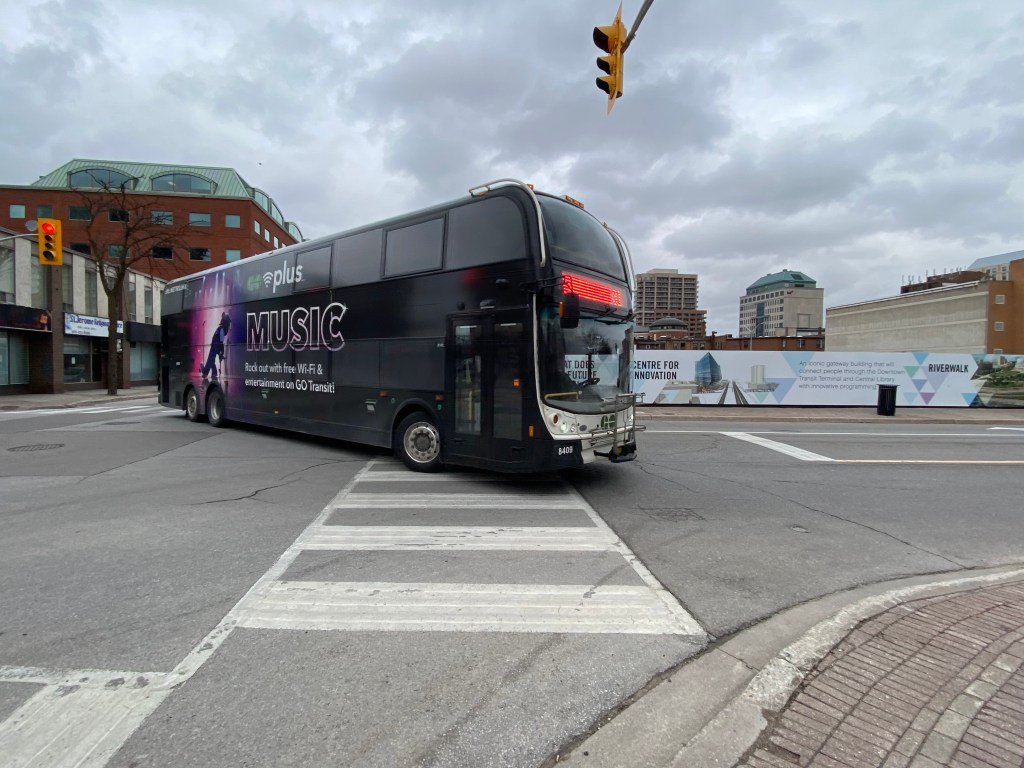
    A Go Transit double decker bus completely covered by a vinyl wrap, with the exception of the front windows and entrance door. The wrap advertises the transit agency’s wifi and music streaming gimmick.

    Apart from unscheduled short-turns, lengthy delays, or missed transfers, the thing that bothers me most about riding buses or streetcars is an obstructed view caused by a vinyl advertisement wrap.

    Though transit advertisements have been around almost as long as there have been transit services, these advertisements have generally been limited to posters and cards mounted outside the vehicles, or placed inside, above the windows or beside doors. Advertisements have long been placed inside train and subway stations, and in outdoor transit shelters.
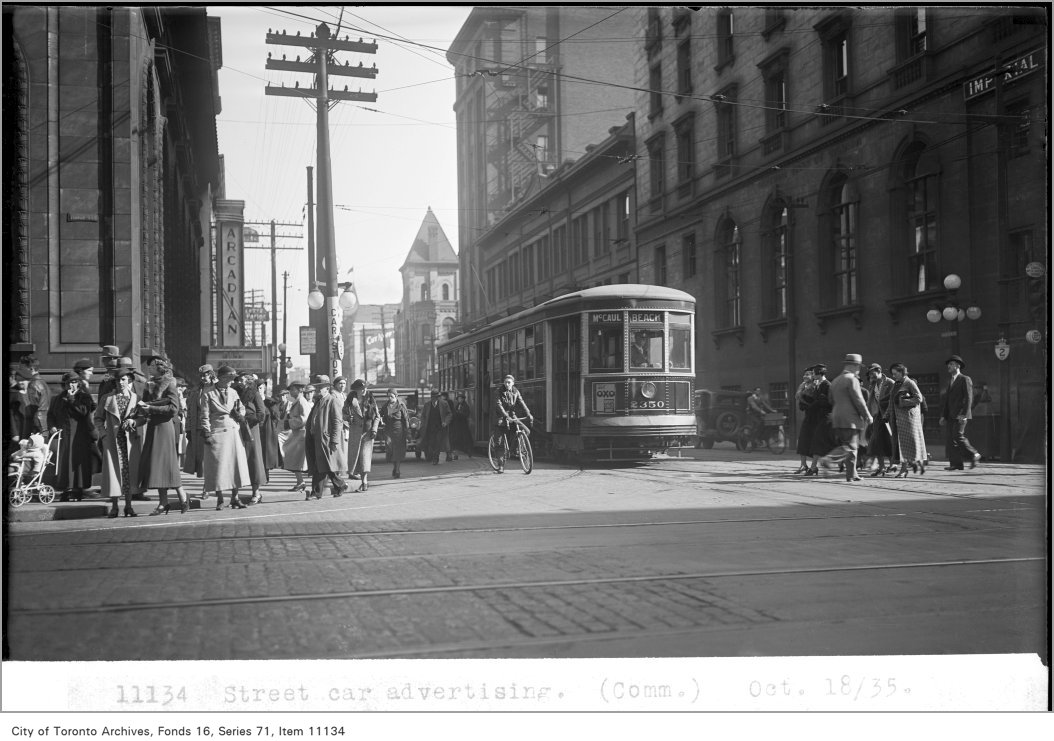
    TTC photograph of streetcar advertising, 1935. The advertisement can be found below the left dash window of the streetcar. City of Toronto Archives Fonds 16, Series 71, Item 11134.

    For advertisers, transit ads provide an ideal vehicle for promoting their goods and services: they can be targeted to specific neighbourhoods that a bus, streetcar, or train passes through; the advertisements move around unlike static billboards, potentially drawing more eyeballs. For transit operators, advertising provides an easy revenue source. Most transit agencies outsource their advertising to larger firms, who are responsible for maintaining accounts and installing and removing ads from vehicles and transit facilities. These companies typically provide an annual payment for the right to advertise on transit vehicles, and at stations and stops.
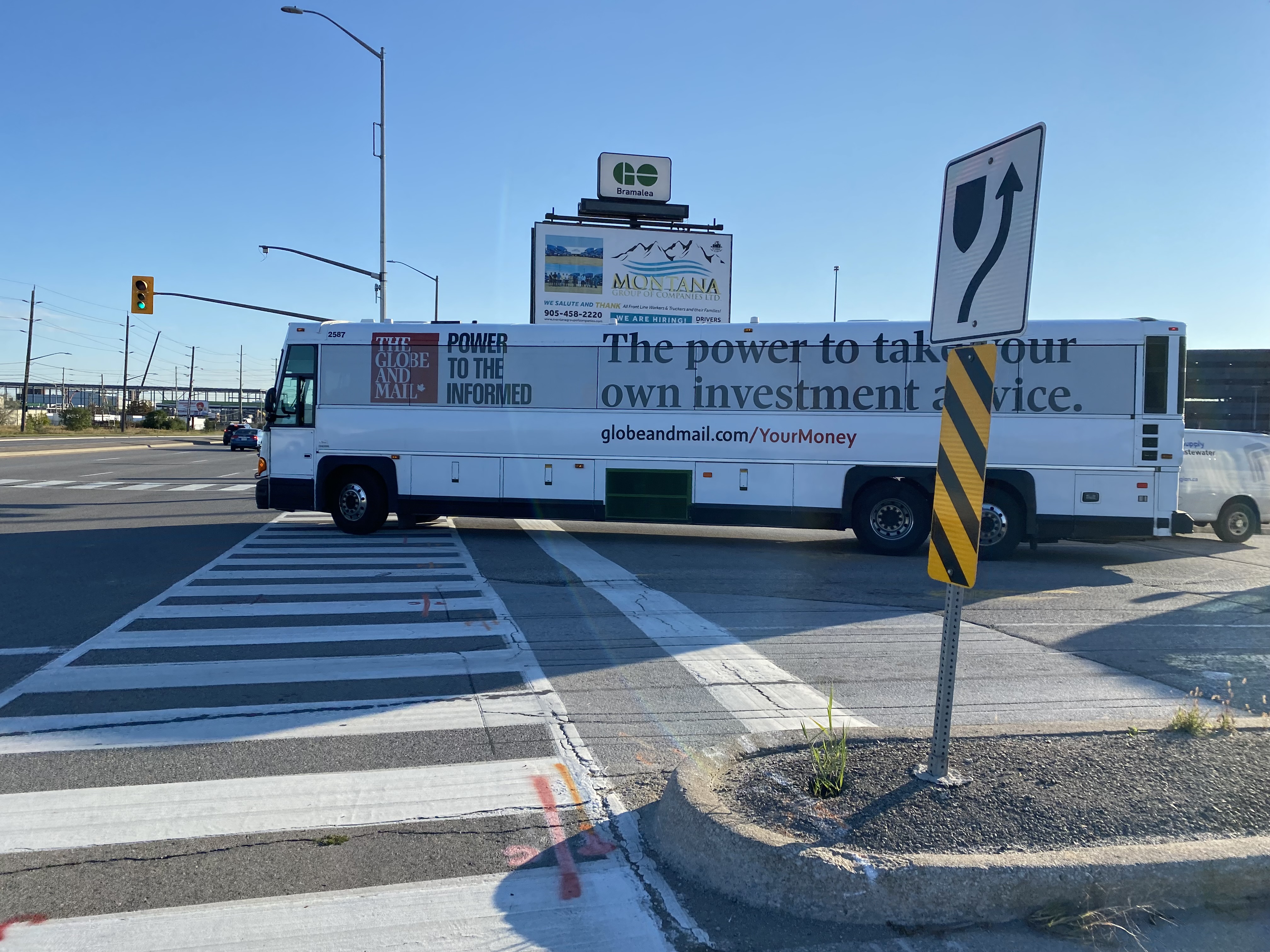
    A GO Transit coach bus departing Bramalea Station, wrapped for a newspaper’s investment news service; all passenger windows are obscured by the advertising wrap

    Though vinyl decals on transit vehicles are not a new innovation (advertisements in the late 1980s and early 1990s were typically opaque, sometimes covering parts of passenger windows) more recent technology has allowed for perforated vinyl wraps that fully cover windows, while providing an obscured outside view through small dots. While the vehicle is moving, a passenger inside may be able to see where they are, but not be able to read signage or see details. For some, not having a clear view of forward motion can contribute to motion sickness.

    The view from the inside (via Chris Livett, on X/Twitter)

    In TTC subway stations and some GO Transit stations, surfaces such as walls, floors, pillars, faregates and even stairways have also become advertising surfaces, a tactic called “station domination.”

    An example of Pattison Outdoor’s “station domination” advertising, with a traditional ad poster at right, an installed video screen and ad pillar at centre, and stairs covered in ads, at left.

    On occasion, vehicle wraps are used for public relations, rather than advertising. GO Transit and the TTC’s Pride buses are a good example of this. A more shameful example was the TTC’s messaging about fare evasion which took place in late 2019 and early 2020, just before the COVID-19 pandemic.

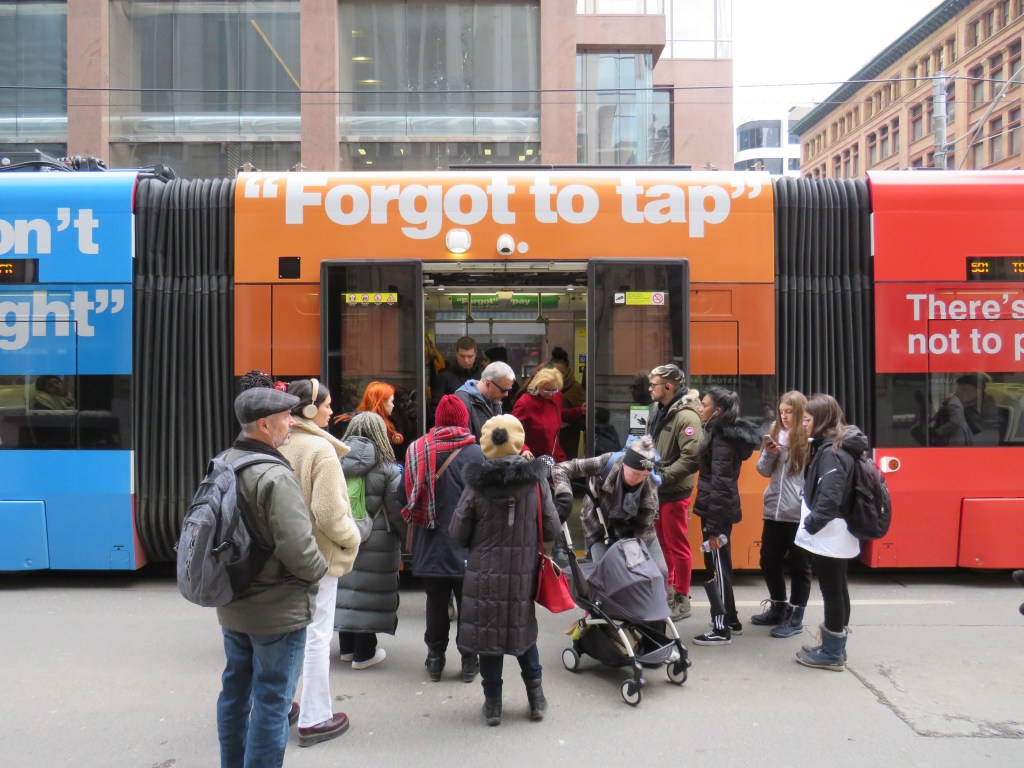
    “Forgot to tap” – part of a TTC streetcar wrap used in late 2019 and early 2020

    For the most part, the TTC does not allow ad wraps to completely obscure bus and streetcar windows, but allows up to 70 percent of the passenger windows to be covered, either in a “strip” format (where only the lower parts of the windows are kept uncovered) or “mural” format (where three of five sections of a streetcar are fully covered). Other agencies, like the Hamilton Street Railway, allow for complete vehicle wraps.


    In Waterloo Region, Regional Councillors just considered a motion to increase the number of wrapped Grand River Transit buses and — for the first time — on ION LRT cars. The appendix to the staff report recommending the increased number of advertising wraps depicts a rail car in a Tropicana wrap, with the windows partially obscured.
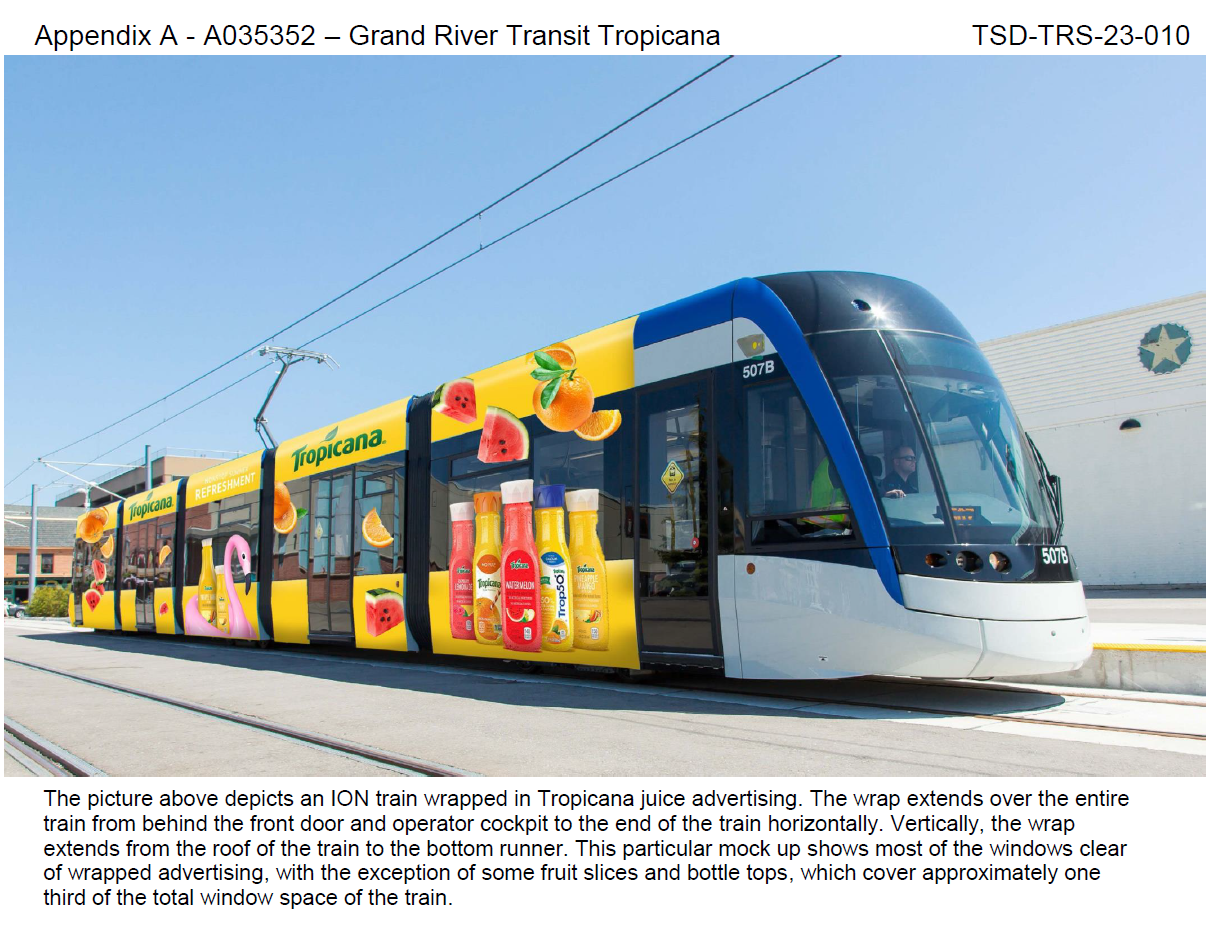
    Depiction of what an advertising wrap would look like on an ION LRT rail car, from the October 10 agenda of the Regional Municipality of Waterloo Planning and Works Committee

    According to the report, the Region of Waterloo/Grand River Transit has a contract with Pattison Outdoor — one of Canada’s largest advertising firms — that allows for a total of five buses to be wrapped at any one time. GRT and Pattison want to increase this to ten percent of the total bus fleet, which numbers over 250. It also seeks to wrap one ION rail car at a time, with the promise that windows would not be fully covered and convert some static back-lit shelter ads to digital ads.

    Currently, Waterloo Region receives guaranteed revenue from its contract with Pattison, averaging $1,546,500 a year, though the total revenue is projected to reach $1,800,000 for 2023, as ridership increases. Allowing for wraps on 20 more buses and one ION railcar is estimated to net an additional amount up to $500,000.

    It’s worth noting that the report notes a 2018 recommendation against advertising on the exterior of LRT vehicles “due to concerns of diminishing the ION brand.” This restriction was also carried to ION-branded buses that follow the planned LRT extension between Fairway Station and Cambridge. It also notes strong public feedback against covering windows, and proposes to do so, “to maintain the customer experience.”

    The Region of Waterloo’s entire Transit Services budget — including paratransit — for 2023 is $207,203,000, with transit fares bringing $46,143,000 of that – a 22.3% farebox ratio (property tax and provincial grants cover the difference). $2.3 million brought in from all advertising revenue — traditional poster ads and transit wraps — is not an insignificant sum, but it makes up just over 1% of the entire transit operating budget. In Toronto, the TTC’s 12-year, $324-million contract — also with Pattison Outdoor — brings in a total of $27 million a year, or 1.1% of the entire TTC budget.

    At least Waterloo Region staff recognize that transit customers don’t like advertisements that obscure windows. They also acknowledge that transit wraps diminish the transit brand. For a revenue source that represents a mere drop in the bucket, why do transit agencies keep allowing them on their vehicles?
  • The TTC needs customer buy-in, not a campaign of scolding its passengers

    The TTC needs customer buy-in, not a campaign of scolding its passengers

    “Forgot to tap”

    Imagine any retail store welcoming its customers the way the Toronto Transit Commission does these days.

    This week, at least two TTC streetcars were wrapped with messages promoting the transit agency’s new aggressive anti-fare evasion campaign. Any passenger caught by fare inspectors or special constables without a valid fare is subject to a fine of up to $425.

    As a regular, fare-paying passenger, I am sympathetic to the TTC’s need to balance its books — it relies on transit fares for 68 percent of its $2.14 billion operating budget — but the more aggressive fare enforcement program — including advertisements inside vehicles and stations and hiring 50 more fare inspectors in 2020 — is insulting to its customers.

    Typically, businesses and public services strive to welcome their clientele and promote themselves to potential new customers. At one time, the TTC even ran television commercials, with a particular focus on promoting off-peak ridership.

    Not anymore.

    Customer notices on posters and on the PA system are restricted to subway closure notices, reminders about etiquette, and now warnings of $425 fines for not tapping a Presto card. Riders are no longer thanked for using the TTC. Instead, we’re subjected to poor and inconsistent service, streetcar shortages, regular weekend subway closures, fare hikes, and repeals of recent fare integration measures, along with lectures on fare payment.

    Other transit and municipal politics writers, including Steve MunroMatt Elliott, and Ben Spurr have written about the TTC’s push for stricter fare enforcement as well as the problems passengers have when paying, including malfunctioning Presto readers and fare payment machines, and overcrowded vehicles. Fare payment machines do not accept bank notes, debit, or credit cards. Though the TTC estimates that 5.7 percent of all riders engage in fare evasion, the rate on streetcars, where passengers board from all doors and tap or pay on board, is 15.9 percent.

    There has been an inconsistent approach to fare enforcement, with inspectors commonly found at streetcar terminals at subway stations. There are reports and credible accusations of racial profiling by fare enforcement officers.

    A friendlier and more wholesome approach would be addressing the technical problems, including the reliability of fare machines, and replacing generic Presto cards being used for child fares that other passengers — such as York University Station — are illegitimately using. There should also be a friendlier education campaign, enforcement discretion, and less aggressive behaviour towards customers, would make far more sense. If the TTC is truly interested in “disrupting” negative behaviour, it should adopt a customer service model, and address the distrust towards its officers from racialized and economically marginalized communities.

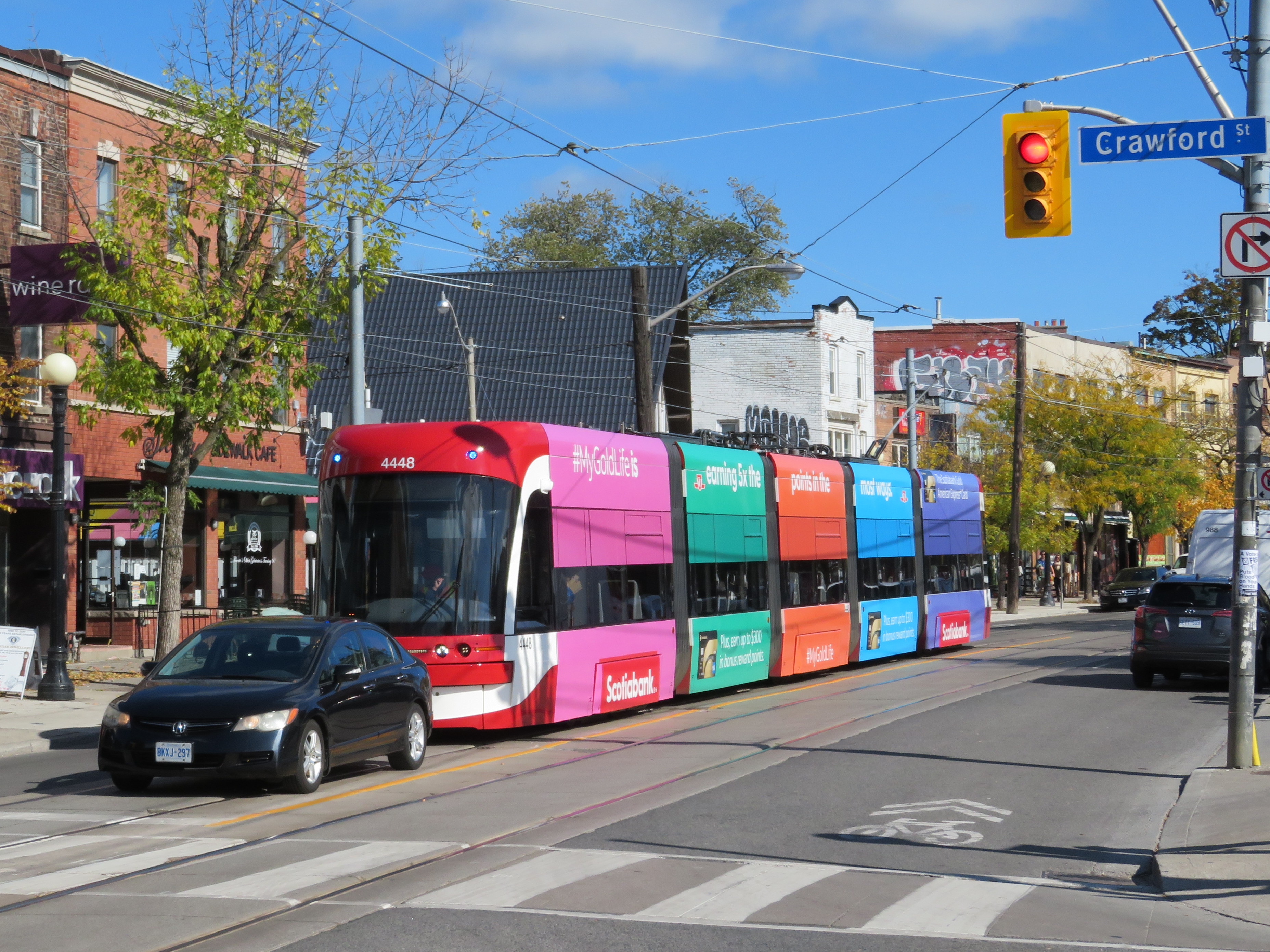
    Putting aside the bad optics of the crackdown on fare evasion, transit ad wraps are an insult to transit riders. Furthermore, they are a detriment to the brand. Toronto’s streetcars are an icon of this great city; this is cheapened by gigantic ads for Starbucks, Sephora, or Scotiabank.

    Inside, the large panoramic windows are obscured by perforated vinyl sheeting that is difficult to see out of. Though the vinyl wraps leave a sliver at seat level, the view is obstructed for anyone standing on a crowded vehicle.

    A typical streetcar advertising wrap

    The current 12-year, $324-million contract with Pattison Outdoor brings in a total of $27 million a year. The contract includes interior and exterior transit advertising (traditional placards, posters in stations and vehicles, and wraps). In total, advertising in all forms represents 1.1 percent of the entire TTC budget, with wraps representing a small portion of that. These wraps, commissioned by the TTC itself, are part of the contact.

    The streetcar wraps that scold, rather than welcome, riders are even more of an insult. What message do they send to visitors to Toronto? And what message do they send to potential riders?

    Customer buy-in is about so much more than just paying one’s fare. The TTC should realize that.