
On June 30, 2026, the Toronto Star featured a story about the City of Oshawa’s “lofty plan” to build a new urban aerial gondola system above Simcoe Street, that community’s main north-south corridor. While the technology is novel, it is a fundamentally bad idea for what the regional government proposes it for. Simcoe Street is currently served by the busiest bus route in Durham Region – Route 901 Pulse – as well as several GO Transit buses (routes 52, 56, and 92).
Gondolas have their place in the urban transit toolbox and they have several advantages. They can be inexpensive to build, as they require minimal right-of-way acquisition and do not require tunnelling. They are adept for climbing steep hills and can offer very frequent service with low operating costs. Gondolas can operate in all sorts of weather conditions, from tropical cities to mountain ski resorts. Modern gondola or cable lift operations allow each car to slow or stop at each station to allow passengers to comfortably board and alight, unlike older, traditional ski lifts. The technology is popular in Latin American cities such as Medellín, Colombia (where the Metrocable system feeds that city’s metro), and La Paz, Bolivia, where a network of Mi Teleférico lines makes up the backbone of the transit service.
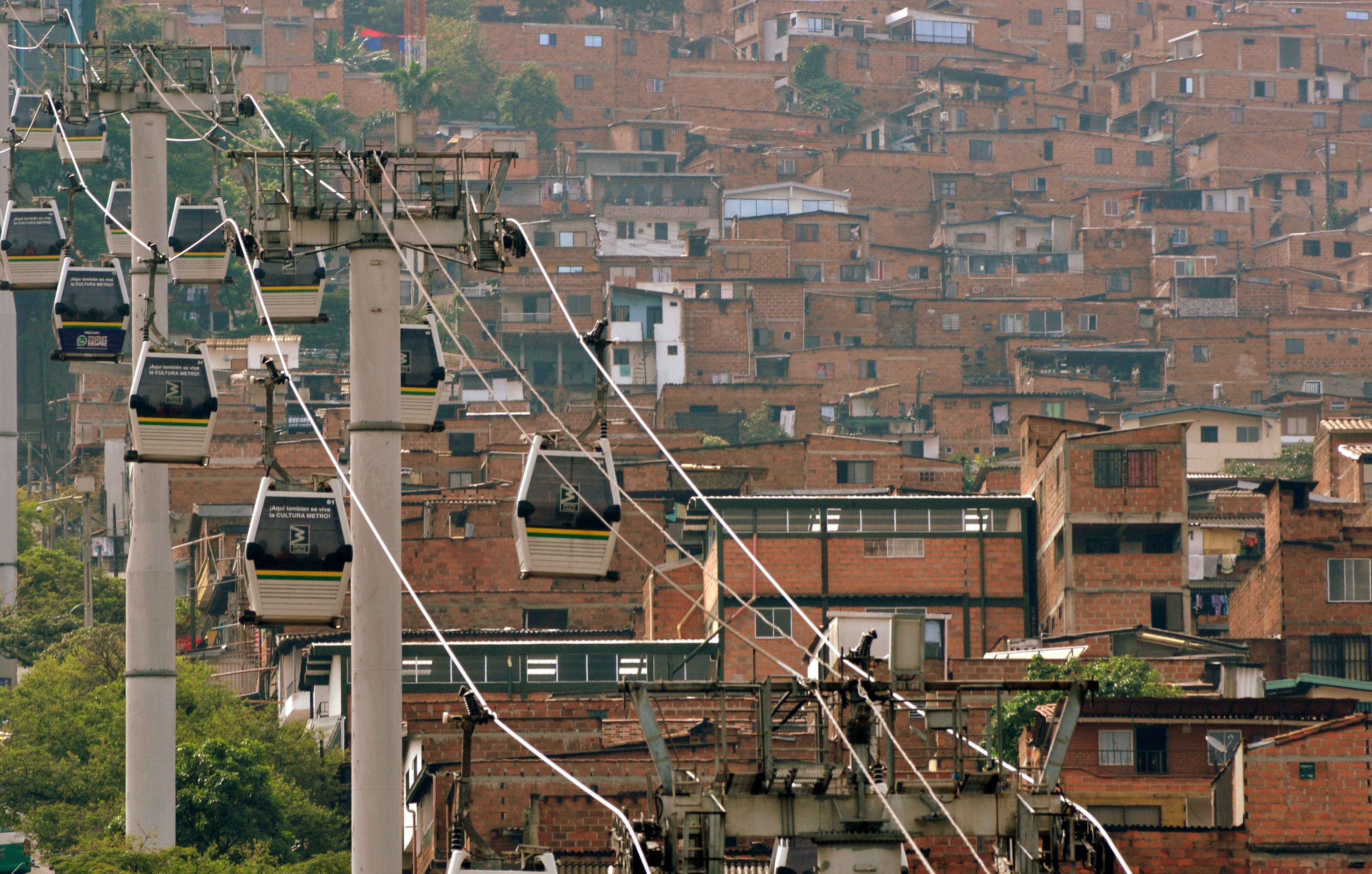
But in those hilly cities in developing countries, the gondolas cover short distances (only between two and five stations per line) and have limited capacity (Mexico City’s Mexicable line has an hourly capacity of just 3,000 per hour). In the United States, the only transit-based aerial cable cars are the Roosevelt Island Tramway in New York and the Portland Aerial Tram, which charges a very high $9 round-trip fare to the general public. In Canada, the most serious gondola proposal would connect Simon Fraser University with the Skytrain in Burnaby, BC and be part of the Translink network. That proposal – though stalled – is logical as it involves just two stations and allows passengers to easily access the university campus located at the top of Burnaby Mountain, reducing the number of buses that have to climb that long, winding access road.
In contrast, the idea of a gondola running over Simcoe Street in Oshawa makes very little sense, and it seems that the concept will not get beyond a consultant’s report. There are far more reasonable alternatives that merit a closer look, including simple painted bus lanes and other “BRT-lite” measures that can benefit both Durham Region Transit (DRT) and GO Transit passengers.
Oshawa’s transit past and future
Simcoe Street, Oshawa’s backbone, has always been the key to Oshawa’s development as an industrial centre; its future opportunities also line the corridor; good transit is essential.
Established as a small village at the crossroads of Kingston Road and Simcoe Street (an early “colonialization road” that connected Lake Ontario with Lake Scugog), Oshawa grew as an industrial centre starting in the 1870s, when Robert McLaughlin’s carriage works moved to expanded facilities in Oshawa to be nearer the Grand Trunk Railway (GTR) and Oshawa Harbour. As more industries followed, a streetcar line, the first component of the Oshawa Railway Company (OR) was built on Simcoe Street in 1895 to connect the burgeoning downtown with the GTR station and harbour to the south. The original Simcoe Street line was built with several freight spurs to allow shippers direct rail access to their properties. Residents could take the streetcar down to Lakeview Park to relax or to beat the summer heat.
As industry grew (the McLaughlin Carriage Works moved into automobile manufacturing starting in 1907, eventually becoming the founding component of General Motors Canada) OR built a new freight-only electric line east of Simcoe Street with direct freight yard connections with the GTR. When the Canadian Pacific and Canadian Northern Railways built new lines through the Oshawa area, the OR connected with those as well. The incomplete Toronto Eastern Railway, a failed interurban line along Kingston Road, provided some use to OR as it provided access to several customers along the TER’s completed section of track.
Though buses replaced passenger service on the single-track Simcoe Street streetcar line in 1940, OR’s freight operations remained busy until the 1960s, with the last electric locomotive withdrawn in 1964. Oshawa’s bus service was taken over by Durham Region Transit in 2006.
When GM opened a modern assembly complex south of the new Highway 401 in 1950, it slowly abandoned its older plants north and west of the downtown core. Its new property had direct CN and CP rail connections and no longer relied on the OR. Meanwhile, other factories such as A.G. Simpson, Duplate/Pittsburgh Plate Glass, Fittings Limited, Ontario Malleable Iron, and Pedlar People, either closed or stopped relying on rail shipments. The old OR tracks, operated by CN diesels in the last few decades, disappeared in the 1990s, replaced by the Michael Starr multi-use trail north of Highway 401. The last remnant of the Oshawa Railway, a Highway 401 overpass built in the late 1930s, was demolished in 2011.
After OR removed its remaining downtown trackage in the 1960s, a one-way road system was implemented in Downtown Oshawa. Simcoe Street became northbound-only between Brock and Elm Streets with Centre Street taking on southbound traffic. King Street was twinned with Bond Street, which followed the disused Toronto Eastern Railway tracks. This helped to speed traffic through the downtown core.
Many of the older industrial lands saw new uses: Most of the old GM North Plant properties are now home to apartment buildings, the Durham Regional Courthouse, and a big box retail complex anchored by Costco Wholesale. The Pedlar People plant was demolished to become a Zellers-anchored plaza on Simcoe Street South. The Ontario Malleable Iron factory became a Knob Hill Farms supermarket which operated between 1981 and 2000. That plant, now mostly demolished, is to be the site of a new GO Transit station; surrounding property, including the old PPG plant, is designated for future development.
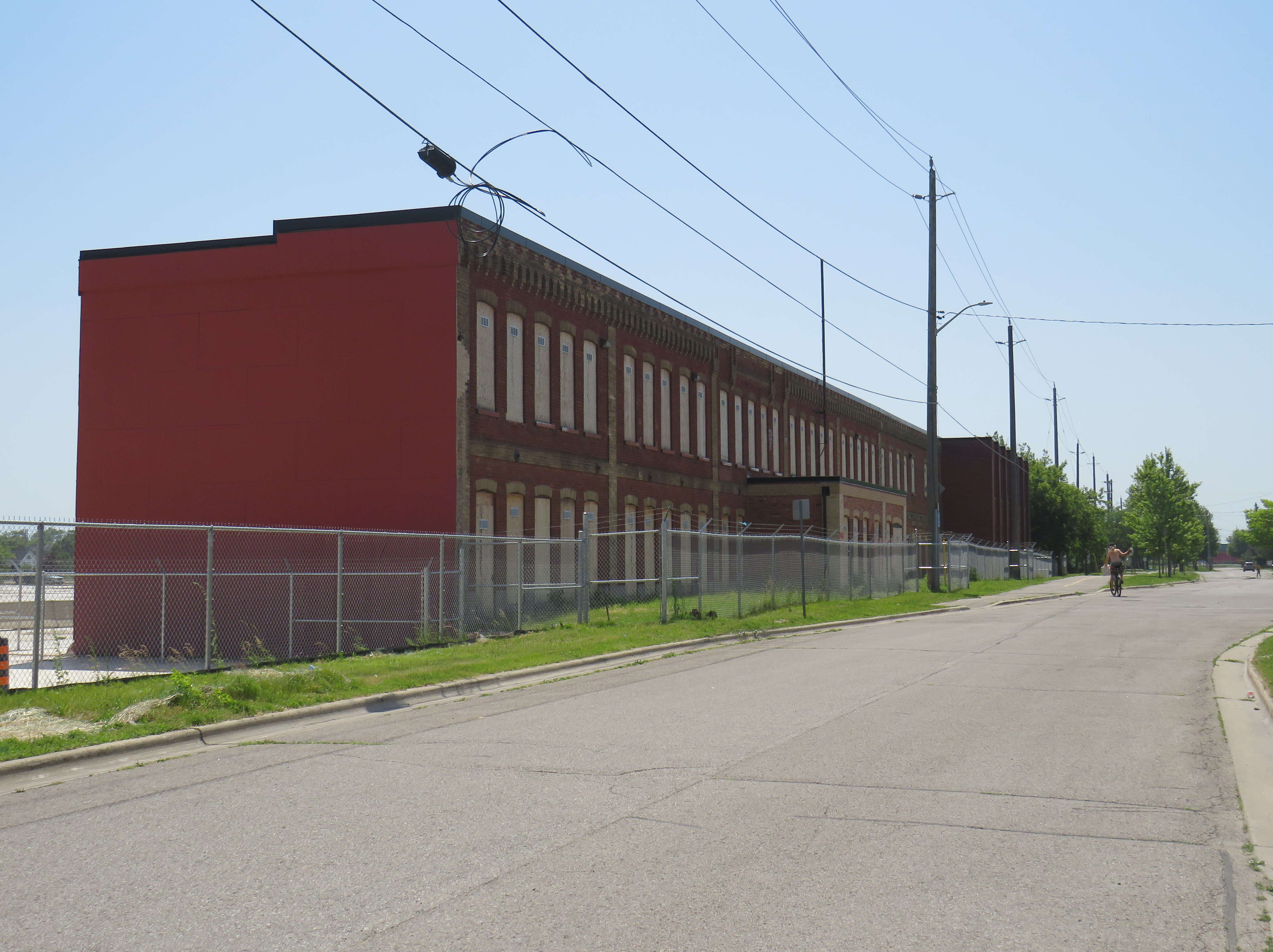
The construction of Highway 401 and changes to intercity rail also changed Oshawa considerably. As Toronto grew and GM’s influence began to decline, Oshawa became part of the metropolitan commutershed. CN closed the old GTR station off Simcoe Street and built a new modern station between Oshawa and Whitby in 1967, consolidating passenger service for those two communities at a single location with space for commuter parking. Though GO Transit was also established that year, its trains only went as far east as Pickering; GO bus service via Highway 401 and via Highway 2 extended the provincial agency’s reach to Oshawa until 1995, when the Lakeshore East line was fully extended to Oshawa.

With the decline of General Motors’ Canadian operations along with many of its feeder plants, Oshawa’s economy shifted towards education and government services while becoming more of a Toronto suburb rather than an independent industrial centre. The downtown hockey arena/entertainment venue, which opened as the General Motors Centre, is now named for Tribute Communities, a residential developer. Durham College’s campus, on the north end of the city, has grown and now includes Ontario Tech University. Between the campus and downtown is the main Lakeridge Health campus, which is the largest hospital in Durham Region.
As Oshawa and its postsecondary educations have continued to grow, it is no wonder that Durham Region Transit’s 901 Simcoe Street bus – the successor to the old Oshawa Railway streetcar – is so busy and congested. But a gondola is not the right solution, either.
Why better buses are the answer

As Metrolinx starts work on the Bowmanville GO Transit expansion – which will extend the Lakeshore East rail corridor into central Oshawa and eastward into Clarington – it is replacing the Simcoe Street bridge over the CPKC tracks, a two-year project that has forced the closure of Oshawa’s main street south of downtown. Most north-south traffic now follows Ritson Road, Park Road, or Stevenson Road. Though traffic is heavier on each of those alternatives (especially on Ritson), Oshawa is coping without experiencing complete gridlock.

Ideally, when the Simcoe Street bridge reopens in late 2027 or early 2028, two of its lanes could be dedicated to DRT and GO buses. These bus-only lanes can then extend northwards towards Downtown Oshawa, Lakeridge Hospital, and Durham College/Ontario Tech. As some of Oshawa’s most important destinations, such as the Oshawa Centre shopping mall and the Oshawa GO/VIA Rail station, are off Simcoe Street, buses can divert on and off the bus lanes to serve those, and other, trip generators; a gondola would not be able to do so.
As the Bowmanville extension of the Lakeshore East GO service will see limited service (peak-direction train service during rush hours and limited off-peak runs) along with a low-speed diversion from the GO corridor to the CPKC line, many passengers connecting to GO towards Toronto would still choose to transfer at the main GO/VIA station.
As the planned new Oshawa Centre GO Station is located on the old Malleable Iron/Knob Hill site two blocks east of Simcoe Street, a gondola would have to swing over to serve it or force a long walking transfer. Depending on how bus service on Simcoe Street is planned by DRT, buses could either divert to serve it, or a dedicated route could provide that connection.

Furthermore, the former Oshawa Railway lands can be better utilized for active transportation purposes. Though the Michael Starr trail runs all the way from Lviv Boulevard (just north of Highway 401) to Taunton Road, it is treated as a recreational trail, rather than a vital transport link. At most crossings, east-west motor traffic is prioritized over pedestrians and cyclists, with “stop and dismount” signs at many trail crossings. There is also a considerable gap between Bruce Street south of Downtown Oshawa and Adelaide Street to the north, as the OR followed Bruce Street and Ritson Road to serve GM’s north plant.
Creating a high-quality through cycling path using part of the OR/Michael Starr right-of-way and improving the existing bike lanes on Mary Street through Downtown Oshawa and extending it to Durham College/Ontario Tech can divert some DRT passengers between the future GO station, the downtown, the hospital, and the campus, and get at least a few car drivers to switch to active transport modes.

If built, Oshawa’s 13-kilometre, 16-station gondola line would be the longest urban aerial transit route in the world and while it might allow for the retention of four lanes of traffic on Simcoe Street, land would still be required to build the towers, stations, and maintenance facility. Buildings will still have to be demolished. The gondola’s capacity would be limited. The estimated $1.1 billion spent on gondola towers, stations, and vehicles could be much better spent.
Once better bus and active transportation infrastructure is provided, Oshawa might find that the fears of Simcoe Street gridlock may not come to pass. An expensive median busway is not necessarily the answer either: simple reserved lanes, enhanced bus stops with off-board fare payment and all-door bus boarding, signal priority and queue-jumps at busy intersections could do a lot in the short term. Yes, that would mean inconvenience for drivers, but the Metrolinx construction on Simcoe Street south is already an inconvenience.
Unfortunately, the costs of maintaining this website and the ArcGIS Online portal to my maps continue to rise. However, I am committed to provide an ad-free, paywall-free resource. If you enjoy my work, please consider buying me a coffee to help with those costs. Thank you!

