In 2018, Etobicoke went three for three in returning hard-line conservative councillors to City Hall. In Ward 3, Mark Grimes was re-elected despite several controversies, with Mayor John Tory’s help. In Ward 1 and Ward 2, councillors with famous names were re-elected, cementing local political legacies. While the results in Ward 1 Etobicoke North were predictable, the results in Ward 2 Etobicoke Centre were disappointing.
Under the previous 44 wards and the approved 47-ward model, Etobicoke had six seats on Toronto City Council. With the 25 wards forced on the city when Bill 5 came into law, they were reduced to three.
Ward 1 — Etobicoke North
Prior to the new ward boundaries coming into effect, old Ward 1 was represented by Vincent Crisanti. Ward 1 sits in the far northwestern part of Toronto, bounded by Steeles Avenue and Highway 427, as well as the West Humber River to the south and the East Humber River. Its boundaries would not have changed in the 47-ward model.
Crisanti was first elected in 2010, defeating incumbent centrist Suzan Hall. Crisanti was a reliable ally during the first few years of Rob Ford’s disastrous mayoralty. Despite this, he was named one of Tory’s four deputy mayors after the 2014 election. This lasted until September 2017 when Crisanti publicly backed Doug Ford’s plan to run against Tory again for mayor.
Ward 2 was the domain of the Ford family. Rob Ford was first elected there in 2000, and had made a name for himself both for his constituency work and for his outspoken behaviour at City Hall. Ford was on the lone side of many 44-1 votes while David Miller was mayor. He ran for mayor in 2010 and won after Miller decided against a third term; his brother, Doug, was elected in Rob’s place in Ward 2. Doug never had Rob’s personal touch. Instead his time as councillor was focused on enabling Rob’s self-destructive behaviour, creating distractions, and coming up with waterfront land schemes that helped to erode Rob Ford’s authority on council, two years before the crack scandal broke. Doug even declared that his under-served ward had too many libraries and expressed his eagerness to close them, starting a fight with Margaret Atwood.
Early in 2014, his work done, Doug Ford was ready to bow out. Rob and Doug’s 20-year-old nephew, Michael Stirpe, changed his last name to Ford, and registered to run in his uncles’ place. But in September 2014, Rob abandoned his bid for re-election for mayor due to his poor health and Doug ran instead. Michael withdrew in September 2014 to run for the local Toronto District School Board trustee position so Rob could run in his old ward. Rob won in Ward 2 easily, getting 58.8 percent of the vote, while Doug came in second place in the mayoral race.
Toronto would continue to be haunted by Doug Ford.
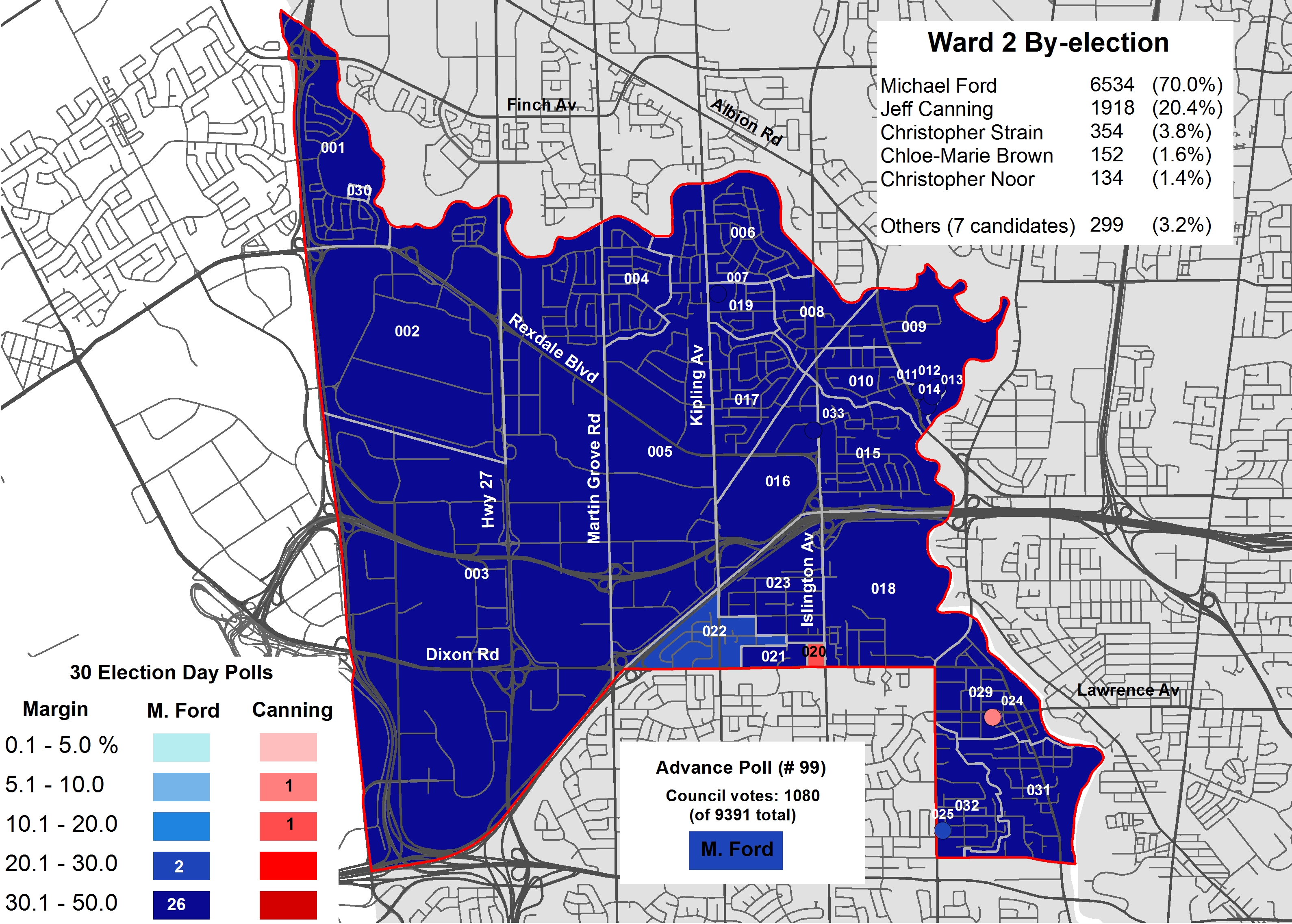
After Rob Ford’s death in March 2016, Michael Ford ran in a summer by-election, getting 70 percent of the vote, though only 9391 voters bothered to turn out. It was looking like Michael Ford would easily win again in 2018.
But then Doug Ford engineered a takeover of the Ontario Progressive Conservatives, won the June 2018 provincial election, and wrecked local democracy in Toronto by imposing cuts to city council to just 25 wards. Despite his loyalty, Vincent Crisanti was just one more victim.
Michael Ford was re-elected easily in the new combined Ward 1 with 42.3 percent of the vote, compared to Crisanti’s 34.3 percent. Other candidates such as Naiima Farah and Carol Royer spoke to the need for political change in a ward where three-quarters of the population are visible minorities. The Toronto Star endorsed Royer, a local entrepreneur and community activist, but she placed fifth, with just over 2 percent of the vote. Farah came in third, but got just 9 percent of the vote.
Crisanti placed first in his old ward, getting 41 percent of the vote there while Michael Ford got 35 percent. In former Ward 2, Ford got over 50 percent of the vote compared to Crisanti’s 29 percent. Michael Ford had the support of his uncle; there were also over 2,000 more votes in the southern half of the ward. The result was not at all surprising.
Farah placed first in two polls: Poll 055 on Dixon Road, and Poll 060, a highrise apartment near Eglinton Avenue and Martin Grove Road. Poll 055 is the home of many new immigrants, including a large Somali-Canadian community. Yet again, it was a shame that new voices, especially persons of colour, were shut out of this municipal election.
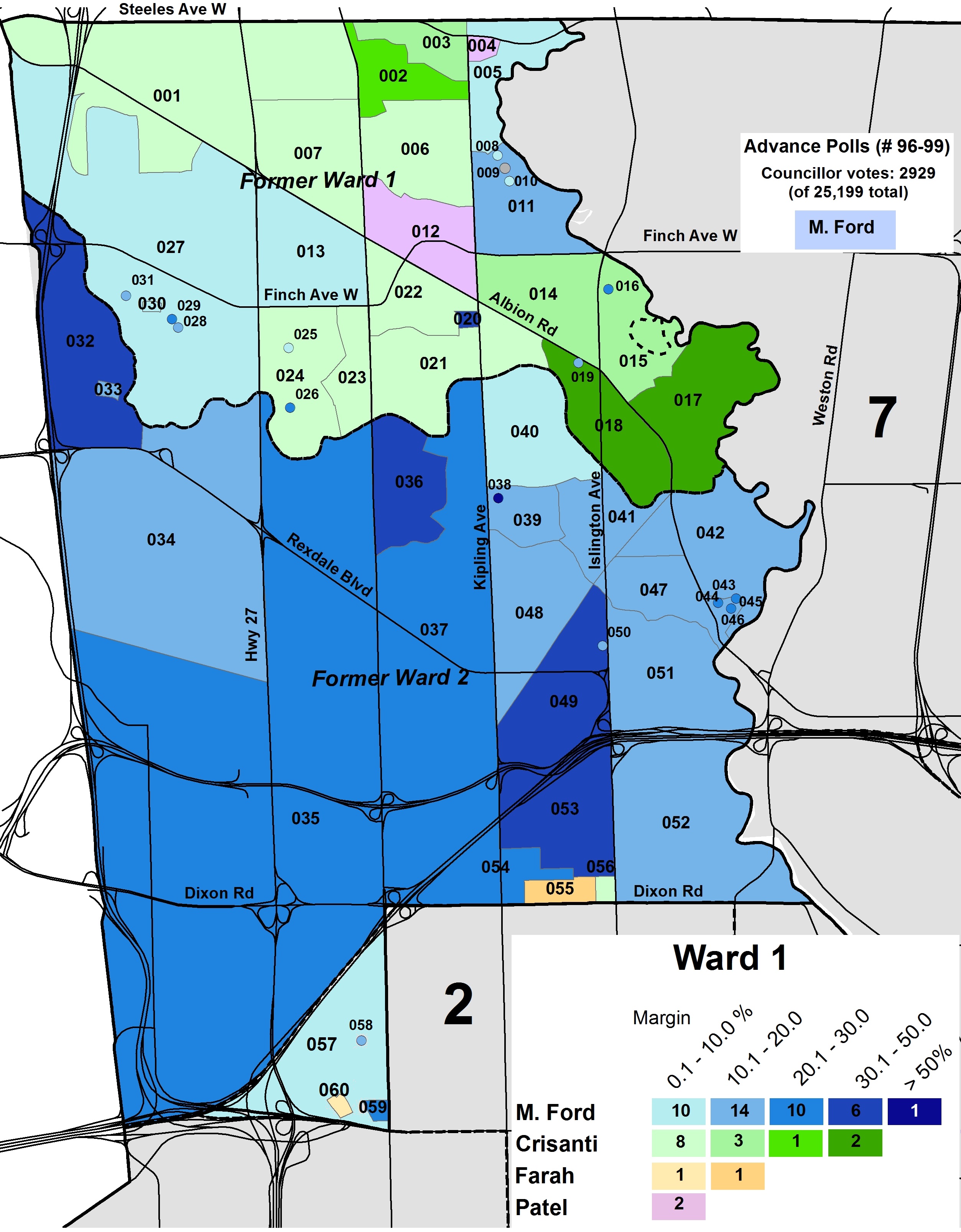
Poll-level results in Ward 1, Etobicoke North
Ward 2 — Etobicoke Centre
Bill 5 also resulted in the amalgamation of former Wards 3 and 4.
Ward 3 was represented by Stephen Holyday, the son of former Etobicoke mayor, Toronto councillor ,and one-time Ontario PC MPP Doug Holyday. The younger Holyday was first elected in 2014 and has been a reliable ally of John Tory, named one of Tory’s deputy mayors after Crisanti was stripped of the title in 2017. Along with Denzil Minnan-Wong, Holyday is one of council’s staunchest conservatives, as well as its most hostile to cyclists.
Ward 4 was represented by John Campbell, a former chair of the Toronto District School Board. While a conservative, Campbell has been a more reasoned voice on city council than his fellow Etobicoke colleagues. For this reason, Campbell was endorsed by the Toronto Star.
Also running were progressive candidate Erica Kelly, previously the NDP candidate in the provincial election, and Angelo Carnevale, who had the support of Doug Ford and Kinga Suma, the controversial Ford-backed PC MPP.
Several polls previously located in old Ward 4 shifted to new Ward 1, while five polls in old Ward 2 shifted to Etobicoke Centre. This gave a slight advantage to Holyday, who did not lose any of his former ward.
It was a close race, but Holyday won with 38.6 percent of the vote, while Campbell got 35.5 percent. Just 1186 votes separated the two incumbent candidates. Holyday was the first choice in all but two polls in former Ward 3 (two polls opted for Erica Kelly), while in former Ward 4, Holyday placed first in nine polls, Campbell placed first in just 28 election-day polls, but did well in the advance polls.
Carnevale, who placed third with 15.1 percent, came first in just one poll, in an area previously represented by the Ford family. But Carnevale, who registered to run against Campbell in the old 47-ward model, helped to take support from Campbell, getting 20 percent of the vote in Campbell’s old turf versus 11 percent in former Ward 3. That, and the fact that there were nearly 3000 more voters in old Ward 3 than in old Ward 4, help to explain how Holyday was returned to city hall.
Last week, Stephen Holyday was one of four suburban councillors named to the new striking committee that makes recommendations for council appointments to important committees, boards, and commissions. It’s quite clear that John Tory will be continuing an austerity agenda while shutting out urban councillors and progressives from decision making. Stephen Holyday will be an important part of that during the next four years.
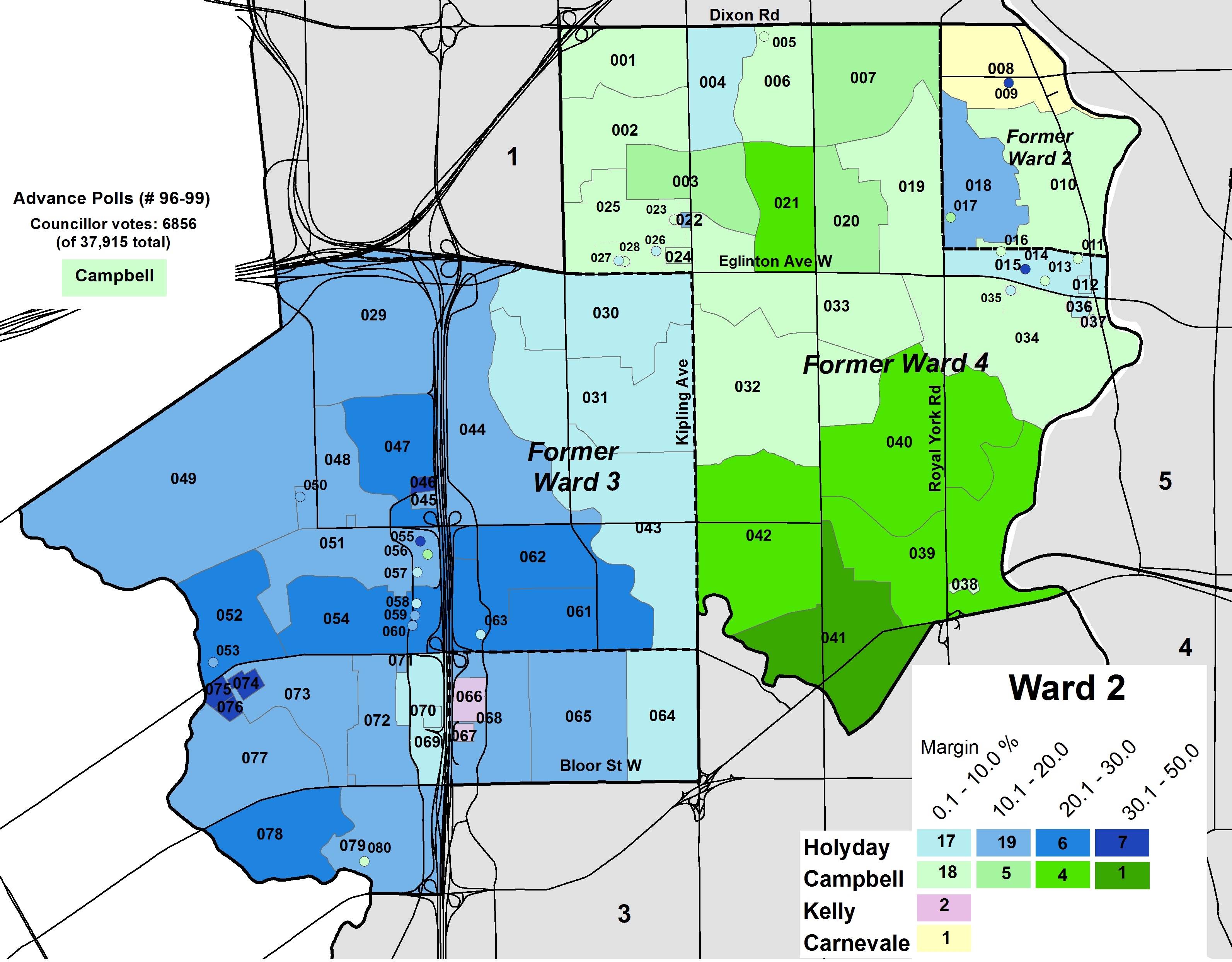 Poll-level results in Ward 2, Etobicoke Centre
| Ward 1 – Etobicoke North | ||
| Candidate | Votes | Percentage |
| Vincent Crisanti | 8,654 | 34.3 |
| Peter D’Gama | 253 | 1.0 |
| Naiima Farah | 2,262 | 9.0 |
| Michael Ford | 10,648 | 42.3 |
| Michelle Garcia | 439 | 1.7 |
| Christopher Noor | 214 | 0.9 |
| Shirish Patel | 1,945 | 7.7 |
| Carol Royer | 642 | 2.6 |
| Ward 2 – Etobicoke Centre | ||
| Candidate | Total Votes | Percentage |
| Bill Boersma | 258 | 0.7 |
| John Campbell | 13441 | 35.5 |
| Angelo Carnevale | 5735 | 15.1 |
| Stephen Holyday | 14627 | 38.6 |
| Erica Kelly | 3854 | 10.2 |