Tag: Timmins

  • The end of the line at Porcupine

    The end of the line at Porcupine

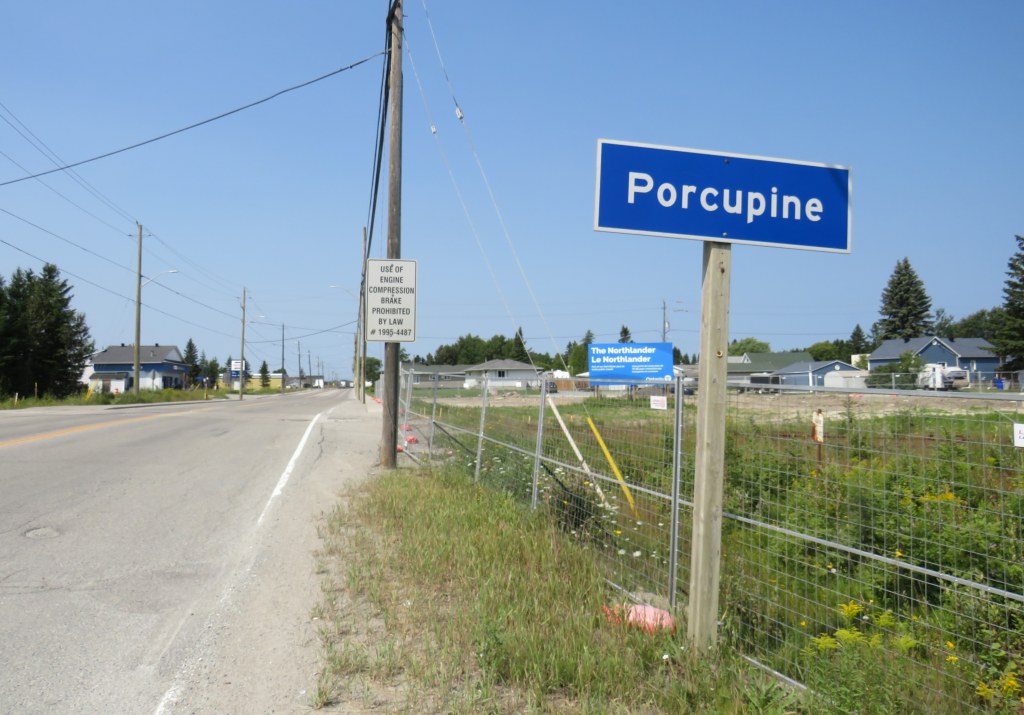
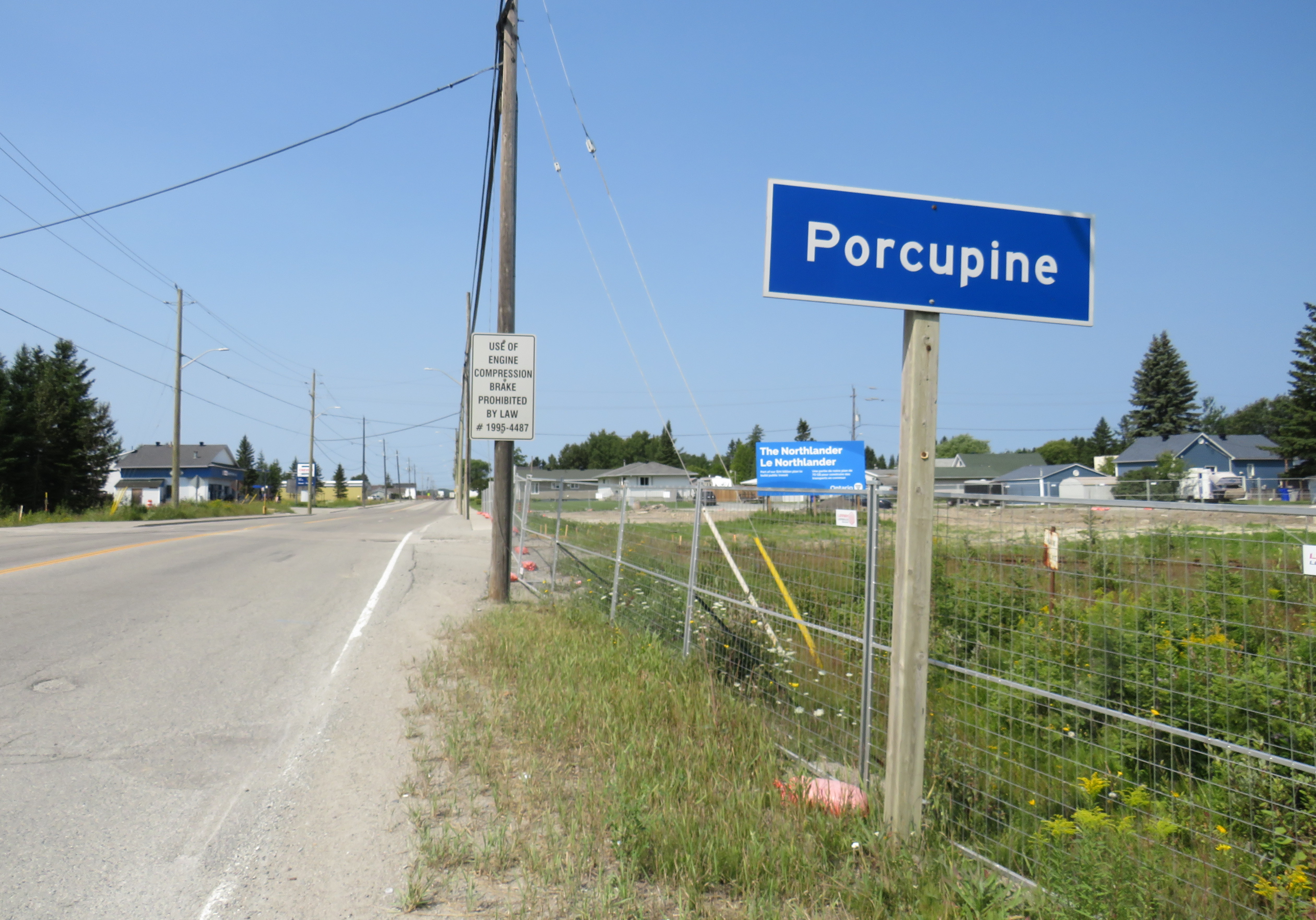
    Sign says "Porcupine" near the new Ontario Northland terminus.
    The end of the line for the restored Northlander train

    Timmins, a resource town of 40,000 in Northeastern Ontario, is known for a few things: gold mines, beer parlours, the birthplace of country musician Shania Twain, and the place where folk musician Stompin’ Tom Connors got his start. If Connors — a travelling musician who delighted small town crowds with songs about their communities (like the hard working and hard drinking times of a “Sudbury Saturday Night”) — was still around, he’d probably write and perform a new song about getting kicked off an overnight train in the sparse environs of Porcupine, Ontario. After all, the song would quickly rhyme itself.

    Porcupine is a small community of about 1,000 on the far eastern edge of the populated area in the geographically gigantic City of Timmins. Before the wave of municipal amalgamations across Ontario in the 1990s and early 2000s, Timmins was the largest city or town in the province by geographic area; it was formed through the amalgamation of the smaller City of Timmins with adjoining Mountjoy and Tisdale Townships (along with the town of South Porcupine) in the 1970s.

    Until 1990, when the devastating cuts to VIA Rail took place, there were two daily trains between Toronto, North Bay, and Northeastern Ontario. The Northlander, a daytime train operated by Ontario Northland Railway, terminated at a downtown station in Timmins. The Northland, a joint VIA/ONR train, ran overnight between Kapuskasing and Toronto, with a bus connection to downtown Timmins. Famously, for a short period the daytime Northlander operated using former Trans-Europ-Express (TEE) cars, purchased used from Dutch and Swiss rail operators.
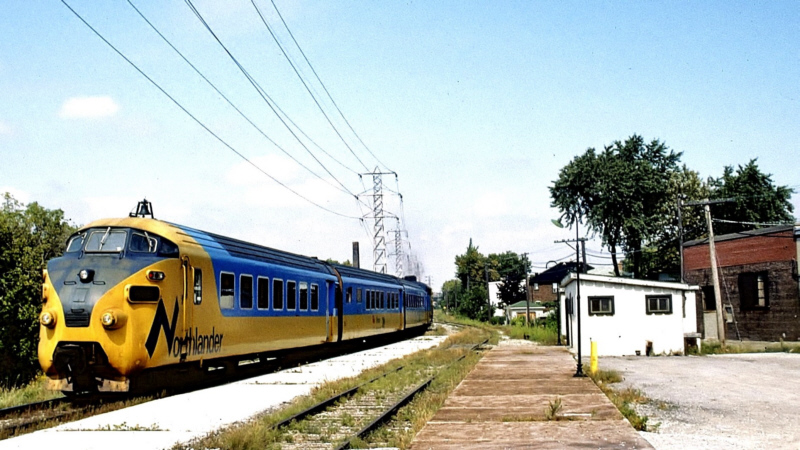
    Northbound Northlander TEE set at St. Clair Avenue in Toronto, by HardHatMak on Flickr

    After 1990, Timmins was only connected by bus, with one daily bus to North Bay (and onwards to Toronto), and one bus, six days a week, to Sudbury (with connections to Toronto). The new daily overnight train — discussed earlier on this site — promises to restore a new daily trip, along with a more comfortable journey, even if sleeping accommodations will not be provided.
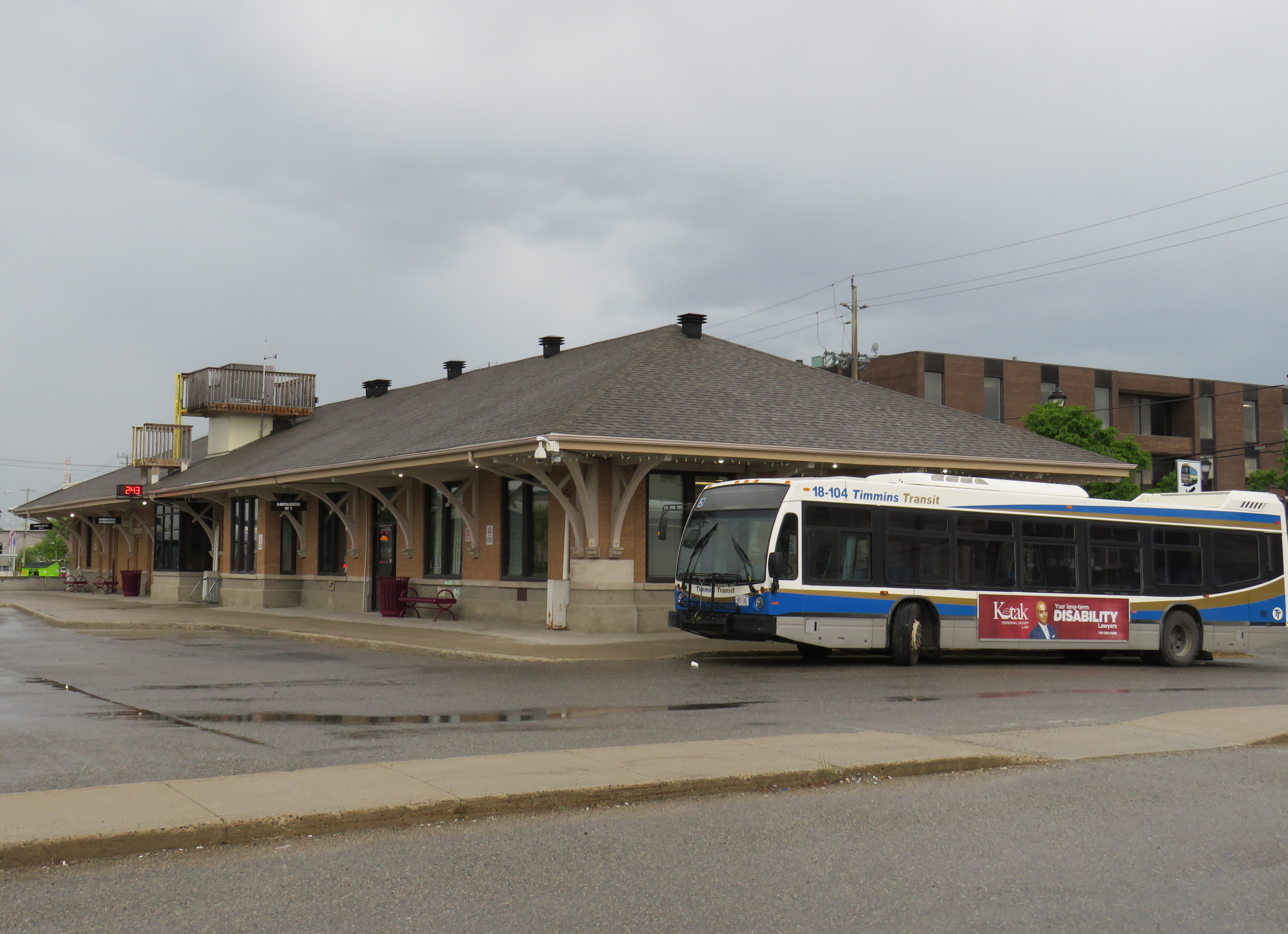
    Timmins Station with transit bus
    The Timmins Station is now a bus terminal serving local transit and Ontario Northland intercity coaches

    Unfortunately, the train will not be returning to Downtown Timmins. The end of rail is at Highway 101 at Porcupine, 13 kilometres to the east. Since abandonment of the passenger rail service, the railway was torn out west of South Porcupine; the railway overpass over Algonquin Boulevard (Highway 101) near the old Timmins Station was removed last year. Ore collected at the open-pit gold mines, previously loaded onto railcars, is now sent on massive dump trucks for processing at a plant at Hoyle, east of Porcupine.
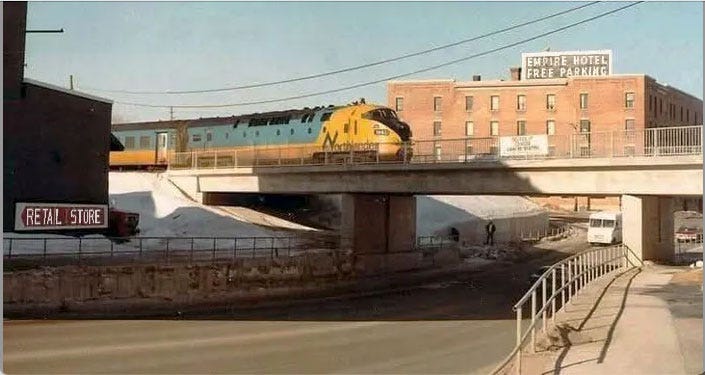
    The Northlander train departs Timmins on the now-demolished railway bridge over Algonquin Boulevard in the early 1980s

    Happily, the Timmins station building remains in use as a transit terminal and Ontario Northland coach stop; it will likely serve a bus shuttle to the new Timmins-Porcupine Station now under construction.
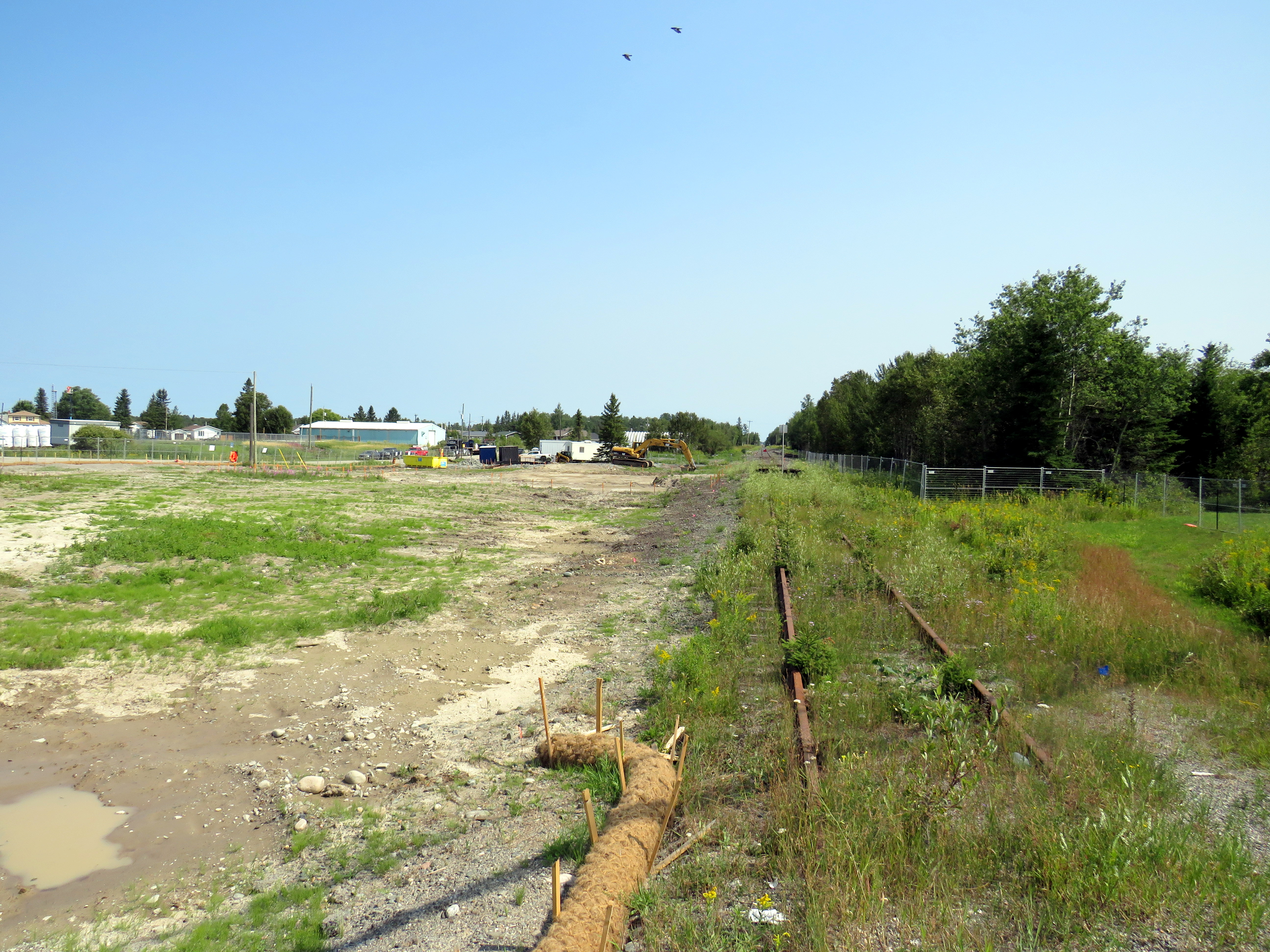
    The end of track at Highway 101 in Porcupine; construction has started on the new terminal station for the Northlander

    Since I last wrote about the promised return of the Northlander, there have been a few updates. The new station building will be somewhat more substantial than first proposed; it will include washrooms, a waiting area, and a service counter for ticket sales and bus parcels. This is welcome, as there is very little around the Porcupine station site. Nearby, there are only a few dozen houses, a propane depot, a small park, and a gas station across the street.
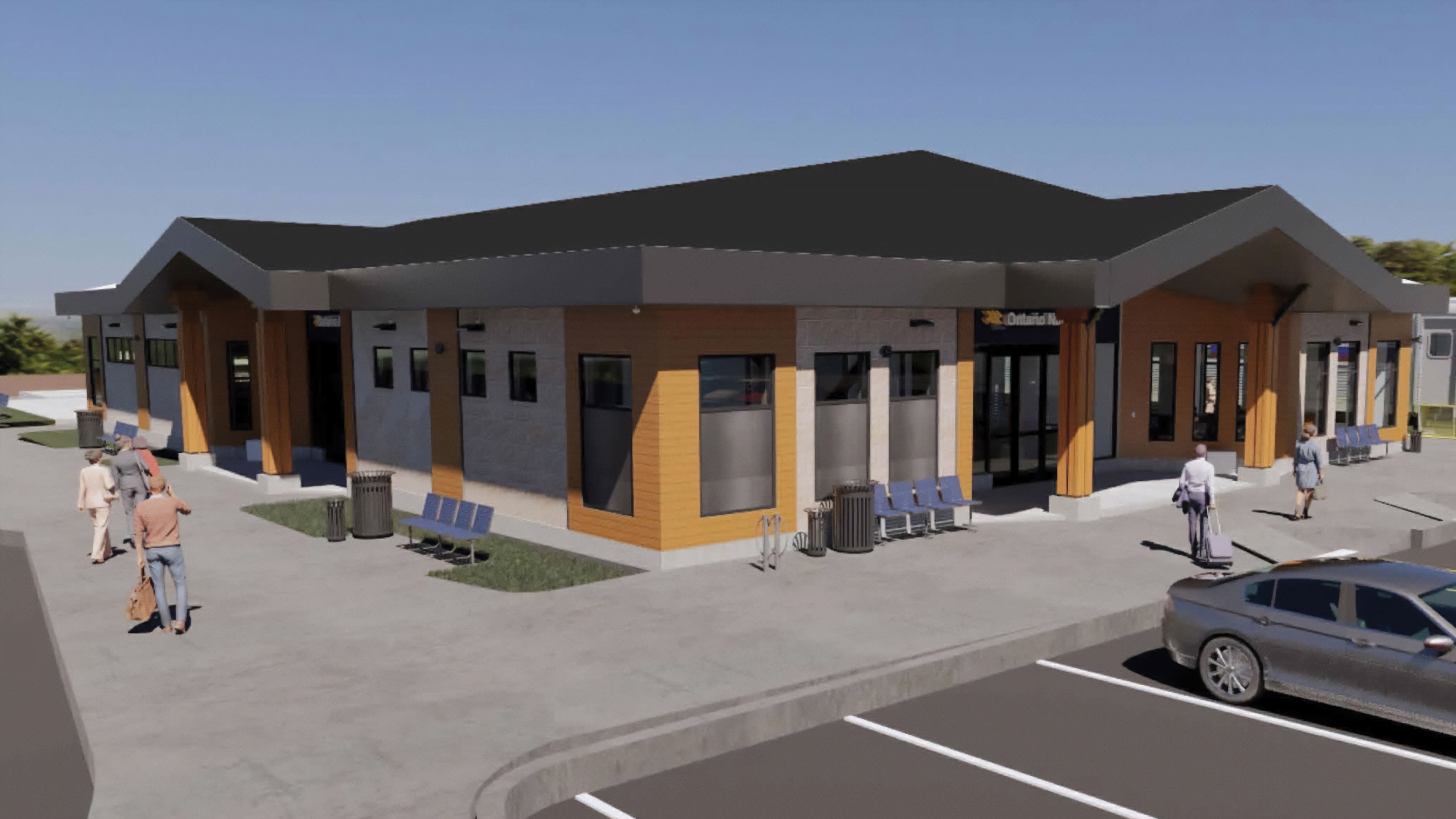
    Rendering of new Timmins-Porcupine Station

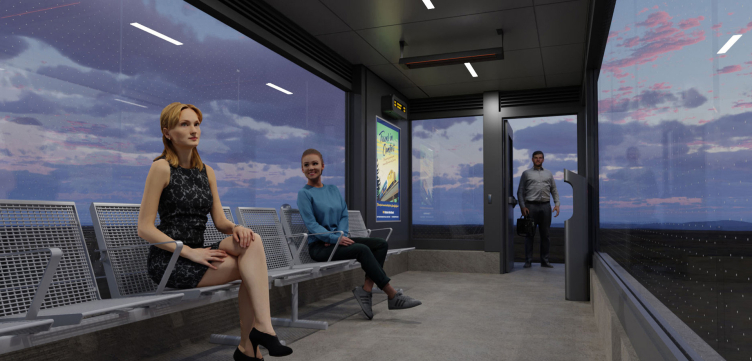
    Most other stations will still just get enclosed shelters, though at Matheson, Swastika, New Liskeard, and Temagami, the construction of new platforms is well underway. Even though there are heritage passenger stations at Matheson (which just escaped demolition), Temagami, South River, Huntsville, and Gravenhurst, there will just be shelters for Northlander passengers at these stops. Shelters depicted on the Ontario Northland website resemble those at BRT stops or GO Transit station platforms, with lighting and overhead heat.
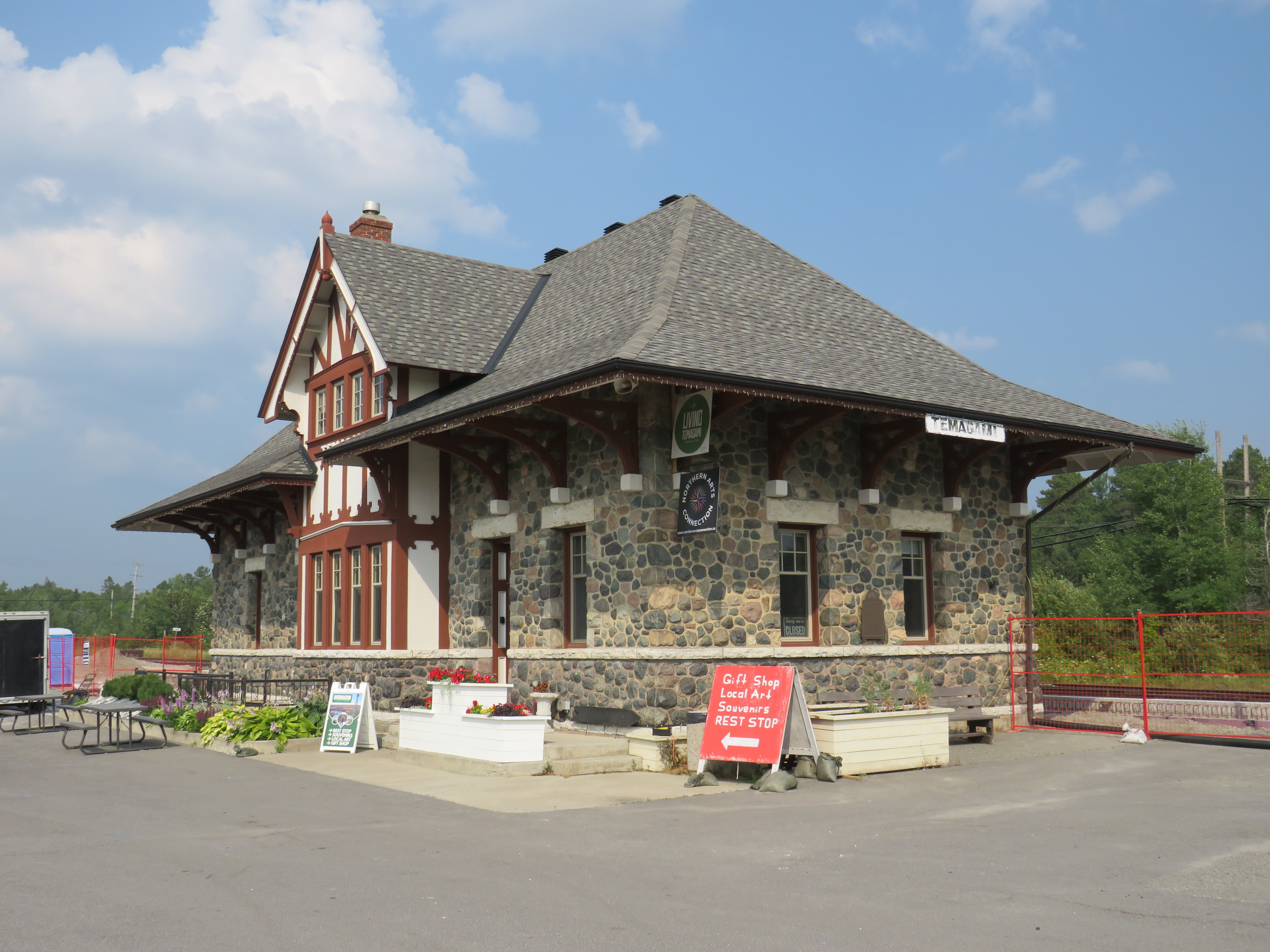
    Fencing protects the construction of a new platform beside the handsome Temagami ONR Station. The station building will not be used for passenger services; it currently hosts a café and gift shop.
    Rendering of passenger shelter for Northlander stops

    It will be nice to see the return of passenger rail to Northeastern Ontario when it launches in two years. Unfortunately, I remain unsure whether it will attract enough riders to be seen as viable after a year or two of service.
  • Buses to the big box

    Buses to the big box

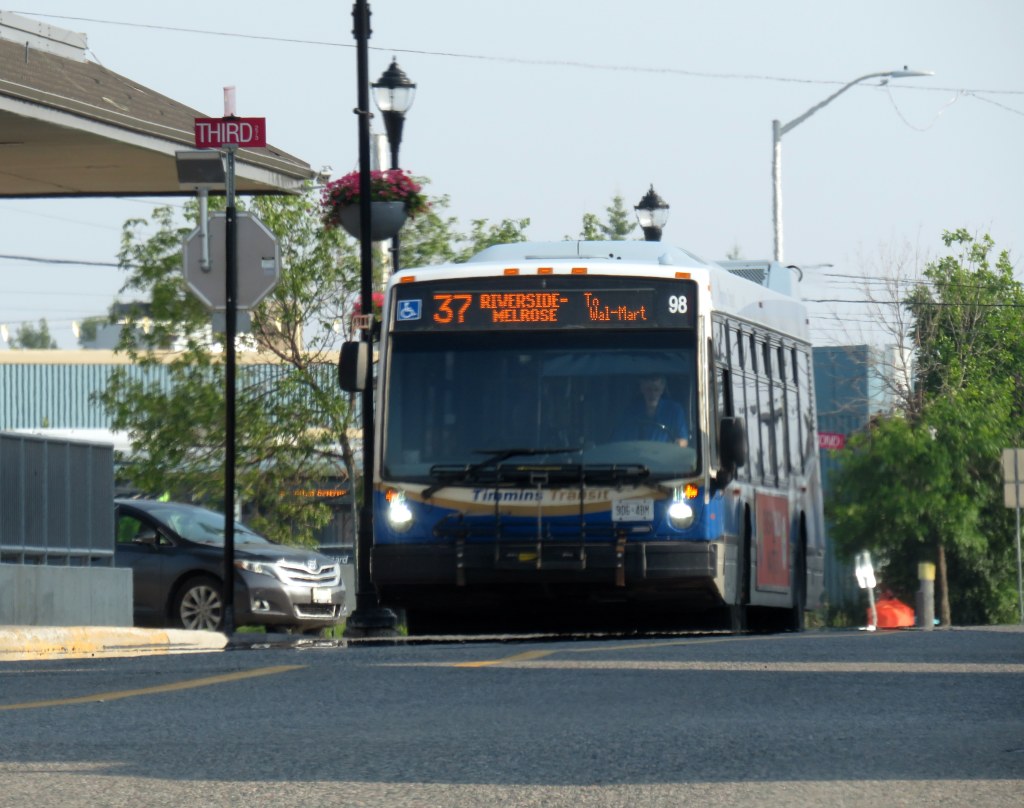
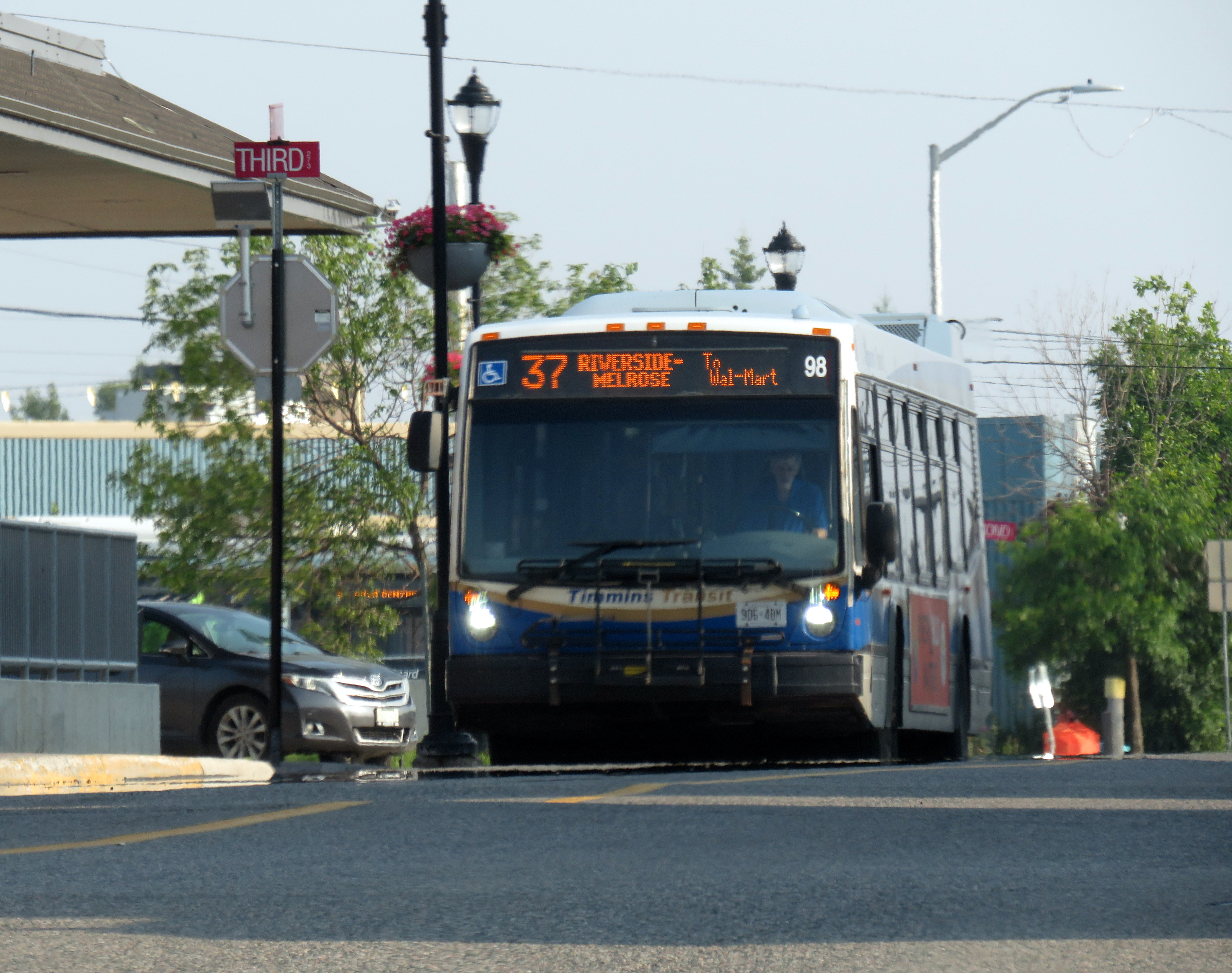
    Timmins Transit bus headed west from downtown to Wal-Mart

    Last month, I found myself intrigued by American transit consultant Jarrett Walker’s observations about the difficulties of getting to Walmart stores by public transit in US cities. On Bluesky, Walker examined the long walks through hostile environments between Walmart stores and the nearest bus stops, and it is an interesting thread.

    In many US cities, Walmarts are often some of the busiest transit destinations.Here is the typical relationship between a Walmart (far right) and its nearest bus stop (far left).Note the details of the pedestrian experience between one and the other. 1/🧵

    Jarrett Walker (@humantransit.bsky.social) 2025-07-19T18:33:32.331Z
    Jarrett Walker’s BlueSky thread on US Walmart locations

    In response, I noted the more typical experience in midsized Ontario cities. Though American and Canadian land use policies are similar in many ways, complete with the post-1990s proliferation of “big box” retail developments, there are some significant differences. For example, local transit systems will often make an effort to serve big box retail clusters, particularly Walmart stores.

    This is something we do a bit better here in Canada. Below are Google Map screenshots of four Walmarts in small Ontario cities.

    Sean Marshall (@seanyyz.bsky.social) 2025-07-19T18:48:29.558Z
    BlueSky post that shows Walmart stores and bus stops in four small Ontario cities: Orillia, St. Thomas, Belleville, and Brockville

    Walmart stores are important to transit riders, especially in smaller urban centres that have few or no other major shopping centres. Most Walmart stores now have an in-store pharmacy, carry a full selection of groceries, and have ancillary services, such as medical clinics, haircutters, and opticians. Walmart itself will typically anchor a larger commercial development with other big-box retailers such as Home Depot or Canadian Tire. These commercial developments and surrounding areas will have up to have several hundred employees, some of which may also rely on transit.

    From the 1960s to the early 2000s, regional shopping malls were often major transit hubs in mid-sized cities and suburban municipalities in Canada, typically located in space set aside in the mall parking lot. For the most part, Canadian commercial landlords were willing to provide the space; in some cases, the terminal was even right outside one of the main entrances.

    In my hometown of Brampton, for example, two of the three major transit terminals were Bramalea City Centre and Shoppers World. Mississauga’s main transit hub is at Square One mall; Hamilton has large bus loops at Limeridge and Eastgate malls, and London has transit hubs at Masonville Place and White Oaks Mall. Smaller cities and towns such as Belleville, Orillia, and Peterborough would also be sure to serve the local shopping mall with at least one route stopping on the mall property, typically in a space set aside on a mall driveway.

    Sometimes, these mall terminals become too small or too difficult for buses to get in and out of. Brampton Transit grew, the Shoppers World and Bramalea City Centre terminals were moved to larger facilities off-site with better road access, but still close to the malls. In smaller cities, where the importance of enclosed shopping malls (anchored by traditional retailers such as Sears Canada, Zellers, and Hudson Bay) declined in favour of big-box retail, often located on the urban outskirts, the buses followed where their passengers needed to go.

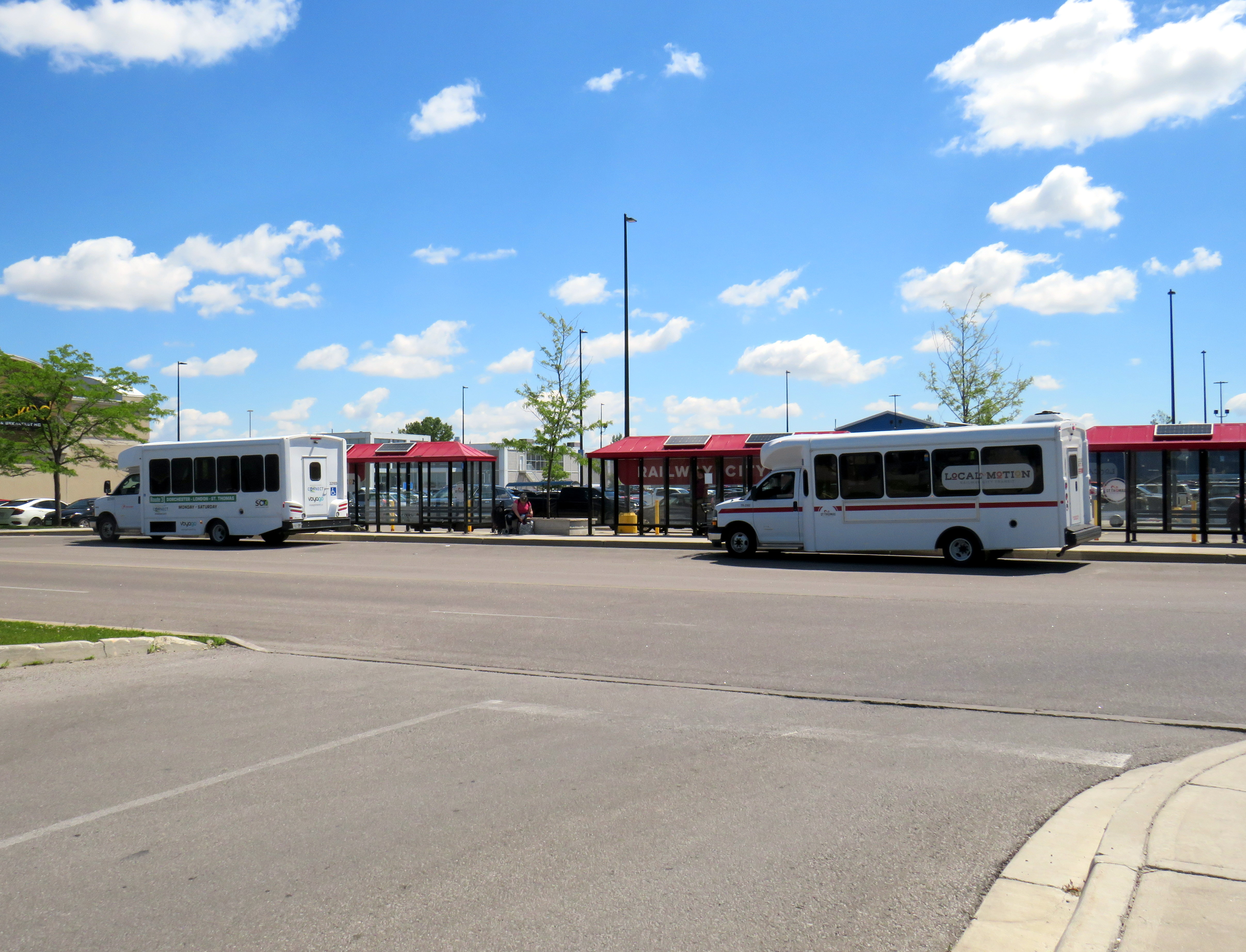
    St. Thomas (Railway City Transit) and Middlesex County Connect minibuses wait for passengers in front of Walmart and Real Canadian Superstore

    In St. Thomas, a small city of about 45,000 people, the main transfer point is in front of the Walmart store parking lot, meaning that every bus rider gets a one-seat ride to the SmartCentres-managed property, which also includes a Loblaws grocery store, Canadian Tire, and over a dozen smaller stores, restaurants, and banks. The recent relocation of the transit hub from a struggling downtown to the big box centre to the west — which is actually closer to the city’s geographic centre — makes sense. It now also serves as the transfer point to the regional bus service to London.

    In Brockville, another small city in Eastern Ontario, the two transfer points are in the downtown and at “Box Stores Transfer” in the northeastern corner of the municipality. The latter is also the transfer point to the inter-municipal River Route to Prescott and Cardinal. In other smaller Ontario cities, including Belleville, Chatham, Orillia, Sarnia, and Timmins, there is at least one bus route extending to the end of the urbanized area to serve the Walmart and/or other large big box retailers. Often the stop will simply be called “Walmart” or “SmartCentres.”

    Sometimes, larger cities will have transit terminals in the middle of big box parking lots. On the south end of Sudbury, GOVA’s Route 1 Mainline terminates in front of a Walmart parking lot, with connections to three local feeder routes. A similar set up can be found in the north end of Guelph. In Waterloo, a large big box complex on the edge of the region’s urban boundary, Boardwalk, was designed with a central transit hub.

    Though the examples here are all Ontario examples, the pattern generally holds across Canada, from St. John’s, Newfoundland to Nanaimo, British Columbia, though there are many exceptions. It also helps that many Canadian Walmart stores are located in shopping malls as they are in renovated and/or expanded former Woolco or Zellers stores.

    Despite these attempts to provide transit services to retailers like Walmart, these are not ideal set ups. Shopping malls were designed as pedestrian environments within large parking lots. As long as there is a convenient, safe, and short walkway to the mall entrance, transit riders could be well-served. This is much harder with contemporary big box retail, as they are designed completely different. With malls, parking lots surround a cluster of stores. Most big box developments have the stores surround gigantic parking lots. Even if walkways and bus facilities were included in the site plan, there are still long, unsheltered walks between the bus stops and store entrances.

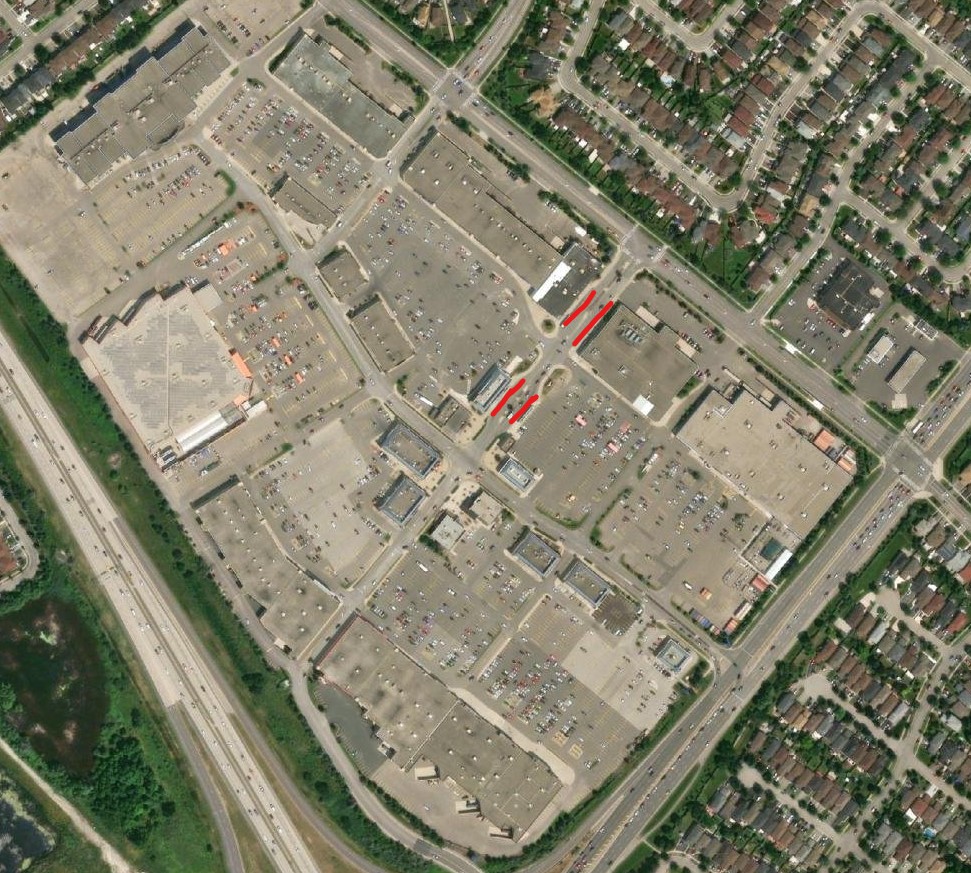
    Trinity Common Shopping Centre at Highway 410 and Bovaird in Brampton. The red lines mark where the buses stop.

    An early attempt to create a more transit and pedestrian site plan in a big box centre was Trinity Common in Brampton, which opened in stages in the early 2000s. There were distinct roadways, complete with sidewalks and street lighting; in the centre, surrounded by restaurant pads, were several bus bays and a transit terminal office. Several busy Brampton Transit bus routes converge here rather than simply stop on the adjoining multi-use roadways. Even so, the distances between retailers — which include Canadian Tire, a Metro supermarket, Home Depot and Brampton’s only multiplex cinema — make walking unpleasant.

    But at least, unlike the American examples Jarrett Walker highlighted, there’s an attempt at doing better. Hopefully, the next generation of retail centres — mixed use developments with residential uses on upper levels — do better with incorporating the needs of pedestrians, cyclists, and transit users.

  • The train is returning to Timmins (sort of)

    The last train left Timmins Station in 1990. Today, it serves as a bus terminal for local and Ontario Northland buses

    Northeastern Ontario got an early Christmas gift from the provincial government on December 15, 2022. On that day, the province announced the purchase of three new trainsets for the restoration of passenger rail service to North Bay, Timmins, and points in between.

    Prior to 1990, there were two daily trains between Toronto and Northeastern Ontario: the daytime Northlander, which ran between Toronto, North Bay, and Timmins daily except Saturdays, and the daily overnight Northland, which continued north to Cochrane and Kapuskasing, with a bus connection to Timmins.

    The Northland, which was operated with VIA equipment, was cut as part of a devastating slash to VIA’s budget by the federal Progressive Conservative government. Other trains cut in 1990 included the daily train services from Toronto, Ottawa, and Montreal to Sudbury, Thunder Bay, Winnipeg, and Vancouver. The remaining train service between Cochrane and Northern Quebec soon followed.

    The only train service left in Northern Ontario were remote services still provided by VIA Rail (the local Sudbury-White River RDC train and the transcontinental Canadian, reduced to three days a week and rerouted on the more remote CN mainline), Algoma Central between Sault Ste. Marie and Hearst, the Polar Bear Express/Little Bear service to Moosonee, and the 6 days/week Northlander service between Toronto and Cochrane, which was re-routed from Timmins (though a bus connection at Matheson was maintained).

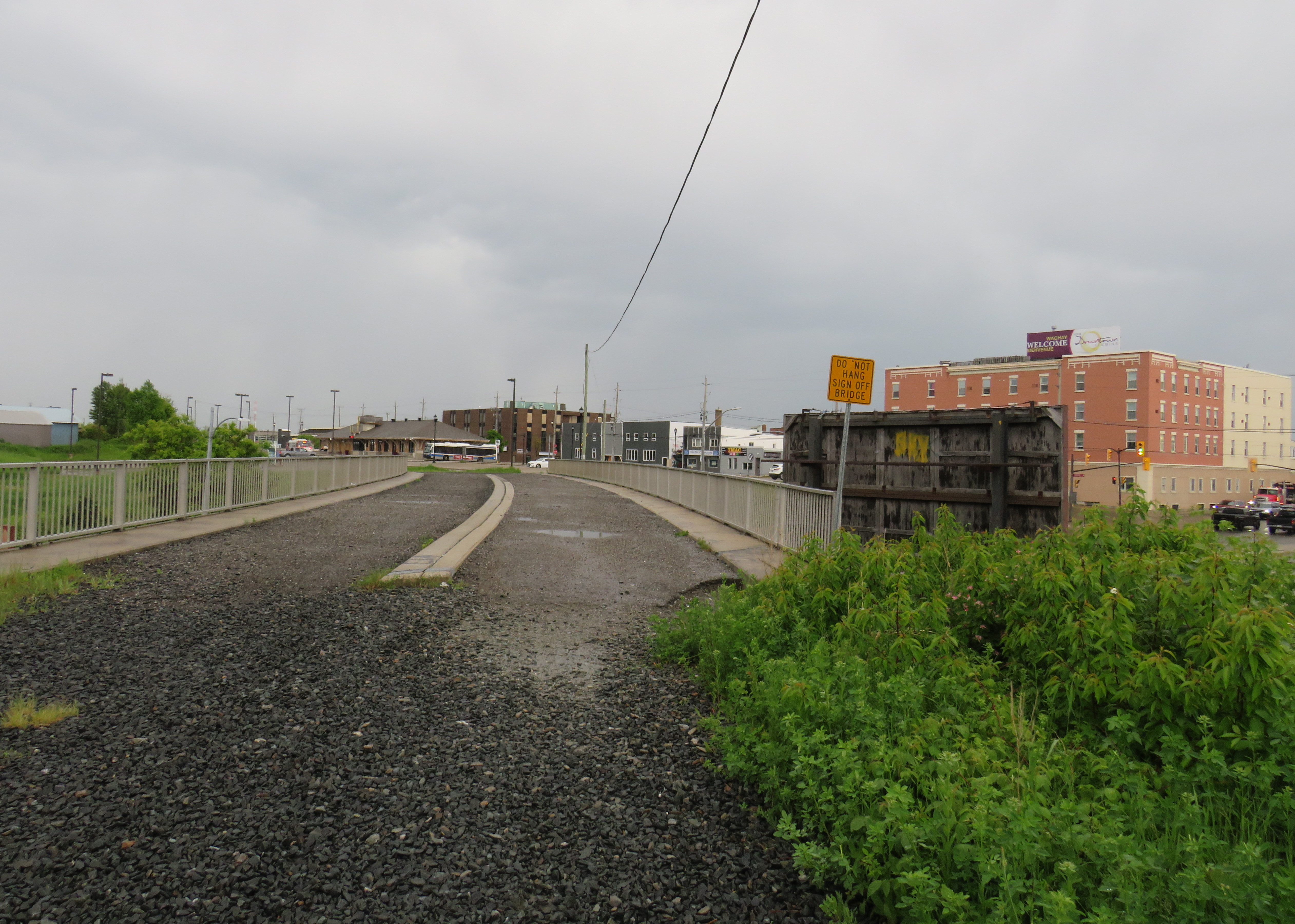
    A railway overpass, completed shortly before its abandonment, crosses Highway 101 (Algonquin Avenue) towards Downtown Timmins, with the station building in the distance. A Timmins Transit bus lays over at the terminal.

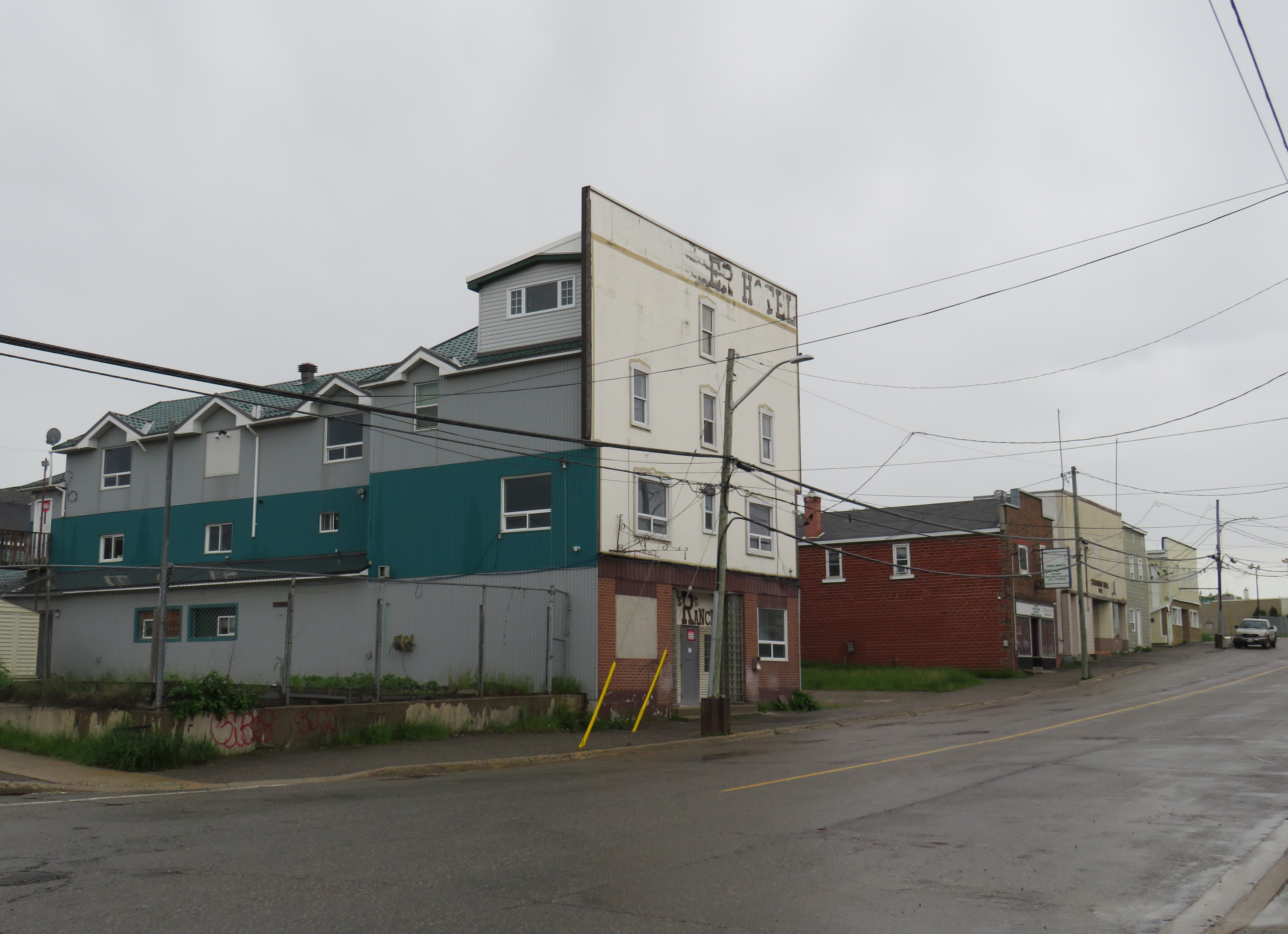
    With the passenger service gone, the tracks through the urban areas of Timmins were quickly removed. The old railway right-of-way in Schumacher, a mining town just east of Downtown Timmins, became the new route of Highway 101, bypassing the old main street, hastening Schumacher’s decline. The station in Timmins was repurposed as a bus terminal for Ontario Northland and Timmins Transit.

    The old route of Highway 101 through Schumacher

    In 2012, the Northlander, which used refurbished former GO Transit single-deck railcars, was cut by the provincial Liberal government, citing declining ridership and high subsidies ($400 per passenger). The train also required an auxiliary power unit, as Ontario Northland used only freight locomotives.

    The southbound Northlander arriving at Gravenhurst in 2012. The auxiliary power unit is immediately behind the locomotive.

    The new trainsets will be the first time in generations that Ontario Northland won’t be using second-hand passenger cars. In the 1970s, Ontario Northland acquired used Trans-Europe Express (TEE) trainsets from Nederlandse Spoorwegen. Though the cars were modern by Canadian standards, the motive power proved unsatisfactory in winter weather and were replaced by older EMD FP7 engines. In 1992, the ageing TEE cars were replaced by the refurbished GO Transit cars.

    Ontario Northland TEE trainset with original power unit at the far end, 1981. Photo by Barry Lewis, photo attained via Wikimedia Commons.

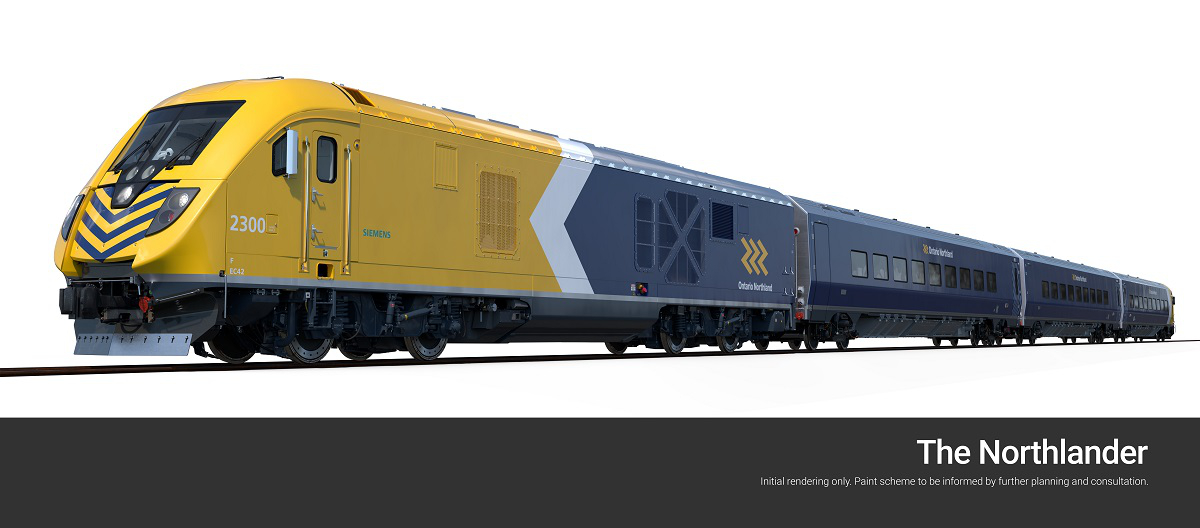
    Like the old TEE trainsets, the new Siemens trainsets will operate in a semi-permanent configuration, with a Siemens Charger locomotive at one end and a combined passenger/control car at the other end, similar to how the new VIA Rail trains will operate. The Siemens Charger locomotives are used by several passenger services in North America, including Amtrak, Brightline, and VIA, while the Siemens Venture cars are very similar to those being delivered to VIA.

    The proposed paint scheme, depicted in a government release below, evokes the old TEE paint scheme, with the modern colours used by Ontario Northland.

    Rendering of the new Northlander trainsets (Ontario Government press release, 17 December 2022)

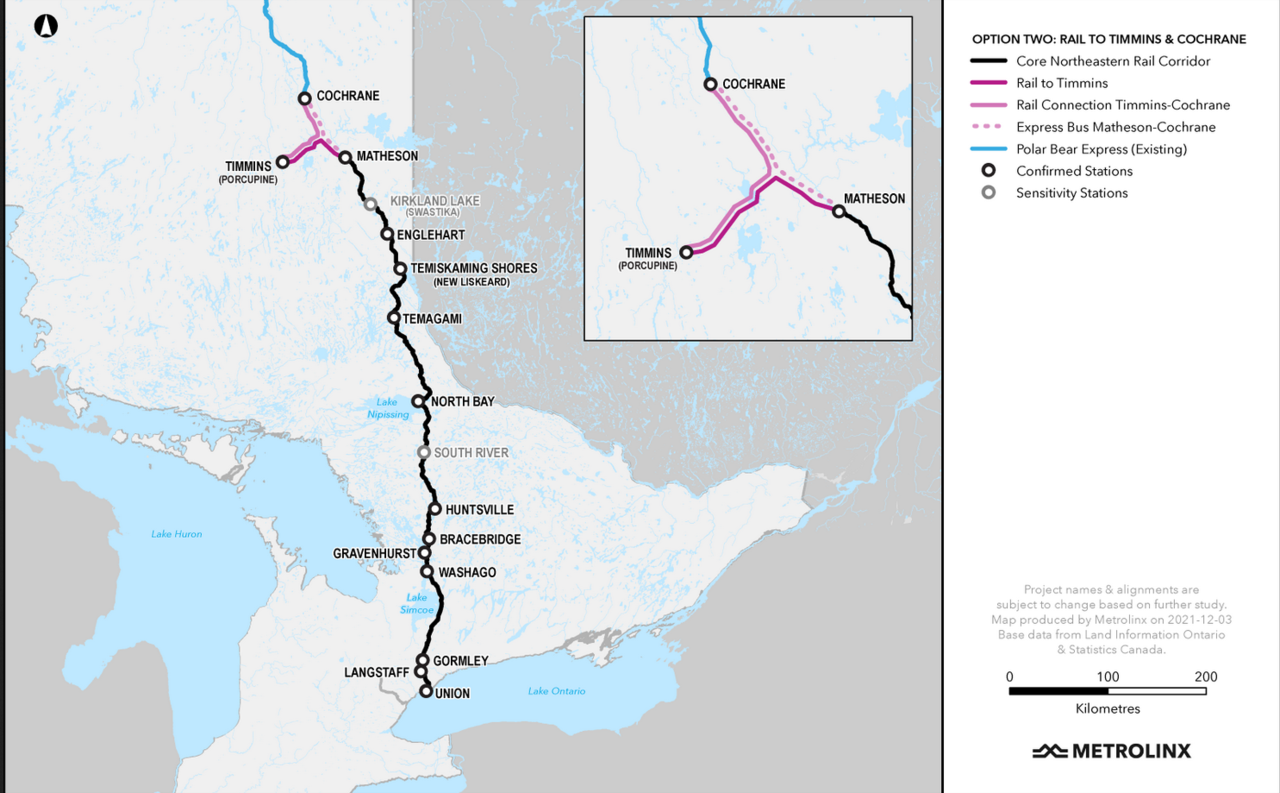
    The revived Northlander service will operate between Toronto and Timmins, with a rail or bus connection to Cochrane, the southern terminal of the Polar Bear Express train to Moosonee. There will be new train stops north of Toronto at Langstaff GO Station (where there are connections to York Region Transit and frequent GO buses on the Highway 407 corridor) and Gormley, a station site with far less connectivity.

    Map of the proposed Northlander service, from the Updated Business Case

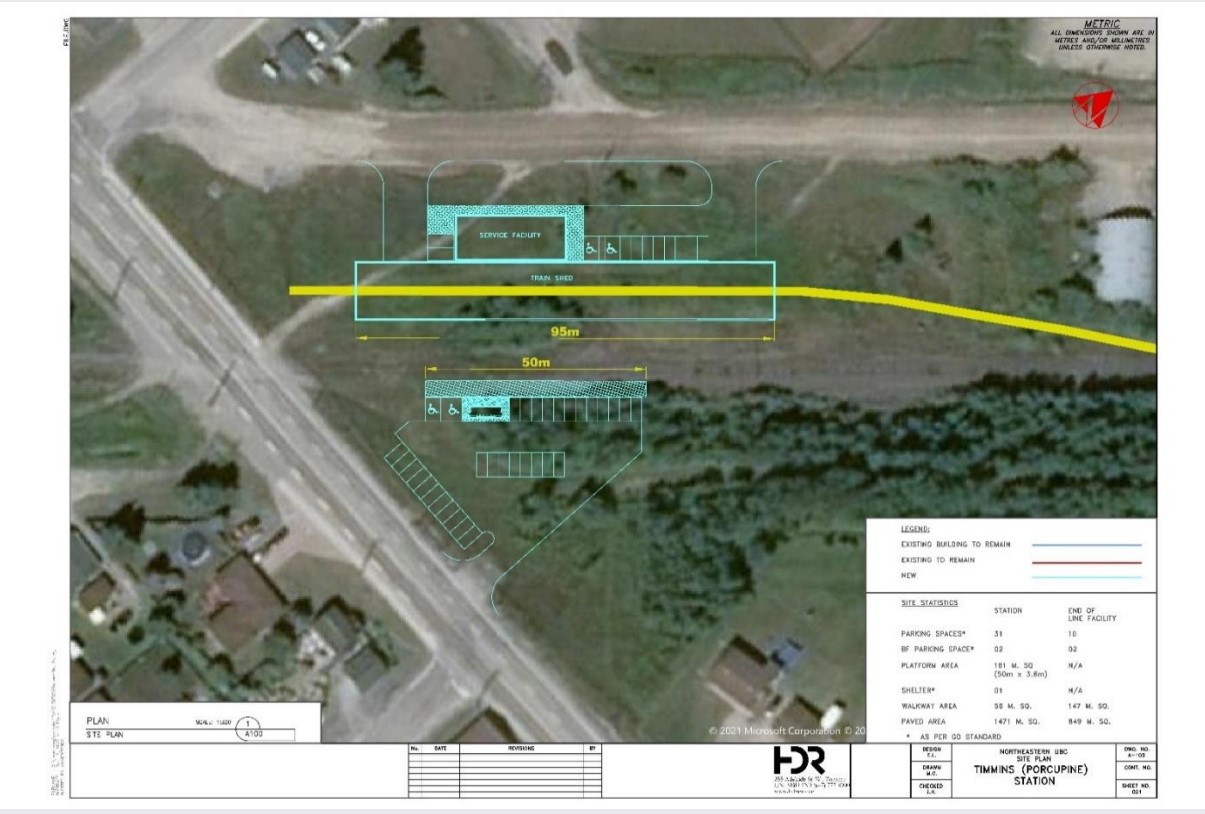
    The trouble, however, is the Timmins terminus. Though the new Siemens trainsets are double-ended and will not require a wye to change directions, most of the track in Timmins has been torn up. As explained earlier, the track into downtown has been partially built upon, and the current end of track is 13 kilometres to the east of central Timmins, on Highway 101 in the small community of Porcupine.

    Schematic of the proposed Timmins Station and service shed from the Updated Business Case. Highway 101 is at bottom left.

    This is where the new station is projected to be built.

    Looking towards the end of track on Falcon Street, Porcupine

    The Porcupine area has local transit service, a Timmins Transit bus that serves Schumacher, South Porcupine, and Porcupine every 30-60 minutes. The proposed station site is about the same driving distance from the city centre as Timmins Airport, which offers direct air service to Pearson and Toronto Island airports.

    According to the business case, the estimated annual ridership for the restored rail service by 2041 is 39,220 to 60,110. Assuming a train in each direction, six days a week, this will mean only 63 to 96 passengers per train, the capacity of just two coach buses, at only a marginally faster speed than the existing Ontario Northland motor coach service. A significant benefit of rail over bus is the reliability in winter conditions, certainly important for Northern Ontario, bus without significant investment in the track infrastructure, it is hard to find much in the way of improvements to the intercity network as a whole. Restoration of the Northlander still does not support travel to Sudbury, the largest community in Northeastern Ontario with the most important medical centre in that part of the province.

    At least the Northlander will get new, reliable equipment for once that will be easier to maintain and obtain parts for. As it is essentially the same equipment as VIA and Amtrak’s new fleets, should the Northlander fail to meet even the meagre ridership projections in the business case documents, the equipment will certainly find new use elsewhere.

    I wish I could be more upbeat about the future of passenger rail in Northern Ontario, an area that deserves reliable, useful intercity transport. The purchase of new rolling equipment is a positive development, but without significant improvements to track speeds, a more convenient Timmins terminus, and a complete transport plan for the entire region that can help build train ridership and support communities elsewhere in Northern Ontario, the renewed Northlander will suffer the same fate as the last iteration.

    Correction: the Cochrane-Senneterre train lasted a little bit longer past the 1990 VIA Rail cuts.