Tag: Ward 39

  • The wrong answer to a tragic death of a boy walking home from school

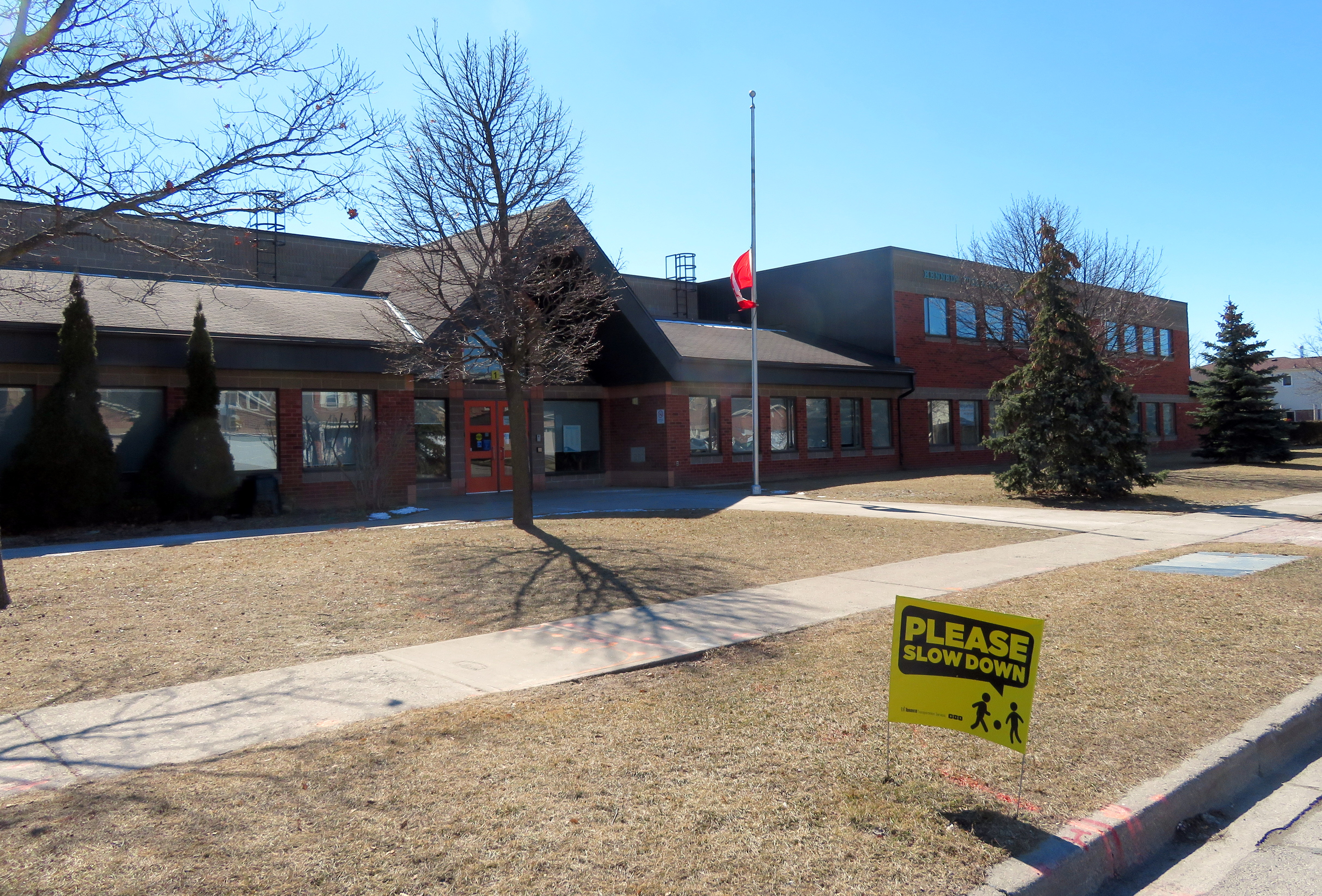
    IMG_6001-001.JPGKennedy Public School, where 11-year old Duncan Xu was in Grade 6. He was struck and killed on an adjacent residential street while walking home on Tuesday, February 27. 

    On Tuesday, February 27, around 3:30 PM, Duncan Xu, an 11-year old boy, was struck and killed by a motorist in a residential neighbourhood in north Scarborough. He was the tenth pedestrian killed on Toronto’s streets in 2018, and the second child killed on their way home from school.

    Duncan Xu was crossing Canongate Trail at Ockwell Manor Drive, near the school, when he was hit by a motorist driving north on Canongate. The intersection does not have a crosswalk, but is only 70 metres north of an intersection controlled by a four-way stop. Canongate Trail a residential street lined with houses, and has a 40 km/h speed limit. The collision occurred right in front of a school zone sign.  Despite its residential nature, Canongate Trail acts as shortcut for non-local traffic avoiding the busy intersection of Steeles Avenue and Kennedy Road.

    I visited the neighbourhood today to better understand the conditions in which a child is killed crossing the street on his way home to school, and the local councillor’s “solution” to that problem.


    Map of the neighbourhood surrounding Kennedy Public School, including the location where Duncan Xu was hit, and the walkway that will close on Monday morning.
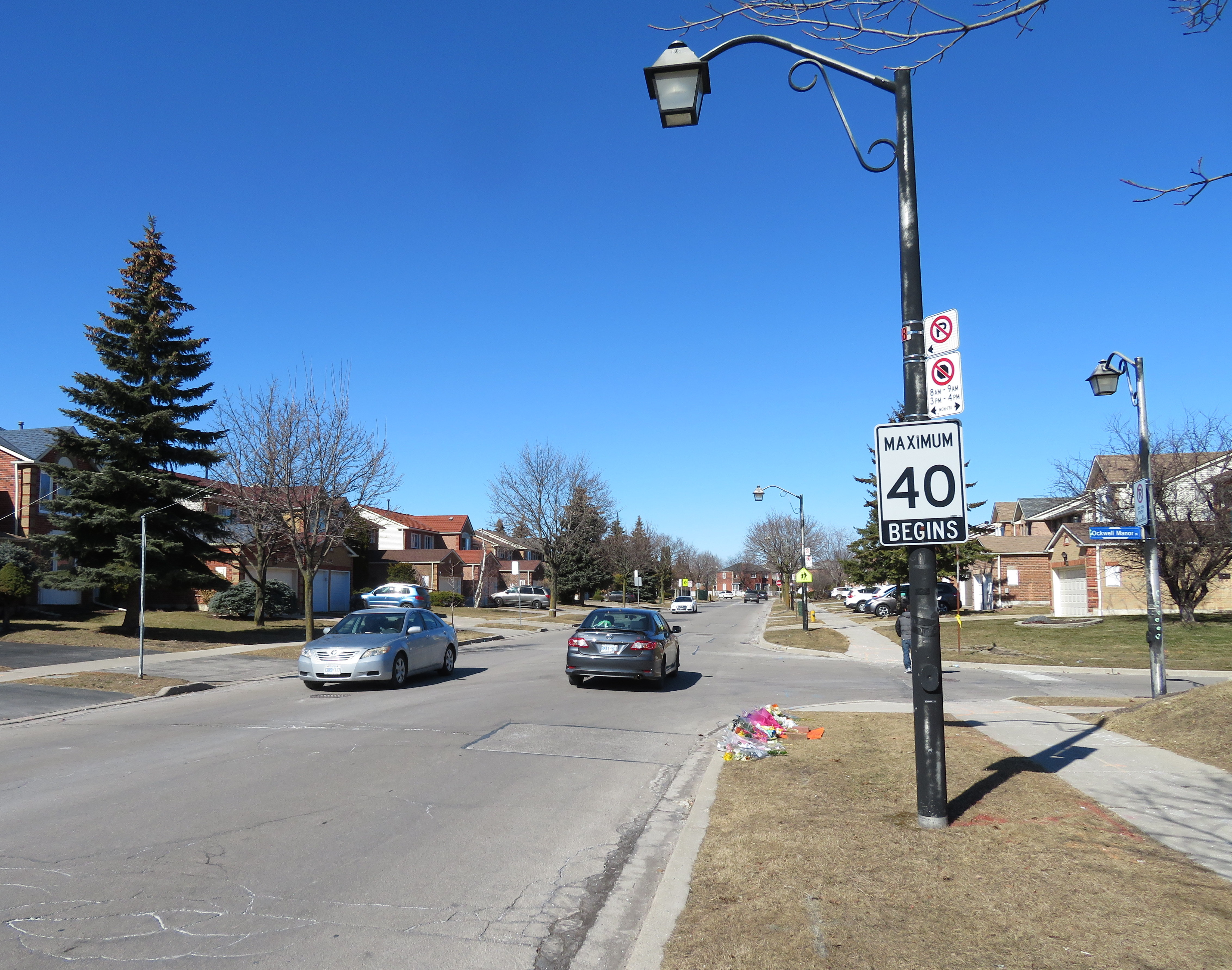
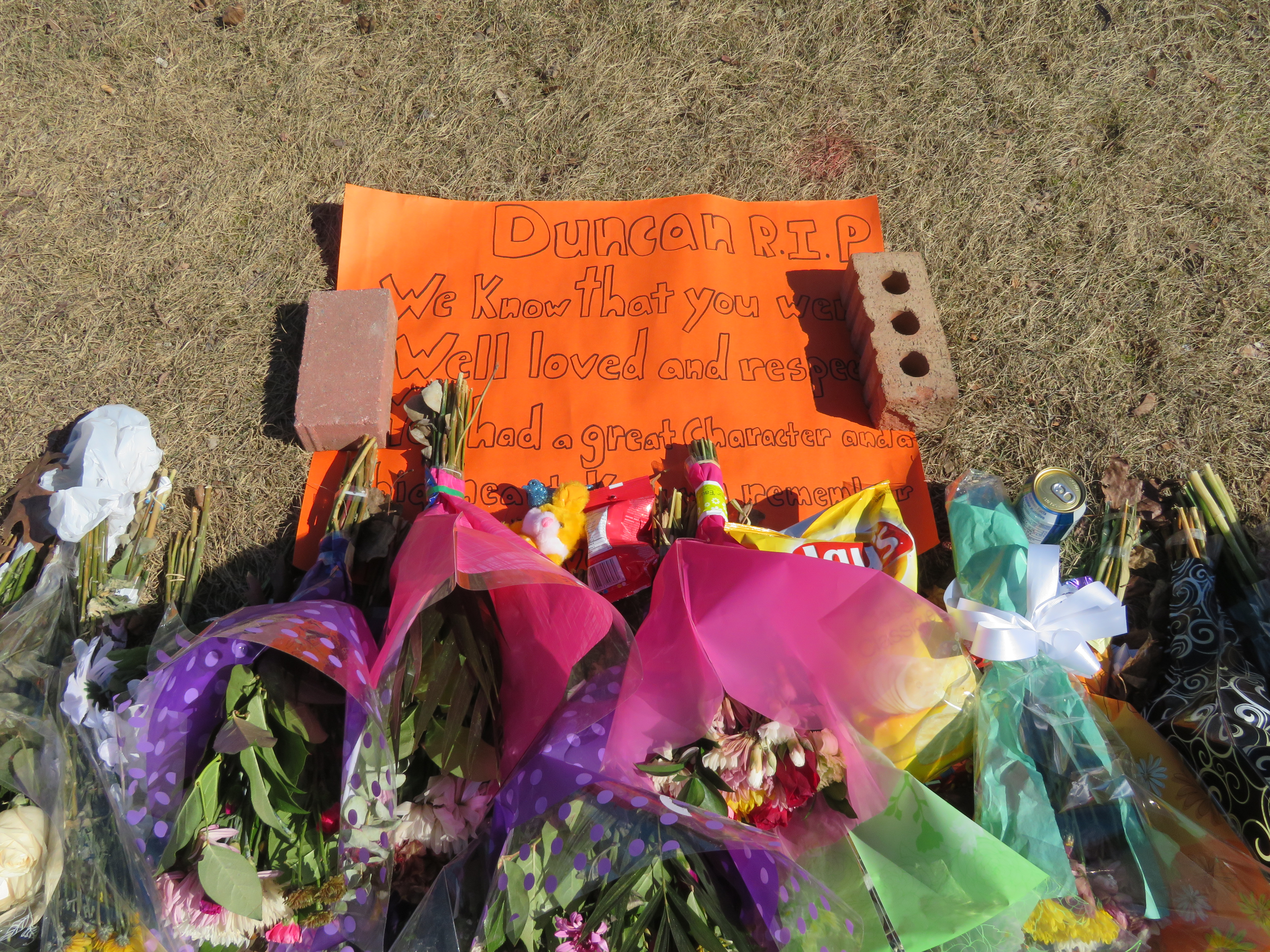
    IMG_6027-001Looking north on Canongate Trail at Ockwell Manor Drive, where Duncan Xu was killed. A memorial is at the curb. Note the speed limit sign, as well as the school zone sign, and also the heavy traffic on Canongate. 

    In the Toronto Star, school principal Kevin Liu described the traffic on Canongate as a problem: “I think we’re getting some thorough traffic, not necessarily residents, cutting through this neighbourhood to avoid a left-hand turn at Kennedy and Steeles during rush hours.”

    The school has long had concerns about their students’ safety.  Initiatives implemented in 2017 included new turning restrictions onto Elmfield Crescent, onto which the school fronts, and parking and stopping restrictions to better manage traffic from parents dropping off and picking up their children. A crossing guard is stationed at the corner of Canongate and Elmfield.

    Canongate is wide as far as local residential streets go. There are no attempts at traffic calming, such as speed humps, bump-outs or curb extensions, or effective traffic enforcement. There are several all-way stop signs on Canongate, but these on their own are not effective in slowing down motor traffic; rolling stops are common as well. When I visited the area today, I found that motorists accelerate quickly headed northbound from the Percell Square/Canongate intersection, and the 40 km/h speed limit is often not adhered to.

    Speeding motorist passes memorial to Duncan Xu on Sunday, March 4

    Sadly, the local councillor, Jim Karygiannis (Ward 39), has not championed measures to reduce and slow down traffic on Canongate Drive, despite local concerns. Instead, the councillor decided to unilaterally close a walkway linking the rear schoolyard with Canongate Trail, close to where Duncan was killed. Duncan used the walkway before trying to cross the street.

    Duncan Xu might not have crossed the street at a crosswalk, but he would still be alive had all motorists driven with the due care and speed befitting a school zone as children are heading home.

    The walkway is a convenient route for students to walk to school. It also connects residents to a nearby park. Councillor Karygiannis claimed that he proposed it earlier, but that local residents and the school refused it. Principal Liu said that he never heard about the proposal.

    The walkway Councillor Karygiannis will unilaterally close on Monday morning after Duncan Xu’s death

    On Monday morning, Councillor Karygiannis will make a show of closing the path and put out a media advisory indicating his intent. Orange plastic netting was already placed at both entries to the path, which cuts between two houses in preparation of the closure. But this is a classic case of “Zero Vision,” rather than Vision Zero, measures to improve road safety, such as improved pedestrian and cycling infrastructure and re-engineered roads that the city is at least nominally committed to.
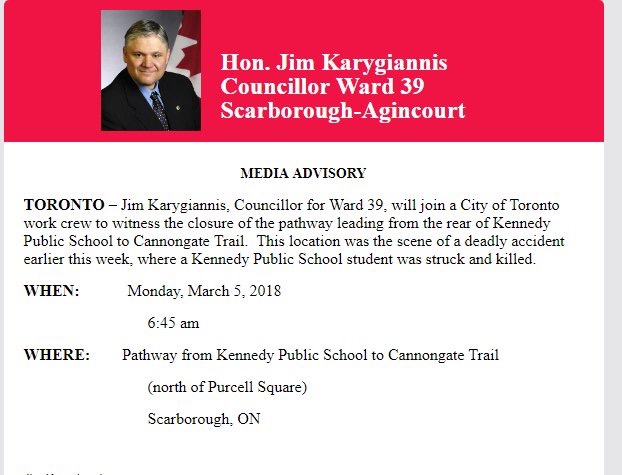
    Councillor Jim Karygiannis media advisory

    Media advisory from Ward 39 Councillor Jim Karygiannis’ office announcing the closure of the pathway

    Closing the walkway will only serve to reduce walking to school, and increase traffic. It will do nothing to solve the problem of fast-moving cars in a residential area, nor will it necessarily prevent children from unsafely crossing the street. It’s the type of inexpensive, easy fix that make politicians look like they’re doing something, but without making the necessary changes to prevent future fatalities.

    Traffic calming measures, such as speed humps, tighter curbs at intersections, extending the curbs out at intersections, and planters would force motorists to slow down, and would be more effective than stop signs. More should be done to discourage impatient drivers from using the residential area as a shortcut. More should be done to encourage students to walk to school, rather than discouraged by closing walkways. Walking audits would allow the community to provide input. And this should be done around every school.

    The safety of pedestrians, especially children, should not be left to half-measures.
    IMG_6036-001

    Updated map of pedestrian fatalities on Toronto’s streets.
  • Mapping the 2014 Toronto Election: Wards 39 and 40

    I almost called this post “Everybody loves @norm” after the popular former Deputy Mayor, Norm Kelly, who represents Ward 40 on  Toronto City Council.

    In this latest installment of my (nearly complete) series of posts on the results of the 2014 municipal election, I come to Wards 39 and 40, Scarborough-Agincourt. The provincial/federal riding of Scarborough-Agincourt is a nice rectangular shape, bounded by Steeles Avenue to the north, Ellesmere Road to the south, Victoria Park to the west, and the GO Transit Stouffville corridor (formerly the CN Uxbridge Subdivision) railway to the east. This rail corridor is proposed as the route of Mayor John Tory’s “SmartTrack” transit plan. However, the boundary between Wards 39 and 40 is a bit jagged, with Finch and Birchmount Avenues and West Highland Creek forming the boundary. This results in an odd panhandle in Ward 39, as it includes only two apartment towers south of Sheppard Avenue.

    Mayoral race

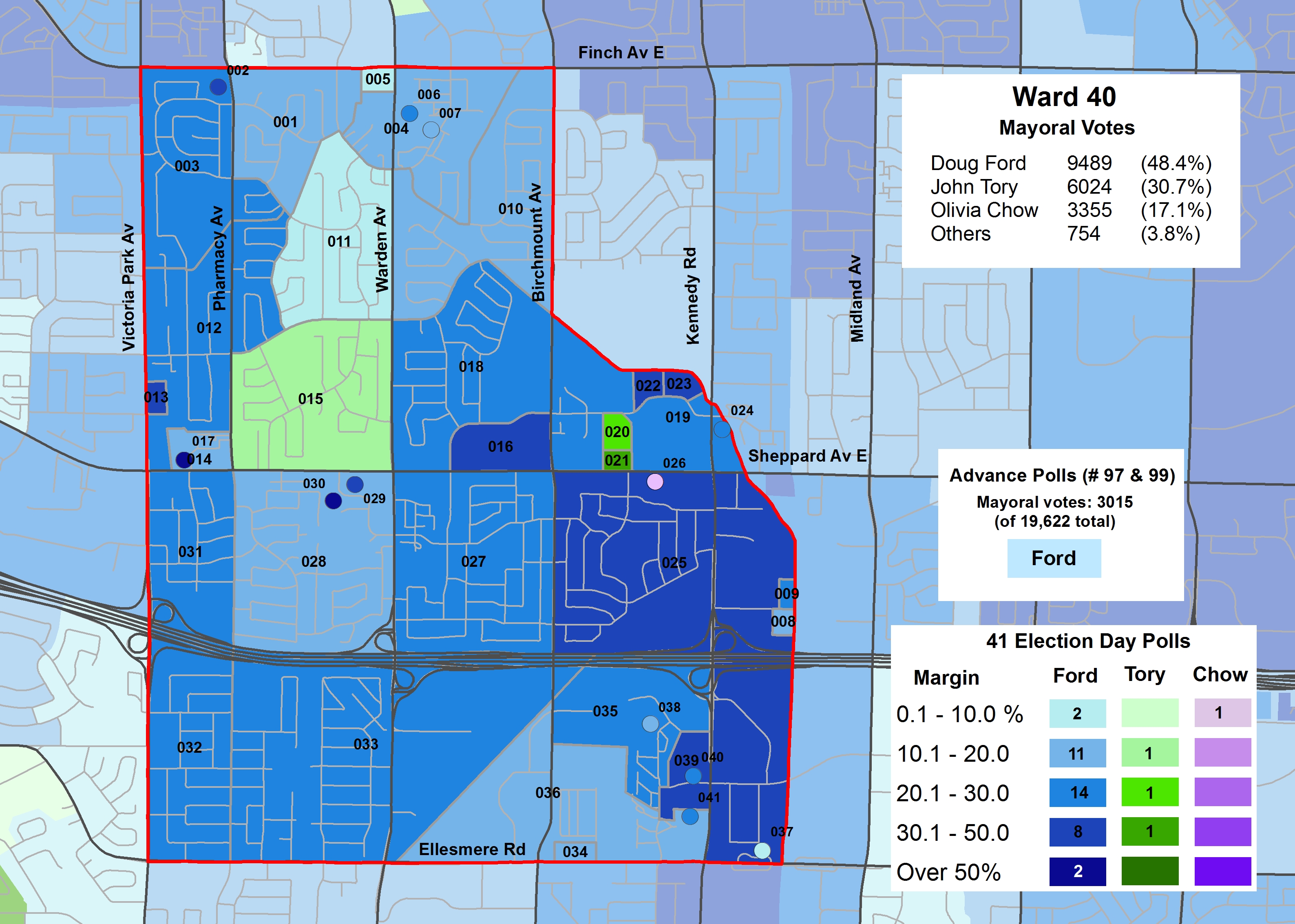
    In the mayoral race, Doug Ford came in first place in both wards, netting 50.1% of the vote in Ward 39 and 48.4% in Ward 40. John Tory came in a distant second place in both wards, with 26.9% of the vote in Ward 39 and 30.7% in Ward 30. Third-place Olivia Chow got between 17 and 18% in both wards.

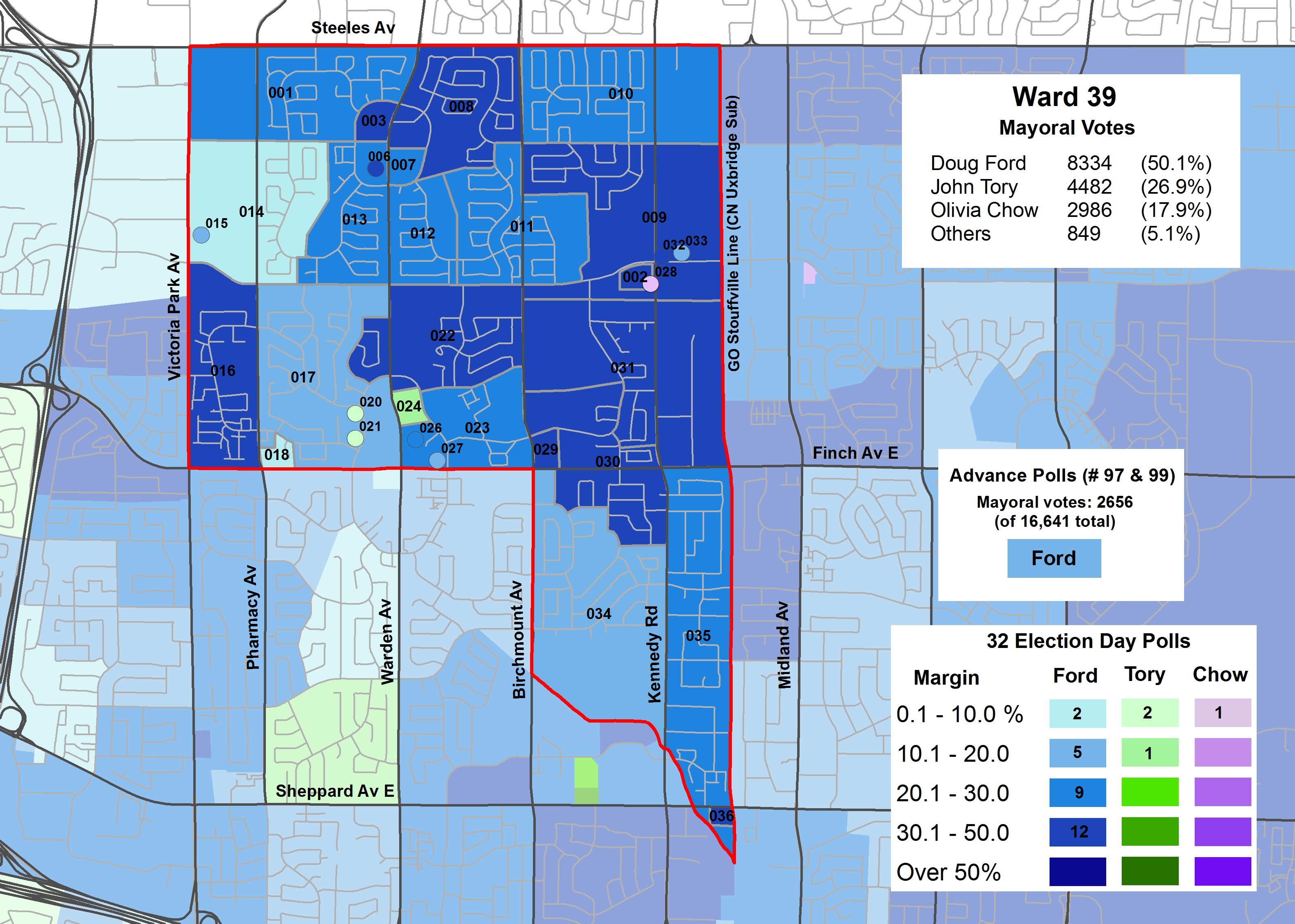
    2014 Election - WARD 39 MayorPoll results of the mayoral race in Ward 39

    In Ward 39, Doug Ford came in first place in all but 4 polls. John Tory came first in three, all representing condominium towers on Bridletowne Circle (in the Finch/Warden area). Olivia Chow one one poll, 028, a condo tower on Kennedy Road near McNicoll Avenue. Doug Ford came in first place in all seniors’ homes in the ward, including the large Yee Hong Centre. While I am not terribly surprised, it is worth noting how a prominent Chinese-Canadian immigrant could not obtain much support in a ward with a large Chinese-Canadian community.*

    2014 Election - WARD 40 Mayor Poll results of the mayoral race in Ward 40

    Like Ward 39, Doug Ford came in first place in all but four polls in Ward 40, with Tory taking three, and Chow one. Tory did the best in Polls 020 and 021, the Shepherd Village retirement and assisted living community on Sheppard Avenue; he also came first in Poll 015, which doesn’t seem much different than its neighbouring Ford-voting subdivisions. Doug Ford did the best in Polls 014, a rental tower on Chichester Place and 030, an older condominum tower on Palmdale Place.

    Council races

    Ward 39, represented since 2003 by accountant and former Catholic school board trustee Mike Del Grande, was an open race in 2014 with Del Grande’s announcement in February that he was not seeking re-election. On April Fool’s Day, April 1, Liberal MP Jim Karygiannis announced his resignation from federal politics to run for the council seat.

    Karygiannis’s announcement was a bit unusual. while it’s not rare for a sitting federal or provincial politician to run for municipal office, usually it’s to run for mayor (the newly elected mayor of Brampton, Linda Jeffrey, was a Liberal MPP and prominent cabinet minister when she resigned to run there; George Smitherman was another powerful provincial cabinet minister who ran for mayor of Toronto, but lost to Rob Ford in 2010). His claim was it was spend more time with family; speculation was that Liberal leader Justin Trudeau didn’t care for the veteran controversial and socially conservative MPP; the feeling was likely mutual.

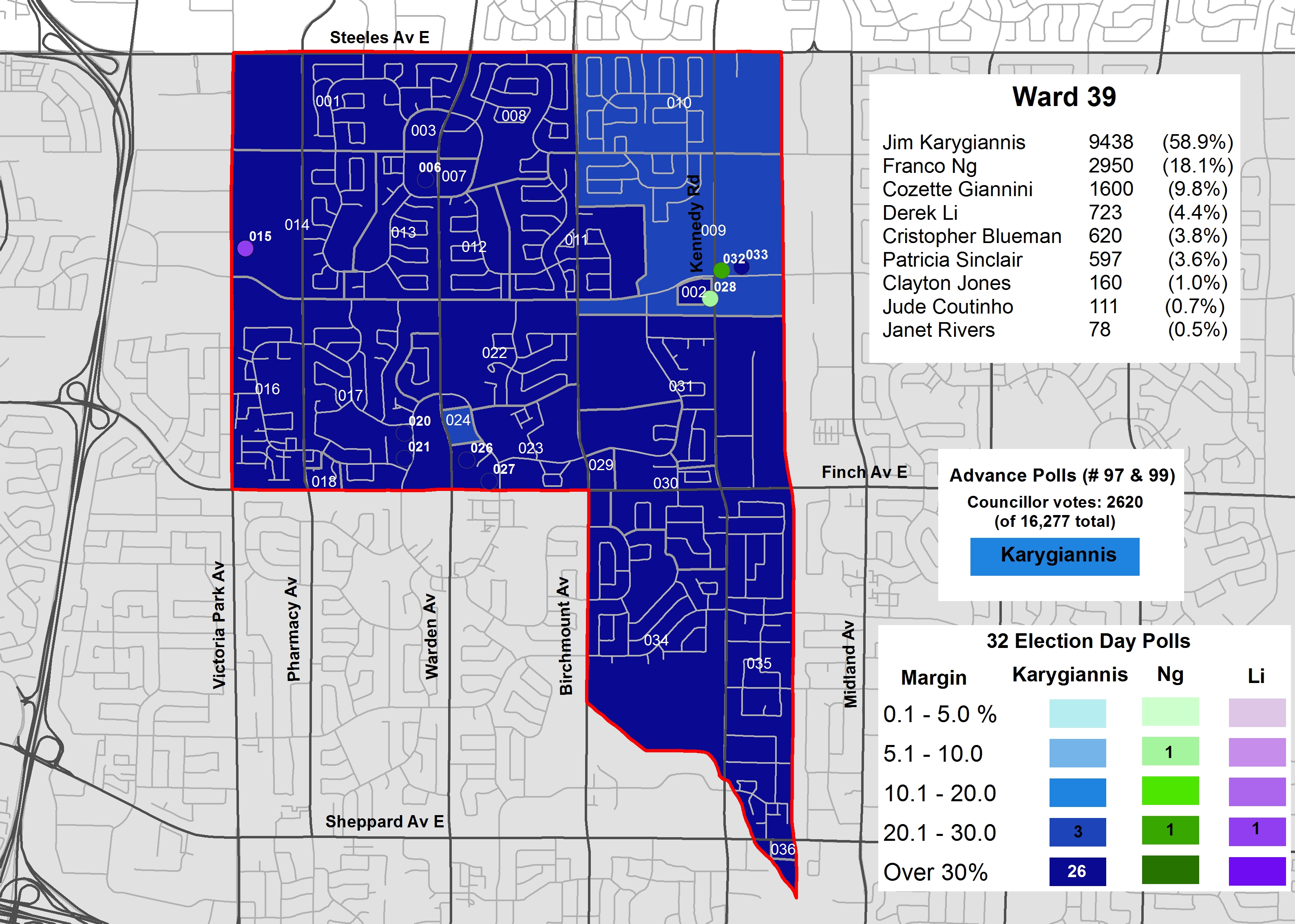
    But with name recognition and a local political machine, Karygiannis pretty much had the advantage of any council incumbent, especially against relative unknowns Franco Ng and Cozette Giannini. While the Toronto Star endorsed Ng, NOW magazine endorsed Giannini, Karygiannis won in a landslide; taking 58.9% of the vote and all but three polls. Second-place Franco Ng netted only 18.1% of the vote (and came first in two polls), Giannini came in third with 9.8%. Fourth-place Derek Li came first in one poll, though this was a long-term medical institution with a small voting population.

    2014 Election - WARD 39 Cllr Poll results of the council race in Ward 39

    There was no contest in Ward 40, represented by councillor Norm Kelly, who won with an astounding 86% of the vote. But I’m certainly not complaining.

    Kelly is a long-term city councillor, but is also a historian, and taught history at Upper Canada College. He was first elected to municipal politics in 1974 as an alderman on Scarborough council. He was a Liberal MP between 1980 and 1984, losing to the Progressive Conservatives in the Mulroney landslide of 1984. After making an unsuccessful run for mayor of Scarborough in 1985, Kelly turned to real estate before returning to Scarborough council in 1994; he has been a Toronto councillor since the 1997 amalgamation.

    Kelly, a centre-right ally of mayors Lastman and Ford (between 2011 and 2014, Kelly voted with the mayor over 80% of the time), was named deputy mayor in August 2013. This was after Rob Ford’s first pick for deputy mayor, Doug Holyday, resigned after a by-election win in Etobicoke-Lakeshore for the Ontario Progressive Conservatives. (The losing Liberal candidate in that by-election, fellow Etobicoke councillor Peter Milczyn, won in the general election in the June 2014 general election). As Rob Ford’s personal scandals involving drug use and lewd behaviour deepened in 2013; council stripped Ford of most of his powers, transferring them to Kelly in November 2013. Kelly quickly re-established order and decorum to City Hall with humour and grace, and for that, politicians and observers of all political stripes were grateful. Even the lefty NOW magazine endorsed Kelly for re-election in 2014.

    Unfortunately, John Tory picked Denzil Minnan-Wong (who, to put it nicely, is not nearly as well-liked as Norm Kelly) as his lead Deputy Mayor. (Vince Crisanti, Glenn De Baeremaeker, and Pam McConnell were chosen as Tory’s secondary deputy mayors.)

    Given Kelly’s sweep of all polls in Ward 40, there was no need to create a map of the council race here.

    Post script: It’s also worth noting that Wards 39 and 40 were represented at the Toronto District School Board by Sam Sotiropoulos, a homophobic and transphobic individual, whose offenses are nicely summed up by Torontoist in its annual Heroes and Villains feature. Sotiropoulos lost to Manna Wong by 2067 votes. Still Sotiropoulos came in second place, and got 9,621 votes. I hope this can be chalked up to the incumbency factor and that many voters simply do not pay attention to school board politics.

    (Hat tip to Paula Cheung reminding me to include this post script, one of the bright spots of the 2014 election.)


    *It should be noted that Olivia Chow immigrated from Hong Kong and speaks Cantonese, many in Ward 39’s Chinese-Canadian community are immigrants from Mainland China and speak Mandarin. And of course, there are many considerations one makes when deciding who to vote for; as I mentioned earlier, I am not surprised to see Chow do so poorly in Agincourt.