On Friday, May 13, I embarked on a day trip through Southwestern Ontario from Downtown Toronto. I wanted to ride more of Ontario’s new intercommunity transit services and try one of the new intercity bus operators that’s filling the vacuum left by Greyhound’s departure. I started my trip at Union Station, spent some time in Kitchener-Waterloo, then continued on to London, returning home that evening.
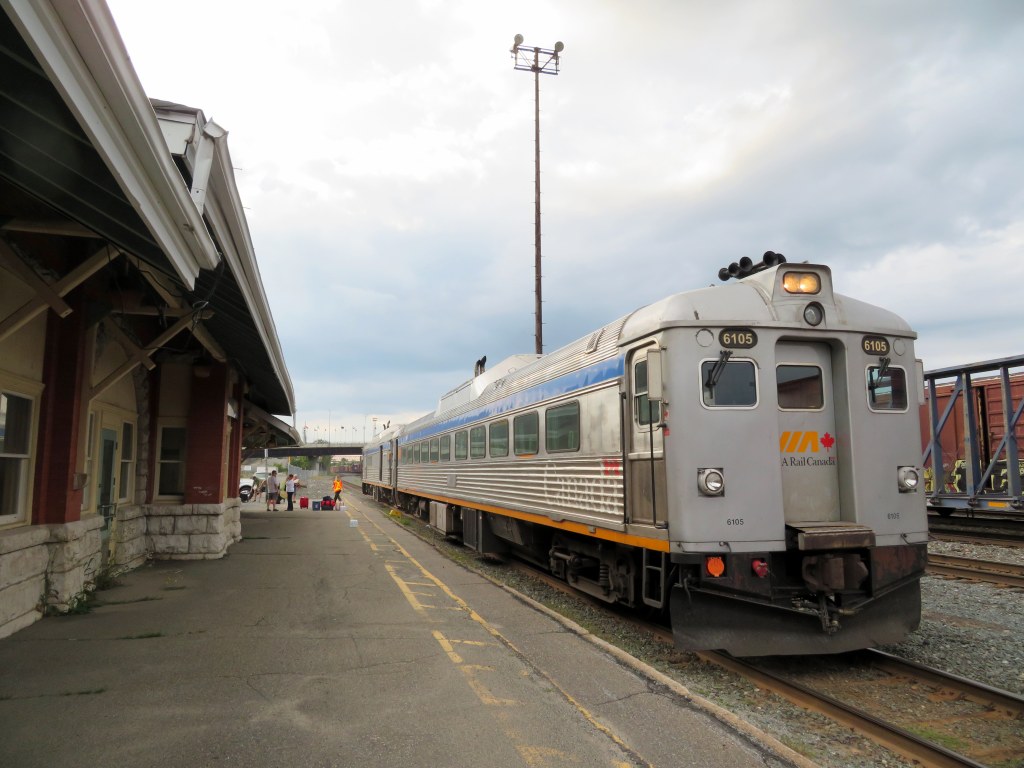
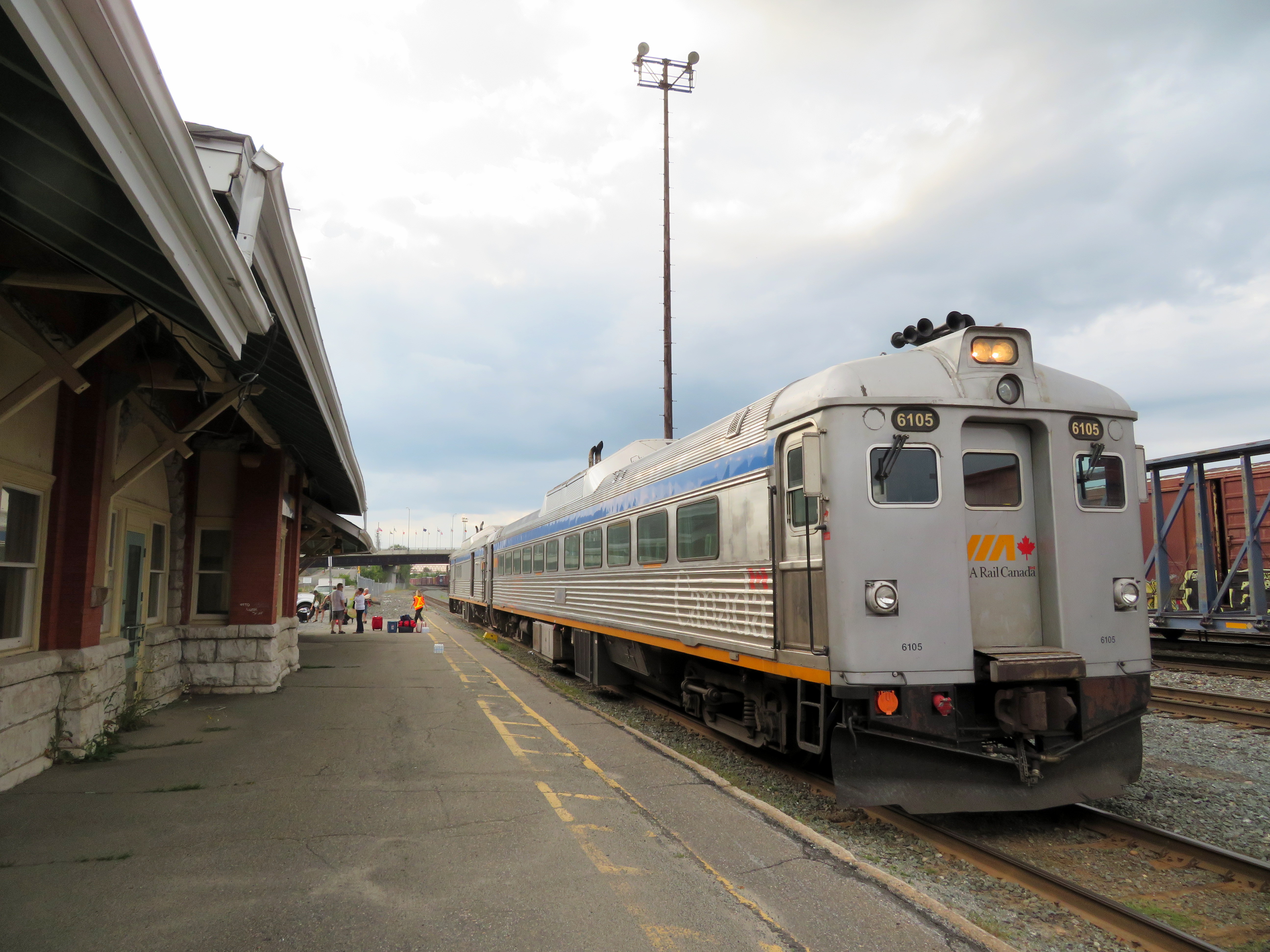
Between Toronto and Kitchener, there are several options. VIA Rail is the fastest and most comfortable ride, but it now only operates one train a day between Toronto and Kitchener.
GO Transit is the most frequent option, with several weekday trains between Toronto, Brampton, Guelph, and Kitchener, and connecting buses at Bramalea GO Station for Downtown Kitchener and Waterloo. The train and bus trip via Bramalea is just under 2 hours, costing $19.40. (Weekend GO service is much slower, requiring a change of bus at Square One, with a 2 hour, 33 minute ride.)
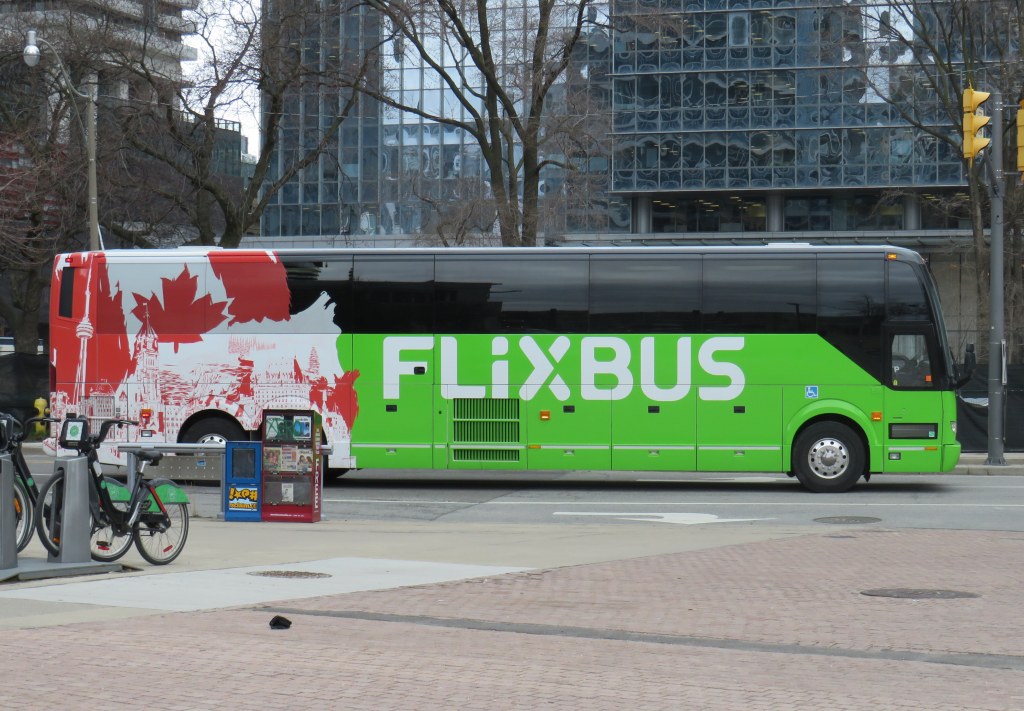
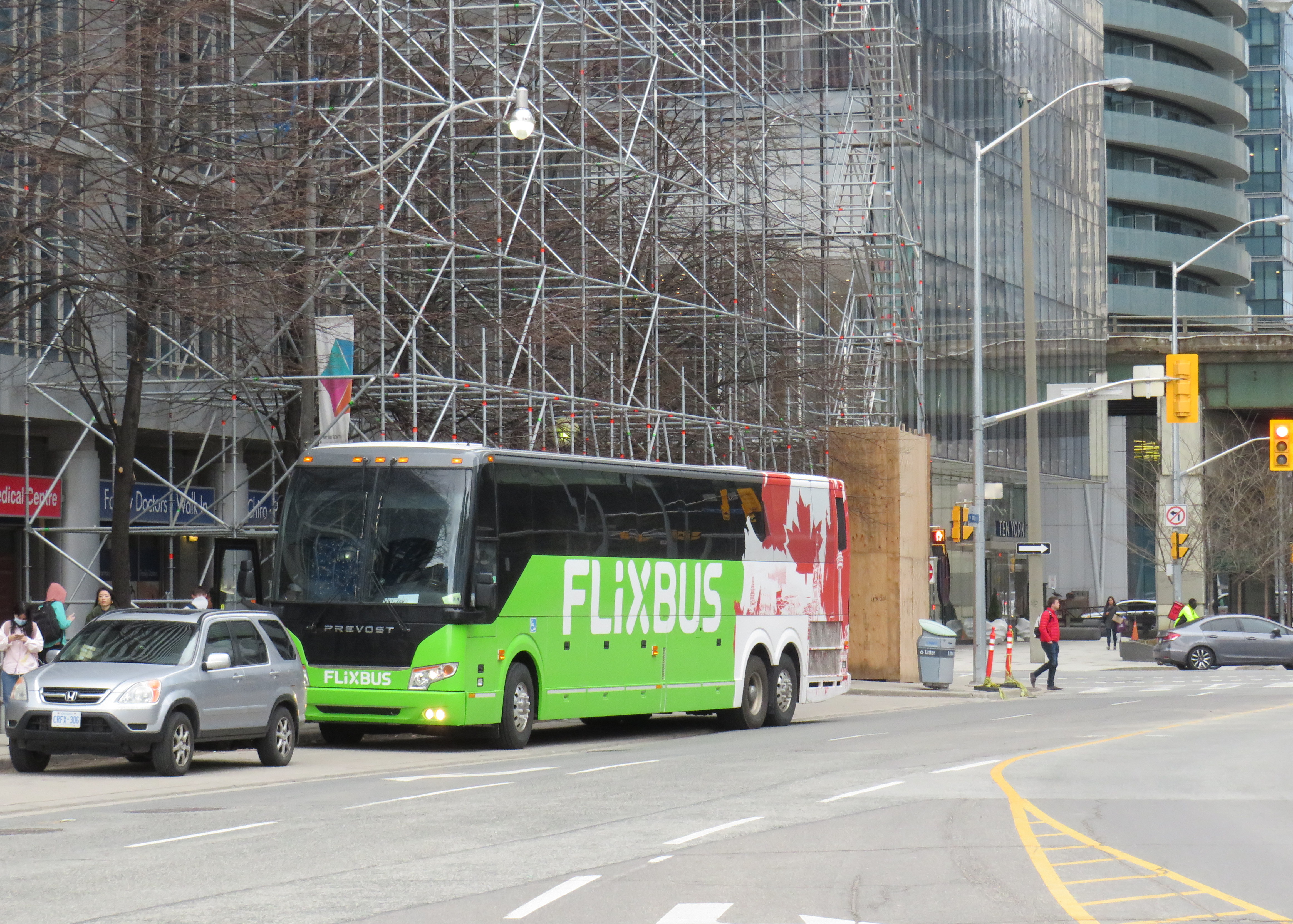
The traveler might also choose one of the new private carriers. FlixBus has one daily departure at 7:45 AM from Downtown Toronto (on York Street, south of Union Station), with a second 2:15 PM trip departing Thursdays through Sundays. Though FlixBus is the cheapest option — only $14.24 with tax — it is slightly slower than GO Transit’s direct train or its Bramalea bus connection, as it deals with Downtown Toronto traffic and serves Guelph on its way to Kitchener. Onex Bus also stops at Kitchener on its Toronto-London route, but it stops at the Sportsworld Terminal near Highway 401, requiring a change to Grand River Transit’s buses.
Because of the flexibility and convenience, I choose GO Transit, switching from train to bus at Bramalea. Because of continuing construction at Bramalea Station, I had trouble finding the bus stop for the Route 30 to Kitchener and University of Waterloo, but once work is complete on the bus loop, the transfer between modes will be quite easy.
Route 30 is a fast bus route, stopping only at the Meadowvale Business Park in Mississauga, where connections can be made to several other GO Transit bus routes as well as Miway and Brampton Transit. In Kitchener-Waterloo, the GO bus stops at Downtown Kitchener, at Wilfrid Laurier University, and at a new terminal at University of Waterloo. This is in contrast to Route 25 between Square One and University of Waterloo, which exits the highway multiple times to make local stops, and is the only weekend GO service.
The new bus terminal at University of Waterloo, serving local GRT routes, GO Transit, and the ION LRT.
Between Kitchener and London, however, options are much more limited. Though the GO Transit Kitchener Line was recently extended to London, this is limited to one weekday train leaving London at 5:30 AM and returning to London at 8:37 PM. There is just one VIA train between the two cities as well. Onex Bus offers up to five trips daily between Sportsworld and Downtown London.
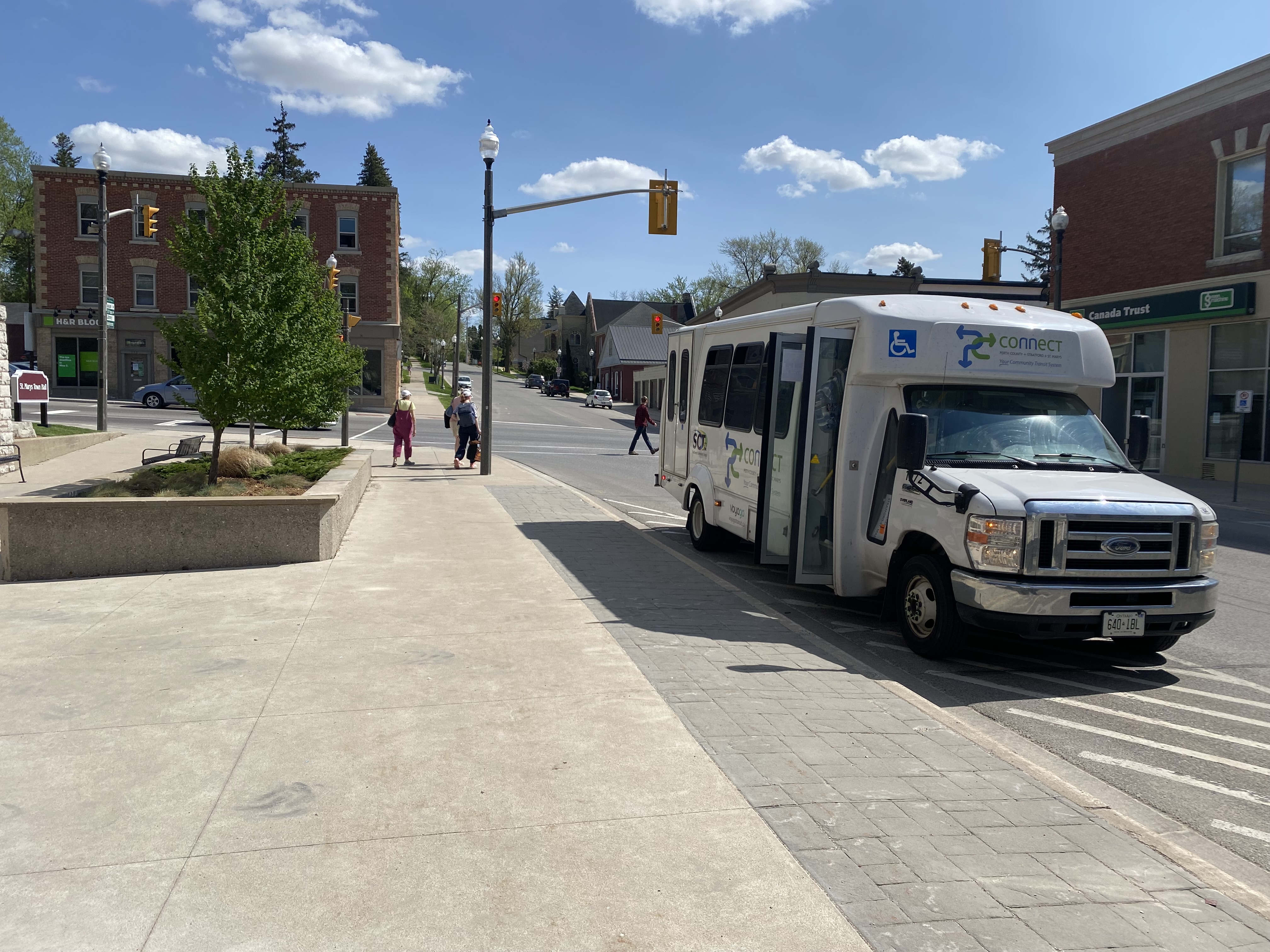
The other option is PC Connect, a provincially-funded intercommunity service connecting Stratford and St. Marys with Kitchener-Waterloo and London, as well as towns within Perth County with each other. From Conestoga Mall in Waterloo, I took the 2:50 PC Connect trip to Stratford and St. Marys. At St. Marys, I changed to a connecting bus for Masonville Place Mall in London. Each ride cost $12 cash. Service was friendly and on-time.
PC Connect Bus in St. Marys
At London, PC Connect stops on Fanshawe Park Road, adjacent to Masonville Place Mall, but a ten-minute walk from the main LTC bus terminal where connections can be made to Western University and Downtown London. (Huron Shores Area Transit, with service to Exeter and Grand Bend, stops on the north side of Fanshawe Park Road).
With VIA Rail’s service reduced between Windsor, London, and Toronto, the only trip back to Toronto after 5PM (on a Friday, a traditionally busy travel day) was an Onex Bus departure from the downtown VIA Rail station’s parking lot at 9:15 PM to Pearson Airport (the last trip of the evening continues to Bramalea City Centre, rather than Downtown Toronto). The VIA station at least is still open at that hour, with washrooms and an indoor waiting area.
I expected a coach bus, but instead, the 13 people waiting were greeted with a 15-seater van. Though the seats were relatively comfortable given the size of the van, passengers had to sit in tight spaces and there was no on-board lavatory like those on Greyhound or Coach Canada coaches. The one-way fare was $38.
The 15-seat van from London to Pearson Airport
Though the van arrived late in London (helpfully, a text was sent out to passengers), the trip to Pearson was uneventful, though it arrived about 30 minutes later than scheduled. I still had an hour’s TTC ride home to look forward to, instead of a 20 minute walk from Union Station or the old Toronto Coach Terminal.
As a private company operating in the newly deregulated intercity coach market, it made sense for OnexBus to utilize a smaller vehicle to minimize costs (the requirement for online advance booking makes this easier). But it was not up to the standards of legacy carriers such as Ontario Northland or Greyhound.
As more Ontarians travel and as post-secondary institutions return to full on-site learning in September 2022, it will be interesting to see how intercity transit providers and customers adapt to the new normal. I certainly would look forward to taking the train again once VIA returns to its full schedule.
Flixbus is one of many intercity coach operators in Ontario right now
With university and college campuses reopening for in-class instruction, white-collar workers slowly returning to the office, and pandemic restrictions receding, there are more intercity transport options in Ontario than at any time prior to March 2020.
New operators, including Germany’s Flixbus, have arrived in Ontario (with routes between Toronto, Guelph/Kitchener, Niagara, and Ottawa), while Greyhound, which pulled out of Canada two years ago, restarted cross-border runs from Toronto, Montreal, and Vancouver. In Southern Ontario, intercommunity bus and van operations continued through the pandemic, with notable service improvements in Simcoe and Grey Counties, new routes in Eastern Ontario, as well as the expansion of “on-demand” services in rural communities and smaller urban centres, including parts of Niagara Region, as the regional government there slowly assumes responsibility for all municipal transit services.
Despite these advances, there are still many gaps in Ontario that need to be filled. The deregulation of Ontario’s motor coach industry has opened the highways up to more operators, but they are all chasing the same customers, rather than attracting new riders.
For getting between Toronto and Ottawa, passengers have a plethora of choices. They may fly — the fastest, but most expensive option — on Air Canada, WestJet or Porter. They may choose VIA Rail, which is comfortable, but slower. Or they may choose to book a ticket on a Megabus, Rider Express, or Flixbus coach, the slowest, cheapest, and least frequent option. (As of May 2022, only Megabus will begin operating daily buses between Toronto and Ottawa.)
Between London and Toronto, passengers can choose between a four-hour GO Transit train ride that departs at 5:33 AM, one of several daily VIA trains (approximately 2 hours), one of three daily Onex buses (2 hours, 35 minutes) or one of three daily non-stop Megabus trips (2 hours, 10 minutes).
Not all bus operators serve the same locations, either, creating new disconnections. In Toronto, GO Transit, Megabus, Rider Express TOK Coach, and Greyhound USA use the new Union Station Bus Terminal, which is directly connected to VIA and GO trains at Union Station and the TTC subway and streetcar system.
Flixbus stops at a curbside layby on York Street south of the Gardiner Expressway
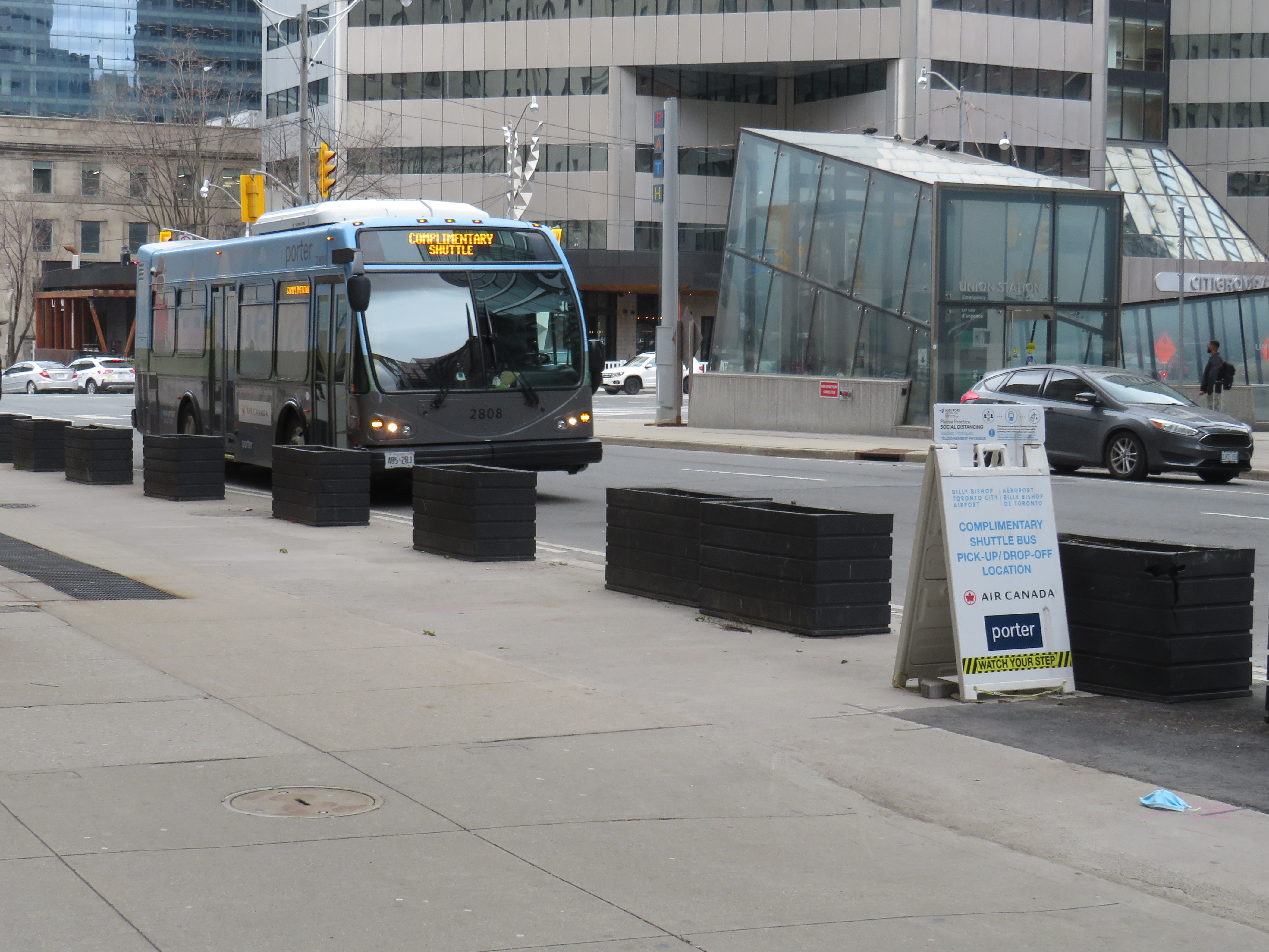
To save on terminal fees, Onex stops beside the Royal York Hotel on York Street, across the street from Union Station, sharing the layby with the Toronto Island Airport shuttle. Flixbus uses a different coach bus layby on York Street south of the Gardiner Expressway, in the Harbourfront area. Neither curbside stop is marked for either company. Though Ontario Northland still sends some buses downtown to Union Station, some of its buses to and from Sudbury and North Bay now terminate at the Yorkdale Bus Terminal in North York.
The layby next to Royal York Hotel serves the Toronto Island Airport shuttle (which has a sign) and Onex bus (which has no bus stop sign)
In Ottawa, Ontario Northland and Orleans Express use the VIA Rail station (which is on the O-Train LRT system), while Megabus terminates at the St. Laurent O-Train station. Autobus Maheux and Flixbus use curbside stops in Downtown Ottawa. The London-Toronto Megabus route bypasses Downtown London on its route from Western University, while Onex Bus and VIA Rail stop right downtown, along with Strathroy-Caradoc’s intercommunity route.
Another issue is that apart from the Toronto-Kitchener-London, Toronto-Niagara, Toronto-Kingston-Ottawa, Toronto-Kingston-Montreal and Ottawa-Montreal corridors, there is still little choice in price, operator, or schedule.
Rider Express suspended service to Windsor last year, so that the three or four VIA rail trains to London and Toronto (or a flight from Windsor airport) are the only option available for anyone travelling without a car. (Transit Windsor’s Tunnel Bus to Detroit remains suspended, despite the continued loosening of border crossing restrictions.) Peterborough, once a major destination for Greyhound Canada on its Toronto-Ottawa corridor, now only has a nearly two-hour-long GO bus connection to Oshawa GO Station.
Gaps that I wrote about several years ago still remain on the map, which are only more evident as new intercommunity services start up and new carriers emerge. The City of St. Thomas and Elgin County remain the most visible of these gaps; St. Thomas is the only urban transit system in Ontario completely disconnected to any other community, despite its short distance to London. Haldimand County, despite its proximity to Brantford and Hamilton has also chosen to remain off the map. While neighbouring Perth, Lambton, Middlesex, and Grey Counties have developed useful transit connections, Huron and Bruce Counties have very limited links to the rest of the province.
Finally, the gaps between Hamilton and Brantford to the south and Guelph and Kitchener-Waterloo to the north remain to be filled despite the growing population and multiple post-secondary institutions in each urban area. Though the Hamilton-Guelph-Kitchener triangle should be a natural expansion for GO Transit, it has yet to announce its intentions. Meanwhile, no private coach operator has filled this obvious need.
The labour-backed Link the Watershed proposal would connect Guelph, Kitchener, Cambridge, and Brantford, but that plan requires the support of local government, but it still leaves the Hamilton corridor wide open.
As more students return to school full time, and more workers return to the office, the need for reliable and attractive transportation options across Ontario will only continue to grow. As housing prices to continue to increase higher than the already-high inflation rate, intercity transport will be one way to ensure students can stay at home while going to school, and workers don’t have to move or endure long and expensive highway commuting.
Hopefully by autumn, these gaps will finally close for good.
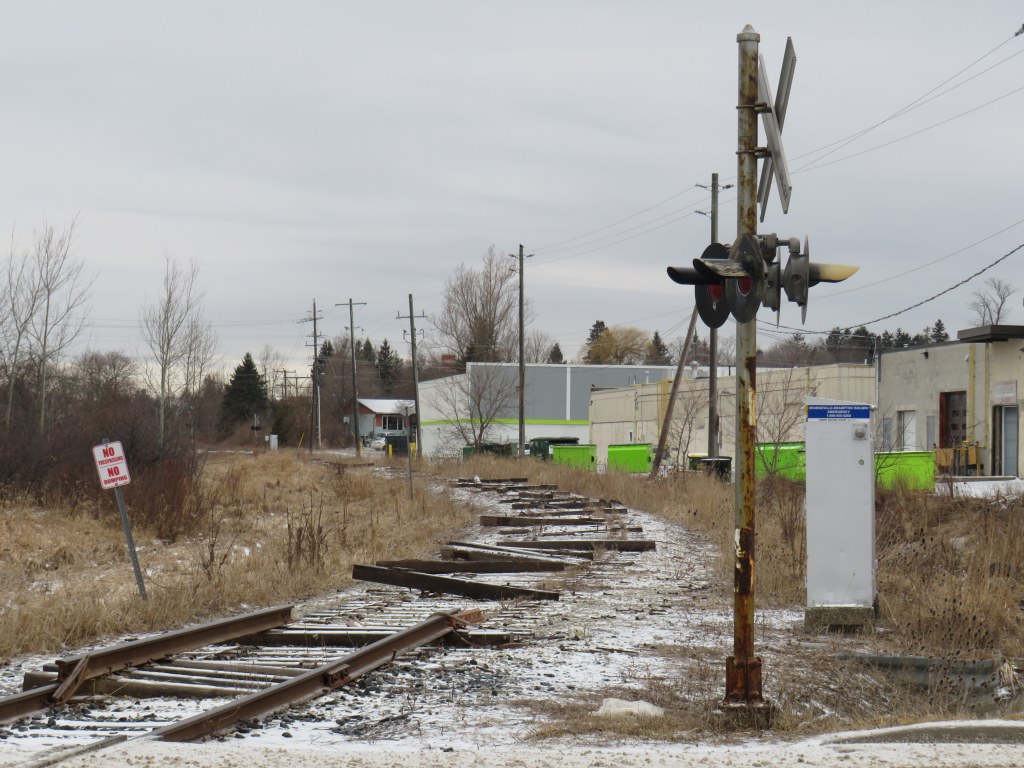
The tracks have been ripped out from the once-proud Orangeville-Brampton Railway
Despite calls for the preservation of the Orangeville-Brampton Railway since its discontinuation in December 2021, the removal of rails on the 150-year old line that once connected Toronto with Owen Sound, Teeswater, and points between began this week.
The Town of Orangeville aims to replace the tracks with a multi-use path through the municipality. The Region of Peel is likely to purchase most of the remaining section, with the right-of-way likely to become another recreational trail through Caledon and north Brampton. I will continue to document the railway’s demise and the route’s future.
In the meantime, the rusty rails await their removal.
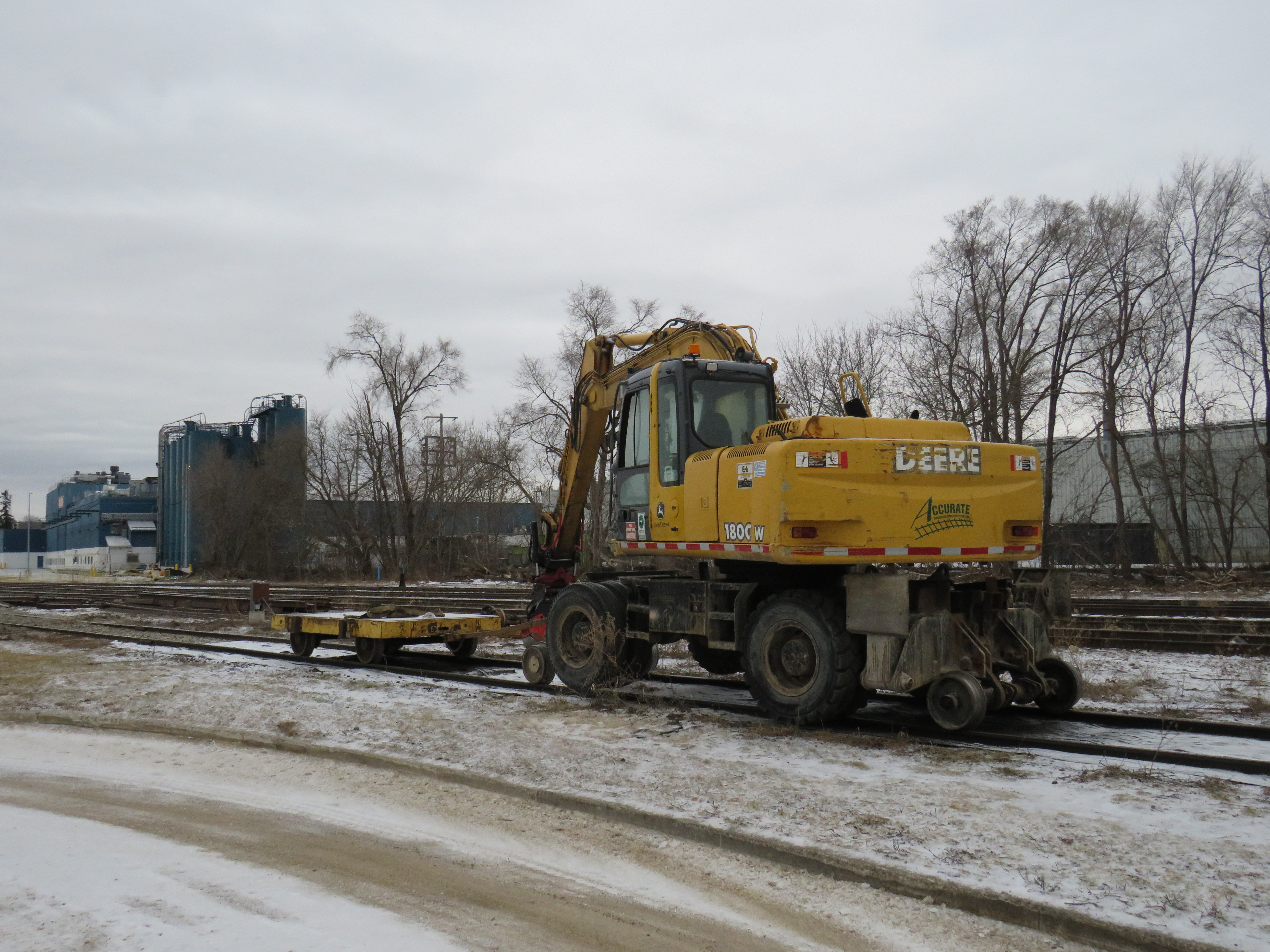
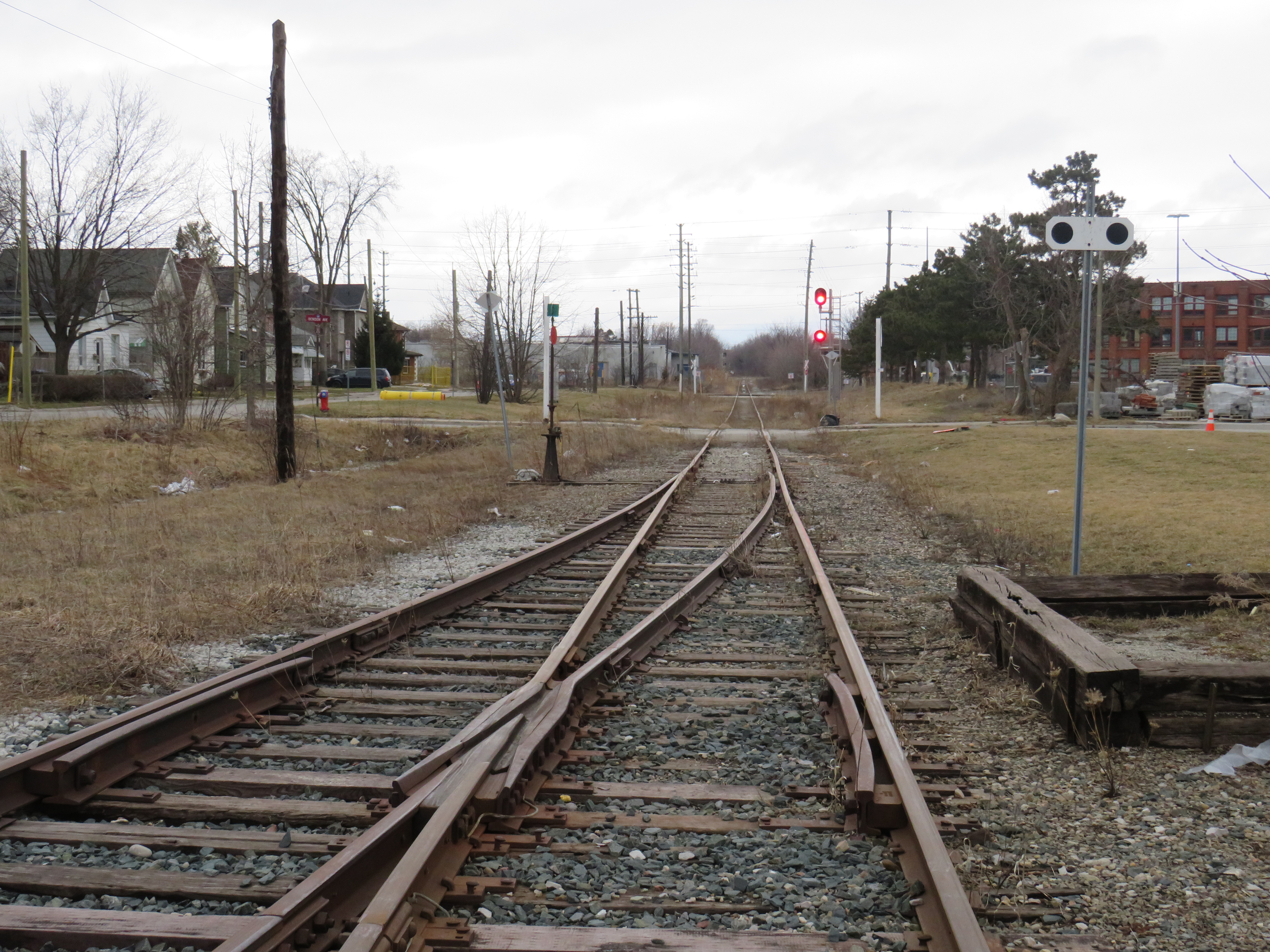
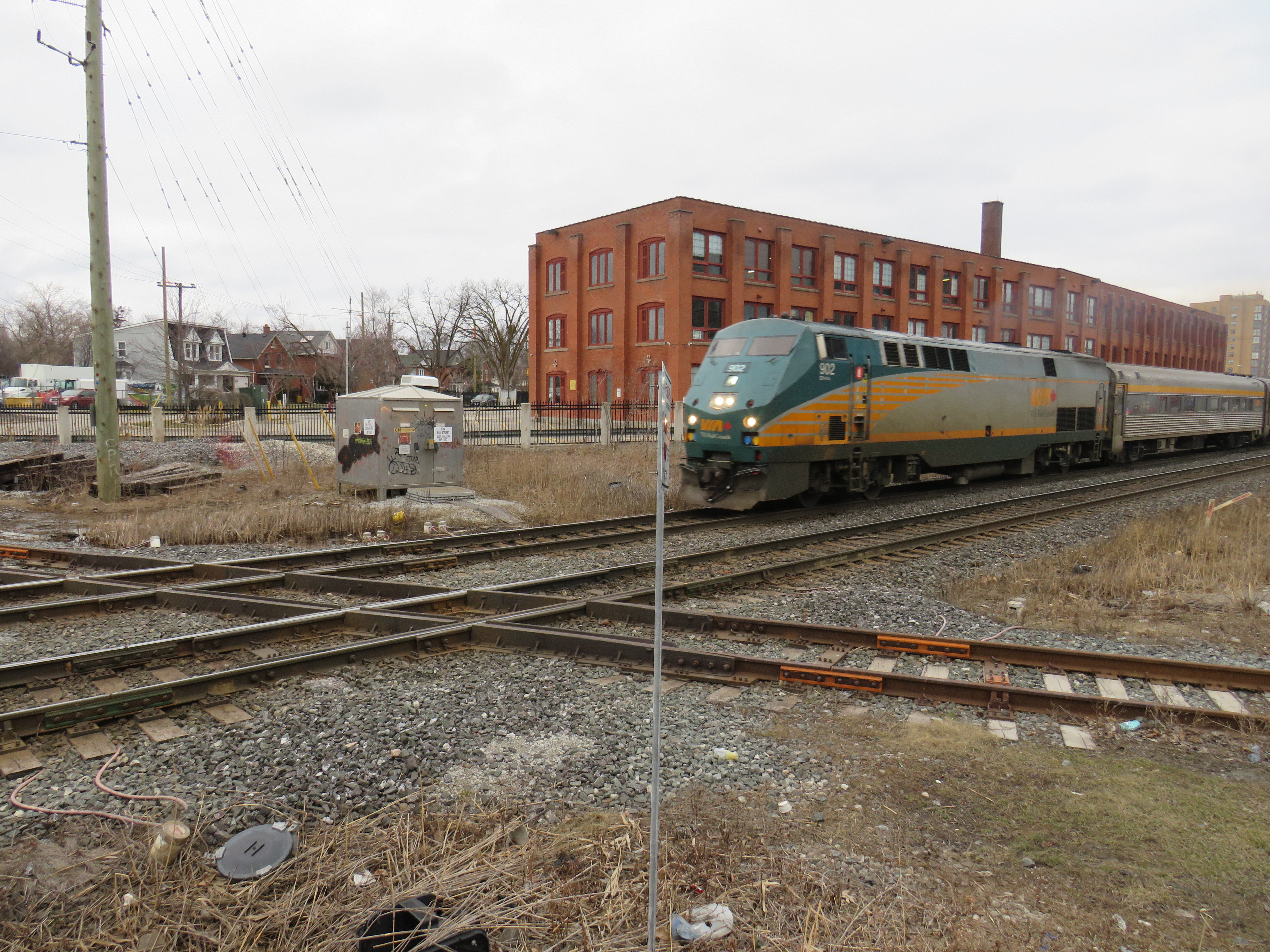
Looking west at Centre Street, Orangeville, March 30, 2022The hi-rail excavator sitting in the Orangeville yard, March 30, 2022. A pile of removed rails sits in front. At Brampton, signals continue to protect the CN mainline despite the abandonment of the old CP routeA Sarnia-bound VIA Train crosses the Brampton diamond, March 25, 2022. Who knows how long it will be before the diamond is removed for good?
End of the line – video of track removal at Orangeville by Jeremy Williams
The current end of track of the once-important Owen Sound Subdivision, on the outskirts of Orangeville. Beyond, a new paved trail occupies the former right-of-way.
On Townline Road on the south end of Orangeville, across the street from the old railway yard and station grounds, two plaques stand, telling the history of the doomed railway next to them.
The first plaque, a faded provincial marker, commemorates the Toronto, Grey and Bruce Railway, which arrived in Orangeville in 1871 and completed to Owen Sound in 1873. The TG&B was combined with the rival Credit Valley Railway by the Canadian Pacific Railway, and Orangeville became the headquarters of a network of branch lines known as the CP Bruce Division. Passenger service to Owen Sound via Brampton and Orangeville continued until 1970.
The second marker, installed by the Town of Orangeville, commemorates the municipal takeover of the remnants of the Bruce Division, after CP abandoned all track west and north of Orangeville in the 1980s and 1990s. The plaque proudly boasts of a “successful passenger tourist operation” and how the new short line “enhanced opportunities for the long-term economic development of the region.”
The municipal plaque is sadly out of date. The Credit Valley Explorer tour train last operated in early 2018, and the Town of Orangeville lost interest in operating the railway, which was costing the municipality $450,000 a year. The last freight train departed Orangeville on Friday, December 17, 2021.
Toronto, Grey and Bruce Railway plaqueOrangeville-Brampton Railway plaque
Together with Dr. Brian Doucet, Canada Research Chair in Urban Change and Social Inclusion at the University of Waterloo, I toured the line in its waning days. At TVO.org, Doucet and I argue that the corridor is worth preserving, even if the Town of Orangeville is no longer interested in paying for the railway. We note how the province is looking to build a new highway through the very same lands that the dying railway cuts across.
Additional photographs and videos of the once-proud Orangeville and Brampton Railway can be found below.
On the morning of Thursday, August 19, I departed Toronto’s Union Station. My destination: Union Station. I set out to travel the longest distance possible by local and regional transportation services, taking advantage of several new routes set up by local and county governments to fill the gaps left by traditional intercity coach operators.
The round trip from Union Station required two trains and seven buses, operating on five separate transportation agencies. In some cases, the transfers were smooth and reliable; in Owen Sound, I waited several hours between connecting trips. For a casual traveler like myself, this was not a problem, but for more frequent commuters, the patchwork of various schedules and fares is not ideal.
I left Union Station on a westbound Kitchener Line train at 7:34 AM on Thursday, August 19. I returned to Union Station at 9:34 PM Friday evening, staying in Meaford overnight. I made time for short visits to Owen Sound, Meaford, Collingwood, and Barrie, with short stopovers in Guelph and at the Blue Mountain resort.
The following is a travelogue of sorts, concluding with a few conclusions on how parts of this trip can be made better for future passengers.
Thursday: Toronto to Owen Sound and Meaford
Intending to catch the morning GOST (Guelph-Owen Sound Transportation) minibus from downtown Guelph, I boarded the first westbound Kitchener Line train at Union Station at 7:34 AM. The train only goes as far as Bramalea Station, requiring a transfer to a bus to continue westward. Happily, the train arrived at Bramalea on time, so there was no problem taking the connecting bus that departs at 8:18 AM. (I had bad luck on a previous trip through Bramalea.)
The connecting bus from Bramalea to Guelph is a slow, local service, winding its way through Brampton, Georgetown, Acton, and rural Wellington County before arriving at Downtown Guelph at 10:13. Through GO Transit’s buses are comfortable, they lack lavatories, so a two-hour trip may be difficult on some passengers’ bladders. Though the 7:34 train to Bramalea connects to an express bus via Highways 407 and 401 to Kitchener, anyone headed to Guelph gets to ride the scenic route.
Though an express bus would be welcome, I noted the importance of the local GO bus for workers living in Brampton getting to jobs in Halton Hills, and residents in Acton and Rockwood commuting to Guelph. There is a need for both services.
At least I got a spot at the front of the double decker bus and was able to enjoy the ride.
This first leg on GO Transit between Toronto and Guelph cost $14.06, deducted from my Presto card.
Brampton Transit used to operate a double-decker bus. GO Transit has brought them back to the Flower City. Due to a construction project on Highway 7 in Rockwood, the double-decker bus took a scenic, yet unexpected detour on country roads. This must have turned some heads.
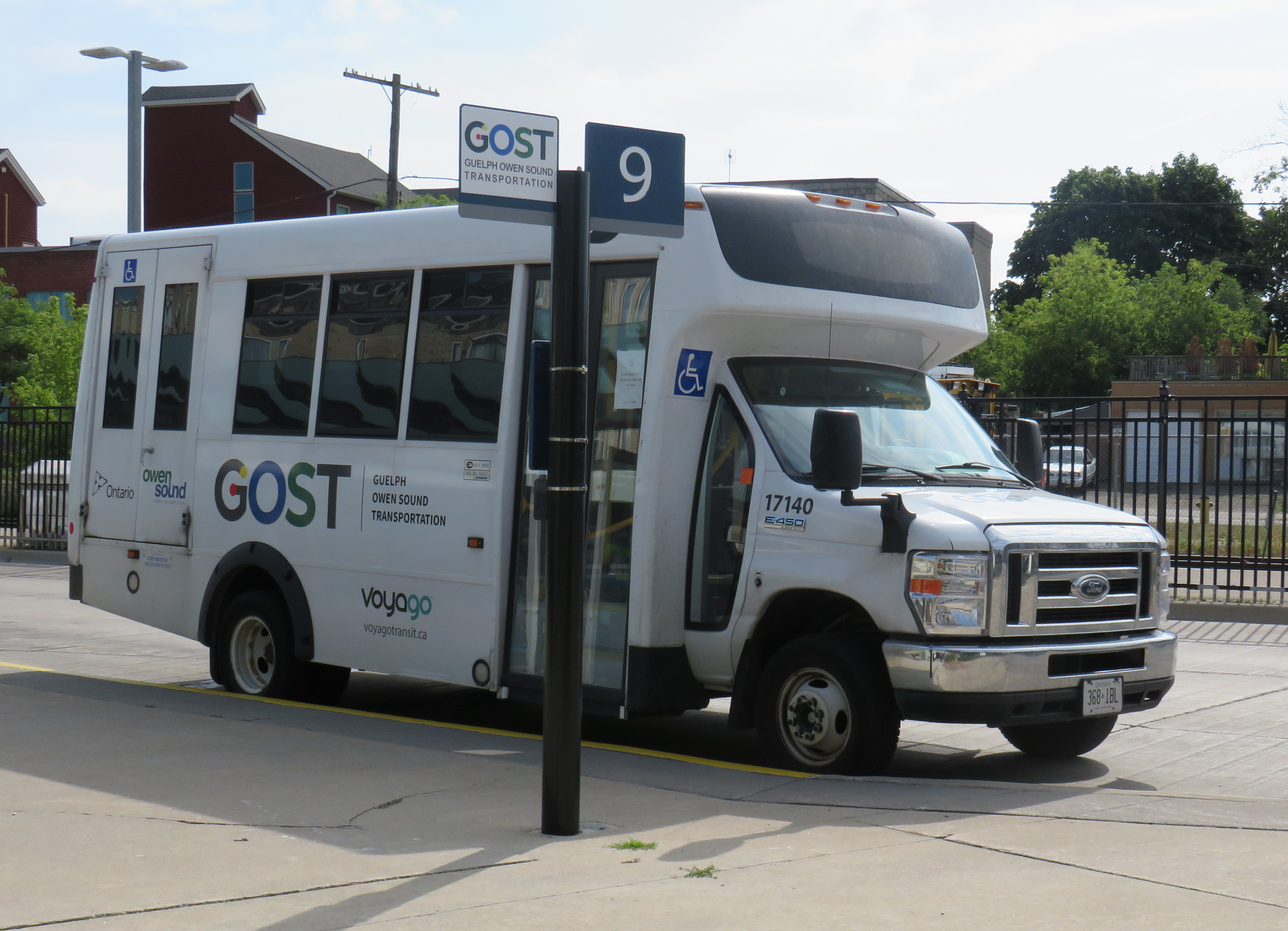
At Downtown Guelph, I had just under 20 minutes to use a washroom and have a quick coffee before switching to the GOST minibus. GOST serves the Guelph Central Station bus terminal, with easy connections to GO buses and trains and most Guelph Transit services.
A GOST minibus waiting for departure at Guelph Central Station
The GOST minibus service operates two round trips, seven days a week, between Guelph and Owen Sound, with stops in Elora, Fergus, Arthur, Mount Forest, Durham, Williamsford, and Chatsworth. Except for Fergus, all stops are located in or near each town’s commercial centre. The service is funded by Owen Sound and a provincial grant, and operated by London-based Voyago (which operates several other rural services in Western Ontario).
Until the mid 2000s, Greyhound ran buses six days a week between Toronto and Owen Sound via Highway 10 through Brampton and Orangeville or via Highway 6 through Guelph and Mount Forest, each route on alternating days. Gray Coach, the TTC-owned predecessor to Greyhound, ran several daily trips. The twice-daily GOST bus is a significant improvement over Greyhound’s schedule in its waning years.
On this Thursday midday northbound trip, there were two passengers going all the way up to Owen Sound, one getting off in Elora, one disembarking at Mount Forest, and one passenger who boarded at Williamsford for Owen Sound. The fare from Guelph to Owen Sound is $20 cash, with cheaper fares to ride shorter distances.
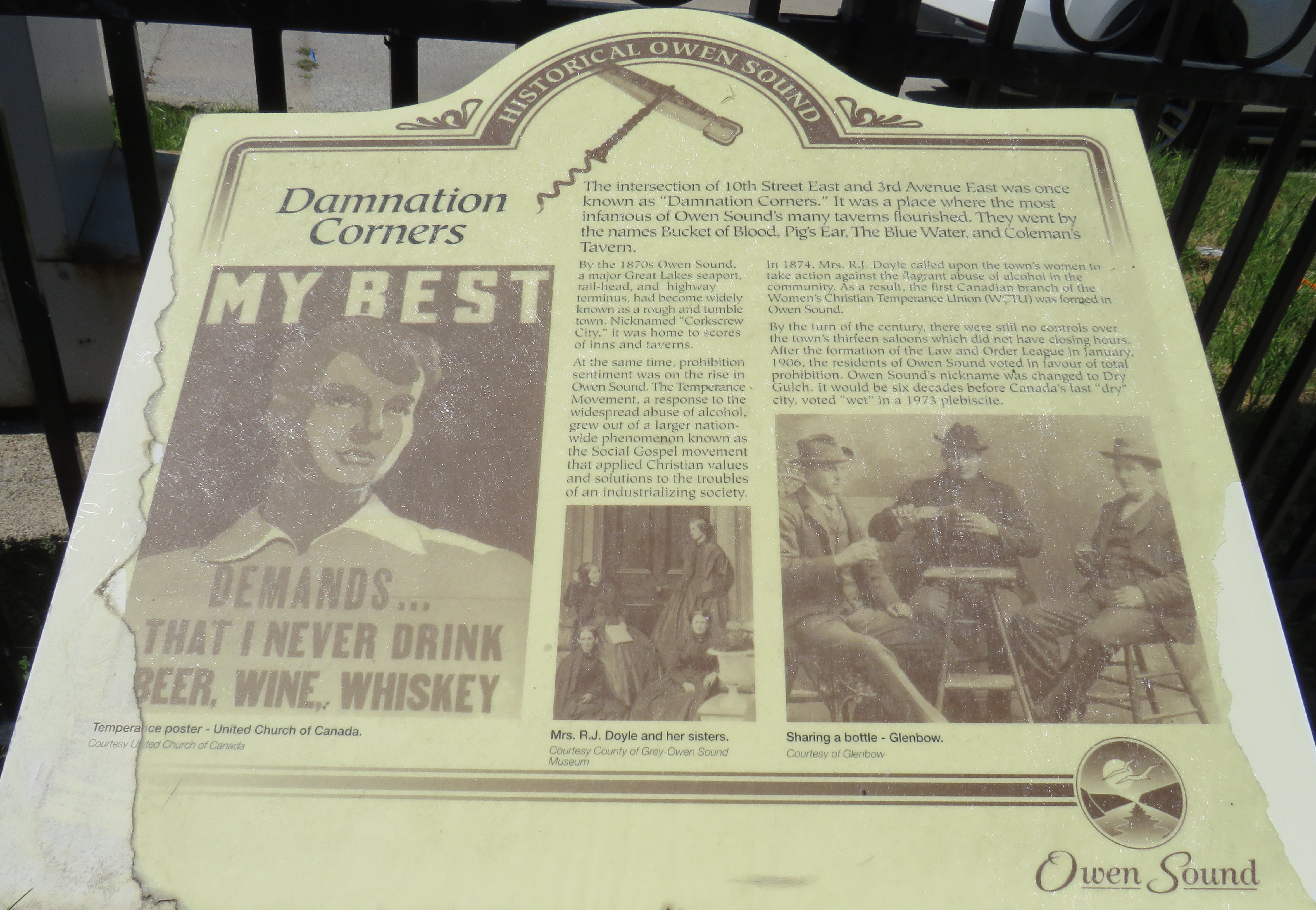
I arrived in Owen Sound a few minutes before 1:00 PM, with several hours to spend before my next ride to Meaford. Owen Sound, population 26,000, has an interesting history as a Great Lakes port and railhead for both the Canadian Pacific and Grand Trunk/Canadian National Railways. The maritime traffic and local industry gave Owen Sound a reputation as a hard drinking town; it became one of the first municipalities in Ontario to go “dry” in 1906. It remained that way until 1973.
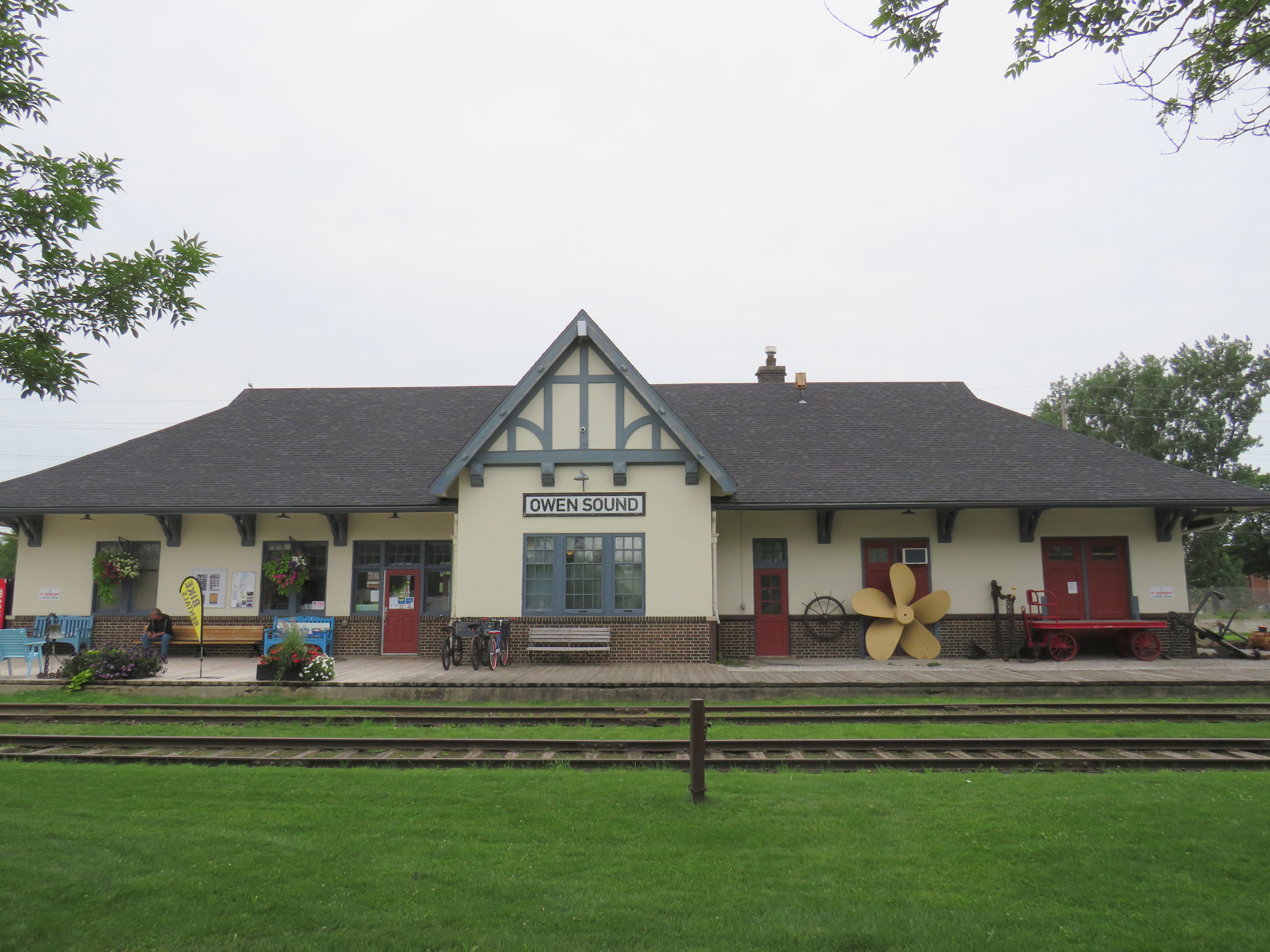
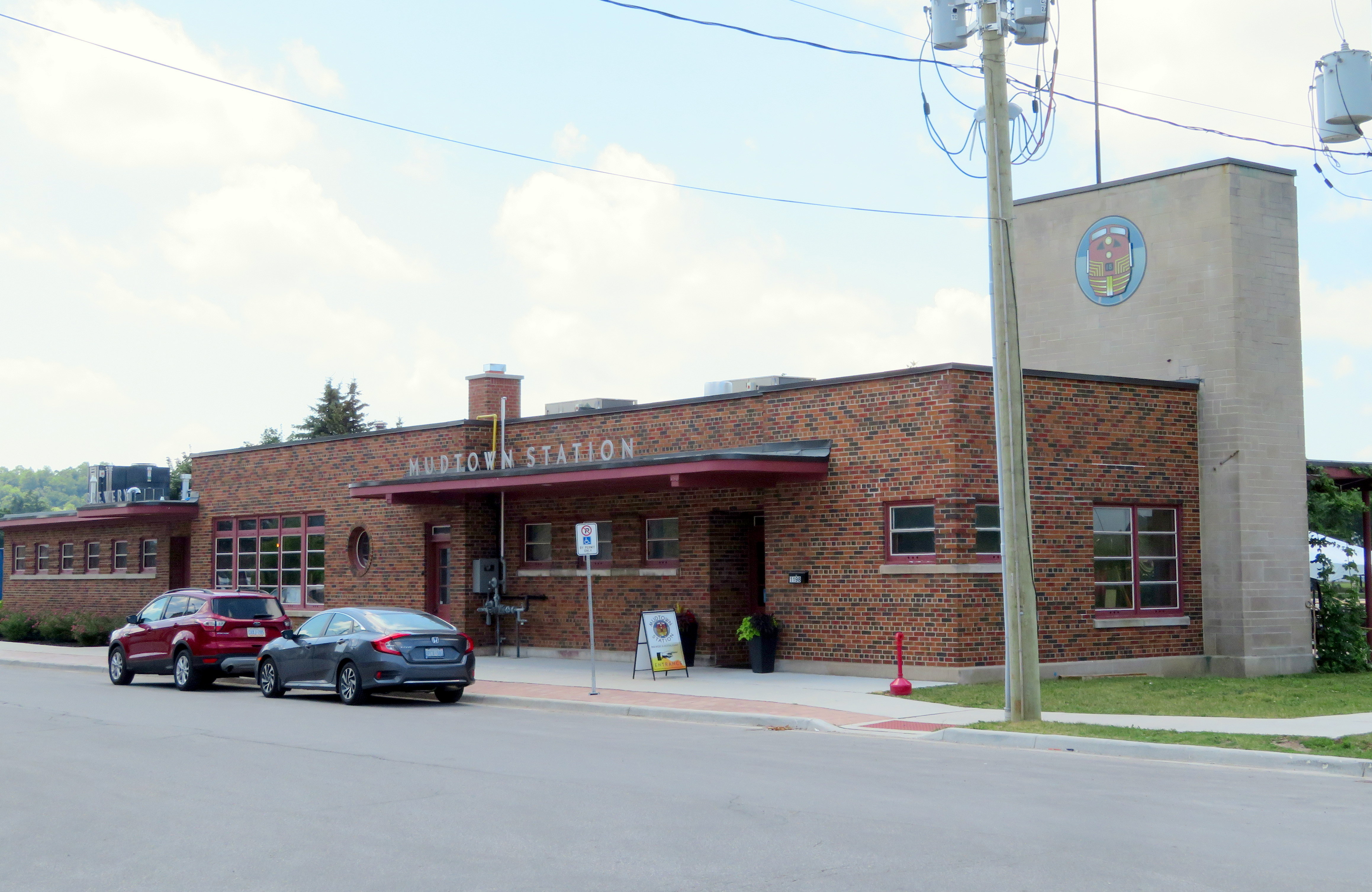
With the construction of the St. Lawrence Seaway and the decline of branch lines across Ontario, the city declined as a port and both railways were torn up in the late 1990s. However, both stations remain standing – the Grand Trunk Station on the west side of the harbour is now a local museum, while the modernist CP station, built after the Second World War, is now a brewpub.
With a lovely downtown, harbour, parks, and heritage neighbourhoods to wander through, Owen Sound was worth a three-and-a-half stopover.
Owen Sound Marine and Rail Museum, the former Grand Trunk/CN StationMudtown Station, the old CP Station in Owen SoundPlaque commemorating “Damnation Corners” where taverns once stood on all four corners. One block to the east was “Salvation Corners” where four Protestant churches still stand.
I decided to stay in Meaford overnight. Though I could get as far east as Wasaga Beach via Grey Transit Route, Colltrans, and Simcoe County Linx, I would not have been able to continue my trip back to Toronto that night, missing the last Linx bus from Wasaga Beach to Barrie by one hour.
Meaford had cheaper accommodations than Owen Sound or Collingwood, and by staying there overnight, it gave me plenty of time in Meaford and Collingwood the next day. Before Greyhound Canada suspended operations in April 2020, there was one daily bus between Toronto, Barrie, Collingwood, and Owen Sound. PMCL, which Greyhound purchased in the 1990s, used to run several buses a day on that route.
I departed Owen Sound on a pre-booked GTR minibus at 4:30 PM, which cost $5 for the trip into Meaford. As I was the only one on that departure, the driver was kind enough to drop me off right by my motel. There are six daily trips between Owen Sound and Meaford, with four of those trips offering a timed connection or direct run to Blue Mountain Resort, GTR’s eastern terminus.
GTR minibus at Owen Sound Terminal (October 2020)
Meaford itself is a charming little town, with several good restaurants, and a lovely harbour. Meaford is the western terminus of the Georgian Trail to Collingwood, one of Ontario’s first rail trails. As GTR minivans and Simcoe Linx and Colltrans buses all have bike racks, Meaford would make for a nice cycling trip.
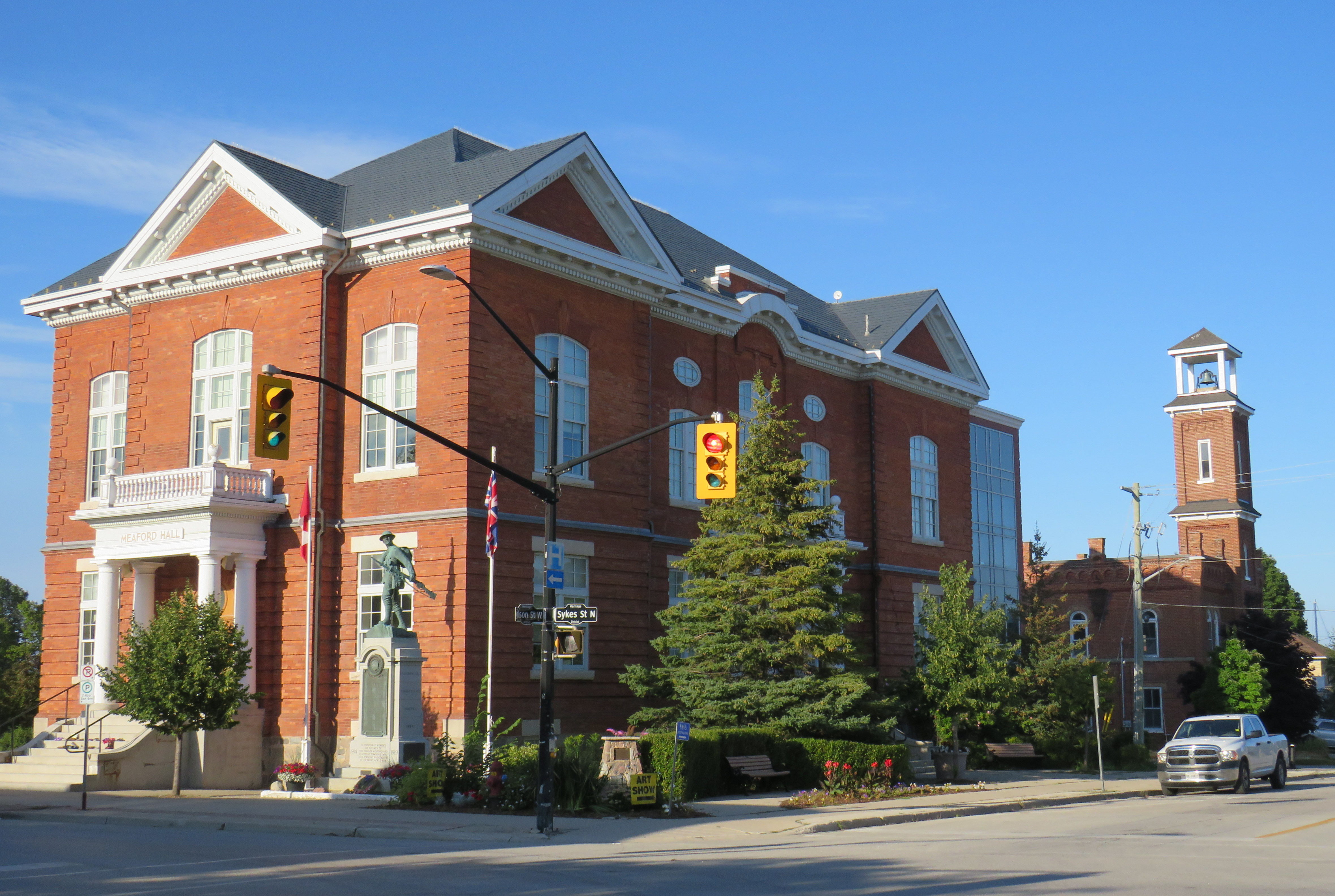
Meaford Hall, with the old fire station behindTerminus of the Georgian Trail, which continues to Collingwood, with connections beyond
Friday: Meaford to Collingwood and Toronto
The next morning, I departed Meaford on GTR Route 4 at 8:46AM, and arrived at Blue Mountain Village just after 9:30, another $5 pre-booked trip. The popular resort is also served by Colltrans’ Blue Mountain Link route to Downtown Collingwood, with connections to local buses and the Simcoe County Linx Route 4 to Wasaga Beach.
Approaching Blue Mountain, the driver helpfully asked me if I needed to catch the bus to Collingwood. Though the timetables between GTR Route 4 and Colltrans’ bus don’t permit an easy connection, if I got off at Craigleith, at the bottom of the escarpment, I would be sure to get the onward bus. I declined the offer, because I was curious to see Blue Mountain Village itself, and I needed a coffee.
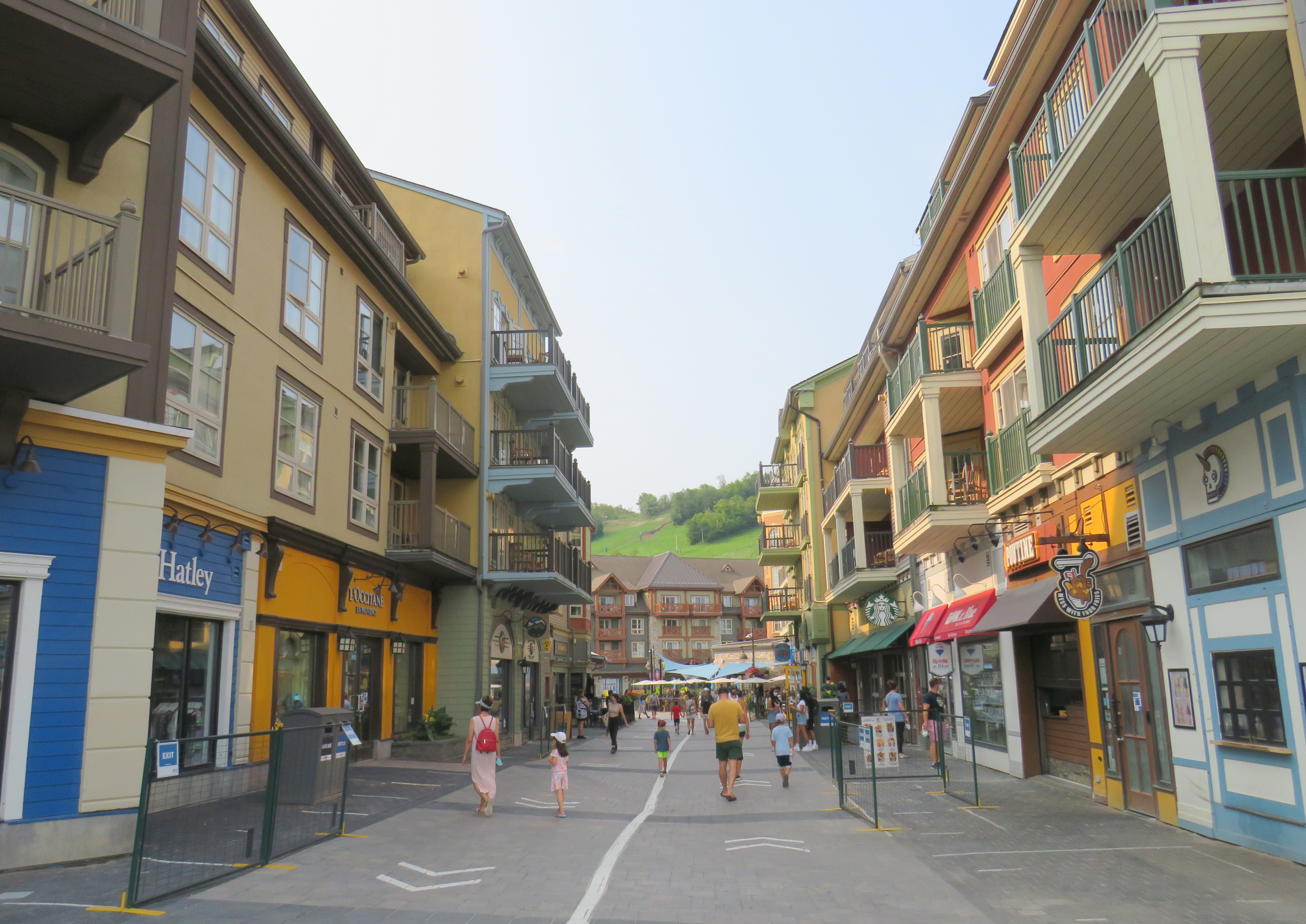
The Disneyland-like urbanity of Blue Mountain Village
Blue Mountain Village, the heart of the sprawling Blue Mountain resort, contains many shops, restaurants and bars, along with three hotels and timeshare apartment complexes with the architecture and walkways meant to invoke a European ski resort. Cars are not permitted in the internal streets, which gives it a somewhat surreal atmosphere. In the summer, tourists and vacationers are attracted by several golf courses, downhill mountain biking trails, rope courses, spas, nearby beaches, and, of course, the shops.
Having gotten my coffee and my morning walk, I paid my $2 fare and got on the 10:20 bus to Downtown Collingwood.
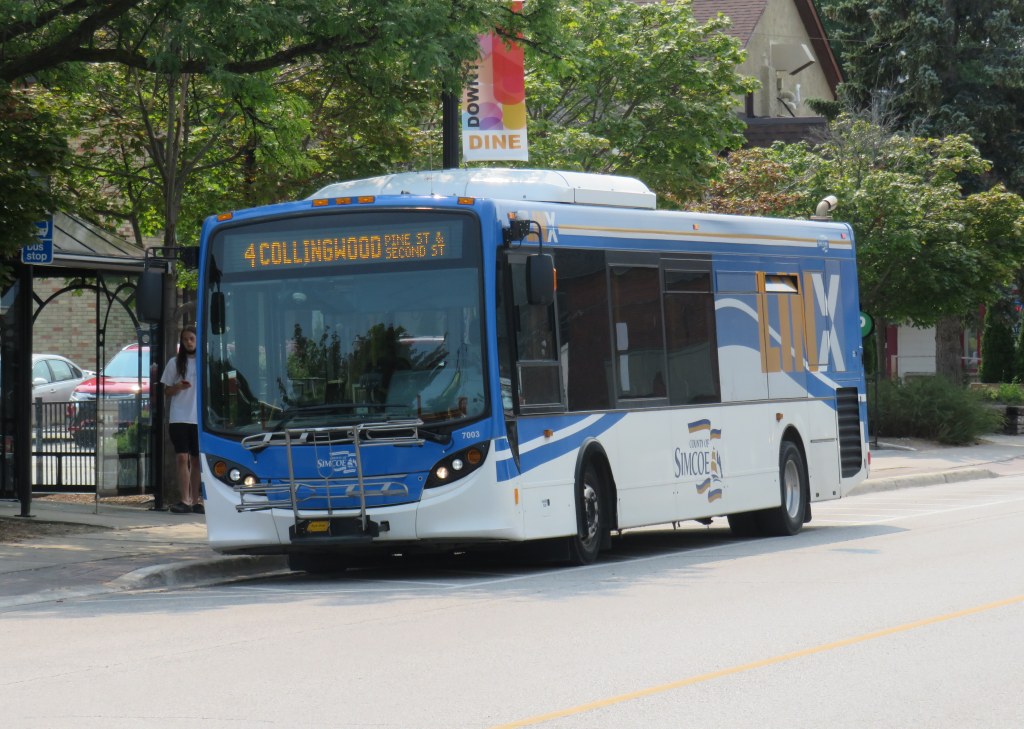
Colltrans and Simcoe County Linx buses at Downtown Collingwood
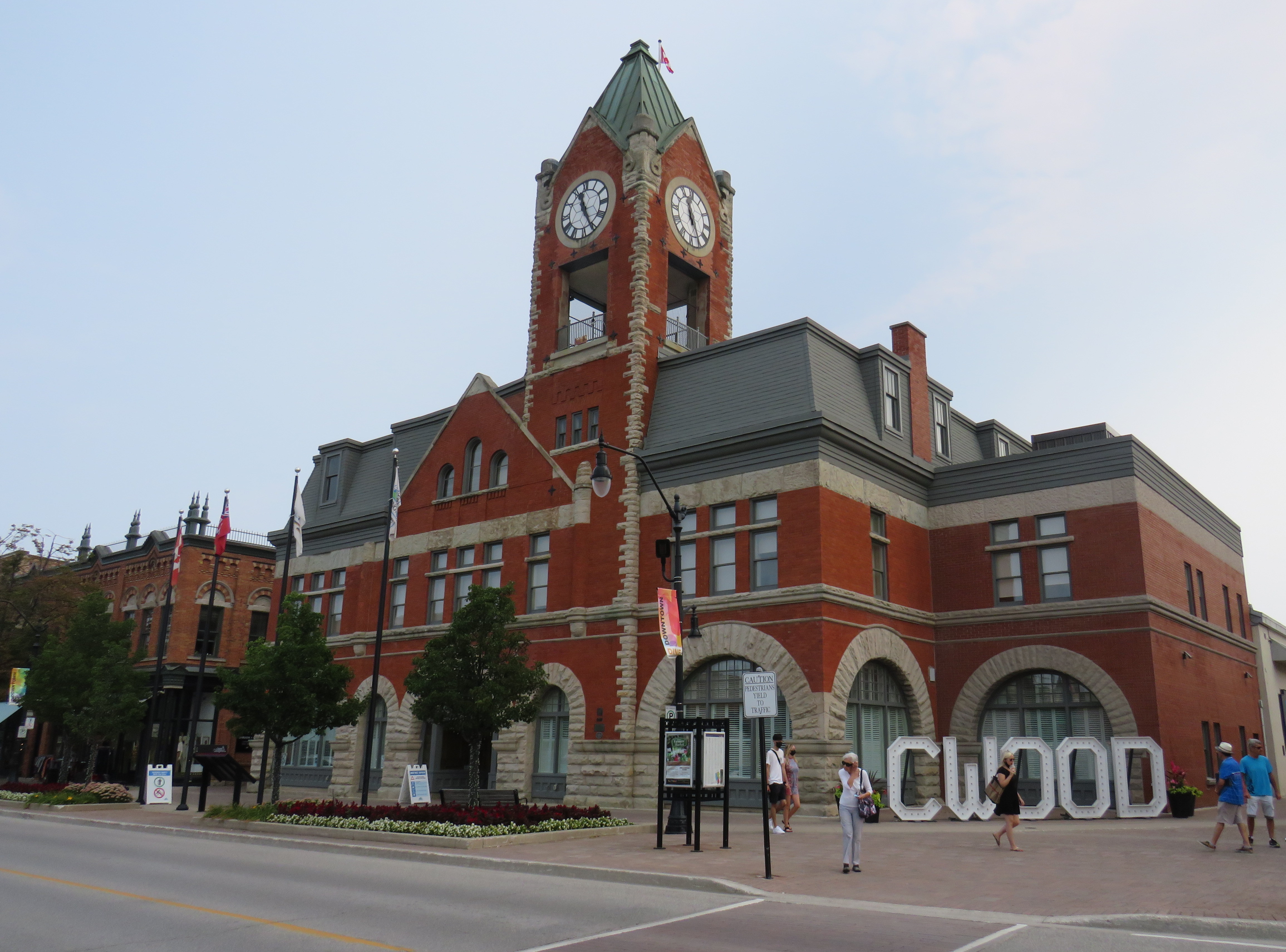
Like Owen Sound, Collingwood has a lovely and vibrant downtown core, with its own proud marine and railway history. Collingwood was the terminus of the Ontario Simcoe & Huron Railway, the province’s first rail connection, built in 1853-1854. The OS&H was built as a shortcut between the Upper Great Lakes and Toronto and prospered before merging with several other railways to become part of the massive Grand Trunk system. Sadly, passenger service to Collingwood ended in 1960, and the railway itself is abandoned and partially removed.
Collingwood Town Hall
After a hearty lunch in Downtown Collingwood and walk through the area, I paid another toonie and boarded Simcoe Linx Route 4 to Wasaga Beach.
In the back parking lot of a Loblaws Superstore in the west end of Wasaga Beach, two Simcoe County Linx buses, a Wasaga Beach Transit bus, and a Clearview Transit minibus meet to exchange passengers. The grocery store is distant from the main tourist area and the downtown commercial centre, but at least transfers between buses are easy. The Wasaga Beach Transit bus does pass by most motels, tourist traps, and beach areas. I changed to another Simcoe County Linx bus (Route 2) that passes through Stayner and Angus for Allandale Waterfront GO Station south of Downtown Barrie. The fare between Wasaga Beach and Allandale was $6.00 cash.
At a grocery store parking lot, Simcoe County Linx, Wasaga Beach Transit, and Clearview Township buses meetArrival at Allandale Waterfront GO Station
Allandale Waterfront GO Station, which hosts GO trains and buses and several Barrie Transit routes, is one of two Barrie terminal points for Simcoe County Linx’s buses. Buses to Orillia and Midland terminate at Georgian College and Royal Victoria Hospital in the northeastern corner of Barrie, with a Barrie Transit fare and a 30-minute local bus ride to get from one Linx route to another.
Kempenfelt Bay, Barrie
The ride back to Union Station, which included a bus to Aurora GO and a change to a train the rest of the way. That final trip cost me $13.76 on my Presto card.
In total, I paid $39.06 on Thursday and $28.76 on Friday to complete the round trip between Toronto and Georgian Bay.
Analysis and Conclusions
It is good to see Owen Sound, Grey County, and Simcoe County develop local solutions to replace and improve upon vanished coach services that ran on Highways 6, 10, and 26, better schedules and improved connections will only make their services better.
With limited schedules, particularly on Grey Transit Route and Simcoe County Linx, I could only do this exact trip by leaving Toronto on a Wednesday or Thursday. GTR’s Routes 3 and 4 between Owen Sound, Meaford, and Blue Mountain operates Wednesdays through Sundays. Though transit between Blue Mountain Village and Wasaga Beach runs 7 days a week, the Simcoe Linx bus between Wasaga Beach and Barrie only runs weekdays, with the last buses leaving Allandale GO and Wasaga Beach Superstore at 6:30 PM.
Later service hours and weekend service between Barrie and Wasaga Beach would allow GTHA residents to get to one of the Great Lakes’ great beaches without a car for a weekend getaway, without more congestion on Highways 400 and 26.
In addition, it would be good to see Simcoe County and municipal systems in Collingwood, Wasaga Beach, Barrie, Orillia, and Midland/Penetanguishene develop a coordinated fare structure, as transfers or fare discounts are not provided between each service, except between Linx and Midland/Penetanguishene. Simcoe County Linx already has its own farecard; if that were upgraded it would at least allow frequent riders to benefit from easy fare payments and transfer discounts.
These are relatively simple changes that can further drive ridership growth and improve mobility throughout fast-growing Simcoe County as well as attract more visitors from Toronto and beyond.
The Toronto-Guelph leg of my trip was unnecessarily slow, and will continue to be so until all-day, two way GO service is introduced on the entire Kitchener Corridor, or if express buses are added to the schedule. While all-day GO train service will take several years with several construction projects underway or necessary in Toronto, Brampton, and Guelph to provide the necessary capacity, improved bus service can provide a stopgap for the time being.
Without an express GO bus or competing services such as Greyhound (which used to operate multiple buses between Guelph and Toronto) or a morning VIA Rail train, it can take nearly three hours to get from Toronto to Guelph without a car.
Though GO Transit will introduce significant service improvements starting Labour Day, including new peak-direction express trains on the Kitchener Corridor. Unfortunately, there are no travel time improvements for getting between Toronto and Guelph weekday mornings. Given that there is currently no alternative access between the two cities, there’s a market that GO Transit is clearly missing right now.
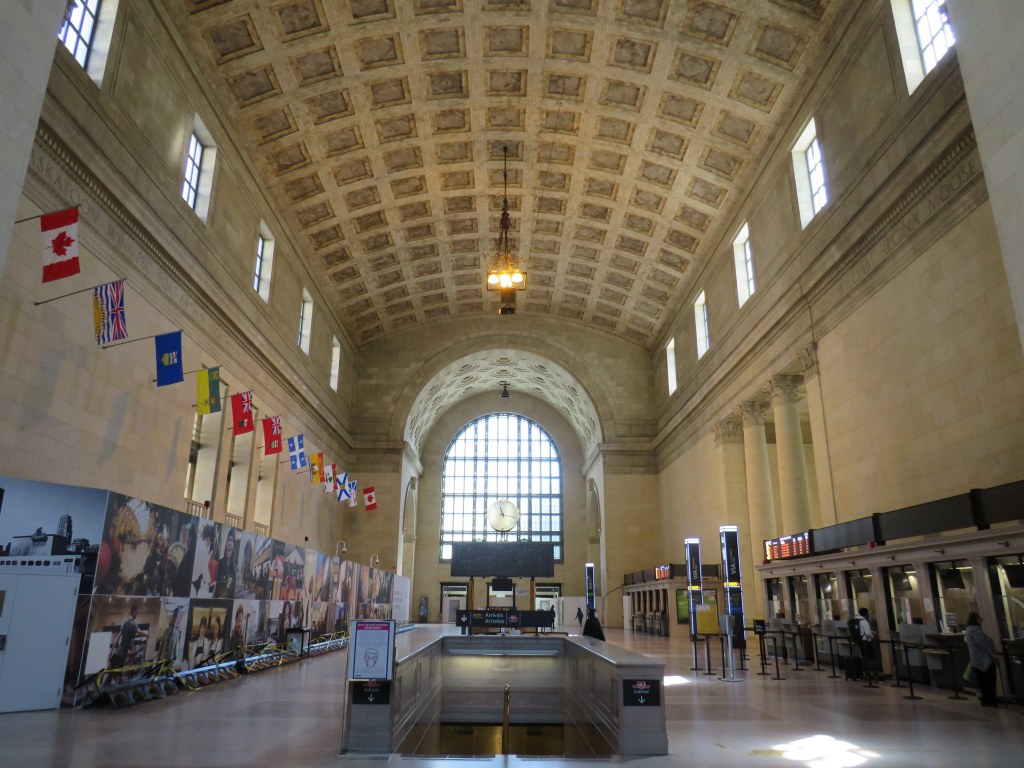
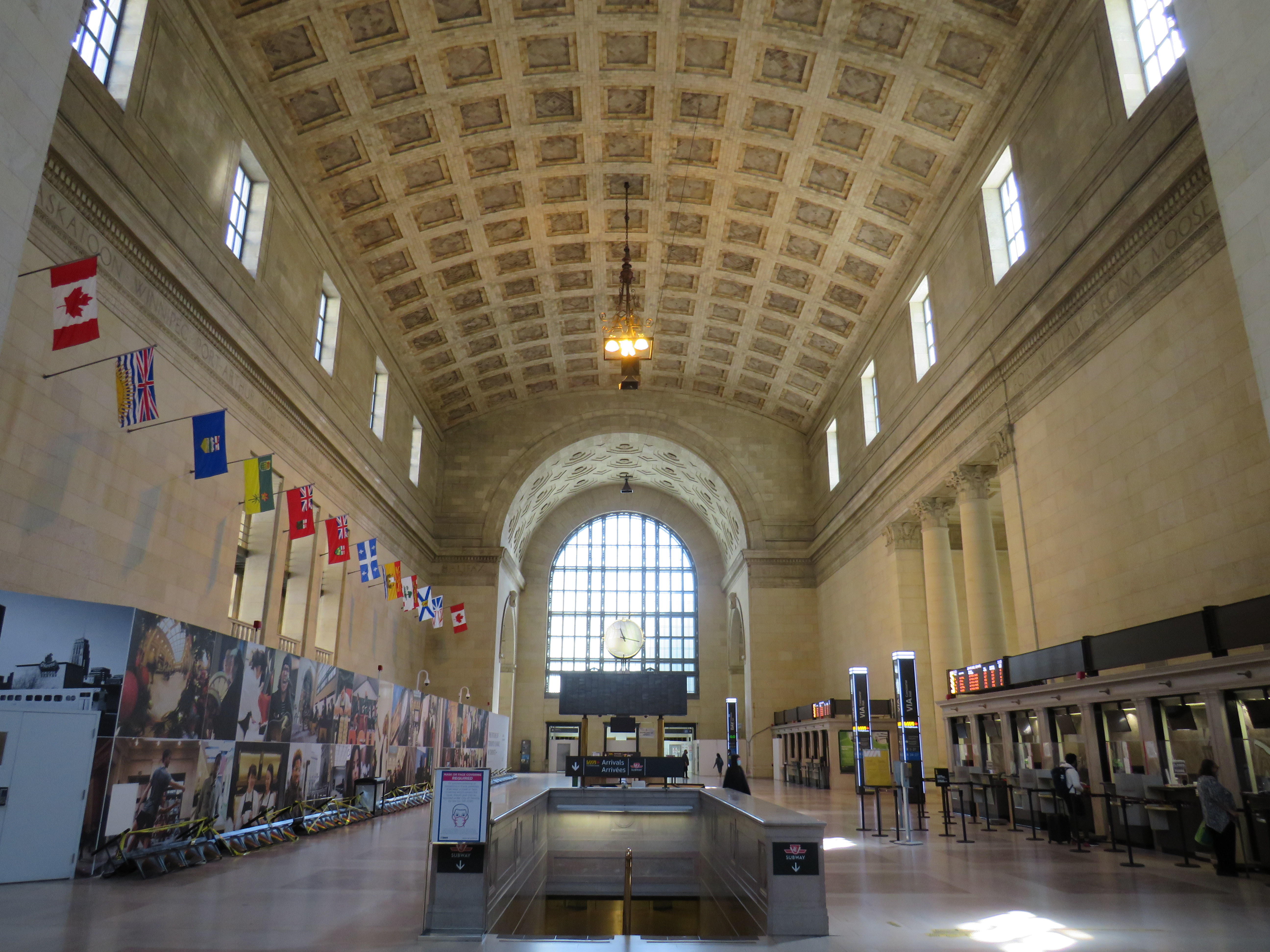
Union Station’s Great Hall is one of Toronto’s great indoor spaces. The station was constructed during Toronto’s first great building boom, in an era that began with E.J. Lennox’s Old City Hall (completed in 1899), and concluded with the completion of the Bank of Commerce Building, opened in 1931.
Work on Union Station, built for the Grand Trunk Railway and Canadian Pacific Railway, began in 1914, with the grand headhouse completed in 1920, construction delayed by the First World War.
Foreshadowing the long-delayed station renovations that are still ongoing, work on the elevated tracks and platforms connecting to the new station took nine more years, though a lavish official opening took place on August 6, 1927. By then, the Grand Trunk Railway was fully absorbed by Canadian National Railways (now CN).
Toronto’s Union Station became Canada’s busiest and most important railway hub, with direct trains to cities throughout six provinces and six American states, with through sleeper cars to even more US destinations via Buffalo. Though Montreal was Canada’s largest city until the early 1970s, CN and CP operated out of separate terminals.
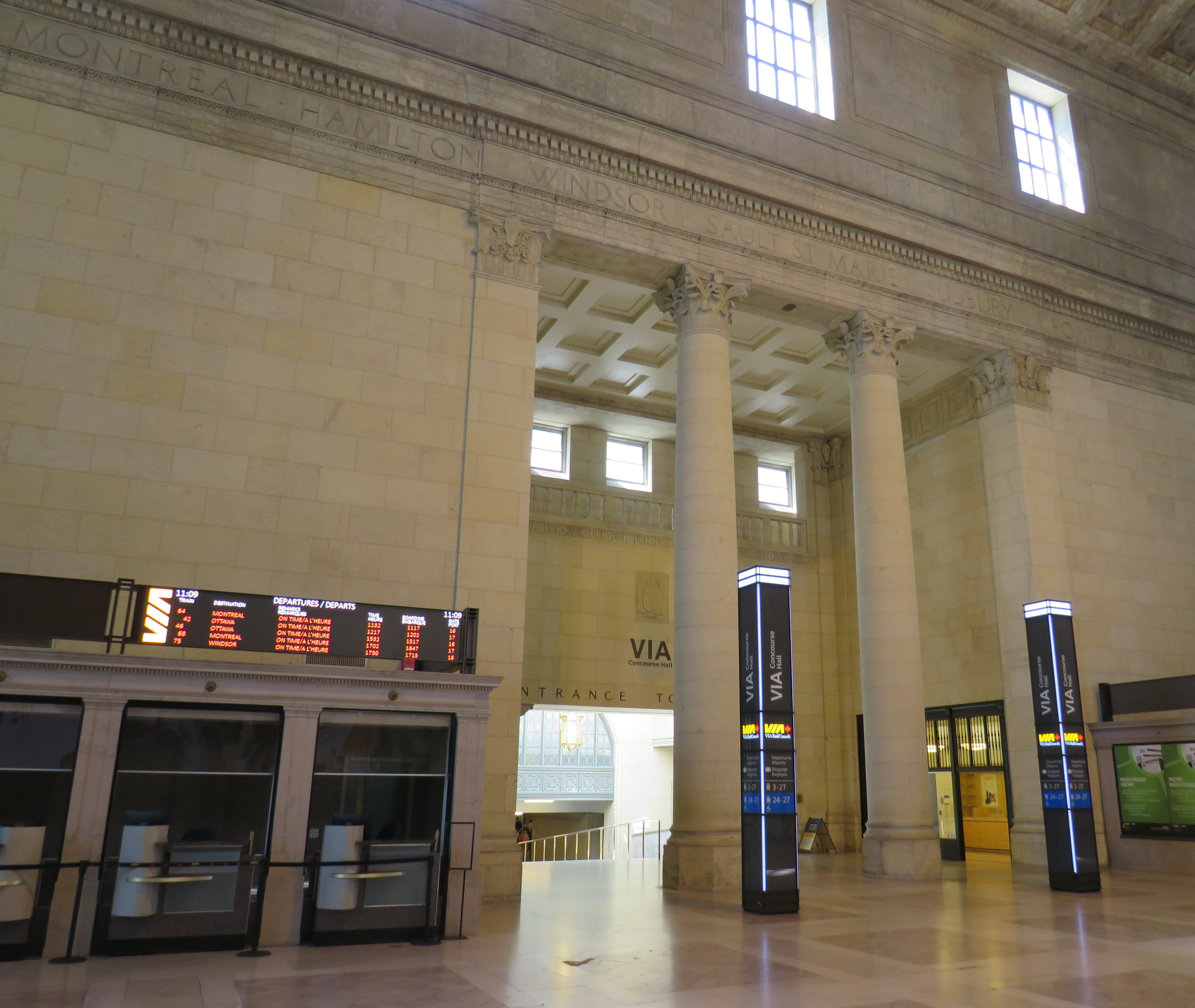
Up high, the names of 27 Canadian cities are carved into the walls. On the north side are the names of cities that were served primarily by the Canadian National Railway (the former Grand Trunk, Grand Trunk Pacific, National Transcontinental, Canadian Northern, and Intercolonial Railways, as existed in 1914-1918); on the south, were the names of cities served primarily by the Canadian Pacific Railway.
On the north side, from west to east, the cities read:
Prince Rupert – Edmonton – Saskatoon – Winnipeg – Port Arthur – North Bay – Sarnia – London – Toronto – Ottawa – Sherbrooke – Levis – Moncton – Halifax
Ottawa – Sherbrooke – Levis – Moncton – Halifax, on the northeast corner of Union Station’s Great Hall
On the south side, from east to west, the city names read:
St. John [NB] – Fredericton – Quebec – Montreal – Hamilton – Windsor – Sault St. Marie [sic] – Sudbury – Fort William – Regina – Moose Jaw – Calgary – Vancouver
Montreal – Hamilton – Windsor – Sault St.-Marie – Sudbury – Fort William — names of cities over the entrance to the train concourse
Many, but not all, cities had direct train service from Union Station; the rest required a change of train at Montreal for points east, Sudbury for Sault Ste. Marie, or Jasper, Alberta, for Prince Rupert.
As rail passenger services declined after the Second World War, the number of destinations reachable from Union Station declined. Fredericton lost its rail service in the 1960s, with buses connecting it with the CPR Montreal-Saint John train. (A VIA-operated RDC restored service between Fredericton and Saint John for a few years in the 1980s.) Sault Ste. Marie lost its RDC service to Sudbury in early 1977, though an intrepid traveler could technically still get to Sault Ste. Marie by rail until 2014, by taking a VIA train to Franz or Oba, and then waiting for many hours in remote Northern Ontario for a southbound Algoma Central Train.
But it wasn’t until 1990, due to severe cuts made by Brian Mulroney’s PC government, that daily passenger service across the country came to an end. No longer could a rail passenger reach Calgary, Moose Jaw, Regina, or Thunder Bay (Fort William) by train. In 1994, with the rerouting of all Montreal-Halifax trains to the CN route though Lévis and Campbellton, stations in Sherbrooke and Saint John lost their remaining service. In 1998, CN abandoned its tracks through central Lévis, requiring the Ocean to be rerouted away from the ferry connection to Québec City. And in 2012, the Ontario government ordered the end to the Northlander, which ran through North Bay to Cochrane.
Today, just 14 of the 26 destinations proclaimed on the walls of Toronto’s Union Station can be reached by train. In Fredericton, there are not even any rails remaining.
Despite the decline in medium and long-distance passenger rail services in North America, Toronto’s Union Station is more relevant than ever. GO Transit began operating in 1967, and expanded throughout the 1970s and 1980s. Now, thanks to its role as hub for commuter and regional rail, regional and intercity buses, local transit, and the rail link to Canada’s busiest airport, Union Station became busier than ever. Today, most passengers are headed to places like Aurora, Mississauga, Pickering, or Burlington, despite the promises of far-flung destinations etched on the Great Hall’s walls.
Rail diesel coaches (RDCs), introduced to Canada’s railways in the 1950s, were used on branch lines and in local service on busy mainlines through the 1980s. Today, they can only be found on VIA’s Sudbury-White River service, a remnant of the once-mighty CPR transcontinental network.
Updated December 18, 2023 as part of my interactive maps migration.
I recently completed a map of all Canadian passenger rail services that operated in 1955, from Whitehorse, Yukon, to St. John’s Newfoundland. As I wrote back in March, the decline in rail services in Canada can be attributed to a few factors: passenger train revenues were augmented by express cargo and mail, mixed trains, carrying both passengers and freight, were still justified in a time before trucks took over general industrial traffic. An incomplete highway network in northern Ontario, Newfoundland, and much of Western Canada also guaranteed healthy passenger demand in an era before jet travel became accessible to the masses.
The introduction of rail diesel coaches (RDCs), with their lower labour costs compared to conventional trains kept some branch lines going through the 1960s, but by the mid 1970s, neither Canadian National nor Canadian Pacific were interested in running passenger trains anymore; both were increasingly focused on bulk freight (grains, minerals, chemicals, finished automobiles) and intermodal container traffic.
VIA Rail took over most of CN and CP’s passenger trains in 1978, with direct government subsidies helping to fund its operations and capital expenses. By then, passenger train service was concentrated in the highly populated Quebec City-Windsor Corridor, but there were still three trains a day between Halifax and Moncton, two trains daily between Montreal and Atlantic Canada, between Winnipeg and Vancouver, and between Calgary and Edmonton. Scheduled bus connections, some even operated by VIA Rail, provided connections to places such as St. John’s, Fredericton, Charlottetown, and the Okanagan Valley.
Cuts imposed in 1981, 1990, and 2012 devastated the network. By 2019, there were only three trains a week in Atlantic Canada, two trains a week between Toronto and Vancouver. Even the Corridor saw cuts: there were five trains a day between Toronto, Kitchener, and Stratford, in 2019, there were just two. The only bright spots were an increase in the number of trains between Toronto and Ottawa and growing commuter rail networks in Toronto and Montreal.
A revised map, linked to below, depicts the passenger network in 1955 and in 1980, just prior to the 1981 cuts. Routes operating between Canada and the United States are depicted (CN, CP, New York Central, Delaware & Hudson, Great Northern, Northern Pacific, and White Pass & Yukon in 1955, Amtrak and White Pass & Yukon in 1980). More information on each route is available by clicking on the lines.
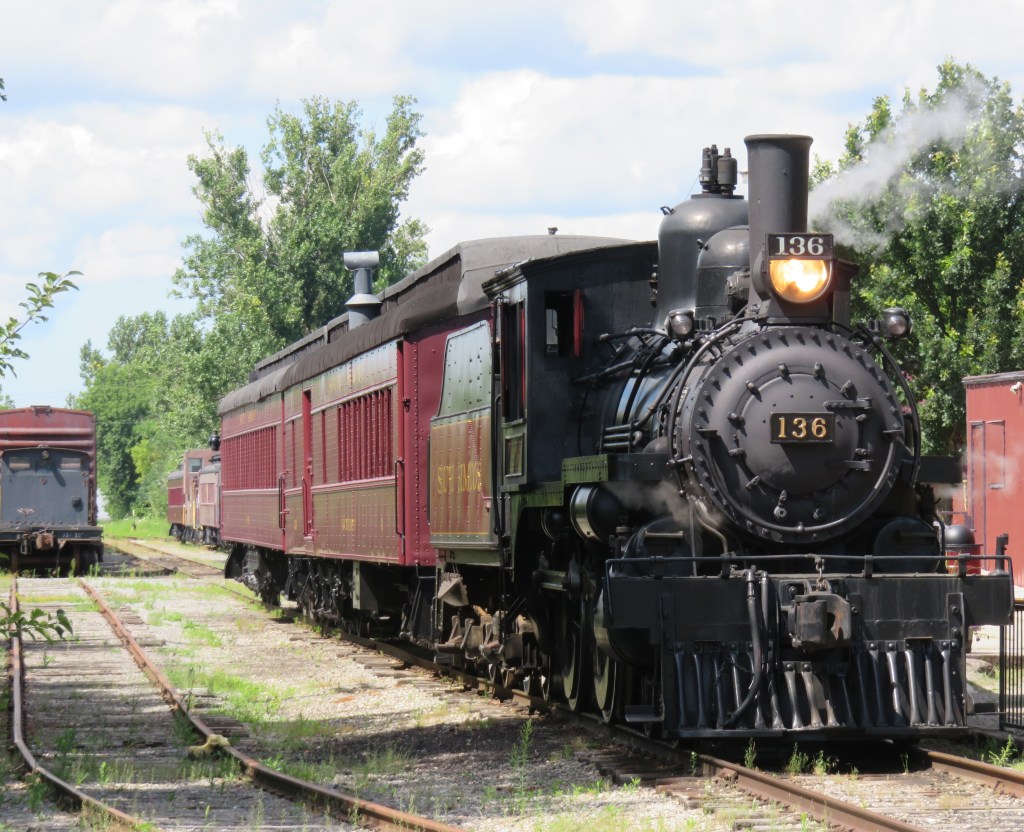
Former Canadian Pacific locomotive #136 hauls excursion trains at the South Simcoe Railway in Tottenham, Ontario
December 17, 2023: The complete map has been migrated to a newer ArcGIS Online account, on account of ESRI suddenly changing its monthly service account to charge bandwidth. That was a pay-as-you go account that helped me get re-acquainted with the ESRI ArcGIS Online platform before I set up a full online subscription to support a small business I co-founded in 2021.
However, I am happy to announce that I completed updates to the Ontario Intercity Transport Map and the 1955 Canada Passenger Rail Map, and that they are safely on a new subscription server at ESRI Canada. Please let me know if you have any suggestions or corrections to the maps, especially during the migration phase.
Sadly, passenger rail has faced a long, slow decline in Canada. Though commuter and regional rail systems in the Toronto and Montreal metropolitan areas have expanded tremendously over the last fifty years, rail service in general has declined in frequency, reliability, and even in speed. Prior to the COVID-19 pandemic, just six trains a day in each direction operated direct between Canada’s two largest cities, the fastest of those trains taking 4 hours 48 minutes to go 539 kilometres to get from Toronto to Montreal.
Seventy years ago, 28 trains on a typical weekday called at CN’s Hamilton Station, departing for Toronto, Niagara Falls, London, Guelph, Barrie, and Simcoe, with another 12 trains calling at the TH&B station on Hunter Street. In 2019, just six GO trains departed Hamilton for Toronto each weekday, with no direct connections even to Niagara, London, or Guelph.
There are several causes for the decline in passenger rail. In 1955, which the map below depicts, passenger train revenues were augmented by express cargo and mail, with the mail contracts alone helping to subsidize many branch lines. Lightly-travelled branch lines were served by mixed trains, which carry both passengers and freight. In Northern Ontario and Quebec, many highways were still of poor quality or unfinished — Highway 17 along the Lake Superior coast was not complete until September 1960. Construction of Highway 401 was just getting underway in 1955. In addition, the airline industry was still new, and air travel was expensive.
Improved highways drew more passengers to coach buses, while the move to trucks for cargo and mail deliveries made many branch lines unprofitable. Larger jet aircraft made air travel cheaper and more convenient for long distances. The major railways concentrated their energies on modernizing their freight networks, with CN and CP building new freight classification and intermodal yards outside of central Toronto, while focusing on bulk freight and shipping containers.
Though CN made efforts to win passengers back in the 1960s and early 1970s with new fare structures and equipment like the Turbo train between Toronto and Montreal, the government of Canada stepped in and took over most intercity passenger rail services in 1977. Though VIA Rail Canada acquired new modern locomotives and rail cars for the Ontario-Quebec corridor services, cuts to government subsidies made in 1981, 1989-1990, and 2012 forced further service cutbacks. British Columbia and Ontario also cut passenger services on their own rural railways.
I mapped the year 1955 for several reasons. I have CN and CP schedules for those years in my collection, while I found contemporary Ontario Northland and New York Central schedules online. It was also the year both railways inaugurated new transcontinental trains: CP launched the Canadian, while CN launched the Super Continental, luxurious diesel-hauled trains with modern sleeping cars and lounges. There were six trains a day leaving Montreal and Toronto for Vancouver that year. In 2019, there were just two trains a week.
In 1955, there were still many branch passenger and mixed trains in Ontario and Quebec, most of which were gone by 1965. Mixed trains were notoriously slow, though, but in many cases, there was a faster parallel highway coach. 1955 was also the last year for CP’s electric trains between Kitchener and Lake Erie, with the London & Port Stanley and Montreal & Southern Counties railways ending passenger runs a year later.
For Ontario and Quebec, I used Paul Delamere’s amazing Ontario Railway Map Collection and Quebec Railway Map Collection, adapting his work to identify those routes used by passenger trains in 1955, then mapping them on my own server. Mapping other routes was much more labourous.
Original version of interactive map
Please contact me if you have any suggestions, corrections, or other feedback.
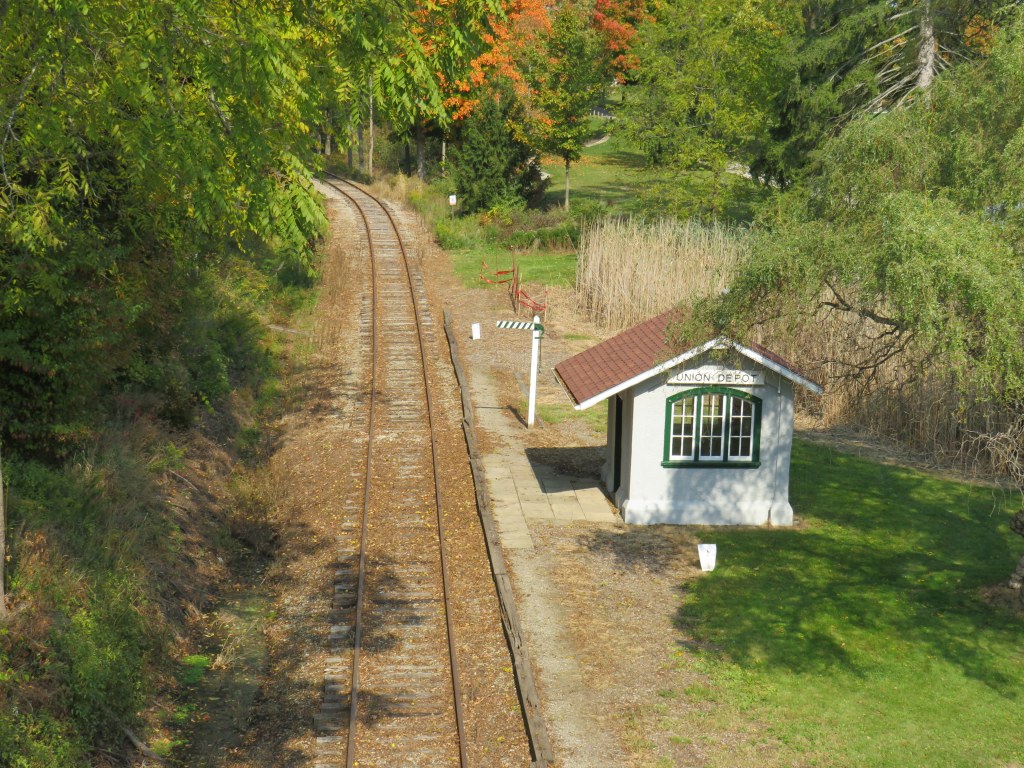
Just south of St. Thomas — Ontario’s Railway City — sits a small stucco-clad shelter, just below the Sparta Road bridge. Until 1957, electric trains of the London & Port Stanley Railway would regularly pass this little, unstaffed station serving the nearby community of Union.
There are dozens of union stations across North America, several of which are still in regular passenger service. Toronto’s Union Station is the continent’s second-busiest railway station, surpassed only by New York’s Penn Station. Union Stations in Chicago, Washington, and Los Angeles are among the top fifteen in Canada and the United States, while other grand union station buildings still greet rail passengers in Winnipeg, Kansas City, and Denver.
Kansas City’s Union Station, with downtown skyline backdrop
Union stations, by definition, are passenger facilities used by two or more railways. They allowed for shared services and passenger convenience, though they required ample access to each railway’s tracks. Toronto’s Union Station, for example, was built for the Grand Trunk and Canadian Pacific Railways, which both had rail corridors following the waterfront into Downtown Toronto. Ottawa, too had a Union Station that was used by CN and CP until 1966 (and in earlier years, New York Central trains called at Ottawa’s Union Station).
In some cases, a union station might be a small depot at the junction of two railways. The small Inglewood Station in Caledon was technically a union station as it was used by Canadian National and Canadian Pacific.
Great Hall, Chicago’s Union Station
Of course, the little Union Station in rural Elgin County was never a true union station. It was merely a flag stop for the L&PS, where awaiting passengers would signal their intention to board by lowering a wooden board affixed to a pole next to the station shelter.
The L&PS Railway opened in 1856 to connect London to nearby St. Thomas and to Port Stanley, giving the growing city access to Lake Erie. In 1913, the City of London, which owned the line, upgraded and electrified the railway under the direction of then-mayor Adam Beck, who championed public hydro electricity and a proposed network of electric railways across the province.
Though bulk freight was the railway’s bread-and-butter — it connected with a train ferry service to Ohio — the L&PS operated regular local passenger service connecting two cities, four separate railways (CN at London and the Wabash, Michigan Central, and Pere Marquette Railroads at St. Thomas), and the popular summer resorts and cottages at Port Stanley.
With improved highways and increased auto ownership, the L&PS ceased passenger service in 1957, though there was regular bus service until the 1990s. Today, it is impossible to get between London, St. Thomas, and Port Stanley without a car. The railway was sold to CN in the early 1960s. CN used the railway to access a new Ford assembly plant as well as local industry in London and St. Thomas, but eventually ceased freight service south of St. Thomas.
The abandoned track south of St. Thomas was acquired by the Port Stanley Terminal Railway, which today operates family-friendly excursions from the former L&PS station in Port Stanley. Though you can no longer board a train at Union, you can still watch trains go by. A restored LP&S interurban passenger car can be found at the Halton County Radial Railway museum near Rockwood.
Passing by Union Station, riding the PTSR excursion train
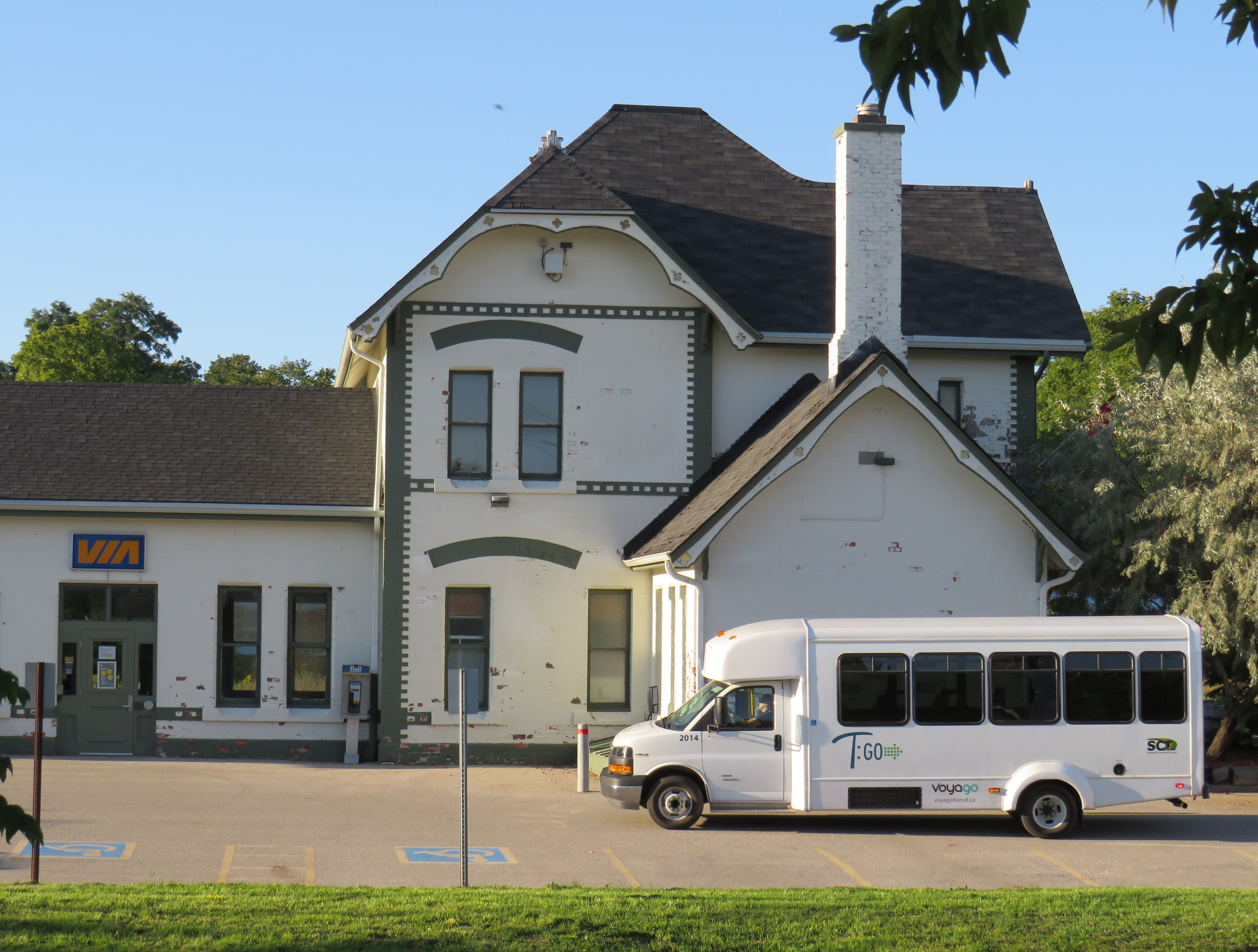
T:GO inter-community transit van at Woodstock VIA Rail station, September 2020
October 2021
I made several changes to the interactive map, including a complete update of the GO Transit bus and rail network, including the most recent rail corridor extensions to Bloomington and London, and a new weekday bus route to Brock University in St. Catharines.
Over the summer, Quinte Transit added a new route between Trenton and Belleville, Simcoe County Linx added a new route between Midland and Orillia, serving Tay Shores and Coldwater, and a new service launched between Brockville, Prescott, and Cardinal in Eastern Ontario.
June 29, 2021/July 6, 2021: Beginning Monday, June 28, Rider Express, an intercity coach company based in Western Canada (which picked up several routes formerly operated by Greyhound Canada and the Saskatchewan Transportation Company), began service in Ontario. Rider Express is looking to fill some of the gaps left by the recent announcement that Greyhound will cease all domestic routes in Eastern Canada.
That’s the good news. The bad news is that its first route in Ontario, connecting Toronto Station, Kingston, and Ottawa, replicates Megabus’ new route (which I have also added) and competes against VIA Rail’s Corridor rail service. Several of Greyhound’s daily Toronto-Ottawa buses ran through Peterborough and along Highway 7 through Eastern Ontario, leaving towns such as Norwood, Havelock, and Perth off the map. Though Peterborough is connected to Toronto by GO Transit, it is a long train and bus ride, while Greyhound offered a direct, express service to Downtown Toronto.
Two steps forward, one step back.
I made additional changes to the interactive map to show new GO Transit, Can-Ar Coach, Megabus, and Ontario Northland routings to the new Union Station Bus Terminal, which replaces the old GO bus terminal and the Toronto Coach Terminal on Bay Street. Meanwhile Ontario Northland moved from the now-closed Ottawa Central Bus Station to the VIA Station on Tremblay Road.
Meanwhile, starting July 8, Orléans Express will expand into Ontario, with a new Gatineau-Ottawa-Montréal route, operating twice daily. It will join Rider Express and Ontario Northland at the VIA Rail Station in Ottawa.
May 2, 2021: On Monday, May 3, “The Link” begins operations on two routes in Selwyn Township and Curve Lake First Nation, connecting several communities with Peterborough Transit and GO Transit at Trent University. The service, which is operated by Peterborough Transit, will run on weekdays, with five trips in each direction on both routes. Fares on “The Link” buses include a free transfer to and from Peterborough city bus routes at Trent, with direct service to downtown, major shopping centres, the hospital and Sir Stanford Fleming College.
February 15, 2021: A few small updates, including the addition of two community routes in Muskoka District Municipality, a bus connection between North Bay and northern Quebec, and a revised bus stop location for Ontario Northland in Orillia.
December 14, 2020: I made several updates to the interactive map, including the addition of Huron Shores Area Transit, which launches today. I made a few changes suggested by one of my readers, and added Niagara Region Transit’s on-demand service in Niagara-on-the-Lake, which replaces a fixed route that was cancelled earlier this year.
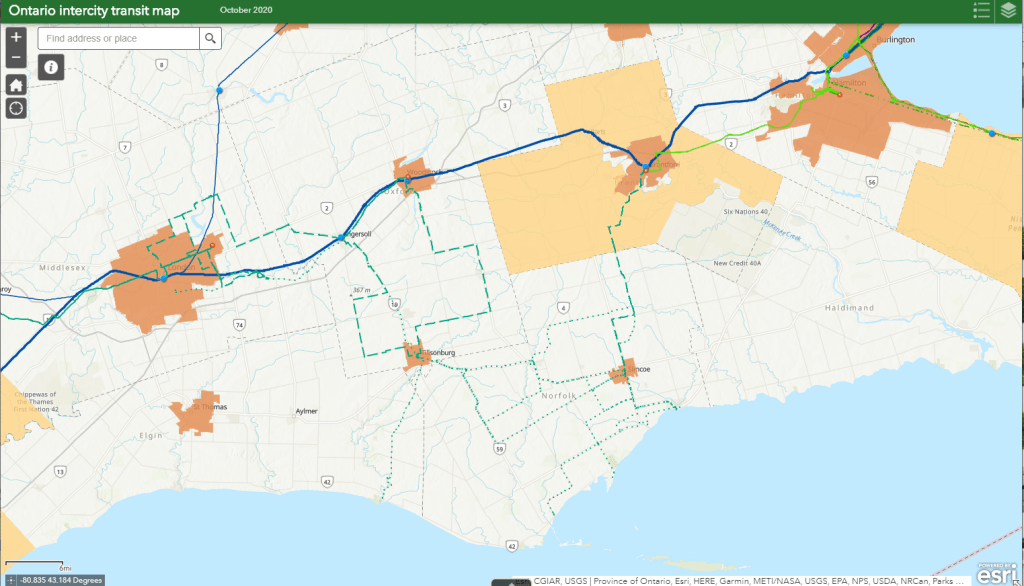
November 9, 2020: I made several updates to the interactive map, including the addition of PC Connect in Perth County, which launches next Monday. I mapped Port Hope’s transit connection to Cobourg, as suggested by one of the readers, and corrected a few minor errors.
October 15, 2020
Despite the ongoing COVID-19 pandemic, several new inter-community transit services launched in Ontario during the last few months.
Last August, T:GO began service on four routes radiating from Tillsonburg, where there was already an in-town circulator service. Mondays through Fridays, twenty-seater vans operate between Tillsonburg, Norwich, Woodstock, Ingersoll, and other communities, offering connections to Woodstock Transit, the hospital, and the VIA Rail Station.
In September, the City of Owen Sound, Grey County, Middlesex County, the town of Strathroy-Caradoc, and Prince Edward County all launched their own services, connecting rural communities and small towns to larger centres such as London, Guelph, and Belleville. In addition, Simcoe County expanded its Linx bus service to serve Alliston and Beeton, and other services, suspended during the early days of the pandemic, resumed operations. Also this year, Niagara and Durham Regions expanded their rural on-demand transit services.
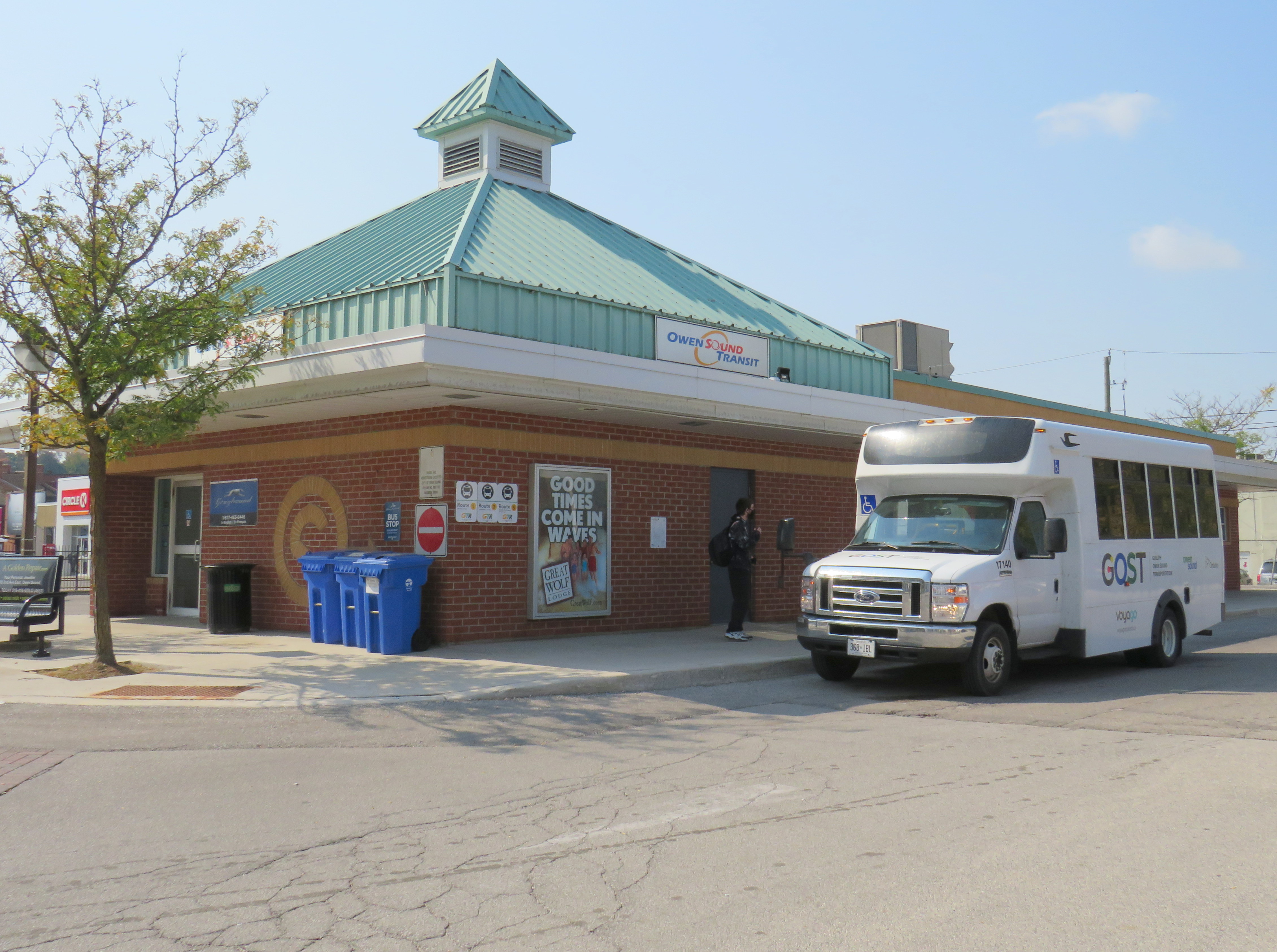
GOST minibus at Owen Sound Transit Terminal
All these new services help to fill the gaps left behind by private coach companies; these have become especially vital as Greyhound Canada suspended all operations in Ontario and Quebec this year (after abandoning Western Canada in 2018), and Coach Canada (operating as Megabus) cut service on some of its routes.
While these new intercommunity routes help to serve local needs, there is a wide variety of service provided in rural and small town Ontario. But without provincial coordination, it is nearly impossible to keep track of them all, never mind plan a trip.
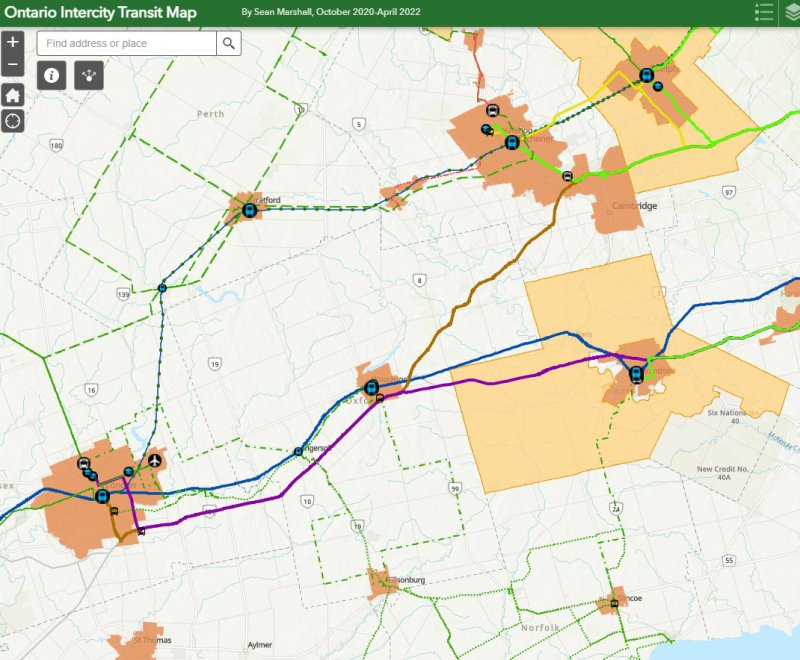
So I went ahead and mapped them all the best I could. Clicking on each route brings up a pop-up window containing further information, including a link to each agency’s website, where available.