Tag: Census

  • Wards and ridings: not quite representation by population

    Wards and ridings: not quite representation by population

    When Statistics Canada released the first batch of 2021 Census data, it made the new population counts available for a wide variety of geographies, from provinces and cities, to local census tracts and even city blocks. It also released data for the 338 federal electoral districts, better known as ridings.

    Because of constitutional requirements, the seats in the federal House of Commons are not allocated equally by population. For example, Prince Edward Island, with a population of 154,331, has four seats. At the other extreme, four electoral districts in Alberta and one in Brampton, Ontario have larger populations than Canada’s smallest province.

    Electoral DistrictProvince/Territory2021 Population
    LabradorNewfoundland & Labrador26,655
    EgmontPrince Edward Island35,925
    NunavutNunavut36,858
    CharlottetownPrince Edward Island38,809
    MalpequePrince Edward Island39,731
    Average109,444
    Banff-AirdrieAlberta155,580
    Calgary SkyviewAlberta159,642
    Brampton WestOntario162,353
    Calgary ShepardAlberta163,447
    Edmonton-WetaskiwinAlberta209,431

    The federal electoral districts were last drawn in 2013, following the 2011 census. As a result, fast-growing ridings, particularly in Southern Ontario, Calgary, and Edmonton, have huge populations compared to the national average.

    In Ontario, the provincial government uses the same boundaries for its provincial electoral districts, with the exception of Northern Ontario, where two additional seats help to compensate for the area’s vast and remote regions, where local MPPs may have to travel hours by car, train, or plane to meet constituents. The province imposed the same boundaries on the City of Toronto in 2018, in the middle of a municipal election for which new, fairer boundaries were just approved.

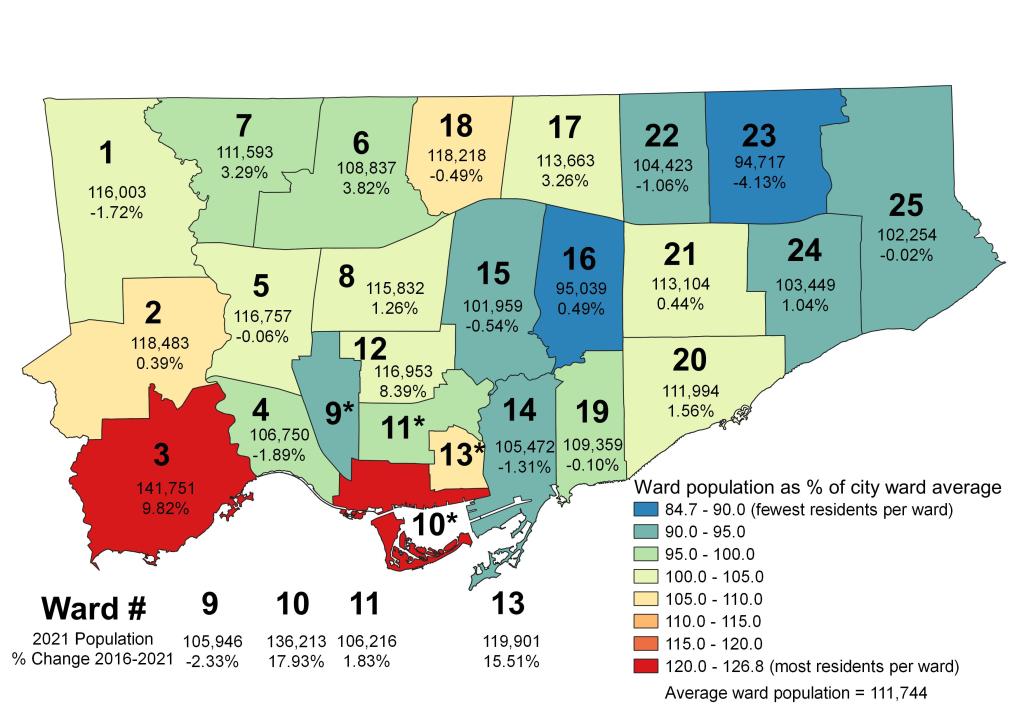
    By 2021, the population differences based on decade-old data became stark, as shown in the map below.
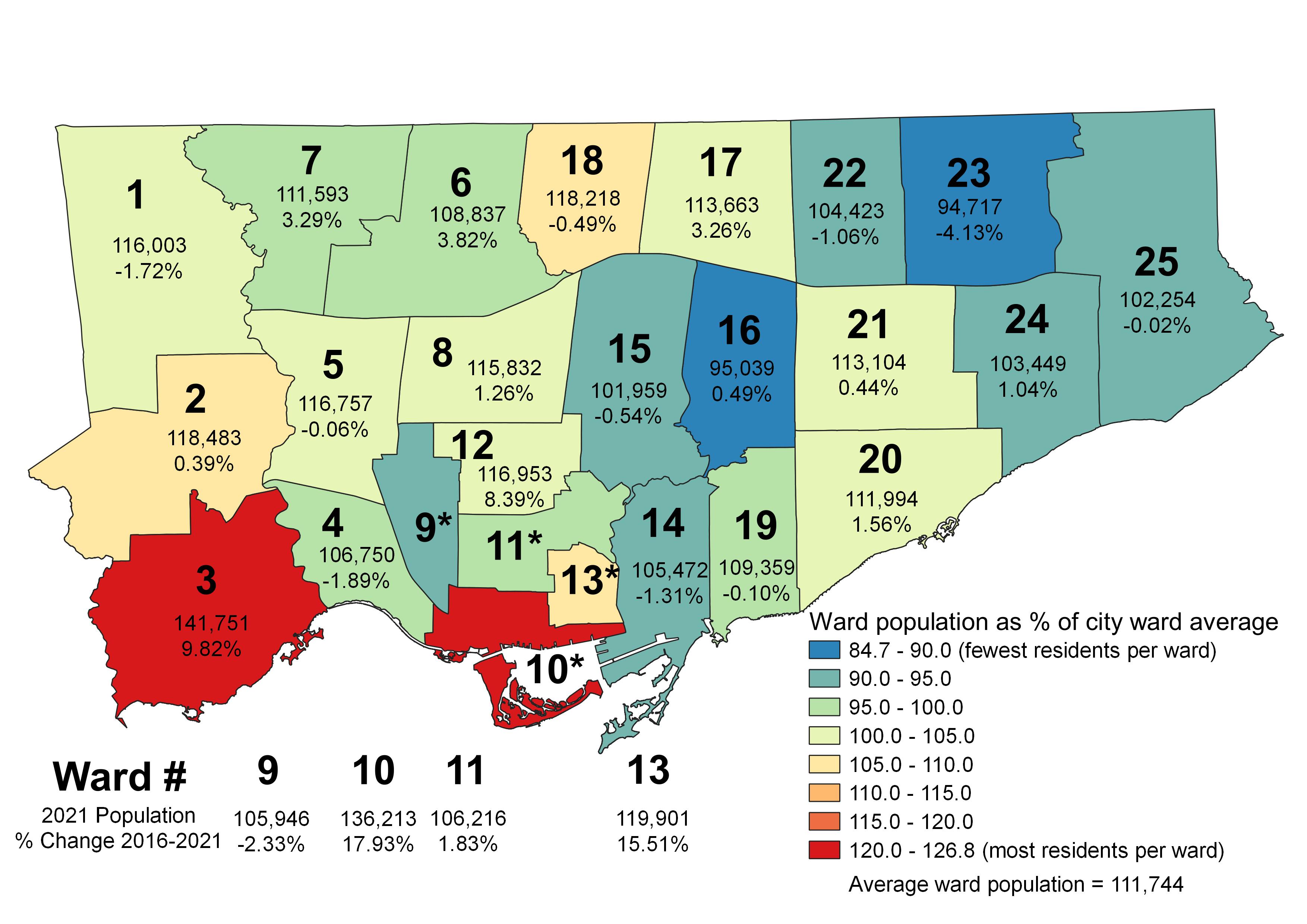
    Map depicting disparities in Toronto’s ward populations

    Ward 23 Scarborough North, represented by Cynthia Lai, has a population of 94,717. Ward 23’s population dropped by over 4% since 2016, as households age and few new housing units built in that ward. Ward 16, Don Valley East, has just 95,039 residents, with a stable population.

    On the other extreme, Ward 3 Etobicoke-Lakeshore, represented by veteran councillor Mark Grimes, has a population of 141,751, growing by 9.82% since 2016. New condominium developments in the Humber Bay neighbourhood and along the Queensway have driven much of that growth. Ward 10, Spadina-Fort York, saw an even greater number of new residents move in, growing by nearly 18% in the last five years.

    As Toronto is stuck with these ward boundaries until 2026, the population disparities will only grow larger, with downtown and South Etobicoke residents becoming even more underrepresented. Compounding the unfairness is that councillors representing high-growth wards have much higher workloads, as they deal with mountains of planning applications while ensuring their existing constituents have access to essential local services like schools, transit, and park space.

    The ward boundaries initially set for the 2018 municipal election would have accounted for future growth, ensuring that workloads would be more fairly distributed, and that city residents would have equal access to their local councillor.

    The 2021 population counts will be used to set new federal riding boundaries, which will be drawn next year after a consultation period and used in the first federal election held after 2023. The province will likely adopt the new boundaries for the 2026 election (assuming a majority government is elected in June).

    Perhaps in four years, Toronto will be able to set its own ward boundaries again. That, of course, will depend on electing a better provincial government and a council committed to equity and good governance.
  • Mapping Toronto’s population growth

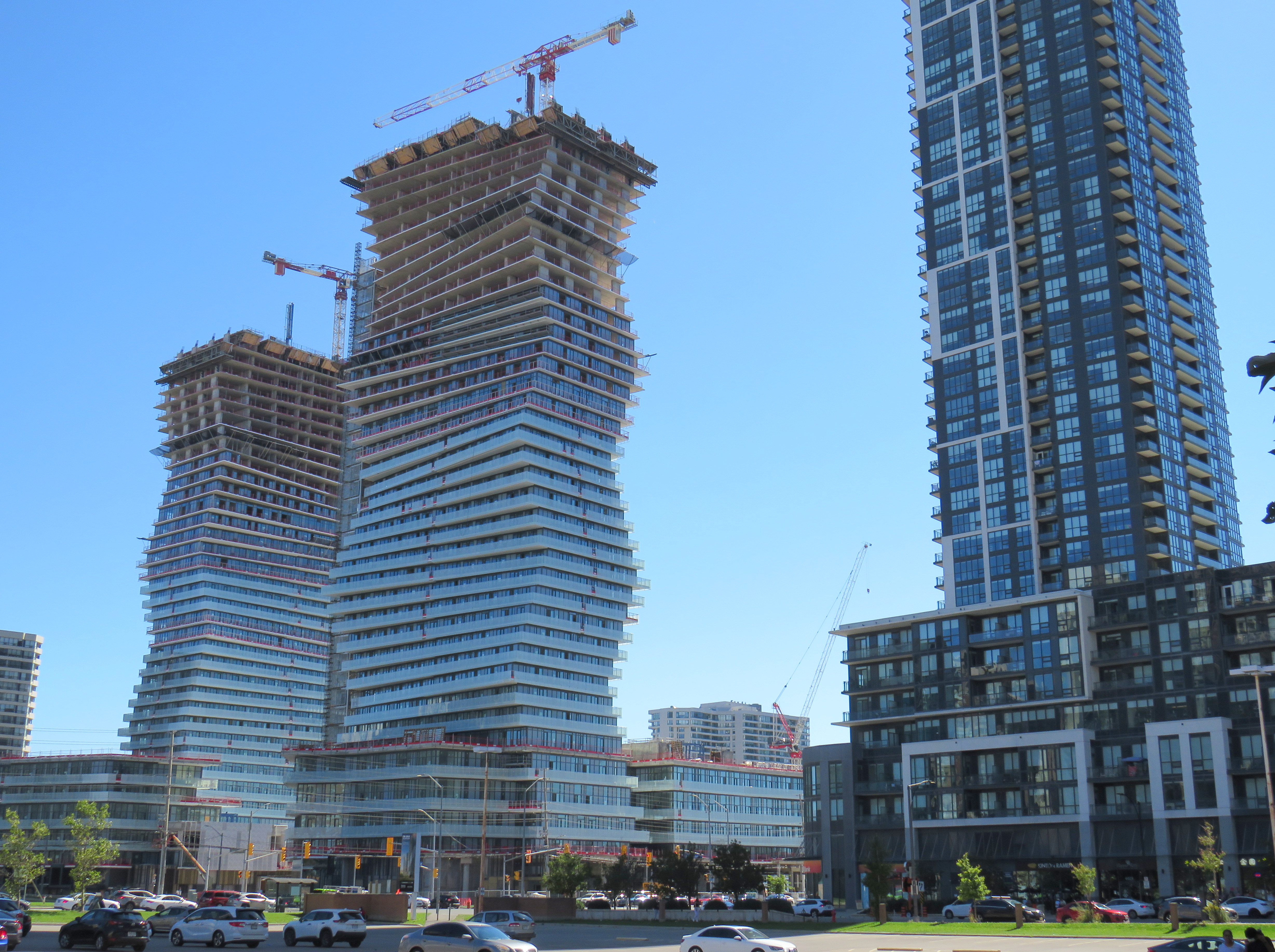
    Despite new highrise development in its city centre, Mississauga lost 3,368 residents between 2016 and 2011

    On February 9, data geeks across Canada rejoiced when Statistics Canada released the first round of data from the 2021 Census of the Population.

    The data was released at all levels of geography made available by Statscan. At the federal level, Canada grew by 5.2% since the 2016 Census, with a total population of 36,991,981. Immigration, rather than natural growth (births vs. deaths) drove Canada’s population increase.

    Of course, this growth did not occur evenly across the country. Newfoundland and Labrador lost residents, while Prince Edward Island and British Columbia saw the biggest population increases.

    Within the Greater Toronto and Hamilton Area, Mississauga experienced population decline (-0.5%) for the first time since it became a city in 1974. Outer suburbs, such as Milton, East Gwillimbury, and areas just beyond the GTHA, such as New Tecumseth and Bradford saw population growth over 20%, driven by new greenfield development.

    In older Toronto suburbs, including much of Etobicoke, North York, Scarborough, and even Mississauga, population losses at the local census tract level can be explained by ageing households, where Millennial and older Gen Z children moved out on their own, particularly into fast-growing downtown areas. These areas, dominated by single-family housing, could accommodate much of the GTHA’s growth with gentle density, including secondary suites (such as basement apartments), garden suites, and zoning policies that would make it easier and more economical to build “missing middle” housing such as walkup apartments and multiplex homes.

    Toronto grew by 62,785 residents in the last five years, with only a few areas accommodating all that growth: the downtown core between Dufferin Street and Broadview Avenue, South Etobicoke, Yonge-Eglinton, and former industrial, instructional, and commercial lands stretching along the Highway 401 corridor through North York and West Scarborough. This corridor includes the Downsview Park development, a new condominium cluster at Wilson Subway Station, the former Canadian Tire lands near Sheppard Avenue and Leslie Street, and the intensification of the Fairview Mall area.

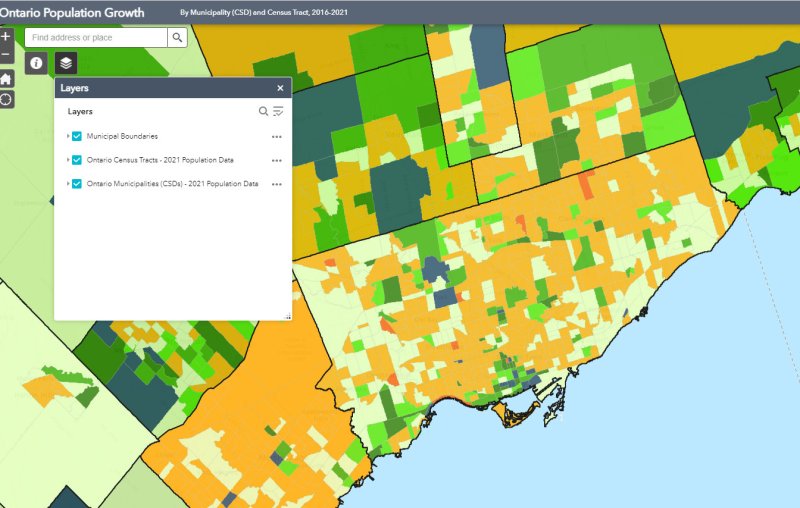
    You can take a look at the changes for each municipality and each census tract in Ontario with an interactive map I created here.

    Population Change for GTHA Municipalities

    Municipality2021 Population2016 PopulationChange (%)Change (Total)
    Toronto 2,794,3562,731,5712.362,785
    Mississauga717,961721,599-0.5-3,638
    Brampton656,480593,63810.662,842
    Hamilton569,353536,9176.032,436
    Markham338,503328,9662.99,537
    Vaughan323,103306,2336.016,870
    Oakville213,759193,83210.319,927
    Richmond Hill202,022195,0223.67,000
    Burlington186,948183,3142.03,634
    Oshawa175,383159,45810.015,925
    Whitby138,501128,3777.910,124
    Milton132,979110,12820.722,851
    Ajax126,666119,6775.86,989
    Clarington101,42792,01310.29,414
    Pickering99,18691,7718.17,415
    Newmarket87,94284,2244.43,718
    Caledon76,58166,50215.210,079
    Halton Hills62,95161,1612.91,790
    Aurora62,05755,44511.96,612
    Whitchurch-Stouffville49,86445,8378.84,027
    Georgina47,64245,4184.92,224
    East Gwillimbury34,63723,99144.410,646
    King27,33324,51211.52,821
    Scugog21,58121,617-0.2-36
    Uxbridge21,55621,1761.8380
    Brock12,56711,6427.9925

  • Mapping Toronto’s population growth

    Data geeks across Canada were eagerly awaiting this day — February 8, 2017 — the first release of the 2016 Canadian Census of the Population. Today’s release only covers population and dwelling counts, further information on age, sex, household characteristics, as well as language, immigration status, employment, income, and other variables will be released later in 2017. The 2016 Census included the mandatory long-form census, which will provide a robust snapshot on the socioeconomic status of all 36 million Canadians.

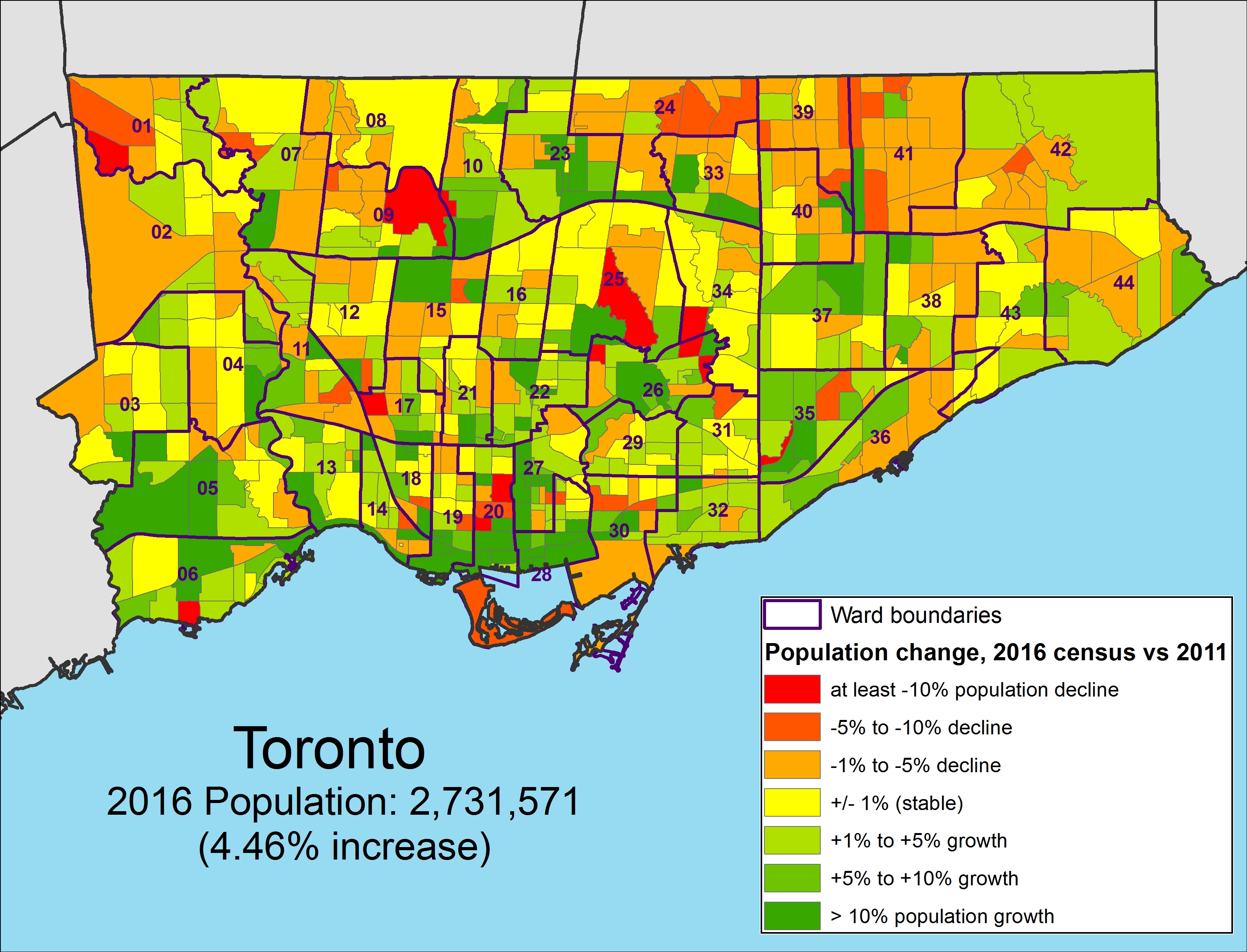
    I created three quick maps showing the population growth in the City of Toronto by census tract. The City of Toronto grew by 116,511 people over five years to 2,731,571 in 2016, a 4.45% increase. Some suburban municipalities grew much faster, like Brampton  (13.3%, with a 2016 population of 593,638), but Toronto has been able to absorb one-third of the Toronto Census Metropolitan Area’s growth.

    Toronto’s population makes up 46.1 % of the Toronto CMA (population 5,928,040). The rest of that growth was found in mature suburbs such as Brampton, Mississauga, and Markham, but also in quickly-growing towns such as Milton (population 110,128, up 30.5% from 2011). While some suburbs — Mississauga and Markham in particular — have been establishing higher-density urban centres with mid and high rise condominiums, most of the suburban growth has come from single-family homes and townhouses on formerly agricultural lands. If the Greenbelt is to continue being successful in containing sprawl and preserving productive farms and natural areas, Toronto needs to absorb even more growth in the next few decades. Land developers, speculators and the real-estate industry, however, are pushing back.

    The first of the three maps shows the percentage increase or decrease in population by census tract. Areas with higher growth are concentrated in Downtown (particularly along Yonge Street and in the Entertainment District, City Place, Liberty Village-Fort York and St. Lawrence-Distillery-Corktown), as well as Etobicoke Centre, on Humber Bay, Midtown, and along the Sheppard Subway corridor in North York. Not surprisingly, these are areas in which new housing developments, particularly condo towers, are being built. Other neighbourhoods, for the most part, are seeing minor increases or decreases in population, likely related to changes in household/family size.

    gta-2016-census
    Population change between 2011 and 2016 by percentage by census tract, Toronto
    (Alternate colour scheme available here and here)

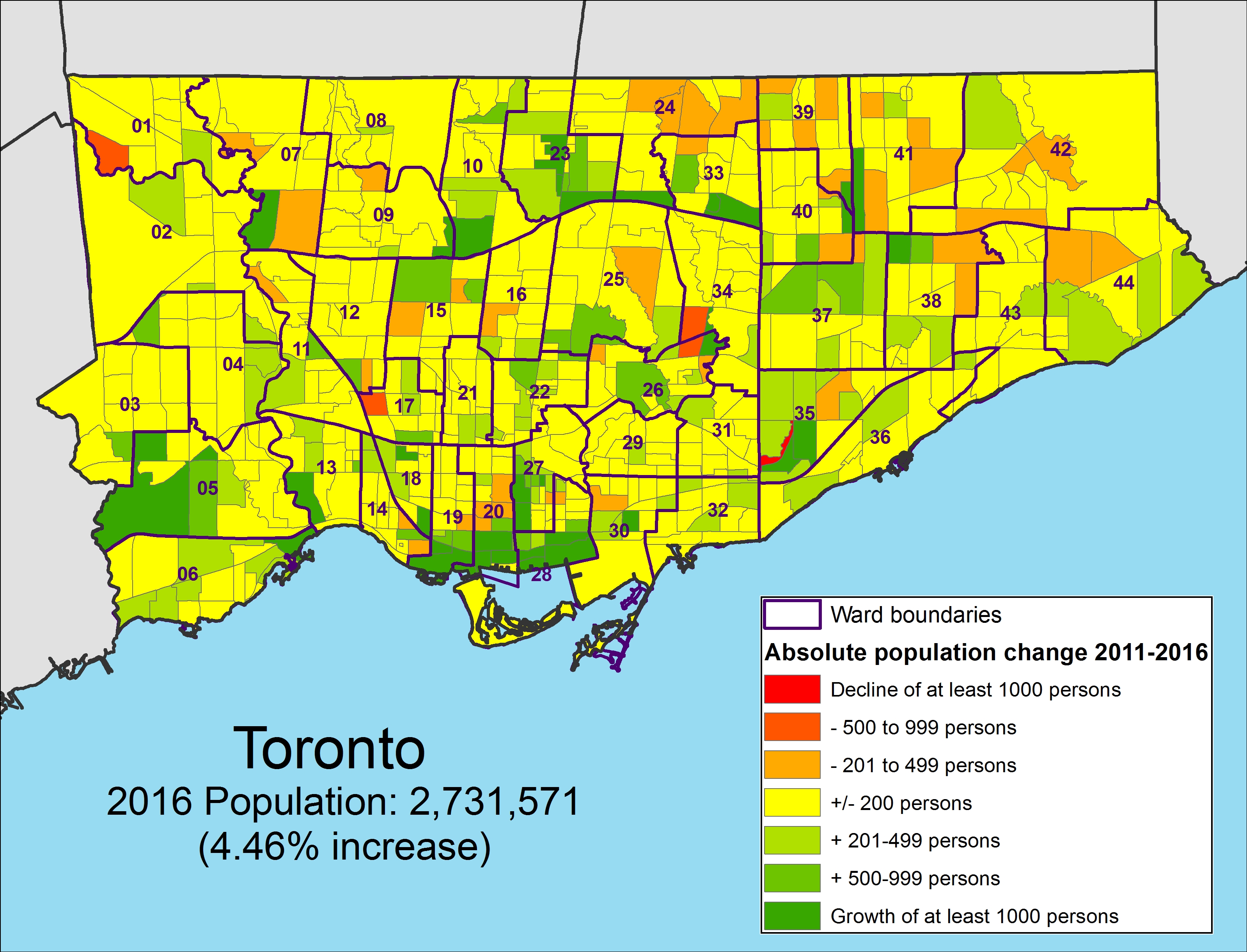
    But more interesting is the map showing absolute population increases or decreases between 2011 and 2016. It better illustrates areas of high population growth and neighbourhoods with population decline. The inner suburbs, especially parts of Scarborough and North York, clearly show slight a population decline compared to the high-growth areas described above.

    gta-2016-census-absolute-changePopulation change between 2011 and 2016 by absolute numbers by census tract, Toronto
    (Alternate colour scheme available here and here)

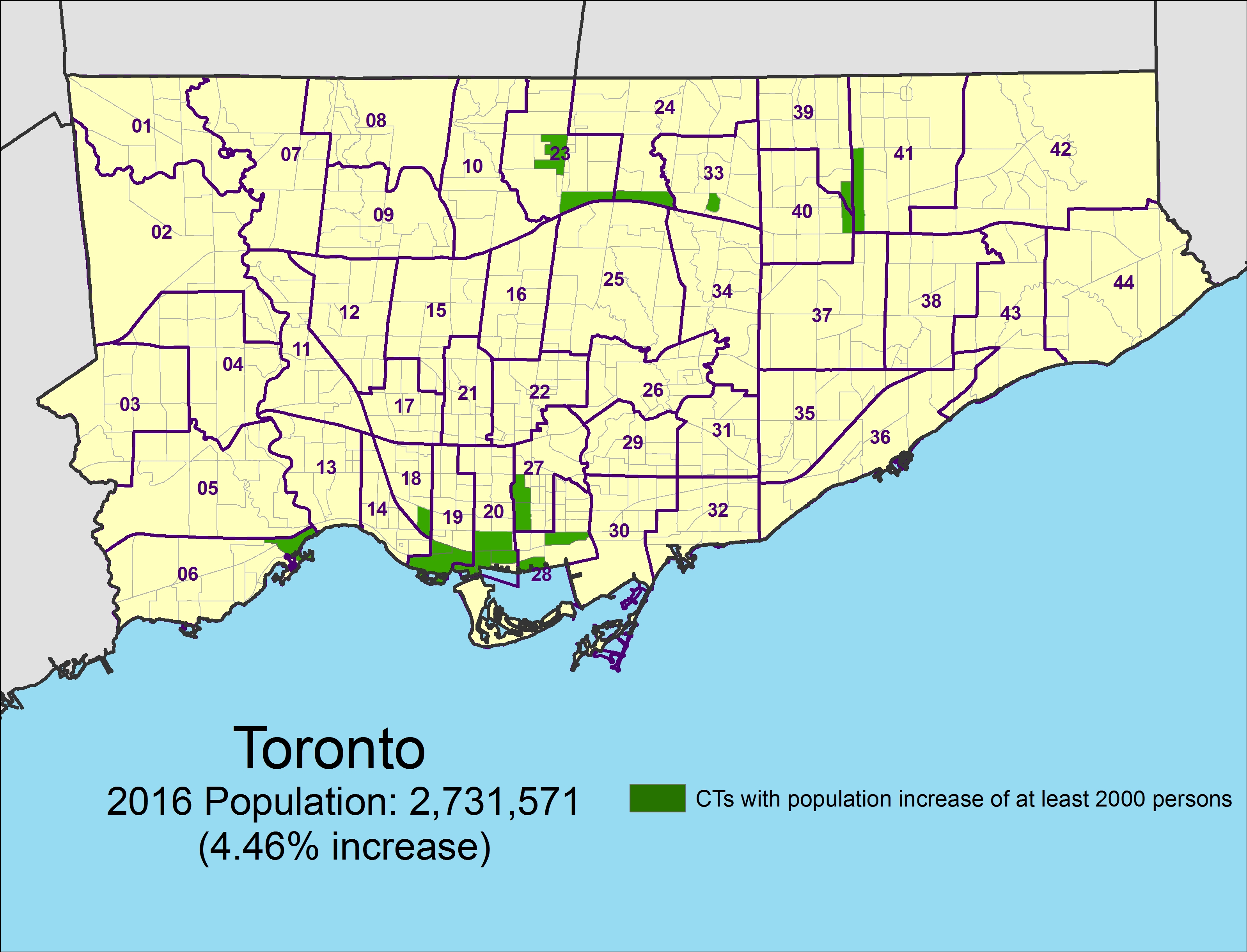
    The final map shows the 63 census tracts (out of a total of 1,426 CTs) with growth of at least 2,000 persons. It very clearly shows where high population growth has taken place.

    GTA 2016 Census Toronto High Growth.jpgCensus tracts that grew by at least 2,000 persons between 2011 and 2016