In 1998, the new City of Toronto was created when the Progressive Conservative government led by Mike Harris forced the merger of Metropolitan Toronto and its six constituent cities and borough. Dubbed the Megacity, it was part of a new round of municipal restructurings that affected much of the province, with Hamilton and Ottawa getting the same treatment three years later. Making less news in 1998 was the abolition of Kent County and the amalgamation of all 21 of its towns, villages and townships with the City of Chatham, creating the new municipality of Chatham-Kent.
Over 25 years later, there are challenges remaining from amalgamation. The new, larger municipality must administer a large mostly rural area but where nearly half the population lives in just one urban centre. But there are benefits, such as a consolidated library system that provides rural residents with more materials and services. Importantly too, is that Chatham-Kent was one of the first municipalities to introduce a rural transit service to connect outlying communities with the city centre, expanding the reach of Chatham’s existing urban bus system.
Three Ride CK routes — A, C, and D — extend from the bus terminal in Downtown Chatham to Wallaceburg (the second-largest community in Chatham-Kent), Dresden, Blenheim, Ridgetown, and Tilbury, covering most of the former towns that made up Kent County. (A fourth route, B, was proposed to serve Thamesville and Bothwell, but has not been implemented.) There is also a seasonal summer bus that serves the lakeside communities of Erieau and Mitchell’s Bay, echoing the former Chatham, Wallaceburg, and Lake Erie electric interurban service.
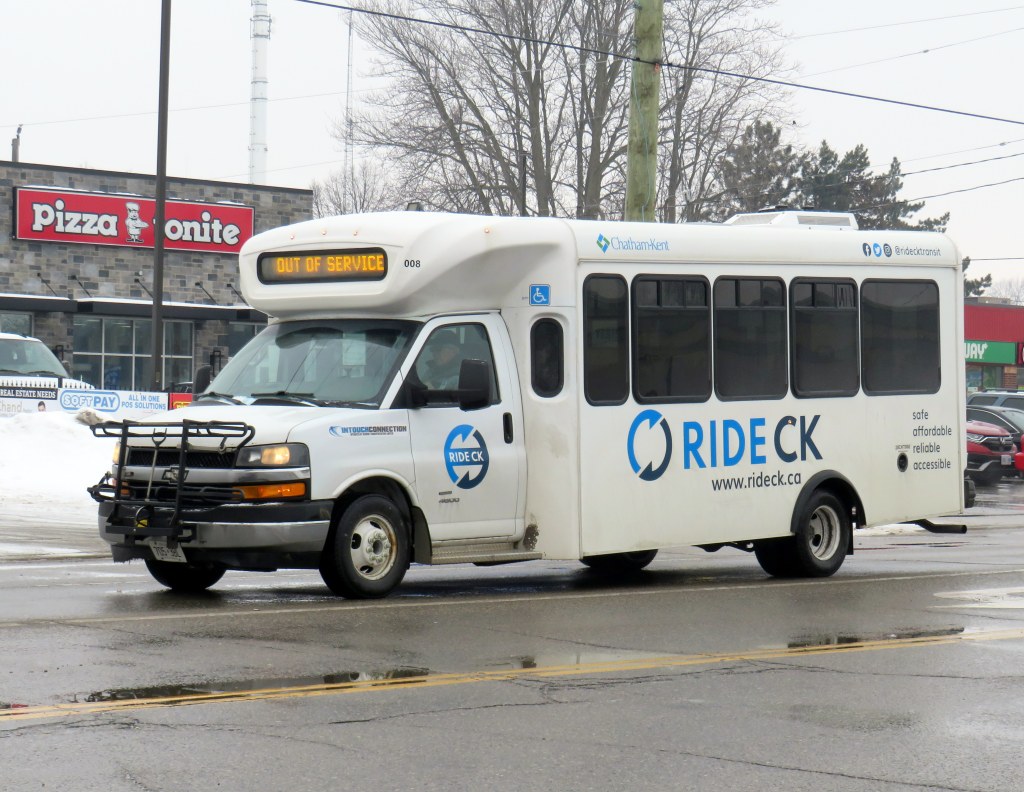
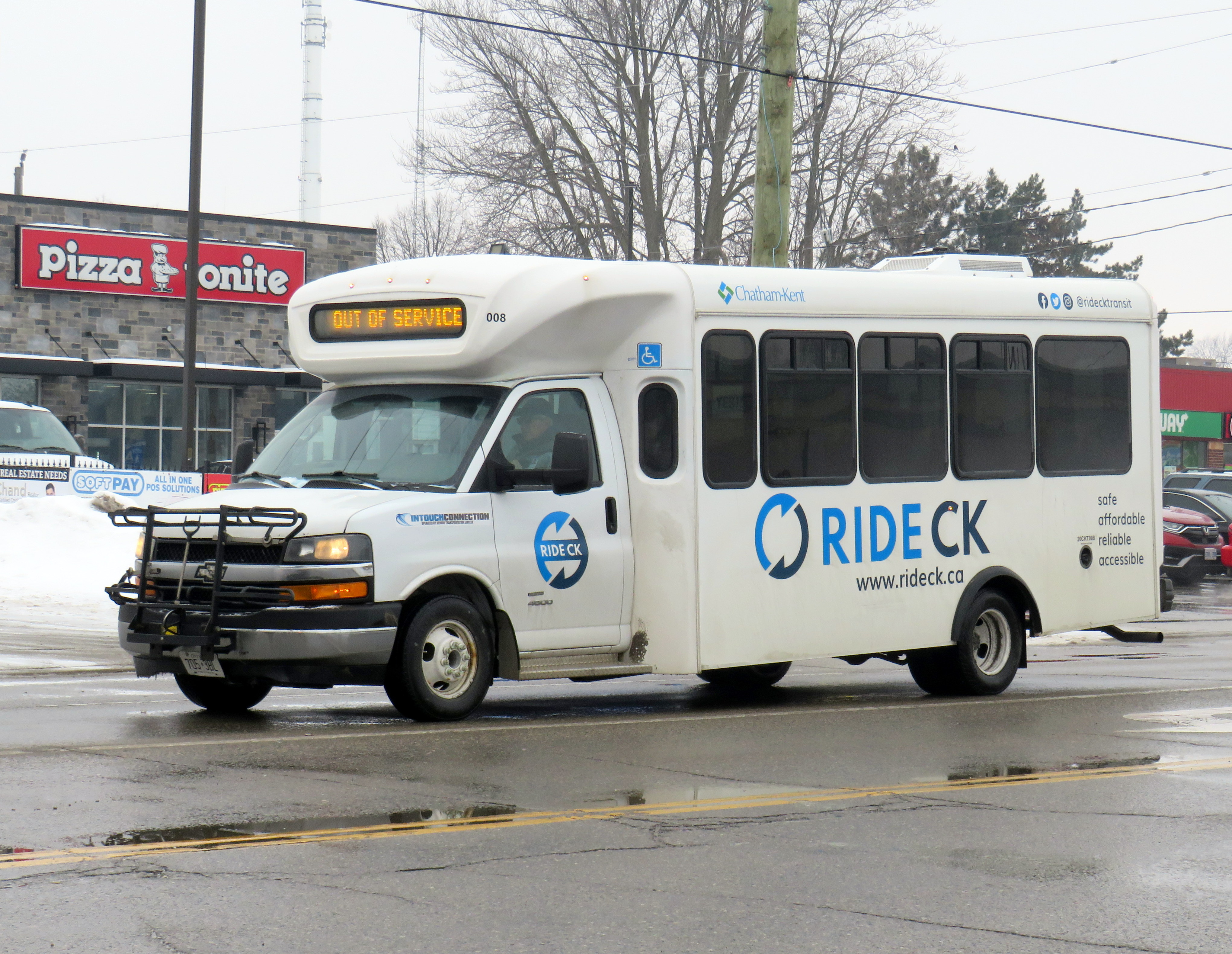
Most RideCK buses — local and intercommunity — are cutaways, meaning that the passenger seating area is in a separately-built body added to a cab and truck chassis. Though these vehicles are popular for paratransit services, low-ridership rural routes, and in smaller communities like Brockville, they do not offer a particularly smooth ride. However, they are an economical option for smaller communities.
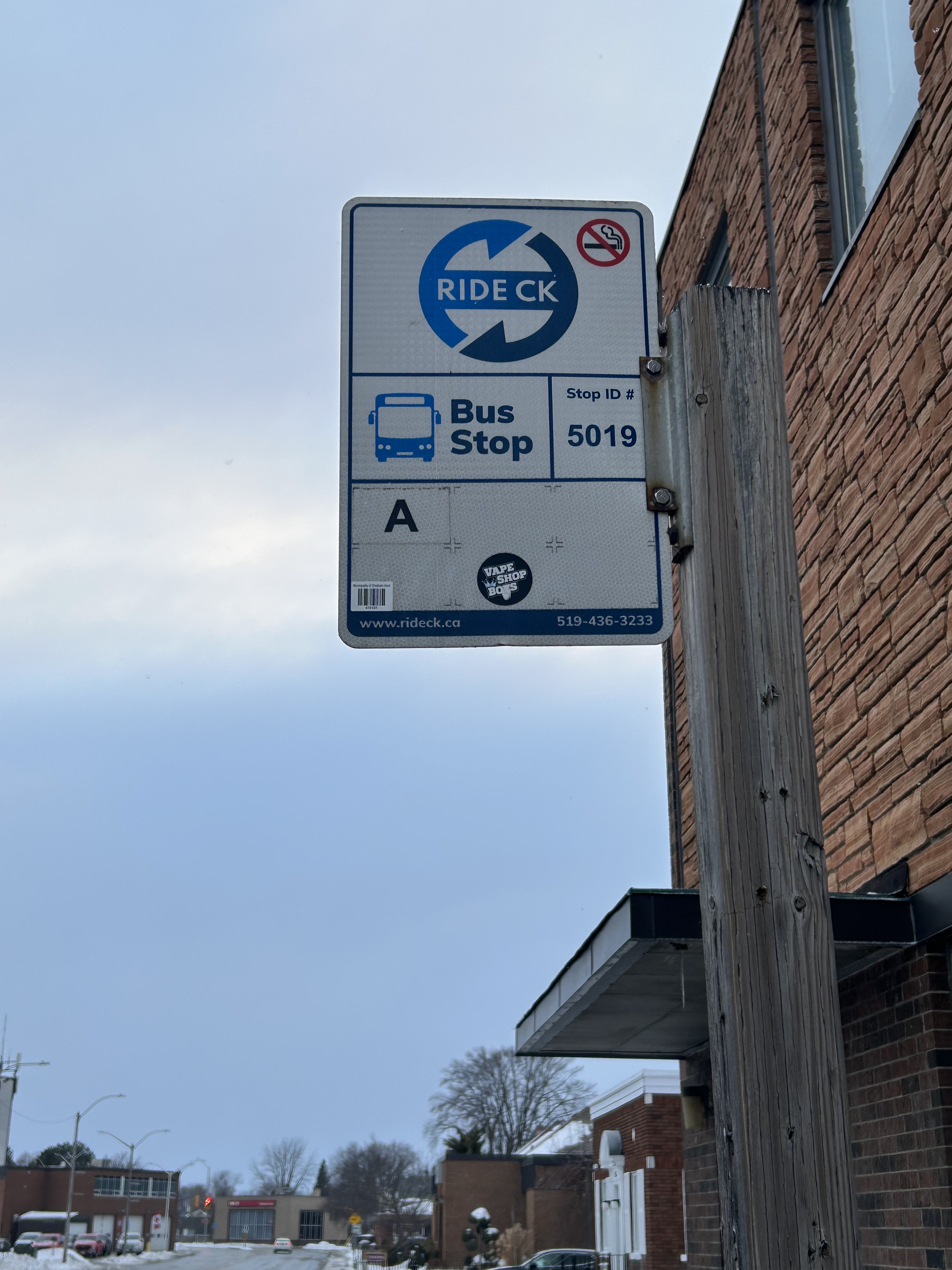
Bus stop in Wallaceburg
Each of the three intercommunity routes operate Monday through Saturday, with two morning and two evening round trips, with an additional midday run that leaves Downtown Chatham at 12:15 PM on weekdays; this additional trip was added several years after service began. There is a timed transfer to the local Chatham routes, allowing for onward connections to shopping, schools, medical services, employment, or social activities. All three rural routes also stop at the hospital in Chatham. The midday trip was added to provide an early return home for anyone taking the bus from outlying areas, such as for a medical appointment, and not then stuck waiting an entire day in Chatham.
I rode RideCK between Chatham and Wallaceburg and back in early February 2026; the midday 12:15 departure had decent ridership with six other passengers leaving the bus terminal (a seventh got on at the big box retail cluster north of Chatham’s urban area); there were five other passengers on the way back south on the first evening bus (5:45 PM leaving Chatham). Given that Chatham-Kent has maintained the service for so long is indicative of how the rural buses are seen as a necessity in the municipality. In Wallaceburg, on-demand local transit is also available, a recent improvement by the municipality.
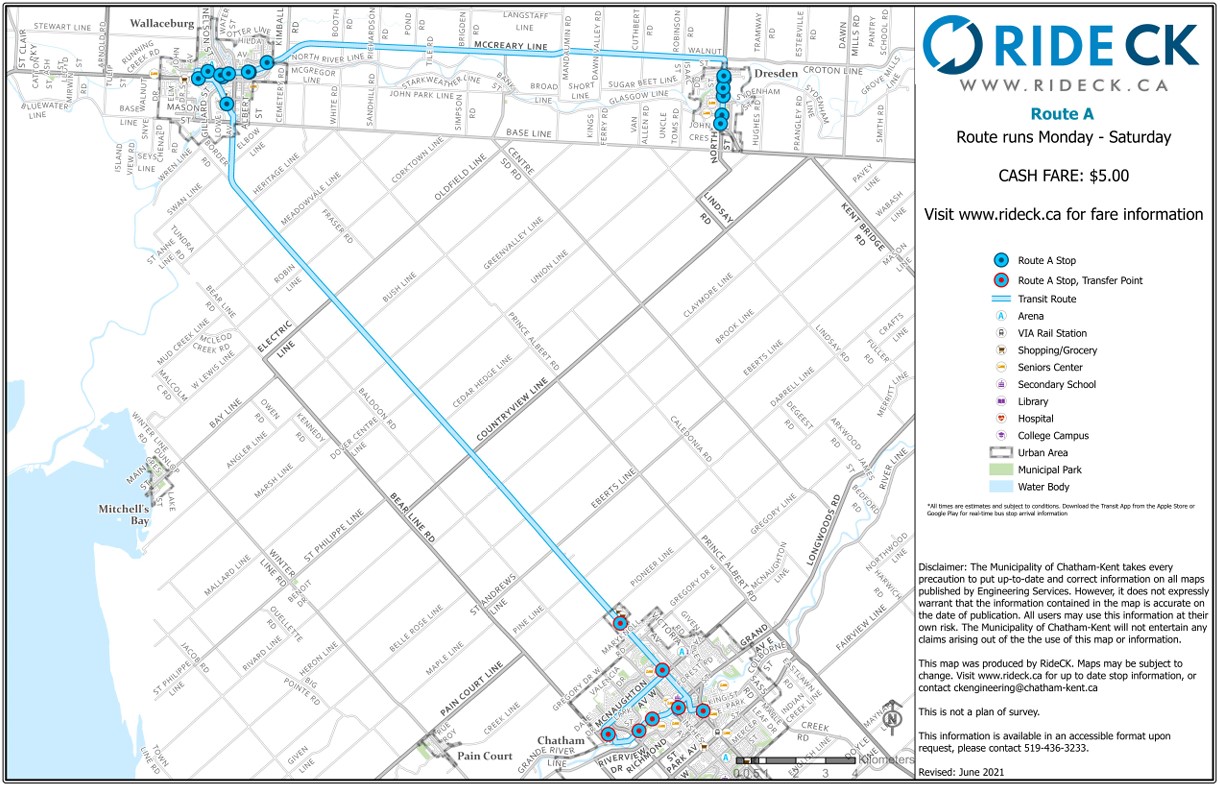
Intercommunity routes have a flat cash fare of $5.25 (though online materials still show the older $5 fare), though transfers to local transit are provided.
Ride CK Route A between Chatham, Wallaceburg, and Dresden
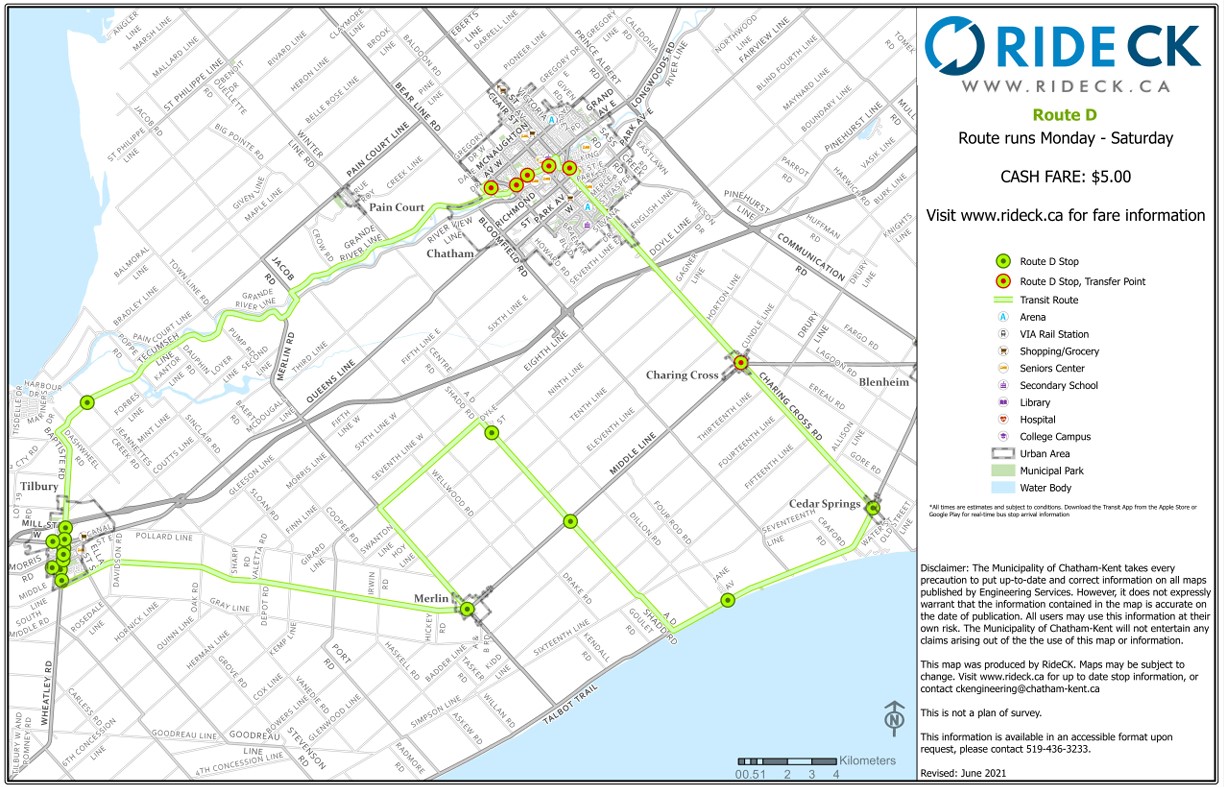
Though Routes A and C are fairly direct, Route D involves a long one-way loop to serve several small communities (including Cedar Springs, Buxton, and Merlin) before continuing to the former town of Tilbury and then back to Chatham. The route passes near, but does not stop at, Pain Court, and completely misses Wheatley.
The circuitous Ride CK Route D making a one-way loop through Cedar Springs and Tilbury
Though Chatham-Kent should be commended on identifying the need for rural transit and maintaining it for over two decades, it still demonstrates the challenges and gaps of operating a municipally provided rural transit service. Ideally, Chatham-Kent would be able to partner with neighbouring Lambton and Essex Counties to provide direct service to more communities. Tilbury should be part of an east-west service between Chatham and Windsor along the Highway 2 corridor, serving towns along Lake St. Clair such as Belle River. That would open connections to the University of Windsor and the main St. Clair College campus, along with other destinations, while improving service to Tilbury.
Route D, then, could be straightened and routed to serve Wheatley, even continuing west to make a connection to Leamington (which sadly, is losing its bus service to Windsor). With good scheduling, such connections could allow passengers to continue on VIA Rail service to London and Toronto.
Ontario needs a province-wide rural transit strategy with long-term funding and strong incentives to get reluctant municipalities (such as Halidmand County) on board. Until then, it is up to each local area to determine what, if any, transit service could look like, and up to residents to demand — and make use — of these services.
Unfortunately, the costs of maintaining this website and the ArcGIS Online portal to my maps continue to rise, especially as the amount of information provided and the number of views grow. If you enjoy my work and find the maps useful, please consider buying me a coffee to help with those costs. Thank you!
It is no secret that I am fascinated by Ontario’s failed downtown malls. Over the last decade, I have visited most of these half-dead shopping centres, from Thunder Bay to Sarnia to Peterborough. All of these malls were built in smaller centres hoping to revitalize their urban cores, especially after the successes of the Toronto Eaton Centre and Ottawa’s Rideau Centre.
A majority of downtown shopping centres in Ontario counted Eaton’s as an anchor, starting with London’s Wellington Square in 1960. New malls in Sudbury (1970), Hamilton (Jackson Square, 1972-1975) and Kitchener (Market Square, 1974) followed, with the pace of downtown mall openings quickening in the late 1970s and 1980s as the provincial government provided assistance through the Ontario Downtown Redevelopment Program (ODRP).
A few downtown malls did not secure Eaton’s as the lead anchor. These malls, which were anchored by Sears, included King Centre (Downtown Kitchener’s second indoor mall), Cornwall Square, and Downtown Chatham Centre. I visited the latter mall in late September 2023.
Chatham, a small city located halfway between London and Windsor, has had bad luck ever since the 1950s. City growth was curtailed when neighbouring townships fought the city’s annexation efforts to develop new industrial lands on the urban outskirts. Political pressure from exurban residents kept the city rather isolated from the new Highway 401, which passes south of the old city limits; residents of the hamlet of Charing Cross opposed a highway interchange that would have provided direct access into Downtown Chatham. Meanwhile, a new Multi-Malls shopping development was approved for a site north of Chatham; an appeal to the Ontario Municipal Board by the city was dismissed, and the new Woolco and Loblaw-anchored plaza helped to draw customers — and tax revenues — from the city proper.
This unfortunate situation was only rectified in 1998, when the City of Chatham was amalgamated with not just its neighbouring townships, but the entire county, creating the new municipality of Chatham-Kent, coming far too late for the industrial and commercial development Chatham had hoped for. In the meantime, a new downtown mall that would not only retain shoppers but hopefully attract new visitors to the city, was seen as the solution.
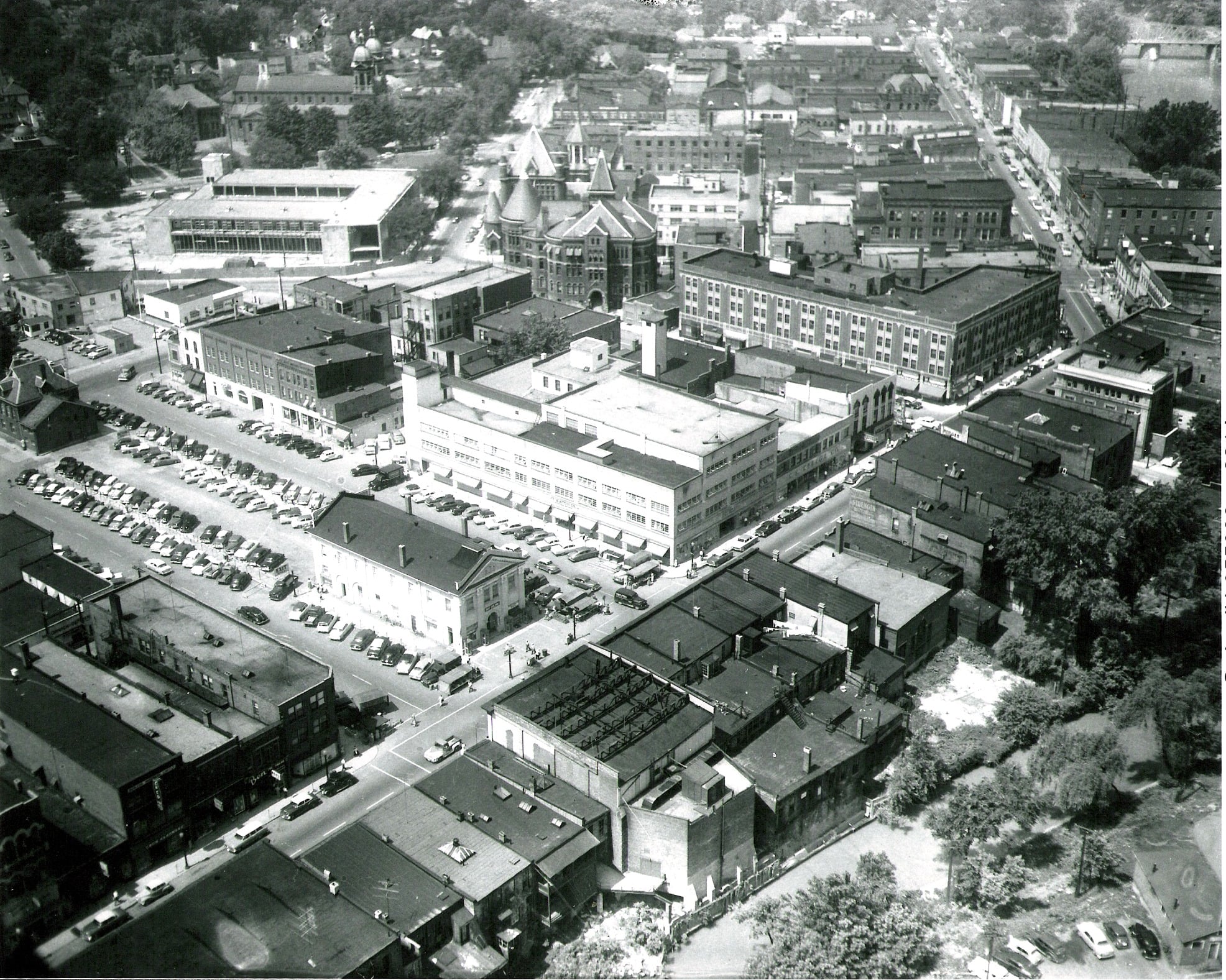
While most downtown malls built during the ODRP era were led by Eaton’s and Cadillac Fairview, the Downtown Chatham Centre (DCC) was managed by Cambridge Shopping Centres. The city of Chatham conducted the land assembly (using its powers of expropriation where necessary), and cleared two city blocks, including the Garner Hotel, the old market square, the Romanesque Harrison Hall, and several commercial blocks, including a shuttered Eaton’s store.
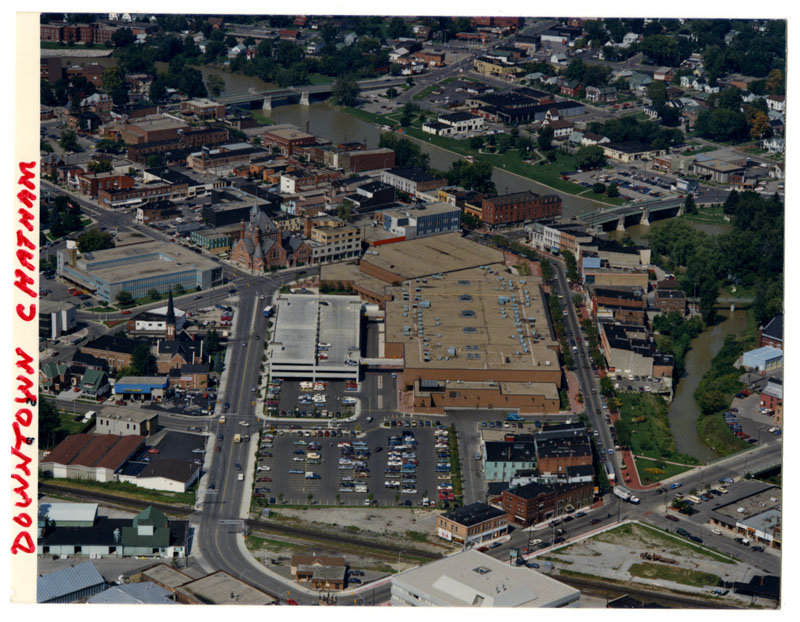
Downtown Chatham in the 1950s. Most of the buildings in the foreground and midground have since been demolished. The old market square became a parking lot by the 1950s; to the immediate left of the old market is the 3-4 storey Eaton’s store. Harrison Hall, with its conic tower, stands behind Eaton’s.The Downtown Chatham Centre soon after opening in 1983(Chatham-Kent Museum)
Instead of Eaton’s — which closed its Chatham store in 1974 — the lead anchor would be Sears, which was expanding its Canadian footprint at the time, as it just pulled out from its 25-year partnership with Simpson’s. Unlike most downtown malls built in Ontario, DCC had always offered ample customer parking, located in a garage linked to both of the mall’s two shopping levels, as well as an adjacent surface lot, with mall visitors able to get their parking validated. On the south side of the mall, there was a Miracle Food Mart, along with a food court on the second floor. Downtown Chatham offered the only full-line department store in town; the mall also had the city’s only escalators. The plaza out front featured a fountain in the summer and a public skating rink in the winter.
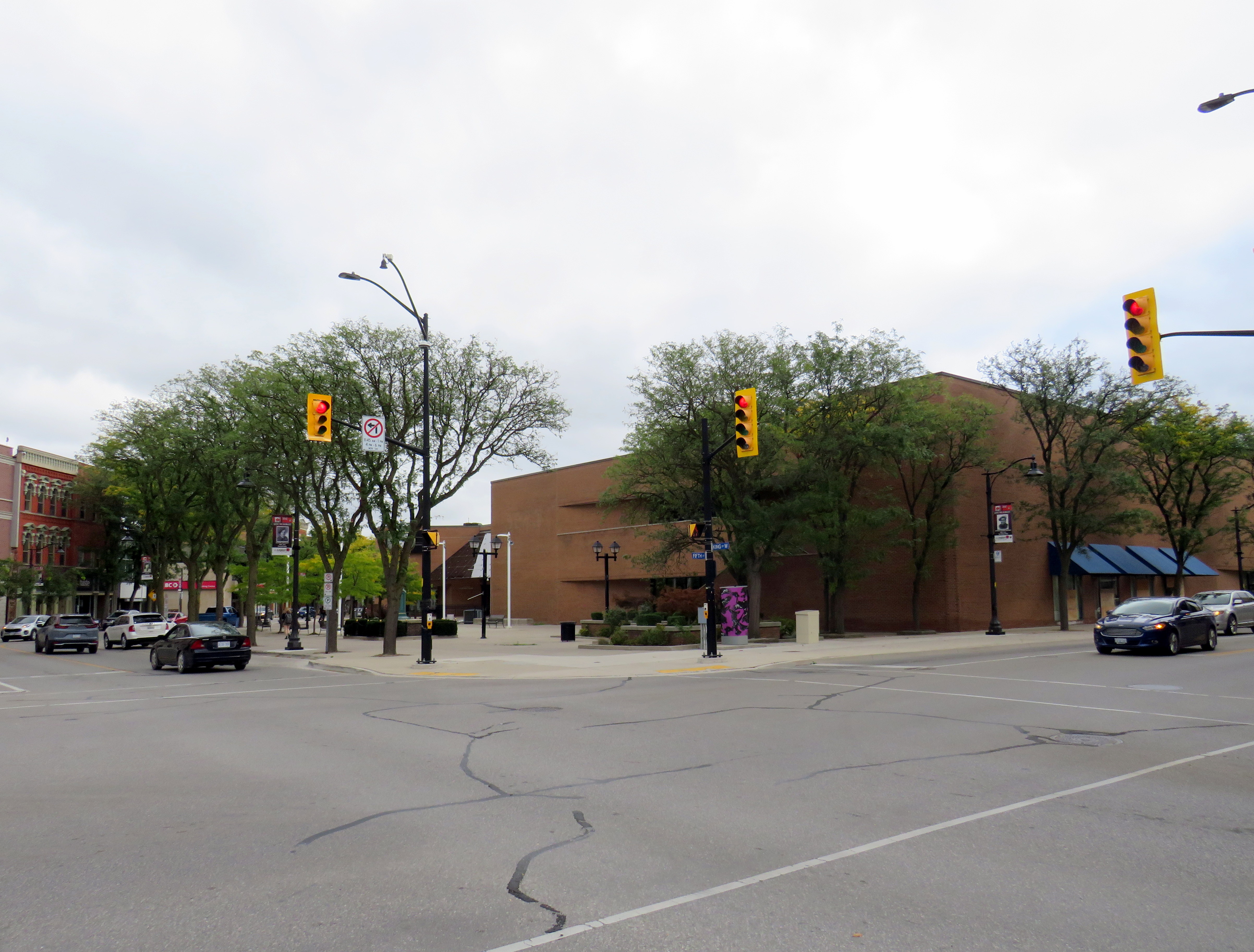
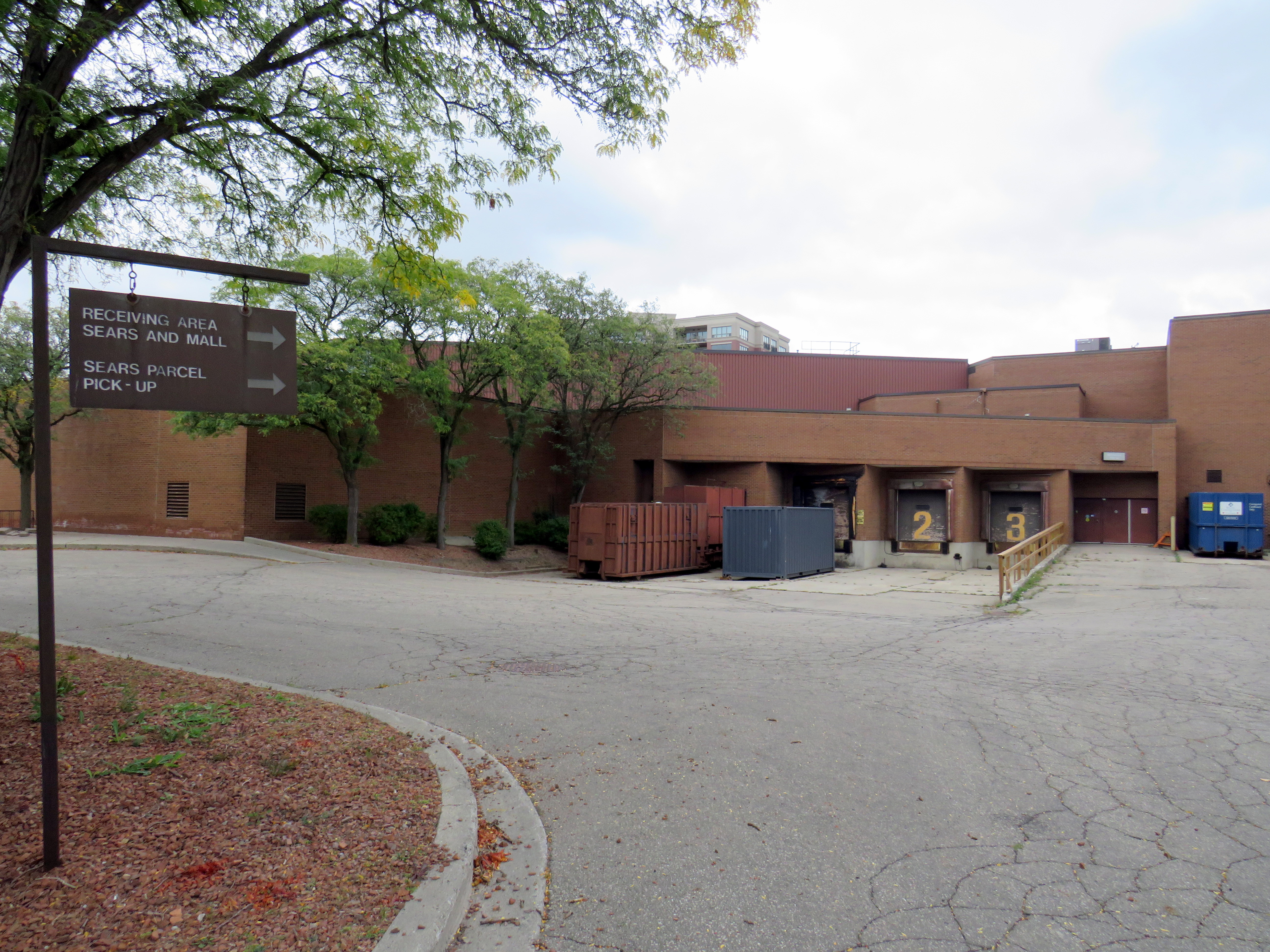
Harrison Hall, which was home to both the City of Chatham and Kent County before demolition in 1978 to make way for the Downtown Chatham Centre. (Chatham-Kent Museum)The site of demolished Harrison Hall in 2023. Asign still directs drivers to the Sears receiving area and the parcel pick-up.
For a time, DCC held its own. Sears was a much more suitable department store for a smaller industrial/agricultural city like Chatham than Eaton’s would have been. Though the Multi-Mall development north of the city on Highway 40 and the Thames-Lea plaza in the suburbs provided competition, the downtown mall’s regional market dominance was undisputed in the 1980s and most of the 1990s. Unlike Eaton’s, Sears Canada was particularly healthy until the early 2000s as it catered to the suburban middle class; in 1999, it purchased the remains of the bankrupt T. Eaton Company, converting many better performing Eaton’s stores to its own brand.
Unlike Chatham’s peer cities like Brantford and Sarnia, the mall’s tenant mix stayed relatively healthy well into the new millennium (see the 1992 and 2014 tenant lists below). Though Miracle Food Mart closed, that space was remised into a Sport Chek and a Goodlife Fitness gym. It wasn’t until the last decade that serious decline began to set in.
What happened?
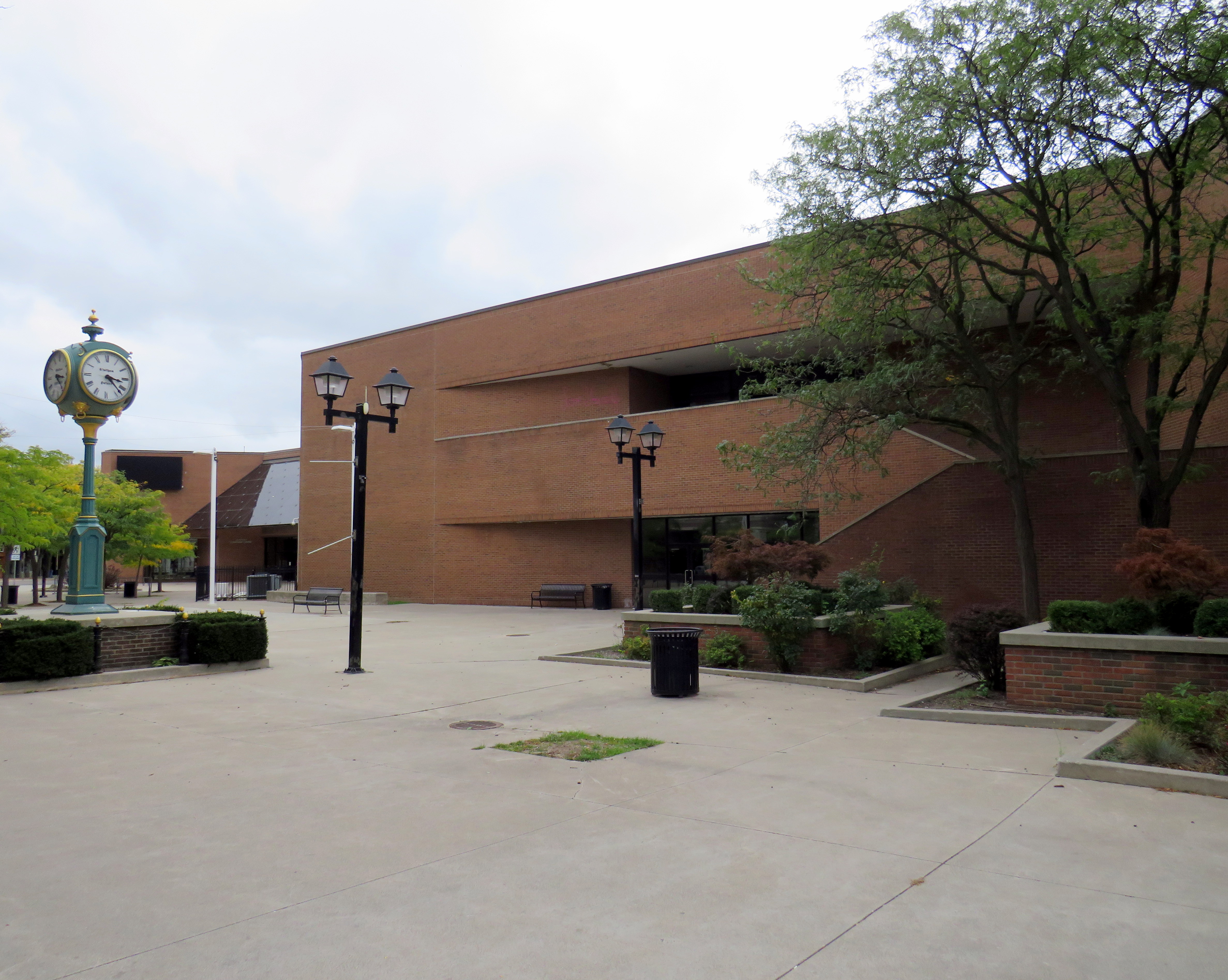
The empty public plaza outside the vacant Sears store
There were several factors that led towards the decline of Downtown Chatham Centre, similar to the reasons why most downtown malls failed. The main difference is that the decline came later than most others.
Chatham’s economy, like most smaller Ontario centres, was in flux, particularly in the 1990s and early 2000s. Free trade agreements affected the local industrial economy, which was already weaker than neighbouring cities like Sarnia, Windsor, and London-St. Thomas.
Factory closures included the Navistar plant. For nearly a century, International Harvester was one of Chatham’s largest employers. The Chatham plant, which assembled International truck tractors and employed 2400 workers in 2001, closed for good in 2011. The rise of Walmart, which moved into the old Woolco store on Highway 40 along with other big-box retailers, also hurt the downtown mall. But Sears Canada entered its own death spiral in the mid-2000s. In 2005, the company was taken over by the private equity firm Pershing Square, whose CEO, Edward Lampert, was already slowly sucking the American parent company dry. Sears Canada sold off its credit card division, its Downtown Toronto headquarters, and eventually the leases for its most attractive stores in 2012 and 2013, including the former Eaton’s flagship in Toronto Eaton Centre.
By 2014, the DCC Sears was converted to an outlet store, foreshadowing its eventual closure in 2017, less than year before the entire chain disappeared from Canada.
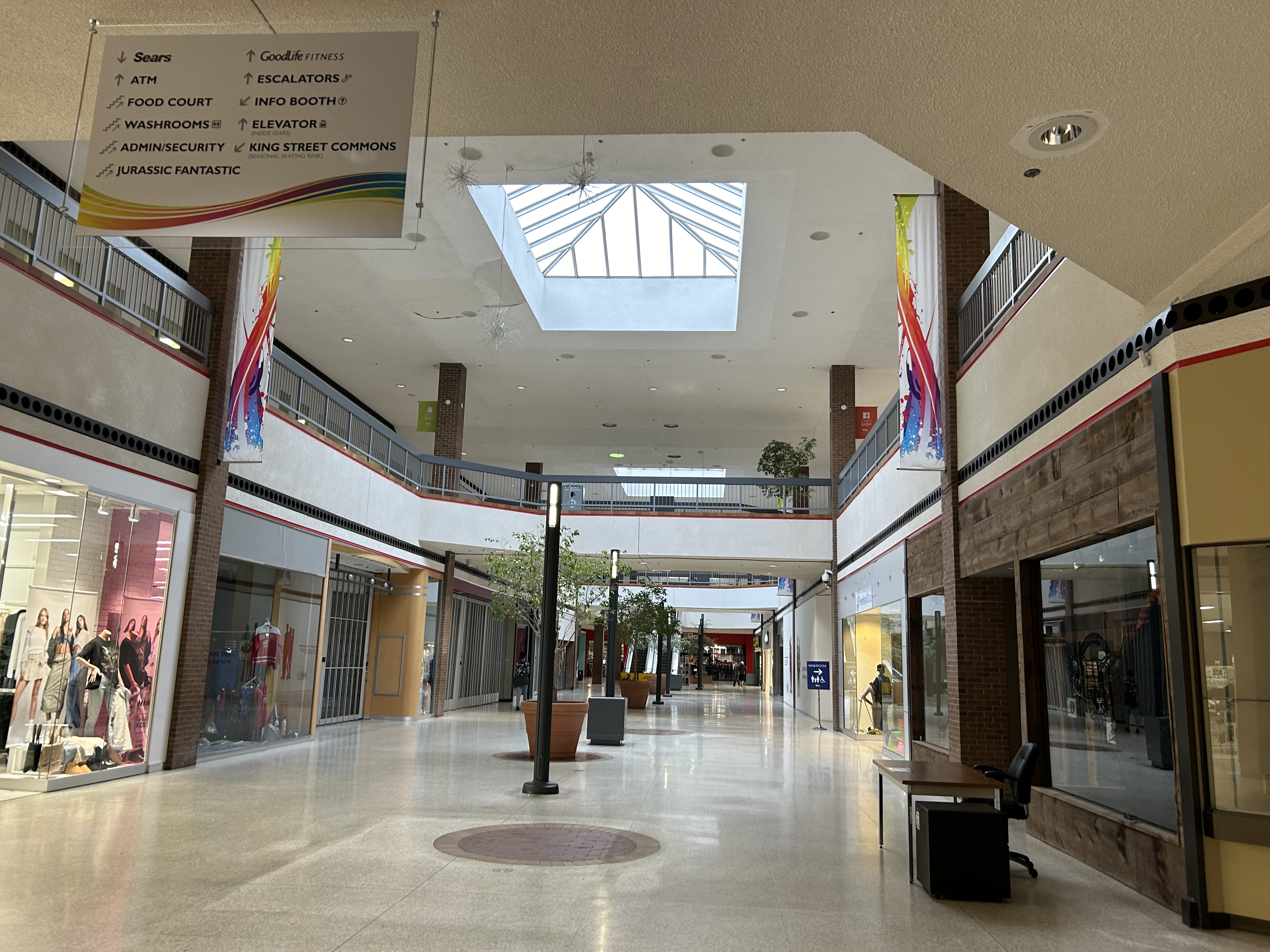
Mall interior looking east, September 2023
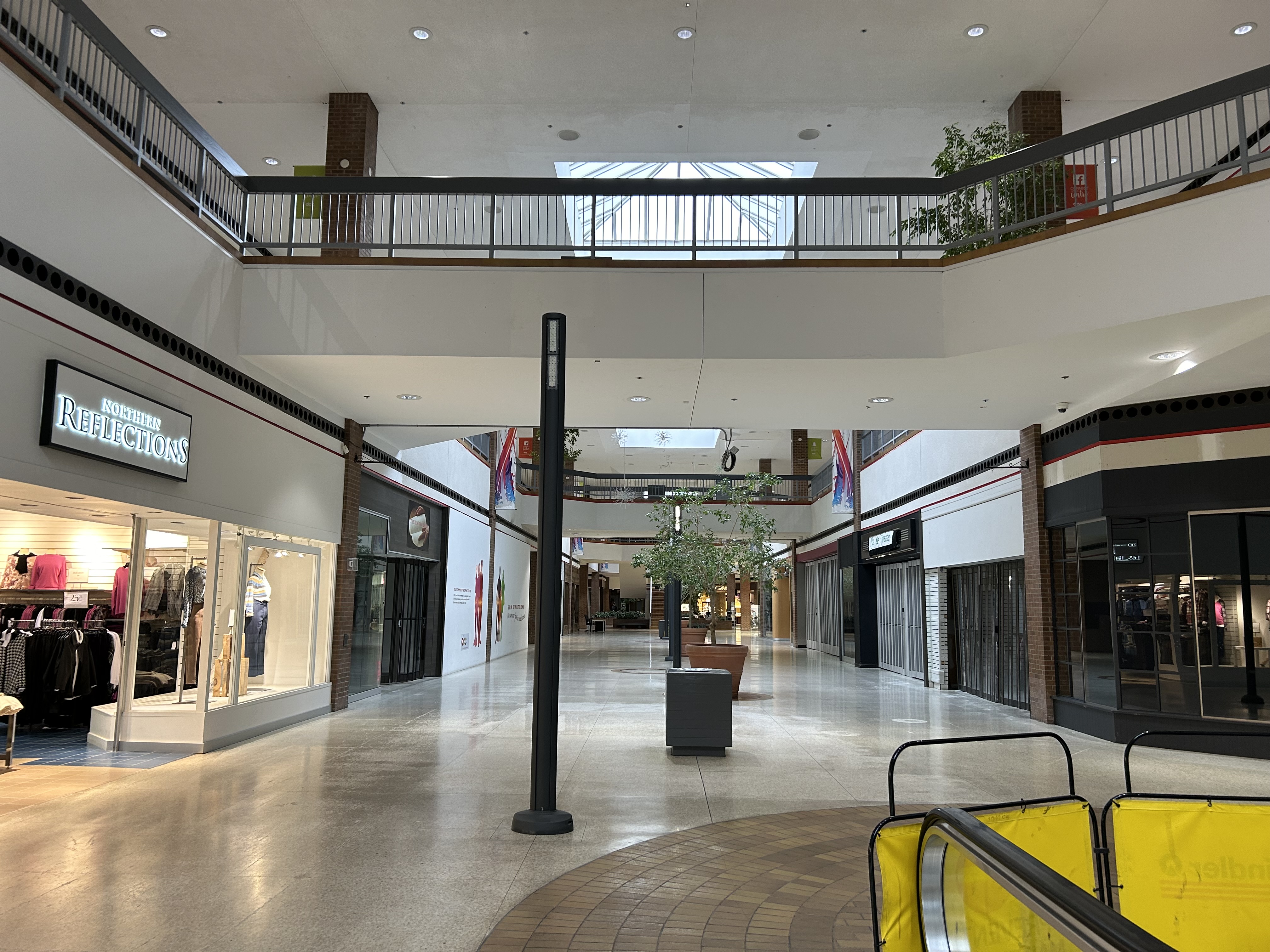
In September 2023, there were only a handful of open stores left inside DCC, including Northern Reflections, a Dollarama, Fit4Less (a budget brand of Goodlife Fitness), Ardene, an independent jewellery store, and a Hart discount department store located in the old Miracle Food Mart/Sport Chek space. All open retail spaces were on the first floor; the escalators were completely blocked off. The Ardene store was already in the process of moving to the Thames-Lea plaza.
Security guards were stationed at both public entrances, likely to ensure the mall did not become a hangout for Chatham’s unhoused.
Mall interior, looking west
The mall also has a pharmacy and medical office, but since 2015, they are accessed only from the outside, in a storefront facing King Street.
What’s next?
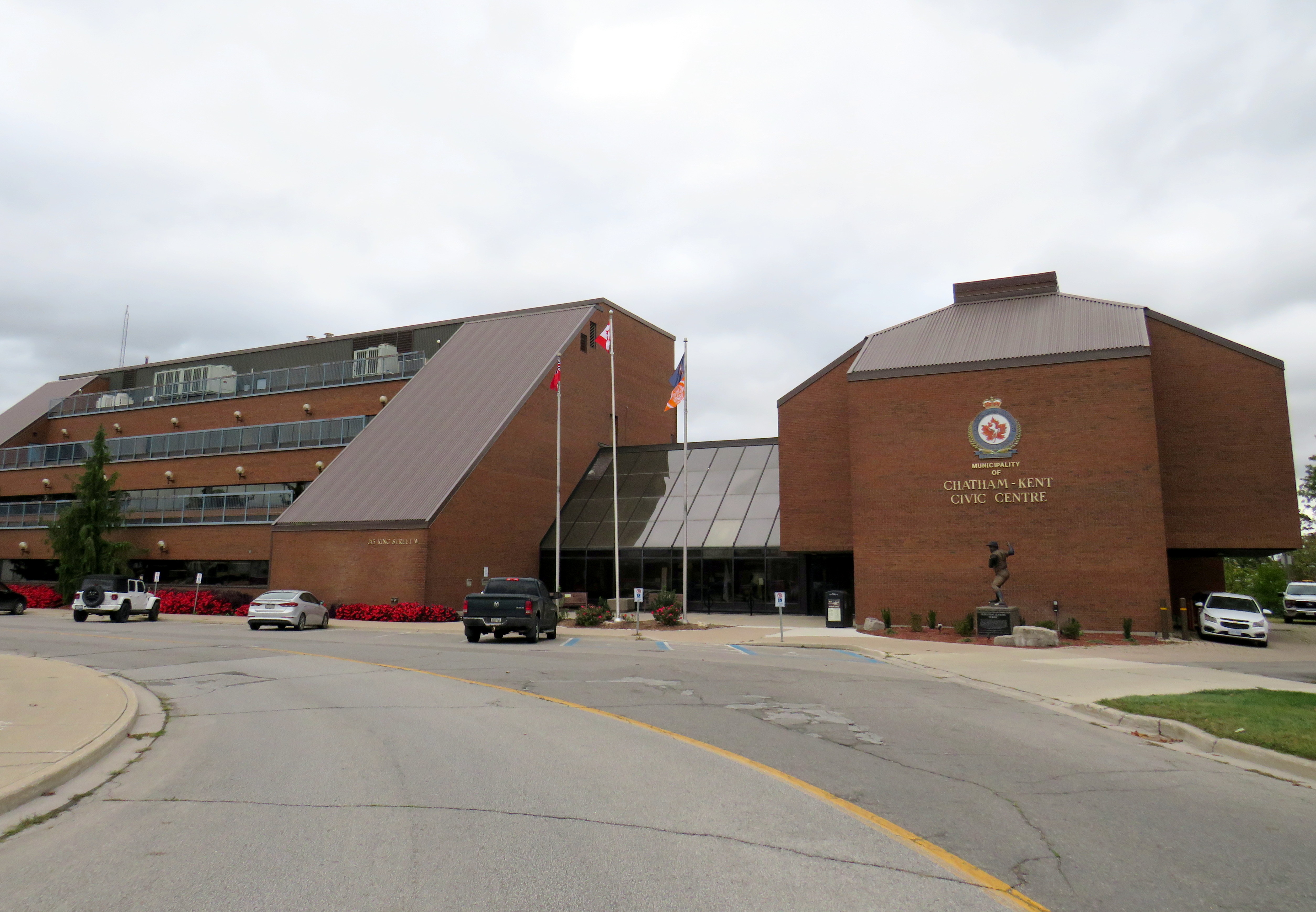
Chatham-Kent Civic Centre, built in 1975-1976
The Municipality of Chatham-Kent currently occupies the Chatham Civic Centre, which was built in the late 1970s on the site of a former gas works on the Thames River. The Civic Centre requires major renovations or replacement, and the municipal government is considering purchasing part of the Downtown Chatham Centre, and moving the municipal government, the main library, and the art gallery/museum into the Sears store, which would be heavily renovated. Staff report that the cost of purchasing and renovating part of the DCC ($42,387,400) was similar to renovating the existing Civic Centre, library, and museum ($38.7 million to $45.8 million) and nearly half the cost of building brand new.
Earlier plans also included a new entertainment centre to host concerts and the Chatham Maroons minor hockey team, replacing an existing municipal arena constructed in 1949. Those plans were later dropped by the mall’s owners.
If Chatham-Kent agrees to purchase and renovate the vacant Sears store, they will relocate to nearly the same site as the old Harrison Hall.
The proposed relocation of the civic centre and library to a central location, adjacent to the RideCK transit terminal (which serves the old City of Chatham as well as many smaller population centres within the municipality) is certainly a more sustainable and equitable outcome than building a new civic centre outside the downtown core. It repurposes an existing building and helps to support downtown business. However, more housing, both on the surface lot and on any vacated civic properties would help bring even more people into the downtown core, which can use the boost. Though retailers may not flock back into the mall once renovations are complete, the storefronts offer flexible space for community programs and small business incubators.
For a small city like Chatham, this is likely the best outcome.
1992 Tenants
Below is the list of tenants at Downtown Chatham Centre in 1992, obtained from the 1993 Canadian Directory of Shopping Centres, published by Maclean-Hunter.
Fashions and footwear Children’s wear: Just Kids Unisex/family wear: Cotton Ginny, Le Château, Pantorama, Stitches, Work World Ladies’ wear: Addition-Elle, Born Free, D’Allairds, Fairweather, Irene Hill, Just Petites, Lady Foot Locker, The Lady’s a Champ, Mariposa, Northern Reflections, Pennington’s, Personally Yours, Reitman’s, Ricki’s, Station Cotton, Suzy Shier, Thyme Maternity Menswear: Tip Top Footwear & leather goods: Foot Locker, Joggers, Kinney, The Shoe Place Jewellery/accessories: Lady Jewellery Company, Ostranders, Young’s Jewellers
Other retailers Books: Classic Bookshop, Coles Drugs/health & beauty: Pharma Plus, The Soap Emporium Department/mass merchandiser: A Buck or Two Electronics: Radio Shack Gift: Den For Men, Things Engraved Hardware/paint & paper: Tool Den Housewares: Junor’s, Stokes Music/Records: Sam the Record Man Pet: Pet Paradise Photo/Camera: Black’s, Japan Camera 1 Hour Photo. Restaurant/fast food: A&W, Crumbles Muffins, Frankfurters, Lumberjack Restaurant, Manchu Wok, Mulligan’s Roadhouse, Sorrento Specialty Food & Drink: Bright’s Wines, Laura Secord, The Gourmet Cup Stationery/Card: Carlton Cards, Hallmark, Willson Stationers Toy: Toys & Wheels Variety/Convenience: News Room Dry Cleaners: La Moderna Dry Cleaning. Hairstyling/Esthetics: The Golden Razor Theatre/Entertainment: Fun & Games Miscellaneous: Infoplace
2014 Tenants
The 2015 Canadian Directory of Shopping Centres tenant list was shorter, though still much more robust than former Eaton’s-anchored downtown malls in comparably-sized cities like Sarnia, Brantford, or Peterborough at the time.
Unfortunately, there have also been some setbacks. Wroute, a shared taxi service in the Kitchener-Guelph-Hamilton triangle, was operational for less than a year. Though GO Transit added new weekday trains between Guelph and Kitchener, none allow for Kitchener-bound commutes, and there has not been interest in serving those gaps identified by Wroute.
Outside of Northern Ontario and the Golden Horseshoe, many cities and towns remain disconnected from nearby communities and larger centres. Though every city and town in Ontario had daily bus and/or rail service in the 1980s, many communities are now completely inaccessible for anyone without access to a car. Though GO Transit expanded to Peterborough, Brantford, Niagara, and Kitchener in the last fifteen years, they are extensions of GO’s radial network from Toronto rather than a true intercity network.
St. Thomas, population 41,000, is the largest city in the province without any passenger links, despite being a short drive to London. Many other cities and towns — particularly in Midwestern and Eastern Ontario — find themselves in similar situations. A few other cities, such as Sarnia (which has just one train a day each way to London and Toronto), are grossly under-served.
But thanks to municipal innovation and a new provincial grant program, this is finally changing. Though several municipalities addressed this problem early on, three new inter-municipal bus systems began operations in 2019, with many more launching this year.