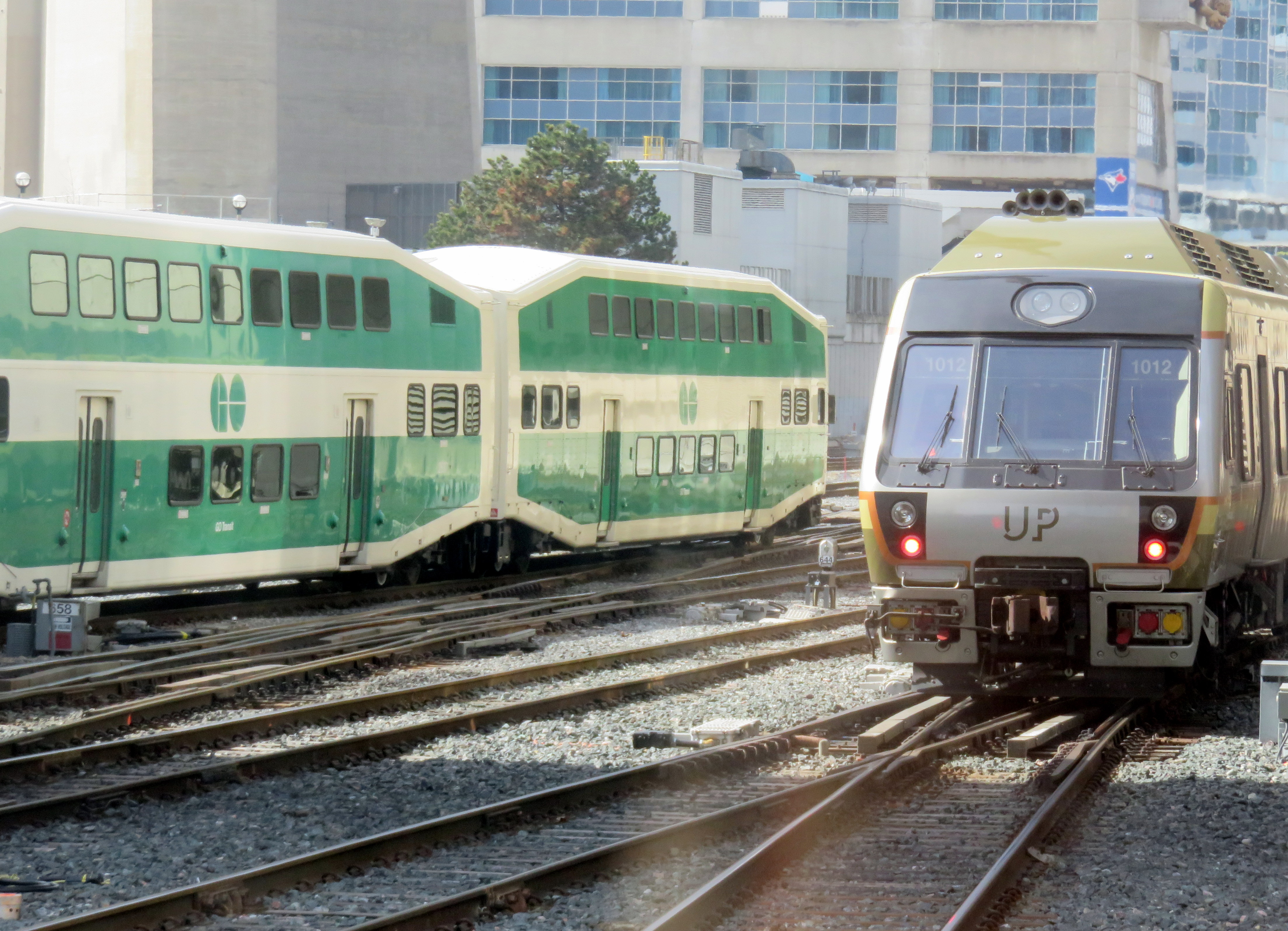
 Electrification for GO Transit and UP Express has been proposed for years
At GO Transit’s Willowbrook Maintenance Centre in Mimico today, the Ontario Minister of Transportation, Steven Del Duca, announced the start of the transit project assessment process (TPAP) that will allow GO to move forward with its plans for electrification. GO RER, the $13.5-billion regional rail network plan, is dependent on a new fleet of electric trainsets to provide rapid transit across the Greater Toronto and Hamilton Area.
But Del Duca introduced a new twist to the plot. Along with the electrification TPAP, the province will also look into the feasibility of hydrogen-powered trains. Hydrogen-powered trains are being tested in Germany by Alstom, a French rail manufacturer.
Quoted in the Toronto Star, Del Duca said that “this is a decision that we’re making that will have to last for a generation and beyond, so we want to make sure that we’re at the leading edge of the technology.”
The Alstom experimental train, a Cordelia LINT, is a similar model to the one used in Ottawa for the O-Train Trillium Line, a diesel light rail operation. The hydrogen-powered model has yet to be tested in revenue service; hydrogen propulsion also has yet to be tested on heavier rail equipment. The Cordelia LINTs are light rail vehicles, and under current railway regulations, cannot share the same tracks with heavier freight and passenger trains.
My fear is that this is yet another distraction from transportation needs in the here and now. Further, I worry that the “fuel cell technology symposium” will not only distract from the GO RER project, it will give credence to NIMBYs opposing electrification – be it the construction of gantries and overhead wires, or those worried about the effects of electromagnetism.
I have more faith in building sound, tested and true, transit systems than pursuing the newest technology there is. Electric trains have been around for over 100 years. Electric multiple unit regional rail as we know it is used in scores of cities worldwide, including Montreal, New York, and Philadelphia. Electric multiple unit trains (EMUs), which can be purchased from at least a half-dozen firms, are reliable, quick, and suitable for GO RER.
The provincial government has an unfortunate history of promoting new technologies that end either in failure — the 1970s-era GO-ALRT plans, for example, or the promotion of Ontario-made compressed natural gas (CNG) buses to replace electric trolley buses in Toronto and Hamilton in the early 1990s. (Those buses were either scrapped early, or converted to conventional diesel propulsion.) The Scarborough RT, originally planned as the nucleus of a conventional light rail network, was replaced by a propitiatory linear induction system heavily promoted by the province.
The idea of hydrogen-powered trains is attractive: they have zero at-source emissions; the Alstom train is train is exceptionally quiet, and only emits steam and condensed water. Electrification requires overhead gantries and wires, along with substations at regular intervals; hydrogen-powered trains require none of these expenses. What isn’t clear is whether hydrogen powered trains offer the other advantages of electric train operation, namely quick acceleration and deceleration needed for a frequent-stop regional rail service.
I want GO RER to be built, and I want it to be built right. I just fear that the attention given to an emerging technology will be yet another distraction, especially going into an election year.

