Tag: Road Violence

  • Deadly by design: Burnhamthorpe Road

    Deadly by design: Burnhamthorpe Road

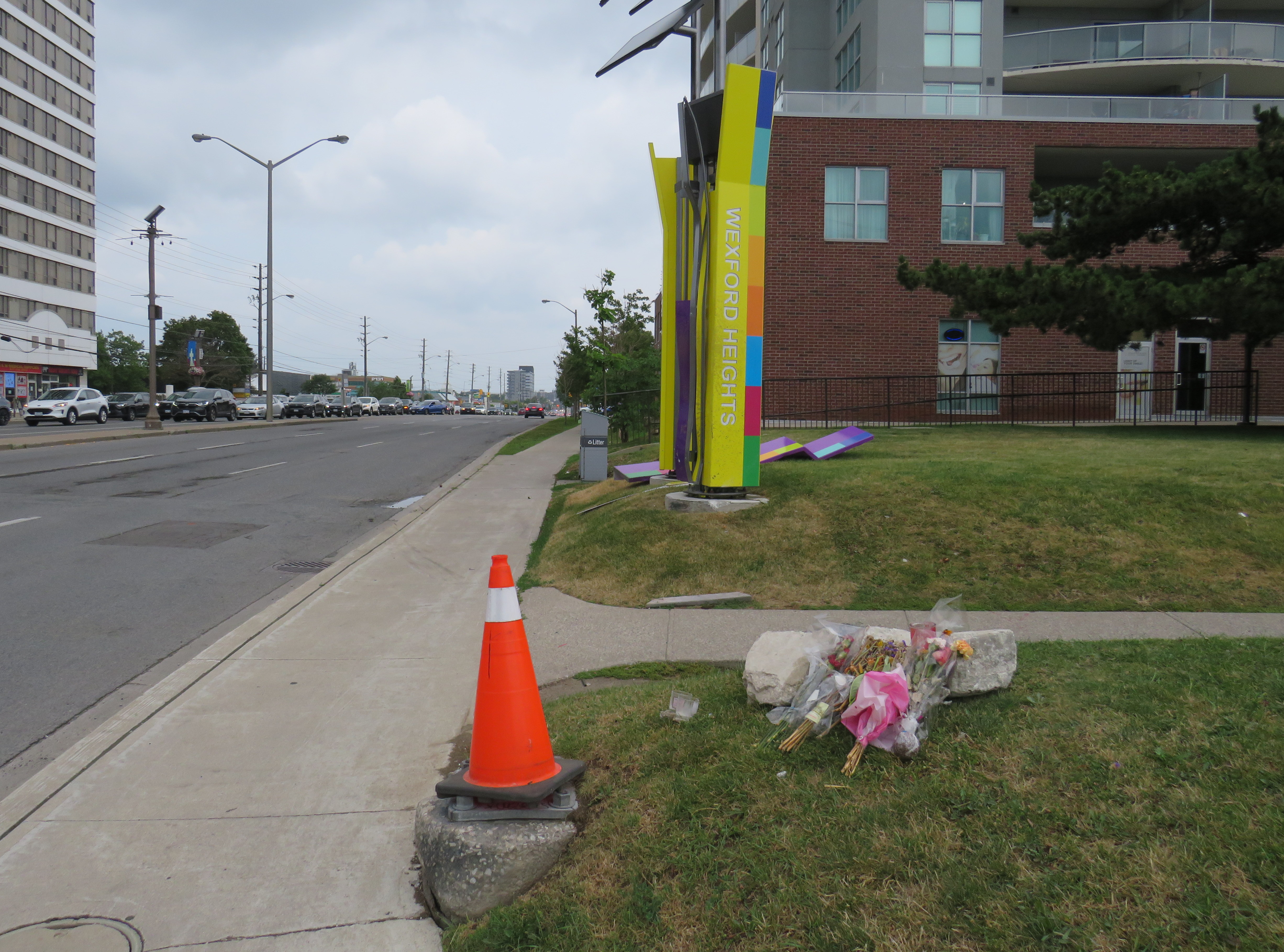
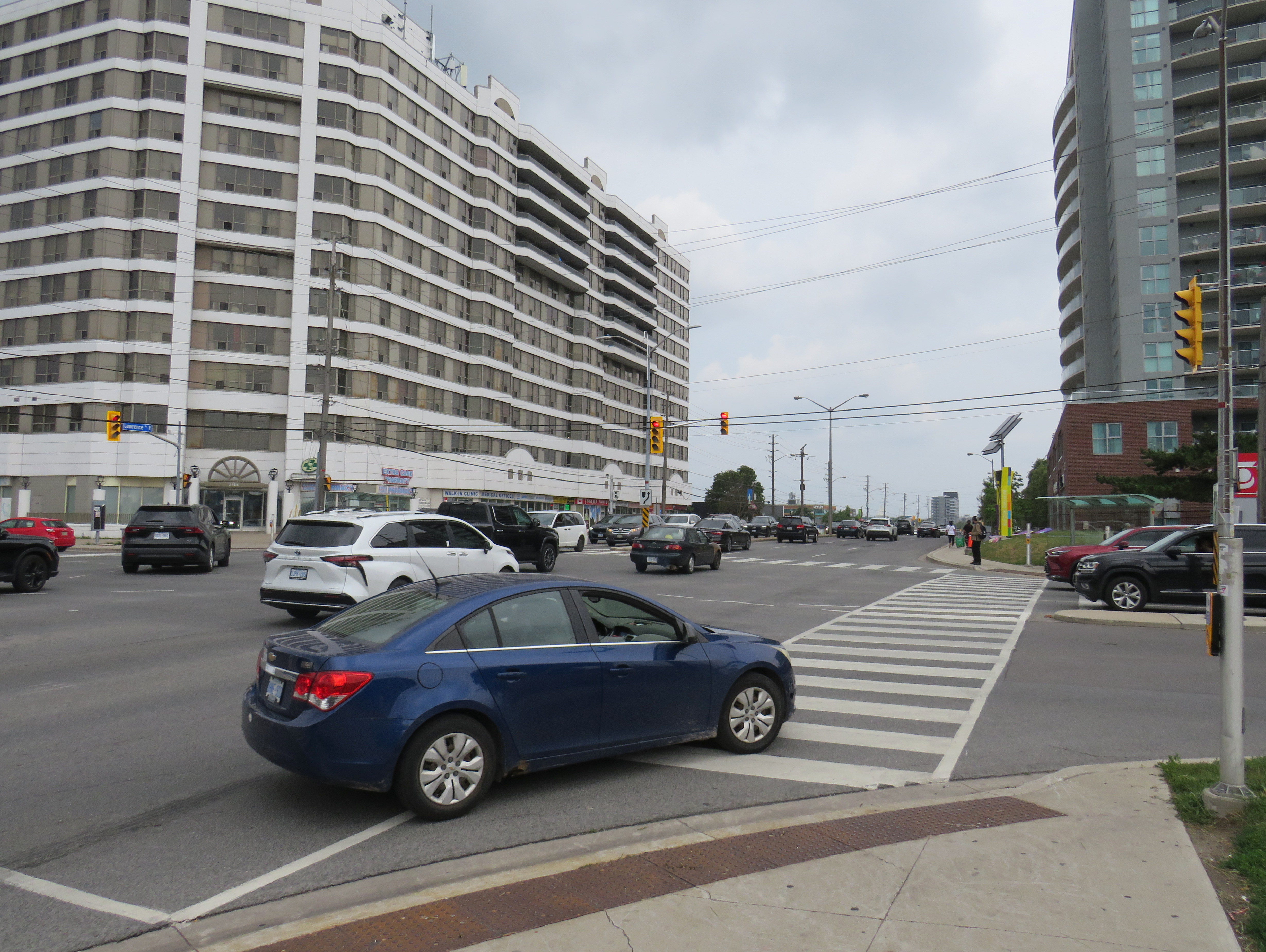
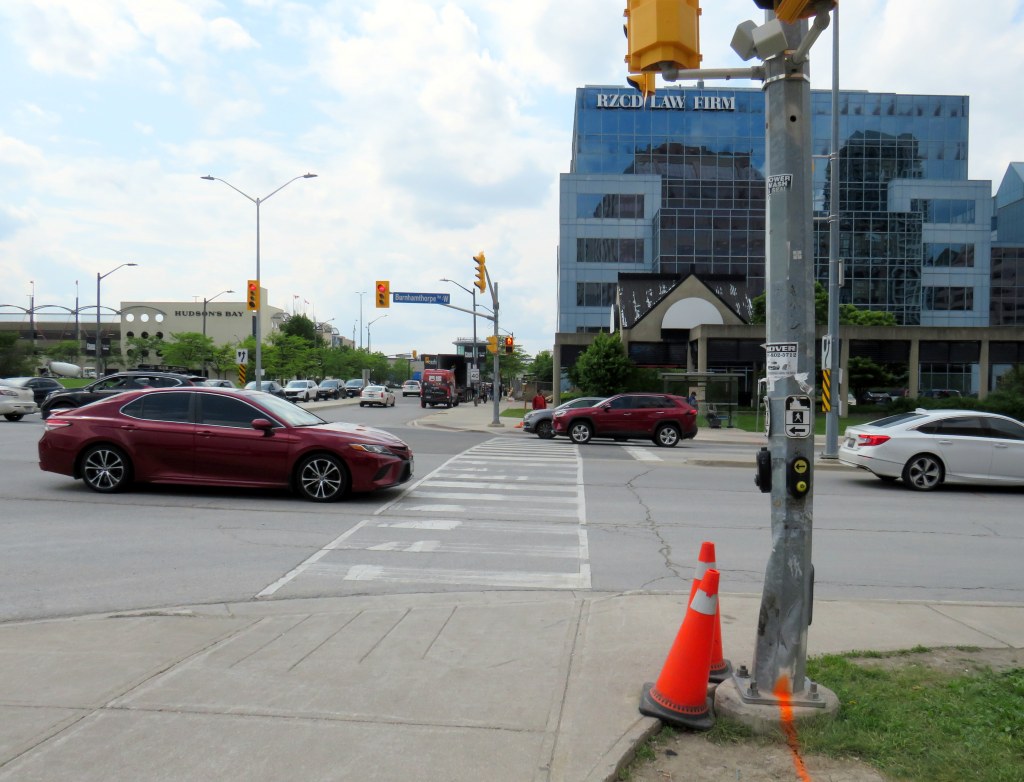
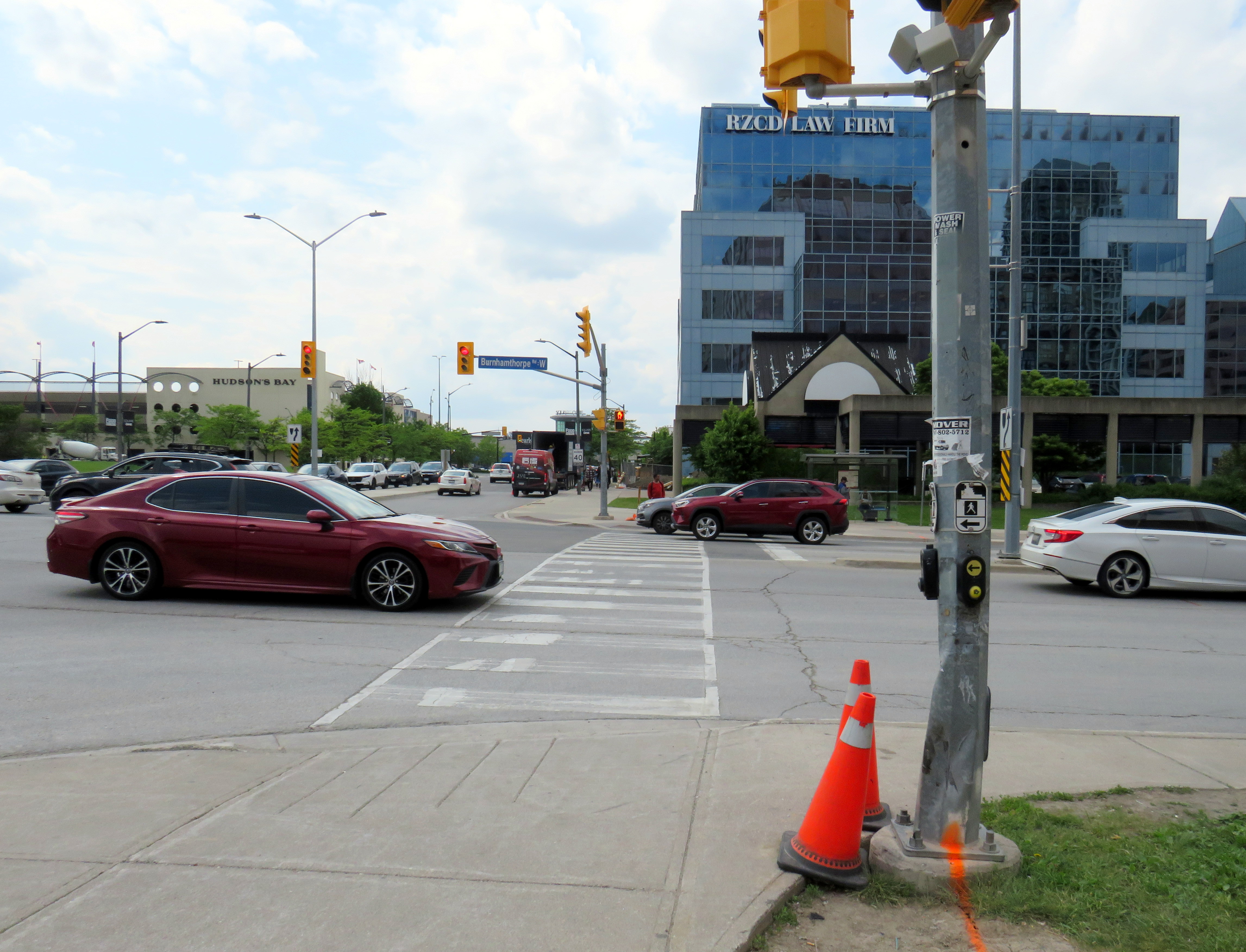
    A dented light pole is the only indicator of a deadly collision in Mississauga City Centre

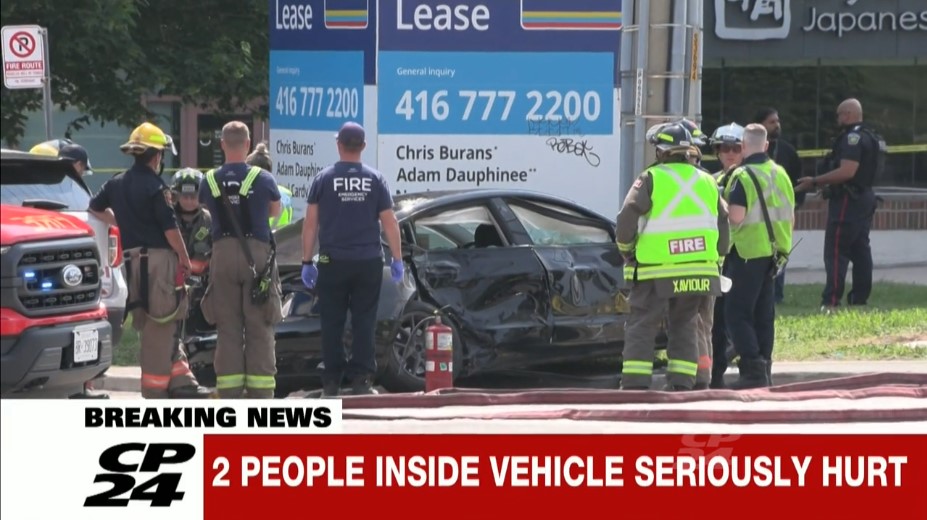
    On Saturday, June 7, around 10:20 AM, the drivers of two vehicles collided in the intersection of Burnhamthorpe Road and Kariya Drive in central Mississauga. One of the two cars that collided, a Tesla sedan, slid onto the sidewalk on the southeast corner, hitting a traffic pole, and then colliding with two pedestrians waiting at the corner to cross the street. One of the two pedestrians, a man in his forties, was killed; the other was taken to hospital with serious injuries. CBC Toronto, CP24/CTV News and the Toronto Star covered the collision.

    Unfortunately, there has been no follow-up reporting so far, and there is no press release or statement on the Peel Regional Police website.

    Screenshot of CP24 news report showing the badly damaged Tesla that crashed into two pedestrians

    A few days later, I visited the area to take note of the intersection and the surroundings.

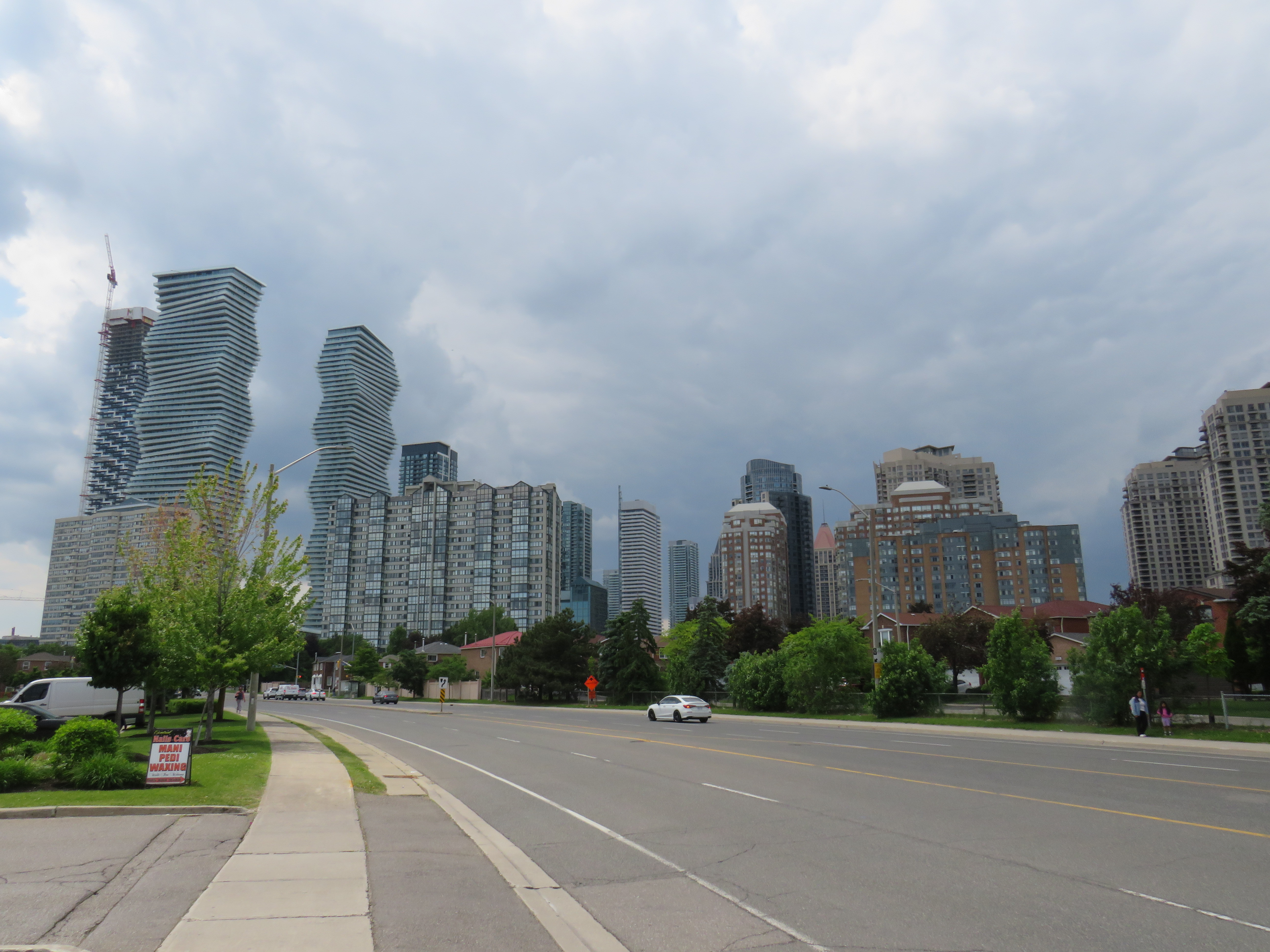
    The intersection of Burnhamthorpe and Kariya is within the busy, urbanizing Mississauga City Centre (MCC) neighbourhood. MCC, also known as Downtown Mississauga, is the political, commercial, and cultural centre of the sprawling suburb of 750,000. The area is centred around Square One Shopping Centre, which opened in 1973, expanding several times in the next four decades to become one of Canada’s largest malls. Immediately to the west of Square One is Mississauga’s post-modern city hall, which is one of the most interesting and walkable civic centres in Ontario. Nearby is a performing arts theatre, a Sheridan College campus, several office buildings, a YMCA, central library, parks, a transit hub, as well as many high-rise residential towers. Newer residential development includes streetfront retail, oriented to the community with local restaurants, cafes, pharmacies, and grocery stores. Despite its greenfield suburban origins, Mississauga City Centre has become a true 15-minute city.

    Looking north on Confederation Parkway towards MCC
    Looking north on Confederation Parkway near Central Parkway, where MCC’s high-rise condominiums tower over older single-family homes

    The problem, though, is despite its impressive growth, MCC’s built infrastructure still has the trappings of a suburban speedway. Though some collector streets and minor arterials, like Living Arts Drive and Confederation Boulevard, are more human-scaled, with bicycle lanes, wider sidewalks, benches, and street trees, other streets have not been updated to suit the emerging urban environment. Burnhamthorpe Road is the best example of this.

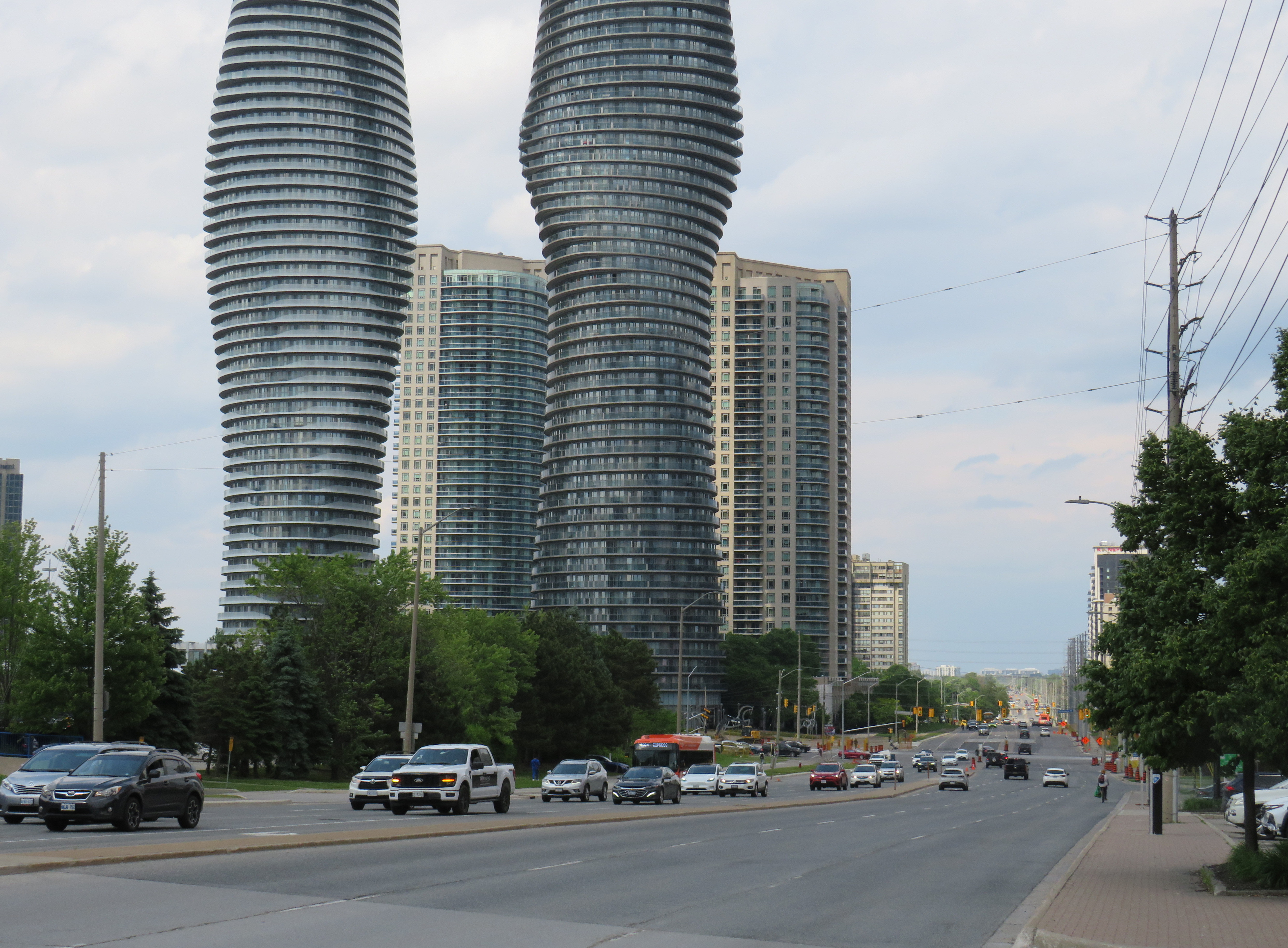
    Looking east on Burnhampthorpe
    Looking east on Burnhampthorpe Road from Kariya Drive, towards Hurontario Street and the landmark Absolute condo towers

    Burnhamthorpe Road is six lanes wide, with an additional left turn lane at every intersection. Though there is a sidewalk on the south side and a designated multiuse path (MUP) on the north side, it is not a pleasant place to walk.

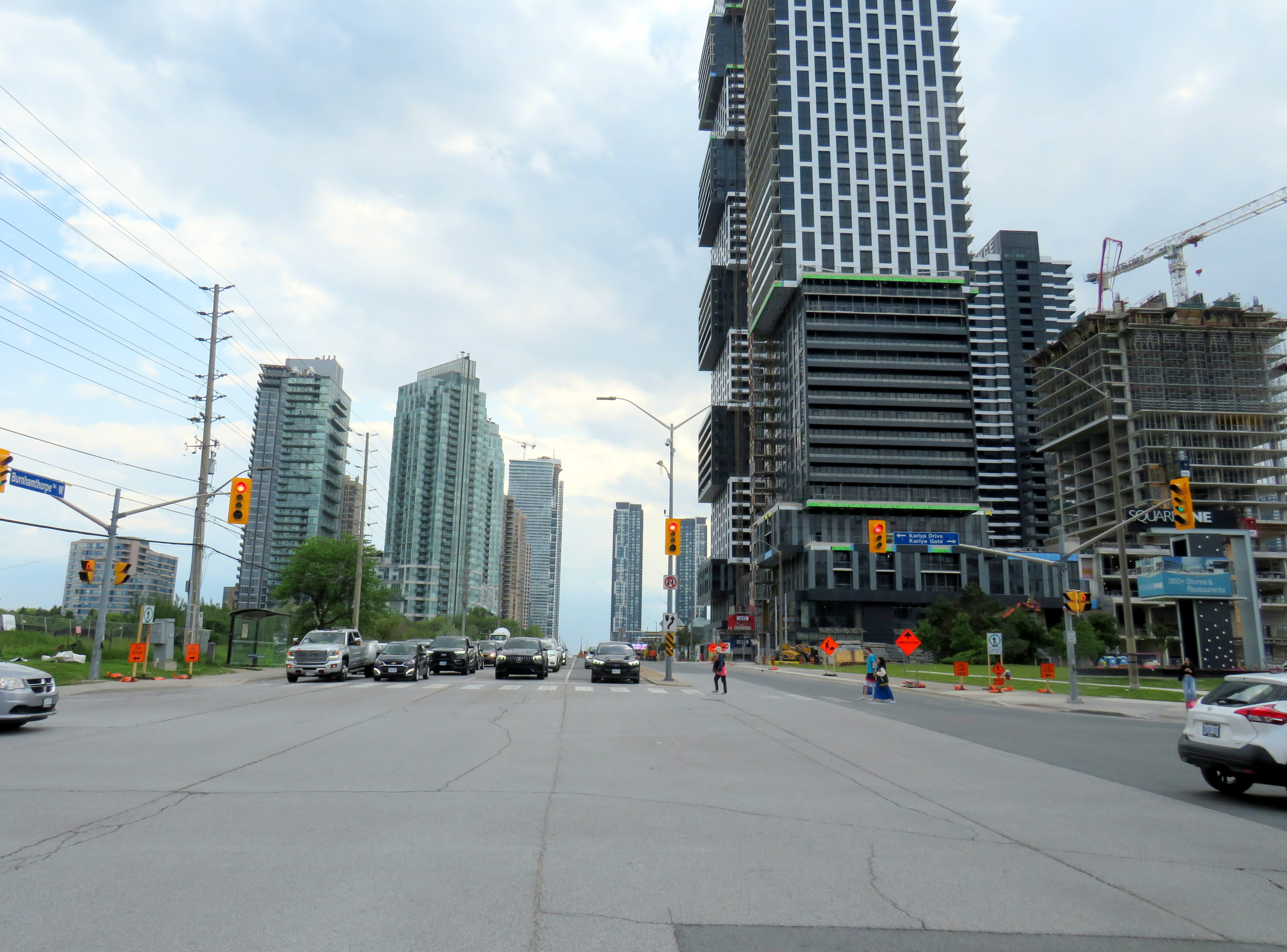
    Looking west on Burnhamthorpe
    Looking west on Burnhamthorpe Road, towards newly built and under-construction high-rise residential towers

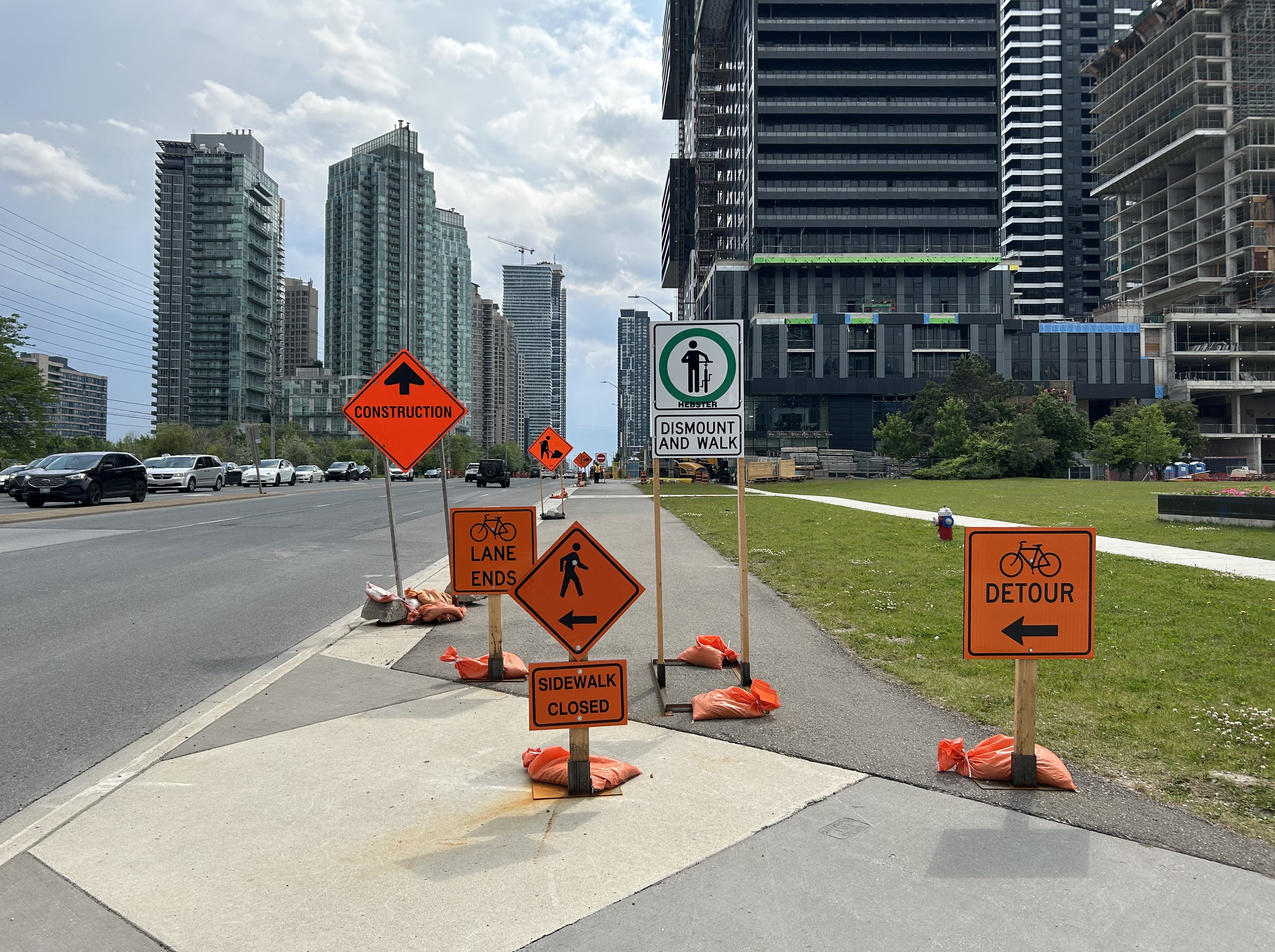
    While I visited The MUP on the north side of Burnhamthorpe west of Kariya Drive was also closed off for the convenience of the builders of the Exchange District Condos development, one of many new mixed-use projects in the area. This forces pedestrians to cross the intersection to continue west, and no thought was made to closing one of the three westbound traffic lanes to provide a continuous path.

    Signs blocking path
    Multiple “sidewalk closed” bike lane detour, and “dismount and walk” signs blocking the asphalt MUP on the north side of Burnhamthorpe Road. Note that no traffic lanes were blocked to provide a continuous route for vulnerable road users.

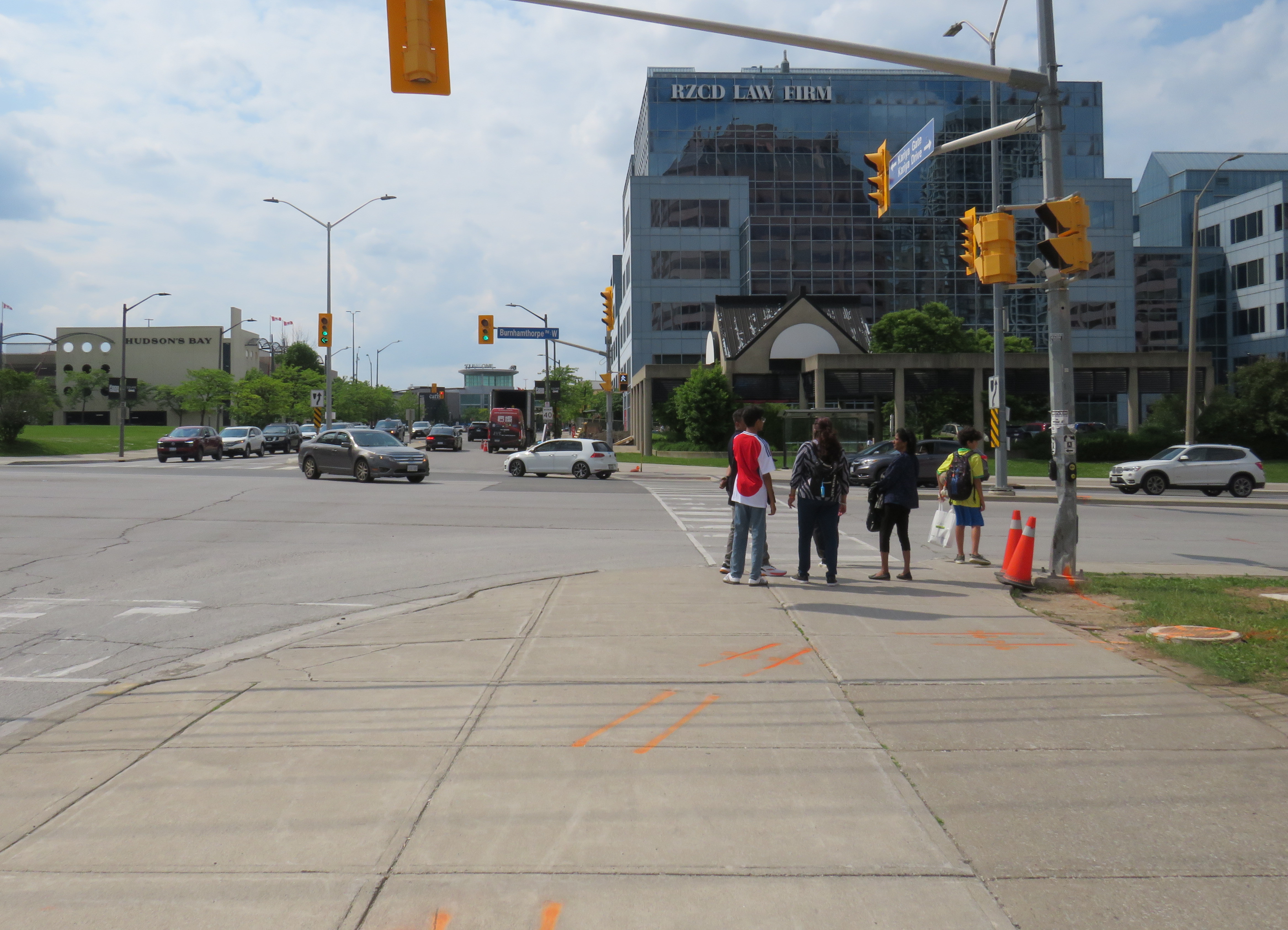
    The intersection of Kariya and Burnhamthorpe is quite busy; at every light cycle, there were multiple pedestrians crossing here on mid Tuesday afternoon, including students walking to the mall or to home from nearby schools, couples and young families out for a stroll. (Kariya Park, named for a Japanese city that was twinned with Mississauga in 1981, is a lovely oasis.) Burnhamthorpe has a 60 km/h speed limit, though Kariya has a 40 km/h limit.

    Five pedestrians, standing where a man was struck and killed last Saturday, about to cross Burnhamthorpe Road on a Tuesday afternoon

    The corner is also a busy transfer point. Miway route 26 Burnhamthorpe is a major east-west bus corridor that connects with the TTC subway at Kipling Station; Kariya Drive is the best stop to get to Square One as Route 26 doesn’t serve the main terminal. Routes 3 Bloor and 8 Cawthra, which do continue to the City Centre Terminal, stop here as well.

    Route 26 Burnhamthorpe is one of MiWay’s busiest

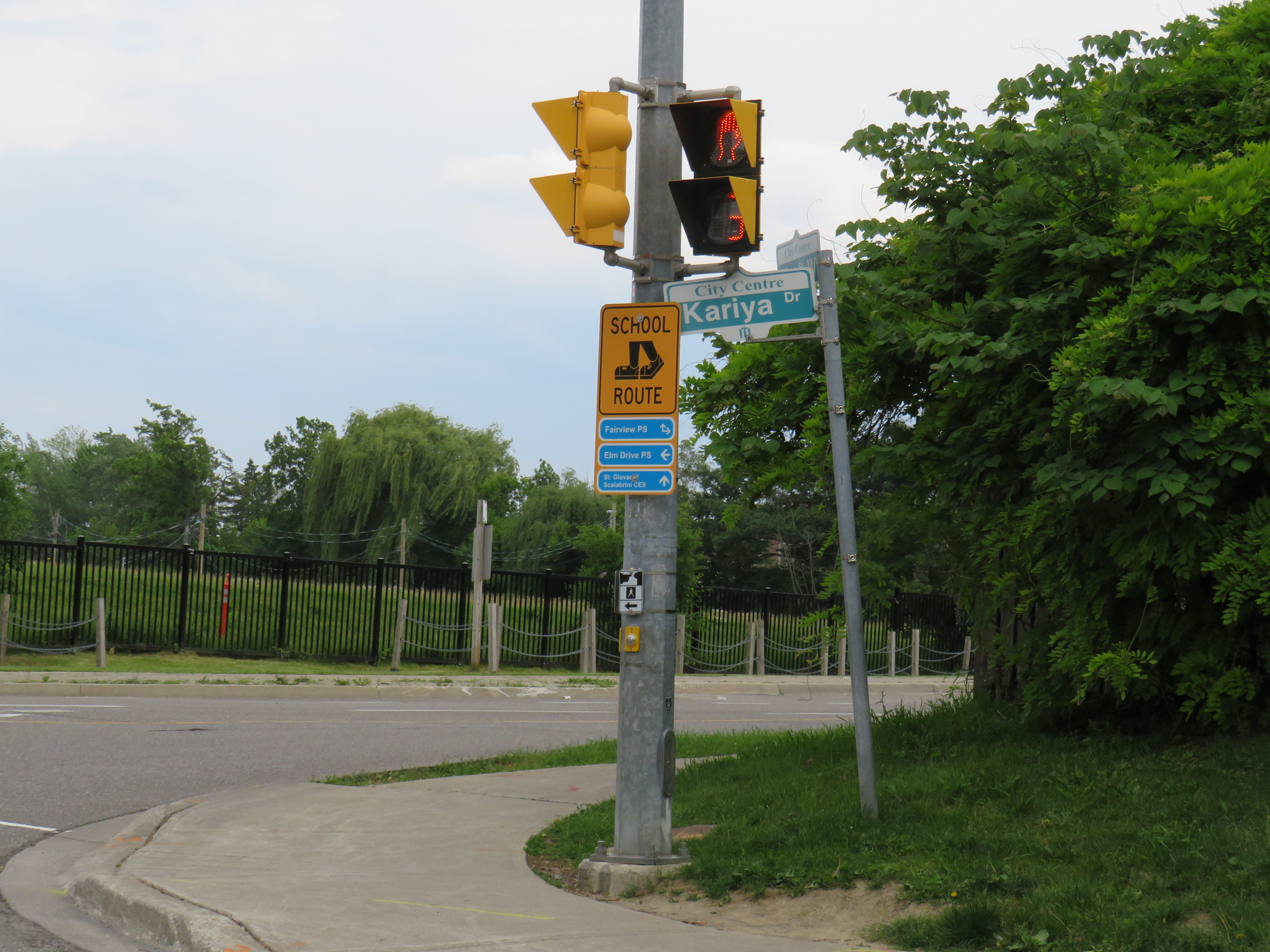
    Also worth noting is that Kariya Drive is a signed school route. MCC itself does not have any elementary or secondary schools, but there are several schools within a short walk to the south of Burnhamthorpe, including Fairview Public School, Elm Drive Public School, St. Giovanni Scalabrini Catholic School, and Fr. Michael Goetz Catholic High School. The more people move into MCC, the more necessary safe walking routes will be.

    School route sign at Kariya Drive
    A school route sign with walking paths to three nearby elementary schools at Kariya Drive and Fairview Boulevard

    There is nothing particularly remarkable about the intersection of Burnhamthorpe Road and Kariya Drive itself that makes it deadly, but that is the problem here. To make walking safer and more attractive, there is much that should be done. Reducing Burnhamthorpe to four lanes in each direction, along with more street trees, could help to reduce speeds (the speed limit should also be dropped to at least 50 km/h), and with several nearby schools, parks, and YMCA, there’s a case for Burnhamthorpe to be designated a community safety zone, with increased enforcement, along with automated traffic cameras. Perhaps dedicated bus lanes could supplant the third traffic lane in each direction, as the nearby Hurontario LRT nears completion.

    Right now, drivers race through the intersection, making left turns against oncoming traffic and crossing pedestrians after the advance arrow signal disappears, as seen in the video below. Wide lanes and a 60 km/h speed limit encourage unsafe driving.

    Three motorists continue to make left turns from Kariya to Burnhamthorpe (behind the FedEx truck) after the advance turn arrow disappears and the green light for opposing traffic and walk signal turn on. Note several pedestrians waiting to cross as drivers rush through.

    To make Mississauga City Centre a complete urban hub, it needs to be safe for pedestrians and cyclists of all ages and abilities to get around. Six-lane arterials like Burnhamthorpe have no place in a dense, multi-use neighbourhood, especially when nearby Highway 403 can handle goods movement and through traffic. One death is too many.

  • Crossride of death: how an Ajax girl was killed riding her bike

    Crossride of death: how an Ajax girl was killed riding her bike

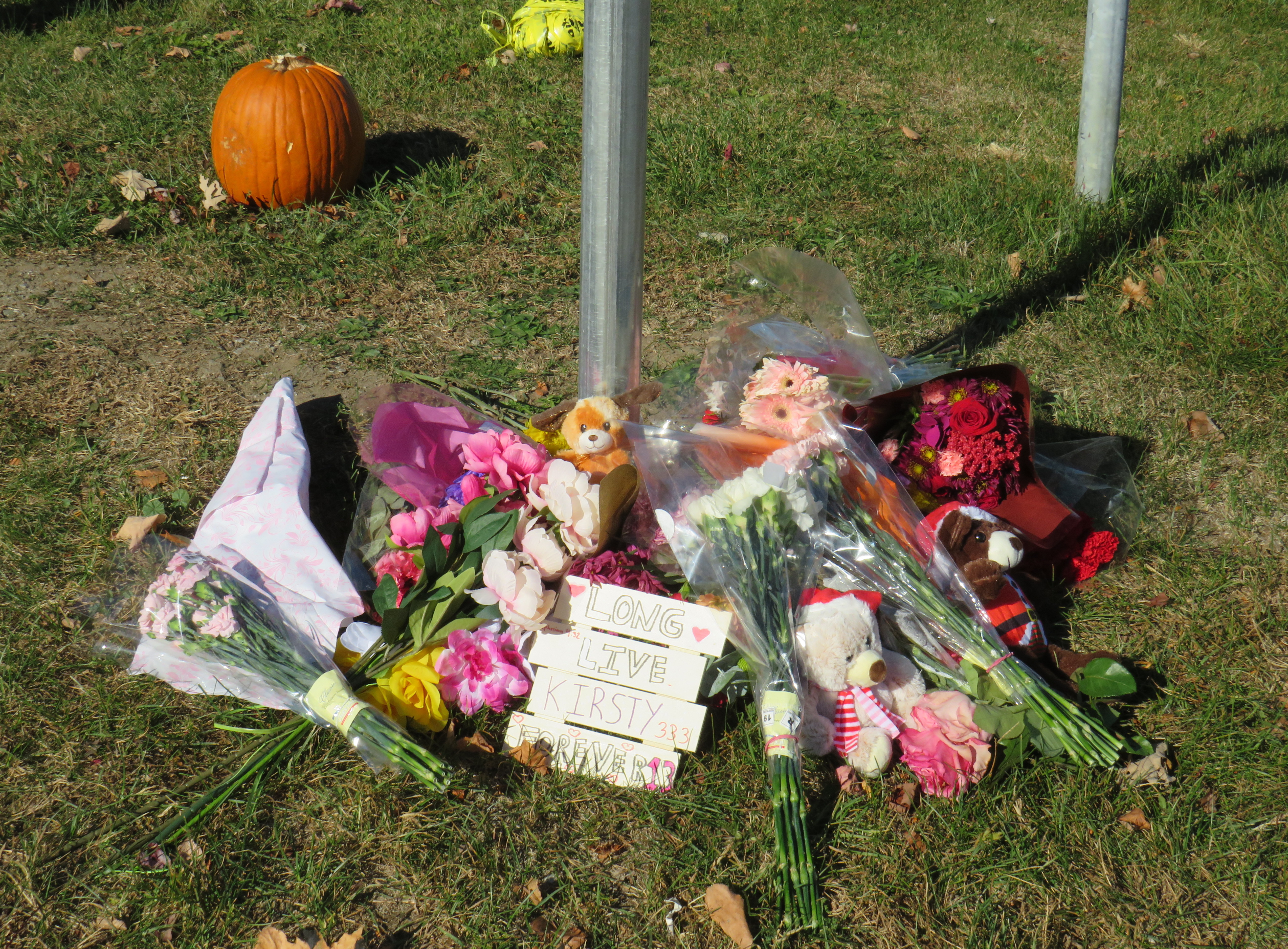
    Memorial for 13-year-old Kirsty, who was struck and killed while riding a bicycle in Ajax on November 7
    Memorial for 13-year-old Kirsty, who was struck and killed while riding a bicycle in Ajax on November 7

    January 13, 2025 update: A 44-year-old woman was charged by Durham Regional Police with careless driving causing death, over two months after this tragic collision.


    On Thursday, November 7, at approximately 7:35 AM, a 13-year-old girl was struck and killed by the driver of a Hyundai Santa Fe (a midsized crossover SUV) at Rossland Road and Stevensgate Drive. The girl was riding a bicycle in a marked crossride, a crossing designated for both pedestrians and cyclists along a multiuse path, when she was struck and pinned beneath the vehicle.

    Multiuse paths (MUPs) are typically found in parks, particularly along waterbodies such as lakes, rivers, and creeks such as Lake Ontario or the Don River. They are shared by all sorts of people, including walkers, runners, cyclists, dog-walkers, rollerbladers, and wheelchair users, often coming into conflict on busy, narrow sections such as the Martin Goodman Trail or the Lower Don Trail.

    In the suburbs surrounding Toronto (and in a few locations within the city, such as on Lake Shore Boulevard East and Eglinton Avenue West), MUPs are a popular form of cycling infrastructure along busier roads with higher speed limits. Older boulevard MUPs required cyclists to stop and dismount at road crossings (though these instructions were usually ignored). Newer and upgraded MUPs allow cyclists to ride across intersecting roadways, at marked crossrides. Signage advises motorists to watch for cyclists and advises cyclists to slow and watch for motorists and to yield to pedestrians. At signalized intersections, most new MUPs include dedicated bicycle signals.

    It was at one of these new crossrides that Kirsty was struck and killed. Though no official police press release or any follow-up news articles provided the girl’s name, that name was clearly visible at the makeshift memorial next to where she was killed.

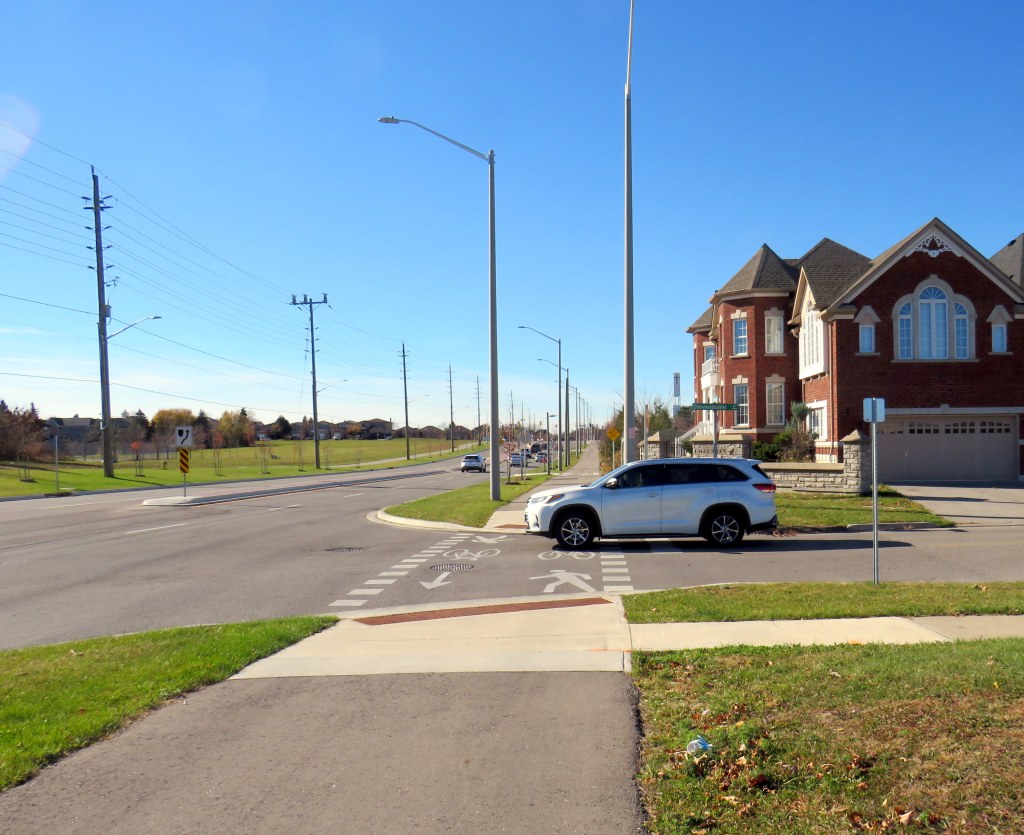
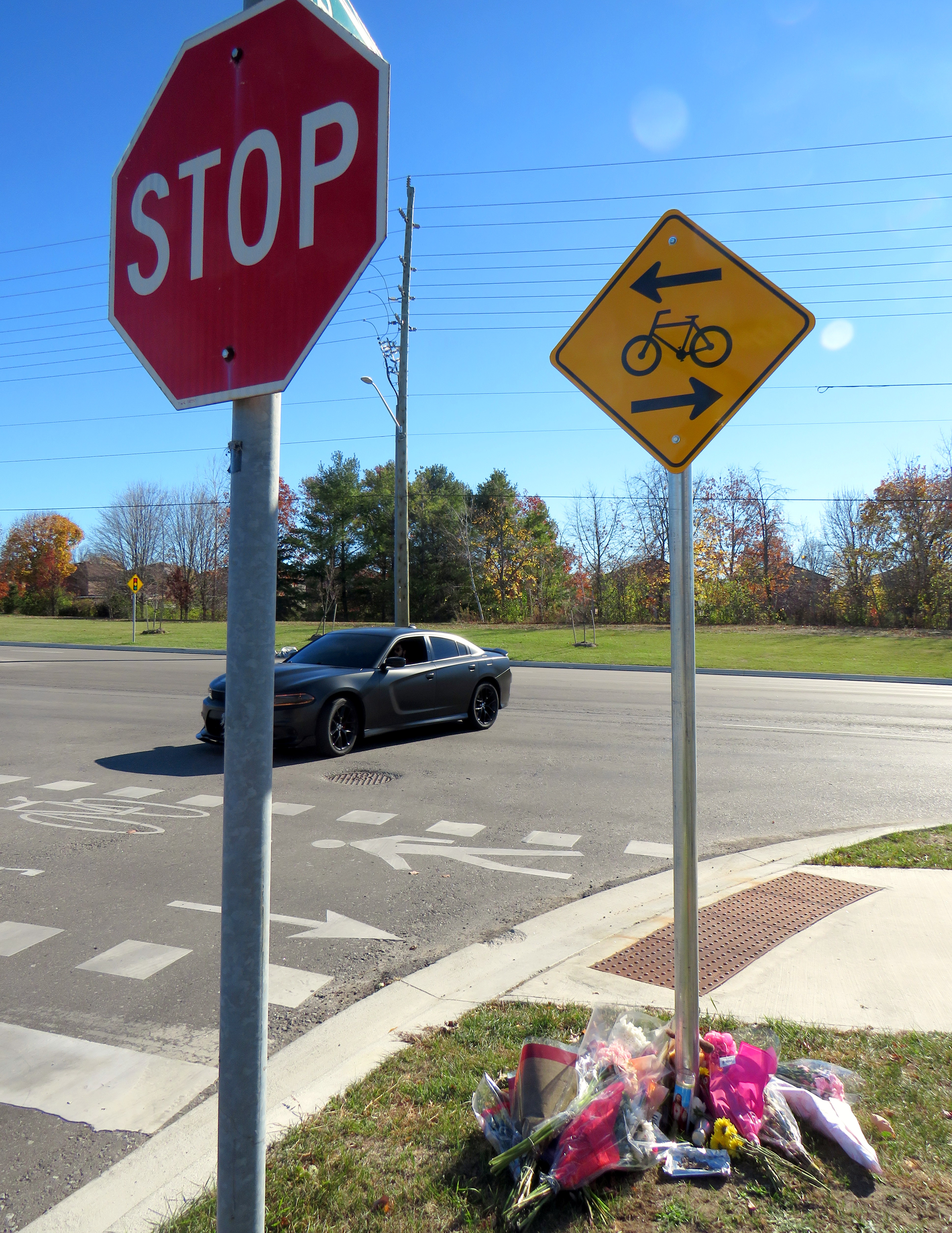
    Crossride at Stevensgate Drive, where a driver pulled out ahead into the crossride without stopping at the stop sign/stop line first.
    Crossride at Stevensgate Drive, where a driver pulled out ahead into the crossride without stopping at the stop sign/stop line first.

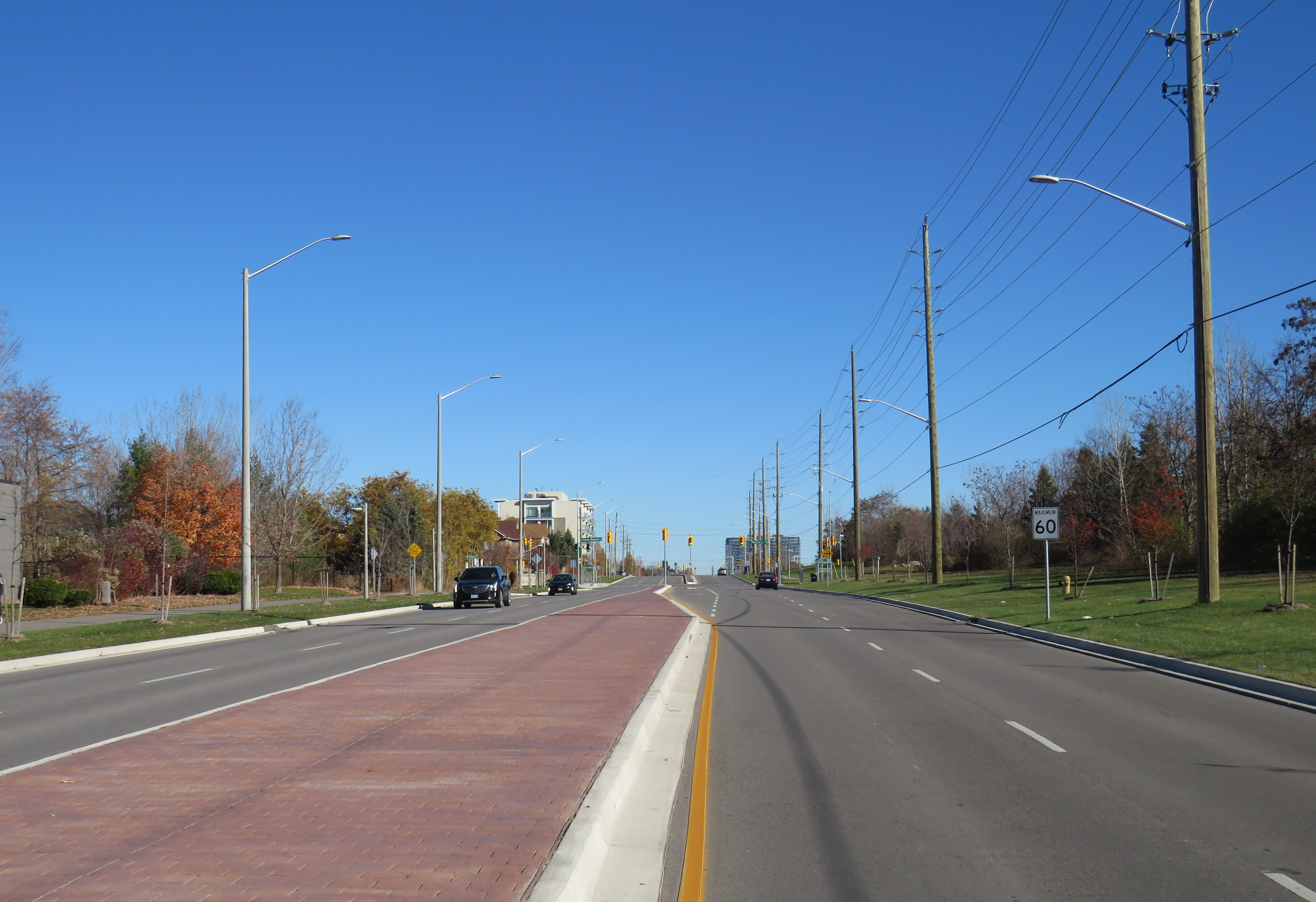
    Rossland Road was recently widened from two to four through lanes; a new multiuse path was built on the north side of the roadway, complete with crossrides and cyclist signals. Rossland Road is very much a road. There are no houses fronting onto the roadway, while the few driveways on Rossland provide access only to church and commercial plaza parking lots.

    Rossland Road in Ajax has two lanes in each direction, with a concrete median in between. The speed limit on Rossland is 60 km/h.

    Stevensgate Drive, which leads north from Rossland Road, is a quiet residential street with about two dozen homes and an evangelical church. A stop sign controls traffic at Rossland Road. Though Stevensgate connects to a large subdivision to the north, there are several other streets with signalized intersections that also provide access to the community.

    Motorists take wide turns pulling into Stevensgate Drive. The memorial is below.
    Motorists take wide turns pulling into Stevensgate Drive

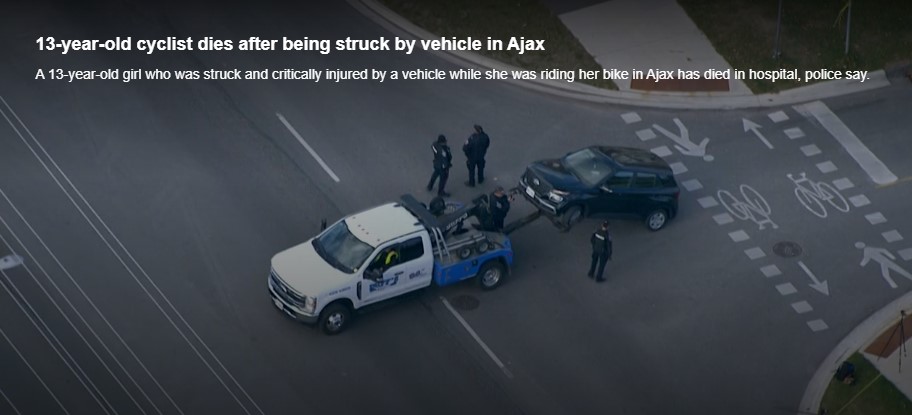
    When Kirsty was struck, it was by the southbound Santa Fe driver who would have passed a stop sign and a clearly painted stop line before entering the crossride. A CP24 news report clearly showed the vehicle being towed onto Rossland Road from the southbound direction. At 7:35 AM, it was daylight.

    Screenshot from CP24 report
    Screenshot from CP24 report

    Drivers rolling through stop signs are a common occurrence, even though the law clearly states that a full and complete stop at the stop sign and painted stop line is required before proceeding. Had the driver done so, this tragedy most likely would have been prevented.

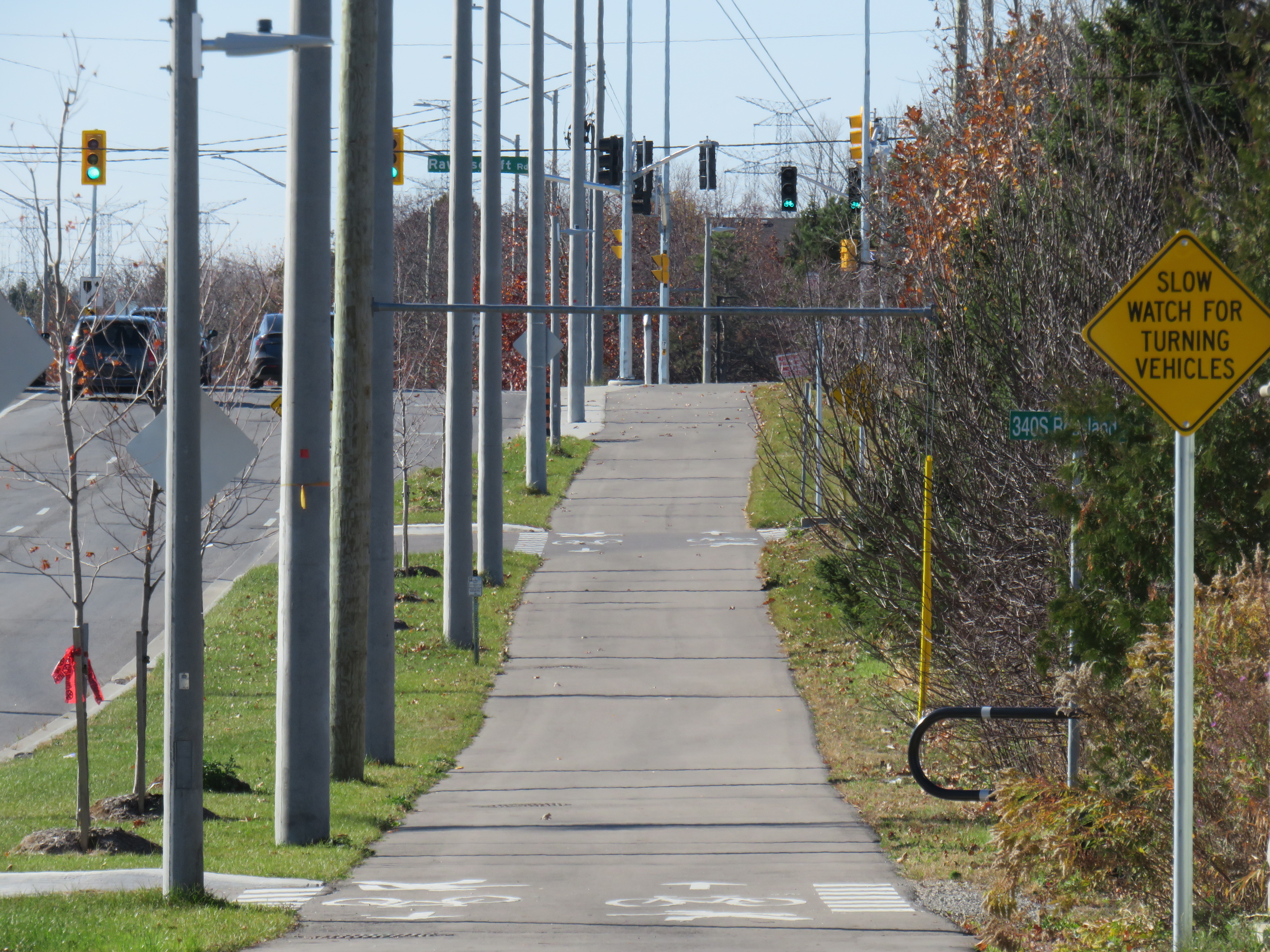
    Looking west along the multiuse path from Stevensgate Drive, towards Ravenscroft Road
    Looking west along the multiuse path, towards Ravenscroft Road

    Two days later, on Saturday, November 9, I visited the scene. I noted the roadside memorial next to the stop sign facing Stevensgate Drive. While I was there, several people stopped to visit the memorial; at least two people left flowers and cards of sympathy.

    While there, I mounted a small digital camera on the trunk of a car parked on the west side of Stevensgate, about 75 metres north of the intersection, in a legal parking spot. The camera, mounted on a mini-tripod, was mostly inconspicuous. Within 25 minutes, five motorists improperly stopped after the stop line and into the crossride; two properly stopped before creeping up to make their turn. Two drivers also made fast, wide right turns into Stevensgate during that time. The edited video below shows motorists’ actions during that 25 minutes

    Video taken on Saturday, November 9 showing motorists driving south on
    Stevensgate Drive towards Rossland Road (3 minutes, 7 seconds)

    While taking photographs and recording the videos, a resident, who lived a few houses north of the intersection, came to talk to me, and asked if I knew the girl. I explained why I was there, and we had a short, but good chat, about the collision and road safety. He noted that it is hard to see traffic from the stop line, and that he has to pull forward before turning. But he agreed that the stop line was there for a reason, and that drivers often rush to get onto Rossland.

    Police enforcement is not necessarily the answer. There are too many intersections to watch, and the careless driving behaviours exhibited are normalized. In Toronto, it is cyclists on quiet streets and in public parks who are typically targeted at stop signs, not motorists, even though cyclists are the more vulnerable road users.

    In Washington DC, there are stop sign cameras mounted at specific locations, though there are only about a dozen of those throughout the city at any given time. These could provide a useful tool for targeted automated enforcement on Ontario’s roads to reinforce proper driving behaviour.

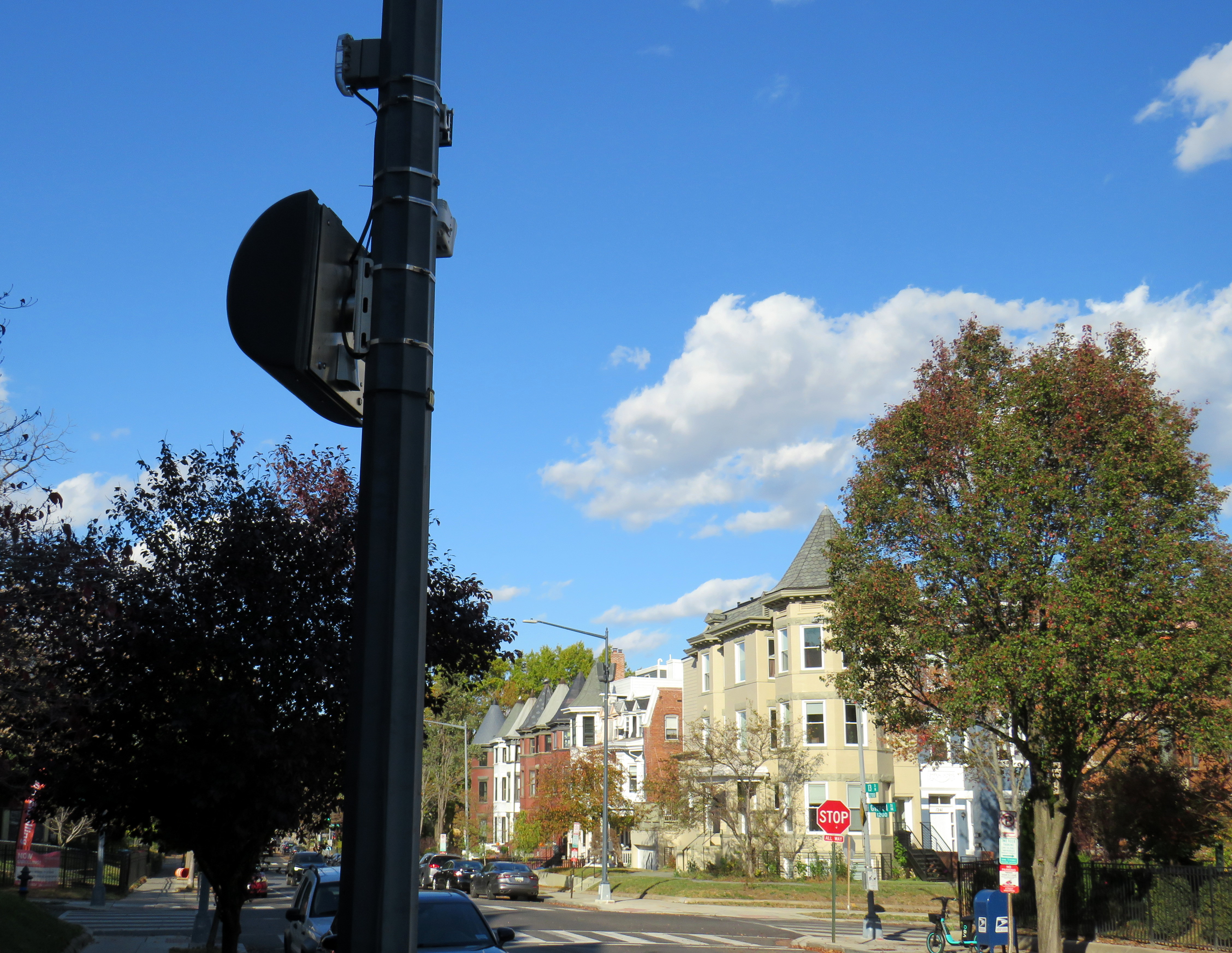
    A pole-mounted camera faces an all-way stop in Washington DC
    A pole-mounted camera faces an all-way stop in Washington DC

    Intersections should also be redesigned to improve the visibility of pedestrians and cyclists at crosswalks and crossrides and act to slow down motorists; raised sidewalks and path crossings would act as a speed hump as well as enhance visibility. A concrete island or short median at the stop sign would force motorists to approach the stop at a slower speed and prevent wide turns on to and off the intersecting street. A quick and inexpensive (though less-effective) solution could be to place wide knock-down bollards with supplemental crossing and stop sign messages in the middle of the roadway at each stop bar and crosswalk/crossride. Though this is best as a short-term measure.

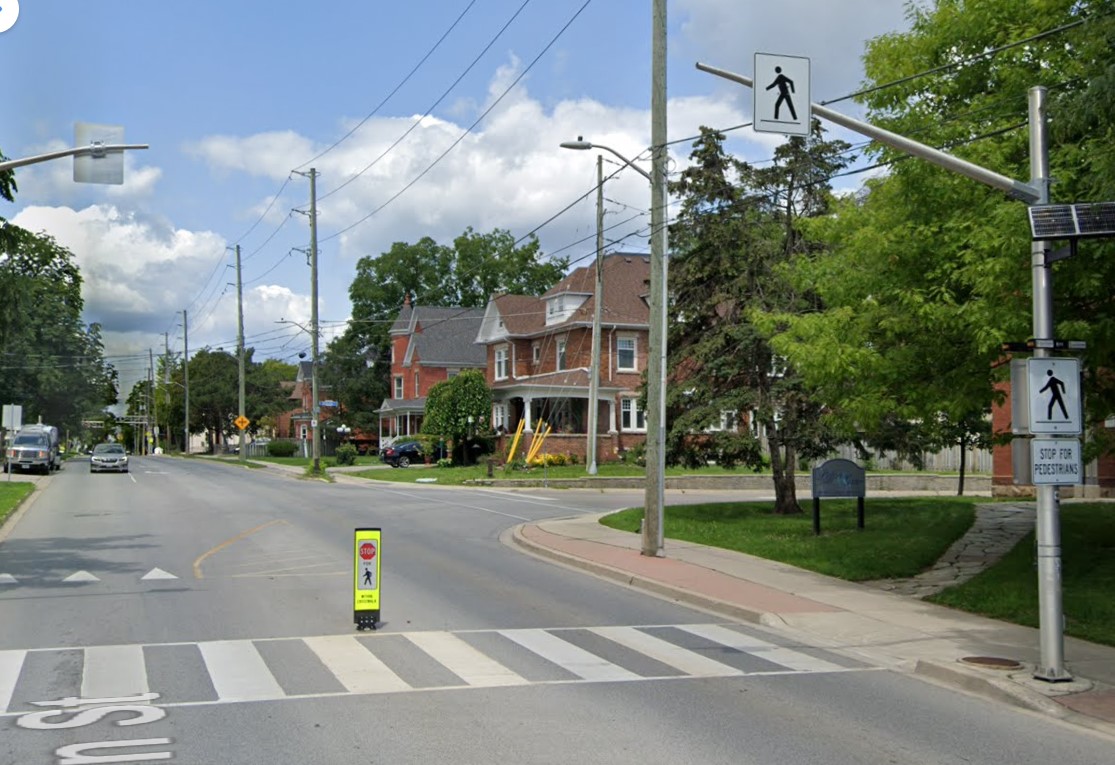
    A wide knock-down bollard designed to provide additional visibility to a crosswalk
    (Milton, Ontario, via Google Streetview)

    As the provincial government vindictively overrides municipalities’ ability to provide safer on-road cycling infrastructure, off-street infrastructure, such as MUPs, will remain an important tool for promoting active transportation, especially in suburban areas and high-traffic neighbourhoods. Though boulevard MUPs provide separation from traffic in most cases, they are particularly hazardous at intersections, especially when motorists are distracted, aggressive, or just merely careless. There is much more that can and should be done to make them safer for all road users.