Tag: TVO

  • Brampton Transit’s evolution from a laggard to a leader

    5010657604_d3cd2c355a_o.jpg
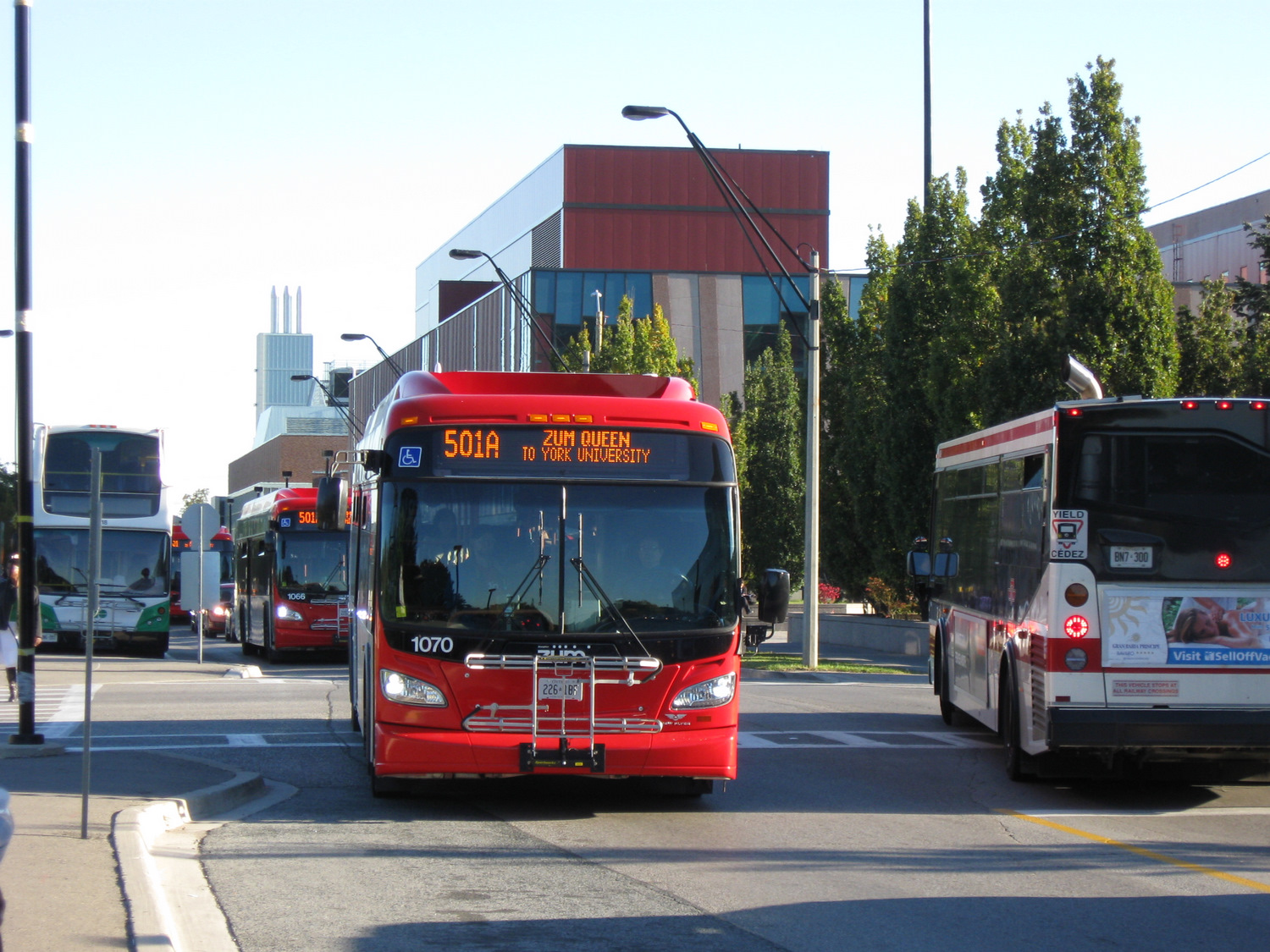
    The introduction of Brampton Transit’s Zum service in 2010, serving York University, was a major turning point for the suburban transit agency

    For TVO this week, I discuss Brampton Transit’s impressive ridership growth. In the last five years, Brampton Transit has bucked the trend of stagnant ridership numbers encountered elsewhere in the Greater Toronto Area and North America in general. I argue that Brampton’s success in improving transit ridership comes from sustained investment over many years, the move to a grid-based route structure, and the introduction of Züm, a basic network of semi-frequent, limited-stop bus routes, many of which extend outside of Brampton’s boundaries.


    I grew up in Brampton, and I have collected maps since kindergarten; my collection includes several old Brampton Transit maps. These maps help to illustrate the progress made since the 1980s, when the level of service provided was quite basic.

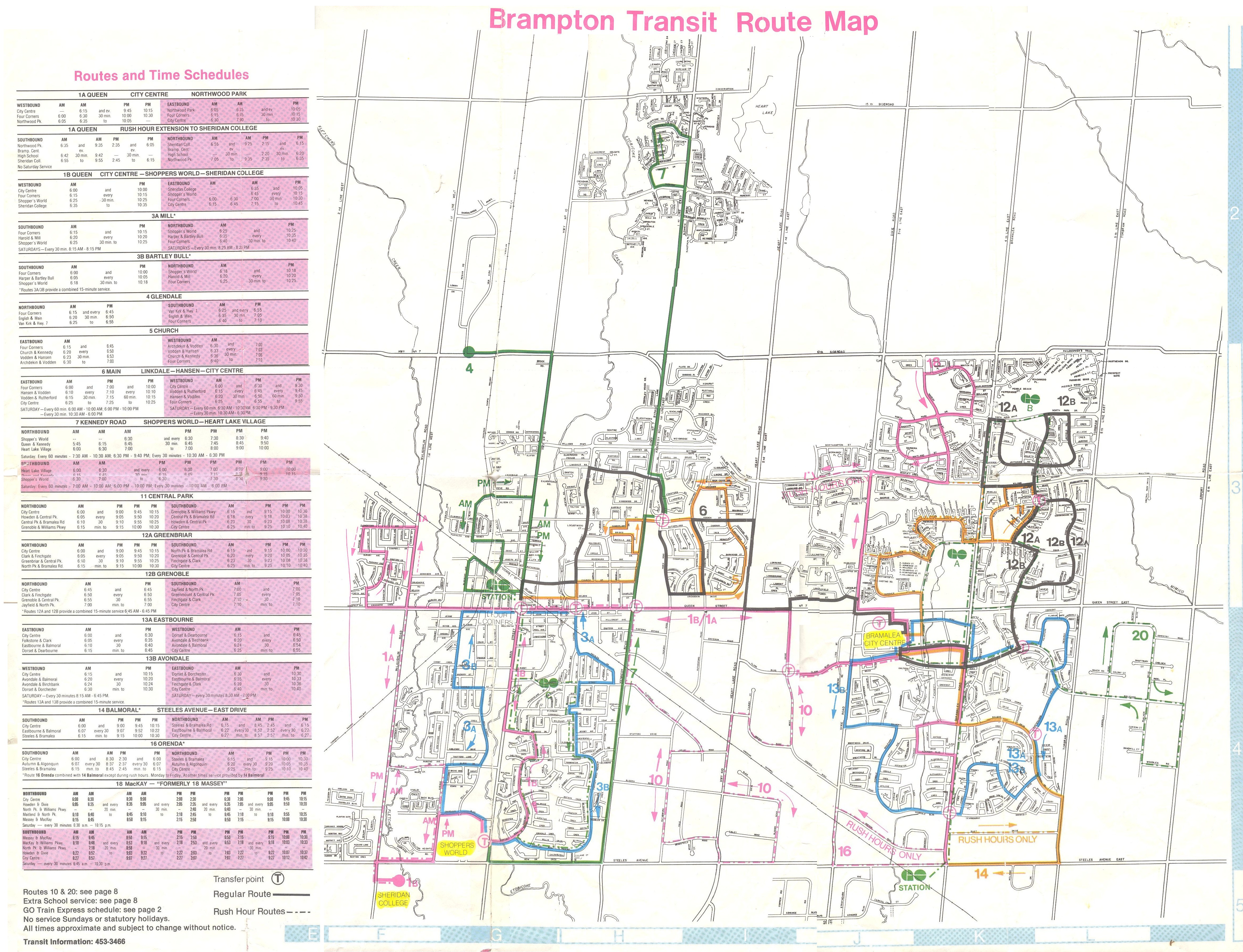
    Brampton Transit began operations in 1976 after the old Town of Brampton’s local bus service was amalgamated with the dial-a-bus service operated in Bramalea. (Brampton amalgamated with most of Chinguacousy Township in 1974, including Bramalea.) In 1980, Brampton Transit operated 14 routes, serving a community of just under 150,000 people. Buses operated no later than 9:00 or 10:00 PM, Mondays through Saturdays, and many routes operated with long, meandering loops. Apart from GO Transit, there were no connections to nearby communities.
    Brampton Transit - December 1980 front
    December 1980 Brampton Transit map

    By 1988, service was offered on Steeles Avenue to Humberline Drive in Etobicoke, where connections could be made to TTC buses on the 96 Wilson and 73 Royal York buses, but didn’t continue east to Humber College. Brampton Transit Route 14 Torbram served Westwood Mall in Mississauga, and connections to Mississauga Transit could be made at Shoppers World. But still, service levels were poor — you were lucky to get a bus every 30 minutes outside of rush hours. Permanent Sunday service wouldn’t come for another ten years. Notable are the four lettered bus routes — A, B, C, and D — that made direct connections to the four weekday GO train round trips to and from Toronto.

    Brampton Transit’s maps of the era are also historically notable because of their advertising: only one of the Burger King locations shown on the 1988 map still exists. Other restaurants advertised — the Old Beef Market, O’Henry’s, and Queen’s Pizzeria — are no longer in business.

    Brampton Transit - 1988
    September 1988 Brampton Transit Map


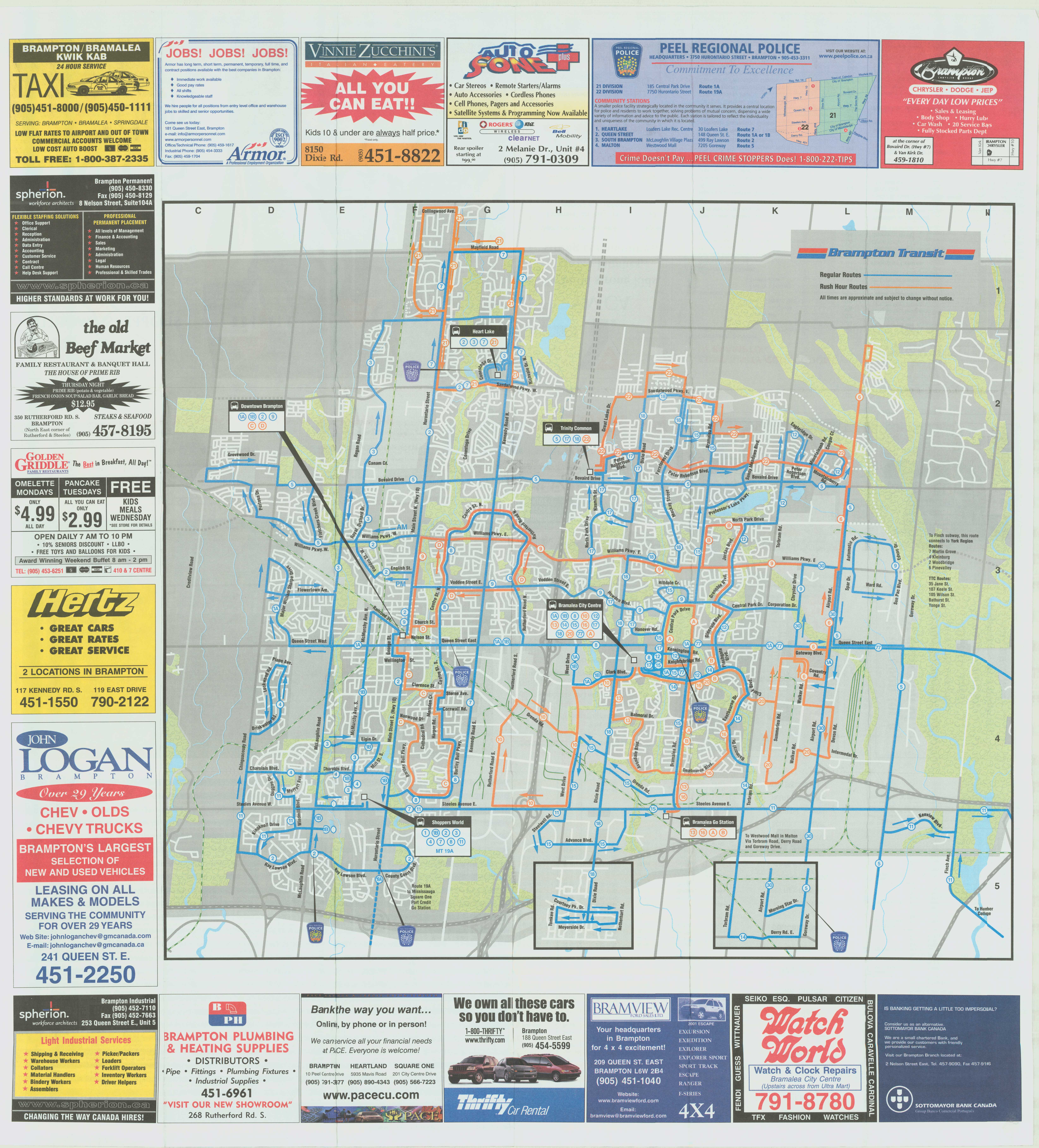
    Brampton Transit Maps published in the 1990s and early 2000s were printed on newsprint, and used only a two-colour scheme: blue for regular routes, and orange for rush-hour routes. Service to new subdivisions was often provided by way of long one-way loops, which is an inexpensive way of serving new areas, but are inconvenient and slow for potential riders.

    Notable in the 2001 map below is Route 77, launched in the 1990s as a joint Brampton Transit/Vaughan Transit route between Bramalea City Centre and Finch Station along Highway 7. Route 77 was a very slow way to get to the subway from Brampton, but it operated until Züm began service in 2010. In 2001, bus service on 11 Steeles was finally extended to Humber College’s main campus.
    Brampton Transit, 2002
    September 2001 Brampton Transit map

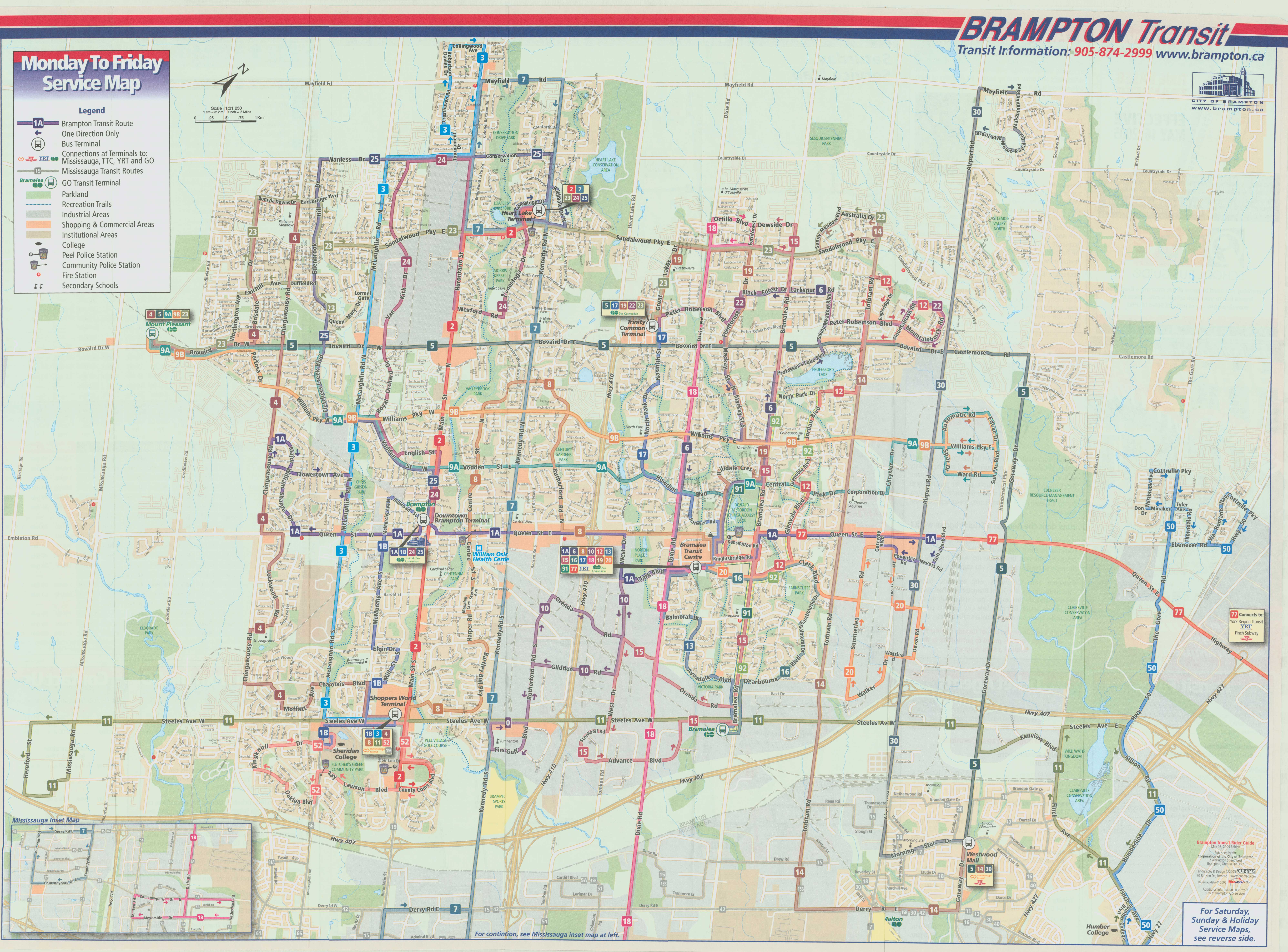
    2005 marked an important turning point for Brampton Transit, as it introduced a grid-based route system on major arterials. Route 14 Torbram, for example, no longer served Bramalea City Centre, but continued north, providing a core north-south route; many other routes were straightened, including Route 2 Main north of Downtown. Changes since May 2005 saw service frequencies improved, more local routes added, and improved connections.
    Brampton Transit - 2005 front
    May 2005 Brampton Transit map

    The current system map, dated September 2017, can be found on Brampton Transit’s website.
  • A farewell to 2017

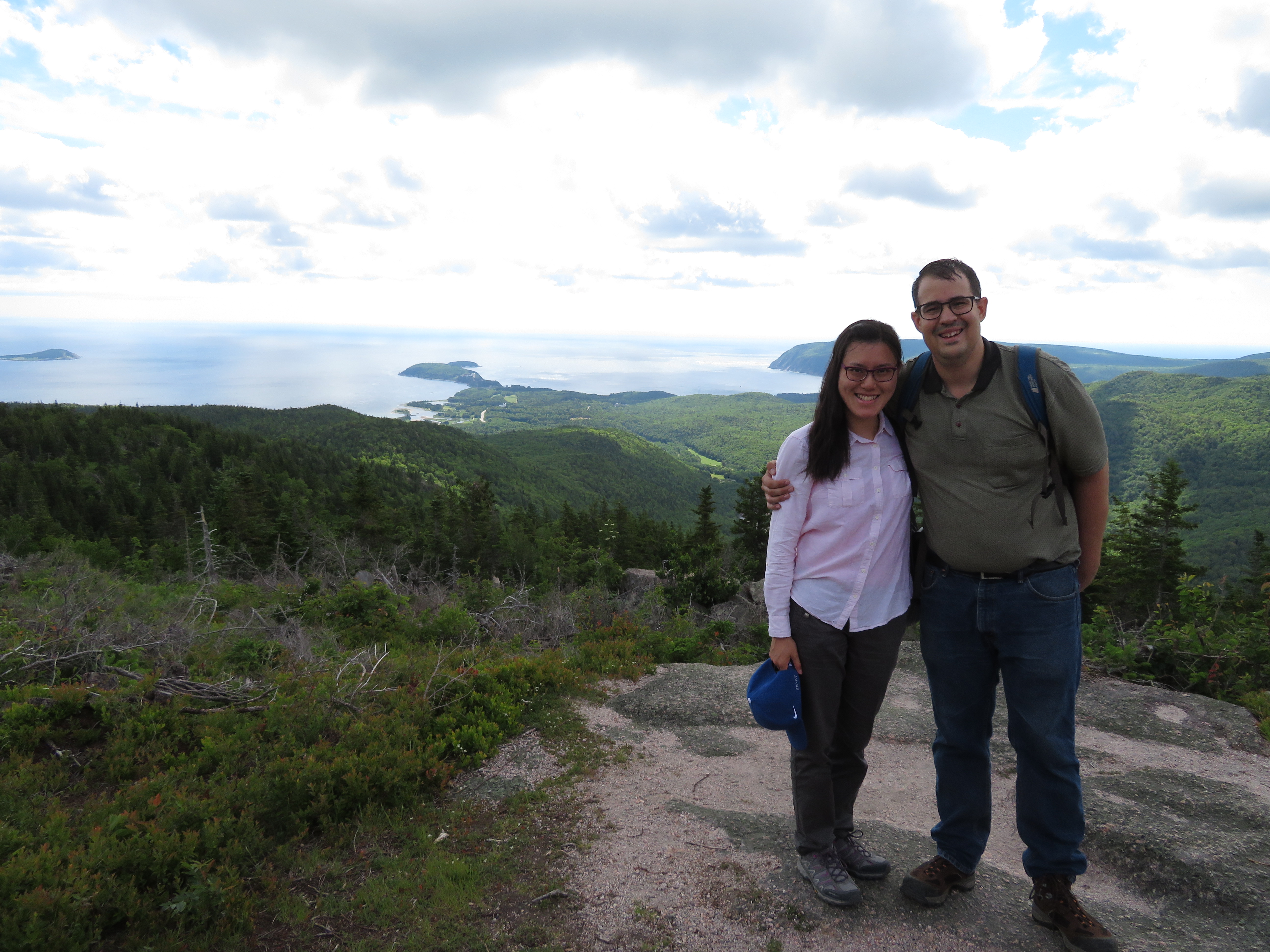
    IMG_0129-001At the top of the Franey Trail, Cape Breton National Park
    For me, 2017 was a great year. In June, I wrote about my life up to that point, looking back at some of the challenges I faced over the years, my ability to overcome them, and my accomplishments. I wrote that shortly before I got married to an amazing life partner, and together, we look forward to many great things.

    Elisa and I honeymooned out East, touring the Cabot Trail, Prince Edward Island, and Halifax before taking the train back home. We also visited Point Pelee for the first time, and made trips to Detroit, Chicago, and across Ontario, to places like Southampton, Sudbury, and Collingwood.

    I met a few new friends in 2017, and I also got to know some great people even better. Along with our own wedding, Elisa and I got to help celebrate three others this year.

    In Brockville, exploring the newly re-opened historic railway tunnel, I spent a few hours catching up with a high school friend who moved from Brampton to a town in Eastern Ontario. That was one of this year’s nice simple highlights. Day trips with friends and groups walks with others were another thing that made this year good. But also in 2017, I lost contact with a few people I knew, including another of my best friends from high school. I regret not keeping in closer contact; social media has its limitations.

    At my full time job, I stood up in front of an audience at an industry event, presenting the work that I did on an interesting interactive map that I developed. This year was one of  the most challenging years I had at work, but also one of the most fulfilling.

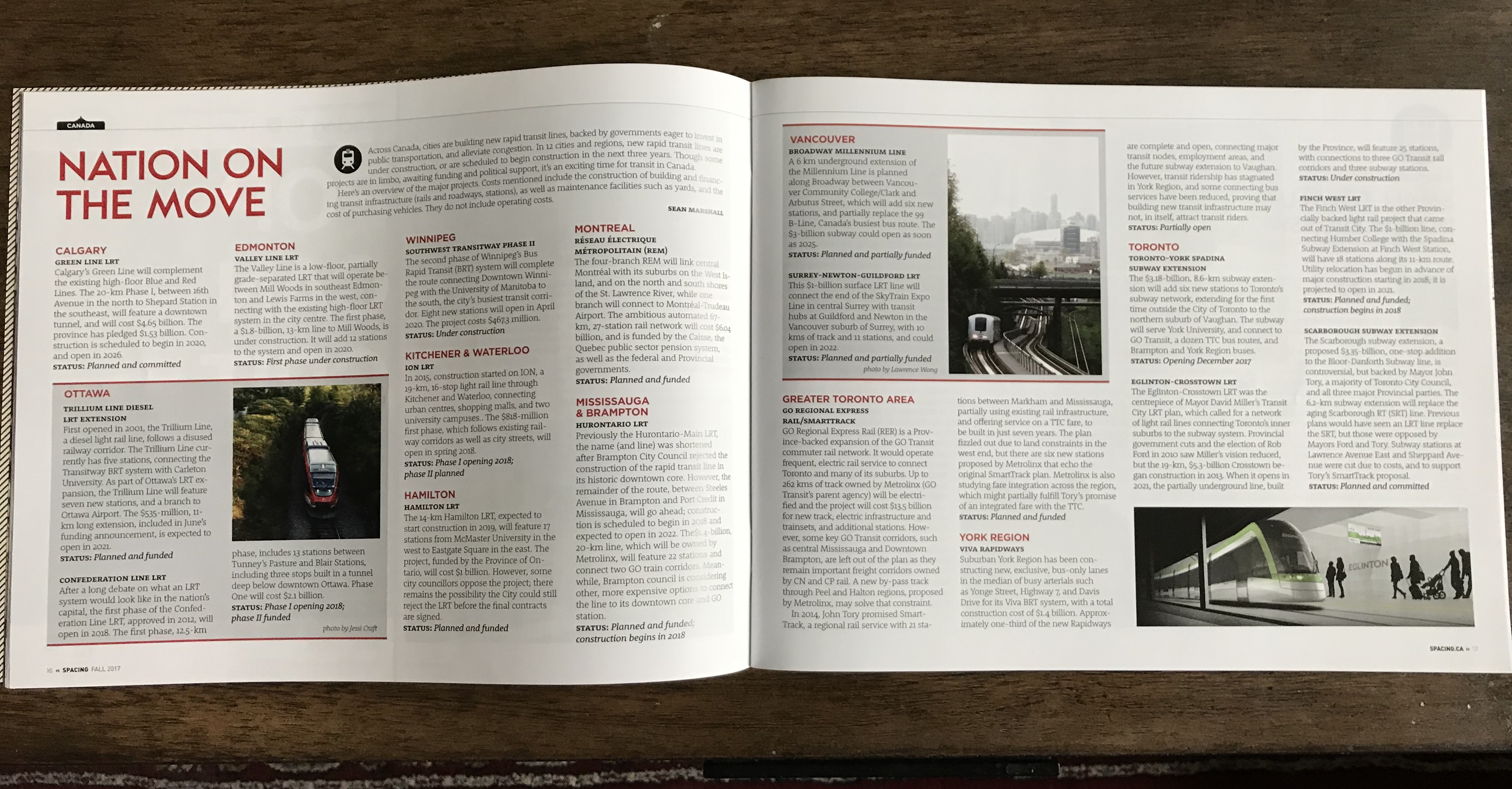
    2017 also marks the tenth year since I started writing on urban issues and transportation for fun. Spacing is one of my favourite publications, and it has been an honour to write for them on occasion. My first blog post described some of the places where Toronto’s old streetcars were sent to once they were retired by the TTC; my latest contribution, a full-page spread in the Fall 2017 issue of the print magazine, highlighted all the major transit projects across Canada planned or in progress. This year, I also wrote for Torontoist and TVO, and of course, in my own blog.

    IMG_1524.jpgNation on the move: my latest article in Spacing
    In 2018, I look forward to many things: a trip to see family and new places in Europe, catching up with friends, having some more writing opportunities, new challenges at work, and a municipal election, where three new wards will help deliver some new faces to Toronto City Council. Maybe, too, there will be a strong mayoral candidate worth supporting.

    My top six posts of 2017

    These six articles might not be the most read, but they are among my favourite posts in 2017. They all deal with some of my favourite subjects: urban planning, transit, and local history.

    • Ontario’s land use scandal: Another greenfield hospital for Niagara: A commentary on poor land use planning decisions (which I have discussed previously on this blog) which puts major health and educational institutions far from where people live, on sites difficult to serve by transit.
    • Hallam Street and the Harbord Streetcar: The history of Hallam Street in west end Toronto and the Harbord Streetcar, which was one Toronto’s most interesting carlines until it was abandoned in 1966.
    • How intercity bus service is failing Ontarians: my first article for TVO, I examine how the intercity bus network in Ontario declined since the 1980s, and how many communities in the province have since become disconnected.
    • A need for high speed rail reality: an article I posted to Spacing, as I express my skepticism for the province’s proposal for a high speed rail line between Toronto, Kitchener-Waterloo, and London, with a possible extension to Windsor. It’s an interesting contrast to the neglect paid to rural bus services.
    • Toronto’s Zero Vision and the folly of Seniors Safety Zones: Putting up a few new signs as part of a reluctant response to an unacceptable level of road violence isn’t  Vision Zero, it’s Zero Vision. As a pedestrian advocate and co-founder of Walk Toronto, I believe that the city does a lousy job of protecting its residents from injury and death on its roads.
    • Rosedale NIMBYs Push Back Against Four-Storey Condo: There are few things more fun than writing about entitled, unreasonable NIMBYs.
  • How intercity bus service is failing Ontarians

    4003585727_e8125d19a3_o.jpg
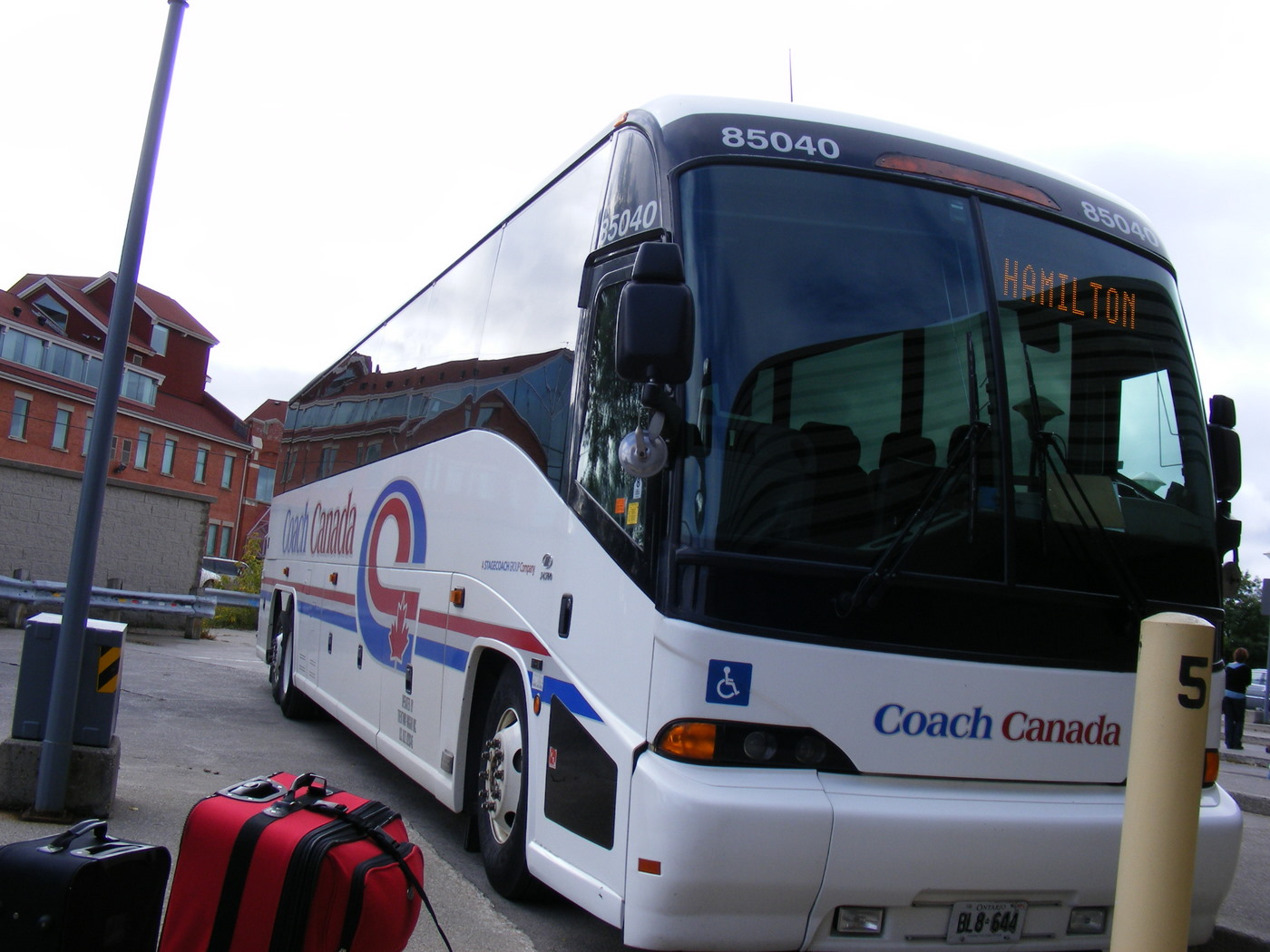
    Coach Canada bus at the Guelph Terminal, three weeks before it abandoned the Guelph-Hamilton service in 2009

    The state of intercity bus travel in Ontario is bleak. While there are still many bus options if you’re travelling between large cities, since the 1980s, hundreds of weekly bus trips and dozens of routes have been cut in Ontario, leaving many small cities and towns with minimal or no intercity transportation options. St. Thomas, a city of 45,000 located a mere 25 kilometres south of London, once had daily buses going in every direction. Today, it has none. Although studies on the modernization of the province’s beleaguered, skeletal bus system got underway in 2016, bus travel remains an afterthought.

    I wrote more about the sorry state of the intercity bus network in Ontario for TVO, my first contribution to the network’s great digital presence.