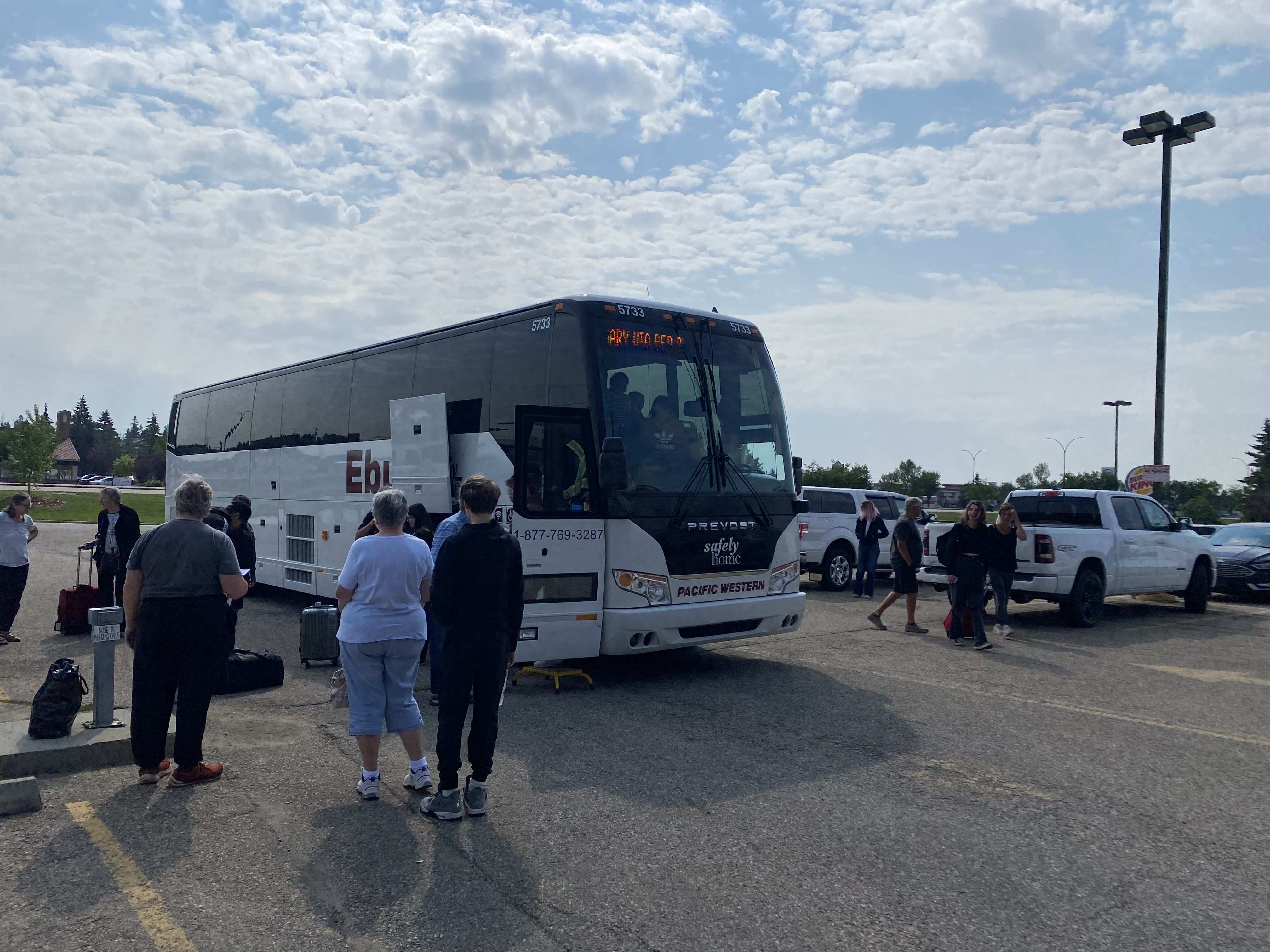
A Calgary-bound Pacific Western Ebus Coach loads at Red Deer, Alberta
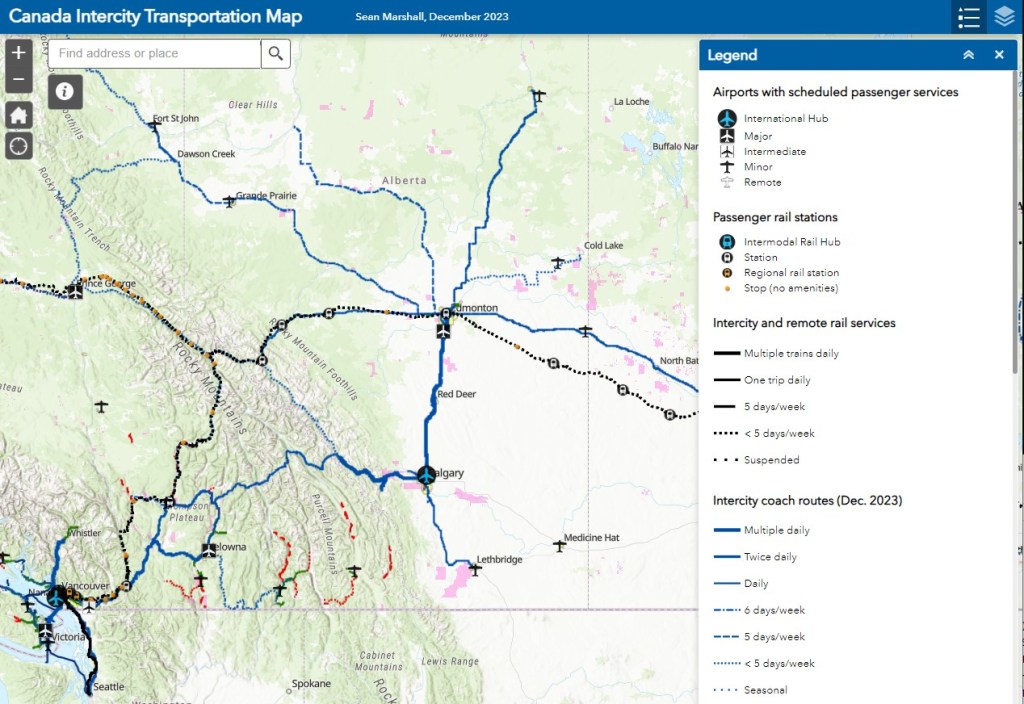
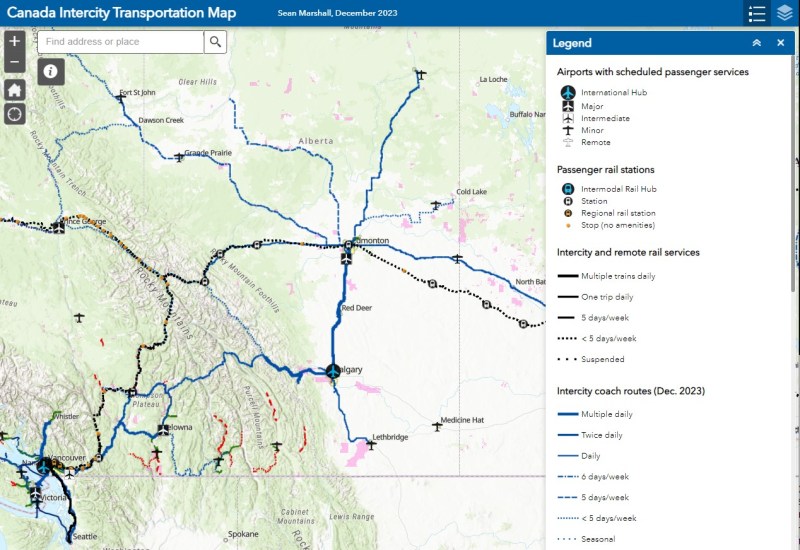
NOTE: Previous versions of the Ontario and Canada maps are retired; please see the new Canada Intercity Transport Map, launched March 30, 2025. This will now be the only interactive map that I will update.
In 2022, I was approached by staff at Infrastructure Canada who were interested in compiling information on intercity bus services across the country. Unfortunately, no repository had existed for a very long time, especially as transit and intercity coach services are primarily under provincial and municipal jurisdiction. Ontario’s provincial government last published a map of intercity carriers in 1990-1991, while Saskatchewan abolished its provincial bus service in 2017. The withering of Greyhound Canada’s once-extensive network left many communities from Ontario west to British Columbia and the Yukon without any service, while new private operators like Ebus and Rider Express filled in to serve the most lucrative routes.
Though the Federal Government operates VIA Rail and oversees air, marine, and long-distance rail transport, for road and city transport, its role has been more limited to helping to fund transit projects and some major road infrastructure improvements. Knowing that, I was excited to learn that there was interest in understanding the state of the country’s rural and intercity transport initiatives. I completed the project for Infrastructure Canada in June 2023, but I have recently updated a version of the map I completed, which I am excited to share.
A simplified methodology of how I completed this map can be found below.
On Saturday August 19, while my spouse and I were paying a visit to the renewed AKG Art Gallery in Buffalo, a thief broke into our building and made off with my bicycle. The well-equipped thief broke into our building’s front entrance using a pry bar, and then used a heavy-duty bolt cutter to cut the rack my bicycle was attached to, taking care to watch for any activity in the garage by hiding in an adjacent stairwell. He spent nearly an hour in the building in total.
This was the second time my bicycle was stolen. This time, I thought I had a better lock. The old spot I had was hidden from the cameras and out of view of most people in the garage — the new spot was in a more prominent location.
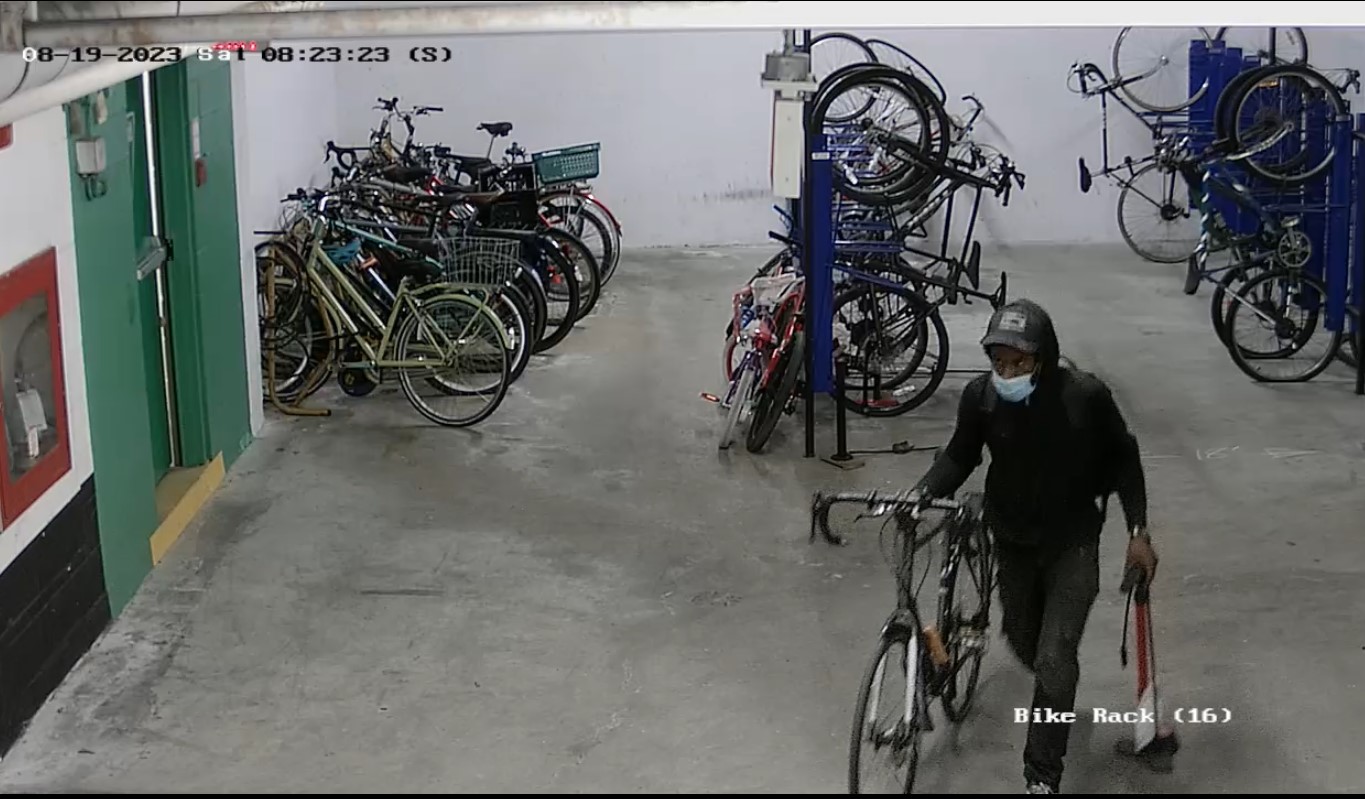
The thief, walking away with my bicycle.
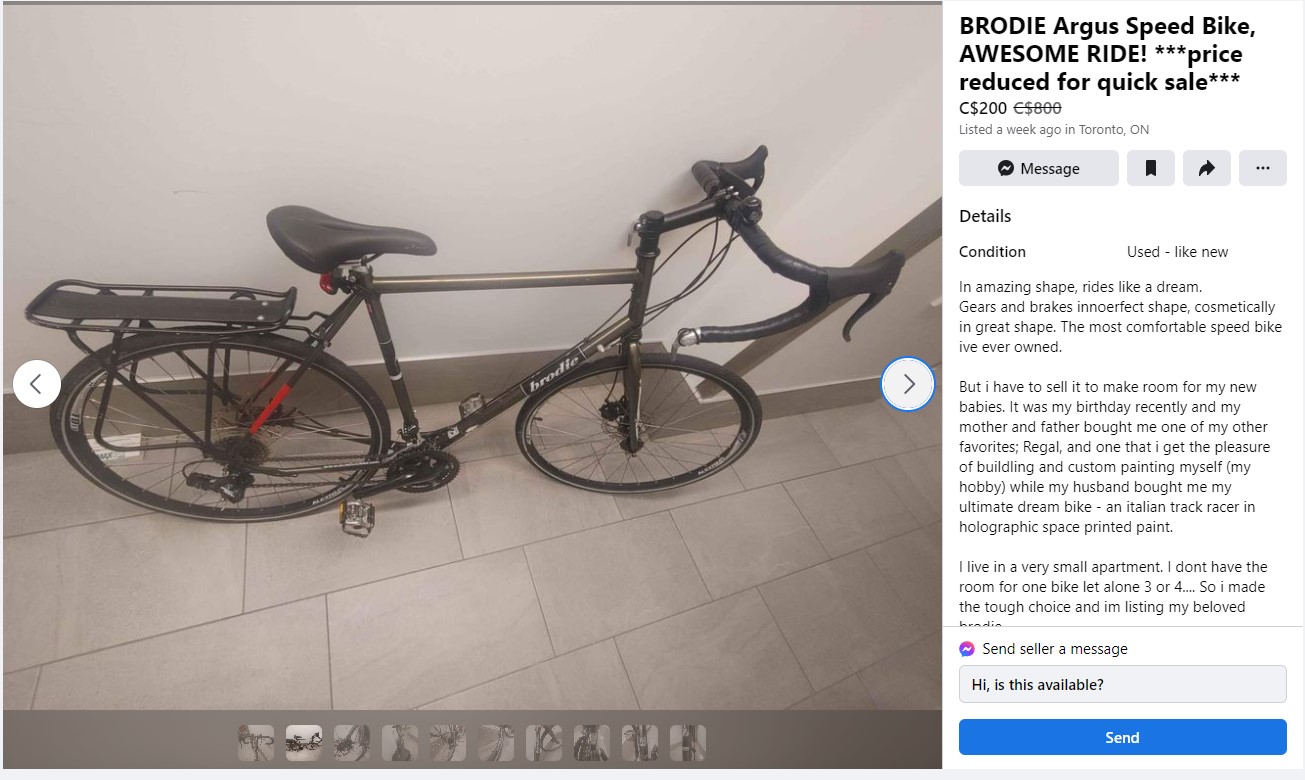
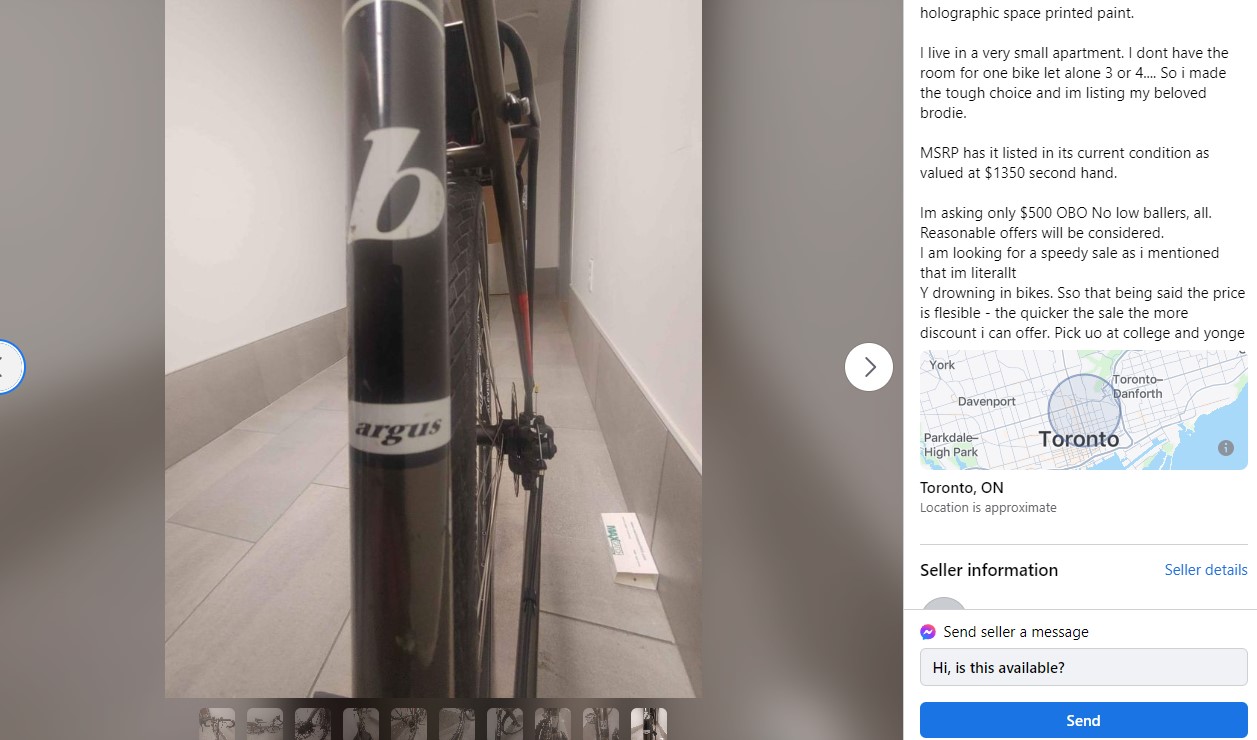
My Brodie touring bicycle was quite distinguishable, with dual-sided pedals (flat on one side, clipless on the other), additional handlebar-mounted brake pedals, fenders and a rear rack, Marathon tires, reflective tape on the forks and seat stays, and the dealer’s original decal on the frame. When I bought it from Bateman’s Bicycle Company in March 2015, I had the extra brake pedals installed as I was unused to having a bike with drop bars, and I wanted a more upright position when riding on city streets.
It took over a week before I discovered the bike missing as I had been really busy in August. When I discovered the theft, I informed the building management, and was able to get still photos and video of the thief. He was dressed in a black hoodie, with a black baseball cap and a surgical mask covering part of his face. His backpack had several tools, so he came in with a specific purpose. He did not cut the Kryptonite lock; instead he cut the rack and left with the lock still attached to the frame.
I reported the theft to Toronto Police, firstly by going on their website, as I had registered my bicycle. (The last time I had a bicycle stolen, the police actually recovered the frame, which I later donated to Bike Sauce.) I saved a service receipt with the bicycle’s make, model, and serial number, and had photos to provide. However, since it involved a break-and-enter, I learned that I actually had to call the police and make a verbal report. After calling, I learned that I had to wait for an officer to arrive so I could give him a narrative. Our building maintenance manager expected it to take a few days; the officer arrived within a few hours, which impressed me. I posted the still photos to social media, including the Cycling in Toronto Facebook group, with the hope that someone might know something.
I was able to provide a detailed timeline to the police based on the security videos, and provided still photos. A week later, a different police officer called me as he wasn’t able to meet the manager to review the videos; I was able to make a copy and dropped off a USB stick to 51 Division the next day. That was the extent of communications from Toronto Police.
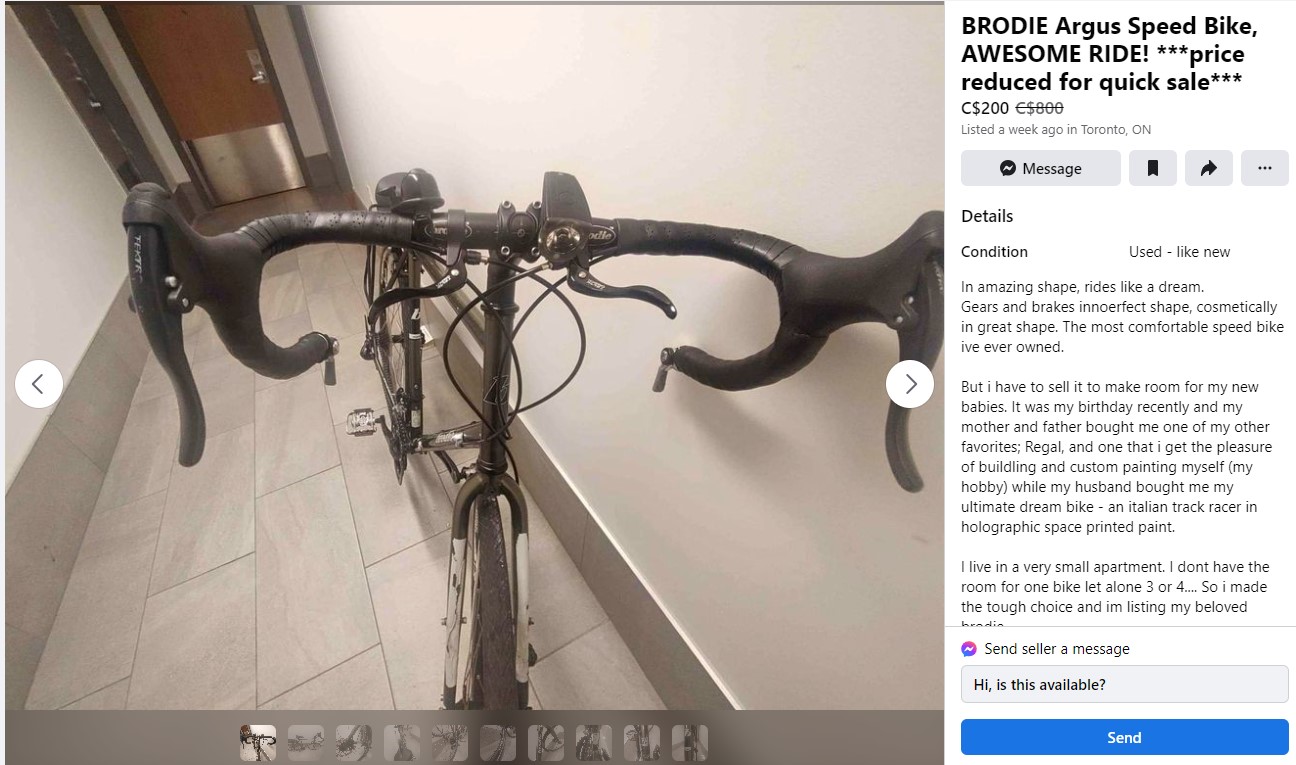
On Monday, September 18, I got a Facebook message from a friend of a friend telling me they found a Facebook Marketplace listing with a bike that matched my bike’s description. It looked like a match, with the extra brake pedals, the red and white tape, the dual pedals, and the Bateman’s dealer sticker. Missing were the fenders and water bottle cage, and cheap new lights were added, replacing the bare mounts.
I had not thought of looking at Facebook Marketplace, but it appears to be a popular place to sell stolen goods. After my spouse searched Kijiji, there was a similar listing. But seeing one’s prized procession taken, and then put up for sale elsewhere felt like it added insult to injury. We had checked these sites before, with no matches.
Screenshot of FB Marketplace listingScreenshot of FB Marketplace listingScreenshot of FB Marketplace listing
I brought this to the police’s attention, hoping for at least advice. I emailed the officer assigned to the case, and heard nothing. I went down to 51 Division again with printed screenshots. I heard nothing.
Back on the Cycling in Toronto Facebook Group, members suggested posting to another FB group, called Stolen Bikes – Toronto. After my membership was approved, I posted about the theft, and a member there quickly messaged me saying that they had just acquired the bike. I could meet him the next day, and I could get it from him. The person who purchased the bike said he followed the listing, feeling especially suspicious. Originally, it was listed for $400, but the person I met was able to get it for $150.
I was so happy to get the bike back, after three weeks of anxiety, especially when I learned of the sale listing. I was worried I wouldn’t see it again, and that an unsuspecting or predatorial buyer would pick it up.
Though I am not out a bike anymore, I will still need new locks and a safe place to store it. I will probably get new fenders when I take it in for an inspection. Until then, my bicycle is safe in our apartment. Luckily, our building allows bikes in the elevators and hallways.
Having distinguishable characteristics helped to identify the bike when I shared the theft on social media; keeping a record of the make, model and serial number also helped. I also choose to secure the wheels with custom locks, which kept the bike intact. Finally, the cycling groups on Facebook proved to be an invaluable resourse for getting people to watch out, and eventually, getting the bike back. I am grateful for the people who kept an eye out and especially to the person who got it back in my possession.
Who knew, just two weeks ago, that Torontonians would be returning to the polls to elect a new mayor of Toronto?
Looking back on John Tory’s last eight-and-a-half years in office, the biggest disappointment might have been that he spent so little of the political capital that he had accumulated after decades as a backroom power broker, corporate executive, provincial party leader, talk radio host, and supporter of NGOs such as CivicAction and the United Way. Despite his promise as a business-friendly, progressive conservative leader who knew how to build partnerships and work with other levels of government, there’s little to show for it. SmartTrack? That was always a fantasy which has now been mostly forgotten. An improved public realm, including a new Rail Deck Park? That never happened either. Heck, we can’t even get a decent WiFi connection in the subway, never mind a cell signal, despite the mayor’s close ties with the telecommunications industry.
To be fair, there are a few things one can point to that got done during Tory’s tenure: new bike routes on Bloor-Danforth, Yonge, and University Avenue, some improvements to the TTC surface network, the King Street transit priority pilot, and surprisingly good pandemic responses, including excellent city-run vaccine clinics, weekend street closures for active transportation, and new street-level patio space to help restaurateurs recover from pandemic shutdowns.
But in 2022, the ActiveTO street closures faded away, partially due to influence from the Toronto Blue Jays management (note: the baseball team and its stadium are owned by Rogers), the King Street transit priority corridor deteriorated from neglect. As the homelessness crisis worsened, Tory and his allies backed repressive and violent clearances of public parks, without supplying enough alternatives for housing or supporting the most vulnerable in this city. A series of municipal budgets in which property taxes were kept low while other expenses piled up has caused this city to become reliant on the support of the province and federal governments to bail us out.
With Tory gone — brought down by his own error in judgment — we will have thirteen lost years in which Toronto will have to catch up. That’s a tall order.
I can’t claim to have all the answers, but I have a few ideas to share to help make Toronto a safer, more fun, more comfortable, and more humane place to live. If I were a mayor with strong powers, here’s what I would do:
A progressive property tax system. An unfortunate reality for Ontario municipalities is that they have very limited tools for raising revenue: property taxes, user fees (like TTC fares and recreation fees), and in Toronto’s case, vehicle registration fees. Municipalities are also given grants from the province and federal government for specific purposes, such as providing mandated services. Unlike sales, income, and business taxes, property taxes do not grow with the economy, so municipalities must raise the property tax mill rate every year to keep up with inflation and/or fund new or expanded services. However, no matter the assessed worth of the property, the tax percentage remains the same.
A progressive property tax system can be used then to raise more money from higher-valued properties. For example, for residential properties, a basic tax rate could apply for the assessed value up to $1 million. Beyond that first $1 million, a higher bracket comes into effect. Such a policy could minimize tax increases for those in smaller or starter homes. To encourage the construction of secondary suites, high-value properties could then get tax breaks for every additional self-contained unit on site, provided they are inspected and meet fire code. A progressive property tax system could help raise revenue, encourage the construction of more housing units, and provide a more equitable revenue source.
A real Vision Zero plan. Putting up “Senior Safety Zone” signs and lowering speed limits on four and six lane streets does little when the roadway remains designed for high speeds, and motorists race through intersections with limited enforcement. To protect pedestrians and cyclists (as well as other drivers and their passengers), the roads themselves must be re-engineered for lower speeds. This means “daylighting” pedestrian crossings by ensuring crosswalks are always well-lit, crosswalks raised where possible to improve visibility and curbs extended to both reduce the amount of roadway that pedestrians must cross, and signal to drivers to slow down. Furthermore, a blanket right-turn-on-red prohibition, like those in New York, Montreal, and Mexico City, would eliminate a common cause of pedestrian-motorist collisions and make those new leading pedestrian intervals at Toronto’s street corners fully effective.
Prioritize transit and clean up the TTC. When I say “clean up the TTC” I don’t mean throwing more cops at the problem of safety on our subways, streetcars and buses. Under CEO Rick Leary’s leadership, it feels as if the TTC has given up on many of the gains brought forward by Andy Byford. Customer service has fallen by the wayside, wait times have increased, the streetcar network is faltering with trams running slower than ever before, communications have become unreliable, and customer confidence in the system has fallen. When customers no longer feel valued, they themselves give up.
After cancelling upcoming service cuts contained in Tory’s last budget, one of the easiest things to do to show that transit riders matter is making King Street great. This means installing permanent streetcar platforms in the curb lanes along the streetcar priority zones and making it even more clear that drivers are prohibited from using King as a throughway. Eliminate the night time taxi exception to simplify signage, and automate enforcement with video cameras mounted at intersections and on streetcars themselves, as is done on some Select Bus Service routes in New York.
Haffiz A., via Twitter, shows how King Street could look:
The TTC also needs to modernize its street railway infrastructure so that streetcars no longer have to stop and crawl across every track intersection. Electric dual-blade junctions and wayside signals — used just about everywhere else — allow streetcar operators to know which way the track is pointed ahead of the intersection and can allow streetcars to glide through junctions at regular traffic speed.
Finally, get TTC staff and all councillors riding the TTC on a regular basis. Meet passengers. Let them know they matter, and inform them of improvements, and be visible.
Build affordable housing. Lots of it. Use increased revenues from the progressive tax system proposed above to build more affordable housing directly (instead of just relying on market solutions like inclusionary zoning), including the co-operative home model. While doing so, shame the provincial and federal governments for pulling out of funding new construction in the 1990s. The city owns lots of land in good areas, such as Green P parking lots, TTC stations, works yards, suburban office spaces, and even on parts of municipal golf courses, which, of course, should be converted to general year-round public spaces.
Stand up to the bullies at Queen’s Park. One of Mayor Tory’s biggest failures was to ignore the province’s meddling in Toronto’s affairs and impose the province’s unpopular plans upon the city. This city should have the right to decide the composition of its own council; there was not nearly enough protest from city leadership when Doug Ford forced a cut in council from 47 to 25 (which will likely go down to just 24 in 2026) after an unprecedented level of public consultation in shaping the approved boundaries. Instead of waiting forever for a ministerial zoning order that was never going to come for a modular housing project in North York, real leadership would have gotten it built, the province be damned. Call their bluff.
Meanwhile, Premier Doug Ford — the man Tory beat to become mayor in 2014 — is imposing his own ideas on Ontario Place, provincially owned public lands on Lake Ontario. If one could not get Rail Deck Park built, Ontario Place could have been the site for a renewed public realm, much like some of New York City’s new waterfront parks. Some vision, some willingness to spend political capital, and a good advocacy campaign could have stopped the plans for an overbearing private megaspa that effectively closes off major portions of our public waterfront.
New York City’s “Little Island” could have been an inspiration for a renewed Ontario Place
There will be some people who will be happy that I am not serious about running for mayor. For one, I don’t have the people skills, the connections, nor the energy to make a serious bid. But if I see some of the ideas suggested above make it into a mayoral platform, I would not be above making a personal endorsement.
November 5: I’m happy to report that my interactive maps are all online again.
In case you’ve been looking for my interactive maps, such as the Ontario Intercity Transportation Map, I apologize for the interruption.
I host my interactive maps on Esri’s ArcGIS Online, and I pay a monthly “pay as you go” for the service. It’s not a large sum, but it ensures that my maps are available and easily updatable. I have a second Esri account that I use for ArcGIS Pro and for new professional contracts.
But even after updating my credit card information and contacting Esri’s customer service many times now, my account is paused. I will let you know when it’s back up. As you’d think a very large IT corporation would be able to resolve this quickly, I’m disappointed and annoyed.
Replacement high pressure sodium lamp on left, the white glow of Toronto’s classic “acorn” lamp on right.
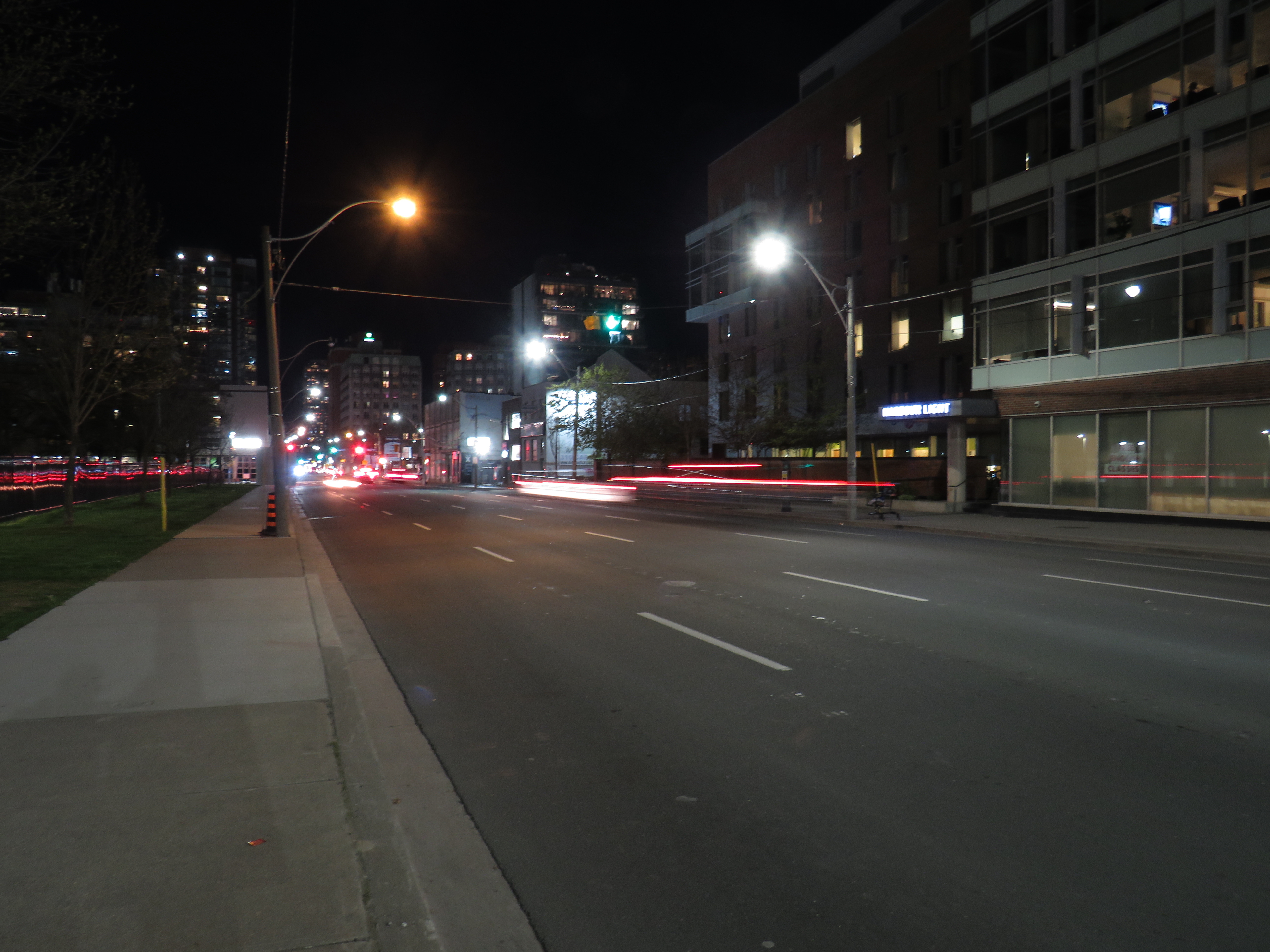
Street lighting is an important, yet overlooked, part of any city’s standard infrastructure. For over seventy years, Toronto’s streets were lit with an elegant and increasingly unique streetlamp design. But modern standards and a desire for standardization will see this change, just as Toronto’s streetcars and street signs have.
Toronto Hydro, which is responsible for Toronto’s street lighting, is replacing the older “acorn” lamps with high pressure sodium (HPS) cobra head lamps (so-called due to their shape when seen from the top or bottom). While surrounding municipalities are switching to white-burning LED lights, Toronto Hydro is installing the older beige-orange glowing lamps.
I asked Toronto Hydro what their long-term plans were for the city’s street lighting infrastructure. Read more on Spacing’s website.
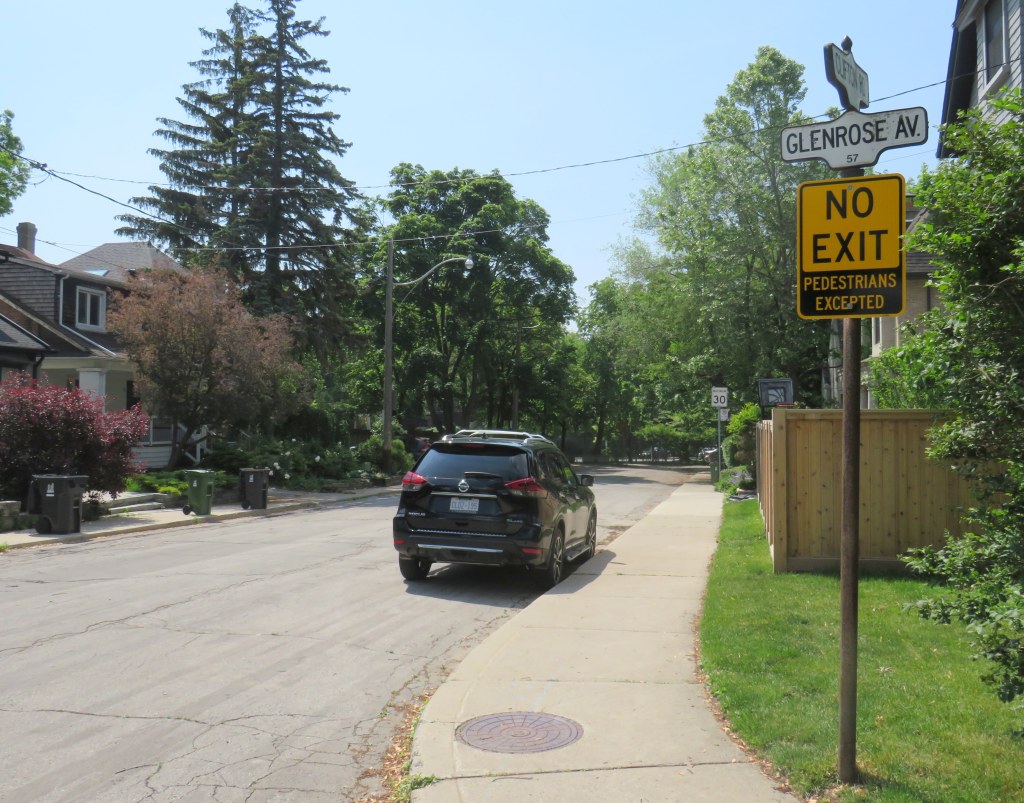
On April 8, Toronto City Council approved a motion brought forward by Councillor Paula Fletcher to change that. Councillor Fletcher’s motion was titled “I’m Walking Here.” Only two months later, new signs are already appearing across Toronto — in Scarborough, Monarch Park, and Swansea. For a city that often takes years to adopt what may seem like simple, easy solutions, this was implemented impressively quickly. The new signs look like standard yellow “no exit” signs, but with a “pedestrians excepted” note at the bottom.
My hope is that these signs will entice Torontonians to get outside, go for a walk, and check out some new streets and parks, enticed by these signs inviting through passage.
In related news, this week Toronto Council approved the expansion of sidewalk slow clearance to all of Toronto’s streets, a service that was previously provided only to suburban areas, where unobstructed sidewalks made municipal slow clearance easy to do. With new snow equipment able to navigate narrow urban sidewalks, Toronto is now finally able to provide universal snow clearance services, a boon for full accessibility.
As public health restrictions ease and stores and restaurant patios reopen this Friday (supported by the city’s willingness to reallocate road space on streets like Yonge and Danforth), there’s never been a better time to for a walk.
Over the past few years, I have been involved with the YongeTOmorrow project on behalf of Walk Toronto. It has been a very interesting and worthwhile experience being part of a stakeholder advisory group. Allied organizations working towards a more exciting and sustainable Yonge Street include Cycle Toronto, 8 80 Cities, and the David Suzuki Foundation.
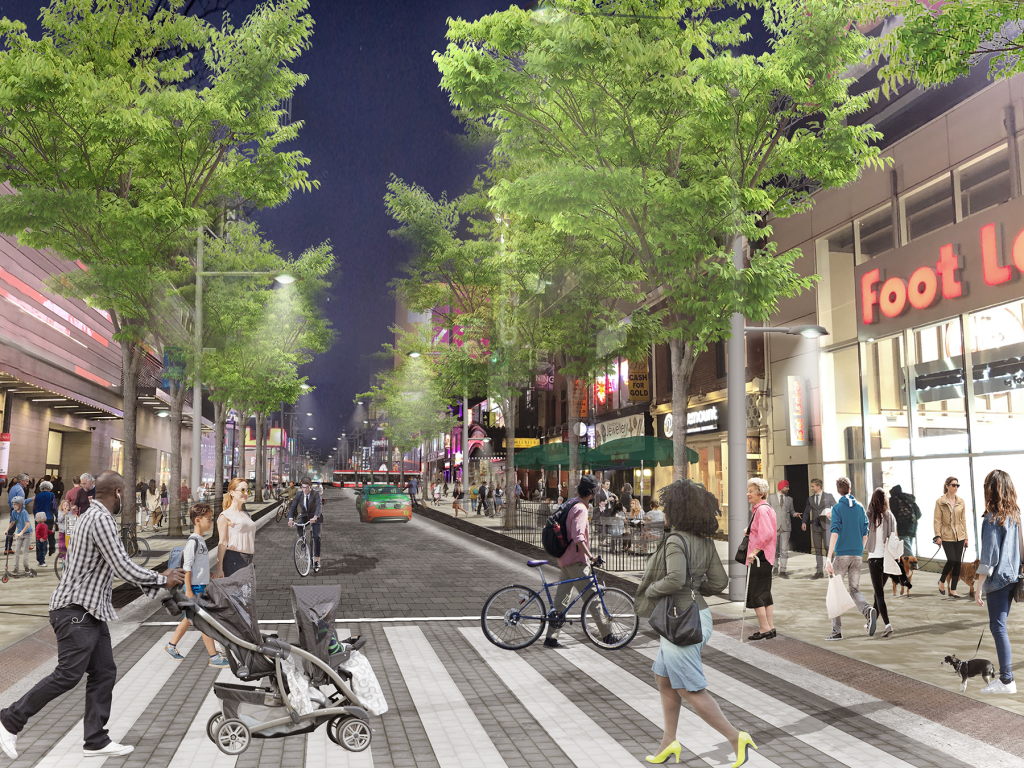
Rendering of proposed changes to Yonge Street , looking north towards Dundas Square. In this section, northbound traffic is permitted, with two-way cycling, and much wider sidewalks, along with new trees and improved street furniture.
Though the selected concept is not perfect, the proposed changes will provide significant improvements to Yonge Street between Queen and College Streets. These include wider sidewalks, patio space, bike facilities, and a pedestrianized zone between Dundas Square and Edward Street, allowing for better circulation, more flexibility for special events, and a more pleasant street.
With more high-rise development on the way (including the redevelopment of the Chelsea Hotel on Gerrard Street), it is only right that more space be given to residents, students, employees, and visitors. Compromises in the plan allow for access to parking garages, permit taxi and other vehicle drop-offs and pick-ups, as well as business deliveries.
This week, I appeared on two podcasts, talking about municipal open data, crowdsourced mapping projects, and Brampton’s success in building suburban transit ridership.
For Spacing Radio’s Future Fix series, I spoke about a recent Walk Toronto initiative to map sidewalk pinch points during the early days of the COVID-19 pandemic. We used Google Maps to pinpoint specific locations where queues to enter grocery stores, pharmacies, and other essential businesses and services made physical distancing difficult or impossible.
Through Walk Toronto’s social media accounts, we asked Torontonians where these locations were, then submitted a list to city staff and public health officials. Not long afterwards, CurbTO was announced to address this specific problem, the first of several initiatives that recognized the need to get outside.
Also on the podcast are Shabnem Afzal, road safety manager for Surrey, British Columbia, speaking about that city’s Vision Zero plan, and Halifax City Councillor Waye Mason, who spoke about that city’s interactive map that allows its citizens identify spots where safe street interventions are needed.
Just before the pandemic hit, I spoke with Helen Lee and Vincent Puhakka of the new podcast The Next Stop about Brampton Transit’s success, and the implications for other suburban transit agencies. Also on the podcast are Brampton Transit General Manager Alex Milojevic and Mayor Patrick Brown.
I hope you have a listen to each of these podcasts, and consider subscribing.
Ten days ago, I spent the day at City Hall and addressed the Infrastructure and Environment Committee. While I was following news of a novel coronavirus that was affecting China, Italy, and Iran, it wasn’t on my mind that day.
What a difference a few days makes.
On Thursday, the province announced that elementary and high schools would close for a three-week-long March Break in an effort to contain an outbreak here. One by one, universities and colleges cancelled in-class lessons, with instructors having to move the remainder of their classes online. The World Health Organization declared COVID-19 a pandemic. Travel restrictions came into place. Restaurants were asked, then forced, to close for dine-in guests. Theatres, cinemas, and some retail chains followed suit. Most office workers were now working from home. Libraries, recreation centres, and even outdoor skating rinks were all shut down.
By Monday, March 16, the city was quiet.
My spouse and I live in an apartment downtown, without a car, so we’ve been going on short walks in the neighbourhood, careful to keep our distance from others (this has been tough to do in supermarkets as I pick up essential food and supplies). But I find the walks are necessary for my mental well-being. They’re also surreal.
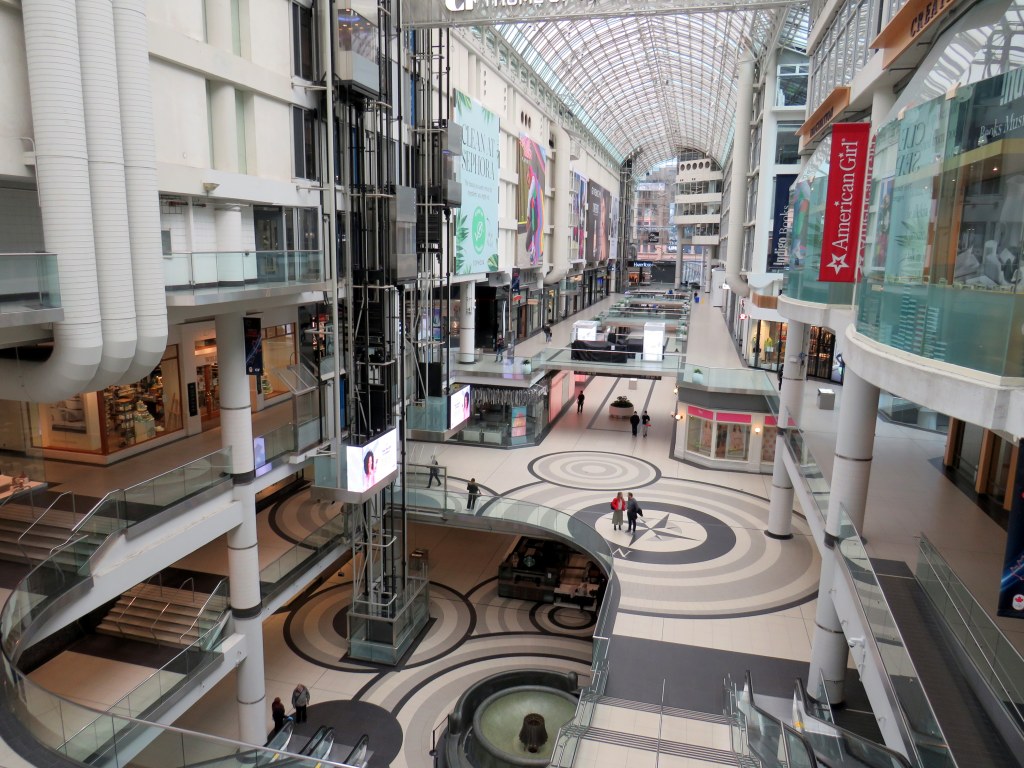
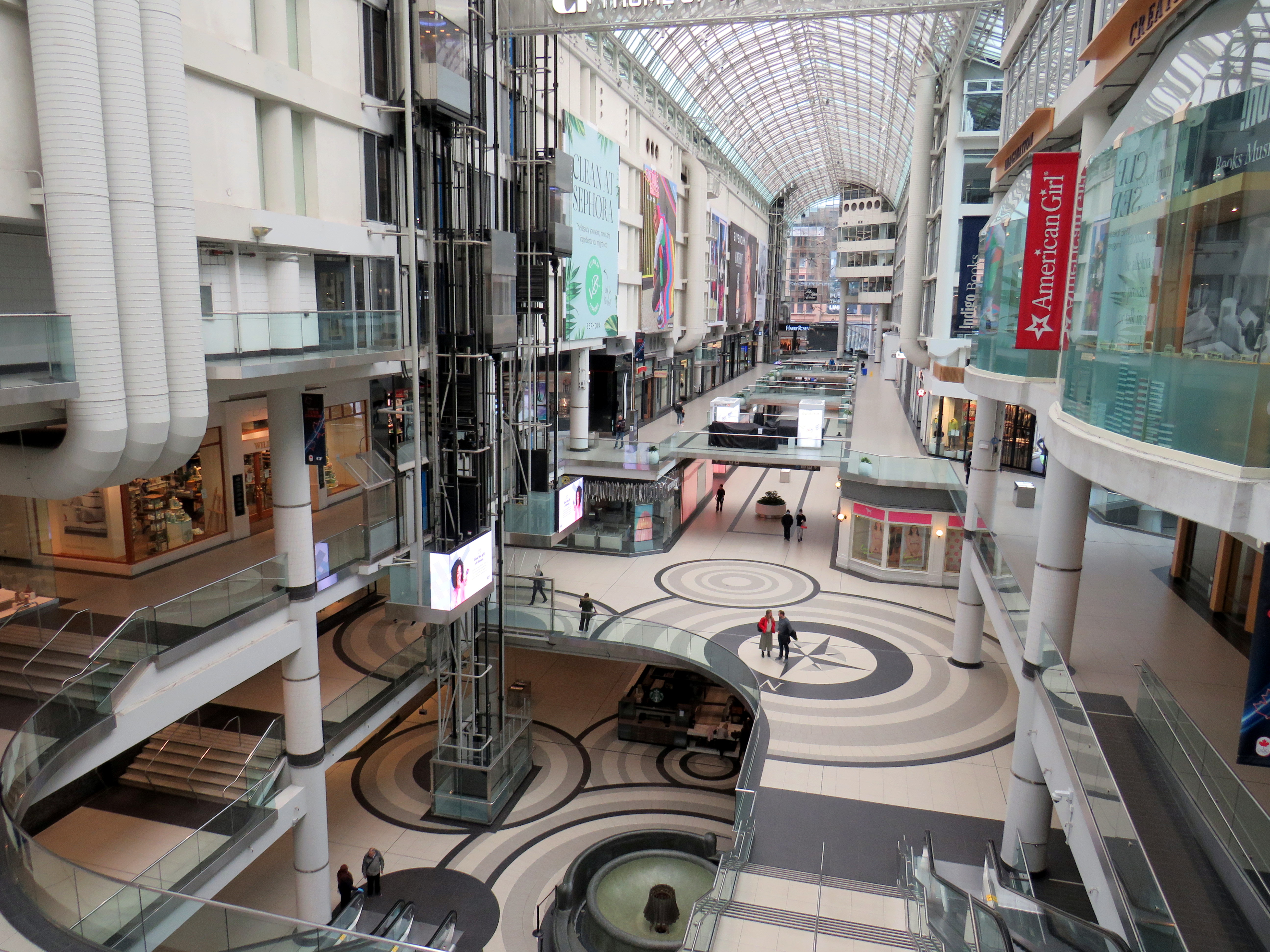
Though most stores in the Eaton Centre were open on Monday (Apple and Nike were among the first to voluntarily close all their retail stores), by Tuesday, nearly half were closed. On Thursday, only a handful were open, including, controversially, EB Games.)
The last time I saw the mall so empty during daytime hours, was walking back towards Union Station to go home from Ryerson University on the afternoon of September 11, 2001.
Keeping distance inside Eaton Centre, Thursday, March 19, 2020
As a condition for permitting the mall’s construction in the 1970s, the City of Toronto required permanent, twenty-four hour public access along the corridor between Shuter Street and James Street, behind Old City Hall. This concession was made because the new mall required several east-west public streets to be closed between Queen and Dundas Streets.
As a matter of practice, most of the mall’s corridors remain open during all hours, providing access to local streets and two subway stations. The only time I encountered locked doors was during the 2010 G-20 Summit fiasco.
GO Transit’s York Concourse at Union Station during the afternoon rush hour on Monday, March 16
Meanwhile, other busy public spaces, such as the GO Transit concourse at Union Station were also eerily quiet. While it is good that most are able to heed the calls from public health officials and political leaders to stay home where possible, I hope that we can continue to build transit, and not enter another lost decade of service cuts and ignoring needs for more infrastructure.
Busy streets, like Bloor and Queen, are also quiet. With no where to go, there’s very little traffic.
The “Hug Me Tree” on Queen Street West
Though I want to remain optimistic, I suspect it won’t be until the end of April at least before some of the social distancing requirements are relaxed. Though it’s tough for many of us, it is necessary to keep hospitals from being overwhelmed and the population as healthy as possible.
We’ve been streaming more movies and television shows and playing party games remotely with family and friends online, with audio and video links to keep us engaged with each other. Sometimes on our walks, we’ll order takeout from some of our favourite independent restaurants and coffee shops.
These are some of the little things that can be done when very little is asked of most of us.
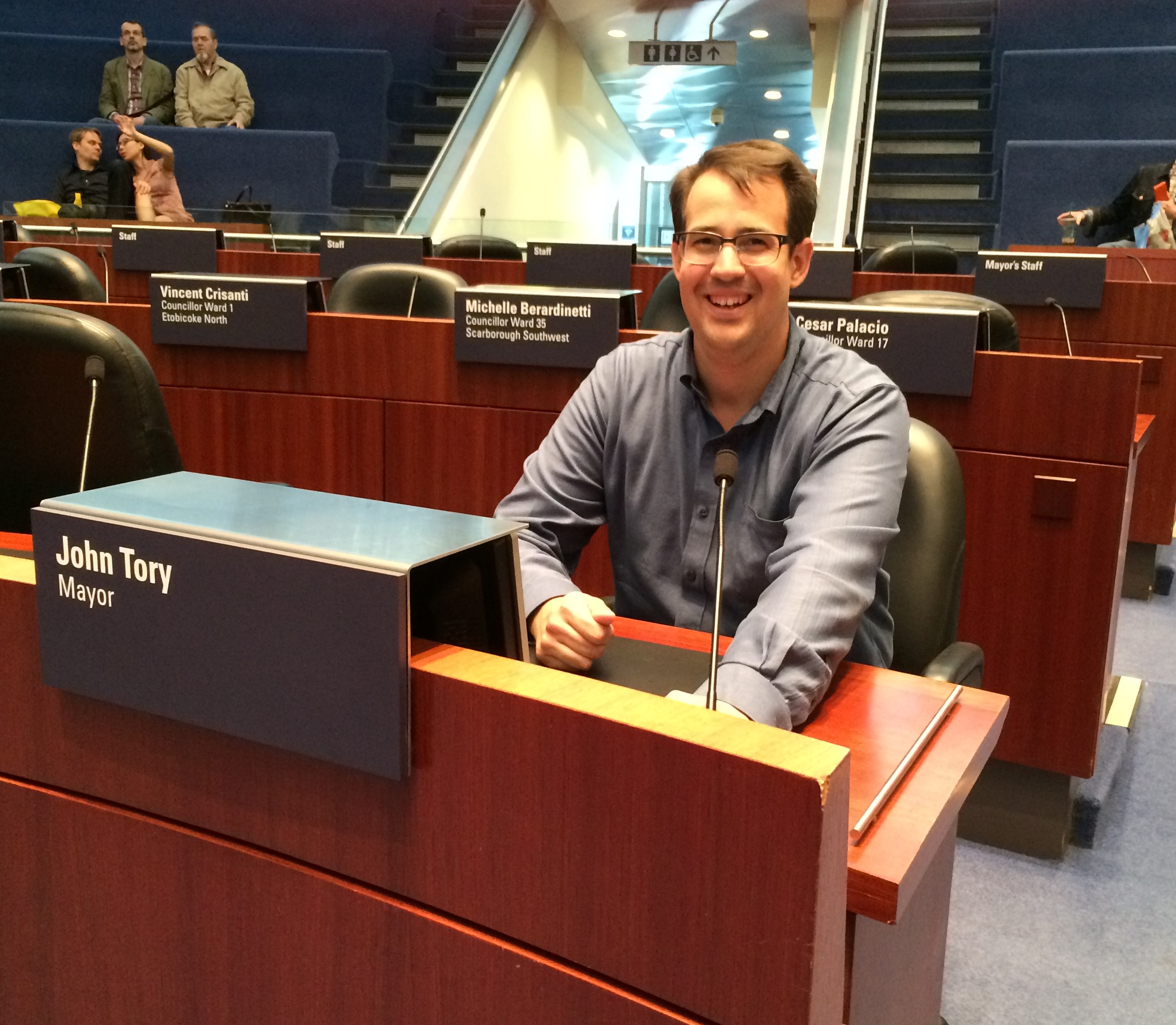
On Wednesday, March 11, I deputed to the Infrastructure and Environment Committee at Toronto City Hall in support of a motion by Councillor Mike Layton to have city staff examine and report back on expanding right turn on red (RTOR) restrictions in the City of Toronto.
Though I had the time and willingness to attend the committee meeting and speak to city councillors, I attended on behalf of Walk Toronto, and the motion was primarily written by my colleague Daniella Levy-Pinto, with input from myself and several other steering committee members.
I found myself much more relaxed deputing this time, especially compared to my deputation late last year to the Toronto Police Services Board. Taking a continuing education course on public speaking and presentations helped, as did increased confidence, and a less intimidating environment.
We argue for blanket RTOR prohibitions, rather than simply at selected intersections, for several reasons. red A citywide or neighborhood ban of right on red would eliminate the cost of creating, installing, maintaining, and replacing prohibition signs at each intersection. Too many signs create a visual overload. Furthermore, eliminating right turns on red only at selected locations is problematic in terms of predictability: some vulnerable road users will have difficulty determining what rules are in place at a particular intersection; Montreal, New York, and Mexico City already prohibit right turns on red. It’s time that Toronto seriously debate the idea, and work towards implementing such a ban.
Meanwhile, while the city has implemented leading pedestrian signals at many intersections, their effectiveness is limited by allowing right turns during the leading pedestrian signal, when the red light is still on. Montreal, which has a slightly different implementation, allows through traffic, including cyclists, to proceed with the first few seconds of the walk signal, while turning vehicles must wait.
Though the Infrastructure and Environment Committee adopted Councillor Layton’s motion, it also passed amendments proposed by Deputy Mayor Denzil Minnan-Wong. Minnan-Wong’s amendments asked for, among other things, a report on the impact that Vision Zero measures have on traffic conditions, and how those traffic delays and congestion have increased stress on drivers.
So, by the deputy mayor’s logic, congestion and traffic safety measures are causing drivers to be aggressive and that is why pedestrians and cyclists continue to be killed on our streets.
Wednesday made for a good lesson on the challenges of grassroots advocacy and participating in local democracy. Recently, City Council voted to increase security at city hall by requiring all visitors to submit to bag searches and metal detector scans, hardly a friendly sight at Toronto’s seat of governance, originally designed to be a welcoming place for all people. Although the committee meeting started at 9:30 AM, it broke for lunch at 12:30, before getting to Councillor Layton’s motion. That meant that I had to leave for lunch, line up again and go through security, before speaking around 2:00 PM. Any citizen with a day job or other commitments wishing to participate in local democracy is at a disadvantage.
But I am glad I had the time and opportunity to speak up for something important.




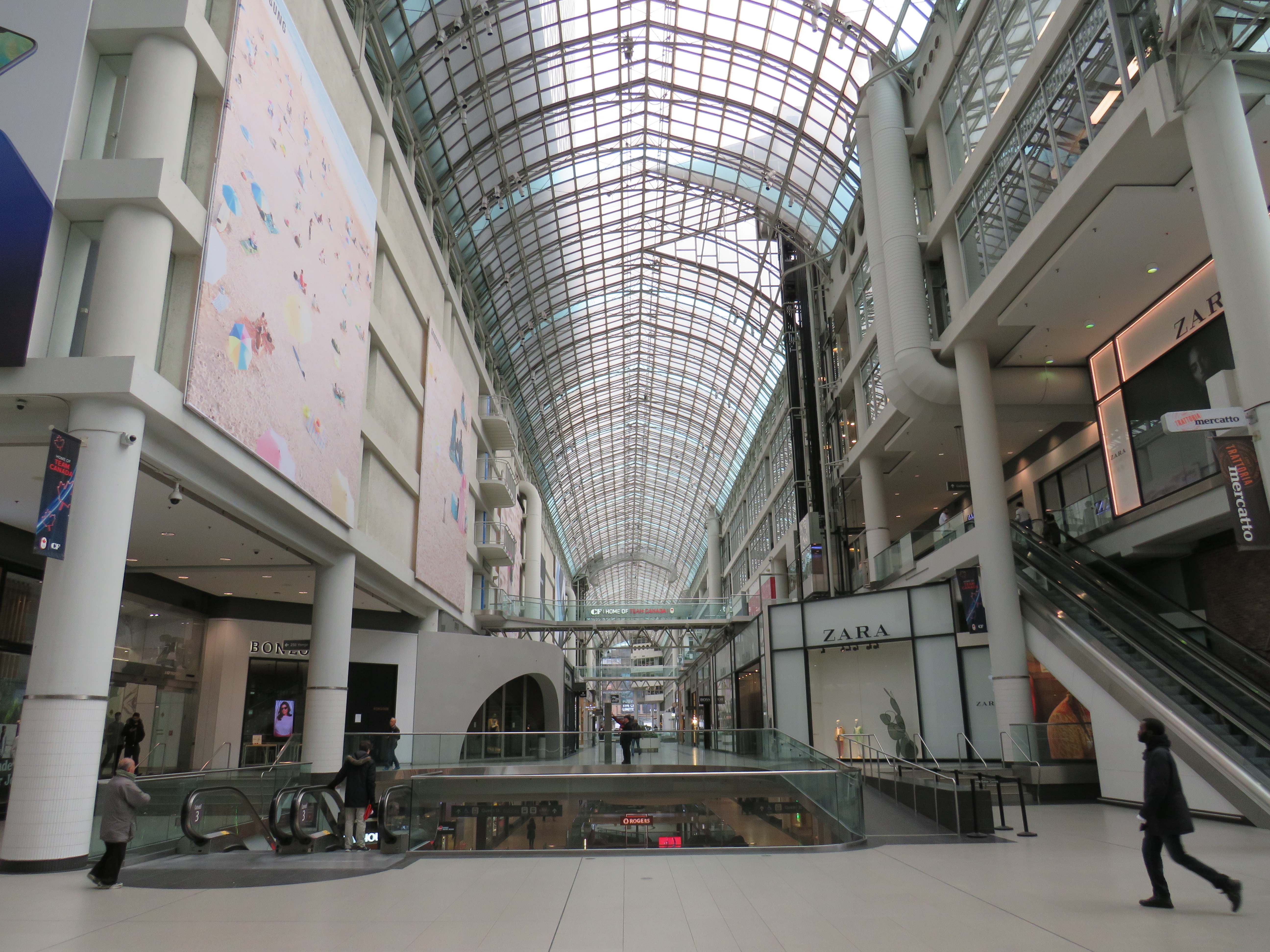 Keeping distance inside Eaton Centre, Thursday, March 19, 2020
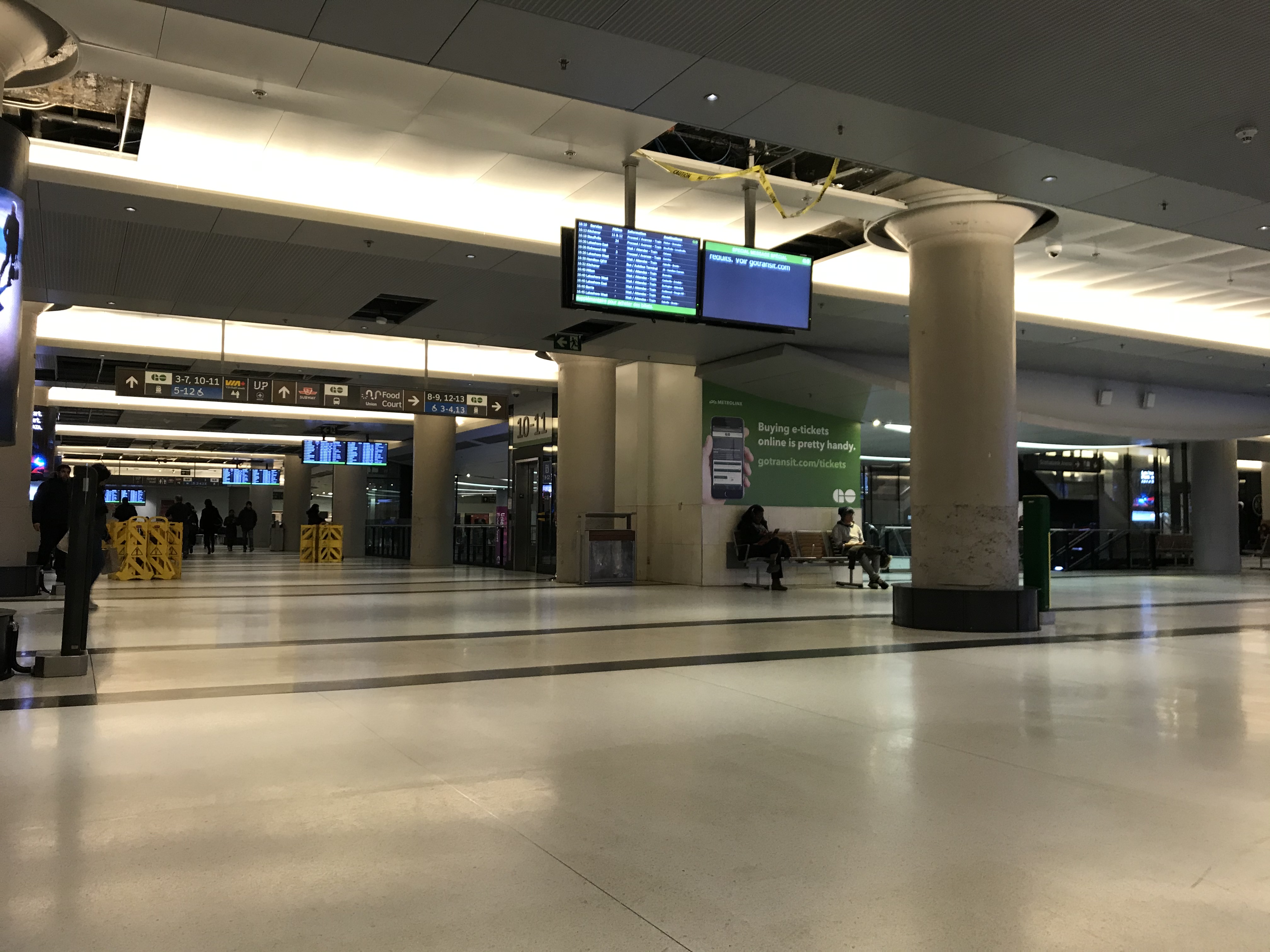 GO Transit’s York Concourse at Union Station during the afternoon rush hour on Monday, March 16
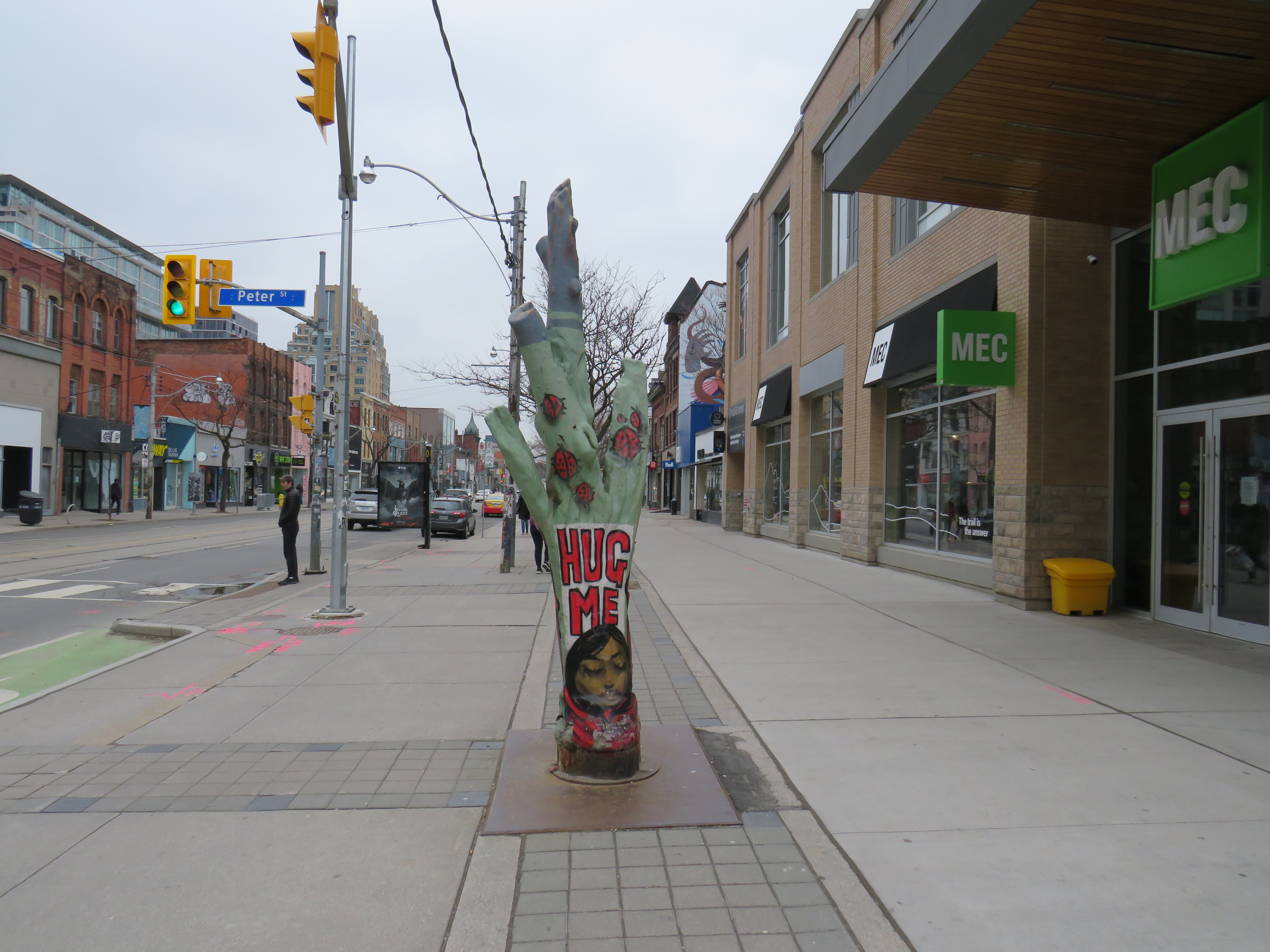 The “Hug Me Tree” on Queen Street West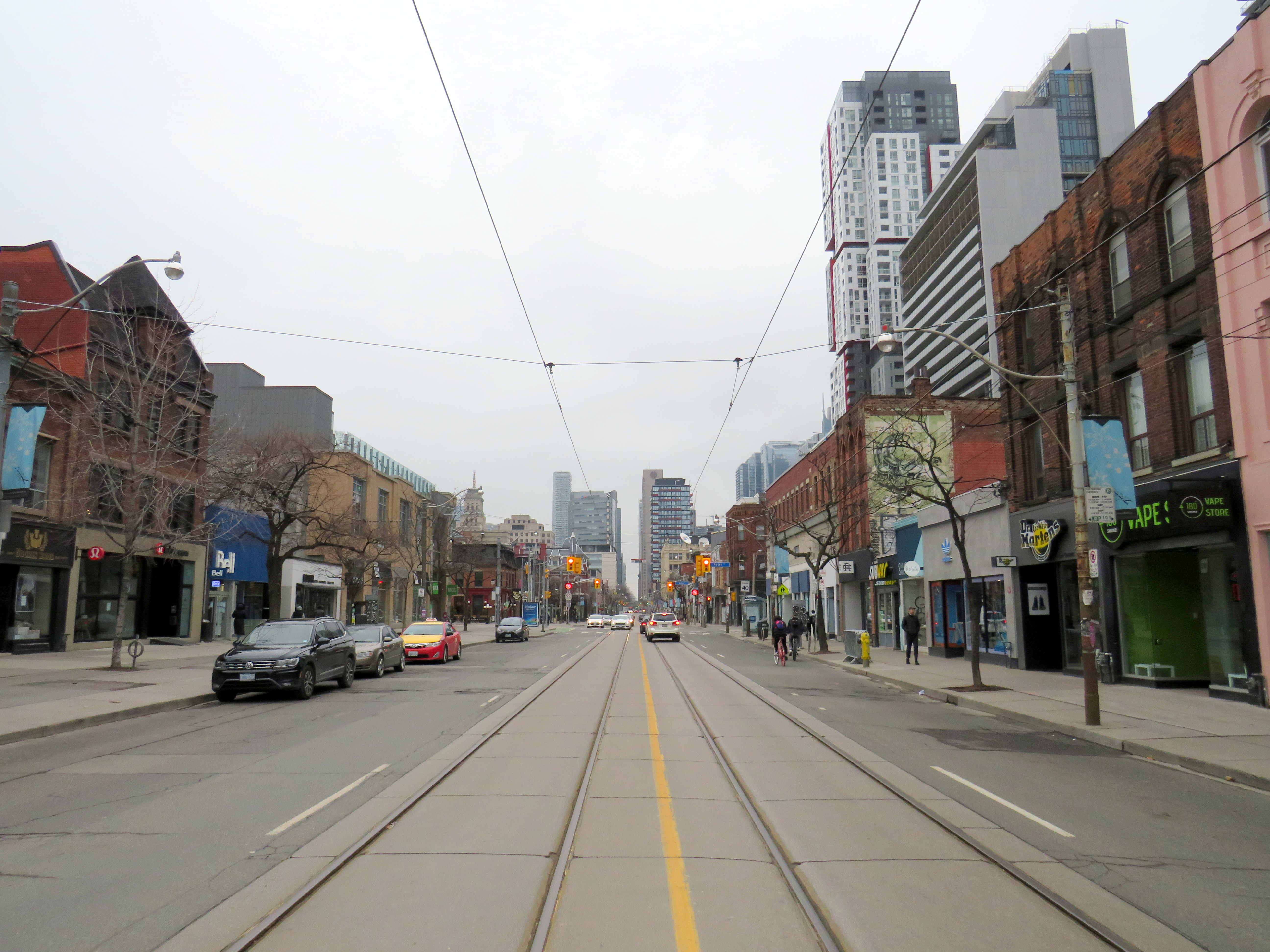
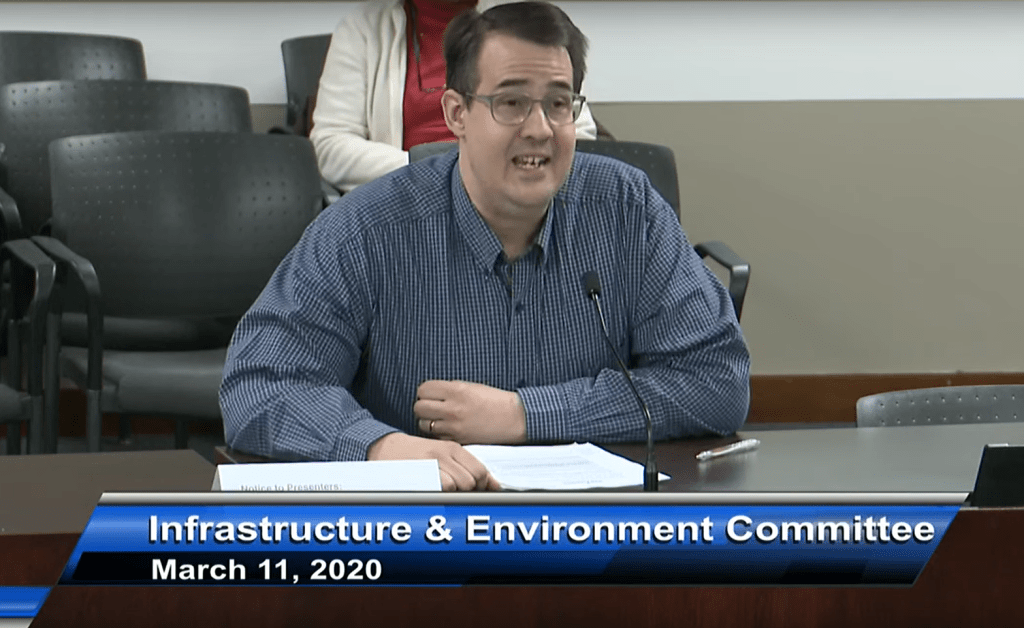
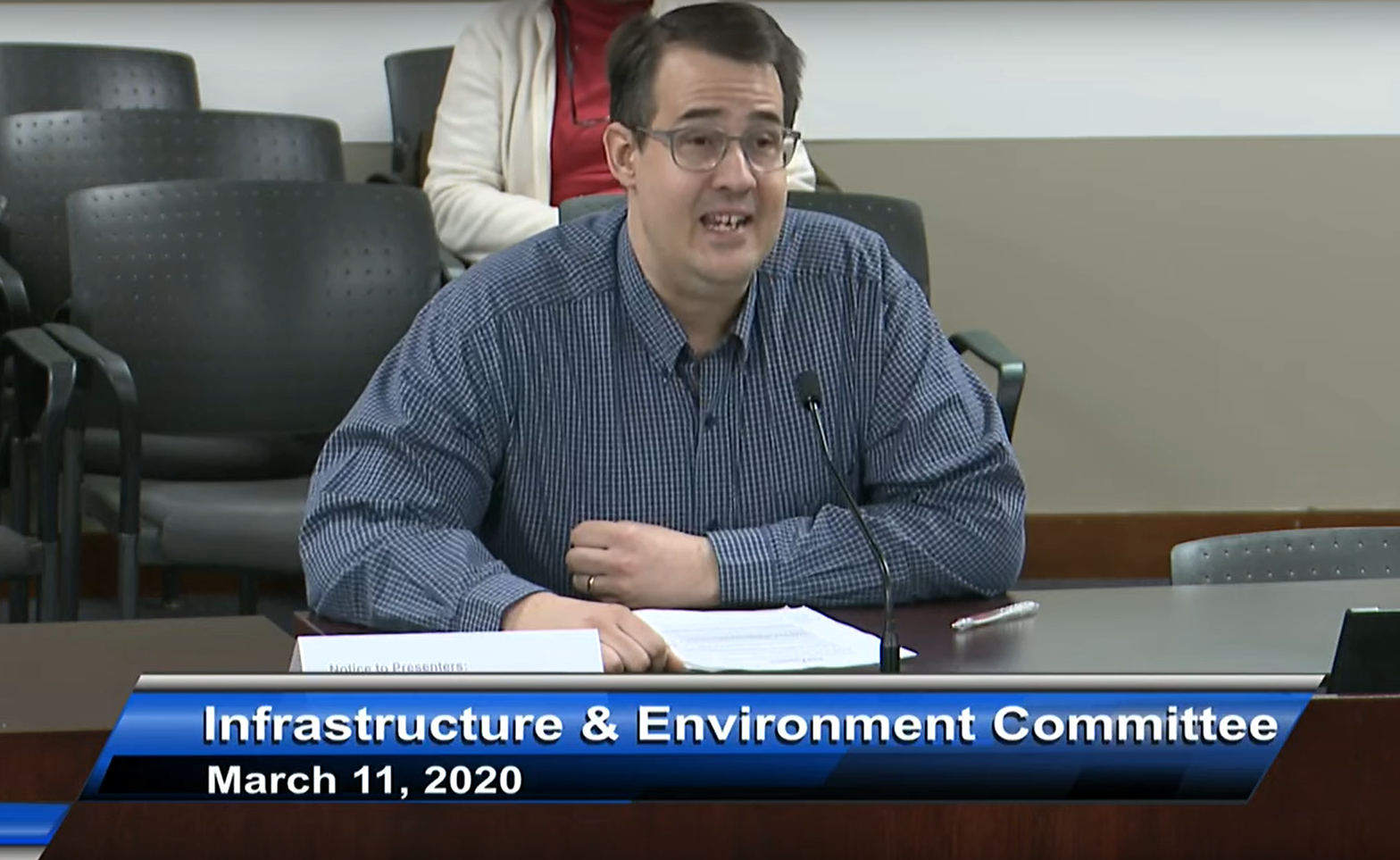 On Wednesday, March 11, I deputed to the Infrastructure and Environment Committee at Toronto City Hall
