Tag: Ana Bailão

  • Mapping the 2023 mayoral byelection

    Last week Monday, I was at Spacing’s election night party at a pub in the Annex, watching the results of the election roll in after 8PM. Public polls consistently saw former Toronto city councillor and NDP MP Olivia Chow leading an especially crowded race of 102 candidates for mayor. It was the most exciting election I’ve followed since at least 2014.

    Former three-term councillor Ana Bailão, one of former mayor John Tory’s protégées, was consistently in second place, followed by former Toronto Police Chief (and provincial PC candidate) Mark Saunders, sitting councillors Josh Matlow (who ran as a progressive) and Brad Bradford (who ran to the right), and right-wing columnist Anthony Furey. Though Bailão, a centrist, had the endorsements of multiple sitting councillors, Liberal MPs and MPPs, and several public and private sector unions, she had difficulty positioning herself as the presumptive centre-right challenger, especially with Premier Doug Ford backing Saunders.

    It was not until the advance polls had closed that Deputy Mayor Jennifer McKelvie, the Toronto Star Editorial Board, and then Tory himself endorsed Bailão, likely spooked by Chow’s continued lead. (David Rider and Ben Spurr at the Star wrote a great article about the leadup to Tory’s endorsement.) Tory, who resigned after admitting to a long-term city hall affair, hummed and hawed over providing his endorsement, and hid from reporters even while robocalling Torontonians pleading them to vote for his appointed successor.

    It is quite possible that Tory’s endorsement came too little, too late for Bailão. Nearly 150,000 electors (representing 21.7% of all votes cast) already voted in advance polls or by mail, and their votes were locked in. But the late push for Bailão was able to convince at least some election day voters to choose strategically — the percentage of voters who chose Saunders, Furey, and Matlow fell, while Bailão’s share grew on election day. Indeed, Bailão placed first among election day voters. But Chow, whose campaign encouraged advance voting, carried the day in the end.

    For example, Josh Matlow placed a close second in Ward 12 in the advance polls (with 30.6% of the vote), where he’s a popular local councillor. On election day, Matlow placed third behind Bailão and Chow, with Chow eking out a narrow win overall there. In every ward, Chow placed first in the advance polls, but when all votes were counted, she placed first in 14 of the 25 wards. The table below shows how the vote shifted.
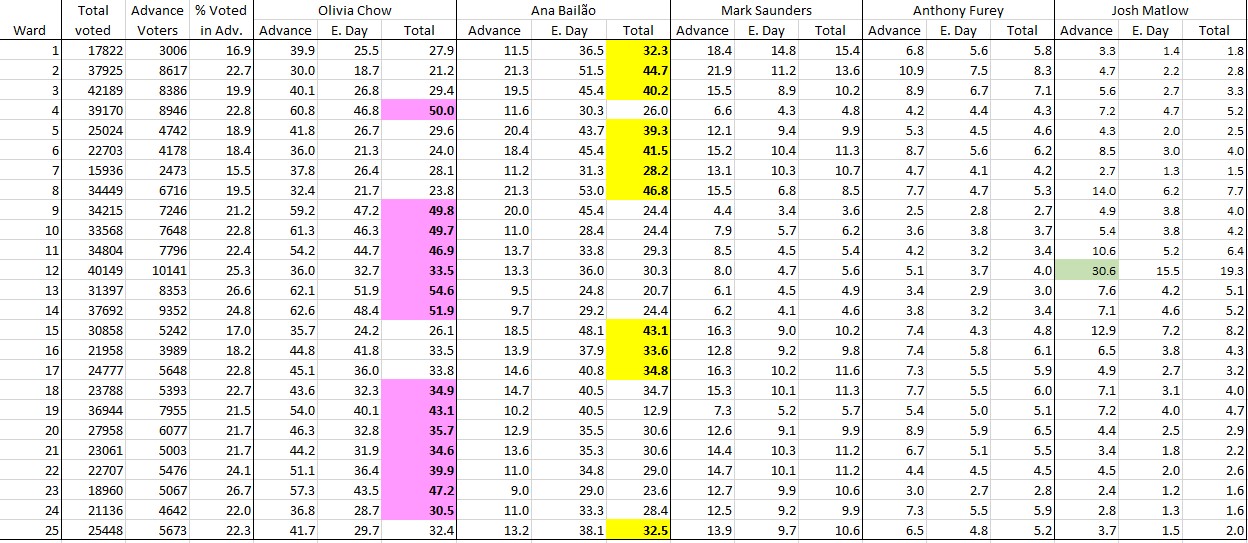
    Table of ward-level mayoral byelection results, showing advance poll and election day results for the leading five candidates. PDF version here.

    Chow won with 269,372 votes (37.2%) to Ana Bailão’s 235,175 (32.5%). Saunders, Ford’s pick, got just 8.6% of the vote despite his positioning as the only candidate to “stop Chow.” Furey placed a distant fourth, with 5%, and Matlow got 4.9%, acknowledging that Bailão’s late surge draw support away from him and towards Bailão and Chow. Brad Bradford was the biggest loser of the night, netting just 1.3% and placing fifth in his own ward.
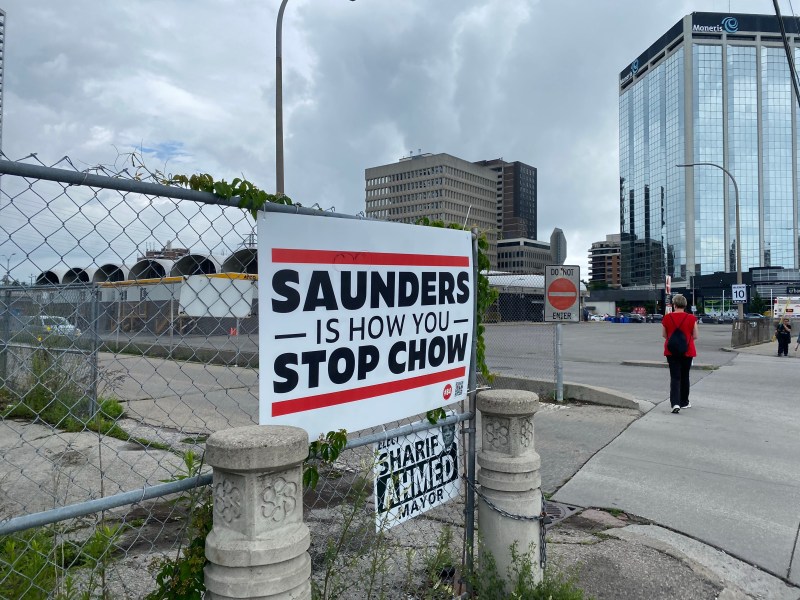
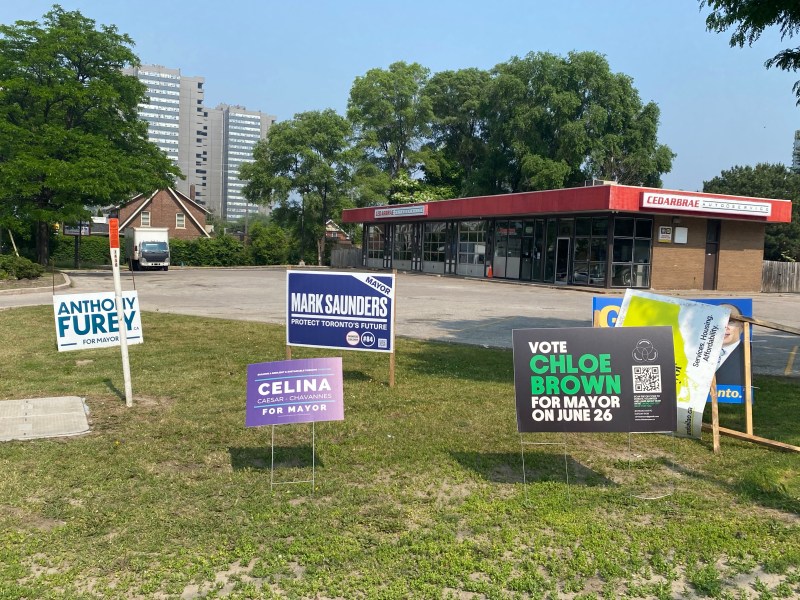
    “Saunders is how you stop Chow” sign

    Though I was skeptical of Olivia Chow’s second run for mayor after an uninspiring run against Rob and Doug Ford and John Tory in 2014 (she placed third), she proved herself worthy this time around. She was more relaxed, more herself, and certainly tapped into a desire for change after eight years of Tory’s dull austerity and four years of chaos under Rob Ford (enabled by his brother Doug).

    I fear Toronto’s political establishment — both Conservative and Liberal — will try to make Chow’s term as mayor difficult, even though their low-tax, low-spend agenda caused many of the problems that she will have to tackle. But for now, I’m pleased we will try it her way.


    I created an interactive map showing the results of the election at the ward and electoral subdivision (poll) level. For the wards, I provided information on the advance and election day poll results.

    Note that not all polls are mapped. Until the City of Toronto releases revised electoral subdivision boundaries (I suspect due to poll consolidations), there are some missing polls. However, 95% of all polls are depicted, and the results are interesting.

    I look forward to your feedback as well; I approve all reasonable comments and reply to most emails.

    Link to map

    Thanks to David Del Grande for pointing out a needed correction.
  • Mapping the results in Ward 4 Parkdale-High Park and Ward 9 Davenport

    In the penultimate post in my series examining the results of the 25 council races in the October 2018 municipal election here in Toronto, I take a look at the results in Ward 4, Parkdale-High Park and Ward 9, Davenport in Toronto’s west end.

    Neither of the two ward-level results were surprising. Ward 4 returned progressive councillor Gord Perks to City Hall, while in Ward 9, there wasn’t much of a contest: centrist Ana Bailão was easily re-elected.

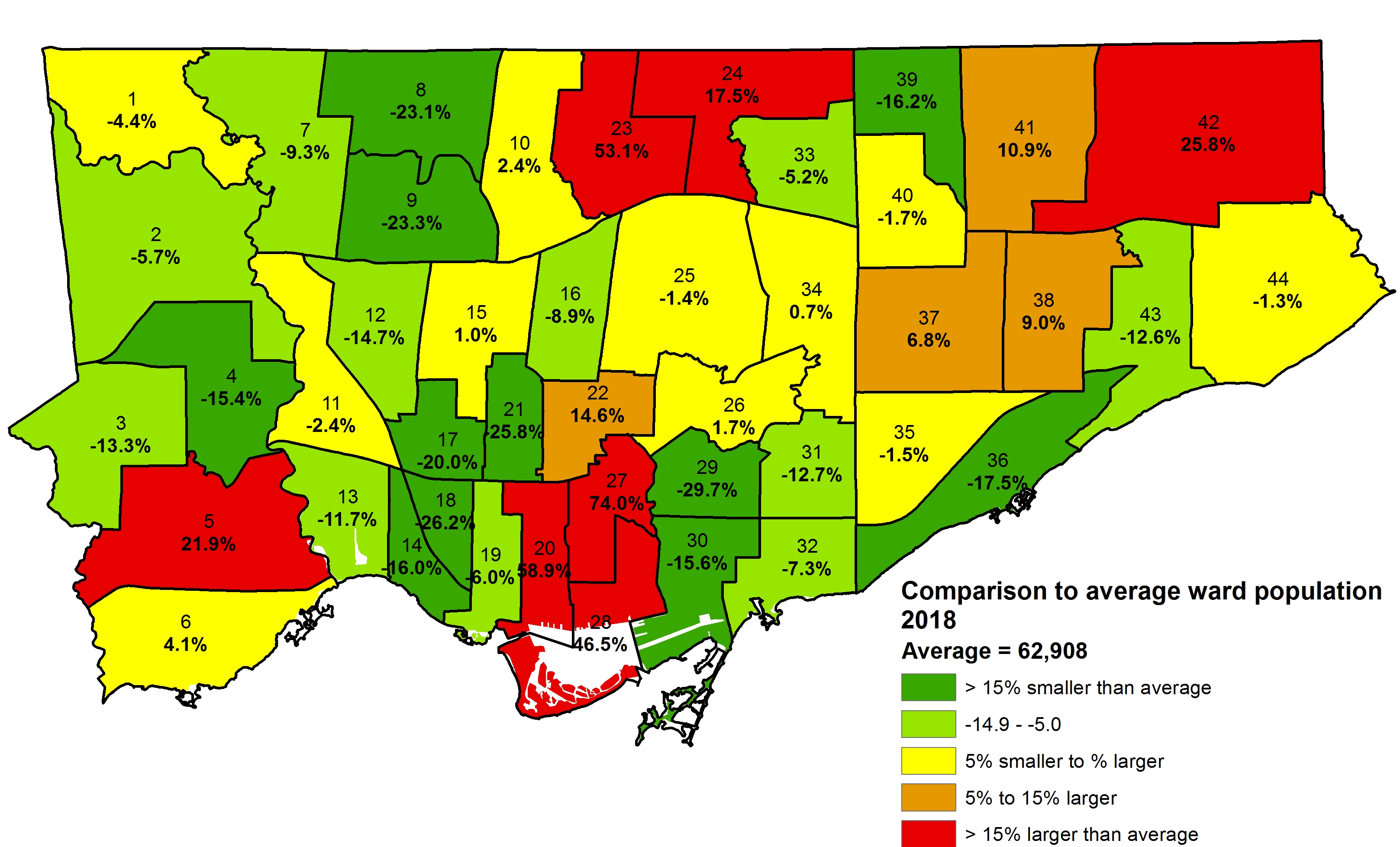
    At the start of 2018, once the 47 ward boundaries were confirmed, it looked as though Bailão was going to be in one of the most interesting council races. The west end of the old City of Toronto — old Wards 14, 17, and 18 — had low population growth compared to many other parts of the city, including northeast Scarborough, North York Centre, Humber Bay Shores, and Downtown. These new ward boundaries were designed to improve representation as the old 44 wards were based on federal ridings drawn in the 1990s. Even with three new wards, the west end would lose a seat on council. The way the boundaries were drawn, it meant that Bailão, elected in Ward 18, would be up against Cesar Palacio, elected in Ward 17.

    2014 Election - 2018 Ward Projections
    Differences in 2018 ward populations under the old 44-ward model. Toronto’s west end was one of several areas over-represented by the outdated boundaries.

    Under the 47-ward model, it would have been the only race in which two incumbents would have ran against one another and Bailão would have had the advantage.

    Palacio, a conservative, was vulnerable in the last few elections, challenged by progressive candidates Alejandra Bravo and Jonah Schein, with Palacio narrowly winning in 2010. With the new boundaries extending south to Bloor Street (the area south of Bloor shifting to join old Ward 14 represented by Gord Perks), Palacio’s base in the north half of his old ward would not have been enough — areas that voted for Bravo in 2014 would have certainly voted for Bailão in a two-candidate race.

    After Bill 5 was introduced and confirmed into law, things changed. Sarah Doucette, a progressive councillor representing old Ward 13 (Swansea, Bloor West Village and part of the Junction) withdrew from the race when her ward was joined with Ward 14 (Parkdale and Roncesvalles).

    Doucette, who was first elected in 2010, said that she wasn’t interested in serving on a 25 ward council. A councillor well-known for her local community activism, Doucette would have represented a much larger area, and would have run against Gord Perks, someone she describes as a friend. For his part, Perks said that “Doucette deeply embodied the values of decency and community at city council. It’s a crime that we’re losing her.”

    Meanwhile, Perks, who was running, still had several opponents in the new larger ward. They included David Ginsberg, owner of several restaurants and a coffee shop near Trinity-Bellwoods Park; Kalsang Dolma, a Parkdale-based artist and community activist; and Evan Tummillo, a property manager who ran against Doucette in 2014. Tummillo was endorsed by the Toronto Sun, while the Toronto Star endorsed Perks.

    In neighbouring Ward 9, Cesar Palacio quietly dropped out of the race in late September, only a few days before the new post-Bill 5 nomination deadline. This was a surprise, as he and Bailão had known that they would run against each other for a very long time. Only four other candidates had registered, none of whom enjoyed wide name recognition. Had Palacio withdrawn earlier, it is possible that a progressive candidate would have taken a shot at running against centrist Bailão.

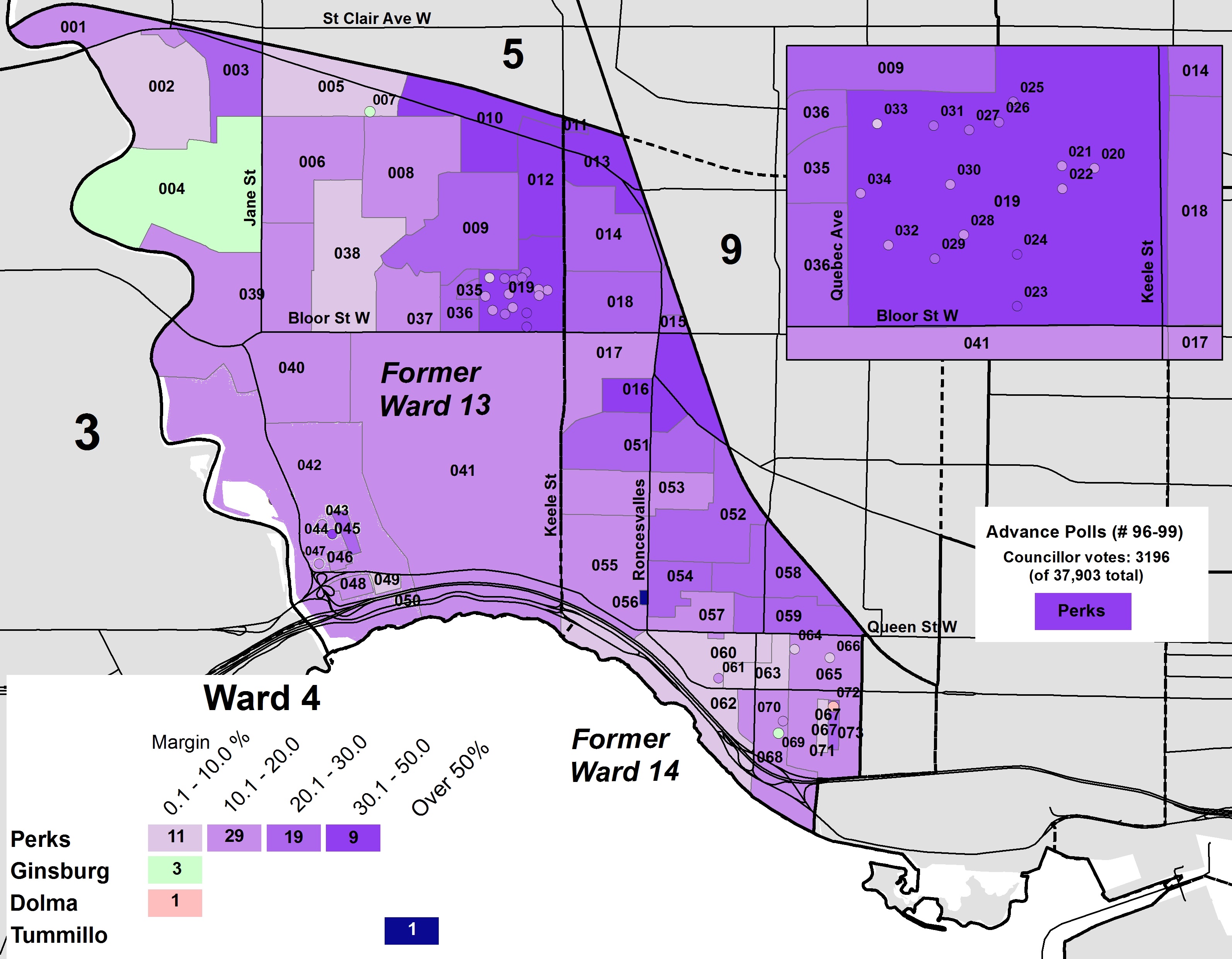
    In Ward 4, Perks easily won re-election, taking 44.5 percent of the vote and placing first in all but five polls. Ginsberg placed a respectable second, with 21.6 percent. Ginsberg did best in the affluent Baby Point neighbourhood in former Ward 13, while Dolma did quite well in a few Parkdale polls, placing first in one. Tummillo got just 6.2 percent of the vote, coming first in just one poll, a seniors’ residence on Roncesvalles Avenue.

    2018 Election - W4.jpg
    Poll-level results for Ward 4

    Meanwhile, in Ward 9, Ana Bailão got the highest winning margin of any council candidate, taking 83.6 percent of the vote. As the councillor in the old City of Toronto most allied with Mayor John Tory, Bailão has since been named to the executive committee and chair of the new planning and housing committee. Perks, on the other hand, was shut out of Tory’s inner circle.

    Bill 5 meant losing councillors that knew their wards intimately. While councillors will be able to hire more staff to help manage these local issues, it’s still an unfortunate loss of local representation.


    Ward 4 Parkdale-High Park
    Candidate Votes Percent
    Kalsang Dolma 5,352 14.1
    David Ginsberg 8,181 21.6
    Valerie Grdisa 1,771 4.7
    Taras Kulish 868 2.3
    Gord Perks 16,887 44.5
    Nick Pavlov 874 2.3
    Alex Perez 686 1.8
    Evan Tummillo 2,367 6.2
    Ward 9 Davenport
    Candidate Votes Percent
    Ana Bailão 26,219 83.6
    Mark Balack 1,114 3.6
    Nahum Mann 2,804 8.9
    Troy Young 1,218 3.9