Tag: Eaton’s

  • The fall of an empire

    The fall of an empire

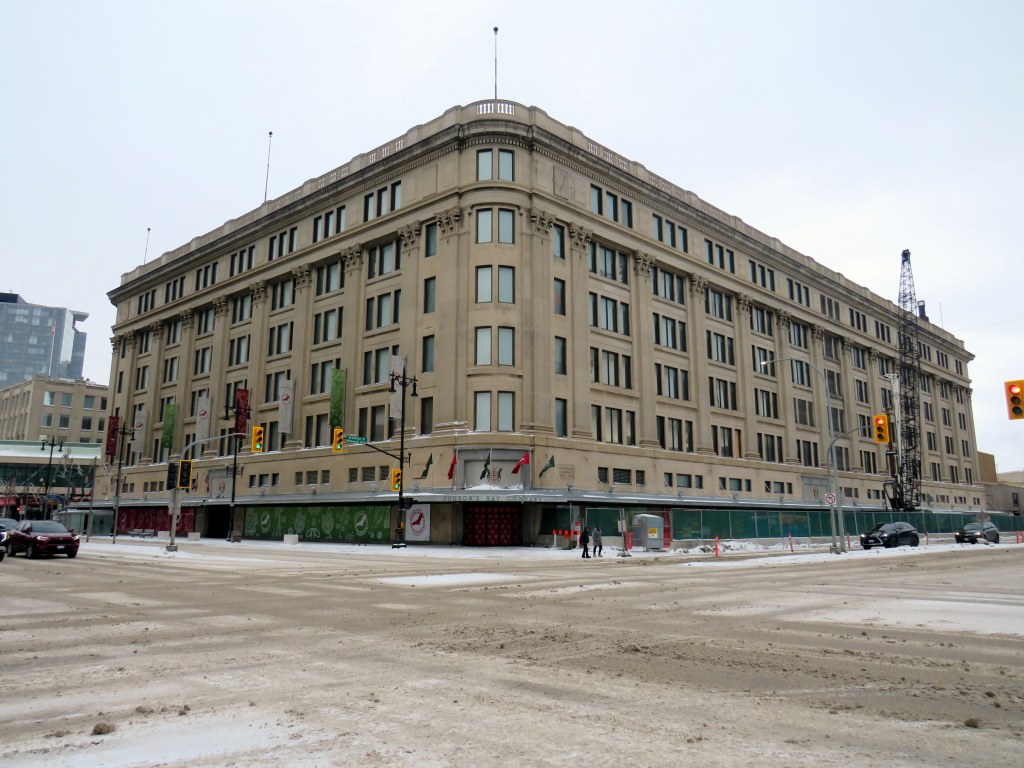
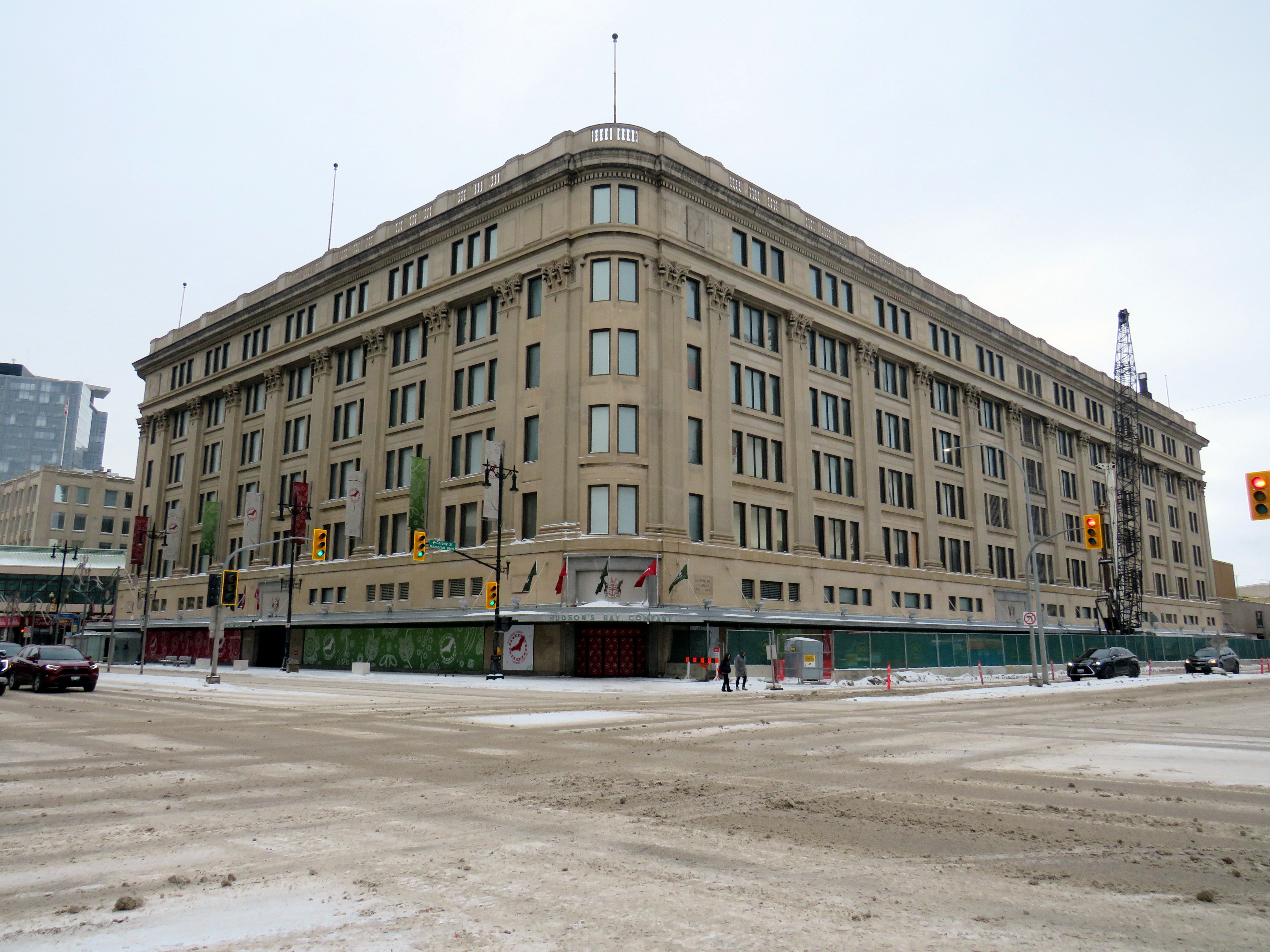
    The former Hudson’s Bay Store in Downtown Winnipeg, one of its western flagship stores. After years of decline, the store closed in November 2020 and is now being transformed into a centre for Manitoba’s First Nations.

    There’s a touch of irony that in the same year Canadian sovereignty is increasingly threatened by an American president, the Hudson’s Bay Company — one of the world’s oldest corporations — has filed for bankruptcy protection. It will likely close at least half of its 80 stores, but with no guarantee it will emerge in a healthy state, able to rebound.

    On May 2, 1670, The Governor and Company of Adventurers of England, trading into Hudson’s Bay, was given a royal charter to trade in all lands that drained into Hudson’s Bay, 3.9 million km2 of land in the heart of the North American continent, in order to compete with the lucrative French fur trade in the St. Lawrence basin. The new company had monopolistic commercial control of what was then called Rupert’s Land: the entirety of present-day Manitoba, most of Saskatchewan and Northern Ontario, a significant part of present-day Quebec, Alberta, and Nunavut, and even parts of what eventually became Minnesota and North Dakota.

    Of course, this new monopoly, which quickly became known as simply the Hudson’s Bay Company (HBC), was created without consent or consultation with the many First Nations and Inuit communities. In the early days of trade, however, HBC relied on trading with First Nations for the valuable fur trades. It established forts and factories (trading posts) throughout the northwest, establishing places such as Moose Factory and Fort Albany that remain to this day.

    In later years, HBC claimed a trading monopoly on lands draining into the Pacific Ocean; it also brought in missionaries to convert Indigenous peoples. (Its monopoly was challenged by new entrants such as the North West Company, which eventually merged with HBC after violent skirmishes over trading territorial rights.)

    HBC’s vast networks of forts and trading posts, particularly Fort Garry (now Winnipeg) led towards the full colonization of western and northern Canada. In 1870, with the decline of the fur trade HBC relinquished control of Rupert’s Land to the new Dominion of Canada, which led immediately to the creation of the Northwest Territories, followed quickly by the Red River Rebellion and the creation of the Province of Manitoba.

    HBC continued as a fur and goods trading company and it was still the only retailer in remote western and northern communities. In larger cities like Vancouver, Winnipeg, Edmonton, and Calgary, it established new department stores. In smaller communities, especially in the north, it took full advantage of its dominant position, and Northern Stores became notorious for high prices (in 1987, HBC sold off its Northern Stores division). HBC continued to exploit Canada’s natural resources — it even had an oil and gas subsidiary between 1926 and 1982.

    In 1960, HBC focused almost entirely on its department store empire, acquiring the Montreal-based Morgan’s chain, competing head-on with Eaton’s and Simpsons-Sears. In the 1970s and 1980s, it also scooped up discount chain Zellers, Simpson’s stores (after its split from Sears Canada), Ottawa-based Freimans, and Hamilton-based Robinson’s, eventually rebranding those stores as “The Bay.” Finally in 1993, it acquired Vancouver-based Woodward’s. During this time, it sold off the Northern stores and the oil company. In the late 1990s, it launched the Home Outfitters big-box chain. The Zellers chain expanded under HBC ownership, first acquiring the competing Towers discount chain in 1991 and K-Mart’s Canadian stores in 1998.

    Though the flagship stores still proudly proclaimed the May 2, 1670 incorporation date, few thought about the long and checkered history of the company. My first memories of The Bay’s retail empire were of the Simpson’s store close to where we lived in Brampton. Simpson’s was the flagship anchor of Shoppers World, a once-vibrant mall. I also knew Simpson’s from the flagship Queen Street store in Downtown Toronto, famous for its toy section, Christmas window displays, and of course, the TVO children’s program Today’s Special. (The most memorable episodes for me, a young, budding urbanist, dealt with a fictionalized closure and demolition of the store, before a heritage plaque uncovered during the move out saved the day.)

    Opening sequence of “Today’s Special,” set in the downtown Simpson’s Queen Street store

    The Shoppers World Simpson’s store, like the rest of the banner, was converted to “The Bay” in 1991. In 2007 the store closed, not long after I moved to my own apartment in Toronto. (I still have some of the chinaware I purchased at that Bay store before I moved to my own place.) But as I worked, and later lived, in Downtown Toronto, I found the Queen Street store very useful for casual clothes shopping and the occasional big-ticket item.
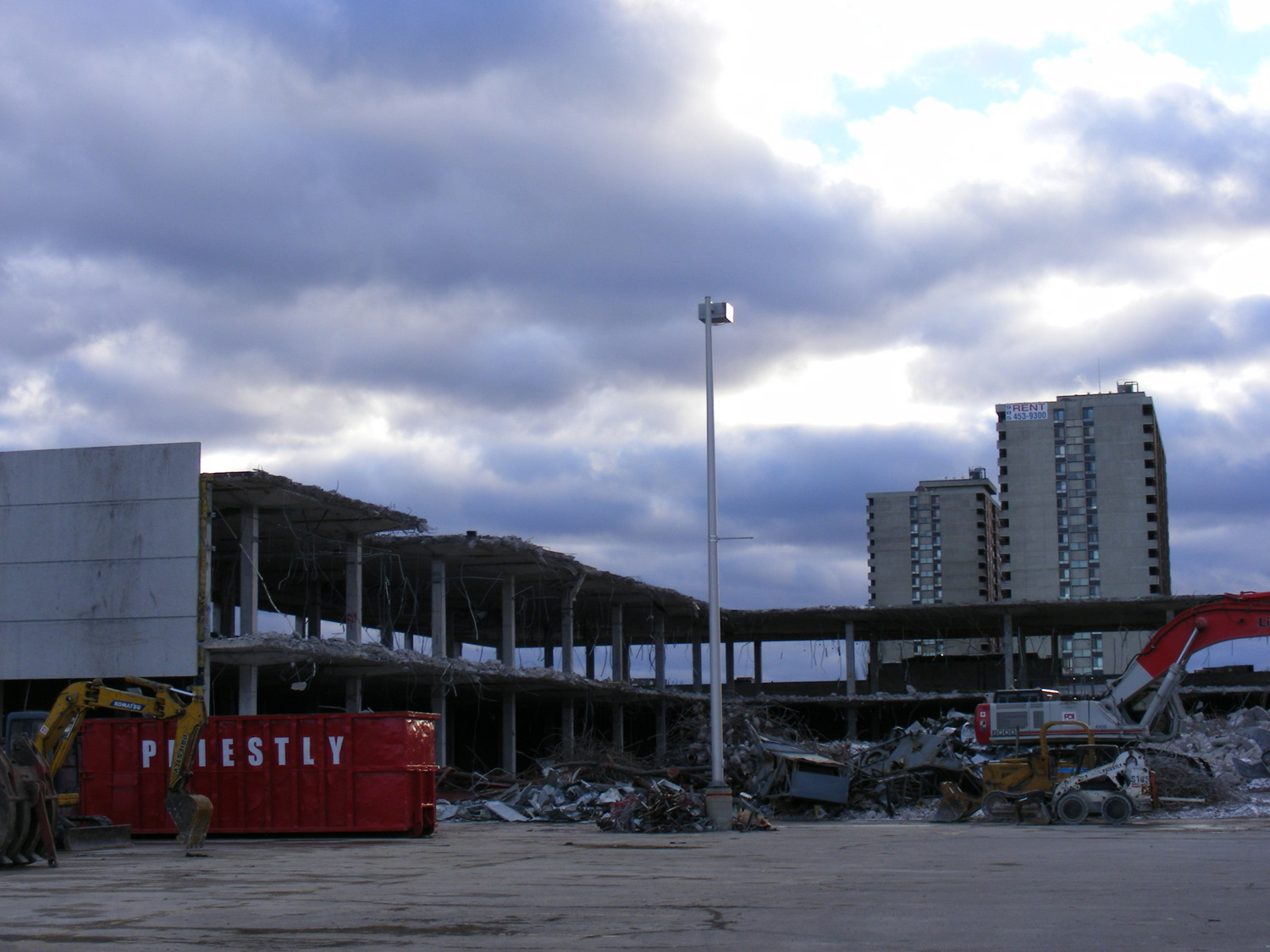
    Demolition of the Shoppers World Simpson’s/The Bay department store in 2010

    Though HBC was sold to a private equity firm in 2008, under CEO Bonnie Brooks’ leadership, there was still life in the department store, with leading stores like the Queen Street flagship upgraded. The fifth floor was a great place to browse for men’s clothes; the seventh floor had an excellent kitchenware department. HBC persisted through the bankruptcy of Eaton’s in 1997-1999 as well the wind-down of Sears Canada that began in 2012 (when it began selling the leases of its urban flagships, including former Eaton’s stores) and concluded in 2018.

    But private equity did what private equity does best: it began selling off the assets and closing down stores, just as Sears did in its last decade. The Zellers discount department store chain was discontinued, with the majority of store leases sold to the ill-fated Target Canada operation in 2011. The Home Outfitters stores were closed in 2019. Real estate was sold off, with HBC leasing back the properties. For example, the Queen Street store was sold to real estate developer Cadillac Fairview — who owns the adjacent Eaton Centre mall — for $650 million in 2014.

    In the last few years, it became clear that the department store chain was in decline. Though pandemic restrictions in 2020 and 2021 had a major effect, the downtown stores also lost office worker patronage. Suppliers were having trouble getting paid and were seizing merchandise at several stores; escalators and elevators were put out of service, and store hours were reduced at most locations.
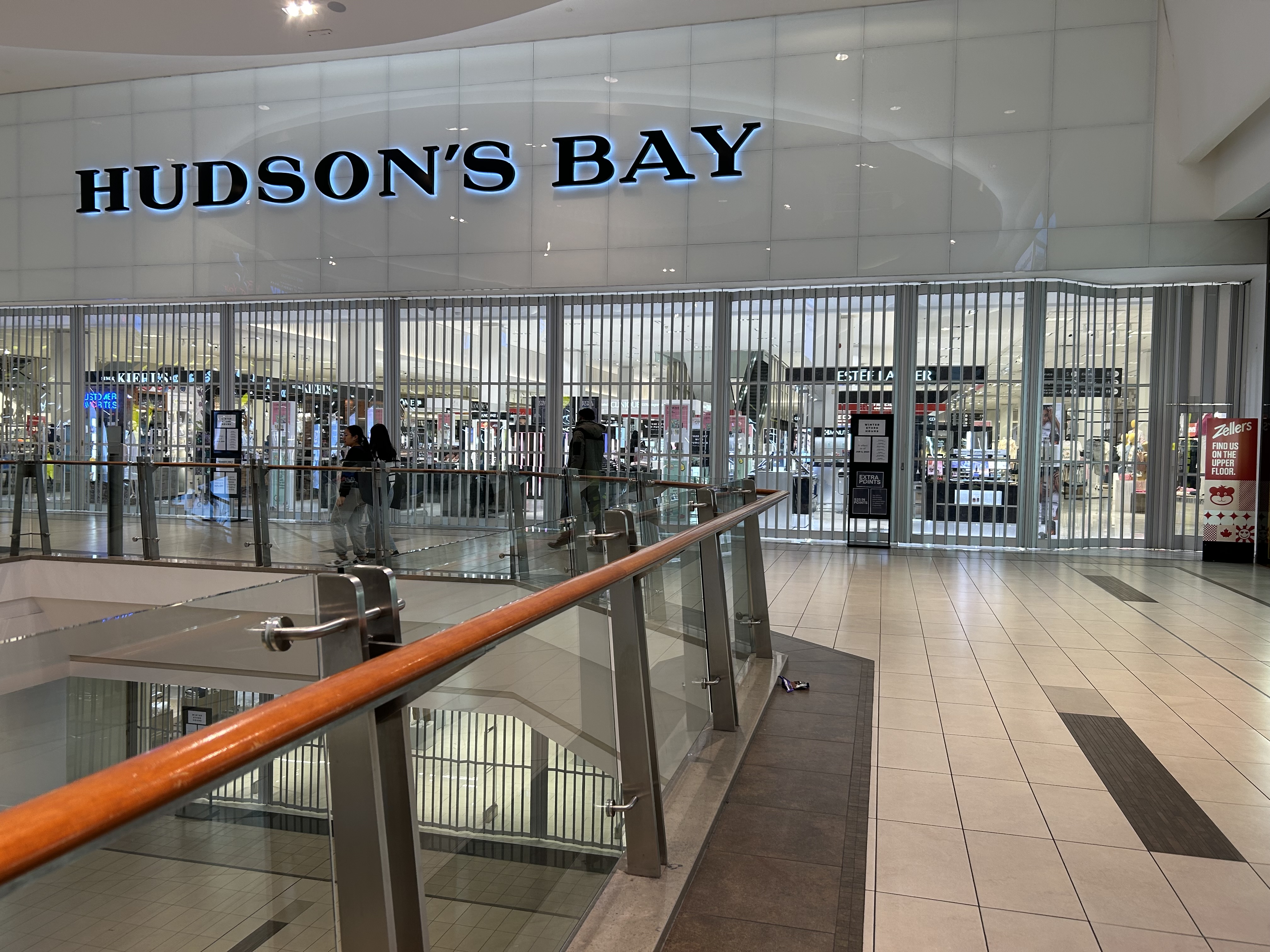
    The Hudson’s Bay store at Scarborough Town Centre closed at 7:00 on a weekday evening in March 2024, even though the rest of the mall remained open for another two hours

    The loss of Canada’s last department store is unfortunate, but it comes as no surprise given the way private equity sucks once-proud businesses dry. The evidence was impossible to miss. How could customers be lured back when escalators were blocked off, marketing non-existent, and store opening hours scaled back? Not even Sears turned off the escalators in its last years.

    I suspect, given the company’s 355-year history, a vestige of HBC will live on, especially in an era of renewed Canadian nationalist. Another business will certainly purchase the name and brand to continue selling the famous point blankets. Though the Queen Street store will certainly be redeveloped by Cadillac Fairview, strict heritage considerations will prevent its complete demolition. The Downtown Winnipeg store, closed in 2020, is already being repurposed into a new hub for Manitoba’s First Nations.

    But it will remain a true shame, as I have always felt there was still a place for a full-service department store in Canada. It only needed to be well managed, relevant, and cared for.
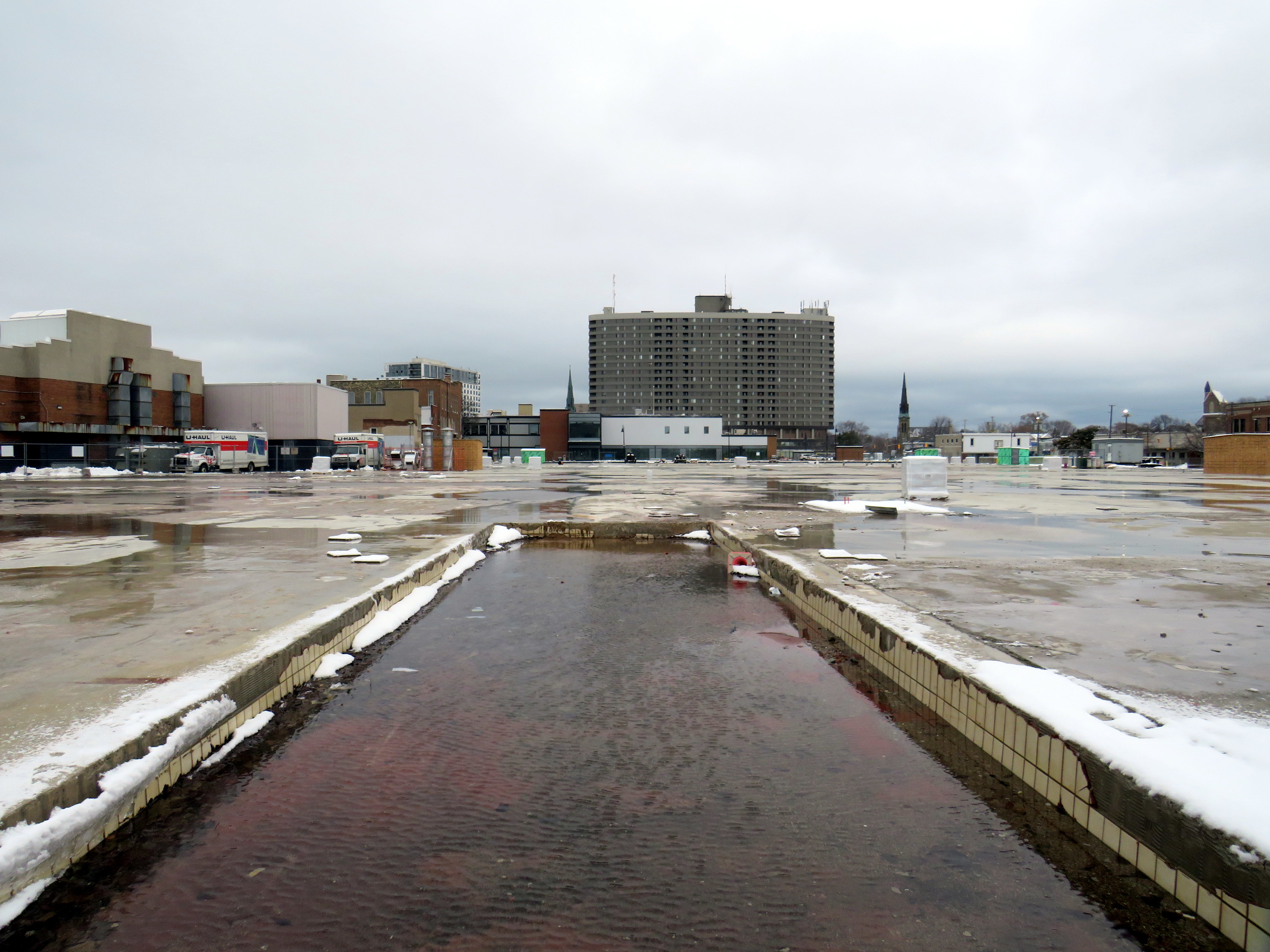
  • The end of Sarnia’s Eaton Centre

    The end of Sarnia’s Eaton Centre

    Late last year, I wrote about the closure of the Hamilton City Centre mall, the last of Ontario’s downtown Eaton Centres to open. But Hamilton’s failed shopping centre wasn’t the only old downtown mall to close in recent years: Sarnia’s Bayside Centre, opened in 1982 as the Sarnia Eaton Centre, was recently demolished, with a seniors’ residence and long-term care home set to take its place.

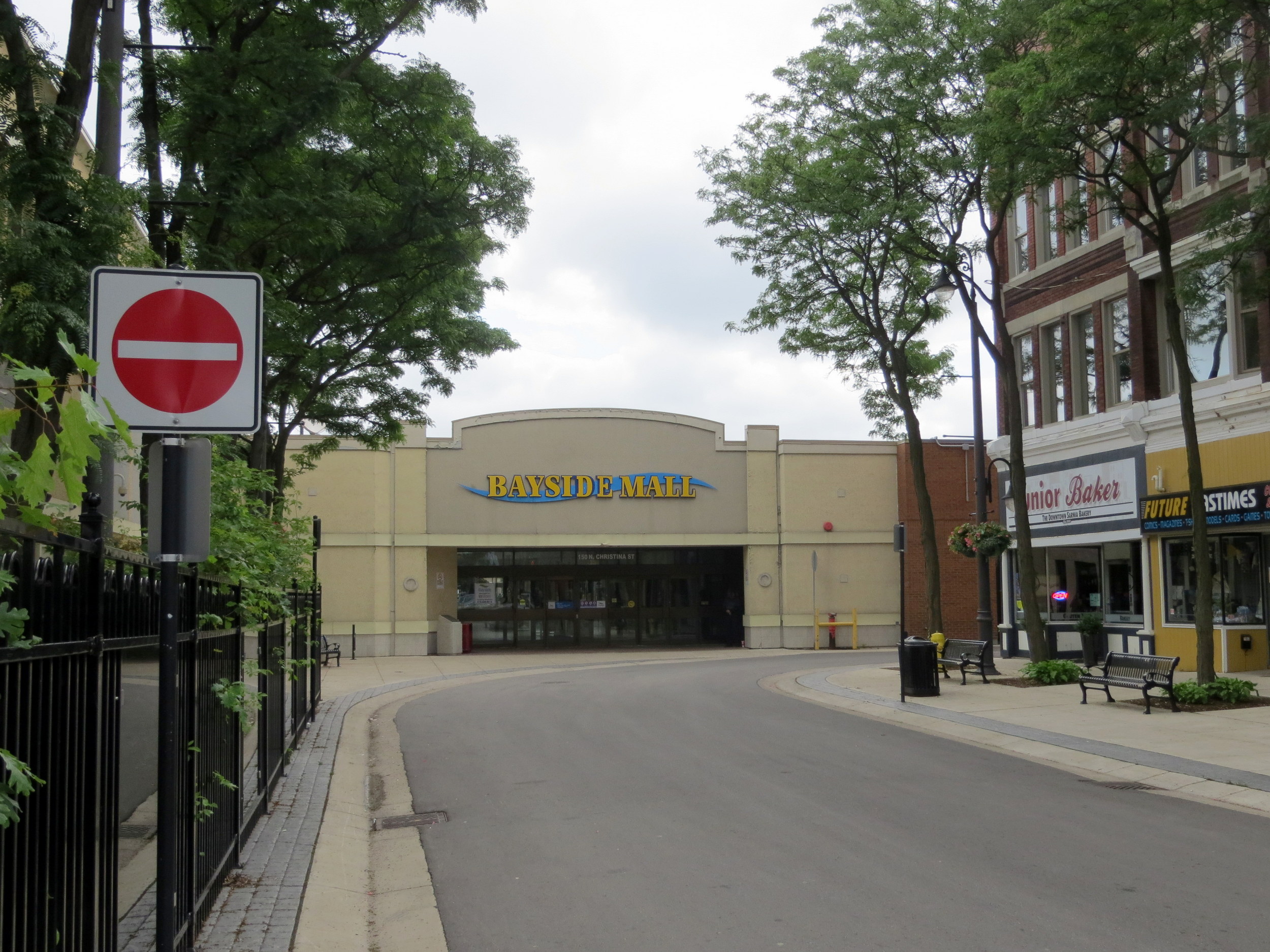
    Bayside Mall in 2013

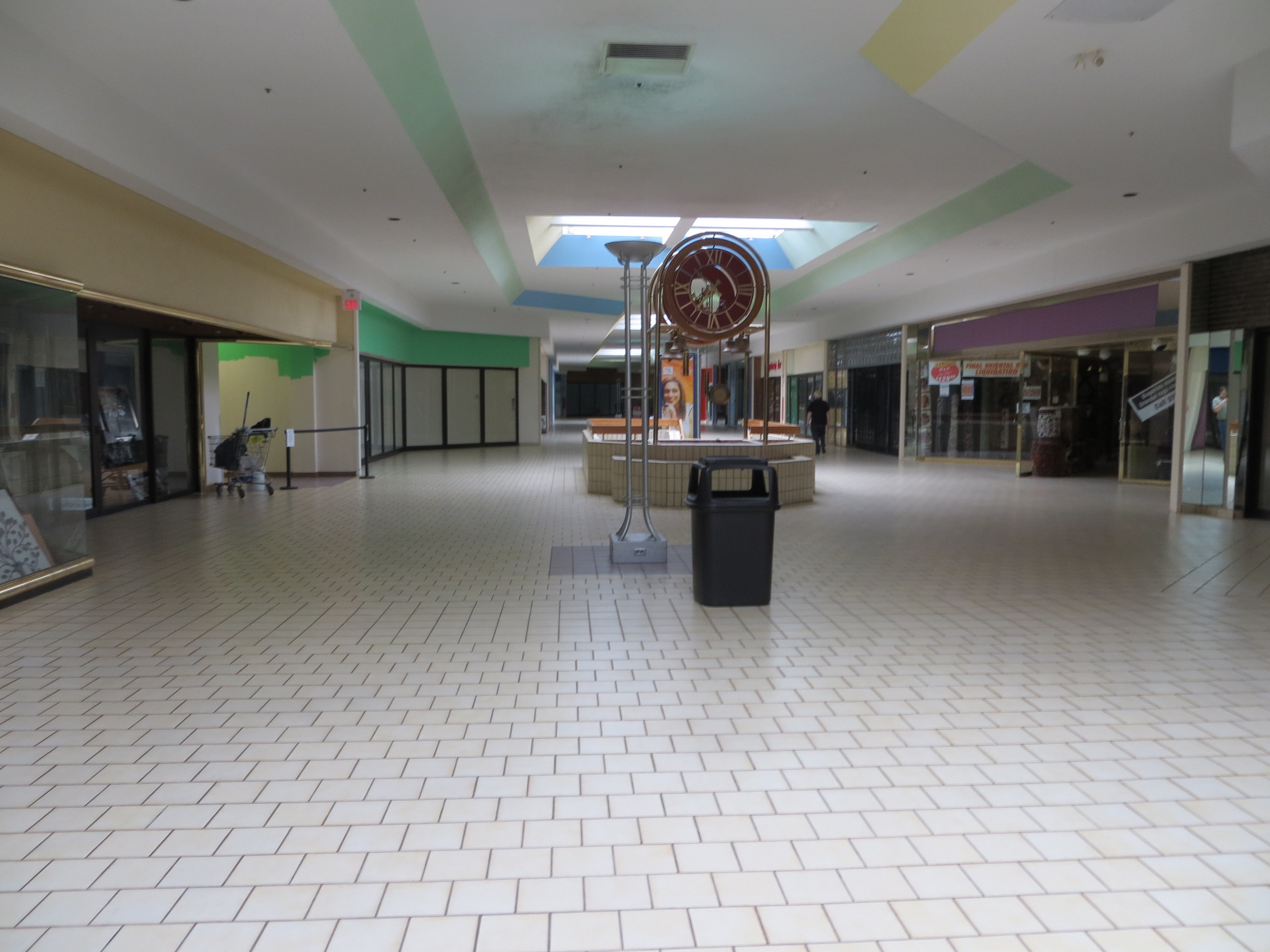
    I previously visited Sarnia’s Bayside Mall in 2013, when the mall was already mostly dead. Community uses, such as a local museum, a Canadian Blood Services clinic, a seniors’ drop-in centre, and a March of Dimes office predominated, with only Hong Kong Express and Subway left in the food court, and a few other shops — a rug store, an optician, a beauty salon, and a pharmacy — scattered amongst the vacant storefronts. The old Eaton’s department store was already converted into offices for Lambton County’s social services department.

    The old fountain at the main entrance to Bayside Mall in 2013.

    As I discussed previously on this website, there was a downtown redevelopment boom across Ontario in the 1970s and 1980s, with municipalities and the province eager to support the construction of new shopping centres to help them compete with suburban malls.

    The Sarnia Eaton Centre was the first of several malls funded by the Ontario Downtown Redevelopment Program, though previous downtown shopping centres, such as Hamilton’s Jackson Square and the Sudbury City Centre, were built with municipal support.

    The case for Sarnia Eaton Centre was always weak, but it was the result of inter-municipal rivalry as much as it was an attempt to revitalize Downtown Sarnia. In the 1970s, Lambton Mall opened in the city’s outskirts, near the intersection of Highways 40 and 402. But Lambton Mall was built outside the city limits, in suburban Sarnia Township. Lambton Mall’s anchors included Sears, Canadian Tire, and Toys R Us.

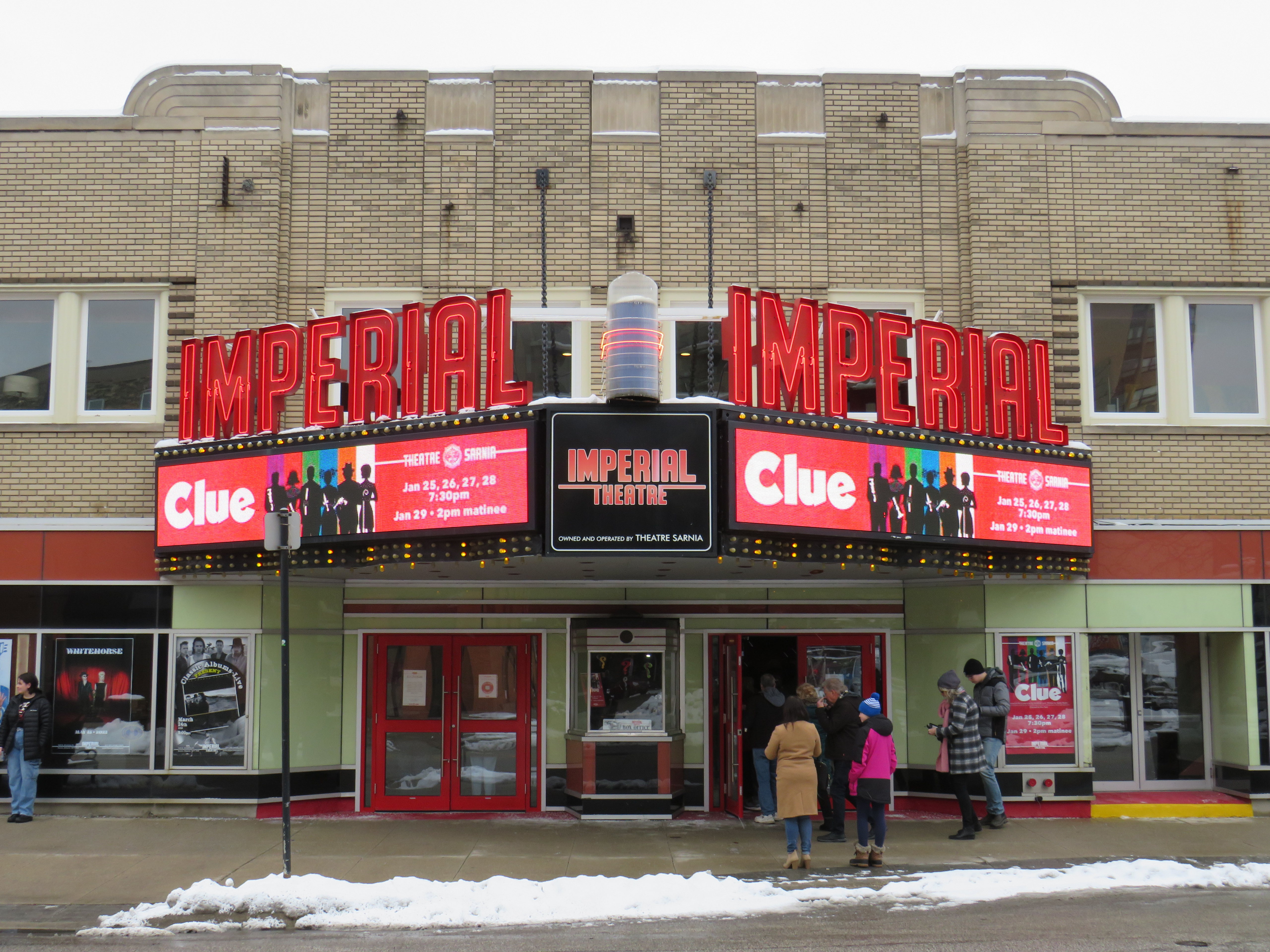
    While Sarnia Township’s population was growing due to residential, industrial, and institutional growth (Lambton College’s main campus was also established in the township, near Lambton Mall), the City of Sarnia’s population declined. Along with the new Eaton Centre, the city also encouraged new highrise residential development in the downtown core, and two new office buildings were also constructed. The city – with support from Imperial Oil, a major employer – renovated the old movie theatre, converting it to a playhouse for local productions and touring shows.

    The Imperial Theatre remains a popular attraction

    When it opened in 1982, Sarnia Eaton Centre was the centrepiece of Sarnia’s downtown comeback. It filled in nearly four blocks of Downtown Sarnia, with Lochiel Street closed between Christina and Vidal Streets, and Victoria Street closed north of Cromwell.

    The mall was anchored, of course, by Eaton’s, a smaller, two-storey store with 91,470 sq. ft. of floor space (just under 8500 square metres), and an A&P supermarket on the southern end. Sarnia Eaton Centre’s 1993 Canadian Directory of Shopping Centres, showed that the mall still had a healthy assortment of national retailers, along with some local businesses. But many retailers refused to renew their store leases, and when Eaton’s entered bankruptcy for the first time in 1997, the Sarnia store was among the first to close.

    The City of Sarnia merged with Sarnia Township in 1991, while the area surrounding Lambton Mall continued to grow as the region’s commercial centre. Big-box stores such as Walmart and Home Depot clustered around the older mall, and even with Sears Canada’s closure, Lambton Mall continued to do well, with Marshalls/Home Sense taking over the old Sears store.

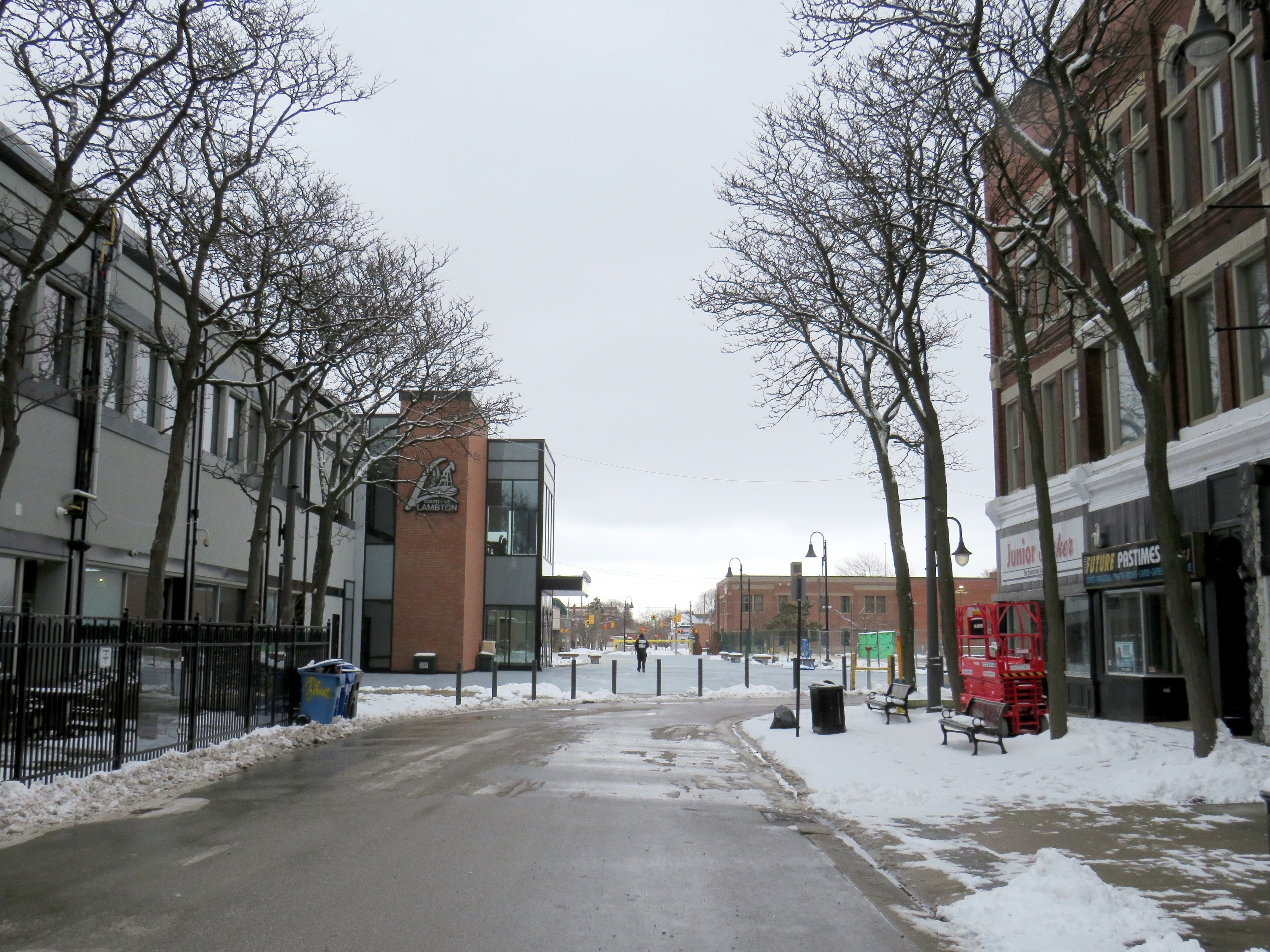
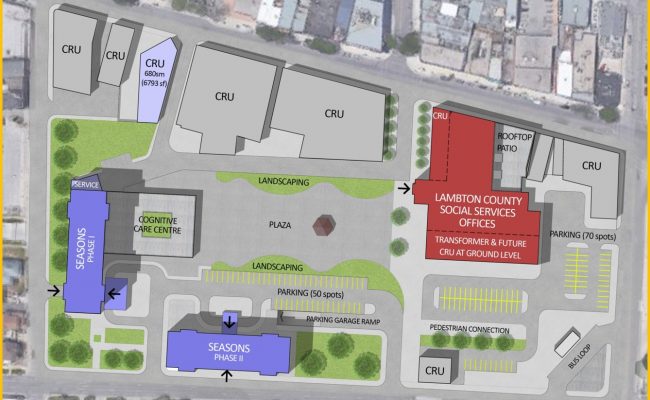
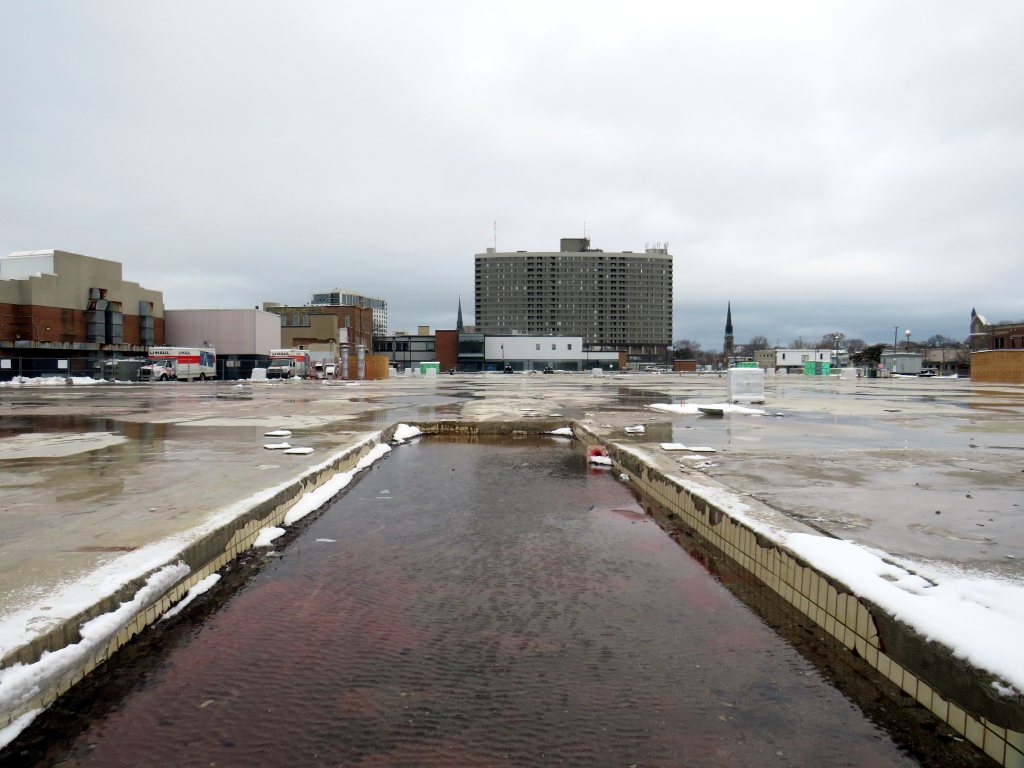
    The Bayside Mall property was purchased by Seasons Retirement Communities in 2017, and most of the mall was demolished in 2021-2022. Lambton County, which operated its social services offices in the former Eaton store, expanded its footprint, with a new municipal courthouse located next to the old Eaton’s store, which was renovated.

    Lochiel Street has been partially restored as a pedestrian walkway across the site, while the southern half of the old mall will be redeveloped for mid-rise seniors’ homes, with a central plaza.

    Map showing the redevelopment of Bayside Mall, with the Lambton County building, in red, already complete in early 2023. The top of the map faces west.

    Bayside Centre is certainly not the only mall property in Ontario to be redeveloped for new housing — Hamilton City Centre will soon come down for similar reasons, and other older malls will soon follow — but it’s among the first.

    Meanwhile, Downtown Sarnia will continue to hold its own. It has a few nice restaurants, cafes and pubs, and the highrise development of the 1970s and 1980s ensures that there’s a local population that will frequent the businesses there. The addition of seniors housing won’t hurt either.


    Below is the list of tenants at Sarnia Eaton Centre in 1992, obtained from the 1993 Canadian Directory of Shopping Centres, published by Maclean-Hunter. In 1992, the collection of retailers was still quite strong, largely driven by Cadillac Fairview’s leasing team.

    Anchors

    A&P (26,512 sq ft), Eaton’s (91,470 sq. ft)

    Fashions and footwear
    Children’s wear: Just Kids
    Unisex/family wear: Le Chateau, D’Gala, Pantorama, Stitches, Thrifty’s
    Ladies’ wear: Fairweather, Irene Hill, Just Petites Lady Foot Locker, Lindor, Reitmans, Smart Set, Suzy Shier
    Menswear: Tip Top
    Footwear/leather goods: Agnew, Baronessa, Bata, Belinda & Brother, Joggers, Kinney, Mr. Minit Shore Repair
    Jewellery/accessories: Ardene, People’s

    Other retailers
    Books/stationery: Carlton Cards, Garfield, WH Smith
    Health and beauty: Caryl Baker Visage, Shoppers Drug Mart
    Department store/mass merchandiser: Marks & Spencer, A Buck Or Two
    Electronics: Radio Shack
    Entertainment: Fun & Games
    Furniture & furnishings: Brass Collections
    Gifts: Things Engraved
    Hardware/paint & paper: St. Clair Paint and Wallpaper
    Housewares: The Royal Douton Store, Stokes
    Music/ records & tapes: Discus, Music World
    Pets: Tropicarium Pet Centre
    Photo/camera: Black’s, Japan Camera
    Restaurants & fast food: Elephant & Castle, Global Donuts, Hamby’s, Hong Kong Express, Kernels, Mykie’s, Viva Pasta
    Specialty food & drink: Laura Secord, mmmarvellous mmmuffins, Second Cup

    Services
    Banks/financial: Canada Trust, TD Bank
    Hairstyling/esthetics: Regis Hairstylists
    Medical/dental: Tridont Dental
    Travel: Marlin Travel
    Misc: Infoplace

  • The end of another Eaton Centre

    The end of another Eaton Centre

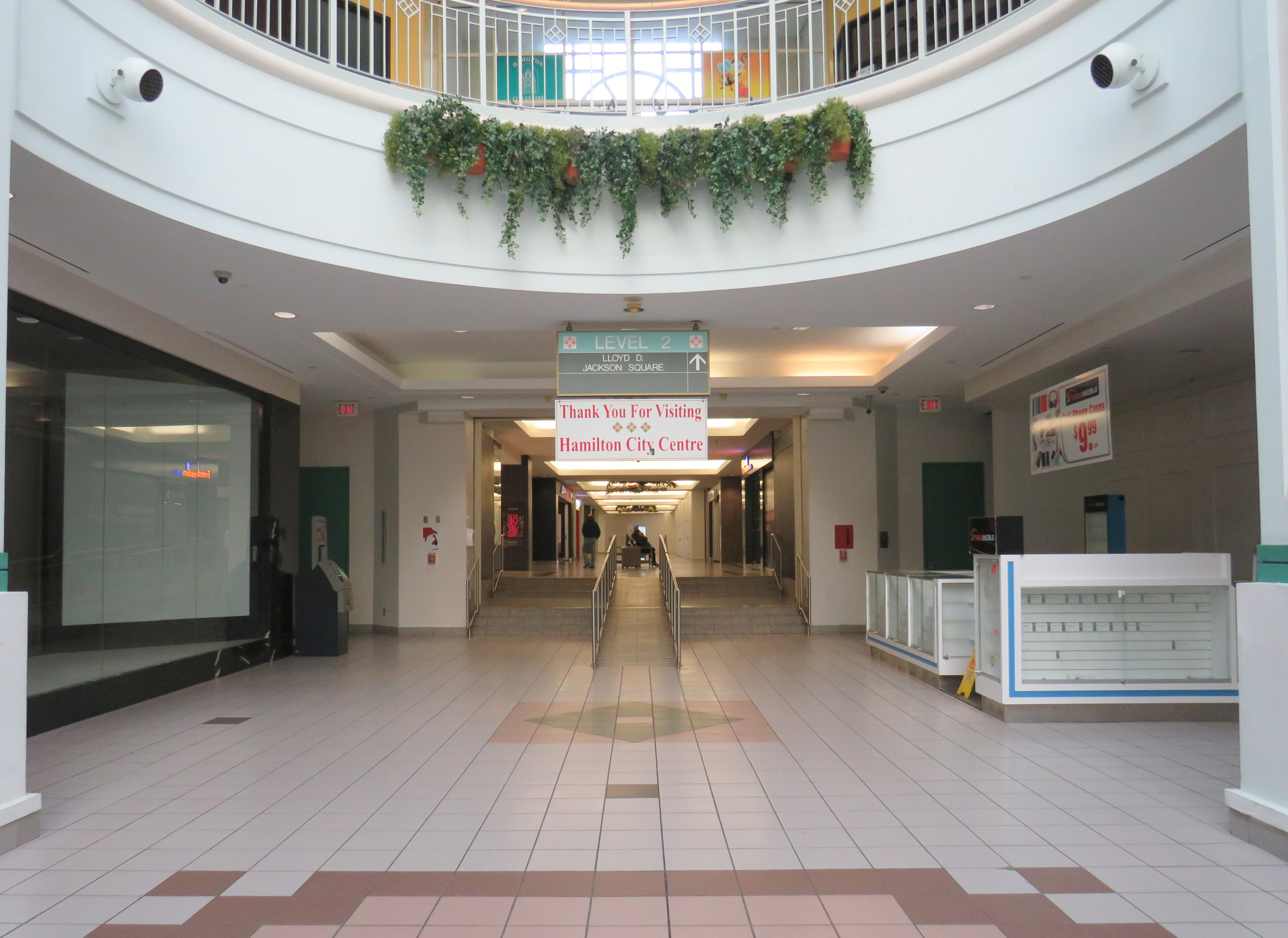
    Main entrance to Hamilton City Centre, on James Street North. Note the awkward spacing of “City” over the entrance; it originally read “Eaton.”

    On December 26, 2022, Hamilton’s former Eaton Centre, opened just 32 years ago, will close for good. Early in the new year, demolition will begin on the failed downtown mall, making way for a new residential development.

    Hamilton Eaton Centre, fully opened in October 1990, was one of several downtown malls built in Ontario through a partnership between Eaton’s and commercial developer Cadillac Fairview, hoping to replicate the success of the Toronto Eaton Centre, which opened in phases between 1977 and 1979. It was the second major shopping centre to open in Downtown Hamilton; it followed the construction of the massive city-led Jackson Square development in the 1970s and 1980s in which entire city blocks were cleared to make way for urban renewal.

    With support from the Ontario and municipal governments, the T. Eaton Company and Cadillac Fairview built new malls in Ottawa, Peterborough, Brantford, Kitchener, Thunder Bay, Sudbury, Sarnia, Hamilton, and expanded London’s existing Wellington Square. These private-public partnerships seemed to be beneficial; smaller cities worried about the decline of their downtowns would get an attractive new shopping centre after expropriating and demolishing existing buildings and/or providing municipal lands for the project. The municipality would finance new parking garages to support the new development. Meanwhile, Eaton’s would help finance the construction and provide a lead anchor for the new development. Cadillac Fairview, which specialized in retail and office development, would arrange the construction and the leasing for the mall stores. (There were a few downtown shopping centre projects in Ontario that did not have Eaton’s involvement, including malls in Chatham, Cornwall, Tillsonburg, and Waterloo.)

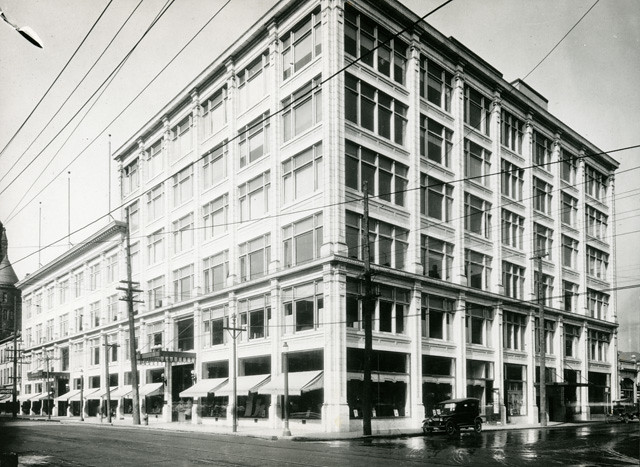
    The old Eaton’s Hamilton Store in the 1920s, looking southwest from James Street North and (now disappeared) Merrick Street (Hamilton Public Library)

    Unlike malls in Kitchener, Sarnia, Brantford, or Guelph, the Hamilton Eaton Centre was mostly built upon lands already acquired by Eaton’s itself, much like the larger and more successful Toronto Eaton Centre (the city of Hamilton assisted by closing Merrick Street between York Boulevard and James Street and transferring the right-of-way for the new development). The first phase of the project, built on the site of the Merrick Street parking garage and the old Hamilton Farmers Market, became the home of a new four-storey Eaton’s store to replace the dilapidated building on James Street. When the new store opened in April 1989, the old store was quickly demolished to make way for the mall itself, which opened just 18 months later.

    The new Eaton’s Hamilton store on York Boulevard soon after opening in 1989. The store had exits to both Jackson Square and once completed, the new Eaton Centre mall. (Hamilton Public Library)

    At first, Hamilton’s Eaton Centre was able to attract prestigious tenants such as HMV and Eddie Bauer thanks to Cadillac Fairview’s expertise and new office development in Downtown Hamilton, including a new CIBC office complex. The new mall was also able to attract existing downtown businesses out of storefront retail and the older Jackson Square mall.

    YouTube video showing the exterior and interior of the old Downtown Hamilton Eaton’s store prior to closing, as well as its demolition in 1989 to make way for the new Hamilton Eaton Centre (via Hamilton Sight & Sound YouTube channel)

    However, as I discussed previously on this website, the malls developed by Eaton’s and Cadillac Fairview did not do well in most markets. New, full-line Eaton’s stores were a poor fit for smaller, industrial cities like Peterborough, Brantford, and Sarnia. The malls themselves were more difficult to get to by car, and shoppers usually had to pay for parking. The established suburban malls were typically larger, and they offered ample free parking. By 1990, the old, large industries were in decline due to free trade and industrial automation, and in the 1990s, a new retail format — the big box “power centre” — emerged as serious competition during a major recession. And in 1994, Walmart entered the Canadian market.

    The former Hamilton Eaton Centre (known as Hamilton City Centre since 2000) from the corner of James Street North and York Boulevard. The clocktower on the corner is an homage to the old Hamilton City Hall, which was demolished in 1960. The clocks themselves were originally installed in the old city hall and will be preserved when the current building is demolished.

    With low traffic and many national retailers unwilling to renew their leases, Cadillac Fairview divested itself of most of its downtown malls. It sold its half-stake of Hamilton’s Eaton Centre to the T. Eaton Company in 1995 (Of its downtown malls, Cadillac Fairview would only hold onto the flagship Toronto Eaton Centre, and the Rideau Centre in Ottawa). According to a Hamilton Spectator article from that year, one of the mall’s three floors was already closed, just five years after its grand opening.1 Among the tenants that left the mall early was upscale men’s clothier Harry Rosen. By 1996, only 50 of the 120 stores outside the Eaton’s department store were still occupied, with another six stores closing early that year.2 A McMaster University business school lecturer predicted that one of the two downtown malls — Eaton Centre or Jackson Square — would close within 10 years. (He was only 15 years off the mark.)2

    In February 1997 — after years of mismanagement and neglect by the fourth generation of the Eaton family — Eaton’s entered bankruptcy protection, allowing it to settle debts and restructure. Though stores in other downtown malls in Brantford, Sarnia, and Kitchener were among the first to go, the Downtown Hamilton store was left off the closure lists, as Eaton’s itself owned the property – losing the department store anchor would not help the mall in case of a property sale. In the meantime, Metrus Developments — which purchased the neighbouring Lister Block in 1989 — evicted its remaining tenants and boarded up the six-storey commercial building, hastening Downtown Hamilton’s visual and commercial decline.

    In 1998, the Region of Hamilton-Wentworth (dissolved in 2001 after amalgamation) began leasing space on the formerly vacant third floor of Hamilton Eaton Centre, partly to help maintain the department store’s presence and support Eaton’s, which still owned the property. The City of Hamilton agreed to provide two hours of free parking at the attached York Boulevard garage and planned for the construction of a new store entrance to the Hamilton Farmers’ Market. This was just enough to keep the department store open until the company collapsed in 1999; the store closed for good in October of that year. The mall was rebranded Hamilton City Centre the year after, sold to a private real estate firm.

    View from the third floor in Hamilton City Centre; the conversion of retail space to offices on the top level is apparent
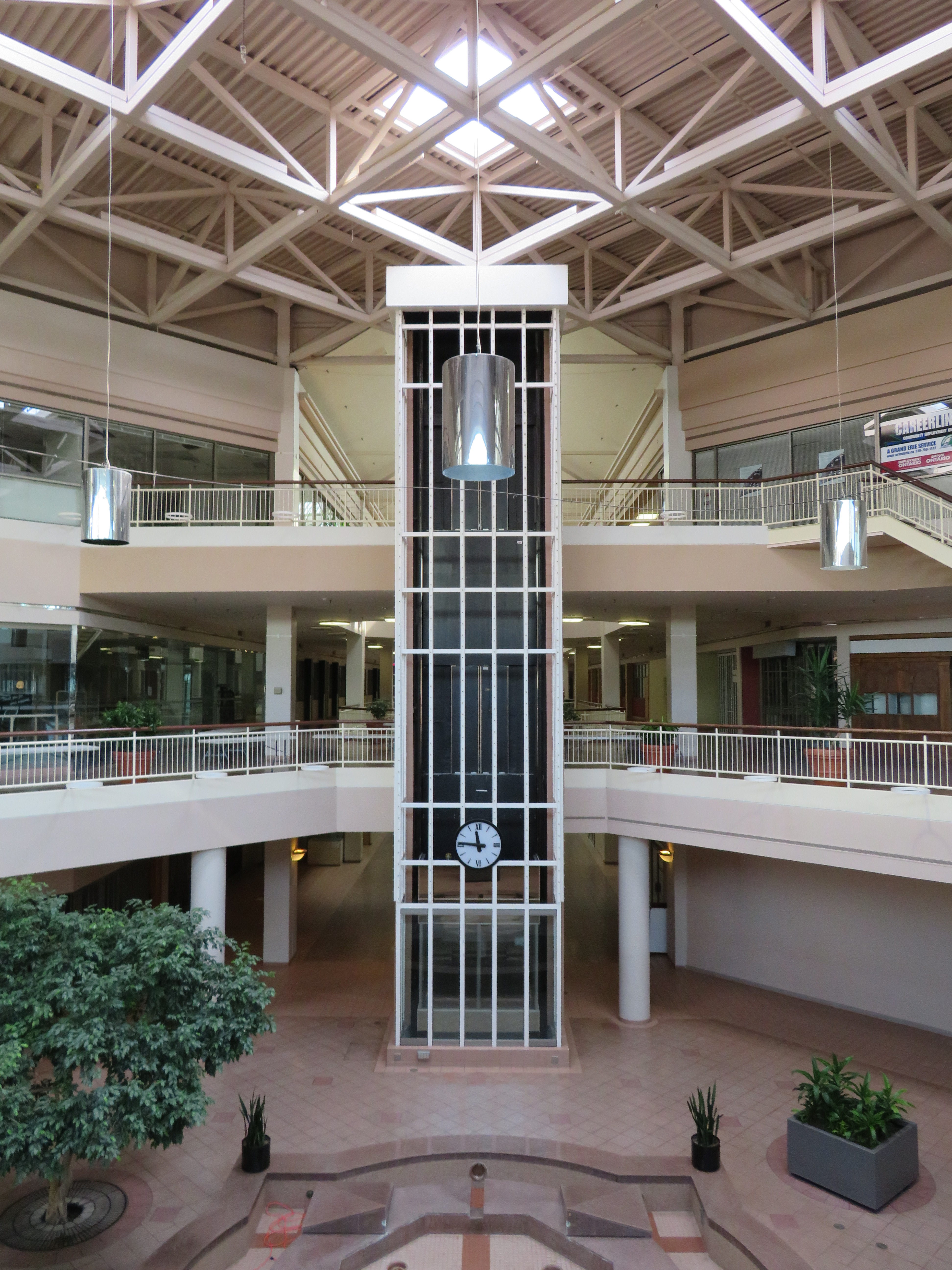
    The central atrium. All remaining stores must close by December 26, 2022.
    The connection between Hamilton City Centre and Jackson Square. This was originally the main route between the old Eaton’s store and the first phase of the 1970s-era mall. The larger Jackson Square will undoubtedly benefit from the residential re-development of the Eaton’s site.

    After Eaton’s closed, part of the massive retail space was renovated and turned into a fitness club. The City of Hamilton leased additional space in the old Eaton’s store, especially as it undertook renovations to its modernist 1960s-era city hall. New windows were punched into the brick facade to provide natural light to the new occupants. But the remaining national retailers like HMV, Fairweather, and Eddie Bauer left the mall, while a few small, independent retailers came in, attracted by cheap rents.

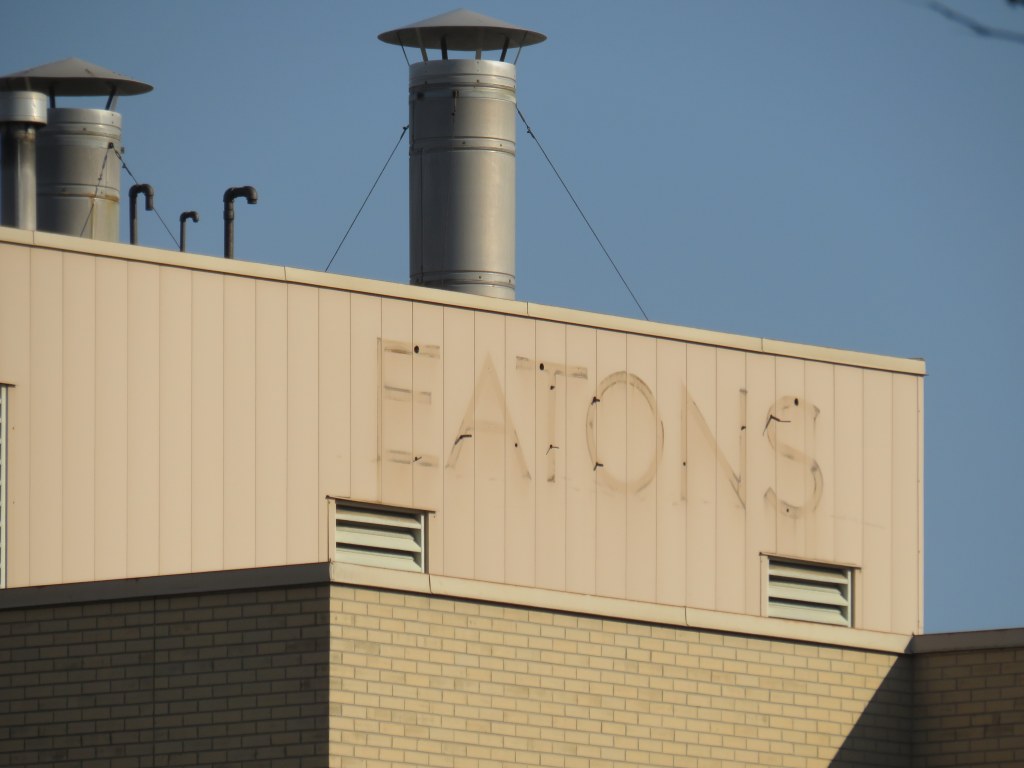
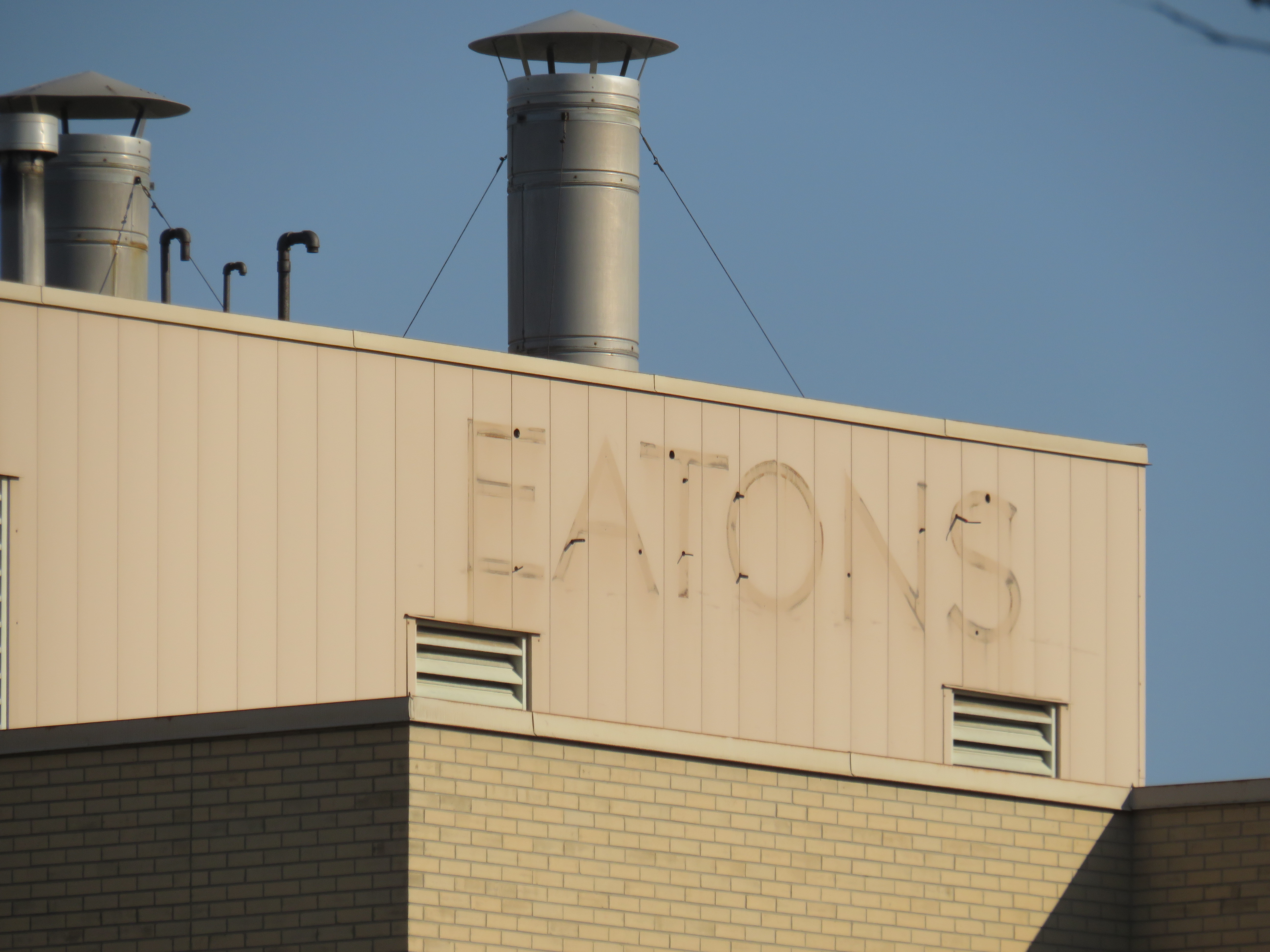
    A fresh labelscar on the south-facing roof of the Eaton’s store, as seen from the patio on top of Jackson Square. Until 2021, a forgotten and unmaintained Eaton’s sign was left alone, hidden from street level.

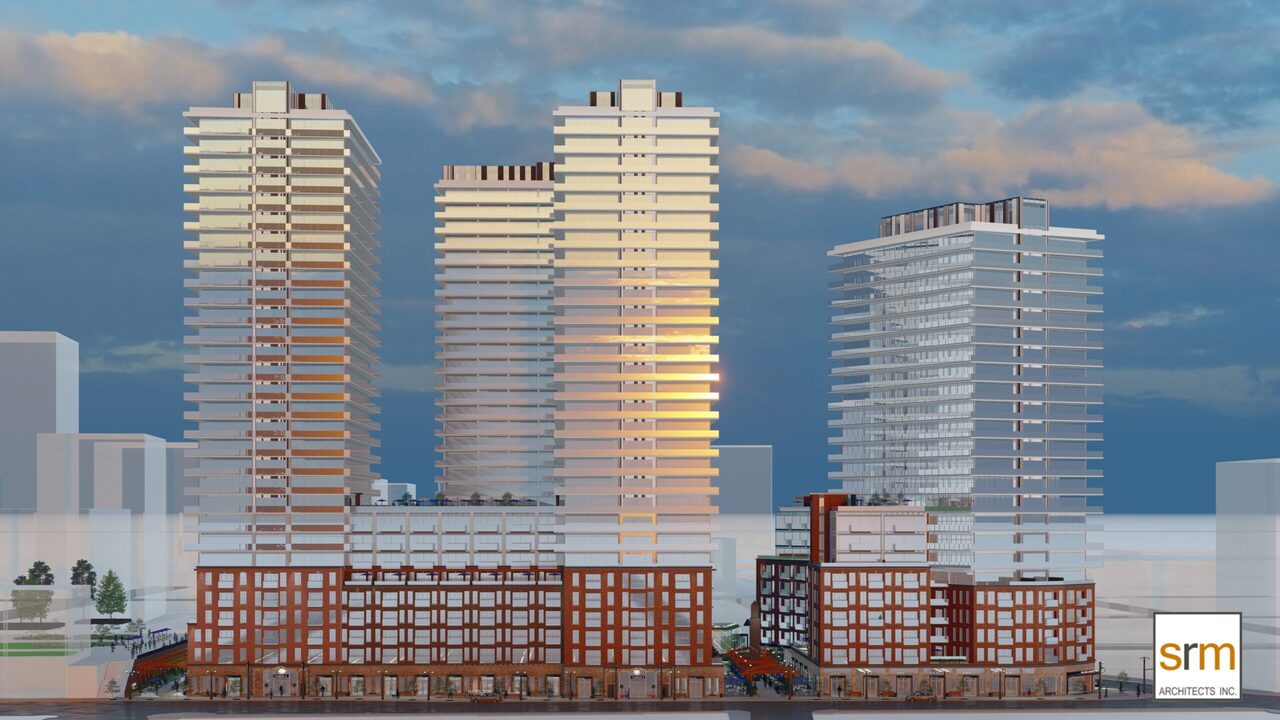
    The new development will have 1,940 residential apartments, along with street-level retail and office spaces, constructed in three phases. Walkways will allow the public to cut through the property, with one of those roughly following the old Merrick Street alignment. Unfortunately, it is being developed and planned independently of the rest of the Jackson Square superblock bound by James, King, and Bay Streets, and York Boulevard, and which also contains the farmers market, the central library, and Copps Coliseum, the sports venue built for an NHL franchise that never arrived.

    But with the influx of new residents, Jackson Square — which, despite is retail vacancies, holds its own due to the attached office, hotel, and civic functions, as well as the full-service Nations supermarket — will only benefit from the demise of its newer downtown competitor.

    Rendering for the new development on the Eaton Centre site by SRM Architects.
    1. “Eaton eyes the future after buying centre” Hamilton Spectator 13 July 1995: D12.
    2. John Burman. “A tough sell: Struggling Eaton Centre looks for new direction” Hamilton Spectator  13 Feb 1996: A1
  • Brantford’s downtown was the “worst in Canada” – but has it bounced back?

    IMG_7684-001
    Interior of former Eaton Market Square, 2018

    On Labour Day weekend, I paid a visit to Brantford. I brought my bike on GO Transit, taking a train to Aldershot and a bus from there to the Telephone City. I then biked from Brantford to Hamilton on one of Ontario’s best rail trails.

    Over a decade ago, Mayor Chris Friel called Brantford “the worst downtown in Canada.” It was not hard to understand why. Colborne Street, Brantford’s main street, was lined with neglected commercial buildings, many with boarded up streetfronts. In the 1990s, many of the plywood hoardings had been decorated with pretend business names and silhouettes of customers, either as an attempt at beautifying the street or recalling the variety of businesses that had once occupied the strip. Only a few stores and restaurants remained open.

    4360965559_d1aa044078_o.jpgBoarded up storefront, Colborne Street, 2010

    There were several reasons for Downtown Brantford’s decline. In the 1980s, Brantford’s major industries, including the once-mighty Massey-Ferguson, had shut down local operations. Other industries like Cockshutt (later White Farm Equipment) had also departed Brantford. By the early 1990s, the unemployment rate hit 24 per cent.

    Cockshutt plant offices in 2004, and the remains in 2018

    The city also made some questionable urban renewal decisions. The old open-air marketplace at Colborne and Market Street, along with a whole city block was cleared for Eaton Market Square, which opened in 1986. The city also built a new parking structure to the south, as well as a new office building across the street from the new mall. Like most downtown malls built in Ontario, Eaton Market Square was a commercial failure. Brantford already had two suburban malls — Lyndon Park Mall, anchored by Sears, and Brantford Mall, anchored by the Right House, a Hamilton-based department store, Woolco and Loblaws.

    While parking at the suburban malls was free and plentiful, customers had to pay to park downtown, and Eaton’s in the 1980s was too upmarket for a smaller, blue collar city. Brantford’s downtown parking garage, built by the municipality, was to be paid for with parking fees.

    IMG_7686-001
    Eaton Market Place dropped the Eaton name after its anchor closed, but the mall’s past has since revealed itself

    While Eaton Market Square brought in many of the remaining retailers that were left on Colborne Street when the mall opened, as the mall floundered, most major tenants left as soon as their leases were due for renewal. By 1997, when Eaton’s entered bankrupcy and closed the Brantford store, many of the other shops had already closed.

    But the mall wasn’t the only thing Brantford officials did to try to revitalize its city centre.

    Like Flint, Michigan’s efforts to attract tourists and shoppers downtown coincident with the decline of its manufacturing base (described in Michael Moore’s film Roger and Me), Brantford pursued other projects along with the new mall to revitalize its downtown core. The provincial government planned a new electronic processing centre, but was cancelled by the NDP-led government in the early 1990s due to budget pressures.

    Icomm was to be a new telecommunications museum, science centre, and research hub, built on an old industrial site just south of downtown. While the building was completed in the early 1990s, it was left vacant after Bell Canada pulled its funding for the venture. Though city officials hoped for a post secondary educational institution, the Icomm building became a casino. Next to the casino, a commercial plaza, including a supermarket, fast food restaurants and a LCBO store was built, along with free surface parking.

    IMG_7676-001.JPGMarket Square

    Eventually, Brantford found a viable solution for revitalizing its downtown core. In 1999, Wilfrid Laurier University opened a satellite campus, starting out in the old Carnegie Library sold by the city for $1. By 2002, there were 340 students; today, enrollment is  about 3,000. Laurier now owns dozens of building downtown, including a previously abandoned movie theatre, and even the old old Eaton Market Square building. Hundreds of students live in local residences.

    IMG_7664-001The old Carnegie Library, Brantford

    Yet, there is still little retail downtown, though there are now several newer restaurants, bars, and coffee shops.

    It hasn’t been all good news. Nipissing University, based in North Bay, also established a satellite campus in Brantford. In December 2014 it announced that it would be winding down its presence there, including its joint programs with Laurier. The Ministry of Education had capped the number of funded spaces for Bachelor of Education students and reduced funding for the program. The joint programs were one of Brantford-Laurier’s main draws.

    4360965043_88fea24940_o.jpgColborne Street, January 2010

    Meanwhile Colborne Street continued to languish. In 2010, the city expropriated and demolished the entire south side of the street, including several commercial blocks still occupied. A new joint Laurier-YMCA athletics and recreation facility was built on the site, which will open by the end of the year. Sadly, the new building contributes very little to Brantford’s main street.

    IMG_7674-001The architecture of the new YMCA-Laurier athletic building is sterile compared to the old Colborne Street storefronts
    At the least, Laurier’s Brantford campus has brought some life back to a moribund downtown core that suffered through misguided urban renewal schemes, a major restructuring of the local economy, competition from suburban retail developments, and urban neglect.

    But a satellite post-secondary institution on its own isn’t necessarily a panacea for other suffering downtowns. As Norma Zminkowska pointed out recently in an article for TVO, satellite campuses aren’t necessarily permanent boosts to the local economy. In Barrie and Bracebridge, small campuses were closed for financial reasons. They weren’t able to attract enough students. Small campuses, especially those with fewer than 3500 students, often struggle to attract students and faculty — and scattering programs can weaken the institution. This is a warning worth considering as Laurier plans another satellite campus in Milton and Ryerson plans its second campus in Downtown Brampton.


    As an aside, Brantford is an interesting town, and is well-positioned at the junction of three major cycling trails connecting it to Cambridge and Kitchener-Waterloo to the north, Simcoe and Port Dover to the south, and Hamilton to the east. The Hamilton-Brantford Rail Trail is one of Ontario’s best trails, in excellent condition, and a gentle grade climbing the Niagara Escarpment.

    IMG_4333
    Hamilton-Brantford Rail Trail

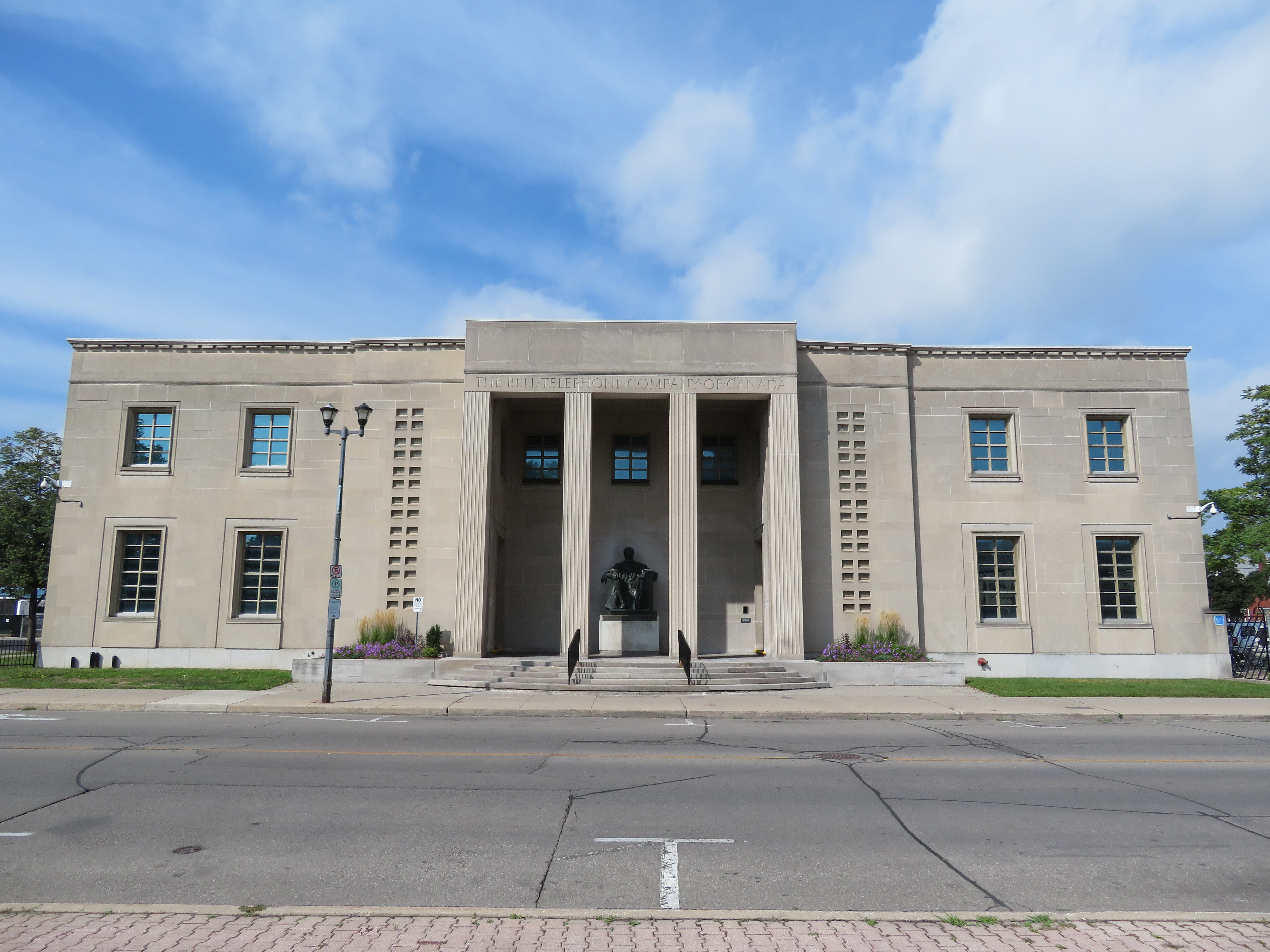
    Within Brantford itself, there are several interesting sights. The Bell Telephone building features a statue of Alexander Graham Bell, who resided just outside of town for a number of years. The world’s first long-distance telephone call was made between nearby Paris, Ontario and Brantford in 1876. The area surrounding Victoria Square north of Colborne Street and the mall is reminiscent of a New England town square.

    IMG_7649.JPGBell Telephone Building

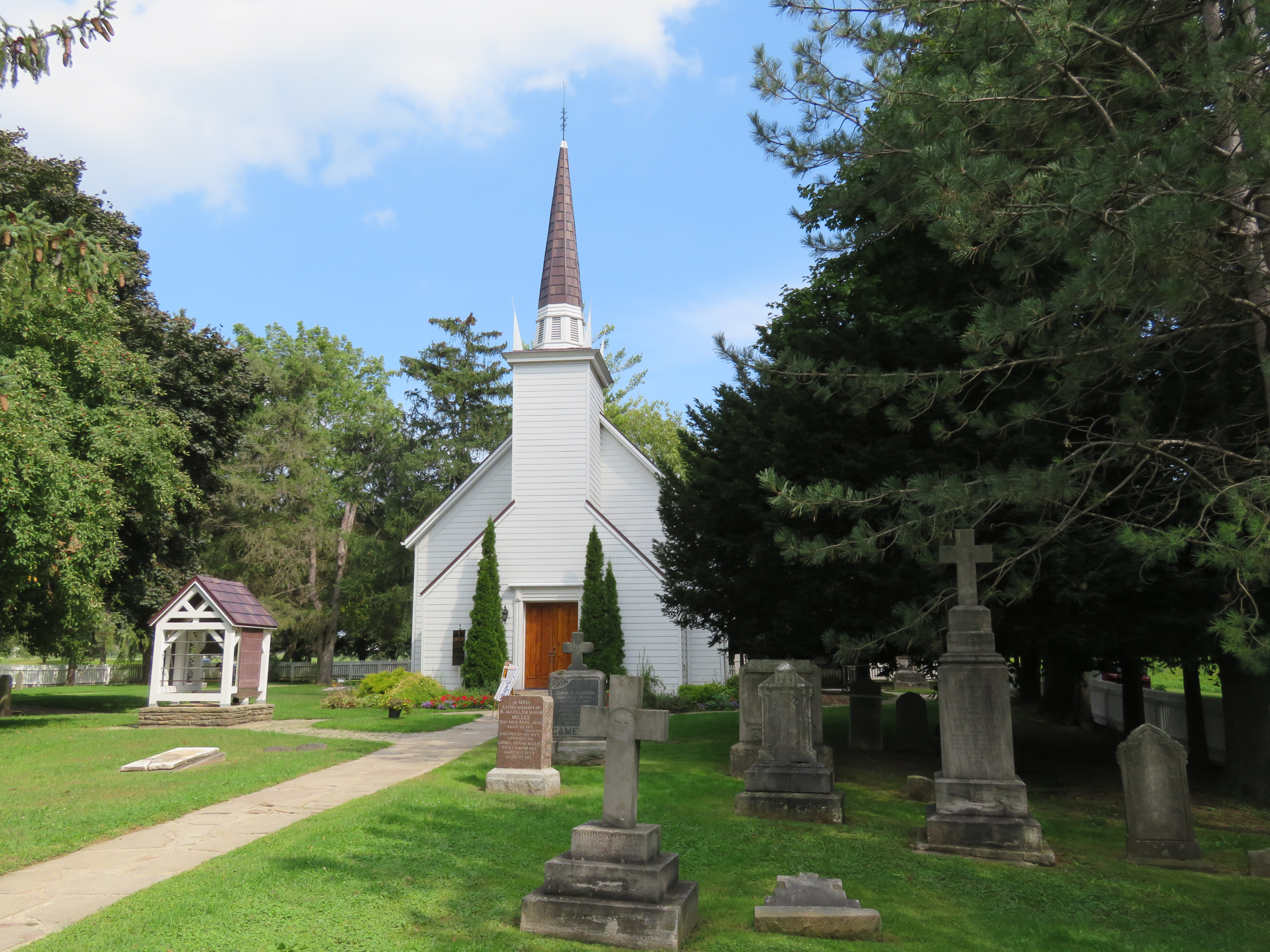
    Brantford was named for Joseph Brant, the anglicized name given to Thayendanegea, the Mohawk leader who allied with the British in the American War of Independence. His community, which previously resided in what is now Upstate New York, was given a large land grant on the Grand River. That land grant shrunk to what is now Six Nations. Her Majesty’s Royal Chapel of the Mohawks is one of the oldest buildings in Ontario, built in 1785. It is worth a visit. Nearby, the Woodland Cultural Centre is a museum and art gallery housed in a former residential school. The museum is dedicated to the history and future of the province’s First Nations.

    IMG_7727.JPGHer Majesty’s Royal Chapel of the Mohawks

    IMG_7709-001.JPGWoodland Cultural Centre. This building formerly housed the Mohawk Institute, one of many residential schools built as part of Canada’s shameful attempts at eradicating Indigenous heritage. It is now a First Nations museum and art gallery. 


  • Ontario’s failed downtown malls

    IMG_0392.JPG
    Bayside Mall, formerly the Sarnia Eaton Centre, on a Saturday morning in 2013. Most stores are vacant or occupied by non-profits or independent businesses.

    The Toronto Eaton Centre, large, famous, and vital, is only one of many malls built in the downtown cores of Ontario cities between the 1960s and 1990s. From Thunder Bay to Cornwall, the construction of new enclosed shopping centres were seen as a necessary tool to keep the old city centres vibrant and relevant in the face of competition from new suburban malls. But only in the province’s two largest cities did the concept work. Elsewhere, these urban shopping complexes were left largely vacant within ten years of opening, when leases expired. When the Eaton’s department chain went bankrupt in 1997, huge voids were left behind that developers and municipalities struggled to fill.

    The Toronto Eaton Centre was opened in two phases between 1977 and 1979. It added hundreds of shops and new office space to Downtown Toronto, anchored by a new Eaton’s flagship and was connected to the Simpson’s store across Queen Street. Today, the Eaton Centre is Canada’s second largest mall (including the Hudson’s Bay/Saks Fifth Avenue building) and the Toronto region’s second most productive shopping centre in terms of sales per square metre. In Ottawa, the downtown Rideau Centre, opened in 1983, is the busiest and most productive mall in that region (Retail Council of Canada, 2016).

    But elsewhere in Ontario, downtown malls — mostly built with municipal and/or provincial government support — have been, without exception, commercial and urban development failures. Not only did they suffer from high vacancy rates, they helped to wreck the downtown cores they are located in rather than foster the economic revitalization they once promised.

    (more…)