Tag: Matt Elliott

  • Mapping Mayor Tory’s support on Council

    Matt Elliott, columnist for Metro Toronto, is one of Toronto’s greatest observers of local politics. One great service that he does is keep track of all important votes at Toronto City Hall. Originally, this work tracked each councillors’ support for Mayor Rob Ford from 2010 through 2014; now his scorecard tracks how each councillor voted according to Mayor John Tory’s agenda. The Council Scorecard spreadsheet is available here.

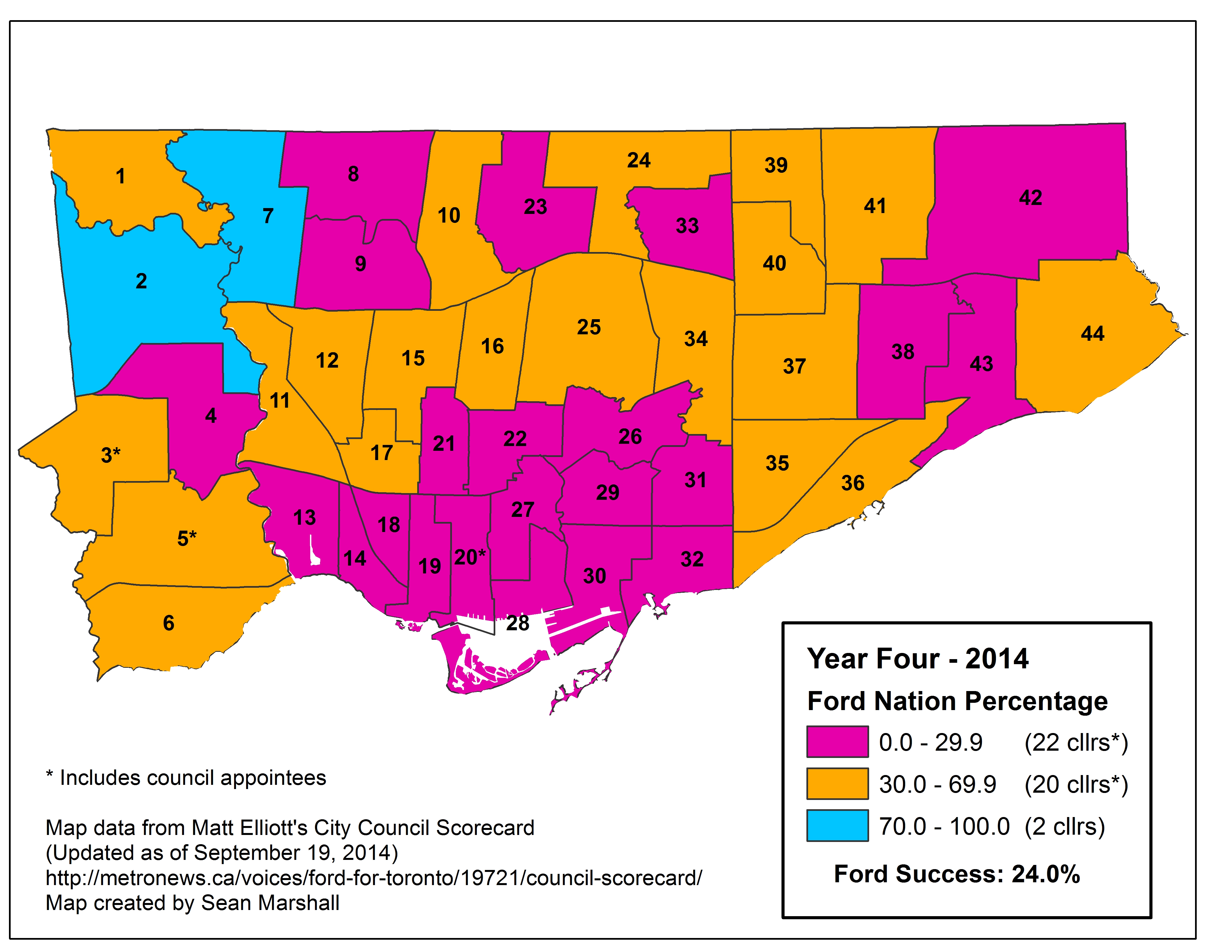
    In 2014, I created several maps using Elliott’s data that helped to show how Rob Ford lost control of City Council. In Ford’s first year, he was able to count on the support of 22 councillors, enough to get most of his agenda passed. But by 2014, only two councillors – Giorgio Mammoliti (Ward 7) and Rob’s brother, Doug (Ward 2) voted with the mayor at least 70 percent of the time.

    I felt it was about time to map how well Mayor Tory is doing.
    torys-team-score-2015
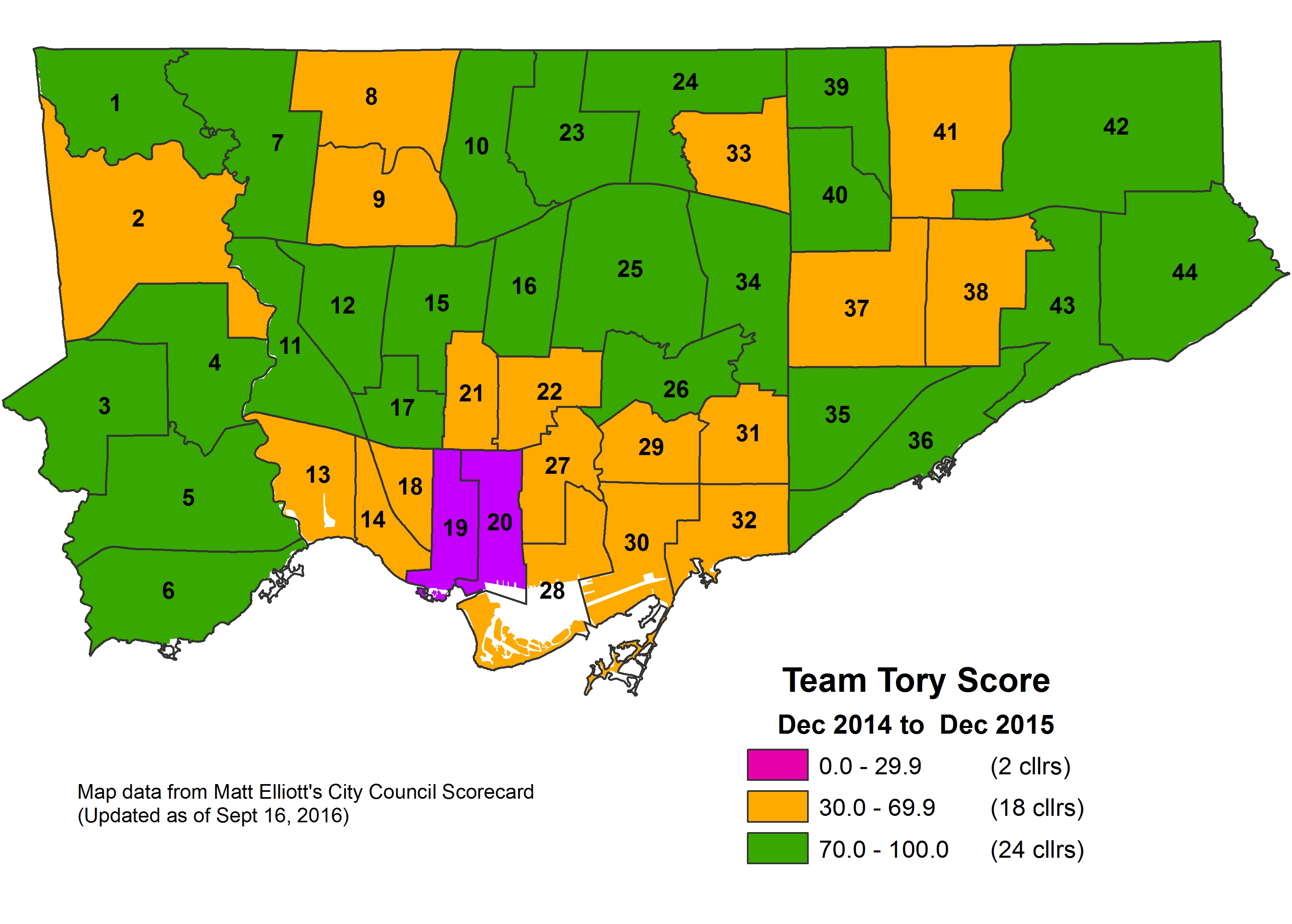
    Team Tory Score, as of December 2015

    In his first year as mayor, from December 2014 to December 2015, Tory enjoyed the support of over half of Toronto City Council; 24 of 44 councillors voted with the mayor at least 70 percent of the time. Important votes on budget austerity, council appointments (such as Police Board Chair and Tory friend, Andy Pringle), approving the “Hybrid” option for the Gardiner Expressway, and approving Uber’s operations in Toronto were all passed.

    But there were some surprises. Many key Tory supporters voted against the mayor on a motion introduced by Councillor Justin Di Ciano (Ward 5) to ask the province not to support ranked ballots. The mayor, who supported the electoral reform, lost that vote.

    In that first year, most other councillors provided some support, voting with the mayor at least 30 percent of the time, including former mayor Rob Ford (Ward 2). The wards that these councillors represent are marked in orange. Generally, these wards are represented by centrist or left-leaning councillors such as Josh Matlow (Ward 22), Maria Augimeri (Ward 9) and Shelley Carroll (Ward 33).

    Only two councillors — Mike Layton (Ward 19) and Joe Cressy (Ward 20) voted opposite to Mayor Tory over 70 percent of the time in 2015.

    torys-team-score-to-june-2016
    Team Tory Score, as of July 2016. Votes from the October 2016 Council Meeting not yet included. 

    So far in 2016, the divide between the allies of the mayor and his opposition widened. Only ten councillors were left in the middle (all centre-left), while five councillors — Gord Perks (Ward 14), Kristyn Wong-Tam (Ward 27), Paula Fletcher (Ward 30), Janet Davis (Ward 31), and Anthony Perruzza (Ward 8) joining the opposition. With the exception of Ward 2, vacated after Rob Ford’s death, all councillors from Etobicoke and Scarborough became clear Tory allies.

    It’s worth noting few normally centrist councillors, who were very effective in opposing Rob Ford’s agenda last term, are now staunch allies, including Paul Ainslie (Ward 43), and Bailão (Ward 18). Both are members of Tory’s Executive Committee; Ainslie, a centre-right councillor who has earned my great respect, was also appointed chair of the Government Management Committee.

    Opposition to Tory’s agenda from councillors in the Toronto-East York region might help to explain why the Executive Committee, hand-picked by Tory and his transition team, did not have much enthusiasm for the 47-ward solution recommended by consultants on the Toronto Ward Boundary Review team. To reflect population growth, Downtown Toronto would get three new councillors in 2018, as would central North York. One ward would disappear in Toronto’s west end; incumbent councillors Ana Bailão (Ward 18) and Cesar Palacio (Ward 17), both Tory allies, are the most affected by that change. In May, the committee requested that the consultants go back to the drawing board and look at a new 44-ward option, as well as ward boundary options consistent with provincial and federal ridings. The consultants did that, and are once again recommending the 47-ward option.

    Almost half-way through his term, Mayor Tory has a confident and strong hold on Council, which has so far supported an agenda of austerity, along with major (and in my view, unwise) transportation infrastructure projects like the Scarborough Subway and the Gardiner East reconstruction.

    It is worth noting as well that apart from Bailão, all councillors from “downtown” wards were frozen out of Tory’s inner circle, even though many downtown and midtown wards enthusiastically voted for Tory in the 2014 election. Furthermore, most of the same councillors that support Tory at least 70 percent of the time also supported Ford’s agenda in 2011 and 2012. Key supporters of Ford’s early agenda went on to sit on John Tory’s Executive Committee.

    While there’s a slightly conservative bent to Toronto City Council, left-leaning mayor David Miller was able to work with centrists and conservatives, including suburban councillors, to implement his agenda, appointing several to key boards and committees. Tory, on the other hand, has frozen out council’s progressives, perpetuating an urban-suburban divide.
    ford-nation-percentage-2011-crop
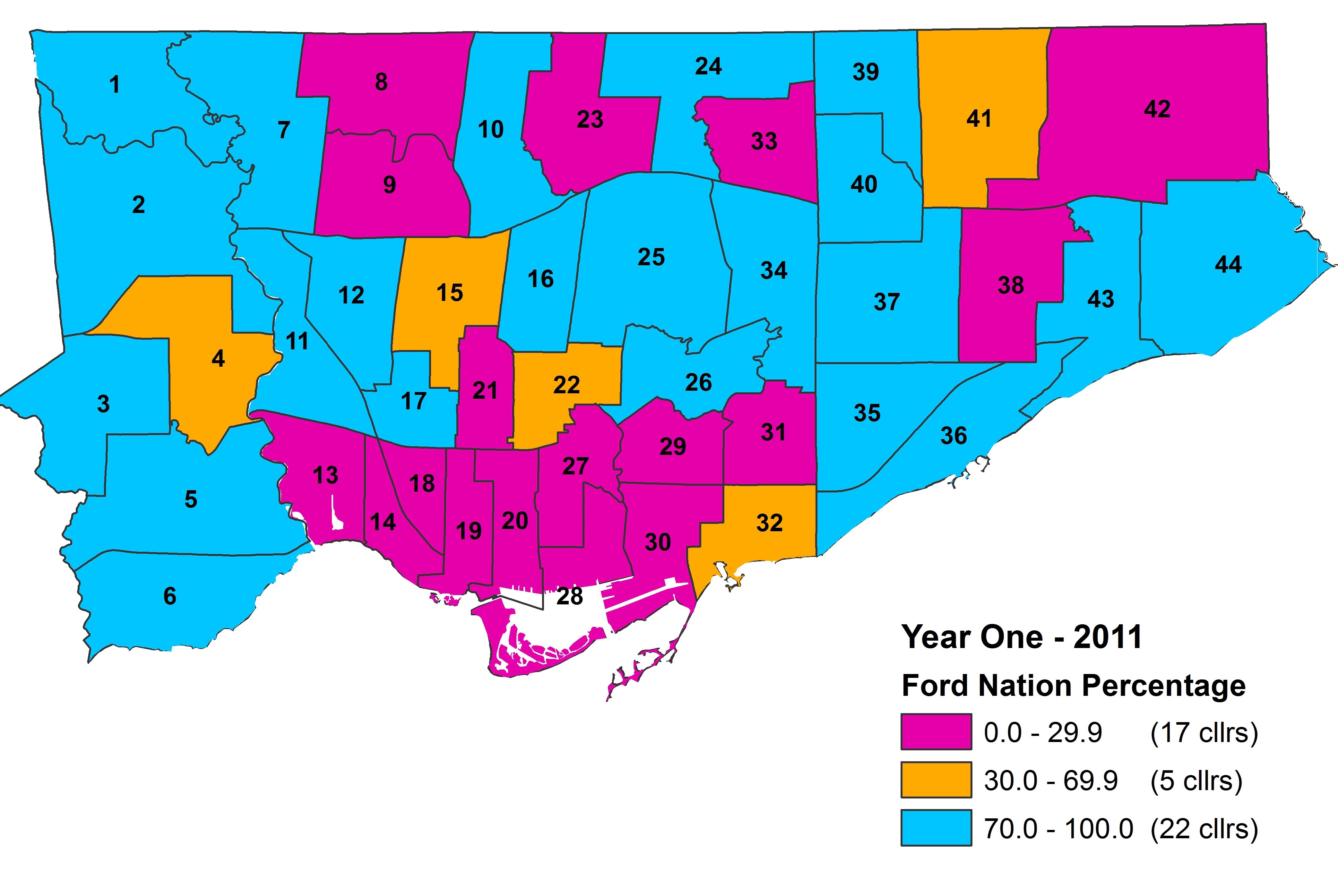
    Mayor Rob Ford’s allies and foes in 2011

    It’s possible that Tory’s hold on power will slip as councillors get restless, or if there’s a backlash to cuts to city services such as the TTC or the Toronto Public Library. After all, Rob Ford’s hold on power slipped long before the crack scandal as residents fought back against budget cuts, and council quashed the Ford Brothers’ attempt to build a Ferris wheel and mall in the Portlands.

    The mid point between municipal elections is coming up, and there’s an opportunity to make changes to committee and board appointments. There’s still an opportunity for new alliances to be made and for goals to change to support a growing city and address growing economic disparity.
  • Mapping “Team Tory”

    Back in September 2014, I created a series of maps for Matt Elliott, journalist at Metro, blogger, city council observer, and all-round great guy. Elliott’s City Council Scorecard tracked how each councillor voted on major decisions at city hall, along with a “Ford Nation” score that measured how closely each councillor voted with the mayor. Matt’s Council Scorecard was one of several inspirations for the work that I undertook so far on this blog, especially mapping the results of the 2014 municipal election.

    On April 24, Elliott published a new edition of his excellent scorecard, a check-up on how Tory has been handling council so far. I wanted to map the new scorecard and compare it to Ford’s performance. You can read more about Elliott’s methodology here.

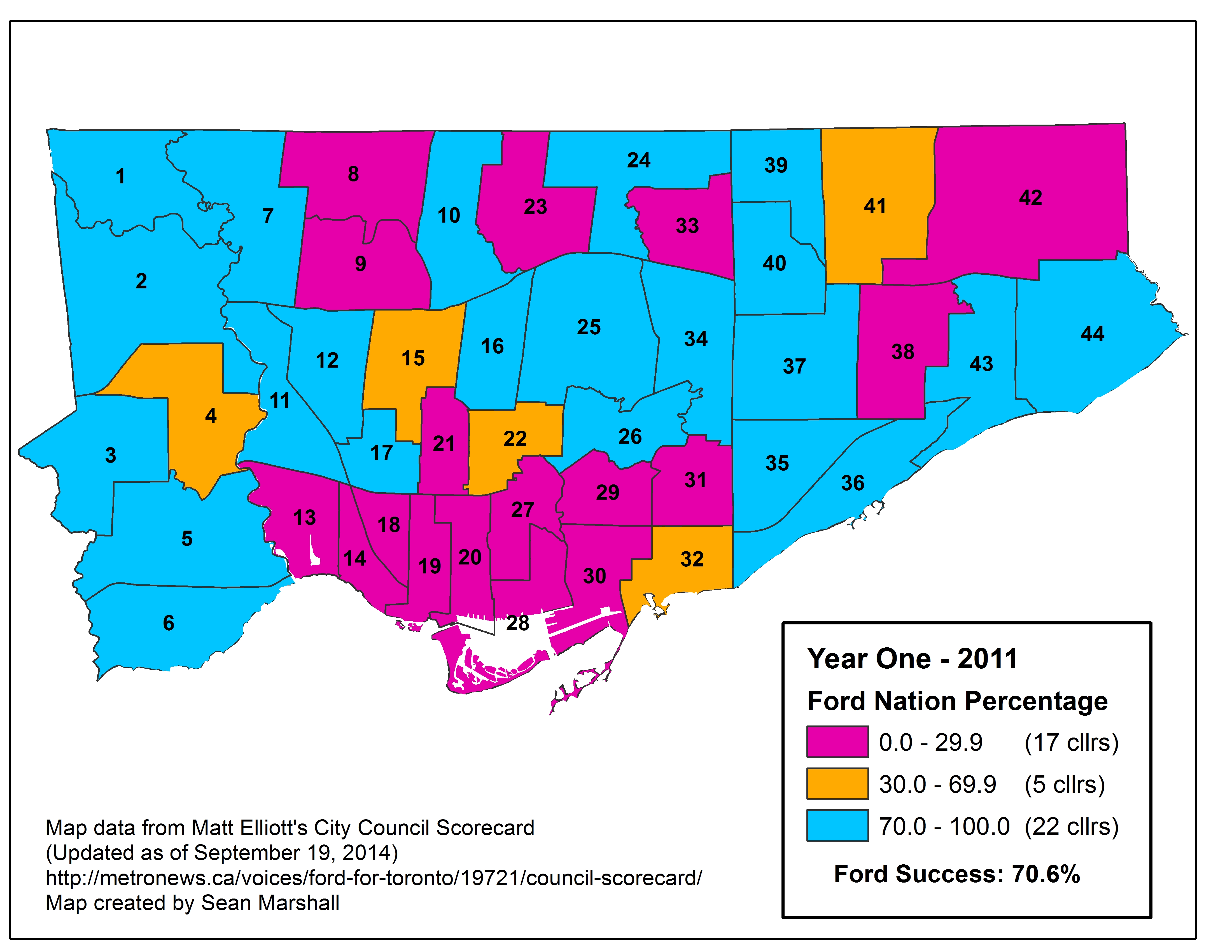
    In 2011, newly elected Mayor Rob Ford was able to count on the support of 22 councillors — a slim majority on the 45-member council when the mayor’s vote is added. From that bloc, Ford was able to pick his executive committee, who helped push forward his agenda of cost-cutting and mucking up Toronto’s transit plans. That year, council voted with Ford over 70 percent of the time. But by December, Ford’s control was already slipping; several potential proposed service cuts were rejected, as well as Doug Ford’s ridiculous plans to take control of the Waterfront development and build a Ferris wheel and mega-mall in Toronto’s Portlands.

    Many of the city councillors opposed to Ford’s agenda  — but not all — were elected in wards representing the Old City of Toronto and East York. But six suburban councillors  — Maria Augimeri, Anthony Perruzza, John Filion, Shelley Carroll, Glenn de Baeremaeker and Raymond Cho  — were all reliable opponents. Except for Cho, who ran for the provincial Progressive Conservatives and lost in the 2014 election, the rest identified with either the Liberals or New Democrats and re-elected in 2010 despite their wards voting overwhelmingly for Rob Ford.

    Ford Nation Percentage 2011 HiRes

    It’s important to note that the Ford brothers’ agenda and control over council fell apart even before the Garrison Ball debacle and the crack-smoking allegations and council meltdown of 2013. In 2012, Rob Ford was only able to count on the loyal support of 17 councillors; he only had a 32 percent success rate at council that year. By 2014, Mayor Ford could only count on two reliable allies — his brother Doug, and Ward 7’s Giorgio Mammoliti; council only voted with the mayor 24 percent of the time.

    Ford Nation Percentage 2014 HiRes

    John Tory was elected in 2014 on an uninspiring, yet effective centre-right campaign, promising better governance, limited tax increases, and his own problematic transit plan. But after four years of Rob and Doug Ford, voters were looking for change. Sadly, candidates running on more substantive/progressive platforms, such as early front runner Olivia Chow and former councillor David Soknacki, either dropped out of the race or came far behind second-place Doug Ford, Rob’s obnoxious and bigoted enabler.

    Those looking for a brave new era at City Hall were disappointed by the incoming mayor’s picks for committee chairs/executive committee, speaker and TTC Chair, all plum posts that help steer the mayor’s agenda. Denzil Minnan-Wong (Ward 34), one of council’s most conservative and divisive members was named Deputy Mayor, while Rob Ford’s enabler on the council floor, Frances Nunziata (Ward 12), was re-appointed Speaker. All but two of Tory’s executive committee members were reliable Ford allies in 2011, seven of whom were on Ford’s original executive committee. (It should be said that some of those councillors, notably Paul Ainslie (Ward 43) and Jaye Robinson (Ward 25), later quit or were kicked off the Executive Committee.)

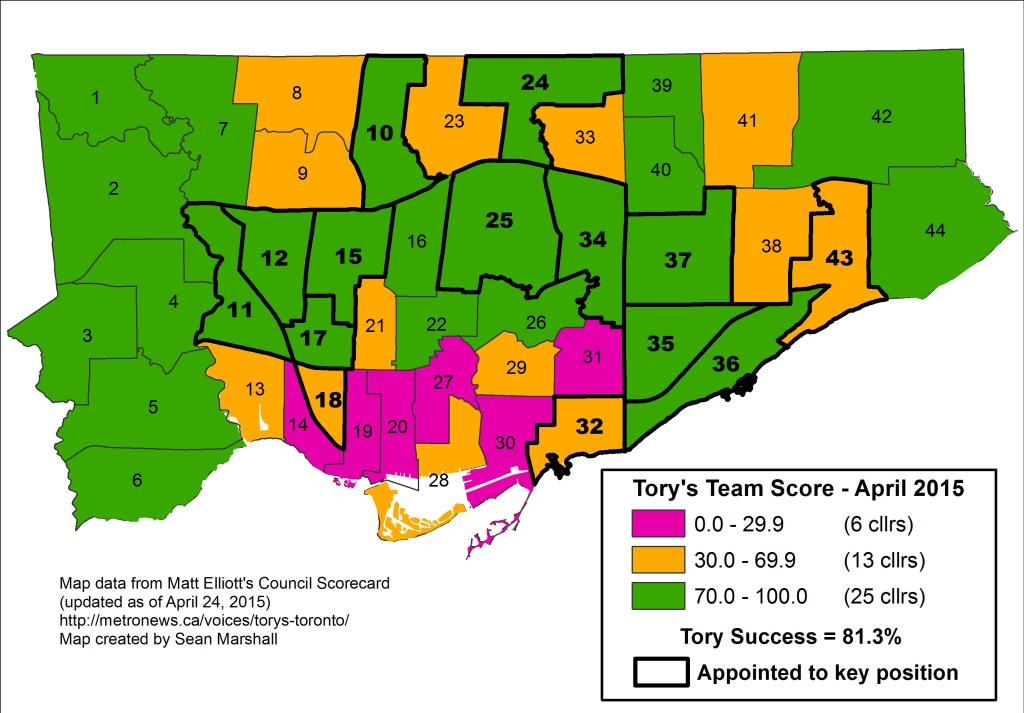
    Tory Team - April 24 2015

    Tory’s Team Score 

    Only five months into his term, John Tory had a good, but not stellar, record of getting his agenda through council. Matt Elliott found that 25 councillors have been reliable allies of Tory; voting with the mayor at least 70 percent of the time, including 5 of the 6 new councillors elected. Only six councillors — Gord Perks, Mike Layton, Joe Cressy, Kristyn Wong-Tam, Paula Fletcher, and Janet Davis, all representing “downtown” wards  — have voted with the mayor less than 30 percent on all important votes. Other anti-Ford councillors, so far, find themselves part of the “mushy middle” or “mighty middle,” though they are at this point a minority of 13. Interestingly, Councillors Rob Ford and Giorgio Mammoliti are voting with Ford most of the time so far. So much for Ford leading an “official opposition” against Tory.

    As expected, councillors that John Tory endorsed and supported in the last election  — Christin Carmichael Greb in Ward 16, Jon Burnside in Ward 26, and Mark Grimes in Ward 6 — were among Tory’s most loyal votes on council, even though none got a plum appointment (Carmichael Greb and Burnside are rookies, Grimes a three-term councillor). All three faced challenges from qualified, less conservative opponents.

    John Tory’s budget and early agenda has been less confrontational and ideological as what Ford pushed in 2011; this could be helping his score. Left-leaning councillors like Joe Mihevc (Ward 21) and Pam McConnell (Ward 28) are, for now, voting 35 percent with the mayor. The budget approved by council keeps tax increases low (I’d argue unsustainably low), but TTC cuts implemented by Rob Ford are being reversed; no services are being slashed. It’s true that council not doing enough on policing issues (especially carding/racial profiling; Tory doesn’t seem to have any interest here), nor is there enough action on the TCHC’s capital repair backlog, but so far, there haven’t been many divisive votes.

    John Tory’s budget and early agenda has been less confrontational and ideological as what Ford pushed in 2011; this could be helping his score. Left-leaning councillors like Joe Mihevc (Ward 21) and Pam McConnell (Ward 28) are, for now, voting 35 percent with the mayor. The budget approved by council keeps tax increases low (I’d argue unsustainably low), but TTC cuts implemented by Rob Ford are being reversed; few services are being slashed. It’s true that council is not doing enough on policing issues (especially carding/racial profiling; Tory doesn’t seem to have any interest in this important matter), nor is there enough action on the TCHC’s capital repair backlog. But so far, there haven’t been many divisive votes. With upcoming labour negotiations and more big-ticket budget items (the decision on what to do about the crumbling and under-capacity east Gardiner Expressway, for example), this will change.

    At times, Tory has seen to be either ignorant or dismissive of how City Council works; had he known better, there would be someone else in the Speaker’s chair, a less polarizing deputy mayor, and a few more centrist or left-leaning councillors in key positions to unite council. Mid-term, in early 2016, there’s an opportunity for Tory to revisit his committee appointments if necessary.

    It’s very possible that Tory will lose political capital as the term goes on, though it is nearly impossible to imagine him losing control of the agenda so dramatically as Ford did. In any case, it will be interesting to see if Tory learns on the job and continues to have the confidence of council, or if he starts to lose his grip as most mayors experienced later in their terms.