No matter how you get around Toronto, it’s feels like it’s more difficult than ever
Getting around Downtown Toronto can be an exercise in frustration, whether you drive, bike, take transit, or drive. Though necessary transit and road construction projects are the cause of much of the congestion, driver behaviour, poor management, and a lack of coordination between various municipal and provincial agencies have only added to the traffic quagmire.
North-south streets such as Spadina, York, Bay, and Jarvis are jammed by drivers headed south towards the Gardiner Expressway, with lane closures near Exhibition Place only making things worse. Motorists blocking intersections make it difficult for pedestrians, cyclists, streetcars, and through traffic to get across the city centre. Ontario Line construction has closed a portion of Queen Street, while work to rebuild streetcar tracks on York and Adelaide Streets to allow 501 cars to bypass the closure is still proceeding.
GO Transit is also expanding its rail corridors to allow for more off-peak and express trains, with the long-term goal of having an electrified, frequent, regional rail network that complements and supplements the web of subways, light rail and buses throughout the region. The TTC is also addressing a backlog of state-of-good repair works throughout the subway system, resulting in slow orders, early closures, and weekend shutdowns.
Meanwhile, people still need to get to places like work, school, conferences and trade shows, concerts, sporting events, social gatherings, festivals, museums, and all the other things that make a city a city. Eventually, with improved GO corridors, the Ontario Line, and the opening of the Crosstown LRT, there will be some redundancy in the transit system that will make planned service closures easier to navigate. But for now, we are stuck with an underbuilt transportation system in a rapidly growing city.
This makes the coordination of transit closures and projects especially essential so things don’t completely fall apart. Saturday, September 21 was just one example of the failure to do so.
On Saturday September 21 and Sunday September 22, GO Transit reduced service on the Lakeshore West Line to hourly service on the entire corridor because of work at Long Branch GO Station, where the station is being completely rebuilt for accessibility improvements and future expansion. It also shut down the entire Barrie Line for various construction works along the corridor, with rail replacement buses to Union Station, stuck in traffic on the Don Valley Parkway and Lake Shore Boulevard with all other motorists getting around the Gardiner closure.
Normally, there are hourly trains as far west as West Harbour Station in Downtown Hamilton, with half-hourly service to Aldershot Station in Burlington. Between Union and Oakville, rail service is as frequent as every 15 minutes during midday and early evenings on Saturday and Sunday. Hourly train service reduced capacity on the inner Lakeshore West line by 75%.
Compounding the problem was the total closure of the Gardiner Expressway between Highway 427 and the Don River between Friday evening and Sunday morning for routine maintenance (the Gardiner and the Don Valley Parkway are regularly closed twice a year for repairs). Many people who might have otherwise driven into the city would have taken GO Transit instead, normally a very good idea. Though none of Toronto’s professional sports teams were playing at home on Saturday, there was still a Shane Gillis stand-up comedy performance at Scotiabank Arena, and a Rainbow Kitten Surprise concert at Ontario Place.
Also, to add insult, the Lakeshore East trains between Toronto and Oshawa were not through-running with the Lakeshore West trains and were operating on a modified schedule. I was travelling east of Toronto on Saturday, making a few stops in Durham Region. As I arrived back from Whitby on Saturday afternoon on a train that normally connects onward westbound train at Union Station, we were treated to the sight of the hourly Lakeshore West train just pulling out. It couldn’t have even waited 2-3 minutes to allow passengers to make the cross-platform connection. That resulted in other passengers complaining to GO staff in the concourse, who were not that helpful.
I’m on the GO Train now. The CSR on the LW train is telling people at Long Branch to not board because the train is too full, so they now have to wait an hour. Lots of people heading to Budweiser Stage and Scotiabank concerts. Very poor planning/coordination between city and MLX. https://t.co/LXNATzYwoV
Tweet from Alan Deschamps, reporting on a full GO train arriving at Long Branch at 6:21 PM on Saturday Sept 21, with the customer service ambassador (CSR) telling waiting passengers to not board and to wait for the next train in an hour
In the early evening on Saturday, a jam-packed eastbound GO train on the Lakeshore East train was not accepting any passengers at Long Branch or Mimico station because of overcrowding. Waiting passengers were told to wait an hour for the next train.
One would think that Metrolinx (GO Transit’s parent agency) and the City of Toronto would coordinate their construction schedules to avoid such problems. However, not even the City of Toronto can figure this out. Back in June of this year, the TTC replaced the 509 Harbourfront and 511 Bathurst streetcars with buses for a week for minor overhead work on Fleet Street. The timing coincided with the massive Collision tech conference at Exhibition Place, which resulted in overcrowded shuttle buses and unreliable service. Had the TTC checked with anyone at the city’s economic development office or with Exhibition Place (another city agency), this work could have easily been rescheduled.
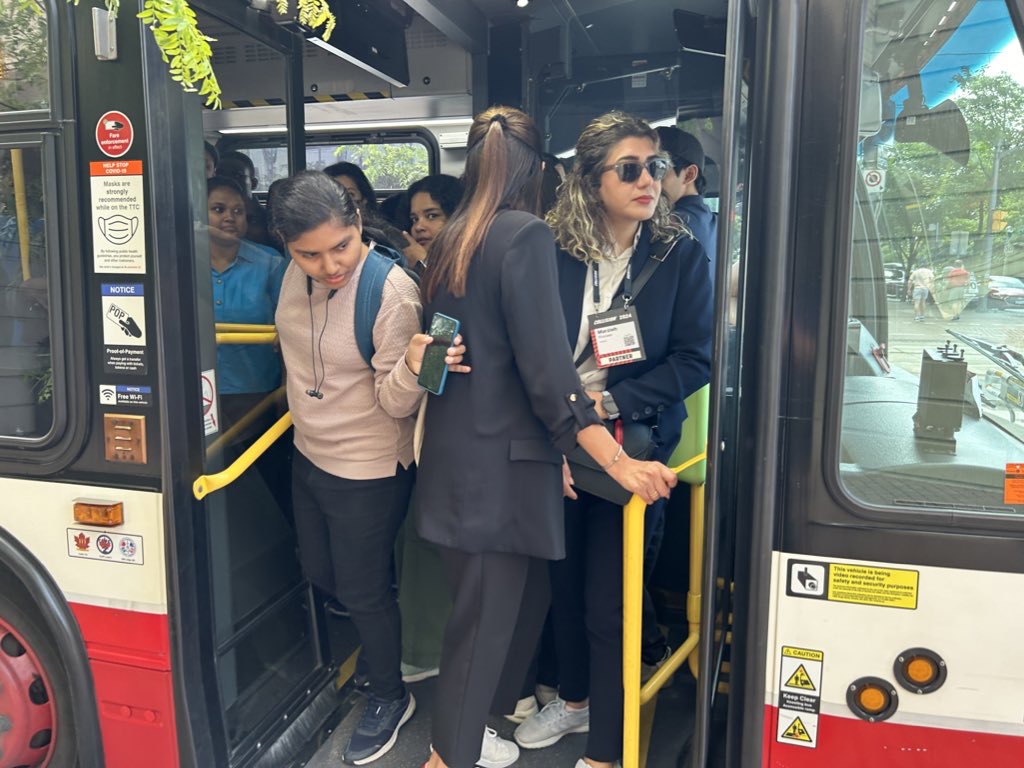
Overloaded 509 Harbourfront bus shuttle on Queen’s Quay in June 2024
Though coordination of transit closures and construction projects with major events and parallel roadworks will not solve Toronto’s road and transit congestion problems, it will at least reduce some of the frustration of getting around. The poor customer service at GO Transit will certainly make riders question if they will be able to rely on the service in the future.
Of course, there is one measure that won’t help but still will be implemented by the provincial government later this fall: a prohibition on new bicycle lanes if they take road space from motorists. Despite blocked bike lanes, aggressive drivers, and an incomplete cycling network, it is still the most reliable and fastest mode for many shorter city trips. Along with major transit improvements and construction coordination, cycling is one of the solutions to getting around Toronto.
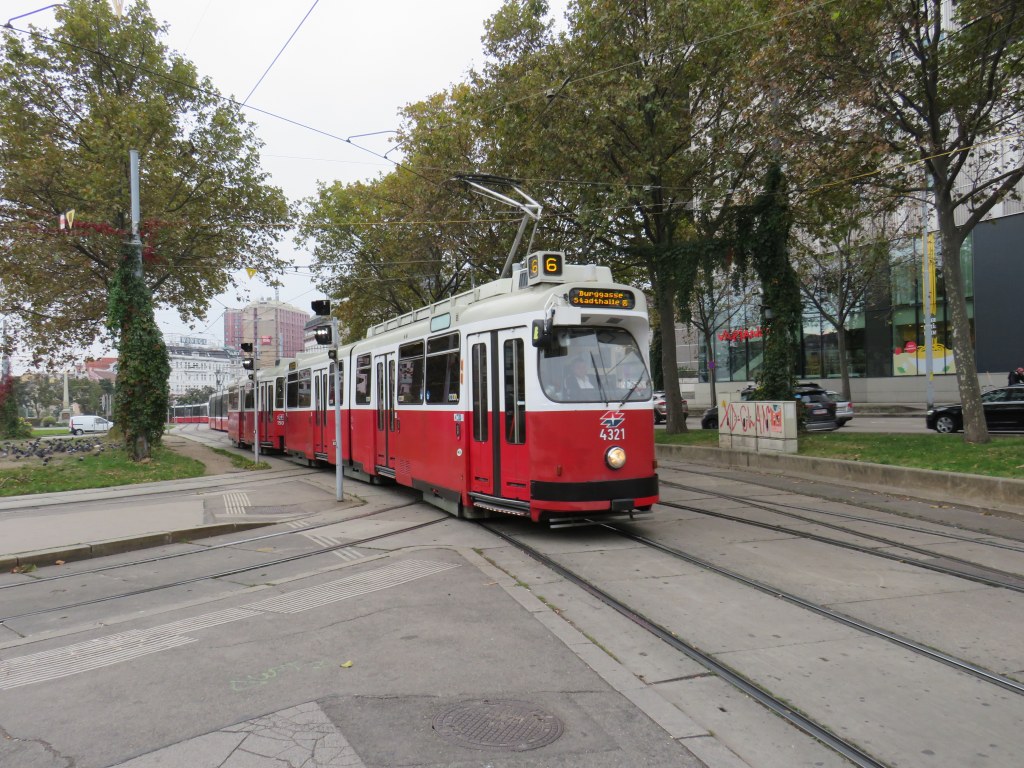
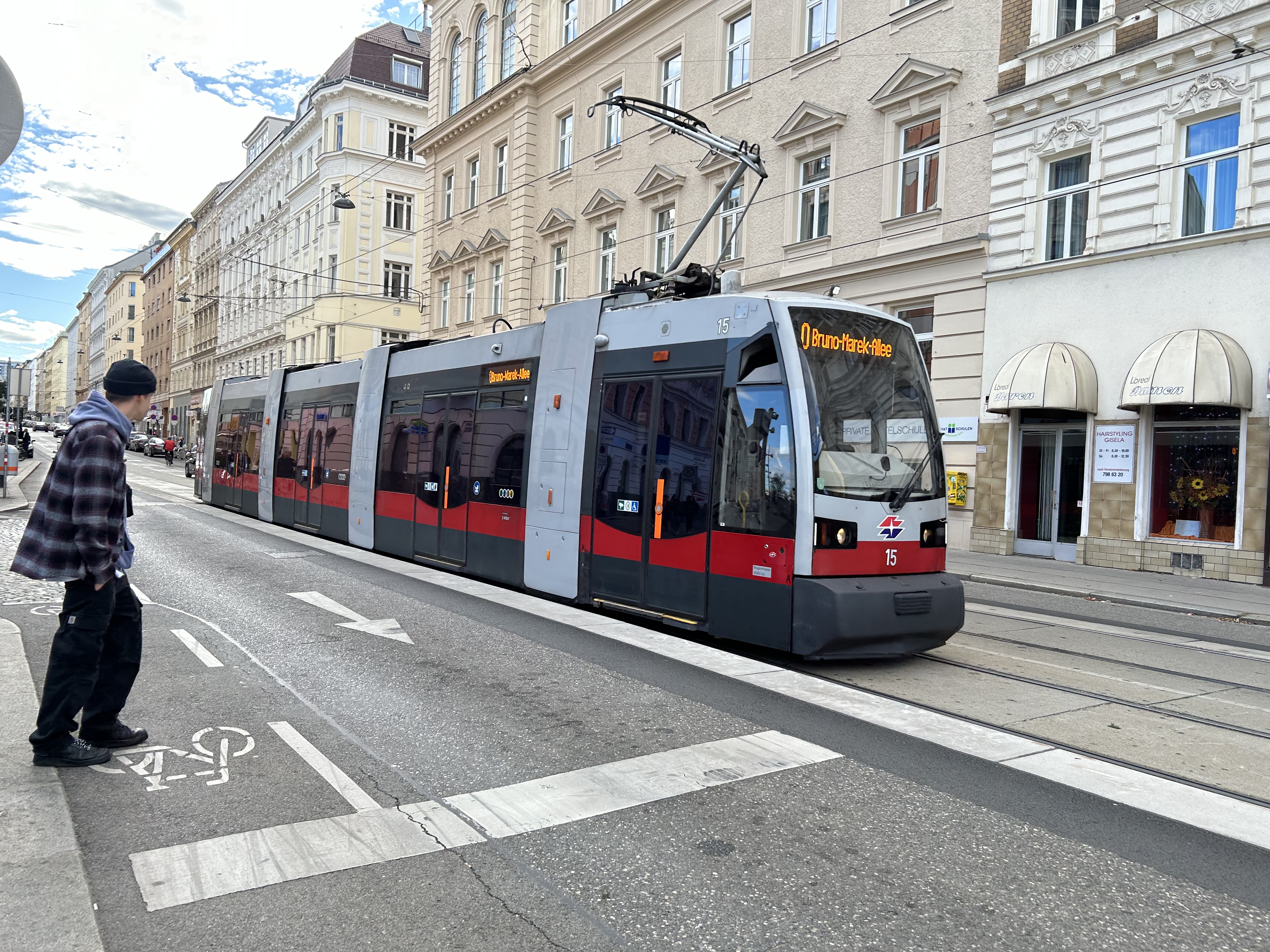
Vienna low-floor tram in the Leopoldstadt district
Back in October, my spouse and I had the opportunity to visit several countries in Central Europe: Austria, Slovakia, Hungary, and the Czech Republic, though we spent the majority of our time in and around Vienna, as that is where my spouse attended business meetings for several days; we also took time to explore the city and surrounding areas together.
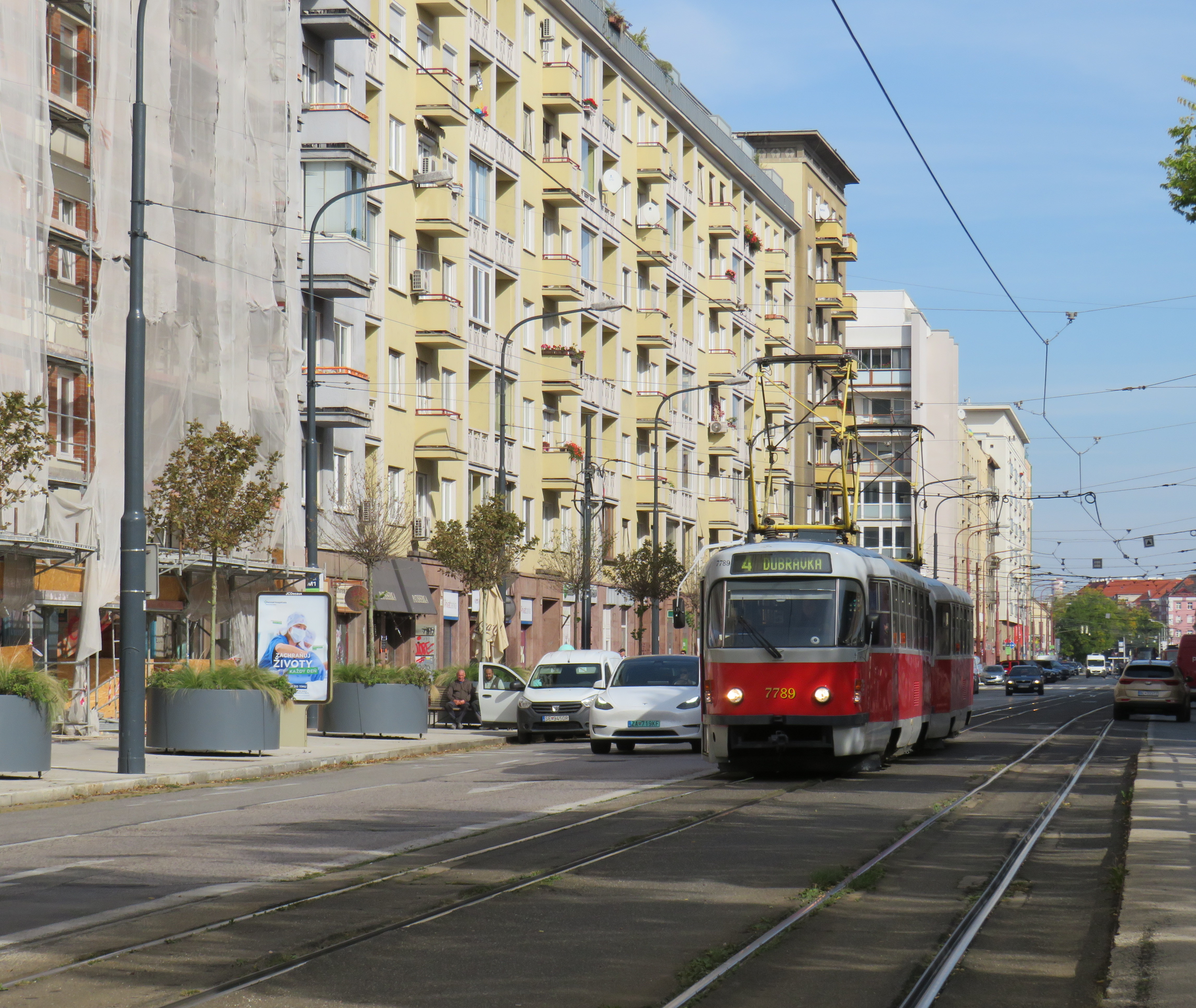
While there, I experienced how serious cities operate trams seriously. In Bratislava, I saw how a streetcar priority corridor can work in a busy downtown core. In Prague, trams made it through watermain construction zones without detours or unreliable bus shuttles. In Budapest, I rode the world’s longest trams that move more people per hour than many metro lines. In Vienna, where I spent the most time, I experienced a city where transit passengers are treated with respect, and where the trams are reliable, despite no discernable signal priority and plenty of mixed-traffic operations.
Vienna is an amazing city to visit. It’s been described to me as “what people think Paris is.” That’s pretty much true. It’s a very walkable city with a fantastic café culture full of independent konditorei cafés (which offer sit-down service), with an assortment of rich, tasty cakes and great coffee. It has great art galleries and grand imperial palaces, but without the crushing crowds of Paris and Versailles. As the original Music City, it’s easy to find shows and performances to suit your tastes. (We attended the famous Wiener Staatsoper, where I took in my first live opera, ever, at a surprisingly reasonable price). It’s also a compact city, easy to walk, though the transport system is excellent. Vienna is also a great base for visiting other cities in Central Europe, where Salzburg, Bratislava, Budapest, and Prague are only a few hours away by (frequent and relatively speedy) train.
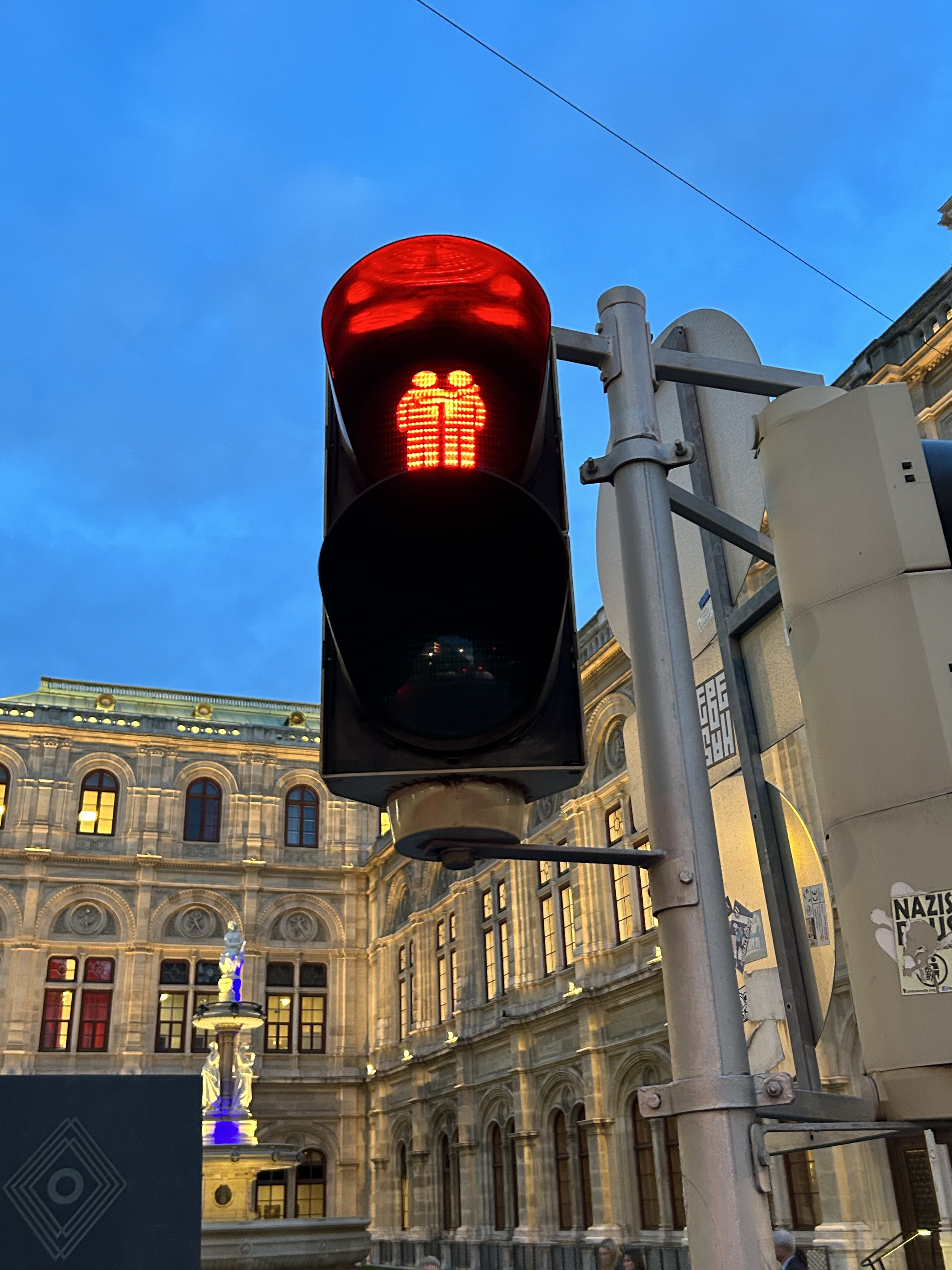
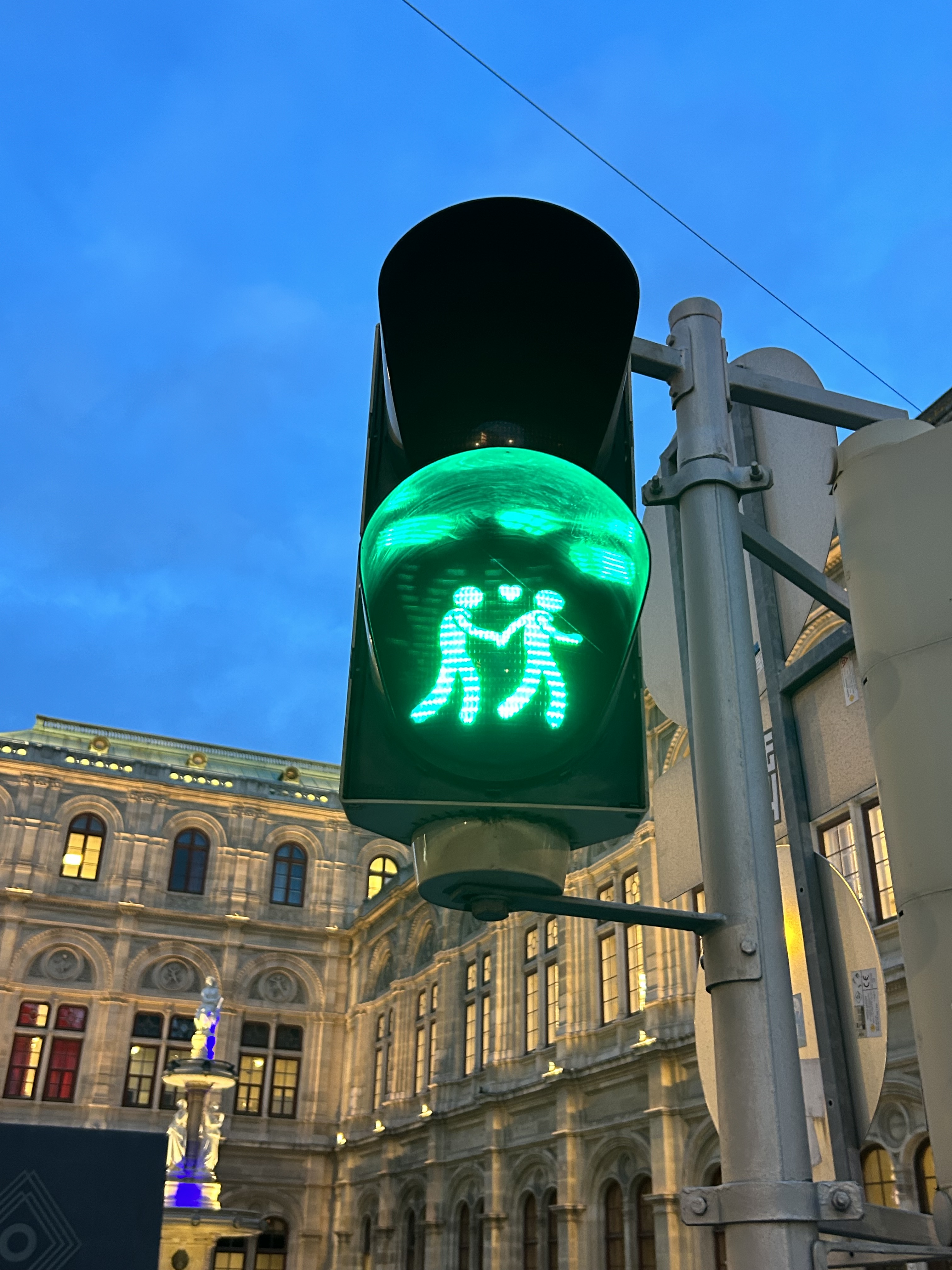
We noticed several pedestrian signs showing loving couples, rather than the standard, like this one in front of the Wiener Staatsoper (Opera House)
Vienna has one of the largest tram systems in Europe, with 30 lines over 176.9 kilometres, and a fleet of 525 cars, including modern articulated LRVs and older trams and trailers. In Vienna, trams alone carry approximately 300 million passengers a year. They run in many different environments: on-street in mixed traffic, reserved lanes, dedicated median and side-of-street rights-of-way; there is also a tram tunnel south of the city centre. Until the 1980s, Straßenbahnen (the German name for trams) were the backbone of Vienna’s transport network, with a small Stadtbahn system (now incorporated into the modern U-Bahn) and regional and suburban (S-Bahn) trains providing limited rapid transit services. Though there are now five U-Bahn lines (two of which evolved from the Stadtbahn), the tram system remains robust and very useful for getting around.
Like all four cities mentioned in this post, Vienna operates a mix of low-floor trams built in the last 25 years, as well as older high-floor trams, many of which are accompanied by an unstaffed trailer. Vienna’s entire network — trams, buses, U-Bahn, and S-Bahn — is a proof-of-payment system. Fare inspections appeared to be infrequent; neither my spouse nor I were checked during our eight days in Vienna. Tickets and passes can be purchased from a machine (found at every U-Bahn entrance and at many tram stops) or on the WienMobil app.
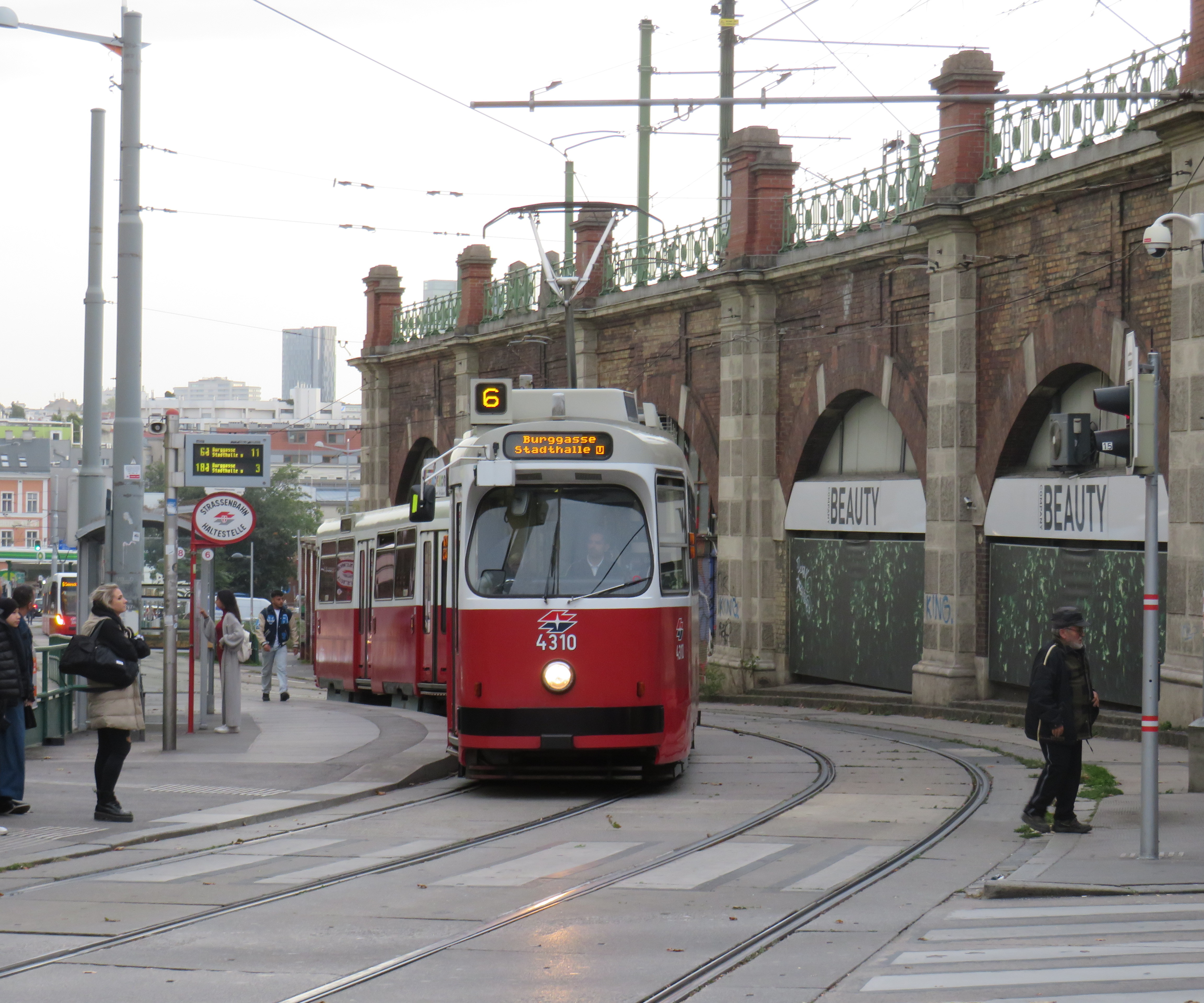
An older Type E2 high-floor tram and trailer at Gumpendorfer Straße. Behind is the old Stadtbahn viaduct, which is now part of Line U6. Note the large red “Strassenbahn Haltestelle” sign to the left, a classic Viennese icon that indicates a tram stop.
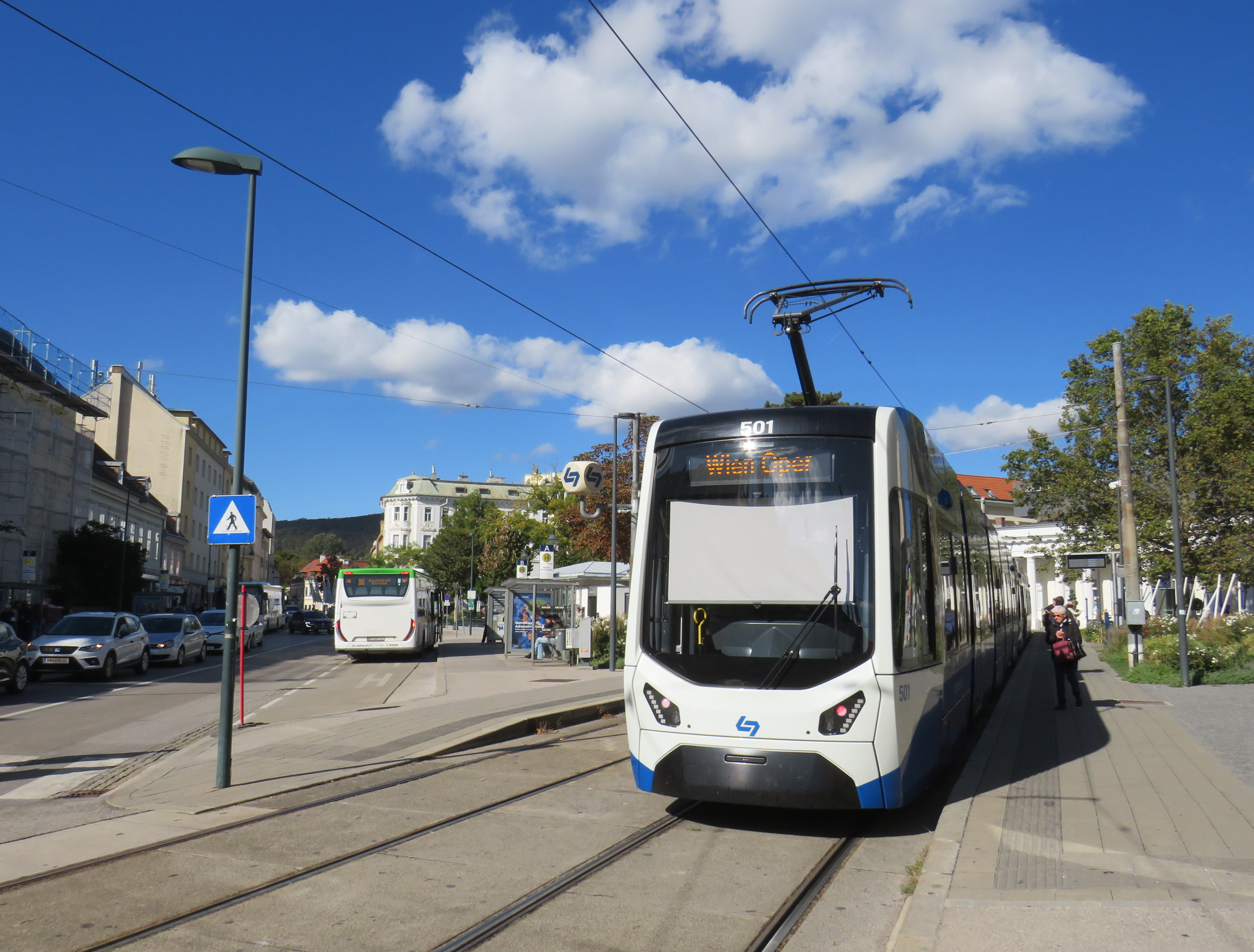
There is also a separate interurban tram service called Badner Bahn, which extends to the historic spa town of Baden bei Wien, an hour south of Vienna’s city centre.
Badner Bahn tram, laying over at Josefsplatz in Baden bei Wien
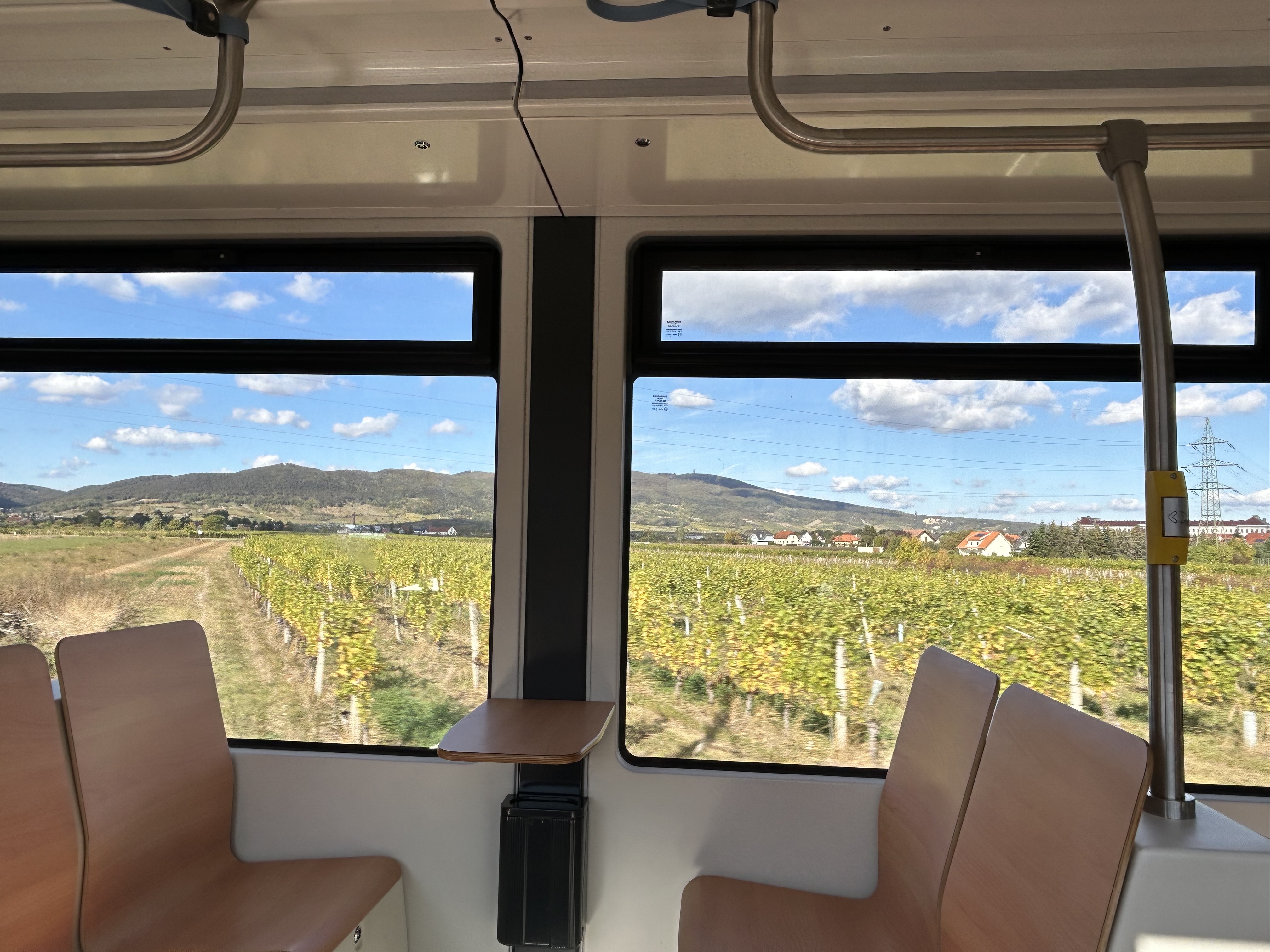
The modernized interurban originates in the heart of Vienna — across the street from the Wiener Staatsoper (Opera House) — then along local tram tracks and through the tunnel before entering its own right-of-way through the southern suburbs, and onwards through small towns, farms, and vineyards before arriving in Baden. There are several spurs leading to local industries; the regular passenger service shares the tracks with local freight trains.
View of the vineyards from Badner Bahn
A sample of the journey aboard Badner Bahn. Arriving southbound at Guntramsdorf, heading towards Baden bei Wien.
Bratislava, just over one hour away from Vienna by train (or by catamaran), is served by a network of metre-gauge trams, trolley buses, and diesel buses, though trams predominate in the city centre. On Obchodná, several tram lines, pedestrians, cyclists, and the occasional delivery or emergency services vehicle share a narrow, but busy shopping street. It just works.
Obchodná, Bratislava
Outside the congested urban core, trams are afforded reserved lanes, sometimes separated from general traffic with curbs (and even grass medians), sometimes just painted lines. Bratislava’s tram system is smaller than Toronto’s, with 211 cars and 42 kilometres of revenue track, carrying around 70 million riders a year in 2019 (Toronto’s streetcars carried 108 million that year). It is also a much smaller city, with a population of around 660,000. I only visited Bratislava for a day, but I got to ride much of the tram network; I found it an easy and convenient way to get around.
Reserved, painted tram lanes just outside Bratislava’s city centre
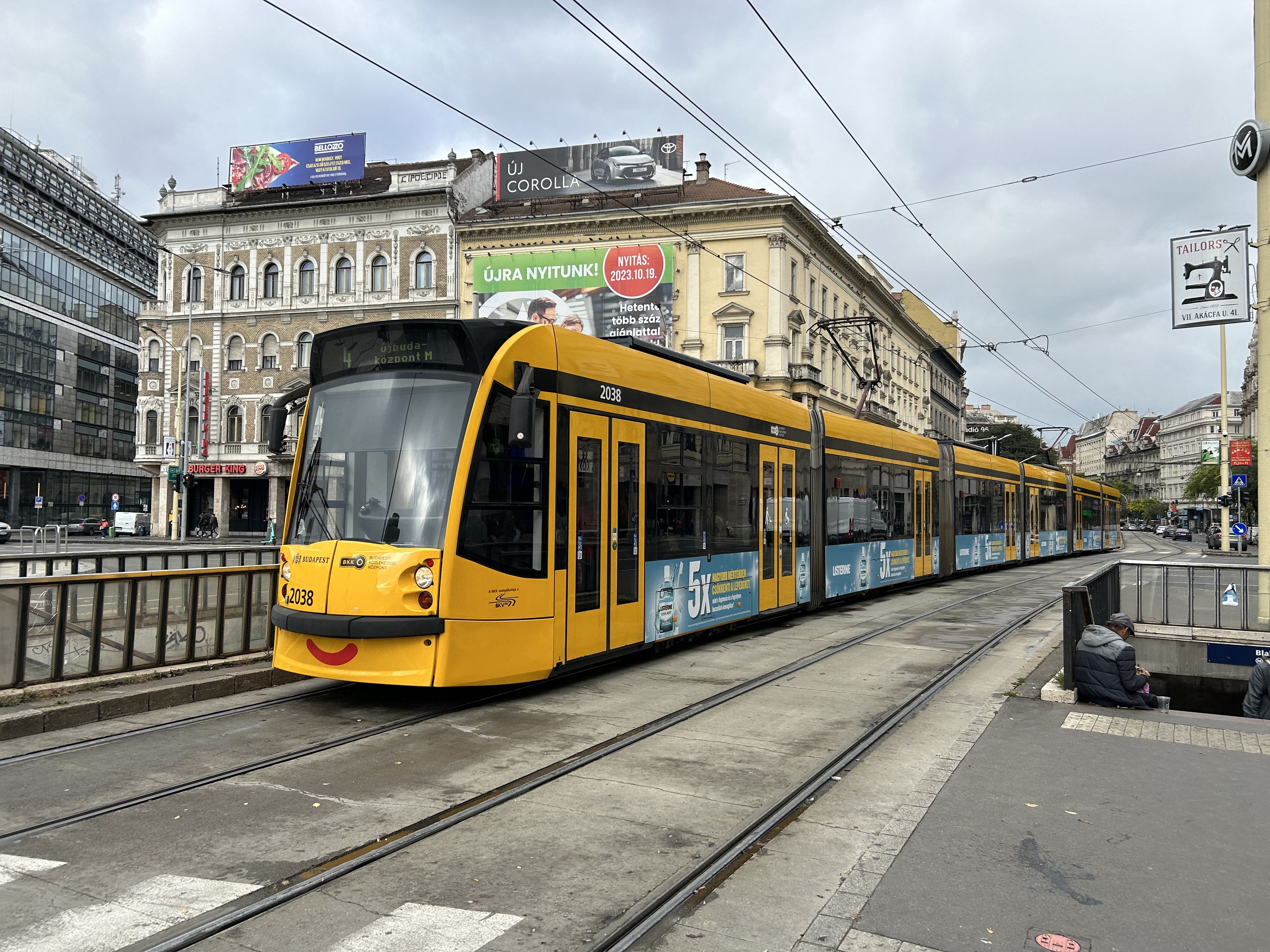
Budapest, Hungary has the largest street railway system in the world by ridership, with Route 4/6 on Budapest’s Grand Boulevard (Hungarian: Nagykörút), often cited as the world’s busiest tram line. Route 4/6 also operates 53.99 metre long Combino Plus trams, which, when introduced in 2006, were the world’s longest. The Combinos are almost twice the length of Toronto’s new Bombardier Flexity cars, which are 28 metres long. Even with the huge capacity these trams have (they require two pantographs to draw enough power to operate), they operate on Line 4/6 every few minutes, all day long, every day.
A Combino Plus tram on Line 4 traverses Budapest’s Nagykörút (Grand Boulevard)
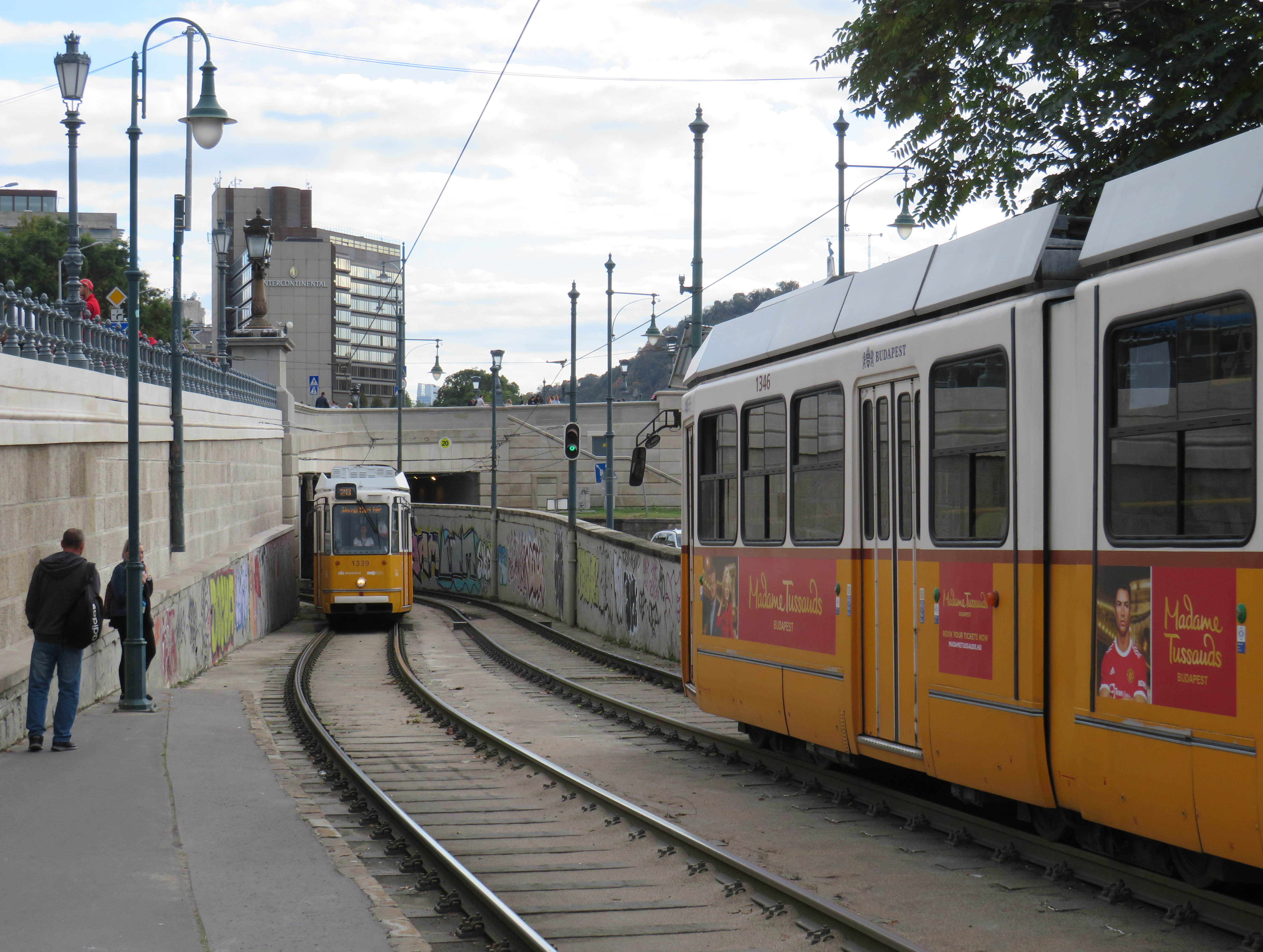
Through the 1970s and 1980s, Budapest’s tram network was slowly cut back in favour of buses, trolley buses, and metro construction. By the 1990s, however, there was a street railway renaissance in Hungary’s capital because of the capacity and economy trams offered. With high frequencies, a private median, and high-capacity low-floor vehicles, Line 4/6 easily matches the capacity of a metro, at comparable speeds. Elsewhere, dedicated lanes and private rights-of-way make it clear that transit riders come first.
Older trams running along the Danube dip under road bridges on a private right-of-way
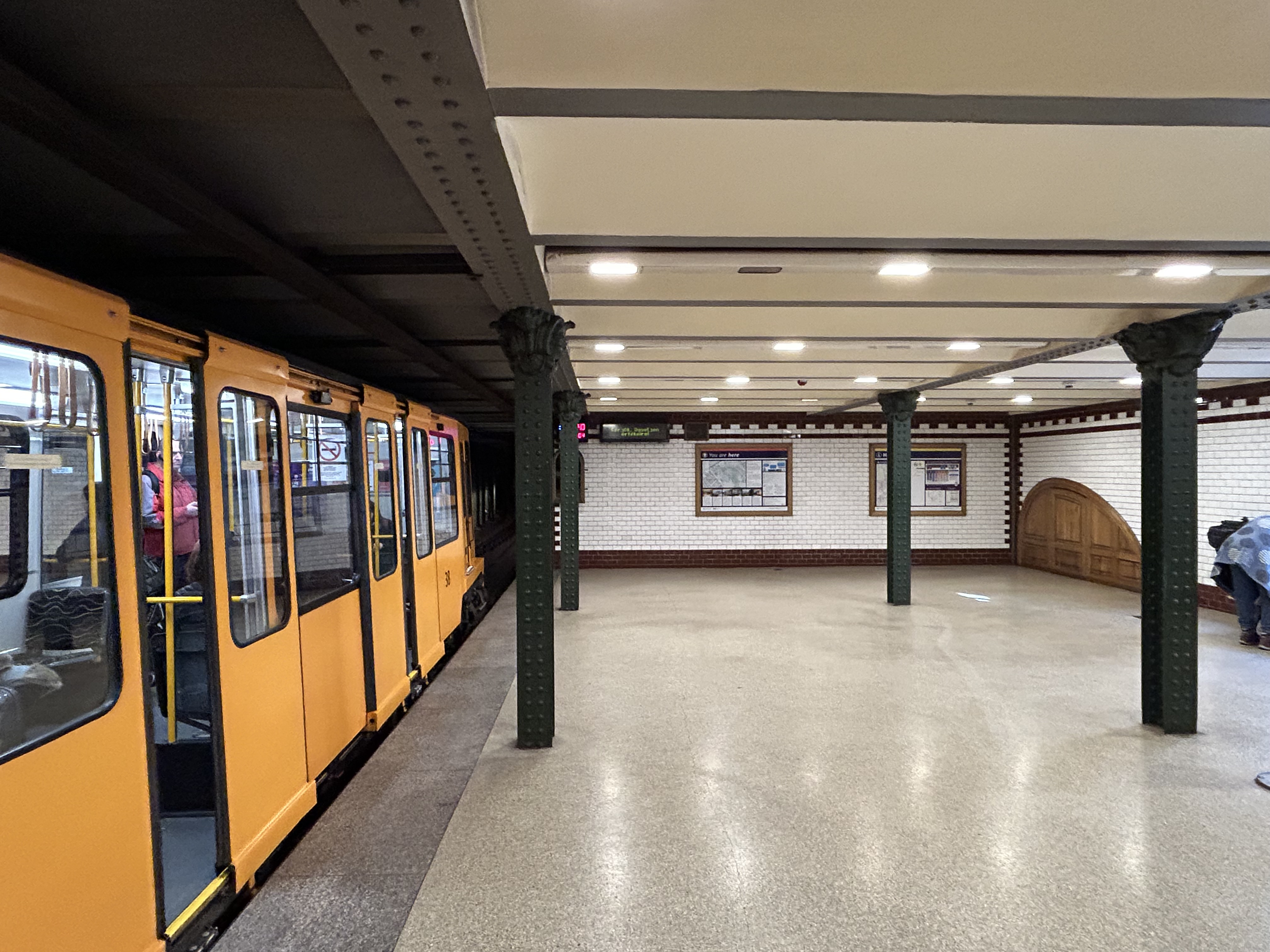
Though Budapest has a large metro network, most of it was not constructed until the l970s and 1980s. However, Line M1 was opened in 1896 as a shallow subway under Andrássy Avenue, the first electric underground metro in the world, and only the second subway, after London’s initial Underground line. Uniquely among urban transit routes, it it is listed as part of an UNESCO World Heritage Site.
Budapest Line M1 stations, restored to their original appearance, look like miniature New York stations, only cleaner
Finally, in Prague, we took several trams to take shelter from the rains that greeted us after arriving from Budapest, but also to see the city outside the crowded tourist spots. We took Line 1 from the city centre to the suburban district of Hrdlořezy, and returned via Line 9, taking a slightly different route back. Like Budapest, a metro system was planned and built in the 1970s and 1980s, but trams remained important, often providing local services parallel to deep underground metro lines.
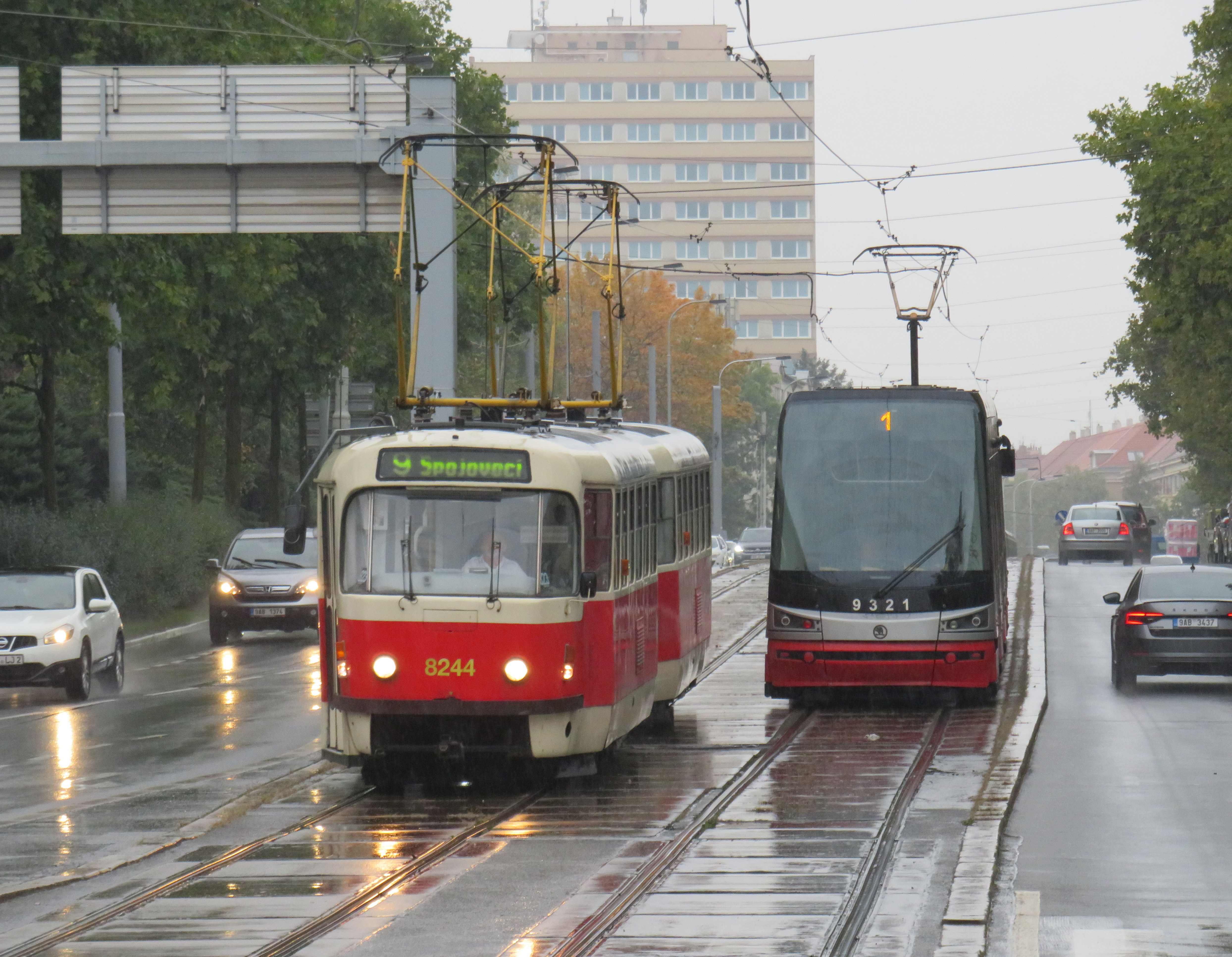
Old two-car tram train on Line 9, passing a newer low-floor tram on Line 1, Sokolovská, Prague. Most trams run on reserved rights-of-way.
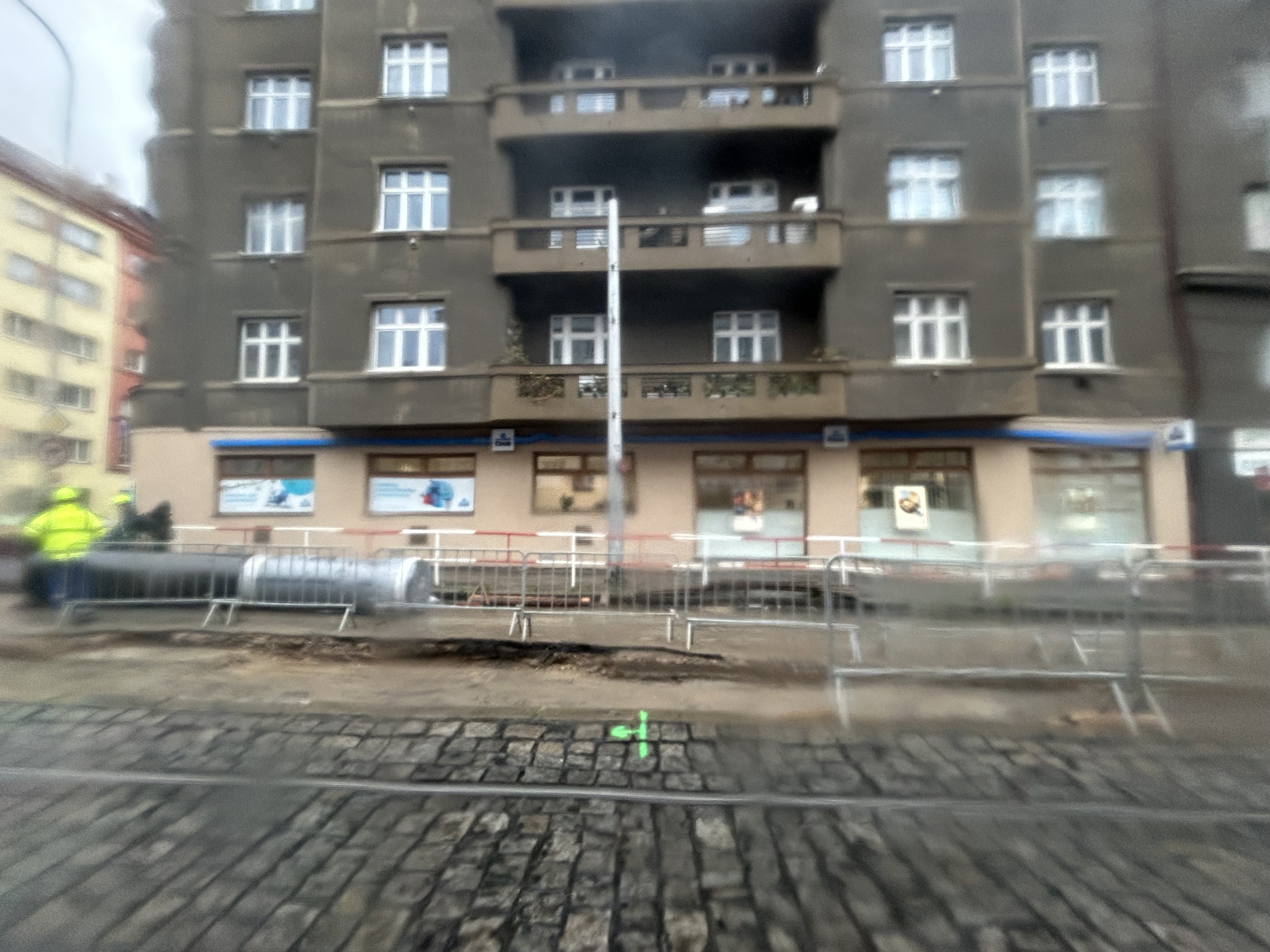
What interested me was seeing major watermain work along the line. Through trams slowed where work was adjacent, there were no diversions or shuttle buses. The trams ran through.
Watermain replacement in Prague, with trams still running(taken on a rainy morning)
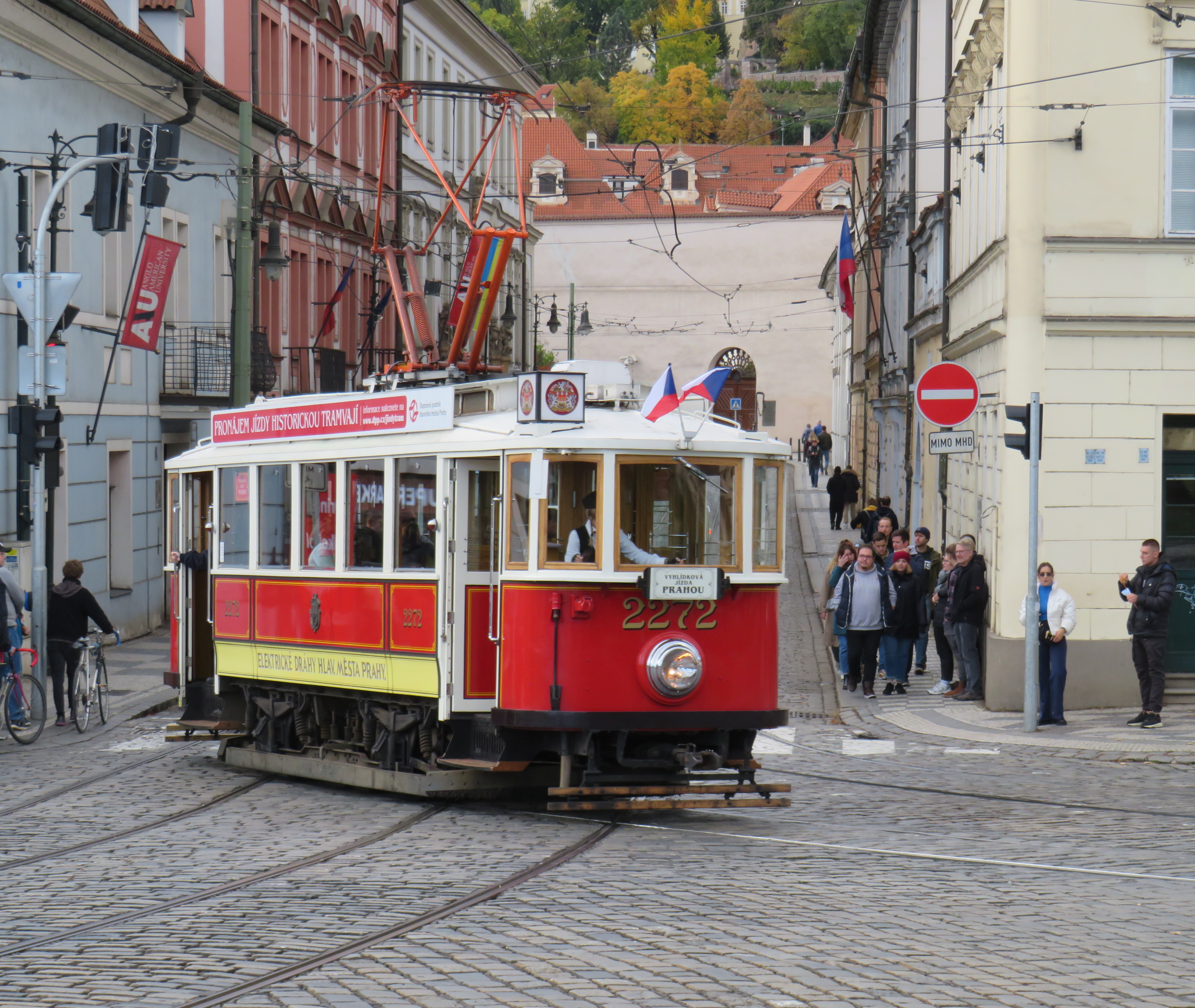
Like Vienna, Bratislava, and Budapest, Prague operates a mixed fleet of older high-floor trams and modern low-floor light rail vehicles, similar to Toronto’s new fleet. But in Prague, heritage trams could often be spotted in service, especially on the west bank of the Vltava near Prague Castle.
Heritage tram #2272 in Prague
Lessons for Toronto
After travelling, it can be easy to spot one’s hometown flaws and faults. But I spent a lot of time riding Vienna’s metros, trams, and buses, and mindfully experiencing the transport networks in Bratislava, Budapest, Prague, and Salzburg (which does not run trams, but has a large trolleybus network), I was left with some key takeaways on how to do transit here.
First and foremost, transit riders were respected. Not necessarily in terms of personable customer service, but the feeling that the next tram or bus was going to arrive on time, and a reliable interval. If there was a delay, it was very well communicated.
For instance, while waiting for a tram in Vienna, we experienced an unusually long wait. The next tram display kept showing the next two arrivals at 3 and 4 minutes. Not long after, a voice came on a loudspeaker posted above the tram stop sign announcing (in German, translated in English to us by one of my spouse’s colleagues) a delay because of a collision along the route. The blockage cleared after a few minutes, and we boarded a crowded tram. I appreciated the audio announcement, especially as it was a basic tram stop.
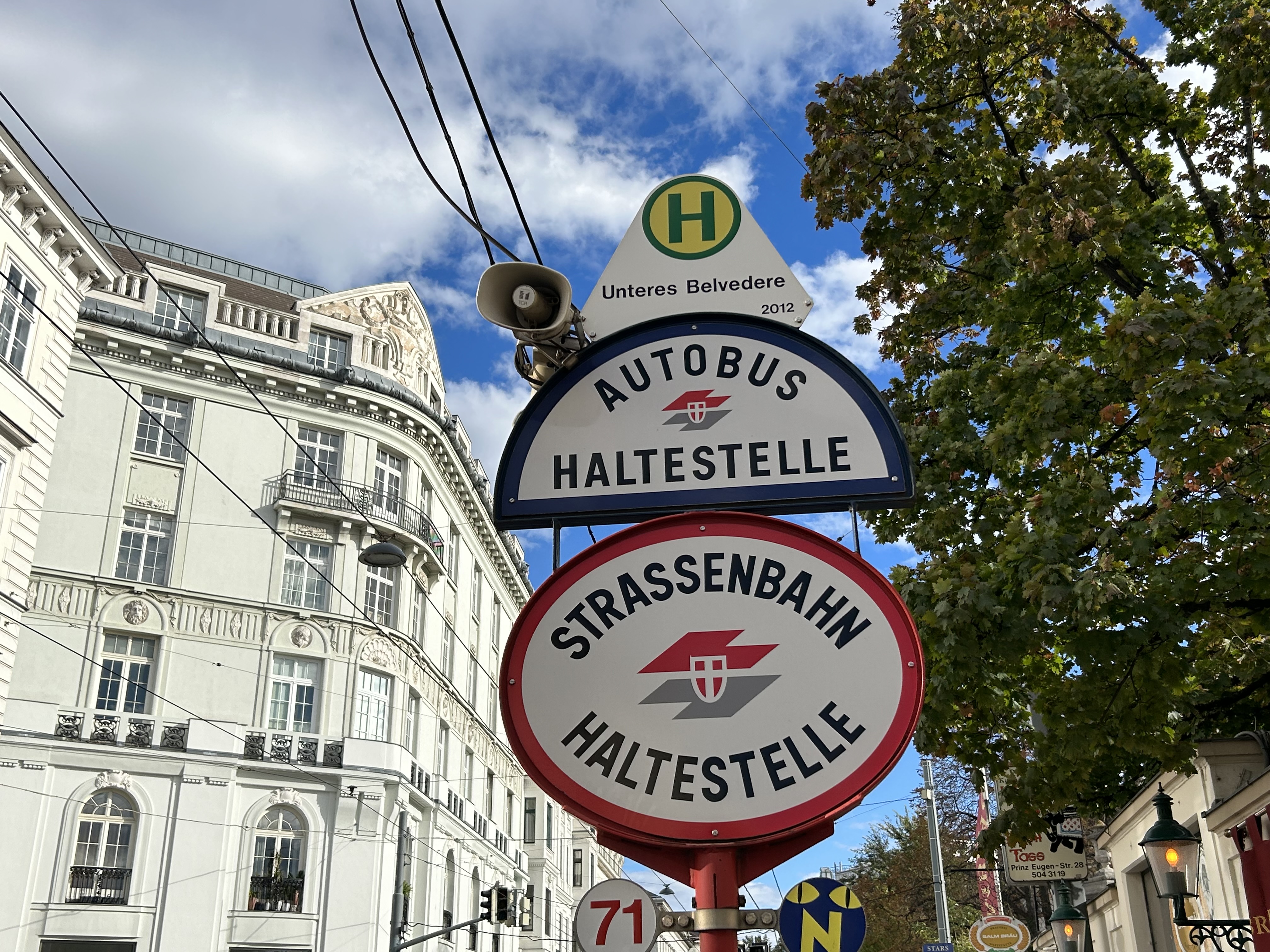
The classic Vienna tram stop. Note the loudspeakers atop the blue bus stop sign (at night, buses take over, hence the Strassenbahn and Autobus stop signs).
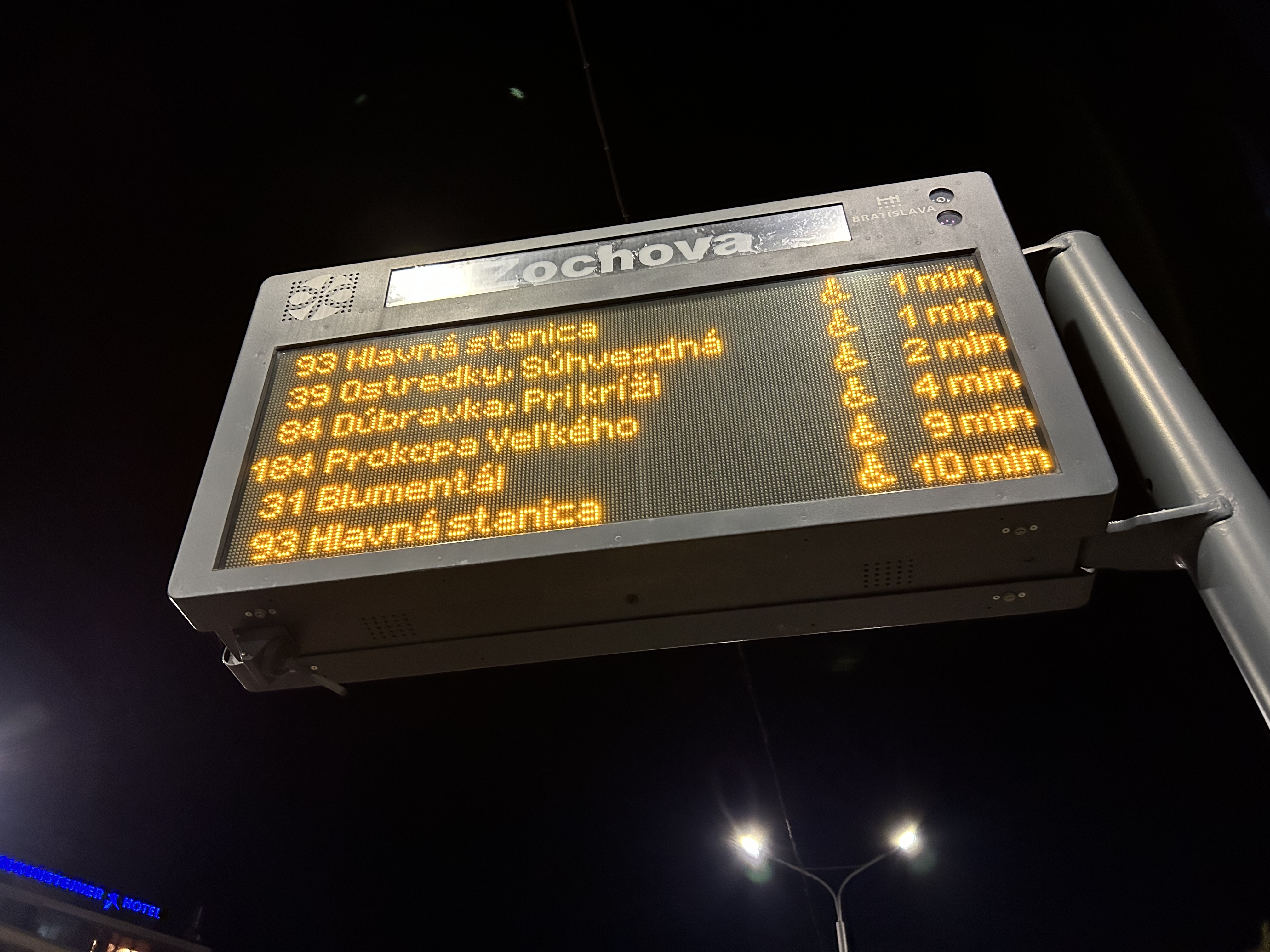
Next vehicle displays were common in every city we visited. They would list — in real time — the next several buses or trams, as well as if the vehicle was low-floor accessible or not with a wheelchair symbol. All buses are now fully accessible, but the information is useful for the tram lines, where there are still many older high-floor vehicles.
Next vehicle display at a bus stop in Bratislava
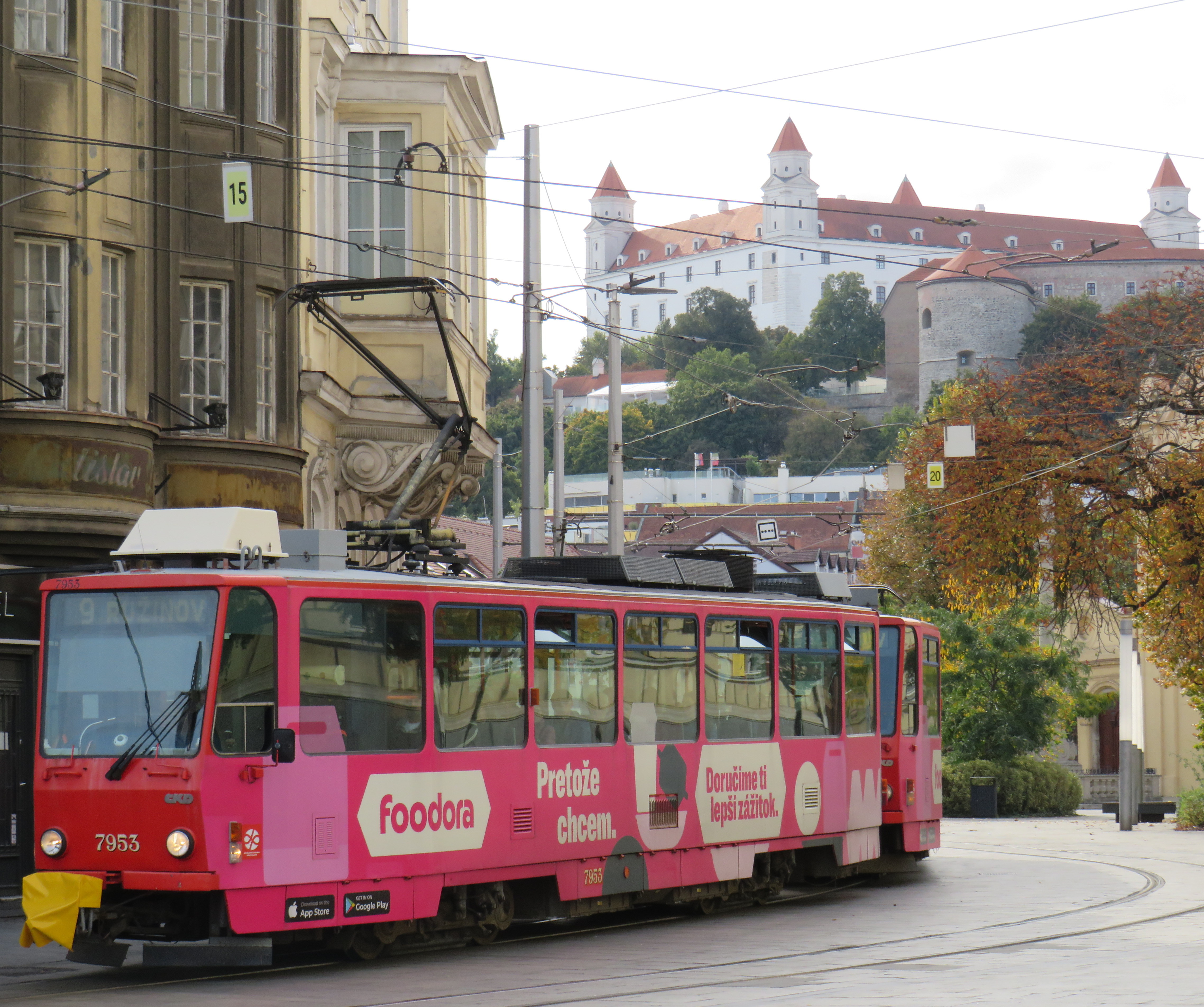
I also noted that in Vienna, and for the most part elsewhere, vinyl advertisement wraps did not cover passenger windows on trams and buses. Bratislava’s wrapped trams had some ads that used window areas, but these were kept to a minimum.
In Vienna, advertisement wraps kept windows completely free of obstructionsAdvertisement wraps in Bratislava had minimal window coverage
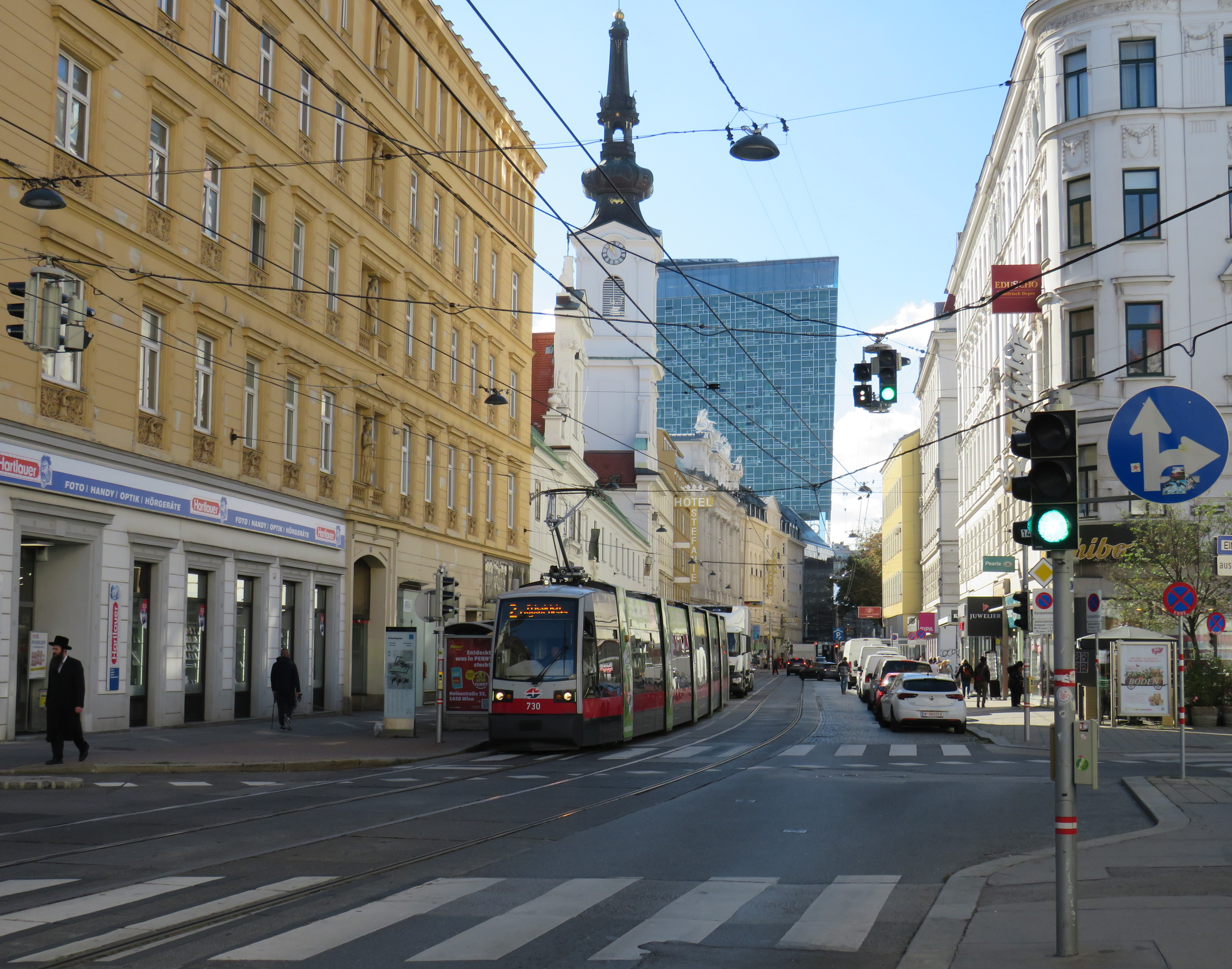
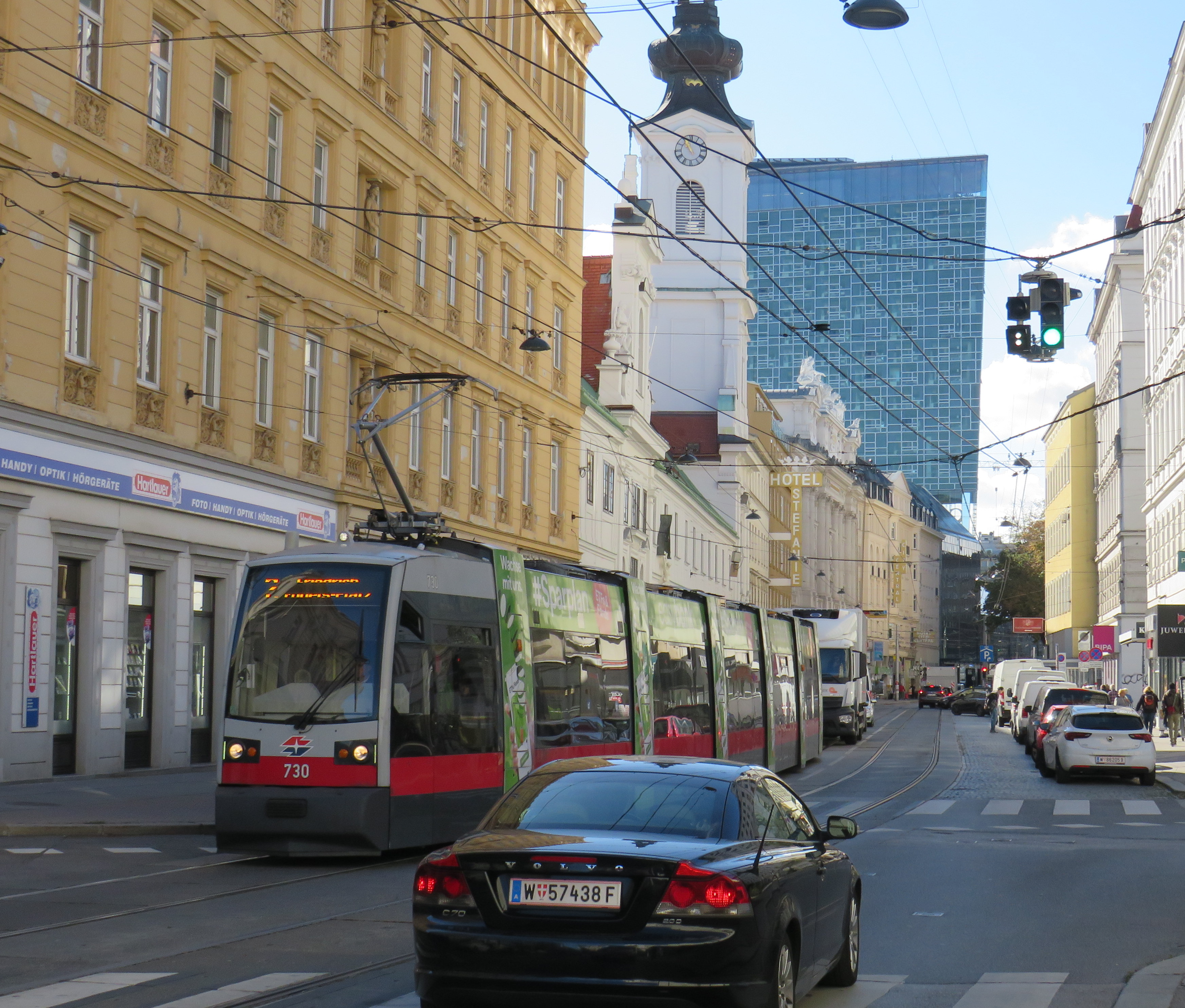
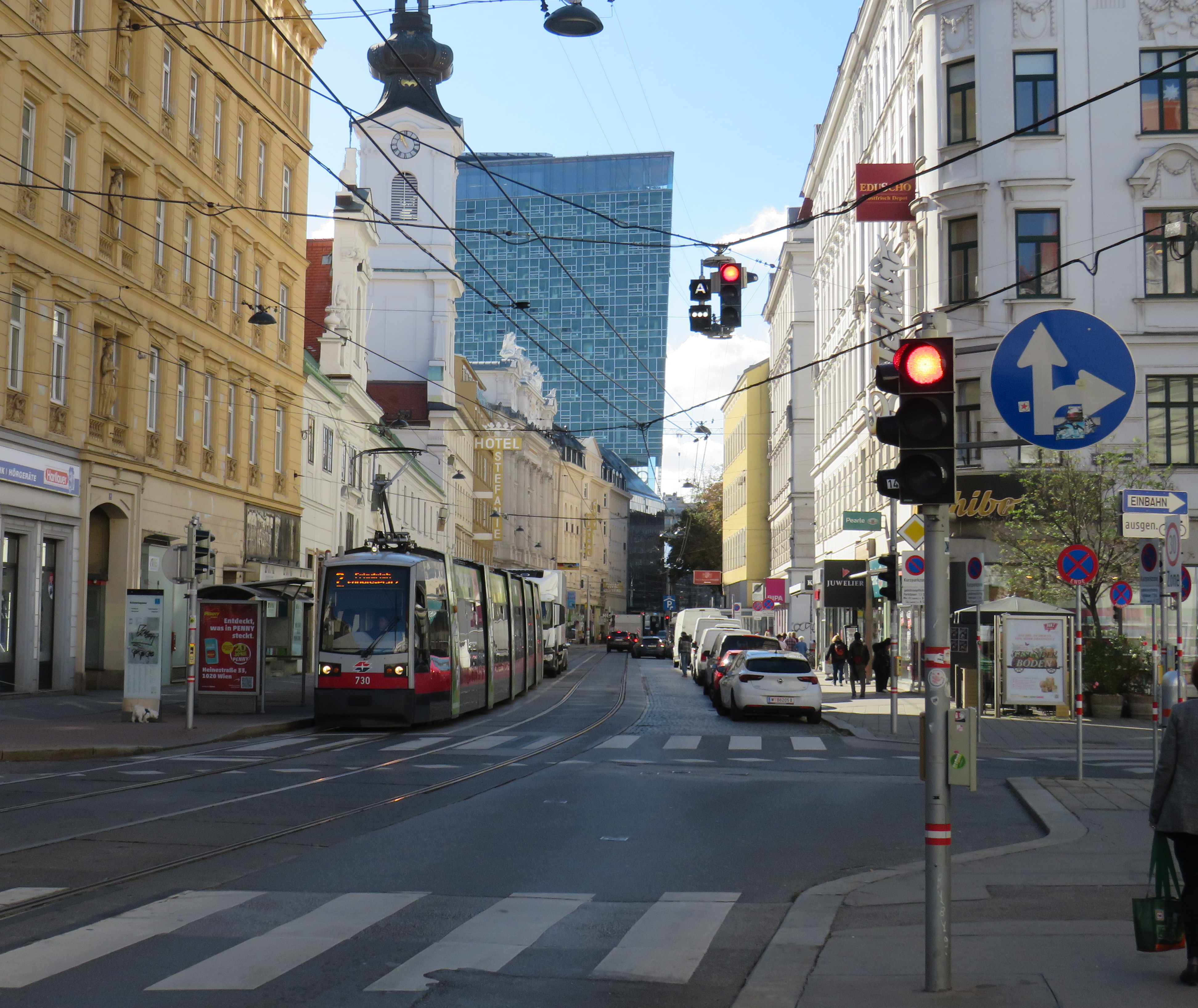
It was also clear that trams had dedicated signals on their routes, if not necessarily signal priority. But with smaller intersections and relatively short signal timings, the waits at each signalized intersection were generally minimal.
Note the white tram signals next to the overhead traffic signal. The “A” indicates that a proceed signal will soon appear, and the operator can cancel the door release, so that no more passengers can enter or exit.
Tram signaling in Vienna and other Central European cites also includes remotely operated electric switches. Overhead signals indicate which direction the switch is set to; operators can pass through junctions at speed. While this is how trams operate in most places around the world, in Toronto, streetcar operators are required to stop before each switch and then crawl.
Trams pass through a track junction, along with an ambulance and a transit maintenance van. The overhead horizontal signal indicates the switch direction.
Though many tram stops are in private rights-of-way, in-street tram stops are designed for passenger safety and accessibility. These stops, depicted by the photograph below, have the curb lane raised to the level of the low-floor trams. This increases the visibility of passengers boarding and egressing, and also simplifies ramp deployment. Operators need not exit the cab and manually deploy the accessibility ramp, a timesaver versus the TTC’s ramp deployment on major streets. In the winter, this also helps keep the slush away from the tram stops.
The raised on-street curb lane at an on-street tram stop in Vienna.
Though Toronto is a very different city than Vienna, Budapest, or Prague, there are some clear takeaways. Keep the tram windows free of advertisements. Improve communications. Fix the track switches and signalize them. Raise the curb lanes at streetcar stops for safety, convenience, and accessibility. Fix the King Street Transit Priority corridor with a permanent streetscape and tighter vehicle restrictions. If it can be done on a narrow commercial street in Bratislava’s historic centre, there’s no reason why it can’t be done in a world financial capital.
These can even be done incrementally, but they need to be done if transit riders are deserving of respect and reliable surface transit.
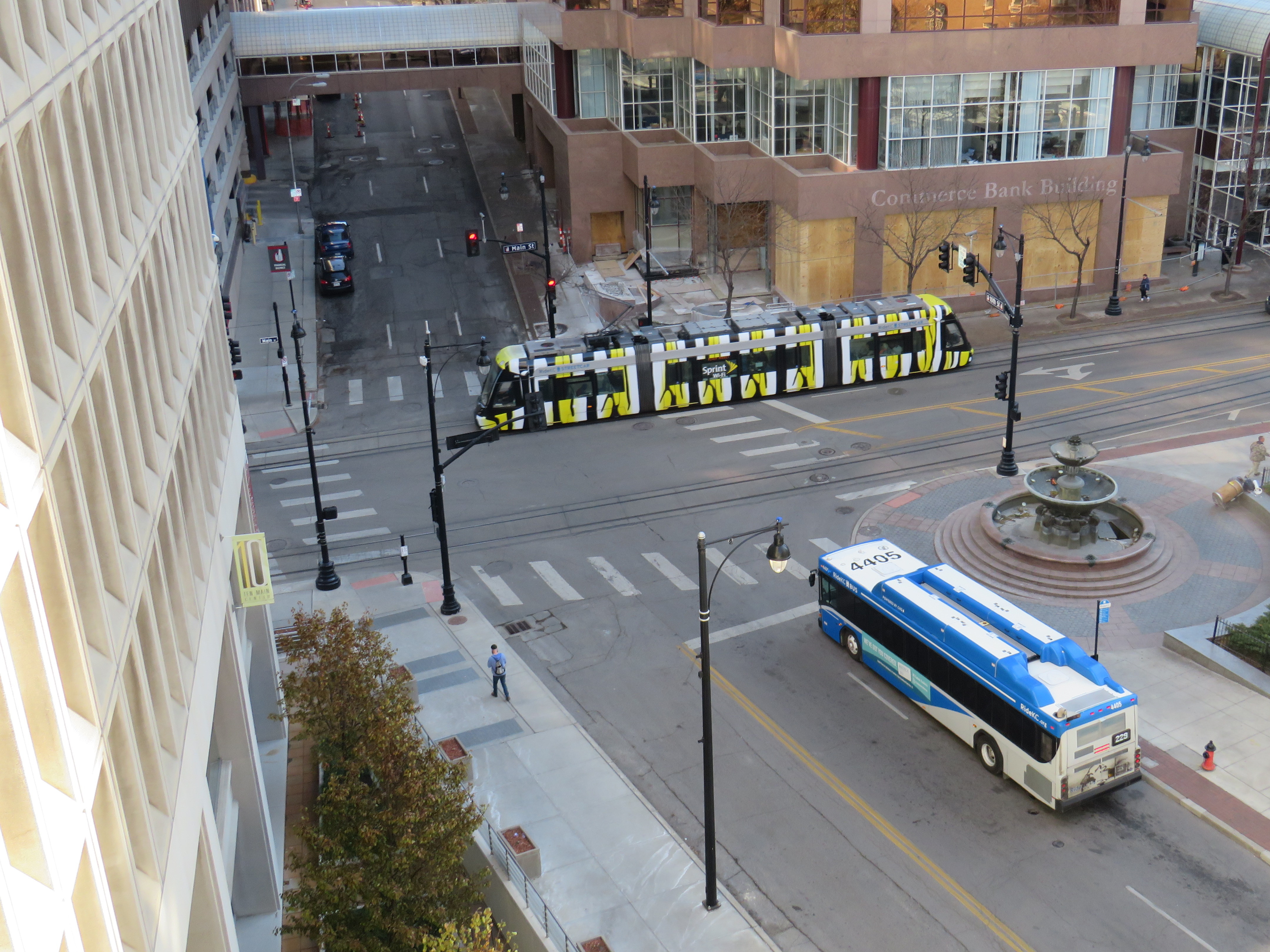
Kansas City, Missouri made news this month when its City Council voted unanimously to include a plan for free fixed-route public transit in the next city budget. Though that budget would still have to be passed in the New Year, the mayor’s support for the measure is a promising sign. Though it will cost $8 million, local politicians support the idea as it will benefit low income riders.
It is worth noting that Kansas City Area Transit Authority’s 2016 annual ridership was just over 14 million a year, while the cost recovery rate was just 12 percent. It would be much harder to offer free transit in Toronto. The TTC’s cost recovery rate is 68%, with transit fares bringing in over $1.2 billion a year. Though a two-hour transfer and free children’s fares were recently introduced, there’s little chance that the City of Toronto would agree to funding fare-free transit. In any case, Kansas City’s experiment will be interesting to watch.
Kansas City was a more interesting city than I expected; I am glad I made the impromptu trip. There are a few Toronto connections, including a streetcar that traveled the continent, a restored Union Station, and a 1920s shopping plaza whose concept was imitated 80 years later in Don Mills.
I enjoyed an evening at a jazz club at the 18th and Vine Historic District and local barbecue. Besides transit, I also got around on an electric pedal assist bike that’s part of the local bike share. It’s friendly, urban city, definitely worth a visit. (more…)
On Friday, CBC Toronto ran a story on several King Street West businesses that have claimed that the new King Street Pilot have caused them to lose customers in December. The three business owners mentioned in the article were Laleh Larijani of Forno Cultura, a bakery on King east of Bathurst, and two Restaurant Row restaurateurs: Jesse Warfield, whose family owns the Gabby’s chain of restaurants, and Fred Luk, owner of Fred’s Not Here and The Red Tomato.
The King Street Pilot was launched by the City of Toronto on November 12, 2017. At many intersections between Bathurst and Jarvis Streets, cars and trucks are required to turn right off of King Street, prioritizing streetcar traffic. Most on-street parking spots were removed from King Street through this section, but designated areas allow for deliveries, passenger pick-ups and drop-offs, and access to local properties, including parking garages. Despite some [predictable] hyperbole from suburban politicians and reactionary journalists, cars are not in fact banned from any section of King Street. And there are many public and privately-owned garages adjacent to the pilot corridor for motorists to park at.
For transit riders, the King Street Pilot is working. In December, the TTC reported travel time reductions for the busy 504 King and 514 Cherry Streetcars of up to 24 percent. However, it still struggles to keep up with demand. The continuing delays in the new streetcar deliveries from Bombardier have not helped matters; and streetcars still often run overcrowded, leaving some passengers behind at streetcar stops. There are some necessary tweaks to be made: TTC schedules should take advantage of improved travel times, and transit signal priority is also necessary with the new far-side stop locations at intersections. Signal priority will help to ensure streetcars don’t have to stop at a red light at the near side of the intersection and again to load passengers at the far side.
But since it’s a year-long pilot project, these tweaks can be made.
Unfortunately the CBC article was weak in that it presented only the business owners’ complaints about the King Street Pilot, without hard data to back up the claims of lost business. Only one Toronto city councillor was quoted, John Campbell, who represents Ward 4, Etobicoke Centre. Ward 4 is an affluent, suburban part of the city that does not have any streetcar lines. Councillor Campbell, who also sits on the Toronto Transit Commission, would like to see street parking permitted during evenings and weekends:
“I would like to see people able to park here in the evening, park here on the weekends, because listen, when it’s –15 C people don’t want to walk a block-and-a-half to get to a restaurant. They want to park within 100 metres. I think that would bring more vibrancy back,” [Campbell] explained.
It’s worth pointing out that motorists will walk much further than 100 metres when parking at busy suburban malls like Sherway Gardens or Yorkdale; it’s also the distance from many GO Transit parking spots to the train platform. The walk between the front doors of the Royal Alexandra Theatre and Princess of Wales Theatre on King Street is nearly 200 metres.
Watering down the King Street Pilot would doom it to failure: as any King Street transit rider knows, traffic congestion didn’t suddenly disappear at 6:30 PM. It’s an unreasonable expectation to find ample parking 100 metres from many downtown businesses and institutions.
It’s worth noting that a suburban councillor has taken so much interest in watering down a downtown initiative championed by downtown councillors, and that as a member of the TTC board, Campbell wishes to reduce the benefit to many of the transit agency’s customers.
Fred Luk, profiled in the CBC article, has a long history of complaining to Toronto media, as pointed out by urbanist and writer Shawn Micallef on Twitter. In the last few years, Luk has complained about the increase in the minimum wage, higher energy costs, the effects of the 2003 SARS outbreak and the 2010 G20 Summit, even the 1999 municipal indoor smoking ban. Yet Luk’s King Street restaurants persisted.
Here's restaurateur Fred Luk complaining about the King Street pilot. His biz is suffering. This is going to be a thread. https://t.co/7qsSi9qZP2
There are many factors that can influence the success of restaurant businesses. Obviously, the quality of food and service should be examined. It’s worth noting that Toronto is bearing with unseasonably cold temperatures, it’s the low season for tourism, and there aren’t any blockbuster musicals currently playing at the Royal Alex or Princess of Wales. Motorists still have to get used to the new arrangements and change their habits; it’s only been seven weeks so far. Once the weather improves, the curb lane in front of Restaurant Row can be used for wider sidewalks, even enlarged front patios.
The smart thing for a business owner concerned about a decline in patronage would be to use the free publicity to promote the restaurants, rather than complain about a loss of business. Businesses in the Entertainment District are largely driven by walk-up traffic; there’s a reason why menus are posted by the doors and in the summertime, you can’t walk past Restaurant Row without having a representative out front trying to get you to look at their menu.
Locating a restaurant on King Street West has lots of advantages: the proximity to thousands of residents, many nearby offices, hotels, entertainment and sports venues, and excellent transit access and ever increasing pedestrian activity. It is not realistic to expect ample street parking to be one those advantages.
If access to parking were the chief concern, it would be wise to set up in a suburban plaza somewhere else, like in John Campbell’s Etobicoke. Complaining about a major improvement to the travel times of thousands of commuters, without offering any incentives for potential customers to visit your restaurants isn’t productive. Instead, doom and gloom messaging may only damage business further, resulting in a self-fulfilling prophecy.
I grew up in Brampton, a suburb of Toronto. Our family could not justify long, expensive vacations, but we did make several trips to Detroit and the region, usually to visit the Henry Ford Museum and Greenfield Village. We’d stay at a hotel outside Detroit, usually one with a swimming pool. Besides the museum visit and the pool, my parents would usually include a stop at an outlet mall. We’d also drive through Detroit itself, sparking my enduring fascination with the city.
Since my first visit in the mid-1980s, the Hudson’s Department Store has been demolished, the Michigan Central Station has been permanently closed and allowed to deteriorate, and several downtown skyscrapers have closed and been abandoned. The city itself continued to lose population as more auto plants closed in the city and surrounding suburbs, and city services declined.
But on recent trips, on my own or with friends, we started to see the beginnings of what looked like a comeback. New downtown baseball and football stadiums, followed by new office buildings, the re-opening of the long-abandoned Book-Cadillac and Fort Shelby Hotels, the opening of the Detroit Riverwalk and Dequindre Cut multi-use paths, and new residential development Downtown and Midtown.
On the last trip to Detroit, my wife and I stayed downtown, at a hotel in the David Whitney Building, a formerly-abandoned office tower. We walked around Downtown Detroit and Eastern Market, visited the famous Art Deco Fisher Building, and went to several museums, including the Charles H. Wright Museum of African-American History, and the Detroit Historical Museum, both of which had special exhibitions marking the 50th anniversary of the 1967 Detroit Rebellion (also known as the 12th Street Riot). We ate at great local restaurants as well.
And I went back to the Henry Ford Museum and Greenfield Village, both of which were as fun and as interesting as I remember.
We also took the new QLine Streetcar. It was a fun ride, and I’m happy to report that the service was well used by both residents and tourists alike. But I have some serious concerns as well.
Hallam Street looking east from Dufferin Street, January 2017
Hallam Street, which runs east-west from Shaw to Dufferin, north of Bloor Street, is unusually wide for such a quiet, short road. Hallam Street doesn’t provide a convenient thoroughfare for motorists, and nearly every storefront is either vacant, or converted to other uses. Despite being located in a dense urban area of Toronto, Hallam Street has a ghostly feeling when walking or cycling across it.
So why is Hallam Street so wide? And why does it have so many vacant or former storefronts?
Former storefront on Hallam Street at Delaware Avenue, one of several on Hallam that were converted to residential uses
For thirty-one years, from 1916 to 1947, Hallam and Lappin Streets hosted the Harbord Streetcar, an interesting and circuitous route that served the northwest portion of the City of Toronto, and later, the east end of the city. Unlike most streetcar routes in Toronto, the Harbord Car refused to follow a grid. It wound its way through several working class neighbourhoods, tying together parts of Toronto otherwise underserved by its transit network.
The Harbord Car was re-routed from Hallam Street and Lappin Avenue to Dovercourt and Davenport Roads in 1947, as part of a re-organization of transit services in Toronto’s west end (more on that below). The streetcar was fully abandoned in 1966, when the first phase of the Bloor-Danforth Subway opened. (more…)
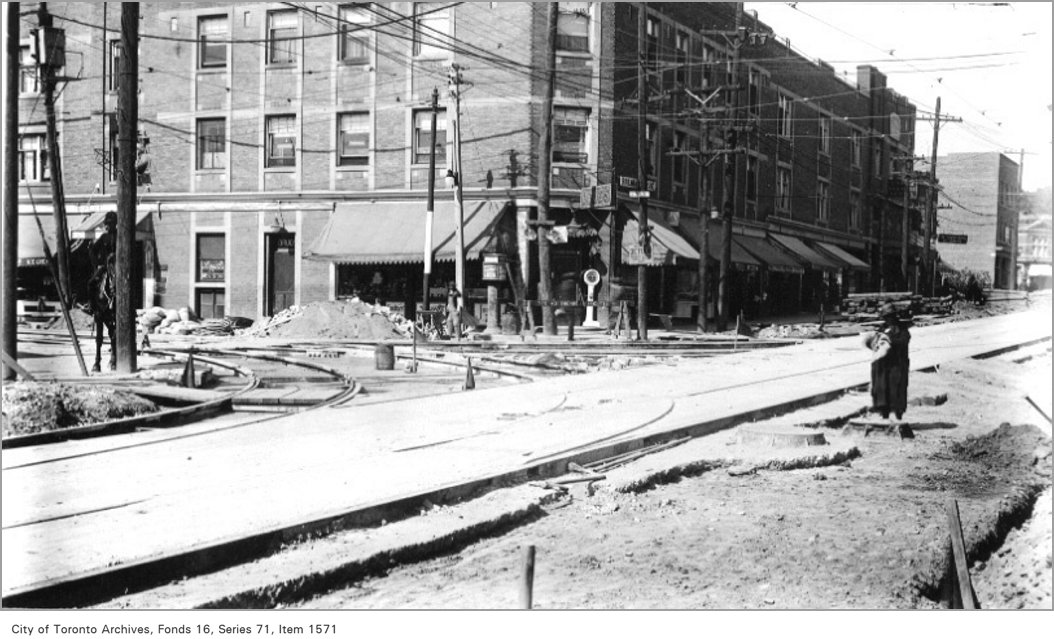
Yonge Street at St. Clair Avenue, 1922. The TTC was busy in its first few years joining together the various street railway systems together and expanding services. Here, work is underway to extend city streetcar service to Glen Echo Loop and connect with the former Toronto Civic Railway’s St. Clair line. City of Toronto Archives Fonds 16, Series 71, Item 1571
In 1921, the Toronto Transportation Commission was established to provide all transit services within the City of Toronto, on a complete cost-recovery basis. Within the City, there would be a single fare for all regular services, including free transfers, with additional fares for services outside the city limits.
The TTC immediately took over the operations of the Toronto Railway Company and the city-owned Toronto Civic Railways and began to unify the two systems. It bought new equipment, and replaced worn-out rail, carhouses, and other facilities. It introduced the first transit buses to Torontonians, and three decades later, Canada’s first subway.
Toronto’s streetcar system expanded through the 1920s, but stagnated through the 1930s, including the loss of almost all of Toronto’s radial railways. But it wasn’t until 1947-1948 that Toronto’s street railway network entered an era of decline, as trolley coaches, diesel buses, and subways chipped away at the streetcar’s dominance.
By the late 1960s, the TTC was looking to eliminate streetcars entirely by 1980, once the Queen Street Subway opened. Of course, that subway line never opened, and the streetcars remained. It wasn’t until the 1990s, though, that the network entered a renaissance.
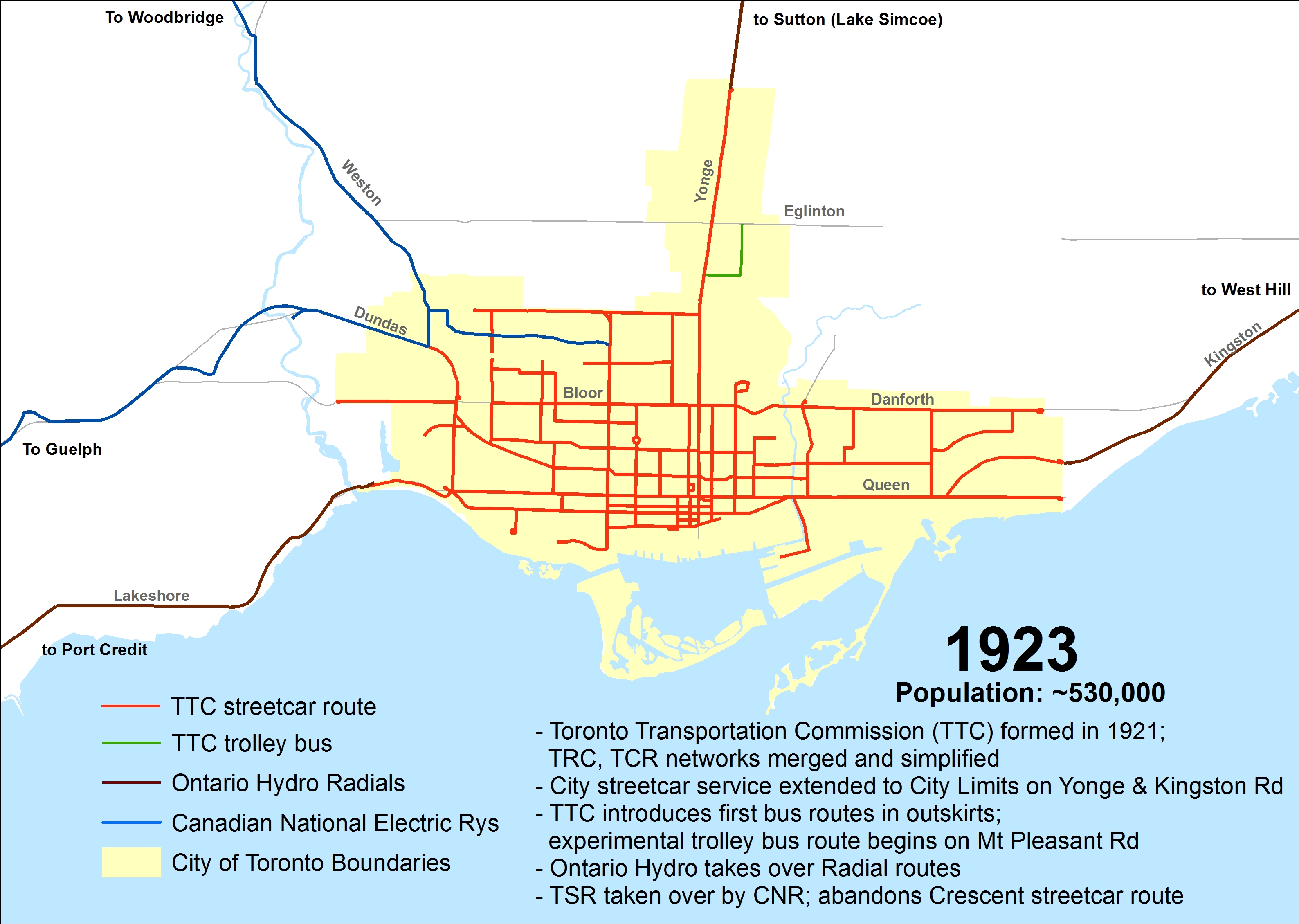
1923
Within two years, the TTC quickly modernized the streetcar system. New streetcars — known as Peter Witts — were ordered and the oldest of the Toronto Railway Company’s cars were immediately scrapped. The TTC unified the TRC and Civic systems, replaced the radial railways within city limits with city services, and added new routes such as Coxwell and Bay. The City took over the Toronto & York radials as well, but handed their operation over to Ontario Hydro. The TTC also replaced much of the worn out rails, and built new turning loops at the end of streetcar lines replaced crossovers and wyes. This improved operations and allowed for larger, single-ended streetcars to operate on more routes.
The TTC also introduced buses. In the early 1920s, buses were were slow, small and less comfortable than streetcars, but they had their advantages. The TTC’s first bus route, 1 Humberside, provided a direct, single-fare ride through the South Junction neighbourhood to TTC streetcars at Dundas Street; the Toronto Suburban’s Crescent streetcar line couldn’t compete and was soon abandoned. The TTC also experimented with a trolley bus route on Merton Street and Mount Pleasant Road between 1922 and 1925; it was replaced by an extension of the St. Clair streetcar.
Trolley bus on Merton Street, June 20, 1922. City of Toronto Archives, Series 648, Fonds 227, Item 1
As part of Doors Open Toronto, the Toronto Transit Commission opened up the Leslie Barns for public tours. The new streetcar facility was built to house and maintain the new fleet of Bombardier-built low-floor streetcars. Of course, the streetcar delivery schedule has been disrupted by Bombardier’s incompetence; while there are only eighteen new streetcars currently in revenue service, there should have been 70 in service by the end of last month. Now the Bombardier problems have affected the Region of Waterloo’s light rail project, ION, which was to open in late 2017.
View from the yard at Leslie Barns west toward the Toronto skyline
In any case, the TTC always puts on a great public event. Visitors to Leslie Barns were welcomed to tour the vintage streetcars — a 1923 Peter Witt, and a 1951 PCC streetcar. A new streetcar gave visitors a tour through the barns and around the (mostly empty) yard. Employees held a charity barbecue, there were giveaways for children and lots of friendly staff eager to answer questions. These public open houses are where you’ll find the TTC at its very best.
You could tell that some of the organizers had some fun. The CLRV on display (pictured below) was signed for Old Weston Road, a short turn point on the 512 St. Clair carline. Townsley Loop, once the terminus for Dovercourt and later Harbord Cars, was closed to streetcars in 2003 and the tracks removed during the St. Clair Avenue streetcar right-of-way construction. Streetcar 4401, parked in the paint shop was just asking for the title I gave it, an homage to the visuals in that great Stanley Kubrick film.
Yeah, operating a streetcar was a childhood dream for a while. Note the rollsign.
Also on Sunday (and every Sunday, from noon until 5PM until Labour Day Weekend), you can ride a PCC streetcar in active service along Queen’s Quay between Union Station and Fleet Loop, and rides are free. We did this yesterday between visiting several downtown Doors Open sites, before exploring Fort York. The two PCC streetcars retained by the TTC (the rest were sold to museums or sent to Kenosha, Wisconsin) were restored to their 1951 appearance and are used for special events, charters, and summer Sunday service on the Harbourfront.
The TTC is often maligned, often unfairly, for poor customer service, service disruptions, and delays. But I think events like Doors Open and free rides on vintage streetcars are a great way for the public to feel good about our transit system.
Streetcar 4500 on Queen’s Quay
Interior, PCC streetcar
Streetcar 4500 at Fleet Loop, passing the 1861 Queen’s Wharf Lighthouse


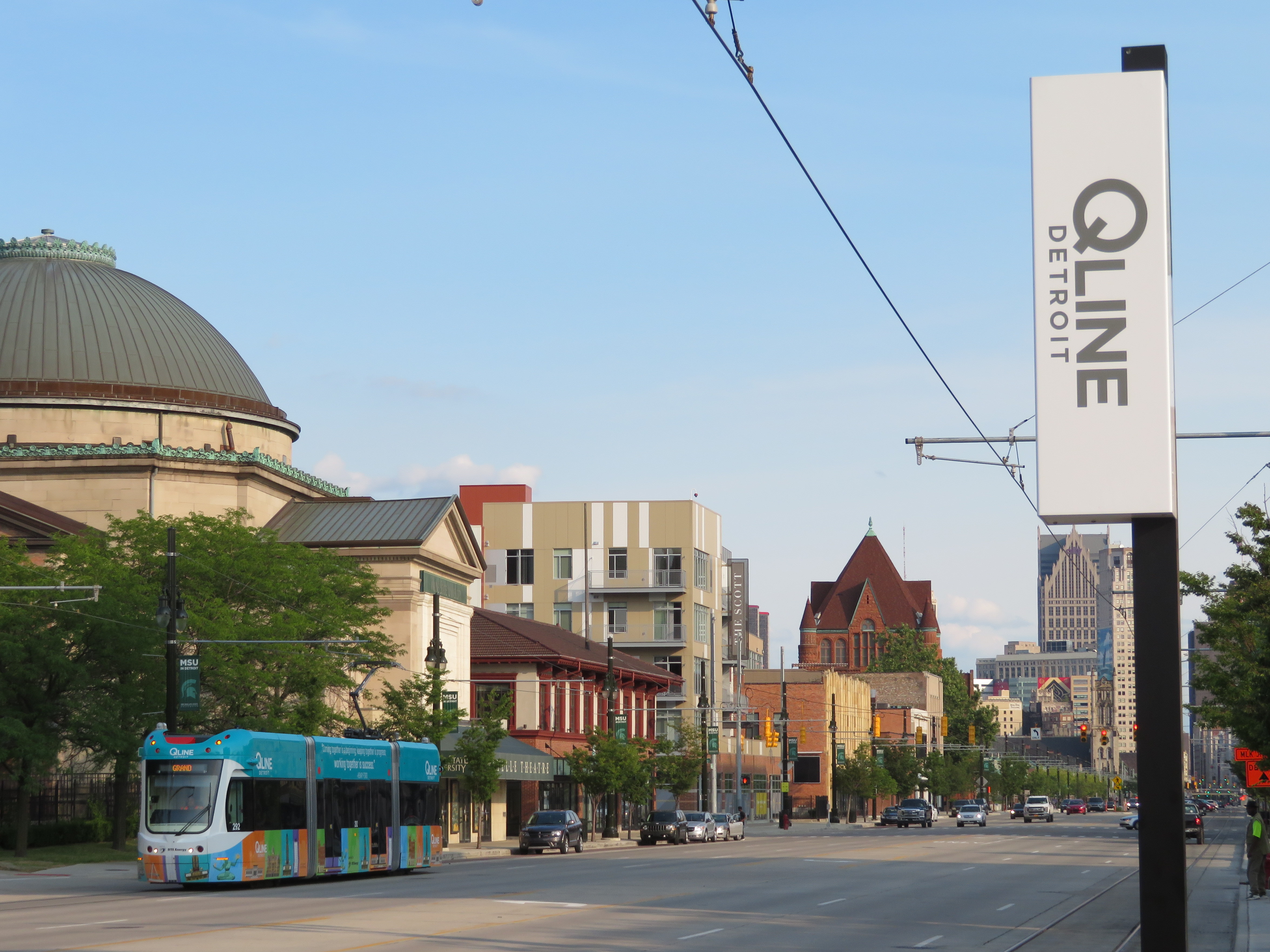 Woodward Avenue at Mack Avenue, August 2017
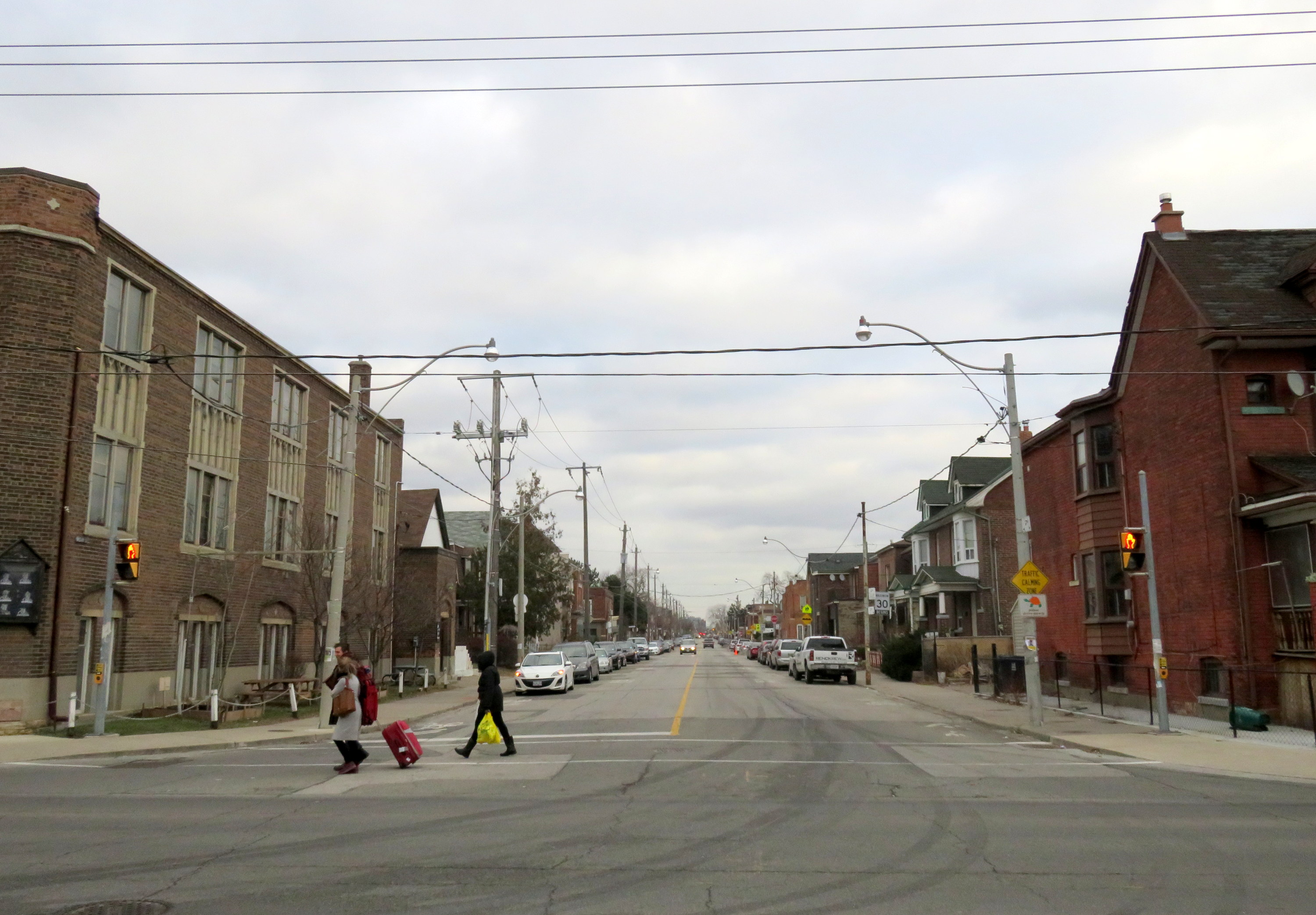 Hallam Street looking east from Dufferin Street, January 2017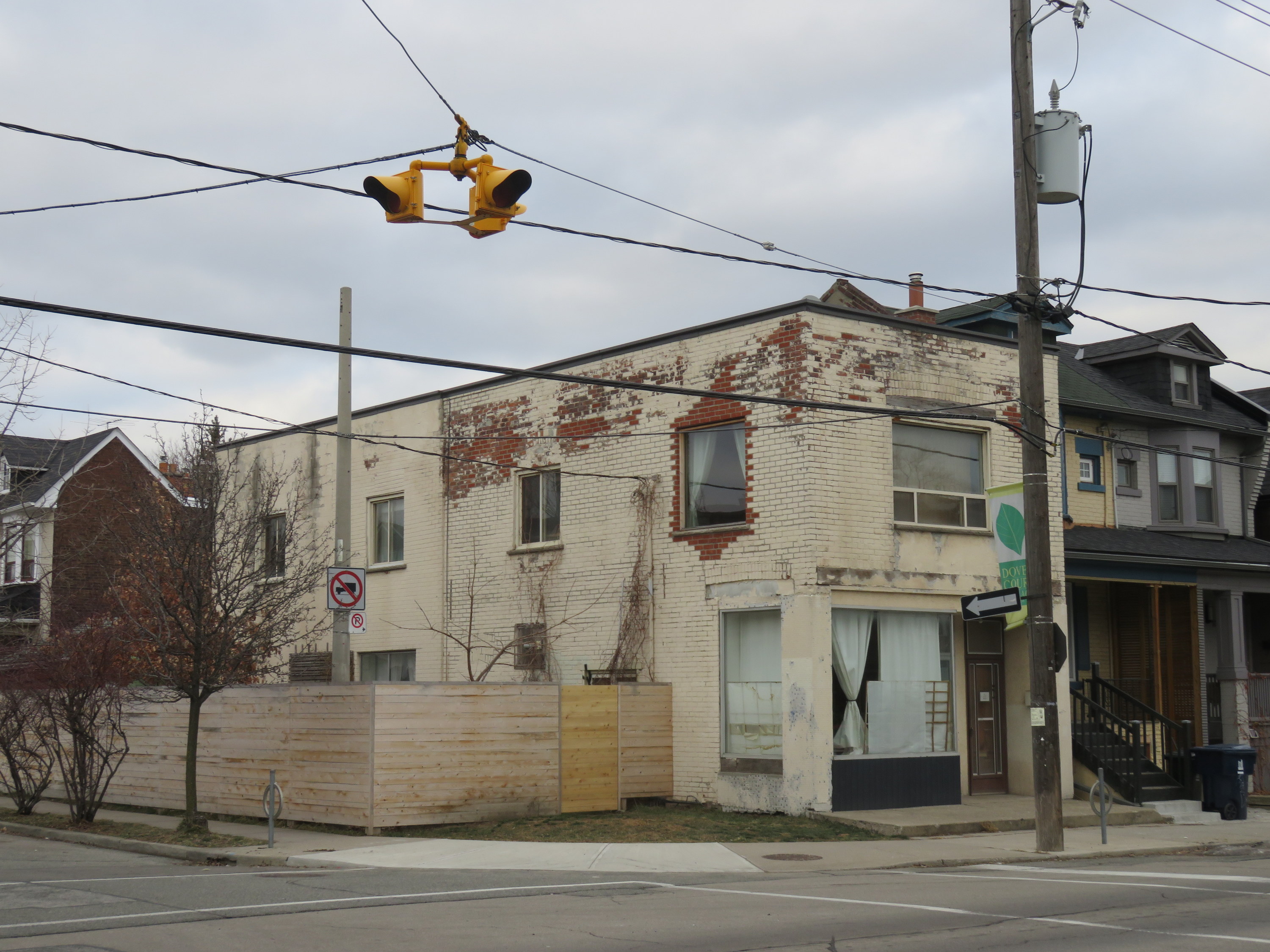
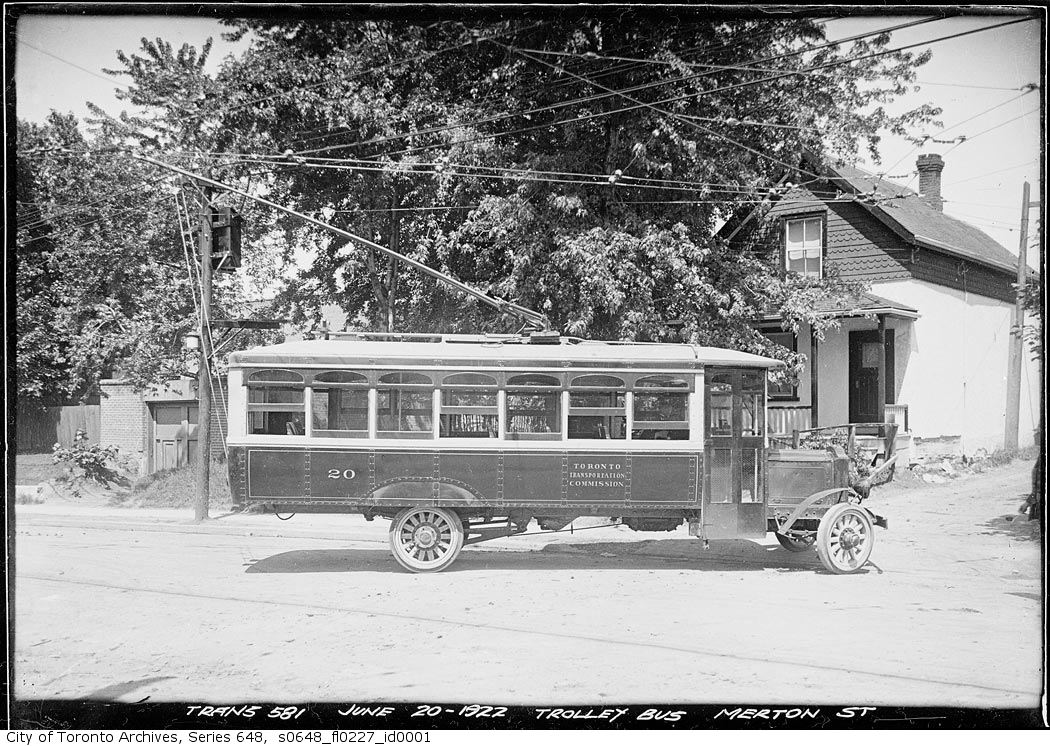 Trolley bus on Merton Street, June 20, 1922. City of Toronto Archives, Series 648, Fonds 227, Item 1


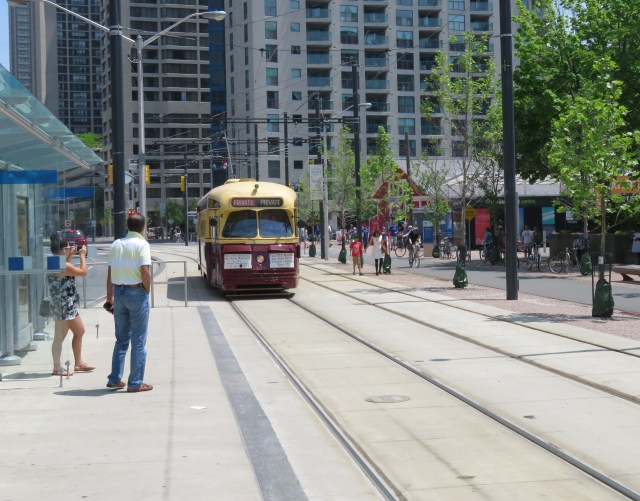 Streetcar 4500 on Queen’s Quay
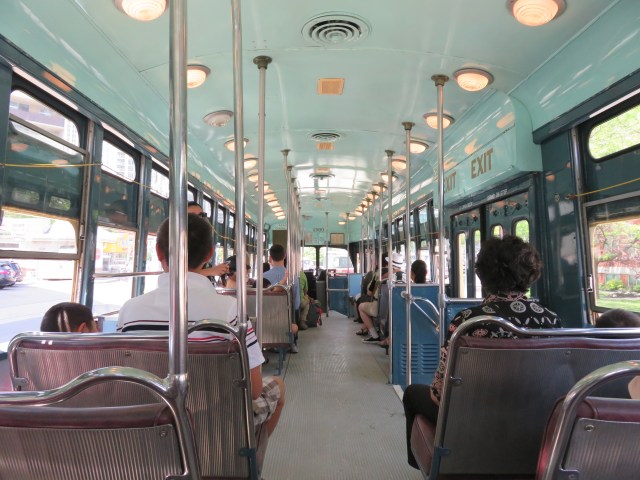 Interior, PCC streetcar

