Tag: University-Rosedale

  • Mapping the results of the 2022 Toronto municipal election

    How Toronto voted for mayor. Areas shaded in blue represent electoral subdivisions (polls) where John Tory placed first. Areas shaded in purple represent polls where Gil Penalosa placed first. Click here for the interactive version.

    As has become my tradition after Toronto’s municipal elections, I mapped out the poll-by-poll results of the mayoral race and some of the more interesting council races. After creating maps for the 2014 election and sharing those on social media, it was suggested that I have a website to host these maps. That is how this website came to be.

    This time, I created an interactive map showing the results of the mayoral race, along with six council races: Ward 3 Etobicoke-Lakeshore, Ward 4 Parkdale High-Park, Ward 5 York South-Weston, Ward 11 University-Rosedale, Ward 18 Willowdale, and Ward 20 Scarborough Southwest.

    I offer more thoughts over at Spacing Toronto, as part of a series mapping the municipal election.

  • Exploring the downtown federal election races: Part III

    Last year, I posted maps showing how each poll voted in the 2011 and 2013/2014 by-elections in two key Downtown Toronto federal constituencies: Trinity-Spadina, and Toronto Centre. I also provided some thoughts about the races and the candidates. Now, over six months since the October 2015 election, I took some time to look at what happened.

    (Elections Canada was also slow to release poll-by-poll data; in comparison, the City of Toronto was very fast — I was making poll-by-poll maps of ward races weeks after the 2014 election.)

    In the 2015 federal election, these two ridings were split into three: University-Rosedale, Spadina-Fort York, and a much smaller Toronto Centre. In 2015, all three ridings were ones to watch; all three had high profile Liberal and New Democratic candidates vying to a seat in Parliament.  (more…)

  • Exploring the downtown federal election races: Part II

    Back in April 2015, I looked at the impact of changes to the new federal electoral districts in three key downtown races: Toronto Centre, University-Rosedale, and Spadina-Fort York. The three downtown ridings were created by splitting two larger electoral districts, Trinity-Spadina and a larger Toronto Centre.

    As a downtown resident and political junkie, I was very interested in how previous election results would look with the new electoral districts. Could Toronto Centre, long held by the Liberals, go orange with Rosedale and Yorkville lopped off? Would University-Rosedale and Spadina-Fort York become Liberal bastions with the new boundaries?

    When I wrote the original post, the Liberal Party had nominated candidates in all three ridings — Chrystia Freeland in University-Rosedale, Adam Vaughan in Spadina-Fort York, and first-time candidate Bill Morneau in Toronto Centre. I wrote more about all six candidates (and some of my personal opinions) in the original post.

    Back in April, the New Democrats nominated Jennifer Hollett in University-Rosedale and Linda McQuaig in Toronto Centre, but had yet to choose a candidate in Spadina-Fort York to run against Adam Vaughan. Vaughan, who took Trinity-Spadina in a 2014 by-election, was a popular Toronto city councillor. There were rumours that prominent criminal defense James Lockyer and former MP and mayoral candidate Olivia Chow were both considering running, but in late July, Chow formally sought, and won, the nomination.

    After the 2014 municipal election, in which Chow came in third place in the race for mayor, she accepted a position at Ryerson University. I expected that she was going to sit this election out, but I was proven wrong.

    All three ridings are proving to be interesting races. The Conservative Party of Canada (CPC) and Green Party have also nominated candidates in all three electoral districts, but only the Liberals and NDP are competitive.

    In this post, I added results and maps from the 2008 election, when the Harper Conservatives won a minority government, the Liberals were led by Stéphane Dion and the New Democratic Party, led by Jack Layton, came in fourth place in the seat count (after the Bloc Québécois) with 30 seats. Perhaps the 2011 election, in which the Bloc was nearly eliminated, the NDP became the Official Opposition and the Liberals relegated to third place, was an anomaly.
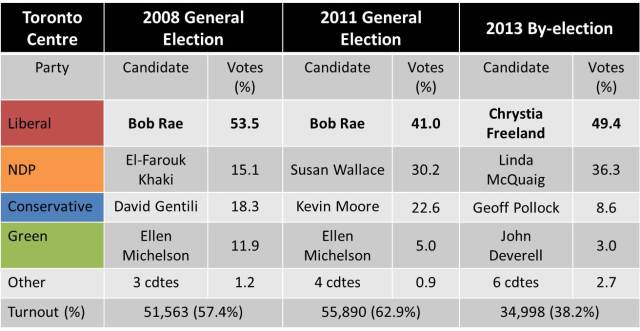
    Toronto Centre 2008-2013 Toronto Centre election results, 2008-2013

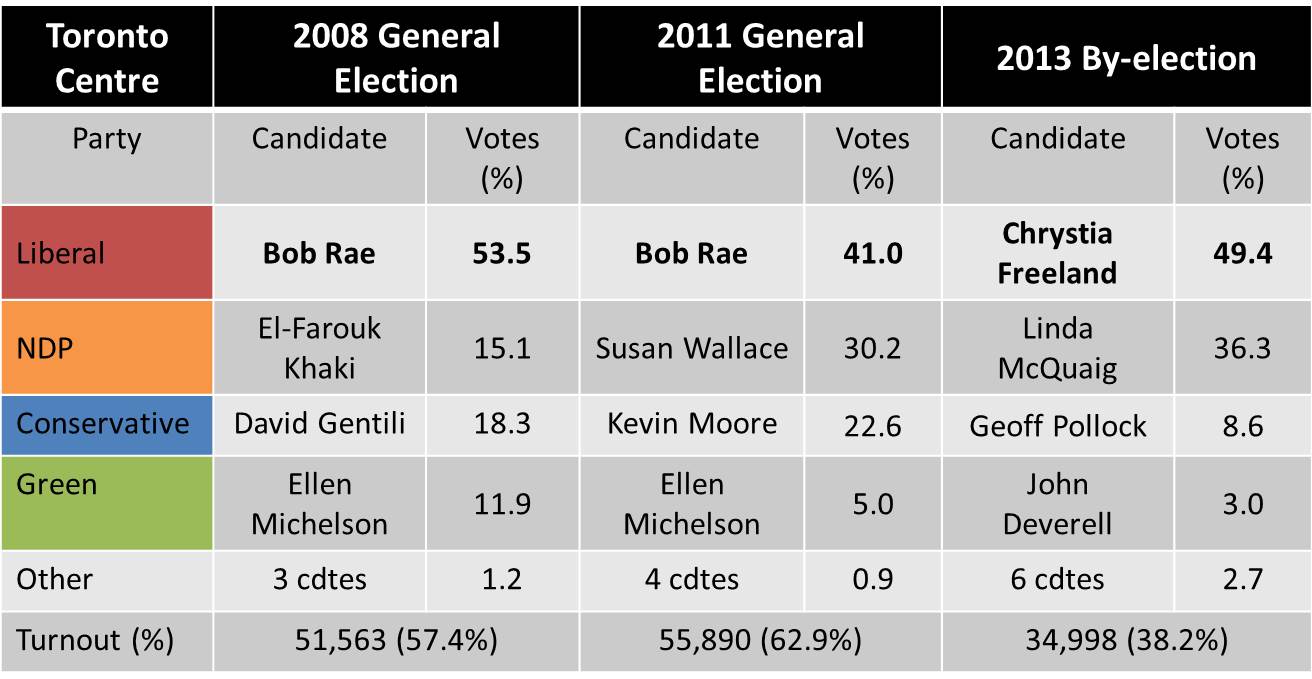
    In Toronto Centre, the NDP kept gaining support since the 2008 election, yet the Liberals held on with comfortable margins in 2011 and 2013. In the 2013 by-election, triggered by Bob Rae’s retirement from electoral politics, the CPC vote share collapsed (as did voter turnout), and Linda McQuaig, the new NDP standard-bearer, more than tripled the NDP’s share of the vote in 2008.
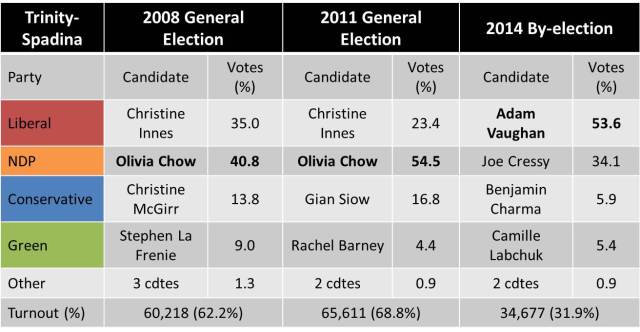
    Trinity-Spadina 2008-2014Trinity-Spadina election results, 2008-2014

    The NDP’s Olivia Chow, elected MP in 2006, was re-elected in 2008 and 2011. But her resignation in 2014 to run for Mayor of Toronto triggered a by-election in which Toronto city councillor Adam Vaughan took the riding for the Liberals in a by-election held on June 30, in the middle of the Canada Day long weekend. Voter turnout was a miserable 31.9%.  (more…)

  • Exploring the downtown federal election races: New ridings, new candidates

    Note: On October 2, I wrote a follow-up to this post, including a few new maps, some additional insights. All three races  — Toronto Centre, University-Rosedale, and Spadina-Fort York, remain interesting and close Liberal-NDP battles. 

    As I mentioned on this blog previously, describing the “Drawing the Lines” ward boundary review now underway, there are new federal electoral district boundaries for the upcoming Fall 2015 election. Toronto will have 25 Members of Parliament (MPs) after the next election; Downtown Toronto and North York both get an additional seat and Scarborough gets half a seat (it currently shares a electoral district with Pickering).

    As a downtown resident, I wanted to explore how the new electoral map might look like in the next election, and see whether the New Democratic Party (NDP) would have a chance at picking up one of those three downtown seats, as both Toronto Centre and Trinity-Spadina are currently represented by high-profile Liberals.

    (An aside: my politics have long leaned left and towards the New Democrats; though I am not my any means a strict or loyal partisan. I have friends who are loyal Liberals,  New Democrats, and Greens; my own voting decision depends on the race – in the 2011 general election, I voted Liberal, as I lived in York Centre, a riding held by NHL Hall of Famer, lawyer and great Liberal Ken Dryden, who sadly lost to Conservative Mark Adler. I soon moved to Davenport, joking that I had traded Dryden for [newly elected NDP MP Andrew] Cash. Brampton West Liberal MP Colleen Beaumier earned my very first vote when I was 18 years old, but I have since voted NDP provincially and federally in most other elections.)

    2011 General Election

    In the 2011 general election, in which Stephen Harper’s Conservatives won a majority government (and Jack Layton led the NDP to its greatest federal victory, winning 103 seats and official opposition status), both Toronto Centre and Trinity-Spadina re-elected their popular incumbents – Olivia Chow in Toronto Centre, former Toronto city councillor and Layton’s spouse, and Bob Rae, former New Democrat and Premier of Ontario, later a Liberal MP and leadership candidate. Chow won with 54.5% of the vote in Trinity-Spadina; Rae won with 41.0% of the vote in Toronto Centre.

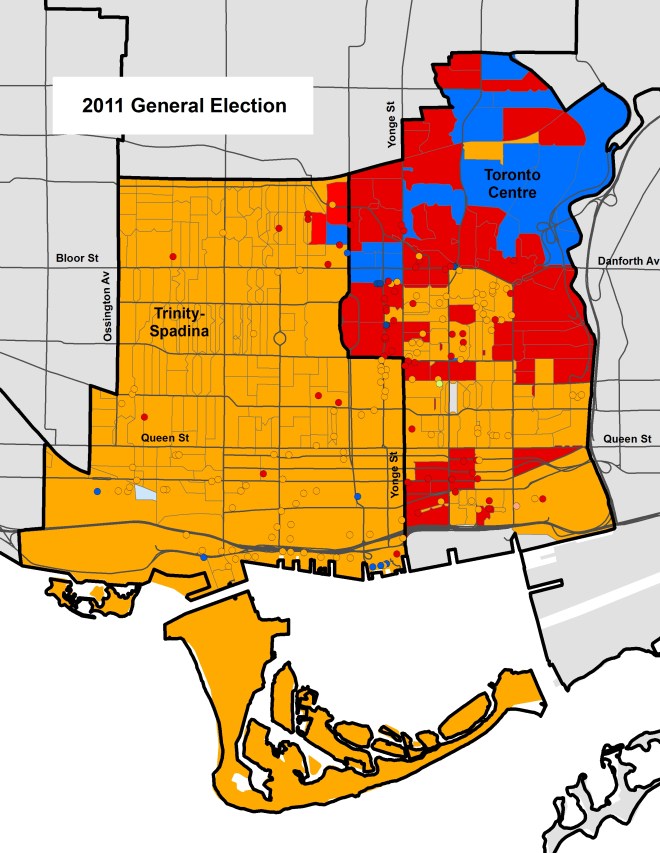
    As you can see in the map below, Chow placed first to most polls in in Toronto Centre, except for a few polls near the Waterfront (the Conservatives came in first in the Harbour Square condo complex), in the east Annex closest to Yorkville and a few condominium and seniors’ residences buildings elsewhere. Christine Innes, running for the Liberals, came in a distant second with 23.4% of the vote.

    In Toronto Centre, Liberal Bob Rae won with 41.0% of the vote; the NDP’s Susan Wallace took a respectable 30.2%, while Conservative Kevin Moore took 22.6% of the vote. In Toronto Centre, the Conservatives took several polls in the wealthiest parts of the riding; the “old money” Rosedale neighbourhood and several polls in Bloor-Yorkville, home of many of the most expensive condominium high-rises in Canada. The Liberals did well in polls throughout the riding (in Rosedale, Yorkville, Cabbagetown and St. Lawrence), while the NDP came in first most polls in Church-Wellesley, St. Jamestown, Moss Park, and Regent Park.

    2011 Fed Election - Downtown (1)Results by poll in the 2011 federal election in Trinty-Spadina and Toronto Centre

    (more…)