Tag: Ward 19

  • Mapping the council race in Ward 19, Beaches-East York

    Ward 19 Beaches-East York was one of the closest races in Toronto’s 2018 municipal election. It was only one of two “open” wards out of 25 — meaning no incumbent councillor was seeking re-election.

    Earlier this year, Councillor Janet Davis (old Ward 31) and Mary-Margaret McMahon (old Ward 32) announced that they were not running again for Council. Davis, a prominent member of council’s left wing, endorsed Diane Dyson, a community activist, as a candidate for Ward 35, which had similar boundaries to Davis’ ward. There were ten other candidates, including David Del Grande, a product manager and former provincial Green Party candidate, and musician Brenda MacDonald, who ran against Davis in the last two elections.

    Meanwhile McMahon, a centrist, endorsed Brad Bradford, a city staffer who worked for the office of the Chief Planner at City Hall. There were eleven candidates running in Ward 37 (mostly congruent with old Ward 32), including Matthew Kellway, the former NDP MP for Beaches-East York, Joshua Makuch, a management consultant and a Canadian Forces veteran who served in Afghanistan, and Valérie Maltais, an environmental scientist.

    Like so many races across the city, Doug Ford’s Bill 5 changed the dynamics completely. The two wards were merged into Ward 19. Five candidates withdrew from the tougher race, but there were still 16 candidates having to run in a much larger area than they planned for.

    Councillor Janet Davis switched her allegiance from Diane Dyson to fellow New Democrat Matthew Kellway. Brad Bradford was endorsed by both Jennifer Keesmaat, his former boss, and John Tory, who likely wanted a more centrist councillor in Ward 19 than Kellway. It became a two-way race, with Tory and McMahon campaigning hard for Bradford, with Kellway having the support of Davis and fellow NDP politicians and activists. Kellway had the support of the Toronto Star’s editorial board, while Bradford had the endorsement of the Toronto Sun.

    In the end, Brad Bradford won with 38.6 percent of the vote, while Kellway took 37.8 percent, with a difference of just 288 votes. Joshua Makuch came in a distant third, with 6.2 percent of the vote, and Diane Dyson placed fourth.

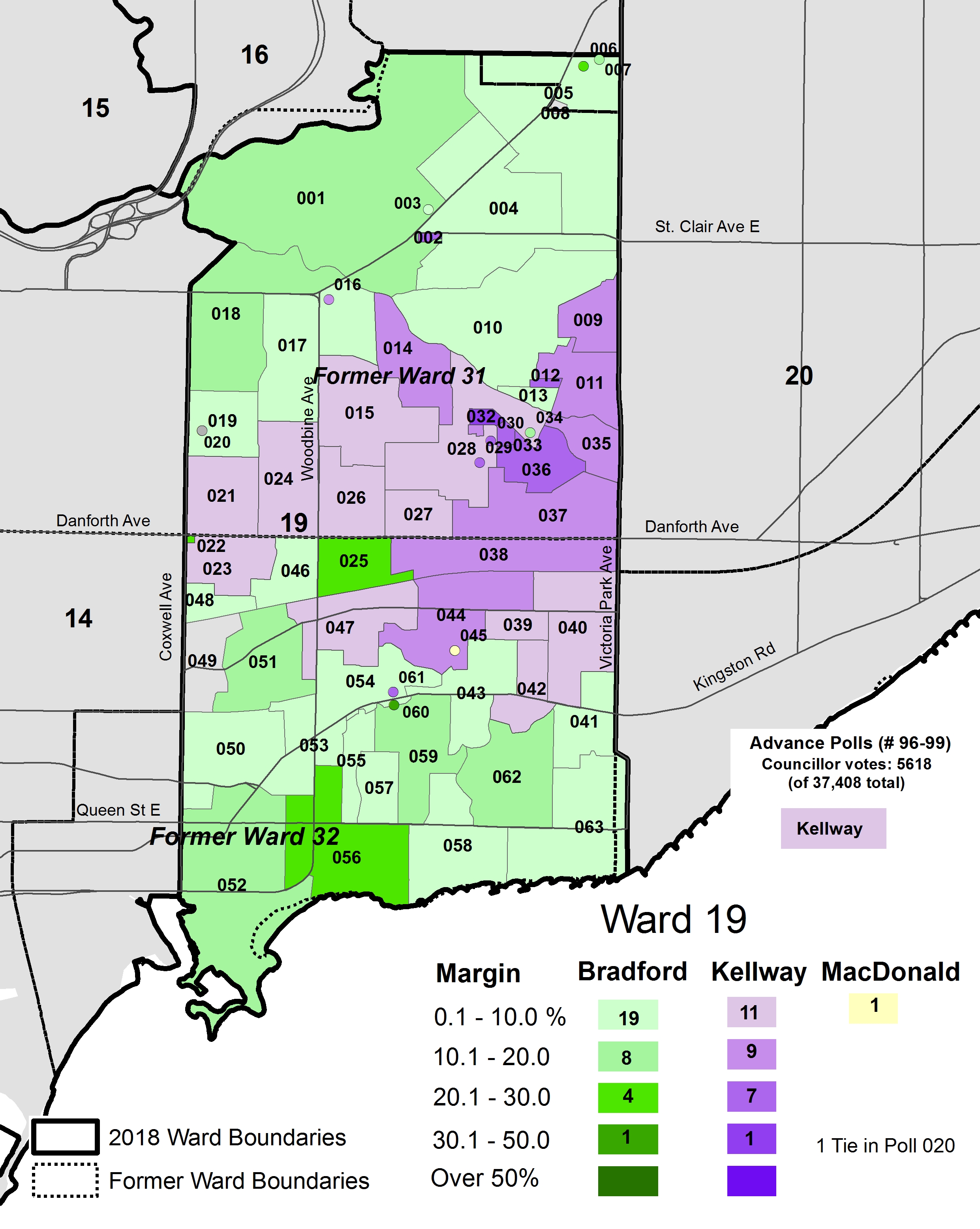
    Kellway came in first place in the advance polls. But on election day, Bradford placed first in 33 polls, while Kellway placed first in 28 polls. Brenda MacDonald came first in Poll 45. Only five votes were cast in Poll 20, which was a five-way tie.
    2018 Election - W19

    Kellway’s best results were north of Danforth Avenue, especially in the east, along Lumsden Avenue and Dawes Road. This area encompasses several Toronto Community Housing buildings and the lower-income Crescent Town neighbourhood. The support and organization from outgoing councillor Janet Davis probably helped, as did Kellway’s record as NDP MP. Had Toronto stayed with the 47 wards, it’s very likely that Diane Dyson would won in Ward 35, given Davis’ previous endorsement. Either way, the support of Mary Margaret McMahon and John Tory would have seen Brad Bradford win in Ward 37. Tory now has a new ally on council.

    The south half of Ward 19 is more affluent and less diverse than the area north of Danforth Avenue. Old Ward 31, north of Danforth Avenue and represented by Davis, had a 2016 median household income of $61,575. Old Ward 32, south of Danforth Avenue and represented by McMahon, had a 2016 median household income of $84,445. In the north half, 42.1 percent of the population identifies as a visible minority, compared to 24.3 south of The Danforth.

    Ward 19 Beaches-East York
    Candidate Total votes Percentage
    Brad Bradford 14286 38.6
    Norval Bryant 89 0.2
    Paul Bura 288 0.8
    Dragan Cimesa 77 0.2
    David Del Grande 283 0.8
    Diane Dyson 1612 4.4
    Matthew Kellway 13998 37.8
    Donald Lamoreux 141 0.4
    Brenda MacDonald 601 1.6
    Joshua Makuch 2315 6.2
    Valérie Maltais 929 2.5
    Frank Marra 142 0.4
    Paul Murton 74 0.2
    Morley Rosenberg 248 0.7
    Adam Smith 708 1.9
    Veronica Stephen 1257 3.4
  • The Downtown Divide: Wards 19, 20, 27, and 28

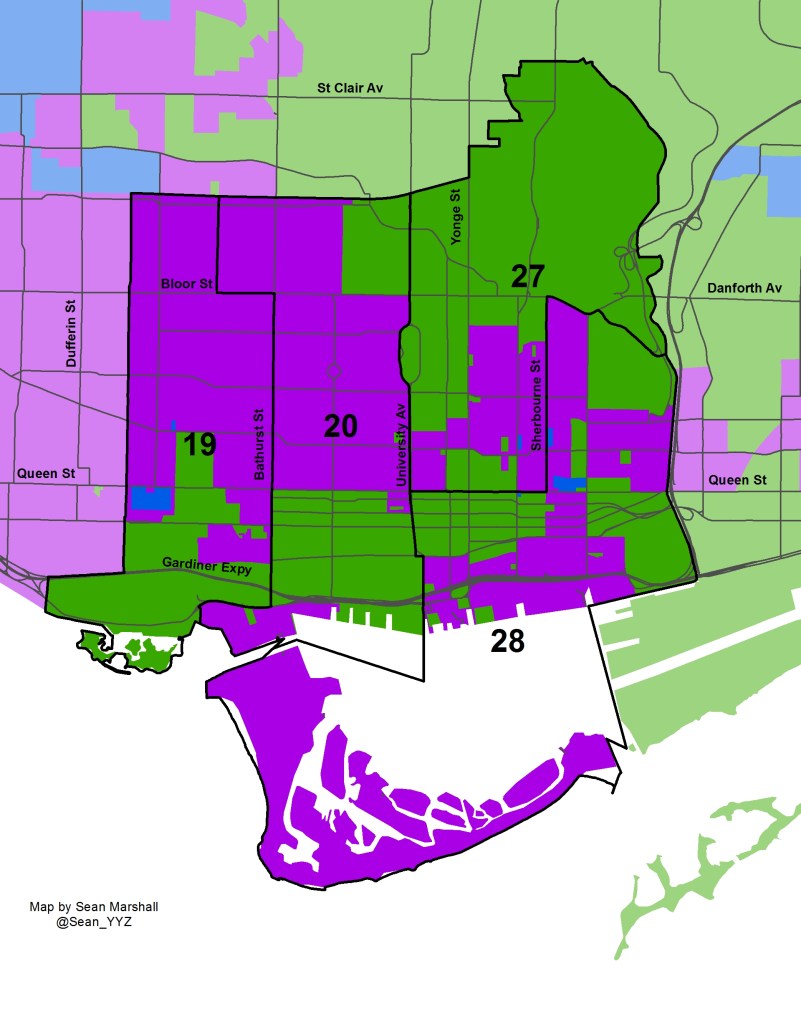
    2014 Election - Downtown Wards Mayor Solid A map of each poll’s first choice for mayor in Wards 19, 20, 27, and 28
    In this post, I examine the results in four downtown wards – Wards 19 and 20, Trinity-Spadina, and Wards 27 and 28, Toronto Centre-Rosedale.

    Olivia Chow, the early favourite to defeat Rob Ford, was a long-time city councillor. Chow represented Ward 20 before she ran and won in Trinity-Spadina for the New Democratic Party in the 2006 federal election. In order to run for mayor, Chow resigned as an MP early in 2014. A by-election was called for June 30. Joe Cressy hoped to keep the seat for the NDP, but Adam Vaughan, Chow’s successor as Ward 20 councillor, won the by-election for the Liberals by a wide margin. In the provincial election held earlier that month, Rosario Marchese, one of a very few NDP MPPs left from the Bob Rae era, lost to Liberal candidate Han Dong. Trinity-Spadina’s demographics were changing, especially with new condominium towers going up in new neighbourhoods like City Place and Liberty Village. And this mattered in the 2014 municipal election.

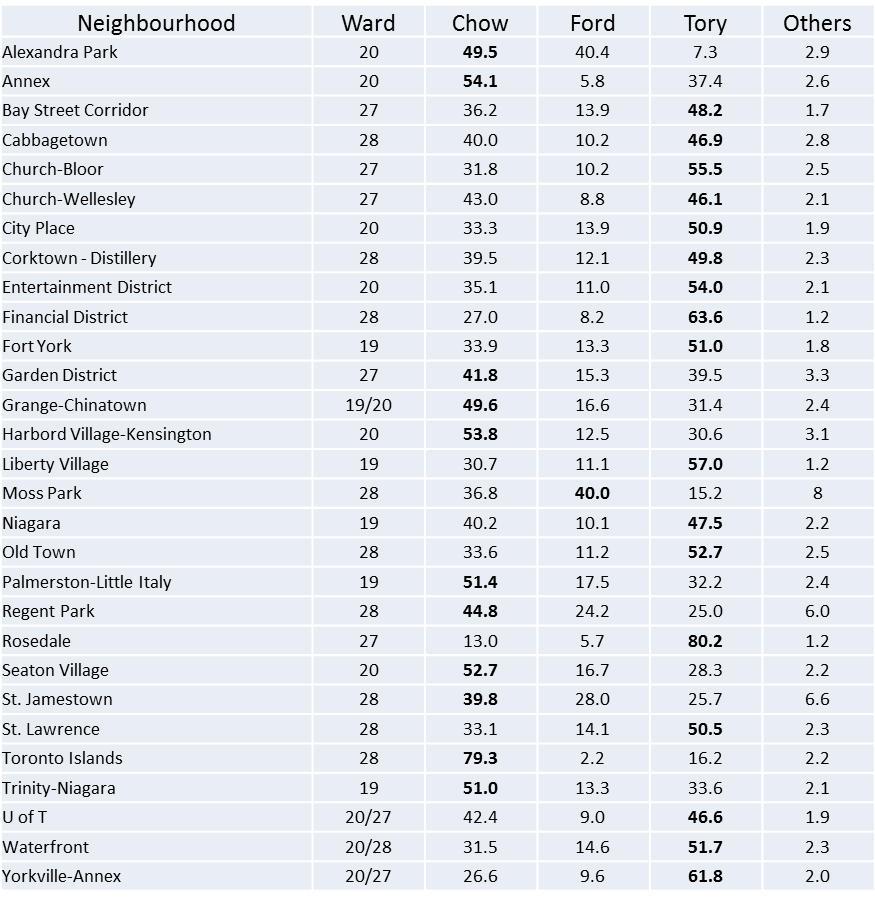
    Of the four downtown wards, John Tory came in first place in three: Wards 20, 27, and 28. Olivia Chow did not win her own ward, even though she represented it in municipal and federal politics for decades. Interestingly, John Tory is also a Ward 20 resident, so he, like Doug Ford, won his own ward. Tory makes his home in a large condominium apartment in Poll 013, Chow lives in a house in Poll 024. At least Chow won her poll.

    The map at the top of this article illustrates each poll’s first choice for mayor, without gradients based on the margin of the win. What can clearly be seen is that the older, more established neighbourhoods (with the exception of Rosedale and Yorkville) voted for Chow. The new condominium neighbourhoods voted for Tory. Doug Ford won a few polls – Moss Park and several other TCHC housing properties, but managed only to get 12.6% of the vote in these four wards.

    But what really strikes me is the north-south divide. Queen Street is a clear dividing line between the new condos to the south (Liberty Village, Fort York, City Place, Entertainment District, the Waterfront and Financial Districts) and the older neighbourhoods to the north. Other areas with many new condo towers, such as around Yonge/Church/Bloor and along Bay Street, also picked Tory.

    2014 Election - Downtown Wards Mayor MarginMap of each poll’s first choice for mayor in Wards 19, 20, 27, and 28, with margin of win

    Chow’s strongest support was in the Annex, Little Italy-Palmerston, and the Harbord Village/Kensington/Chinatown neighbourhoods. She did the best on Toronto Island, winning nearly 80% of the vote there. Chow also did well in Alexandra Park, a rare downtown neighbourhood where Ford came in second place and Tory got less than 10% of the vote. Tory did the best in Rosedale (not surprisingly), which he won with 82% of the vote, and did very well in those new condominium neighbourhoods.

    What really surprised me was that Tory came in first in the Church-Wellesley neighbourhood. Olivia Chow and her late husband Jack Layton were some of the greatest allies of the Toronto’s LGBT community, going back to the 1980s, when gays and lesbians did not enjoy the societal acceptance and support that they increasingly do now. I suspect that the spectre of a Doug Ford victory (the Fords have been rightly accused of being homophobic) convinced many voters to back Tory as Chow’s campaign floundered, and this might have been an important factor here.

    Table_Downtown

    Council races downtown

    Except in Ward 20, where Councillor Adam Vaughan moved on to federal politics (Ceta Ramkhalawansingh filled in as a interim council appointee), each incumbent councillor – Mike Layton in Ward 19, Kristyn Wong-Tam in Ward 27, and Pam McConnell in Ward 28, were easily re-elected.

    In Ward 20, Joe Cressy, after losing the federal by-election, ran for council in a crowded, open race, and won 42% of the vote and 54 of 68 election-day polls. There were other very good candidates, like Terri Chu (who came in second with 12.4%), Albert Koehl, and Anshul Kapoor, but Cressy had the organization and some name recognition from his run for MP. Cressy also had the endorsement of NOW, the Toronto Star, and the Labour Council. Fringe mayoral candidate Sarah Thomson also ran in Ward 20 after withdrawing from the mayoral race, despite her name recognition and nearly winning Trinity-Spadina for the Provincial Liberals in 2011, came in third with 9.5% of the vote.

    (more…)