Tag: Waterfront

  • The Amsterdam Bridge and the Torontobrug

    Reopened, at last

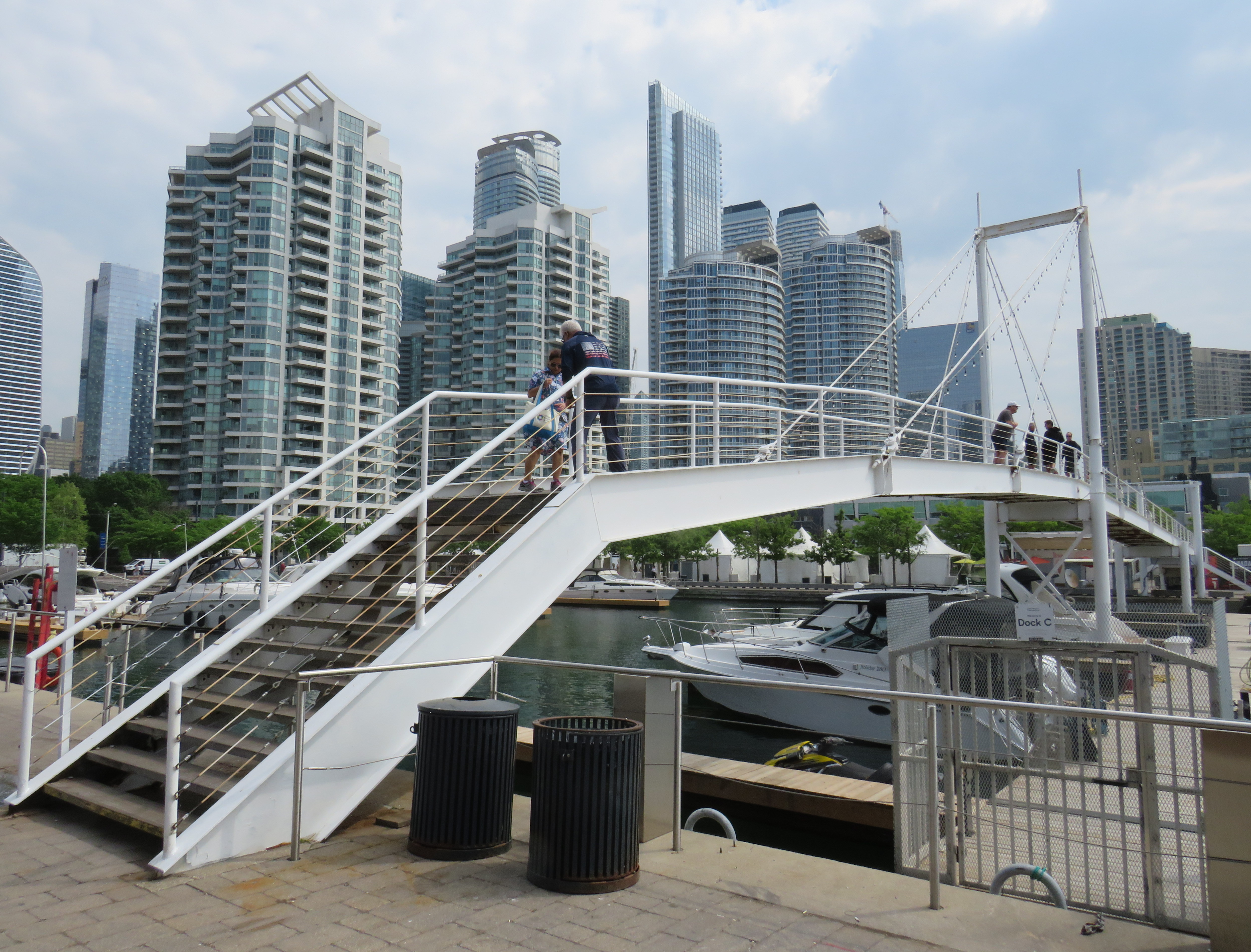
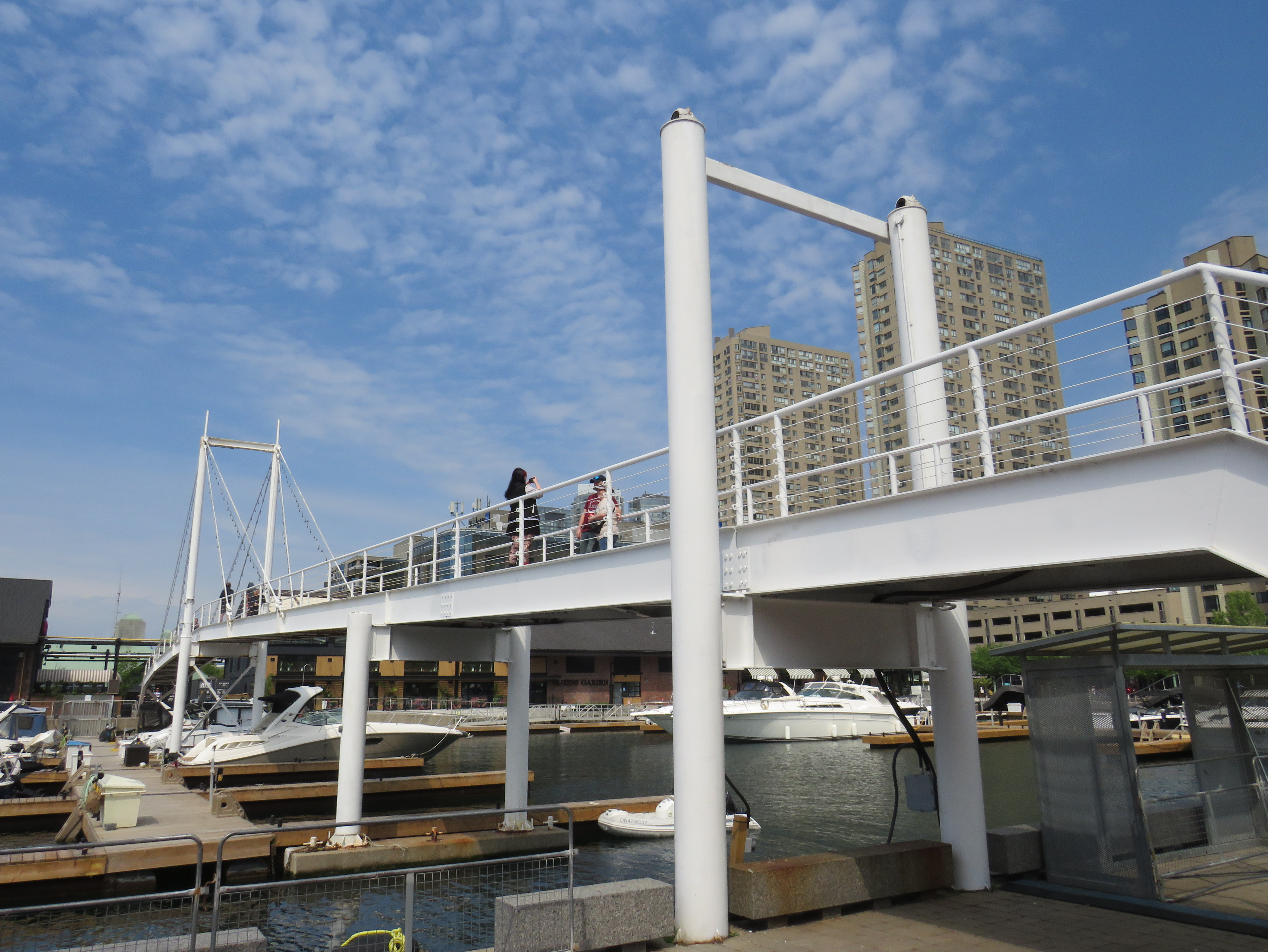
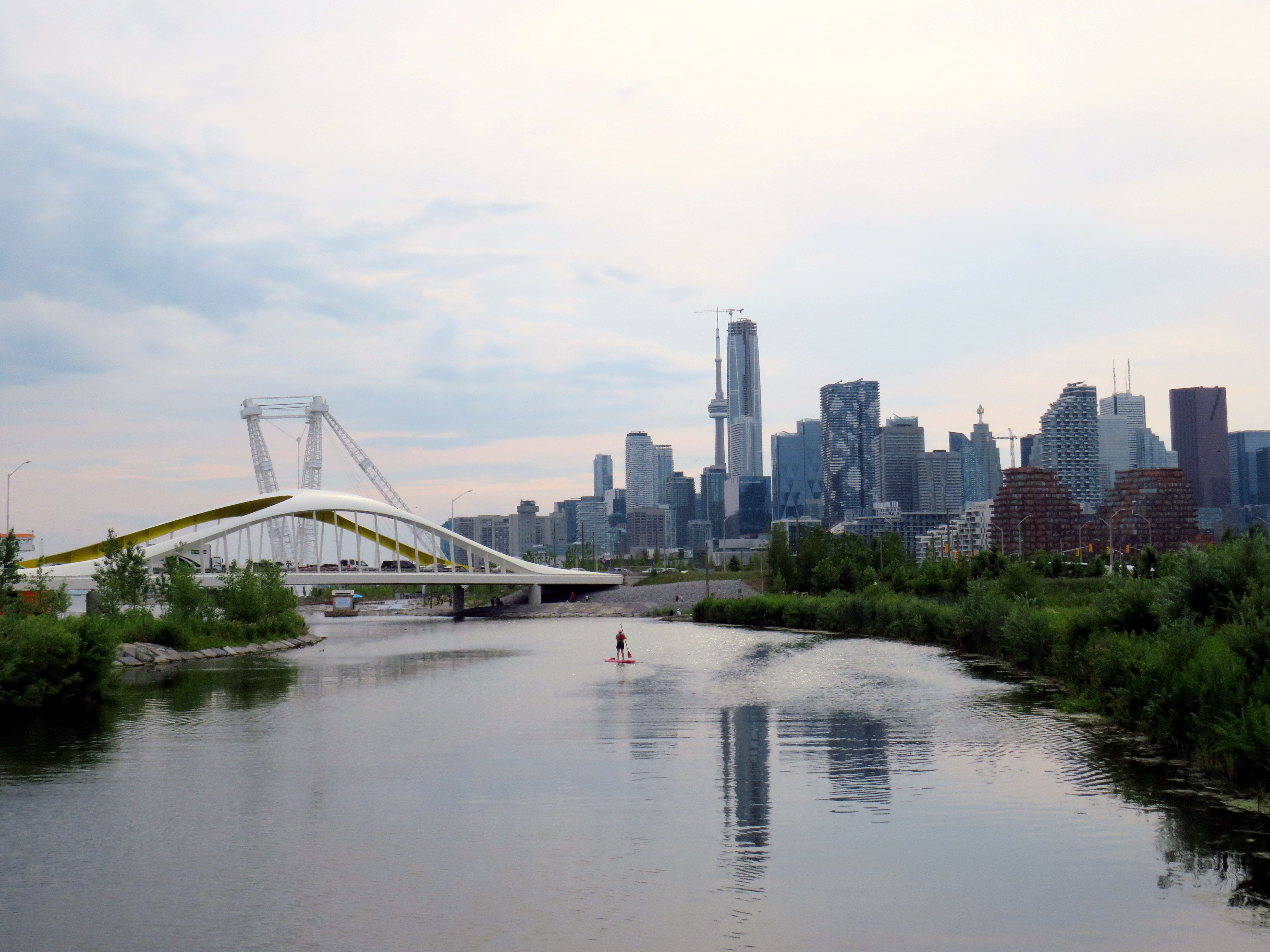
    On Sunday, May 31, the Amsterdam Bridge reopened on Toronto’s Harbourfront after being closed for five years. The footbridge, which spans a marina south of Queen’s Quay, is a popular meeting place and photo opportunity, with views of Toronto Harbour to the south and the towering skyline to the north. A gift of the City of Amsterdam, one of Toronto’s sister cities at the time, the bridge was one of the first great public spaces on the waterfront as it was beginning to transition from a derelict industrial space to the city’s new front yard.

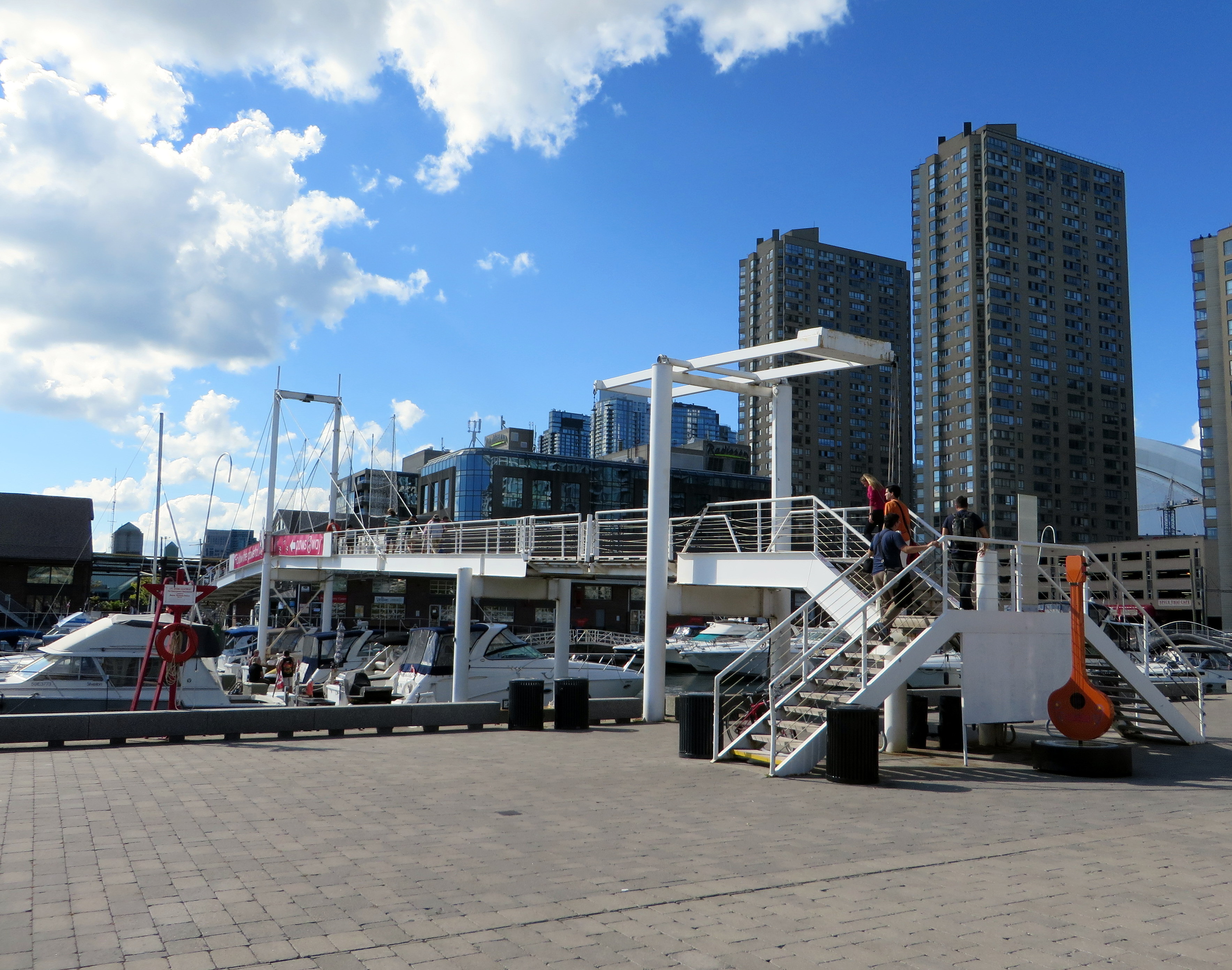
    The Amsterdam Bridge in 2014

    The footbridge, a cable suspension structure over the marina featured a lifting section on the east side so that tall yachts could moor at the north end of the marina on request, though this was not a regular occurrence. The design mimicked some of the iconic canal crossings in Amsterdam. Sadly, due to neglect, the bridge was closed to pedestrians in 2021 and the lifting section removed.

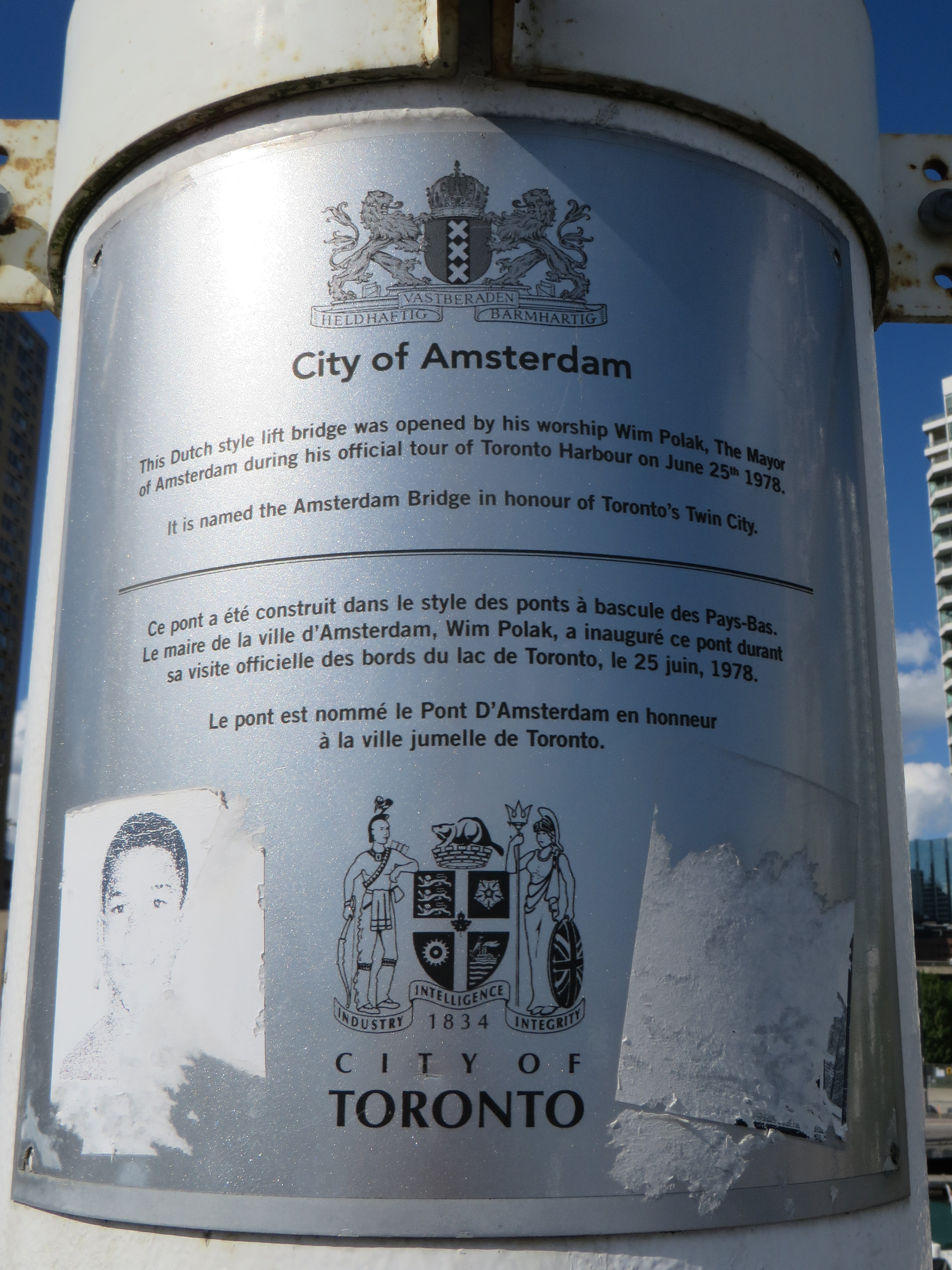
    Plaque on the bridge commemorating the opening of the Amsterdam Bridge, a “Dutch style lift bridge” on June 25, 1978 by Amsterdam mayor Wim Polak, taken in 2014. Note the old pre-amalgamation City of Toronto coat of arms below. A replacement plaque with similar text (but with the current post-amalgamation civic coat of arms) since replaced the original.

    When the bridge reopened in 2026 just in time for Toronto hosting six World Cup soccer matches, the lifting section was replaced by a fixed span. Once again, visitors can climb the bridge, take in the views, and snap great photographs, but the “lift bridge” of the original “Dutch style lift bridge” is no more. It’s a shame too, that it took five years for this fix to even happen; Toronto needs to do better at maintaining its public assets, especially its unusual, fun, and quirky landmarks.

    Fixed deck on the Amsterdam Bridge in 2026

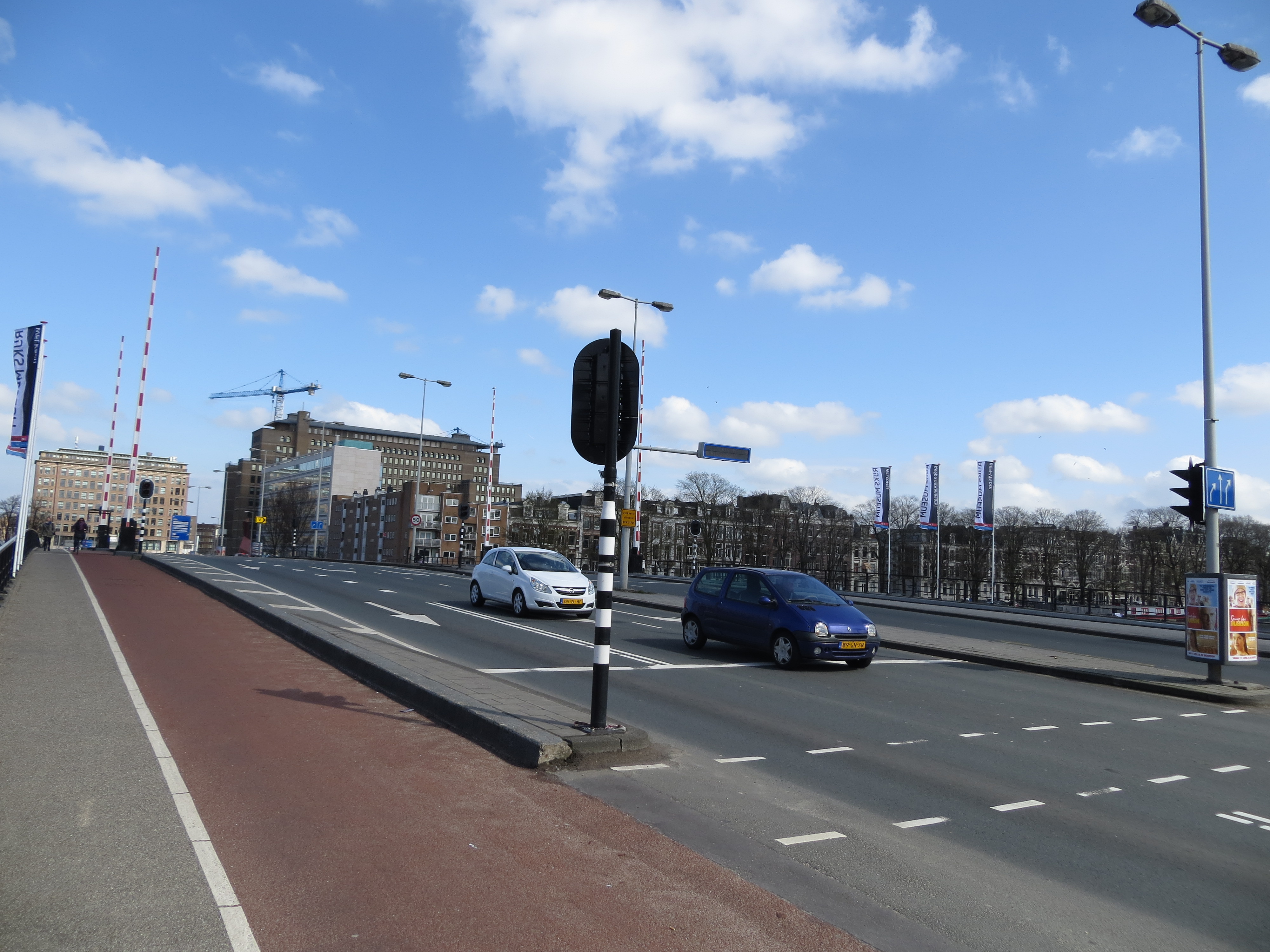
    Around the same time Toronto got an Amsterdam Bridge, the City of Amsterdam named a bridge for Toronto. The Torontobrug spans the Amstel River, carrying the busy Centrumring (Central Ring Road). A five-lane traffic artery outside the major tourist areas, the bridge is not iconic by any means (I biked to it during my 2013 visit to Amsterdam) but it is an important road link. There are separated cycle tracks on both sides of the bridge, so it is at least multimodal. The bridge can still open for river boat traffic when necessary.

    The Torontobrug in Amsterdam, 2013

  • Major improvements are coming to Scarborough’s waterfront

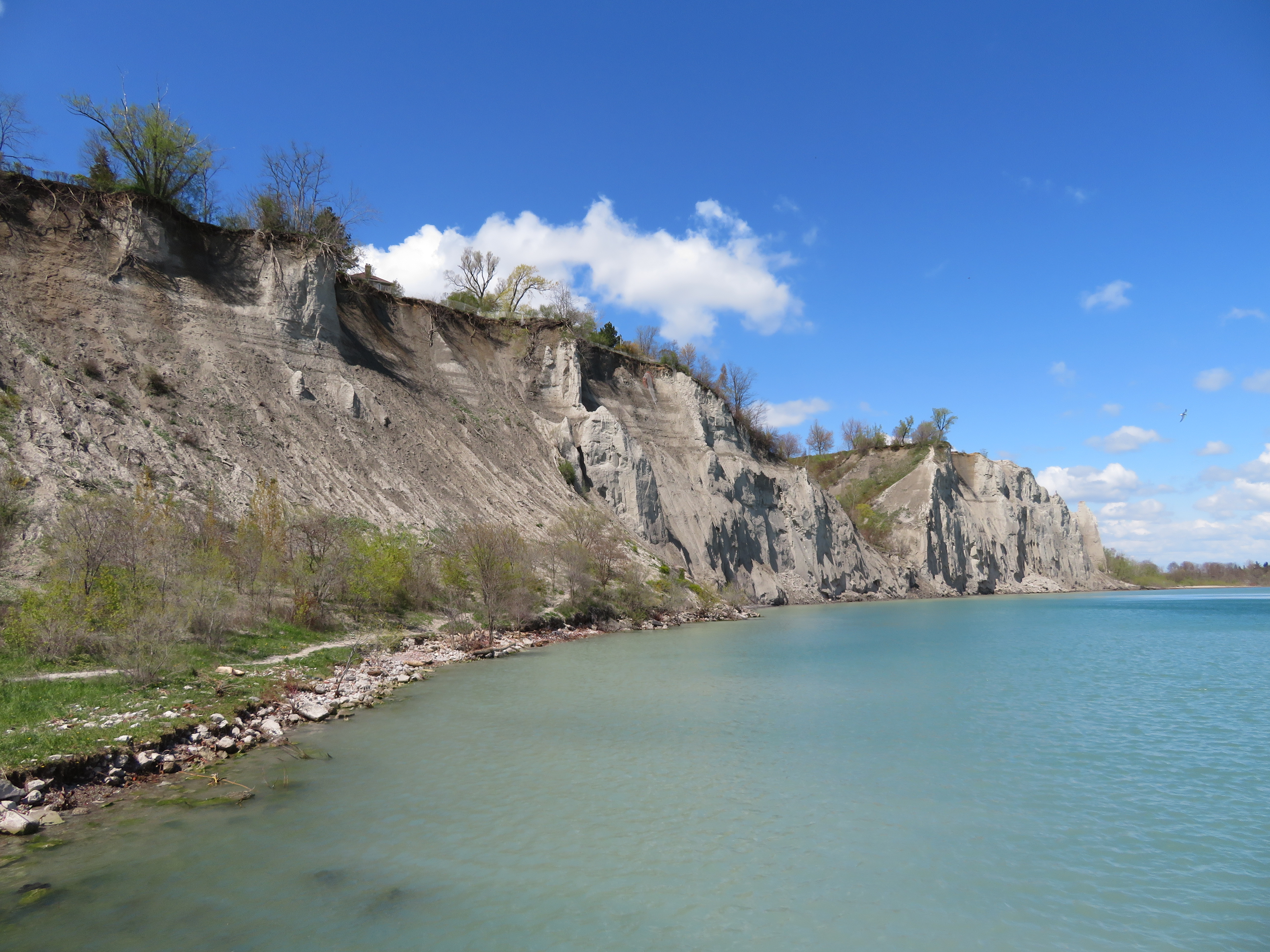
    IMG_8897-001The Scarborough Bluffs will soon become more accessible
    Over the last few years, the Toronto and Region Conservation Authority (TRCA) has been working on an environmental assessment for improvements to much of the Lake Ontario shoreline in Scarborough. Today, the TRCA announced that assessment is now complete, and it calls for major improvements between Bluffer’s Park and East Point Park.

    A new multi-use trail is planned for the bottom of the Scarborough Bluffs, with access points at Bluffer’s Park, the Doris McCarthy Trail, Guild Park, and East Point Park, connecting with the existing path across Highland Creek and the Rouge River to Pickering. In addition, pedestrian and cyclist access down to Bluffer’s Park on Brimley Road will be greatly improved.

    When my partner and I tried to walk along the Scarborough Waterfront in 2016, we found the Waterfront Trail lacking, and the section along Brimley Road quite dangerous. These changes, along with the new seasonal TTC bus service to Bluffer’s Park, will help to make Scarborough’s wonderful waterfront safer and easier to access. 

    The plan also calls for improved erosion control measures, along with interventions to improve land and aquatic habitats, helping to protect one of Toronto’s most spectacular natural features while protecting the natural environment.

    If you were looking for some good news in Toronto, especially with the many recent stories of violence on our streets, this is it.

  • Wandering the Waterfront Trail in Scarborough

    IMG_8897-001At the bottom of the Scarborough Bluffs, west of Bluffer’s Park

    Lake Ontario, like all five of the Great Lakes, is more a freshwater sea than merely a lake. It’s over three hundred kilometres long, from Hamilton to Kingston, bordering two countries, with several inhabited islands, and features a varied and fascinating landscape. Lake Ontario’s vastness is best appreciated from its shore, whether it be the Toronto Islands, on the east side, on the beaches at Presqu’ile or Sandbanks Provincial Parks, or from the top of the Scarborough Bluffs.

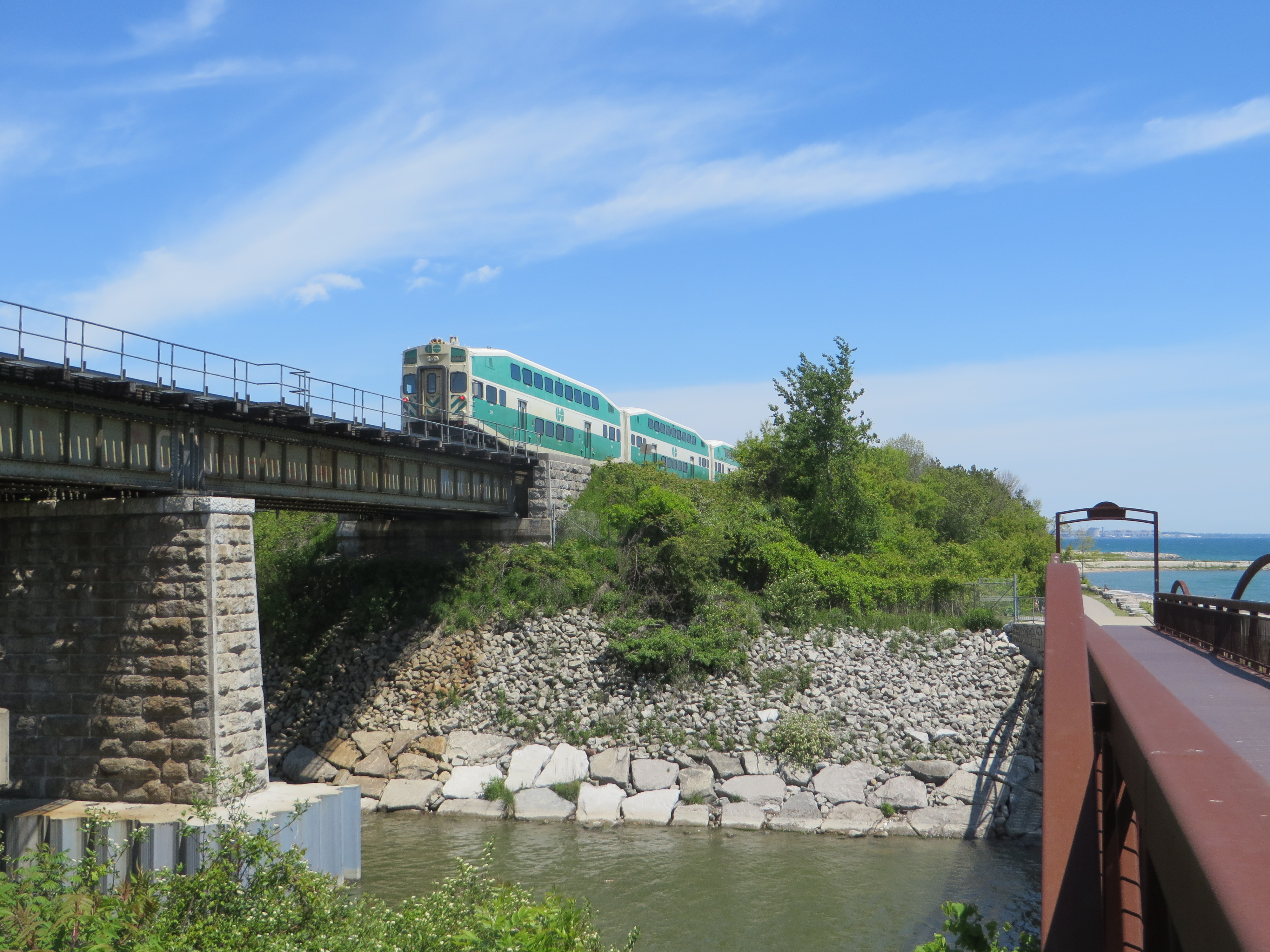
    The Waterfront Trail, at least in theory, is a wonderful way to explore these varied shorelines of Ontario’s vast Great Lakes on foot or by bicycle. Founded in 1995, the trail now extends from the Quebec border, west along the St. Lawrence River, through Niagara, along the north shore of Lake Erie, and up the Detroit and St. Clair Rivers to Lake Huron. I cycle the Waterfront Trail between Toronto and Hamilton several times a year, an 85-kilometre trip. GO Transit’s trains and buses follow the Waterfront Trail from Durham Region to the Niagara River, making it easy to walk or cycle one-way, returning by train and/or bus.

    IMG_0834-001.JPG
    The Waterfront Trail crosses Highland Creek in eastern Scarborough. (2015 photo)

    But the Waterfront Trail is dependent on municipal infrastructure, or the lack of it. Most of the trail’s route winds through rural areas, following country roads and highways where segregated multi-use trails aren’t built: in many places, the Waterfront Trail is neither close to the water, nor is it a ‘trail’ of any kind. At least in Northumberland County and Niagara Region, paved shoulders and bike lanes are found along the busier country roads. But this is not always the case.

    In urban areas, though, like the City of Toronto, there is both the demand and the resources for safe pedestrian and cycling infrastructure along the waterfront. In the old city of Toronto, the Waterfront Trail follows the Martin Goodman Trail, and is nearly completely segregated from motor traffic.

    But in Etobicoke and in Scarborough, much of the trail is routed via on-street sections; in sections, pedestrians must follow sidewalks next to busy sections of Lake Shore Boulevard and Kingston Road; for cyclists, there aren’t even any bike lanes — they have the choice of either riding with traffic, or illegally riding on the sidewalks.


    Route of the Waterfront Trail within the City of Toronto

    (more…)

  • A check-up on Downtown Barrie

    IMG_8357-001
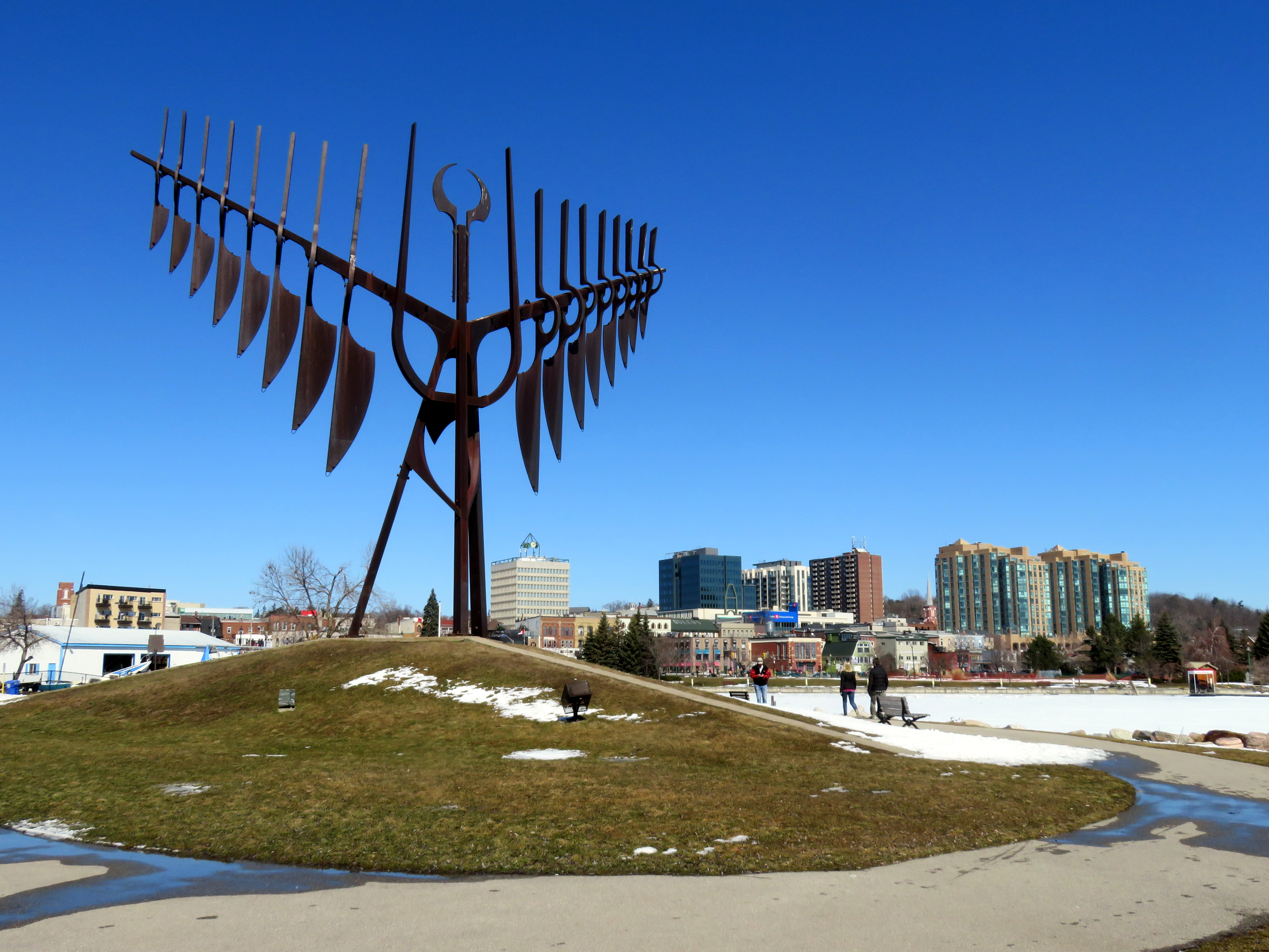
    “Spirit Catcher” by Ron Baird on Downtown Barrie’s Waterfront

    Last weekend, I made a trip up to Barrie on GO Transit. Most people in the Greater Toronto Area know of Barrie as a place you pass on Highway 400 on the way north to Collingwood, Wasaga Beach, or Muskoka, but it has a population of 140,000 people, many of them commuters to the Greater Toronto Area.

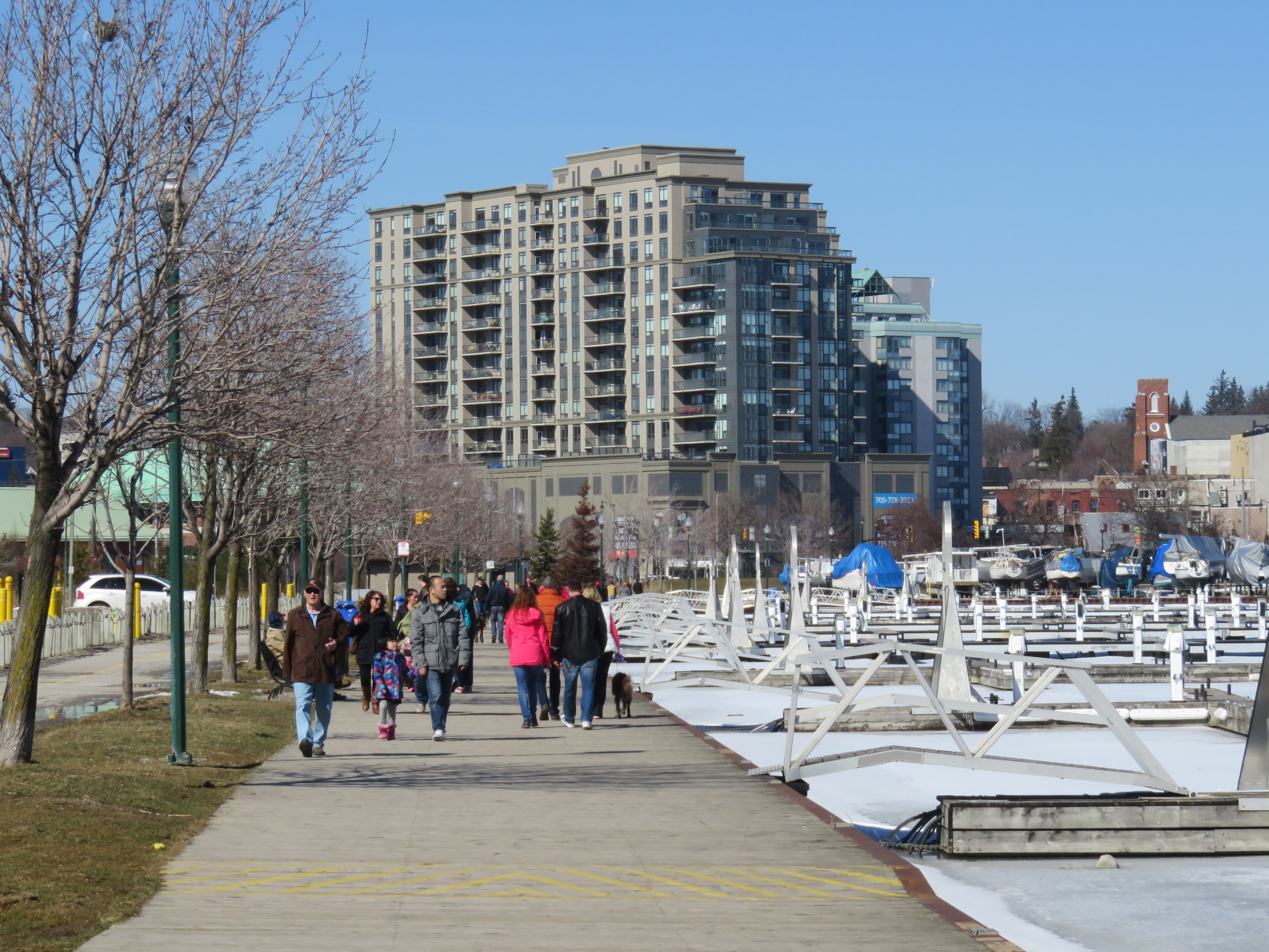
    Barrie features a lovely waterfront, situated at the end of Lake Simcoe’s Kempenfelt Bay. After the abandonment of the Canadian National Railway tracks north of Allandale Station in 1997, a new waterfront trail was created and Lakeshore Drive moved inland to provide more park space. The waterfront trail connects on the north with a rail trail that extends to Orillia. The waterfront has three swimming areas, a marine, food concessions, playgrounds, and gardens. On a warm Sunday in March, the boardwalk and waterfront paths were very well used. Work is being completed on further enhancements to the public realm.

    IMG_8386-001A busy March Sunday on Barrie’s waterfront
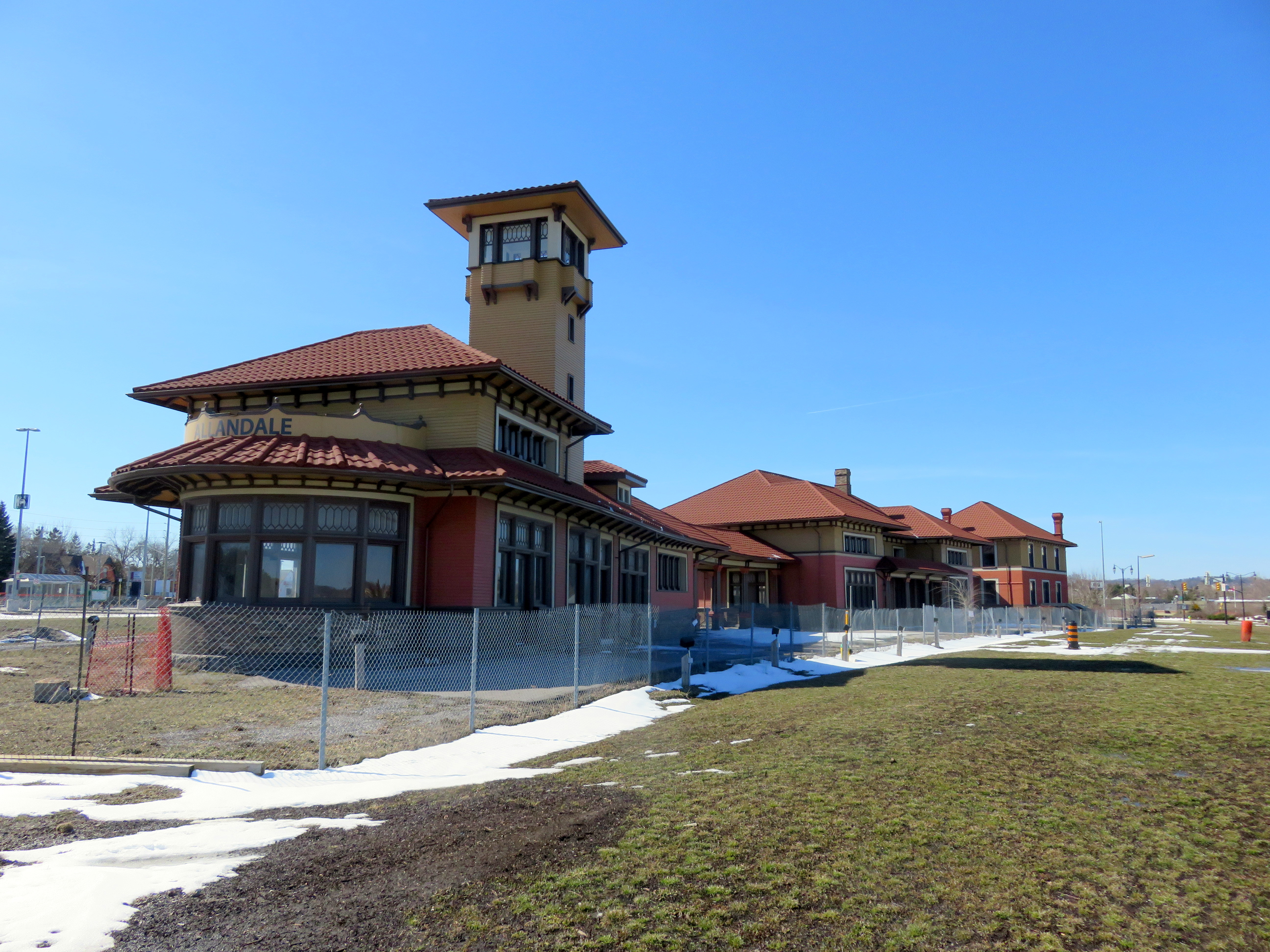
    In 2012, GO Transit extended the Barrie line to Allandale Waterfront Station, at the closest point possible to Downtown Barrie where tracks remained. The old Allandale Station, built by the Grand Trunk Railway in 1905 and abandoned by CN in the 1980s, still stands just north of the GO station, newly restored. Yet the station is fenced off and is awaiting re-use.

    IMG_8372-001.JPGAllandale Station is fully restored on the outside, but remains fenced off. The GO Station is to the far left.
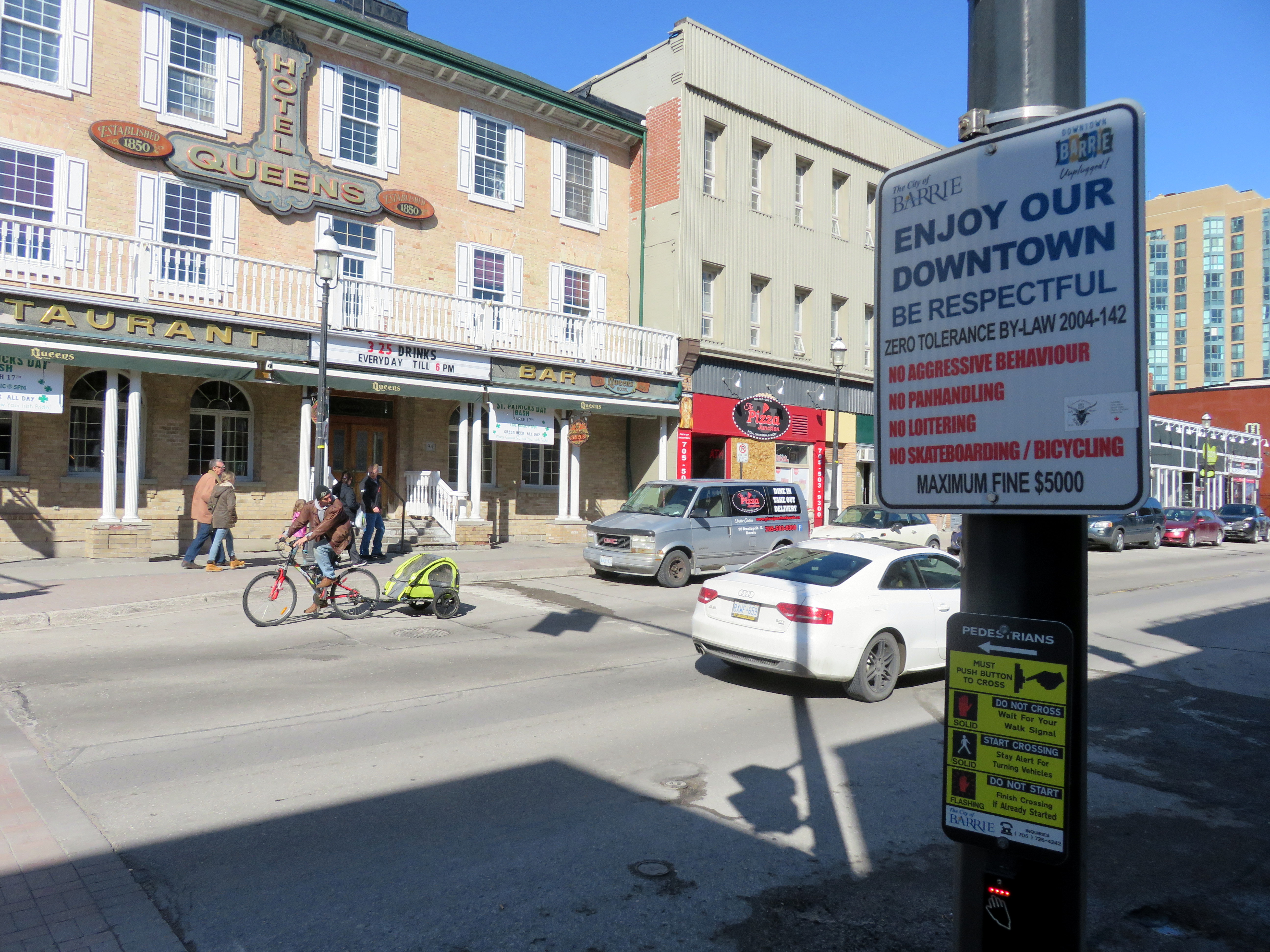
    Downtown Barrie hosts many heritage buildings. Despite a catastrophic fire in 2007, the downtown core boasts a mostly-intact inventory of heritage commercial and institutional buildings. The old Carnegie Library was incorporated into the MacLaren Art Centre (a new central library was built in the 1980s). The Queen’s Hotel on Dunlop Street, established in the 1850s, retains its historical veranda. Brampton and other county towns had similar hotels, but many were lost to fire or development.

    The downtown business improvement area has been active as well. During the summer months, patios are brought out into the streets, and festivals are put on year-round. New condominium towers built along the waterfront and downtown bring new residents that can support the historic city centre.

    Despite my positive impressions, one thing really bothered me: Downtown has many signs posted reminding people of a 2004 by-law prohibiting “aggressive behaviour, panhandling, loitering, and skateboarding/bicycling” with a maximum fine of $5000. Surveillance cameras are positioned at several downtown corners.

    IMG_8396-002Sign reminding of Downtown Barrie’s Zero Tolerance Bylaw. The historic Queen’s Hotel is in the background.
    The intent of the rule against cycling probably refers to bicycles ridden on sidewalks, rather than on roadways (there are some bicycle lock-up locations downtown and along the waterfront). That said, the signage and the by-law have the effect of telling young people and low-income residents that they are not welcome.

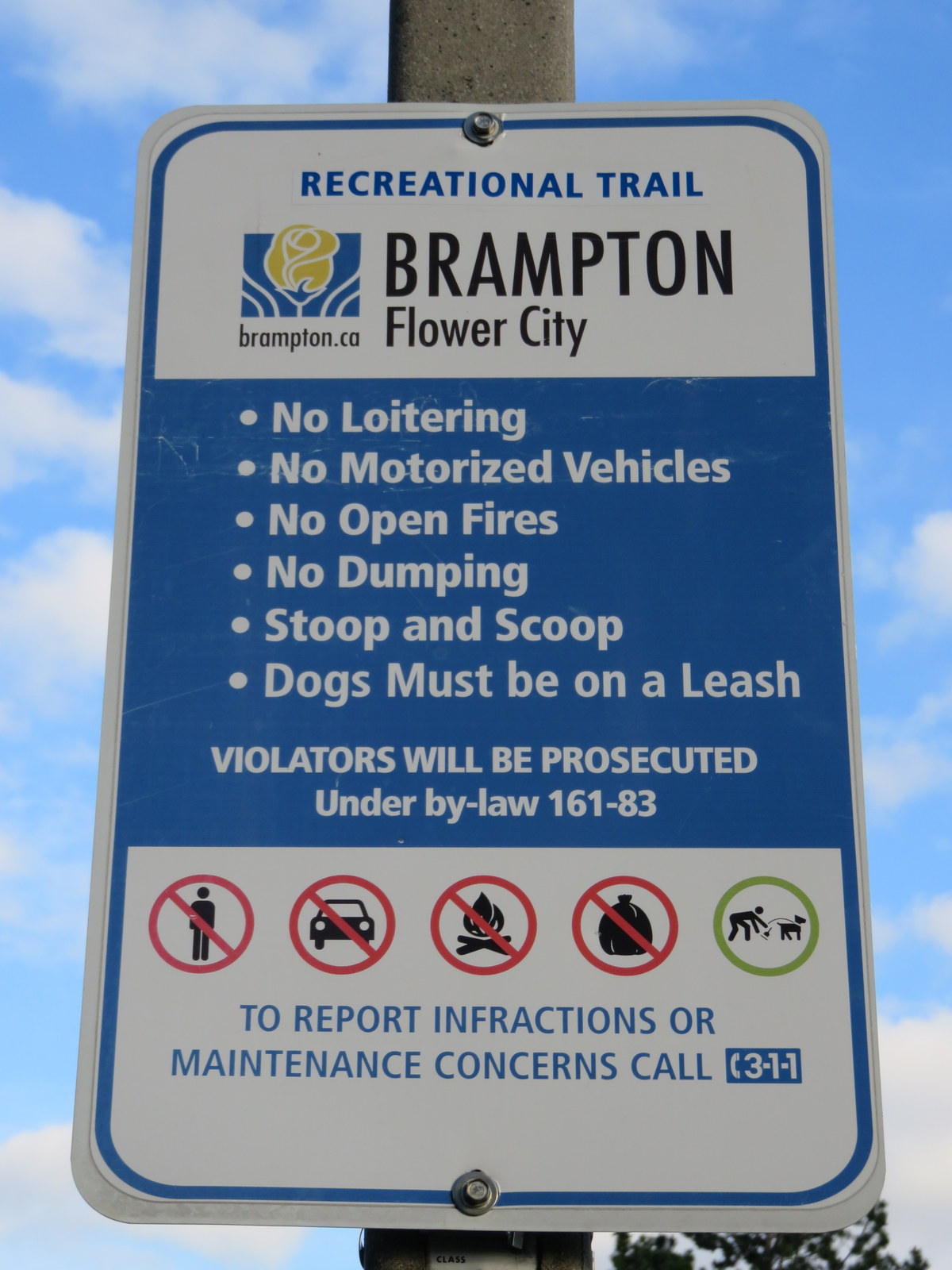
    Signs and specific bylaws such as this are not uncommon in Ontario. In Brampton, signs in public parks and along its pathways prohibit loitering as well. Yet sidewalks and parks are public spaces; parks in particular are places where one might wish to relax, have a picnic, or just sit and enjoy nature or to people-watch.

    IMG_2362-001.JPG“No loitering” in Brampton’s parks

    Downtown Barrie has struggled with poverty, vacant lots, derelict properties on the periphery, as well as crime, such as assaults, and drug trafficking. Downtown Barrie has many of the support services for economically and socially marginalized people; there are affordable rental apartments and rooming houses in the core as well. Downtown has several cafes and restaurants, a few clothing and furniture stores, as well as a craft brewery, but many of the businesses along the main streets are convenience stores, hair salons, vape shops, tattoo parlours, bars, and nightclubs. Especially missing are businesses such as a drug store, and a supermarket.

    To discourage loitering, benches were removed from Dunlop Street, Barrie’s main street. However, seniors in particular benefit from places to sit and rest while going on walks or doing shopping. Payphones downtown were also removed in 2013; the local councillor said that they were “degrading the quality of the neighbourhood.”

    In 2014, the City of Hamilton was looking at adopting a similar by-law to discourage low-income and homeless people congregating and creating a nusiance in Downtown Hamilton. Councillor Jason Farr pointed to Downtown Barrie’s success, but noted the importance of consulting with poverty advocates to “include that social side of the argument.”

    Instead of merely implementing aggressive regulations and ticketing, there’s a need for inclusive urbanism. Are there adequate recreational and social activities for youth and marginalized populations? Barrie has a skateboard/BMX park nearby, at Queen’s Park, but that might not be enough to satisfy local youth. What urban interventions would Barrie’s low income populations like to see? Sadly, I doubt they were consulted.

    Barrie’s waterfront is one of Ontario’s best: accessible by transit, connected to its downtown, hosting many activities and events. As construction concludes, it should help revitalize the neighbourhoods around it. Barrie should not further push away its already marginalized populations; it should find a way to be welcoming to all.

  • The East Gardiner: a chance to get it right

    IMG_9169-002A snapshot I took back in March 2001 of the Gardiner Expressway’s demolition at Carlaw Avenue.

    In June, 1999, Toronto City Council, after much debate, voted 44-8 to demolish the eastern section of the Gardiner Expressway. The section of elevated freeway from the Don River to Leslie Street, which opened in 1966, was underused and in need of serious repair.

    The East Gardiner extension was built to connect with the Scarborough Expressway, part of a larger network of freeways proposed by Metropolitan Toronto that were never built. The Scarborough Expressway would have connected to Highway 401 near Port Union Road, cancelled in the aftermath of the June 3, 1971 decision of the Ontario Government overturning an Ontario Municipal Board decision permitting construction of the Spadina Expressway.

    Council debated the merits of maintaining the 1.3 kilometre section of the Gardiner Expressway; several members resisted removal. Tom Jakobek, representing the Beaches neighbourhood and later disgraced in the MFP computer leasing scandal, was its most vocal defender.

    “Cars are an important necessity in this society. Why would anyone want to eliminate road capacity anywhere, when it’s located in the middle of an industrial area and people use it?”

    But the pro-demolition side won out. Of the 50 public deputations before that June 1999 vote, those in favour of demolition outnumbered opponents by a 2:1 ratio. Automobile groups and some Scarborough and Beaches residents were the most opposed as two new traffic lights would be added to their westward commutes.

    Nine of the councillors who voted for demolition still serve today: Maria Augimeri, Raymond Cho, John Filion, Giorgio Mammoliti, Pam McConnell, Joe Mihevc, Denzil Minnan-Wong, Frances Nunziata, and David Shiner. Also voting with the majority were councillors Jack Layton, David Miller, and Olivia Chow. Mayor Mel Lastman did not vote on the final motion.

    Among the eight opposed to the demolition were Jakobek and Sandra Bussin (both councillors represented the Beaches neighbourhood), along with conservatives Doug Holyday and Norm Kelly, both who would become Rob Ford’s deputy mayors.

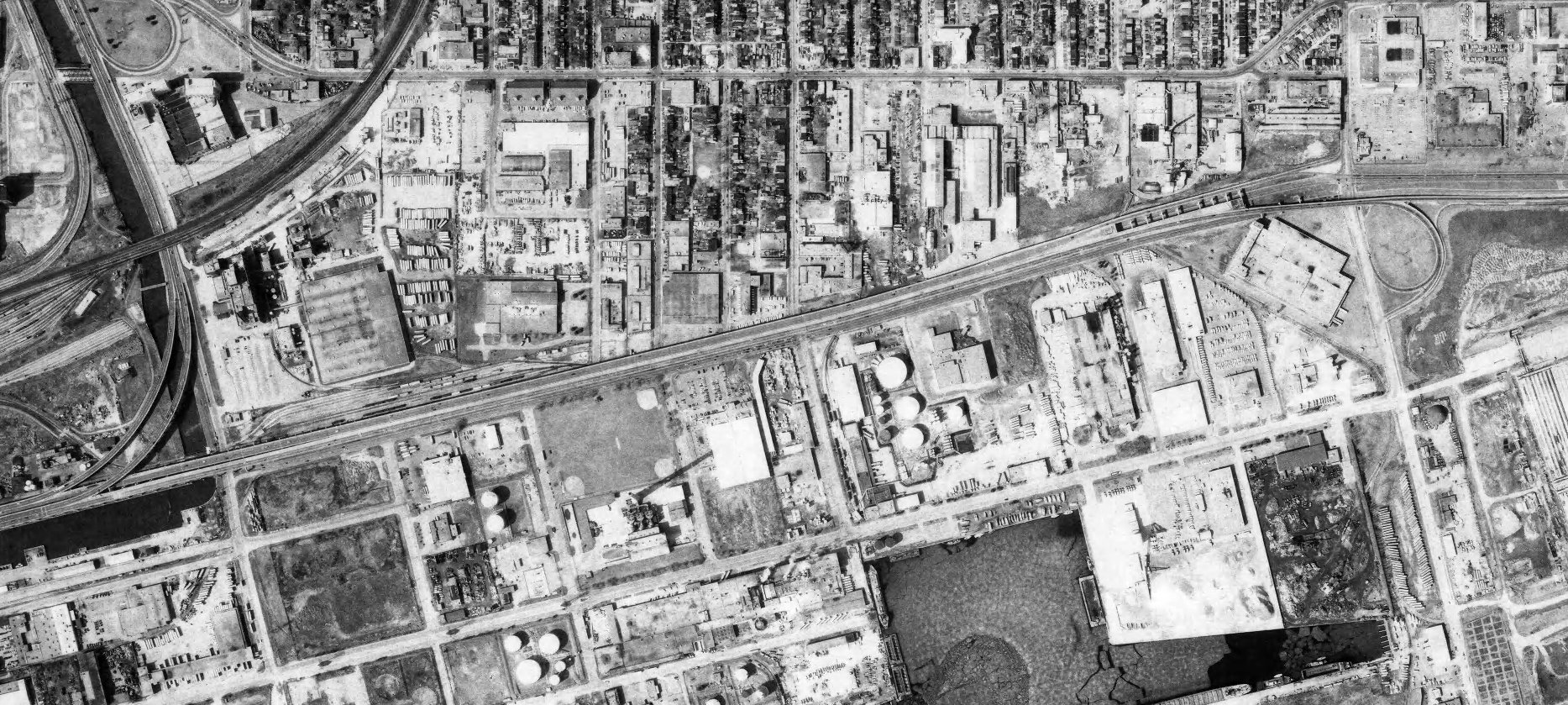
    Fullscreen capture 13052015 92518 PMAerial photograph of the Gardiner Expressway eastern extension in 1992. the Leslie Street ramps are on the far right, the Unilever lands to the right of the Don Valley Park way flyover ramps. Image from Toronto Archives

    Demolition began on April 28, 2000, a year later, it was gone, part from a few pillars left over near Leslie Street. A new bike path, and an improved Lake Shore Boulevard were built in the Gardiner’s place, and the traffic jams never materialized. In fact, parallel routes — Dundas Street and Eastern Avenue — were reduced to two lanes from four to accomodate new bike lanes. East-end residents coped.

    8760426957_1aa6259239_b

    Now, once again, we’re debating the future of the eastern Gardiner Expressway, this time the section between Jarvis Street and the Don Valley Parkway (DVP). Like the demolished section east of the DVP, city council is facing a crucial decision on whether to maintain the crumbling structure, or demolish it in favour of a widened Lake Shore Boulevard. Like the demolished section east of the DVP, the Jarvis-DVP section is underused and in need of major repairs.

    The consultants in charge of the environmental assessment (EA) fr the Gardiner Expressway & Lake Shore Boulevard Reconfiguration Environmental Assessment & Urban Design Study have a website where you can find out more about the options and the process.

    At first, four alternative solutions were considered:

    • Maintain the elevated expressway (spend money only to rehabilitate the structure, this is the status quo option)
    • Improve the urban fabric while maintaining the existing expressway (basically the status quo with some ground-level improvements for pedestrians and cyclists
    • Replace with a new above-or-below grade expressway; and
    • Remove the elevated expressway and build a new [wider Lake Shore Boulevard.]

    It’s worth noting that the EA consultants recommended the remove option, replacing the six-lane Gardiner east of Jarvis Street with an eight-lane Lake Shore Boulevard.

    But after feedback from the Public Works and Infrastructure Committee (PWIC) and First Gulf, the owners of the massive former Unilever lands at the foot of the Don River, there were two options carried forward for further public review: the “hybrid” option and the remove option. Both options would allow First Gulf to redevelop the 30 acre parcel, part of a larger 60 acre plan for up to 12 million square feet of commercial (office and retail) space. The public presentation [PDF] can be found here. 

    The remove option (as illustrated on Pages 23-29 of the presentation) results in the demolition of 2.2-kilometres of the Gardiner, replacing it with a eight-lane Lake Shore Boulevard. There would be signalized at-grade intersections at Jarvis, Sherbourne, Parliament, and Cherry Streets (with more intersections possible as the East Harbourfront lands develop), and flyover ramps connecting the widened Lake Shore Blvd with the Don Valley Parkway. The removal option would cost $326 million in up-front capital costs (demolition and the construction of new ramps) and $135 million in ongoing maintenance over a 100-year lifecycle. The study’s traffic models claim that removal would only increase travel times by 3-5 minutes.

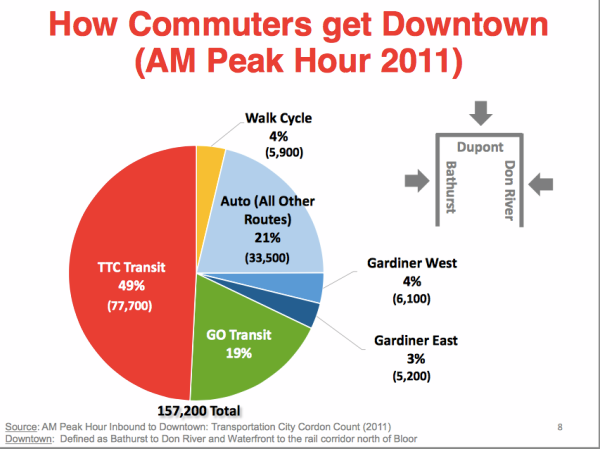
    It’s also worth noting that most commuters headed to the downtown core take transit: nearly half take the TTC, another 19 percent take GO Transit. Only 28 percent of downtown-bound commuters drive, and of those, 3% use the section of the Gardiner Expressway in question.

    screen-shot-2015-05-12-at-9-29-53-am
    Page 8 of the Gardiner East presentation

    The “hybrid” option, (as illustrated on Pages 36-42 of the presentation) maintains the Gardiner as-is west of Cherry Street, with new off-ramps to Lake Shore Boulevard east of Cherry and fly-over ramps to the DVP, elevated. It would cost $414 million in up-front capital costs, and $505 million in maintenance over a 100-year lifecycle. There would be no increase in travel times, all other variables remaining the same.

    This is why I place quotation marks around “hybrid” — except for a short section east of Cherry, the hybrid option pretty much preserves the status quo. The pedestrian experience isn’t improved, fewer parcels between Yonge and Cherry streets are available for development, and the long-term capital costs are higher. Really, the remove option is a hybrid. It cements the retention of the Gardiner west of Jarvis Street for the long term, it includes expensive flyovers to the DVP, and it widens Lake Shore Boulevard to absorb auto capacity. Calling what almost amounts to the status quo as a “hybrid”option is a brilliant stroke of marketing, or simply a cynical attempt to push through a more expensive, auto-friendly scheme.

    Opposition to the Gardiner removal is led by the Gardiner Coalition, which includes the Canadian Automobile Association (which promoted freeway expansion in Toronto before), the Canadian Courier & Logistics Association, the Ontario Trucking Association, Redpath Sugar and the Toronto Industry Network. The coalition of motorists and industry commissioned a separate report by the University of Toronto’s Eric Miller, that claimed that travel times would increase by 10 minutes. Why does Eric Miller’s name sound familiar? He was the lead transportation adviser to Tory’s campaign and a supporter of Tory’s SmartTrack platform.

    On May 11, 2015, ahead of council debate, John Tory spoke in favour of the “hybrid” option, sounding a lot like Tom Jakobek in 1999: “no matter how much transit we get built, and I intend to try and get a lot built during my time as mayor, we are still going to have people driving around in cars and trucks, it’s a reality.” Tory echoed comments made earlier in April by Tory’s Deputy Mayor, Denzil Minnan-Wong:

    “I did not get elected to increase congestion, I did not,” Minnan-Wong insisted. “The residents in the area that I represent in Don Mills are going to be negatively impacted. I was elected to solve congestion problems.”

    It’s interesting how self-styled fiscal conservatives prefer to spend more money on roads when given the choice, isn’t it? Remember Minnan-Wong’s rants against pink umbrellas at popular Sugar Beach or washrooms at waterfront parks? If there’s money to throw at unnecessary expressway construction, what about the TCHC public housing repair backlog? Or accelerating work to make the TTC more accessible? Why worry about a small number of commuters to the downtown core?

    Fullscreen capture 14052015 123133 AMExisting, hybrid, remove: Page 47 of the Gardiner East presentation

    It’s worth noting that John Duffy, former Policy Director for John Tory’s mayoral campaign, is a registered lobbyist for First Gulf. Duffy is also planning a $1-million public-relations blitz to promote Tory’s SmartTrack transit plan, which would have a stop right at the Unilever site’s front door. Eric Miller’s and John Duffy’s names coming keep coming up. I’ll talk more about that in an upcoming post.

    To be fair, First Gulf has stated several times that either the remove or the hybrid option for the East Gardiner suits their needs for developing the site, and denies supporting either option.

    I strongly support the remove option. It’s the cheapest alternative, but it offers the most opportunities to develop the East Harbourfront. Yes, an eight-lane Lake Shore Boulevard won’t be the most pleasant street to cross, but it won’t be much different than University Avenue. If designed right, it could be a Grand Boulevard.

    Council will be making a once-in-a-lifetime decision. There’s plenty of other, better ways that money spent on rebuilding the East Gardiner could be spent on. Hopefully council sees the wisdom of the remove option despite the myopic desires of the Mayor and Deputy Mayor.

    IMG_2180-001Manhattan’s West Side Drive, which replaced an elevated freeway. New York is doing fine.