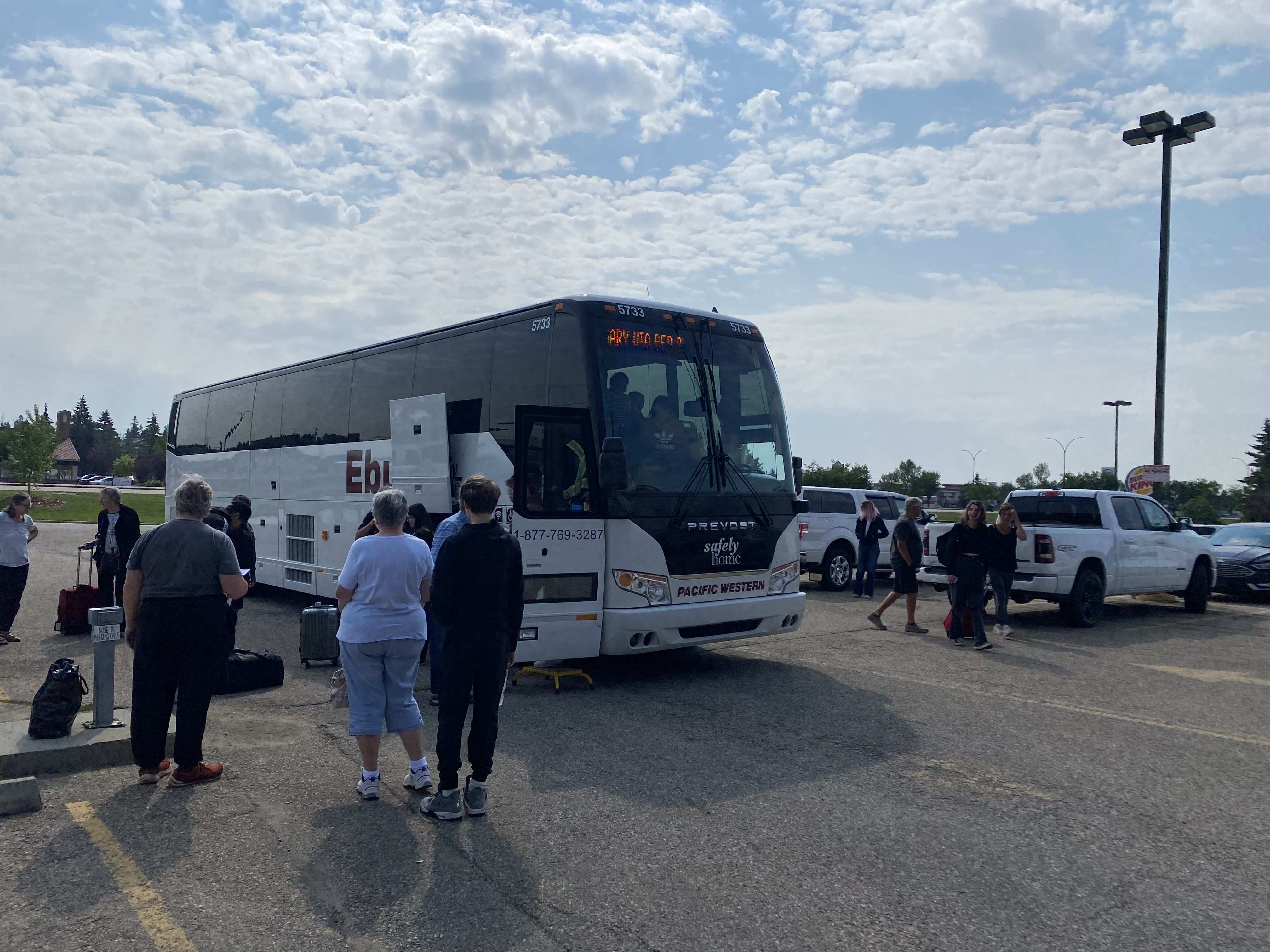
A Calgary-bound Pacific Western Ebus Coach loads at Red Deer, Alberta
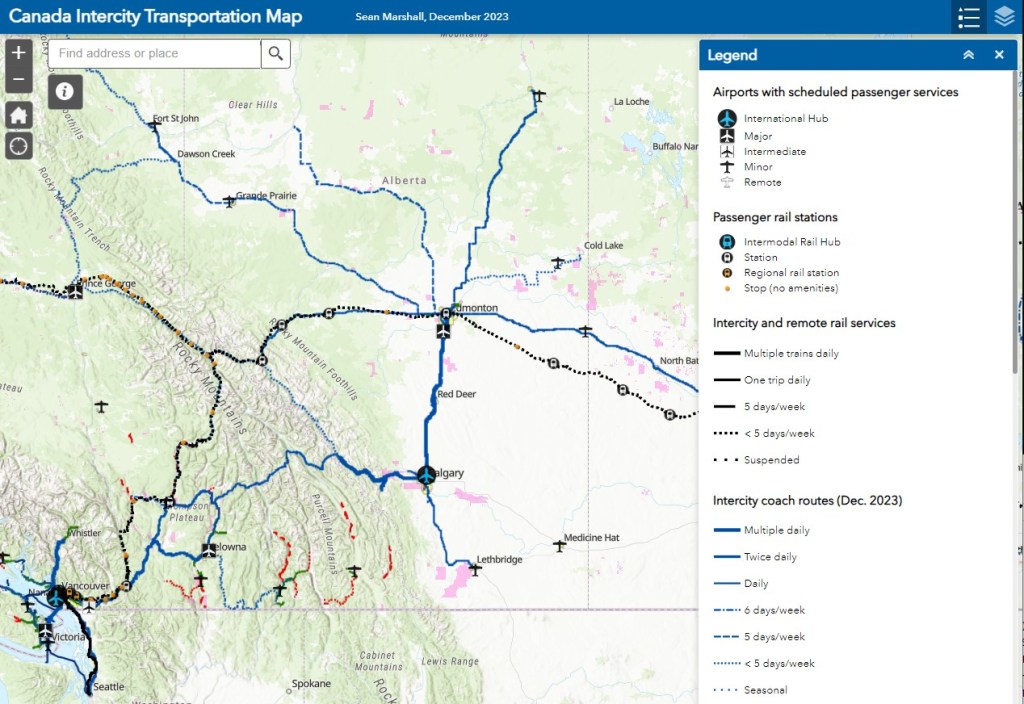
NOTE: Previous versions of the Ontario and Canada maps are retired; please see the new Canada Intercity Transport Map, launched March 30, 2025. This will now be the only interactive map that I will update.
In 2022, I was approached by staff at Infrastructure Canada who were interested in compiling information on intercity bus services across the country. Unfortunately, no repository had existed for a very long time, especially as transit and intercity coach services are primarily under provincial and municipal jurisdiction. Ontario’s provincial government last published a map of intercity carriers in 1990-1991, while Saskatchewan abolished its provincial bus service in 2017. The withering of Greyhound Canada’s once-extensive network left many communities from Ontario west to British Columbia and the Yukon without any service, while new private operators like Ebus and Rider Express filled in to serve the most lucrative routes.
Though the Federal Government operates VIA Rail and oversees air, marine, and long-distance rail transport, for road and city transport, its role has been more limited to helping to fund transit projects and some major road infrastructure improvements. Knowing that, I was excited to learn that there was interest in understanding the state of the country’s rural and intercity transport initiatives. I completed the project for Infrastructure Canada in June 2023, but I have recently updated a version of the map I completed, which I am excited to share.
A simplified methodology of how I completed this map can be found below.
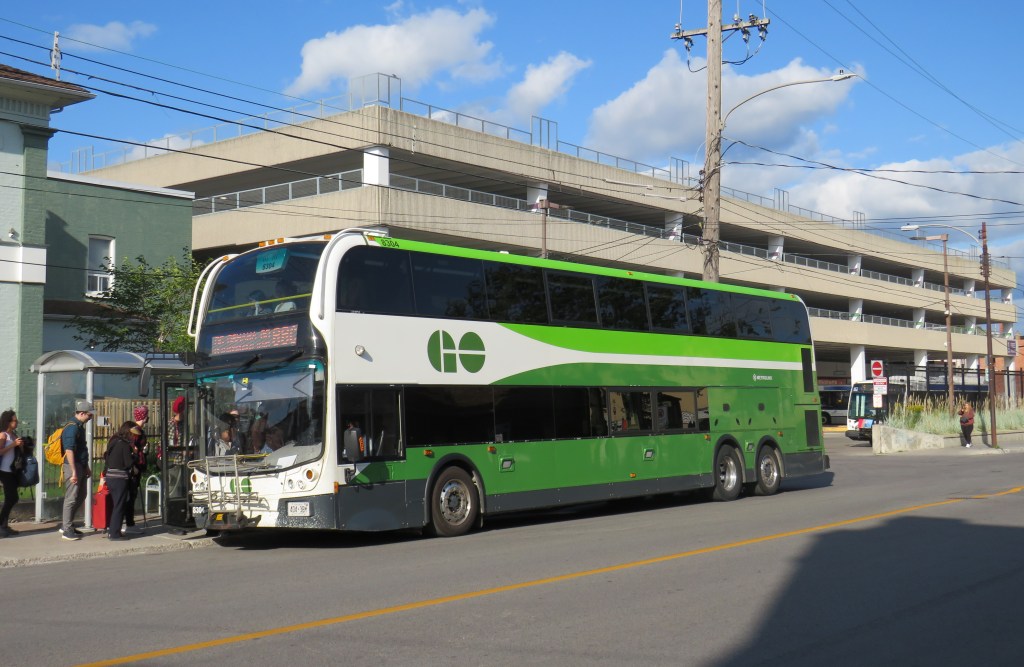
A busy GO Transit Route 88C bus loads passengers in front of the Peterborough Bus Terminal in the city’s downtown core
Peterborough, Ontario, a city of 84,000 people, is about a 90-minute drive from Downtown Toronto, without heavy traffic. A regional centre for central-east Ontario, Peterborough is home to Trent University, a mid-sized liberal arts institution with about 10,000 full time students, and Fleming College, which has over 6,000 full time students and 10,000 part time students.
Given its relative importance and its proximity to the Greater Toronto Area, especially Durham Region, one might expect to find good transit links from Peterborough to not only Toronto, but elsewhere in Ontario. Unfortunately, this is not really the case.
Prior to the COVID-19 pandemic and the closure of Greyhound Canada’s remaining service in Ontario and Quebec, there were four daily Greyhound buses between Peterborough and Toronto (three on Saturdays and Sundays), with one of those daily runs continuing east on Highway 7 to Ottawa, with stops in towns such as Havelock, Madoc, and Perth.
The scheduled time between the old Toronto Coach Terminal at Bay and Dundas Streets and Downtown Peterborough was between one hour and 45 minutes (making only an intermediate stop at Scarborough Centre Station) and two hours, 15 minutes (making local stops in Ajax, Oshawa, and Orono).
2019 Greyhound timetable for Ottawa-Peterborough-Toronto service. Note the overnight 5757/5790 runs that also followed Highway 7, but only stopped at Madoc for a rest break.
In September 2009, GO Transit first started a bus service between Oshawa GO Station, Downtown Peterborough, and Trent University, following the success of other bus services to universities and colleges in the region. Before 2020, that route made only four stops between Oshawa Station and Downtown Peterborough; all were park-and-ride lots adjacent to Highway 35/115; the bus would take just over an hour between the station and Downtown Oshawa.
Despite GO Transit’s competition, the Greyhound service remained popular, as it offered a direct, faster, one-seat ride between Downtown Toronto and Downtown Peterborough, with most buses only stopping at Scarborough Town Centre along the way. Three days a week, there were connections to Bancroft and Pembroke. GO Transit’s advantage was a slightly cheaper fare, connections to local transit and other GO services, and a more convenient service for passengers travelling between Durham Region and Peterborough. Unlike Greyhound, GO Transit continued to Trent University. Apart from the Newcastle (Hwy 2 at Hwy 35/115) park-and-ride, where passengers could connect to GO Transit routes 90/91 to Newcastle, Bowmanville, Courtice, and Downtown Oshawa, the park-and-ride stops were little-used.
GO Transit Route 88 map, January 2020. There were only four stops between Oshawa GO Station and Peterborough Bus Terminal
In mid-2020, with the COVID-19 pandemic causing major reductions in bus and rail ridership, GO Transit cut and consolidated several services, particularly in areas where local transit agencies operate. Route 90 was reduced to early morning and late-night service between Union Station and Oshawa GO when trains were not operating. The remainder of Route 90 through Courtice, Bowmanville, and Newcastle was cut entirely. Route 91 was merged into Route 88, which added new stops in Courtice and Bowmanville.
Route 88B, which includes stops at park-and-ride lots at proposed new GO Stations in central Oshawa and Courtice, takes up to 120 minutes to get from Trent University to Oshawa Station. The regular 88 bus takes 105 to 115 minutes to complete the trip. That is a very long time to sit on a bus, especially one not equipped with a lavatory.
GO Transit’s Route 88 bus timetable, including connecting train service from Toronto Union Station (click for larger size)
On Thursdays and Fridays, during regular school days between September and April, there are several express 88C buses, that only stop at Trent University, Peterborough Bus Terminal, and Oshawa GO. They make the complete trip in 1 hour 20 minutes; from Union Station to Downtown Peterborough is 2 hours, 20 minutes, not much slower than the slowest Greyhound bus.
The Route 88 route map in September 2023
Granted, for anyone living in Bowmanville and headed to Peterborough, the route is an improvement, with a new one-seat-ride now possible. While travelling to Peterborough earlier in September, I noted several passengers getting on in Downtown Bowmanville. But for through passengers, the backtrack to get to the Clarington Boulevard Park & Ride (the proposed location for the Bowmanville GO Station) and then the local stops to Newcastle are a bit annoying. Once on the highway, the bus has to get off at the Highway 35/115 split near Pontypool, and again at County Road 10 near Cavan and Millbrook, despite the very occasional time a passenger wants to get on or off (which has never happened when I rode Route 88). These diversions add 2-3 minutes each to the trip.
Pulling up to a deserted GO bus stop at County Road 10 near Cavan
These carpool stops might be useful if there were connecting transit services, rather than just a parking lot and a bus shelter. The 35/115 lot near Pontypool is 34 kilometres to Lindsay, a town of nearly 20,000 people, but whose only transit connection is a 3 day/week TOK coach bus between Haliburton and Toronto. A shuttle connection to Lindsay (which has a local transit service) would provide new links to Toronto, Durham Region, and Peterborough. Meanwhile, the Highway 2 carpool lot does not have direct Durham Region Transit service either.
Since Greyhound Canada’s withdrawal from the Canadian market, GO was the only intercity operator serving Peterborough until earlier this year, when Rider Express and Flixbus resumed service on the Toronto-Peterborough-Ottawa route. Both companies offer express, one-seat rides to downtown Toronto, but they have two major disadvantages over GO or even the old Greyhound service: frequency and in-town connections.
Flixbus offers one daily round trip, leaving the Union Station Bus Terminal at 11:00 AM and arriving at a Tim Hortons parking lot (at 1200 Lansdowne Street West, on the southwest side of Peterborough), at 1:05 PM, with stops near Scarborough Town Centre and at Thickson Road and Highway 401 in Whitby. The return trip leaves Peterborough at 9:05 PM, arriving in Toronto at 11:05 PM.
Boarding a Flixbus coach in a parking lot behind a Tim Horton’s in Peterborough’s suburbs
Rider Express runs on the same route four days a week, leaving Union Station at 12:00 PM, arriving at a different Tim Horton’s parking lot (on Ashburnham Road, on the southeast side of Peterborough) at 1:45 PM, making one stop in Scarborough. The return trip leaves Peterborough at 10:05 PM and arrives in Toronto at 11:35 PM. The map below shows where GO, Flixbus, and Rider Express stop in Peterborough.
While GO stops at Trent University, Downtown Peterborough, and a park-and-ride lot on the south end of the city, Flixbus and Rider Express only stop at locations close to the main highway on the south side of Peterborough, pulling into parking lots with nowhere to sit and no real amenities, unless waiting passengers had a car to wait in or paid for a coffee or snack at the Tim Horton’s. The old Greyhound terminal, which was located on the same block as the downtown transit terminal, has since been sold, and is now converted for local community services. Though they offer a much faster ride to downtown Toronto, the private operators are neither frequent enough nor convenient enough to compete with GO.
One day, Peterborough may get intercity rail service again thanks to the federal High Frequency Rail project, still in the early procurement phase, which would provide the speedy, frequent intercity service Peterborough needs. Until then, Metrolinx should revise the entire Peterborough bus service, including working with Durham Region and the City of Kawartha Lakes to make the service more useful for more riders, with a mix of daily express buses and enhanced local connections. The Selwyn Link bus service, which connects GO and Peterborough Transit with Selwyn Township and Curve Lake First Nation at Trent University, is great example to build upon.
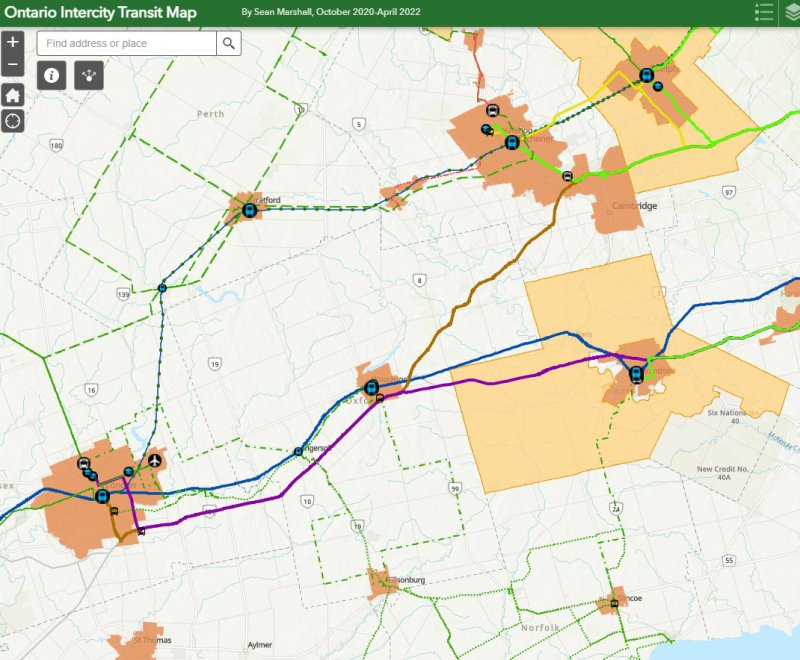
I have updated the Ontario Intercity Transport Map for September 2023 with new and revised routes right across the province. The notable losses include Prescott-Russell’s abandonment of its rural on-demand service, the closure of Grey Transit Route’s service between Walkerton and Flesherton, and Trailways’ stop in Chatham. The London-to-St. Thomas gap remains unfilled, and there’s a clear gap in Huron and Bruce Counties, especially with the loss of service to Walkerton. For the most part, it is good to see most regional transit services continuing, with mostly minor adjustments.
I look forward to sharing my Canada Intercity Transit Map, based on work I recently completed for Infrastructure Canada, in the near future.
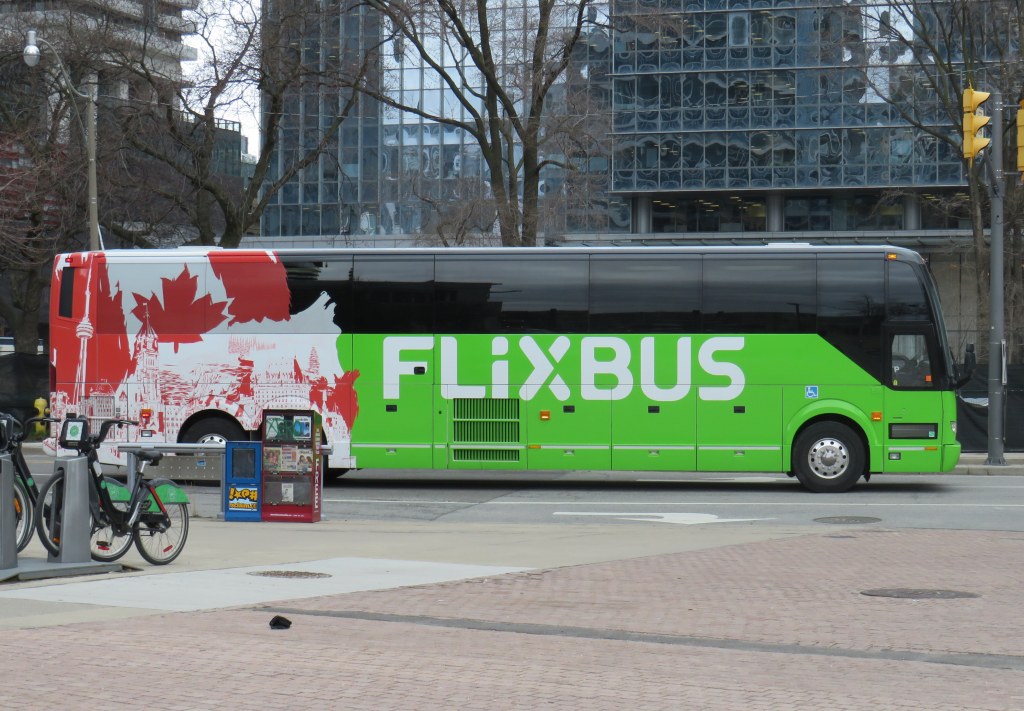
Flixbus is one of many intercity coach operators in Ontario right now
With university and college campuses reopening for in-class instruction, white-collar workers slowly returning to the office, and pandemic restrictions receding, there are more intercity transport options in Ontario than at any time prior to March 2020.
New operators, including Germany’s Flixbus, have arrived in Ontario (with routes between Toronto, Guelph/Kitchener, Niagara, and Ottawa), while Greyhound, which pulled out of Canada two years ago, restarted cross-border runs from Toronto, Montreal, and Vancouver. In Southern Ontario, intercommunity bus and van operations continued through the pandemic, with notable service improvements in Simcoe and Grey Counties, new routes in Eastern Ontario, as well as the expansion of “on-demand” services in rural communities and smaller urban centres, including parts of Niagara Region, as the regional government there slowly assumes responsibility for all municipal transit services.
Despite these advances, there are still many gaps in Ontario that need to be filled. The deregulation of Ontario’s motor coach industry has opened the highways up to more operators, but they are all chasing the same customers, rather than attracting new riders.
For getting between Toronto and Ottawa, passengers have a plethora of choices. They may fly — the fastest, but most expensive option — on Air Canada, WestJet or Porter. They may choose VIA Rail, which is comfortable, but slower. Or they may choose to book a ticket on a Megabus, Rider Express, or Flixbus coach, the slowest, cheapest, and least frequent option. (As of May 2022, only Megabus will begin operating daily buses between Toronto and Ottawa.)
Between London and Toronto, passengers can choose between a four-hour GO Transit train ride that departs at 5:33 AM, one of several daily VIA trains (approximately 2 hours), one of three daily Onex buses (2 hours, 35 minutes) or one of three daily non-stop Megabus trips (2 hours, 10 minutes).
Not all bus operators serve the same locations, either, creating new disconnections. In Toronto, GO Transit, Megabus, Rider Express TOK Coach, and Greyhound USA use the new Union Station Bus Terminal, which is directly connected to VIA and GO trains at Union Station and the TTC subway and streetcar system.
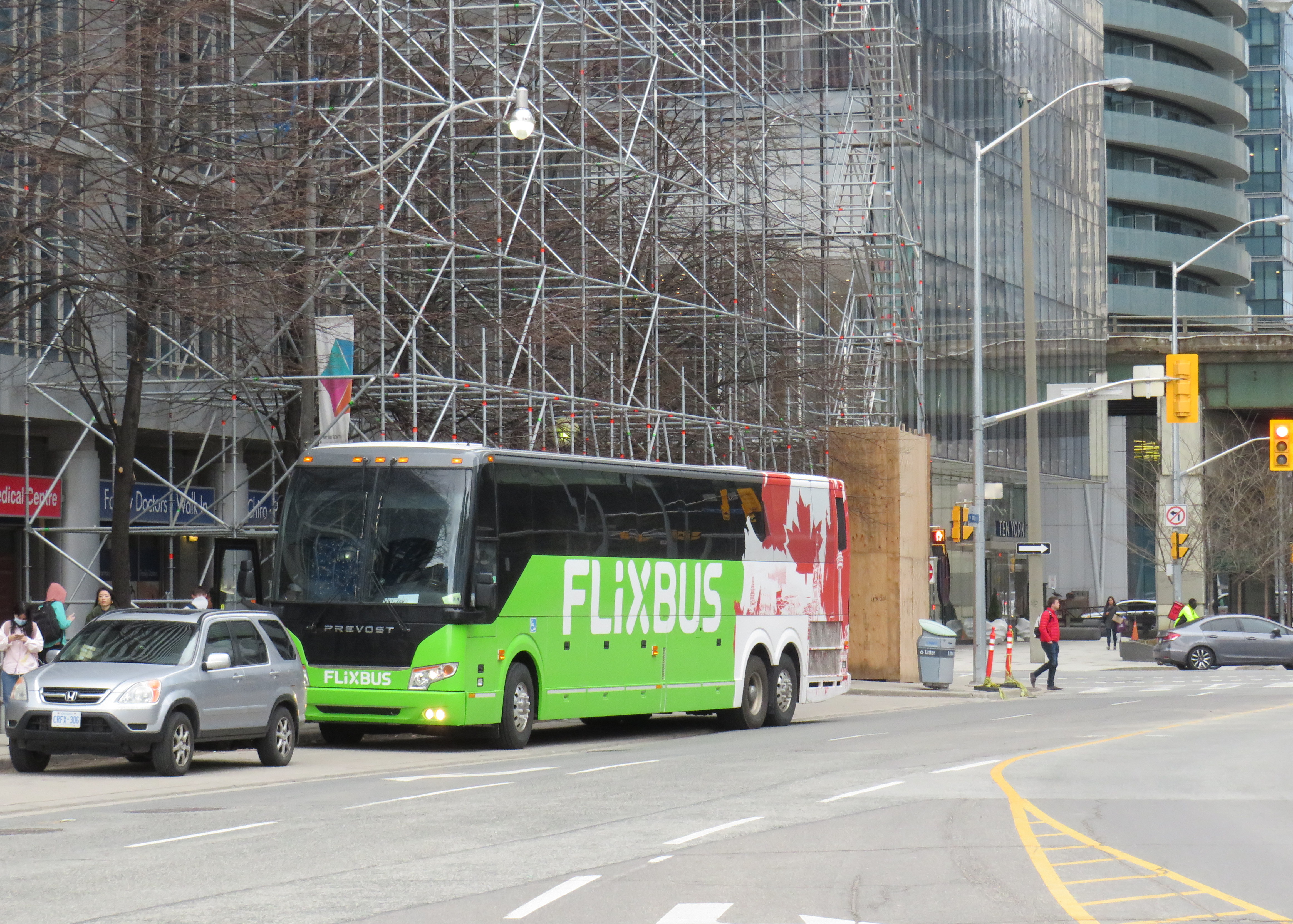
Flixbus stops at a curbside layby on York Street south of the Gardiner Expressway
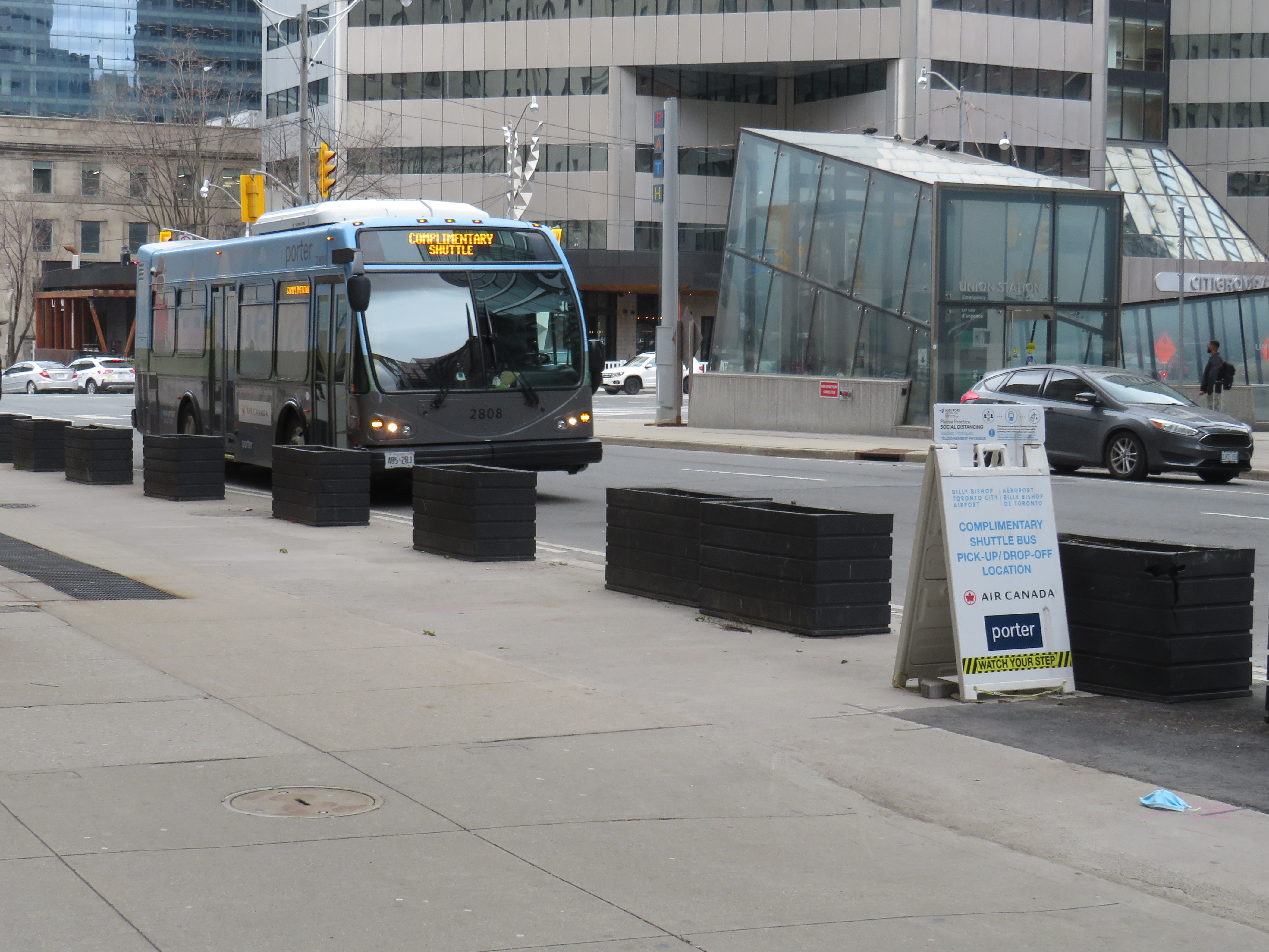
To save on terminal fees, Onex stops beside the Royal York Hotel on York Street, across the street from Union Station, sharing the layby with the Toronto Island Airport shuttle. Flixbus uses a different coach bus layby on York Street south of the Gardiner Expressway, in the Harbourfront area. Neither curbside stop is marked for either company. Though Ontario Northland still sends some buses downtown to Union Station, some of its buses to and from Sudbury and North Bay now terminate at the Yorkdale Bus Terminal in North York.
The layby next to Royal York Hotel serves the Toronto Island Airport shuttle (which has a sign) and Onex bus (which has no bus stop sign)
In Ottawa, Ontario Northland and Orleans Express use the VIA Rail station (which is on the O-Train LRT system), while Megabus terminates at the St. Laurent O-Train station. Autobus Maheux and Flixbus use curbside stops in Downtown Ottawa. The London-Toronto Megabus route bypasses Downtown London on its route from Western University, while Onex Bus and VIA Rail stop right downtown, along with Strathroy-Caradoc’s intercommunity route.
Another issue is that apart from the Toronto-Kitchener-London, Toronto-Niagara, Toronto-Kingston-Ottawa, Toronto-Kingston-Montreal and Ottawa-Montreal corridors, there is still little choice in price, operator, or schedule.
Rider Express suspended service to Windsor last year, so that the three or four VIA rail trains to London and Toronto (or a flight from Windsor airport) are the only option available for anyone travelling without a car. (Transit Windsor’s Tunnel Bus to Detroit remains suspended, despite the continued loosening of border crossing restrictions.) Peterborough, once a major destination for Greyhound Canada on its Toronto-Ottawa corridor, now only has a nearly two-hour-long GO bus connection to Oshawa GO Station.
Gaps that I wrote about several years ago still remain on the map, which are only more evident as new intercommunity services start up and new carriers emerge. The City of St. Thomas and Elgin County remain the most visible of these gaps; St. Thomas is the only urban transit system in Ontario completely disconnected to any other community, despite its short distance to London. Haldimand County, despite its proximity to Brantford and Hamilton has also chosen to remain off the map. While neighbouring Perth, Lambton, Middlesex, and Grey Counties have developed useful transit connections, Huron and Bruce Counties have very limited links to the rest of the province.
Finally, the gaps between Hamilton and Brantford to the south and Guelph and Kitchener-Waterloo to the north remain to be filled despite the growing population and multiple post-secondary institutions in each urban area. Though the Hamilton-Guelph-Kitchener triangle should be a natural expansion for GO Transit, it has yet to announce its intentions. Meanwhile, no private coach operator has filled this obvious need.
The labour-backed Link the Watershed proposal would connect Guelph, Kitchener, Cambridge, and Brantford, but that plan requires the support of local government, but it still leaves the Hamilton corridor wide open.
As more students return to school full time, and more workers return to the office, the need for reliable and attractive transportation options across Ontario will only continue to grow. As housing prices to continue to increase higher than the already-high inflation rate, intercity transport will be one way to ensure students can stay at home while going to school, and workers don’t have to move or endure long and expensive highway commuting.
Hopefully by autumn, these gaps will finally close for good.
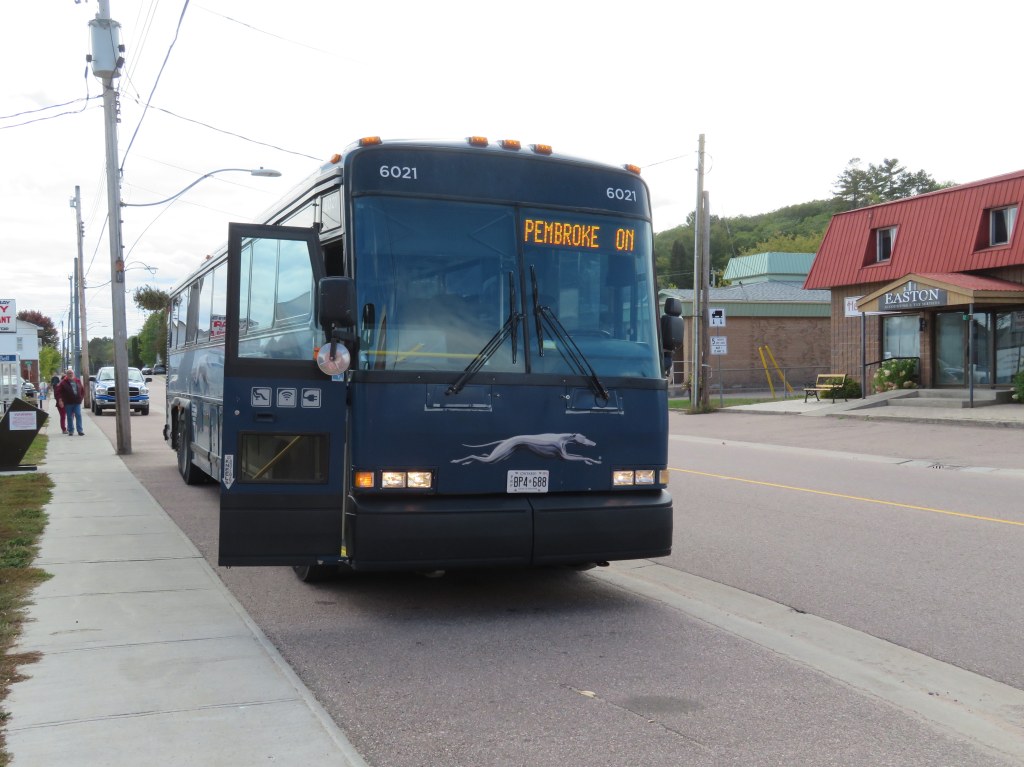
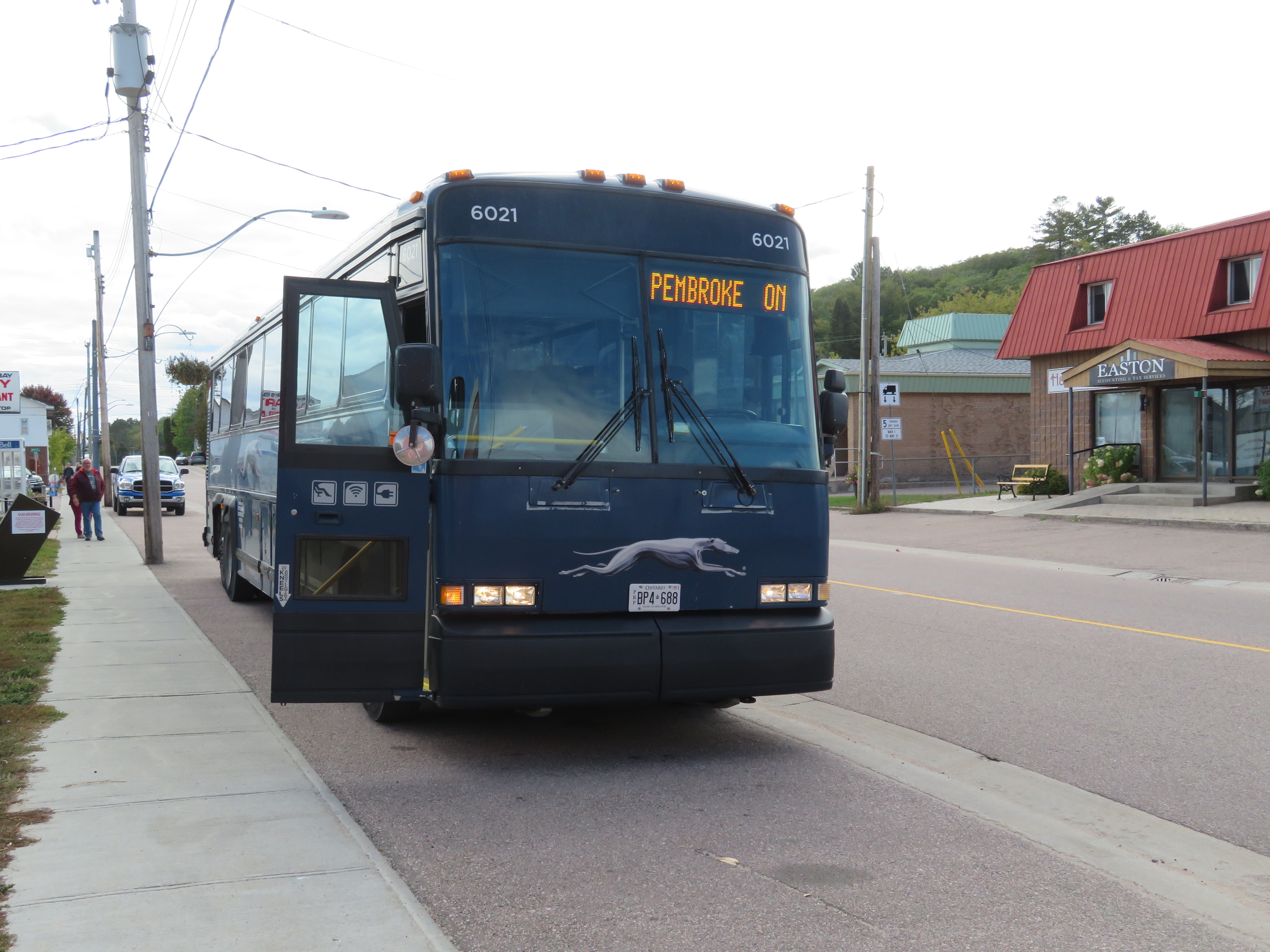
Barry’s Bay, on Greyhound’s Peterborough-Pembroke route, is one of many smaller towns and villages that permanently lost all intercity bus connections since the COVID-19 pandemic
On Thursday, May 13, Greyhound Canada announced that it was permanently ceasing operations. This should not have come as a shock to anyone following the intercity transport industry: for over three decades, intercity bus carriers in this country were privatized (Gray Coach and Canada Coach Lines in Ontario, shut down (Saskatchewan Transportation Corporation), or strangled by continued cutbacks and poor customer service (Greyhound). In 2018, Greyhound Canada ended all its remaining services between Vancouver and Sudbury. The loss of commuter and student traffic — Greyhound’s bread-and-butter in Ontario and Quebec — due to the pandemic led to a temporary, then permanent shutdown.
The next day, on Friday, May 14, Megabus — operated by Coach Canada, a subsidiary of UK-based Stagecoach — announced that it would begin service on the Toronto-Ottawa and Toronto-Kingston routes abandoned by Greyhound. Two buses a day will soon operate between Toronto, Scarborough Town Centre, Kingston, and Ottawa, daily except Tuesdays and Wednesdays, terminating at St-Laurent Shopping Centre, a stop on Ottawa’s new LRT. Though this provides a new option for travelers between the big three cities (VIA Rail continues to serve this route), it does not fill the gaps left by years of decline by private intercity bus operators.
Before Greyhound’s website disappeared, I downloaded the PDF schedules for Ontario and Quebec. In 2019, Greyhound operated three routes between Toronto and Ottawa: an express bus, with stops only in Scarborough, Belleville, Peterborough, Madoc, and/or Kanata, a local bus, making stops in cities and towns along Highway 7 between Peterborough and Carleton Place, and a Kingston-Ottawa bus via Smiths Falls. You can view and download the schedules below:
Peterborough loses two buses a day to and from Ottawa and express bus service to Downtown Toronto (which made the trip in less than two hours off-peak.) Though Peterborough is still connected to Toronto via GO Transit bus Route 88, it can take nearly three hours to go between Union Station and Downtown Peterborough, including a train connection at Oshawa, and many local stops in Clarington and along Highway 115. Other towns, such as Norwood, Marmora, Madoc, Perth, and Carleton Place, lose all bus services, except for a commuter-oriented weekday run between Ottawa and Carleton Place.
Greyhound has chosen to become irrelevant to most Canadians long before the final shutdown announcement. Northern Ontario, at least, still has Ontario Northland (which has expanded its reach), and the Greater Toronto and Hamilton Area has GO Transit (though gaps continue to exist in that network). If your rural community is lucky, your local or regional municipality launched a new, subsidized bus or microtransit service. There is also VIA Rail, which serves most larger communities that lost Greyhound services in 2020-2021 (Windsor, Chatham, Belleville, Ottawa, etc.), though it is typically more expensive.
Despite these continued and emerging services, there remains a need for government support of those crucial links left behind by Megabus, VIA, and GO Transit.
A few weeks ago, I went for another long-distance bus trip. I started my journey in Downtown Toronto, and continued on to Peterborough and Pembroke, before arriving in Ottawa late in the evening. Apart from the Toronto-Peterborough leg aboard a packed, delayed bus, this was the most pleasant of all my long-distance bus trips.
Greyhound’s Peterborough-Pembroke route only operates a few days a week, on Friday, Saturday, and Sunday. It is one of the last rural bus routes operated by Greyhound Canada as most remaining routes operate on highways between large urban centres. The bus follows Highways 28, 62, and 60, stopping at small towns such as Bancroft, Maynooth and Barry’s Bay. North of Lakefield, the route passes through the Canadian Shield, with its lakes, rocks, and trees.
As I traveled on last Friday in September, the fall colours were almost at their peak in the Haliburton Highlands, making this an especially scenic ride. There was an informal fifteen-minute stop in Barry’s Bay, enough time to get a decent coffee and a snack.
The view from Highway 28 near Bancroft, September 27
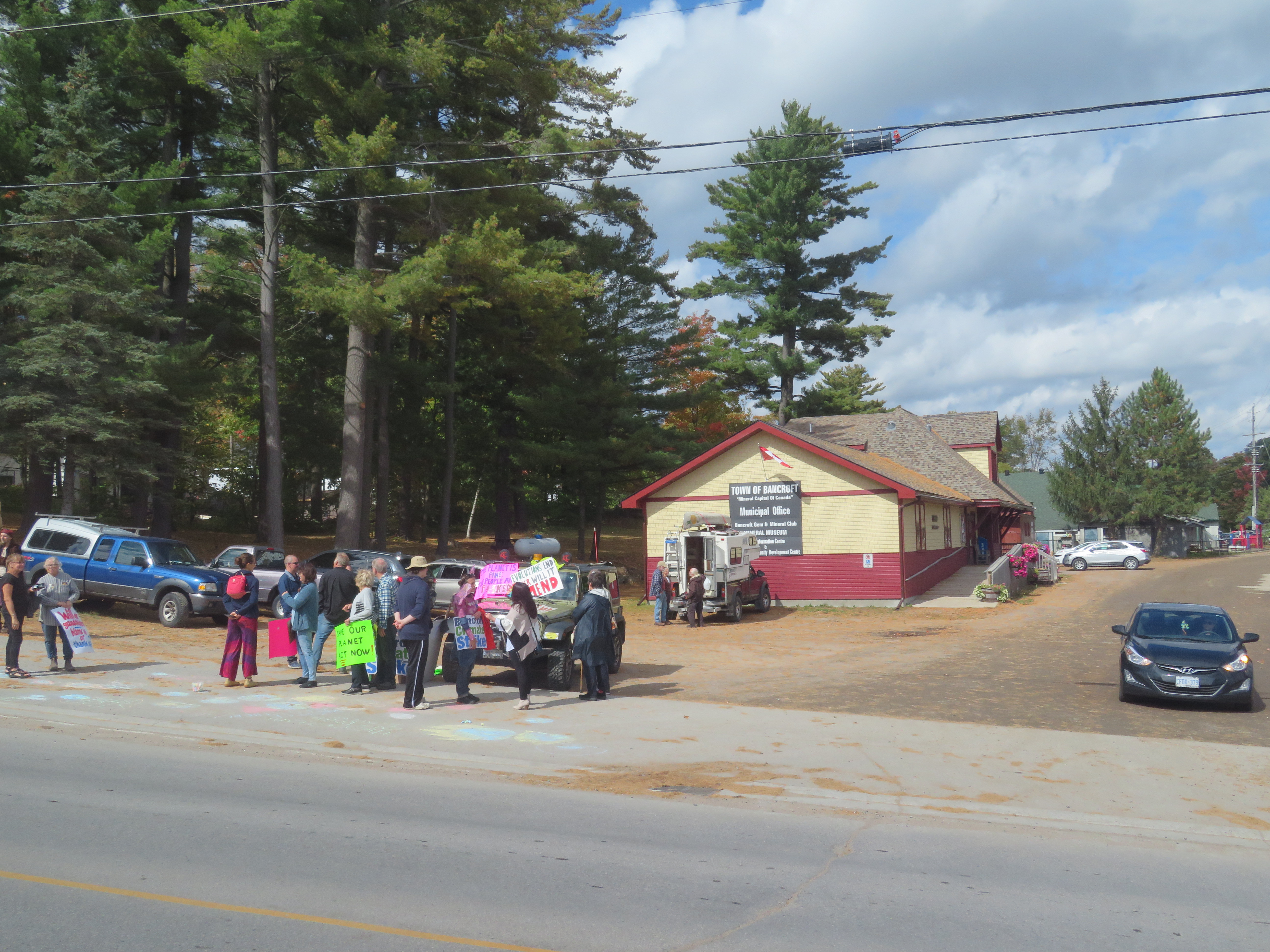
At Bancroft, we passed by the old Central Ontario Railway Station. Passenger service ended in the 1950s, while the tracks were torn up in the 1980s. The station was preserved and is now a local museum. In front, a dozen citizens took part in a local climate strike that took place across Canada, part of the Global Week for Future. It was nice to see residents take part, even in small town Ontario.
Climate strikers in Bancroft. The former railway station stands behind
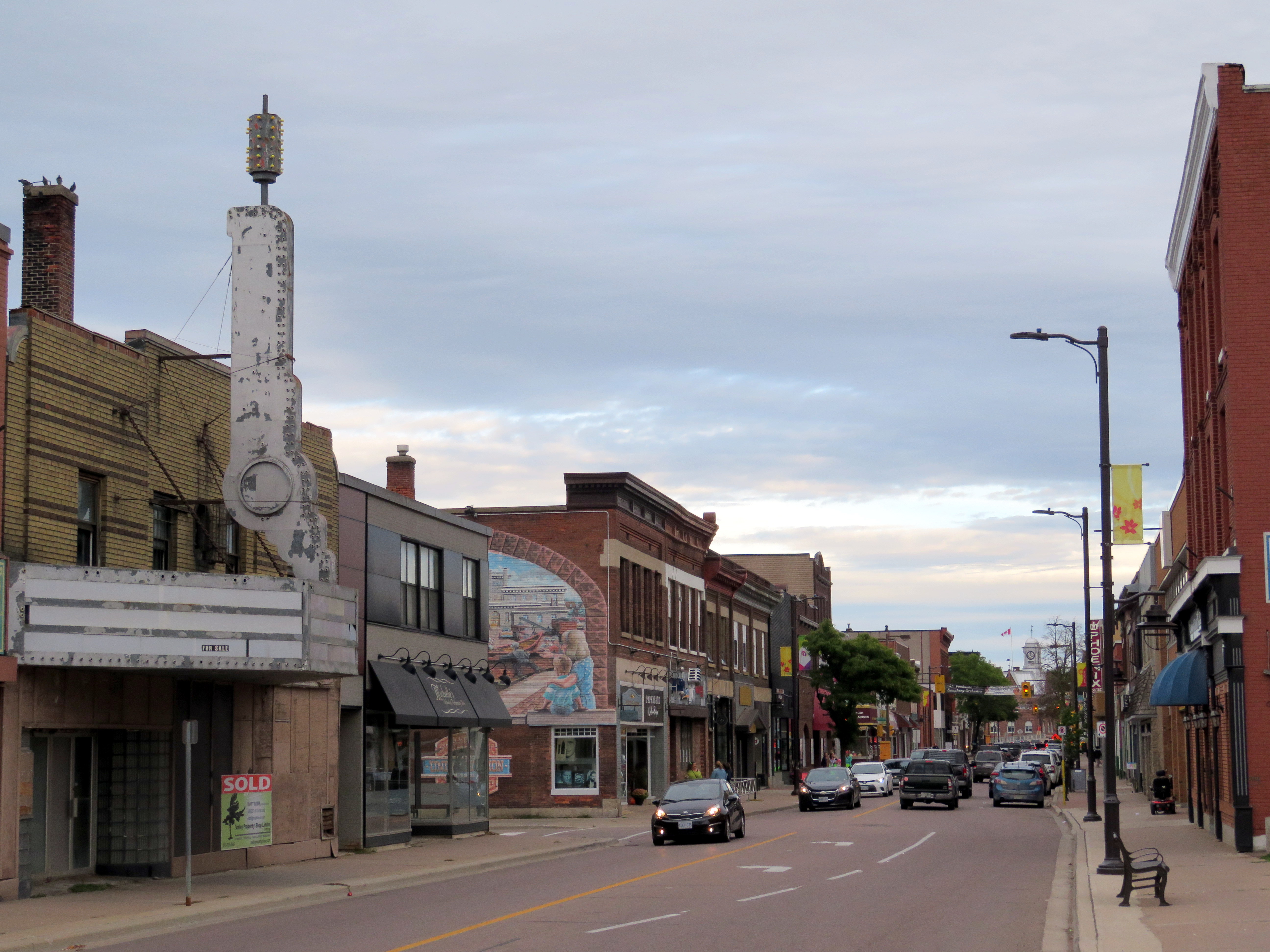
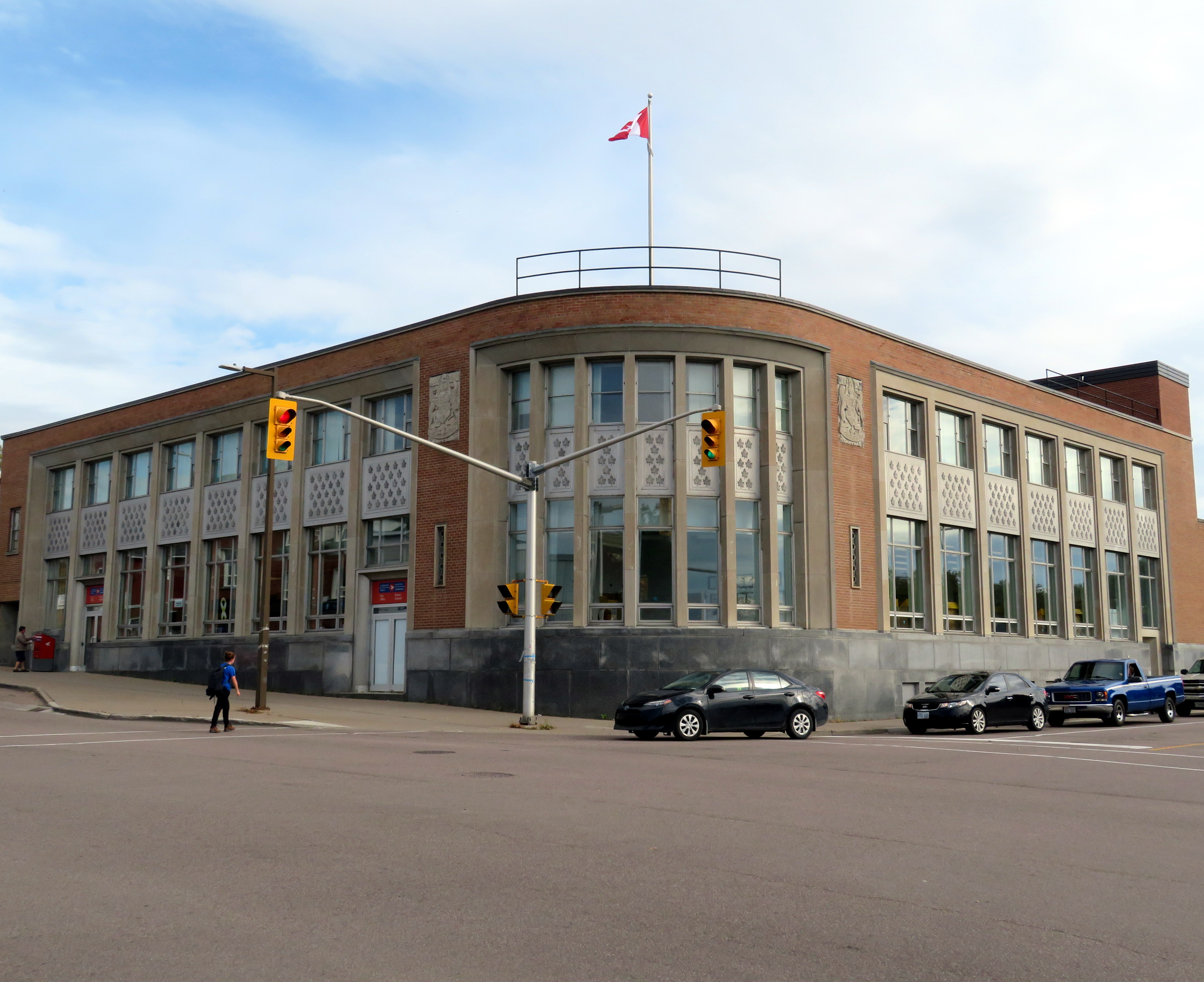
At Pembroke, I had several hours before the Ontario Northland bus departed for Ottawa. While Pembroke’s downtown core could use some TLC, it has great bones and a great collection of heritage buildings, including a late Victorian post office, its late Art Moderne replacement, the historic Renfrew County courthouse, solid commercial blocks, and a fascinating library.
Downtown Pembroke
Pembroke’s post offices. The 1888 building, designed by Thomas Fuller, is now City Hall. The 1950s replacement, on the left, still houses Canada Post.
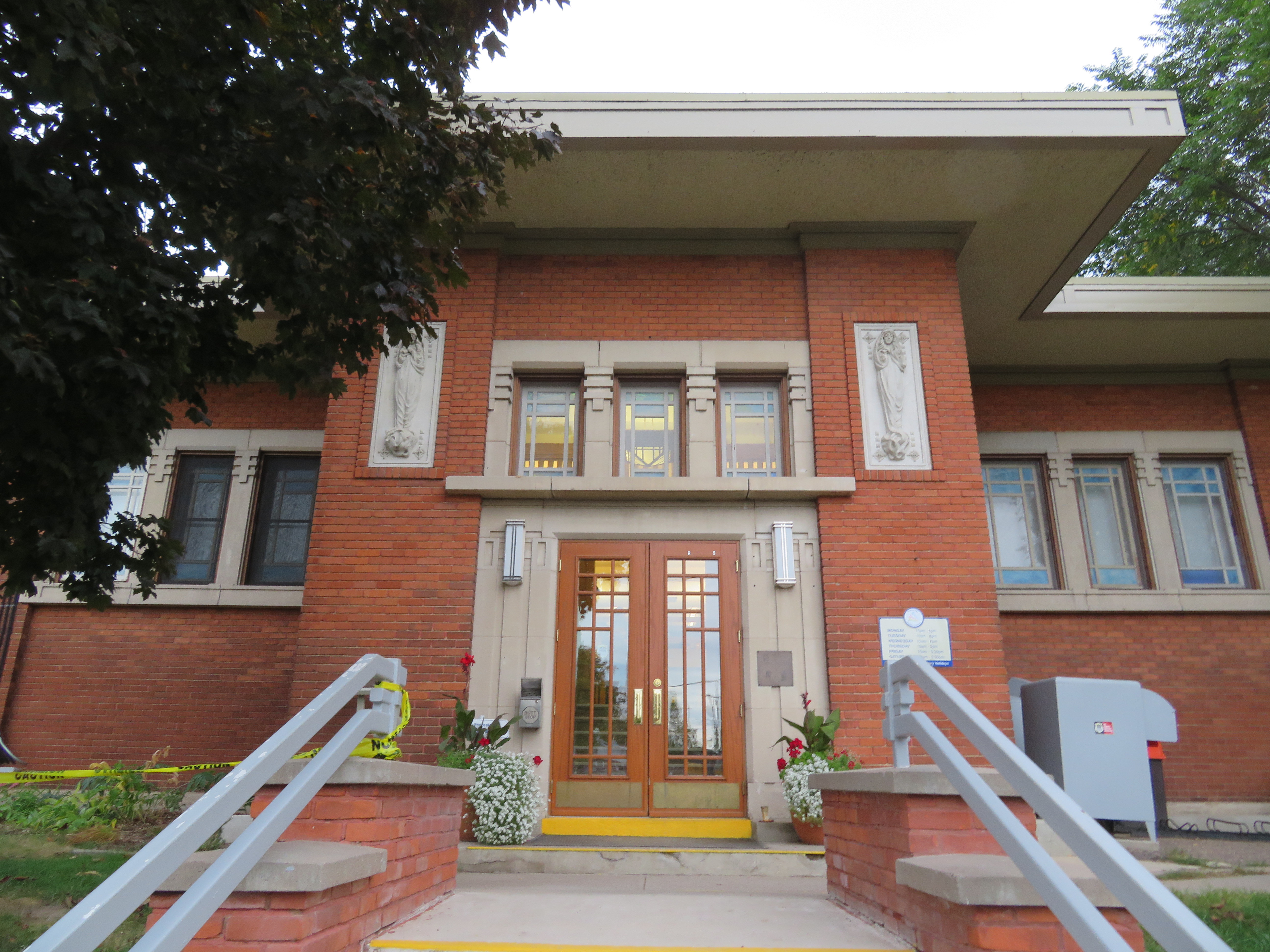
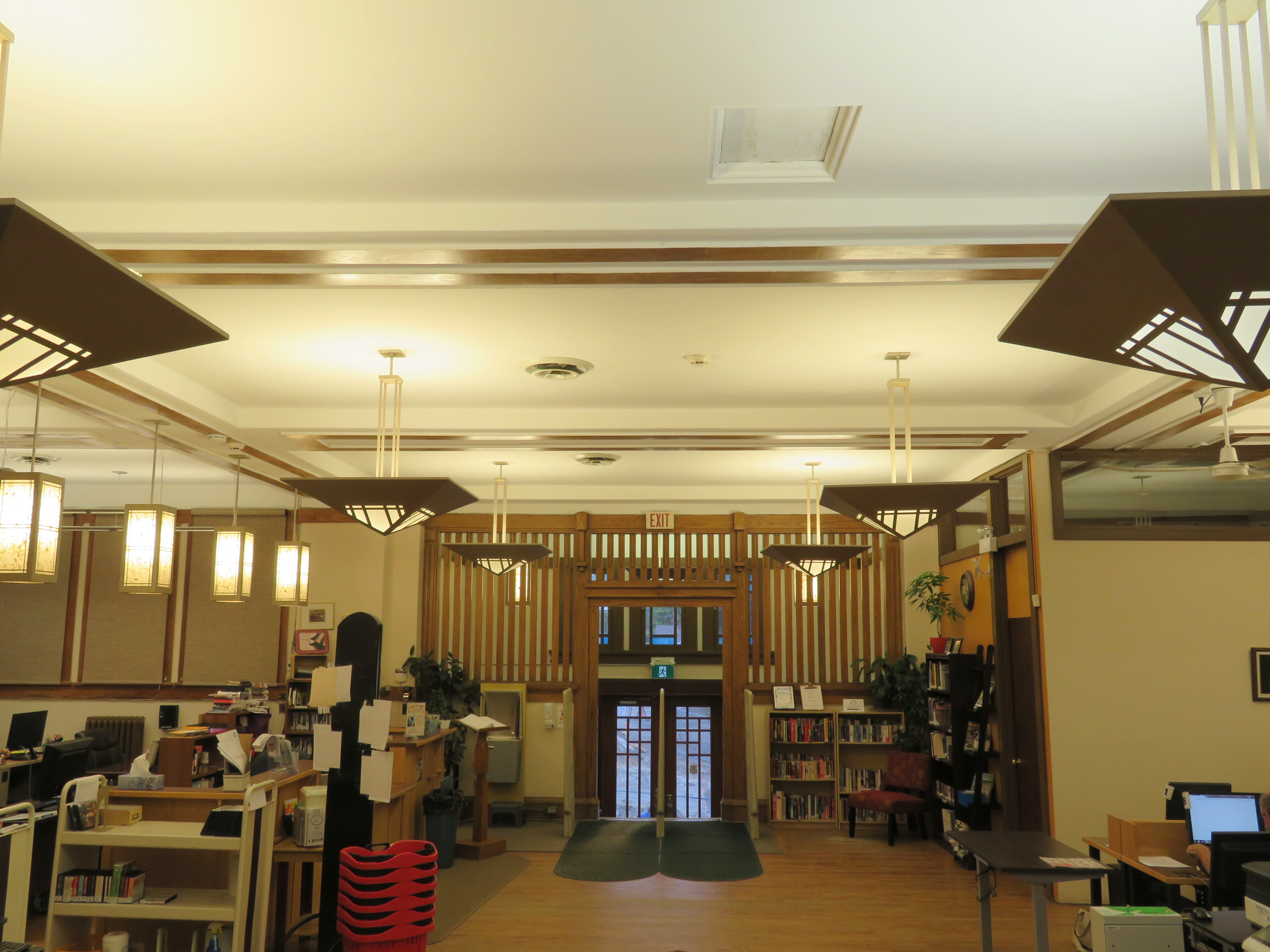
Pembroke’s public library is especially unique, as it looks like it could have been designed by Frank Lloyd Wright. Built in 1914, it was designed by Francis Conroy Sullivan, a Canadian-born architect who studied under Wright in Chicago before establishing his firm in Ottawa. Expansions and renovations have remained faithful to the Prairie Style architecture.
Entrance to the Pembroke Public Library
Library interior
Though Pembroke was served by three different railways — the Canadian Pacific transcontinental mainline, a branch of the Canada Atlantic that operated between Montreal and Parry Sound, and the Canadian Northern — all tracks were removed by 2013, when Canadian National ripped up the Beachburg Subdivision. None of the station buildings survive, but the abandoned rights-of-way are still intact. At the west end of town, a long trestle now carries a snowmobile trail where the CN mainline once crossed the Indian River.
Former CN trestle, Pembroke
The removal of the CN and CP routes through the Ottawa Valley were especially unfortunate, as all through freight and passenger traffic across Canada must now pass through Greater Toronto. This was the result of cost-cutting and the loss of local rail customers, such as lumber and pulp industries. The Commonwealth Plywood plant in Pembroke still stands as a reminder of the industrial past of the Upper Ottawa Valley.
Abandoned Commonwealth Plywood plant
The last passenger train, VIA’s Canadian, called at Pembroke in 1990. But there are two daily bus trips in each direction between Ottawa and North Bay/Sudbury, one operated by Greyhound, the other by Ontario Northland. From Pembroke, I was able to take a Northland bus that left at 9:00 PM, arriving in Ottawa by 11:00 PM. This gave me plenty of time for dinner after a long walk around town.
My trip to Pembroke made for a pleasant detour, giving me a chance to see another part of Ontario.
VIA RDC train about to depart Sudbury for White River
Last month, I embarked on a journey from Toronto to Thunder Bay, a distance of over 1,300 kilometres. My journey took me nearly three days as I opted to travel by bus and rail, rather than by car or by air. Though I had to take three separate trips to accomplish it (an Ontario Northland bus, a VIA Rail RDC train, and a Kasper Transportation mini-bus), it was a very interesting trip.
Unloading a canoe from the RDC on the Spanish River, northwest of Sudbury
Once I arrived in Thunder Bay, I rented a car. Though I know Northeastern Ontario quite well, I had yet to visit Northwestern Ontario (a brief stop in Sioux Lookout on VIA’s Canadian notwithstanding). There are several beautiful provincial parks within a short drive of Thunder Bay, and the city itself has a few interesting sights. Highway 17 along the Lake Superior shoreline is probably Ontario’s most scenic drive.
Travelling without a car has its challenges, especially as the traveler is at the mercy of sudden schedule changes, traffic delays, and other hiccups, but it is still possible to get across Northern Ontario even after Greyhound’s withdrawal from Western Canada and Northern Ontario last year.




 Downtown Pembroke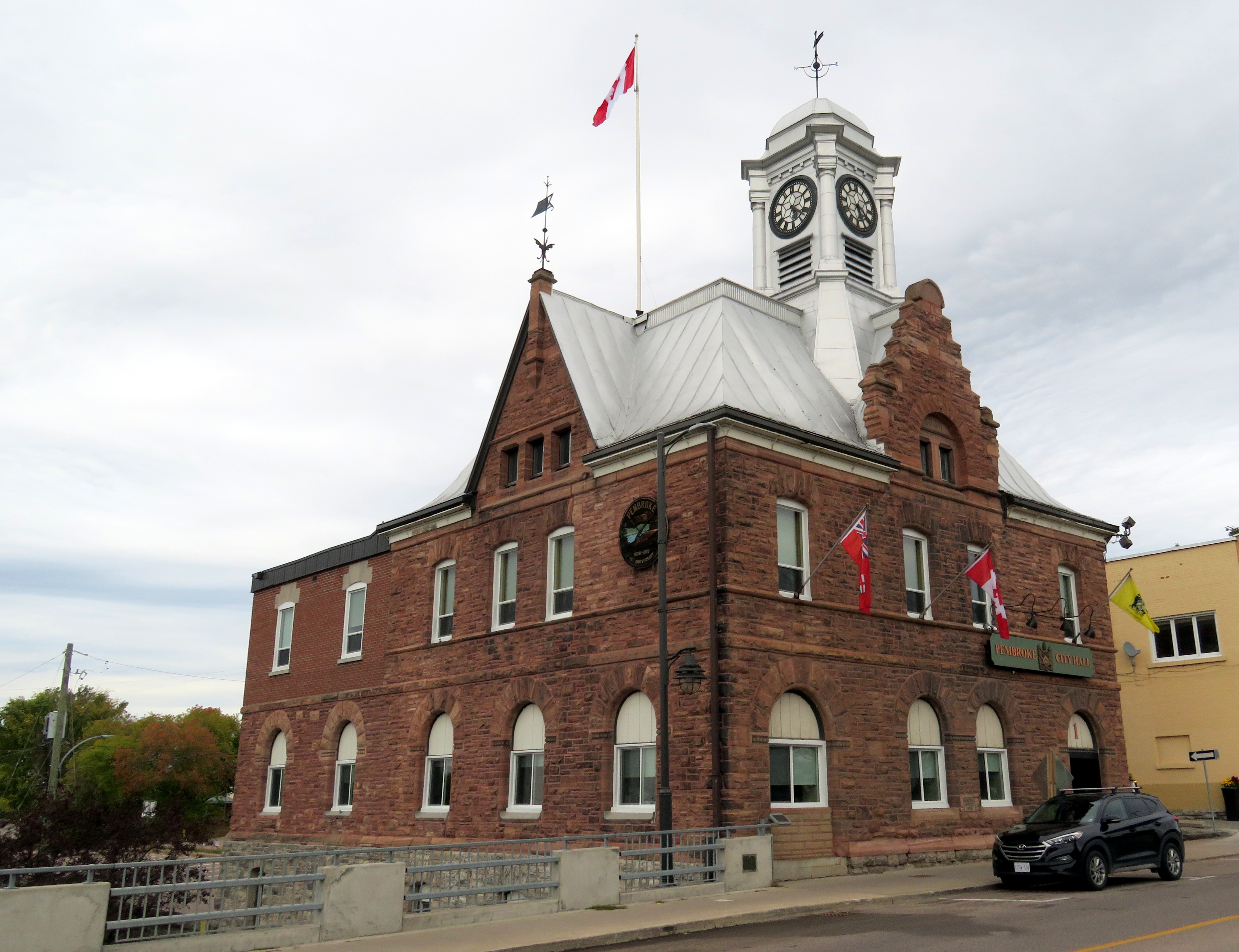
 Entrance to the Pembroke Public Library
 Library interior
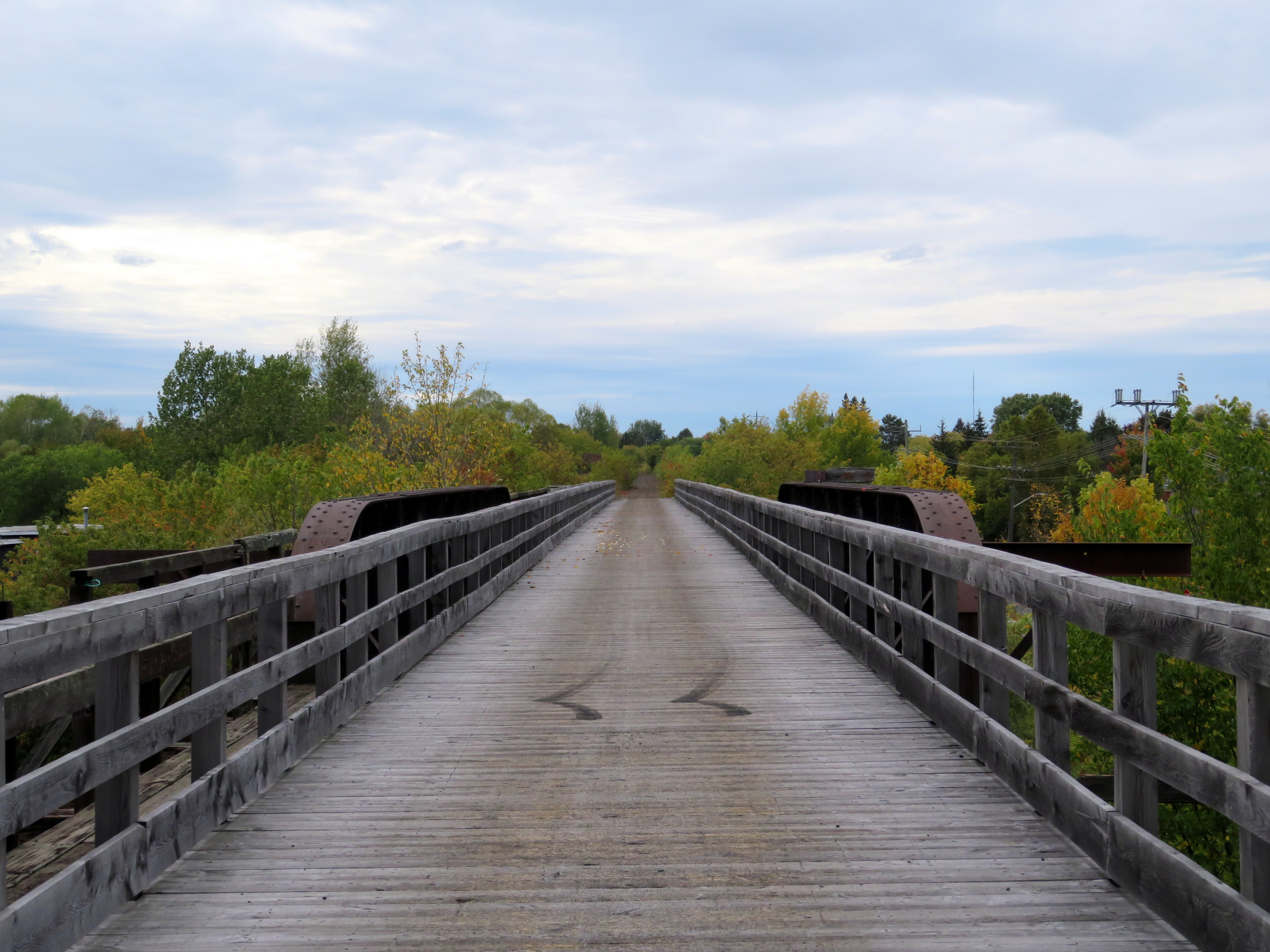 Former CN trestle, Pembroke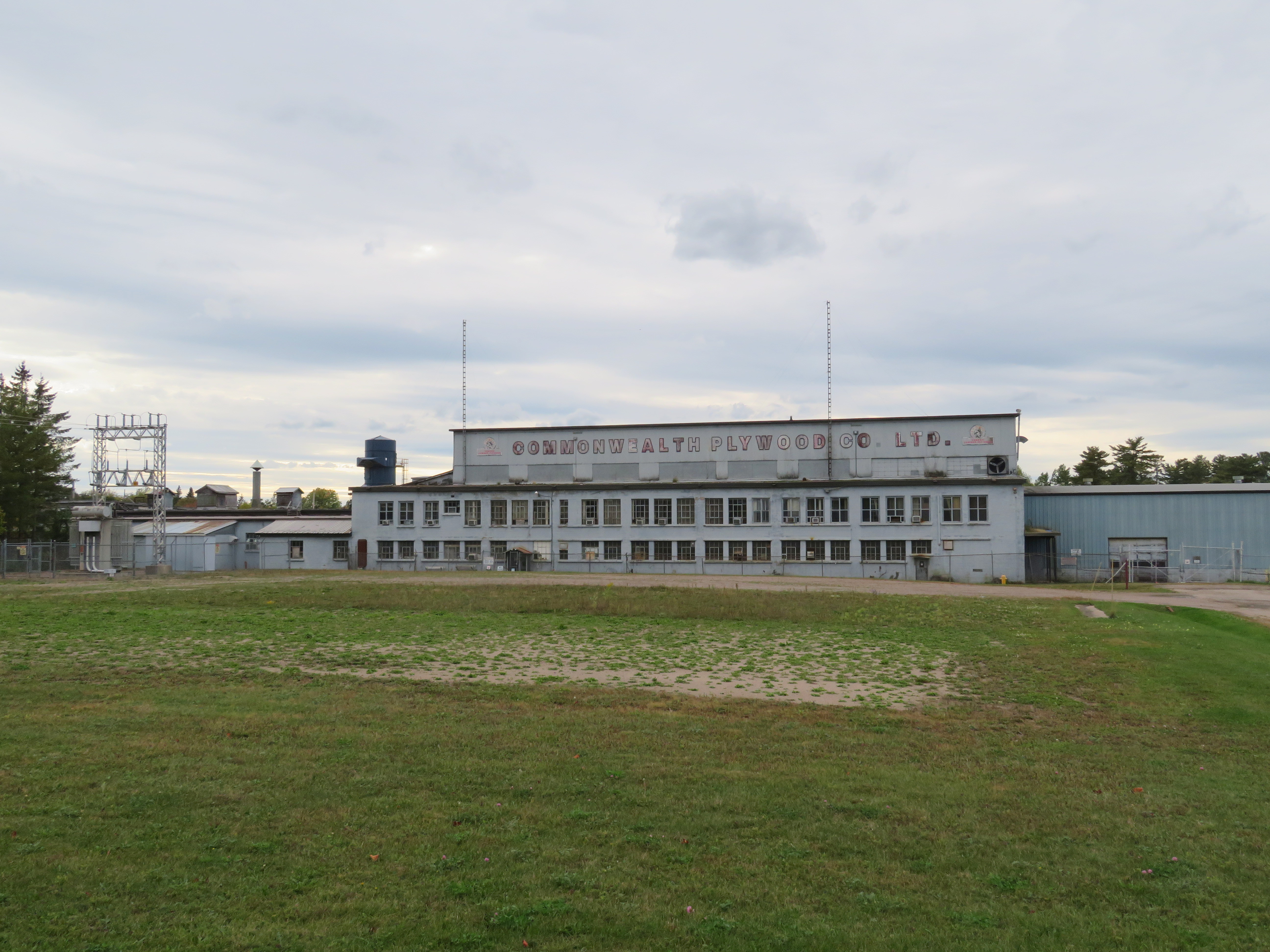
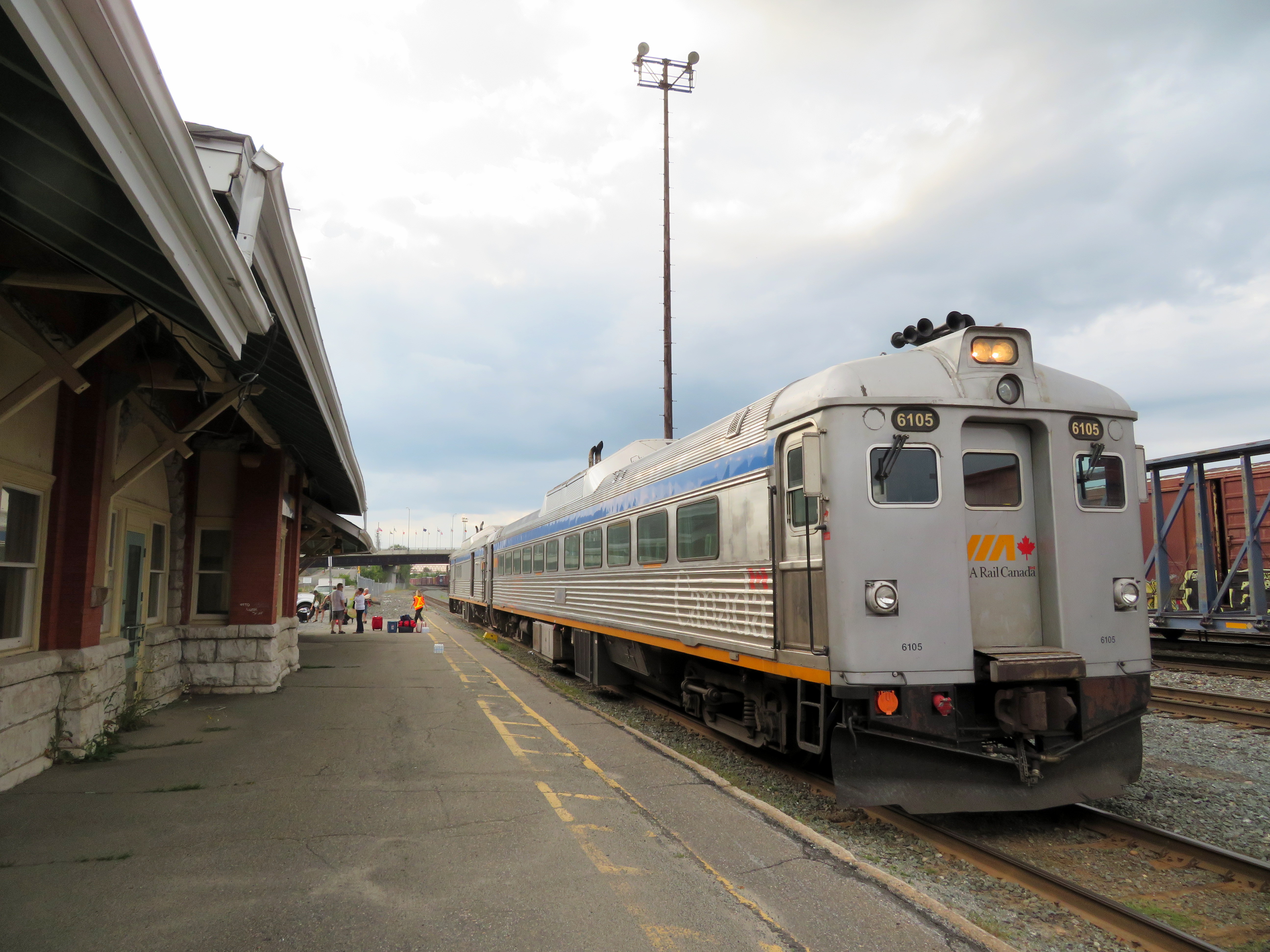 VIA RDC train about to depart Sudbury for White River
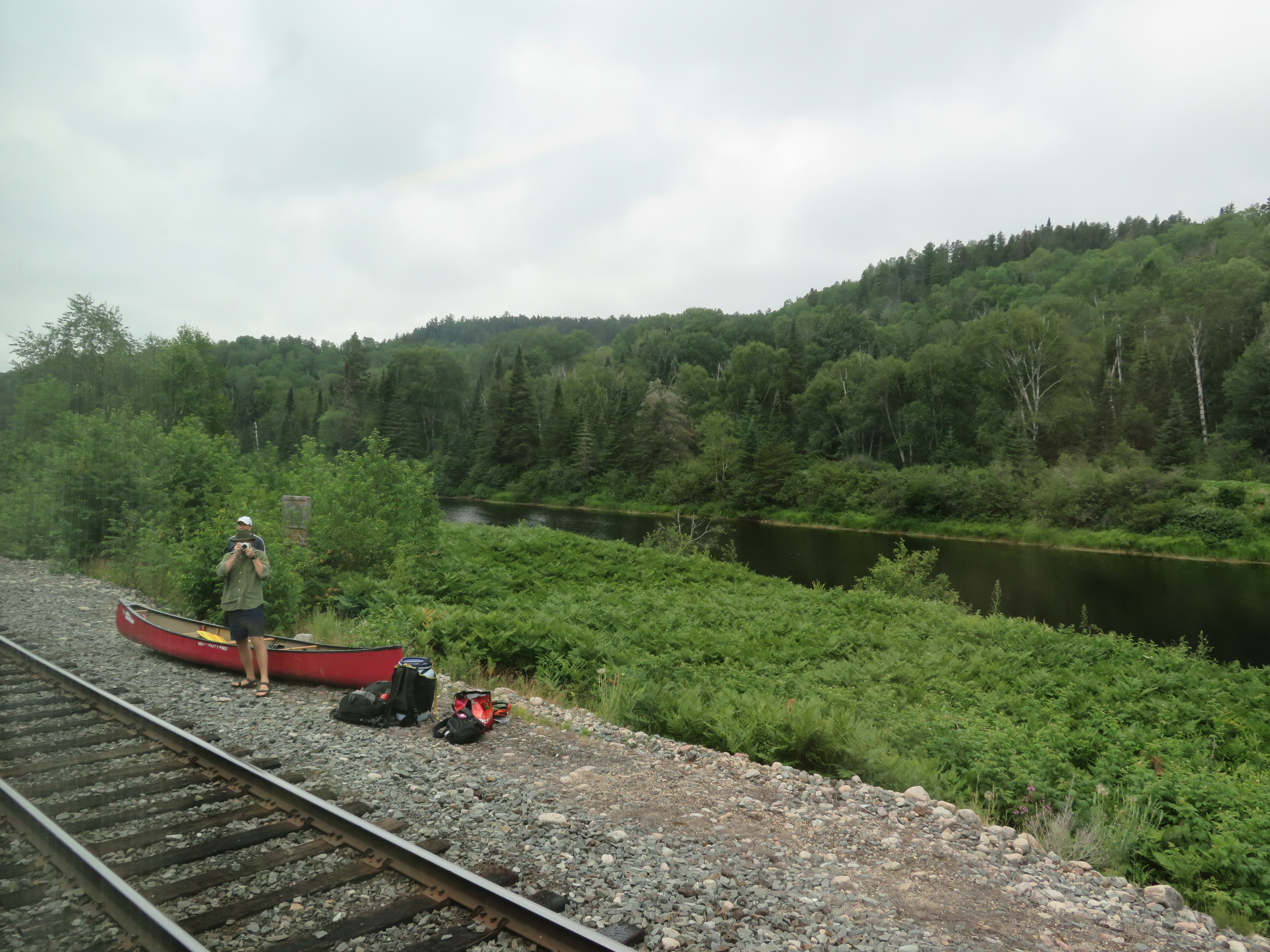 Unloading a canoe from the RDC on the Spanish River, northwest of Sudbury
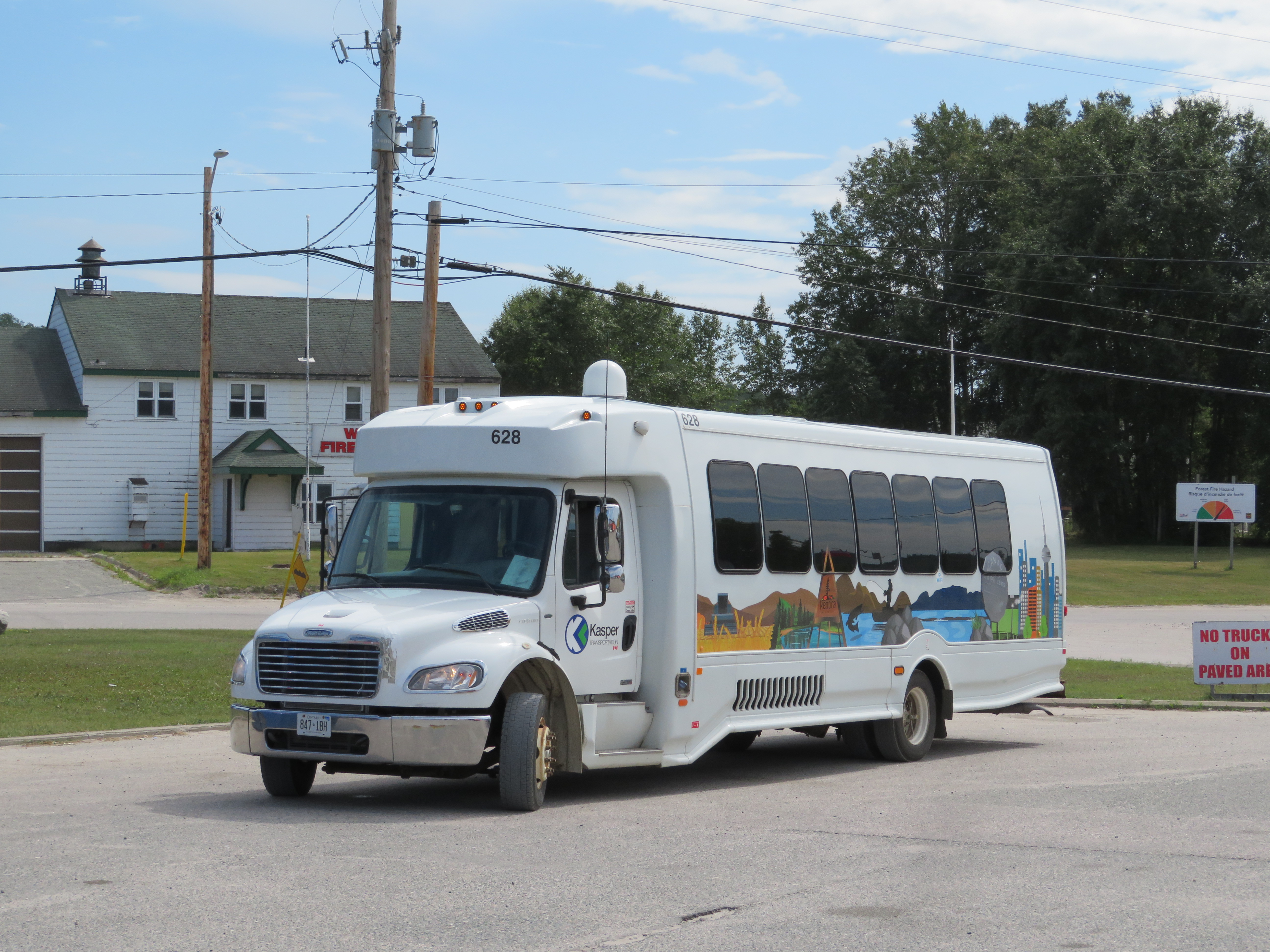 Kasper Transporation bus at White River – filling the gap left by Greyhound
