Tag: Sign

  • Do I stay, or do I go now?

    Pedestrian crossing at Victoria Park, Cobourg

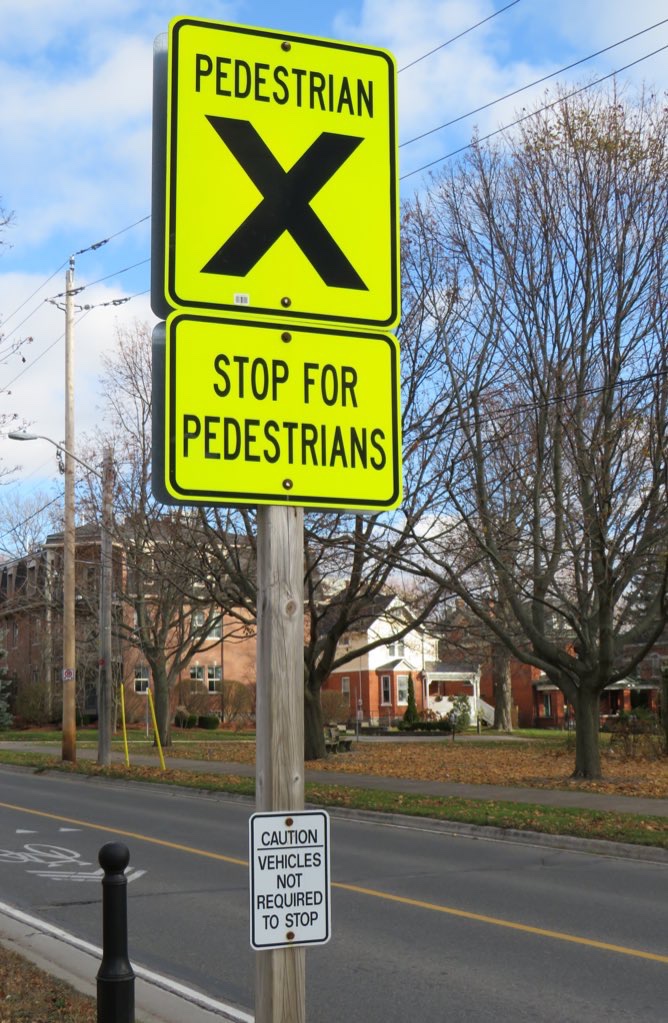
    At the corner of King Street (former Highway 2) and College Street in Cobourg, adjacent to Victoria Park on the eastern edge of Downtown Cobourg, there’s a marked pedestrian crossing, with clear “zebra” road markings on the pavement.

    The sign, in bright fluorescent yellow, reads “PEDESTRIAN X.” Below, a second sign, also in bright yellow, reads “STOP FOR PEDESTRIANS.” The message is clear enough.

    However, a smaller white sign below, facing the sidewalk, reads “CAUTION – VEHICLES NOT REQUIRED TO STOP.”

    So which is it?

    (more…)
  • The road to Paris and London

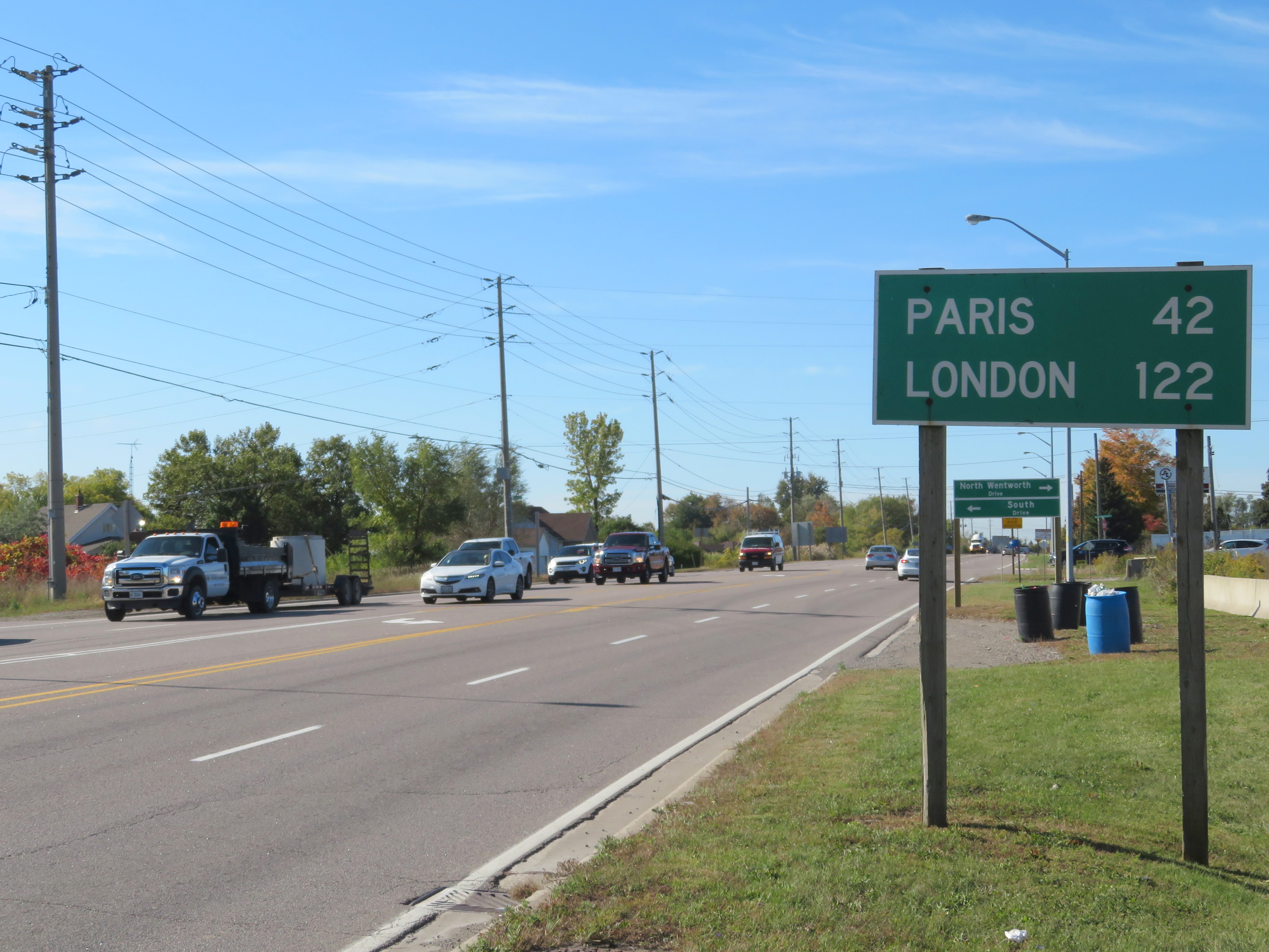
    Sign with the distance to Paris and London OntarioDistance Sign on Highway 5, Clappison’s Corners

    Early European settlers to Ontario were not very imaginative when they came up with local place names. Although some towns and townships have First Nations names (Toronto, Chinguacousy, Niagara), or named for First Nations leaders allied with the British (Tecumseh, Brant), most cities, towns, and townships were given the names of European settlements, British royals and nobility, or the names of those settlers.

    The list of Ontario towns and cities includes no less than ten world capitals: Athens, Brussels, Delhi, Dublin, London, Paris, Vienna, Warsaw, Wellington, and Zurich. Other towns and cities across the province include the names of British royalty and nobility (Cobourg, Hanover, Port Arthur, Fort William, Richmond Hill) or the towns settler arrived from. These towns can be found throughout the province.

    At Clappison’s Corners, a busy intersection outside of Hamilton, Paris and London appear on the same sign, amusing the occasional visitor. By driving west on Highway 5, Paris is just 42 kilometres away, with London an additional 80 kilometres’ drive via Highway 2.
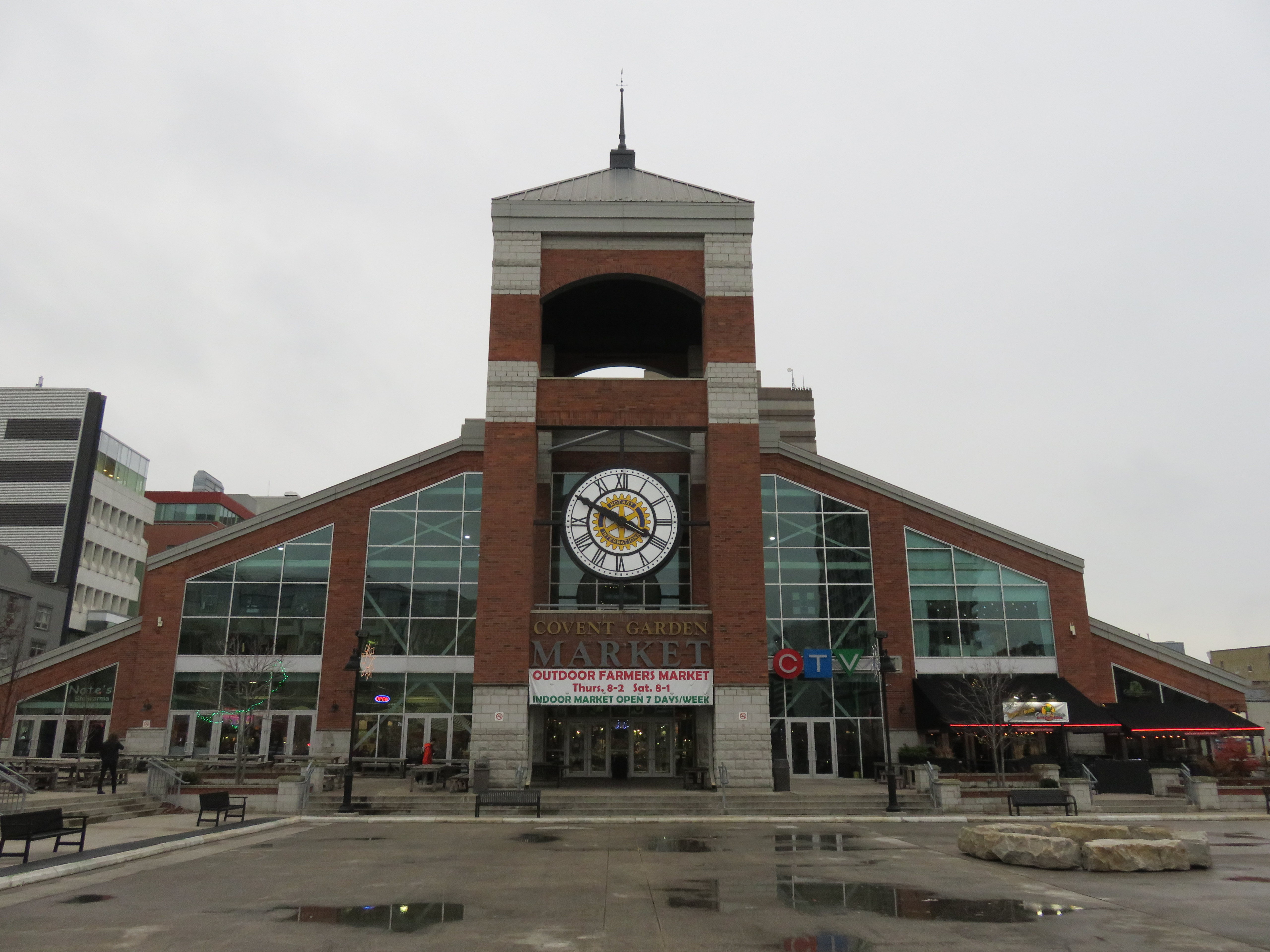
    The other Covent Garden Market, London, OntarioThe other Covent Garden Market, London

    London was named for the British city in 1793, and was chosen as the site of the new capital of Upper Canada by governor John Graves Simcoe. He felt that the interior location, on the banks of the Thames River (Simcoe named that, too), would be safe from American attack. However, York (now Toronto), became the capital. But London became the regional centre for Western Ontario, and is now the world’s second-largest London with over 350,000 residents.
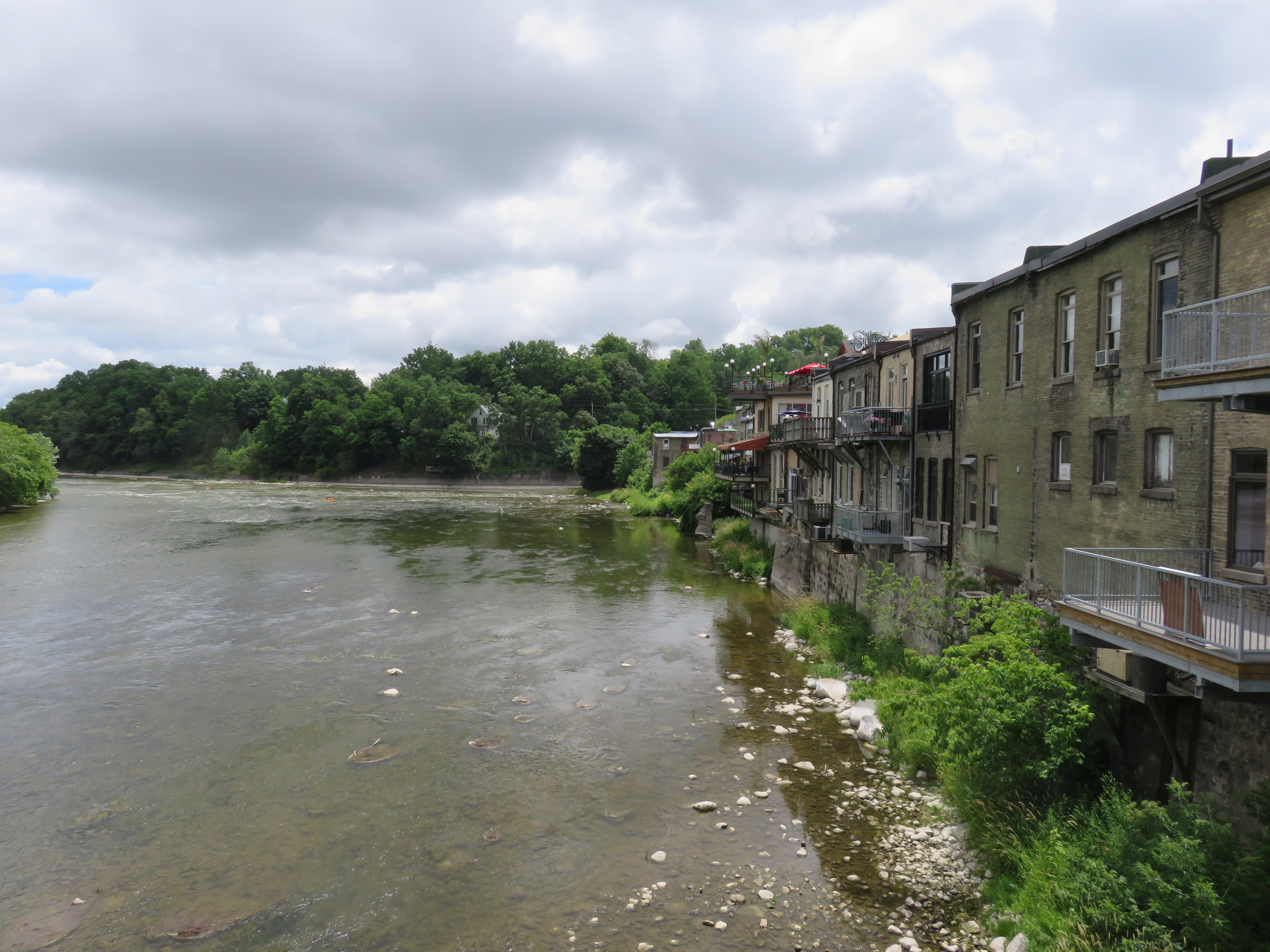
    Paris OntarioParis, Ontario’s main street backs onto the Grand River

    Paris was named in the 1840s not for the French capital, but for the large gypsum deposits in the area, used to make plaster of Paris. In 2000, the town of Paris was amalgamated with rural Brant County. The community has a population of just 12,000, the third-largest Paris (between Paris, Texas and Paris, Tennessee).

    Before the provincial government downloaded thousands of highways to local municipalities in the late 1990s, Highway 5 ran from Highway 2 (Kingston Road) in Scarborough to Highway 2 again at Paris. At Paris, a motorist could continue on Highway 2 west to London and beyond. New freeways, such as Highway 403, offered a faster trip, while local roads, such as Highways 2 and 5, were downloaded as a cost-cutting measure. Today, Highway 5 runs for just 13 kilometres connecting Highways 6 and 8.

    Today, the route to Paris and London is merely an anachronism of an earlier time, when King’s Highways covered the province and when motorists passed through many small towns on their way to places like Toronto, Detroit, and Montreal. At some point, the sign at Clappison’s Corners will be removed to make way for a new interchange. Until then, this humble monument to European settlement and rural King’s Highways will stand guard.
  • The trouble with those “cyclists dismount” signs

    IMG_3940

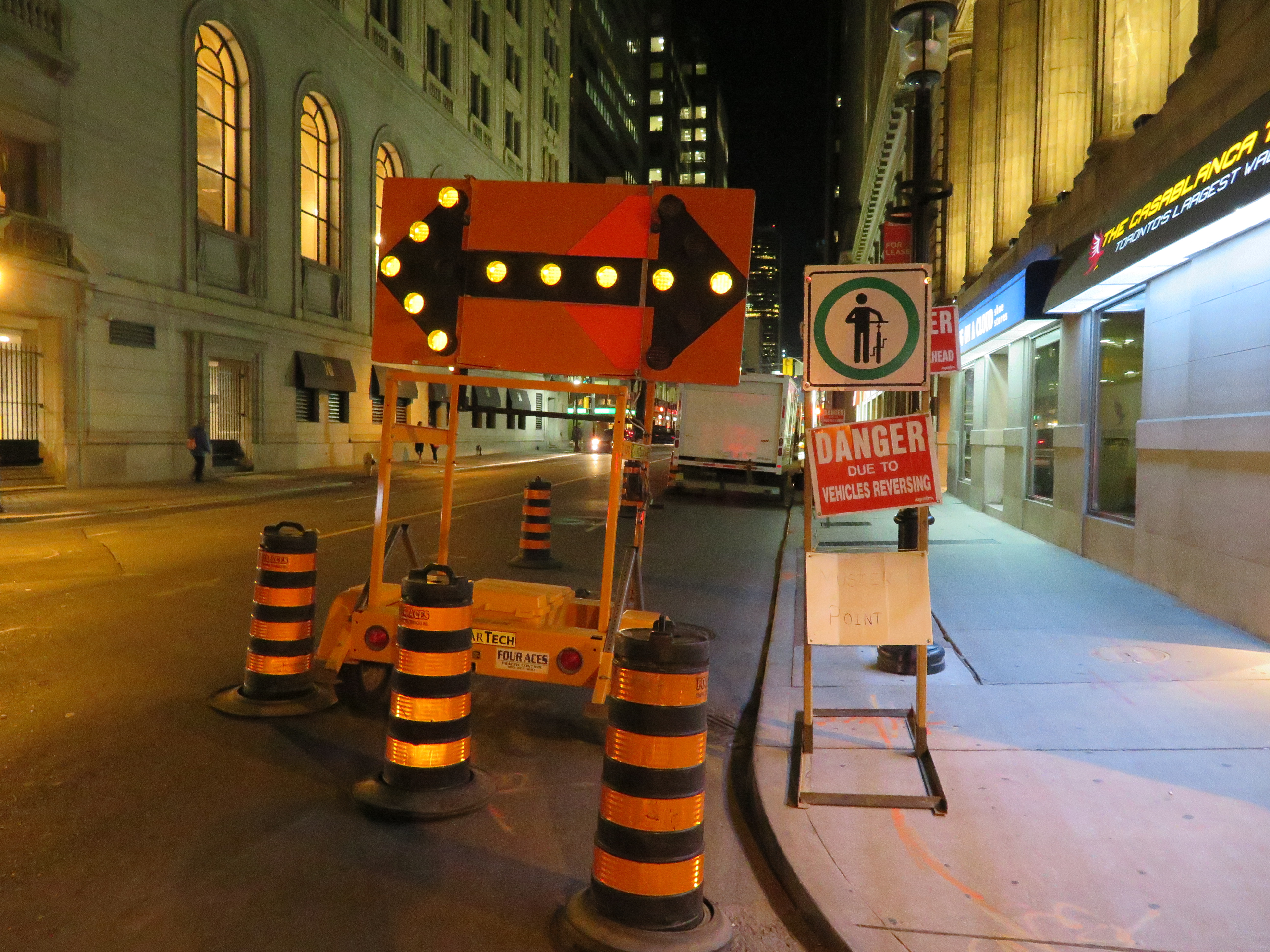
    Recently, I wrote about inconsistent, misleading, and problematic signage at road construction sites. Too often, cyclists are instructed to dismount and walk when a bike lane or general traffic lane is closed for construction.

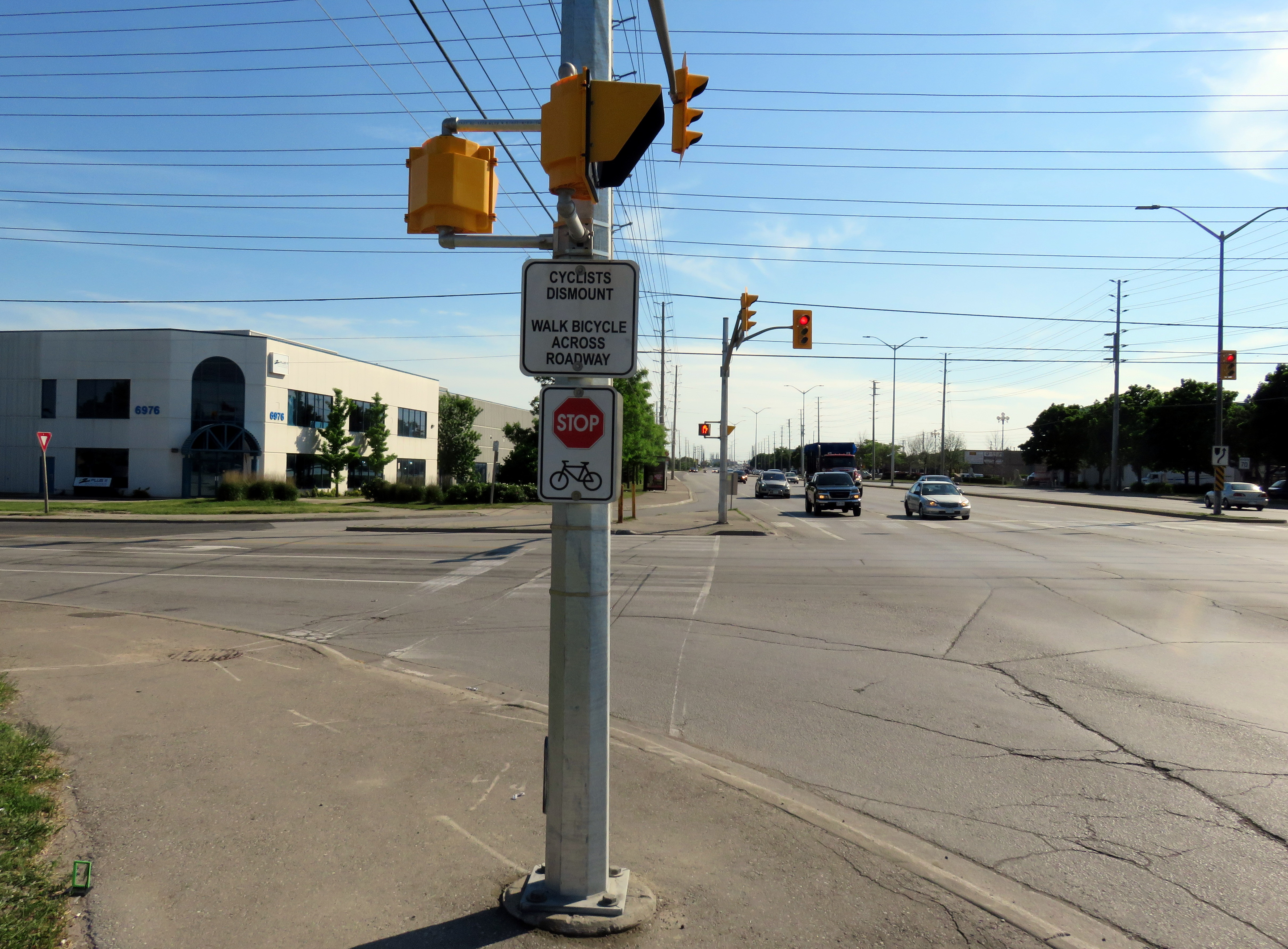
    But these signs also exist where many multi-use trails and paths cross intersections. In suburban municipalities such as Brampton and Mississauga, multi-use paths adjacent to major roadways are preferred over on-street bike lanes (protected or not). But they too, are littered with signs instructing cyclists to stop, get off their bikes, and walk across the intersection, such as the example illustrated below, in Mississauga.

    IMG_2302-001

    The trouble is, the Ontario Traffic Manual (OTM), used by transportation planners and engineers to design roadways and install the appropriate signage, takes a dim view of signage requiring cyclists to dismount when on roadways or on multi-use trails:

    “It is sometimes necessary for cyclists to dismount their bicycle and walk when the terrain or cycling conditions are difficult and no alternatives exist. However, the option of asking cyclists to dismount and walk their bikes should not be relied upon in lieu of adequately accommodating cyclists through appropriate road design.”

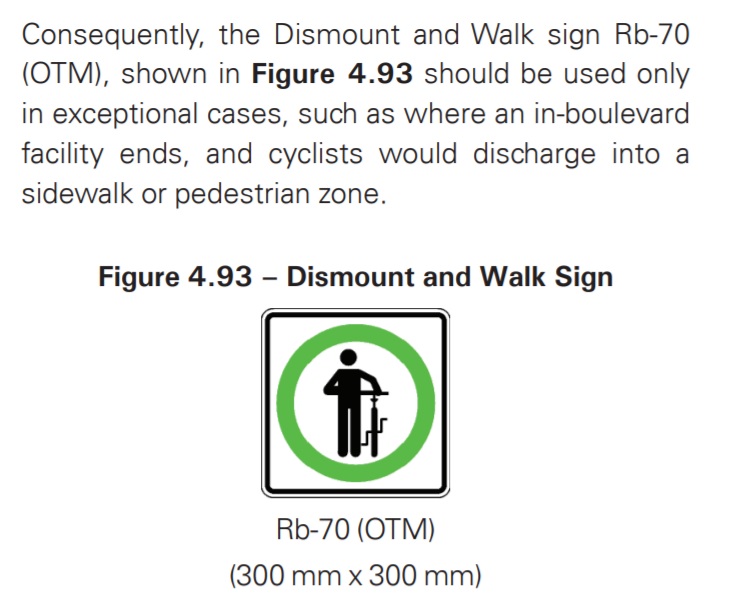
    Book 18 of the OTM (available here as a PDF) states that the “dismount and walk” sign should “be used only in exceptional cases, such as where an in-boulevard facility ends, and cyclists would discharge into a sidewalk or pedestrian zone.” This clearly means that these signs should not exist when a bike route or multi-use trail crosses a driveway or an intersection, but only when the route ends and becomes a sidewalk, or at a pedestrian mall where cycling is not permitted. (Page 118, OTM Book 18, 2013 edition.)

    OTM Book 18 page 118Excerpt from page 118, book 18 of the Ontario Traffic Manual, December 2013 edition
    The OTM also says that “…cyclists usually find it difficult to rationalize why “dismount and walk” restrictions are in place, and conclude that they were a poor, illogical or arbitrary decision. Thus, if facility designs cause cyclists to make what they consider to be unnecessary stops, this will increase the likelihood that they will ignore or disobey traffic controls.”

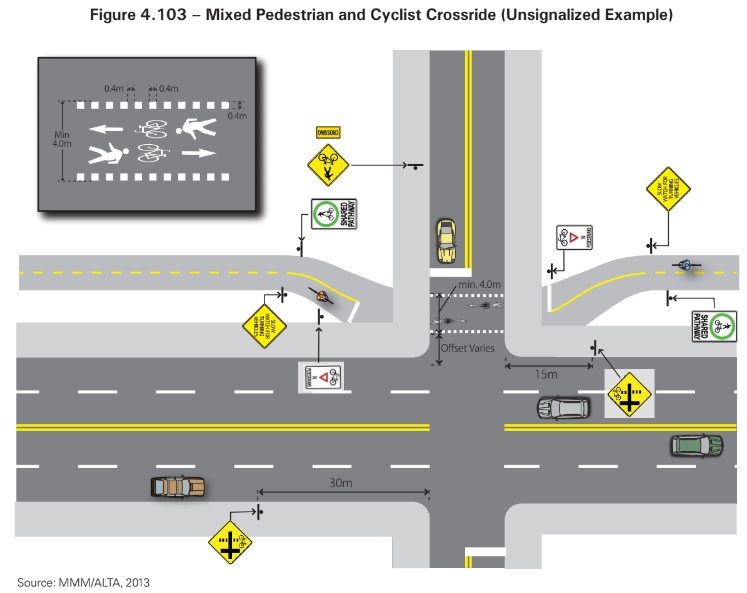
    What the Ontario Traffic Manual does specify, is how signage, road markings, and design should be made to clearly mark crossing locations, warn motorists to watch for cyclists, and to remind cyclists to yield to pedestrians. Figure 4.103 from OTM Book 18, shown below, illustrates how a mixed pedestrian and cyclist route on the side of a road — like those in Brampton and Mississauga — should meet an intersection. While signs warn motorists and cyclists to watch out for each other, and for cyclists to yield to pedestrians, there are no “cyclists dismount” signs to be seen in the diagram.

    OTM Book 18 page 124 .jpg
    Illustration of how a multi-use trail should meet an intersection. Figure 4.103, from page 124, book 18 of the Ontario Traffic Manual, December 2013 edition

    Multi-use trails are an effective way of providing safe cycling infrastructure, especially in the suburbs, where traffic speeds are higher and politics may not make installing bike lanes an easy sell. Traffic engineers have figured out that those ubiquitous “cyclists dismount” signs are not effective and developed designs that instead accommodate cyclists.

    It’s time that municipalities figured this out.

  • What do I know? I’m just a downtown elitist

    23211094949_cd3f8fc6a1_k

    I once described Councillor Denzil Minnan-Wong as the city official that “knew the cost of everything and the value of nothing.” In 2014, Minnan-Wong complained about the costs of building new washrooms at the soccer fields at Cherry Beach, holding up a sign that simply said “$600,000.” That photo of Minnan-Wong, scowling for the cameras, trying to generate some outrage in an election year, was meme gold and so was parodied in the #TOpoli Twittersphere.

    At $600,000, yes the washrooms were expensive. But as they were built in an isolated part of the Portlands, they required a new connection to the nearest watermain; a sewage tank had to be constructed as well, being so far from existing lines. The city has a mandate to provide quality parks and recreational facilities. Minnan-Wong, along with the Fords, also complained about the costs of umbrellas at Sugar Beach, a popular new waterfront park.

    In 2016, under Mayor John Tory’s administration, we have a City that doesn’t know the cost of some things (like the Scarborough Subway) nor does it know the value of other, smaller things, like the Toronto sign.

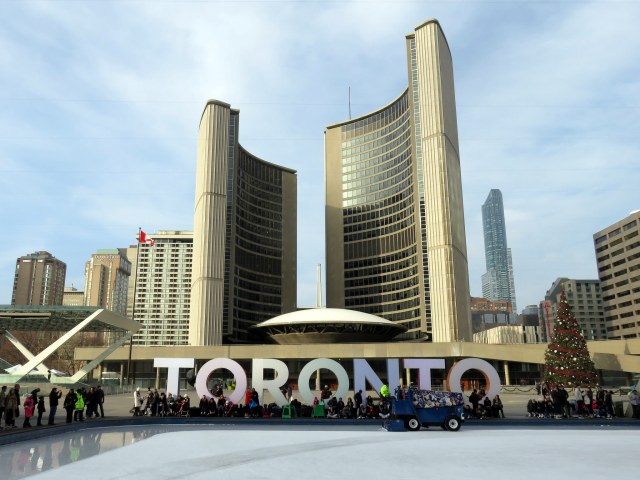
    The Toronto sign, placed on Nathan Phillips Square ahead of last year’s Pan Am Games proved to be incredibly popular with residents and tourists alike. The LED backlighting allows the sign to be coloured at night to mark any holiday or any important current or special event. The $100,000 climbable sign (reminiscent of the successful “I amsterdam” signs) was supposed to be temporary, and will have to be replaced within three years. A staff report estimate the cost of major repairs to the existing sign, and a new mobile sign, would cost $421,700 over two years. This would be money well spent.

    But some councillors, including Etobicoke’s Stephen Holyday and Scarborough’s Raymond Cho, would rather privatize the sign, perhaps selling it off. At least Councillor David Shiner, a fiscal conservative, called it “a potent symbol of Toronto pride and unity” after amalgamation, but even he questioned the need for paying for city staff to maintain the sign. A strong argument could be made that the costs to maintain the sign should come from Tourism Toronto and the local tourism industry, but calls from some quarters to sell it off are ridiculous.

    Last Friday, we learned that the estimated cost of building the one-stop, six kilometre subway extension to Scarborough Centre jumped from $2.0 billion to $2.9 billion. But unlike cycling infrastructure or fully funding an effective Vision Zero program to protect vulnerable road users, the mayor, key council allies, and provincial MPPs remain hell-bent on building it.

    Scarborough Centre MPP Brad Duguid, a powerful cabinet minister in the provincial Liberal government, quoted in the Toronto Sun, said that critics of the subway plan “…have been yapping away on this project from Day 1 and the vast majority of those critics come from fairly elitist downtown views of the city. People in Scarborough and the suburbs of Toronto count as well.” Duguid claimed that “the area surrounding the new [Scarborough Centre] station is growing fast.” Never mind that population and employment densities are not very high along the subway route, even in Scarborough Centre, and no major commercial development has come to central Scarborough since the 1990s.

    On Metro Morning, Duguid, a former city councillor who endorsed John Tory’s mayoral bids in 2003 and 2014, doubled down on his previous rhetoric. He repeated false claims about Scarborough Centre’s growth, claimed Scarborough residents have paid for downtown subway expansions, he even stated that the Scarborough Subway “transcends politics” (which earned a guffaw from host Matt Galloway).

    I live downtown, and I don’t use the subway; like many who live here, I walk to work. Many others cycle, or take overcrowded streetcars on King and Queen Streets. The Yonge Subway is overcrowded from commuters from outside the downtown core. Most downtowners wouldn’t directly benefit from a Relief Line either, but it’s an essential part of the network. The last subway built in Downtown Toronto was in 1966. I’m hardly an “elitist” either; I rent my apartment. I don’t enjoy many luxuries, and I certainly don’t hold a position of power or influence. I simply want the best transit for the best price; the Scarborough LRT, along with GO Transit RER and the Eglinton-Crosstown and Scarborough-Malvern light rail corridors represent the right investment for the eastern half of Toronto.

    We’re content to keep up an underused section of the Gardiner at greater expense than an urban boulevard, at the cost of lost development opportunities on the eastern waterfront. We’re committed to a $2.9 billion, 6 kilometre one-stop extension when a 10 kilometre, 6-stop LRT would cost $1.8 billion, funded entirely by the province. But we’ll complain about umbrellas and washrooms, budget too little for road safety plans, and question the costs of maintaining a popular sign at City Hall. I love this city, but sometimes Toronto still gets me down.