Tag: Walking

  • A Waterford wandering

    A Waterford wandering

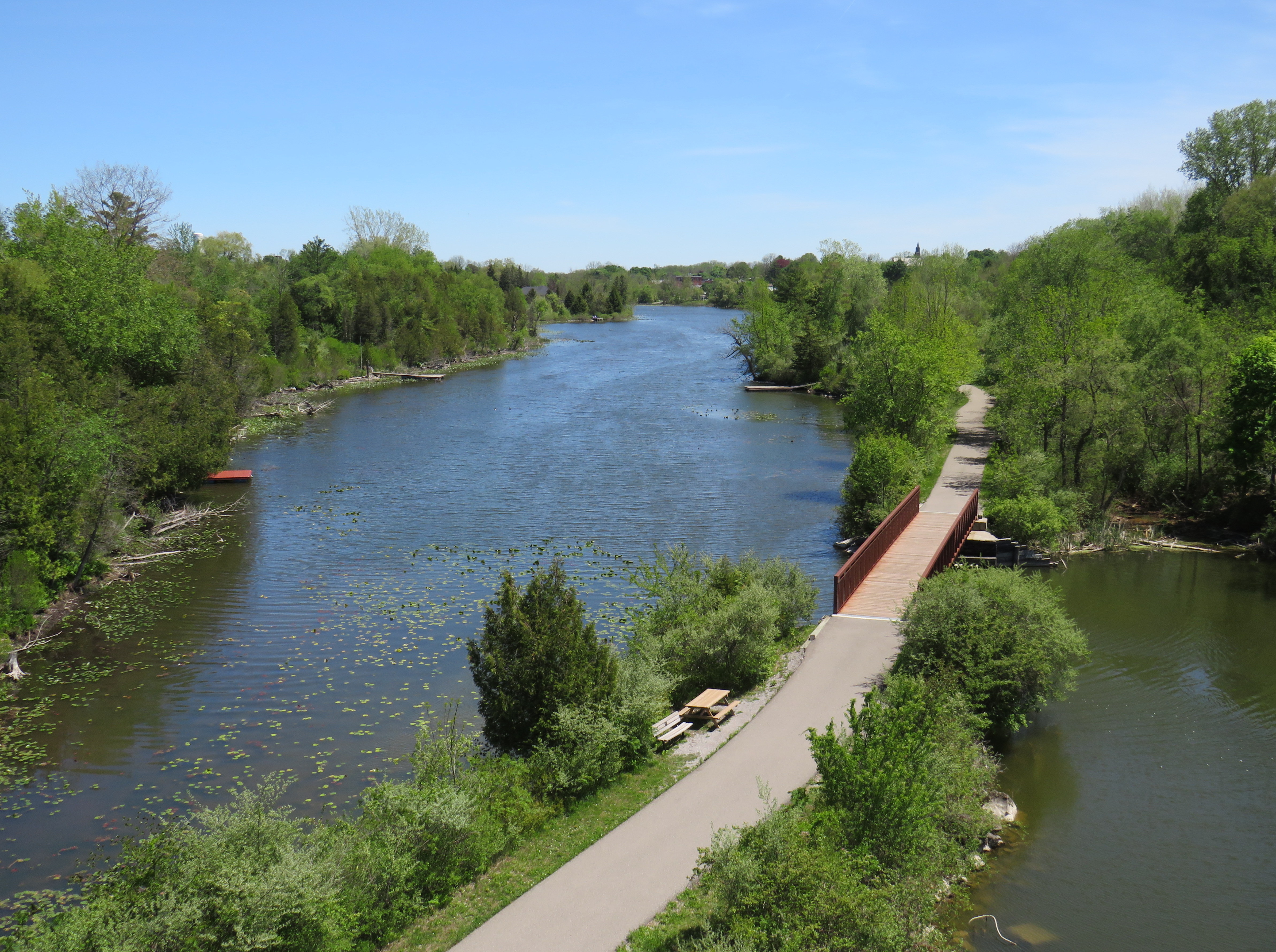
    Looking down from the Black Bridge on the Norfolk County Trail to Shadow Lake and Waterford Ponds in May 2026
    Looking down from the Black Bridge on the Norfolk County Trail to Shadow Lake and Waterford Ponds in May 2026

    On a beautiful May Thursday, I met one of my colleagues in the village of Waterford. As he is now living in Port Rowan on Lake Erie, this was an opportunity for us to get some important work done, while also exploring one of Ontario’s great small communities.

    Though the local area was settled over 200 years ago, Waterford was established as a thriving village with the arrival of the Canada Southern Railway (CASO) which was eventually incorporated into the giant New York Central system. The route through Canada, with its divisional headquarters in St. Thomas, was the fastest line between Buffalo, Detroit, and Chicago. It was joined by the Toronto, Hamilton & Buffalo (TH&B), which connected Hamilton and the Canadian Pacific Railway with CASO at Waterford and at Welland. In 1916, the electric Lake Erie & Northern (LE&N) Railway, another Canadian Pacific property, provided regular freight and passenger service between Port Dover, Brantford, and Kitchener. By the 1990s, all three railways were abandoned, but their former rights-of-way remain in active use as part of the local trail network.
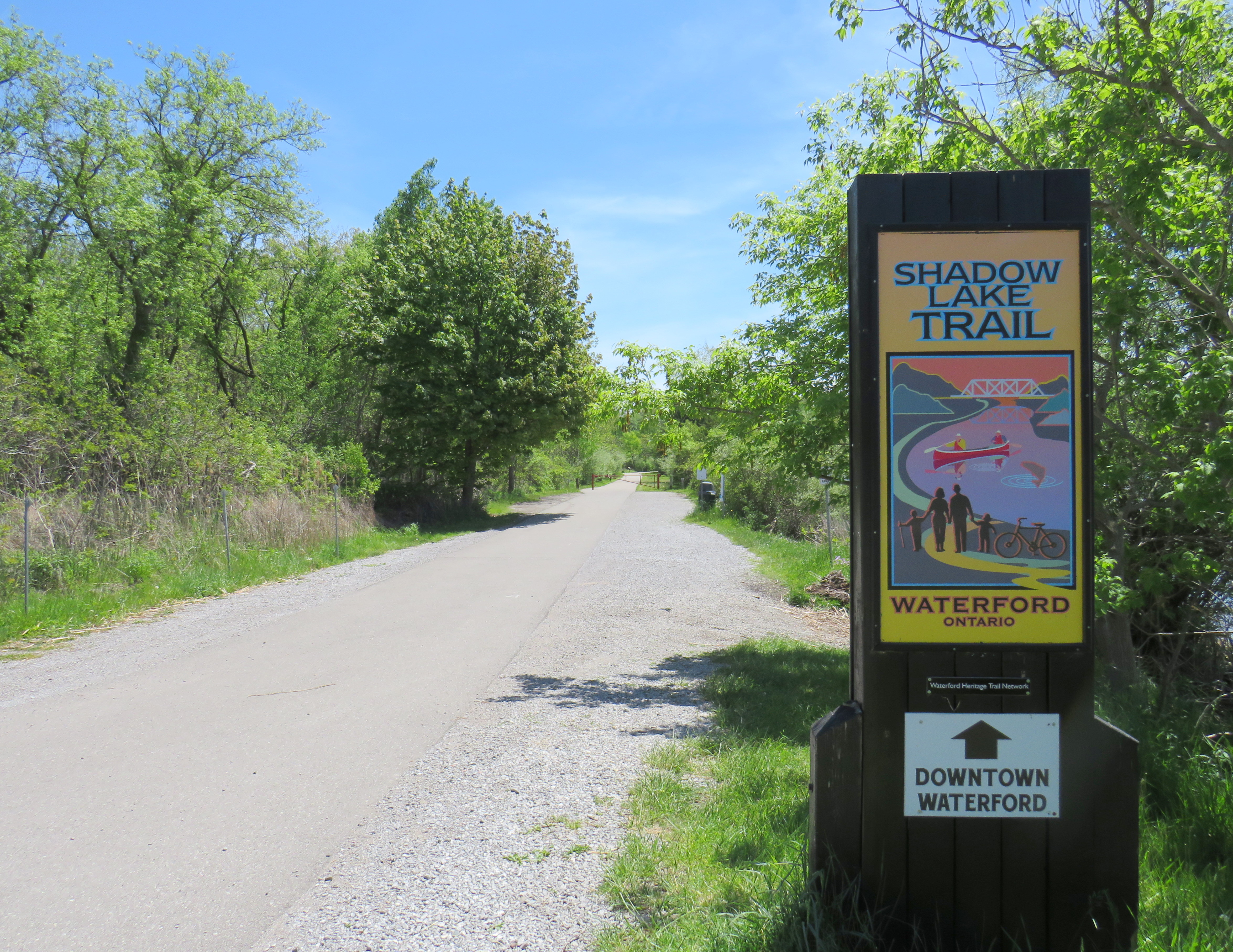
    Take the Shadow Lake Trail to Downtown Waterford

    The large system of ponds around Waterford, popular with birds, boaters, and anglers, are artificial. Shadow Lake was a millpond created by damming Nanticoke Creek. When constructing its railway, CASO found the sand and gravel deposits in this area irresistible for exploitation; the gravel was first used for railway ballast; larger aggregate pits created new ponds to the west.
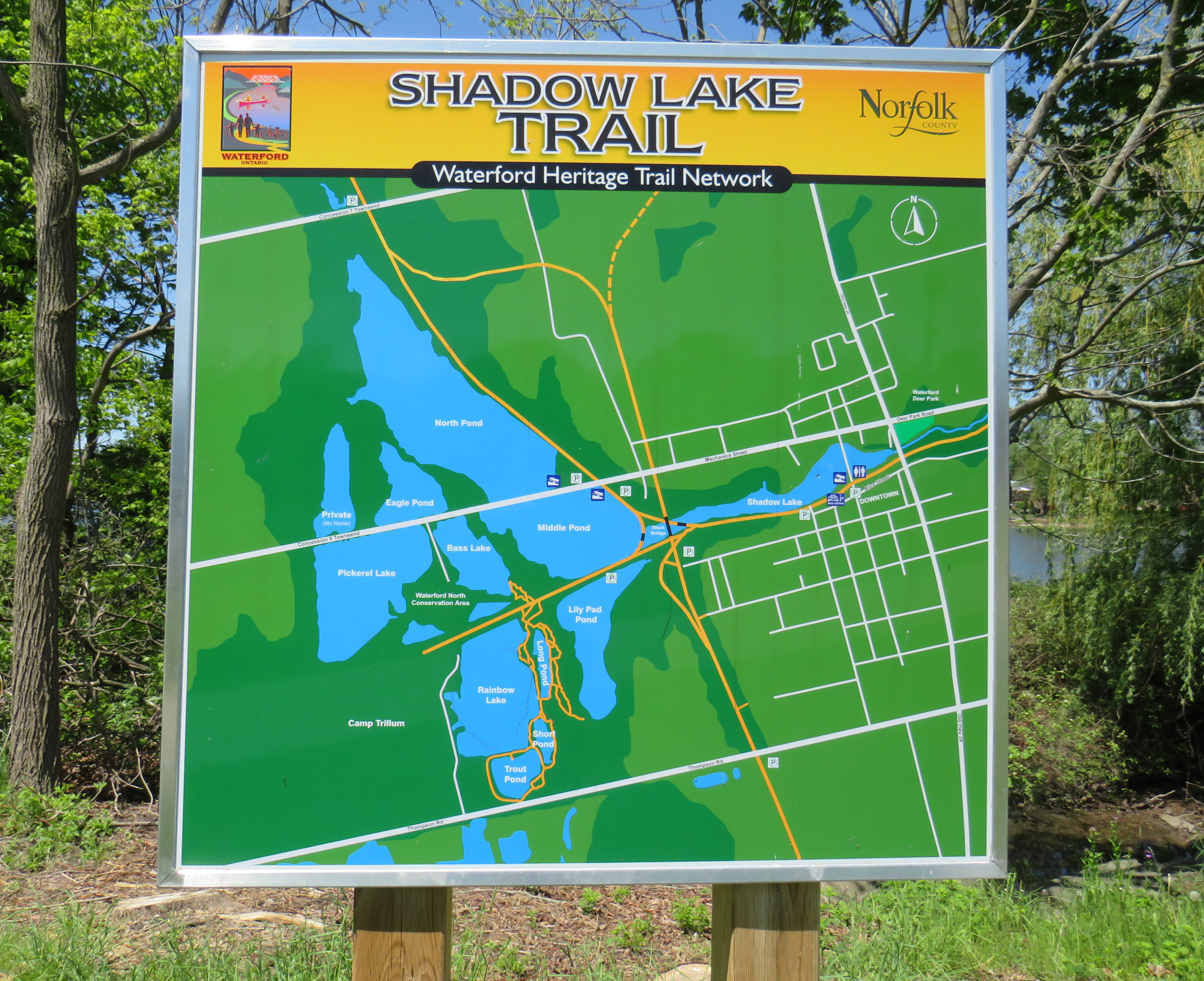
    Map of the Shadow Lake Trail and connecting trails in Waterford, along with the extensive ponds surrounding them
    Map of the Shadow Lake Trail and connecting trails in Waterford, along with the extensive ponds surrounding them

    The former Canada Southern Railway Station, which also served the TH&B, still stands, and has recently been home to an artisan market. Sadly, the LE&N station was demolished in the 1970s.
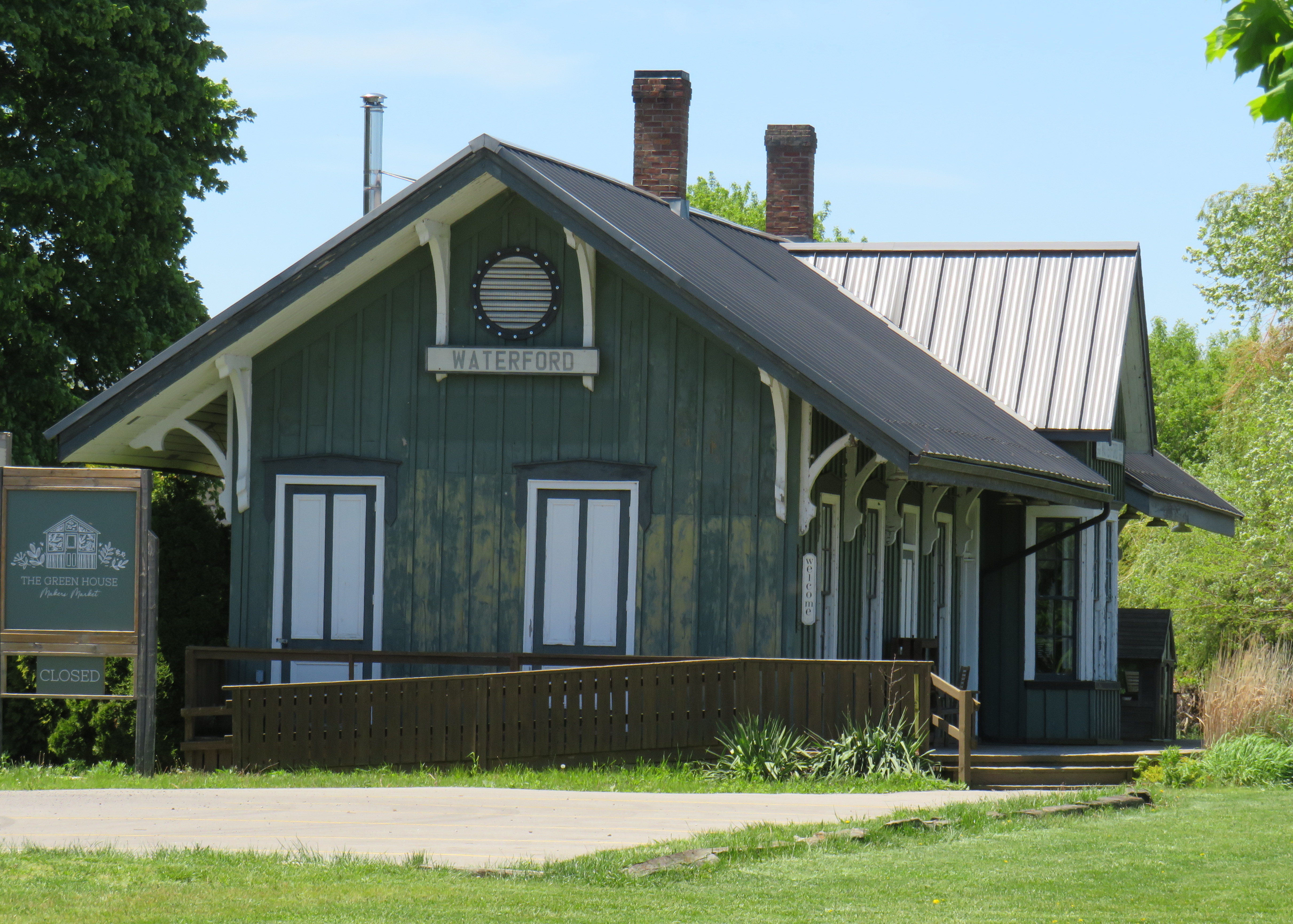
    Former railway station
    Waterford CASO Station

    Despite the loss of the railways and the LE&N station, the railway rights of way are fully intact within the village area and have been converted to trails. Within Waterford, the east-west Shadow Lake Trail follows the former CASO route between the Waterford Conservation Area to the west and Lingwood Park to the east, though it is not part of a continuous trail system across southwestern Ontario. Only short sections within Waterford, Tillsonburg, St. Thomas, and Essex are open to the public; most of the old railway corridor was sold off to local landowners in the late 1980s and early 1990s.
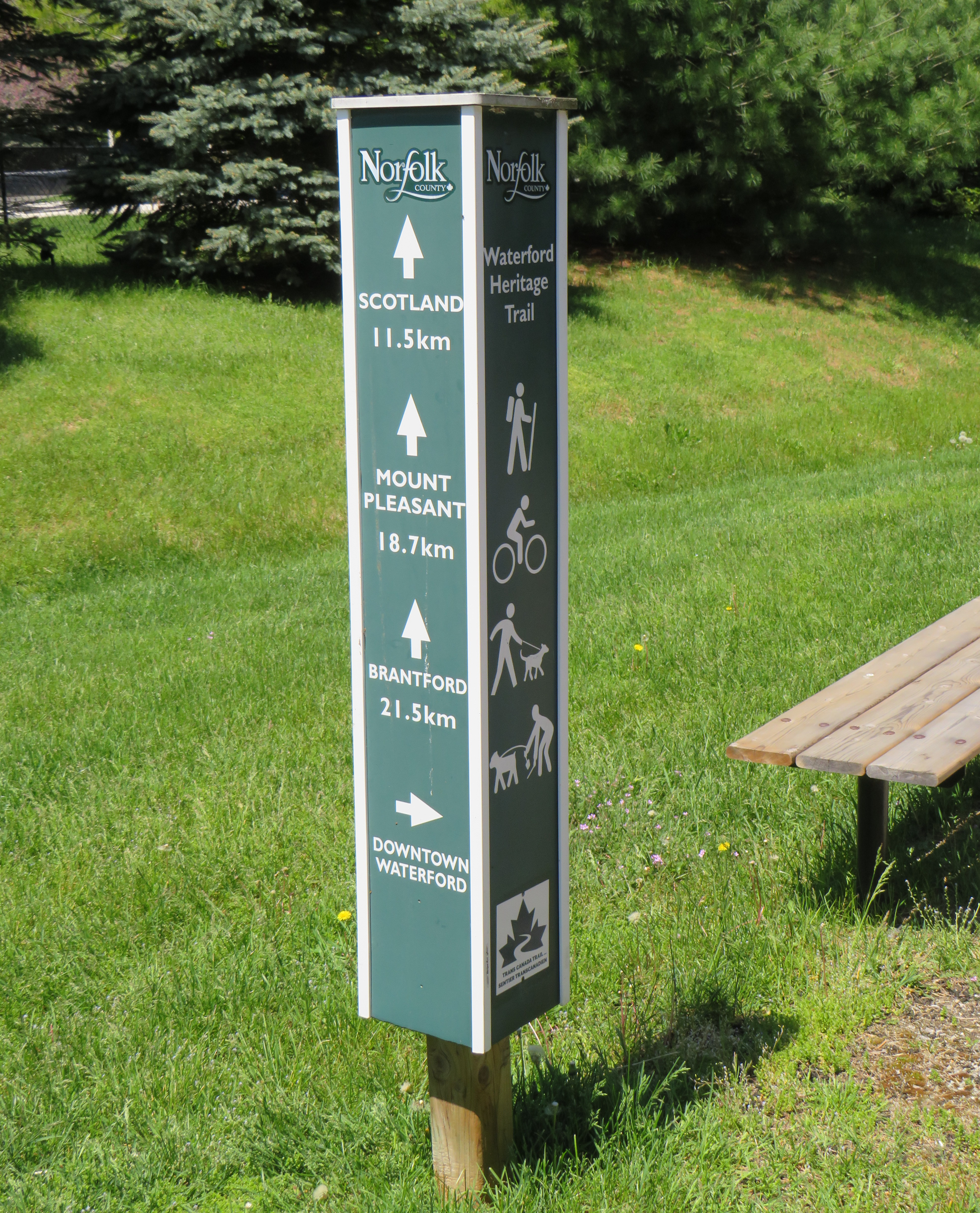
    Norfolk County Trail sign

    However, the north-south LE&N Trail, which connects to the Shadow Lake Trail by way of a gentle paved pathway or a metal staircase, is part of a much longer rail trail corridor that continues north to Brantford (the trail shifts to the TH&B route north of Waterford) and south to Simcoe and Port Dover. At Brantford, it is easy for the ambitious cyclist to continue east to Hamilton or north to Paris, Cambridge, and Kitchener via connecting high-quality rail trails. The Norfolk County Trail is at its scenic best when it crosses over the Waterford area via the Black Bridge.
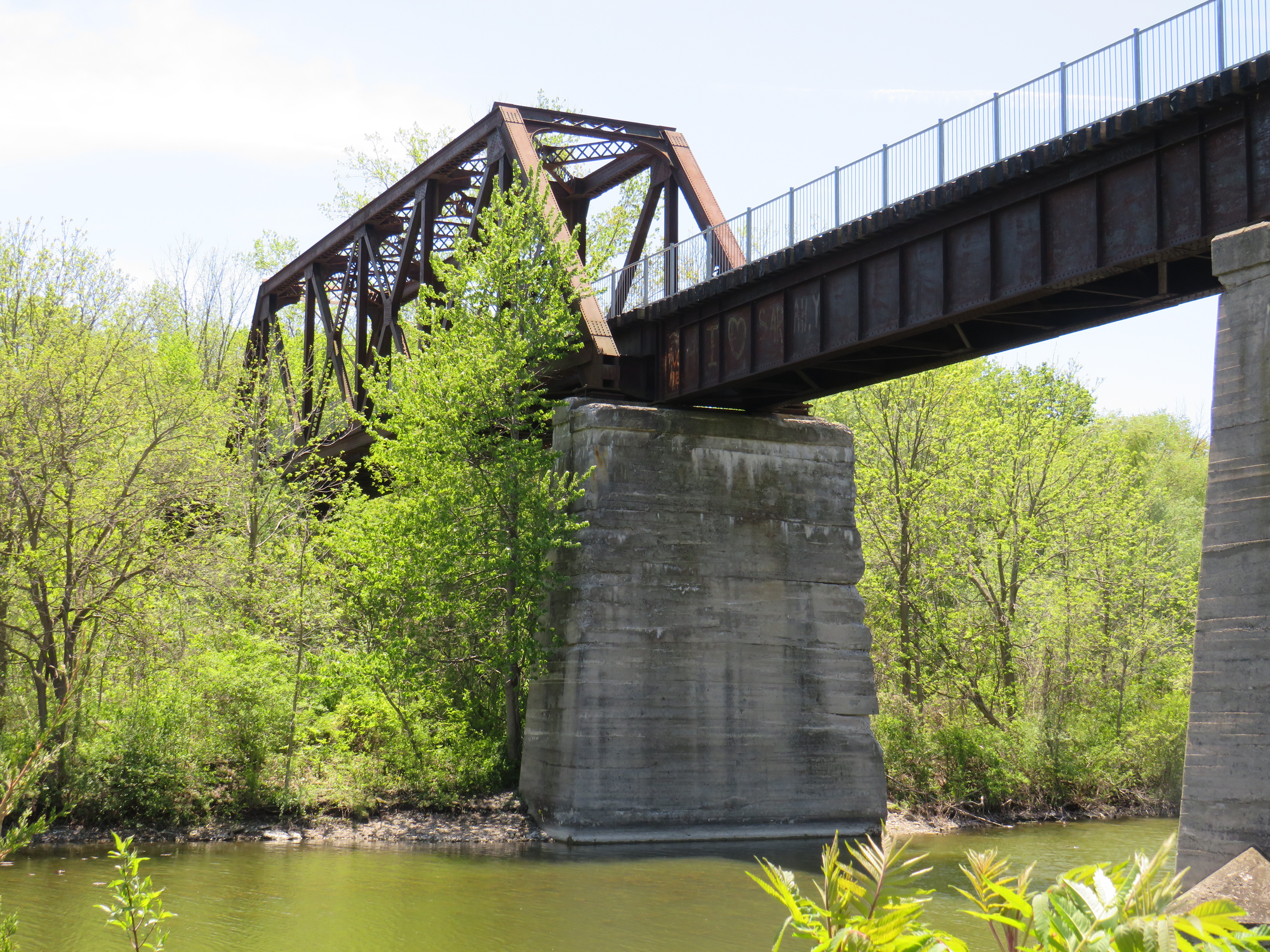
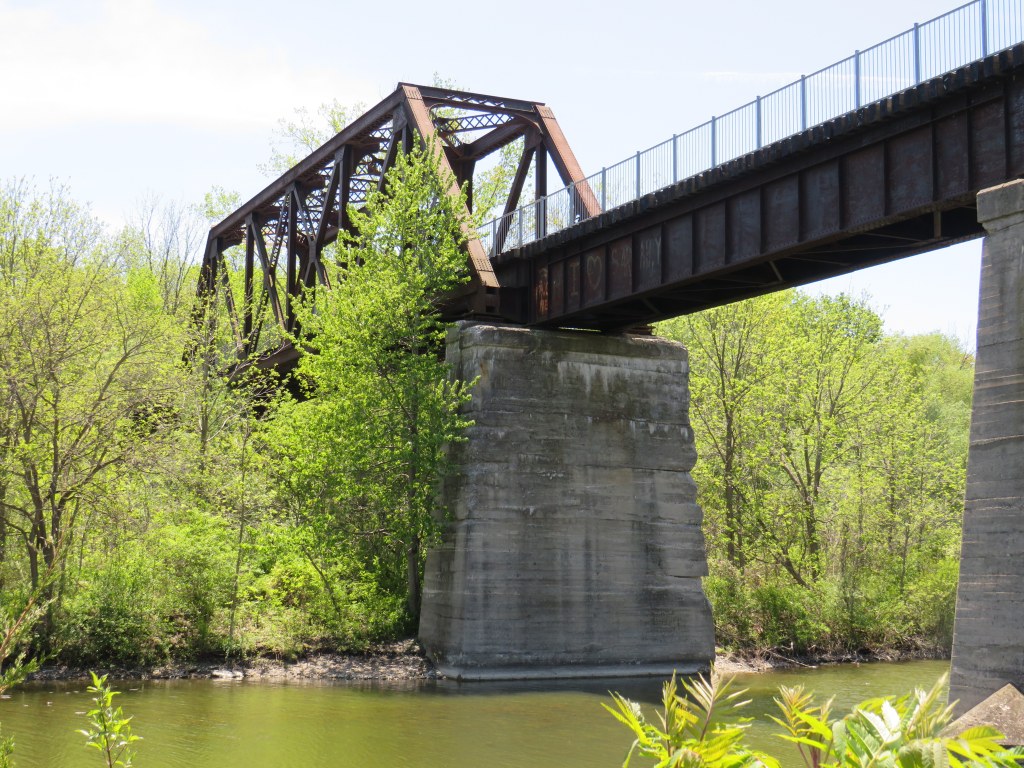
    A railway bridge, since converted to a trail, crosses a pond
    The Black Bridge crosses over the old CSR and TH&B railways and the Waterford Ponds

    One aspect that I especially appreciated was all the interpretive plaques along the trail system that told the story of Waterford, local industry, and the railways. This is how I learned that the ponds were the result of milling and quarrying, rather than truly natural features.
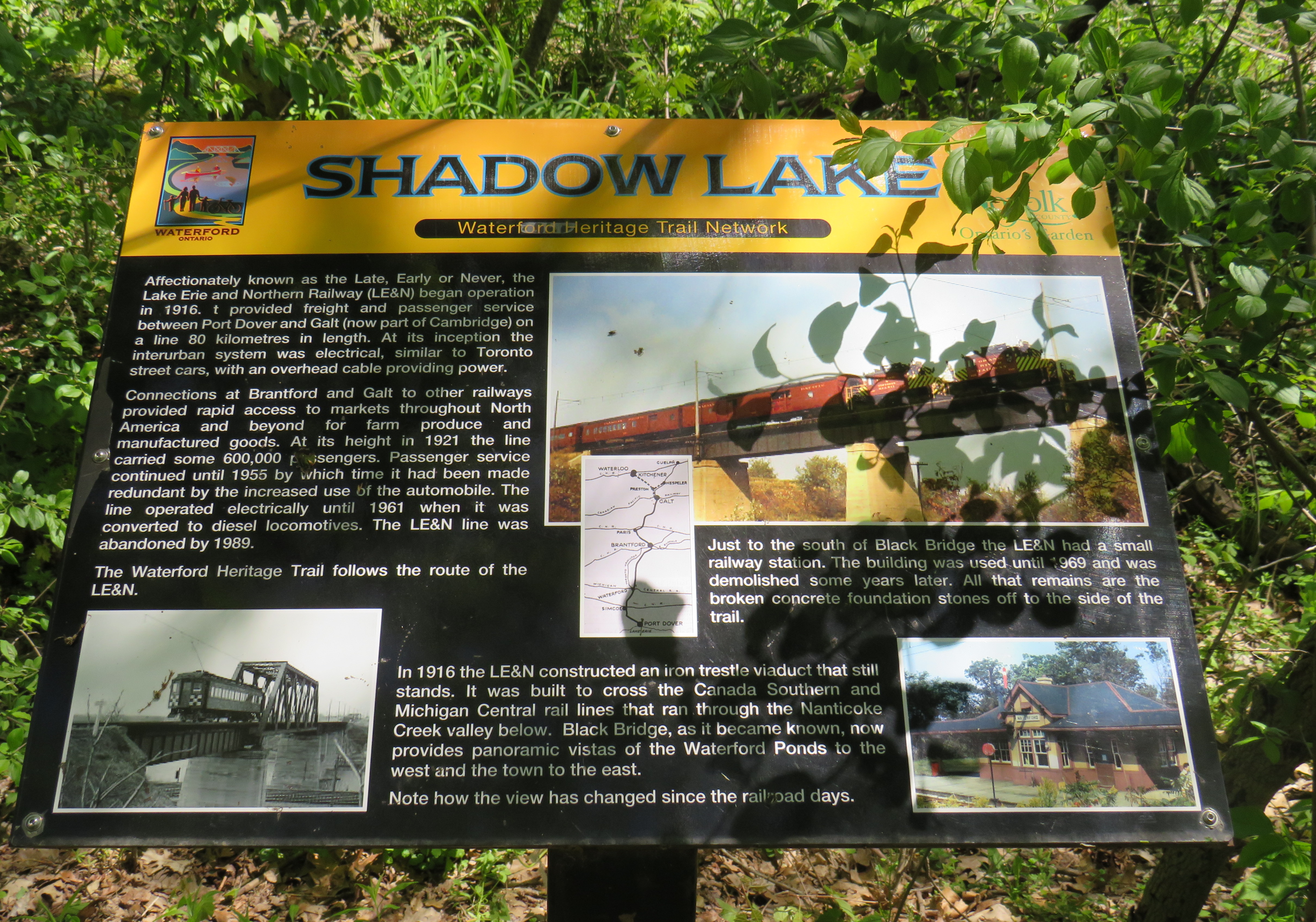
    One of several interpretive plaques along the trail system in Waterford

    Despite their attractiveness for long-distance cyclists, the trails within the Waterford area are well-used by residents and visitors going for shorter walks. The trail network within Waterford connects well to local streets and to itself by way of the former low-level TH&B wye tracks, which also cross the ponds. A walker can easily do a round trip without backtracking while being surrounded by nature. Wayfinding signage is very good, and benches are plentiful. The ponds are a great spot for bird watching. As we know how good walking is for our physical and mental health, Waterford is blessed with this network and could be a model for other smaller urban centres and rural communities.
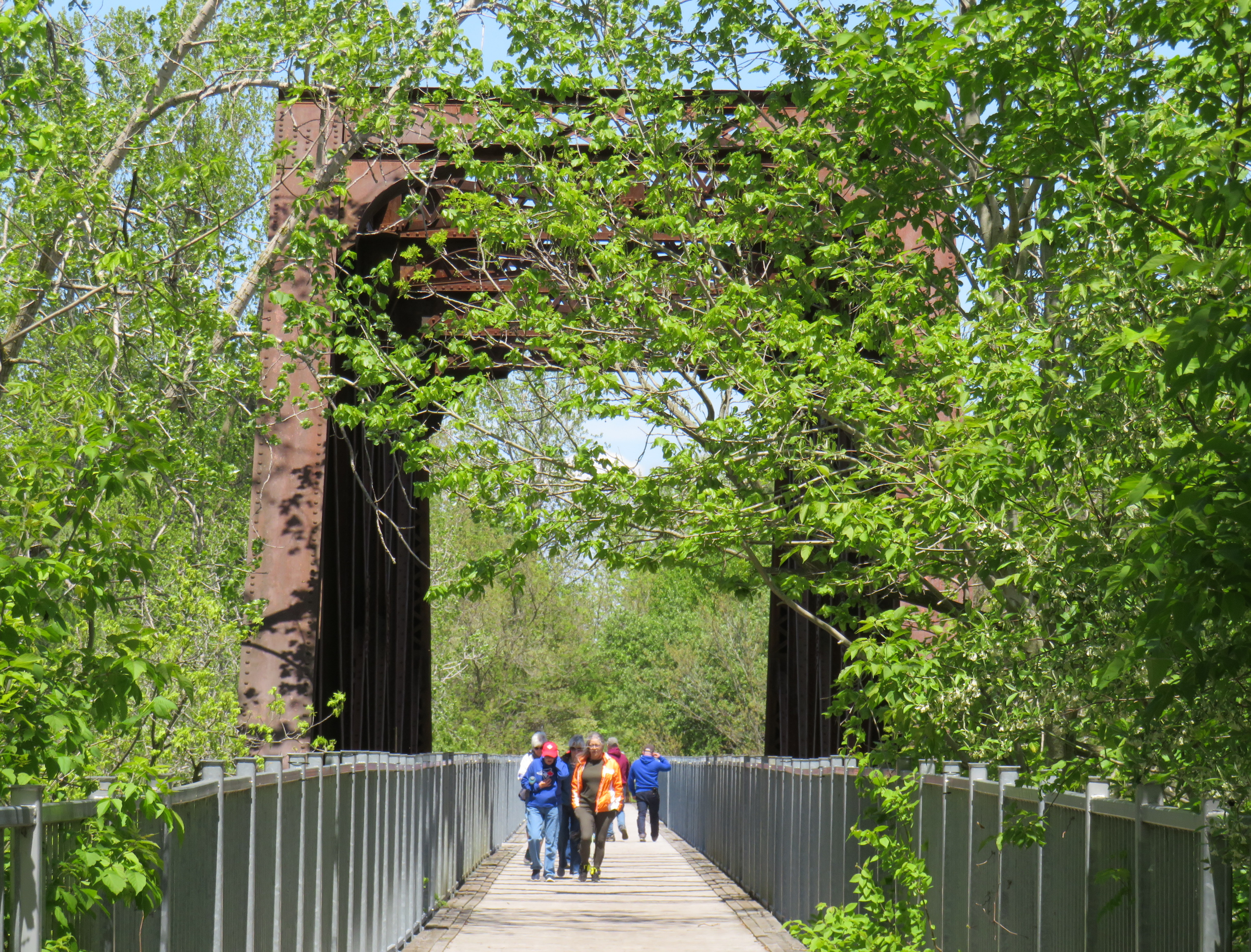
    Walkers on the old railway bridge
    In the early afternoon on a Thursday, the Black Bridge was popular with pedestrians and cyclists

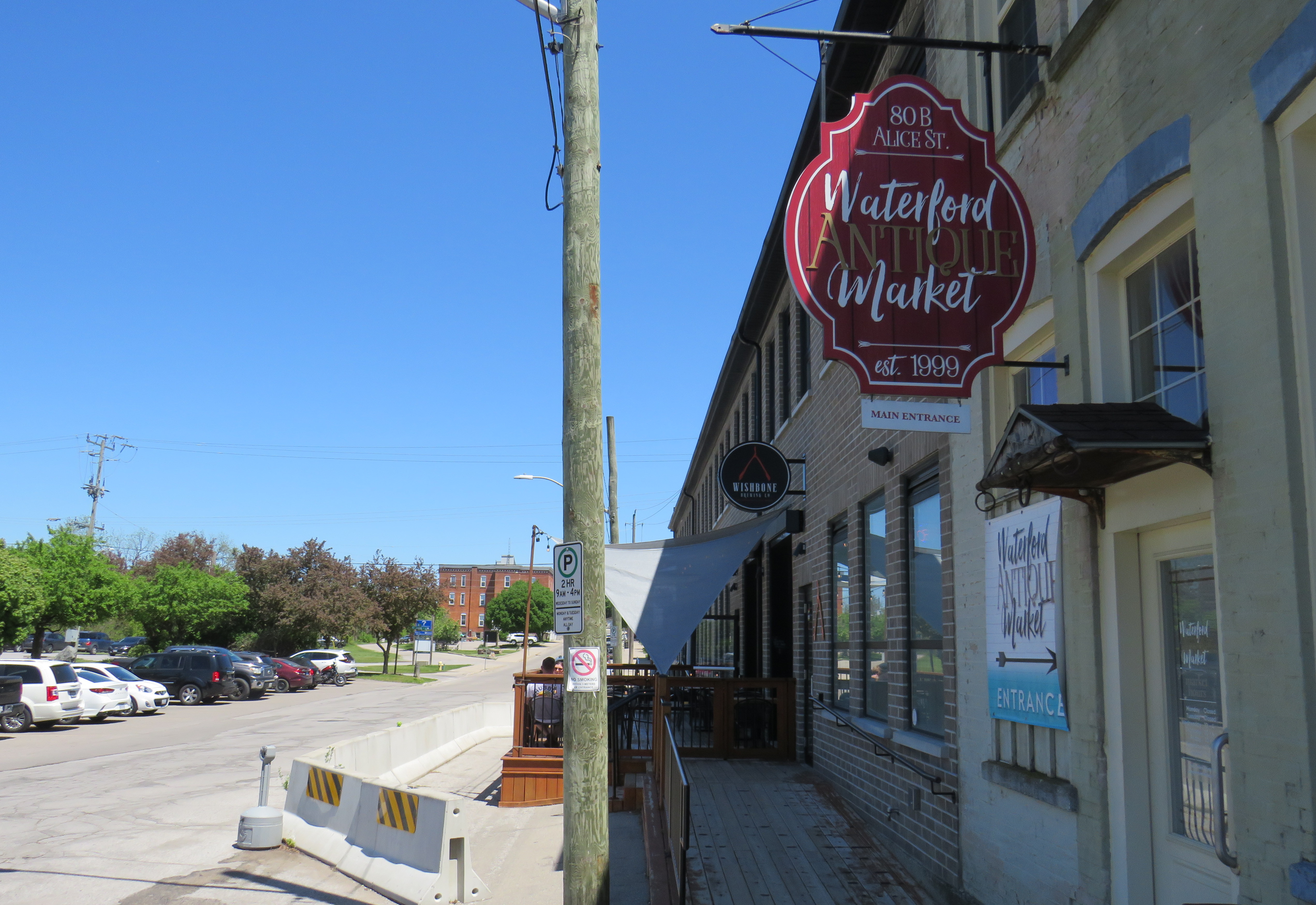
    Within the little downtown, there are public washrooms for trail users as well as several restaurants, cafes, and a craft brewery located in a former textile plant. There are also several antique dealers, a public library, and other small shops.
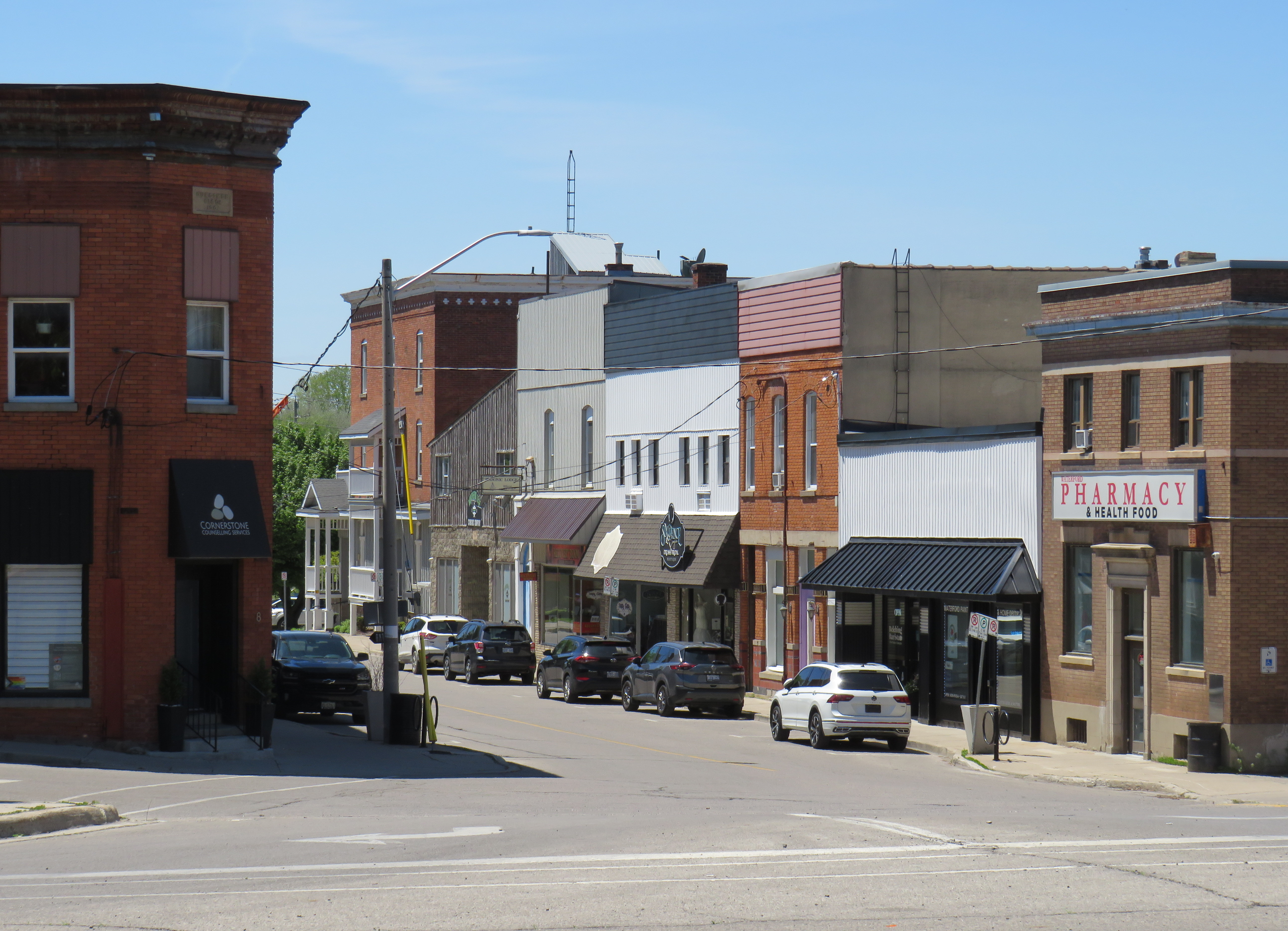
    Alice Street, Waterford
    Alice Street, Waterford’s main commercial strip, is lined with restaurants, shops, a cafe, and a brewery
    Waterford Antique Market and Wishbone Brewery, in a renovated textile plant

    Despite all that Waterford has to offer, there is one thing that can be improved to make it safer to get around. Alice Street, the main commercial strip in Waterford, meets Old Highway 24 at an unsignalized crossing. Though busy Highway 24 now bypasses Waterford, the old highway is still busy, with drivers exceeding the 40 km/h posted speed limit. The Waterford library branch and northbound bus stop towards Brantford are on the opposite side of the wide T-intersection from the Alice Street businesses; it is surprising that there is no traffic signal here to control auto traffic and provide a safer pedestrian crossing.
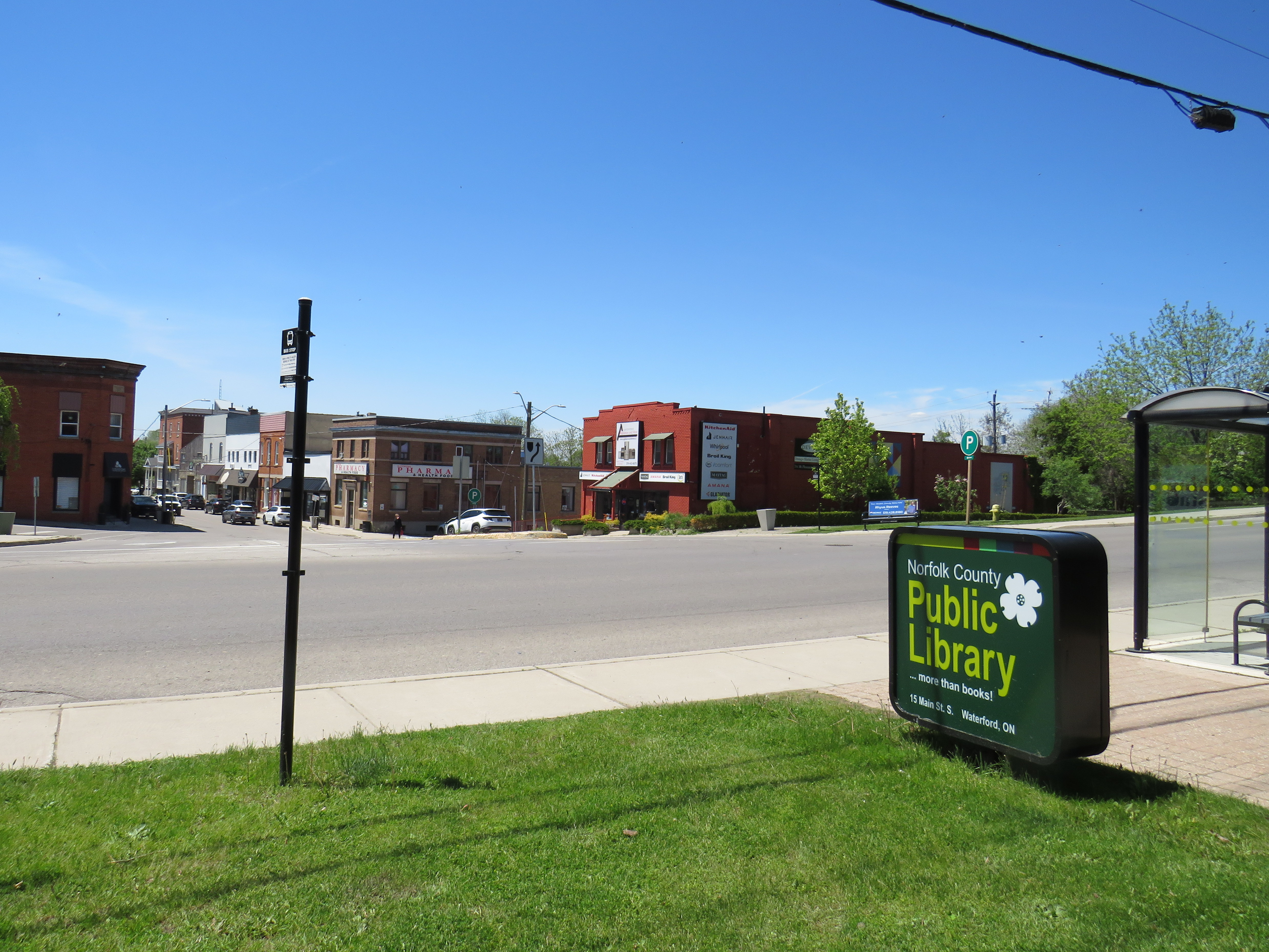
    The northbound bus stop (note the shelter at right) and library branch are on the opposite side of a busy road from the downtown shops

    Though there is a traffic signal 200 metres to the south at Nichol Street, most pedestrians opt to cross at Alice Street instead. According to Google Streetview, there was a signed pedestrian crossing at Alice Street in 2009 but was removed by 2012.
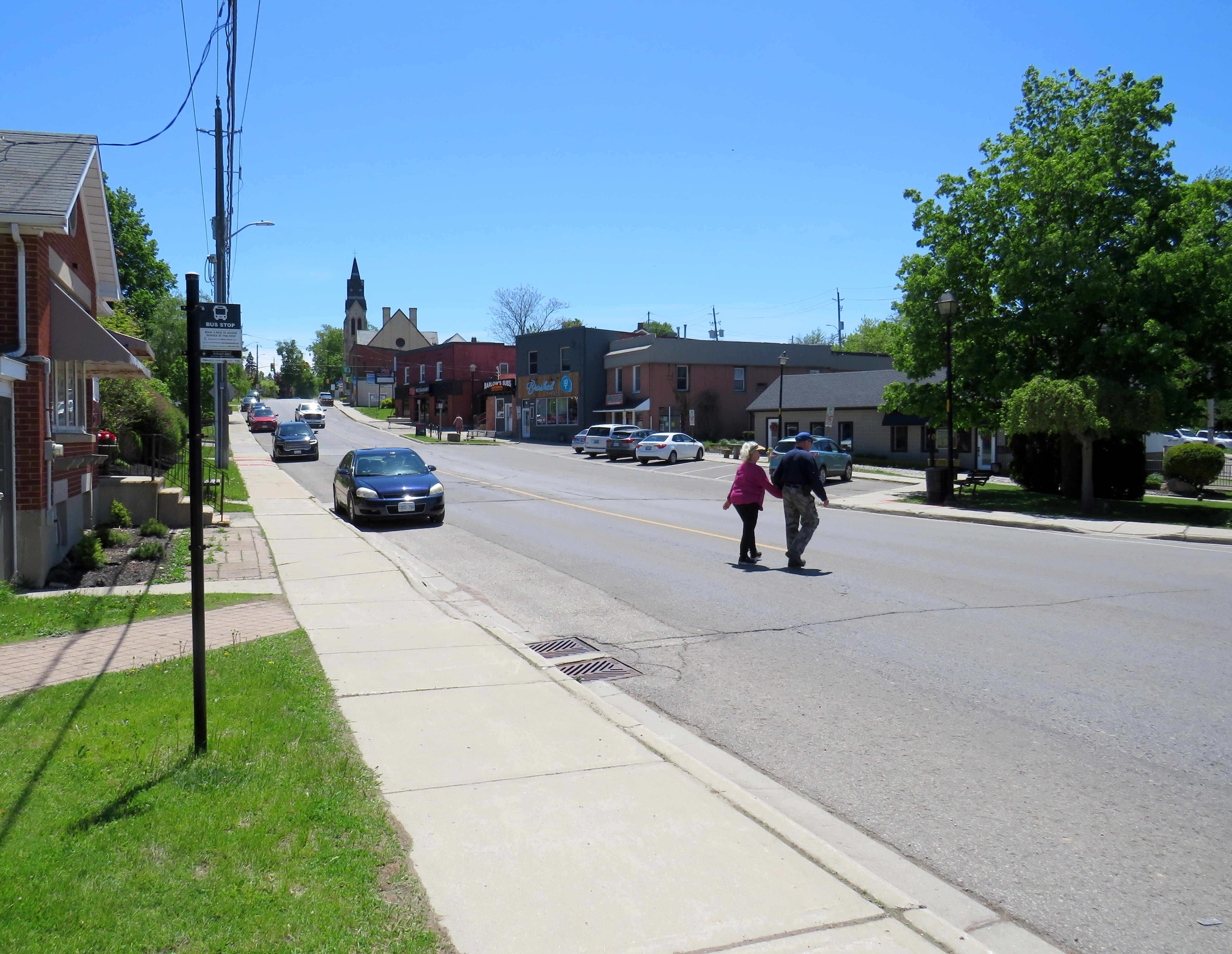
    Waterford is under a two hours’ drive from Downtown Toronto, though it is accessible without a car. GO Transit and VIA Rail both serve Downtown Brantford, where on weekdays, one can take a Ride Norfolk minibus south to Waterford. Cyclists from Hamilton or Toronto can take GO Transit buses to Brantford and bike south down the TH&B Rail Trail to Waterford on a relaxed 90-minute ride. From Simcoe, it’s an easy 45-minute ride.


    In general, Ontario can do so much better promoting sustainable tourism and travel by way of transit, walking, and cycling, as there are many places like Waterford that are easy to get to and around without a car that are not especially well-known, and there are many opportunities to improve public and active transportation links to other communities throughout the province. Though some communities, like Brantford, Hamilton, and Peterborough are very well connected to multiple trail systems radiating outwards in multiple directions, other cities and towns are not so lucky.

    Though St. Marys and St. Thomas, for instance, also have made great use of former rail infrastructure, they are lacking safe, high-quality active transportation connections to nearby cities like London or Stratford. Lindsay, in Kawartha Lakes, is at the nexus of several trails as well, but it lacks any intercity bus connections of its own. A provincial strategy could go a long way.
  • No exit? I’m walking here!

    No exit? I’m walking here!

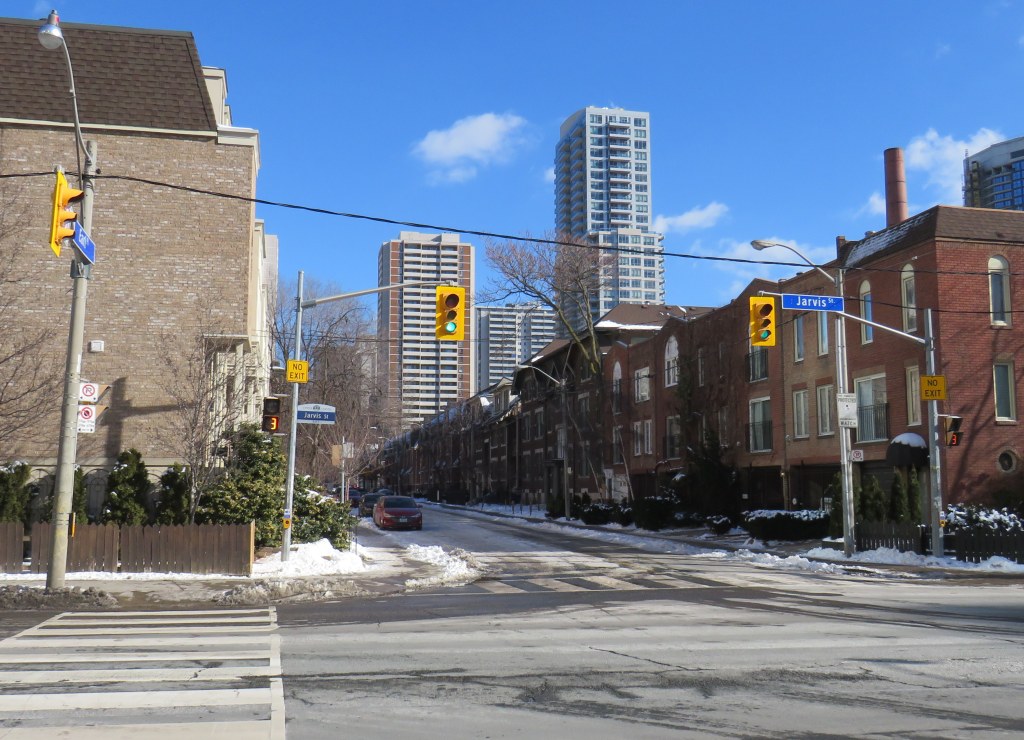
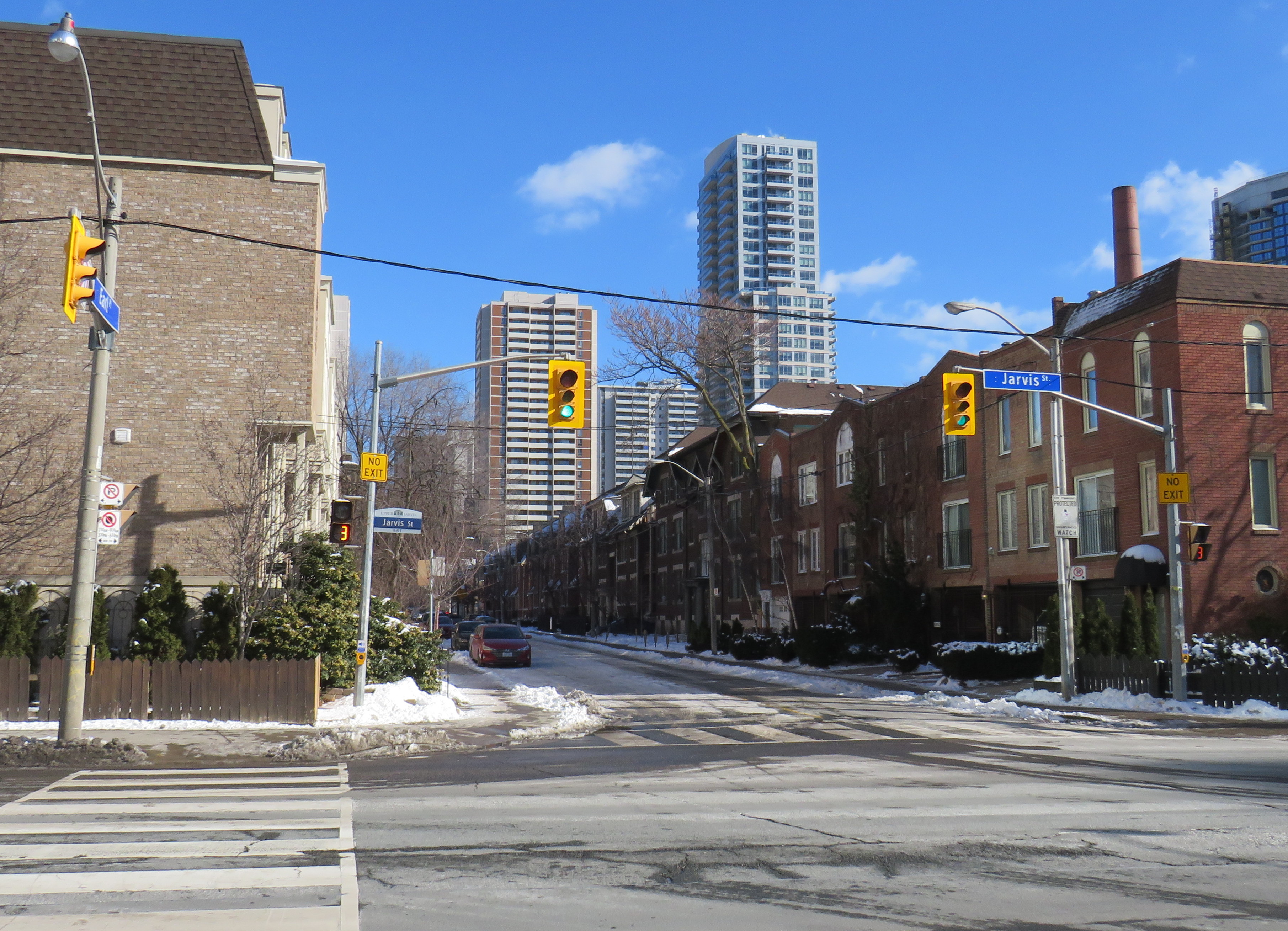
    Misleading “no exit” signs, like these on Maitland Place at Jarvis Street, will soon be changed by the City of Toronto to indicate that indeed, pedestrians can continue through

    Back in January, inspired by a Twitter thread that expressed the frustration of getting around the city by foot, my Walk Toronto colleague Dylan Reid suggested that we could create an inventory of all instances in the city where “No Exit” signs do not apply to all road users.

    Though these signs are required under traffic codes and regulations, they do not reflect that in many cases, there is an exit for pedestrians. 

    I quickly created a Google map of all locations in the City of Toronto marking such locations. Through a social media campaign led by Walk Toronto, we were quickly able to map over 450 locations where a pathway, sidewalk, or staircase allows a pedestrian to continue their way where motor vehicles are forced to turn around.

    Happily, this is about to change.

    Yesterday, by a simple show of hands, Toronto City Council approved a motion brought forward by Councillor Paula Fletcher to change that. Councillor Fletcher’s motion was titled “I’m Walking Here.”

    The motion, which was amended to strengthen the wording, requests city staff to develop a new signage standard to indicate where “no exit” signage betrays a pedestrian passage, and to begin installing these new signs this year.

    The map that I created based on Dylan’s initial suggestion will be used to help identify these locations.

    Given the ongoing pandemic, where we are all subjected to yet another lockdown, walking is one of the few permitted ways for each of us to get outside, enjoy the fresh spring air, and get much needed exercise. Knowing where one can walk, especially away from heavy traffic or busy sidewalks and paths, will only help unlock the city for more Torontonians.

    I want to thank everyone who submitted locations for the map to Walk Toronto or to myself via Twitter or directly to me on this website. This couldn’t have happened without the help of fellow Torontonians.

  • Why pedestrian safety is a matter of justice for essential workers

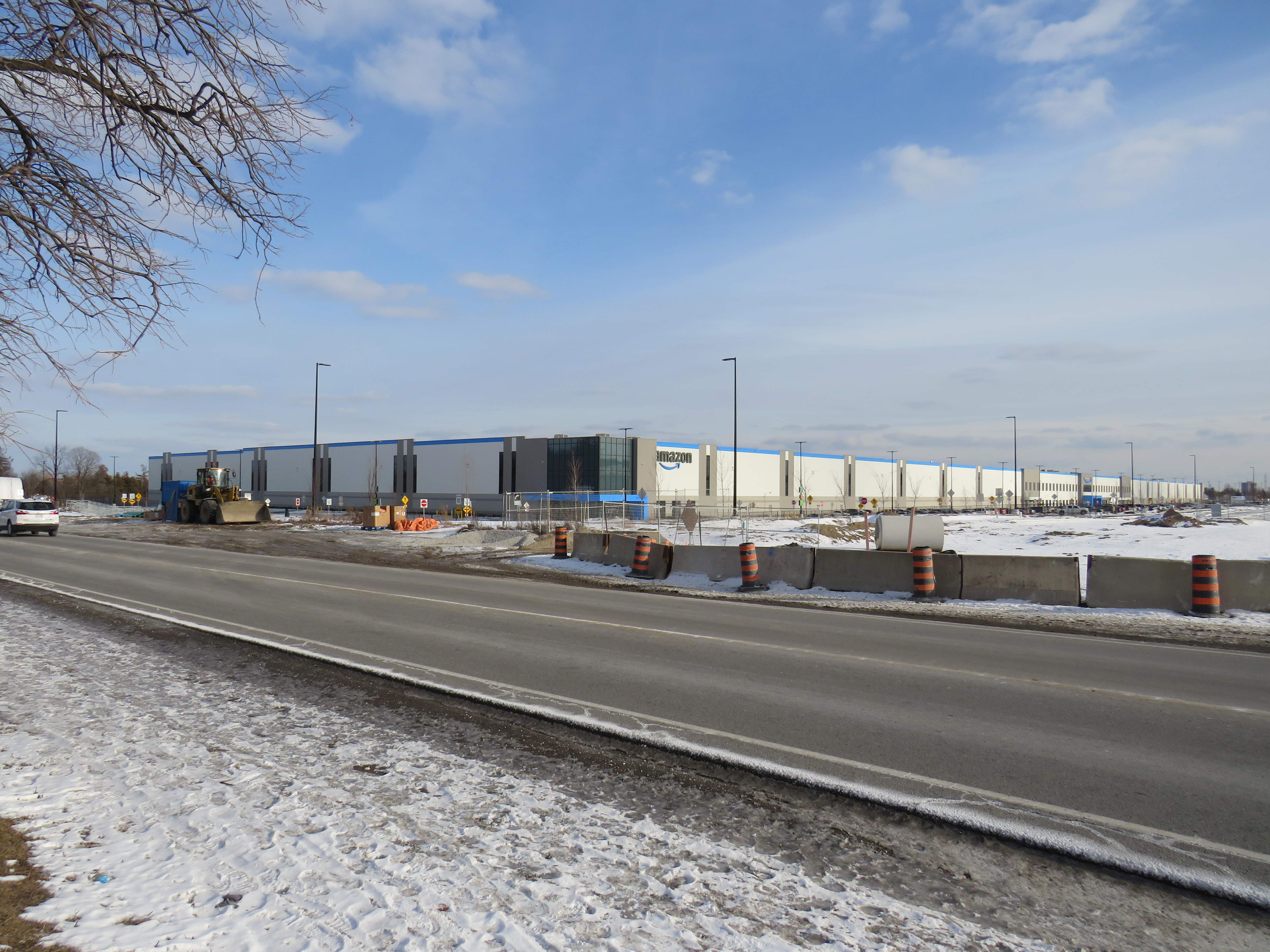
    The new YYZ9 Fulfillment Centre in Northeast Scarborough, looking across Steeles Avenue

    In August 2020, in the midst of an ongoing COVID-19 pandemic, Amazon opened its sixth fulfillment centre in the Greater Toronto Area near Steeles and Tapscott Road in northeast Scarborough. Upon opening, the new warehouse, where consumer orders are packed for delivery, employed 700 workers, 100 more than Amazon initially planned due to high order volumes.

    The starting wage for an Amazon fulfillment centre employee is $17.00 an hour, despite notoriously tough working conditions. With most professional and office workers at home, and with ongoing pandemic restrictions, Amazon has enjoyed significant sales increases. But those workers picking and packing orders are not able to work from home – and workplace spread has been a significant factor in COVID-19 transmission in Ontario.

    Brampton, home to two of the GTA’s fulfilment centres, and close to Amazon’s Mississauga, Milton and Bolton warehouses, has been a COVID-19 hotspot. Like Toronto, Peel Region has been under lockdown and stay-at-home orders since November.

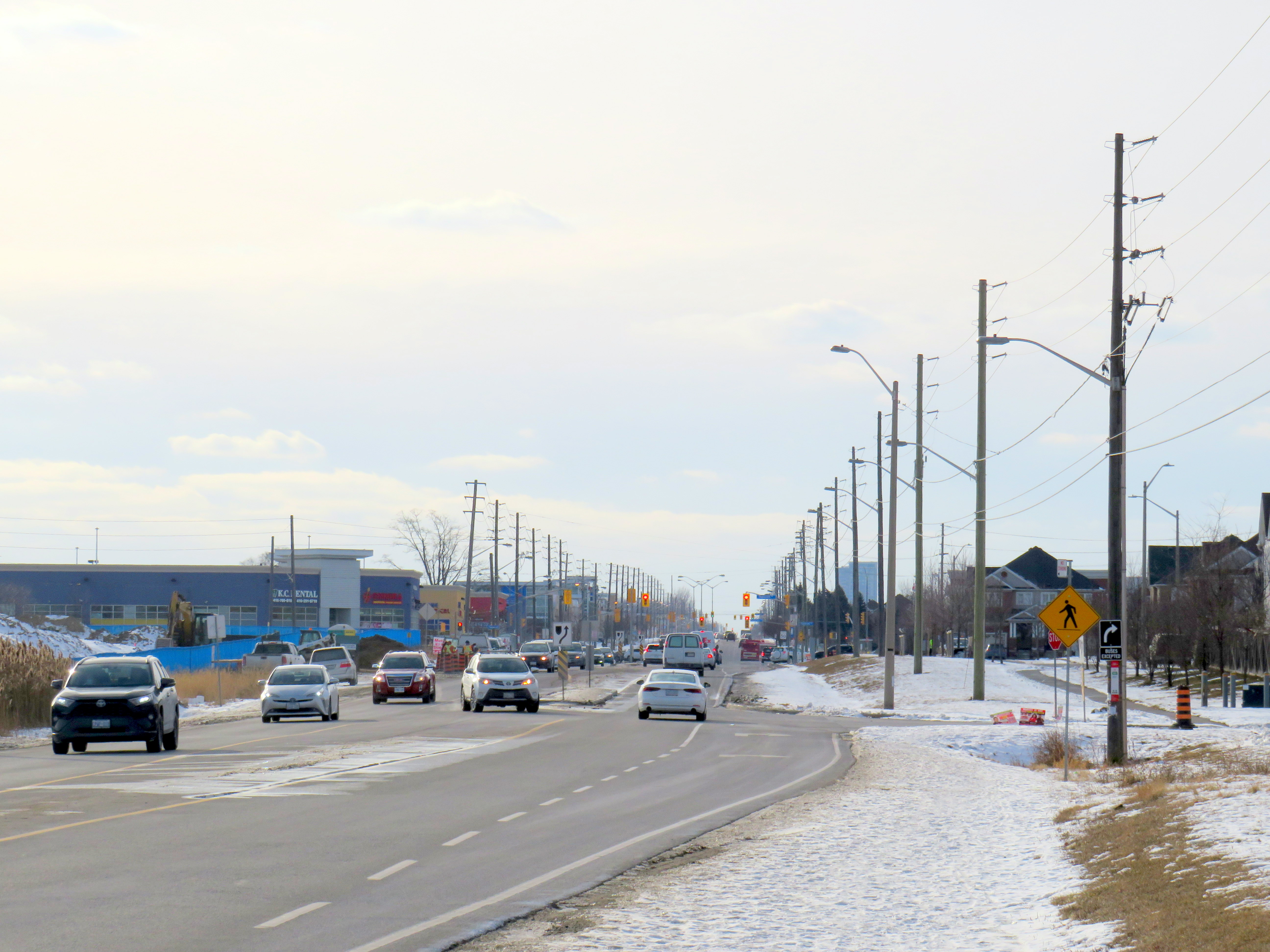
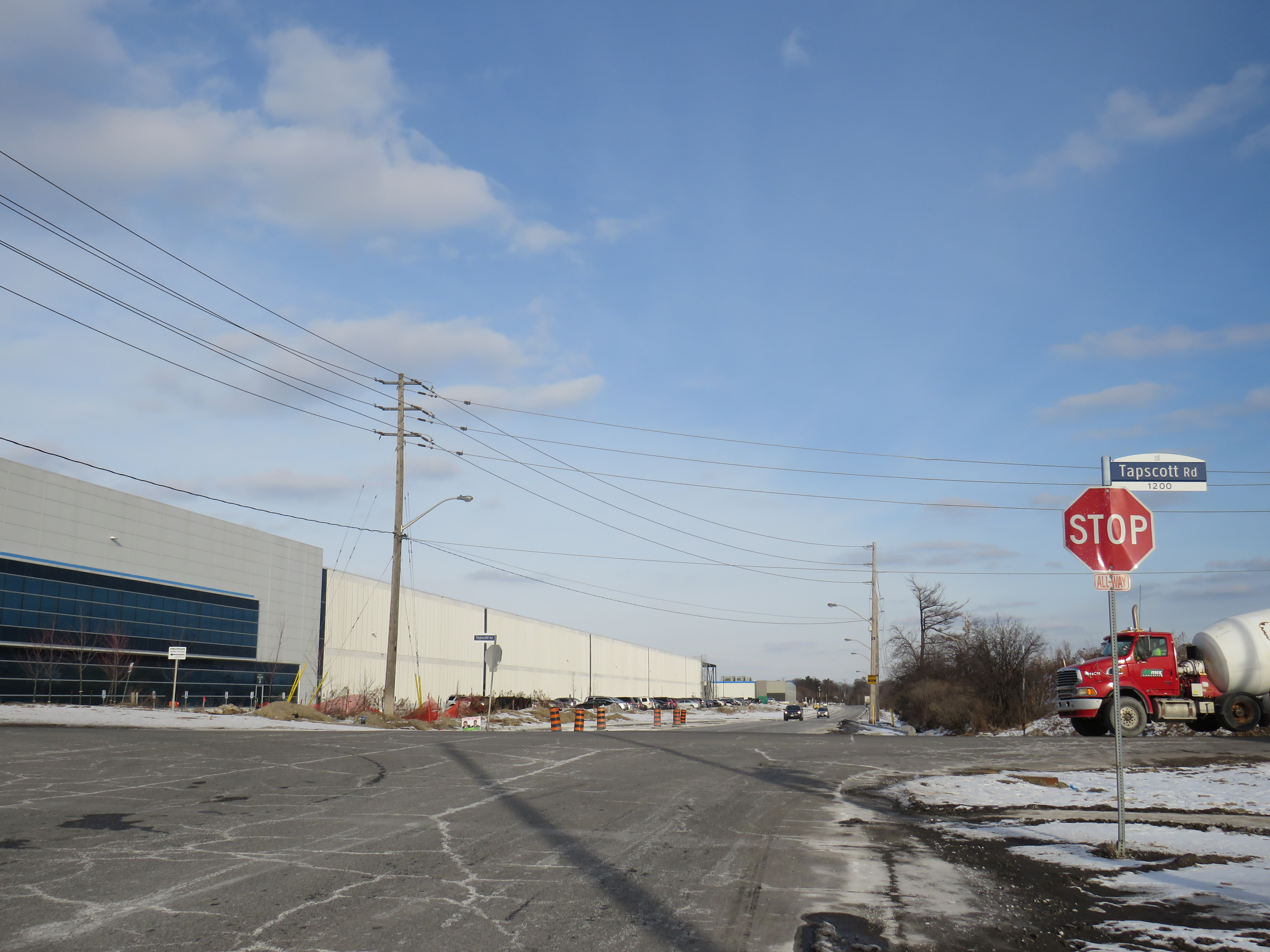
    Like most new logistics facilities, the new Scarborough warehouse, like the other five GTA Amazon fulfillment centres, is in an industrial area on the city’s outskirts, where land is plentiful, but transit and pedestrian access is lacking. East of Tapscott Road, Steeles Avenue narrows from four lanes to two, and there are no designated pedestrian crossings at the intersection with Eastvale Drive. The eastbound TTC stop at Eastvale Avenue was removed in 2018 after a passenger was struck and killed trying to cross the street after disembarking from a 53 Steeles East bus. The next nearest stop, at Tapscott Road, is 300 metres west.

    Steeles Avenue, looking west towards Eastvale Drive and the signalized intersection beyond, at Tapscott Road

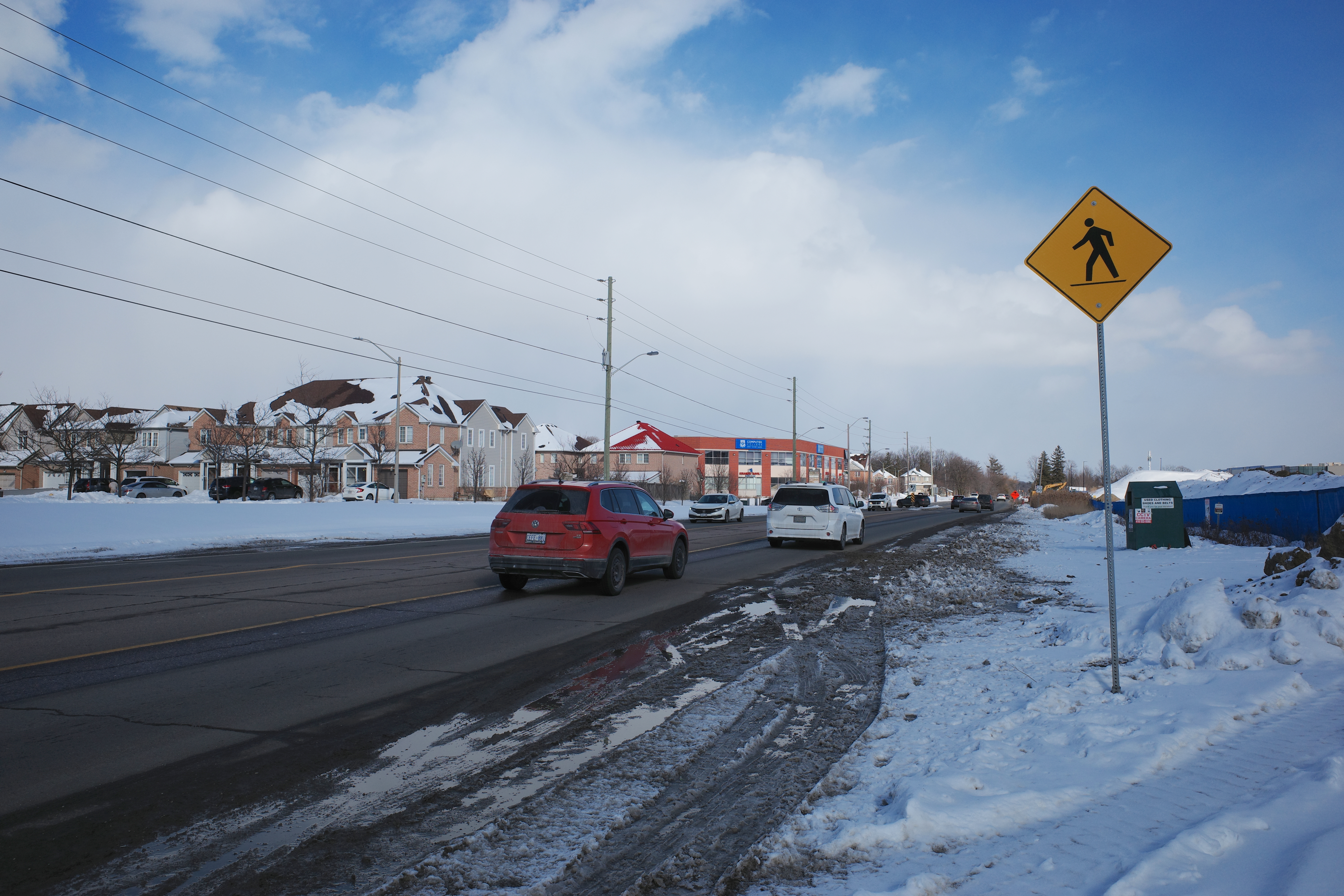
    The sidewalk on the south side of Steeles Avenue ends at Tapscott, a few hundred metres west of the Amazon fulfilment centre. On the north side, the sidewalk ends at Ferncliffe Crescent in Markham. Despite a new residential area in Morningside Heights, to the east, there is no sidewalk along Steeles to connect to it. Pedestrians heading to Amazon or towards Staines Road must choose whether to walk in the mud, or on the busy roadway. Though the posted speed limit is 50 km/h, motorists regularly travel at 60 km/h or faster.

    Looking east on Steeles from Tapscott Road – despite the sign advising motorists of pedestrian activity, there are no sidewalks leading east towards the new Amazon fulfillment centre (Sonali Praharaj)

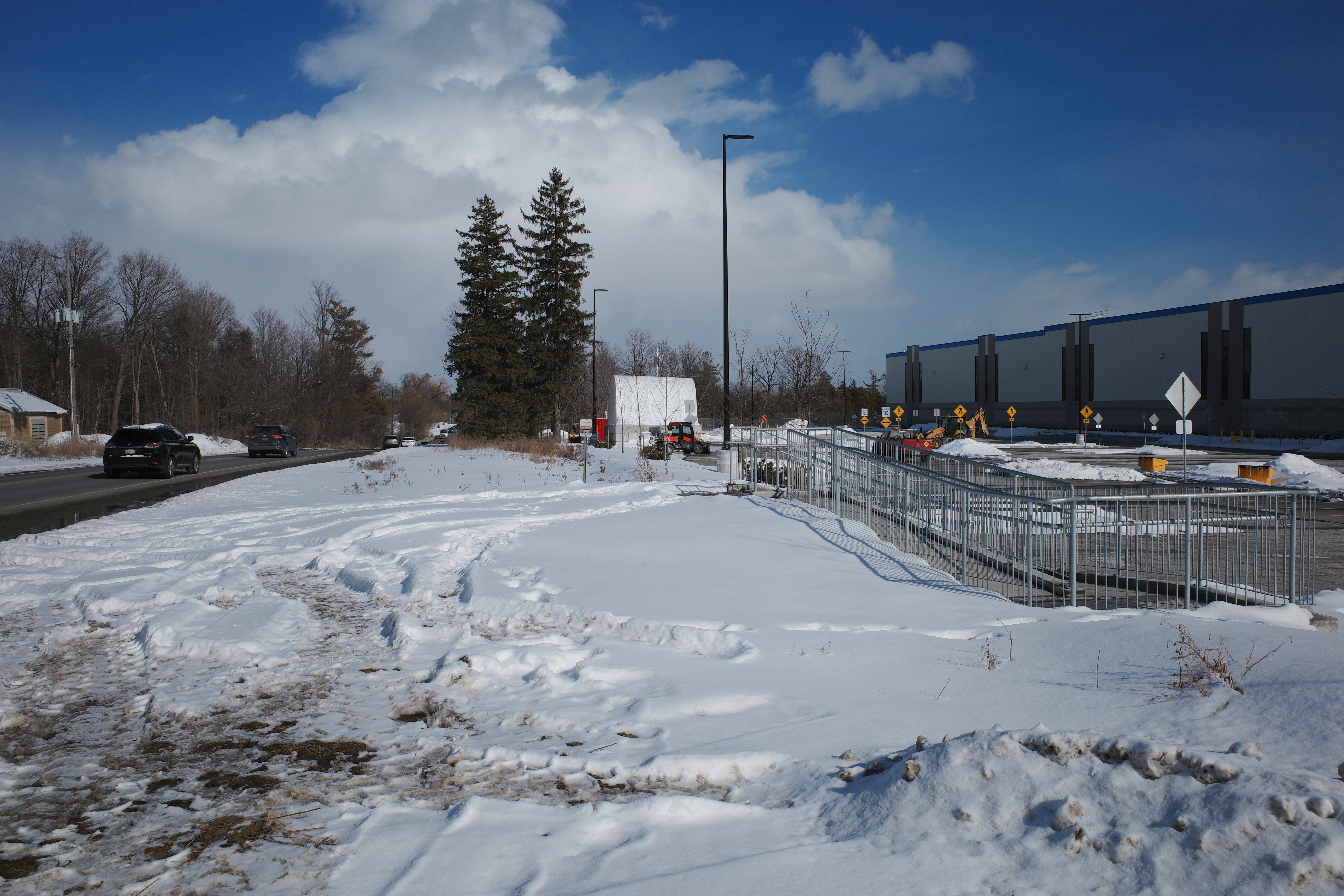
    A stairway and ramp were built on the north end of the Amazon property, likely with the expectation that a sidewalk on the south side of Streeles Avenue would soon be installed. This would provide improved pedestrian access to the fulfillment centre. But without a safe and logical way to get to it from the street, it remains largely unused.

    Passmore Avenue, on the south side of the fulfillment centre, was rebuilt with a sidewalk in the late fall of 2020, months after Amazon opened. However, it requires a lengthy walk north to Steeles Avenue up Tapscott, and there are no sidewalks on Tapscott from Passmore south, towards McNicoll Avenue. The intersection of Passmore and Tapscott itself – controlled by an all-way stop – still does not feature proper crosswalks.  

    Looking east on Steeles from Tapscott Road – despite the sign advising motorists of pedestrian activity, there are no sidewalks leading east towards the new Amazon fulfillment centre (Sonali Praharaj)

    Though there are two TTC bus routes that operate to the corner of Tapscott Road and Passmore Avenue – 53B/953B Steeles East and 102B/C Markham Road – for months, workers had to walk on the roadway, through a construction site to access those buses. Anyone looking to go east, towards Morningside Heights, or southeast, towards Malvern, still face a long, dangerous walk or a lengthy bus commute.

    The corner of Tapscott Road and Passmore Avenue

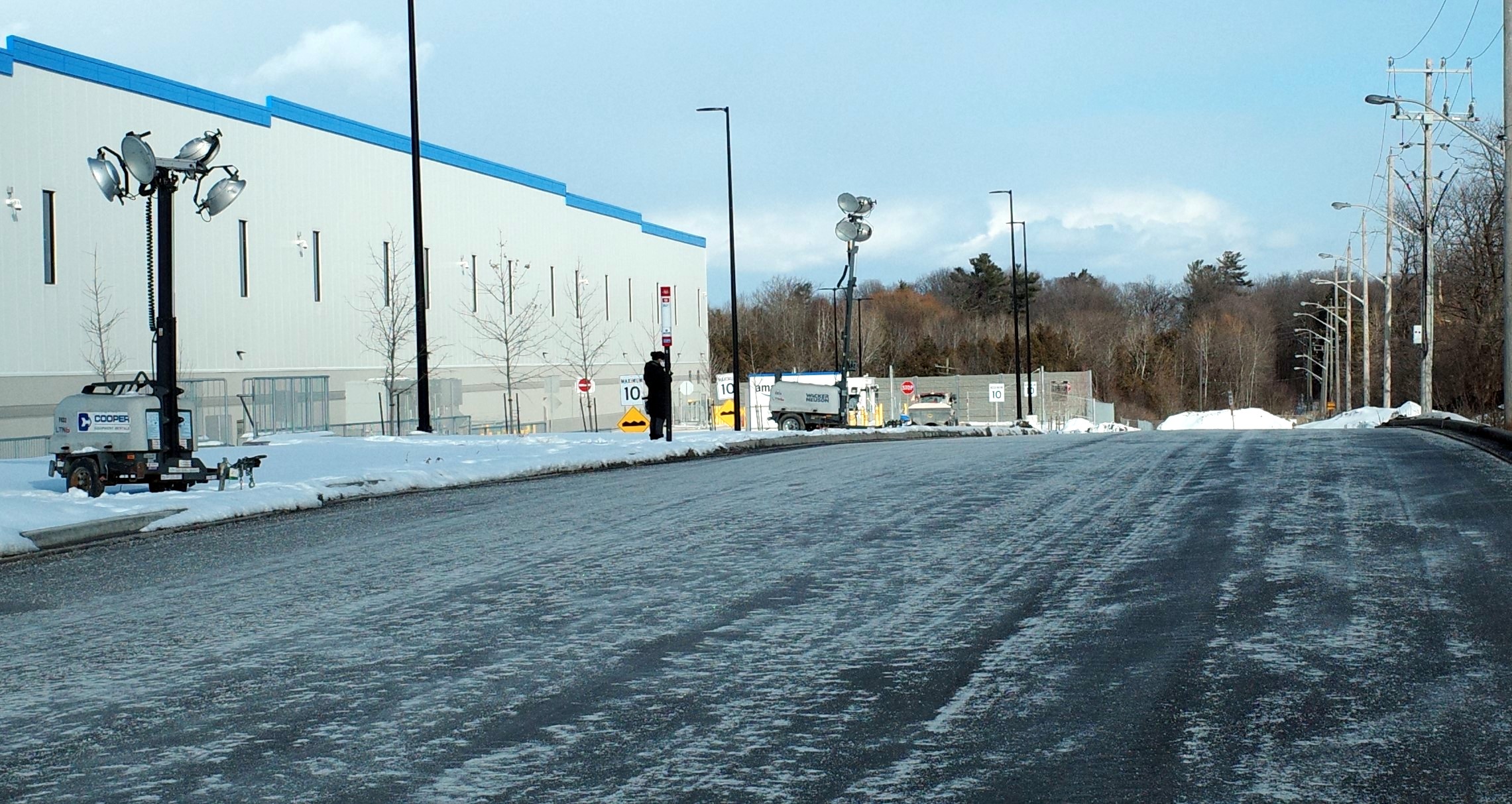
    The TTC, starting January 11, 2021, began diverting the 53B Steeles East bus to directly serve the Amazon fulfillment centre, finally serving a major industrial trip generator and reducing essential workers’ travel times. Even still, the new sidewalk on Passmore ends at the warehouse entrance – anyone waiting for a bus must still walk and wait in the snow or mud.

    Eventually, Steeles Avenue will be widened, with new sidewalks and bike lanes, and Morningside Avenue will be extended north to Steeles Avenue. However, these improvements have been planned for years and completion is still several years away. Though new warehouses have opened here, civic infrastructure has not caught up.

    New TTC bus stop serving the Amazon Fulfillment Centre on Passmore Road (Sonali Praharaj)

    The TTC’s service change, adding a new bus stop on Passmore Avenue, was a welcome – yet overdue – acknowledgement that essential workers, especially racialized and lower-paid workers, deserve better. It is inexcusable that new employment uses are planned, approved, and constructed before the appropriate pedestrian infrastructure and transit services are in place. It is also inexcusable that after a TTC customer was killed that a nearby bus stop was removed, rather than safety improvements added instead. This is not just a matter of ensuring a basic level of safety for pedestrians – this is a matter of justice for those we consider essential workers.

  • No exit? Yes, walk this way!

    No exit? Yes, walk this way!

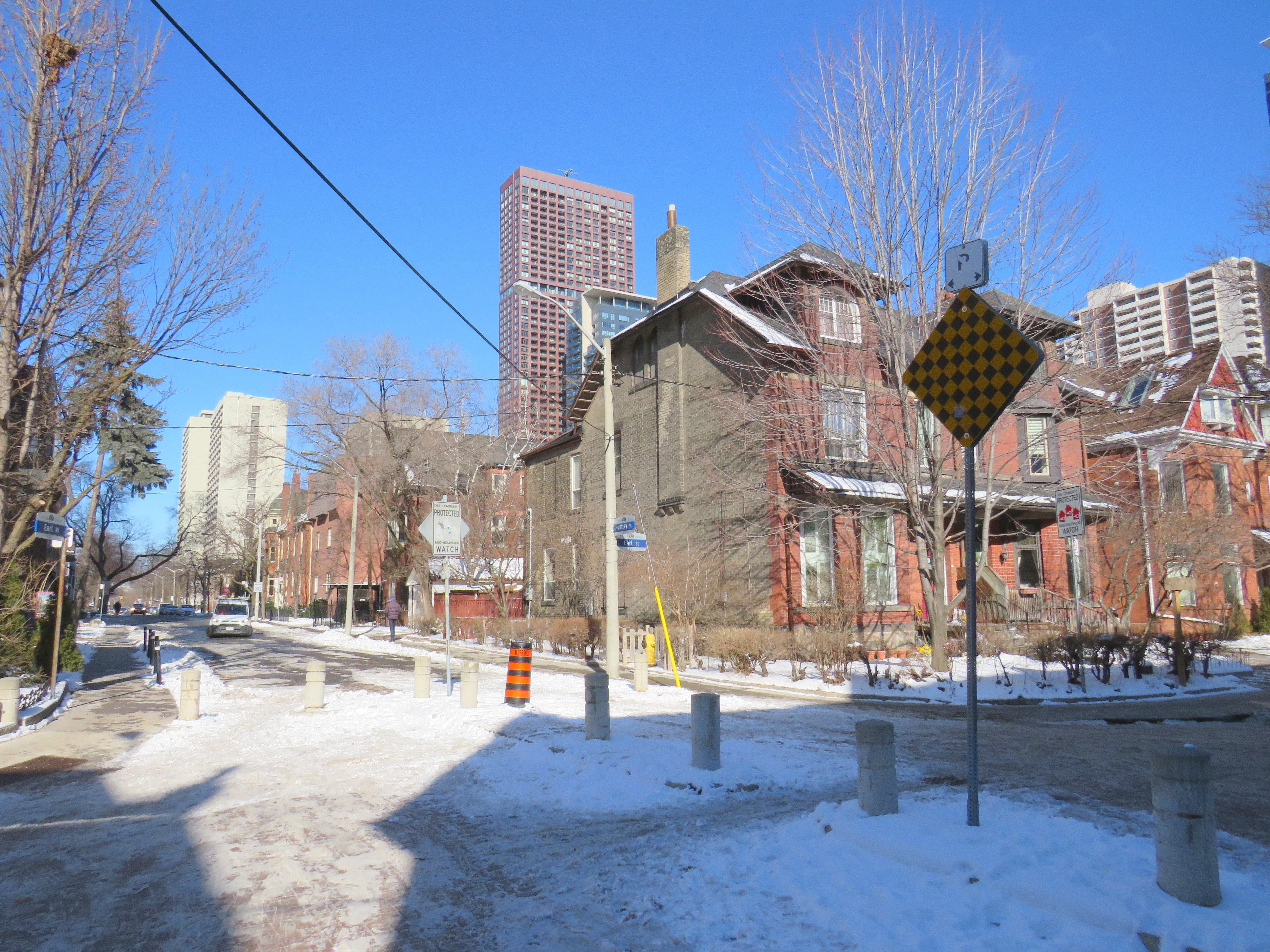
    Earl Place, where “No Exit” signs betray through access for pedestrians and cyclists

    Last week, Dylan Reid and I, both co-founders of Walk Toronto, decided to create an inventory of all instances in the city where “No Exit” signs do not apply to all road users. Though these signs are required under traffic codes and regulations, they do not reflect that in many cases, there is an exit for pedestrians. Some of those offer through passage for cyclists as well. We were inspired by a Twitter thread that expressed the frustration of getting around the city by foot, where signage is designed entirely for motorists.

    Instances where pedestrians or cyclists may continue past a “No Exit” sign include traffic calming measures meant to keep out through motor vehicles on once-continuous roads. The intersection of Earl Place, Earl Street, and Huntley Street is just one example: curbs and bollards restrict motorists from continuing through, though a narrow passage allows cyclists to continue past; sidewalks also allow through pedestrian movement.

    Earl Place and Huntley Street

    In many other cases, suburban street designs, such as cul-de-sacs, limit vehicular movement though residential subdivisions, but narrow public walkways allow pedestrians access to parklands and neighbouring streets. In other cases, changes in grade between streets allow for a staircase, but not a through roadway down a steep hill. These are common in the Swansea, Baby Point, Silverthorn, and East Toronto neighbourhoods.

    As of January 30, 2021, I have mapped over 250 misleading “No Exit” signs throughout the City of Toronto, though I know there are many more. Please send them to me via Twitter or via a direct message, and I will be sure to add your submission.

    Our goal is to convince the City of Toronto to add signage recognizing where pedestrians and cyclists do have an exit. Perhaps too, this might inspire you to get outside, and walk around the neighbourhood, checking out passageways you might have not known about.

  • A tale of two streets: Winona Drive and Shaughnessy Boulevard

    A tale of two streets: Winona Drive and Shaughnessy Boulevard

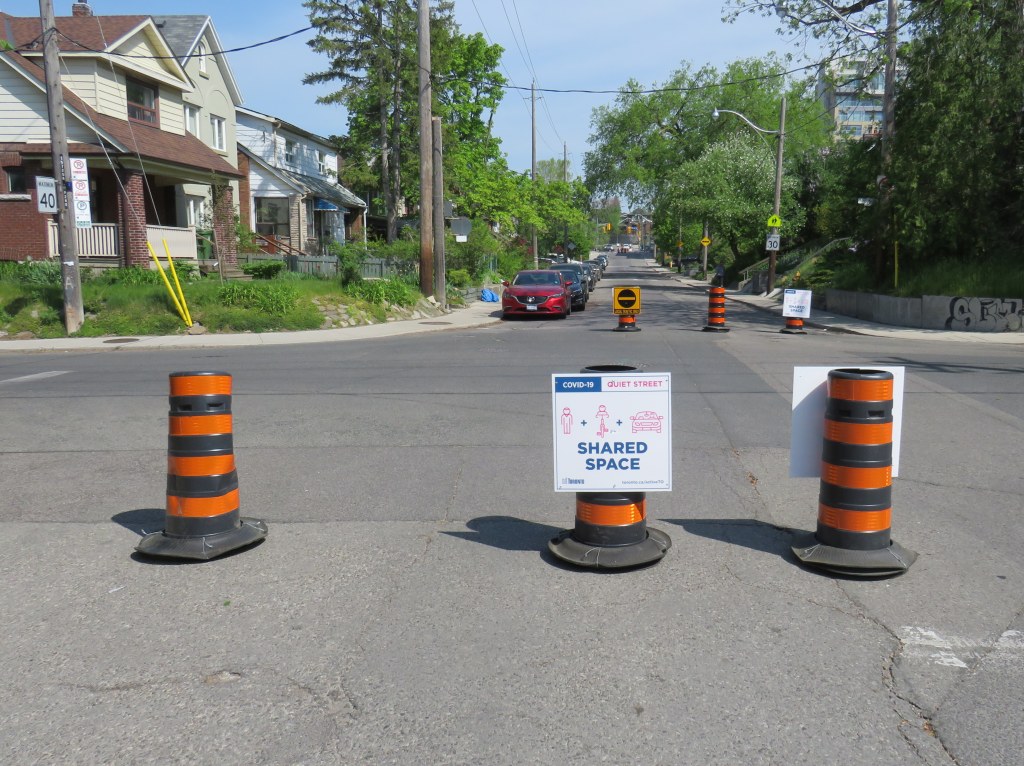
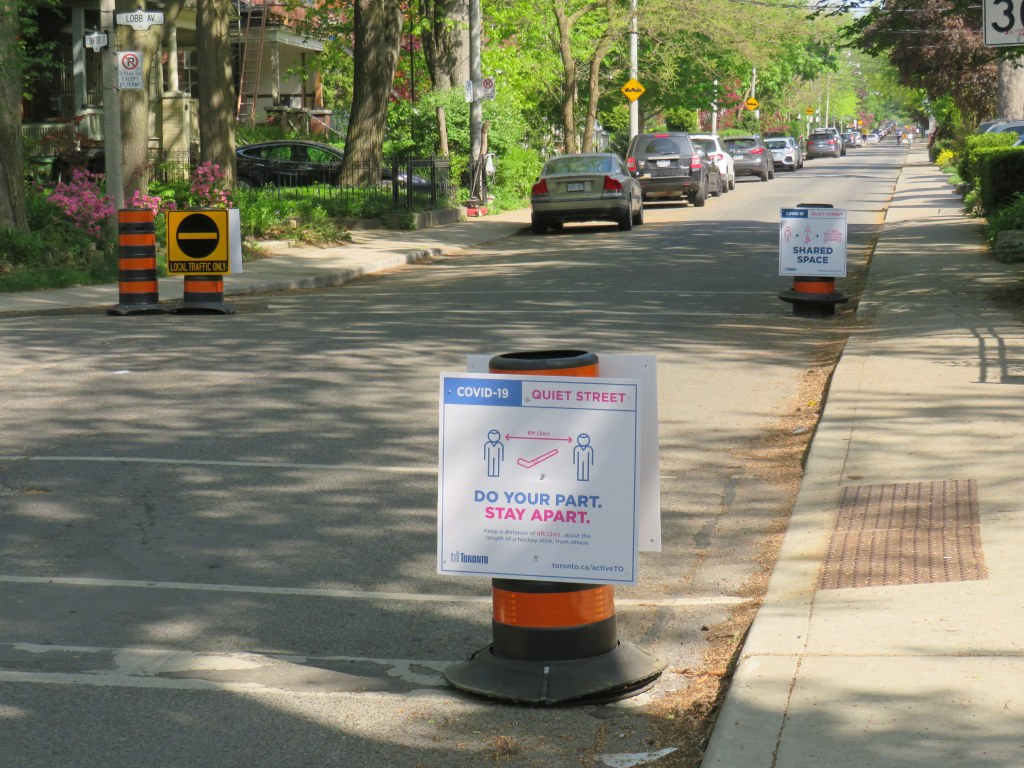
    Typical Quiet Street signage and pylon placement, Crawford Street

    Earlier this month, as part of Toronto’s long-overdue response to the ongoing COVID-19 pandemic, the city introduced ActiveTO. ActiveTO includes several measures addressing the need for safe active transportation and recreation routes as summer approaches and businesses slowly reopen.

    Current ActiveTO initiatives include weekend traffic closures of sections of Lake Shore Boulevard and Bayview Avenue to take pressure off narrow and busy multi-use paths, designating specific “quiet streets” to provide safer cycling and pedestrian corridors, and the construction of new bike lanes and cycle tracks, accelerating work on the painfully slow implementation of the city’s cycling network plan.

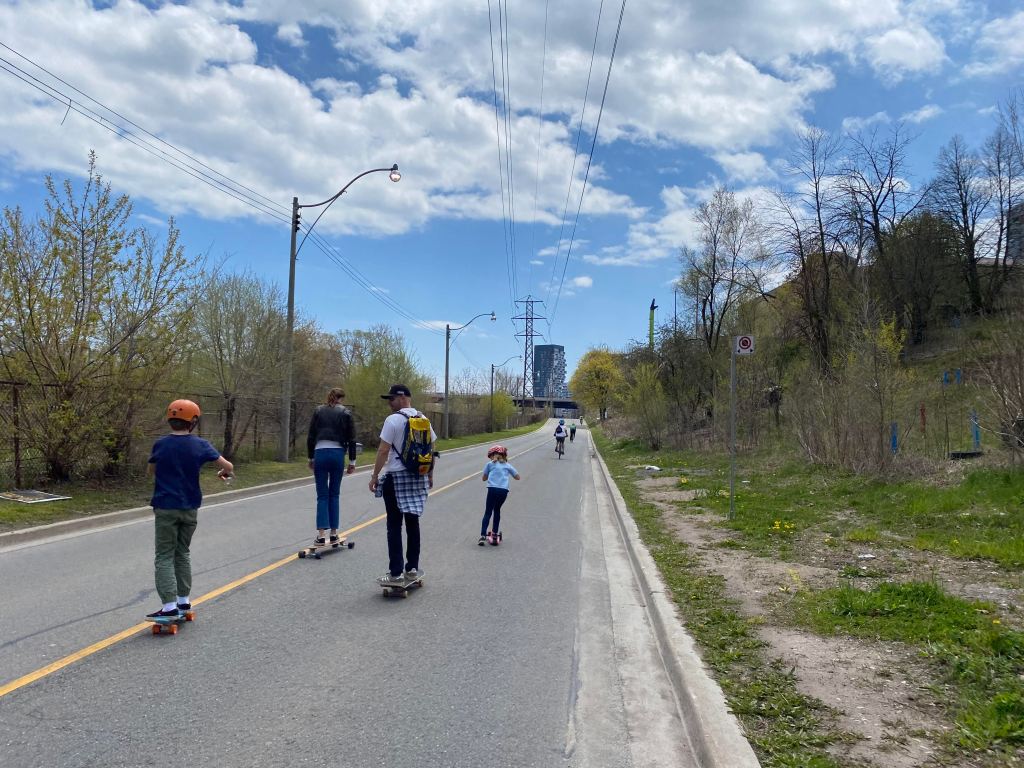
    One of many families enjoying the Bayview Avenue extension closure on May 16. The weekend closure provides a safe, spacious alternative to the crowded Lower Don Trail

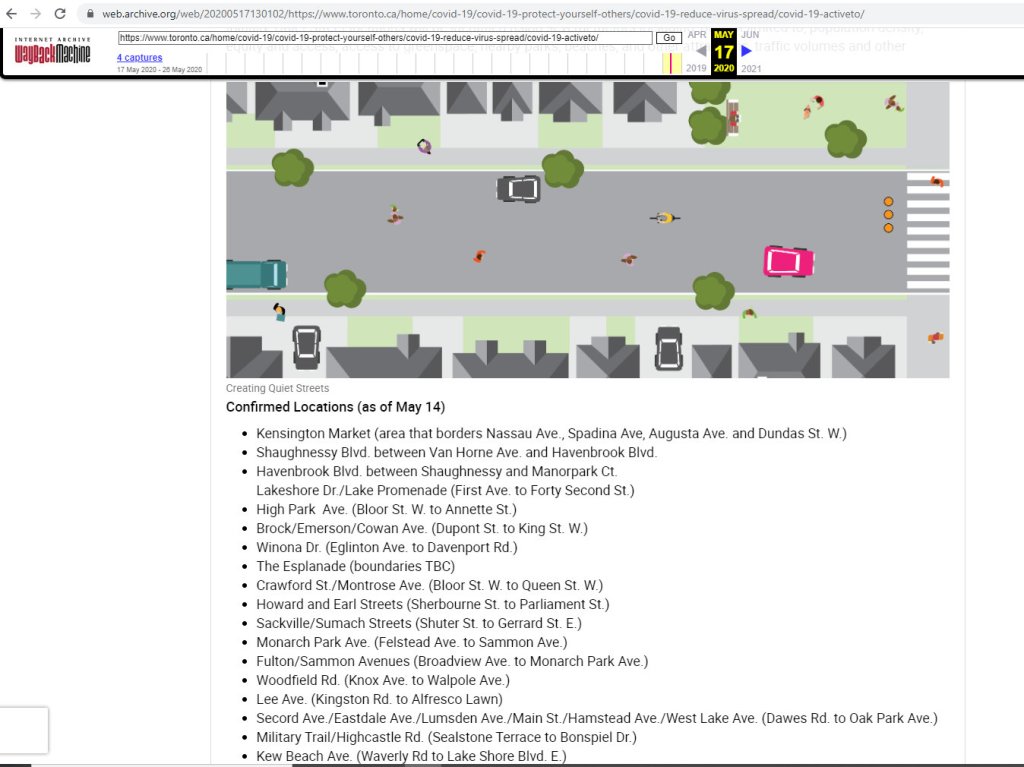
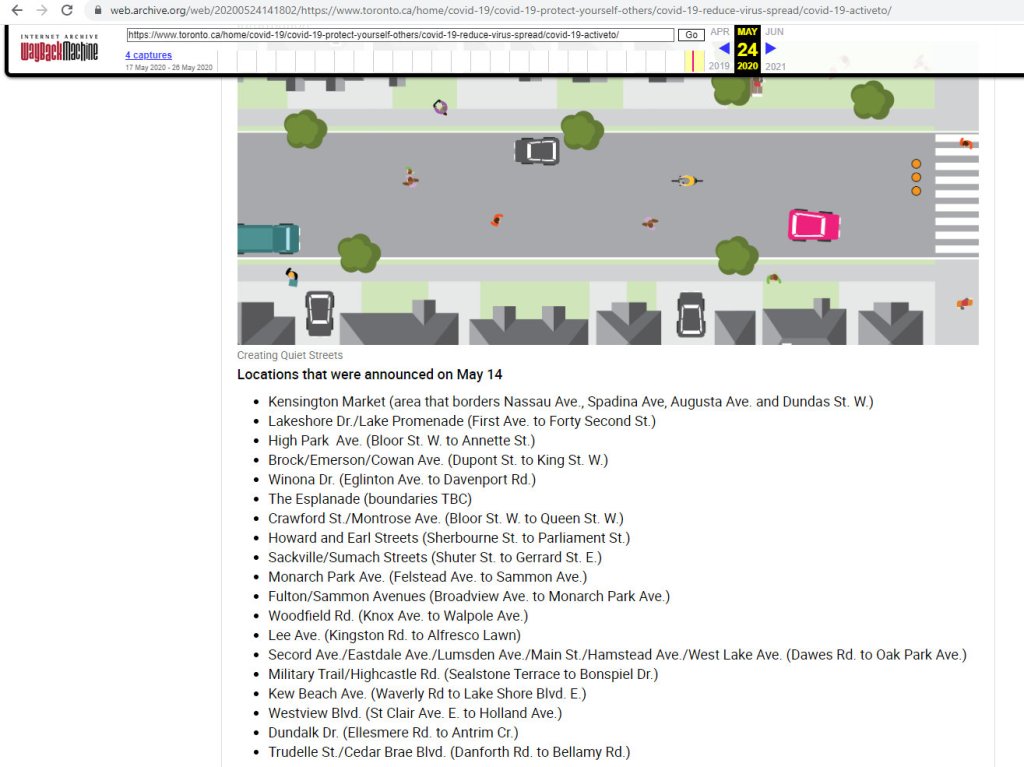
    I visited two Toronto streets this week included in the initial list of ActiveTO quiet streets that were announced on May 14, 2020.

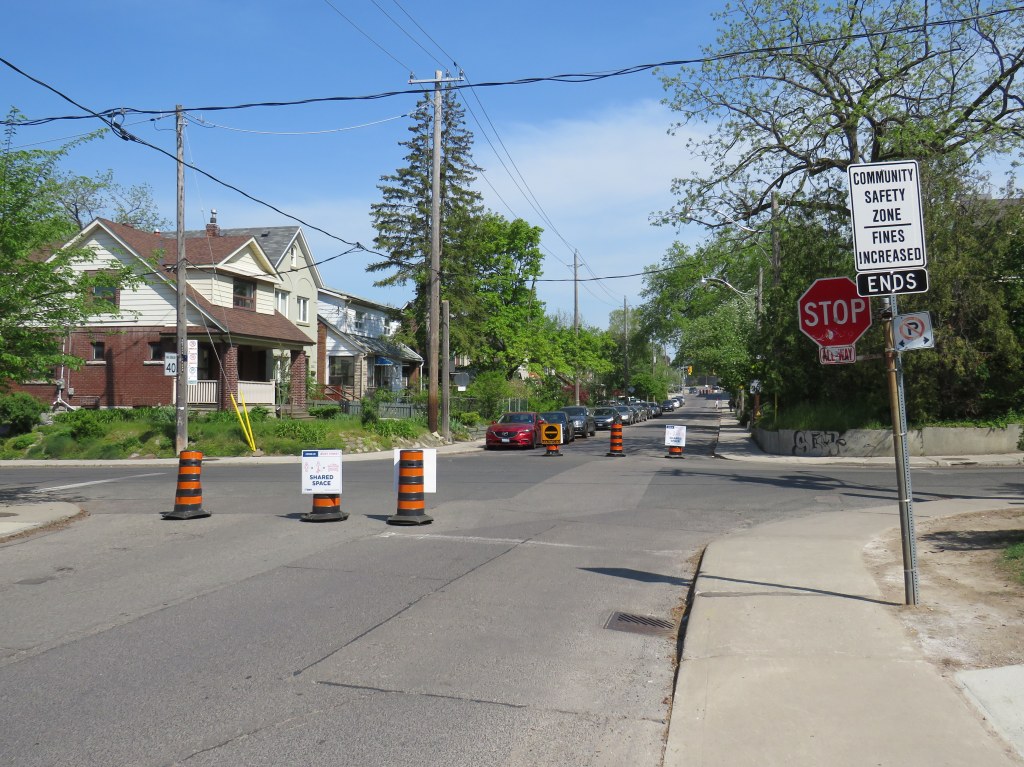
    On Winona Drive, the pylons and signs placed by city work crews were moved by residents to block an entire lane of traffic at each intersection. This enhances their effectiveness in reminding motorists that the space is for local traffic only and that the roadway is shared with pedestrians and cyclists.

    Winona Drive at Benson Avenue, May 25, 2020
    Close-up of relocated pylons on Winona Drive

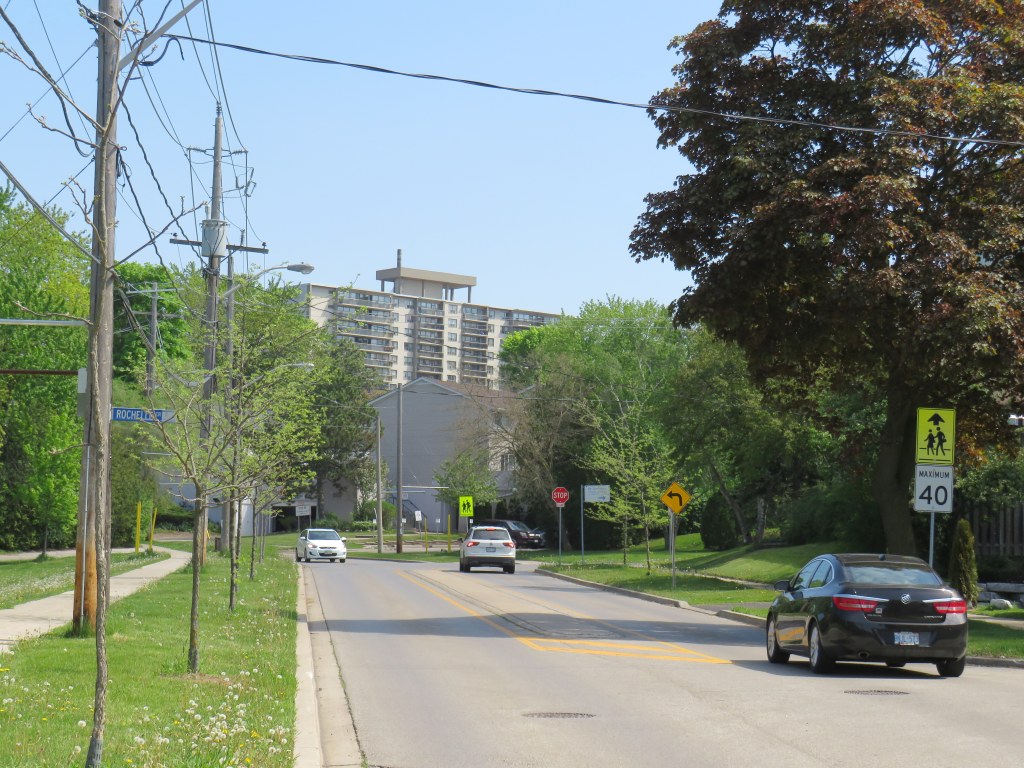
    Shaughnessy and Havenbrook Boulevards, near Sheppard Avenue and Don Mills Road, connect the densely populated Fairview Mall and Don Valley Village neighbourhoods with the Betty Sutherland Trail, part of the Don River ravine system. Though Shaughnessy is mostly fronted by comfortable, midcentury homes, it borders several apartment buildings and townhouse complexes, including several Toronto Community Housing properties.

    Shaughnessy Boulevard looking north at Rochelle Crescent

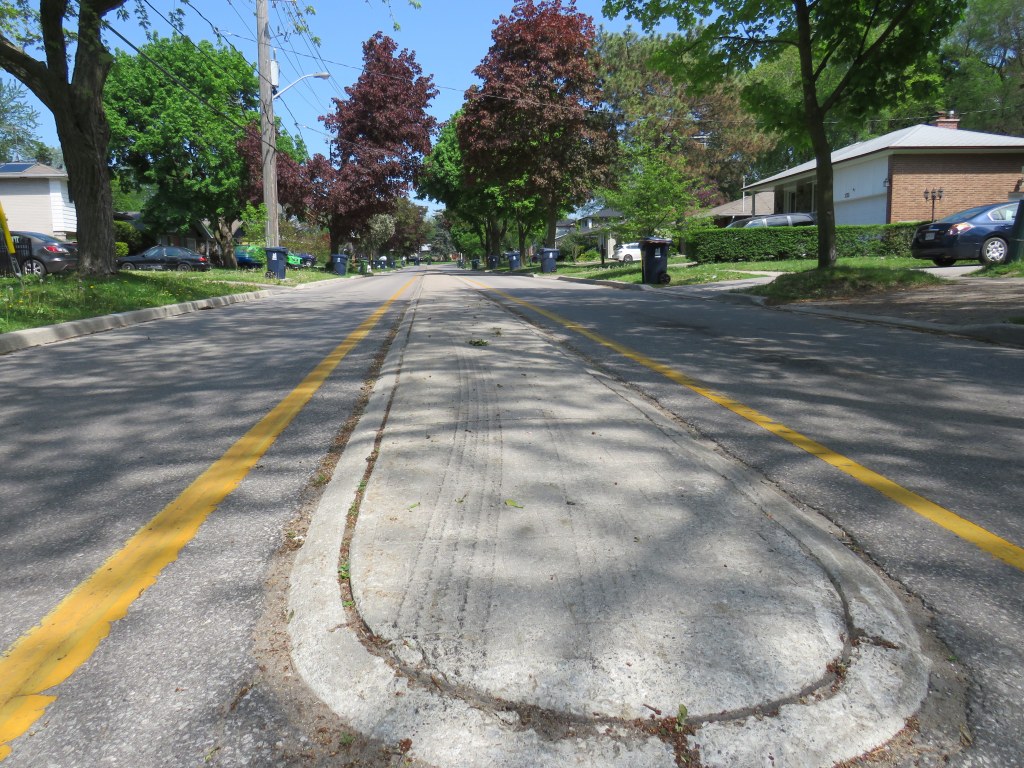
    In 2012, some road calming measures were undertaken on Shaughnessy to slow down traffic, particularly near local schools and parks. A four-lane section between Sheppard Avenue and Glenworth Road was narrowed, including a very short section of bike lanes. A shallow concrete median was added between Glenworth and Esterbrooke Avenue. However, the street remained problematic.

    The shallow median on Shaughnessy Boulevard does nothing to slow down aggressive motorists

    In a recent Toronto Star article, resident Robin Sacks noted that the street was unsafe as motorists used it as a bypass of parallel Don Mills Road. She, and many of her neighbours, supported Shaughnessy’s designation as an ActiveTO quiet street.

    Unfortunately, other residents took it upon themselves to remove the pylons and signs and complain to their local city councillor as soon as they were installed. By the weekend, they — along with concrete barriers placed in the median — were removed, and the street wiped from the city’s website.

    Councillor Shelley Carroll, a progressive, was quoted in the Star article that she felt those who objected to the traffic calming measures were on “solid ground,” as there were no community consultations before the measures were introduced. She also noted that Shaughnessy is “a safe street with ample sidewalks and, unlike denser parts of downtown, ‘no one’s having any trouble distancing.’”

    To Carroll’s credit, a consultation is planned for Wednesday, May 27. Overall, her track record has been supportive of safer streets in her community and in Toronto as a whole, so I was surprised by her comments. Hopefully, Shaughnessy, like many other suburban streets, will see improvements shortly.

    Quiet streets, if planned as a network, are helpful for encouraging active transportation, especially where wider sidewalks and cycle lanes are unable to be installed on parallel major roads (due to streetcar lines, for example), or where they can connect major parks, off-road trails, and other cycling corridors.

    To make such quiet streets permanent, curb extensions at intersections and other physical cues should be used to slow down traffic. Traffic circles and well-marked crosswalks could also take the place of four-way stops, which are easily ignored by motorists while frustrating cyclists.

    The COVID-19 pandemic has exposed severe inequities; between those who work in the logistics, healthcare, and food service industries, and those who are able to work at home; between those who have comfortable homes with access to ample green space and those who do not, and those can rely on their own automobiles, and those who must walk, cycle, or take transit. This is why expanding public space and providing safe routes to travel is so important.

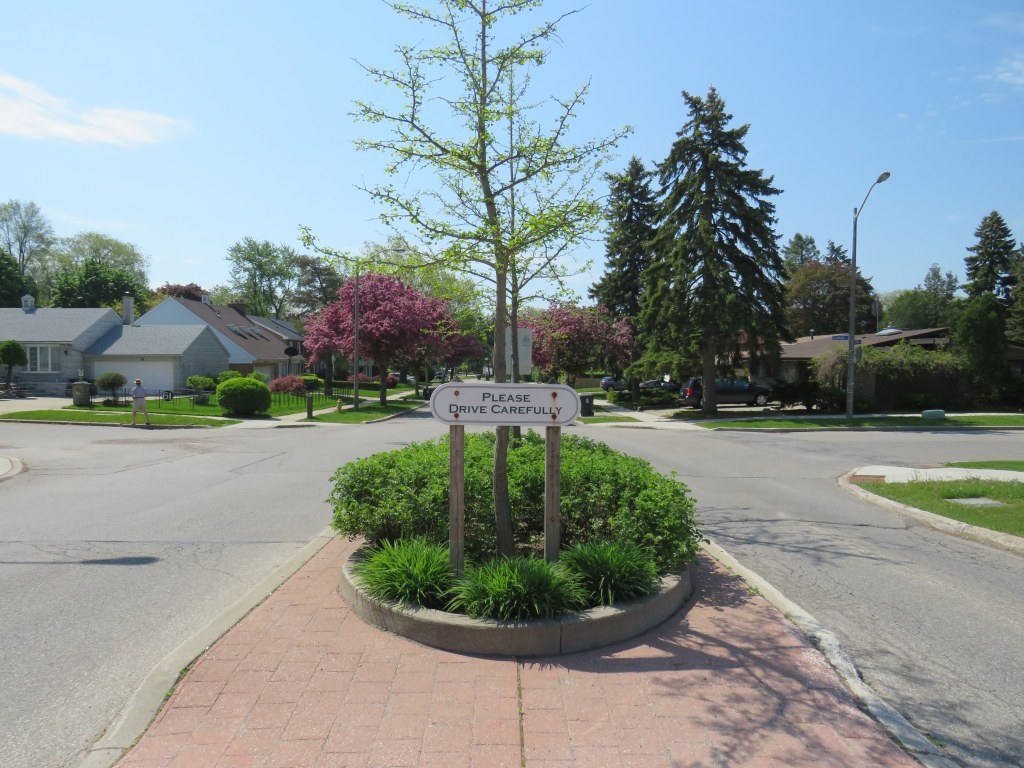
    “please drive carefully” – sign in median of Shaughnessy Boulevard

  • Deadly by design: Supertest Road

    Deadly by design: Supertest Road

    IMG_7204-001

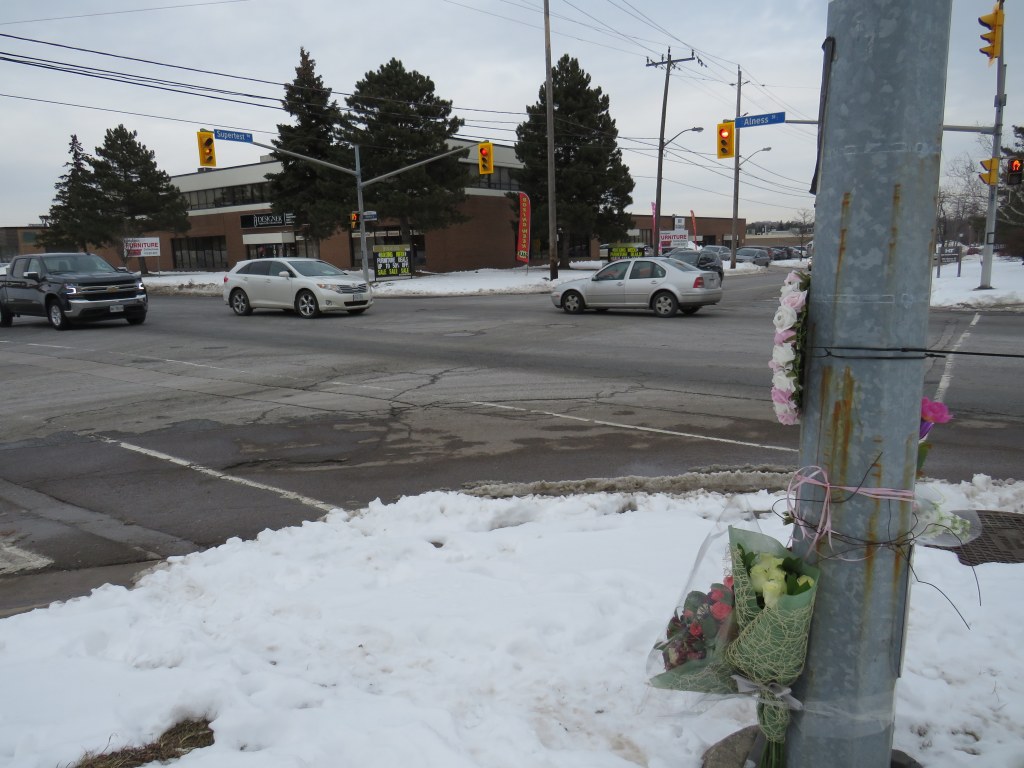
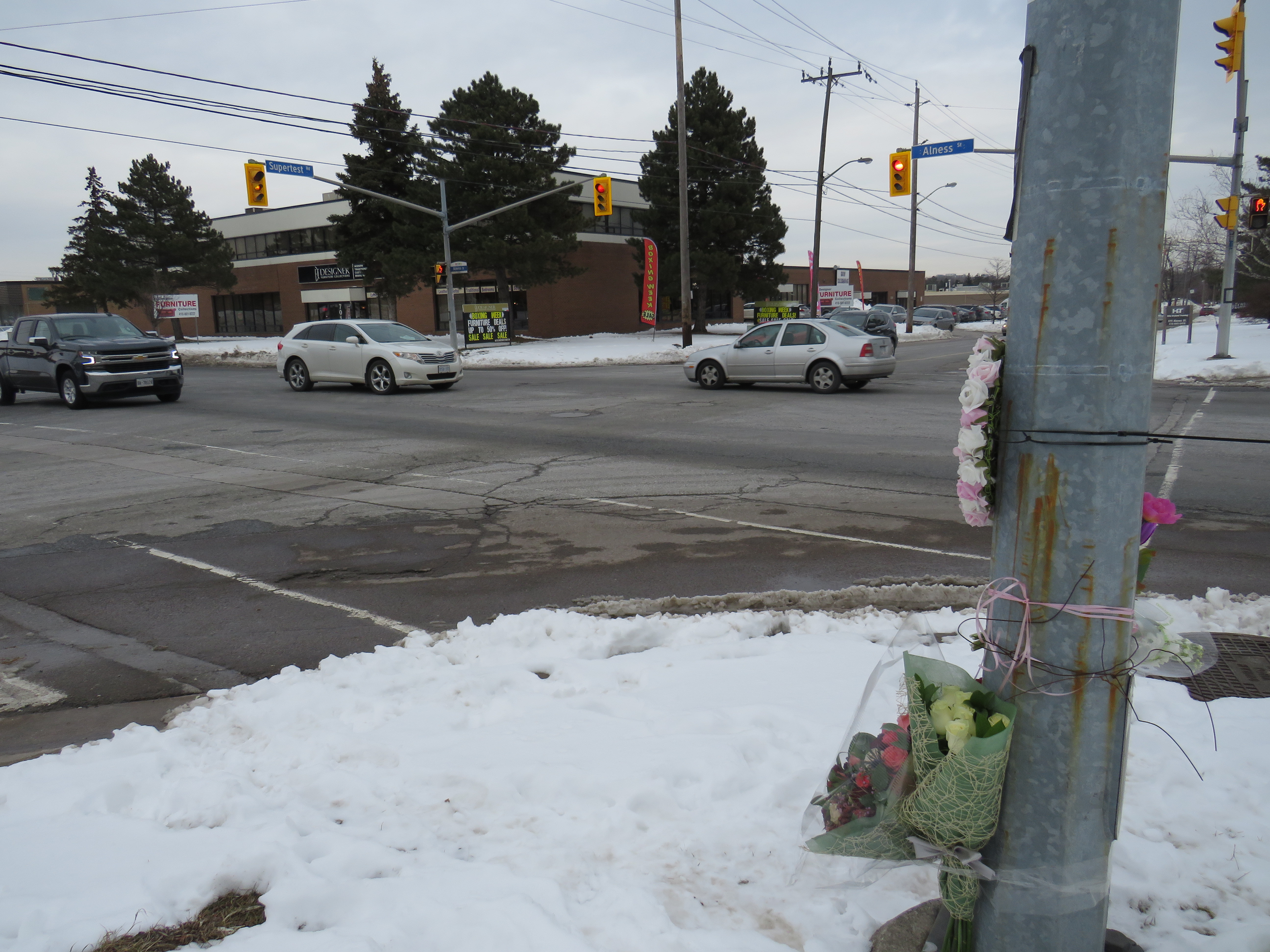
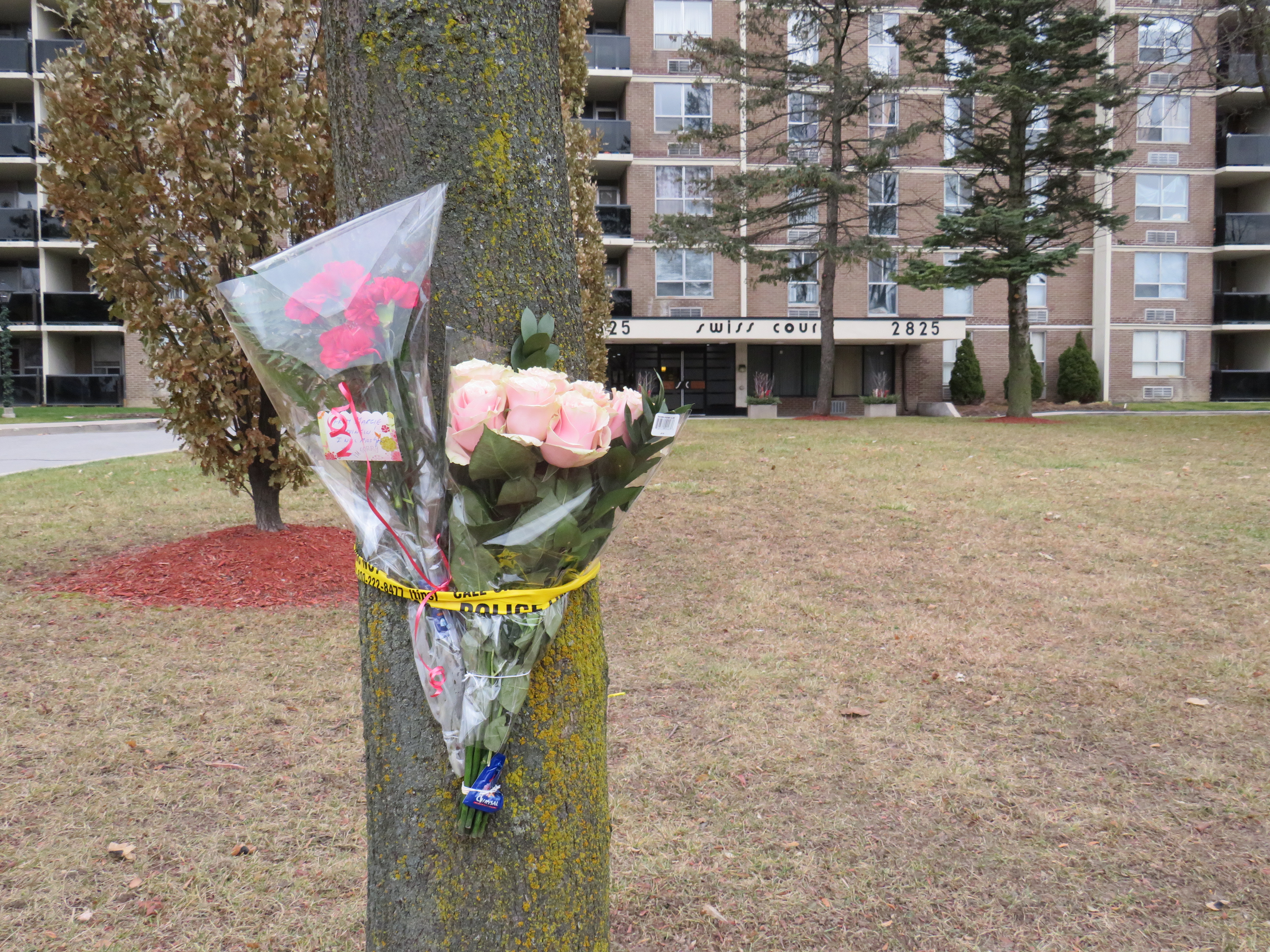
    On Tuesday, January 21, a 26-year-old woman was struck and killed by the driver of a tractor-trailer at the corner of Supertest Road and Alness Street in North York. According to police, the truck driver was making a right turn from Supertest south to Alness when he hit the pedestrian.

    Last week, I paid a visit to the intersection, located in an industrial area off Dufferin Street, just south of Steeles Avenue. It was immediately apparent that pedestrians are an afterthought in this part of the city, and tragedy was inevitable.

    The intersection of Alness and Supertest, with a makeshift memorial on the southwest cornerThe intersection of Alness and Supertest, with a makeshift memorial on the southwest corner
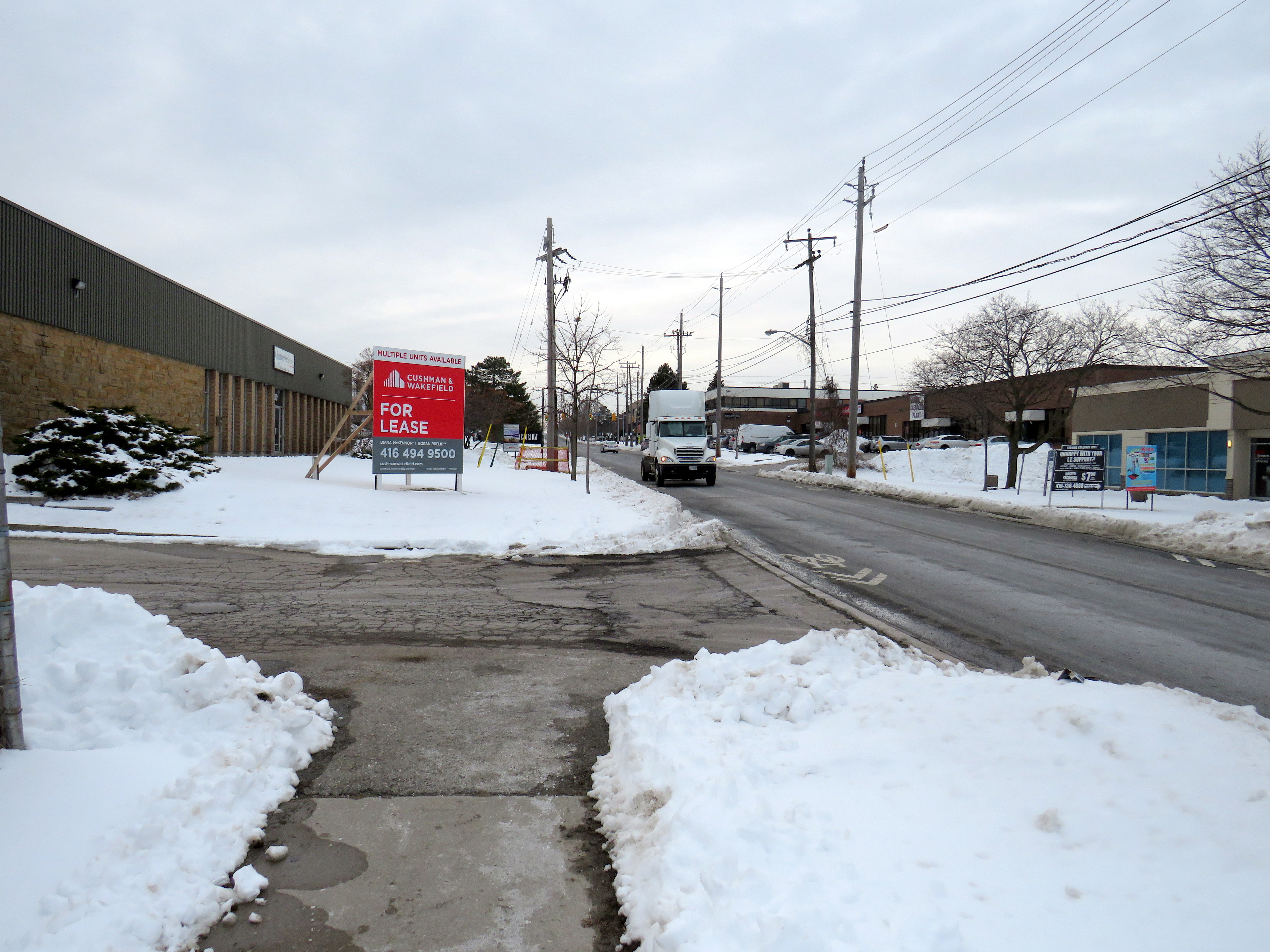
    I took the 105 Dufferin North bus from Sheppard West Station and got off at Supertest Road before walking west towards Alness Street. I pressed the beg button to cross Dufferin, but it did not work, so I crossed with the solid “don’t walk” sign. At least I had enough time to cross before traffic on Dufferin got the green light. With a bus stop at the intersection, G. Ross Lord Park to the east, and a busy supermarket on the southwest corner, there is no excuse for a malfunctioning pedestrian signal. In fact, the walk signal should appear by default.

    As I walked westward on Supertest, the lone sidewalk on the south side of the street came to an end at an industrial driveway about halfway between Dufferin and Alness. With the snow, I was forced to walk on the street, which was busy with cars and trucks. Without any sidewalk, anyone using a wheeled device would also be forced on the street.

    End of sidewalkThe only sidewalk on Supertest Road comes to an end halfway between Dufferin and Alness
    With my smartphone, I recorded my walk along the curb towards Alness Street, avoiding the snowbanks, debris, and motor traffic. It was not a pleasant walk.

    The intersection of Supertest and Alness is a signalized intersection, with pedestrian signals and crosswalks on all four sides. Alness has a through sidewalk, but only on the east side of the street. The intersection is surrounded by a scrapyard on the southwest corner, a bank on the northwest corner, and warehouses to the east. The missing sidewalk on the south side Supertest east of the intersection resumes west of Alness.

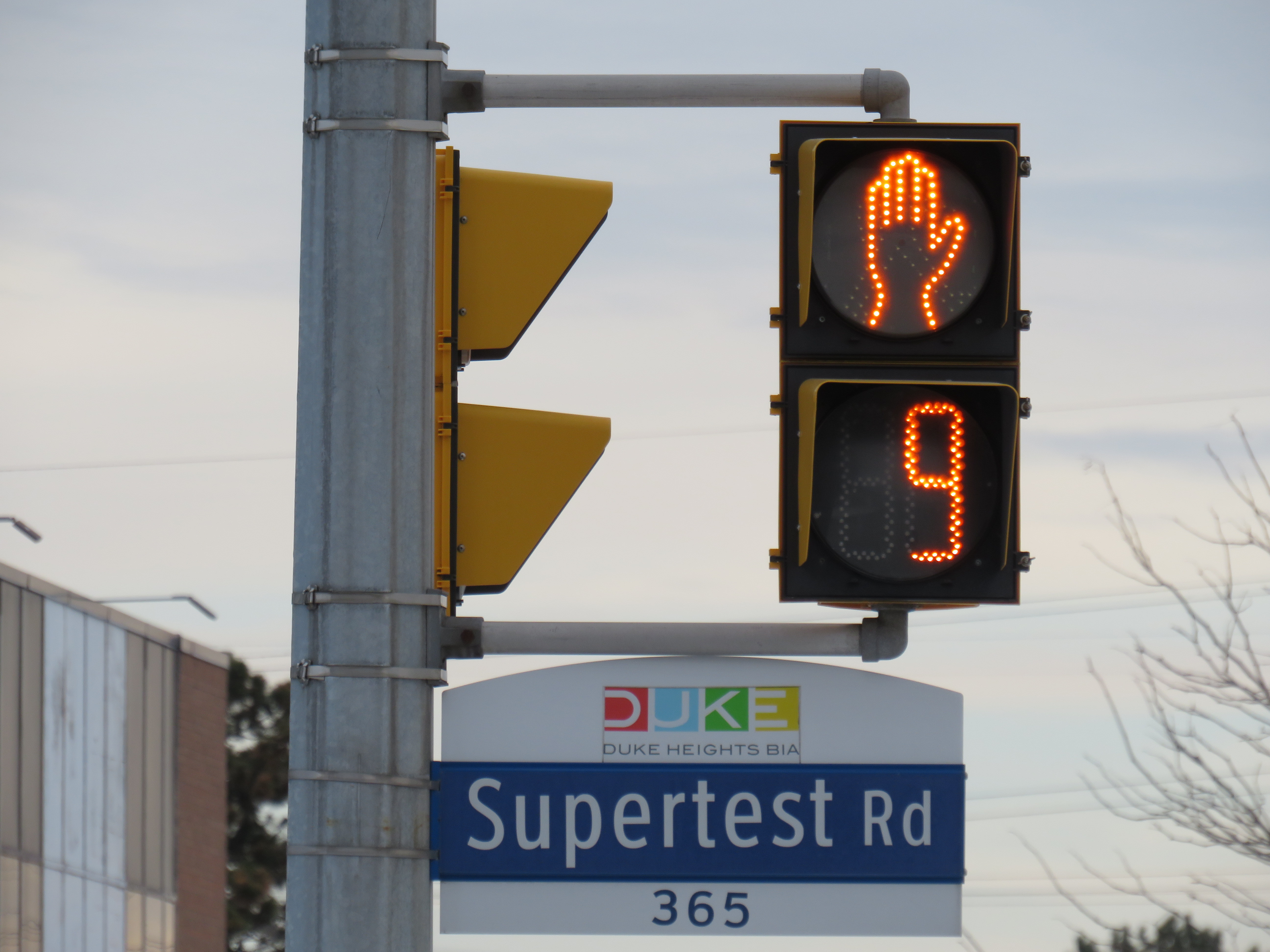
    The traffic lights are on a timer, and walk signals automatically appear, so there are no beg buttons at Alness and Supertest. What I noticed during my visit is that motorists will regularly rush to get through an amber signal, sometimes running a red. Truck drivers make wide right turns. Though the area is not pedestrian friendly, I did note several pedestrians in the area, running errands at the bank or walking to and from several of the nearby businesses.

    Truck turning from Supertest to Alness

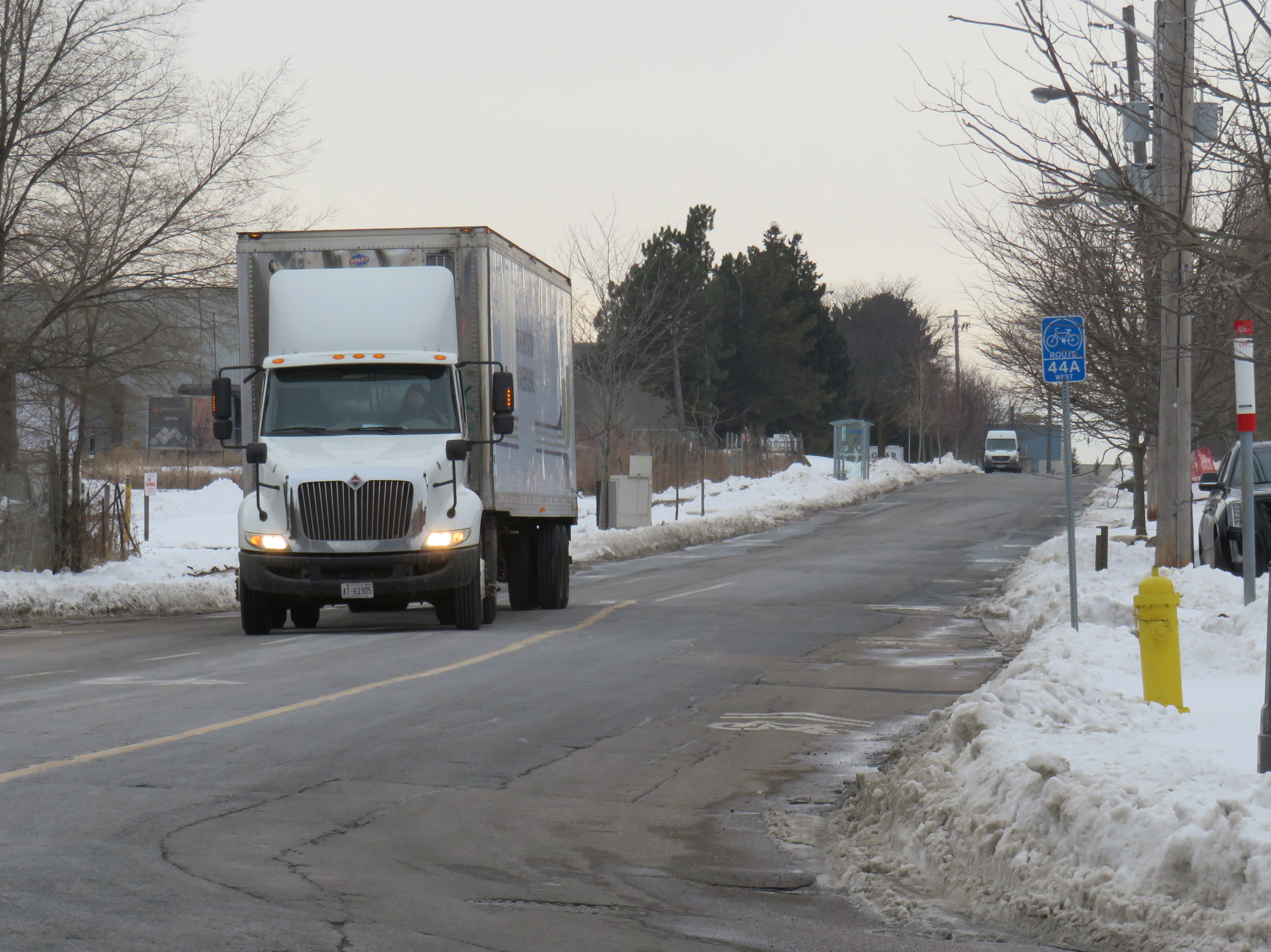
    Finally, I noted the sharrows, the signed bicycle route on Supertest Road, and the TTC stop on the north side. The cycle route is supposed to connect G. Ross Lord Park on the east side of Dufferin to Flint Road to the west and south to the Finch Corridor Recreational Trail, but it’s not an enticing place to bike. Meanwhile, the TTC stop, for the limited-service 117 Alness route, is inaccessible without a sidewalk leading to it.

    Looking west on Supertest RoadLooking west on Supertest Road, with the sharrow, TTC stop, and bike route sign on the right
    Everything about this industrial intersection was designed to fail pedestrians and cyclists. Last week, it did exactly that.

  • Islington Avenue: deadly by design

    IMG_6266-001Memorial to 77-year old Pasquina Lapadula in front of her apartment building on Islington Avenue north of Finch
    On Thursday, November 29 at 6:30AM, Pasquina Lapadula left her Islington Avenue apartment building and crossed the street in front of her home. Soon after stepping out, she was struck and killed by the driver of an SUV traveling northbound. The driver then fled the scene. Sadder still, drivers passed the scene without stopping to help.

    Toronto police are looking for a dark coloured SUV with bright headlights and fog lights. They have yet to find the driver and lay charges.

    According to the Toronto Star, 37 pedestrians have been killed on Toronto’s streets. Of those, 24 were 60 years old or over. Since 2007, 410 pedestrians were killed on Toronto’s streets; 238 of those were aged 60 or older. November 2019 was an especially deadly month; Lapadula was the third older pedestrian killed in Toronto in just three days.

    Though blame can be laid at the driver, who despite having ultra-bright headlights and fog lights, struck Lapadula and sped away afterwards, this part of Islington Avenue, like many other suburban roads in Toronto, is deadly by design.

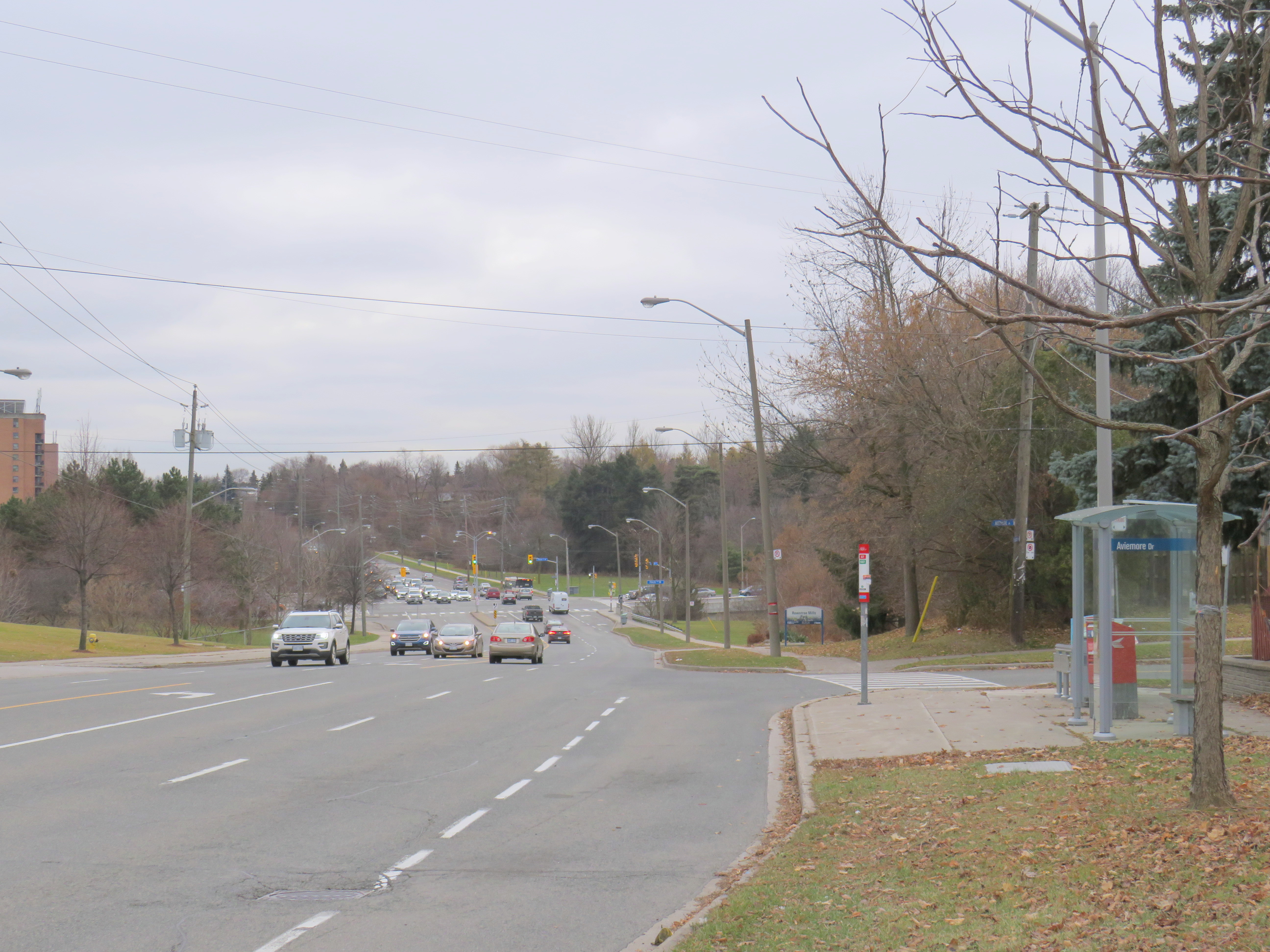
    IMG_6283-001Islington Avenue looking south from Aviemore Drive towards Finch Avenue
    The collision took place at Aviemore Drive in Humber Summit, in Toronto’s northwestern corner, near the boundary between the former cities of Etobicoke and North York. The area was developed in the 1960s and 1970s, when automobile-centric planning was at its peak.

    Islington Avenue is five lanes wide between intersections, including a striped middle lane that turns into left turn lanes at intersections. Sidewalks are separated by wide boulevards, and there are long distances between traffic signals.

    The road has a slight curve north of Finch Avenue, with a hill down towards the East Humber River at Finch. From Aviemore Drive, it is a 220 metre walk south to the crosswalk at Finch Avenue and 430 metres north to the traffic signals at Milady Road. Just south of Aviemore Drive are entrances to Gord and Irene Risk Park and Recreation Centre and Rowntree Mills Park.

    As the speed limit is unposted on this section of Islington Avenue, by law, vehicles may only go a maximum of 50 kilometres per hour. However, the road design encourages speeds far greater than the limit.

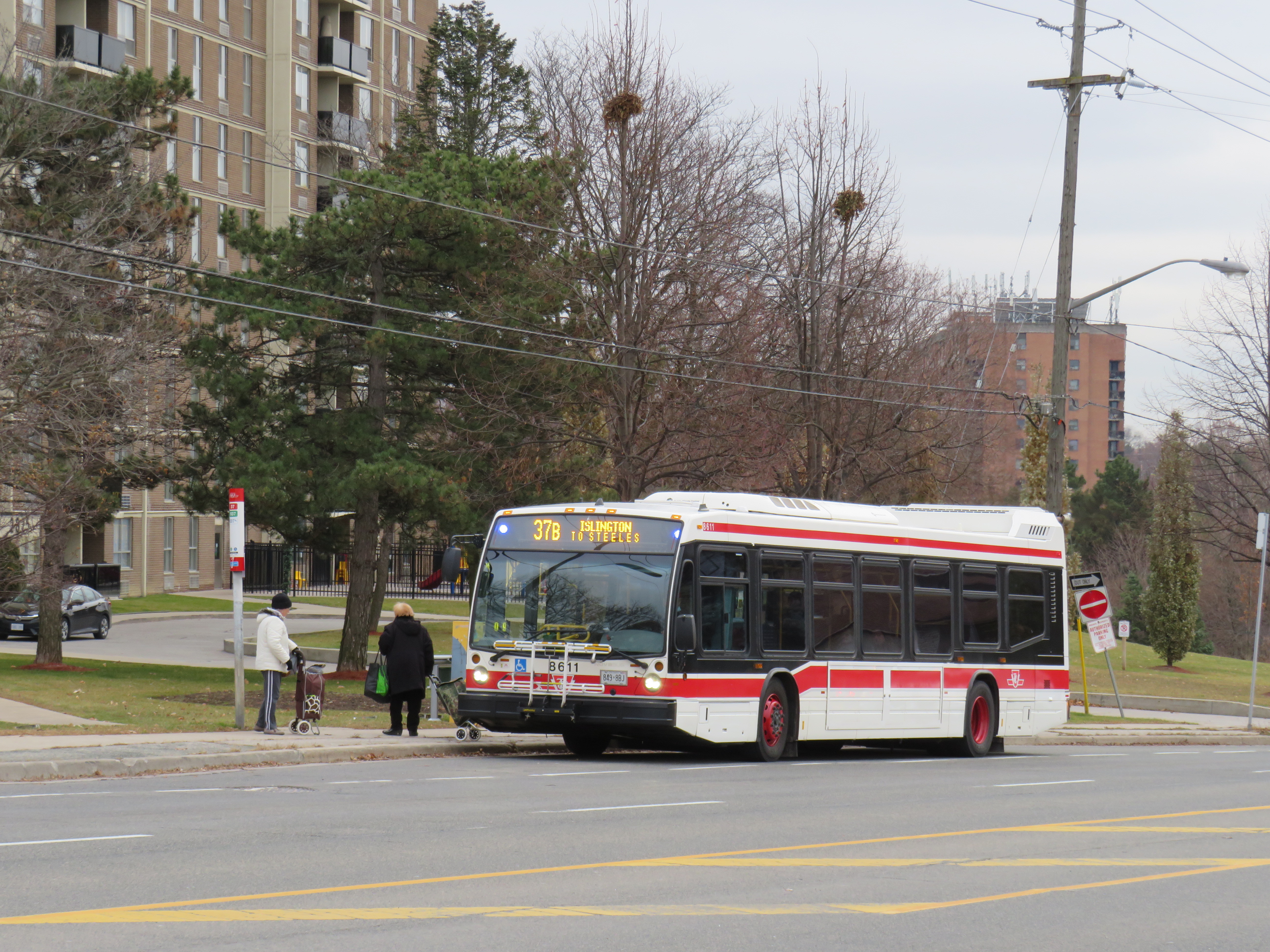
    IMG_6299-001TTC bus stopped in bay in front of Pasquina Lapadula’s apartment building
    As on Don Mills Road north of Finch, TTC buses stop in bus bays instead of on the street itself. These bus bays were not designed for the benefit of transit, but instead for the convenience of private motorists. Buses stopping get out of the way of traffic, and then must merge back in. (A law requiring other motorists to do so exists, but is never enforced.)

    Everything about the road design is designed for high vehicle throughput, with little consideration for pedestrian safety.

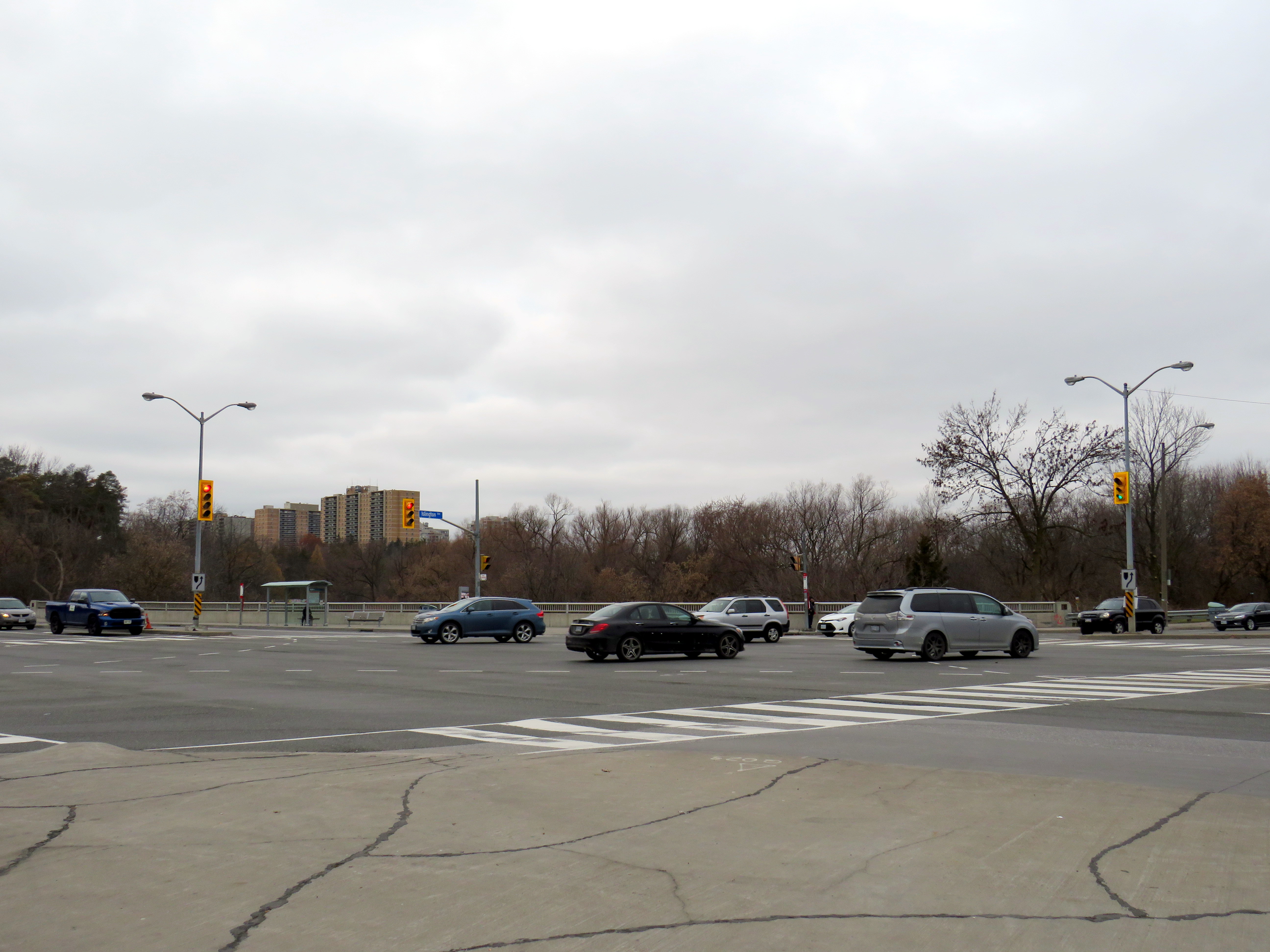
    IMG_6248-001Islington and Finch Avenues

    It is true that Pasquina Lapadula could have walked 220 metres down to Finch Avenue, and depending on her destination, another 220 metres back up the hill. The traffic signals and painted crosswalks would have provided additional safety. But the intersection of Finch and Islington itself is problematic.

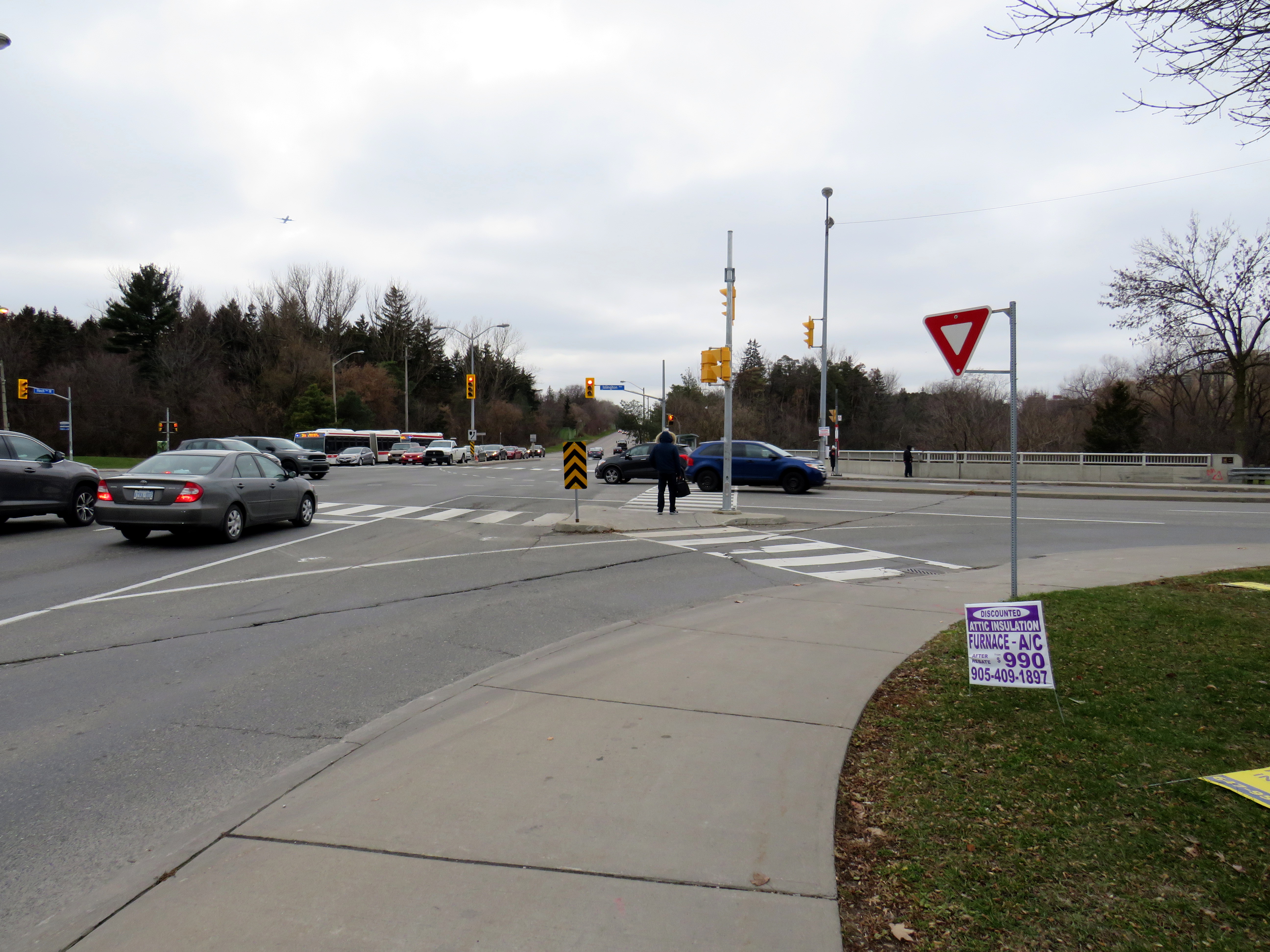
    The intersection sits on a large viaduct over the East Humber River. Right turn slip lanes are found on the southwest and northeast quadrants, allowing right-turning traffic to pass by quickly while requiring pedestrians to cross an additional lane of traffic governed only by a yield sign. Buses on Finch stop at bus bays at the far side of the intersection, further lengthening the distance pedestrians must cross.

    IMG_6255-001Slip lane from Finch to Islington

    I was frustrated when two Toronto councillors advocate giving out reflective armbands for pedestrians to wear, especially as one of those councillors opposed road safety initiatives in her own ward. I was angered the Toronto Star’s editorial board ignore city data, their own reporters and columnists, and pedestrian and cycling advocates to back those two suburban councillors.

    This was especially tone deaf given the Toronto Police Service’s abandonment of traffic enforcement, the epidemic of pedestrians being killed in the last two years, and the disturbing number of hit-and-runs. Armbands would not have saved Pasquina Lapadula’s life when she was confronted by the driver of a speeding SUV, with blindingly bright headlights and fog lights.

    This is why we need real Vision Zero measures like lower speed limits, more safe pedestrian crossings, road re-engineering to slow down vehicles, complete streets, and effective police enforcement.

  • Zero vision in suburban Toronto

    IMG_3684-001

    Though the city of Toronto has made some progress towards safer streets recently, the lack of police enforcement of traffic laws, the reluctance to spend serious money on road redesign, and the attitudes of some city officials continue to be obstacles towards making Toronto a safe place to walk and cycle.

    As part of the city’s Vision Zero 2.0 Plan, City Council voted in July to reduce speed limits from 60 km/h to 50 km/h on 37 sections of arterial roadways across the city, and from 50 km/h to 40 km/h on five more roads. Councillors Ana Bailão and Jim Karygiannis moved to extend several of these sections. However, rookie councillor Cynthia Lai (Ward 23-Scarborough North) moved to amend the item to remove three sections of arterial roads in her ward:

    • Brimley Road from Sheppard Avenue East to Steeles Avenue East,
    • Markham Road from Milner Avenue to Steeles Avenue East, and
    • McCowan Road from Milner Avenue to Steeles Avenue East.

    Councillor Lai claimed that her constituents were concerned about gridlock in her ward and opposed the speed restrictions. Scarborough is especially dangerous for pedestrians as it has the most kilometres of high-speed arterial roads in the city and the longest distances between crosswalks.

    High speeds and dangerous driving are major problems in Ward 23, a part of the city that I visit a few times a month. Brimley, Markham, and McCowan Roads are designed solely for car traffic: they are lined by plazas, warehouses, and backyard fences. Traffic signals are often far apart. Markham and McCowan Roads are also high-speed thoroughfares connecting Markham to Highway 401.

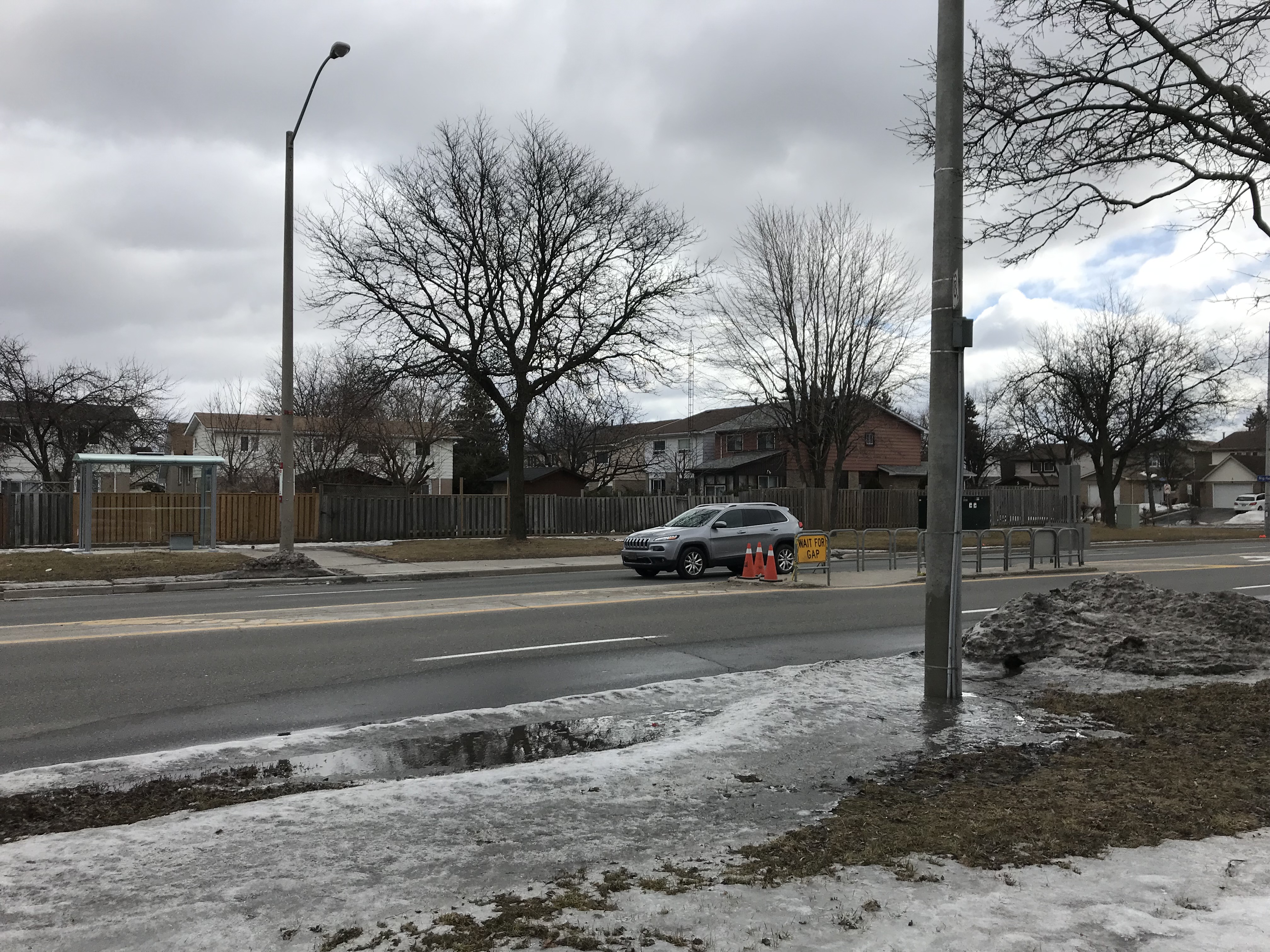
    Walking along McCowan Road between Finch and Steeles earlier this year, my spouse and I encountered a pedestrian refuge smashed in by a motorist. The refuge island was protected by reflective signage, as well as metal barriers, and was installed to help pedestrians cross at a TTC bus stop, though pedestrians are not given the right of way.

    IMG_1644Smashed pedestrian refuge island on McCowan Road
    This is why it was so disappointing to see Councillor Lai organize a “Senior Pedestrian Safety Initiative” with Toronto Police at Woodside Square, a community mall at the corner of McCowan Road and Finch Avenue. Councillor Lai, her staff, and local police were “educating” seniors about pedestrian safety, while giving out reflective armbands. Councillor Lai claimed it was part of the city’s Vision Zero strategy, and she doesn’t “think we should blame anybody.”

    This was just days after a police report showed a severe decline in traffic tickets issued and extremely limited police enforcement of unsafe driving in Toronto. On the Friday before, two seniors were seriously hurt when crossing the street.

    https://twitter.com/cynthiaToronto/status/1198323383538204673

    Needless to say, Councillor Lai and the Toronto Police taken to task by road safety advocates and even fellow councillors. Jessica Spieker of Friends and Families for Safe Streets called it a “form of victim blaming.”

    Supporting Councillor Lai’s position, on Monday November 25, Councillor James Pasternak said “wearing high visibility clothing or reflective gear is a key part of keeping everyone safe, including pedestrians, construction workers, cyclists, police officers and crossing guards. Let’s make VisionZeroTO work.” Councillor Pasternak is Mayor John Tory’s handpicked chair of the Infrastructure and Environment Committee, which among its duties is ensuring the safety of Toronto’s road infrastructure.

    Vision Zero 2.0 says nothing about armbands. Instead, the plan includes reducing speeds, road design improvements, and safer crossings at TTC stops.

    Though it is always a good idea for pedestrians to be aware of their surroundings and be predictable when crossing the street, most of the responsibility falls on the city, which designs the roads, the police, who have abandoned their duty to protect road users, and drivers, who are licensed and insured to operate multi-tonne vehicles. The rash of hit-and-runs after pedestrians were struck is especially alarming.

    In Waterloo, a crossing guard performing her duties was struck and seriously injured by the driver of a F-150 truck, who then fled the scene. This was the despite the school guard wearing a reflective vest, carrying a stop sign, in a marked school crosswalk. No amount of high-visibility clothing will protect pedestrians from dangerous drivers, who in Toronto this year, killed pedestrians walking on sidewalks, and injured pedestrians in transit shelters.

    Ironically, Woodside Square itself was hit twice by drivers in the last two years. In December 2017, a motorist crashed through both sets of doors at the mall entrance closest to Shoppers Drug Mart. In February 2018, a motorist, possibly dealing with medical problems, crashed into several cars and into a Subway restaurant at the mall. High-visibility clothing would not have helped in either of those cases.

    It’s unfortunate that a city councillor will choose giving out reflective armbands over effective speed reductions, road redesign, and traffic enforcement. Hopefully, Councillor Lai will take the criticism to heart and do better for Ward 23.

    Post script: A staff report to the Infrastructure and Environment Committee in October 2019 continued the recommendation for speed reductions in Ward 23, citing minimal impacts to travel times, and the dangerous conditions on Brimley, Markham, and McCowan Roads. Staff noted that there have been 6 fatalities and 20 serious injuries incidents on those three road segments. On October 29, Council voted to lower the speed limits on Brimley, Markham, and McCowan Roads against Councillor Lai’s objections.

  • Addressing the Toronto Police Services Board

    IMG_2922.PNG

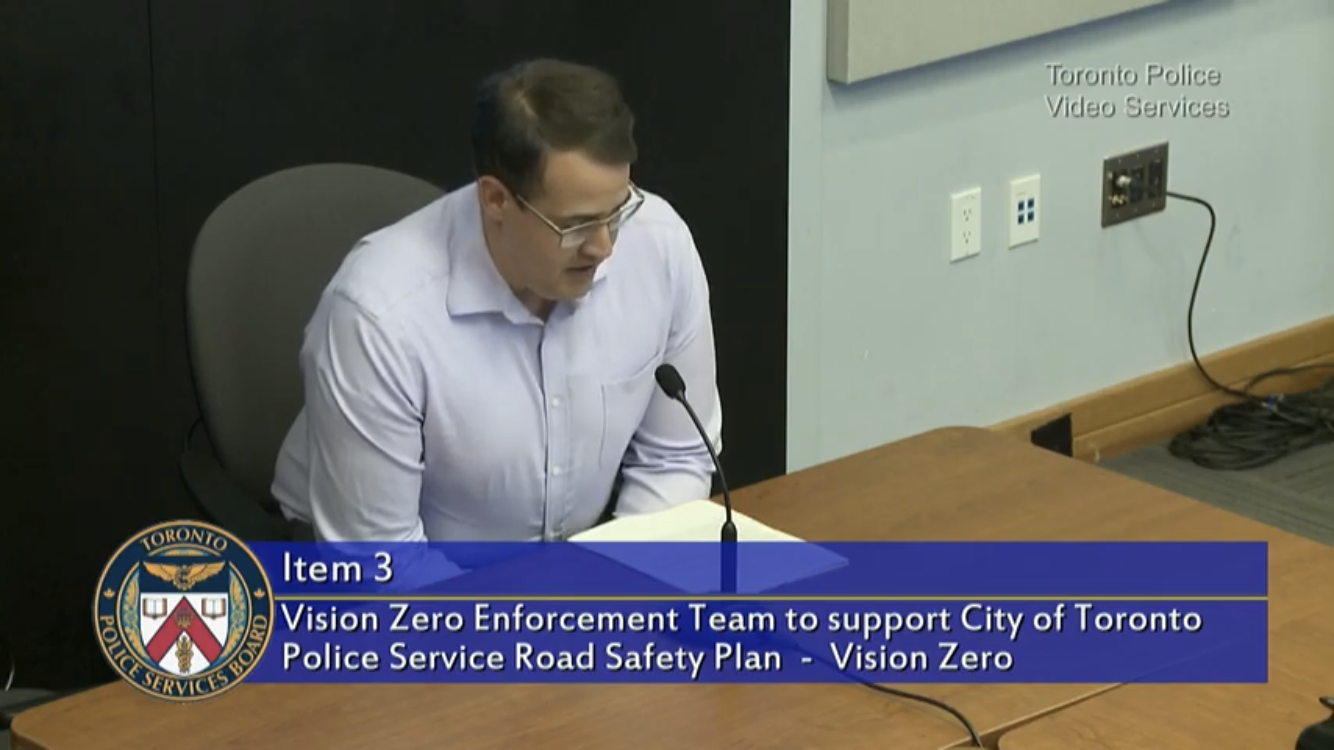
    Earlier today, on behalf of Walk Toronto, I made a deputation to the Toronto Police Services Board addressing the lack of traffic enforcement in the City of Toronto. After criticism from organizations such as Walk Toronto, Cycle Toronto, and Friends and Families for Safe Streets, the Toronto Police now plans to initiate a “Vision Zero enforcement team,” with the city funding the annual $1 million cost.

    As anyone who walks or cycles in the City of Toronto knows, aggressive, distracted, and careless driving is commonplace. They also know that apart from the well-publicized blitz, the Toronto Police Service (TPS) have not responded to the carnage on our streets.

    I spoke to express our disappointment of how the TPS completely failed vulnerable road users by not engaging in meaningful traffic enforcement and calling for a return to making this a priority. Similar deputations were made by John Sewell, former mayor and police critic, Keagan Gartz from Cycle Toronto, and Jessica Spieker from Families and Friends for Safe Streets.

    I found it was a bit intimidating. it was my first formal deputation in a long time, and I sat at a table in front the board, including Chief Mark Saunders and Mayor John Tory. But I did it! Next time I depute, I should find it easier.

    Mayor Tory, to his credit, convinced fellow police board members that the traffic enforcement team be made permanent, and funded from the Toronto police budget, starting in 2020. This motion passed unanimously.

    It is not enough, of course, but it’s an acknowledgement that we desperately needed. Walk Toronto and our partners will continue to push for safer streets.

    Unfortunately, Chief Saunders chose to blame airpods for the epidemic of pedestrian injuries and deaths, ignoring experts and the city’s own data:

    Chief Saunders and the board had the opportunity to ask questions of any member of the public who took the time to craft and make deputations today at Police Headquarters. Regretfully, they chose not to do so.

    Below is the complete text of my deputation to the Toronto Police Services Board. You can watch the whole meeting here (I speak just after the 1:00 mark).

    Vision Zero is an internationally recognized set of road safety tenets that aims to reduce all fatalities and severe injuries in a municipality to zero over the course of a year, while increasing safe, healthy, equitable mobility for all, especially vulnerable road users such as pedestrians.

    Road design, engineering controls and enforcement are all essential pillars for reducing road violence on our streets. Road improvements force vehicle operators to slow down and take notice, while improving the visibility and safety of vulnerable road users, especially pedestrians and cyclists.

    In the meantime, the City of Toronto has focused on reducing speed limits, adding traffic signals, and designating school safety zones and senior safety zones. But this has been more about putting up signs. Signs have no effect If there are no consequences for disobeying them.

    At Walk Toronto, we have noted the lack of police enforcement of safe speeds, red light running, illegal turns, and distracted driving. There may be the occasional well-publicized blitz, but for the most part, motorists in Toronto know that they can get away with risky and dangerous behaviour because the likelihood of being caught is negligible. At best, Toronto’s response to road violence has been reactive, rather than proactive.

    To date, 34 pedestrians were killed on Toronto’s streets in 2019; in 2018, 42 pedestrians were killed. Not just on city streets, but on sidewalks, at bus stops, and even inside a bus shelter. Earlier this year, a home was struck in East York. Meanwhile, police are being deployed downtown not to protect pedestrians, but to ensure traffic isn’t impeded at busy intersections during rush hours.

    We were outraged – but not shocked – by a recent Toronto Star report that found that the number of traffic tickets issued dropped from 700,000 in 2010 to just 200,000 in 2018, and that there are no officers assigned to full-duty local traffic enforcement. This is despite a growing city, an ageing population, and enhanced provincial penalties for distracted, reckless, and impaired driving introduced over the last few years.

    The Toronto Police Service has failed the city’s most vulnerable road users.

    Though red-light cameras, photo radar, and automated school bus “stop” signs are useful tools, there is no substitute for old-fashioned police enforcement. Additional new dedicated officers are a good step in recognizing this failure, as long as enforcement does not target indigenous, racialized, and other communities that are already disproportionately affected by policing. In the end, we need both better designed streets and a renewed direction that the Toronto Police Service will have no tolerance for unsafe driving in Toronto.

    Thank you.

  • The dangers of Don Mills Road

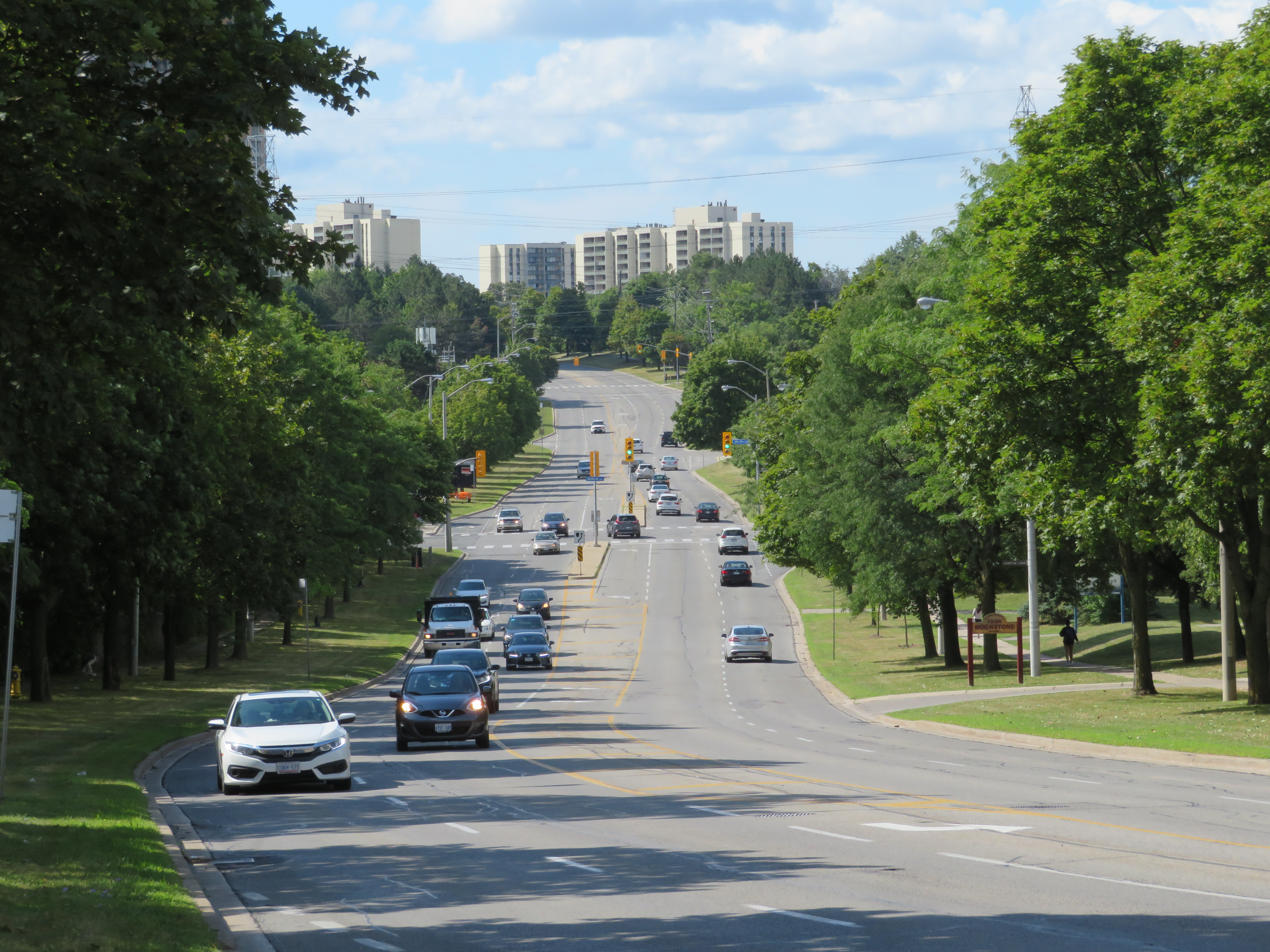
    IMG_3664.JPGDon Mills Road looking south towards McNicoll Avenue, North York
    On the afternoon of Tuesday July 16, a woman was struck and killed by the driver of a left-turning waste collection truck as she was crossing the street. The tragedy happened at the corner of Cliffwood Road and Barkwood Crescent, in a quiet North York residential neighbourhood. The 68-year old was the eighteenth pedestrian killed on Toronto’s streets in 2019. 

    Cliffwood Road is a typical suburban residential street in northeast North York, just south of the municipal boundary at Steeles Avenue. It meets Don Mills Road twice; at the north end, there are traffic signals, with a middle school and a plaza on the east side of the four-way intersection. On the south side, Cliffwood meets Don Mills at a three-way intersection, protected only by a a stop sign facing Cliffwood. As Cliffwood loops back on itself and has no direct connections to Steeles Avenue, it is not a useful short-cut for speeding motorists unlike many other suburban streets.

    What, in particular, contributed to this deadly crash? I paid a visit to the area to find out.

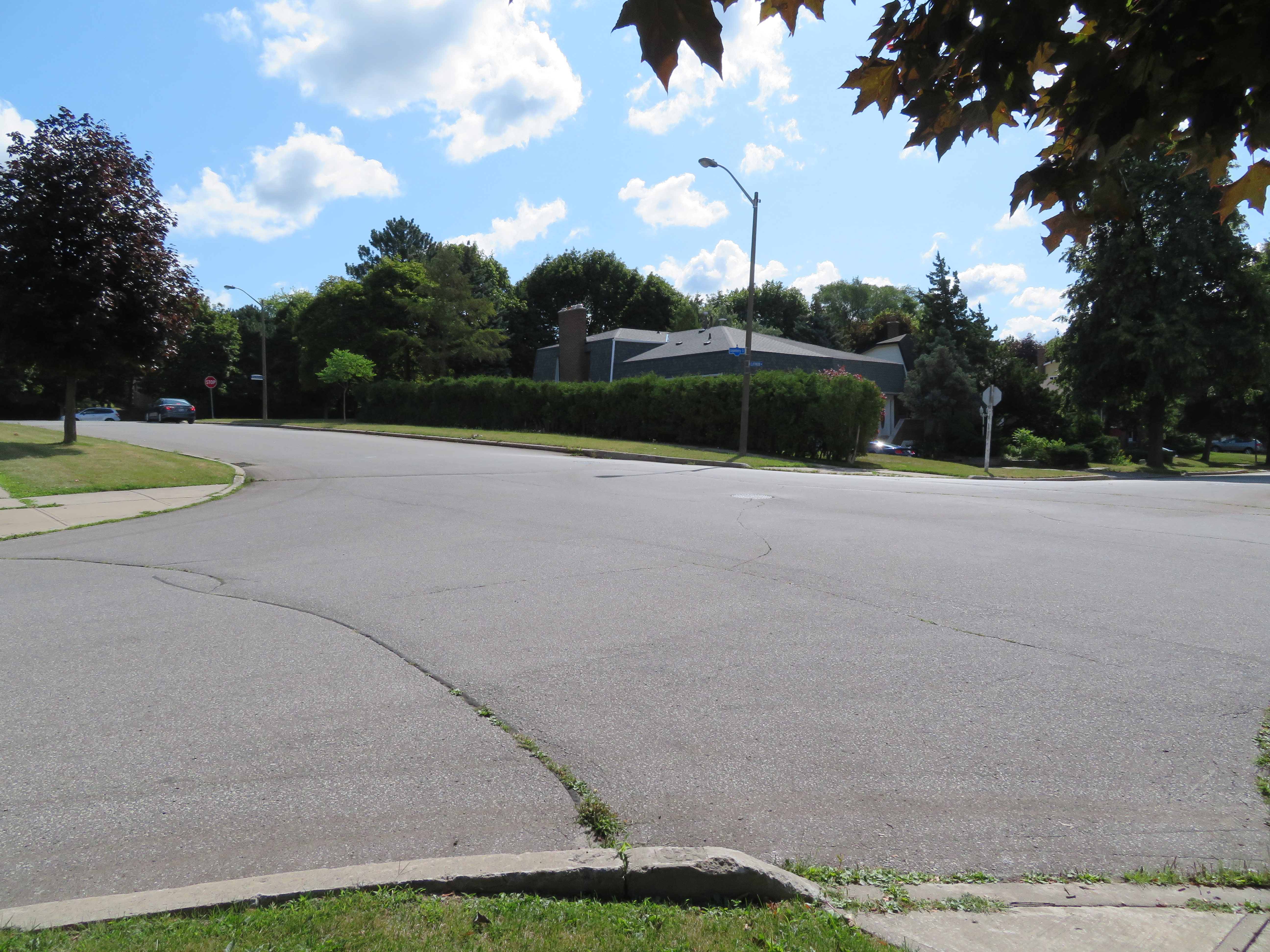
    IMG_3647.JPGThe intersection of Cliffwood Road and Barkwood Crescent, looking southeast
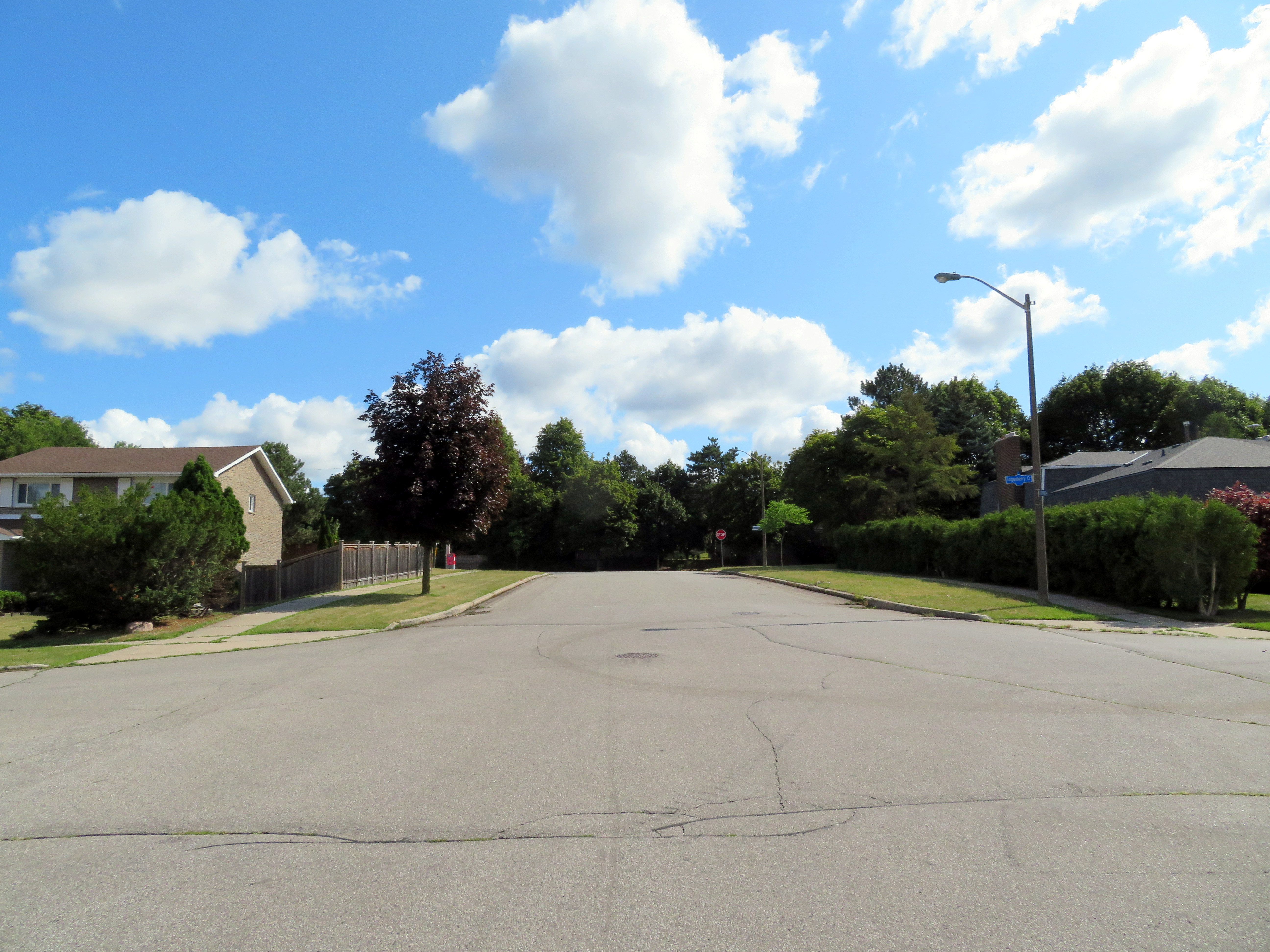
    Between Don Mills Road and Barkwood Crescent, Cliffwood Road is 12 metres wide without any lane markings or medians to separate traffic or slow vehicles turning off of busy Don Mills Road. West of Barkwood Crescent, Cliffwood Road narrows to 8.5 metres. Twelve metres is a lot of road space: Beverley Street in Downtown Toronto is the same width, but it has two driving lanes, a parking lane, and two unprotected bike lanes. The wide street width here only encourages motorists to drive fast after coming off Don Mills Road, while wide curb radii at the corners at Don Mills and at Barkwood Crescent also encourage motorists to take turns quickly.

    At Barkwood Crescent, Cliffwood Road has a speed limit of 50 km/h, the default speed limit in the City of Toronto. Closer to the schools to the north, a 40 km/h speed limit is posted, but there are no physical measures to slow down cars and trucks. Cliffwood Road, like so many other suburban streets, was built for speed, and not for local residents on foot.

    IMG_3648-001An unnecessarily large intersection at Cliffwood Road and Barkwood Crescent, and a wide approach to Don Mills Road
    I also noted the condition of nearby Don Mills Road, a busy thoroughfare connecting office parks in Richmond Hill and Markham with Fairview Mall to the south. Don Mills is a busy bus corridor, with both TTC and YRT buses providing frequent weekday service.

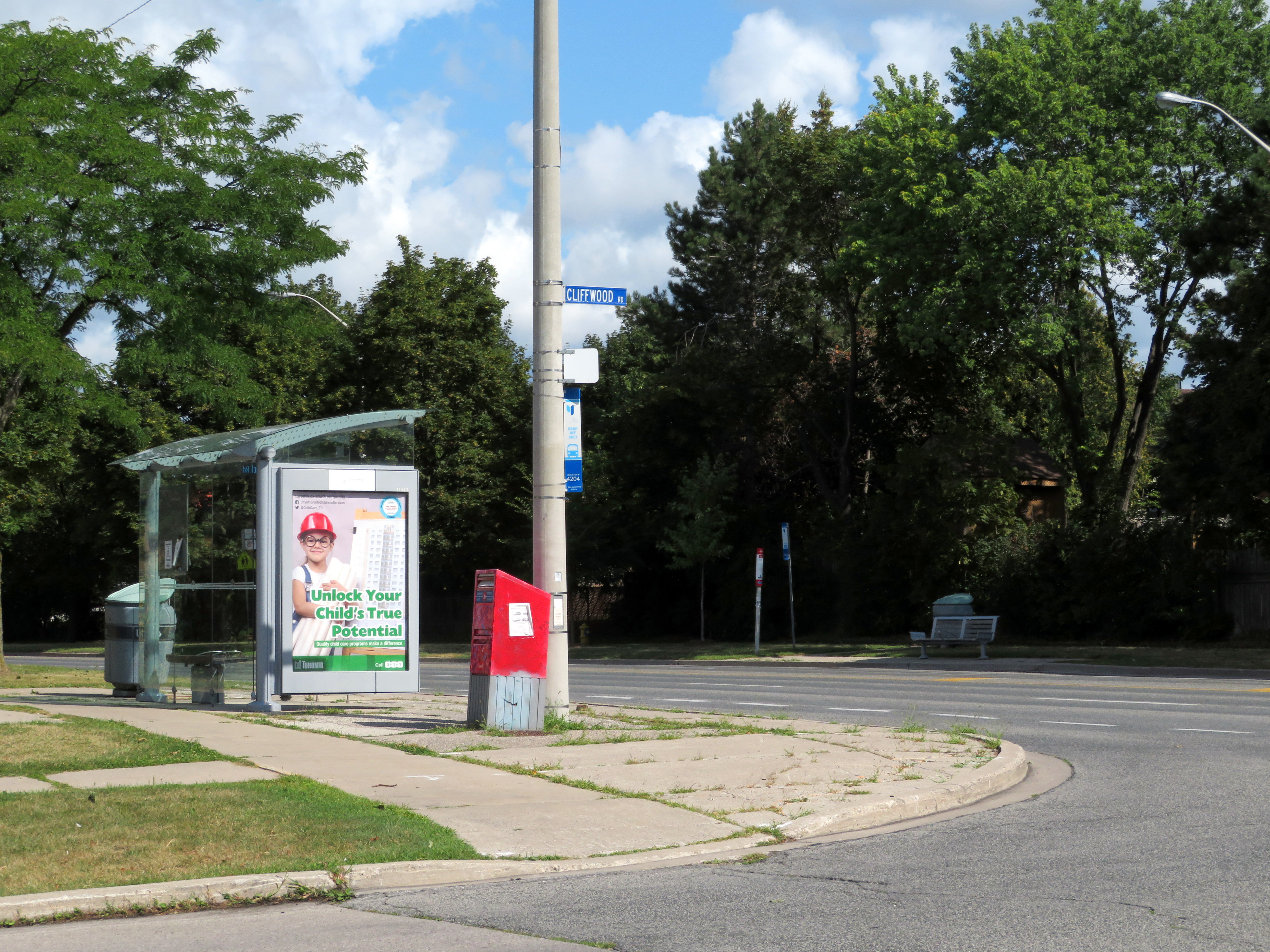
    Despite the frequent bus service, Don Mills Road is hostile to pedestrians and transit users. At the southern intersection of Don Mills and Cliffwood Roads, the nearest crosswalk is nearly 300 metres to the north, or 600 metres to the south. Understandably, most transit users will choose to cross at the nearest TTC stop, rather than walk an extra five or ten minutes twice a day, especially in inclement weather.

    In late August, a pedestrian was crossing Sheppard Avenue East in Scarborough to get to a nearby TTC bus stop when she was fatally struck by a motorist who then fled the scene. That stretch of Sheppard Avenue is flat and straight.

    IMG_3652-001The corner of Cliffwood and Don Mills Roads with bus stops
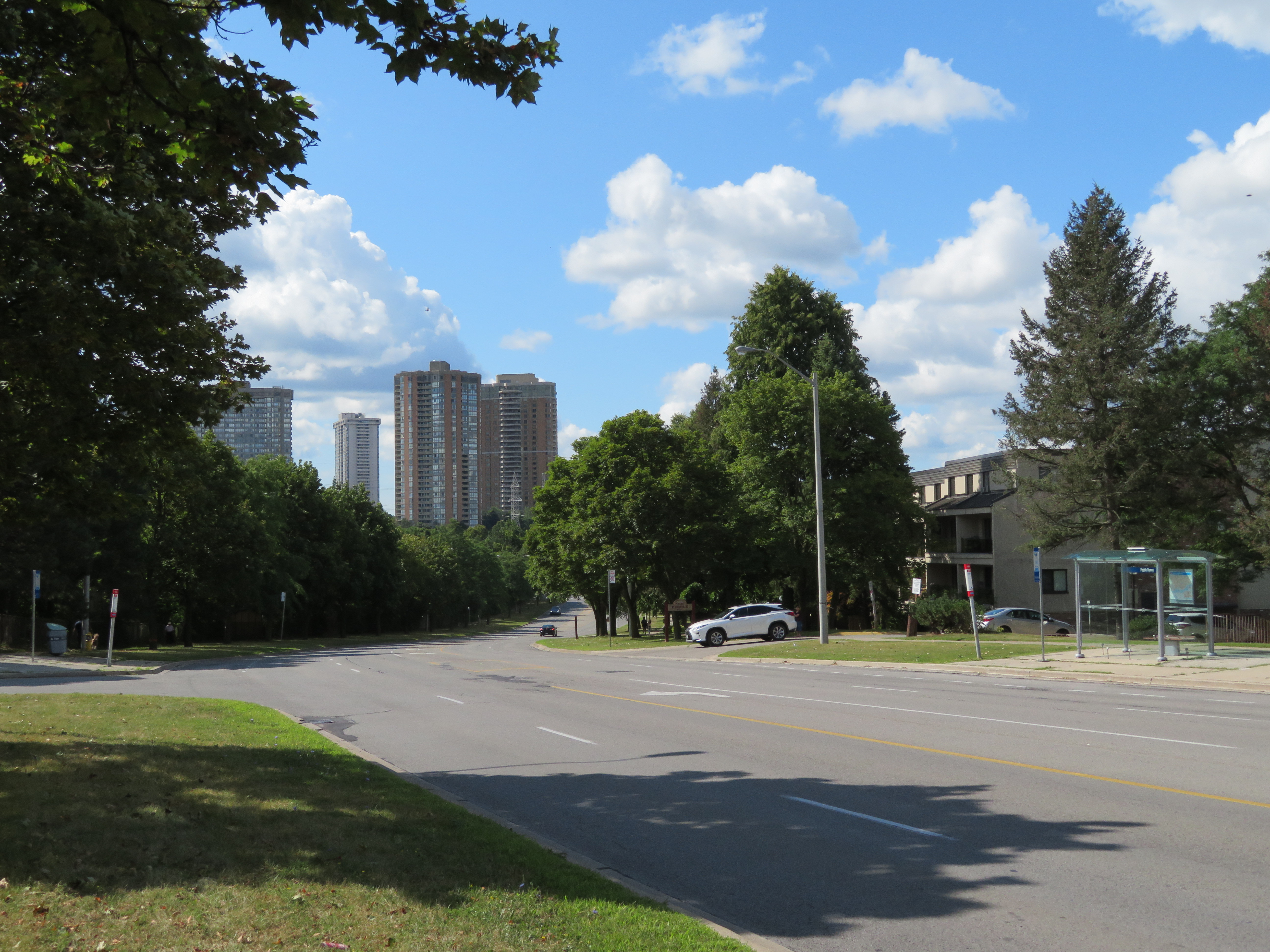
    Most area bus stops are adjacent to bus bays. Bus bays are designed to get buses out of the way of traffic while they are dropping off and picking up passengers. Once the bus is ready to leave the bus stop, it must then merge back into traffic. In addition, many of these bus bays double as right-turn lanes, increasing the distance a pedestrian must cross the street.

    Furthermore, Don Mills has several hills and curves north of Finch Avenue that makes this especially dangerous because of low visibility, making it difficult to judge how far or how fast traffic may be coming. There are five lanes plus bus bays/right turn lanes; the centre lane alternates between serving as a left turn lane or a striped buffer space between northbound and southbound traffic, which further encourages high speeds.

    IMG_3663-001.JPGBus stop at Don Mills Road and Mogul Drive, illustrating the high-speed curves
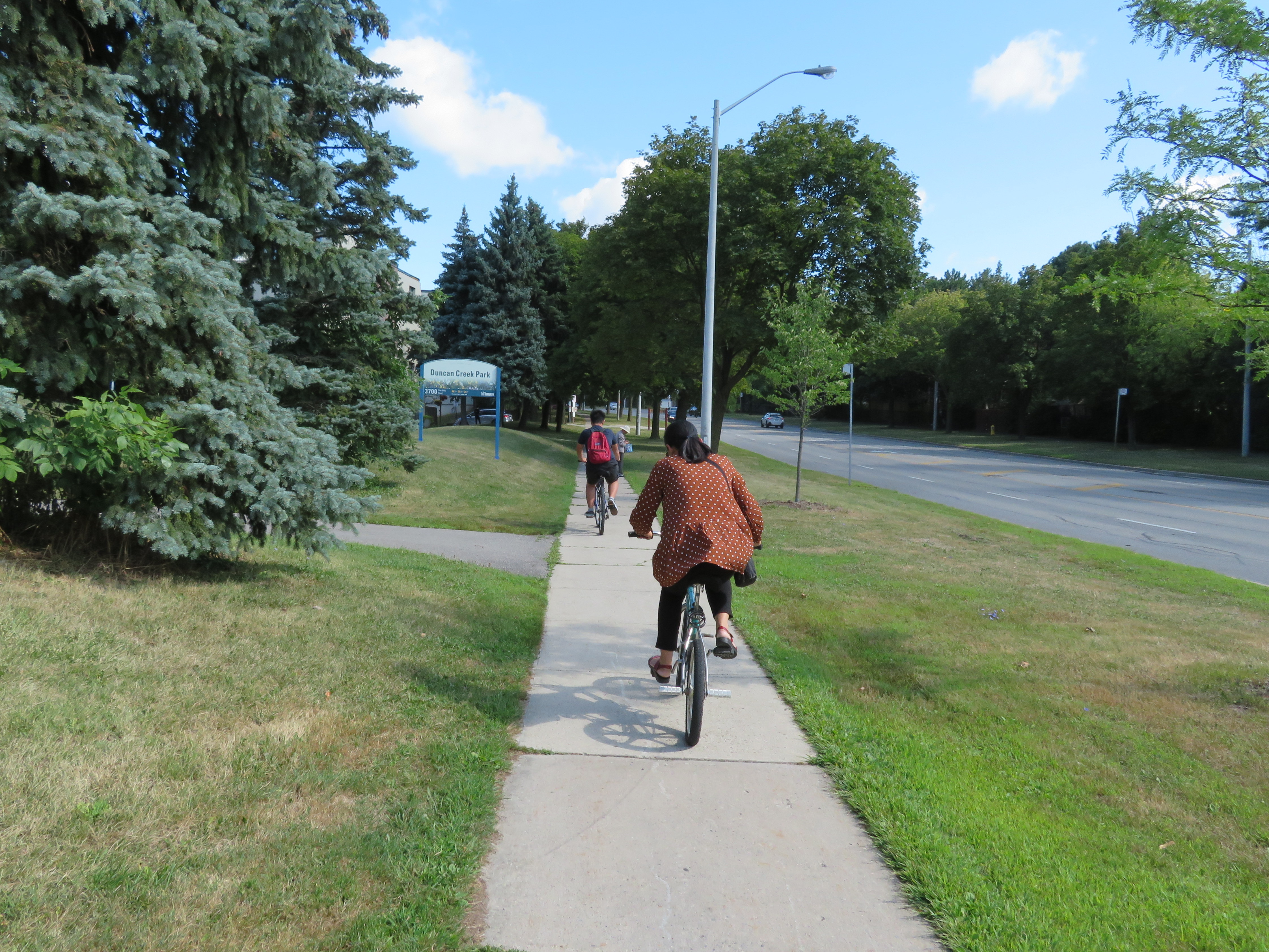
    It is no wonder too that cyclists choose the sidewalks. Despite the wide right-of-way with generous boulevards between the backyard fences and the curbs, no though has been made to improve cycling infrastructure in this part of Toronto. Separated bike lanes or a multi-use path, similar to those on Eglinton Avenue in Etobicoke, or in Peel Region, would make sense here, and along other suburban arterials.

    Cross-ride marking and signals at intersections would improve the safety for suburban cyclists and legitimize a common practice.

    IMG_3630-001Cyclists take the sidewalk on Don Mills Road

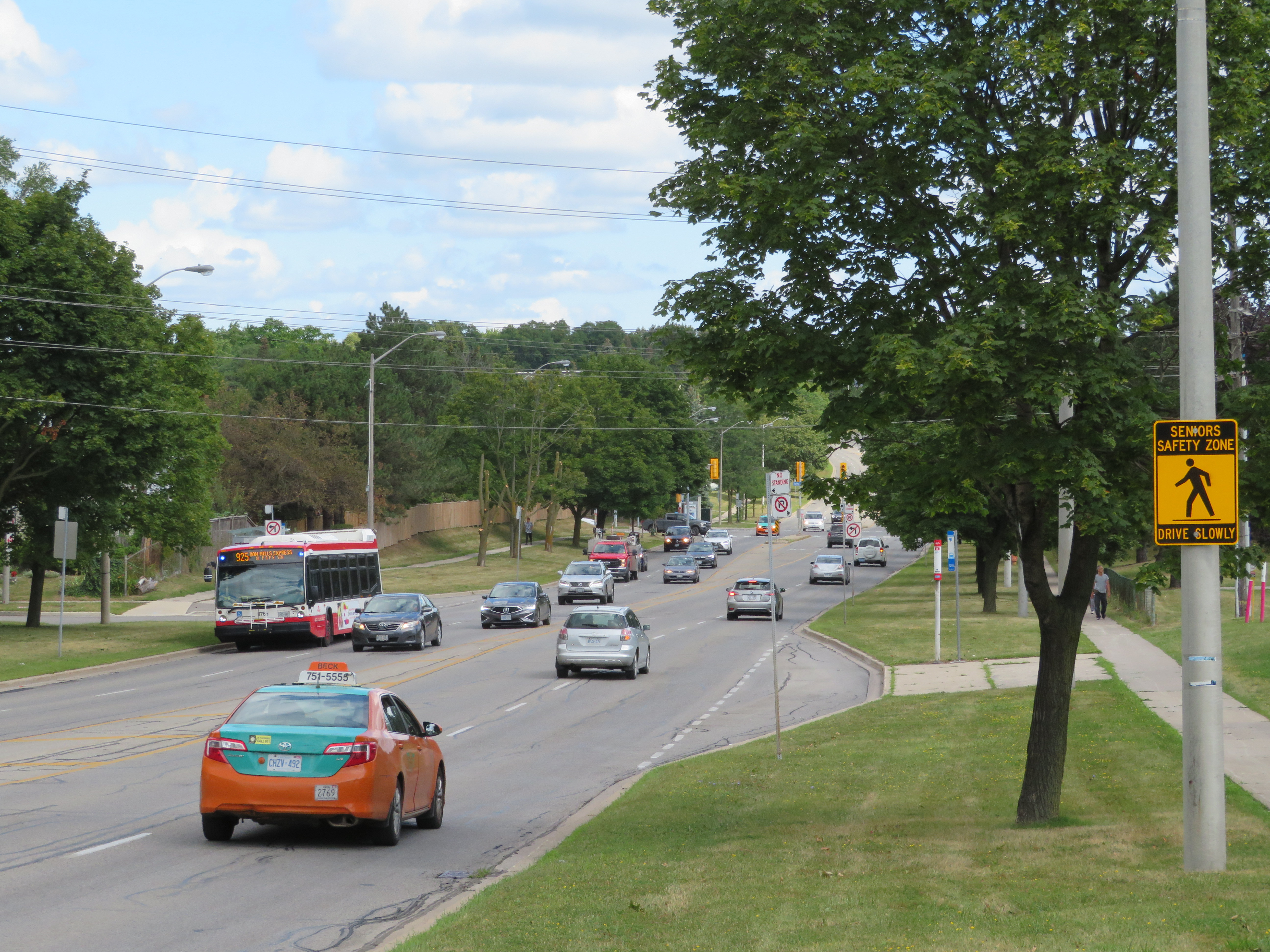
    At the end of my tour of upper Don Mills Road, I could not help but notice I was walking in a signed “Seniors Safety Zone.” As with Eglinton Avenue East in Scarborough, signs were put up but no measures were put in place to slow motorists down, and there was no sign of police enforcement of the posted limit either.

    IMG_3684-001.JPG“Seniors Safety Zone” – note the bus bay behind the sign

    There are a few things that can be done in Toronto’s suburbs to improve the safety of vulnerable road users (pedestrians and cyclists) and reduce the incidence and severity of crashes when they do happen. The installation of safer pedestrian crossings, such as traffic signals would reduce the distance required to get to a TTC stop safely. Bus bays should be eliminated with every road reconstruction project, as they do not benefit transit riders and encourage fast-moving traffic. Finally, residential streets should be narrowed, especially at intersections to slow motorists down, reduce the time a pedestrian is in the street while crossing, and improve their visibility.

    Finally, wide multi-use paths along suburban corridors like Don Mills Road would help promote active transportation and reduce conflicts between pedestrians and cyclists.