Category: Election

  • Mapping Toronto’s approved new ward boundaries

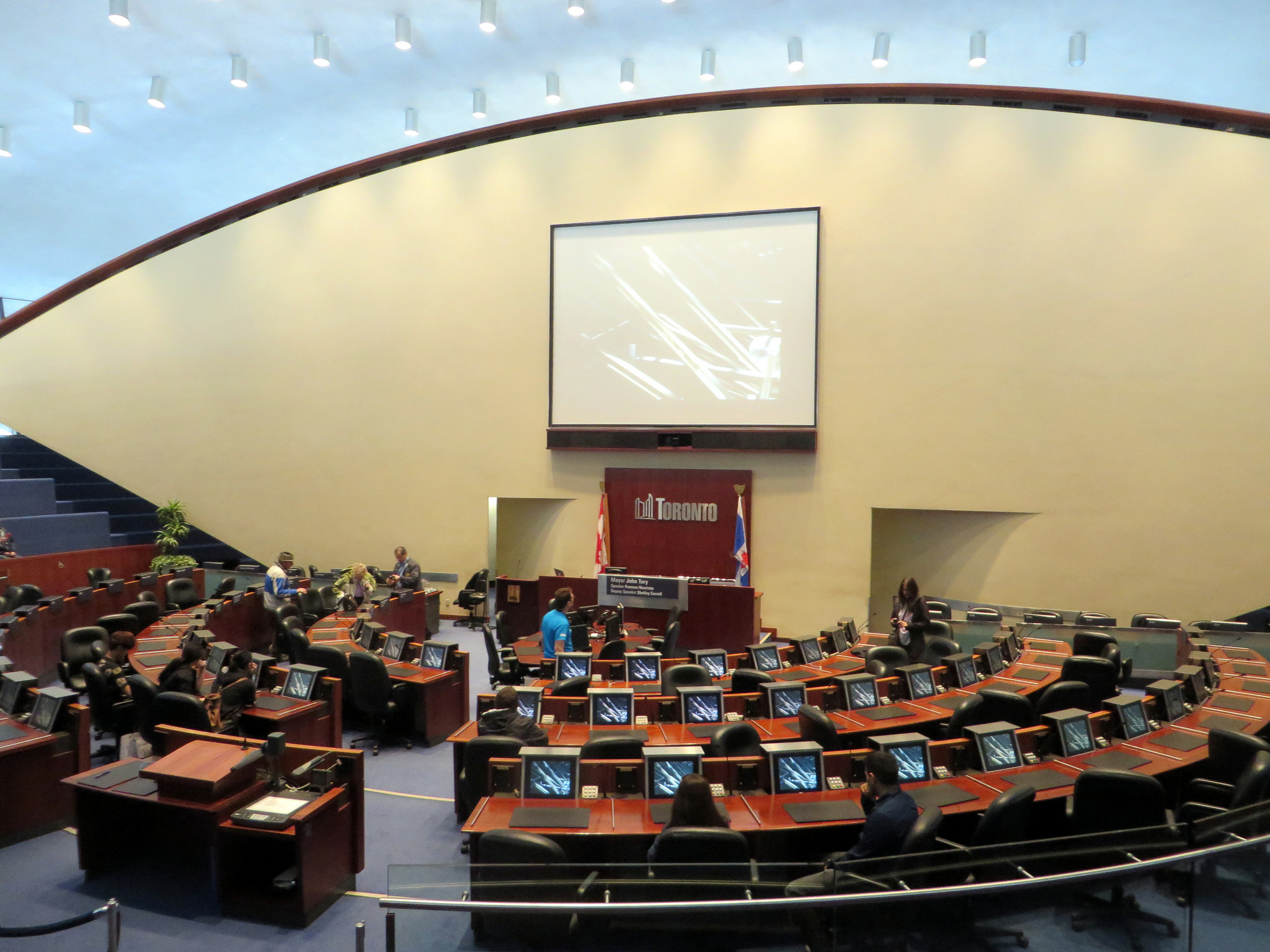
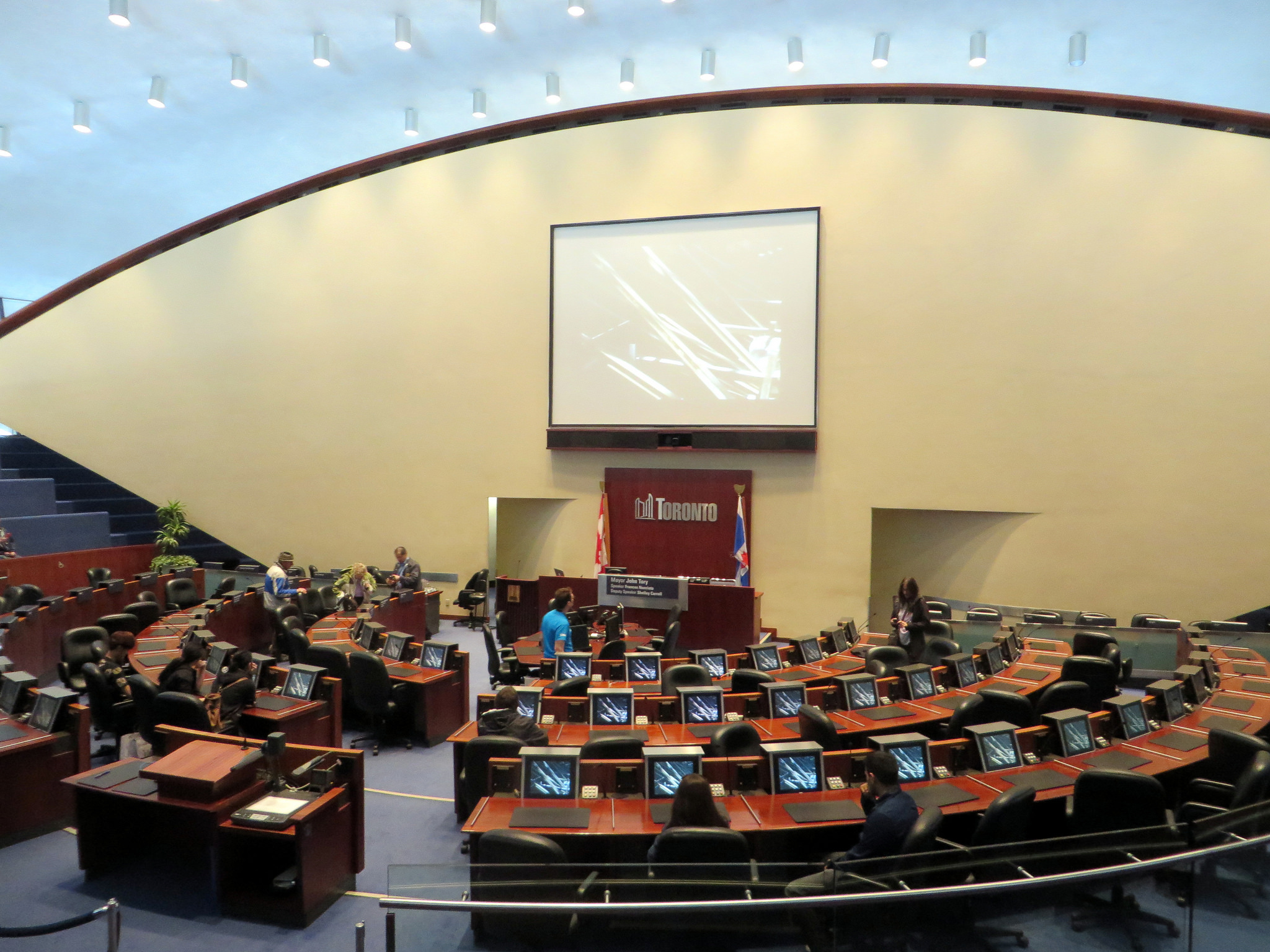
    18506683800_6c96dcc66b_k

    On Monday, October 22, 2018, Torontonians will be electing a new city council. And for the first time since 2000, Toronto’s ward boundaries will be changing.

    When the new council is formed on December 1, 2018, there will be 47 wards, up from 44. Downtown Toronto will gain three new seats, and North York will gain one, but one seat is lost in Toronto’s west end, in an area currently represented by Wards 14, 17, and 18. Seven wards in Etobicoke, North York, and Scarborough will remain unchanged.

    Earlier this week, the City of Toronto added the new boundaries to its open data catalogue, so I used the data to create an interactive Google map. This map, embedded below, shows both the current 44 wards, and the approved new 47 wards. Each of the two ward boundary layers can be turned on and off.


    Google map showing current and approved new ward boundaries

    These new ward boundaries are the result of a long four-year study and consultation process, and represent a compromise that improves representation in high-growth areas, while minimizing the loss of council representation elsewhere. Several other options were explored, including reducing the number of councillors to 25, but they were rejected by the consultants hired by the city to draw the new wards; they were also unpopular among members of the public who attended the consultations.

    While Toronto City Council approved the new boundaries in November 2016 (despite Mayor John Tory’s opposition), Councillors Justin Di Ciano (Ward 5) and Giorgio Mammoliti (Ward 7) appealed the new boundaries to the Ontario Municipal Board. Happily, the OMB dismissed the two councillors’ complaints last month. Both councillors are likely to run for re-election in modified versions of their existing wards.

    I will update the interactive map, adding candidate names for each of the new wards. Nominations are open from May 1, 2018 through July 27, 2018.

    Thanks to Gil Meslin (@g_meslin), who altered me to the fact that the new ward boundaries were available on the city’s website. 

  • A call for a progressive Toronto

    18506683800_6c96dcc66b_k.jpgI created this website two and a half years ago as a repository for the series of maps I created documenting the results of the 2014 municipal election. Unlike many political observers, I focused not just on the mayoral race, but also on each of the 44 council races; I created poll-by-poll maps illustrating how each ward voted, for both mayor and councillor. I thought that the information might be useful for the 2018 election.

    I kept this blog going by sharing my thoughts on public transit, land use planning, electoral reform, as well as other diversions, such as out-of-town bike rides and my trip on Cuba’s Hershey Train. It has been a lot of fun sharing those thoughts. Yet I remain interested in city politics, especially in electing better people to Toronto City Hall.

    The last municipal election was very disappointing. I originally supported Olivia Chow, before turning my attention to David Soknacki, who ran on a campaign of ideas and honesty, but dropped out in early September 2014. I was repulsed by the incumbent mayor, Rob Ford, and his brother, Doug, yet I couldn’t trust John Tory, who ran on a centre-right platform of low tax increases, a since-discredited transit plan called “SmartTrack” and not being Rob or Doug Ford.

    Tory won that election, of course, beating Doug Ford and Olivia Chow. Tory’s support came from his midtown base of relatively affluent, mostly white, home-owning voters. Tory also did well in other affluent neighbourhoods, such as Etobicoke’s Kingsway, Swansea, the Beaches, and Cliffside, and in neighbourhoods where condominium apartments are a common housing type. As Chow’s campaign floundered, Tory picked up the votes from progressive electors afraid of a Doug Ford win. In the end, Olivia Chow did best in west-end, older downtown neighbourhoods like the Annex, Seaton Village, Parkdale, and Trinity-Bellwoods.
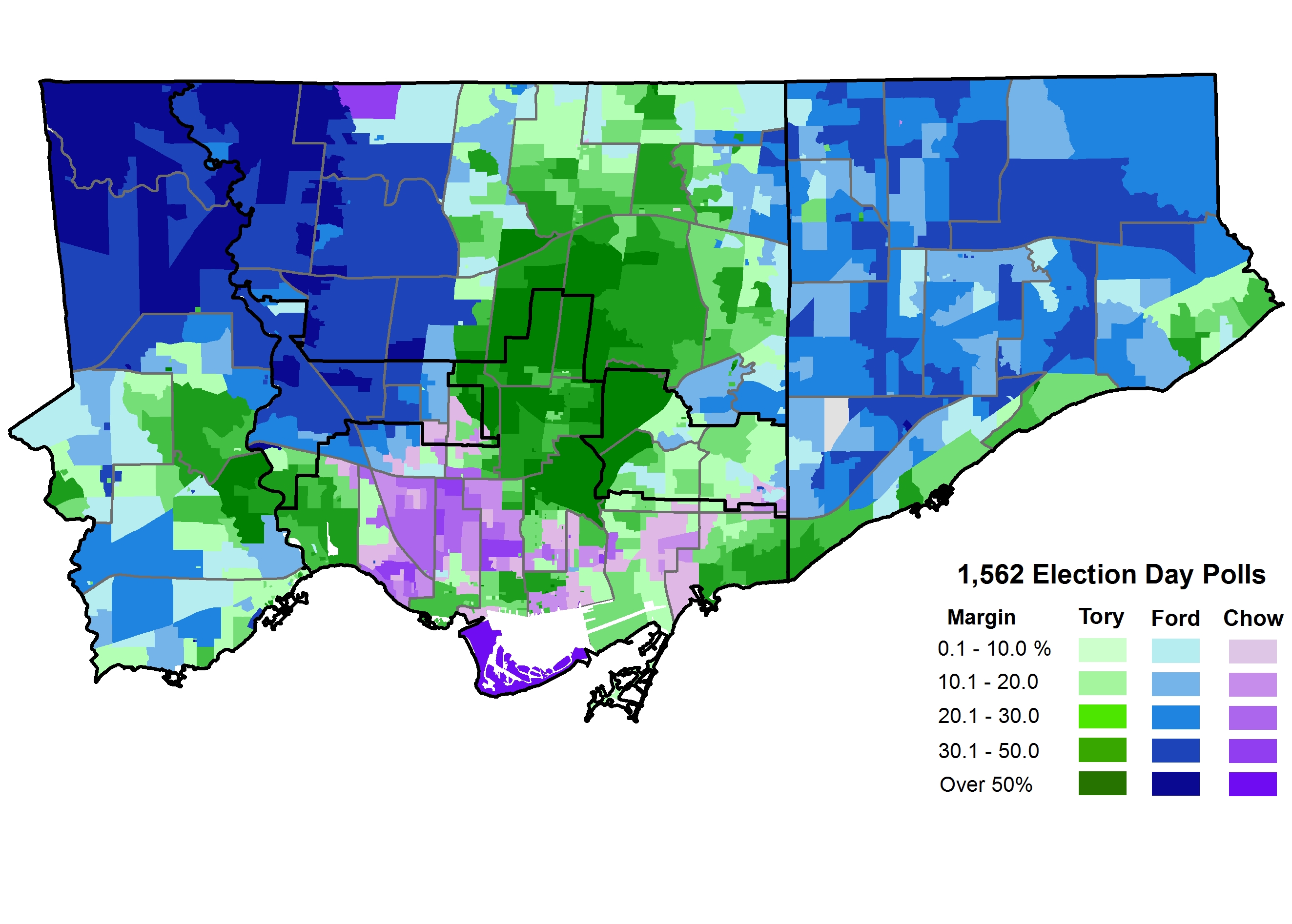
    2014 Election - Mayor Votes by Sub 2014How Toronto voted in 2014

    Giving Tory some benefits of my doubts, I had hoped that he would push a strong city-building agenda, balancing business interests with the needs of disadvantaged residents. Instead, Toronto got an austerity agenda with the top goal of keeping property taxes low, leaving essential city services underfunded and public housing units falling apart. He resisted police reform, including flip-flopping on the elimination of the racist carding program. His signature transit plan, SmartTrack, was watered down to a point where it’s nearly unrecognizable, wasting valuable time and capital that could have been spent developing the Relief Line subway. It’s almost as if we re-elected Rob Ford, but without the homophobia, overt racism, and self-destructive behaviour.

    Tory is backed by a council that has mostly supported his agenda. Had a few council races gone another way, the mayor would have had a harder time freezing or cutting budgets for housing and shelters, transit, libraries, planning services, and other essential programs. Last week, Tory and his council allies endorsed a budget freeze for 2018, defeating motions to exempt homeless shelters, poverty-reduction programs, and long-term care homes. Accounting for inflation, this is in effect, another budget cut of two percent.

    John Tory will run for re-election in 2018, and he is already in campaign mode, targeting the province for funds to repair TCHC housing and the Relief Line. It’s possible that Doug Ford will run for mayor again, on a right-wing populist message. So far, no one has indicated that they will run to the left. At least there’s still city council, with 44 members, which is difficult, but possible to change. Council, not the mayor, holds the power.

    In 2014, only one incumbent —John Parker, in Ward 26 — was defeated. Parker, a thoughtful and reasoned conservative, lost his seat to Jon Burnside, a former Toronto police officer endorsed by John Tory. In total, only seven new councillors were elected to City Council that year, though there were two by-elections since.

    But each of those newcomers were elected either on a second run for city council, came from another level of political office, or had family political ties. There’s hope for next year.

    Right-leaning councillors Burnside and Justin Di Ciano (Ward 5) ran unsuccessful campaigns in 2010 and won office on the second try. John Campbell (Ward 4) was the previous Chair of the Toronto District School Board, and Jim Karygiannis (Ward 39) was a Liberal MP. Stephen Holyday (Ward 3) is the son of former Etobicoke mayor and councillor Doug Holyday, and Joe Cressy (Ward 20) is also the son of two former Toronto city councillors. Christin Carmichael Greb is the daughter of defeated Conservative MP John Carmichael. Carmichael Greb also enjoyed John Tory’s endorsement; Tory’s robocalls supporting her campaign  helped her win in a hotly contested open race.

    To win a seat on Toronto City Council, especially without a party system, you need name recognition or you need connections. Having political connections makes it a lot easier to raise money and attract talent to run a campaign. That name recognition gives you attention from the media and helps at the ballot box. It’s a lousy system that shuts out too many fine, talented people who are unable to spend the money and time to run a serious campaign, and it creates political dynasties, for better or for worse.

    With only 18 months before the 2018 municipal election, it’s time for anyone who opposes the Ford/Tory agenda to organize.

    It’s likely that Mayor Tory will likely win re-election, but we still need a strong, progressive candidate for mayor, willing to take Tory to task for the consequences of his budget cuts, his dithering on transit infrastructure, and his resistance to police reform. If nothing more, it will make the mayor accountable, and energize progressive voters.

    But even more importantly, it’s necessary to back progressive candidates for city council, ideally replacing weak representatives on City Council, and especially against unreasonable and uncooperative politicians like Giorgio Mammoliti (Ward 7), and councillors who actively resist change, like Tory ally Justin Di Ciano (Ward 5),who blocked municipal voting reform and is now fighting Toronto’s new ward boundaries.

    Council, too, needs even more diversity. It needs more women and people of colour to better reflect the city it is supposed to represent. And there are good people working towards that. For example, on Wednesday, June 7, Women Win Toronto, will launch.

    I will be backing several progressive candidates next year — some of whom will be running a second time — by contributing my time and money in key races. (I’ll share my endorsements next year.) Only a few new faces need to be elected to change the dynamic at City Hall. And even if you doubt your chances of winning in 2018, run anyway. You will have the chance to have your voices heard, and set the stage for running again in 2022. That’s how politicians get elected.

    Good luck!
  • Mapping Mayor Tory’s support on Council

    Matt Elliott, columnist for Metro Toronto, is one of Toronto’s greatest observers of local politics. One great service that he does is keep track of all important votes at Toronto City Hall. Originally, this work tracked each councillors’ support for Mayor Rob Ford from 2010 through 2014; now his scorecard tracks how each councillor voted according to Mayor John Tory’s agenda. The Council Scorecard spreadsheet is available here.

    In 2014, I created several maps using Elliott’s data that helped to show how Rob Ford lost control of City Council. In Ford’s first year, he was able to count on the support of 22 councillors, enough to get most of his agenda passed. But by 2014, only two councillors – Giorgio Mammoliti (Ward 7) and Rob’s brother, Doug (Ward 2) voted with the mayor at least 70 percent of the time.

    I felt it was about time to map how well Mayor Tory is doing.

    torys-team-score-2015
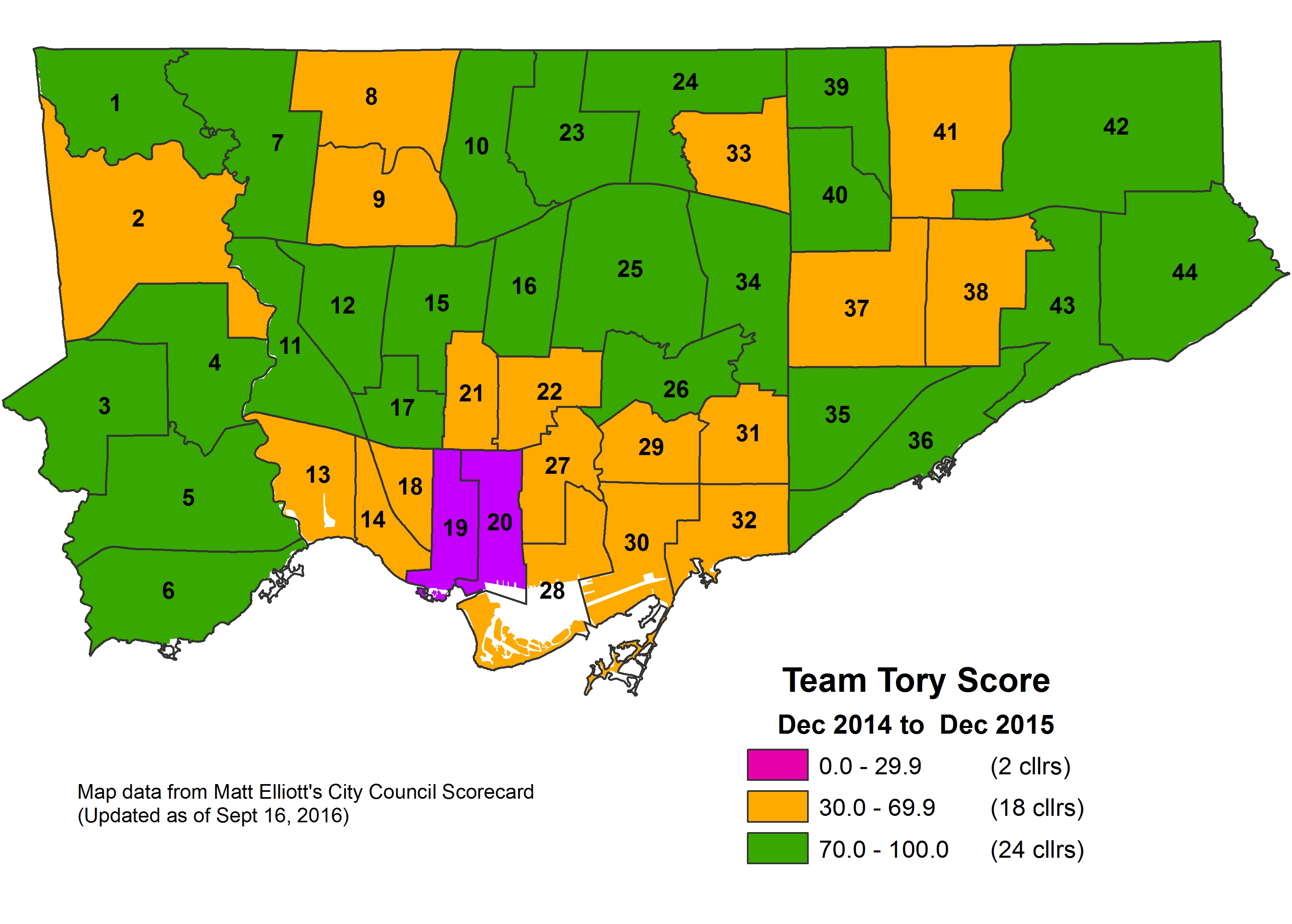
    Team Tory Score, as of December 2015

    In his first year as mayor, from December 2014 to December 2015, Tory enjoyed the support of over half of Toronto City Council; 24 of 44 councillors voted with the mayor at least 70 percent of the time. Important votes on budget austerity, council appointments (such as Police Board Chair and Tory friend, Andy Pringle), approving the “Hybrid” option for the Gardiner Expressway, and approving Uber’s operations in Toronto were all passed.

    But there were some surprises. Many key Tory supporters voted against the mayor on a motion introduced by Councillor Justin Di Ciano (Ward 5) to ask the province not to support ranked ballots. The mayor, who supported the electoral reform, lost that vote.

    In that first year, most other councillors provided some support, voting with the mayor at least 30 percent of the time, including former mayor Rob Ford (Ward 2). The wards that these councillors represent are marked in orange. Generally, these wards are represented by centrist or left-leaning councillors such as Josh Matlow (Ward 22), Maria Augimeri (Ward 9) and Shelley Carroll (Ward 33).

    Only two councillors — Mike Layton (Ward 19) and Joe Cressy (Ward 20) voted opposite to Mayor Tory over 70 percent of the time in 2015.

    torys-team-score-to-june-2016
    Team Tory Score, as of July 2016. Votes from the October 2016 Council Meeting not yet included. 

    So far in 2016, the divide between the allies of the mayor and his opposition widened. Only ten councillors were left in the middle (all centre-left), while five councillors — Gord Perks (Ward 14), Kristyn Wong-Tam (Ward 27), Paula Fletcher (Ward 30), Janet Davis (Ward 31), and Anthony Perruzza (Ward 8) joining the opposition. With the exception of Ward 2, vacated after Rob Ford’s death, all councillors from Etobicoke and Scarborough became clear Tory allies.

    It’s worth noting few normally centrist councillors, who were very effective in opposing Rob Ford’s agenda last term, are now staunch allies, including Paul Ainslie (Ward 43), and Bailão (Ward 18). Both are members of Tory’s Executive Committee; Ainslie, a centre-right councillor who has earned my great respect, was also appointed chair of the Government Management Committee.

    Opposition to Tory’s agenda from councillors in the Toronto-East York region might help to explain why the Executive Committee, hand-picked by Tory and his transition team, did not have much enthusiasm for the 47-ward solution recommended by consultants on the Toronto Ward Boundary Review team. To reflect population growth, Downtown Toronto would get three new councillors in 2018, as would central North York. One ward would disappear in Toronto’s west end; incumbent councillors Ana Bailão (Ward 18) and Cesar Palacio (Ward 17), both Tory allies, are the most affected by that change. In May, the committee requested that the consultants go back to the drawing board and look at a new 44-ward option, as well as ward boundary options consistent with provincial and federal ridings. The consultants did that, and are once again recommending the 47-ward option.

    Almost half-way through his term, Mayor Tory has a confident and strong hold on Council, which has so far supported an agenda of austerity, along with major (and in my view, unwise) transportation infrastructure projects like the Scarborough Subway and the Gardiner East reconstruction.

    It is worth noting as well that apart from Bailão, all councillors from “downtown” wards were frozen out of Tory’s inner circle, even though many downtown and midtown wards enthusiastically voted for Tory in the 2014 election. Furthermore, most of the same councillors that support Tory at least 70 percent of the time also supported Ford’s agenda in 2011 and 2012. Key supporters of Ford’s early agenda went on to sit on John Tory’s Executive Committee.

    While there’s a slightly conservative bent to Toronto City Council, left-leaning mayor David Miller was able to work with centrists and conservatives, including suburban councillors, to implement his agenda, appointing several to key boards and committees. Tory, on the other hand, has frozen out council’s progressives, perpetuating an urban-suburban divide.

    ford-nation-percentage-2011-crop
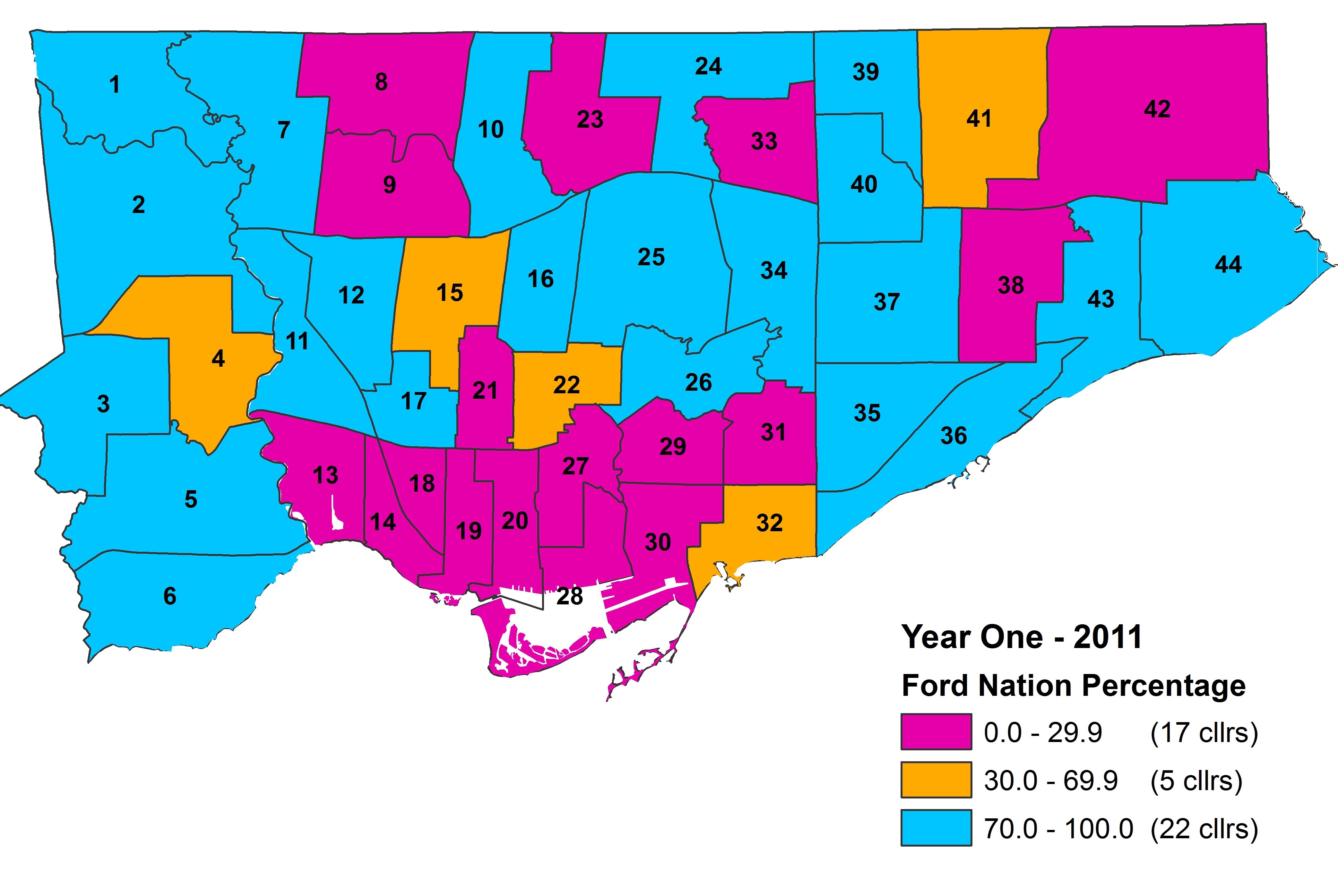
    Mayor Rob Ford’s allies and foes in 2011

    It’s possible that Tory’s hold on power will slip as councillors get restless, or if there’s a backlash to cuts to city services such as the TTC or the Toronto Public Library. After all, Rob Ford’s hold on power slipped long before the crack scandal as residents fought back against budget cuts, and council quashed the Ford Brothers’ attempt to build a Ferris wheel and mall in the Portlands.

    The mid point between municipal elections is coming up, and there’s an opportunity to make changes to committee and board appointments. There’s still an opportunity for new alliances to be made and for goals to change to support a growing city and address growing economic disparity.

  • Mapping the Ward 2 by-election

    Ward 2 By-election
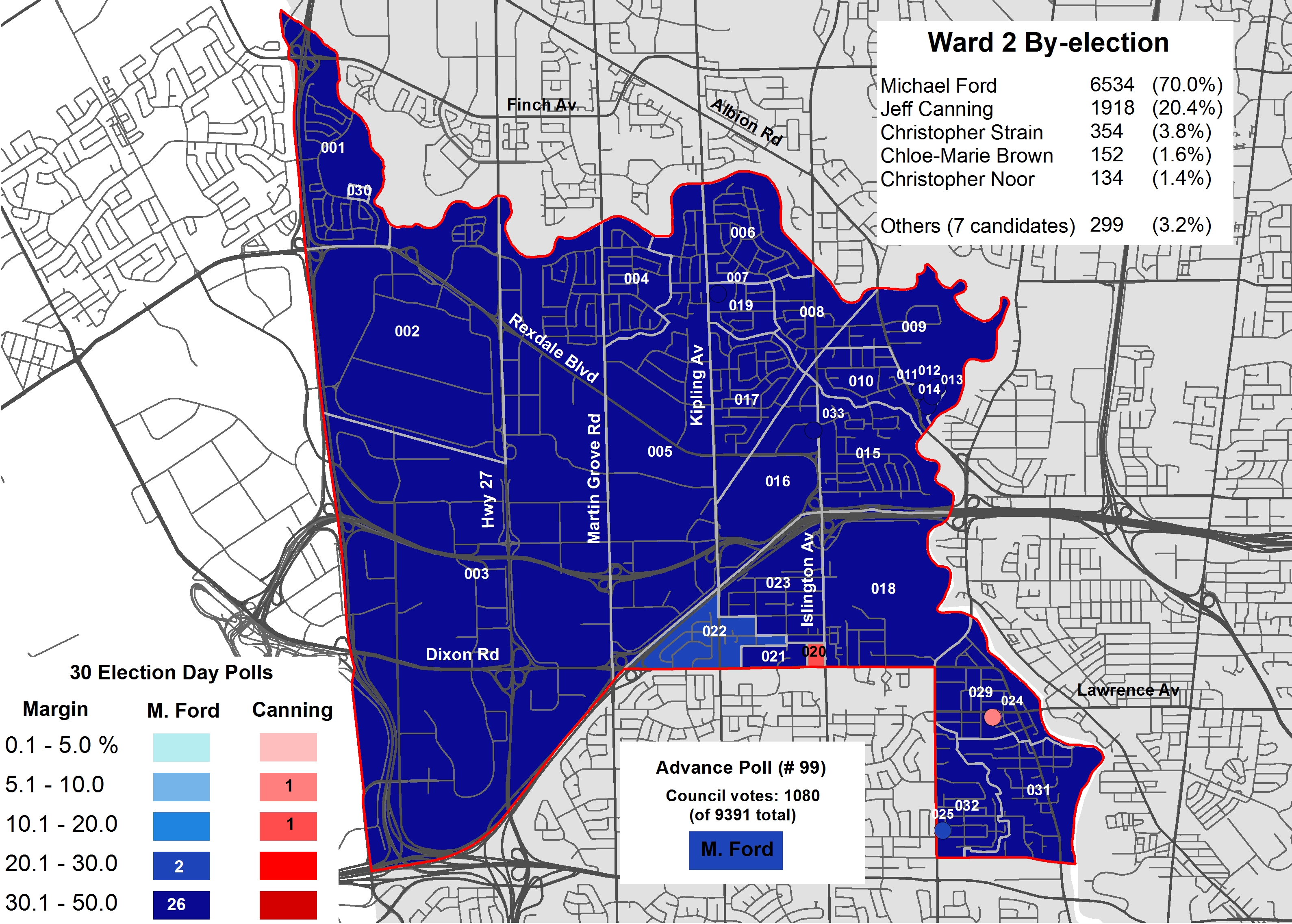
    Poll results of the 2016 council race in Ward 2

    On Monday, July 25, residents of Ward 2 (Etobicoke North) went to the polls to elect a new councillor to replace the late Rob Ford, who was elected as councillor in the 2014 general election after a disastrous four years as mayor.

    After Rob Ford’s death in March 2016, it was widely expected that the Ford family would field a candidate; it would either be former Ward 2 councillor Doug Ford or Rob and Doug’s nephew Michael Ford (née Stirpe).

    Michael Ford, then 20 years old, ran for councillor in the 2014 general election. He withdrew in September 2014 to run for the local Toronto District School Board trustee position, so that Rob Ford could run for councillor instead, abandoning his bid for re-election as Mayor of Toronto due to his poor health. Doug Ford, who originally wasn’t going to run again for municipal office, ran for mayor in Rob’s place, coming in a strong second to John Tory. I mapped those results in a previous post. 

    Right away, Michael Ford was the clear favourite to win the by-election. The Ford name is famous in north Etobicoke; Doug Ford Senior was a Progressive Conservative MPP from 1995 to 1999; Rob Ford represented Ward 2 from 2000 through 2010 before running for mayor, and winning against George Smitherman. But Michael Ford, only 22, claimed to be his own person; his brief tenure on the TDSB board has been without the buffoonery or intolerance that Rob and Doug exhibited; Michael attended the 2016 Pride Parade in 2016, something the other Fords made a point of avoiding. But Michael Ford campaigned on a platform of “customer service” — the same philosophy that made Rob Ford popular in his ward.

    There were eleven candidates running against Michael Ford. They included:

    • Entrepreneur Justin Canning, a right-of-centre candidate who made a point of saying that Michael isn’t like Rob and Doug Ford when quoted in the Toronto Star;
    • Christopher Strain, a New Democrat who managed Russ Ford’s campaign for councillor in Ward 6 in the 2014 election;
    • Chloe-Marie Brown, a volunteer and City Hall intern who sought to represent her community and bring attention to the needs of lower income residents of North Etobicoke.

    Voter turnout was low, as they often are for municipal by-elections. Only 9391 residents voted in 2016, less than half the 19,793 votes for councillor that were cast in 2014. And to no one’s surprise, Michael Ford won, with 70.0%of the vote. Justin Canning came in a very distant second, with 20.4%, Chris Strain had only 3.8% of the vote, Chloe-Marie Brown only got 1.6%.

    Michael Ford came in first place in all by two polls by wide margins, as shown in the map above. Only two polls, 020 and 024, chose Justin Canning. Poll 020 represents two condo towers on Islington Avenue at Dixon Road, while Poll 024 represents a seniors’ residence on Lawrence Avenue. Both polls voted for Rob Ford for council in 2014, but for John Tory for mayor over Doug Ford.

    Even though I am willing to give Michael Ford a chance to prove himself as city councillor (and we will see how different he truly is from his uncles), the low voter turnout and the inevitability of Ford’s win still troubles me. Perhaps the low turnout was partly due to the assumption that Ford would win this by-election; holding it in the middle of summer wouldn’t have helped either. But there was a solid choice of alternative, qualified candidates that deserved voters’ consideration. Ward 2 deserved a real contest, not another coronation.

  • Exploring the downtown federal election races: Part III

    Last year, I posted maps showing how each poll voted in the 2011 and 2013/2014 by-elections in two key Downtown Toronto federal constituencies: Trinity-Spadina, and Toronto Centre. I also provided some thoughts about the races and the candidates. Now, over six months since the October 2015 election, I took some time to look at what happened.

    (Elections Canada was also slow to release poll-by-poll data; in comparison, the City of Toronto was very fast — I was making poll-by-poll maps of ward races weeks after the 2014 election.)

    In the 2015 federal election, these two ridings were split into three: University-Rosedale, Spadina-Fort York, and a much smaller Toronto Centre. In 2015, all three ridings were ones to watch; all three had high profile Liberal and New Democratic candidates vying to a seat in Parliament.  (more…)

  • Mapping Toronto’s proposed new ward boundaries

    18506683800_6c96dcc66b_k

    Toronto is way overdue for ward boundary reform. Finally, in time for the 2018 election, Toronto will have reshaped ward boundaries — and probably three new wards. This will give quickly-growing Downtown Toronto and North York Centre more representation at City Council.

    Consultants retained by the City of Toronto have been tasked with reviewing the size and shape of Toronto’s wards, and providing a recommendation for new ward boundaries. Back in August 2015, an options report was released with five distinct options. After further consultation, the final report was released yesterday, May 16.

    The final report’s recommendation is similar to the “Minimal Change” option in last August’s options report, but there have been some minor tweaks to the ward boundaries. If the recommendations are approved by City Council, there will be 47 wards, up from 44. Each new ward will have an average population of 61,000, with a range between 51,800 and 72,000 (+/- 15%). These new wards are designed to last for four election cycles, and will be re-drawn again in time for the 2034 election.

    The report will be considered by the Executive Committee on May 24, 2016, which will vote on a recommendation to take to City Council on June 7, 2016. If there are no further hiccups, this gives just over two years for aspiring council candidates and city staff to prepare for the next election, which will be held on Monday, October 22, 2018.

    The recommendation brought forward is a compromise that improves representation in high-growth areas, while minimizing the loss of council representation elsewhere. It increases the number of councillors, but by a minimal amount. (Had Toronto maintained the practice of having two wards per provincial/federal riding, there would be 50 councillors.) Happily, proposals to cut the number of representatives at City Council were not a very popular idea. In terms of staffing and associated costs, each councillor costs approximately $290,000; it would therefore cost about $870,000 to add three new wards, which in my opinion, is a bargain.

    While Downtown Toronto will gain three new seats, and North York gaining one, one seat is lost in Toronto’s west end, in current wards 14, 17, 18. This probably squeezes out Cesar Palacio, a rather poor city councillor who remains in office despite strong competition in the last few elections. Otherwise, despite ward boundary shifts across most of the city, every incumbent councillor should easily find a home that’s mostly made up of their current turf.

    I created the CartoDB interactive map, linked below, for Torontoist; my full article is available there.

    I mapped the results of the 2014 election for every ward in the city — that was the primary reason why I started this blog in November 2014. That previous work should be helpful for predicting the results of the 2018 election with the new boundaries.

    https://seanmarshall1.cartodb.com/viz/5c5c1540-1b21-11e6-8cfa-0ecd1babdde5/map


  • Some thoughts about the 2015 election and Canada’s new government

    My congratulations to Prime Minister Justin Trudeau and the Liberal Party. The Liberals managed to win a healthy majority government on October 19, 2015, defeating Stephen Harper and the Conservatives. I’m not completely happy with the election day results, but I think there is still plenty to be satisfied about. For now, I’m cautiously optimistic thanks to a clear Conservative defeat and the first few moves on the incoming Liberal government.

    (more…)

  • A disappointing step backwards for ranked ballots

    I’ve long been a fan of ranked ballots, a voting system that Dave Meslin and the good people at RaBIT have been promoting for a long time. At the municipal level, ranked ballots —also known as instant run-off voting — is a simple, yet effective way of improving local democracy.

    Ranked ballots ensure that politicians are elected because they can enjoy the support of a majority of electors, so they are fairer than the first-past-the-post system we currently use to elect city councillors. To some degree, it reduces the advantage that incumbent councillors enjoy due to name recognition, and they promote diversity in local politics. I think they’re a better idea than term limits, recalls, or municipal parties.

    The provincial government is currently reviewing the Municipal Elections Act; reforms may allow municipalities to adopt ranked ballots. At first the City of Toronto seemed to be eager to sign on; in 2013, Council adopted a motion to ask the province to allow ranked ballots to replace the current electoral system; more recently Mayor John Tory expressed his support for the idea.

    But during a recent council meeting, newly-elected Councillor Justin Di Ciano (Ward 5) just threw a wrench into the works. Calling ranked ballots “confusing,” he put forward a motion to ask the province not to allow ranked ballots. It passed, 25-18.

    The map below illustrates the result of that vote by ward.

    Ranked ballots vote

    Incumbent councillors might be wary of ranked ballots, especially if they face multiple opponents. Fifteen councillors (and Mayor Tory) were elected with less than 50% of the vote; they would be vulnerable to ranked ballots. Three of those councillors: Ana Bailão (Ward 18), Joe Cressy (Ward 20), and Raymond Cho (Ward 42), were brave enough to vote the right way on Di Ciano’s motion.

    Conversely, councillors such as Norm Kelly (Ward 40, who won with 86% of the vote), Michael Thompson (Ward 37, 84%) and Jaye Robinson (Ward 25, 83%) voted for the motion. Justin Di Ciano himself won with 54% of the vote in Ward 5. The “yes” votes were mostly from Council’s right wing, but left leaning councillors such as Maria Augimeri (Ward 9) and Paula Fletcher (Ward 30) joined in. Augimeri would have almost definitely lost in 2010 had ranked ballots been adopted; it’s possible that Fletcher would have been voted out in 2010 and in 2014 under this voting system.

    2014 Election - Councillor win percentMap of the share of votes each councillor was elected by in 2014.  

    The fight for ranked ballots is far from over; Mayor Tory still has plenty of political capital and sway with the provincial government. I’m hopeful that council will reverse itself yet again.

    In happier news, Council voted 25-18 in favour of asking the province to allow non-citizen permanent residents to vote in municipal elections. As local government is closest to the people, and makes decisions that affect most individuals on a day-to-day basis, I am in favour of such a move. That said, I still believe that electing federal and provincial representatives should remain a privilege afforded to Canadian citizens.

  • A quick guide to the Toronto Ward Boundary Review

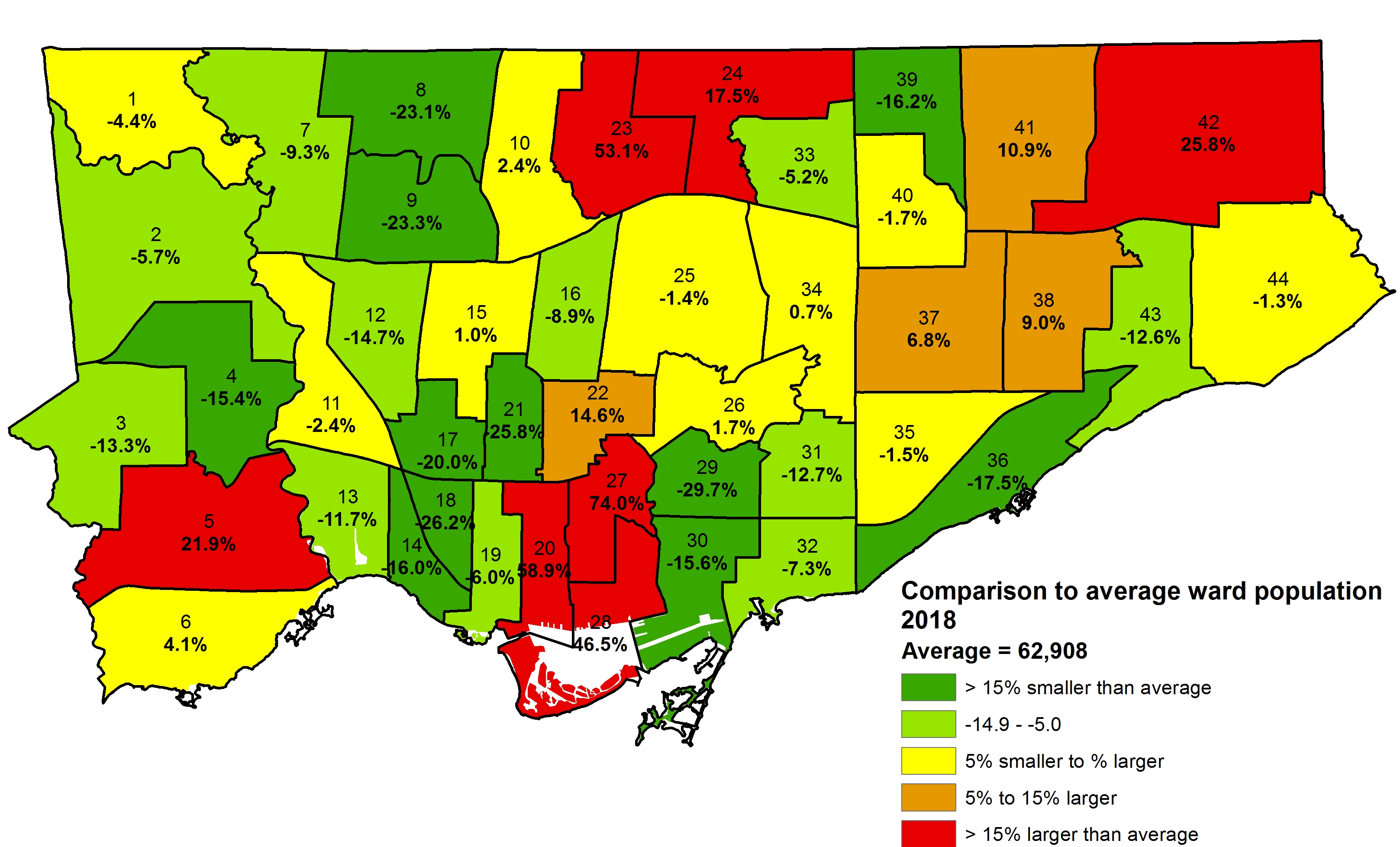
    2014 Election - 2018 Ward ProjectionsThe variance in ward populations in 2018; new ward boundaries will address the population inequities shown above.

    Back in March, I wrote about the City’s plans for new ward boundaries, outlining the history of Toronto’s post-amalgamation council and the need for fairer representation. While Toronto’s population continues to increase, most of the growth is concentrated in northeast Scarborough, central North York and Etobicoke, and especially Downtown, where new condo towers are going up by the dozen.

    Yesterday, on August 11, the Toronto Ward Boundary Options Report was released, setting the stage for further public consultations. With the report, we now have tangible details of what the new wards might look like, and how many politicians the new council, to be elected in 2018, will be comprised of.

    I wrote more about the report in Torontoist, with a discussion on the process, criteria, and the various options presented.

    While the mayor may disagre (“I think the last thing we need is more politicians,” he was quoted as saying), I personally prefer the options that add a few more councillors than the existing 44. Back in 1997, the newly amalgamated City of Toronto had 57 city councillors, and with a growing population, a small increase in the size of council is more than appropriate. “Option 1 – Minimal Change” adds three new councillors; two downtown and one in North York; it is not a bad option, though I think fifty is a workable number.

    There are plenty of opportunities for feedback, including a survey and a new round of public consultations in the Fall; I recommend taking part and sharing your own views.

  • Talking with Two Twits

    Recently, I sat down with Darren Foster (Cityslikr), of the blog All Fired Up In The Big Smoke, and Paisley Rae to discuss the results of the last municipal election, particularly the ward-level election maps that I created back in December 2014 and in January and February 2015.

    It was my first time participating in a podcast. As I stated at the start of the mapping project (and this website), this was something that I was doing entirely for my own interest.  At first, I only sought to map the most interesting wards, but eventually I resolved to set up a blog and to create a map for each and every council race and the mayoral race in every ward. I was happy, and humbled, to gets lots of positive feedback. I’m hopeful that with new ward boundaries in 2018, and a renewed interest in the ward races, we’ll finally get to see more new, progressive faces at City Hall that better reflect the diversity of this great city.

    If you want to hear what I sound like in conversation, and maybe learn a bit about the last election and why the next election in 2018 matters so much, I encourage you to have a listen.