Category: Election

  • Ontario municipalities over the barrel, again

    Ontario municipalities over the barrel, again

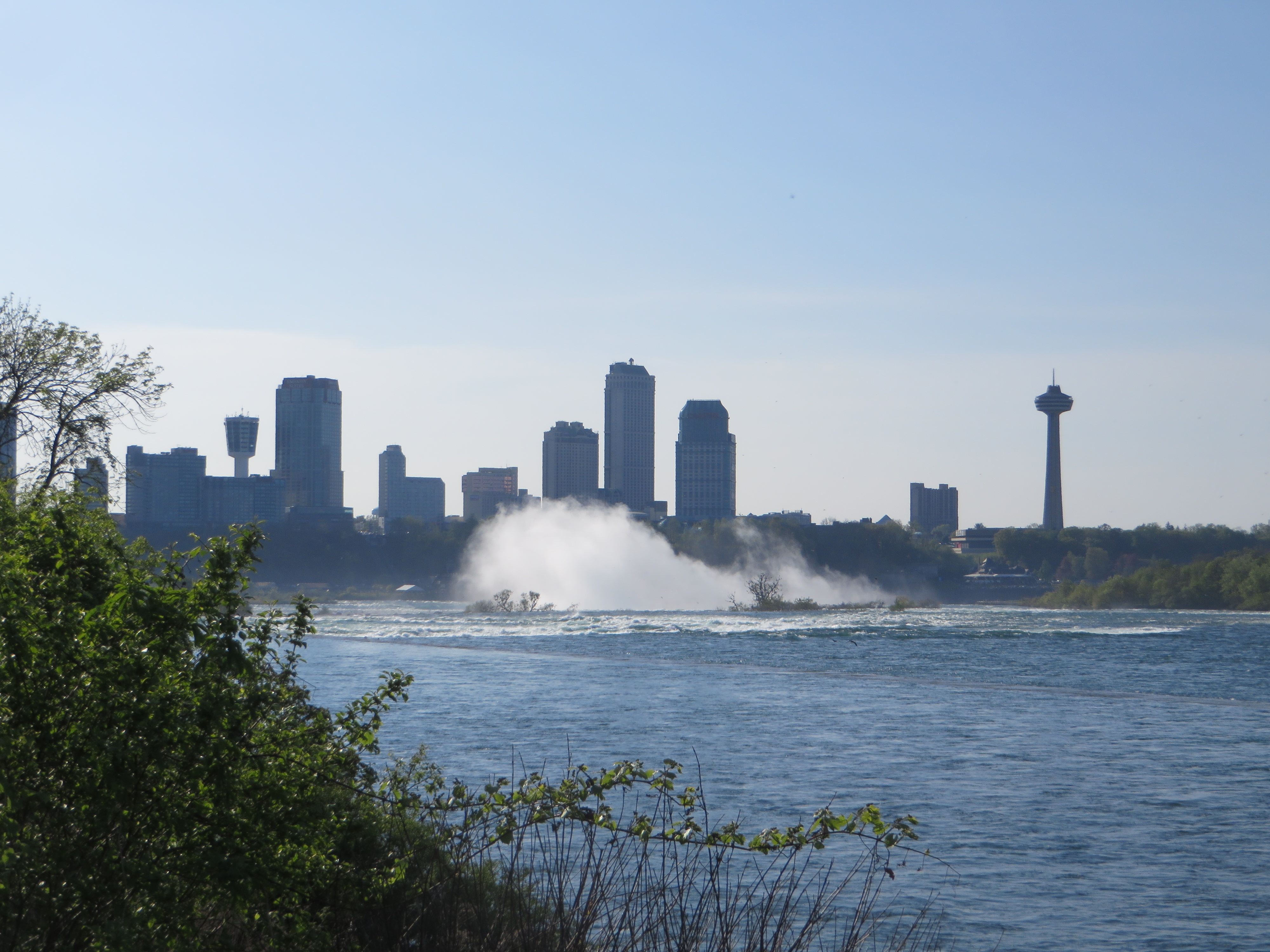
    Once again, Doug Ford wants to mess with local democracy. This time, it’s in Niagara Region.

    With the recent news overload — yet another war in the Middle East, rising fuel costs, another municipal mayoral race — not to mention the flood of news from Queen’s Park (a new mega-convention centre on Lake Ontario, moves to let bigger passenger jets on an expanded island airport, and legislation to increase secrecy within the highest levels of provincial government), you might be forgiven for missing yet another bit of news.

    In what has become a tradition for failed mayoral candidate and current Progressive Conservative premier Doug Ford, there’s another move to disrupt local democracy, this time in Niagara Region. Since his party was elected to government in 2018, Premier Ford has been busy tinkering with local governance. First was the sudden interference in Toronto’s municipal election, introducing election to force the city to reduce the number of elected councillors from 47 to just 25. That was soon followed by the cancellation of new open elections for regional chairs in Peel, York, Niagara and Muskoka Regions (who are normally appointed by those councils), the introduction of “strong mayor” powers, the aborted dissolution of Peel Region, the consolidation of conservation authorities, and the takeover of elected school boards.

    In the last few weeks, the Ford government set its sights on Niagara Region, pushing for the quick amalgamation of its 13 municipal governments ahead of municipal elections this coming October.
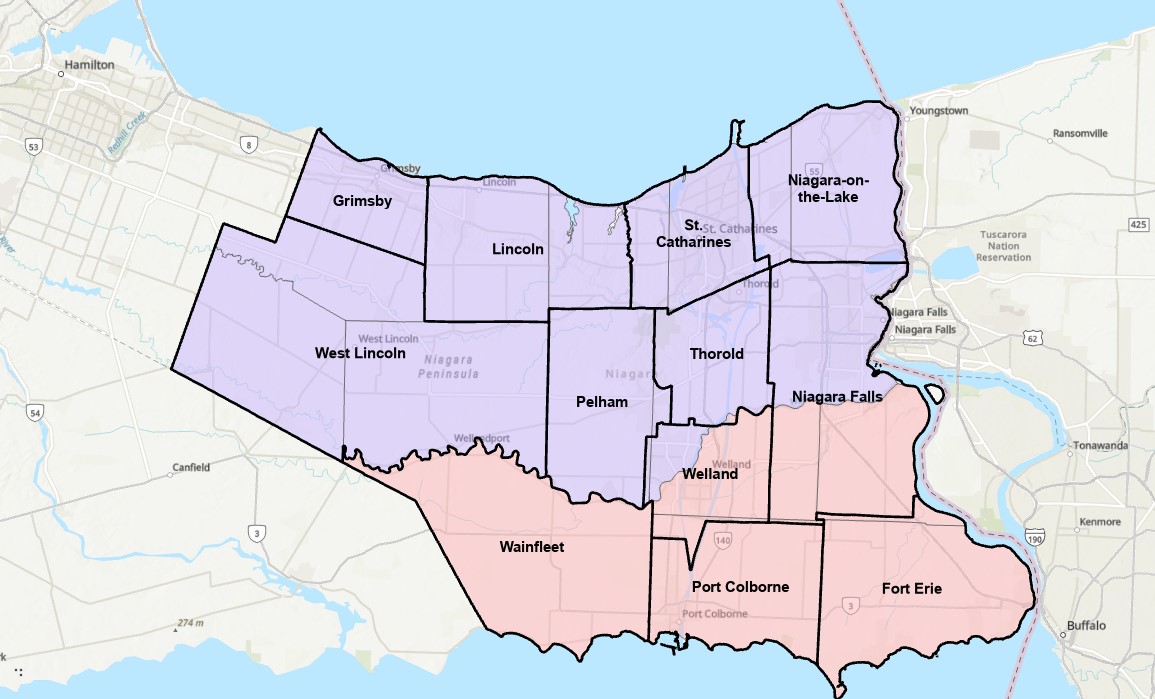
    Niagara Region municipalities, with former Lincoln County townships in blue and Welland County townships in red

    Niagara Region is one of eight regional governments in Ontario, a specialized level of government introduced by an earlier Progressive Conservative government in the 1970s, following on the success of Metropolitan Toronto created in 1954. Regional governments had more powers and responsibilities than counties, including regional planning and the provision of water and wastewater systems deemed essential for smart urban growth. Most regions formed their own police services, and many took on responsibility for household waste management and public transit (Durham, Waterloo, York, and most recently Niagara). Other services, such as fire departments, libraries, local planning, parks and recreation, and local public works remained the responsibility of the cities, towns, and townships.

    The Mike Harris-led PC government, elected in 1995, was a big proponent of municipal amalgamations. After amalgamating the City of Toronto in 1998, it replaced regional governments in the Hamilton, Ottawa, and Sudbury areas with amalgamated cities in 2001, and broke up the former region of Haldimand-Norfolk creating two stand-alone municipalities. Dozens of other amalgamations took place in those years, including Chatham-Kent and Kawartha Lakes (formerly Victoria County). On top of that, provincial costs were downloaded to those new creations, including social and health services and thousands of kilometres of provincial highways.

    That era of drastic municipal change came to an end in December 2003, when a new Liberal government was elected, with relative calm for nearly fifteen years, until June 2018. During that time, the status quo prevailed, without a full review of the operations, finances, and role of municipal governments that would inform good faith reforms.

    Niagara Region is made up of twelve lower tier municipalities: the cities of St. Catharines, Niagara Falls, Welland, Thorold, and Port Colborne, the towns of Fort Erie, Grimsby, Lincoln, Niagara-on-the-Lake, and Pelham, and the townships of Wainfleet and West Lincoln. The current region is a result of that earlier wave of regional government establishments in much of Ontario; prior to 1970, Niagara was made up of two counties — Lincoln and Welland — with fifteen townships and nearly a dozen smaller cities and towns between them.

    As with all remaining regional governments, Niagara Region Council is made up of municipal politicians who also sit on their local city or town councils. Each mayor sits on the regional board, and to make up for population disparity between urban centres and rural townships, the larger municipalities send additional councillors who already sit on their local councils. Though some regions have chairs elected by the region’s populations, others have a non-elected chair, typically chosen by the regional council.

    The Niagara problem started when the provincial government used its new authority to appoint its own preferred chair to Regional Council after the previous chair, former Liberal MPP Jim Bradley, died in office in late 2025. Bob Gale quickly promoted regional amalgamation, backed by Premier Ford, citing tax increases and too many local politicians. The idea is unpopular amongst Niagara residents, especially those in smaller communities such as Niagara-on-the-Lake, which under a four-municipality model, would be joined with Niagara Falls (whose mayor backed the idea).

    Repeatedly, it has been shown that municipal amalgamations fail to save taxpayers’ money but only make municipal government more distant to the residents it serves. Though the number of municipal politicians would decrease (there are 126 across the 12 lower-tier municipalities), in smaller towns and rural townships, these are part-time positions. In Toronto, the moves from seven councils down to one in 1998 and from 44 councillors down to 25 in 2018 failed to save operating funds, as the number of paid employees to support each councillor increased to manage their greater workloads. Even the conservative Fraser Institute found no tax savings when studying the effects of amalgamation on smaller Ontario municipalities. Furthermore, with many services already the responsibility of the region, what savings could be had if police, transit, social services, housing, and major roads are already amalgamated?

    For now, the idea of amalgamation in Niagara Region is stalled, but not because wiser heads prevailed. Chair Bob Gale resigned just three months into his term after local anti-hate organizations found he had in his collection of historical artifacts a copy of Mein Kampf signed by its author, Adolf Hitler.

    One of the other problems with a quick amalgamation of such a large area is that there is no study on what boundaries actually make sense. Does the combination of 12 municipalities into just four actually work? Should the new boundaries just lump existing towns together, or more intelligently redraw existing boundaries completely? For example, should the City of Thorold be just thrown in with a neighbour as is, or could be split into three, with the urbanized area joining St. Catharines, the area east of the canal joining Niagara Falls, and the southern rural area joining Pelham and Welland?

    Unfortunately, as hospitals face funding and staffing crises, as students face increasing debt loads to complete post-secondary education, and the economy continues to face headwinds, Doug Ford manages to get bogged down into distractions like shiny new buildings on Toronto’s waterfront, municipal restructurings, and needless new highways. The next provincial election will not come for another three years, and yet the premier wants to play mayor.
  • Mapping the 2023 mayoral byelection

    Last week Monday, I was at Spacing’s election night party at a pub in the Annex, watching the results of the election roll in after 8PM. Public polls consistently saw former Toronto city councillor and NDP MP Olivia Chow leading an especially crowded race of 102 candidates for mayor. It was the most exciting election I’ve followed since at least 2014.

    Former three-term councillor Ana Bailão, one of former mayor John Tory’s protégées, was consistently in second place, followed by former Toronto Police Chief (and provincial PC candidate) Mark Saunders, sitting councillors Josh Matlow (who ran as a progressive) and Brad Bradford (who ran to the right), and right-wing columnist Anthony Furey. Though Bailão, a centrist, had the endorsements of multiple sitting councillors, Liberal MPs and MPPs, and several public and private sector unions, she had difficulty positioning herself as the presumptive centre-right challenger, especially with Premier Doug Ford backing Saunders.

    It was not until the advance polls had closed that Deputy Mayor Jennifer McKelvie, the Toronto Star Editorial Board, and then Tory himself endorsed Bailão, likely spooked by Chow’s continued lead. (David Rider and Ben Spurr at the Star wrote a great article about the leadup to Tory’s endorsement.) Tory, who resigned after admitting to a long-term city hall affair, hummed and hawed over providing his endorsement, and hid from reporters even while robocalling Torontonians pleading them to vote for his appointed successor.

    It is quite possible that Tory’s endorsement came too little, too late for Bailão. Nearly 150,000 electors (representing 21.7% of all votes cast) already voted in advance polls or by mail, and their votes were locked in. But the late push for Bailão was able to convince at least some election day voters to choose strategically — the percentage of voters who chose Saunders, Furey, and Matlow fell, while Bailão’s share grew on election day. Indeed, Bailão placed first among election day voters. But Chow, whose campaign encouraged advance voting, carried the day in the end.

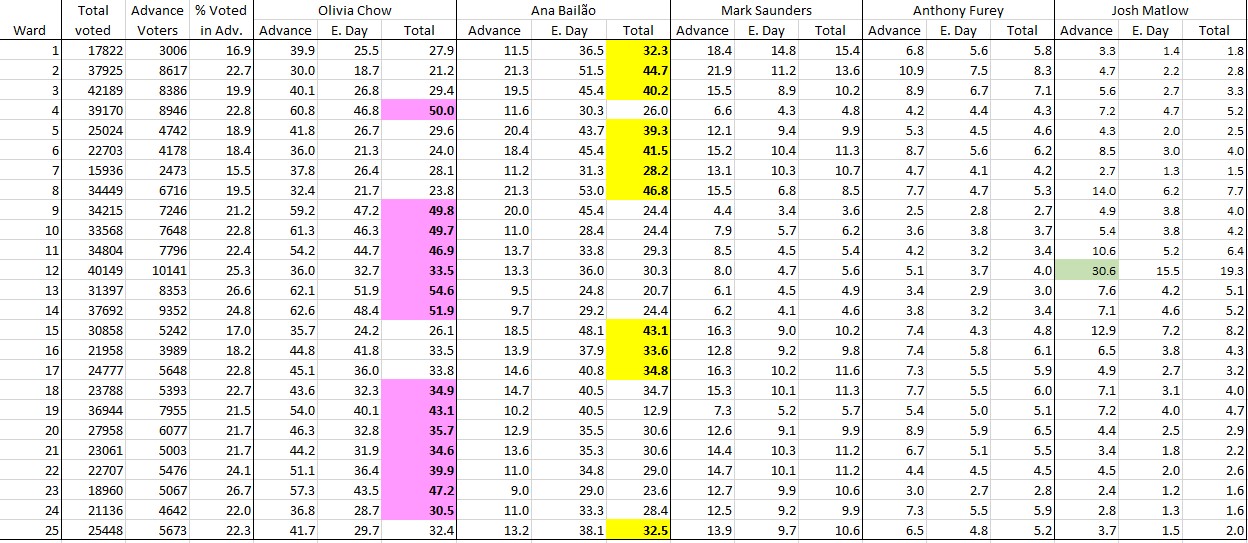
    For example, Josh Matlow placed a close second in Ward 12 in the advance polls (with 30.6% of the vote), where he’s a popular local councillor. On election day, Matlow placed third behind Bailão and Chow, with Chow eking out a narrow win overall there. In every ward, Chow placed first in the advance polls, but when all votes were counted, she placed first in 14 of the 25 wards. The table below shows how the vote shifted.

    Table of ward-level mayoral byelection results, showing advance poll and election day results for the leading five candidates. PDF version here.

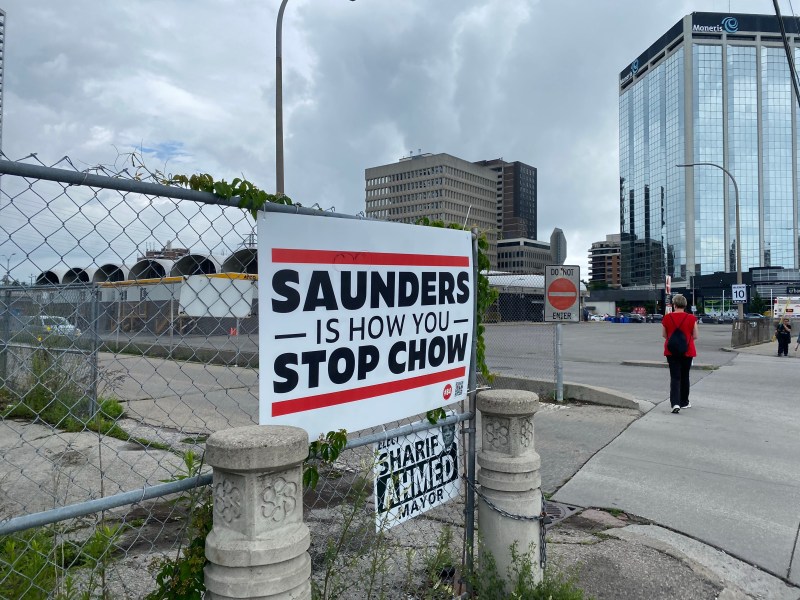
    Chow won with 269,372 votes (37.2%) to Ana Bailão’s 235,175 (32.5%). Saunders, Ford’s pick, got just 8.6% of the vote despite his positioning as the only candidate to “stop Chow.” Furey placed a distant fourth, with 5%, and Matlow got 4.9%, acknowledging that Bailão’s late surge draw support away from him and towards Bailão and Chow. Brad Bradford was the biggest loser of the night, netting just 1.3% and placing fifth in his own ward.

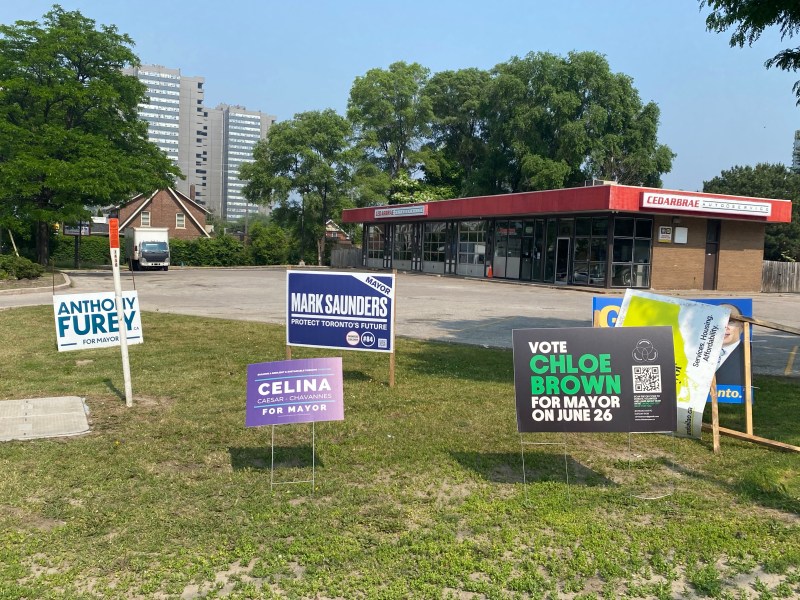
    “Saunders is how you stop Chow” sign

    Though I was skeptical of Olivia Chow’s second run for mayor after an uninspiring run against Rob and Doug Ford and John Tory in 2014 (she placed third), she proved herself worthy this time around. She was more relaxed, more herself, and certainly tapped into a desire for change after eight years of Tory’s dull austerity and four years of chaos under Rob Ford (enabled by his brother Doug).

    I fear Toronto’s political establishment — both Conservative and Liberal — will try to make Chow’s term as mayor difficult, even though their low-tax, low-spend agenda caused many of the problems that she will have to tackle. But for now, I’m pleased we will try it her way.


    I created an interactive map showing the results of the election at the ward and electoral subdivision (poll) level. For the wards, I provided information on the advance and election day poll results.

    Note that not all polls are mapped. Until the City of Toronto releases revised electoral subdivision boundaries (I suspect due to poll consolidations), there are some missing polls. However, 95% of all polls are depicted, and the results are interesting.

    I look forward to your feedback as well; I approve all reasonable comments and reply to most emails.

    Link to map

    Thanks to David Del Grande for pointing out a needed correction.

  • Mapping the results of the 2022 Toronto municipal election

    How Toronto voted for mayor. Areas shaded in blue represent electoral subdivisions (polls) where John Tory placed first. Areas shaded in purple represent polls where Gil Penalosa placed first. Click here for the interactive version.

    As has become my tradition after Toronto’s municipal elections, I mapped out the poll-by-poll results of the mayoral race and some of the more interesting council races. After creating maps for the 2014 election and sharing those on social media, it was suggested that I have a website to host these maps. That is how this website came to be.

    This time, I created an interactive map showing the results of the mayoral race, along with six council races: Ward 3 Etobicoke-Lakeshore, Ward 4 Parkdale High-Park, Ward 5 York South-Weston, Ward 11 University-Rosedale, Ward 18 Willowdale, and Ward 20 Scarborough Southwest.

    I offer more thoughts over at Spacing Toronto, as part of a series mapping the municipal election.

  • Mapping the 2022 municipal election

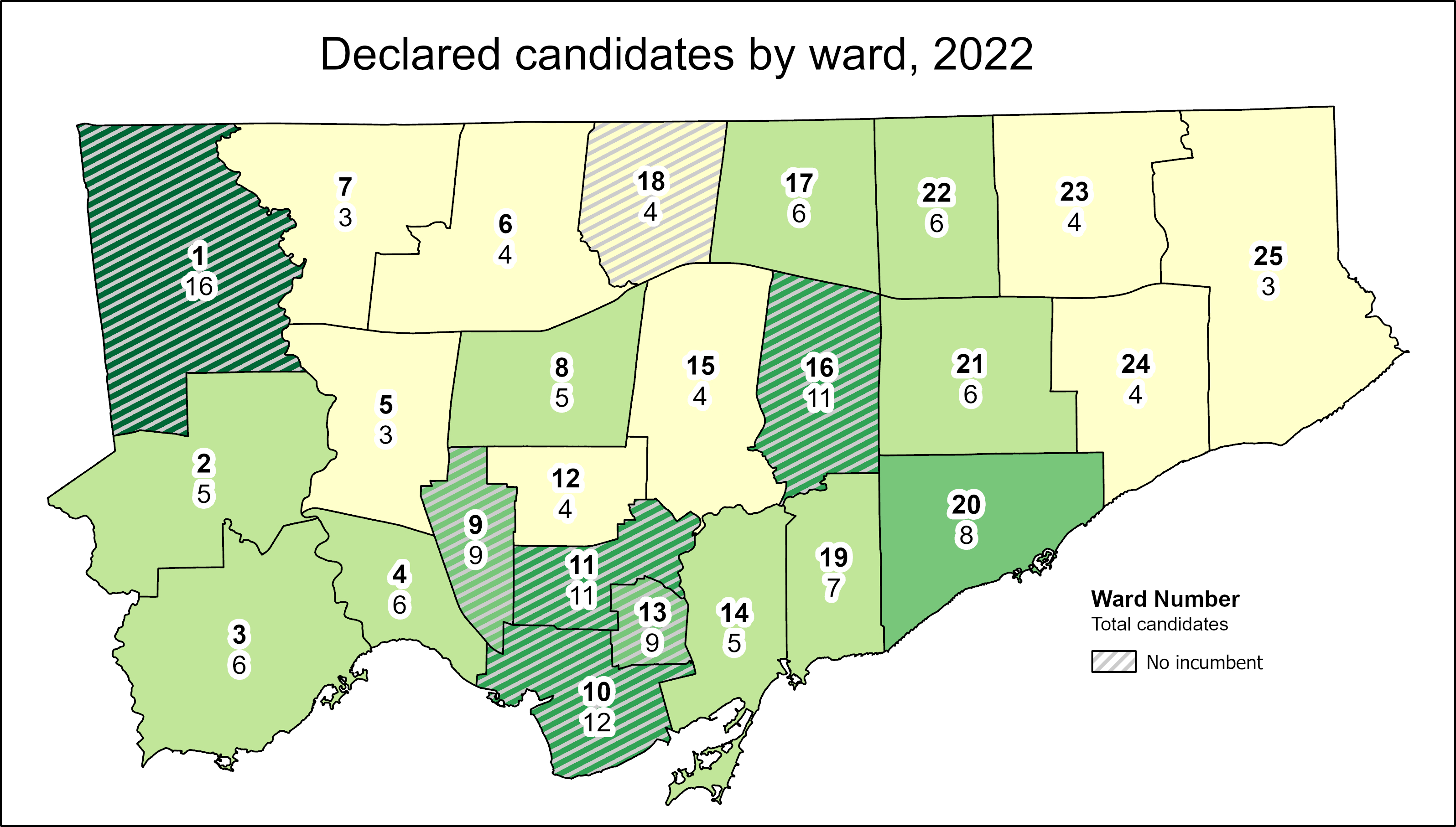
    Number of candidates running in each ward

    This coming Monday, October 24, Ontarians will be electing new city councils. In Brampton, Ottawa, and Hamilton, the mayoral races should prove to be interesting. For Ottawa in particular, with Jim Watson stepping down, voters have a clear choice (and I’ll be cheering for Catherine McKenney). Though Gil Penalosa offers a new vision of a sustainable, active, and safer city, it’s very likely John Tory will win an unprecedented third term, the first to do so since amalgamation in 1998.

    At Spacing Toronto, I have been offering some insights by mapping the state of our local democracy, ward by ward. Though there are seven wards in which no sitting councillor is running for re-election, the new council may not look too much different from the last one. That’s because two former councillors — Vincent Crisanti and Jon Burnside — will be looking to get back into office. Meanwhile, Mayor Tory has been busy campaigning for twelve candidates, including eight incumbents, that will help advance his agenda of incrementalism and austerity. Among Tory’s picks are Frances Nunziata, who has been in municipal office uninterrupted since 1988.

    Here are the links to my posts at Spacing:

    Open wards and the power of incumbency: The power of incumbency, and the mayor’s own influence, will weigh heavy on the final results. Though there may be seven “open” wards and a few more truly-competitive races, there is a lot happening behind the scenes to favour certain candidates.

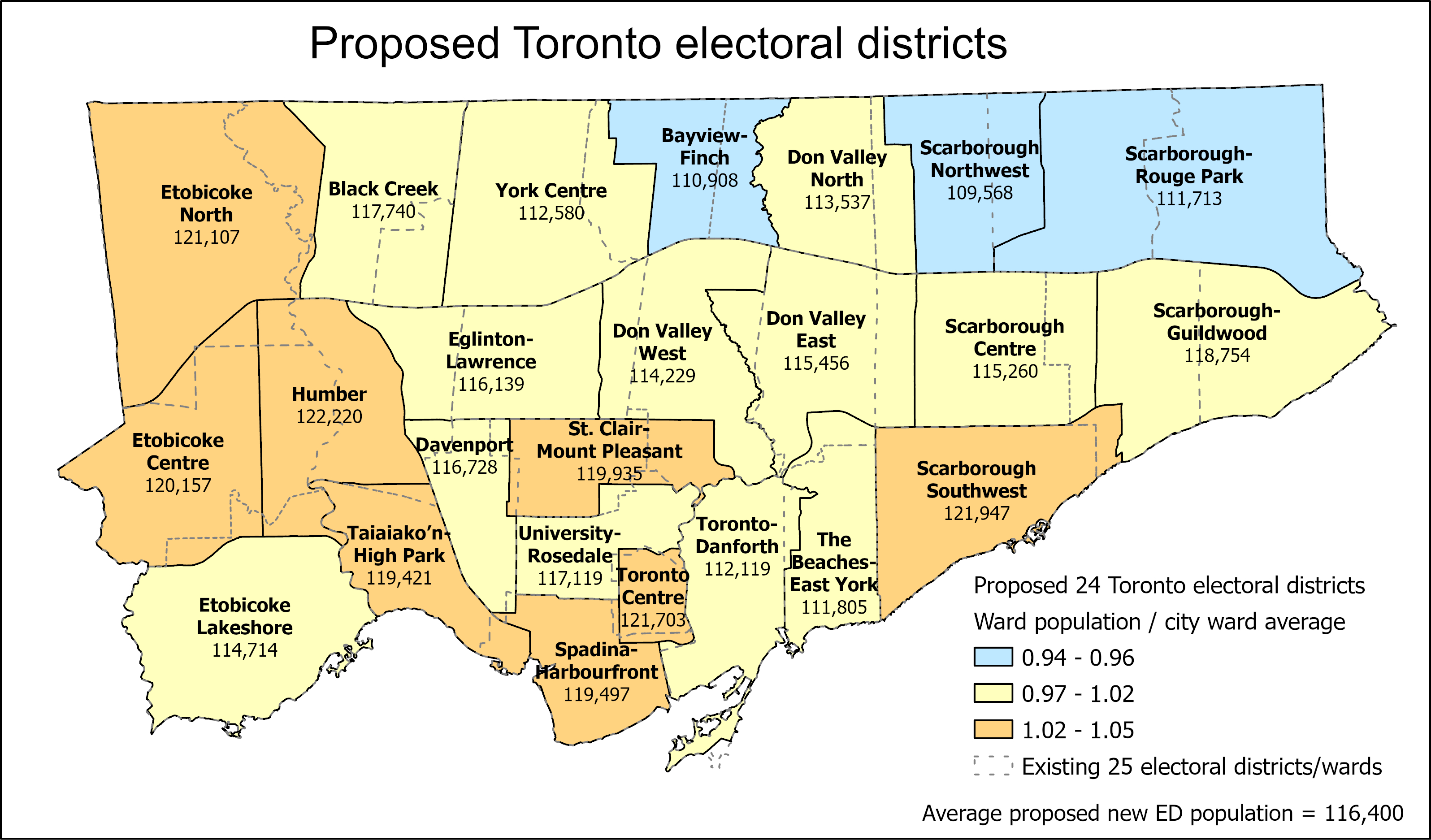
    Population disparities between Toronto’s 25 wards: How ward boundaries that were drawn in 2013 have exasperated imbalances in population, leading to burnout in high-growth wards (with several downtown councillors deciding to move on). If Toronto continues to be forced to use federal/provincial riding boundaries, it will have just 24 wards in the 2026 election.

    What Toronto’s new ward boundaries might look like

    Toronto is a highrise, rental city – unlike City Council: Though nearly half of all Torontonians live in highrise dwellings and/or rent their homes, Toronto City Council is made up almost entirely of homeowners. In only a few wards, detached houses make up the vast majority of the housing stock and homeowners dominate. I ask why city council doesn’t reflect the way an increasing number of us live. The interest in this post had me on CBC Metro Morning for the first time, early on September 30.

    Duelling campaign endorsements: Though Mayor John Tory has supported a few candidates before (most notably, Etobicoke councillor Mark Grimes), this time, he’s actively campaigning with twelve allies. Meanwhile Progress Toronto is backing nine challengers, focusing on races where it hopes to help get new faces elected.

  • Wards and ridings: not quite representation by population

    Wards and ridings: not quite representation by population

    When Statistics Canada released the first batch of 2021 Census data, it made the new population counts available for a wide variety of geographies, from provinces and cities, to local census tracts and even city blocks. It also released data for the 338 federal electoral districts, better known as ridings.

    Because of constitutional requirements, the seats in the federal House of Commons are not allocated equally by population. For example, Prince Edward Island, with a population of 154,331, has four seats. At the other extreme, four electoral districts in Alberta and one in Brampton, Ontario have larger populations than Canada’s smallest province.

    Electoral DistrictProvince/Territory2021 Population
    LabradorNewfoundland & Labrador26,655
    EgmontPrince Edward Island35,925
    NunavutNunavut36,858
    CharlottetownPrince Edward Island38,809
    MalpequePrince Edward Island39,731
    Average109,444
    Banff-AirdrieAlberta155,580
    Calgary SkyviewAlberta159,642
    Brampton WestOntario162,353
    Calgary ShepardAlberta163,447
    Edmonton-WetaskiwinAlberta209,431

    The federal electoral districts were last drawn in 2013, following the 2011 census. As a result, fast-growing ridings, particularly in Southern Ontario, Calgary, and Edmonton, have huge populations compared to the national average.

    In Ontario, the provincial government uses the same boundaries for its provincial electoral districts, with the exception of Northern Ontario, where two additional seats help to compensate for the area’s vast and remote regions, where local MPPs may have to travel hours by car, train, or plane to meet constituents. The province imposed the same boundaries on the City of Toronto in 2018, in the middle of a municipal election for which new, fairer boundaries were just approved.

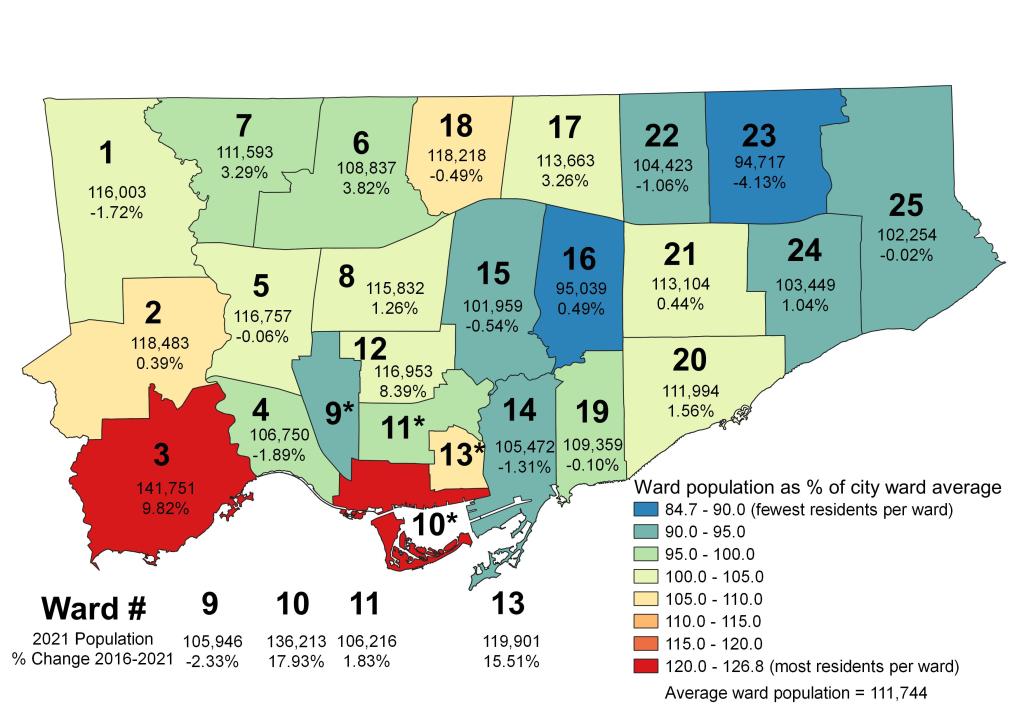
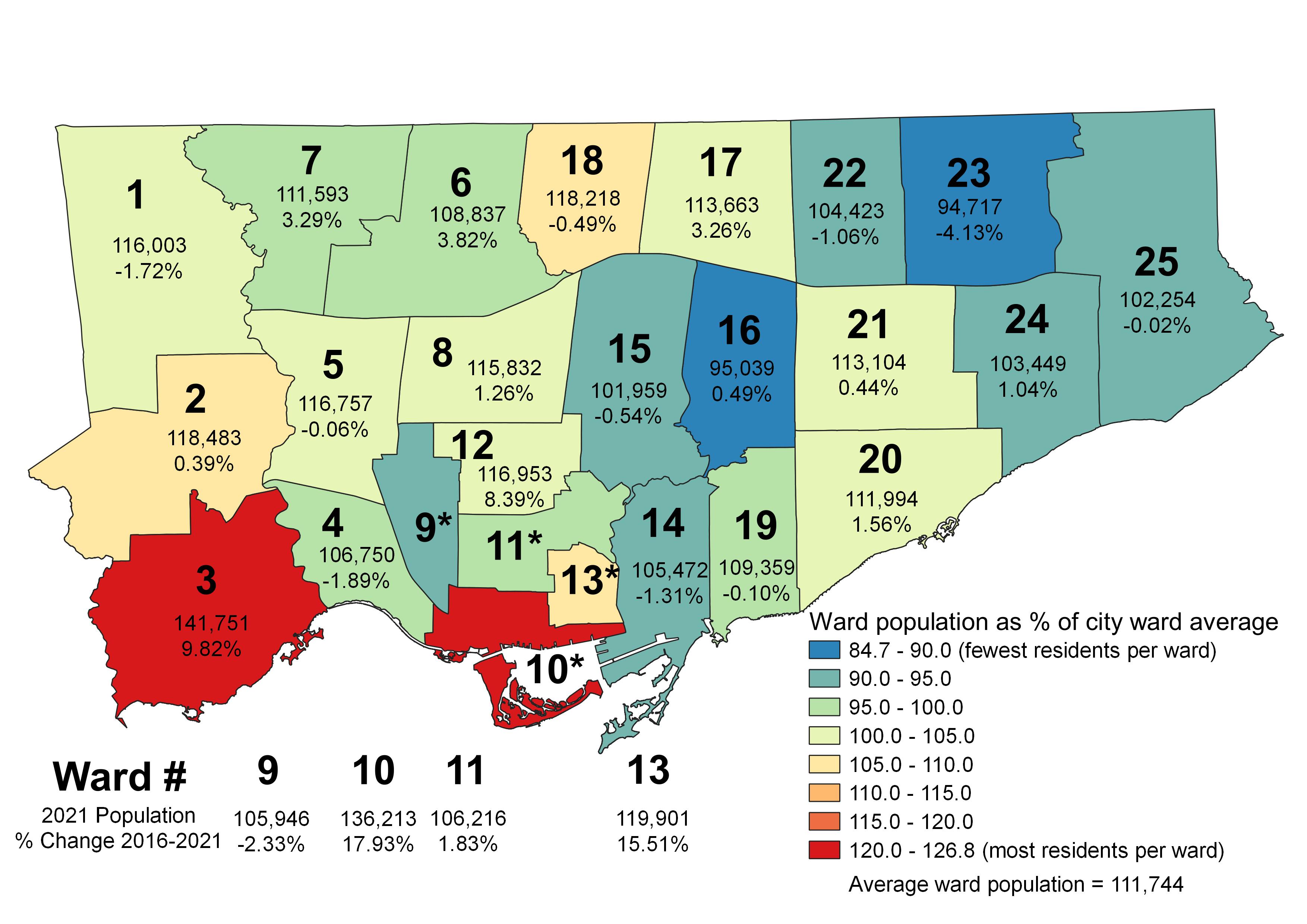
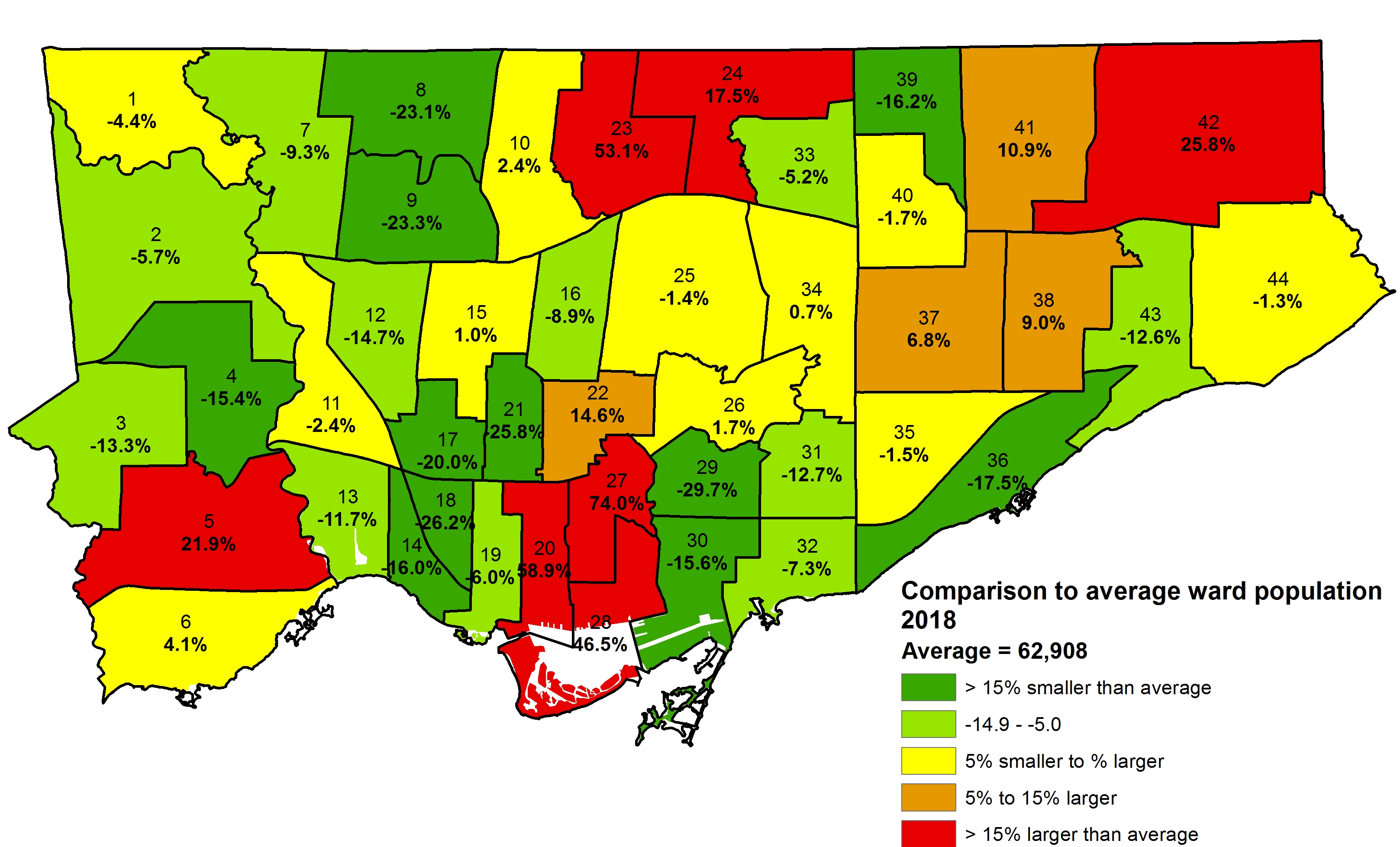
    By 2021, the population differences based on decade-old data became stark, as shown in the map below.

    Map depicting disparities in Toronto’s ward populations

    Ward 23 Scarborough North, represented by Cynthia Lai, has a population of 94,717. Ward 23’s population dropped by over 4% since 2016, as households age and few new housing units built in that ward. Ward 16, Don Valley East, has just 95,039 residents, with a stable population.

    On the other extreme, Ward 3 Etobicoke-Lakeshore, represented by veteran councillor Mark Grimes, has a population of 141,751, growing by 9.82% since 2016. New condominium developments in the Humber Bay neighbourhood and along the Queensway have driven much of that growth. Ward 10, Spadina-Fort York, saw an even greater number of new residents move in, growing by nearly 18% in the last five years.

    As Toronto is stuck with these ward boundaries until 2026, the population disparities will only grow larger, with downtown and South Etobicoke residents becoming even more underrepresented. Compounding the unfairness is that councillors representing high-growth wards have much higher workloads, as they deal with mountains of planning applications while ensuring their existing constituents have access to essential local services like schools, transit, and park space.

    The ward boundaries initially set for the 2018 municipal election would have accounted for future growth, ensuring that workloads would be more fairly distributed, and that city residents would have equal access to their local councillor.

    The 2021 population counts will be used to set new federal riding boundaries, which will be drawn next year after a consultation period and used in the first federal election held after 2023. The province will likely adopt the new boundaries for the 2026 election (assuming a majority government is elected in June).

    Perhaps in four years, Toronto will be able to set its own ward boundaries again. That, of course, will depend on electing a better provincial government and a council committed to equity and good governance.

  • Voter turnouts in the 2018 Toronto municipal election

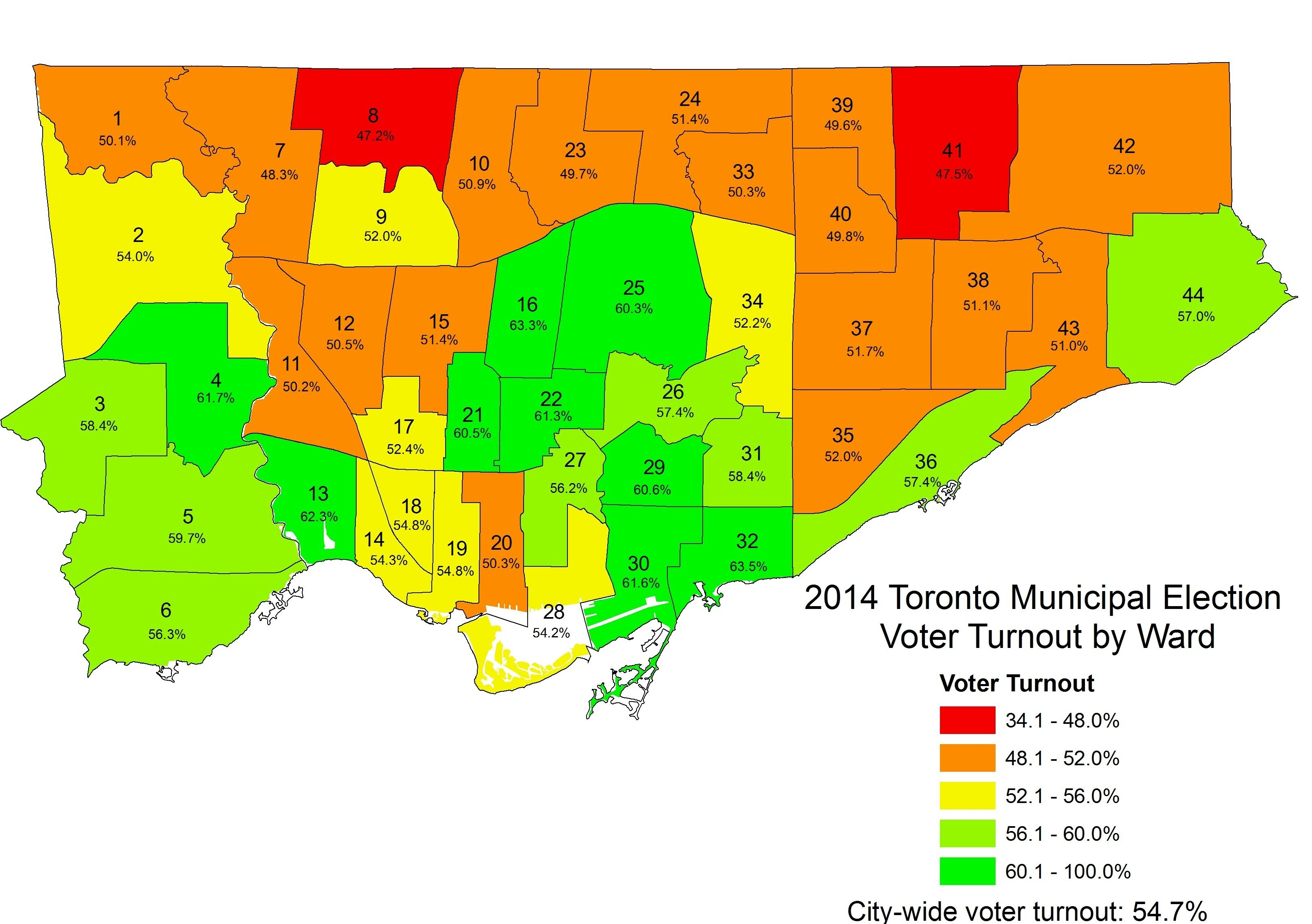
    2014 was a watershed year for municipal voter turnout in Toronto. After a disastrous four years of Rob Ford as mayor, 54.7 percent of all eligible voters went to the polls, electing John Tory. That was the highest voter turnout in decades, even higher than 1997, when Torontonians elected Mel Lastman to lead a newly amalgamated City of Toronto. In 2010, when Rob Ford was elected mayor, turnout was 50.4 percent, compared to 39.3 percent in 2006 and 38.3 percent in 2000.

    Four years ago, the mayoral race was especially competitive. Progressive Olivia Chow was the initial front-runner against Ford, but Tory (who previously ran for mayor in 2003) pulled ahead as Chow’s campaign floundered. Late in the campaign, Rob Ford dropped out due to health concerns, so his brother Doug took his place. Among the three frontrunners, Tory got 40.3 percent of the vote, while Doug Ford took 33.7 percent. Chow only got 23.1 percent. Voters also elected seven new councillors that year, and returned Rob Ford to Ward 2.

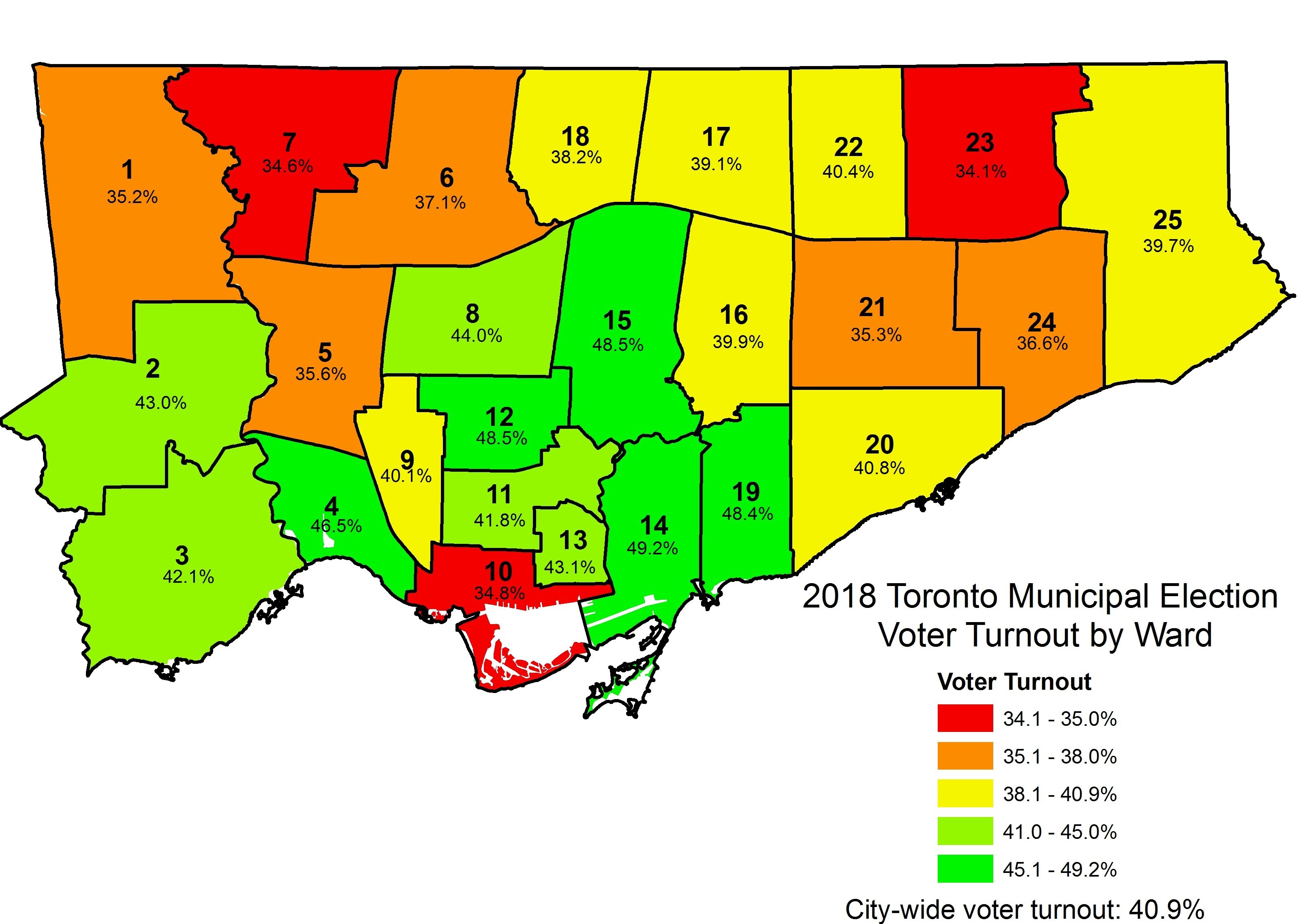
    After two elections in which over half the number of eligible voters took part, in 2018 voter turnout fell to just 40.9 percent. This was hardly surprising. John Tory cruised to victory despite a challenge by former chief planner Jennifer Keesmaat, while a sudden reduction in the number of wards confused voters and crushed the hopes of many council hopefuls and their supporters.

    Though 769,000 electors voted in this mess of an election, voter turnout varied across the city. In Ward 23, Scarborough North, only 34.1 percent of eligible voters turned out to the polls. In Ward 7, Humber River-Black Creek, just 34.6 percent of electors voted. Ward 10, Spadina-Fort York, had the third worst turnout, with just 34.8 percent.

    Areas with the highest voter turnout were Midtown and east end Toronto. Ward 14, Toronto-Danforth had the highest turnout, where 49.2 percent of electors cast a vote. It was followed by Ward 15 and Ward 12 (both of which had 48.5 percent turnout) and Ward 19, where 48.4 percent of electors went to the polls.

    Wards 12, 14, 15, and 19 had interesting and competitive council races. In Ward 14, the race featured two progressive incumbents, while Ward 19 was one of just two races in which an established city councillor was not running for re-election. Wards 12 and 15 also had competitive races. However, in Ward 4, Gord Perks won re-election easily.

    Yet Ward 23 had an open council race in which no incumbent was running. And Ward 7 was one of the most interesting and important races of 2018; this is where Giorgio Mammoliti was finally defeated after years of campaign violations, buffoonery, and embarrassments.

    2018-election-turnout-by-ward-e1547405800521.jpg

    2018 voter turnout by ward (alternate version available here)

    Voter turnout has consistently been low in Toronto’s northwest and northeast corners. In 2014, Ward 8 and Ward 41 (which made up parts of new Wards 7 and 23) had the lowest numbers of electors casting a vote. Turnout was highest in more affluent neighbourhoods, especially in places like Midtown Toronto, the Kingsway neighbourhood in Etobicoke, and in Toronto’s East End. What surprised me mostly was the poor turnout in Ward 10 in 2018.

    2014-election-turnout-e1547405905585.jpg

    2014 voter turnout by ward (alternate version available here)

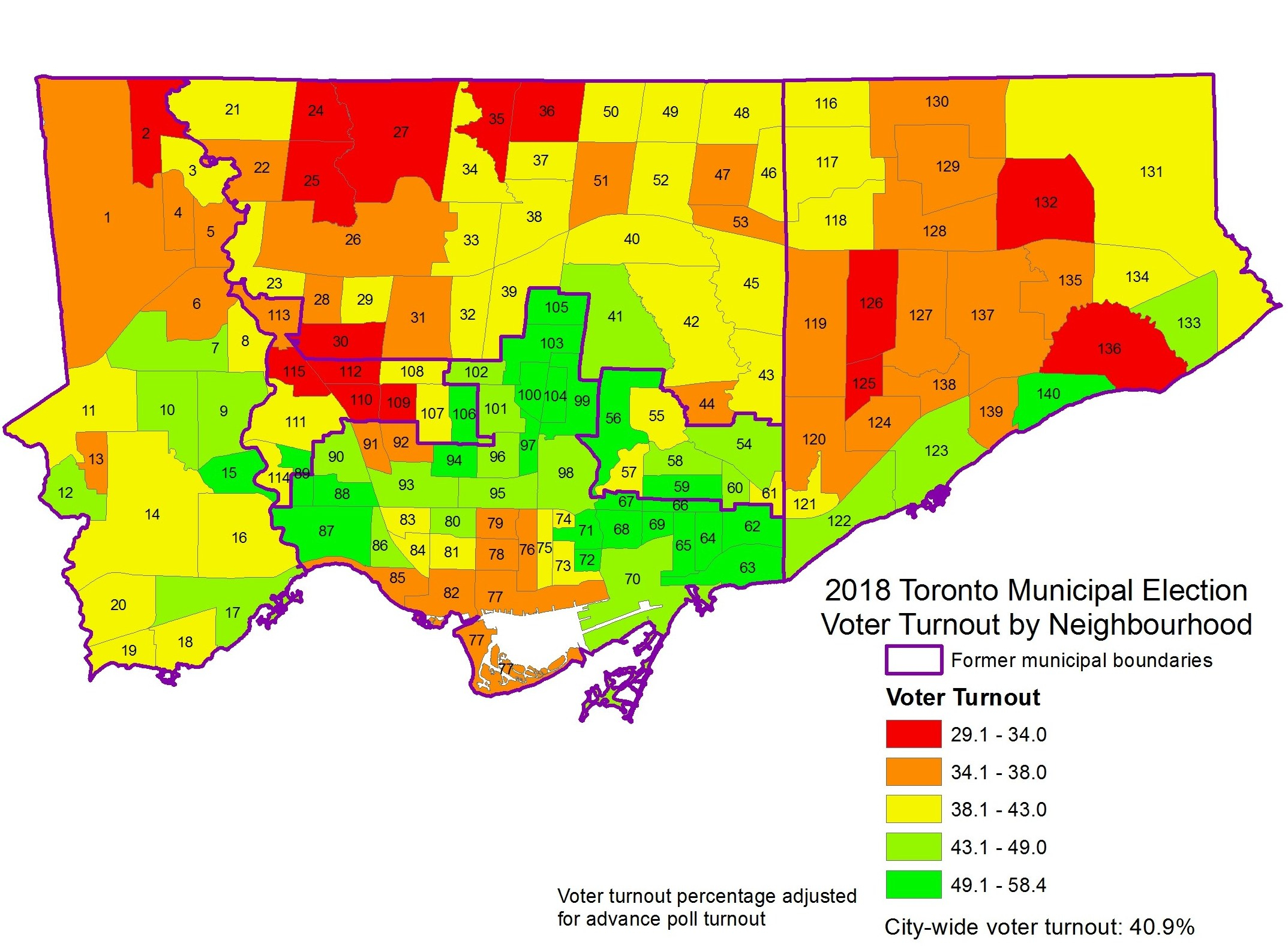
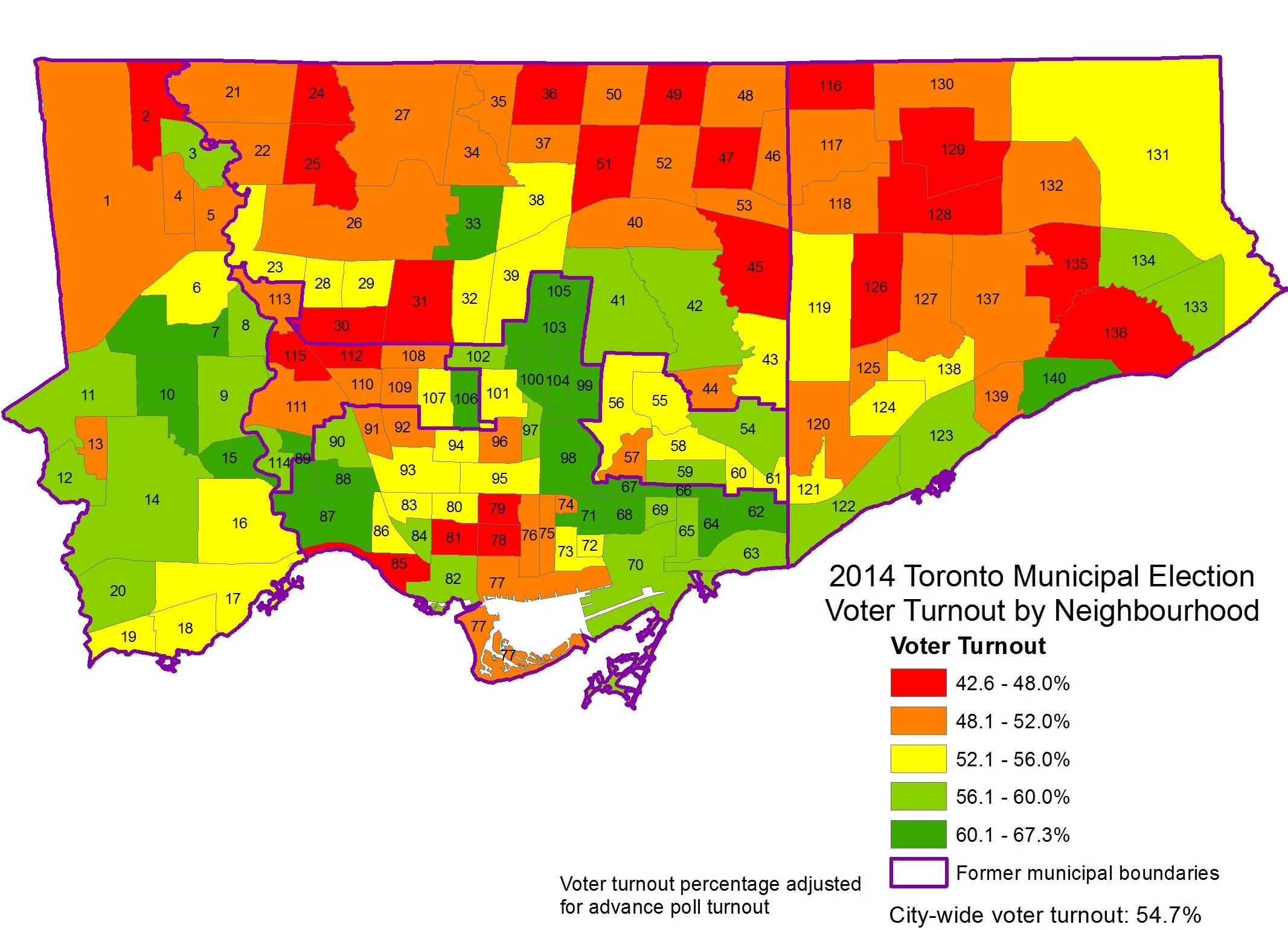
    The difference in voter turnout across the city is more apparent at the neighbourhood level. With the poll-level results available through Toronto’s Open Data Catalogue, I allocated the poll results to each of Toronto’s 140 neighbourhoods, while adjusting the numbers based on the number of votes cast in the advance polls in each ward. The map below shows voter turnout at the neighbourhood level in 2018.

    citydata-nabes-turnouts-2018-e1547406217401.jpg
    2018 voter turnout by neighbourhood (alternate version available here)

    What is immediately apparent is that voter turnout is highest in many neighbourhoods surrounding Toronto’s downtown core, while turnout is lowest in the former City of York, in northwestern Toronto and parts of Scarborough. Areas of high voter turnout tend to be affluent neighbourhoods with high levels of home ownership. These neighbourhoods include the Kingsway, Lawrence Park, Leaside, Cabbagetown, Rosedale, Forest Hill, Swansea, the Beaches, and Leaside. Many of these areas also have active residents’ associations. With Ryerson professor Myer Siemiatycki, I looked at the results of previous municipal election voter turnouts in a report published by the Maytree Foundation.

    Downtown, areas with major condominium developments also have lower turnout, especially in places like the Waterfront, CityPlace, Liberty Village, and the Bay Street corridor. These areas are more likely to have younger residents and many renters. Engaging voters both in downtown condos and those living in the inner suburbs remains a challenge. While voter turnout was much higher in 2014 across the city, the same basic patterns are evident.citydata-nabes-turnouts-2014.jpg
    2014 voter turnout by neighbourhood (alternate version available here)

  • Mapping the Downtown city council races

    At the end of 2014, despite some disappointing results in that year’s municipal election, I was feeling optimistic about 2018. In 2014, there were a number of great candidates running for city council, and I expected many would try again in 2018. After council finally approved the recommended 47 ward model for the 2018 election, I was excited. Downtown, which was badly underrepresented under the 44 ward model, would get three additional wards. Vacancies left by departing councillors, including Mary-Margaret McMahon and John Filion, would further improve the chance for fresh new voices to join city council. At least eight wards across Toronto would not have an incumbent running.

    Of course, we all know what happened to that dream.

    Downtown tends to elect some of Toronto’s hardest-working and most progressive councillors. They’re hard-working out of necessity: old Ward 27 had the largest population in the city, and all four old downtown wards struggled with pressures caused by massive new development and social concerns, especially as older, affordable housing stock is replaced by new condominiums. (Similar pressures exist in North York Centre and Midtown.)

    The last council term

    In 2014, four councillors were elected downtown. Mike Layton was re-elected in Ward 19, which ran from Dovercourt Road in the west to Bathurst Street in the east, including Exhibition Place, Fort York, and the Mirvish Village redevelopment site at Bathurst and Bloor. Layton was first elected to council in 2010. Layton is the son of respected long-time councillor and federal NDP leader Jack Layton.

    Joe Cressy was elected in old Ward 20, which was located between Bathurst Street and University Avenue, and included the Annex, University of Toronto, the Entertainment District, City Place, and much of the waterfront. The previous elected councillor in Ward 20 was Adam Vaughan, who resigned in 2014 to run in a federal by-election in Spadina-Fort York. He is now the Liberal MP for Spadina-Fort York. A long-time political activist, Cressy is the son of former city councillors Gordon Cressy and Joanne Campbell.

    Kristyn Wong-Tam was re-elected in Ward 27, which included Rosedale, Yorkville, the Church-Wellesley Village, Ryerson University, and Moss Park. A local business owner and an advocate for both LGBTQ and Asian-Canadian community issues, Wong-Tam was first elected in 2010.

    Pam McConnell was re-elected in Ward 28, which included Cabbagetown, Regent Park, the St. Lawrence Neighbourhood, much of the Financial District, and the Distillery District. She was first elected as a Metro councillor in 1994. She is credited for many local improvements, including the Regent Park redevelopment and the revitalized Berczy Park. Sadly, McConnell died in 2017. She was replaced by council appointee Lucy Troisi in a controversial vote.

    The promise of new representation

    At the beginning of 2018, with three new wards, each of the seven downtown races were starting to shape up.

    Mike Layton planned to run for re-election in Ward 19, whose boundaries were similar to the ward he was first elected to in 2010. Joe Cressy planned to run in new Ward 24, and Kristyn Wong-Tam planned to run in Ward 22. Despite her promise not to run for election after her appointment, Lucy Troisi registered to run in Ward 23, against former Liberal provincial cabinet minister and 2010 mayoral candidate George Smitherman. Also running in Ward 23 were Megan Willson, an entrepreneur and community organizer; Khuram Aftab, a local convenience store owner; and Walied Khogali Ali, a progressive community activist in Regent Park and St. Jamestown.

    Ward 20 had an especially crowded field of candidates, with eleven council hopefuls. Among the most prominent was local TDSB trustee Ausma Malik, a rising political star. Malik, like other Muslim women and men, faced targeted attacks during the 2014 municipal election. Her win was one of a few bright spots in a nasty campaign season. Malik was backed by many progressives, including Layton and Cressy.

    Other high-profile candidates included businessman, transit advocate, and naval reserve officer Kevin Vuong; lawyer April Engelberg; former television journalist and Conservative Karlene Nation; disgruntled restaurateur Al Carbone; second-time candidate Dean Maher, founder of two local neighbourhood associations; and Sabrina Zuniga, federal Conservative candidate for Spadina-Fort York in the 2015 election. Late to register was Han Dong, a local Liberal MPP defeated in the June provincial election. Dong’s entry into the race was supported by former councillor and Liberal MP Adam Vaughan.

    Candidates in Ward 21, which encompassed Corktown, the Distillery District, and St. Lawrence Market, included Jennifer Hollett, a former broadcaster and provincial NDP candidate in University-Rosedale; and Suzanne Kavanagh, past president of the St. Lawrence Neighbourhood Association and advocate for local public spaces, including Toronto’s waterfront.

    In Ward 25, which included the Yorkville and Church-Wellesley neighbourhoods, there were several well-known candidates, featuring several activists within the local LGBTQ movement. These included Chris Moise, a local Toronto District School Board trustee; Niki Ward, director of the 519 Community Centre; and Ryan Lester, a director of development with the Canadian Centre for Diversity and Inclusion, and former director at Egale Canada.

    Downtown voters were spoiled by choice, and there were many worthy and qualified candidates.

    But then, of course, Doug Ford seized control of the Ontario Progressive Conservative Party and won the provincial election in June. One of his first acts was to unilaterally cut Toronto City Council to just 25 wards, with the promise to invoke the Notwithstanding Clause of the Charter of Rights and Freedoms to get it past any legal challenge.

    Seven downtown wards were reduced to just three. Councillor Joe Cressy decided to run in Spadina Fort-York, while Mike Layton registered in University-Rosedale. Kristyn Wong-Tam ran in Toronto Centre, along with appointed councillor Lucy Troisi.

    Many allied progressive candidates, including Ausma Malik and Jennifer Hollett, withdrew their candidacies. Chris Moise decided to run for re-election as TDSB trustee, which he won. Other candidates who withdrew included Han Dong,

    Ward 10

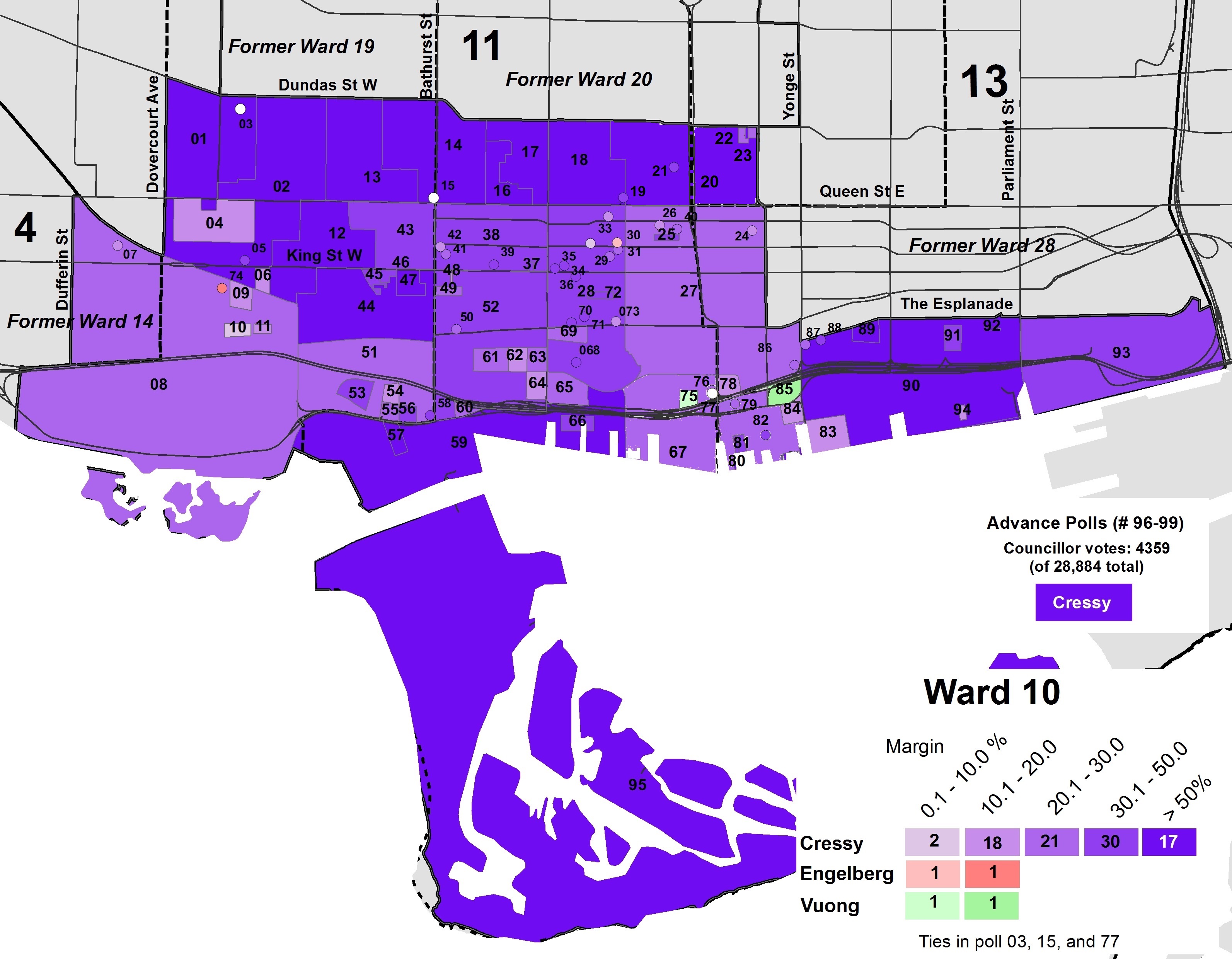
    There were 14 candidates running in Ward 10, Fort York-Spadina, including Joe Cressy, April Engelberg, and Kevin Vuong. Cressy won with 55.8 percent of the vote, with Engelberg coming in second place with 11.6 percent and and Vuong with 10.5 percent. Cressy placed first in all but seven polls, most of which were condominium buildings in the Harbourfront and Liberty Village neighbourhoods. The top three candidates all supported the King Street Pilot, while Al Carbone got a mere 1.8 percent of the vote.

    2018 Election - W10
    Poll results in Ward 10

    Ward 11

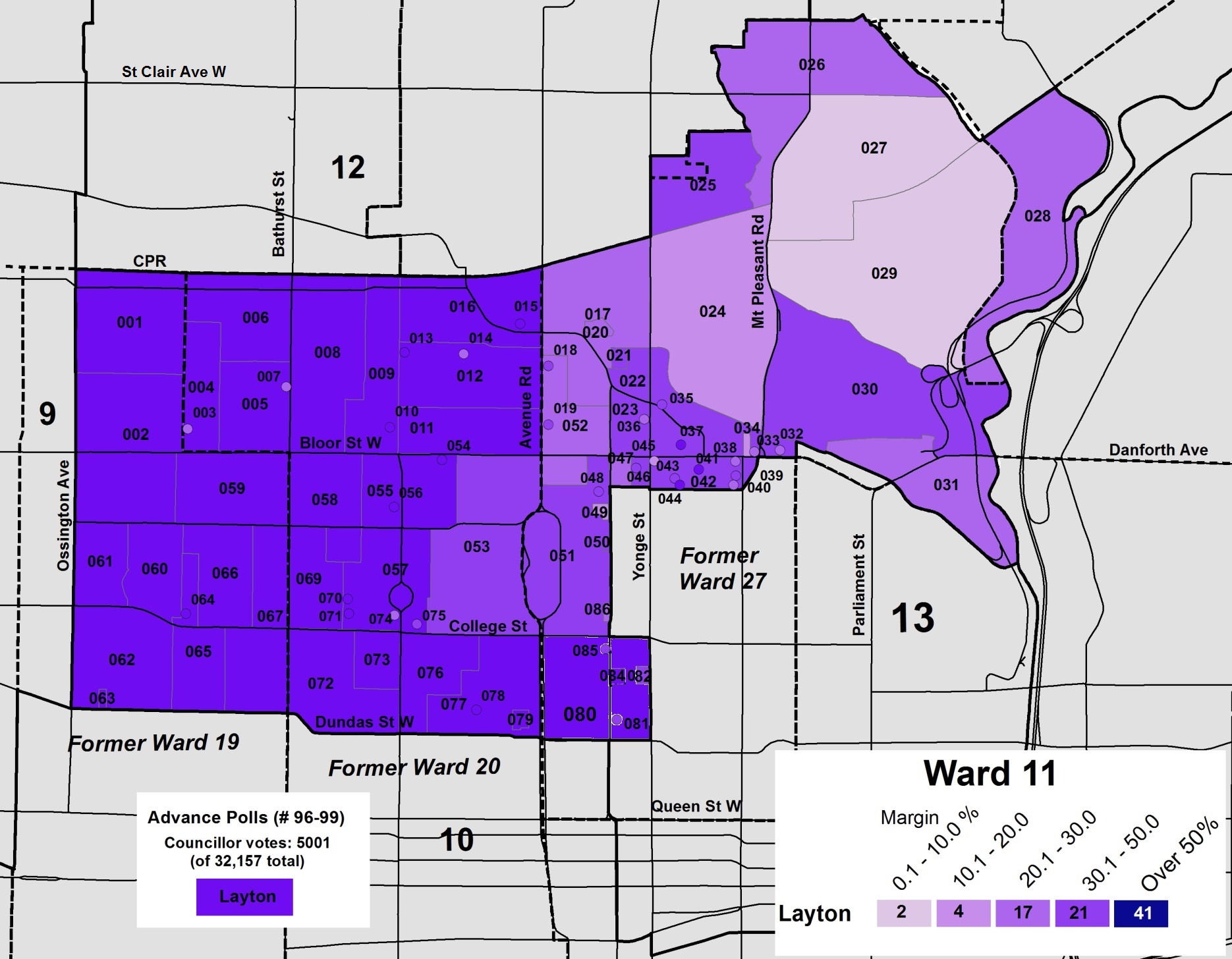
    The new Ward 11 was a very different ward from the one in which Mike Layton had run in 2010 and 2014. Only a fraction of old Ward 19 was included in University-Rosedale, which includes neighbourhoods such as the Annex, Yorkville and Rosedale, areas previously represented by Councillors Cressy and Wong-Tam. Layton was challenged by Niki Ward and by latecomer candidate Joyce Rowlands, an occupational health nurse, writer, and policy consultant, and the daughter of former City of Toronto mayor June Rowlands.

    Despite the change in ward boundaries, Layton won easily with 69.6 percent of the vote, while Rowlands placed second with 13.2 percent, and Ward in third with 9.1 percent. Layton came first in every poll, but Rowlands did best in Rosedale, almost winning Polls 027 and 029. This was the same area in which Wong-Tam had the least support in 2014.

    2018-Election-W11Poll results in Ward 11

    Ward 13

    The new Ward 13, Toronto Centre, had much more of former Ward 28 than Councillor Wong-Tam’s old Ward 27. The Rosedale and Yorkville sections of Ward 27 became part of new Ward 11. While Ward 13 is geographically smaller than old Ward 27 (the only instance of this happening under the 25-ward model), it still has a larger population, and has many different challenges than the old ward, as it now includes St. Jamestown, where hundreds remain displaced after a fire, and Regent Park, which is still undergoing redevelopment.

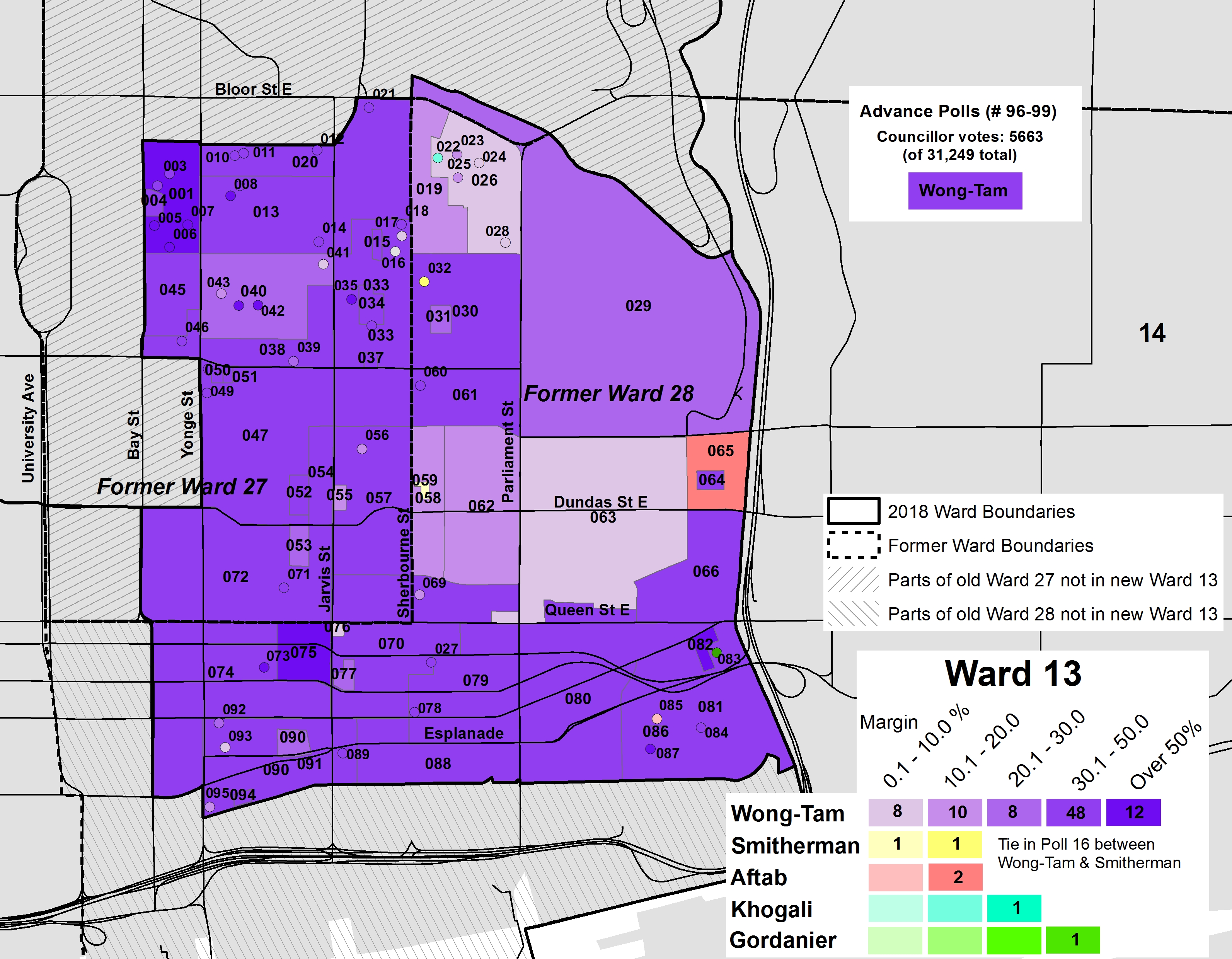
    Wong-Tam won with 50.3 percent of the vote, with other high-profile candidates doing quite poorly. George Smitherman got just 15.2 percent of the vote, while Lucy Troisi, the Ward 28 incumbent, got just 8.6 percent. Wong-Tam placed first in all but seven polls, while Troisi didn’t place first anywhere. It’s clear by the poll results map below that Wong-Tam’s support was lowest in St. Jamestown and in the Regent Park neighbourhoods while strongest in old Ward 27 and the area south of Queen Street.

    This speaks to the challenges for many councillors elected to new, larger wards. At least Kristyn Wong-Tam is one of Toronto’s most effective and hardest-working councillors, so Ward 13 is in good hands.

    2018 Election - W13.jpgPoll results in Ward 13

    Conclusion

    Downtown Toronto is fortunate to have experienced, dedicated, and hard-working councillors, but concentrating all the work in just three wards is unfortunate. Not only is the population of central Toronto growing faster than most other parts of the city, it has additional needs: an increasing share of the city’s employment that requires additional infrastructure such as a Relief Line Subway, and pressing social needs especially as new development downtown squeezes out affordable rental housing and the institutions that support marginalized people.

    I also think of all the great people running for council who never got a fair shot at running for council. Though re-electing Councillors Cressy, Layton, and Wong-Tam is the best result especially considering the circumstances, I was excited by many of the new voices who put their names forward in good faith earlier in 2018. Hopefully, they remain active in the community and get a fair chance in the future.


    Ward 10 Spadina-Fort York
    Candidate Votes Percent
    Michael Barcelos 451 1.6
    Al Carbone 519 1.8
    Joe Cressy 15,903 55.1
    Ahdam Dour 80 0.3
    April Engelberg 3,346 11.6
    Dean Maher 611 2.1
    Andrew Massey 473 1.6
    Rick Myers 747 2.6
    Karlene Nation 860 3.0
    John Nguyen 1,032 3.6
    Kevin Vuong 3,018 10.5
    Edris Zalmai 147 0.5
    Sabrina Zuniga 1,564 5.4
    Andrei Zodian 133 0.5
    Ward 11 University-Rosedale
    Candidate Votes Percent
    Michael Borrelli 671 2.1
    Marc Cormier 995 3.1
    Mike Layton 22,370 69.6
    Joyce Rowlands 4,231 13.2
    Michael Shaw 581 1.8
    George Sawision 376 1.2
    Nicki Ward 2,933 9.1
    Ward 13 Toronto Centre
    Candidate Votes Percent
    Darren Abramson 108 0.4
    Khuram Aftab 1,794 5.7
    Jon Callegher 713 2.3
    Richard Forget 150 0.5
    Tim Gordanier 734 2.4
    Jonathan Heath 144 0.5
    John Jeffery 530 1.7
    Walied Khogali Ali 1,408 4.5
    Gladys Larbie 101 0.3
    Barbara Lavoie 176 0.6
    Ryan Lester 968 3.1
    Kyle McNally 138 0.4
    Catherina Perez 511 1.6
    George Smitherman 4,734 15.2
    Jordan Stone 161 0.5
    Lucy Troisi 2,698 8.6
    Megann Willson 411 1.3
    Rob Wolvin 64 0.2
    Kristyn Wong-Tam 15,706 50.3
  • Mapping the results in Ward 4 Parkdale-High Park and Ward 9 Davenport

    In the penultimate post in my series examining the results of the 25 council races in the October 2018 municipal election here in Toronto, I take a look at the results in Ward 4, Parkdale-High Park and Ward 9, Davenport in Toronto’s west end.

    Neither of the two ward-level results were surprising. Ward 4 returned progressive councillor Gord Perks to City Hall, while in Ward 9, there wasn’t much of a contest: centrist Ana Bailão was easily re-elected.

    At the start of 2018, once the 47 ward boundaries were confirmed, it looked as though Bailão was going to be in one of the most interesting council races. The west end of the old City of Toronto — old Wards 14, 17, and 18 — had low population growth compared to many other parts of the city, including northeast Scarborough, North York Centre, Humber Bay Shores, and Downtown. These new ward boundaries were designed to improve representation as the old 44 wards were based on federal ridings drawn in the 1990s. Even with three new wards, the west end would lose a seat on council. The way the boundaries were drawn, it meant that Bailão, elected in Ward 18, would be up against Cesar Palacio, elected in Ward 17.

    2014 Election - 2018 Ward Projections
    Differences in 2018 ward populations under the old 44-ward model. Toronto’s west end was one of several areas over-represented by the outdated boundaries.

    Under the 47-ward model, it would have been the only race in which two incumbents would have ran against one another and Bailão would have had the advantage.

    Palacio, a conservative, was vulnerable in the last few elections, challenged by progressive candidates Alejandra Bravo and Jonah Schein, with Palacio narrowly winning in 2010. With the new boundaries extending south to Bloor Street (the area south of Bloor shifting to join old Ward 14 represented by Gord Perks), Palacio’s base in the north half of his old ward would not have been enough — areas that voted for Bravo in 2014 would have certainly voted for Bailão in a two-candidate race.

    After Bill 5 was introduced and confirmed into law, things changed. Sarah Doucette, a progressive councillor representing old Ward 13 (Swansea, Bloor West Village and part of the Junction) withdrew from the race when her ward was joined with Ward 14 (Parkdale and Roncesvalles).

    Doucette, who was first elected in 2010, said that she wasn’t interested in serving on a 25 ward council. A councillor well-known for her local community activism, Doucette would have represented a much larger area, and would have run against Gord Perks, someone she describes as a friend. For his part, Perks said that “Doucette deeply embodied the values of decency and community at city council. It’s a crime that we’re losing her.”

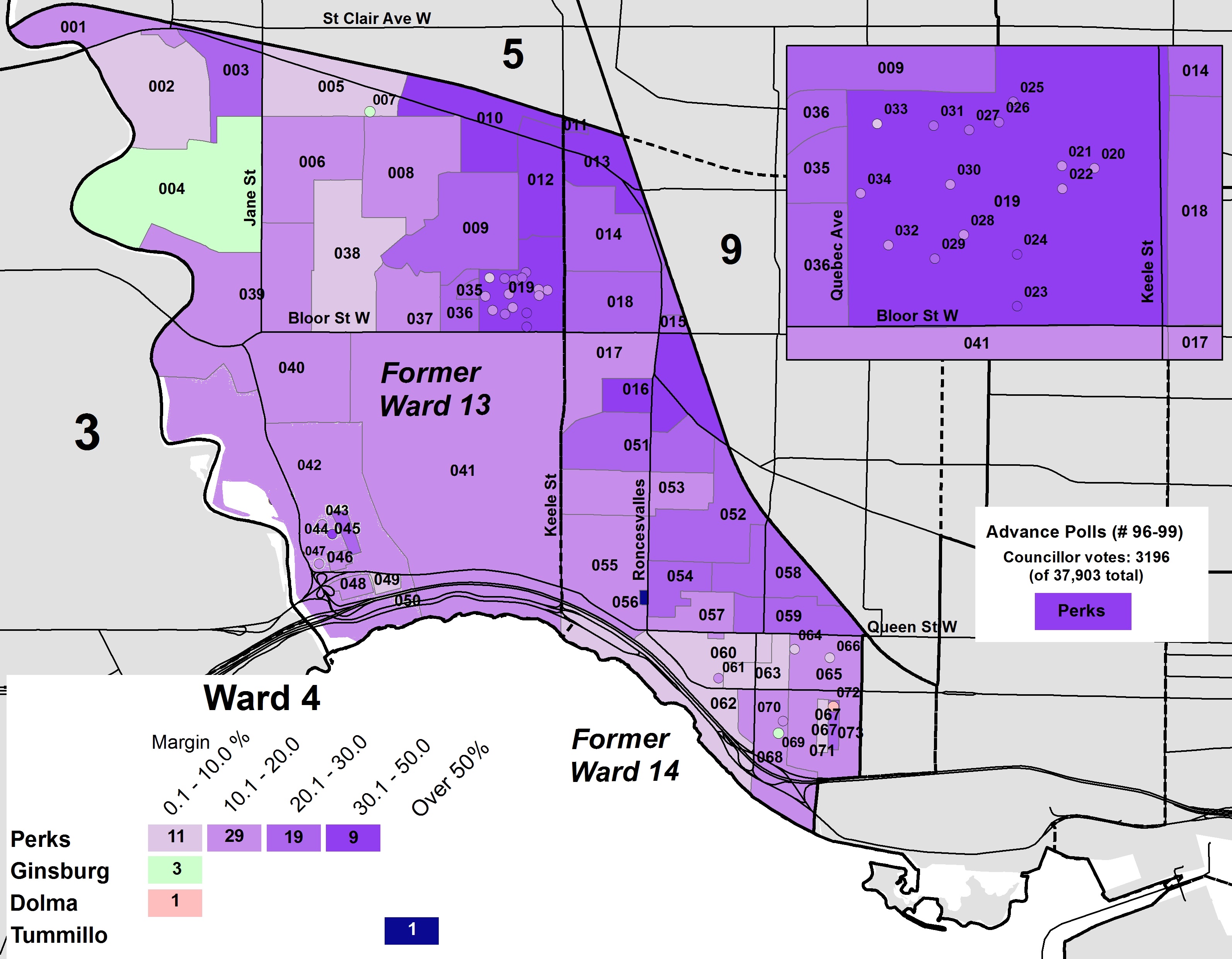
    Meanwhile, Perks, who was running, still had several opponents in the new larger ward. They included David Ginsberg, owner of several restaurants and a coffee shop near Trinity-Bellwoods Park; Kalsang Dolma, a Parkdale-based artist and community activist; and Evan Tummillo, a property manager who ran against Doucette in 2014. Tummillo was endorsed by the Toronto Sun, while the Toronto Star endorsed Perks.

    In neighbouring Ward 9, Cesar Palacio quietly dropped out of the race in late September, only a few days before the new post-Bill 5 nomination deadline. This was a surprise, as he and Bailão had known that they would run against each other for a very long time. Only four other candidates had registered, none of whom enjoyed wide name recognition. Had Palacio withdrawn earlier, it is possible that a progressive candidate would have taken a shot at running against centrist Bailão.

    In Ward 4, Perks easily won re-election, taking 44.5 percent of the vote and placing first in all but five polls. Ginsberg placed a respectable second, with 21.6 percent. Ginsberg did best in the affluent Baby Point neighbourhood in former Ward 13, while Dolma did quite well in a few Parkdale polls, placing first in one. Tummillo got just 6.2 percent of the vote, coming first in just one poll, a seniors’ residence on Roncesvalles Avenue.

    2018 Election - W4.jpg
    Poll-level results for Ward 4

    Meanwhile, in Ward 9, Ana Bailão got the highest winning margin of any council candidate, taking 83.6 percent of the vote. As the councillor in the old City of Toronto most allied with Mayor John Tory, Bailão has since been named to the executive committee and chair of the new planning and housing committee. Perks, on the other hand, was shut out of Tory’s inner circle.

    Bill 5 meant losing councillors that knew their wards intimately. While councillors will be able to hire more staff to help manage these local issues, it’s still an unfortunate loss of local representation.


    Ward 4 Parkdale-High Park
    Candidate Votes Percent
    Kalsang Dolma 5,352 14.1
    David Ginsberg 8,181 21.6
    Valerie Grdisa 1,771 4.7
    Taras Kulish 868 2.3
    Gord Perks 16,887 44.5
    Nick Pavlov 874 2.3
    Alex Perez 686 1.8
    Evan Tummillo 2,367 6.2
    Ward 9 Davenport
    Candidate Votes Percent
    Ana Bailão 26,219 83.6
    Mark Balack 1,114 3.6
    Nahum Mann 2,804 8.9
    Troy Young 1,218 3.9
  • Mapping the results in Ward 15 – Don Valley West and Ward 16 – Don Valley East

    Happy holidays!

    In this post, I take a look at the council races in Ward 15 Don Valley West and Ward 16 Don Valley East. The new two wards, introduced under Bill 5, encompass most of what used to be Wards 25, 26, and 34.

    Ward 25, Toronto’s most affluent under the 44 ward model, was represented by Jaye Robinson, a centre-right councillor. First elected in 2010, she served on both Rob Ford and John Tory’s executive committees. In 2014, she was appointed chair of the powerful Public Works and Infrastructure Committee, whose responsibility includes roads and transportation. Robinson was roundly criticized by road safety advocates (including Walk Toronto, of which I am a co-founder) for a weak “Vision Zero” plan to reduce traffic deaths in Toronto, especially pedestrians and cyclists. 2018 has turned out to be an especially deadly year on Toronto’s streets.

    Ward 26 was represented by Jon Burnside, a former Toronto Police officer. In 2014, Burnside defeated incumbent councillor John Parker — the only council race in which a sitting councillor was defeated by a challenger that year. Parker was a Progressive Conservative MPP in Mike Harris’ government, but came to be one of the most effective opponents of the Ford Brothers’ plans for Toronto’s waterfront, and brought a dry wit that was much needed at the time. In the 2014 election, John Tory endorsed Burnside, and Parker was defeated. Burnside had the support of the wealthier Leaside neighbourhood and condo towers off Wynford Drive, while the lower-income Flemingdon and Thorncliffe Park neighbourhoods supported Parker or Ishrath Velshi.

    Since the 2014 election, Burnside has proven himself as a thoughtful, moderate conservative.

    Meanwhile, Ward 34 was represented by Denzil Minnan-Wong, probably city council’s staunchest and most effective conservative.

    Minnan-Wong has been a municipal politician since 1994, when he was appointed to North York City Council. Since 1997, he has sat on Toronto City Council. He’s an advocate of contracting out city services, such as waste collection. Though he supported separated bicycle lanes on Sherbourne, Harbord, Richmond and Adelaide Streets, he quickly moved to scrub bike lanes on Jarvis Street downtown and Pharmacy and Birchmount Avenues in Scarborough. He has been especially powerful during the mayoralties of Rob Ford and John Tory, serving as Tory’s deputy mayor.

    In June 2018, Minnan-Wong was nominated by local Progressive Conservatives and ran in the June provincial election. He lost narrowly to the Liberal incumbent, Michael Coteau. Unlike council colleagues Shelley Carroll and Chin Lee, Minnan-Wong did not resign his seat to run provincially.

    Under the 47 ward model approved by City Council, each of the three incumbents were poised to run in wards similar to the ones they represented. Only one candidate registered to run against Jaye Robinson in new Ward 27 — Kyle Ashley, a former parking enforcement officer who made a name for himself on Twitter ticketing and shaming motorists blocking Toronto’s bike lanes. He ran against Robinson because of a perceived lack of leadership on Vision Zero. In new Ward 33, Burnside faced a few opponents, but was looking to cruise to re-election.

    Meanwhile, Minnan-Wong was challenged by former Liberal MPP and provincial minister David Caplan in new Ward 32. After leaving provincial politics, Caplan served as chair of the Infrastructure Lab and vice-chair of Global Public Affairs Toronto. It would be the first time in many years that Minnan-Wong would face a high-profile opponent.

    But then the new 25 wards were imposed on the city.

    Ward 15

    Ward 15, the provincial/federal riding of Don Valley West, is represented by Liberals both provincially and federally: former premier Kathleen Wynne continues to serve the community, while Rob Oliphant is the Liberal MP.

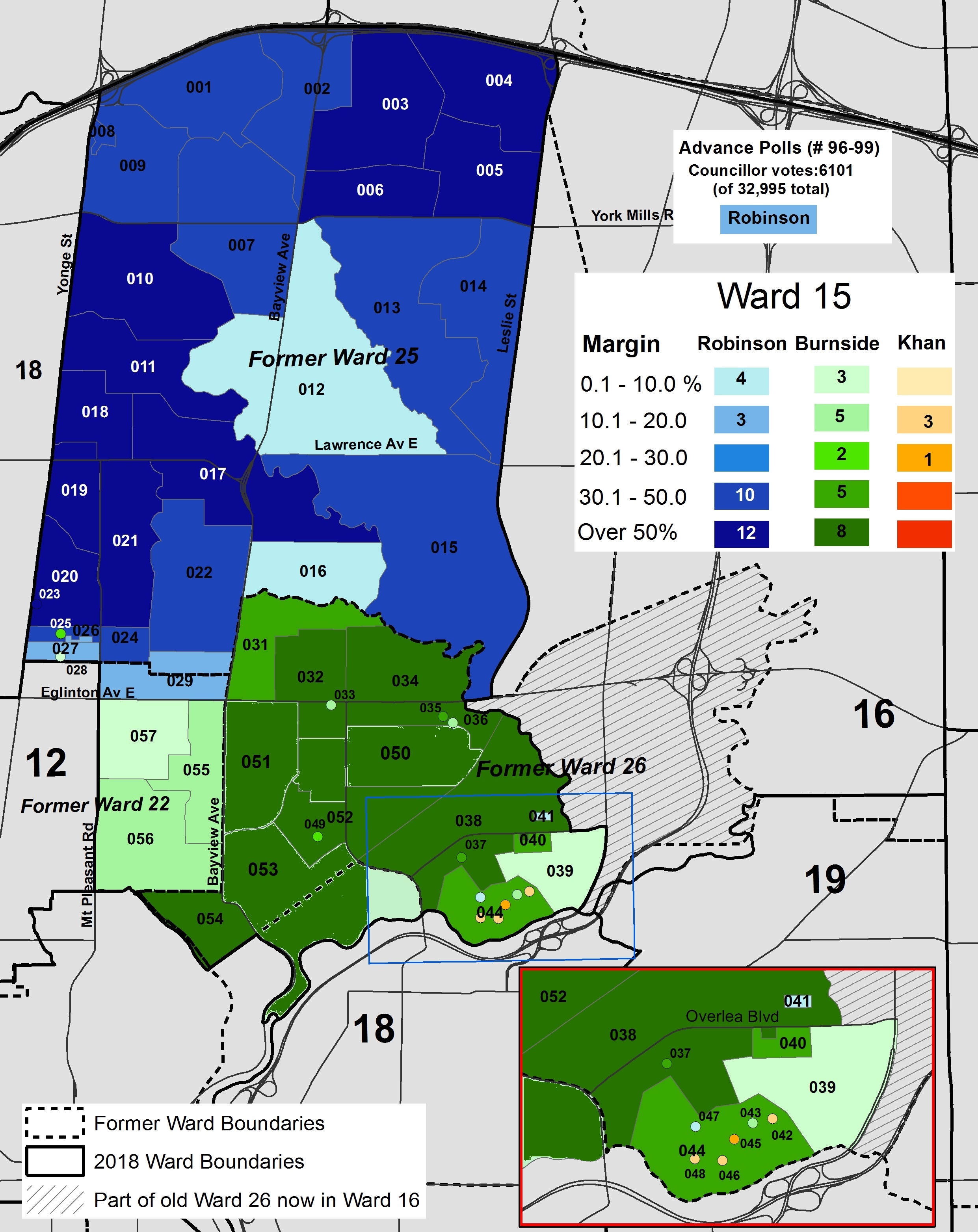
    The new ward boundary, severely disadvantaged Burnside: a significant chunk of old Ward 26, including Flemingdon Park, was now part of Don Valley East. A small part of old Ward 22, between Mount Pleasant Road and Bayview Avenue, was added. Meanwhile, Robinson did not lose any of her old ward. Several candidates, including Ashley, dropped out of the new race.

    Burnside placed first in former Ward 26, getting 68 percent of the vote there, and won all three polls in former Ward 22, though by a small margin over Robinson. In Thorncliffe Park, however, Tanweer Khan got over 30 percent of the vote and placed first in four polls. Khan, a local business owner, was an organizer against the updated provincial health and sex-ed curriculum. Khan also ran for the nomination for the provincial Progressive Conservatives PC nomination in Don Valley West, but lost. Khan only got 4.0 percent of the vote ward-wide, but it helped Robinson win.

    Robinson took 67 percent of the vote in her former ward. She won Ward 15 overall with 49.2 percent of the vote, to Burnside’s 43.8 percent. Though Robinson will not be part of the Tory’s executive committee this term, she was recently appointed Chair of the Toronto Transit Commission.

    What bothers me mostly is not the result, but of the geographic isolation of Thorncliffe Park under the new 25 ward model. It is now a geographically isolated corner of a mostly affluent ward. I fear it, and neighbourhoods like it, will be ignored under a much smaller council.

    2018 Election - W15.jpgPoll results in Ward 15

    Ward 16

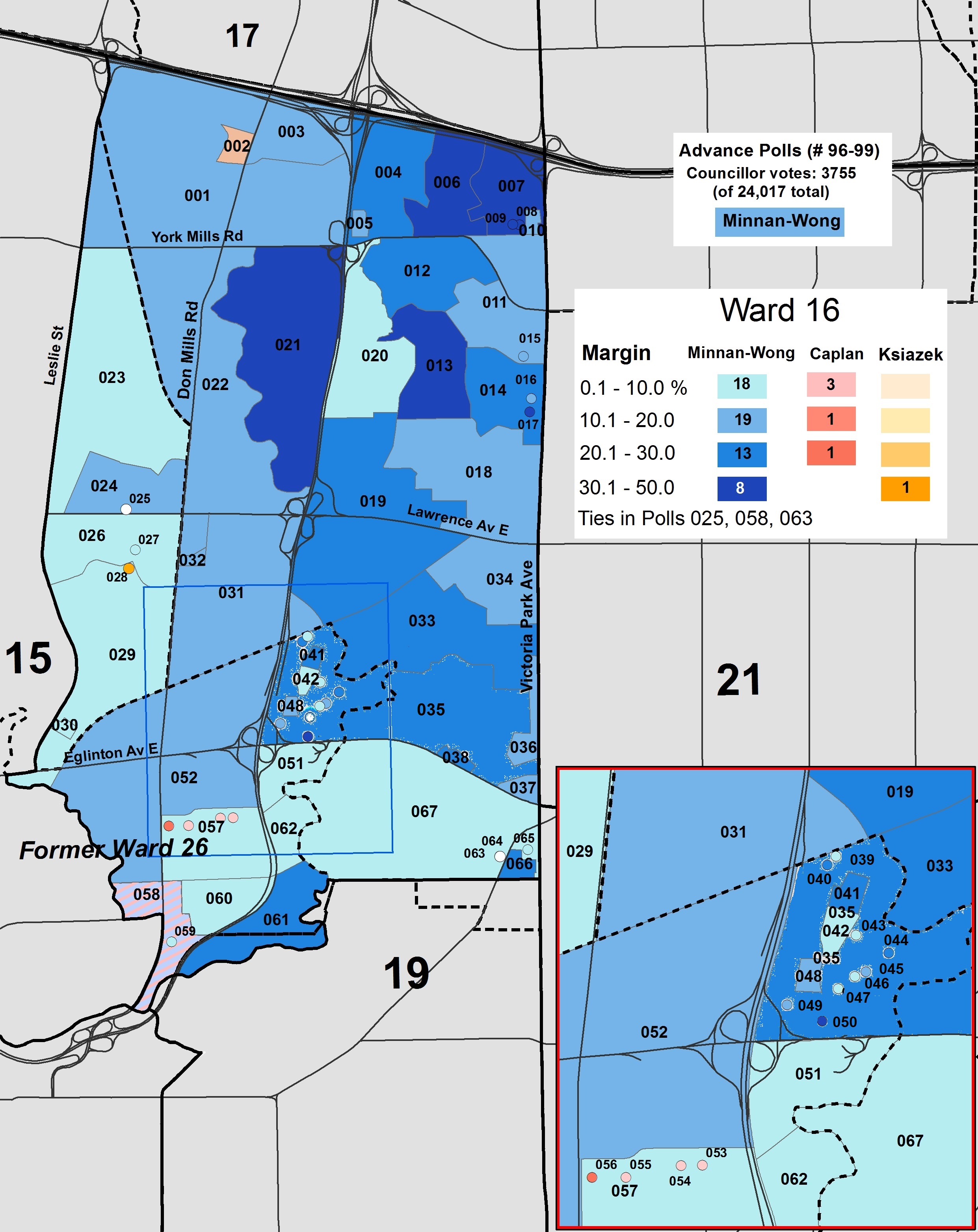
    David Caplan was no match for Denzil Minnan-Wong. Caplan was able to get over 30 percent of the vote, but he placed first in just five polls. The combination of Minnan-Wong’s name recognition and incumbency, Caplan’s long absence from provincial politics and his involvement in the eHealth boondoggle (he resigned as Minister of Health in 2009 and did not run in the 2011 provincial election) probably also played a part as well. Caplan did best in Flemingdon Park, a low-income neighbourhood with a large immigrant population that was previously part of Ward 26.

    Self-described “pragmatist” Stephen Ksiazek, a local business owner who sits on the Don Mills Residents Association, placed third with 7.1 percent of the vote, coming first in one poll.

    Minnan-Wong will serve a second term as Tory’s primary deputy mayor, and will once again set an agenda of low taxes and austerity at City Hall.

    2018 Election - W16.jpgWard 16 poll results


    Ward 15 – Don Valley West
    Candidate Votes Percent
    Jon Burnside 14440 43.8
    Tanweer Khan 1309 4.0
    Minh Le 404 1.2
    Jaye Robinson 16219 49.2
    Nikola Streker 583 1.7


    Ward 16 – Don Valley East
    Candidate Votes Percent
    Aria Alavi 582 2.4
    David Caplan 7277 30.3
    Diane Gadoutsis 569 2.4
    Stephen Ksiazek 1698 7.1
    Pushpalatha Mathanalingam 888 3.7
    Denzil Minnan-Wong 11128 46.3
    Dimitre Popov 1104 4.6
    Michael Woulfe 771 3.2
  • The Scarborough Six: mapping the results of the 2018 election

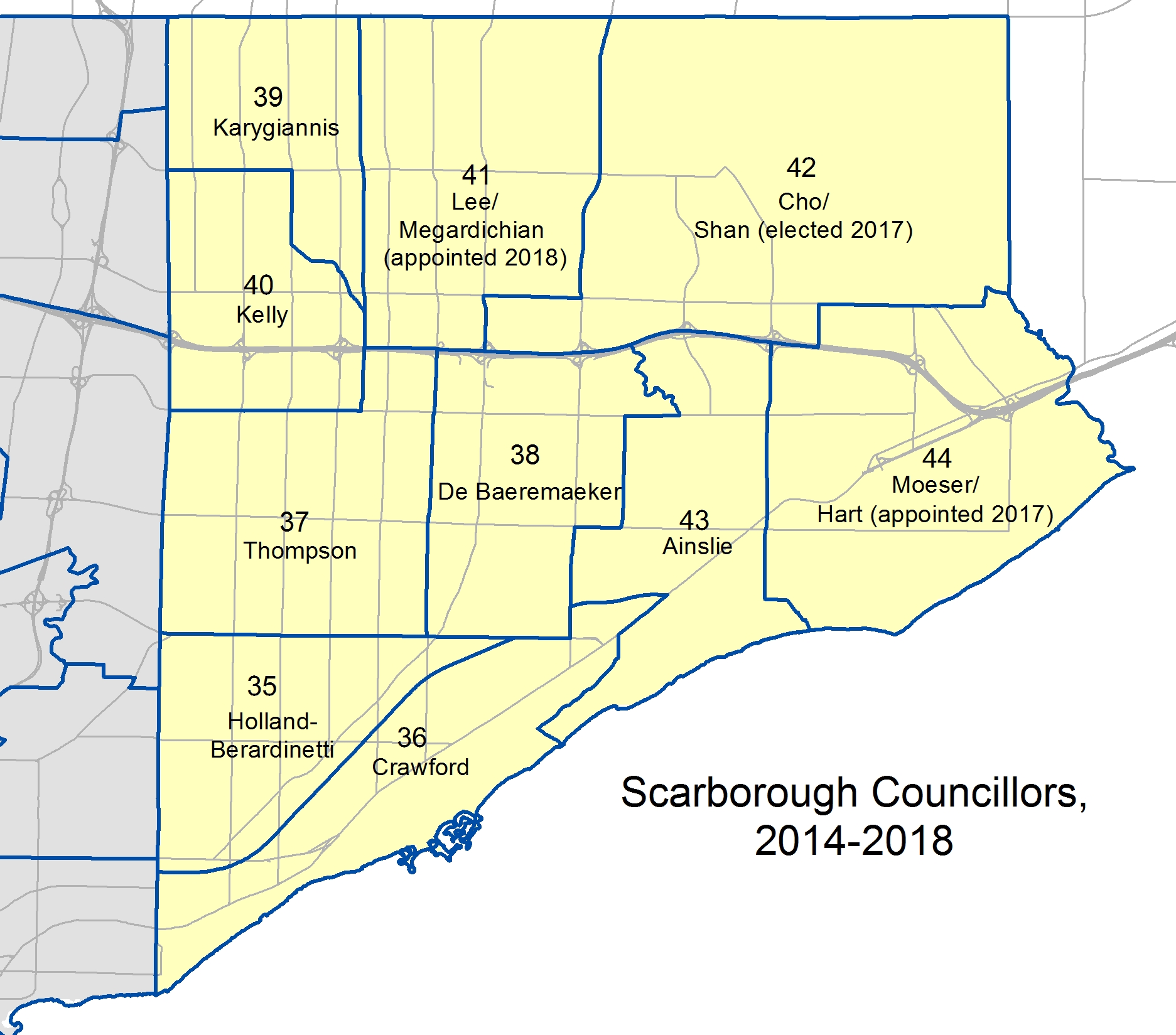
    In 2014, Scarborough elected ten city councillors. Since that election, one councillor, Ron Moeser, died in office, while two others, Raymond Cho and Chin Lee, resigned to run for provincial office. Cho, representing the Ontario PCs, was successful, while Lee, running for the Liberals, was not. Neethan Shan was elected in Ward 42 in a by-election to fill Cho’s seat. Jim Hart was appointed in Ward 44 by council after Moeser’s death, and Miganoush Megardichian was appointed in Ward 41.

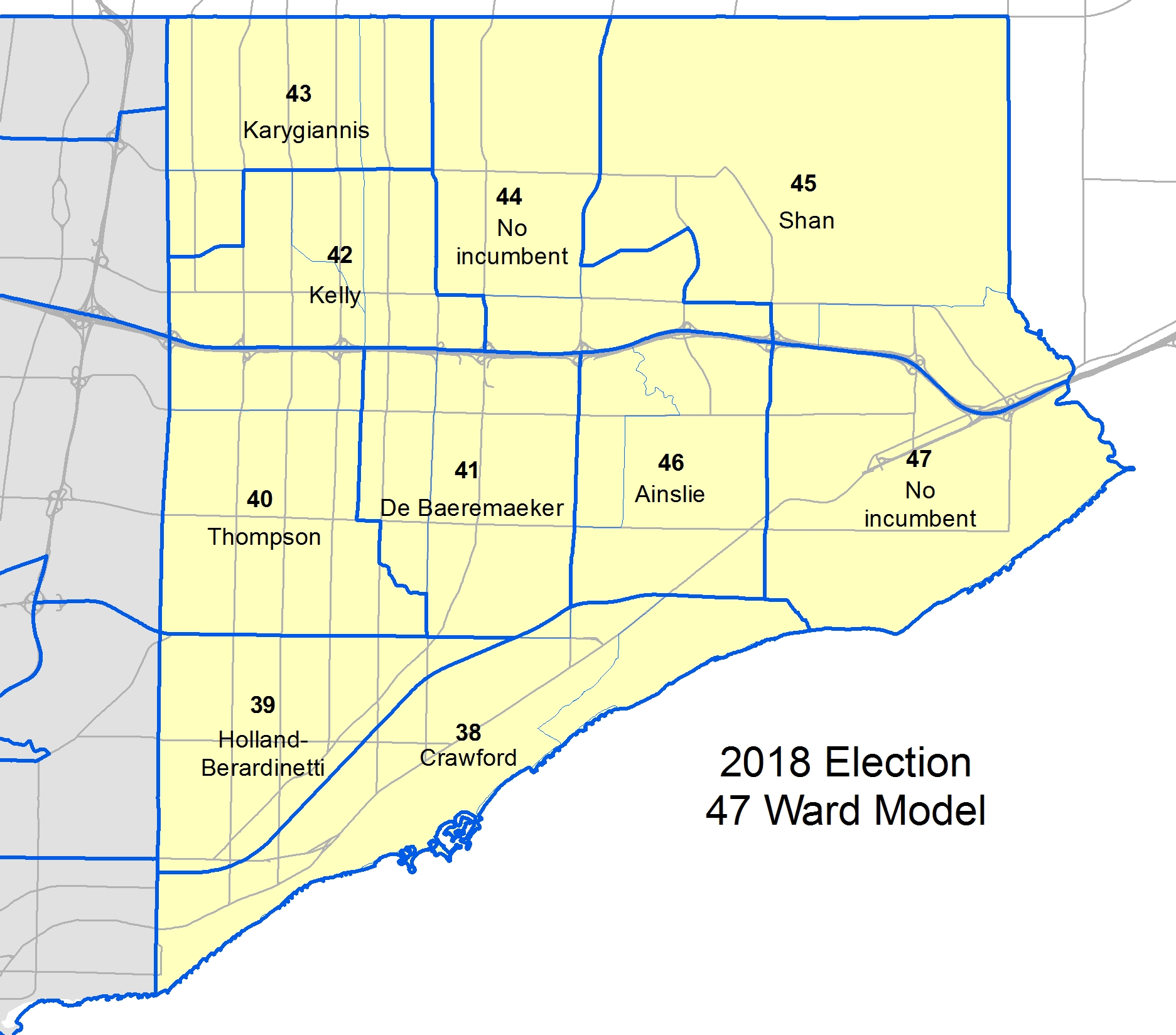
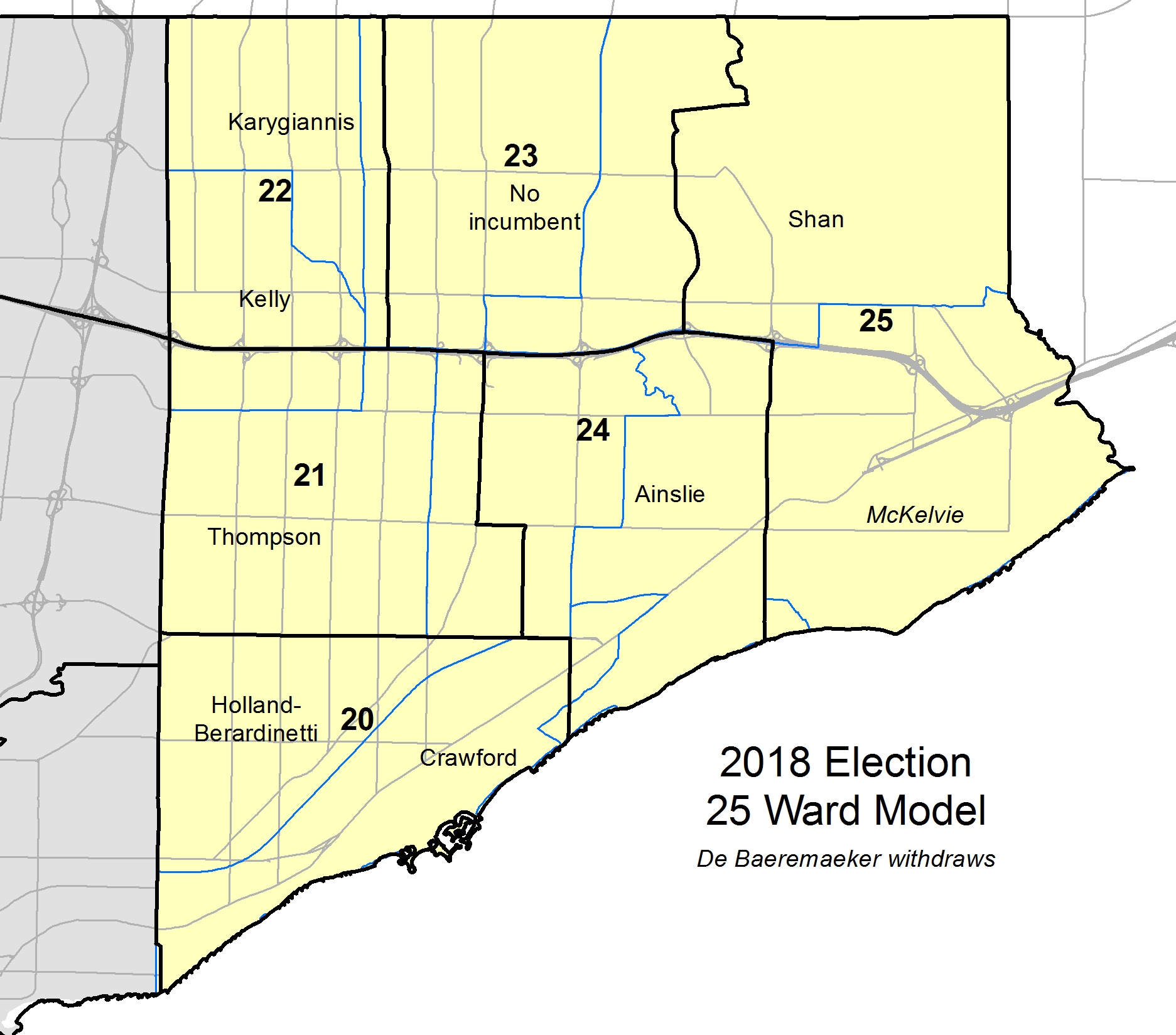
    With the new 47 ward model approved by city council for the 2018 election, Scarborough was allocated the same number of wards, though boundaries shifted to reflect changes in population. Two of the new wards – 44 and 47 – had no incumbent running, opening those wards up to new voices.

    With Premier Doug Ford’s move to cut city council to just 25 wards, Scarborough went down to just six wards. In Wards 20 and 22, incumbents faced off against each other. Councillor Glenn De Baeremaeker, famous for his support of the Scarborough subway extension, decided that the odds were against him and withdrew his candidacy. De Baeremaeker’s old ward was cut in half and redistributed evenly to new Wards 21 and 24. Had he decided to run again, it would have meant running against fellow council veterans Michael Thompson or Paul Ainslie, both of whom had a geographic advantage in not losing any of their former territories.

    I previously mapped the results in Ward 22, where Jim Karygiannis defeated Norm Kelly, Ward 23, where conservative businesswoman Cynthia Lai won, and Ward 25, where Jennifer McKelvie defeated incumbent Neethan Shan.

    Of the remaining three races in Scarborough, only Ward 20 was interesting. There, incumbents Michelle Holland-Berardinetti and Gary Crawford ran against eight challengers. In Wards 21 and 24, Councillors Thompson and Ainslie won with over 65 percent of the vote and nearly every poll. I did not map the results of those two races.

    Ward 20

    Ward 20 saw two right-leaning councillors, Gary Crawford and Michelle Holland-Berardinetti face off against each other. Both were reliable Tory allies; Crawford served as budget chief under both Rob Ford and John Tory, while Holland-Berardinetti was council’s innovation advocate.

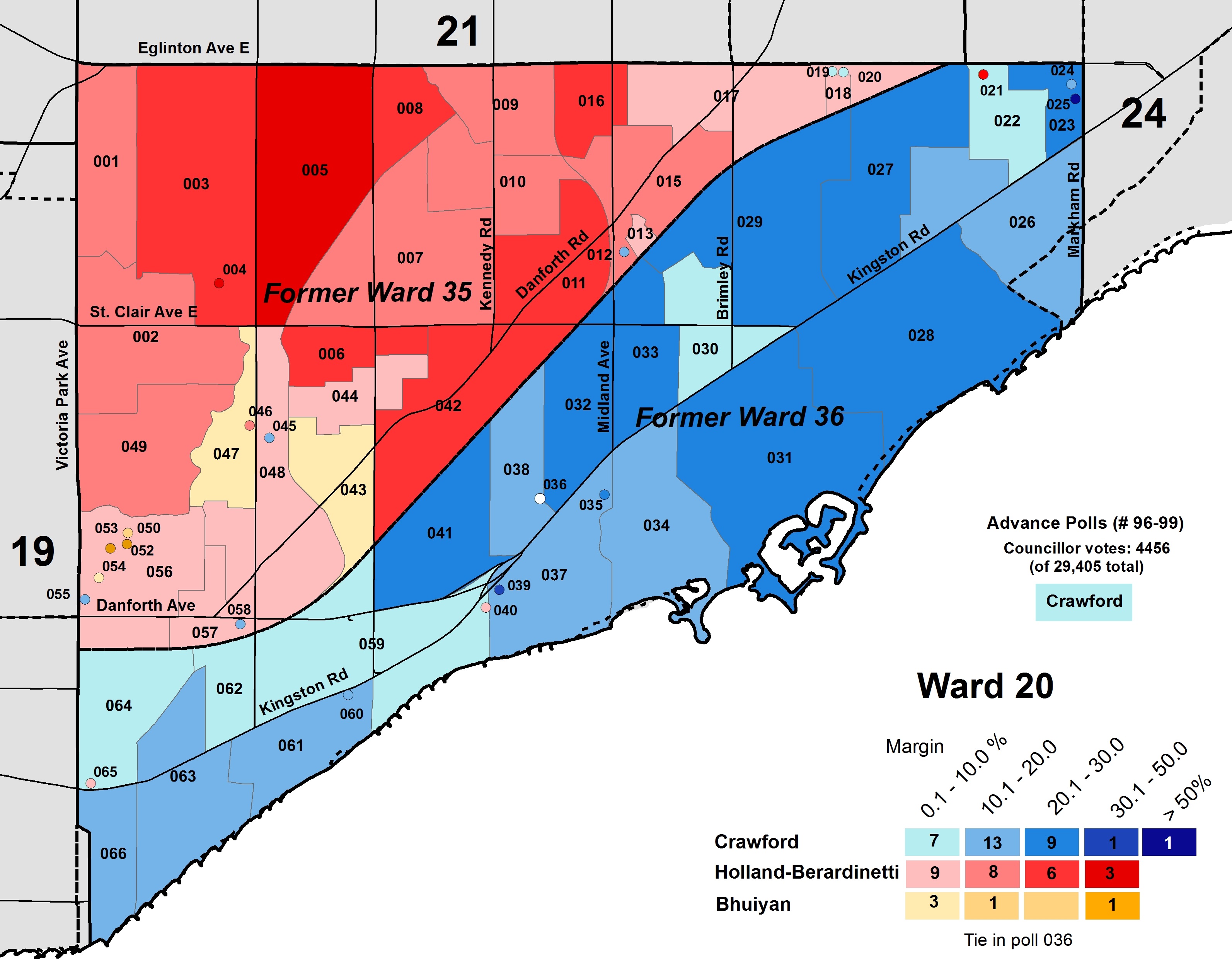
    Crawford was first elected in Ward 36 in 2010 after serving as public school trustee. He previously ran for the provincial Progressive Conservatives in 2007. Ward 36, whose southern boundary was Lake Ontario, was Scarborough’s most affluent ward and included the Scarborough Bluffs. Holland-Berardinetti, the spouse of former Liberal MPP Lorenzo Berardinetti, was also first elected in 2010, representing Ward 35. Both councillors were re-elected by wide margins in 2014.

    Bill 5 resulted in Wards 35 and 36 merging, with only a small part of old Ward 36 shifting to new Ward 24. The number of voters in each of the two former wards was almost equal, but Crawford won a very a tight race; only 411 votes separated the two incumbents.

    Though Mohsin Bhuiyan originally registered to run against Crawford in the 47-ward model, he placed first in five polls in former Ward 35, in the Dentonia Park and Scarborough Junction neighbourhoods. He placed third overall, with 10 percent of the vote, but he drew more votes from Holland-Berardinetti than from Crawford. Suman Roy, a food advocate endorsed by the Toronto Star and NOW Magazine, was only able to get 5.4 percent of the vote, coming in fifth.

    2018 Election - W20.jpg

    Ward 20 Scarborough Southwest
    Candidate Votes Percent
    Gerard Arbour 1,187 4.0
    Mohsin Bhuiyan 2,910 10.0
    Paulina Corpuz 1,813 6.2
    Gary Crawford 10,505 35.7
    Michelle Holland-Berardinetti 10,094 34.3
    John Letonja 160 0.5
    Robert McDermott 367 1.3
    Suman Roy 1,582 5.4
    Curtis Smith 541 1.8
    Bruce Waters 246 0.8

    Ward 21

    Michael Thompson was first elected to Toronto City Council in 2003. In the 2014 election, he won with over 80 percent of the vote. In the larger new ward, the share of the vote fell to 69 percent. While he’s a thoughtful conservative and a good constituency councillor, Thompson also supported Doug Ford’s unilateral cut to city council.

    Ward 21 Scarborough Centre
    Candidate Votes Percent
    Paul Beatty 1,638 6.8
    Vivek Bhatt 993 4.1
    Fawzi Bidawi 1,035 4.3
    Zia Choudhary 1,014 4.2
    Randy Bucao 949 4.0
    Ismail Khan 311 1.3
    Arfan Naveed 349 1.5
    Raphael Rosch 545 2.3
    Nur Saifullah 132 0.6
    Michael Thompson 16,542 69.1
    Zamir ul hassan Nadeem 448 1.9

    Ward 24

    Paul Ainslie was first elected to Toronto City Council in 2006, after being appointed to council in a neighbouring ward in 2005. A principled centrist, Ainslie served on Tory’s executive committee and was re-appointed in 2018. Ainslie won in 2018 with two-thirds of the vote in Ward 24, placing first in all but three polls.

    Ward 24 Scarborough-Guildwood
    Candidate Votes Percent
    Paul Ainslie 15,131 66.8
    Itohan Evbagharu 132 0.6
    Reddy Muttukuru 1,323 5.8
    Priyanth Nallaratnam 1,896 8.4
    Keiosha Ross 405 1.8
    Sajid Saleh 841 3.7
    Michelle Spencer 1,933 8.5
    Emery Warner 393 1.7
    Morlan Washington 592 2.6