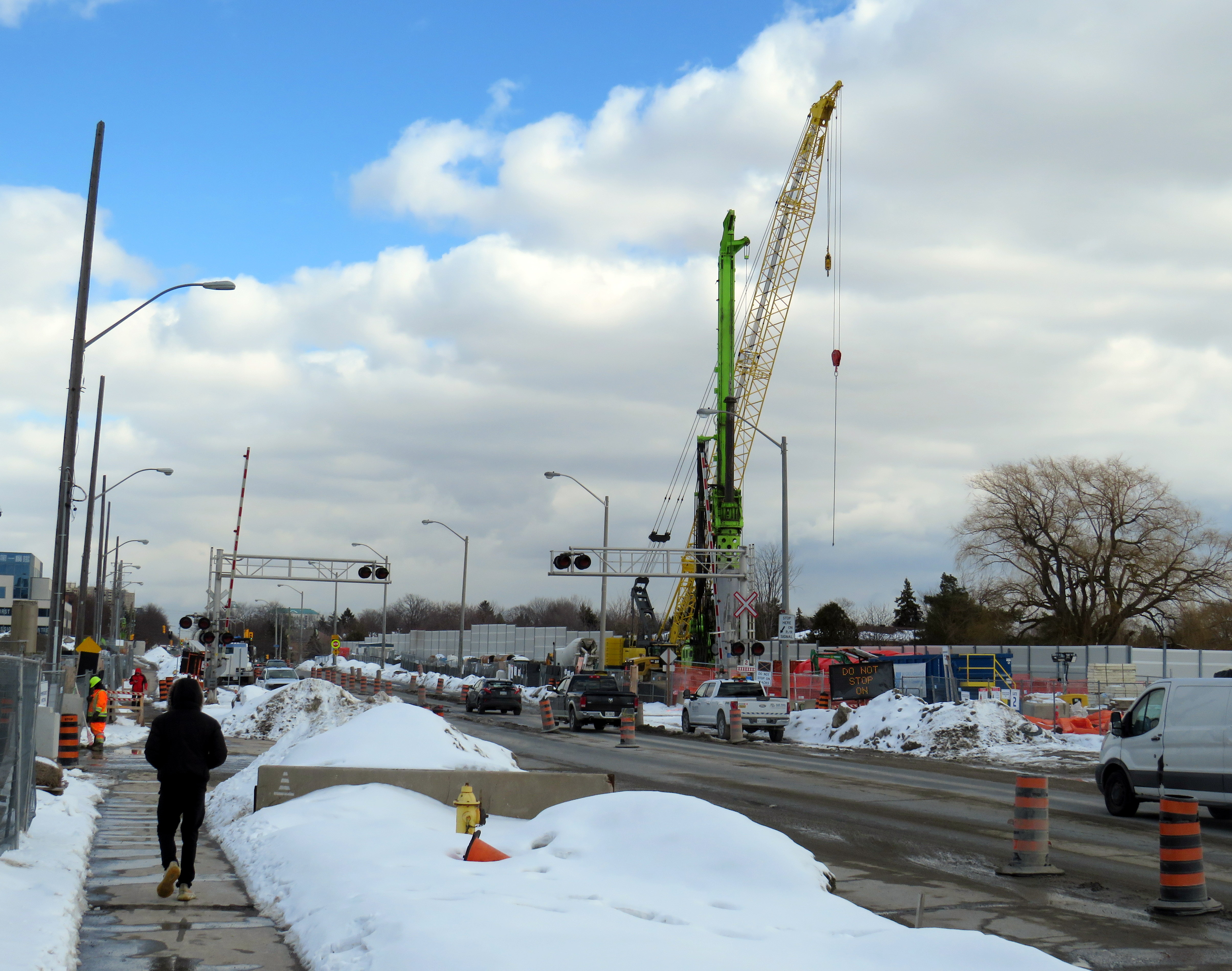
Metrolinx construction on Finch Avenue East in Scarborough
On Finch Avenue East in Scarborough, where the busy roadway meets the GO Stouffville Line, one will encounter a major construction project. Cranes and pile drivers line the railway crossing, with dozens of construction workers busy building a new grade separation between the rails and roadway. Once complete, the underpass will allow Finch Avenue traffic to pass unimpeded by more frequent GO train service and provide additional safety to all road users.
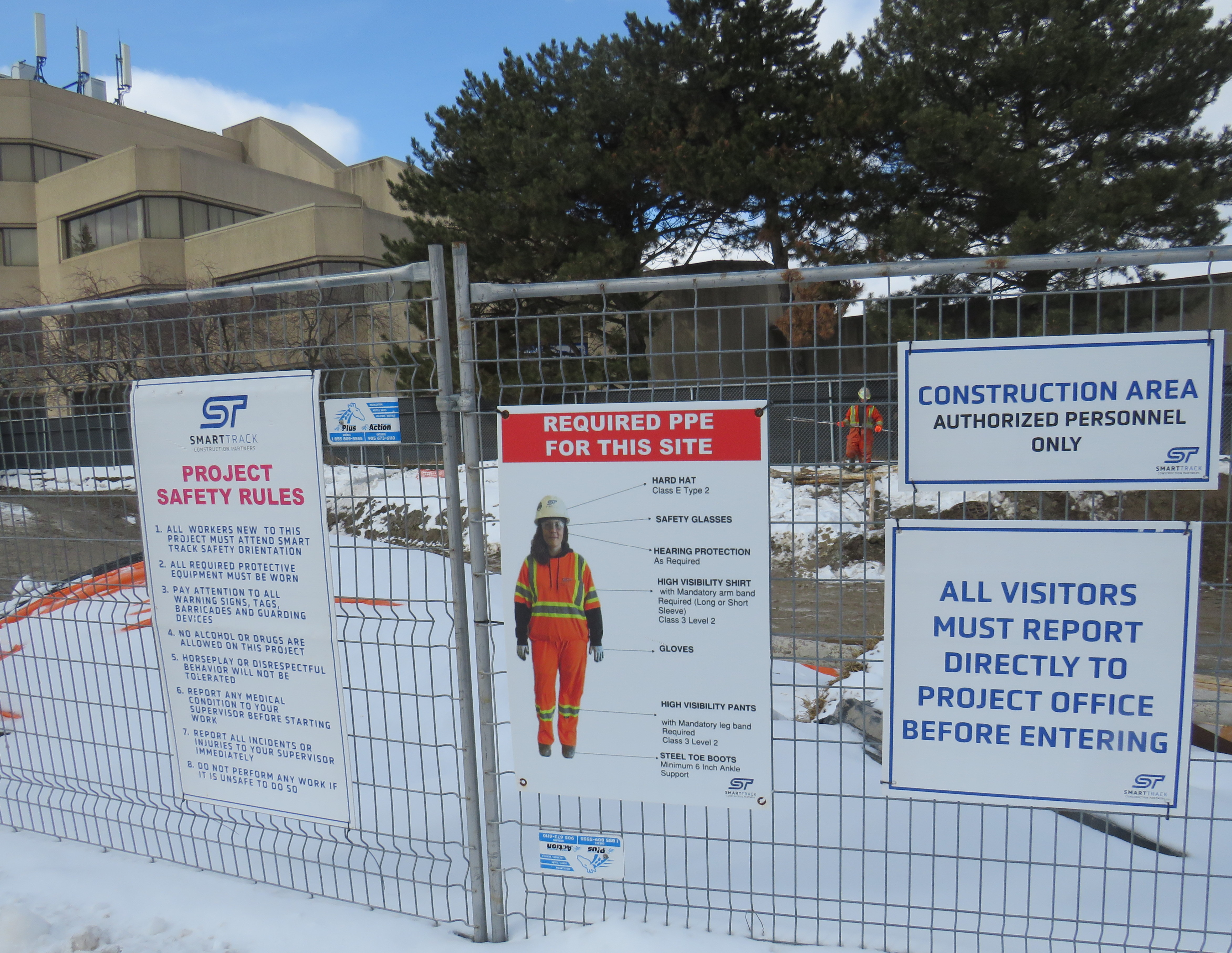
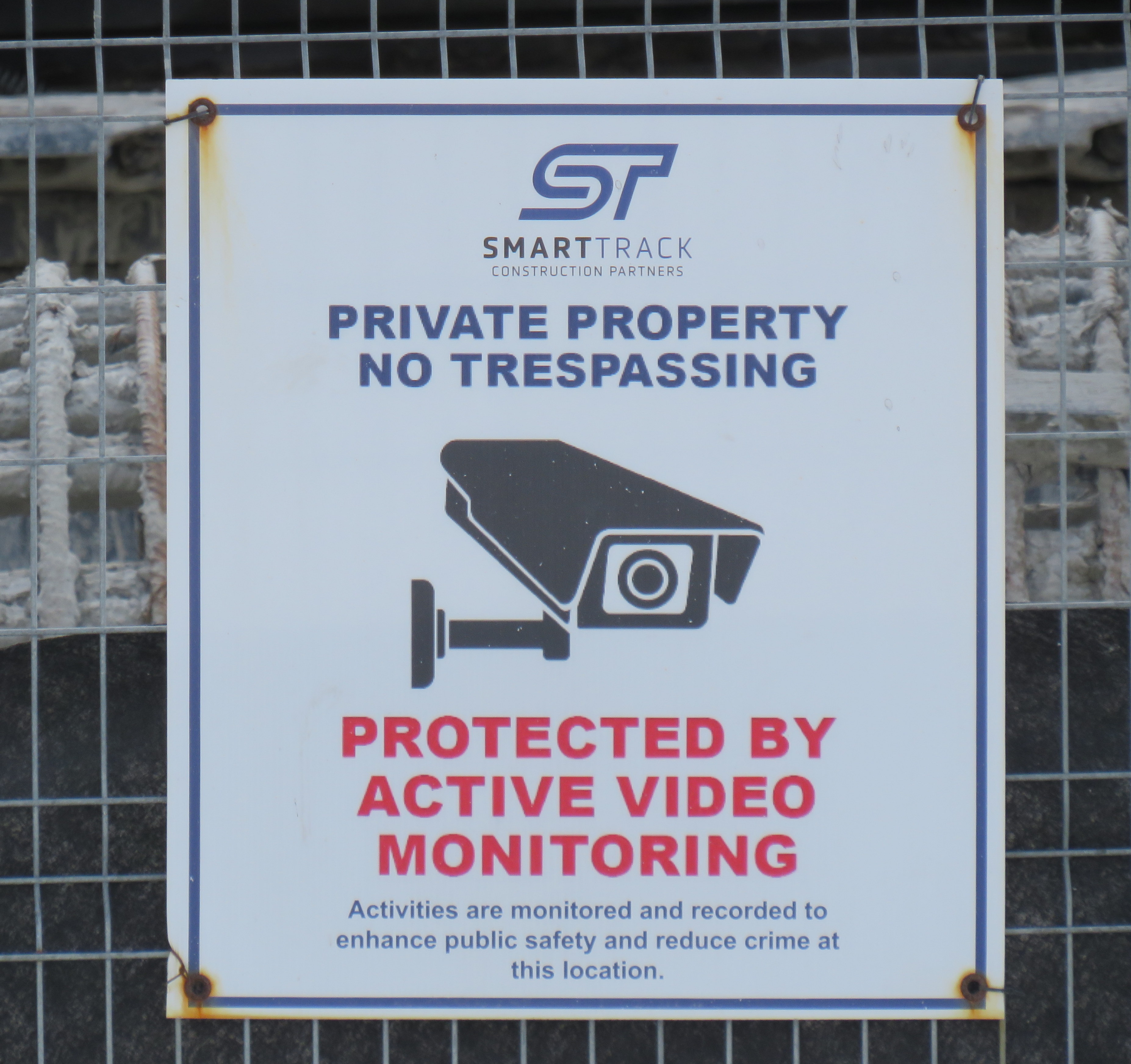
But the overpass was meant to be much more than just a rail bridge. A clue can be found in the construction site signage. Though the construction equipment is all marked for Green Infrastructure Partners (GIP), GIP is part of a project-specific consortium called “SmartTrack Construction Partners” or STCP, noted in a 2024 City of Toronto progress report. The SmartTrack name is interesting, as this was also going to be a site of a so-called SmartTrack station.
Construction site signageCloseup of another site sign, with the “SmartTrack Construction Partners” name and logo clearly displayed
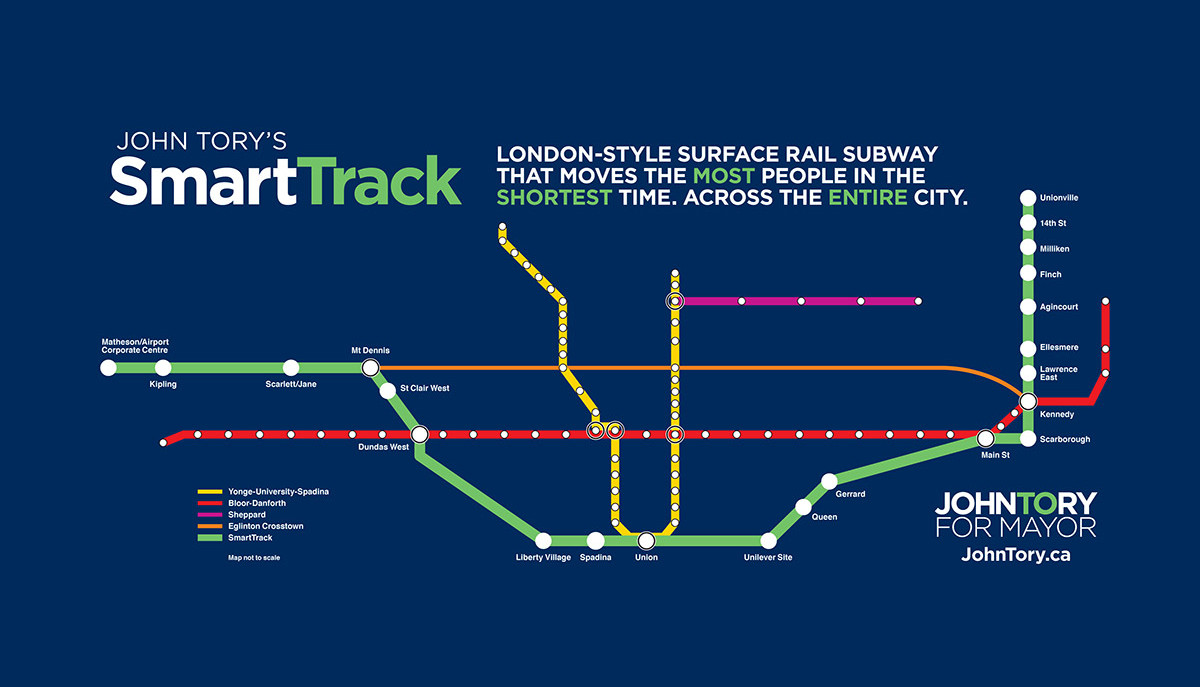
The Finch-Kennedy GO Station became part of a five-stop remnant of the SmartTrack concept, a “surface rail subway” promoted as part of John Tory’s 2014 successful mayoral campaign and subsequently made part of city policy, even maintaining the brand name. As I have written extensivelyabout the troubled proposaland failed implementation of SmartTrack on this website, I will not go into any detail. But SmartTrack promised the construction of 13 entirely new regional rail stations augmenting 9 existing or committed GO stations on the Stouffville and Kitchener corridors, including a new rail branch on Eglinton Avenue West to Mississauga. One of those stations was to be at Finch Avenue East.
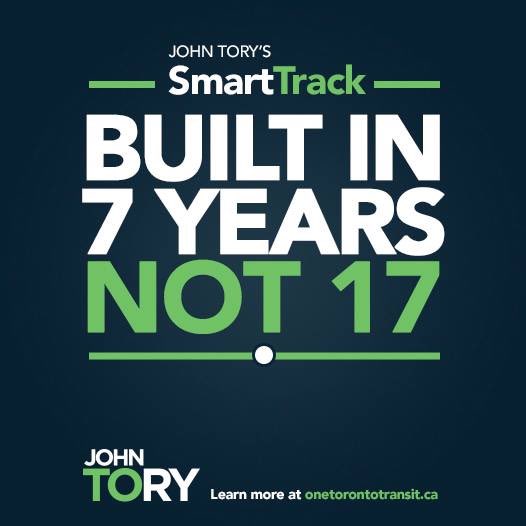
“John Tory’s SmartTrack,” depicting what the “London-style” transit service would look like, from Tory’s 2014 campaign
Since 2015, the SmartTrack concept began to shrink as the difficulty of building a regional rail line on Eglinton West became clear and as other transit projects came forward. The Ontario Line, now under construction, fills the downtown subway relief function that SmartTrack promised. The tunneled western extension of Line 5 from Mount Dennis to Renforth replaces the problematic western section of Tory’s proposal. Furthermore, GO Expansion would transform much of the GO rail network into a more frequent, all-day service on five of its seven lines would provide more service to more stations than SmartTrack ever could. (Unfortunately, Metrolinx is dragging its heels on GO’s transformation.) Even better, all these projects were promoted and funded by the province, while SmartTrack was a municipal effort.
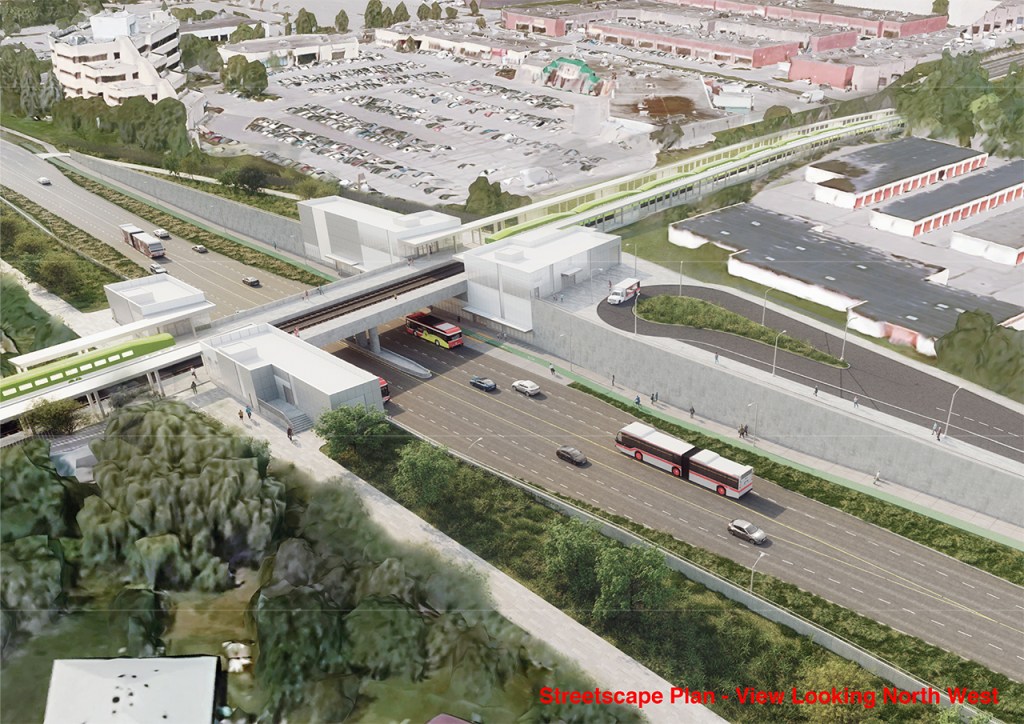
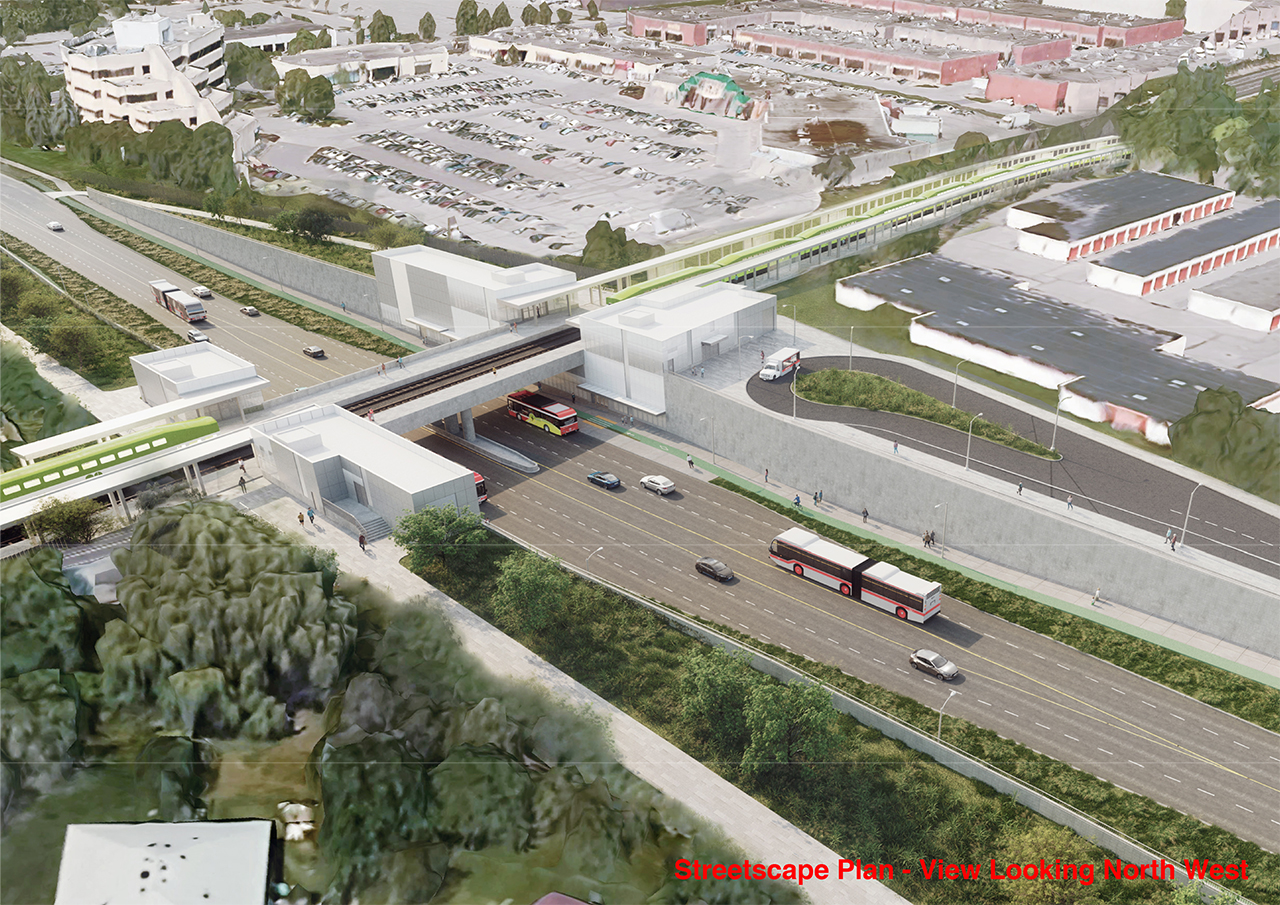
But Finch SmartTrack Station, referred to in official planning materials as “Finch-Kennedy,” survived a whole decade, one of four remaining city-funded SmartTrack-branded stops from that early campaign map (a fifth stop was later added to the Barrie GO Corridor, at Bloor Street). Even as a regular GO Transit stop, Finch-Kennedy would have been quite useful for Scarborough commuters as well as promote new mixed-use development in northeastern Toronto. Surrounding the site are commercial plazas and industrial malls, self-storage units, and low-density residential subdivisions. The streetscape plan of the station below illustrates the site’s surroundings.
As planned, Finch-Kennedy Station would have been a no-frills rapid transit stop, with two tracks and platforms that span the Finch Avenue overpass. Access between the street (with curbside bus stops) and platforms would have been easy and direct, with stairs and elevators connecting the two modes on both sides of the street. With more frequent GO service facilitated by the double track expansion of the corridor, and proposed electrification, the Stouffville Line would have been a really useful link between the frequent 39/939 bus route (the busiest bus corridor in Toronto) to Union Station, the transfers to Lines 2 and 5 at Kennedy Station, and to Markham to the north. There would be no parking on-site, but just an access driveway on the northeast corner for service vehicles.
Though GO could double track the Stouffville Corridor and run more frequent trains without the grade separation if no station was to be built at Finch, an underpass would be necessary if trains were going to decelerate, stop, and accelerate within a short proximity of Finch Avenue. Building the platforms on the bridge structure only makes transit connections easier.
Due to cost overruns, SmartTrack is down to just three stations, which are now in various stages of construction. Along with King-Liberty, Finch-Kennedy was dropped from the list in December 2024, even as construction on the first and most critical phase, the Finch underpass, was already underway. Earlier this week, the Toronto Star reported that nearly $100 million were spent on these two now-deferred stations. The cost of completing Finch-Kennedy had jumped by $130 million, to a total of almost $370 million.
Even though the station is deferred, heavy construction continues on Finch Avenue East. The SmartTrack name lives on through the firm tasked with finishing the grade separation intended to literally support the new transit connection. Presumably, the bridge will be built with provision for the transit station to be added later. But it will only be even more expensive to go back later and complete the job.
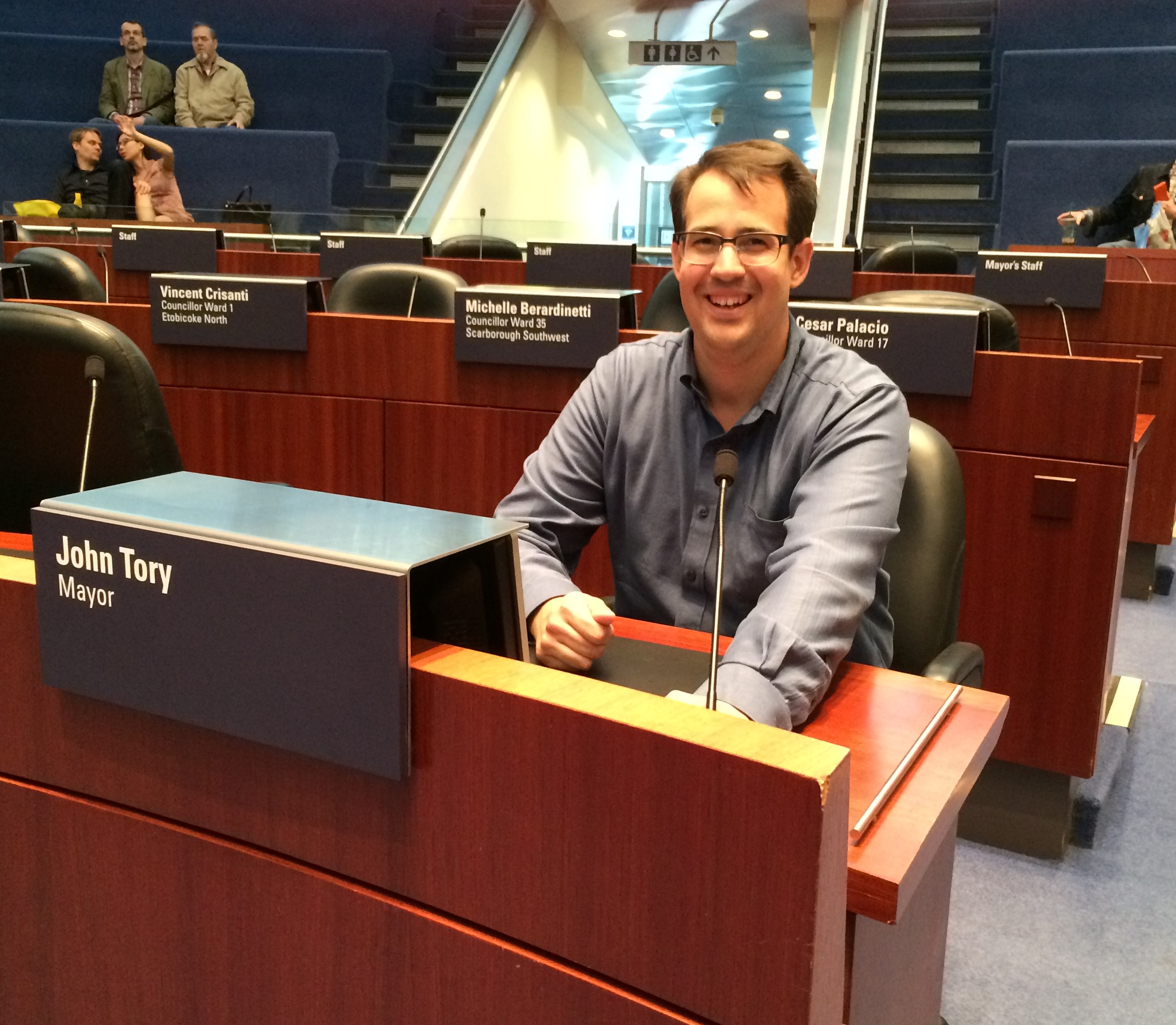
Meanwhile, after resigning in disgrace in Winter 2023, not long after his re-election, John Tory is rumoured to make another run for mayor against his replacement, Olivia Chow. Tory will have a lot to answer for if he chooses to run again; the tattered remains of his SmartTrack legacy should certainly be one of those questions.
Map of John Tory’s SmartTrack proposal, his signature campaign plank from the 2014 municipal election
SmartTrack, the transit plan championed by former mayor John Tory in 2014, is the election promise that will never fully die, even if it was diminished from the promise of a brand-new 53-kilometre transit relief project to just a few new stations on existing GO Transit rail corridors. SmartTrack, as initially pitched, would have utilized existing rail and highway corridors to quickly build an express rapid transit line that would provide much-needed relief to the Yonge Subway line, foster development of the East Don Lands (former site of an Unilever soap factory), and connect downtown with employment lands in Markham and Mississauga. According to campaign materials, SmartTrack would have been built in just seven years.
Eleven years later, that relief is coming, but through other forms: the now under-construction Ontario Line, expansion of the Bloor-Yonge Subway station, and slow subway ridership recovery after the COVID-19 pandemic restrictions in 2020-2021. The Mount Dennis-Airport Corporate Centre section, nearly impossible to build as a continuous passenger rail line, is now being built as a tunneled extension of the Eglinton-Crosstown LRT.
Over a decade later, the legacy of SmartTrack, along with other major changes for the GO Transit Kitchener Line, will affect both GO operations and UP Express, Toronto’s airport rail link, which will be asked to do more despite existing constraints. Without rigorous planning, transparency from Metrolinx, and stakeholder input, the potential of Toronto’s northwest corridor as a high-quality local and regional transit project is in doubt. With significant investment and proper planning, the Kitchener Line could serve as a shining example of how to get things right.
The diminished legacy of SmartTrack
It’s possible that three “SmartTrack” stations might be completed in 17 years
The idea of a “London-style surface rail subway” for Toronto was, and remains, a laudable goal for our existing GO Transit rail corridors; this was the concept behind the GO Expansion project touted just a few years ago that would truly transform the system into a high-quality urban rail network. It would not only serve suburban municipalities like Markham, Brampton, and Mississauga, but also improve travel times to the inner suburbs such as Agincourt and Rexdale.
What SmartTrack got wrong was relying on a flawed report that had very specific aims, poor public buy-in, and an arrogant, yet ineffectual proponent who nevertheless managed to win re-election, twice. (He might run again in 2026.) It didn’t help that SmartTrack was a municipal idea that was not coordinated with the provincial planning process; it never really got off the ground, even if municipal planning staff were charged with implementing the proposal. Ideally, the city should have just pushed hard to advance GO expansion on multiple corridors and for fare integration with the TTC.
Despite years of inaction, five SmartTrack stations remain on the books, to be funded largely by the City of Toronto. This was a curious arrangement as the provincial government has taken responsibility for the costs of all other GO Transit expansion projects, along with subway and LRT extensions. The five stations the city committed to were:
East Harbour (Lakeshore East/Stouffville, with a connection with the Ontario Line)
Finch-Kennedy (Stouffville Line) and
Bloor-Lansdowne (Barrie Line, not on the old SmartTrack map)
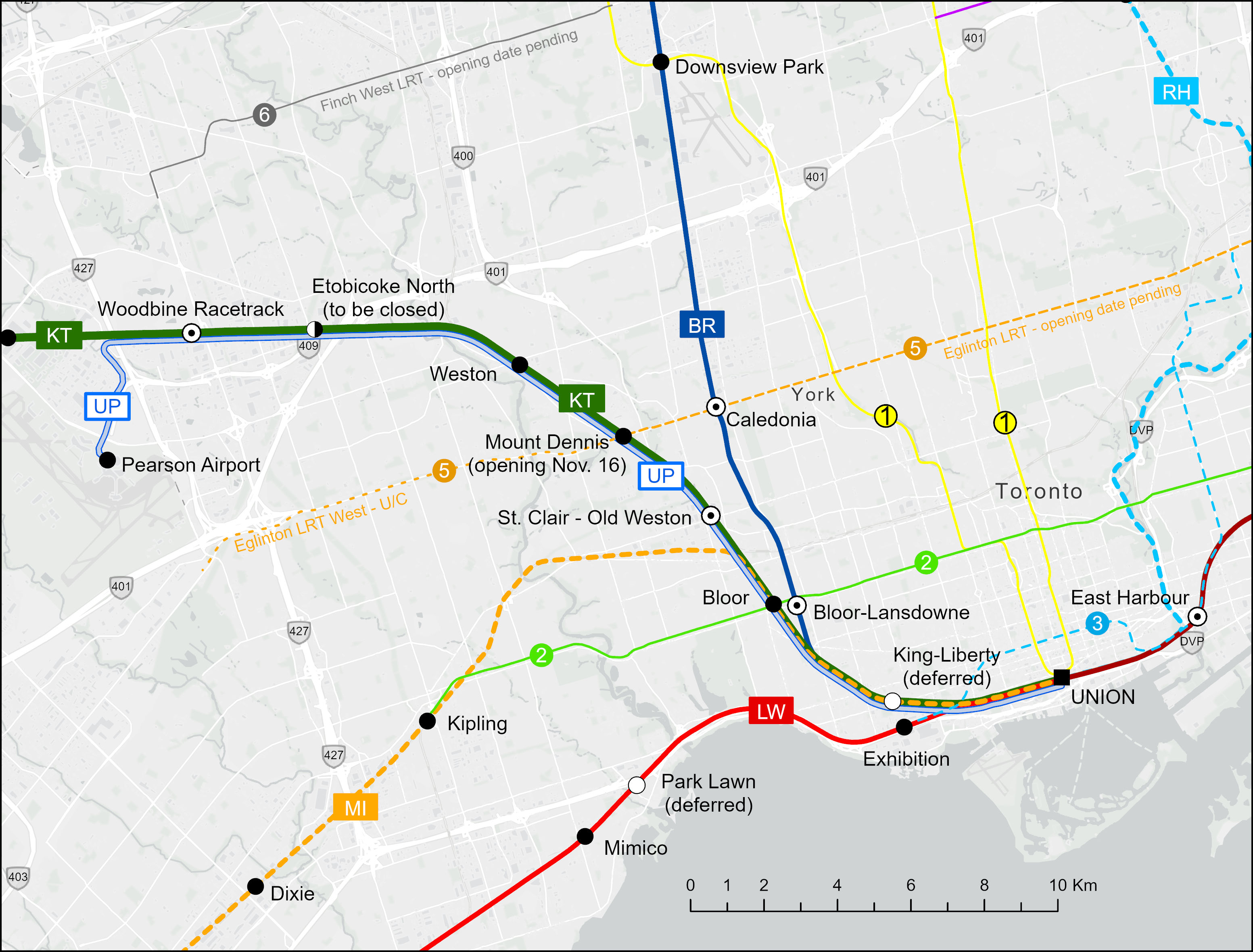
The King-Liberty and St. Clair-Old Weston stations, present in the original SmartTrack map, are on the inner portion of the busy Kitchener Line, which now hosts two-way, all-day service between Union and Bramalea Stations, as frequent as every 30 minutes weekdays. This section of track, known as the Weston Subdivision, also hosts UP Express (UPX) trains, which run every 15 minutes between Union and Pearson Airport, with stops at Bloor and Weston stations. It will also stop at Mount Dennis when that station opens in mid-November, connecting with the Crosstown LRT when that opens, likely in early 2026.
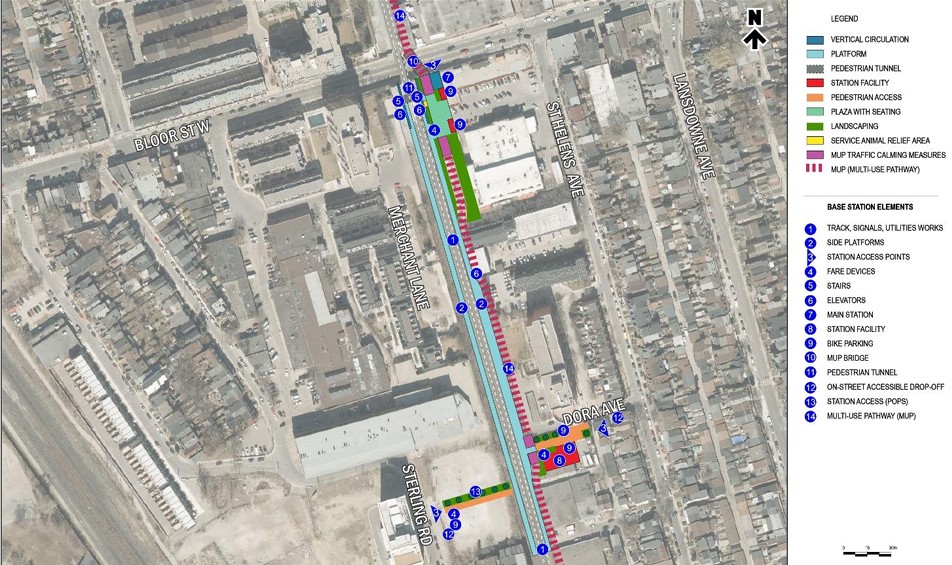
Bloor-Lansdowne is a curious “SmartTrack” legacy station, as it was not on the original proposed route. Located just east of Bloor GO Station on the Kitchener Line, the two-platform station would serve Barrie Line trains, with a walking connection to the TTC’s Lansdowne Station two blocks to the east. (See my supplementary post highlighting this transfer.) Unlike King-Liberty and Finch-Kennedy stations, Bloor-Lansdowne is going ahead as construction had already started in 2024.
Bloor-Lansdowne Station is two blocks west of Lansdowne Station and a 7-10 minute walk to the subway, which runs north of Bloor Street. From 2023 City of Toronto report.
Bloor-Lansdowne probably should not have been advanced, especially when King-Liberty or even Finch-Kennedy would be more useful new stations.
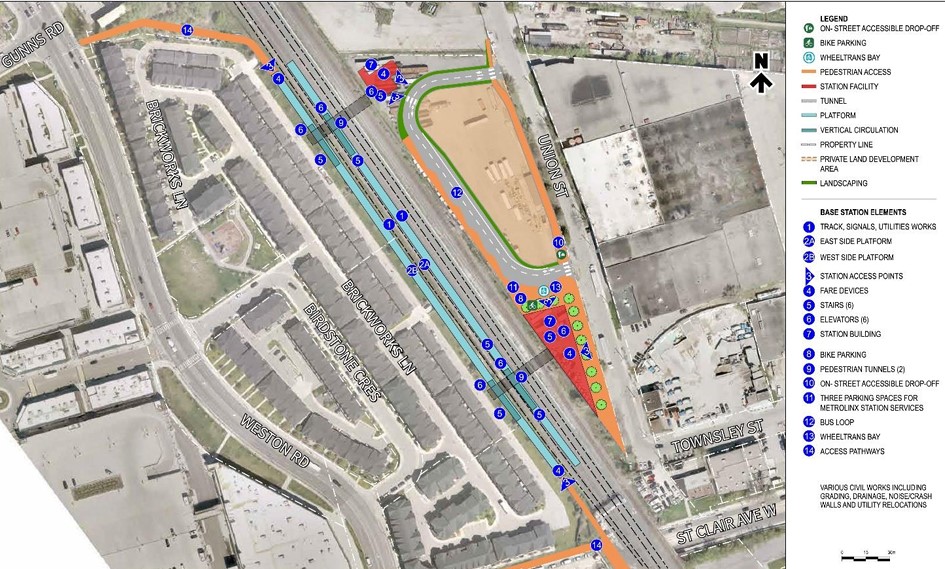
St. Clair-Old Weston Station will still go ahead, even though pedestrian access and transfers to local transit lines will be less than ideal. Rail platforms will be accessed from Union Street, not directly from St. Clair Avenue, Keele Street, or Old Weston Road. Though TTC buses could be diverted to the planned bus loop, transfers to streetcars on the 512 St. Clair line will be awkward and unattractive to riders. (See my supplementary post that describes the challenges in more detail.)
Map of inner portion of GO Kitchener Line, UP Express, and connecting rapid transit lines
Woodbine GO Station (not to be confused with Woodbine subway station on Line 2), located on the Woodbine Racetrack lands, is now under construction. When complete, it will replace Etobicoke North Station, which only has one platform and cannot be easily expanded for a four-track mainline. There is the potential for a short extension of the soon-to-open Line 6 Finch West LRT to Woodbine from Humber College. Woodbine Station would serve both GO trains and UPX, allowing passengers from Kitchener-Waterloo and Guelph to make an easy transfer to Pearson Airport. Woodbine would also be a logical transfer point between local GO trains to Bramalea and Mount Pleasant and express GO trains to Guelph and Kitchener.
With these decisions in mind, the challenge now will be figuring out how to serve the new Kitchener Line stations.
What is UP Express for, anyway?
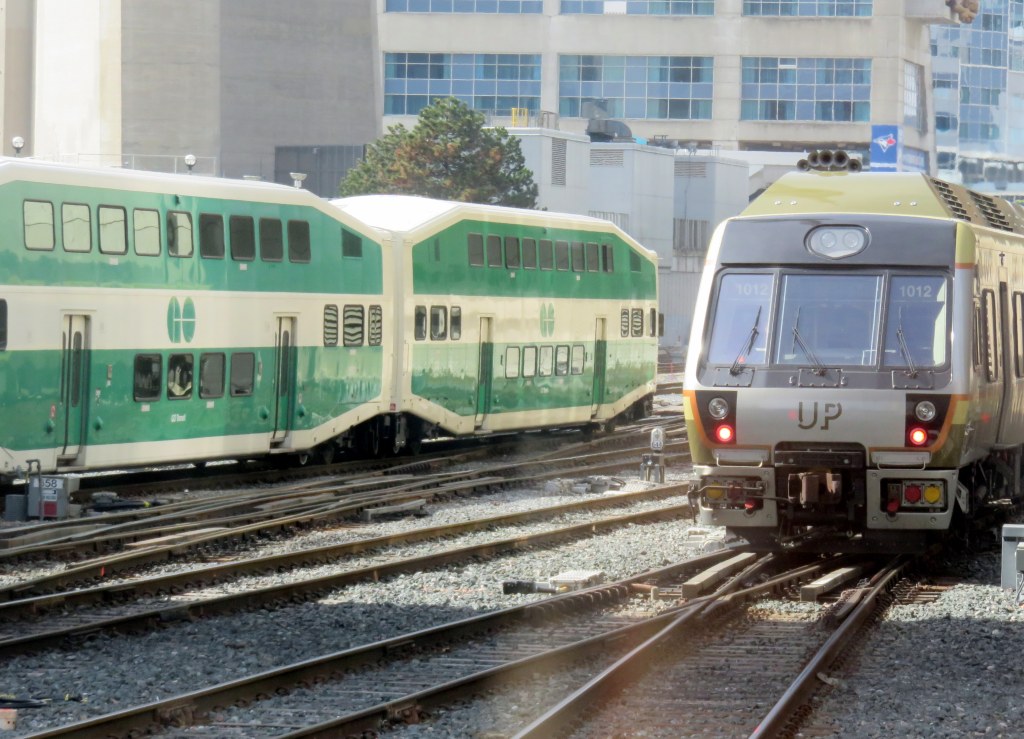
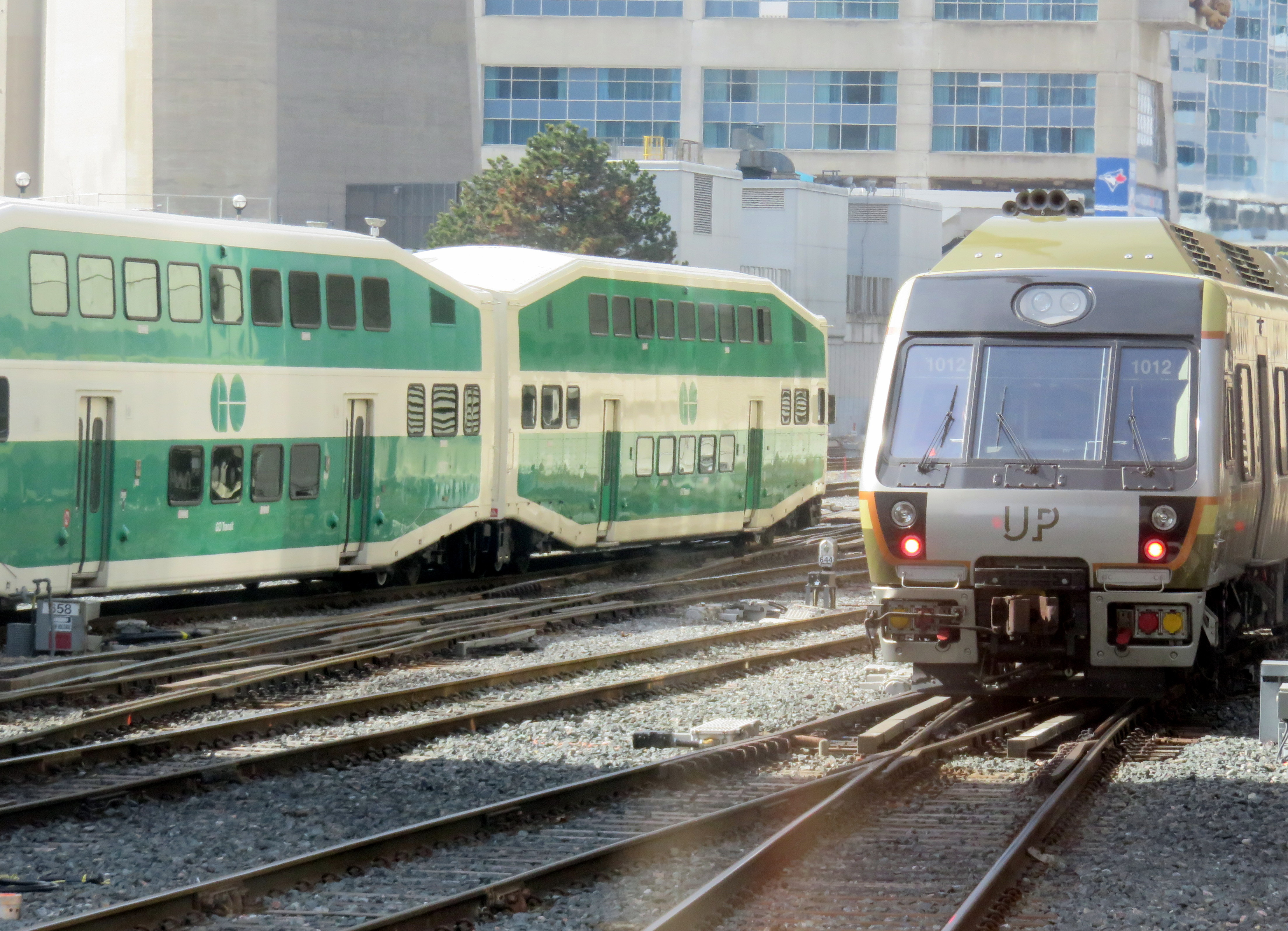
UP Express and GO trains near Union Station
UP Express, for all its faults, is an example of what urban regional rail looks like. Trains are frequent – every 15 minutes – seven days a week, from early in the morning to late at night, with the last train leaving Union at 1:00 AM. Stations feature high-level boarding, ideal for quick and easy boarding, especially for those passengers with luggage, strollers, or using mobility devices. The only other comparable example in North America is Denver’s A-Line train, an electrified service which also makes multiple stop between the downtown core and the city’s international airport.
A 15-minute frequency is important as it is commonly cited as the minimum level of service for a “get up and go” level of transit convenience and attractiveness. Right now, the Kitchener Corridor has a base hourly service between Union and Bramalea seven days a week, with additional peak-direction express trains and 30 minute service during much of the weekday service period.
Because of its reliable and frequent service and affordable fares, UPX has become a victim of its own success, with many riders travelling between Union, Bloor, and Weston, rather than going all the way to and from the airport. This problem was especially evident when riders were left stranded after the end of game seven of the 2025 World Series. The last train left Union station completely full, not long after the game finished in extra innings.
Fares for riding UPX are quite reasonable. When UP Express was first launched, a one-way fare to the airport was $27.50. In 2016, that adult fare dropped to $12.00, today it is $12.35. Adult fares paid with a Presto card are discounted by $3.10. An adult fare between Weston and Union is just over $5. However, UPX despite being owned and operated by Metrolinx, has no fare integration with GO Transit, and it is not part of the provincial One Fare program that permits free transfers between GO, the TTC and other GTHA transit agencies. This is likely intended to minimize overcrowding, even though it limits the utility of UPX.
Another constraint is the UPX fleet and station size. All UPX stations are designed for three-car trains, as the service was designed to be a premium airport rail link, not an urban transit service. There are just 18 Nippon Sharyo DMU rail cars available for service, assembled into four 3-car trains, and two 2-car trains. The interior design is set up for a premium airport service, with rows of forward/backward facing individual seats and lots of luggage space.
These challenges will be exasperated with the addition of new stations at Mount Dennis and St. Clair-Old Weston. Furthermore, Metrolinx has requested that City of Toronto modify plans for the St. Clair-Old Weston (or SCOW) station to be UPX-only. According to an October 21, 2025 report to Council’s Executive Committee, “Metrolinx has indicated that this service change is required to maintain the 15-minute (or better) service frequency commitment made by Metrolinx for the SmartTrack Program, which can no longer be maintained by GO service.”
Despite Metrolinx building a fourth track on the Weston Subdivision that will extend to Pearson Junction (where the UPX tracks diverge towards the airport) from the Union Station Rail Corridor (hence the closures of the West Toronto Rail Path), it seems that it can not commit to operating 15-minute service for both GO and UPX service, which seems like a ridiculous state of affairs when this is common practice in Europe and Asia. This goes against the whole concept of GO Expansion, which promised to deliver fast, frequent, integrated GO service to most of its corridors.
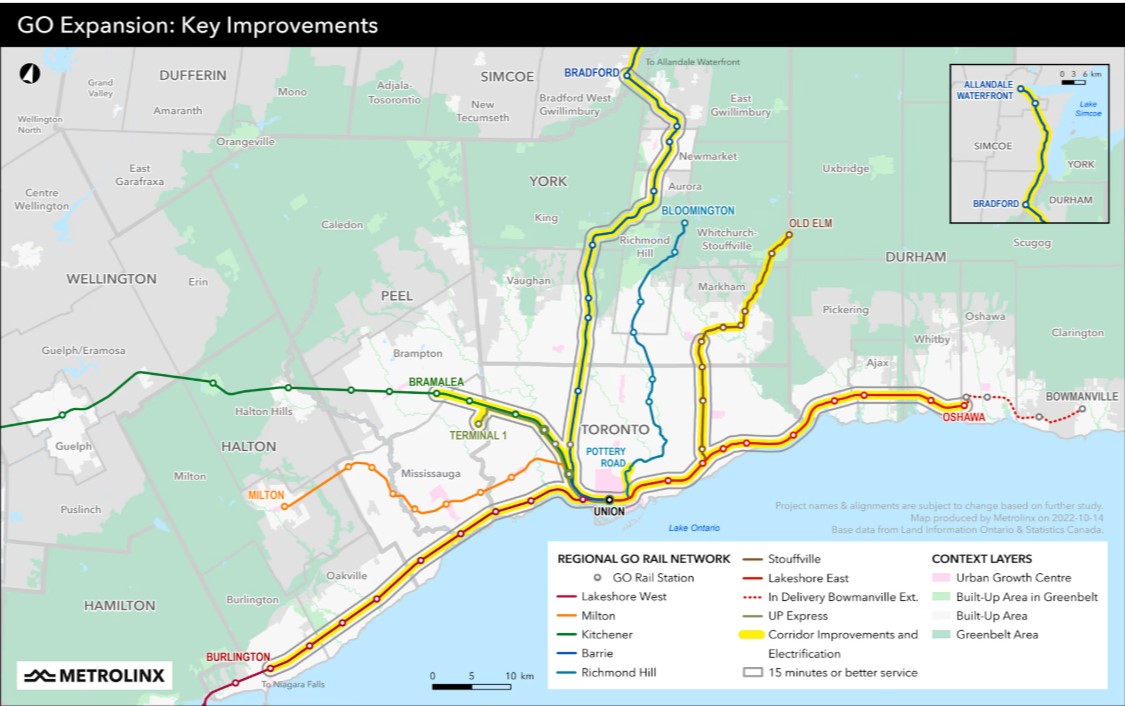
2022 Metrolinx map depicting corridor improvements, electrification, and 15-minute service for the inner portions of the Lakeshore West, Lakeshore East, Stouffville, Barrie, and Kitchener lines.2022 Metrolinx map showing the Kitchener Corridor with “corridor improvements and electrification” for the Toronto-Bramalea inner portion of the line, along with other construction projects between Bramalea and Kitchener.
Perhaps Metrolinx’s inability to conceive of GO becoming more than just a suburban commuter railway is why Deutsche Bahn pulled out of its contract with Metrolinx early in 2025. Since The Trillium’s June 2025 investigation, there has been little said about the collapse of GO Expansion. Communications and transparency have not been Metrolinx’s strong suit, especially in the last few years as Doug Ford’s PC government has tightened its control on all government communications.
So, if St. Clair-Old Weston is served only by UP Express, it will have to be completely rethought. It will not be able to offer an exclusive, 25-minute ride between Terminal 1 and Pearson Airport. That in itself is fine. A train taking 30 minutes to travel the same distance, with a few additional stops will work, provided that the trains have the capacity to serve both airport passengers and urban transit riders. Stations should be six cars long, then, with a new Union Station terminal, ideally under the main trainshed for easy connections to TTC, GO, and VIA Rail. GO Transit trains would then focus on suburban and regional travel between Toronto, Malton, Brampton, Guelph, and Kitchener, skipping most existing stops in the City of Toronto, part from Woodbine and perhaps Bloor.
But Metrolinx, the City, and the Province need to express their intentions openly and clearly so that we, the passengers and taxpayers, know what will happen, and that we will get the best transit possible. Let’s be smart about this.
Last week Monday, I was at Spacing’s election night party at a pub in the Annex, watching the results of the election roll in after 8PM. Public polls consistently saw former Toronto city councillor and NDP MP Olivia Chow leading an especially crowded race of 102 candidates for mayor. It was the most exciting election I’ve followed since at least 2014.
Former three-term councillor Ana Bailão, one of former mayor John Tory’s protégées, was consistently in second place, followed by former Toronto Police Chief (and provincial PC candidate) Mark Saunders, sitting councillors Josh Matlow (who ran as a progressive) and Brad Bradford (who ran to the right), and right-wing columnist Anthony Furey. Though Bailão, a centrist, had the endorsements of multiple sitting councillors, Liberal MPs and MPPs, and several public and private sector unions, she had difficulty positioning herself as the presumptive centre-right challenger, especially with Premier Doug Ford backing Saunders.
It was not until the advance polls had closed that Deputy Mayor Jennifer McKelvie, the Toronto Star Editorial Board, and then Tory himself endorsed Bailão, likely spooked by Chow’s continued lead. (David Rider and Ben Spurr at the Star wrote a great article about the leadup to Tory’s endorsement.) Tory, who resigned after admitting to a long-term city hall affair, hummed and hawed over providing his endorsement, and hid from reporters even while robocalling Torontonians pleading them to vote for his appointed successor.
It is quite possible that Tory’s endorsement came too little, too late for Bailão. Nearly 150,000 electors (representing 21.7% of all votes cast) already voted in advance polls or by mail, and their votes were locked in. But the late push for Bailão was able to convince at least some election day voters to choose strategically — the percentage of voters who chose Saunders, Furey, and Matlow fell, while Bailão’s share grew on election day. Indeed, Bailão placed first among election day voters. But Chow, whose campaign encouraged advance voting, carried the day in the end.
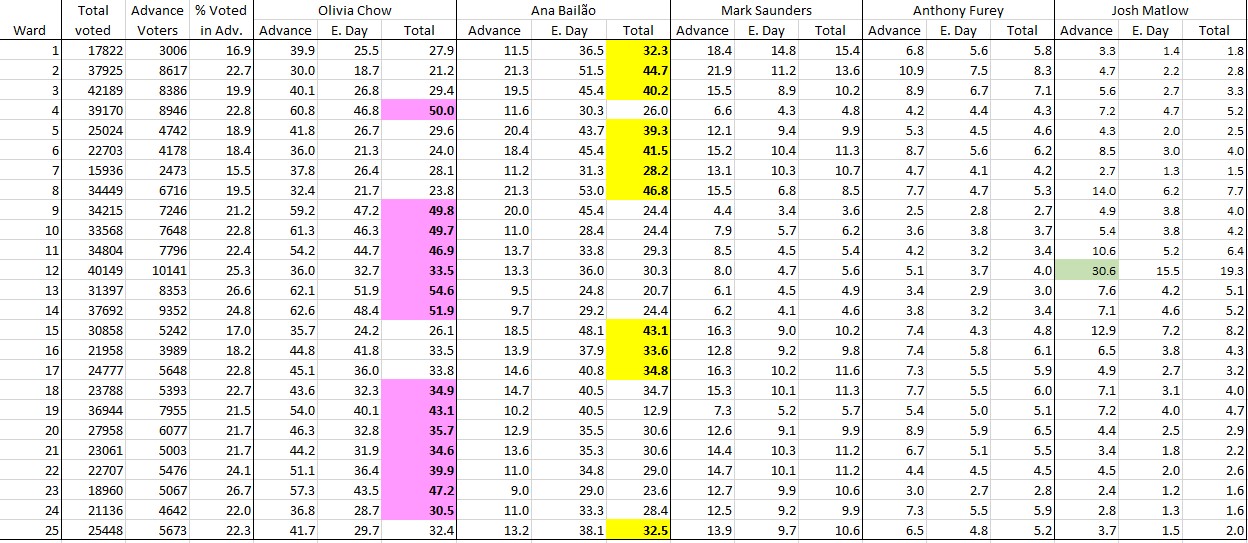
For example, Josh Matlow placed a close second in Ward 12 in the advance polls (with 30.6% of the vote), where he’s a popular local councillor. On election day, Matlow placed third behind Bailão and Chow, with Chow eking out a narrow win overall there. In every ward, Chow placed first in the advance polls, but when all votes were counted, she placed first in 14 of the 25 wards. The table below shows how the vote shifted.
Table of ward-level mayoral byelection results, showing advance poll and election day results for the leading five candidates. PDF version here.
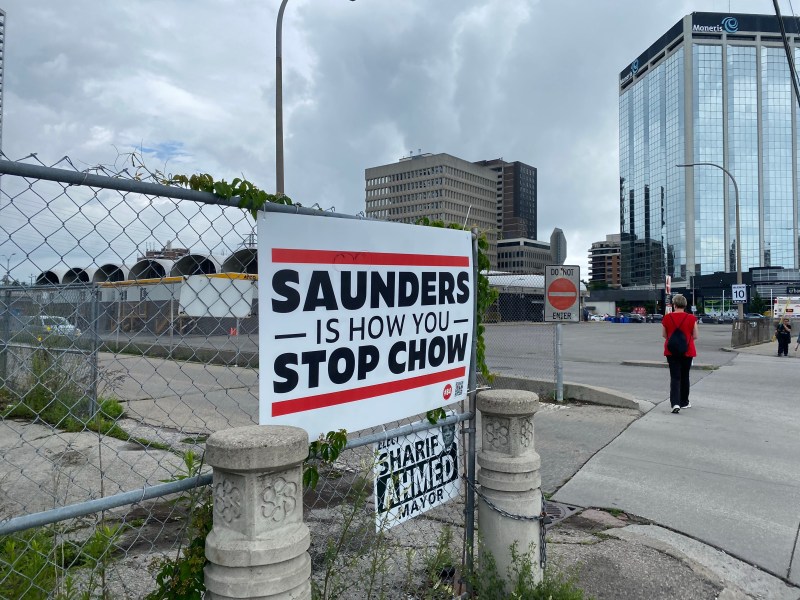
Chow won with 269,372 votes (37.2%) to Ana Bailão’s 235,175 (32.5%). Saunders, Ford’s pick, got just 8.6% of the vote despite his positioning as the only candidate to “stop Chow.” Furey placed a distant fourth, with 5%, and Matlow got 4.9%, acknowledging that Bailão’s late surge draw support away from him and towards Bailão and Chow. Brad Bradford was the biggest loser of the night, netting just 1.3% and placing fifth in his own ward.
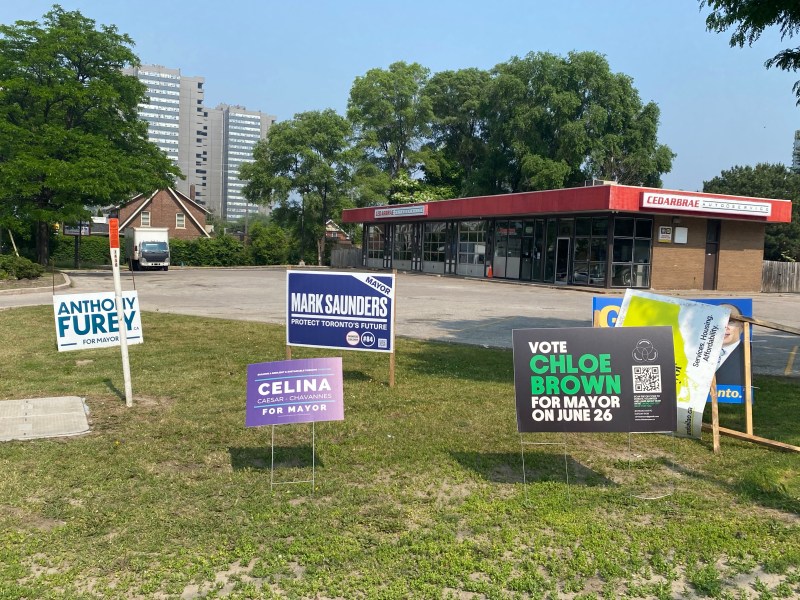
“Saunders is how you stop Chow” sign
Though I was skeptical of Olivia Chow’s second run for mayor after an uninspiring run against Rob and Doug Ford and John Tory in 2014 (she placed third), she proved herself worthy this time around. She was more relaxed, more herself, and certainly tapped into a desire for change after eight years of Tory’s dull austerity and four years of chaos under Rob Ford (enabled by his brother Doug).
I fear Toronto’s political establishment — both Conservative and Liberal — will try to make Chow’s term as mayor difficult, even though their low-tax, low-spend agenda caused many of the problems that she will have to tackle. But for now, I’m pleased we will try it her way.
I created an interactive map showing the results of the election at the ward and electoral subdivision (poll) level. For the wards, I provided information on the advance and election day poll results.
Note that not all polls are mapped. Until the City of Toronto releases revised electoral subdivision boundaries (I suspect due to poll consolidations), there are some missing polls. However, 95% of all polls are depicted, and the results are interesting.
I look forward to your feedback as well; I approve all reasonable comments and reply to most emails.
Who knew, just two weeks ago, that Torontonians would be returning to the polls to elect a new mayor of Toronto?
Looking back on John Tory’s last eight-and-a-half years in office, the biggest disappointment might have been that he spent so little of the political capital that he had accumulated after decades as a backroom power broker, corporate executive, provincial party leader, talk radio host, and supporter of NGOs such as CivicAction and the United Way. Despite his promise as a business-friendly, progressive conservative leader who knew how to build partnerships and work with other levels of government, there’s little to show for it. SmartTrack? That was always a fantasy which has now been mostly forgotten. An improved public realm, including a new Rail Deck Park? That never happened either. Heck, we can’t even get a decent WiFi connection in the subway, never mind a cell signal, despite the mayor’s close ties with the telecommunications industry.
To be fair, there are a few things one can point to that got done during Tory’s tenure: new bike routes on Bloor-Danforth, Yonge, and University Avenue, some improvements to the TTC surface network, the King Street transit priority pilot, and surprisingly good pandemic responses, including excellent city-run vaccine clinics, weekend street closures for active transportation, and new street-level patio space to help restaurateurs recover from pandemic shutdowns.
But in 2022, the ActiveTO street closures faded away, partially due to influence from the Toronto Blue Jays management (note: the baseball team and its stadium are owned by Rogers), the King Street transit priority corridor deteriorated from neglect. As the homelessness crisis worsened, Tory and his allies backed repressive and violent clearances of public parks, without supplying enough alternatives for housing or supporting the most vulnerable in this city. A series of municipal budgets in which property taxes were kept low while other expenses piled up has caused this city to become reliant on the support of the province and federal governments to bail us out.
With Tory gone — brought down by his own error in judgment — we will have thirteen lost years in which Toronto will have to catch up. That’s a tall order.
I can’t claim to have all the answers, but I have a few ideas to share to help make Toronto a safer, more fun, more comfortable, and more humane place to live. If I were a mayor with strong powers, here’s what I would do:
A progressive property tax system. An unfortunate reality for Ontario municipalities is that they have very limited tools for raising revenue: property taxes, user fees (like TTC fares and recreation fees), and in Toronto’s case, vehicle registration fees. Municipalities are also given grants from the province and federal government for specific purposes, such as providing mandated services. Unlike sales, income, and business taxes, property taxes do not grow with the economy, so municipalities must raise the property tax mill rate every year to keep up with inflation and/or fund new or expanded services. However, no matter the assessed worth of the property, the tax percentage remains the same.
A progressive property tax system can be used then to raise more money from higher-valued properties. For example, for residential properties, a basic tax rate could apply for the assessed value up to $1 million. Beyond that first $1 million, a higher bracket comes into effect. Such a policy could minimize tax increases for those in smaller or starter homes. To encourage the construction of secondary suites, high-value properties could then get tax breaks for every additional self-contained unit on site, provided they are inspected and meet fire code. A progressive property tax system could help raise revenue, encourage the construction of more housing units, and provide a more equitable revenue source.
A real Vision Zero plan. Putting up “Senior Safety Zone” signs and lowering speed limits on four and six lane streets does little when the roadway remains designed for high speeds, and motorists race through intersections with limited enforcement. To protect pedestrians and cyclists (as well as other drivers and their passengers), the roads themselves must be re-engineered for lower speeds. This means “daylighting” pedestrian crossings by ensuring crosswalks are always well-lit, crosswalks raised where possible to improve visibility and curbs extended to both reduce the amount of roadway that pedestrians must cross, and signal to drivers to slow down. Furthermore, a blanket right-turn-on-red prohibition, like those in New York, Montreal, and Mexico City, would eliminate a common cause of pedestrian-motorist collisions and make those new leading pedestrian intervals at Toronto’s street corners fully effective.
Prioritize transit and clean up the TTC. When I say “clean up the TTC” I don’t mean throwing more cops at the problem of safety on our subways, streetcars and buses. Under CEO Rick Leary’s leadership, it feels as if the TTC has given up on many of the gains brought forward by Andy Byford. Customer service has fallen by the wayside, wait times have increased, the streetcar network is faltering with trams running slower than ever before, communications have become unreliable, and customer confidence in the system has fallen. When customers no longer feel valued, they themselves give up.
After cancelling upcoming service cuts contained in Tory’s last budget, one of the easiest things to do to show that transit riders matter is making King Street great. This means installing permanent streetcar platforms in the curb lanes along the streetcar priority zones and making it even more clear that drivers are prohibited from using King as a throughway. Eliminate the night time taxi exception to simplify signage, and automate enforcement with video cameras mounted at intersections and on streetcars themselves, as is done on some Select Bus Service routes in New York.
Haffiz A., via Twitter, shows how King Street could look:
The TTC also needs to modernize its street railway infrastructure so that streetcars no longer have to stop and crawl across every track intersection. Electric dual-blade junctions and wayside signals — used just about everywhere else — allow streetcar operators to know which way the track is pointed ahead of the intersection and can allow streetcars to glide through junctions at regular traffic speed.
Finally, get TTC staff and all councillors riding the TTC on a regular basis. Meet passengers. Let them know they matter, and inform them of improvements, and be visible.
Build affordable housing. Lots of it. Use increased revenues from the progressive tax system proposed above to build more affordable housing directly (instead of just relying on market solutions like inclusionary zoning), including the co-operative home model. While doing so, shame the provincial and federal governments for pulling out of funding new construction in the 1990s. The city owns lots of land in good areas, such as Green P parking lots, TTC stations, works yards, suburban office spaces, and even on parts of municipal golf courses, which, of course, should be converted to general year-round public spaces.
Stand up to the bullies at Queen’s Park. One of Mayor Tory’s biggest failures was to ignore the province’s meddling in Toronto’s affairs and impose the province’s unpopular plans upon the city. This city should have the right to decide the composition of its own council; there was not nearly enough protest from city leadership when Doug Ford forced a cut in council from 47 to 25 (which will likely go down to just 24 in 2026) after an unprecedented level of public consultation in shaping the approved boundaries. Instead of waiting forever for a ministerial zoning order that was never going to come for a modular housing project in North York, real leadership would have gotten it built, the province be damned. Call their bluff.
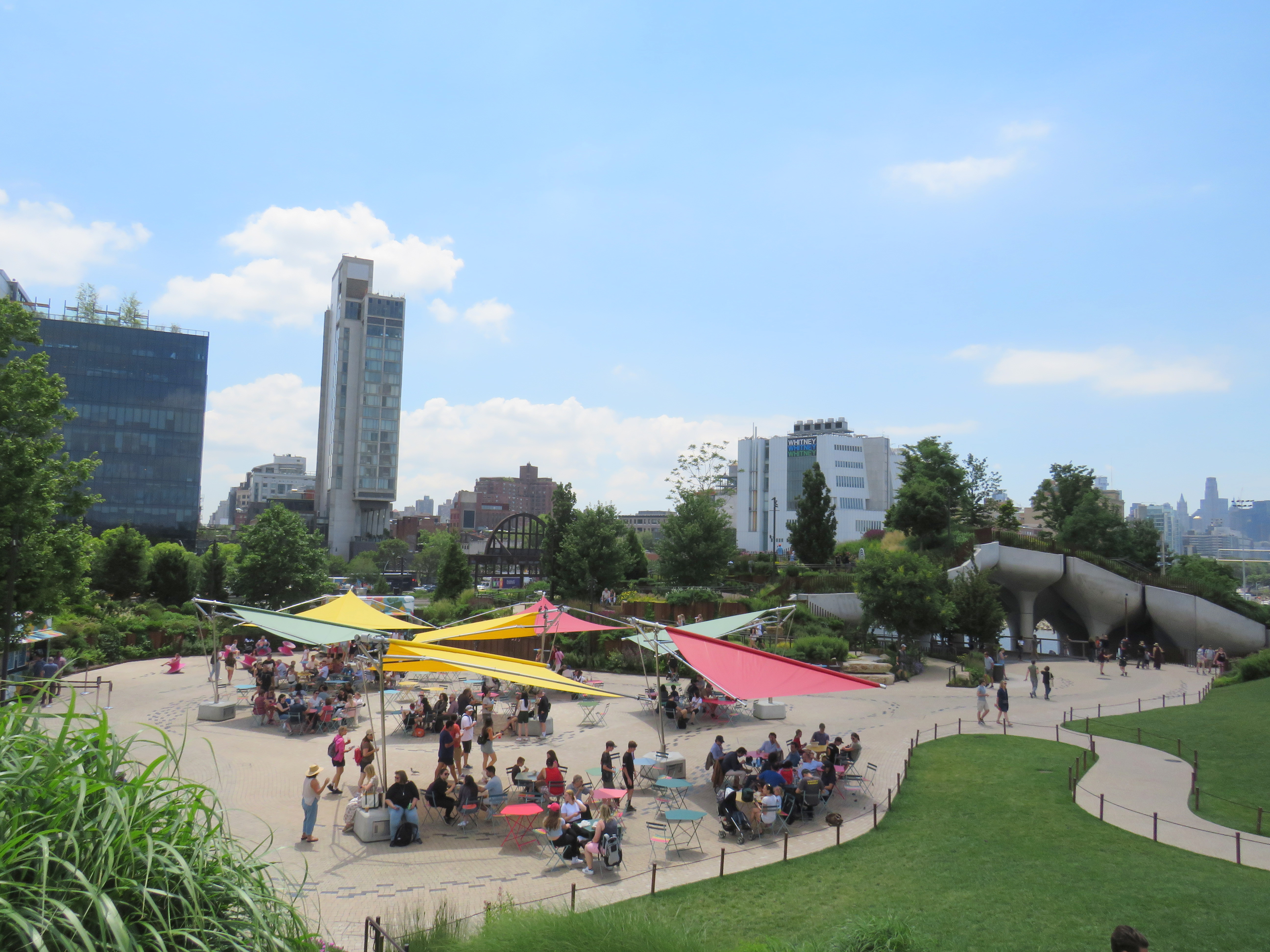
Meanwhile, Premier Doug Ford — the man Tory beat to become mayor in 2014 — is imposing his own ideas on Ontario Place, provincially owned public lands on Lake Ontario. If one could not get Rail Deck Park built, Ontario Place could have been the site for a renewed public realm, much like some of New York City’s new waterfront parks. Some vision, some willingness to spend political capital, and a good advocacy campaign could have stopped the plans for an overbearing private megaspa that effectively closes off major portions of our public waterfront.
New York City’s “Little Island” could have been an inspiration for a renewed Ontario Place
There will be some people who will be happy that I am not serious about running for mayor. For one, I don’t have the people skills, the connections, nor the energy to make a serious bid. But if I see some of the ideas suggested above make it into a mayoral platform, I would not be above making a personal endorsement.
How Toronto voted for mayor. Areas shaded in blue represent electoral subdivisions (polls) where John Tory placed first. Areas shaded in purple represent polls where Gil Penalosa placed first. Click here for the interactive version.
As has become my tradition after Toronto’s municipal elections, I mapped out the poll-by-poll results of the mayoral race and some of the more interesting council races. After creating maps for the 2014 election and sharing those on social media, it was suggested that I have a website to host these maps. That is how this website came to be.
This time, I created an interactive map showing the results of the mayoral race, along with six council races: Ward 3 Etobicoke-Lakeshore, Ward 4 Parkdale High-Park, Ward 5 York South-Weston, Ward 11 University-Rosedale, Ward 18 Willowdale, and Ward 20 Scarborough Southwest.
This coming Monday, October 24, Ontarians will be electing new city councils. In Brampton, Ottawa, and Hamilton, the mayoral races should prove to be interesting. For Ottawa in particular, with Jim Watson stepping down, voters have a clear choice (and I’ll be cheering for Catherine McKenney). Though Gil Penalosa offers a new vision of a sustainable, active, and safer city, it’s very likely John Tory will win an unprecedented third term, the first to do so since amalgamation in 1998.
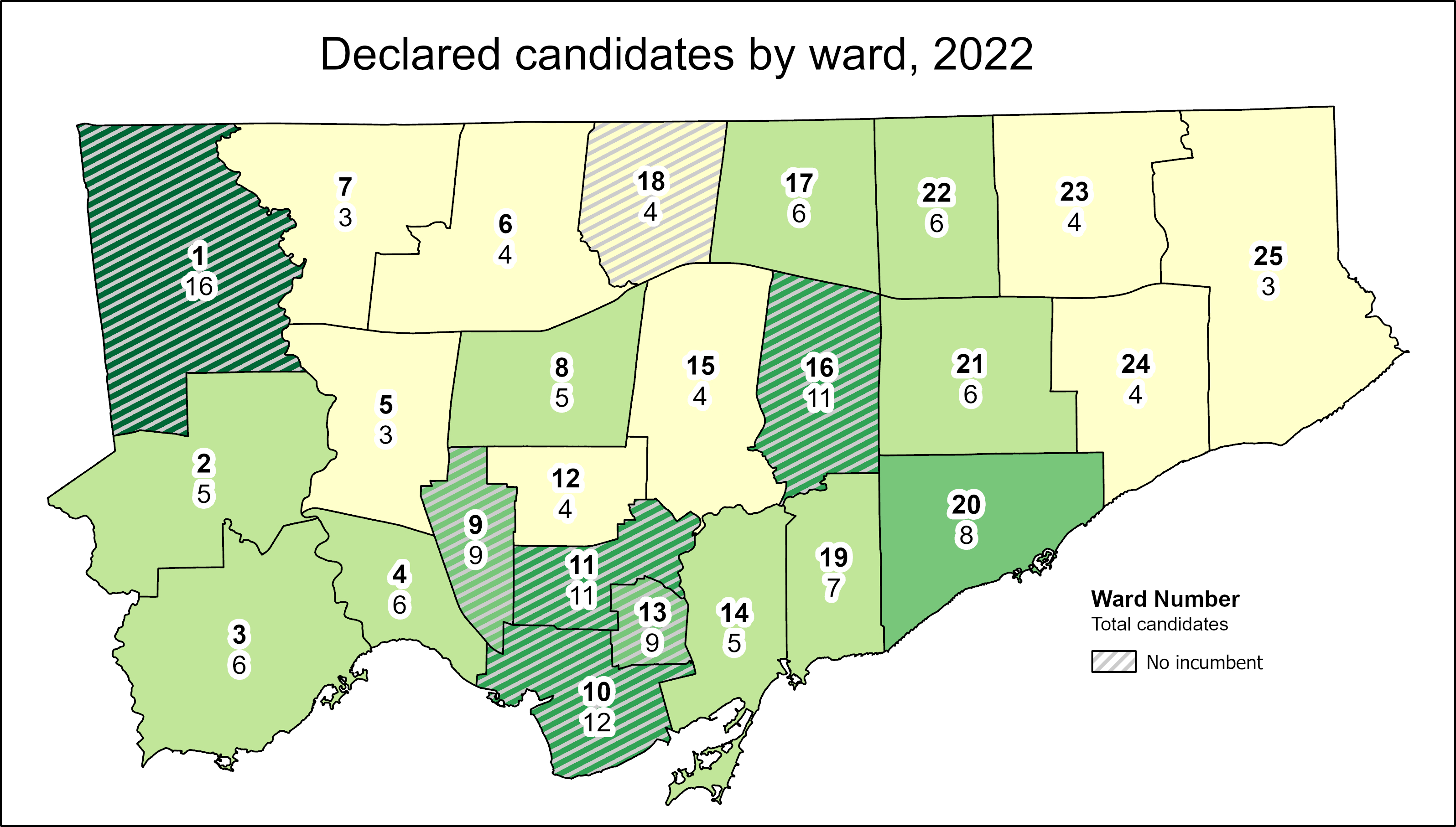
At Spacing Toronto, I have been offering some insights by mapping the state of our local democracy, ward by ward. Though there are seven wards in which no sitting councillor is running for re-election, the new council may not look too much different from the last one. That’s because two former councillors — Vincent Crisanti and Jon Burnside — will be looking to get back into office. Meanwhile, Mayor Tory has been busy campaigning for twelve candidates, including eight incumbents, that will help advance his agenda of incrementalism and austerity. Among Tory’s picks are Frances Nunziata, who has been in municipal office uninterrupted since 1988.
Here are the links to my posts at Spacing:
Open wards and the power of incumbency: The power of incumbency, and the mayor’s own influence, will weigh heavy on the final results. Though there may be seven “open” wards and a few more truly-competitive races, there is a lot happening behind the scenes to favour certain candidates.
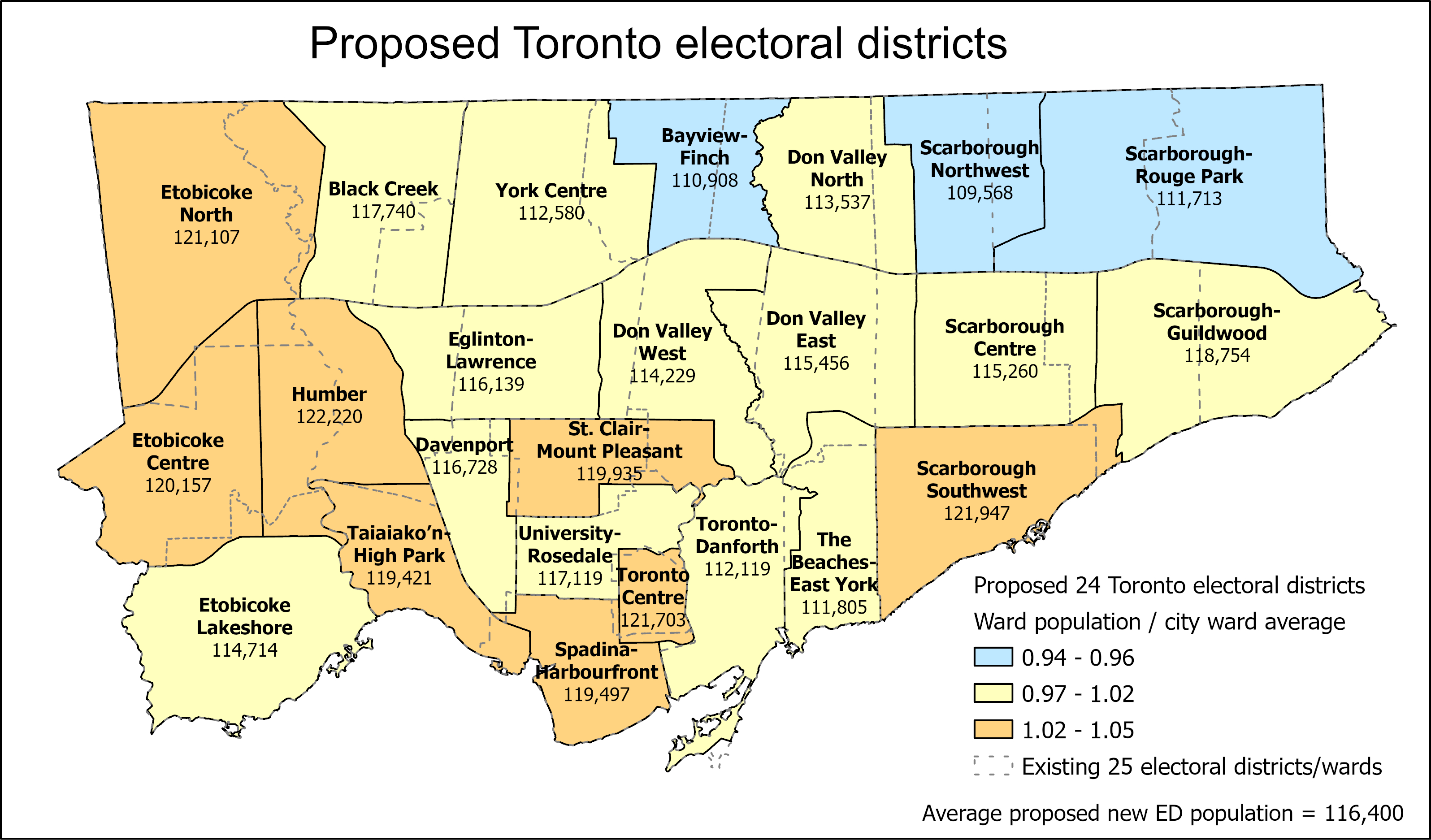
Population disparities between Toronto’s 25 wards: How ward boundaries that were drawn in 2013 have exasperated imbalances in population, leading to burnout in high-growth wards (with several downtown councillors deciding to move on). If Toronto continues to be forced to use federal/provincial riding boundaries, it will have just 24 wards in the 2026 election.
What Toronto’s new ward boundaries might look like
Toronto is a highrise, rental city – unlike City Council: Though nearly half of all Torontonians live in highrise dwellings and/or rent their homes, Toronto City Council is made up almost entirely of homeowners. In only a few wards, detached houses make up the vast majority of the housing stock and homeowners dominate. I ask why city council doesn’t reflect the way an increasing number of us live. The interest in this post had me on CBC Metro Morning for the first time, early on September 30.
Duelling campaign endorsements: Though Mayor John Tory has supported a few candidates before (most notably, Etobicoke councillor Mark Grimes), this time, he’s actively campaigning with twelve allies. Meanwhile Progress Toronto is backing nine challengers, focusing on races where it hopes to help get new faces elected.
Nobody’s going to be flocking to the streets during a pandemic
In an interview with local news station CP24, Mayor John Tory said that the city was considering implementing one-way directional traffic on city sidewalks as part of a response to COVID-19. This idea was considered as a measure to ensure physical distancing on Toronto’s sidewalks.
The mayor, however, does not support the alternate solution of increasing the amount of road space given to pedestrians and cyclists. With traffic on major routes such as Yonge, Queen, and Bloor reduced, and most businesses closed, it would be easy to provide additional space for pedestrians without causing traffic congestion. According to the mayor, “it could have the unintended effect of attracting more pedestrians to busy areas, something the city is actively trying to discourage right now.”
That’s ridiculous.
With businesses closed, no patios to linger at, and no programming (unlike at any other street closure, whether it be Taste of the Danforth, Open Streets, Pride Week, or Buskerfest), pedestrians will not be attracted to linger and crowd sidewalks in dense urban neighbourhoods. However, they will be able to walk to work, get to essential services, exercise the dog, or get some fresh air, without having to dodge other people or sidewalk barriers, such as construction scaffolding.
Furthermore, enforcing one-way sidewalks — the city’s only other idea — would be extremely difficult to enforce. It would only increase the distance pedestrians would have to walk to get to work or essential services. It would go against centuries of practice, and it would encourage less-safe midblock crossings. It would be especially cumbersome for seniors and pedestrians with disabilities.
While Toronto continues to do nothing to protect vulnerable road users during a pandemic, other cities — including Montreal, New York, Vancouver, Denver, and Oakland— have closed entire roads to better serve pedestrians and cyclists in parks and dense urban areas. Closer to home, Kitchener and Brampton have also taken steps to to assist active transportation during this unprecedented time.
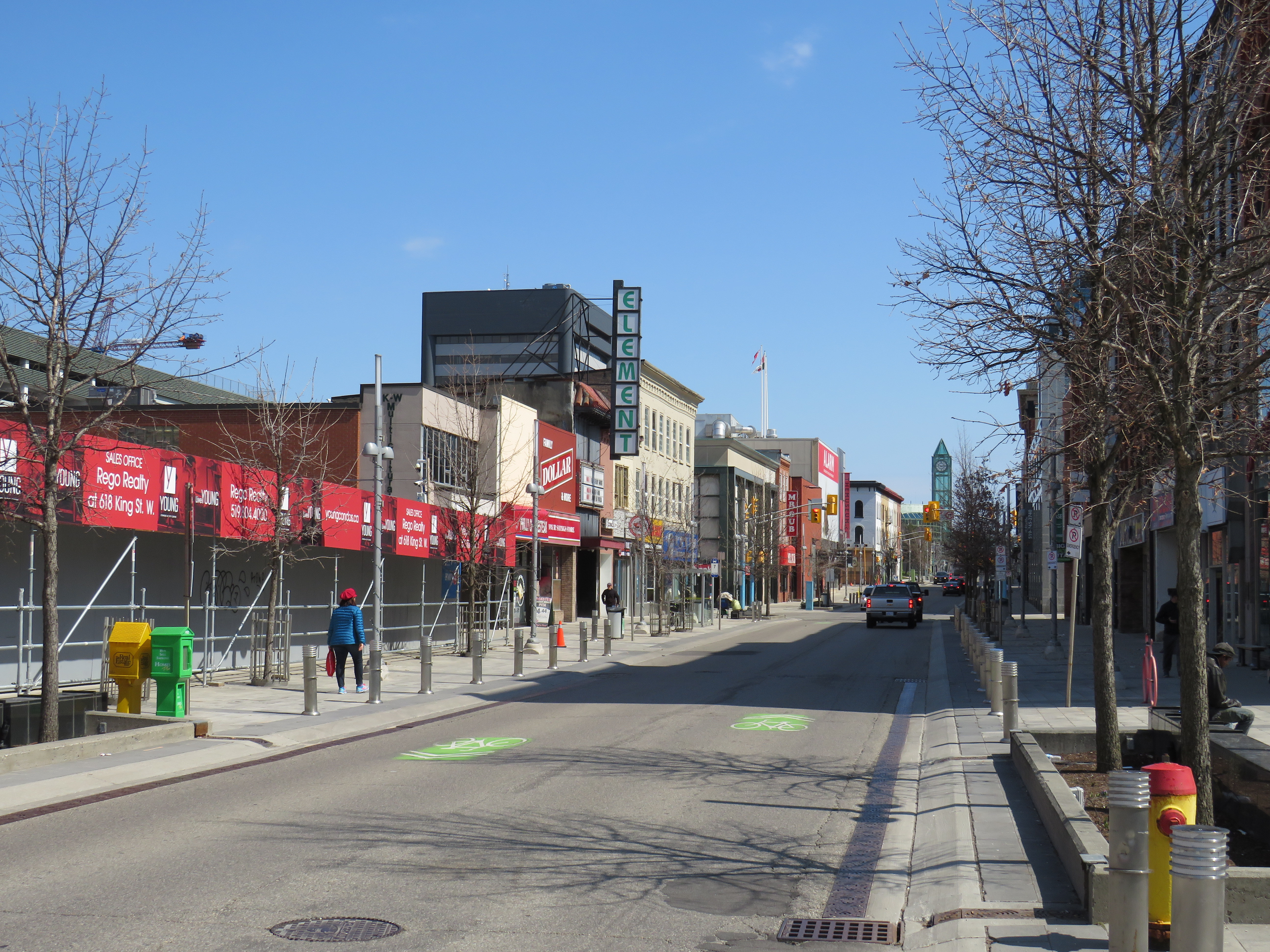
King Street, Downtown Kitchener
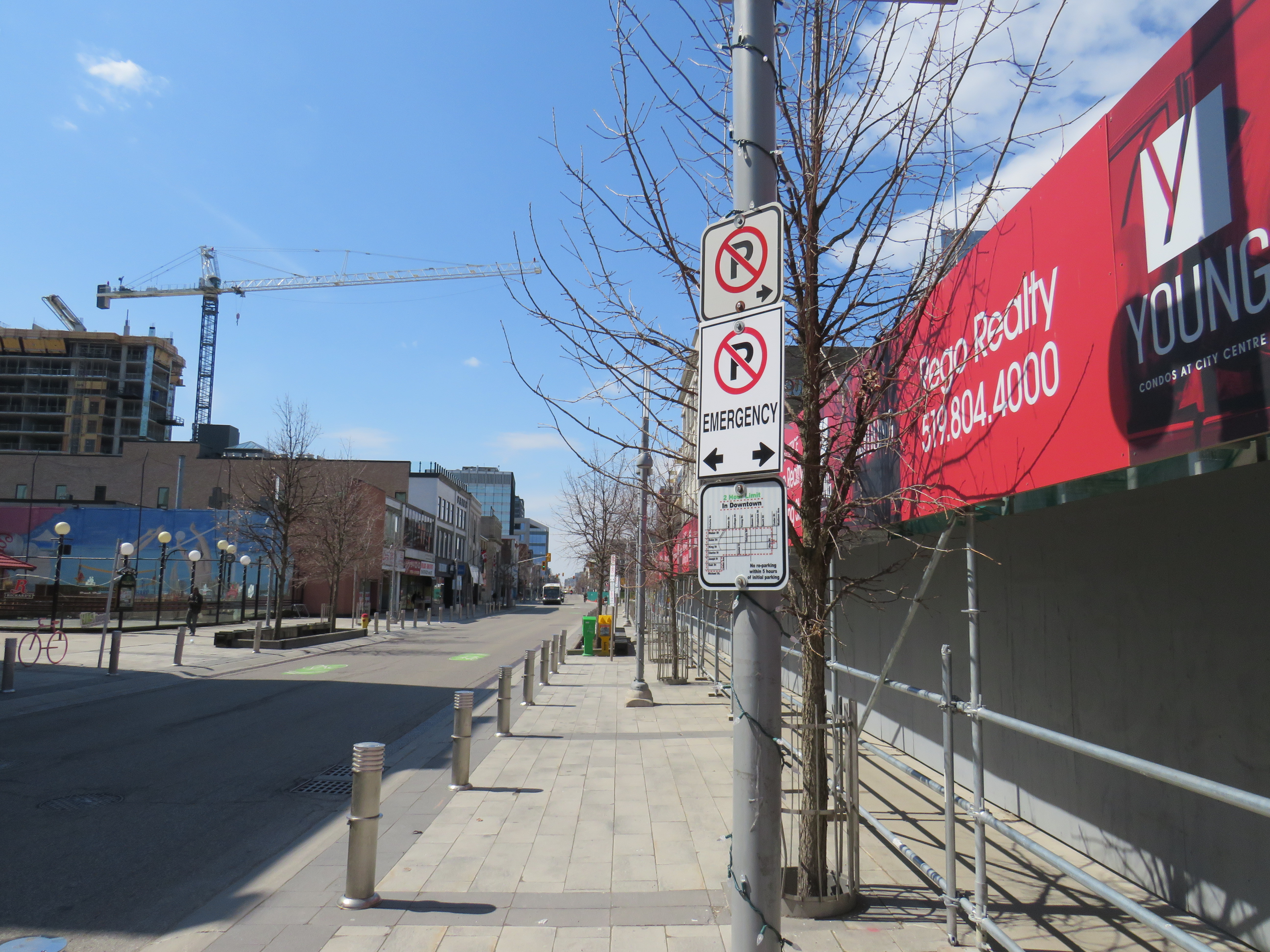
A decade ago, King Street in Downtown Kitchener was reconstructed with new lighting, street furniture, trees, and a rolled curb separating the narrow street with sidewalk and street parking and loading areas, which were separated from the pedestrian area by removable bollards. As a response to COVID-19, most of the parking spots were blocked off, with the bollards moved towards the roadways, quickly and easily expanding the pedestrian zone. With new residential development in Downtown Kitchener, several portions of the regular sidewalk were covered with scaffolding. The widened pedestrian clearway made it easy and safe to get around the barriers, allowing pedestrians to practice physical distancing.
Bollards moved close to the street, and parking banned. It’s much easier to get around the construction scaffolding.
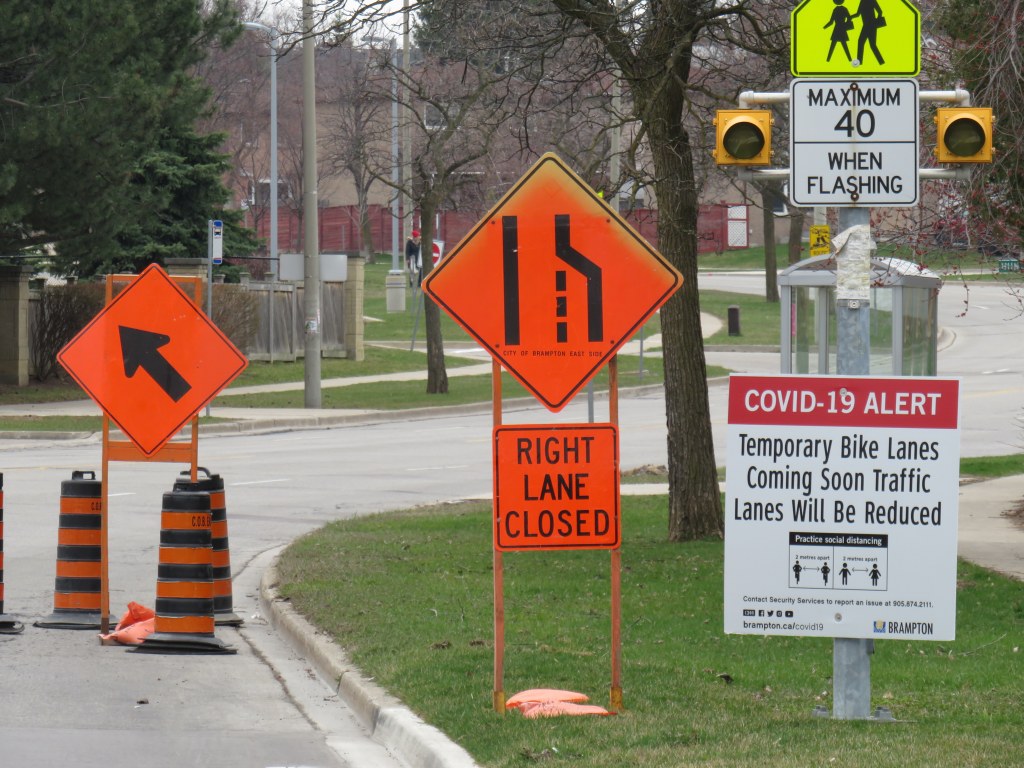
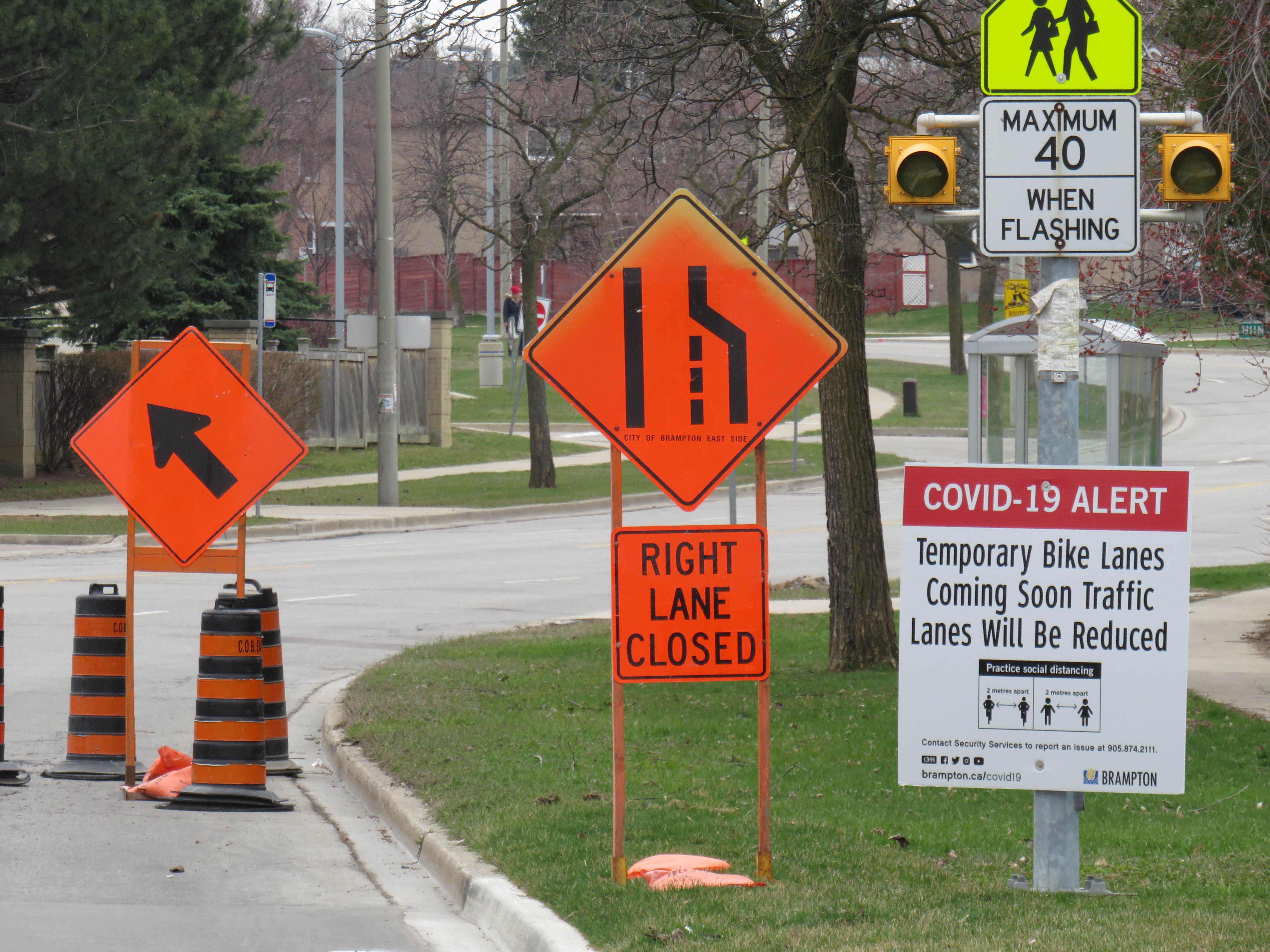
Meanwhile, in Brampton, where sidewalk crowding isn’t usually a problem, the city government went ahead with a plan to close the right lanes of Howden Boulevard and Vodden Street — four-lane collector roads through residential areas — to install temporary bike lanes. This will provide a five-kilometre bikeway across the city between Etobicoke Creek and Chinguacousy Park, crossing Highway 410 at a safe location.
Installing temporary lanes makes it easier in the future to make the lanes permanent — Vodden and Howden could use road diets after all — which could connect three north-south ravine paths and connect Downtown Brampton with Bramalea City Centre. City Council — including Mayor Patrick Brown — is committed to improving the city’s rather poor active transportation infrastructure.
Temporary bike lanes coming to Howden Blvd. in Brampton
While Toronto continues to drag its heels on providing safe spaces for its residents to walk and bike while being physically distant, its peer cities — and even one of its suburbs, are leading. One can only speculate about the reasoning behind Mayor Tory’s reluctance to do more.
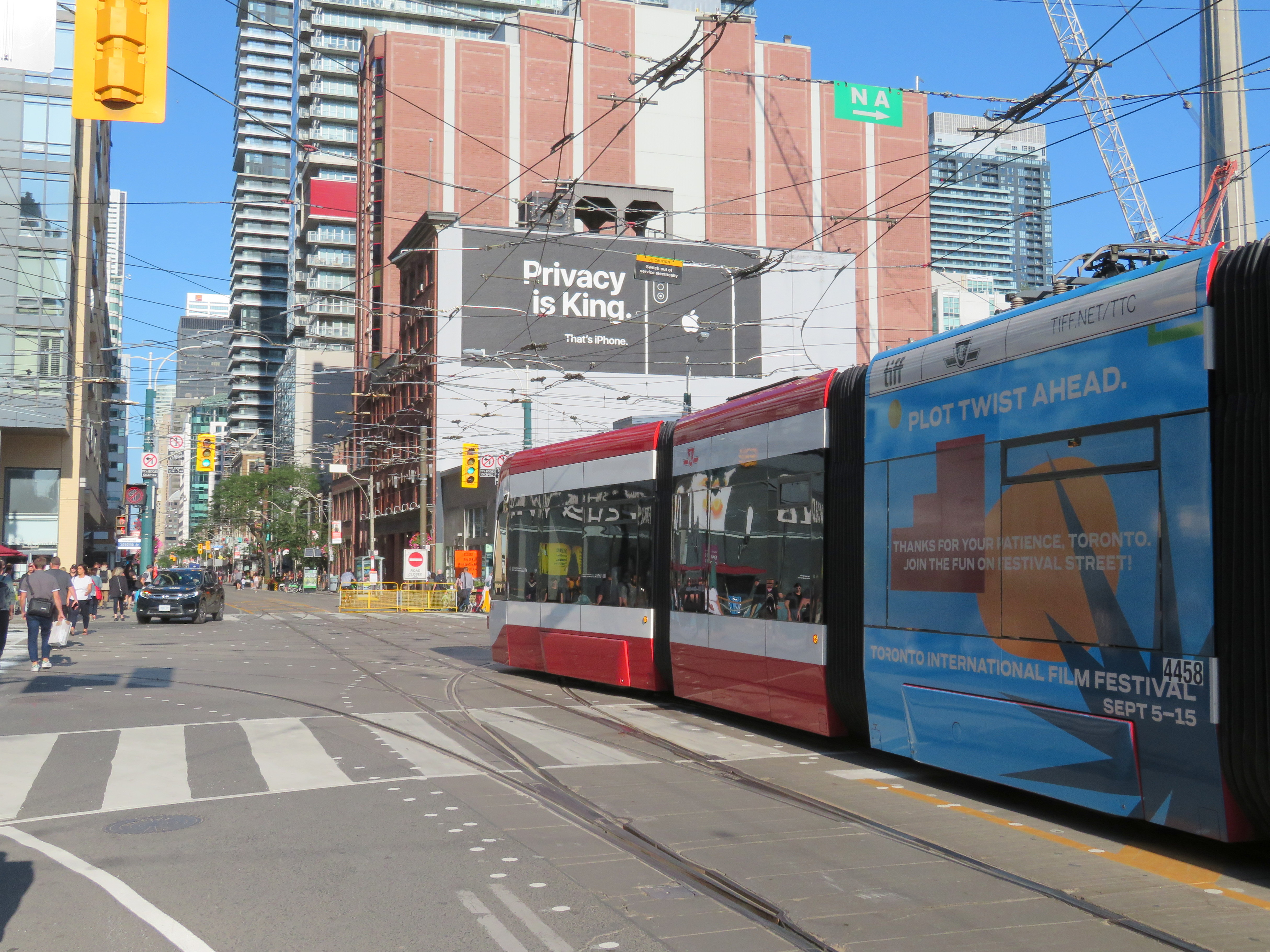
504 King Streetcar diverting onto Spadina on Thursday, September 5
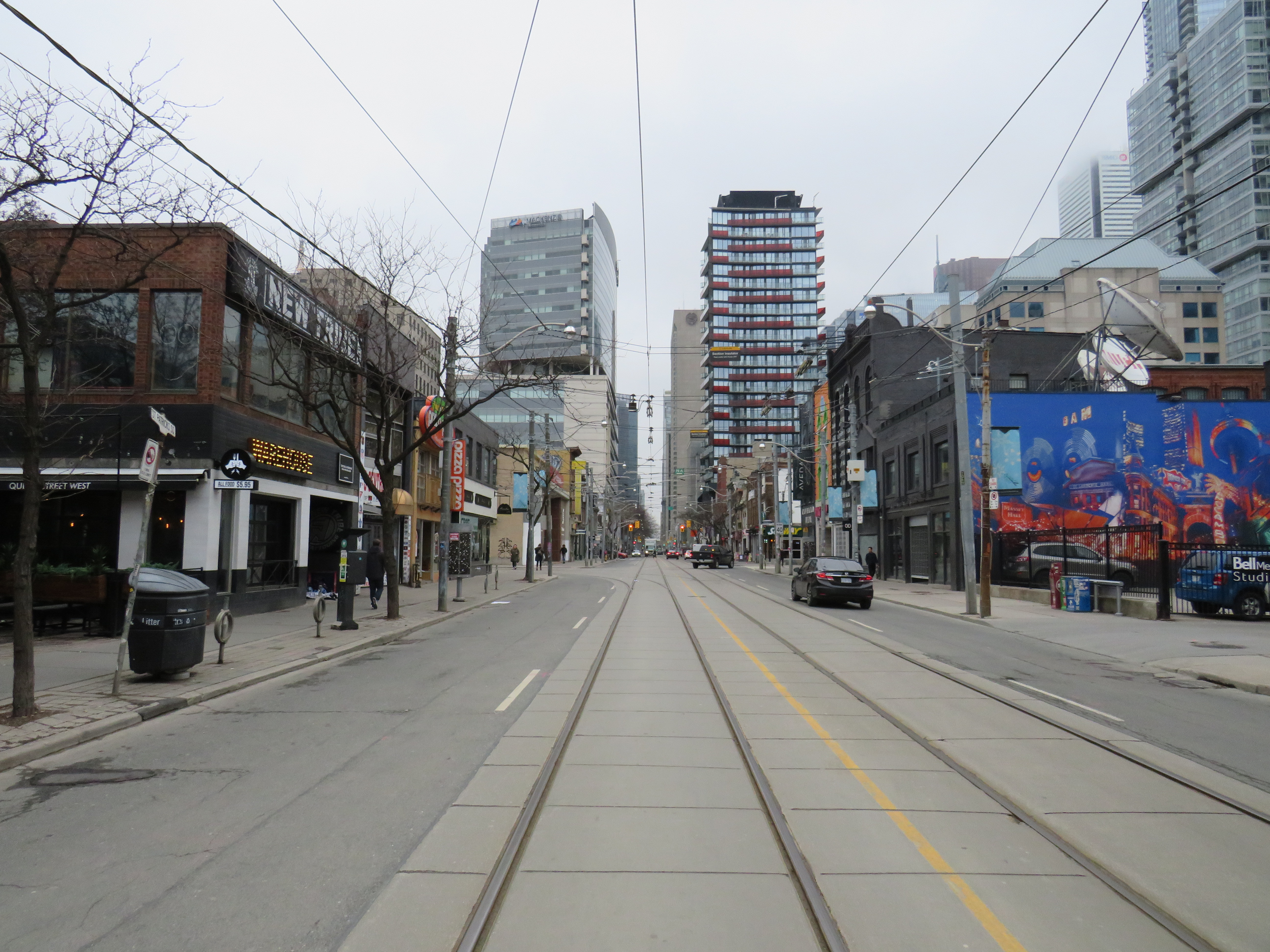
For the sixth year in a row, King Street between University and Spadina Avenues was closed for four straight days. This closure was for the Toronto International Film Festival (TIFF) “Festival Street,” which took place between Thursday September 5 and Sunday September 8. In addition, King Street was closed during the afternoon rush hours the following Monday and Tuesday for “Red Carpet Events.”
TIFF has been recognized among the world’s most important film festivals, and one where the public has the opportunity to take part (albeit at increasingly inaccessible prices for many screenings). It offers tremendous economic and cultural value to Toronto. It compliments and helps to support many other annual film festivals, such as Hot Docs and Inside Out.
But TIFF’s clout and influence has also led to entitlement, with “Festival Street” being the most disruptive result. While King Street is closed off to traffic during the film festival, it has severe effects for the 84,000 daily riders of the 504 King Street, as well as riders on the busy 501 Queen and 510 Spadina cars.
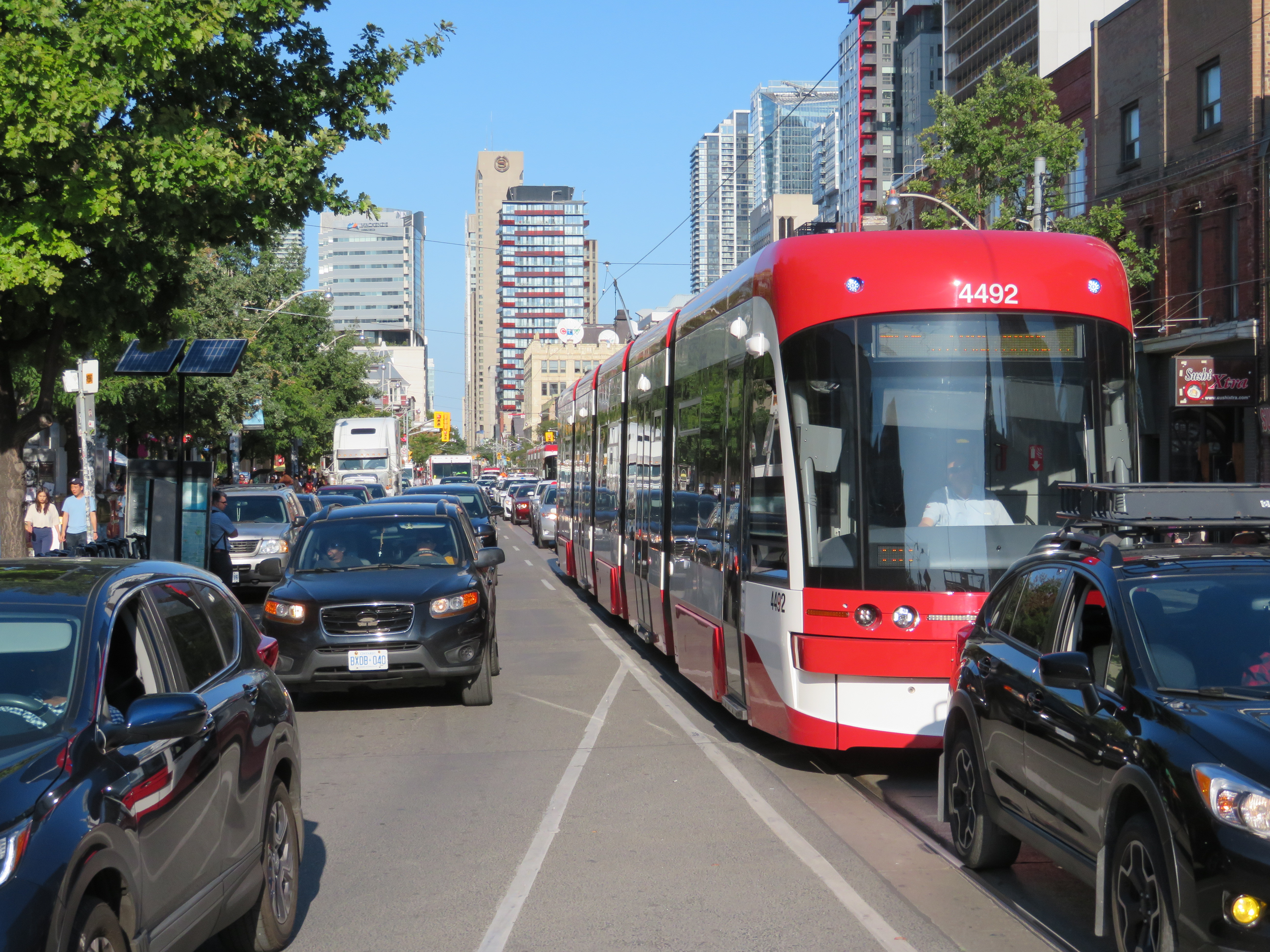
501 Queen and 504 King Streetcars stuck in traffic westbound at Queen and Spadina
Several major TIFF screening locations are located on or near King Street West, including Roy Thomson Hall, the Princess of Wales Theatre, the TIFF Bell Lightbox, and two blocks north, the Scotiabank Cinemas. Industry parties and galas are held at nearby hotels and restaurants. It’s natural that King Street would be a hub of activity for the film festival. But it is also the third busiest transit route in Toronto, after the Yonge-University and Bloor-Danforth subways.
The King Street Pilot, which began in late 2017, prohibits through motor vehicle traffic on King Street between Jarvis and Bathurst Streets through the downtown core, though all vehicles are permitted to use King Street for short segments. Despite spotty enforcement, the pilot project allowed the TTC to operate much more reliably through the busy corridor, with an increase of capacity and ridership. In early 2017, daily ridership on the 504 King was 72,000. By March 2018, it grew to 84,000. In April, council voted to make the pilot permanent. This will allow for streetscape improvements along the corridor and wider sidewalks, with improved physical measures to further restrict through traffic.
On the CBC radio program Metro Morning on March 28, Toronto Mayor John Tory spoke about his concerns regarding Premier Doug Ford’s plans to upload the city’s subway system, as well as Ford’s intentions to build new subway extensions to Richmond Hill and Scarborough Centre, bury the Eglinton West LRT, and start the long-planned Relief Line. Instead of a conventional subway, the Relief Line envisioned by the province would use a “new technology,” despite planning and engineering underway for a subway, using an existing subway yard for Relief Line train storage.
But Tory, who has been passive so far about the province’s plans, was hopeful that the unspecified new technology proposed for the Relief Line would be a “fantastic bonanza” for Toronto, but he added that he didn’t know for sure what would come of the new plan.
Mayor Tory tells @metromorning he's prepared to hold out hope that the province's unspecified new tech for the Relief Line is a "fantastic bonanza for us. But I don't know."
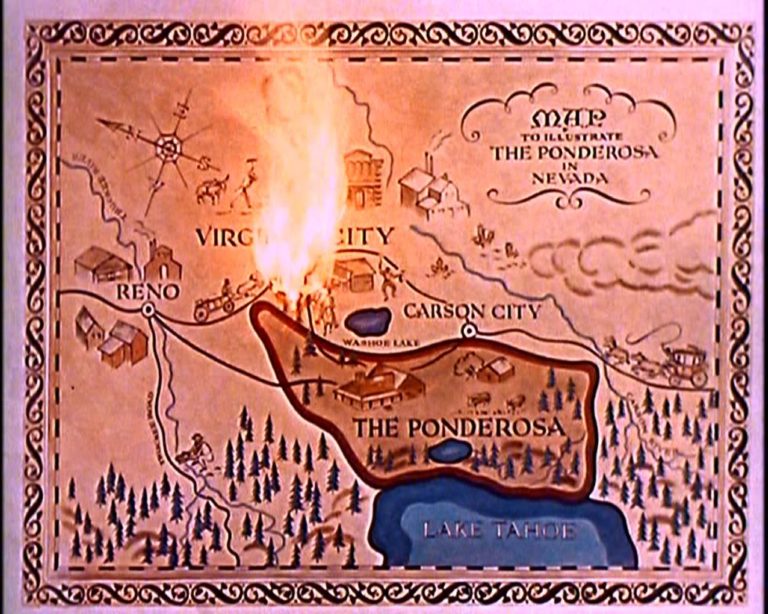
It is curious that Tory called this hostile takeover a “fantastic bonanza.” Bonanza was a long-running Western television show, starring Lorne Greene as the patriarch of the Cartwright family, owners of a vast ranch on Lake Tahoe. Bonanza was famous for its theme music and opening credits, which featured a burning map of the Cartwrights’ Ponderosa ranch before introducing the cast.
Opening theme for Bonanza
Bonanza’s burning map is a great metaphor for Toronto’s transit planning. Newly elected mayors and premiers burn the maps left behind by their predecessors, and time is wasted on new feasibility studies and engineering reports, ready just in time for someone else to get elected with yet another idea. Plans come and go, but hardly anything ever gets built.
There’s plenty of blame to go around. After a prolonged spurt of subway construction in the 1950s, 1960s and 1970s, momentum was lost. In the 1980s, Bill Davis’ Progressive Conservatives insisted on a novel linear-induction rail system for Scarborough, rather than the light rail project already underway. The Liberals, under David Peterson, proposed several subway lines, though it was scaled back under NDP Premier Bob Rae. In 1994, work started on the first phases of the Eglinton and Sheppard subways. When Mike Harris’ government was elected in 1995, they cancelled Eglinton, filling in a hole already dug for the tunnel boring machines.
There was new hope in 2003, when a new Liberal provincial government was elected, and David Miller, an urban progressive, became mayor of Toronto. While the province’s top priority was the extension of the Spadina Subway to York University and Vaughan, it was willing to help fund major improvements to GO Transit, along with new light rail systems in Ottawa, Kitchener-Waterloo, Hamilton, and Mississauga-Brampton. It also committed to Miller’s proposed Transit City LRT network, including a fully grade-separated replacement of the ageing Scarborough RT.
There were valid criticisms of Transit City — there were too many transfers to get around the top of the city, there was no Relief Line, and a few of the proposed lines, like parts of the Jane and Don Mills LRTs, were too difficult to build as surface rail projects. But because of Miller, the Eglinton-Crosstown LRT is well underway, and preliminary work continues on Finch Avenue West.
Work would have also started on the Scarborough RT replacement and expansion and the Sheppard East LRT, had Rob Ford not been elected in 2010, promising “subways, subways, subways” and burning the transit maps for which new projects were planned and being built. Seven funded LRT stops in Scarborough became three unfunded subway stops. Overestimating Rob Ford, and hoping to keep seats in Scarborough, the Liberal government folded to his demands, and work stopped on the LRT replacement.
Rob Ford’s disastrous term was followed by John Tory’s twin obsessions of SmartTrack and an austerity agenda, at a time when the Yonge and Bloor-Danforth subways were overwhelmed by demand caused by a growing population and a booming economy — hardly the conditions that demanded low spending on civic services and infrastructure and yet another half-baked transit plan.
SmartTrack map from the 2014 John Tory campaign
Tory promised that it would only take seven years to build SmartTrack, which would mostly use existing railway infrastructure, along with a new section of track in Etobicoke, on land already sold off for development. Tory’s insistence on SmartTrack further delayed momentum on the Relief Line. Though Tory remained committed to the Scarborough subway extension over the approved and funded LRT, it was reduced to a single stop as costs ballooned, while the subway and SmartTrack threatened to cannibalize each other. We don’t hear much about SmartTrack anymore, but at least Tory has come around on the Relief Line.
But Doug Ford’s latest musings make it clear why the planned subway upload is so dangerous.
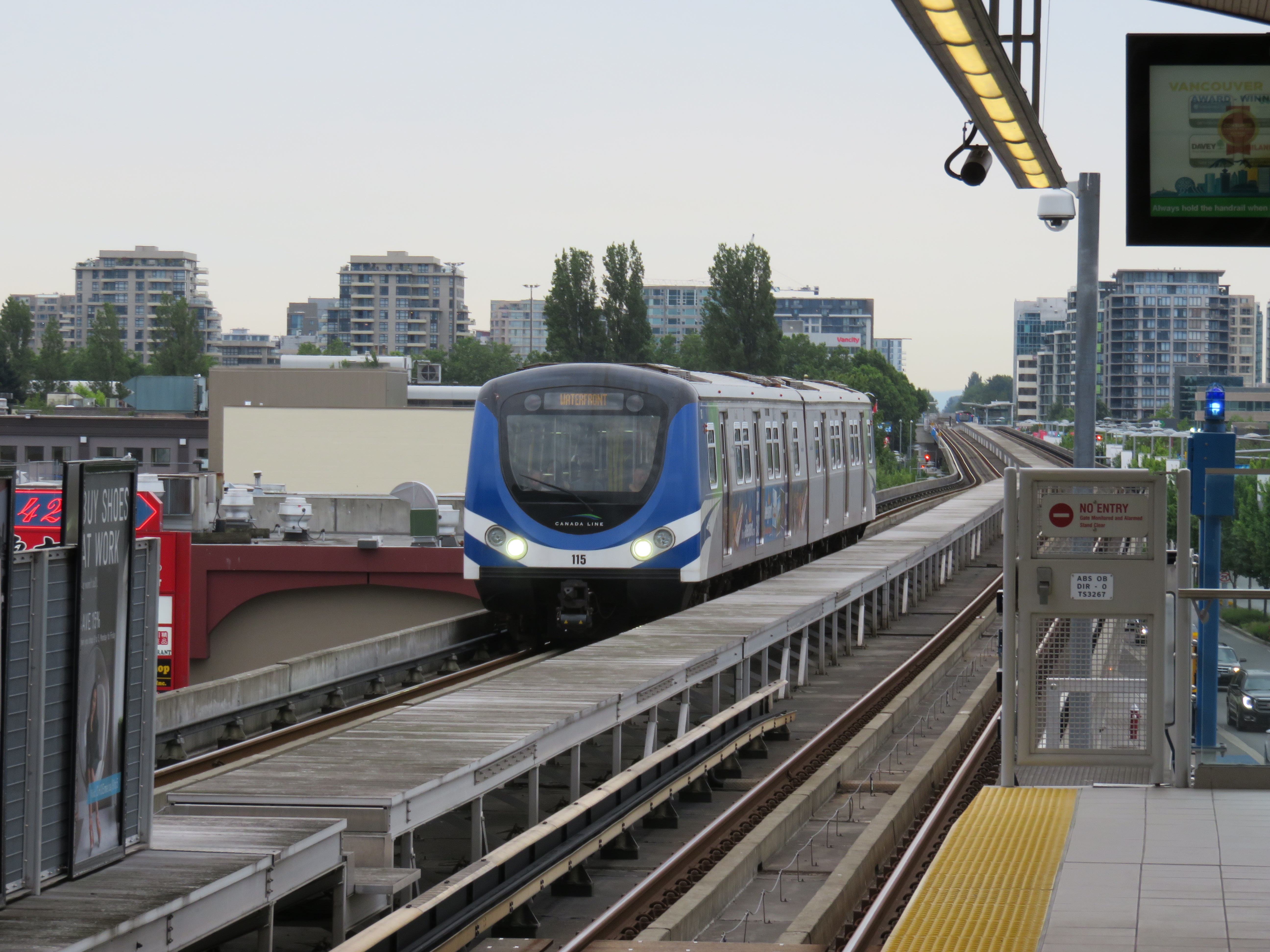
Canada Line in Richmond, British Columbia
So what now for the Relief Line?
Despite the inevitable Simpsons monorail jokes (Doug Ford did promise a monorail on Toronto’s waterfront when he was a city councillor in 2011), the new technology the province is considering is likely an automated light metro line, similar to the Canada Line in Vancouver. The Canada Line links Vancouver’s city centre with the international airport and the suburb of Richmond. It was built as a private-public partnership (P3) project, in which a private company was contracted to design, build, and operate the line. It’s an attractive option for a conservative government: P3s promise to be cheaper to build and operate than a conventional public project.
But the Canada Line has problems. Though trains are frequent, it was built too small to accommodate growth. The outer terminals at Vancouver airport and Richmond-Brighouse are both single track/single platform. Station platforms are too short — only 40 metres long — to increase train sizes. And as many stations are underground, it’s too expensive to extending platforms to fit larger trains. Some relief is coming, but even then, the maximum capacity of the Canada line is 15,000 persons per direction per hour, far less than Vancouver’s SkyTrain lines or Toronto’s subway. If this is the route Toronto takes, it won’t be long before the Relief Line itself will need relief.
Once again, I fear that Toronto will continue to spin its wheels thanks to the Ford circus. And it’s a shame — though sadly not surprising — that Mayor Tory isn’t fighting back.
November 8, 2018:I updated this post to look at the results for fourth place mayoral candidate Saron Gebresellassi.
I started this website four years ago after I began producing maps of the local council races and ward-level results of the 2014 municipal election and sharing them on Twitter. I figured that I would continue to map the results after the 2018 election. In this post, I start with the mayoral race results. Over the next two months, I will dive into the local council races as poll level data and poll boundary shapefiles are now available on the City of Toronto’s Open Data catalogue.
John Tory’s landslide win this year was no surprise. Despite urban progressives’ frustration with his centre-right agenda, Tory has remained popular with a large segment of Toronto’s population. Until July of this year, there were no high profile challengers to Tory. Meanwhile the mayor assembled a campaign team that included Nick Kouvalis and Warren Kinsella, and had months to fund-raise a massive election war chest.
Former Toronto chief planner Jennifer Keesmaat registered on July 27, 2018, the last day of nominations for mayor. Keesmaat decided to run for mayor after Tory delivered an inadequate response to Premier Doug Ford’s Bill 5 in July 2018, in which he called for a referendum rather than forcefully opposing Ford’s surprising and vindictive attack on Toronto City Council.
Keesmaat did not have the time, organization, and money to make a strong campaign against Tory. Her platform was more progressive than Tory’s but still not distinctive or bold enough. Keesmaat even promised to keep property tax increases at or below the level of inflation, Tory’s key plank.
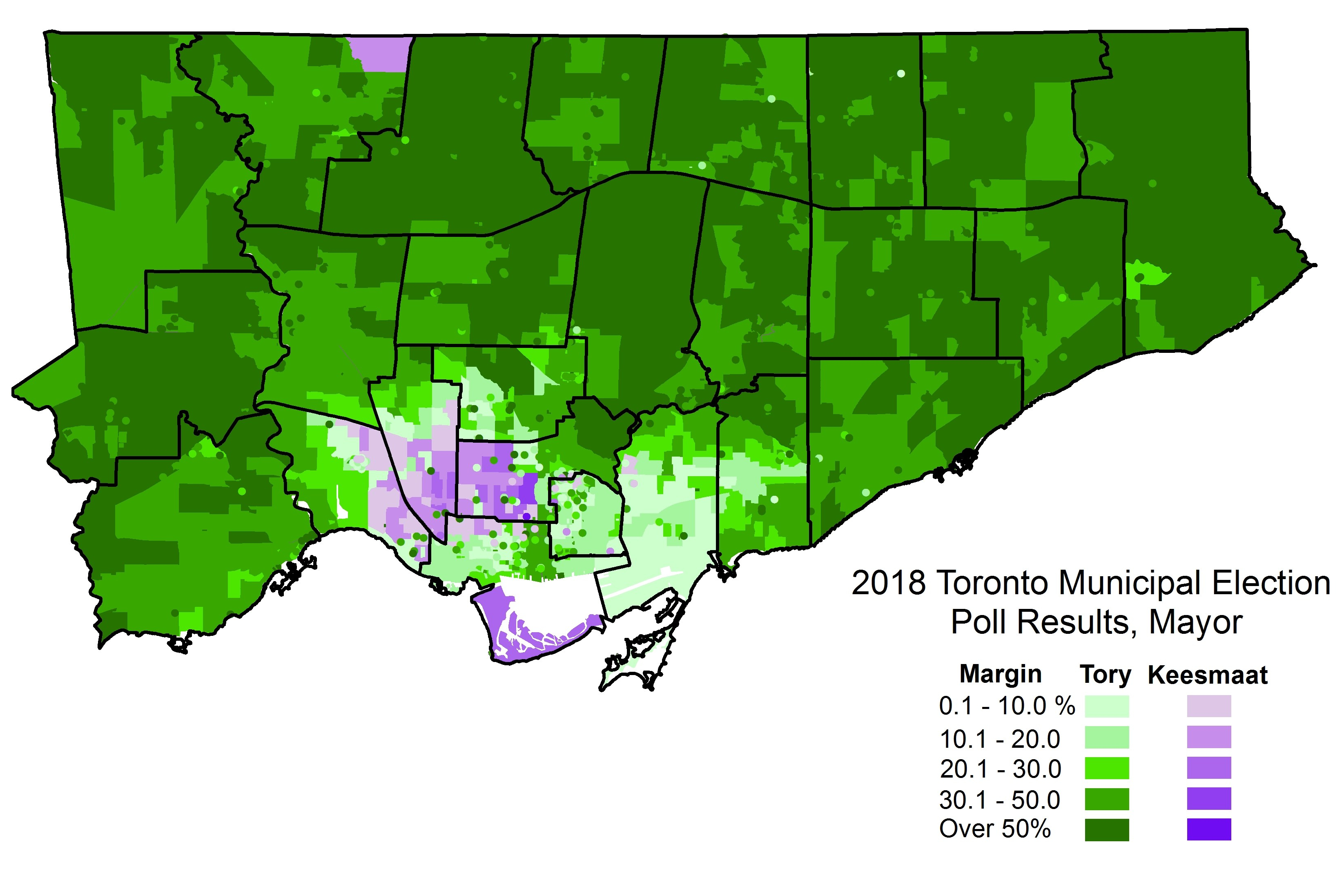
It was no surprise that Tory was able to win with 63 percent of the vote, coming in first in all 25 wards, and 1599 of 1700 regular election day polls. Tory placed first in every poll won by Doug Ford in 2014.
Keesmaat placed first in only 101 polls, with all except one of those being in the old City of Toronto (the other poll was York University).
Poll-by-poll results for the 2018 mayoral race
Interestingly, but not too surprisingly, the polls in which Keesmaat placed first were very similar to those polls where Olivia Chow did best in 2014 — established west Downtown neighbourhoods such as the Annex, Little Italy-Palmerston, Seaton Village, the Junction, and Parkdale. Had the old 44 wards still been in use, Keesmaat would have placed first in three wards — old Wards 14, 18, and 19, the same as Chow’s results in 2014. These neighbourhoods are clearly the urban progressive base.
Tory finished first in central and east downtown neighbourhoods, including the areas with younger, more diverse populations such as City Place, the Entertainment District, and Liberty Village. It’s also quite clear that Keesmaat failed to capture the imagination of large segments of Toronto’s population — especially in areas with large populations of immigrants and visible minorities. Any left-leaning challenger needs to win over not only the suburbs, but also downtown condo dwellers.
2018
2014
Maps of the mayoral race results at the ward level, with the old 2014 ward boundaries
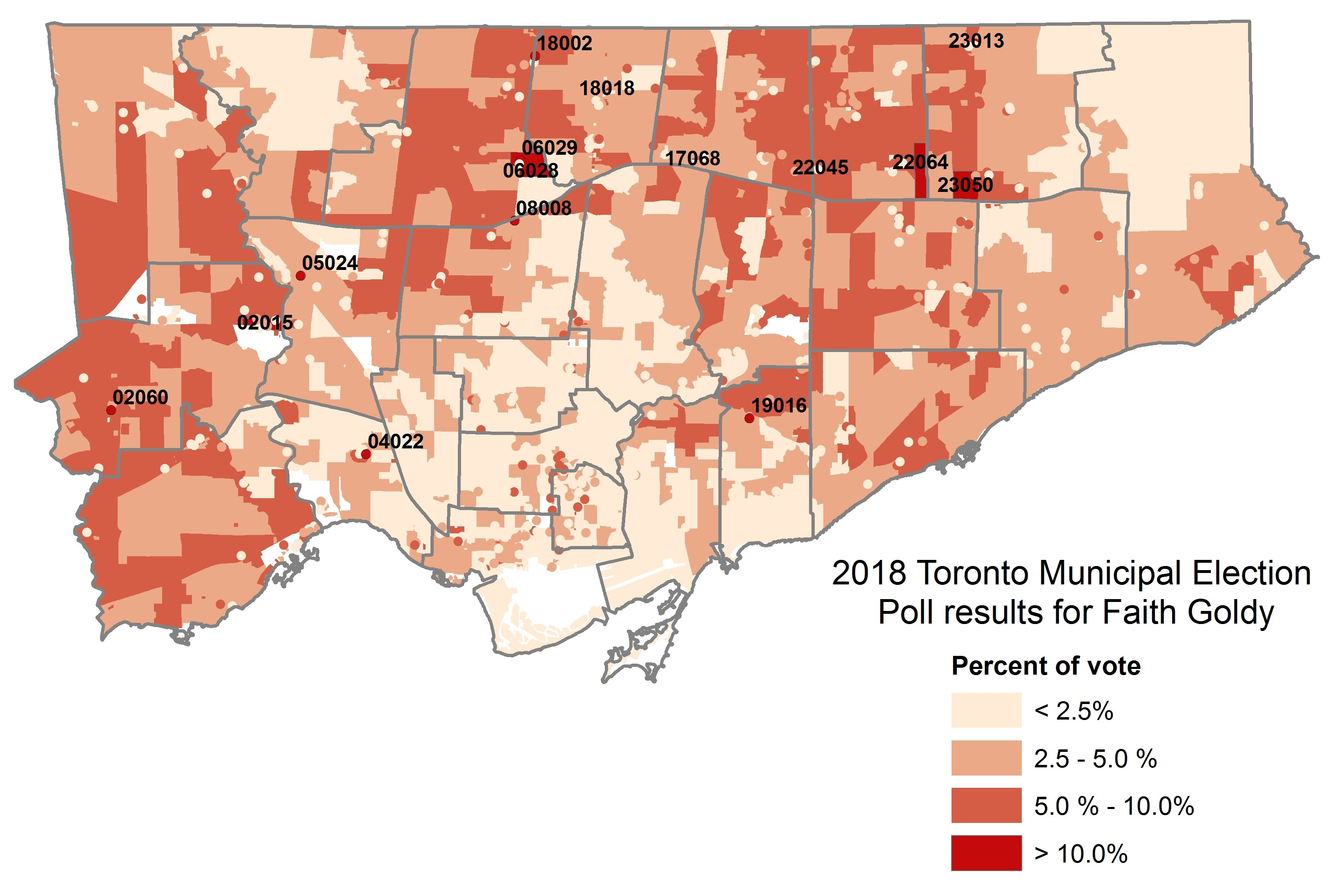
Coming in third place in the 2018 mayoral election was white supremacist Faith Goldy, who managed to win over 25,000 votes, or 3.4 percent of all votes cast. Goldy fared poorly in most polls, and she failed to win more than 20 percent of the vote in any of those polls. But still, she was able to get over 10 percent of the votes in 16 polls across Toronto. They are mapped below. Goldy’s support was highest in the suburbs, especially central Etobicoke and in the Bathurst-Sheppard area, and in north Scarborough.
Most of those polls where Goldy got relatively high percentages of the vote had few total ballots cast. Poll 68 in Ward 17, a condo building near Leslie Street and Sheppard Avenue, had the highest vote percentage for Goldy, though this was only 7 of 35 total votes for mayor. Poll 1 in Ward 19 had the highest absolute number of Faith Goldy supporters (excluding advance polls), with 86 out of 1030 mayoral votes cast.
Still, it saddens me to see a xenophobic, racist fringe candidate get as much support as she did in Toronto, a city whose motto is “diversity our strength.”
After I wrote this blog entry on Wednesday, Brittany Andrew-Amofah on Twitter suggested that I take a look at the results for fourth place candidate Saron Gebresellassi. Gebresellassi’s platform was stronger than Keesmaat’s, focusing on housing, transit, mental health supports, and opportunities for youth and racialized communities, especially in Toronto’s inner suburbs. Gebresellassi argued strongly for these issues at mayoral debates.
It would've been worth it to analyze the support Saron received @sean_YYZ.
I say this because she was one of two racialized candidates in the top 5, possibly bringing some more insight on how racialized communities voted but also her bold platform that spoke to suburban issues
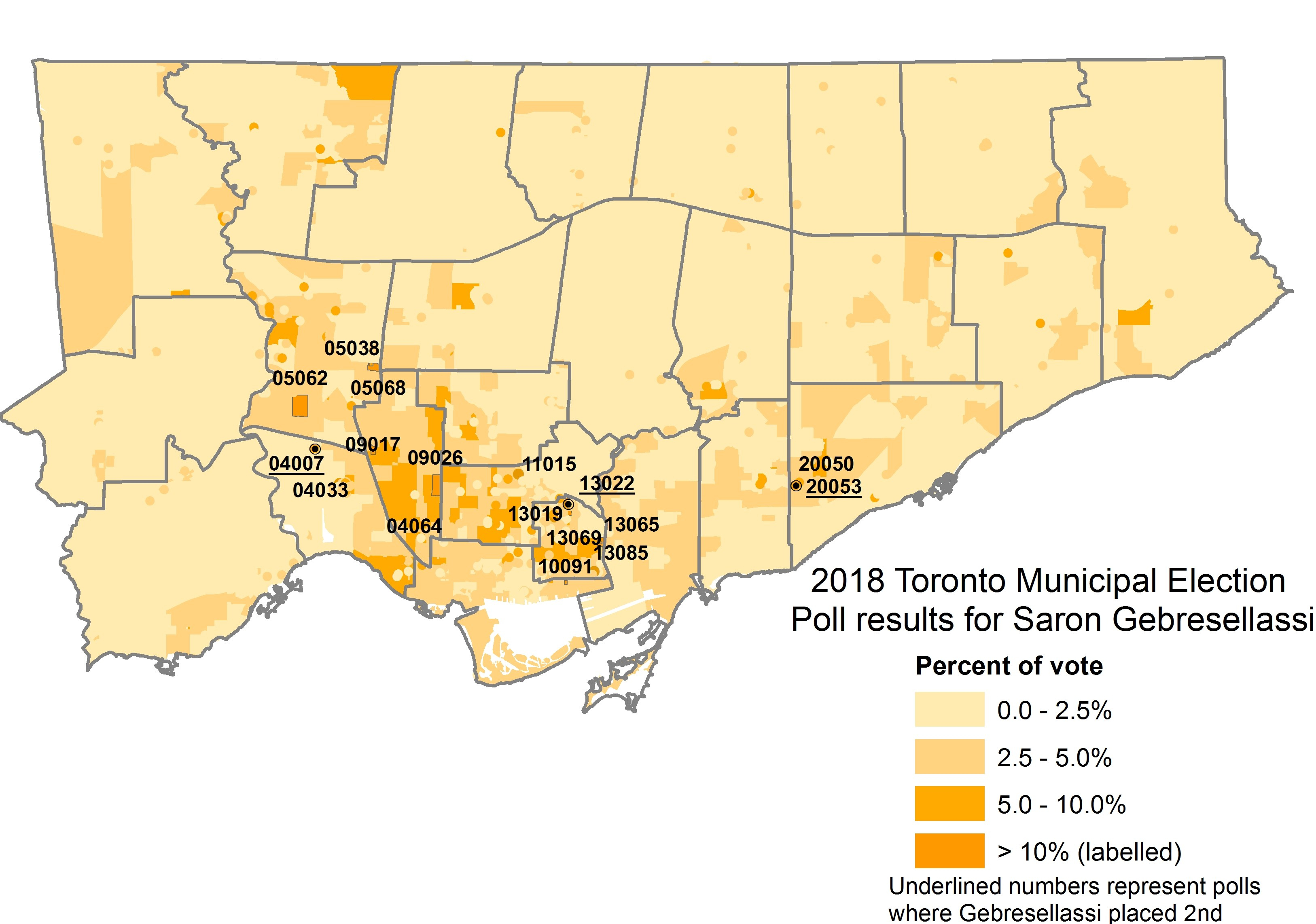
Unfortunately, Gebresellassi only got 2 percent of the city-wide vote. She fared better in eight wards in central Toronto, as well as in York South-Weston, Humber River-Black Creek and Scarborough Southwest. Perhaps not coincidentally, these eleven wards were also the provincial ridings won by the NDP in the June provincial election. Gebresellassi’s highest support was in Ward 9 – Davenport, where she got 5.2% of all votes cast. Ward 9 is also where Keesmaat had the highest support, nearly beating Tory.
Ward-level results for Saron Gebresellassi
Gebresellassi took more than 10 percent of the vote in 17 polls. Many of these polls were located in Toronto Community Housing (TCH) buildings, co-ops, and shelters. Twenty-four percent of all voters in Poll 22 in Ward 13, located at a TCH property in St. Jamestown, chose Gebresellassi.
Saron Gebresellassi spoke passionately about the right for safe and affordable housing, and many voters, especially those living in social housing took notice.
Poll-level results for Saron Gebresellassi. Polls in which Saron Gebresellassi got more than 10 percent of the vote are labelled; the three polls where she placed second (to John Tory) are underlined.
As I mentioned before, I plan to take a close look at the council races over the next little while. Despite a frustrating and at times dispiriting municipal election here in Toronto, it’s worthwhile, I think, to look back at what happened. How did some incumbent councillors win, while others lost? How did the new boundaries change local dynamics?



 Canada Line in Richmond, British Columbia
 How each of Toronto’s 25 wards voted for mayor
 Poll-by-poll results for the 2018 mayoral race

 Most of those polls where Goldy got relatively high percentages of the vote had few total ballots cast. Poll 68 in Ward 17, a condo building near Leslie Street and Sheppard Avenue, had the highest vote percentage for Goldy, though this was only 7 of 35 total votes for mayor. Poll 1 in Ward 19 had the highest absolute number of Faith Goldy supporters (excluding advance polls), with 86 out of 1030 mayoral votes cast.
 Ward-level results for Saron Gebresellassi