Tag: John Tory

  • A good, a bad, and an ugly week for Toronto transit

    There was some good transit news for Torontonians today, as the provincial government announced $150 million in funding for detailed study and engineering for the planned Relief Line subway. The preferred route and station locations for the first phase of the new subway line was also released this week, with eight stops from Pape to Osgoode Stations.

    Happily, the Relief Line, an idea that’s over one hundred years old, Toronto’s answer to New York’s Second Avenue Subway, is closer to being built than ever before. As Steve Munro reports, the study will focus initially on the portion from Pape to downtown, but will shift to the northern and western extensions.

    But there were also some ugly truths concerning that other subway project, the proposed one-stop extension of Subway Line 2 to Scarborough Centre. Last week, homeowners in the Ellesmere/McCowan neighbourhood received notices of possible expropriation, ahead of a public information session in which the preferred alignment of the one-stop subway was revealed. I can understand the residents’ anger; major projects will always be disruptive to some properties and some families and businesses are sometimes forced to re-locate. There’s an argument to be made that subway backers don’t realize the extent of the disruption that even bored-tunnel subways can cause. Stations have to be dug, utilities have to be moved, buildings demolished, and roads closed.

    But most importantly, the Scarborough subway extension remains a bad policy.

    Fullscreen capture 01062016 72046 PM
    2031 ridership projections for terminal subway stations

    In 2031, the projected ridership between Scarborough Centre and Kennedy Station will be 31,000 a day, or 7,200 in the AM Peak. This is lower than previous estimates; a 2013 study estimated the AM peak ridership for the subway extension to be between 9,500 and 14,000. The reduction by nearly half is because the 2013 plan had three stations — at Lawrence, at Scarborough Centre, and at Sheppard — but the new plan has only one station. Passengers on the 54 Lawrence East bus and on the Sheppard corridor would either be gerrymandered to the SmartTrack line, or forced to transfer to get to the subway at Kennedy or Scarborough Centre. $2 billion will be spent for this one-stop extension, while the Islington to Kipling section of Line 1, opened in 1980, cost a small fraction of that amount, even in 2016 dollars.

    On one hand, 7,200 is a respectable peak hour ridership between the two final stations on a long subway line, and subway trains shouldn’t be full at this part of any route. The ridership between Islington and Kipling stations on the other end of Line 2 will be 1,200 less during the same time. Fed by multiple bus routes, Scarborough Centre will be a busy station, one of the top ten for train boardings, if not the top five, in the TTC system.

    But in order to justify John Tory’s SmartTrack, a useful station at Lawrence and McCowan is being dispensed with. Planners, working under the direction council and the mayor’s office, euphemistically call it an “express subway.”

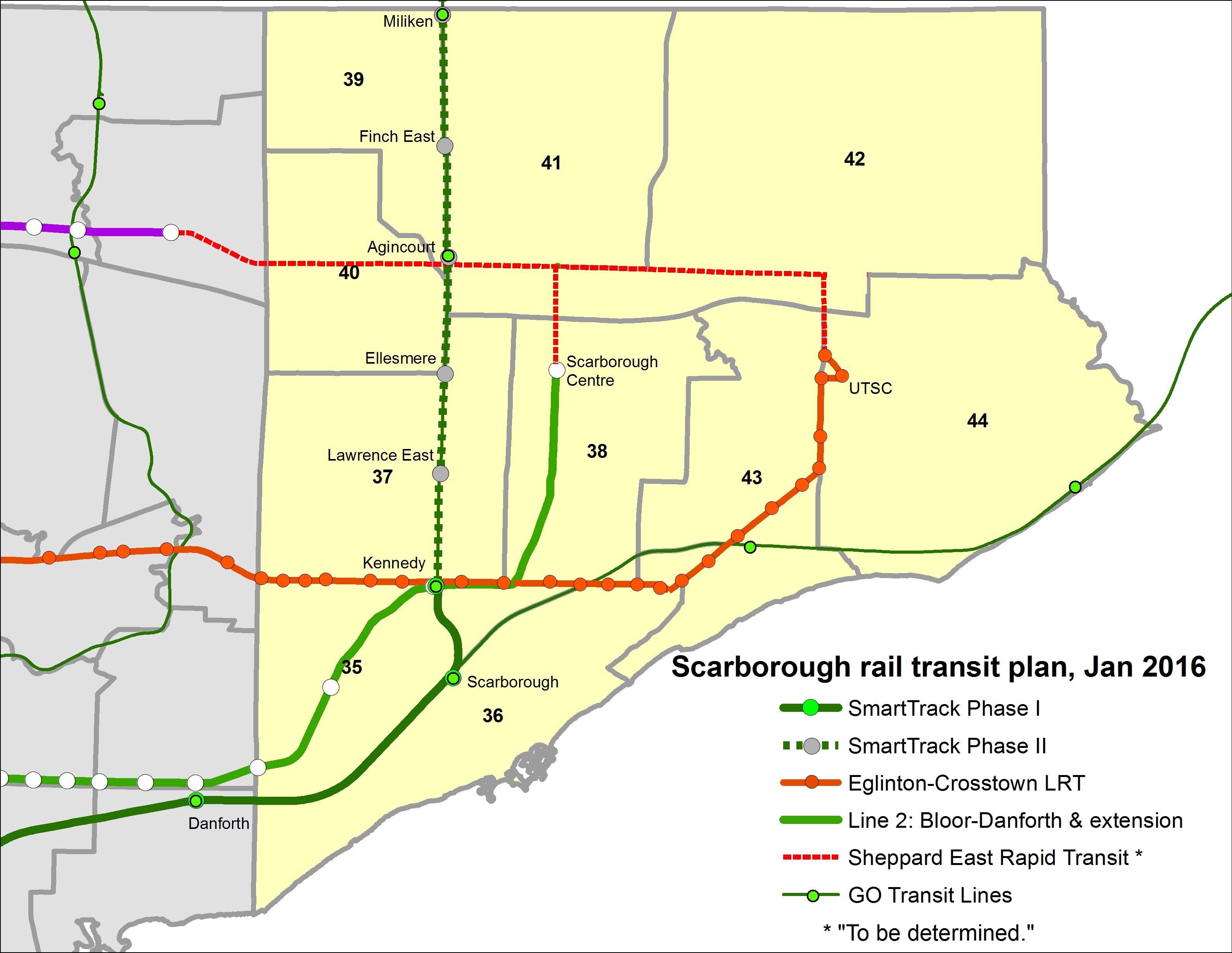
    Scarborough - 2015Scarborough transit plan, 2015

    Scarborough - 2016Scarborough transit plan, 2016

    Previous proposals, backed by former mayor David Miller and 2014 candidates Olivia Chow and David Soknacki, would have seen a light rail line replace the failing Scarborough RT route; the province even promised to cover the capital costs of the retrofit and extension to Centennial College and Sheppard Avenue. In 2011, in a report published by the Pembina Institute, the AM peak ridership of the LRT line between Kennedy and Sheppard was estimated to be 6,400 in 2031, far below the design capacity of a subway extension. An LRT line, with seven stops and many more surface transit connections, would directly serve many more passengers than a one-stop subway.

    Under the failed mayoralty of Rob Ford, the province agreed to build a subway instead, but the city was required to pay up. A property tax levy of 1.6% is currently collected to help pay the city’s share.

    The LRT ship has probably sailed. But thanks to two weak mayors, myopic councillors eager to show they’re fighting for their little fiefdoms, and an obliging provincial government determined not to lose seats in the next election, we’re stuck. At least we’re making progress on the Relief Line.

    Meanwhile, John Tory continues — inadvertently or not — to sow the seeds of confusion over what SmartTrack is all about. After the Downtown Relief Line funding announcement, the mayor put out this tweet:

    This is incorrect. The work on the GO Stouffville Line (not the “Unionville Line”) is a project undertaken by Metrolinx that will allow for two-way service on the existing GO corridor, work that started in 2015. Apart from the SRRA report written before John Tory ran for mayor in 2014, and some initial studies by the City of Toronto and Metrolinx, no work has been carried out on the still-vague proposal.

    Council’s stubborn support of the Scarborough Subway and Tory’s continued SmartTrack fantasies is are just a few reasons why it’s so easy to be frustrated with municipal politics.

  • Leadership, John Tory style (updated)

    Updated May 29

    I was frustrated this week by Mayor John Tory’s pronouncement that he’s “not in favour of adding any more politicians here,” referring to the proposed new ward boundaries released last week that would increase the number of city councillors from 44 to 47. This is despite a rigorous and solid process, with plenty of public and stakeholder consultation sessions. But to Tory, “politician” is a dirty word. Never mind that the boundaries were created in 2000, from even older federal/provincial boundaries that based on the 1991 census, Tory doesn’t like the solution developed after three years of work.

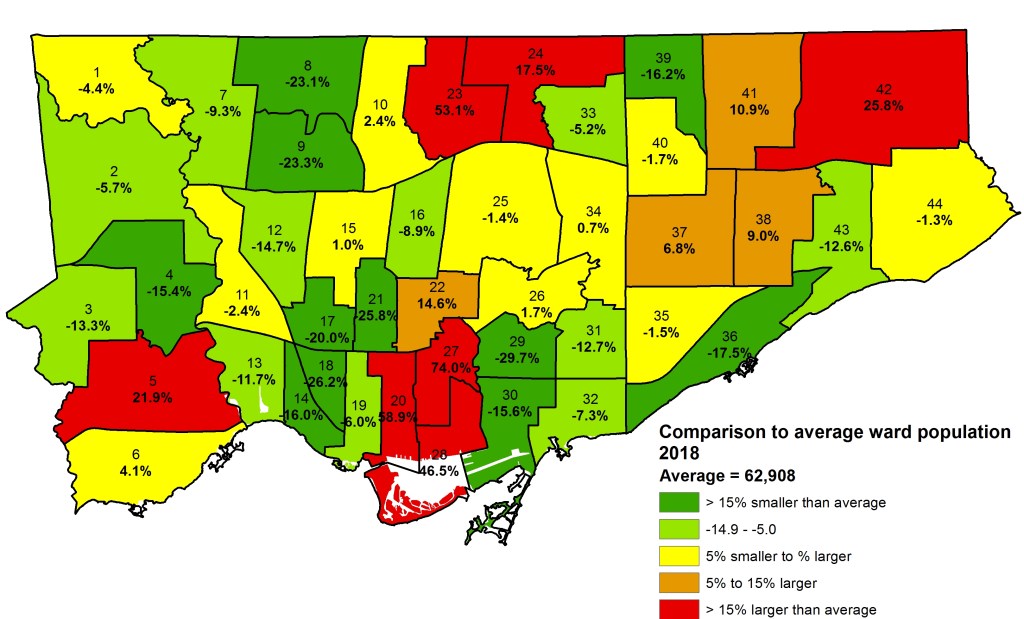
    2014 Election - 2018 Ward Projections
    The discrepancy between each ward’s population and the city-wide average in 2018

    Instead, Mayor Tory wants staff to back to the drawing board and come up with a plan that he likes, following the fine tradition in municipal politics of ignoring the advice and hard work of staff and outside experts because you don’t like the answer they give. Tory’s hand-picked Executive Committee agreed with his motion to defer the debate until the fall. 

    This is a problem. It’s necessary for aspiring candidates to be organizing right now if they want even a slight chance of knocking off an incumbent councillor. For that reason, the boundaries need to be decided as soon as possible. And adding three new councillors really shouldn’t be a big ask — it would cost $870,000 a year, including the costs of hiring additional assistants.

    One reason why Calgary’s Naheed Nenshi is a great mayor is because he trusts his staff and praises their hard work. I was at a lecture in which Mayor Nenshi took very little credit for that city’s response to the 2013 floods. Instead, he spoke about how he. along with senior city staff responded in a coordinated manner, involving all city employees and citizen volunteers in the effort to minimize the flood’s impact and clean up the damage.

    John Tory, on the other hand, shames city staff and local councillor Kristyn Wong-Tam in a crass stunt for Jack Lakey, author of “The Fixer” column in the Toronto Star. This reminds me very much of Rob Ford’s modus operandi.

    In the article, Mayor Tory is photographed cleaning up a planter on Alexander Street, as he explained that he was frustrated by the city bureaucracy who couldn’t get the planter repaired and looking good. Rob Ford was famous for this kind of stunt — filling in potholes, attending to residents’ complaints — often going over the head of councillors or city staffers. Urban forestry manager Dean Hart is named and shamed, but that department does not have responsibility for planters — that’s Transportation Services, which Lakey glosses over. To quote a friend: “so a city division which gets annual budget reductions declines to do work that’s out of scope, and in turn gets this response?” That’s not leadership.

    Leadership means addressing the real problems. Perhaps there is a problem with buck-passing. Maybe there’s a way to improve communications between city departments. A good leader involves the parties responsible and encourages them to find a solution, not publicly shame them. Maybe a leader doesn’t demand annual budget cuts in all areas (except, of course, the police), then blames staff when the effects of the budget cuts become visible. Meanwhile, Ward 27 is the most populated in the city, and Councillor Wong-Tam one of the hardest-working on council. Yet Tory doesn’t want to implement a sensible ward boundary plan.

    Running for election, John Tory liked using the word “bold” a lot, especially when he was touting his signature transit plan, SmartTrack. He promised leadership, but has instead dithered on or deep-sixed important initiatives, like a city-wide cycling network (He won’t back crucial sections of a new city-wide cycling network, saying only that he supports “sensible” bike lanes.

    On police reform, Tory dithered on eliminating the racist practice of carding until forced to take a position when a group of prominent citizens spoke out against it.

    As for social programs and revenue tools to fund essential city services and infrastructure, Tory would rather keep property taxes below inflation, despite the warnings of top bureaucrats. As Desmond Cole points out, Tory is pretty much carrying out Rob Ford’s agenda of low taxes, weak leadership on issues like police reform, and ignoring the plight of Toronto’s poor and lower-income residents. Car owners and homeowners (particularly the owners of single-family dwellings) rule in John Tory’s Toronto.

    Yet, we’ll keep up a needless section of elevated highway. But, at the same time, we can’t build a new streetcar line in the East Waterfront.

    As one person on Twitter pointed out, had we given central Toronto the representation it deserved, Council might have decided to go with the least-expensive Boulevard Option for the eastern section of the Gardiner Expressway. And committees like Public Works and Infrastructure, which has control over items such as cycling infrastructure, are dominated by suburban councillors.


    Bike Routes and Wards
    Cycling infrastructure and Public Works and Infrastructure Committee membership by ward.

    Sure, John Tory won’t embarrass us. He won’t smoke crack, he won’t be caught uttering blatantly racist remarks and he’ll march in the Pride Parade. But he’ll continue the Ford agenda of low taxes and reduced city spending, except for things like the Gardiner East. And it now appears that he will continue Ford’s legacy of crass photo-ops, pretending to care about “customer service.”

    But the city will continue to grow, and we’ll see some progress on important issues, such as inclusionary zoning to build some new affordable housing. There are lots of good people — prominent advocates and people working behind the scenes, staffers and councillors at City Hall, community leaders and great organizations pushing for better — that desire a better city and continue to make Toronto great. There’s plenty of bold leadership for a city that needs it, but you’re not going to find it inside the mayor’s office.

  • The least-worst alternative for the Gardiner East

    Back in May, I outlined the reasons why I supported the removal of the elevated Gardiner Expressway east of Jarvis Street. Of the various options, which included maintaining the existing highway, a so-called “hybrid” section that would maintain most of the existing structure, but re-route the section between Cherry Streets and the Don Valley Parkway, and the removal option, which would see a widened Lake Shore Boulevard take over from the demolished freeway, similar to how New York City replaced the elevated West Side Highway.

    The removal option was the cheapest of the three alternatives ($326 million in up-front capital costs and $135 million in ongoing maintenance over a 100-year lifecycle). The study’s traffic models claimed that removal would only increase travel times by 3-5 minutes. Removing the East Gardiner offers the most opportunities to develop the East Harbourfront. Then, I conceded that an eight-lane Lake Shore Boulevard won’t be the most pleasant street to cross, but it won’t be much different than University Avenue.

    But for the benefit of east-end and suburban motorists and several vocal lobbies, council voted 24-21 for the “hybrid” option on June 11, 2015, despite higher costs ($414 million in up-front capital costs, and $505 million in maintenance over a 100-year lifecycle). The relatively close vote was an early test of John Tory’s hold on Toronto City Council.

    Yesterday, the City of Toronto released two important SmartTrack studies. The first was on the projected ridership of Mayor John Tory’s signature campaign promise; the second was on the feasibility of the problematic Eglinton West spur, which observers pretty much expected would be replaced by the planned extension of the Eglinton-Crosstown LRT. Ridership for SmartTrack would be high, but this is predicated on easy transfers, subway-like frequencies, and it being part of the regular TTC fare system. Fifteen-minute service, GO-like fares (which I’ve described as being unfairly expensive for intra-Toronto commutes) and a shorter line will, obviously, reduce ridership, and its relief of the TTC subway. But at least SmartTrack is getting smarter.

    On the same day, we learned more about the City Council-supported “hybrid” options for the Gardiner East as City and Waterfront Toronto staff released detailed assessments on three potential alignments endorsed by the City’s Public Works and Infrastructure Committee. You can view the entire media presentation here.


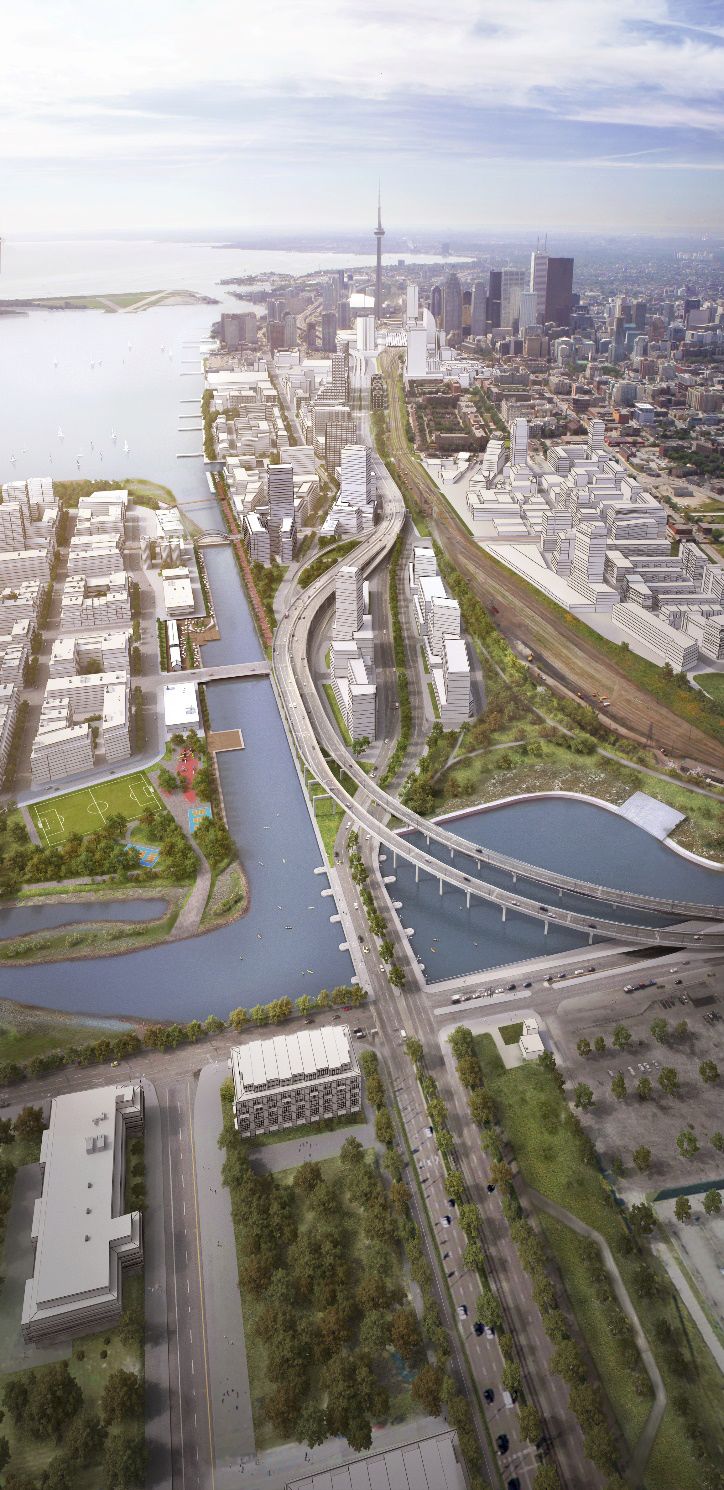
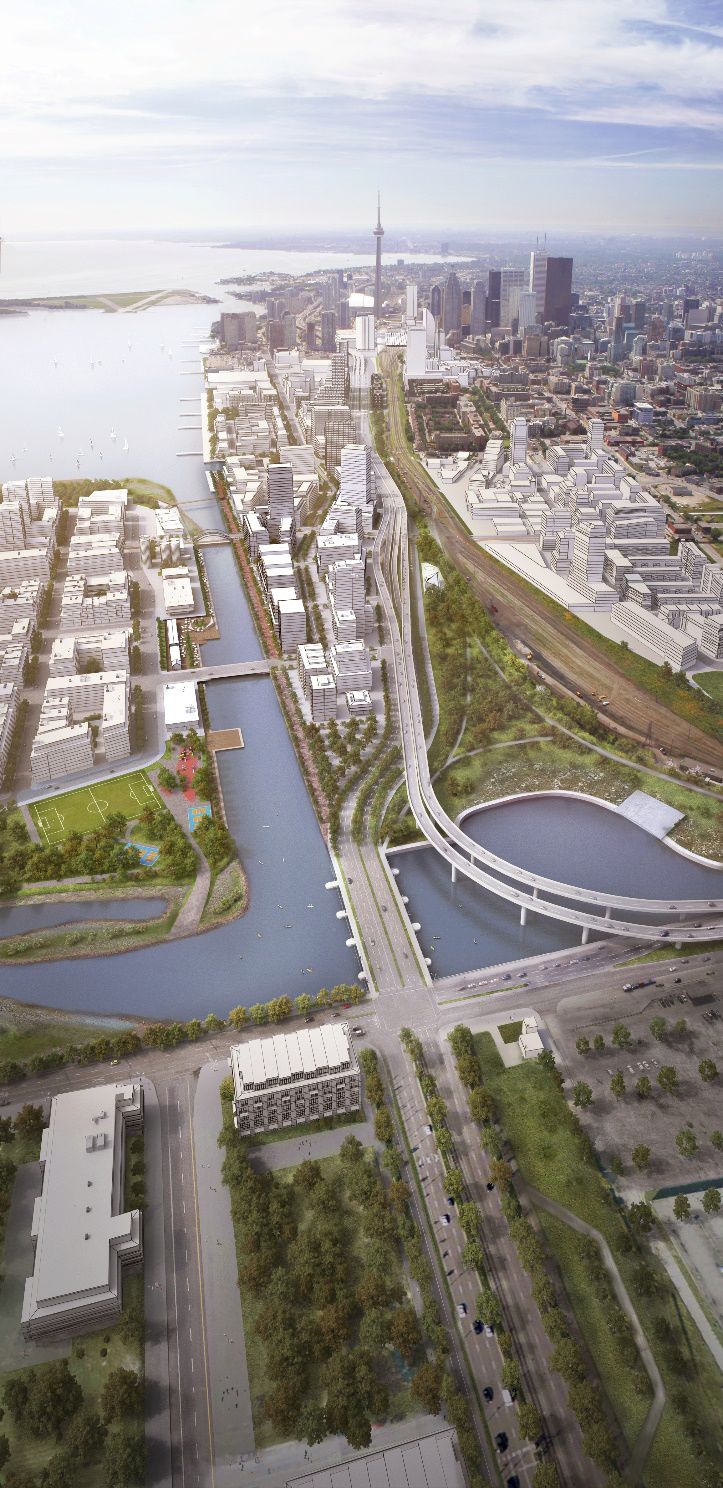
    Gardiner_media_presentation1     Gardiner_media_presentation2     Gardiner_media_presentation3
             Hybrid 1                             Hybrid 2                          Hybrid 3

    Of the three, “Hybrid 1” is the cheapest to construct, as it uses the existing DVP-Gardiner ramp configuration, but impacts the naturalization of the mouth of the Don River, necessary for flood mitigation. By largely using existing infrastructure, it also minimizes construction delays. “Hybrid” concepts 2 and 3 move the ramps north, but they would be tighter, reducing traffic speeds. These two alternatives also open up more land for development.

    “Hybrid 3” is preferred in all areas except for cost, as it has the greatest potential for development and has the least impact on the planned naturalization of the mouth of the Don. It’s estimated that “Hybrid 3” will cost $569 million to build, and $483 million in long-term maintenance costs, for a total of $1.052 billion. “Hybrid 1” would cost $424 to build, and $482 million in long-term maintenance costs.


    CriteriaCriteria for the three Hybrid options, from slide 39 of the City of Toronto media presentation

    As per David Rider’s report in the Star, we should expect that City and Waterfront Toronto staff expect to recommend “Hybrid 3” to the public works committee and city council. Local councillor Pam McConnell, who backed the “remove” option and still prefers it, will likely endorse the “Hybrid 3” alignment as well, as it delivers the most benefits to the community.

    I’m still disappointed by last year’s vote to keep the Gardiner Expressway up, but I’ll concur with Councillor McConnell. If Mayor Tory and Council are determined to keep the unnecessary eastern section of the Gardiner Expressway up, it should be backing the least-worst option for doing so.

  • A smarter SmartTrack

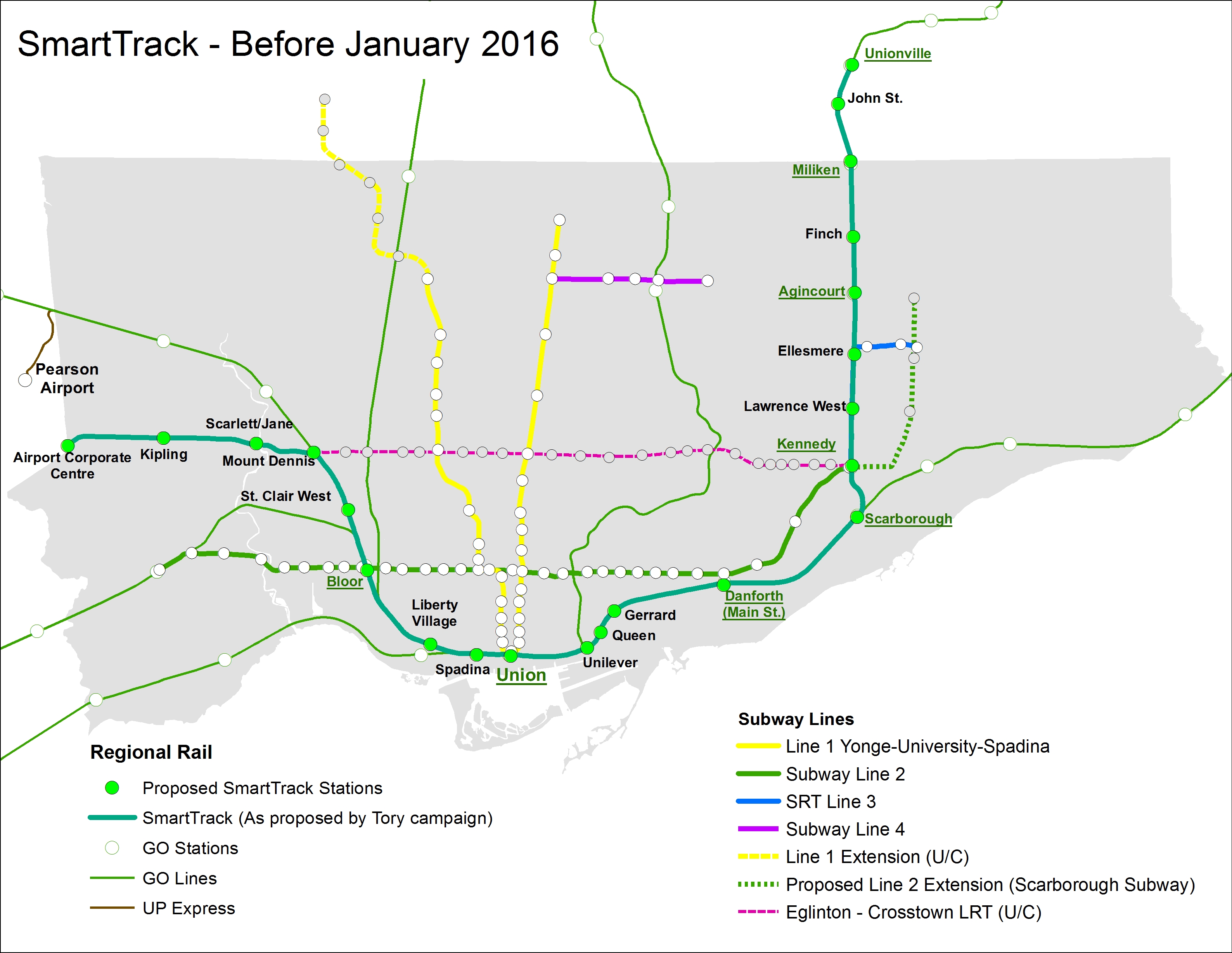
    ST - Before 2016
    John Tory’s original SmartTrack plan, shown with the existing TTC Subway and GO Rail networks. 

    In Friday’s Globe and Mail, we were treated to a scoop by Oliver Moore, that newspaper’s excellent transportation reporter, on behind-the-scenes revisions to Mayor John Tory’s SmartTrack rail transit platform, a topic that I discussed several times in this blog.

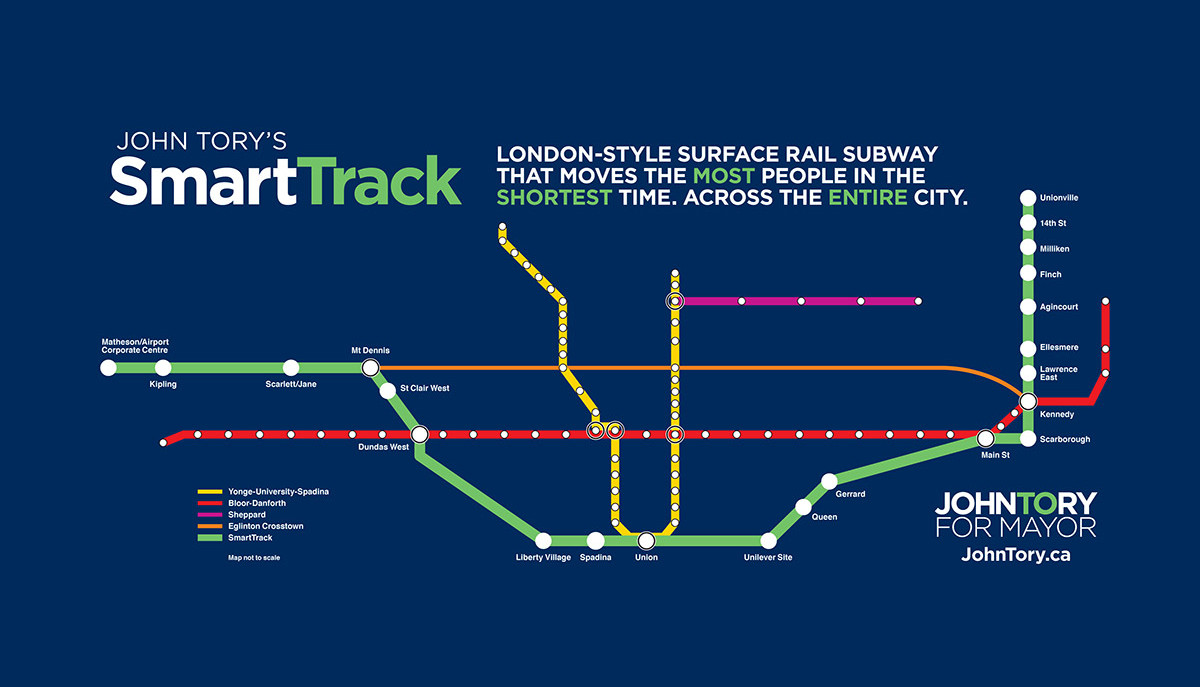
    Tory’s SmartTrack plan, dreamed up by a private-sector planning firm, was intended to connect office parks in Mississauga and Markham to Downtown Toronto, as well as serve the proposed First Gulf development at the Unilever site near the mouth of the Don River. Tory promised that it would provide relief to Toronto’s overburdened subway system, but that was never the main objective.

    I have been aware of rumours that Tory’s SmartTrack plan was going to be walked back due to mounting costs and technical issues of implementing the mayor’s campaign promise. The team that came up with the idea of a U-shaped rail network intended to connect several suburban employment centres with Downtown Toronto overlooked some important details, such as the availability of land along the former Richview Expressway corridor along Eglinton Avenue West. SRRA, the private-sector planning organization that came up with SmartTrack, assumed that the Richview lands were available and owned by the province, but the city owned the land, and sold much of it off for development in 2011 and 2012.

    The cost of building the western spur between Mount Dennis and the Airport Corporate Centre was, in all likelihood, found to be prohibitive, though we have yet to find out what the estimated costs for a tunnel along that section. The eastern section, north of Kennedy Station, would have closely paralleled both the Scarborough RT and the proposed extension of the Bloor-Danforth Subway to McCowan Road, a project that Tory also backed.

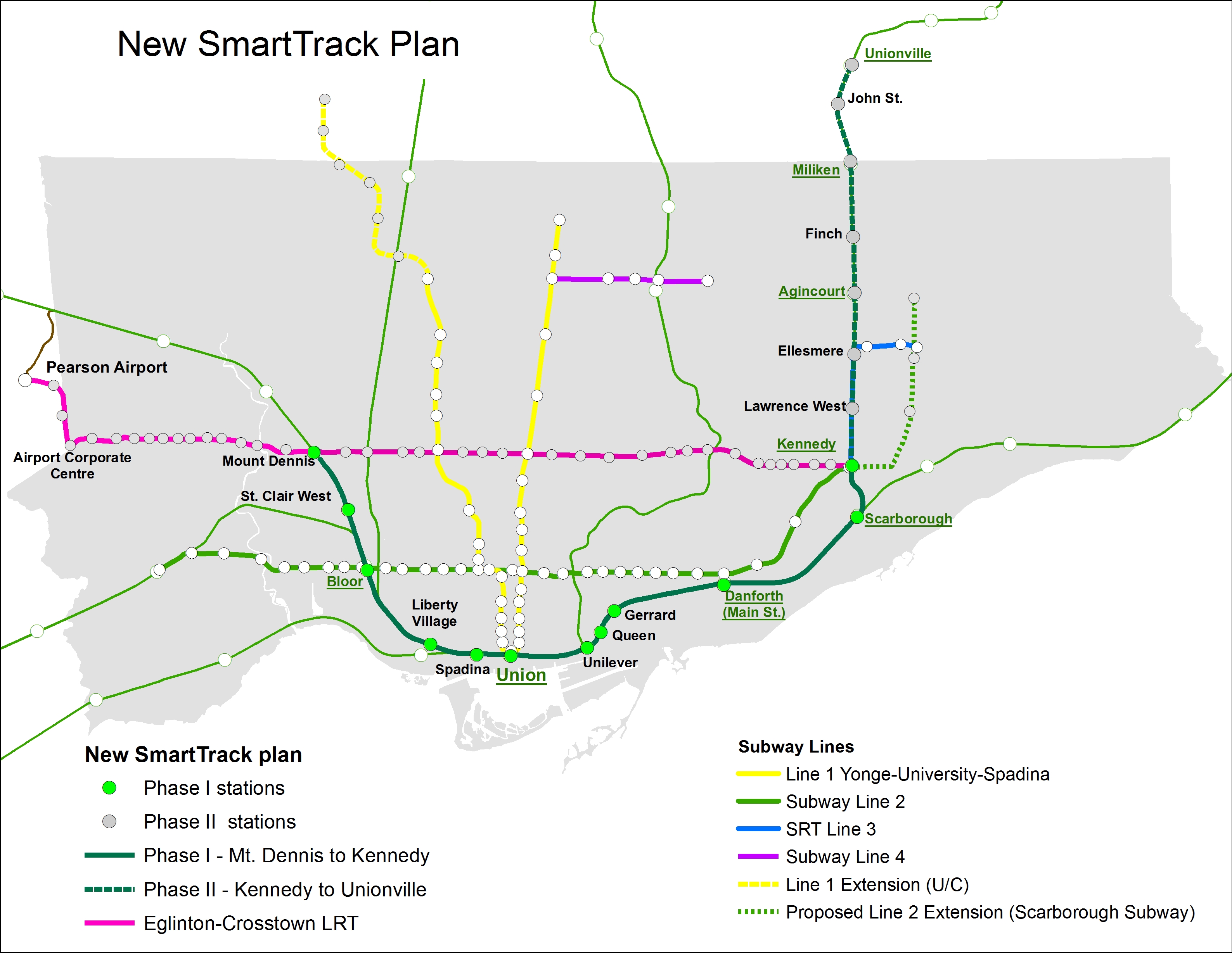
    The Globe and Mail’s Oliver Moore reports that SmartTrack will cover a much shorter section than the map on John Tory’s 2014 campaign brochures. Frequent rail service will complement existing GO Transit Regional Express Rail (RER) services on the Kitchener and Stouffville Corridors, terminating at Mount Dennis and Kennedy Stations. The Eglinton West section will be covered by the “shovel-ready” Phase II of the Eglinton-Crosstown light rail transit line (ECLRT), which is already under construction east of Mount Dennis. (The provincial government deferred funding for this section of the ECLRT in 2010 for budgetary reasons.) The north-eastern section of SmartTrack, between Kennedy Station and Unionville Station in Markham, will be deferred.

    This new plan, which is being finalized and will likely be officially announced later this year, will cost an additional $2-billion to $3.5-billion to the existing plans for RER, in order to facilitate more frequent, subway-like frequencies, as well as complete the western section of the ECLRT.

    If Moore’s reporting is accurate (and I have seen maps and other materials that collaborate his report), then Tory will have to eat some crow. Spin doctors will have to figure out how to polish this turd as Tory seeks a second mandate in 2018. It’s also inevitable that the new additional service on this corridor will continue to be branded as “SmartTrack.” But this is the best solution, and maybe this is a sign that Tory is learning on the job.

    At the end of the day, what Toronto gets is what Metrolinx’s “Big Move” plan envisioned: upgrades of most GO Transit corridors to RER, as well as Phase II of the Eglinton-Crosstown LRT line to Pearson Airport. (The Finch West and Sheppard East LRTs are also approved, but have yet to start construction.) The paired-down SmartTrack plan, if trains are frequent enough, and with attractive transfers with the subway and TTC surface routes, will draw some riders. It could help provide medium-term relief as the [Downtown] Relief Line Subway is studied and built.

    New SmartTrack PlanThe new SmartTrack plan, including Phase II of the Eglinton-Crosstown LRT

    But where I find myself annoyed is when I realize that we wasted over a year on Tory’s campaign slogan without any progress on the Relief Line (which will offer real, long-term relief to the Yonge Subway), the Waterfront West LRT, or other transit priorities such as accessibility at all existing subway stations. I remember during the 2014 election campaign, critics of Tory’s simplistic and flawed SmartTrack plan were dismissed without acknowledging their objections. It’s also worth noting that Tory also adopted rival Olivia Chow’s bus plan, after belittling it during the campaign.

    In order to provide fast and reliable transit to the Airport Corporate Centre and Pearson Airport itself, there are opportunities to refine the western section of the Eglinton-Crosstown LRT. The environmental assessment called for 15 stops between Mount Dennis and Pearson Airport, while SmartTrack would have had as few as three stops along the same section. If the ECLRT can be sped up at all, it would be worth considering. I would also be interested in whether the SmartTrack corridor could be integrated with the UP Express rail link, whose ridership started off quite low.

    And maybe, just maybe, the high costs of constructing the Scarborough Subway extension will also prompt a rethink, going back to the original LRT replacement and extension plan. As the Spadina Subway extension to York University and Vaughan is now two years late (and yet another $400 million over-budget), maybe there’s an opportunity to get it right there as well. It’s also imperative that proponents of the Relief Line Subway strike now.

    I could be giddy with the revelation that Mayor Tory’s signature campaign platform is coming undone, having foreseen the problems with his plan. But I’m not. However, I do take pleasure in knowing that we have a smarter plan in the works.


  • Not so FAST: SmartTrack gets a lobby group, raises many questions (Updated)

    smarttrack_fb
    I find myself feeling frustrated, worn down, and at times angry about this federal election that’s thankfully coming to an end on Monday. As a progressive voter, I’ve been disappointed by Thomas Mulcair and the New Democrats, for reasons that Desmond Cole explains so very well in today’s Toronto Star. (Locally, I ‘ve been supporting the NDP’s Linda McQuaig in Toronto Centre, whose progressive credentials are impeccable.) The bright side is that Stephen Harper’s Conservatives are going down to an almost-certain defeat, hopefully taking their narrow and divisive targeted politics with them. My wish is for a minority government in which the Liberals and New Democrats share power; this may check the Liberals’ record of running left and governing right.

    Happily, Torontonians also have the Blue Jays and municipal politics to watch. Last night, we all got to watch the strangest seventh inning in baseball history; today, we get to snicker at the efforts of an Astroturfing crew of lobbyists pushing SmartTrack – a mayoral campaign slogan masquerading as a transit plan. Municipal politics may be at times just as depressing as provincial or federal politics, but at least it’s a lot more fun.

    The Toronto Star’s fantastic transportation reporter, Tess Kalinowski, reported on a new booster group, known as FAST (Friends & Allies of SmartTrack). Its spokesperson would be Alvin Curling, a former provincial Liberal cabinet minister and Speaker of the Provincial Parliament. Other members of its Public Advisory Board include Kyle Rae, former city councillor who is now a City Hall lobbyist, and three prominent lawyers  – Andrea Geddes Poole, Michael Brooks, and David S. Young. Also involved is one Tom Allison. 

    According to a press release, FAST claims it’s “here to advocate for SmartTrack and to educate the public about how it could make a huge difference in cutting congestion and moving people around the region.” It would raise funds “devoted to creating a variety of awareness campaigns such as town halls and informational videos.” 

    FAST’s website – launched today – is comically full of spelling and syntax errors, misinformation, and complete fabrications of basic facts. Here are just a few. (more…)

  • Gardiner East update: a close vote, but one Tory is likely to win (updated)

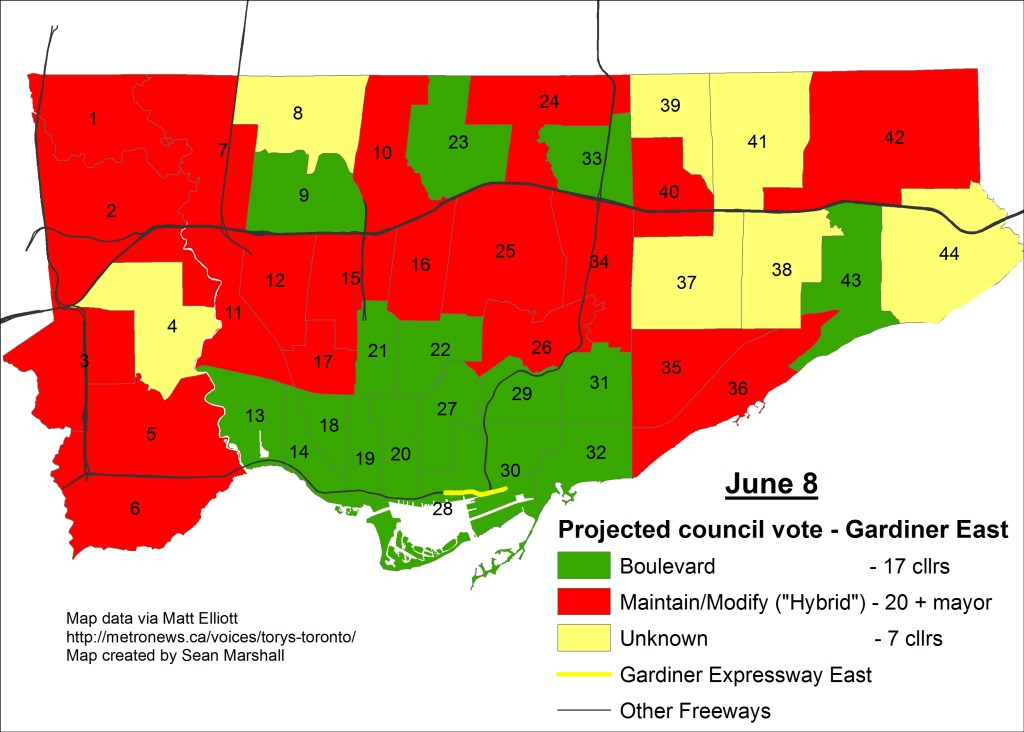
    East Gardiner Vote - June 8
    Projected Gardiner East council vote as of Monday, June 8.

    (Updated 5:00 PM, June 8)

    With Councillors Jon Burnside and Raymond Cho coming out in support of the “Hybrid” option for the Gardiner East, and Councillor John Filion supporting the Removal/Boulevard option, here’s the latest map. Only seven councillors are considered “unknown” in their intentions for this week’s vote; John Tory and pro-expressway advocates only need two more councillors on their side to win a razor thin 23-22 vote. The new map, based on Matt Elliott’s tally (PDF here), is above. Councillor Jim Karygiannis withdrew his support for the “Hybrid” and is asking constituents for their feedback on Twitter.

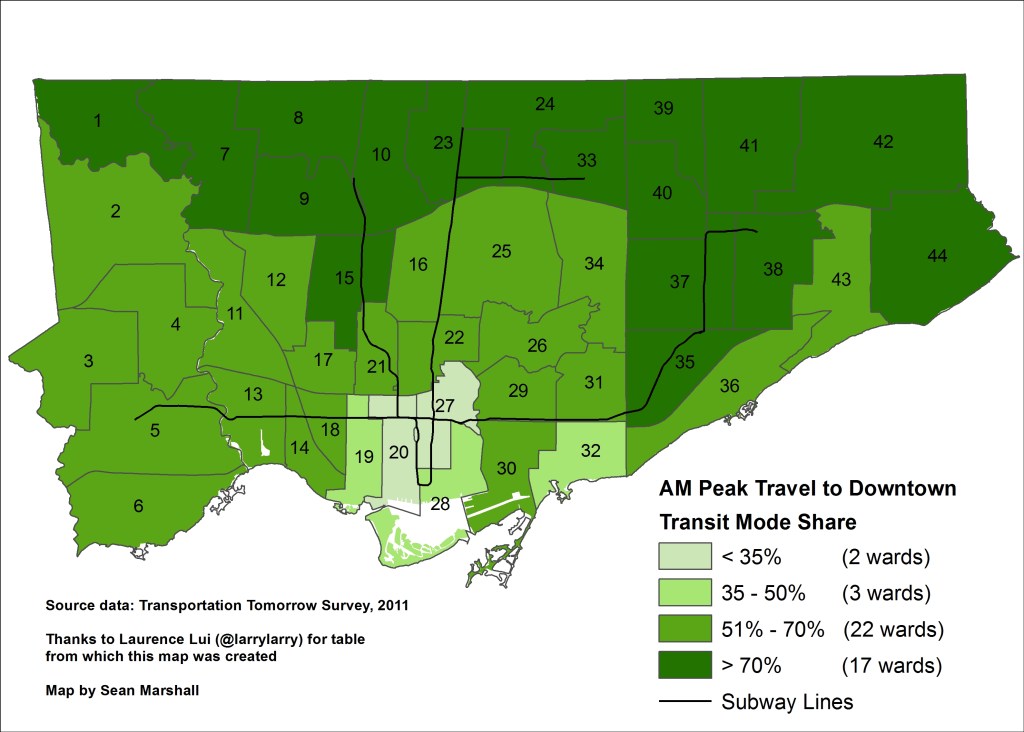
    As Council is divided mostly on suburban-urban lines, It’s worth noting that most Toronto commuters headed downtown take transit; even in the outer areas where transit access is lacking, and travel times long. In every ward completely north of Highway 401, more than 70 percent of weekday AM peak trips to Downtown Toronto are made by public transit – either TTC buses and subways or by GO train. In 39 of 44 wards, a majority of commuters take transit.

    In only seven wards do auto commuters have more than 40 percent of the mode share. Only one ward, Ward 32, which includes the affluent Beach(es) neighbourhood, do auto commuters outnumber transit riders in the AM Peak. Good road access, high auto ownership rates and lousy TTC surface routes (the notoriously slow, short-turning 501 Queen Car) are the likely explanations for this anomaly. Downtown, in Wards 20, 27, and 28, at least half the commuters to downtown jobs, schools or institutions take “other” means of transportation; mostly walking or cycling.

    Ironically, those councillors most in favour of rebuilding the Gardiner Expressway represent constituents who aren’t using the Gardiner Expressway – or any other road – to get downtown.

    I created these two maps with data from the table created by Laurence Lui (Google Drive PDF here). He obtained and disseminated survey data from the 2011 Transportation Tomorrow Survey,  a comprehensive travel survey conducted every five years in the Greater Toronto and Hamilton Area.

    Downtown AM Peak Mode Share - Transit

    Downtown AM Peak Mode Share - Auto

    (more…)

  • From “Boldness” to Madness?

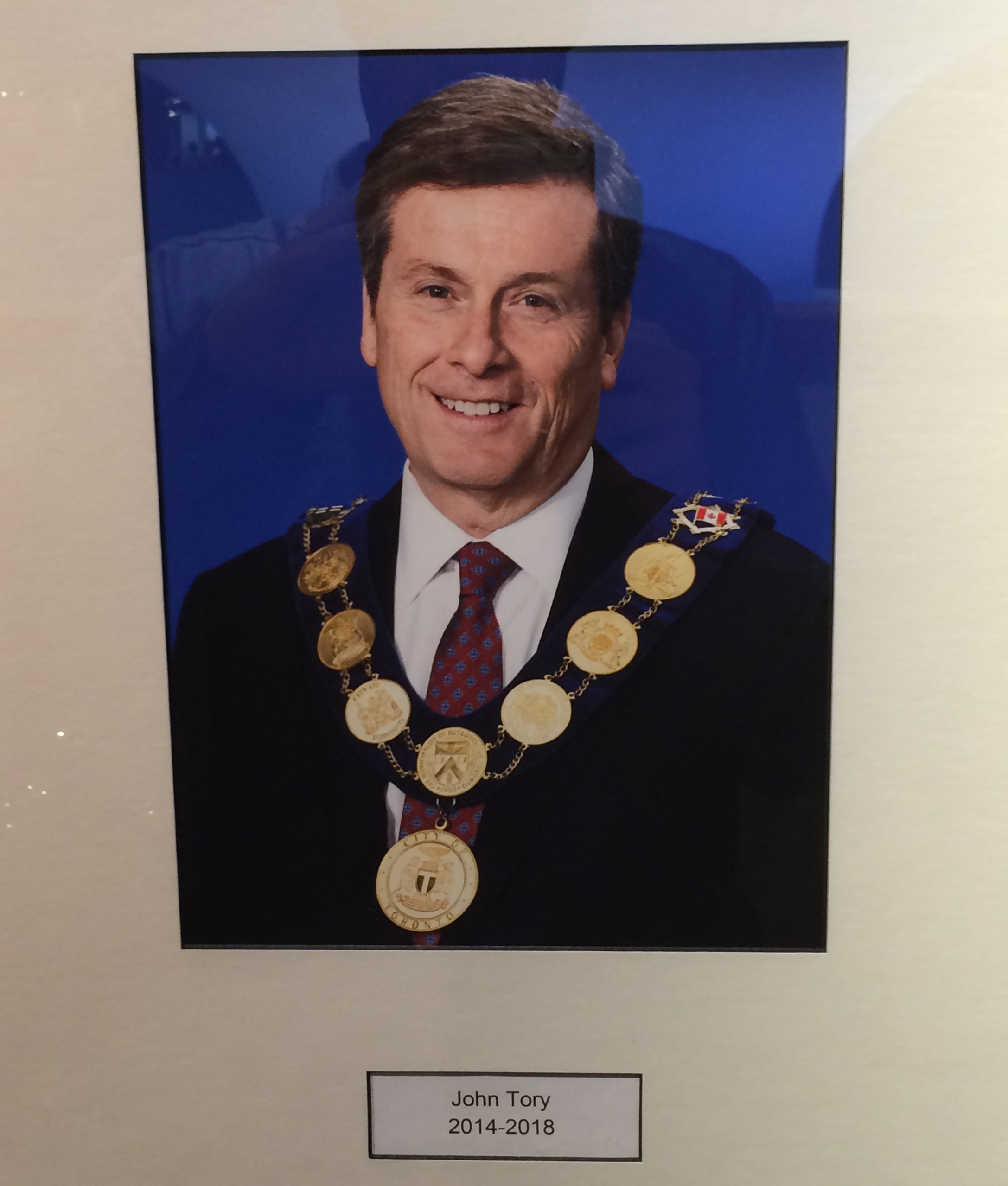
    Tory

    As I find myself increasingly frustrated with John Tory’s first six months in office, I can’t help but wonder what his motivations are behind his stances on his signature SmartTrack transit plan, the Gardiner East, the Scarborough Subway, and police carding. Despite it’s many flaws, it’s still full steam ahead for SmartTrack; the Scarborough Subway is quickly becoming a fiscal quagmire, and his positions on other issues troubling.

    A subway alignment along Bellamy Road? That’s madness, not the “bold” transit plans John Tory campaigned on. Is John Tory stubborn? Or getting bad advice? Is he open to contradictory options? Or closed-minded? Is he afraid of admitting mistakes and moving forward?

    I have been thinking about Tory’s previous runs for office and a bit troubled that his campaign advisers, and even his son*, have become lobbyists representing for some of the most controversial issues at City Hall, such as taxi licencing. One of Tory’s senior strategists, John Duffy, is planning a PR blitz to support SmartTrack.

    To put it bluntly, I feel that there are serious clncerns about John Tory’s ability to govern. In my opinion, leadership in municipal politics is about making informed decisions, listening to senior staffers, consulting with stakeholders, and coming to sound decisions. With Mayor John Tory, it all appears to be bass-ackwards, with a small group of political advisers and lobbyists calling the shots. I also find myself thinking about Tory’s past leadership.

    In 2003, John Tory came in a reasonably close second place to David Miller, running on a centre-right platform of responsible governance after Mel Lastman’s turbulent two terms after the creation of the Megacity in 1997. Apart from a website Tory’s team created that attacked Miller for considering tolling the Gardiner Expressway and Don Valley Parkway, Tory’s 2003 campaign was respectable, fair and reasonable, building his name recognition and earning goodwill.

    Tory seemed like the perfect candidate for leader of the Ontario Progressive Conservatives. The party was looking to shift towards the centre after the Mike Harris/Ernie Eves era., and he had strong name recognition in the vote-rich Greater Toronto Area, where the PCs lost over 20 seats to the newly-elected Liberals in the provincial election that same year.

    Tory’s PCs ran in the 2007 election on a controversial platform of subsidizing religious private schools. He argued that taxpayers should fund Islamic, Jewish and other faith-based schools, just as the province funded public and Catholic school boards. It became his signature campaign plank, much like how SmartTrack became the most memorable campaign promise of Tory’s 2014 mayoral campaign.

    Tory’s plan for funding religious schools the wrong answer to a very legitimate question: why, in the twenty-first century, is a progressive, urban, and multicultural province still funding a separate, Catholic school system? In the 1860s, when Catholics were a disadvantaged religious minority in Ontario, and politicians were trying to woo French-Catholic majority Quebec to joining Confederation, it made sense, one of many compromises that made Canada work. But not 140 years later. After all, Quebec got out of its Constitutional obligation to provide Protestant schooling in the 1990s without too much fuss.

    The religious schools issue was a disaster. Tory mused that creationism could be taught alongside evolution in publicly-funded religious schools; the Liberals jumped on such gaffes. Tory could have made the election about the record of the somewhat unpopular Liberal government led by Dalton McGuinty, but the Liberals saw an advantage and ran with it, winning the election with a second majority government. To make matters worse, Tory, who decided to run in Don Valley West, lost to the Liberal Minister of Education, Kathleen Wynne.

    After losing a by-election in a rural, supposedly-safe PC seat in order to sit in the Ontario Legislature, Tory quit politics for six years, chairing Civic Action, a non-partisan, business-led urban think tank, an organization whose purpose is a bit mysterious. Tory also hosted an afternoon talk radio show on CFRB.

    Some of his views as Chair of Civic Action and an easy-going drive-time talk radio host don’t really match what he’s saying today as Mayor of Toronto.

    Back in 2010-2013, Tory spoke strongly about the need for new funding to pay for new transportation infrastructure, stating that politicians had to be ready to “make the admittedly tough choices about how to raise the money necessary to build a better transportation system.”  At the time Civic Action was promoting a public relations campaign, called “What Would You Do For 32?”  – the 32 being the number of minutes “saved” if Metrolinx’s “The Big Move” transportation plan – a mix of light rail and bus rapid transit projects, new and extended subways, GO Regional Express Rail, and some highway expansion projects in fringe urban areas.

    Civic Action declared the campaign to be about pressing for “bold leadership” to “dramatically improve transportation in the Greater Toronto and Hamilton Area (GTHA)” [There’s that b-word again, which would be used again and again to describe SmartTrack in Tory’s campaign speeches.] As I read it, Civic Action’s role would be mostly limited to public relations work to educate and promote new revenue tools (taxes, fees and tolls) to businesses and the public in order to fund these projects. In  January 2013, Tory was quite vocal about the need for investment in the high-level plan that Metrolinx put together, itself largely guided by the list of wants and needs brought forward by local municipalities.

    Interestingly, the Big Move identified the Scarborough and Sheppard LRTs to be built as part of the 15-year plan, while a “Relief Line” – a 13-kilometre subway corridor, was part of its 25-year plan. This was the plan that Civic Action, and Tory himself, were promoting.

    There’s a reason why SmartTrack never appeared on Metrolinx’ maps: it was interested in transforming the GO Transit commuter rail network into a regional express rail system, starting with the electrification of the Georgetown/UP Express and Lakeshore corridors, as well as the municipal rapid transit plans proposed or approved at the time. Eglinton Avenue west of Mount Dennis was to be served by an extension of the Eglinton-Crosstown LRT; it would meet the Mississauga Transitway at Renforth Drive. The combination of improvements to the Yonge subway line, the upgrades to GO’s rail network, and the eventual construction of the Downtown Relief Line subway didn’t leave any need for SmartTrack, which would have duplicated these other lines.

    But in May 2015, Tory is so committed to SmartTrack, he is now looking at even more expensive options for the Scarborough expansion of the Bloor-Danforth subway, as the two projects run in close parallel to each other through central Scarborough. This could increase the already expensive $3.56 billion subway extension’s cost by an extra $1 billion.


    Tory throwing more money at the Scarborough Subway extension

    On the Gardiner East, we hear John Tory call the “hybrid” solution – essentially a replacement of the existing expressway on a slightly different alignment “the right, balanced decision that made common sense,” in an interview with TVO’s Steve Paikin. But senior city staff like Chief City Planner Jenniffer Keesmaat and Medical Officer of Health David McKeown, and other experts such as former Chief City Planner Paul Bedford all call for the removal option, in which Lake Shore Boulevard is upgraded to handle the additional traffic.

    (Tory repeated that term, “common sense, ” four more times in that interview, which is worth watching. I can’t help but be reminded by another conservative who liked using “common sense” to implement many destructive policies in Ontario.)

    And today, May 27, David Rider at the Toronto Star revealed that Tory used “an outdated, inflated commute statistic” to justify the “hybrid” option in that same interview. (Rider later clarified that Tory did not know about the flaws in that statistic, and has stopped using it.)

    This statistic comes from the University of Toronto traffic study, which was commissioned by the Gardiner Coalition, which includes the Canadian Automobile Association, courier companies, and other industries. Eric Miller was one of the co-authors of that study.

    Perhaps not coincidentally, Miller was also the lead transportation adviser to Tory’s campaign and a key supporter of Tory’s SmartTrack platform, giving it an “A-plus” grading, while saying Chow’s plan “…lacks the vision and boldness that the city’s current situation calls for.” (There’s that b-word again.)

    But in a Toronto Life Informer article last October, Eric Miller, to his credit, also had this to say:

    “SmartTrack may lead us to revisit whether the Scarborough subway extension really does make sense or whether the LRT might be better to do. That frees up a billion dollars or more that might make up the shortfall.”

    Even Tory’s hand-picked transportation expert wondered if the Scarborough subway extension is such as good idea, but Tory, for some reason, remains entirely committed to it.

    Back in 2007, I don’t think that Tory himself even believed in the idea of funding private religious schools all that much; I have the feeling (and I’m not the only one) that he didn’t really believe in the idea himself, but allowed his advisers and confidants to push for this ill-advised platform. At Civic Action, Tory sounded rather progressive, as he surrounded himself with civic boosters, urban planners, and activists.

    On SmartTrack, like so many important and controversial issues, it sounds like Tory listened to a select group of campaign and policy advisers, and quickly closed his mind to any other ideas or criticism. On police carding, which is grossly racist and ineffective, Tory has also dismissed criticism and has done nothing to address this matter. Tory helped to select Mark Saunders as Toronto Police Chief, who unlike his rival, fellow Deputy Chief Peter Sloly, supported the practice, even going as far calling those persons innocent, yet carded anyway “collateral damage.” On Uber, Tory has been supportive of a full council debate, putting off much-needed taxi reforms until the courts can rule on the city’s previously-filed injunction against the controversial company’s Toronto operations.

    Tory ran for mayor with zero experience in municipal politics; he has been used to life on Bay Street, a chummy business environment. Perhaps that’s where Tory’s leadership style comes from, and maybe he’ll learn on the job. But with a small group of political advisers and lobbyists influencing the mayor, he is deprived of wider opinions and facts that I think are necessary for better decision-making.

    As long as he has the support of enough councillors, he’ll be successful implementing his so-far fiscally irresponsible agenda. But in his first year Rob Ford had the support of council on most important votes; what happens when the honeymoon is over?

    *(John A.D. Tory, the mayor’s son, is both president of a firm, Private Air Inc, based out of the Billy Bishop Toronto City (Island) Airport, and a registered lobbyist. His father, John H. Tory, would not be able to participate in any way in the Island Airport debate, nor vote on any related matter. Unlike his campaign advisers and campaign staff turned lobbyists, the younger Tory’s involvement was known months before the municipal election.)

  • The Sheppard Scarborough Subway Shitshow

    5279614296_c4bdaac003_b
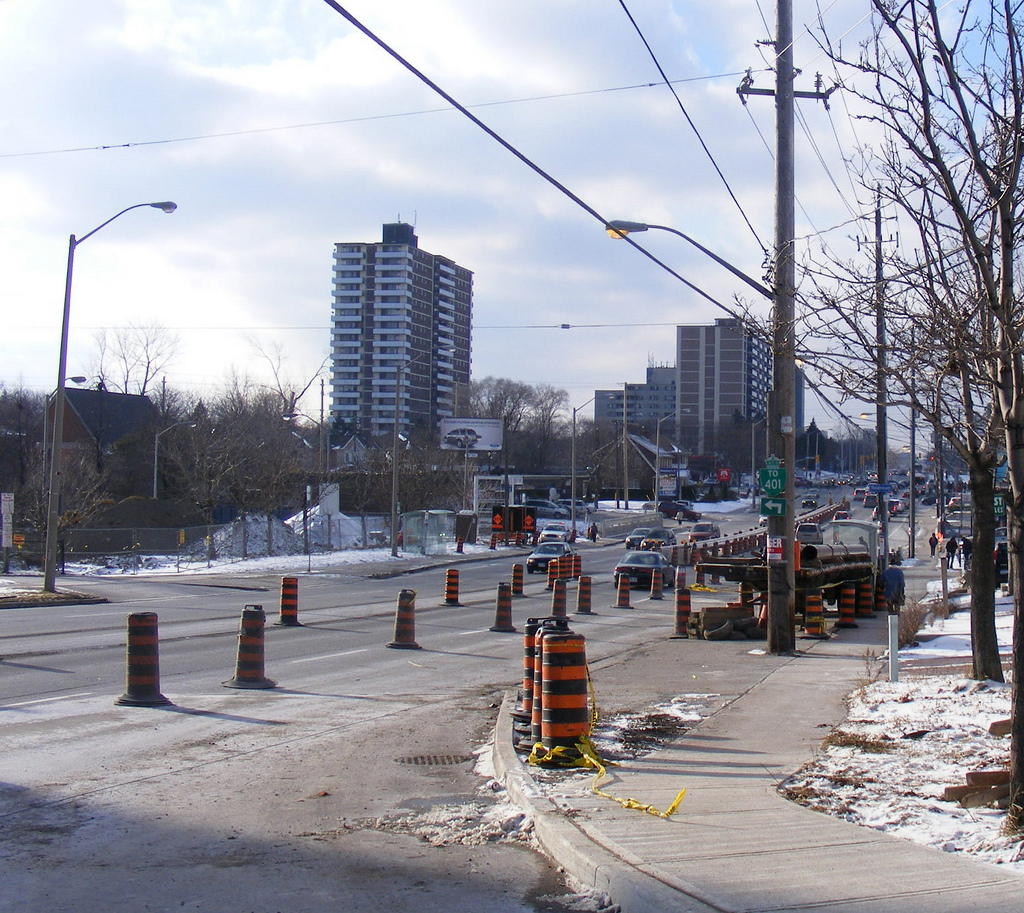
    Building the Sheppard East LRT in December, 2010

    Nearly five years ago, in October 2010, work began on the Sheppard East light rail transit project, the first of three Transit City lines funded by the provincial government. This initial work was to build a grade separation between Sheppard Avenue East and Canadian National Railway’s Uxbridge Subdivision (better known as the GO Transit Stouffville Line), adjacent to the Agincourt GO Station. Metrolinx was still undertaking detailed design work for the connection to the Sheppard Subway at Don Mills Station, as well as the carhouse at Sheppard and Conlins Road, which would have also served the planned Scarborough RT replacement and extension and potentially the Scarborough-Malvern LRT, one of several Transit City lines that weren’t funded.

    Originally, the 13-kilometre Sheppard East line was to be the first to open, originally by the end of 2013. Finch West between Yonge Street and Humber College was to have opened by the end of 2015. But thanks to austerity measures enacted by the province in Spring 2010, the timelines were pushed back: the Sheppard Line would have opened in 2014; a shortened Finch line (only between the Spadina Subway extension at Keele Street and Humber College) in 2019.

    The completed Sheppard Avenue underpass at Agincourt GO Station, 2013. Note the median for light rail. Image via Google Street View.

    Construction was completed on the Agincourt underpass in May 2013, yet all other enabling work for Sheppard was halted after Mayor Rob Ford’s election. The incoming mayor declared Transit City dead; the province, up for re-election in 2011, was eager to oblige. Ford mused about extending the Sheppard Subway line west to Downsview and east to Scarborough Town Centre, and extend the Bloor-Danforth subway line instead of go with the fully funded, fully approved LRT replacement and extension. Ford was aided and abetted by councillors on both the right and the left, with Councillor Glenn De Baeremaeker the most prominent of Ford’s subway enablers.

    It’s almost a miracle that the Eglinton-Crosstown LRT project survived Ford’s bull-in-a-china-shop act. After some uncertainty, major work on that line continued, with the first boring machines launched in June 2013. That didn’t stop Ford from promising to bury the surface section of the route, at a cost of $1 billion, a plan that City Council defeated in February 2012.

    In March 2012, Council again voted to construct the Sheppard East LRT, in a 24-19 vote against Mayor Ford. Yet work never re-started. In October, 2013, Council voted to proceed with the extension of the Bloor-Danforth subway, even as Ford was losing control of the agenda overall. The provincial Liberal government again went along, hoping to retain power, perhaps even win back a majority government, in the next election. Even Adam Giambrone, an architect of the Transit City LRT plan, backed the expensive subway option as a NDP candidate in a Scarborough provincial by-election.

    That decision pretty much sealed the fate for the Sheppard East LRT. Why go back to building a light rail line on Sheppard if council couldn’t commit to building the Scarborough RT replacement? Why bother building an expensive maintenance facility to serve only one line? Why put any political capital in a project that had only tepid political support? After all, Scarborough was getting the subway extension most of its politicians demanded (even if its residents preferred an LRT), and there would be SmartTrack. Sheppard East was all but dead.

    A few weeks ago, the provincial government re-confirmed that it was funding the construction of the $1.2-billion Finch West LRT between Finch on the Spadina Subway extension, and Humber College, but that work would only start in 2016, and open five years later, in 2021. It also announced 2021 as the start date for construction on the Sheppard East LRT. That puts that project into never-never land. And not a word of protest from City Hall.

    Of course, this latest delay has emboldened subway boosters, hoping the city will push for the subway extension instead. This is despite the fact that the existing five-stop Stubway doesn’t have the ridership to fill four-car subway trains; transit experts are pretty much unanimous in their opinion that the ridership will never materialize to justify a subway extension; even the City of Toronto’s official plans only include subways for the Downtown Relief Line and on Yonge north from Finch Station into York Region. (The one amusing part of Tess Kalinowski’s article is that the pro-subway coalition member she spoke with didn’t want his name published.)

    IMG_2875A private car on the Sheppard Subway, mid-afternoon, May 19, 2015
    Why do we let politicians plan and then then destroy Toronto’s transit plans? Toronto is committed to spending billions on a subway extension we don’t need, while the subway we do need, the Downtown Relief Line, loses momentum as attention is focused elsewhere; on Sheppard and on John Tory’s dubious SmartTrack proposal, a plan that appeared almost out of nowhere in the middle of an election campaign, a half-baked plan that doesn’t provide the subway connectivity nor the redundancy required to function as an adequate relief line. Tory backed the Bloor-Danforth subway extension, even though the cheaper LRT plan was still open.

    Furthermore, Tory committed himself to the Gardiner East “hybrid” solution, which pretty much is a reconstruction of the existing elevated expressway east of Jarvis Street despite it being the more expensive short and long term option for a segment of road that is currently underutilized. It’s a plan that most urban experts and advocates dismiss, even warning that Toronto would be “a laughingstock” if it were implemented. Matt Elliott writes about this absurdity in more detail.

    To me, it appears that Tory surrounded himself with a small group of advisers like campaign chair and lobbyist John Duffy (who will be leading a public relations campaign for SmartTrack) and transportation adviser Eric Miller (who co-authored the pre-SmartTrack reports and whose University of Toronto Transportation Research Institute developed the case for the “hybrid” option backed by “The Gardiner Coalition”). Maybe council will overrule Tory’s preference for the “hybrid.” Maybe not.

    And because of that, John Tory is proving to be on the wrong side again and again on important issues; from carding, a racist police practice he seems to have no problem continuing, despite increasing public opposition; to limiting necessary tax increases; backing the Sheppard Subway; maintaining the East Gardiner Expressway;  his stubborn support for SmartTrack. I’m reminded of his myopic and stubborn support for religious school funding as Ontario Progressive Conservative leader back in 2007; a platform that might have cost him the election. I hope to be proven wrong, but I can’t say I have much faith in John Tory’s leadership.

    Of course, politicians of all stripes can be blamed for the Scarborough Subway Shitshow. But I feel we blew the last, best chance to get things right.

  • The East Gardiner: a chance to get it right

    IMG_9169-002A snapshot I took back in March 2001 of the Gardiner Expressway’s demolition at Carlaw Avenue.

    In June, 1999, Toronto City Council, after much debate, voted 44-8 to demolish the eastern section of the Gardiner Expressway. The section of elevated freeway from the Don River to Leslie Street, which opened in 1966, was underused and in need of serious repair.

    The East Gardiner extension was built to connect with the Scarborough Expressway, part of a larger network of freeways proposed by Metropolitan Toronto that were never built. The Scarborough Expressway would have connected to Highway 401 near Port Union Road, cancelled in the aftermath of the June 3, 1971 decision of the Ontario Government overturning an Ontario Municipal Board decision permitting construction of the Spadina Expressway.

    Council debated the merits of maintaining the 1.3 kilometre section of the Gardiner Expressway; several members resisted removal. Tom Jakobek, representing the Beaches neighbourhood and later disgraced in the MFP computer leasing scandal, was its most vocal defender.

    “Cars are an important necessity in this society. Why would anyone want to eliminate road capacity anywhere, when it’s located in the middle of an industrial area and people use it?”

    But the pro-demolition side won out. Of the 50 public deputations before that June 1999 vote, those in favour of demolition outnumbered opponents by a 2:1 ratio. Automobile groups and some Scarborough and Beaches residents were the most opposed as two new traffic lights would be added to their westward commutes.

    Nine of the councillors who voted for demolition still serve today: Maria Augimeri, Raymond Cho, John Filion, Giorgio Mammoliti, Pam McConnell, Joe Mihevc, Denzil Minnan-Wong, Frances Nunziata, and David Shiner. Also voting with the majority were councillors Jack Layton, David Miller, and Olivia Chow. Mayor Mel Lastman did not vote on the final motion.

    Among the eight opposed to the demolition were Jakobek and Sandra Bussin (both councillors represented the Beaches neighbourhood), along with conservatives Doug Holyday and Norm Kelly, both who would become Rob Ford’s deputy mayors.

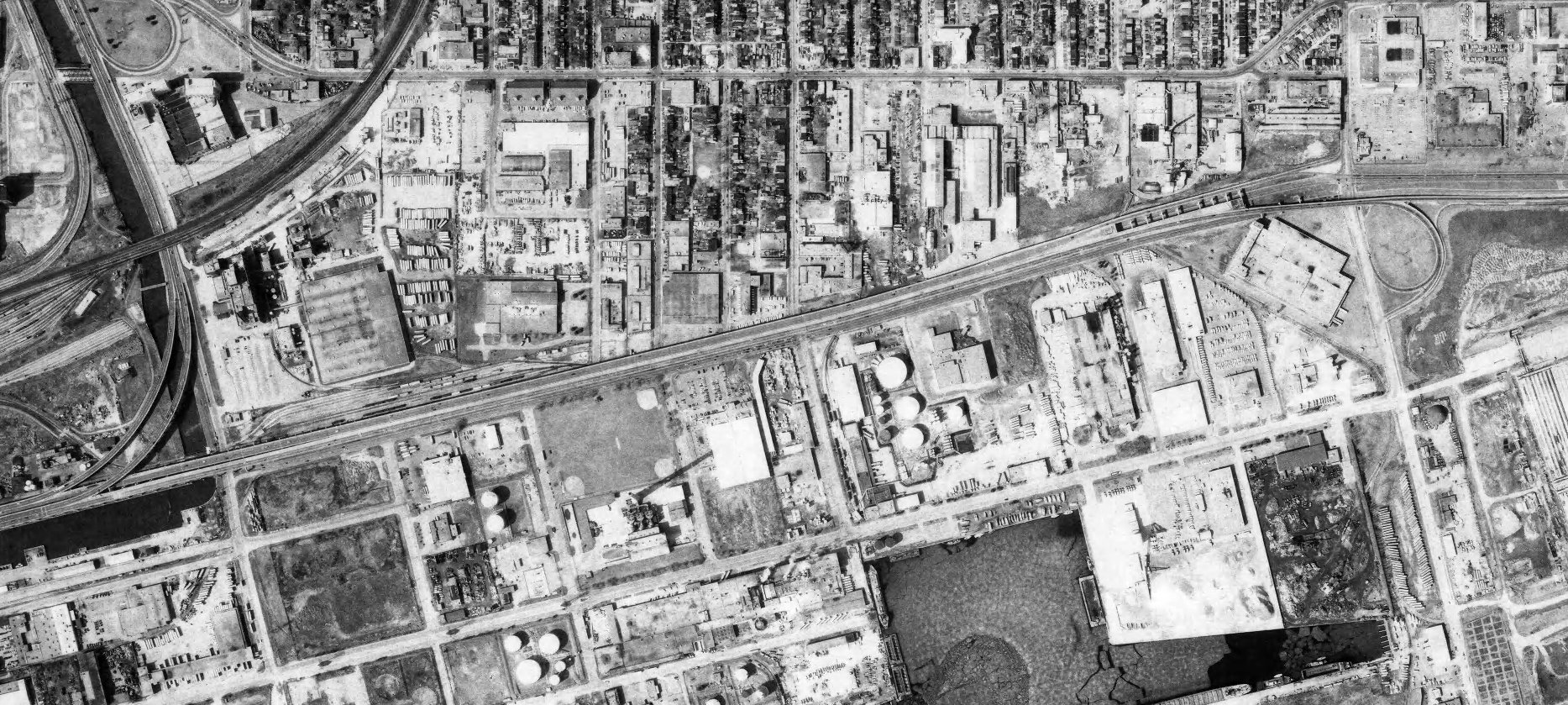
    Fullscreen capture 13052015 92518 PMAerial photograph of the Gardiner Expressway eastern extension in 1992. the Leslie Street ramps are on the far right, the Unilever lands to the right of the Don Valley Park way flyover ramps. Image from Toronto Archives

    Demolition began on April 28, 2000, a year later, it was gone, part from a few pillars left over near Leslie Street. A new bike path, and an improved Lake Shore Boulevard were built in the Gardiner’s place, and the traffic jams never materialized. In fact, parallel routes — Dundas Street and Eastern Avenue — were reduced to two lanes from four to accomodate new bike lanes. East-end residents coped.

    8760426957_1aa6259239_b

    Now, once again, we’re debating the future of the eastern Gardiner Expressway, this time the section between Jarvis Street and the Don Valley Parkway (DVP). Like the demolished section east of the DVP, city council is facing a crucial decision on whether to maintain the crumbling structure, or demolish it in favour of a widened Lake Shore Boulevard. Like the demolished section east of the DVP, the Jarvis-DVP section is underused and in need of major repairs.

    The consultants in charge of the environmental assessment (EA) fr the Gardiner Expressway & Lake Shore Boulevard Reconfiguration Environmental Assessment & Urban Design Study have a website where you can find out more about the options and the process.

    At first, four alternative solutions were considered:

    • Maintain the elevated expressway (spend money only to rehabilitate the structure, this is the status quo option)
    • Improve the urban fabric while maintaining the existing expressway (basically the status quo with some ground-level improvements for pedestrians and cyclists
    • Replace with a new above-or-below grade expressway; and
    • Remove the elevated expressway and build a new [wider Lake Shore Boulevard.]

    It’s worth noting that the EA consultants recommended the remove option, replacing the six-lane Gardiner east of Jarvis Street with an eight-lane Lake Shore Boulevard.

    But after feedback from the Public Works and Infrastructure Committee (PWIC) and First Gulf, the owners of the massive former Unilever lands at the foot of the Don River, there were two options carried forward for further public review: the “hybrid” option and the remove option. Both options would allow First Gulf to redevelop the 30 acre parcel, part of a larger 60 acre plan for up to 12 million square feet of commercial (office and retail) space. The public presentation [PDF] can be found here. 

    The remove option (as illustrated on Pages 23-29 of the presentation) results in the demolition of 2.2-kilometres of the Gardiner, replacing it with a eight-lane Lake Shore Boulevard. There would be signalized at-grade intersections at Jarvis, Sherbourne, Parliament, and Cherry Streets (with more intersections possible as the East Harbourfront lands develop), and flyover ramps connecting the widened Lake Shore Blvd with the Don Valley Parkway. The removal option would cost $326 million in up-front capital costs (demolition and the construction of new ramps) and $135 million in ongoing maintenance over a 100-year lifecycle. The study’s traffic models claim that removal would only increase travel times by 3-5 minutes.

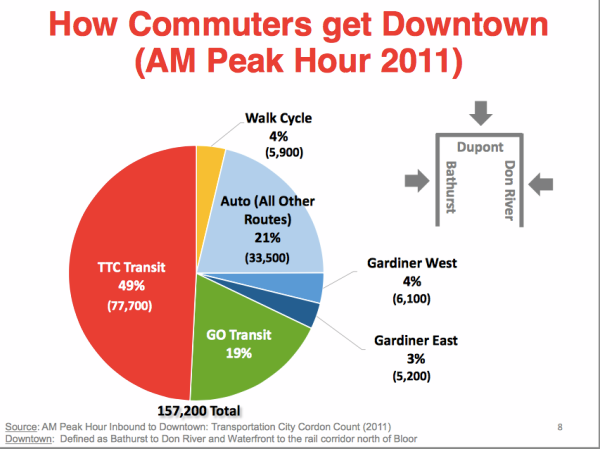
    It’s also worth noting that most commuters headed to the downtown core take transit: nearly half take the TTC, another 19 percent take GO Transit. Only 28 percent of downtown-bound commuters drive, and of those, 3% use the section of the Gardiner Expressway in question.

    screen-shot-2015-05-12-at-9-29-53-am
    Page 8 of the Gardiner East presentation

    The “hybrid” option, (as illustrated on Pages 36-42 of the presentation) maintains the Gardiner as-is west of Cherry Street, with new off-ramps to Lake Shore Boulevard east of Cherry and fly-over ramps to the DVP, elevated. It would cost $414 million in up-front capital costs, and $505 million in maintenance over a 100-year lifecycle. There would be no increase in travel times, all other variables remaining the same.

    This is why I place quotation marks around “hybrid” — except for a short section east of Cherry, the hybrid option pretty much preserves the status quo. The pedestrian experience isn’t improved, fewer parcels between Yonge and Cherry streets are available for development, and the long-term capital costs are higher. Really, the remove option is a hybrid. It cements the retention of the Gardiner west of Jarvis Street for the long term, it includes expensive flyovers to the DVP, and it widens Lake Shore Boulevard to absorb auto capacity. Calling what almost amounts to the status quo as a “hybrid”option is a brilliant stroke of marketing, or simply a cynical attempt to push through a more expensive, auto-friendly scheme.

    Opposition to the Gardiner removal is led by the Gardiner Coalition, which includes the Canadian Automobile Association (which promoted freeway expansion in Toronto before), the Canadian Courier & Logistics Association, the Ontario Trucking Association, Redpath Sugar and the Toronto Industry Network. The coalition of motorists and industry commissioned a separate report by the University of Toronto’s Eric Miller, that claimed that travel times would increase by 10 minutes. Why does Eric Miller’s name sound familiar? He was the lead transportation adviser to Tory’s campaign and a supporter of Tory’s SmartTrack platform.

    On May 11, 2015, ahead of council debate, John Tory spoke in favour of the “hybrid” option, sounding a lot like Tom Jakobek in 1999: “no matter how much transit we get built, and I intend to try and get a lot built during my time as mayor, we are still going to have people driving around in cars and trucks, it’s a reality.” Tory echoed comments made earlier in April by Tory’s Deputy Mayor, Denzil Minnan-Wong:

    “I did not get elected to increase congestion, I did not,” Minnan-Wong insisted. “The residents in the area that I represent in Don Mills are going to be negatively impacted. I was elected to solve congestion problems.”

    It’s interesting how self-styled fiscal conservatives prefer to spend more money on roads when given the choice, isn’t it? Remember Minnan-Wong’s rants against pink umbrellas at popular Sugar Beach or washrooms at waterfront parks? If there’s money to throw at unnecessary expressway construction, what about the TCHC public housing repair backlog? Or accelerating work to make the TTC more accessible? Why worry about a small number of commuters to the downtown core?

    Fullscreen capture 14052015 123133 AMExisting, hybrid, remove: Page 47 of the Gardiner East presentation

    It’s worth noting that John Duffy, former Policy Director for John Tory’s mayoral campaign, is a registered lobbyist for First Gulf. Duffy is also planning a $1-million public-relations blitz to promote Tory’s SmartTrack transit plan, which would have a stop right at the Unilever site’s front door. Eric Miller’s and John Duffy’s names coming keep coming up. I’ll talk more about that in an upcoming post.

    To be fair, First Gulf has stated several times that either the remove or the hybrid option for the East Gardiner suits their needs for developing the site, and denies supporting either option.

    I strongly support the remove option. It’s the cheapest alternative, but it offers the most opportunities to develop the East Harbourfront. Yes, an eight-lane Lake Shore Boulevard won’t be the most pleasant street to cross, but it won’t be much different than University Avenue. If designed right, it could be a Grand Boulevard.

    Council will be making a once-in-a-lifetime decision. There’s plenty of other, better ways that money spent on rebuilding the East Gardiner could be spent on. Hopefully council sees the wisdom of the remove option despite the myopic desires of the Mayor and Deputy Mayor.

    IMG_2180-001Manhattan’s West Side Drive, which replaced an elevated freeway. New York is doing fine. 

  • Mapping “Team Tory”

    Back in September 2014, I created a series of maps for Matt Elliott, journalist at Metro, blogger, city council observer, and all-round great guy. Elliott’s City Council Scorecard tracked how each councillor voted on major decisions at city hall, along with a “Ford Nation” score that measured how closely each councillor voted with the mayor. Matt’s Council Scorecard was one of several inspirations for the work that I undertook so far on this blog, especially mapping the results of the 2014 municipal election.

    On April 24, Elliott published a new edition of his excellent scorecard, a check-up on how Tory has been handling council so far. I wanted to map the new scorecard and compare it to Ford’s performance. You can read more about Elliott’s methodology here.

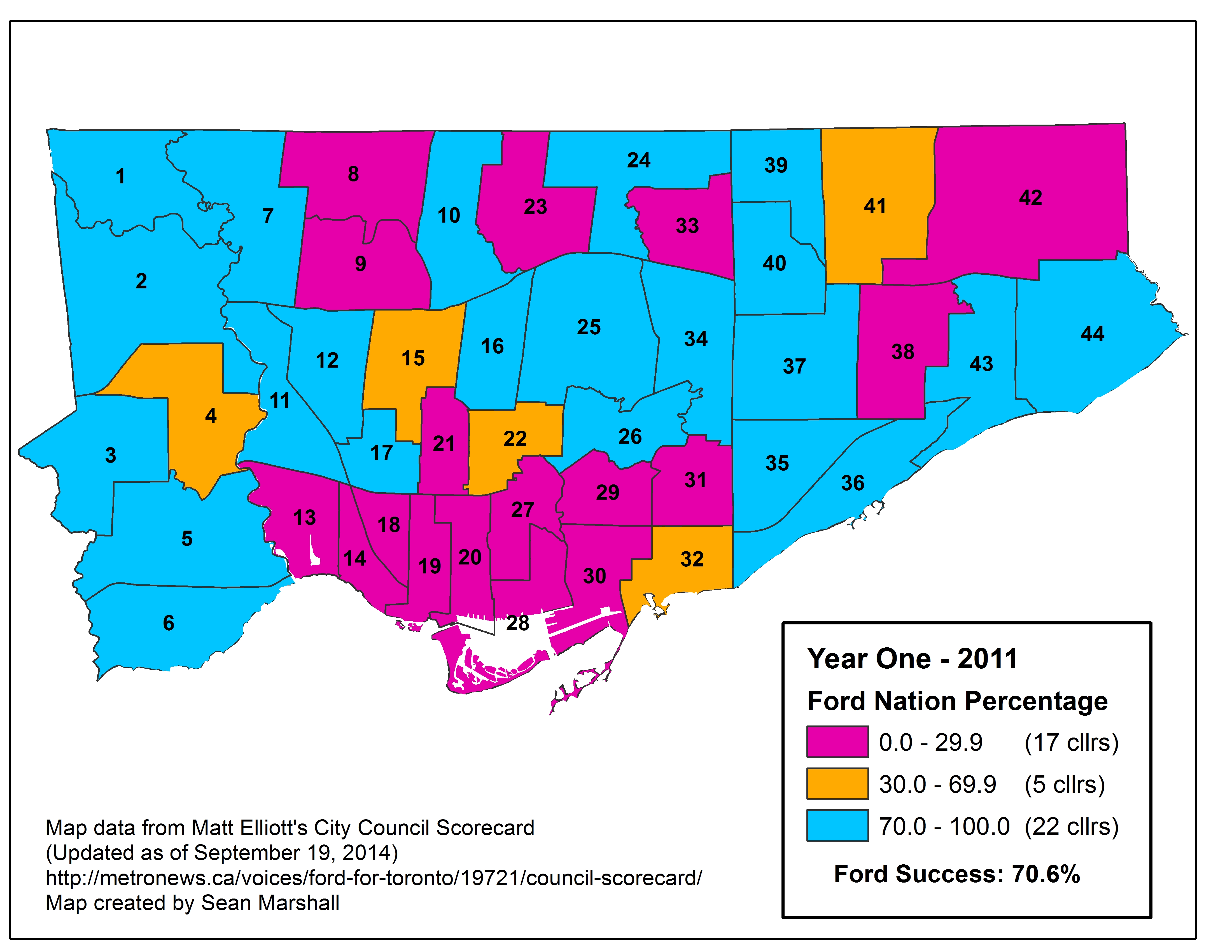
    In 2011, newly elected Mayor Rob Ford was able to count on the support of 22 councillors — a slim majority on the 45-member council when the mayor’s vote is added. From that bloc, Ford was able to pick his executive committee, who helped push forward his agenda of cost-cutting and mucking up Toronto’s transit plans. That year, council voted with Ford over 70 percent of the time. But by December, Ford’s control was already slipping; several potential proposed service cuts were rejected, as well as Doug Ford’s ridiculous plans to take control of the Waterfront development and build a Ferris wheel and mega-mall in Toronto’s Portlands.

    Many of the city councillors opposed to Ford’s agenda  — but not all — were elected in wards representing the Old City of Toronto and East York. But six suburban councillors  — Maria Augimeri, Anthony Perruzza, John Filion, Shelley Carroll, Glenn de Baeremaeker and Raymond Cho  — were all reliable opponents. Except for Cho, who ran for the provincial Progressive Conservatives and lost in the 2014 election, the rest identified with either the Liberals or New Democrats and re-elected in 2010 despite their wards voting overwhelmingly for Rob Ford.

    Ford Nation Percentage 2011 HiRes

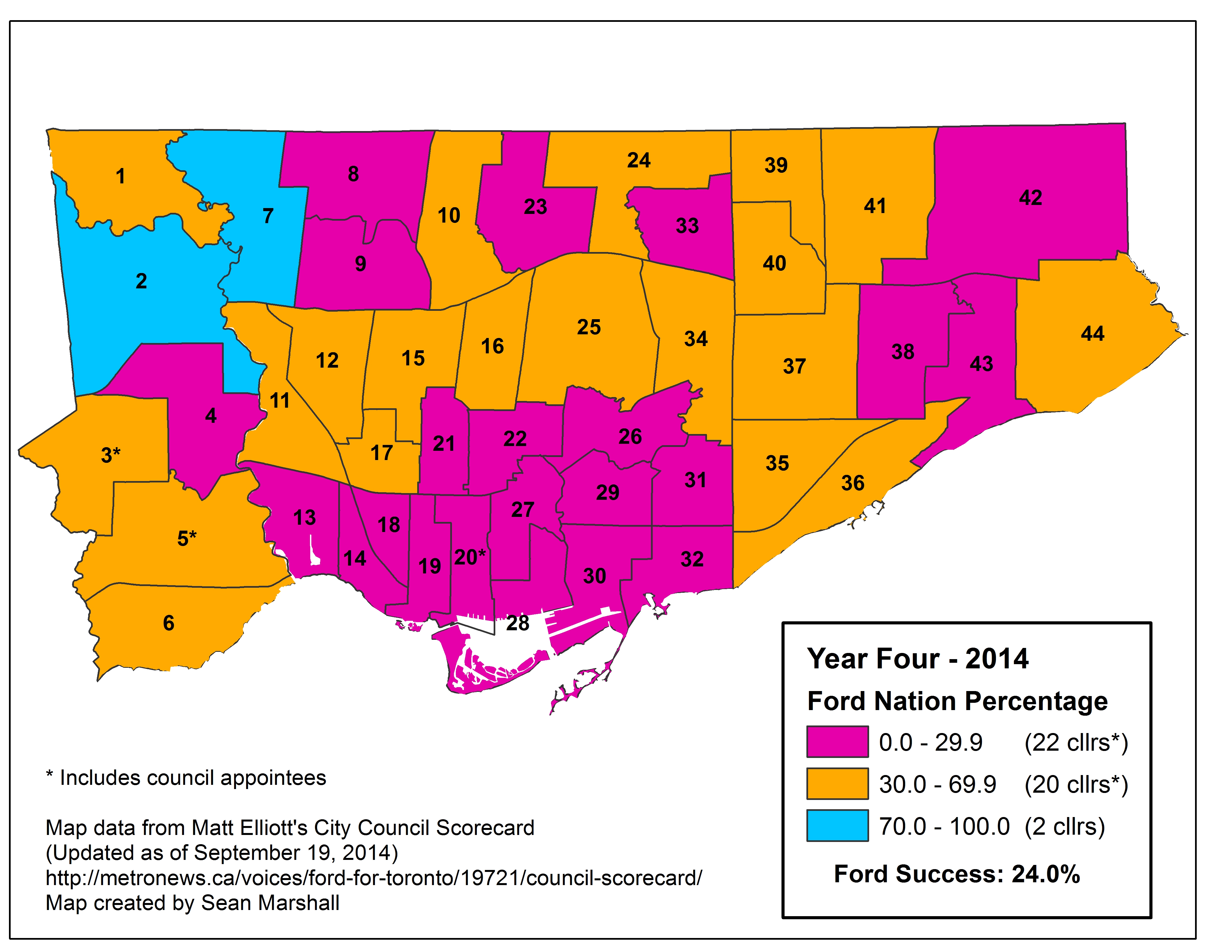
    It’s important to note that the Ford brothers’ agenda and control over council fell apart even before the Garrison Ball debacle and the crack-smoking allegations and council meltdown of 2013. In 2012, Rob Ford was only able to count on the loyal support of 17 councillors; he only had a 32 percent success rate at council that year. By 2014, Mayor Ford could only count on two reliable allies — his brother Doug, and Ward 7’s Giorgio Mammoliti; council only voted with the mayor 24 percent of the time.

    Ford Nation Percentage 2014 HiRes

    John Tory was elected in 2014 on an uninspiring, yet effective centre-right campaign, promising better governance, limited tax increases, and his own problematic transit plan. But after four years of Rob and Doug Ford, voters were looking for change. Sadly, candidates running on more substantive/progressive platforms, such as early front runner Olivia Chow and former councillor David Soknacki, either dropped out of the race or came far behind second-place Doug Ford, Rob’s obnoxious and bigoted enabler.

    Those looking for a brave new era at City Hall were disappointed by the incoming mayor’s picks for committee chairs/executive committee, speaker and TTC Chair, all plum posts that help steer the mayor’s agenda. Denzil Minnan-Wong (Ward 34), one of council’s most conservative and divisive members was named Deputy Mayor, while Rob Ford’s enabler on the council floor, Frances Nunziata (Ward 12), was re-appointed Speaker. All but two of Tory’s executive committee members were reliable Ford allies in 2011, seven of whom were on Ford’s original executive committee. (It should be said that some of those councillors, notably Paul Ainslie (Ward 43) and Jaye Robinson (Ward 25), later quit or were kicked off the Executive Committee.)

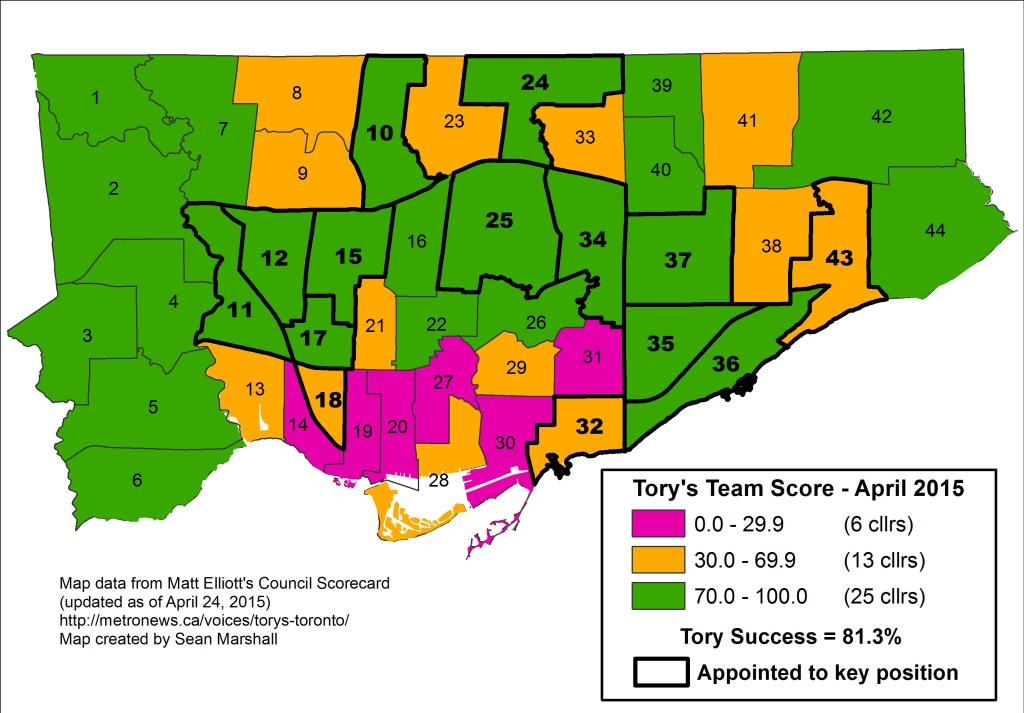
    Tory Team - April 24 2015

    Tory’s Team Score 

    Only five months into his term, John Tory had a good, but not stellar, record of getting his agenda through council. Matt Elliott found that 25 councillors have been reliable allies of Tory; voting with the mayor at least 70 percent of the time, including 5 of the 6 new councillors elected. Only six councillors — Gord Perks, Mike Layton, Joe Cressy, Kristyn Wong-Tam, Paula Fletcher, and Janet Davis, all representing “downtown” wards  — have voted with the mayor less than 30 percent on all important votes. Other anti-Ford councillors, so far, find themselves part of the “mushy middle” or “mighty middle,” though they are at this point a minority of 13. Interestingly, Councillors Rob Ford and Giorgio Mammoliti are voting with Ford most of the time so far. So much for Ford leading an “official opposition” against Tory.

    As expected, councillors that John Tory endorsed and supported in the last election  — Christin Carmichael Greb in Ward 16, Jon Burnside in Ward 26, and Mark Grimes in Ward 6 — were among Tory’s most loyal votes on council, even though none got a plum appointment (Carmichael Greb and Burnside are rookies, Grimes a three-term councillor). All three faced challenges from qualified, less conservative opponents.

    John Tory’s budget and early agenda has been less confrontational and ideological as what Ford pushed in 2011; this could be helping his score. Left-leaning councillors like Joe Mihevc (Ward 21) and Pam McConnell (Ward 28) are, for now, voting 35 percent with the mayor. The budget approved by council keeps tax increases low (I’d argue unsustainably low), but TTC cuts implemented by Rob Ford are being reversed; no services are being slashed. It’s true that council not doing enough on policing issues (especially carding/racial profiling; Tory doesn’t seem to have any interest here), nor is there enough action on the TCHC’s capital repair backlog, but so far, there haven’t been many divisive votes.

    John Tory’s budget and early agenda has been less confrontational and ideological as what Ford pushed in 2011; this could be helping his score. Left-leaning councillors like Joe Mihevc (Ward 21) and Pam McConnell (Ward 28) are, for now, voting 35 percent with the mayor. The budget approved by council keeps tax increases low (I’d argue unsustainably low), but TTC cuts implemented by Rob Ford are being reversed; few services are being slashed. It’s true that council is not doing enough on policing issues (especially carding/racial profiling; Tory doesn’t seem to have any interest in this important matter), nor is there enough action on the TCHC’s capital repair backlog. But so far, there haven’t been many divisive votes. With upcoming labour negotiations and more big-ticket budget items (the decision on what to do about the crumbling and under-capacity east Gardiner Expressway, for example), this will change.

    At times, Tory has seen to be either ignorant or dismissive of how City Council works; had he known better, there would be someone else in the Speaker’s chair, a less polarizing deputy mayor, and a few more centrist or left-leaning councillors in key positions to unite council. Mid-term, in early 2016, there’s an opportunity for Tory to revisit his committee appointments if necessary.

    It’s very possible that Tory will lose political capital as the term goes on, though it is nearly impossible to imagine him losing control of the agenda so dramatically as Ford did. In any case, it will be interesting to see if Tory learns on the job and continues to have the confidence of council, or if he starts to lose his grip as most mayors experienced later in their terms.