Tag: John Tory

  • Why Doug Ford’s plan for 25 Toronto wards is an attack on local democracy

    Ridings and 47 Wards.jpgMap of Doug Ford’s proposed 25 wards and the City Council-approved 47 ward boundaries

    Late last week, the newly elected Ontario Progressive Conservative government announced that they would be imposing a new electoral map on the City of Toronto, a decision that would eliminate the new 47 wards approved by Toronto City Council, replacing them with the same 25 boundaries used by the federal and provincial governments.

    It’s very clear that Premier Doug Ford’s plan, which requires a new piece of legislation, ironically titled the “Better Local Government Act,” is vindictive and mean-spirited because it only affects the City of Toronto, which rejected Doug Ford’s 2014 mayoral bid. It quashes the hopes of many young, racialized, and progressive candidates looking to change the make up of a council that has generally supported Mayor John Tory’s agenda. It is unfair to candidates that ran in good faith, started campaigns, raised funds, and spent money hiring staff, purchasing materials, and renting campaign offices.

    But most of all, Ford’s actions are an attack on local democracy because of the haste with which they are being made, at the end of the nomination period for those approved 47 wards. They ignore the years of study by independent experts and several rounds of public consultations. They also benefit Toronto’s suburban areas, which are growing at a far slower rate than downtown Toronto, North York Centre and Etobicoke’s waterfront area, which will be disproportionately affected by this arbitrary decision.

    Each new ward was designed to have an average population of 61,000, with a population range of between 51,800 and 72,000 (+/- 15%). They were designed to last for four election cycles, to be re-drawn before the 2034 election.

    It is worth noting that the independent experts looked at using the 25 federal/provincial boundaries twice. In the first study, they were rejected early on because they would not “meet the tests of effective representation.” The federal boundaries, which are also adopted by the province of Ontario, are based on population counts from the 2011 Census, and are already seven years out-of-date, while the consultants were tasked with developing new ward boundaries to last 16 years. Even a 50-ward solution (which mimics the old 44 wards based on the 22 federal ridings that were established in 1996 and came into effect with the 1997 federal election) would result in severe variations in population.
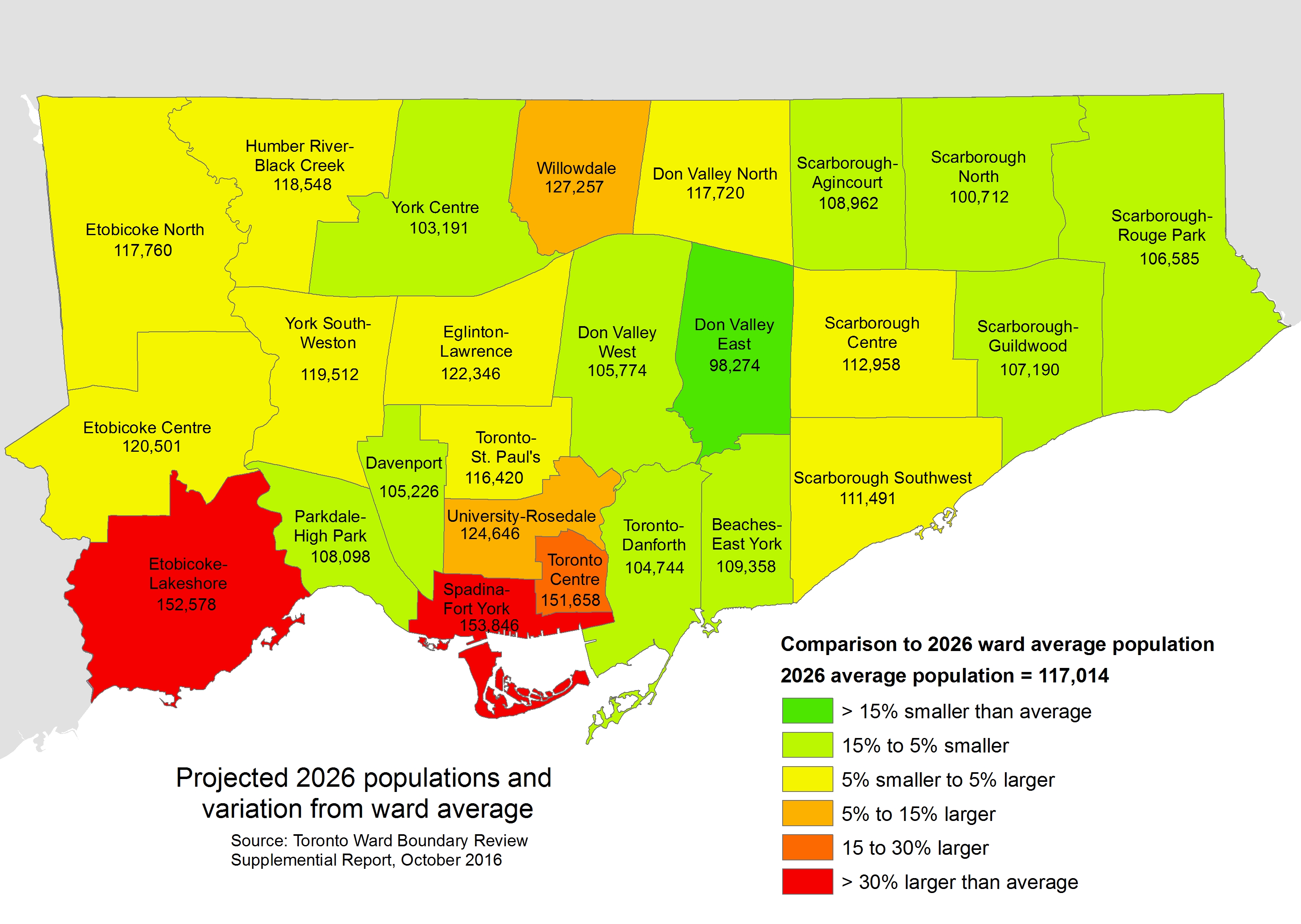
    Ridings and 2026 pop variation.jpgHow the 25 ridings, if used for Toronto’s ward boundaries, will vary in population by 2026

    After Tory’s Executive Committee tasked the Toronto Ward Boundary Review team to re-examine options that would see fewer than 47 councillors elected in 2018, they re-examined using the 25 ward boundaries. They found that in 2026, three of those wards — Toronto Centre, Etobicoke-Lakeshore, and Spadina-Fort York — would have populations over 30% higher than the ward average in 2026. Willowdale and University-Rosedale would also have had much larger populations than the city average.

    The review team also looked at a 26-ward option that mostly maintained the riding boundaries but added a new ward downtown out of the Toronto Centre and Spadina-Fort York constituencies and adjusted boundaries in southern Etobicoke. Even then, Etobicoke Centre and Etobicoke-Lakeshore would still have populations over 20% higher than the city-wide average. Despite making some adjustments for population growth, this option would have not have corresponded with some ridings, and was also not recommended.
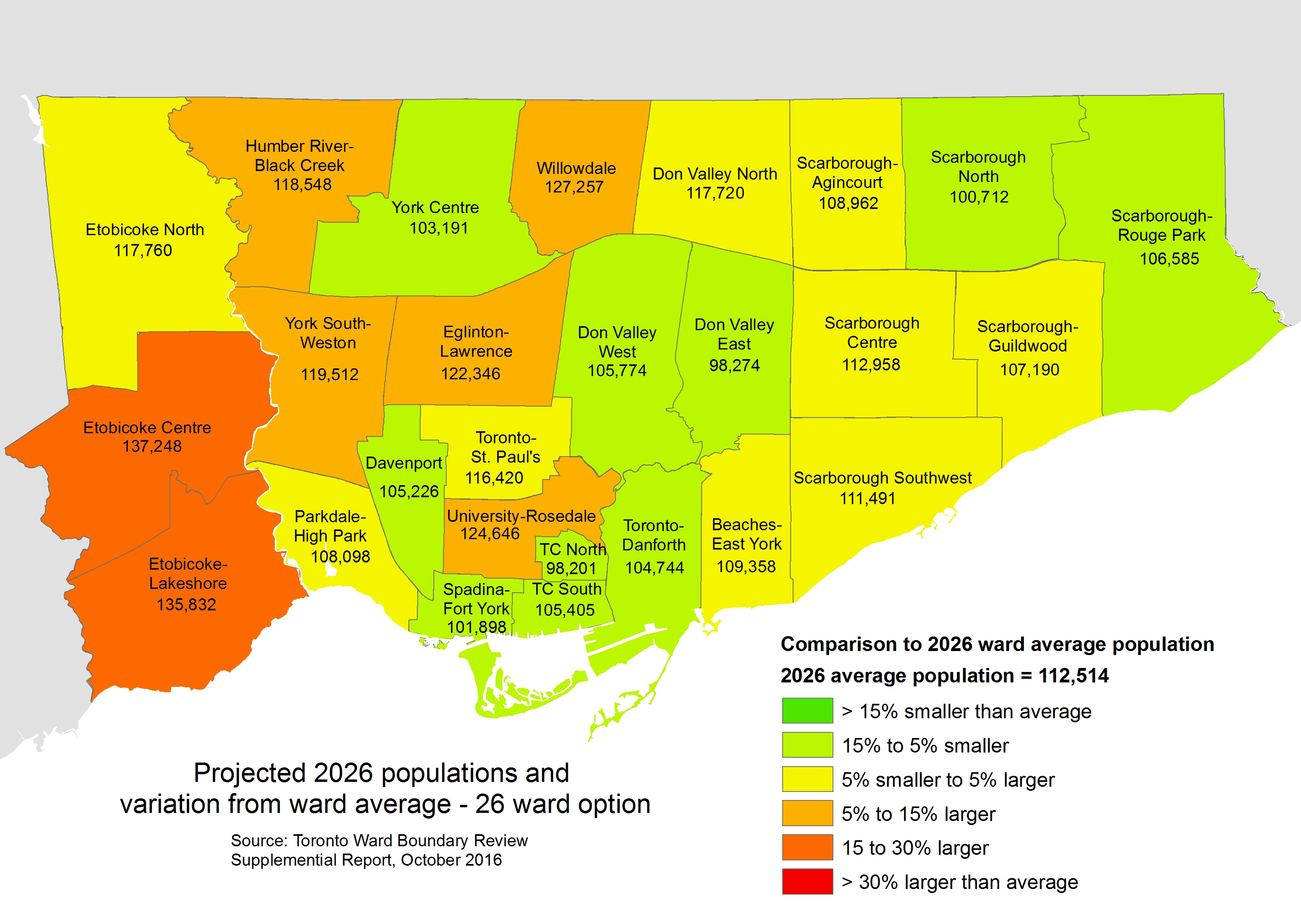
    26 Wards and 2026 pop variation.jpgHow the modified 26 ridings, if used for Toronto’s ward boundaries, would have varied in population in 2026

    For those reasons, and to support local representation, the 47-ward solution was once again recommended, and was approved by City Council in November 2016. Councillors Justin Di Ciano (Ward 5) and Giorgio Mammoliti (Ward 7) then appealed the new boundaries to the Ontario Municipal Board, but they were dismissed. The 47-ward solution has survived despite it all.

    Mayor Tory may have brought back decorum to the mayor’s office after an embarrassing period under Doug Ford’s brother Rob, but he has pushed an austerity agenda, and has failed to show leadership on police reform, wasteful infrastructure spending, and safe streets for pedestrians and cyclists. His initial reaction, to call for a referendum on Ford’s plan to cut Toronto’s council, was a characteristically weak response; he was later pushed into supporting a legal challenge by an angry public. Meanwhile, some of Tory’s allies, like Di Ciano, David Shiner, and Glenn De Baeremaeker, support Ford’s actions.

    Ford’s attack on local democracy is an insult to candidates who have already put their names forward for election and launched their campaigns. It undermines the City of Toronto’s legislated responsibility to decide its own ward boundaries. And it will only exasperate existing disparities in council representation.
  • The John Tory Way

    32267768383_8c2f20d0d5_k
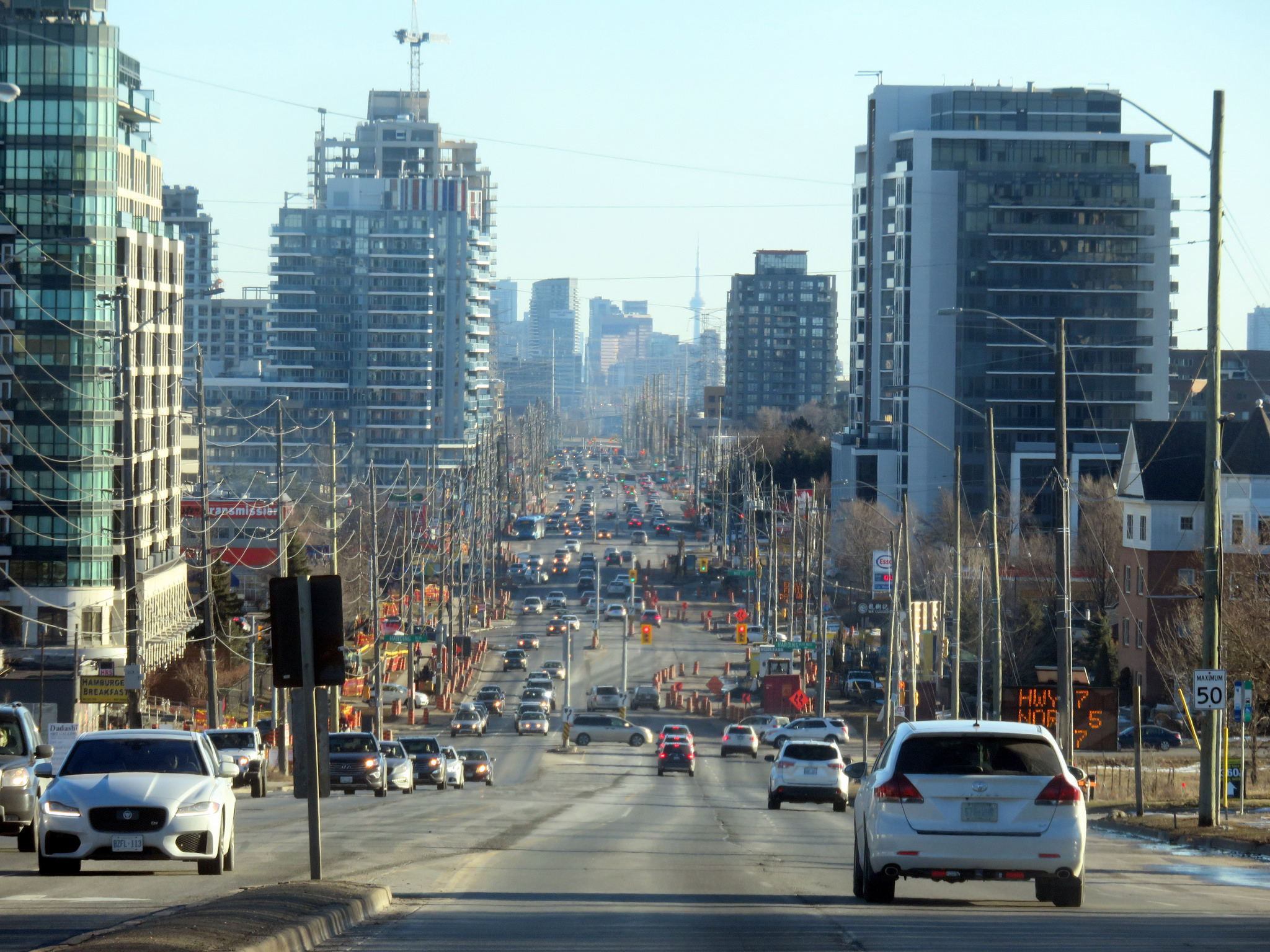
    Yonge Street looking south from Richmond Hill

    There’s an episode of The Simpsons where Homer Simpson changes his name to Max Power, after he’s ridiculed for sharing the name with a buffoonish television character. It’s not a great episode — it came out at the time the show was in transition from its glory years to the “Zombie Simpsons” era — but it has a few good laughs.

    There’s one good memorable quote:

    — “There’s the right way, the wrong way, and the Max Power way!”
    — “Isn’t that the wrong way?”
    — “Yeah, but faster!”

    On important transportation projects, the John Tory way is the wrong way, but costlier. We’ve seen this several times during his mayoralty.

    When it came time to replace the underused eastern section of the Gardiner Expressway, Tory and his suburban allies on council voted in favour of a more expensive “hybrid” option that maintains much of the elevated highway, instead of a cheaper at-grade option that would provide a better pedestrian realm on the Eastern Waterfront and better support new development.

    In Scarborough, Tory stubbornly supports building a one-stop subway extension that was last estimated to cost $3.35 billion dollars, instead of supporting a seven stop LRT route from Kennedy Station that would extend the existing grade-separated Scarborough RT route to Centennial College and Sheppard Avenue. A proposed SmartTrack station at Lawrence East (whose estimated construction cost has risen from $26 million to $155 million) may not be able to be built while the Scarborough RT is still in operation.

    And on February 27, Toronto’s Public Works and Infrastructure Committee (PWIC) voted against plans backed by city staff, the local councillor, John Filion, and many residents and road safety advocates, to transform Yonge Street in North York Centre between Sheppard and Finch Avenues. This section of Yonge Street is due for reconstruction, hence the opportunity to rethink the street to better serve the community.

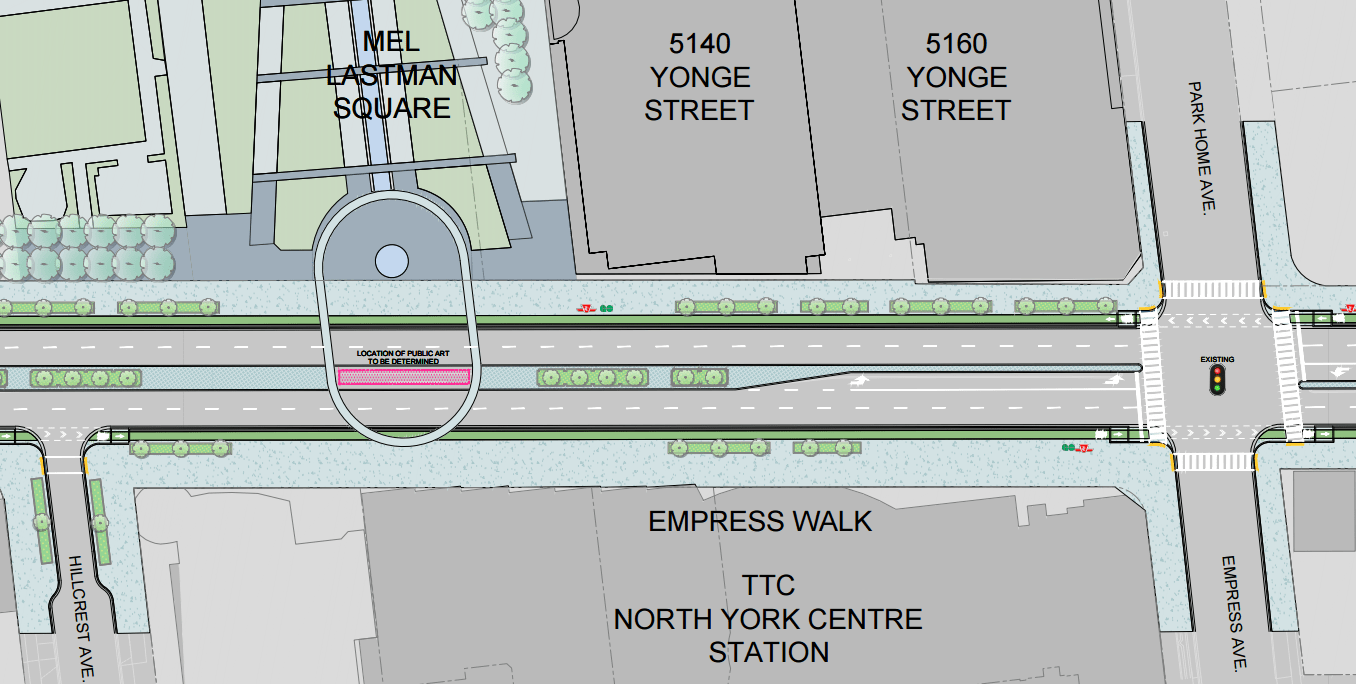
    The REimagining Yonge Street plan seeks to improve the pedestrian realm with widened sidewalks, would add new cycling infrastructure. To make room for these improvements, two traffic lanes — used for street parking outside of weekday rush hours — would be removed. This stretch of Yonge Street has seen many new condominium towers built over the last decade, and there are three subway stations serving this stretch of Yonge Street.

    Mayor Tory, who has the power to select committee chairs and members, stated his preference for the status quo on Yonge Street, suggesting that the bike lanes be moved one block west, to Beecroft Avenue. PWIC moved for this alternative option as well, even though city staff reported that the change would cost an additional $20 million.

    YongeCrossSectionYonge Street between Sheppard and Finch Avenues would have seen new separated bike lanes, wider sidewalks, and new public art. (From the EA materials.)
    The decision to maintain the status quo on Yonge Street benefits commuters outside of Toronto more than local residents, so it is puzzling why Mayor Tory has declared his support — once again — for an option that puts drivers first. Nearly three-quarters of rush-hour drivers on Yonge Street through North York come from York Region. A majority of residents take transit, walk, or cycle; they would benefit from a safer, more pleasant street. Moving the bicycle route to Beecroft Avenue serves to move cyclists out of the way of cars, rather than providing a direct route with better access to transit, shops, and homes.

    With Doug Ford focused on the Ontario Progressive Conservative party leadership race, there are — as of yet — no high-profile challengers to Mayor Tory’s re-election bid. There is no need to pander to a voting bloc angered by a so-called “war on the car” unless Tory actually supports suburban commuters over his own constituents. And this decision will only cost more money.

    Once again, Mayor John Tory has chosen the wrong way.

  • A new low for the Scarborough Subway champion

    Note: a version of this article has been cross-posted to Spacing Toronto

    For 2016’s annual Torontoist Heroes and Villains feature, I nominated Toronto Councillor Glenn De Baeremaeker (Ward 38, Scarborough Centre) as villain of the year. (“Pedestrian blaming” won that dubious honour.) But I remain proud of my choice. As I wrote back in December:

    De Baeremaeker’s record of environmentalism has been overshadowed by an increasingly antagonistic tone, pitting supposedly downtrodden Scarborough against the rest of the city in his one-track quest to build a one-stop subway extension to his ward. In his myopic support of the subway, De Baeremaeker is opportunistic and vindictive, takes the low road, insults critics who engage in good faith debates, and in the process does a disservice to the community he represents.

    Councillor De Baeremaeker hasn’t changed his tone.

    Yesterday, May 10, the City of Toronto held a public consultation at Scarborough Civic Centre on the next phase of planning for that one-stop, 6.2-kilometre subway extension, which is estimated to cost $3.35 billion, and open no earlier than 2026.

    I wish I was able to attend last night’s meeting, as disgruntled Scarborough residents questioned the merits of that transit plan. And Councillor De Baeremaeker shamelessly blamed “downtown councillors” for the shortcomings of that one-stop subway. For a councillor who is rightly proud of his past environmental advocacy, it was surely a low point.

    Toronto Star reporter Jennifer Pagliaro, an excellent local journalist, covered the meeting. 

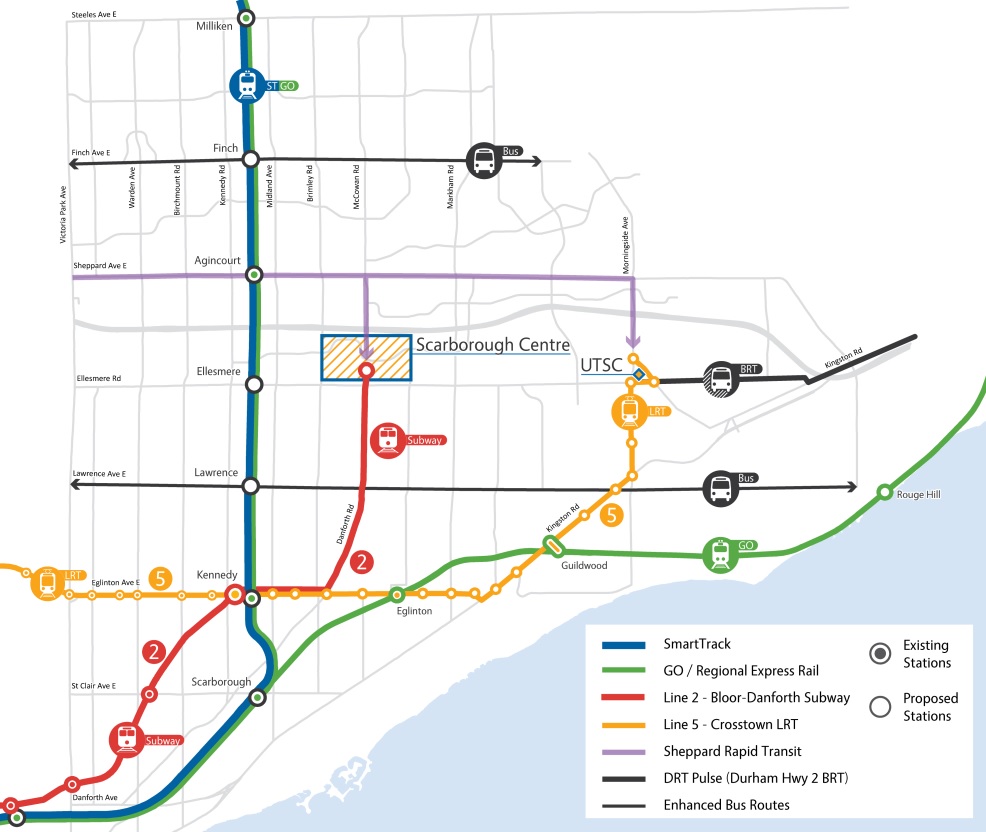
    City Scarborough MapCity of Toronto map from February 2016 illustrating current plans for the Scarborough Subway and connecting transit.

    At the public consultation, TTC and City planning staff answered queries from members of the public, many questioning the utility of the single-stop subway. There are no additional funds to rough in future stations, such as at McCowan Road and Lawrence Avenue, where the line would intersect the busy 54 Lawrence East bus and serve Scarborough General Hospital. As building future stations later would require an extended shut-down of the line, the one-stop subway extension will likely be forever a one-stop subway.

    (The eastern extension of the Eglinton-Crosstown LRT from Kennedy Station to University of Toronto’s Scarborough Campus is also part of the new plan for Scarborough, but the LRT component is unfunded.)

    Shameless as ever, Councillor De Baeremaeker resorted to strawman arguments, talking up a “suburban/urban divide”:

    [De Baeremaeker] blamed “downtown councillors,” who represent the most densely populated wards in the city, for not wanting to fund more frequent transit stops like their residents enjoy.

    Yes, it is true that all councillors representing central Toronto opposed the subway extension, but so did several suburban politicians, most notably Councillor Paul Ainslie (Ward 43 – Scarborough East). Yet not one of those councillors wanted less transit for Scarborough. Instead, they backed a seven-stop LRT replacement for the ageing Scarborough rapid transit line, including an extension to Centennial College and Sheppard Avenue in Malvern. That less-expensive line was fully funded by the provincial government, which would have permitted scarce funds to be spent on other transit projects across Toronto.

    Meanwhile Mayor John Tory was most interested in pushing SmartTrack, a fantasy rail project that got pared down as parts of the line were found to be impossible to build, and costs increased. The eastern end of SmartTrack conflicted with the Scarborough Subway extension. The three-stop subway plan was cut to a single stop at Scarborough Centre, to keep costs down and to not cannibalize SmartTrack.

    Yet Tory and De Baeremaeker are allies on the subway extension; Tory named him one of his Deputy Mayors to champion the line. But Tory’s push for his own project put him at odds with De Baeremaeker’s focus on the subway extension, any subway extension, to his ward.

    It is also worth noting that until 2012, De Baeremaeker supported Transit City, the transit plan championed by David Miller that would have delivered three new light rail lines to Scarborough.

    I am not surprised by De Baeremaeker’s shameless politics. But his performance last night was especially crass and dishonest. Backed into a corner, faced with angry local residents, he lashed out at imaginary villains. But subway backers largely have themselves to blame; despite winning every recent vote on the subway plan, they have only one stop to show for it.

  • Leadership, John Tory style (part 2)

    We’ve seen it before: when cornered on an issue, Mayor John Tory will get defensive, flustered, and counter with disingenuous remarks. Police carding was one such issue, so was the Gardiner East. Today, as Mayor Tory defends his SmartTrack proposal, he’s doing the same thing.

    After a staff report on SmartTrack — originally planned for a week ago at the scheduled Executive Committee — became public, we learned more details about the watered-down transit plan that was Tory’s signature campaign promise. (Read Steve Munro’s article in Torontoist for more details.)

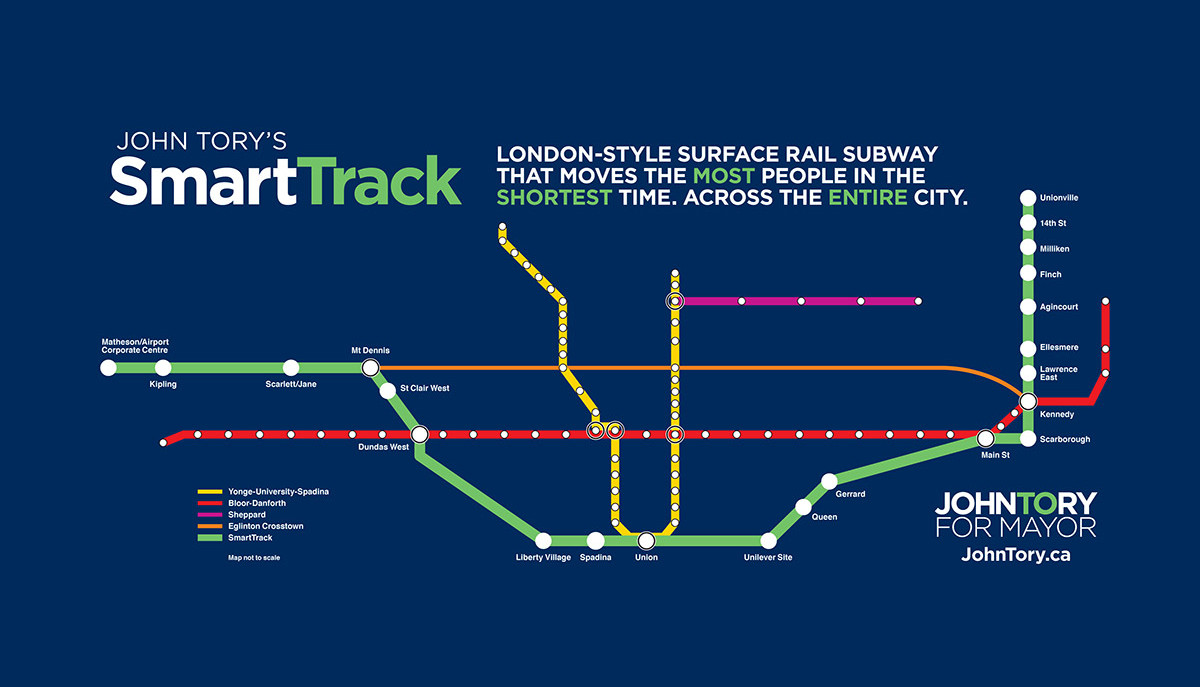
    • In 2014, John Tory promised that his “London Style” surface rail subway would open in just seven years. Now, we find out that it won’t be completed until 2025-2026.
    • Only six new stations will be added to GO Transit’s existing stops on the Kitchener and Stouffville corridors; the GO RER system planned by Metrolinx will stop at the same stations as SmartTrack, blurring the lines further between the province’s plans and Tory’s promises.
    • The City of Toronto will be on the hook for all LRT operating expenses, while the Province/ Metrolinx will continue to own the infrastructure.
    • The City of Toronto would be on the hook for some of the GO RER expenses, such as 15 percent of required grade separations, such as at Steeles and Finch Avenues in Scarborough.
    • The Eglinton-Crosstown LRT west extension to Pearson International Airport, which replaced part of the original SmartTrack alignment planned using outdated Google Maps satellite imagery, may not be built beyond the planned Renforth Gateway Hub, the eastern end of the Mississauga Transitway.
    • Tax Increment Financing (TIF) will not be enough to fund the construction of SmartTrack and the LRT extension; development charges and a property tax hike would be required to fund SmartTrack’s construction.

    smarttrack_fbThe original SmartTrack plan that John Tory campaigned on in 2014
    These are serious concerns, and it is worth asking whether Toronto should remain committed to this plan. After all, the Relief Line Subway remains unfunded, even though it is a top priority for city planning staff. And there’s that $3.2 billion one-stop subway extension to Scarborough Centre, which might become even more expensive if so-called “Subway Champions” Councillor Glenn De Baeremaeker and Liberal MPP Brad Duguid get their way with a proposed realignment.

    (Interestingly, a SmartTrack/RER stop at Lawrence East may not be able to be built before the one-stop subway extension is opened — a Scarborough RT station is in the way. This isn’t good news for transit riders on the 54 Lawrence East bus, which will lack a rapid transit connection in Scarborough.)

    Mayor John Tory’s response is to ask “what’s their plan?” instead of listening and responding to critics. It’s certainly not a productive or mature reaction to very valid concerns.

    There were several alternative plans made by rival candidates in 2014 — Olivia Chow and David Soknacki backed returning to the cheaper and longer Scarborough LRT replacement, and building the Downtown Relief Line subway. Chow also proposed additional bus services, which was mocked by Tory’s campaign as no real plan for transit. Once Tory was elected, the TTC ended up implementing much of Chow’s bus plan, including restoring most of Rob Ford-mandated service cuts and adding new express and night routes.

    Last week, John Tory also rejected — yet again — the new ward boundaries recommended by the Ward Boundary Review Team, independent consultants who came up –twice — with a 47-ward solution meant to reflect population growth (especially downtown and in central North York) and imbalances in ward populations and councillors’ workloads. The Executive Committee voted against the mayor, backing the 47-ward option, but staff warn it might be too late now for the 2018 election. That might suit Tory’s political agenda, but it’s a blow against local democracy.

    Bottom line: Olivia Chow has no plan for transit. She is not a leader.
    – John Tory, 2014

    So no, John Tory, you’re not a leader. You have failed to acknowledge your errors, you haven’t listened to critics, you’re stubborn, and you lash out when things don’t go your way. And you won’t listen to experts because you don’t like what they have to say. At one point, you claim your critics don’t have any alternative plans to SmartTrack, at other times, you mock the very plans that critics suggest.

    So far, John Tory’s critics have been correct about his transit plan. Maybe it’s time to listen.

  • Mapping Mayor Tory’s support on Council

    Matt Elliott, columnist for Metro Toronto, is one of Toronto’s greatest observers of local politics. One great service that he does is keep track of all important votes at Toronto City Hall. Originally, this work tracked each councillors’ support for Mayor Rob Ford from 2010 through 2014; now his scorecard tracks how each councillor voted according to Mayor John Tory’s agenda. The Council Scorecard spreadsheet is available here.

    In 2014, I created several maps using Elliott’s data that helped to show how Rob Ford lost control of City Council. In Ford’s first year, he was able to count on the support of 22 councillors, enough to get most of his agenda passed. But by 2014, only two councillors – Giorgio Mammoliti (Ward 7) and Rob’s brother, Doug (Ward 2) voted with the mayor at least 70 percent of the time.

    I felt it was about time to map how well Mayor Tory is doing.

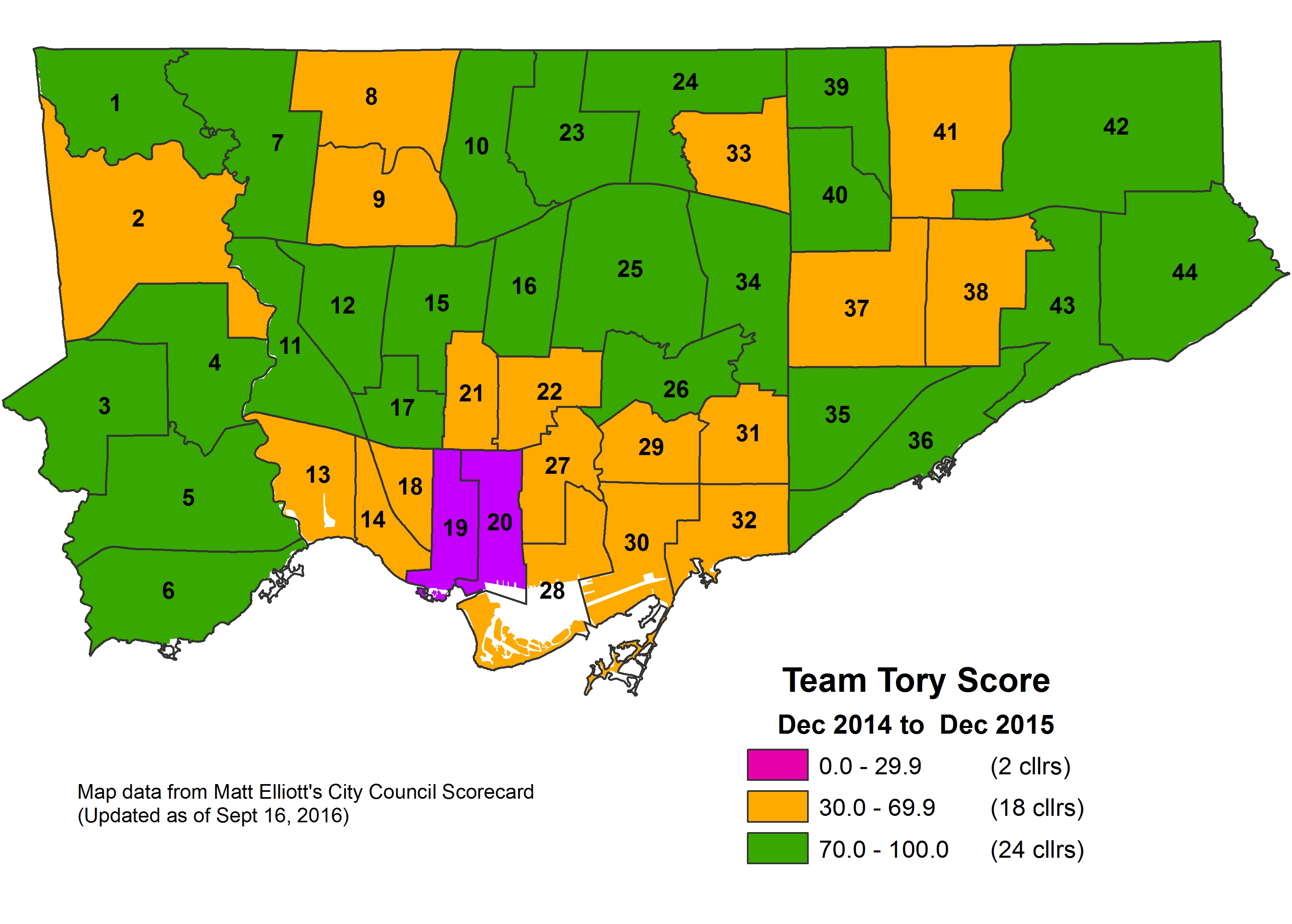
    torys-team-score-2015
    Team Tory Score, as of December 2015

    In his first year as mayor, from December 2014 to December 2015, Tory enjoyed the support of over half of Toronto City Council; 24 of 44 councillors voted with the mayor at least 70 percent of the time. Important votes on budget austerity, council appointments (such as Police Board Chair and Tory friend, Andy Pringle), approving the “Hybrid” option for the Gardiner Expressway, and approving Uber’s operations in Toronto were all passed.

    But there were some surprises. Many key Tory supporters voted against the mayor on a motion introduced by Councillor Justin Di Ciano (Ward 5) to ask the province not to support ranked ballots. The mayor, who supported the electoral reform, lost that vote.

    In that first year, most other councillors provided some support, voting with the mayor at least 30 percent of the time, including former mayor Rob Ford (Ward 2). The wards that these councillors represent are marked in orange. Generally, these wards are represented by centrist or left-leaning councillors such as Josh Matlow (Ward 22), Maria Augimeri (Ward 9) and Shelley Carroll (Ward 33).

    Only two councillors — Mike Layton (Ward 19) and Joe Cressy (Ward 20) voted opposite to Mayor Tory over 70 percent of the time in 2015.

    torys-team-score-to-june-2016
    Team Tory Score, as of July 2016. Votes from the October 2016 Council Meeting not yet included. 

    So far in 2016, the divide between the allies of the mayor and his opposition widened. Only ten councillors were left in the middle (all centre-left), while five councillors — Gord Perks (Ward 14), Kristyn Wong-Tam (Ward 27), Paula Fletcher (Ward 30), Janet Davis (Ward 31), and Anthony Perruzza (Ward 8) joining the opposition. With the exception of Ward 2, vacated after Rob Ford’s death, all councillors from Etobicoke and Scarborough became clear Tory allies.

    It’s worth noting few normally centrist councillors, who were very effective in opposing Rob Ford’s agenda last term, are now staunch allies, including Paul Ainslie (Ward 43), and Bailão (Ward 18). Both are members of Tory’s Executive Committee; Ainslie, a centre-right councillor who has earned my great respect, was also appointed chair of the Government Management Committee.

    Opposition to Tory’s agenda from councillors in the Toronto-East York region might help to explain why the Executive Committee, hand-picked by Tory and his transition team, did not have much enthusiasm for the 47-ward solution recommended by consultants on the Toronto Ward Boundary Review team. To reflect population growth, Downtown Toronto would get three new councillors in 2018, as would central North York. One ward would disappear in Toronto’s west end; incumbent councillors Ana Bailão (Ward 18) and Cesar Palacio (Ward 17), both Tory allies, are the most affected by that change. In May, the committee requested that the consultants go back to the drawing board and look at a new 44-ward option, as well as ward boundary options consistent with provincial and federal ridings. The consultants did that, and are once again recommending the 47-ward option.

    Almost half-way through his term, Mayor Tory has a confident and strong hold on Council, which has so far supported an agenda of austerity, along with major (and in my view, unwise) transportation infrastructure projects like the Scarborough Subway and the Gardiner East reconstruction.

    It is worth noting as well that apart from Bailão, all councillors from “downtown” wards were frozen out of Tory’s inner circle, even though many downtown and midtown wards enthusiastically voted for Tory in the 2014 election. Furthermore, most of the same councillors that support Tory at least 70 percent of the time also supported Ford’s agenda in 2011 and 2012. Key supporters of Ford’s early agenda went on to sit on John Tory’s Executive Committee.

    While there’s a slightly conservative bent to Toronto City Council, left-leaning mayor David Miller was able to work with centrists and conservatives, including suburban councillors, to implement his agenda, appointing several to key boards and committees. Tory, on the other hand, has frozen out council’s progressives, perpetuating an urban-suburban divide.

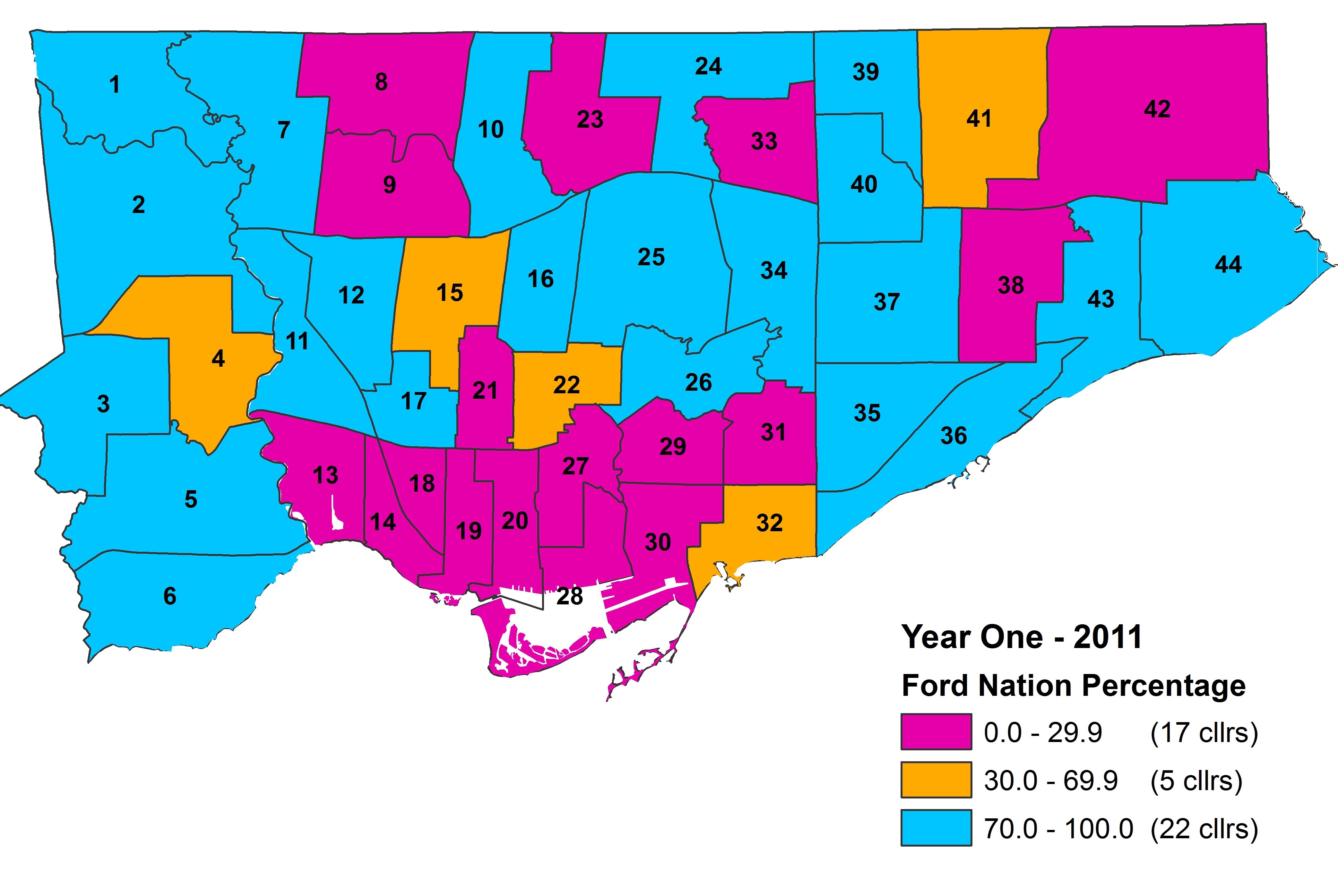
    ford-nation-percentage-2011-crop
    Mayor Rob Ford’s allies and foes in 2011

    It’s possible that Tory’s hold on power will slip as councillors get restless, or if there’s a backlash to cuts to city services such as the TTC or the Toronto Public Library. After all, Rob Ford’s hold on power slipped long before the crack scandal as residents fought back against budget cuts, and council quashed the Ford Brothers’ attempt to build a Ferris wheel and mall in the Portlands.

    The mid point between municipal elections is coming up, and there’s an opportunity to make changes to committee and board appointments. There’s still an opportunity for new alliances to be made and for goals to change to support a growing city and address growing economic disparity.

  • The controversial Judson Street zoning change

    IMG_3781-001

    Earlier this year, Etobicoke Councillor Justin Di Ciano (Ward 5) pushed for a zoning change to several industrial properties on Judson Street, adjacent to GO Transit’s Willowbrook Yards. Local residents had enough with a concrete batching operation and Dunpar Homes applied to build a townhouse development on the site.

    City staff recommended against the rezoning, which would allow townhouses to go up on land previously zoned as industrial. Metrolinx, GO Transit’s parent organization, also spoke out against the re-zoning, warning that it could impact its expansion plans, including GO RER/SmartTrack. But Councillor Di Ciano, Mayor John Tory, and most of the mayor’s allies voted against those concerns and supported the redevelopment.

    Now Metrolinx is appealing the council decision to the Ontario Municipal Board, and the City will be forced to hire external expert advice, as it went against its staff recommendations.

    You can read the Torontoist post here, where I explain the situation in more detail.


  • Toronto’s new rapid transit plan

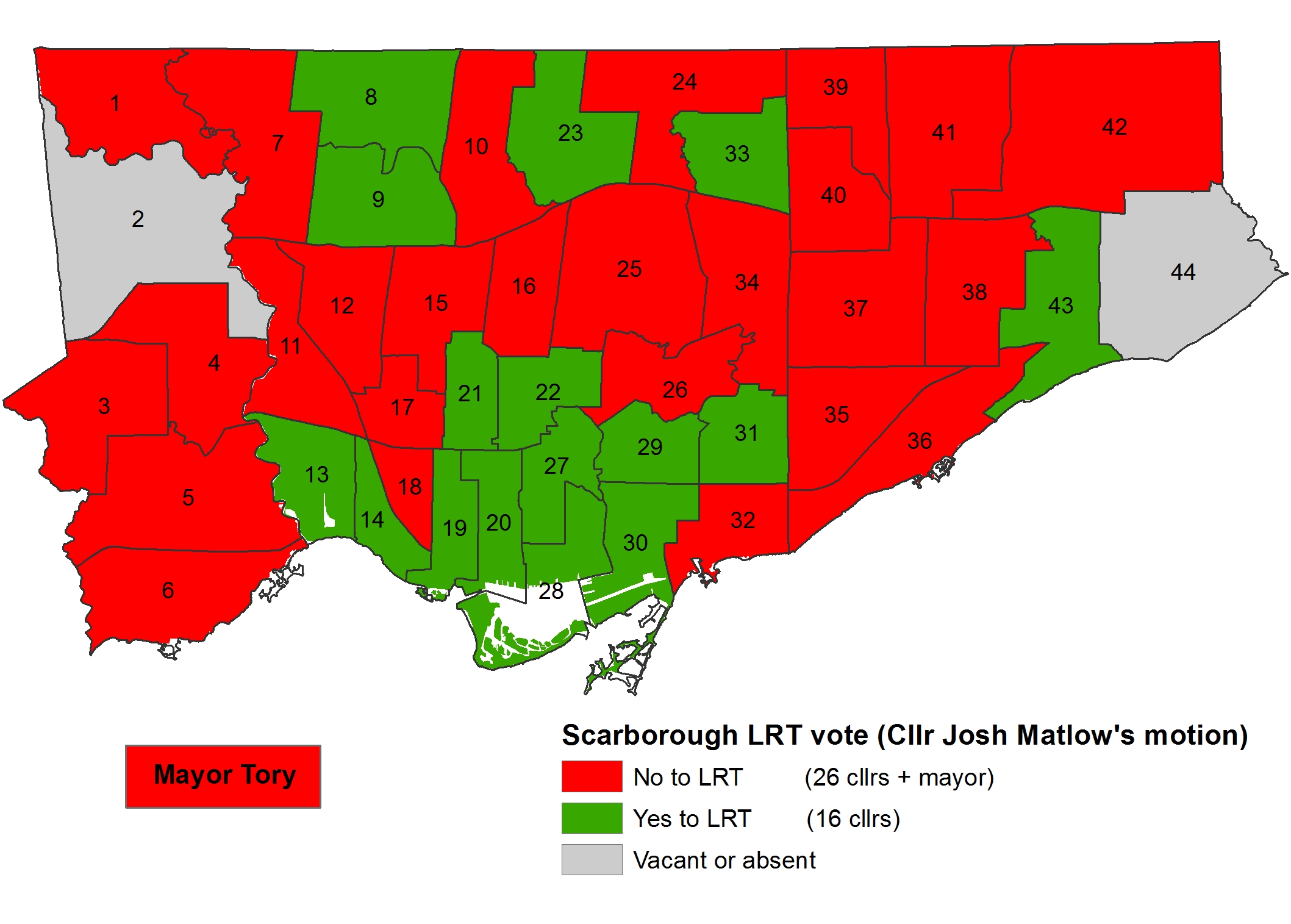
    Yesterday, City Council decided, by a vote of 27-16, to go ahead with the $3.1 billion one-stop extension of the Bloor-Danforth Subway to Scarborough Centre, rejecting Councillor Josh Matlow’s last-ditch attempt to resurrect the LRT replacement and extension of the ageing Scarborough LRT line. Council — Mayor Tory included — also voted to spend resources studying three more suburban subway extensions and a re-alignment of the proposed Relief Line subway backed by the local councillor.

    Unfortunately, the chance of going back to the less-expensive, yet longer seven-stop light rail line is slim-to-nil at this point. In my view, it’s time for transit advocates that backed the LRT to focus their energies elsewhere. Like Metrolinx’s fare integration strategy, and the plans for other LRT lines, such as the eastern and western extensions of the Eglinton-Crosstown.

    TT - Scarborough VoteHow council voted on Councillor Matlow’s motion to resurrect the LRT option for Scarborough
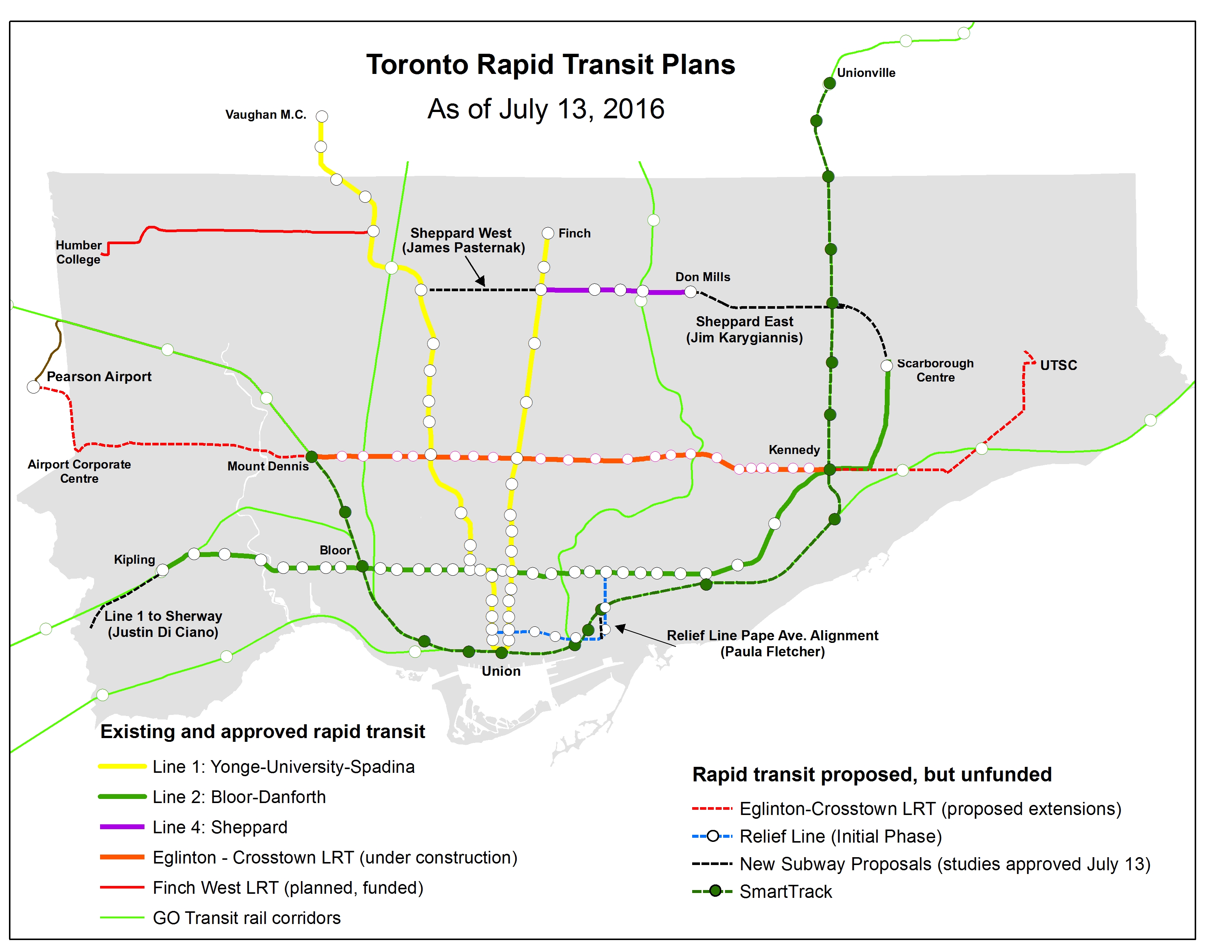
    In order to ensure that he had enough votes, John Tory entertained Ward 39 Councillor Jim Karygiannis’ motion for a study on an extension of the Sheppard Line from Don Mills Station to Scarborough Centre. (There’s a LRT proposed for Sheppard East, but no matter.) Karygiannis’ motion passed, as well as several other councillors’ pet subway projects. Ward 10 Councillor James Pasternak has long pushed for a Sheppard Subway extension west between Sheppard-Yonge and Downsview Stations, and he successfully got that included as well. Finally, Justin Di Ciano (Ward 5) got a study approved for a subway extension in his ward as well, resurrecting a long-dormant proposal for a subway extension from Kipling Station to Sherway Gardens.

    It’s worth noting that all three right-leaning councillors are reliable votes for John Tory.

    Downtown, Paula Fletcher (Ward 30) moved that staff re-examine the Relief Line, moving the recommended alignment from under Pape Avenue to Carlaw Avenue between Gerrard and Queen Streets. This would shift the planned — yet unfunded — subway line two blocks west. The Pape alignment was chosen for ease of construction and operation (the line must curve from north to west just south of Queen Street), and is only two blocks away. That study will cost $520,000 and staff time.

    All these new studies are illustrated below. For clarity’s sake, the Sheppard East LRT, the Scarborough LRT proposal, and the existing Scarborough RT (Line 3) are removed. You can read more about how the votes went down on Steve Munro’s site.

    Transit Plan July 2016The map of planned, approved and existing rapid transit lines, and those extensions and re-alignments approved for study
    The “subways, subways, subways” sentiment is alive and well at City Hall, even if Rob Ford has passed on. And despite the thirst for expensive new subway lines,  Mayor Tory is still backing an austerity agenda at City Hall. Apart from the decorum, not much has changed in the mayor’s office.

  • The difference between the Fords’ Subway Plan and John Tory’s Subway Plan

    201493-rob-ford-subway
    The Rob Ford/Doug Ford Subway Plan, circa 2014

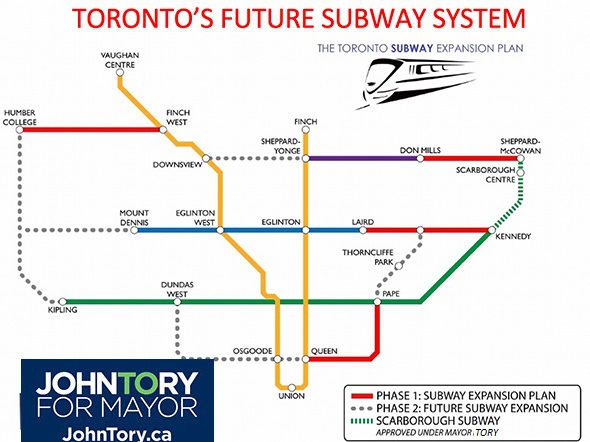
    The above is the subway plan promoted by Rob Ford, and later Doug Ford, in the 2014 municipal election. Thanks to today’s pandering to suburban councillors demanding their own subway lines, below is the John Tory-backed subway plan.

    tory-subway
    The John Tory Subway Plan, circa 2016

  • The Truth About SmartTrack

    smarttrack_fb

    This article originally appeared on June 27, 2016 in Torontoist

    In 2014, then-mayoral candidate John Tory ran on a campaign of sound fiscal management, returning decorum to City Hall, and a curious new transit plan called SmartTrack, which promised “London-style” rapid transit from Mississauga to Markham. During the election campaign Tory claimed that the new rail service—53 kilometres long, costing $8 billion—would provide needed transit relief in just seven years, all on a TTC fare.

    During campaign speeches, Tory called the plan “bold.” He also promised to build the Rob Ford-backed subway extension to Scarborough Centre, rather than return to the cheaper, funded light rail alternative that candidates Olivia Chow and David Soknacki were backing.

    Of course, Tory won the election, and many Torontonians were looking forward to an era of competent governance, if not visionary leadership. But two years in, the costs of the Scarborough subway keep mounting, even if the number of stations kept shrinking (from three stations to one stop), and the scope of John Tory’s “bold” SmartTrack plan kept getting watered down.

    With the recent provincial and municipal transit announcements on new GO Station locations, it’s now official: SmartTrack is nothing more than a brand name for transit projects that were already in the works. And the City of Toronto is stuck with some of the construction costs that would have been borne by the province.

    Mayor Tory and the provincial government held two separate transit announcements this week: one in Liberty Village, the other at the former Unilever lands that First Gulf is looking to redevelop as a major office and commercial centre. While Tory has been bullish about promoting First Gulf’s development, the East Gardiner replacement, SmartTrack Station, and even a Relief Line subway stop—projects he championed—will all serve this particular property.

    Those announcements coincide with a Metrolinx report [PDF] that recommends 12 new GO Transit stations: Breslau, St. Clair, and Liberty Village on the Kitchener Line; Innisfil, Mulock, Kirby, Davenport-Bloor, and Spadina on the Barrie Line; East Harbour (Unilever), Gerrard, Lawrence East, and Finch East on the Lakeshore East and Stouffville lines. Stations at Mount Dennis, Downsview Park, and Caledonia were already approved and will connect to the subway and Crosstown LRT. Seven of those stations—from Mount Dennis to Unionville—are along the SmartTrack corridor. Spadina Station, part of Tory’s SmartTrack map, will only be served by Barrie corridor trains.

    From the start, SmartTrack was a fantasy built on assumptions; the line was an idea conceived by a little-known organization called Strategic Regional Research Alliance. SRRA authored a report, “The Business Case for the Regional Rail Line,” discussing the potential of a 2009 concept for connecting suburban office parks with Downtown Toronto with rapid transit. That report became the basis for SmartTrack.

    Meanwhile, Metrolinx—the provincial transportation authority for the Greater Toronto and Hamilton Area—was involved in studying plans for converting much of its existing GO Transit rail network from a commuter rail system to an electrified, regional rail network known as Regional Express Rail. RER and SmartTrack (as well as VIA Rail and UP Express trains) would be sharing the same corridors.

    Since the election, the truth about SmartTrack has become clear. Previous plans for SmartTrack were simplistic, with maps created using out-of-date Google Maps imagery that ignored the fact that lands owned by the City of Toronto along Eglinton Avenue in Etobicoke—reserved for an unbuilt freeway—were largely sold off and redeveloped. There were serious engineering and financial complications of building the connection between the existing GO line at Mount Dennis and the Eglinton spur. The plan to use tax increment financing (TIFs) to build SmartTrack remains dubious. The Eglinton spur was removed, replaced by the revival of the approved yet unfunded western section of the Eglinton Crosstown LRT. Tory surrounded himself with experts, including a prominent University of Toronto transportation professor who gave the plan an “A+.” Critics who pointed out these flaws were ignored or insulted. There are few excuses that Tory can make for this failure.

    With the latest announcements, it is clear that SmartTrack has become nothing more than a moniker for an existing GO Transit RER. Rush-hour train frequencies will likely be every eight to 10 minutes; off peak, trains will arrive every 15 minutes (the TTC subway never operates at less than six-minute frequencies). We do not know what fares will be charged on GO RER/SmartTrack as Metrolinx continues to study regional fare integration. And it is very unlikely that we will be seeing frequent, electric trains offering relief by 2021.

    As the Globe and Mail‘s Marcus Gee points out, the City will now be expected to pick up much of the construction tab—similar to how the municipal government is stuck with cost overruns on the Scarborough subway extension after it rejected a provincially funded seven-stop light rail line to replace the ageing RT line.

    At best, SmartTrack represents the City of Toronto’s buy-in to GO RER, a worthwhile project to provide better rail service to suburban Toronto and the 905. There’s room to negotiate at least some fare integration between GO and the TTC. But at worst, SmartTrack is a failure to deliver on a key election promise, as flawed as it is. But in order for the Mayor to save face, the SmartTrack brand will likely never go away.

  • What do I know? I’m just a downtown elitist

    23211094949_cd3f8fc6a1_k

    I once described Councillor Denzil Minnan-Wong as the city official that “knew the cost of everything and the value of nothing.” In 2014, Minnan-Wong complained about the costs of building new washrooms at the soccer fields at Cherry Beach, holding up a sign that simply said “$600,000.” That photo of Minnan-Wong, scowling for the cameras, trying to generate some outrage in an election year, was meme gold and so was parodied in the #TOpoli Twittersphere.

    At $600,000, yes the washrooms were expensive. But as they were built in an isolated part of the Portlands, they required a new connection to the nearest watermain; a sewage tank had to be constructed as well, being so far from existing lines. The city has a mandate to provide quality parks and recreational facilities. Minnan-Wong, along with the Fords, also complained about the costs of umbrellas at Sugar Beach, a popular new waterfront park.

    In 2016, under Mayor John Tory’s administration, we have a City that doesn’t know the cost of some things (like the Scarborough Subway) nor does it know the value of other, smaller things, like the Toronto sign.

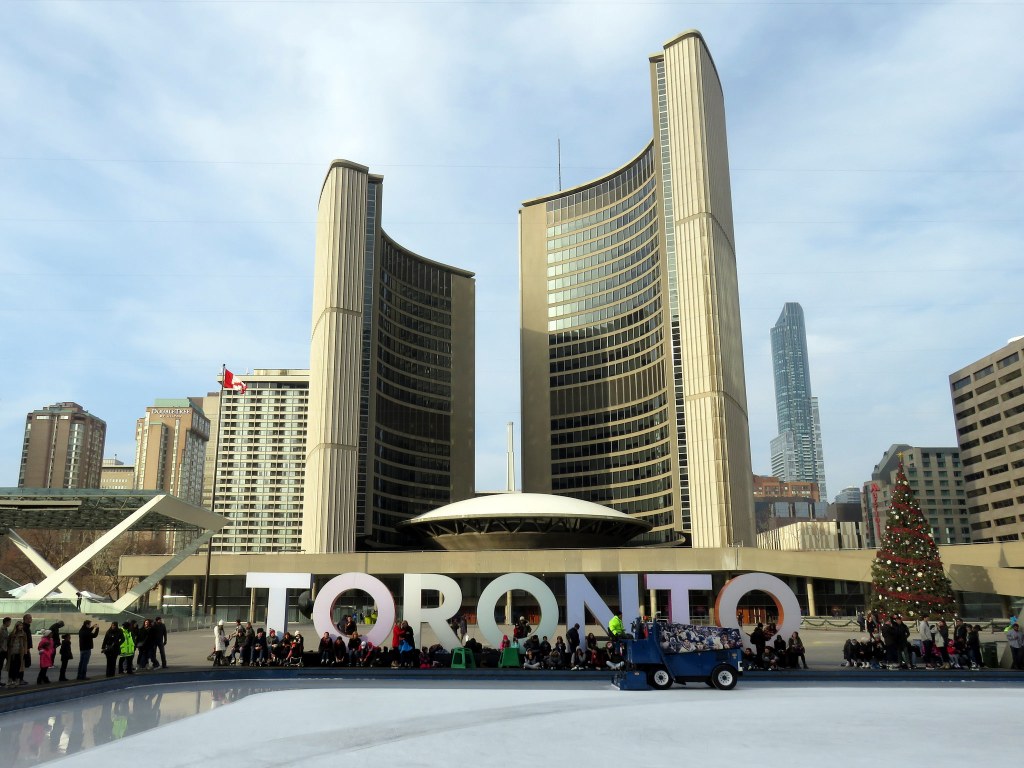
    The Toronto sign, placed on Nathan Phillips Square ahead of last year’s Pan Am Games proved to be incredibly popular with residents and tourists alike. The LED backlighting allows the sign to be coloured at night to mark any holiday or any important current or special event. The $100,000 climbable sign (reminiscent of the successful “I amsterdam” signs) was supposed to be temporary, and will have to be replaced within three years. A staff report estimate the cost of major repairs to the existing sign, and a new mobile sign, would cost $421,700 over two years. This would be money well spent.

    But some councillors, including Etobicoke’s Stephen Holyday and Scarborough’s Raymond Cho, would rather privatize the sign, perhaps selling it off. At least Councillor David Shiner, a fiscal conservative, called it “a potent symbol of Toronto pride and unity” after amalgamation, but even he questioned the need for paying for city staff to maintain the sign. A strong argument could be made that the costs to maintain the sign should come from Tourism Toronto and the local tourism industry, but calls from some quarters to sell it off are ridiculous.

    Last Friday, we learned that the estimated cost of building the one-stop, six kilometre subway extension to Scarborough Centre jumped from $2.0 billion to $2.9 billion. But unlike cycling infrastructure or fully funding an effective Vision Zero program to protect vulnerable road users, the mayor, key council allies, and provincial MPPs remain hell-bent on building it.

    Scarborough Centre MPP Brad Duguid, a powerful cabinet minister in the provincial Liberal government, quoted in the Toronto Sun, said that critics of the subway plan “…have been yapping away on this project from Day 1 and the vast majority of those critics come from fairly elitist downtown views of the city. People in Scarborough and the suburbs of Toronto count as well.” Duguid claimed that “the area surrounding the new [Scarborough Centre] station is growing fast.” Never mind that population and employment densities are not very high along the subway route, even in Scarborough Centre, and no major commercial development has come to central Scarborough since the 1990s.

    On Metro Morning, Duguid, a former city councillor who endorsed John Tory’s mayoral bids in 2003 and 2014, doubled down on his previous rhetoric. He repeated false claims about Scarborough Centre’s growth, claimed Scarborough residents have paid for downtown subway expansions, he even stated that the Scarborough Subway “transcends politics” (which earned a guffaw from host Matt Galloway).

    I live downtown, and I don’t use the subway; like many who live here, I walk to work. Many others cycle, or take overcrowded streetcars on King and Queen Streets. The Yonge Subway is overcrowded from commuters from outside the downtown core. Most downtowners wouldn’t directly benefit from a Relief Line either, but it’s an essential part of the network. The last subway built in Downtown Toronto was in 1966. I’m hardly an “elitist” either; I rent my apartment. I don’t enjoy many luxuries, and I certainly don’t hold a position of power or influence. I simply want the best transit for the best price; the Scarborough LRT, along with GO Transit RER and the Eglinton-Crosstown and Scarborough-Malvern light rail corridors represent the right investment for the eastern half of Toronto.

    We’re content to keep up an underused section of the Gardiner at greater expense than an urban boulevard, at the cost of lost development opportunities on the eastern waterfront. We’re committed to a $2.9 billion, 6 kilometre one-stop extension when a 10 kilometre, 6-stop LRT would cost $1.8 billion, funded entirely by the province. But we’ll complain about umbrellas and washrooms, budget too little for road safety plans, and question the costs of maintaining a popular sign at City Hall. I love this city, but sometimes Toronto still gets me down.