Tag: Josh Matlow

  • Mapping the 2023 mayoral byelection

    Last week Monday, I was at Spacing’s election night party at a pub in the Annex, watching the results of the election roll in after 8PM. Public polls consistently saw former Toronto city councillor and NDP MP Olivia Chow leading an especially crowded race of 102 candidates for mayor. It was the most exciting election I’ve followed since at least 2014.

    Former three-term councillor Ana Bailão, one of former mayor John Tory’s protégées, was consistently in second place, followed by former Toronto Police Chief (and provincial PC candidate) Mark Saunders, sitting councillors Josh Matlow (who ran as a progressive) and Brad Bradford (who ran to the right), and right-wing columnist Anthony Furey. Though Bailão, a centrist, had the endorsements of multiple sitting councillors, Liberal MPs and MPPs, and several public and private sector unions, she had difficulty positioning herself as the presumptive centre-right challenger, especially with Premier Doug Ford backing Saunders.

    It was not until the advance polls had closed that Deputy Mayor Jennifer McKelvie, the Toronto Star Editorial Board, and then Tory himself endorsed Bailão, likely spooked by Chow’s continued lead. (David Rider and Ben Spurr at the Star wrote a great article about the leadup to Tory’s endorsement.) Tory, who resigned after admitting to a long-term city hall affair, hummed and hawed over providing his endorsement, and hid from reporters even while robocalling Torontonians pleading them to vote for his appointed successor.

    It is quite possible that Tory’s endorsement came too little, too late for Bailão. Nearly 150,000 electors (representing 21.7% of all votes cast) already voted in advance polls or by mail, and their votes were locked in. But the late push for Bailão was able to convince at least some election day voters to choose strategically — the percentage of voters who chose Saunders, Furey, and Matlow fell, while Bailão’s share grew on election day. Indeed, Bailão placed first among election day voters. But Chow, whose campaign encouraged advance voting, carried the day in the end.

    For example, Josh Matlow placed a close second in Ward 12 in the advance polls (with 30.6% of the vote), where he’s a popular local councillor. On election day, Matlow placed third behind Bailão and Chow, with Chow eking out a narrow win overall there. In every ward, Chow placed first in the advance polls, but when all votes were counted, she placed first in 14 of the 25 wards. The table below shows how the vote shifted.
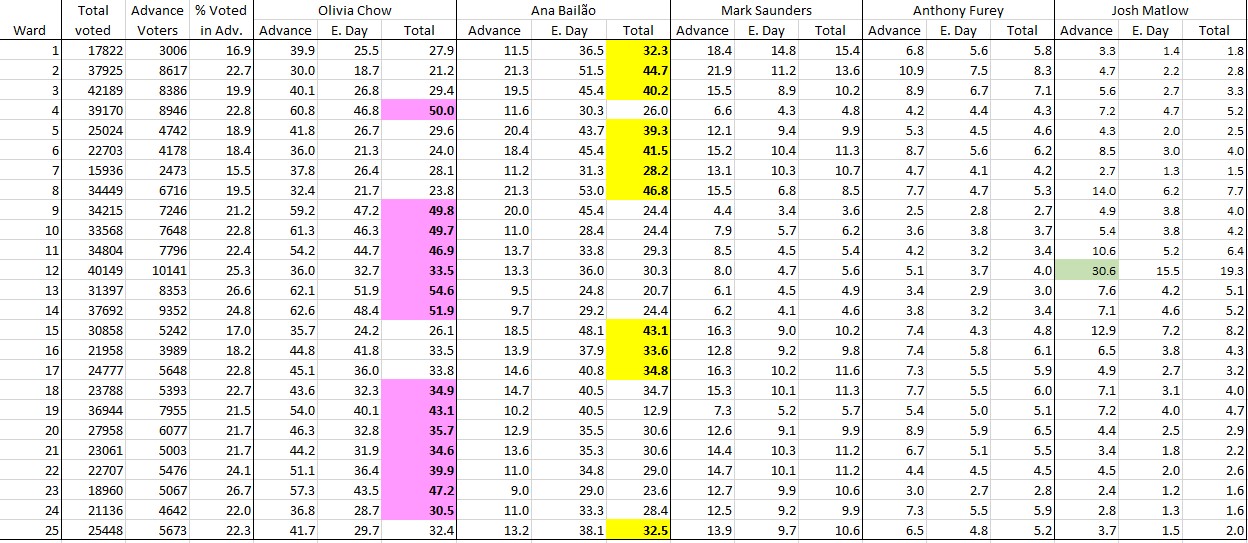
    Table of ward-level mayoral byelection results, showing advance poll and election day results for the leading five candidates. PDF version here.

    Chow won with 269,372 votes (37.2%) to Ana Bailão’s 235,175 (32.5%). Saunders, Ford’s pick, got just 8.6% of the vote despite his positioning as the only candidate to “stop Chow.” Furey placed a distant fourth, with 5%, and Matlow got 4.9%, acknowledging that Bailão’s late surge draw support away from him and towards Bailão and Chow. Brad Bradford was the biggest loser of the night, netting just 1.3% and placing fifth in his own ward.
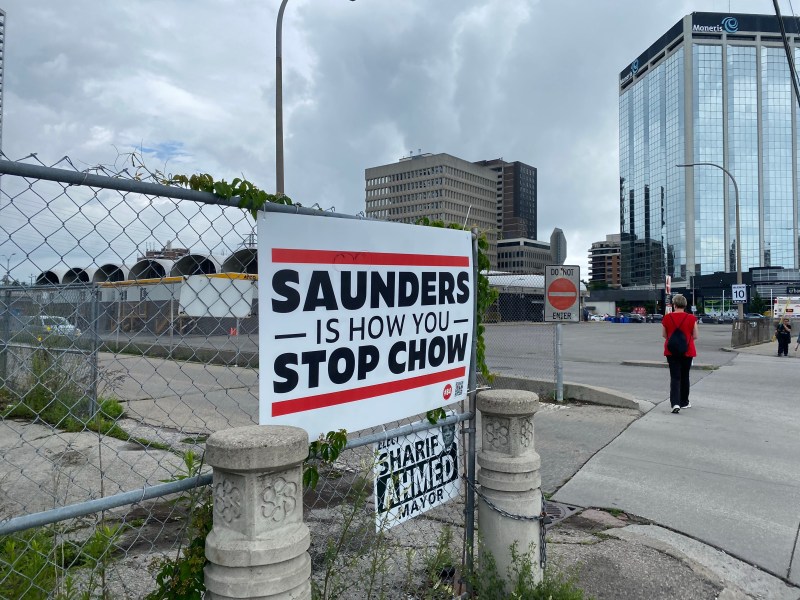
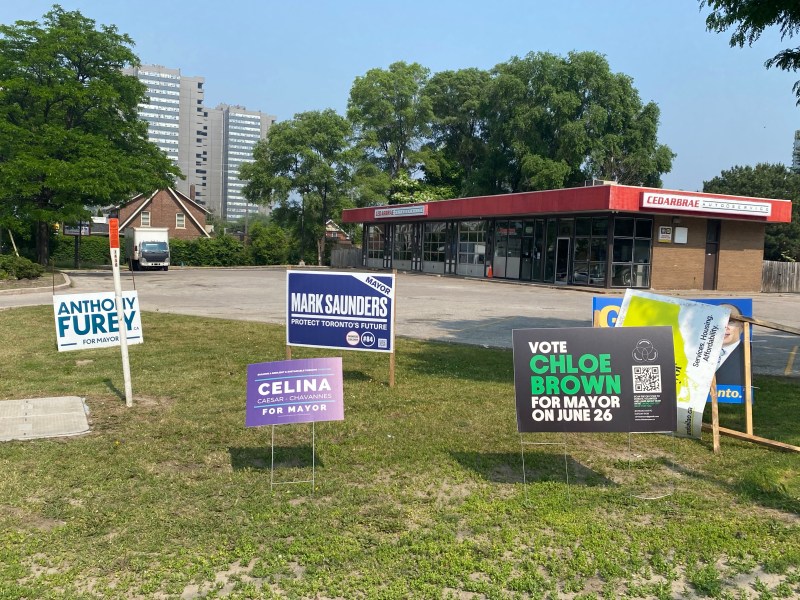
    “Saunders is how you stop Chow” sign

    Though I was skeptical of Olivia Chow’s second run for mayor after an uninspiring run against Rob and Doug Ford and John Tory in 2014 (she placed third), she proved herself worthy this time around. She was more relaxed, more herself, and certainly tapped into a desire for change after eight years of Tory’s dull austerity and four years of chaos under Rob Ford (enabled by his brother Doug).

    I fear Toronto’s political establishment — both Conservative and Liberal — will try to make Chow’s term as mayor difficult, even though their low-tax, low-spend agenda caused many of the problems that she will have to tackle. But for now, I’m pleased we will try it her way.


    I created an interactive map showing the results of the election at the ward and electoral subdivision (poll) level. For the wards, I provided information on the advance and election day poll results.

    Note that not all polls are mapped. Until the City of Toronto releases revised electoral subdivision boundaries (I suspect due to poll consolidations), there are some missing polls. However, 95% of all polls are depicted, and the results are interesting.

    I look forward to your feedback as well; I approve all reasonable comments and reply to most emails.

    Link to map

    Thanks to David Del Grande for pointing out a needed correction.
  • Mapping the council race in Ward 12 – Toronto-St. Paul’s

    As mentioned in my last post, Bill 5, introduced by Premier Doug Ford in the middle of Toronto’s municipal election campaign, had a silver lining: it finally rid Toronto City Council of its greatest embarrassment, Giorgio Mammoliti. Otherwise, though, it had terrible effects. It removed the opportunity for many new voices to get elected to City Council by reducing the number of seats from 47 to just 25. In Ward 12, voters had a very difficult decision to make, as Josh Matlow and Joe Mihevc found themselves running against each other. Previously, both councillors expected to cruise to victory; neither were facing any prominent challengers under the 47-ward model.

    Joe Mihevc, allied with the New Democratic Party, is one of the best arguments against council term limits. Representing old Ward 21, Mihevc has been a very popular and effective community representative. Ward 21 includes wealthy neighbourhoods such as Cedarvale, Wychwood Park, and the west half of Forest Hill. It also includes more modest neighbourhoods north of St. Clair Avenue and west of Bathurst Street. Two of Mihevc’s signature accomplishments were championing the St. Clair Avenue streetcar right-of-way and the Wychwood Barns project, where a former TTC streetcar yard was transformed into a wonderful park, art space, and community hub.

    Josh Matlow, a Liberal, was elected to City Council in 2010 in old Ward 22. Matlow’s ward includes much of Toronto’s midtown area, affluent neighbourhoods such as Deer Park, Rathnally, and the eastern half of Forest Hill, as well as highrise apartments near Yonge and Eglinton and along Davisville Avenue. Matlow started his first term as an idealistic centrist, but made his mark as a sharp and informed critic of Rob Ford and John Tory, especially the Scarborough Subway.

    Both Mihevc and Matlow became well-known for their involvement in local and city-wide issues. Mihevc has been very active in public health and anti-poverty matters. While Matlow is well-known for pushing for smarter transit infrastructure, he was also busy managing growth in his ward, especially in the Yonge-Eglinton area. Both have been very active in their wards, working on community improvements which make it so unfortunate that only one of the two could be re-elected.

    Though Joe Mihevc is well to the political left of John Tory, the mayor backed Mihevc. This wasn’t surprising given the amount of bad blood between Tory and Josh Matlow. The mayor robocalled for Mihevc, like he did for Brad Bradford in Ward 19, and Mark Grimes in Ward 3.

    But the voters in new Ward 8 chose Josh Matlow by a comfortable margin. Matlow got 51.6 percent of the vote to Mihevc’s 42.1 percent. The other four candidates shared the remaining 6.3 percent of the vote. This was one council race the mayor couldn’t influence.

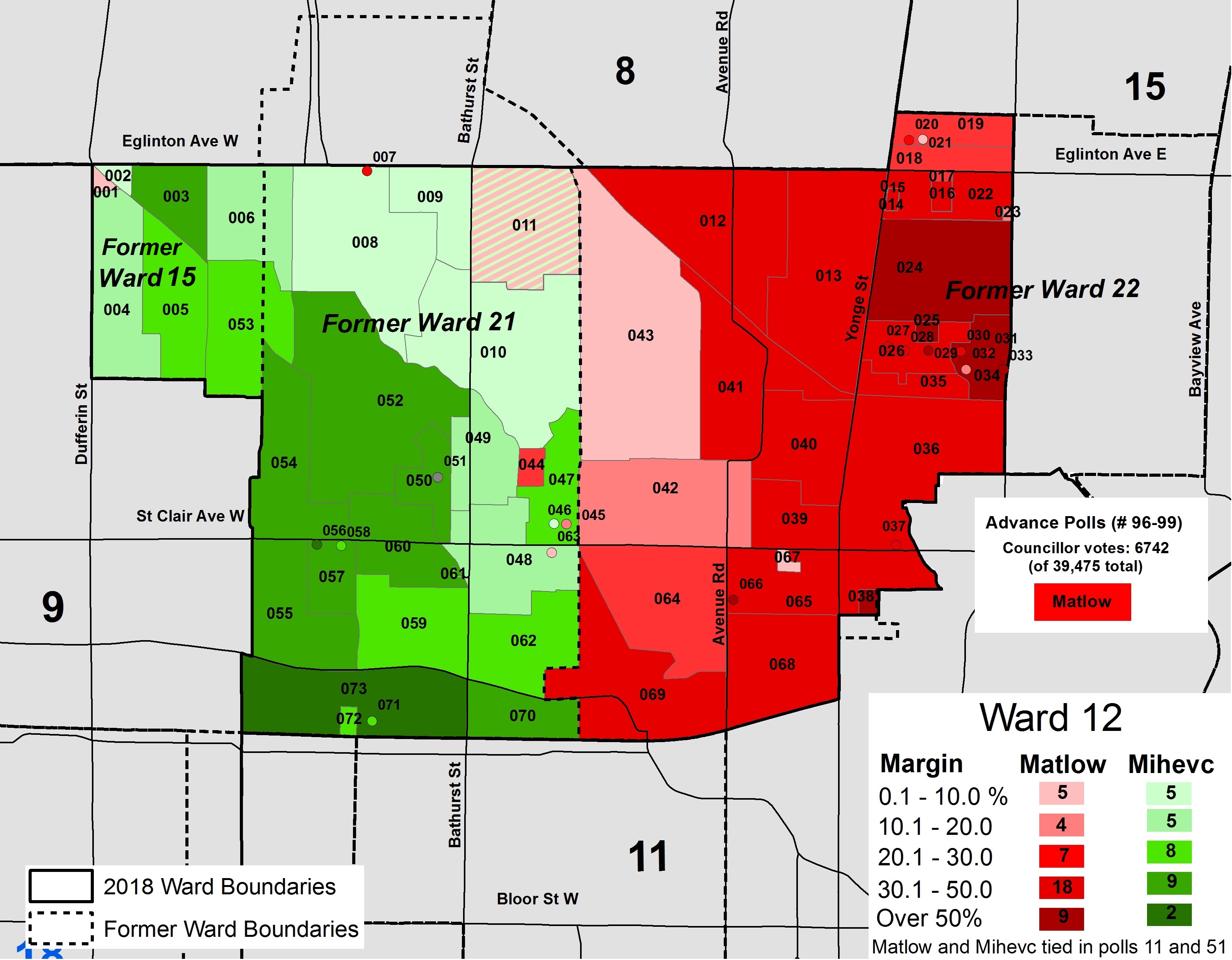
    2018-election-w12

    This result had more to do with geography than anything else. Both Mihevc and Matlow lost parts of their old wards due to the new boundaries — the part of Ward 22 east of Mount Pleasant Road moved to Ward 15, while the part of old Ward 21 north of Eglinton Avenue went to Ward 8. Mihevc was able to count on the support of 61 percent of the voters in former Ward 21, made up of 27 polls. Mihevc also came first in five of the six polls located in former Ward 15, west of Oakwood Avenue. Matlow placed first in only five of the 33 polls west of Oakwood Avenue, and tied with Mihevc in two.

    But there were 39 polls in former Ward 22, Matlow’s turf, where he remained especially popular, getting 66.4 percent of the vote there, and placing first in every poll. The advance poll heavily favoured Matlow as well.

    Doug Ford’s late-stage meddling made the 2018 election incredibly unfair, especially as candidates scrambled late to run in much larger wards. Matlow won because the new Ward 8 had a larger electorate from his old ward, rather than Mihevc’s. This wasn’t fair. But Bill 5 wasn’t meant to be fair.

    But by sending Josh Matlow back to City Council, instead of a more conciliatory Joe Mihevc, John Tory won’t have such an easy time getting his agenda through.

    Ward 12 Toronto-St. Paul’s
    Candidate Total votes Percentage
    Elizabeth Cook 908 2.3
    Artur Langu 290 0.7
    Ian Lipton 930 2.4
    Josh Matlow 20371 51.6
    Joe Mihevc 16634 42.1
    Bob Murphy 342 0.9

    Note: This post is revised from a previous version to better describe some of the community work done by city councillors. 

  • Gardiner East update: a close vote, but one Tory is likely to win (updated)

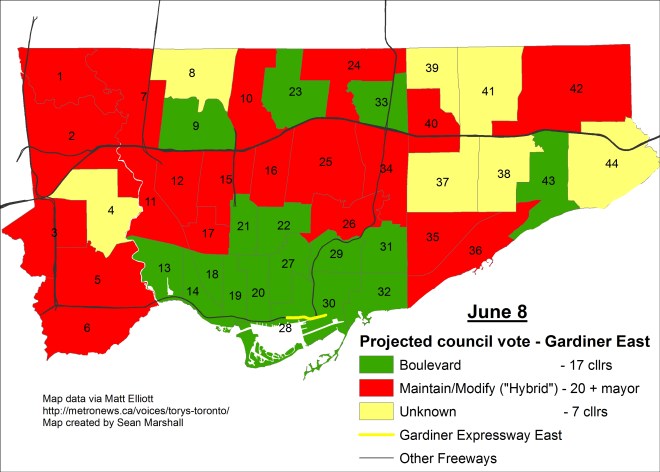
    East Gardiner Vote - June 8
    Projected Gardiner East council vote as of Monday, June 8.

    (Updated 5:00 PM, June 8)

    With Councillors Jon Burnside and Raymond Cho coming out in support of the “Hybrid” option for the Gardiner East, and Councillor John Filion supporting the Removal/Boulevard option, here’s the latest map. Only seven councillors are considered “unknown” in their intentions for this week’s vote; John Tory and pro-expressway advocates only need two more councillors on their side to win a razor thin 23-22 vote. The new map, based on Matt Elliott’s tally (PDF here), is above. Councillor Jim Karygiannis withdrew his support for the “Hybrid” and is asking constituents for their feedback on Twitter.

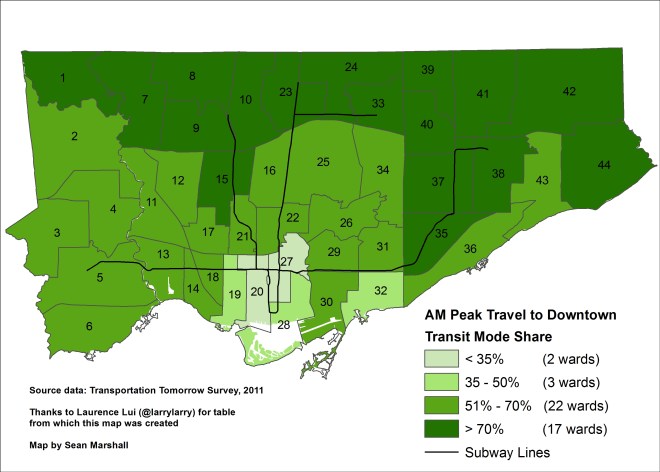
    As Council is divided mostly on suburban-urban lines, It’s worth noting that most Toronto commuters headed downtown take transit; even in the outer areas where transit access is lacking, and travel times long. In every ward completely north of Highway 401, more than 70 percent of weekday AM peak trips to Downtown Toronto are made by public transit – either TTC buses and subways or by GO train. In 39 of 44 wards, a majority of commuters take transit.

    In only seven wards do auto commuters have more than 40 percent of the mode share. Only one ward, Ward 32, which includes the affluent Beach(es) neighbourhood, do auto commuters outnumber transit riders in the AM Peak. Good road access, high auto ownership rates and lousy TTC surface routes (the notoriously slow, short-turning 501 Queen Car) are the likely explanations for this anomaly. Downtown, in Wards 20, 27, and 28, at least half the commuters to downtown jobs, schools or institutions take “other” means of transportation; mostly walking or cycling.

    Ironically, those councillors most in favour of rebuilding the Gardiner Expressway represent constituents who aren’t using the Gardiner Expressway – or any other road – to get downtown.

    I created these two maps with data from the table created by Laurence Lui (Google Drive PDF here). He obtained and disseminated survey data from the 2011 Transportation Tomorrow Survey,  a comprehensive travel survey conducted every five years in the Greater Toronto and Hamilton Area.

    Downtown AM Peak Mode Share - Transit

    Downtown AM Peak Mode Share - Auto

    (more…)