Tag: City Hall

  • Let’s not be jealous of Montreal

    Let’s not be jealous of Montreal

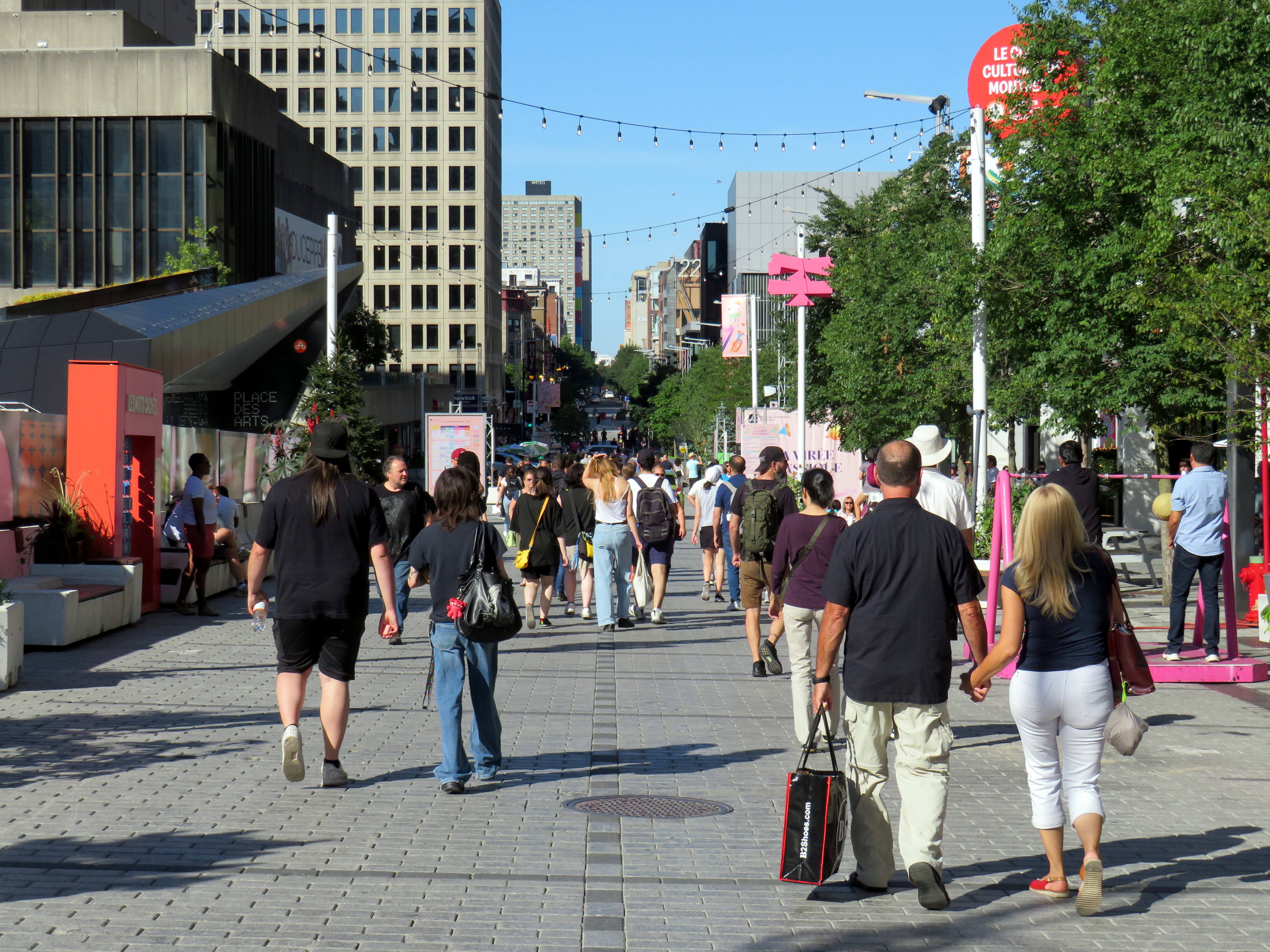
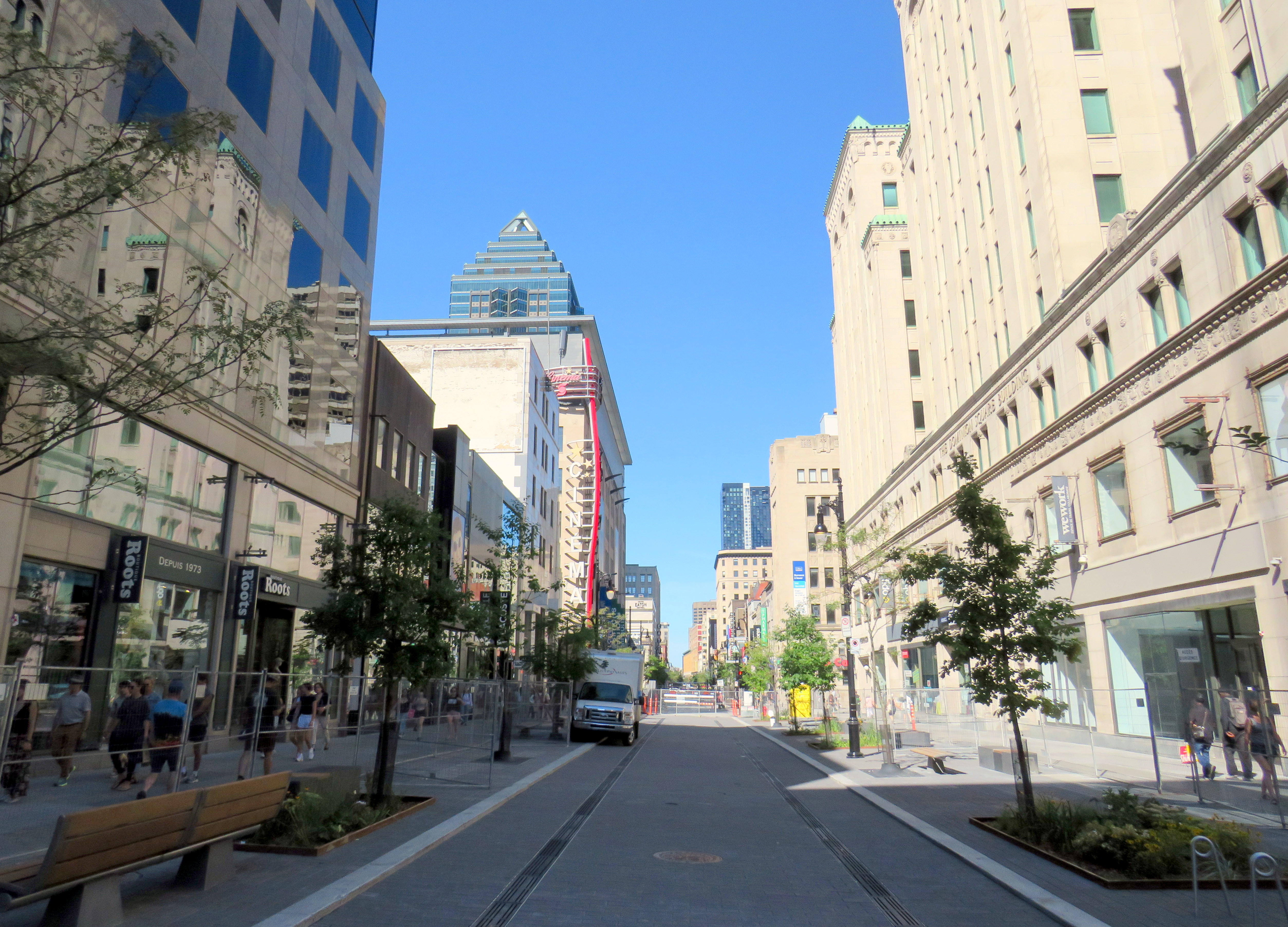
    Rue St-Catharine in the Quartier des Spectacles, August 2025

    A visit to Montreal can make one jealous. Jealous of the city’s better street furniture, greater cycling infrastructure, great public spaces throughout the city, and an improved pedestrian realm. Entire streets are closed in the summer months to motor traffic, allowing pedestrians to spill out into the roadway, and patios to sprout without the need for concrete blocks to protect them (and less noise and pollution to those dining al fresco).

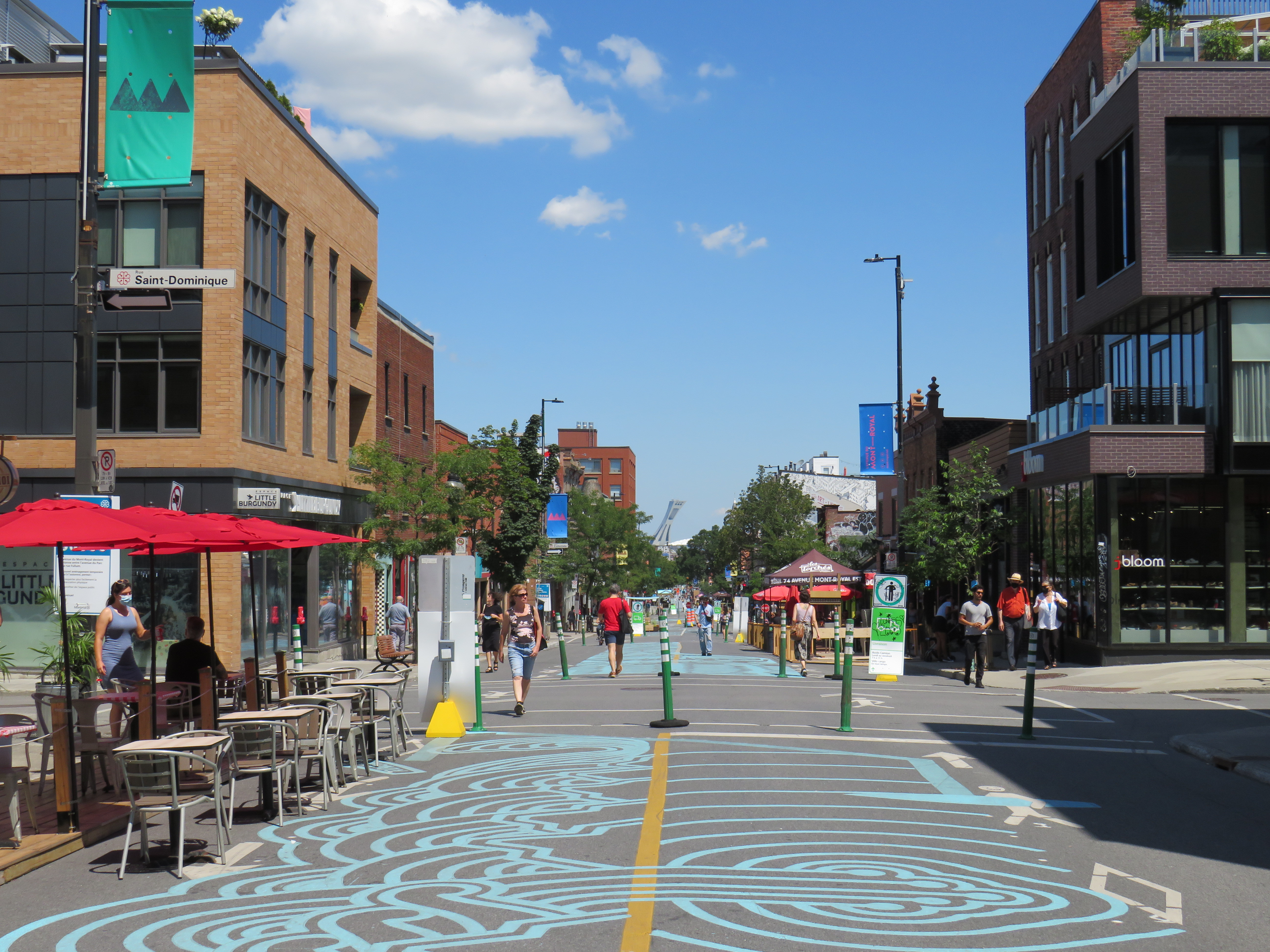
    For example, Avenue Mont-Royal, was first closed in Summer 2020 as a “Corridor Sanitare” to encourage people to get outside during the first wave of the COVID-19 pandemic and support local businesses, which set up patios on the sidewalk and the street. My spouse and I rented a car and visited Montreal during this time, getting a lot of walking in a city that opened up as much as safely possible.

    Avenue Mont-Royal, looking east, August 2020

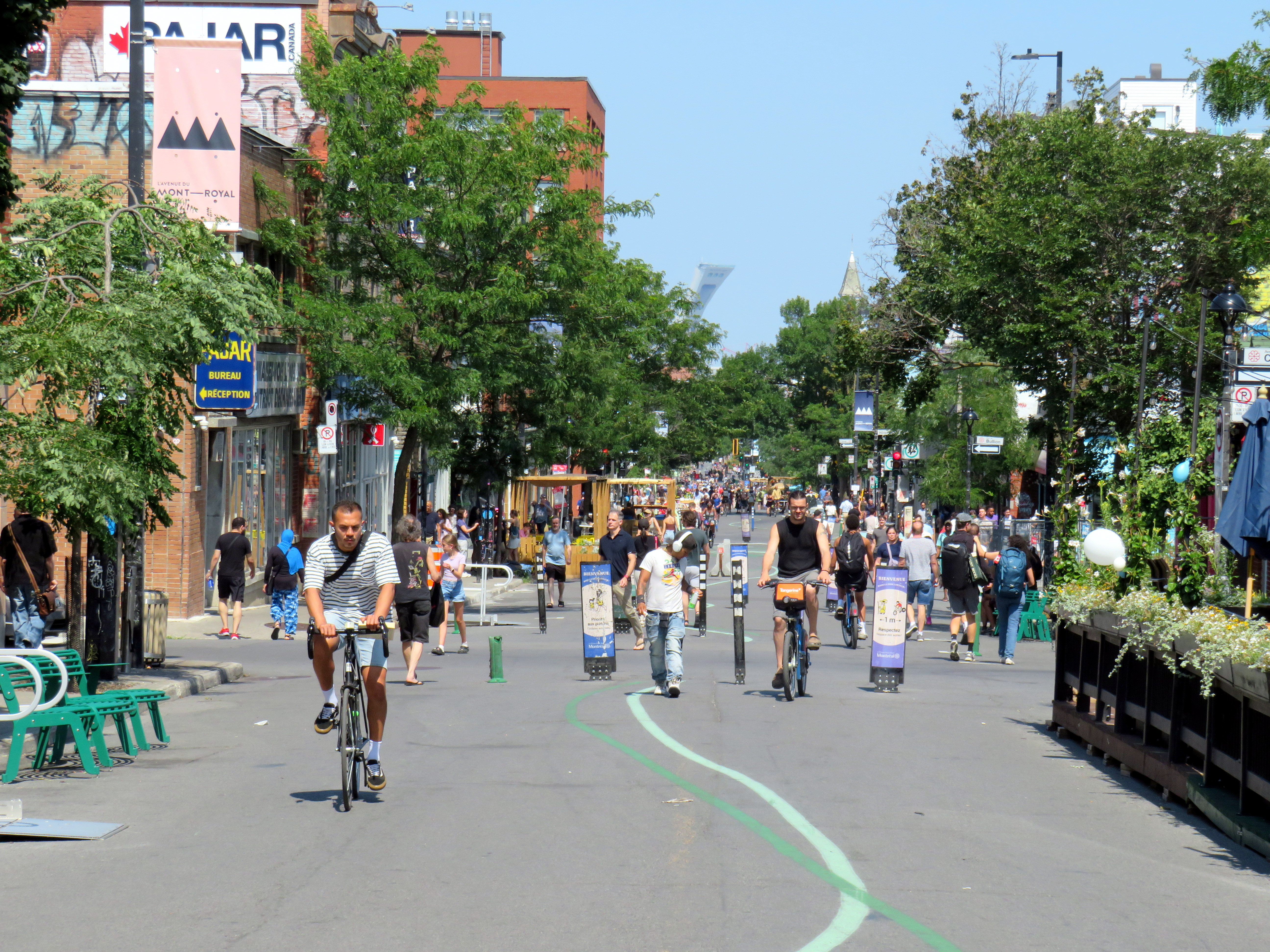
    Happily, Montreal continued the tradition in the years since, even as pandemic restrictions eased, then disappeared entirely. Five years later, Avenue Mont-Royal was even more vibrant. Not only were there lots of patios on the street, there were public benches, shade structures, and water fountains, allowing anyone to sit, relax, and enjoy the outdoors. The annual summer closure is a hit.

    Avenue Mont-Royal, looking east, August 2025

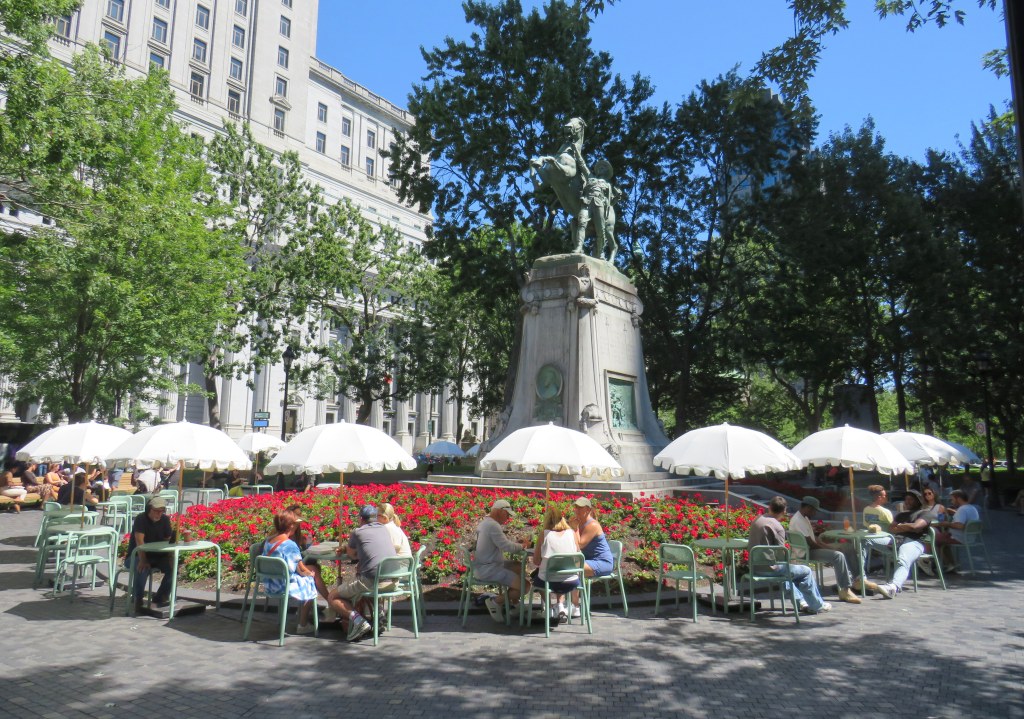
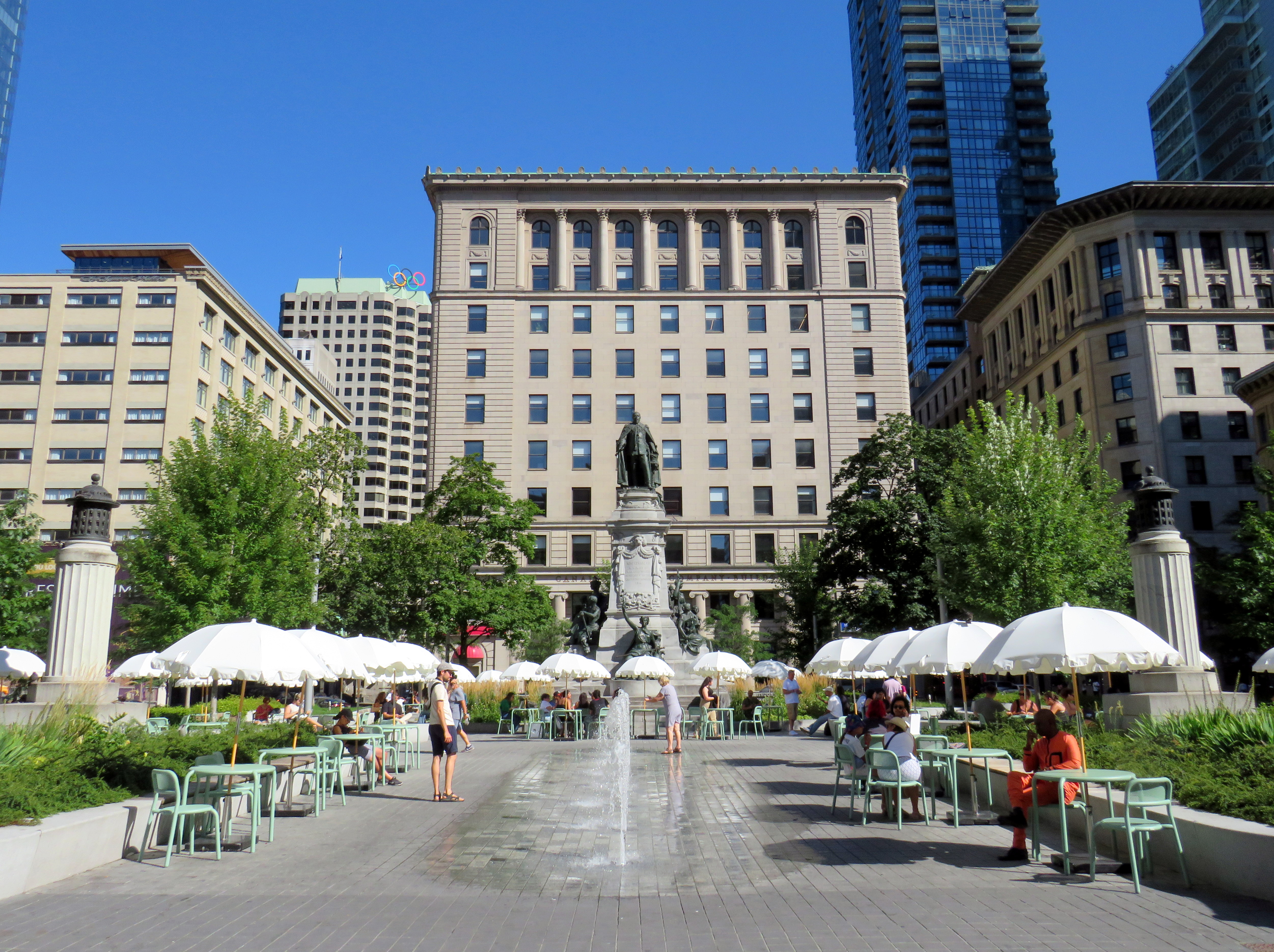
    Several public squares were also renewed in recent years. Phillips Square, on Rue Ste-Catharine across from the now-shuttered Hudson’s Bay department store, was renewed with new splash fountains along with small café-style tables and chairs, complete with shade umbrellas. The metal chairs are movable, allowing larger groups to sit around a single table. It’s a refreshed natural congregation point along the city’s main shopping street.

    Phillips Square, August 2025

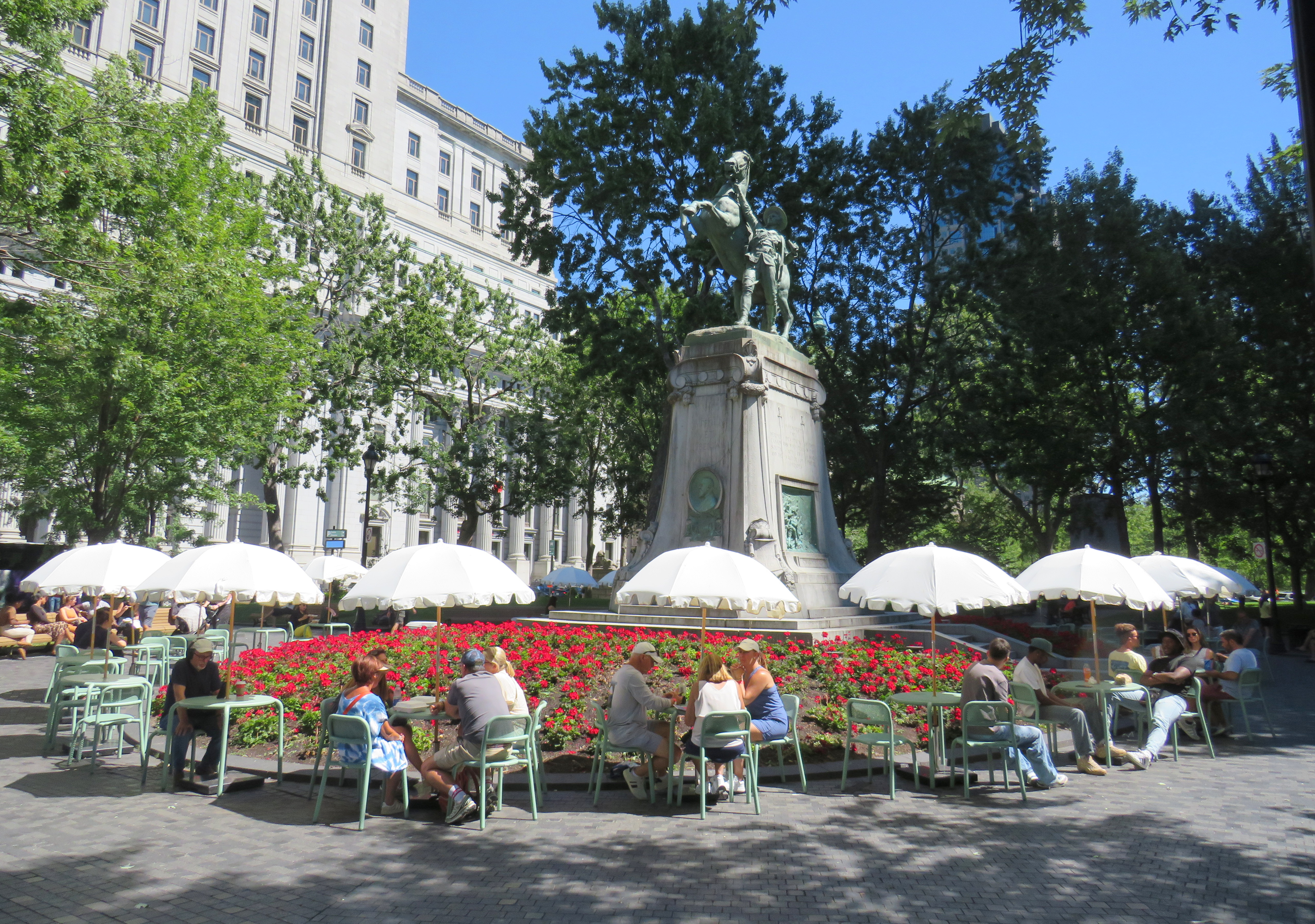
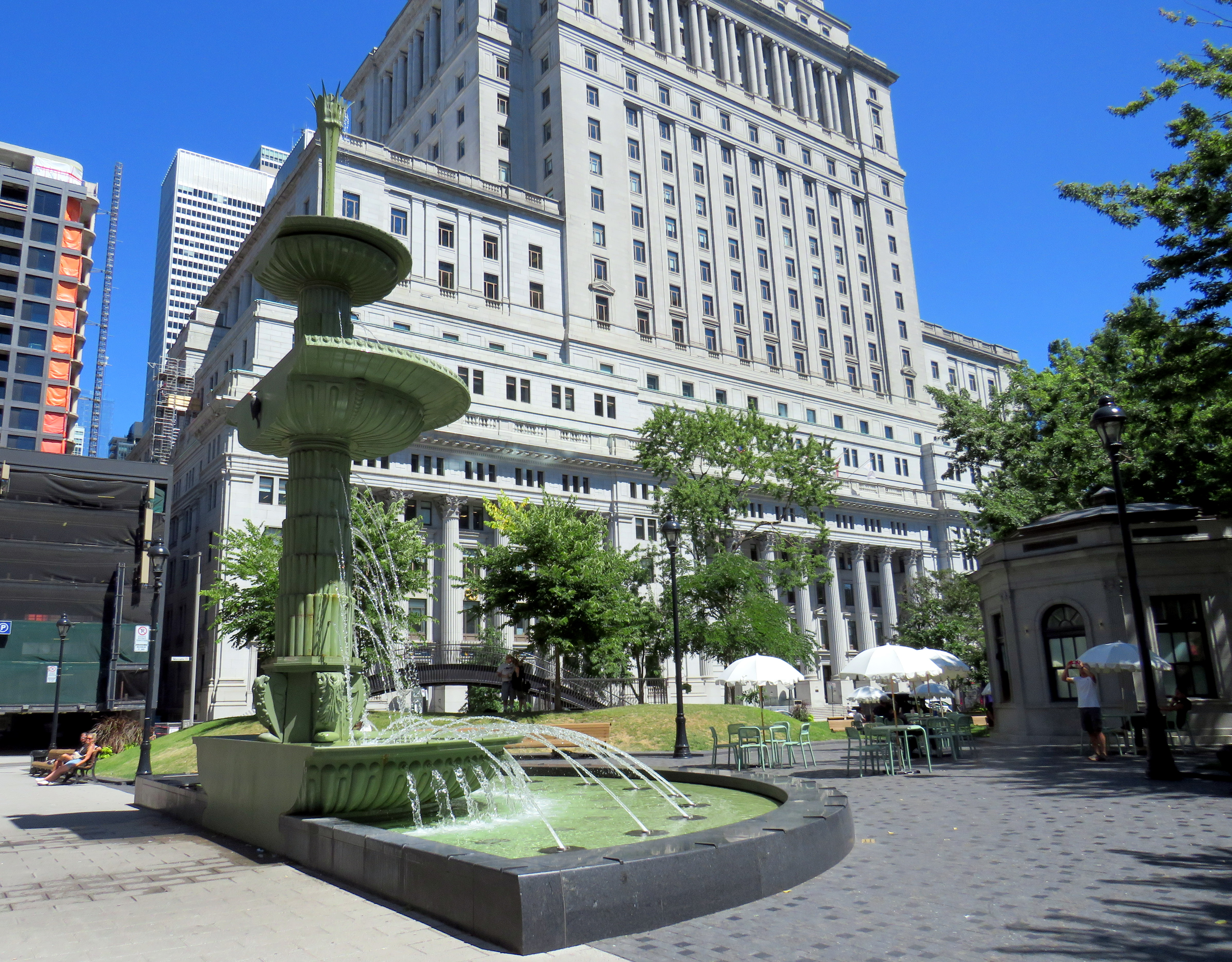
    Similar tables and umbrellas were set up at Dorchester Square, several blocks to the west, near Mary, Queen of the World Cathedral and Central Station. Both squares were reimagined by the brilliant landscape architecture firm Claude Cormier + Associés. At Dorchester Square, a new water fountain, seemingly a classic installation, is cut in the rear, with a woodpecker behind. Such Easter eggs are features of Cormier park projects.

    Dorchester Square, August 2025
    Fountain at Dorchester Square; note the woodpecker on the side. One of the two black curved footbridges across the parking ramps is behind.

    Furthermore, Montreal is rebuilding the western section of Rue St-Catharine towards Crescent. Though motor vehicles are permitted after reconstruction, they are limited to a single through lane, with lay-bys for deliveries, passenger pick-ups and drop-offs, and emergency vehicles. Sidewalks are widened considerably, with more benches, bicycle parking, and street trees.

    Completing Rue St-Catharine, near Bishop Street

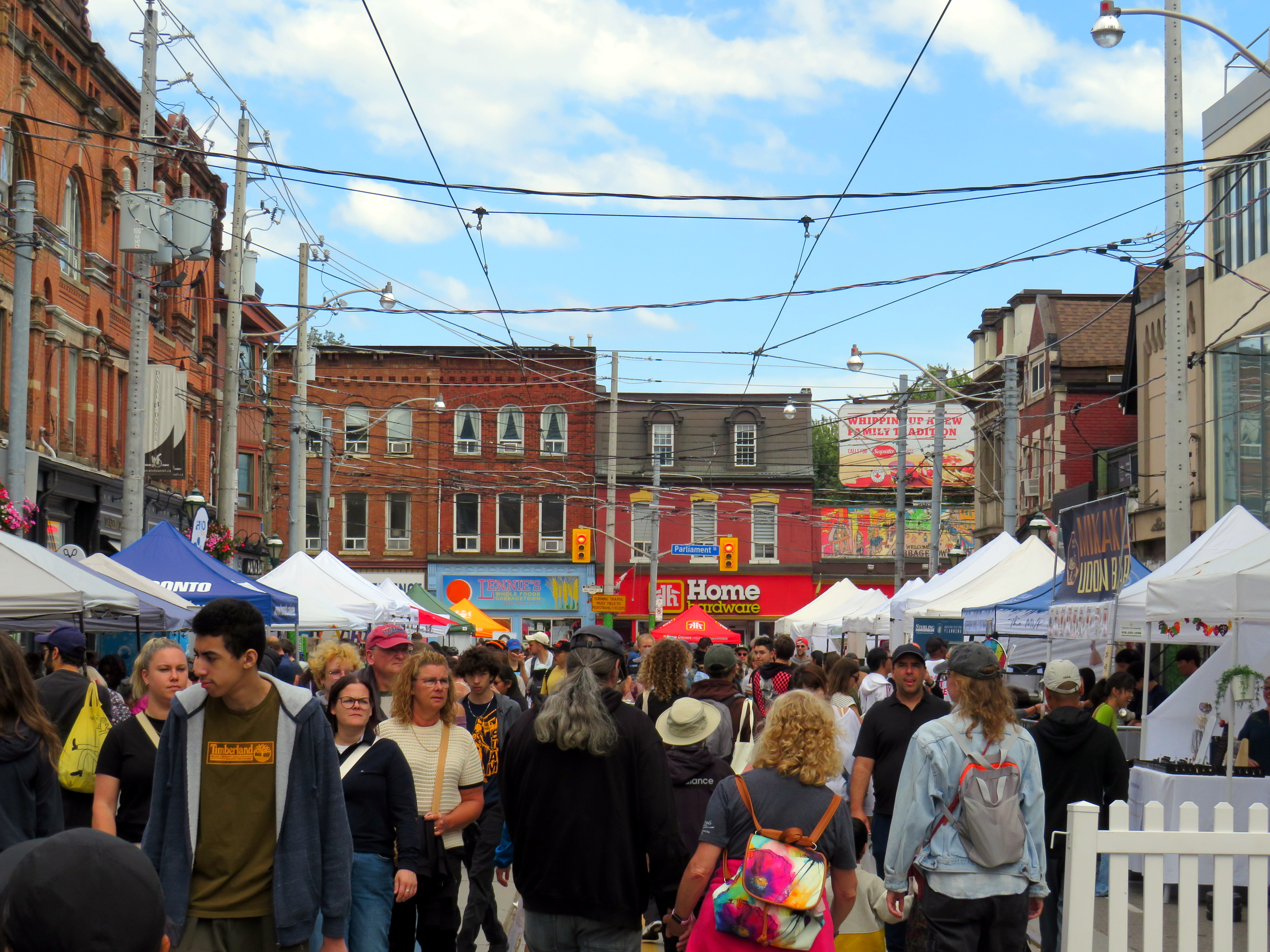
    After returning to Toronto, it’s easy to feel down on this city. Montreal seems to do everything right. Meanwhile, ActiveTO, the open streets initiative following the pandemic restrictions here, quickly eroded, and was effectively ended in 2022. Open Streets, which closed sections of Yonge and Bloor Streets to motorists for two Sunday mornings, was last held in 2022. But there are still business improvement area-led weekend street festivals, which attract tens of thousands of pedestrians.

    Torontonians want to walk, and pedestrianized streets, even when they’re just weekend events, are immensely popular. One downside, however, is a lack of seating outside of businesses’ patio areas. One is free to walk, enjoy live music, or just people watch, but to sit down, one is compelled to purchase something from one of the businesses with a sanctioned patio.

    Torontonians love a street festival: Cabbagetown in September

    There are a few other successes. A small segment Gould Street at Toronto Metropolitan University was pedestrianized and rebuilt as a central plaza for that university campus. A short section of Willcocks Street at the University of Toronto was similarly pedestrianized.

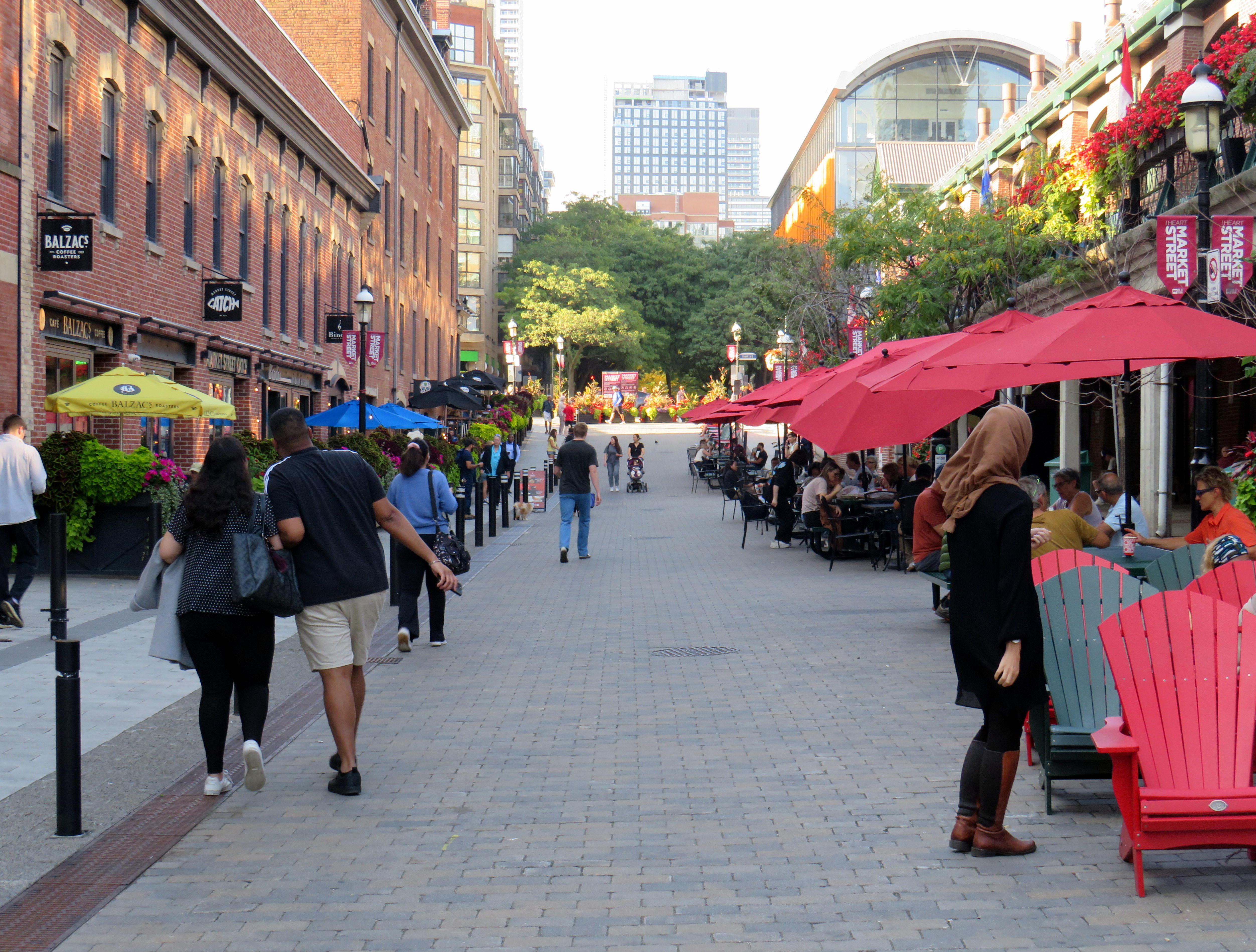
    But the best example in Toronto is Market Street, which abuts St. Lawrence Market. Patio space and Muskoka chairs provide plenty of seating, without obligation to purchase anything (though it provides additional seating to those who picked up a snack or lunch inside the market). The shade umbrellas and high-quality surface materials and street furniture make this a wonderful oasis in Toronto’s downtown core.

    Market Street looking north from The Esplanade. St. Lawrence Market is on the right.

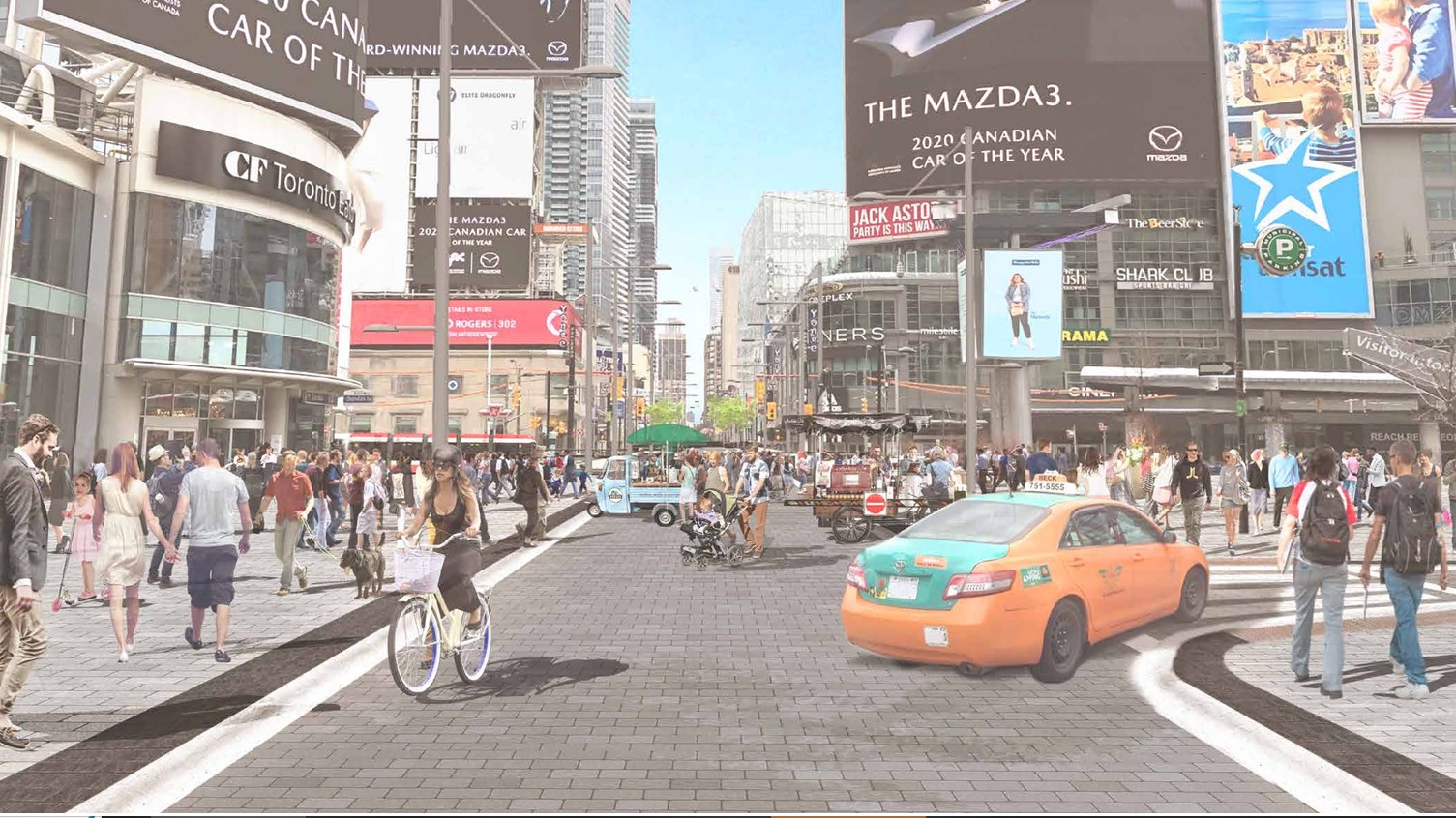
    Planning for Yonge Street’s makeover, which will include narrowing the roadway, widening the sidewalks, improvements to the public realm, and seasonal closures of selected sections of the traffic lanes, is complete. Unfortunately, the YongeTOmorrow improvements will have to wait for another five years (work starting in 2030) due to Ontario Line construction.

    Rendering of Yonge Street looking north towards Dundas, once YongeTOmorrow improvements are complete

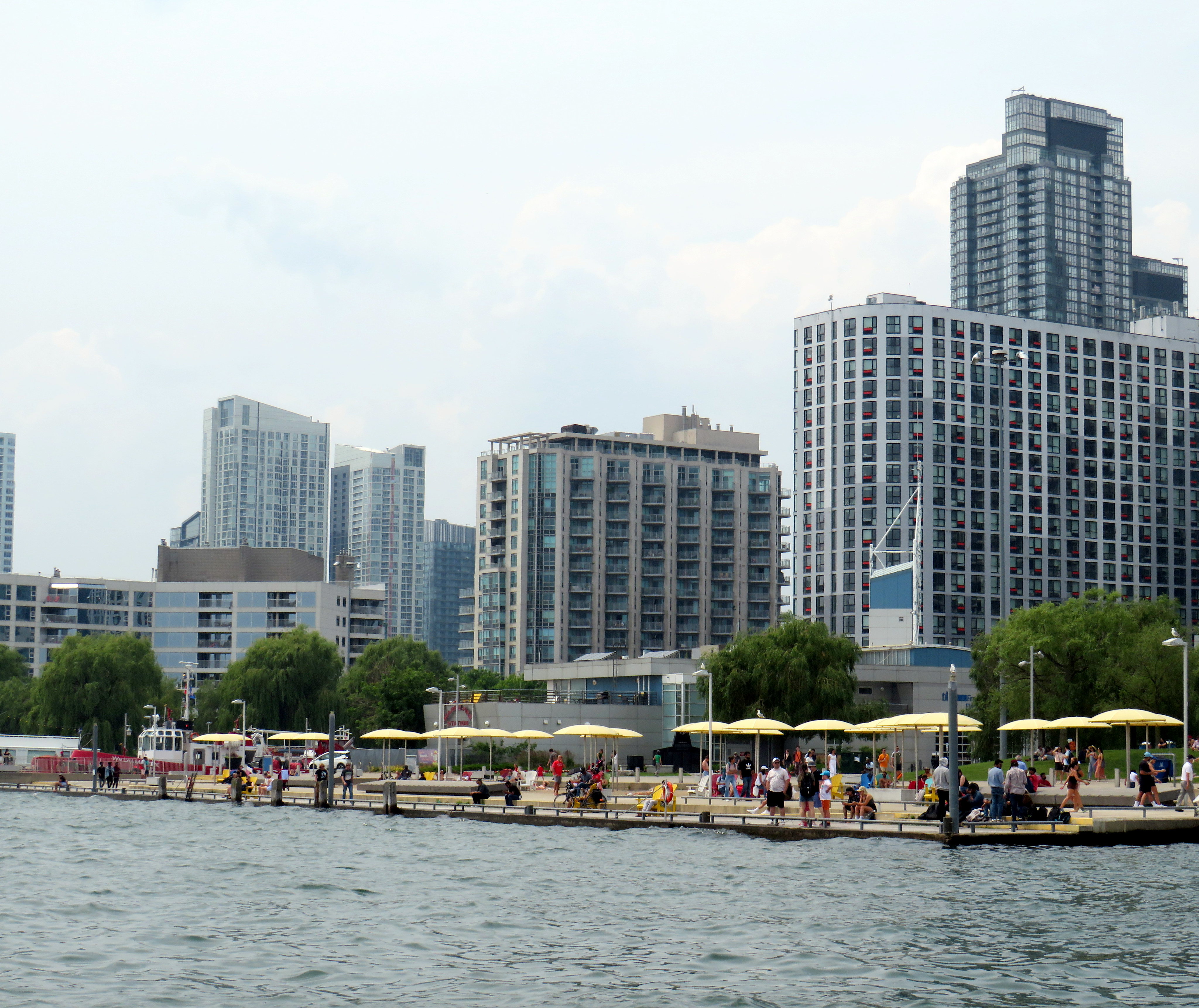
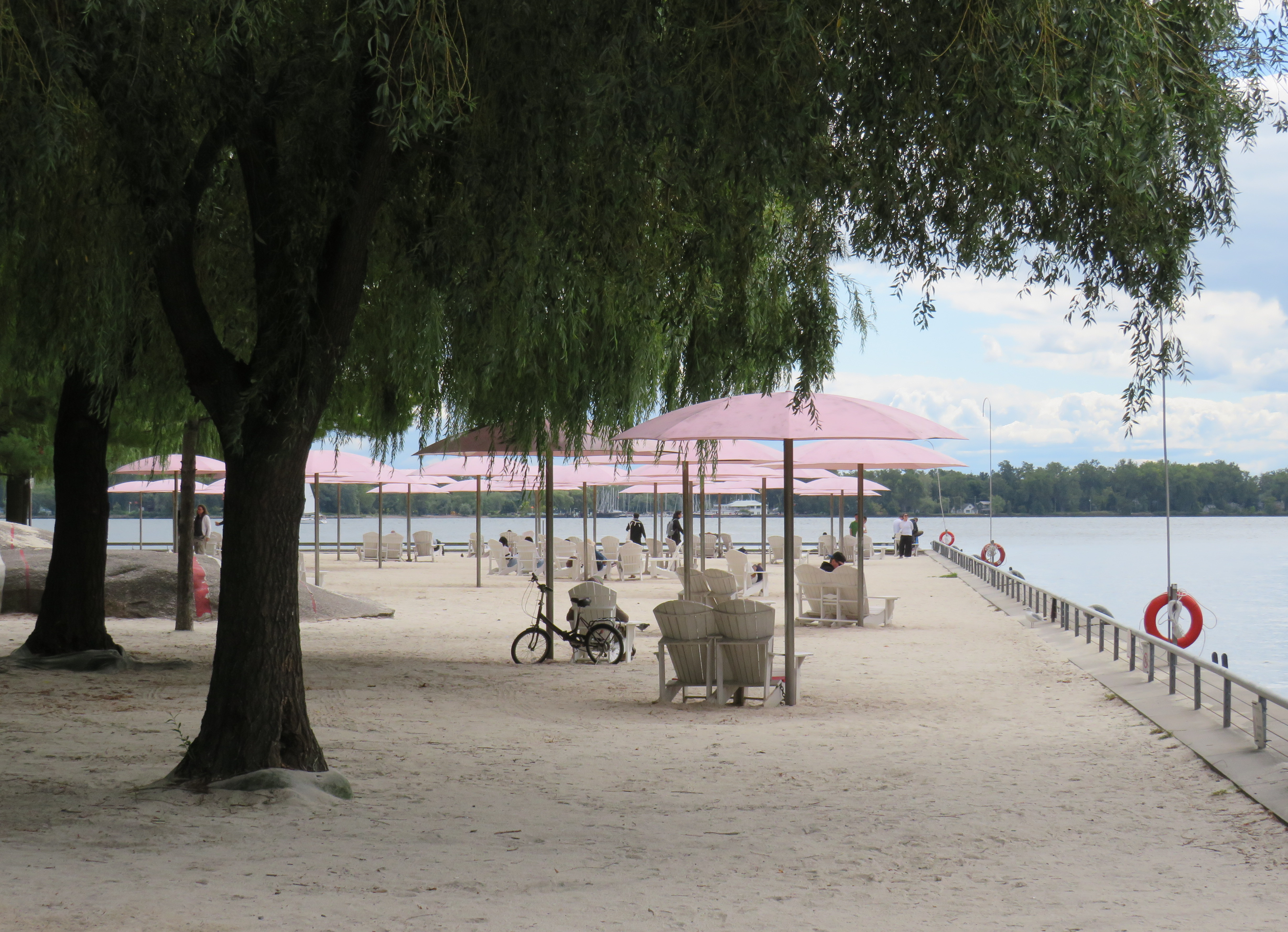
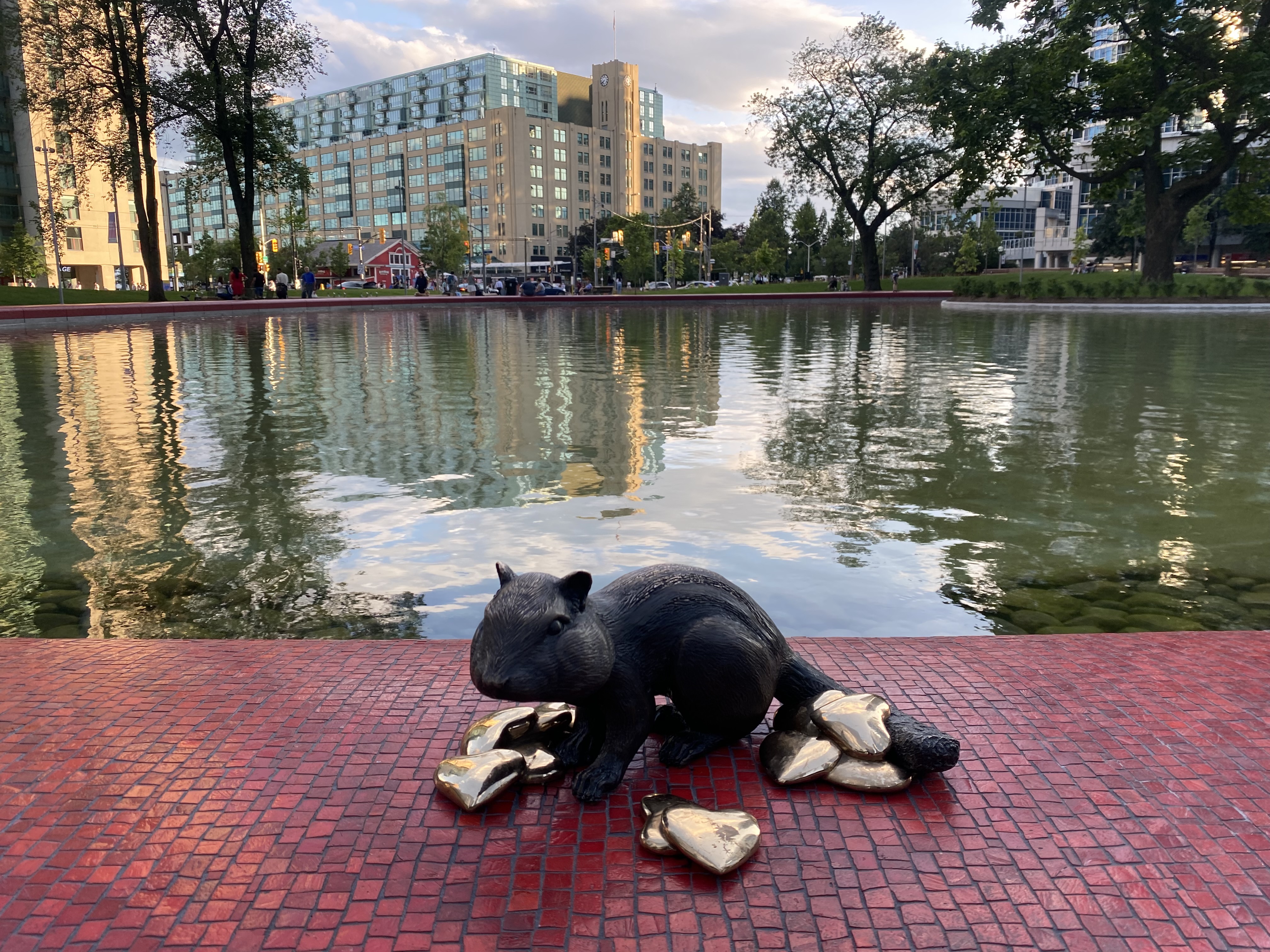
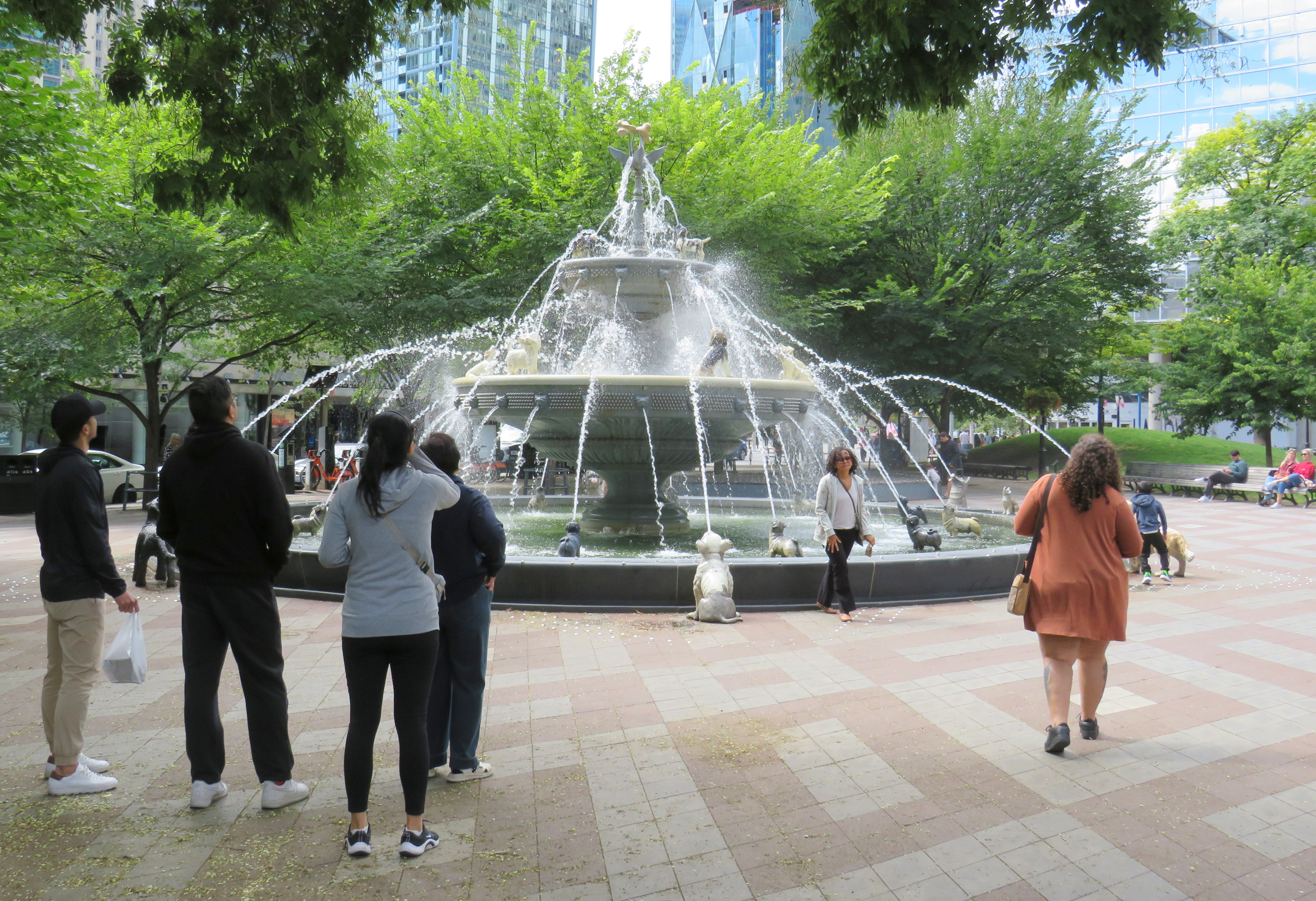
    There are also other great things happening in Toronto. Claude Cormier was tapped to create new public spaces, such as HtO Park and Sugar Beach on the Harbourfront, but also reimagine existing places such as Love Park (previously a highway off-ramp) and Berczy Park, home of the popular Dog Fountain. At Love Park, not one of the 45 movable chairs have been taken (though one ended up in the pond). Torontonians have been shown to cherish great public spaces.

    Toronto has made a lot of progress on improving its public realm, and it has shown that it is willing and able to close streets to traffic for the benefit of pedestrians and cyclists. Though it is so very easy to envy Montreal for its greater progress in the last two decades, it is up to us to continue the momentum Toronto does have, and work harder to push for change, even when there’s a car-focused provincial government. Streets can be narrowed, parks can be improved, and streets can be handed over to the people. Additional seating and more public washrooms will open up this city to many more residents and visitors.

    This should all be a key pillar of a progressive agenda in next years’ municipal election. When certain candidates talk about tax cuts, austerity, and crime, there needs to be a focus on creating a better quality of life to provide an alternative. And that talk must be backed up with action, with quick wins that don’t require multi-year waits.

  • Downtown Brampton’s next chapter

    Garden Square, at Main and Queen Streets, will be one of the two public spaces downtown to be rejuvenated

    After nearly two decades of little change, Downtown Brampton may finally be turning the corner from being a sleepy town centre to becoming the proper hub for a city of nearly 800,000.

    The Riverwalk, an ambitious plan to enhance flood protection from nearby Etobicoke Creek and create new public space, will break ground later this year. The extension of the Hurontario LRT into Downtown Brampton, by way of a deep-mined tunnel, was approved and funded by the provincial and federal governments. There will also be a new transportation hub to accommodate additional tracks at Brampton GO Station and support Brampton Transit ridership growth. City of Brampton is also hoping to get started on a new Centre for Innovation at the corner of Nelson and George Streets; it will contain a new central library as well as space for Toronto Metropolitan University and Rogers.

    Private sector development is also waking up. The first of a new wave of mixed-use high-rise developments, Rose Garden Residences, has started construction.

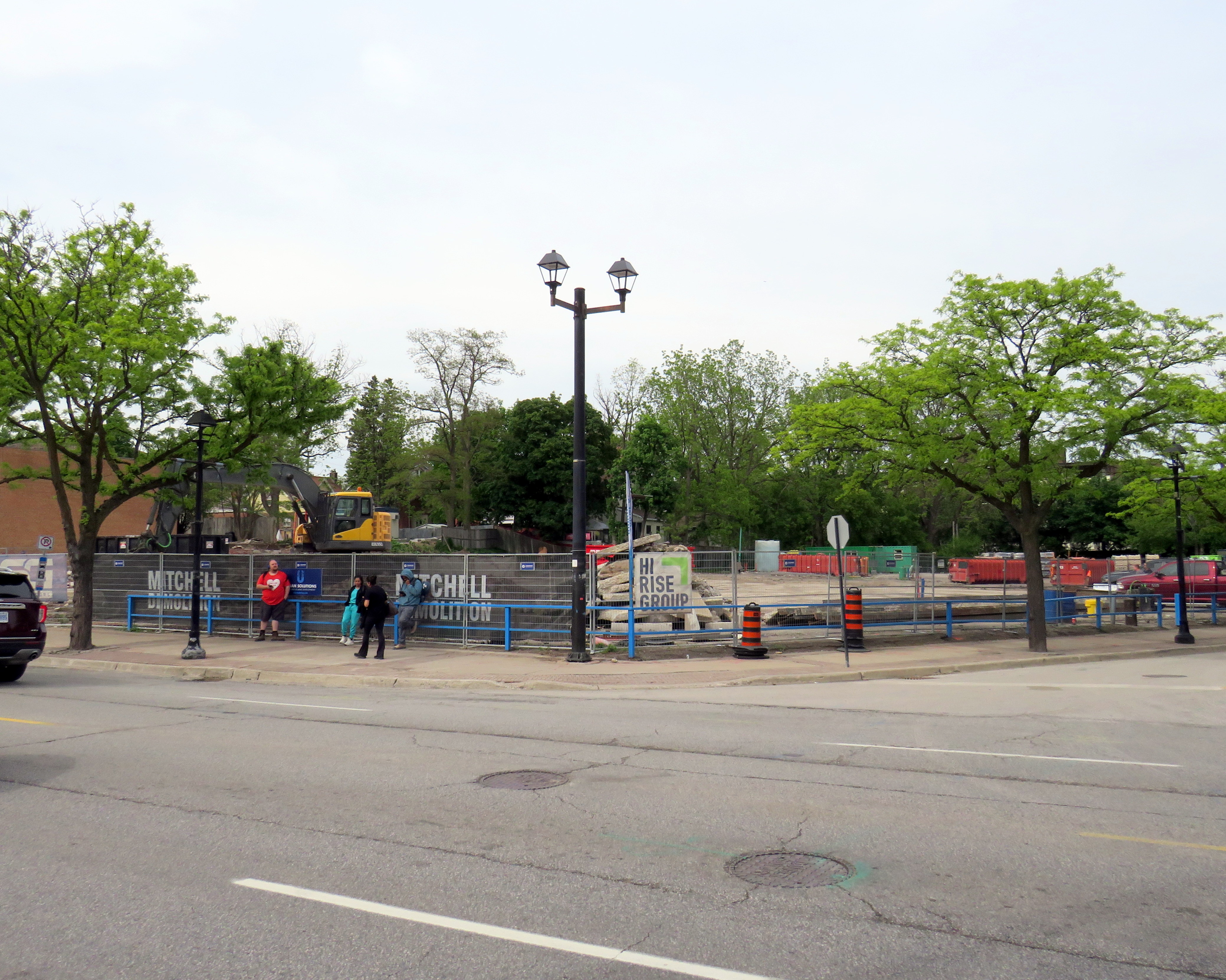
    Demolition is complete and shoring is starting at Rose Garden Residences

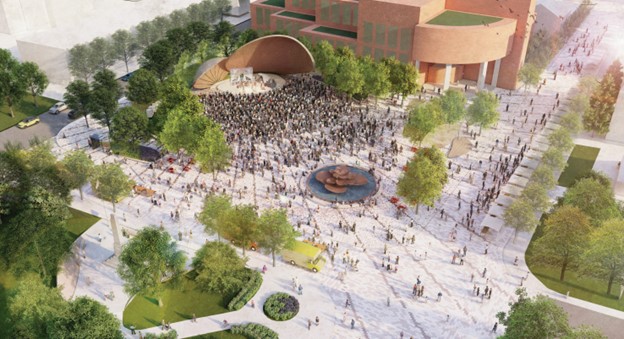
    These are exciting times for Brampton. The city, looking to attract more people to the downtown core, is planning to improve both Ken Willians Square, in front of City Hall, and Garden Square, in front of the Rose Theatre. The municipal government is looking for feedback on four proposed designs for the two square.

    For Urban Toronto, I wrote more about Brampton’s plans to rejuvenate its downtown public realm.

    Proposed design for Ken Willians Square, Downtown Brampton
  • Can you walk to City Hall?

    Can you walk to City Hall?

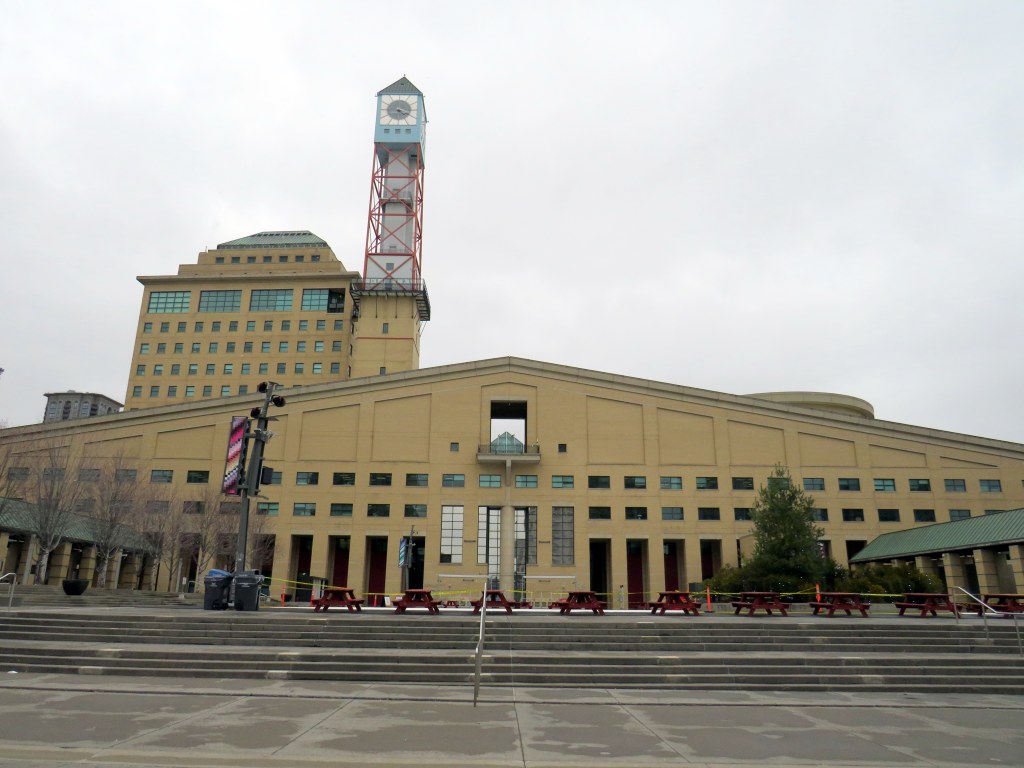
    Mississauga City Hall, one of the most walkable municipal buildings in Ontario

    In late March 2024, with a streak of mild, sunny days, I was eager to get outside and walk. As I have long been interested in local politics and planning issues, public transit, active transportation (especially walking advocacy), I thought I would try to get to every city, town, and township hall in the Greater Toronto and Hamilton Area (GTHA) without a car.

    This was a fun project, even if there were times I felt really frustrated at times by poor transit and long hikes. The highlight of my quest was a tour of Mississauga City Hall from Councillor Joe Horneck. Mississauga’s civic centre is one of Ontario’s most iconic — and walkable — government buildings.

    Mississauga Council Chambers

    Of the three levels of government (federal, provincial, municipal), the municipal level has the most impact on the day-to-day lives of most Canadians; it is also the closest level of government to all. Residents can depute at committee meetings, get meetings with their local councillor and city staff, and obtain building permits, marriage licenses, or pay bills at city and town halls. Therefore, they should be as accessible as possible, especially to those without cars.

    Only one GTHA town hall (Caledon) was completely inaccessible without a car, though several other town halls required long walks from the nearest transit stop, making them inaccessible to some residents. But I could get to Brock Township, the least-populated and most-rural municipality in the GTHA, thanks to Durham Region Transit’s On-Demand service, though I had some difficulty there.

    The complete list of GTHA city and town halls, along with photographs and a map can be accessed here.

    Preview of Story Map

  • The continuing history of Dundas Street

    The continuing history of Dundas Street

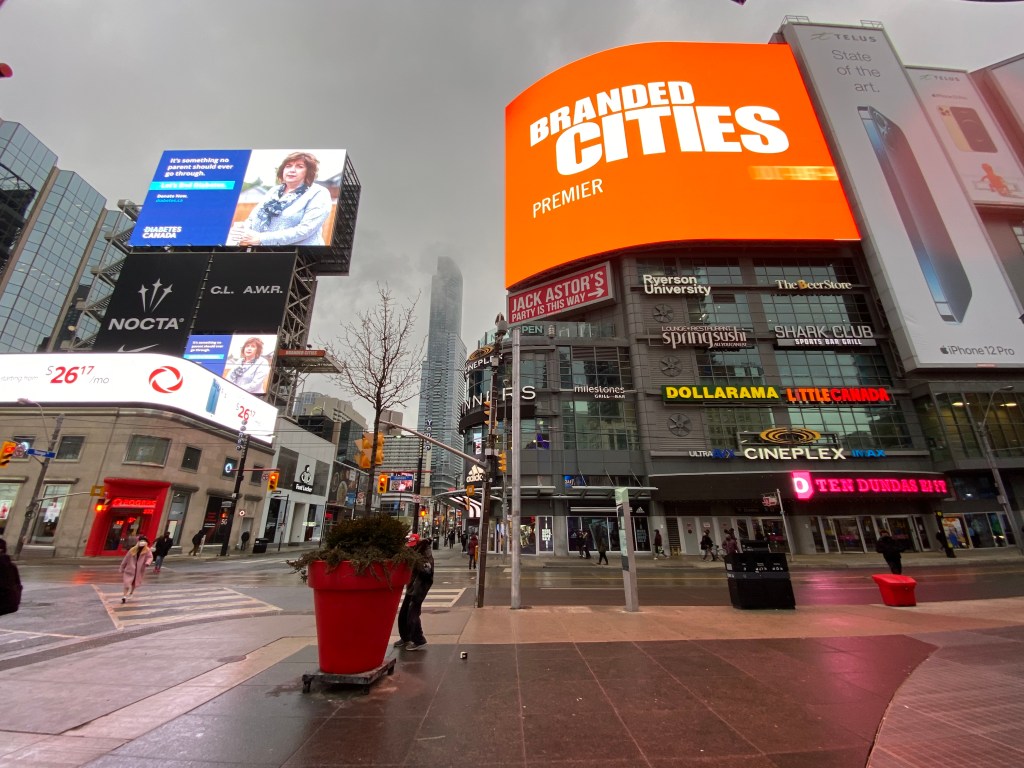
    Yonge-Dundas Square in early 2021

    Nearly three years ago, I wrote about the complicated history of Toronto’s Dundas Street. Calls to rename the street, which honours Henry Dundas, 1st Viscount Melville, came during a time of reckoning in Canada and the United States with racism, colonialism, and our ongoing relationships with First Nations. Ryerson University (my alma mater) changed its name to Toronto Metropolitan University (TMU) in 2022, in acknowledgement of Egerton Ryerson’s role in developing Canada’s system of residential schools.

    After a petition was sent to City Council on June 27, 2020 calling for the renaming of Dundas Street, given Henry Dundas’ role in delaying immediate abolition of slavery in the British Empire, city staff came back to council with a report offering four options:

    • Do nothing
    • Retain the legal street names with additional interpretation and recognitions
    • Retain the legal street names but rename those civic assets with Dundas in their name, except TTC facilities (there are three parks and one library branch that include the Dundas name, and Yonge-Dundas Square; there are two TTC subway stations and one streetcar line that also bear the Dundas name)
    • Rename the streets and all other civic assets now carrying the Dundas name (including Dundas Street East, Dundas Street West, Dundas Square, and Old Dundas Street).

    In 2021, Toronto City Council voted 17-7 in favour of the fourth option, renaming Dundas Street and all associated city assets, such as the library, the two subway stations, Yonge-Dundas Square, and three city parks. At the time, the estimated cost was $8.6 million, but by Fall 2023, it had grown to $12.7 million. There was also a significant backlash to the renaming, which included several conservative city councillors.

    In the end, council voted to approve a compromise that would include renaming Yonge-Dundas Square, Dundas and Dundas West subway stations, and the Jane-Dundas library, but retain the name Dundas Street itself. There would also be a public education campaign “to acknowledge the historical impact of Henry Dundas’s actions and that of slavery more generally.”
    Yonge-Dundas Square would be renamed Sankofa Square, while Dundas Station, directly below, would be renamed with financial support from TMU. “Sankofa” was one of four shortlisted names considered by the Recognition Review Community Advisory Committee (CAC), which was made up of Black and Indigenous leaders, including business owners and residents along Dundas, with the participation of local city councillors.

    Sankofa, a concept that originates with the Akan people of Ghana, “refers to the act of reflecting on and reclaiming teachings from the past which enables us to move forward together.” The CAC’s short list notes the concept’s connection to West Africa, which represented a major portion of the origins of Africans trafficked to the Americas — including Upper Canada — during the slave trade.

    Dundas Street, looking east from Dovercourt Road

    This compromise will not make anyone especially happy, but Mayor Olivia Chow will have to make many more compromises to properly address the fiscal and social crises Toronto is facing. But this is one compromise I mostly agree with. At first I thought Yonge-Dundas Square should have an Indigenous name, but after reading the background materials, I learned that the First Nations elders on the CAC preferred a name that focuses on the Black historical experience.

    Until recently, few people gave the name “Dundas Street,” named over 200 years ago, much thought. Now more people are aware that there were slaves here, in Ontario, despite Governor John Graves Simcoe’s abolitionist leanings. Our understanding of history evolves as we as people evolve — this is the reason why we have historians.

    Nearly three years ago, I wrote about the history of Dundas Street. It’s a really interesting one, by the way, as it continued to change and grow right up until the 1950s. In 2023, we continue to add to the history of the colonial-era road.

  • Mapping the 2023 mayoral byelection

    Last week Monday, I was at Spacing’s election night party at a pub in the Annex, watching the results of the election roll in after 8PM. Public polls consistently saw former Toronto city councillor and NDP MP Olivia Chow leading an especially crowded race of 102 candidates for mayor. It was the most exciting election I’ve followed since at least 2014.

    Former three-term councillor Ana Bailão, one of former mayor John Tory’s protégées, was consistently in second place, followed by former Toronto Police Chief (and provincial PC candidate) Mark Saunders, sitting councillors Josh Matlow (who ran as a progressive) and Brad Bradford (who ran to the right), and right-wing columnist Anthony Furey. Though Bailão, a centrist, had the endorsements of multiple sitting councillors, Liberal MPs and MPPs, and several public and private sector unions, she had difficulty positioning herself as the presumptive centre-right challenger, especially with Premier Doug Ford backing Saunders.

    It was not until the advance polls had closed that Deputy Mayor Jennifer McKelvie, the Toronto Star Editorial Board, and then Tory himself endorsed Bailão, likely spooked by Chow’s continued lead. (David Rider and Ben Spurr at the Star wrote a great article about the leadup to Tory’s endorsement.) Tory, who resigned after admitting to a long-term city hall affair, hummed and hawed over providing his endorsement, and hid from reporters even while robocalling Torontonians pleading them to vote for his appointed successor.

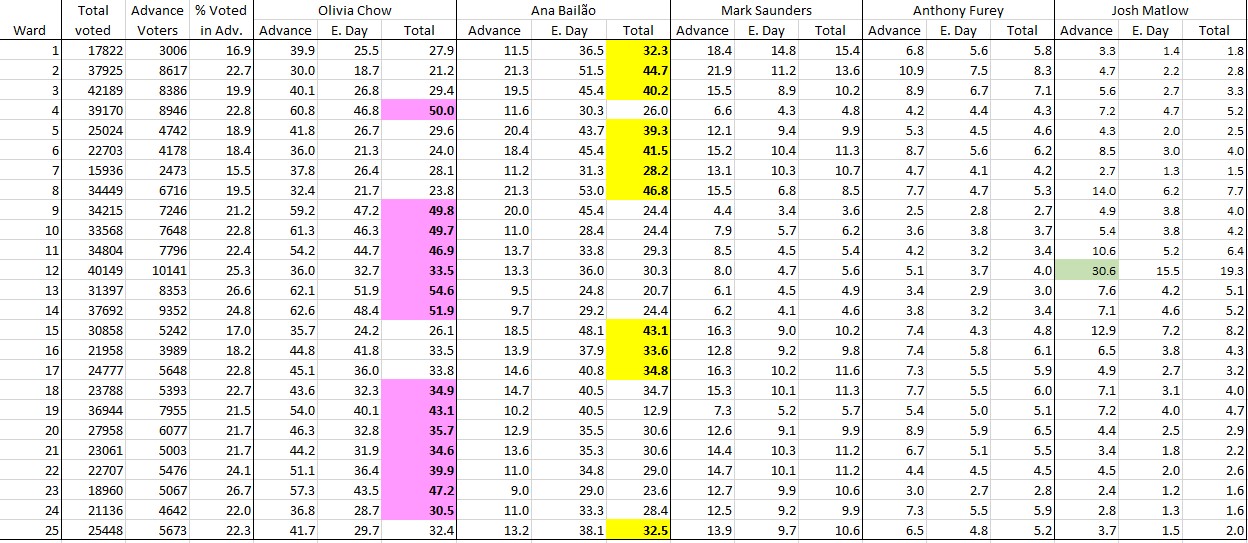
    It is quite possible that Tory’s endorsement came too little, too late for Bailão. Nearly 150,000 electors (representing 21.7% of all votes cast) already voted in advance polls or by mail, and their votes were locked in. But the late push for Bailão was able to convince at least some election day voters to choose strategically — the percentage of voters who chose Saunders, Furey, and Matlow fell, while Bailão’s share grew on election day. Indeed, Bailão placed first among election day voters. But Chow, whose campaign encouraged advance voting, carried the day in the end.

    For example, Josh Matlow placed a close second in Ward 12 in the advance polls (with 30.6% of the vote), where he’s a popular local councillor. On election day, Matlow placed third behind Bailão and Chow, with Chow eking out a narrow win overall there. In every ward, Chow placed first in the advance polls, but when all votes were counted, she placed first in 14 of the 25 wards. The table below shows how the vote shifted.

    Table of ward-level mayoral byelection results, showing advance poll and election day results for the leading five candidates. PDF version here.

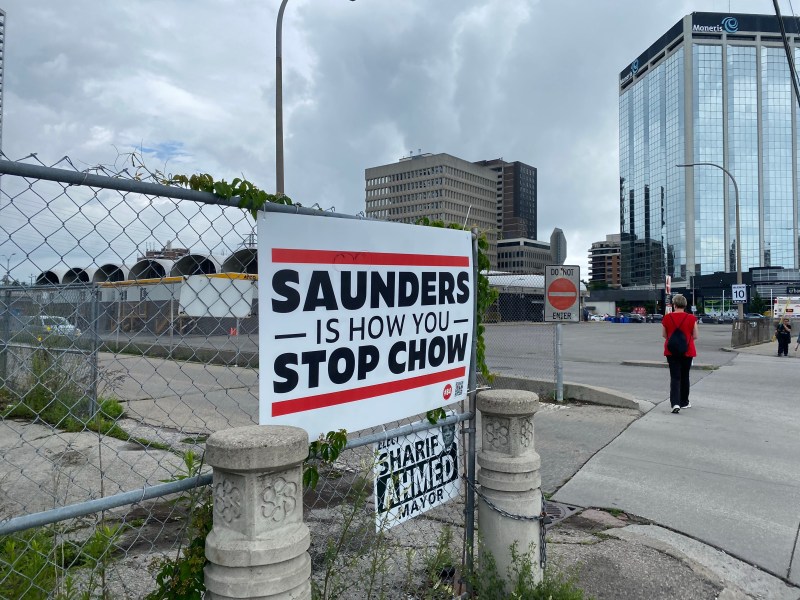
    Chow won with 269,372 votes (37.2%) to Ana Bailão’s 235,175 (32.5%). Saunders, Ford’s pick, got just 8.6% of the vote despite his positioning as the only candidate to “stop Chow.” Furey placed a distant fourth, with 5%, and Matlow got 4.9%, acknowledging that Bailão’s late surge draw support away from him and towards Bailão and Chow. Brad Bradford was the biggest loser of the night, netting just 1.3% and placing fifth in his own ward.

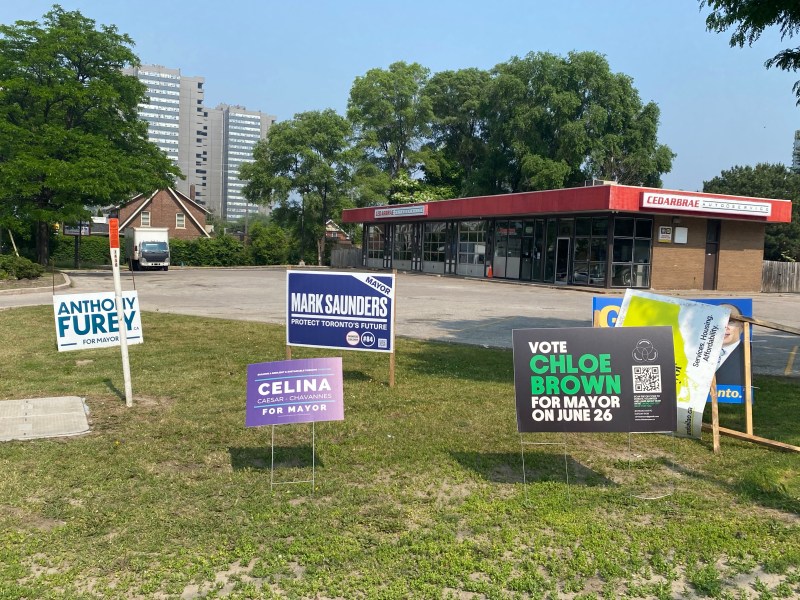
    “Saunders is how you stop Chow” sign

    Though I was skeptical of Olivia Chow’s second run for mayor after an uninspiring run against Rob and Doug Ford and John Tory in 2014 (she placed third), she proved herself worthy this time around. She was more relaxed, more herself, and certainly tapped into a desire for change after eight years of Tory’s dull austerity and four years of chaos under Rob Ford (enabled by his brother Doug).

    I fear Toronto’s political establishment — both Conservative and Liberal — will try to make Chow’s term as mayor difficult, even though their low-tax, low-spend agenda caused many of the problems that she will have to tackle. But for now, I’m pleased we will try it her way.


    I created an interactive map showing the results of the election at the ward and electoral subdivision (poll) level. For the wards, I provided information on the advance and election day poll results.

    Note that not all polls are mapped. Until the City of Toronto releases revised electoral subdivision boundaries (I suspect due to poll consolidations), there are some missing polls. However, 95% of all polls are depicted, and the results are interesting.

    I look forward to your feedback as well; I approve all reasonable comments and reply to most emails.

    Link to map

    Thanks to David Del Grande for pointing out a needed correction.

  • Voter turnout in the 2022 municipal election

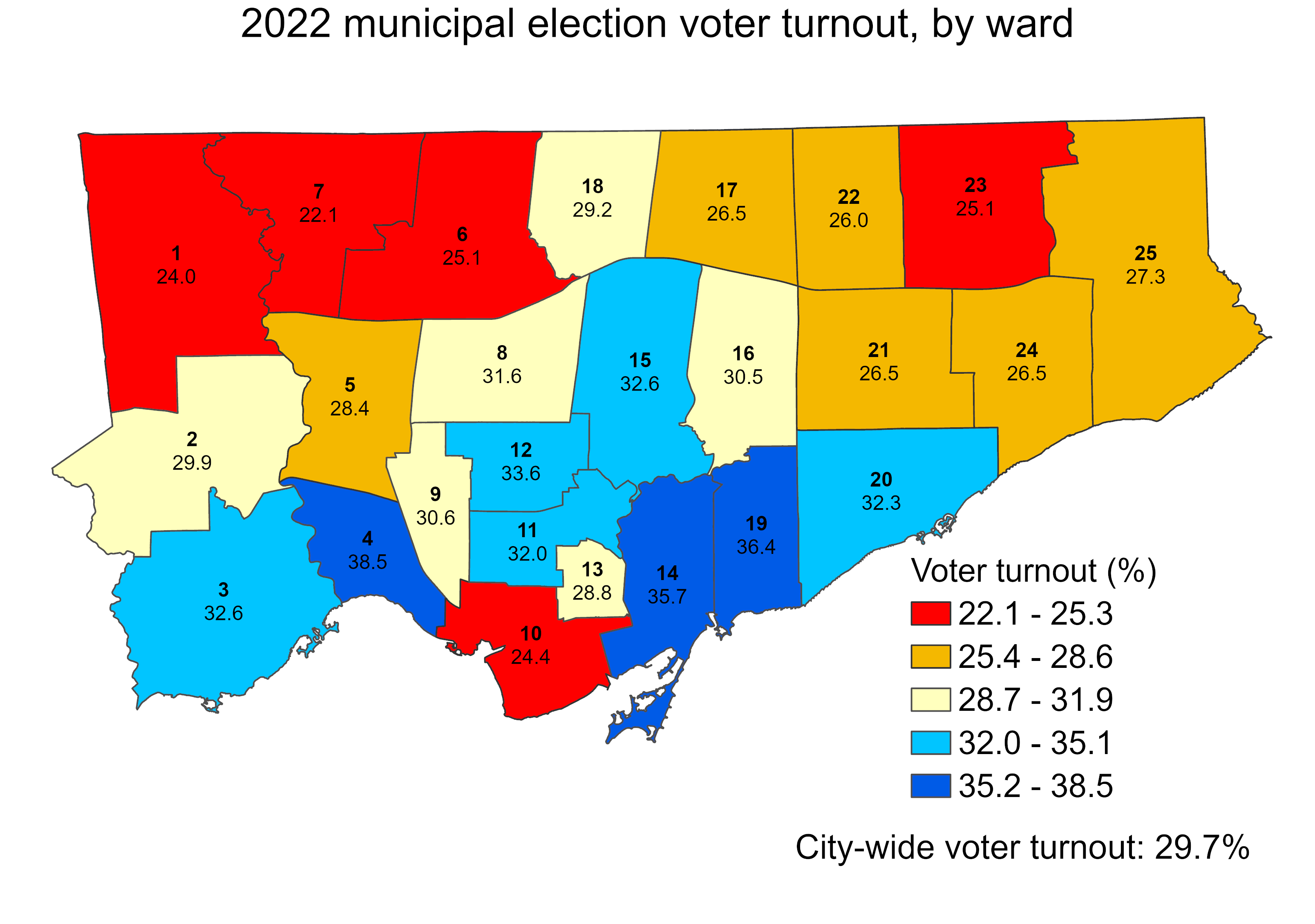
    Ever since John Tory was elected mayor of Toronto in 2014, voter turnout in municipal elections has been in decline. In 2010, the year Rob Ford was elected mayor, turnout was 50.4 percent. Four years later, 54.7 percent of all eligible voters went to the polls to elect a new chief magistrate. However, in 2018, just 40.9 percent bothered to vote, and in 2022, turnout fell further, to just 29.7 percent.

    With the recent release of detailed voter statistics from the 2022 municipal election in the Toronto Open Data catalogue, it is now possible to see how much turnout dropped in each ward.

    I dig deeper into the last election’s dismal showing, and what it might mean for the upcoming mayoral by-election, at Spacing Toronto.

  • Sean’s strong mayor agenda for a new era

    Who knew, just two weeks ago, that Torontonians would be returning to the polls to elect a new mayor of Toronto?

    Looking back on John Tory’s last eight-and-a-half years in office, the biggest disappointment might have been that he spent so little of the political capital that he had accumulated after decades as a backroom power broker, corporate executive, provincial party leader, talk radio host, and supporter of NGOs such as CivicAction and the United Way. Despite his promise as a business-friendly, progressive conservative leader who knew how to build partnerships and work with other levels of government, there’s little to show for it. SmartTrack? That was always a fantasy which has now been mostly forgotten. An improved public realm, including a new Rail Deck Park? That never happened either. Heck, we can’t even get a decent WiFi connection in the subway, never mind a cell signal, despite the mayor’s close ties with the telecommunications industry.

    To be fair, there are a few things one can point to that got done during Tory’s tenure: new bike routes on Bloor-Danforth, Yonge, and University Avenue, some improvements to the TTC surface network, the King Street transit priority pilot, and surprisingly good pandemic responses, including excellent city-run vaccine clinics, weekend street closures for active transportation, and new street-level patio space to help restaurateurs recover from pandemic shutdowns.

    But in 2022, the ActiveTO street closures faded away, partially due to influence from the Toronto Blue Jays management (note: the baseball team and its stadium are owned by Rogers), the King Street transit priority corridor deteriorated from neglect. As the homelessness crisis worsened, Tory and his allies backed repressive and violent clearances of public parks, without supplying enough alternatives for housing or supporting the most vulnerable in this city. A series of municipal budgets in which property taxes were kept low while other expenses piled up has caused this city to become reliant on the support of the province and federal governments to bail us out.

    With Tory gone — brought down by his own error in judgment — we will have thirteen lost years in which Toronto will have to catch up. That’s a tall order.

    I can’t claim to have all the answers, but I have a few ideas to share to help make Toronto a safer, more fun, more comfortable, and more humane place to live. If I were a mayor with strong powers, here’s what I would do:

    • A progressive property tax system. An unfortunate reality for Ontario municipalities is that they have very limited tools for raising revenue: property taxes, user fees (like TTC fares and recreation fees), and in Toronto’s case, vehicle registration fees. Municipalities are also given grants from the province and federal government for specific purposes, such as providing mandated services. Unlike sales, income, and business taxes, property taxes do not grow with the economy, so municipalities must raise the property tax mill rate every year to keep up with inflation and/or fund new or expanded services. However, no matter the assessed worth of the property, the tax percentage remains the same.

      A progressive property tax system can be used then to raise more money from higher-valued properties. For example, for residential properties, a basic tax rate could apply for the assessed value up to $1 million. Beyond that first $1 million, a higher bracket comes into effect. Such a policy could minimize tax increases for those in smaller or starter homes. To encourage the construction of secondary suites, high-value properties could then get tax breaks for every additional self-contained unit on site, provided they are inspected and meet fire code. A progressive property tax system could help raise revenue, encourage the construction of more housing units, and provide a more equitable revenue source.
    • A real Vision Zero plan. Putting up “Senior Safety Zone” signs and lowering speed limits on four and six lane streets does little when the roadway remains designed for high speeds, and motorists race through intersections with limited enforcement. To protect pedestrians and cyclists (as well as other drivers and their passengers), the roads themselves must be re-engineered for lower speeds. This means “daylighting” pedestrian crossings by ensuring crosswalks are always well-lit, crosswalks raised where possible to improve visibility and curbs extended to both reduce the amount of roadway that pedestrians must cross, and signal to drivers to slow down. Furthermore, a blanket right-turn-on-red prohibition, like those in New York, Montreal, and Mexico City, would eliminate a common cause of pedestrian-motorist collisions and make those new leading pedestrian intervals at Toronto’s street corners fully effective.
    • Prioritize transit and clean up the TTC. When I say “clean up the TTC” I don’t mean throwing more cops at the problem of safety on our subways, streetcars and buses. Under CEO Rick Leary’s leadership, it feels as if the TTC has given up on many of the gains brought forward by Andy Byford. Customer service has fallen by the wayside, wait times have increased, the streetcar network is faltering with trams running slower than ever before, communications have become unreliable, and customer confidence in the system has fallen. When customers no longer feel valued, they themselves give up.

      After cancelling upcoming service cuts contained in Tory’s last budget, one of the easiest things to do to show that transit riders matter is making King Street great. This means installing permanent streetcar platforms in the curb lanes along the streetcar priority zones and making it even more clear that drivers are prohibited from using King as a throughway. Eliminate the night time taxi exception to simplify signage, and automate enforcement with video cameras mounted at intersections and on streetcars themselves, as is done on some Select Bus Service routes in New York.

      Haffiz A., via Twitter, shows how King Street could look:

      https://twitter.com/trainguy89/status/1627147434802520066?s=20

      The TTC also needs to modernize its street railway infrastructure so that streetcars no longer have to stop and crawl across every track intersection. Electric dual-blade junctions and wayside signals — used just about everywhere else — allow streetcar operators to know which way the track is pointed ahead of the intersection and can allow streetcars to glide through junctions at regular traffic speed.

      Finally, get TTC staff and all councillors riding the TTC on a regular basis. Meet passengers. Let them know they matter, and inform them of improvements, and be visible.
    • Build affordable housing. Lots of it. Use increased revenues from the progressive tax system proposed above to build more affordable housing directly (instead of just relying on market solutions like inclusionary zoning), including the co-operative home model. While doing so, shame the provincial and federal governments for pulling out of funding new construction in the 1990s. The city owns lots of land in good areas, such as Green P parking lots, TTC stations, works yards, suburban office spaces, and even on parts of municipal golf courses, which, of course, should be converted to general year-round public spaces.
    • Stand up to the bullies at Queen’s Park. One of Mayor Tory’s biggest failures was to ignore the province’s meddling in Toronto’s affairs and impose the province’s unpopular plans upon the city. This city should have the right to decide the composition of its own council; there was not nearly enough protest from city leadership when Doug Ford forced a cut in council from 47 to 25 (which will likely go down to just 24 in 2026) after an unprecedented level of public consultation in shaping the approved boundaries. Instead of waiting forever for a ministerial zoning order that was never going to come for a modular housing project in North York, real leadership would have gotten it built, the province be damned. Call their bluff.

      Meanwhile, Premier Doug Ford — the man Tory beat to become mayor in 2014 — is imposing his own ideas on Ontario Place, provincially owned public lands on Lake Ontario. If one could not get Rail Deck Park built, Ontario Place could have been the site for a renewed public realm, much like some of New York City’s new waterfront parks. Some vision, some willingness to spend political capital, and a good advocacy campaign could have stopped the plans for an overbearing private megaspa that effectively closes off major portions of our public waterfront.
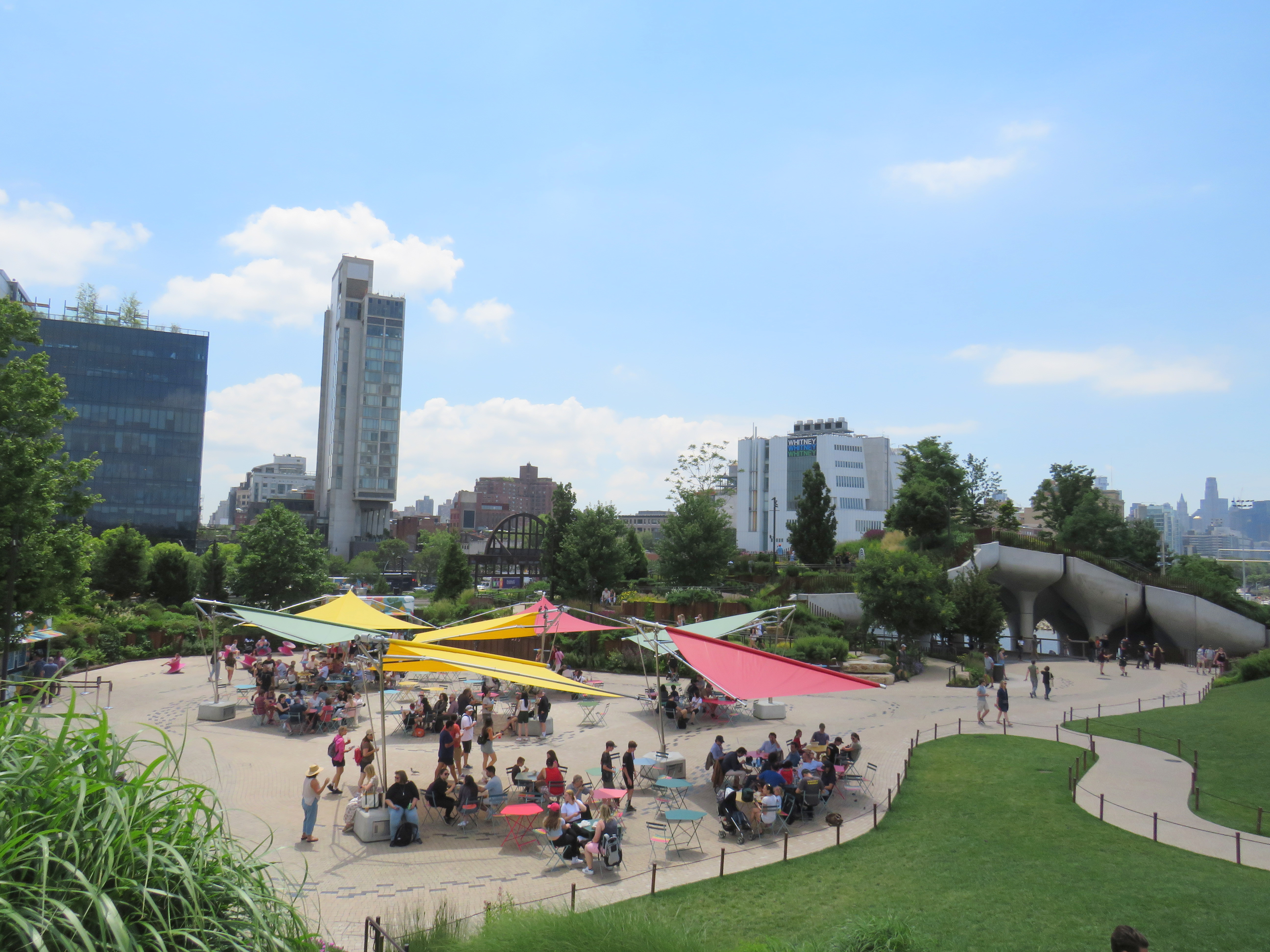
    New York City’s “Little Island” could have been an inspiration for a renewed Ontario Place

    There will be some people who will be happy that I am not serious about running for mayor. For one, I don’t have the people skills, the connections, nor the energy to make a serious bid. But if I see some of the ideas suggested above make it into a mayoral platform, I would not be above making a personal endorsement.

  • Mapping the 2022 municipal election

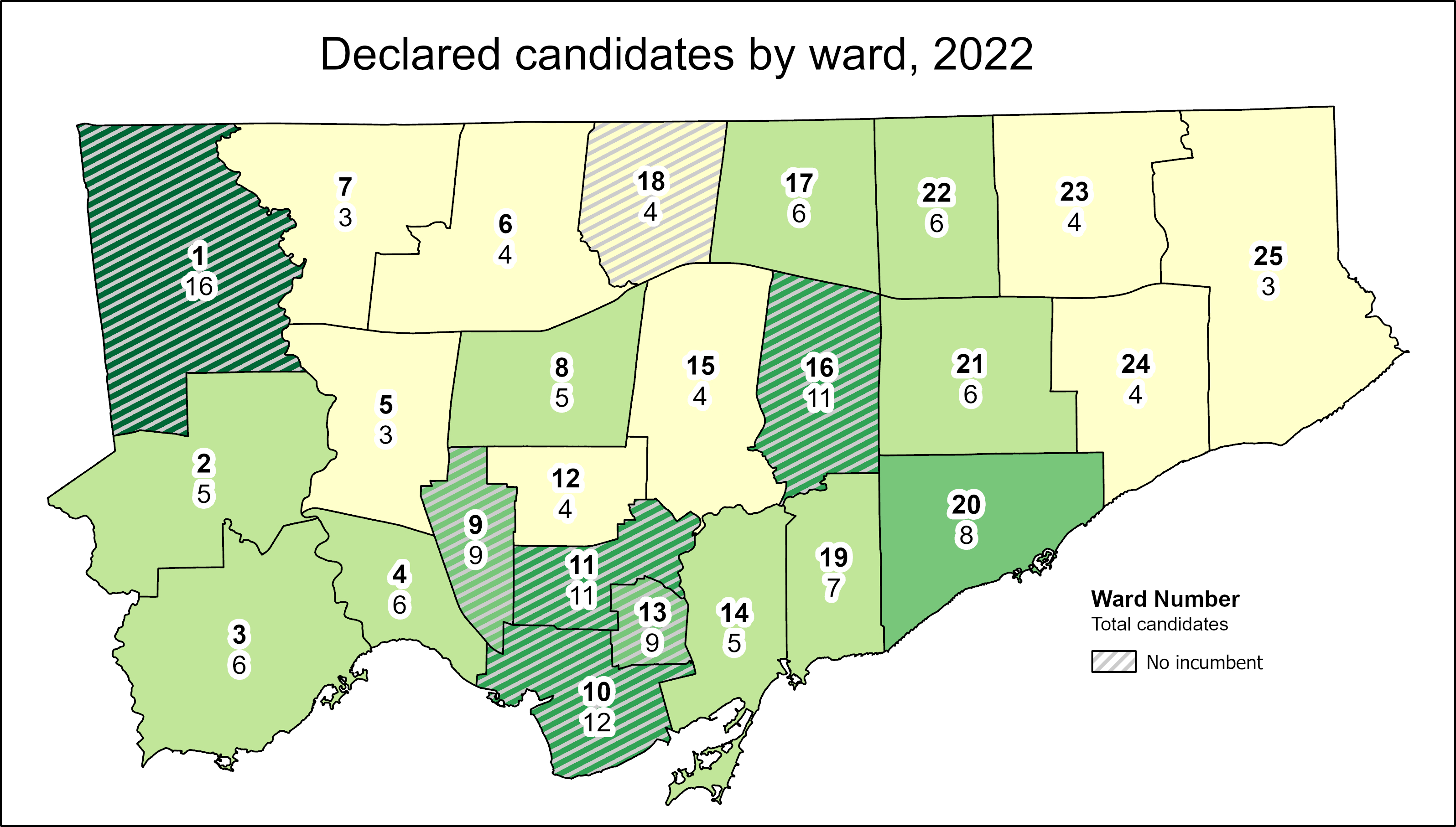
    Number of candidates running in each ward

    This coming Monday, October 24, Ontarians will be electing new city councils. In Brampton, Ottawa, and Hamilton, the mayoral races should prove to be interesting. For Ottawa in particular, with Jim Watson stepping down, voters have a clear choice (and I’ll be cheering for Catherine McKenney). Though Gil Penalosa offers a new vision of a sustainable, active, and safer city, it’s very likely John Tory will win an unprecedented third term, the first to do so since amalgamation in 1998.

    At Spacing Toronto, I have been offering some insights by mapping the state of our local democracy, ward by ward. Though there are seven wards in which no sitting councillor is running for re-election, the new council may not look too much different from the last one. That’s because two former councillors — Vincent Crisanti and Jon Burnside — will be looking to get back into office. Meanwhile, Mayor Tory has been busy campaigning for twelve candidates, including eight incumbents, that will help advance his agenda of incrementalism and austerity. Among Tory’s picks are Frances Nunziata, who has been in municipal office uninterrupted since 1988.

    Here are the links to my posts at Spacing:

    Open wards and the power of incumbency: The power of incumbency, and the mayor’s own influence, will weigh heavy on the final results. Though there may be seven “open” wards and a few more truly-competitive races, there is a lot happening behind the scenes to favour certain candidates.

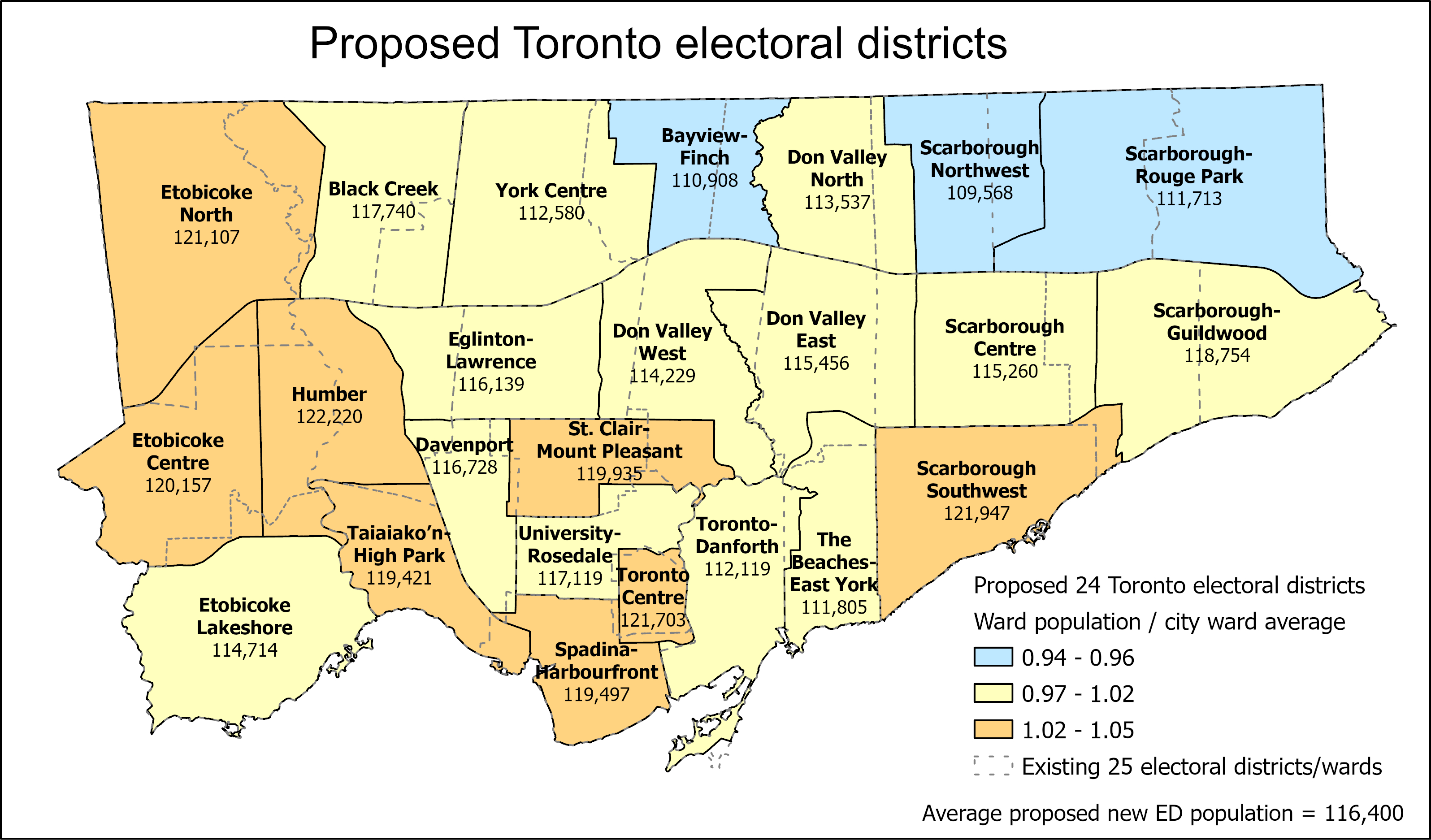
    Population disparities between Toronto’s 25 wards: How ward boundaries that were drawn in 2013 have exasperated imbalances in population, leading to burnout in high-growth wards (with several downtown councillors deciding to move on). If Toronto continues to be forced to use federal/provincial riding boundaries, it will have just 24 wards in the 2026 election.

    What Toronto’s new ward boundaries might look like

    Toronto is a highrise, rental city – unlike City Council: Though nearly half of all Torontonians live in highrise dwellings and/or rent their homes, Toronto City Council is made up almost entirely of homeowners. In only a few wards, detached houses make up the vast majority of the housing stock and homeowners dominate. I ask why city council doesn’t reflect the way an increasing number of us live. The interest in this post had me on CBC Metro Morning for the first time, early on September 30.

    Duelling campaign endorsements: Though Mayor John Tory has supported a few candidates before (most notably, Etobicoke councillor Mark Grimes), this time, he’s actively campaigning with twelve allies. Meanwhile Progress Toronto is backing nine challengers, focusing on races where it hopes to help get new faces elected.

  • Wards and ridings: not quite representation by population

    Wards and ridings: not quite representation by population

    When Statistics Canada released the first batch of 2021 Census data, it made the new population counts available for a wide variety of geographies, from provinces and cities, to local census tracts and even city blocks. It also released data for the 338 federal electoral districts, better known as ridings.

    Because of constitutional requirements, the seats in the federal House of Commons are not allocated equally by population. For example, Prince Edward Island, with a population of 154,331, has four seats. At the other extreme, four electoral districts in Alberta and one in Brampton, Ontario have larger populations than Canada’s smallest province.

    Electoral DistrictProvince/Territory2021 Population
    LabradorNewfoundland & Labrador26,655
    EgmontPrince Edward Island35,925
    NunavutNunavut36,858
    CharlottetownPrince Edward Island38,809
    MalpequePrince Edward Island39,731
    Average109,444
    Banff-AirdrieAlberta155,580
    Calgary SkyviewAlberta159,642
    Brampton WestOntario162,353
    Calgary ShepardAlberta163,447
    Edmonton-WetaskiwinAlberta209,431

    The federal electoral districts were last drawn in 2013, following the 2011 census. As a result, fast-growing ridings, particularly in Southern Ontario, Calgary, and Edmonton, have huge populations compared to the national average.

    In Ontario, the provincial government uses the same boundaries for its provincial electoral districts, with the exception of Northern Ontario, where two additional seats help to compensate for the area’s vast and remote regions, where local MPPs may have to travel hours by car, train, or plane to meet constituents. The province imposed the same boundaries on the City of Toronto in 2018, in the middle of a municipal election for which new, fairer boundaries were just approved.

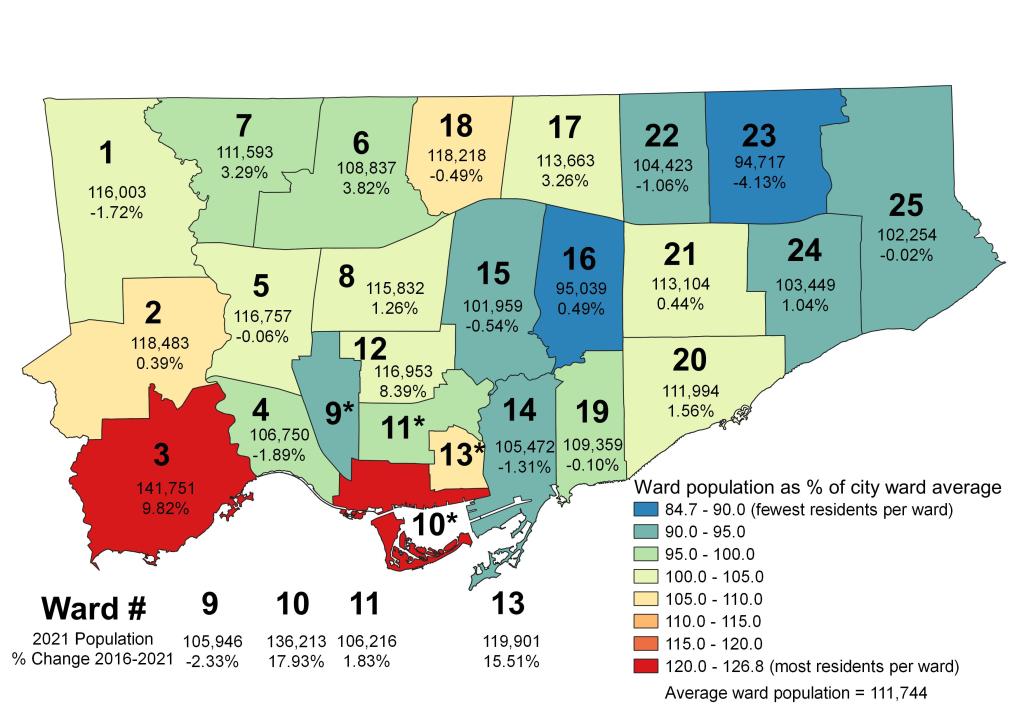
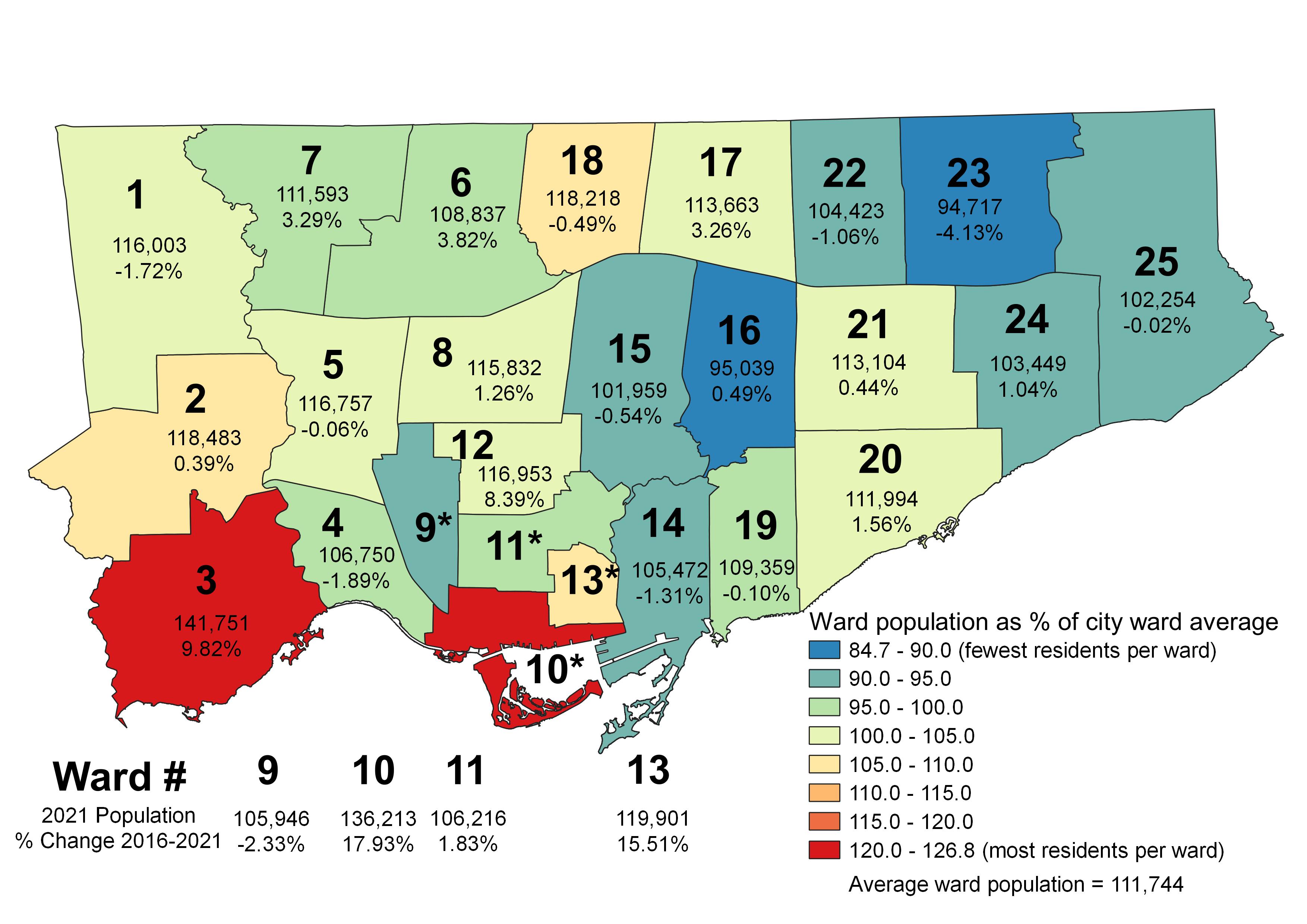
    By 2021, the population differences based on decade-old data became stark, as shown in the map below.

    Map depicting disparities in Toronto’s ward populations

    Ward 23 Scarborough North, represented by Cynthia Lai, has a population of 94,717. Ward 23’s population dropped by over 4% since 2016, as households age and few new housing units built in that ward. Ward 16, Don Valley East, has just 95,039 residents, with a stable population.

    On the other extreme, Ward 3 Etobicoke-Lakeshore, represented by veteran councillor Mark Grimes, has a population of 141,751, growing by 9.82% since 2016. New condominium developments in the Humber Bay neighbourhood and along the Queensway have driven much of that growth. Ward 10, Spadina-Fort York, saw an even greater number of new residents move in, growing by nearly 18% in the last five years.

    As Toronto is stuck with these ward boundaries until 2026, the population disparities will only grow larger, with downtown and South Etobicoke residents becoming even more underrepresented. Compounding the unfairness is that councillors representing high-growth wards have much higher workloads, as they deal with mountains of planning applications while ensuring their existing constituents have access to essential local services like schools, transit, and park space.

    The ward boundaries initially set for the 2018 municipal election would have accounted for future growth, ensuring that workloads would be more fairly distributed, and that city residents would have equal access to their local councillor.

    The 2021 population counts will be used to set new federal riding boundaries, which will be drawn next year after a consultation period and used in the first federal election held after 2023. The province will likely adopt the new boundaries for the 2026 election (assuming a majority government is elected in June).

    Perhaps in four years, Toronto will be able to set its own ward boundaries again. That, of course, will depend on electing a better provincial government and a council committed to equity and good governance.

  • A new twist in the story of a downtown parking lot

    The Metrolinx parking lot at Elizabeth and Railroad Street is nearly complete

    Over the last few years, I have followed the purchase and demolition of over a dozen houses in Downtown Brampton, in the block bounded by George, Nelson, Elizabeth, and Railroad Streets. Metrolinx, the provincial transit planning and operating agency, acquired the block for a new surface parking lot for the neighbouring GO Transit station.

    At first, the parking lot was intended to replace parking spaces lost due to construction of a new post-secondary education campus — a joint venture between Ryerson University and Sheridan College — on the main GO Station lands. Though the provincial government pulled funding for the campus in the fall of 2018, Metrolinx continued work on the parking lot, completing the demolition, clearing the land, and building the parking area.

    Now, it is possible that the parking lot will never open.

    At the Brampton City Council meeting on January 26, 2022, councillors considered a request by Rogers for two Minister’s Zoning Orders (MZOs) in order for it to relocate its existing Brampton offices at 8200 Dixie Road in Bramalea to a new build in Downtown Brampton. The particular property Rogers looks to acquire for its new campus is the same one Metrolinx acquired, cleared, and partly constructed its new parking lot.

    Part of the existing Rogers campus at 8200 Dixie Road

    The property at 8200 Dixie Road was built in the 1963 as a Northern Electric (later Northern Telecom) plant, which produced switchboards and other telecommunications equipment. In 1995, the plant closed, and the building was refurbished to become the headquarters for Nortel Networks. In 2005, during Nortel’s infamous fall into bankruptcy, the property was sold to Rogers, which uses it today for its business operations and technical offices, with 3,000 workers stationed there.

    Rogers is interested in the downtown site for several reasons. The new campus would be adjacent to several transit links, including the GO Transit Kitchener Line, with links to Downtown Toronto (where Rogers has its head office) and the Kitchener-Waterloo technology hub. In its submission to the city, Rogers also notes the proposed LRT extension into Downtown Brampton (now in the design phase, either as a tunnel or a surface route) and planned bus improvements. Though it is served by Brampton Transit, the 8200 Dixie Road site is almost entirely dependent on its employees driving to work.

    The new Rogers downtown site would support Brampton’s goals of becoming a cybersecurity centre of excellence and landing a major postsecondary education campus — Ryerson University continues to be interested in expanding in Brampton and the University of Guelph has expressed interest in relocating its Humber College presence to Brampton to better serve its student base.

    There are also several development proposals for Downtown Brampton. The City of Brampton is still planning to build a new Centre for Innovation to support education and business development. The new facility, located adjacent to the downtown transit terminal, will include a new central library. New highrise developments will bring thousands of new residential units to downtown Brampton, walkable to local businesses, the GO station, and Rogers’ planned new campus.

    Map of Metrolinx/Rogers lands in Downtown Brampton, with surrounding active development plans

    The new office campus — proposed to be 200,000 to 500,000 square feet — would have a smaller footprint than the Dixie Road site. By relocating its offices, Rogers would then be free to sell or redevelop the old Nortel lands for housing and new industrial uses, likely for warehousing and logistics. The development of the old land would certainly finance the new property.

    Proposed redevelopment of the Rogers lands at 8200 Dixie Road, with mixed residential development on the east side, towards Balmoral Drive, and new industrial uses on the west side.

    Rogers wanted municipal support for the MZOs so it could move quickly towards designing its new office complex. In response to a question from council, Rogers indicated that it had already been talking with Metrolinx about purchasing the land, and that Metrolinx itself was supportive. Mayor Patrick Brown indicated that he has been speaking with Metrolinx CEO Phil Verster, and that Metrolinx would submit its own letter of support.

    MZOs have a controversial reputation. In Ontario, the Minister of Municipal Affairs has the authority to issue a zoning order over any property that overrides the normal zoning process. Traditionally, MZOs have been used infrequently, often in an emergency situation (such as after a disaster, such as the collapse of the Algo Centre Mall in Elliot Lake), or to fast track the construction of a major employer or housing development, typically issued at the request of the municipality.

    The Doug Ford-led Progressive Conservative government have issued MZOs much more frequently, often for projects with significant opposition. This included the site of a proposed Amazon warehouse on the Pickering/Ajax border, which was strongly opposed by environmentalists and Ajax politicians, yet supported by Pickering officials. Meanwhile, a MZO requested by the City of Toronto, for an affordable housing project in North York, has yet to be issued. (It is worth noting that the project is in a PC-held riding, represented by Associate Minister of Transportation Stan Cho.)

    But, in this case, with a unanimous vote of endorsement from Brampton City Council, with support from Metrolinx and local business groups the new Rogers relocation should prove to be less contentious than other recent MZOs.

    There are still a few questions that will have to be answered in due time:

    • Will Metrolinx be able to provide all-day, two-way GO train service to Downtown Brampton by the time Rogers is ready to relocate its Brampton operations? Right now, the Kitchener Line is constrained through Brampton as it uses a busy CN freight corridor. A third track and platform at Downtown Brampton will be needed to support commuters arriving from Toronto in the morning. Though the planned new transit hub at Main and Nelson Streets will support this expansion, work has yet to begin on that project, including a temporary bus facility as the old terminal and office building above is demolished.
    • Will Brampton agree on the Main Street LRT extension, whether it will be in a tunnel or at-grade in Downtown Brampton? If so, will it be able to secure funding from the province and the federal government? As transit access is key for Rogers’ proposal, and for potential new educational instructions, closure on this long-running matter is important.
    • How many workers will be on site at Rogers’ new complex? Though 200,000 square feet will be enough space for about 1,000 employees, which is just one-third of its Brampton workforce. Perhaps Rogers is looking towards a hybrid model of work, where employees are on site only part-time.

    Finally, it is interesting how Metrolinx, a public agency, was determined to assemble land and build a new parking lot, only to see that land sold to a large private company. However, having major employers located adjacent to regional transit hubs is a good thing, especially as it represents a shift away from GO’s traditional model of transporting commuters to Union Station in the morning and back to the suburbs in the afternoon.

    For Downtown Brampton, Rogers’ plans for relocating to the urban core is a badly-needed shot in the arm. Locating a major employer to the core will support existing and new businesses. After many attempts to revitalize downtown, this latest plan might be the catalyst that changes everything.