Tag: City Hall

  • Leadership, John Tory style (updated)

    Updated May 29

    I was frustrated this week by Mayor John Tory’s pronouncement that he’s “not in favour of adding any more politicians here,” referring to the proposed new ward boundaries released last week that would increase the number of city councillors from 44 to 47. This is despite a rigorous and solid process, with plenty of public and stakeholder consultation sessions. But to Tory, “politician” is a dirty word. Never mind that the boundaries were created in 2000, from even older federal/provincial boundaries that based on the 1991 census, Tory doesn’t like the solution developed after three years of work.

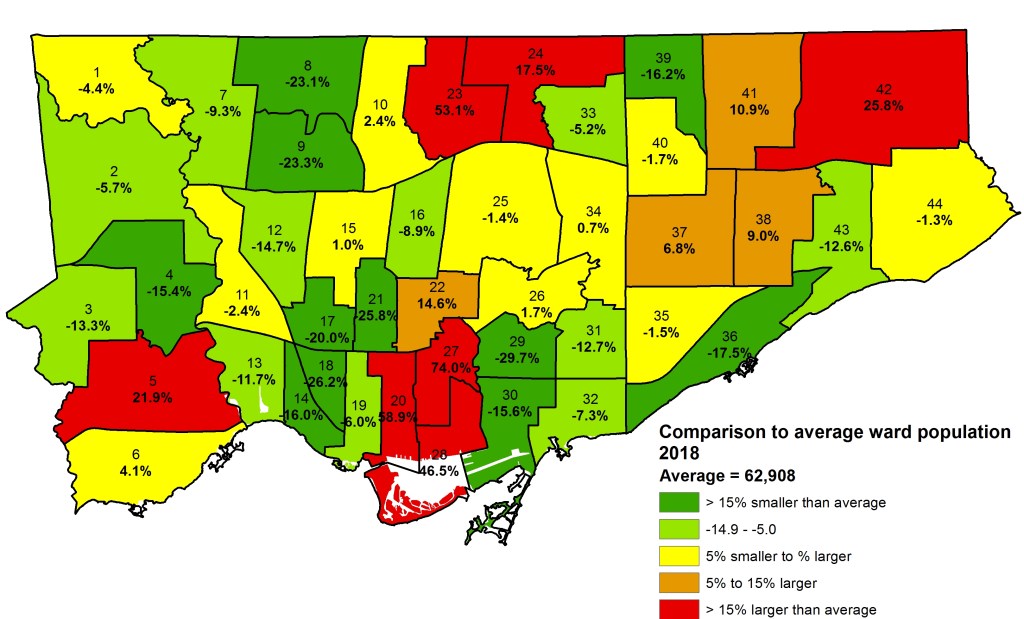
    2014 Election - 2018 Ward Projections
    The discrepancy between each ward’s population and the city-wide average in 2018

    Instead, Mayor Tory wants staff to back to the drawing board and come up with a plan that he likes, following the fine tradition in municipal politics of ignoring the advice and hard work of staff and outside experts because you don’t like the answer they give. Tory’s hand-picked Executive Committee agreed with his motion to defer the debate until the fall. 

    This is a problem. It’s necessary for aspiring candidates to be organizing right now if they want even a slight chance of knocking off an incumbent councillor. For that reason, the boundaries need to be decided as soon as possible. And adding three new councillors really shouldn’t be a big ask — it would cost $870,000 a year, including the costs of hiring additional assistants.

    One reason why Calgary’s Naheed Nenshi is a great mayor is because he trusts his staff and praises their hard work. I was at a lecture in which Mayor Nenshi took very little credit for that city’s response to the 2013 floods. Instead, he spoke about how he. along with senior city staff responded in a coordinated manner, involving all city employees and citizen volunteers in the effort to minimize the flood’s impact and clean up the damage.

    John Tory, on the other hand, shames city staff and local councillor Kristyn Wong-Tam in a crass stunt for Jack Lakey, author of “The Fixer” column in the Toronto Star. This reminds me very much of Rob Ford’s modus operandi.

    In the article, Mayor Tory is photographed cleaning up a planter on Alexander Street, as he explained that he was frustrated by the city bureaucracy who couldn’t get the planter repaired and looking good. Rob Ford was famous for this kind of stunt — filling in potholes, attending to residents’ complaints — often going over the head of councillors or city staffers. Urban forestry manager Dean Hart is named and shamed, but that department does not have responsibility for planters — that’s Transportation Services, which Lakey glosses over. To quote a friend: “so a city division which gets annual budget reductions declines to do work that’s out of scope, and in turn gets this response?” That’s not leadership.

    Leadership means addressing the real problems. Perhaps there is a problem with buck-passing. Maybe there’s a way to improve communications between city departments. A good leader involves the parties responsible and encourages them to find a solution, not publicly shame them. Maybe a leader doesn’t demand annual budget cuts in all areas (except, of course, the police), then blames staff when the effects of the budget cuts become visible. Meanwhile, Ward 27 is the most populated in the city, and Councillor Wong-Tam one of the hardest-working on council. Yet Tory doesn’t want to implement a sensible ward boundary plan.

    Running for election, John Tory liked using the word “bold” a lot, especially when he was touting his signature transit plan, SmartTrack. He promised leadership, but has instead dithered on or deep-sixed important initiatives, like a city-wide cycling network (He won’t back crucial sections of a new city-wide cycling network, saying only that he supports “sensible” bike lanes.

    On police reform, Tory dithered on eliminating the racist practice of carding until forced to take a position when a group of prominent citizens spoke out against it.

    As for social programs and revenue tools to fund essential city services and infrastructure, Tory would rather keep property taxes below inflation, despite the warnings of top bureaucrats. As Desmond Cole points out, Tory is pretty much carrying out Rob Ford’s agenda of low taxes, weak leadership on issues like police reform, and ignoring the plight of Toronto’s poor and lower-income residents. Car owners and homeowners (particularly the owners of single-family dwellings) rule in John Tory’s Toronto.

    Yet, we’ll keep up a needless section of elevated highway. But, at the same time, we can’t build a new streetcar line in the East Waterfront.

    As one person on Twitter pointed out, had we given central Toronto the representation it deserved, Council might have decided to go with the least-expensive Boulevard Option for the eastern section of the Gardiner Expressway. And committees like Public Works and Infrastructure, which has control over items such as cycling infrastructure, are dominated by suburban councillors.


    Bike Routes and Wards
    Cycling infrastructure and Public Works and Infrastructure Committee membership by ward.

    Sure, John Tory won’t embarrass us. He won’t smoke crack, he won’t be caught uttering blatantly racist remarks and he’ll march in the Pride Parade. But he’ll continue the Ford agenda of low taxes and reduced city spending, except for things like the Gardiner East. And it now appears that he will continue Ford’s legacy of crass photo-ops, pretending to care about “customer service.”

    But the city will continue to grow, and we’ll see some progress on important issues, such as inclusionary zoning to build some new affordable housing. There are lots of good people — prominent advocates and people working behind the scenes, staffers and councillors at City Hall, community leaders and great organizations pushing for better — that desire a better city and continue to make Toronto great. There’s plenty of bold leadership for a city that needs it, but you’re not going to find it inside the mayor’s office.

  • Mapping Toronto’s proposed new ward boundaries

    18506683800_6c96dcc66b_k

    Toronto is way overdue for ward boundary reform. Finally, in time for the 2018 election, Toronto will have reshaped ward boundaries — and probably three new wards. This will give quickly-growing Downtown Toronto and North York Centre more representation at City Council.

    Consultants retained by the City of Toronto have been tasked with reviewing the size and shape of Toronto’s wards, and providing a recommendation for new ward boundaries. Back in August 2015, an options report was released with five distinct options. After further consultation, the final report was released yesterday, May 16.

    The final report’s recommendation is similar to the “Minimal Change” option in last August’s options report, but there have been some minor tweaks to the ward boundaries. If the recommendations are approved by City Council, there will be 47 wards, up from 44. Each new ward will have an average population of 61,000, with a range between 51,800 and 72,000 (+/- 15%). These new wards are designed to last for four election cycles, and will be re-drawn again in time for the 2034 election.

    The report will be considered by the Executive Committee on May 24, 2016, which will vote on a recommendation to take to City Council on June 7, 2016. If there are no further hiccups, this gives just over two years for aspiring council candidates and city staff to prepare for the next election, which will be held on Monday, October 22, 2018.

    The recommendation brought forward is a compromise that improves representation in high-growth areas, while minimizing the loss of council representation elsewhere. It increases the number of councillors, but by a minimal amount. (Had Toronto maintained the practice of having two wards per provincial/federal riding, there would be 50 councillors.) Happily, proposals to cut the number of representatives at City Council were not a very popular idea. In terms of staffing and associated costs, each councillor costs approximately $290,000; it would therefore cost about $870,000 to add three new wards, which in my opinion, is a bargain.

    While Downtown Toronto will gain three new seats, and North York gaining one, one seat is lost in Toronto’s west end, in current wards 14, 17, 18. This probably squeezes out Cesar Palacio, a rather poor city councillor who remains in office despite strong competition in the last few elections. Otherwise, despite ward boundary shifts across most of the city, every incumbent councillor should easily find a home that’s mostly made up of their current turf.

    I created the CartoDB interactive map, linked below, for Torontoist; my full article is available there.

    I mapped the results of the 2014 election for every ward in the city — that was the primary reason why I started this blog in November 2014. That previous work should be helpful for predicting the results of the 2018 election with the new boundaries.

    https://seanmarshall1.cartodb.com/viz/5c5c1540-1b21-11e6-8cfa-0ecd1babdde5/map


  • On the 2016 City of Toronto budget (Updated)

    Updated Jan. 12 with a thought on a progressive property tax. 

    It’s budget time at Toronto City Hall. Right now, city councillors are in the process of debating the city’s expenses and revenues. While the City of Toronto, like all municipalities in the province, is prohibited from operating at a deficit, there’s a ever-growing gap between revenue (taxes, fees, grants, etc.) and the necessary operating and capital expenses required to successfully run a city of 2.6 million people.

    Operating expenses are being held back due to “gapping,” in which vacant staff positions aren’t filled immediately. This is an easy way to cut costs, especially at a time when all city departments – the Toronto Police Service excepted – were requested by Mayor John Tory to reduce costs by 2 percent. But as Neville Park explains in Torontoist, this is not a viable long-term strategy.

    Meanwhile, the capital costs keep piling up. The Toronto Community Housing Corporation (TCHC) has hundreds of uninhabitable units; thousands more are at risk of being closed up unless its capital backlog is addressed. The Toronto Transit Commission (TTC) has a backlog of state-of-good-repair projects necessary to maintain its sophisticated transit system operating, as well as unfunded projects to improve accessibility and purchases of new vehicles to keep up with demand and grow ridership.

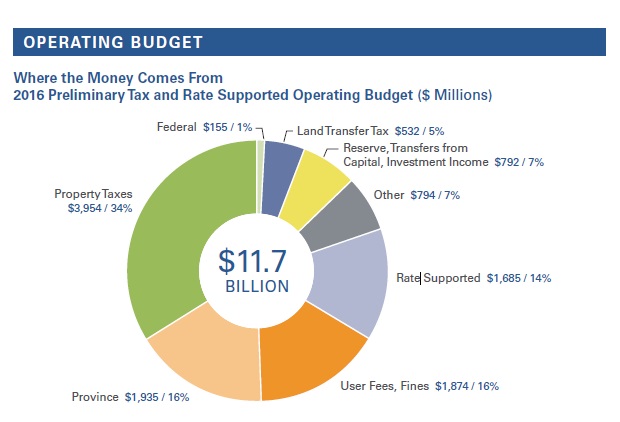
    2016Budget
    Estimated City of Toronto 2016 operating budget revenue (source)

    In 2016, $3.95 billion will be collected from property taxes in order to fund the City of Toronto’s operating budget, just over a third of all revenue. It’s the largest source of revenue, but provincial grants, user fees (such as TTC fares) and fines, water and waste management charges are other important sources of revenue. The much-loathed municipal land transfer tax will contribute $532 million to the city’s budget, an increasingly important source of revenue. But there’s still a projected gap, estimated between $90 and $124 million, that still has to be filled. That’s where the debate will largely focus on.

    Property taxes mostly do not fund the city’s capital budget; utility and parking rates are the largest single-source of funds (water, waste and city parking are self-financing), followed by provincial and federal grants (largely to fund transit and other infrastructure), development fees, and debt-financing and from the city’s capital reserves.

    Mayor Tory, despite wanting to hold the line on expenses, also wants to build his signature – yet unrealistic – SmartTrack line, among other transit projects, as well as social housing. He proposed a new levy (not calling it a “tax”) in December, if approved, it would be phased-in, starting in 2017.

    I’ve been critical of Mayor Tory’s administration, but his proposed infrastructure levy is a step in the right direction. It’s an acknowledgement that the backlog of necessary capital projects needs to be addressed.

    But I was concerned to read last week in the Toronto Star that senior city staff and Tory’s advisers were considering, even laying some of the groundwork, for a sale of a minority stake of Toronto Hydro to pay for new infrastructure. While it might raise $1.5 billion, it would be a one-time source of funds, and would reduce or eliminate an annual dividend that raised $60 million for the city in 2014. There were also rumours of a partial or complete sale of the Toronto Parking Authority. But responding in the Toronto Sun, Tory denied having such plans.

    The City of Toronto desperately needs to seek new, stable, and sustainable revenue sources beyond the property tax and user fees, neither of which are progressive or especially fair. Reinstating the vehicle registration tax would be a good place to start, at least to fund the city’s unfunded anti-poverty strategy, but income and sales taxes, currently prohibited by provincial legislation, tied to inflation, would help. So would increased, sustained provincial and federal assistance.

    You can find out more about the 2016 budget at the city’s website here. I’m not following the debates that closely, but Torontoist can be counted on for good issue-based coverage, the Toronto Star’s Ed Keenan provides excellent commentary.


    On property taxes, current value assessments, and a progressive property tax

    Property taxes are a very difficult subject to explain, but David Hains at Torontoist explains how they work far better than I, or most people, can. Property taxes are not well understood, but it’s important to note that despite rising property values, the city does not necessarily collect more taxes on each property. In many cases, even with a tax hike, the amount paid by some property owners may stay the same, or even decrease.

    Property taxes provide a predictable and reliable revenue source, but unlike income and sales taxes, they do not increase automatically with inflation; annual tax increases determined by City Council allows the city budget to grow with inflation and support city priorities, such as improved transit, infrastructure repairs, or other city services.

    The city is also phasing in changes to property taxes in order to reduce the burden on commercial properties (including multi-unit residential rental buildings) and increase it on freehold units. This is why, in 2013, I received a rent reduction notice as the property taxes in the apartment building I was living in at the time was reduced.

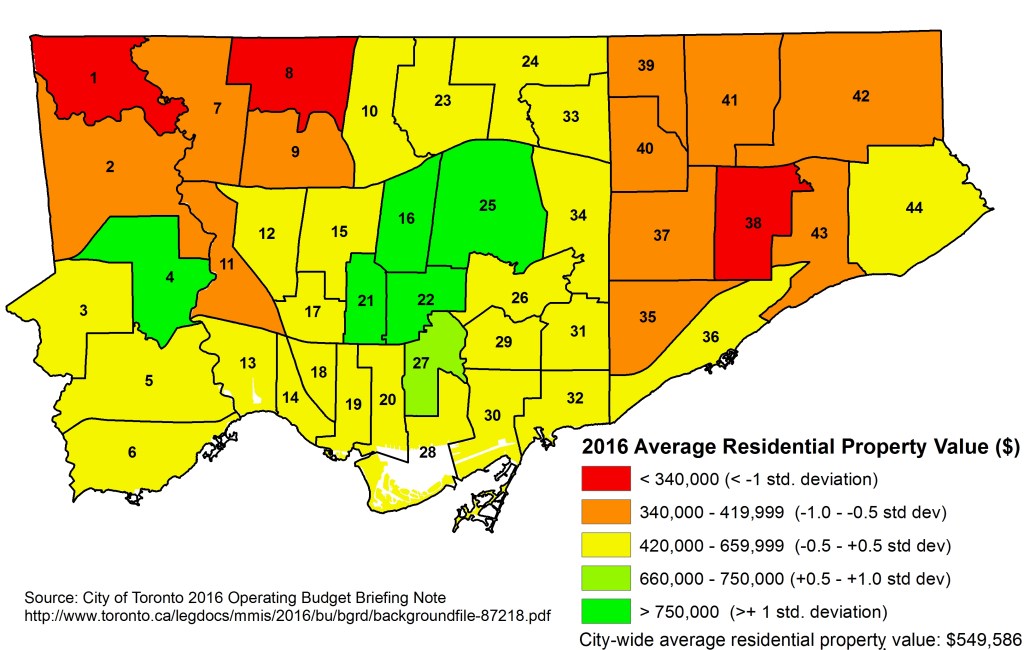
    To satisfy my interest in property taxes, property values, and assessments, I created three maps based on a City of Toronto 2016 budget briefing note on changes to the current value assessment (CVA) from 2015 to 2016. The Municipal Property Assessment Corporation (MPAC) conducts property tax assessments for all properties on behalf of municipal governments in Ontario every four years. It is upon these assessments that the city calculates each property’s tax rates.

    The first map, below, shows the average assessed residential property value for 2016, using a standard deviation classification scheme. Ward 25 has, by far, the highest average property value, at $1,375,568. Ward 25 includes the exclusive Bridle Path neighbourhood, as well as the affluent Lawrence Park East and York Mills neighbourhoods. Other Midtown Wards (16, 22, 21) are well above the city’s average property value, assessed at $549,586. Lowest is Ward 8, whose average residential property is assessed at $301,320.

    It’s interesting to note that, with the exception of Ward 4, which narrowly voted for Doug Ford in 2014, the map closely resembles that of John Tory’s support base.

    2016 Average Residential Propery Value std deviation

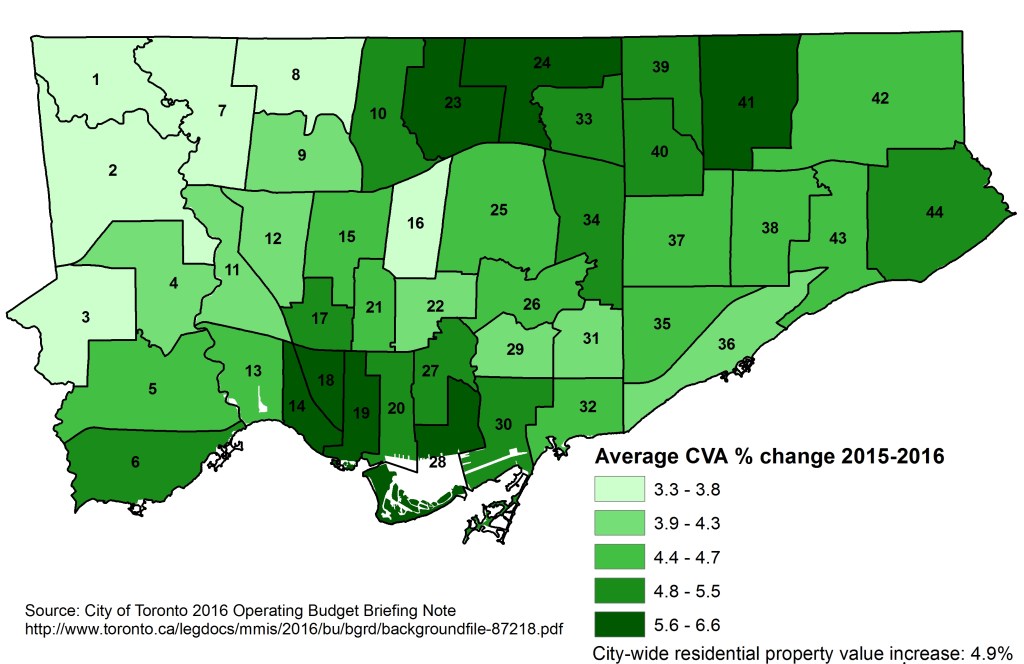
    The second map, below, shows the change in the average CVA in each ward. Ward 18, which includes the gentrified or gentrifying Queen West, Brockton, Junction Triangle, and Dovercourt Village neighbourhoods had the highest annual average CVA increase, at 6.6 percent. Other downtown wards, such as 14 (which includes gentrifying Parkdale, Roncesvalles, and part of the Junction), 19, and 28 did well, as well as Wards 23, 24 and 41 in the suburbs. The northwest had the smallest average increases in assessments, with Ward 8 again coming in at the bottom, with only a 3.3% increase.

    CVA Change 2015-2016

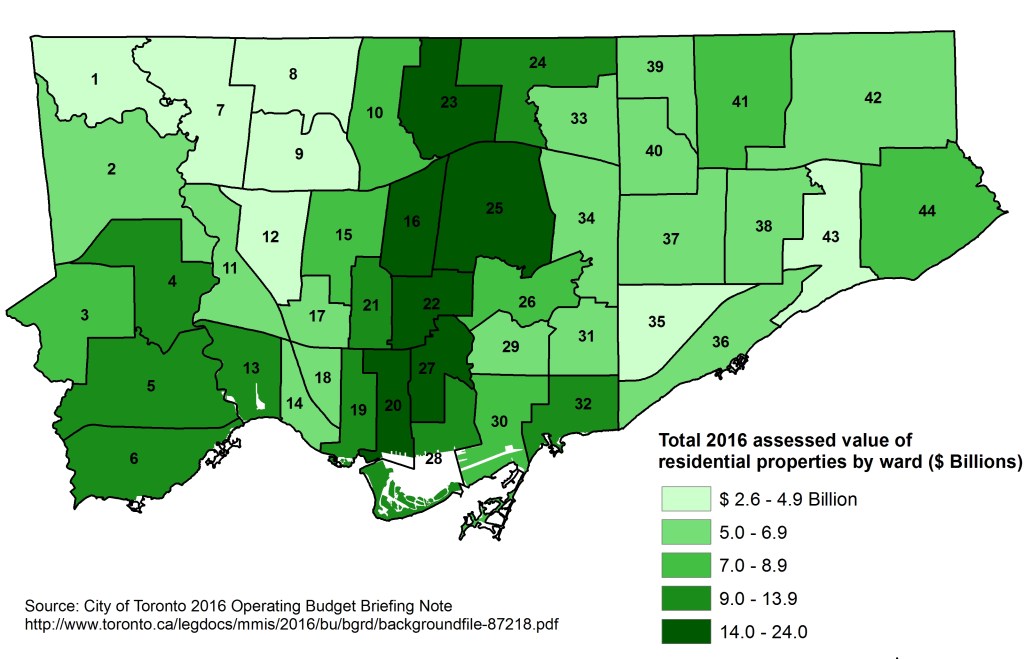
    Finally, the map below shows the entire aggregate value of residential assessments in 2016. Not surprisingly, Wards along the dense Yonge Street corridor had the highest values. Except for Wards 16 and 25, all have higher than average ward populations, and housing in most neighbourhoods largely consists of expensive detached houses and highrise condominiums.

    2016 Total Residential Propery Values

    In today’s Toronto Star, Ryerson Professor (and friend) Myer Siemiatycki discusses the idea of a progressive property tax. A progressive property tax would be similar to income taxes, in which tax brackets are set up, lowering taxes on lower-value properties, and raising them on properties with high assessed values. Siemiatycki proposes that a first bracket, if a system was implemented this year, would ensure that properties worth under $400,000 would pay less property tax than they paid in 2015. A second bracket would apply to properties assessed at between $400,000 to $600,000, which would be subject to the currently proposed tax increase. Properties worth over $600,000 would be subject to higher property tax increases, the highest bracket topping out at properties worth over $2.5 million. Siemiatycki argues that the most expensive properties have benefited most from Toronto’s increasing housing prices.

    This is an interesting idea that would raise more revenue for the City of Toronto, give many “Ford Nation” residents a tax reduction, and provide more fairness in the flat property tax rate. It would be much more easily implementable than, say, sales and income taxes. But given that John Tory’s base (and wards represented by some of his staunchest allies) would be most affected by such a progressive tax system, I don’t hold out much hope for its adoption.

  • Mapping “Team Tory”

    Back in September 2014, I created a series of maps for Matt Elliott, journalist at Metro, blogger, city council observer, and all-round great guy. Elliott’s City Council Scorecard tracked how each councillor voted on major decisions at city hall, along with a “Ford Nation” score that measured how closely each councillor voted with the mayor. Matt’s Council Scorecard was one of several inspirations for the work that I undertook so far on this blog, especially mapping the results of the 2014 municipal election.

    On April 24, Elliott published a new edition of his excellent scorecard, a check-up on how Tory has been handling council so far. I wanted to map the new scorecard and compare it to Ford’s performance. You can read more about Elliott’s methodology here.

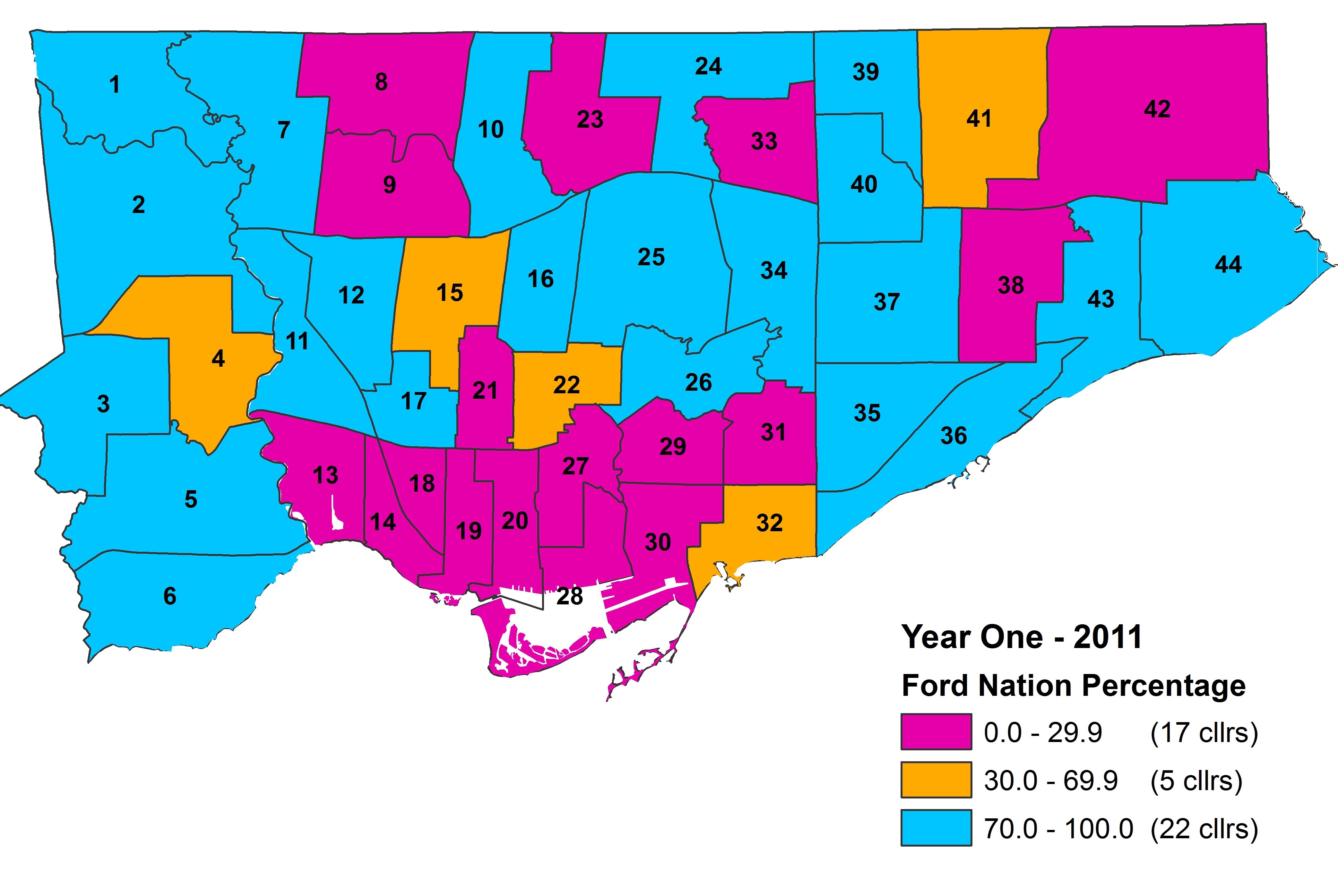
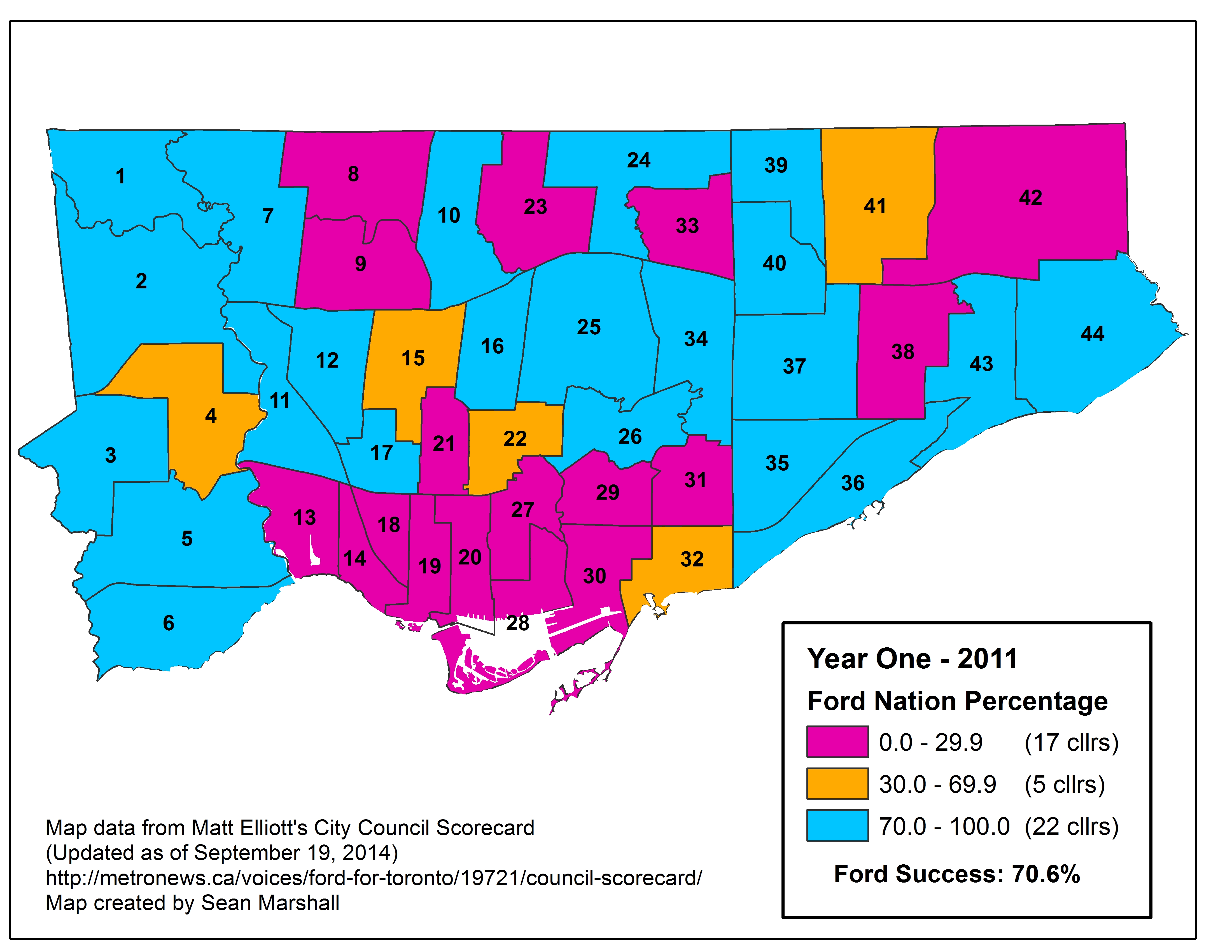
    In 2011, newly elected Mayor Rob Ford was able to count on the support of 22 councillors — a slim majority on the 45-member council when the mayor’s vote is added. From that bloc, Ford was able to pick his executive committee, who helped push forward his agenda of cost-cutting and mucking up Toronto’s transit plans. That year, council voted with Ford over 70 percent of the time. But by December, Ford’s control was already slipping; several potential proposed service cuts were rejected, as well as Doug Ford’s ridiculous plans to take control of the Waterfront development and build a Ferris wheel and mega-mall in Toronto’s Portlands.

    Many of the city councillors opposed to Ford’s agenda  — but not all — were elected in wards representing the Old City of Toronto and East York. But six suburban councillors  — Maria Augimeri, Anthony Perruzza, John Filion, Shelley Carroll, Glenn de Baeremaeker and Raymond Cho  — were all reliable opponents. Except for Cho, who ran for the provincial Progressive Conservatives and lost in the 2014 election, the rest identified with either the Liberals or New Democrats and re-elected in 2010 despite their wards voting overwhelmingly for Rob Ford.

    Ford Nation Percentage 2011 HiRes

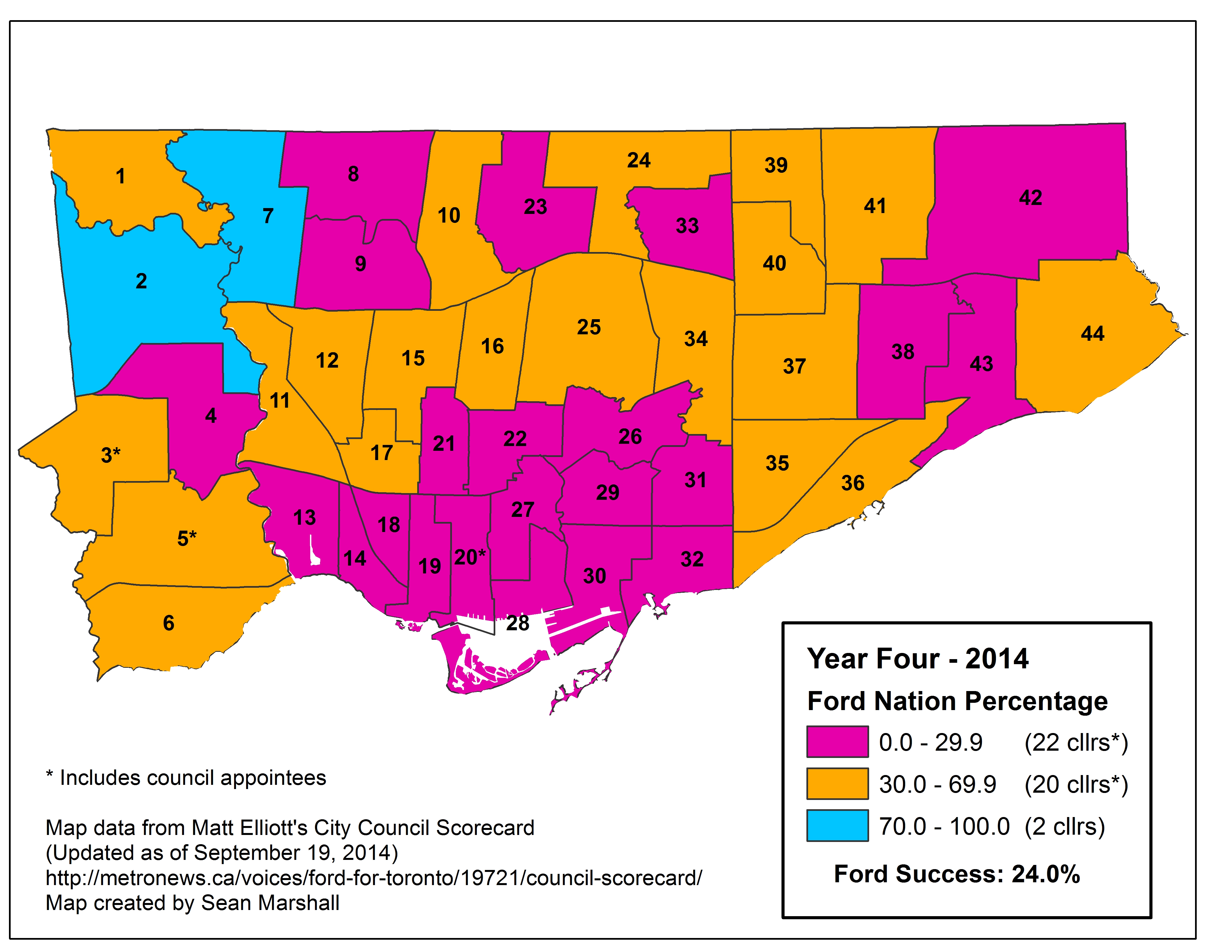
    It’s important to note that the Ford brothers’ agenda and control over council fell apart even before the Garrison Ball debacle and the crack-smoking allegations and council meltdown of 2013. In 2012, Rob Ford was only able to count on the loyal support of 17 councillors; he only had a 32 percent success rate at council that year. By 2014, Mayor Ford could only count on two reliable allies — his brother Doug, and Ward 7’s Giorgio Mammoliti; council only voted with the mayor 24 percent of the time.

    Ford Nation Percentage 2014 HiRes

    John Tory was elected in 2014 on an uninspiring, yet effective centre-right campaign, promising better governance, limited tax increases, and his own problematic transit plan. But after four years of Rob and Doug Ford, voters were looking for change. Sadly, candidates running on more substantive/progressive platforms, such as early front runner Olivia Chow and former councillor David Soknacki, either dropped out of the race or came far behind second-place Doug Ford, Rob’s obnoxious and bigoted enabler.

    Those looking for a brave new era at City Hall were disappointed by the incoming mayor’s picks for committee chairs/executive committee, speaker and TTC Chair, all plum posts that help steer the mayor’s agenda. Denzil Minnan-Wong (Ward 34), one of council’s most conservative and divisive members was named Deputy Mayor, while Rob Ford’s enabler on the council floor, Frances Nunziata (Ward 12), was re-appointed Speaker. All but two of Tory’s executive committee members were reliable Ford allies in 2011, seven of whom were on Ford’s original executive committee. (It should be said that some of those councillors, notably Paul Ainslie (Ward 43) and Jaye Robinson (Ward 25), later quit or were kicked off the Executive Committee.)

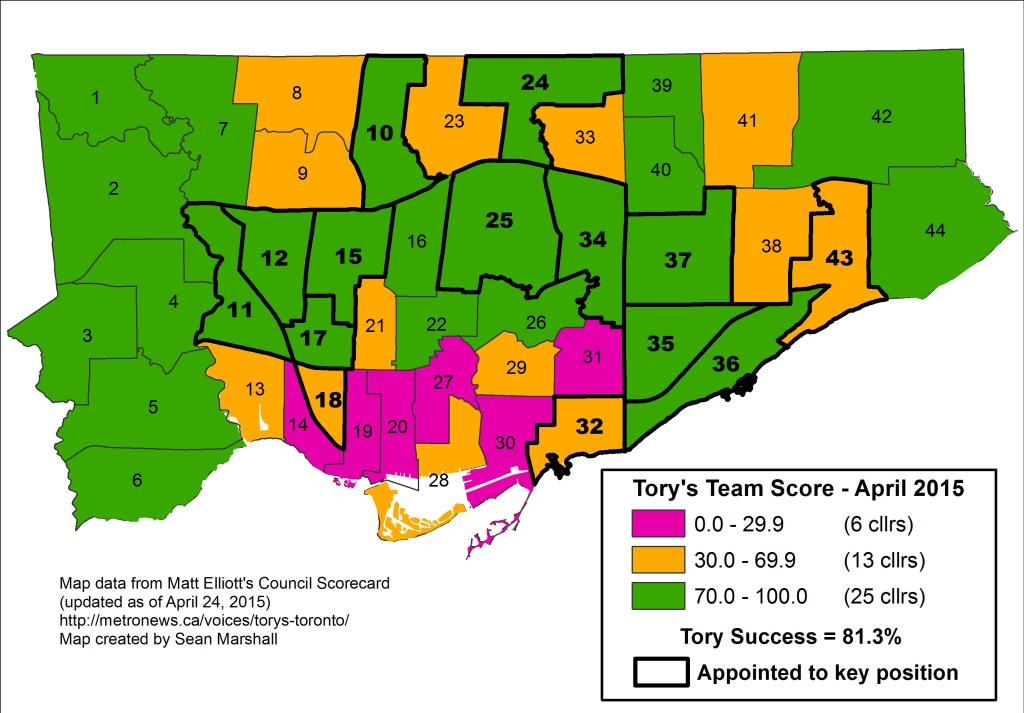
    Tory Team - April 24 2015

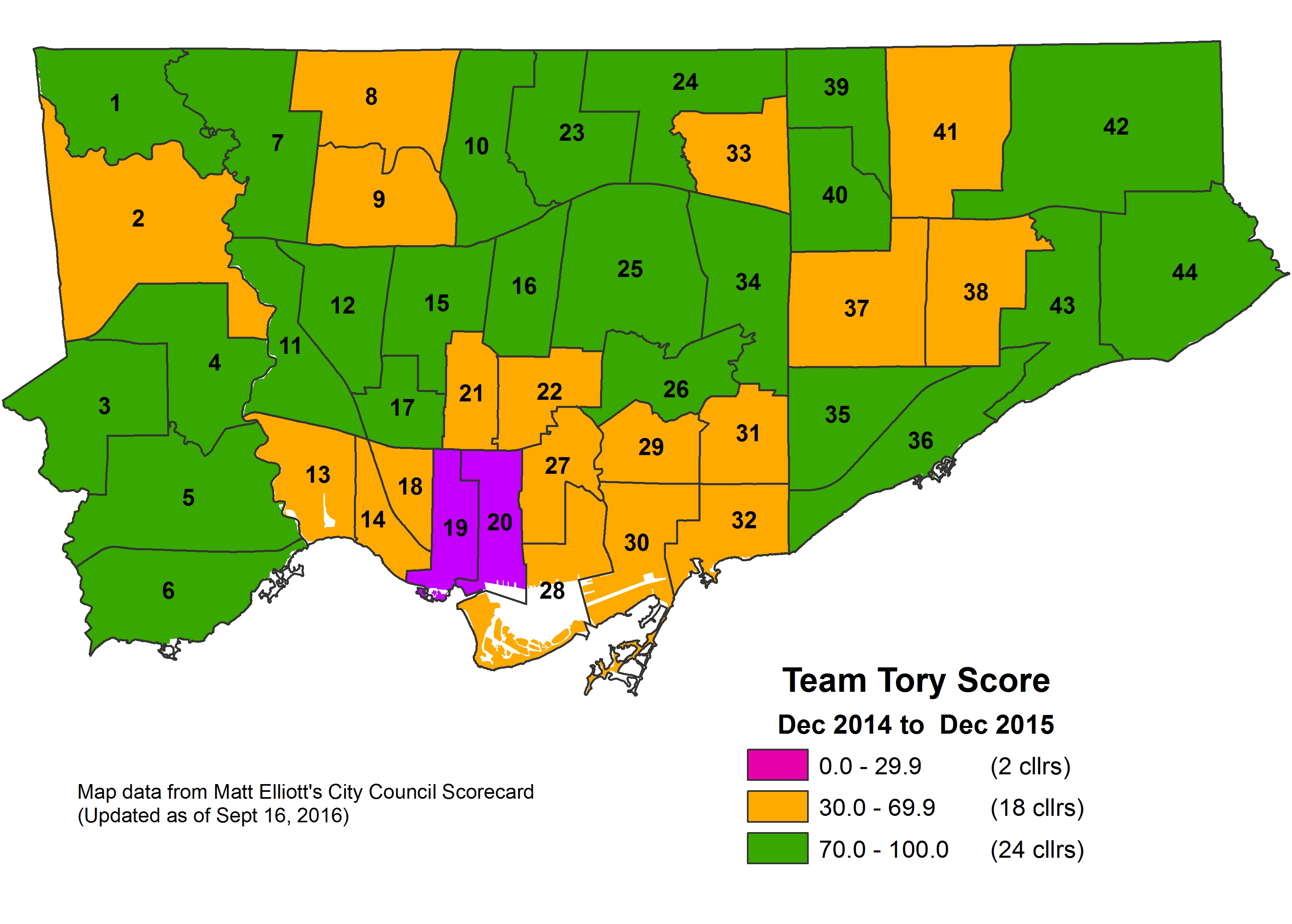
    Tory’s Team Score 

    Only five months into his term, John Tory had a good, but not stellar, record of getting his agenda through council. Matt Elliott found that 25 councillors have been reliable allies of Tory; voting with the mayor at least 70 percent of the time, including 5 of the 6 new councillors elected. Only six councillors — Gord Perks, Mike Layton, Joe Cressy, Kristyn Wong-Tam, Paula Fletcher, and Janet Davis, all representing “downtown” wards  — have voted with the mayor less than 30 percent on all important votes. Other anti-Ford councillors, so far, find themselves part of the “mushy middle” or “mighty middle,” though they are at this point a minority of 13. Interestingly, Councillors Rob Ford and Giorgio Mammoliti are voting with Ford most of the time so far. So much for Ford leading an “official opposition” against Tory.

    As expected, councillors that John Tory endorsed and supported in the last election  — Christin Carmichael Greb in Ward 16, Jon Burnside in Ward 26, and Mark Grimes in Ward 6 — were among Tory’s most loyal votes on council, even though none got a plum appointment (Carmichael Greb and Burnside are rookies, Grimes a three-term councillor). All three faced challenges from qualified, less conservative opponents.

    John Tory’s budget and early agenda has been less confrontational and ideological as what Ford pushed in 2011; this could be helping his score. Left-leaning councillors like Joe Mihevc (Ward 21) and Pam McConnell (Ward 28) are, for now, voting 35 percent with the mayor. The budget approved by council keeps tax increases low (I’d argue unsustainably low), but TTC cuts implemented by Rob Ford are being reversed; no services are being slashed. It’s true that council not doing enough on policing issues (especially carding/racial profiling; Tory doesn’t seem to have any interest here), nor is there enough action on the TCHC’s capital repair backlog, but so far, there haven’t been many divisive votes.

    John Tory’s budget and early agenda has been less confrontational and ideological as what Ford pushed in 2011; this could be helping his score. Left-leaning councillors like Joe Mihevc (Ward 21) and Pam McConnell (Ward 28) are, for now, voting 35 percent with the mayor. The budget approved by council keeps tax increases low (I’d argue unsustainably low), but TTC cuts implemented by Rob Ford are being reversed; few services are being slashed. It’s true that council is not doing enough on policing issues (especially carding/racial profiling; Tory doesn’t seem to have any interest in this important matter), nor is there enough action on the TCHC’s capital repair backlog. But so far, there haven’t been many divisive votes. With upcoming labour negotiations and more big-ticket budget items (the decision on what to do about the crumbling and under-capacity east Gardiner Expressway, for example), this will change.

    At times, Tory has seen to be either ignorant or dismissive of how City Council works; had he known better, there would be someone else in the Speaker’s chair, a less polarizing deputy mayor, and a few more centrist or left-leaning councillors in key positions to unite council. Mid-term, in early 2016, there’s an opportunity for Tory to revisit his committee appointments if necessary.

    It’s very possible that Tory will lose political capital as the term goes on, though it is nearly impossible to imagine him losing control of the agenda so dramatically as Ford did. In any case, it will be interesting to see if Tory learns on the job and continues to have the confidence of council, or if he starts to lose his grip as most mayors experienced later in their terms.