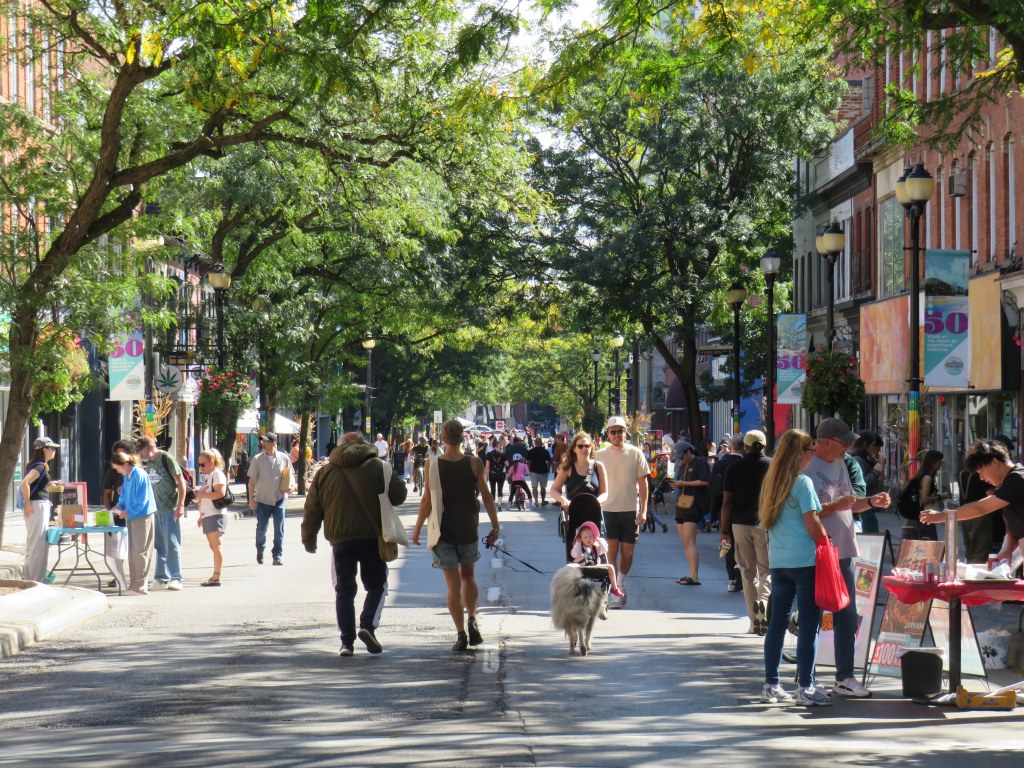
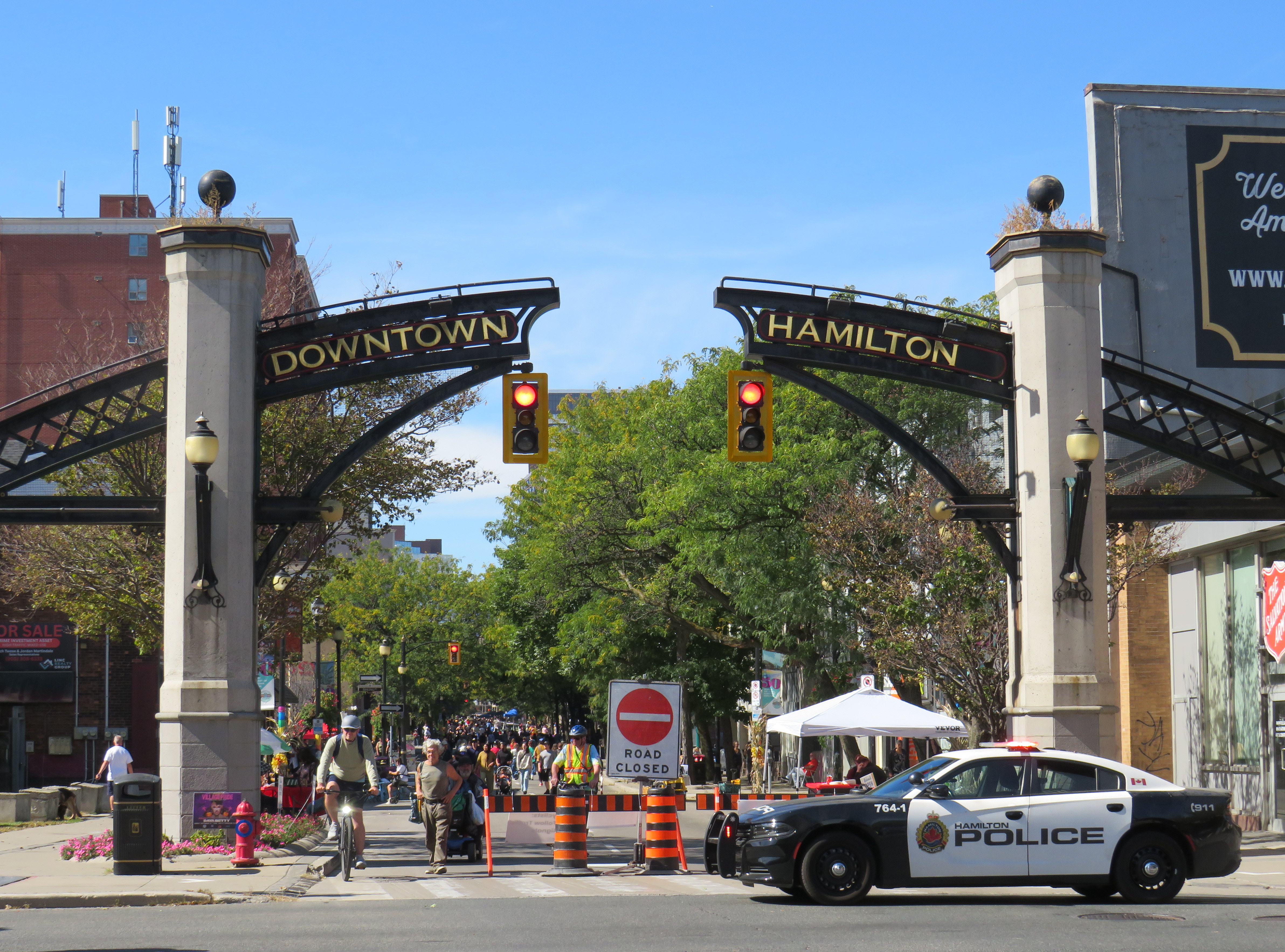
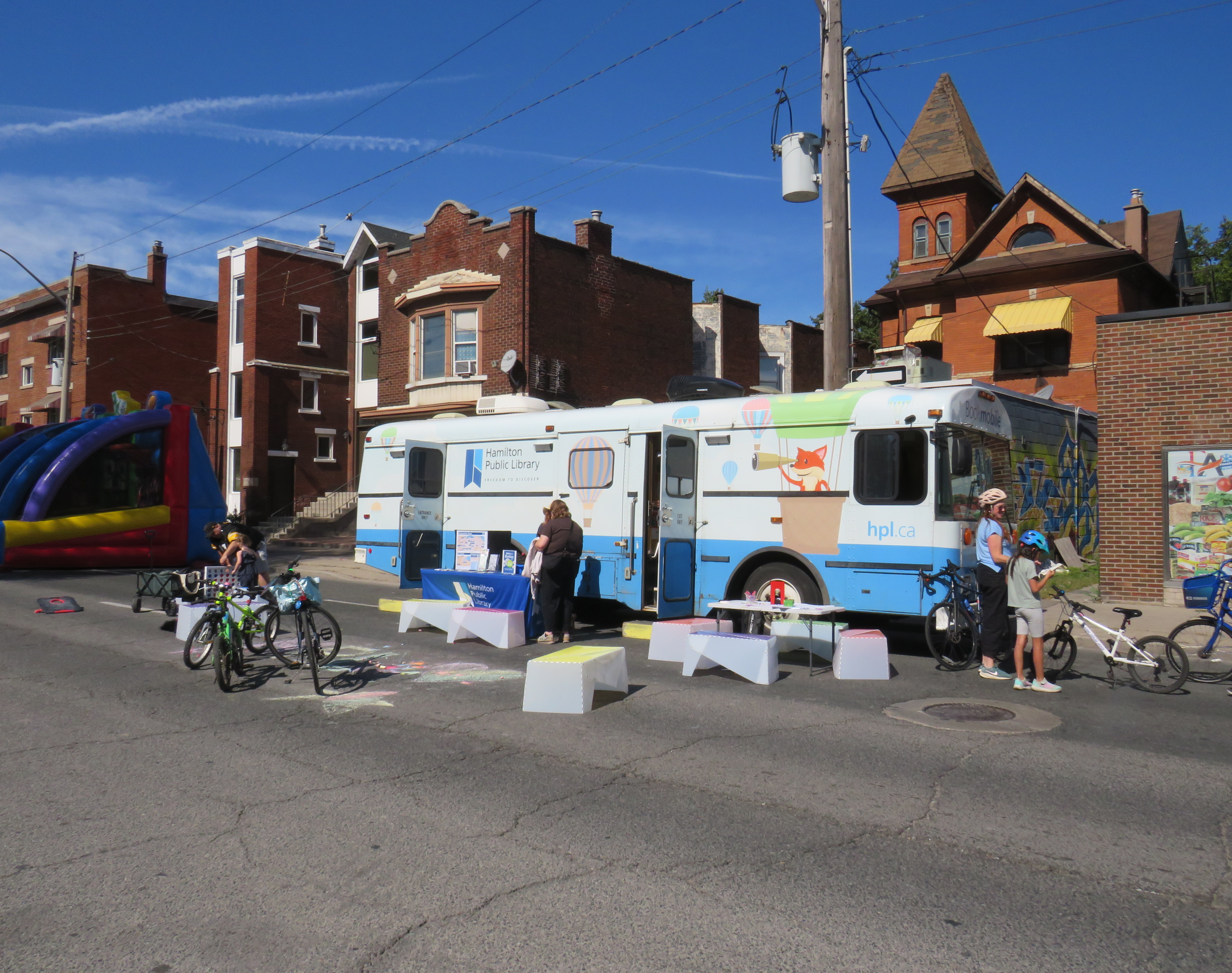
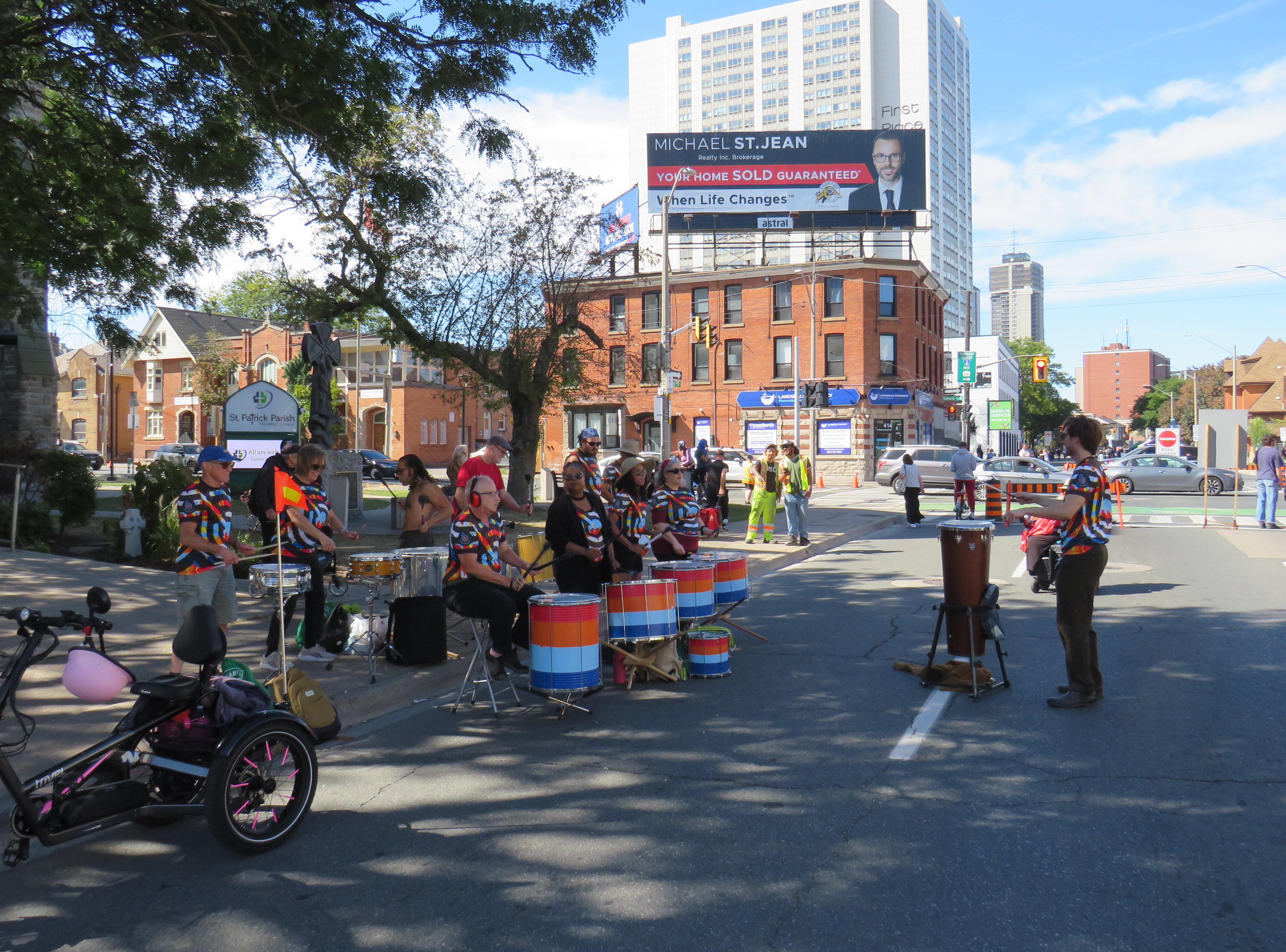
On Sunday, September 27, I took the GO train to Hamilton with my bike to experience Open Streets Hamilton, an annual event that shuts down just over three kilometres of King Street East between John Street and Gage Street from 10AM to 4PM. An official program of the City of Hamilton, pedestrians and cyclists get to enjoy a car-free experience, with five activation hubs, with live music, play spaces, and booths set up by city-affiliated agencies like the Hamilton Street Railway and Hamilton Public Library as well as local non-profit and activist organizations. Businesses along King Street were welcomed to take their business outside with displays and tables for passers-by to browse.
The Hamilton Public Library’s bookmobile near King and ShermanDrum band at King and Victoria
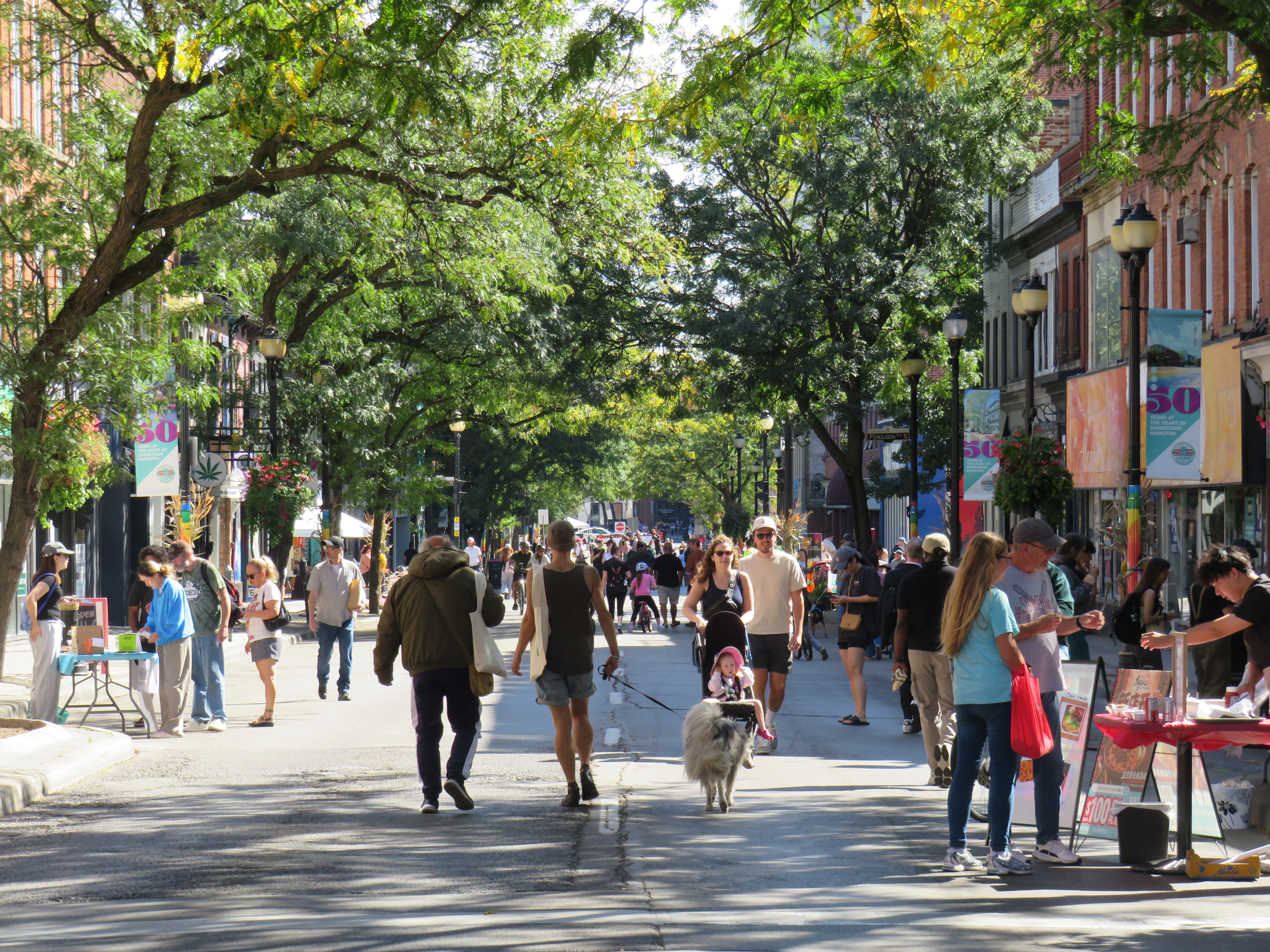
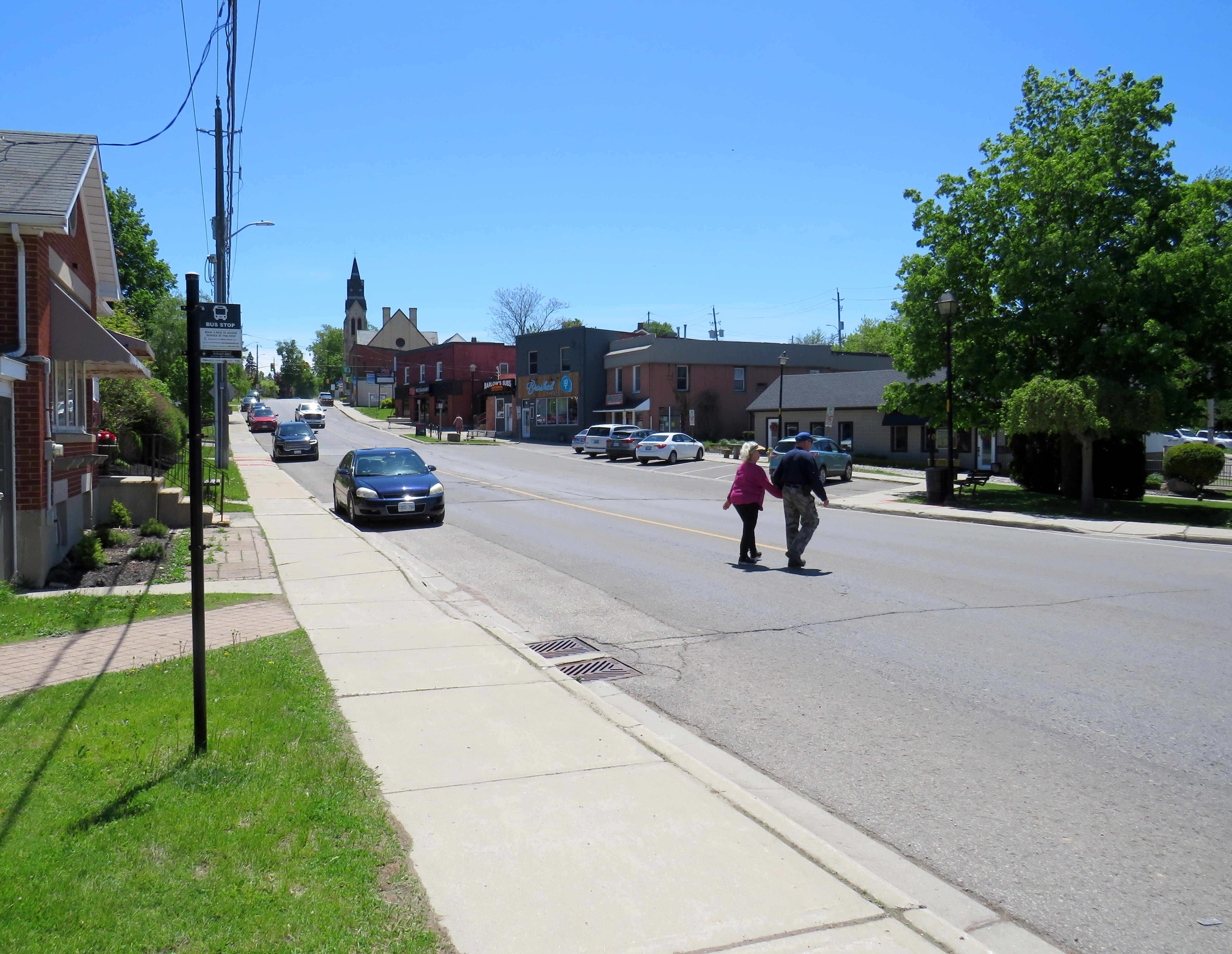
Hamilton’s Open Streets was a delight. A pleasant, sunny day certainly helped, but it was nice to see so many people sharing the space, all at a gentle pace. Cyclists taking advantage of the car-free King Street were respectful of pedestrians having the whole right-of-way and especially careful around the five hubs. Cyclists looking for a faster route could easily go just two blocks north to Cannon Street, which has a continuous two-way cycletrack as far east as Sherman Avenue.
King Street narrows between John and Wellington Streets through the tree-lined International Village BIA
By extending Open Streets into the later afternoon, Hamilton helped to encourage businesses to participate and to get a wide variety of participants through the day. Though Open Streets in Toronto was supported by the Downtown Yonge BIA, there was limited commercial activity along the routes, likely due to the short hours.
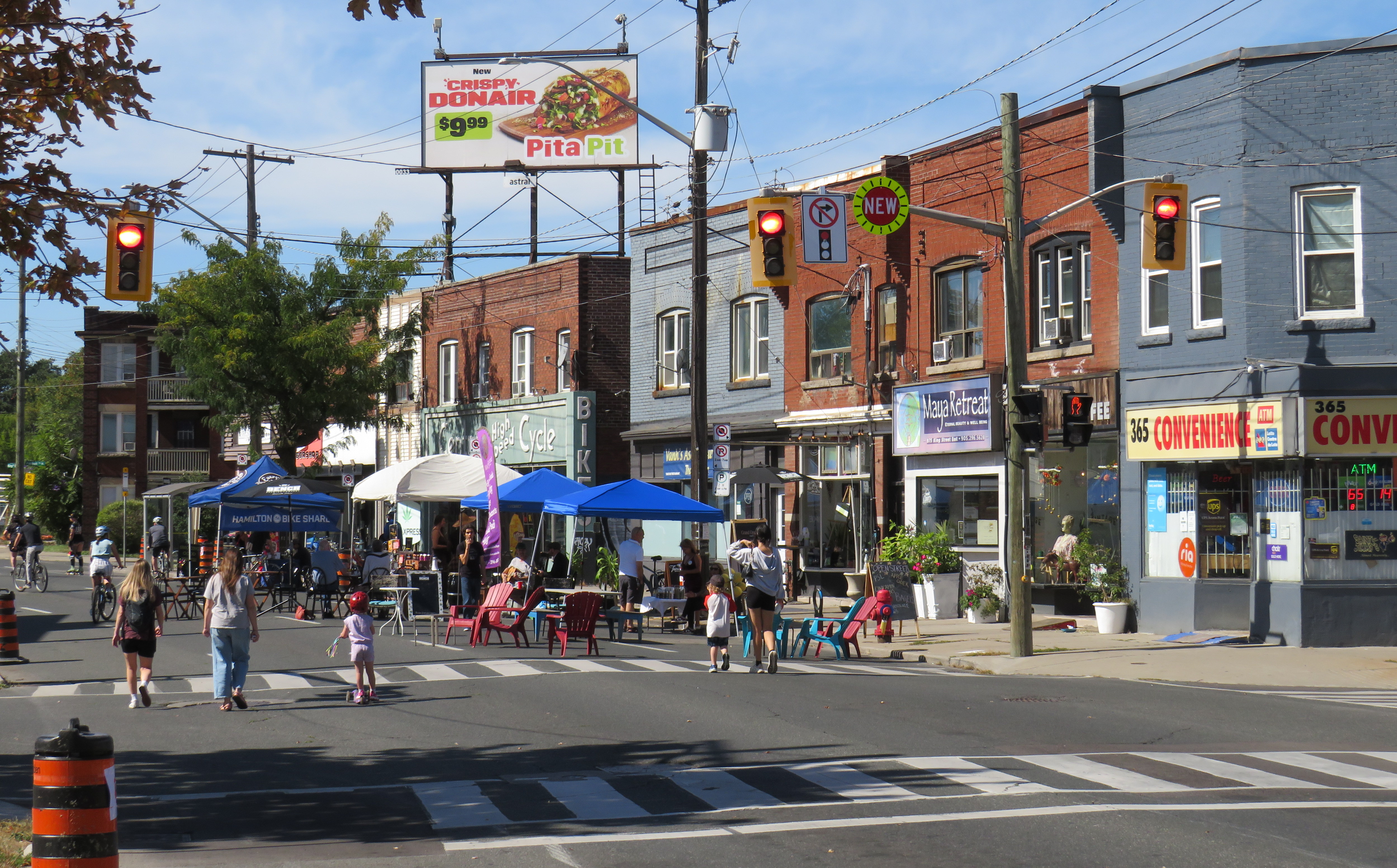
King at Barnesdale, towards the east end of the Open Streets. Note the café on the block put out seating and shade canopies.
In 2026, Toronto only had two blocks of temporary pedestrian activation — Church Street between Alexander and Wellesley Streets in the Village. Happily, that experiment ran for over six weeks, and restaurants and bars took advantage of the extra space. It worked well, despite nearby road construction and concerns about safety and traffic congestion. But it was just a taste of what Toronto can and should do.
Hamilton shows that open streets are popular and Toronto needs to bring them back. Hopefully the mayor and council elected later this month will have the courage and ambition to get Torontonians outside and on the streets.
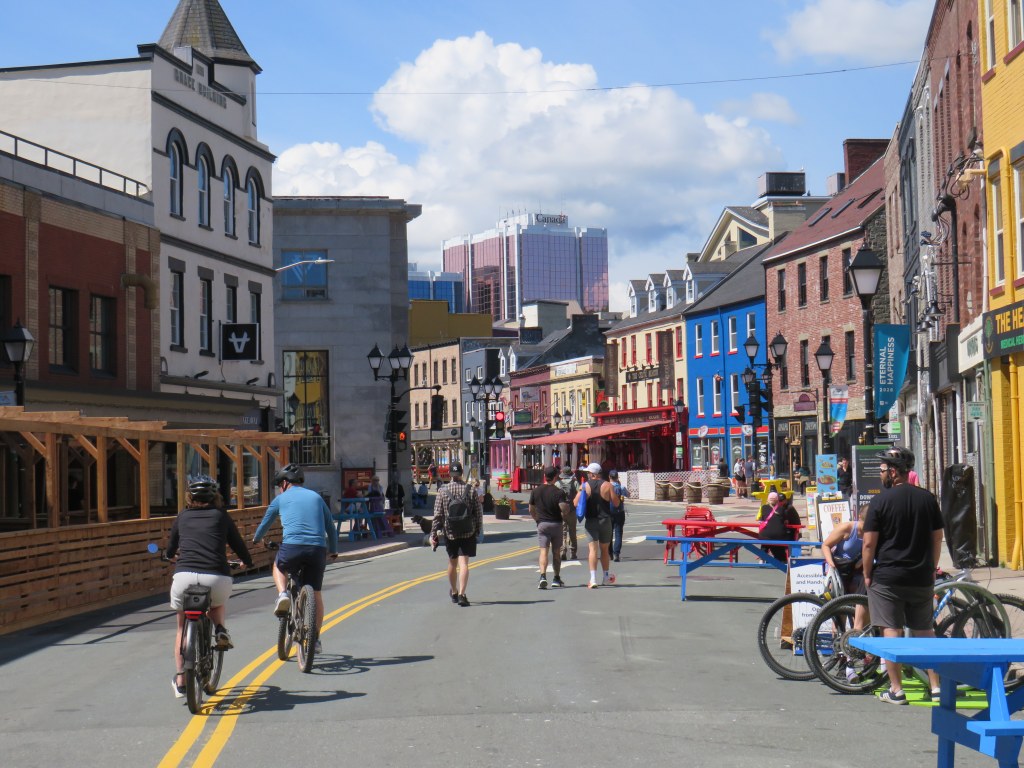
Pedestrians and cyclists enjoying a sunny Sunday morning in St. John’s
In late June of this year, my spouse and I had the chance to visit St. John’s, along with a few other destinations in Eastern Newfoundland and Saint Pierre, France. I highly recommend the visit, though even late June can be a bit cool and wet there.
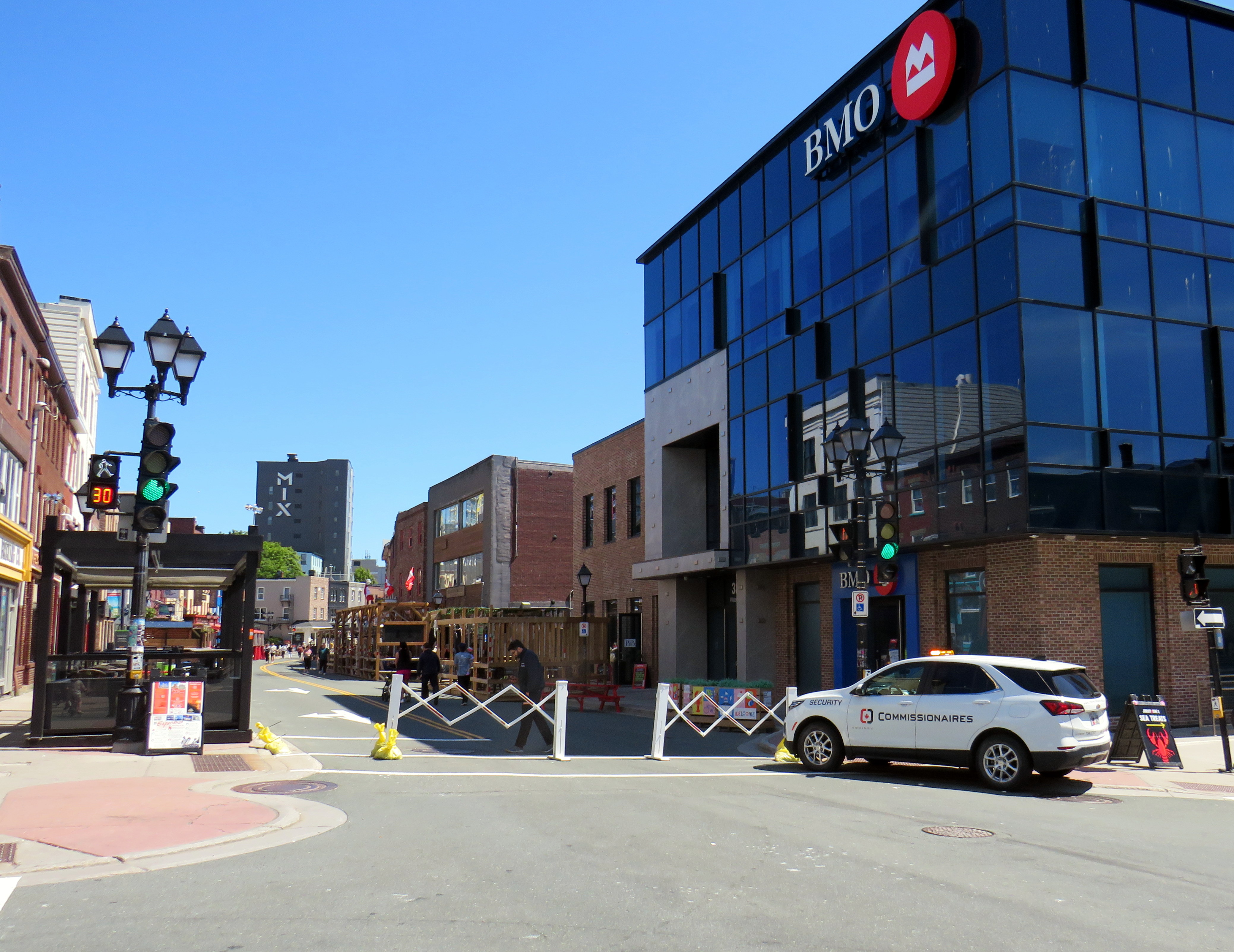
During our last two days, several blocks — about 700 metres — of Water Street, the main commercial street in St. John’s, was closed to all motor vehicles, and remains so until September 7, Labour Day. This is an annual event, supported by downtown businesses, and is one of the positive legacies of the social distancing era of 2020-2021.
Though fenced-off restaurant patios spill on to Water Street, there are plenty of public spaces to sit, too
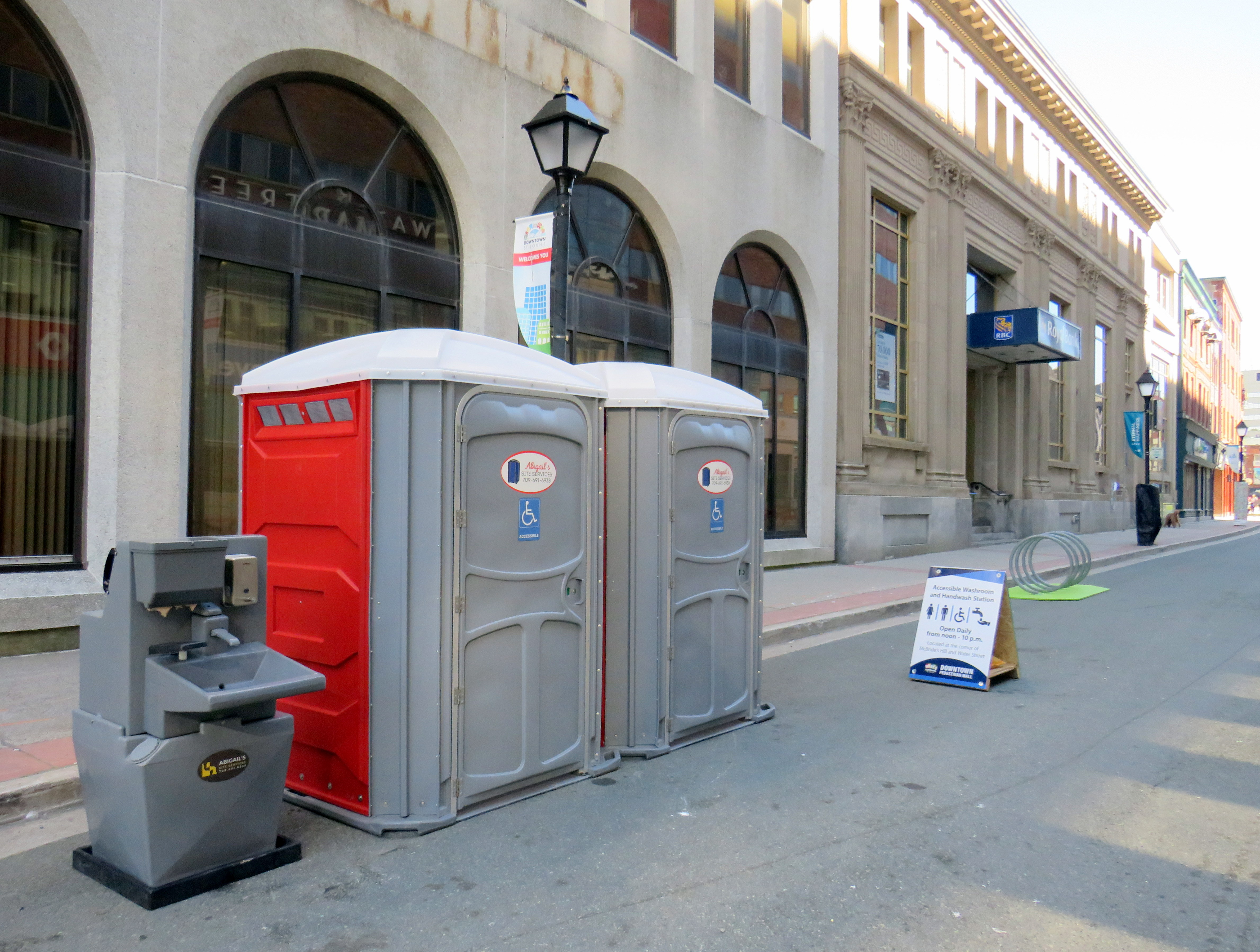
This is much less a street festival (though there are plenty of organized events) and more of an open street initiative. Though restaurants’ patios spill out into the street, there are plenty of public picnic tables set up for anyone to use, both in sunny and shaded areas. There are several portable toilets, complete with adjacent hand-washing sinks, which provide relief without having to pay to use a washroom.
Portable washrooms, hand-washing station, and portable bike parking on Water Street
Pedestrians and pedal cyclists are welcomed, though cyclists are instructed to go at a slow speed, and e-bikes passing through must have their power assist off.
Sign explaining e-bike policy for the Downtown Pedestrian Mall
Of course, there are security guards and gates set up to keep motorists out, apart from emergency vehicles and local deliveries. But I did not notice any police cars stationed at any of the intersecting streets, and the few RNC officers I saw were on general foot patrol. Though several Metrobus routes normally serve Water Street, these are diverted one block away to Harbour Drive.
Security minding traffic gates at Water and Adelaide Streets, the southern end of the pedestrian mall
Though St. John’s is a much smaller city than Toronto (its metro area is less than 4% the size of Toronto’s CMA), it is also much more car-dependent, with only a basic bus transit system, and very little cycling infrastructure. Yet, they are able to pull this off for ten weeks a year, on an annual basis. The last Open Streets event in Toronto was in 2022, and those were only held two Sundays of the year. Yes, there are wildly successful street festivals, such as Taste of the Danforth, which just had its record-breaking comeback, but they aren’t the same as they are rammed with crowds, and those only take place over two or three days.
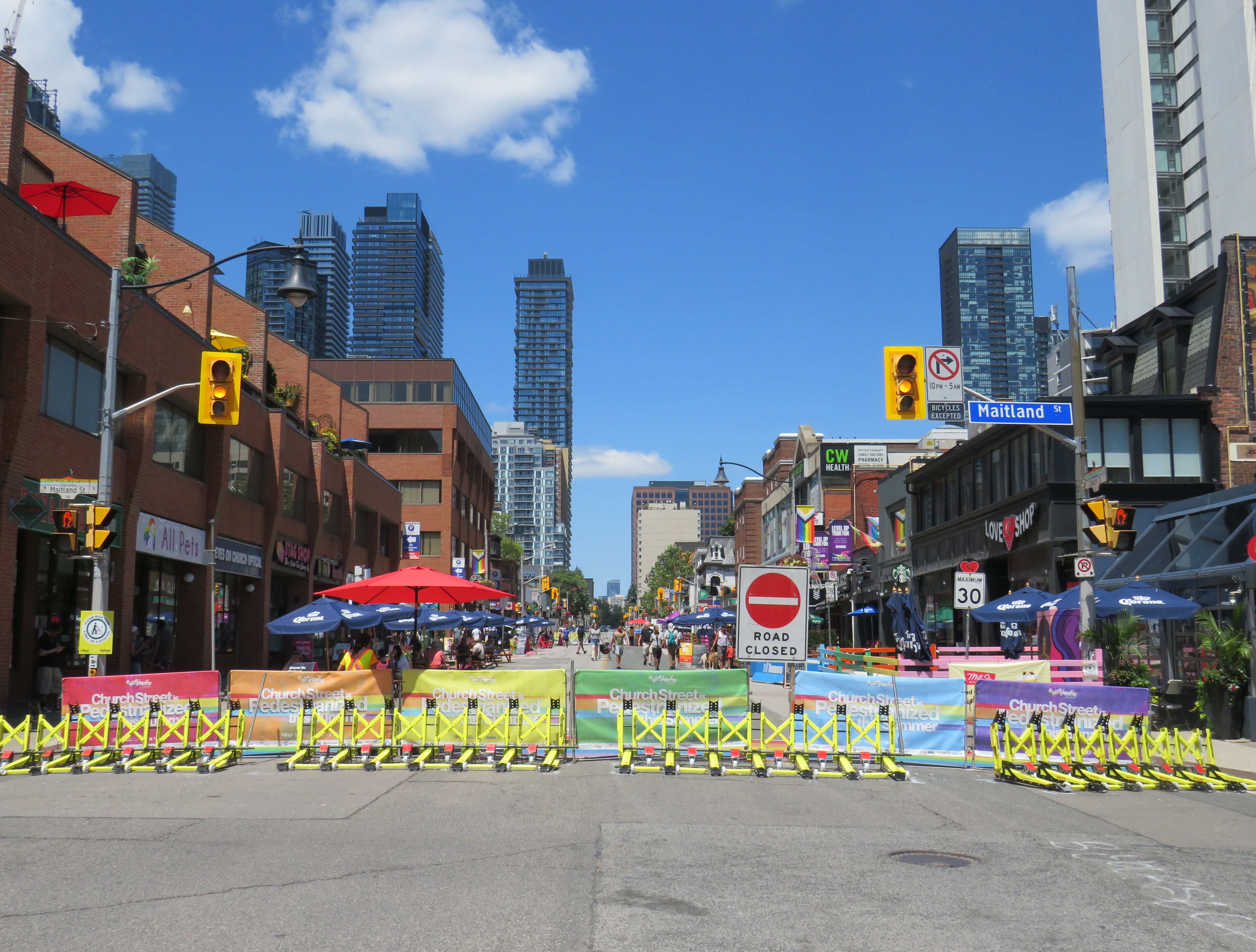
Moveable car traps and metal barricades block Church Street, looking north at Maitland
One key noticeable difference are the harder barriers to prevent motor vehicles from entering. Yellow wheel traps are lined up next to metal barricades, decorated with colourful banners. Though understandable given recent history in Toronto and Vancouver with vehicular attacks on sidewalks and a street festival, they sadly act to fence in what should be an open street and pedestrians must enter on the sidewalks. Unlike St. John’s, cycling is prohibited as well.
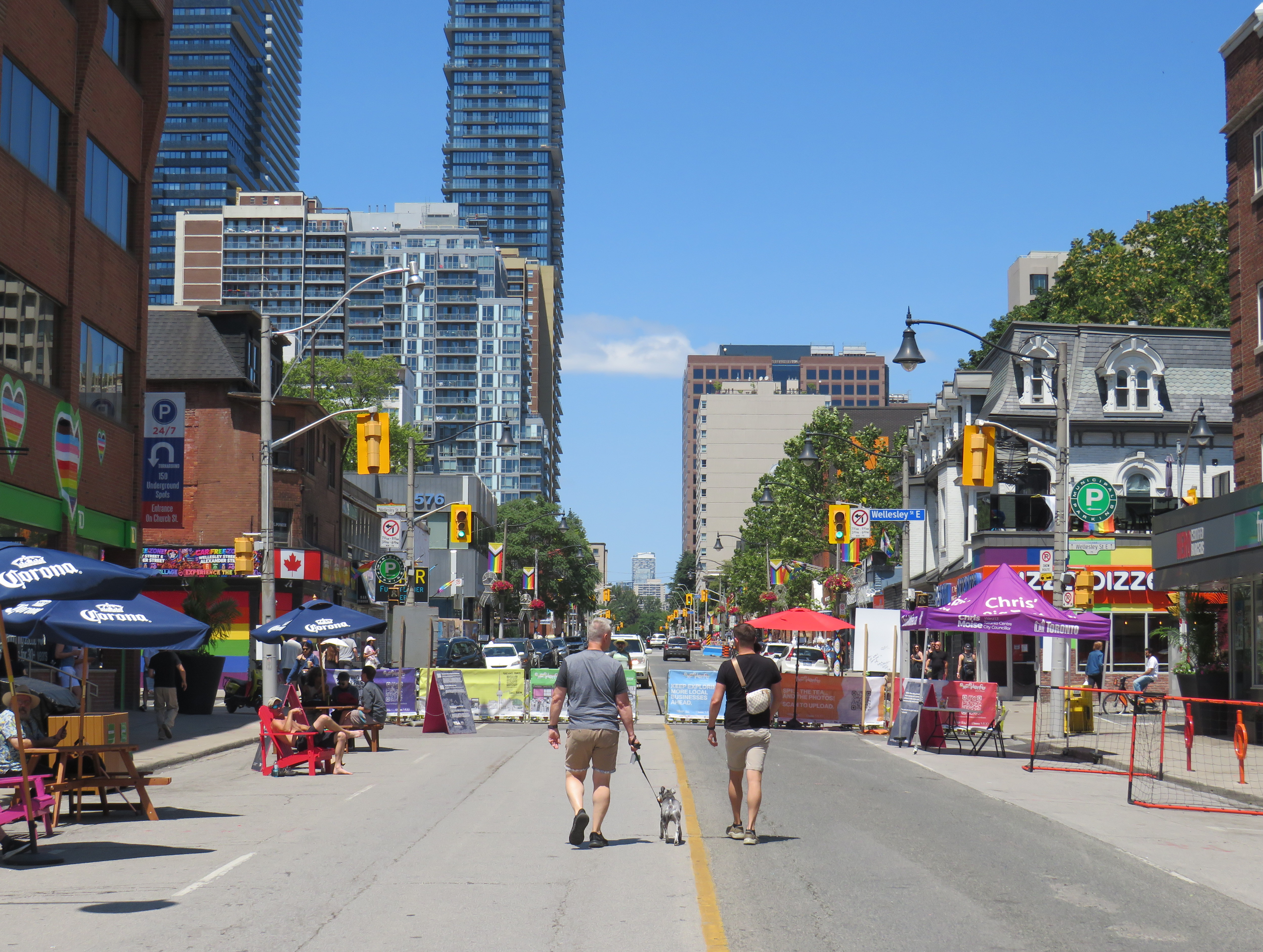
Shaded by branded patio umbrellas, the picnic tables and Muskoka chairs on the left are open to anyone
Still, it’s a great taste of what Toronto should have more of. As on Water Street, there are both private patio spaces on the street as well as public chairs and benches, as well as extra waste bins, though no public toilets. It’s also very well used, especially later in the day. The Church-Wellesley Village is the cultural and commercial centre for Toronto’s 2SLGBTQ+ communities, as well as being in the centre of a very densely-populated area with limited open space.
It is also oddly quiet, despite the vibrancy. That’s because there are no cars, which are a major source of urban noise pollution. The car-free environment also makes sitting on a curbside patio much more enjoyable, without the noise and smells of passing motorists. How can anyone object?
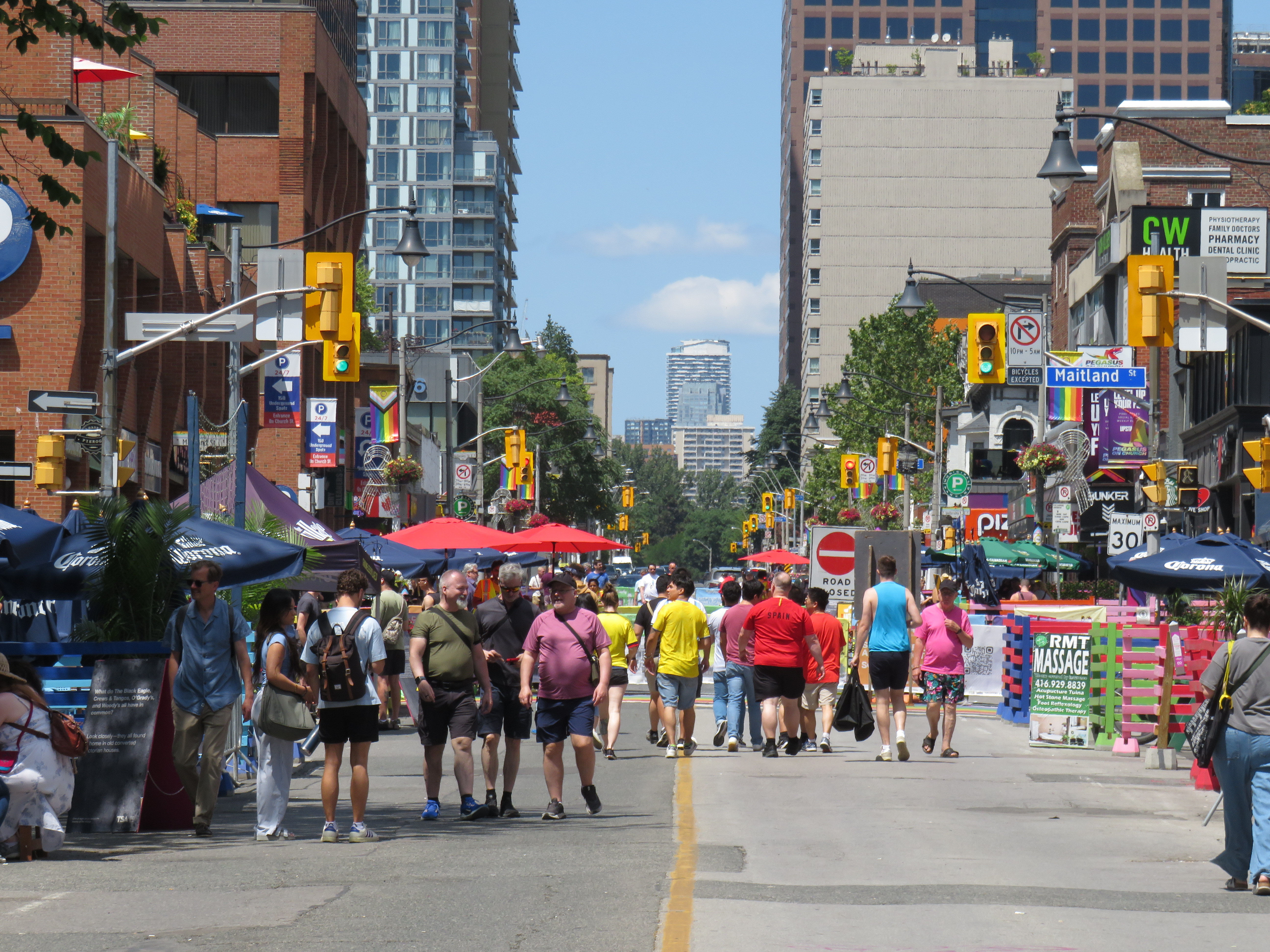
Later in the afternoon, Church Street was busier with pedestrians
It might be too much to ask for Montreal-style open street corridors, but Toronto should at least aspire to more, long-term open street set-ups like Water Street and Church Street. Kensington Market would be the perfect place to start. Even on our busy east-west streetcar routes on corridors such as Gerrard Street East or Queen Street West, with a bit of imagination and can-do spirit, we can accommodate those as well.
With adding long-term implementations, we will need to rethink the costs of policing and security, which are currently a major barrier to providing these spaces in Toronto. In Montreal, security staffing is minimal on open streets such as Ave. Mont-Royal. The needs of policing and securing a regular pedestrianized area are quite different than ensuring safety at a crowded street festival.
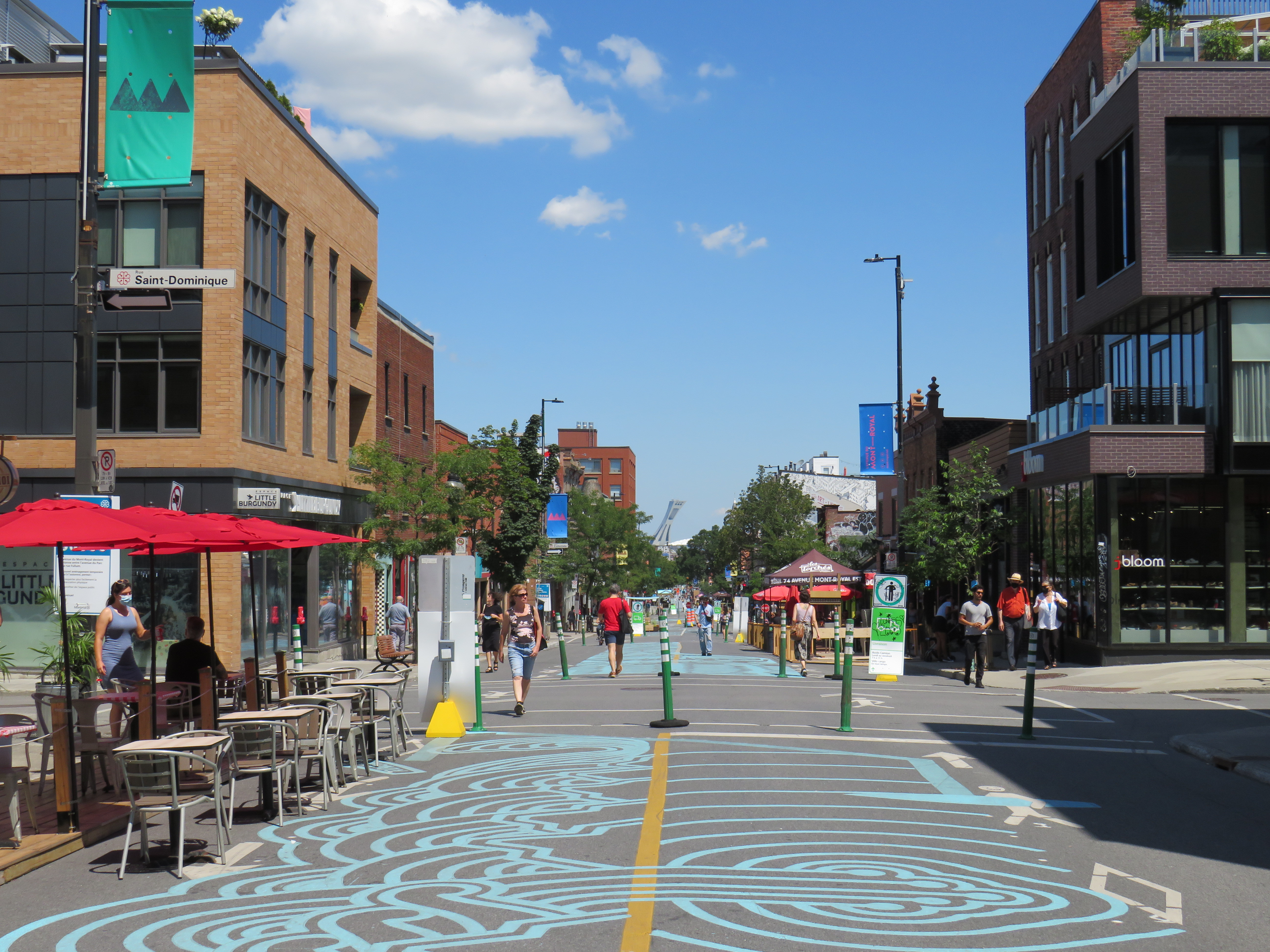
Ave. Mont-Royal, where security measures are minimal on the summer open street
Such crowd-pleasing, neighbourhood-building actions as Open Streets should be on any serious mayor or council candidate’s policy platform in the upcoming municipal election.
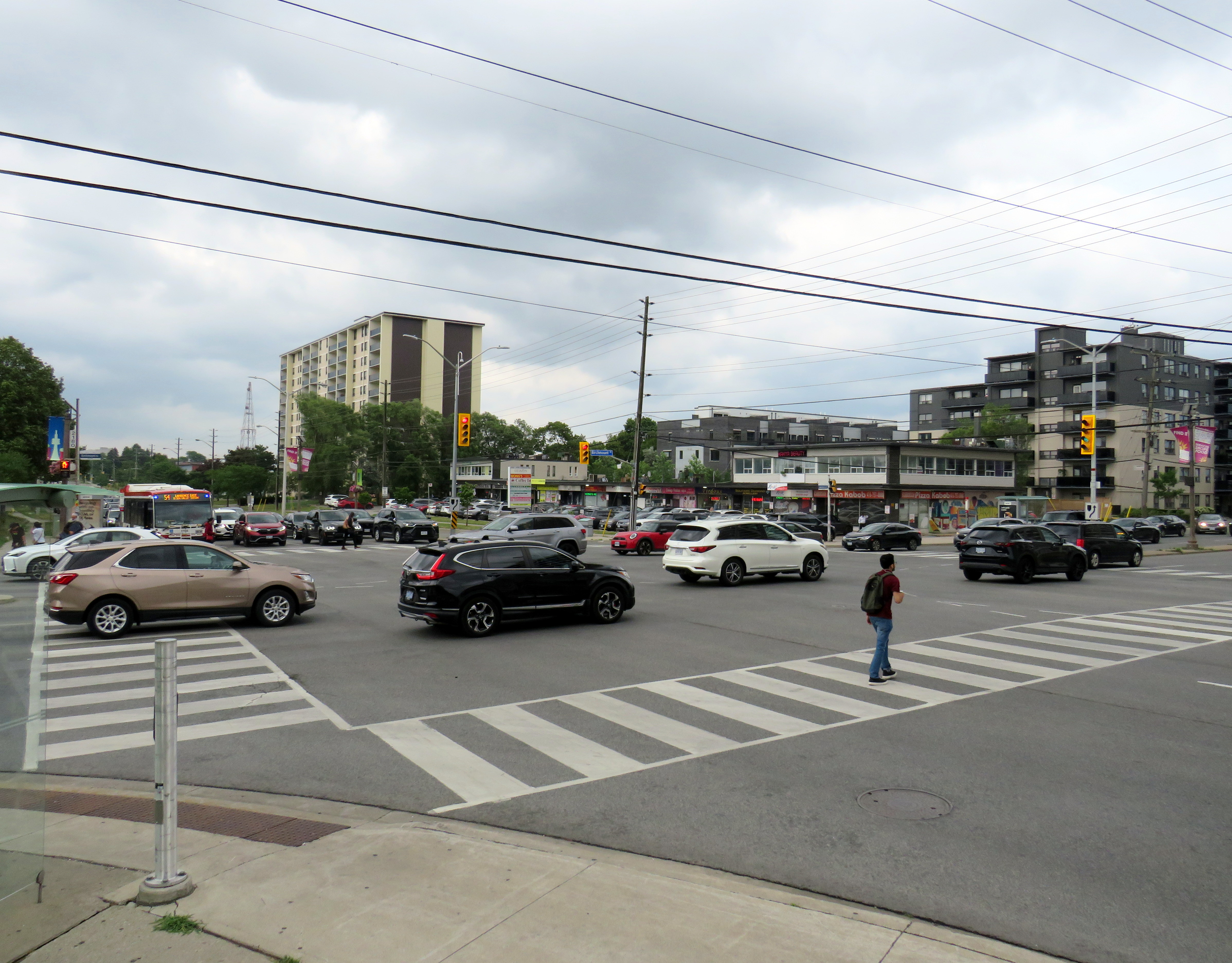
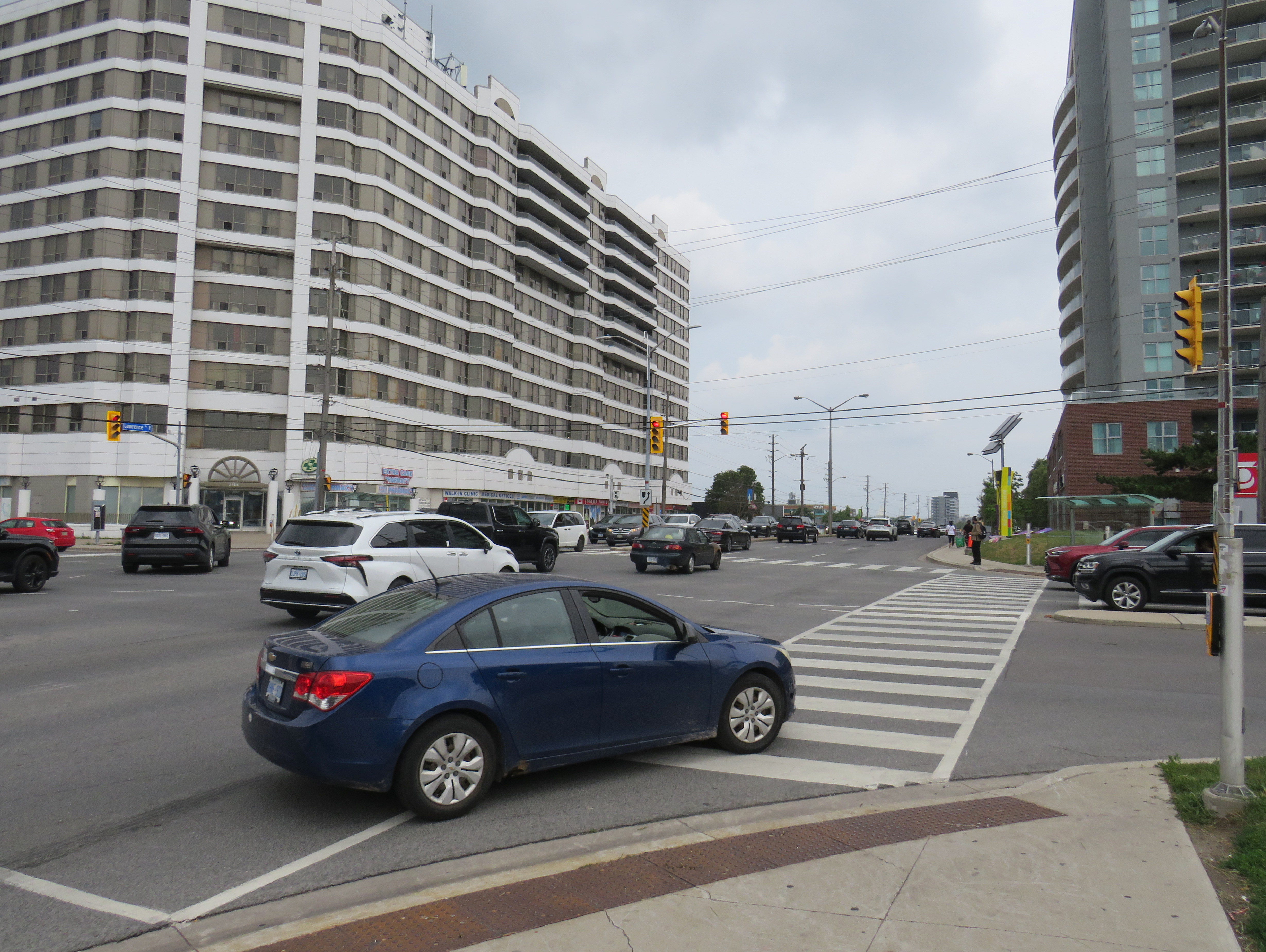
Birchmount Road and Lawrence Avenue East, Scarborough
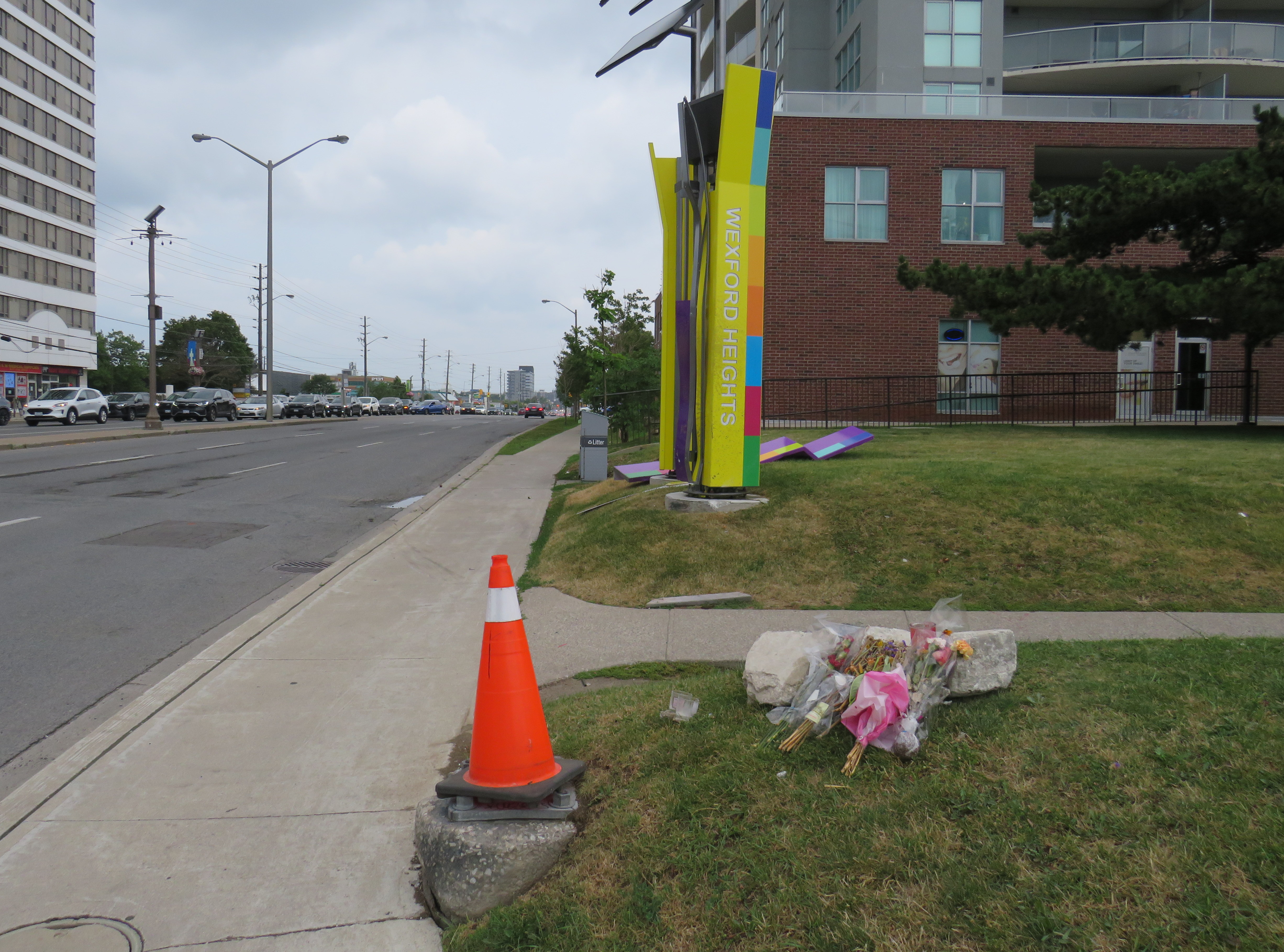
On Friday, July 10, the driver of a westbound Toyota RAV4 SUV drove through a red light on Lawrence Avenue East and struck another vehicle travelling south on Birchmount Avenue. The SUV continued forward, mounting the sidewalk where two pedestrians were standing, and then hit a traffic signal pole. The pole, as designed, fell to the ground. The two pedestrians — a 64-year-old man and a 61-year-old woman — were killed. The drivers of both vehicles — as well as two passengers in the RAV4 — were taken to hospital with “non-life-threatening injuries.” Nearly two weeks later, there have been no updates from the Toronto Police or any news outlet letting the public know of any charges laid; there is not even any mention of who the two dead victims were.
As it’s just another “accident,” society shrugs and continues on.
Roadside memorial to two dead pedestrians, with a pylon covering the base of the fallen traffic pole
A day later, just after 8PM on Saturday, July 11, two people were shot dead on St. Clair Avenue West during the Salsa on St. Clair street festival, and four more were injured. This was not a random shooting, but a violent gunfight where the assailants and those killed knew each other. There were many thousands attending the popular street festival that evening; many of those attending fled fearing for their safety.
Elected leaders from all three levels of government were quick to denounce the violence, and Toronto Police, to its credit, refused to hyperbolize the general risk to the public. Chief Myron Demkiw reminded Torontonians that “shootings are down over 26 per cent compared to the same time last year,” followed by the recognition that such violence “…understandably shakes the sense of safety and security that Torontonians expect and deserve.”
However, there are those whose agendas are not served by nuanced remarks like Chief Demkiw’s. Second-time mayoral candidate Brad Bradford was quick to blast senior police officials, saying it was “wrong to call Toronto a safe city.” Bradford followed with his preferred response from police which “…is to say ‘No. No more. Not now, not ever.’” For someone running on a right-wing reactionary platform, such a response would have been much more helpful against an incumbent mayor.
It’s understandable that the St. Clair shooting has gotten lots of attention from the police, news media, and politicians. Despite a continuing decline in violent crime and Toronto’s well-deserved reputation as a safe city, brazen gun violence is frightening, especially in a crowded area where there are thousands enjoying a summer evening. People want to be safe and feel safe while outside their homes. But that also means being able to walk without fear of being struck and killed by a motorist, even when on a sidewalk.
For intermittent street festivals, parades, and temporary pedestrian malls, a lot of attention is already placed on security, especially after recent vehicle attacks. Portable car traps keep vehicles out, while paid duty police and security guards keep watch at intersections and places in between. But we also do very little to protect pedestrians and other road users from dangerous driving. Doug Ford’s provincial government, working against Toronto and other municipalities, moved against bike lane installation (protected bike lanes that serve as a buffer between motor traffic and sidewalks) and speed enforcement cameras, which were working to reduce drivers’ speeds.
Drivers speeding through a red light on seven-lane Lawrence Avenue East at Birchmount Road. Note the temporary replacement traffic signal affixed to the median pole on the far side of the street.
As a society, we are horrified by gun violence, but generally give scant attention to deaths on our roads that result from motorists’ choices. No councillor, mayor, premier, or prime minister spoke out when two bystanders were killed in Scarborough. Their names have still not been released. There’s no follow up to the police investigation, and it has so far merited just one story in the Toronto Star, CBC Toronto, and CP24.
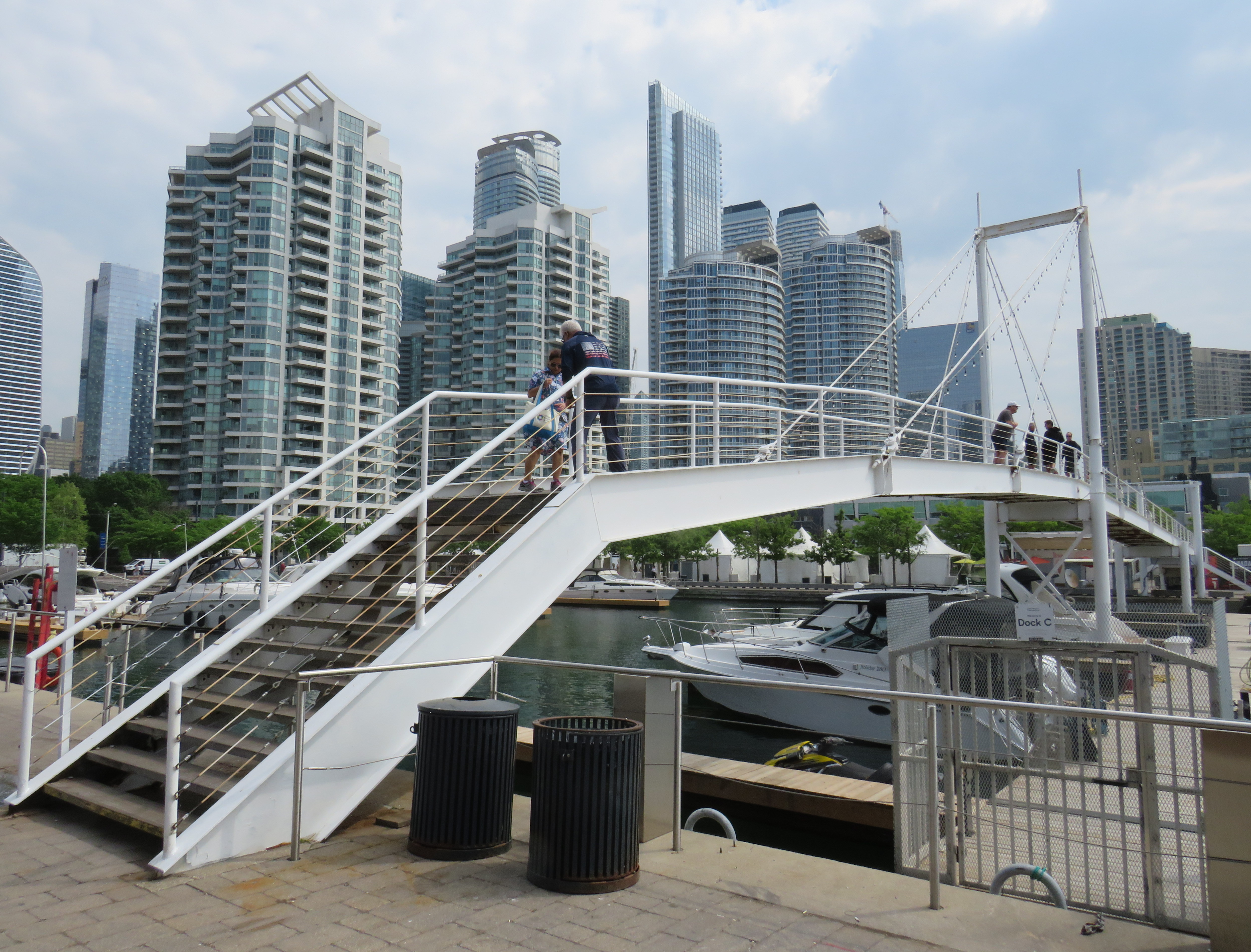
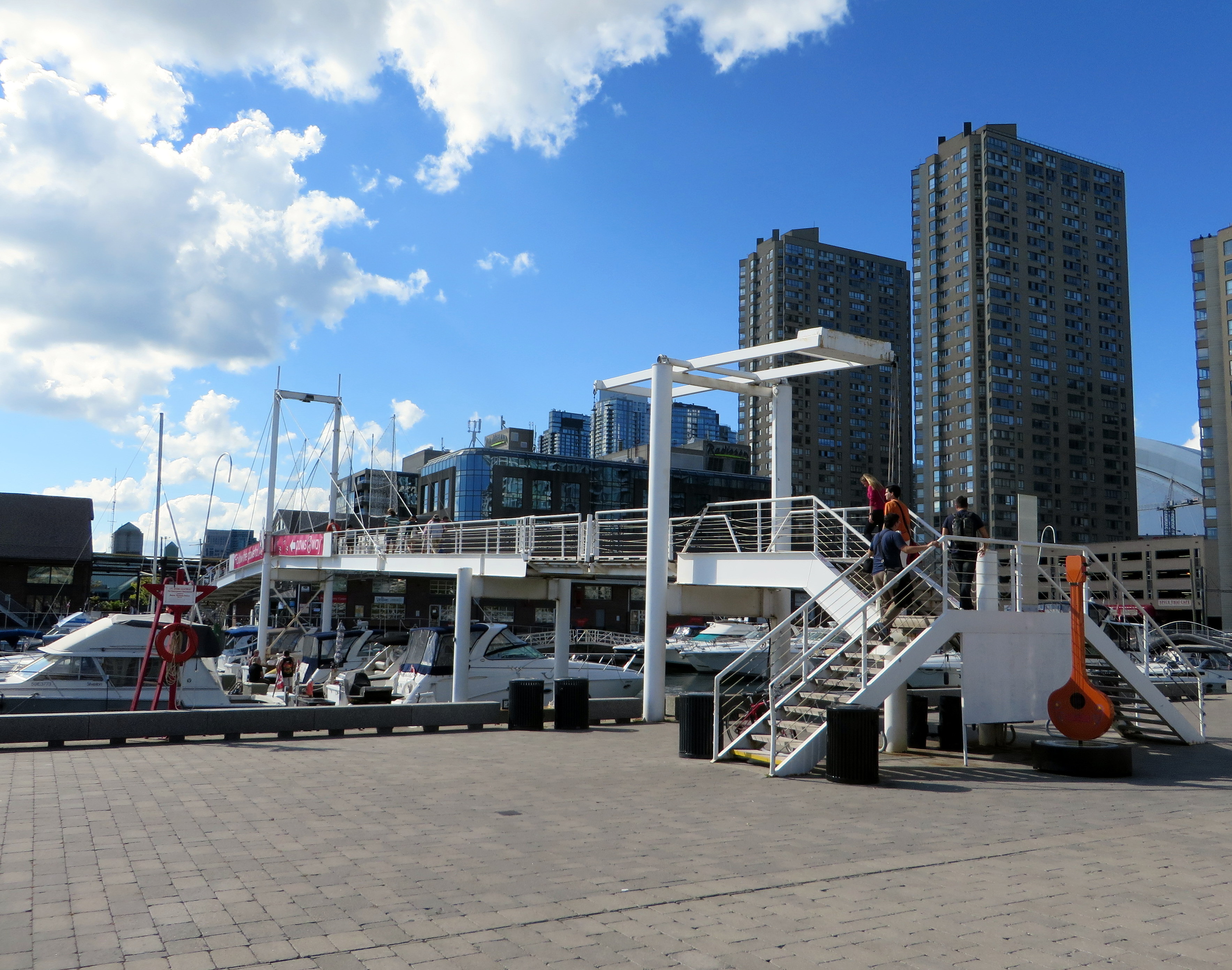
On Sunday, May 31, the Amsterdam Bridge reopened on Toronto’s Harbourfront after being closed for five years. The footbridge, which spans a marina south of Queen’s Quay, is a popular meeting place and photo opportunity, with views of Toronto Harbour to the south and the towering skyline to the north. A gift of the City of Amsterdam, one of Toronto’s sister cities at the time, the bridge was one of the first great public spaces on the waterfront as it was beginning to transition from a derelict industrial space to the city’s new front yard.
The Amsterdam Bridge in 2014
The footbridge, a cable suspension structure over the marina featured a lifting section on the east side so that tall yachts could moor at the north end of the marina on request, though this was not a regular occurrence. The design mimicked some of the iconic canal crossings in Amsterdam. Sadly, due to neglect, the bridge was closed to pedestrians in 2021 and the lifting section removed.
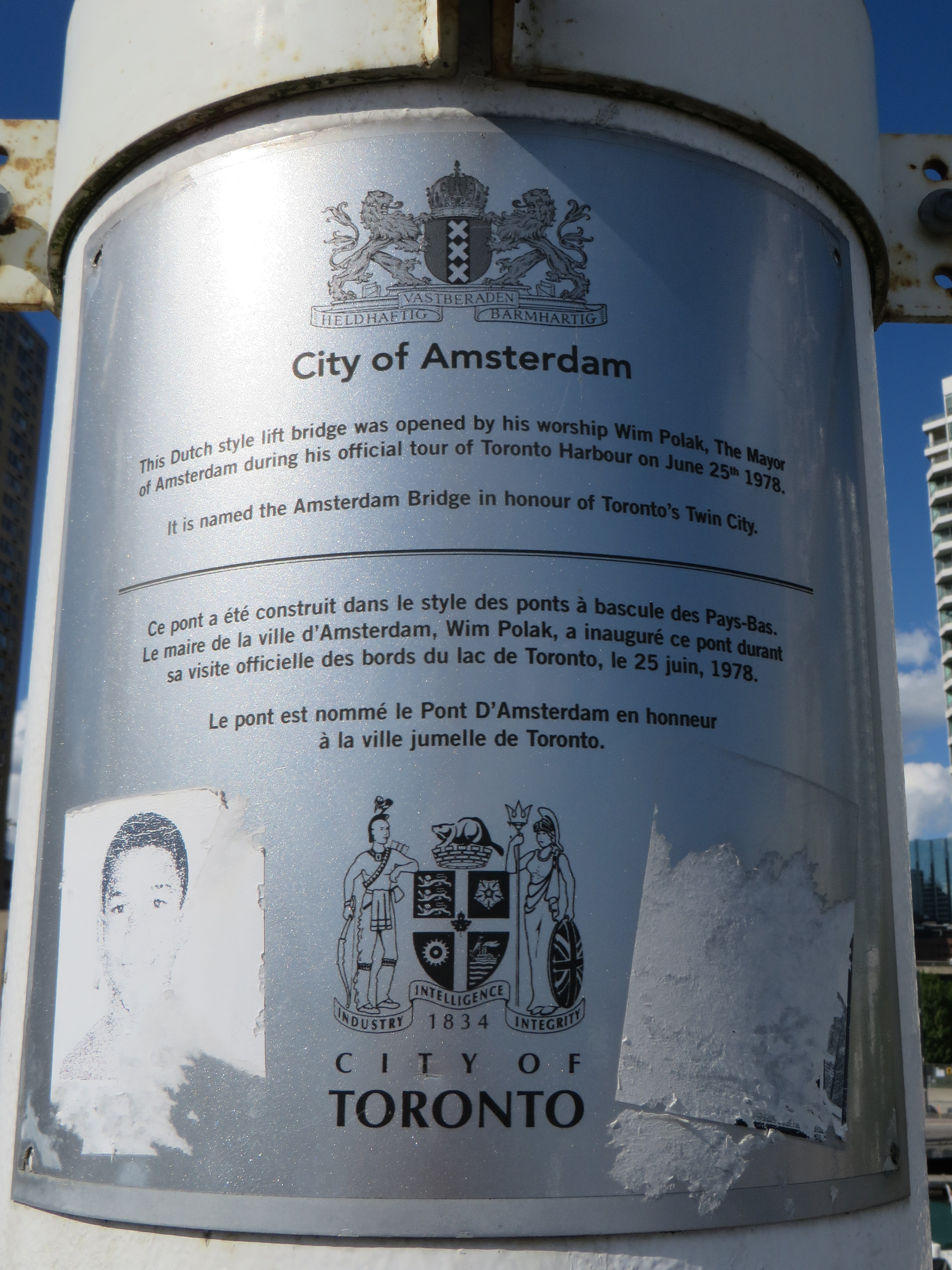
Plaque on the bridge commemorating the opening of the Amsterdam Bridge, a “Dutch style lift bridge” on June 25, 1978 by Amsterdam mayor Wim Polak, taken in 2014. Note the old pre-amalgamation City of Toronto coat of arms below. A replacement plaque with similar text (but with the current post-amalgamation civic coat of arms) since replaced the original.
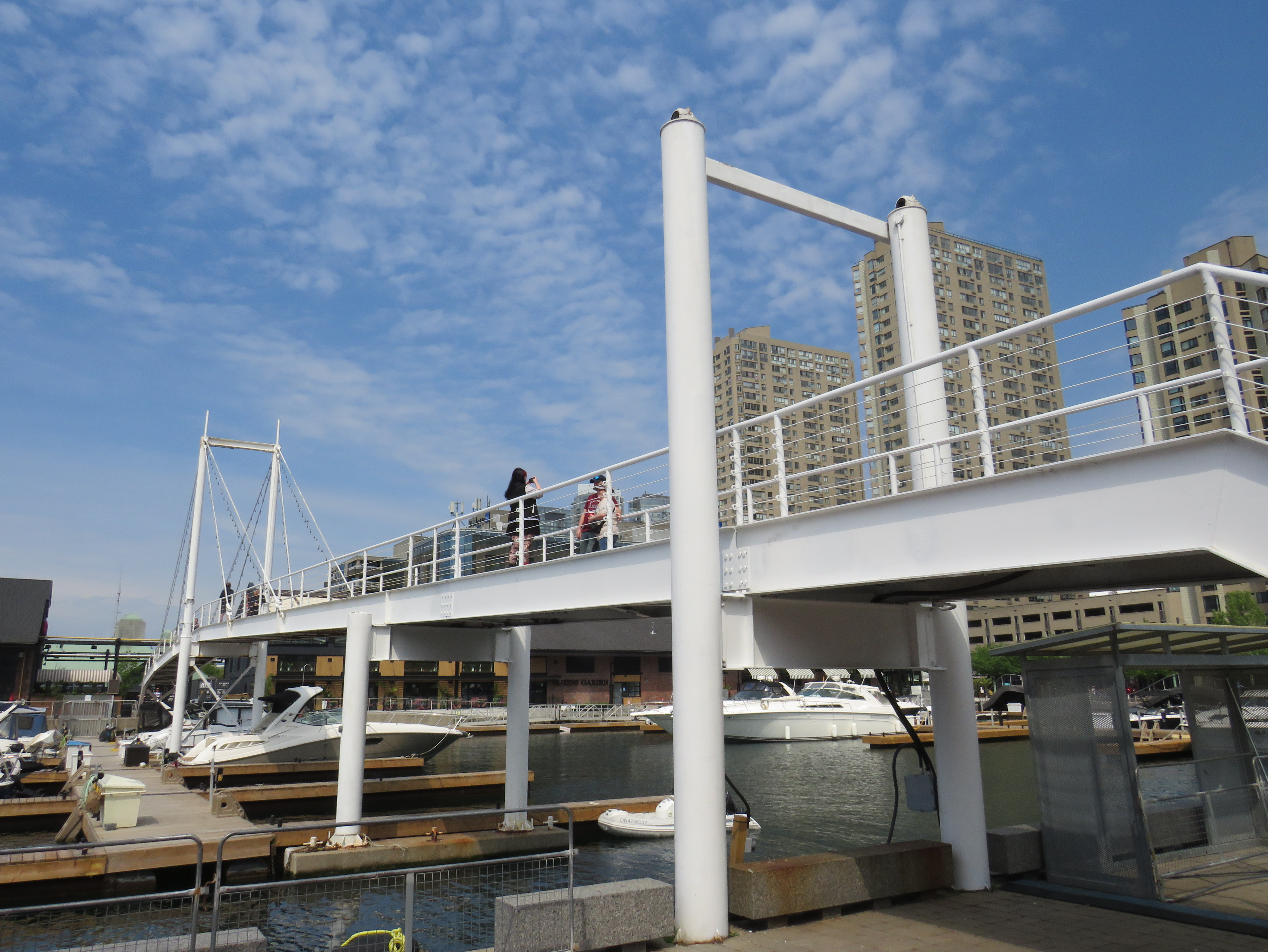
When the bridge reopened in 2026 just in time for Toronto hosting six World Cup soccer matches, the lifting section was replaced by a fixed span. Once again, visitors can climb the bridge, take in the views, and snap great photographs, but the “lift bridge” of the original “Dutch style lift bridge” is no more. It’s a shame too, that it took five years for this fix to even happen; Toronto needs to do better at maintaining its public assets, especially its unusual, fun, and quirky landmarks.
Fixed deck on the Amsterdam Bridge in 2026
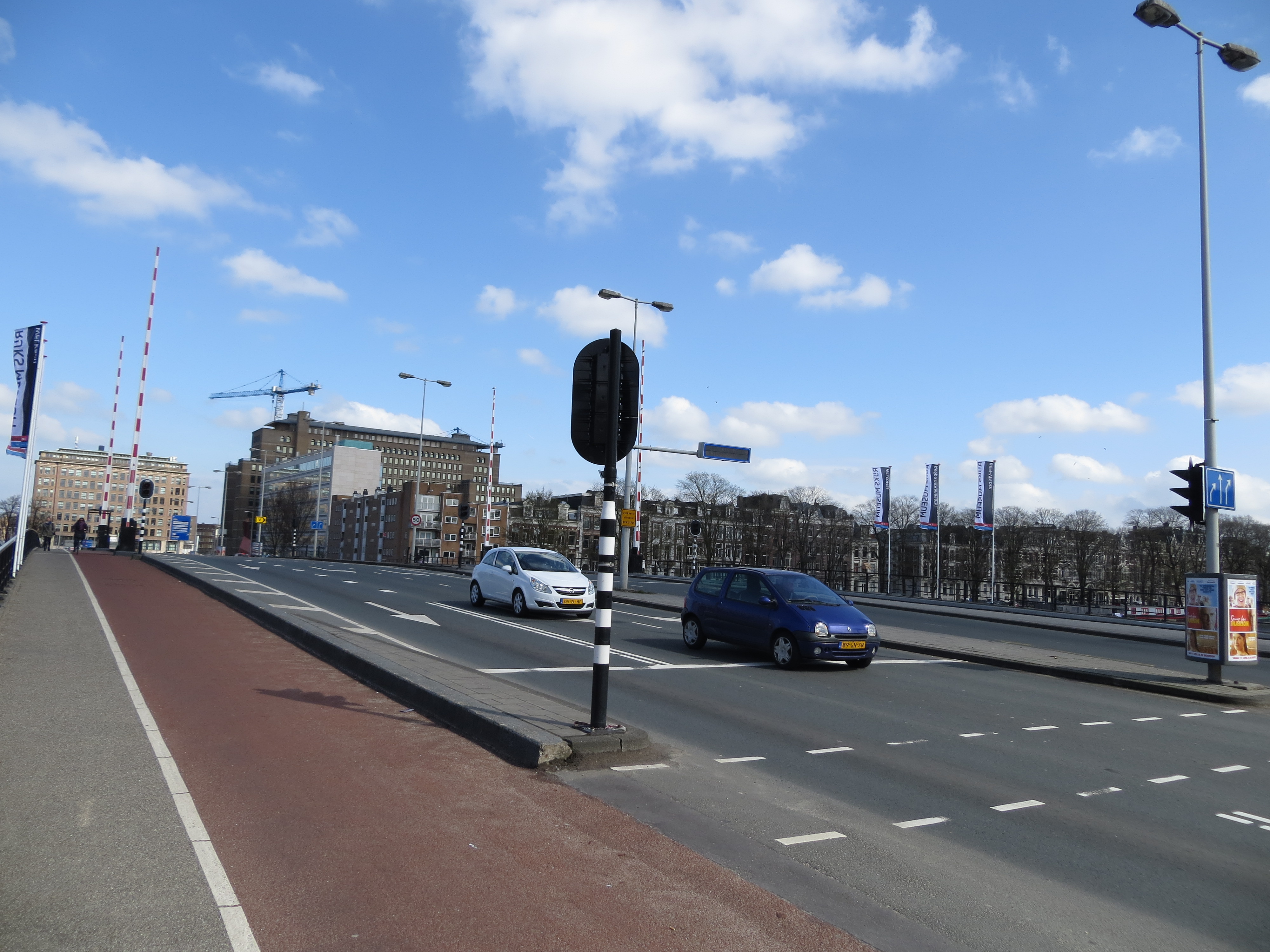
Around the same time Toronto got an Amsterdam Bridge, the City of Amsterdam named a bridge for Toronto. The Torontobrug spans the Amstel River, carrying the busy Centrumring (Central Ring Road). A five-lane traffic artery outside the major tourist areas, the bridge is not iconic by any means (I biked to it during my 2013 visit to Amsterdam) but it is an important road link. There are separated cycle tracks on both sides of the bridge, so it is at least multimodal. The bridge can still open for river boat traffic when necessary.
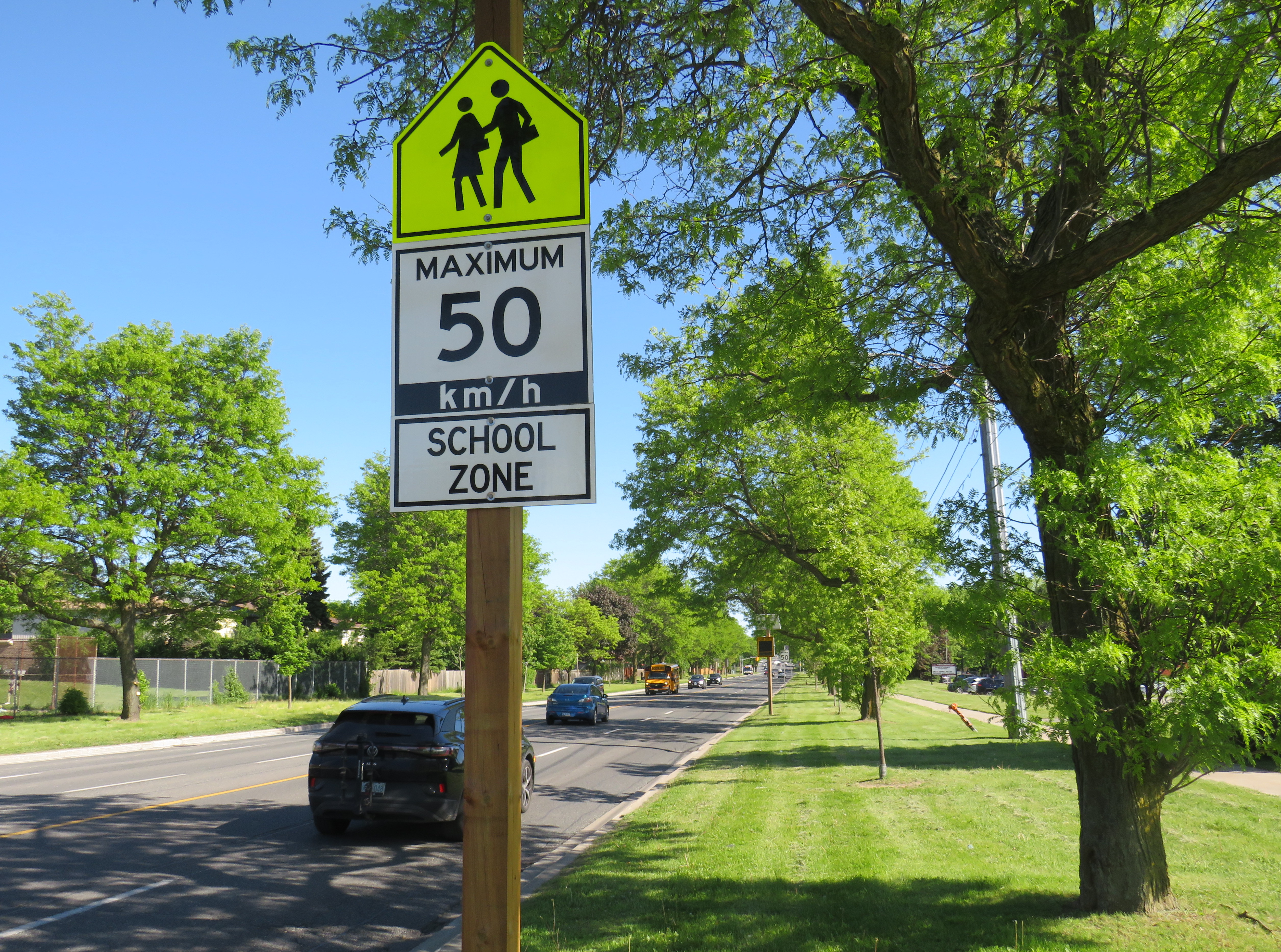
A gigantic school zone speed limit sign on McCowan Road in Scarborough
Months after Doug Ford’s provincial government banned the use of municipal speed enforcement cameras, calling it a “cash grab,” new supersized school speed zone signs are going up across the province. The first ones I encountered are on McCowan Road in Scarborough, near my spouse’s family home.
The signs, placed near St. Ignatius of Loyola Catholic School south of Finch Avenue, are gigantic: nearly 2.5 metres tall, mounted over three metres above the ground, affixed to an extra large wooden pole as the new signs were too big for the standard metal poles used for that purpose. The province delivered 80 signs to the City of Toronto, but with four signs per school zone (two mounted in each direction including advance warning signs), that meant only 20 schools would get these new totems.
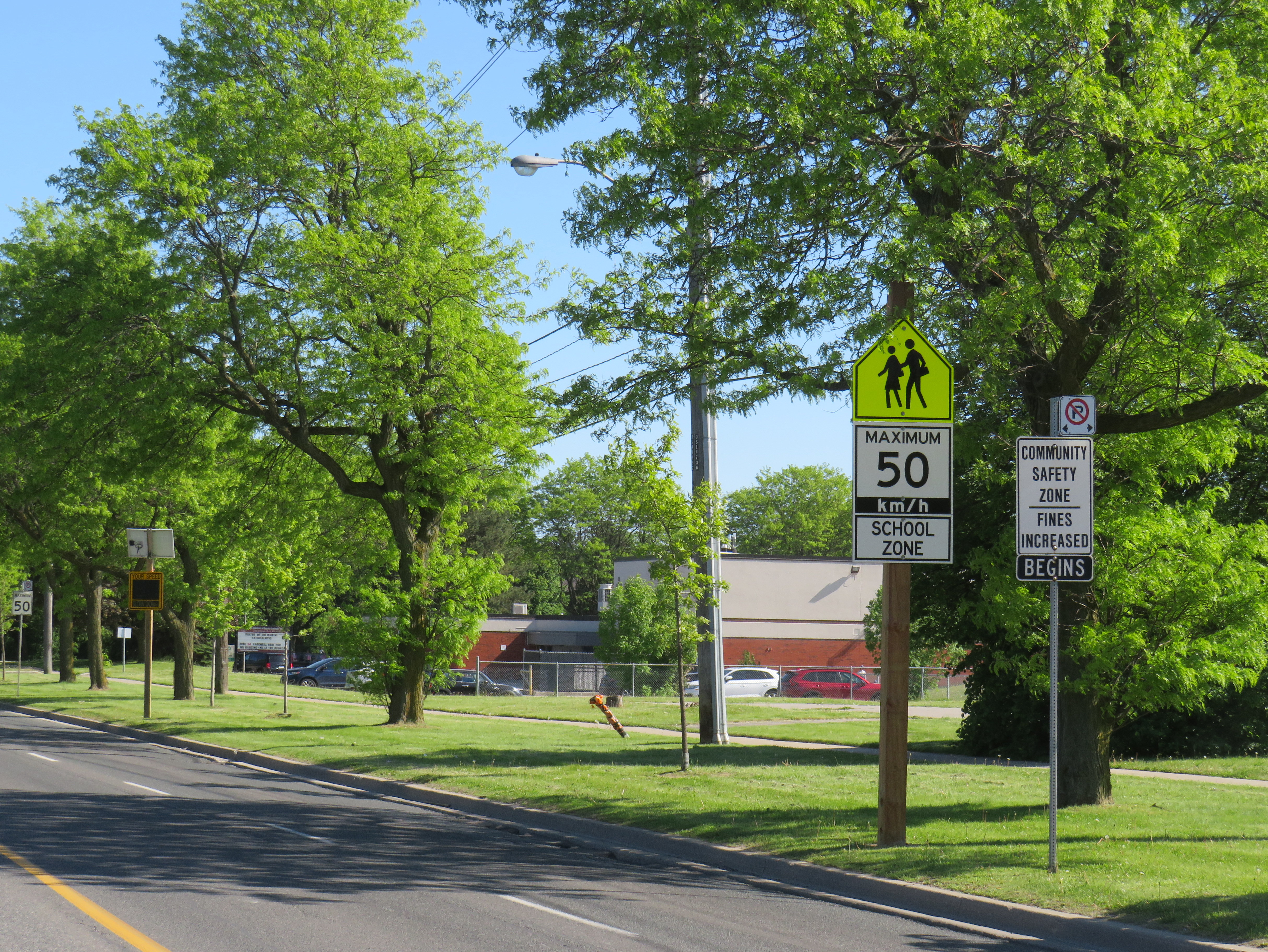
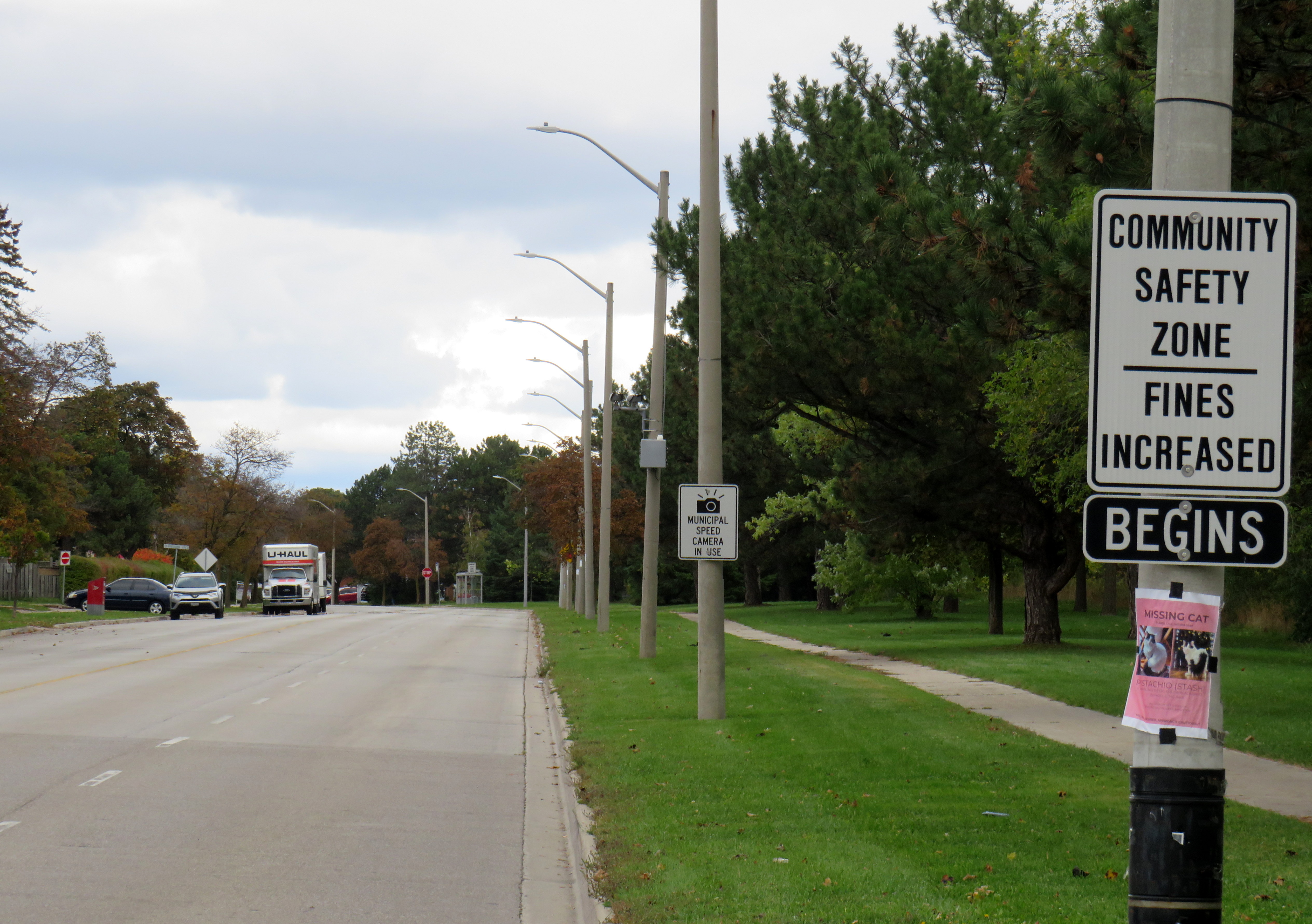
The new supersized school zone sign next to an older “community safety zone” sign, affixed to a standard metal sign pole
Before the pro-driver legislation was enacted on November 14, 2025, there was a speed camera placed on McCowan Road adjacent to the elementary school, one of 150 located in the City of Toronto. Under provincial law, municipal speed cameras were only allowed to be installed in specific designated safety zones, namely roadways adjacent to schools, parks, or seniors’ residences, and had to be accompanied with advisory signage.
Between April 2024, when the camera was activated, and July 2025, when the camera was destroyed (one of many vandalized that year), over 19,000 speeding motorists were captured by the photo camera travelling at least 11 km/h over the posted speed limit. This was despite the existing maximum speed, school zone, community safety zone, and municipal speed camera signs on this stretch of road.
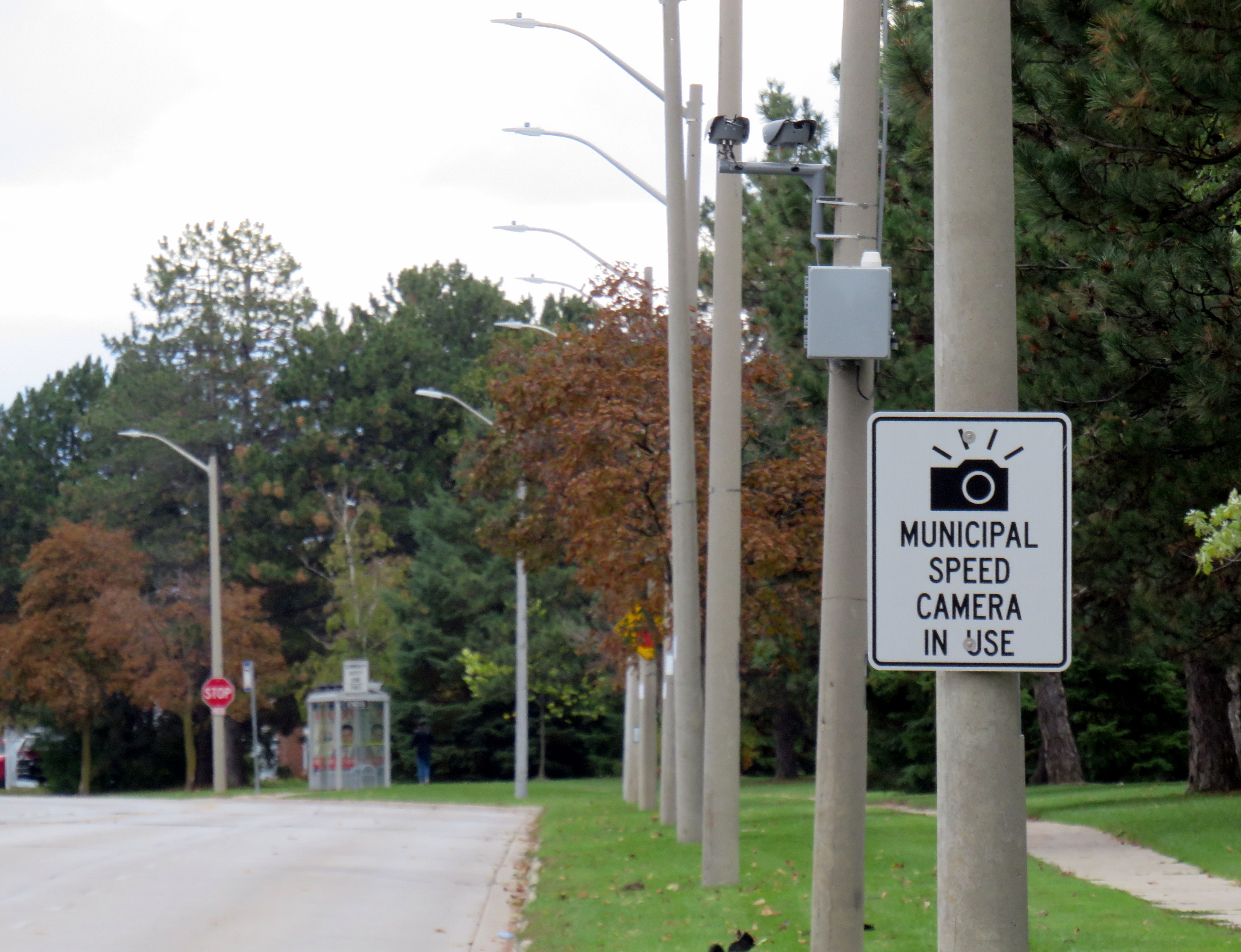
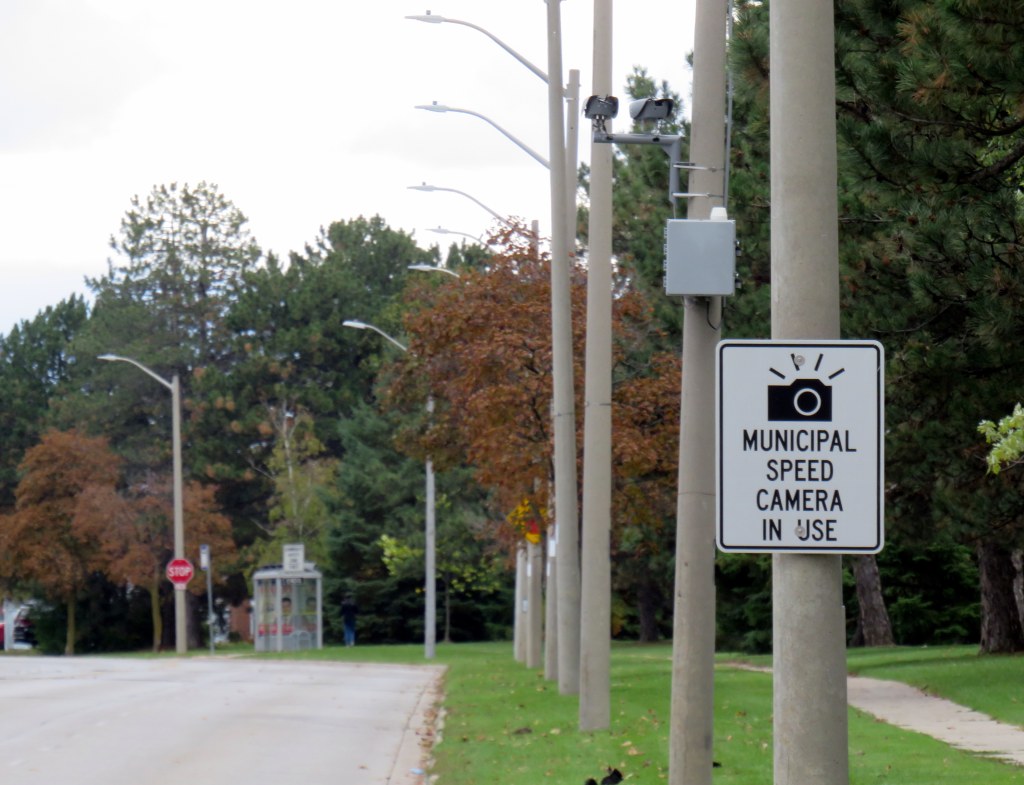
Sign warning of a municipal speed camera in Brampton in October 2025
Despite the high number of infractions, the cameras were doing their job; a job that the Toronto Police isn’t motivated — or able — to do. As seasoned municipal watcher Matt Elliot points out, for period between January 1, 2025 through November 14, 2025 (when camera enforcement was forced to end), 628,165 speeding tickets were issued through the automated speed enforcement program. Toronto Police’s “Vision Zero” traffic unit issued just 14,500 tickets.
New city report notes the Toronto Police Vision Zero Enforcement Team handed out about 14,500 speeding tickets in 2025. Might sound like a lot, but well, compare and contrast.
Despite all those tickets issued, the cameras were especially effective at reducing speeding in school zones. A 2025 Toronto Metropolitan University/SickKids Hospital study found that speed enforcement cameras reduced speeding by 45 per cent and reduced speeds by most drivers by more than 10 km/h.
Active police enforcement remains a valuable tool because officers can lay charges that automatic speed cameras can not catch, including distracted, impaired, and dangerous driving. But policing has a dark history of racial profiling and has a pro-motorist “windshield bias,” while speed enforcement and red light cameras do not discriminate.
Furthermore, North American roads are designed for excessive speed and not for the safety of vulnerable road users. We rely on signs to advise motorists of how we expect them to drive, rather than road design that requires attentive and slower driving. Speed cameras were a useful stopgap that worked a lot better than signage.
So, the new supersized signs going up are not a solution to unsafe driving: they are just another mere indication that children, seniors, and all pedestrians and cyclists don’t really matter, especially to politicians like Doug Ford.
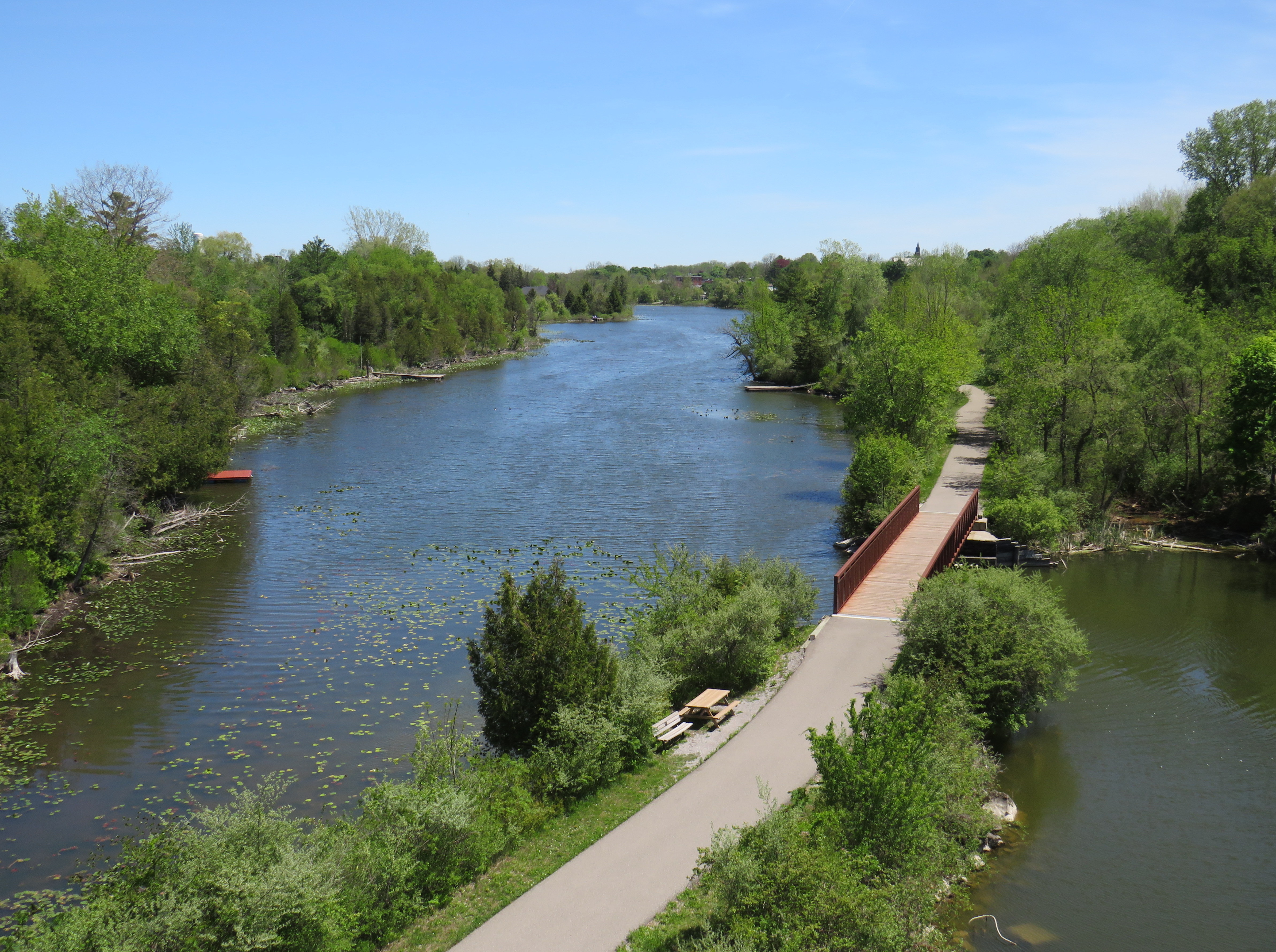
Looking down from the Black Bridge on the Norfolk County Trail to Shadow Lake and Waterford Ponds in May 2026
On a beautiful May Thursday, I met one of my colleagues in the village of Waterford. As he is now living in Port Rowan on Lake Erie, this was an opportunity for us to get some important work done, while also exploring one of Ontario’s great small communities.
Though the local area was settled over 200 years ago, Waterford was established as a thriving village with the arrival of the Canada Southern Railway (CASO) which was eventually incorporated into the giant New York Central system. The route through Canada, with its divisional headquarters in St. Thomas, was the fastest line between Buffalo, Detroit, and Chicago. It was joined by the Toronto, Hamilton & Buffalo (TH&B), which connected Hamilton and the Canadian Pacific Railway with CASO at Waterford and at Welland. In 1916, the electric Lake Erie & Northern (LE&N) Railway, another Canadian Pacific property, provided regular freight and passenger service between Port Dover, Brantford, and Kitchener. By the 1990s, all three railways were abandoned, but their former rights-of-way remain in active use as part of the local trail network.
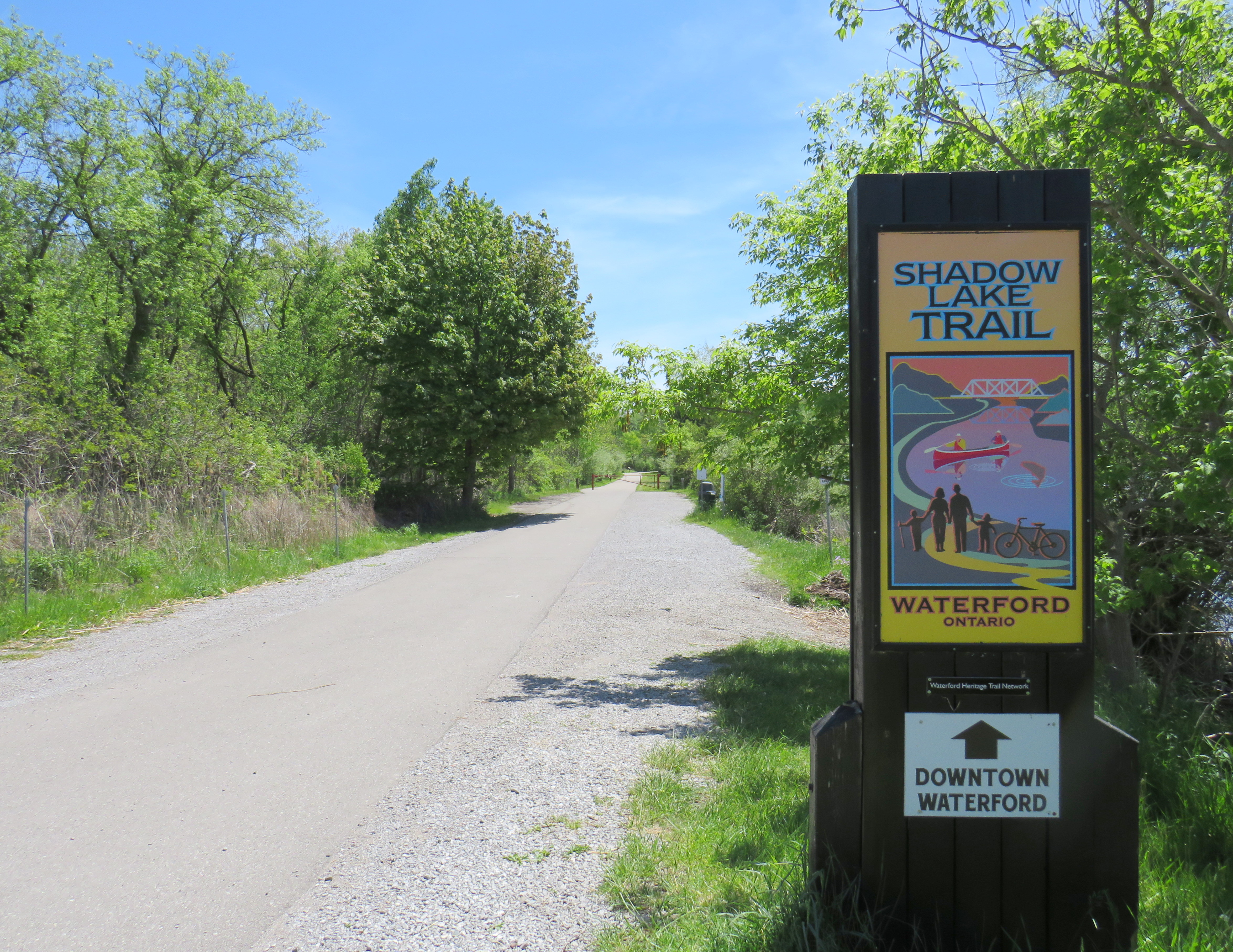
Take the Shadow Lake Trail to Downtown Waterford
The large system of ponds around Waterford, popular with birds, boaters, and anglers, are artificial. Shadow Lake was a millpond created by damming Nanticoke Creek. When constructing its railway, CASO found the sand and gravel deposits in this area irresistible for exploitation; the gravel was first used for railway ballast; larger aggregate pits created new ponds to the west.
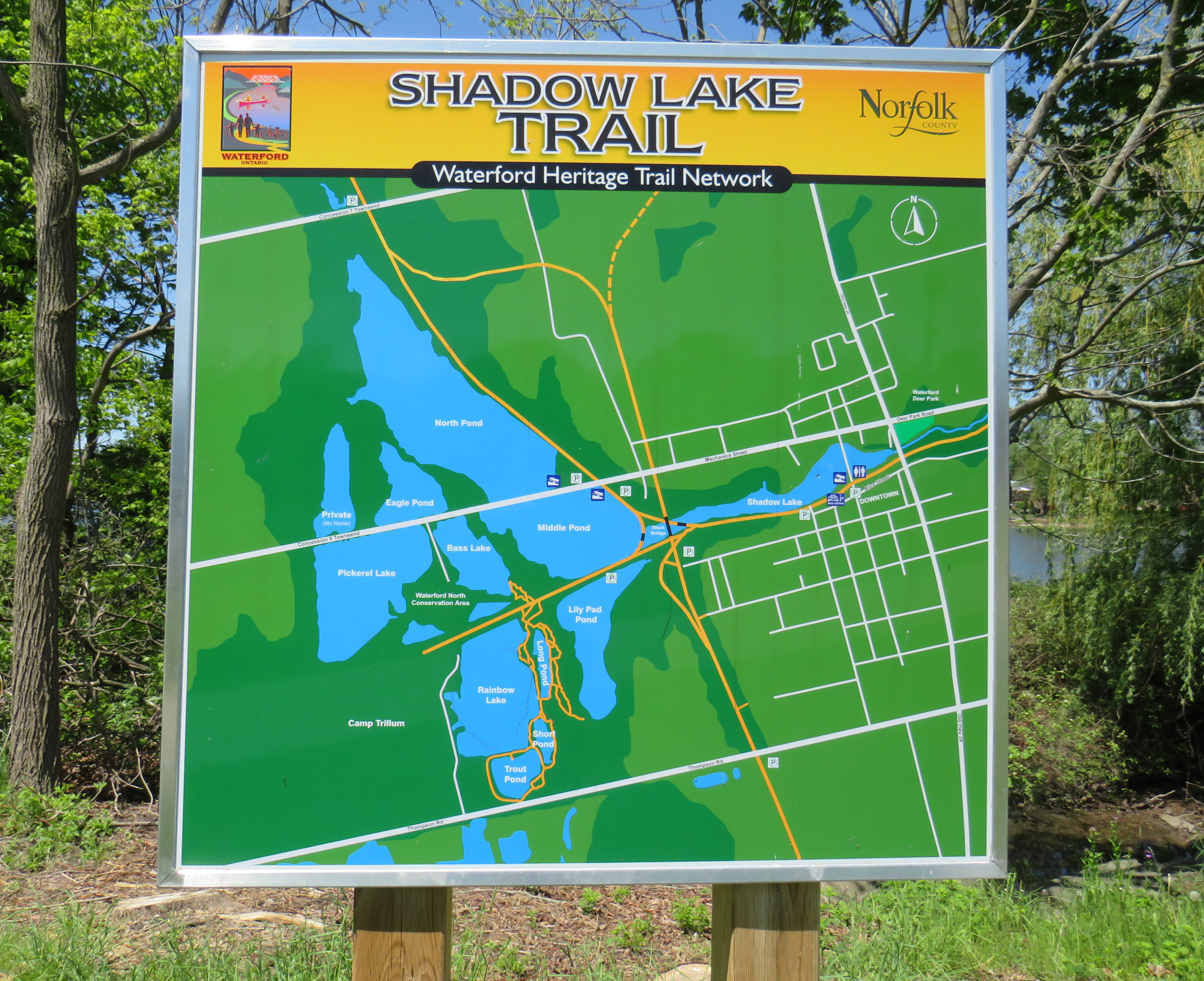
Map of the Shadow Lake Trailand connecting trails in Waterford, along with the extensive ponds surrounding them
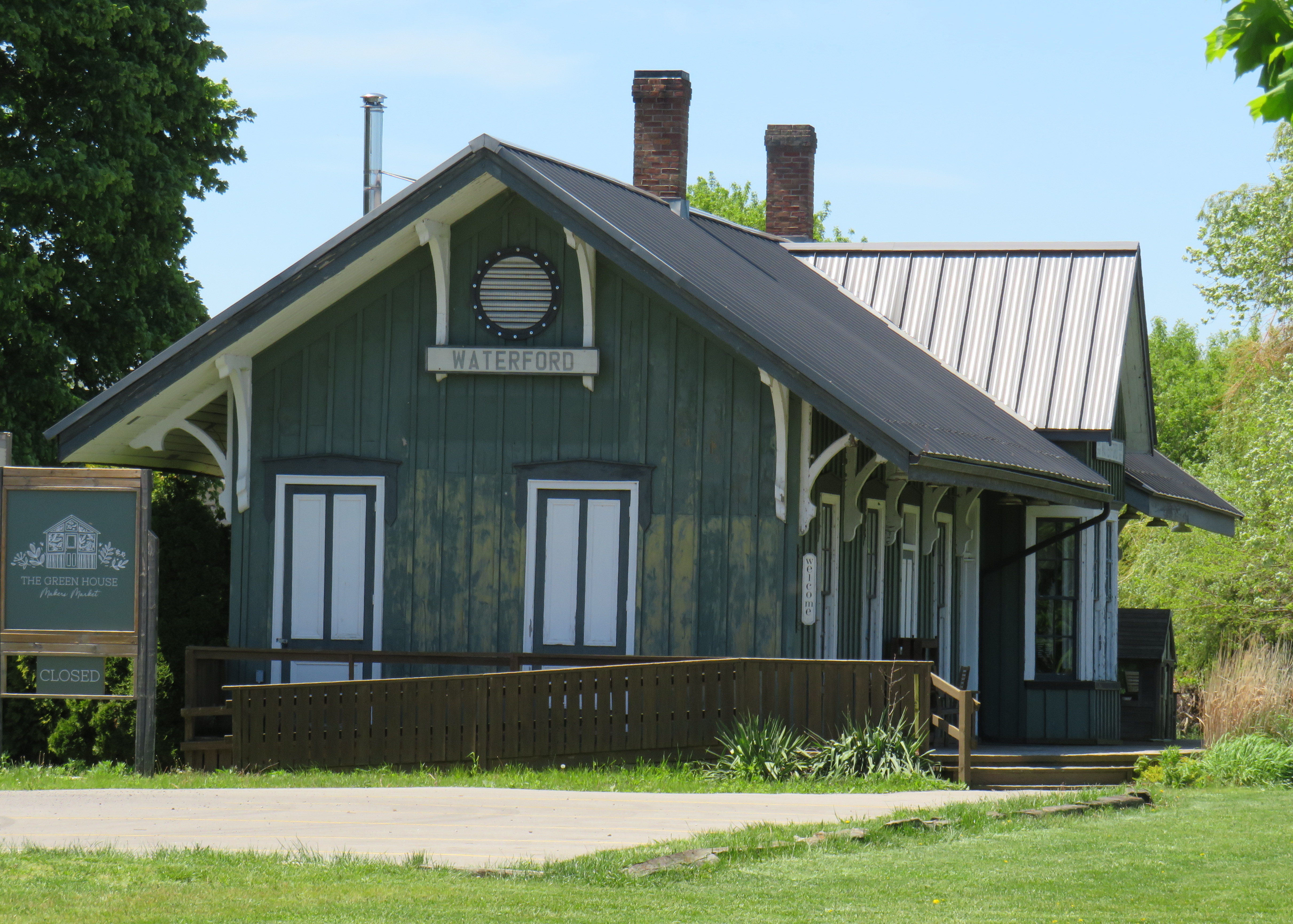
The former Canada Southern Railway Station, which also served the TH&B, still stands, and has recently been home to an artisan market. Sadly, the LE&N station was demolished in the 1970s.
Waterford CASO Station
Despite the loss of the railways and the LE&N station, the railway rights of way are fully intact within the village area and have been converted to trails. Within Waterford, the east-west Shadow Lake Trail follows the former CASO route between the Waterford Conservation Area to the west and Lingwood Park to the east, though it is not part of a continuous trail system across southwestern Ontario. Only short sections within Waterford, Tillsonburg, St. Thomas, and Essex are open to the public; most of the old railway corridor was sold off to local landowners in the late 1980s and early 1990s.
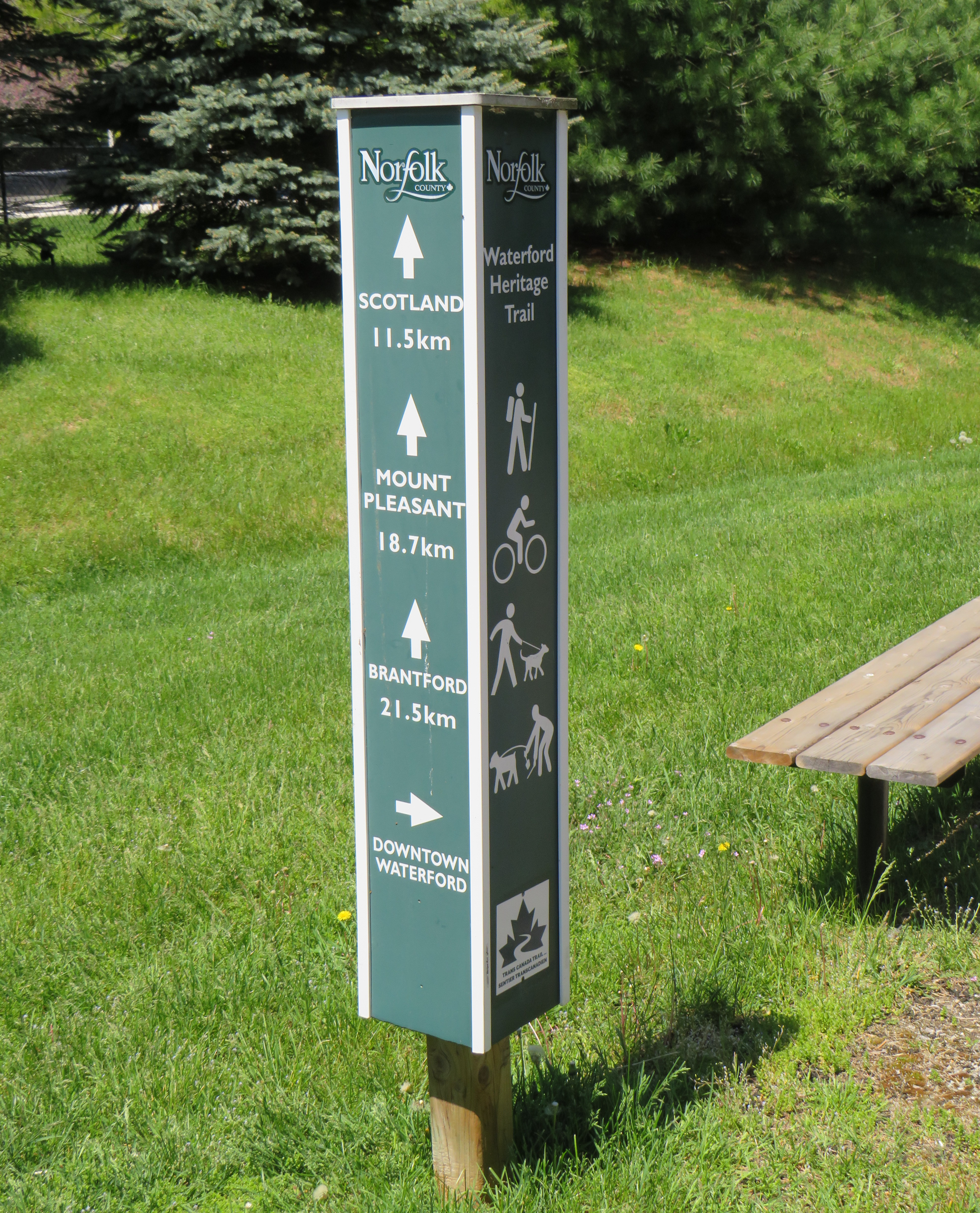
Norfolk County Trail sign
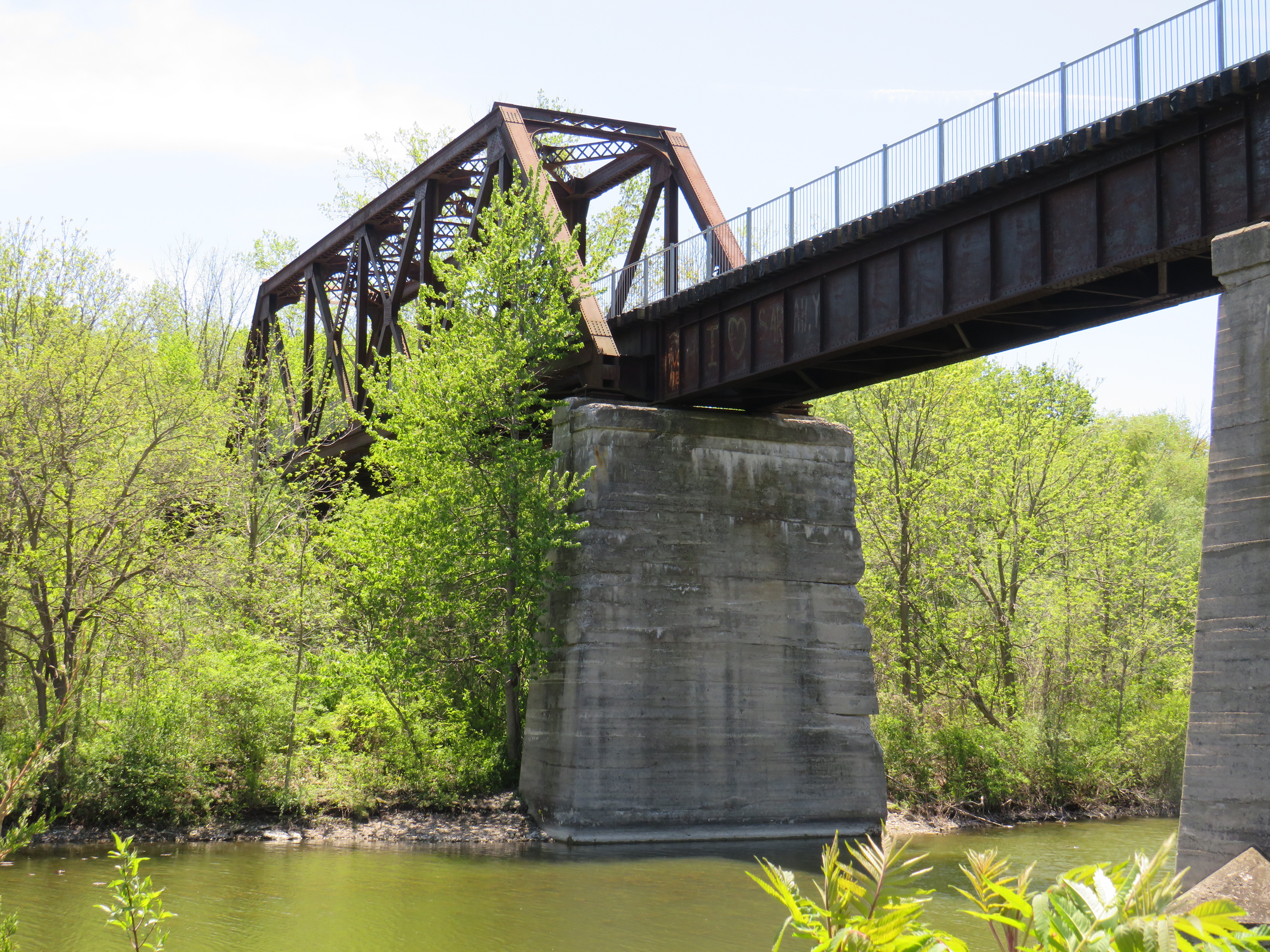
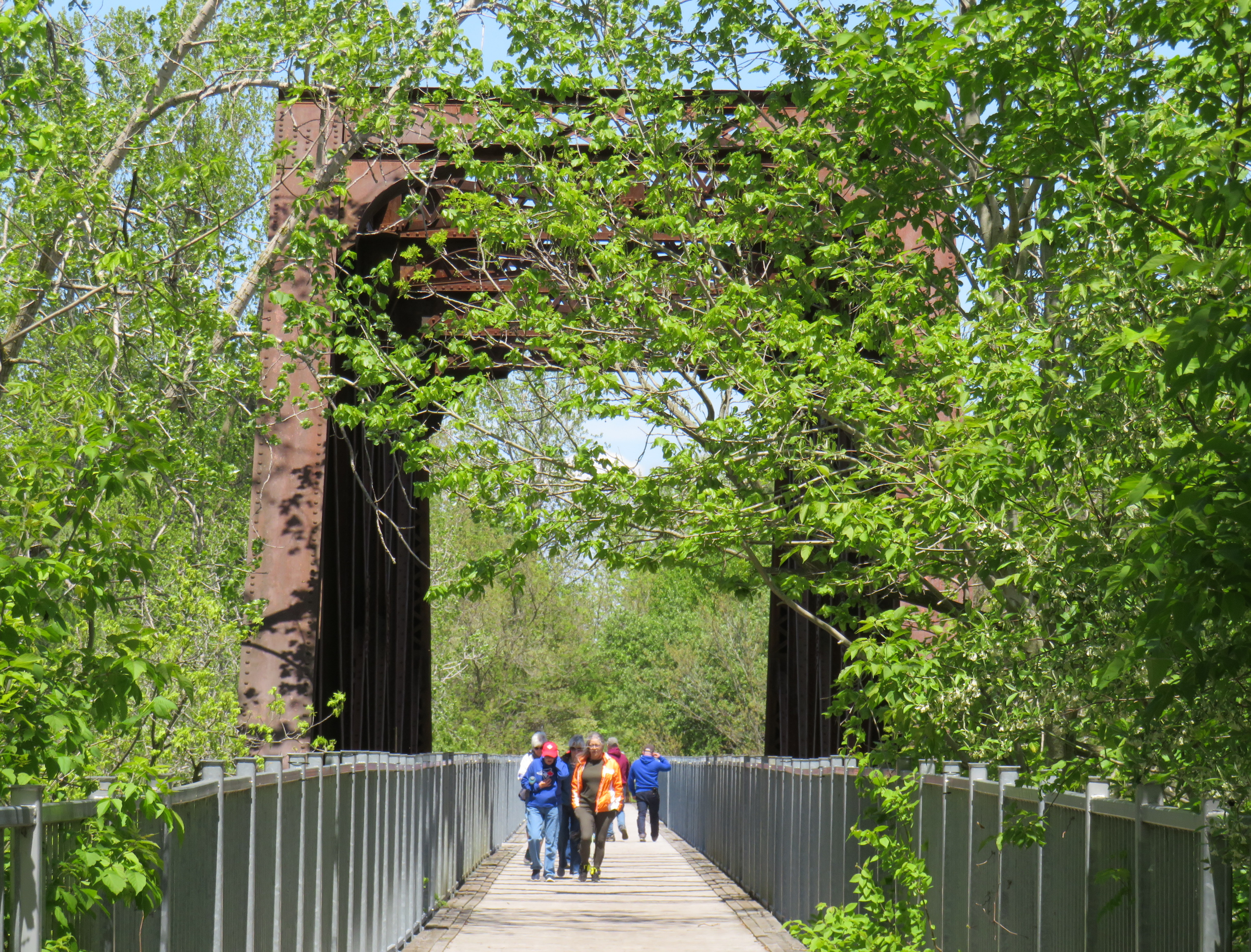
However, the north-south LE&N Trail, which connects to the Shadow Lake Trail by way of a gentle paved pathway or a metal staircase, is part of a much longer rail trail corridor that continues north to Brantford (the trail shifts to the TH&B route north of Waterford) and south to Simcoe and Port Dover. At Brantford, it is easy for the ambitious cyclist to continue east to Hamilton or north to Paris, Cambridge, and Kitchener via connecting high-quality rail trails. The Norfolk County Trail is at its scenic best when it crosses over the Waterford area via the Black Bridge.
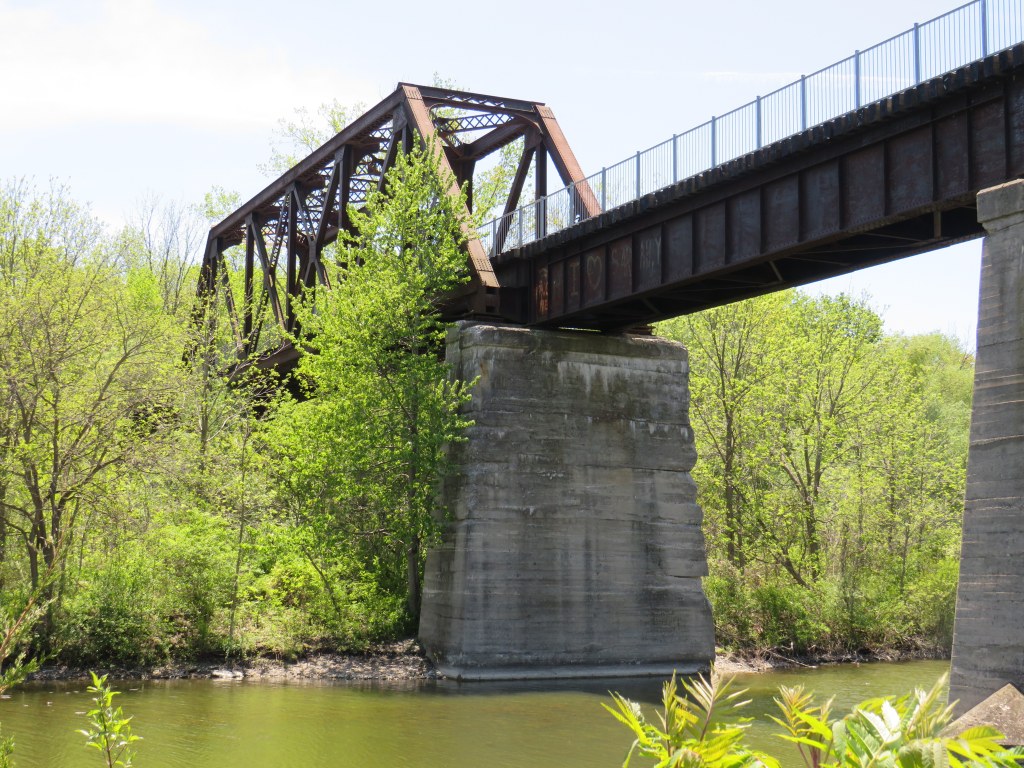
The Black Bridge crosses over the old CSR and TH&B railways and the Waterford Ponds
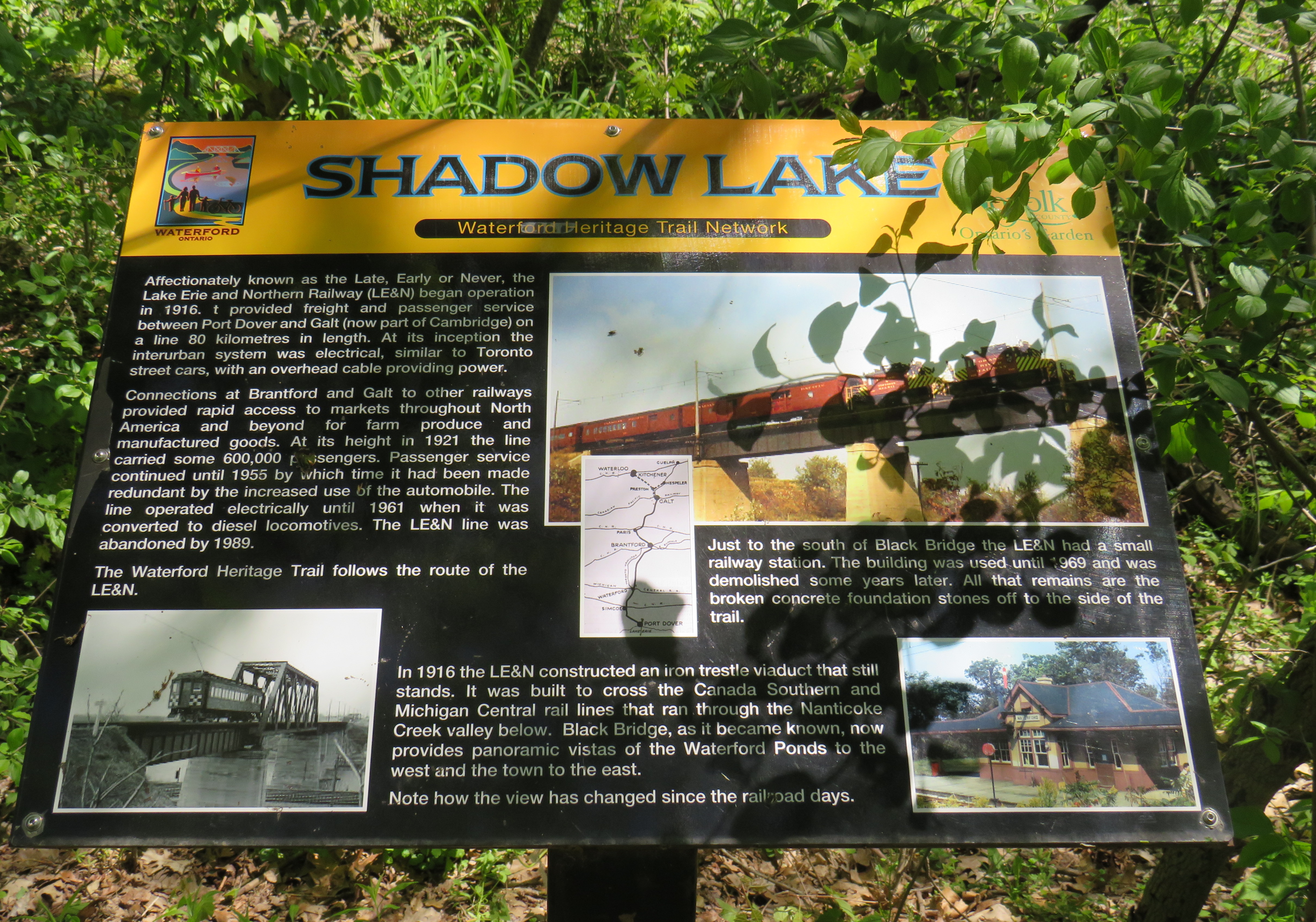
One aspect that I especially appreciated was all the interpretive plaques along the trail system that told the story of Waterford, local industry, and the railways. This is how I learned that the ponds were the result of milling and quarrying, rather than truly natural features.
One of several interpretive plaques along the trail system in Waterford
Despite their attractiveness for long-distance cyclists, the trails within the Waterford area are well-used by residents and visitors going for shorter walks. The trail network within Waterford connects well to local streets and to itself by way of the former low-level TH&B wye tracks, which also cross the ponds. A walker can easily do a round trip without backtracking while being surrounded by nature. Wayfinding signage is very good, and benches are plentiful. The ponds are a great spot for bird watching. As we know how good walking is for our physical and mental health, Waterford is blessed with this network and could be a model for other smaller urban centres and rural communities.
In the early afternoon on a Thursday, the Black Bridge was popular with pedestrians and cyclists
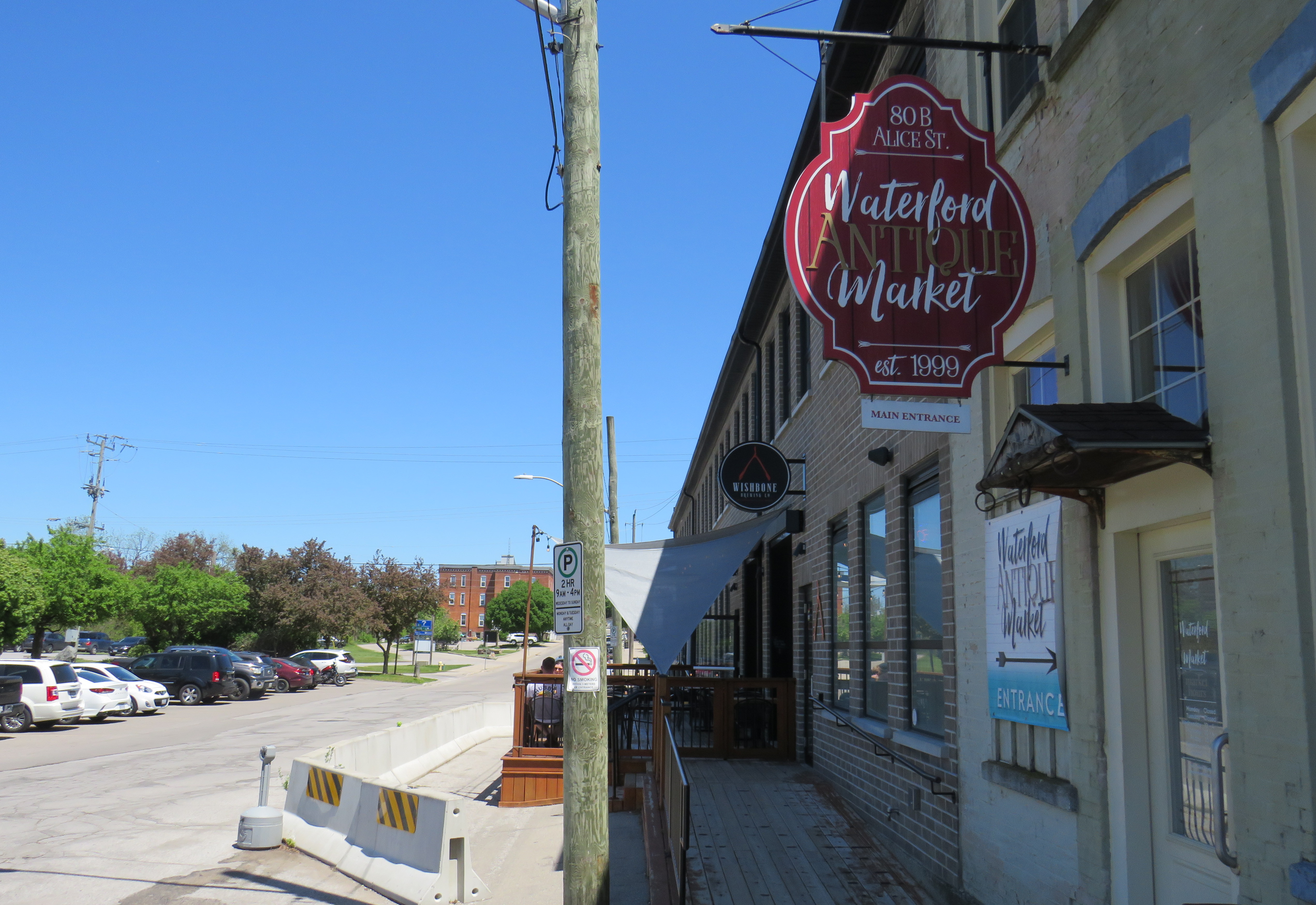
Within the little downtown, there are public washrooms for trail users as well as several restaurants, cafes, and a craft brewery located in a former textile plant. There are also several antique dealers, a public library, and other small shops.
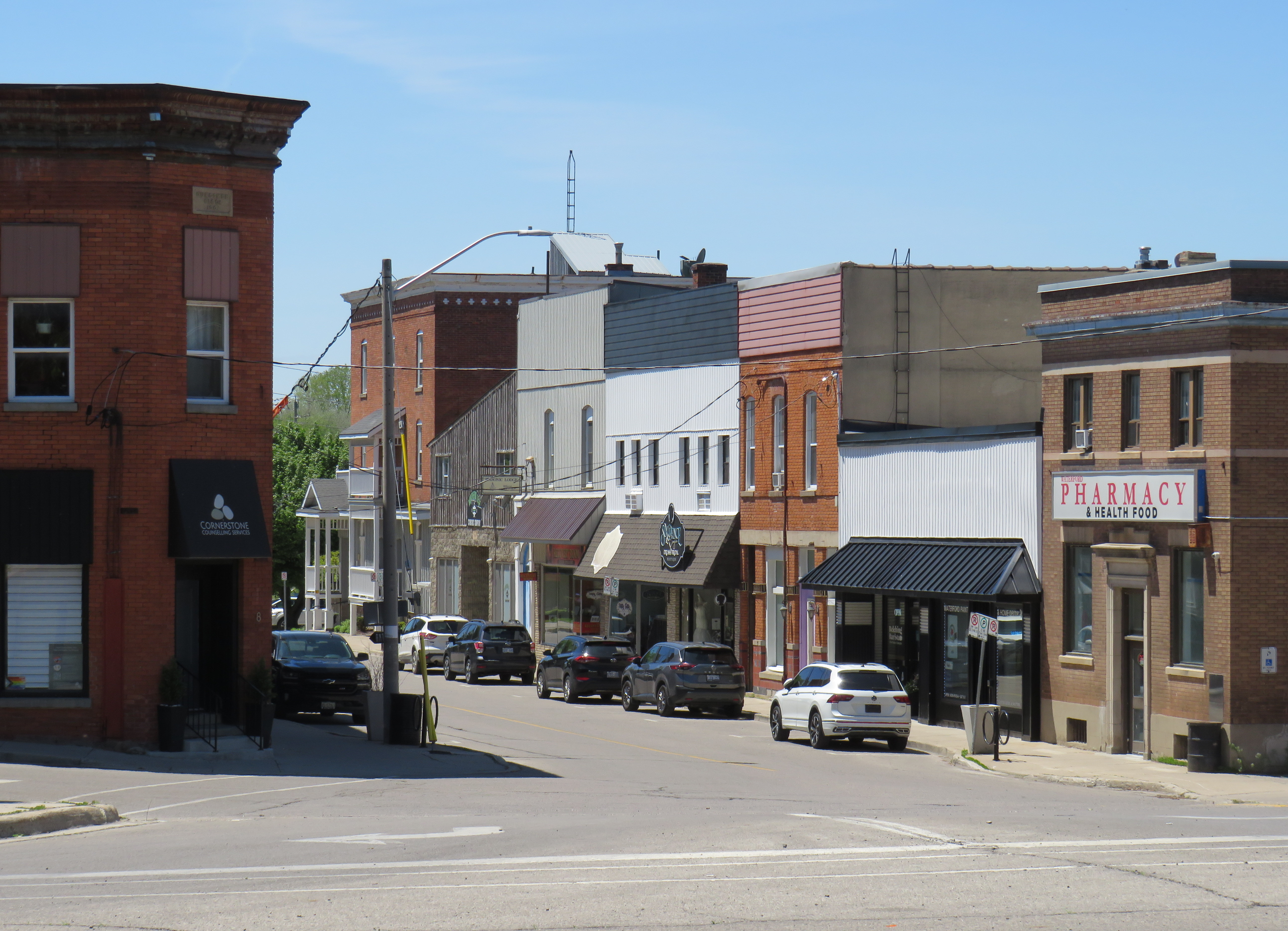
Alice Street, Waterford’s main commercial strip, is lined with restaurants, shops, a cafe, and a breweryWaterford Antique Market and Wishbone Brewery, in a renovated textile plant
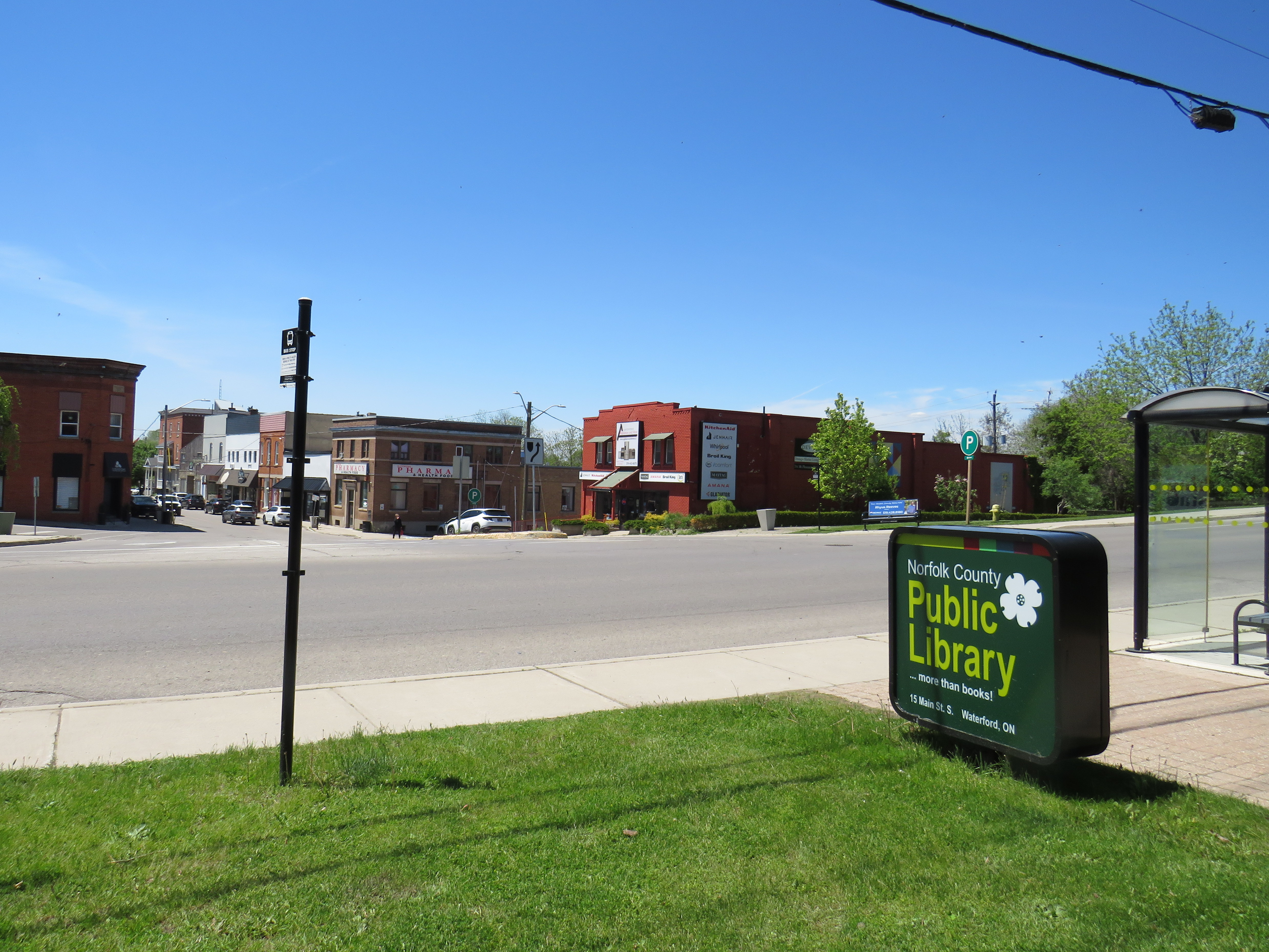
Despite all that Waterford has to offer, there is one thing that can be improved to make it safer to get around. Alice Street, the main commercial strip in Waterford, meets Old Highway 24 at an unsignalized crossing. Though busy Highway 24 now bypasses Waterford, the old highway is still busy, with drivers exceeding the 40 km/h posted speed limit. The Waterford library branch and northbound bus stop towards Brantford are on the opposite side of the wide T-intersection from the Alice Street businesses; it is surprising that there is no traffic signal here to control auto traffic and provide a safer pedestrian crossing.
The northbound bus stop (note the shelter at right) and library branch are on the opposite side of a busy road from the downtown shops
Though there is a traffic signal 200 metres to the south at Nichol Street, most pedestrians opt to cross at Alice Street instead. According to Google Streetview, there was a signed pedestrian crossing at Alice Street in 2009 but was removed by 2012.
Waterford is under a two hours’ drive from Downtown Toronto, though it is accessible without a car. GO Transit and VIA Rail both serve Downtown Brantford, where on weekdays, one can take a Ride Norfolk minibus south to Waterford. Cyclists from Hamilton or Toronto can take GO Transit buses to Brantford and bike south down the TH&B Rail Trail to Waterford on a relaxed 90-minute ride. From Simcoe, it’s an easy 45-minute ride.
In general, Ontario can do so much better promoting sustainable tourism and travel by way of transit, walking, and cycling, as there are many places like Waterford that are easy to get to and around without a car that are not especially well-known, and there are many opportunities to improve public and active transportation links to other communities throughout the province. Though some communities, like Brantford, Hamilton, and Peterborough are very well connected to multiple trail systems radiating outwards in multiple directions, other cities and towns are not so lucky.
Though St. Marys and St. Thomas, for instance, also have made great use of former rail infrastructure, they are lacking safe, high-quality active transportation connections to nearby cities like London or Stratford. Lindsay, in Kawartha Lakes, is at the nexus of several trails as well, but it lacks any intercity bus connections of its own. A provincial strategy could go a long way.
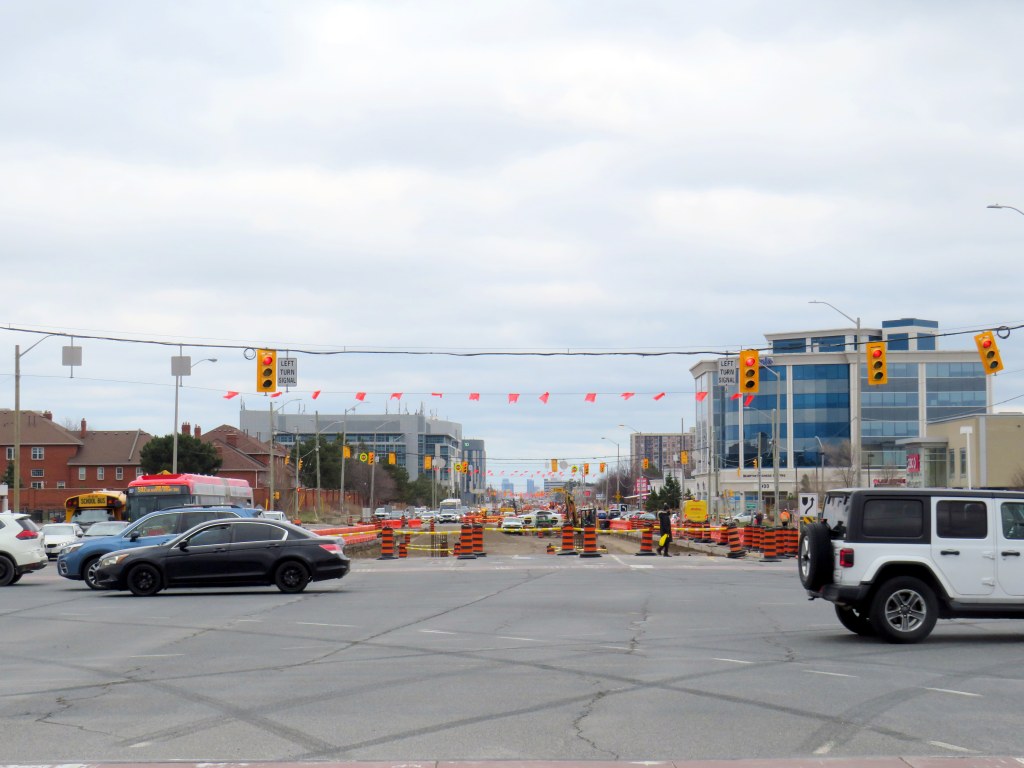
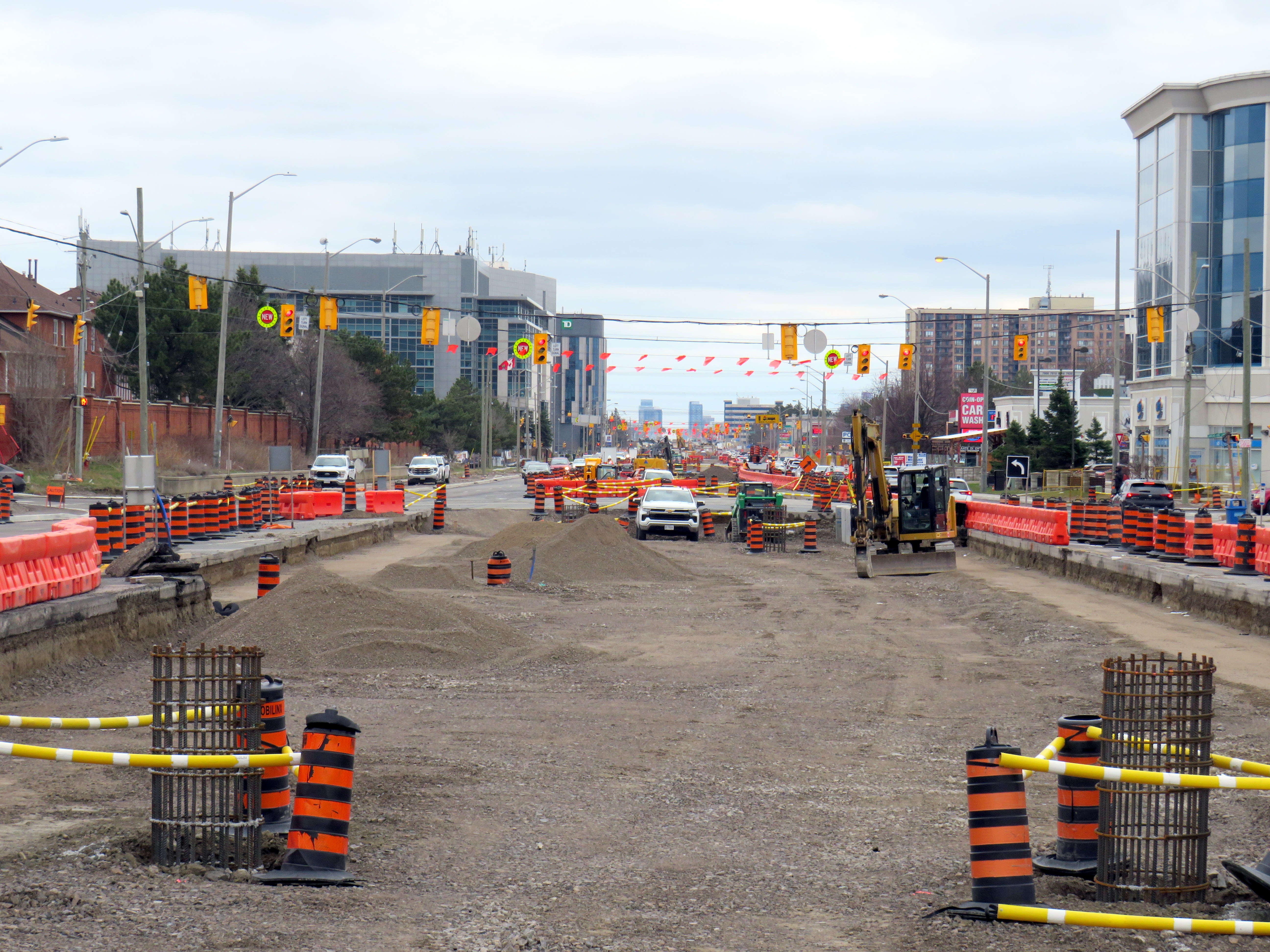
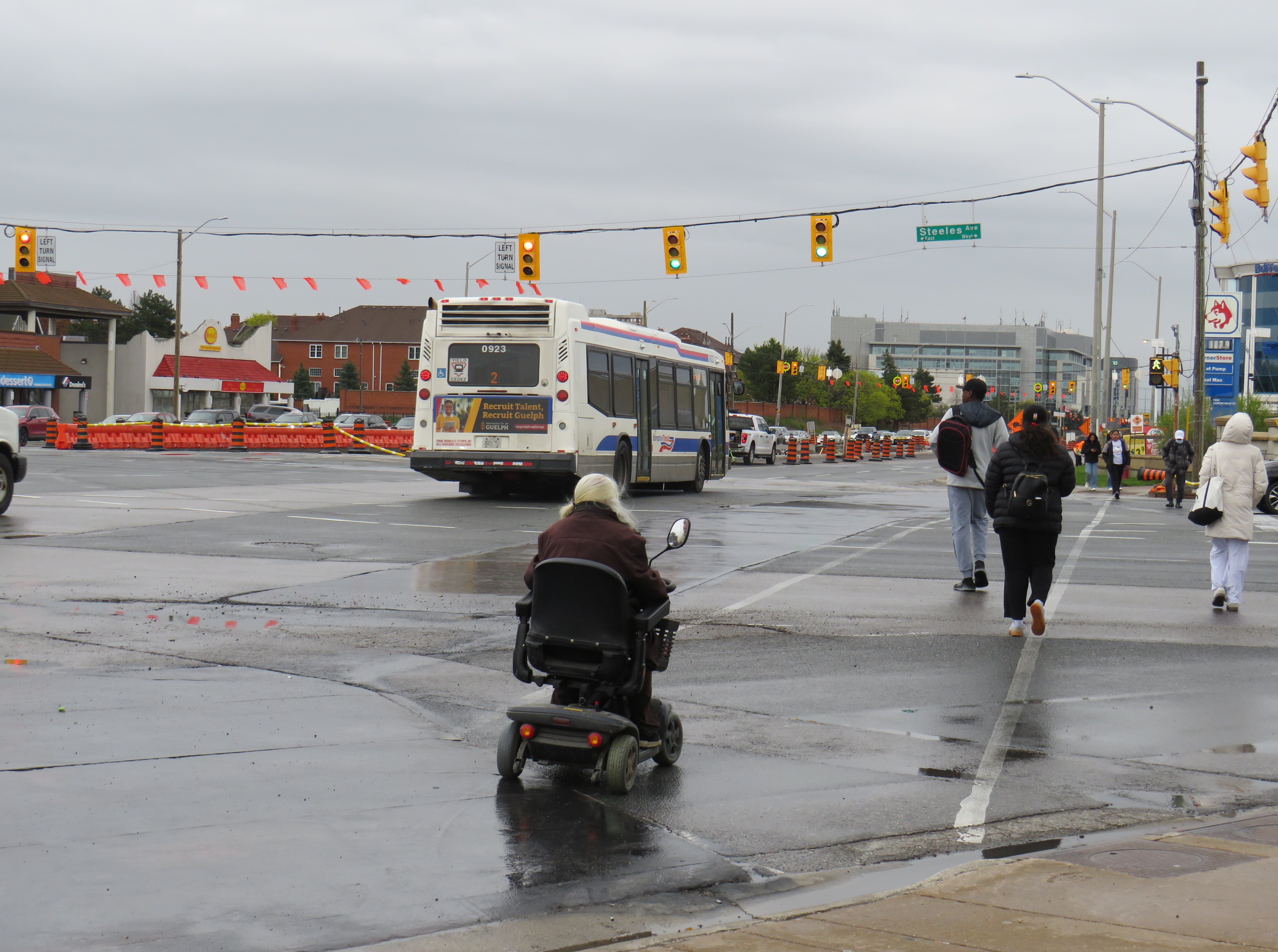
Hurontario Street, looking south from Steeles Avenue, where the first phase of the Hurontario LRT will terminate
The first phase of the Hurontario LRT, which will between Port Credit GO Station and Steeles Avenue in Brampton, is slowly taking shape after years of construction delays. In Spring 2026, eight years since construction started on the corridor, work on the LRT guideway into south Brampton has finally begun.
As I wrote in detail before, a previous iteration of Brampton City Council narrowly voted against the LRT entering downtown as a surface line in 2015. This was the version selected in the provincial environmental assessment. Instead, that council voted to study alternative corridors into Downtown Brampton requiring lengthy detours, and asking for the LRT northern terminus to be on the south side of Steeles Avenue, despite a major bus exchange — Brampton Gateway Terminal — on the north side of the intersection to accommodate all options. After the 2018 election, council recommitted to a Main Street alignment (though preferring a tunnel) and asked the province to restore the terminus on the north side of Steeles pending a decision on the final four kilometres into Downtown Brampton. In early 2026, only one of the six councillors opposed to the Main Street LRT ten years ago remains in office.
I wanted to follow up with Metrolinx to see how pedestrians would be safely accommodated at the Steeles and Hurontario intersection, given high traffic volumes, wide roads, and likely thousands of passengers switching between modes on a daily basis. Early concepts of an underground pedestrian tunnel were rejected by the province as out-of-scope, so pedestrians would have to cross both Hurontario and Steeles to make the transfer. Having no satisfactory answers despite many attempts to get an answer to this question, I took the lengthy and expensive route of submitting a freedom of information (FOI) request.
In summary, I learned that despite multiple requests from City of Brampton officials to restore the north side stop, Metrolinx and the provincial government refused. With the financial close with Mobilinx — the private-sector consortium selected to build, operate, and maintain the LRT — imminent in early 2019, there was no interest to make the minor change to facilitate the terminal, even though the city committed to taking on the cost on its own. The province was open to other changes to the line, however, as in 2022, it unilaterally renamed the line for a former Mississauga mayor and political ally of Doug Ford.
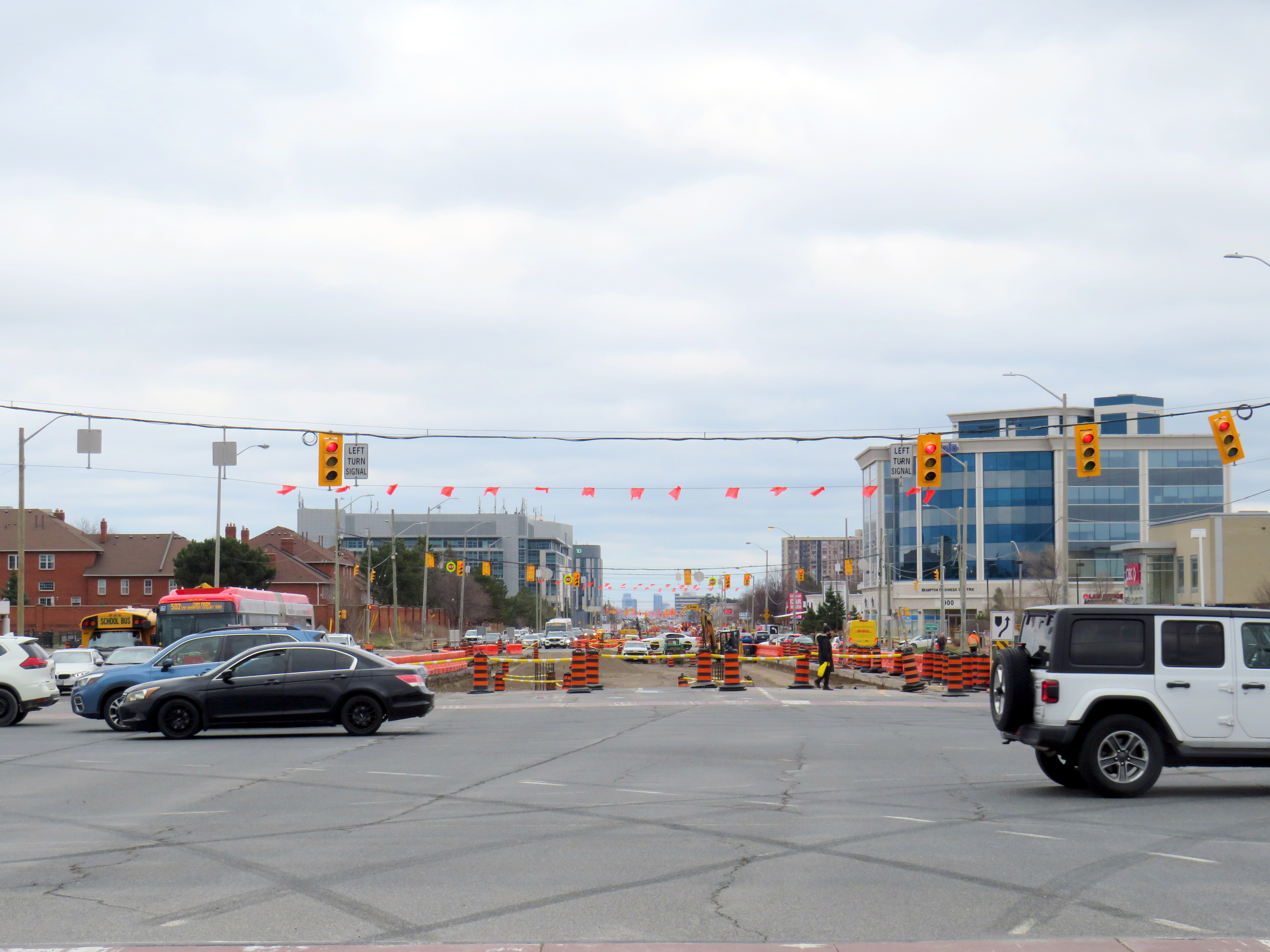
Looking south across Hurontario Street across a very busy multi-lane intersection towards the end of the LRT
As work at the Steeles-Hurontario intersection is now well underway, it has become visually clear the problem will be once the LRT opens. The population around the Brampton Gateway Terminal area is rapidly growing; a 40-storey condominium tower on nearby Steeles Avenue West is nearing completion, with many more highrise and mixed-use developments planned, including the eventual redevelopment of Shoppers World Mall. Already, there are dozens who cross nine-lane Steeles Avenue hourly; once passengers have to transfer from the LRT to the transit terminal on the northwest corner, there will be hundreds.
Furthermore, once the (now-funded) Phase 2 of the LRT to Downtown Brampton is started, the intersection will have to be torn up yet again to extend the tracks across Steeles and build a new north-side stop. The province’s refusal to do this all at once is baffling, and will likely be much more expensive than if it was done right the first time.
Looking across from Gateway Terminal towards the future LRT terminus on Wednesday, May 6. Already, there are plenty of pedestrians crossing here.
Already, the costs of the current Mobilinx contract have ballooned while construction delays pile up. The Hurontario LRT was originally supposed to open in 2024. In 2025, Mobilinx had to completely rebuild the track intersection at Topflight Drive just south of Highway 407 after track was already laid in 2023 due to construction errors. In February 2026, Global News reported that only 45 percent of the track was laid. Due to delays and problems paying contractors, the consortium’s credit rating was downgraded by Standard & Poor to BBB, which is near junk status.
Given the multiple delays and difficulties building the LRT, work is only now at the point where the dangerous terminal location is being baked in. Even though construction errors are fixed, and the project name changed, Metrolinx has been unwilling to address the safety issue at Steeles Avenue that was raised many times. In the meantime, Metrolinx, Peel Region, and City of Brampton will have to figure out how to mitigate the potential disaster that is now in the making.
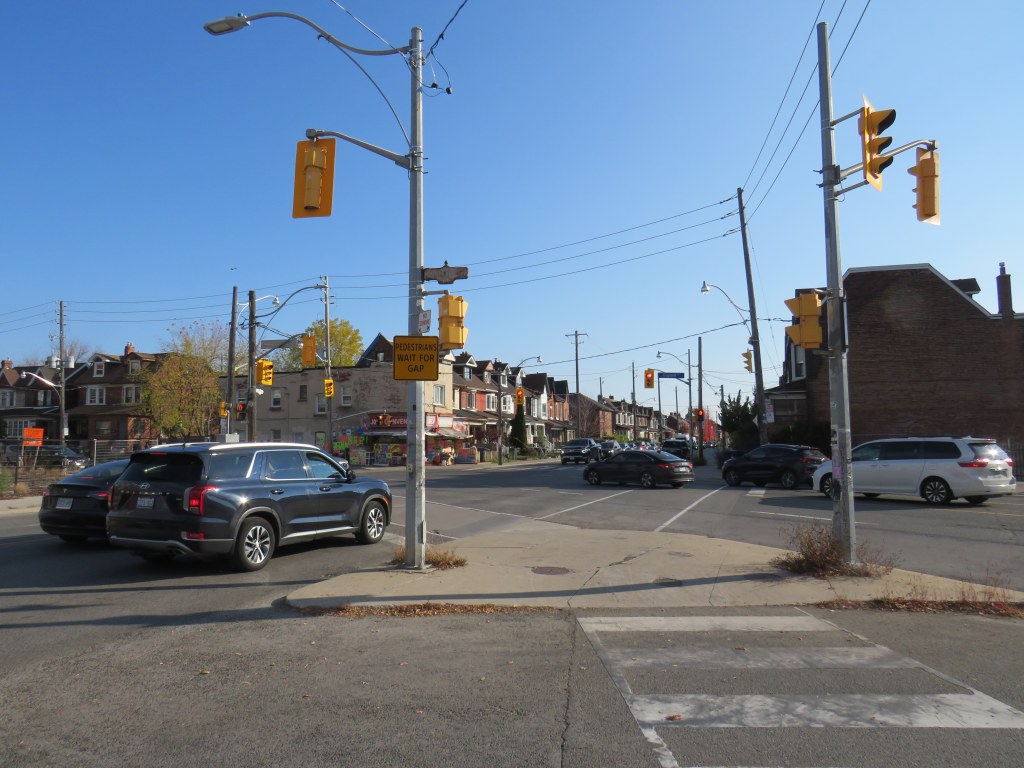
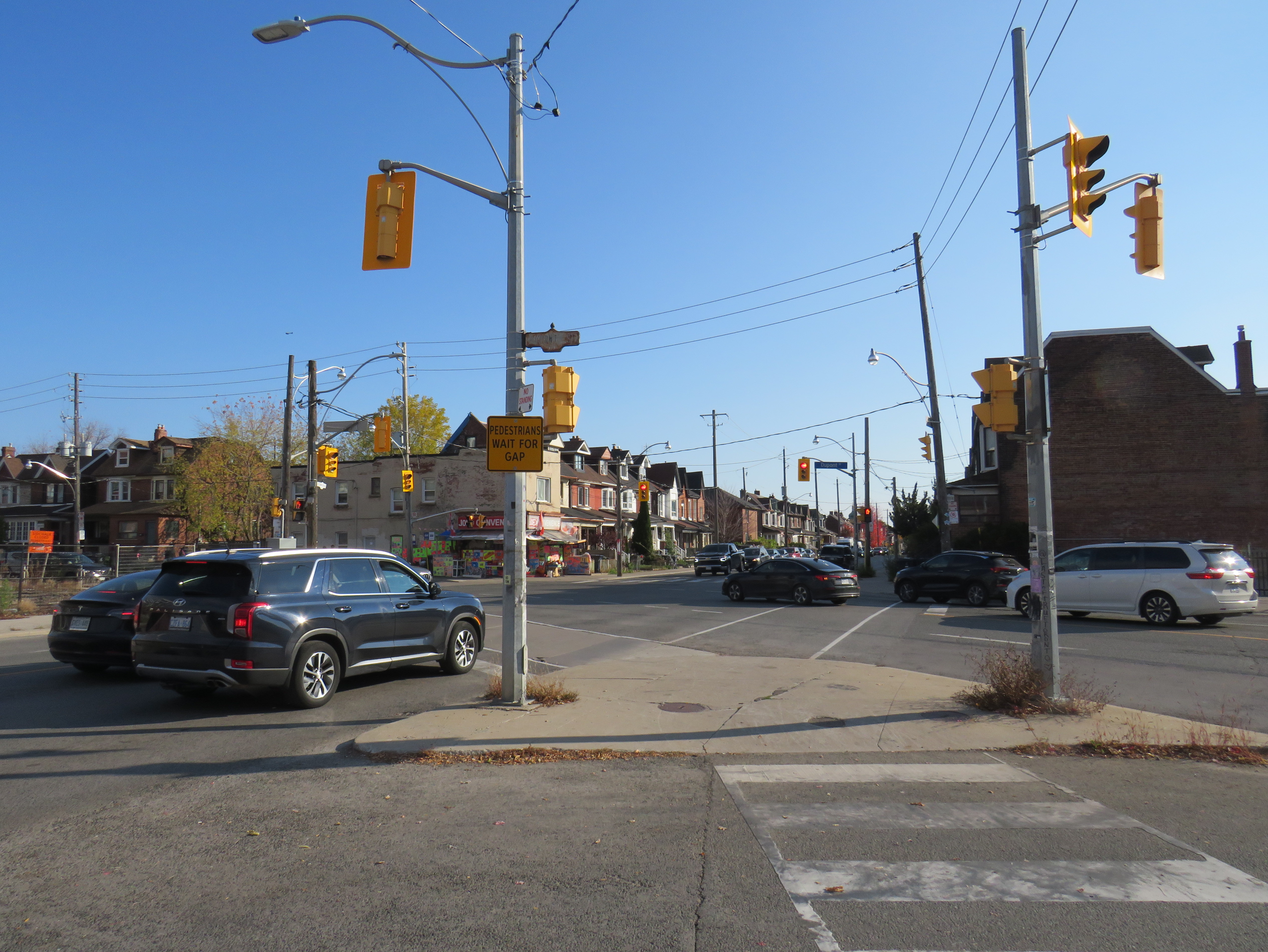
Slip lane with small pedestrian refuge island at Dupont Street and Ossington Avenue
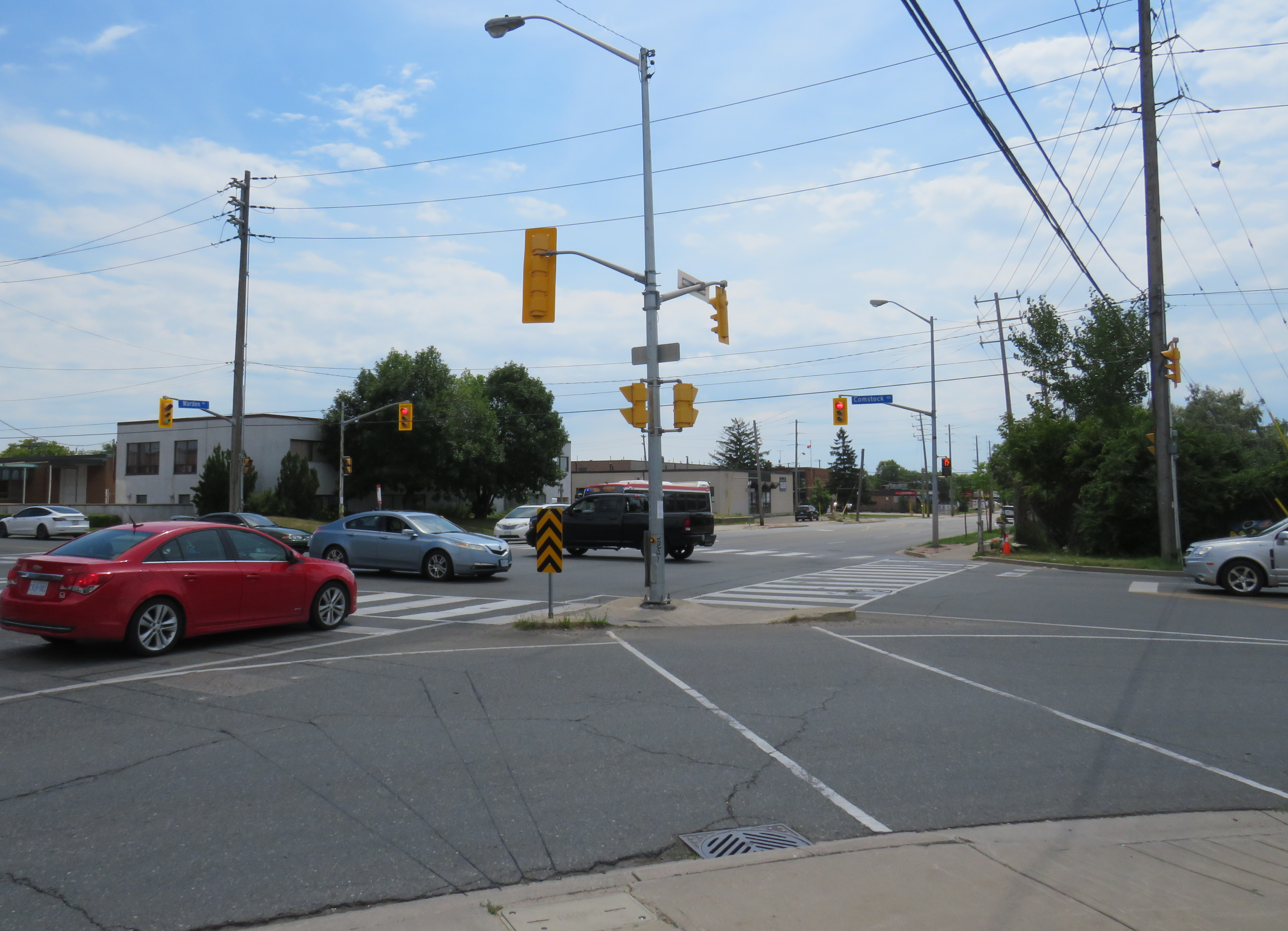
There are many ways that road design acts to facilitate vehicle drivers yet impede pedestrian mobility. There’s the beg button (traffic engineers prefer the term “pedestrian call button”) that ensures maximum traffic throughput unless a pesky pedestrian or cyclist decides they want to cross the road too when the light turns green. There’s the two-phase pedestrian crossing that guarantees a long wait to cross a wide traffic artery on foot. Wide curb radii at intersections allow drivers to easily turn, yet they intrude into the crosswalk space. And there’s the slip lane, also known as a channelized right turn.
Most slip lanes are designed to allow right-turning motor vehicles to bypass an intersection. Where an intersection may be controlled by a traffic signal or a stop sign, typically, a slip lane is only controlled by a yield sign, reminding motorists to give way to pedestrians crossing and/or oncoming traffic on the roadway being turned into. They are typically built for higher speeds, with turn radii even greater than those afforded by generous curved curbs at many urban intersections. The space left over in the triangular bit of concrete is where pedestrians must wait to cross the main roadways.
Occasionally, slip lanes are used to discourage or prevent certain turning movements. At shopping plaza entrances, for example, slip lanes are used to prevent left turns into or out of the driveway. They may also be used at one-way streets for the same purpose.
Thankfully, slip lanes are not the standard in the City of Toronto. At least forty slip lanes were removed between 2005 and 2025, including Front Street eastbound at Yonge, from Coxwell Avenue southbound at Dundas Street East, and a half dozen on Danforth Road in Scarborough. In the downtown core, there are only three remaining examples that cross pedestrian pathways: from southbound Bay Street to Queen Street West, from eastbound Bloor Street to Parliament Street, and from Mount Pleasant Road to Jarvis Street. There are several other intersections in the city centre that allow some right-turning vehicles to bypass the main intersection, such as Adelaide and Richmond Streets at Jarvis, University at Front, or Parliament at Gerrard, but these still require a full turn at their start or end point, mitigating their danger.
A map of slip lanes in Toronto, and those removed in the last twenty years, is below. This work was assisted my followers on BlueSky for their additions and corrections, and I appreciate their help.
By removing slip lanes, pedestrians and cyclists are better protected, and there can often be new space for seating, public art, or even plant life.
Slip lanes are far more common in suburban neighbourhoods outside the City of Toronto. In Brampton and Mississauga, slip lanes are common on regional roads such as Steeles Avenue, Dixie Road, or Erin Mills Parkway. These six-lane roads are designated as goods movement corridors, and are designed for heavy traffic, including tractor-trailers. Even in Peel, though, slip lanes are being rethought. Several were removed on Bovaird Drive in Brampton two years ago (replaced by signalized crossrides), while others are being repainted to empathize the pedestrian crossing and encourage slower movements. More signage tells motorists to stop for pedestrians.
Modified slip lane at Bovaird Drive and Main Street in Brampton. Further east, slip lanes were removed at three lower-traffic intersections and replaced by multi-use path crossings.
Though the City of Toronto has done some good work eliminating or modifying slip lanes in the name of traffic safety and an improved pedestrian realm, there are many more that still should be examined, such as the one at Ossington and Dupont, where, unusually, pedestrians are instructed to wait for a gap, rather than motorists instructed to yield. These “wait for gap” signs are found at the entrances and exits to expressways, such as the Gardiner Expressway or Highway 401. But these, too, can be changed. At the eastbound ramp to northbound Don Valley Parkway on the Prince Edward Viaduct, a free-flowing on-ramp was changed to a signalized right turn, improving safety and comfort for pedestrians and cyclists.
Crossing the Bay Street on-ramp to the eastbound Gardiner Expressway makes getting to the Waterfront more dangerous and uncomfortable than it should be
Hopefully, City of Toronto staff work to correct the situation at Dupont and Ossington (there’s no reason why pedestrians should be expected to yield to traffic in this revitalizing part of the city) and continue the work to make our streets safer for all.
If you like my work and you would like to help out with my webhosting costs (I just had to renew my ad-free WordPress subscription), consider buying me a coffee.Thank you!
Dearbourne Boulevard, a four-lane collector street designated a community safety zone
Last week, while visiting Brampton, I came across one of the hundreds municipal speed enforcement cameras that Premier Doug Ford’s government wants to rip out across the province. The camera, on a four-lane collector street in Bramalea, is in a residential area, adjacent to several parks, including a pathway to a local public school, in an area designated a community safety zone. This is precisely the type of place that the government intended speed enforcement cameras would go when they were permitted under provincial legislation in 2019.
In a September 2025 government press release touting the move as “protecting taxpayers,” Ford, whose government was in power when these cameras were permitted, claimed that the program became “a cash grab;” supporting quotes included those from former Liberal leader and current Vaughan mayor Steven Del Duca, a representative of the province’s municipal police unions, and a spokesperson from the right-wing Canadian Taxpayers Federation.
If only there was a simple, effective way for taxpayers to avoid the so-called “cash grab.”
It was interesting who was not quoted in that press release, including doctors, educators, safety advocates, and even police brass. Ontario police chiefs support automated speed enforcement. It is also worth noting most municipalities support the cameras; Vaughan is one of only a few municipalities that recently rejected the road safety program; Del Duca was joined by just two other conservative-leaning mayors.
Of course, the arguments against the cameras, which in Toronto, were repeatedly vandalized or stolen, never held water. There were no tickets mailed out to drivers going just a few kilometres over the limit. Furthermore, speed enforcement was never a “cash grab” as the fines collected went to pay for the administration of the program, to “Vision Zero” works, such as the installation of speed cushions and improved pedestrian crossings, and to the province, which the collects the victim surcharges added to every Highway Traffic Act fine. The City of Brampton found that not only were the cameras effective in reducing speeds, they had the support of a majority of its residents.
Municipal speed camera
That said, while visiting Dearbourne Boulevard, I realized that speed enforcement cameras on their own are not effective in creating safer streets.
Dearbourne Boulevard serves one of the oldest parts of Bramalea, established in the early 1960s as a self-contained satellite town, where residents were expected to drive to most destinations. After amalgamation into the City of Brampton, traffic increased and more transit became available. Nearby, several newer high-rise apartment buildings were built, walking distance to Bramalea GO Station. A bus route, 16 Dearbourne, runs along the street, connecting the neighbourhood with several shopping plazas, the GO Station, and the transit hub adjacent to Bramalea City Centre.
Despite having low traffic and serving a residential area (an industrial area is just to the south, but it is inaccessible from Dearbourne), it is still a wide four lane street. The only traffic signal is at Bramalea Road; there are two all-way stops at Delamere Drive and Dorchester Road. At the east end of Dearbourne, the T-intersection with Balmoral Drive is controlled only be a stop sign, with two long and gentle right turn slip lanes. The speed limit is 50 km/h, and there are no speed cushions, curb extensions, or even painted buffers to indicated that drivers should go slower. In October 2022, a pedestrian was struck and seriously injured at one of the two all-way stop intersections; the driver fled the scene.
Though to its credit, the City of Brampton has been improving many suburban streets and roads to reduce speeds and promote walking and cycling. Charolais Drive, Vodden Street, Central Park Boulevard, and Vodden Road saw traffic lanes replaced by new cycling lanes, with little pushback from residents. Dearbourne Boulevard was also slated for improvements in 2021-2022, but that work was not yet started.
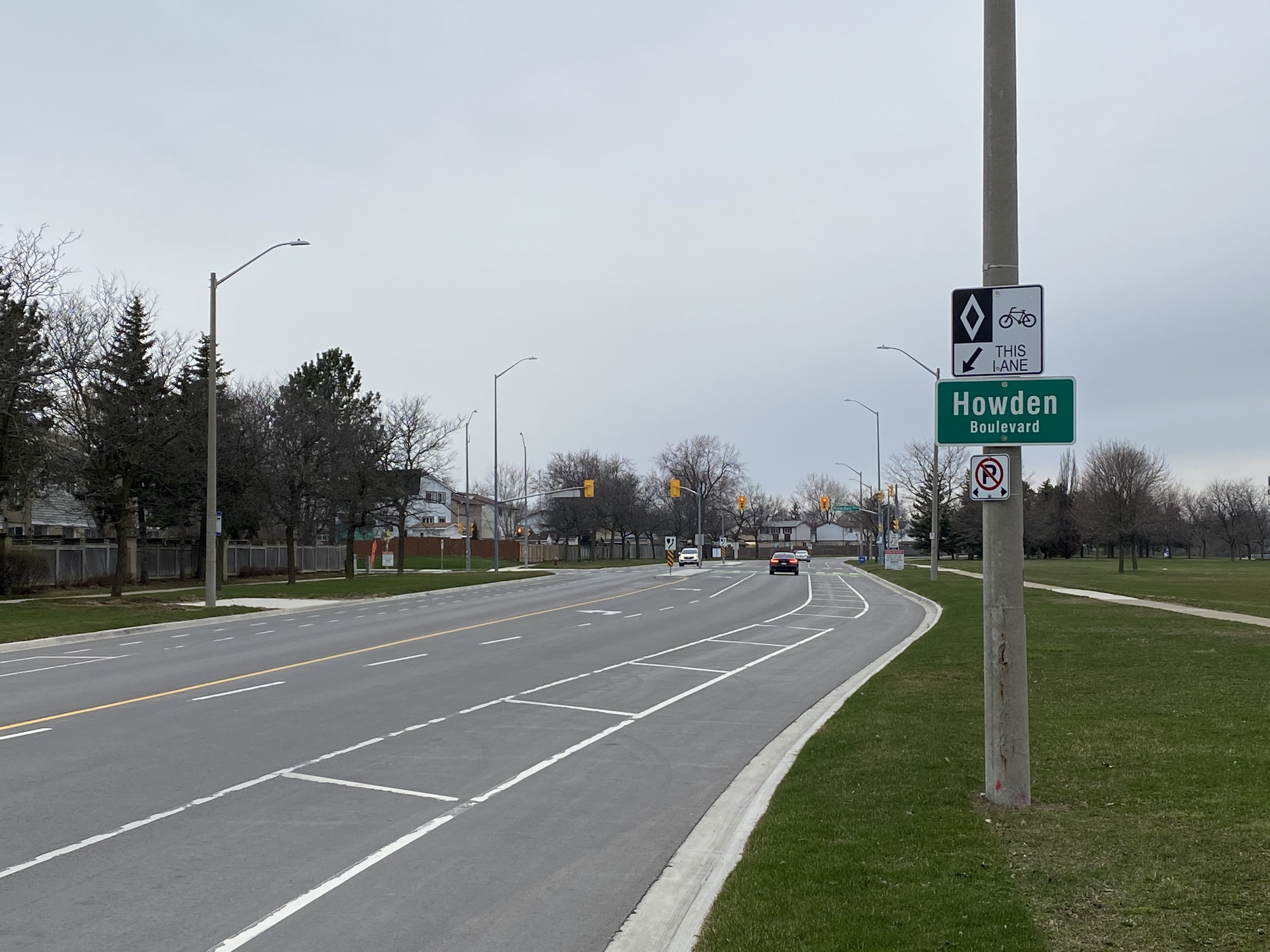
Central Park Boulevard, Howden Boulevard, and Vodden Street were among several four-lane collector roads tamed with new cycling infrastructure in the last five years, creating a new through east-west cycle route
Now, it might be too late. Not only will the speed camera be prohibited under a bill being rushed through the provincial legislature (going around the consultation process where concerned citizens, advocates, or safety experts could depute to MPPs), but another omnibus bill was just introduced, which if passed, would prohibit all Ontario municipalities from removing general traffic lanes to install cycling infrastructure, or even transit lanes and on-street patios.
Given the provincial government’s increasing hostility to anything that inconveniences drivers, be it road tolls, vehicle license renewal fees, automated speed enforcement, or bike lanes, it leaves municipalities fewer options to protect their most vulnerable road users and promote sustainable and healthy transport options. Though Doug Ford claims that alternatives like flashing lights and more signs would do the trick, they do not do much to deter aggressive and dangerous drivers, unlikely to get caught.
For streets like Dearbourne Boulevard, there are a few options. Lowering the speed limit to 40 km/h should be a first step. The redundant outer two lanes could be converted to parking-only spaces, with curb extensions and bollards at intersections. The slip lanes at Balmoral Drive should be ripped out.
Roads designed in the 1960s and 1970s for traffic that never really materialized need to be rethought, with or without Queen’s Park’s support.
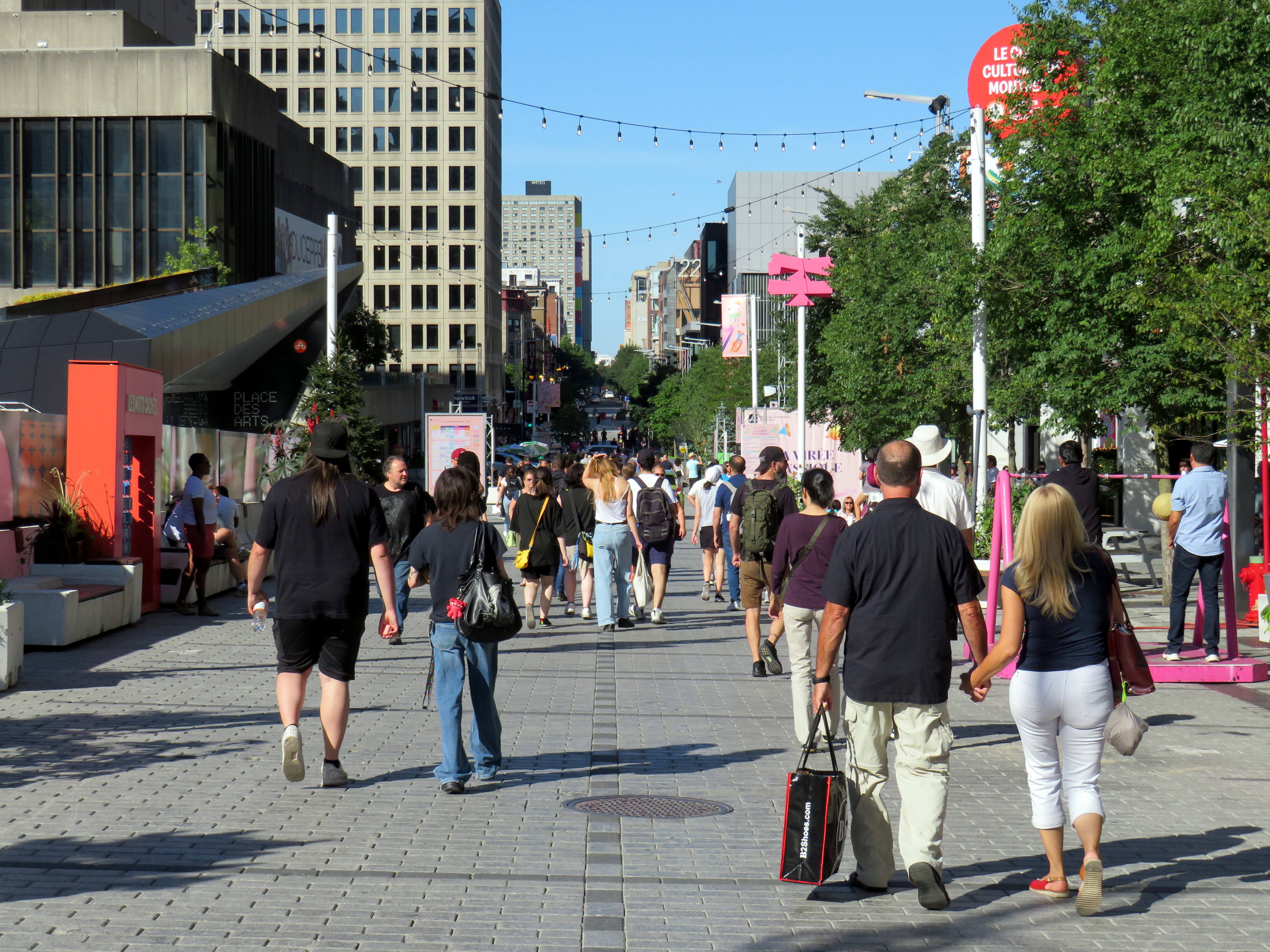
Rue St-Catharine in the Quartier des Spectacles, August 2025
A visit to Montreal can make one jealous. Jealous of the city’s better street furniture, greater cycling infrastructure, great public spaces throughout the city, and an improved pedestrian realm. Entire streets are closed in the summer months to motor traffic, allowing pedestrians to spill out into the roadway, and patios to sprout without the need for concrete blocks to protect them (and less noise and pollution to those dining al fresco).
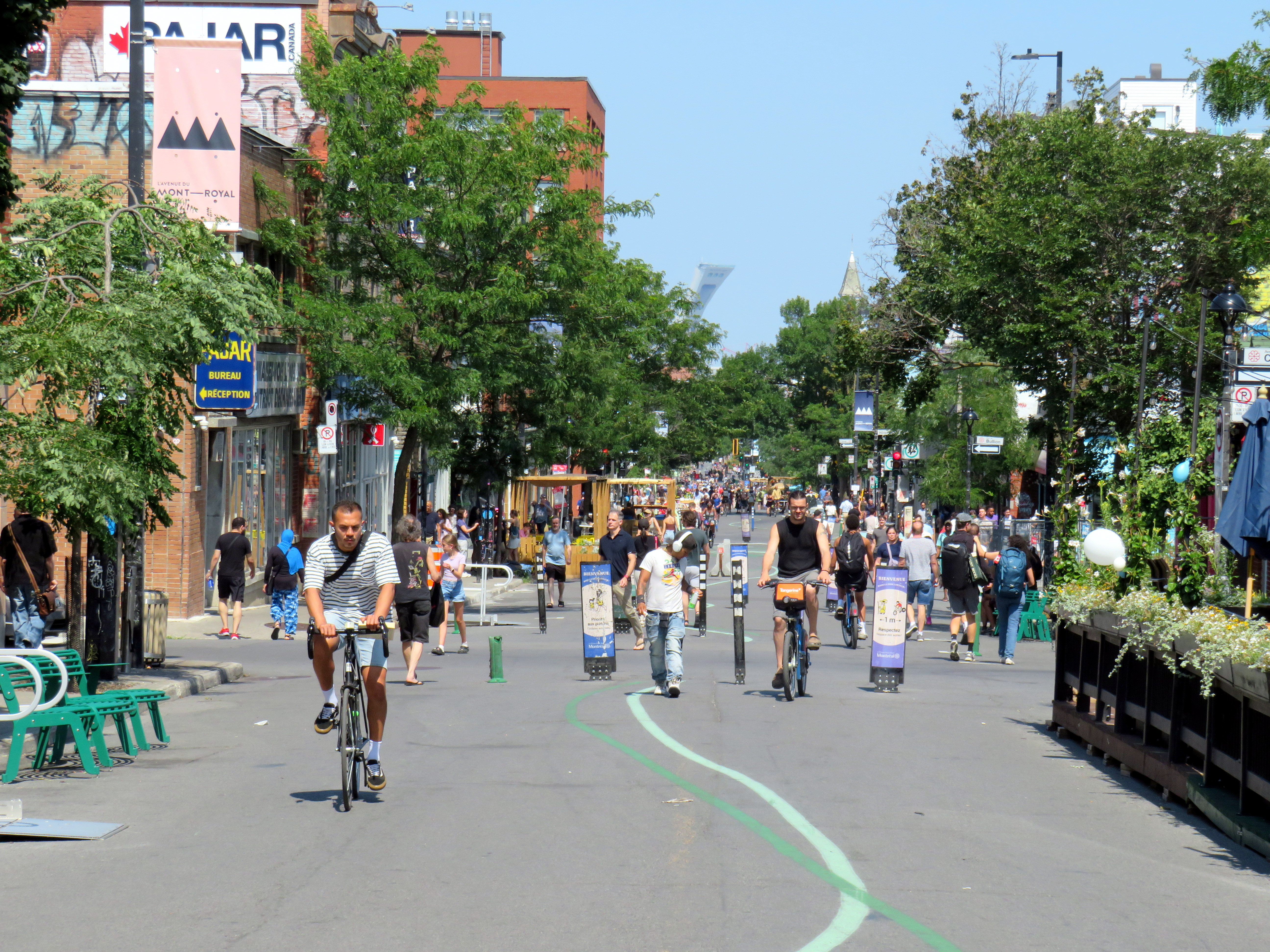
For example, Avenue Mont-Royal, was first closed in Summer 2020 as a “Corridor Sanitare” to encourage people to get outside during the first wave of the COVID-19 pandemic and support local businesses, which set up patios on the sidewalk and the street. My spouse and I rented a car and visited Montreal during this time, getting a lot of walking in a city that opened up as much as safely possible.
Avenue Mont-Royal, looking east, August 2020
Happily, Montreal continued the tradition in the years since, even as pandemic restrictions eased, then disappeared entirely. Five years later, Avenue Mont-Royal was even more vibrant. Not only were there lots of patios on the street, there were public benches, shade structures, and water fountains, allowing anyone to sit, relax, and enjoy the outdoors. The annual summer closure is a hit.
Avenue Mont-Royal, looking east, August 2025
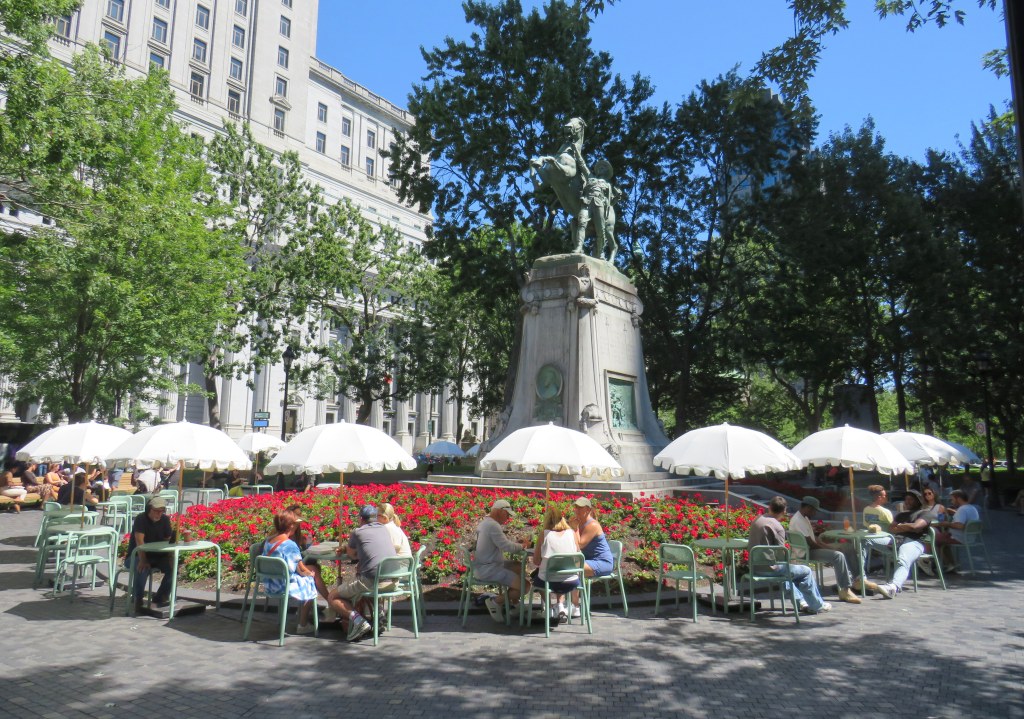
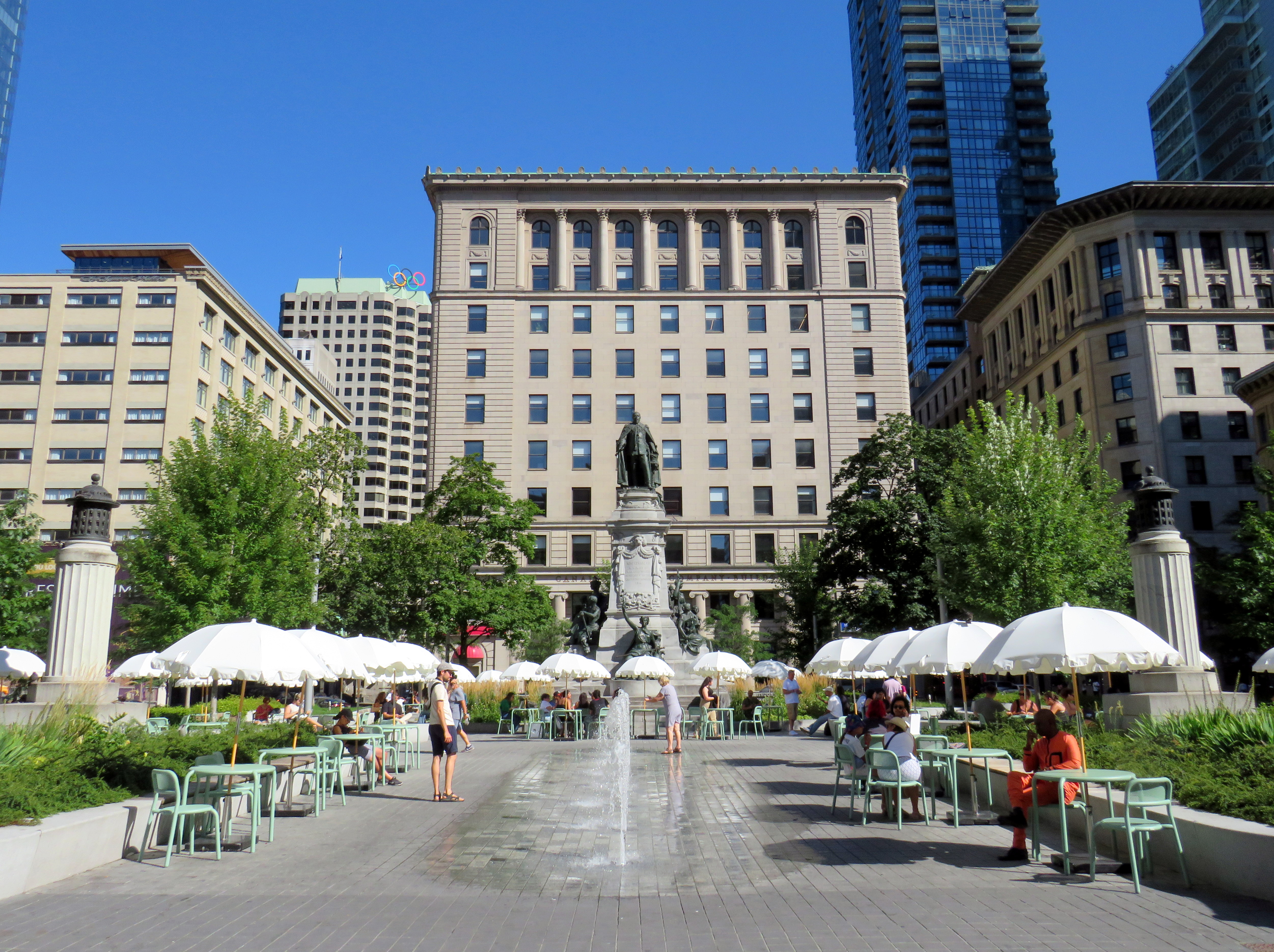
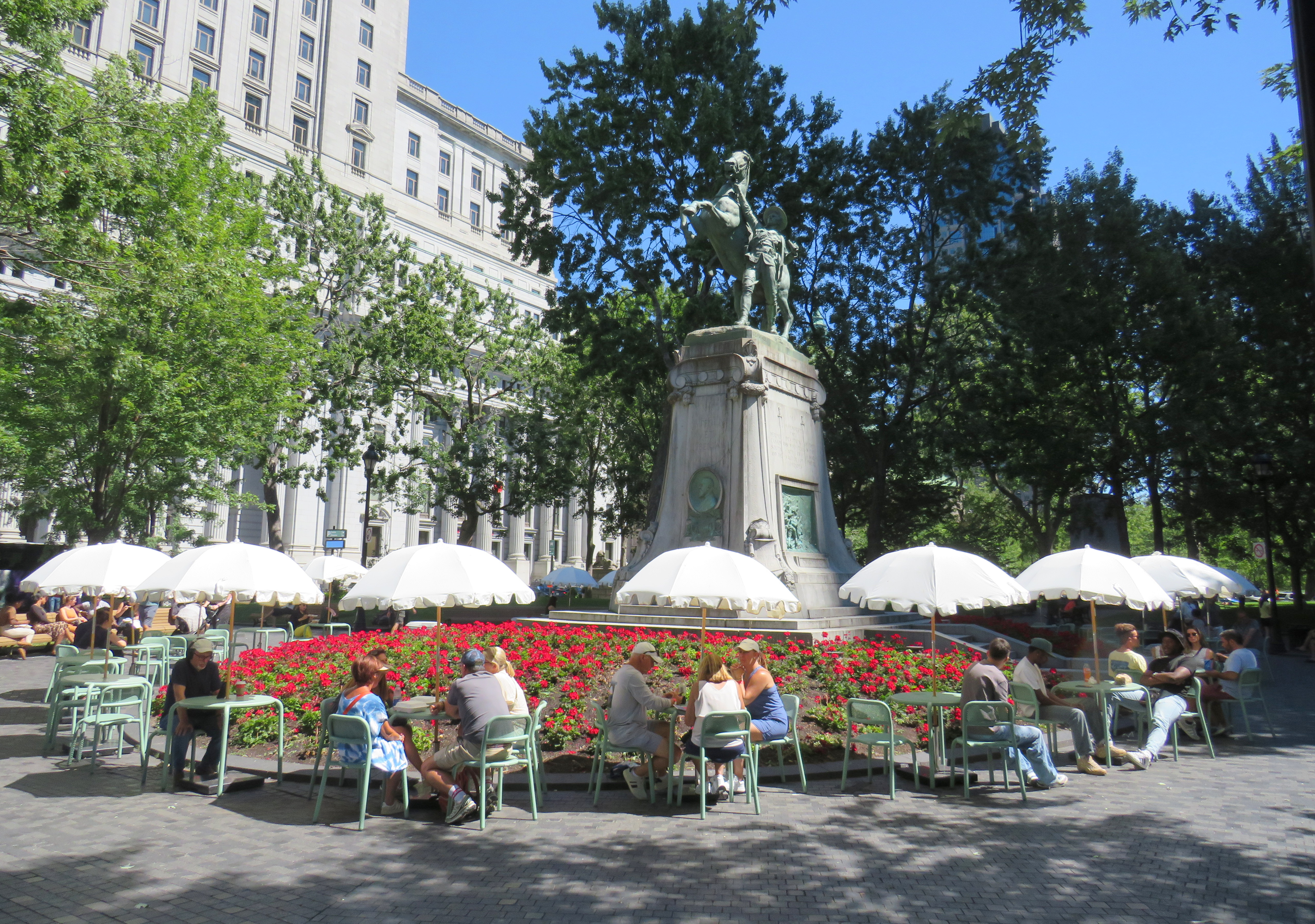
Several public squares were also renewed in recent years. Phillips Square, on Rue Ste-Catharine across from the now-shuttered Hudson’s Bay department store, was renewed with new splash fountains along with small café-style tables and chairs, complete with shade umbrellas. The metal chairs are movable, allowing larger groups to sit around a single table. It’s a refreshed natural congregation point along the city’s main shopping street.
Phillips Square, August 2025
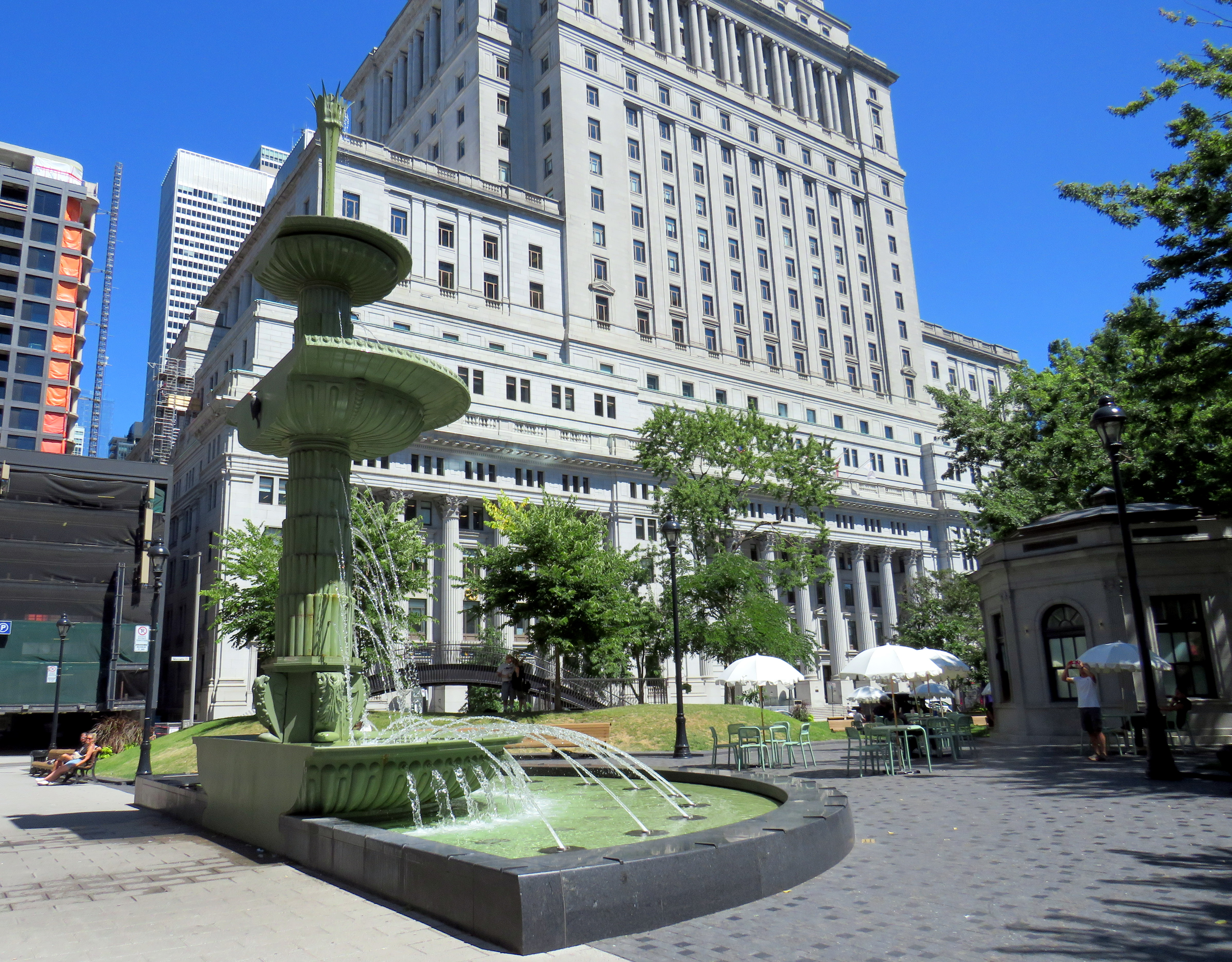
Similar tables and umbrellas were set up at Dorchester Square, several blocks to the west, near Mary, Queen of the World Cathedral and Central Station. Both squares were reimagined by the brilliant landscape architecture firm Claude Cormier + Associés. At Dorchester Square, a new water fountain, seemingly a classic installation, is cut in the rear, with a woodpecker behind. Such Easter eggs are features of Cormier park projects.
Dorchester Square, August 2025Fountain at Dorchester Square; note the woodpecker on the side. One of the two black curved footbridges across the parking ramps is behind.
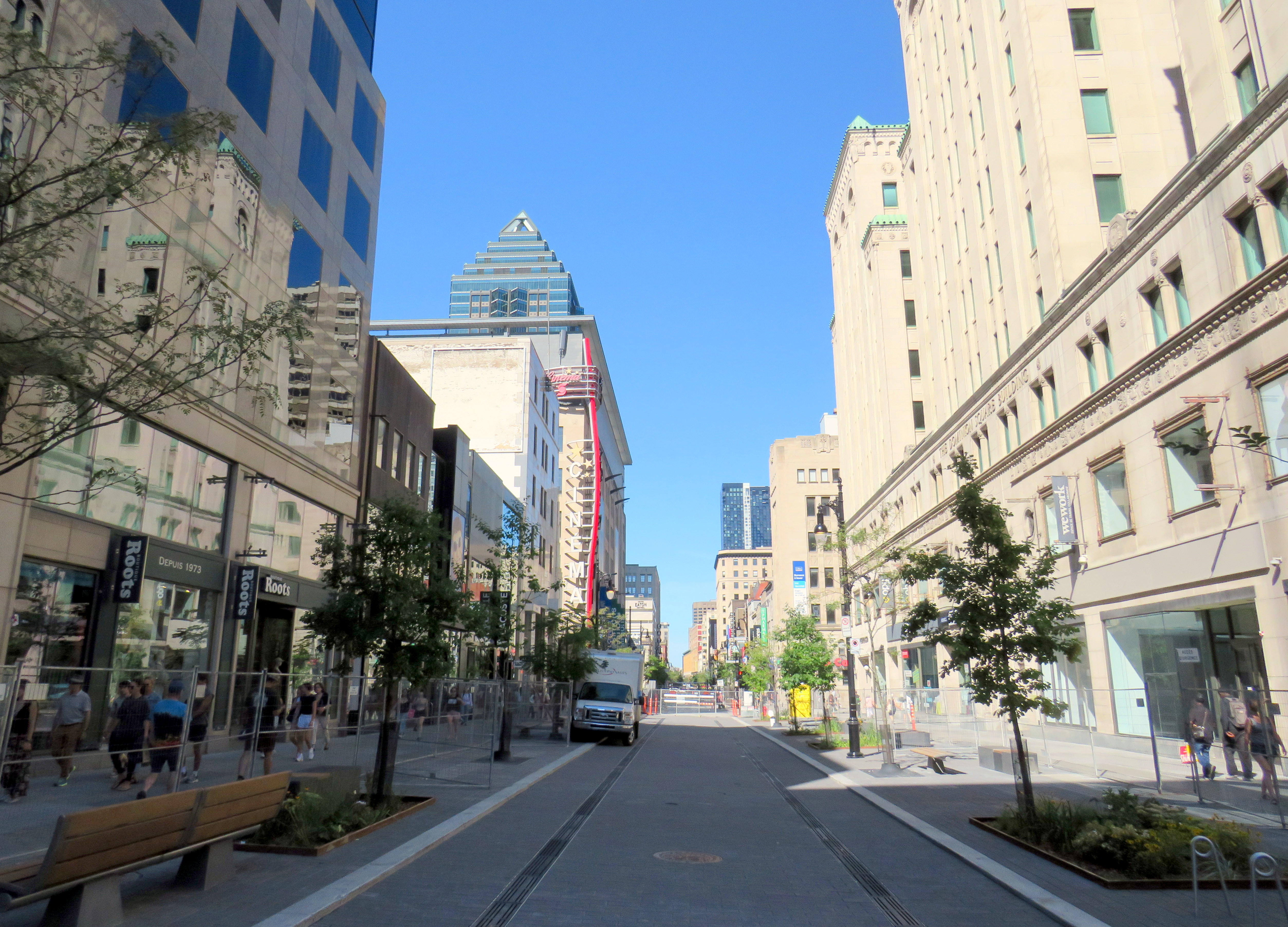
Furthermore, Montreal is rebuilding the western section of Rue St-Catharine towards Crescent. Though motor vehicles are permitted after reconstruction, they are limited to a single through lane, with lay-bys for deliveries, passenger pick-ups and drop-offs, and emergency vehicles. Sidewalks are widened considerably, with more benches, bicycle parking, and street trees.
Completing Rue St-Catharine, near Bishop Street
After returning to Toronto, it’s easy to feel down on this city. Montreal seems to do everything right. Meanwhile, ActiveTO, the open streets initiative following the pandemic restrictions here, quickly eroded, and was effectively ended in 2022. Open Streets, which closed sections of Yonge and Bloor Streets to motorists for two Sunday mornings, was last held in 2022. But there are still business improvement area-led weekend street festivals, which attract tens of thousands of pedestrians.
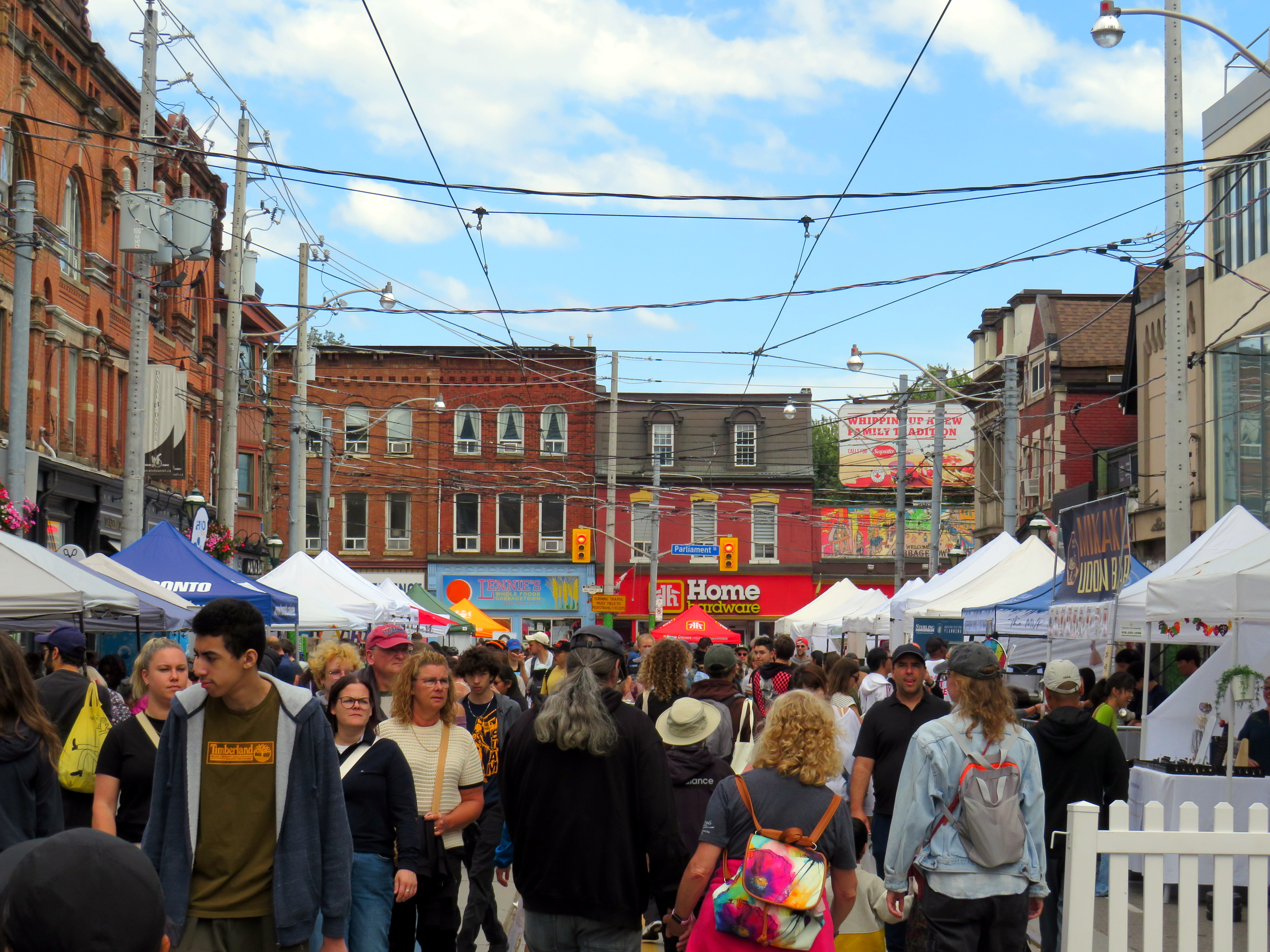
Torontonians want to walk, and pedestrianized streets, even when they’re just weekend events, are immensely popular. One downside, however, is a lack of seating outside of businesses’ patio areas. One is free to walk, enjoy live music, or just people watch, but to sit down, one is compelled to purchase something from one of the businesses with a sanctioned patio.
Torontonians love a street festival: Cabbagetown in September
There are a few other successes. A small segment Gould Street at Toronto Metropolitan University was pedestrianized and rebuilt as a central plaza for that university campus. A short section of Willcocks Street at the University of Toronto was similarly pedestrianized.
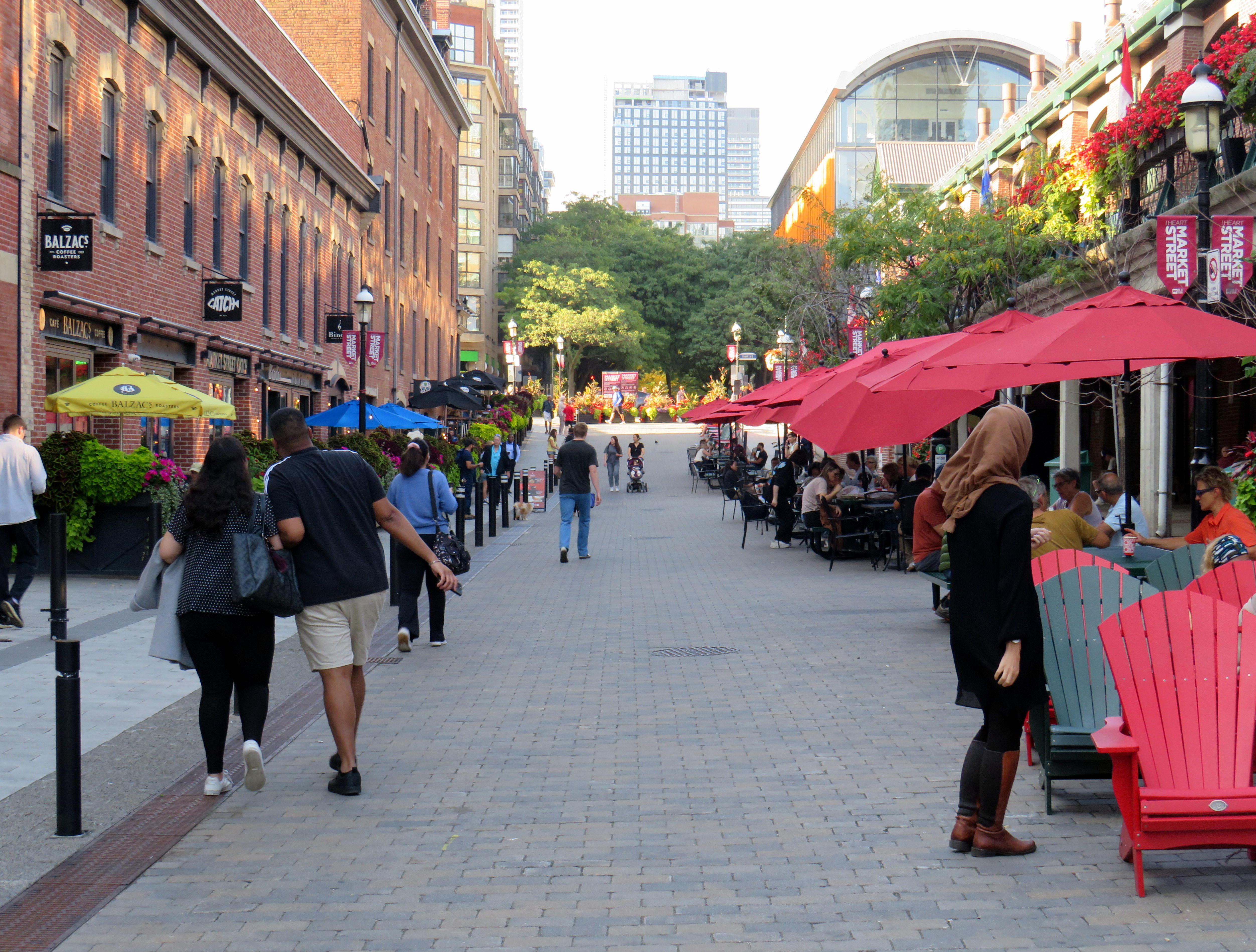
But the best example in Toronto is Market Street, which abuts St. Lawrence Market. Patio space and Muskoka chairs provide plenty of seating, without obligation to purchase anything (though it provides additional seating to those who picked up a snack or lunch inside the market). The shade umbrellas and high-quality surface materials and street furniture make this a wonderful oasis in Toronto’s downtown core.
Market Street looking north from The Esplanade. St. Lawrence Market is on the right.
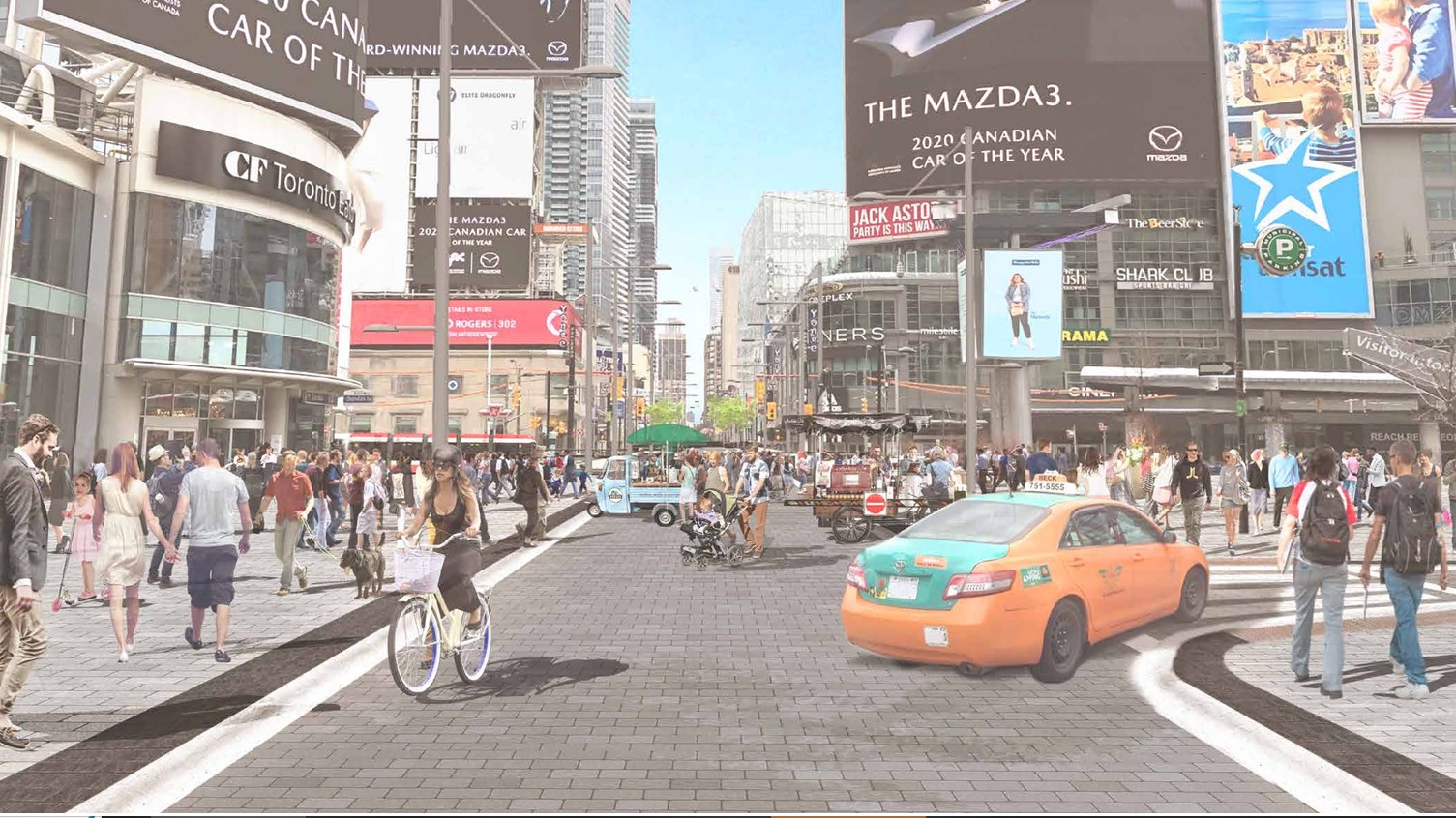
Planning for Yonge Street’s makeover, which will include narrowing the roadway, widening the sidewalks, improvements to the public realm, and seasonal closures of selected sections of the traffic lanes, is complete. Unfortunately, the YongeTOmorrow improvements will have to wait for another five years (work starting in 2030) due to Ontario Line construction.
Rendering of Yonge Street looking north towards Dundas, once YongeTOmorrow improvements are complete
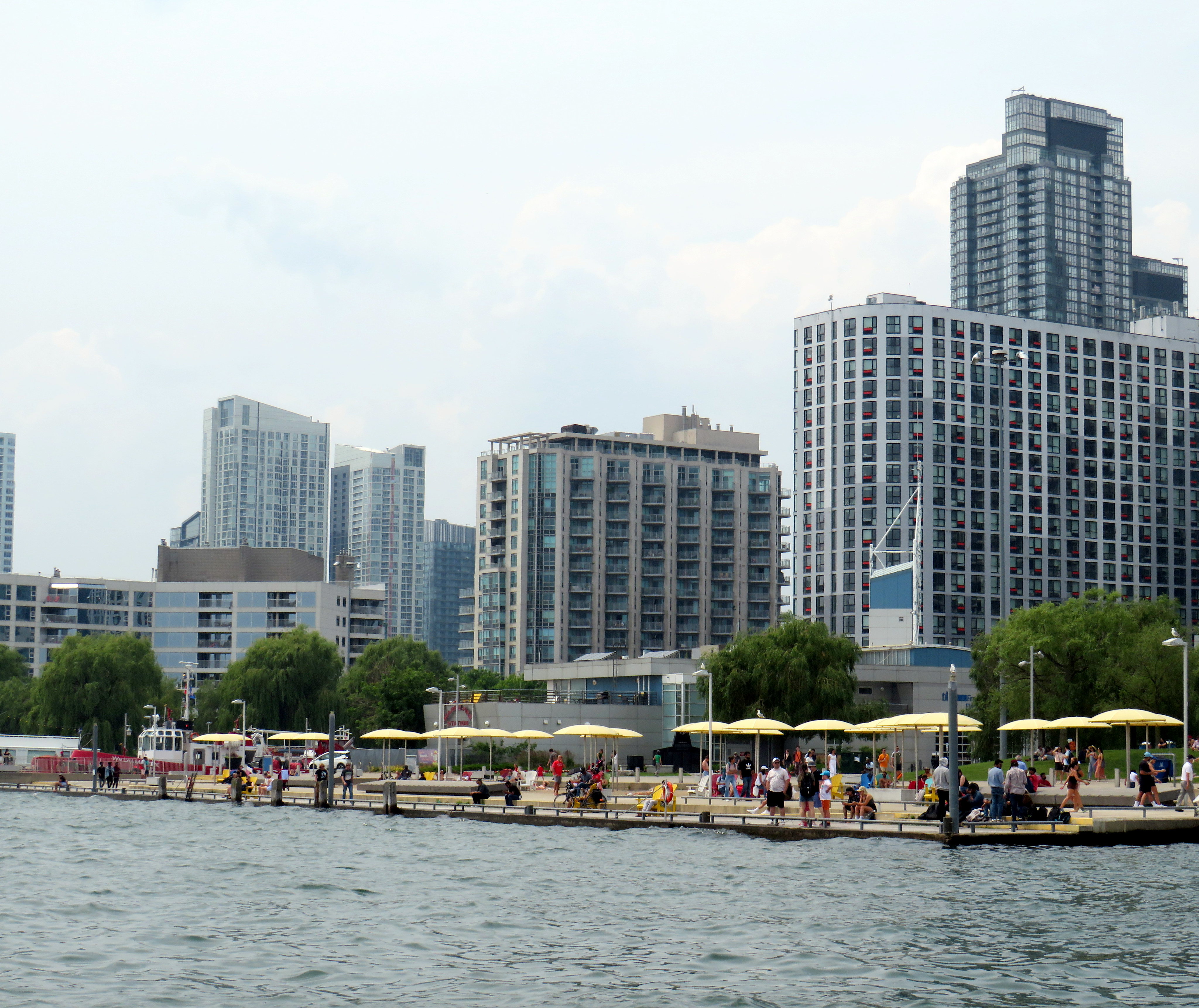
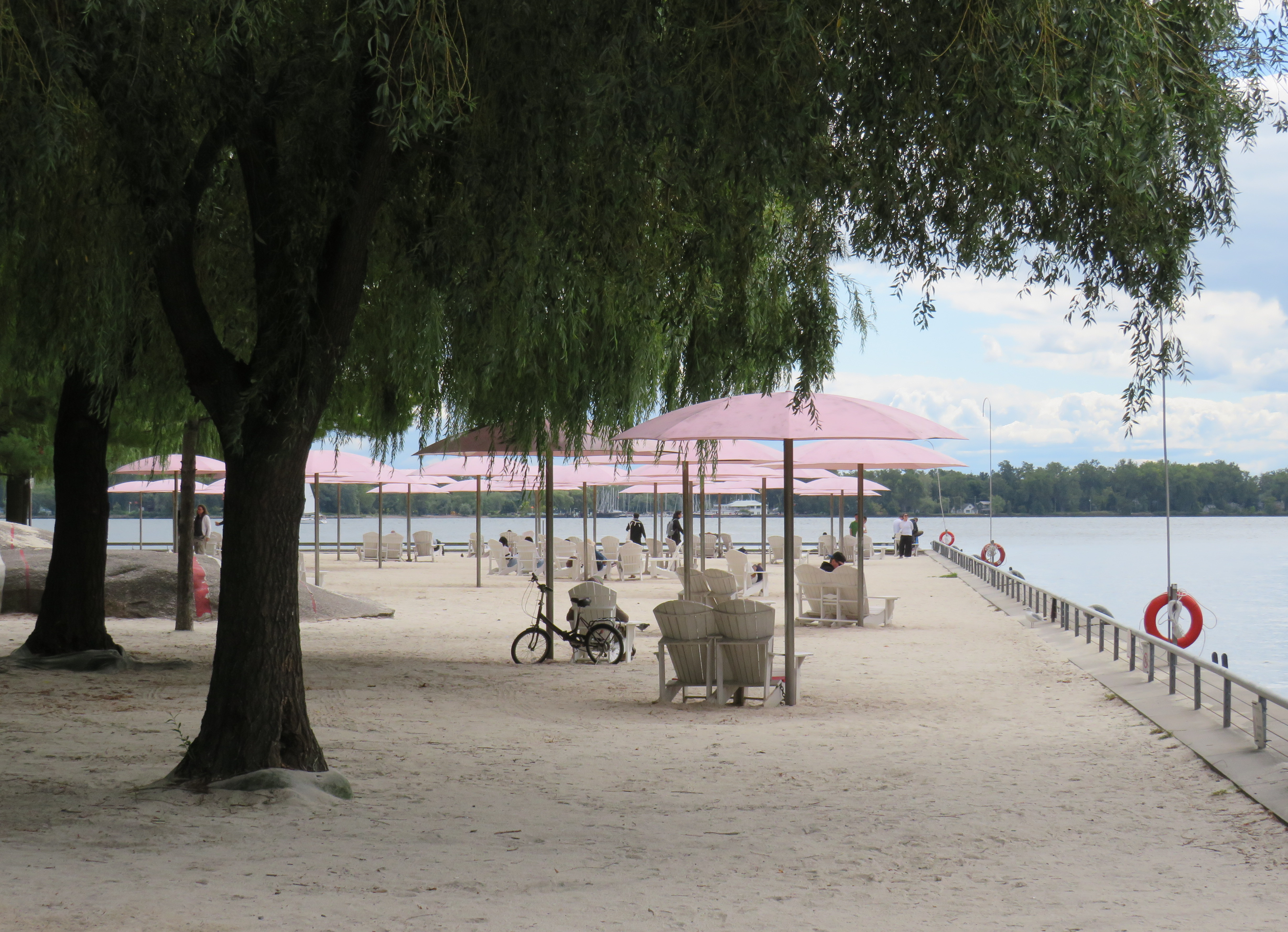
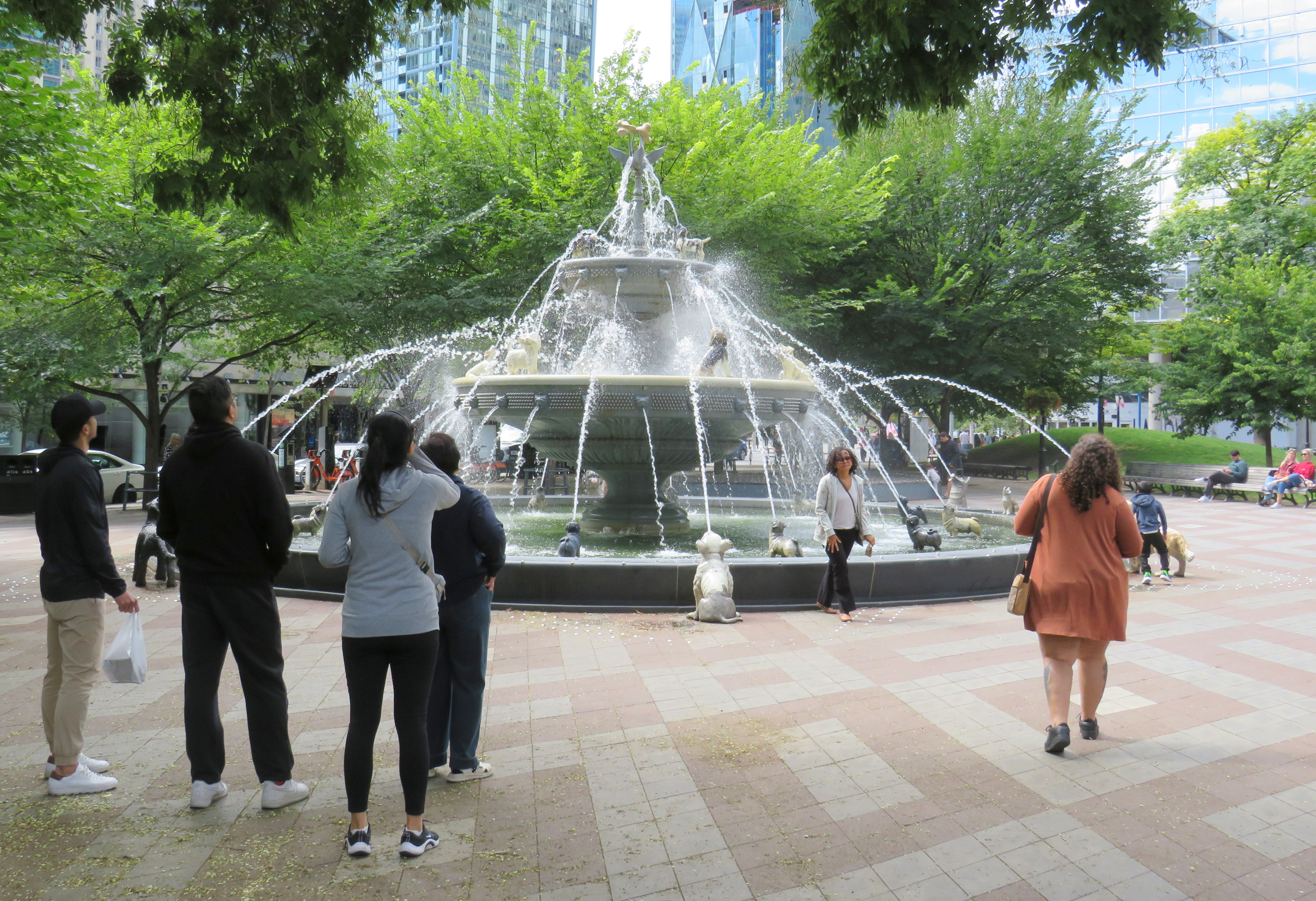
There are also other great things happening in Toronto. Claude Cormier was tapped to create new public spaces, such as HtO Park and Sugar Beach on the Harbourfront, but also reimagine existing places such as Love Park (previously a highway off-ramp) and Berczy Park, home of the popular Dog Fountain. At Love Park, not one of the 45 movable chairs have been taken (though one ended up in the pond). Torontonians have been shown to cherish great public spaces.
HTO Park from Toronto Harbour
Canada’s Sugar Beach
Love Park
Berczy Park
Toronto has made a lot of progress on improving its public realm, and it has shown that it is willing and able to close streets to traffic for the benefit of pedestrians and cyclists. Though it is so very easy to envy Montreal for its greater progress in the last two decades, it is up to us to continue the momentum Toronto does have, and work harder to push for change, even when there’s a car-focused provincial government. Streets can be narrowed, parks can be improved, and streets can be handed over to the people. Additional seating and more public washrooms will open up this city to many more residents and visitors.
This should all be a key pillar of a progressive agenda in next years’ municipal election. When certain candidates talk about tax cuts, austerity, and crime, there needs to be a focus on creating a better quality of life to provide an alternative. And that talk must be backed up with action, with quick wins that don’t require multi-year waits.