Tag: Brantford

  • A Waterford wandering

    A Waterford wandering

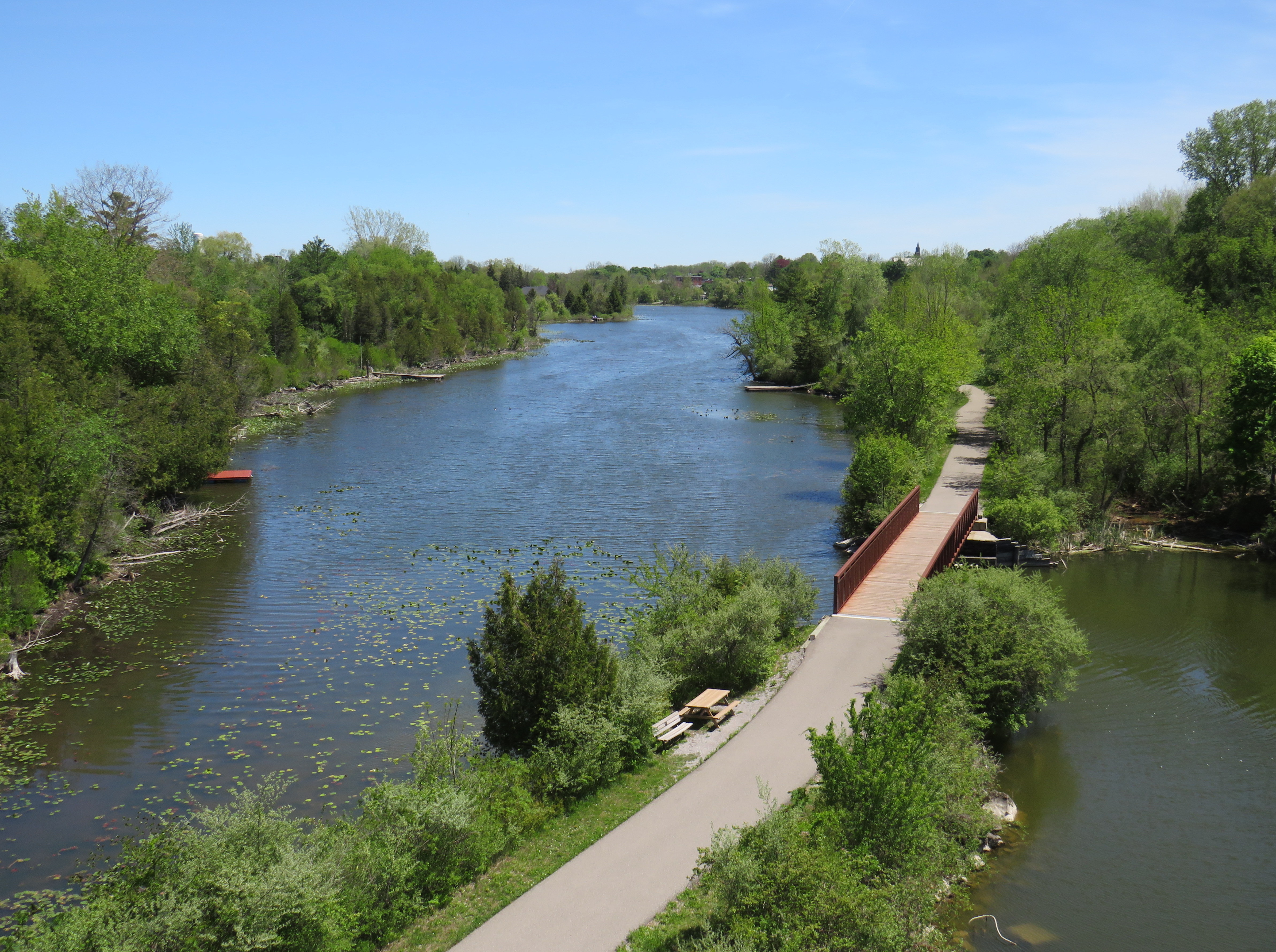
    Looking down from the Black Bridge on the Norfolk County Trail to Shadow Lake and Waterford Ponds in May 2026
    Looking down from the Black Bridge on the Norfolk County Trail to Shadow Lake and Waterford Ponds in May 2026

    On a beautiful May Thursday, I met one of my colleagues in the village of Waterford. As he is now living in Port Rowan on Lake Erie, this was an opportunity for us to get some important work done, while also exploring one of Ontario’s great small communities.

    Though the local area was settled over 200 years ago, Waterford was established as a thriving village with the arrival of the Canada Southern Railway (CASO) which was eventually incorporated into the giant New York Central system. The route through Canada, with its divisional headquarters in St. Thomas, was the fastest line between Buffalo, Detroit, and Chicago. It was joined by the Toronto, Hamilton & Buffalo (TH&B), which connected Hamilton and the Canadian Pacific Railway with CASO at Waterford and at Welland. In 1916, the electric Lake Erie & Northern (LE&N) Railway, another Canadian Pacific property, provided regular freight and passenger service between Port Dover, Brantford, and Kitchener. By the 1990s, all three railways were abandoned, but their former rights-of-way remain in active use as part of the local trail network.

    Take the Shadow Lake Trail to Downtown Waterford

    The large system of ponds around Waterford, popular with birds, boaters, and anglers, are artificial. Shadow Lake was a millpond created by damming Nanticoke Creek. When constructing its railway, CASO found the sand and gravel deposits in this area irresistible for exploitation; the gravel was first used for railway ballast; larger aggregate pits created new ponds to the west.

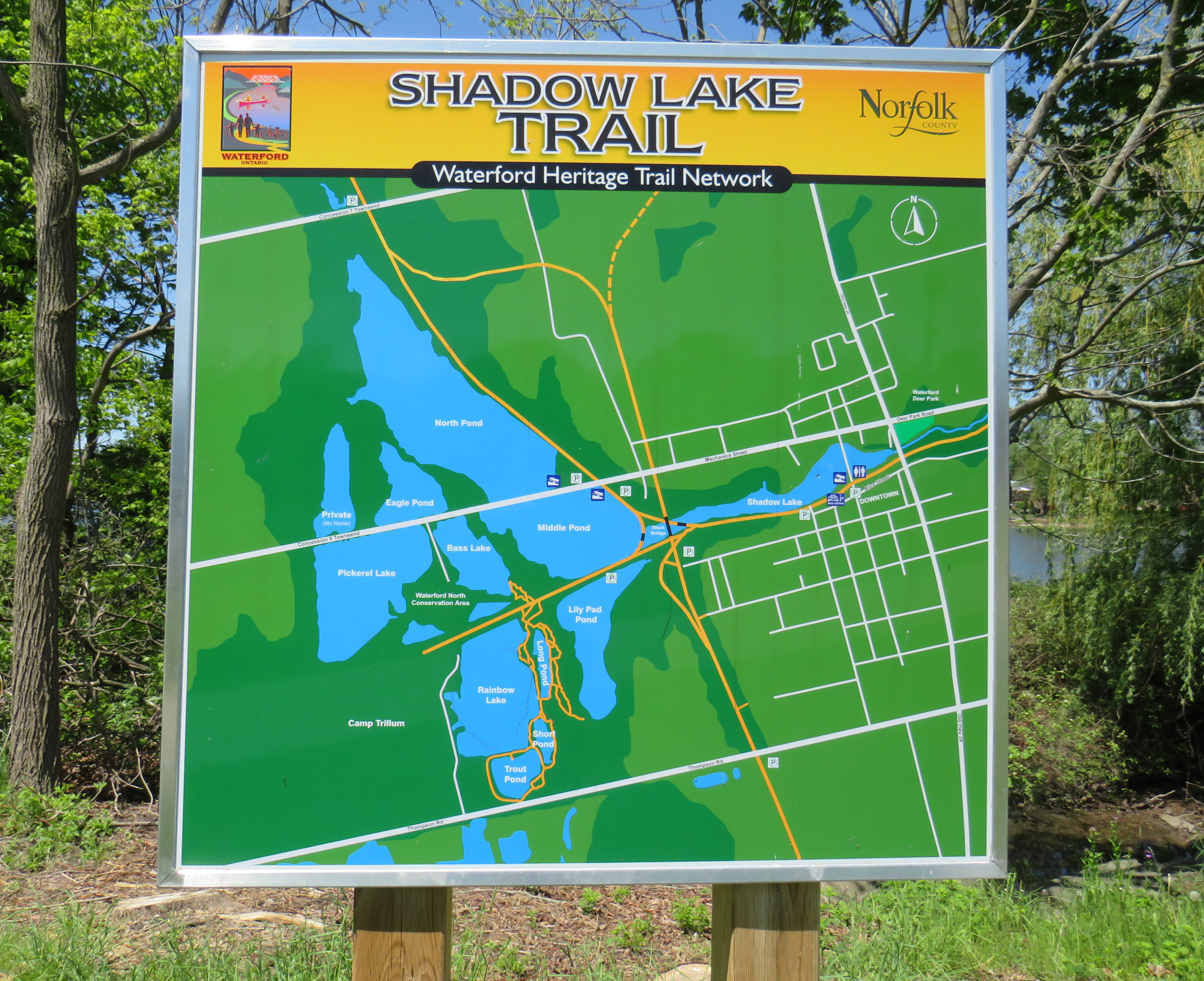
    Map of the Shadow Lake Trail and connecting trails in Waterford, along with the extensive ponds surrounding them
    Map of the Shadow Lake Trail and connecting trails in Waterford, along with the extensive ponds surrounding them

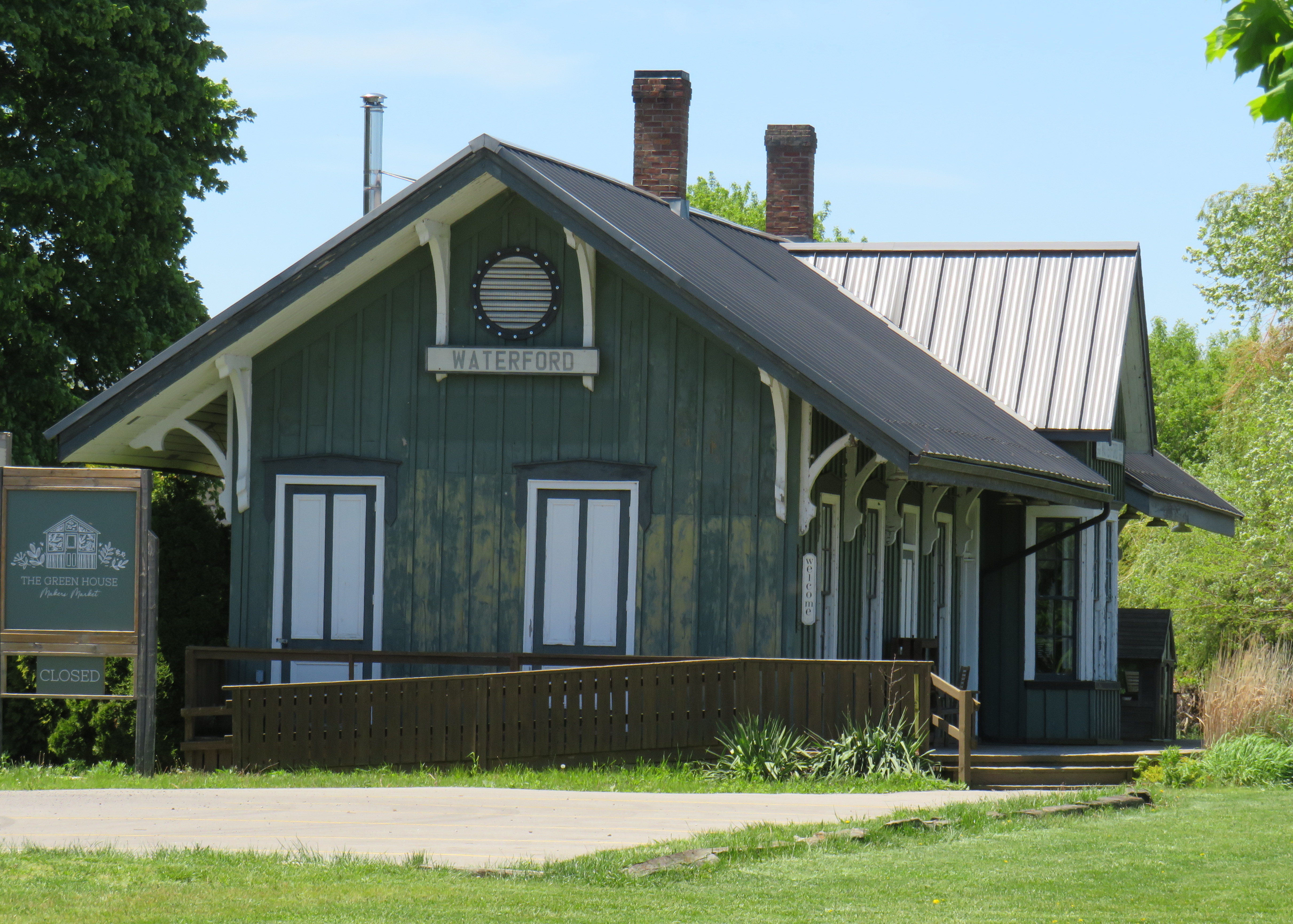
    The former Canada Southern Railway Station, which also served the TH&B, still stands, and has recently been home to an artisan market. Sadly, the LE&N station was demolished in the 1970s.

    Former railway station
    Waterford CASO Station

    Despite the loss of the railways and the LE&N station, the railway rights of way are fully intact within the village area and have been converted to trails. Within Waterford, the east-west Shadow Lake Trail follows the former CASO route between the Waterford Conservation Area to the west and Lingwood Park to the east, though it is not part of a continuous trail system across southwestern Ontario. Only short sections within Waterford, Tillsonburg, St. Thomas, and Essex are open to the public; most of the old railway corridor was sold off to local landowners in the late 1980s and early 1990s.

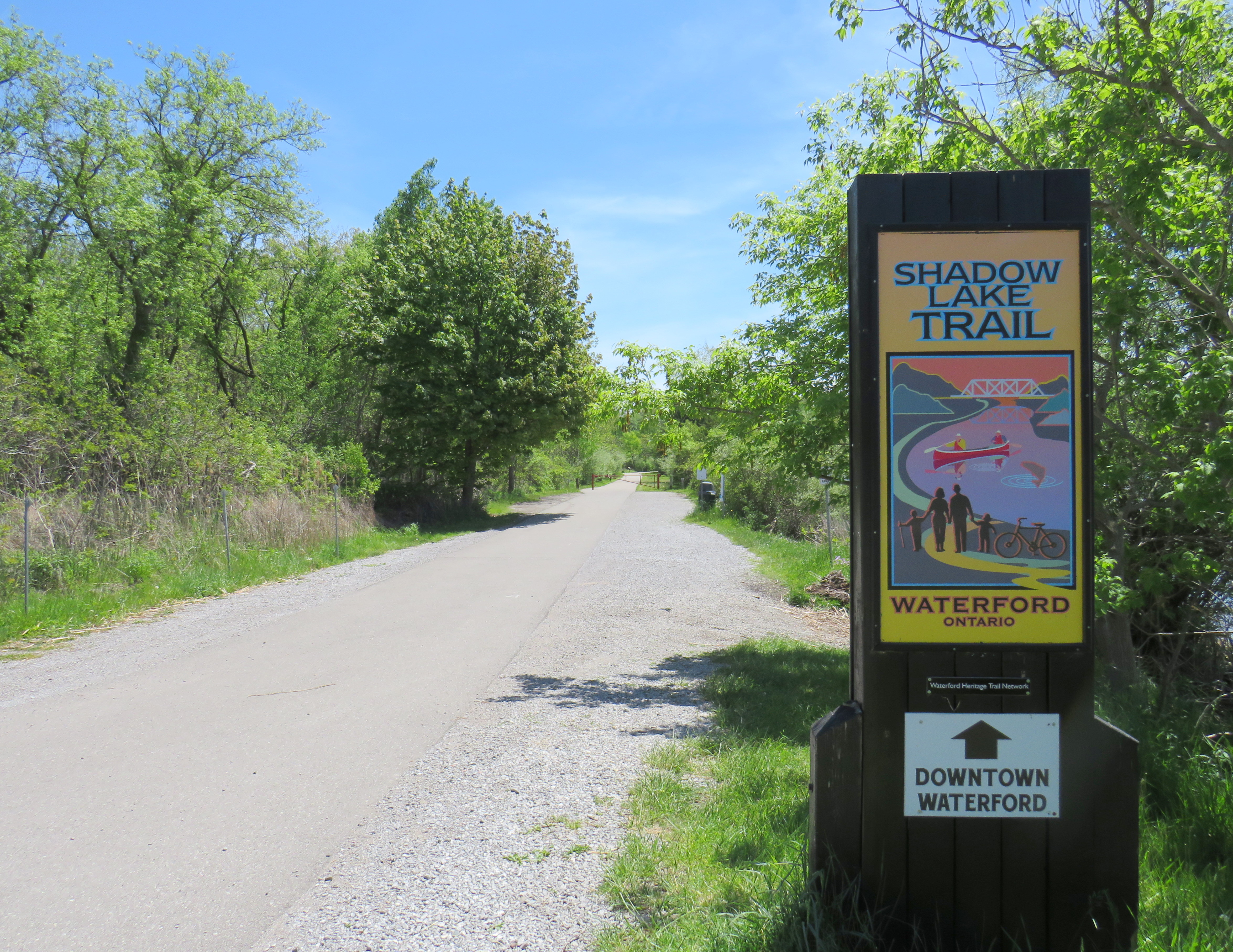
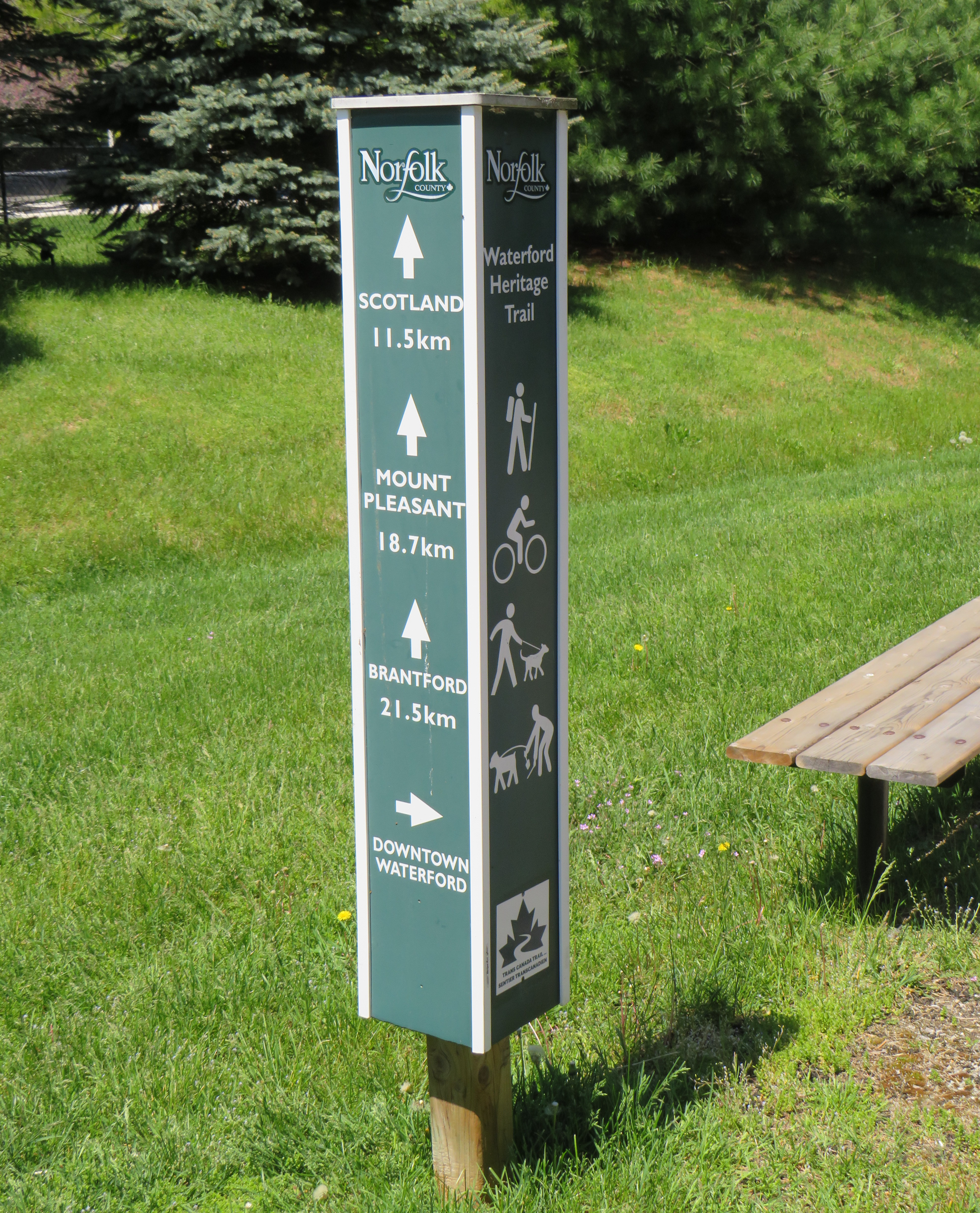
    Norfolk County Trail sign

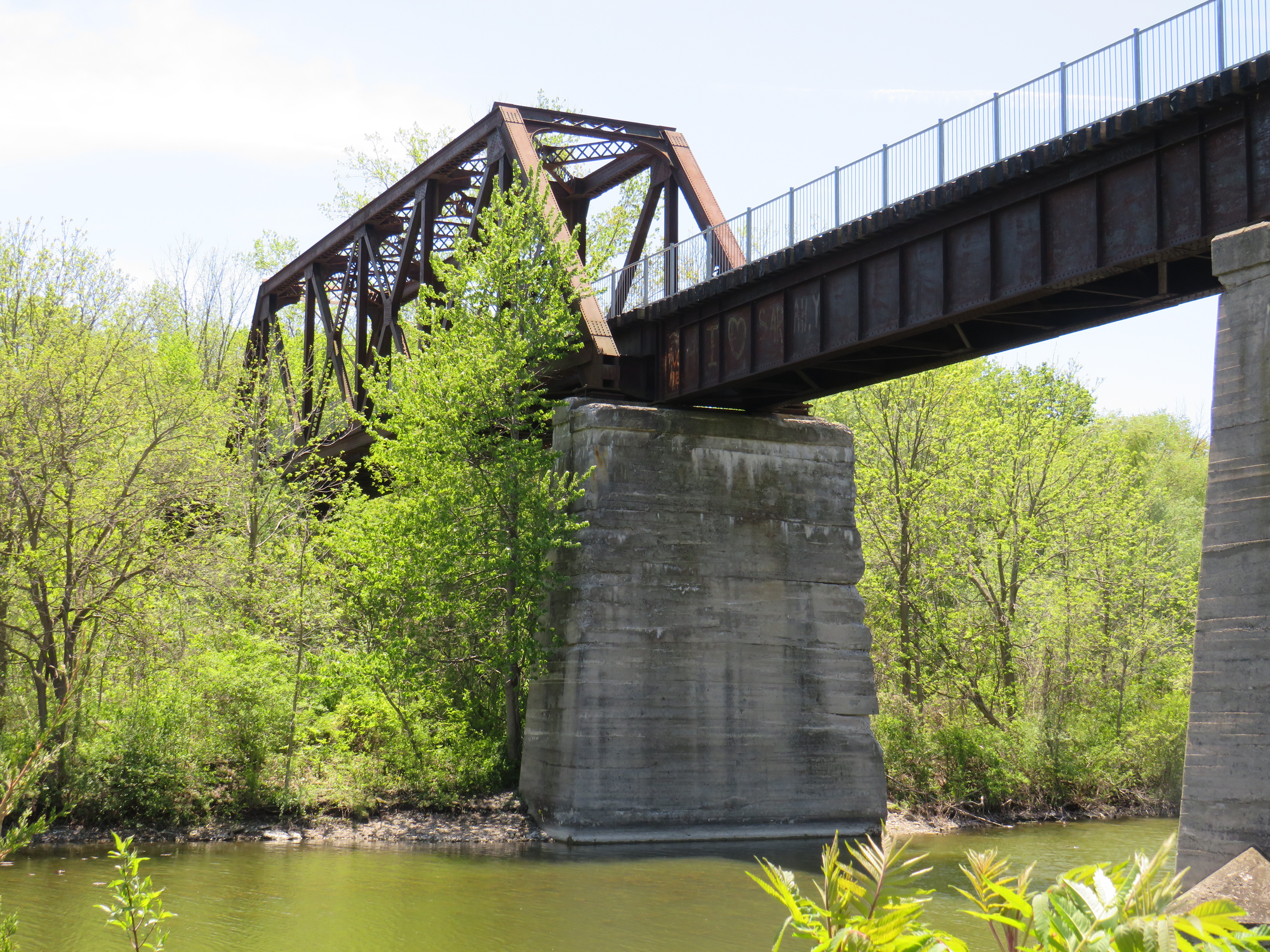
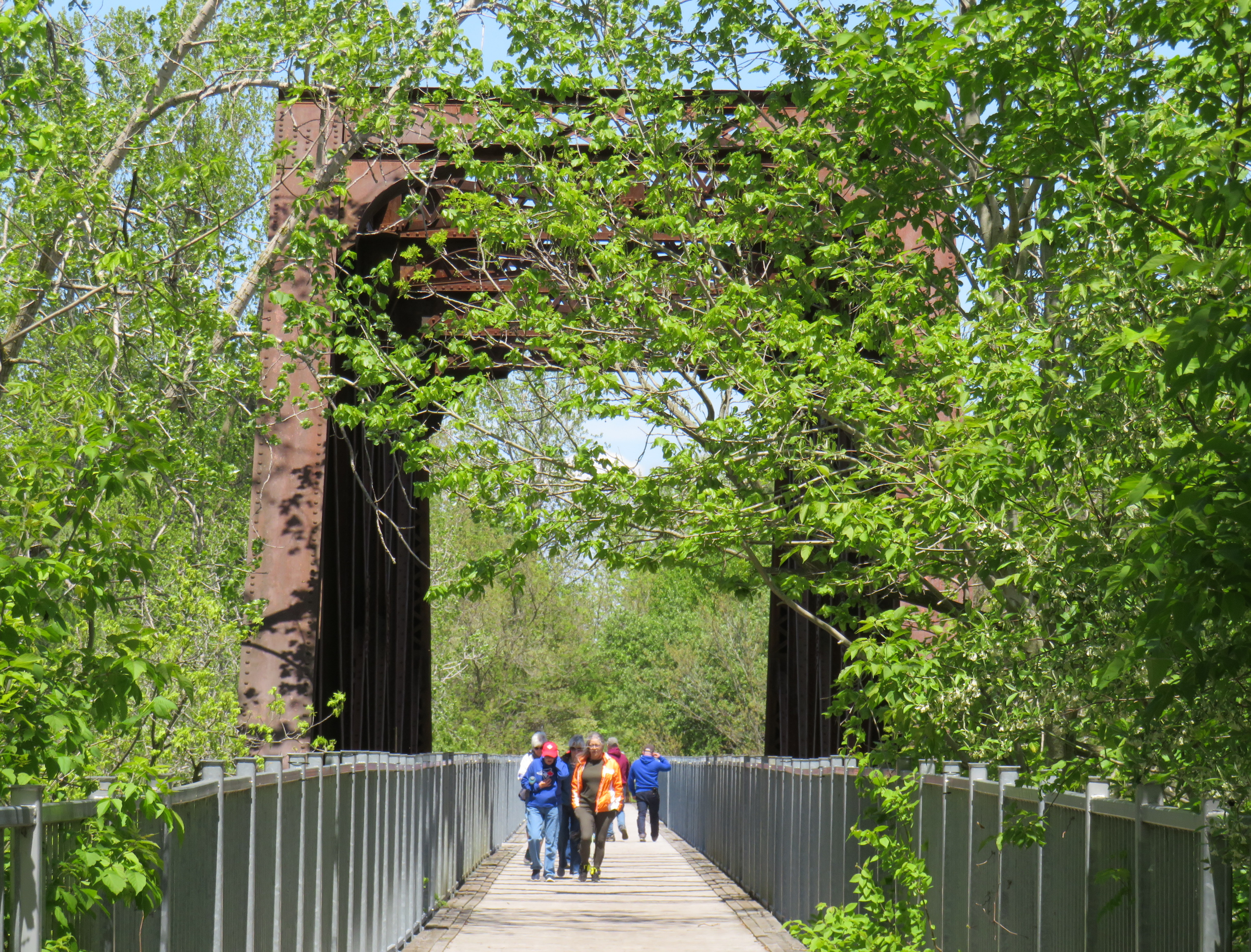
    However, the north-south LE&N Trail, which connects to the Shadow Lake Trail by way of a gentle paved pathway or a metal staircase, is part of a much longer rail trail corridor that continues north to Brantford (the trail shifts to the TH&B route north of Waterford) and south to Simcoe and Port Dover. At Brantford, it is easy for the ambitious cyclist to continue east to Hamilton or north to Paris, Cambridge, and Kitchener via connecting high-quality rail trails. The Norfolk County Trail is at its scenic best when it crosses over the Waterford area via the Black Bridge.

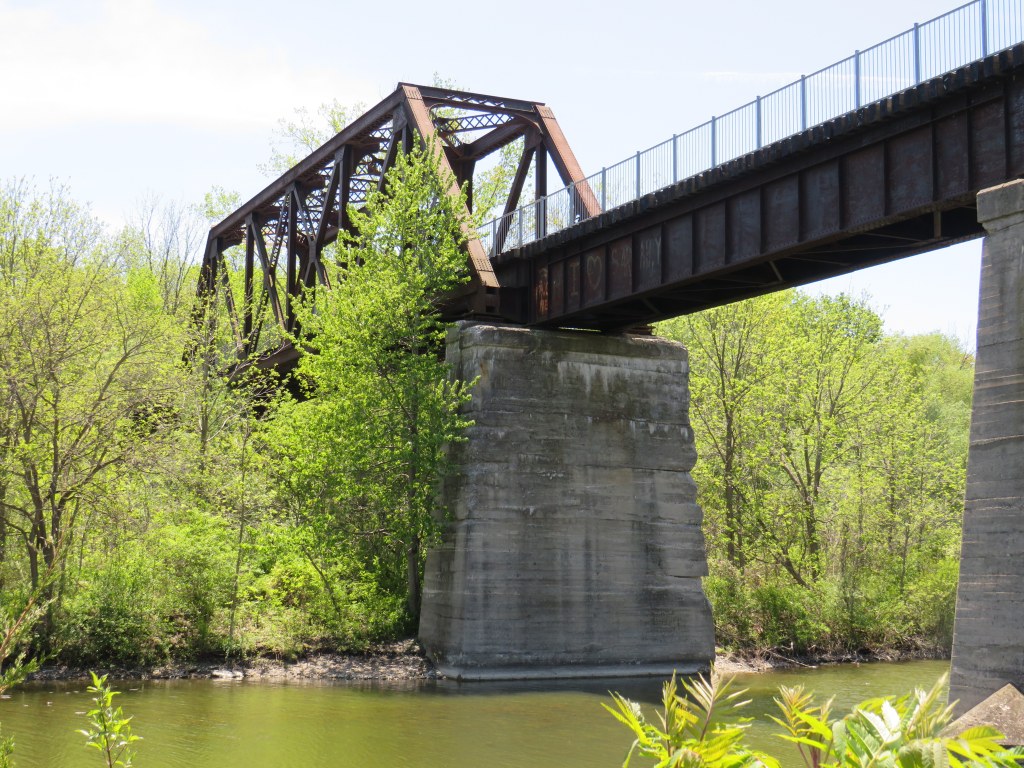
    A railway bridge, since converted to a trail, crosses a pond
    The Black Bridge crosses over the old CSR and TH&B railways and the Waterford Ponds

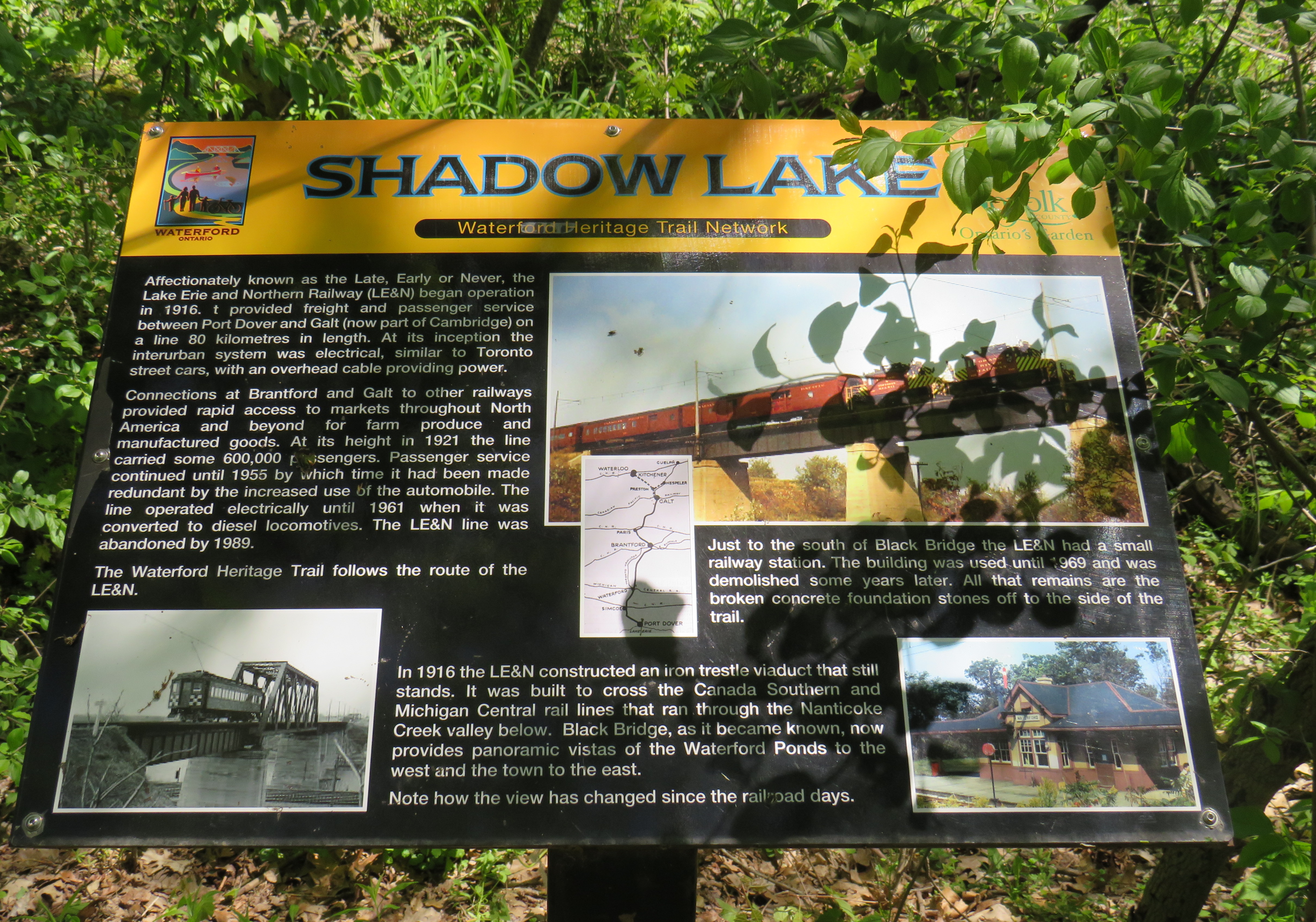
    One aspect that I especially appreciated was all the interpretive plaques along the trail system that told the story of Waterford, local industry, and the railways. This is how I learned that the ponds were the result of milling and quarrying, rather than truly natural features.

    One of several interpretive plaques along the trail system in Waterford

    Despite their attractiveness for long-distance cyclists, the trails within the Waterford area are well-used by residents and visitors going for shorter walks. The trail network within Waterford connects well to local streets and to itself by way of the former low-level TH&B wye tracks, which also cross the ponds. A walker can easily do a round trip without backtracking while being surrounded by nature. Wayfinding signage is very good, and benches are plentiful. The ponds are a great spot for bird watching. As we know how good walking is for our physical and mental health, Waterford is blessed with this network and could be a model for other smaller urban centres and rural communities.

    Walkers on the old railway bridge
    In the early afternoon on a Thursday, the Black Bridge was popular with pedestrians and cyclists

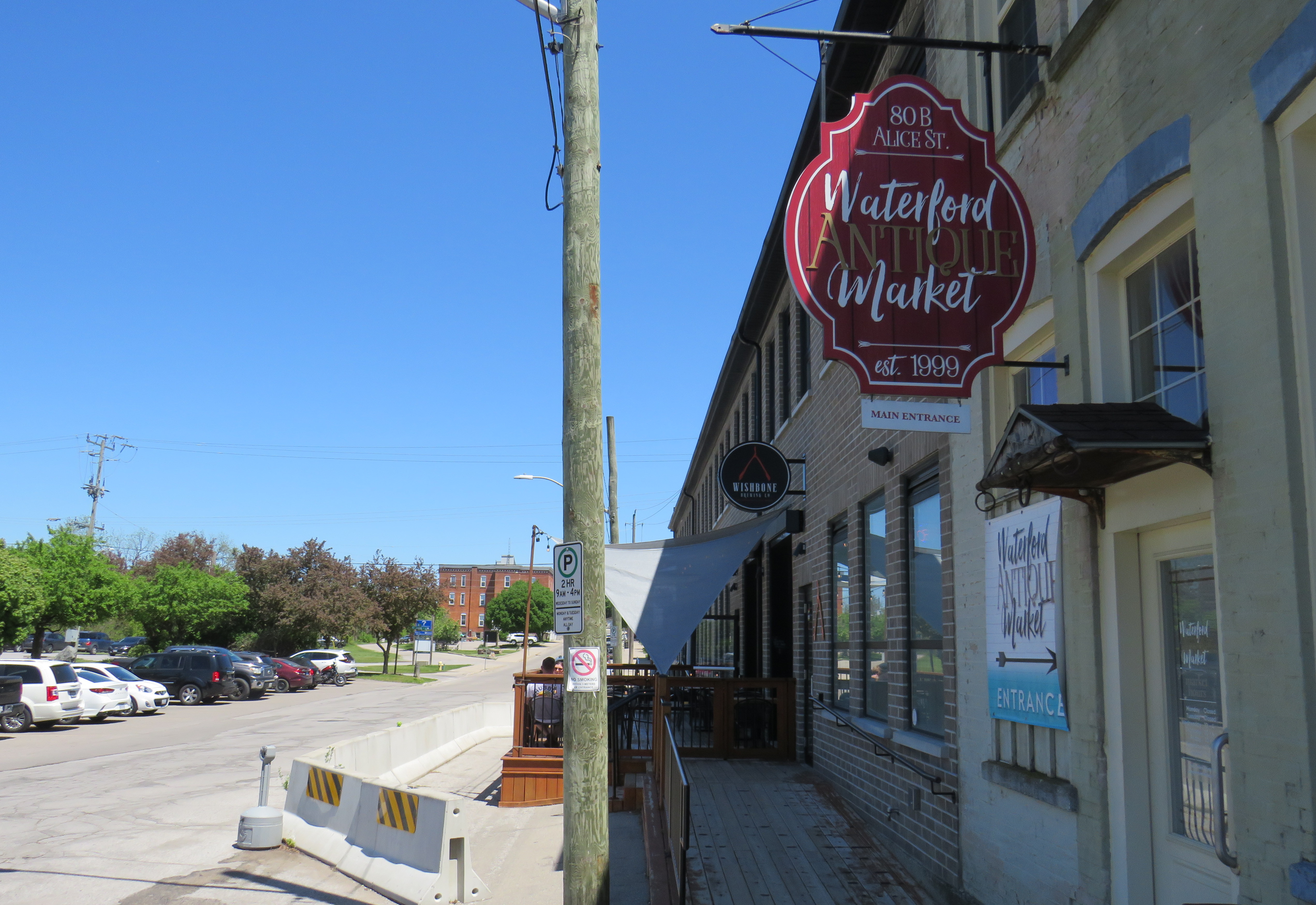
    Within the little downtown, there are public washrooms for trail users as well as several restaurants, cafes, and a craft brewery located in a former textile plant. There are also several antique dealers, a public library, and other small shops.

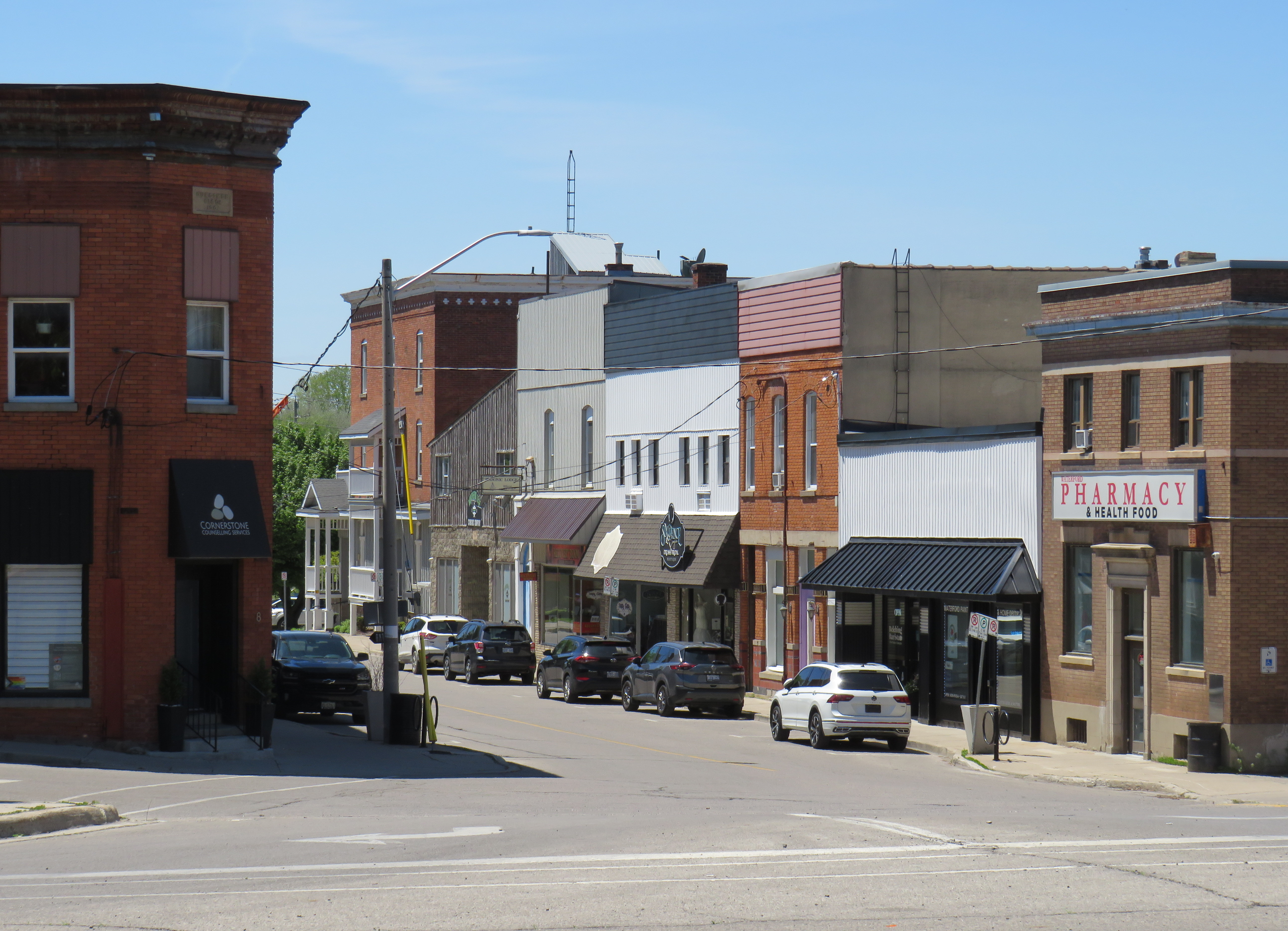
    Alice Street, Waterford
    Alice Street, Waterford’s main commercial strip, is lined with restaurants, shops, a cafe, and a brewery
    Waterford Antique Market and Wishbone Brewery, in a renovated textile plant

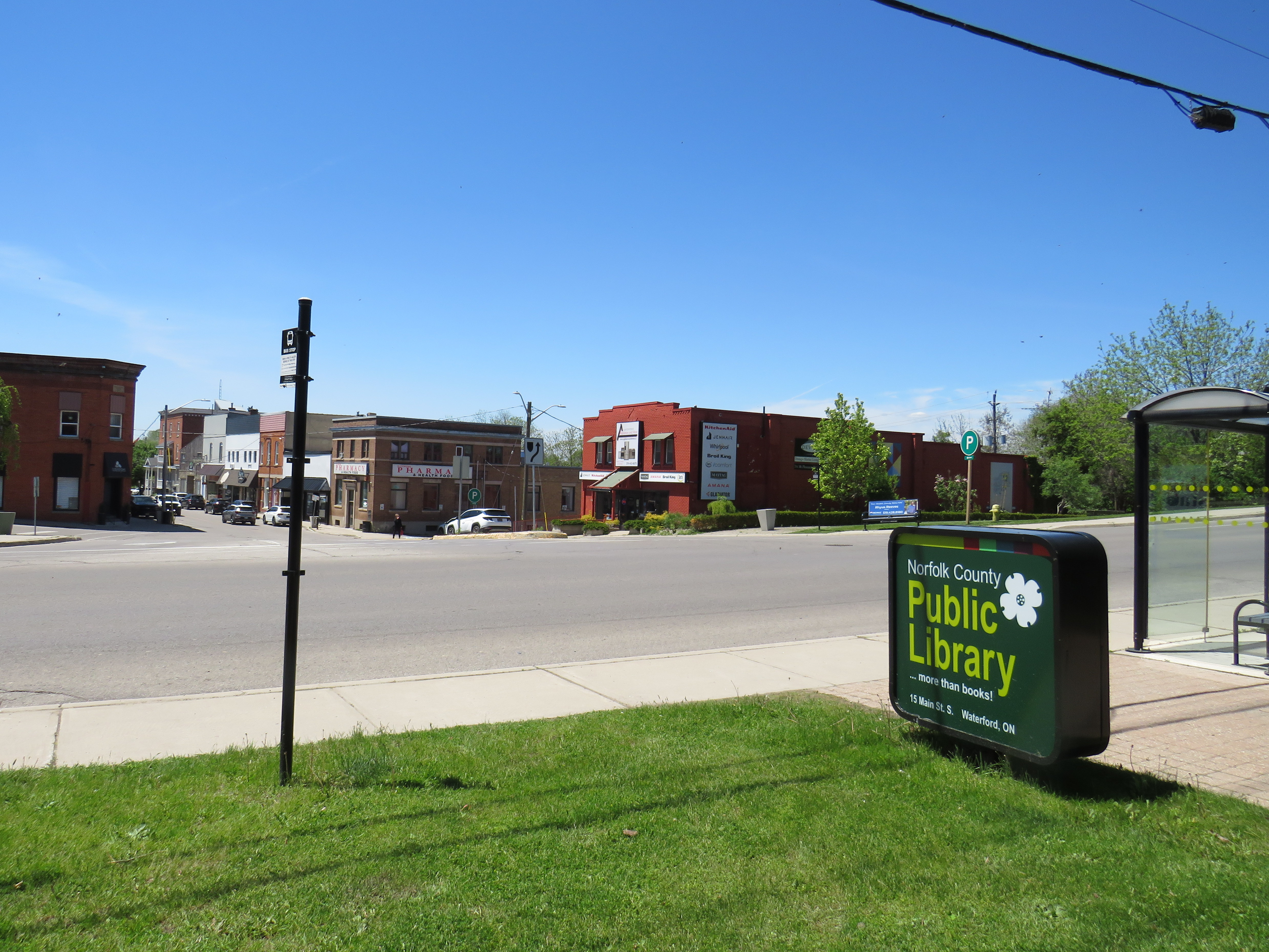
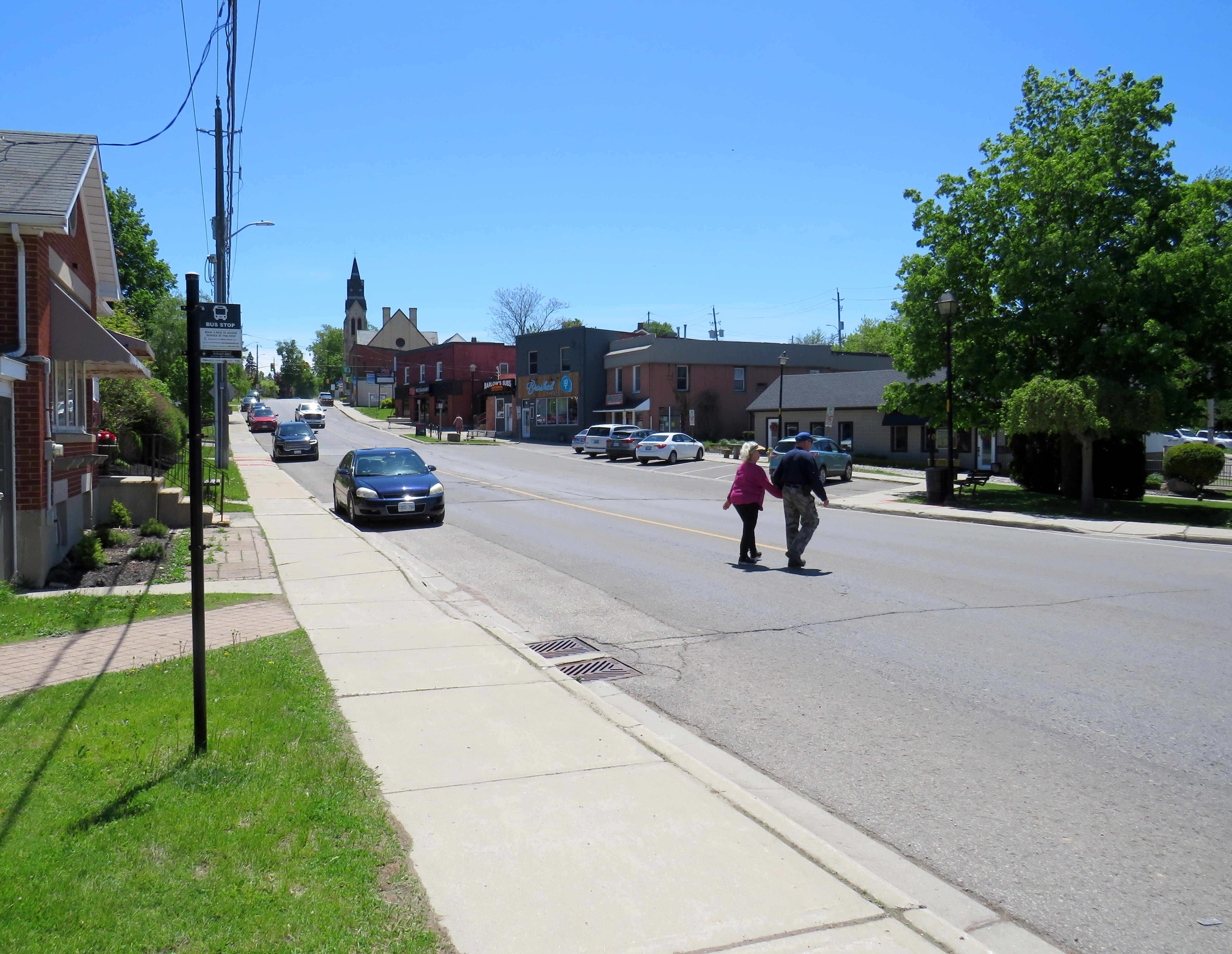
    Despite all that Waterford has to offer, there is one thing that can be improved to make it safer to get around. Alice Street, the main commercial strip in Waterford, meets Old Highway 24 at an unsignalized crossing. Though busy Highway 24 now bypasses Waterford, the old highway is still busy, with drivers exceeding the 40 km/h posted speed limit. The Waterford library branch and northbound bus stop towards Brantford are on the opposite side of the wide T-intersection from the Alice Street businesses; it is surprising that there is no traffic signal here to control auto traffic and provide a safer pedestrian crossing.

    The northbound bus stop (note the shelter at right) and library branch are on the opposite side of a busy road from the downtown shops

    Though there is a traffic signal 200 metres to the south at Nichol Street, most pedestrians opt to cross at Alice Street instead. According to Google Streetview, there was a signed pedestrian crossing at Alice Street in 2009 but was removed by 2012.

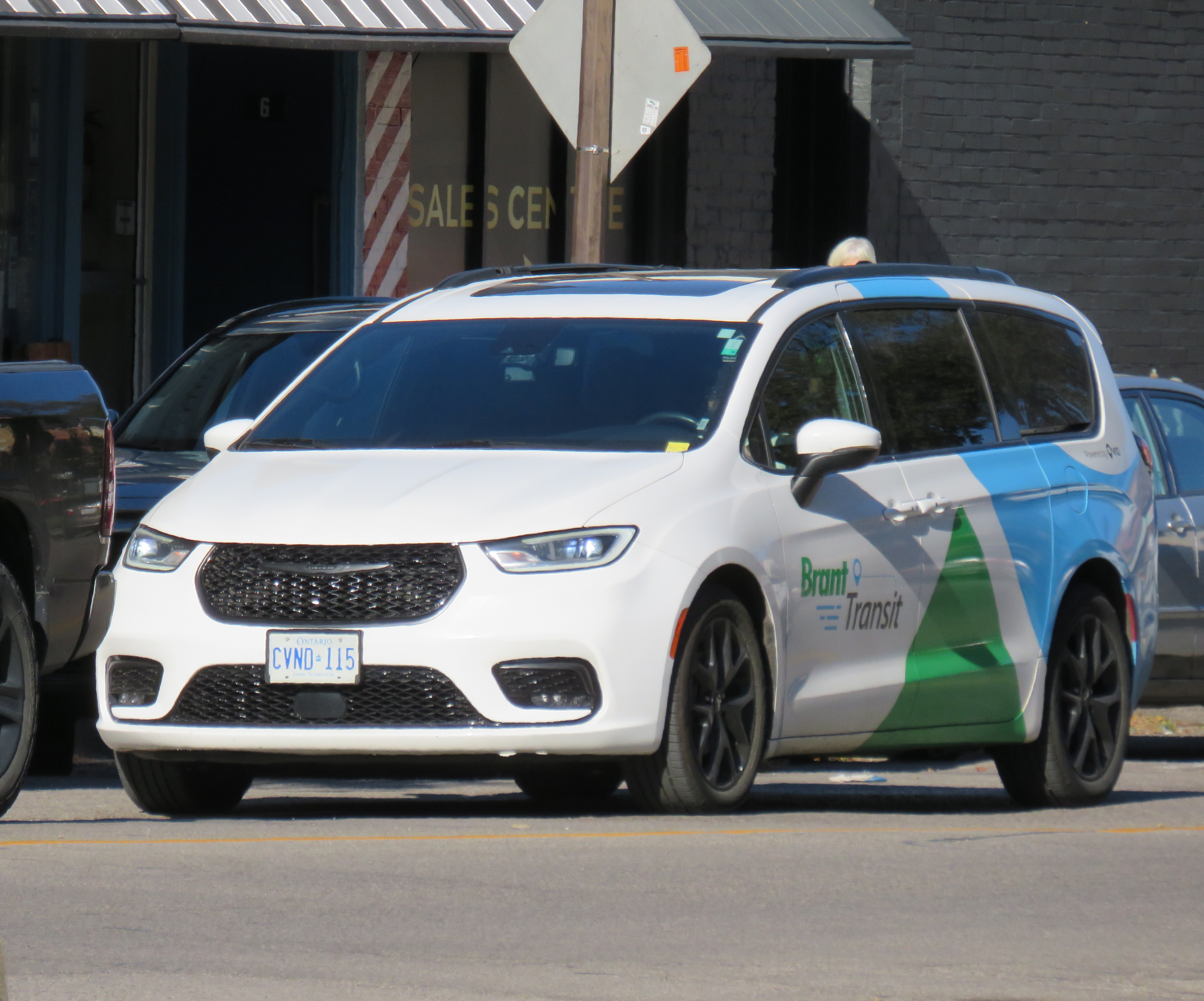
    Waterford is under a two hours’ drive from Downtown Toronto, though it is accessible without a car. GO Transit and VIA Rail both serve Downtown Brantford, where on weekdays, one can take a Ride Norfolk minibus south to Waterford. Cyclists from Hamilton or Toronto can take GO Transit buses to Brantford and bike south down the TH&B Rail Trail to Waterford on a relaxed 90-minute ride. From Simcoe, it’s an easy 45-minute ride.


    In general, Ontario can do so much better promoting sustainable tourism and travel by way of transit, walking, and cycling, as there are many places like Waterford that are easy to get to and around without a car that are not especially well-known, and there are many opportunities to improve public and active transportation links to other communities throughout the province. Though some communities, like Brantford, Hamilton, and Peterborough are very well connected to multiple trail systems radiating outwards in multiple directions, other cities and towns are not so lucky.

    Though St. Marys and St. Thomas, for instance, also have made great use of former rail infrastructure, they are lacking safe, high-quality active transportation connections to nearby cities like London or Stratford. Lindsay, in Kawartha Lakes, is at the nexus of several trails as well, but it lacks any intercity bus connections of its own. A provincial strategy could go a long way.

  • A patchwork of new intercity connections in Ontario

    IMG_6956-001.JPG
    RideNorfolk buses at Norfolk County Hall, Simcoe

    Over the last three years, I wrote about the gaps in intercity rail and coach services in Ontario, and how some companies were working to fill them.

    In Northern Ontario, Ontario Northland and Kasper Transportation worked to fill the void left by Greyhound’s departure from Western Canada, with both companies offering new links to towns such as Hearst and Fort Francis.

    Unfortunately, there have also been some setbacks. Wroute, a shared taxi service in the Kitchener-Guelph-Hamilton triangle, was operational for less than a year. Though GO Transit added new weekday trains between Guelph and Kitchener, none allow for Kitchener-bound commutes, and there has not been interest in serving those gaps identified by Wroute.

    Outside of Northern Ontario and the Golden Horseshoe, many cities and towns remain disconnected from nearby communities and larger centres. Though every city and town in Ontario had daily bus and/or rail service in the 1980s, many communities are now completely inaccessible for anyone without access to a car. Though GO Transit expanded to Peterborough, Brantford, Niagara, and Kitchener in the last fifteen years, they are extensions of GO’s radial network from Toronto rather than a true intercity network.

    St. Thomas, population 41,000, is the largest city in the province without any passenger links, despite being a short drive to London. Many other cities and towns — particularly in Midwestern and Eastern Ontario — find themselves in similar situations. A few other cities, such as Sarnia (which has just one train a day each way to London and Toronto), are grossly under-served.

    But thanks to municipal innovation and a new provincial grant program, this is finally changing. Though several municipalities addressed this problem early on, three new inter-municipal bus systems began operations in 2019, with many more launching this year.

    (more…)

  • Brantford’s downtown was the “worst in Canada” – but has it bounced back?

    IMG_7684-001
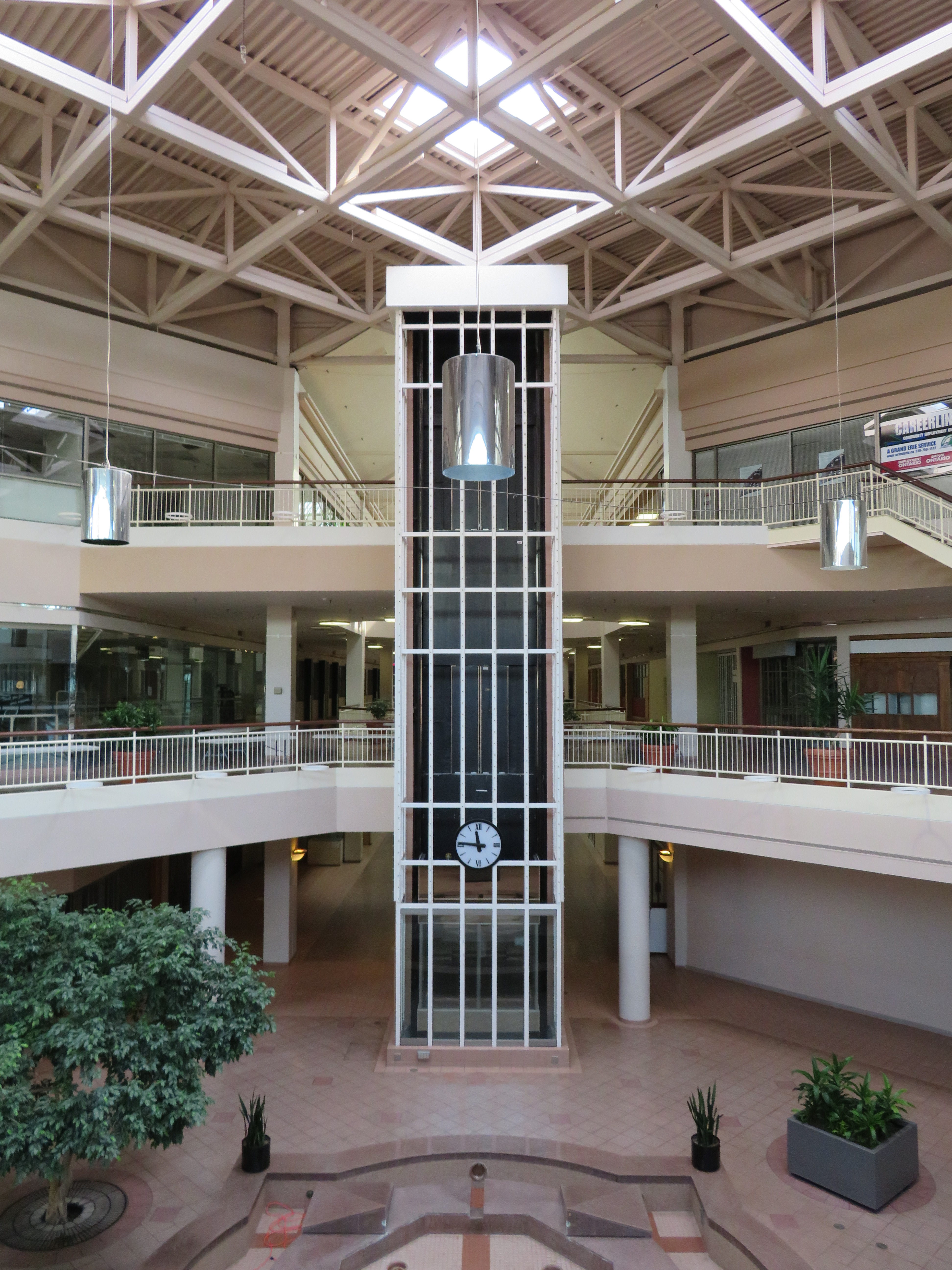
    Interior of former Eaton Market Square, 2018

    On Labour Day weekend, I paid a visit to Brantford. I brought my bike on GO Transit, taking a train to Aldershot and a bus from there to the Telephone City. I then biked from Brantford to Hamilton on one of Ontario’s best rail trails.

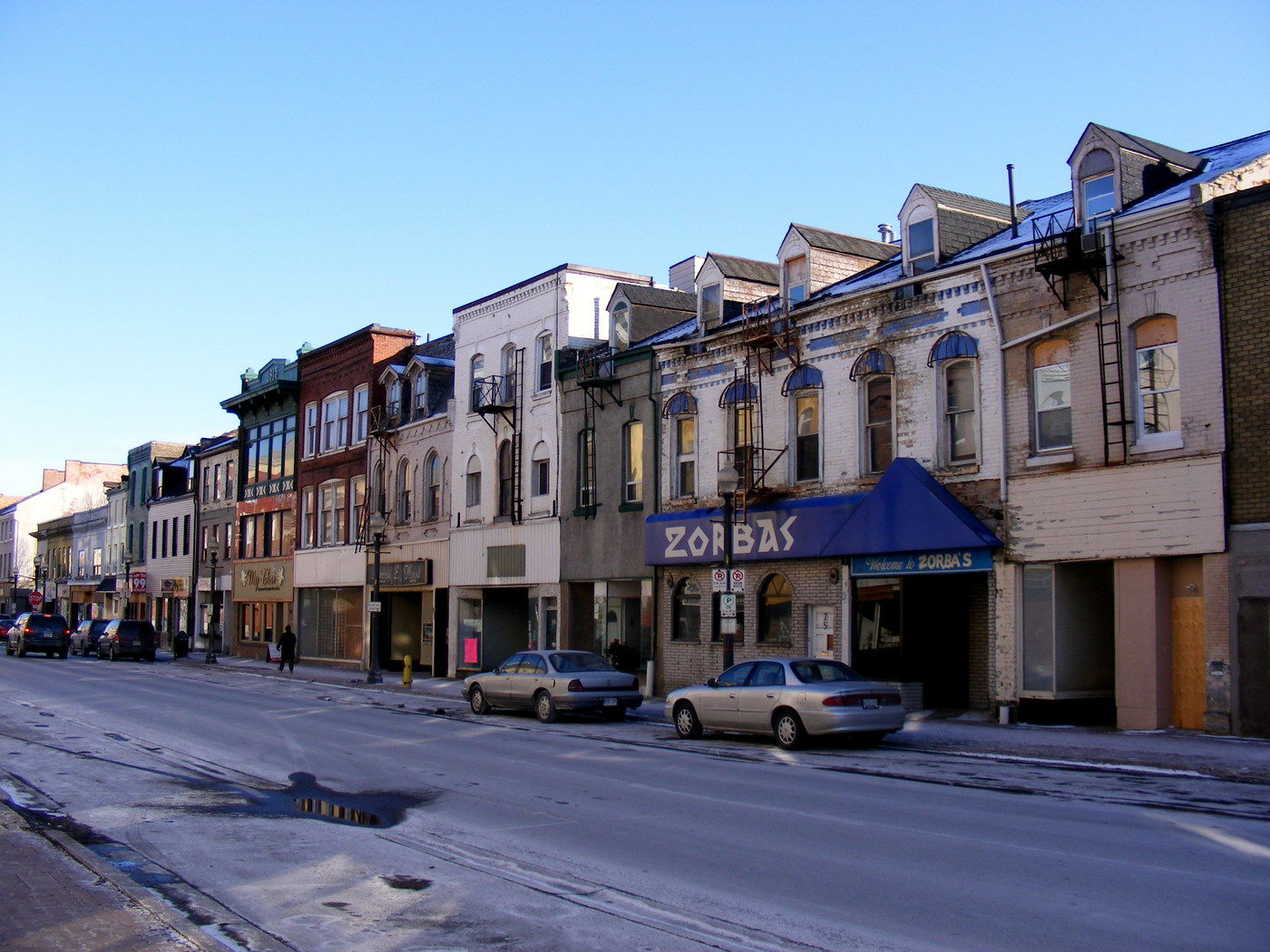
    Over a decade ago, Mayor Chris Friel called Brantford “the worst downtown in Canada.” It was not hard to understand why. Colborne Street, Brantford’s main street, was lined with neglected commercial buildings, many with boarded up streetfronts. In the 1990s, many of the plywood hoardings had been decorated with pretend business names and silhouettes of customers, either as an attempt at beautifying the street or recalling the variety of businesses that had once occupied the strip. Only a few stores and restaurants remained open.

    4360965559_d1aa044078_o.jpgBoarded up storefront, Colborne Street, 2010

    There were several reasons for Downtown Brantford’s decline. In the 1980s, Brantford’s major industries, including the once-mighty Massey-Ferguson, had shut down local operations. Other industries like Cockshutt (later White Farm Equipment) had also departed Brantford. By the early 1990s, the unemployment rate hit 24 per cent.

    Cockshutt plant offices in 2004, and the remains in 2018

    The city also made some questionable urban renewal decisions. The old open-air marketplace at Colborne and Market Street, along with a whole city block was cleared for Eaton Market Square, which opened in 1986. The city also built a new parking structure to the south, as well as a new office building across the street from the new mall. Like most downtown malls built in Ontario, Eaton Market Square was a commercial failure. Brantford already had two suburban malls — Lyndon Park Mall, anchored by Sears, and Brantford Mall, anchored by the Right House, a Hamilton-based department store, Woolco and Loblaws.

    While parking at the suburban malls was free and plentiful, customers had to pay to park downtown, and Eaton’s in the 1980s was too upmarket for a smaller, blue collar city. Brantford’s downtown parking garage, built by the municipality, was to be paid for with parking fees.

    IMG_7686-001
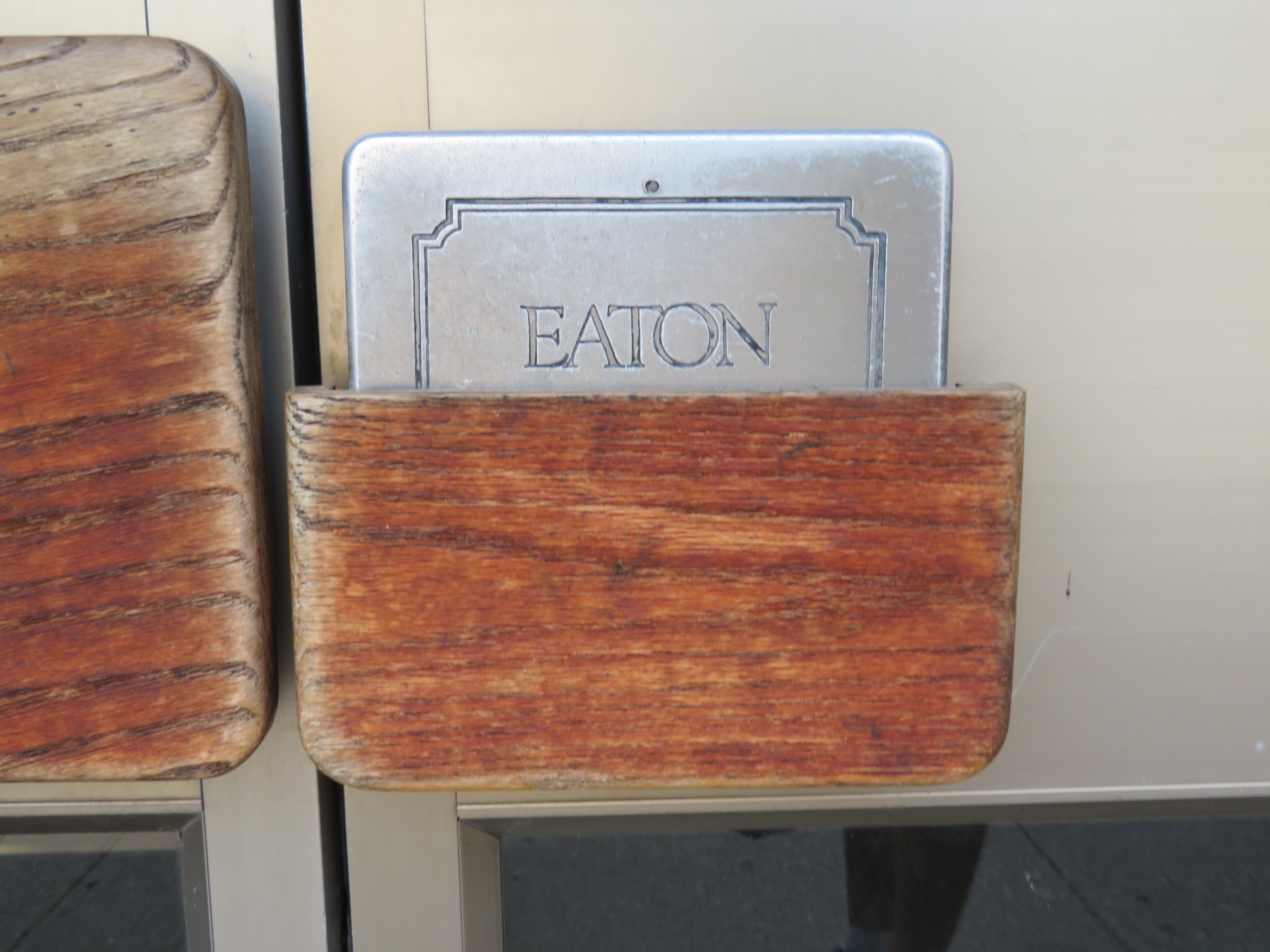
    Eaton Market Place dropped the Eaton name after its anchor closed, but the mall’s past has since revealed itself

    While Eaton Market Square brought in many of the remaining retailers that were left on Colborne Street when the mall opened, as the mall floundered, most major tenants left as soon as their leases were due for renewal. By 1997, when Eaton’s entered bankrupcy and closed the Brantford store, many of the other shops had already closed.

    But the mall wasn’t the only thing Brantford officials did to try to revitalize its city centre.

    Like Flint, Michigan’s efforts to attract tourists and shoppers downtown coincident with the decline of its manufacturing base (described in Michael Moore’s film Roger and Me), Brantford pursued other projects along with the new mall to revitalize its downtown core. The provincial government planned a new electronic processing centre, but was cancelled by the NDP-led government in the early 1990s due to budget pressures.

    Icomm was to be a new telecommunications museum, science centre, and research hub, built on an old industrial site just south of downtown. While the building was completed in the early 1990s, it was left vacant after Bell Canada pulled its funding for the venture. Though city officials hoped for a post secondary educational institution, the Icomm building became a casino. Next to the casino, a commercial plaza, including a supermarket, fast food restaurants and a LCBO store was built, along with free surface parking.

    IMG_7676-001.JPGMarket Square

    Eventually, Brantford found a viable solution for revitalizing its downtown core. In 1999, Wilfrid Laurier University opened a satellite campus, starting out in the old Carnegie Library sold by the city for $1. By 2002, there were 340 students; today, enrollment is  about 3,000. Laurier now owns dozens of building downtown, including a previously abandoned movie theatre, and even the old old Eaton Market Square building. Hundreds of students live in local residences.

    IMG_7664-001The old Carnegie Library, Brantford

    Yet, there is still little retail downtown, though there are now several newer restaurants, bars, and coffee shops.

    It hasn’t been all good news. Nipissing University, based in North Bay, also established a satellite campus in Brantford. In December 2014 it announced that it would be winding down its presence there, including its joint programs with Laurier. The Ministry of Education had capped the number of funded spaces for Bachelor of Education students and reduced funding for the program. The joint programs were one of Brantford-Laurier’s main draws.

    4360965043_88fea24940_o.jpgColborne Street, January 2010

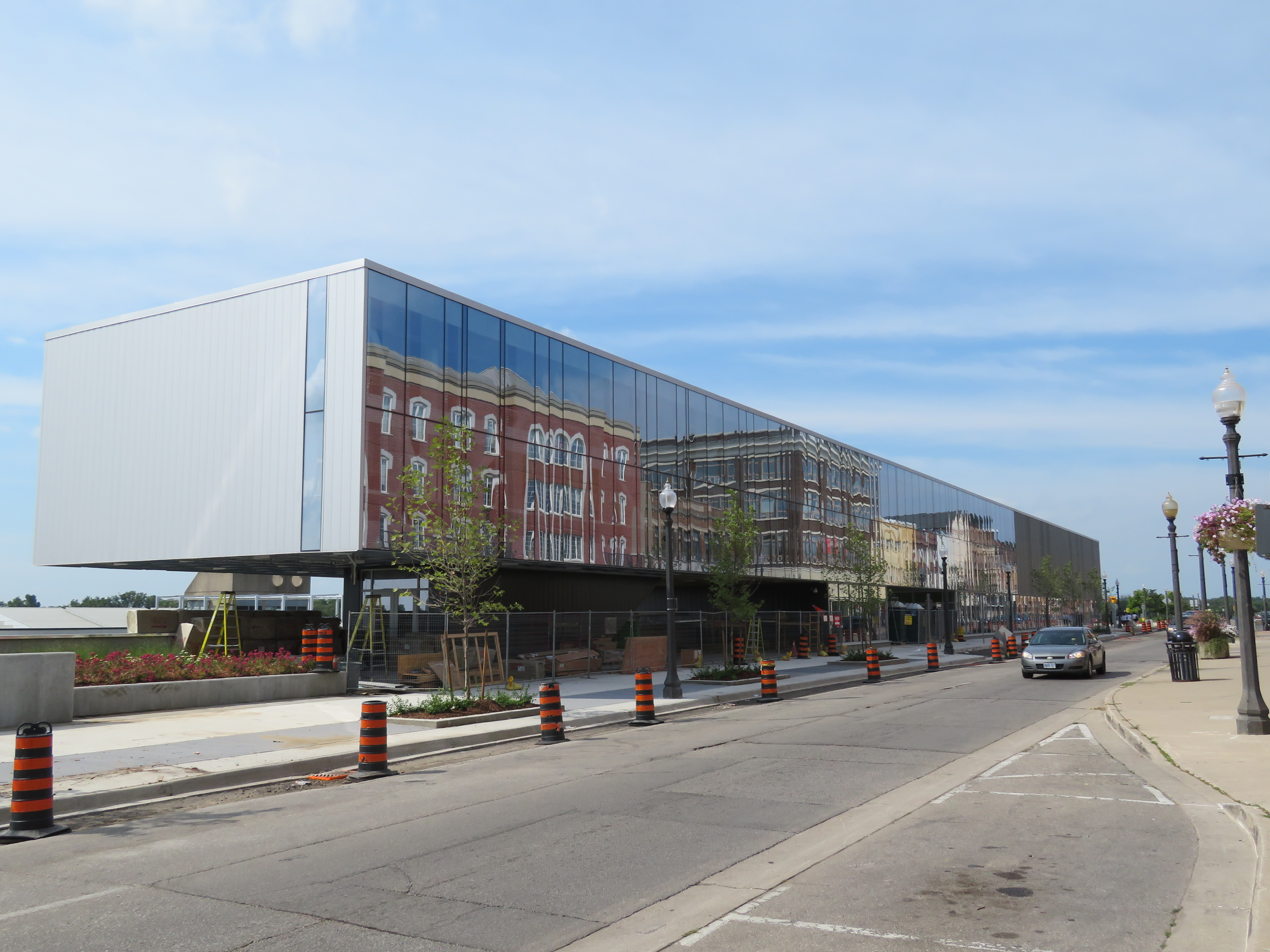
    Meanwhile Colborne Street continued to languish. In 2010, the city expropriated and demolished the entire south side of the street, including several commercial blocks still occupied. A new joint Laurier-YMCA athletics and recreation facility was built on the site, which will open by the end of the year. Sadly, the new building contributes very little to Brantford’s main street.

    IMG_7674-001The architecture of the new YMCA-Laurier athletic building is sterile compared to the old Colborne Street storefronts
    At the least, Laurier’s Brantford campus has brought some life back to a moribund downtown core that suffered through misguided urban renewal schemes, a major restructuring of the local economy, competition from suburban retail developments, and urban neglect.

    But a satellite post-secondary institution on its own isn’t necessarily a panacea for other suffering downtowns. As Norma Zminkowska pointed out recently in an article for TVO, satellite campuses aren’t necessarily permanent boosts to the local economy. In Barrie and Bracebridge, small campuses were closed for financial reasons. They weren’t able to attract enough students. Small campuses, especially those with fewer than 3500 students, often struggle to attract students and faculty — and scattering programs can weaken the institution. This is a warning worth considering as Laurier plans another satellite campus in Milton and Ryerson plans its second campus in Downtown Brampton.


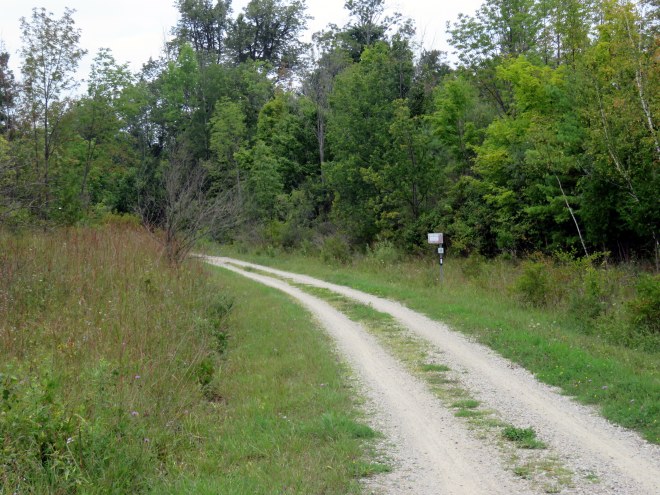
    As an aside, Brantford is an interesting town, and is well-positioned at the junction of three major cycling trails connecting it to Cambridge and Kitchener-Waterloo to the north, Simcoe and Port Dover to the south, and Hamilton to the east. The Hamilton-Brantford Rail Trail is one of Ontario’s best trails, in excellent condition, and a gentle grade climbing the Niagara Escarpment.

    IMG_4333
    Hamilton-Brantford Rail Trail

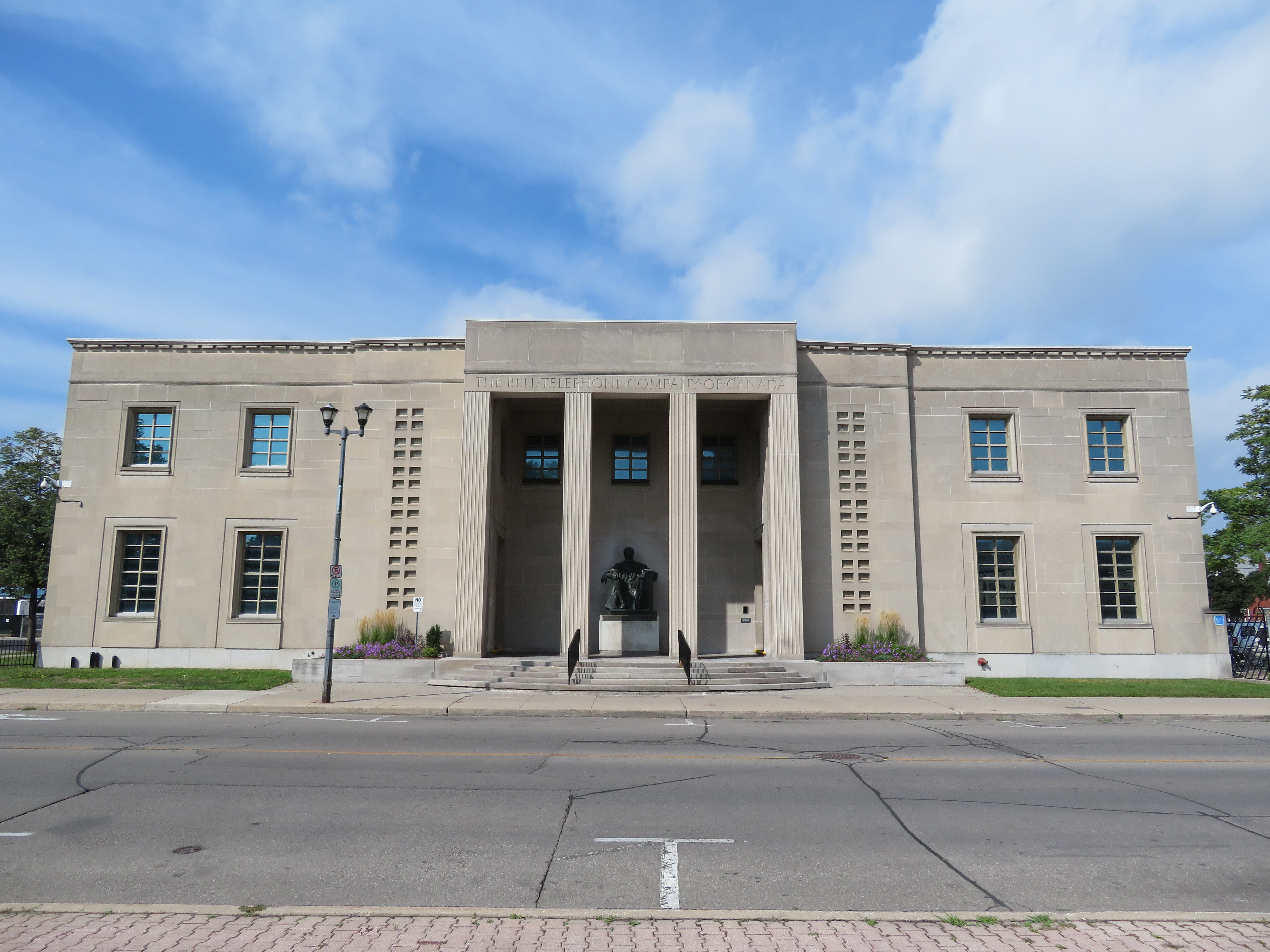
    Within Brantford itself, there are several interesting sights. The Bell Telephone building features a statue of Alexander Graham Bell, who resided just outside of town for a number of years. The world’s first long-distance telephone call was made between nearby Paris, Ontario and Brantford in 1876. The area surrounding Victoria Square north of Colborne Street and the mall is reminiscent of a New England town square.

    IMG_7649.JPGBell Telephone Building

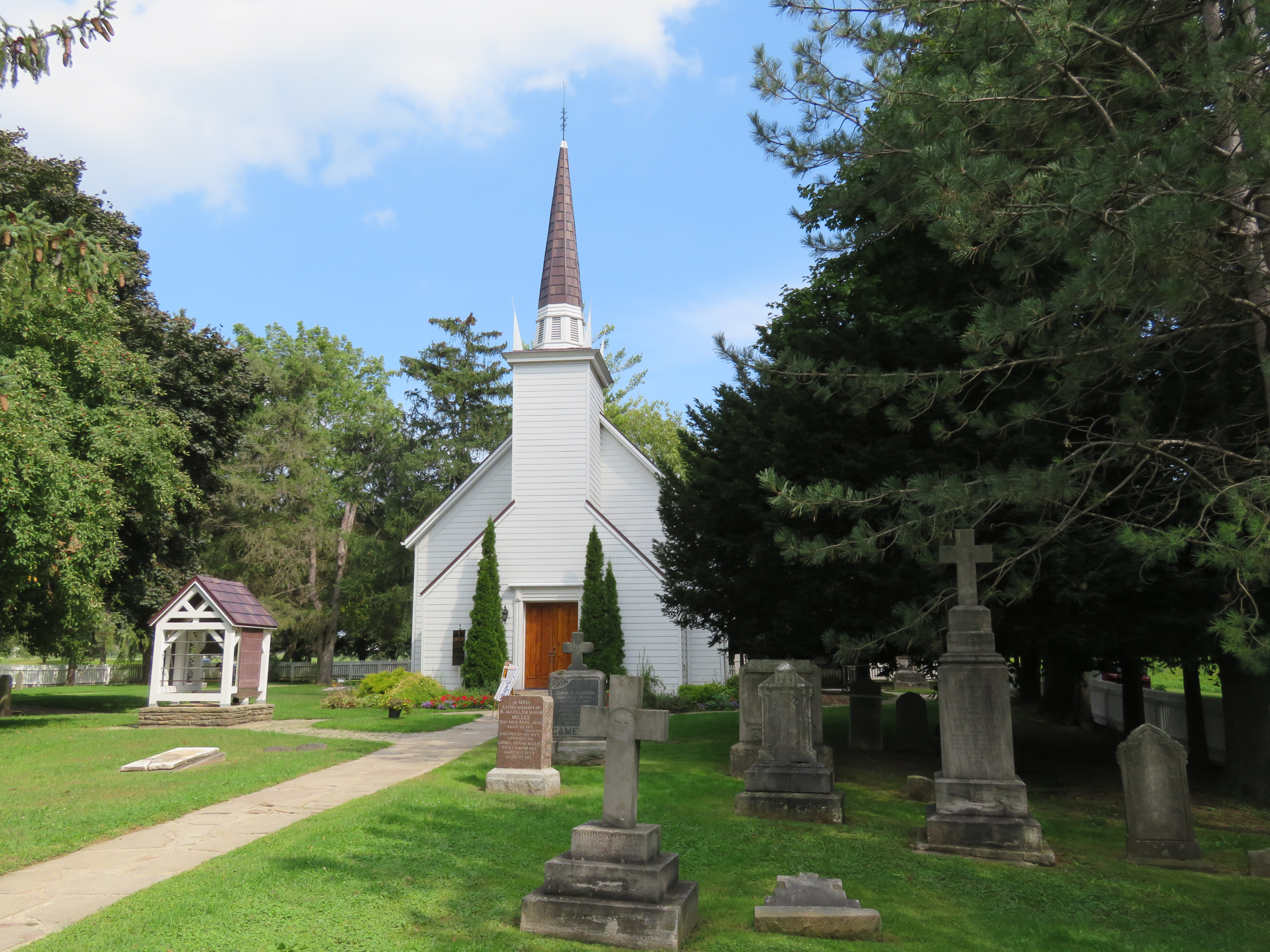
    Brantford was named for Joseph Brant, the anglicized name given to Thayendanegea, the Mohawk leader who allied with the British in the American War of Independence. His community, which previously resided in what is now Upstate New York, was given a large land grant on the Grand River. That land grant shrunk to what is now Six Nations. Her Majesty’s Royal Chapel of the Mohawks is one of the oldest buildings in Ontario, built in 1785. It is worth a visit. Nearby, the Woodland Cultural Centre is a museum and art gallery housed in a former residential school. The museum is dedicated to the history and future of the province’s First Nations.

    IMG_7727.JPGHer Majesty’s Royal Chapel of the Mohawks

    IMG_7709-001.JPGWoodland Cultural Centre. This building formerly housed the Mohawk Institute, one of many residential schools built as part of Canada’s shameful attempts at eradicating Indigenous heritage. It is now a First Nations museum and art gallery. 


  • Ontario’s failed downtown malls

    IMG_0392.JPG
    Bayside Mall, formerly the Sarnia Eaton Centre, on a Saturday morning in 2013. Most stores are vacant or occupied by non-profits or independent businesses.

    The Toronto Eaton Centre, large, famous, and vital, is only one of many malls built in the downtown cores of Ontario cities between the 1960s and 1990s. From Thunder Bay to Cornwall, the construction of new enclosed shopping centres were seen as a necessary tool to keep the old city centres vibrant and relevant in the face of competition from new suburban malls. But only in the province’s two largest cities did the concept work. Elsewhere, these urban shopping complexes were left largely vacant within ten years of opening, when leases expired. When the Eaton’s department chain went bankrupt in 1997, huge voids were left behind that developers and municipalities struggled to fill.

    The Toronto Eaton Centre was opened in two phases between 1977 and 1979. It added hundreds of shops and new office space to Downtown Toronto, anchored by a new Eaton’s flagship and was connected to the Simpson’s store across Queen Street. Today, the Eaton Centre is Canada’s second largest mall (including the Hudson’s Bay/Saks Fifth Avenue building) and the Toronto region’s second most productive shopping centre in terms of sales per square metre. In Ottawa, the downtown Rideau Centre, opened in 1983, is the busiest and most productive mall in that region (Retail Council of Canada, 2016).

    But elsewhere in Ontario, downtown malls — mostly built with municipal and/or provincial government support — have been, without exception, commercial and urban development failures. Not only did they suffer from high vacancy rates, they helped to wreck the downtown cores they are located in rather than foster the economic revitalization they once promised.

    (more…)
  • A ride through Midwestern Ontario, Part II

    IMG_6019-001The Cambridge to Paris Rail Trail, part of a network of rail trails that join together in the City of Brantford

    Previously in this blog, I described the first day of a two-day ride through Midwestern Ontario, between Guelph and Kitchener via West Montrose and St. Jacobs. I rode through Ontario’s only authentic covered bridge, along infrastructure created for both cyclists and carriages, and through several picturesque towns and villages.

    Midwestern Ontario is a term that I generally use to describe the part of the province west of the Greater Toronto Area, yet outside the flat, prairie landscapes of Southwestern Ontario (Essex, Lambton, and Kent Counties). The rural landscape is marked by gentle rolling hills, livestock and cash crop farms, as well as cities and towns adjusting to a post-industrial economy. Brantford was once the capital of Canada’s once massive farm implement industry, but now not even the factories remain. Kitchener-Waterloo’s diverse heavy manufacturing concerns have mostly left; but there’s now a strong knowledge economy. Galt (now part of Cambridge) and Paris straddle the Grand River, their grand stone churches and commercial blocks make these some of Ontario’s most picturesque.

    Electric and steam railways — the Grand River Railway, the Lake Erie & Northern, the Toronto, Hamilton & Buffalo, the Grand Trunk, the Canada Southern — tied many of these communities together; now highways do. But many those abandoned railways have found new purpose as hiking and cycling trails; Brantford is at the heart of this new network.

    The second day’s ride, on August 30, took me from Downtown Kitchener, where I stayed overnight, through Cambridge, I then followed the Grand River closely to Brantford. After a stop in Brantford, I took the former TH&B railway corridor into Downtown Hamilton, where I enjoyed dinner and refreshments before loading my bike on a GO Transit bus and rode back home to Toronto. I completed a similar trip in 2012; I wrote about that ride in Spacing.

    Photos and commentary follow.

    (more…)