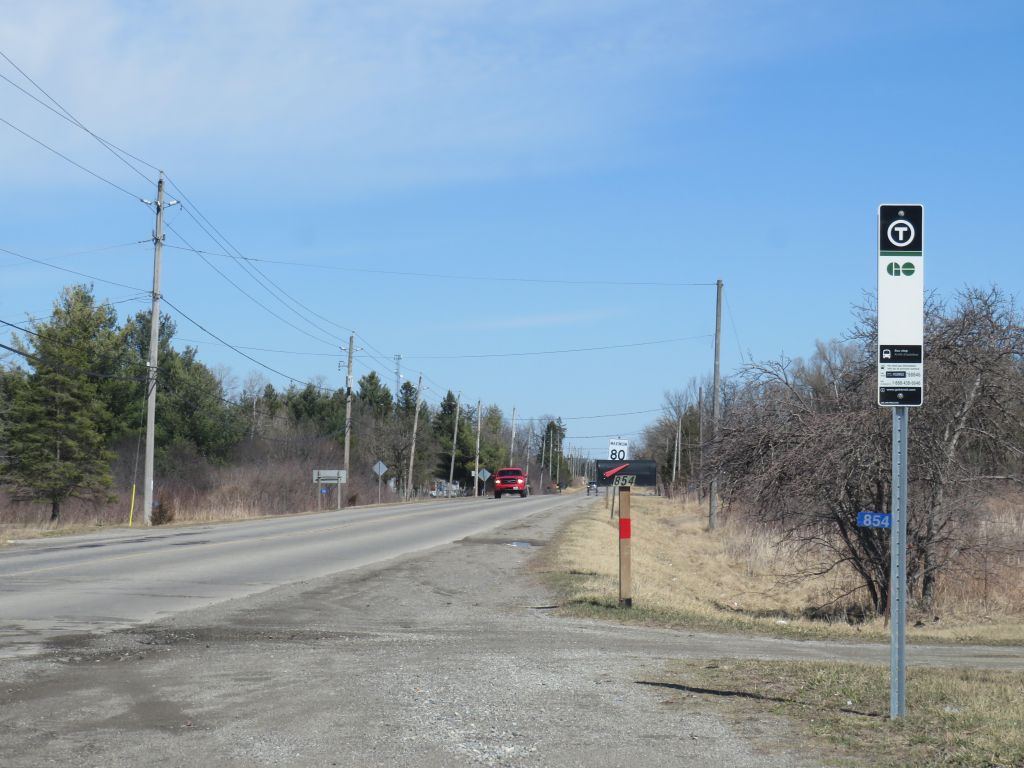
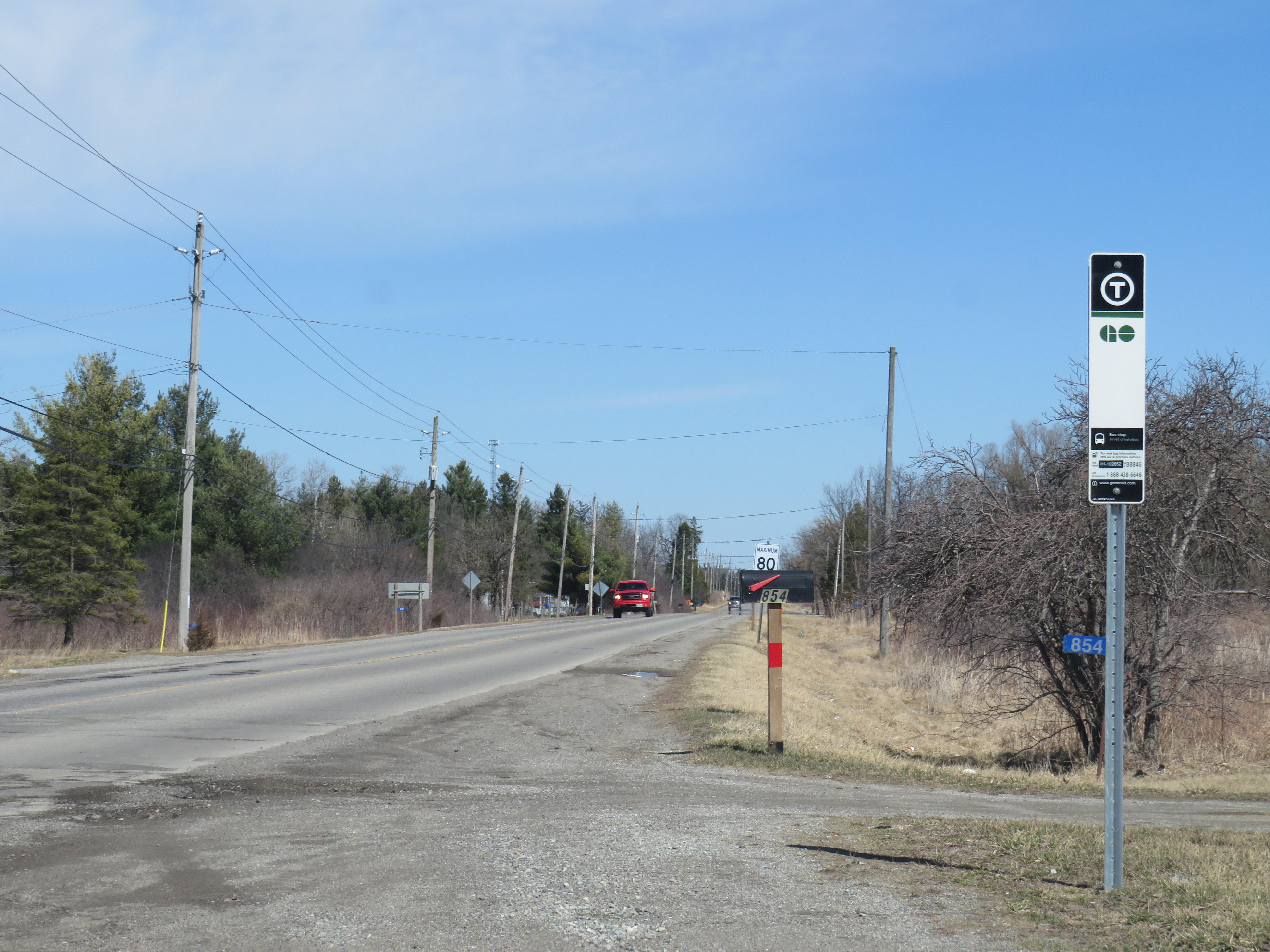
New GO Transit bus stop on Chiefswood Road at Six Nations
As we enter Spring 2025, there are a few significant changes in Ontario’s intercity transportation services. A new daily GO Transit route will now connect Six Nations and the Mississaugas of the Credit First Nation with Brantford, Hamilton, and Greater Toronto. A new seasonal Waterloo-Burlington weekend express could foreshadow more direct service between Kitchener/Waterloo and Hamilton in the future. Flixbus moved its Ottawa terminal stop to the VIA Rail station, joining Ontario Northland and Orleans Express.
However, there are also some cuts, triggered by the end of the Ontario Intercommunity Transportation Grants. Grey County will terminate all GTR services with the exception of Route 1 between Dundalk, Shelburne, and Orangeville. T:GO is ending its intercommunity services outside of Tillsonburg, including routes that connect with Woodstock and London. PC Connect is cutting its rural route that serves places like Mitchell and Milverton (though routes connecting Listowel, Stratford, and St. Marys to Kitchener/Waterloo and London will continue).
Unfortunately, T:GO will end all intercommunity bus routes outside of Tillsonburg, including the link to Woodstock
Recently, I provided my expertise mapping Canada’s intercity transit links to Transport Canada, which allowed me to enhance and update the interactive map. I am also working with Transport Action Canada to support their efforts advocating improved intercity transport across the country.
As always, please contact me with feedback, corrections, or updates. It is a challenge continually maintaining a Canada-wide map given how frequently things change.
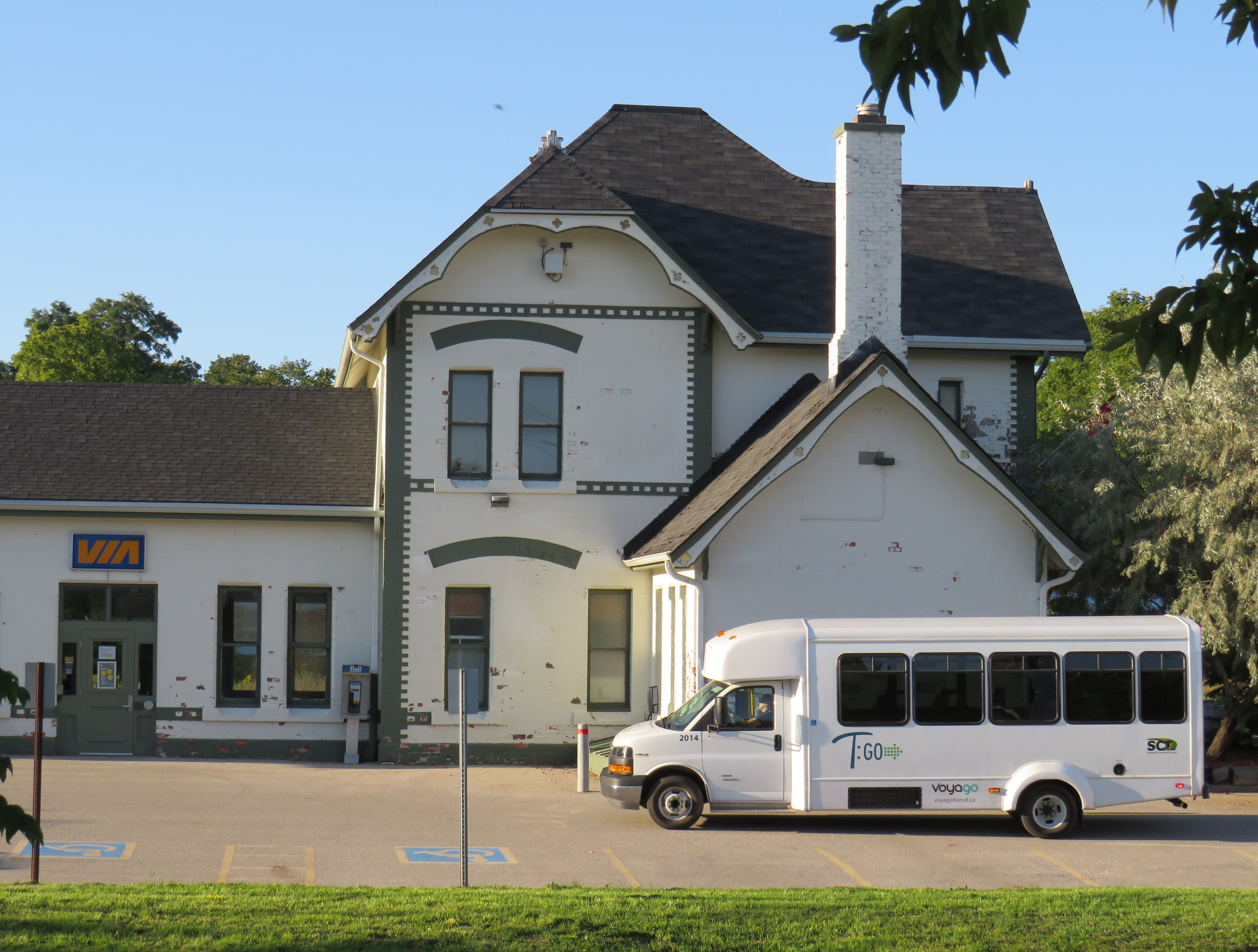
T:GO inter-community transit van at Woodstock VIA Rail station, September 2020
October 2021
I made several changes to the interactive map, including a complete update of the GO Transit bus and rail network, including the most recent rail corridor extensions to Bloomington and London, and a new weekday bus route to Brock University in St. Catharines.
Over the summer, Quinte Transit added a new route between Trenton and Belleville, Simcoe County Linx added a new route between Midland and Orillia, serving Tay Shores and Coldwater, and a new service launched between Brockville, Prescott, and Cardinal in Eastern Ontario.
June 29, 2021/July 6, 2021: Beginning Monday, June 28, Rider Express, an intercity coach company based in Western Canada (which picked up several routes formerly operated by Greyhound Canada and the Saskatchewan Transportation Company), began service in Ontario. Rider Express is looking to fill some of the gaps left by the recent announcement that Greyhound will cease all domestic routes in Eastern Canada.
That’s the good news. The bad news is that its first route in Ontario, connecting Toronto Station, Kingston, and Ottawa, replicates Megabus’ new route (which I have also added) and competes against VIA Rail’s Corridor rail service. Several of Greyhound’s daily Toronto-Ottawa buses ran through Peterborough and along Highway 7 through Eastern Ontario, leaving towns such as Norwood, Havelock, and Perth off the map. Though Peterborough is connected to Toronto by GO Transit, it is a long train and bus ride, while Greyhound offered a direct, express service to Downtown Toronto.
Two steps forward, one step back.
I made additional changes to the interactive map to show new GO Transit, Can-Ar Coach, Megabus, and Ontario Northland routings to the new Union Station Bus Terminal, which replaces the old GO bus terminal and the Toronto Coach Terminal on Bay Street. Meanwhile Ontario Northland moved from the now-closed Ottawa Central Bus Station to the VIA Station on Tremblay Road.
Meanwhile, starting July 8, Orléans Express will expand into Ontario, with a new Gatineau-Ottawa-Montréal route, operating twice daily. It will join Rider Express and Ontario Northland at the VIA Rail Station in Ottawa.
May 2, 2021: On Monday, May 3, “The Link” begins operations on two routes in Selwyn Township and Curve Lake First Nation, connecting several communities with Peterborough Transit and GO Transit at Trent University. The service, which is operated by Peterborough Transit, will run on weekdays, with five trips in each direction on both routes. Fares on “The Link” buses include a free transfer to and from Peterborough city bus routes at Trent, with direct service to downtown, major shopping centres, the hospital and Sir Stanford Fleming College.
February 15, 2021: A few small updates, including the addition of two community routes in Muskoka District Municipality, a bus connection between North Bay and northern Quebec, and a revised bus stop location for Ontario Northland in Orillia.
December 14, 2020: I made several updates to the interactive map, including the addition of Huron Shores Area Transit, which launches today. I made a few changes suggested by one of my readers, and added Niagara Region Transit’s on-demand service in Niagara-on-the-Lake, which replaces a fixed route that was cancelled earlier this year.
November 9, 2020: I made several updates to the interactive map, including the addition of PC Connect in Perth County, which launches next Monday. I mapped Port Hope’s transit connection to Cobourg, as suggested by one of the readers, and corrected a few minor errors.
October 15, 2020
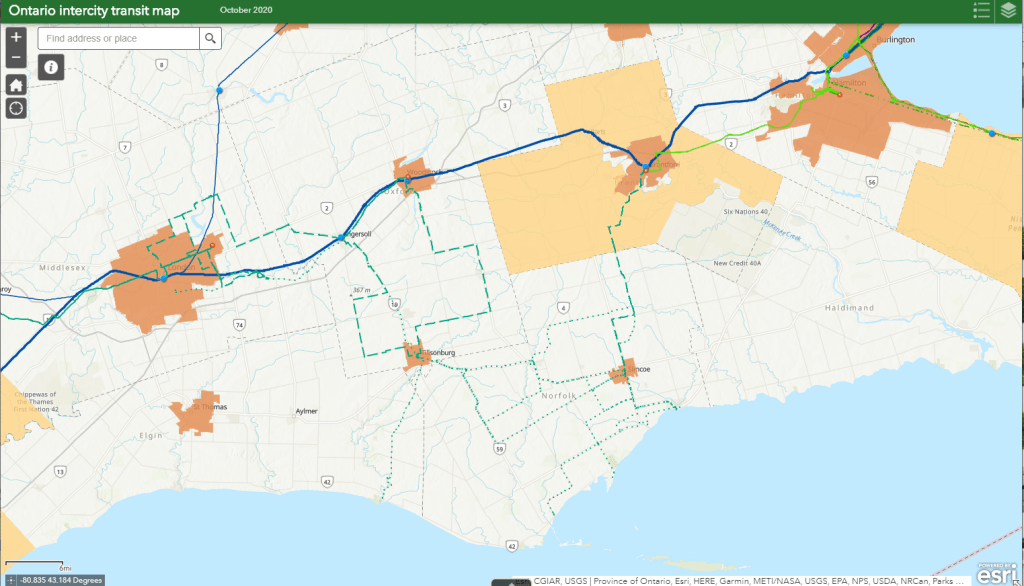
Despite the ongoing COVID-19 pandemic, several new inter-community transit services launched in Ontario during the last few months.
Last August, T:GO began service on four routes radiating from Tillsonburg, where there was already an in-town circulator service. Mondays through Fridays, twenty-seater vans operate between Tillsonburg, Norwich, Woodstock, Ingersoll, and other communities, offering connections to Woodstock Transit, the hospital, and the VIA Rail Station.
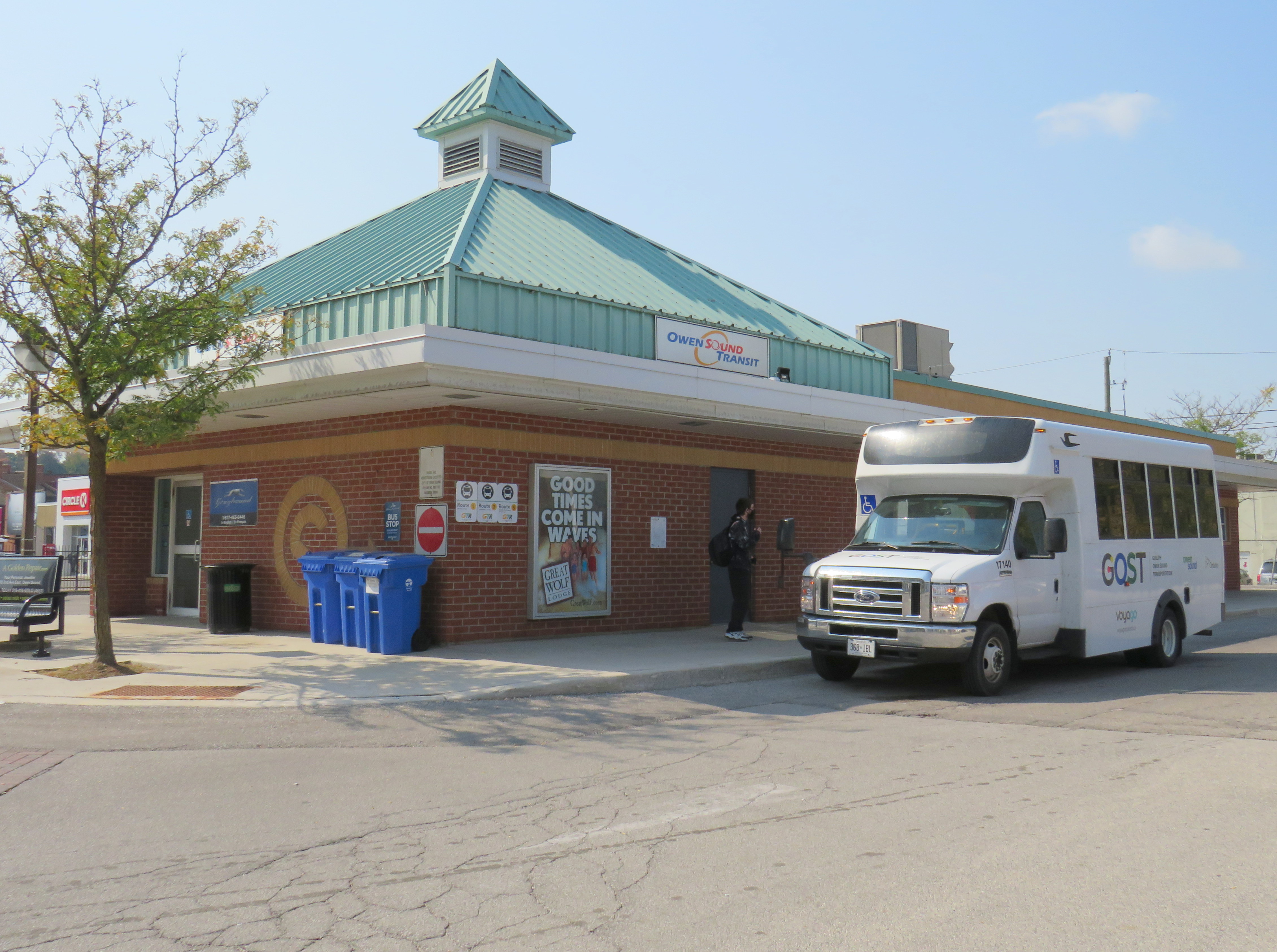
In September, the City of Owen Sound, Grey County, Middlesex County, the town of Strathroy-Caradoc, and Prince Edward County all launched their own services, connecting rural communities and small towns to larger centres such as London, Guelph, and Belleville. In addition, Simcoe County expanded its Linx bus service to serve Alliston and Beeton, and other services, suspended during the early days of the pandemic, resumed operations. Also this year, Niagara and Durham Regions expanded their rural on-demand transit services.
GOST minibus at Owen Sound Transit Terminal
All these new services help to fill the gaps left behind by private coach companies; these have become especially vital as Greyhound Canada suspended all operations in Ontario and Quebec this year (after abandoning Western Canada in 2018), and Coach Canada (operating as Megabus) cut service on some of its routes.
While these new intercommunity routes help to serve local needs, there is a wide variety of service provided in rural and small town Ontario. But without provincial coordination, it is nearly impossible to keep track of them all, never mind plan a trip.
So I went ahead and mapped them all the best I could. Clicking on each route brings up a pop-up window containing further information, including a link to each agency’s website, where available.
Unfortunately, there have also been some setbacks. Wroute, a shared taxi service in the Kitchener-Guelph-Hamilton triangle, was operational for less than a year. Though GO Transit added new weekday trains between Guelph and Kitchener, none allow for Kitchener-bound commutes, and there has not been interest in serving those gaps identified by Wroute.
Outside of Northern Ontario and the Golden Horseshoe, many cities and towns remain disconnected from nearby communities and larger centres. Though every city and town in Ontario had daily bus and/or rail service in the 1980s, many communities are now completely inaccessible for anyone without access to a car. Though GO Transit expanded to Peterborough, Brantford, Niagara, and Kitchener in the last fifteen years, they are extensions of GO’s radial network from Toronto rather than a true intercity network.
St. Thomas, population 41,000, is the largest city in the province without any passenger links, despite being a short drive to London. Many other cities and towns — particularly in Midwestern and Eastern Ontario — find themselves in similar situations. A few other cities, such as Sarnia (which has just one train a day each way to London and Toronto), are grossly under-served.
But thanks to municipal innovation and a new provincial grant program, this is finally changing. Though several municipalities addressed this problem early on, three new inter-municipal bus systems began operations in 2019, with many more launching this year.
Bayside Mall, formerly the Sarnia Eaton Centre, on a Saturday morning in 2013. Most stores are vacant or occupied by non-profits or independent businesses.
The Toronto Eaton Centre, large, famous, and vital, is only one of many malls built in the downtown cores of Ontario cities between the 1960s and 1990s. From Thunder Bay to Cornwall, the construction of new enclosed shopping centres were seen as a necessary tool to keep the old city centres vibrant and relevant in the face of competition from new suburban malls. But only in the province’s two largest cities did the concept work. Elsewhere, these urban shopping complexes were left largely vacant within ten years of opening, when leases expired. When the Eaton’s department chain went bankrupt in 1997, huge voids were left behind that developers and municipalities struggled to fill.
The Toronto Eaton Centre was opened in two phases between 1977 and 1979. It added hundreds of shops and new office space to Downtown Toronto, anchored by a new Eaton’s flagship and was connected to the Simpson’s store across Queen Street. Today, the Eaton Centre is Canada’s second largest mall (including the Hudson’s Bay/Saks Fifth Avenue building) and the Toronto region’s second most productive shopping centre in terms of sales per square metre. In Ottawa, the downtown Rideau Centre, opened in 1983, is the busiest and most productive mall in that region (Retail Council of Canada, 2016).
But elsewhere in Ontario, downtown malls — mostly built with municipal and/or provincial government support — have been, without exception, commercial and urban development failures. Not only did they suffer from high vacancy rates, they helped to wreck the downtown cores they are located in rather than foster the economic revitalization they once promised.