Two and a half years ago, I took my first transit trip using an on-demand service, travelling between Port Perry and Cannington in rural Durham Region. It was part of a quest I undertook to visit every city and town hall in the Greater Toronto and Hamilton Area without a car. In March 2023, I found DRT’s booking service to be an exercise in frustration at first, though I eventually landed on a time that worked.
In September 2026, I wanted to travel to Paris, Ontario, a picturesque town of 15,000 people on the Grand River, and only a 15-minute drive from Brantford. In 2000, the Town of Paris was amalgamated with the rural county that surrounds the City of Brantford.
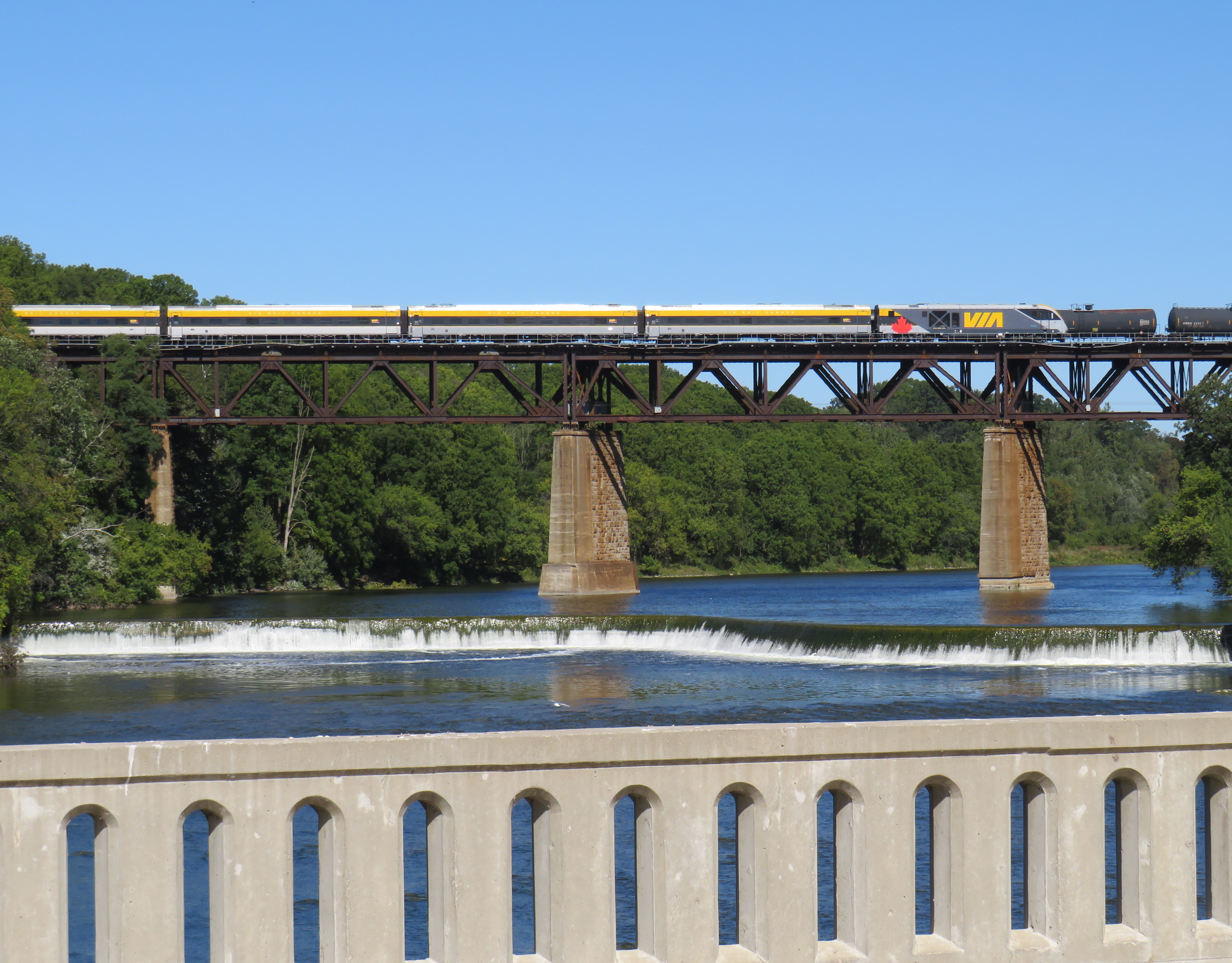
Though ten VIA trains a day pass through Paris, the closest stop is in Brantford
In the 1980s and early 1990s, Paris was served by a Brantford Transit bus route, which made sense given the short distance between the two communities. This service was discontinued in 1996 due to funding cutbacks to transit province-wide by the Mike Harris-led Progressive Conservatives. With the loss of Greyhound’s once-a-day local bus between London and Toronto in 2018, there was no way to get to Paris without a car or a taxi ride.
In 2019, the county launched Brant e-Ride, which was later branded as Brant Transit. An on-demand transit service, Brant Transit serves the entire municipality. It also allows pick-ups and drop-offs anywhere within Brantford, as long as either the origin or destination is within the county’s boundaries. Rides are $6 one-way, or $4 for adults over 55 and free for children 12 and under.
The ability to travel between Brantford and the surrounding county allows Brant County residents easy access to workplaces, schools, shopping, or medical services in Brantford, as well as connections to GO buses to McMaster University and Aldershot Station, VIA Rail trains, and the weekday Ride Norfolk service to Waterford and Simcoe. The service also allows Brantford residents to get to employment areas in Brant County, such as the Ford and Adidas warehouses by Highway 403 and Rest Acres Road (Highway 24 South).
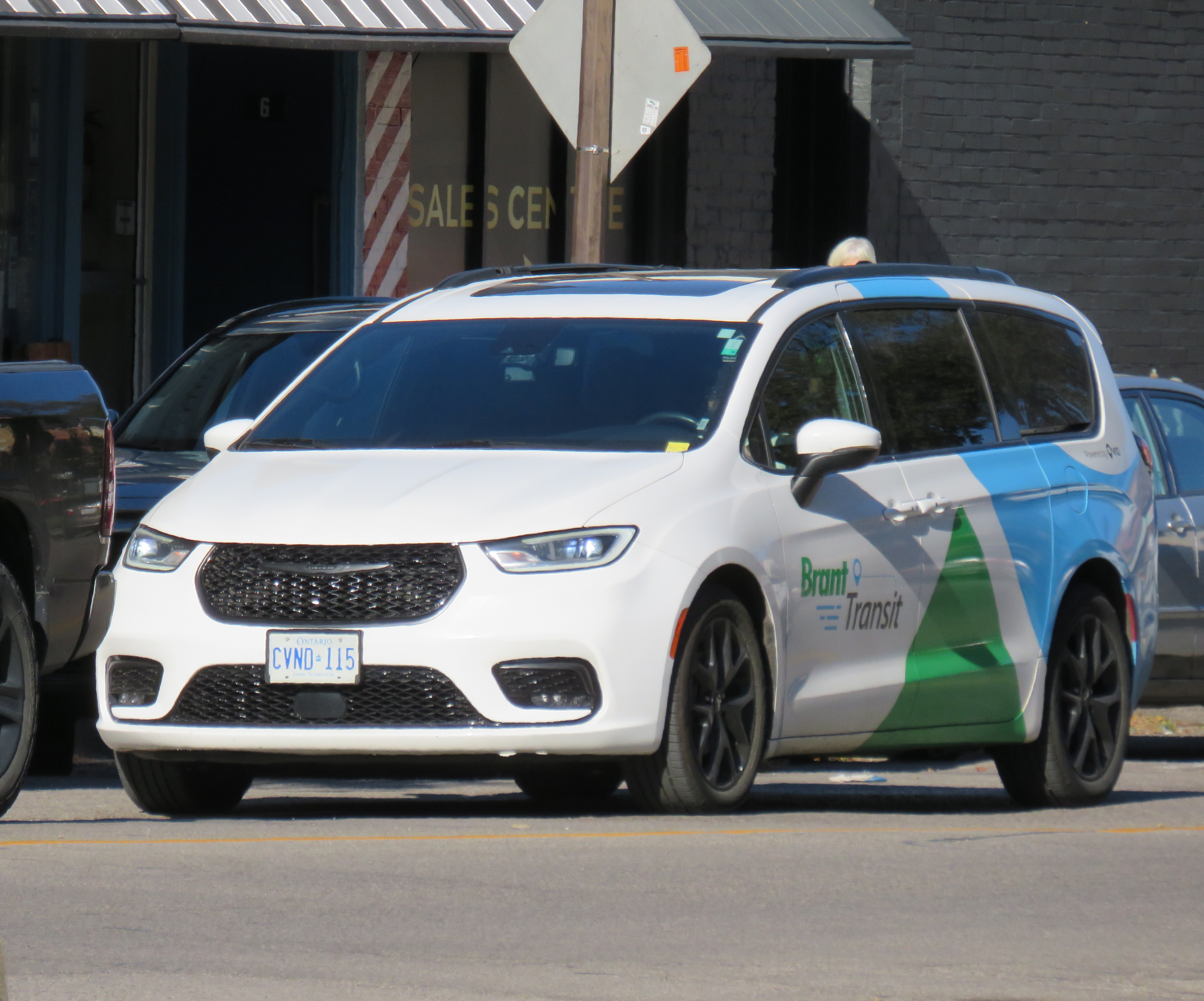
The current contractor to Brant Transit is Via Transportation, a New York-based mobility software company specializing in on-demand transit and shuttle service platforms. Drivers are hired locally and use Brant Transit-branded minivans and SUVs.
Brant Transit ridership is growing, with over 25,000 rides provided in 2024, up 11% from 2023. The overwhelming majority of rides taken are between Brantford and Brant County, rather than within the municipality, with 57% of passengers using the service to get to and from work and another 24% using it to access health services.
Unlike the 2024 DRT experience, I found the booking system easy to use and it accepted my trip requests within the times I was looking for: a pickup in Brantford around 10AM (plenty of time for me to get there from Toronto either by VIA train or GO train/bus) and a pickup in Paris around 4PM. That would give me plenty of time for a leisurely walk around Paris, enjoy a relaxed lunch, and browse the downtown.
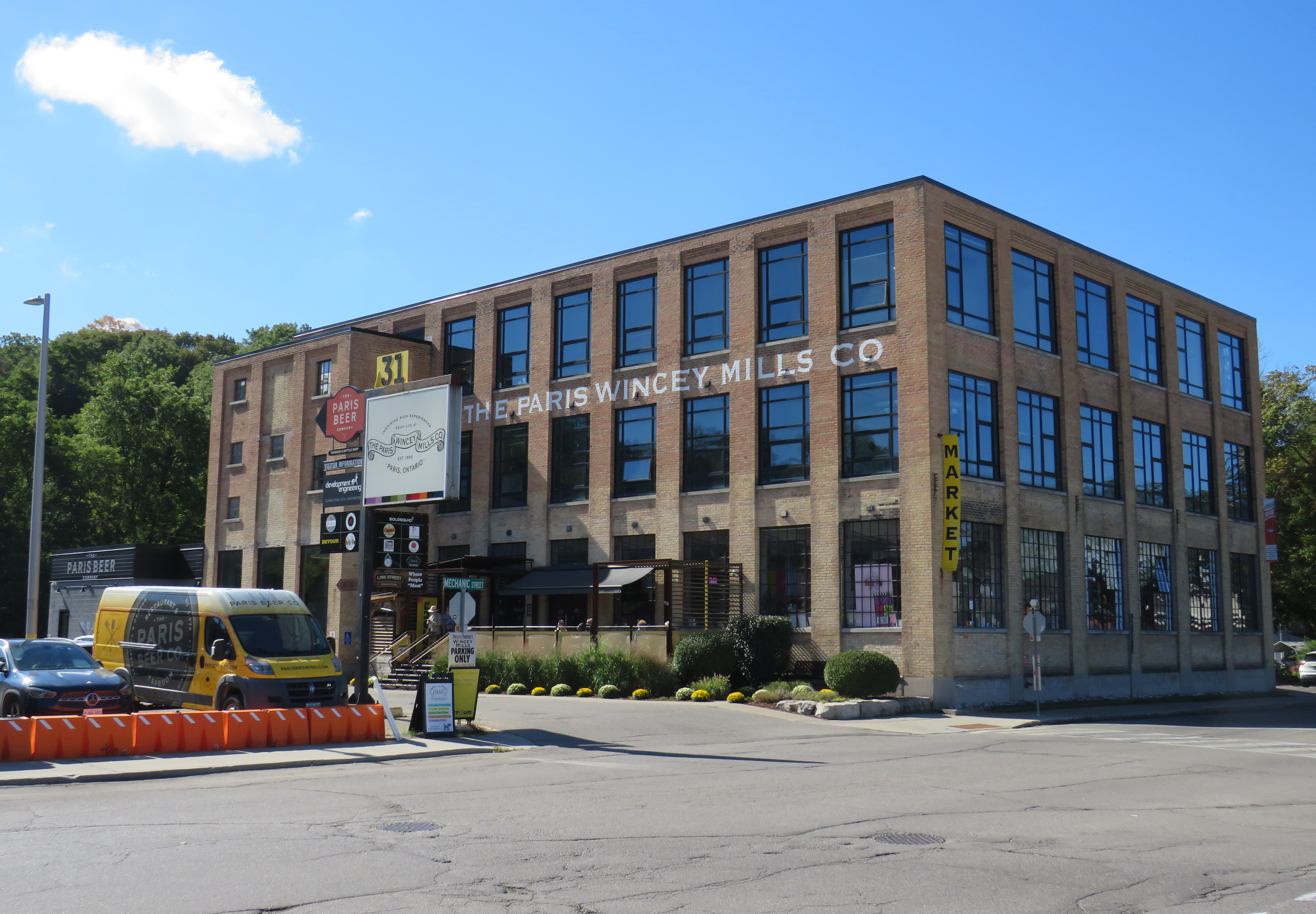
I travelled between the bus terminal in Downtown Brantford and the Paris Wincey Mills building, just off Paris’ main street. The old textile mill, once a Canadian Tire store, was beautifully restored, with a café, market, and brewery on the lower level, and offices on the upper two floors.
Paris Wincey Mills Co. building
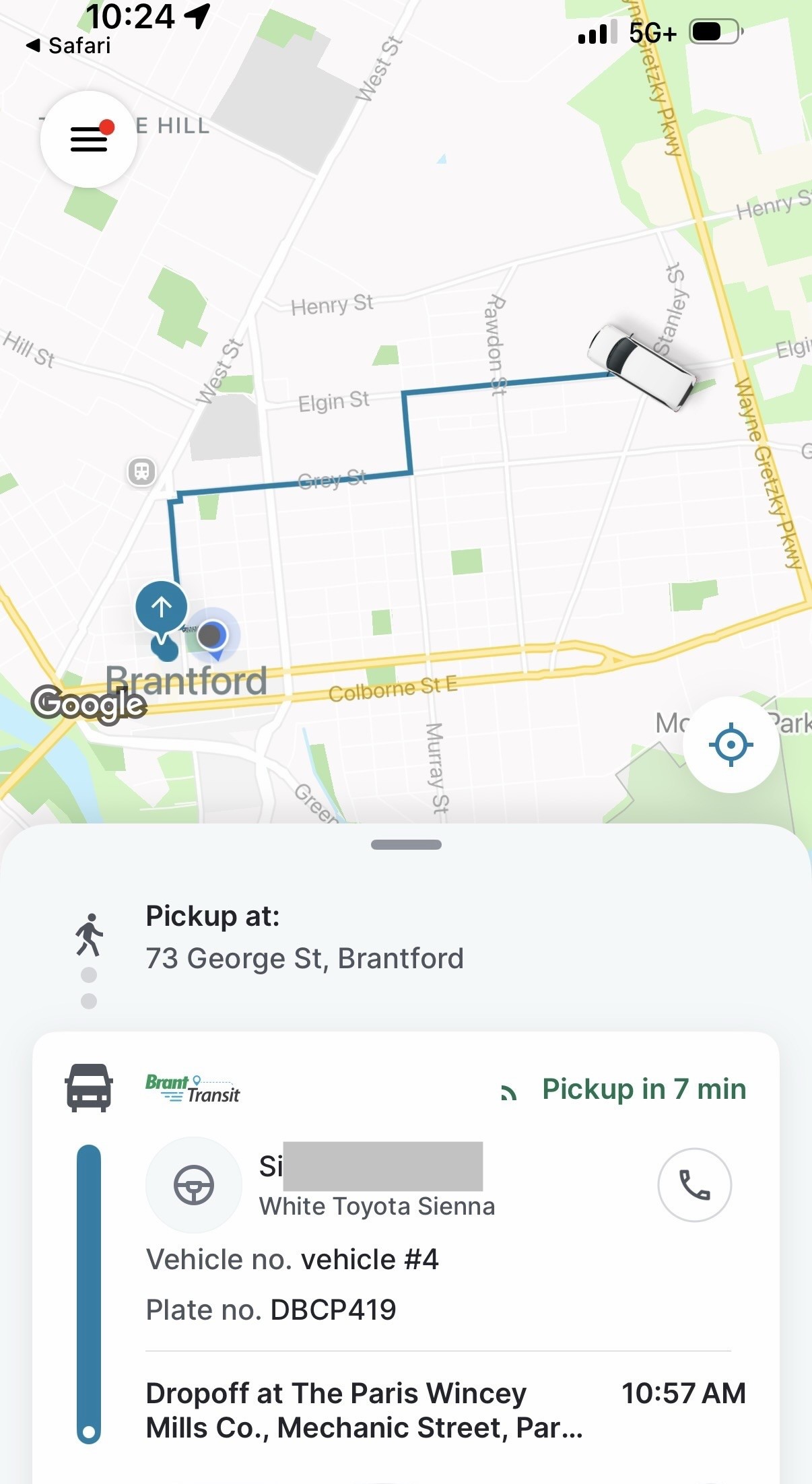
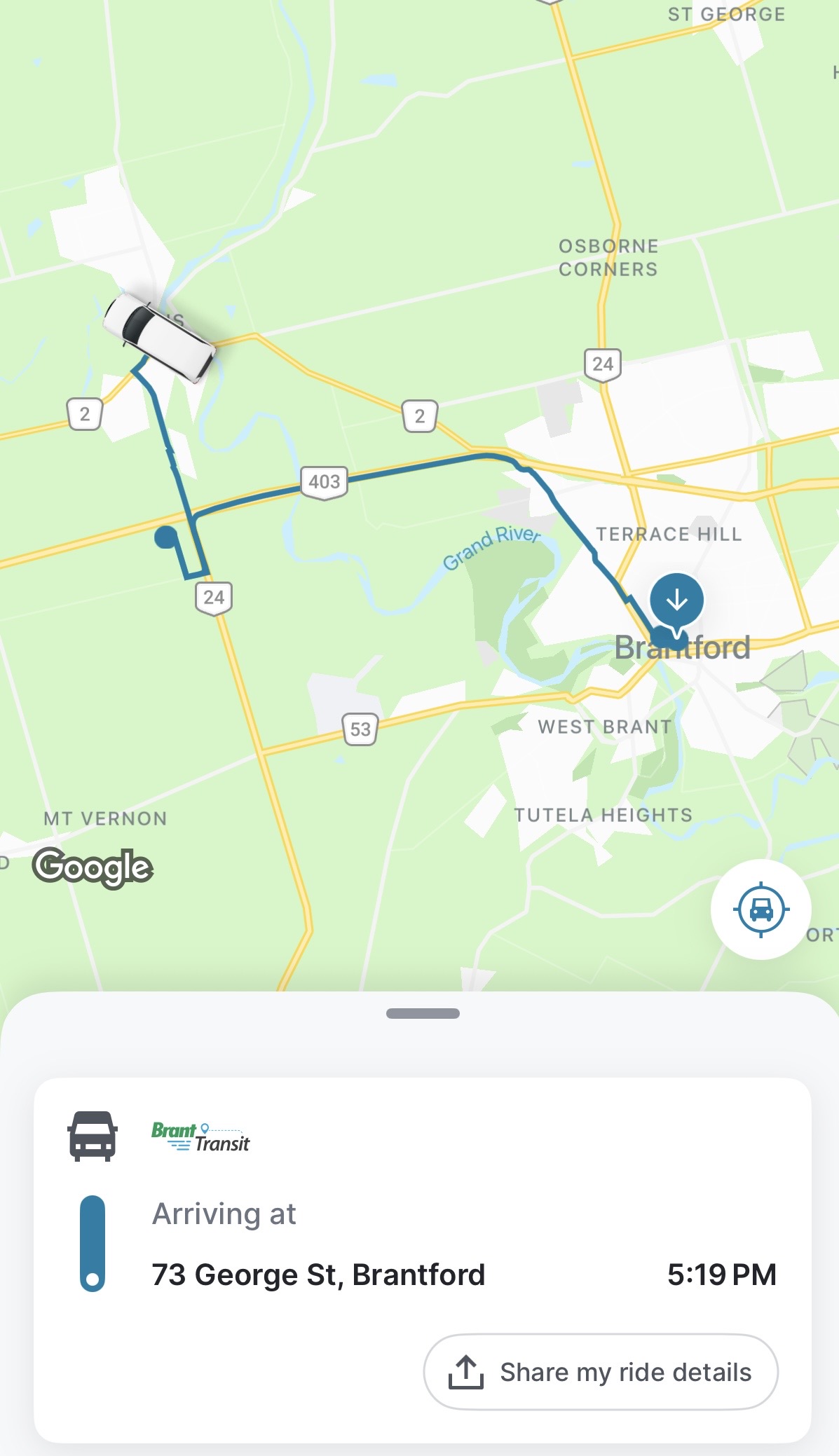
The only trouble was the initial pick-up. The app, as well as the text alerts, kept telling me to wait at 73 George Street, the location of the old Brantford Carnegie Library now occupied by Wilfrid Laurier University. However, the tracking app — which appears similar to the Uber or Lyft platforms — showed the that correct location was actually the bus terminal. Luckily, I made it in time to meet the driver.
Information provided to me in the Brant Transit App, with driver’s name (redacted), vehicle info (plate and make), pickup time and location and estimated drop off time
I shared the ride to Paris with one other passenger, who remained on board after I departed. On the return ride, I could see the driver made several stops before picking me up, with a stop en route at one of the warehouses near Highway 403, where two other passengers were waiting, all headed to Brantford.
Screenshot of Brant Transit App showing my route back to Brantford Bus Terminal from Paris with an intermediate stop at a warehouse near Highways 24 and 403
Overall, I was satisfied with my experience. The drivers were friendly, the ride comfortable, and the app easy to use. If Brant Transit on a September Thursday was reflective of on-demand transit in general, the concept would leave a very positive experience for users and municipalities alike.
Furthermore, Paris itself continues to grow, with new residential subdivisions on Rest Acres Road near Highway 403. In the future, Brant County should seriously consider fixed-route services to serve commercial and residential growth in and around Paris, either as part of Brant Transit, contracted to Brantford as before 1996, or both. In the meantime, the on-demand service can continue to provide mobility for the rest of the county, and even within Paris during off-peak times such as evenings and weekends.
I would have benefitted from a fixed-route service for a leisurely visit; once the transit times are booked, the passenger is tied to those times. After three hours in Paris, I had more than enough time to see everything I planned; had there been a bus at 3:30, I would have hopped on that instead of waiting for a 4:35 pickup. Though on-demand transit offers geographical flexibility in a sparsely populated or low demand area, fixed-route, scheduled services provide temporal flexibility that on-demand services can not match.
Quinte Transit bus stopped at the Belleville Bus Terminal, August 2026
Last month, I visited two beautiful towns in Eastern Ontario: Picton, in Prince Edward County, and Almonte, in Lanark County. Both communities have populations of just over 5,000 (though Almonte, within Ottawa’s commutershed, is growing), and both have wonderful downtowns full of independent stores, restaurants, and great public spaces. But you can only get to one of them without a car.
It was pretty easy to get to Picton from Downtown Toronto on a Thursday morning. Flixbus offers a direct seasonal service from Pearson Airport and Union Station Bus Terminal, stopping at Scarborough Town Centre, Whitby, and Trenton, and in Wellington, Bloomfield, and Picton in Prince Edward County. The County (which is actually a single-tier municipality) has become a popular tourism area, with visitors attracted by local wineries, art galleries, resorts, and the famous Sandbanks Provincial Park on Lake Ontario, so having alternative modes of transport to get to and around the area is welcome.
Unbranded Flixbus unloading in disused parking lot near Downtown Picton
As Flixbus does not operate its own buses — it partners with local coach operators — the buses do not have a consistent look. The bus on my August 20 trip, operated by Eastern Charter Inc., was a plain grey coach bus, but it was a comfortable ride. The last stop, in an unused parking lot off Picton Main Street, is across the street from a McDonald’s but is also a short walk to the downtown area. The parking lot, once used by a now-demolished church, is large enough to turn the bus around for the return trip.
Picton Main Street
Downtown Picton itself is very walkable, with regular pedestrian crossings and beautifully maintained sidewalks and street furniture. Even though there are larger retailers just outside the town centre, most storefronts are occupied by clothing stores, antique dealers, financial services, and craft shops, there is also a large independent bookseller, complete with attached cafe. Though many businesses are geared towards tourists and more affluent residents, it is not exclusively the case. The public library, a renovated and expanded Carnegie building, serves the entire community well. Discount chain Giant Tiger also thrives in the downtown area. The Regent Theatre, one of Ontario’s oldest continuously-operating theatres, has been hosting concerts, shows, and first-run movies since 1931.
Regent Theatre, which also contains a tourism information desk, is open between showsThe Carnegie Library on Picton’s Main Street, with a small playground out frontThe sidewalks full of life and room for street trees, benches, and outdoor store displays.
Prince Edward County also offers on-demand transit service within the municipality and a weekday fixed-route service between Picton, Bloomfield, and Belleville operated by Trenton-based Quinte Transit. During the summer and early fall, additional fixed-route services operate between Belleville, Wellington, and Picton, sponsored by local wineries and tourist attractions. Bus stops are well marked, with current schedules posted at each point.
County Transit bus stop at the Fairgrounds (Crystal Palace)
At Downtown Belleville, there are connections to Belleville Transit, which serves the VIA Rail Station and the Megabus/Flixbus stops near Highway 401 and to Quinte Transit’s Trenton service at Loyalist College. There also used to be a connection at the downtown terminal for Deseronto and Napanee, but sadly it disappeared last year.
Prince Edward County does a fine job running and marketing a transit service geared to both its residents and to visitors. It should be a model for other communities in Southern Ontario and elsewhere.
Almonte: Nowhere to go
Dr. James Nasmith Square, Almonte. The old post office on the right is home to a great Italian restaurant, fittingly named Il Postino.
Almonte, less than an hour’s drive from Downtown Ottawa, is another charming and busy town, full of independent shops and restaurants in heritage buildings. On a busy summer weekend, parking can be hard to find. The town, part of the municipality of Mississippi Mills, is also growing, with new residential development to the east of the historic downtown. It has just about everything that Picton has, except for a transit link.
Prior to the COVID-19 pandemic of 2020, there was a weekday commuter bus that would shuttle workers from Almonte and Carleton Place to Ottawa and back, making several stops along the OC Transpo bus network. Though Flixbus has restored the lost Greyhound route along Highway 7 between Toronto, Peterborough, and Ottawa with stops in Carleton Place and Perth (and with a schedule that accommodates commuters), these coach buses stop at gas stations along Highway 7 and don’t serve the communities very well, unlike the commuter-centric buses operated by smaller companies like 417 Coach and Thom Transport.
As the federal government is mandating full in-office shifts again, and as towns like Almonte and Perth become popular day trip destinations, it’s time for places like Lanark County to follow Prince Edward’s lead.
You’ll see fewer trains on the Lakeshore West, Stouffville, and Barrie Lines in September
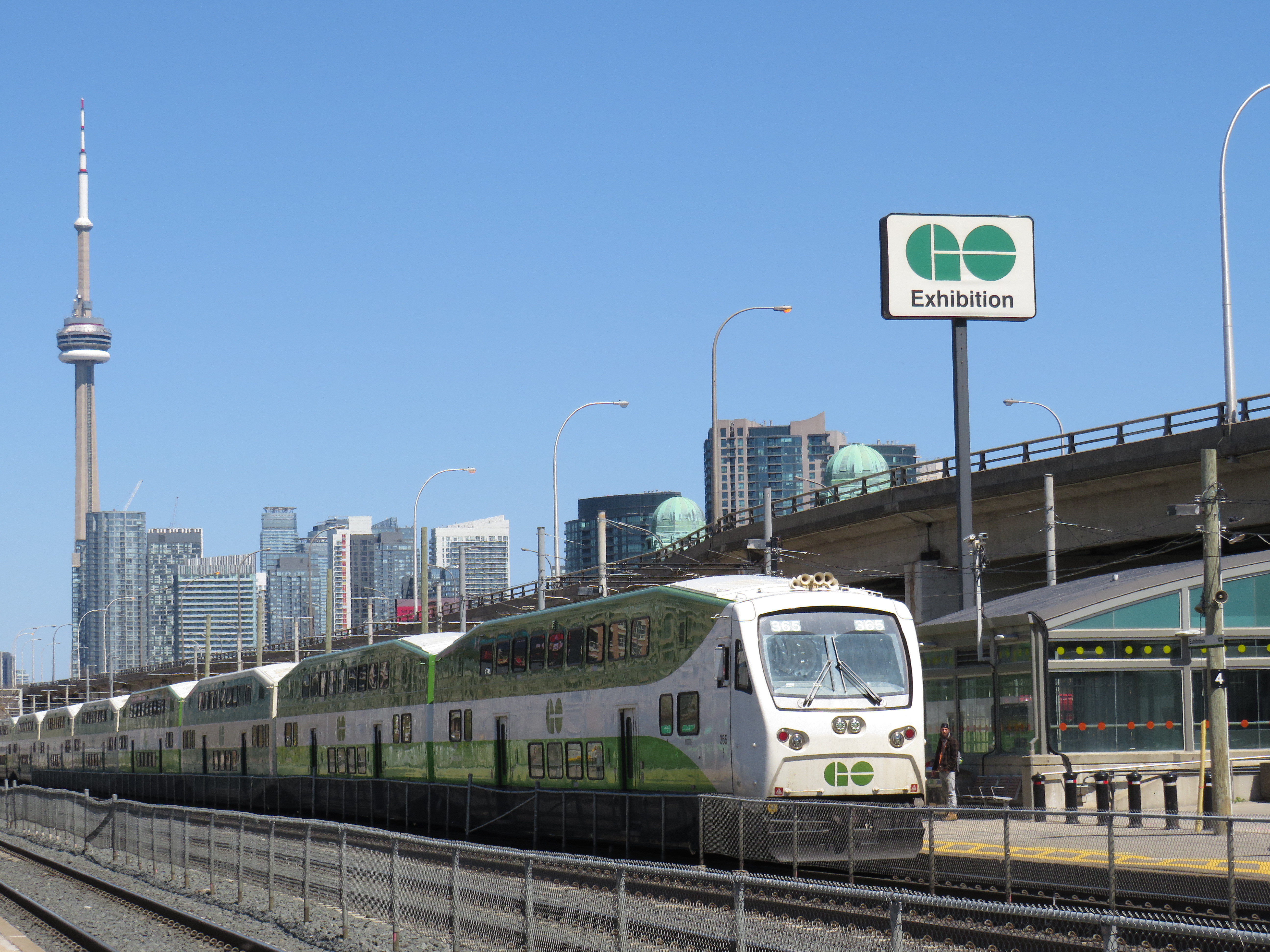
GO Transit passengers might be in for a shock after Labour Day as new schedules and new penalties come into effect. On several rail corridors, off-peak trains are being cancelled and replaced with buses, while the fines for not paying a GO Transit fare are increasing — by over 450% for a first-time offense.
During the evening of Friday, August 28 — just five days before the Labour Day long weekend — GO Transit quietly released its new schedules for the Fall 2026 period. Typically, schedule changes include the restoration of extra bus trips on the Highway 407 Corridor (which serves several college and university campuses), as well as bus routes to Guelph, Kitchener-Waterloo, St. Catharines, and Peterborough. The fall schedule change often brings certain service improvements and schedule adjustments to reflect demand and operating changes. But the changes for September 2026 are mostly cuts to rail services.
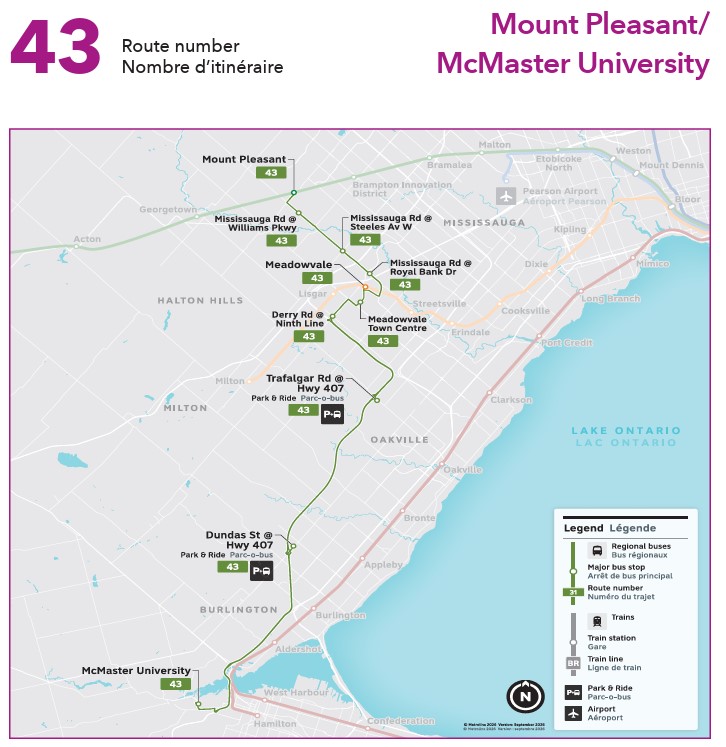
There is one new bus route, Route 43 between Mount Pleasant GO Station in Brampton and McMaster University in Hamilton, via Meadowvale and Highway 407, running mainly in the peak direction, Mondays through Fridays.
New Route 43 between Mount Pleasant and McMaster (PDF Schedule)
But on the Barrie Line, there will be one less weekday round trip between Allandale Waterfront and Union Station: the southbound 21:10 trip and the northbound 22:01 trip disappear, along with the 20:54 northbound to Aurora. Those runs will be replaced with buses. But the southbound 21:10 train from Allandale took 1 hour and 42 minutes, arriving at Union at 22:52. The replacement bus, including a transfer at Aurora, takes nearly three hours, with no access to washrooms and no direct access to Downsview Park Station.
On weekends and holidays, the first southbound train from Allandale Waterfront will now be at 14:05, the last train will be two hours later, at 16:05. From Union Station, the first northbound train will be at 16:54, to Aurora only. The old Table 65 schedule has six round trips to Barrie on weekends, with hourly service to and from Aurora.
There will be similar cuts to the train schedule on the Stouffville Line, where there will be no train service until after 3PM on weekends and holidays. The 23:00 and midnight trains from Union on weekdays are gone, as are the evening inbound trains. There will be replacement buses, but those are often stuck in traffic on the Don Valley Parkway and Highway 404. On the Lakeshore West line, the 15-minute weekend afternoon service between Union and Oakville is gone and the Niagara train service extension on weekdays is down to just one peak-direction train.
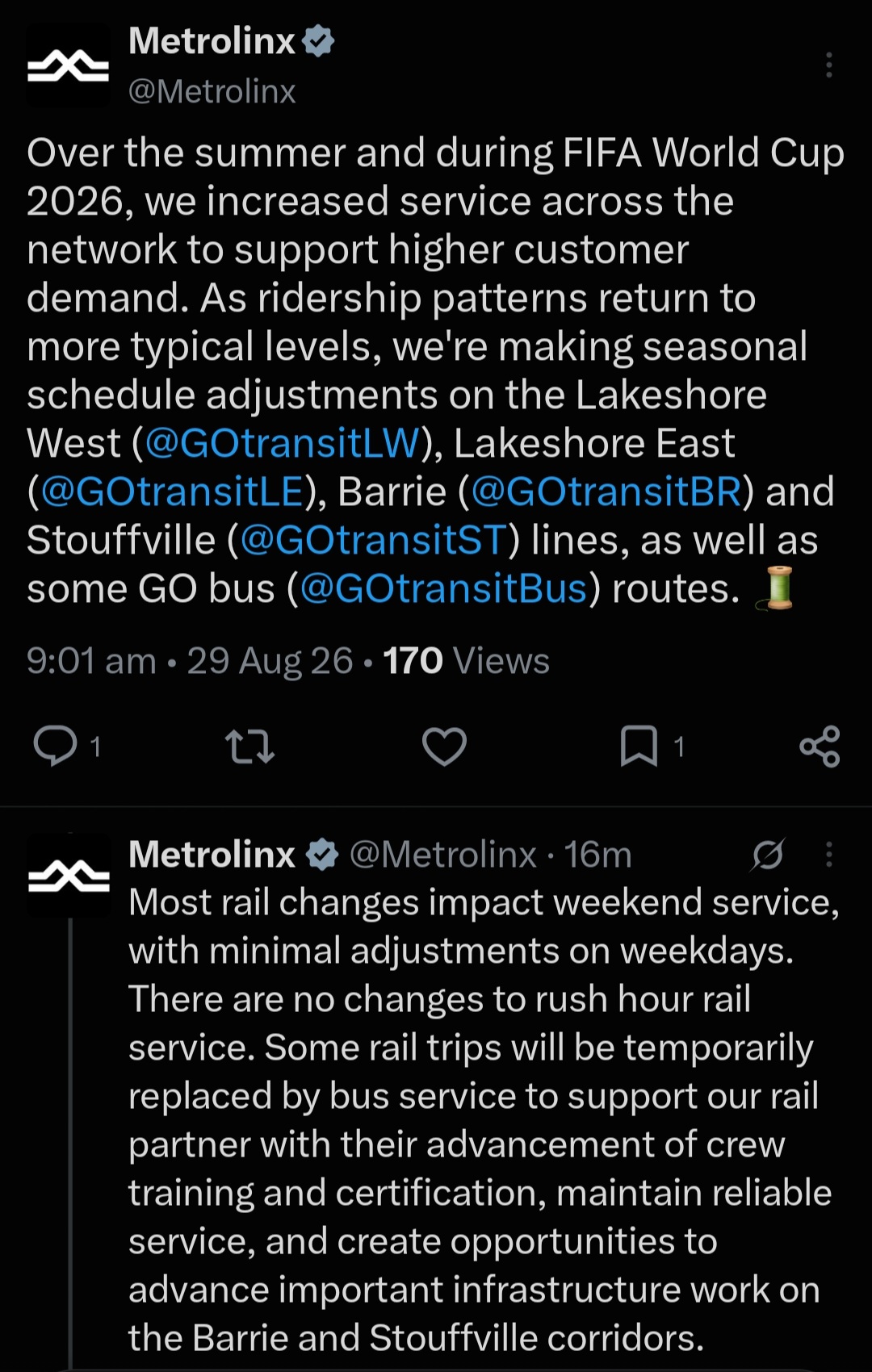
Though there is no notice of changes yet on the GO Transit homepage, it did post a partial explanation on X.
GO Transit post on X, citing seasonal adjustments, which some rail trips temporarily replaced by buses
GO Transit says the rail trips replaced by buses are to “support our rail partner with their advancement of crew training and certification, maintain reliable service, and create opportunities to advance important infrastructure work…” What this is actually saying is that Alstom, which has a contract to operate and maintain the trains, has a crew shortage and a backlog of staff training. While GO Transit buses are operated and maintained by GO Transit employees, its trains are not. As Metrolinx is reliant on the contractor to staff the trains, it needs to reduce the number of shifts to ensure the remaining trains are fully staffed.
There’s no word on when train service can be restored, never mind improved, to meet demand. This can be traced back to the botched partnership with ONxpress that would have seen the Deutsche Bahn subsidiary take over GO rail operations and expansion.
The late announcement of these service changes is a symptom of the culture of secrecy at Metrolinx. The reason for the service cuts goes even deeper.
Because GO Transit’s rail service operates on a strict proof-of-payment system, it can sometimes be possible to forget to tap on or off at stations, which have no fare gates unlike the TTC subway and underground light rail stations. Often, Presto farecard validators are positioned in awkward areas, away from platform access points. Under the old policy, the first-time $35 fine and the second-time $50 fine were similar to penalty fares levied in the United Kingdom, acknowledging that mistakes happen. A failure to tap should not automatically result in a first-time fine four times higher than not paying for street parking in Toronto ($50).
At the very least, Presto validation (tap) machines should always be easy to spot and easy to access, reducing the number of honest mistakes. It should also follow that the penalty for not paying a transit fare should be treated as the equivalent for not paying for parking especially in an open system without fare gates.
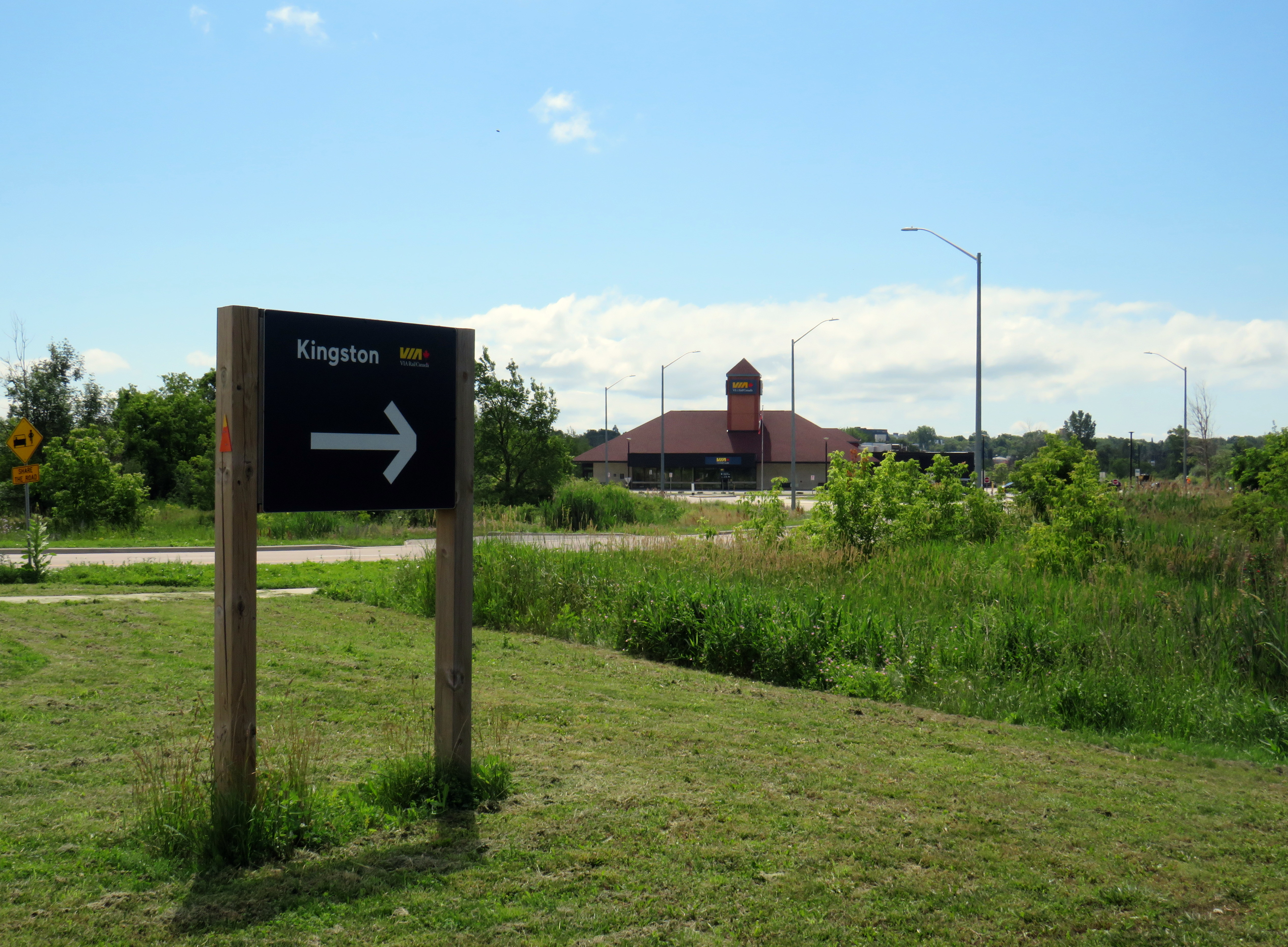
Located in a marshy area, Kingston Station is unnecessarily isolated from the rest of the city
Kingston, Ontario, is the largest city between the Greater Toronto Area, Ottawa, and Montreal. With Queen’s University, Royal Military College, and St. Lawrence College, Kingston is a major trip generator for VIA Rail, and has one of the busiest stations on the Quebec-Windsor corridor. It is also one of the most isolated intercity rail stations in Southern Ontario. Kingston’s geography and earlier decisions made by CN are largely to blame, but the future of VIA’s existing rail services is largely dependant on the fate of Kingston Station.
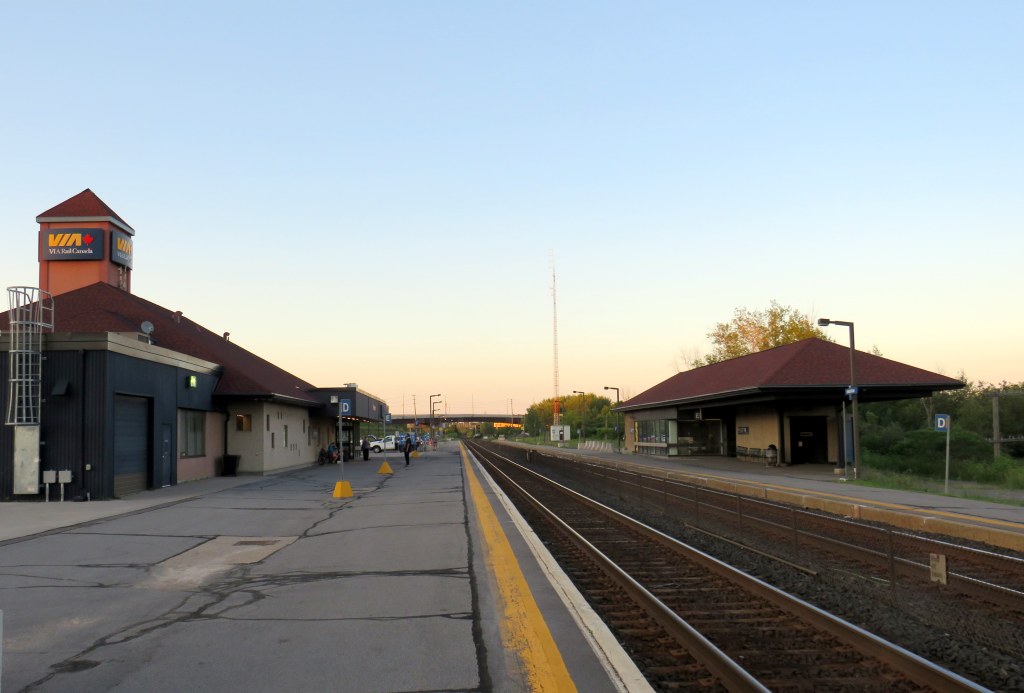
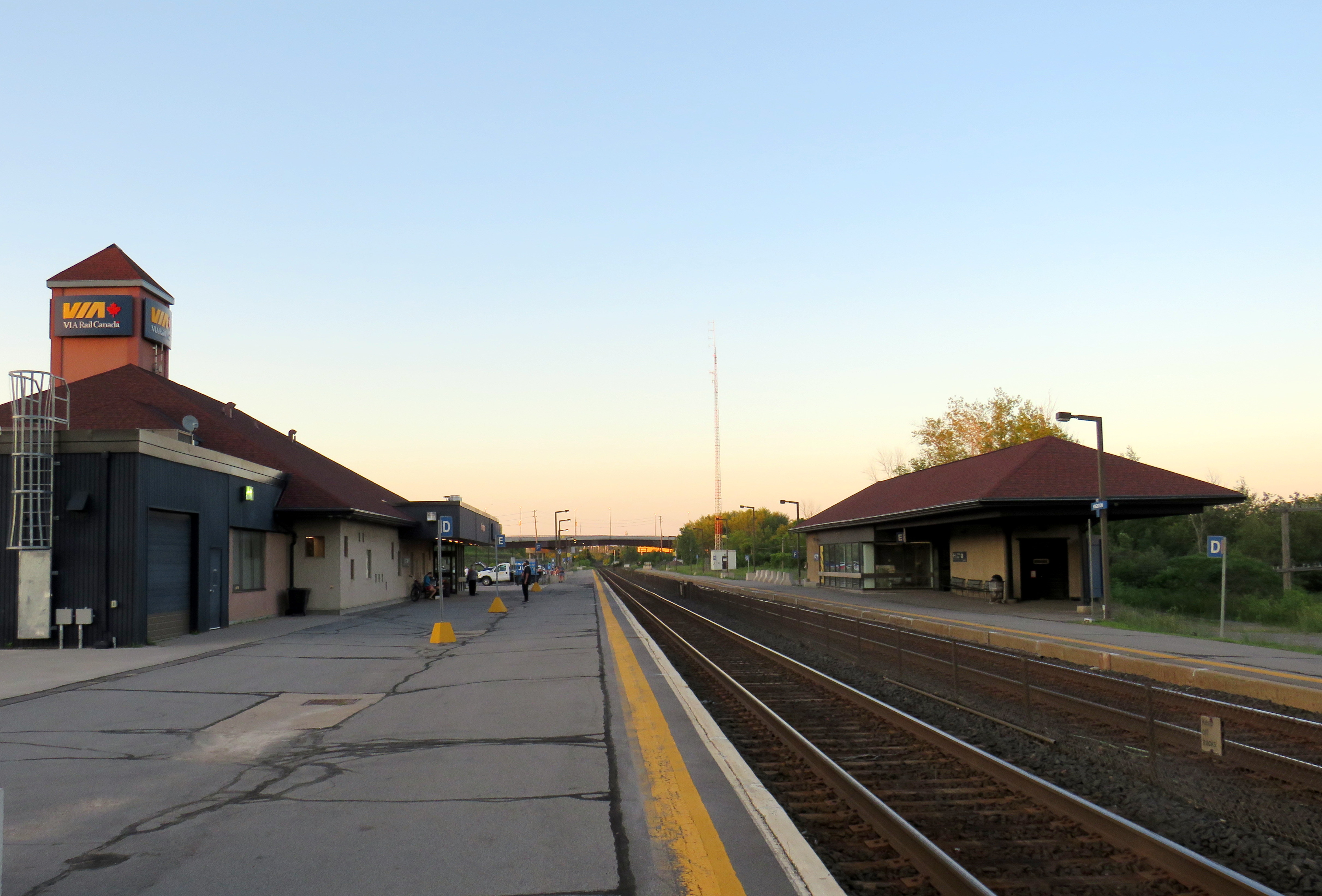
The VIA Rail station, off John Counter Boulevard, was constructed by CN in 1974 to replace a 1850s-era railway station on Montreal Street. The station has a ticket counter, washrooms, a ticket counter, and a small business class lounge, and two platforms. The south platform is connected to the station by way of a tunnel, with elevators, stairs and escalators providing access. Renovations in the early 2000s added a peaked roof and a tower displaying the VIA Rail logo to the minimalist CN station.
But the station is in an isolated location, located in a marshy area; the nearest businesses are a furniture store, a funeral home and a used car dealership. Despite this, Kingston Transit does a satisfactory job connecting the station to the downtown and post-secondary institutions, but the bus stop is unsheltered and a short walk away from the station building.
The two-track arrangement at Kingston Station does not suit CN or VIA particularly well. Both tracks are on the mainline, meaning that they are shared by VIA and freight. Delays to either CN or VIA causes congestion, one of several causes of train delays, contributing to VIA’s poor on-time performance. It also limits VIA’s flexibility in offering early morning or late evening trains that originate or terminate at Kingston or local all-stop service in conjunction with through express services. Newer VIA stations in Belleville and Cobourg have three platforms; the Belleville station tracks allow VIA trains to bypass the CN yard to the north.
The two-platform Kingston Station
The reasons for the Kingston station’s relative isolation compared to other mid-sized centres like London or Brantford, partly goes back to the 1850s, when the Grand Trunk Railway, which built the Toronto-Montreal mainline, routed its tracks away from Kingston’s urban centre. As the historic downtown sits at the mouth of the wide Cataraqui River, the Grand Trunk sought a narrower crossing further inland. To compensate, it built a spur into Downtown Kingston to serve local passengers and freight service; eventually a streetcar line ran to the main Montreal Street station and the city grew north to meet the railway.
In the 1970s, Canadian National, the successor to the Grand Trunk, was in the midst of modernizing its core infrastructure to focus on long-distance freight and container shipping. It rerouted its mainline north of Kingston on a shallower curve while eliminating several at-grade crossings. As CN continued to operate passenger rail on the corridor, it had to build a new station to replace the old Montreal Street location. The new Kingston Station had plenty of parking along with a passenger pick-up/drop-off loop, easily accessible to Princess Street and the new subdivisions in Kingston Township.
CN had the same principles in mind when it built new stations after the Second World War in Oshawa, Saskatoon, and Ste-Foy, outside of Québec City. Ease of rail operation and access to parking were bigger considerations than having a downtown station accessible by foot or public transit.
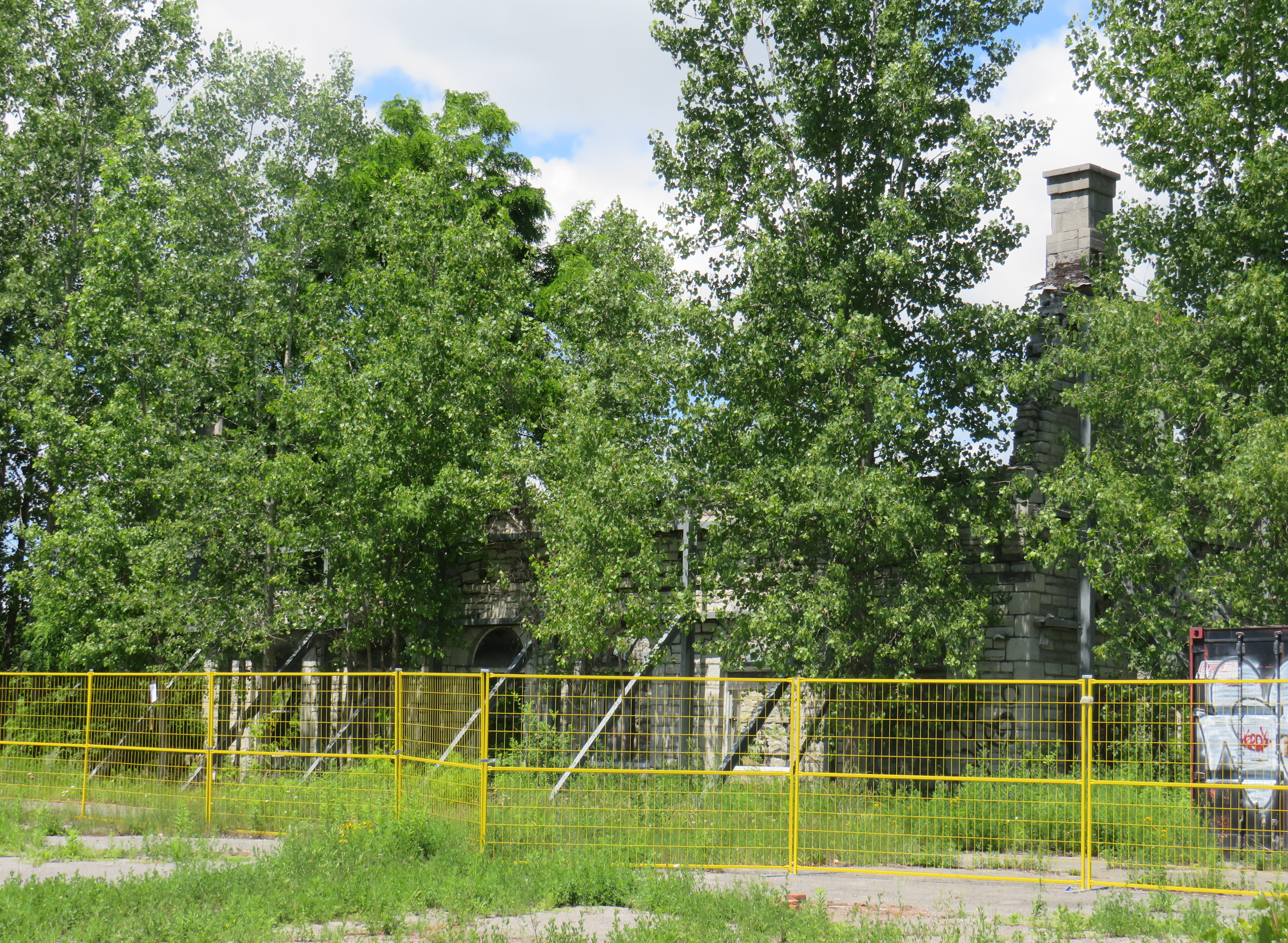
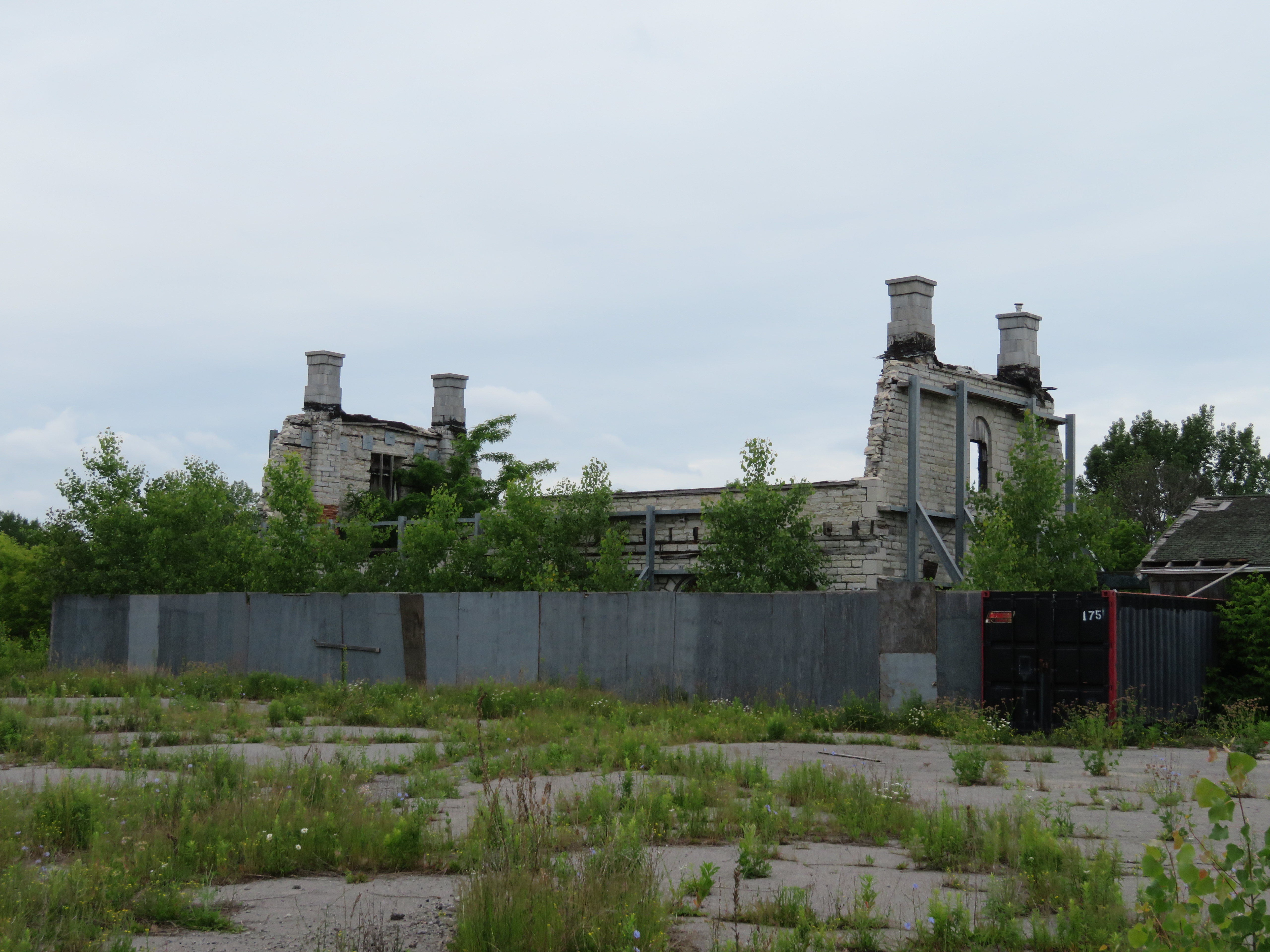
Trees grow around the stone ruins of the 1850s Kingston GTR StationA similar view eight years earlier, in 2018
Today, the original GTR station lies in ruins, fenced off, and partially hidden by trees that have grown around it. The roof is long-gone, as are the additional station buildings such as the express freight and restaurant structures. With the vacant railway lands sitting abandoned for decades, this part of Montreal Street looks rough.
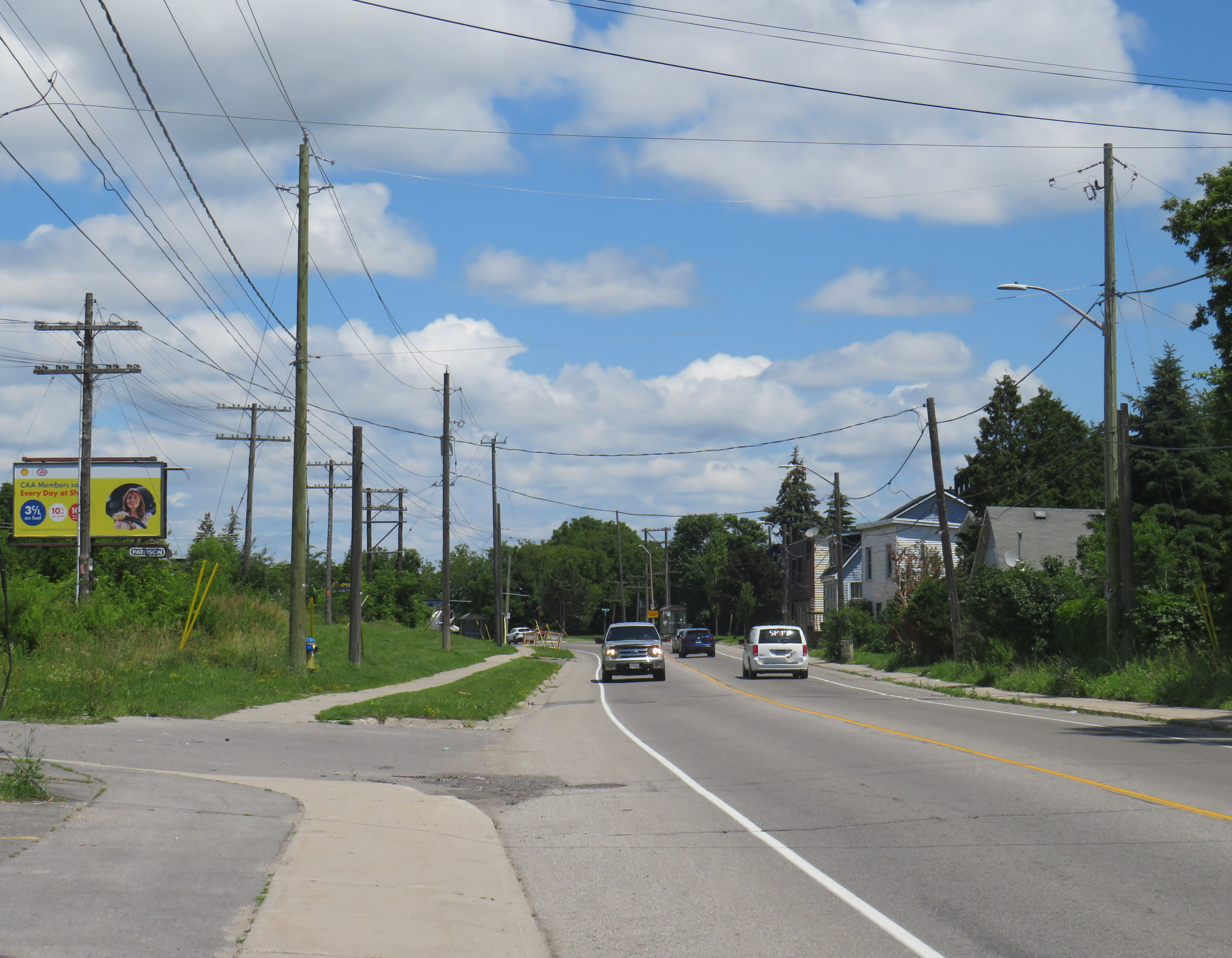
Montreal Street near the old station. The old railway telegraph lines at left betray the old railway route
An opportunity for a new station
Happily, there’s an ideal place for a larger Kingston Station between the old Montreal Street and the newer John Counter Road site that could serve as a proper multimodal hub while being somewhat more convenient to Downtown Kingston and Queen’s University: Division Street. I alluded to this in an earlier post, but after a recent visit, it appears that this is an excellent opportunity.
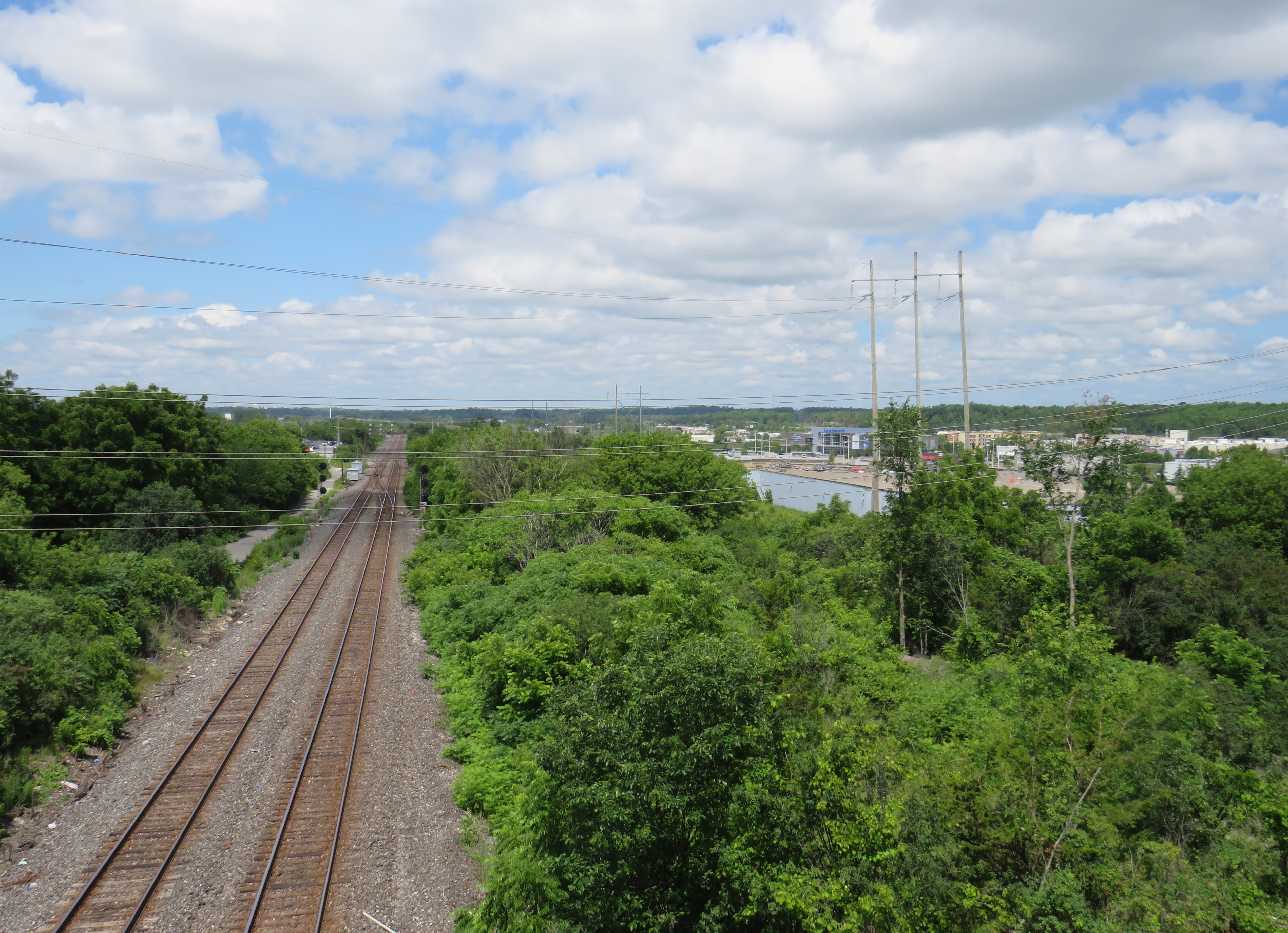
Looking west from Division Street over the CN mainline. The wooded area immediately to the north (right side) offers plenty of room for a new intermodal station.
The CN mainline passes under a long overpass at Division Street that was built in the 1970s not only to cross the CN line but also a Canadian Pacific-owned branch line that once ran between Kingston’s waterfront and Renfrew, near the Ottawa River. The additional room allocated for the now-abandoned CP branch could easily fit two VIA-exclusive tracks, separate from through CN freight trains. This would allow VIA trains to sit overnight, and provide early-morning service to Toronto, Montreal, and Ottawa leaving on schedule. If the Alto HSR takes over the bulk of the through passenger traffic, Kingston will have an excellent regional hub that will serve Eastern Ontario rail passengers far better than the status quo, with more reliable schedules and the opportunity for late night arrivals.
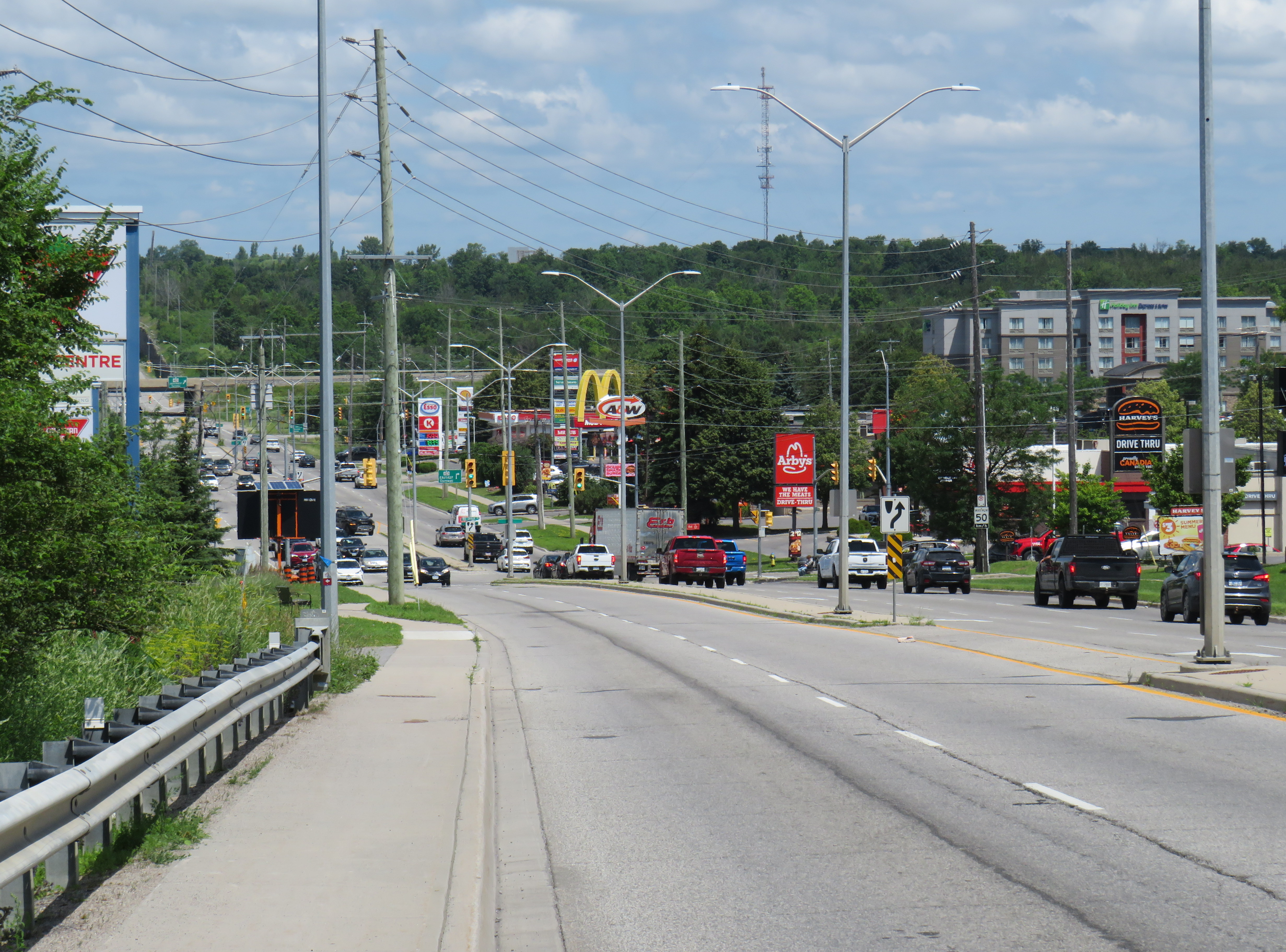
Looking north from the Division Street railway overpass towards Highway 401.
Another advantage of the Division Street site is the proximity to Highway 401. This would allow intercity and regional buses to easily exit and enter the intermodal station. As Division Street continues south towards Downtown Kingston and Queen’s University and is already a major Kingston Transit corridor (with direct and regular service on Routes 1, 2, and 701/702 express, as well as other nearby routes), it’s a logical focal point that can consolidate the various intercity bus stops.
Back in June, Alto announced that federal transport minister Steven MacKinnon directed the consortium to “…develop a plan to assess a southern route option between Peterborough and Ottawa that includes a potential stop in Kingston that would interconnect with VIA Rail services, subject to technical feasibility and project requirements.”
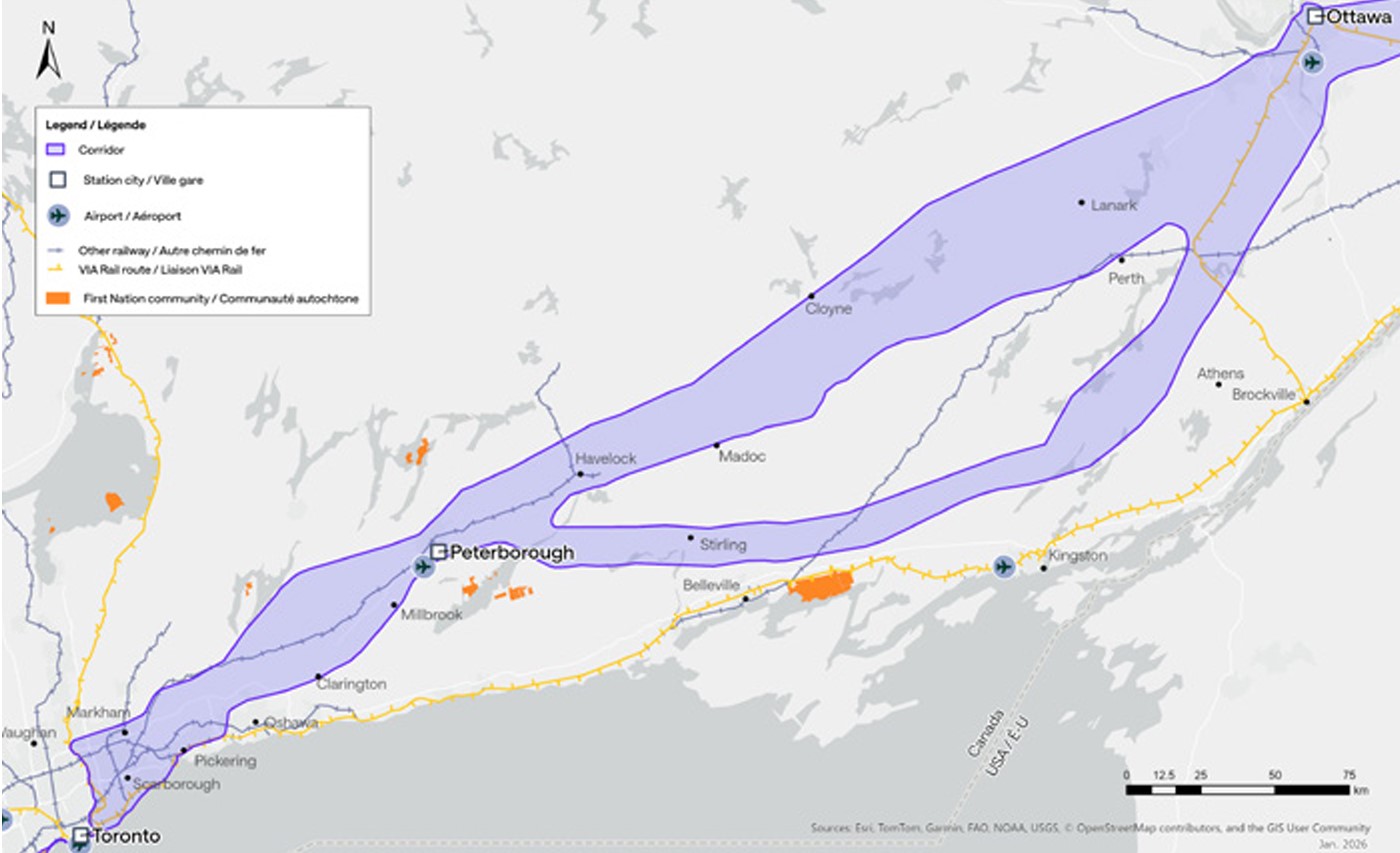
Previous conceptual maps showed the proposed southern alignment located far from Kingston’s urban area, with the closest potential station locations in sparsely-populated South Frontenac Township near the communities of Verona, Sydenham, or Perth Road, at least 20-30 minutes north of Kingston’s urban area by car. If Alto were to serve Kingston properly, it would have to swing much further south, adding to construction costs and through travel times. A spur line into Kingston might make more sense, then, just as the Grand Trunk did 170 years ago.
The time savings to Montreal, Toronto, and Ottawa with a high speed line from Kingston might be better provided with a new conventional railway station and more flexible, reliable service to meet the needs of communities like Kingston, Belleville, and Brockville, rather than forcing Alto farther south. Division Street offers that opportunity.
Extensions to Montreal’s REM has resulted in some regional route changes in the Montreal area
In time for summer, I have updated my Canada Intercity Transportation Map to include new connections and revisions. The only major changes to the intercity coach layer are new routes operated for Flixbus, including new seasonal routes from Toronto to North Bay and Prince Edward County.
In Quebec, the opening of the Deux-Montagnes and Anse-à-l’Orme branches of the REM in Greater Montreal resulted in several long-distance Exo regional bus lines cut back or replaced in favour of local bus routes feeding into the new regional rail service. Therefore, I have decided to remove Exo bus routes from the map where they exist entirely within one or two urban transit zones, being consistent with the municipal transit agencies surrounding Toronto. However, long-distance express routes and routes that serve Montreal’s outer periphery will remain on the map as part of the regional route layers.
In addition, I have also included a few new and previously overlooked services operated by the MRCs (municipalités régionale de comté), including taxibus service areas, which operate similarly to on-demand transit elsewhere in Canada, but have posted stops and semi-fixed schedules; many of these require preregistration before reserving a ride. Where taxibus services operate, I have opted to include those as on-demand, rather than fixed route lines to be consistent across Canada. Only on-demand and taxibus services that are open to the general public are included in the map.
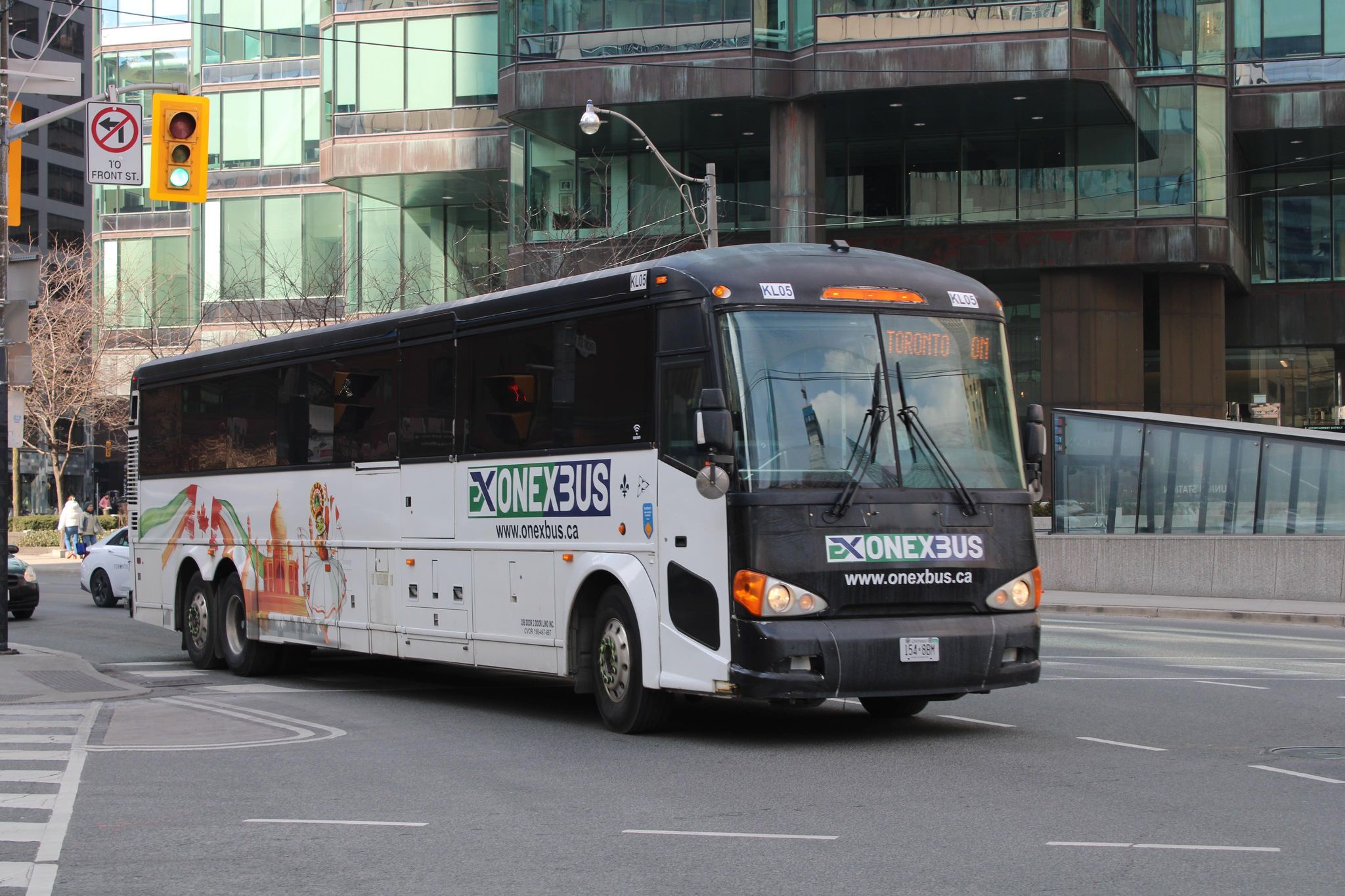
Onex Bus changed its schedules recently, eliminating most departures from Brampton Gateway
Mapping smaller intercity coach operators continues to be challenge, as deregulation in Ontario and Western Canada and online ticketing have made it harder to track changes in schedules and stop locations, though I have noted some changes with Onex Bus’ schedules, which ended most trips to and from Brampton Gateway Terminal at Main and Steeles earlier this year.
Previously, carriers like Greyhound would publish detailed schedules that were valid for at least a few months at a time, including holiday and school break special runs; Ontario Northland and Quebec-based carriers (where provincial regulation remains in force) at least maintain consistent schedules. As it is much harder to track this industry — with no central database — I always appreciate the contributions website visitors provide by email or social media. I thank everyone who has helped so far.
Unfortunately, the costs of maintaining this website and the ArcGIS Online portal to my maps continue to rise. However, I am committed to provide an ad-free, paywall-free resource. If you enjoy my work, please consider buying me a coffee to help with those costs. Thank you!
On June 30, 2026, the Toronto Starfeatured a story about the City of Oshawa’s “lofty plan” to build a new urban aerial gondola system above Simcoe Street, that community’s main north-south corridor. While the technology is novel, it is a fundamentally bad idea for what the regional government proposes it for. Simcoe Street is currently served by the busiest bus route in Durham Region – Route 901 Pulse – as well as several GO Transit buses (routes 52, 56, and 92).
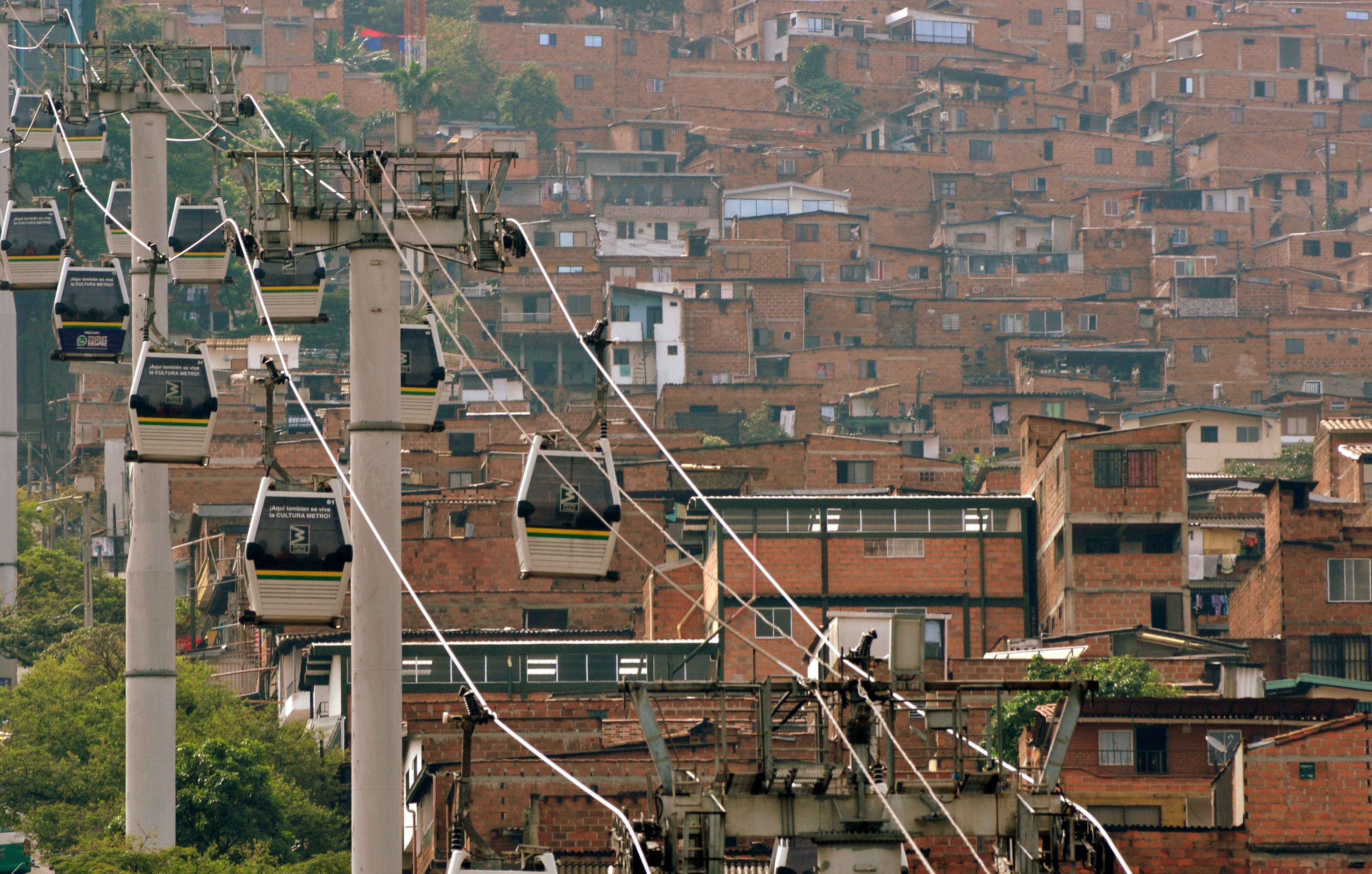
Gondolas have their place in the urban transit toolbox and they have several advantages. They can be inexpensive to build, as they require minimal right-of-way acquisition and do not require tunnelling. They are adept for climbing steep hills and can offer very frequent service with low operating costs. Gondolas can operate in all sorts of weather conditions, from tropical cities to mountain ski resorts. Modern gondola or cable lift operations allow each car to slow or stop at each station to allow passengers to comfortably board and alight, unlike older, traditional ski lifts. The technology is popular in Latin American cities such as Medellín, Colombia (where the Metrocable system feeds that city’s metro), and La Paz, Bolivia, where a network of Mi Teleférico lines makes up the backbone of the transit service.
But in those hilly cities in developing countries, the gondolas cover short distances (only between two and five stations per line) and have limited capacity (Mexico City’s Mexicable line has an hourly capacity of just 3,000 per hour). In the United States, the only transit-based aerial cable cars are the Roosevelt Island Tramway in New York and the Portland Aerial Tram, which charges a very high $9 round-trip fare to the general public. In Canada, the most serious gondola proposal would connect Simon Fraser University with the Skytrain in Burnaby, BC and be part of the Translink network. That proposal – though stalled – is logical as it involves just two stations and allows passengers to easily access the university campus located at the top of Burnaby Mountain, reducing the number of buses that have to climb that long, winding access road.
In contrast, the idea of a gondola running over Simcoe Street in Oshawa makes very little sense, and it seems that the concept will not get beyond a consultant’s report. There are far more reasonable alternatives that merit a closer look, including simple painted bus lanes and other “BRT-lite” measures that can benefit both Durham Region Transit (DRT) and GO Transit passengers.
Oshawa’s transit past and future
Simcoe Street, Oshawa’s backbone, has always been the key to Oshawa’s development as an industrial centre; its future opportunities also line the corridor; good transit is essential.
Established as a small village at the crossroads of Kingston Road and Simcoe Street (an early “colonialization road” that connected Lake Ontario with Lake Scugog), Oshawa grew as an industrial centre starting in the 1870s, when Robert McLaughlin’s carriage works moved to expanded facilities in Oshawa to be nearer the Grand Trunk Railway (GTR) and Oshawa Harbour. As more industries followed, a streetcar line, the first component of the Oshawa Railway Company (OR) was built on Simcoe Street in 1895 to connect the burgeoning downtown with the GTR station and harbour to the south. The original Simcoe Street line was built with several freight spurs to allow shippers direct rail access to their properties. Residents could take the streetcar down to Lakeview Park to relax or to beat the summer heat.
As industry grew (the McLaughlin Carriage Works moved into automobile manufacturing starting in 1907, eventually becoming the founding component of General Motors Canada) OR built a new freight-only electric line east of Simcoe Street with direct freight yard connections with the GTR. When the Canadian Pacific and Canadian Northern Railways built new lines through the Oshawa area, the OR connected with those as well. The incomplete Toronto Eastern Railway, a failed interurban line along Kingston Road, provided some use to OR as it provided access to several customers along the TER’s completed section of track.
Though buses replaced passenger service on the single-track Simcoe Street streetcar line in 1940, OR’s freight operations remained busy until the 1960s, with the last electric locomotive withdrawn in 1964. Oshawa’s bus service was taken over by Durham Region Transit in 2006.
When GM opened a modern assembly complex south of the new Highway 401 in 1950, it slowly abandoned its older plants north and west of the downtown core. Its new property had direct CN and CP rail connections and no longer relied on the OR. Meanwhile, other factories such as A.G. Simpson, Duplate/Pittsburgh Plate Glass, Fittings Limited, Ontario Malleable Iron, and Pedlar People, either closed or stopped relying on rail shipments. The old OR tracks, operated by CN diesels in the last few decades, disappeared in the 1990s, replaced by the Michael Starr multi-use trail north of Highway 401. The last remnant of the Oshawa Railway, a Highway 401 overpass built in the late 1930s, was demolished in 2011.
After OR removed its remaining downtown trackage in the 1960s, a one-way road system was implemented in Downtown Oshawa. Simcoe Street became northbound-only between Brock and Elm Streets with Centre Street taking on southbound traffic. King Street was twinned with Bond Street, which followed the disused Toronto Eastern Railway tracks. This helped to speed traffic through the downtown core.
Many of the older industrial lands saw new uses: Most of the old GM North Plant properties are now home to apartment buildings, the Durham Regional Courthouse, and a big box retail complex anchored by Costco Wholesale. The Pedlar People plant was demolished to become a Zellers-anchored plaza on Simcoe Street South. The Ontario Malleable Iron factory became a Knob Hill Farms supermarket which operated between 1981 and 2000. That plant, now mostly demolished, is to be the site of a new GO Transit station; surrounding property, including the old PPG plant, is designated for future development.
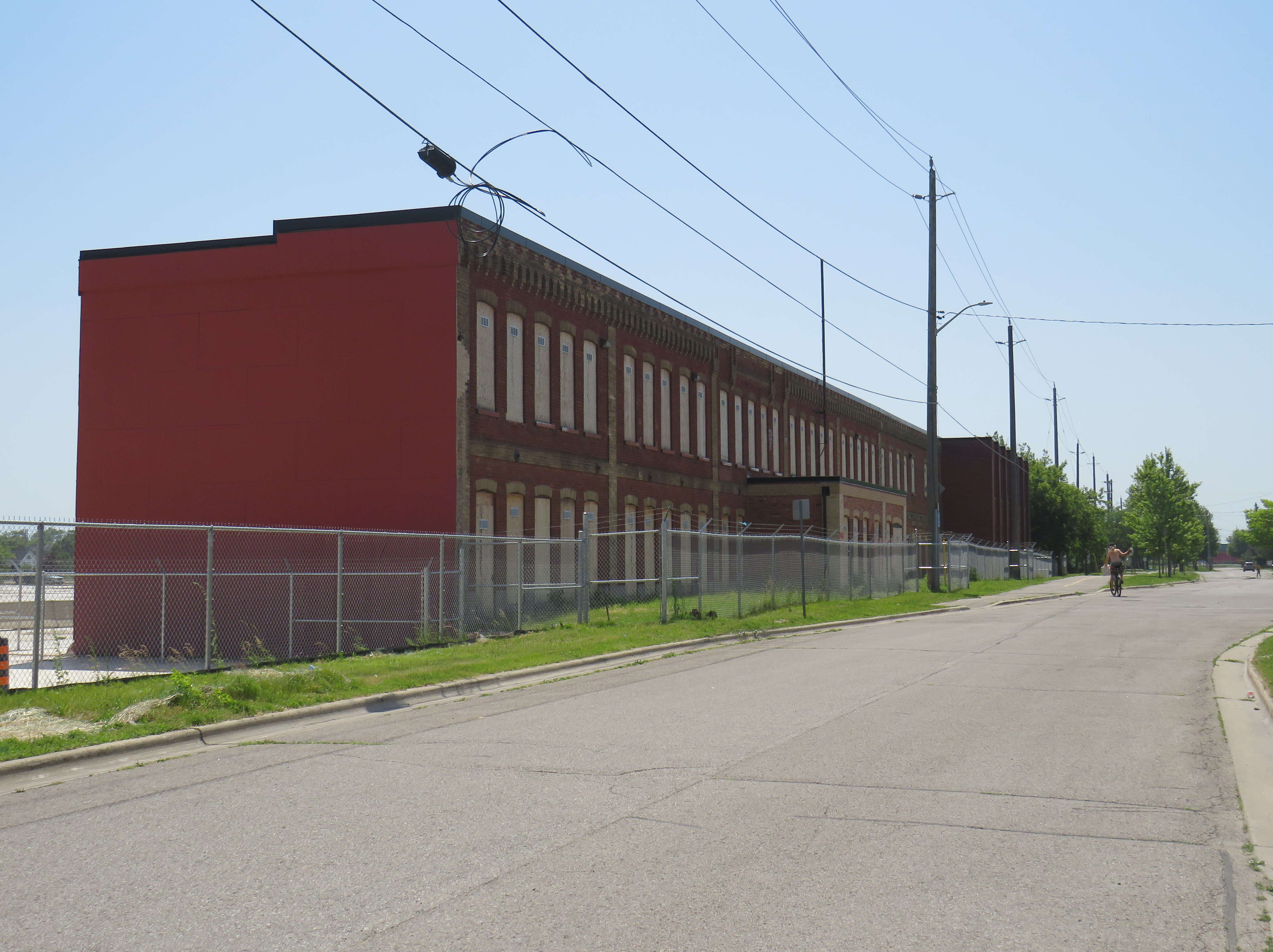
Facade of the old Ontario Malleable Iron factory, later Knob Hill Farms
The construction of Highway 401 and changes to intercity rail also changed Oshawa considerably. As Toronto grew and GM’s influence began to decline, Oshawa became part of the metropolitan commutershed. CN closed the old GTR station off Simcoe Street and built a new modern station between Oshawa and Whitby in 1967, consolidating passenger service for those two communities at a single location with space for commuter parking. Though GO Transit was also established that year, its trains only went as far east as Pickering; GO bus service via Highway 401 and via Highway 2 extended the provincial agency’s reach to Oshawa until 1995, when the Lakeshore East line was fully extended to Oshawa.
Map of Oshawa’s transit past and possible future, highlighting the old Oshawa Railway streetcar and freight tracks, connecting railways, and major Oshawa institutions. The proposed route of the gondola along Simcoe Street is highlighted in green. Click image for full size.
With the decline of General Motors’ Canadian operations along with many of its feeder plants, Oshawa’s economy shifted towards education and government services while becoming more of a Toronto suburb rather than an independent industrial centre. The downtown hockey arena/entertainment venue, which opened as the General Motors Centre, is now named for Tribute Communities, a residential developer. Durham College’s campus, on the north end of the city, has grown and now includes Ontario Tech University. Between the campus and downtown is the main Lakeridge Health campus, which is the largest hospital in Durham Region.
As Oshawa and its postsecondary educations have continued to grow, it is no wonder that Durham Region Transit’s 901 Simcoe Street bus – the successor to the old Oshawa Railway streetcar – is so busy and congested. But a gondola is not the right solution, either.
Why better buses are the answer
Typical traffic on Simcoe Street at Adelaide Avenue, near the famous Parkwood Estate and Lakeridge Hospital
As Metrolinx starts work on the Bowmanville GO Transit expansion – which will extend the Lakeshore East rail corridor into central Oshawa and eastward into Clarington – it is replacing the Simcoe Street bridge over the CPKC tracks, a two-year project that has forced the closure of Oshawa’s main street south of downtown. Most north-south traffic now follows Ritson Road, Park Road, or Stevenson Road. Though traffic is heavier on each of those alternatives (especially on Ritson), Oshawa is coping without experiencing complete gridlock.
Metrolinx construction on the replacement Simcoe Street Bridge
Ideally, when the Simcoe Street bridge reopens in late 2027 or early 2028, two of its lanes could be dedicated to DRT and GO buses. These bus-only lanes can then extend northwards towards Downtown Oshawa, Lakeridge Hospital, and Durham College/Ontario Tech. As some of Oshawa’s most important destinations, such as the Oshawa Centre shopping mall and the Oshawa GO/VIA Rail station, are off Simcoe Street, buses can divert on and off the bus lanes to serve those, and other, trip generators; a gondola would not be able to do so.
As the Bowmanville extension of the Lakeshore East GO service will see limited service (peak-direction train service during rush hours and limited off-peak runs) along with a low-speed diversion from the GO corridor to the CPKC line, many passengers connecting to GO towards Toronto would still choose to transfer at the main GO/VIA station.
As the planned new Oshawa Centre GO Station is located on the old Malleable Iron/Knob Hill site two blocks east of Simcoe Street, a gondola would have to swing over to serve it or force a long walking transfer. Depending on how bus service on Simcoe Street is planned by DRT, buses could either divert to serve it, or a dedicated route could provide that connection.
Furthermore, the former Oshawa Railway lands can be better utilized for active transportation purposes. Though the Michael Starr trail runs all the way from Lviv Boulevard (just north of Highway 401) to Taunton Road, it is treated as a recreational trail, rather than a vital transport link. At most crossings, east-west motor traffic is prioritized over pedestrians and cyclists, with “stop and dismount” signs at many trail crossings. There is also a considerable gap between Bruce Street south of Downtown Oshawa and Adelaide Street to the north, as the OR followed Bruce Street and Ritson Road to serve GM’s north plant.
Creating a high-quality through cycling path using part of the OR/Michael Starr right-of-way and improving the existing bike lanes on Mary Street through Downtown Oshawa and extending it to Durham College/Ontario Tech can divert some DRT passengers between the future GO station, the downtown, the hospital, and the campus, and get at least a few car drivers to switch to active transport modes.
Michael Starr Trail, built on the old OR right-of-way. Note the yellow “stop and dismount” signs.
If built, Oshawa’s 13-kilometre, 16-station gondola line would be the longest urban aerial transit route in the world and while it might allow for the retention of four lanes of traffic on Simcoe Street, land would still be required to build the towers, stations, and maintenance facility. Buildings will still have to be demolished. The gondola’s capacity would be limited. The estimated $1.1 billion spent on gondola towers, stations, and vehicles could be much better spent.
Once better bus and active transportation infrastructure is provided, Oshawa might find that the fears of Simcoe Street gridlock may not come to pass. An expensive median busway is not necessarily the answer either: simple reserved lanes, enhanced bus stops with off-board fare payment and all-door bus boarding, signal priority and queue-jumps at busy intersections could do a lot in the short term. Yes, that would mean inconvenience for drivers, but the Metrolinx construction on Simcoe Street south is already an inconvenience.
Unfortunately, the costs of maintaining this website and the ArcGIS Online portal to my maps continue to rise. However, I am committed to provide an ad-free, paywall-free resource. If you enjoy my work, please consider buying me a coffee to help with those costs. Thank you!
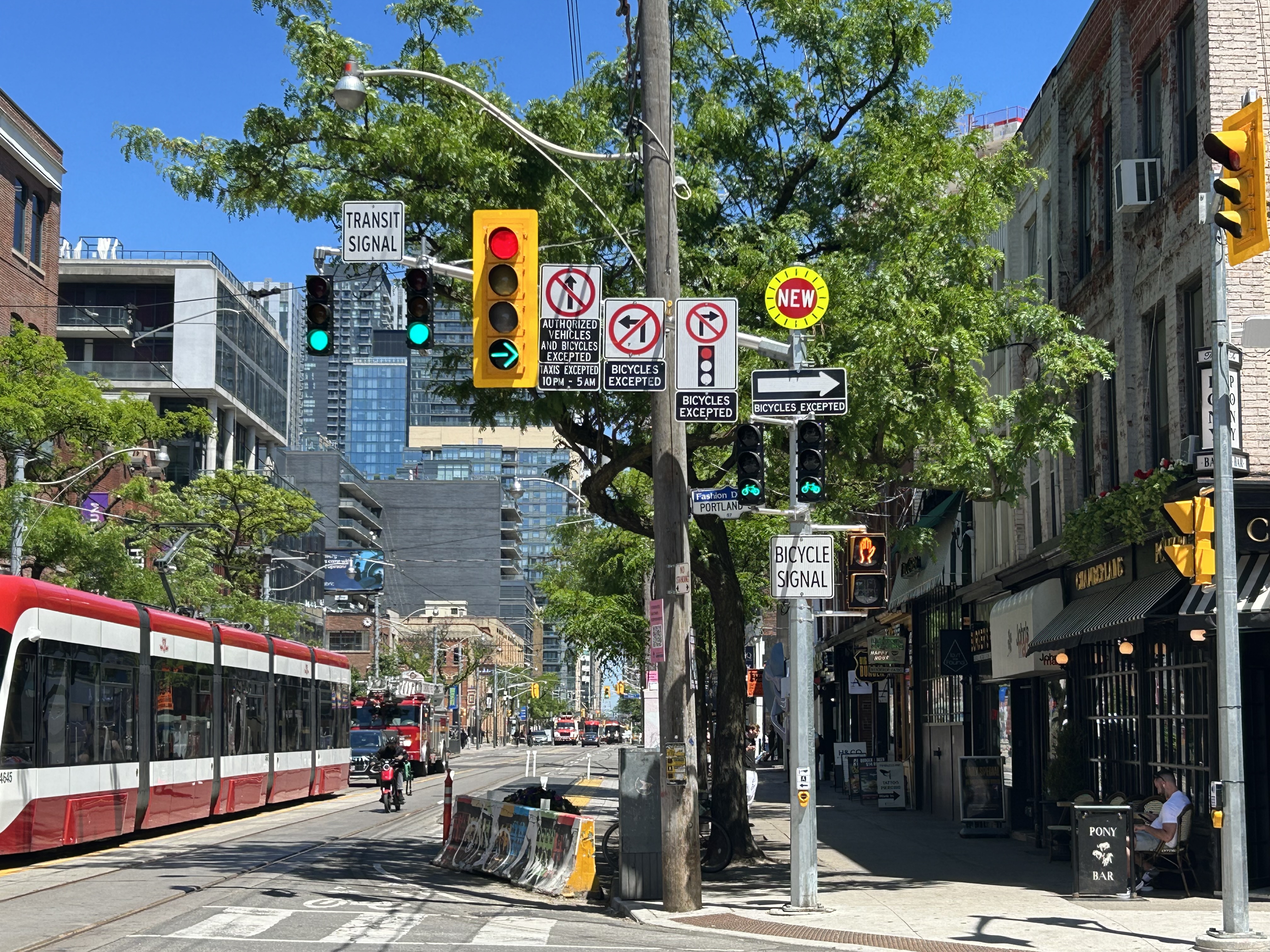
A mess of signs and signals on King Street West at Portland Avenue
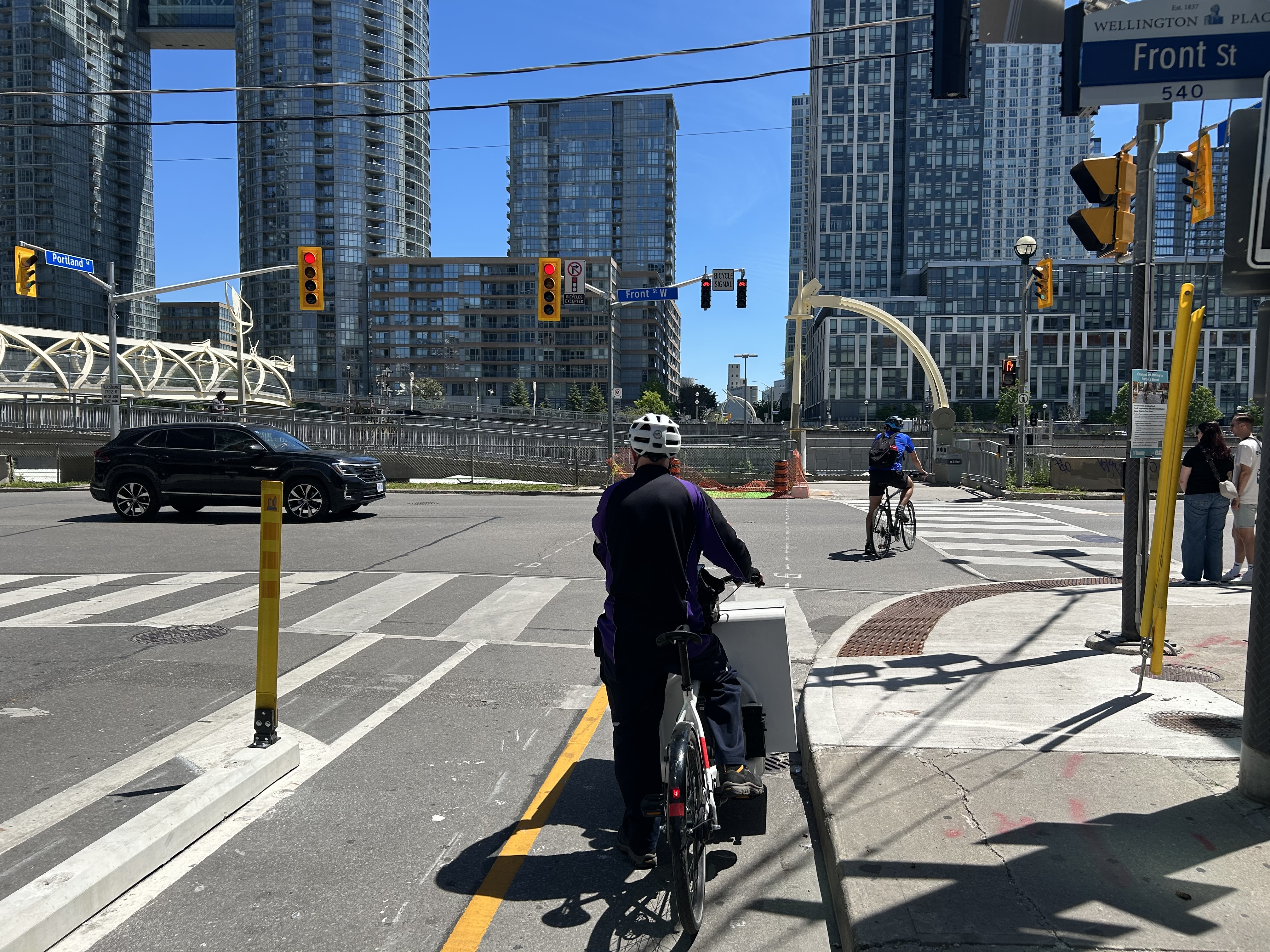
On a lovely weekday afternoon in early June, I went for a ride through Downtown Toronto to check out the changes to Portland Street between Richmond Avenue and Front Street. This side street, just west of the downtown core, connects the busy Richmond-Adelaide cycle tracks with the Puente De Luz walking/cycling bridge across the Union Station Rail Corridor to CityPlace and via Dan Leckie Way to the Waterfront.
While the City of Toronto is currently restricted in adding new cycling lanes on major corridors, it continues to piece together alternative routes where possible; Portland Street, which parallels congested Spadina Avenue and Bathurst Street, is one of those opportunities. A new two-way cycle track was opened while most of Portland Street itself is now one-way for motorists.
Looking south at the end of Portland Street towards CityPlace and the ramp to the Puente De Luz Bridge (bridge at far left)
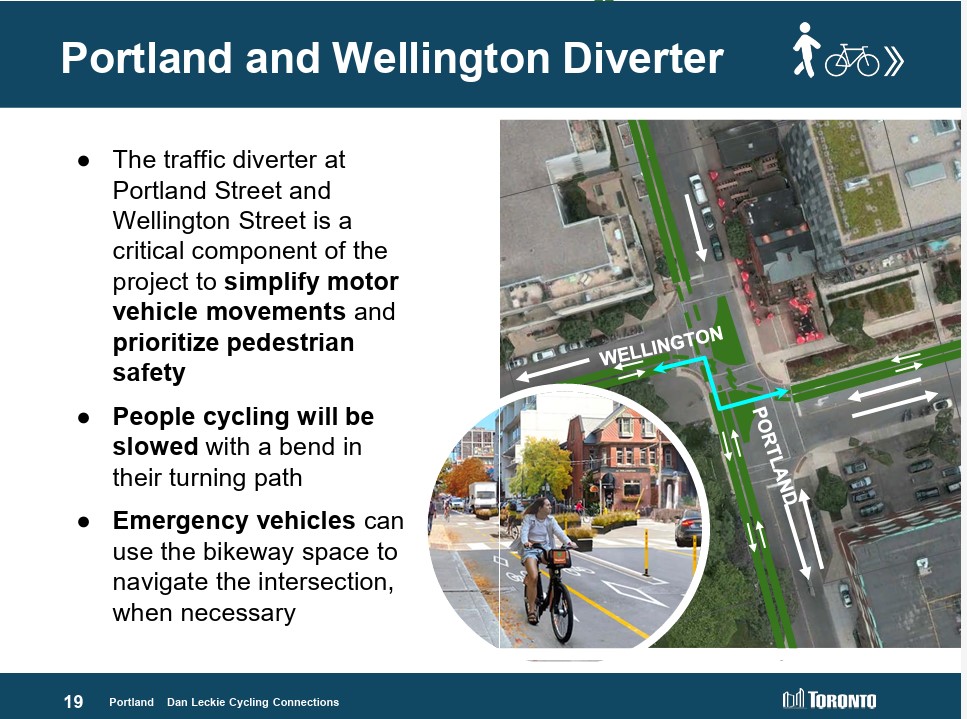
At Portland and Wellington Streets, an interesting new traffic alignment diverts motor traffic around the complex intersection while permitting through cyclist and pedestrian movement on all sides, improving safety for all road users. On Portland Street northbound and southbound, drivers are required to turn right onto Wellington maintaining local access while discouraging through drivers. This new layout, complete with Muskoka chairs laid out in the middle of the intersection is unusual for Toronto and is more common in cycling-friendly cities such as Montreal. Emergency vehicles can still pass through, following the cycling paths.
Wellington Street is a designated east-west cycling route connecting the Downtown Core and west end neighbourhoods like Parkdale and Liberty Village and will eventually hookup with an extension of the West Toronto Railpath. Together with increased density in the downtown area, this intersection will only get busier with cyclists and pedestrians in the future.
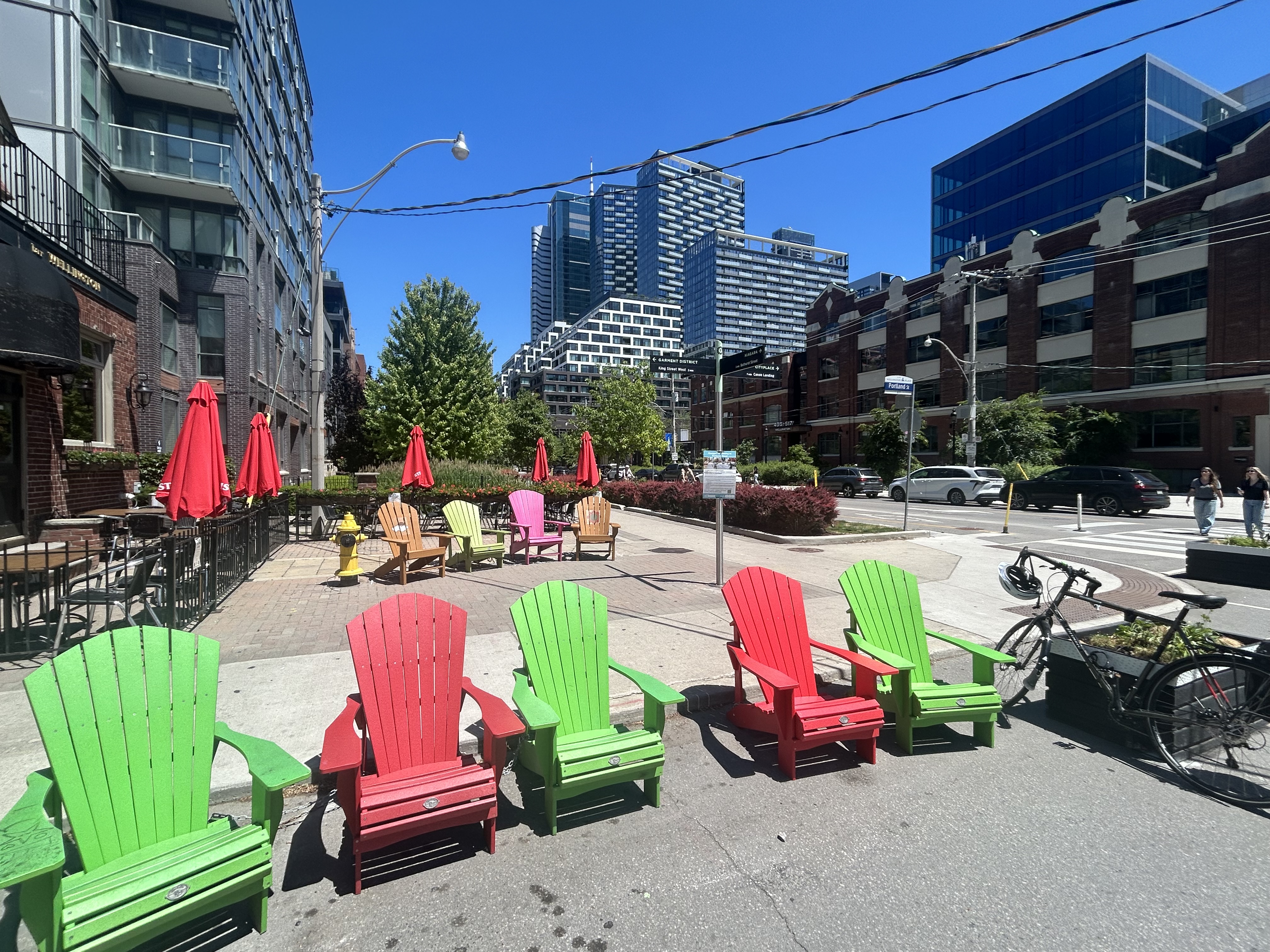
Portland looking north at Wellington. Motorists must turn in one direction from Wellington or Portland, opening up the middle of the crossing to a four-way cycling intersection, with planters and colourful Muskoka chairs Comfortable places to sit in the middle of an intersection
Despite the very unToronto urban intervention at Portland and Wellington, a very Toronto intervention continues one block north at King Street. Though the King Street Pilot was launched in November 2017, over eight years ago, little has been done since to improve the street for pedestrians or transit users. To discourage motorists from illegally proceeding through intersections (intended to eliminate congestion for streetcars and buses), the curb lanes are blocked with painted Jersey barriers. More recently, additional traffic lights were installed, so there are now signals for transit, cyclists, motorists, and pedestrians.
At Portland, and every other intersection that drivers are not permitted to go straight (taxi drivers are excepted after 10 pm), the traffic signals remain red at all times. A right green arrow appears for 5-10 seconds at the beginning of the cycle, allowing motorists to turn unimpeded. At Portland, however, eastbound motorists on King may not make a right on red because of the two-way cycle track on the west side of the street. Because of all these restrictions, there are seven signs facing eastbound drivers affixed to the traffic pole, along with two transit signals, one traffic signal, two bicycle signals, and one pedestrian signal.
This could have been clearer
The amount of clutter here can be confusing and is also unsightly. First off, there is no need for the “bicycle signal” sign below the two bicycle signal heads and next to the pedestrian signal. The signal aspects are already clearly for bicycles without the sign. Revising the Ontario Traffic Manual (OTM) to allow red arrows on traffic signals could both simplify the yellow traffic signal here and eliminate the need for the “no right turn on red” sign. It would also be clear then that right is the only permitted sign. Speaking of the OTM, dedicated transit signal aspects such as those used in Europe or even several American cities would eliminate the need for the “transit signal” sign and further reduce confusion. If the late night taxi exception was removed, the “no left turn” and “no straight movement” signs could be consolidated as well.
But most of all, the sign clutter makes it even more clear that the King Street Pilot configuration needs to become permanent, with raised curb extensions at the far sides of each intersection, with a level platform for streetcar boarding. Permanent planters and benches would be a visual cue to drivers that King Street is not a throughfare, but a pedestrian and transit-first corridor.
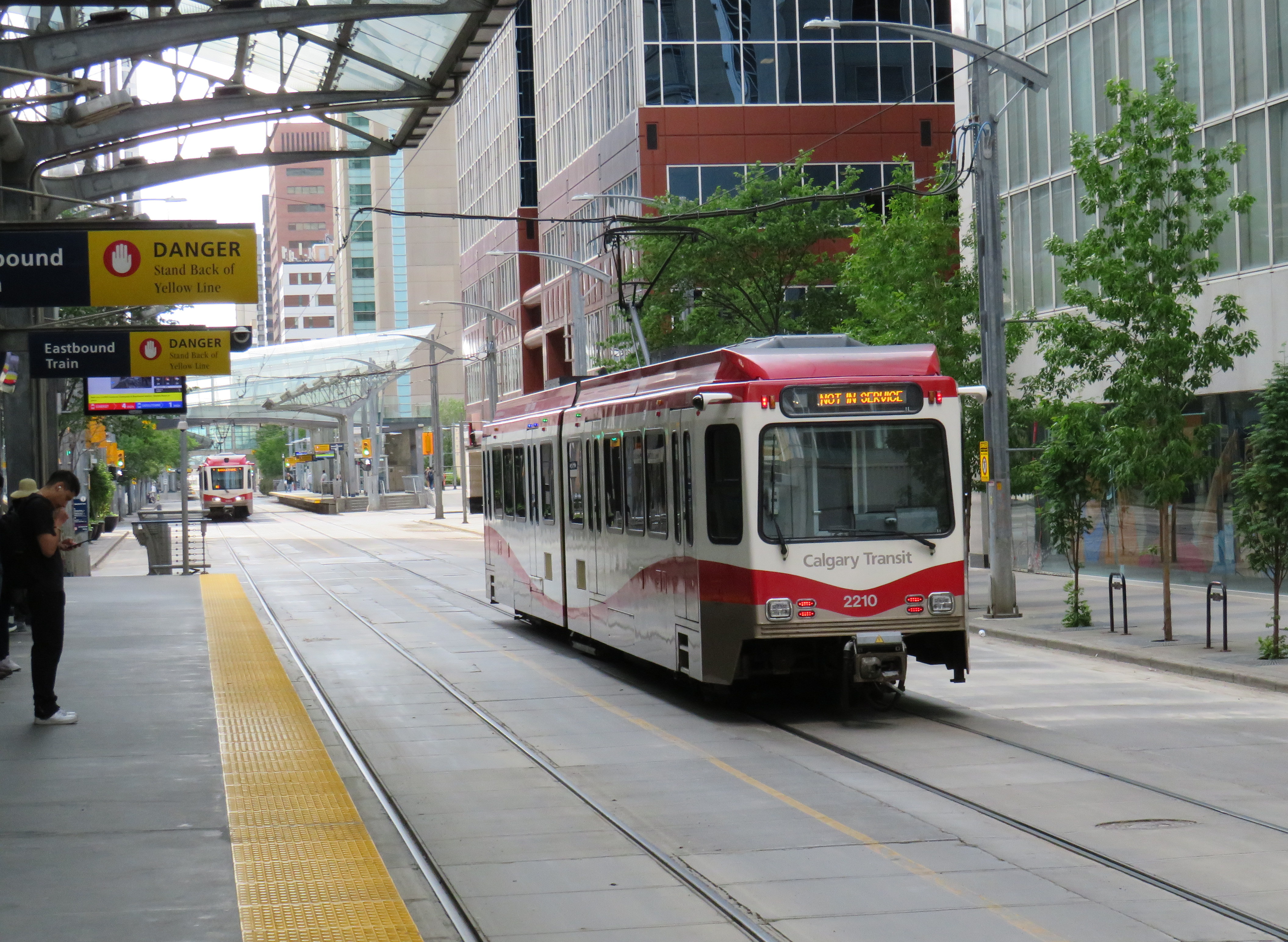
There is a lot less sign clutter along Seventh Avenue in Calgary, which is exclusively a transit and pedestrian corridor
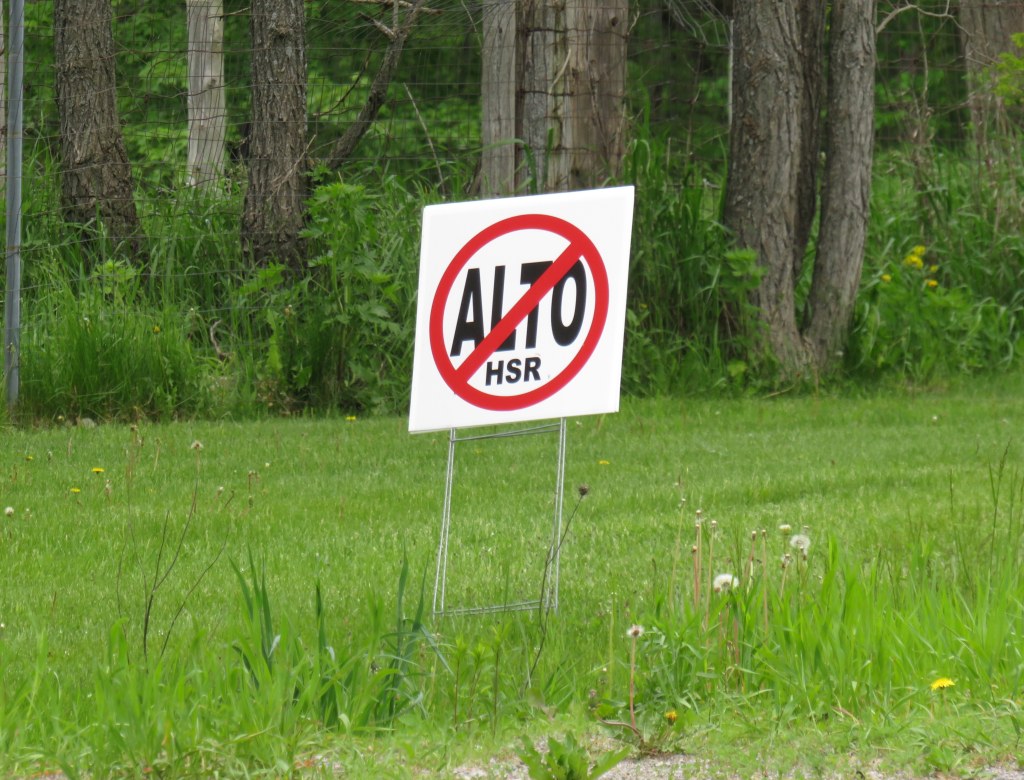
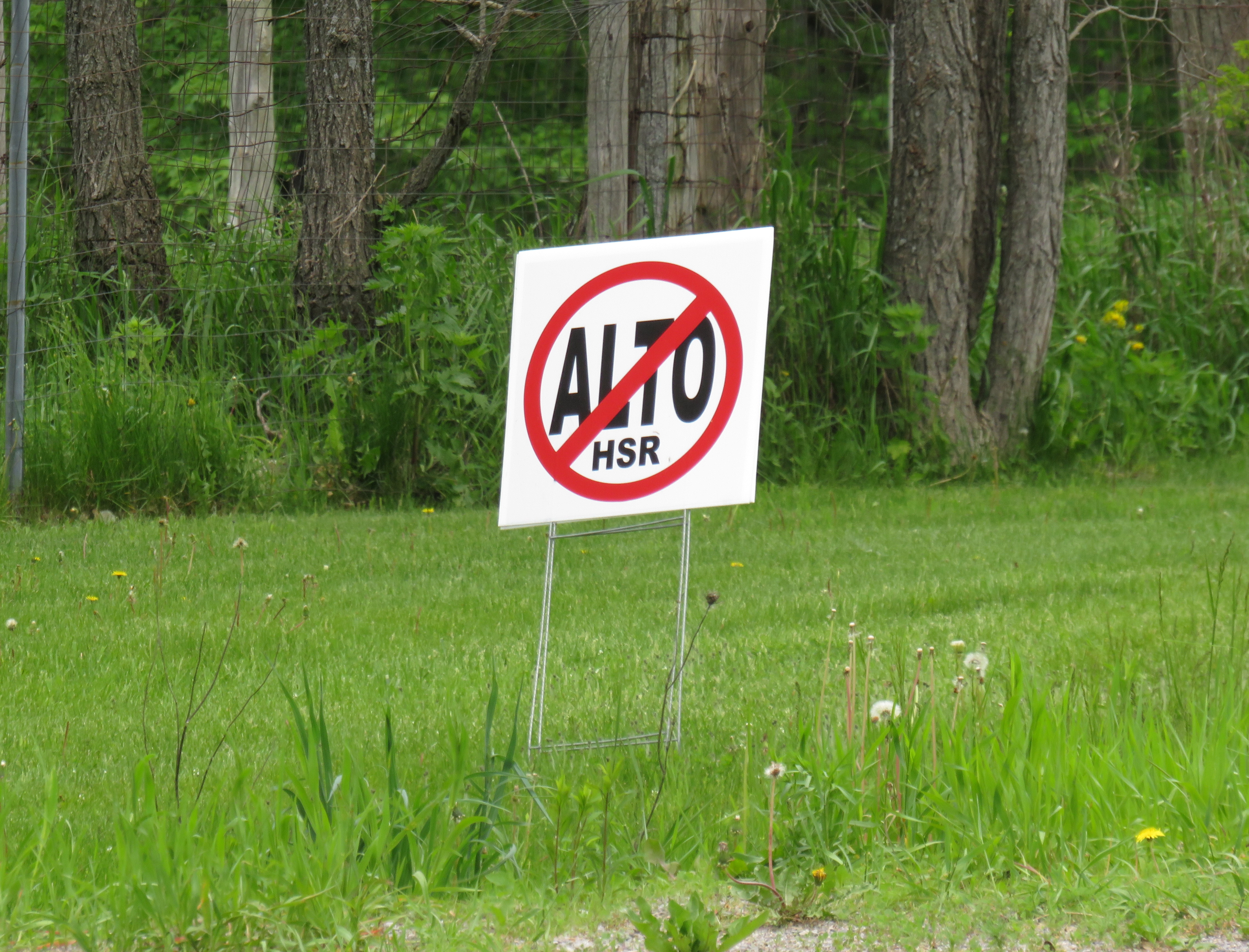
A “No ALTO HSR” sign on a property near Marmora, Ontario
There’s a running joke that Canada leads the world in high speed rail studies, but we never follow through with actually building those high speed lines. Comedian Rick Mercer had at least two sketches on his old weekly CBC television show mocking this state of affairs, as the idea goes back to the 1970s.
“VIA Rail: Yesterday’s speeds, today.”
“Canada’s High Speed Rail Study Industry: The future, never!”
In 2026, however, Canada is finally past the high speed rail study phase and appears to be committed to building the seven-station corridor between Toronto, Ottawa, Montreal, and Quebec City, with a consortium selected that is already planning the detailed route. It’s an exciting time as the first phase, between Ottawa and Montreal, should start construction in three years once the exact corridor is decided upon and land acquisition has begun.
High speed rail, if done right, should benefit Eastern Canada as a whole. Fast and frequent train service will divert a lot of the travel in the busy Toronto-Montreal-Ottawa triangle from the air, reducing emissions and allowing existing airports to handle any increases in long-haul demand. Faster and more reliable passenger train service would also take traffic off the highways and boost commerce within the most populated part of the country. If done right, it will also support plans for better transport infrastructure outside the corridor to Southwestern Ontario and provide Canadian expertise for other projects such as in Alberta, which is contemplating its own passenger rail network between Calgary and Banff and north to Edmonton.
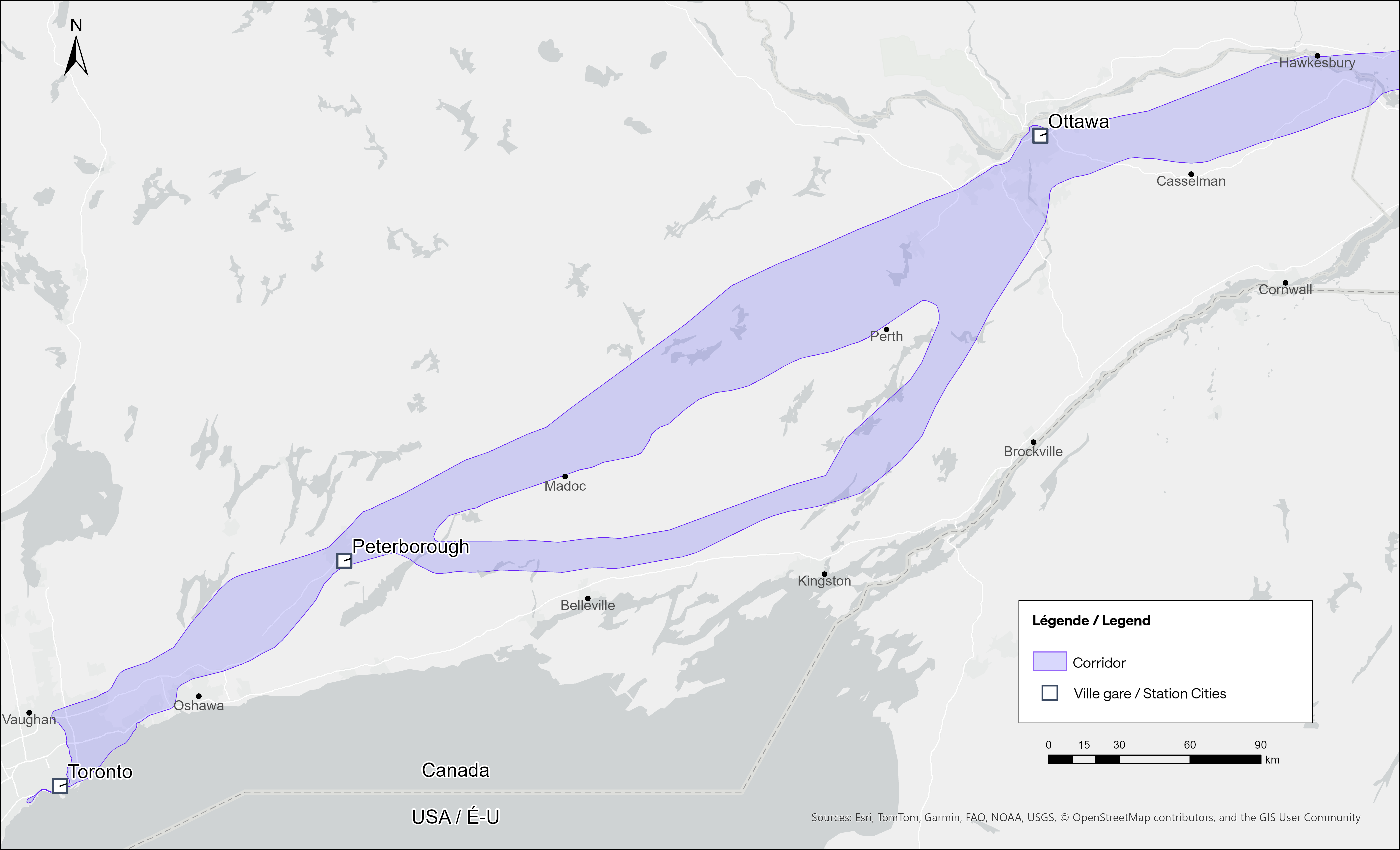
Map of potential routings for the Alto high speed line in Ontario
Not unexpectedly, there is opposition from residents and landowners along the route, especially in Eastern Ontario and the area of Quebec just northwest of Montreal. In Hastings County, north of Trenton and Belleville, there are a few dozen “No Alto HSR” signs on lawns and farms in places like Madoc, Marmora, Stirling, and Tweed. In this part of Ontario, between Peterborough and the Rideau Lakes region southwest of Ottawa, there are two broad potential routes: a southerly corridor runs near Campbellford, Stirling, Tweed, and Westport, including through some productive farmland in Northumberland and Hastings Counties. A second route runs north of Highway 7, just north of Madoc and Perth, along the southern fringes of the Canadian Shield.
Though a high speed railway line would be straight and relatively narrow, it would require the acquisition and severance of hundreds of properties. Along the existing CN and CP railway corridors to the south constructed in the 1850s and 1900s, there are frequent public road and private-access level crossings, something that is not possible with modern high speed trains passing at up to 300 kilometres per hour, so farmers whose land is crossed by the new high speed railway corridor may not be able to access parts of their property easily. Furthermore, there are no stops planned between Peterborough and Ottawa, a distance of over 250 kilometres.
In Prescott & Russell Counties in the Lower Ottawa Valley, even the local governments are opposed to Alto crews doing early survey work to determine an optimum route, with county warden Mario Zanth clear on the matter: “This council does not want them on our territory.” For now, Alto surveying is mostly done by way of drones over land where landowners have not granted access.
Once a more specific route is selected, hopefully some of the opposition will fade. Detailed design work and further consultation should also help mitigate concerns. This is especially important west of Ottawa, where there are the two diverging routes.
Despite the rural opposition, Alto should go ahead. Other major infrastructure projects, especially new highways, can be far more disruptive to local land use. But without local community benefits — at least a new freeway has regular access points — it will be harder to get buy-in.
Therefore, this needs to be a matter of “Alto and” than just “Alto” by itself. This means building and maintaining a supporting network of conventional VIA service, intercity and regional buses, and local transit connections. It might also mean adding a few additional stations along the route, in places such as Perth. Adding additional stops doesn’t have to slow down trains at all; Japan’s Shinkansen has three classes of trains, from the super-express Nozomi to the all-stops Kodama. While most passengers would be through Toronto-Ottawa-Montreal travellers, offering additional stops for select trains can make Alto more accessible to more people, especially if it means providing new options to underserved communities.
An express train passes the local Odawara Shinkansen Station in April 2019
If Alto becomes the backbone of a strong, integrated transportation network in Ontario and Quebec, the benefits will go far beyond those in the six cities directly served the planned high speed line, even to those directly bypassed by Alto trains. This integration is commonplace in Japan and Europe.
In Kingston, for example, a new or upgraded VIA station with additional tracks and platforms would allow for early morning departures and late evening arrivals from Toronto, Ottawa, and Montreal without having to sit on active CN freight tracks overnight; VIA schedules built around serving cities like Belleville, Kingston, and Drummondville would ensure the existing service remains vital as through passengers switch to the faster line. A new Kingston station near Division Street could integrate rail and bus services, with easy access to Highway 401, with local and regional buses to places like Gananoque. Enhanced bus connections to the rest of the Ottawa Valley from the Ottawa Alto/VIA Station could allow travelers from Pembroke, Arnprior, or Hawkesbury to quickly continue their journeys via train. At Trois-Rivières, there should be seamless connections to places like Shawinigan and Victoriaville. The Canada Intercity Transportation Map on this website shows which communities are unserved or underserved by bus and rail: these include many towns in Southern Ontario and Quebec that are within 100 kilometres of the Alto corridor.
Canada is right to invest in high quality and sustainable transportation infrasturure as a nation-building project, to boost the regional and national economy, and promote environmentally friendly travel options. But focusing only on Alto, without a strategy of leveraging the conventional VIA network and intercity bus connections to feed that network, can only limit the success of high speed rail. The communities in between deserve better.
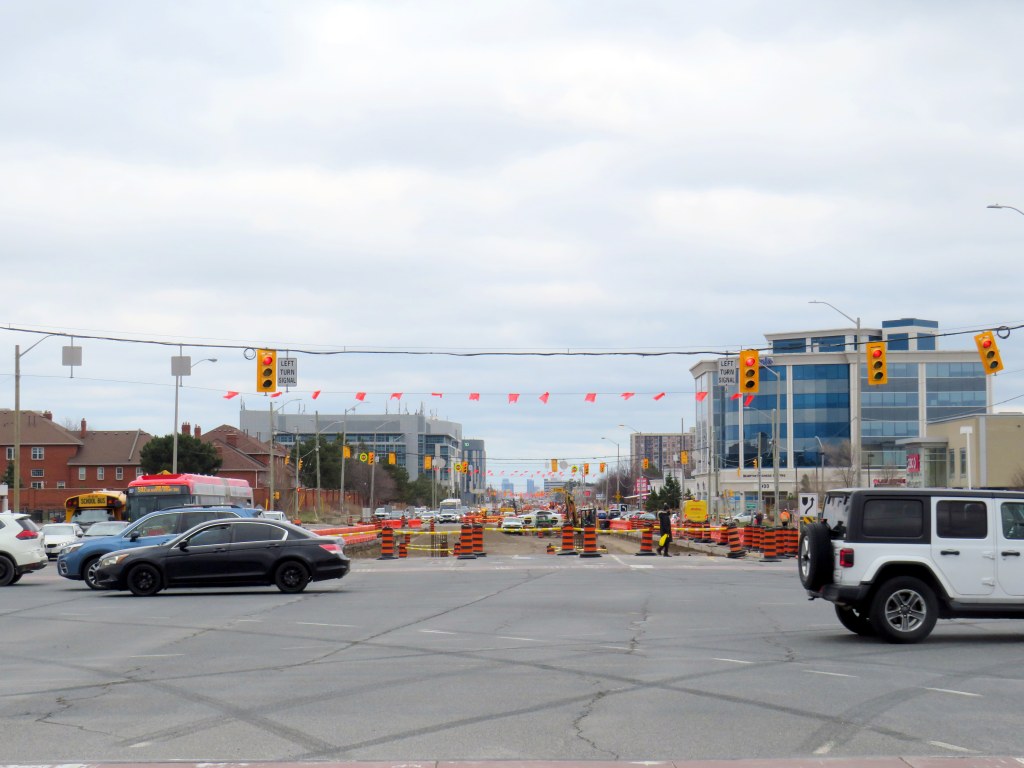
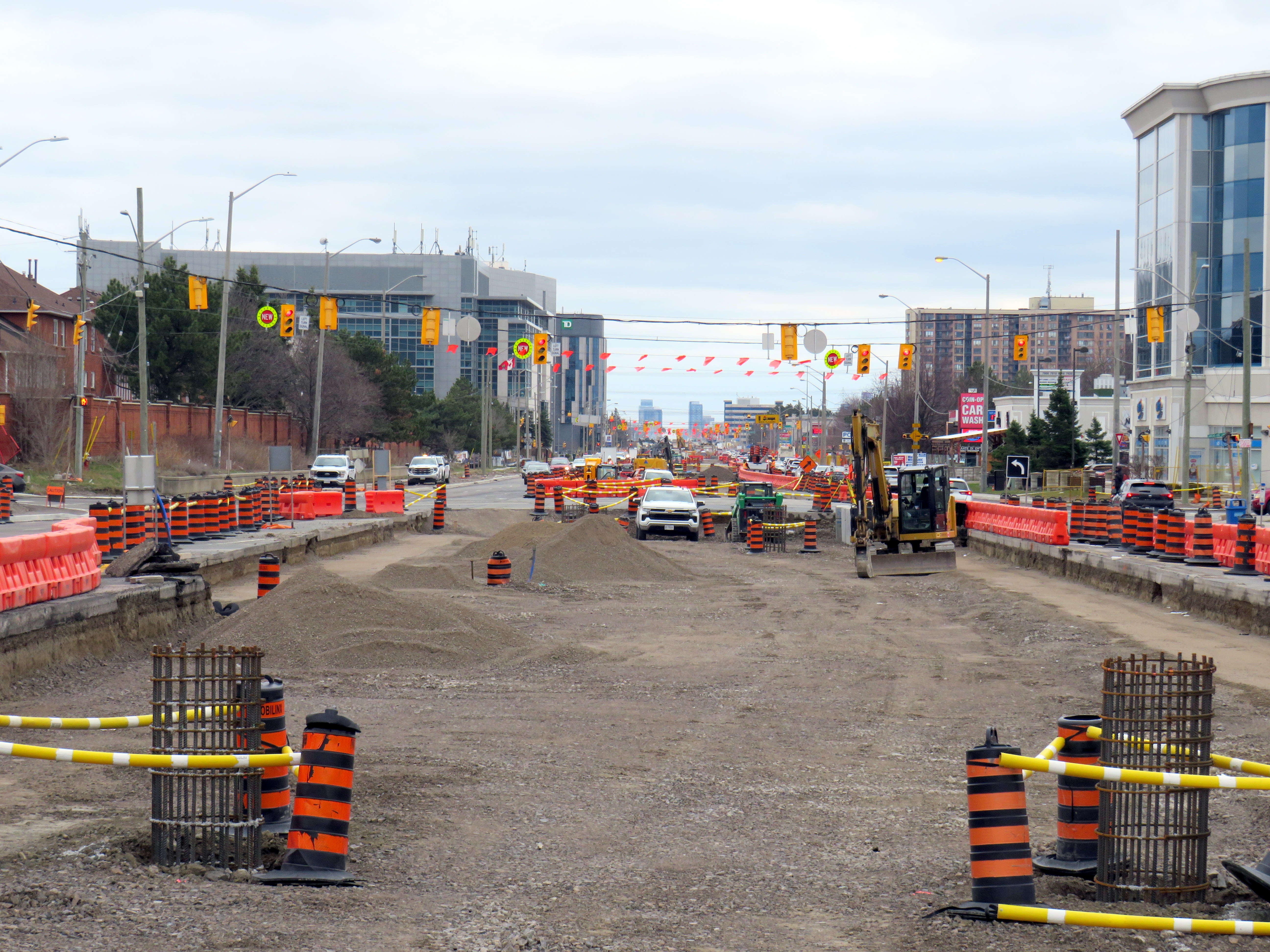
Hurontario Street, looking south from Steeles Avenue, where the first phase of the Hurontario LRT will terminate
The first phase of the Hurontario LRT, which will between Port Credit GO Station and Steeles Avenue in Brampton, is slowly taking shape after years of construction delays. In Spring 2026, eight years since construction started on the corridor, work on the LRT guideway into south Brampton has finally begun.
As I wrote in detail before, a previous iteration of Brampton City Council narrowly voted against the LRT entering downtown as a surface line in 2015. This was the version selected in the provincial environmental assessment. Instead, that council voted to study alternative corridors into Downtown Brampton requiring lengthy detours, and asking for the LRT northern terminus to be on the south side of Steeles Avenue, despite a major bus exchange — Brampton Gateway Terminal — on the north side of the intersection to accommodate all options. After the 2018 election, council recommitted to a Main Street alignment (though preferring a tunnel) and asked the province to restore the terminus on the north side of Steeles pending a decision on the final four kilometres into Downtown Brampton. In early 2026, only one of the six councillors opposed to the Main Street LRT ten years ago remains in office.
I wanted to follow up with Metrolinx to see how pedestrians would be safely accommodated at the Steeles and Hurontario intersection, given high traffic volumes, wide roads, and likely thousands of passengers switching between modes on a daily basis. Early concepts of an underground pedestrian tunnel were rejected by the province as out-of-scope, so pedestrians would have to cross both Hurontario and Steeles to make the transfer. Having no satisfactory answers despite many attempts to get an answer to this question, I took the lengthy and expensive route of submitting a freedom of information (FOI) request.
In summary, I learned that despite multiple requests from City of Brampton officials to restore the north side stop, Metrolinx and the provincial government refused. With the financial close with Mobilinx — the private-sector consortium selected to build, operate, and maintain the LRT — imminent in early 2019, there was no interest to make the minor change to facilitate the terminal, even though the city committed to taking on the cost on its own. The province was open to other changes to the line, however, as in 2022, it unilaterally renamed the line for a former Mississauga mayor and political ally of Doug Ford.
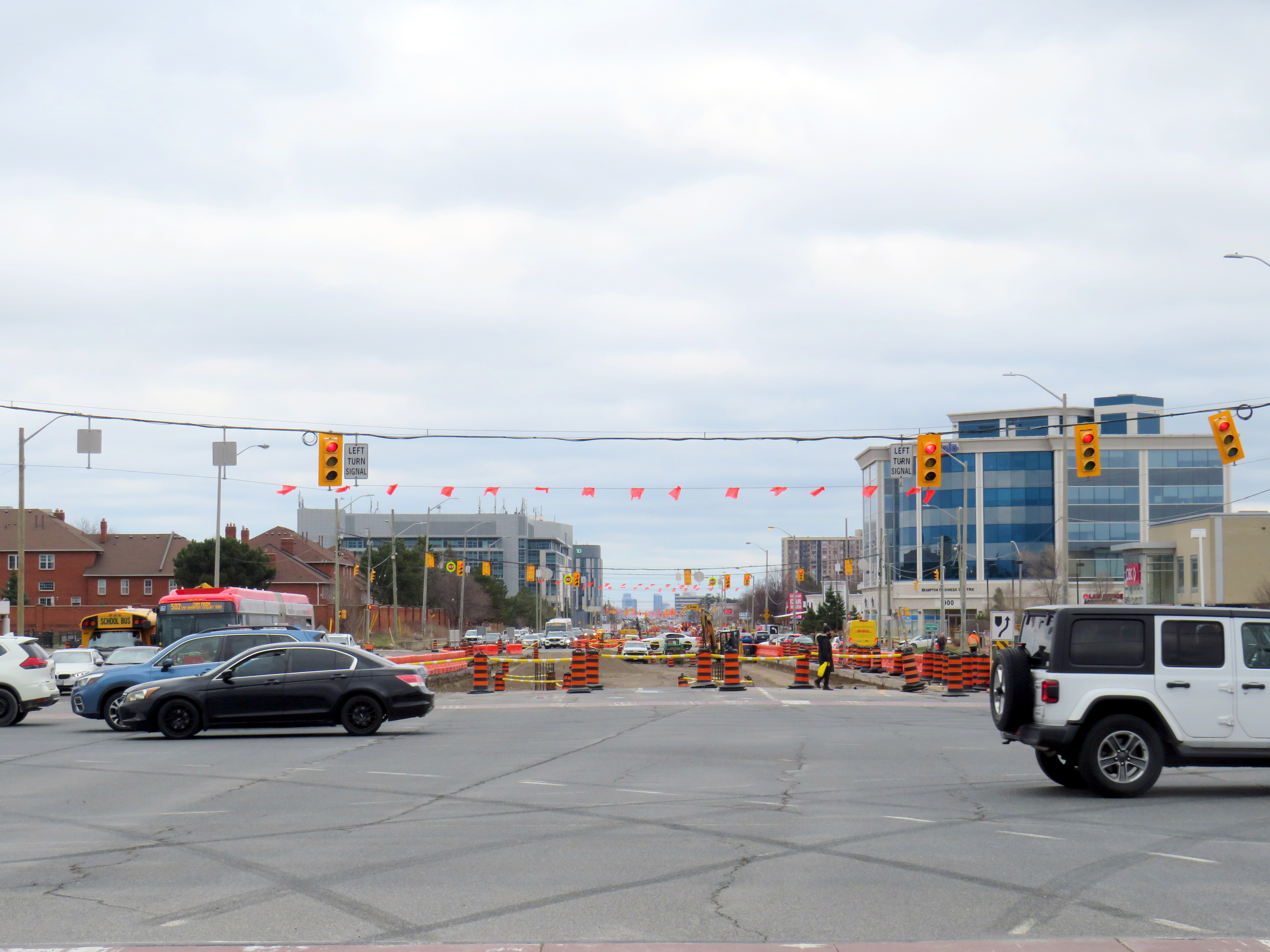
Looking south across Hurontario Street across a very busy multi-lane intersection towards the end of the LRT
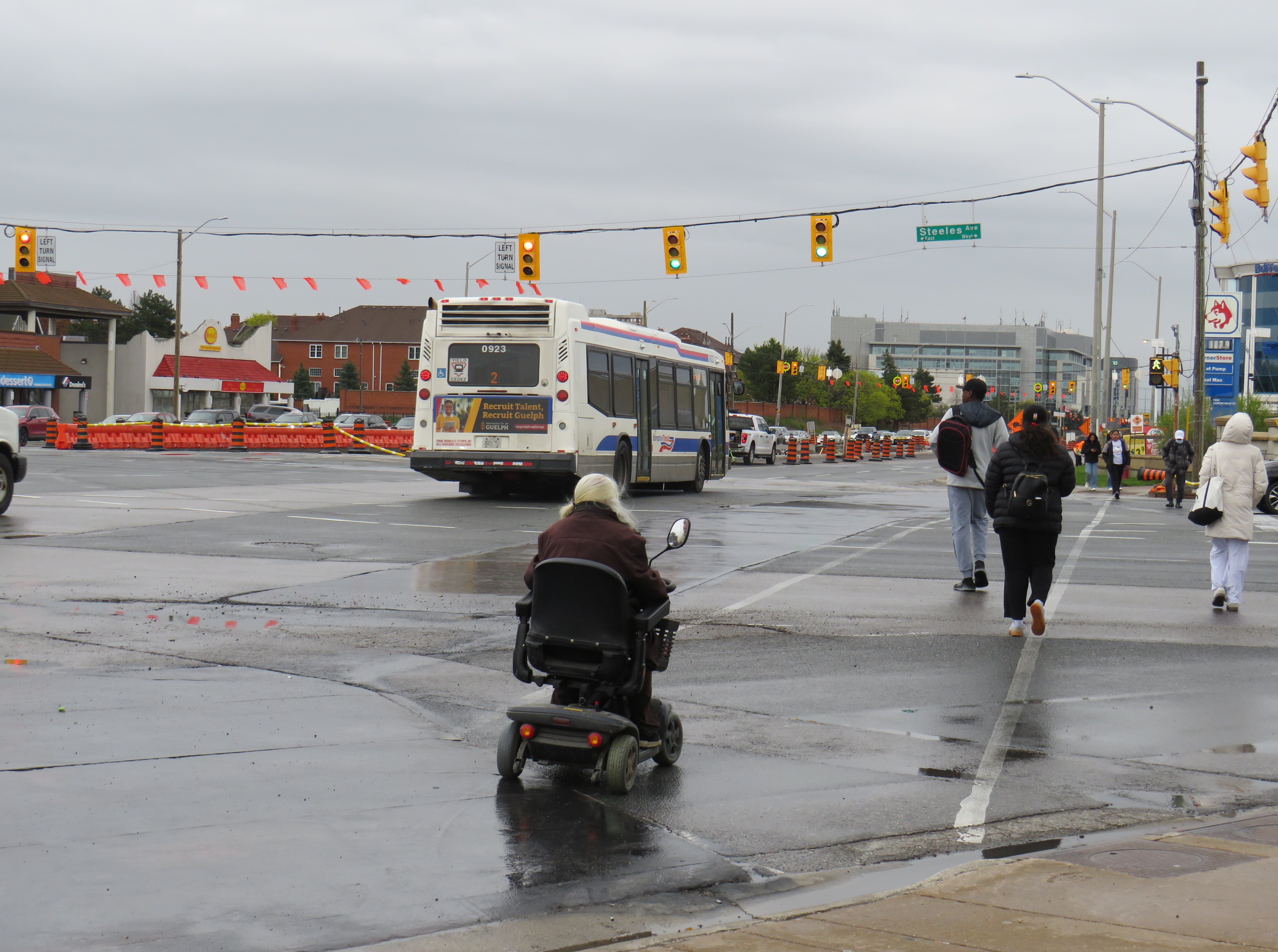
As work at the Steeles-Hurontario intersection is now well underway, it has become visually clear the problem will be once the LRT opens. The population around the Brampton Gateway Terminal area is rapidly growing; a 40-storey condominium tower on nearby Steeles Avenue West is nearing completion, with many more highrise and mixed-use developments planned, including the eventual redevelopment of Shoppers World Mall. Already, there are dozens who cross nine-lane Steeles Avenue hourly; once passengers have to transfer from the LRT to the transit terminal on the northwest corner, there will be hundreds.
Furthermore, once the (now-funded) Phase 2 of the LRT to Downtown Brampton is started, the intersection will have to be torn up yet again to extend the tracks across Steeles and build a new north-side stop. The province’s refusal to do this all at once is baffling, and will likely be much more expensive than if it was done right the first time.
Looking across from Gateway Terminal towards the future LRT terminus on Wednesday, May 6. Already, there are plenty of pedestrians crossing here.
Already, the costs of the current Mobilinx contract have ballooned while construction delays pile up. The Hurontario LRT was originally supposed to open in 2024. In 2025, Mobilinx had to completely rebuild the track intersection at Topflight Drive just south of Highway 407 after track was already laid in 2023 due to construction errors. In February 2026, Global News reported that only 45 percent of the track was laid. Due to delays and problems paying contractors, the consortium’s credit rating was downgraded by Standard & Poor to BBB, which is near junk status.
Given the multiple delays and difficulties building the LRT, work is only now at the point where the dangerous terminal location is being baked in. Even though construction errors are fixed, and the project name changed, Metrolinx has been unwilling to address the safety issue at Steeles Avenue that was raised many times. In the meantime, Metrolinx, Peel Region, and City of Brampton will have to figure out how to mitigate the potential disaster that is now in the making.
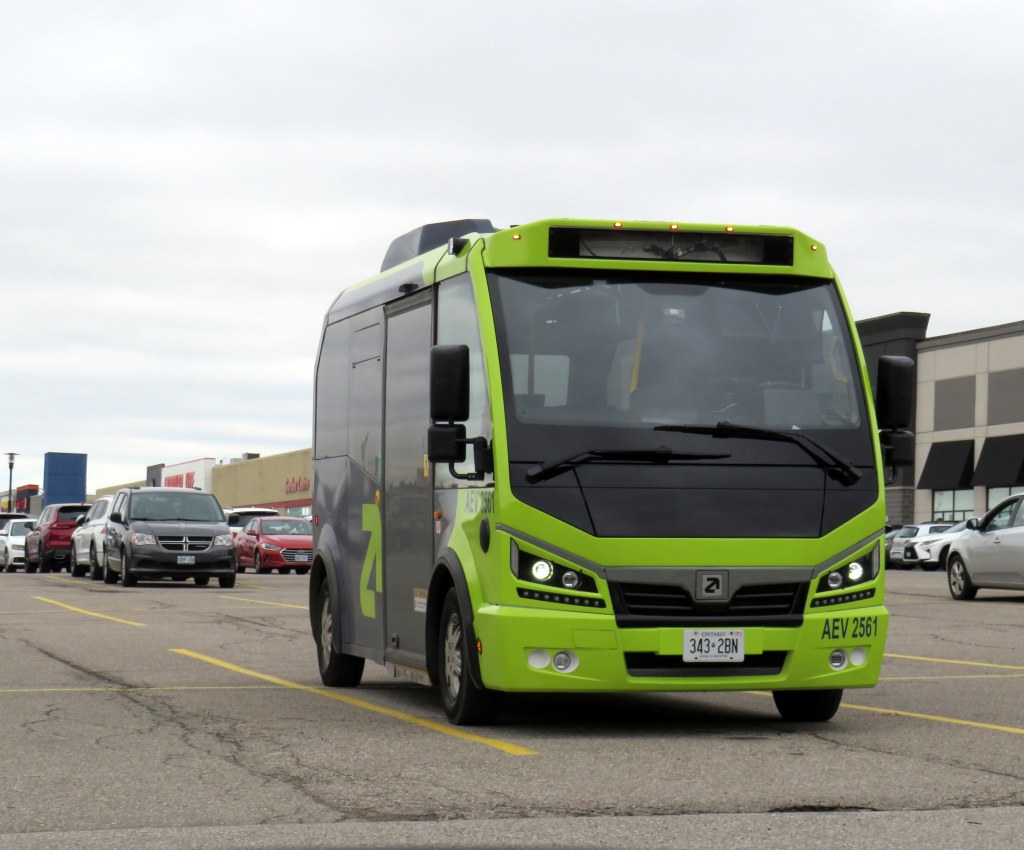
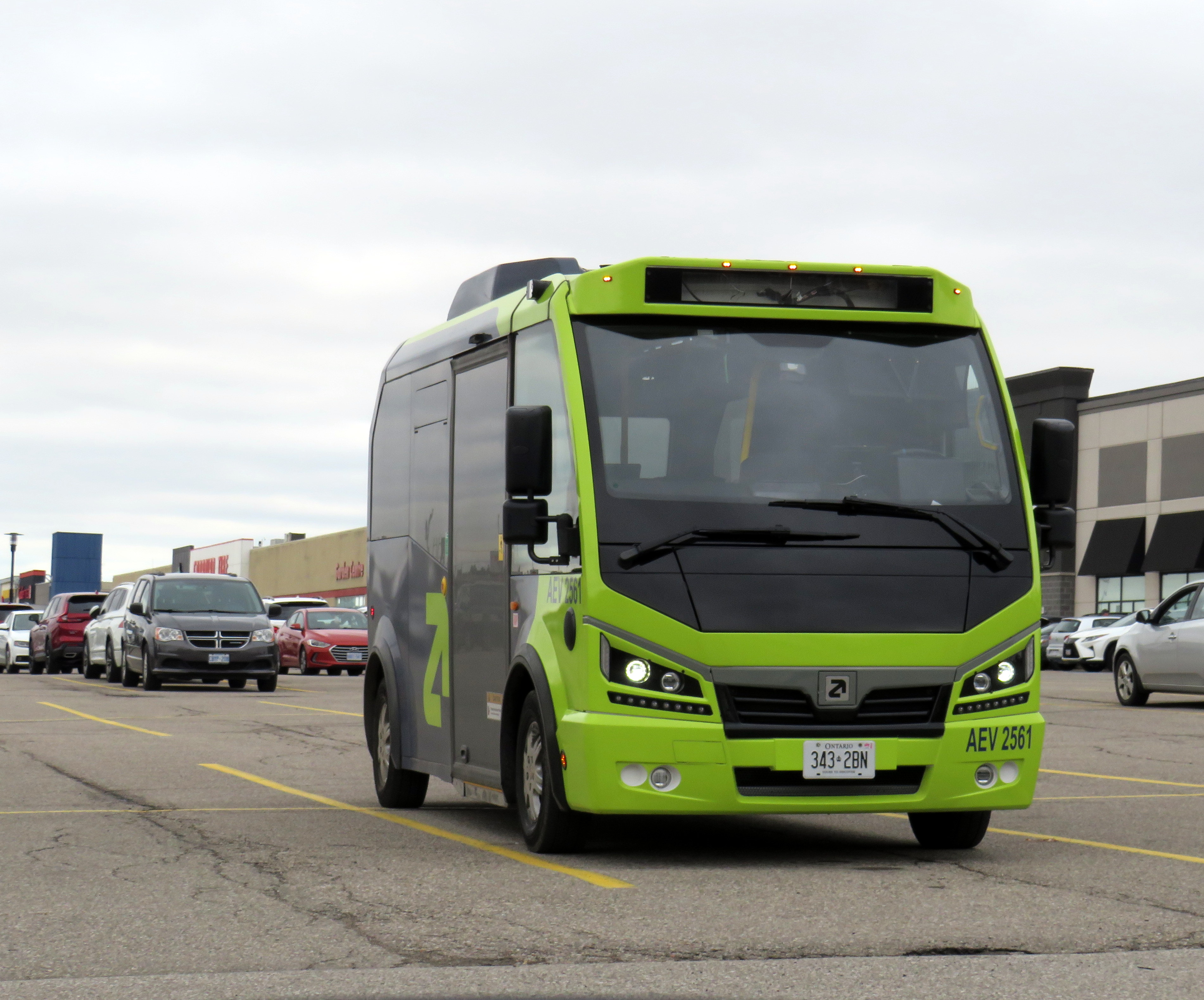
An Argo minibus lays over at Shoppers World Brampton
In an interesting staff report presented to Caledon Town Council, that municipality is planning to enter into a 15-month On-Demand Micro-Transit Pilot Agreement with Argo Transit, a Brampton-based provider of electric minibus services. This new on-demand transit service would replace most of the contracted Brampton Transit services in the Town of Caledon, including Routes 41, which serves Bolton, and 81, which runs along Kennedy Road north of Mayfield Road. Extensions of Route 30 Airport Road and 18 Dixie would continue under Brampton Transit, as they are limited-service extensions directly serving specific employers.
Argo already provides on-demand service in Bradford-West Gwillimbury, replacing a fixed-route service there last year It also operates a supplemental door-to-door on-demand service in central Brampton on top of the fixed route Brampton Transit service. In Brampton, and as expected in Caledon, the same fares at Brampton’s regular service are charged, paid through a Presto card or app.
The benefits for Caledon include new service to and within Caledon East, which is currently without transit, as well as midday, early evening, and weekend service not currently provided through Caledon’s contract with Brampton Transit. The proposed service times will be Monday to Friday from 5:30 AM to 8:00 PM, and Saturday and Sunday from 7:00 AM to 7:00 PM. If implemented, Argo service would begin October 1, 2026.
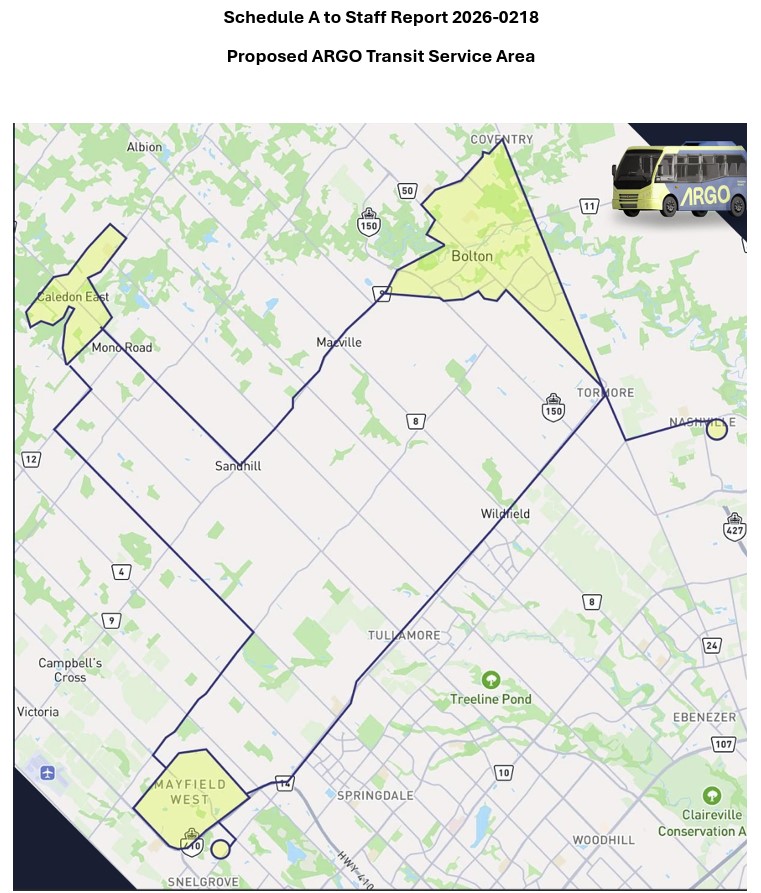
The map, included as an appendix to the staff report, shows connections to Brampton Transit on Mayfield Road and to York Region Transit in Kleinburg.
Map of proposed Argo service areas in Caledon, with connecting links.
There are some questions that should be addressed before October. Currently, Route 41 provides service to employment areas in south Bolton and provides connections to several Brampton Transit and YRT routes at Highway 50 and Queen Street, with easy transfers to the TTC subway in Vaughan and Humber College in Etobicoke. Would Brampton maintain a shortened route to Mayfield Road and Highway 50 that could make this link? Would transfers be permitted to other Brampton Transit routes along Mayfield Road, including Routes 15, 18, and 30, or would stops outside the on-demand areas be restricted to those in the map?
For Caledon, on-demand transit looks like an attractive option to replace Brampton Transit-contracted routes with low ridership and limited service hours. For it to succeed — and even build ridership for new fixed-route service in the future — connections to other transit will be necessary.
Despite population growth, Brampton Transit ridership is in decline
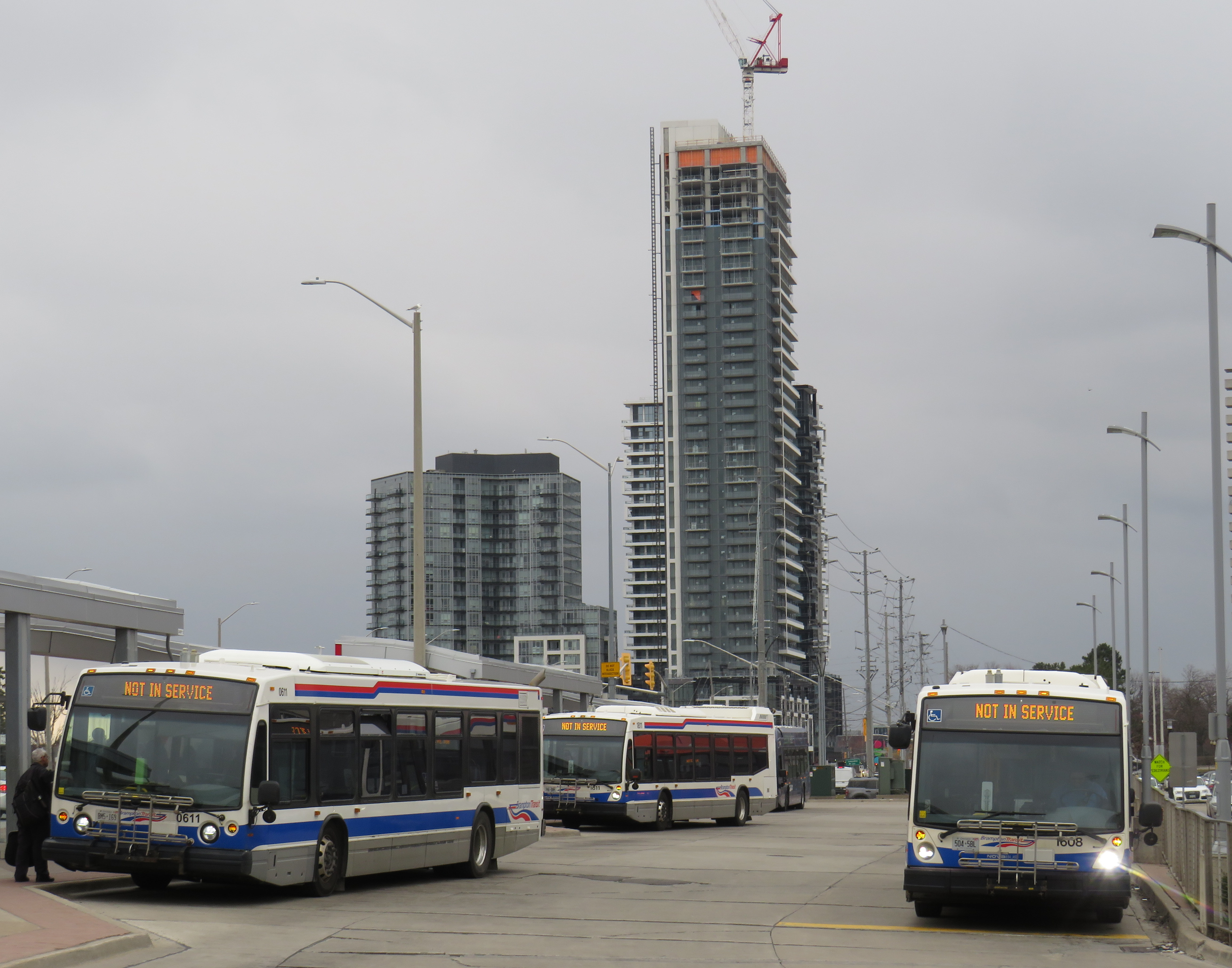
Meanwhile, Brampton Transit, after several years of dramatic ridership growth after the end of COVID-19 restrictions, is cutting back as ridership has taken a sudden dip in 2025-2026. Four minor routes — 33 Peter Robertson, 36 Gardenbrooke, 55 Elbern Markell and 56 Kingknoll — will be discontinued. These four neighbourbood routes provide local service in areas where other routes are within walking distance or operate in the opposite direction, so the effects are minor and the cuts justifiable if it keeps service going elsewhere.
However, Route 5 Bovaird, a major local route between Westwood Mall and Mount Pleasant GO Station, will see significant cuts: in the weekday peak from 13 minutes to 20 minutes and evenings from 30 to 40 minutes, and weekend evenings from every 30 to 50 minutes. The 505 Zum route that parallels the 5 does not operate weekend evenings, resulting in very poor service along the Bovaird corridor during those times.
This is a disappointing setback for transit in my hometown, which up to now has been a model for promoting ridership growth in a suburban edge city. For years, I have wrote about its success in growing demand by operating good service, especially to destinations well beyond its boundaries to places like York University (later the subway terminal in Vaughan), Mississauga City Centre, Humber College, and Pearson International Airport.
It would be very unfortunate if transit were allowed to enter a “death spiral” of ridership decline, fare hikes, and service cuts in response to this dip, largely due to a decline in international student enrollment at colleges and universities. Brampton has shown before that good service, with incremental growth is a great way of boosting ridership. This means operating buses at least every 20-30 minutes at all times on major corridors like Bovaird.