Tag: Hurontario-Main

  • A disaster in the making

    A disaster in the making

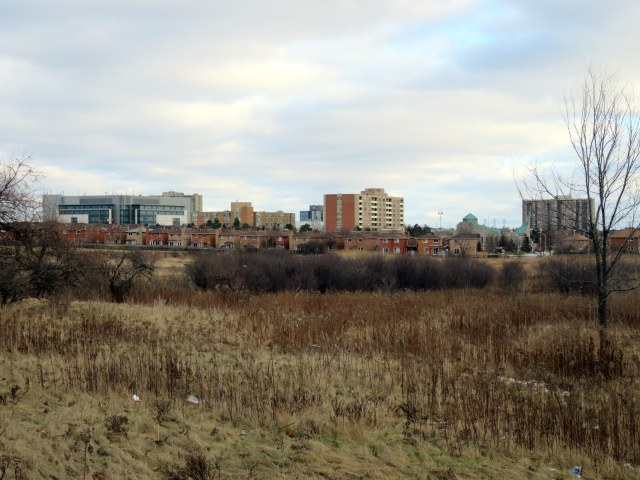
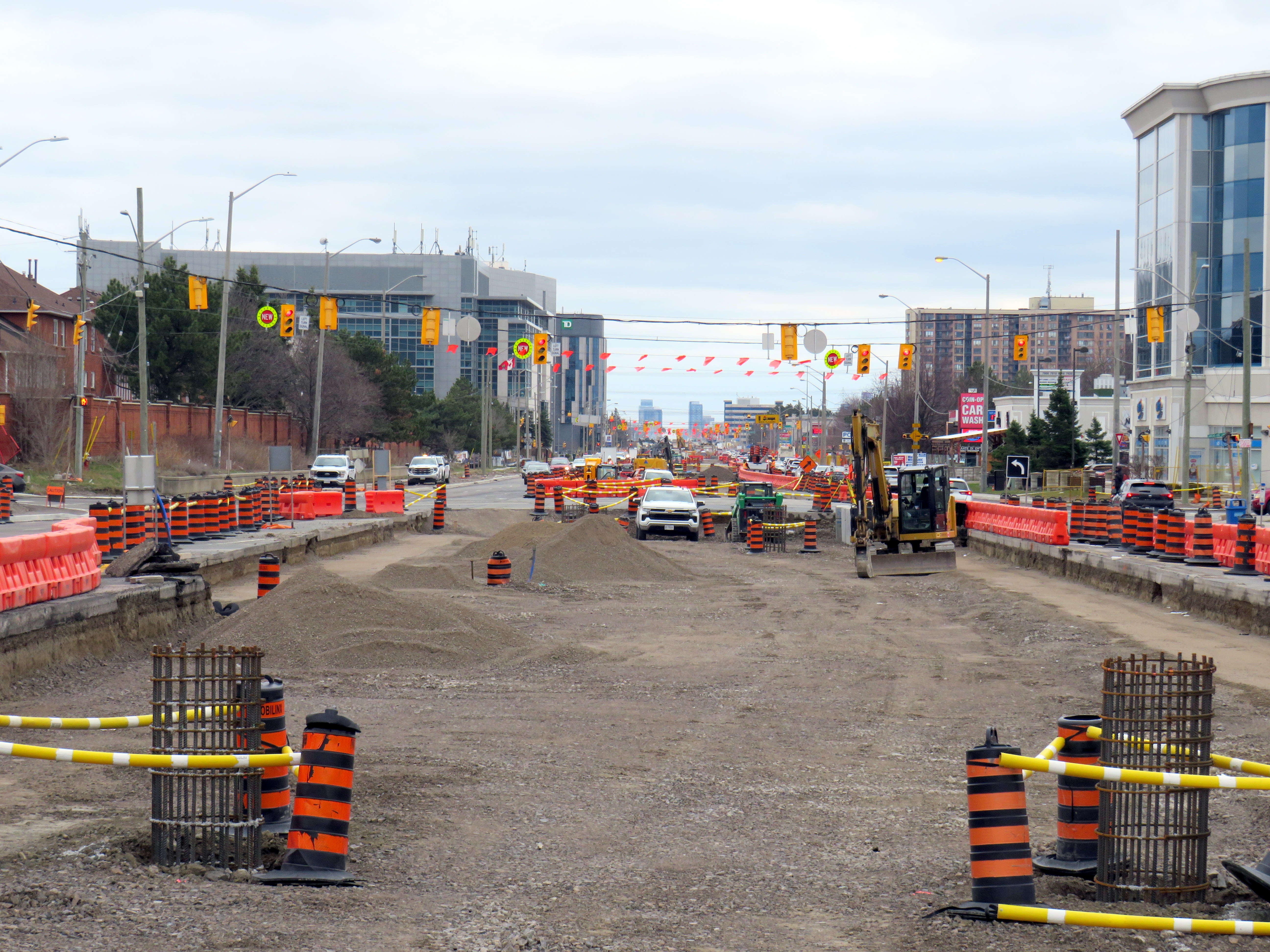
    Hurontario Street, looking south from Steeles Avenue, where the first phase of the Hurontario LRT will terminate

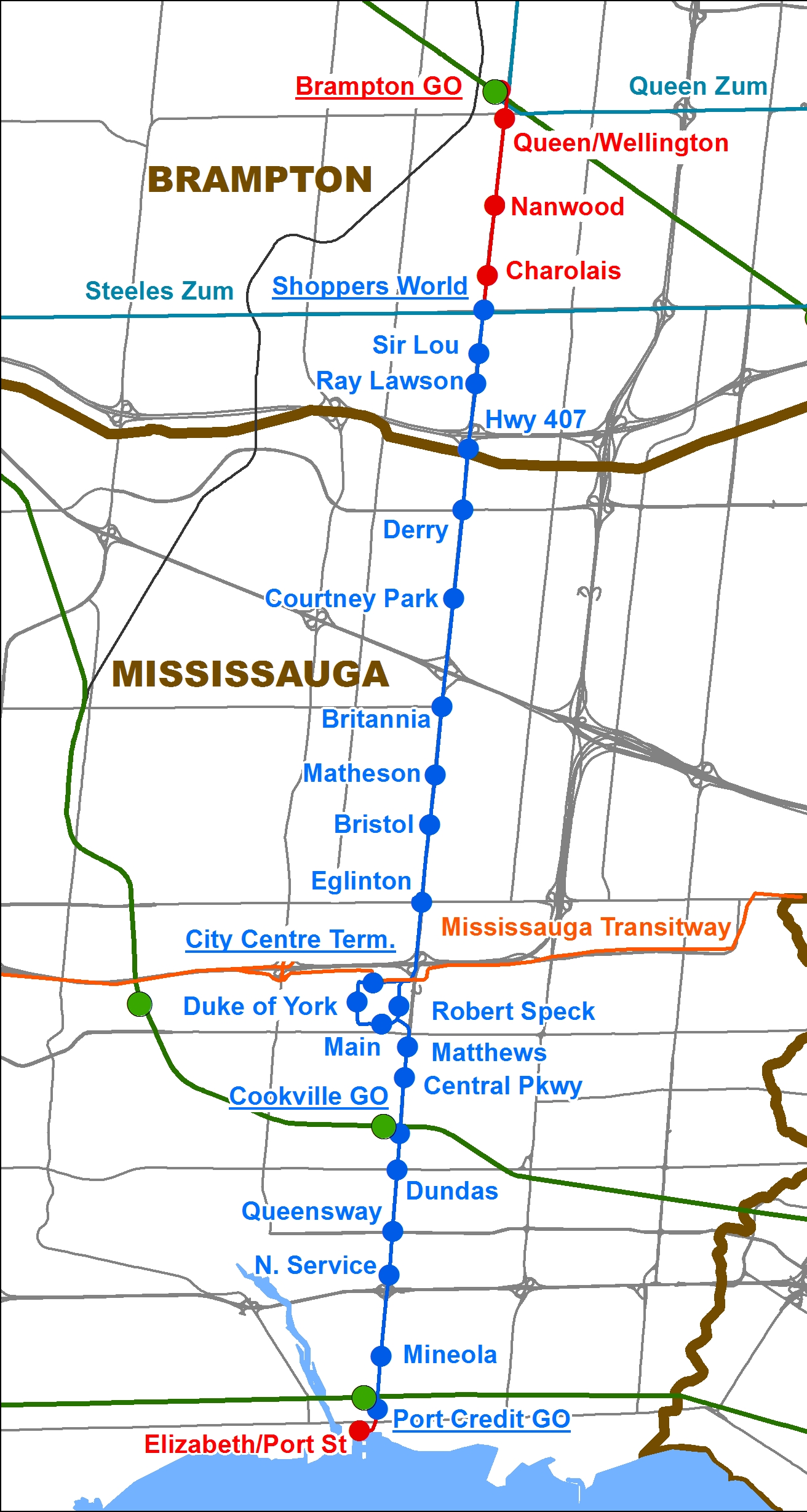
    The first phase of the Hurontario LRT, which will between Port Credit GO Station and Steeles Avenue in Brampton, is slowly taking shape after years of construction delays. In Spring 2026, eight years since construction started on the corridor, work on the LRT guideway into south Brampton has finally begun.

    As I wrote in detail before, a previous iteration of Brampton City Council narrowly voted against the LRT entering downtown as a surface line in 2015. This was the version selected in the provincial environmental assessment. Instead, that council voted to study alternative corridors into Downtown Brampton requiring lengthy detours, and asking for the LRT northern terminus to be on the south side of Steeles Avenue, despite a major bus exchange — Brampton Gateway Terminal — on the north side of the intersection to accommodate all options. After the 2018 election, council recommitted to a Main Street alignment (though preferring a tunnel) and asked the province to restore the terminus on the north side of Steeles pending a decision on the final four kilometres into Downtown Brampton. In early 2026, only one of the six councillors opposed to the Main Street LRT ten years ago remains in office.

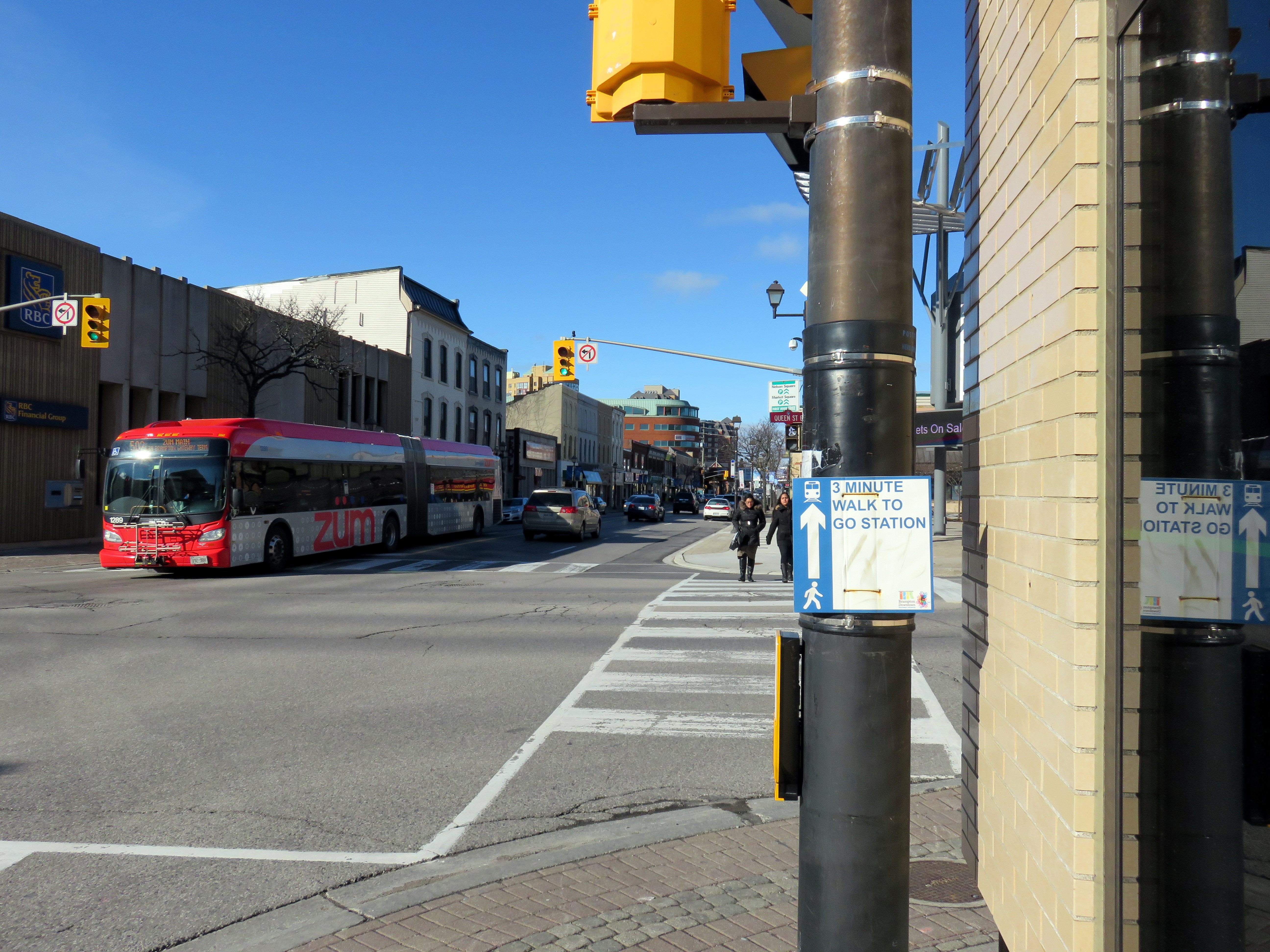
    I wanted to follow up with Metrolinx to see how pedestrians would be safely accommodated at the Steeles and Hurontario intersection, given high traffic volumes, wide roads, and likely thousands of passengers switching between modes on a daily basis. Early concepts of an underground pedestrian tunnel were rejected by the province as out-of-scope, so pedestrians would have to cross both Hurontario and Steeles to make the transfer. Having no satisfactory answers despite many attempts to get an answer to this question, I took the lengthy and expensive route of submitting a freedom of information (FOI) request.

    In summary, I learned that despite multiple requests from City of Brampton officials to restore the north side stop, Metrolinx and the provincial government refused. With the financial close with Mobilinx — the private-sector consortium selected to build, operate, and maintain the LRT — imminent in early 2019, there was no interest to make the minor change to facilitate the terminal, even though the city committed to taking on the cost on its own. The province was open to other changes to the line, however, as in 2022, it unilaterally renamed the line for a former Mississauga mayor and political ally of Doug Ford.
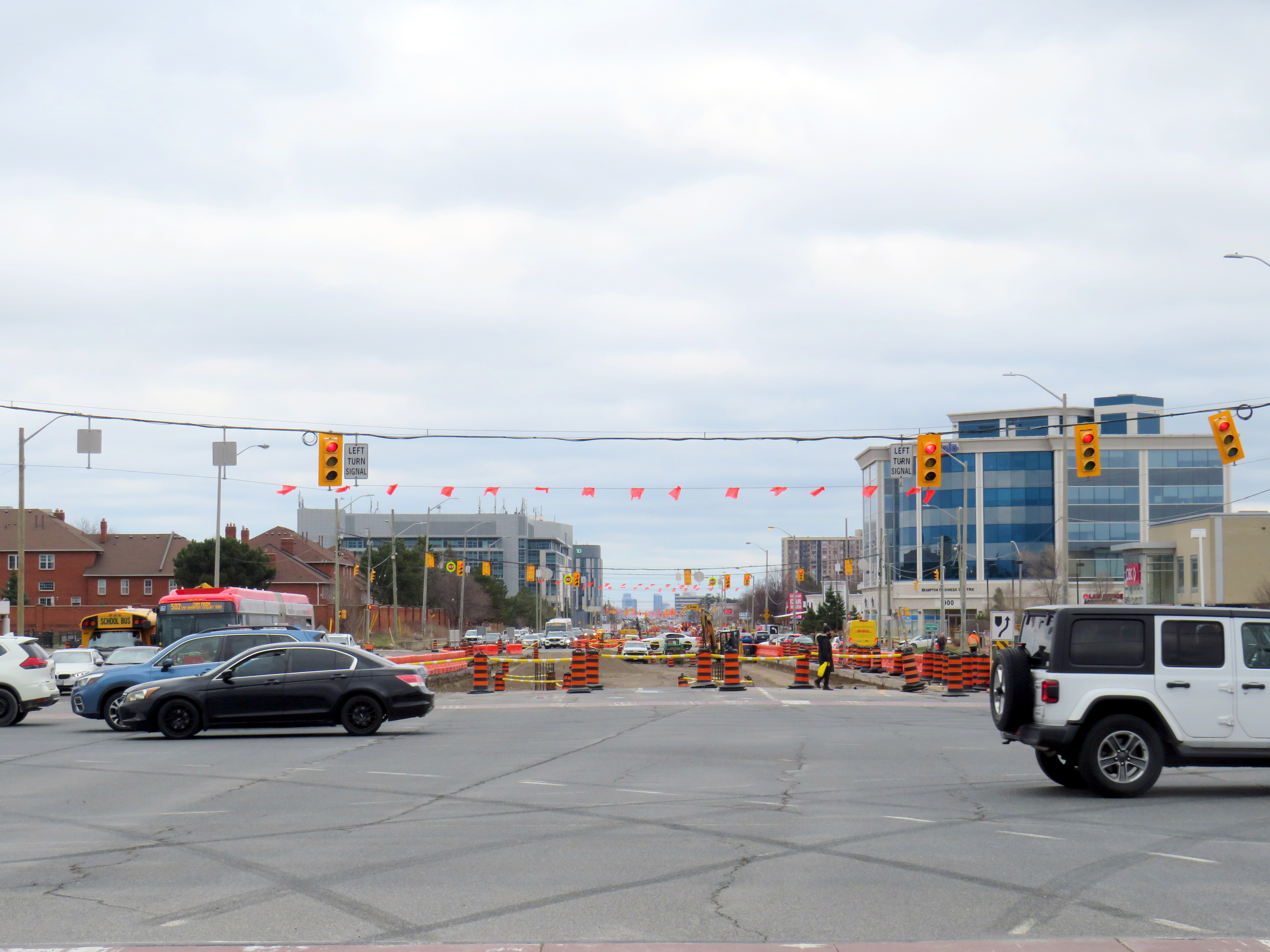
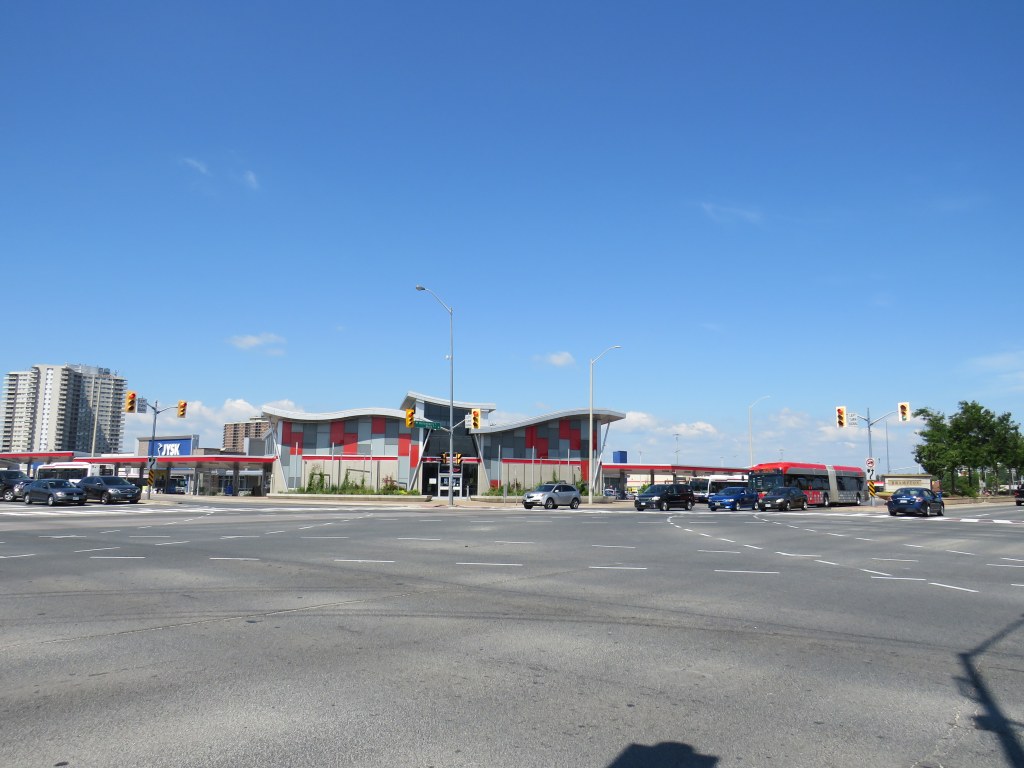
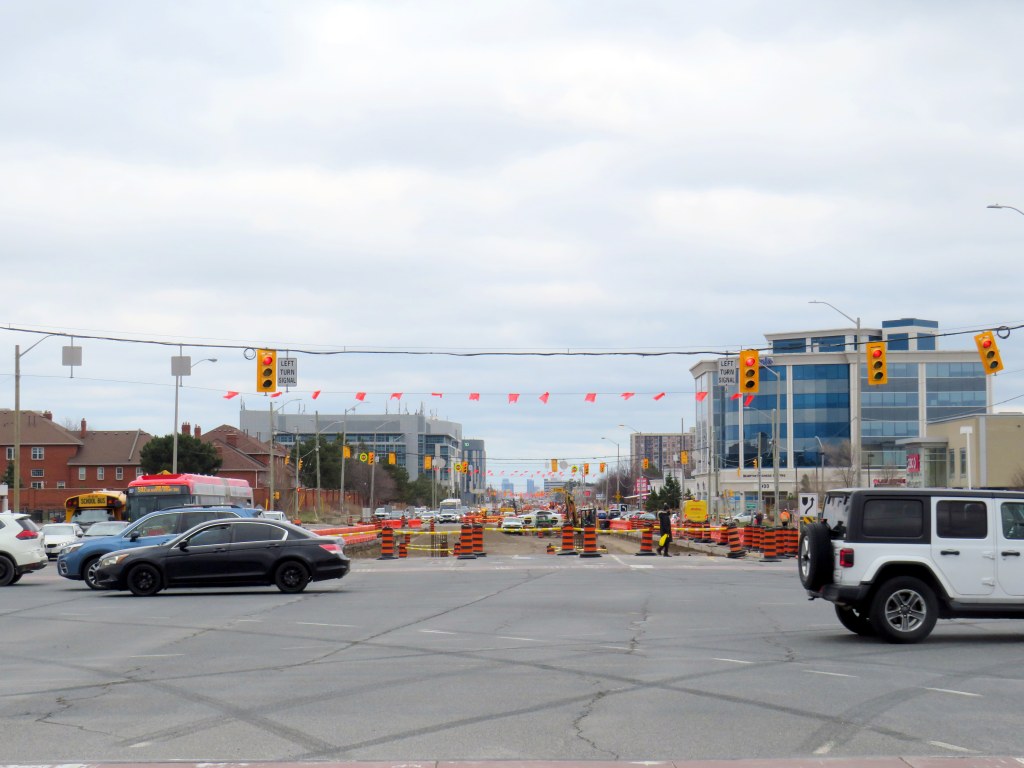
    Looking south across Hurontario Street across a very busy multi-lane intersection towards the end of the LRT

    As work at the Steeles-Hurontario intersection is now well underway, it has become visually clear the problem will be once the LRT opens. The population around the Brampton Gateway Terminal area is rapidly growing; a 40-storey condominium tower on nearby Steeles Avenue West is nearing completion, with many more highrise and mixed-use developments planned, including the eventual redevelopment of Shoppers World Mall. Already, there are dozens who cross nine-lane Steeles Avenue hourly; once passengers have to transfer from the LRT to the transit terminal on the northwest corner, there will be hundreds.

    Furthermore, once the (now-funded) Phase 2 of the LRT to Downtown Brampton is started, the intersection will have to be torn up yet again to extend the tracks across Steeles and build a new north-side stop. The province’s refusal to do this all at once is baffling, and will likely be much more expensive than if it was done right the first time.
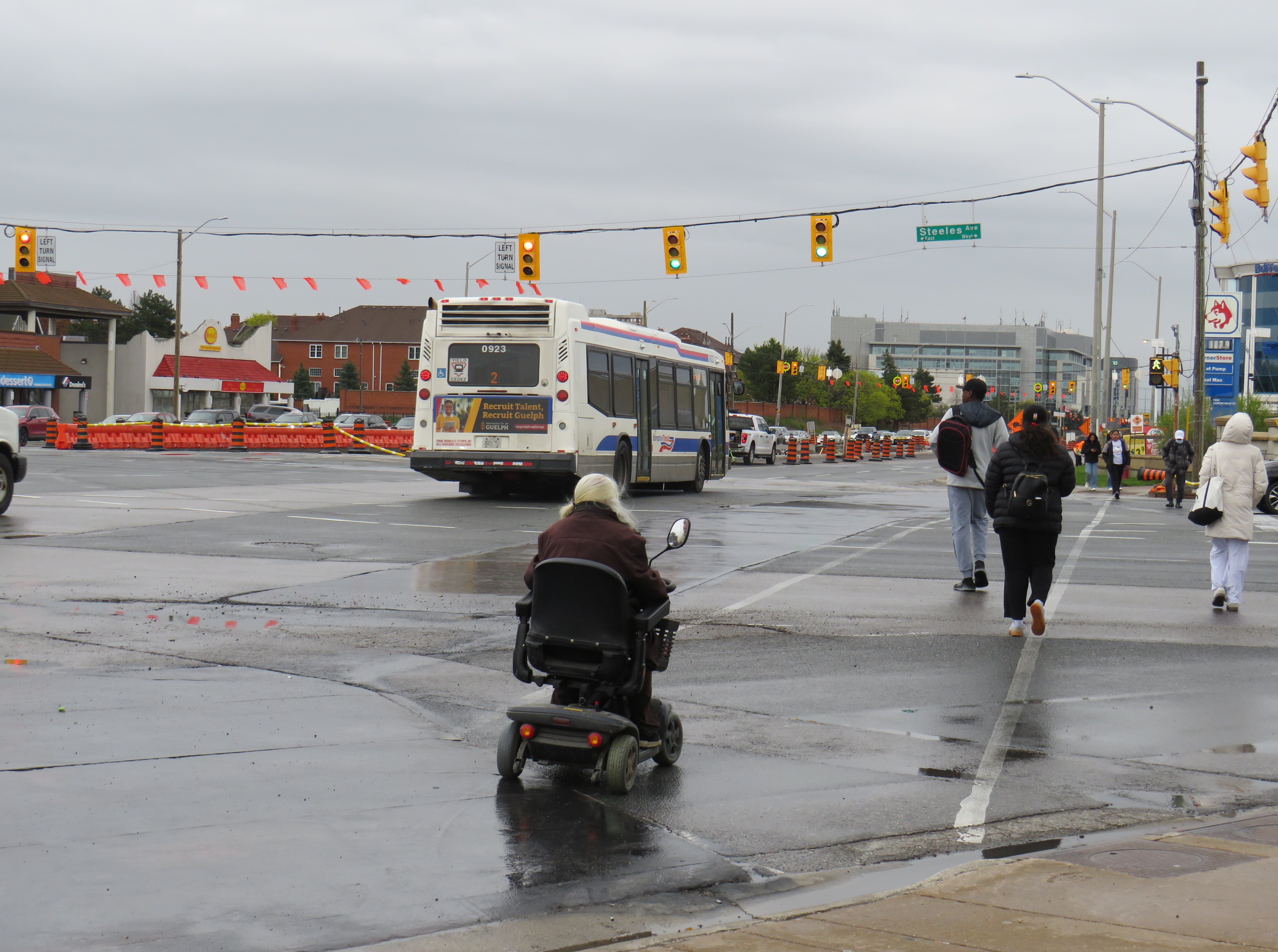
    Looking across from Gateway Terminal towards the future LRT terminus on Wednesday, May 6. Already, there are plenty of pedestrians crossing here.

    Already, the costs of the current Mobilinx contract have ballooned while construction delays pile up. The Hurontario LRT was originally supposed to open in 2024. In 2025, Mobilinx had to completely rebuild the track intersection at Topflight Drive just south of Highway 407 after track was already laid in 2023 due to construction errors. In February 2026, Global News reported that only 45 percent of the track was laid. Due to delays and problems paying contractors, the consortium’s credit rating was downgraded by Standard & Poor to BBB, which is near junk status.

    Given the multiple delays and difficulties building the LRT, work is only now at the point where the dangerous terminal location is being baked in. Even though construction errors are fixed, and the project name changed, Metrolinx has been unwilling to address the safety issue at Steeles Avenue that was raised many times. In the meantime, Metrolinx, Peel Region, and City of Brampton will have to figure out how to mitigate the potential disaster that is now in the making.
  • Whose line is it anyway?

    Whose line is it anyway?

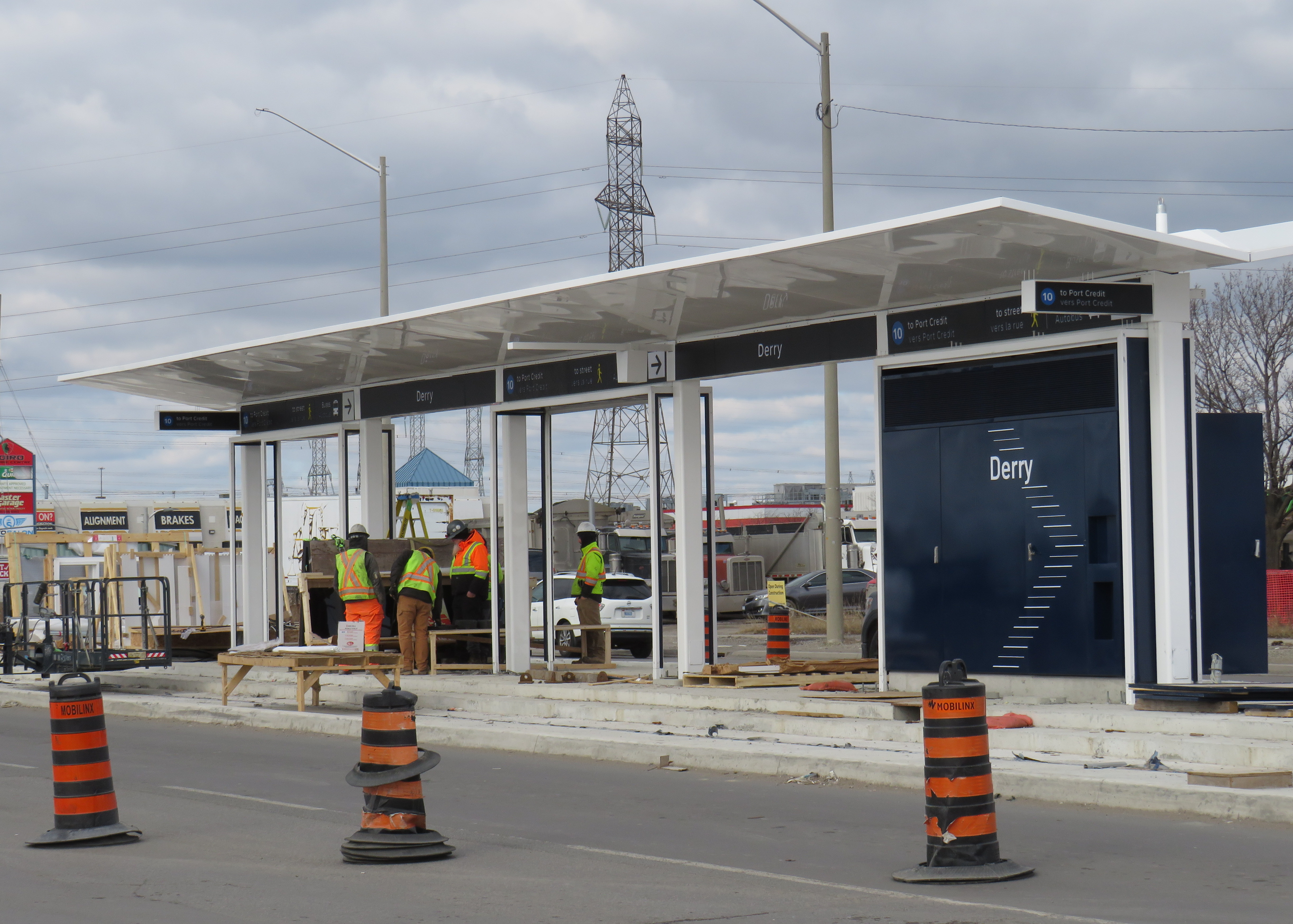
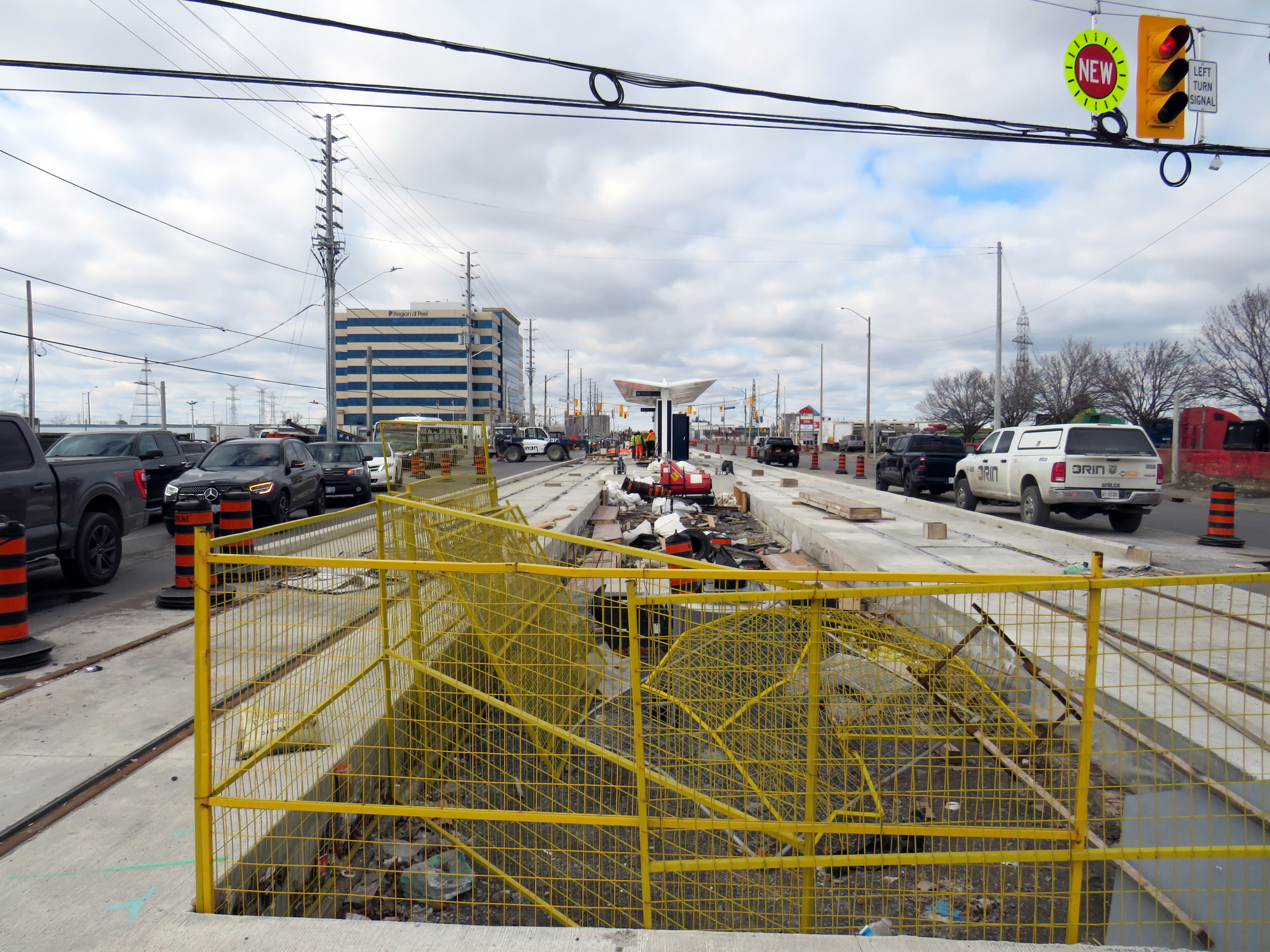
    Light rail construction on Hurontario Street at Derry Road, February 12, 2024

    Less than two weeks ago, I wrote about the politics of renaming of the Hurontario LRT for Hazel McCallion, a long-serving mayor of Mississauga and close political and personal ally of Premier Doug Ford.

    Though much of the information I received was redacted, I was able to learn that the Cities of Brampton and Mississauga had already come up with a brand for the new transit line. Metrolinx and the provincial government had to reimburse them for the costs once the Minister of Transportation intervened to force a new name upon the project, which cumulated with a love-in photo op on February 14, 2022.

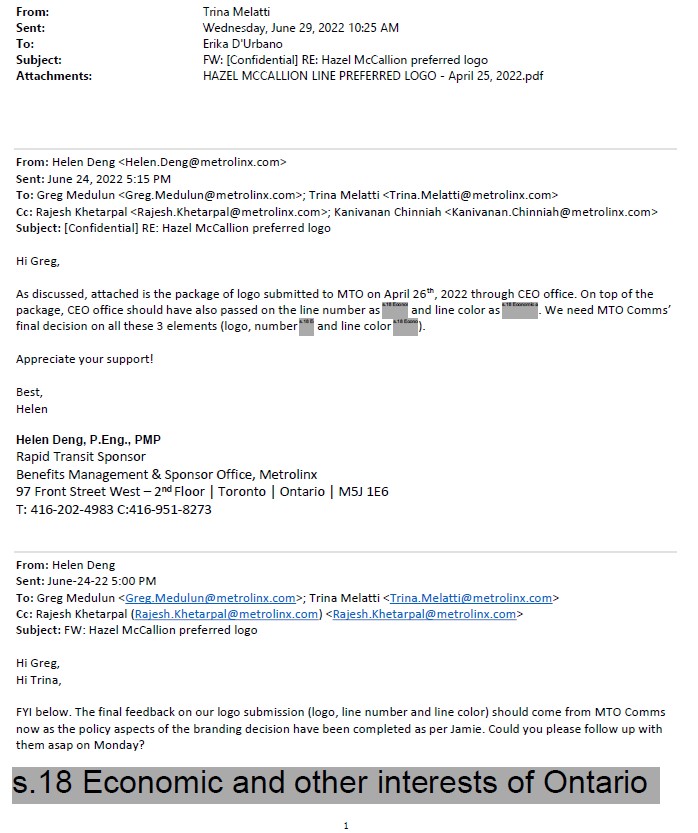
    Among the information redacted in the information package sent to me, six months after my initial Freedom of Information request, was the LRT line’s colour and number. They were redacted under Section 18(1) of the provincial Freedom of Information and Privacy Protection Act, citing economic and other interests of Ontario.

    Redacted line colour, number, and logo

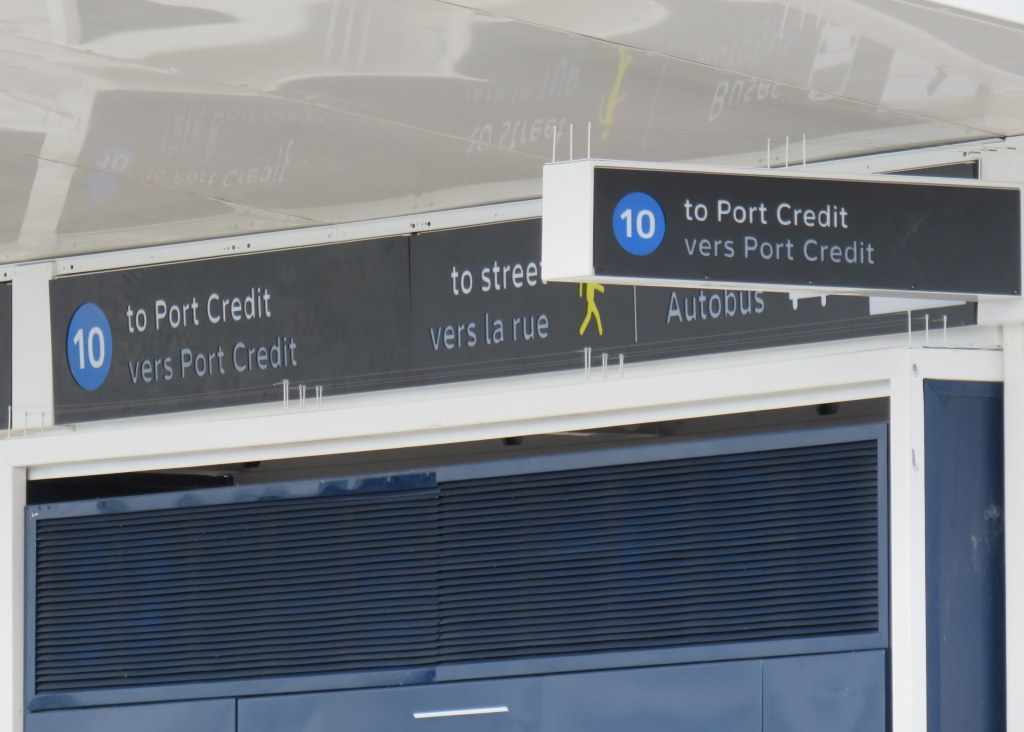
    At Derry Road, though, the secret is out. The Hurontario Line will be Line 10, represented by a bright blue colour similar to the former Line 3 Scarborough RT.

    Derry LRT station under construction

    Line 10 is a good choice for this corridor. Hurontario Street and Main Street through Mississauga and Brampton used to be part of provincial Highway 10, which was later bypassed by Highway 410 and downloaded to the two cities between the 1980s and the 2000s. It will also be the first Metrolinx-managed rapid transit project completely outside the City of Toronto, where Lines 1 through 6 are already assigned to the existing subway and the Eglinton-Crosstown and Finch West LRTs (with Line 3 reused for the Ontario Line when it opens).

    Brampton Transit and Miway currently operate bus services with that route number (10 South Industrial and 10 Bristol-Britannia), but those should be easy to change in advance of the LRT’s opening, which will take place in late 2025 or early 2026, given the construction progress so far.

    I remain puzzled and somewhat annoyed that this information was kept secret, and for what reasons. Revealing a line number and colour in a freedom of information request should not have been important. If it was to protect for another government photo opportunity, then that is now moot. Who is the Hurontario LRT for? The Doug Ford-led provincial government, or the people who will ride it?

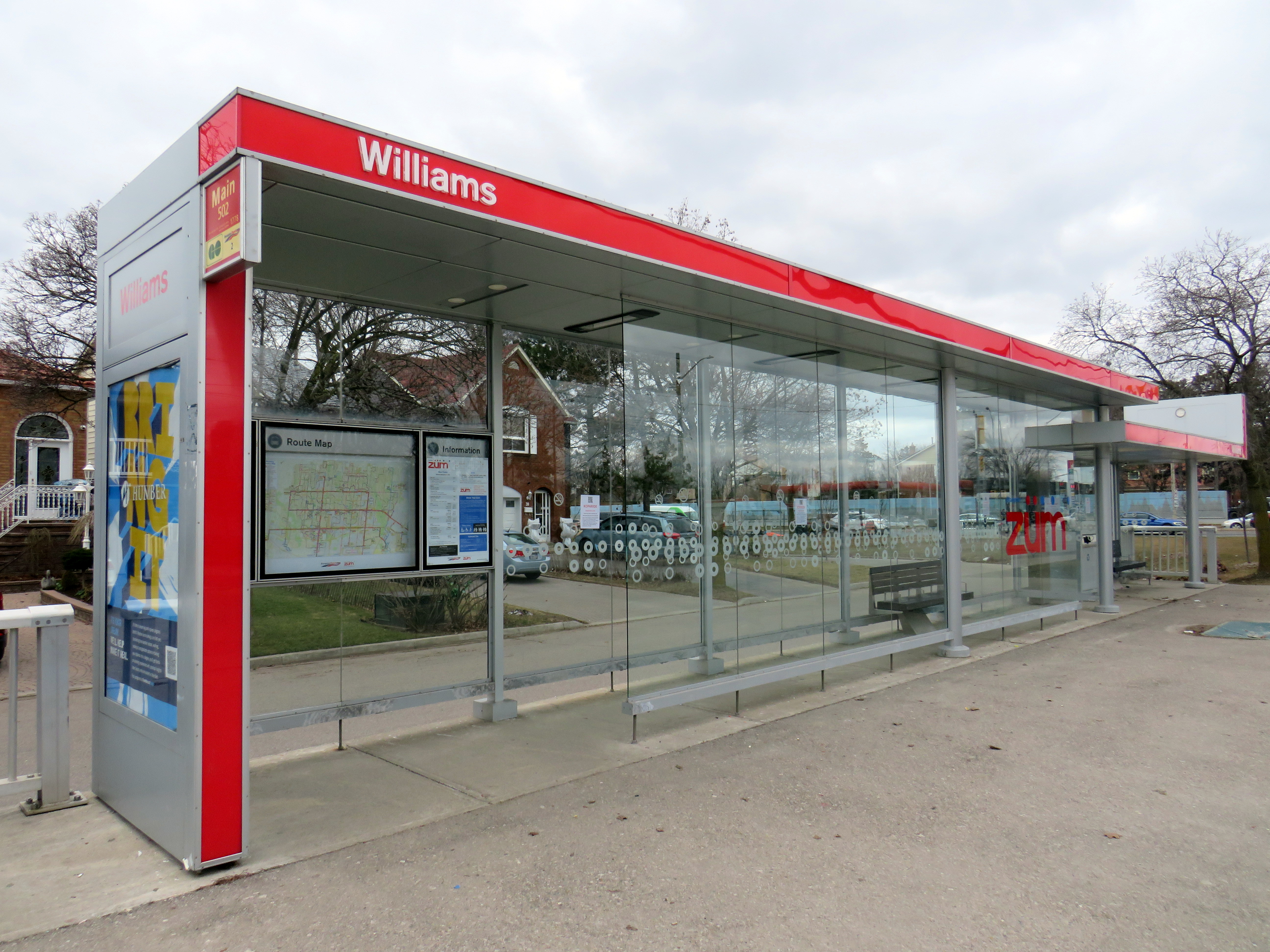
    Finally, I note that like the shelters going up for the Finch West LRT and the surface stops of the Eglinton LRT, there is very little protection from the elements at the Hurontario LRT stops, with only a canopy and a single wall supplying shade and cover from the rain or snow. Compare the Derry Road LRT stop with older Brampton Züm shelters, which include enclosed waiting areas, benches, and even winter heating.

    Brampton Züm stop with full glass enclosure, benches, and a button to activate a heater in the winter
    One more thing…

    To my longtime followers as well as my occasional readers, thank you for your interest and support. Last year’s FOI request cost me $525.00. Sadly, freedom of information isn’t free. If you like my work and want to contribute to my online mapping and webhosting costs, please consider buying me a coffee.

  • Brampton LRT: a second chance to get it right

    A mock-up of a Bombardier Flexity tram sits in Gage Park while a Brampton Züm bus passes by in 2013

    On Wednesday, May 10, Brampton’s Committee of Council will consider a staff report on the proposed extension of the Hurontario LRT north from Steeles Avenue to Downtown Brampton.

    This section of the LRT, planned last decade, was narrowly rejected by Brampton City Council in a 6-5 vote, with then-mayor Linda Jeffrey supporting the transit line’s construction. Unfortunately, six city councillors sided with several downtown merchants and affluent Main Street South residents (including former premier Bill Davis), who did not support a surface tram on Main Street, back in October 2015.

    Councillors who voted to reject the Main Street alignment later backed the study of slower, more indirect alternative routes, while voting to ask Metrolinx and the provincial government, which was planning the line, to terminate the LRT on the south side of Steeles Avenue to allow for their potential fantasy options. Unfortunately, Metrolinx obligated.

    In 2019, a newly elected council, led by a new mayor, Patrick Brown, was willing to revisit the LRT decision, again backing a direct Main Street alignment. City staff were directed to update the original, approved 2014 Transit Project Assessment Process (TPAP). In 2021, staff narrowed the alternatives to just two options: an all-surface alignment from Steeles Avenue to the GO station in Downtown Brampton, and an underground option between Nanwood Avenue and the rail corridor. Meanwhile, Brampton staff and elected officials tried, without success, to restore the north-side LRT terminal at Steeles Avenue/Gateway Terminal.

    Now that the 30% design work for the two options is complete, city officials must decide how to proceed, especially if they expect senior levels of government to cover the costs of this major transit project.

    The alignments

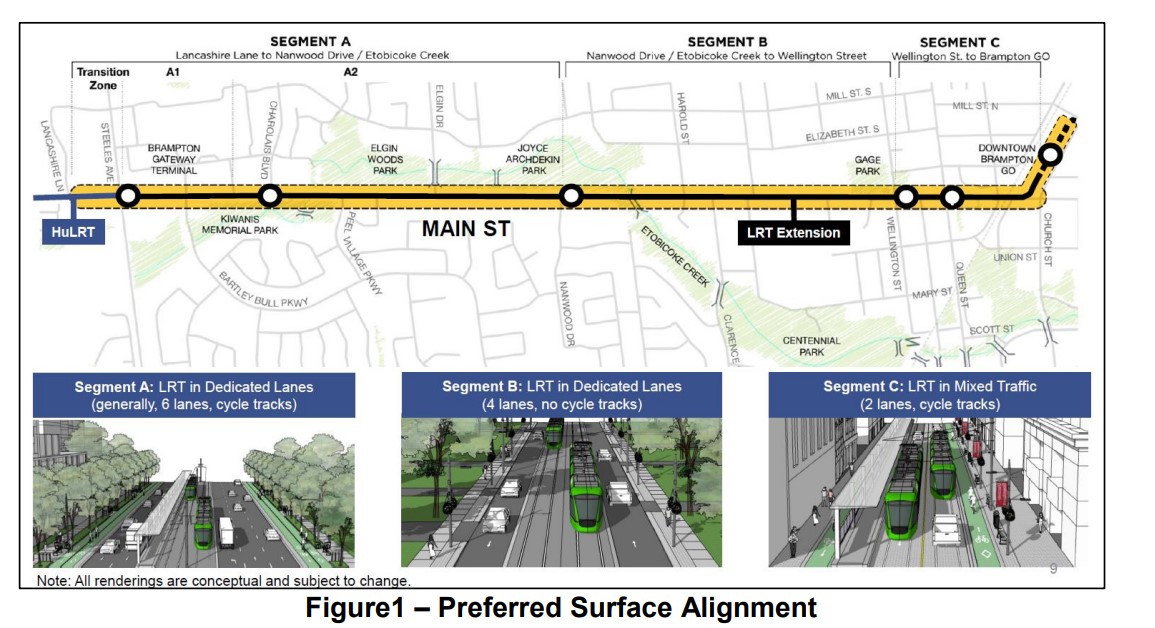
    The all-surface alignment three stops in each direction between the Gateway Terminal at Steeles Avenue and the Brampton GO Station: at Charolais Boulevard, Nanwood Drive, and split northbound and southbound stops between Wellington and Queen Streets. These stop locations match the existing 502 Züm Main stops on this section of Main Street.

    Between Nanwood Drive and Wellington Street, the LRT would operate in dedicated lanes, with general traffic in the outer two lanes. There would not be room for bicycle lanes, and left turns would be prohibited at non-signalized intersections. North of Wellington, the LRT would run in mixed traffic, with cycle tracks and widened sidewalks on both sides of the street.

    The preferred surface alignment

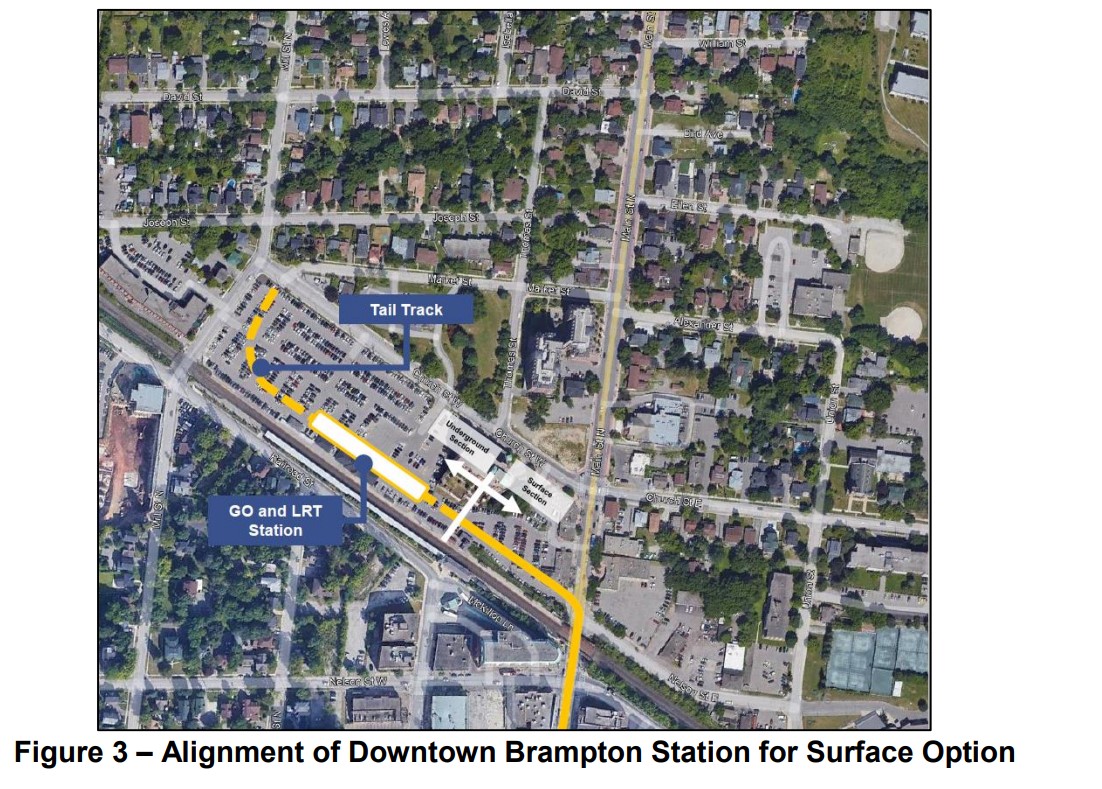
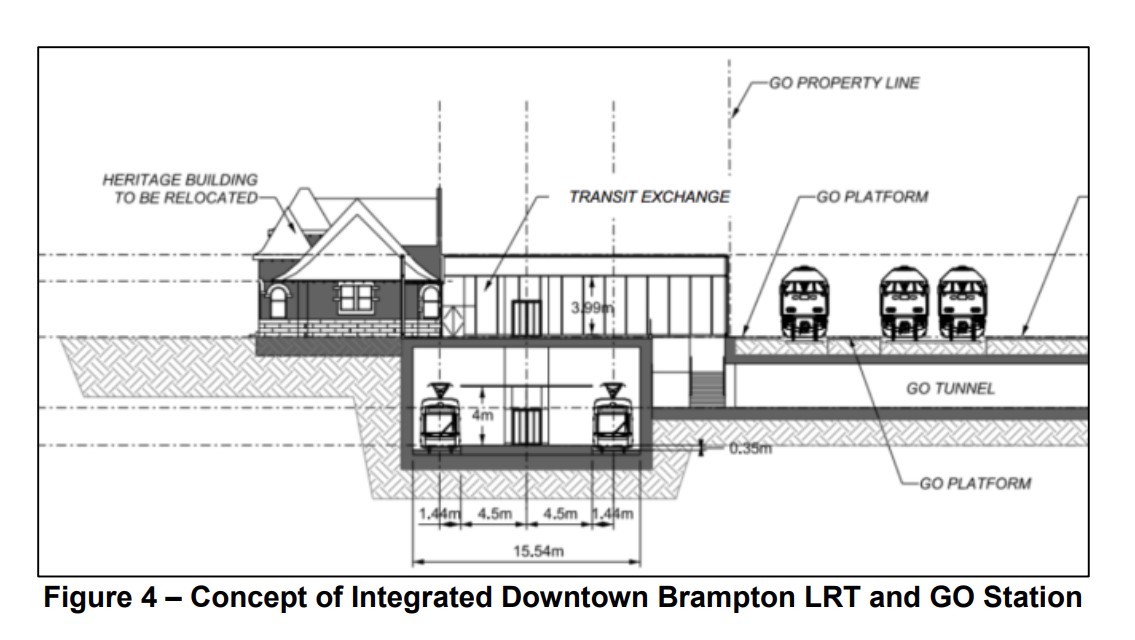
    The northern terminus would be on the GO Station property, on the west side of Main Street, in a below-grade trench. Stairs and elevators would connect the platform with the GO Station, while the historic 1907 station building would be moved to support GO train service expansion on the busy CN freight corridor. The street surface would need to be lowered by one metre for the light rail vehicles and the overhead wire to clear the railway underpass.

    Alignment of off-street surface LRT alignment on the GO Station property
    Design concept for the GO and LRT terminal

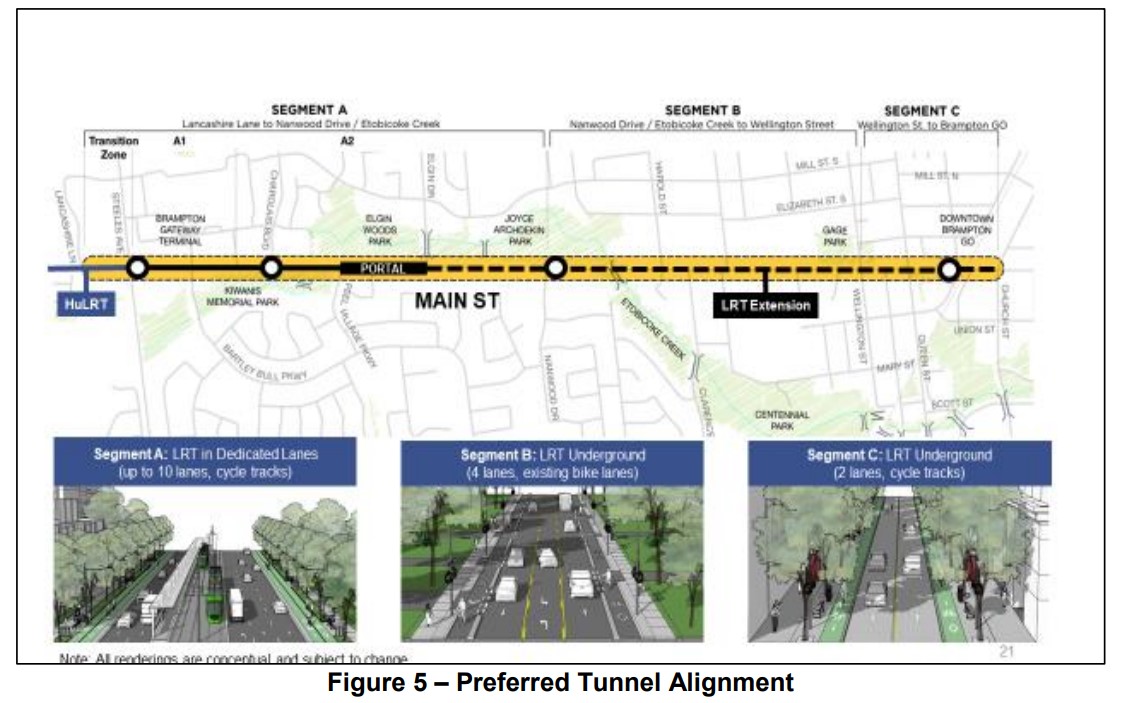
    The tunnel alignment – which was not part of the approved 2014 TPAP – includes the same surface stops at Brampton Gateway Terminal and Charolais Boulevard, and two underground stations, at Nanwood Drive and the terminal, just south of the GO Station. Between Elgin and Nanwood, the tunnel would be dug in the traditional cut-and-cover method while the portion under Etobicoke Creek and the downtown core would be constructed using the sequential excavation method.

    The tunnel portal would be located at Elgin Drive, several hundred metres south of Nanwood. The longer tunnel section is required to avoid the Etobicoke Creek floodplains. Though Nanwood Drive has no intersecting transit routes and relatively low density, the rundown Brampton Mall property would be an ideal urban development site, as would the commercial properties immediately to the south.

    The preferred tunnel alignment

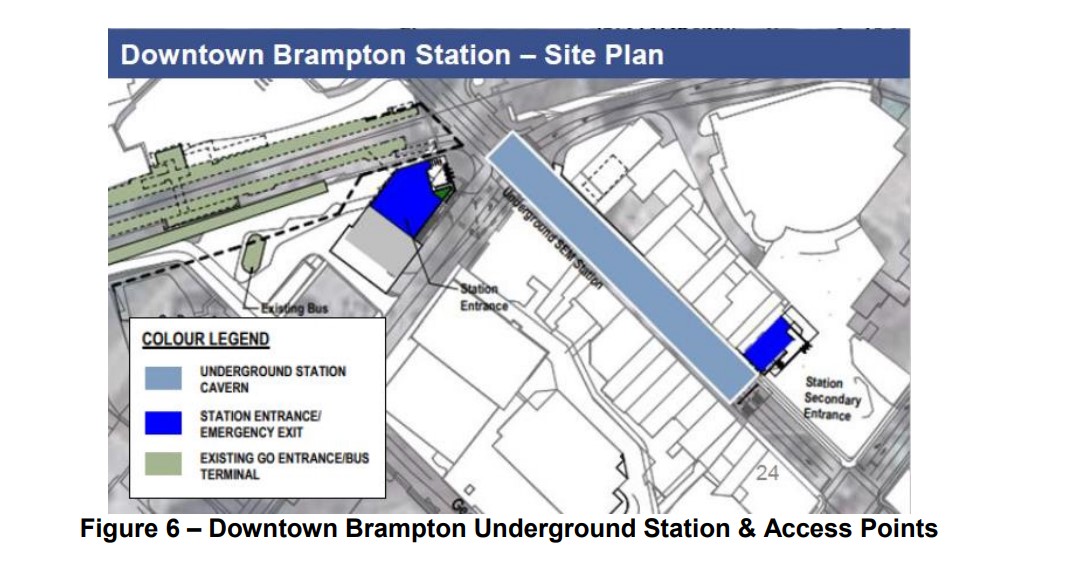
    The downtown terminal station would include a primary access at the corner of Main and Nelson Streets, to provide access to the GO Station and the proposed new transportation hub, as well as a secondary entrance closer to Queen Street and Garden Square.

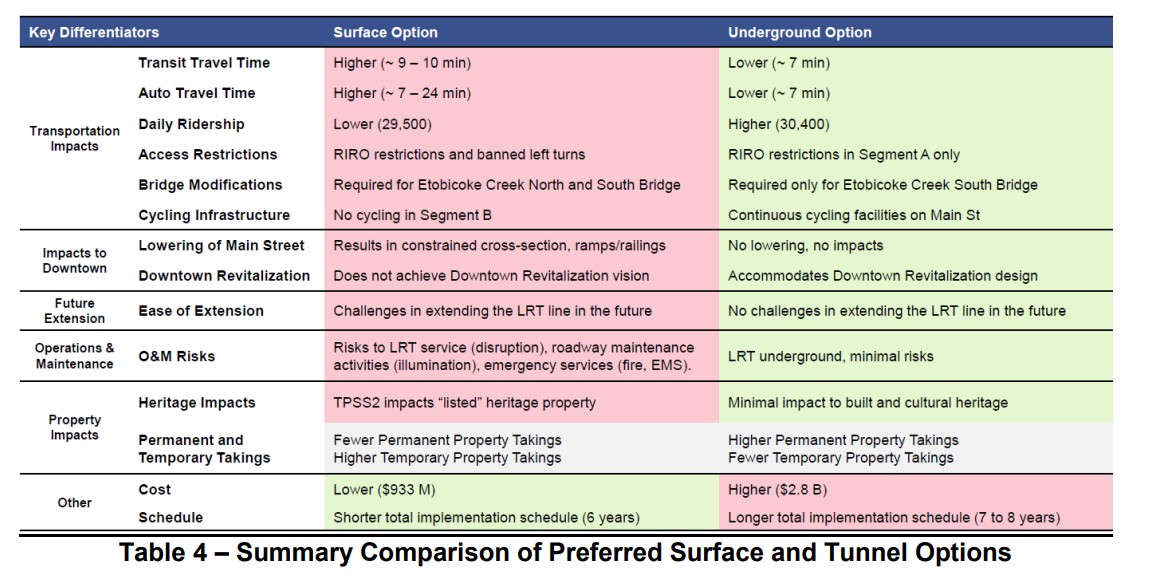
    The two options were compared, putting the tunnel alignment ahead in all categories apart from cost and schedule. The tunnel would allow for continuous cycling infrastructure on Main Street, minimize traffic impacts, while having slightly higher ridership and somewhat faster transit. The tunnel would also better satisfy homeowners and businesses along the corridor. Staff also note that the tunnel alignment, without the bend into the GO station property, would be easier to extend farther north.

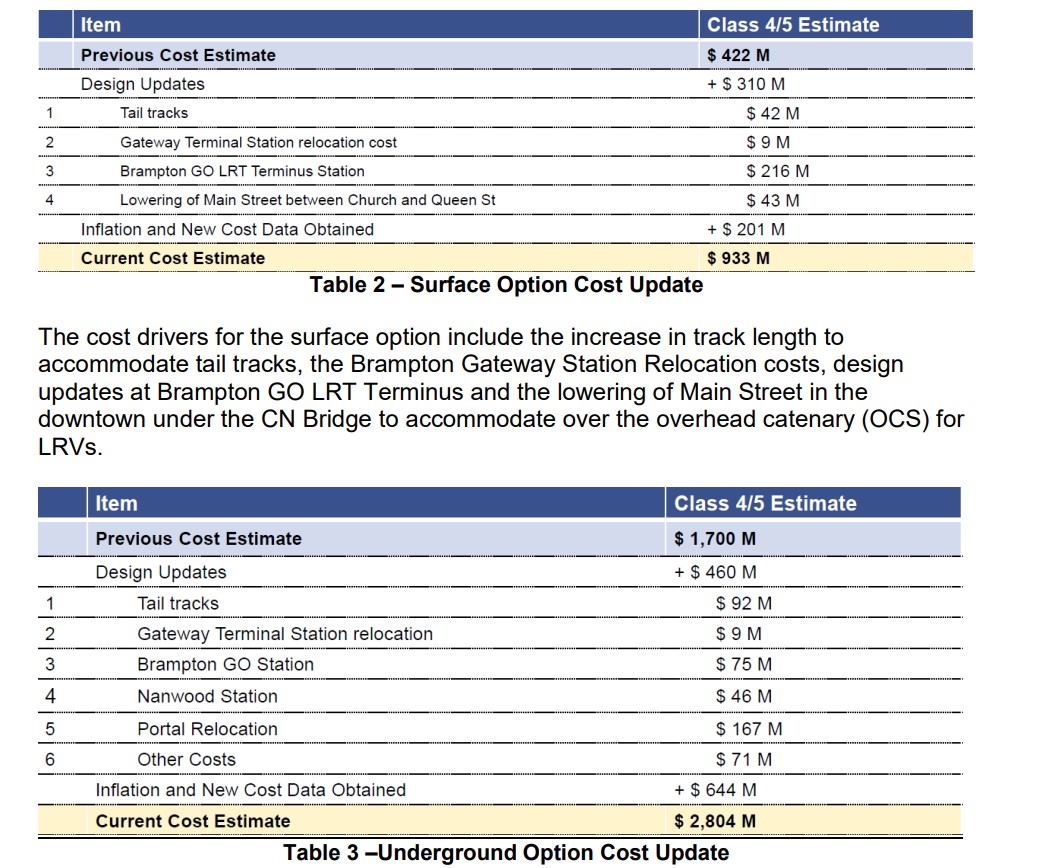
    As with other transit projects, the costs of delaying this segment of the LRT are subject to inflation. The surface alignment would cost $933 million, while the tunnel route would cost $2.8 billion. The surface option would take one to two fewer years to complete, an important consideration given Brampton’s fast-growing transit ridership and delays on other complex LRT projects, such as the Eglinton-Crosstown line.

    Cost comparisons for the tunnel and surface alignments

    The Pitch

    Towards the end of the staff report is a section called “Funding Advocacy.” Staff rightfully point out the need for the LRT extension, given the city’s and the province’s goals of directing high density development to the downtown core and other transit station areas, as well as the city’s record of continuous ridership growth and transit improvements.

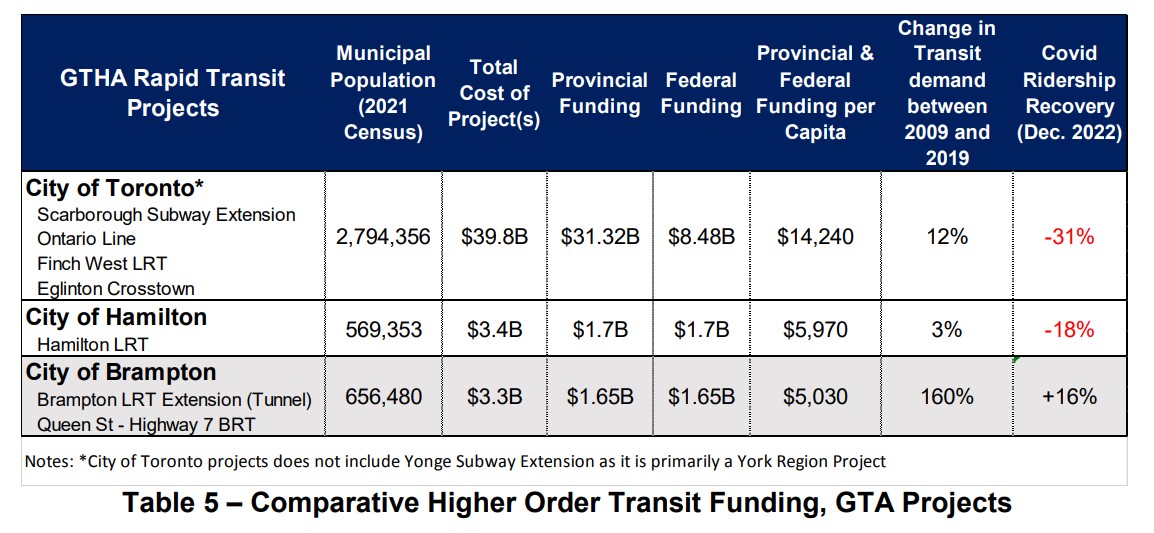
    They also point out that the funding that Brampton is seeking (for the Queen Street BRT project and the LRT, specifically the tunnel option) is comparable to other transit projects in the Greater Toronto and Hamilton Area. The table below compares the costs and funding sought for Brampton’s proposed projects to those funded and underway in Toronto and Hamilton.

    Table comparing costs, funding and system ridership for Toronto, Hamilton, and Brampton

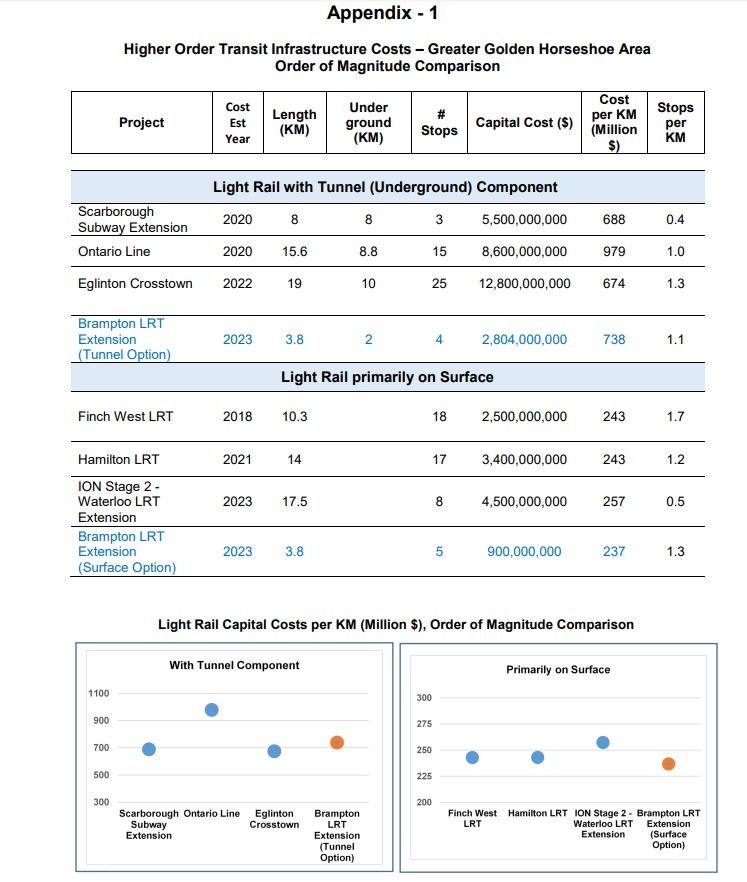
    An appendix to the staff report compares the cost of the tunnel option with other tunnelled Ontario projects (the Scarborough Subway Extension, the Ontario Line, the Eglinton-Crosstown), and the surface alignment with other surface projects (Finch West LRT, Hamilton LRT, Ion LRT extension in Cambridge).

    Concluding thoughts

    It is still a shame that Brampton City Council put the interests of a small, but affluent, minority of voters first back in 2015-2016. Had they not prevailed, the LRT into Downtown Brampton would have been under construction right now – at the same time that critical water infrastructure is being replaced in Downtown Brampton, and we would be looking forward to it being open in just two years. However, just three of the eleven council members that voted on the LRT in 2015-2016 remain at Brampton City Hall, and two of those three councillors supported the original project.

    The arguments in favour of the tunnel are enticing: a faster transit ride though a congested part of the city, an appeal to provincial and federal governments that have historically short-changed Brampton on its infrastructure needs, in a city that will have six seats up for grabs in the next elections.

    However, a surface LRT will be quicker and much cheaper to build. I also do not see the need for further extensions northward, at least via Main Street, and even then, it would require a second tunnel portal somewhere near Vodden Street, adding at least $1 billion to future costs. The GO station terminal points towards the abandoned Orangeville-Brampton Railway, which could provide a good alignment northward from Downtown Brampton, even with a parallel cycling path.

    More than anything, I want to see the Hurontario-Main LRT completed to Downtown Brampton as soon as possible, especially as work progresses on all-day hourly train service between Toronto and Kitchener and revitalization and intensification of Downtown Brampton accelerates.

    The provincial government has signaled that they prefer the surface alignment for cost reasons (notwithstanding it spending billions of dollars on an unnecessary tunnel on Eglinton West in Etobicoke), as does the Brampton Board of Trade. It is also worth noting that this study is only at the 30% design phase, detailed engineering work may find further costs.

    The surface option was the right choice in 2015, and it remains the right choice today. This time, maybe, Brampton will get it right.

  • Terminal Gateway: how bad decisions will affect the safety thousands of daily transit riders

    Terminal Gateway: how bad decisions will affect the safety thousands of daily transit riders

    Brampton Gateway Terminal from the southeast corner of Hurontario Street and Steeles Avenue, Brampton

    Last month, Metrolinx held a virtual open house to present information on the progress of the Hurontario LRT project, planned work, and details on some of the stops along the line. For now, roadwork is limited to median removal and utility relocation, but by next year, heavy construction will commence along the 18-kilometre long corridor.

    I was hoping to get some information on the northern terminus, at Steeles Avenue in Brampton, but no details were provided. I took the opportunity to ask specific questions about the transfer between the LRT and local buses, but I was disappointed by the answer.

    If Metrolinx goes ahead with their plans for a minimal station on the south side of the intersection, anyone connecting between modes will be forced to cross two sides of a busy, hazardous intersection at grade, impacting both accessibility and safety. We can thank politicians on the 2014-2018 Brampton City Council for this situation, which provide just one of many examples of how systemic racism manifests in transit decision making.

    (more…)
  • The death and life of Shoppers World Brampton

    IMG_5980
    An old Target shopping cart sits in front of Shoppers World. Target, which closed in 2015, now subdivided into smaller retail units, including JYSK, Staples, and Giant Tiger

    Previously on this blog, I wrote about Shoppers World Brampton, a shopping mall that slowly declined despite being located in a high-growth suburban city. I wrote that RioCan Real Estate Investment Trust (REIT), the owners of the mall, were interested in developing the property by reducing the retail footprint and adding new residential uses. Some of those details have now been revealed.

    Shoppers World opened in 1969, on the outskirts of the Town of Brampton, which was transitioning from a county service centre and industrial town to a suburb of Toronto. The mall expanded twice: once in 1973-74, and again in 1980-81.

    In the 1980s, Shoppers World boasted a Simpson’s department store, K-Mart, two full-service supermarkets, a Pascal’s department store, two movie theatres, and even an indoor waterpark. Familiar national chains filled the halls: Thrifty’s, Grand & Toy, Coles and W.H. Smith, Smart Set, Naturalizer, Black’s, Collegiate Sports, Peoples Jewelers, and Reitman’s. Shoppers World never had the status that Square One or Yorkdale enjoyed, but it was a good mall offering just about anything you’d ever need.

    It was where I got my first paying gig: returning stray shopping carts to K-Mart for a few dollars apiece. I lived within walking distance of the mall, though I joked that the best thing about it was the bus to Square One.

    But many of those national retailers left by the mid-1990s. Square One, a 15 minute drive south, was expanding, and Bramalea City Centre had renovated and expanded as well. But when RioCan REIT purchased Shoppers World in the late 1990s, it made some long-needed improvements, including new flooring over the old terrazzo, a new food court, and removing some of the dead retail space for new big-box retailers like Canadian Tire, Staples, and Winners. When The Bay (successor to Simpson’s) closed, it was replaced by more exterior retail.

    Meanwhile, Zellers replaced K-Mart, and briefly became a Target store during the American company’s disastrous foray in the Canadian market. Rio-Can carved that into spaces for smaller retailers, including Giant Tiger. Finally, the bus terminal moved, from a distant corner facing Steeles Avenue, to a central location right at the corner of Main Street and Steeles Avenue, designed for easy transfers to the Hurontario LRT.

    ShoppersWorld

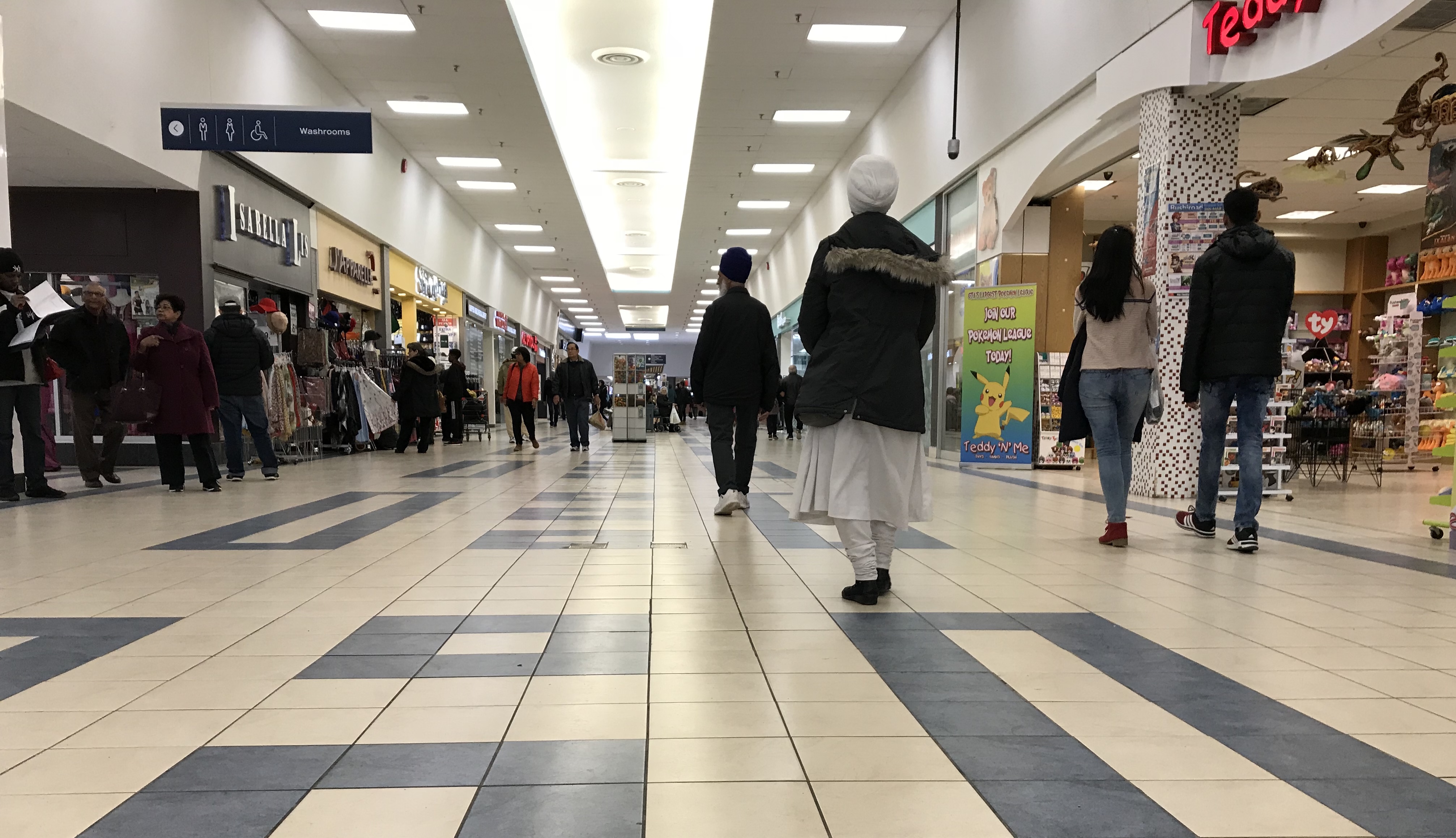
    The interior of the mall is still busy, but nearly all chains let their leases expire, with independent retailers taking over. Even so, there are many vacant storefronts.

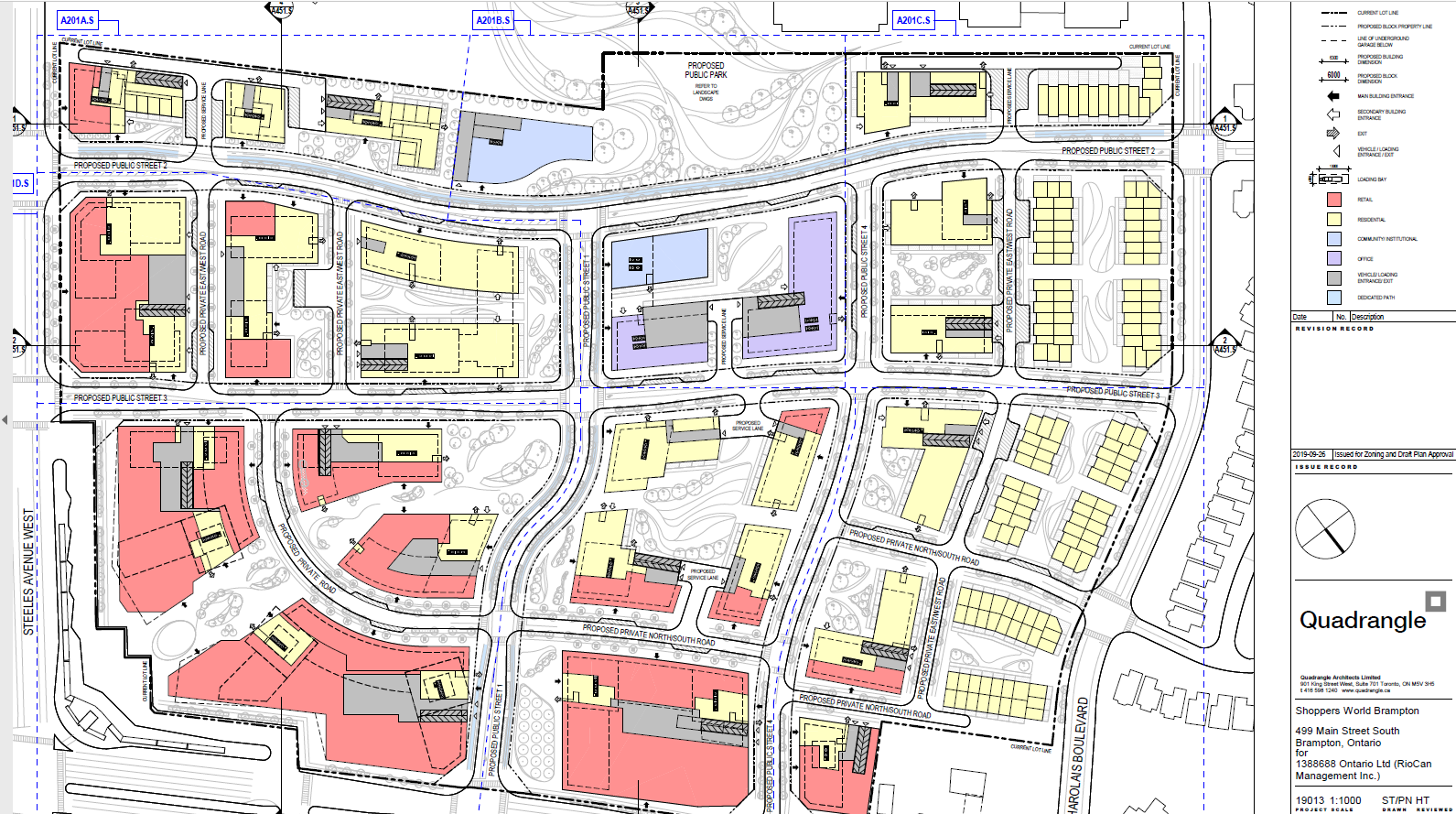
    Earlier in October, RioCan submitted their plans to the City of Brampton, and were also presented at an open house at the mall on October 22, 2019. The redevelopment proposal includes new roads, residential towers with at-grade retail, underground parking, among other features.

    Details from RioCan’s submission include:

    • Four new north-south and east-west public streets through the property, including multi-use paths, as several private laneways. Mill Street would continue south from Charolais Boulevard to Steeles Avenue.
    • New residential towers up to 28 storeys tall, containing 4,725 units (one, two, and potentially three-bedroom apartments)
    • 155 townhouses in the northern end of the property, towards low-rise subdivisons north of Charolais Boulevard
    • 44,647 m² (480,582 sq. ft.) of retail space integrated with the residential towers, a reduction from 62,256 m² (670,124 sq. ft.)
    • An enlarged Kaneff Park (west of the mall, between two separate existing high-rise rental tower clusters), along with new community and library space
    • New office space adjacent to the expanded park and community space
    • Most parking will be located underground
    • The Brampton Gateway terminal will remain

    Site Plan of Shoppers World Brampton redevelopmentSite plan from RioCan’s submissions to the City of Brampton. Click to enlarge.

    The first phase of the redevelopment will be 27-storey tower on the southwest corner of the site (where the abandoned Brampton Transit terminal now sits). This will be constructed before the mall itself is touched. Further phases will see the mall slowly demolished, though they are dependent on market conditions.

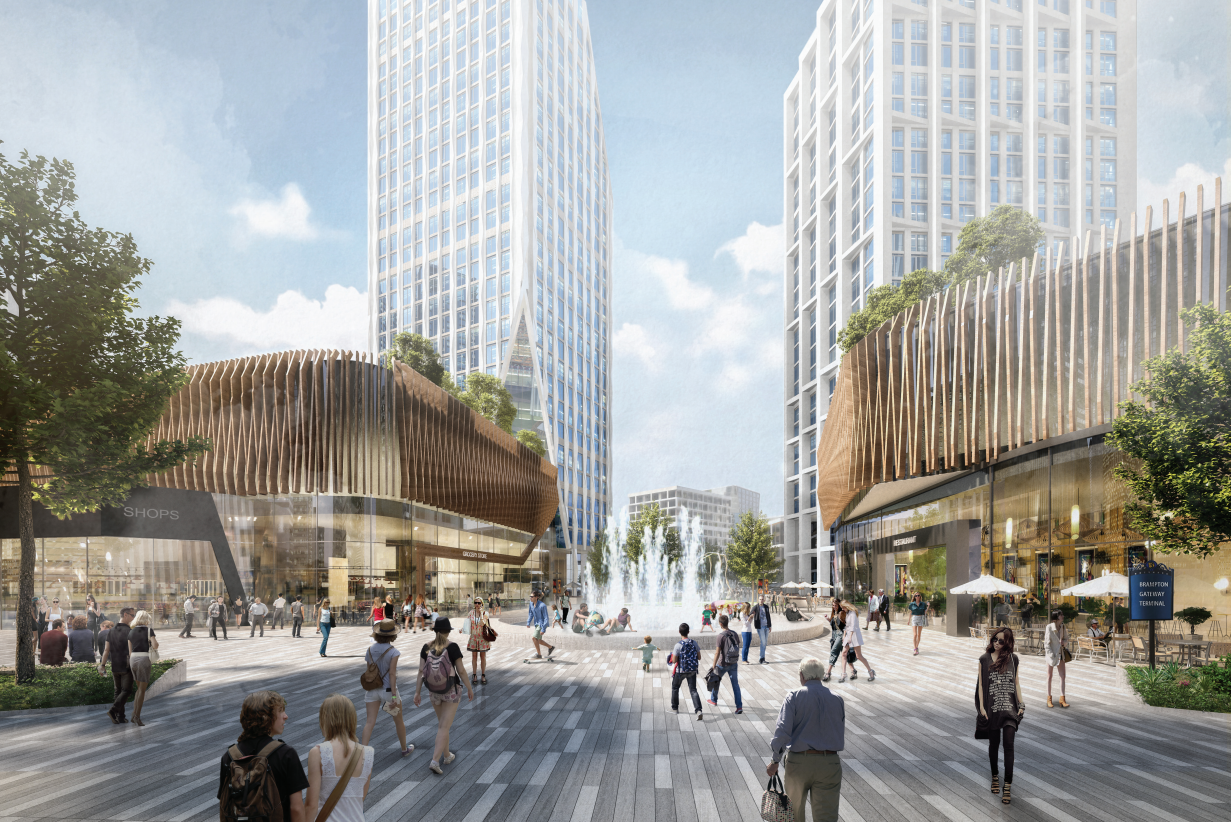
    SWB - View from terminalRendering of Shoppers World redevelopment, looking northwest from the existing Brampton Gateway Terminal

    RioCan hired Quadrangle and SvN architects to develop conceptual renderings for the development, indicating that RioCan is serious about this development. Given the City of Brampton’s own plans for urbanizing this part of the city, I am optimistic this will be built. The area already has good public transit access, with Zum express bus service to Downtown Brampton, Mississauga City Centre, Sheridan and Humber Colleges, as well as local service. This will also be at the terminus of the Hurontario LRT line (construction will begin shortly as the contract was just awarded), which may yet continue to Downtown Brampton.

    This is the largest shopping mall redevelopment in the Greater Toronto Area, following work now underway at the Galleria Mall in Toronto, and proposed for the Promenade Mall in Vaughan (though much of that mall’s structure will remain intact). As the mid-market gets squeezed by discounters, internet shopping, and high-end shopping centres, more malls of Shoppers World’s size will see similar development.

    I was surprised to see such urbanity proposed for suburban Brampton, but it may finally be the time for the Flower City to bloom. Despite my nostalgia for Shoppers World, I am excited for its future.

    SWB Rendering 1.jpgLooking south on Mill Street towards the park expansion and Steeles Avenue. The first phase tower is shown in the middle background.
     

  • A better Hurontario Street – an LRT update

    IMG_0091-001.JPG
    Metrolinx light rail vehicle mock-up at Gage Park, meets a Brampton Transit Zum bus, 2013. 

    Earlier this week, I visited Brampton City Hall, where at a public open house, Metrolinx and city staff provided an update of the Hurontario Light Rail Transit project. Brampton City Hall was an ironic location for the open house; before Brampton Council voted against building the LRT up to Downtown Brampton and the GO/VIA Station, the LRT line would have stopped right here. Even with Brampton’s decision, there will be three stops in the city, so an open house for local residents to provide their feedback was still needed.

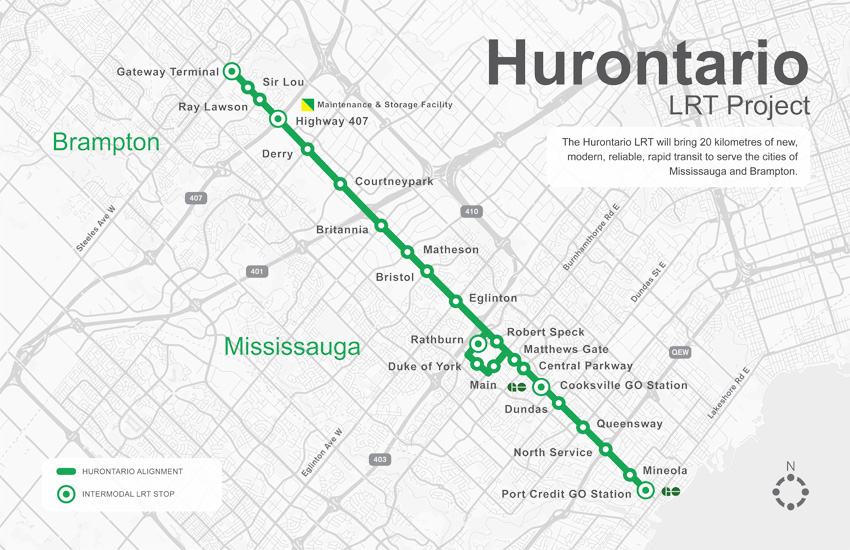
    hurontario_lrt_map_en-850x550
    The Hurontario LRT project, map via Metrolinx

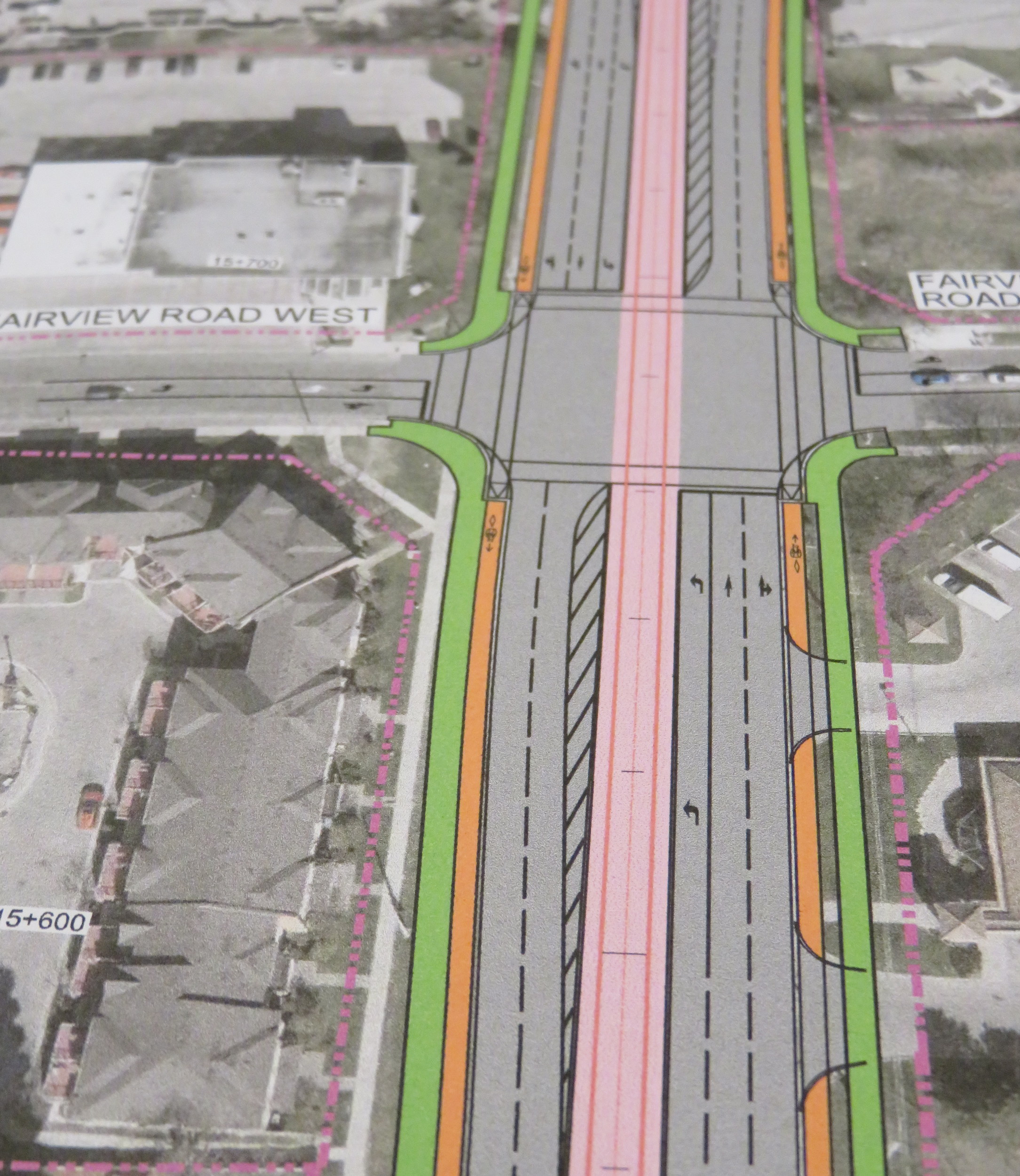
    The open house was quite interesting as more design details were displayed. There`s a focus on promoting active transportation — walking and cycling — and urbanizing much of the corridor. Three lanes of motor traffic will go down to two in most places, and right turning traffic will be tamed. This will make Hurontario Street a safer and more pleasant place to be.

    Along the entire LRT corridor, Hurontario Street will feature separated bike infrastructure — for the most part, there will be separated bike lanes, with multi-use paths in a few areas, especially south of the Queensway, where Hurontario Street is narrower. Sidewalks are also wider. With only a few exceptions, cyclists will be able to ride across intersections without being required to dismount. Those exceptions are at the Queen Elizabeth Way, and at Highways 403 and 407, where Ministry of Transportation Ontario (MTO) standards at interchanges will force the “stop, dismount, wait for gap” regime; pedestrians will also still have to yield to motor traffic.

    img_8334-001Typical cross-section once the LRT is built. The orange paths are the separated bike lanes, the green paths are sidewalks. Hurontario Street will only have two traffic lanes in each direction. 
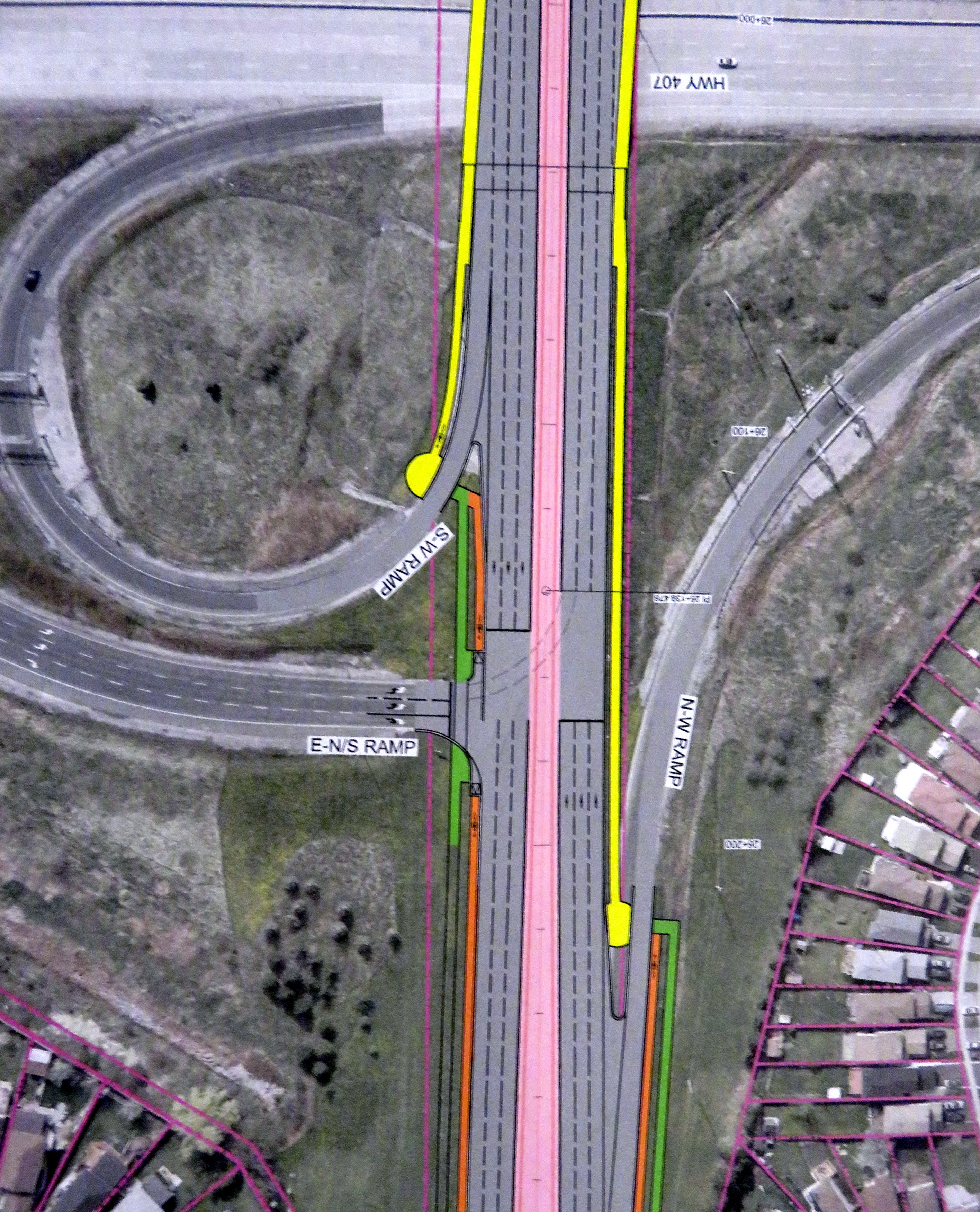
    img_8328-001At expressways, like at Highway 407, pedestrians and cyclists still must yield to motor traffic at on-ramps. 
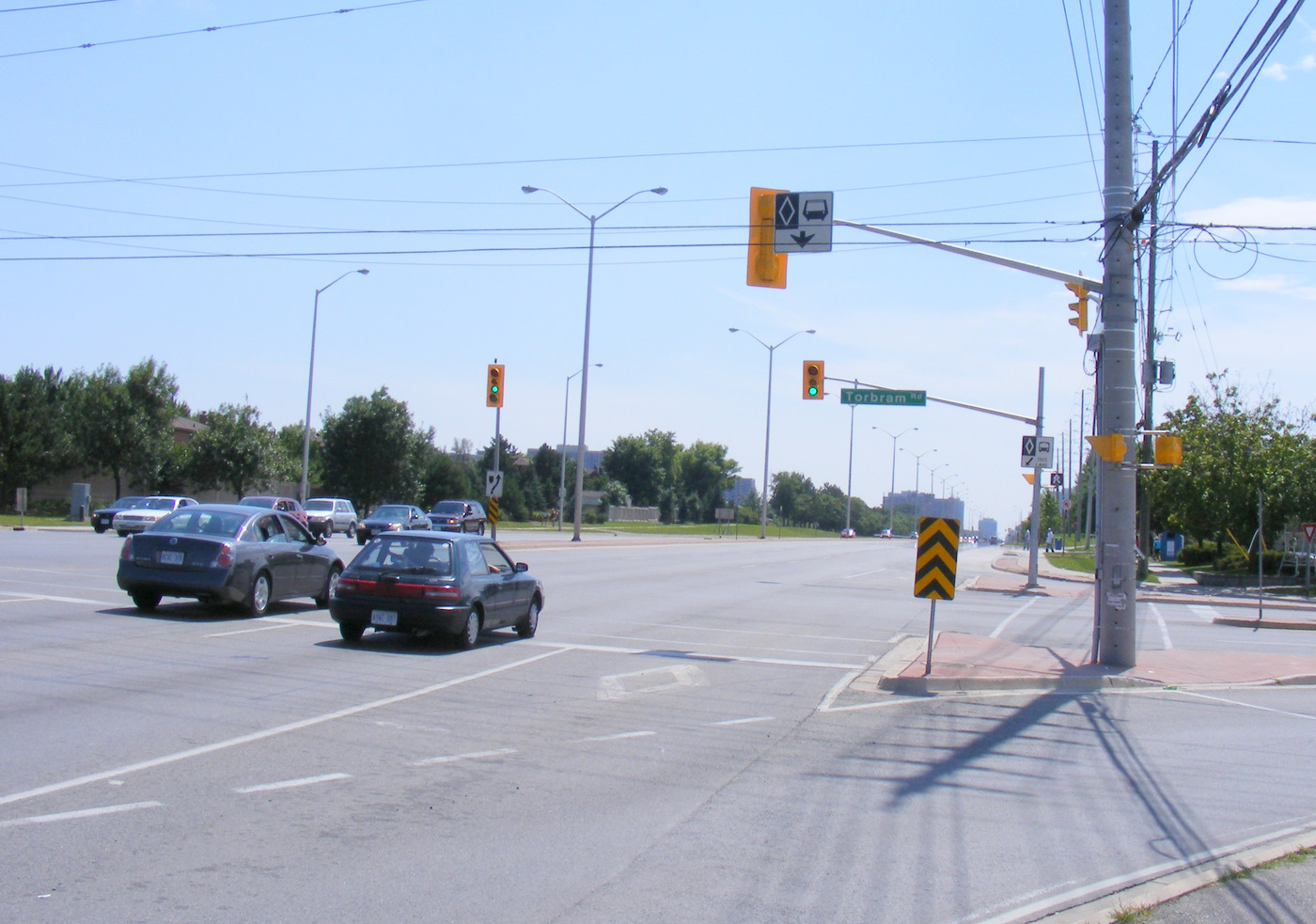
    In another benefit for pedestrians and cyclists, channelized right turns are eliminated along the entire route. Channelized right turns (like the one shown below) are convenient for motorists, but they increase conflicts with foot traffic and are incompatible with lower speeds and safe cycling infrastructure. Their removal also creates new room for streetscaping opportunities.

    4852433218_a9848b9973_o
    An example of a channelized right turn

    The northern terminus of the LRT, at least for now, will be at Steeles Avenue. As Brampton debates other LRT alignments (Kennedy Road and McLauglin Road are indirect alternatives to reach Downtown Brampton), the stop was moved to the south side of the intersection. This is unfortunate: the Brampton Gateway bus terminal, which opened in 2012, was designed to easily connect with the planned LRT stop on the north side of the intersection, with two short crosswalks across southbound Main Street.

    img_8331-001
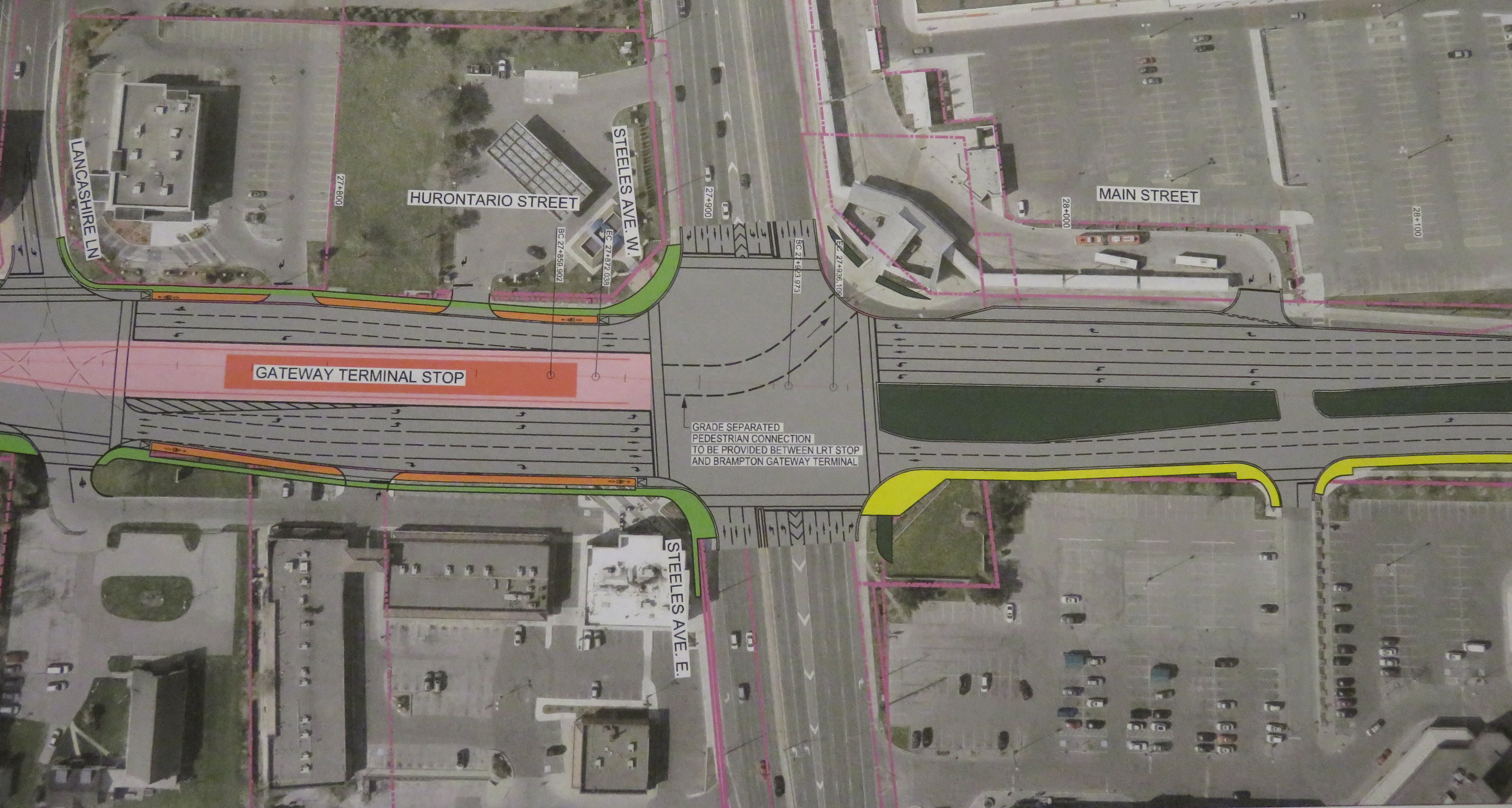
    Planned LRT terminus at Steeles Avenue, including tunnel between the LRT platform and the Brampton Gateway Terminal. 

    Instead, a more expensive tunnel is required to accommodate transferring passengers between the LRT and buses. Elevators and escalators will provide direct access to the tunnel; crosswalks at Steeles Avenue and Lancashire Lane will also be accessible from the platform.

    The final contract is planned to be signed in mid-2018 and construction should begin in Fall 2018. As the City of Mississauga backs the LRT project, hopefully any change in the provincial government will not jeopardize this plan. Not only will Mississauga (and south Brampton) get a fine new transit service, it will also see a tamer, more urbanized main street.

    And maybe Brampton City Council will come to its senses and extend the transit corridor via the direct, least-expensive, Main Street alignment.

  • Brampton’s Etobicoke Creek: floods, concrete, and new public spaces

    20438289892_d6cd9cb6c9_z

    Over at Spacing, I wrote about a recent Jane’s Walk that I led on Downtown Brampton and Etobicoke Creek.

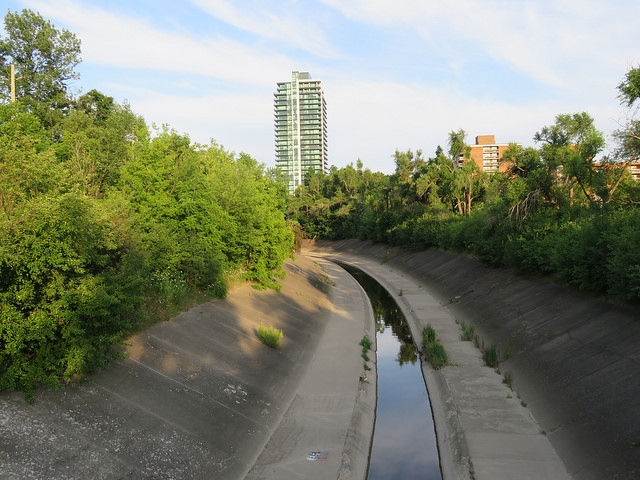
    Until a concrete diversion channel was built in the 1950s, Downtown Brampton would regularly flood as it was built right on top of the creek. The concrete diversion, fenced off and cut off from both the downtown core and the rest of the Etobicoke Creek ravine to the north and south, is an eyesore.

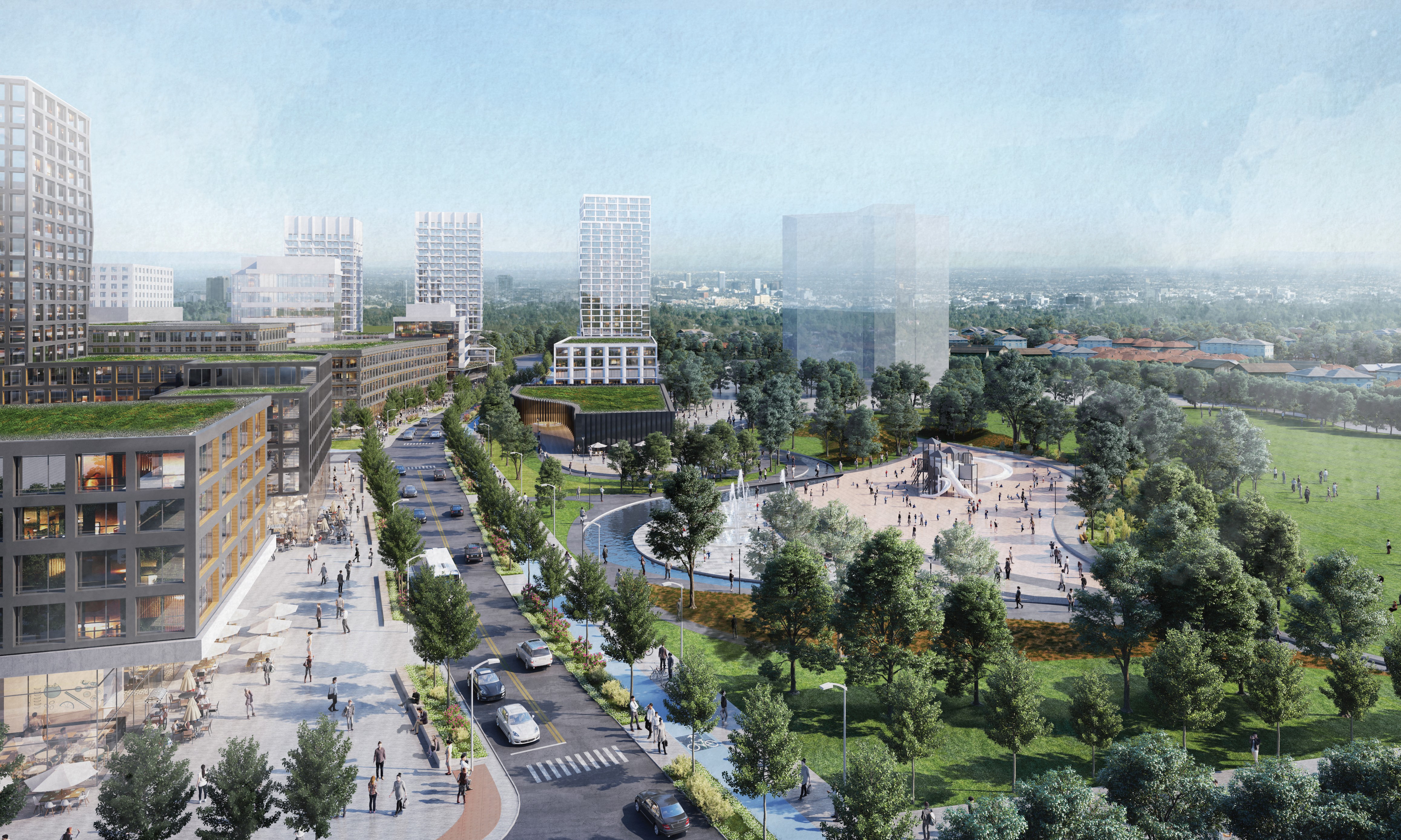
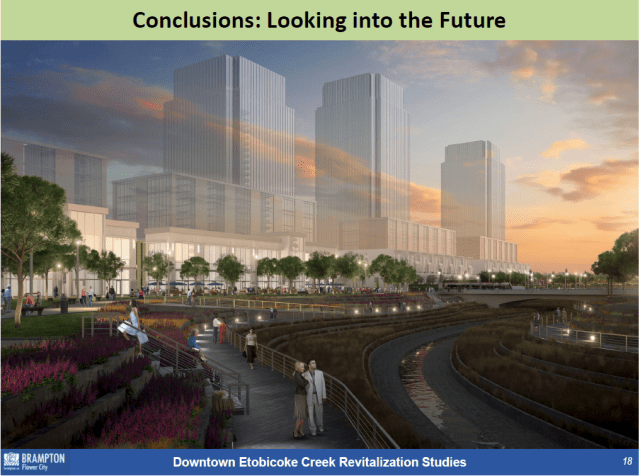
    Happily, the City of Brampton is planning to revitalize the channel, which is nearing the end of its useful life and must be reconstructed. The proposed concept, pictured below, includes new public spaces and urban development.

    Etobicoke Creek
    Conceptual drawing of revitalized Etobicoke Creek 

    Of course, during the walk, there was a discussion of the Hurontario-Main LRT, a subject I’ve written about here several times before. Some local councillors and one local advocacy group, Citizens for a Better Brampton, opposed the Main Street surface alignment, and want to push for an Etobicoke Creek route into Downtown Brampton. It would not only wreck a lovely ravine (where one can spot plenty of wildlife), but it would be located in a floodplain, and near the backyards of less-wealthy residents. There’s now a petition to nix that route. Of course, the cheapest and most logical route is along Main Street itself, but a dysfunctional and misguided Council continues to refuse to accept that fact.

    It was a pleasure leading a Jane’s Walk, and I learned a lot myself from the conversations that we had along the way; a good Jane’s Walk is when local residents participate and share their knowledge. Leading a walk is a lot of fun, and something that’s quite easy to do. And it need not be on the “official” Jane’s Walk weekend (this year, it was May 6-8), but anytime of the year.

    I’ll be leading another walk on Sunday June 12 at 3PM, in Bramalea, meeting at the civic centre across from the mall. Bramalea , billed as “Canada’s first satellite city” when planned and constructed starting in the early 1960s. There’s an interesting diversity of housing types, and an effort to build great greenspaces and linear parks, with a civic centre and shopping mall anchoring the large development.

  • GO Transit and the high cost of “free” parking, Part II: Brampton Boogaloo

    IMG_0610-001

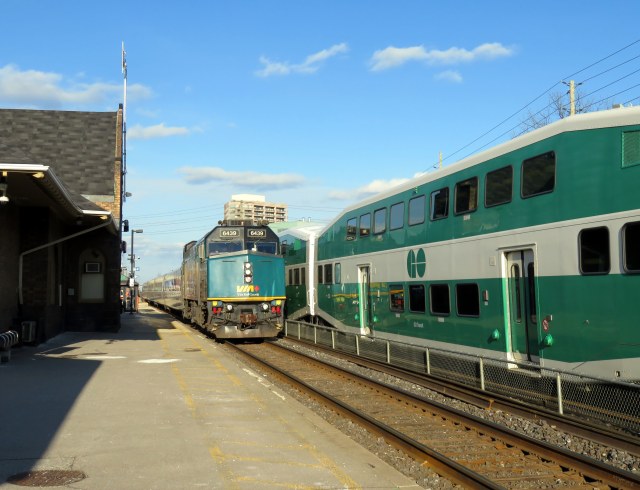
    GO and VIA Trains meet at Brampton Station

    September 20, 2016 update: Metrolinx has begun the process of demolishing its newly-acquired Downtown Brampton properties. It has applied for a demolition permit for 28A and 28B Nelson Street West, two semi-detached dwellings that were built in 2001. In the  City of Brampton, demolition permits for residential properties must be approved by the Planning & Infrastructure Services Committee. The permit will likely be approved at the September 26, 2016 meeting of that committee.


    On April 5, 2016, Peter Criscione at the Brampton Guardian reported on a matter that arose during the regular meeting of the City of Brampton Planning & Infrastructure Services Committee on April 4. Metrolinx, the regional transit authority that operates GO Transit and UP Express, confirmed the purchase of 1.78 acres in Downtown Brampton, land that will be used for surface parking.

    Brampton Station, served by GO Transit and VIA trains, is located in Downtown Brampton, and is adjacent to Brampton Transit’s downtown transit terminal. With local shopping, restaurants, residential areas and employment, it is one of the most walkable stations in GO Transit’s system; it has a Walk Score of 90. (Bramalea GO Station, in comparison, has a Walk Score of 22.) The options of getting to Brampton Station without a car are quite good, at least as far as most GO stations go.

    But Brampton Station’s two lots are full, and there are planned service improvements to Brampton, including eventual hourly evening and weekend rail service. Not everyone can be expected to take transit, walk, or get a ride to the station. But I find this land assembly troubling.

    According to Criscione, and noted in the minutes of the April 4 meeting [page 25-26], the properties purchased by Metrolinx include:

    • 20 Nelson Street West
    • 37 George Street North
    • 41 George Street North
    • 26 Nelson Street West
    • 3 Railroad Street (includes 3 separate parcels)
    • 28A Nelson Street West
    • 28B Nelson Street West
    • 30 Nelson Street West
    • 42 Elizabeth Street North

    The planning committee asked staff to contact Metrolinx and report on the status of its recent and pending purchases of downtown lands. It also invited Metrolinx to work with city staff and officials, as well as present their plans at a future meeting.

    The purchase of downtown lands for a parking lot is troubling, in my opinion. Downtown Brampton is a designated “anchor hub” — a major mobility hub where two or more rapid transit lines meet where transit-oriented development and intensification is encouraged. At no point do I see new surface parking lots are part of this vision, especially if buildings must be vacated and demolished to do so. And Downtown Brampton, not yet experiencing a building boom, has plenty of parking lots and garages that could be employed instead.

    The embedded Google Map below shows where these properties are located, immediately south of Brampton Station, and west of the Brampton Transit downtown terminal.


    On Friday, April 8, I visited Downtown Brampton to have a look at the properties in question.

    (more…)

  • Digging a hole on Main Street

    Fullscreen capture 29022016 113646 PM

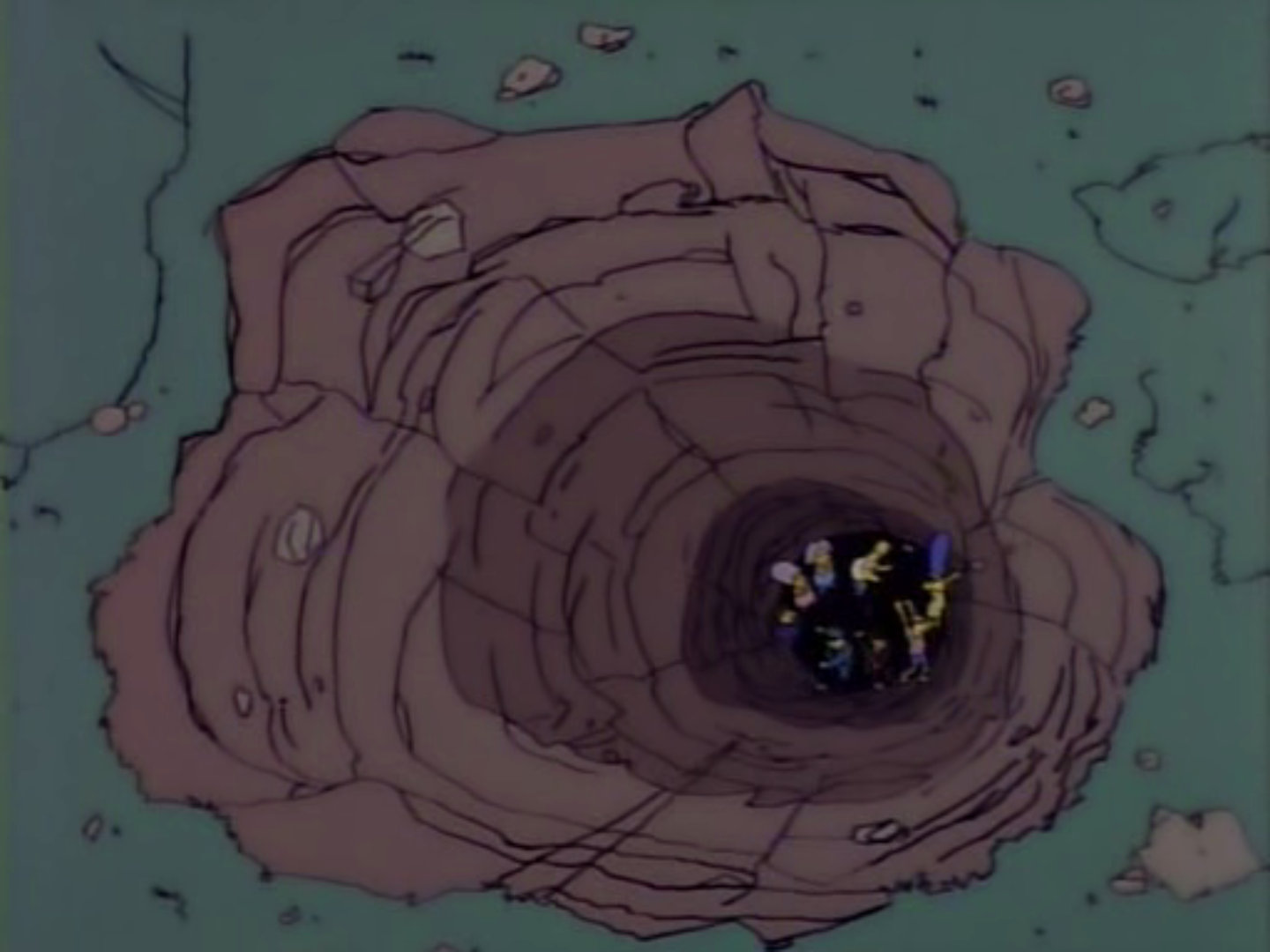
    Most people that know me know that I’m a fan of The Simpsons. There’s a scene at the end of a classic episode, entitled “Homer the Vigilante,” where several characters, including Homer Simpson, Otto Mann, Mayor Quimby, and Police Chief Wiggum are stuck in a hole, looking for a non-existent buried treasure.

    The final few minutes of the episode are a spoof of the 1963 comedy epic It’s a Mad, Mad, Mad, Mad World: a cat burglar tricks the people of Springfield into seeking his buried treasure while he escapes from the police lockup. A briefcase found quickly when digging under a “Big T” says as much, but a few determined souls decide to keep digging in the vain hope of finding that promised treasure. Finally, after digging for hours and finally realizing that there was no fortune to be found, the remaining excavators decide to dig their way out of the deep hole they find themselves in. As the final scene fades into the credits, Wiggum suggests they’re all doing it wrong, providing some nonsensical advice: “No, no. Dig up, stupid.”

    On October 27, 2015, Brampton City Council decided, in a 5-4 decision, to terminate the provincially funded LRT line at Steeles Avenue. Council was pressured by local opposition from wealthy landowners on Main Street South and several downtown businesses. Construction on the shortened transit corridor is scheduled to begin in 2018.

    After rejecting the recommended surface alignment, Council asked staff, which twice recommended the original surface route, to come back with alternative alignments. Late last week, staff released its report on the various options for extending the Hurontario LRT from Steeles Avenue (Shoppers World). That report, buried in a large PDF document, starts at page 238. The report will be brought to the Planning and Infrastructure Committee on Monday, March 7, and will likely presented at a special public meeting on Monday, April 18.

    Yesterday, in Bramptonist, Divyesh Mistry summarized the report’s recommendations. Staff recommended  two tunnel options. Both potential tunnel alignments would extend from a portal between Elgin Drive and Nanwood Drive under Main Street to the GO Station, either with underground stations at Nanwood and Wellington Street (at Brampton City Hall and Gage Park), or running straight through without stops, but a new surface stop at Elgin Drive. The first option, with underground stations at Nanwood and Wellington, would cost $570 million; the second tunnel option would be cheaper, costing $410 million. The tunnel would have to clear the Etobicoke Creek bed, and each underground station would require stairways and elevators to provide access.

    Staff recommended that council authorize $2.5 million for a new transit project assessment process (TPAP), including technical and design work, that would take two years to complete.

    Fullscreen capture 01032016 120953 AM
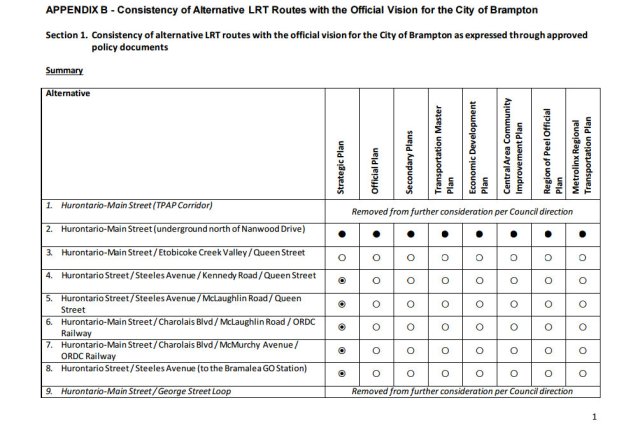
    Appendix B from the City of Brampton staff planning report, which outlines each LRT routing option’s consistency with city, regional, and provincial planning policies

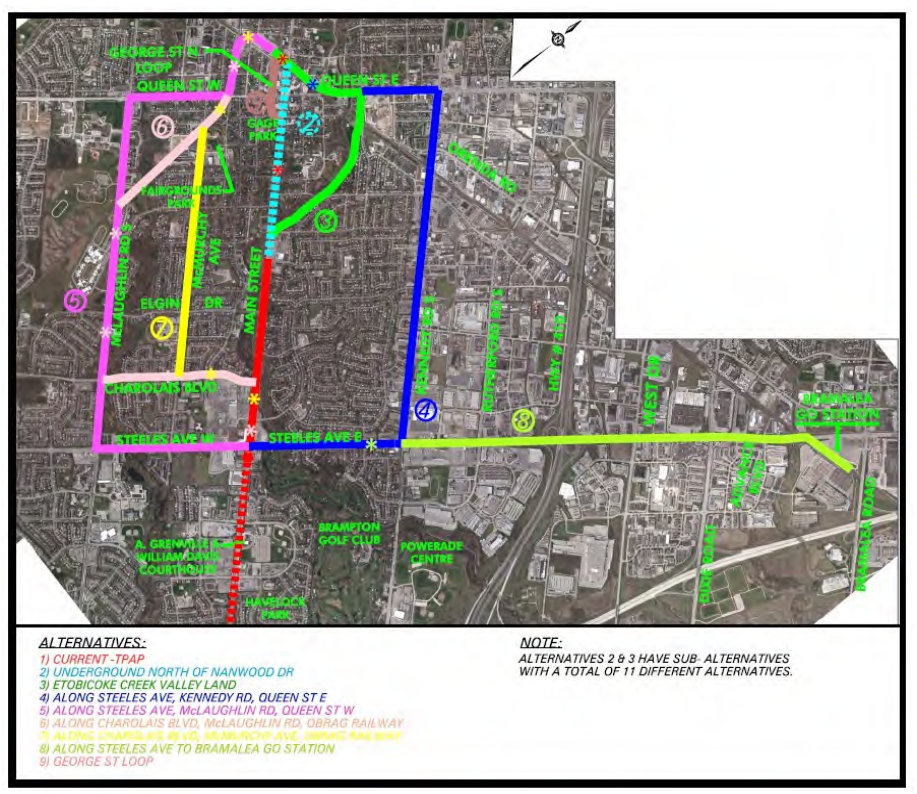
    Of course, cheapest and most obvious option, running the new light rail line on the surface between Nanwood Avenue and the Brampton GO Station, was “removed from further consideration per Council direction.” Various other alignments that would have seen the light rail line follow  McMurchy Avenue, McLaughlin Road, Etobicoke Creek and/or the Orangeville-Brampton Railway were rejected as they were found to be inconsistent with various planning policies, including the city and regional official plans and economic and transportation policies. The various other alignments would be less direct, follow active railways or floodplains, and move the LRT away from Main Street, but in the neighbourhoods of other, less wealthy residents.

    Fullscreen capture 01032016 121050 AM
    Appendix A: from the City of Brampton staff planning report, a map of alternative LRT alignments north of Steeles Avenue

    If money weren’t an object, the first tunnel option, with stops at Nanwood and Wellington, would be a reasonable compromise. It maintains the linear alignment most suited to moving passengers, it gets the LRT to Downtown Brampton, the Queen Street corridor, and the GO/VIA station, and it placates the local NIMBYs worried about light rail trains operating on Main Street.

    But the City of Brampton, when it rejected the alignment north of Steeles Avenue planned during a multi-year TPAP, threw away the $200 million the province was prepared to spend on that segment. If Brampton ends up deciding to extend the LRT, it’s already in a $200 million hole, unless it can convince Queen’s Park to give that money back. If it decides to build a tunnel, it will dig itself even deeper into that hole. The cheaper of the two tunnel options misses useful stops at Wellington and at Nanwood, where the Brampton Mall lands provide an excellent opportunity for urban intensification.

    So I see three options going forward:

    • The status quo. Brampton City Council balks at the costs of each alternative alignment, and the Hurontario-Main LRT terminates at Shoppers World. Maybe in a few years, Brampton will realize its mistake, à la Mesa, Arizona, and approve and build the extension. I see this as the most likely outcome.
    • A return to the surface TPAP LRT alignment. Brampton City Council, once again faced with a staff report advocating the direct Main Street alignment, balks at the cost of the tunnel, and decides to reverse position, even begging Queen’s Park to provide funding. Will a dysfunctional Brampton City Council come to this decision? Possible, but unlikely.
    • A go-ahead for a tunnel. With the recent election of a new Liberal government committed to building infrastructure, there’s a slight chance that Brampton would find enough support from upper levels of government for partial funding for a $410-570 million tunnel into Downtown Brampton. But it will be up against many competing bids for transit funding. London, Ontario has a plan for a rapid transit system. Ottawa is ready to start building Phase II of the Confederation Line LRT. And, of course, Toronto has several plans for new subways and LRT lines. Will Brampton be willing to go it alone?

    As Lisa Stokes points out, Brampton already has a $1.5 billion infrastructure gap, and there are many other projects that the city needs in the short to medium term, such as a second full-service hospital campus, a central library, a permanent market space, or simply repairing the roads, parks, and recreation centres in dire need of attention.

    So because of its rejection of a financially and technically sound surface routing last October, the City of Brampton will likely go through a new round of project assessments. It will also have to go begging for money to build their preferred alternative. Without even starting construction, City Council dug a pretty deep hole for itself. Can it dig itself out?

  • The terminus of the Hurontario LRT: an opportunity for something better

    IMG_8755-001
    Downtown Brampton, the logical terminus of the Hurontario-Main LRT

    I’ve written several times about the Hurontario-Main light rail transit (LRT) project on this blog. Last summer, I led a walk along Main Street, discussing Downtown Brampton’s wonderful built heritage, the potential for Main Street, and explaining why alternative routes, proposed by councillors and private interests, weren’t feasible. Floodplains aren’t great places to build higher-order transit lines.

    Needless to say, I was very disappointed that Brampton City Council voted 6-5 last October against building the LRT between Steeles Avenue and Downtown Brampton. A vocal and wealthy minority, including a former premier of Ontario, opposed the project; it didn’t help that Mayor Linda Jeffrey found herself in constant opposition with several city councillors who backed other candidates for mayor in the 2014 municipal election. A Toronto Star reporter, assigned to the western GTA beat, wasn’t reporting fairly on this issue either.

    Since that unfortunate vote, I resigned myself to a truncated Hurontario-Main LRT corridor that will still serve three or four stops in Brampton, but will stop short of its logical terminus.

    I recently made a trip out to the intersection of Steeles Avenue and Main and Hurontario Streets, the new northern terminus of the planned LRT. Construction of the 20-kilometre line, between Port Credit and Steeles Avenue, is scheduled to begin in 2018.

    HMLRT
    The Hurontario-Main LRT, after Brampton City Council’s vote in October 2015. 

    The corner of Steeles Avenue and Main Street is already a major transit hub. Eleven Brampton Transit bus routes (including two Züm routes), a Miway express bus, and GO Transit buses serve the corner; the Brampton Gateway Terminal is the city’s second-busiest transfer point. The new Gateway Terminal, which opened in 2014, was built to accommodate ridership growth and facilitate transfers with the proposed LRT, which will stop in the median of Main Street.

    As far as Toronto’s suburbs go, this corner of Brampton is relatively dense. There are several rental towers within a short walking distance; there are also three nearby townhouse complexes. Shoppers World, on the northeast corner, is a large regional shopping centre, albeit a mall that has fallen on hard times. On the southwest corner, there is still an old farmfield, surrounded by subdivisions, apartment towers and retail. There are many opportunities for transit-oriented development.

    IMG_8803-001A fallow farm field, south of Shoppers World. The area is zoned for medium and high density housing developments, including townhouses and apartment buildings. 
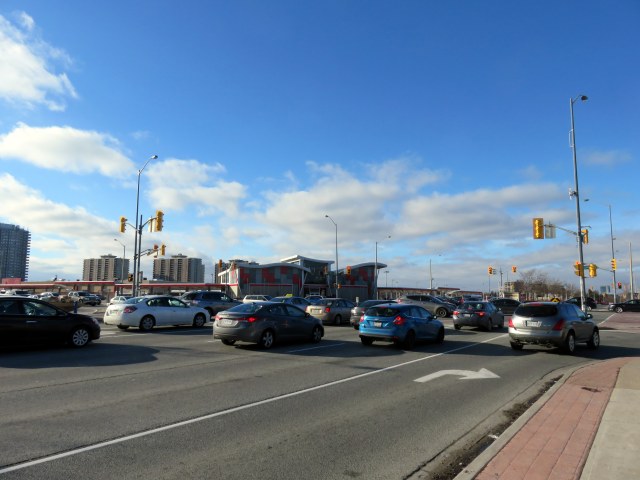
    If Downtown Brampton, Brampton’s busiest bus route (501 Queen) and a GO Transit and VIA Rail station weren’t just 3 kilometres away, this would actually be an ideal terminus for a suburban light rail transit line.

    IMG_8776-001The corner of Steeles and Hurontario/Main, looking northwest. The Brampton Gateway Terminal is on the opposite corner.
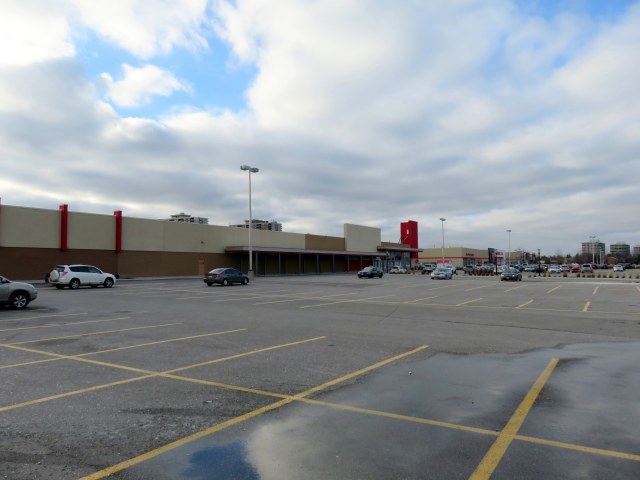
    One of the greatest opportunities for new transit-oriented development is Shoppers World Brampton. First opened in 1969 by Peel Elder Limited (who also developed Shoppers World Danforth), the mall went through several additions over the years; by the 1980s, it boasted over 200 stores, including a Simpson’s, K-Mart, Pascal Hardware, cinemas, and two supermarkets. At one time, Shoppers World even had indoor waterslides. By 2000, Simpsons became The Bay, and K-Mart became Zellers.

    Growing up only a 15-minute walk away, Shoppers World was my local mall. Pizza Hut was a favourite place to meet up with friends, I fondly remember the free popcorn at Jumbo Video, and the bus terminal made it easy to get to better malls, particularly Square One. My first paying gig was returning abandoned shopping carts to K-Mart for $5 each.

    By the 1990s, the mall’s owners neglected the property, while Bramalea City Centre and Square One renovated and expanded. There were persistent rumours that the mall would be closed and re-developed with highrise towers.

    IMG_8782-001A mostly empty Shoppers World parking lot on a Saturday afternoon.
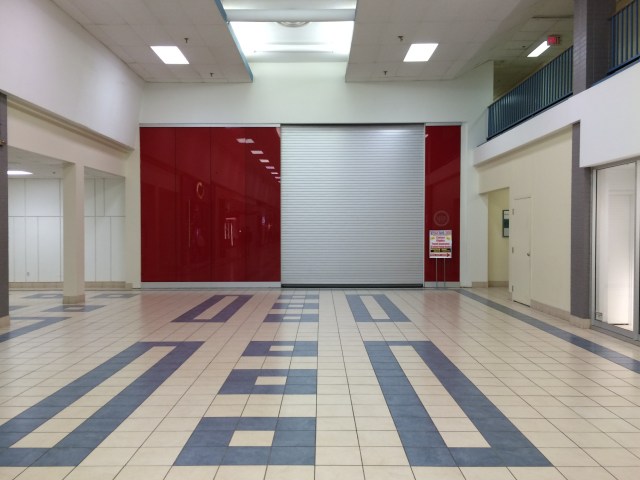
    RioCan REIT took over Shoppers World Brampton in 2000, renovated the property, and added new big-box retailers such as Canadian Tire. But The Bay closed in 2007, and Target, which took over Zellers’ lease, shut down last year. The final indignity came when the shuttered Bay store was torn down and replaced by Lastman’s Bad Boy.

    Shoppers World isn’t yet a dead mall – while many national chains left in the last two decades, small businesses have moved in. However, there are still plenty of vacancies, especially in the north end of the mall, near where The Bay used to be. The new Bad Boy and Beer Store are accessed only from outside the mall, making it harder to draw customers in.

    IMG_2887-001The former mall entrance to Target, showing the floor tiles installed in the 2000-2002 renovations.

    The answer, I think, is to partially redevelop Shoppers World into a mixed-use, transit-oriented development, retaining a majority of the retail space, but including new residential, office and community uses. Shops at Don Mills, at Don Mills Road and Lawrence Avenue in Toronto, isn’t a bad model to follow, but better residential integration and a proper link with the transit hub would be necessary. Humbertown, a smaller, but controversial development proposed for Etobicoke, has the right mix of retail and residential intensification.

    One day, I believe a new Brampton City Council will come to its senses and get the LRT extended to Downtown Brampton as proposed. This is what happened in Mesa, Arizona, a Phoenix suburb that originally opposed a light rail corridor from Downtown Phoenix, Tempe, and Arizona State University, to its downtown. After the first phase of the Valley Metro LRT opened in December 2008, political opposition to a light rail extension along Main Street faded. The LRT through Downtown Mesa opened to great fanfare in August, 2015.

    But until that time comes, there are some opportunities to capitalize on the approved plan. Steeles Avenue isn’t the ideal place to end the Hurontario LRT, but it’s a good place to start planning something better.