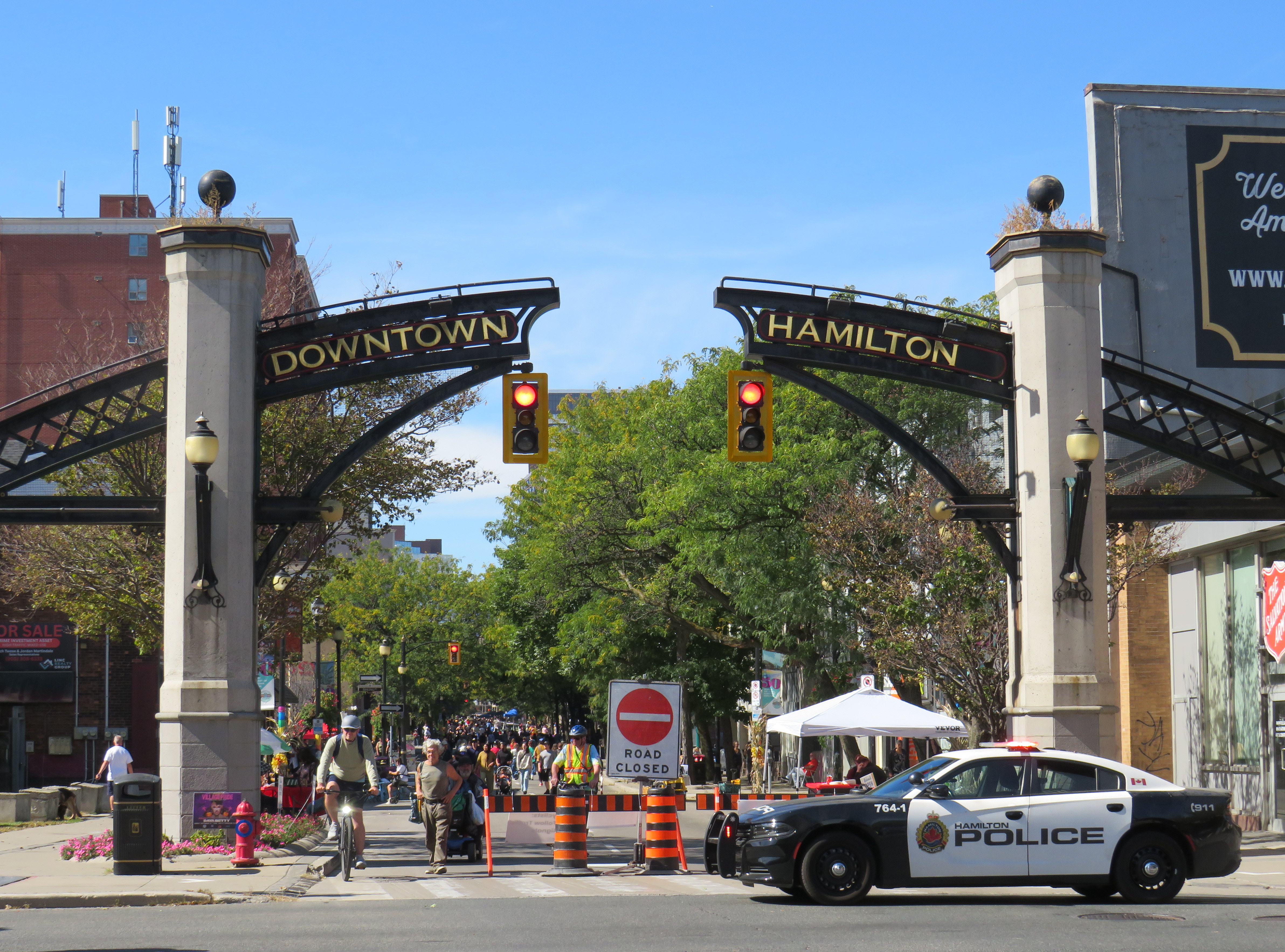
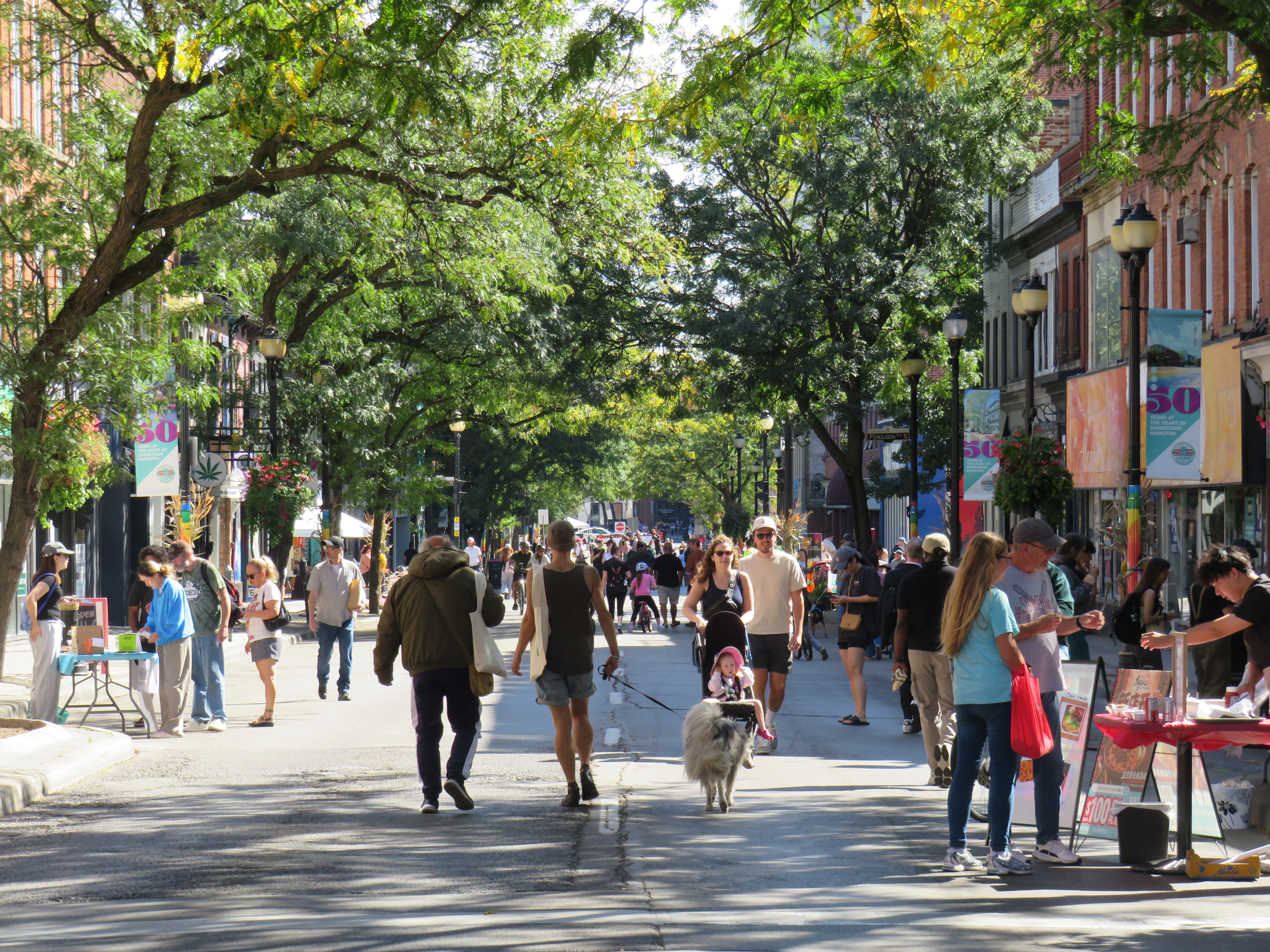
On Sunday, September 27, I took the GO train to Hamilton with my bike to experience Open Streets Hamilton, an annual event that shuts down just over three kilometres of King Street East between John Street and Gage Street from 10AM to 4PM. An official program of the City of Hamilton, pedestrians and cyclists get to enjoy a car-free experience, with five activation hubs, with live music, play spaces, and booths set up by city-affiliated agencies like the Hamilton Street Railway and Hamilton Public Library as well as local non-profit and activist organizations. Businesses along King Street were welcomed to take their business outside with displays and tables for passers-by to browse.
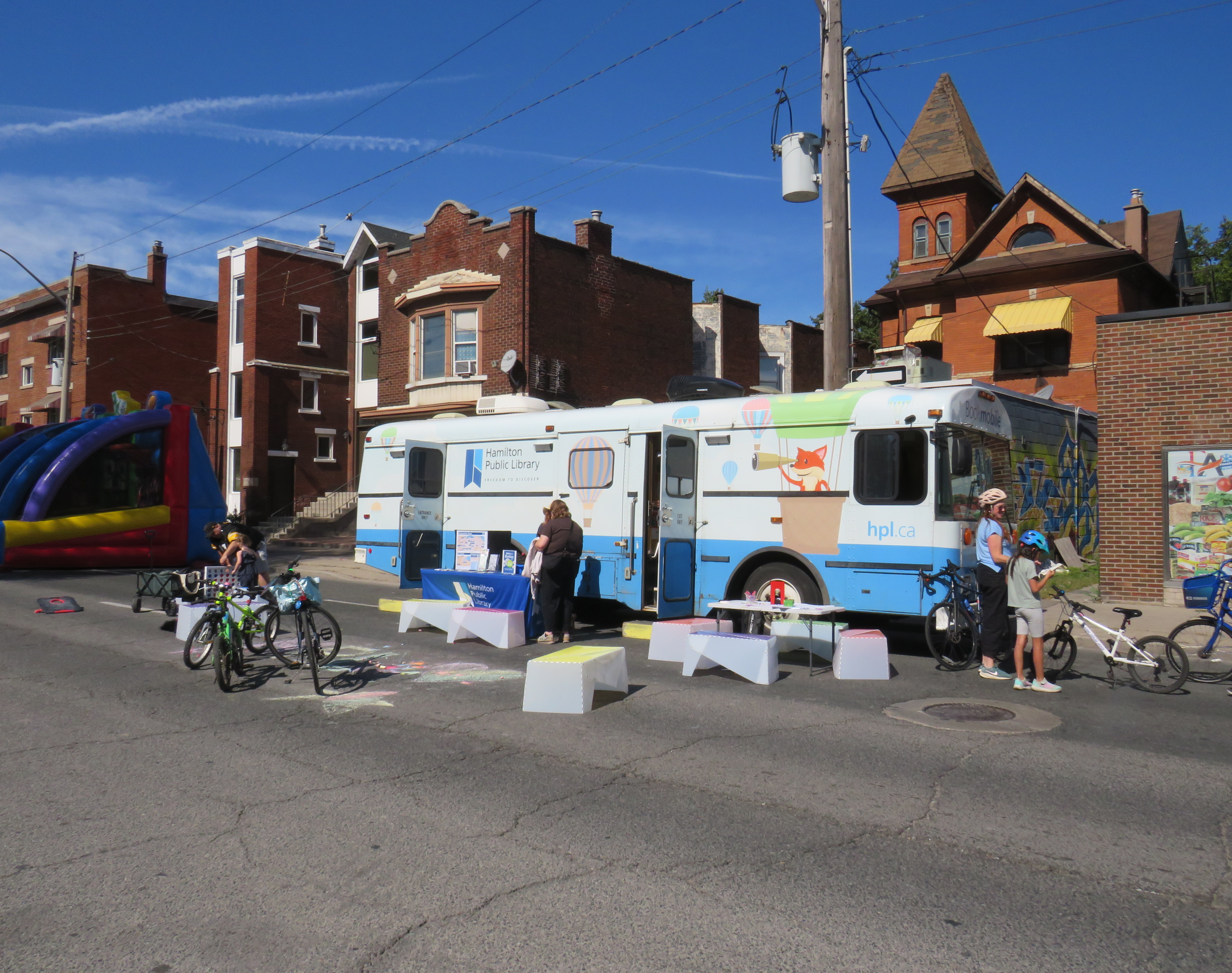
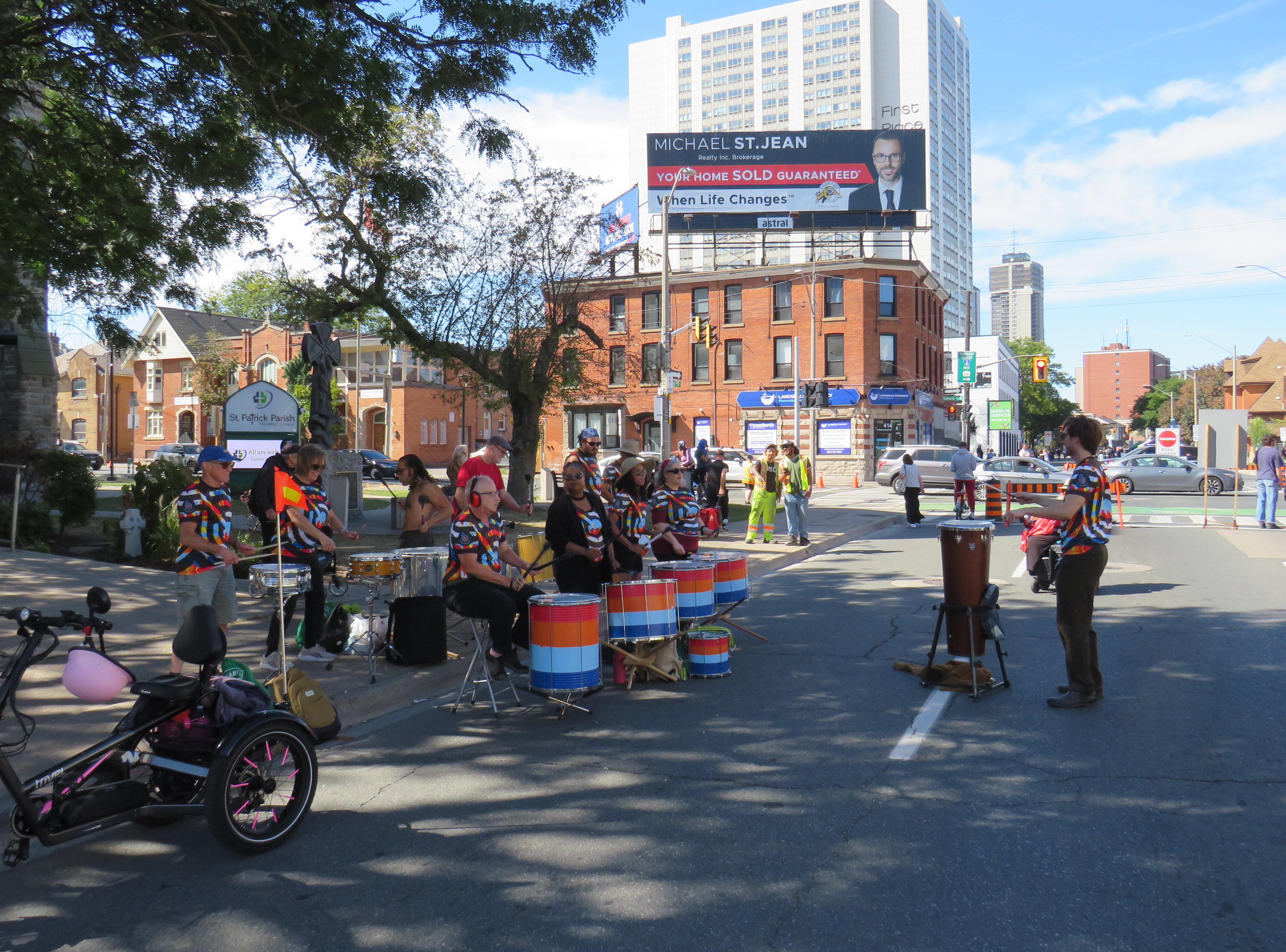
The Hamilton Public Library’s bookmobile near King and ShermanDrum band at King and Victoria
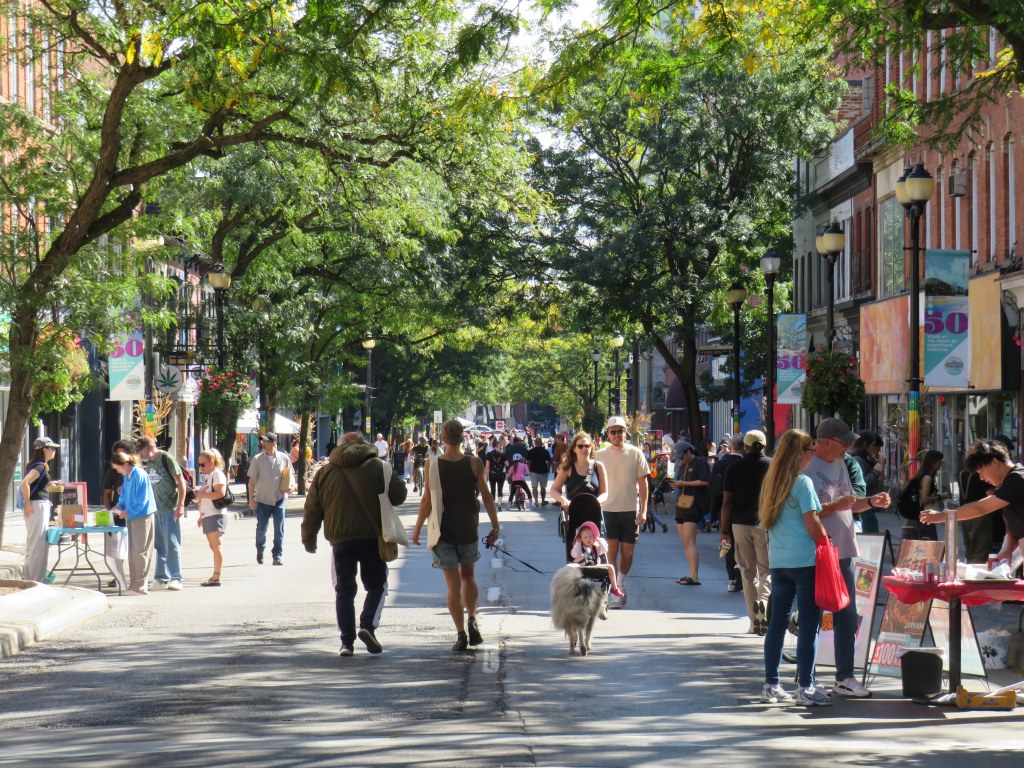
Hamilton’s Open Streets was a delight. A pleasant, sunny day certainly helped, but it was nice to see so many people sharing the space, all at a gentle pace. Cyclists taking advantage of the car-free King Street were respectful of pedestrians having the whole right-of-way and especially careful around the five hubs. Cyclists looking for a faster route could easily go just two blocks north to Cannon Street, which has a continuous two-way cycletrack as far east as Sherman Avenue.
King Street narrows between John and Wellington Streets through the tree-lined International Village BIA
By extending Open Streets into the later afternoon, Hamilton helped to encourage businesses to participate and to get a wide variety of participants through the day. Though Open Streets in Toronto was supported by the Downtown Yonge BIA, there was limited commercial activity along the routes, likely due to the short hours.
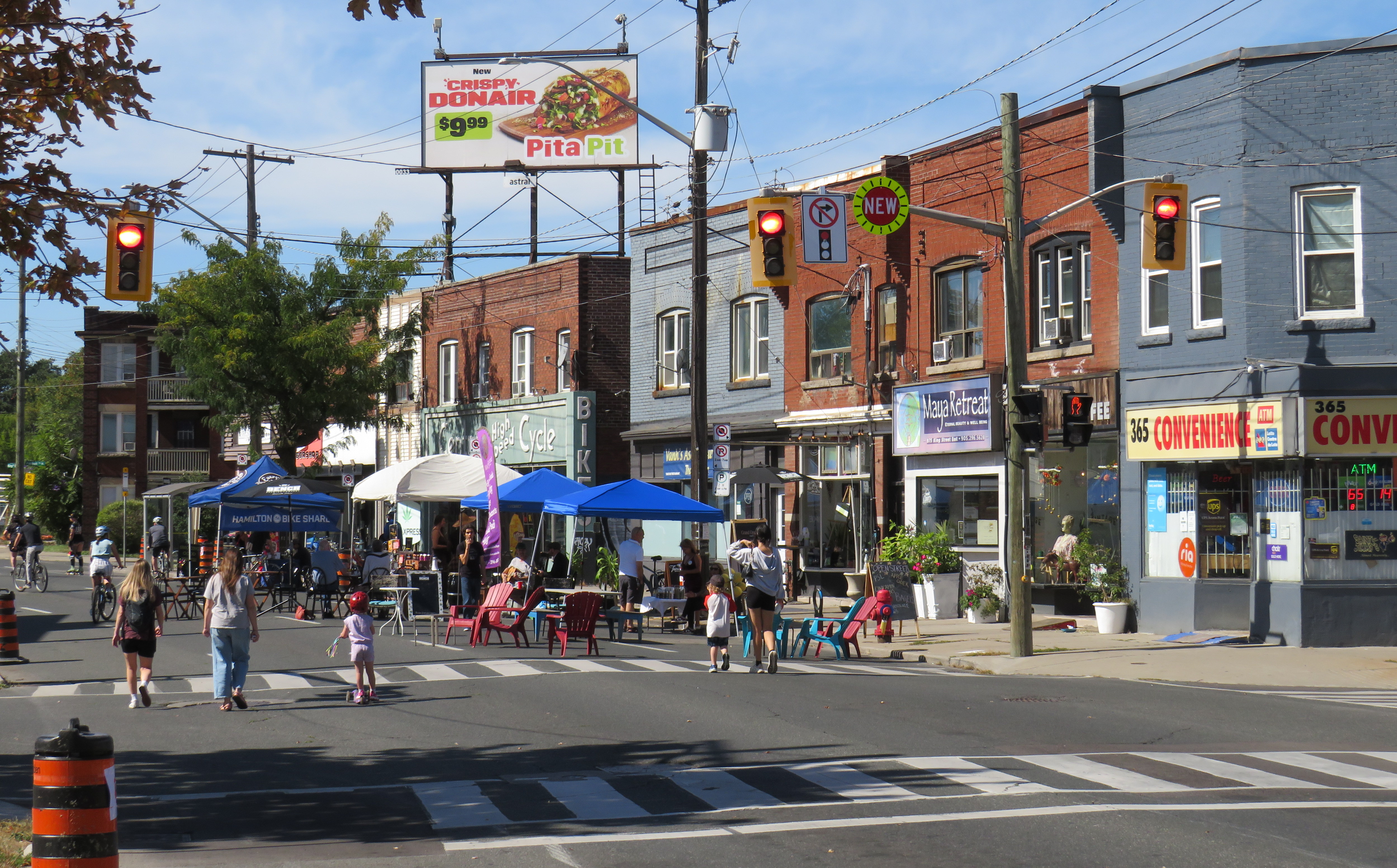
King at Barnesdale, towards the east end of the Open Streets. Note the café on the block put out seating and shade canopies.
In 2026, Toronto only had two blocks of temporary pedestrian activation — Church Street between Alexander and Wellesley Streets in the Village. Happily, that experiment ran for over six weeks, and restaurants and bars took advantage of the extra space. It worked well, despite nearby road construction and concerns about safety and traffic congestion. But it was just a taste of what Toronto can and should do.
Hamilton shows that open streets are popular and Toronto needs to bring them back. Hopefully the mayor and council elected later this month will have the courage and ambition to get Torontonians outside and on the streets.
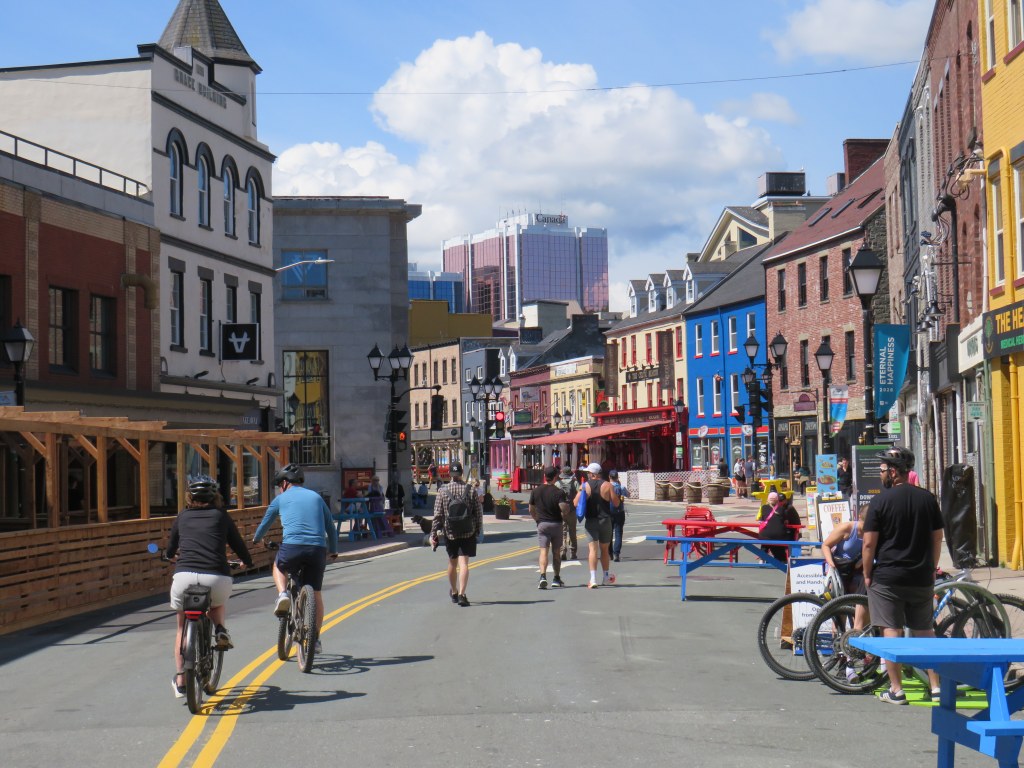
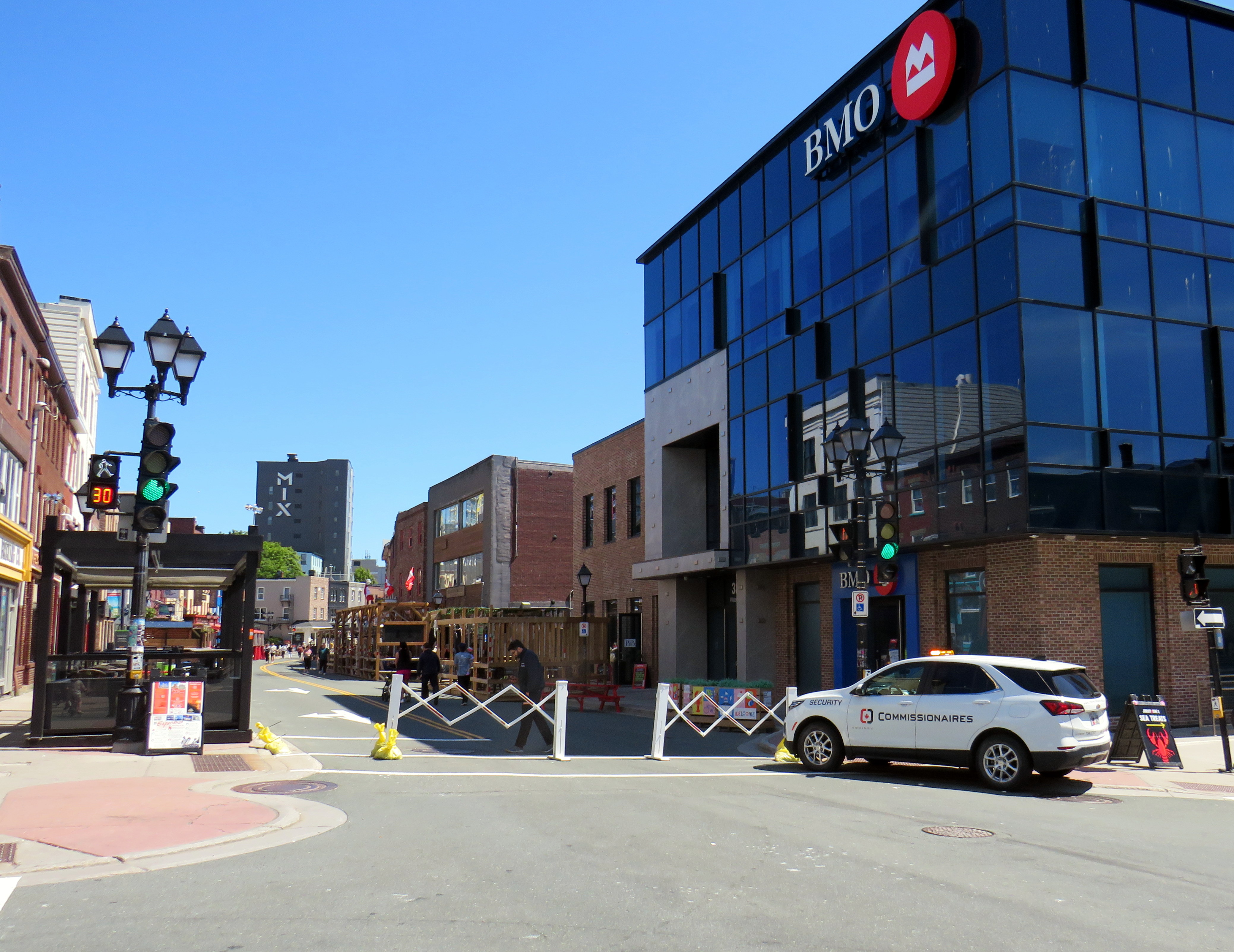
Pedestrians and cyclists enjoying a sunny Sunday morning in St. John’s
In late June of this year, my spouse and I had the chance to visit St. John’s, along with a few other destinations in Eastern Newfoundland and Saint Pierre, France. I highly recommend the visit, though even late June can be a bit cool and wet there.
During our last two days, several blocks — about 700 metres — of Water Street, the main commercial street in St. John’s, was closed to all motor vehicles, and remains so until September 7, Labour Day. This is an annual event, supported by downtown businesses, and is one of the positive legacies of the social distancing era of 2020-2021.
Though fenced-off restaurant patios spill on to Water Street, there are plenty of public spaces to sit, too
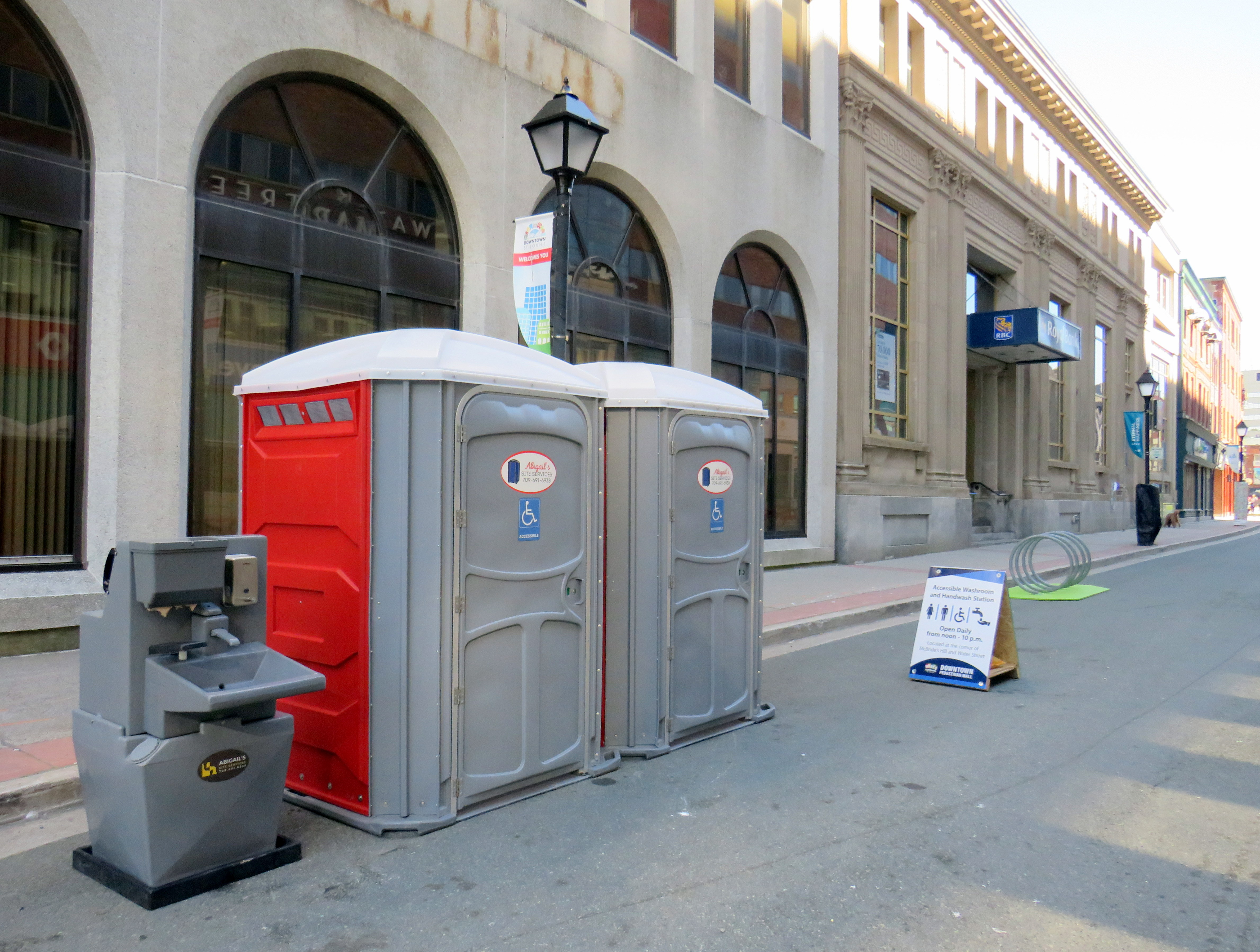
This is much less a street festival (though there are plenty of organized events) and more of an open street initiative. Though restaurants’ patios spill out into the street, there are plenty of public picnic tables set up for anyone to use, both in sunny and shaded areas. There are several portable toilets, complete with adjacent hand-washing sinks, which provide relief without having to pay to use a washroom.
Portable washrooms, hand-washing station, and portable bike parking on Water Street
Pedestrians and pedal cyclists are welcomed, though cyclists are instructed to go at a slow speed, and e-bikes passing through must have their power assist off.
Sign explaining e-bike policy for the Downtown Pedestrian Mall
Of course, there are security guards and gates set up to keep motorists out, apart from emergency vehicles and local deliveries. But I did not notice any police cars stationed at any of the intersecting streets, and the few RNC officers I saw were on general foot patrol. Though several Metrobus routes normally serve Water Street, these are diverted one block away to Harbour Drive.
Security minding traffic gates at Water and Adelaide Streets, the southern end of the pedestrian mall
Though St. John’s is a much smaller city than Toronto (its metro area is less than 4% the size of Toronto’s CMA), it is also much more car-dependent, with only a basic bus transit system, and very little cycling infrastructure. Yet, they are able to pull this off for ten weeks a year, on an annual basis. The last Open Streets event in Toronto was in 2022, and those were only held two Sundays of the year. Yes, there are wildly successful street festivals, such as Taste of the Danforth, which just had its record-breaking comeback, but they aren’t the same as they are rammed with crowds, and those only take place over two or three days.
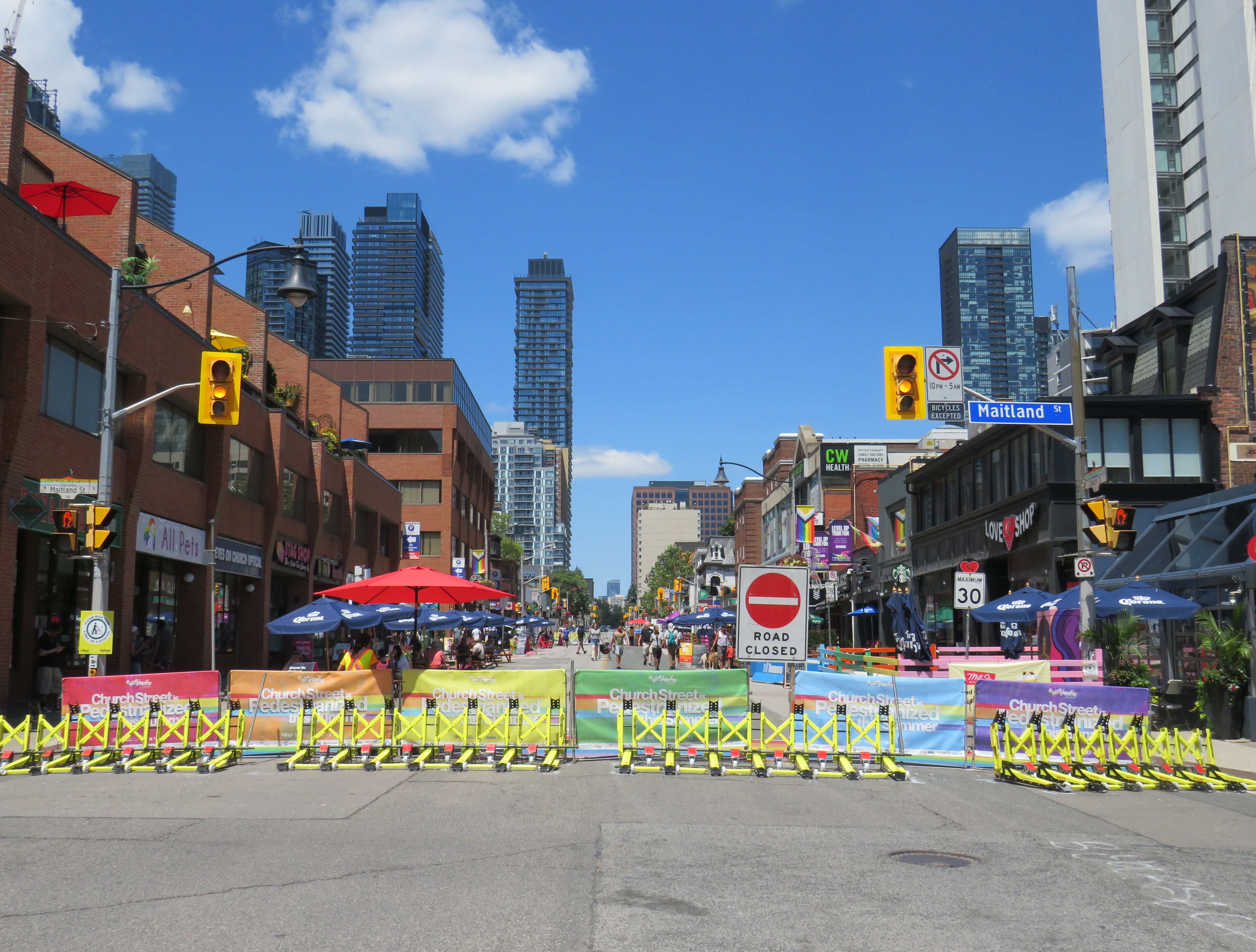
Moveable car traps and metal barricades block Church Street, looking north at Maitland
One key noticeable difference are the harder barriers to prevent motor vehicles from entering. Yellow wheel traps are lined up next to metal barricades, decorated with colourful banners. Though understandable given recent history in Toronto and Vancouver with vehicular attacks on sidewalks and a street festival, they sadly act to fence in what should be an open street and pedestrians must enter on the sidewalks. Unlike St. John’s, cycling is prohibited as well.
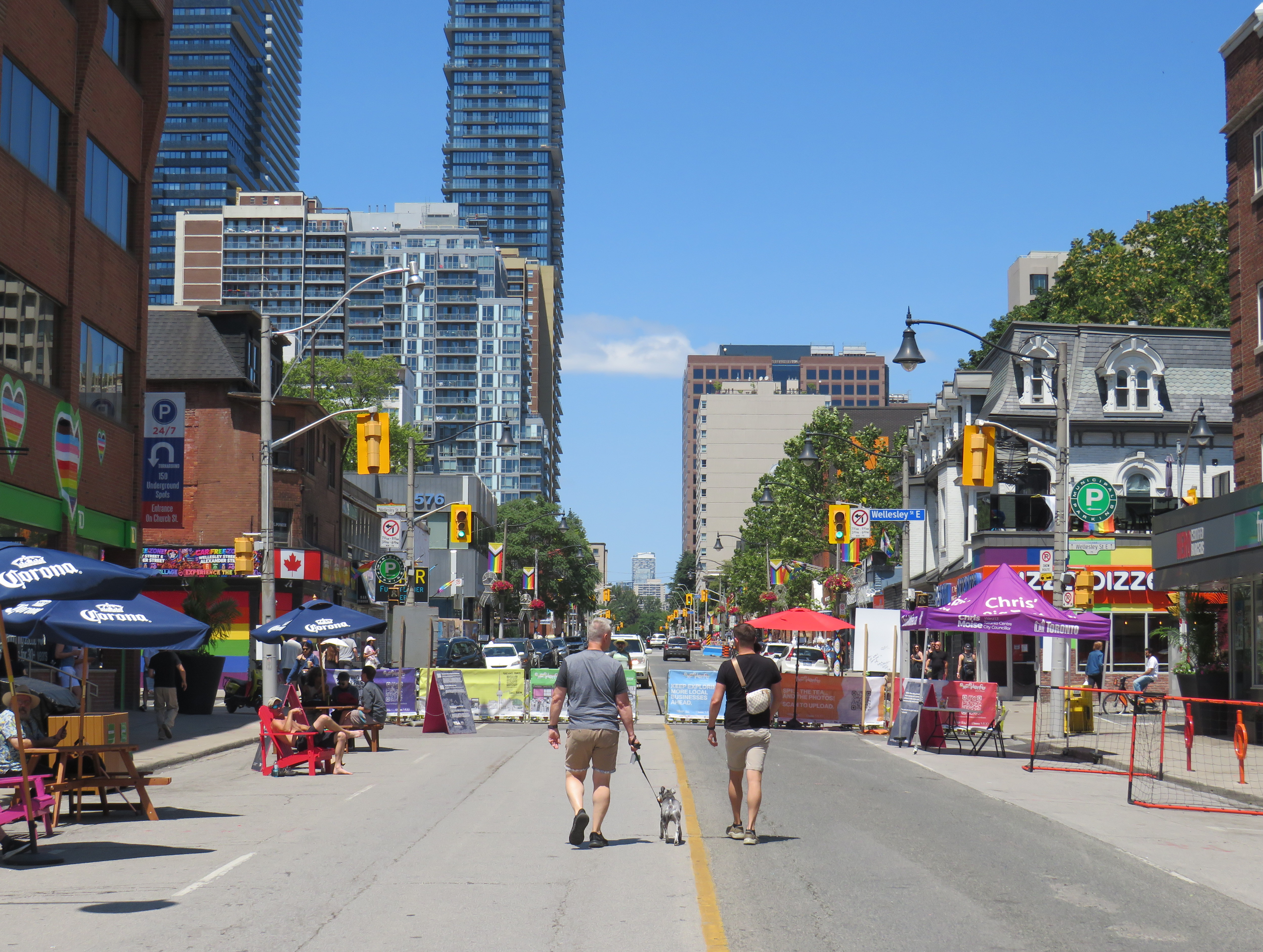
Shaded by branded patio umbrellas, the picnic tables and Muskoka chairs on the left are open to anyone
Still, it’s a great taste of what Toronto should have more of. As on Water Street, there are both private patio spaces on the street as well as public chairs and benches, as well as extra waste bins, though no public toilets. It’s also very well used, especially later in the day. The Church-Wellesley Village is the cultural and commercial centre for Toronto’s 2SLGBTQ+ communities, as well as being in the centre of a very densely-populated area with limited open space.
It is also oddly quiet, despite the vibrancy. That’s because there are no cars, which are a major source of urban noise pollution. The car-free environment also makes sitting on a curbside patio much more enjoyable, without the noise and smells of passing motorists. How can anyone object?
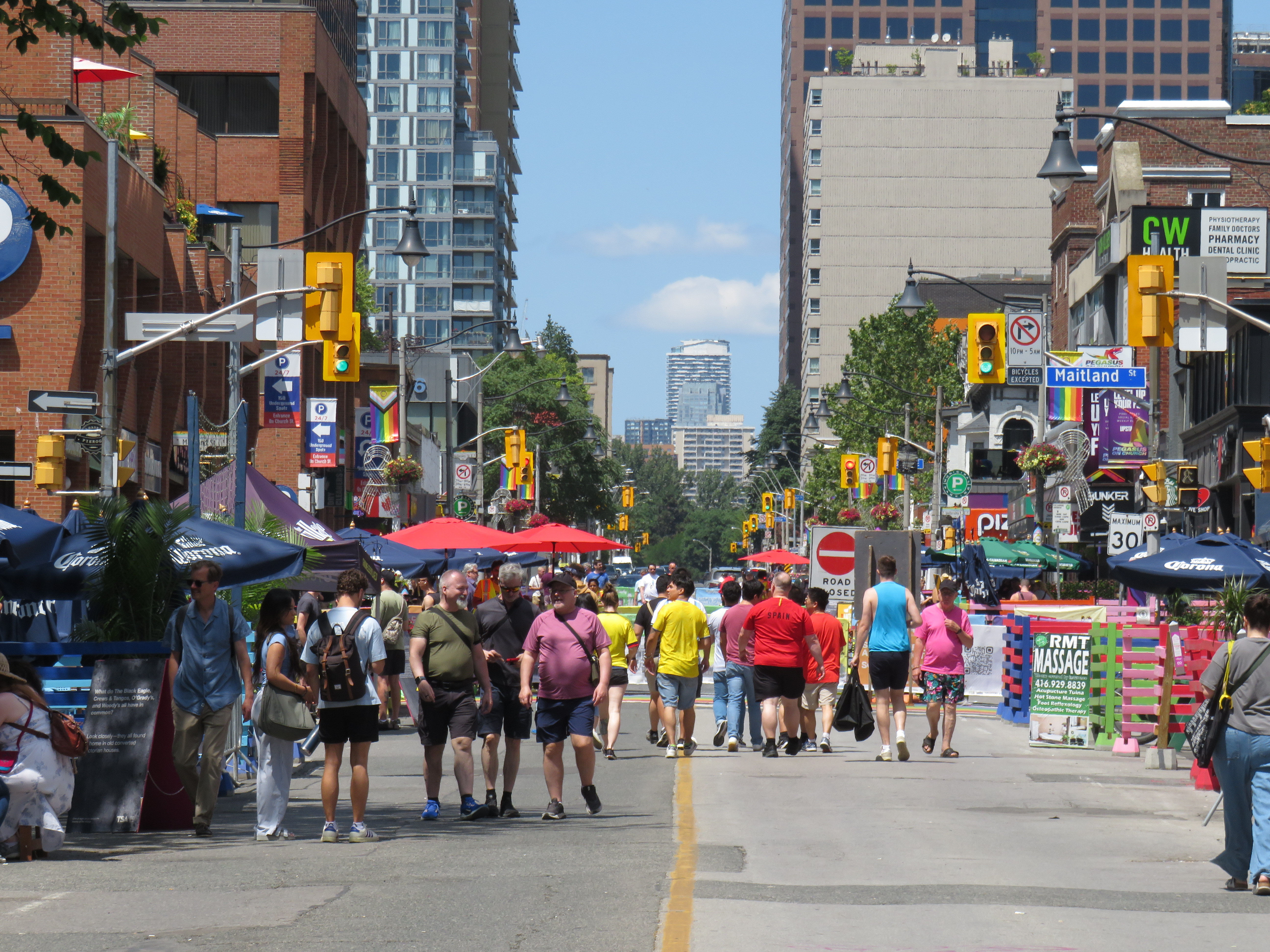
Later in the afternoon, Church Street was busier with pedestrians
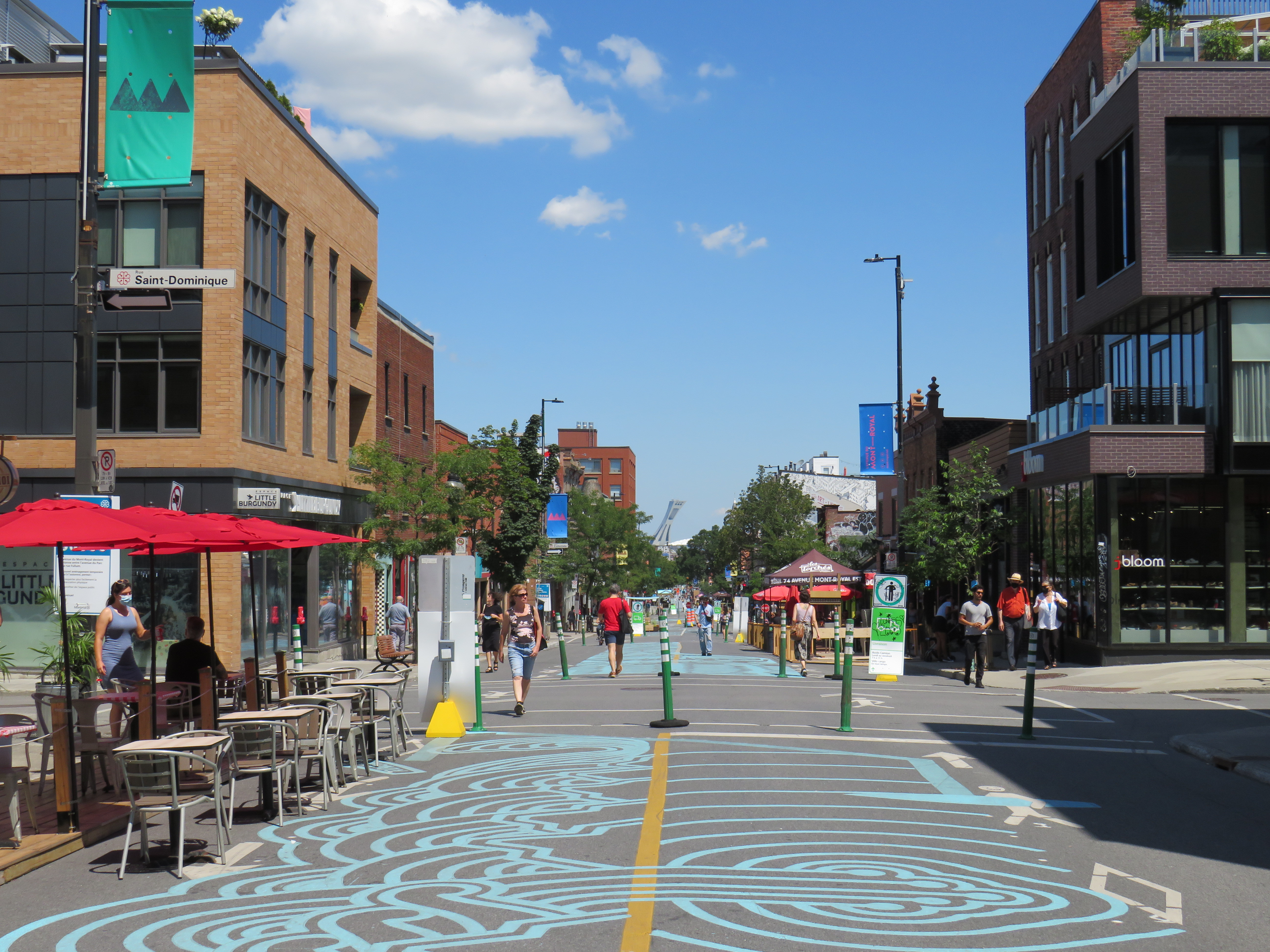
It might be too much to ask for Montreal-style open street corridors, but Toronto should at least aspire to more, long-term open street set-ups like Water Street and Church Street. Kensington Market would be the perfect place to start. Even on our busy east-west streetcar routes on corridors such as Gerrard Street East or Queen Street West, with a bit of imagination and can-do spirit, we can accommodate those as well.
With adding long-term implementations, we will need to rethink the costs of policing and security, which are currently a major barrier to providing these spaces in Toronto. In Montreal, security staffing is minimal on open streets such as Ave. Mont-Royal. The needs of policing and securing a regular pedestrianized area are quite different than ensuring safety at a crowded street festival.
Ave. Mont-Royal, where security measures are minimal on the summer open street
Such crowd-pleasing, neighbourhood-building actions as Open Streets should be on any serious mayor or council candidate’s policy platform in the upcoming municipal election.
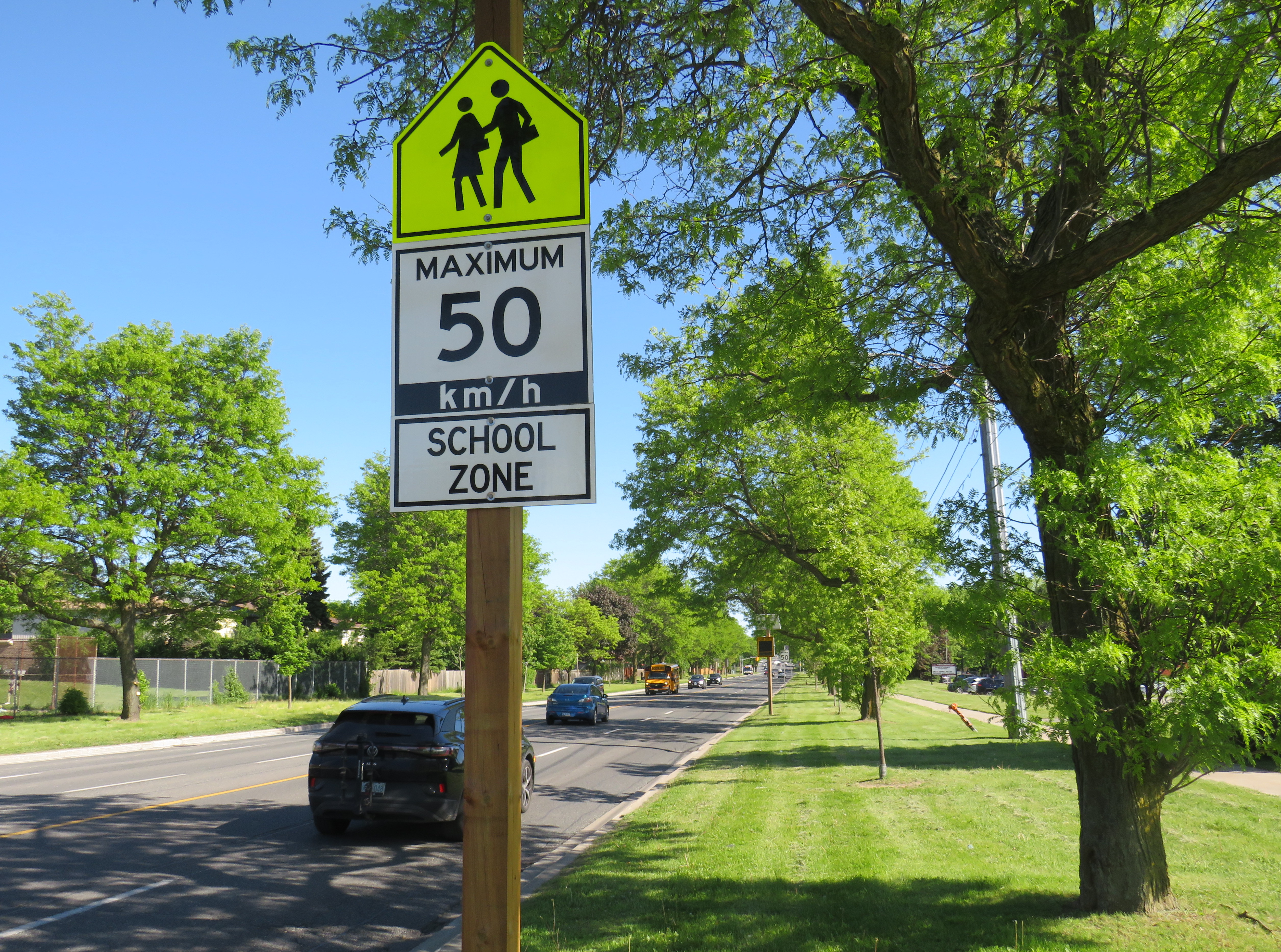
A gigantic school zone speed limit sign on McCowan Road in Scarborough
Months after Doug Ford’s provincial government banned the use of municipal speed enforcement cameras, calling it a “cash grab,” new supersized school speed zone signs are going up across the province. The first ones I encountered are on McCowan Road in Scarborough, near my spouse’s family home.
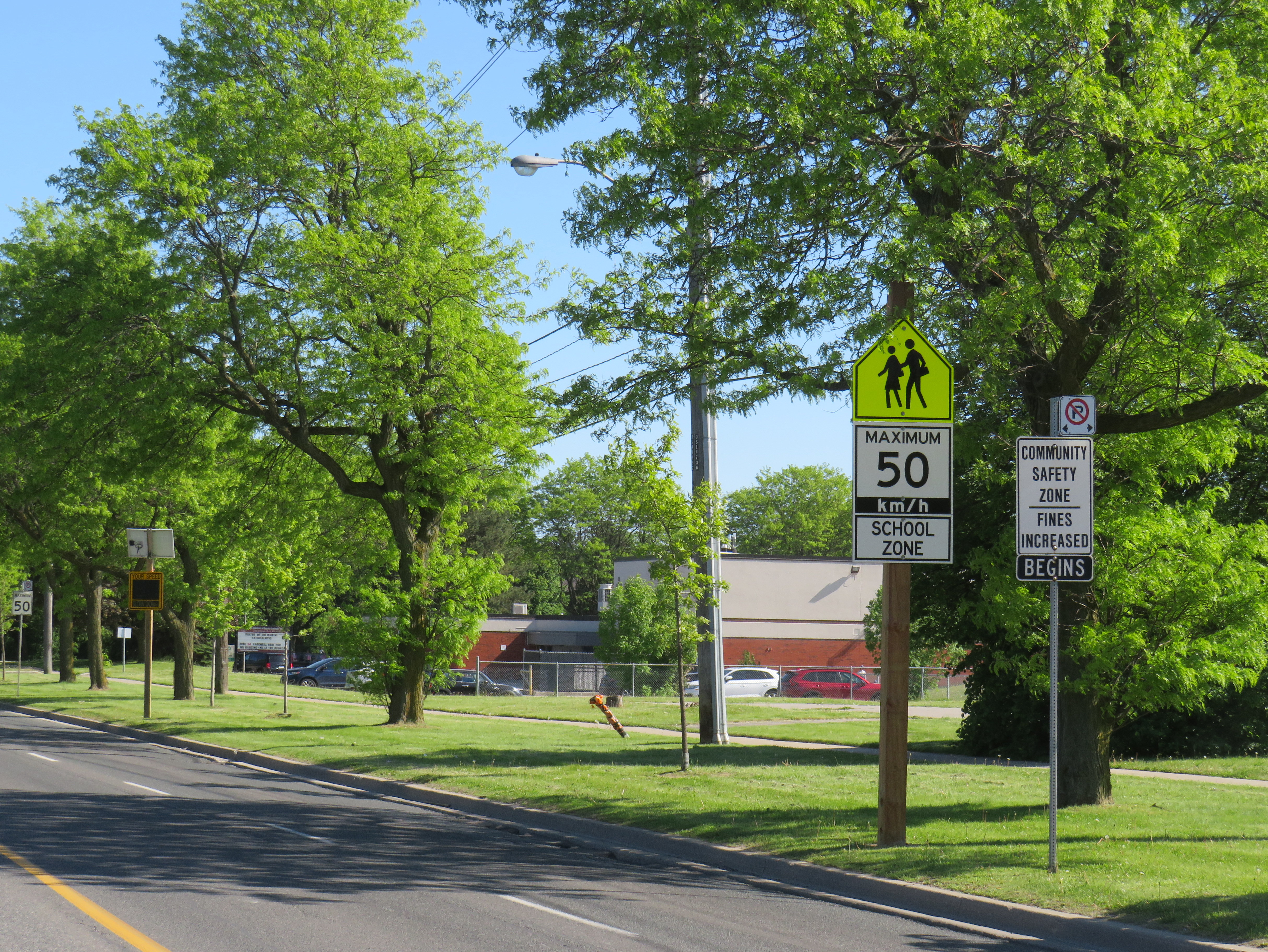
The signs, placed near St. Ignatius of Loyola Catholic School south of Finch Avenue, are gigantic: nearly 2.5 metres tall, mounted over three metres above the ground, affixed to an extra large wooden pole as the new signs were too big for the standard metal poles used for that purpose. The province delivered 80 signs to the City of Toronto, but with four signs per school zone (two mounted in each direction including advance warning signs), that meant only 20 schools would get these new totems.
The new supersized school zone sign next to an older “community safety zone” sign, affixed to a standard metal sign pole
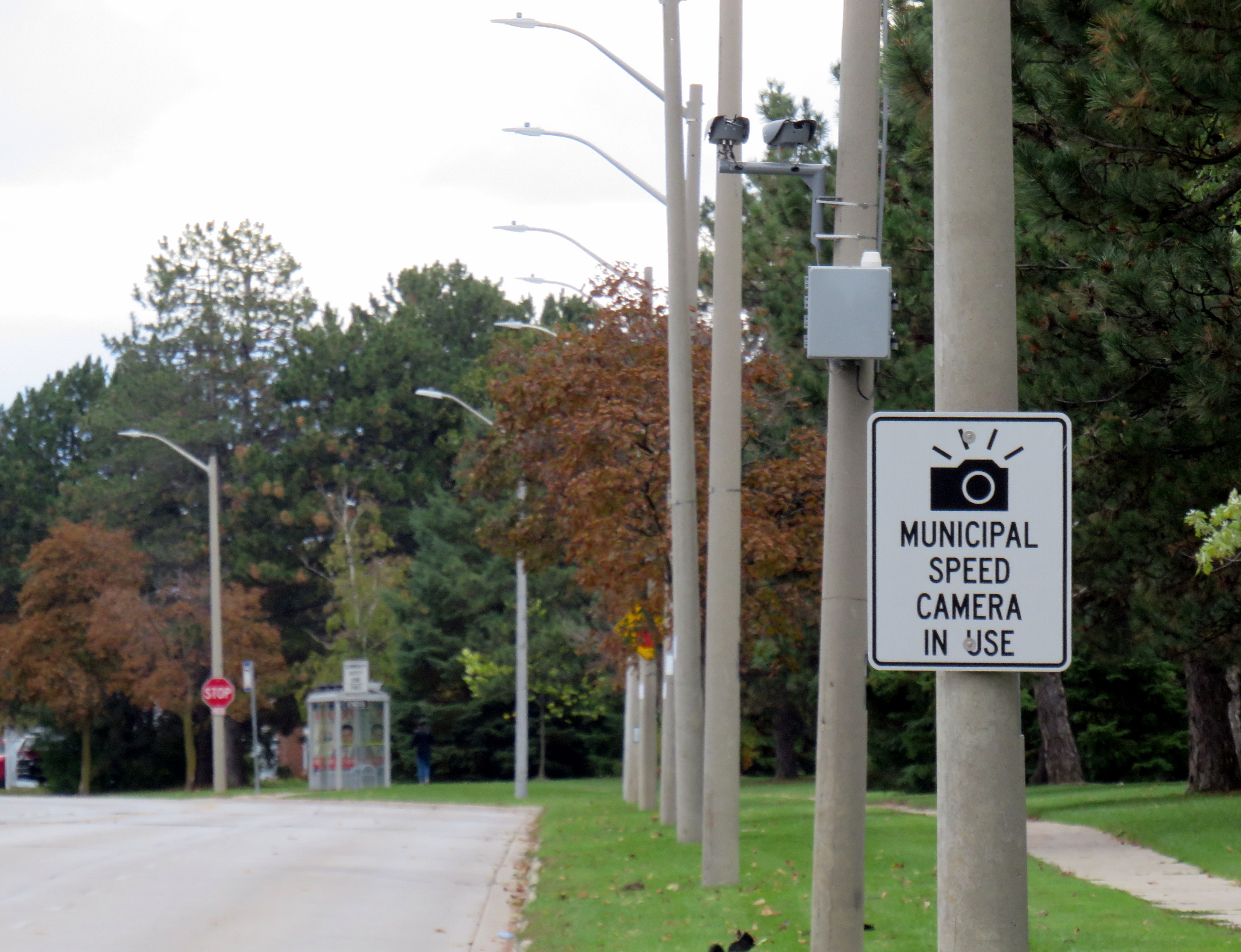
Before the pro-driver legislation was enacted on November 14, 2025, there was a speed camera placed on McCowan Road adjacent to the elementary school, one of 150 located in the City of Toronto. Under provincial law, municipal speed cameras were only allowed to be installed in specific designated safety zones, namely roadways adjacent to schools, parks, or seniors’ residences, and had to be accompanied with advisory signage.
Between April 2024, when the camera was activated, and July 2025, when the camera was destroyed (one of many vandalized that year), over 19,000 speeding motorists were captured by the photo camera travelling at least 11 km/h over the posted speed limit. This was despite the existing maximum speed, school zone, community safety zone, and municipal speed camera signs on this stretch of road.
Sign warning of a municipal speed camera in Brampton in October 2025
Despite the high number of infractions, the cameras were doing their job; a job that the Toronto Police isn’t motivated — or able — to do. As seasoned municipal watcher Matt Elliot points out, for period between January 1, 2025 through November 14, 2025 (when camera enforcement was forced to end), 628,165 speeding tickets were issued through the automated speed enforcement program. Toronto Police’s “Vision Zero” traffic unit issued just 14,500 tickets.
New city report notes the Toronto Police Vision Zero Enforcement Team handed out about 14,500 speeding tickets in 2025. Might sound like a lot, but well, compare and contrast.
Despite all those tickets issued, the cameras were especially effective at reducing speeding in school zones. A 2025 Toronto Metropolitan University/SickKids Hospital study found that speed enforcement cameras reduced speeding by 45 per cent and reduced speeds by most drivers by more than 10 km/h.
Active police enforcement remains a valuable tool because officers can lay charges that automatic speed cameras can not catch, including distracted, impaired, and dangerous driving. But policing has a dark history of racial profiling and has a pro-motorist “windshield bias,” while speed enforcement and red light cameras do not discriminate.
Furthermore, North American roads are designed for excessive speed and not for the safety of vulnerable road users. We rely on signs to advise motorists of how we expect them to drive, rather than road design that requires attentive and slower driving. Speed cameras were a useful stopgap that worked a lot better than signage.
So, the new supersized signs going up are not a solution to unsafe driving: they are just another mere indication that children, seniors, and all pedestrians and cyclists don’t really matter, especially to politicians like Doug Ford.
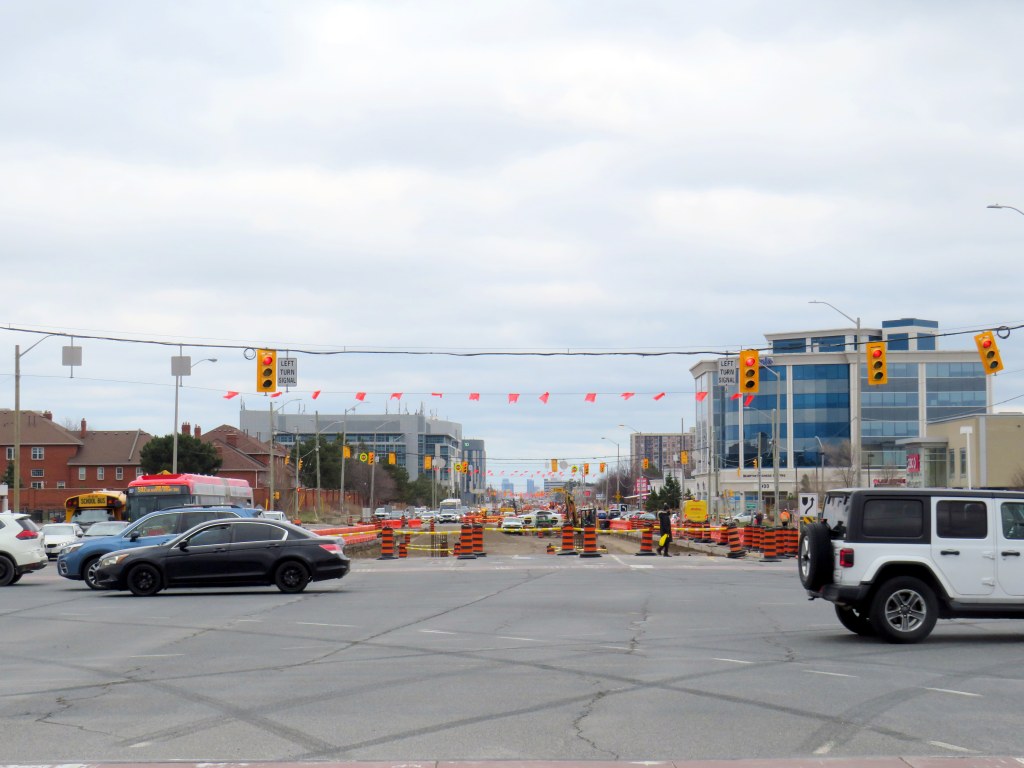
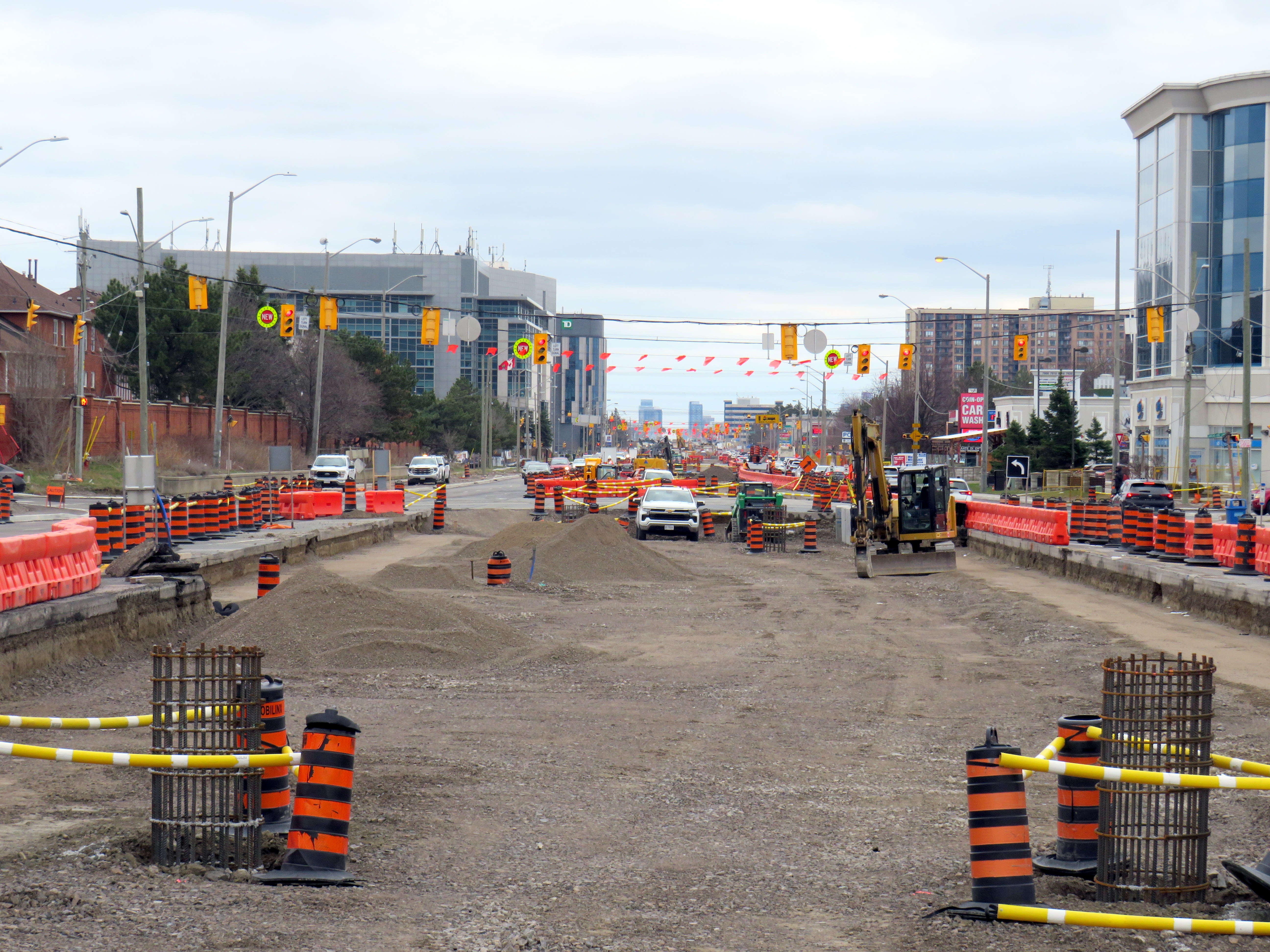
Hurontario Street, looking south from Steeles Avenue, where the first phase of the Hurontario LRT will terminate
The first phase of the Hurontario LRT, which will between Port Credit GO Station and Steeles Avenue in Brampton, is slowly taking shape after years of construction delays. In Spring 2026, eight years since construction started on the corridor, work on the LRT guideway into south Brampton has finally begun.
As I wrote in detail before, a previous iteration of Brampton City Council narrowly voted against the LRT entering downtown as a surface line in 2015. This was the version selected in the provincial environmental assessment. Instead, that council voted to study alternative corridors into Downtown Brampton requiring lengthy detours, and asking for the LRT northern terminus to be on the south side of Steeles Avenue, despite a major bus exchange — Brampton Gateway Terminal — on the north side of the intersection to accommodate all options. After the 2018 election, council recommitted to a Main Street alignment (though preferring a tunnel) and asked the province to restore the terminus on the north side of Steeles pending a decision on the final four kilometres into Downtown Brampton. In early 2026, only one of the six councillors opposed to the Main Street LRT ten years ago remains in office.
I wanted to follow up with Metrolinx to see how pedestrians would be safely accommodated at the Steeles and Hurontario intersection, given high traffic volumes, wide roads, and likely thousands of passengers switching between modes on a daily basis. Early concepts of an underground pedestrian tunnel were rejected by the province as out-of-scope, so pedestrians would have to cross both Hurontario and Steeles to make the transfer. Having no satisfactory answers despite many attempts to get an answer to this question, I took the lengthy and expensive route of submitting a freedom of information (FOI) request.
In summary, I learned that despite multiple requests from City of Brampton officials to restore the north side stop, Metrolinx and the provincial government refused. With the financial close with Mobilinx — the private-sector consortium selected to build, operate, and maintain the LRT — imminent in early 2019, there was no interest to make the minor change to facilitate the terminal, even though the city committed to taking on the cost on its own. The province was open to other changes to the line, however, as in 2022, it unilaterally renamed the line for a former Mississauga mayor and political ally of Doug Ford.
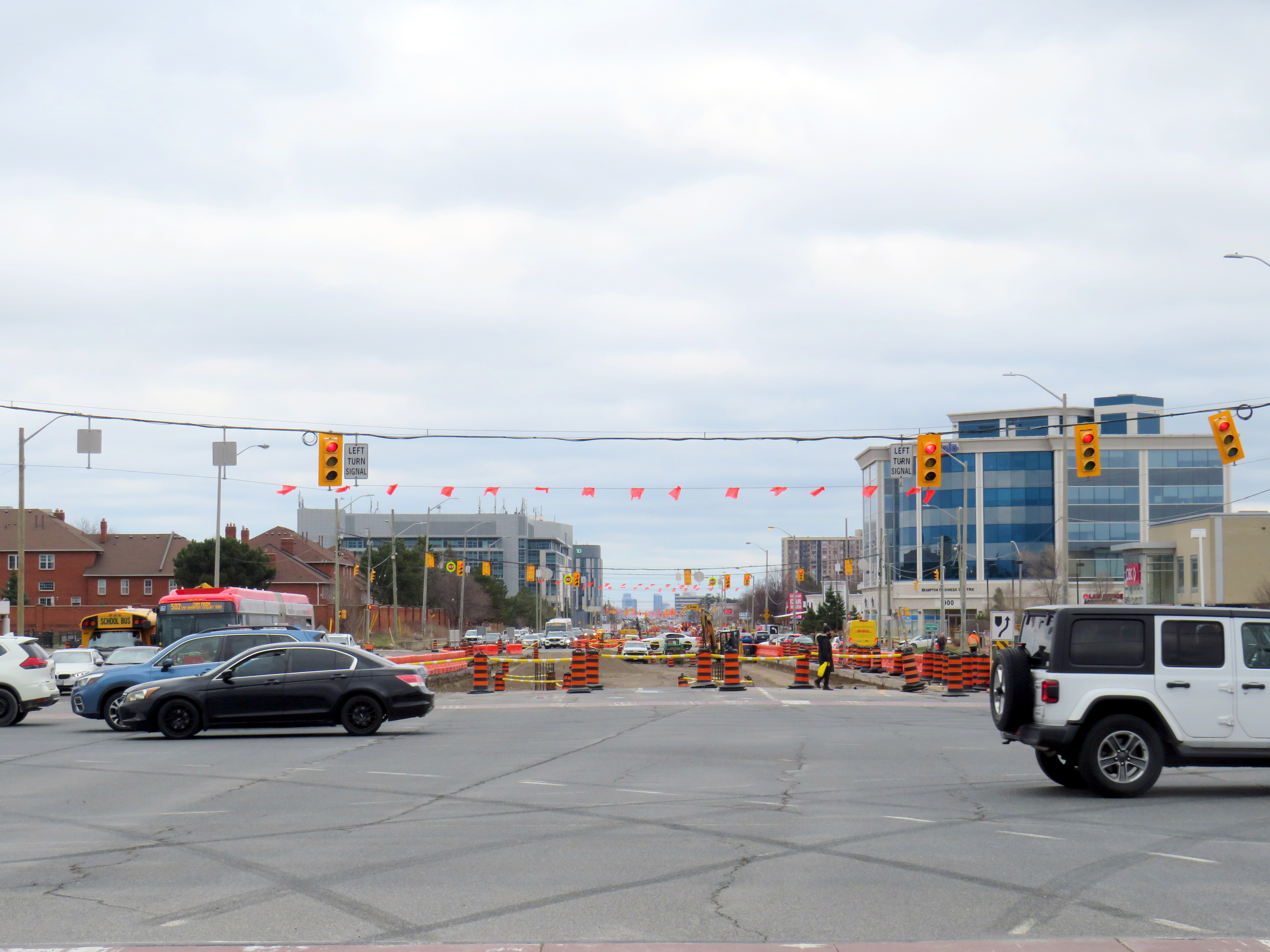
Looking south across Hurontario Street across a very busy multi-lane intersection towards the end of the LRT
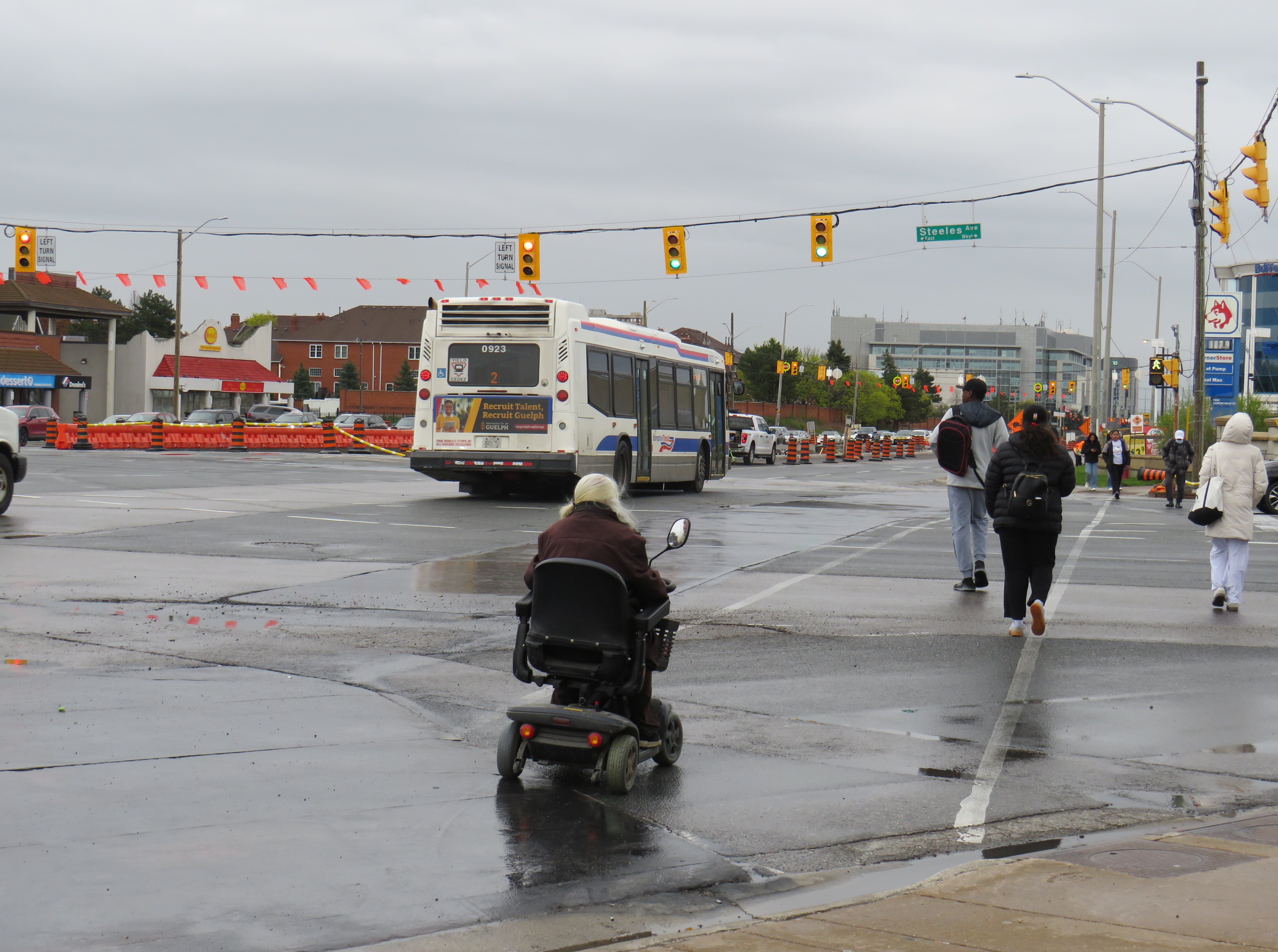
As work at the Steeles-Hurontario intersection is now well underway, it has become visually clear the problem will be once the LRT opens. The population around the Brampton Gateway Terminal area is rapidly growing; a 40-storey condominium tower on nearby Steeles Avenue West is nearing completion, with many more highrise and mixed-use developments planned, including the eventual redevelopment of Shoppers World Mall. Already, there are dozens who cross nine-lane Steeles Avenue hourly; once passengers have to transfer from the LRT to the transit terminal on the northwest corner, there will be hundreds.
Furthermore, once the (now-funded) Phase 2 of the LRT to Downtown Brampton is started, the intersection will have to be torn up yet again to extend the tracks across Steeles and build a new north-side stop. The province’s refusal to do this all at once is baffling, and will likely be much more expensive than if it was done right the first time.
Looking across from Gateway Terminal towards the future LRT terminus on Wednesday, May 6. Already, there are plenty of pedestrians crossing here.
Already, the costs of the current Mobilinx contract have ballooned while construction delays pile up. The Hurontario LRT was originally supposed to open in 2024. In 2025, Mobilinx had to completely rebuild the track intersection at Topflight Drive just south of Highway 407 after track was already laid in 2023 due to construction errors. In February 2026, Global News reported that only 45 percent of the track was laid. Due to delays and problems paying contractors, the consortium’s credit rating was downgraded by Standard & Poor to BBB, which is near junk status.
Given the multiple delays and difficulties building the LRT, work is only now at the point where the dangerous terminal location is being baked in. Even though construction errors are fixed, and the project name changed, Metrolinx has been unwilling to address the safety issue at Steeles Avenue that was raised many times. In the meantime, Metrolinx, Peel Region, and City of Brampton will have to figure out how to mitigate the potential disaster that is now in the making.
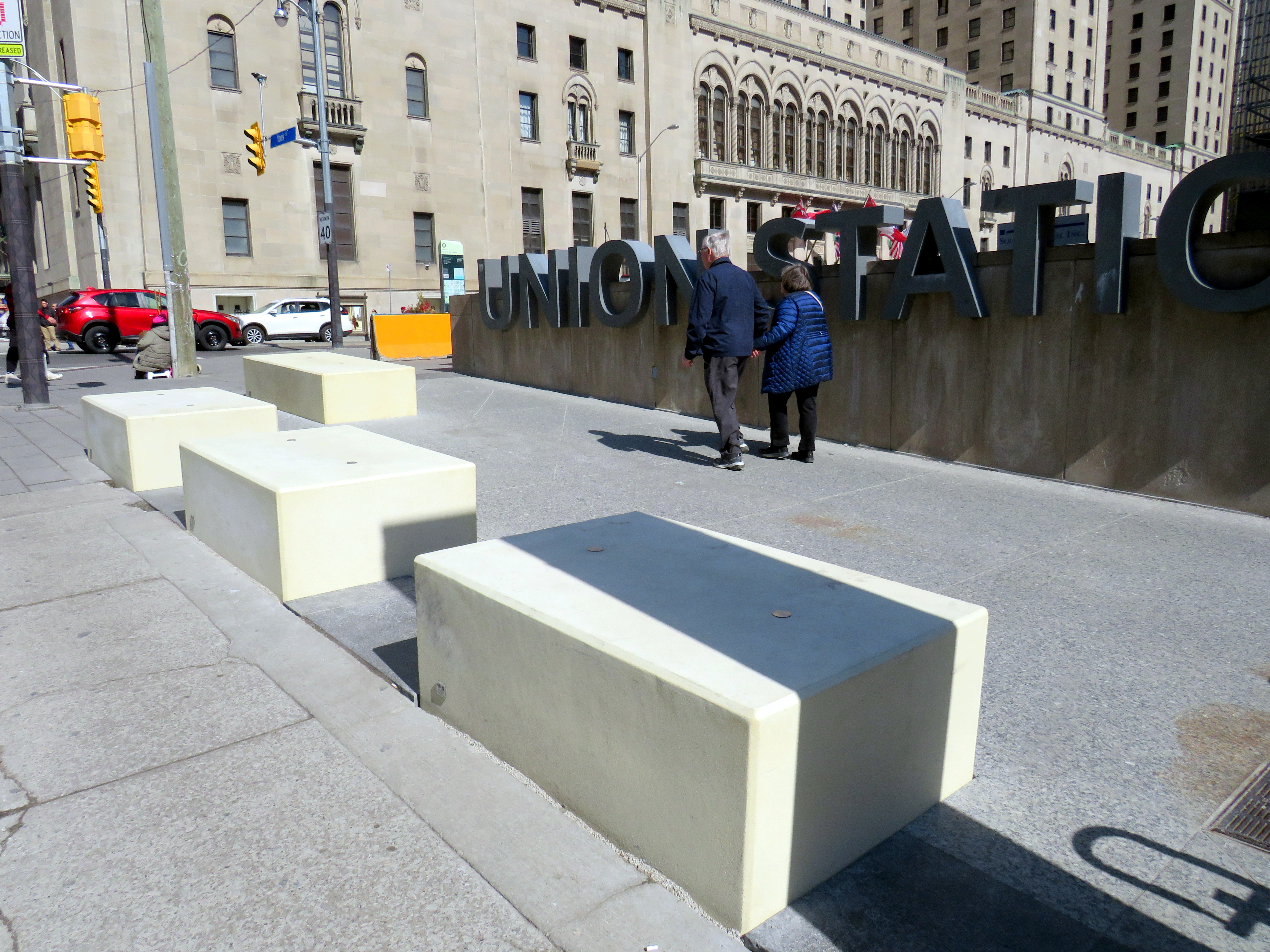
New blocks installed in front of Union Station at Front and York Streets
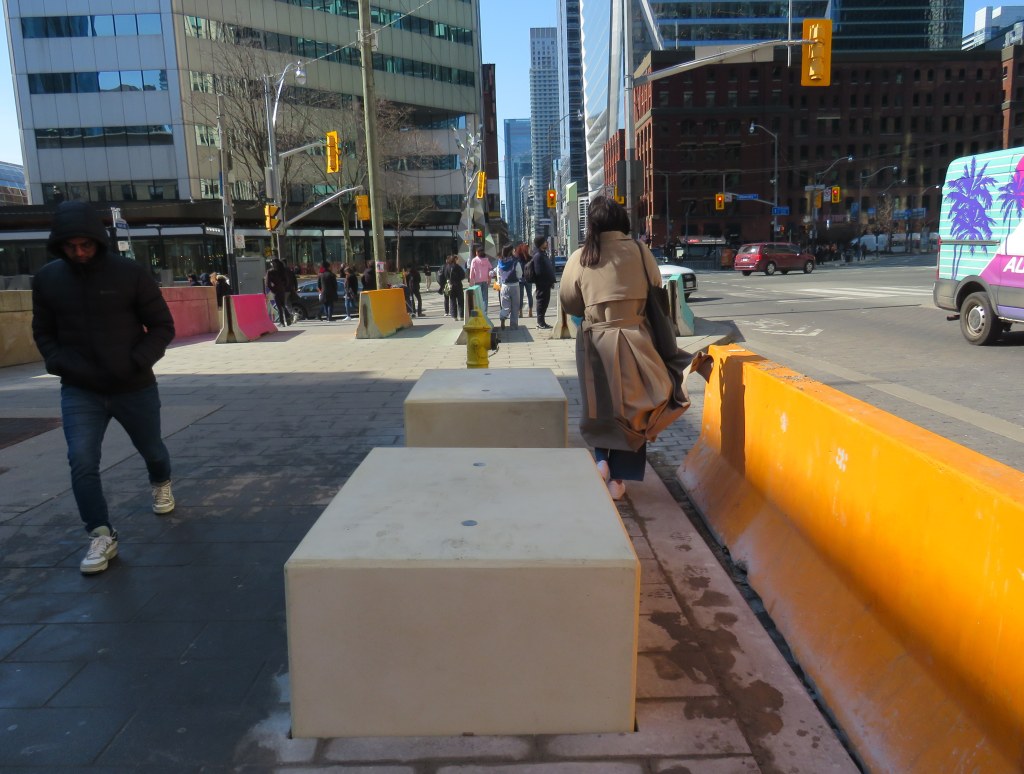
When I learned that Union Station was finally getting permanent bollards to replace the haphazardly-placed Jersey barriers that have sat in front of the transport hub since 2018, I was relieved. I wrote about these barriers several times on this website, criticizing their appearance and their placement, blocking the way for the thousands of people who cross Front Street every day. But when I went to see them in person, after seeing criticism online, I was dismayed.
The new permanent barriers might even be worse than the temporary obstructions they are meant to replace.
The Jersey barriers were hastily placed after a tragic attack on Yonge Street in North York, where a man intentionally drove a rented van on to the sidewalk, killing ten pedestrians and injuring and traumatizing many more.
Vehicular assaults on crowds of pedestrians are a major concern; tactics used at mass gatherings — such as the winter light show and New Years Eve events at Nathan Phillips Square and major concerts and playoff games at Skydome and Scotiabank Arena — now include blocking closed streets with heavy vehicles such as snow plows, dump trucks, and city buses. However, Union Station is the only place in the city where officials have decided that new permanent barriers were necessary.
Union Station is one of the busiest pedestrian areas in the city
The new permanent barriers are not the sturdy, yet narrow, bollards that are used elsewhere. Instead, they are large, undecorated concrete blocks anchored into the ground and are knee-high. The plain concrete colour does not match the stone sidewalks or plaza. They are placed very close together, impeding access for those using large carts, strollers, or wheeled mobility devices. Despite all the money spent renovating Union Station, these blocks look cheap.
Concrete blocks at the corner of York and Front Street at Union Station
The total cost of installing the “Custom Anti-Terror Concrete Barriers,” as the city described the bid, was $2,438,238, including HST. The lowest bid, by South Central Inc., came over a $1 million cheaper than the other two bids. It is worth noting that there are no public documents that describe the city’s specifications for the contract, nor was there any public consultation before the city solicited bids.
The result? An esthetic failure and an accessibility challenge.
Video showing pedestrians going around the concrete blocks in front of Union Station
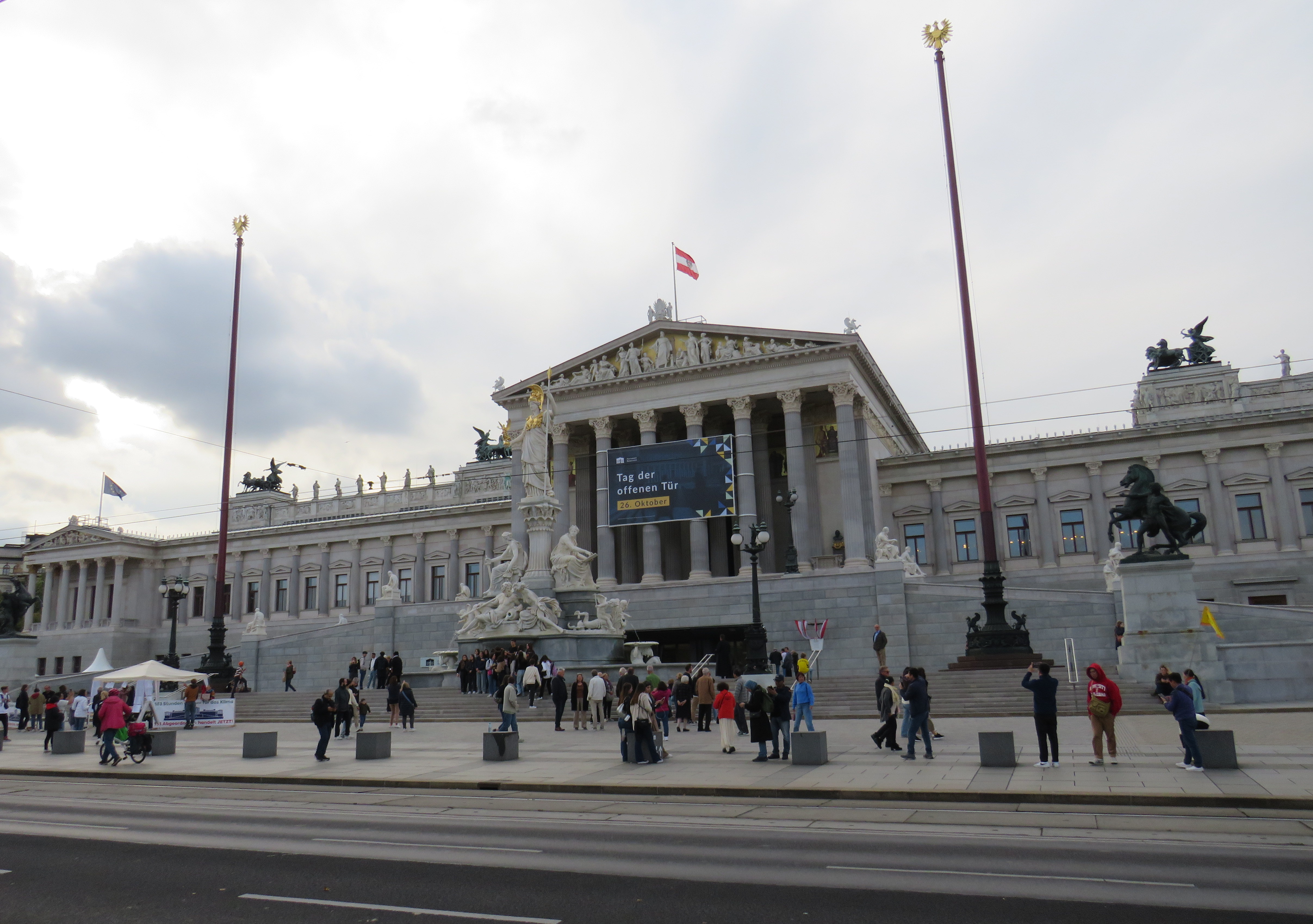
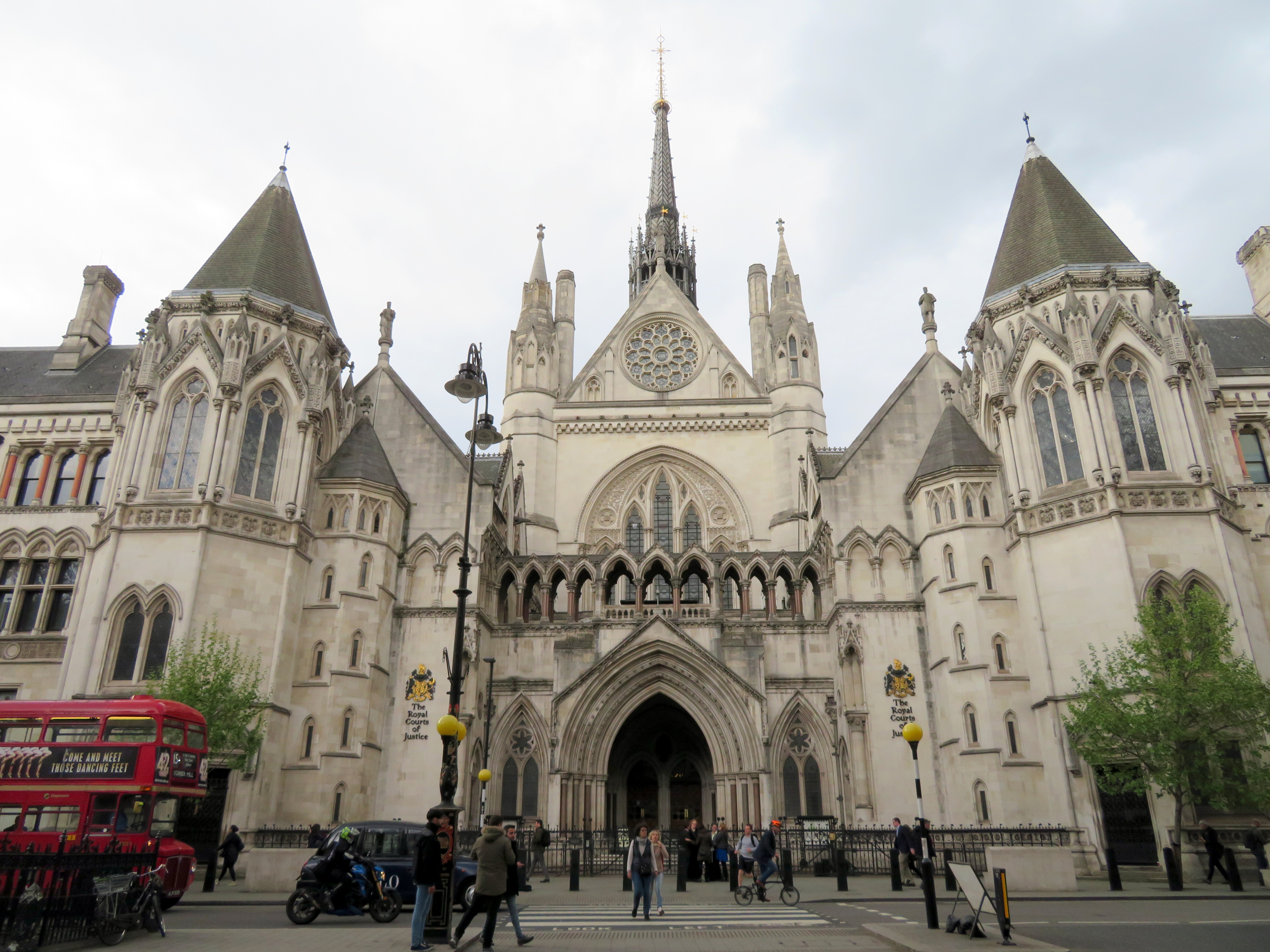
I cannot understand the city’s decision to go with these blocks where more elegant and pedestrian-friendly alternatives are typically used elsewhere. For example, the Austrian Parliament Building in Vienna, which faces the famous and busy Ringstrasse, is protected by smaller concrete bollards, which are also more widely separated, making it much more pleasant for pedestrians to get by. In Great Britain, metal bollards are common on busy commercial streets and in front of important buildings, but they are easy for pedestrians to pass, and generally blend in.
Thick concrete bollards in front of the Austrian Parliament Building, 2023Metal bollards in front of the Royal Courts of Justice in London
In the United States, government buildings are also protected by heavy anti-vehicular barricades (especially since the 1995 Oklahoma City bombing), but they are generally more permeable for pedestrians.
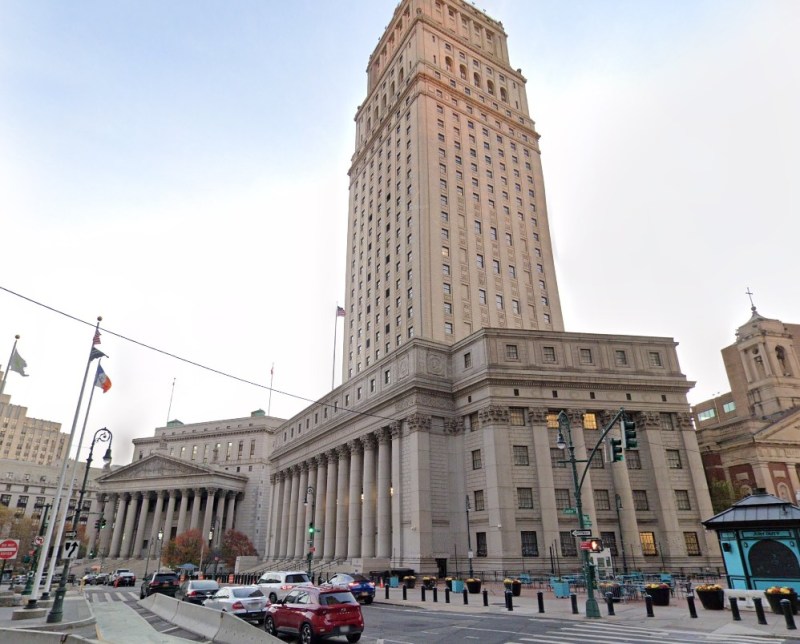
Metal bollards protect the federal courthouse in Downtown Manhattan (Google Streetview)
It is also worth noting that other popular pedestrian areas, such as the Yonge-Dundas intersection, are not protected from a potential vehicular attack — or an unintentional collision. It is beyond comprehension why the city only focused on protecting one pedestrian area, using such a poorly thought-out design. Toronto can — and should — do better.
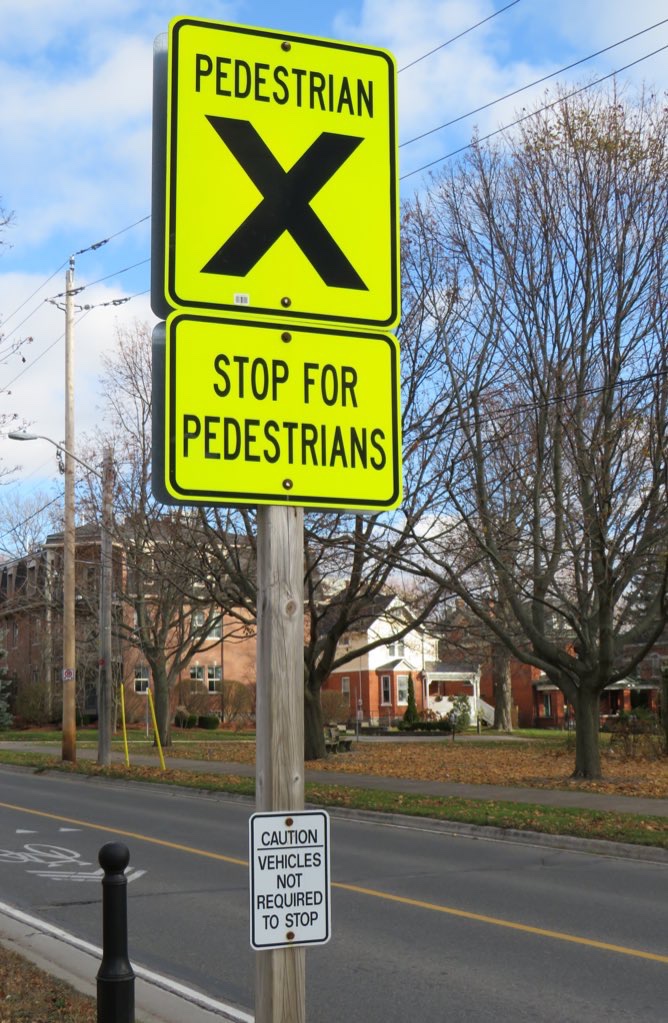
At the corner of King Street (former Highway 2) and College Street in Cobourg, adjacent to Victoria Park on the eastern edge of Downtown Cobourg, there’s a marked pedestrian crossing, with clear “zebra” road markings on the pavement.
The sign, in bright fluorescent yellow, reads “PEDESTRIAN X.” Below, a second sign, also in bright yellow, reads “STOP FOR PEDESTRIANS.” The message is clear enough.
However, a smaller white sign below, facing the sidewalk, reads “CAUTION – VEHICLES NOT REQUIRED TO STOP.”
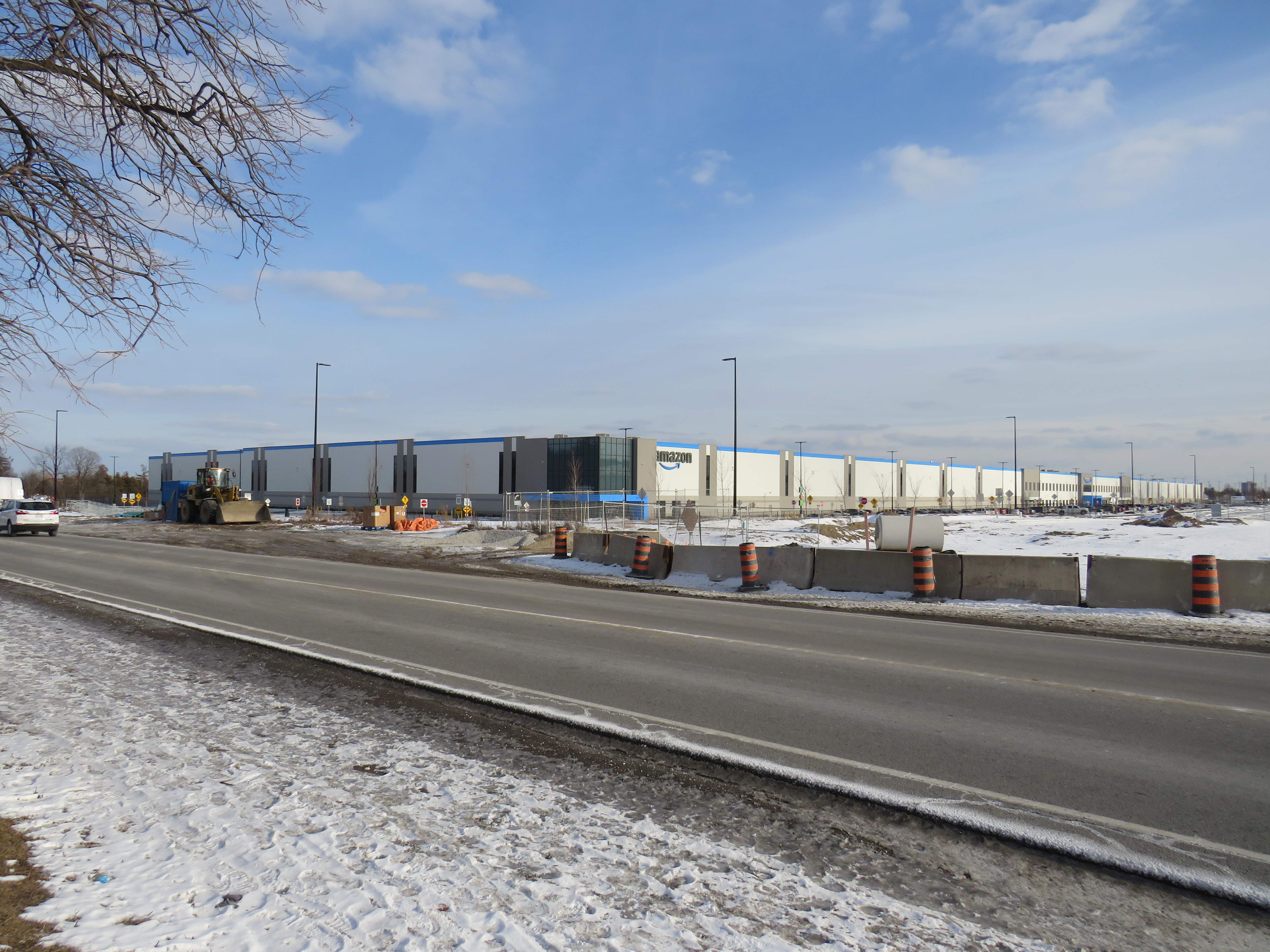
The starting wage for an Amazon fulfillment centre employee is $17.00 an hour, despite notoriously tough working conditions. With most professional and office workers at home, and with ongoing pandemic restrictions, Amazon has enjoyed significant sales increases. But those workers picking and packing orders are not able to work from home – and workplace spread has been a significant factor in COVID-19 transmission in Ontario.
Brampton, home to two of the GTA’s fulfilment centres, and close to Amazon’s Mississauga, Milton and Bolton warehouses, has been a COVID-19 hotspot. Like Toronto, Peel Region has been under lockdown and stay-at-home orders since November.
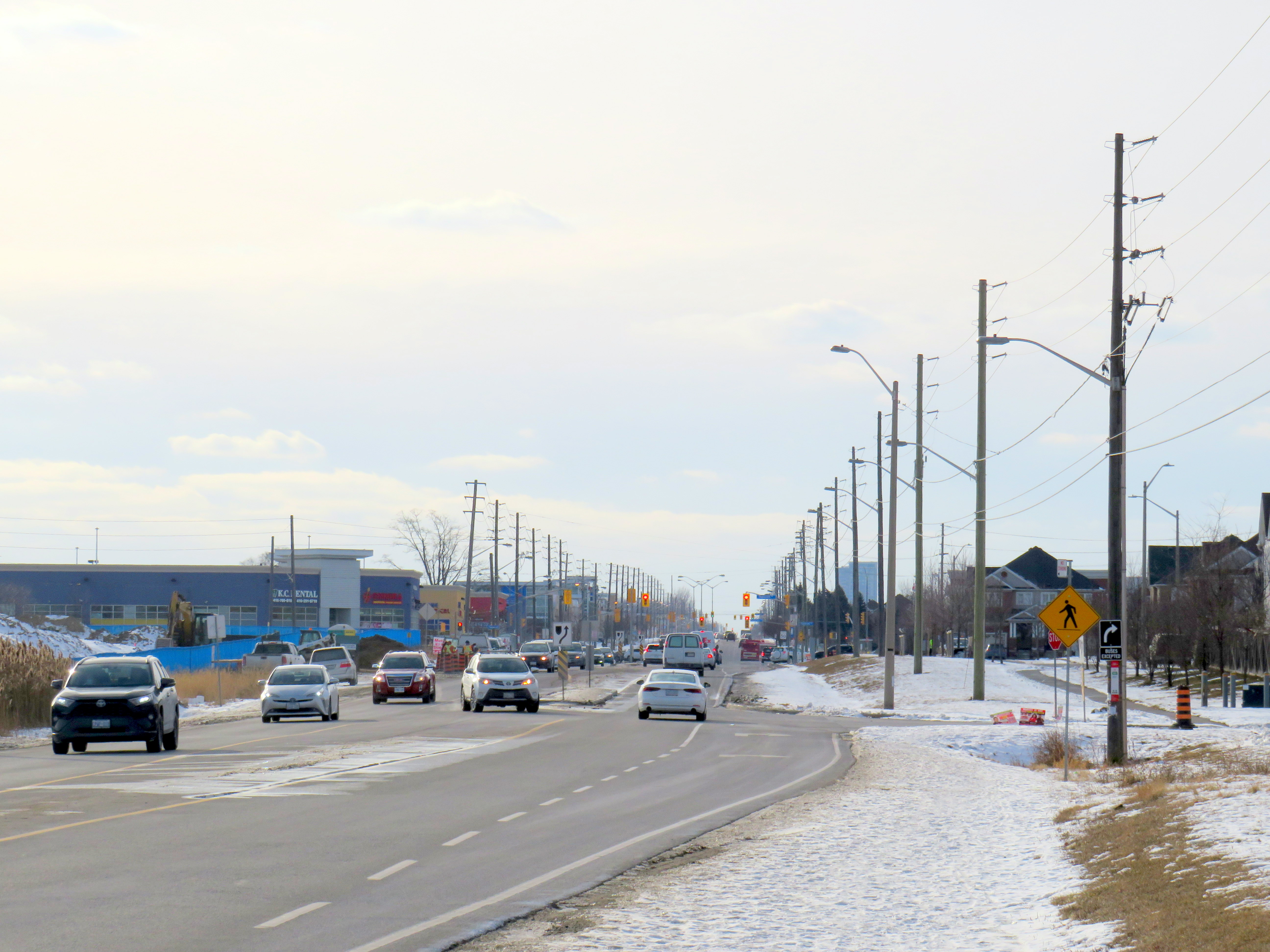
Like most new logistics facilities, the new Scarborough warehouse, like the other five GTA Amazon fulfillment centres, is in an industrial area on the city’s outskirts, where land is plentiful, but transit and pedestrian access is lacking. East of Tapscott Road, Steeles Avenue narrows from four lanes to two, and there are no designated pedestrian crossings at the intersection with Eastvale Drive. The eastbound TTC stop at Eastvale Avenue was removed in 2018 after a passenger was struck and killed trying to cross the street after disembarking from a 53 Steeles East bus. The next nearest stop, at Tapscott Road, is 300 metres west.
Steeles Avenue, looking west towards Eastvale Drive and the signalized intersection beyond, at Tapscott Road
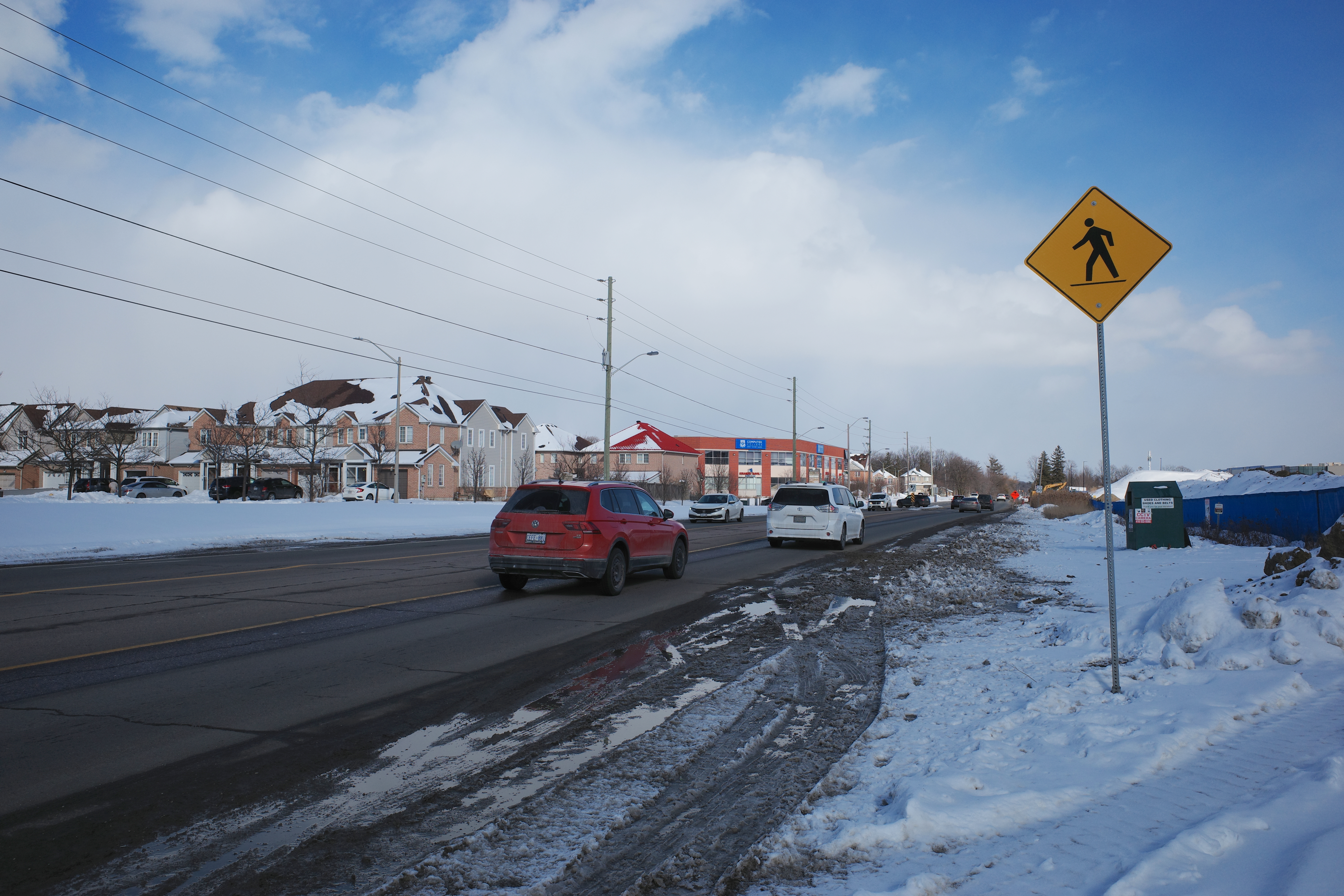
The sidewalk on the south side of Steeles Avenue ends at Tapscott, a few hundred metres west of the Amazon fulfilment centre. On the north side, the sidewalk ends at Ferncliffe Crescent in Markham. Despite a new residential area in Morningside Heights, to the east, there is no sidewalk along Steeles to connect to it. Pedestrians heading to Amazon or towards Staines Road must choose whether to walk in the mud, or on the busy roadway. Though the posted speed limit is 50 km/h, motorists regularly travel at 60 km/h or faster.
Looking east on Steeles from Tapscott Road – despite the sign advising motorists of pedestrian activity, there are no sidewalks leading east towards the new Amazon fulfillment centre (Sonali Praharaj)
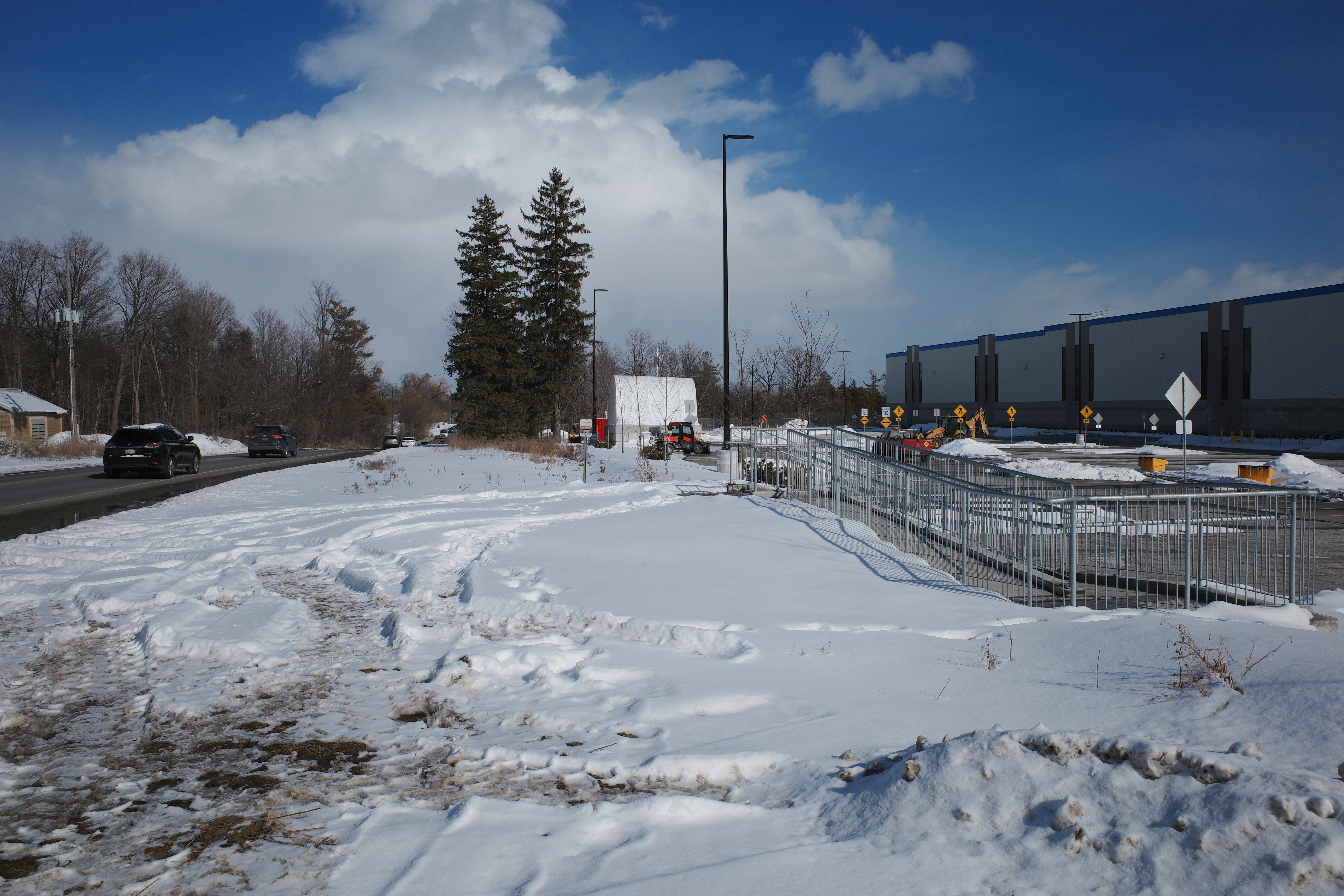
A stairway and ramp were built on the north end of the Amazon property, likely with the expectation that a sidewalk on the south side of Streeles Avenue would soon be installed. This would provide improved pedestrian access to the fulfillment centre. But without a safe and logical way to get to it from the street, it remains largely unused.
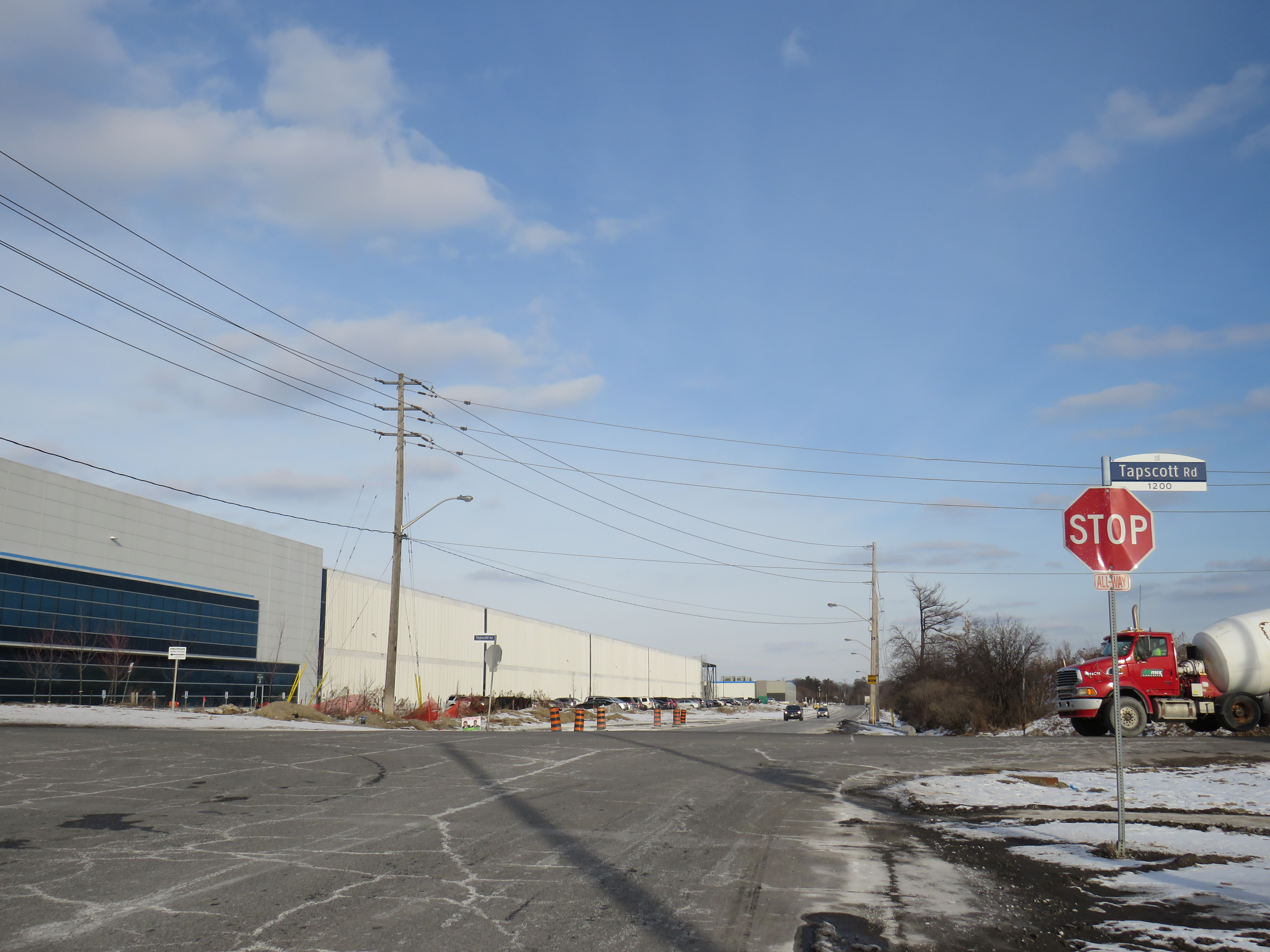
Passmore Avenue, on the south side of the fulfillment centre, was rebuilt with a sidewalk in the late fall of 2020, months after Amazon opened. However, it requires a lengthy walk north to Steeles Avenue up Tapscott, and there are no sidewalks on Tapscott from Passmore south, towards McNicoll Avenue. The intersection of Passmore and Tapscott itself – controlled by an all-way stop – still does not feature proper crosswalks.
Looking east on Steeles from Tapscott Road – despite the sign advising motorists of pedestrian activity, there are no sidewalks leading east towards the new Amazon fulfillment centre (Sonali Praharaj)
Though there are two TTC bus routes that operate to the corner of Tapscott Road and Passmore Avenue – 53B/953B Steeles East and 102B/C Markham Road – for months, workers had to walk on the roadway, through a construction site to access those buses. Anyone looking to go east, towards Morningside Heights, or southeast, towards Malvern, still face a long, dangerous walk or a lengthy bus commute.
The corner of Tapscott Road and Passmore Avenue
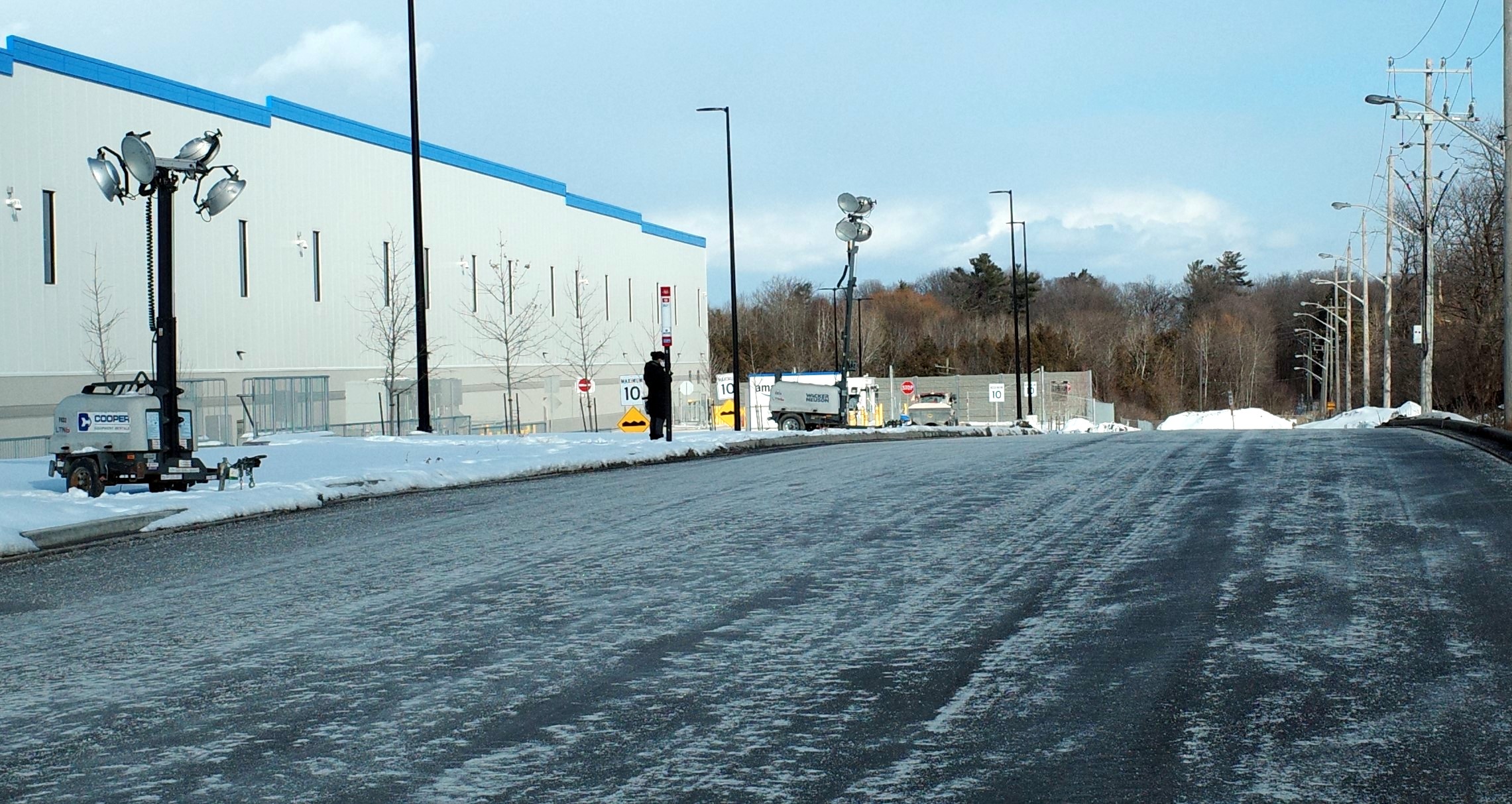
The TTC, starting January 11, 2021, began diverting the 53B Steeles East bus to directly serve the Amazon fulfillment centre, finally serving a major industrial trip generator and reducing essential workers’ travel times. Even still, the new sidewalk on Passmore ends at the warehouse entrance – anyone waiting for a bus must still walk and wait in the snow or mud.
Eventually, Steeles Avenue will be widened, with new sidewalks and bike lanes, and Morningside Avenue will be extended north to Steeles Avenue. However, these improvements have been planned for years and completion is still several years away. Though new warehouses have opened here, civic infrastructure has not caught up.
New TTC bus stop serving the Amazon Fulfillment Centre on Passmore Road (Sonali Praharaj)
The TTC’s service change, adding a new bus stop on Passmore Avenue, was a welcome – yet overdue – acknowledgement that essential workers, especially racialized and lower-paid workers, deserve better. It is inexcusable that new employment uses are planned, approved, and constructed before the appropriate pedestrian infrastructure and transit services are in place. It is also inexcusable that after a TTC customer was killed that a nearby bus stop was removed, rather than safety improvements added instead. This is not just a matter of ensuring a basic level of safety for pedestrians – this is a matter of justice for those we consider essential workers.
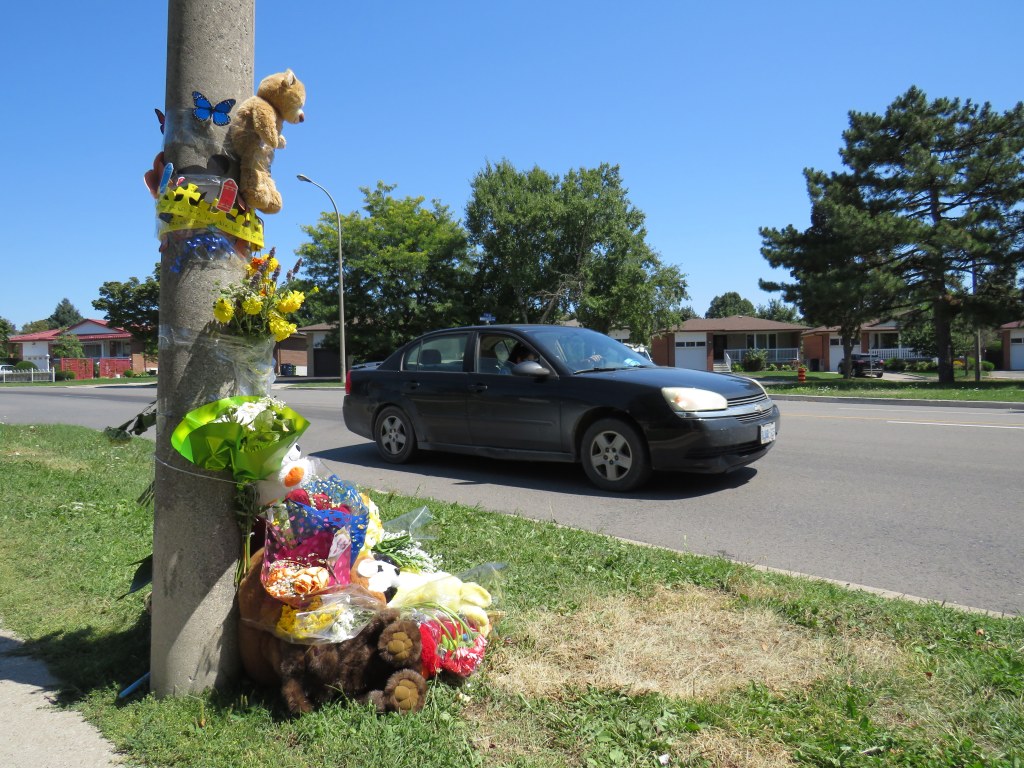
Roadside memorial to a three year old boy at The East Mall and Montebello Gardens, near Burnhamthorpe Road, Etobicoke
On Tuesday, August 11, just after 11AM, a father and his two children were attempting to cross The East Mall north of Burnhamthorpe Road. They were crossing from the west side of the minor arterial street, where there is the main entrance to a long term care home, to the corner of Montebello Gardens, a short residential street on the east side.
As the three pedestrians were crossing, an 81-year-old woman driving a black SUV turned left from Montebello Gardens to go south on The East Mall, crashing directly into the family.
All three pedestrians were rushed to hospital. A three-year-old boy was soon pronounced dead, while a seven-year-old girl was taken to a trauma centre. The driver remained on scene. It is not certain if charges will be laid.
The three-year-old’s death came only a day after the Toronto Star’s Ben Spurr reported that 2020 has been the safest year for pedestrians and cyclists since at least 2007. There were 63 collisions resulting in serious injury or death in the period from January 1 through July 1, down from an average of 99. The decline can be explained by considerably reduced traffic since COVID-19 lockdowns began in mid March, and by fewer pedestrians on city streets.
As traffic picks up with the loosening of restrictions and as people go out for strolls and exercise for physical and mental health, the need for improved road safety and a commitment for real Vision Zero implementation, especially in Toronto’s suburbs, remains crucial. The area near where the young boy was killed last week just shows how much further we need to go.
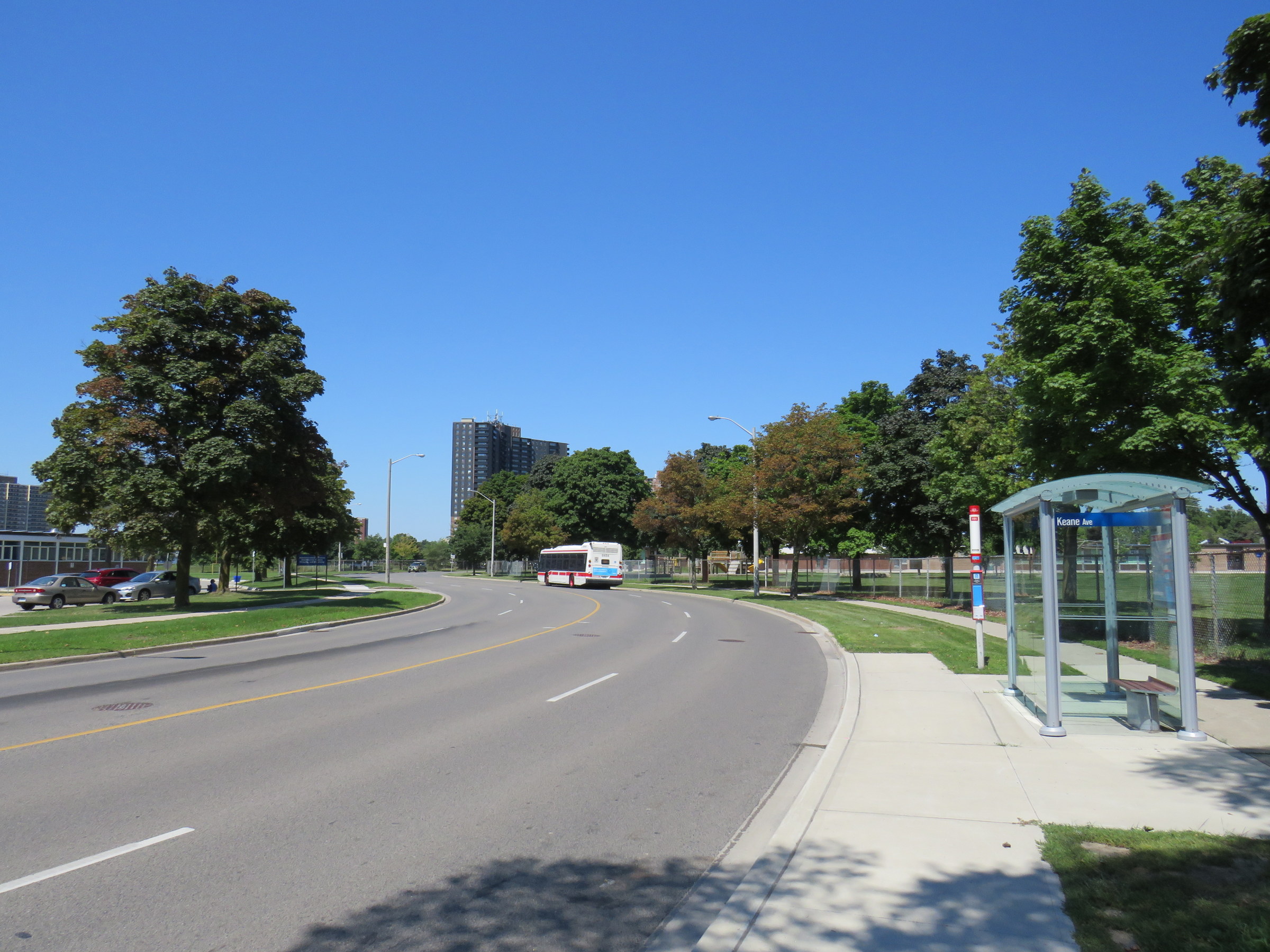
TTC bus stop on The East Mall, north of Keene Avenue
I visited The East Mall on a sunny Friday afternoon. I took the 111 East Mall bus from Kipling Station to Keane Avenue, the first stop north of Burnhamthorpe Road. The bus stop has a nice, clean shelter and a large concrete pad, but no where safe to cross the street. On the other side, there is a southbound stop for buses heading towards Cloverdale Mall and the subway, and Burnhamthorpe Collegiate Institute, a high school specializing in programs for mature students and adult learners.
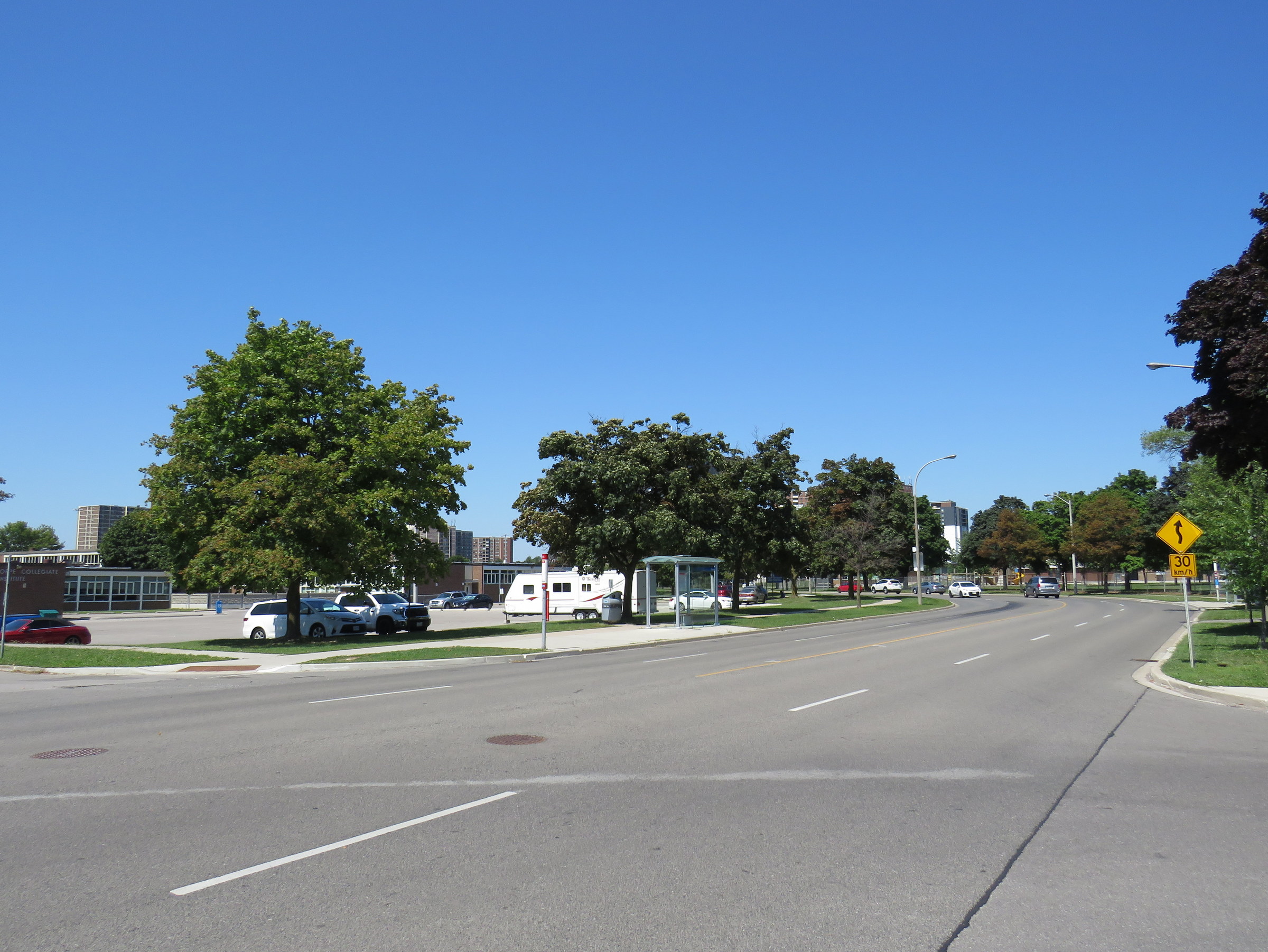
The intersection of The East Mall and Keene Avenue, looking north. Burnhamthorpe CI is behind the southbound bus stop A sign warns drivers of a winding road, with an advisory speed of 30 km/h.
A signalized pedestrian crossover exists further north, in front of West Glen Junior Public School, but the next TTC stop, at Capri Road, is at yet another unsignalized intersection. The distance between Burnhamthorpe Road to the south, and the pedestrian crossover is over 550 metres, and neither designated crossing is visible from Keene Avenue nor Montebello Gardens due to the winding nature of The East Mall.
This part of Toronto has seen plenty of tragedy this year. The Eatonville Care Centre was one of several long term care homes where the Canadian Armed Forces were deployed due to deadly outbreaks of COVID-19 amidst poor working and sanitary conditions documented by CAF medical staff. Forty-two residents died during that outbreak.
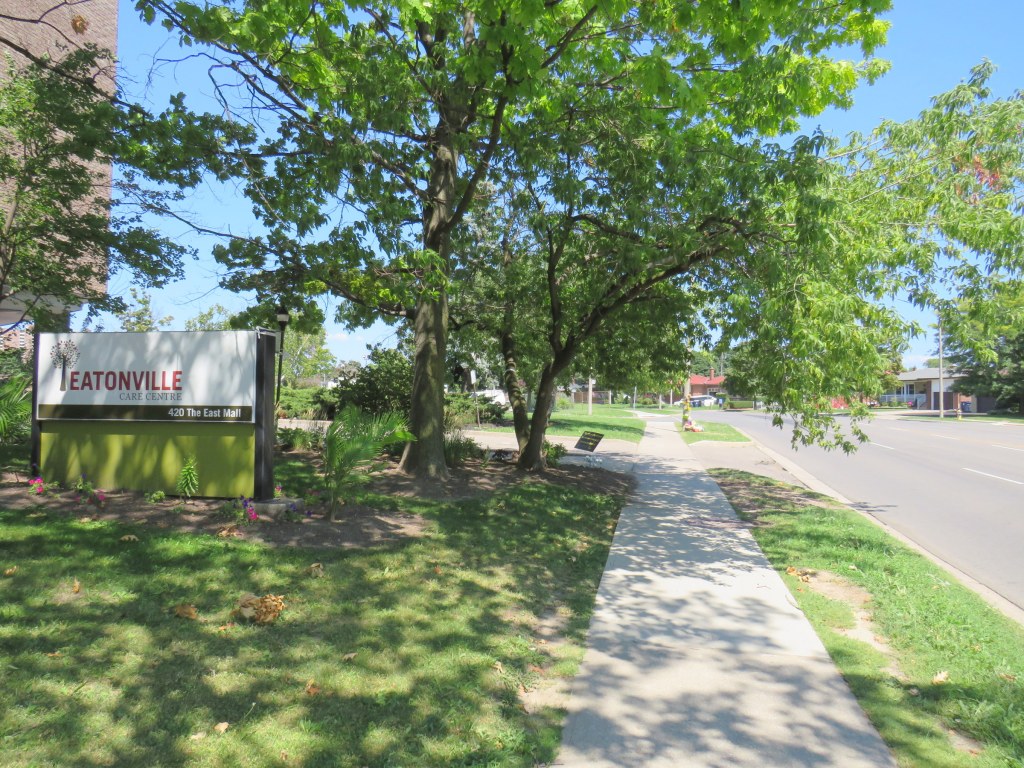
Eatonville Care Centre, with the roadside memorial in the background
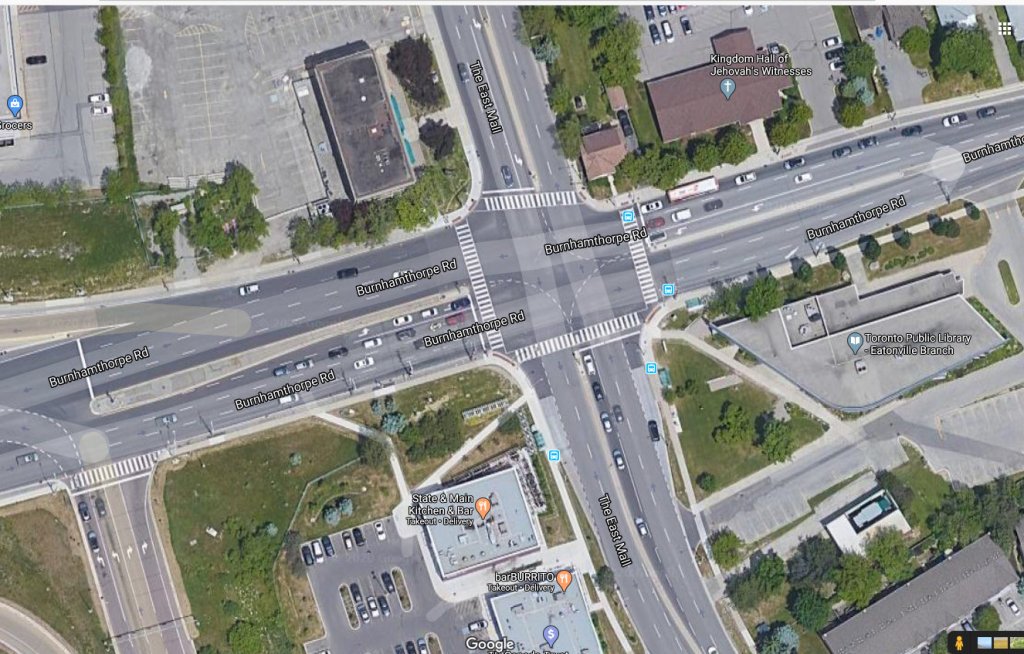
The presence of a long term care home, a library branch at the southeast corner of The East Mall and Burnhamthorpe Road, two nearby schools, and a large Loblaws supermarket and pharmacy on the southwest corner should have made this area a priority for improved, safer road infrastructure. Speeds along The East Mall are much higher than the posted 40 km/h limit, while the winding, roadway limits both drivers’ and pedestrians’ fields of vision. There should be no excuse for such long distances between safe pedestrian crossings, especially with the vulnerable populations living in this area.
Though the driver who killed the three-year-old boy was carelessly turning from a side street, and not speeding along The East Mall, another tragedy is inevitable without significant changes. Meanwhile, The East Mall is similarly laid out south of Burnhamthorpe, where there are older rental towers and townhomes and new condominium towers going in, yet nothing is done to calm traffic along a winding, busy street.
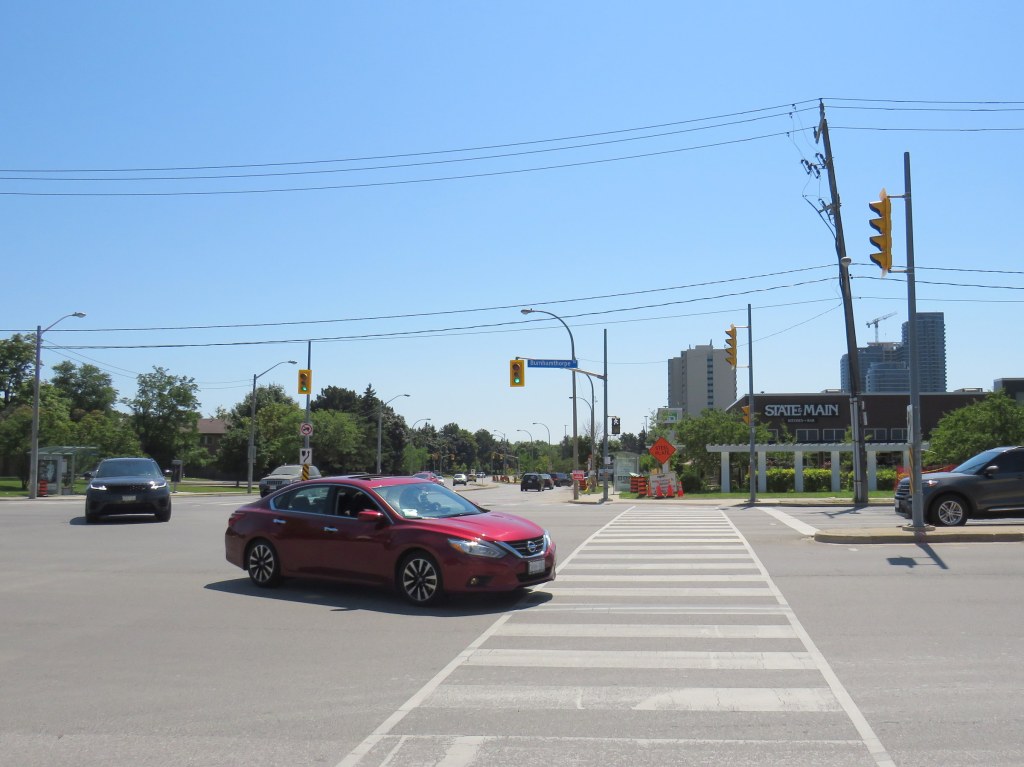
Though the intersection of The East Mall and Burnhamthorpe Road is signalized, it is also a dangerous intersection to cross. Burnhampthorpe Road widens to four westbound lanes leading towards Highway 427, while wide turning radii make it easy for motorists to turn right at all four corners. Drivers, rushing on and off Highway 427 take little notice or care for pedestrians, as I experienced trying to cross the street.
An Uber/Lyft driver in a red Nissan sedan and a Land Rover SUV driver turn left from The East Mall to Burnhamthorpe Road towards Highway 427 after the advance green signal disappears and the walk signal turns on, with me starting my crossing
While motorists are treated to generous geometries and easy turns, pedestrians are only an afterthought, despite the library, supermarket, offices, and several bus stops used by TTC and Mississauga bus routes. Meanwhile, a new townhouse complex on the northwest corner will add even more pedestrians to this area.
The intersection of Burnhamthorpe and The East Mall encourages high speeds, with pedestrians only an afterthought
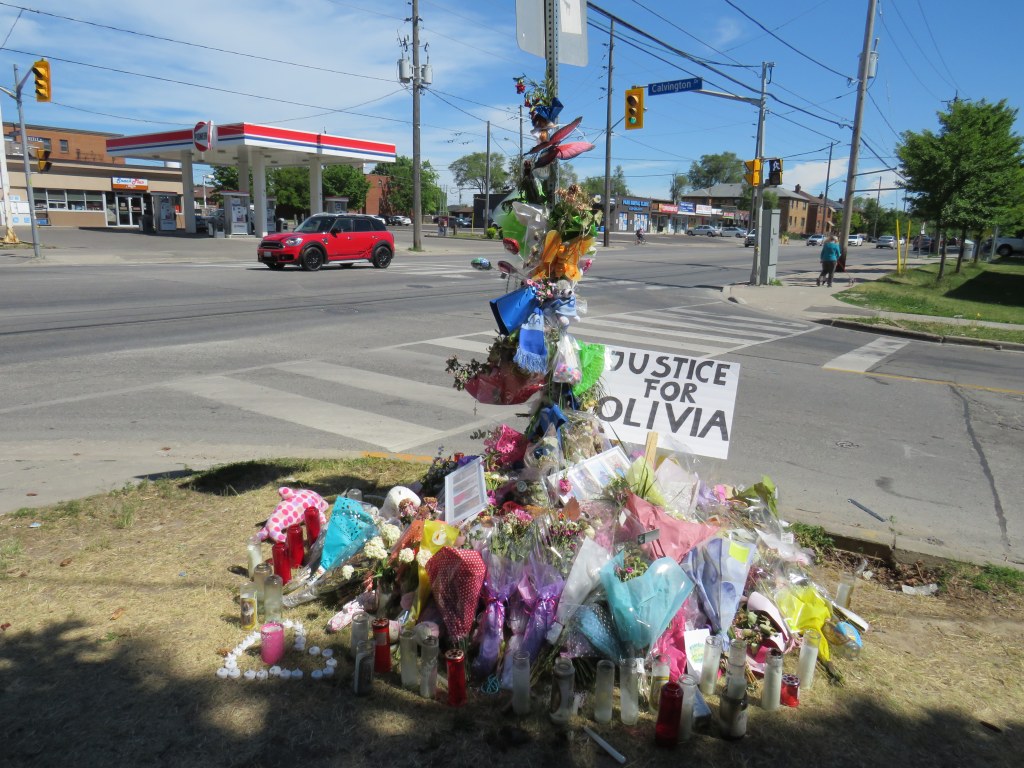
On Sunday, June 7, Olivia and Julia Sarracini were crossing Calvington Drive at Keele Street. It was 12:15 in the morning. The walk sign turned on, and the two sisters, aged 17 and 19, entered the crosswalk, walking north. Behind them, the driver of a black SUV waited for southbound traffic to clear the intersection before turning left, directly into the two young women, who were already halfway across the intersection.
Julia suffered leg injuries and was sent to hospital. Olivia, who was just finishing Grade 12, was pronounced dead at the scene. The driver of the SUV did not stop, but fled westbound on Calvington Drive.
Two days later, Toronto Police arrested 46-year-old Shawn Ramsey. He was charged with two criminal offences: fail to stop at the scene of an accident causing death and fail to stop at the scene of an accident causing bodily harm.
The driver was definitely at fault for striking the two women, who were walking with the right of way and all due care necessary. But it remains quite possible that if the motorist remained at the scene that night might only be facing minor Highway Traffic Act charges. (Without a vulnerable road users’ law, justice for pedestrians and cyclists injured or killed on Ontario’s streets is terribly inadequate.) Yet road design and a poor transportation network in Toronto’s inner suburbs played a significant role here.
Memorial for Olivia Sarracini
This section of Keele Street provides a link between Highway 401 and Humber River Regional Hospital to the south, and Finch Avenue, York University, and several industrial areas to the north. Downsview Park is just to the north of Calvington Avenue, and along with the large parkspace, new residential development is well underway, with more planned.
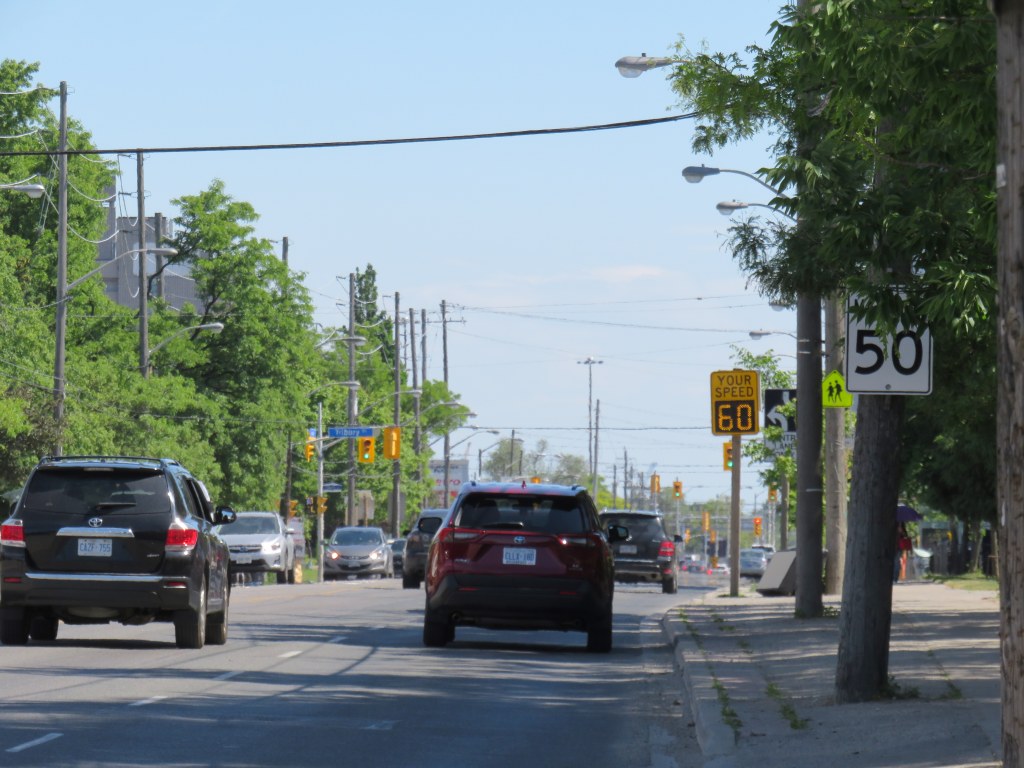
The area around Keele and Calvington was developed in the 1950s and 1960s, though visages of the old village of Downsview can be found close by, towards Wilson Avenue to the south. Between Wilson and Sheppard, Keele Street is five lanes wide, with a centre left-turn lane. Traffic is heavy throughout the day and evening, with many trucks headed to and from industrial lands and nearby construction sites. Even in heavy traffic, motorists regularly exceed the 50 km/h speed limit.
Pedestrians are provided only with narrow sidewalks, close to the road. These sidewalks are not separated from strip plaza parking spaces. Despite a major hospital, nearby elementary and secondary schools, a library, Downsview Park, and urban intensification taking place in the area, there are no cycling facilities. Cyclists, therefore, usually take the sidewalk. While cyclists avoid heavy traffic on Keele’s narrow lanes, they infringe on the little bit of space given to pedestrians.
Strip plaza across Keele Street from Calvington Avenue
Calvington runs west from Keele, with a strip plaza and gas station on the east side of the intersection. Though most traffic off Calvington turns south, pedestrians are prohibited from crossing at the north side, lest they slow down left-turning motorists off of Calvington. Furthermore, an advance left turn signal gives priority to northbound motorists turning on to Calvington from Keele, though the advance signal is only triggered by a queue of several left-turning vehicles.
Though neither the advance signal nor the crossing restriction were factors in the collision on June 7, they are just further reminders of who the streetscape was designed for.
Pedestrians are prohibited from crossing at the north side of the Keele and Calvington intersection. Note the sidewalk cyclist, likely headed to nearby Downsview Park.
Soon after Olivia Sarracini’s death, Councillor James Pasternak moved to request a traffic safety review of the Keele and Calvington intersection at the June 16 meeting of North York Community Council. Pasternak suggested that street lighting, traffic signal synchronization, traffic signage, and “the feasibility of installing advance green traffic lights” be included in the review.
The trouble with that motion is that it too narrow. There are dozens of similar intersections in Toronto’s post-war suburbs. The intersection already has an advance green traffic signal. I would suggest that a review of the whole district is necessary in the the context of new and upcoming urban development, poor access to Downsview Park from the south and west, and inadequate and unsafe active transportation infrastructure. Nearby Highway 401 and the GO Transit Barrie Line both create significant barriers to pedestrians and cyclists in the area.
Olivia Sarracini was killed and Julia Sarracini was injured by a dangerous and callous driver who did not have the humanity to stay and offer assistance and take responsibility. This tragedy shouldn’t warrant a narrow safety review. Without changing the built environment, tragedies like these will continue.
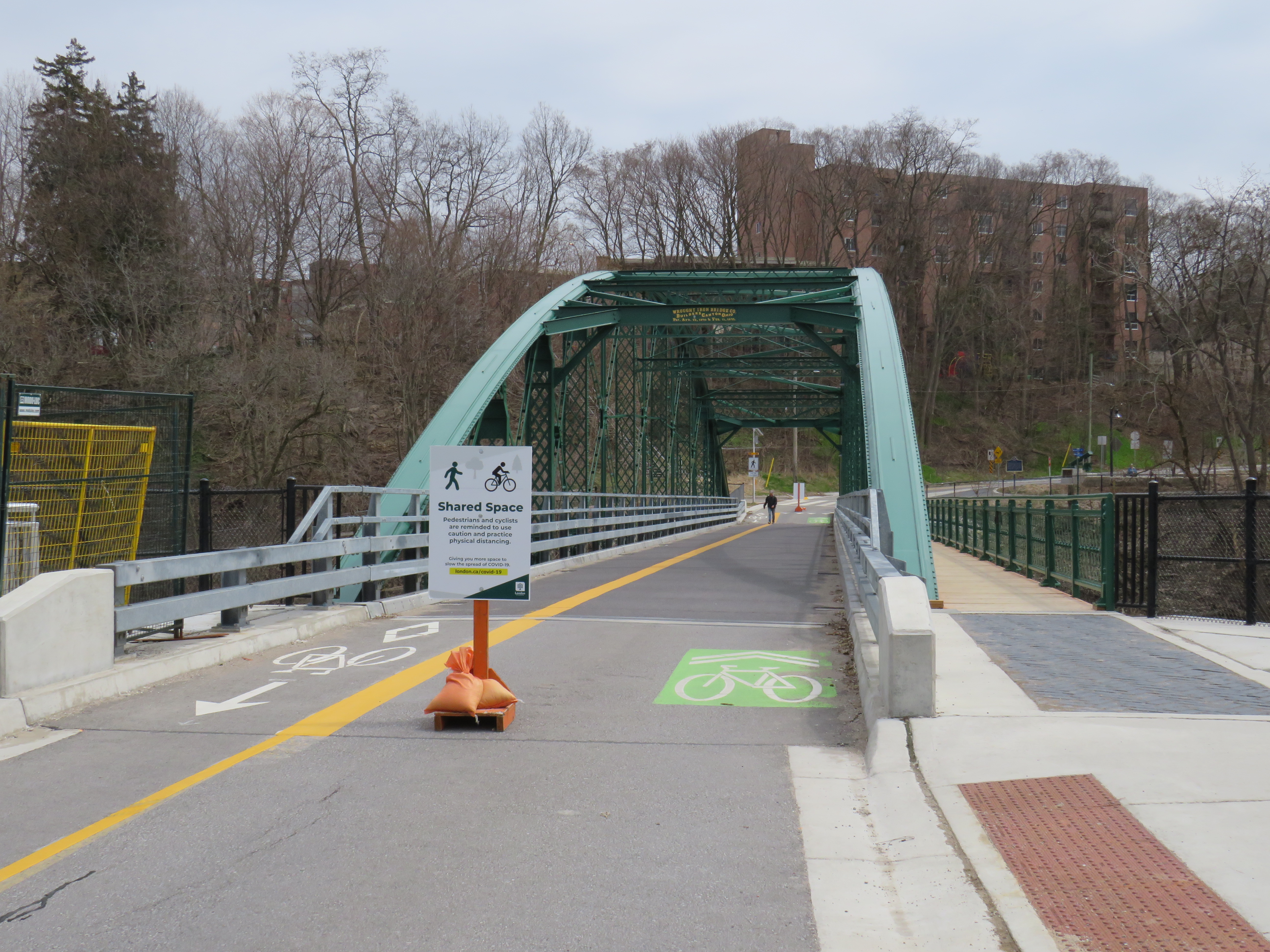
Blackfriars Bridge open to pedestrians and cyclists in London, Ontario
For my latest TVO article, I spoke with Councillor Shawn Menard in Ottawa, Councillor Rowena Santos in Brampton, and Ryerson University epidemiologist Anne Harris about how cities in Ontario are reallocating road space for pedestrians and cyclists during the ongoing COVID-19 pandemic, or why they may be hesitant to do so.
In Brampton, five kilometres of new bike lanes, proposed in that city’s new transportation plan, were quickly approved as part of its response to COVID-19. This benefits both pedestrians and cyclists by reducing conflicts on sidewalks, reducing congestion on city paths, and recognizing that cycling is an increasingly important mode of transportation.
Cyclists on Howden Boulevard, Brampton
In Ottawa, despite resistance from the the mayor and council, Shawn Menard, who represents an urban ward just south of Parliament Hill, was able to temporarily close two lanes of traffic on a narrow bridge on a major retail street, and worked with the National Capital Commission to re-allocate a section of parkway for active transportation.
Meanwhile in Toronto, the mayor and medical officer of health were resistant to increasing calls for sidewalk expansions in congested urban areas, including where queues formed to enter grocery stores, pharmacies, hardware stores, and LCBO outlets.
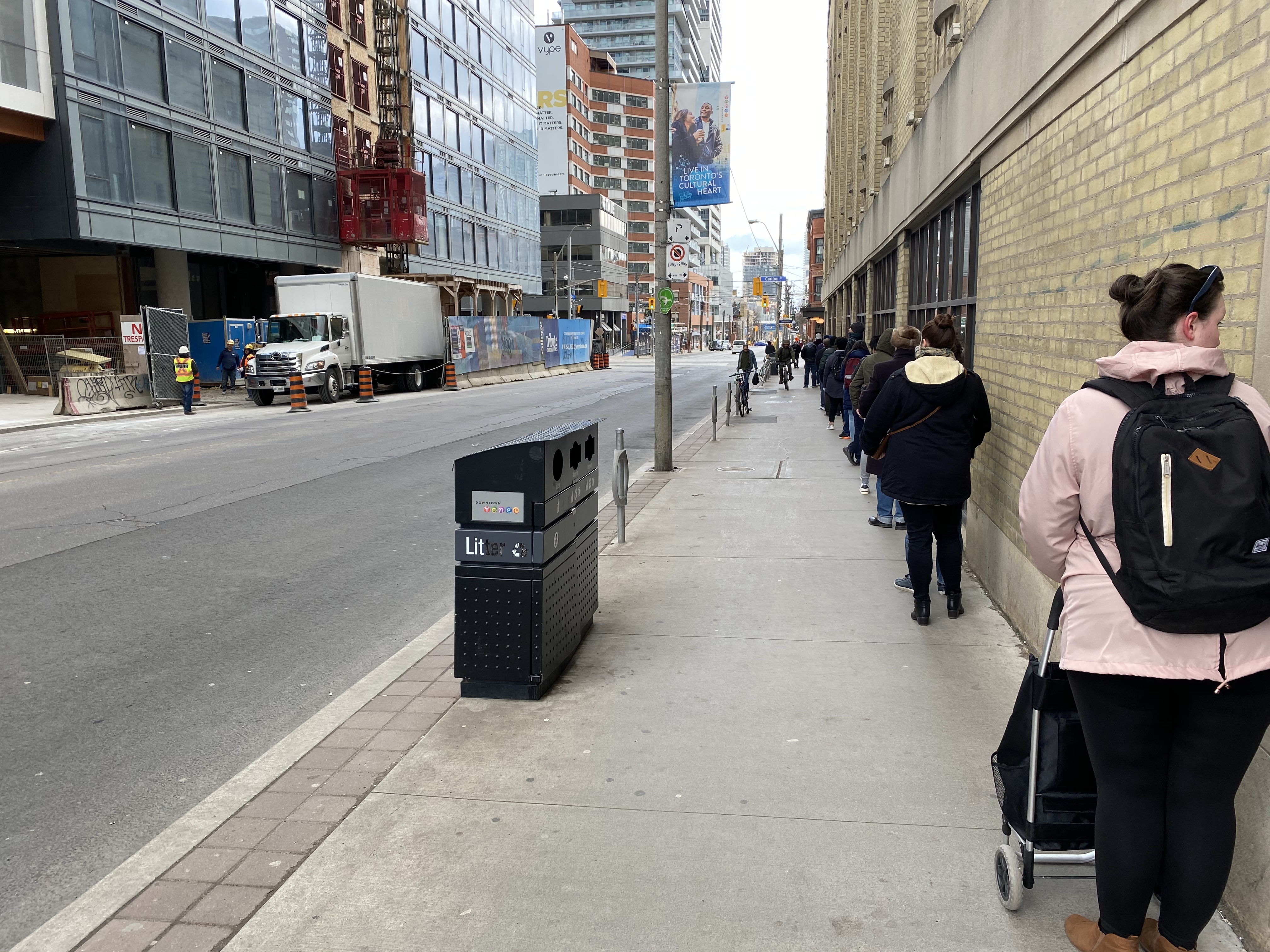
Queue on Church Street at Carlton to enter Loblaws supermarket
With Walk Toronto, I have been involved with pushing the City of Toronto to take action, especially in pinch points where store queues, construction barriers, and other obstructions have made it difficult — if not impossible — to safely practice physical distancing when walking or cycling for essential purposes, or even getting a little bit of fresh air or light exercise in dense urban areas.
The good news is that ten problem areas — including the intersection of Carlton and Church — have finally been identified for curb lane closures, with potentially more on the way. This is a timid first step, made after weeks of advocacy, but it is welcome.