Tag: COVID-19

  • Why pedestrian safety is a matter of justice for essential workers

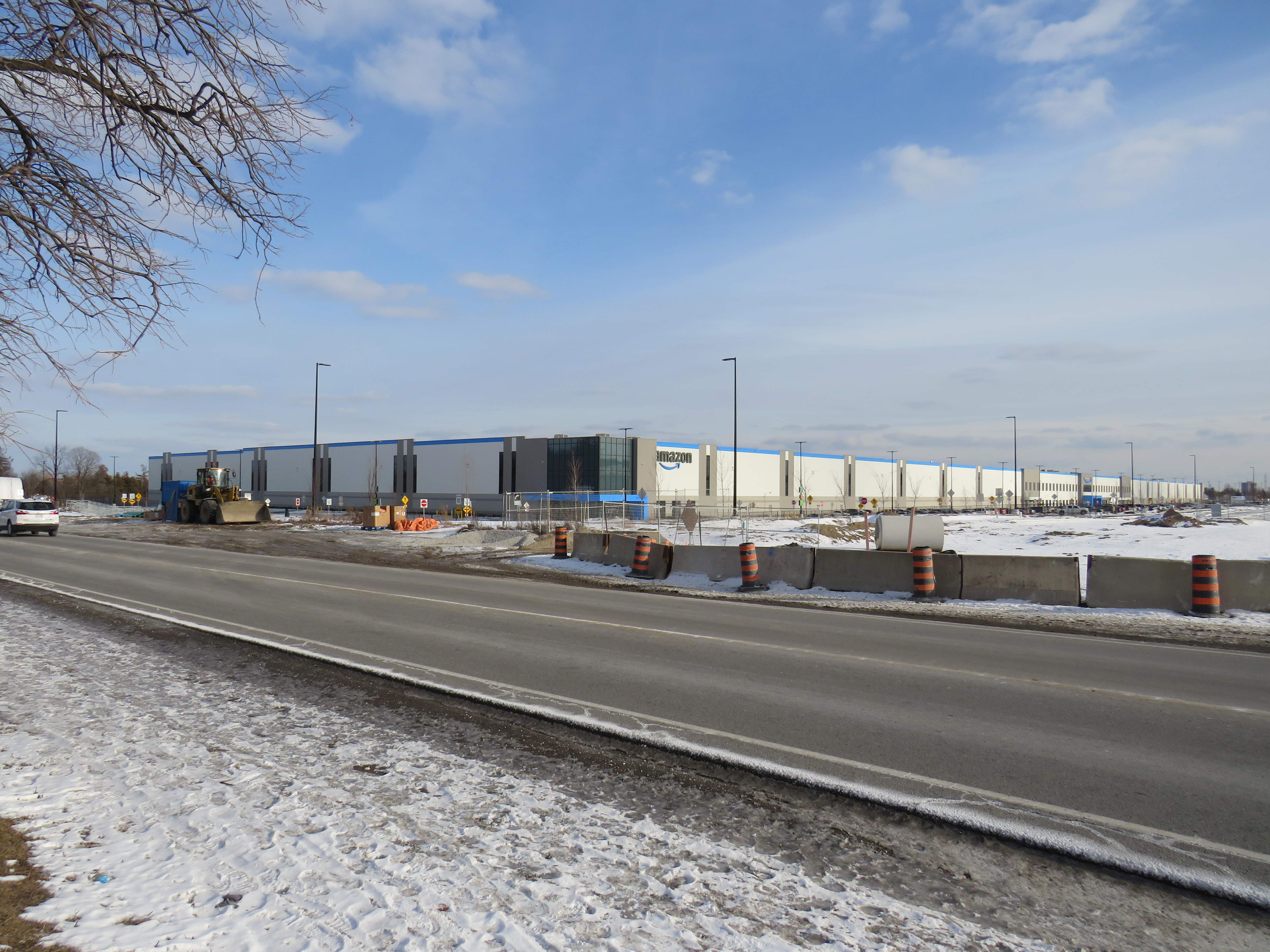
    The new YYZ9 Fulfillment Centre in Northeast Scarborough, looking across Steeles Avenue

    In August 2020, in the midst of an ongoing COVID-19 pandemic, Amazon opened its sixth fulfillment centre in the Greater Toronto Area near Steeles and Tapscott Road in northeast Scarborough. Upon opening, the new warehouse, where consumer orders are packed for delivery, employed 700 workers, 100 more than Amazon initially planned due to high order volumes.

    The starting wage for an Amazon fulfillment centre employee is $17.00 an hour, despite notoriously tough working conditions. With most professional and office workers at home, and with ongoing pandemic restrictions, Amazon has enjoyed significant sales increases. But those workers picking and packing orders are not able to work from home – and workplace spread has been a significant factor in COVID-19 transmission in Ontario.

    Brampton, home to two of the GTA’s fulfilment centres, and close to Amazon’s Mississauga, Milton and Bolton warehouses, has been a COVID-19 hotspot. Like Toronto, Peel Region has been under lockdown and stay-at-home orders since November.

    Like most new logistics facilities, the new Scarborough warehouse, like the other five GTA Amazon fulfillment centres, is in an industrial area on the city’s outskirts, where land is plentiful, but transit and pedestrian access is lacking. East of Tapscott Road, Steeles Avenue narrows from four lanes to two, and there are no designated pedestrian crossings at the intersection with Eastvale Drive. The eastbound TTC stop at Eastvale Avenue was removed in 2018 after a passenger was struck and killed trying to cross the street after disembarking from a 53 Steeles East bus. The next nearest stop, at Tapscott Road, is 300 metres west.
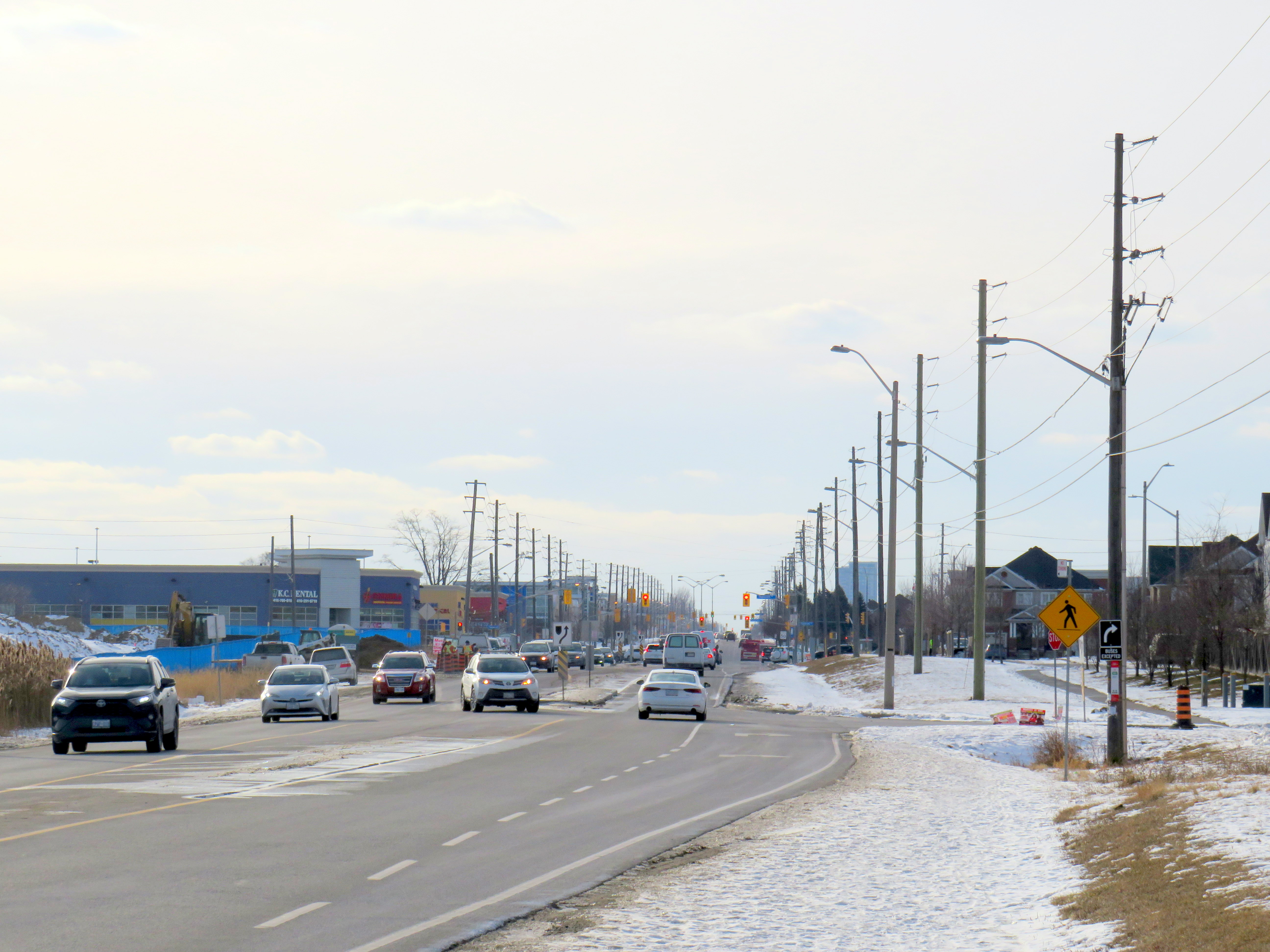
    Steeles Avenue, looking west towards Eastvale Drive and the signalized intersection beyond, at Tapscott Road

    The sidewalk on the south side of Steeles Avenue ends at Tapscott, a few hundred metres west of the Amazon fulfilment centre. On the north side, the sidewalk ends at Ferncliffe Crescent in Markham. Despite a new residential area in Morningside Heights, to the east, there is no sidewalk along Steeles to connect to it. Pedestrians heading to Amazon or towards Staines Road must choose whether to walk in the mud, or on the busy roadway. Though the posted speed limit is 50 km/h, motorists regularly travel at 60 km/h or faster.
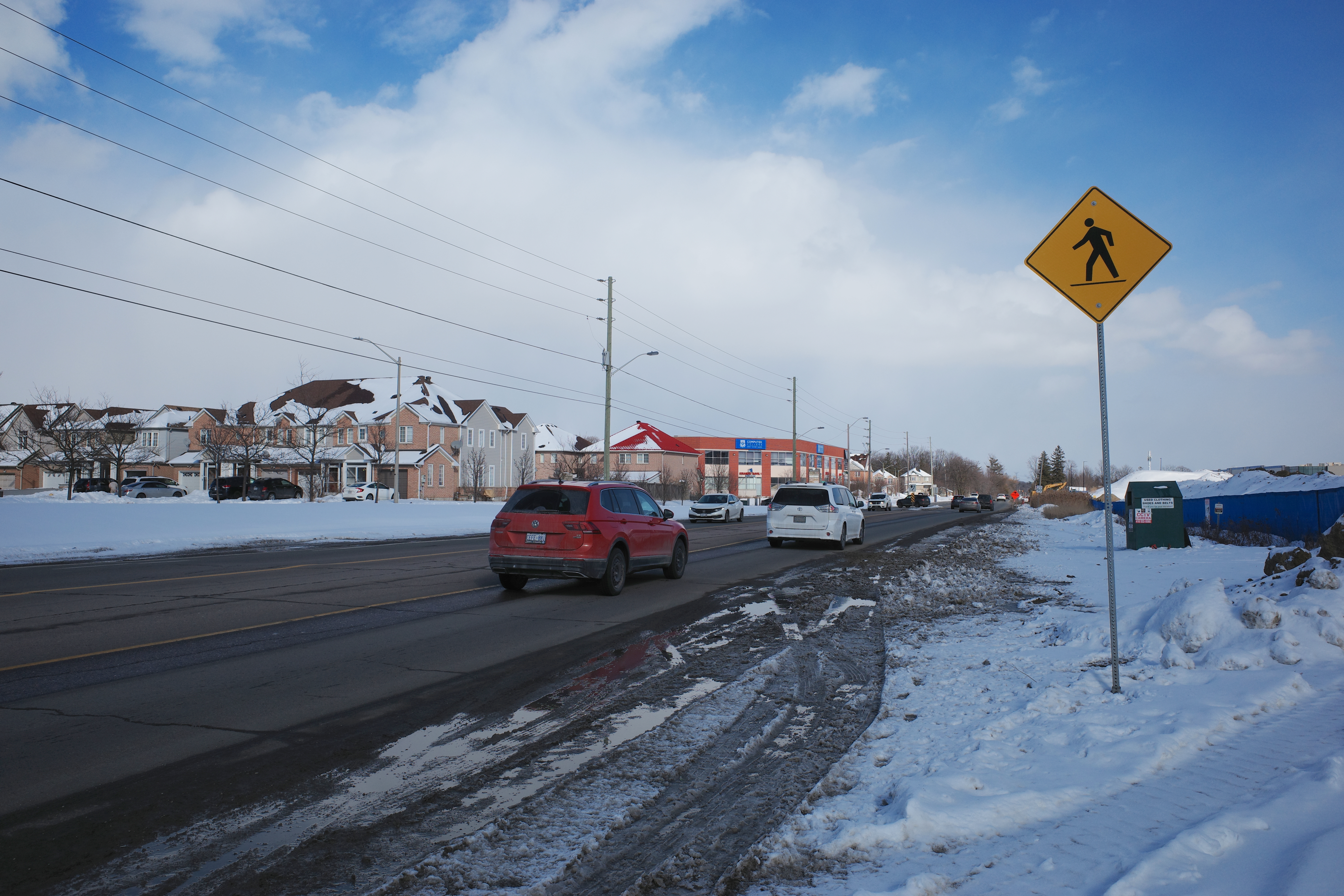
    Looking east on Steeles from Tapscott Road – despite the sign advising motorists of pedestrian activity, there are no sidewalks leading east towards the new Amazon fulfillment centre (Sonali Praharaj)

    A stairway and ramp were built on the north end of the Amazon property, likely with the expectation that a sidewalk on the south side of Streeles Avenue would soon be installed. This would provide improved pedestrian access to the fulfillment centre. But without a safe and logical way to get to it from the street, it remains largely unused.

    Passmore Avenue, on the south side of the fulfillment centre, was rebuilt with a sidewalk in the late fall of 2020, months after Amazon opened. However, it requires a lengthy walk north to Steeles Avenue up Tapscott, and there are no sidewalks on Tapscott from Passmore south, towards McNicoll Avenue. The intersection of Passmore and Tapscott itself – controlled by an all-way stop – still does not feature proper crosswalks.  
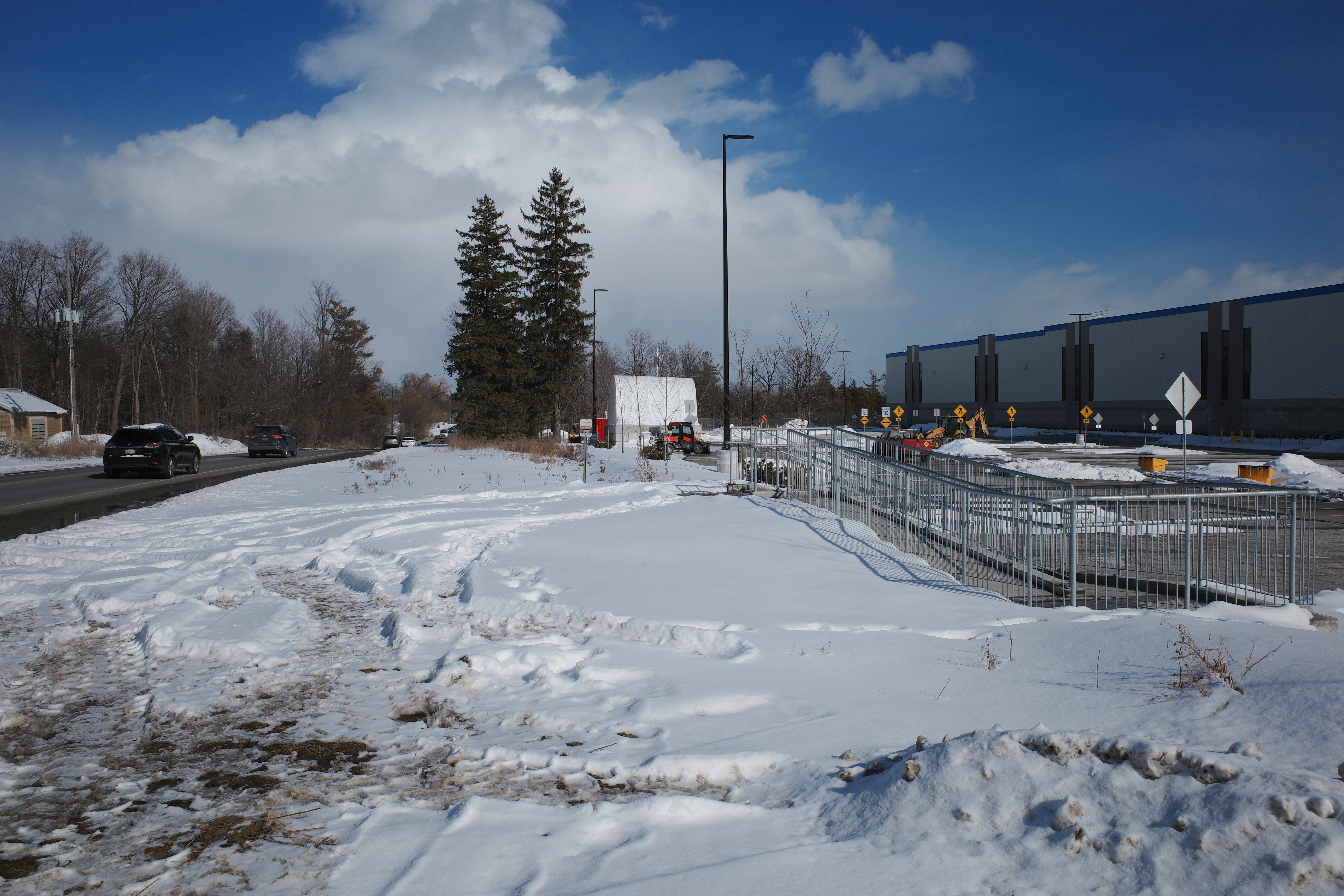
    Looking east on Steeles from Tapscott Road – despite the sign advising motorists of pedestrian activity, there are no sidewalks leading east towards the new Amazon fulfillment centre (Sonali Praharaj)

    Though there are two TTC bus routes that operate to the corner of Tapscott Road and Passmore Avenue – 53B/953B Steeles East and 102B/C Markham Road – for months, workers had to walk on the roadway, through a construction site to access those buses. Anyone looking to go east, towards Morningside Heights, or southeast, towards Malvern, still face a long, dangerous walk or a lengthy bus commute.
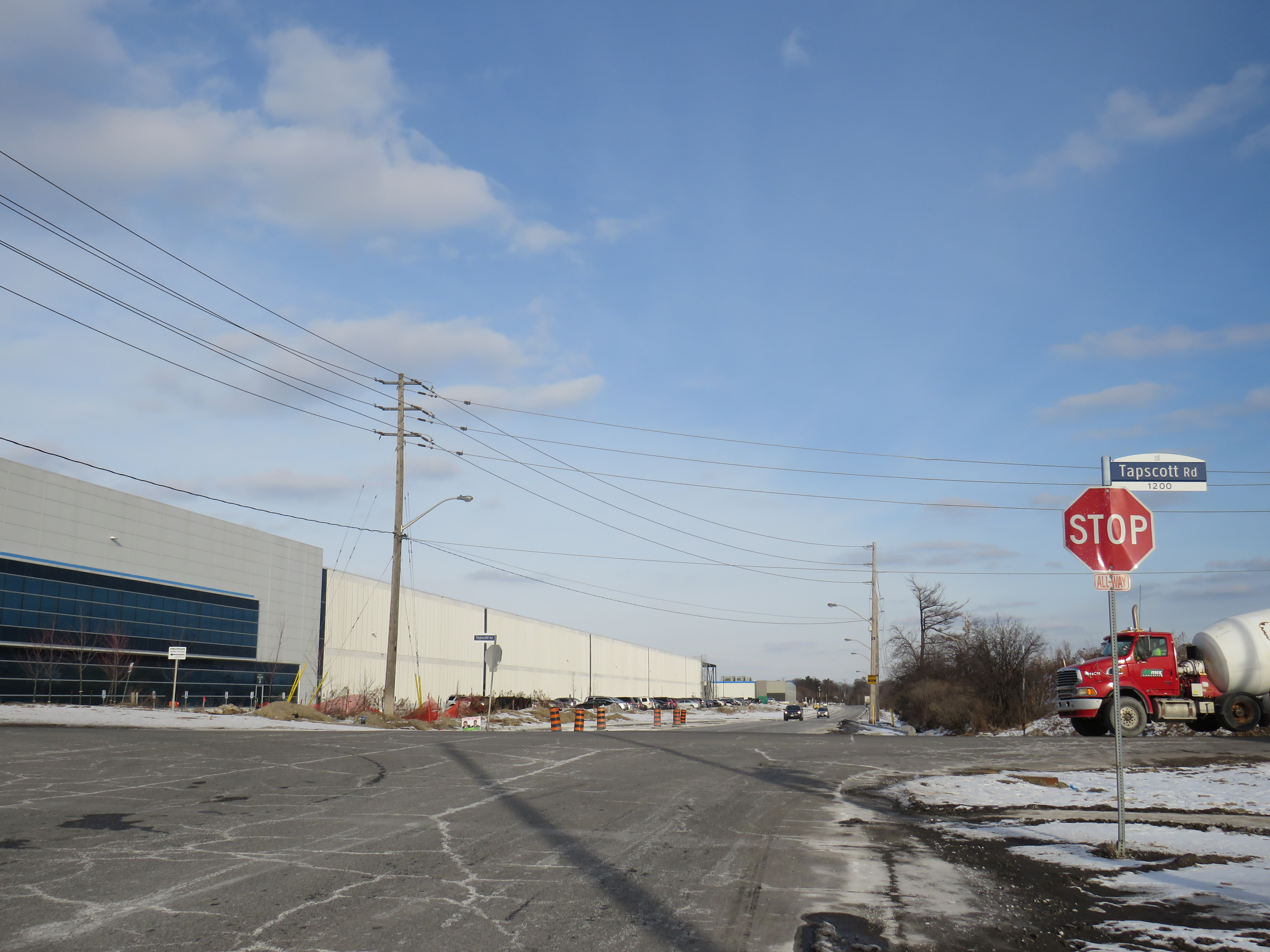
    The corner of Tapscott Road and Passmore Avenue

    The TTC, starting January 11, 2021, began diverting the 53B Steeles East bus to directly serve the Amazon fulfillment centre, finally serving a major industrial trip generator and reducing essential workers’ travel times. Even still, the new sidewalk on Passmore ends at the warehouse entrance – anyone waiting for a bus must still walk and wait in the snow or mud.

    Eventually, Steeles Avenue will be widened, with new sidewalks and bike lanes, and Morningside Avenue will be extended north to Steeles Avenue. However, these improvements have been planned for years and completion is still several years away. Though new warehouses have opened here, civic infrastructure has not caught up.
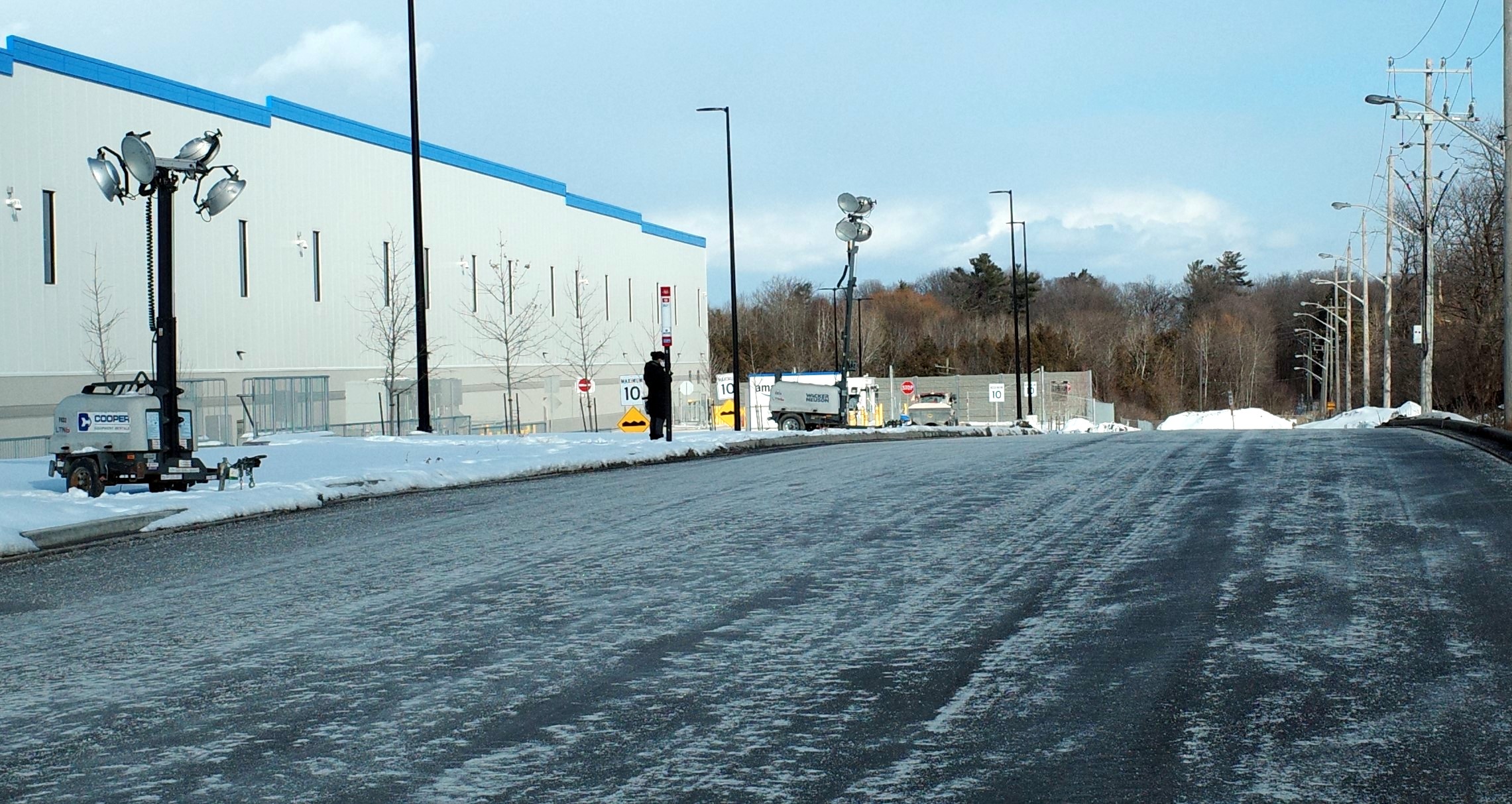
    New TTC bus stop serving the Amazon Fulfillment Centre on Passmore Road (Sonali Praharaj)

    The TTC’s service change, adding a new bus stop on Passmore Avenue, was a welcome – yet overdue – acknowledgement that essential workers, especially racialized and lower-paid workers, deserve better. It is inexcusable that new employment uses are planned, approved, and constructed before the appropriate pedestrian infrastructure and transit services are in place. It is also inexcusable that after a TTC customer was killed that a nearby bus stop was removed, rather than safety improvements added instead. This is not just a matter of ensuring a basic level of safety for pedestrians – this is a matter of justice for those we consider essential workers.
  • Finding a washroom during Toronto’s pandemic winter

    Finding a washroom during Toronto’s pandemic winter

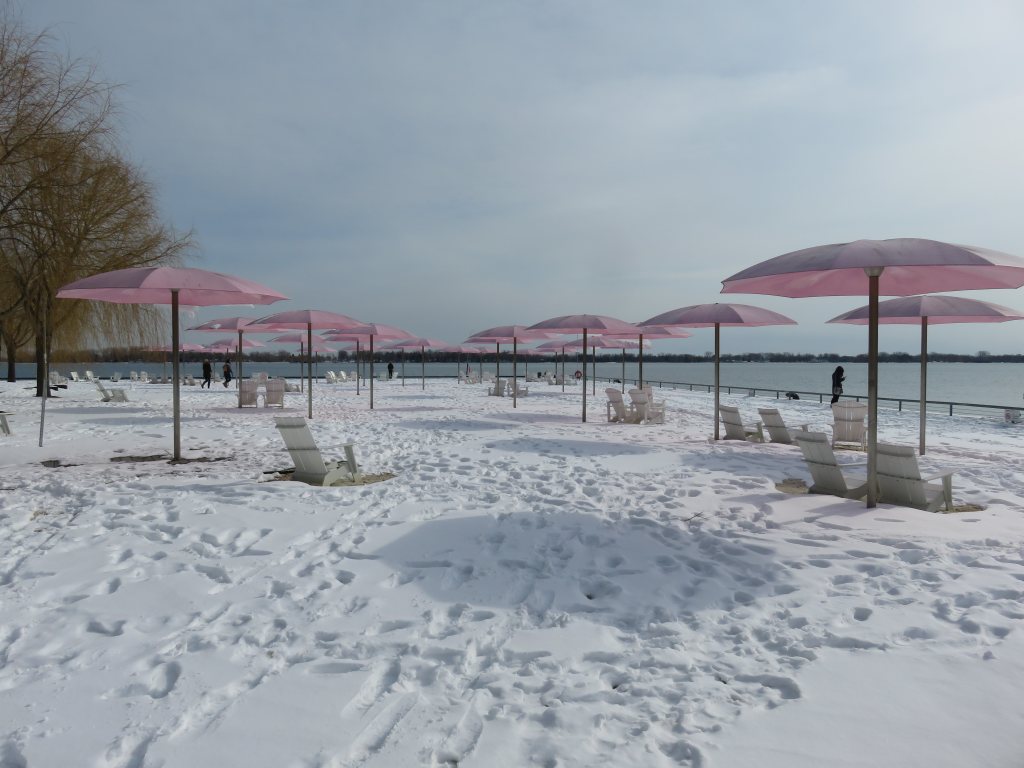
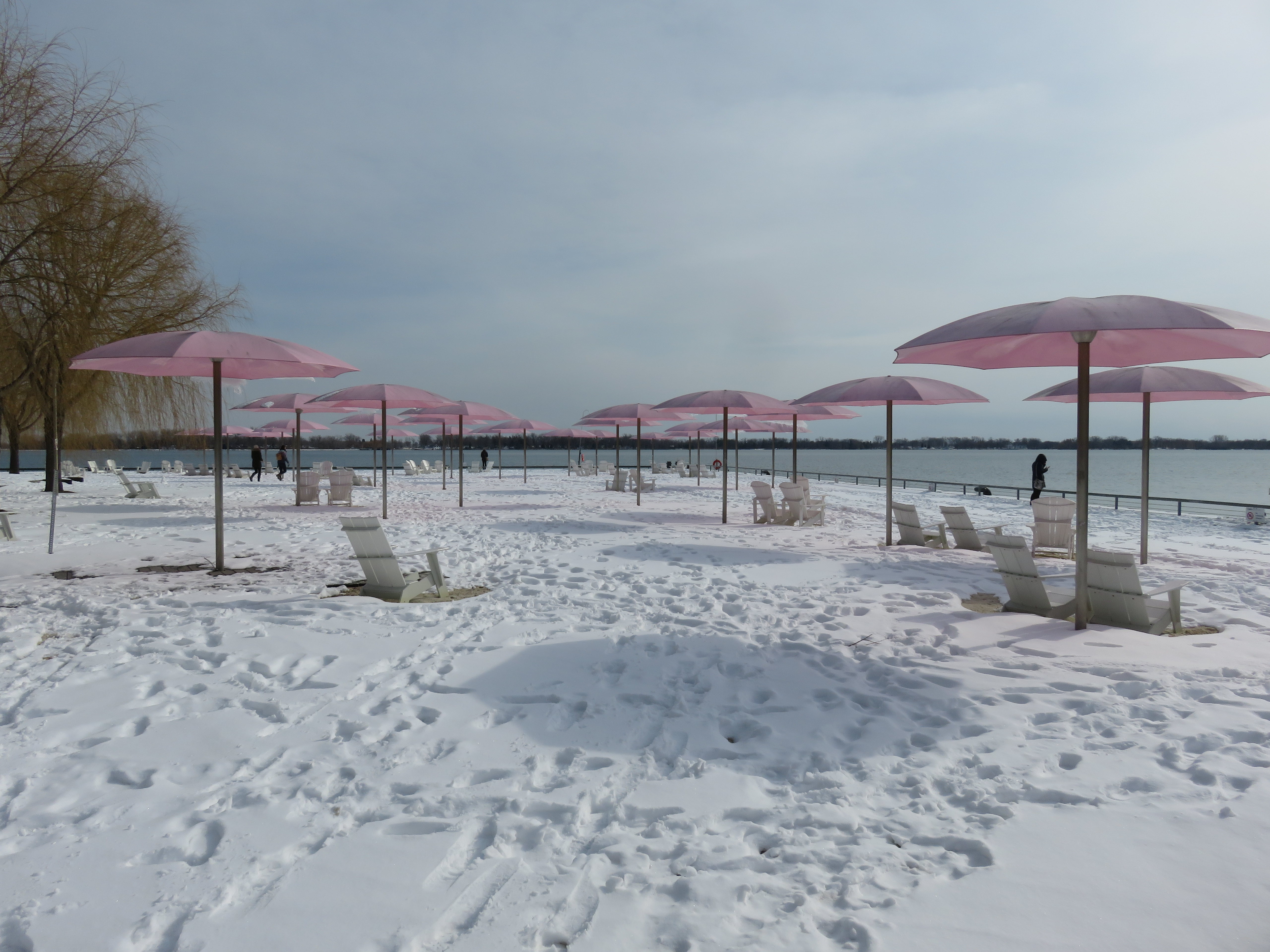
    Sugar Beach in the wintertime

    Update December 14, 2020: With outdoor skating rinks fully opened for the season, I have added the washrooms located at each of these facilities open this winter. Though many rinks will have to be pre-booked to use (to limit crowds during the pandemic) the city has provided access to adjacent indoor washrooms. I also noted the addition of a portable toilet at Guild Park, something I commented on previously.

    Please note, though, that many portable toilets have not been kept in good service. I suggest bringing hand sanitizer on your walks in case you need to use one of these temporary facilities.


    Update November 28, 2020: I have added the list of 51 temporary portable toilets that the city has or will be adding to its parks this winter as part of an effort to encourage Torontonians to get outside for winter walks. Many of these locations are along the major ravine paths, including the Don and Humber Rivers. Most location descriptions were easy to locate, though others were quite vague. I did the best I could with the information given. I also added the toilet locations at Tommy Thompson Park, which is operated by the Toronto and Region Conservation Authority.
    There remain some critical gaps, including the absence of Guild Park in Scarborough and along the waterfront between Humber Bay Shores and Marie Curtis Park, but on the whole, this is a positive development. The city also announced new winter maintenance of additional park paths, though ideally, this service would be extended along the entire ravine network.


    As of Monday, November 23, Toronto and Peel Region will be in another lockdown. Non-essential businesses and services will close or be open only for take-out and curbside pickup. Gyms, patios, and salons will all be closed. Though we may not be able to socialize with friends and extended family, we can still go for walks, runs, and bike rides to maintain our physical and mental heath.

    But with indoor dining prohibited since October in Toronto, and most malls closing down, finding a washroom has become much more difficult. Many outdoor park washrooms are not winterized, so they must close as well. For many of us, having access to open and accessible washrooms is a necessary when leaving the home for long periods of time.

    Happily, the City of Toronto has identified over 40 park washrooms that will be open during the winter months, with the promise of more to come, including portable toilets placed in strategic locations.

    Though there is a list of washrooms open (or soon to open) on the city’s website, they are listed in alphabetical order, without easily-accessible location information. I took the liberty of mapping each park washroom location, as well as selected other city-owned public washrooms accessible seven days a week.

    Though winterized public washrooms can be found across the city, there are a few areas left unserved, including the Etobicoke waterfront between Humber Bay Shores and Long Branch, the eastern Scarborough waterfront parks, including Guild Park and the Port Union/Rouge Beach area, and northwestern Etobicoke. Ideally, every Torontonian should live within walking distance of a four-season park.

    Even with the impending lockdown, there are some other washrooms that will remain available when necessary. GO Transit has kept washrooms at its stations accessible even during the Spring 2020 lockdown. On the Lakeshore Line, stations are open seven days a week, including Guildwood and Rouge Hill. Many supermarkets have public washrooms as well.

    I hope that there will be improved four-season access to public washrooms this year, and every year going forward. Simple outdoor activity, including long walks, are one of the safest and easiest things we can do to keep ourselves happy and busy.

    I will update the map as more washroom facilities open.

  • A failure to communicate: a small, but meaningful example of the terrible messaging during this pandemic

    A failure to communicate: a small, but meaningful example of the terrible messaging during this pandemic

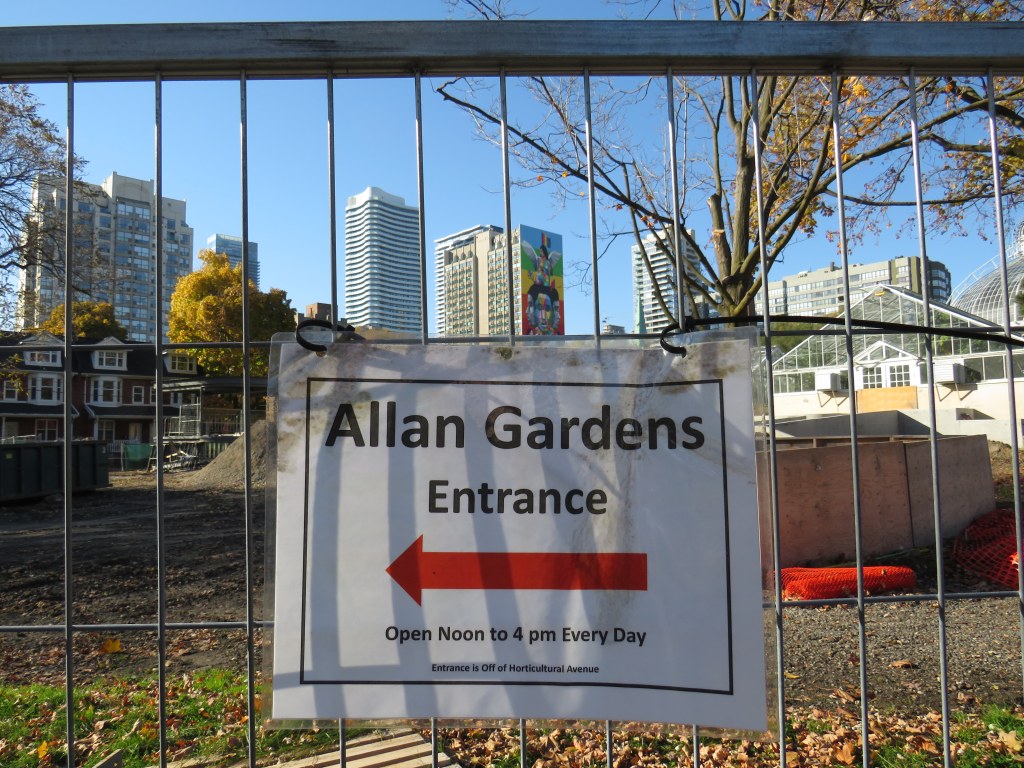
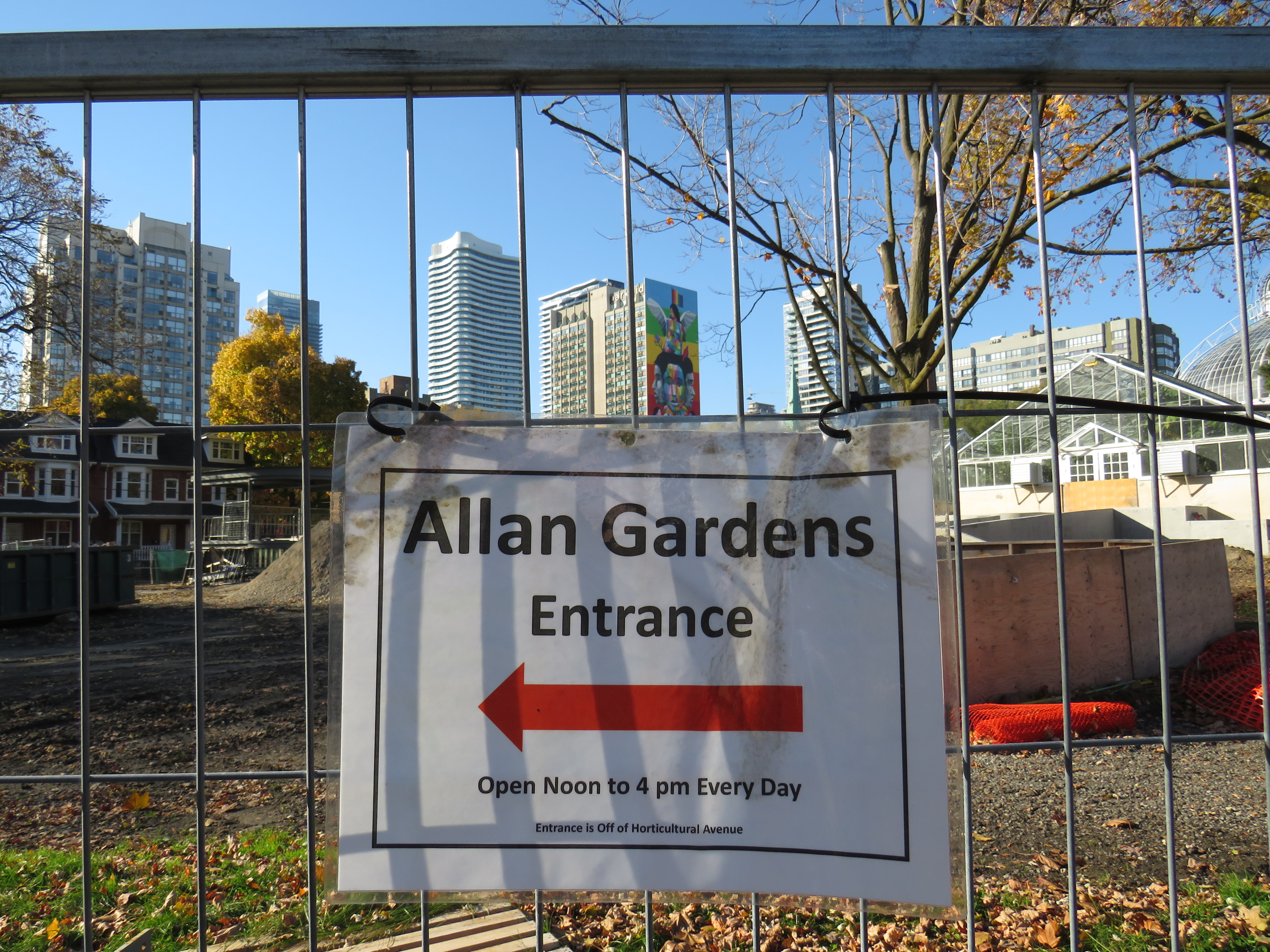
    On November 4, signage scattered around Allan Gardens leads visitors to locked doors

    The ongoing pandemic, to quote the prime minister, “really sucks.” Ontario has been subjected to various levels of lockdowns and restrictions for nearly eight months now as COVID-19 case counts continue to be high. Restaurants, bars, cinemas, and gyms are currently closed in Toronto, as are most other indoor venues. Many of us are — if we’re lucky — working from home, but shut off from meaningful socializing from family, friends, colleagues, and allies. Many are left unemployed with few job openings out there. Those still working in factories, warehouses, public institutions, kitchens, and stores face increased pressures without many of their supports.

    That leaves only a few outlets for selfcare: the support of immediate family, outdoor exercise, and passive entertainment such as streaming shows and movies online. Though I am working on several interesting projects here at home, I can attest that Zoom calls, Facebook chats, and occasional phone-calls are no substitute for in-person social interaction. Regular walks have been essential to my mental health, which has suffered during the pandemic. With so much construction in my neighbourhood, there has been one nearby oasis: the conservatory at Allan Gardens.

    Sadly, that’s no longer an option, and I found that out the hard way. Though it is a minor complaint given the much larger failure to control the virus here in Ontario and properly communicate important public health information and advice, it’s just a microcosm of the mixed messaging from all levels of government that we have been enduring since February.

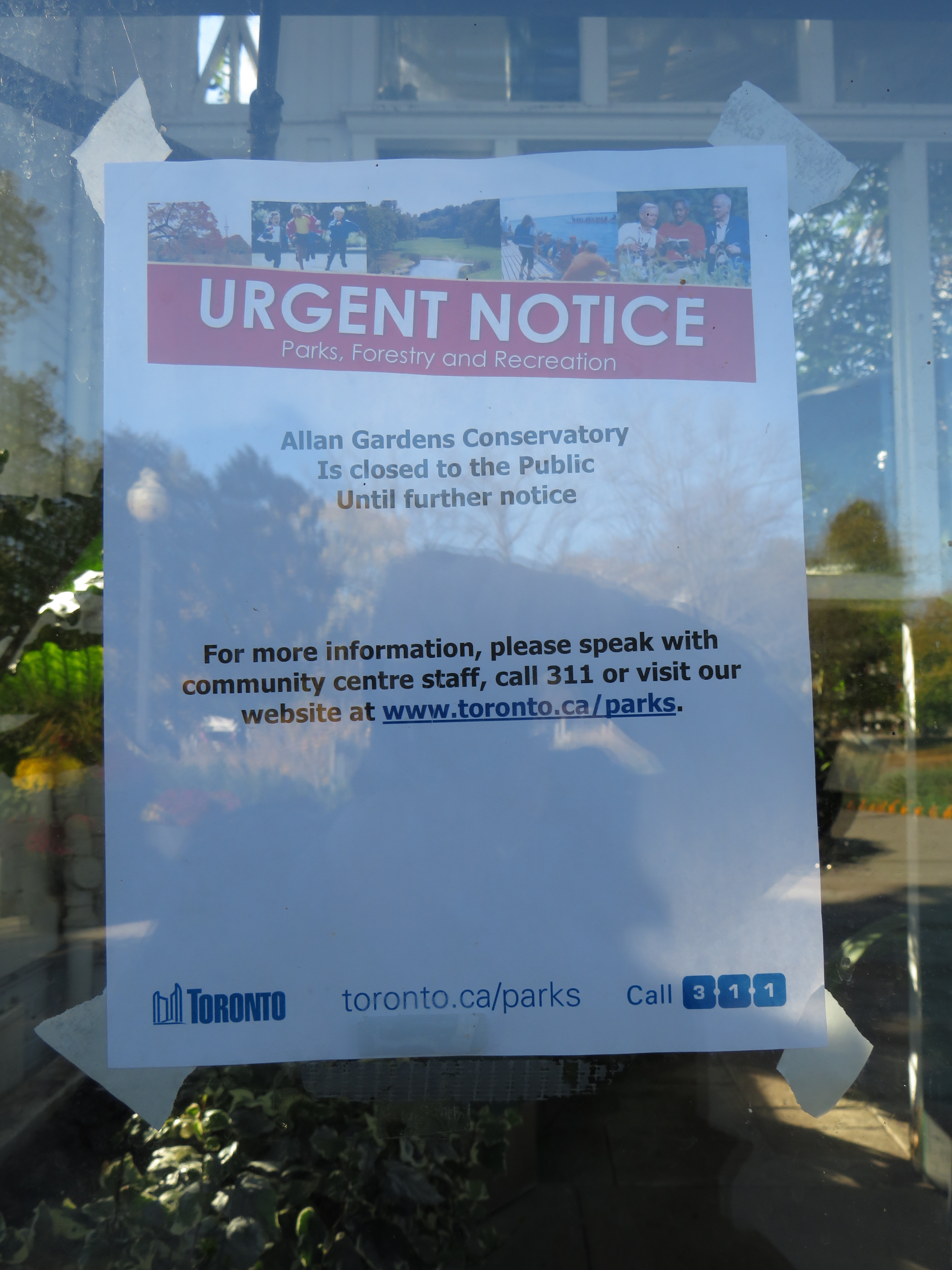
    “Urgent notice” – anyone who continues past the signs directing visitors to the designated entrance to the Allan Gardens Conservatory is greeted with this notice indicating that the building is closed until further notice
    (more…)
  • Why Durham Region is going the microtransit route during the pandemic – and what it means for other transit systems

    Why Durham Region is going the microtransit route during the pandemic – and what it means for other transit systems

    Durham Region Transit and GO Transit buses meeting at Durham College/Ontario Tech University

    Previously on this site, I expressed my skepticism about Durham Region’s commitment to improving transit service. But in the five years since, the region east of Toronto has done exactly that by creating a route grid along major corridors, fusing together a network from four separate municipal systems.

    While the ongoing COVID-19 pandemic has seen transit ridership plummet across the province, followed by service cuts to match the reduced demand, Durham is doing two interesting things: firstly, it is adding additional service on its main corridors, and it is replacing twenty-five low ridership routes with on-demand transit.

    In my latest article for TVO.org, I take a closer look at Durham Region Transit’s response to shifting ridership during a pandemic and the benefits and pitfalls of microtransit as a potential solution.

  • Opening up the streets in Toronto and Guelph

    Opening up the streets in Toronto and Guelph

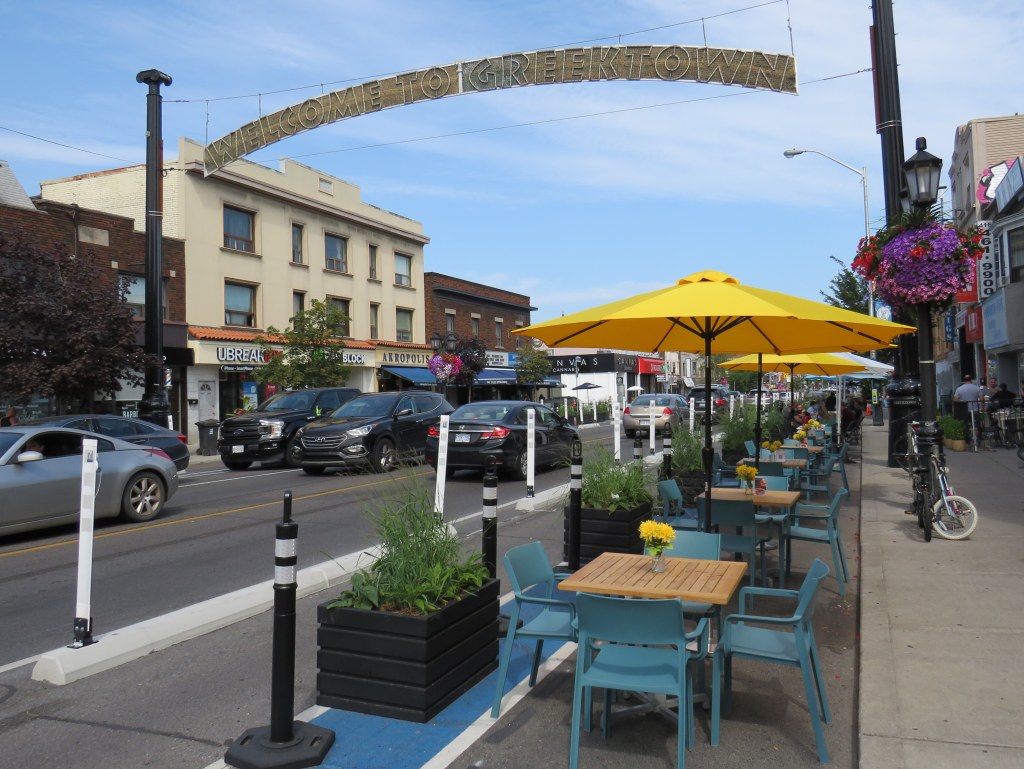
    Toronto’s Danforth Avenue has been transformed with new protected bike lanes and patio spaces

    In the last few days, I visited Toronto’s Danforth Avenue and Downtown Guelph to see how municipalities can support local businesses during the ongoing COVID-19 pandemic.

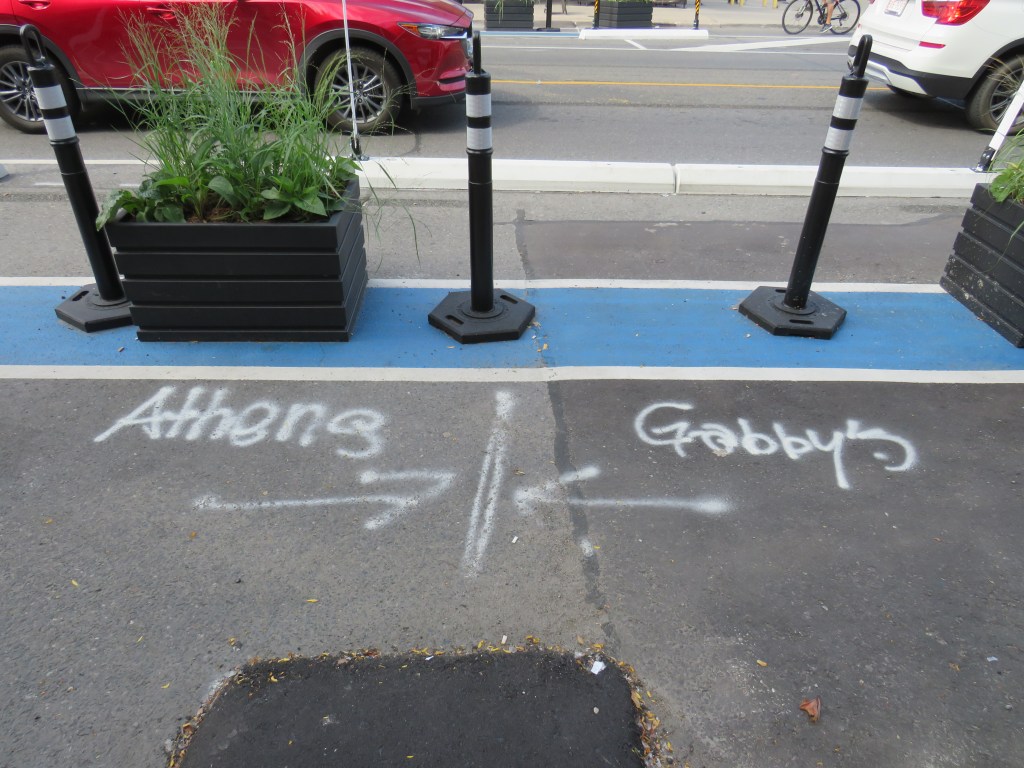
    On Danforth Avenue, new interim bicycle lanes were installed between Broadview Avenue and Dawes Road, spanning three business improvement areas (Broadview Danforth, Greektown, and Danforth Mosaic). With the new bike lanes, dedicated spaces for restaurant patios were installed in the curb lanes. The new patios extended beyond restaurant storefronts, with spray-painted demarcations to mark each business’ territory. This gave businesses with limited or no indoor seating plenty of room to serve customers and recoup some of the lost business due to the pandemic.

    Where one patio space begins and where another ends: Greektown on the Danforth

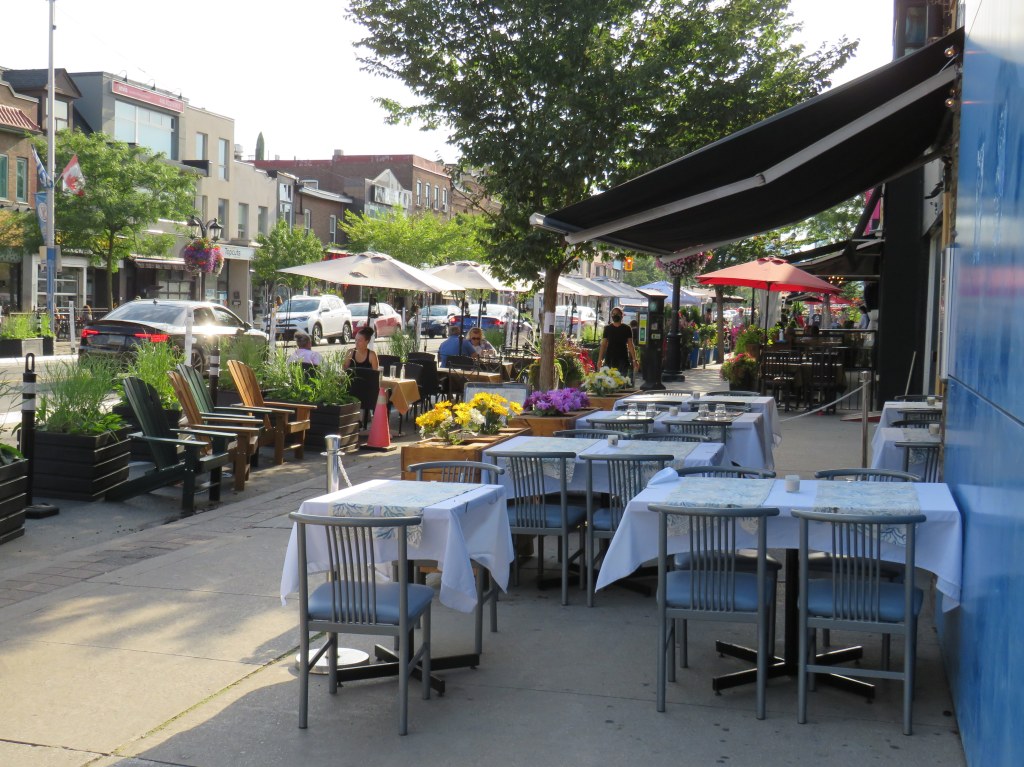
    Though most curbside patio space was allocated to businesses, Muskoka chairs placed within the Destination Danforth area are free for anyone to sit, no purchase required. This helped make the setup perfect for pedestrians out for a stroll or headed to nearby businesses.

    While cyclists are thrilled to get the new bike lanes (the Bloor-Danforth lanes will soon extend as far west as Runnymede Road once construction is complete on Bloor Street West), walking along the Danforth was the best way to see the changes.

    Muskoka chairs on the left are may be used by anyone, while tables on the right allows a local restaurant to seat customers while maintaining physical distancing

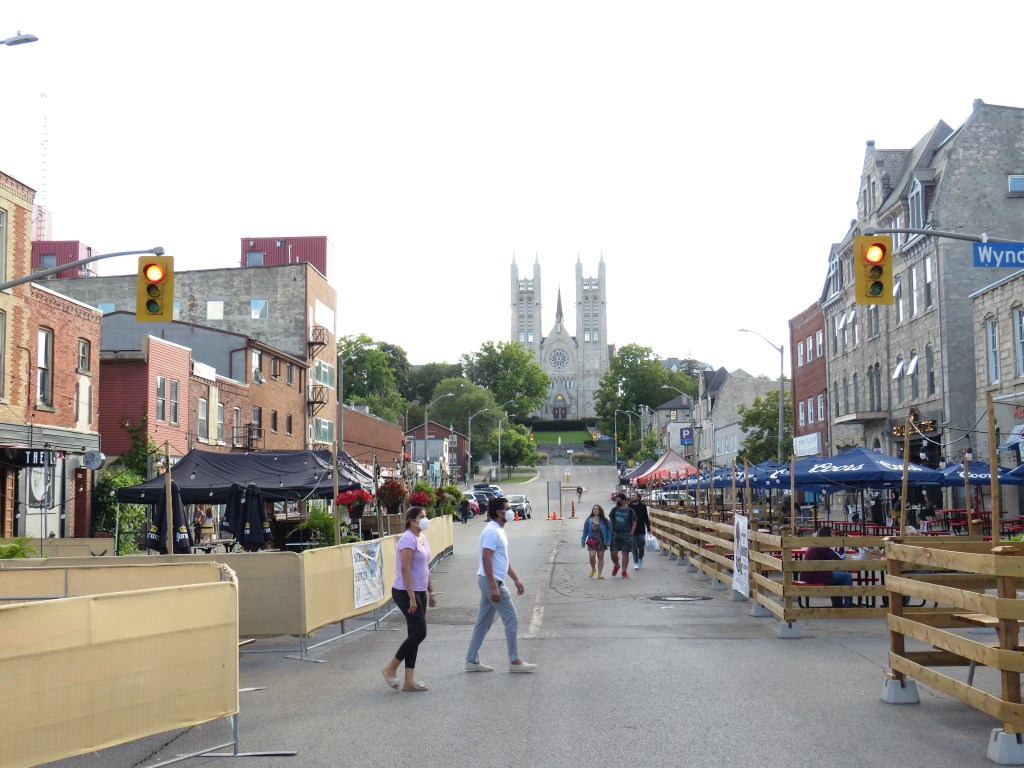
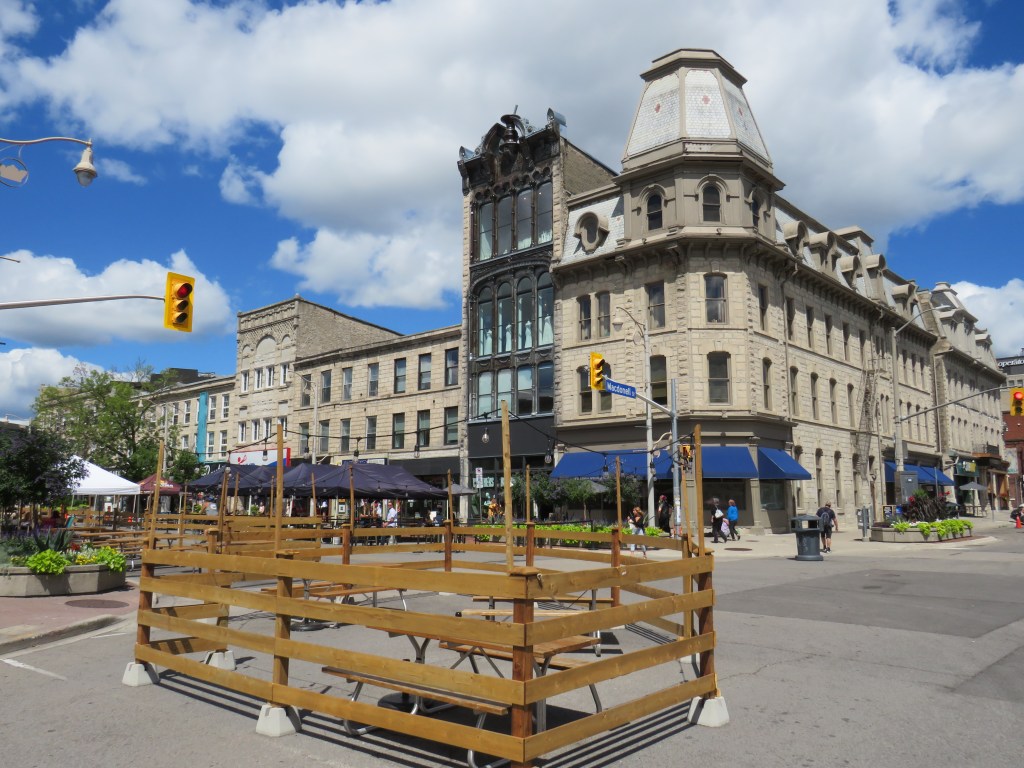
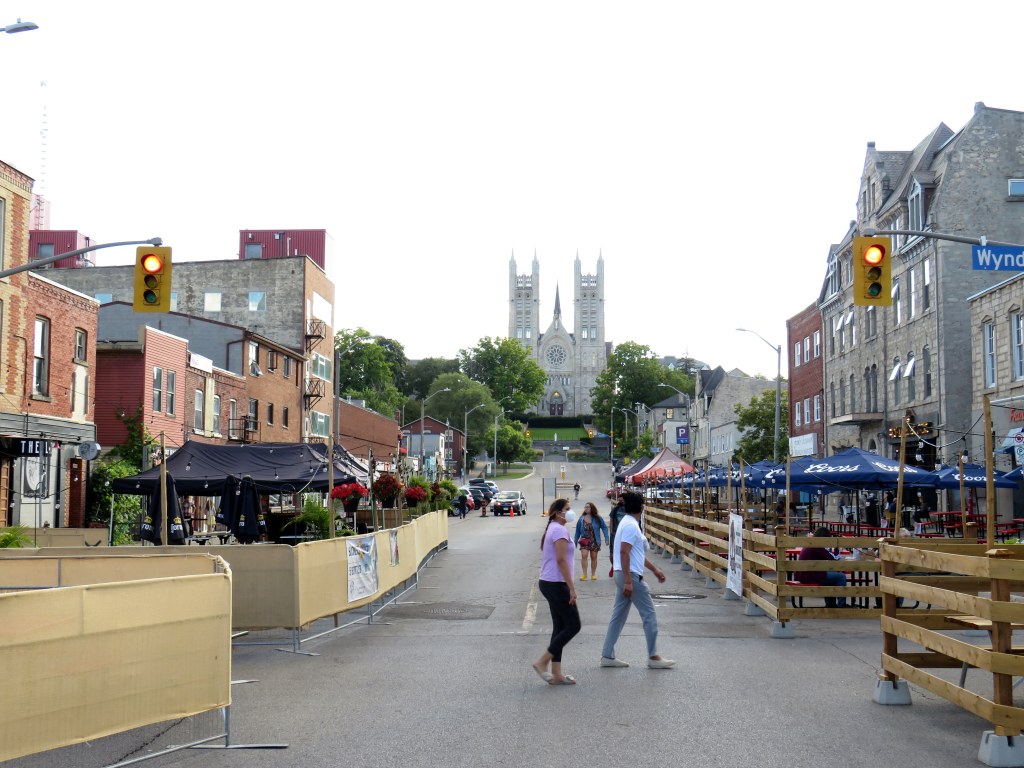
    In Downtown Guelph, the intersection of Wyndham and Macdonell Streets was closed to allow restaurants, bars, and breweries to operate large open air dining areas, in what is called the Downtown Dining District. Unlike The Danforth, patio areas allocated to local businesses in Guelph are enclosed with fences or ropes, but the centre of the street is free to walk or bike through.

    The corner of Wyndham and Macdonell Streets, Guelph

    Though the Downtown Dining District will only continue through Labour Day, the area was busy on a Wednesday afternoon and early evening. Most restaurants have been able to operate entirely with outdoor seating — thanks to generous canopies and umbrellas to provide protection from the sun and rain. This provides additional protection for restaurant staff and patrons. Though Phase 3 is in effect across the province (allowing for limited indoor dining), the fresh air is preferable.

    Macdonell Street looking towards the Basilica Church of Our Lady Immaculate

    Though it took a pandemic to rethink how we use our streets, it is nice to see these changes. Perhaps Guelph could make the Downtown Dining District an annual tradition, attracting visitors from nearby cities, like Toronto, Hamilton, and Kitchener-Waterloo. Perhaps the Destination Danforth changes also become permanent as well – after all, Torontonians love open streets and festivals.

  • Pylons are not enough: how to make a quiet street

    Pylons are not enough: how to make a quiet street

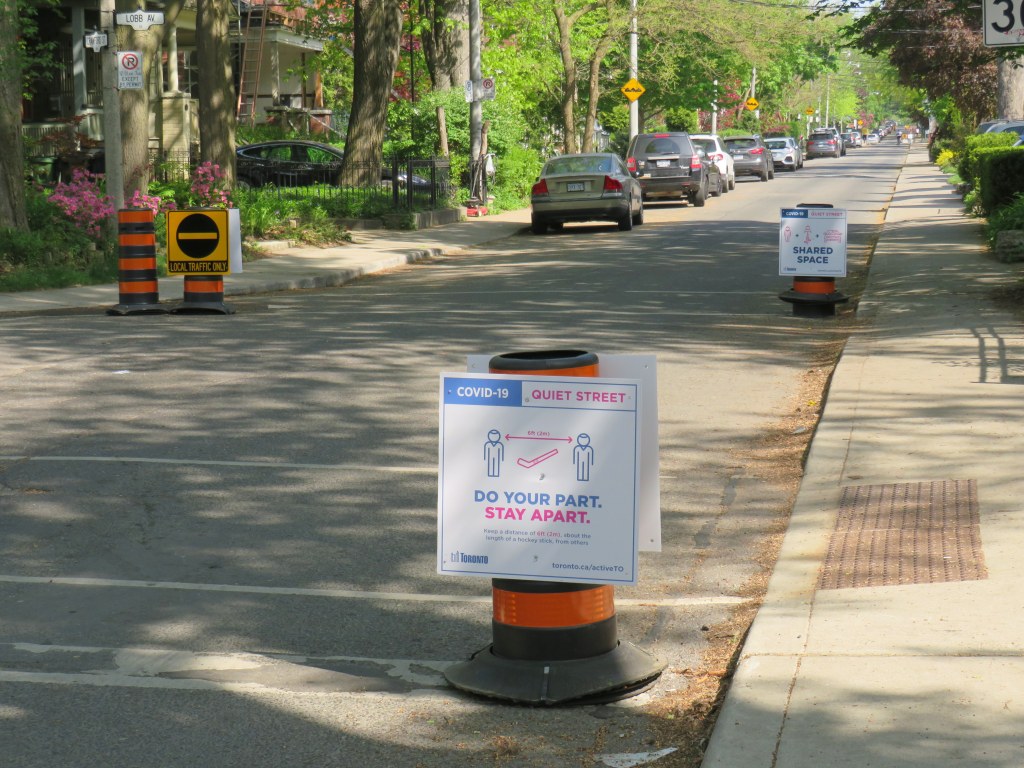
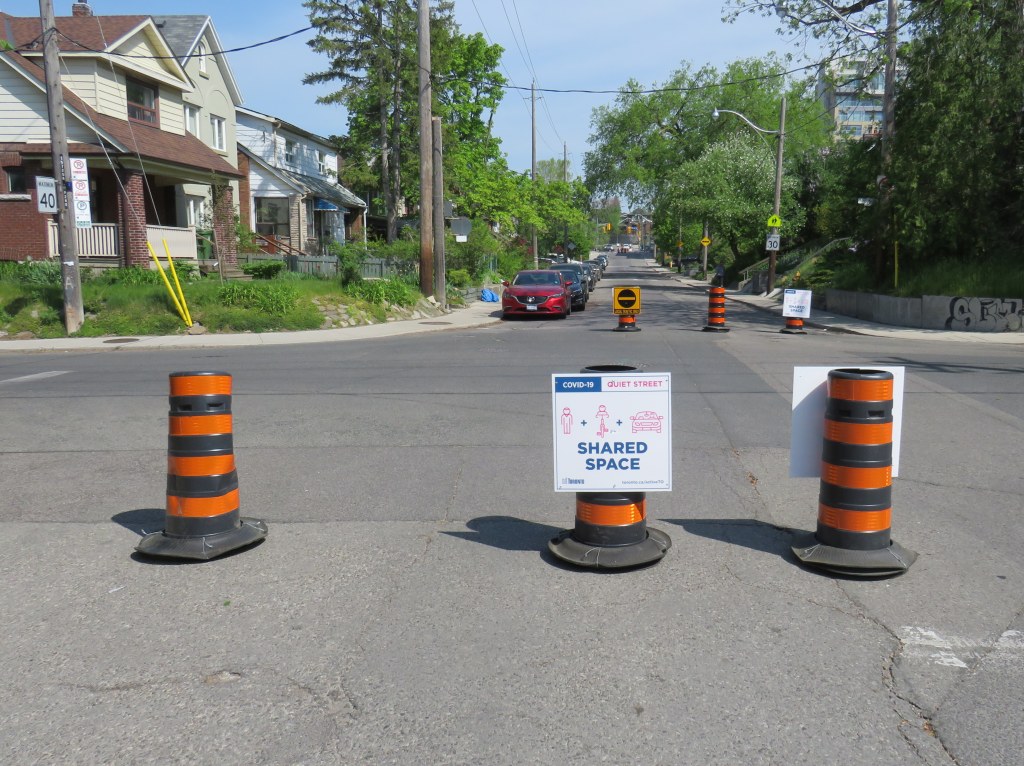
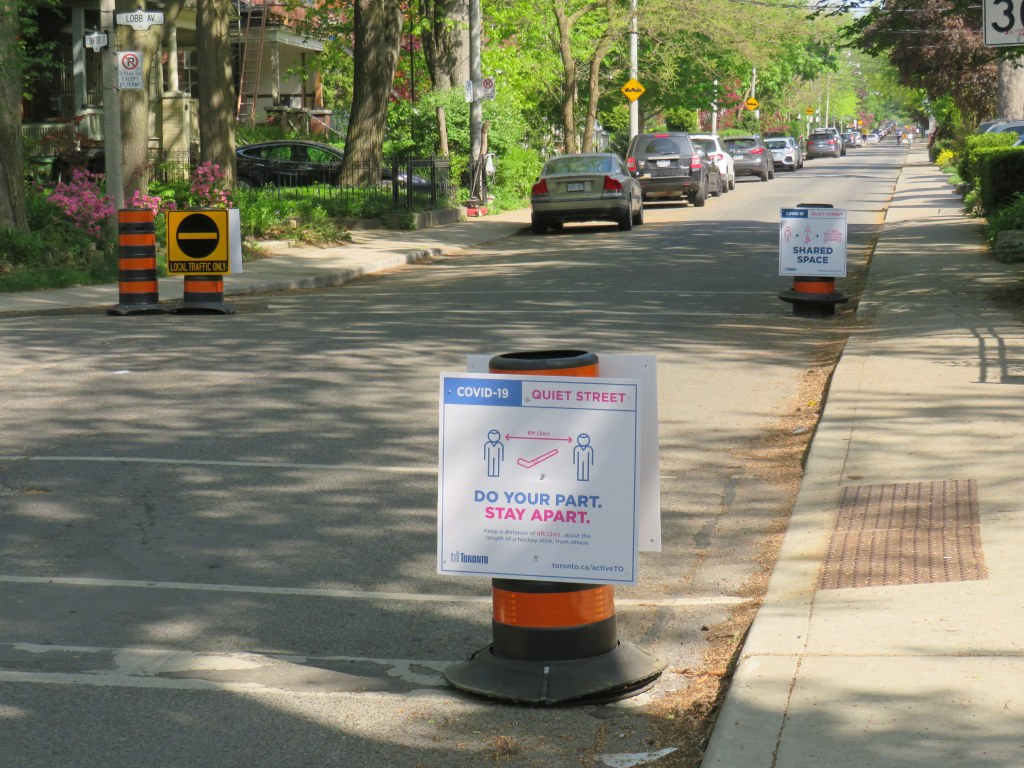
    Pylons and Quiet Street signage left in the gutter, Crawford Street, Toronto

    Toronto took its time recognizing the need for pedestrian space during the ongoing COVID-19 pandemic. It wasn’t until late April that the mayor and the medical officer of health considered limited curb lane closures to accommodate crowded sidewalks in front of supermarkets, drug stores, and other essential businesses.

    But those curb lane closures — called CurbTO — later expanded to ActiveTO, which includes hundreds of kilometres of “Quiet Streets” for pedestrians and cyclusts and regular weekend road closures on Lake Shore Boulevard and Bayview Avenue. By June, CurbTO and ActiveTO were joined by CafeTO — which would expedite restaurant patio licences and even allow temporary patio space in parking lanes — as well as CampTO and SwimTO, programs to safely open up public pools and day camps for the summer.

    Most significantly, new cycle tracks and bike were approved by a wide margin at Council in May, including the entire stretch of Bloor-Danforth between Runnymede Road and Dawes Road.

    Map of ActiveTO Quiet Streets, weekend closures, and new cycling routes

    Through the weekend road closures are closed off with metal barriers and enforced by police, the Quiet Streets are protected only by pylons and temporary signage. On Shaughnessy Boulevard, one of the first Quiet Street implementations, pylons were removed by angry motorists. Elsewhere, residents rearranged pylons to block half the street, doing more to discourage through traffic.

    In Kensington Market, pylons were moved by drivers onto the sidewalk, creating additional barriers to pedestrians, especially those with disabilities.

    Clearly, pylons are not enough.

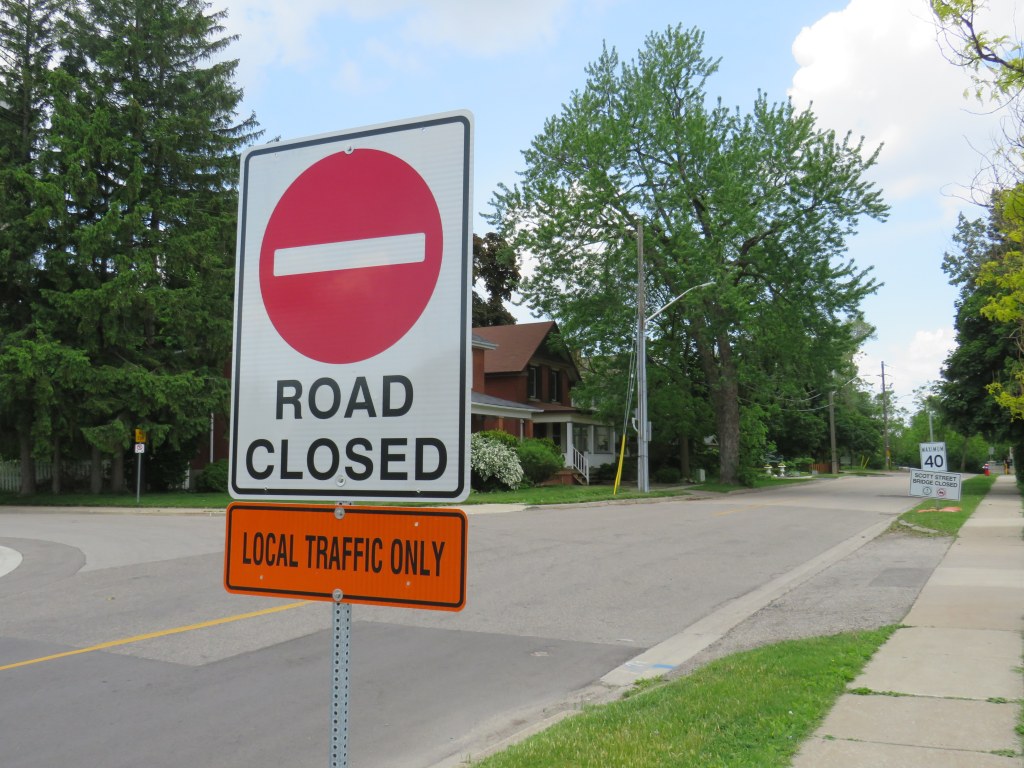
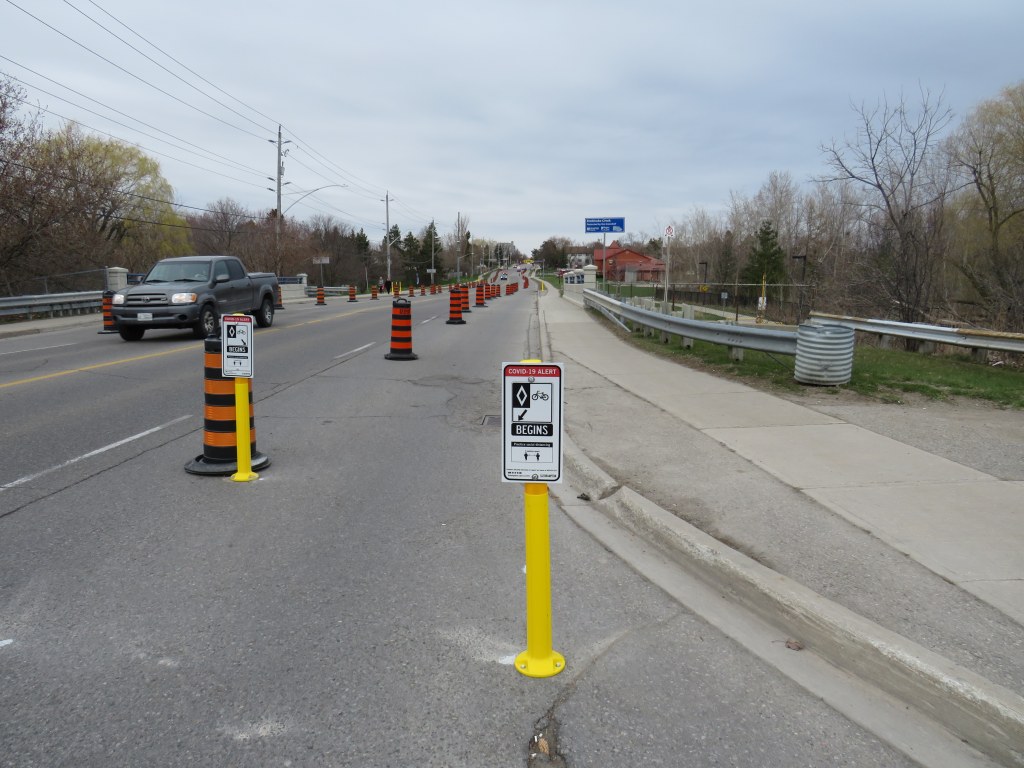
    While I was in Brampton recently, I noticed a more effective approach. On Scott Street, just east of the city’s downtown core, a narrow bridge was closed to motor traffic in order to provide a quiet and safe crossing of Etobicoke Creek to connect two sections of the Etobicoke Creek Trail. Instead of moveable pylons, rigid plastic bollards were bolted to the roadway, with a compliant “road closed” sign posted in the middle.

    Closely spaced yellow bollards on Scott Street

    Signage approaching the closed bridge was also also quite clear.

    Road closed sign on Scott Street

    I also noted that bolted bollards were also used to mark the interim bike lanes on Vodden Street and Howden Boulevard at every intersection, precluding their use by through traffic. On that early weekday afternoon, only one vehicle was illegally parked in the lane along the entire four-kilometre route. Not one pylon was out of place either.

    While Brampton was one of the first cities in Ontario to implement improved active transportation infrastructure during the COVID-19 pandemic, it has done little else since. However, Brampton has an ambitious new active transportation master plan to fix many gaps in its cycling infrastructure and expand its paths system; hopefully it will able to accelerate parts of its plan as Toronto is now doing.

    But what Brampton did right was putting in effective barriers and signage to protect its temporary walking and cycling routes. This is something Toronto could learn from.

  • Sorry, bus full: riding transit during a pandemic

    Sorry, bus full: riding transit during a pandemic

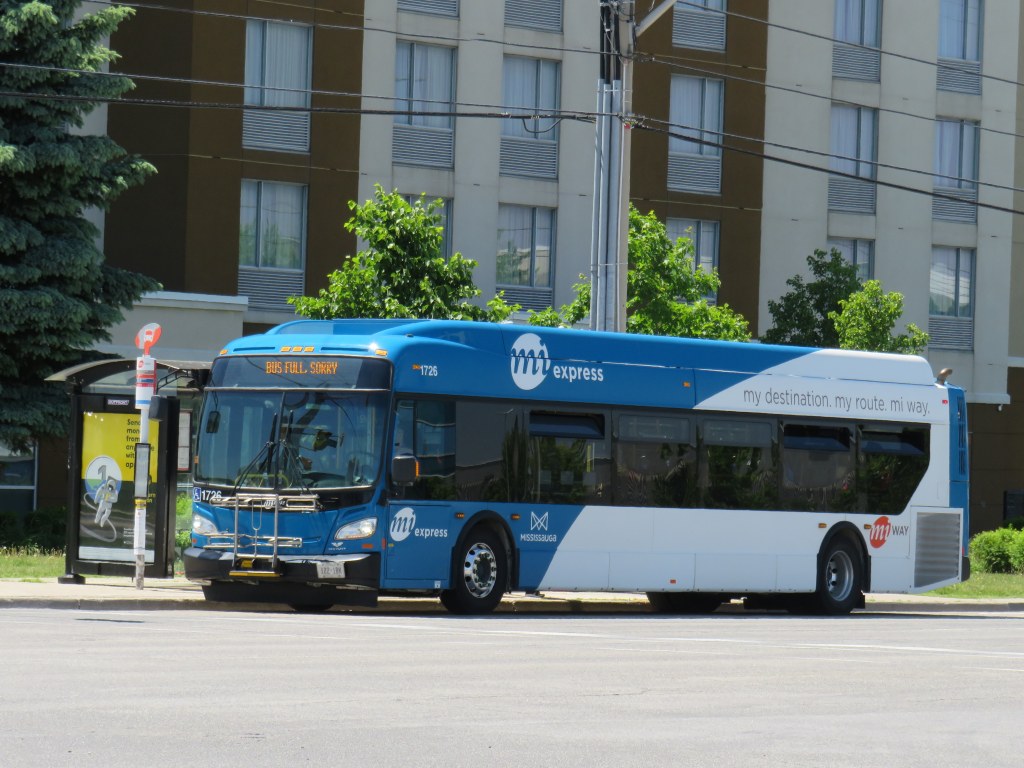
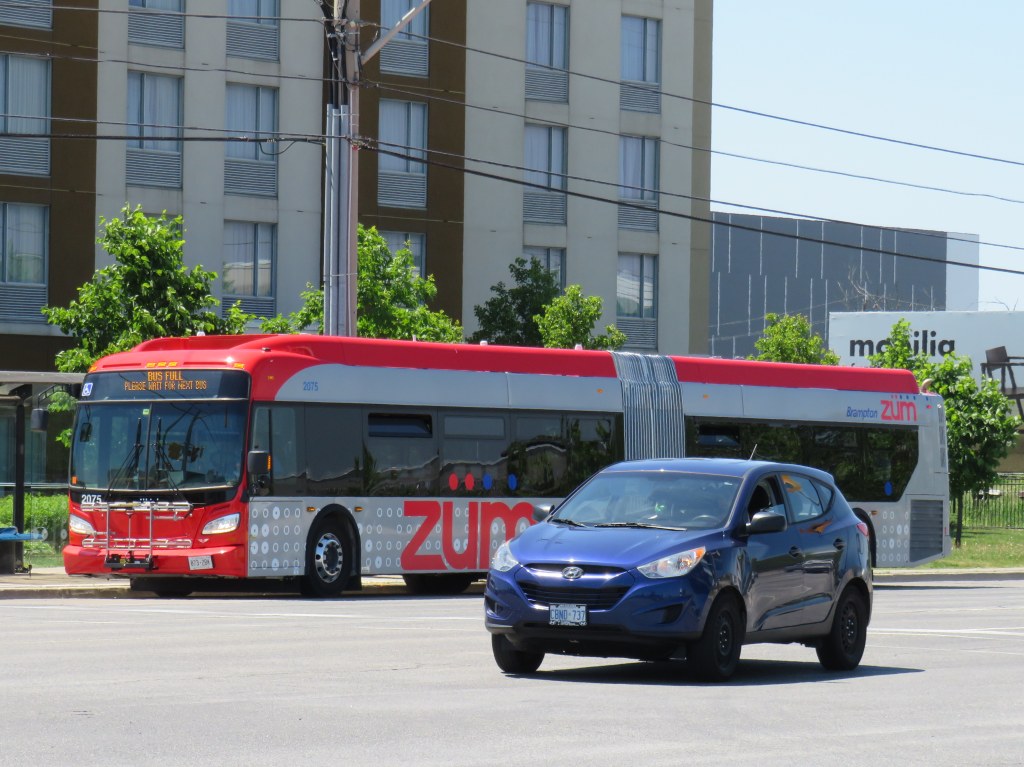
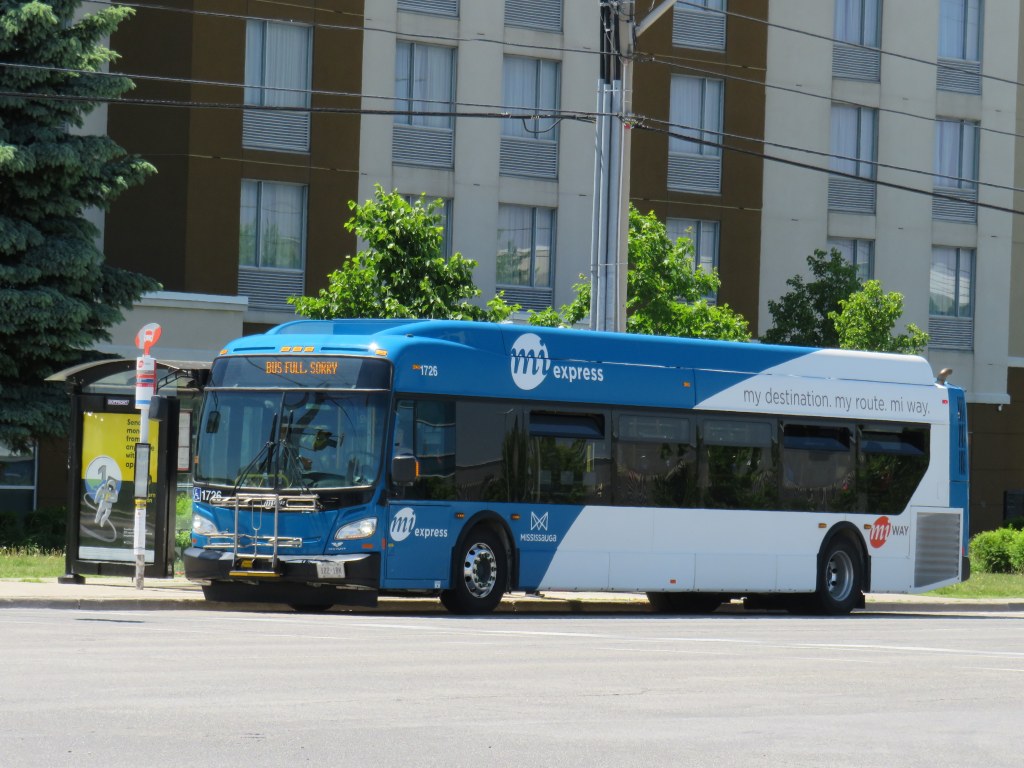
    Brampton Transit bus on route 502 Zum with “bus full” displayed

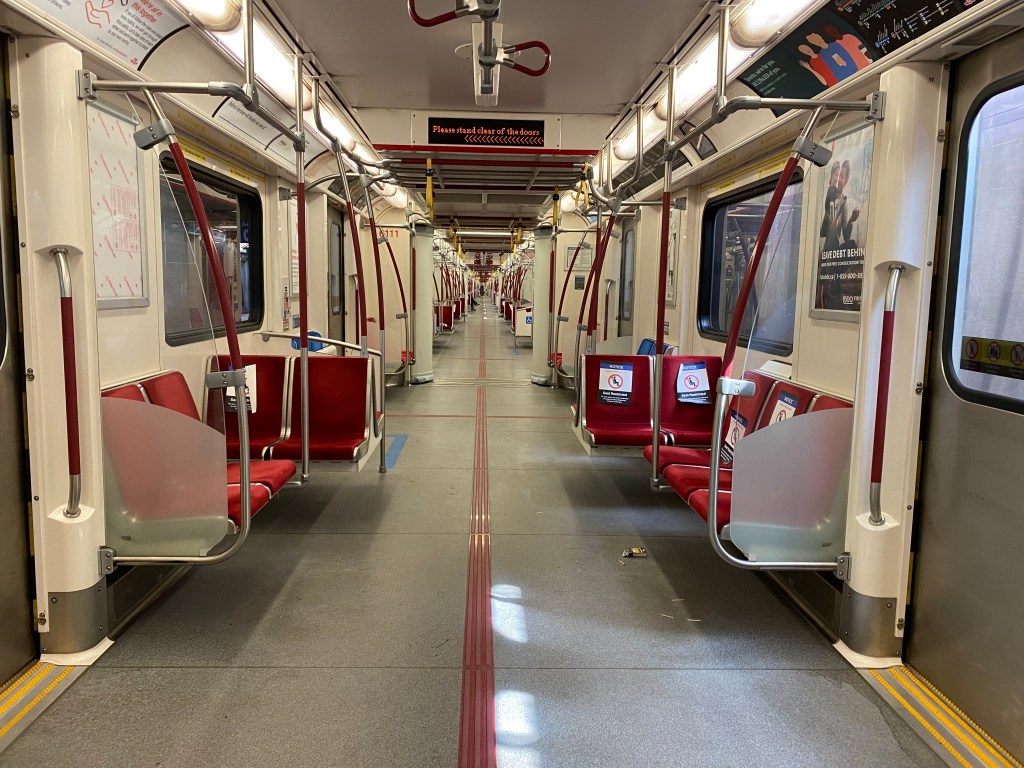
    On Thursday, I took the subway for the first time since Ontario declared a state of emergency in March. I entered Queen Station at 9:45 that morning, and rode to Wilson Station. The subway ride north was noticeably quiet, and I had a good choice of seats, even though most were marked as restricted for physical distancing.

    Empty subway train northbound on Line 1, June 11, 2020

    On my return home, at 4:00 PM, the subway was busier, but still quiet enough to take a seat in the middle of the train, while just about everyone had a non-restricted seat through the downtown core. That never happened prior to March 13.

    As I am used to crowded subway trains — even on Sunday mornings — my first subway rides in months proved to be a surreal experience. Though as most passengers were wearing face coverings and keeping distance, it felt safer and more comfortable than many of my recent supermarket trips.

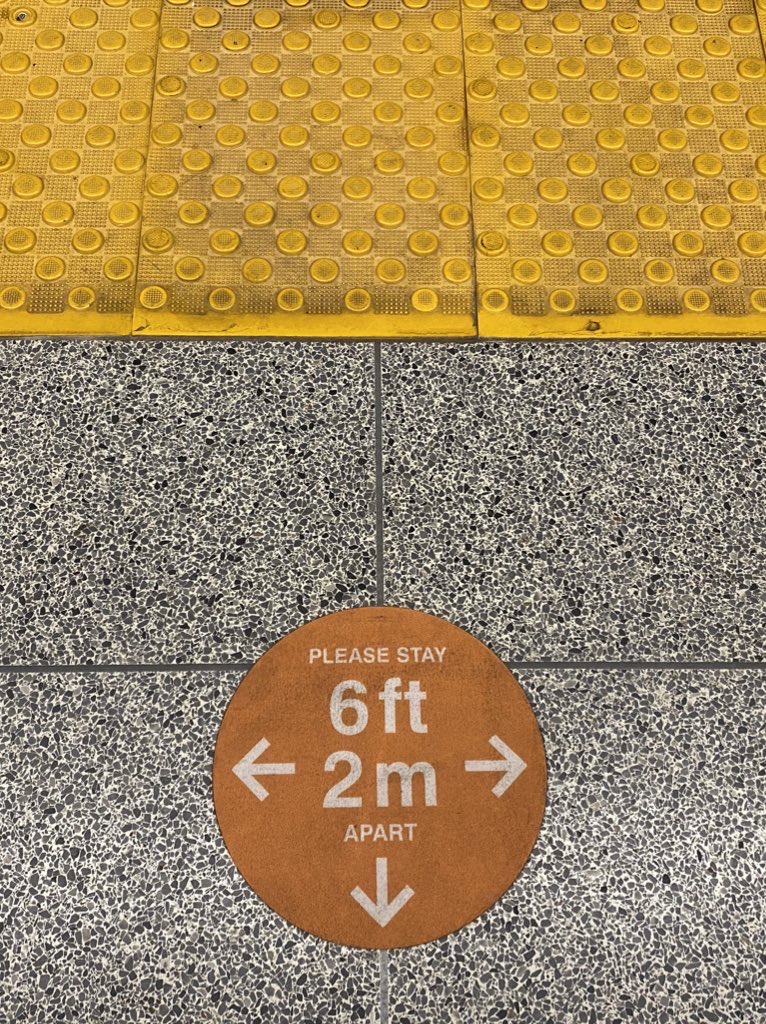
    Platform edge marker, Queen Station

    Though subways are mostly empty, and streetcars pass through downtown with only twenty percent of their normal ridership, things are very different on the buses. In Toronto, Brampton and Mississauga, vehicles regularly bypass crowds of waiting passengers while displaying a “sorry bus full” sign.

    Miway bus full on Hurontario Street, on the same corridor as the Zum bus pictured above

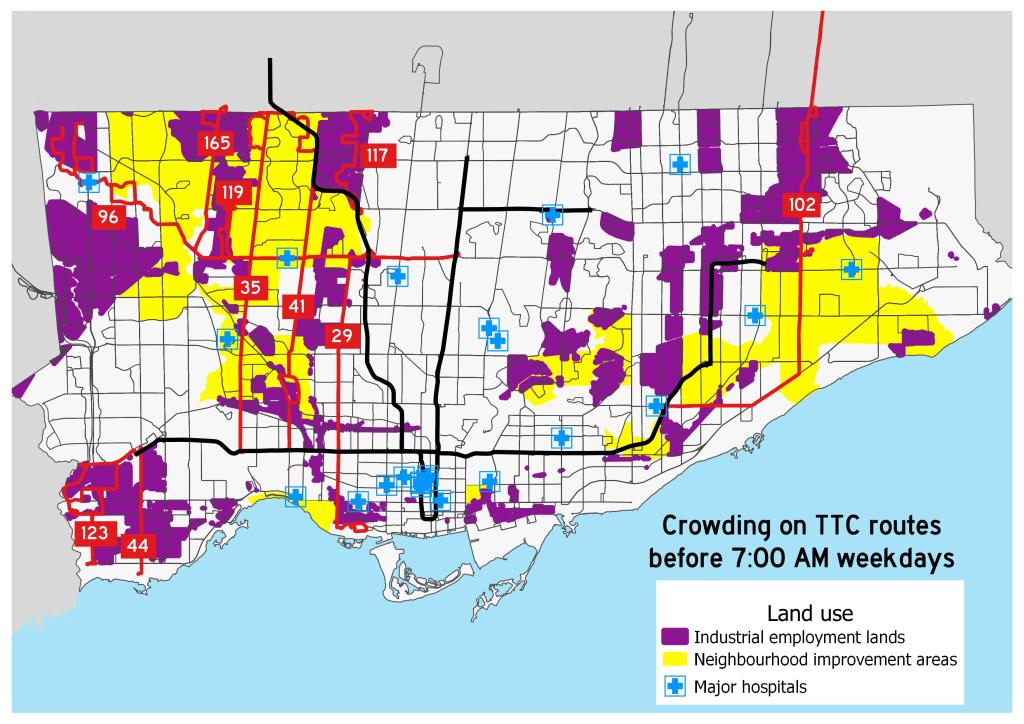
    Back in March, I mapped the TTC’s most crowded early morning routes. These ten routes were generally located in Toronto’s suburbs, serving employment lands and neighbourhoods with lower incomes and higher proportions of racialized persons. Brampton and Mississauga, which also have large food production and warehousing industries and significant immigrant and racialized populations, are experiencing similar problems with crowding.

    All buses only allow passengers to enter through the rear doors, with many seats marked restricted with paper signs similar to those on the subway. The area behind the driver is closed off as well. While the TTC expect riders to tap their Presto cards at the rear or pay by cash or ticket at a subway station, Brampton, Mississauga, and other systems are permitting free rides for now.

    A typical TTC bus contains only 33-36 passenger seats; an articulated (“bendy”) bus has 46. The TTC operators’ union instructed its members to allow only 10 customers aboard a standard bus (though the operator has discretion), and 15 aboard an articulated bus. Transporting that few people on each bus is unsustainable, and with tens of thousands of essential workers relying on the TTC to get to work — many of those jobs difficult and poorly-paying — it’s yet another inequity laid bare by this pandemic.

    Crowding on ten TTC bus routes in late March 2020

    With loosening restrictions, the demand for transit has already begun to increase. By early July, local transit agencies will require all passengers to wear masks or face coverings. At the same time, passengers will be directed to enter buses through the front doors, while reinstating mandatory fare payment.

    Meanwhile, Brampton Transit — which was operating on a modified weekend schedule since March — is restoring some of its weekday service on Monday June 15 to meet re-surging demand, while Mississauga increased service levels on June 1. Brampton, Mississauga and Toronto will require masks or face coverings on transit starting July 2.

    While Brampton plans to hand out 100,000 free non-medical masks to its transit users, the TTC plans to give out one million disposable masks, specifically targeting lower-income neighbourhoods where transit demand remains high.

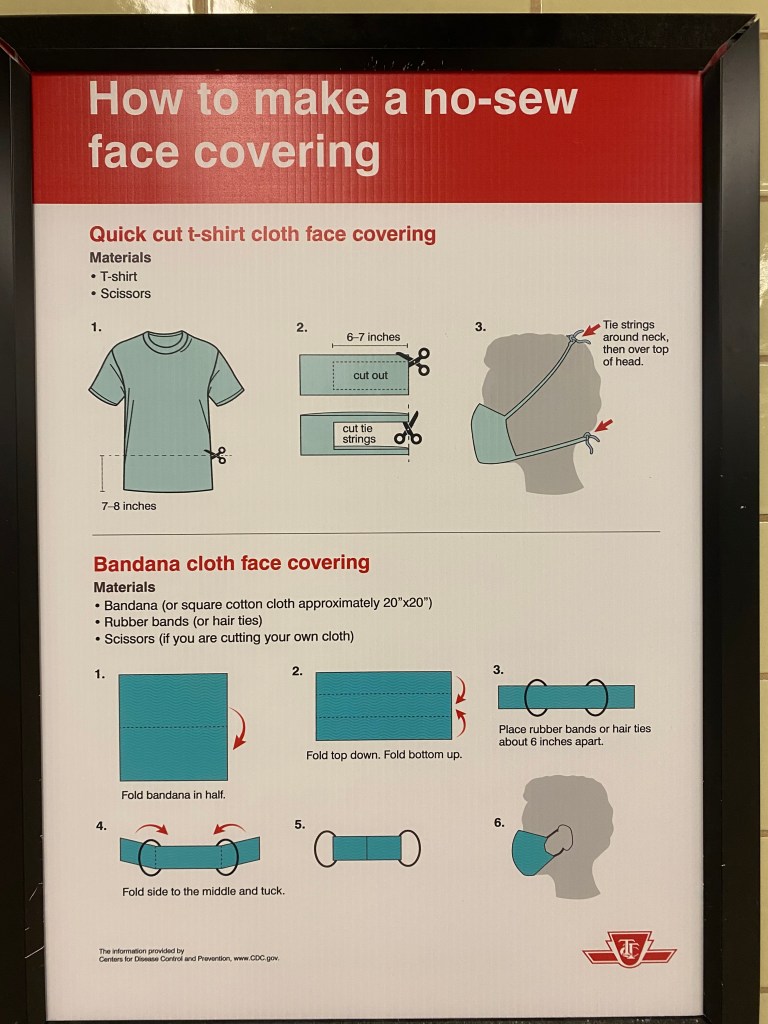
    Poster in the TTC subway with instructions on how to make a no-sew fabric face covering.

    Front-door boarding and mandatory mask use will help with some of the capacity issues on buses. Offering free masks is a welcome acknowledgement that many who have taken transit may not have money or time to purchase or make their own face coverings. (The TTC has instructions on how to make rudimentary masks posted in subway stations.)

    Even then, bus capacity will continue to be limited to ensure physical distancing, and buses will likely still pass by crowds of waiting customers.
    While central Toronto benefits from walkable neighbourhoods, existing and new cycling infrastructure, and subways and streetcars with more capacity to spare, suburban residents will still have to rely on buses. Though I see mandatory mask use as a necessary step towards mitigating the risk of viral transmission, I fear it may not be enough for those who work at hospitals and clinics, food plants and warehouses, and grocery stores, restaurants, nursing homes, and daycares.
    Bus riders deserve better.

  • A tale of two streets: Winona Drive and Shaughnessy Boulevard

    A tale of two streets: Winona Drive and Shaughnessy Boulevard

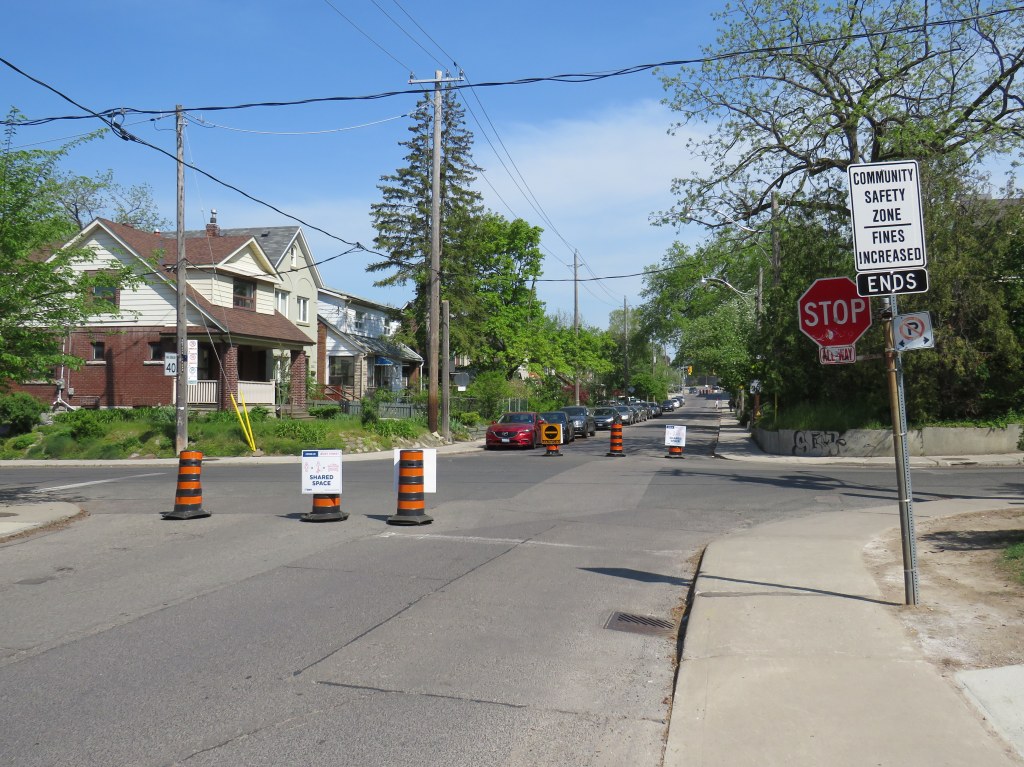
    Typical Quiet Street signage and pylon placement, Crawford Street

    Earlier this month, as part of Toronto’s long-overdue response to the ongoing COVID-19 pandemic, the city introduced ActiveTO. ActiveTO includes several measures addressing the need for safe active transportation and recreation routes as summer approaches and businesses slowly reopen.

    Current ActiveTO initiatives include weekend traffic closures of sections of Lake Shore Boulevard and Bayview Avenue to take pressure off narrow and busy multi-use paths, designating specific “quiet streets” to provide safer cycling and pedestrian corridors, and the construction of new bike lanes and cycle tracks, accelerating work on the painfully slow implementation of the city’s cycling network plan.

    One of many families enjoying the Bayview Avenue extension closure on May 16. The weekend closure provides a safe, spacious alternative to the crowded Lower Don Trail

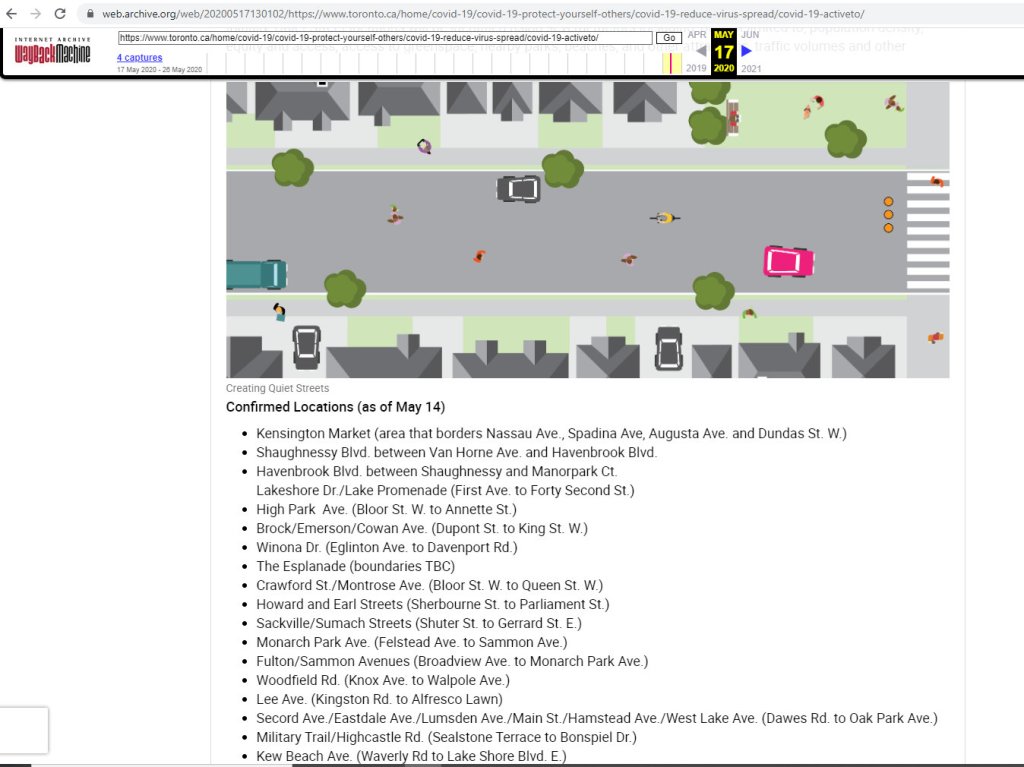
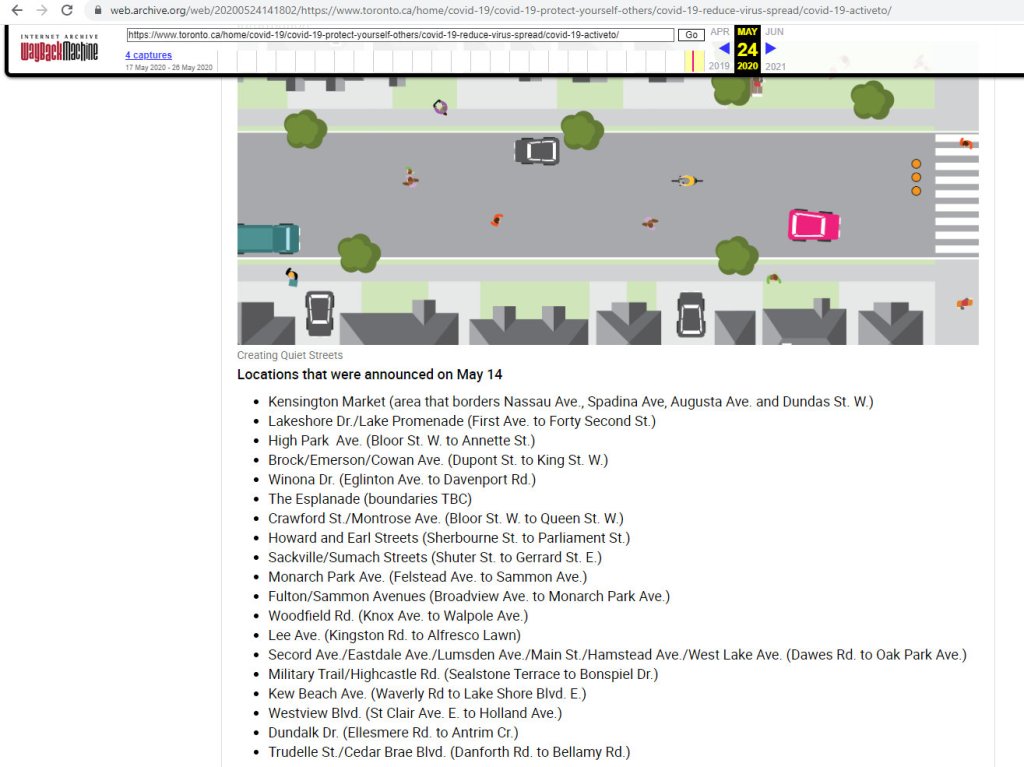
    I visited two Toronto streets this week included in the initial list of ActiveTO quiet streets that were announced on May 14, 2020.

    On Winona Drive, the pylons and signs placed by city work crews were moved by residents to block an entire lane of traffic at each intersection. This enhances their effectiveness in reminding motorists that the space is for local traffic only and that the roadway is shared with pedestrians and cyclists.

    Winona Drive at Benson Avenue, May 25, 2020
    Close-up of relocated pylons on Winona Drive

    Shaughnessy and Havenbrook Boulevards, near Sheppard Avenue and Don Mills Road, connect the densely populated Fairview Mall and Don Valley Village neighbourhoods with the Betty Sutherland Trail, part of the Don River ravine system. Though Shaughnessy is mostly fronted by comfortable, midcentury homes, it borders several apartment buildings and townhouse complexes, including several Toronto Community Housing properties.

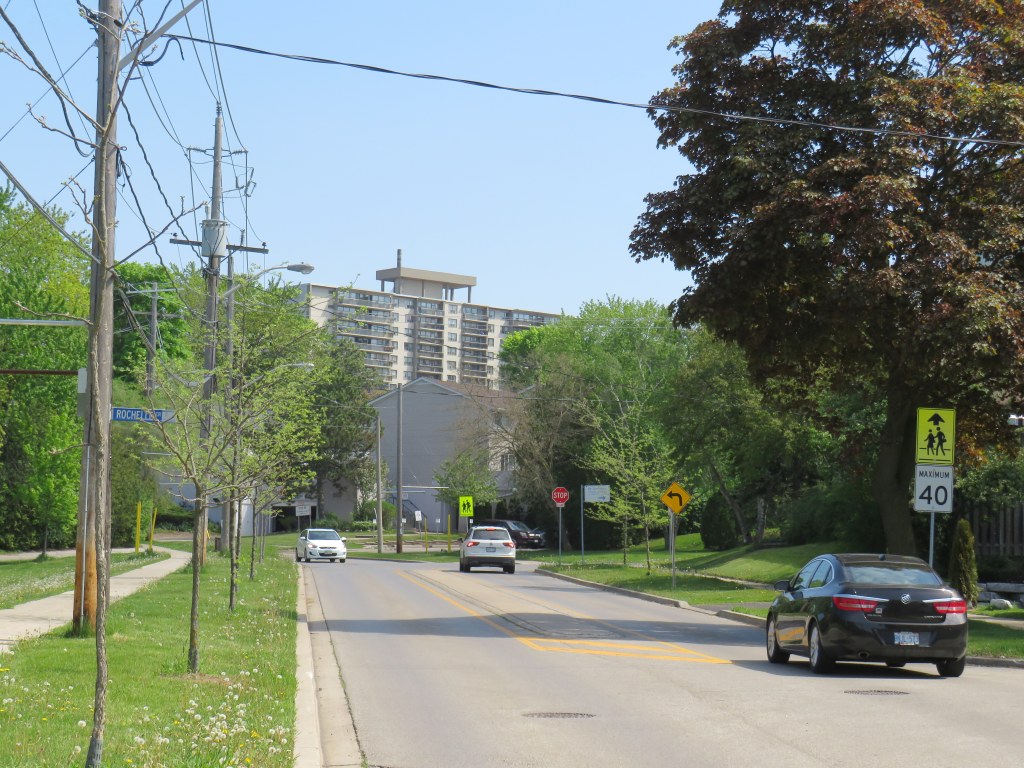
    Shaughnessy Boulevard looking north at Rochelle Crescent

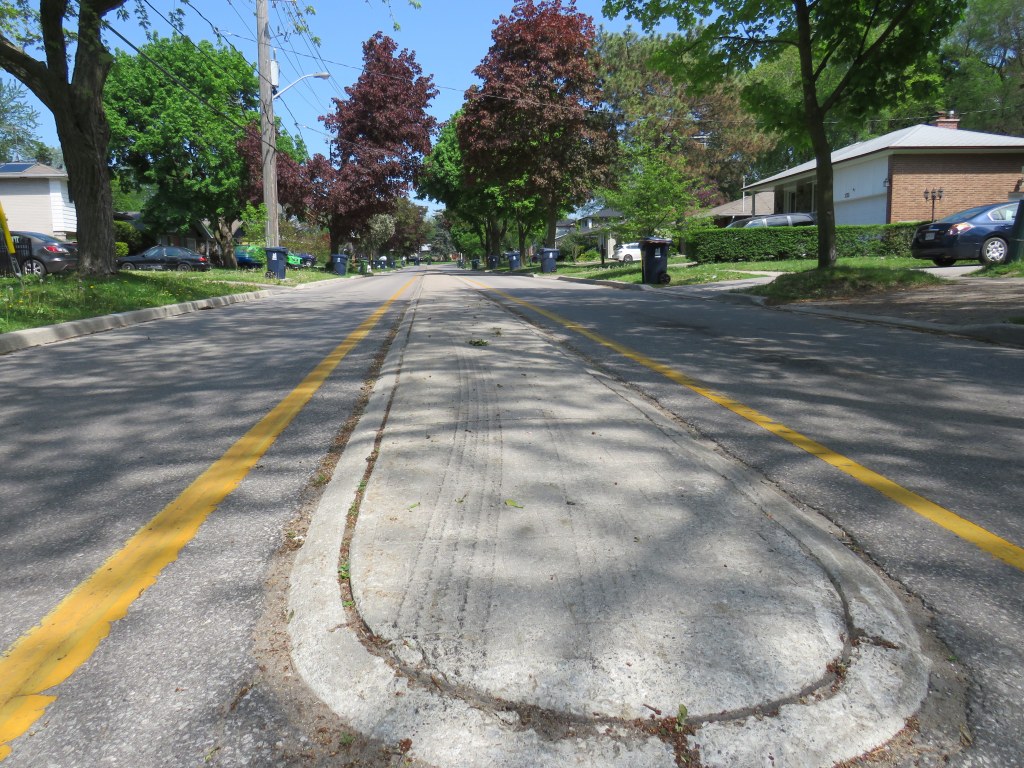
    In 2012, some road calming measures were undertaken on Shaughnessy to slow down traffic, particularly near local schools and parks. A four-lane section between Sheppard Avenue and Glenworth Road was narrowed, including a very short section of bike lanes. A shallow concrete median was added between Glenworth and Esterbrooke Avenue. However, the street remained problematic.

    The shallow median on Shaughnessy Boulevard does nothing to slow down aggressive motorists

    In a recent Toronto Star article, resident Robin Sacks noted that the street was unsafe as motorists used it as a bypass of parallel Don Mills Road. She, and many of her neighbours, supported Shaughnessy’s designation as an ActiveTO quiet street.

    Unfortunately, other residents took it upon themselves to remove the pylons and signs and complain to their local city councillor as soon as they were installed. By the weekend, they — along with concrete barriers placed in the median — were removed, and the street wiped from the city’s website.

    Councillor Shelley Carroll, a progressive, was quoted in the Star article that she felt those who objected to the traffic calming measures were on “solid ground,” as there were no community consultations before the measures were introduced. She also noted that Shaughnessy is “a safe street with ample sidewalks and, unlike denser parts of downtown, ‘no one’s having any trouble distancing.’”

    To Carroll’s credit, a consultation is planned for Wednesday, May 27. Overall, her track record has been supportive of safer streets in her community and in Toronto as a whole, so I was surprised by her comments. Hopefully, Shaughnessy, like many other suburban streets, will see improvements shortly.

    Quiet streets, if planned as a network, are helpful for encouraging active transportation, especially where wider sidewalks and cycle lanes are unable to be installed on parallel major roads (due to streetcar lines, for example), or where they can connect major parks, off-road trails, and other cycling corridors.

    To make such quiet streets permanent, curb extensions at intersections and other physical cues should be used to slow down traffic. Traffic circles and well-marked crosswalks could also take the place of four-way stops, which are easily ignored by motorists while frustrating cyclists.

    The COVID-19 pandemic has exposed severe inequities; between those who work in the logistics, healthcare, and food service industries, and those who are able to work at home; between those who have comfortable homes with access to ample green space and those who do not, and those can rely on their own automobiles, and those who must walk, cycle, or take transit. This is why expanding public space and providing safe routes to travel is so important.

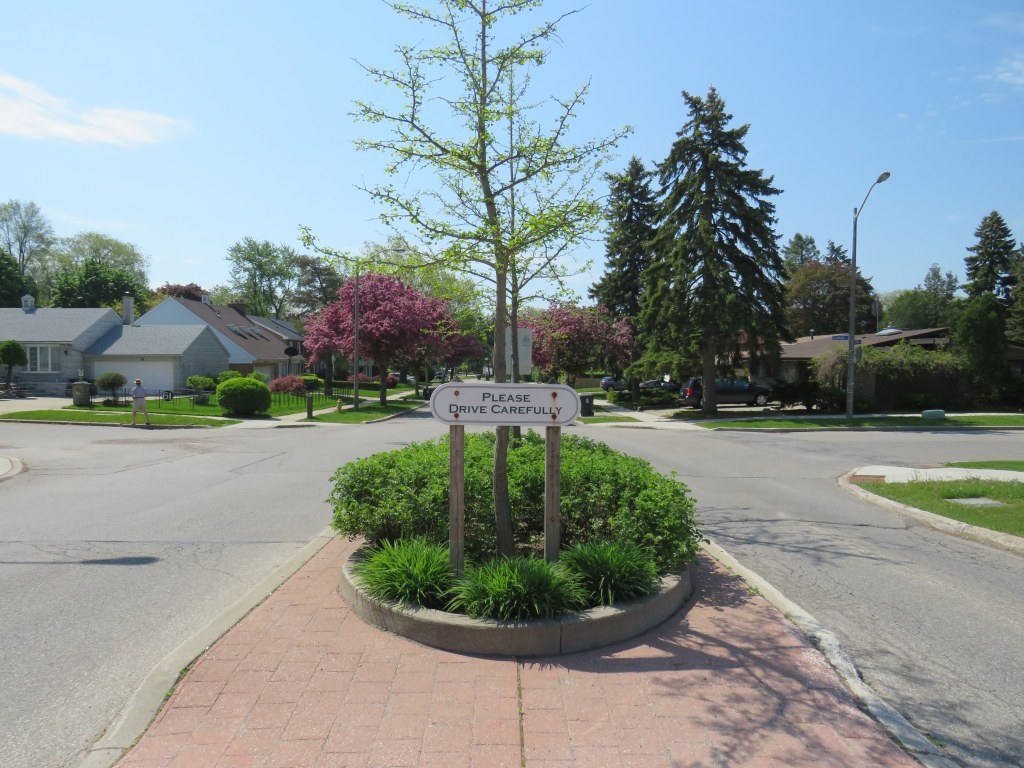
    “please drive carefully” – sign in median of Shaughnessy Boulevard

  • Signs of the times in Northwestern Toronto

    Signs of the times in Northwestern Toronto

    Un-plated rental cars stored in the Woodbine Centre parking lot

    In a distant corner of Woodbine Centre’s parking lot, dozens of late model cars and trucks sit with their licence plates removed. These are all rental cars, left idle due to the collapse of demand during the ongoing COVID-19 pandemic. Friday, Hertz — the United States’ second-largest car rental company — filed for bankruptcy. Hertz’s brands include Dollar and Thrifty.

    Woodbine Centre, a once-vibrant mall in northwest Toronto is a short drive from Toronto-Pearson International Airport, making it an ideal place to store the suddenly surplus fleets. Though in the 1980s and 1990s, Woodbine boasted cinemas, two-full line department stores, Zellers, and dozens of national chain stores, it has lost most of its cachet, with both Sears and Zellers gone, and Hudson’s Bay barely hanging on. Its parking lot was typically half-empty in recent years.

    Though the demand for rental cars, especially at the airport, have dried up, many neighbourhood car rental branches remain open, offering attractive rates for daily and weekly rentals. I have taken advantage of the low prices right now (often as cheap as $25 a day on a multi-day rental) to run errands, go for short drives, conduct some field research for future articles and projects, and visit nearby provincial parks and regional forests for physically-distant nature hikes. I am also able to help family members by delivering groceries and medications. With the surplus of available cars, upgrades from the intermediate or standard car booking can be expected. (I was given a Mercedes-Benz E-class a few weeks ago, though I had booked a standard sedan.)

    Though we live downtown, my partner and I prefer to shop at a Chinese grocery store in Scarborough, which is calmer, better organized, and better stocked than our local stores (flour, rice, and meat are plentiful). Having a car makes it easy to carry a large load, reducing the number of grocery trips required.

    Across the street from Woodbine Centre, in another parking lot, there is another sign of the times: an overflow lot for Humber College has been transformed into a drive-through COVID-19 assessment centre. At 12:30 on Monday, May 25, the centre, which is normally open daily from 10:00 AM to 6:00 PM, was already full, and not accepting any more patients who were looking to be tested.

    While Premier Doug Ford urged anyone worried about having COVID-19 or being in contact with anyone with it last Sunday, it’s not surprising to see the huge demand. While the change in eligibility is good news, it is troubling that actually getting tested may take so long.

    Full COVID-19 assessment centre in North Etobicoke

  • Room to share: How cities can make physical distancing work

    Room to share: How cities can make physical distancing work

    IMG_8405
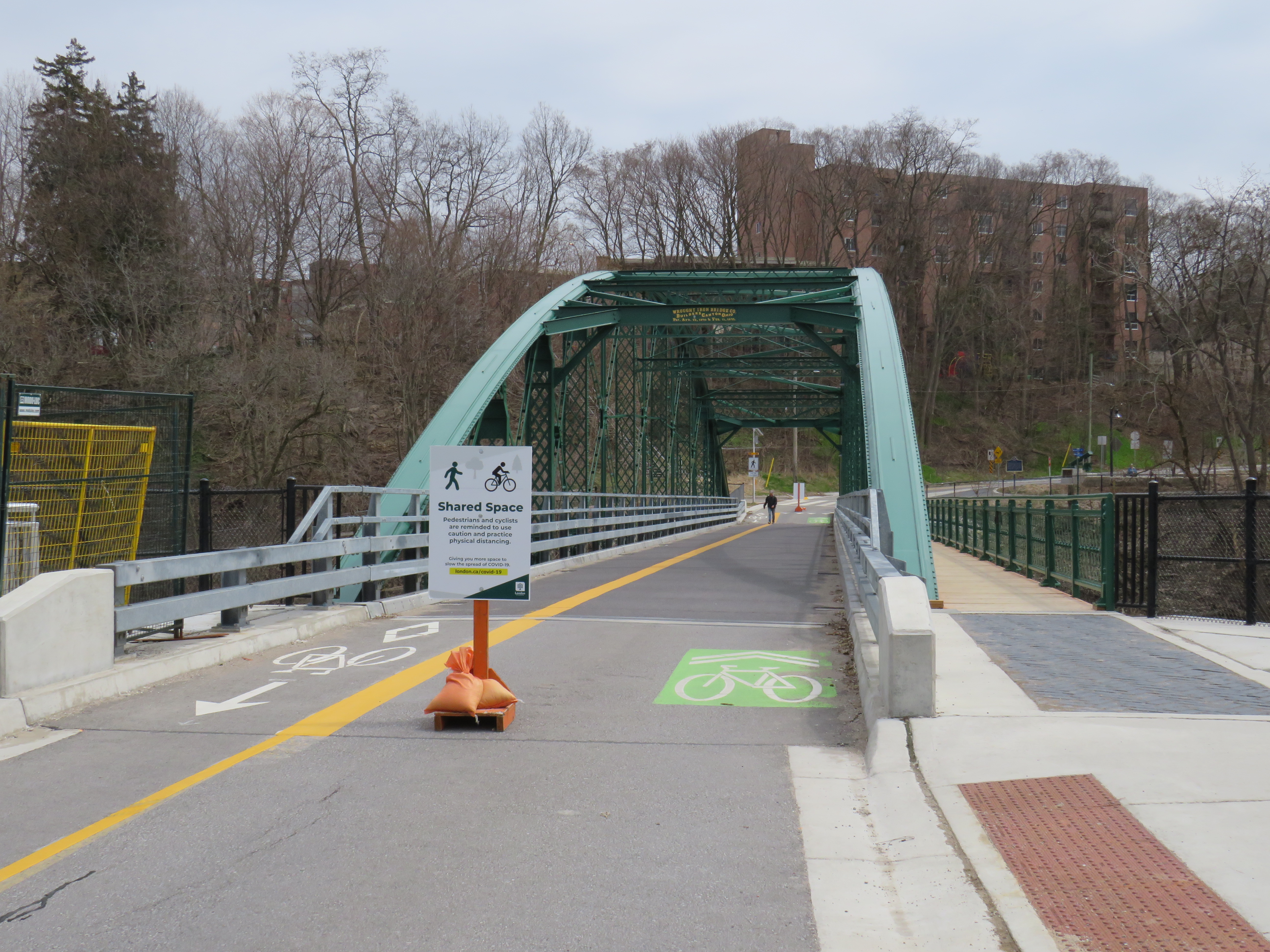
    Blackfriars Bridge open to pedestrians and cyclists in London, Ontario

    For my latest TVO article, I spoke with Councillor Shawn Menard in Ottawa, Councillor Rowena Santos in Brampton, and Ryerson University epidemiologist Anne Harris about how cities in Ontario are reallocating road space for pedestrians and cyclists during the ongoing COVID-19 pandemic, or why they may be hesitant to do so.

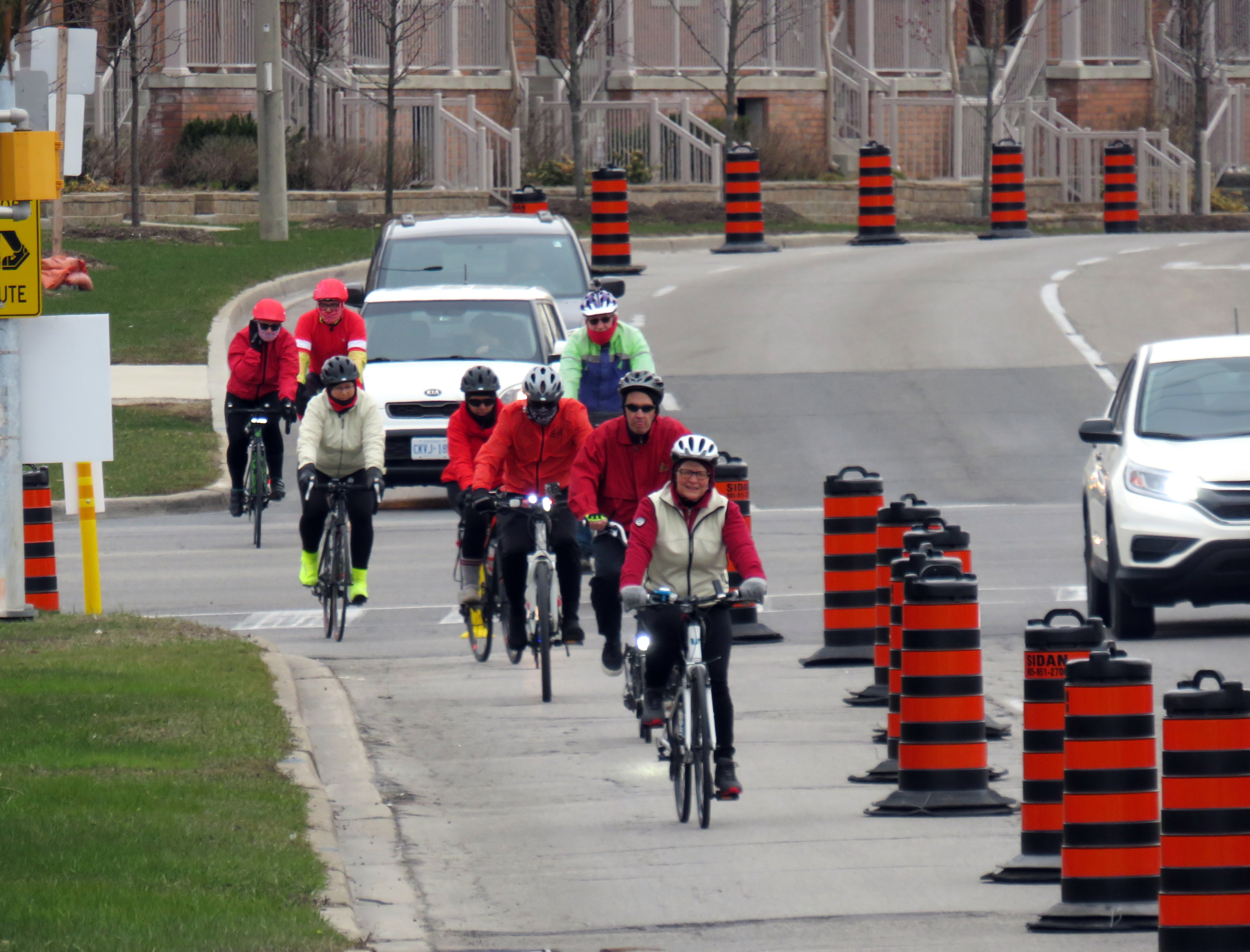
    In Brampton, five kilometres of new bike lanes, proposed in that city’s new transportation plan, were quickly approved as part of its response to COVID-19. This benefits both pedestrians and cyclists by reducing conflicts on sidewalks, reducing congestion on city paths, and recognizing that cycling is an increasingly important mode of transportation.

    IMG_8499-001
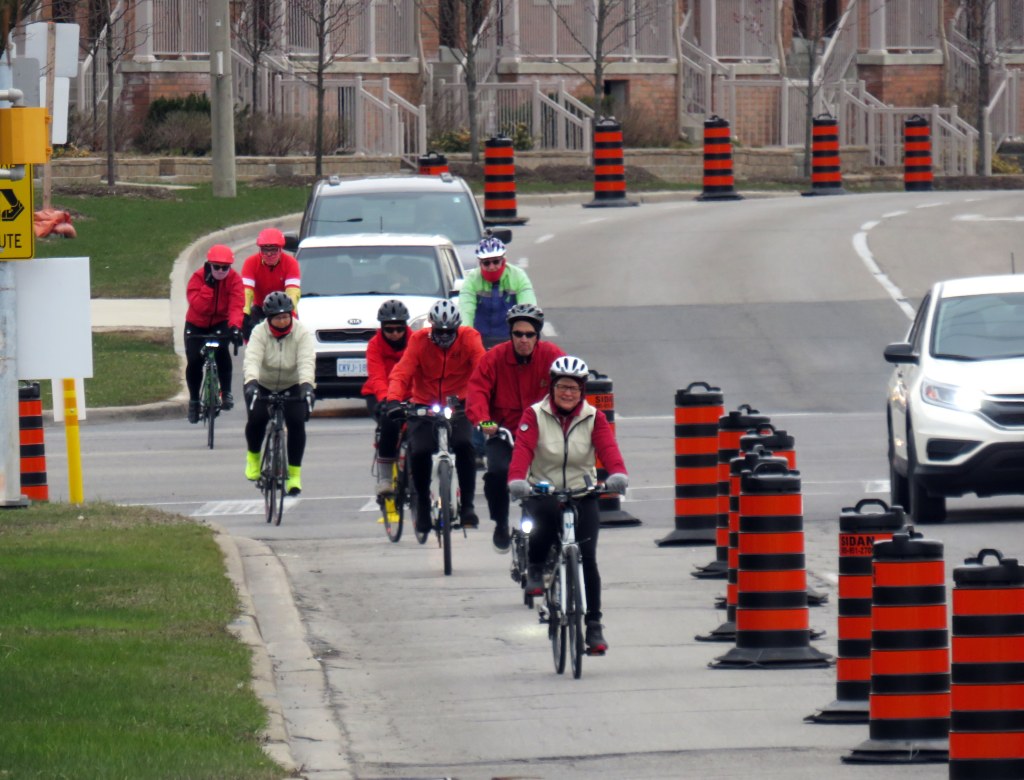
    Cyclists on Howden Boulevard, Brampton

    In Ottawa, despite resistance from the the mayor and council, Shawn Menard, who represents an urban ward just south of Parliament Hill, was able to temporarily close two lanes of traffic on a narrow bridge on a major retail street, and worked with the National Capital Commission to re-allocate a section of parkway for active transportation.

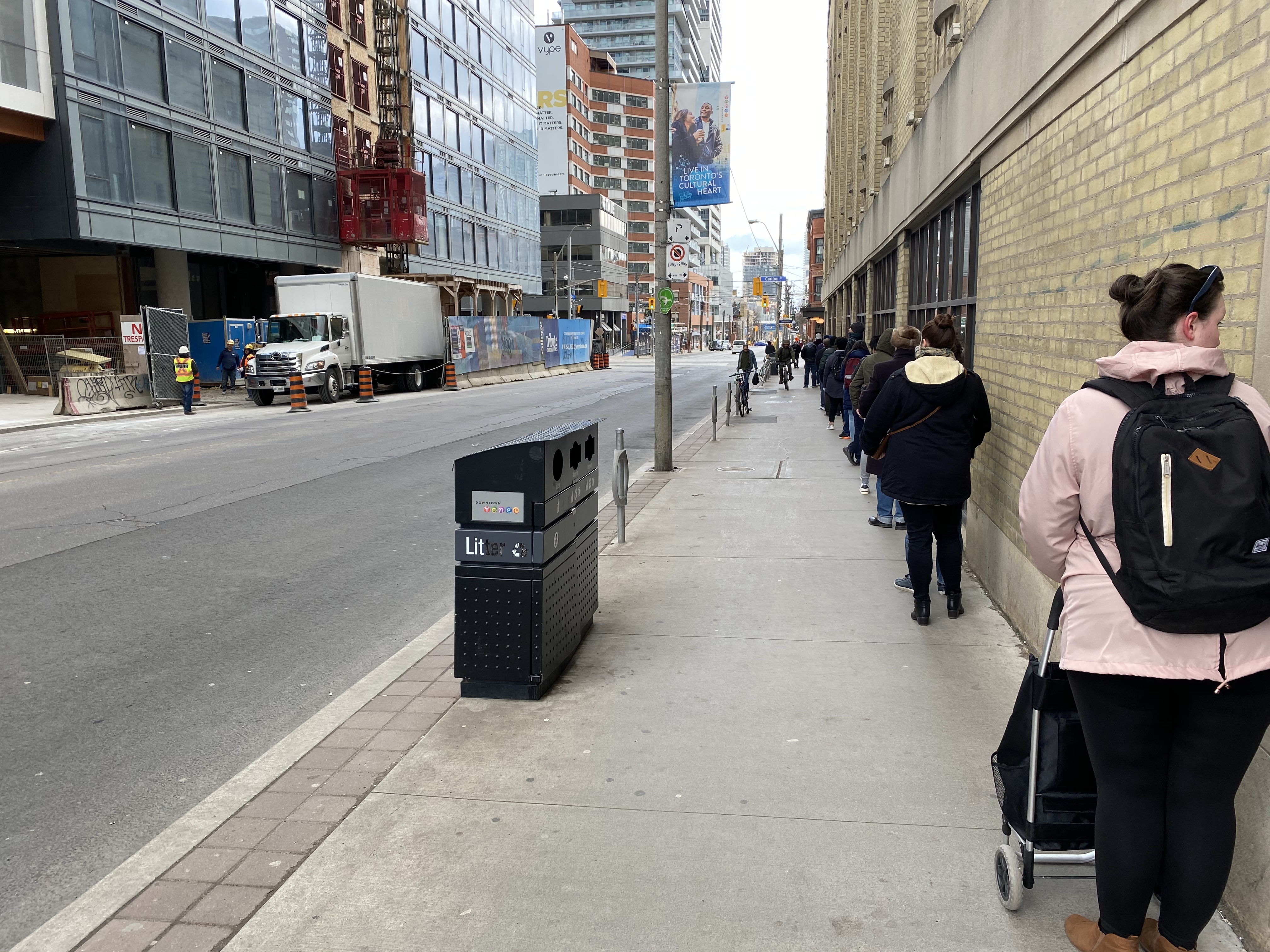
    Meanwhile in Toronto, the mayor and medical officer of health were resistant to increasing calls for sidewalk expansions in congested urban areas, including where queues formed to enter grocery stores, pharmacies, hardware stores, and LCBO outlets.

    This was one of my favourite articles I have written so far. 


    Loblaws queue on Church Street
    Queue on Church Street at Carlton to enter Loblaws supermarket

    With Walk Toronto, I have been involved with pushing the City of Toronto to take action, especially in pinch points where store queues, construction barriers, and other obstructions have made it difficult — if not impossible — to safely practice physical distancing when walking or cycling for essential purposes, or even getting a little bit of fresh air or light exercise in dense urban areas.

    The good news is that ten problem areas — including the intersection of Carlton and Church — have finally been identified for curb lane closures, with potentially more on the way. This is a timid first step, made after weeks of advocacy, but it is welcome.