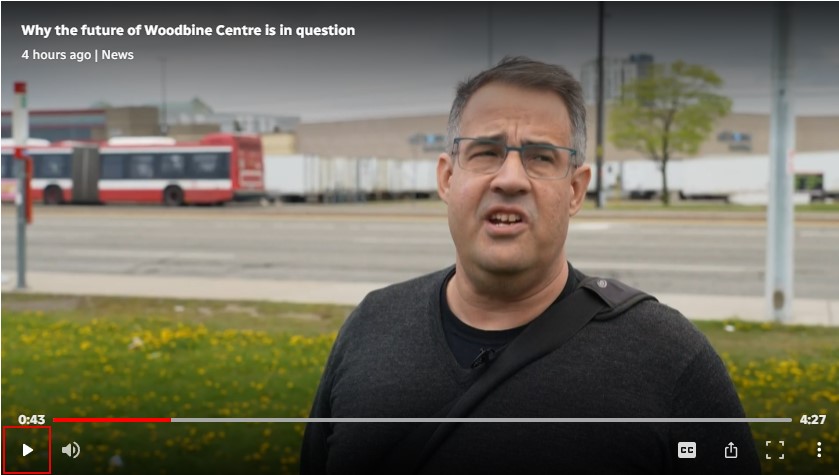
You can catch me on CBC Toronto today talking about the history of Woodbine Centre and Fantasy Fair with reporter Nav Nanwa. The CBC television report has some pretty good drone shots of the mall as well.
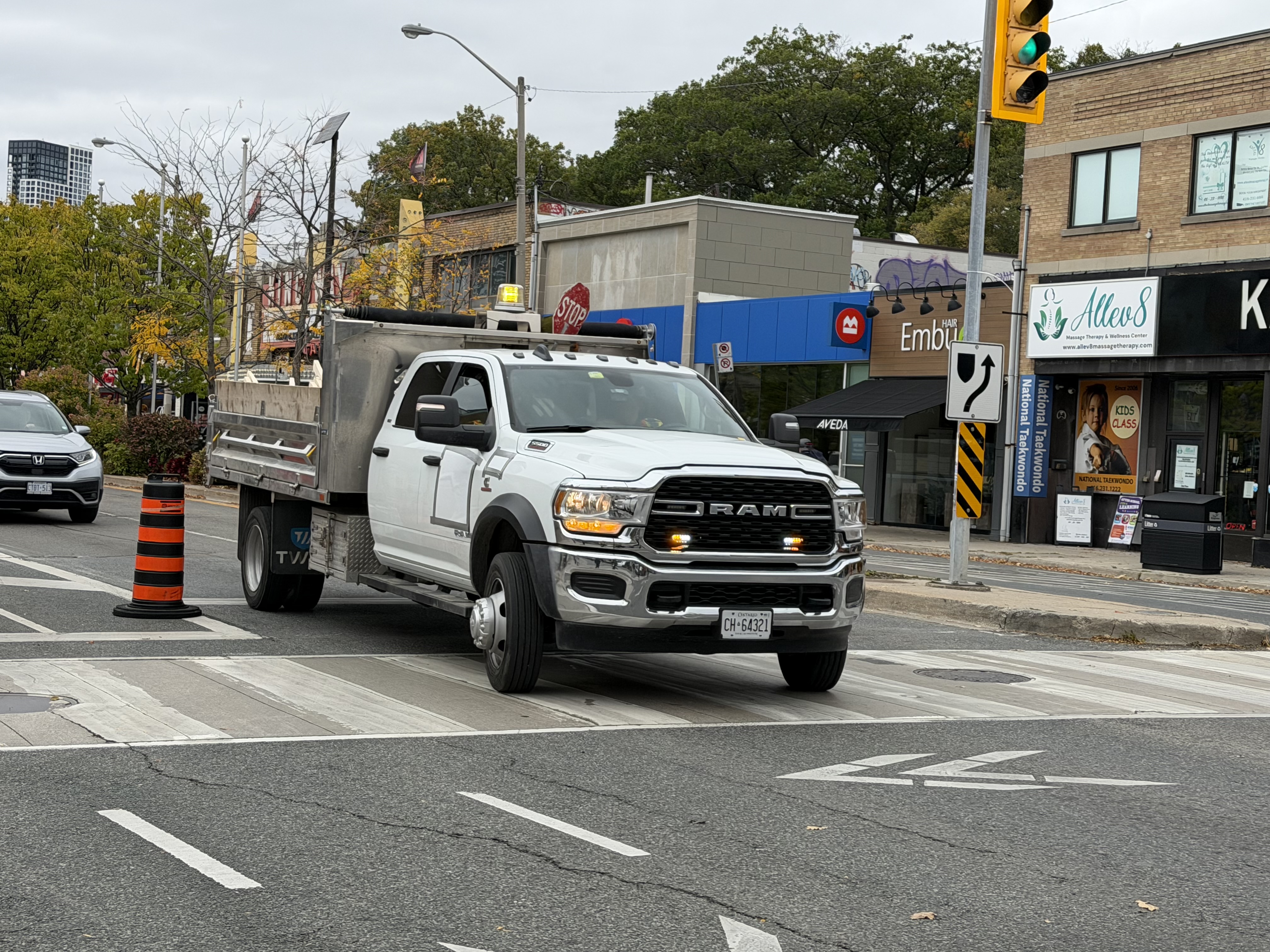
Here’s me standing in front of Highway 27 and the trailers stored in the old Sears parking lot
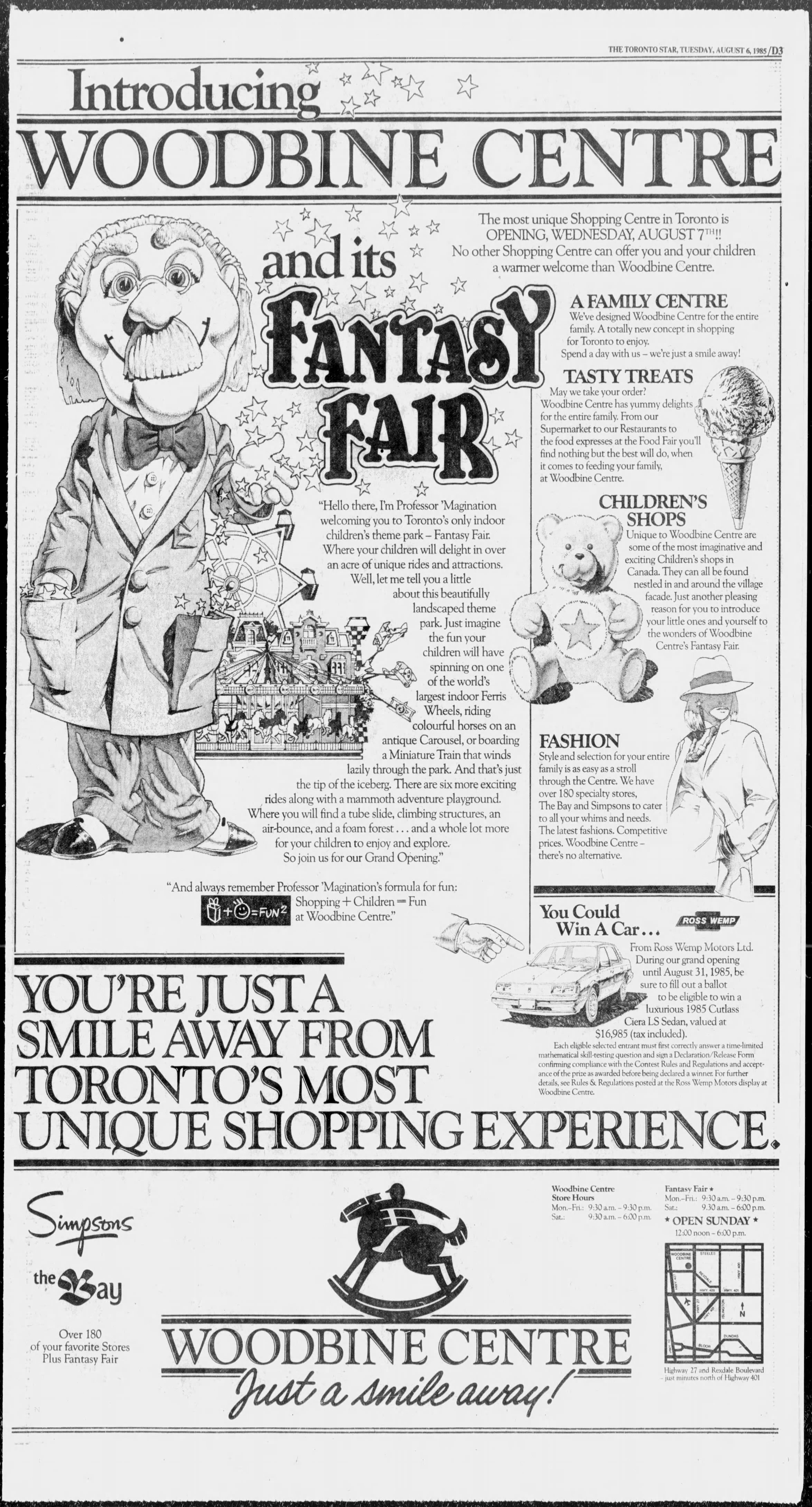
I wrote more about the history of Woodbine Centre in November 2024, which you can read here. Looking for reports of the mall opening from 1985, I found this full page ad in the Tuesday, August 6, 1985 edition of the Toronto Star.
December 7, 2025 may be a day that will live in transit infamy. That was the day Line 6, the Finch West LRT, opened to the public, and it did not go well.
First off, any discussion on the initial failure of Line 6 should acknowledge that was never designed to be a rapid, regional transit link. The LRT, serving Northwestern Toronto, was intended to be an upgrade to the slow, congested, and busy 36 Finch West bus, feeding into the rapid transit network at Finch West Station. Line 6 is a legacy of Transit City, a LRT plan proposed under previous mayor David Miller intended to connect the inner suburbs of Etobicoke, North York, and Scarbrorough to the subway and to each other.
As with all proposed Transit City routes (with the exception of the tunneled central section of the Eglinton-Crosstown LRT), there were always going to be compromises on Finch that would not make it a true rapid transit service. Situated almost entirely on the surface, Line 6 trains are easier for residents to access than subways in deep tunnels; closer stop spacing was intended so the new transit line continues to serve the needs of those who live, work, go to school, and frequent the corridor, without the necessity of a parallel local bus. Anyone expecting subway speeds were in for disappointment.
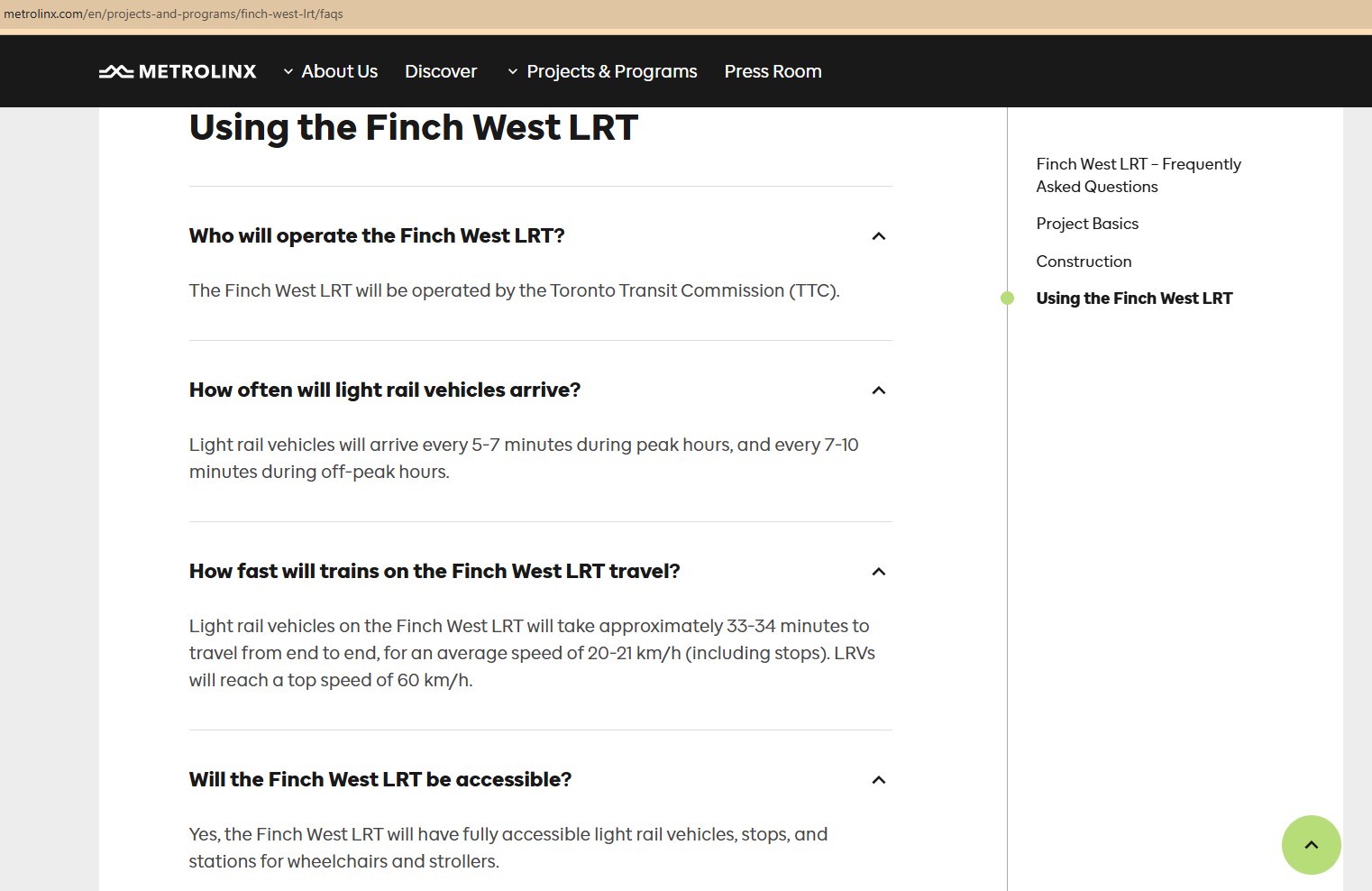
Still, the LRT was supposed to improve travel times over the existing bus, with wider stop spacing than the legacy streetcar network, a congestion-free right of way, signal priority, and decent operating speeds. With a promised average speed of 20-21 kilometres per hour, a total trip time of 33-34 minutes each way, it would have been a bit faster, more comfortable, and certainly more reliable than the bus. It was never going to be as fast as a subway, but for Finch Avenue West, that was okay.
Screen capture of a Metrolinx FAQ webpage, with frequent and relatively speedy transit service promised for the Finch West LRT. The webpage was still up as of December 18, 2025.
As the first modern LRT to open in the Greater Toronto and Hamilton Area (GTHA), Line 6 was to be a preview of additional lines planned and under construction elsewhere in the Golden Horseshoe, including the yet-to-open Line 5 Crosstown LRT, the Hurontario Line, the Hamilton LRT, and a proposed Line 7 on Eglinton Avenue East towards the University of Toronto Scarborough Campus and Malvern. Delivered by Metrolinx, the provincial transit agency, each line would be constructed and maintained by a P3 consortium, though the Toronto LRTs would be operated by TTC employees.
The hoped-for narrative that the provincial government, Metrolinx, the city of Toronto, and the TTC all touted — a smooth new ride, worthy of including on the subway maps — quickly fell apart on Sunday December 7, though there were plenty of warning signs of slower-than-promised operations.
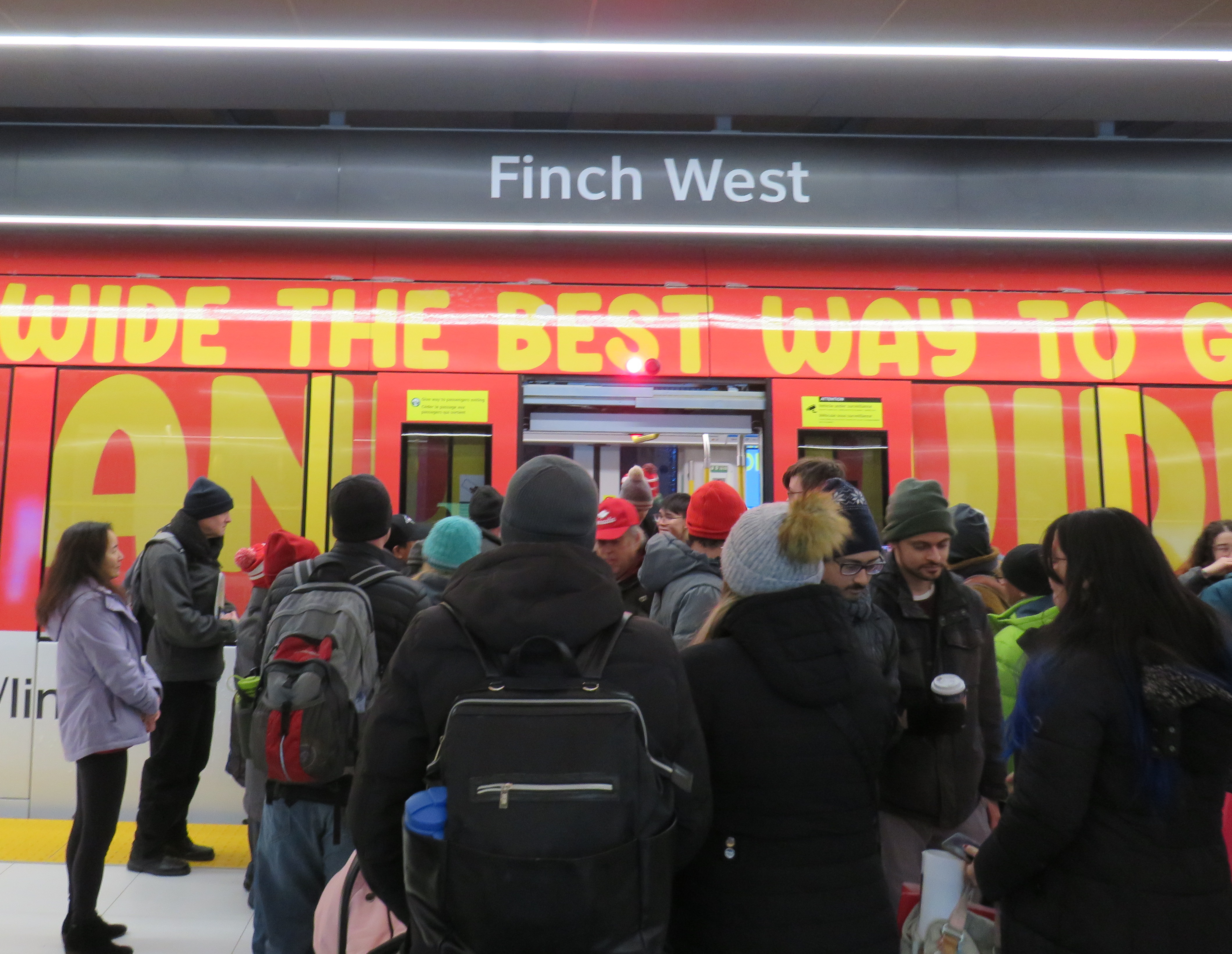
Opening day crowds on December 7. Passengers disembark from a wrapped LRV that touts Line 6 as “far and wide the best way to go far and wide.”
On Sunday, December 7, there were plenty of people eager to try the new LRT: railfans and urbanists, curious families, and local residents, lured by free fares on the opening day. Though I was there and took several trips, I wasn’t going to make too many judgements on opening day. There would be inevitable hiccups with the large crowds and cold, snowy temperatures. Still, there were visible problems.
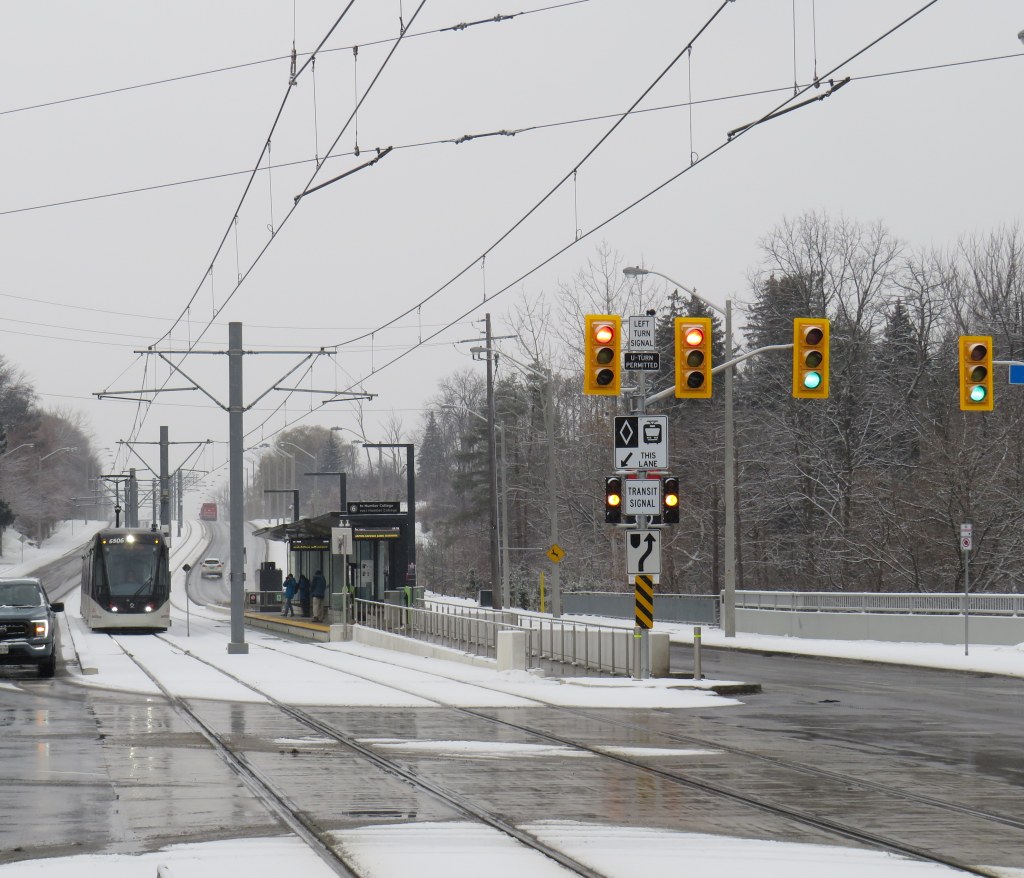
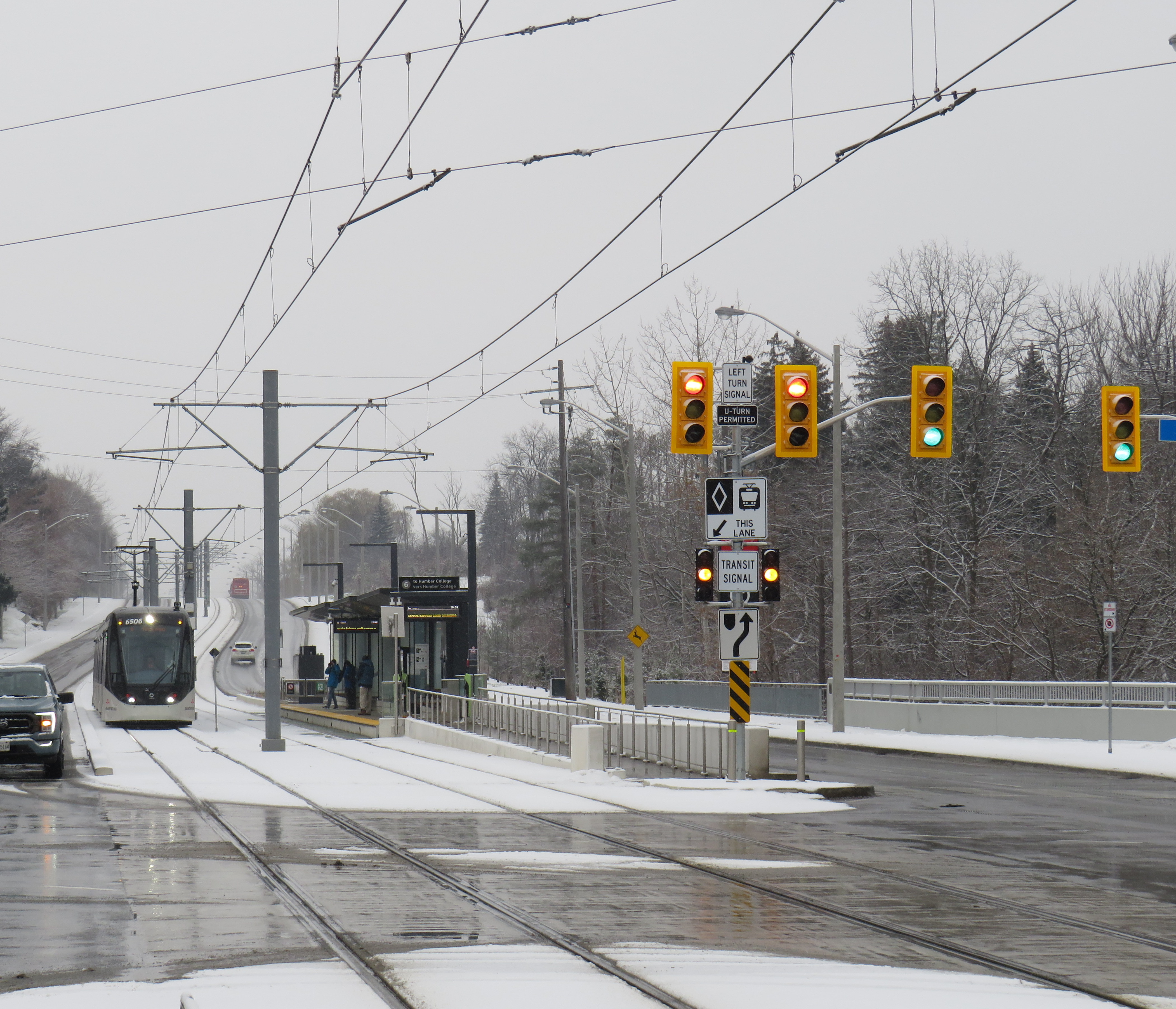
An eastbound LRV approaches Islington Avenue (Mount Olive Station) as the transit signal switches from green to amber. The traffic signals are still green.
So far, a lot of the post-opening discourse has been on operating speeds and traffic operations. Instead of 33-34 minutes, as claimed by Metrolinx, trips were taking 55 minutes each way. Additionally, the transit signal priority (TSP) system has not been activated, causing light rail vehicles (LRVs) to wait entire light cycles, even for private vehicles to turn left before proceeding. The dedicated transit signals turn red about 10-20 seconds before general traffic gets a red light, even as LRVs approach the intersections. On December 16, Toronto City Council approved a motion to implement “more aggressive” TSP on Finch West and the surface portion of the Line 5 Eglinton-Crosstown LRT, as well as on the legacy streetcar network.
The problem on Finch West is not just a matter of transit signal priority. The number of stops along the line, also criticized by several critics, is also not a problem, as Finch West was never intended to be a high-speed regional line. (That said, Mount Olive and nearby Stevenson could have been consolidated into a single stop west of Kipling Avenue.) The other problems are poorly managed schedules and streetcar-style slow zones on a modern LRT alignment.
Right now, LRVs are forced to slow to 25 km/h at all intersections, even though all conflicting traffic has a red light. This is an inexplicable restriction given that motor traffic, including TTC buses, have a 50 km/h limit, and many drivers will proceed at significantly above the posted limit. These restrictions are not found elsewhere in North America; in Calgary and Edmonton, LRTs are protected at many at-grade intersections with railway-style lights and gates. In places like Minneapolis-St. Paul and Phoenix, additional LED flashing signs warn drivers of an approaching LRV, which glides through the signalized intersection at higher speeds than on Finch. (There is also a lot less sign clutter, with intuitive signals for left turns and transit).
Transit schedules are also needlessly padded, with too much time for lower speeds and lengthy station stops. On a repeat visit to Finch West, on Wednesday December 17, 2025, travel times were inconsistent and slower then either 36C bus I took a few days before the LRT opened. (Even the trip with the long Starbucks pitstop.)
Line 6 travel times on Wednesday Dec. 17
Eastbound (read down)
Stop/station
Westbound (read up)
12:59 PM (dep.)
Humber College LRT Station
12:31 PM (arr.)
1:03
Westmore Dr.
12:25
1:05
Martin Grove Rd.
12:22
1:10
Kipling Ave. (Mt. Olive)
12:13
1:14
Islington Ave. (Rowntree Mills)
12:09
1:26
Weston Rd. (Emery)
11:57
1:29
Arrow Rd./Signet Dr.
11:54
1:33
Jane and Finch
11:46
1:37
Tobermory Dr.
11:35
1:45
Sentinel Rd.
11:32
1:48 PM (arr.)
Finch West Stn. (LRT Terminal)
11:27 AM (dep.)
49 minutes
Total time
1 h 4 minutes
It took eleven minutes to go two stops, less than a kilometre, from Tobermory Drive to Jane Street on the westbound trip. Lengthy station dwell times at Tobermory (five minutes) and Mount Olive (three minutes) on that westbound ride, with no onboard announcements was especially frustrating. The return eastbound trip from Humber College was 15 minutes faster, even with much of the same slow zones at intersections and switches, the 10 km/h curve near Humber College Station, and lengthy stops.
With such unpredictable and unreliable service, Line 6 is running at least as badly as the downtown streetcar routes. Without immediate fixes, people will completely lose faith in the TTC and future LRTs, including Eglinton-Crosstown. We can not just rely on tweaks to signal times; we need a complete review and overhaul of streetcar and LRT operating practices.
At least we know what can and should be fixed before the Eglinton-Crosstown line opens, a much longer LRT route that will have a regional transit role.
One more thing…
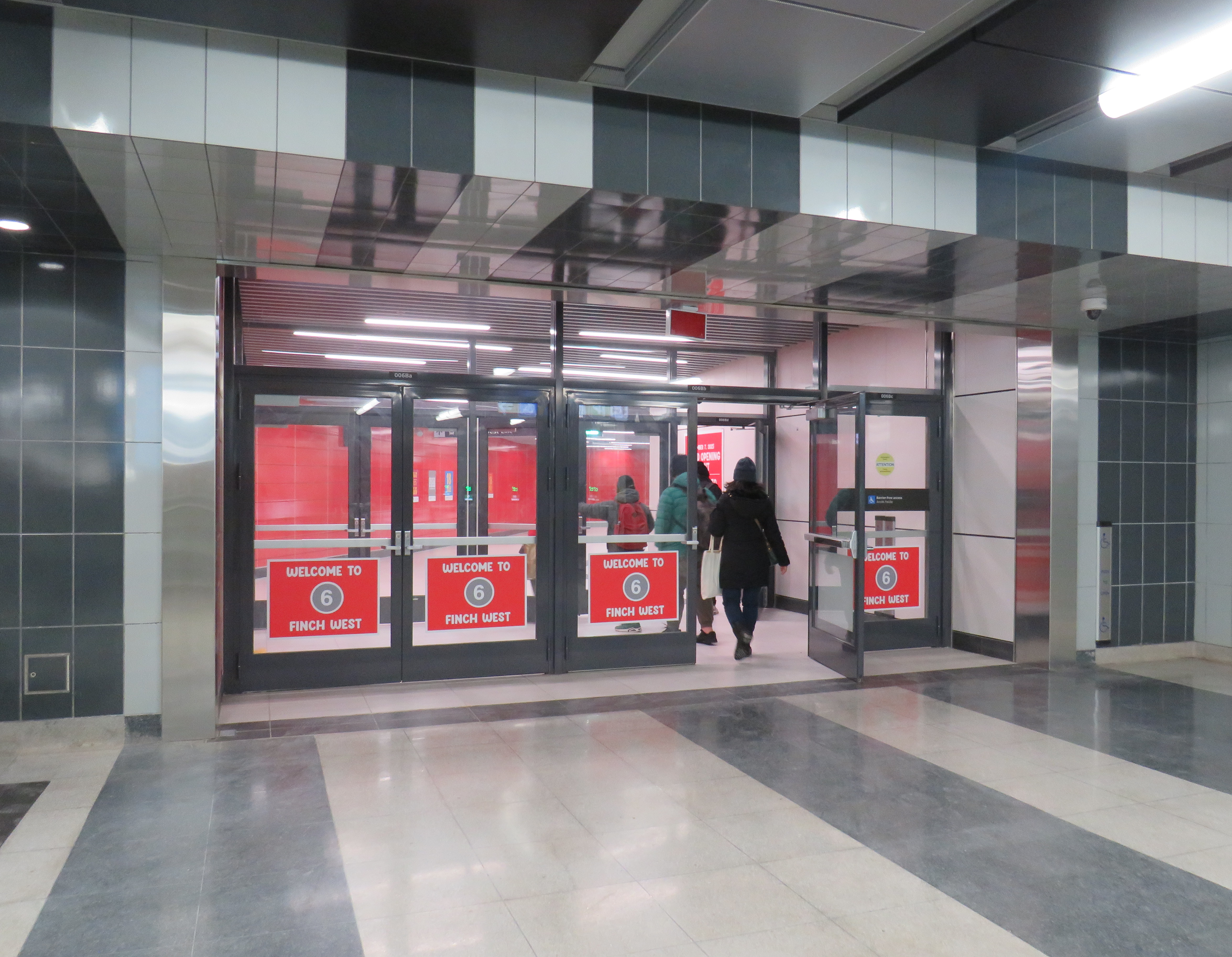
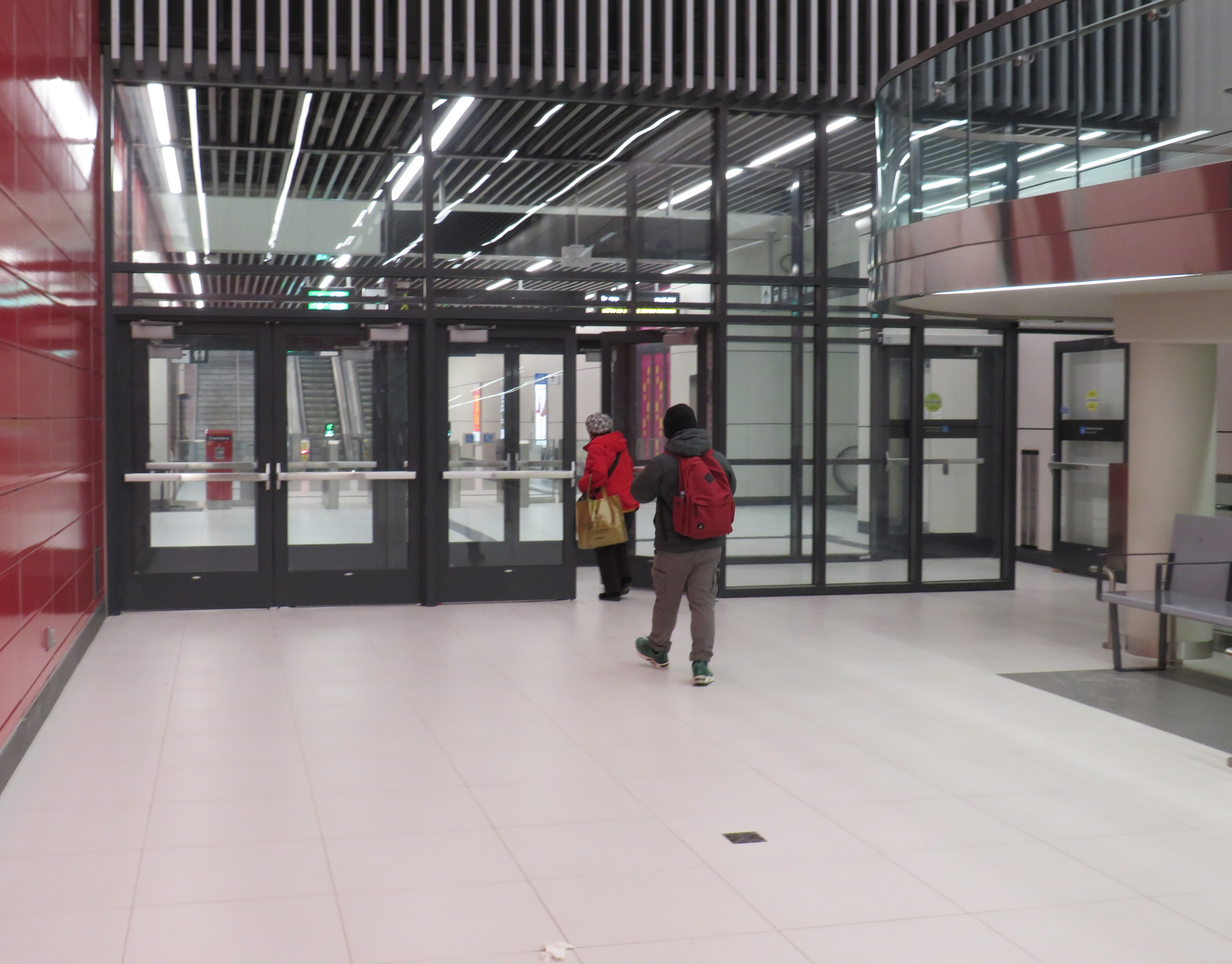
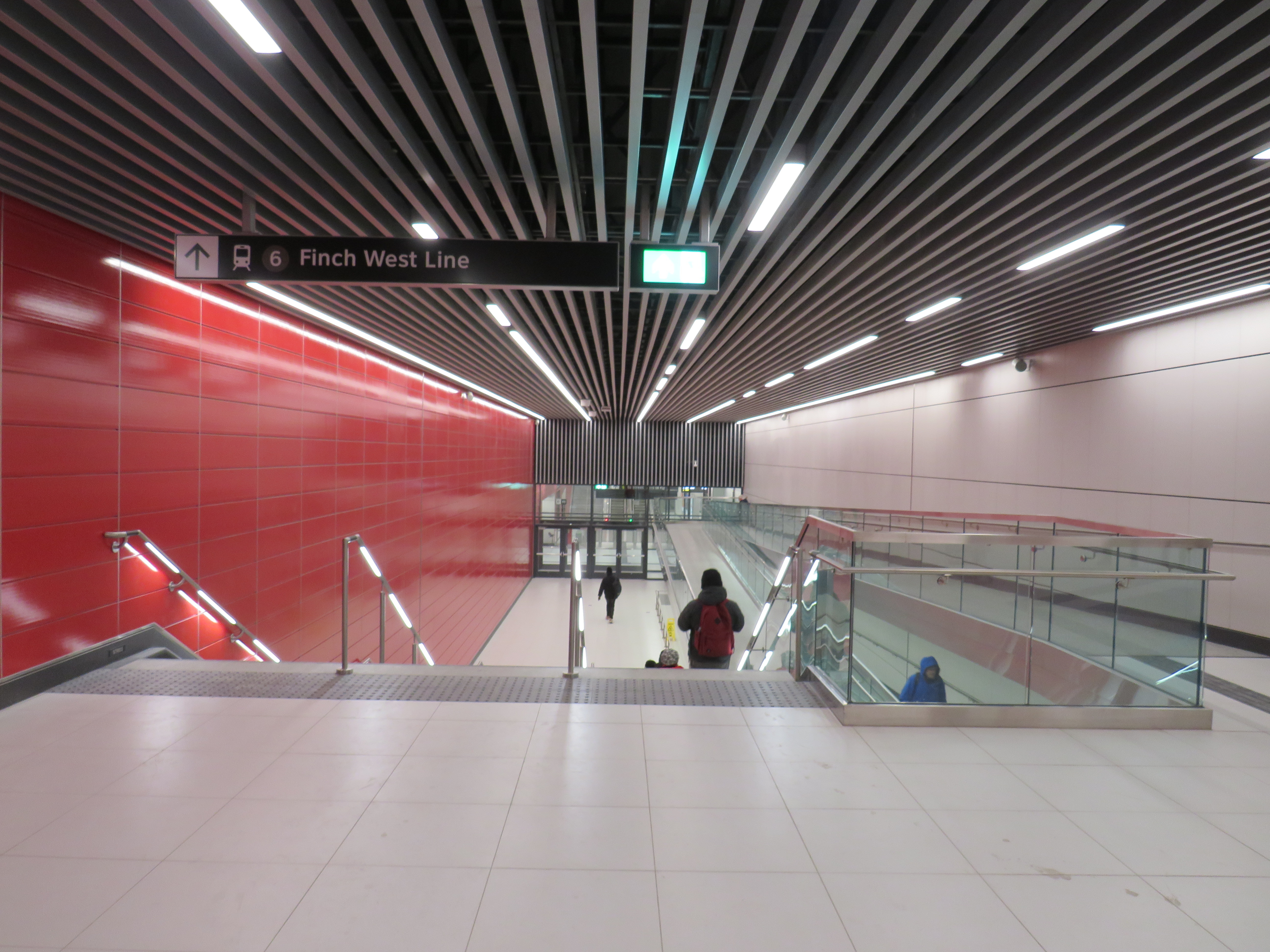
What is with all the doors between the Line 1 subway station and the LRT terminal at Finch West. Passengers have to pass through four sets of doors to transfer between two TTC services, as well as ascend one escalator or elevator, walk down one set of stairs (or navigate a long and circuitous ramp) and then ascend another escalator or elevator to get to the other platform.
Stairs or a long, circuitous ramp between the doors from subway to LRT
Though transfers can be tricky, at the very least, these doorways should be kept open, and shut only during station closures or during fire alarms, as done in hospitals or shopping centres. Other TTC stations have no such barriers between modes or may have a single door to exit a subway station terminal to the bus platform. Automatic sliding doors could have also been an option. Instead, the powered doors are left to one side, with the button against the wall. It’s not an ideal design from an accessibility point of view.
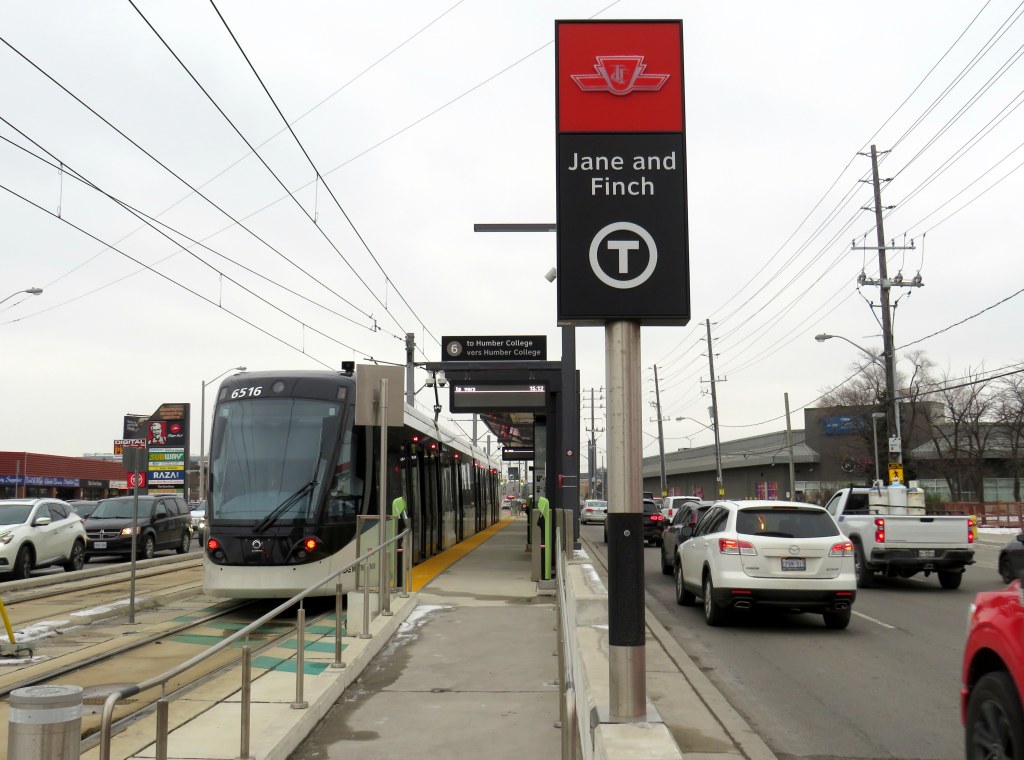
Two Line 6 LRVs cross Jane Street at Finch Avenue, December 3, 2025 as training wraps up ahead of revenue service on December 7
Can a brand-new light rail line outrun the local bus it replaces? Starting on Sunday, December 7, Torontonians will get the chance to find out when the new Line 6 Finch West light rail line finally opens to the public. Though built and maintained by Metrolinx, the service will be operated by TTC employees.
The new LRT, 11 kilometres long, with 18 stops, runs almost exclusively in a transit-only median on Finch Avenue West between Finch West Station at Keele Street in North York and Highway 27 in Etobicoke. The end terminals are below grade, with three traffic signals skipped. Otherwise, the light rail vehicles will be subject to stopping at the same traffic lights as all other cars, trucks, and buses.
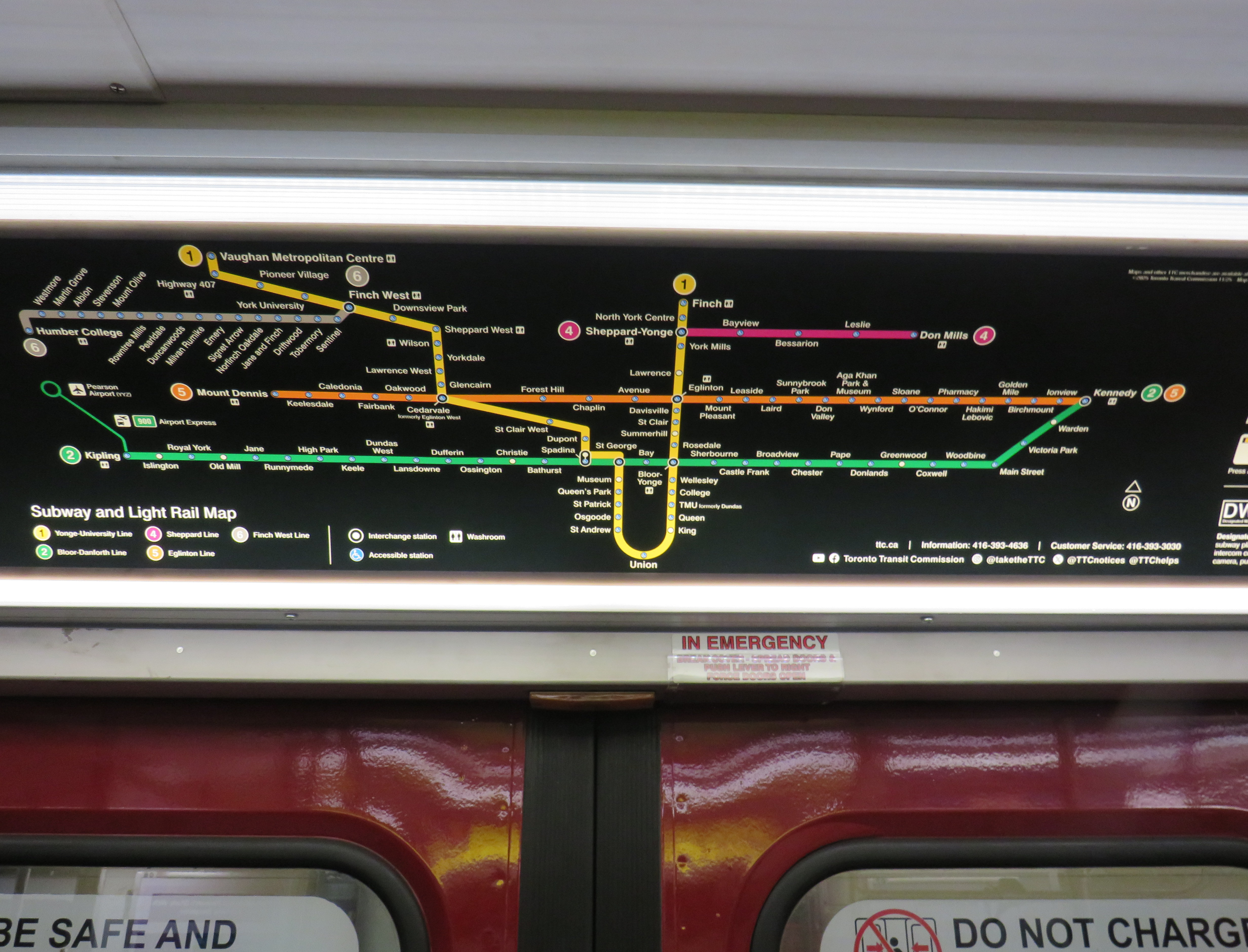
New maps in the TTC subway system show the long-delayed Line 5 Eglinton-Crosstown (opening date still TBD) and Line 6, which opens Sunday December 7
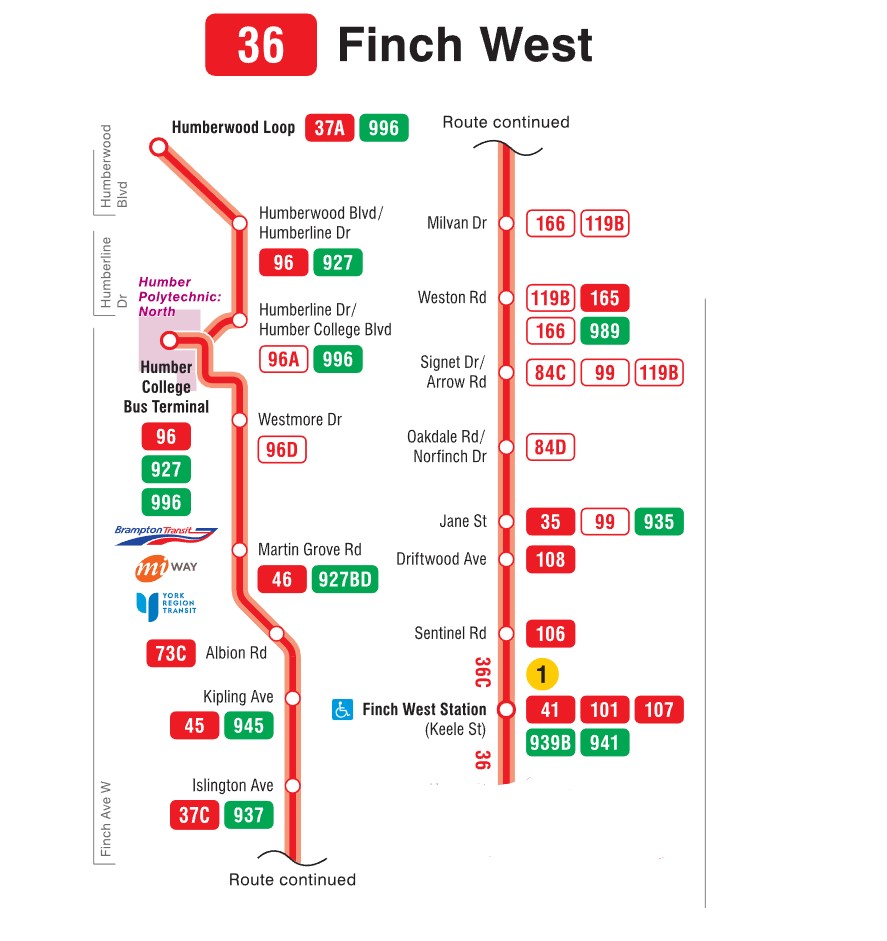
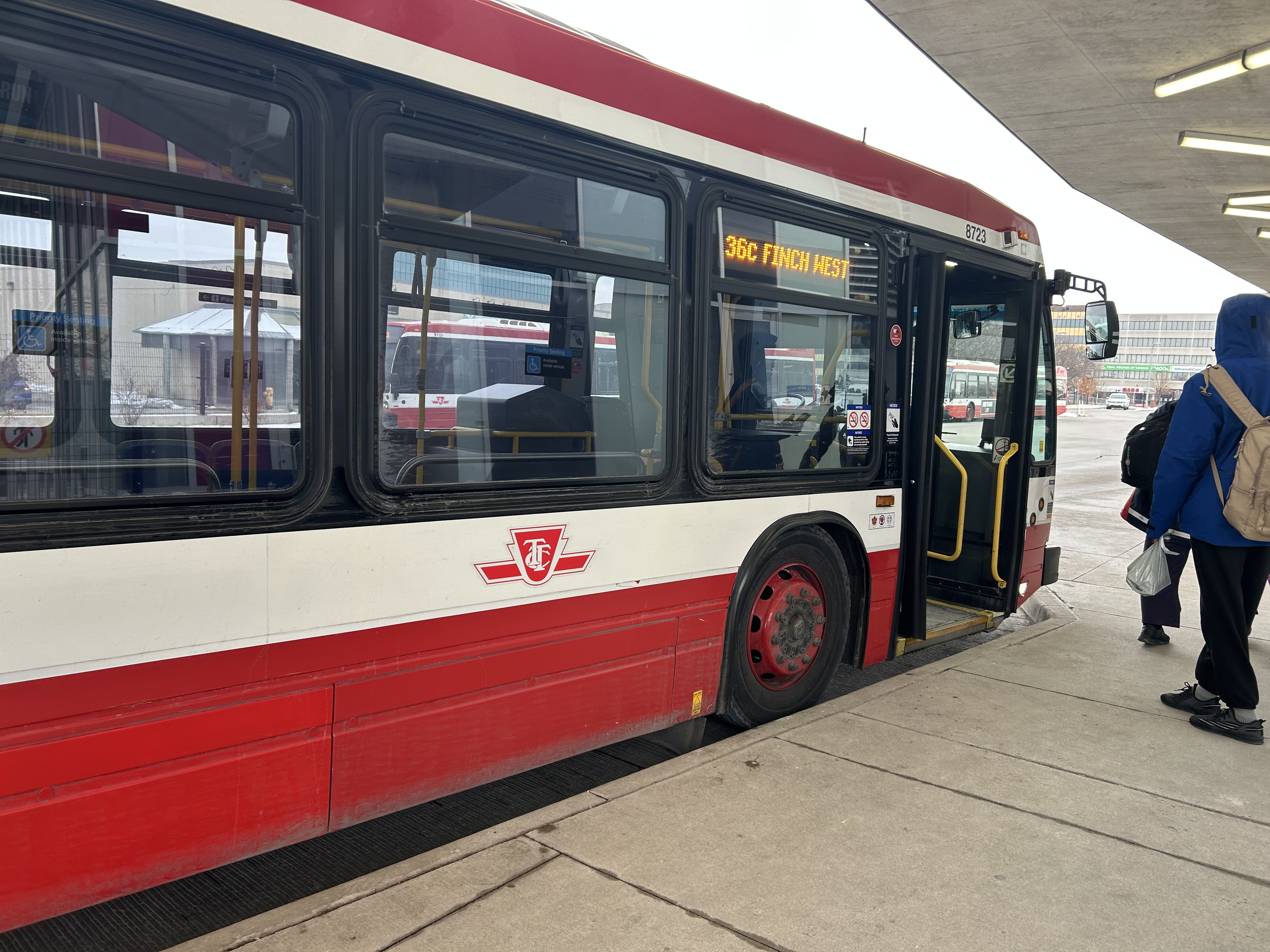
For the last few weeks, Finch West has been served by the 36C bus, running between Finch West Station at Keele Street and Humberwood Loop near the Mississauga border, making a stop at the Humber College bus terminal. A separate 36 Finch West bus continues east from Finch West Station to Finch Station at Yonge Street. There will only be eight fewer stops on Line 6 than there bus stops between Finch West Station and Humber College; apart from overnight service, there will be no parallel local bus serving the corridor.
Map of the Route 36C Finch West-Humberwood service, modified from the TTC’s original
Without limited stops and signal priority, the new light rail line will not achieve any real time savings. On his website, transit advocate Steve Munro notes that the end-to-end time of the new Line 6 LRT is scheduled for 46 minutes, consistent across all operating time periods. The 36C’s fastest round trip times, late evenings and early Sunday mornings, is between 79 and 82 minutes, or 40-41 minutes one way on a slightly longer route.
To see this for myself, I visited Finch Avenue West and rode the 36C both ways between Finch West and Humber College. Wednesday, December 3 was an overcast and cold day, with the daytime high temperature hovering around the freezing mark. But the roads were clear and dry, with no collisions and little construction work in the way of traffic on Finch; conditions couldn’t be any better for early December.
Here were the times for the two buses I took. I started timing the runs as soon as the bus doors closed and departed the originating stop; waiting times at the initial stops were not included.
TTC Route 36C travel times on Wednesday Dec. 3
Eastbound (read down)
Stop/station
Westbound (read up)
12:07 PM (dep.)
Humber College bus loop
1:50 PM (arr.)
12:11
Westmore Dr.
1:37**
12:13
Martin Grove Rd.
1:24
12:18
Kipling Ave. (Mt. Olive)
1:29
12:20
Islington Ave. (Rowntree Mills)
1:19*
12:28
Weston Rd. (Emery)
1:11
12:33
Arrow Rd./Signet Dr.
1:09
12:38
Jane and Finch
1:04
12:42
Tobermory Dr.
1:01
12:44
Sentinel Rd.
1:00
12:51 PM (arr.)
Finch West Stn. (bus terminal)
12:57 PM (dep.)
44 minutes
Total time
53 minutes
* At Islington Avenue westbound, the bus was delayed by five minutes by a troublesome passenger ** At Westmore Drive westbound, the operator left the bus with twelve passengers on board to order coffee at a nearby Starbucks, resulting in a second delay of nearly ten minutes
The eastbound departure, leaving Humber College at 12:07 PM, made it to Finch West Station in 44 minutes, two minutes faster than the scheduled LRT trip. This bus, an articulated (18-metre) vehicle was relatively busy, with a few standees between Jane Street and Finch West Station, and most en route stops were made. There were no unusual delays; just some traffic near Highway 400; it also took two light cycles to complete the left turn from Finch to Keele approaching the subway station.
Westbound 36C bus waiting to depart Finch West Station
I returned towards Humber College on a different bus that left Finch West Station at 12:57 PM. For a while, this run, a standard 12-metre bus, was making exceptionally good time, with only a few passengers on board. It skipped several bus stops as no one wanted on or off until Tobermory Drive. Line 6 LRVs will stop at every station, just like the subway, even if there aren’t any waiting passengers.
At Islington Avenue there was a delay caused by a prospective passenger who rushed through a don’t walk/red light to get the bus, despite another one close behind. As the passenger was using a mobility device, the bus operator had trouble deploying the ramp because the bus had already inched ahead of the bus stop pad, ready to proceed with the green light. The driver needed to reposition the ramp and wait for the next green, which resulted in a five-minute delay.
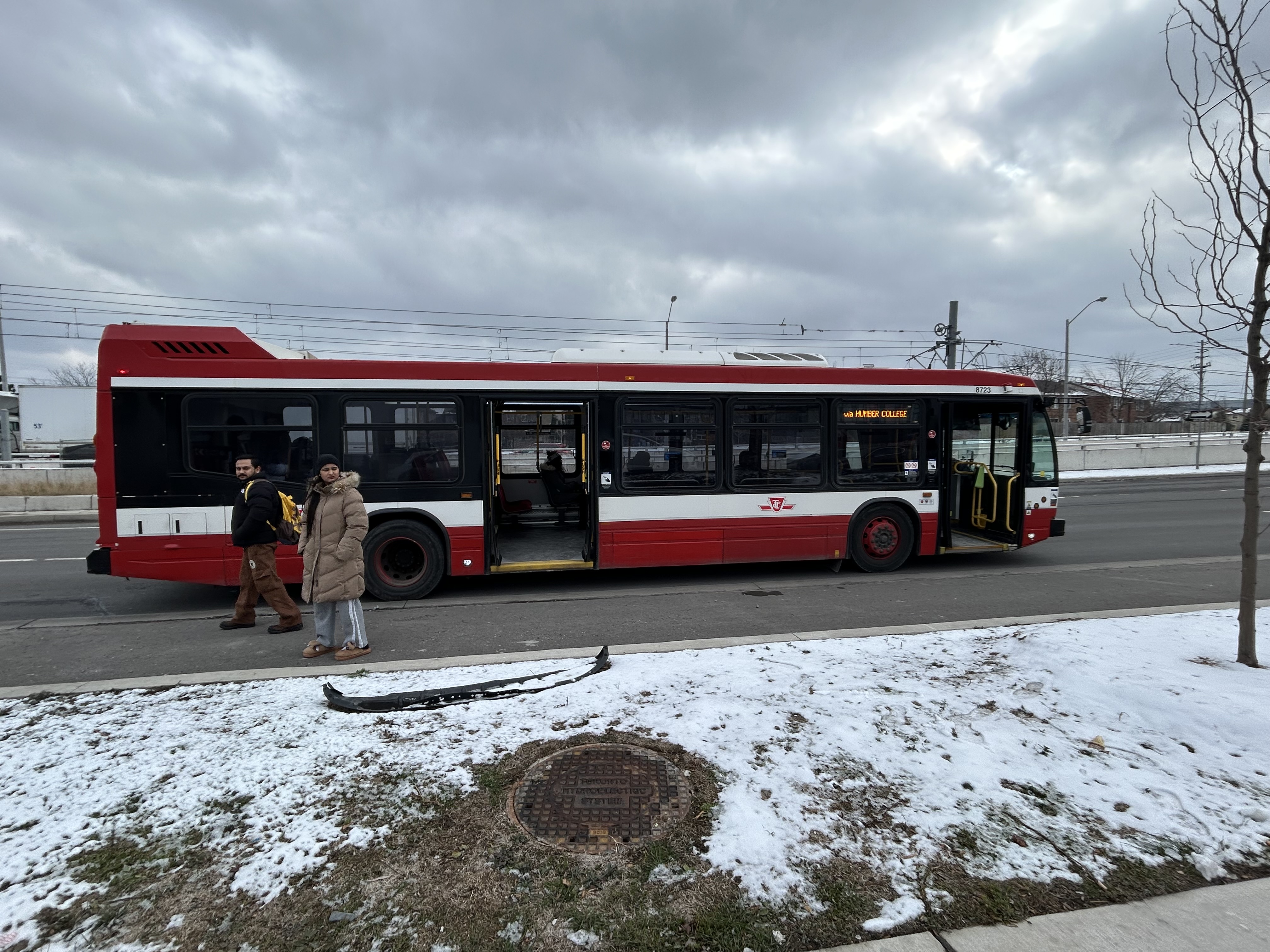
Another delay came a few minutes later, when at Westmore Drive, just one stop before the Humber College bus terminal, the operator left the bus without notice and walked into a nearby Starbucks. After a few minutes, and seeing two other westbound 36C buses pass by, most passengers exited the open doors to flag down the next bus.
Passengers leave an unattended Route 36C bus on Finch Avenue West at Westmore Drive. The portal for Line 6 LRVs to descend under Highway 27 towards Humber College is behind
The TTC operator returned eight minutes later, and we finally arrived at Humber College Bus Terminal at 1:50, 53 minutes after departing Finch West Station. (It’s worth noting that Humber College also has a Starbucks and public washrooms in the main building near the bus loop.)
At least that’s one instance where the LRT will certainly be faster than taking the bus.
A longer walk, a longer wait
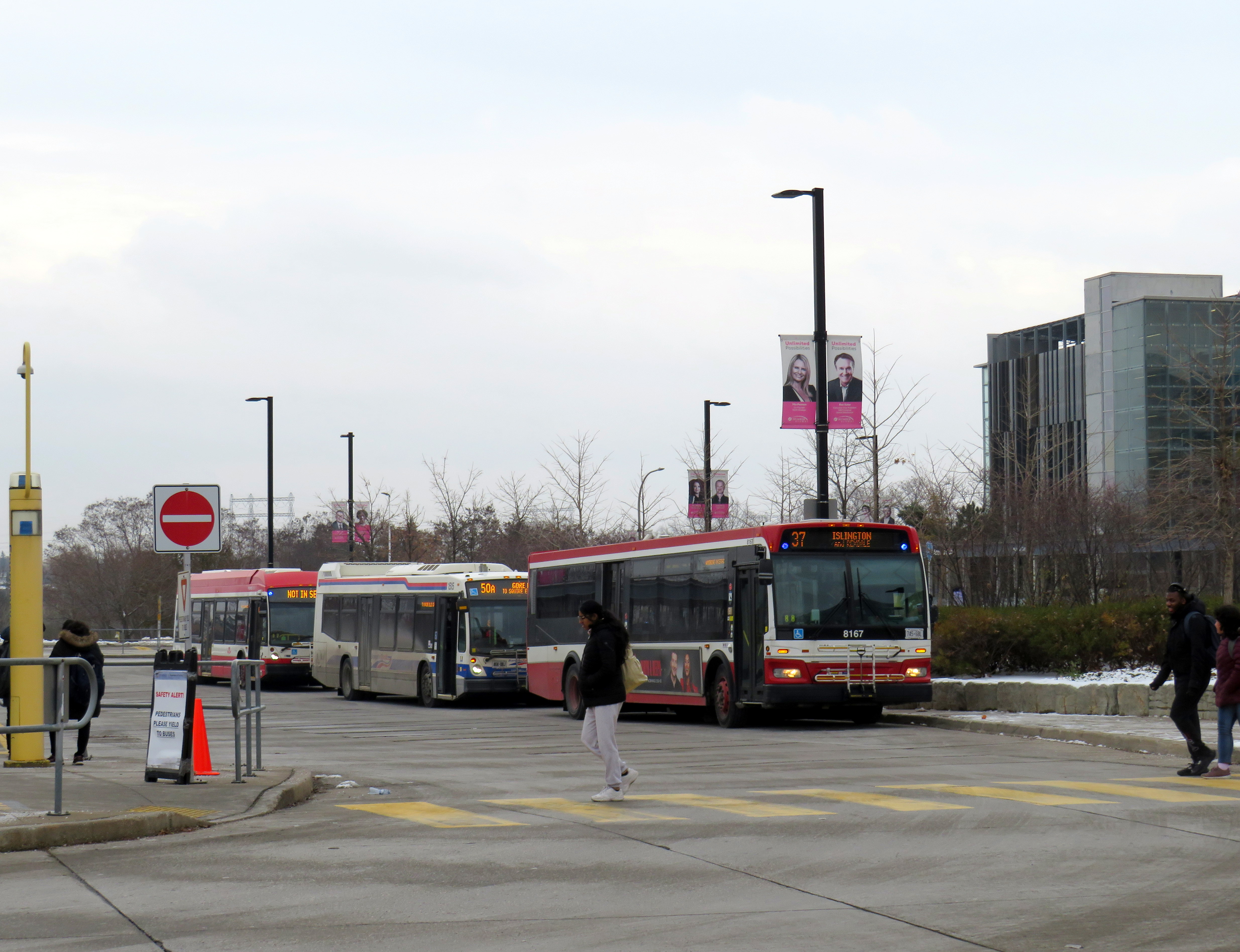
TTC and Brampton Transit buses layover at Humber College
Humber College’s bus terminal serves a total of nine TTC, Brampton Transit, Miway, and YRT routes. It’s also a connection point between TTC Wheel-Trans and Peel Region’s TransHelp paratransit services. But the LRT terminal station is a five-minute walk away from the terminal, which is adjacent to several primary buildings on campus.
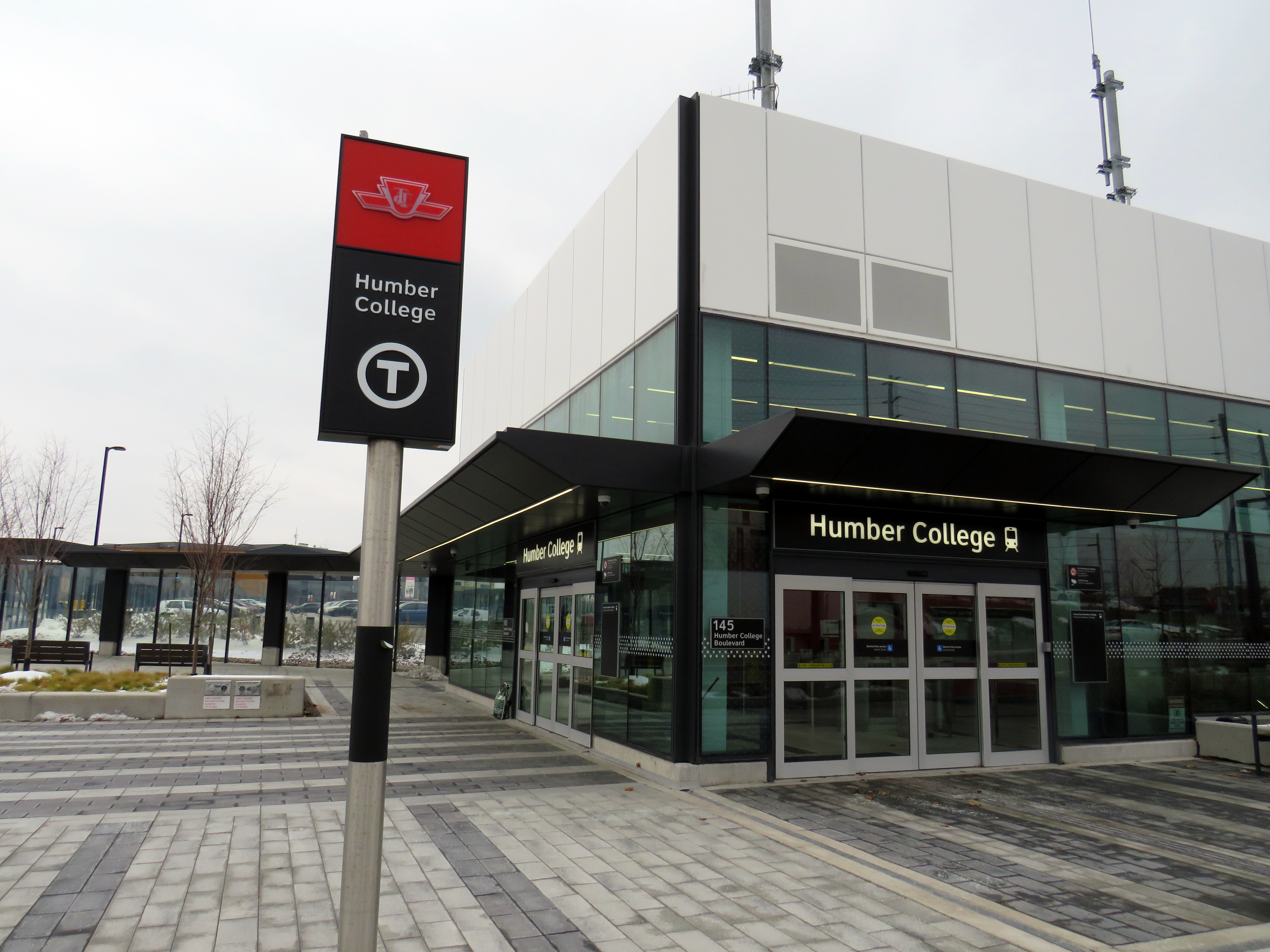
A walkway leads between the bus terminal and LRT station, with partial shelter provided by a long canopy that blocks northerly winds, but not the prevailing westerly winds. At the end of the walkway is the entrance to the below-grade LRT platforms, which are parallel to nearby Highway 27. This alignment reduced construction costs over a longer approach to the college, but it permits a future extension to the planned Woodbine GO Station two kilometres to the south and even Pearson Airport.
Humber College Station entrance, at Highway 27. The walkway to the bus terminal and main campus is behind.
During weekday peak periods, the LRT will run every 6 minutes, about as frequent as the current 36C bus during weekday daytime periods. However, during off peak times, trains will only come every 10-12 minutes, resulting in longer waits. Anyone travelling from Humber College will have to factor in the longer walk and potentially longer wait time.
I will certainly go out on Sunday December 7 to celebrate the opening of this new line, which despite the unnecessarily slow speeds, will result in a more predictable and more comfortable ride, with significant capacity improvements during peak periods, especially at school dismissal times. LRT doors will line up with the platforms, making loading and unloading easier for passengers with mobility devices, strollers, or carts.
I will also go ride the LRT after the opening day crowds are done, to see how it works in day-to-day operation. There are ways to speed up the schedule: more aggressive transit priority, shorter station dwell times, quick turnarounds at the terminals with “step back” operation, schedule optimization, and I hope these are considered by Metrolinx, the TTC and the city as everyone gets used to the new transit line.
If you like my work and you would like to help out with my webhosting costs (I just had to renew my ad-free WordPress subscription), consider buying me a coffee.Thank you!
Woodbine Centre & Fantasy Fair is up for sale, again
Growing up in Brampton in the 1980s and early 1990s, there were two favourite day trips I fondly remember.
There were the drives to nearby Georgetown, which had one of the largest indoor playgrounds at any McDonald’s restaurant. It featured a multistorey indoor crawl maze, a spiral slide that led to a giant ball pit, a tire swing, as well as a standard McDonaldland-themed merry-go-round. A CN caboose could be rented for children’s parties. At least we’d burn off some of the calories from the burgers and fries. (There’s a video on Reddit from 1992 that shows what it looked like.)
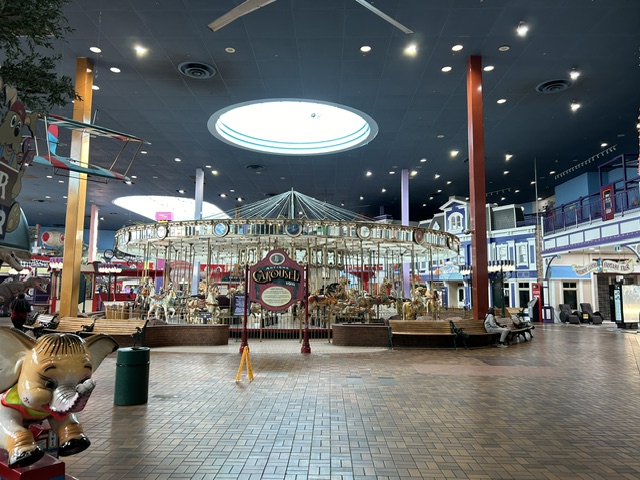
Then there were the trips to Fantasy Fair. When Woodbine Centre opened in 1985, it featured a unique attraction: a large indoor amusement park, complete with a historic Looff carousel (though with replica fiberglass horses), a Ferris wheel, and a train ride that wound through the attraction. The highlight for me, however, was a huge indoor playground that spanned two floors that was many times the size of the Georgetown McDonald’s playground. It had multiple slides, a mirror maze, swings, and two ball pits. There was also a McDonald’s restaurant facing Fantasy Fair, in one of the faux-Victorian storefronts that surrounded the attraction.
Fantasy Fair Carousel, November 2024
The mall itself was anchored by The Bay and Simpson’s, along with a Cineplex multiplex cinema, and a complete assortment of mid-market retailers. In 1991, when the Hudson’s Bay Company retired the Simpson’s brand (converting most of those stores into The Bay), it sold the redundant store to Sears Canada. A Zellers discount department store was added in the 1990s. But the mall slowly lost its pizzazz.
Cadillac Fairview sold Woodbine Centre in 2005 to a numbered company, with real estate management firm Avison Young operating the mall. By then, many of the national retailers had left once their leases were up. The mall’s relatively isolated site, without good transit access became a liability. Changing demographics in northern Etobicoke, competition from surrounding larger malls (Bramalea City Centre, Sherway Gardens, Square One, Vaughan Mills, and Yorkdale) and new big box retail developments also took their toll.
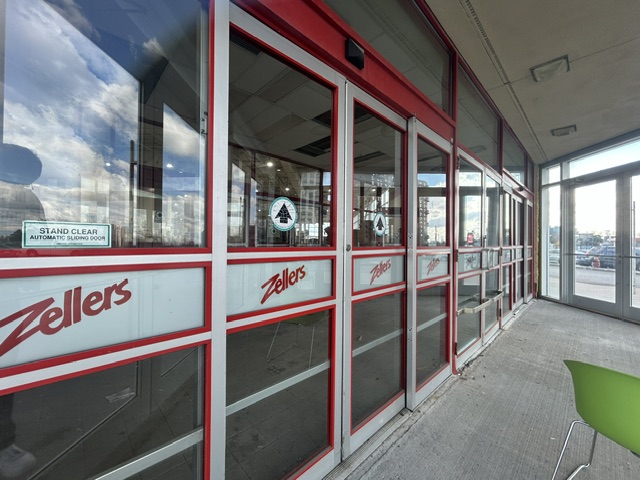
The Zellers store was not one of the leases picked up by ill-fated Target Canada, and it closed in 2012. Sears closed in March 2017, a few months before the entire chain was liquidated. Sport Chek closed its store in 2018.
Woodbine Centre’s Zellers store was not picked up by Target, and the parking lot-facing doors still have the defunct retailer’s logo intact
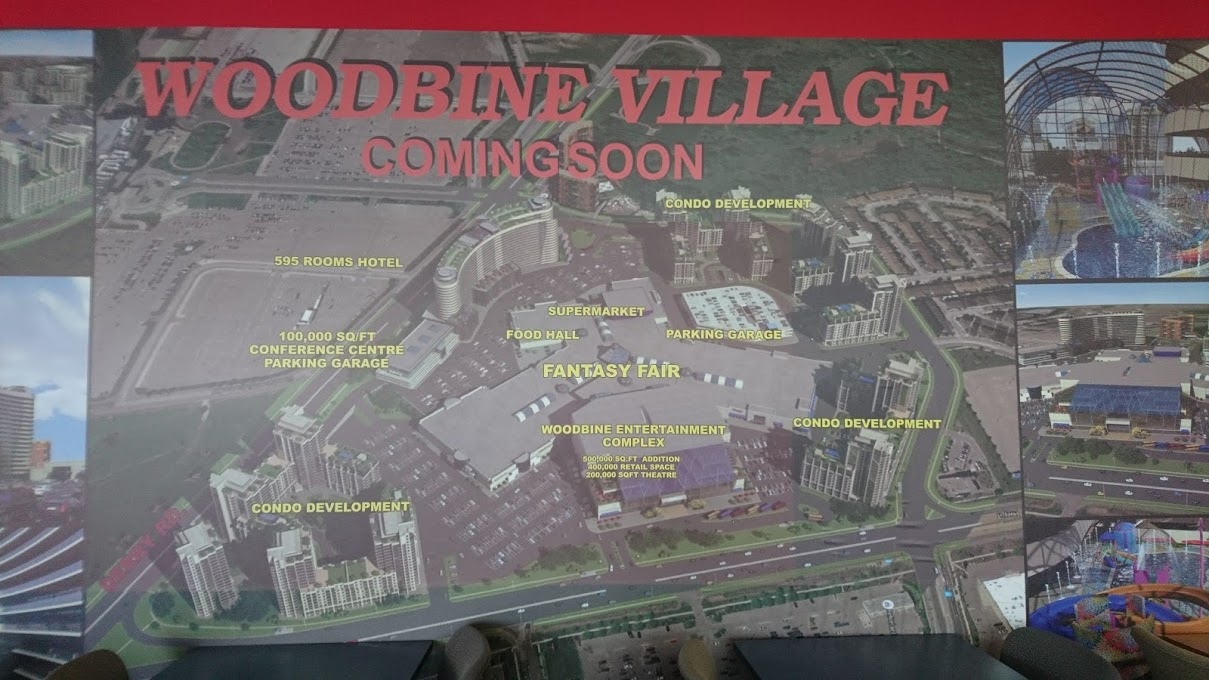
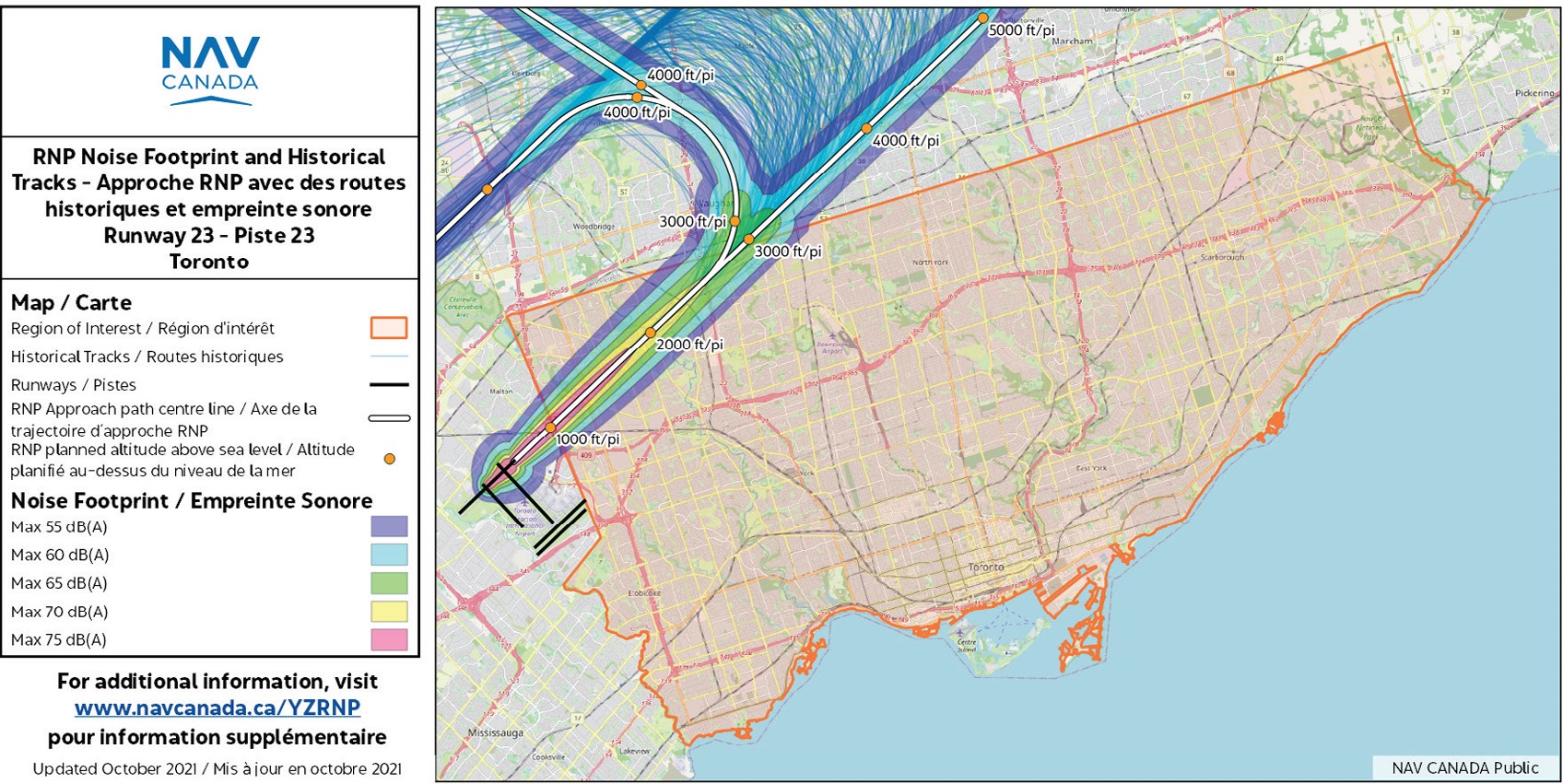
There was an attempt to renovate the mall, as part of a grand plan to revitalize the property with a new supermarket, refreshed food court, new entertainment options, and condominium towers surrounding the shopping centre. The Woodbine Village proposal competed with the better-financed Woodbine Live plans at the nearby racetrack, which included a casino, hotel, and event hall, all of which were built or are nearing completion. Condominium development is complicated as the property, particularly the southeast corner at Highway 27 and Rexdale Boulevard, is directly below the approach for Pearson Airport’s Runway 23.
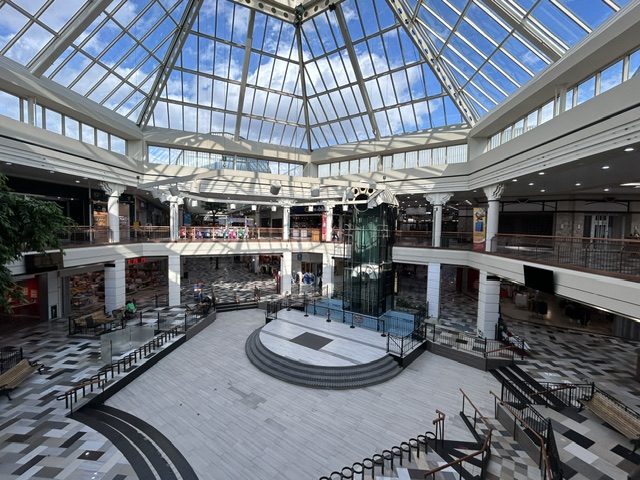
Poster promoting “Woodbine Village” which boasts a new supermarket, condo development, hotel, and expanded Fantasy Fair including indoor waterpark NAV Canada map showing approach and noise contours for Runway 23, which passes directly above Woodbine CentreWoodbine Centre’s central atrium, including defunct fountain below glass elevator
After a disheartening American election result on Tuesday, November 5, I decided to turn off the newsfeeds, and out for a walk and explore Woodbine Centre again.
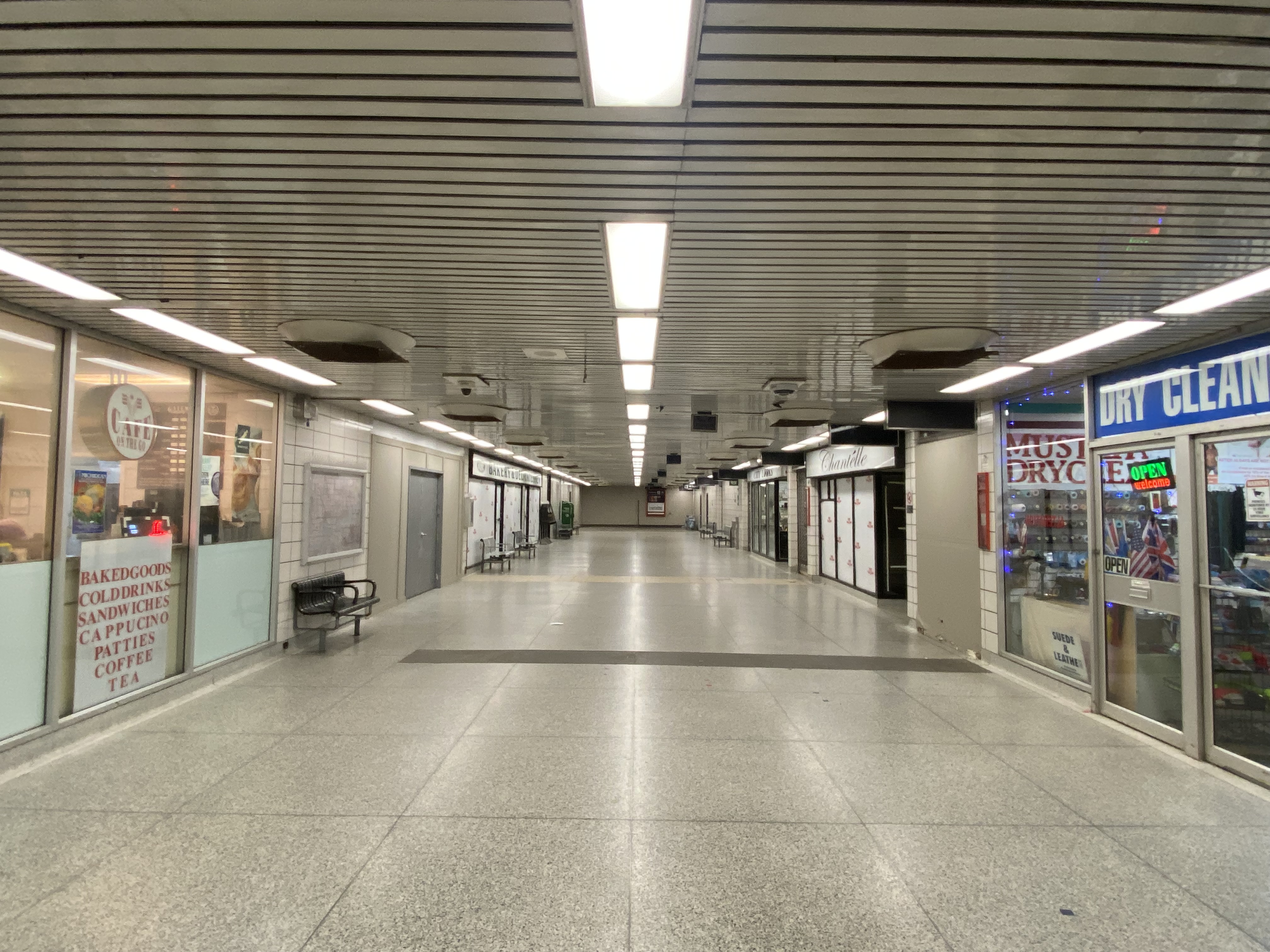
Though the basic architecture remains intact, the corridor floors were given cheap new brown, grey, and beige tiles that look out of place in the post-modern interior. Much of the original green paint on the roof, walls, railings, and signs is now red and mahogany.
Apart from the fast food offerings, there were few recognizable store names among the tenants in 2024. Apart from Hudson’s Bay, Foot Locker, Ardene, The Children’s Place, Dollarama, LensCrafters, TD Bank, and Urban Behavior, most stores were independent clothing, home décor, and furniture stores, or were cellphone vendors such as Wow Mobile, Best Buy Express, or Rogers and Bell kiosks. About 20 percent of the store fronts were vacant.
Looking towards the old Sears store, which is now All Home Furnishings, which was having a clearance sale in November. Note the Payless Shoe Shack, a knock-off of the defunct Payless Shoe Source chain, on the left. Vacant faux-Victorian storefronts at Fantasy Fair
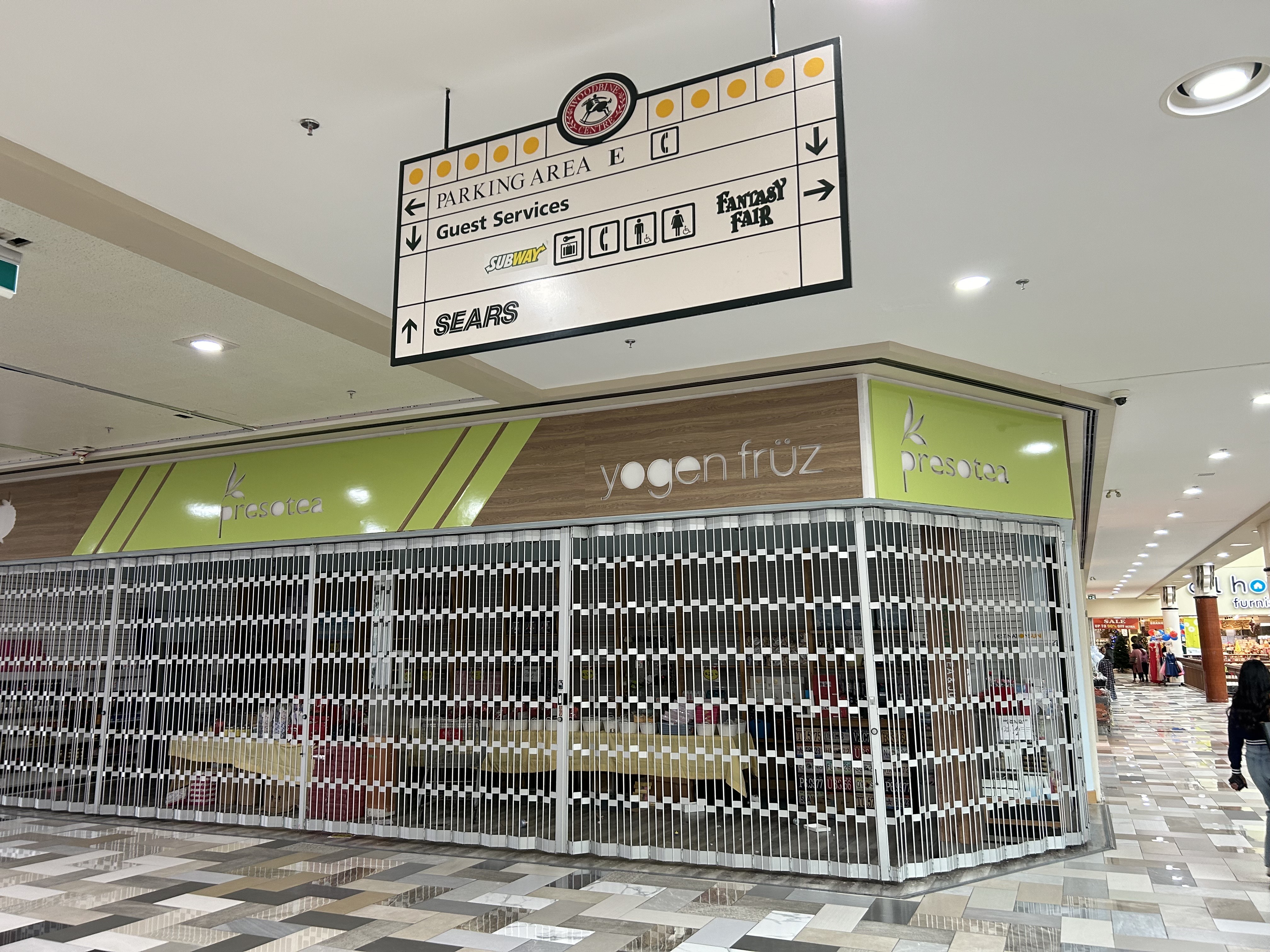
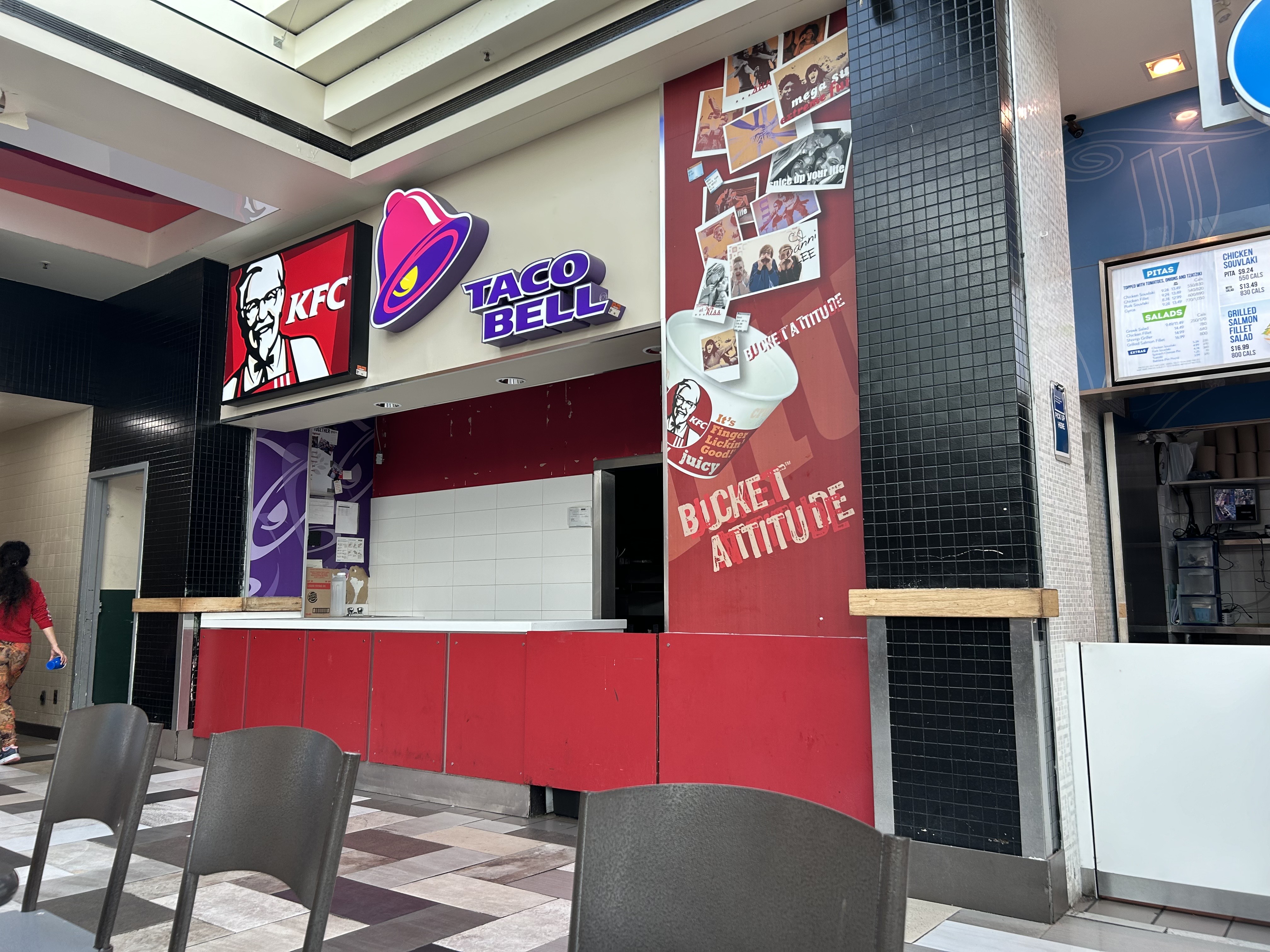
Professional property managers are quick to update signage and keep up appearances; the management at Woodbine has clearly given up. Vacant storefronts are left exposed, rather than blocked off. Signage advertises stores that are long gone. Pot lights flicker on and off.
Overhead sign pointing the way to Sears, which closed over seven years ago. The Subway restaurant is also gone. Behind the sign, a shuttered Yogen Fruz/Prestotea store front acts as storage. A closed KFC/Taco Bell stall in the food court, with the signage still up and illuminated, despite the equipment taken out
Surprisingly, Fantasy Fair was still operating, even on a Wednesday afternoon where there were few visitors. Ride attendants, dressed in red vests, looked bored, even when running the train for the lone parent and child. The Ferris wheel is now permanently closed, however, and some of the attractions look sadly decrepit.
The railway crossing lights, bells, and gates still work at Fantasy Fair when the train passes through
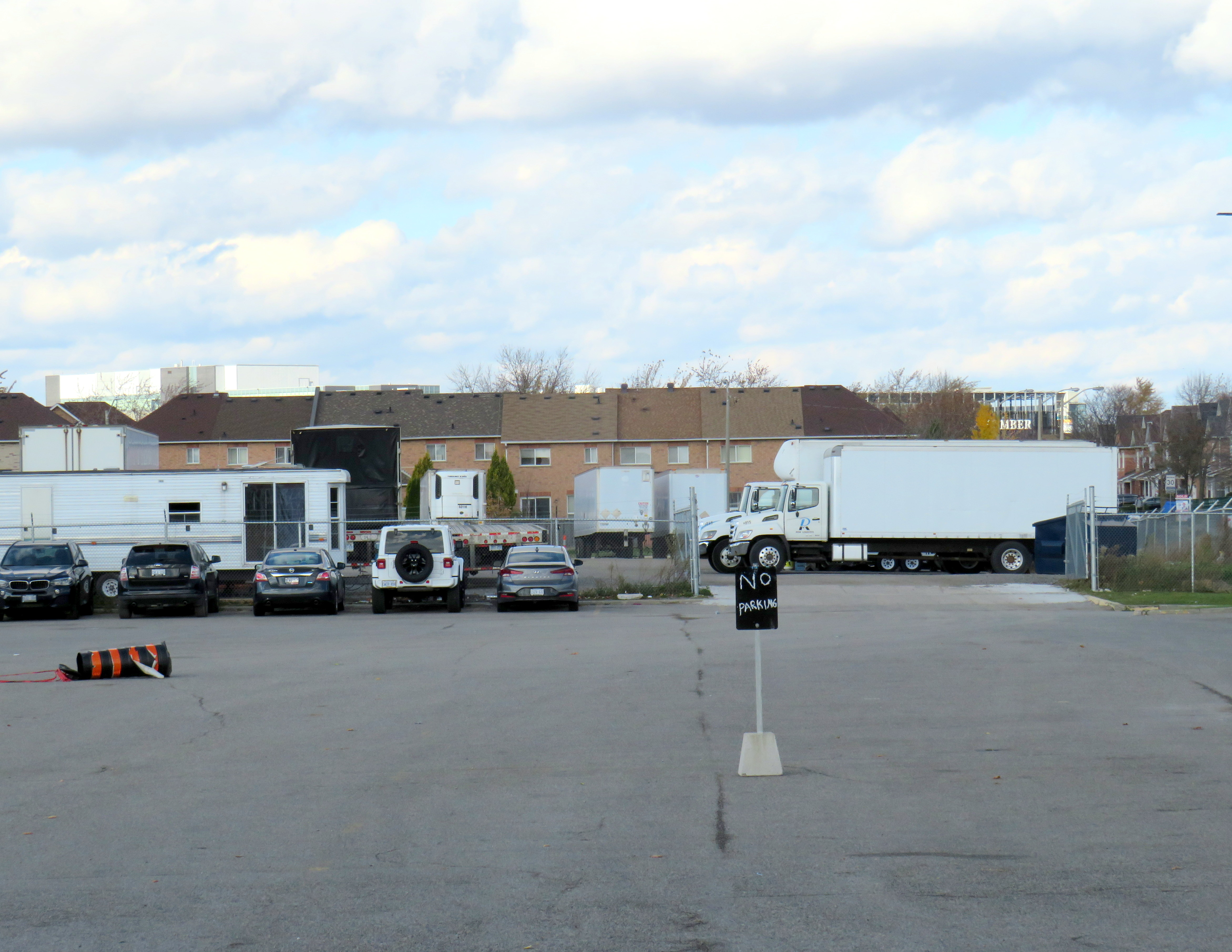
Outside the mall, much of the parking lot is fenced off and is now used for truck and trailer storage, and the storage of overflow rental car fleets. Though the rental car parking began during the COVID-19 pandemic, when people stopped travelling, it continues to be an easy revenue stream for the mall management. The truck trailers, on the other hand, are an unsightly feature, particularly where they face Highway 27.
Fenced-off rental cars in the Woodbine Centre parking lotTruck trailer parking on part of the mall parking lot
Unfortunately, the future is not good for Woodbine Centre as a mall. Though mixed-use development remains a possibility — Humber College is within walking distance — the airport noise will continue to be a challenge for condominium sales. Transit expansion would certainly help; the nearly-complete Finch West LRT terminates nearby. Extending that two kilometres south to serve Woodbine Centre, Woodbine Racetrack/Casino, and a planned GO Transit station, could be the boost the site needs. (Of course, the mall site could have made a good location for a mega-spa, particularly with the nearby casino venue and hotels, but I digress.)
The Humber College LRT terminus is less than a kilometre north of Woodbine Centre
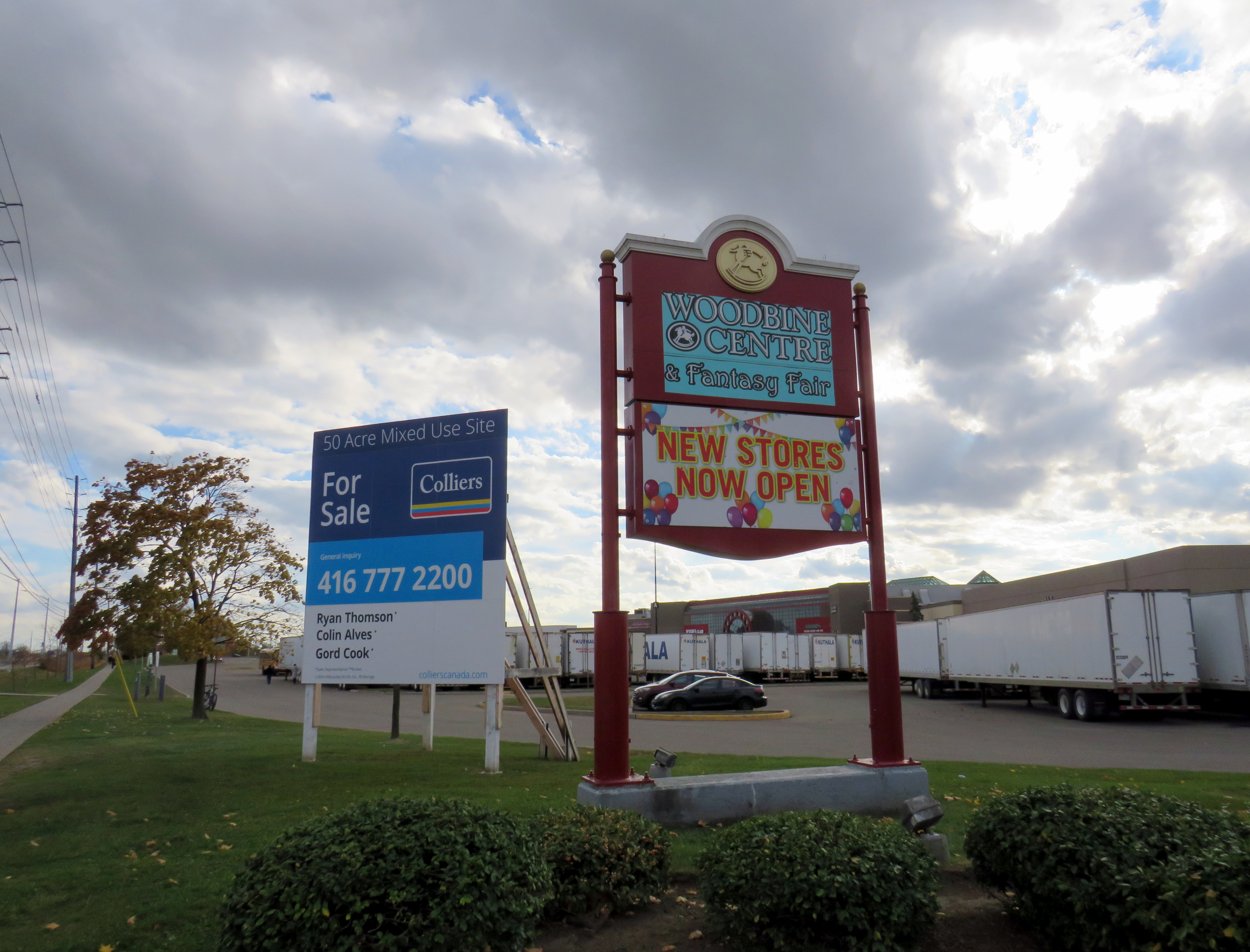
The mall’s fate will likely be decided soon. The site is up for sale again, not advertised as a shopping centre, but as a “50 acre mixed use site.”
1992 Tenants
Below is the list of tenants at Woodbine Centre in 1992, obtained from the 1993 Canadian Directory of Shopping Centres, published by Maclean-Hunter. Tenants still open in 2024 are bolded.
Anchors Anchors: The Bay (140,000 sq.ft.), Sears (135,000 sq.ft.)
Fashions and footwear Children’s Wear: Flora’s, Just Kids. Family Wear: Cotton Ginny. Ladies’ Wear: Addition-Elle, Antel’s, Au Coton, Braemar, Braemar Petites, La Cache, The Cavery, Cotton Plus, D’Allaird’s, Dalmy’s, Emotions, Fairweather, Irene Hill, Jacob, La Jolie, Karuba, Lady Foot Locker, Limité, Lindor, Liz Porter, Mia, Northern Reflections, Ports International (Ladies), Reitmans, Ricki’s, Shirley K Maternity, Smart Set, Suzy Shier, Tabi International, Tan Jay, Tristan, Tucci Fashions. Menswear: Casa Angelo, Petrocelle Vomo, Randy River, Star’s Men’s Shop, Steel, Tip Top, Tuxedo Royale.
Unisex / Men’s & Ladies’ Wear: Benetton, Boca, Bootlegger, Canary Island Adventure & Travel Company, Le Château, Frenz Leather, Jean Machine, Levi’s 1850, Pantorama, The Pro Image, Stitches, Thriftys, Willow Ridge. Footwear/Leather Goods: Agnew, Aldo, Bata, Belinda & Brother, Bentley Leathers, Calderon, Florsheim Shoes, Foot Locker, Fredelle, K. Jamson, Kinney, The Little Shoemaker, Moneysworth & Best, Naturalizer, Pegabo Jewellery/Fashion Accessories: Accessories For You, Ardene, The Joy of Sox, Mappins, Peoples Jewellers, Reflexions, Young’s Jewellers
Other retailers Books: Classic Bookshop, Coles, Moyer’s The Teacher’s Store, Smithbooks Cosmetics/toiletries: Body Reform, Caryl Baker Visage, Enchante Perfumes, Merle Norman Cosmetics Department store/mass merchandiser: Marks & Spencer Drugs/health & beauty: Shoppers Drug Mart Electronics/Computers: Bell Canada Phone Centre, Compucentre, Majestic Sound Warehouse, Radio Shack, Safe & Sound Fabric & Sewing: Needle ‘n’ Thread Florist/Nursery: Woodbine Florists Furniture & Furnishings: Brass Imports, Clocks Unlimited, Diamond Furniture, Lighting Unlimited, Pictures Gift: A. David Soloway, China Panda, Den For Men, Jinny’s China & Gifts, Party Hut, Rafters, Le Roulet Grocery: Bulk Barn Hardware/Paint & Paper: St. Clair The Paint & Paper People Hobby/Craft: Lewiscraft Housewares: House of Knives, Pot Pourri, Shaver Centre Fine Blade, Stokes Music/Records & Tapes: A&A Music & Entertainment, Discus, Music World Optical:LensCrafters Pet: Aquarium Toronto Photo/Camera: Blacks, Japan Camera Restaurant and Fast Food: A & W, Abacus Cuisine, Baby O’Donuts, Dutch Treats, Jimmy The Creek, J.J. Muggs, Kentucky Fried Chicken, Kernels, London Style Fish & Chips, Los Rios, Made In Japan A Teriyaki Experience, Manchu Wok, Manfreds, McDonald’s, Mr. Submarine, New York Fries, Sbarro. Specialty Food & Drink:Baskin-Robbins, Laura Secord Mrs. Fields Cookies, mmmarvellous mmmuffins, Swiss Fudge, Timothy’s Coffees of the World, Yogurty’s Yogurt Discovery. Stationery/Card: Garfield, Grand & Toy, Hallmark. Toy: Toy World. Variety/Convenience: The Silver Dollar Store, United Cigar Store. Dry Cleaners: Parker’s Cleaners. Financial/Legal: Bank of Montreal, Canada Trust Hairstyling/Esthetics: The Cut Above, Da Vinci, Tantastic, You’nique Hairstyling. Medical/Dental: Eye-Exam Centre, Procare Medical Centre, Woodbine Dental. Printing: K.P. Copy. Theatre / Entertainment: Cineplex, Orville & Wilbur Family Games, Wizard’s Castle Travel: Marlin Travel Miscellaneous: Lottery Kiosk
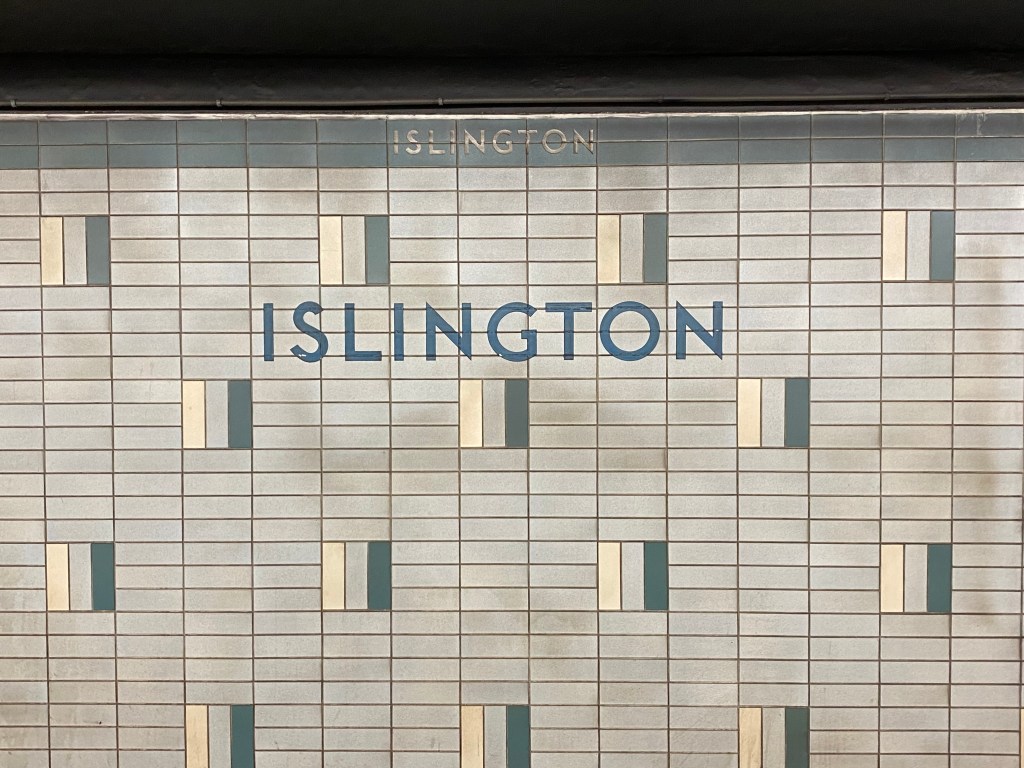
Islington Station, opened in 1968 as part of a major expansion of the Toronto subway system into Etobicoke and Scarborough, is now literally falling apart.
At platform level, Islington looks little different than most stations on the Bloor-Danforth Line with the faded wall tile, coated with a layer of brake dust. Upstairs, on the concourse level and the old bus terminal, the station is in far worse shape. Wear and tear from hundreds of buses entering and exiting the station every day, along with water seepage from an underground stream, has caused the station to look much older than it actually is.
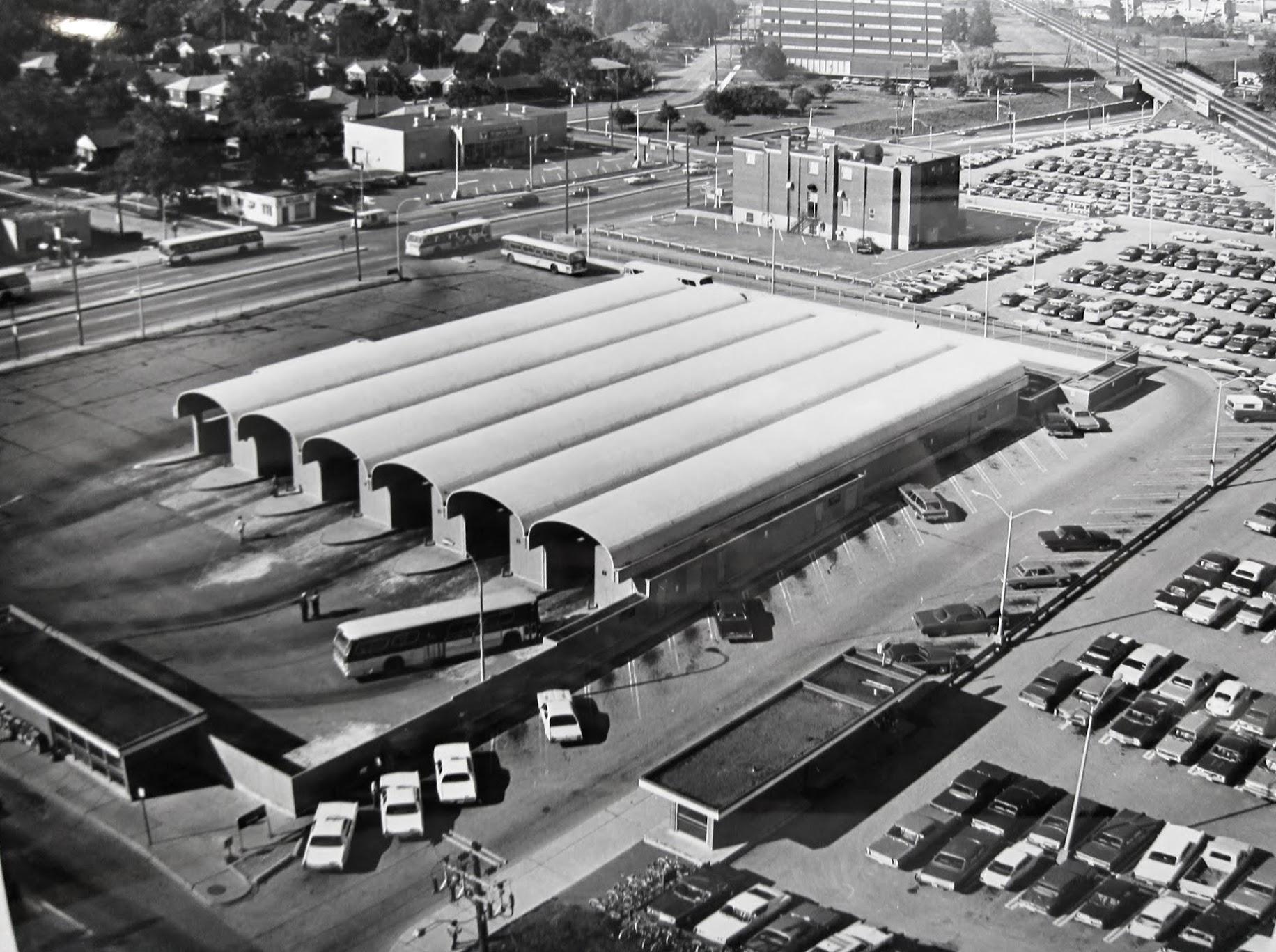
From 1968 to 1980, Islington Station was the Bloor-Danforth Line’s western terminus, with buses branching out to points all over Etobicoke. The bus terminal boasted six bus bays, each with its own driveway. One of the six platforms was dedicated for Gray Coach services, which included an express bus to Pearson Airport.
An arriving bus would first pull into the east side of the terminal, with all passengers descending a set of stairs to the subway concourse, either to transfer to the subway, exit the station, or transfer to another bus route. The bus, once the operator took their break, would then pull forward to the boarding area, where a second set of stairs emerged from a waiting area. Below, on the concourse level, a flashing light would alert waiting passengers that their bus was boarding. The terminal design was similar to the original bus terminal at Eglinton Station; at Warden Station, the levels are reversed, with the bus bays below the passenger concourse.
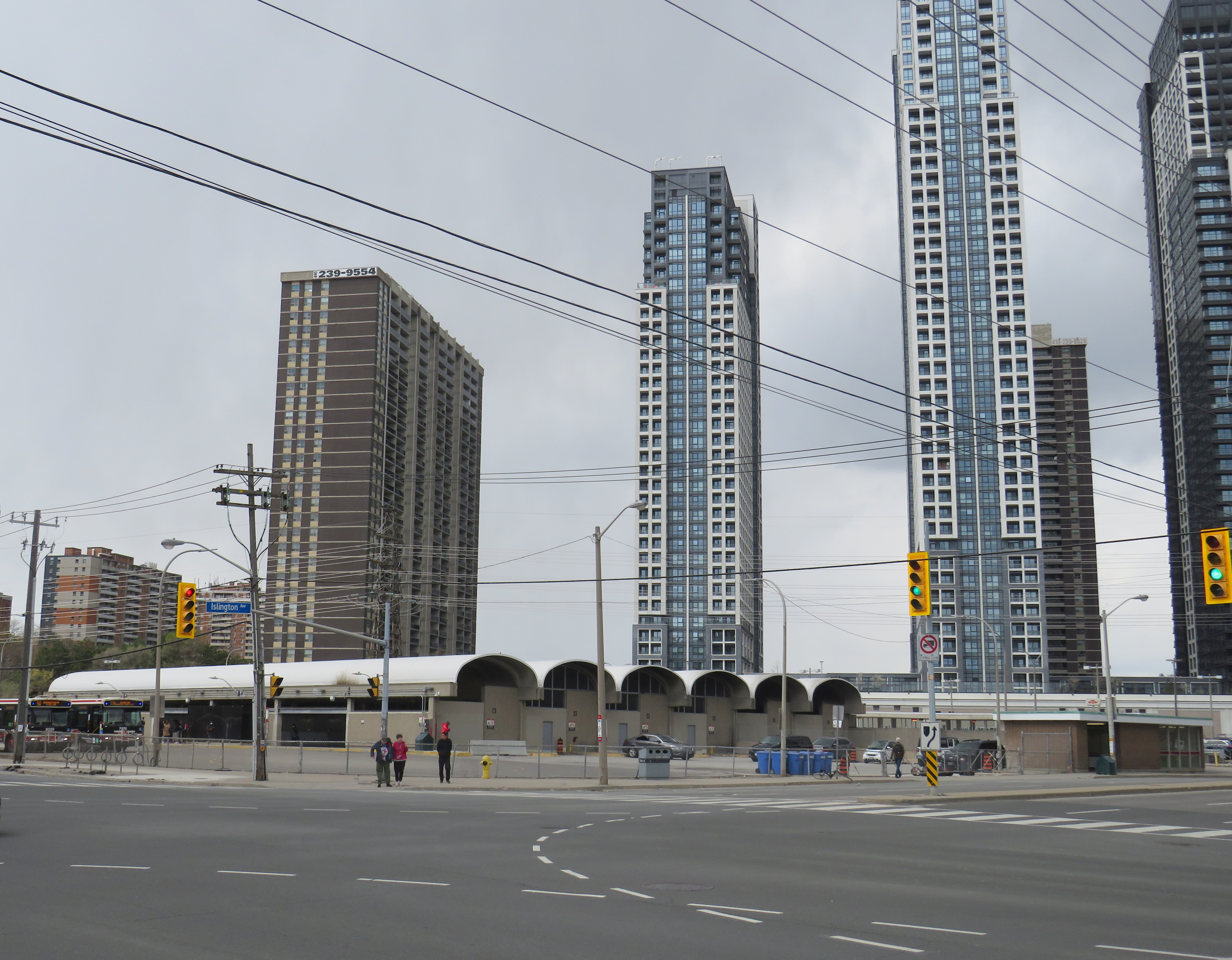
Aerial view of Islington Station’s bus terminal in 1975, City of Toronto Archives, Series 836, Subseries 4, File 46. Note the Mississauga Transit bus passing by on Bloor Street. Looking northwest toward the sealed-off bus terminal, May 2023
In 1980, the subway was extended one stop westward to Kipling. The extension allowed the TTC to reroute most of its Etobicoke routes from Islington, which provided new space for Mississauga Transit, whose buses now loaded inside the bus terminal. (As the bus bays are inside the station’s fare-paid area, Mississauga Transit buses off-loaded passengers outside the station’s main entrance on Islington Avenue.) A seventh bay, located to the south of the original structure, was added to provide additional capacity for Mississauga Transit, however, only simple bus shelters provided protection from the rain and snow.
But by 2016, the bus terminal area was starting to crumble, and bus bays 1 and 2 (the bus bays closest to the subway platforms) were closed permanently to prevent further structural damage. Mississauga and GO Transit planned for a new terminal adjacent to Kipling Station, but it was delayed by several years. Part of the delay was caused by Hydro One — owner of the transmission lines that parallel the subway and adjacent Canadian Pacific Railway corridor — who refused to allow a terminal building under its wires.
The opening of the new Kipling terminal for GO and Mississauga Transit buses in May 2021 (repositioned to avoid the hydro corridor) allowed the TTC to permanently close the crumbling bus terminal bays. All remaining buses — 37/937 Islington, 50 Burnhamthorpe, and 110 Islington South — began only using the outer bus loading area in late 2021.
Bus passage, Islington Station. Stairways to the old bus bays are sealed off, with the signs above the old stairways blacked out. Passengers transferring to TTC buses must walk to the far end of this corridor and then up a stairway to access the outer bus bay.
With little room remaining for buses to load, offload, and layover, passengers on TTC buses arriving at Islington are now let off on the street and must walk to the main entrance and show their transfer or tap their Presto card to enter the subway or transfer to another bus. Though Route 37/937 and 50 buses stop right in front of the station entrance on Islington Avenue, Route 110 buses off load on Bloor Street, a two-minute walk to the subway entrance.
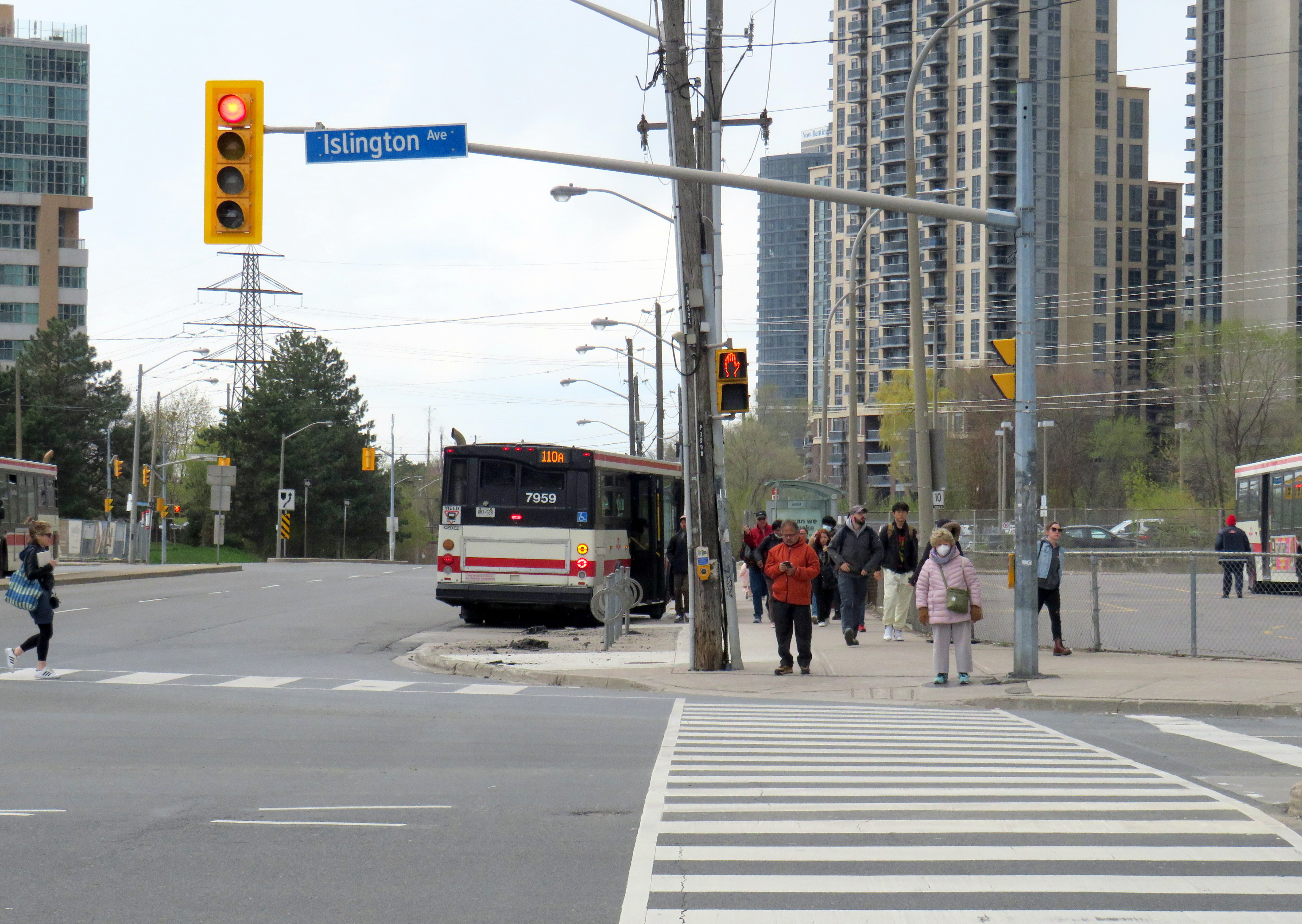
A Route 110A Islington South bus off loads on Bloor Street; passengers must walk north to the subway entrance on Islington Avenue, to the right of this photograph
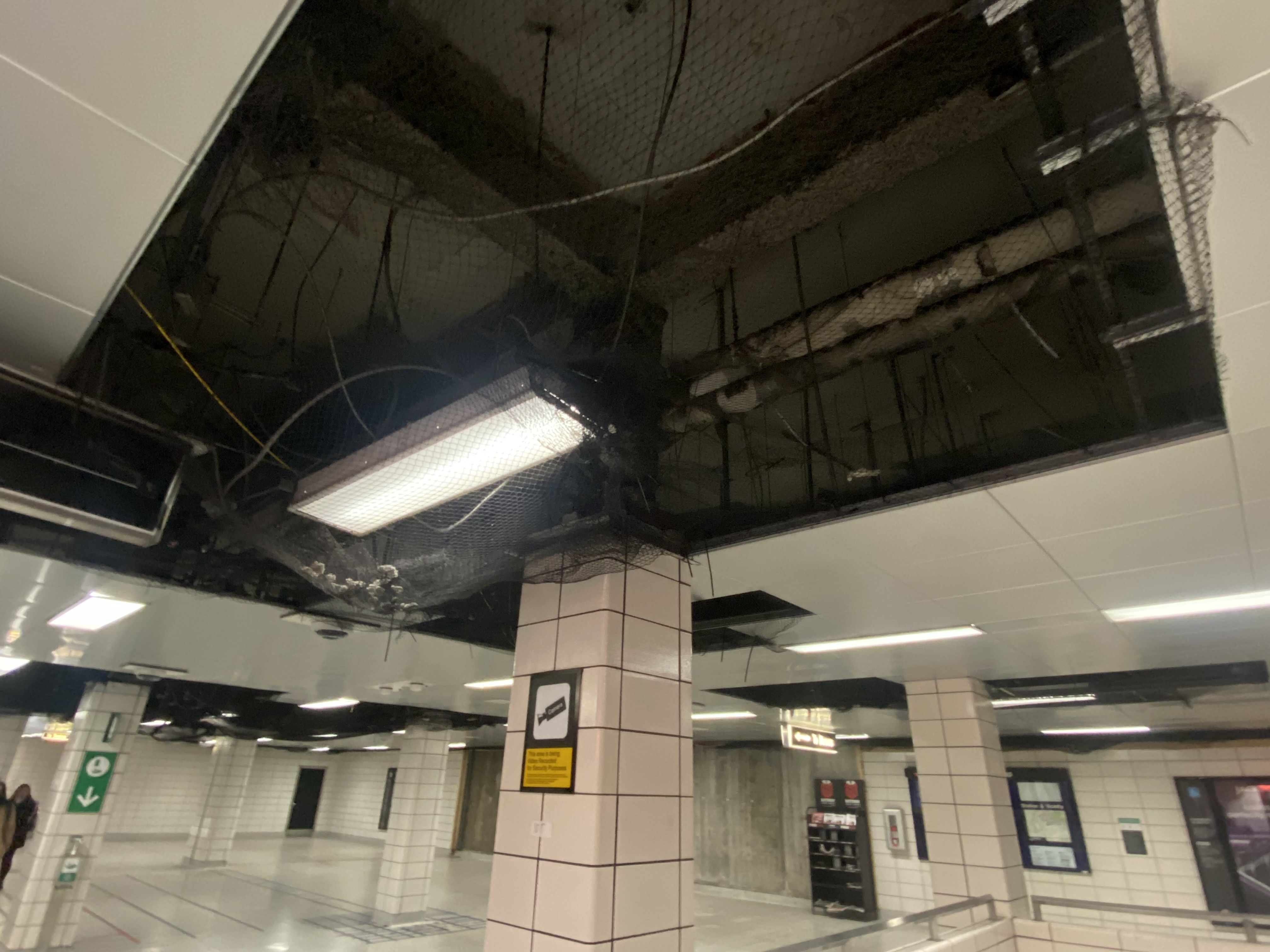
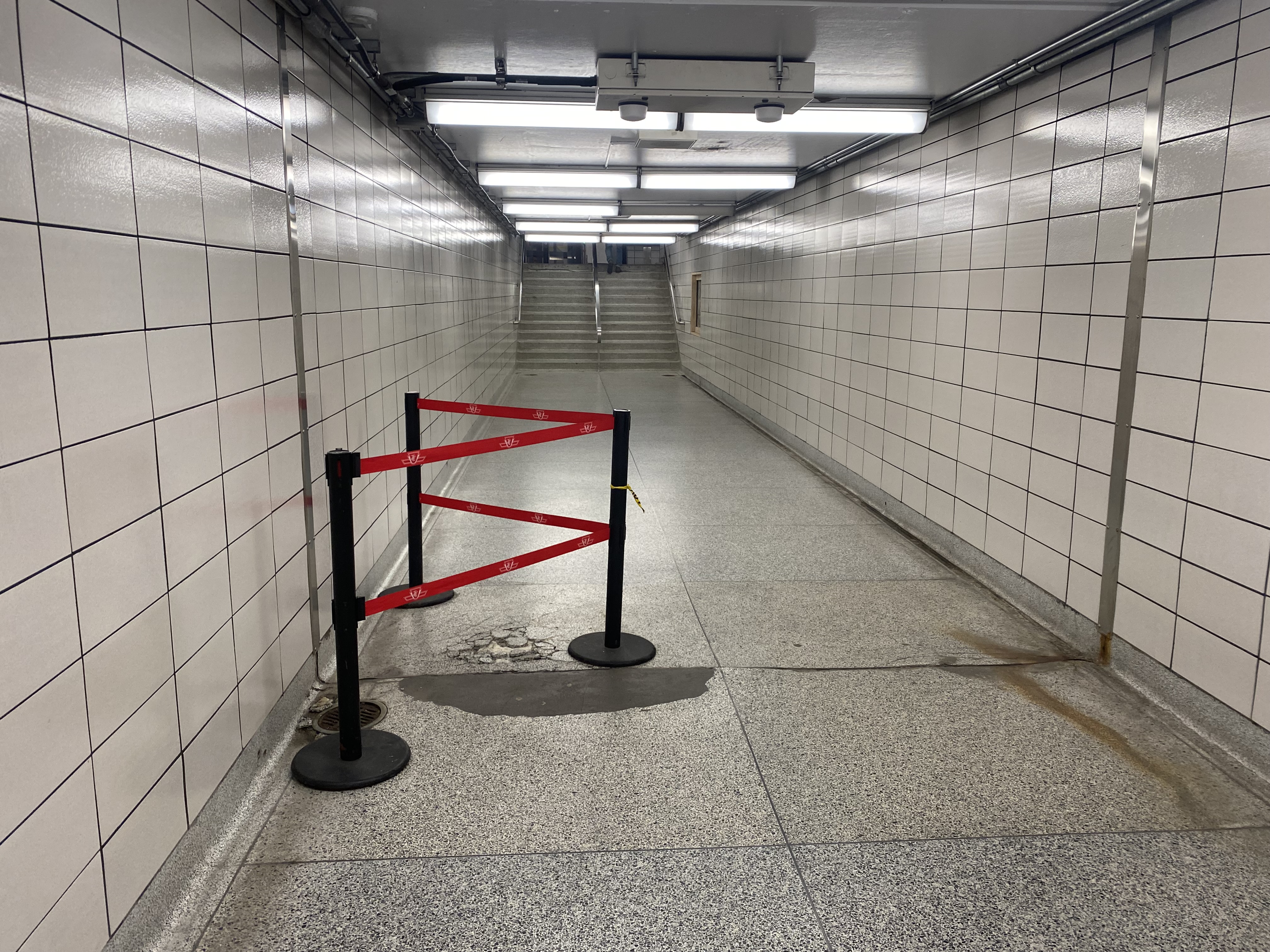
Since the bus terminal closure, the decay at Islington Station has extended beyond the bus area. On the mezzanine level, ceiling tiles were removed, while black netting catches chunks of broken concrete. Removed wall tiles reveal crumbling concrete and exposed rebar. Water leaks cover the mezzanine floor. There are no signs advising passengers of work underway or future construction, though there have been several plans to rebuild the station and promote new development on the site.
Fare gates partially obscured by temporary columns
Not only is reconstruction needed to rectify the deteriorating state of the station, Islington is also one of 15 subway stations that still do not have barrier-free access for passengers using wheelchairs or other mobility devices. Islington and Warden were left at the bottom of the list for station retrofits largely due to the difficulty of providing barrier-free access. The outdated bus terminal layouts at those stations require complete redesigns, and both stations are good candidates for urban development.
Netting keeps chunks of concrete from falling onto passengers’ headsCrumbling terrazzo floor in the passageway underneath Islington AvenueWater leak on the concourse level
There have been several proposals for redevelopment at Islington, taking advantage of its large bus terminal area and parking lot. The city first looked at redevelopment in 2006. At that time, there was a proposal from engineering firm SNC-Lavalin for a new office building that would incorporate a rebuilt station. However, that proposal deal fell through.
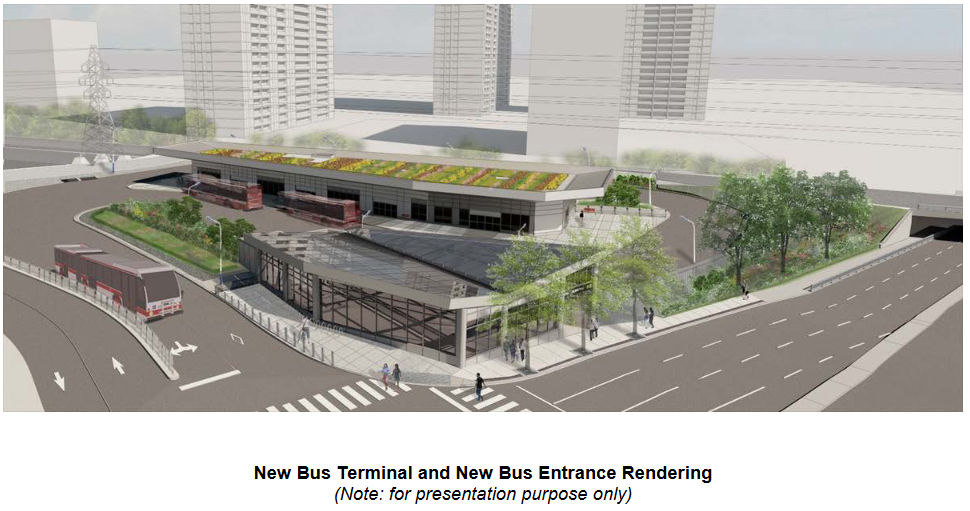
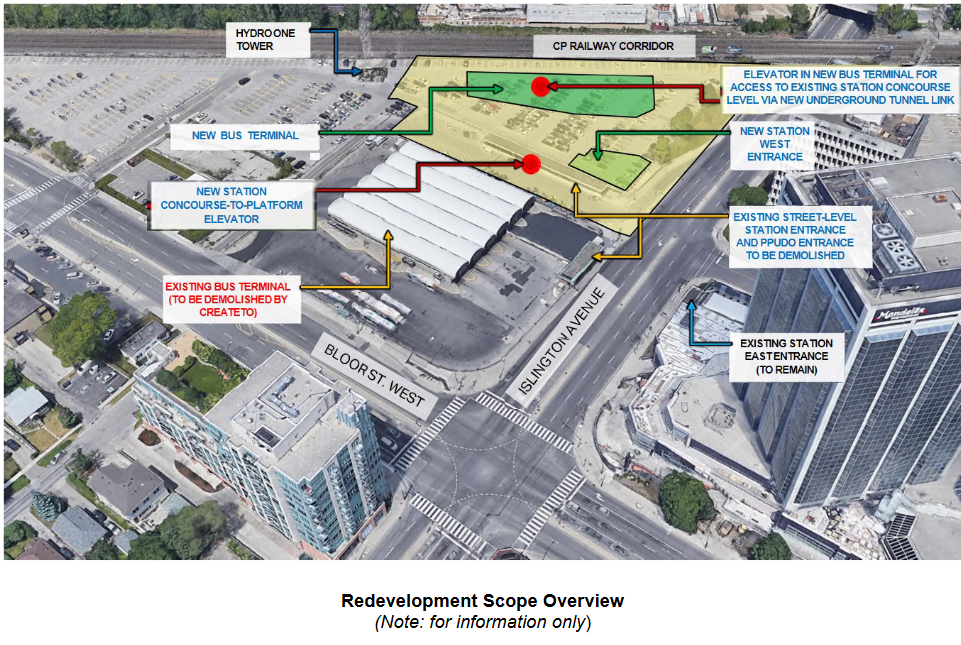
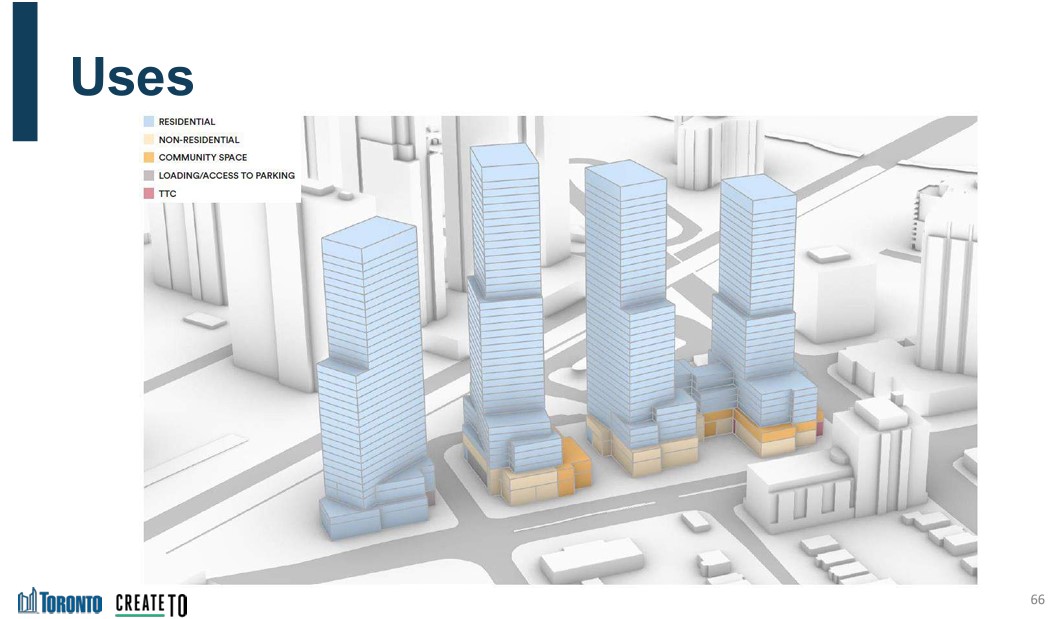
In 2021, a new plan to rebuild the station was presented to the public. It would include a new six-bay bus terminal in the commuter parking lot north of the existing terminal. Upon completion, the old bus area would be redeveloped under the city’s CreateTO housing program. Aberfoyle Crescent, which connects Islington Avenue and Bloor Street, would be extended through the station property to provide bus access and allow for development of the rest of the station property. The site is constrained by the same Hydro One corridor that stymied construction of the new Kipling terminal (much of the parking lot is under hydro wires), but this is a much smaller bus terminal, and hopefully lessons were learned this time.
Work on station construction was scheduled to begin in Spring 2023.
Rendering of new bus terminal and station entranceSchematic of the TTC station redevelopmentCreateTO development blocks at Bloor and Islington, from 2021 presentationCreate TO conceptual plan for Islington Station site
It is now mid-June 2023, and for now, there is no sign of work. Inside the station, there are no signs informing customers of impending construction, even if only to reassure passengers that the decrepit conditions are being addressed.
The many delays at Islington Station are also indictive of the difficulties of redeveloping even city-owned properties for new, much needed housing. It won’t be until 2026 — at the earliest — that new development can take place.
Until then, TTC customers must put up with a rapidly deteriorating station.
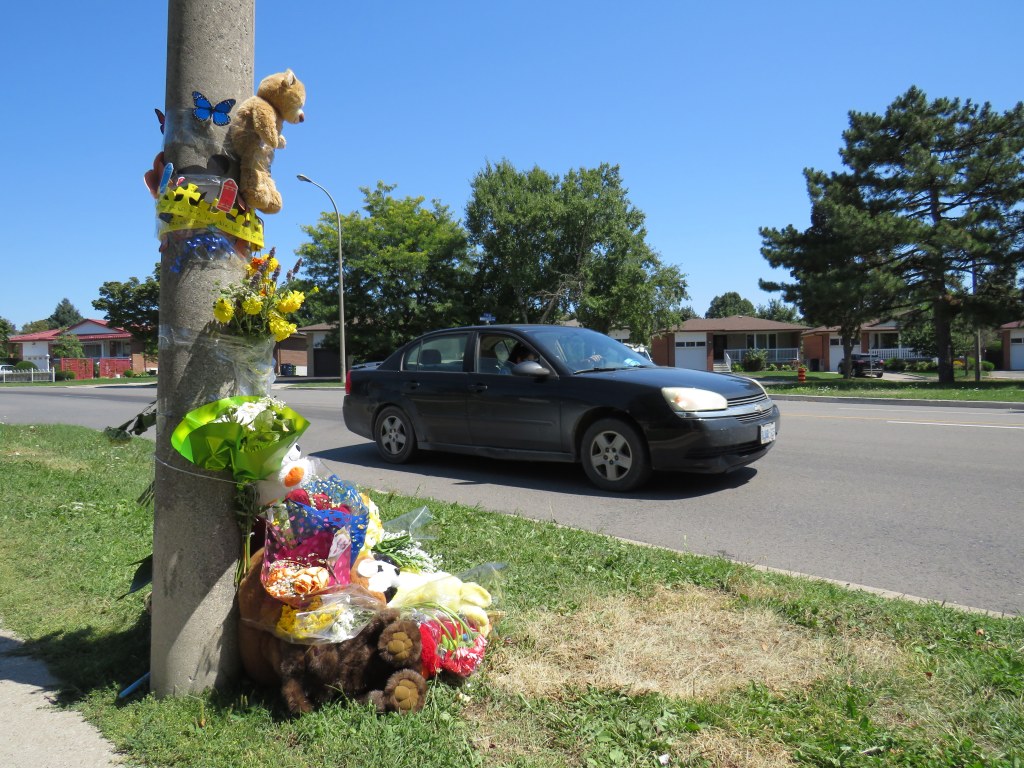
Roadside memorial to a three year old boy at The East Mall and Montebello Gardens, near Burnhamthorpe Road, Etobicoke
On Tuesday, August 11, just after 11AM, a father and his two children were attempting to cross The East Mall north of Burnhamthorpe Road. They were crossing from the west side of the minor arterial street, where there is the main entrance to a long term care home, to the corner of Montebello Gardens, a short residential street on the east side.
As the three pedestrians were crossing, an 81-year-old woman driving a black SUV turned left from Montebello Gardens to go south on The East Mall, crashing directly into the family.
All three pedestrians were rushed to hospital. A three-year-old boy was soon pronounced dead, while a seven-year-old girl was taken to a trauma centre. The driver remained on scene. It is not certain if charges will be laid.
The three-year-old’s death came only a day after the Toronto Star’s Ben Spurr reported that 2020 has been the safest year for pedestrians and cyclists since at least 2007. There were 63 collisions resulting in serious injury or death in the period from January 1 through July 1, down from an average of 99. The decline can be explained by considerably reduced traffic since COVID-19 lockdowns began in mid March, and by fewer pedestrians on city streets.
As traffic picks up with the loosening of restrictions and as people go out for strolls and exercise for physical and mental health, the need for improved road safety and a commitment for real Vision Zero implementation, especially in Toronto’s suburbs, remains crucial. The area near where the young boy was killed last week just shows how much further we need to go.
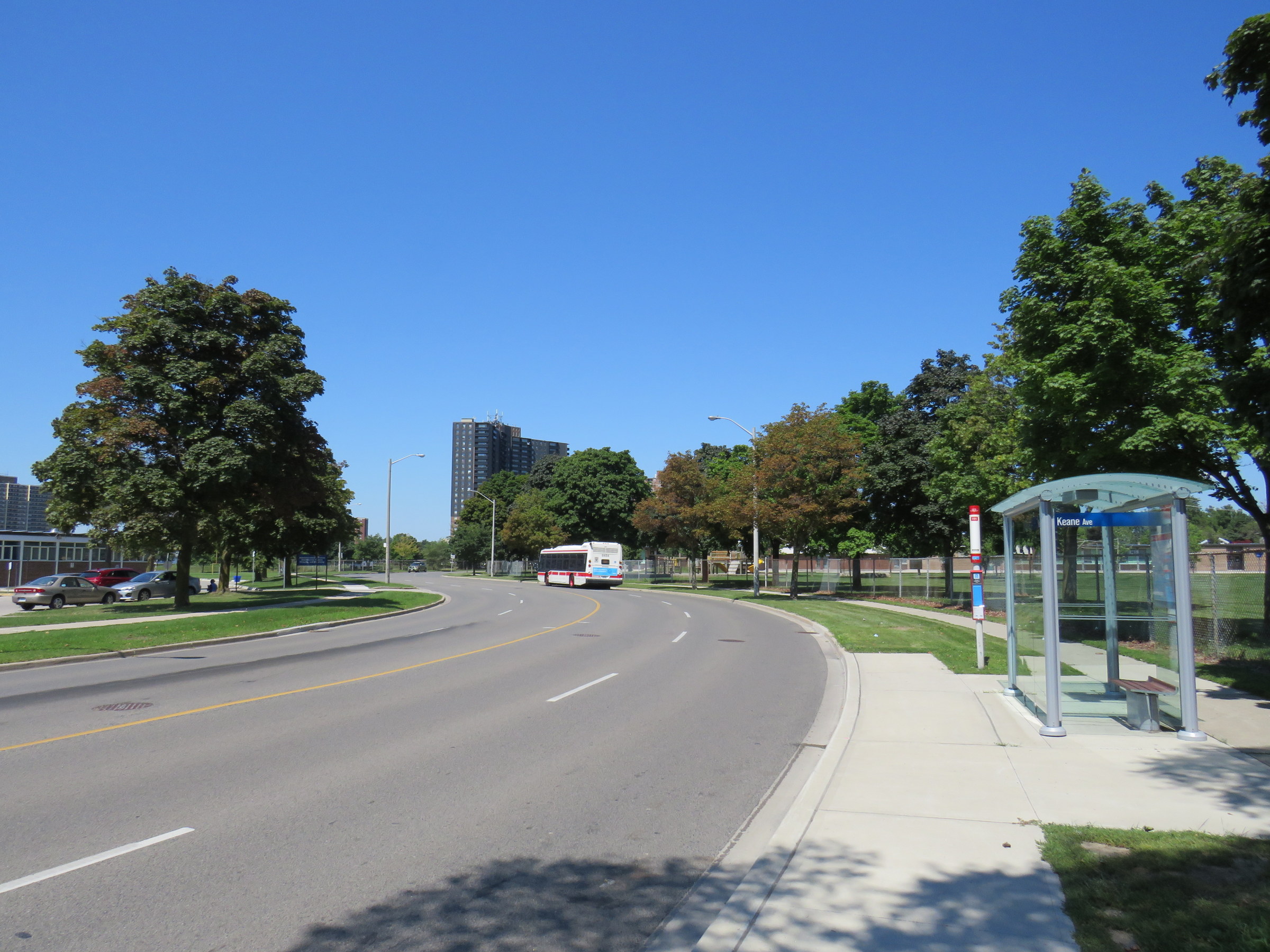
TTC bus stop on The East Mall, north of Keene Avenue
I visited The East Mall on a sunny Friday afternoon. I took the 111 East Mall bus from Kipling Station to Keane Avenue, the first stop north of Burnhamthorpe Road. The bus stop has a nice, clean shelter and a large concrete pad, but no where safe to cross the street. On the other side, there is a southbound stop for buses heading towards Cloverdale Mall and the subway, and Burnhamthorpe Collegiate Institute, a high school specializing in programs for mature students and adult learners.
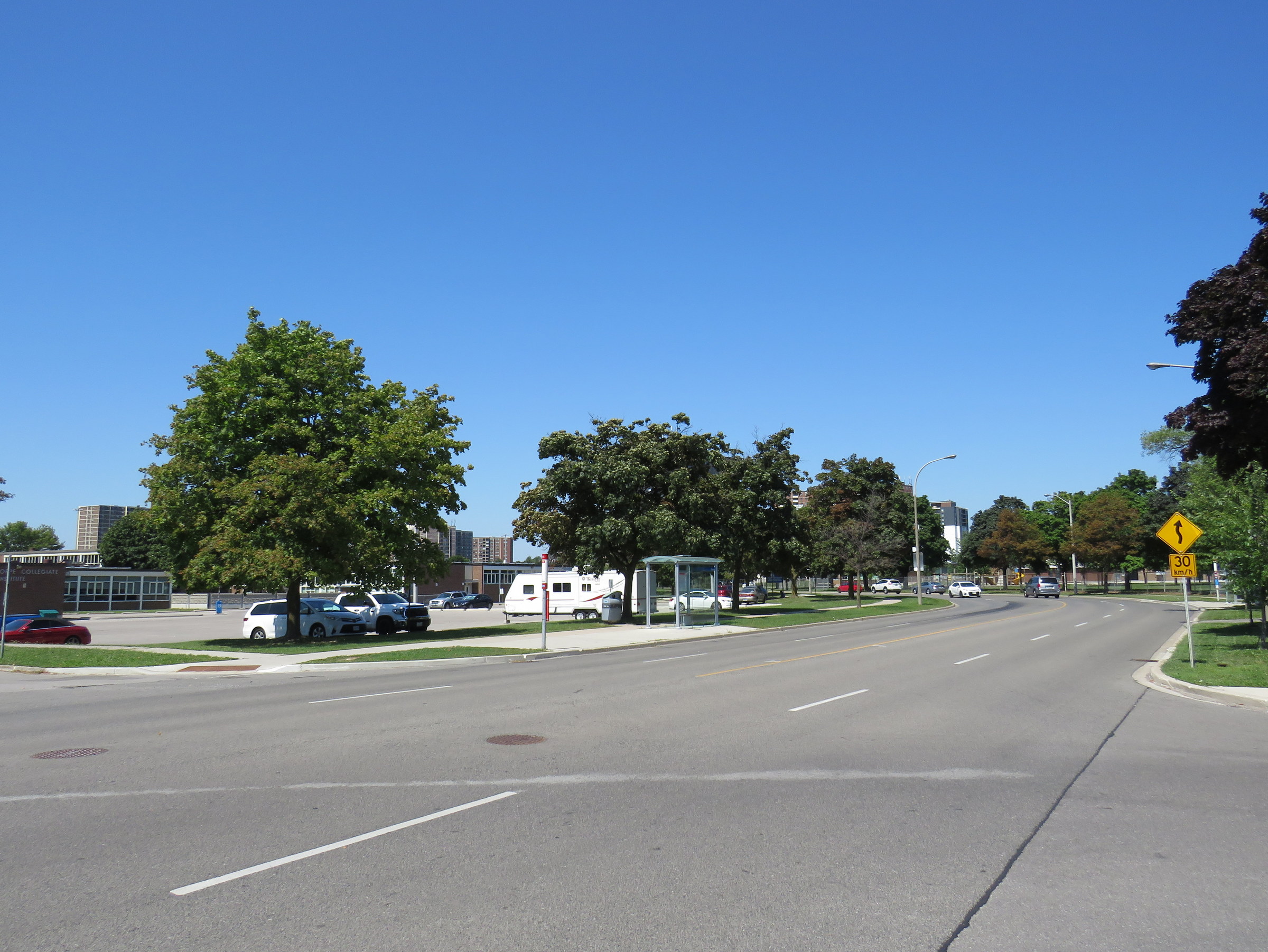
The intersection of The East Mall and Keene Avenue, looking north. Burnhamthorpe CI is behind the southbound bus stop A sign warns drivers of a winding road, with an advisory speed of 30 km/h.
A signalized pedestrian crossover exists further north, in front of West Glen Junior Public School, but the next TTC stop, at Capri Road, is at yet another unsignalized intersection. The distance between Burnhamthorpe Road to the south, and the pedestrian crossover is over 550 metres, and neither designated crossing is visible from Keene Avenue nor Montebello Gardens due to the winding nature of The East Mall.
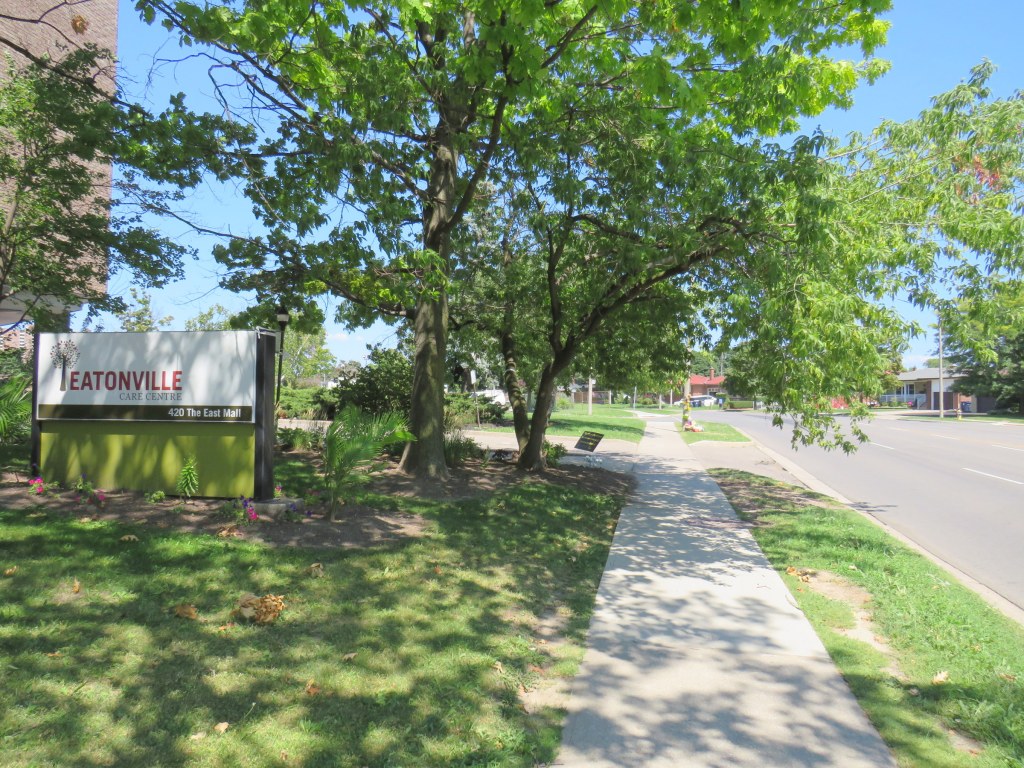
This part of Toronto has seen plenty of tragedy this year. The Eatonville Care Centre was one of several long term care homes where the Canadian Armed Forces were deployed due to deadly outbreaks of COVID-19 amidst poor working and sanitary conditions documented by CAF medical staff. Forty-two residents died during that outbreak.
Eatonville Care Centre, with the roadside memorial in the background
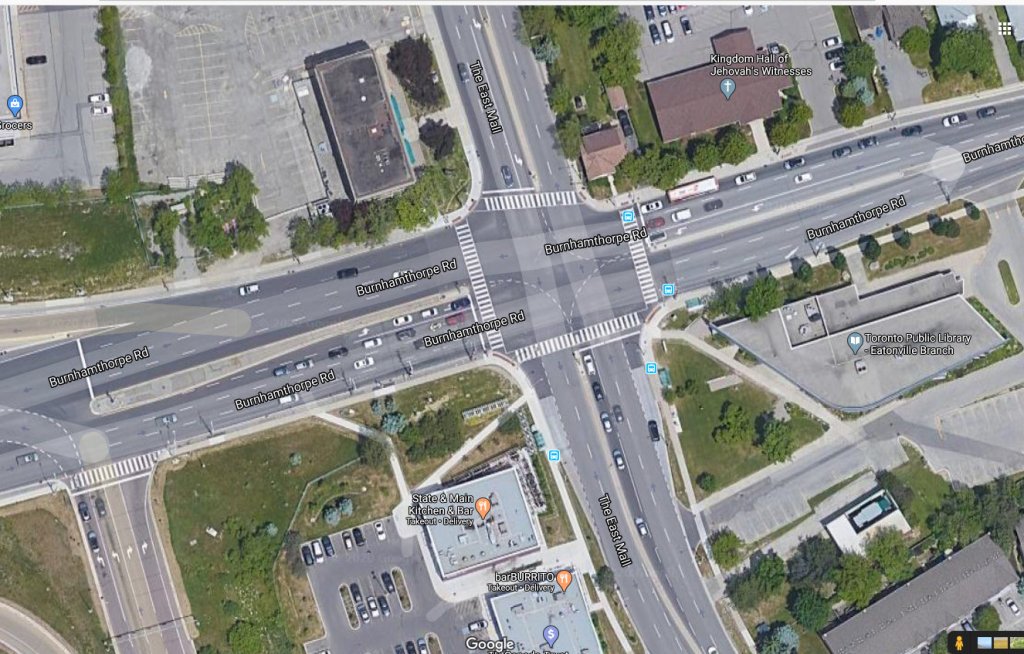
The presence of a long term care home, a library branch at the southeast corner of The East Mall and Burnhamthorpe Road, two nearby schools, and a large Loblaws supermarket and pharmacy on the southwest corner should have made this area a priority for improved, safer road infrastructure. Speeds along The East Mall are much higher than the posted 40 km/h limit, while the winding, roadway limits both drivers’ and pedestrians’ fields of vision. There should be no excuse for such long distances between safe pedestrian crossings, especially with the vulnerable populations living in this area.
Though the driver who killed the three-year-old boy was carelessly turning from a side street, and not speeding along The East Mall, another tragedy is inevitable without significant changes. Meanwhile, The East Mall is similarly laid out south of Burnhamthorpe, where there are older rental towers and townhomes and new condominium towers going in, yet nothing is done to calm traffic along a winding, busy street.
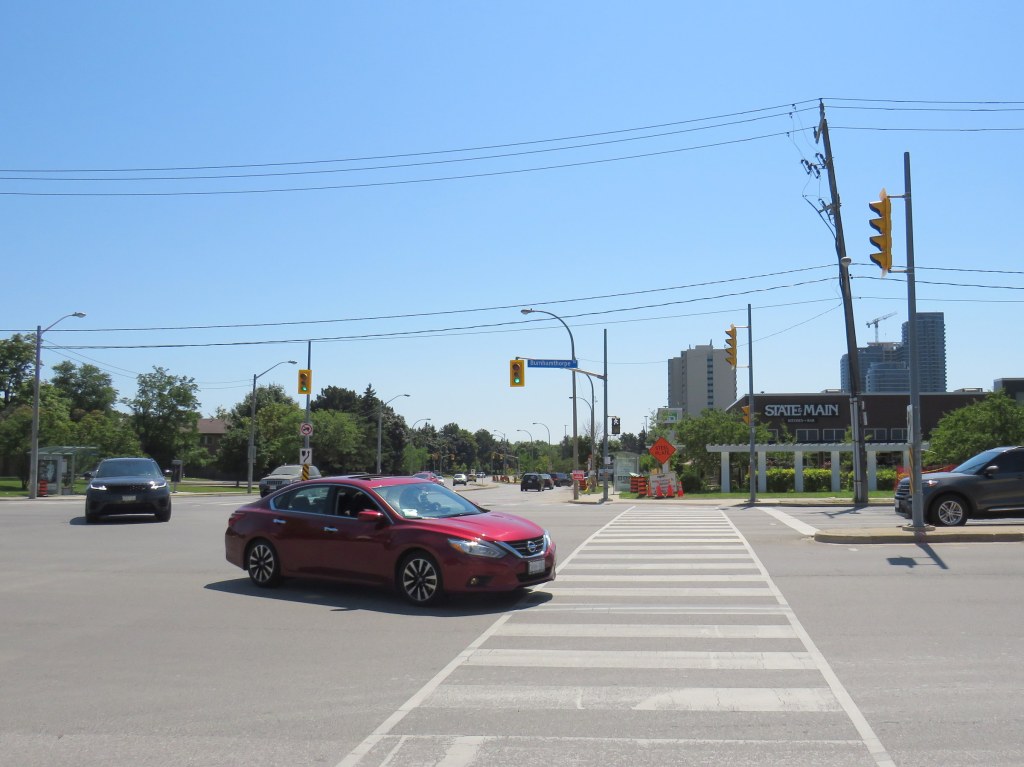
Though the intersection of The East Mall and Burnhamthorpe Road is signalized, it is also a dangerous intersection to cross. Burnhampthorpe Road widens to four westbound lanes leading towards Highway 427, while wide turning radii make it easy for motorists to turn right at all four corners. Drivers, rushing on and off Highway 427 take little notice or care for pedestrians, as I experienced trying to cross the street.
An Uber/Lyft driver in a red Nissan sedan and a Land Rover SUV driver turn left from The East Mall to Burnhamthorpe Road towards Highway 427 after the advance green signal disappears and the walk signal turns on, with me starting my crossing
While motorists are treated to generous geometries and easy turns, pedestrians are only an afterthought, despite the library, supermarket, offices, and several bus stops used by TTC and Mississauga bus routes. Meanwhile, a new townhouse complex on the northwest corner will add even more pedestrians to this area.
The intersection of Burnhamthorpe and The East Mall encourages high speeds, with pedestrians only an afterthought
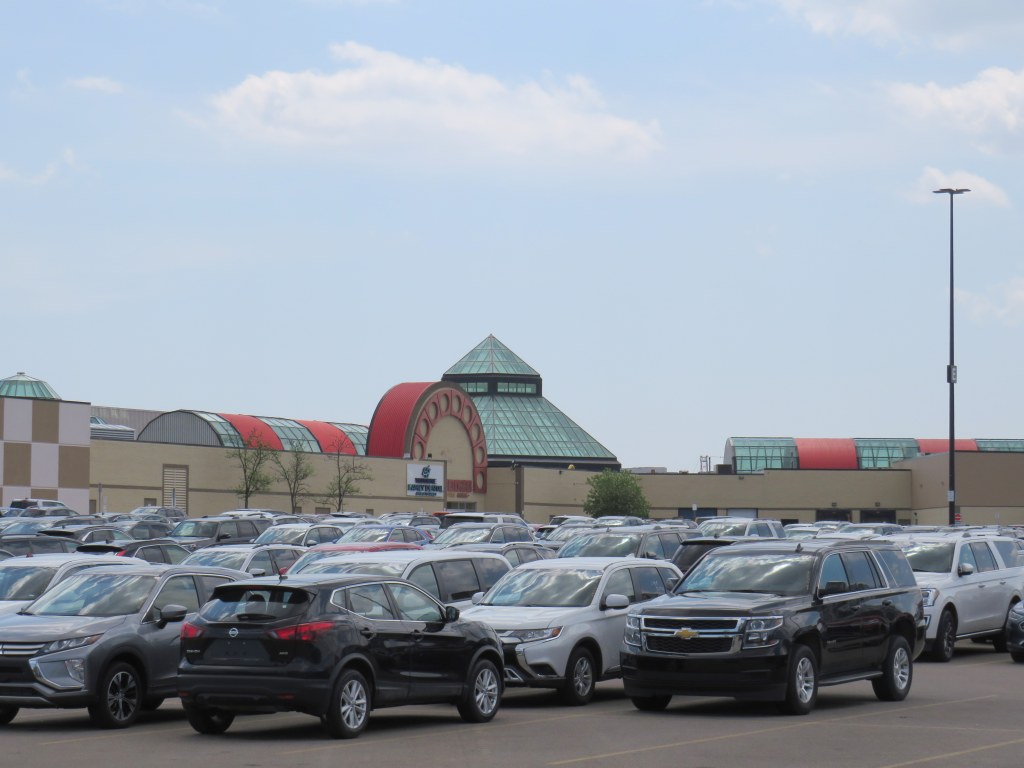
Un-plated rental cars stored in the Woodbine Centre parking lot
In a distant corner of Woodbine Centre’s parking lot, dozens of late model cars and trucks sit with their licence plates removed. These are all rental cars, left idle due to the collapse of demand during the ongoing COVID-19 pandemic. Friday, Hertz — the United States’ second-largest car rental company — filed for bankruptcy. Hertz’s brands include Dollar and Thrifty.
Woodbine Centre, a once-vibrant mall in northwest Toronto is a short drive from Toronto-Pearson International Airport, making it an ideal place to store the suddenly surplus fleets. Though in the 1980s and 1990s, Woodbine boasted cinemas, two-full line department stores, Zellers, and dozens of national chain stores, it has lost most of its cachet, with both Sears and Zellers gone, and Hudson’s Bay barely hanging on. Its parking lot was typically half-empty in recent years.
Though the demand for rental cars, especially at the airport, have dried up, many neighbourhood car rental branches remain open, offering attractive rates for daily and weekly rentals. I have taken advantage of the low prices right now (often as cheap as $25 a day on a multi-day rental) to run errands, go for short drives, conduct some field research for future articles and projects, and visit nearby provincial parks and regional forests for physically-distant nature hikes. I am also able to help family members by delivering groceries and medications. With the surplus of available cars, upgrades from the intermediate or standard car booking can be expected. (I was given a Mercedes-Benz E-class a few weeks ago, though I had booked a standard sedan.)
Though we live downtown, my partner and I prefer to shop at a Chinese grocery store in Scarborough, which is calmer, better organized, and better stocked than our local stores (flour, rice, and meat are plentiful). Having a car makes it easy to carry a large load, reducing the number of grocery trips required.
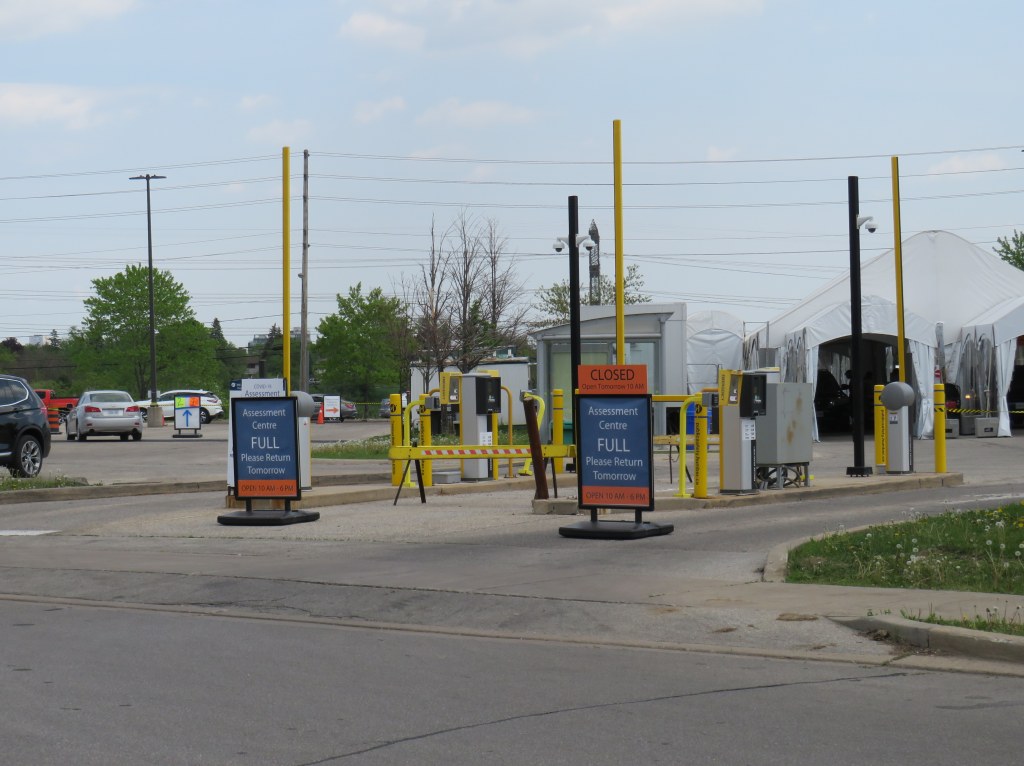
Across the street from Woodbine Centre, in another parking lot, there is another sign of the times: an overflow lot for Humber College has been transformed into a drive-through COVID-19 assessment centre. At 12:30 on Monday, May 25, the centre, which is normally open daily from 10:00 AM to 6:00 PM, was already full, and not accepting any more patients who were looking to be tested.
While Premier Doug Ford urged anyone worried about having COVID-19 or being in contact with anyone with it last Sunday, it’s not surprising to see the huge demand. While the change in eligibility is good news, it is troubling that actually getting tested may take so long.
Full COVID-19 assessment centre in North Etobicoke
In 2018, Etobicoke went three for three in returning hard-line conservative councillors to City Hall. In Ward 3, Mark Grimes was re-elected despite several controversies, with Mayor John Tory’s help. In Ward 1 and Ward 2, councillors with famous names were re-elected, cementing local political legacies. While the results in Ward 1 Etobicoke North were predictable, the results in Ward 2 Etobicoke Centre were disappointing.
Under the previous 44 wards and the approved 47-ward model, Etobicoke had six seats on Toronto City Council. With the 25 wards forced on the city when Bill 5 came into law, they were reduced to three.
Ward 1 — Etobicoke North
Prior to the new ward boundaries coming into effect, old Ward 1 was represented by Vincent Crisanti. Ward 1 sits in the far northwestern part of Toronto, bounded by Steeles Avenue and Highway 427, as well as the West Humber River to the south and the East Humber River. Its boundaries would not have changed in the 47-ward model.
Crisanti was first elected in 2010, defeating incumbent centrist Suzan Hall. Crisanti was a reliable ally during the first few years of Rob Ford’s disastrous mayoralty. Despite this, he was named one of Tory’s four deputy mayors after the 2014 election. This lasted until September 2017 when Crisanti publicly backed Doug Ford’s plan to run against Tory again for mayor.
Ward 2 was the domain of the Ford family. Rob Ford was first elected there in 2000, and had made a name for himself both for his constituency work and for his outspoken behaviour at City Hall. Ford was on the lone side of many 44-1 votes while David Miller was mayor. He ran for mayor in 2010 and won after Miller decided against a third term; his brother, Doug, was elected in Rob’s place in Ward 2. Doug never had Rob’s personal touch. Instead his time as councillor was focused on enabling Rob’s self-destructive behaviour, creating distractions, and coming up with waterfront land schemes that helped to erode Rob Ford’s authority on council, two years before the crack scandal broke. Doug even declared that his under-served ward had too many libraries and expressed his eagerness to close them, starting a fight with Margaret Atwood.
Early in 2014, his work done, Doug Ford was ready to bow out. Rob and Doug’s 20-year-old nephew, Michael Stirpe, changed his last name to Ford, and registered to run in his uncles’ place. But in September 2014, Rob abandoned his bid for re-election for mayor due to his poor health and Doug ran instead. Michael withdrew in September 2014 to run for the local Toronto District School Board trustee position so Rob could run in his old ward. Rob won in Ward 2 easily, getting 58.8 percent of the vote, while Doug came in second place in the mayoral race.
Toronto would continue to be haunted by Doug Ford.
After Rob Ford’s death in March 2016, Michael Ford ran in a summer by-election, getting 70 percent of the vote, though only 9391 voters bothered to turn out. It was looking like Michael Ford would easily win again in 2018.
But then Doug Ford engineered a takeover of the Ontario Progressive Conservatives, won the June 2018 provincial election, and wrecked local democracy in Toronto by imposing cuts to city council to just 25 wards. Despite his loyalty, Vincent Crisanti was just one more victim.
Michael Ford was re-elected easily in the new combined Ward 1 with 42.3 percent of the vote, compared to Crisanti’s 34.3 percent. Other candidates such as Naiima Farah and Carol Royer spoke to the need for political change in a ward where three-quarters of the population are visible minorities. The Toronto Star endorsed Royer, a local entrepreneur and community activist, but she placed fifth, with just over 2 percent of the vote. Farah came in third, but got just 9 percent of the vote.
Crisanti placed first in his old ward, getting 41 percent of the vote there while Michael Ford got 35 percent. In former Ward 2, Ford got over 50 percent of the vote compared to Crisanti’s 29 percent. Michael Ford had the support of his uncle; there were also over 2,000 more votes in the southern half of the ward. The result was not at all surprising.
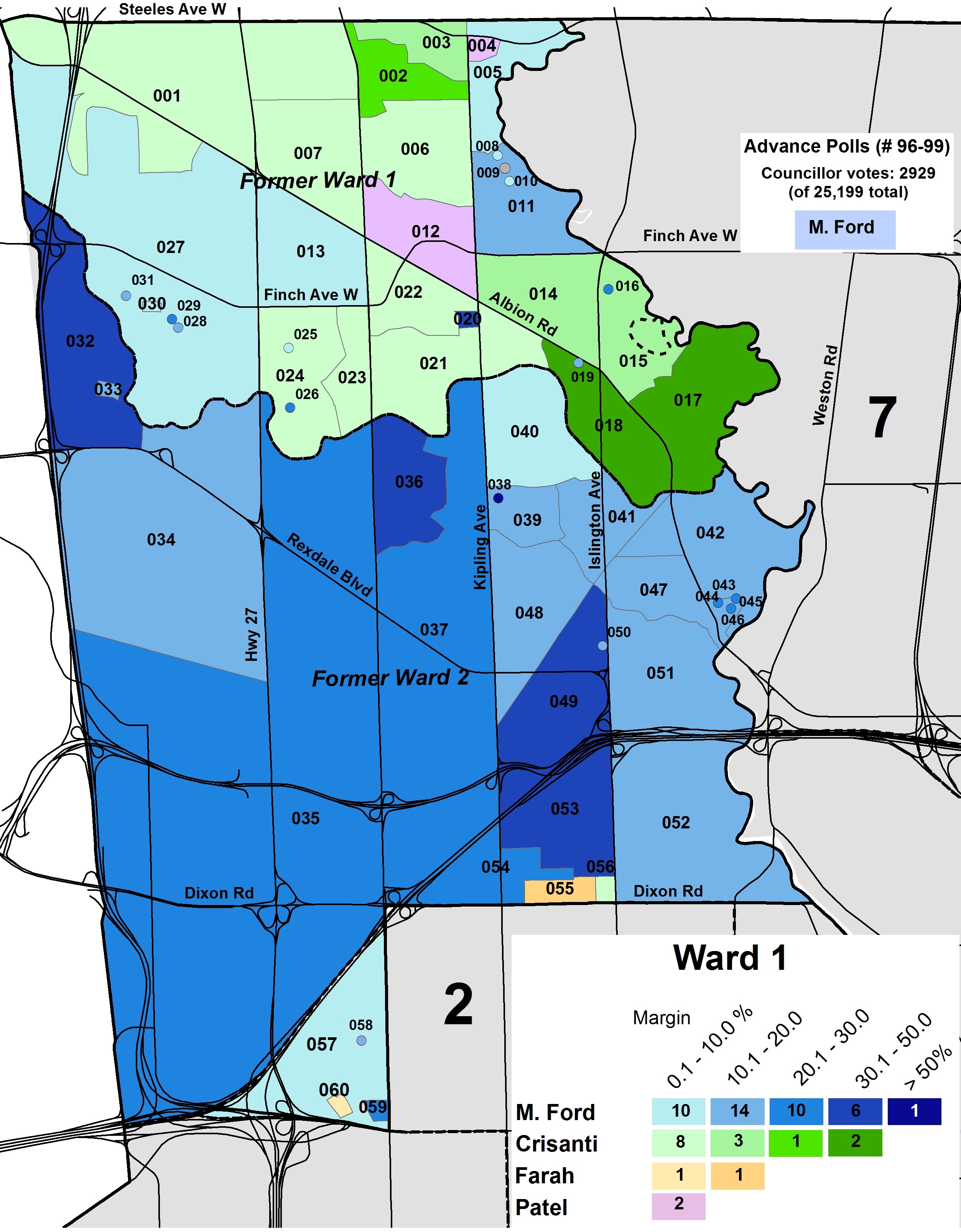
Farah placed first in two polls: Poll 055 on Dixon Road, and Poll 060, a highrise apartment near Eglinton Avenue and Martin Grove Road. Poll 055 is the home of many new immigrants, including a large Somali-Canadian community. Yet again, it was a shame that new voices, especially persons of colour, were shut out of this municipal election.
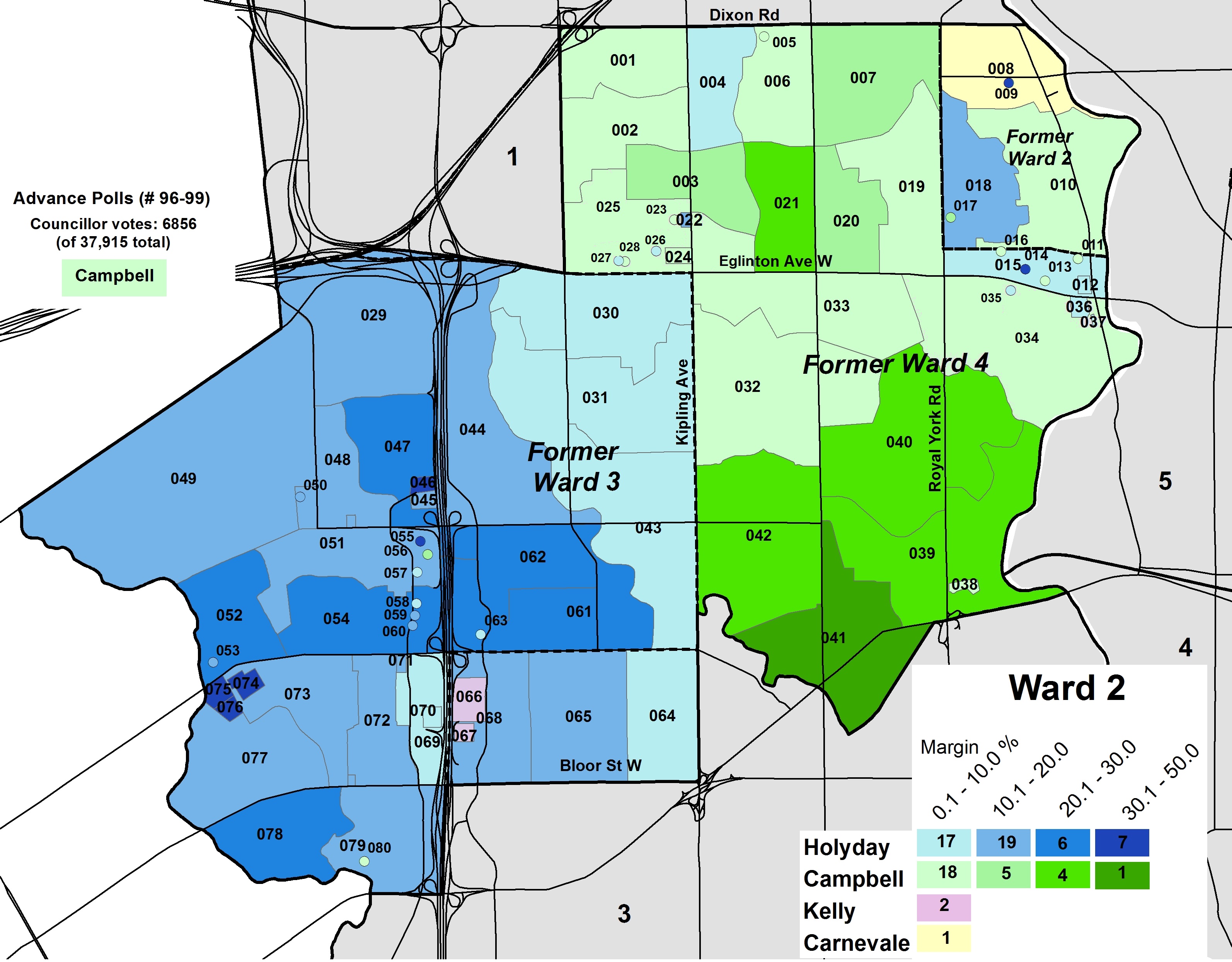
Poll-level results in Ward 1, Etobicoke North
Ward 2 — Etobicoke Centre
Bill 5 also resulted in the amalgamation of former Wards 3 and 4.
Ward 3 was represented by Stephen Holyday, the son of former Etobicoke mayor, Toronto councillor ,and one-time Ontario PC MPP Doug Holyday. The younger Holyday was first elected in 2014 and has been a reliable ally of John Tory, named one of Tory’s deputy mayors after Crisanti was stripped of the title in 2017. Along with Denzil Minnan-Wong, Holyday is one of council’s staunchest conservatives, as well as its most hostile to cyclists.
Ward 4 was represented by John Campbell, a former chair of the Toronto District School Board. While a conservative, Campbell has been a more reasoned voice on city council than his fellow Etobicoke colleagues. For this reason, Campbell was endorsed by the Toronto Star.
Also running were progressive candidate Erica Kelly, previously the NDP candidate in the provincial election, and Angelo Carnevale, who had the support of Doug Ford and Kinga Suma, the controversial Ford-backed PC MPP.
Several polls previously located in old Ward 4 shifted to new Ward 1, while five polls in old Ward 2 shifted to Etobicoke Centre. This gave a slight advantage to Holyday, who did not lose any of his former ward.
It was a close race, but Holyday won with 38.6 percent of the vote, while Campbell got 35.5 percent. Just 1186 votes separated the two incumbent candidates. Holyday was the first choice in all but two polls in former Ward 3 (two polls opted for Erica Kelly), while in former Ward 4, Holyday placed first in nine polls, Campbell placed first in just 28 election-day polls, but did well in the advance polls.
Carnevale, who placed third with 15.1 percent, came first in just one poll, in an area previously represented by the Ford family. But Carnevale, who registered to run against Campbell in the old 47-ward model, helped to take support from Campbell, getting 20 percent of the vote in Campbell’s old turf versus 11 percent in former Ward 3. That, and the fact that there were nearly 3000 more voters in old Ward 3 than in old Ward 4, help to explain how Holyday was returned to city hall.
Last week, Stephen Holyday was one of four suburban councillors named to the new striking committee that makes recommendations for council appointments to important committees, boards, and commissions. It’s quite clear that John Tory will be continuing an austerity agenda while shutting out urban councillors and progressives from decision making. Stephen Holyday will be an important part of that during the next four years.
Etobicoke-Lakeshore represents the southern third of Etobicoke, stretching from Dundas Street in the north to Lake Ontario in the south, encompassing the historic villages of Islington, Long Branch, New Toronto, and Mimico, as well as sprawling industrial areas and post-war subdivisions. It also includes the rapidly growing high-rise communities of Humber Bay Shores and Six Points.
In 2014, Etobicoke-Lakeshore elected two city councillors, veteran Mark Grimes in Ward 6, south of the Gardiner Expressway, and a new councilor, Justin Di Ciano, in the north half. The pair are friends and were close allies on council prior to the 2018 election.
For many years, Ward 5, located north of the Gardiner Expressway, was represented by Peter Milczyn. Milczyn, an architect by training, was a thoughtful centrist on Toronto City Council. In Spring 2014, Milczyn, a Liberal, was elected to the provincial legislature. James Maloney (elected as a Liberal MP in the 2015 federal election) was appointed by council as a caretaker representative until the Fall 2014 election, which was won by Justin Di Ciano.
Di Ciano, a real estate executive, won Ward 5 with 54.1 percent of of the vote in 2014 and placed first in all but two polls. Nobody knew it at the time, but the 2014 election was the start of Justin Di Ciano’s problems.
Meanwhile, in Ward 6, incumbent councillor Mark Grimes was re-elected in 2014 with 43.6 percent of the vote. Grimes was challenged by community leader Russ Ford (who got 34.1 percent of the vote) and former Toronto Police spokesperson Tony Vella (who got 10.5 percent of the vote). Russ Ford had a strong campaign, but Grimes’ incumbency, and John Tory’s late endorsement and robocalls, gave the sitting councillor the advantage.
During the last term of council, both Di Ciano and Grimes came under increasing scrutiny by the press and the Ontario Provincial Police. Both councillors backed a controversial residential development adjoining GO Transit’s Willowbrook yards and maintenance centre despite Metrolinx’s objections.
Under mayors Ford and Tory, Mark Grimes was the appointed chair of Exhibition Place, the board that controls the city-owned waterfront land where the Canadian National Exhibition is held. The CNE, a separate entity, is a tenant of Exhibition Place. Other important tenants include a hotel, two convention centres (Beanfield Centre and Enercare Centre), Medieval Times, and Maple Leaf Sports and Entertainment. Three MLSE teams — the Toronto Argonauts, Toronto FC, and the Marlies play at Exhibition Place, while the Raptors (also a MLSE property) have their training centre on the lands. Exhibition Place is also the home of Muzik, a controversial nightclub supported by Grimes and fellow councillor Giorgio Mammoliti.
Workers represented by the International Association of Theatrical Stage Employees (IATSE) had been locked out by Exhibition Place for months. Last week, IATSE members, who provide technical and staging work for all Exhibition Place events and venues, agreed to a long-overdue contract from the city and are finally going back to work. The union had to take concessions, and claims the lockout was a “union-busting attempt.”
Di Ciano also became notable as council’s most vocal opponent of ranked ballots, getting city council to vote against adopting them in future elections. Di Ciano also strongly opposed the new 47 ward boundaries, decided after years of planning and consultation; he became a major cheerleader for Doug Ford’s Bill 5.
In the end, though, Councillor Di Ciano decided not to run for re-election. His executive assistant, Mary Campbell, registered in Ward 5 instead. Also running in Ward 5 was Pamela Gough, a long-time local Toronto District School Board trustee. As a school trustee, Gough was especially concerned with traffic and road safety.
In Ward 6, challengers to Mark Grimes included Amber Morley and Iain Davis. Morley, like Russ Ford, worked at the LAMP Community Heath Centre and in Ward 4 Councillor John Campbell’s office. Iain Davis is the son of former TDSB chair Bruce Davis; he ran on a centre-right platform.
With the 25 wards confirmed, Grimes, Morley, Gough, and Davis re-registered in Ward 3. Mary Campbell withdrew her nomination, perhaps to avoid a vote split with Grimes.
The Toronto Star, Progress Toronto and the Toronto and District Labour Council backed Morley. Not only did Morley offer the most progressive platform, she also had the best chance of defeating Grimes. It would have been great to see another younger woman of colour elected to a council that is disproportionately white and male.
But yet again, Mayor Tory endorsed Grimes and robocalled on his behalf, citing Grimes’ “determination and experience”. It didn’t matter that Grimes was called out by Toronto’s integrity commissioner or that he was under OPP investigation. It was clear that Tory wanted Grimes back on council.
Thanks partly to Tory’s support, Grimes won, with 40.9 percent of the vote. Morley came in second with 27.2 percent and Gough placed third, with 18.1 percent. Grimes placed first in both former Wards 5 and 6, though with a larger percentage of the vote in the old Ward 5, south of the Gardiner Expressway.
Morley did the best in the southern most part of Ward 3, south of the GO Transit railway in New Toronto and Mimico. She also did well in Humber Bay Shores and the Six Points area. Grimes did best in Alderwood and in polls in the exclusive Palace Pier condos at the mouth of the Humber River. Pamela Gough placed first in six polls, all near the Bloor Street and Royal York Road intersection.
On November 15, 2018, less than a month after the election, the OPP charged Di Ciano and Grimes with campaign finance violations. It is alleged that Grimes and Di Ciano benefited from research and polling work paid for by Dunpar during the 2014 election. If convicted, Di Ciano and Grimes could face a fine up to $25,000, and could also be forced from office or barred from running in future municipal elections.
What’s puzzling is why Tory endorsed Grimes, whose reputation was well known among City Hall watchers. Perhaps it had something to do with the Exhibition Place lockout. Or maybe Tory just wanted a reliable right-wing vote on a smaller council.
Meanwhile, I hope Amber Morley considers another run. She was a great candidate and was able to prove her determination. With name recognition from her first run, she has a strong chance to finally take out Mark Grimes in 2022.
Earlier this year, Etobicoke Councillor Justin Di Ciano (Ward 5) pushed for a zoning change to several industrial properties on Judson Street, adjacent to GO Transit’s Willowbrook Yards. Local residents had enough with a concrete batching operation and Dunpar Homes applied to build a townhouse development on the site.
City staff recommended against the rezoning, which would allow townhouses to go up on land previously zoned as industrial. Metrolinx, GO Transit’s parent organization, also spoke out against the re-zoning, warning that it could impact its expansion plans, including GO RER/SmartTrack. But Councillor Di Ciano, Mayor John Tory, and most of the mayor’s allies voted against those concerns and supported the redevelopment.
Now Metrolinx is appealing the council decision to the Ontario Municipal Board, and the City will be forced to hire external expert advice, as it went against its staff recommendations.