Metrolinx construction on Finch Avenue East in Scarborough
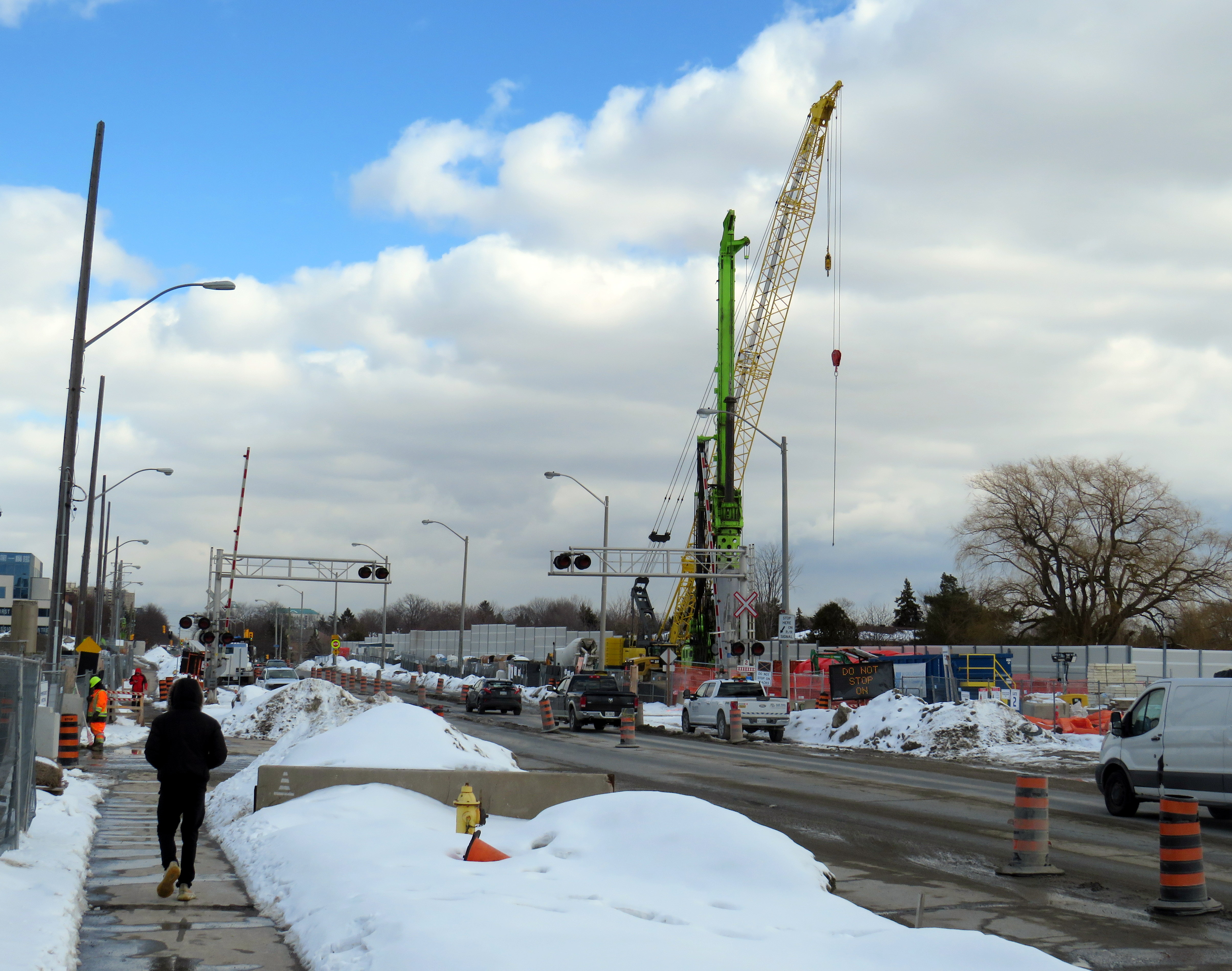
On Finch Avenue East in Scarborough, where the busy roadway meets the GO Stouffville Line, one will encounter a major construction project. Cranes and pile drivers line the railway crossing, with dozens of construction workers busy building a new grade separation between the rails and roadway. Once complete, the underpass will allow Finch Avenue traffic to pass unimpeded by more frequent GO train service and provide additional safety to all road users.
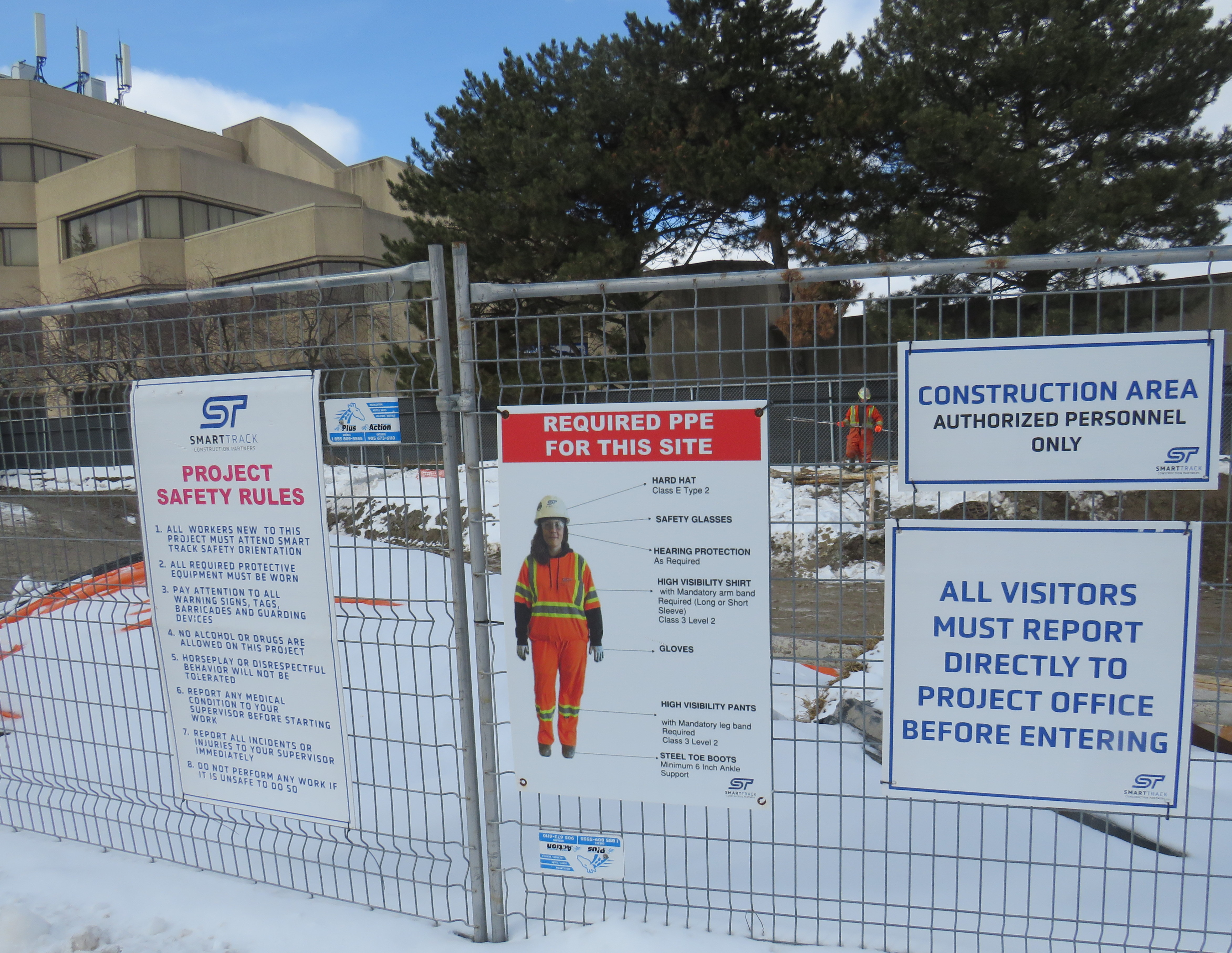
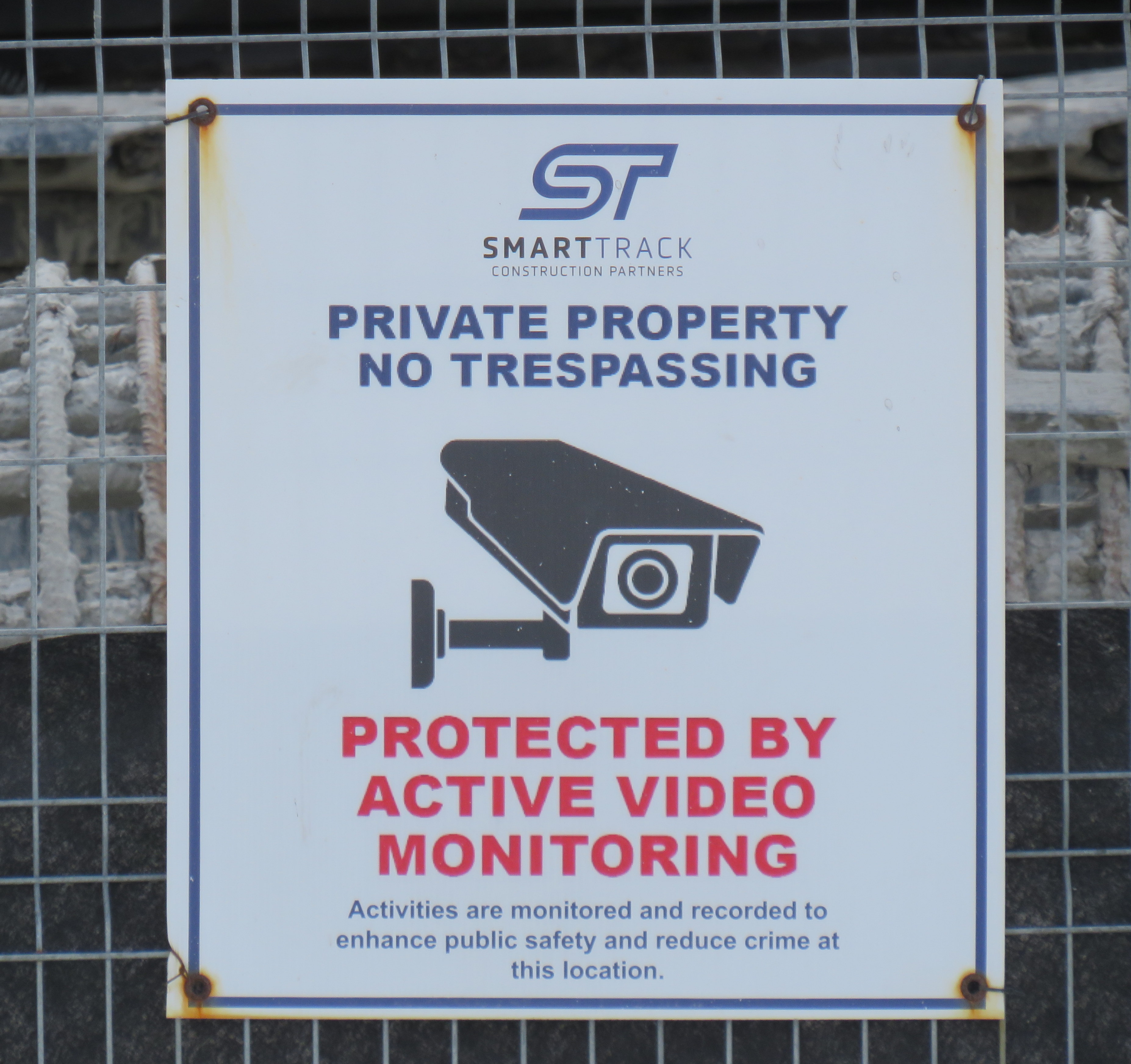
But the overpass was meant to be much more than just a rail bridge. A clue can be found in the construction site signage. Though the construction equipment is all marked for Green Infrastructure Partners (GIP), GIP is part of a project-specific consortium called “SmartTrack Construction Partners” or STCP, noted in a 2024 City of Toronto progress report. The SmartTrack name is interesting, as this was also going to be a site of a so-called SmartTrack station.
Construction site signageCloseup of another site sign, with the “SmartTrack Construction Partners” name and logo clearly displayed
The Finch-Kennedy GO Station became part of a five-stop remnant of the SmartTrack concept, a “surface rail subway” promoted as part of John Tory’s 2014 successful mayoral campaign and subsequently made part of city policy, even maintaining the brand name. As I have written extensivelyabout the troubled proposaland failed implementation of SmartTrack on this website, I will not go into any detail. But SmartTrack promised the construction of 13 entirely new regional rail stations augmenting 9 existing or committed GO stations on the Stouffville and Kitchener corridors, including a new rail branch on Eglinton Avenue West to Mississauga. One of those stations was to be at Finch Avenue East.
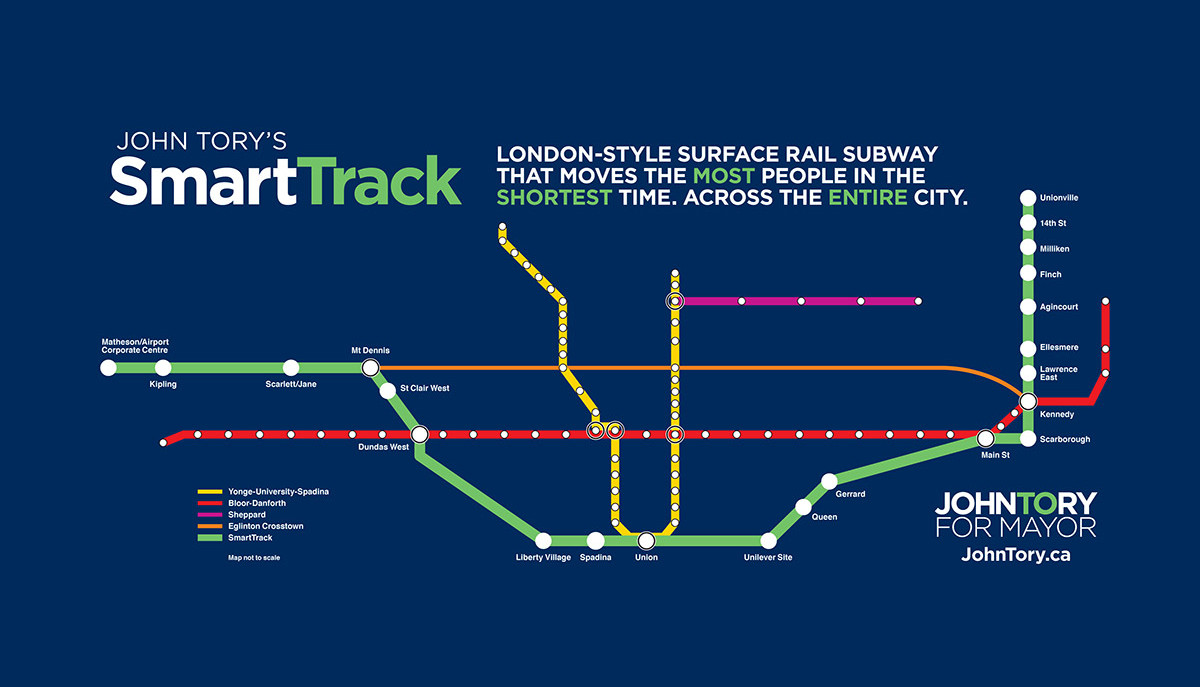
“John Tory’s SmartTrack,” depicting what the “London-style” transit service would look like, from Tory’s 2014 campaign
Since 2015, the SmartTrack concept began to shrink as the difficulty of building a regional rail line on Eglinton West became clear and as other transit projects came forward. The Ontario Line, now under construction, fills the downtown subway relief function that SmartTrack promised. The tunneled western extension of Line 5 from Mount Dennis to Renforth replaces the problematic western section of Tory’s proposal. Furthermore, GO Expansion would transform much of the GO rail network into a more frequent, all-day service on five of its seven lines would provide more service to more stations than SmartTrack ever could. (Unfortunately, Metrolinx is dragging its heels on GO’s transformation.) Even better, all these projects were promoted and funded by the province, while SmartTrack was a municipal effort.
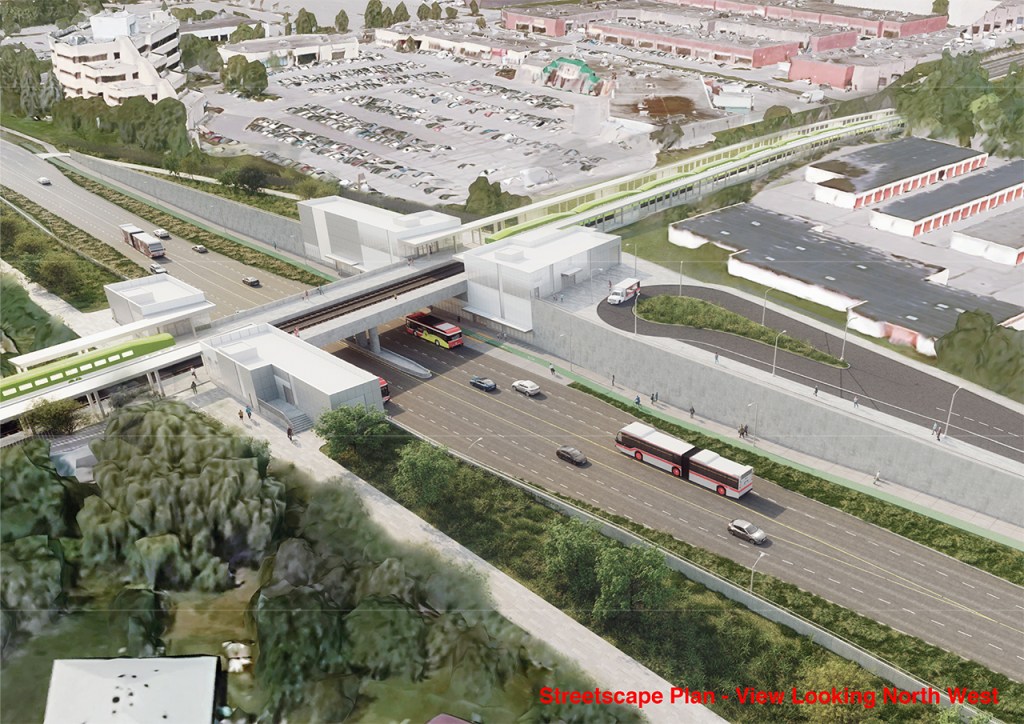
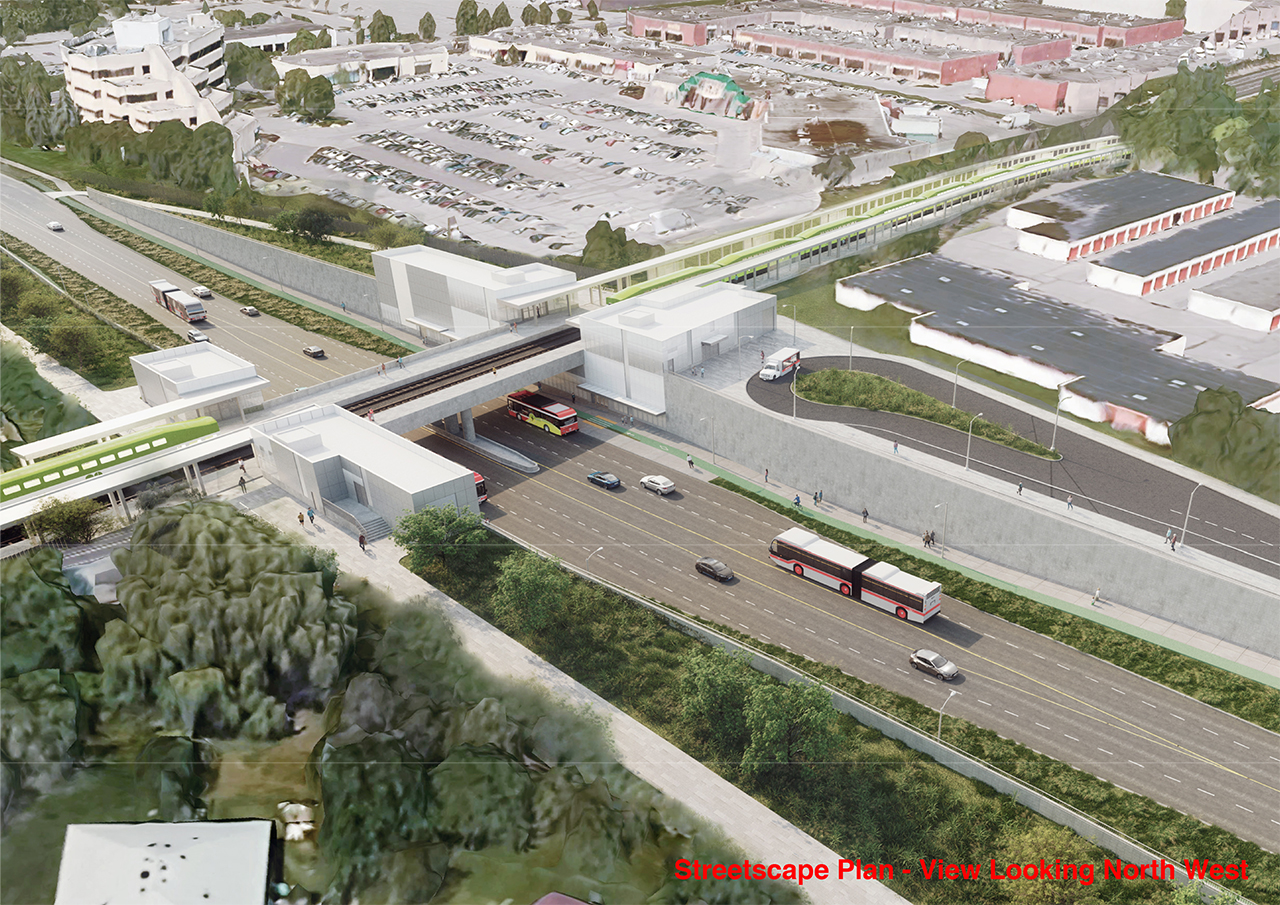
But Finch SmartTrack Station, referred to in official planning materials as “Finch-Kennedy,” survived a whole decade, one of four remaining city-funded SmartTrack-branded stops from that early campaign map (a fifth stop was later added to the Barrie GO Corridor, at Bloor Street). Even as a regular GO Transit stop, Finch-Kennedy would have been quite useful for Scarborough commuters as well as promote new mixed-use development in northeastern Toronto. Surrounding the site are commercial plazas and industrial malls, self-storage units, and low-density residential subdivisions. The streetscape plan of the station below illustrates the site’s surroundings.
As planned, Finch-Kennedy Station would have been a no-frills rapid transit stop, with two tracks and platforms that span the Finch Avenue overpass. Access between the street (with curbside bus stops) and platforms would have been easy and direct, with stairs and elevators connecting the two modes on both sides of the street. With more frequent GO service facilitated by the double track expansion of the corridor, and proposed electrification, the Stouffville Line would have been a really useful link between the frequent 39/939 bus route (the busiest bus corridor in Toronto) to Union Station, the transfers to Lines 2 and 5 at Kennedy Station, and to Markham to the north. There would be no parking on-site, but just an access driveway on the northeast corner for service vehicles.
Though GO could double track the Stouffville Corridor and run more frequent trains without the grade separation if no station was to be built at Finch, an underpass would be necessary if trains were going to decelerate, stop, and accelerate within a short proximity of Finch Avenue. Building the platforms on the bridge structure only makes transit connections easier.
Due to cost overruns, SmartTrack is down to just three stations, which are now in various stages of construction. Along with King-Liberty, Finch-Kennedy was dropped from the list in December 2024, even as construction on the first and most critical phase, the Finch underpass, was already underway. Earlier this week, the Toronto Star reported that nearly $100 million were spent on these two now-deferred stations. The cost of completing Finch-Kennedy had jumped by $130 million, to a total of almost $370 million.
Even though the station is deferred, heavy construction continues on Finch Avenue East. The SmartTrack name lives on through the firm tasked with finishing the grade separation intended to literally support the new transit connection. Presumably, the bridge will be built with provision for the transit station to be added later. But it will only be even more expensive to go back later and complete the job.
Meanwhile, after resigning in disgrace in Winter 2023, not long after his re-election, John Tory is rumoured to make another run for mayor against his replacement, Olivia Chow. Tory will have a lot to answer for if he chooses to run again; the tattered remains of his SmartTrack legacy should certainly be one of those questions.
Map of John Tory’s SmartTrack proposal, his signature campaign plank from the 2014 municipal election
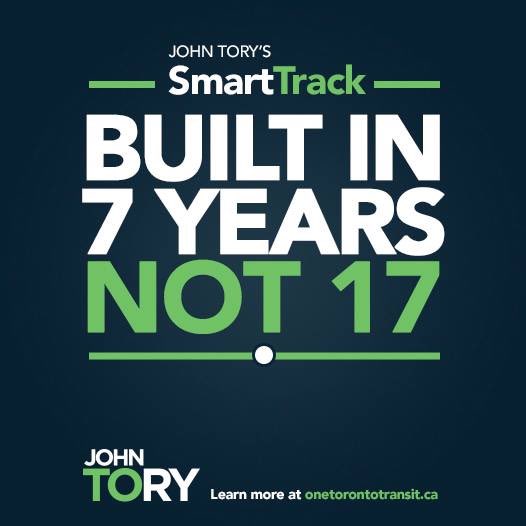
SmartTrack, the transit plan championed by former mayor John Tory in 2014, is the election promise that will never fully die, even if it was diminished from the promise of a brand-new 53-kilometre transit relief project to just a few new stations on existing GO Transit rail corridors. SmartTrack, as initially pitched, would have utilized existing rail and highway corridors to quickly build an express rapid transit line that would provide much-needed relief to the Yonge Subway line, foster development of the East Don Lands (former site of an Unilever soap factory), and connect downtown with employment lands in Markham and Mississauga. According to campaign materials, SmartTrack would have been built in just seven years.
Eleven years later, that relief is coming, but through other forms: the now under-construction Ontario Line, expansion of the Bloor-Yonge Subway station, and slow subway ridership recovery after the COVID-19 pandemic restrictions in 2020-2021. The Mount Dennis-Airport Corporate Centre section, nearly impossible to build as a continuous passenger rail line, is now being built as a tunneled extension of the Eglinton-Crosstown LRT.
Over a decade later, the legacy of SmartTrack, along with other major changes for the GO Transit Kitchener Line, will affect both GO operations and UP Express, Toronto’s airport rail link, which will be asked to do more despite existing constraints. Without rigorous planning, transparency from Metrolinx, and stakeholder input, the potential of Toronto’s northwest corridor as a high-quality local and regional transit project is in doubt. With significant investment and proper planning, the Kitchener Line could serve as a shining example of how to get things right.
The diminished legacy of SmartTrack
It’s possible that three “SmartTrack” stations might be completed in 17 years
The idea of a “London-style surface rail subway” for Toronto was, and remains, a laudable goal for our existing GO Transit rail corridors; this was the concept behind the GO Expansion project touted just a few years ago that would truly transform the system into a high-quality urban rail network. It would not only serve suburban municipalities like Markham, Brampton, and Mississauga, but also improve travel times to the inner suburbs such as Agincourt and Rexdale.
What SmartTrack got wrong was relying on a flawed report that had very specific aims, poor public buy-in, and an arrogant, yet ineffectual proponent who nevertheless managed to win re-election, twice. (He might run again in 2026.) It didn’t help that SmartTrack was a municipal idea that was not coordinated with the provincial planning process; it never really got off the ground, even if municipal planning staff were charged with implementing the proposal. Ideally, the city should have just pushed hard to advance GO expansion on multiple corridors and for fare integration with the TTC.
Despite years of inaction, five SmartTrack stations remain on the books, to be funded largely by the City of Toronto. This was a curious arrangement as the provincial government has taken responsibility for the costs of all other GO Transit expansion projects, along with subway and LRT extensions. The five stations the city committed to were:
East Harbour (Lakeshore East/Stouffville, with a connection with the Ontario Line)
Finch-Kennedy (Stouffville Line) and
Bloor-Lansdowne (Barrie Line, not on the old SmartTrack map)
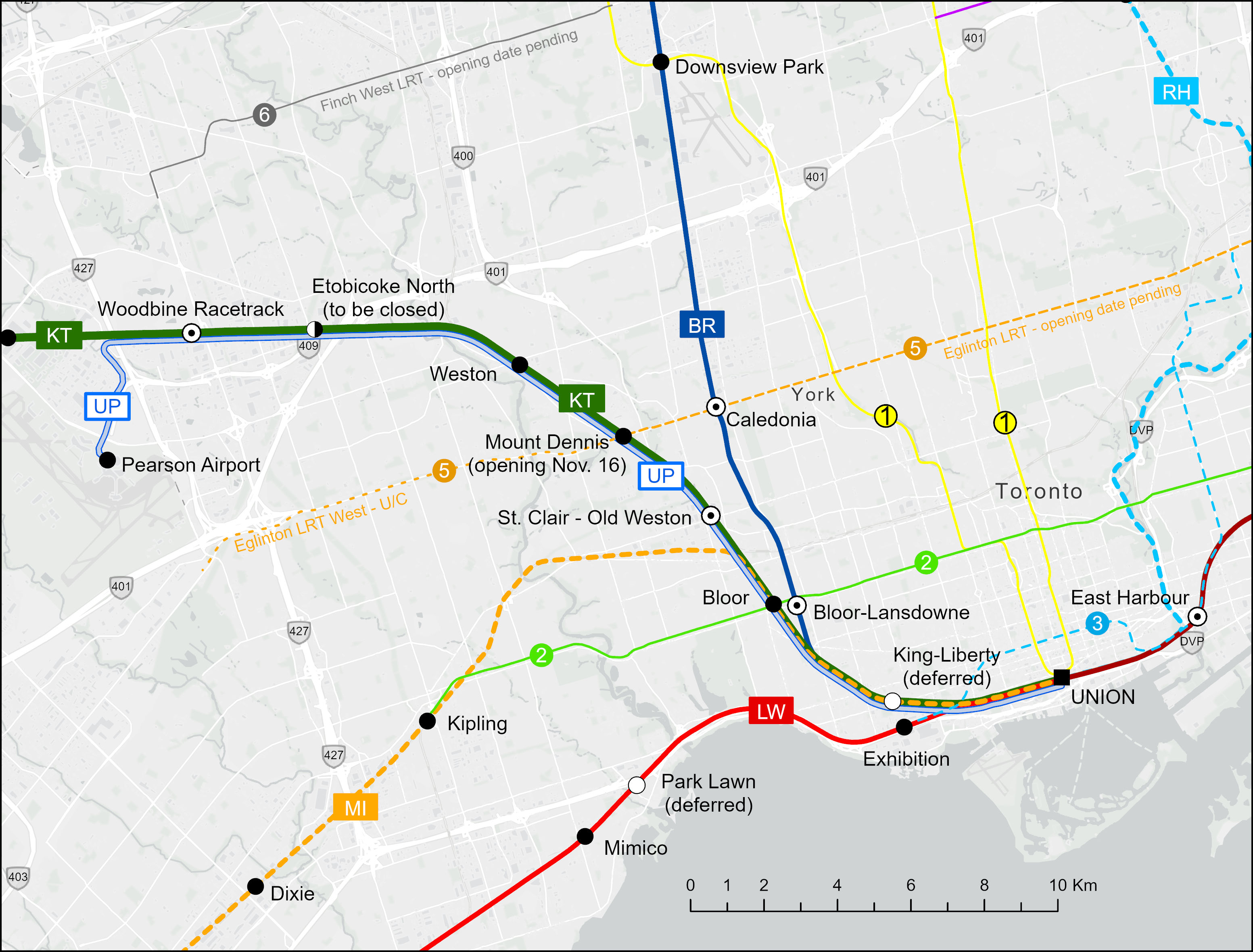
The King-Liberty and St. Clair-Old Weston stations, present in the original SmartTrack map, are on the inner portion of the busy Kitchener Line, which now hosts two-way, all-day service between Union and Bramalea Stations, as frequent as every 30 minutes weekdays. This section of track, known as the Weston Subdivision, also hosts UP Express (UPX) trains, which run every 15 minutes between Union and Pearson Airport, with stops at Bloor and Weston stations. It will also stop at Mount Dennis when that station opens in mid-November, connecting with the Crosstown LRT when that opens, likely in early 2026.
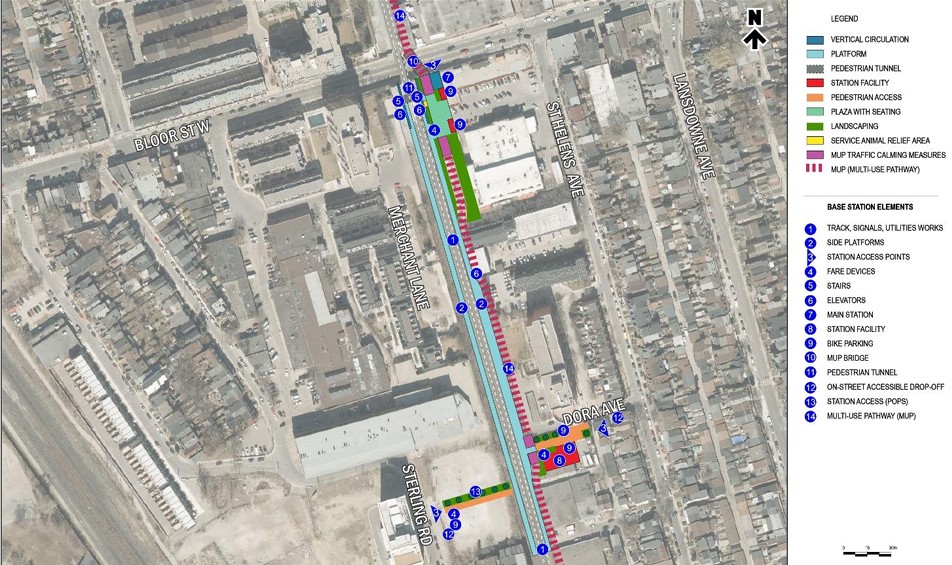
Bloor-Lansdowne is a curious “SmartTrack” legacy station, as it was not on the original proposed route. Located just east of Bloor GO Station on the Kitchener Line, the two-platform station would serve Barrie Line trains, with a walking connection to the TTC’s Lansdowne Station two blocks to the east. (See my supplementary post highlighting this transfer.) Unlike King-Liberty and Finch-Kennedy stations, Bloor-Lansdowne is going ahead as construction had already started in 2024.
Bloor-Lansdowne Station is two blocks west of Lansdowne Station and a 7-10 minute walk to the subway, which runs north of Bloor Street. From 2023 City of Toronto report.
Bloor-Lansdowne probably should not have been advanced, especially when King-Liberty or even Finch-Kennedy would be more useful new stations.
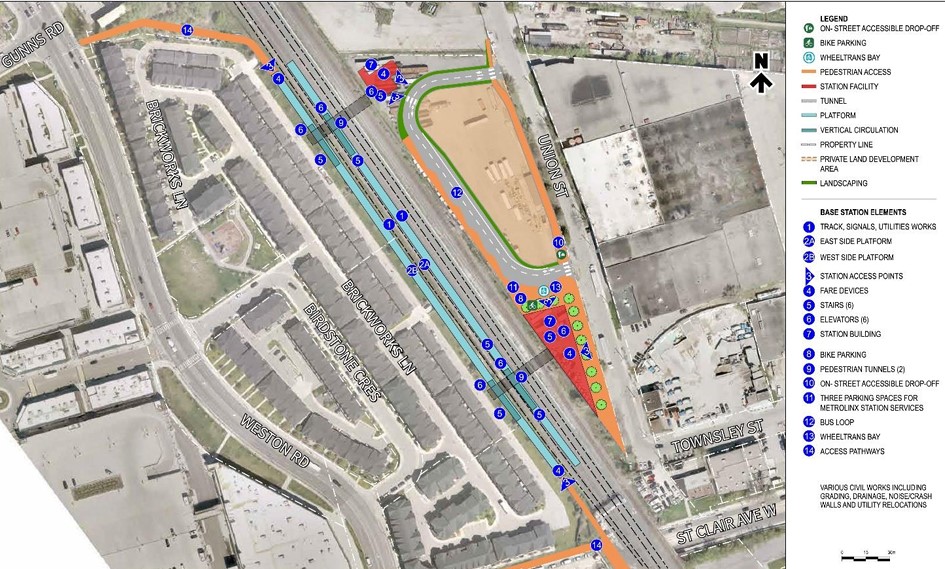
St. Clair-Old Weston Station will still go ahead, even though pedestrian access and transfers to local transit lines will be less than ideal. Rail platforms will be accessed from Union Street, not directly from St. Clair Avenue, Keele Street, or Old Weston Road. Though TTC buses could be diverted to the planned bus loop, transfers to streetcars on the 512 St. Clair line will be awkward and unattractive to riders. (See my supplementary post that describes the challenges in more detail.)
Map of inner portion of GO Kitchener Line, UP Express, and connecting rapid transit lines
Woodbine GO Station (not to be confused with Woodbine subway station on Line 2), located on the Woodbine Racetrack lands, is now under construction. When complete, it will replace Etobicoke North Station, which only has one platform and cannot be easily expanded for a four-track mainline. There is the potential for a short extension of the soon-to-open Line 6 Finch West LRT to Woodbine from Humber College. Woodbine Station would serve both GO trains and UPX, allowing passengers from Kitchener-Waterloo and Guelph to make an easy transfer to Pearson Airport. Woodbine would also be a logical transfer point between local GO trains to Bramalea and Mount Pleasant and express GO trains to Guelph and Kitchener.
With these decisions in mind, the challenge now will be figuring out how to serve the new Kitchener Line stations.
What is UP Express for, anyway?
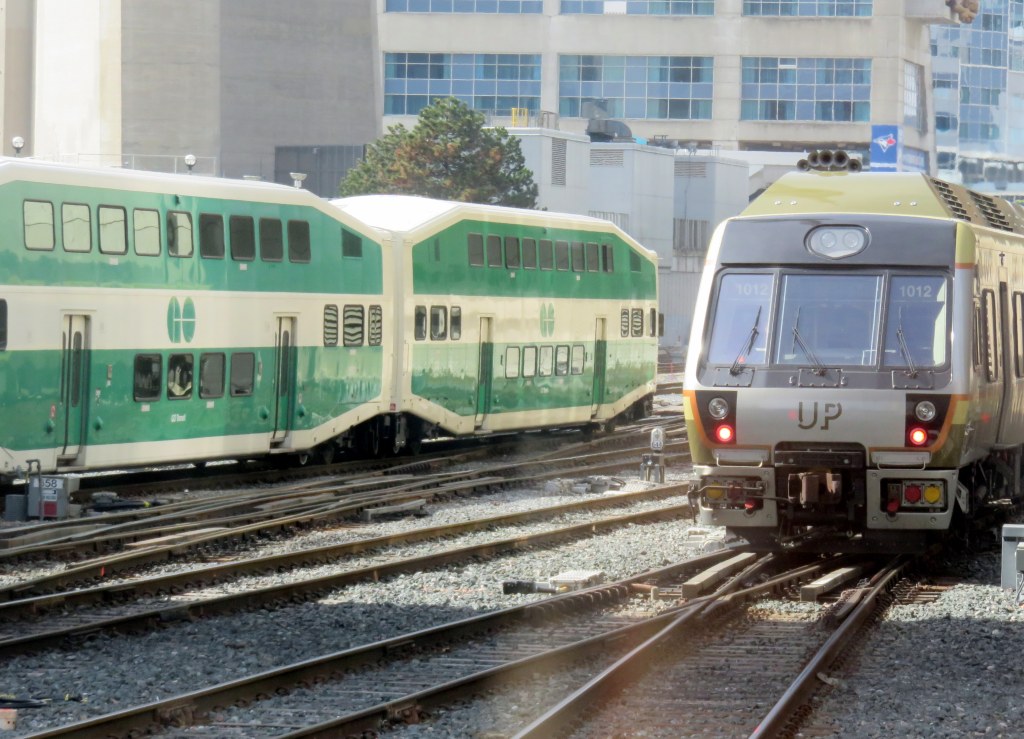
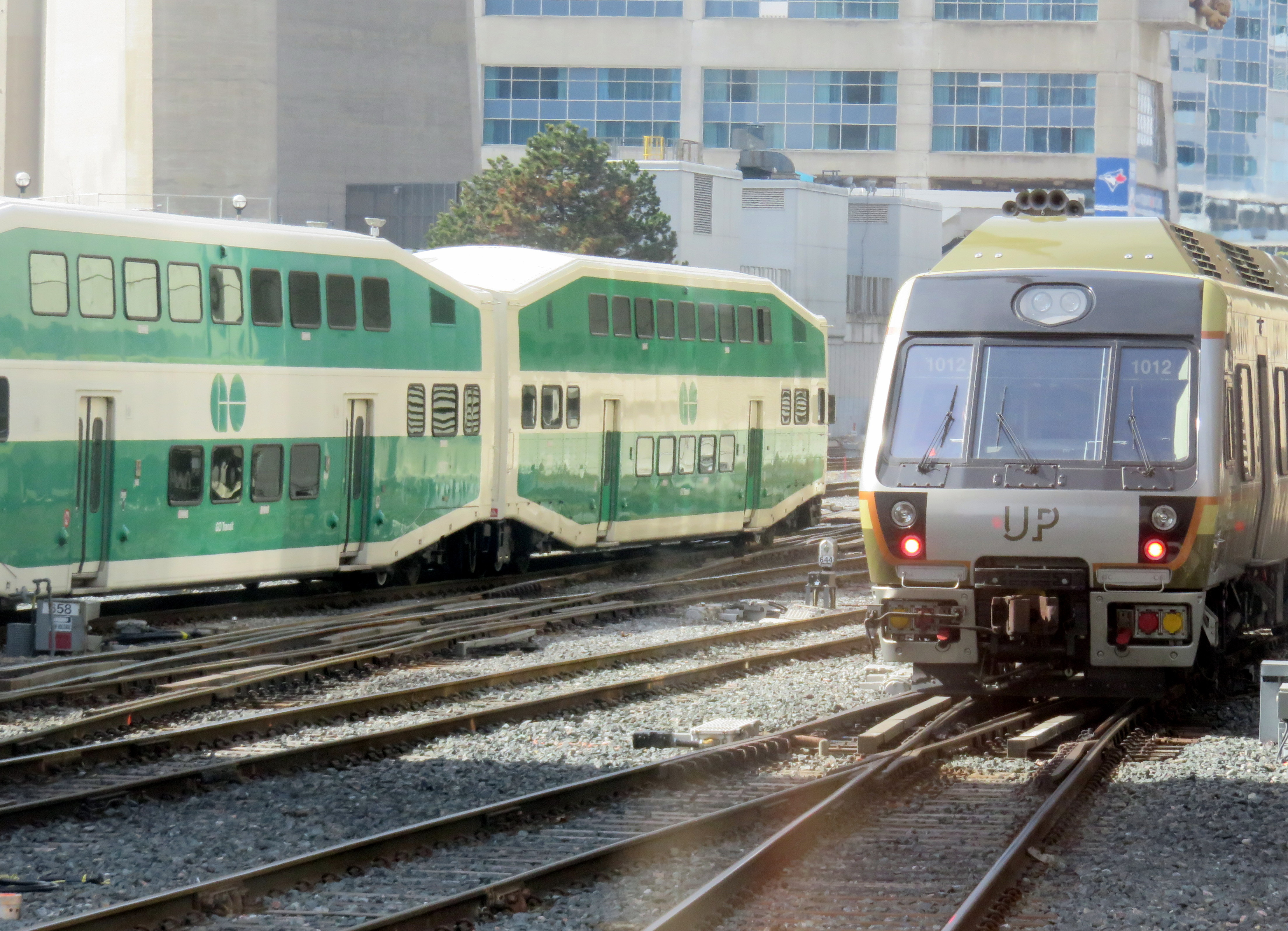
UP Express and GO trains near Union Station
UP Express, for all its faults, is an example of what urban regional rail looks like. Trains are frequent – every 15 minutes – seven days a week, from early in the morning to late at night, with the last train leaving Union at 1:00 AM. Stations feature high-level boarding, ideal for quick and easy boarding, especially for those passengers with luggage, strollers, or using mobility devices. The only other comparable example in North America is Denver’s A-Line train, an electrified service which also makes multiple stop between the downtown core and the city’s international airport.
A 15-minute frequency is important as it is commonly cited as the minimum level of service for a “get up and go” level of transit convenience and attractiveness. Right now, the Kitchener Corridor has a base hourly service between Union and Bramalea seven days a week, with additional peak-direction express trains and 30 minute service during much of the weekday service period.
Because of its reliable and frequent service and affordable fares, UPX has become a victim of its own success, with many riders travelling between Union, Bloor, and Weston, rather than going all the way to and from the airport. This problem was especially evident when riders were left stranded after the end of game seven of the 2025 World Series. The last train left Union station completely full, not long after the game finished in extra innings.
Fares for riding UPX are quite reasonable. When UP Express was first launched, a one-way fare to the airport was $27.50. In 2016, that adult fare dropped to $12.00, today it is $12.35. Adult fares paid with a Presto card are discounted by $3.10. An adult fare between Weston and Union is just over $5. However, UPX despite being owned and operated by Metrolinx, has no fare integration with GO Transit, and it is not part of the provincial One Fare program that permits free transfers between GO, the TTC and other GTHA transit agencies. This is likely intended to minimize overcrowding, even though it limits the utility of UPX.
Another constraint is the UPX fleet and station size. All UPX stations are designed for three-car trains, as the service was designed to be a premium airport rail link, not an urban transit service. There are just 18 Nippon Sharyo DMU rail cars available for service, assembled into four 3-car trains, and two 2-car trains. The interior design is set up for a premium airport service, with rows of forward/backward facing individual seats and lots of luggage space.
These challenges will be exasperated with the addition of new stations at Mount Dennis and St. Clair-Old Weston. Furthermore, Metrolinx has requested that City of Toronto modify plans for the St. Clair-Old Weston (or SCOW) station to be UPX-only. According to an October 21, 2025 report to Council’s Executive Committee, “Metrolinx has indicated that this service change is required to maintain the 15-minute (or better) service frequency commitment made by Metrolinx for the SmartTrack Program, which can no longer be maintained by GO service.”
Despite Metrolinx building a fourth track on the Weston Subdivision that will extend to Pearson Junction (where the UPX tracks diverge towards the airport) from the Union Station Rail Corridor (hence the closures of the West Toronto Rail Path), it seems that it can not commit to operating 15-minute service for both GO and UPX service, which seems like a ridiculous state of affairs when this is common practice in Europe and Asia. This goes against the whole concept of GO Expansion, which promised to deliver fast, frequent, integrated GO service to most of its corridors.
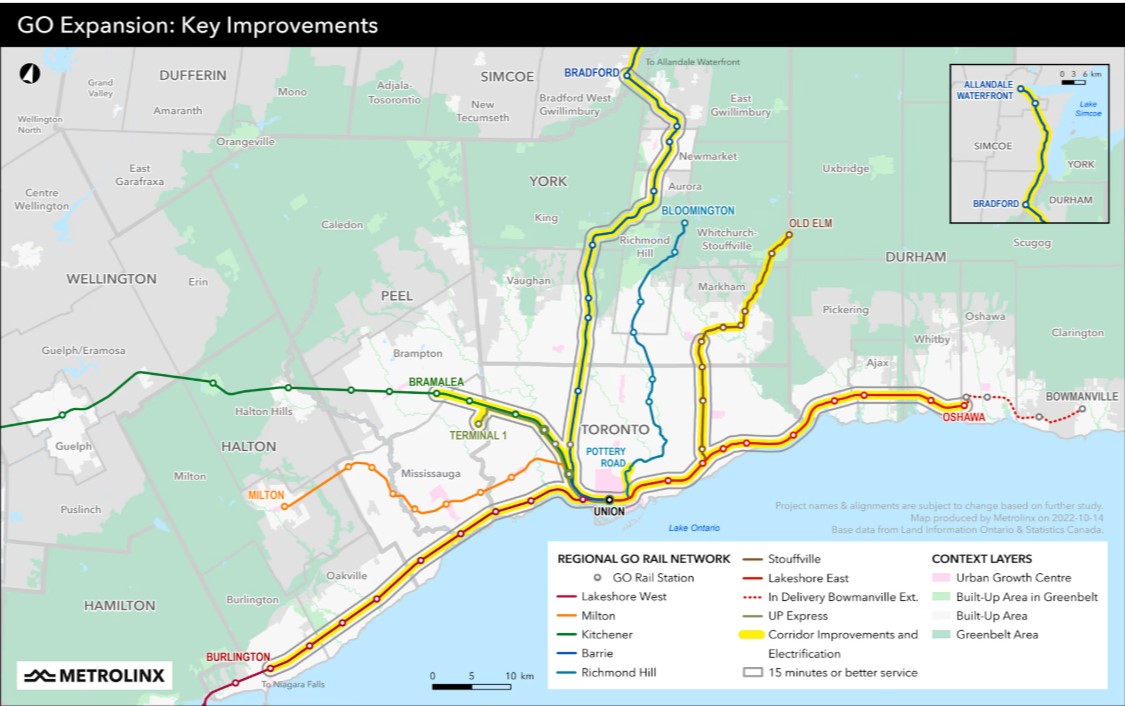
2022 Metrolinx map depicting corridor improvements, electrification, and 15-minute service for the inner portions of the Lakeshore West, Lakeshore East, Stouffville, Barrie, and Kitchener lines.2022 Metrolinx map showing the Kitchener Corridor with “corridor improvements and electrification” for the Toronto-Bramalea inner portion of the line, along with other construction projects between Bramalea and Kitchener.
Perhaps Metrolinx’s inability to conceive of GO becoming more than just a suburban commuter railway is why Deutsche Bahn pulled out of its contract with Metrolinx early in 2025. Since The Trillium’s June 2025 investigation, there has been little said about the collapse of GO Expansion. Communications and transparency have not been Metrolinx’s strong suit, especially in the last few years as Doug Ford’s PC government has tightened its control on all government communications.
So, if St. Clair-Old Weston is served only by UP Express, it will have to be completely rethought. It will not be able to offer an exclusive, 25-minute ride between Terminal 1 and Pearson Airport. That in itself is fine. A train taking 30 minutes to travel the same distance, with a few additional stops will work, provided that the trains have the capacity to serve both airport passengers and urban transit riders. Stations should be six cars long, then, with a new Union Station terminal, ideally under the main trainshed for easy connections to TTC, GO, and VIA Rail. GO Transit trains would then focus on suburban and regional travel between Toronto, Malton, Brampton, Guelph, and Kitchener, skipping most existing stops in the City of Toronto, part from Woodbine and perhaps Bloor.
But Metrolinx, the City, and the Province need to express their intentions openly and clearly so that we, the passengers and taxpayers, know what will happen, and that we will get the best transit possible. Let’s be smart about this.
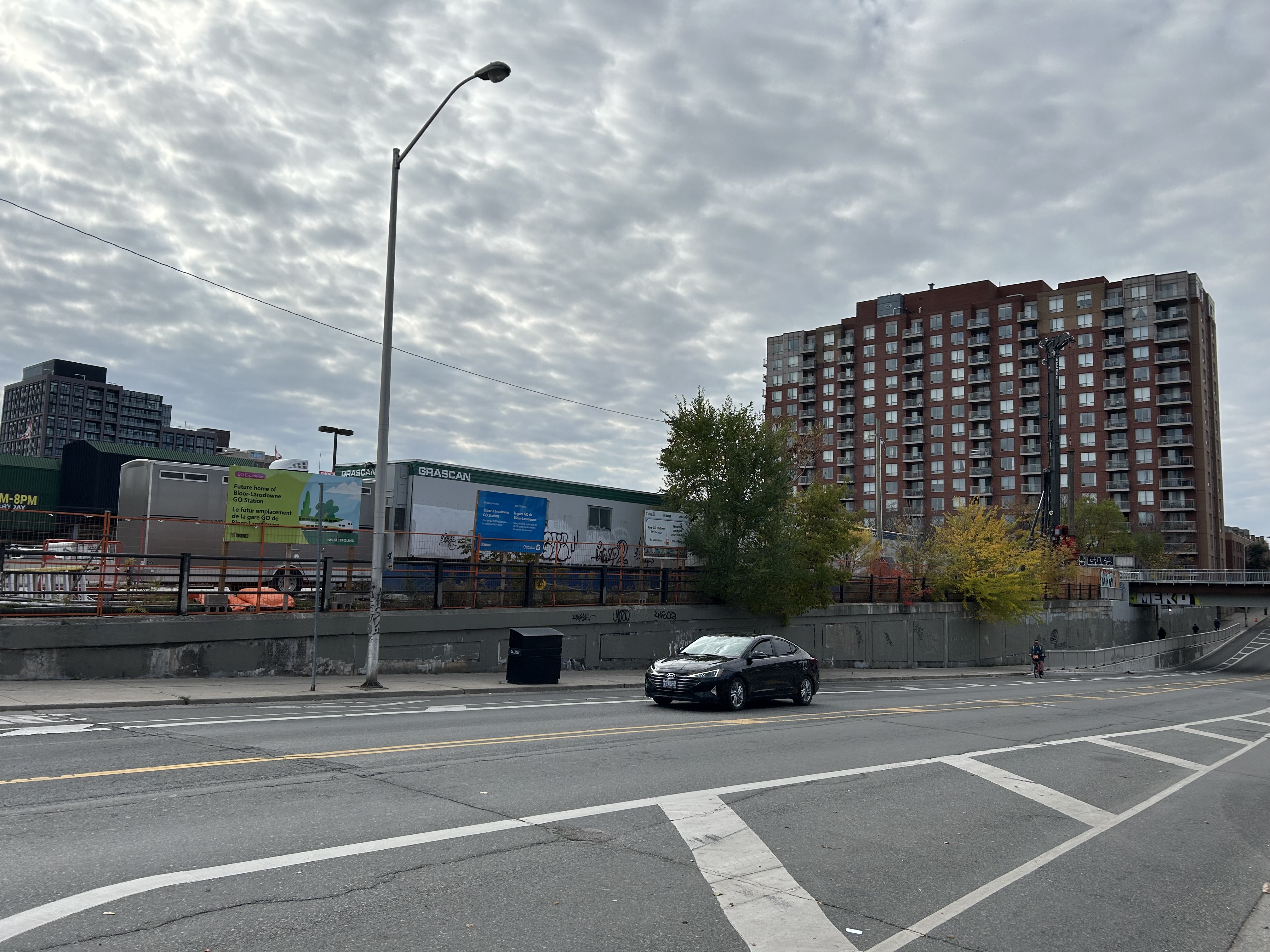
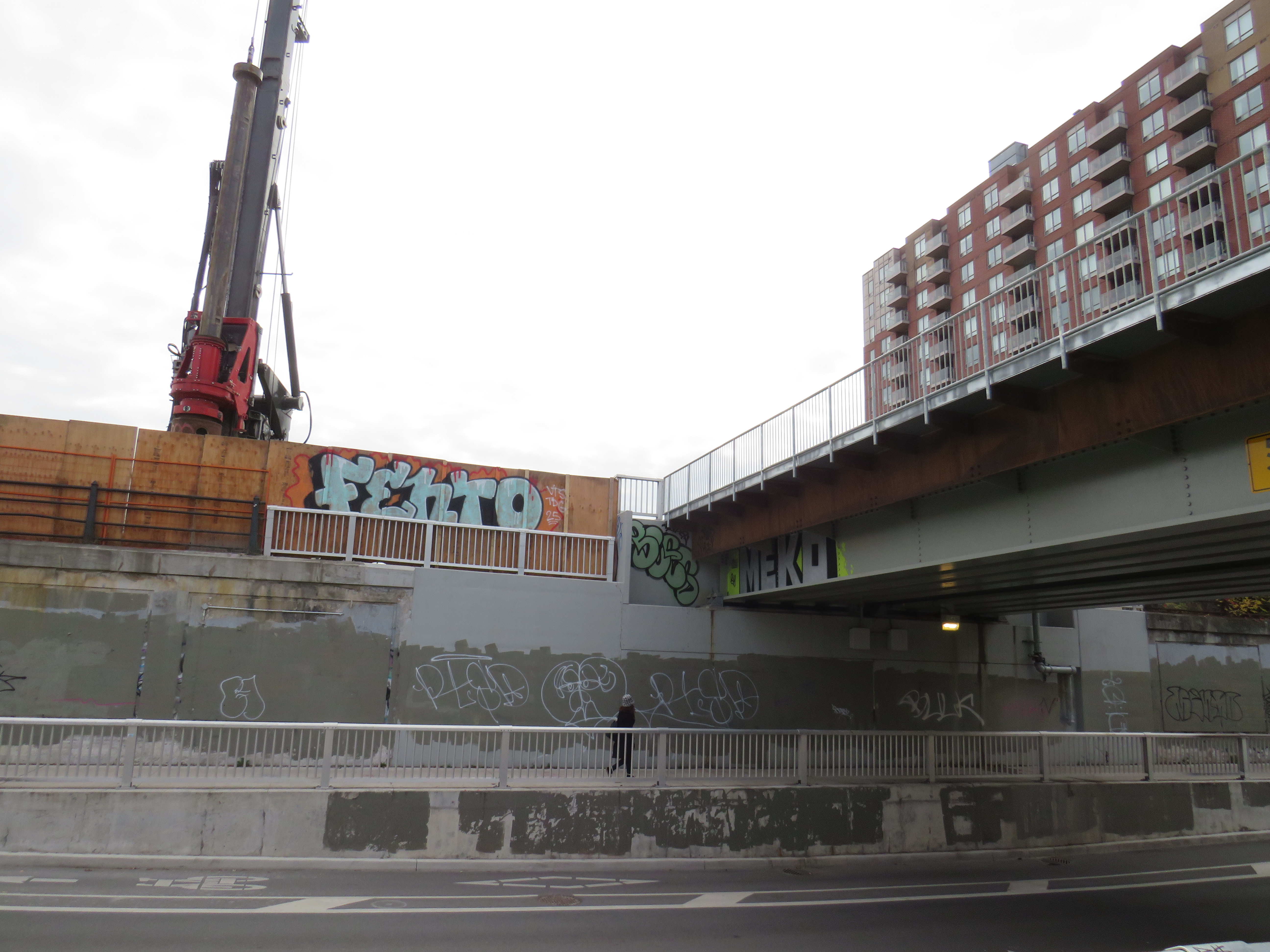
Bloor-Lansdowne Station construction, November 2, 2025
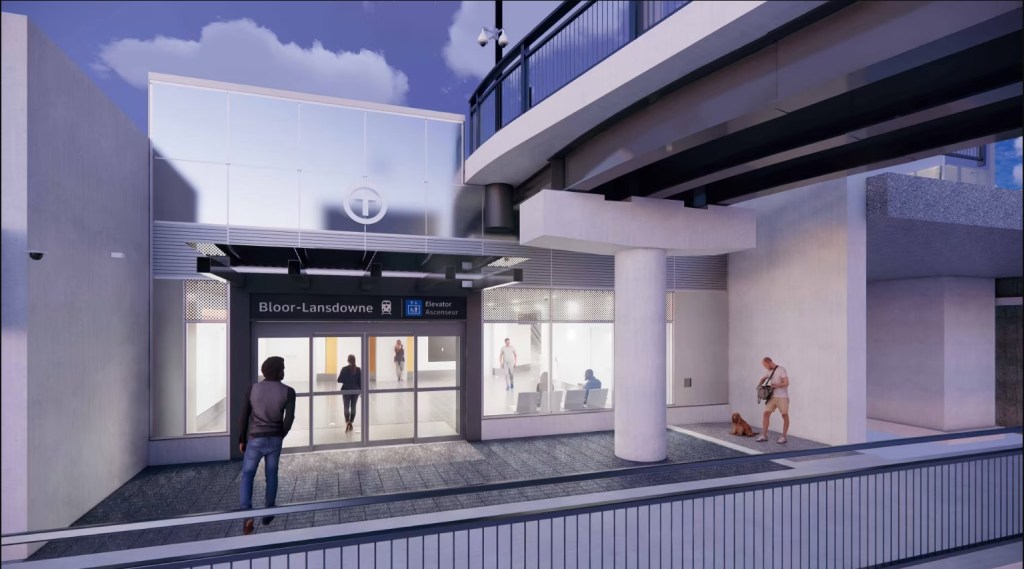
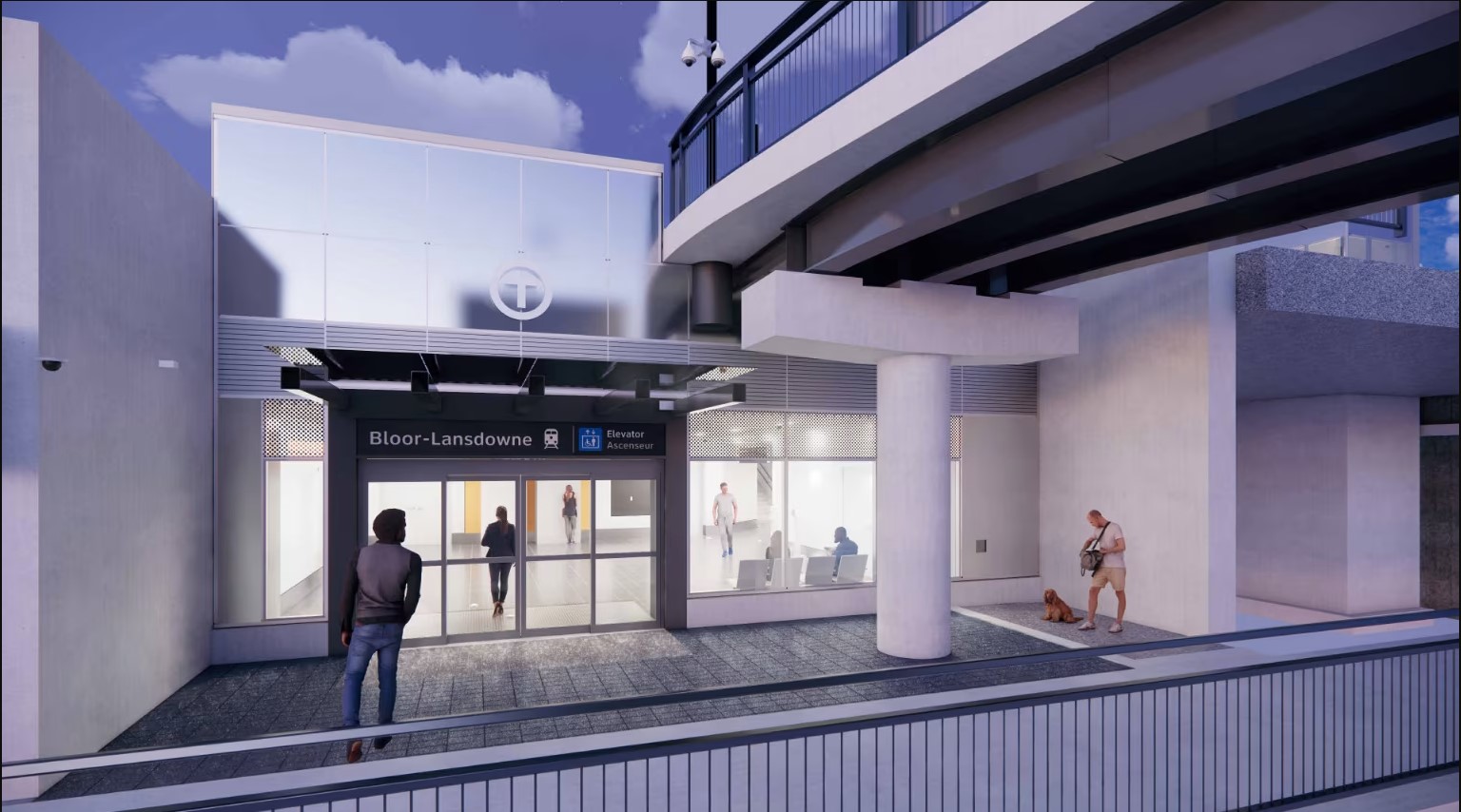
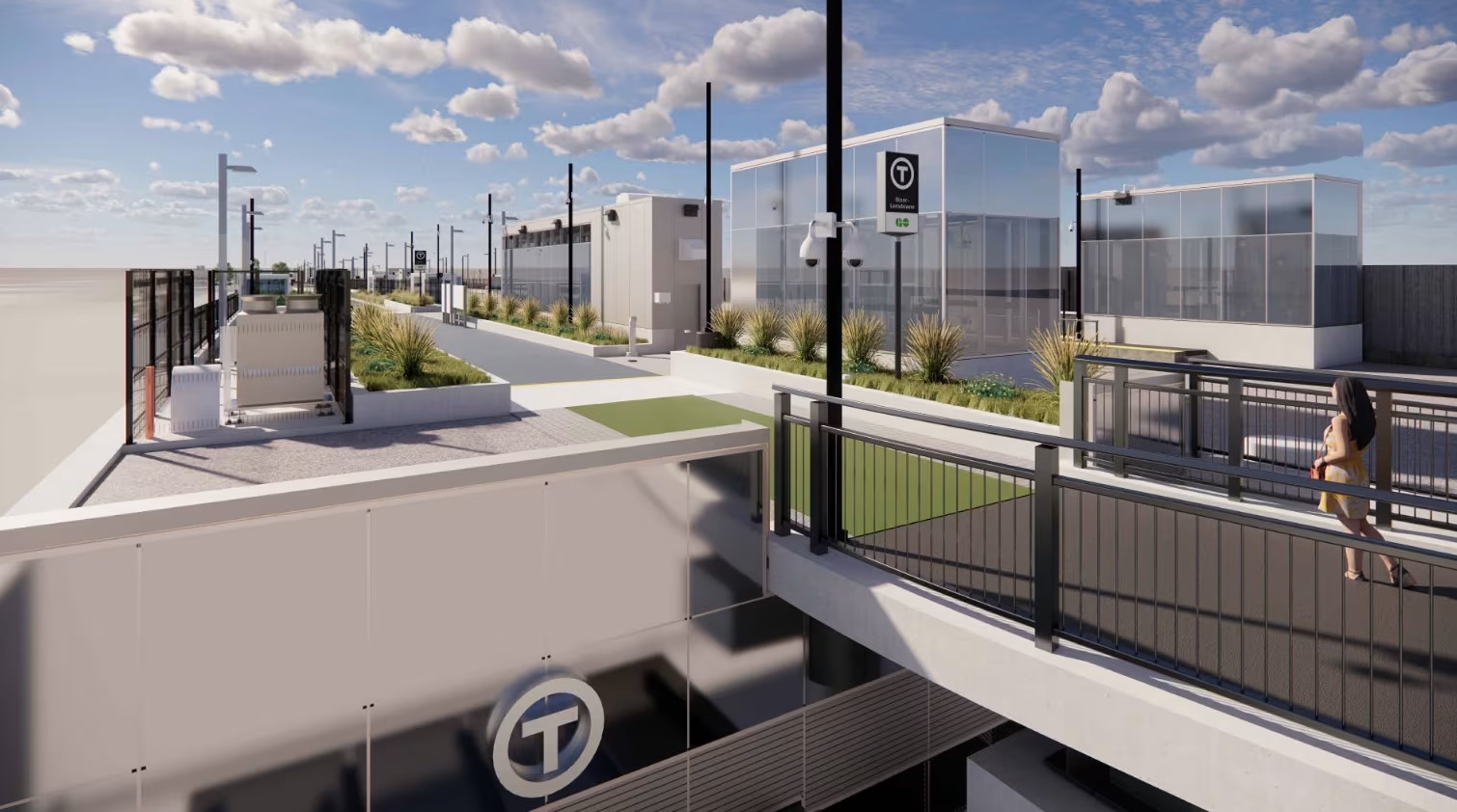
Bloor-Lansdowne Station, one of five “SmartTrack” stations planned for existing GO Transit rail lines in the City of Toronto, is located just south of Bloor Street West on the GO Barrie Line, and south of the Davenport Diamond grade-separation. The purpose of this new two-platform GO station is to provide a new connection between GO trains and the TTC subway, similar to existing stations like Bloor/Dundas West, Danforth/Main Street, or Downsview Park. Unfortunately, it will not be an easy transfer.
The future Bloor-Lansdowne station entrance, 2025Rendering of Bloor-Lansdowne Station entrance (from Metrolinx web page)
When GO Transit began operations on the Lakeshore Line in 1967, it was built on a shoestring, meant to be a three-year experiment to see if commuter rail would work in the growing Greater Toronto Area. Stations were built cheaply, with asphalt platforms with bus shelters, constructed on easily purchased land for suburban parking lots. At stations like Long Branch and Danforth, connections to TTC subways and streetcars were on-street; most connections would be made at Union Station. When the Georgetown (now Kitchener) Line opened in 1974, Bloor Station was accessed only by narrow stairways down to the sidewalk, with a 4-5 minute walk to Dundas West Station (a direct subway connection is finally nearing completion). Newer GO rail stations, like Kipling (1980-1981), Kennedy (GO platform opened 2005), and Downsview Park (2015), were built with direct intermodal connections, befitting GO’s increasing importance. When it opens on November 16, Mount Dennis GO/UP station will have a direct connection to the future Line 5 Crosstown LRT.
Though Lansdowne subway station is north of Bloor Street and two blocks to the east, the new GO station will be located entirely south of Bloor Street
But Bloor-Lansdowne, located next to a former Value Village, will feature a subway-train transfer worse than the current connection between Bloor GO and Dundas West subway station. It took me nearly 7 minutes to get from the Lansdowne subway platform to the planned main entrance below the rail overpasses, including waiting at the Bloor-Lansdowne intersection for a walk signal, and crossing an unsignalized intersection at St. Helens Avenue. (See video below.)
The construction of a new pedestrian overpass connected with the long-delayed Davenport Greenway will provide a slightly more pleasant walking path between the subway and GO train, avoiding a busy signalized intersection. But it will not reduce walking times or the amount of time without shelter from the elements.
Proposed Davenport Greenway
Granted, for some commuters, Bloor-Lansdowne will significantly reduce travel times, especially for those travelling between parts of York Region and western Toronto. But nearby Bloor Station on the GO Kitchener Line will have much better TTC connections and more frequent service with both GO and UP Express service and will be a much more attractive route towards Downtown Toronto. Compared to the benefits to riders on the 39/939 Finch East — the TTC’s busiest bus corridor — that Finch-Kennedy Station will offer, or the benefit of King-Liberty’s GO and UP Express service to riders in Liberty Village, Parkdale, and West Queen West with King-Liberty, Bloor-Lansdowne has limited ridership potential.
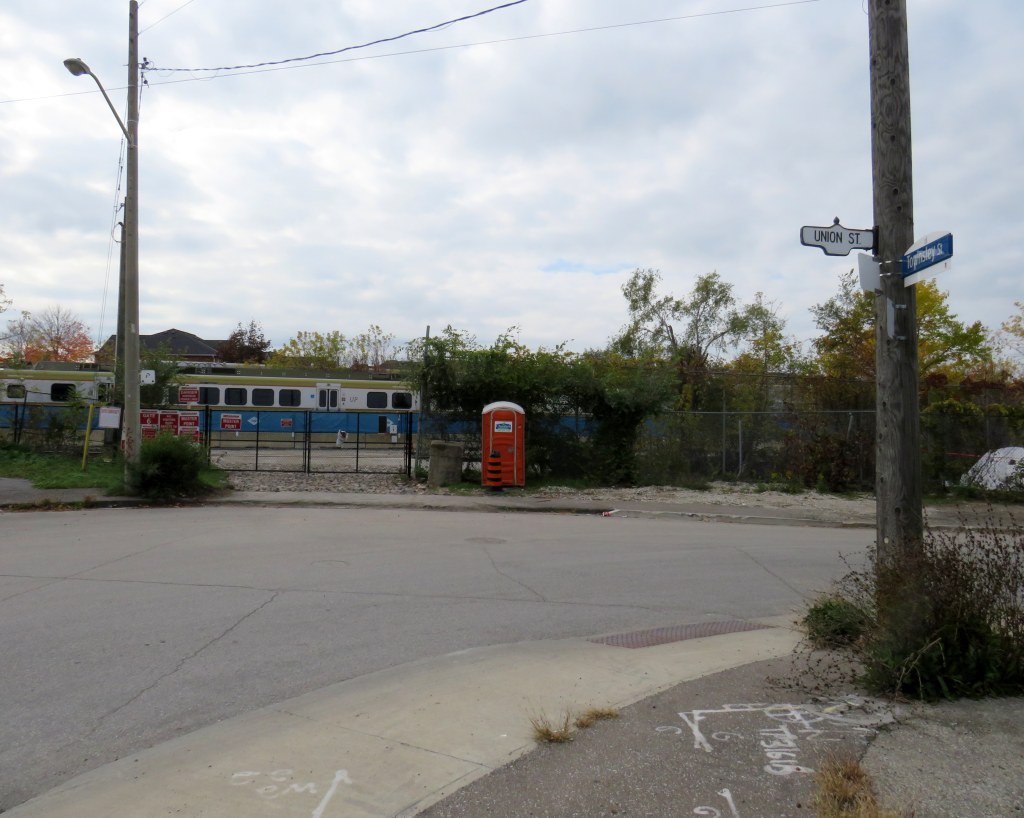
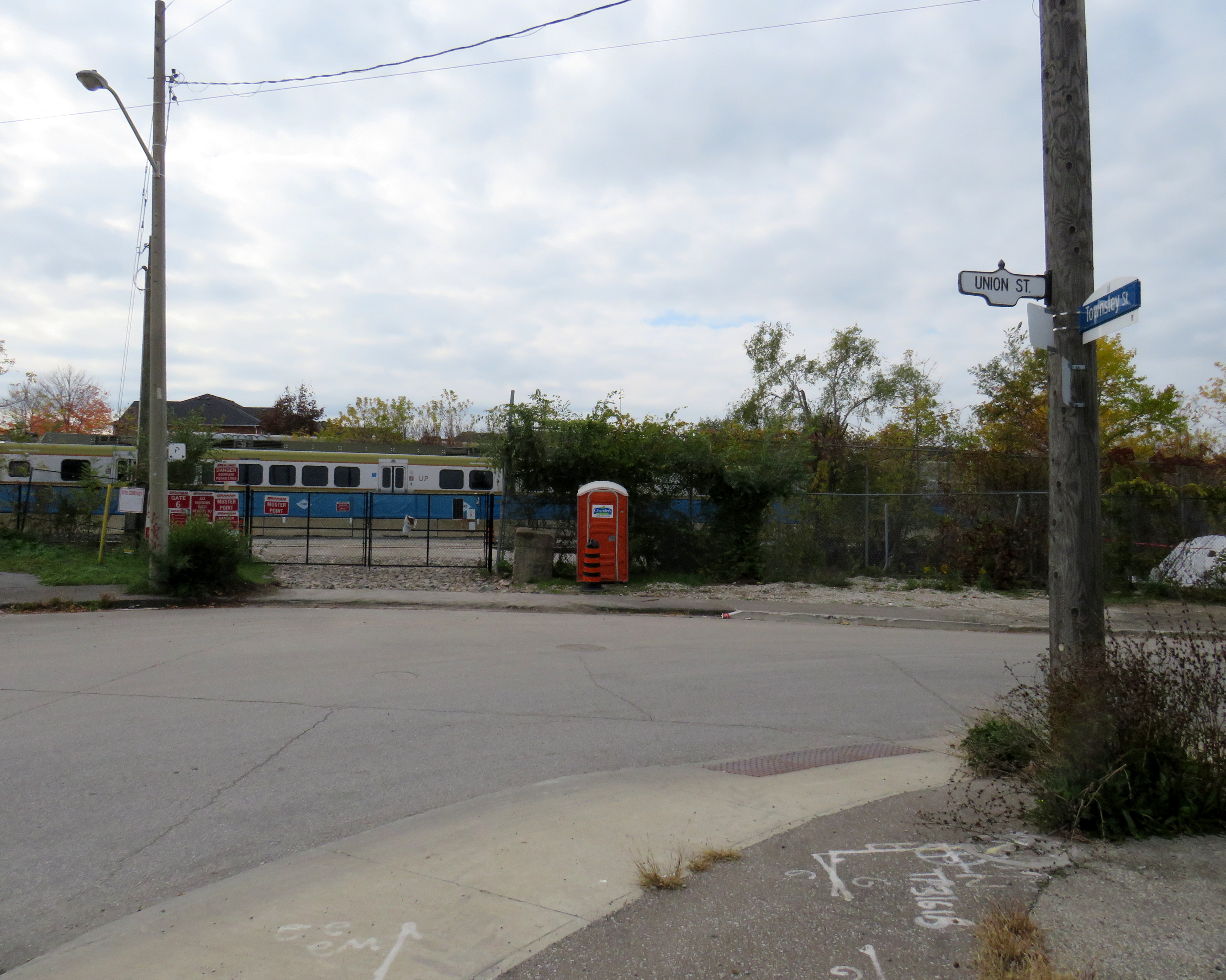
An UP Express train passes the intersection of Union and Townsley Streets
At the lonely corner of Union and Townsley Streets sits the site of St. Clair-Old Weston Road Station, one of five proposed new GO stations in the City of Toronto as part of the remnants of the SmartTrack brand. The station’s name (which will likely be revised closer to opening day) refers to the intersection of St. Clair Avenue West and Old Weston Road, one block to the east. After years of benign neglect, the northwest corner of the old City of Toronto is seeing new development.
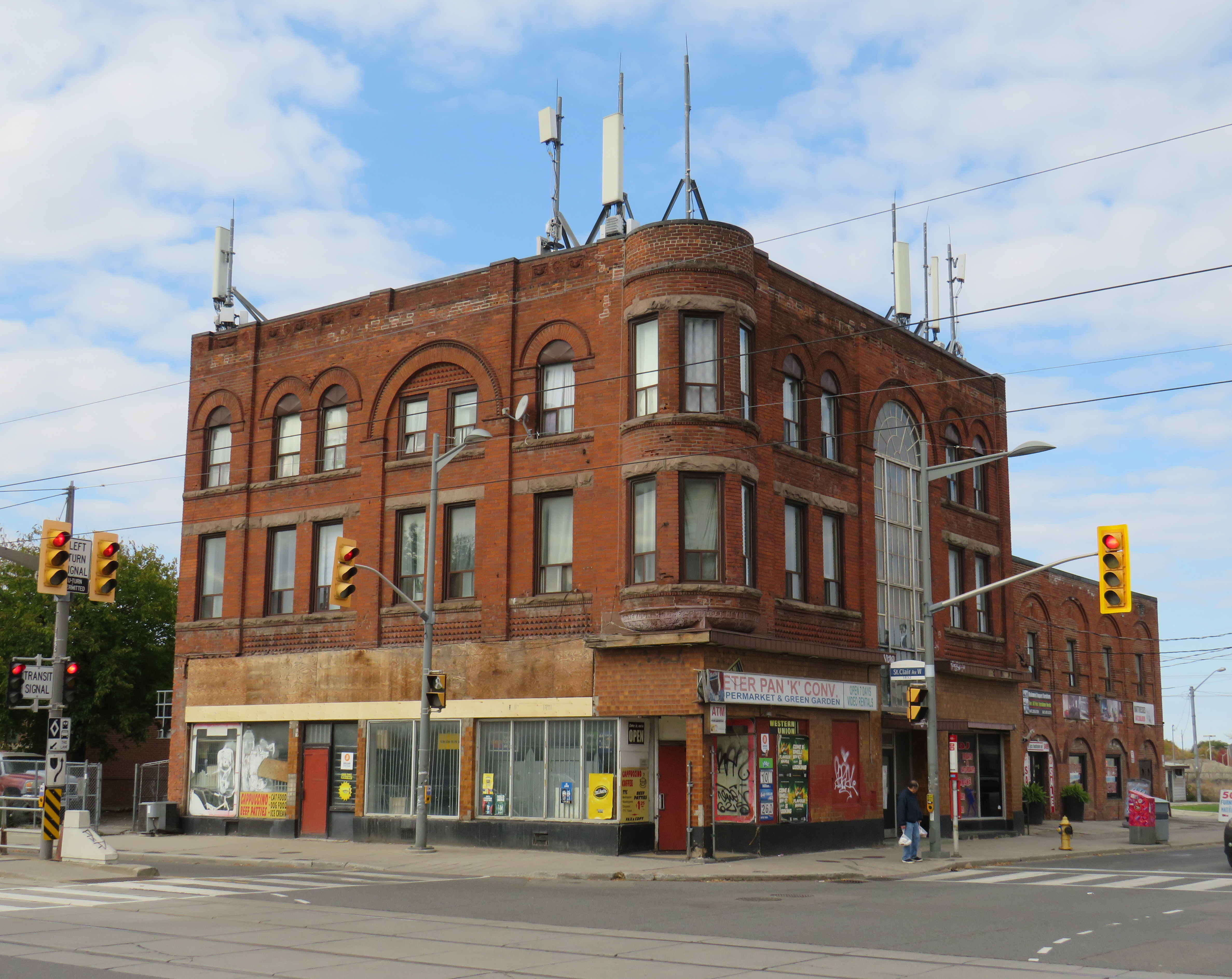
The old Heydon House Hotel stands at the corner of St. Clair Avenue and Old Weston Road
The former Ontario Stockyards and associated slaughterhouses is now a busy retail area. A large cluster of midrise and highrise development proposals are in the pipeline surrounding the station site, spurred on by a city-initiated transportation plan and the provincial major transportation transit area (MTSA) designation. More transit will be needed to serve the planned growth, and that’s where the new station comes in.
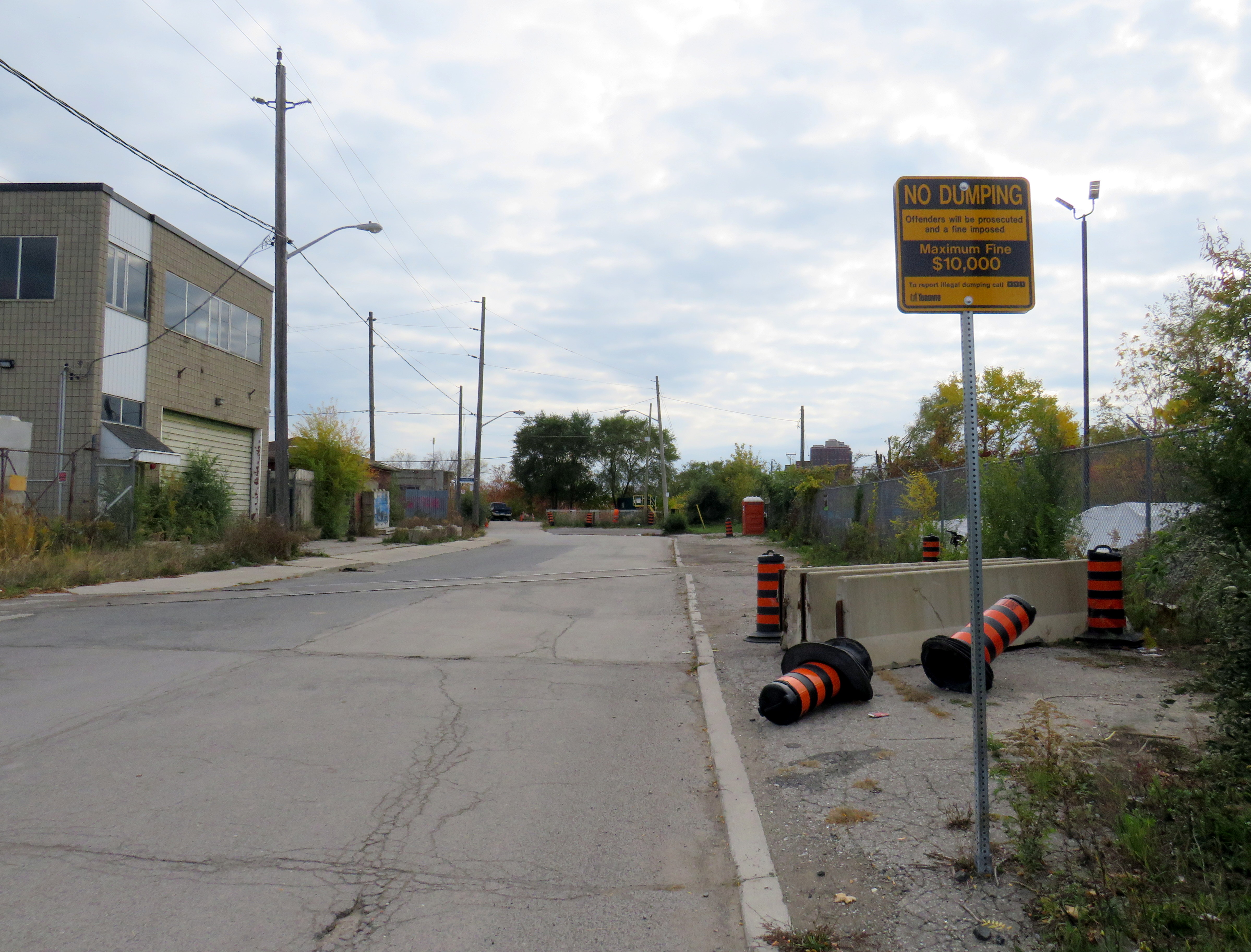
Right now, the corner of Union and Townsley is eerily quiet. At the corner of Old Weston and Townsley, a once-popular flea market was demolished, with no immediate plans for the site. The Consolidated Bottle Company plant on Union Street sits empty, awaiting future development. To the south, the Delta Bingo on St. Clair West is also the site of a planned highrise cluster. There are other proposals along Union Street to the north. But right now, it’s a great place to dump waste.
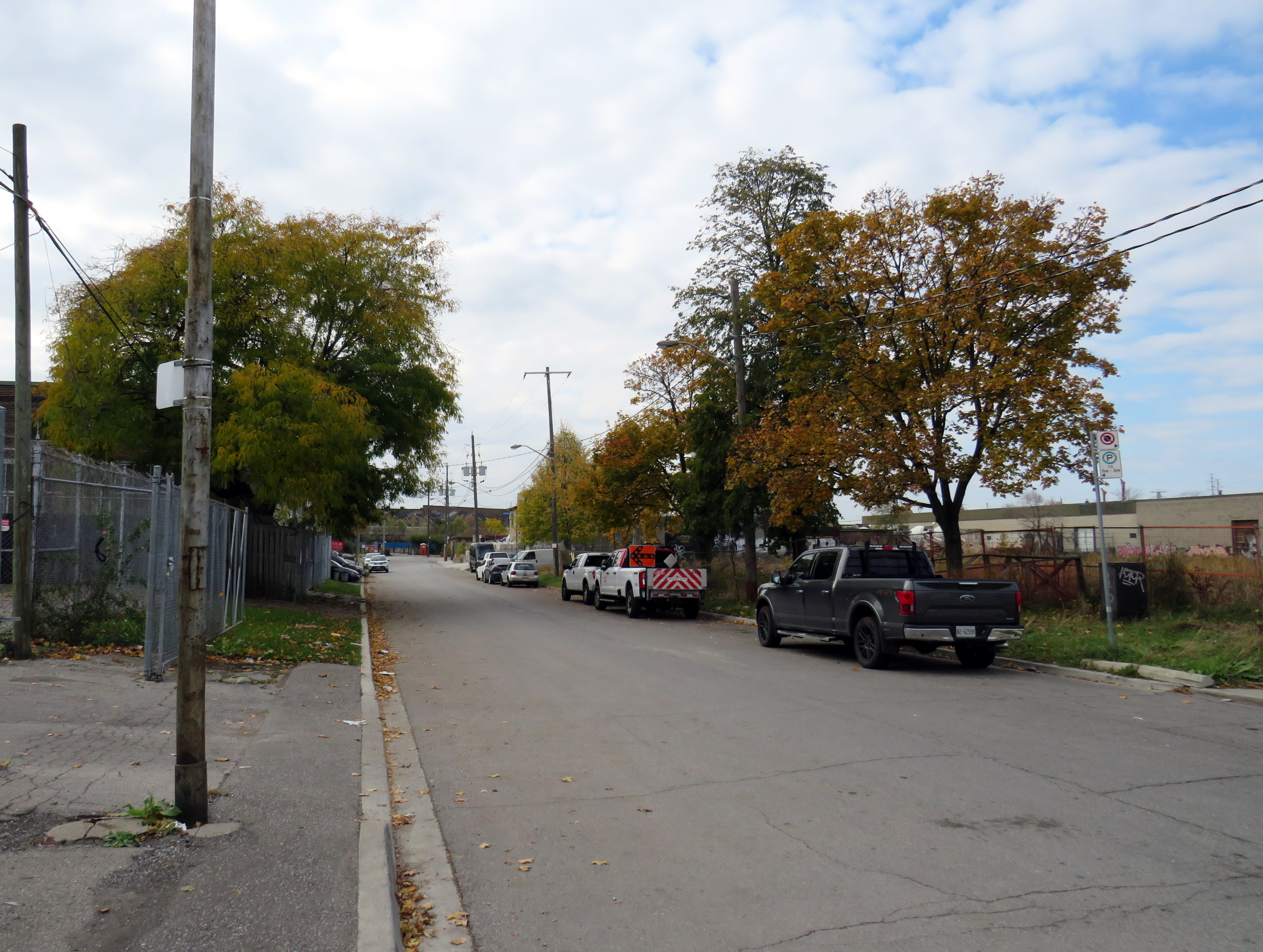
A no dumping sign and an abandoned rail spur crossing on Union StreetMissing sidewalks on Townsley Street, looking west from Old Weston RoadSt. Clair-Old Weston Station site plan
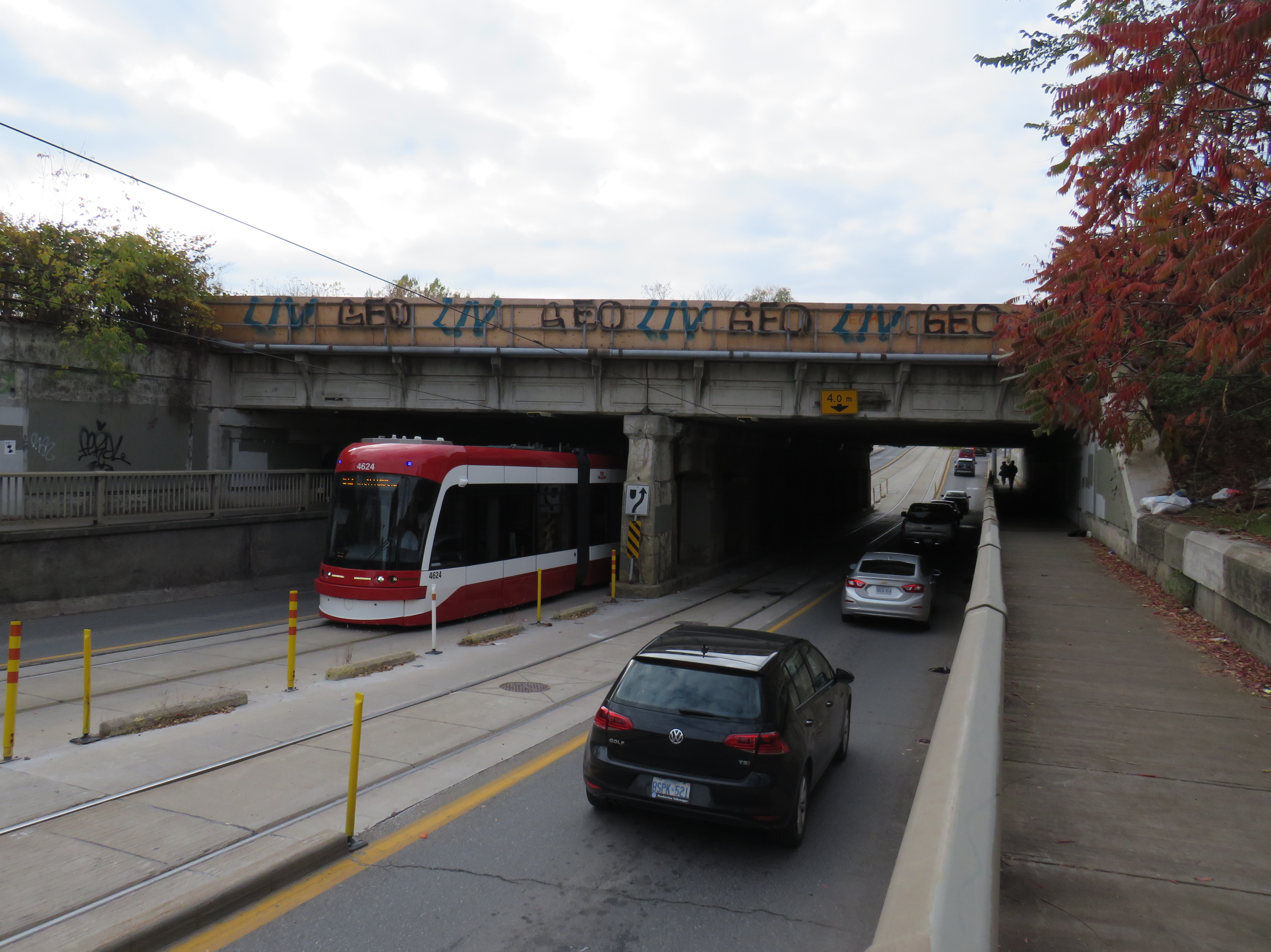
Despite the promise of new development, the station site plan leaves a lot to be desired. Connections to the nearby 512 St. Clair Streetcar will be awkward. A planned bus loop would require a diversion for nearby TTC bus routes, except the low-frequency 127 Davenport, which terminates by the old flea market site. An underpass that allows St. Clair Avenue to duck under the Metrolinx and CPKC railways will have to be rebuilt, with streetcar closures planned starting next year. Though likely not included (the street right-of-way will not be widened during the work, despite traffic congestion through this pinch point), extending walkways and even rail platforms to the south side of St. Clair would improve connections considerably and reduce walking times to several of the proposed developments. Under the current plan, train platforms would be located entirely north of St. Clair Avenue, with no direct station access from the busy arterial.
The narrow St. Clair Avenue underpass, a traffic pinch point, is due for replacement
As I argue below, this is a major blow to any hopes for an integrated regional transit system throughout the Greater Toronto and Hamilton Area. Subsidized transfers reduce the need to build expensive parking lots and garages, encourage more passengers to ride transit, especially in off-peak periods, and reduce the potential of major GO Transit expansion projects planned or underway.
The provincial Liberal government introduced the discounted double fare in 2017. It reduced the cost of a trip taken on both GO and TTC by $1.50 if the fare was paid on a Presto fare card. For many years, there were discounted transfers between GO and suburban transit agencies, but this was the first time such a discount was offered to TTC passengers.
The Liberals also planned discounts for transferring between suburban bus systems such as York Region Transit and Miway, subsidies that would have been covered by the provincial carbon pricing scheme. This would have reduced the impact of another fare barrier. (A short bus trip across Steeles Avenue costs nearly $7.)
When the Doug Ford-led Progressive Conservative government was elected, the provincial climate change plan was scrapped, along with those planned fare changes. Now, the province will not renew the $18.5 million annual subsidy for linked GO-TTC fares, though it did introduce free fares for children on GO Transit.
This will especially affect commuters to York University, who previously enjoyed a one-seat ride to the heart of the campus on YRT and GO buses. When the subway extension opened, YRT retreated to terminals north of Steeles Avenue, forcing a transfer to the subway or a long walk across six lanes of traffic and campus parking lots. GO Transit, too, moved to a new terminal at Highway 407, two subway stops from campus. While GO commuters at least saved $3.00 a day with the discounted double fare, YRT commuters got nothing. (Of all the suburban agencies, only Brampton Transit continues to serve the campus.)
This is also a blow to what’s left of SmartTrack, Mayor John Tory’s signature transit plan that was once pitched as “London-style surface rail.” At first, SmartTrack was a 53-kilometre heavy-rail line, mostly piggybacking on existing GO Transit corridors, but including a problematic western branch to the Airport Corporate Centre in Mississauga, all on an integrated TTC fare. Eventually SmartTrack just consisted of more frequent, electric GO service, along with additional station stops and fare integration. This was much more realistic, but it distracted from other needs such as the Relief Line and GO’s own RER regional rail plan.
As Jonathan English points out in Urban Toronto, the GO rail network represents “tremendous infrastructure that could greatly improve the lives of hundreds of thousands of Torontonians.” But it lies “letting it lie mostly dormant because we won’t make the comparatively small operating funding investments required to improve the service and make the fares fair.”
The $18.5 million annual cost is a small price to pay for improving transit accessibility and utilization of our existing corridors. Increasing that annual subsidy to reduce the cost of transfers between the TTC , York Region, Brampton, and Mississauga would, too be a worthwhile investment.
Sadly, the current provincial government does not see the value in promoting fairer fare systems, nor regional transit in general. In response to budget cuts, Metrolinx reduced or eliminated service on five GO bus routes last month, and more may be to come. While there may be enthusiasm for building a new “Ontario Line” and a subway extension to Richmond Hill, there’s little regard for the actual transit rider.
On the CBC radio program Metro Morning on March 28, Toronto Mayor John Tory spoke about his concerns regarding Premier Doug Ford’s plans to upload the city’s subway system, as well as Ford’s intentions to build new subway extensions to Richmond Hill and Scarborough Centre, bury the Eglinton West LRT, and start the long-planned Relief Line. Instead of a conventional subway, the Relief Line envisioned by the province would use a “new technology,” despite planning and engineering underway for a subway, using an existing subway yard for Relief Line train storage.
But Tory, who has been passive so far about the province’s plans, was hopeful that the unspecified new technology proposed for the Relief Line would be a “fantastic bonanza” for Toronto, but he added that he didn’t know for sure what would come of the new plan.
Mayor Tory tells @metromorning he's prepared to hold out hope that the province's unspecified new tech for the Relief Line is a "fantastic bonanza for us. But I don't know."
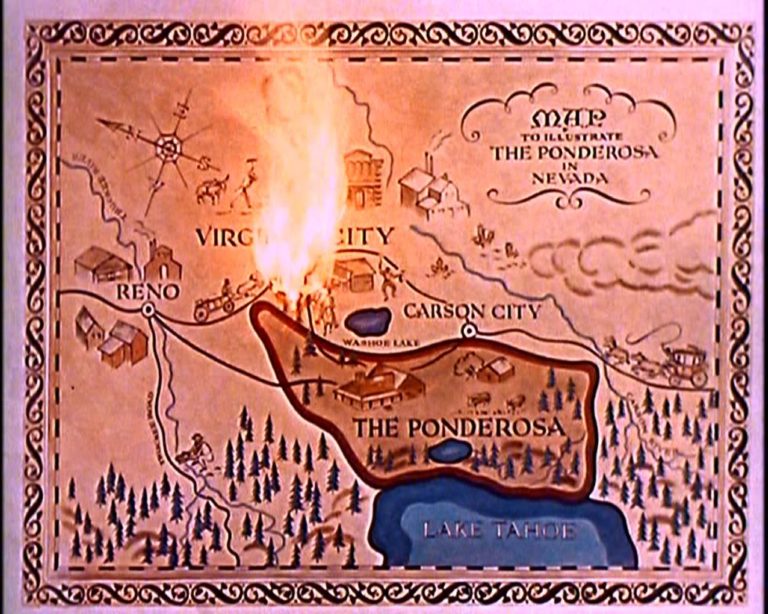
It is curious that Tory called this hostile takeover a “fantastic bonanza.” Bonanza was a long-running Western television show, starring Lorne Greene as the patriarch of the Cartwright family, owners of a vast ranch on Lake Tahoe. Bonanza was famous for its theme music and opening credits, which featured a burning map of the Cartwrights’ Ponderosa ranch before introducing the cast.
Opening theme for Bonanza
Bonanza’s burning map is a great metaphor for Toronto’s transit planning. Newly elected mayors and premiers burn the maps left behind by their predecessors, and time is wasted on new feasibility studies and engineering reports, ready just in time for someone else to get elected with yet another idea. Plans come and go, but hardly anything ever gets built.
There’s plenty of blame to go around. After a prolonged spurt of subway construction in the 1950s, 1960s and 1970s, momentum was lost. In the 1980s, Bill Davis’ Progressive Conservatives insisted on a novel linear-induction rail system for Scarborough, rather than the light rail project already underway. The Liberals, under David Peterson, proposed several subway lines, though it was scaled back under NDP Premier Bob Rae. In 1994, work started on the first phases of the Eglinton and Sheppard subways. When Mike Harris’ government was elected in 1995, they cancelled Eglinton, filling in a hole already dug for the tunnel boring machines.
There was new hope in 2003, when a new Liberal provincial government was elected, and David Miller, an urban progressive, became mayor of Toronto. While the province’s top priority was the extension of the Spadina Subway to York University and Vaughan, it was willing to help fund major improvements to GO Transit, along with new light rail systems in Ottawa, Kitchener-Waterloo, Hamilton, and Mississauga-Brampton. It also committed to Miller’s proposed Transit City LRT network, including a fully grade-separated replacement of the ageing Scarborough RT.
There were valid criticisms of Transit City — there were too many transfers to get around the top of the city, there was no Relief Line, and a few of the proposed lines, like parts of the Jane and Don Mills LRTs, were too difficult to build as surface rail projects. But because of Miller, the Eglinton-Crosstown LRT is well underway, and preliminary work continues on Finch Avenue West.
Work would have also started on the Scarborough RT replacement and expansion and the Sheppard East LRT, had Rob Ford not been elected in 2010, promising “subways, subways, subways” and burning the transit maps for which new projects were planned and being built. Seven funded LRT stops in Scarborough became three unfunded subway stops. Overestimating Rob Ford, and hoping to keep seats in Scarborough, the Liberal government folded to his demands, and work stopped on the LRT replacement.
Rob Ford’s disastrous term was followed by John Tory’s twin obsessions of SmartTrack and an austerity agenda, at a time when the Yonge and Bloor-Danforth subways were overwhelmed by demand caused by a growing population and a booming economy — hardly the conditions that demanded low spending on civic services and infrastructure and yet another half-baked transit plan.
SmartTrack map from the 2014 John Tory campaign
Tory promised that it would only take seven years to build SmartTrack, which would mostly use existing railway infrastructure, along with a new section of track in Etobicoke, on land already sold off for development. Tory’s insistence on SmartTrack further delayed momentum on the Relief Line. Though Tory remained committed to the Scarborough subway extension over the approved and funded LRT, it was reduced to a single stop as costs ballooned, while the subway and SmartTrack threatened to cannibalize each other. We don’t hear much about SmartTrack anymore, but at least Tory has come around on the Relief Line.
But Doug Ford’s latest musings make it clear why the planned subway upload is so dangerous.
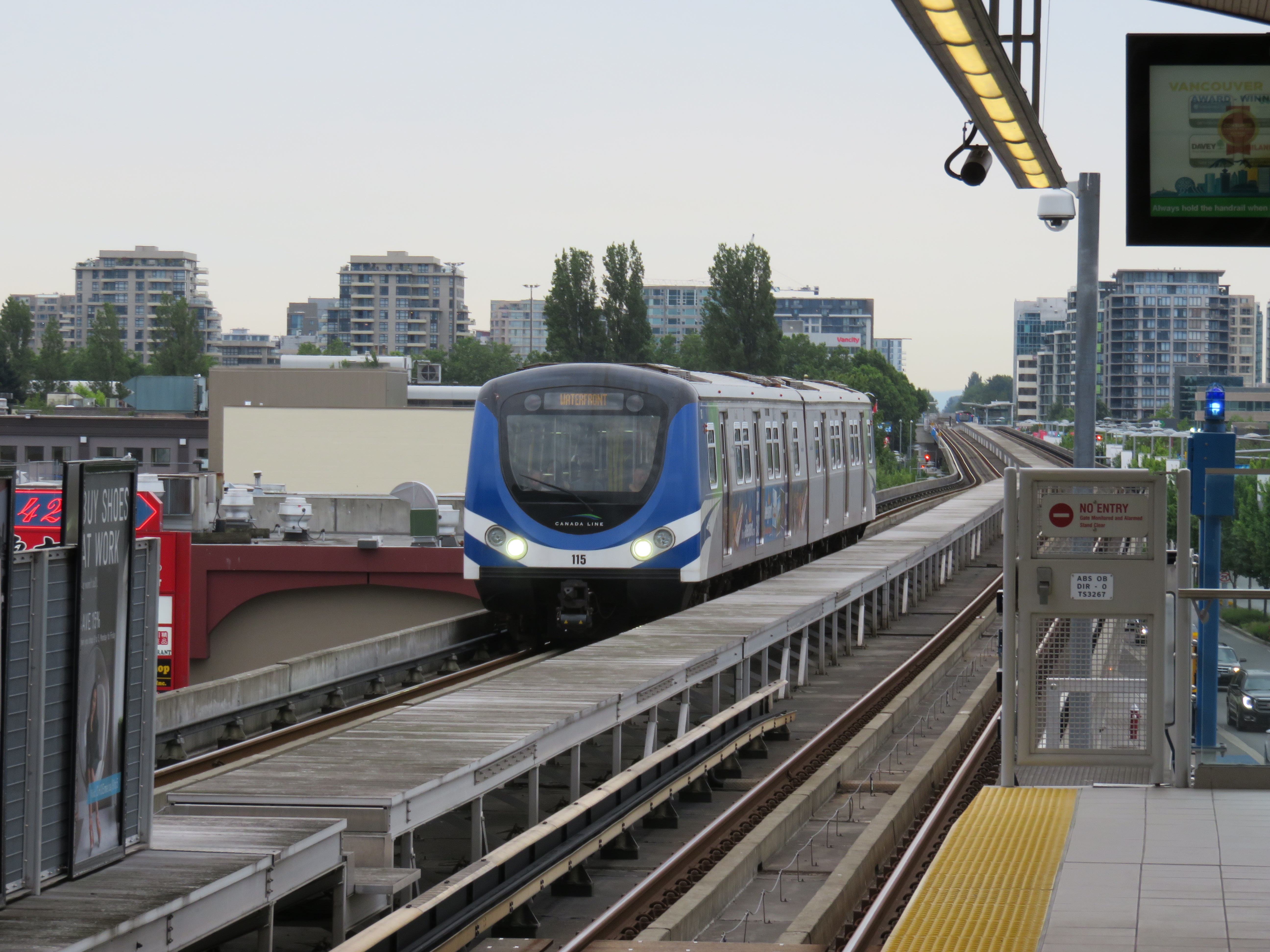
Canada Line in Richmond, British Columbia
So what now for the Relief Line?
Despite the inevitable Simpsons monorail jokes (Doug Ford did promise a monorail on Toronto’s waterfront when he was a city councillor in 2011), the new technology the province is considering is likely an automated light metro line, similar to the Canada Line in Vancouver. The Canada Line links Vancouver’s city centre with the international airport and the suburb of Richmond. It was built as a private-public partnership (P3) project, in which a private company was contracted to design, build, and operate the line. It’s an attractive option for a conservative government: P3s promise to be cheaper to build and operate than a conventional public project.
But the Canada Line has problems. Though trains are frequent, it was built too small to accommodate growth. The outer terminals at Vancouver airport and Richmond-Brighouse are both single track/single platform. Station platforms are too short — only 40 metres long — to increase train sizes. And as many stations are underground, it’s too expensive to extending platforms to fit larger trains. Some relief is coming, but even then, the maximum capacity of the Canada line is 15,000 persons per direction per hour, far less than Vancouver’s SkyTrain lines or Toronto’s subway. If this is the route Toronto takes, it won’t be long before the Relief Line itself will need relief.
Once again, I fear that Toronto will continue to spin its wheels thanks to the Ford circus. And it’s a shame — though sadly not surprising — that Mayor Tory isn’t fighting back.
Ten months ago, I wrote about some of the unanswered questions about the Toronto Transit Commission’s Line 1 subway extension to York University and Vaughan. At the time, I was concerned about fare integration once the subway opened, especially if suburban GO, YRT, or Brampton Transit passengers headed to York University were required to make new transfers to the subway at Vaughan Centre or Highway 407 Stations.
We now know the day the six new subway stations will open: Sunday, December 17, 2017. We also know how the TTC, York Region Transit, and Brampton Transit will serve the new extension and York University. And today, we also have some indication of how GO Transit passengers will be affected by the changes.
How YRT and Brampton Transit will serve the Line 1 subway extension
(from the YRT website)
Transfers from GO Transit or UPX to the TTC will cost $1.50 for passengers using Presto cards, a 50% reduction from the full adult fare of $3.00. Passengers transferring from the TTC to GO or UPX will get a $1.50 fare discount. It is expected that the new co-fare subsidies will cost the provincial government $18 million a year. The fare discount will not apply to passengers using fare media other than Presto cards, including TTC tokens, Metropasses, or paper one-way tickets or day passes.
These are similar to the co-fares offered between GO Transit and transit agencies outside the City of Toronto, including MiWay, York Region Transit, Brampton Transit, and Hamilton Street Railway. However, these co-fares are generally more generous — ranging from $0.60 in Hamilton to $1.00 in York Region.
There was no news on reducing the fare penalty for transferring between the TTC and connecting local bus systems such as York Region Transit and MiWay.
For many commuters, the new TTC co-fare is great news, and it represents a good first step towards proper fare integration. It helps to make GO Transit more useful for trips within the City of Toronto, and it helps suburban commuters who use the TTC for part of their trip, such as University of Toronto students, who are located too far a walk to Union Station.
(John Tory is also claiming a victory, calling it “a step in the right direction” for his SmartTrack proposal. At this point, “SmartTrack” is little more than a GO/TTC fare agreement and a few new proposed GO stations.)
However, this could also affect York University students as well. Previous plans for the Line 1 subway extension saw GO Transit buses serve the Highway 407 station, requiring a transfer to the subway to get to campus. York University has been long eager to remove the buses from the York Commons area, which GO and the TTC use as their campus terminals.
York Region Transit will continue to operate many bus routes into York’s campus, on the Ian Macdonald Boulevard ring road, and Brampton Transit’s Queen Züm bus route will remain on campus. Their university-bound passengers won’t be required to transfer to the subway and pay an additional fare. But it appears, for now, that GO Transit passengers will have to make a connection, costing $1.50 each way. (This will not be the case for in the short term, see update below.) This will also apply to GO train customers on the Barrie Line who currently use York University Station, if that station closes as planned when the subway connection at Downsview Park opens.
This will be a blow for GO Transit customers who commute to and from York University, accustomed to a one-seat ride direct to campus. But it will be an improvement for GO operations on the Highway 407 corridor, with buses no longer stuck in traffic in the Keele Street and Steeles Avenue area. It will also benefit GO Transit passengers who aren’t headed to York University. Providing good public transit is not be about giving everyone a one-seat ride.
Despite these benefits, if GO Transit serves Highway 407 Station as planned, it will impact many passengers with a new transfer and an additional $3.00 cost per day. I’m curious what GO Transit’s messaging and final plans will be, because they have yet to communicate their new schedules and connections when the subway extension opens. Hopefully, we will learn the answers to the rest of those questions soon.
Update: According to the CBC and Metrolinx’s Anne Marie Aikins, there are now no immediate plans to re-route GO Transit buses from York University. at least in the short term. This is a short-term solution, however, because the Highway 407 station was designed with a large terminal for GO Transit buses, and York University has been vocal about wanting the hundreds of GO and TTC buses a day out of the York Commons area.
I don’t see this as a long-term solution, however. Hopefully Metrolinx and the TTC can figure out how to best serve York University passengers, though that should have been figured out a long time ago. After all, the subway was originally supposed to open by the end of 2015.
Note: a version of this article has been cross-posted to Spacing Toronto
For 2016’s annual Torontoist Heroes and Villains feature, I nominated Toronto Councillor Glenn De Baeremaeker (Ward 38, Scarborough Centre) as villain of the year. (“Pedestrian blaming” won that dubious honour.) But I remain proud of my choice. As I wrote back in December:
De Baeremaeker’s record of environmentalism has been overshadowed by an increasingly antagonistic tone, pitting supposedly downtrodden Scarborough against the rest of the city in his one-track quest to build a one-stop subway extension to his ward. In his myopic support of the subway, De Baeremaeker is opportunistic and vindictive, takes the low road, insults critics who engage in good faith debates, and in the process does a disservice to the community he represents.
Councillor De Baeremaeker hasn’t changed his tone.
Yesterday, May 10, the City of Toronto held a public consultation at Scarborough Civic Centre on the next phase of planning for that one-stop, 6.2-kilometre subway extension, which is estimated to cost $3.35 billion, and open no earlier than 2026.
I wish I was able to attend last night’s meeting, as disgruntled Scarborough residents questioned the merits of that transit plan. And Councillor De Baeremaeker shamelessly blamed “downtown councillors” for the shortcomings of that one-stop subway. For a councillor who is rightly proud of his past environmental advocacy, it was surely a low point.
Toronto Star reporter Jennifer Pagliaro, an excellent local journalist, covered the meeting.
City of Toronto map from February 2016 illustrating current plans for the Scarborough Subway and connecting transit.
At the public consultation, TTC and City planning staff answered queries from members of the public, many questioning the utility of the single-stop subway. There are no additional funds to rough in future stations, such as at McCowan Road and Lawrence Avenue, where the line would intersect the busy 54 Lawrence East bus and serve Scarborough General Hospital. As building future stations later would require an extended shut-down of the line, the one-stop subway extension will likely be forever a one-stop subway.
(The eastern extension of the Eglinton-Crosstown LRT from Kennedy Station to University of Toronto’s Scarborough Campus is also part of the new plan for Scarborough, but the LRT component is unfunded.)
Shameless as ever, Councillor De Baeremaeker resorted to strawman arguments, talking up a “suburban/urban divide”:
[De Baeremaeker] blamed “downtown councillors,” who represent the most densely populated wards in the city, for not wanting to fund more frequent transit stops like their residents enjoy.
Yes, it is true that all councillors representing central Toronto opposed the subway extension, but so did several suburban politicians, most notably Councillor Paul Ainslie (Ward 43 – Scarborough East). Yet not one of those councillors wanted less transit for Scarborough. Instead, they backed a seven-stop LRT replacement for the ageing Scarborough rapid transit line, including an extension to Centennial College and Sheppard Avenue in Malvern. That less-expensive line was fully funded by the provincial government, which would have permitted scarce funds to be spent on other transit projects across Toronto.
Meanwhile Mayor John Tory was most interested in pushing SmartTrack, a fantasy rail project that got pared down as parts of the line were found to be impossible to build, and costs increased. The eastern end of SmartTrack conflicted with the Scarborough Subway extension. The three-stop subway plan was cut to a single stop at Scarborough Centre, to keep costs down and to not cannibalize SmartTrack.
Yet Tory and De Baeremaeker are allies on the subway extension; Tory named him one of his Deputy Mayors to champion the line. But Tory’s push for his own project put him at odds with De Baeremaeker’s focus on the subway extension, any subway extension, to his ward.
It is also worth noting that until 2012, De Baeremaeker supported Transit City, the transit plan championed by David Miller that would have delivered three new light rail lines to Scarborough.
I am not surprised by De Baeremaeker’s shameless politics. But his performance last night was especially crass and dishonest. Backed into a corner, faced with angry local residents, he lashed out at imaginary villains. But subway backers largely have themselves to blame; despite winning every recent vote on the subway plan, they have only one stop to show for it.
GO Transit train from the Pape Avenue footbridge, near the proposed site of Gerrard Station
At its last board meeting on December 8, Metrolinx presented an update on the status of twelve new GO Transit rail stations, all located on existing lines. Eight of these proposed new stations are located in the City of Toronto; and six of those are station locations once promised as part of John Tory’s SmartTrack proposal. Unfortunately, the proposed new station designs (all available in this Metrolinx report) appear to be similar to existing GO stations in the suburbs, with needlessly large bus loops, PPUDOs, and parking lots. Development opportunities are limited.
Transit connections at some proposed stations, like St. Clair West, are poor or practically non-existent. This is rather unfortunate, as SmartTrack was originally proposed as a frequent, subway-like service between Mississauga and Markham, with full TTC fare integration. Today, it’s merely six additional stations on existing GO Transit rail corridors. Without quick and seamless connections to the subway and surface TTC routes, the ability to provide any transit relief is compromised.
We’ve seen it before: when cornered on an issue, Mayor John Tory will get defensive, flustered, and counter with disingenuous remarks. Police carding was one such issue, so was the Gardiner East. Today, as Mayor Tory defends his SmartTrack proposal, he’s doing the same thing.
Here is Tory's full answer to question about whether city is getting a bad deal. He has a message for critics of his transit plan. pic.twitter.com/APzmDFHFl9
In 2014, John Tory promised that his “London Style” surface rail subway would open in just seven years. Now, we find out that it won’t be completed until 2025-2026.
Only six new stations will be added to GO Transit’s existing stops on the Kitchener and Stouffville corridors; the GO RER system planned by Metrolinx will stop at the same stations as SmartTrack, blurring the lines further between the province’s plans and Tory’s promises.
The City of Toronto will be on the hook for all LRT operating expenses, while the Province/ Metrolinx will continue to own the infrastructure.
The City of Toronto would be on the hook for some of the GO RER expenses, such as 15 percent of required grade separations, such as at Steeles and Finch Avenues in Scarborough.
Tax Increment Financing (TIF) will not be enough to fund the construction of SmartTrack and the LRT extension; development charges and a property tax hike would be required to fund SmartTrack’s construction.
The original SmartTrack plan that John Tory campaigned on in 2014
These are serious concerns, and it is worth asking whether Toronto should remain committed to this plan. After all, the Relief Line Subway remains unfunded, even though it is a top priority for city planning staff. And there’s that $3.2 billion one-stop subway extension to Scarborough Centre, which might become even more expensive if so-called “Subway Champions” Councillor Glenn De Baeremaeker and Liberal MPP Brad Duguid get their way with a proposed realignment.
(Interestingly, a SmartTrack/RER stop at Lawrence East may not be able to be built before the one-stop subway extension is opened — a Scarborough RT station is in the way. This isn’t good news for transit riders on the 54 Lawrence East bus, which will lack a rapid transit connection in Scarborough.)
Mayor John Tory’s response is to ask “what’s their plan?” instead of listening and responding to critics. It’s certainly not a productive or mature reaction to very valid concerns.
There were several alternative plans made by rival candidates in 2014 — Olivia Chow and David Soknacki backed returning to the cheaper and longer Scarborough LRT replacement, and building the Downtown Relief Line subway. Chow also proposed additional bus services, which was mocked by Tory’s campaign as no real plan for transit. Once Tory was elected, the TTC ended up implementing much of Chow’s bus plan, including restoring most of Rob Ford-mandated service cuts and adding new express and night routes.
Last week, John Tory also rejected — yet again — the new ward boundaries recommended by the Ward Boundary Review Team, independent consultants who came up –twice — with a 47-ward solution meant to reflect population growth (especially downtown and in central North York) and imbalances in ward populations and councillors’ workloads. The Executive Committee voted against the mayor, backing the 47-ward option, but staff warn it might be too late now for the 2018 election. That might suit Tory’s political agenda, but it’s a blow against local democracy.
Bottom line: Olivia Chow has no plan for transit. She is not a leader. – John Tory, 2014
So no, John Tory, you’re not a leader. You have failed to acknowledge your errors, you haven’t listened to critics, you’re stubborn, and you lash out when things don’t go your way. And you won’t listen to experts because you don’t like what they have to say. At one point, you claim your critics don’t have any alternative plans to SmartTrack, at other times, you mock the very plans that critics suggest.
So far, John Tory’s critics have been correct about his transit plan. Maybe it’s time to listen.

 Canada Line in Richmond, British Columbia
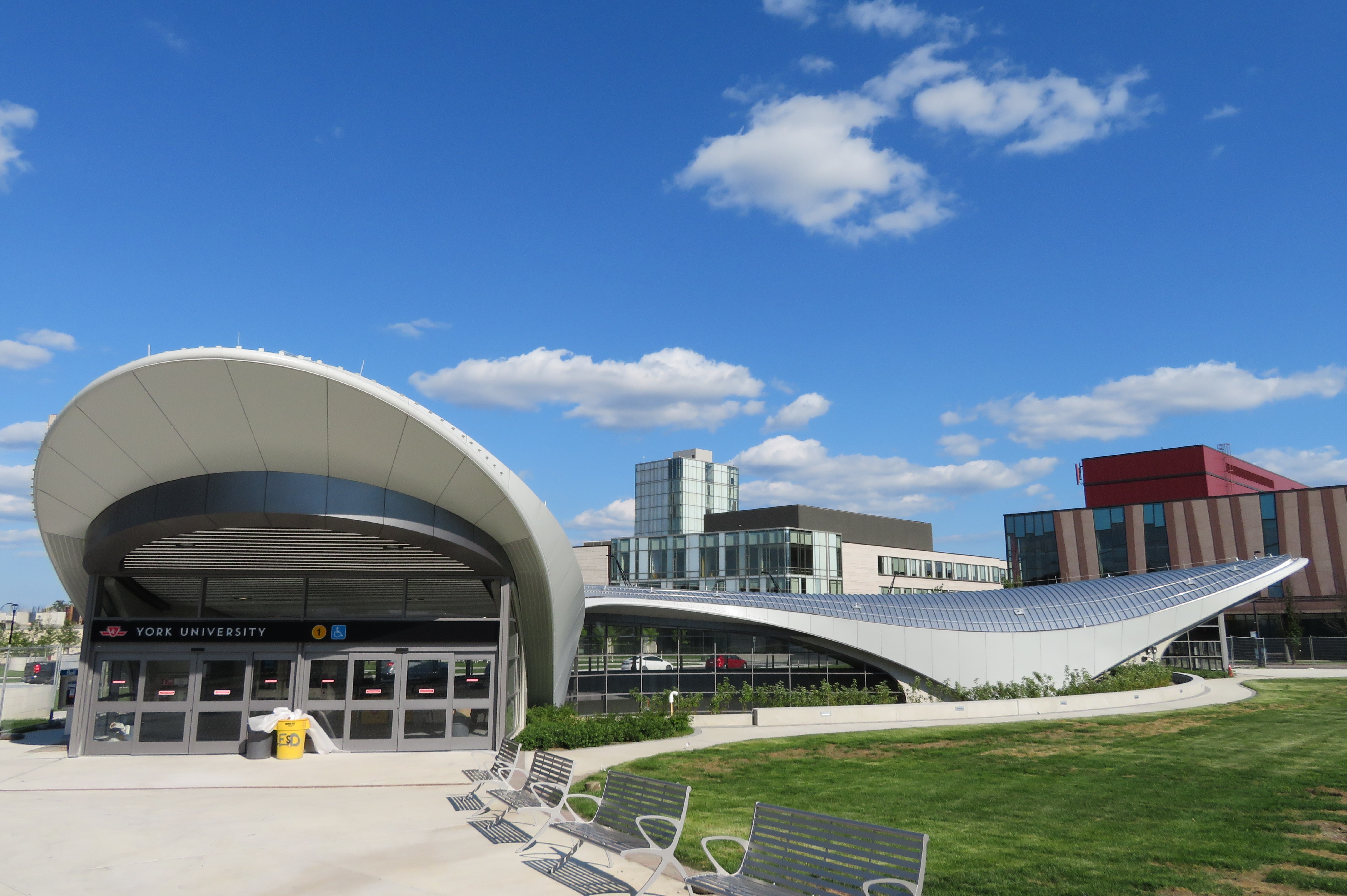 York University Station, August 2017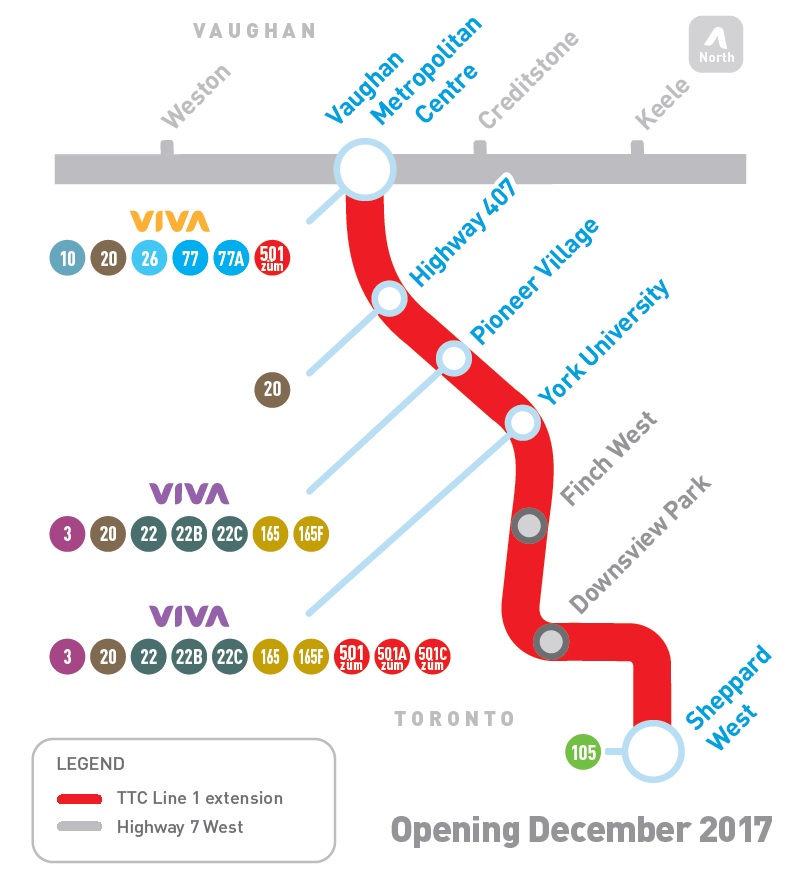
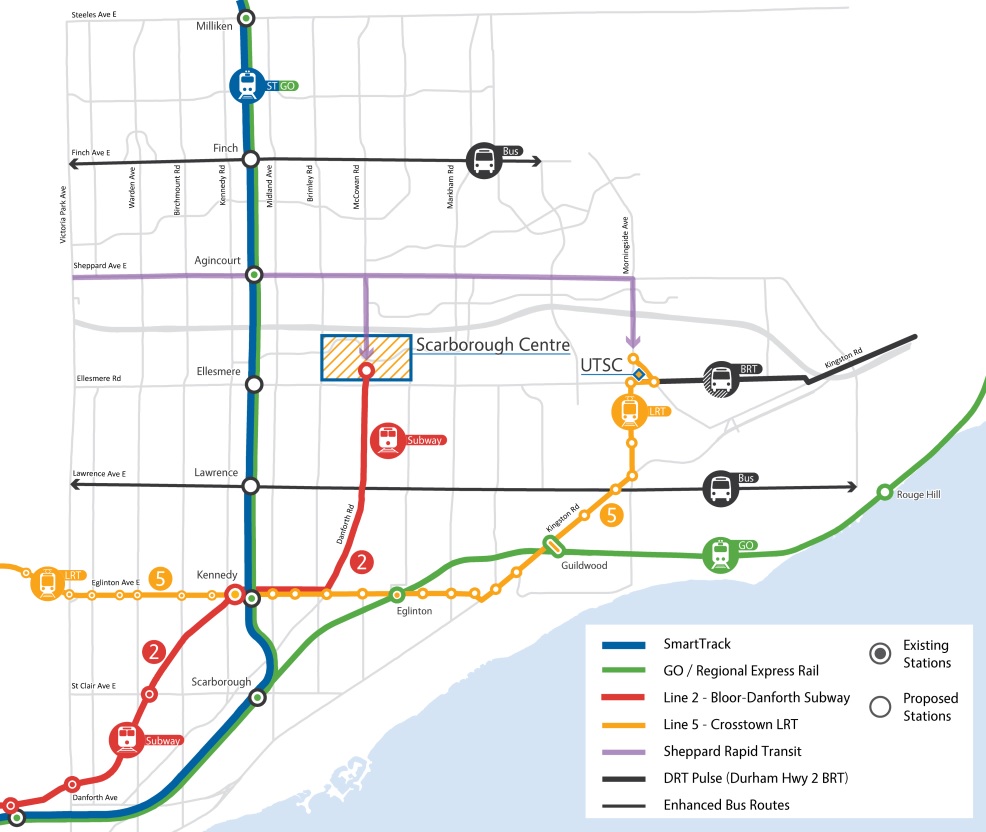 City of Toronto map
 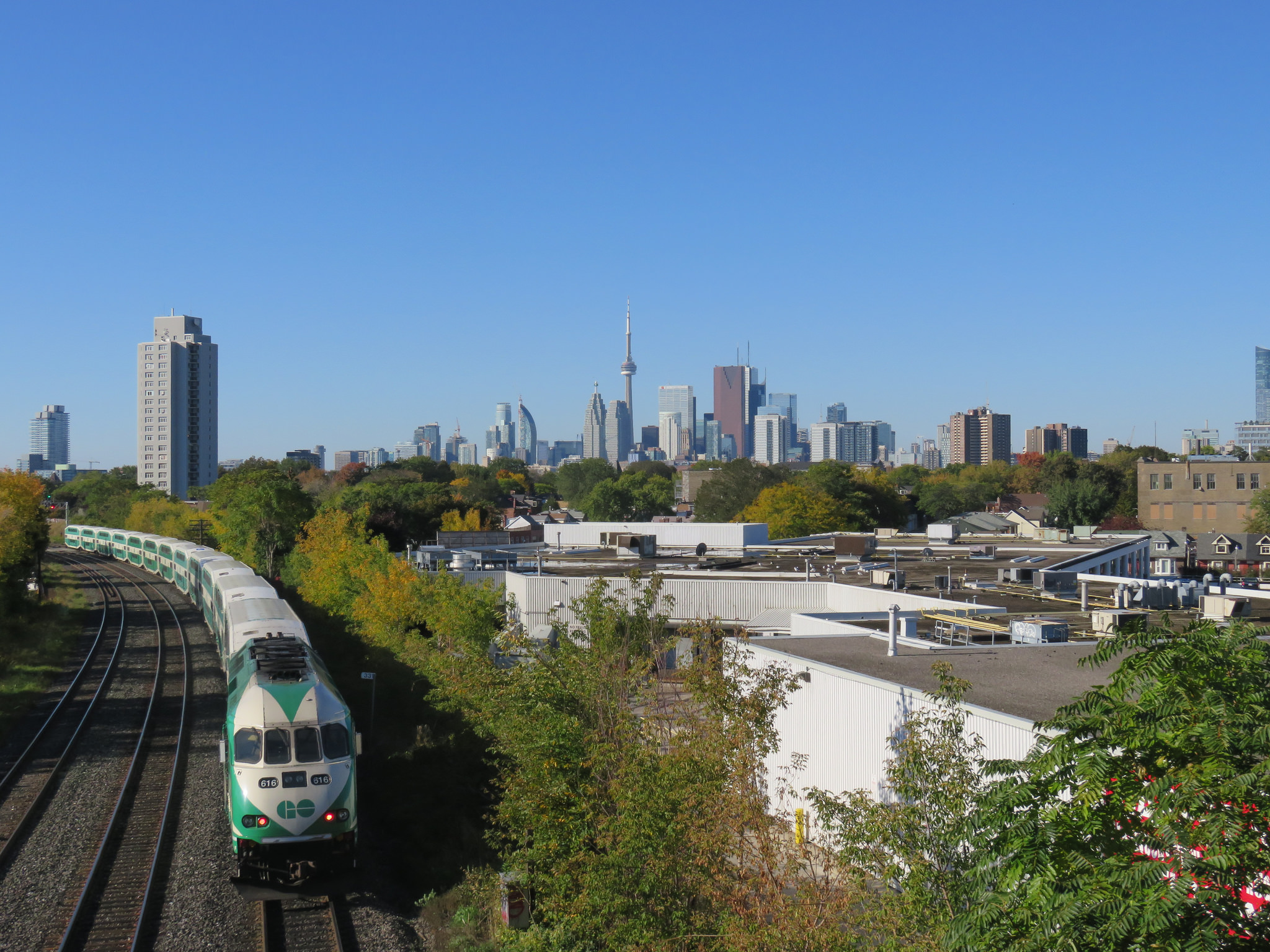 GO Transit train from the Pape Avenue footbridge, near the proposed site of Gerrard Station
 Sean Marshall