Tag: SmartTrack

  • Ridership has tripled on UP Express, but we can do even better

    19008325386_9c321ac7ab_k

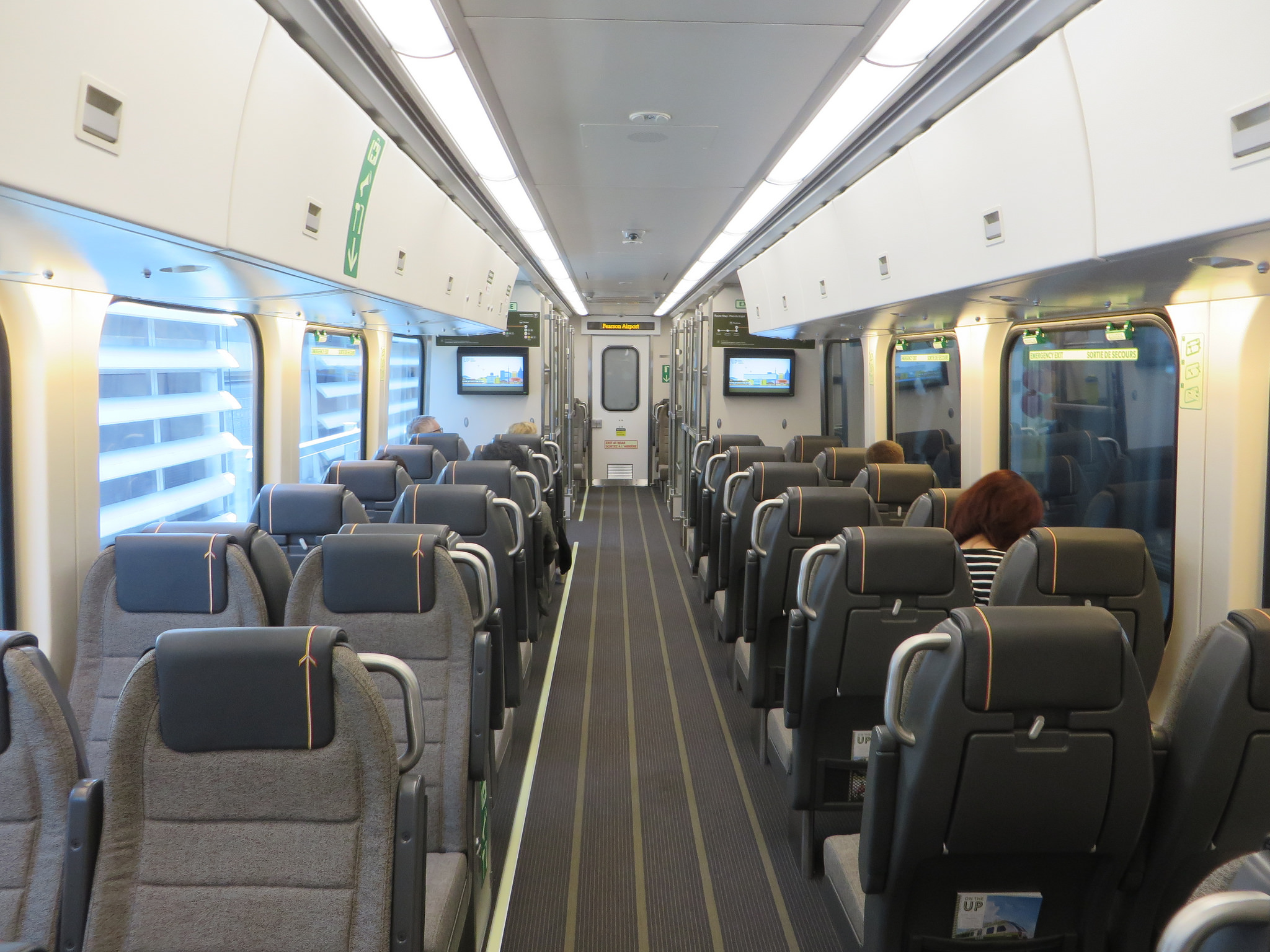
    When UP Express — Toronto’s rail link to Toronto Pearson International Airport – -launched on June 6, 2015, the one-way fare between Union Station and Pearson Airport was set at $27.50, or $19.00 with a Presto card. At the time, Metrolinx, the provincial agency charged with planning and integrating transportation services in the Greater Toronto and Hamilton Area and the parent agency of GO Transit, expected that ridership would hit 5,000 passengers a day in a year. But after its launch, ridership sunk instead. 

    By January 2016, only an average of 1,967 passengers a day rode UP Express, so Metrolinx cleaned house and lowered the fares. The one-way cash fare was reduced from $27.50 to $12, and from $19 to $9 with a Presto card, and fares between Union and Bloor and Weston stations were reduced to match the GO Transit fares for the same trips. Since the new fare structure was introduced, UP Express ridership has more than tripled. By June 2016, the daily average ridership increased to 7,657.

    Despite the ridership growth, and the utility of the rail service for local residents near Bloor and Weston Stations, there’s still more that can be done to make the most of the $456 million spent to build the line.

    The airport region is a major employment centre, yet is difficult to serve by public transit. Fare integration between UP Express, GO Transit, MiWay and Brampton Transit could be an important a first step in creating a full regional rail network, a concept that Mayor John Tory pitched as “SmartTrack.”

    Airport LinksTransit connections at Pearson Airport. UP Express, if it offered fare integration with the TTC, MiWay and Brampton Transit, would be an invaluable part of the Toronto area’s transit network

    UP Express’s ridership increase is a good news story. But there’s so much more utility that can be leveraged.

    I discuss the UP Express ridership trends further in Torontoist

  • The controversial Judson Street zoning change

    IMG_3781-001

    Earlier this year, Etobicoke Councillor Justin Di Ciano (Ward 5) pushed for a zoning change to several industrial properties on Judson Street, adjacent to GO Transit’s Willowbrook Yards. Local residents had enough with a concrete batching operation and Dunpar Homes applied to build a townhouse development on the site.

    City staff recommended against the rezoning, which would allow townhouses to go up on land previously zoned as industrial. Metrolinx, GO Transit’s parent organization, also spoke out against the re-zoning, warning that it could impact its expansion plans, including GO RER/SmartTrack. But Councillor Di Ciano, Mayor John Tory, and most of the mayor’s allies voted against those concerns and supported the redevelopment.

    Now Metrolinx is appealing the council decision to the Ontario Municipal Board, and the City will be forced to hire external expert advice, as it went against its staff recommendations.

    You can read the Torontoist post here, where I explain the situation in more detail.


  • The Truth About SmartTrack

    smarttrack_fb

    This article originally appeared on June 27, 2016 in Torontoist

    In 2014, then-mayoral candidate John Tory ran on a campaign of sound fiscal management, returning decorum to City Hall, and a curious new transit plan called SmartTrack, which promised “London-style” rapid transit from Mississauga to Markham. During the election campaign Tory claimed that the new rail service—53 kilometres long, costing $8 billion—would provide needed transit relief in just seven years, all on a TTC fare.

    During campaign speeches, Tory called the plan “bold.” He also promised to build the Rob Ford-backed subway extension to Scarborough Centre, rather than return to the cheaper, funded light rail alternative that candidates Olivia Chow and David Soknacki were backing.

    Of course, Tory won the election, and many Torontonians were looking forward to an era of competent governance, if not visionary leadership. But two years in, the costs of the Scarborough subway keep mounting, even if the number of stations kept shrinking (from three stations to one stop), and the scope of John Tory’s “bold” SmartTrack plan kept getting watered down.

    With the recent provincial and municipal transit announcements on new GO Station locations, it’s now official: SmartTrack is nothing more than a brand name for transit projects that were already in the works. And the City of Toronto is stuck with some of the construction costs that would have been borne by the province.

    Mayor Tory and the provincial government held two separate transit announcements this week: one in Liberty Village, the other at the former Unilever lands that First Gulf is looking to redevelop as a major office and commercial centre. While Tory has been bullish about promoting First Gulf’s development, the East Gardiner replacement, SmartTrack Station, and even a Relief Line subway stop—projects he championed—will all serve this particular property.

    Those announcements coincide with a Metrolinx report [PDF] that recommends 12 new GO Transit stations: Breslau, St. Clair, and Liberty Village on the Kitchener Line; Innisfil, Mulock, Kirby, Davenport-Bloor, and Spadina on the Barrie Line; East Harbour (Unilever), Gerrard, Lawrence East, and Finch East on the Lakeshore East and Stouffville lines. Stations at Mount Dennis, Downsview Park, and Caledonia were already approved and will connect to the subway and Crosstown LRT. Seven of those stations—from Mount Dennis to Unionville—are along the SmartTrack corridor. Spadina Station, part of Tory’s SmartTrack map, will only be served by Barrie corridor trains.

    From the start, SmartTrack was a fantasy built on assumptions; the line was an idea conceived by a little-known organization called Strategic Regional Research Alliance. SRRA authored a report, “The Business Case for the Regional Rail Line,” discussing the potential of a 2009 concept for connecting suburban office parks with Downtown Toronto with rapid transit. That report became the basis for SmartTrack.

    Meanwhile, Metrolinx—the provincial transportation authority for the Greater Toronto and Hamilton Area—was involved in studying plans for converting much of its existing GO Transit rail network from a commuter rail system to an electrified, regional rail network known as Regional Express Rail. RER and SmartTrack (as well as VIA Rail and UP Express trains) would be sharing the same corridors.

    Since the election, the truth about SmartTrack has become clear. Previous plans for SmartTrack were simplistic, with maps created using out-of-date Google Maps imagery that ignored the fact that lands owned by the City of Toronto along Eglinton Avenue in Etobicoke—reserved for an unbuilt freeway—were largely sold off and redeveloped. There were serious engineering and financial complications of building the connection between the existing GO line at Mount Dennis and the Eglinton spur. The plan to use tax increment financing (TIFs) to build SmartTrack remains dubious. The Eglinton spur was removed, replaced by the revival of the approved yet unfunded western section of the Eglinton Crosstown LRT. Tory surrounded himself with experts, including a prominent University of Toronto transportation professor who gave the plan an “A+.” Critics who pointed out these flaws were ignored or insulted. There are few excuses that Tory can make for this failure.

    With the latest announcements, it is clear that SmartTrack has become nothing more than a moniker for an existing GO Transit RER. Rush-hour train frequencies will likely be every eight to 10 minutes; off peak, trains will arrive every 15 minutes (the TTC subway never operates at less than six-minute frequencies). We do not know what fares will be charged on GO RER/SmartTrack as Metrolinx continues to study regional fare integration. And it is very unlikely that we will be seeing frequent, electric trains offering relief by 2021.

    As the Globe and Mail‘s Marcus Gee points out, the City will now be expected to pick up much of the construction tab—similar to how the municipal government is stuck with cost overruns on the Scarborough subway extension after it rejected a provincially funded seven-stop light rail line to replace the ageing RT line.

    At best, SmartTrack represents the City of Toronto’s buy-in to GO RER, a worthwhile project to provide better rail service to suburban Toronto and the 905. There’s room to negotiate at least some fare integration between GO and the TTC. But at worst, SmartTrack is a failure to deliver on a key election promise, as flawed as it is. But in order for the Mayor to save face, the SmartTrack brand will likely never go away.

  • A good, a bad, and an ugly week for Toronto transit

    There was some good transit news for Torontonians today, as the provincial government announced $150 million in funding for detailed study and engineering for the planned Relief Line subway. The preferred route and station locations for the first phase of the new subway line was also released this week, with eight stops from Pape to Osgoode Stations.

    Happily, the Relief Line, an idea that’s over one hundred years old, Toronto’s answer to New York’s Second Avenue Subway, is closer to being built than ever before. As Steve Munro reports, the study will focus initially on the portion from Pape to downtown, but will shift to the northern and western extensions.

    But there were also some ugly truths concerning that other subway project, the proposed one-stop extension of Subway Line 2 to Scarborough Centre. Last week, homeowners in the Ellesmere/McCowan neighbourhood received notices of possible expropriation, ahead of a public information session in which the preferred alignment of the one-stop subway was revealed. I can understand the residents’ anger; major projects will always be disruptive to some properties and some families and businesses are sometimes forced to re-locate. There’s an argument to be made that subway backers don’t realize the extent of the disruption that even bored-tunnel subways can cause. Stations have to be dug, utilities have to be moved, buildings demolished, and roads closed.

    But most importantly, the Scarborough subway extension remains a bad policy.

    Fullscreen capture 01062016 72046 PM
    2031 ridership projections for terminal subway stations

    In 2031, the projected ridership between Scarborough Centre and Kennedy Station will be 31,000 a day, or 7,200 in the AM Peak. This is lower than previous estimates; a 2013 study estimated the AM peak ridership for the subway extension to be between 9,500 and 14,000. The reduction by nearly half is because the 2013 plan had three stations — at Lawrence, at Scarborough Centre, and at Sheppard — but the new plan has only one station. Passengers on the 54 Lawrence East bus and on the Sheppard corridor would either be gerrymandered to the SmartTrack line, or forced to transfer to get to the subway at Kennedy or Scarborough Centre. $2 billion will be spent for this one-stop extension, while the Islington to Kipling section of Line 1, opened in 1980, cost a small fraction of that amount, even in 2016 dollars.

    On one hand, 7,200 is a respectable peak hour ridership between the two final stations on a long subway line, and subway trains shouldn’t be full at this part of any route. The ridership between Islington and Kipling stations on the other end of Line 2 will be 1,200 less during the same time. Fed by multiple bus routes, Scarborough Centre will be a busy station, one of the top ten for train boardings, if not the top five, in the TTC system.

    But in order to justify John Tory’s SmartTrack, a useful station at Lawrence and McCowan is being dispensed with. Planners, working under the direction council and the mayor’s office, euphemistically call it an “express subway.”

    Scarborough - 2015Scarborough transit plan, 2015

    Scarborough - 2016Scarborough transit plan, 2016

    Previous proposals, backed by former mayor David Miller and 2014 candidates Olivia Chow and David Soknacki, would have seen a light rail line replace the failing Scarborough RT route; the province even promised to cover the capital costs of the retrofit and extension to Centennial College and Sheppard Avenue. In 2011, in a report published by the Pembina Institute, the AM peak ridership of the LRT line between Kennedy and Sheppard was estimated to be 6,400 in 2031, far below the design capacity of a subway extension. An LRT line, with seven stops and many more surface transit connections, would directly serve many more passengers than a one-stop subway.

    Under the failed mayoralty of Rob Ford, the province agreed to build a subway instead, but the city was required to pay up. A property tax levy of 1.6% is currently collected to help pay the city’s share.

    The LRT ship has probably sailed. But thanks to two weak mayors, myopic councillors eager to show they’re fighting for their little fiefdoms, and an obliging provincial government determined not to lose seats in the next election, we’re stuck. At least we’re making progress on the Relief Line.

    Meanwhile, John Tory continues — inadvertently or not — to sow the seeds of confusion over what SmartTrack is all about. After the Downtown Relief Line funding announcement, the mayor put out this tweet:

    This is incorrect. The work on the GO Stouffville Line (not the “Unionville Line”) is a project undertaken by Metrolinx that will allow for two-way service on the existing GO corridor, work that started in 2015. Apart from the SRRA report written before John Tory ran for mayor in 2014, and some initial studies by the City of Toronto and Metrolinx, no work has been carried out on the still-vague proposal.

    Council’s stubborn support of the Scarborough Subway and Tory’s continued SmartTrack fantasies is are just a few reasons why it’s so easy to be frustrated with municipal politics.

  • Yet another transit plan for Scarborough (Updated)

    Updated with a link and discussion of the Scarborough Transit Planning Update, released earlier today.

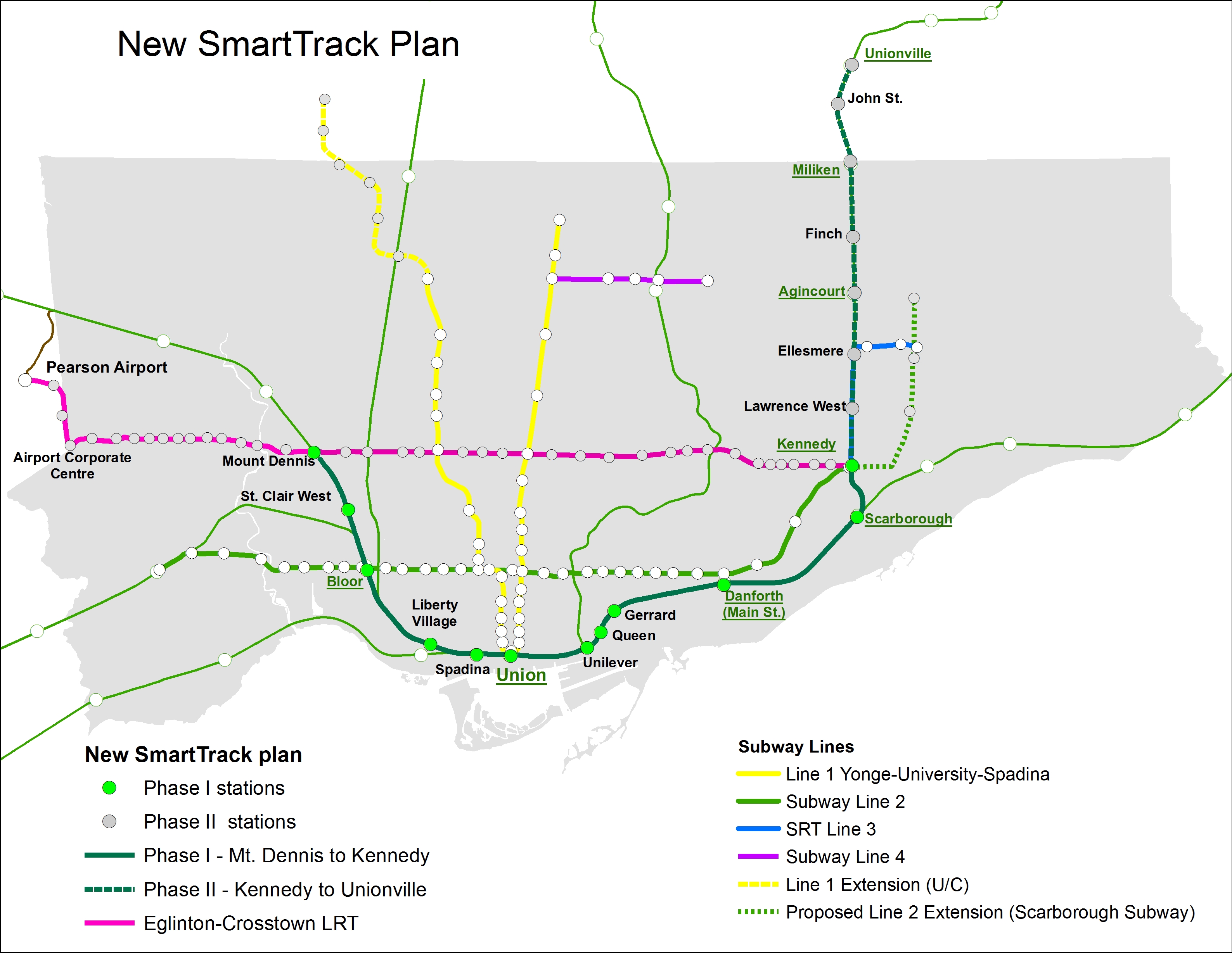
    It’s been an eventful few days for transit watchers. Late last week, we found out that John Tory’s SmartTrack plan will be clipped to an initial phase between Mount Dennis and Kennedy Station, and the Eglinton-Crosstown extended in the west to the Airport Corporate Centre and probably Pearson Airport itself. The section north from Kennedy Station to Unionville Station in Markham has been deferred to a later Phase II. And the announcement of a preferred alignment to the Gardiner East “Hybrid” was announced on Tuesday.

    Back in December, 2014, I suggested that there was no need for the Scarborough Subway extension, and that a good transit plan had already been developed in the last ten years. A combination of the Scarborough RT replacement and extension to Malvern, the Transit City light rail plan, and GO Transit Regional Express Rail (RER) would have served the eastern part of Toronto quite well.

    But then, in 2010, Toronto elected Rob Ford as mayor, who ran on a transportation platform of “subways, subways, subways” and ending the so-called “war on the car.” The Scarborough RT replacement was dropped in favour of a subway, planning and construction work on the Finch and Sheppard East LRT routes was suspended, and the TTC surface network was cut back. For a while, it looked like maybe the Scarborough LRT line would be resurrected. But then municipal and provincial politicians, looking for votes, pushed the more expensive and shorter subway option. Candidates in a by-election in Scarborough-Guildwood all claimed to be “subway champions,” even the NDP’s Adam Giambrone, the TTC Chair at the time Mayor David Miller put forward the seven-line Transit City LRT plan. The three-stop Scarborough Subway extension would cost over $3.5 billion.

    John Tory, who won the 2014 mayoral election, ran on a platform that included “SmartTrack,” a single-line regional rail concept that he claimed would provide relief to the Yonge Subway, completed by 2021. Tory’s campaign claimed that SmartTrack would carry  200,000 riders a day, and be fully integrated with the TTC, including fares. Tory also promised not to re-open the Scarborough LRT vs. subway debate, committing himself to the three-stop subway. Tory never showed much commitment to the Finch West and Sheppard East LRTs, which were funded by the province, but left dormant.

    The trouble with committing to SmartTrack and the Scarborough Subway was having two new parallel transit lines three kilometres from each other between Eglinton and Sheppard Avenues, as depicted in the map below. The Eglinton-Crosstown LRT, currently under construction, the Bloor-Danforth Subway and the SmartTrack line would intersect at Kennedy Station.

    Scarborough - 2015Active rail transit proposals in Scarborough, as of 2015

    But on Wednesday, January 20, Oliver Moore and Marcus Gee at the Globe and Mail and Tess Kalinowski at the Toronto Star broke news on a City of Toronto planning report that would re-allocate part of that $3.5 billion from the subway to extending the Eglinton-Crosstown line to the University of Toronto’s Scarborough Campus (UTSC), and reducing the number of stops on the subway from three (excluding Councillor Glenn De Baeremaeker’s proposal for a fourth) to one. The subway, therefore, would run five or six kilometres, non-stop, between Scarborough Centre and Kennedy. The 12-kilometre, 17-stop extension of the Eglinton-Crosstown line resurrects most of the proposed, but unfunded Scarborough-Malvern LRT

    Today, on January 21, the Scarborough Transit Planning Update staff report was released, with more details.

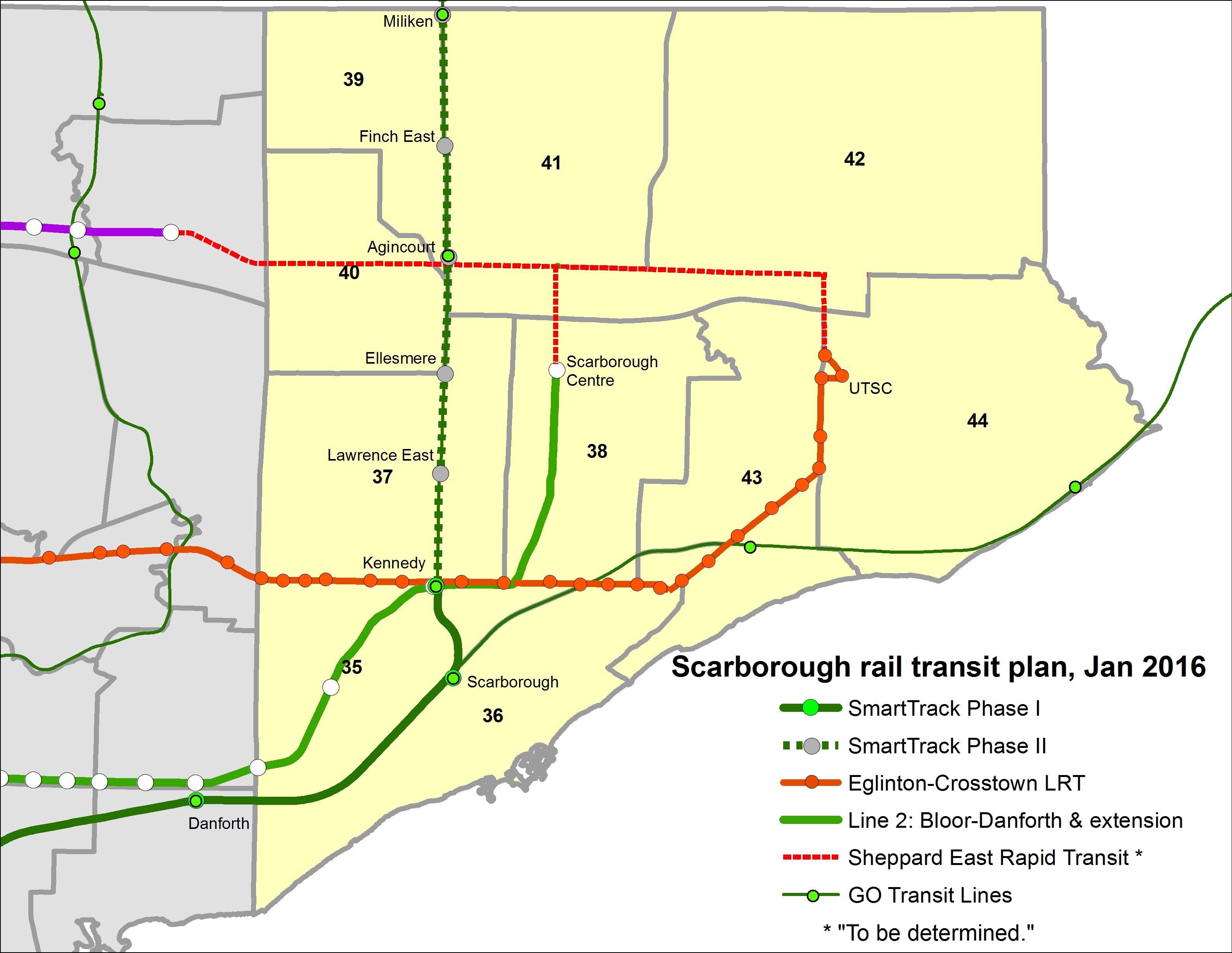
    I created this map below based on a map tweeted by the Star’s Tess Kalinowski on Wednesday afternoon:
    https://twitter.com/TessKalinowski/status/689890493409300484

    Scarborough - 2016The Latest plan for Scarborough, including the one-stop subway extension and the additional 17 stops planned for the Eglinton-Crosstown LRT, as well as SmartTrack Phases I and II, as recommended in a separate study.

    It’s worth noting that the Sheppard East LRT, which won’t start construction until 2021 (essentially leaving it in limbo) is marked on the staff report map as “rapid transit to be determined.” Maybe it will connect to the subway at Scarborough Town Centre. Maybe it will connect to the Eglinton-Crosstown. Maybe it will remain a bus route. In the original Transit City plan, Sheppard East was to be started first; indeed construction did start on the Sheppard Avenue rail underpass at Agincourt GO Station; an empty median is where the LRT tracks are planned to go. The Scarborough-Malvern LRT was supposed to continue north of UTSC to Sheppard Avenue (and potentially further north along Morningside), but this isn’t part of this latest study.

    Transit City planned for a LRT maintenance and storage facility (MSF) on Sheppard East at Conlins Road, near Morningside Avenue. The Conlins MSF would have served three routes: the Sheppard East LRT, the Scarborough RT replacement, and the Scarborough-Malvern LRT. The MSF has been scaled back due to the deferral or cancellation of the other two lines, but will be essential if this latest plan goes through. So the ECLRT is built to UTSC, a rail connection from Sheppard will probably be necessary, and maybe the Sheppard and Crosstown lines were converge here.

    What makes the least sense for me is the long, non-stop section of the subway between Kennedy and Scarborough Centre. There was clearly a problem of having two prioritized high-capacity rail proposals serving similar markets: SmartTrack, and the Scarborough subway extension both championed by the mayor. Cutting out the Sheppard and Lawrence stops delivers passengers to SmartTrack. That is, of course, SmartTrack makes it north of Kennedy Station.

    A separate study by Metrolinx staff, recommending a shorter SmartTrack line between Mount Dennis and Kennedy, along with a western extension of the Eglinton-Crosstown LRT,  was reported in the Globe and Mail last Friday, with the Unionville-Markham section part of a later Phase II. It appears that the City-led Scarborough Transit Planning Study is assuming a full build-out of SmartTrack, at least on the east end.

    I’m happy, though, to see LRT seriously considered as a solution for intermediate transit needs. What I find somewhat ironic, though, is that the Eglinton-Crosstown LRT is becoming what SmartTrack was eighteen months ago: a single line that solves all transit planning problems. Of course, my wish is to go back to building the Scarborough LRT extension, the original Scarborough-Malvern line, and letting Metrolinx and GO Transit do their thing with implementing RER.

    The city planning report notes that “…of the 206,000 transit trips that begin in Scarborough, 99,000 or 48% end in Scarborough. This means that only 14% of all trips that begin and end in Scarborough use transit (99,000 of 692,000).” (Pages 14-15.)

    This is why improving the local transit network – be it streetcars or buses – is so important. We’re often fixated on moving commuters long distances, but we never pay enough attention to short-distance commuters as well. For all the “subways, subways, subways” hot air we’re still hearing from some Scarborough councillors, most of their transit-riding constituents rely on buses. As a friend pointed out, since most of those local trips are by car, we need to ask whether this new plan will make transit more competitive for trips within Scarborough.

    Will we see yet another proposal for Scarborough? I bet we will. Maybe SmartTrack could be routed to a spur to Scarborough Centre (has anyone looked at that?). But at some point, fatigue will set in, and we’ll have to pick something – anything – and build it in order to avoid looking indecisive. But I believe that these planned revisions to SmartTrack, LRT, and the Scarborough subway are steps in the right direction.

  • The least-worst alternative for the Gardiner East

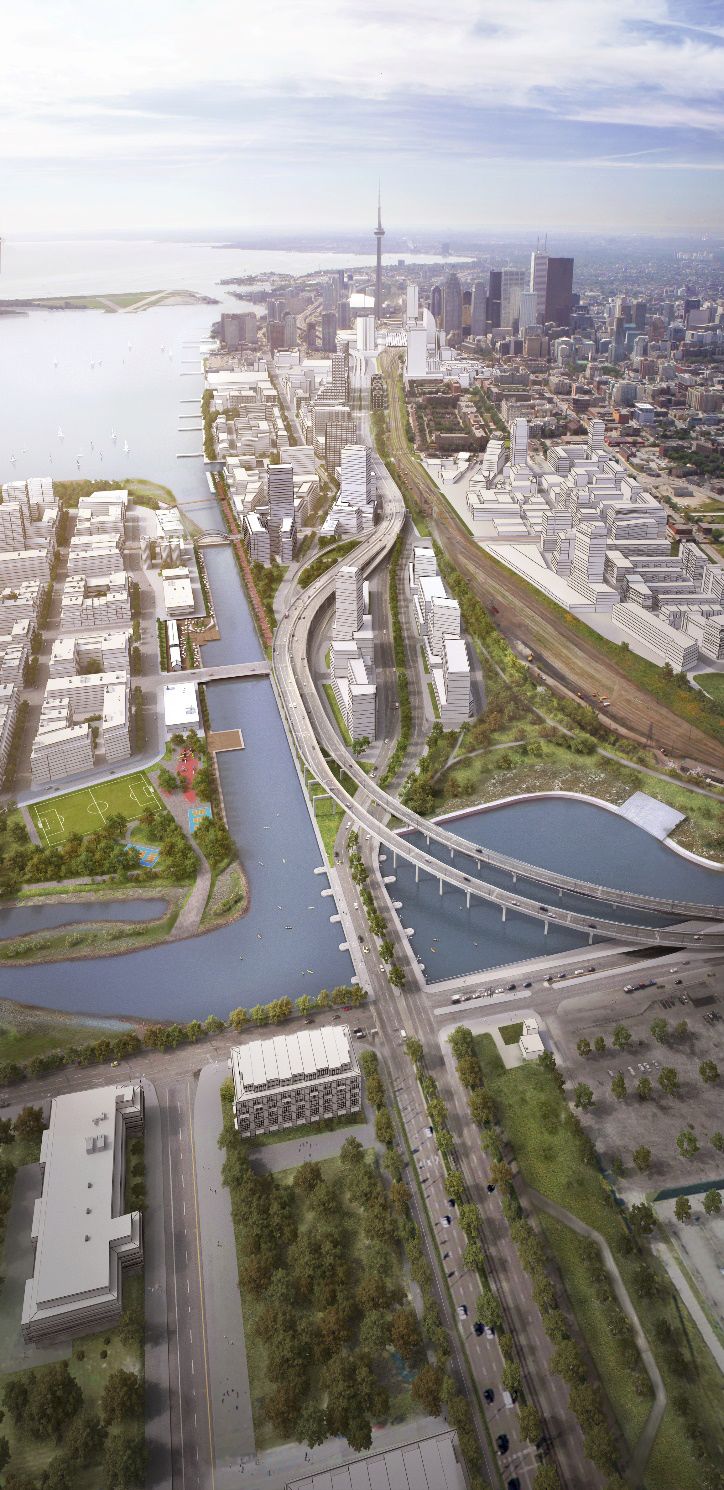
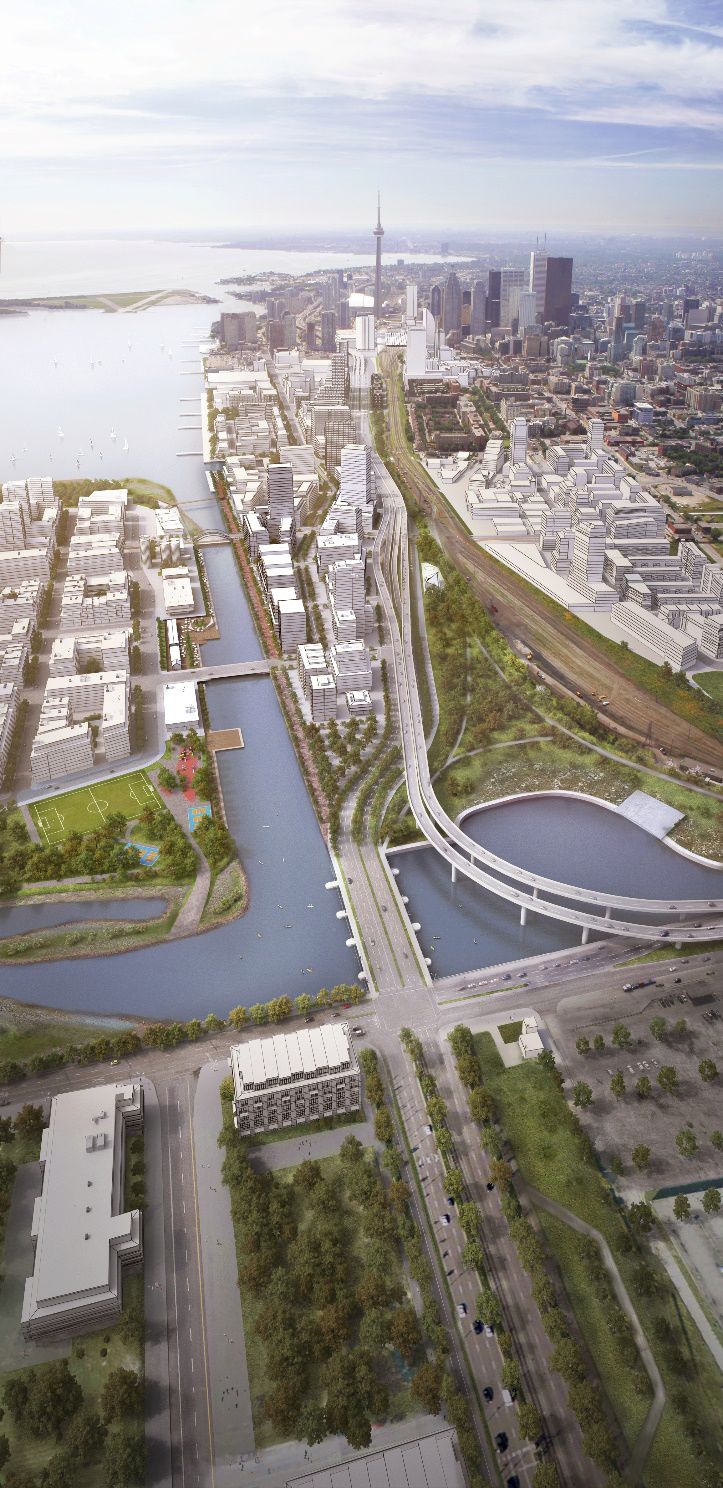
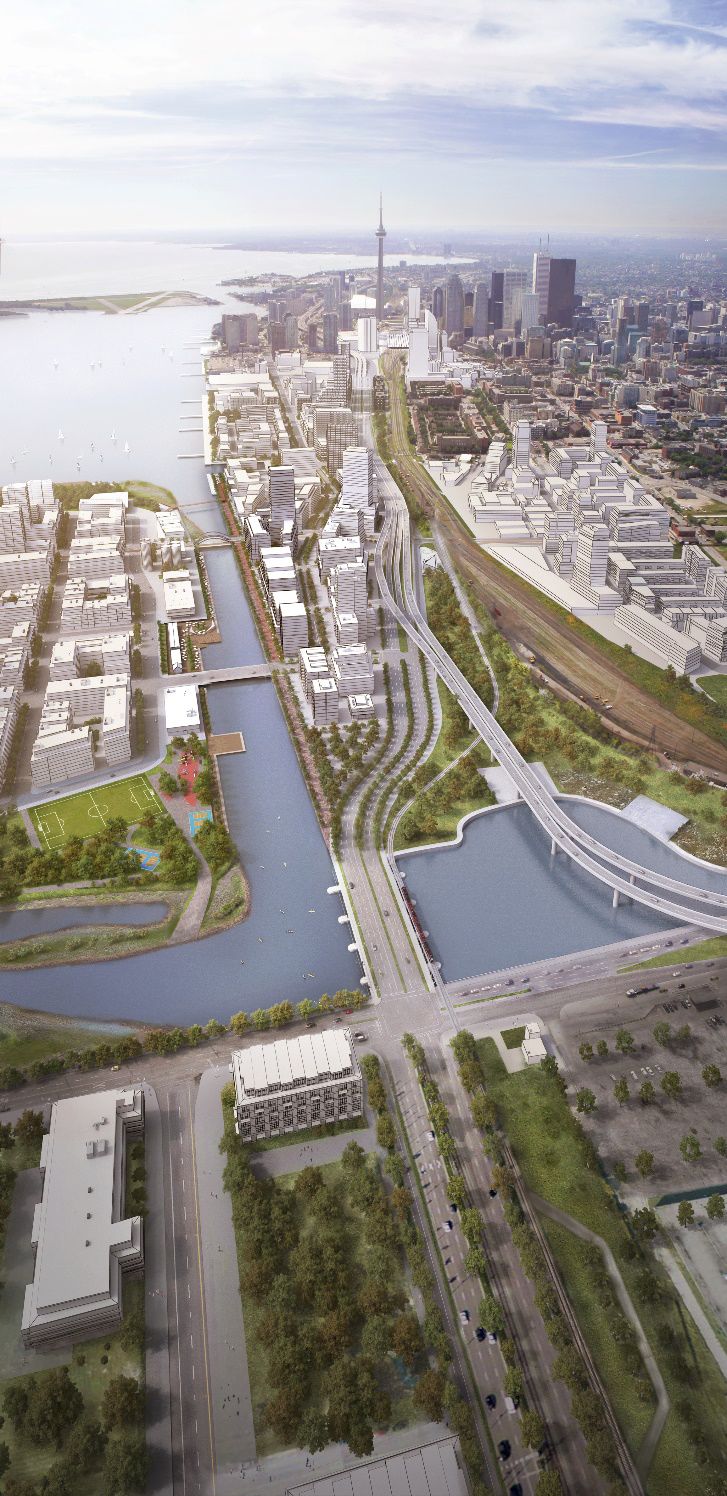
    Back in May, I outlined the reasons why I supported the removal of the elevated Gardiner Expressway east of Jarvis Street. Of the various options, which included maintaining the existing highway, a so-called “hybrid” section that would maintain most of the existing structure, but re-route the section between Cherry Streets and the Don Valley Parkway, and the removal option, which would see a widened Lake Shore Boulevard take over from the demolished freeway, similar to how New York City replaced the elevated West Side Highway.

    The removal option was the cheapest of the three alternatives ($326 million in up-front capital costs and $135 million in ongoing maintenance over a 100-year lifecycle). The study’s traffic models claimed that removal would only increase travel times by 3-5 minutes. Removing the East Gardiner offers the most opportunities to develop the East Harbourfront. Then, I conceded that an eight-lane Lake Shore Boulevard won’t be the most pleasant street to cross, but it won’t be much different than University Avenue.

    But for the benefit of east-end and suburban motorists and several vocal lobbies, council voted 24-21 for the “hybrid” option on June 11, 2015, despite higher costs ($414 million in up-front capital costs, and $505 million in maintenance over a 100-year lifecycle). The relatively close vote was an early test of John Tory’s hold on Toronto City Council.

    Yesterday, the City of Toronto released two important SmartTrack studies. The first was on the projected ridership of Mayor John Tory’s signature campaign promise; the second was on the feasibility of the problematic Eglinton West spur, which observers pretty much expected would be replaced by the planned extension of the Eglinton-Crosstown LRT. Ridership for SmartTrack would be high, but this is predicated on easy transfers, subway-like frequencies, and it being part of the regular TTC fare system. Fifteen-minute service, GO-like fares (which I’ve described as being unfairly expensive for intra-Toronto commutes) and a shorter line will, obviously, reduce ridership, and its relief of the TTC subway. But at least SmartTrack is getting smarter.

    On the same day, we learned more about the City Council-supported “hybrid” options for the Gardiner East as City and Waterfront Toronto staff released detailed assessments on three potential alignments endorsed by the City’s Public Works and Infrastructure Committee. You can view the entire media presentation here.


    Gardiner_media_presentation1     Gardiner_media_presentation2     Gardiner_media_presentation3
             Hybrid 1                             Hybrid 2                          Hybrid 3

    Of the three, “Hybrid 1” is the cheapest to construct, as it uses the existing DVP-Gardiner ramp configuration, but impacts the naturalization of the mouth of the Don River, necessary for flood mitigation. By largely using existing infrastructure, it also minimizes construction delays. “Hybrid” concepts 2 and 3 move the ramps north, but they would be tighter, reducing traffic speeds. These two alternatives also open up more land for development.

    “Hybrid 3” is preferred in all areas except for cost, as it has the greatest potential for development and has the least impact on the planned naturalization of the mouth of the Don. It’s estimated that “Hybrid 3” will cost $569 million to build, and $483 million in long-term maintenance costs, for a total of $1.052 billion. “Hybrid 1” would cost $424 to build, and $482 million in long-term maintenance costs.


    CriteriaCriteria for the three Hybrid options, from slide 39 of the City of Toronto media presentation

    As per David Rider’s report in the Star, we should expect that City and Waterfront Toronto staff expect to recommend “Hybrid 3” to the public works committee and city council. Local councillor Pam McConnell, who backed the “remove” option and still prefers it, will likely endorse the “Hybrid 3” alignment as well, as it delivers the most benefits to the community.

    I’m still disappointed by last year’s vote to keep the Gardiner Expressway up, but I’ll concur with Councillor McConnell. If Mayor Tory and Council are determined to keep the unnecessary eastern section of the Gardiner Expressway up, it should be backing the least-worst option for doing so.

  • A smarter SmartTrack

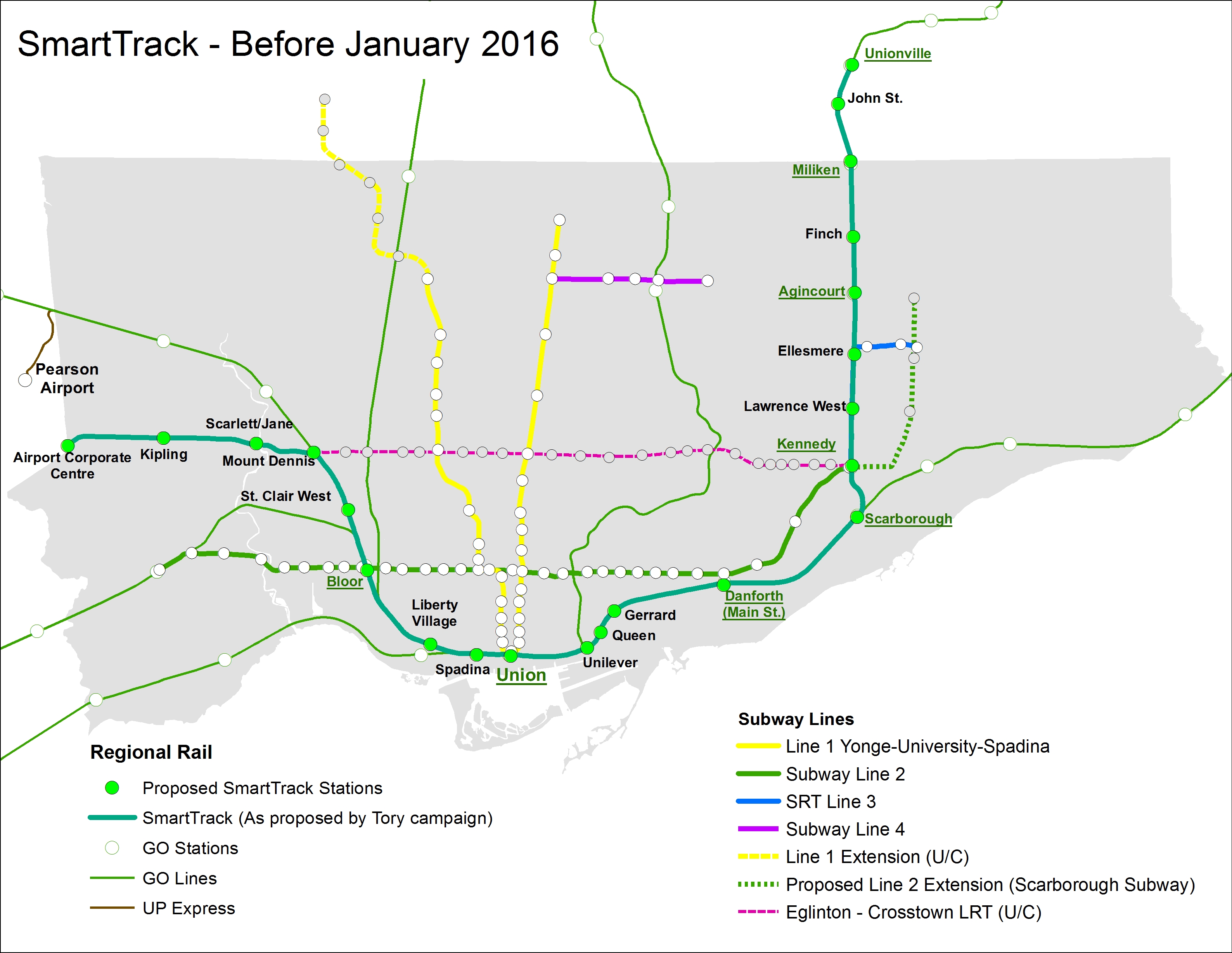
    ST - Before 2016
    John Tory’s original SmartTrack plan, shown with the existing TTC Subway and GO Rail networks. 

    In Friday’s Globe and Mail, we were treated to a scoop by Oliver Moore, that newspaper’s excellent transportation reporter, on behind-the-scenes revisions to Mayor John Tory’s SmartTrack rail transit platform, a topic that I discussed several times in this blog.

    Tory’s SmartTrack plan, dreamed up by a private-sector planning firm, was intended to connect office parks in Mississauga and Markham to Downtown Toronto, as well as serve the proposed First Gulf development at the Unilever site near the mouth of the Don River. Tory promised that it would provide relief to Toronto’s overburdened subway system, but that was never the main objective.

    I have been aware of rumours that Tory’s SmartTrack plan was going to be walked back due to mounting costs and technical issues of implementing the mayor’s campaign promise. The team that came up with the idea of a U-shaped rail network intended to connect several suburban employment centres with Downtown Toronto overlooked some important details, such as the availability of land along the former Richview Expressway corridor along Eglinton Avenue West. SRRA, the private-sector planning organization that came up with SmartTrack, assumed that the Richview lands were available and owned by the province, but the city owned the land, and sold much of it off for development in 2011 and 2012.

    The cost of building the western spur between Mount Dennis and the Airport Corporate Centre was, in all likelihood, found to be prohibitive, though we have yet to find out what the estimated costs for a tunnel along that section. The eastern section, north of Kennedy Station, would have closely paralleled both the Scarborough RT and the proposed extension of the Bloor-Danforth Subway to McCowan Road, a project that Tory also backed.

    The Globe and Mail’s Oliver Moore reports that SmartTrack will cover a much shorter section than the map on John Tory’s 2014 campaign brochures. Frequent rail service will complement existing GO Transit Regional Express Rail (RER) services on the Kitchener and Stouffville Corridors, terminating at Mount Dennis and Kennedy Stations. The Eglinton West section will be covered by the “shovel-ready” Phase II of the Eglinton-Crosstown light rail transit line (ECLRT), which is already under construction east of Mount Dennis. (The provincial government deferred funding for this section of the ECLRT in 2010 for budgetary reasons.) The north-eastern section of SmartTrack, between Kennedy Station and Unionville Station in Markham, will be deferred.

    This new plan, which is being finalized and will likely be officially announced later this year, will cost an additional $2-billion to $3.5-billion to the existing plans for RER, in order to facilitate more frequent, subway-like frequencies, as well as complete the western section of the ECLRT.

    If Moore’s reporting is accurate (and I have seen maps and other materials that collaborate his report), then Tory will have to eat some crow. Spin doctors will have to figure out how to polish this turd as Tory seeks a second mandate in 2018. It’s also inevitable that the new additional service on this corridor will continue to be branded as “SmartTrack.” But this is the best solution, and maybe this is a sign that Tory is learning on the job.

    At the end of the day, what Toronto gets is what Metrolinx’s “Big Move” plan envisioned: upgrades of most GO Transit corridors to RER, as well as Phase II of the Eglinton-Crosstown LRT line to Pearson Airport. (The Finch West and Sheppard East LRTs are also approved, but have yet to start construction.) The paired-down SmartTrack plan, if trains are frequent enough, and with attractive transfers with the subway and TTC surface routes, will draw some riders. It could help provide medium-term relief as the [Downtown] Relief Line Subway is studied and built.

    New SmartTrack PlanThe new SmartTrack plan, including Phase II of the Eglinton-Crosstown LRT

    But where I find myself annoyed is when I realize that we wasted over a year on Tory’s campaign slogan without any progress on the Relief Line (which will offer real, long-term relief to the Yonge Subway), the Waterfront West LRT, or other transit priorities such as accessibility at all existing subway stations. I remember during the 2014 election campaign, critics of Tory’s simplistic and flawed SmartTrack plan were dismissed without acknowledging their objections. It’s also worth noting that Tory also adopted rival Olivia Chow’s bus plan, after belittling it during the campaign.

    In order to provide fast and reliable transit to the Airport Corporate Centre and Pearson Airport itself, there are opportunities to refine the western section of the Eglinton-Crosstown LRT. The environmental assessment called for 15 stops between Mount Dennis and Pearson Airport, while SmartTrack would have had as few as three stops along the same section. If the ECLRT can be sped up at all, it would be worth considering. I would also be interested in whether the SmartTrack corridor could be integrated with the UP Express rail link, whose ridership started off quite low.

    And maybe, just maybe, the high costs of constructing the Scarborough Subway extension will also prompt a rethink, going back to the original LRT replacement and extension plan. As the Spadina Subway extension to York University and Vaughan is now two years late (and yet another $400 million over-budget), maybe there’s an opportunity to get it right there as well. It’s also imperative that proponents of the Relief Line Subway strike now.

    I could be giddy with the revelation that Mayor Tory’s signature campaign platform is coming undone, having foreseen the problems with his plan. But I’m not. However, I do take pleasure in knowing that we have a smarter plan in the works.


  • Not so FAST: SmartTrack gets a lobby group, raises many questions (Updated)

    smarttrack_fb
    I find myself feeling frustrated, worn down, and at times angry about this federal election that’s thankfully coming to an end on Monday. As a progressive voter, I’ve been disappointed by Thomas Mulcair and the New Democrats, for reasons that Desmond Cole explains so very well in today’s Toronto Star. (Locally, I ‘ve been supporting the NDP’s Linda McQuaig in Toronto Centre, whose progressive credentials are impeccable.) The bright side is that Stephen Harper’s Conservatives are going down to an almost-certain defeat, hopefully taking their narrow and divisive targeted politics with them. My wish is for a minority government in which the Liberals and New Democrats share power; this may check the Liberals’ record of running left and governing right.

    Happily, Torontonians also have the Blue Jays and municipal politics to watch. Last night, we all got to watch the strangest seventh inning in baseball history; today, we get to snicker at the efforts of an Astroturfing crew of lobbyists pushing SmartTrack – a mayoral campaign slogan masquerading as a transit plan. Municipal politics may be at times just as depressing as provincial or federal politics, but at least it’s a lot more fun.

    The Toronto Star’s fantastic transportation reporter, Tess Kalinowski, reported on a new booster group, known as FAST (Friends & Allies of SmartTrack). Its spokesperson would be Alvin Curling, a former provincial Liberal cabinet minister and Speaker of the Provincial Parliament. Other members of its Public Advisory Board include Kyle Rae, former city councillor who is now a City Hall lobbyist, and three prominent lawyers  – Andrea Geddes Poole, Michael Brooks, and David S. Young. Also involved is one Tom Allison. 

    According to a press release, FAST claims it’s “here to advocate for SmartTrack and to educate the public about how it could make a huge difference in cutting congestion and moving people around the region.” It would raise funds “devoted to creating a variety of awareness campaigns such as town halls and informational videos.” 

    FAST’s website – launched today – is comically full of spelling and syntax errors, misinformation, and complete fabrications of basic facts. Here are just a few. (more…)

  • The genesis of Mayor John Tory’s SmartTrack

    I was recently browsing Urban Toronto‘s forums (a great resource if you’re interested in keeping up with construction updates and development proposals here in Toronto), when I came across a post written by “AlvinofDiaspar” in a thread discussing SmartTrack.

    Alvin’s post linked to an interesting report written by the Strategic Regional Research Alliance, a consulting group based in Toronto that I had never heard of until recently. The report, entitled “The Strategic Case for the Regional Relief Line,” was published in October 2013, just before the mayoral race began for the 2014 election.

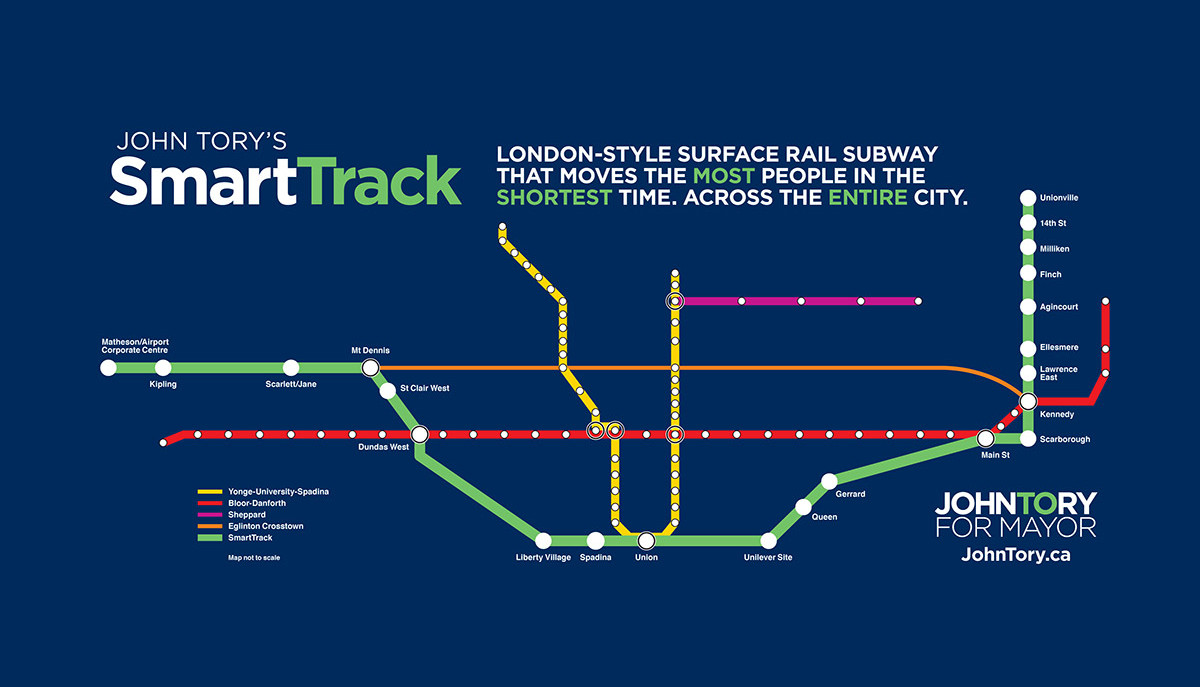
    John Tory unveiled his “SmartTrack” plan, promising a “London-Style surface rail subway” (whatever that meant), on May 26, 2014. The transit service, using frequent, electric multiple unit trains (like those used for commuter/regional transport in many European cities) would mostly follow existing railway corridors from Markham to Mississauga, via Union Station.

    On the east end, the route would follow GO Transit’s Stouffville Line from Union Station as far as Unionville Station, making more frequent stops, serving the Unilever plant (which will be replaced by a massive commercial/office redevelopment by First Gulf, first announced in 2012), as well as additional stops at Queen St East, Gerrard/Carlaw, Lawrence East, Ellesmere, Finch and 14th Avenue, in addition to existing GO Transit stops at Danforth/Main, Scarborough Junction, Kennedy/Eglinton, Agincourt (Sheppard), Milliken (Steeles) and Unionville.

    To the west, the line would follow GO’s Kitchener Line from Union Station as far as Mount Dennis (Eglinton Avenue, near the western terminus of phase one of the Eglinton-Crosstown LRT), with stops at Spadina, Liberty Village, the existing GO/UP Express station at Bloor, and at St. Clair Avenue. At Mount Dennis, the SmartTrack corridor follows a routing via Eglinton Avenue into Mississauga’s Airport Corporate Centre office district, which of course has no existing rail infrastructure to capitalize on.

    Tory promised to have SmartTrack operational in seven years, by 2021, putting other approved and/or proposed transit projects (the Downtown Relief Line, the Sheppard East and Finch West LRTs, among other plans) on the back burner.
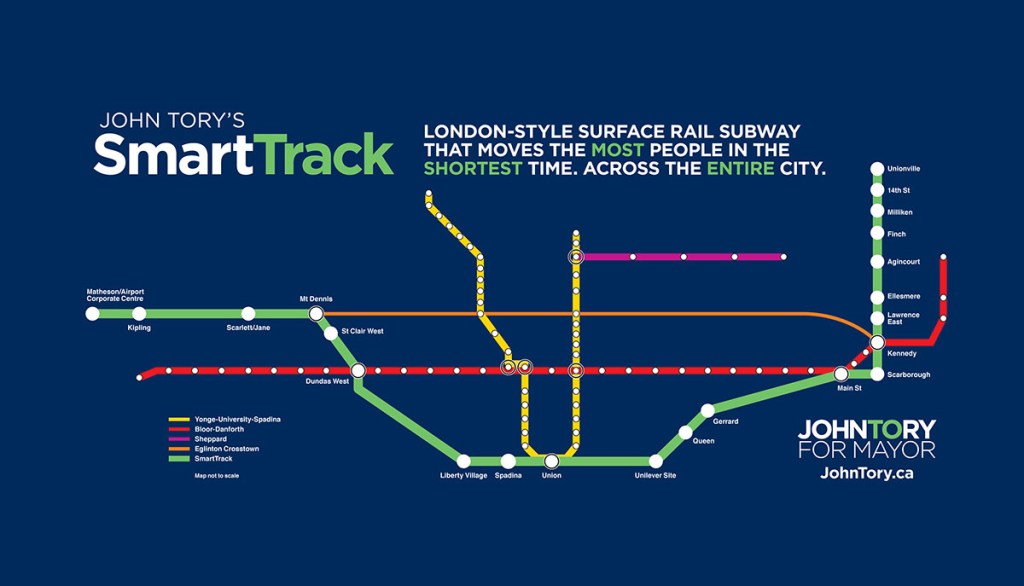
    smarttrack_fbJohn Tory’s “SmartTrack” map

    Back in 2014, transit observers were taken aback by this new “bold” transit idea (John Tory kept using that word to describe SmartTrack), as his campaign had recently taunted Olivia Chow’s hesitancy to prioritize the Downtown Relief Line (DRL) in her transit platform. At the time, Chow, the presumed front runner in the mayoral race in April 2014, promised to increase TTC bus service and build the Scarborough LRT while planning for the DRL continued.

    The DRL is a long-proposed subway line under review by the City of Toronto and by Metrolinx that would connect downtown Toronto to the Bloor-Danforth Line east of the Don River, thus relieving the the Bloor-Yonge subway interchange from overcrowding, while offering improved transit access to east end Toronto, and addressing overcrowding on Yonge subway trains. Further extensions to the north, towards Thorncliffe Park, Flemingdon Park and Don Mills, would re-direct many current and potential transit riders from the Yonge Subway, allowing for an extension of that line from Finch to Richmond Hill.

    But to some degree, Tory’s promise of frequent, regional electric rail on GO’s corridors dovetailed with provincial plans for electrification of part of GO’s services and the Airport Rail Line (now branded as the Union Pearson Express). Improved services on GO’s corridors, if paired with fare integration with local transit (GO’s fares are very expensive for short trips), would provide useful rapid transit to many areas not served by the subway, and could provide some relief to the existing subway network. John Tory was endorsed by many provincial cabinet ministers; it appeared that he had the support of the Liberal government itself, though Premier Kathleen Wynne never endorsed any mayoral candidate directly.

    The only hint of this SRRA report that I could find in the mainstream media was in an interesting article written by Tess Kalinowski, the transportation reporter at the Toronto Star after Tory’s win on October 27, 2014. In an article published on November 17, entitled “The evolution of SmartTrack,” a report entitled “The Business Case for the Regional Relief Line” was mentioned. Also mentioned in the article was John Duffy, a political strategist who worked on the provincial Liberal leadership campaign of former transportation minister (now environmental minister) Glen Murray, and had ties to Wynne’s leadership and election campaigns. Kalinowski wrote that Duffy also was acquainted with Iain Dobson, a property developer and Metrolinx board member. Other people involved in putting SmartTrack together and mentioned in the article were the Canadian Urban Institute’s Glenn Miller (who is listed as a SRRA contact on its website, as is Iain Dobson, a real estate executive and Metrolinx board member), former Toronto chief planner Paul Bedford and businesswoman and urban expert Anne Golden.

    Transit advocate and friend Steve Munro picked up on this report before I had – you can read his posts which are more detailed and far better than my short analysis in this post:

    Munro: The Dubious Planning Behind SmartTrack Part I Part II Part III

    It’s unfortunate that John Tory decided to make this concept the centrepiece of his transit platform. Easily, the biggest flaw, mentioned by others, including Steve Munro and mayoral rival Olivia Chow, is the Eglinton section between Mount Dennis and the Airport Corporate Centre. The corridor already had a proposed rail transit project, the western leg of the Eglinton-Crosstown LRT line, a project first proposed in 2007 as part of a larger city-wide LRT plan known as Transit City, and confirmed in 2009 when the provincial government announced funding for it and three other LRT lines. (In 2010, funding was deferred for the section west of Weston Road). The once-available right-of-way that would have allowed for a surface-running heavy rail transit project was already disappearing.

    But in the SRRA-authored report, we see why Tory went along with the problematic Eglinton routing, rather than having SmartTrack continuing along the GO Kitchener/UP Express corridor towards the transit desert of northwest Toronto. It was part of a larger plan to connect suburban office parks to Downtown Toronto.

    The Regional Relief Line, as envisioned by the SRRA, would have included a third phase, from the Airport Corporate Centre to Meadowvale Business Park, another large, although sprawling, employment centre near Highway 401 and Mississauga Road. The “Phase Three” of this proposed regional rail route would follow Highway 401 on a new alignment.
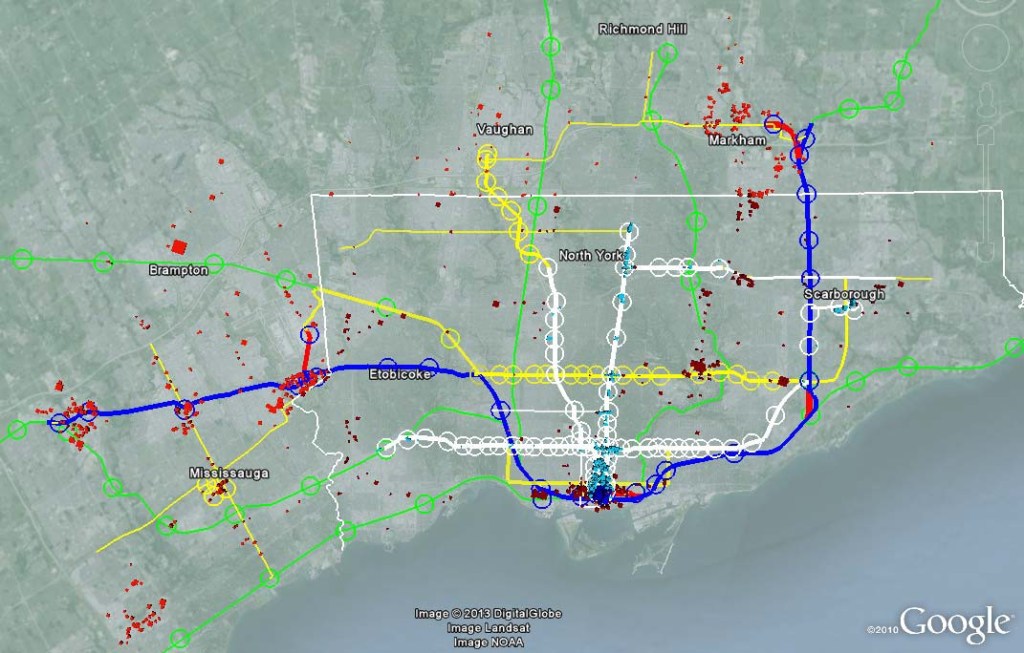
    srra mapThe map from the SRRA report, published on page 4. Note the use of Google Maps to create the map.

    The SRRA planning exercise appears to be one where well-educated planning experts were engaged in a game of “connect the dots.” Sure, the Regional Relief Line connected several major employment nodes in Markham, Toronto, and Mississauga, with the nodes in Mississauga lined up along Highway 401. But this error on page 6 of the report makes me wonder how many of the facts and assumptions the authors simply got wrong or didn’t fact-check:

    This phase will take a little longer to complete than the Markham phase because there are no tracks on the section from Mt Denis to the Airport Corporate Centre. This right of way will take longer to design and obtain approval in an EA process. It is owned by the Province and was intended to be an expressway. There is ample room for the dedicated right of way.

    In fact, the Richview Corridor, the right of way mentioned, was owned by the city, not the province, reserved in the 1960s for an expressway linking Highways 401 and 427 to the proposed Highway 400 extension, part of a much larger highway plan for Metropolitan Toronto. The 400 extension was cancelled and the at-grade Black Creek Drive was built instead; the Richview lands along Eglinton Avenue West in Etobicoke remained dormant for decades. But in 2011, the city started selling off the land for residential development, making the right of way unusable for any transportation corridor. (This did not matter in plans for the Eglinton-Crosstown LRT connection to the airport; there was still room to build a median LRT corridor along this section.) In 2013, pre-eminent local transit and planning experts should have been aware of this development and be able to identify the proper owner of this former right of way.

    It also strikes me as a little backwards looking to link auto-dependent office parks together with a new transit line, especially without a detailed origin-destination study. Shouldn’t urban planners be promoting dense urban employment clusters in areas well-served or potentially well-served by transit? Does it make sense to build expensive transit lines to serve low-density office complexes that come with large parking lots and garages, such as those in Mississauga’s Airport Corporate Centre? Or am I confused?

    In December 2014, mere weeks after Tory’s election, Council voted 42-1 to accelerate the work plan for the rail line, awarding up to $750,000 for early analysis and modelling work. The consultants awarded the funds? A group from the University of Toronto and Strategic Regional Research Associates. In February, council approved an additional $1.65-million towards studying SmartTrack, at least taking a closer look at the Eglinton West section of the corridor.

    To me, it seems just a little bit odd that Tory’s campaign advisers were awarded this contract to study a project, that until Tory’s election, wasn’t even on any transit planning maps. Steve Munro picked up on this as well, questioning whether  Iain Dobson, a member of the Metrolinx Board, has a conflict of interest due to his involvement with the SRRA and a member of the Advisory Board to the University of Toronto Transportation Research Institute. After all, Metrolinx is supposed to be the expert, disinterested provincial agency charged with evaluating and implementing various transit plans. Meanwhile, the need for a Downtown Relief Line hasn’t gone away.

    Tory and his connections in academia and the private sector have managed to change the course of Toronto’s short-term transit planning, and I can’t help but feel a bit suspicious of the behind-the-scenes planning that went into SmartTrack. This is a story very much worth following.