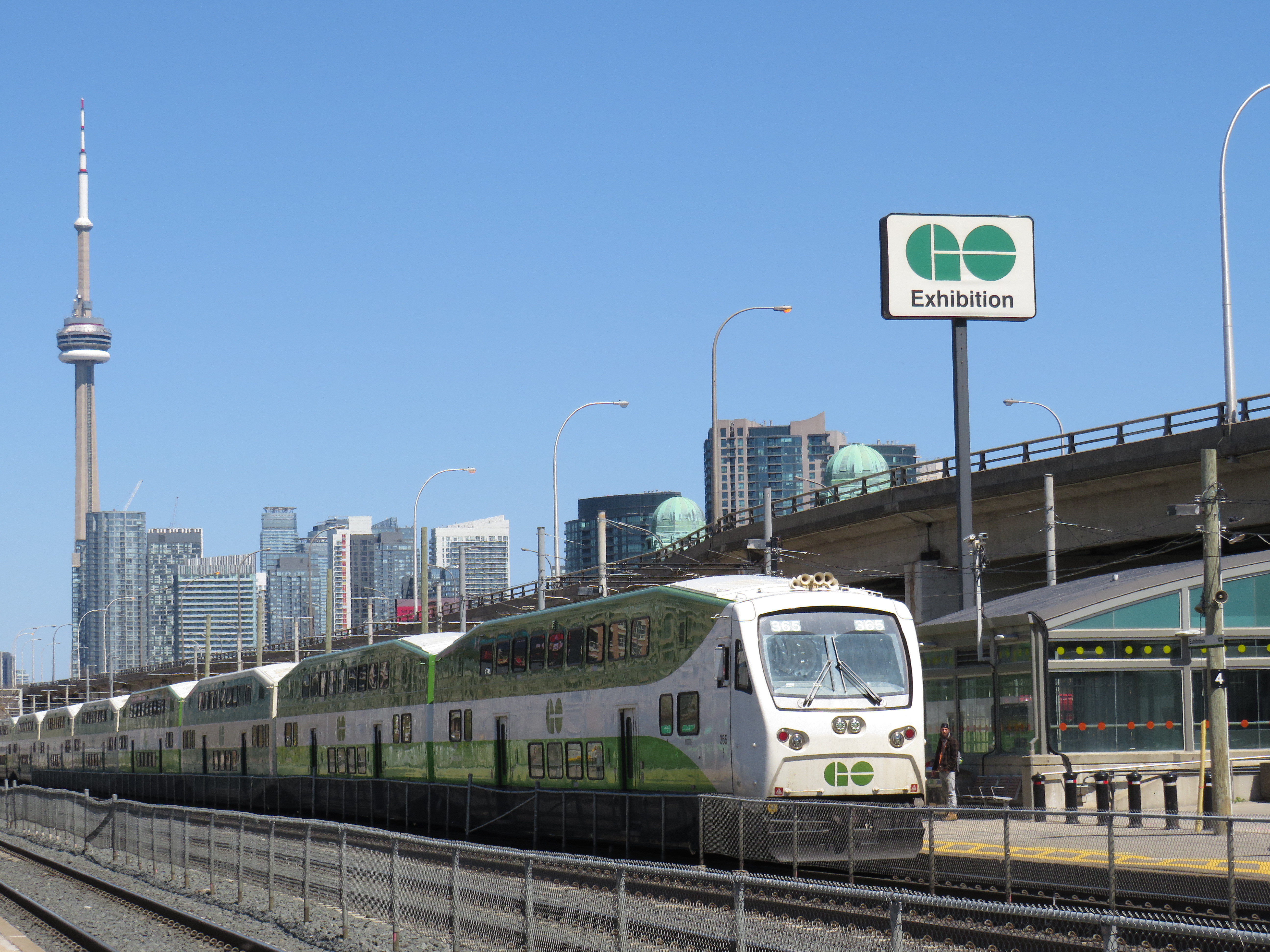
You’ll see fewer trains on the Lakeshore West, Stouffville, and Barrie Lines in September
GO Transit passengers might be in for a shock after Labour Day as new schedules and new penalties come into effect. On several rail corridors, off-peak trains are being cancelled and replaced with buses, while the fines for not paying a GO Transit fare are increasing — by over 450% for a first-time offense.
During the evening of Friday, August 28 — just five days before the Labour Day long weekend — GO Transit quietly released its new schedules for the Fall 2026 period. Typically, schedule changes include the restoration of extra bus trips on the Highway 407 Corridor (which serves several college and university campuses), as well as bus routes to Guelph, Kitchener-Waterloo, St. Catharines, and Peterborough. The fall schedule change often brings certain service improvements and schedule adjustments to reflect demand and operating changes. But the changes for September 2026 are mostly cuts to rail services.
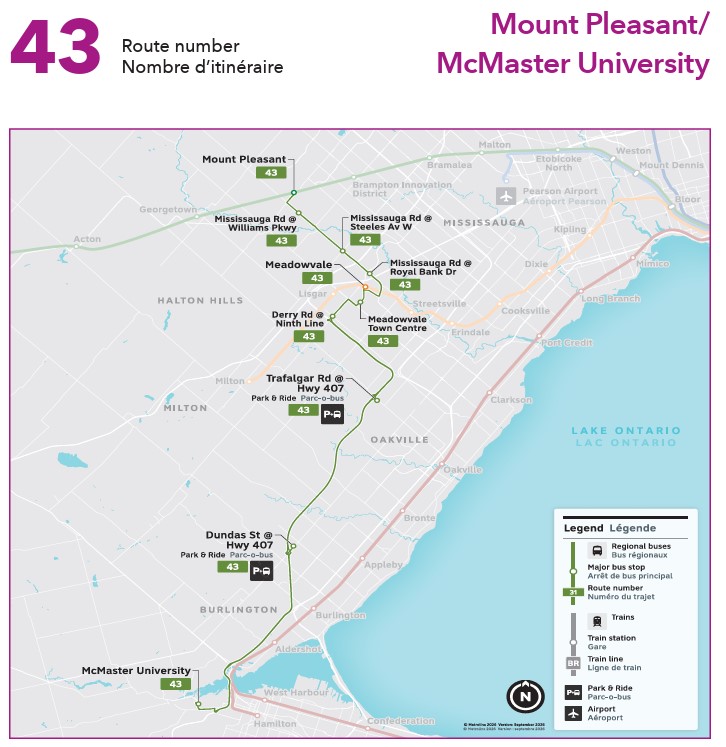
There is one new bus route, Route 43 between Mount Pleasant GO Station in Brampton and McMaster University in Hamilton, via Meadowvale and Highway 407, running mainly in the peak direction, Mondays through Fridays.
New Route 43 between Mount Pleasant and McMaster (PDF Schedule)
But on the Barrie Line, there will be one less weekday round trip between Allandale Waterfront and Union Station: the southbound 21:10 trip and the northbound 22:01 trip disappear, along with the 20:54 northbound to Aurora. Those runs will be replaced with buses. But the southbound 21:10 train from Allandale took 1 hour and 42 minutes, arriving at Union at 22:52. The replacement bus, including a transfer at Aurora, takes nearly three hours, with no access to washrooms and no direct access to Downsview Park Station.
On weekends and holidays, the first southbound train from Allandale Waterfront will now be at 14:05, the last train will be two hours later, at 16:05. From Union Station, the first northbound train will be at 16:54, to Aurora only. The old Table 65 schedule has six round trips to Barrie on weekends, with hourly service to and from Aurora.
There will be similar cuts to the train schedule on the Stouffville Line, where there will be no train service until after 3PM on weekends and holidays. The 23:00 and midnight trains from Union on weekdays are gone, as are the evening inbound trains. There will be replacement buses, but those are often stuck in traffic on the Don Valley Parkway and Highway 404. On the Lakeshore West line, the 15-minute weekend afternoon service between Union and Oakville is gone and the Niagara train service extension on weekdays is down to just one peak-direction train.
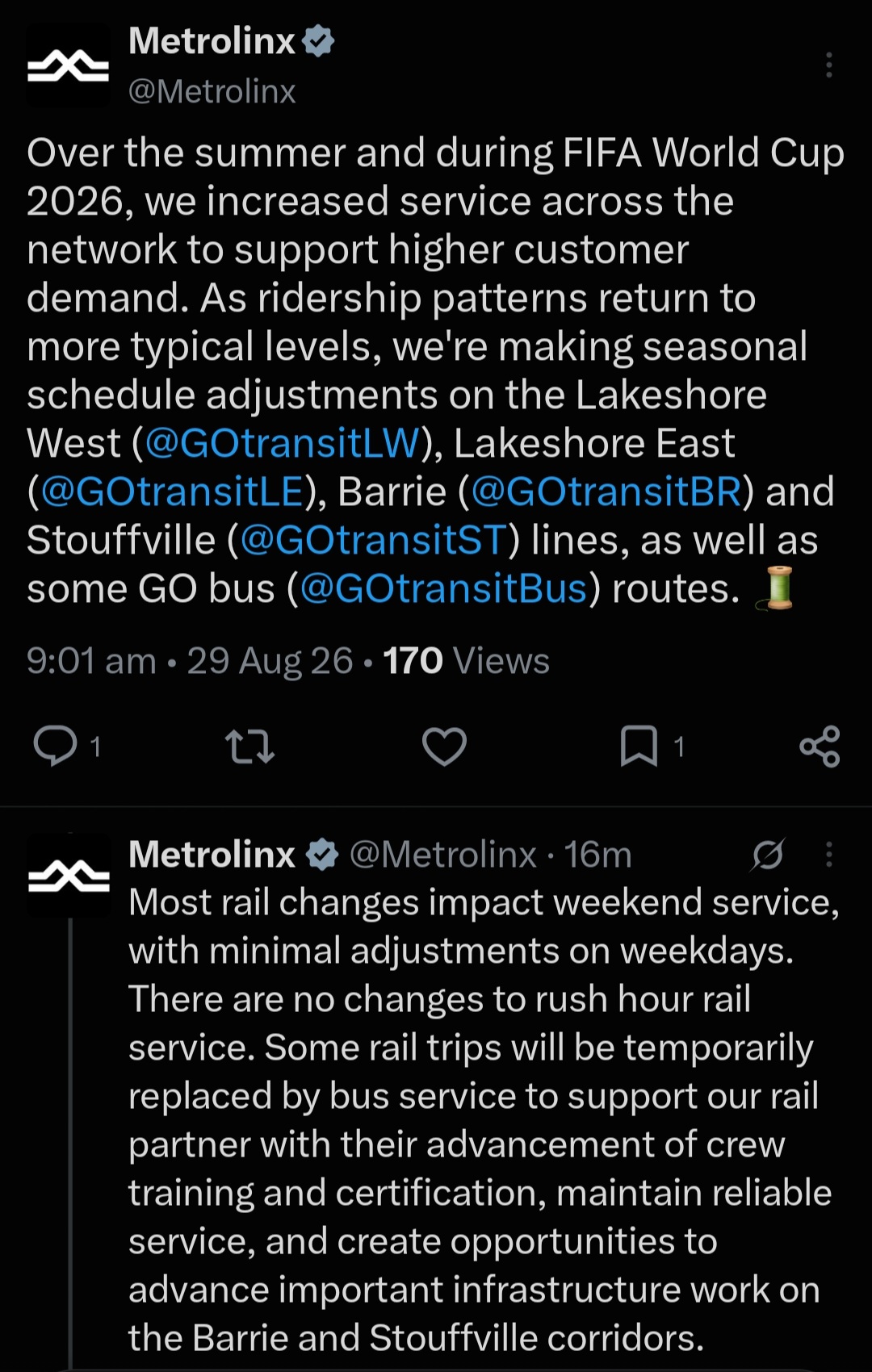
Though there is no notice of changes yet on the GO Transit homepage, it did post a partial explanation on X.
GO Transit post on X, citing seasonal adjustments, which some rail trips temporarily replaced by buses
GO Transit says the rail trips replaced by buses are to “support our rail partner with their advancement of crew training and certification, maintain reliable service, and create opportunities to advance important infrastructure work…” What this is actually saying is that Alstom, which has a contract to operate and maintain the trains, has a crew shortage and a backlog of staff training. While GO Transit buses are operated and maintained by GO Transit employees, its trains are not. As Metrolinx is reliant on the contractor to staff the trains, it needs to reduce the number of shifts to ensure the remaining trains are fully staffed.
There’s no word on when train service can be restored, never mind improved, to meet demand. This can be traced back to the botched partnership with ONxpress that would have seen the Deutsche Bahn subsidiary take over GO rail operations and expansion.
The late announcement of these service changes is a symptom of the culture of secrecy at Metrolinx. The reason for the service cuts goes even deeper.
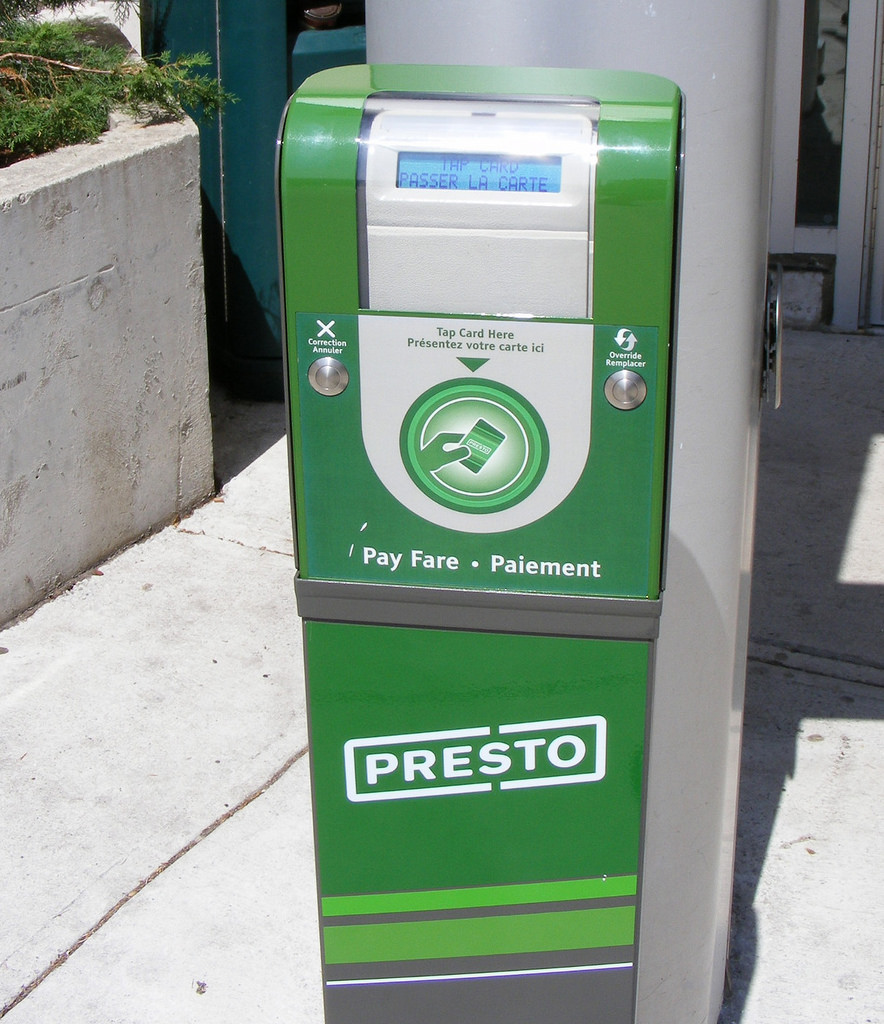
Because GO Transit’s rail service operates on a strict proof-of-payment system, it can sometimes be possible to forget to tap on or off at stations, which have no fare gates unlike the TTC subway and underground light rail stations. Often, Presto farecard validators are positioned in awkward areas, away from platform access points. Under the old policy, the first-time $35 fine and the second-time $50 fine were similar to penalty fares levied in the United Kingdom, acknowledging that mistakes happen. A failure to tap should not automatically result in a first-time fine four times higher than not paying for street parking in Toronto ($50).
At the very least, Presto validation (tap) machines should always be easy to spot and easy to access, reducing the number of honest mistakes. It should also follow that the penalty for not paying a transit fare should be treated as the equivalent for not paying for parking especially in an open system without fare gates.
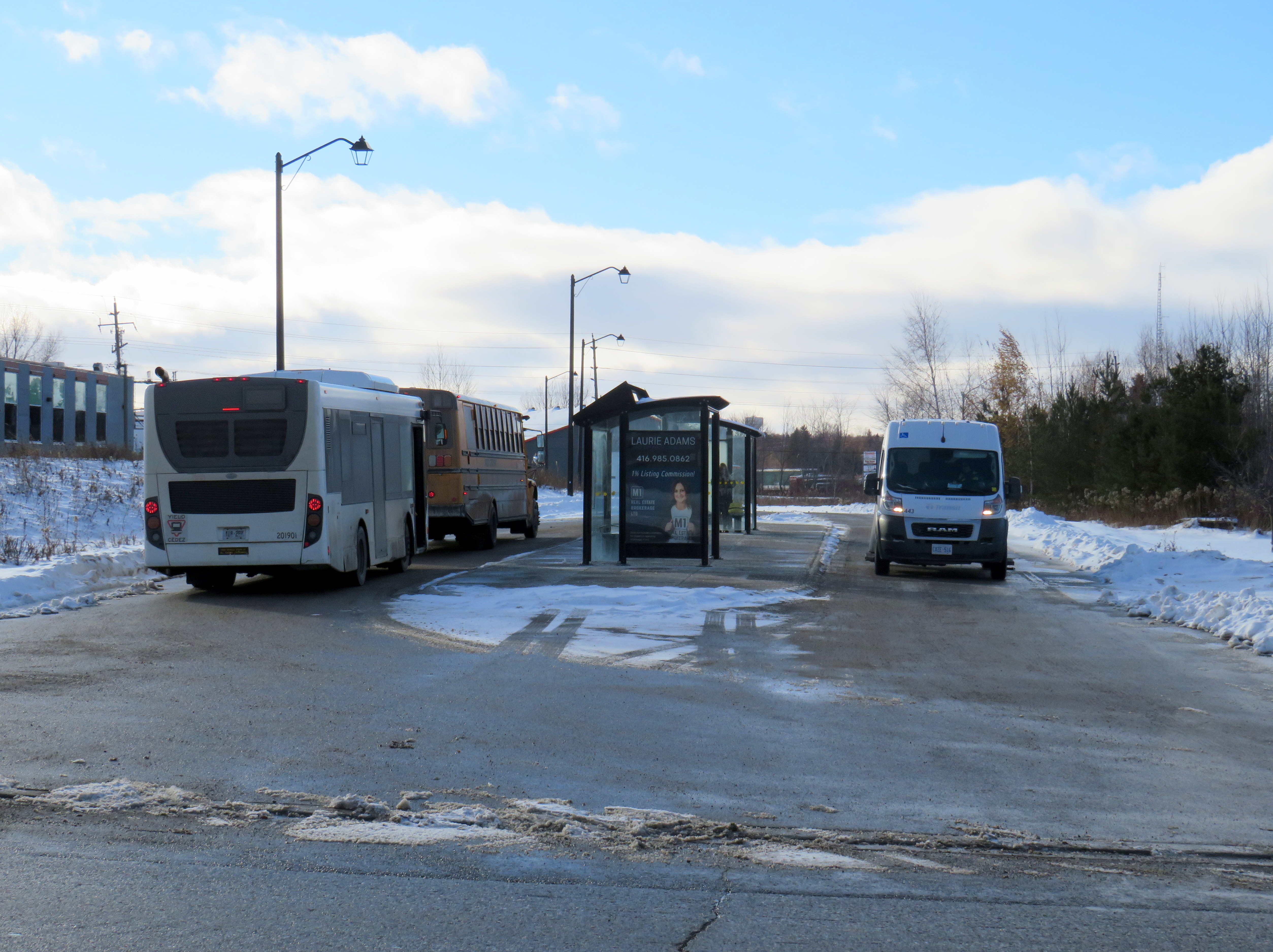
Buses on the Orange and Blue routes await departure at Orangeville Transit’s transfer hub
Earlier in December 2025, I took a short trip to Orangeville, Ontario, to take a ride on the province’s only fare-free transit system. Though Orangeville Transit provides a vital service for the town’s residents, the fare-free service is not necessarily a model for larger transit systems.
The town of Orangeville, population approximately 30,000, is on the outer edge of the Greater Toronto & Hamilton Area. Until 2021, it was connected to the Canadian Pacific mainline at Streetsville by a municipally-owned railway; Highways 9 and 10 link the town with Highways 400 and 410. GO Transit runs a limited weekday bus service from Brampton, and the remnant of Grey County’s GTR system runs between Orangeville, Shelburne, and Dundalk.
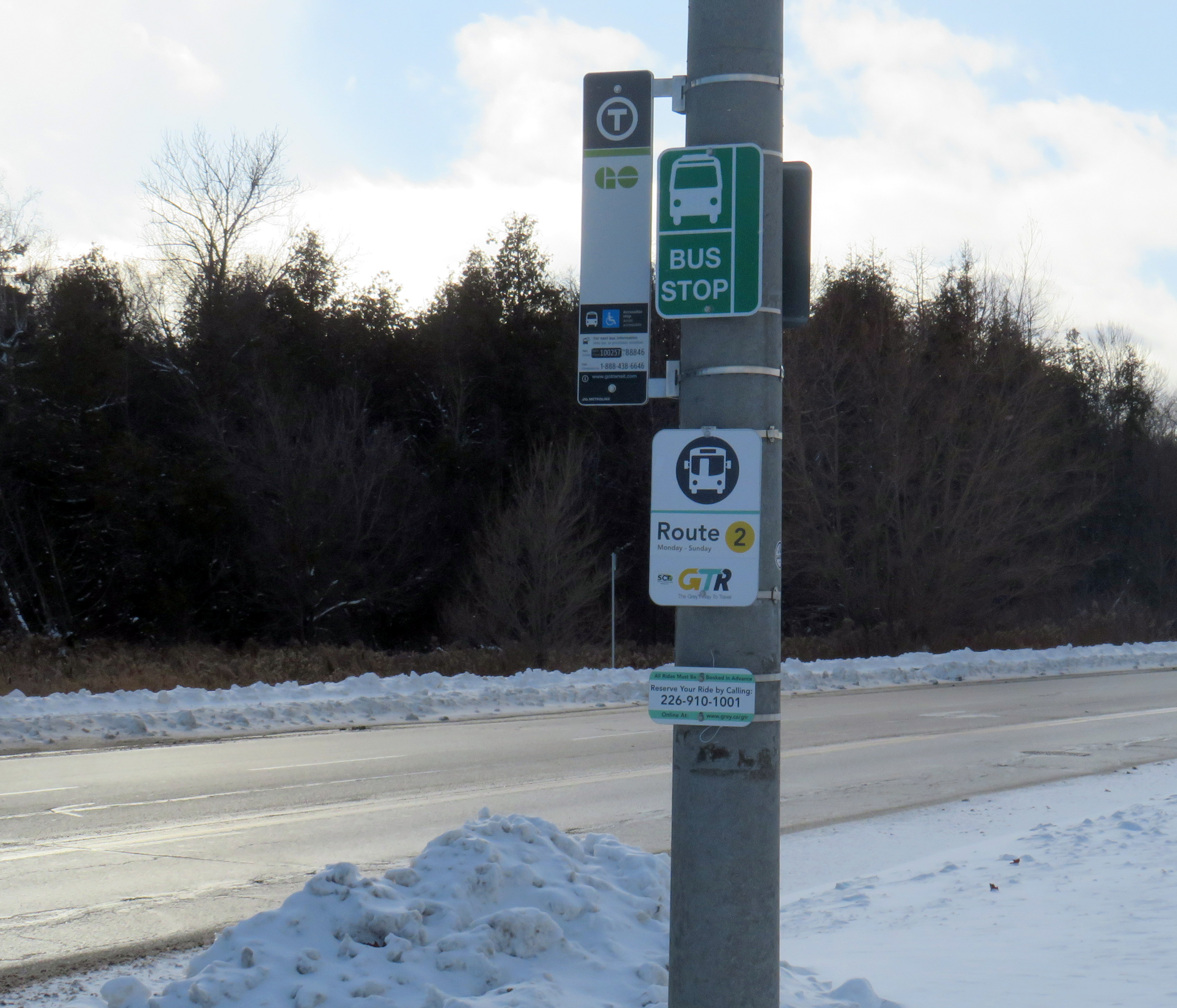
Orangeville Transit, GO Transit, and GTR Route 2 signs on Hansen Blvd.
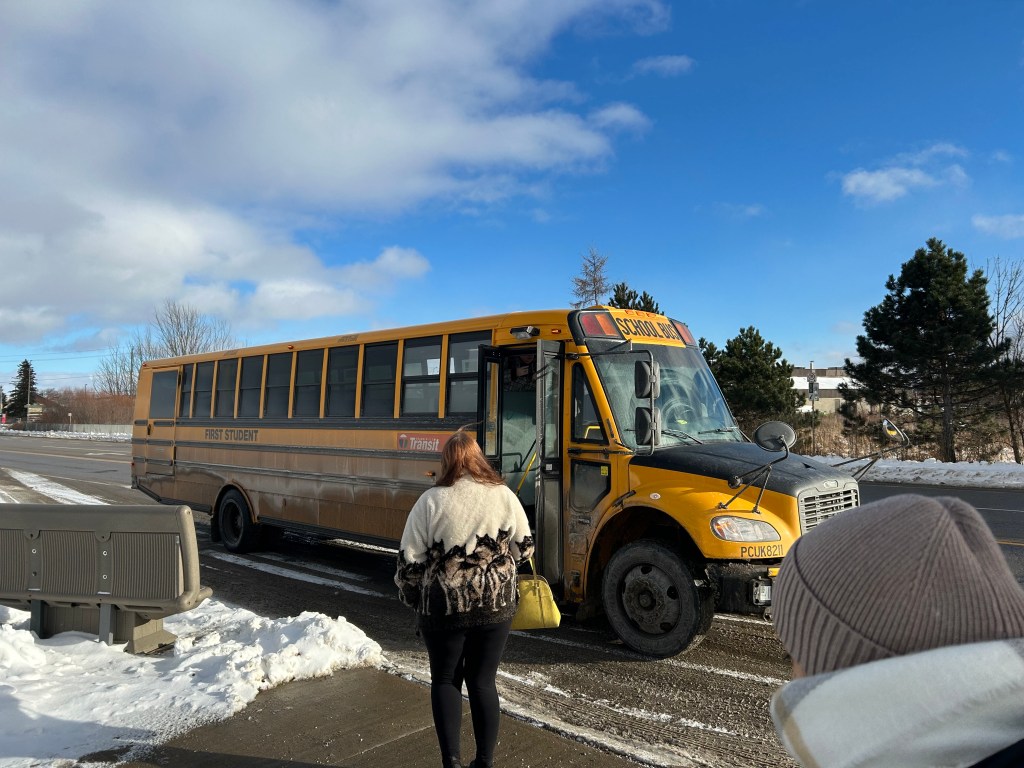
These three services meet at a curbside stop on Hansen Boulevard at First Street adjacent to the Orangeville Mall on the north side of town, where there is a standard bus shelter. After getting off the GO bus here, a GTR van arrived a few minutes later, dropping off a few more passengers. A few minutes after that, a yellow school bus arrived, sporting an Orangeville Transit sticker on the side. This would be my bus.
After a winding route through several residential subdivisions, circling back on Hansen Boulevard, the bus arrived at the central transfer point located in a field west of the downtown core. The transfer point, located behind a small shopping plaza, is adjacent to the abandoned Orangeville-Brampton Railway corridor. However, the new terminal is not served by GO or GTR. GO Transit buses layover at the old Canadian Pacific Railway station site on Townline before heading south to Brampton GO Station.
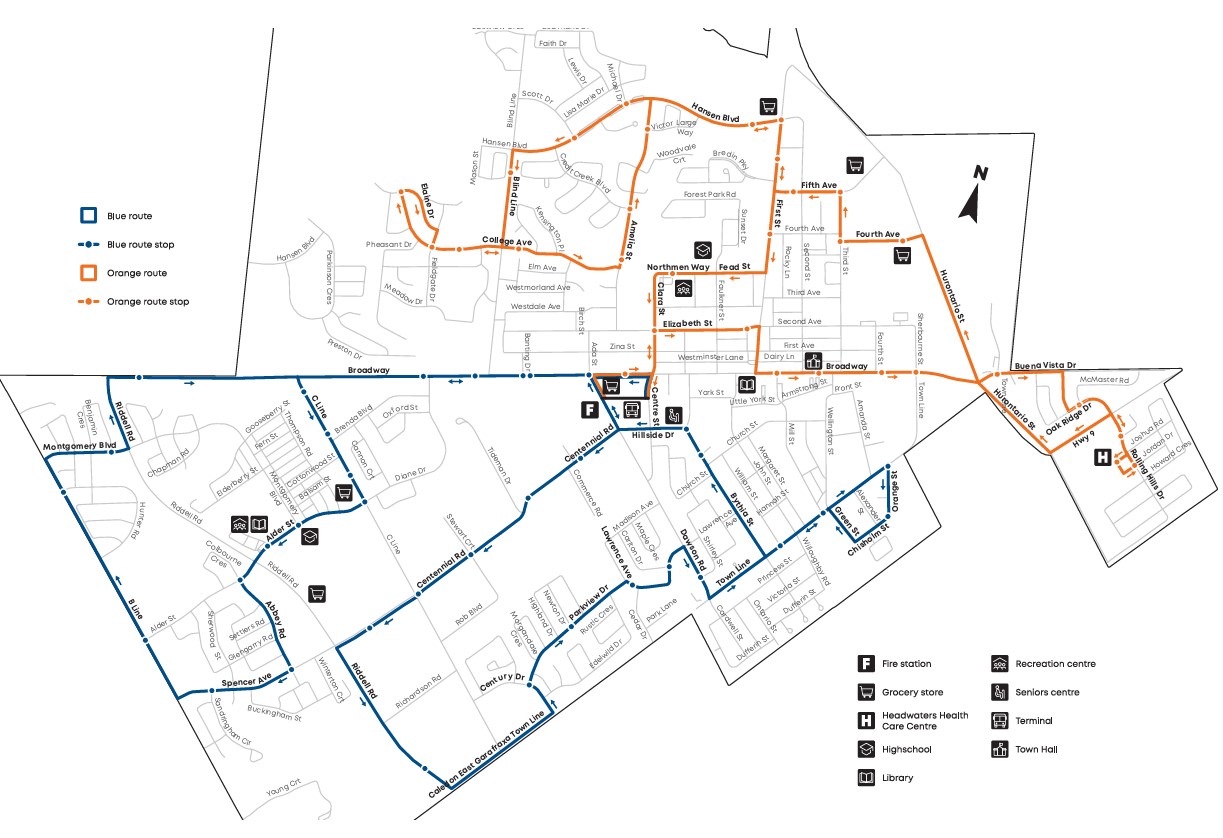
Orangeville Transit map, with two routes operating on 45-minute schedules
In some ways, the fare-free service in Orangeville is a success. Ridership more than doubled between 2019 and 2023, the year it introduced free fares. The program has since been extended through 2026. However, Orangeville Transit is a very small operation, with only two routes, each on a 45-minute schedule. The two routes are made up of circuitous, one-way loops that provide service to the entire municipality, but do not provide through or speedy service.
Though large systems, like GO Transit and the Toronto Transit Commission, get more than half their funding from fare revenue (in the late 1990s, fares made up 80% of the operating costs for those two systems due to provincial austerity), smaller systems, with lower costs, can get by with free fares. This is also true of some mid-sized American systems, such as Richmond, Albuquerque, or Kansas City, where fare collection might be more trouble than it is worth. But there’s a trade off; for many riders, a more frequent and faster ride would be worth a few dollars — reliable government funding along with targeted reduced fare programs might be a better solution.
In Orangeville’s case, the rider gets what they pay for — a slow, infrequent, and circuitous service where you might end up picked up by a school bus.
Transit journeys, wrapped
Orangeville Transit was the last of 32 distinct transit services I got to ride in 2025 and was one of 10 systems I rode for the first time (another three of those were in Italy). Unfortunately, my first ride on Deseronto Transit was also my last. With the obvious exception of the Vatican, I have been on at least one transit service in every one of the 21 countries I’ve been to so far.
Local and regional transit systems taken in 2025: Toronto Transit Commission GO Transit Brampton Transit MiWay York Region Transit Durham Region Transit Burlington Transit Hamilton Street Railway Orangeville Transit (1st time) Simcoe County Linx Barrie Transit Wasaga Beach Transit(1st time) London Transit Deseronto Transit(RIP) Belleville Transit Kingston Transit Brockville Transit (1st time) River Route(1st time) Transit Windsor LTW Transit(1st time) Thunder Bay Transit (1st time) OC Transpo Société de transport de l’Outaouais (Gatineau QC) Société de transport de Montréal Winnipeg Transit Calgary Transit TransLink (Metro Vancouver) BC Transit (Greater Victoria) Azienda Napoletana Mobilità (Naples) (1st time) Azienda per la mobilità di Roma Capitale (1st time) Ente Autonomo Volturno (Campagna IT) (1st time)
On Monday, February 26, the new Ontario One Fare Program will take effect. Transit riders who previously had to pay a second fare when transferring from GO Transit or suburban transit agencies (York Region Transit, MiWay, etc.) to the TTC, will now benefit from a free transfer. Passengers will also be able to transfer free from the TTC to suburban buses or get the TTC fare discounted if transferring to GO Transit.
The new fare program, subsidized by the provincial government, is only available to customers who pay using a Presto card or other contactless payment options (credit card, debit card, mobile app). It is also not applicable to and from UP Express.
This is good news for many transit users, and it fixes several flaws in the existing fare structure. For example, when GO Transit moved its Highway 407 buses — originally designed to ferry commuters to York University — to Highway 407 Station in Vaughan, students and staff had to pay the TTC fare just to go two stops or endure an unfriendly walk. For a short time, there was a $1.50 discount for GO-TTC transfers, but that was allowed to expire under the Ontario PC government.
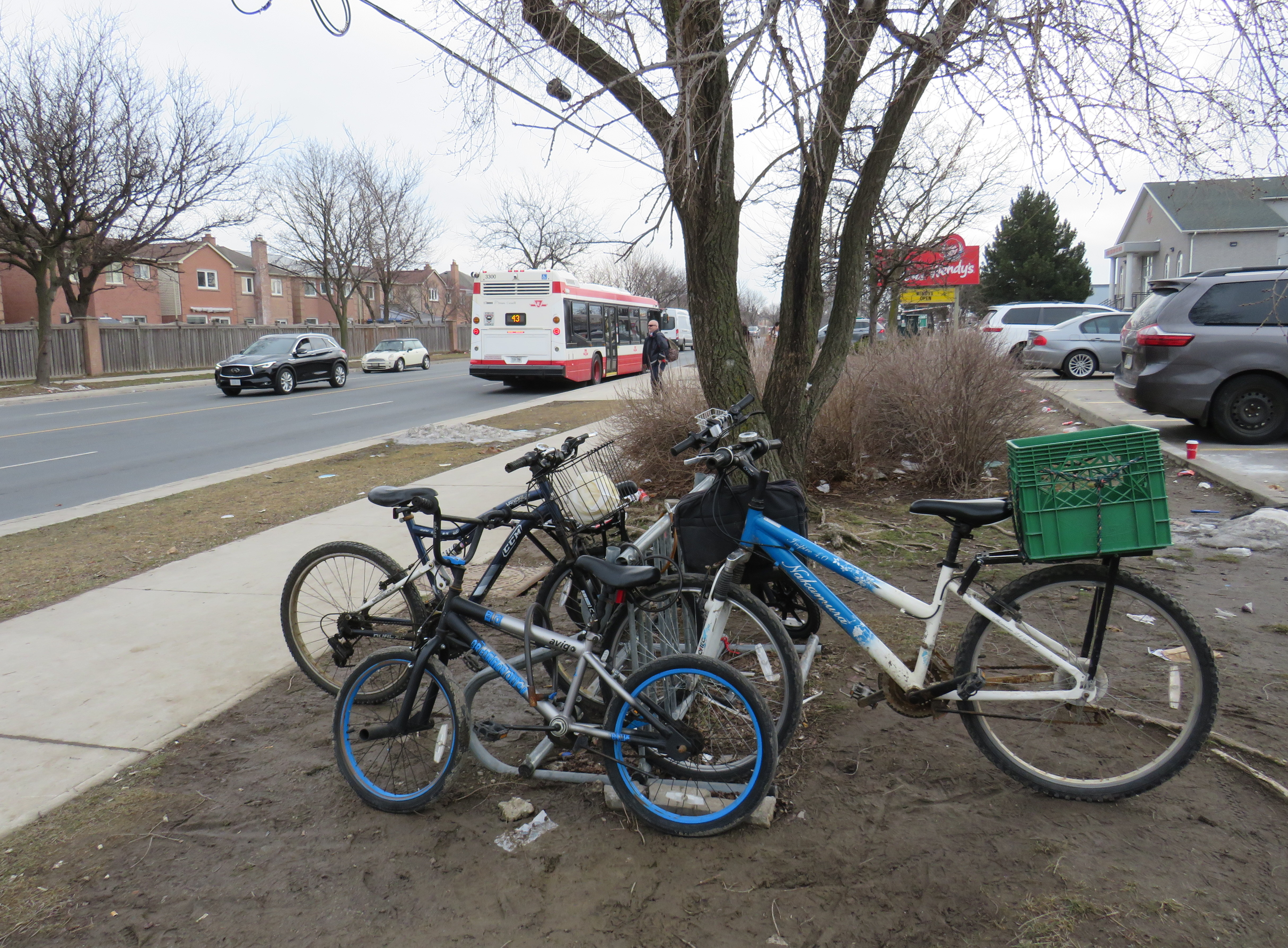
The elimination of the double fare will also benefit transit passengers who live or work near the border of Toronto and York, Peel, and Durham Regions. On the boundary between Markham and Toronto, it is common to see lots of bicycles locked up at bus stops along or near Steeles Avenue at TTC stops. These bicycles are owned by York Region residents who ride south to avoid the double fare and benefit from one less transfer. Once the new free transfer comes into effect, it will be interesting to see if there is a bump in YRT ridership.
Bicycles parked on the south side of Steeles Avenue, February 2024
Though the new free TTC transfer should — at least in theory — eliminate a barrier to integrating GO Transit with local transit, the TTC really isn’t set up to feed the GO Transit rail network, nor are many GO stations set up to serve TTC riders. There are historical reasons for these poor connections, but they will need to be fixed.
GO Transit started off in 1967 as a commuter rail pilot project, with the Government of Ontario (the “GO” in GO Transit) looking to keep costs down in case the three-year experiment was unsuccessful. Many station sites were selected for their proximity to major roads and highways and parking access. As the service was intended to attract suburban commuters from their cars and mitigate the need for expensive highway widenings, transit access was only a secondary consideration. The initial Lakeshore Line exceeded expectations and so GO added new lines to Georgetown (1974), Richmond Hill (1978), Milton (1981) and took over CN commuter operations to Bradford/Barrie and Stouffville.
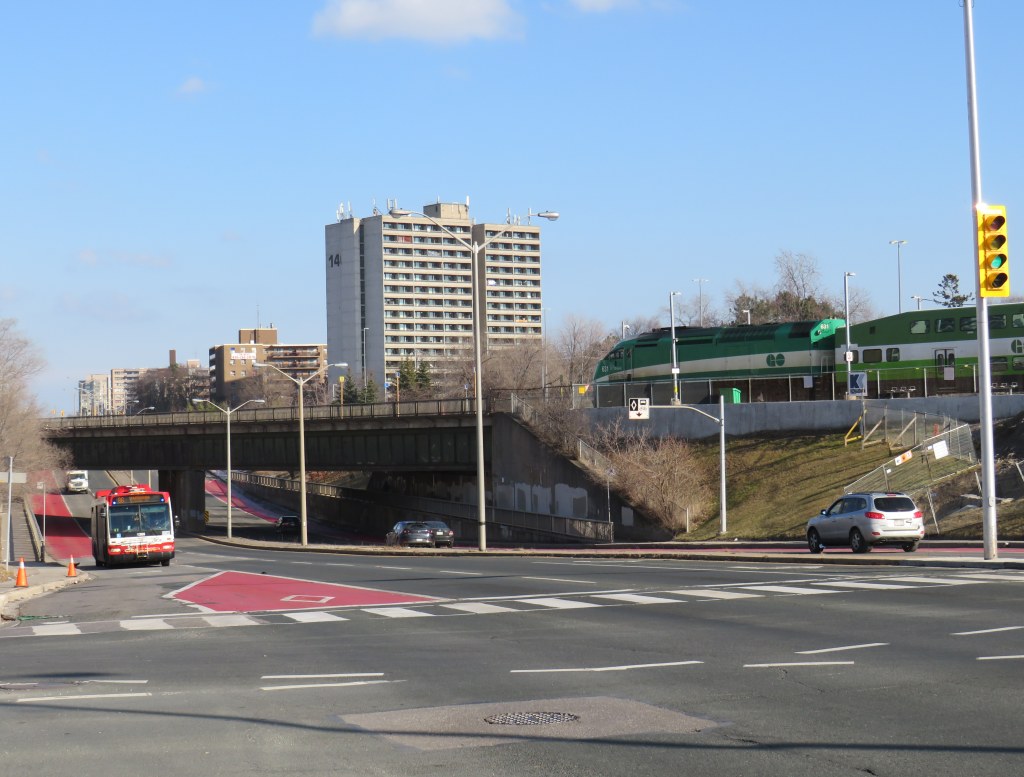
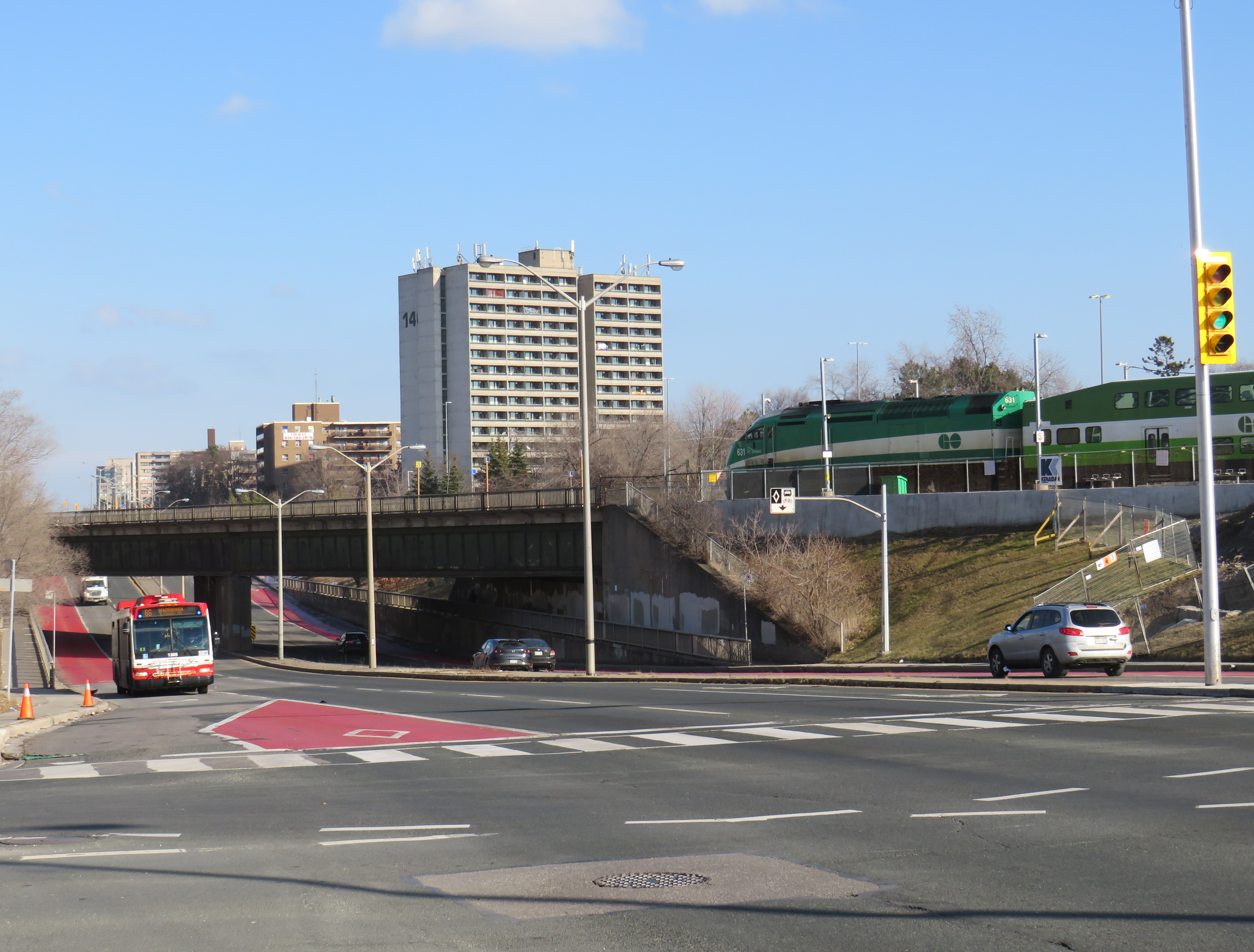
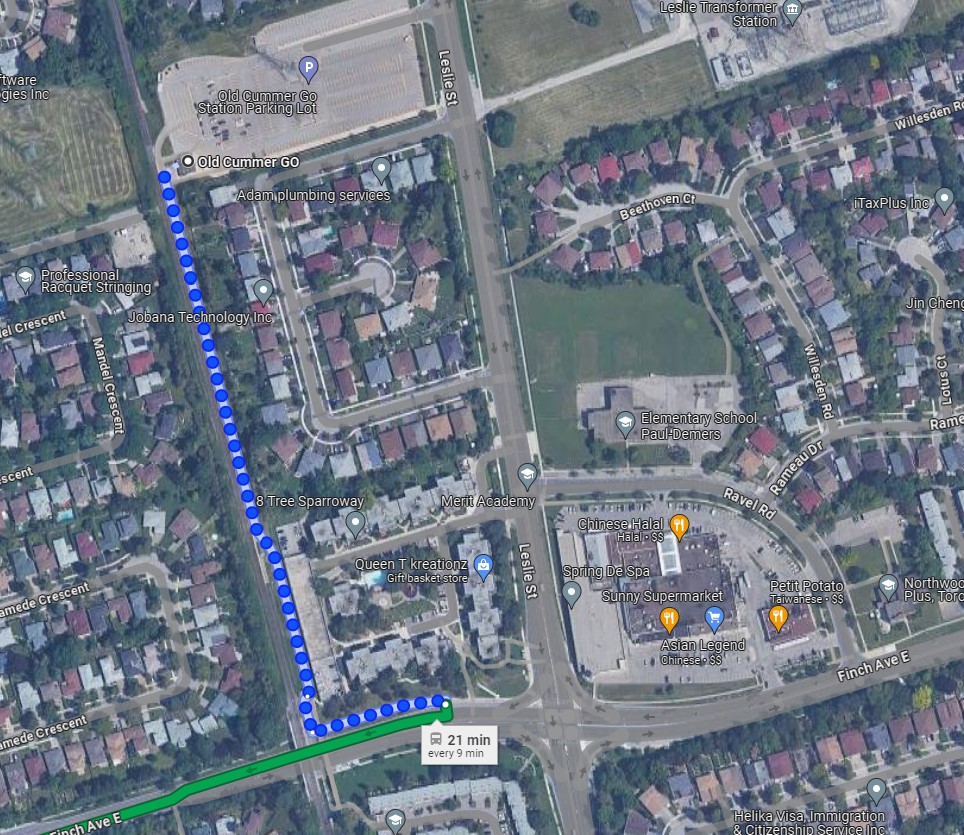
An example of this era of GO Transit station placement is Old Cummer Station, which opened in 1978. It was built where the Richmond Hill Line crossed the Finch hydro corridor, with land underneath the transmission lines easily paved over for parking. A walkway leads south to Finch Avenue, where one can connect to TTC buses, but the station building and the platform are oriented towards the parking.
As the Richmond Hill Line only operates during the peak periods, and is the only GO train service not destined for service expansion, this is not a major problem.
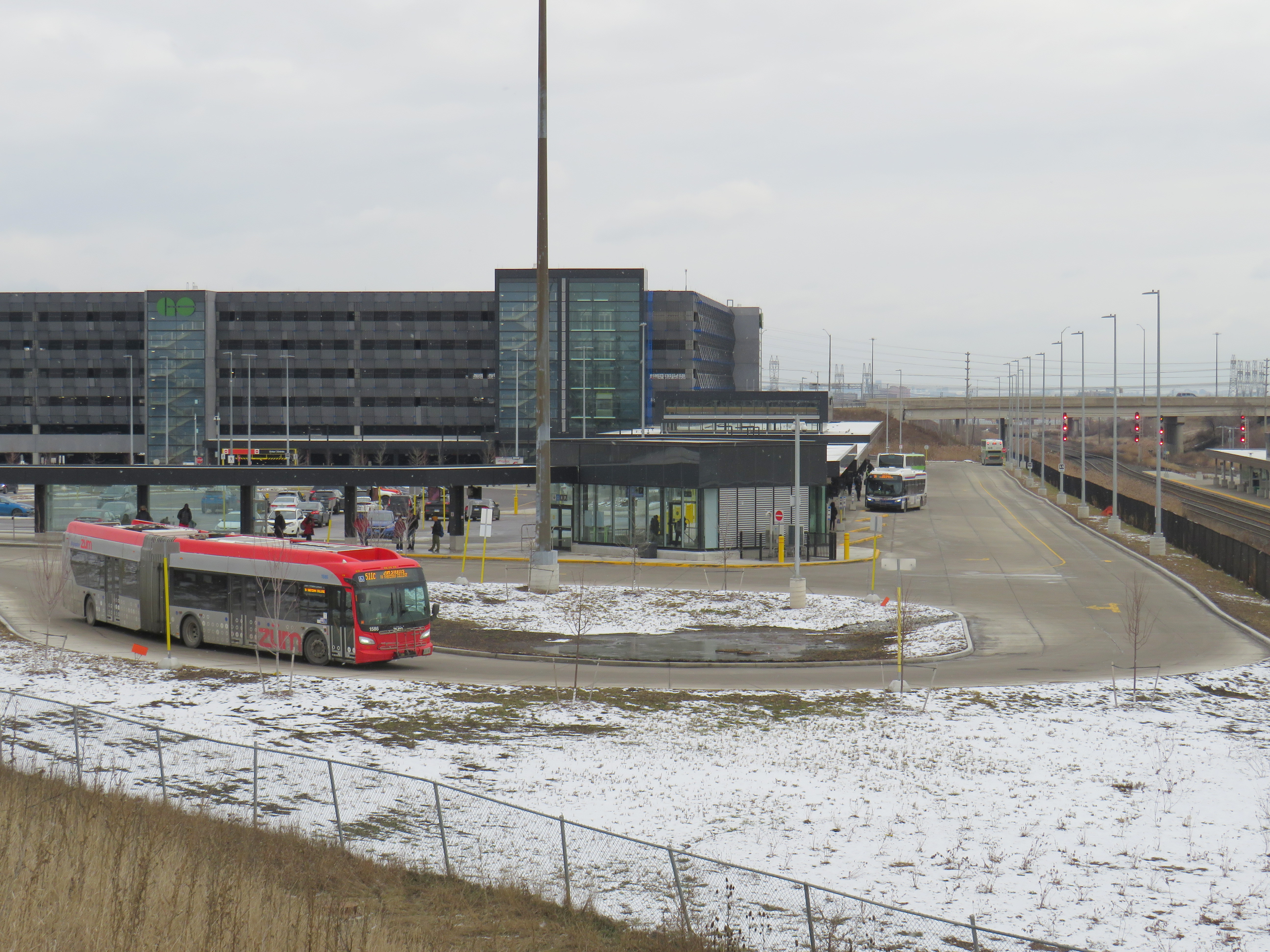
In the 905 suburbs, such as Mississauga, Brampton, Oakville, and Whitby, local transit connections are often quite good. For decades, commuters in those cities have benefitted from discounted or free fares on local transit when heading to or from GO rail stations (with Presto, connections to and from GO buses are now also free). Many transit agencies, particularly Durham Region, Oakville, and Burlington along the Lakeshore Line, centre their bus systems around the GO stations. Brampton built its downtown bus terminal adjacent to the GO station in 1989, and in 2023, Metrolinx opened a new bus terminal at Bramalea Station, allowing for easy transfers between buses and trains.
Bramalea GO Stationbus loop
On the other hand, the TTC bus network was designed around the subway network, with nearly every route serving at least one rapid transit station. Though TTC buses would pass by GO stations, transfers between the two were limited because of the extra fare and the infrequent GO services compared to the subway. The only TTC loop on GO station property is at Rouge Hill Station, though Exhibition Loop and Long Branch Loop are short walks to GO station entrances.
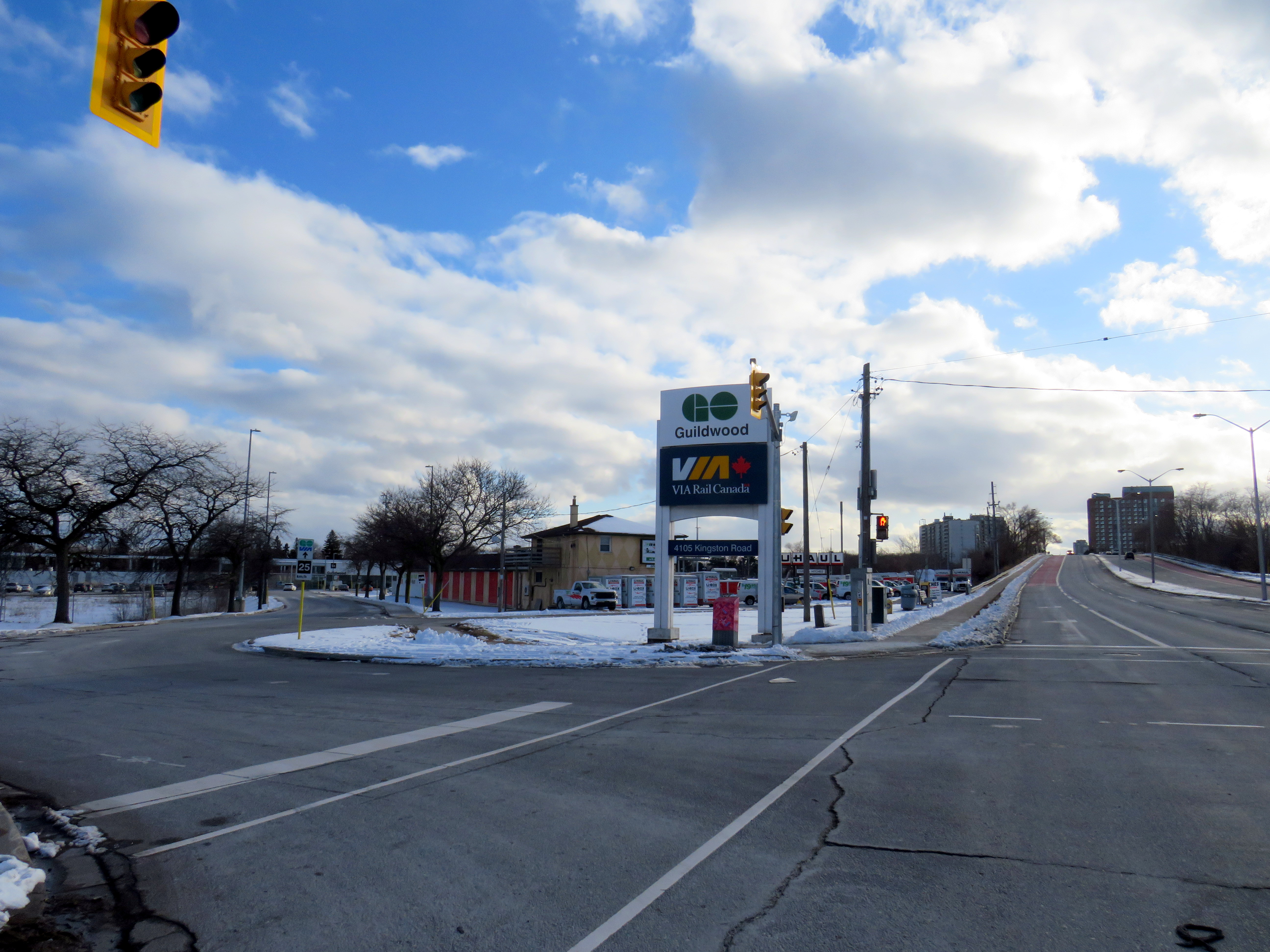
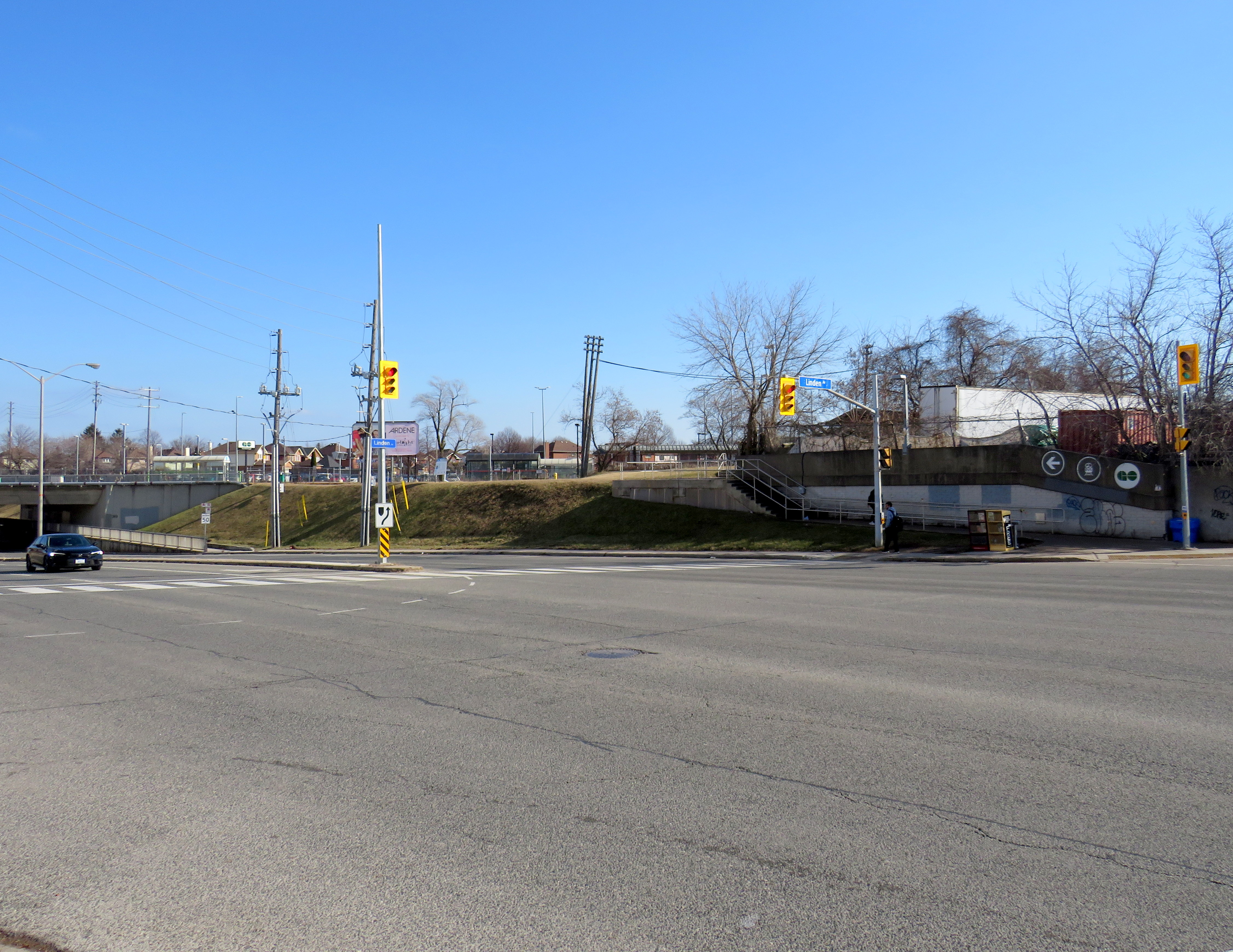
Entrance to Guildwood GO Station at Kingston Road. TTC passengers looking to connect with GO trains must cross a busy intersection than then walk through a parking lot to reach the station building.
As GO Transit continues to expand, and fare integration finally becomes a reality, there is both an opportunity and a need to change. Though there are plenty of examples of poor GO-TTC connections, there are also some promising moves towards physical integration between the two systems.
The worst GO-TTC connection: Etobicoke North
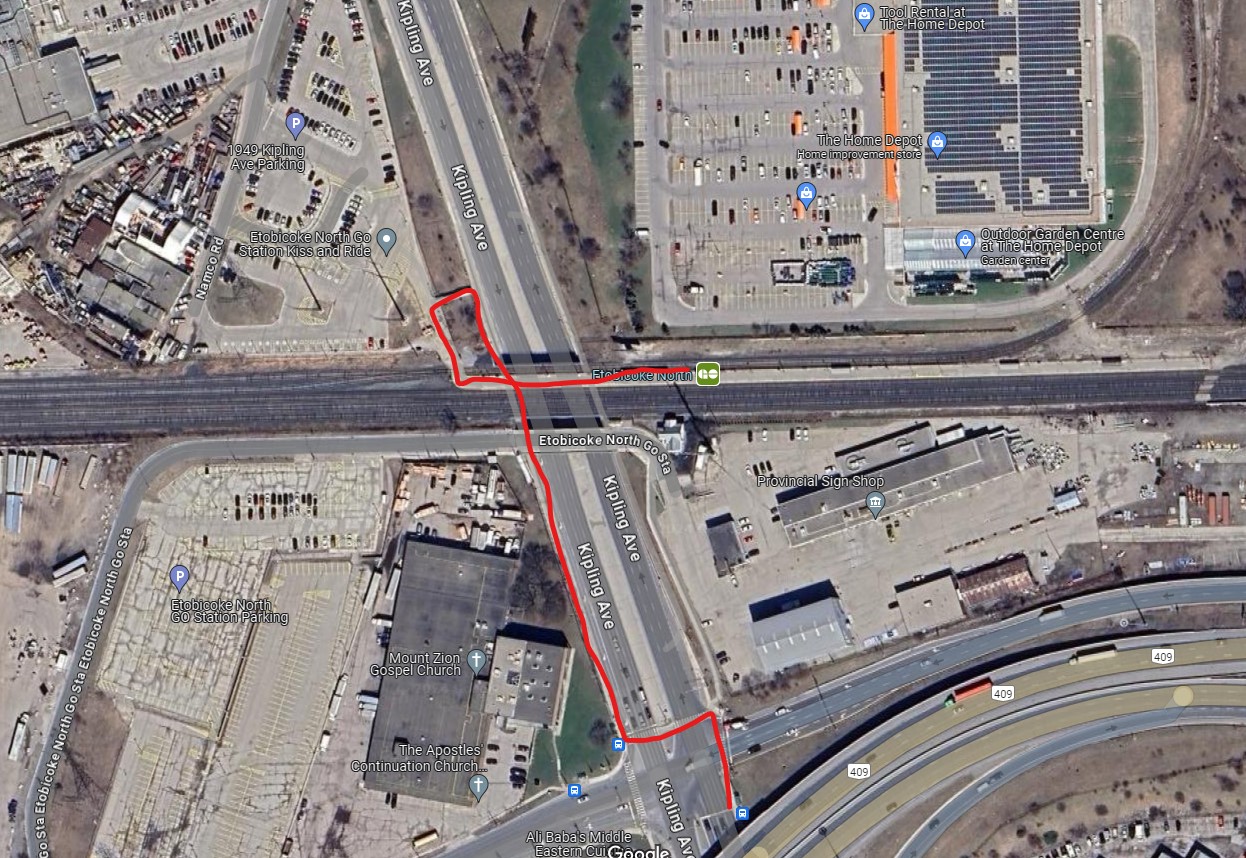
Red path shows walking route between northbound 45 Kipling bus stop and Etobicoke North GO platform
Etobicoke North station opened in 1974 as part of the Georgetown (now Kitchener) GO Line. The station and parking lot were built on Ministry of Transportation property and in a hydro corridor. Though the frequent 45 Kipling bus passes under the rail corridor, the transfer between bus and train requires crossing two sides of the busy Kipling/Belfield/Highway 409 off-ramp intersection, continuing on a narrow sidewalk, and climbing a flight of stairs before reaching the main walkway to the station platform. Though a passenger could save a lot of time by transferring to the train (especially as it now runs seven days a week), the long and uncomfortable transfer makes this very uninviting.
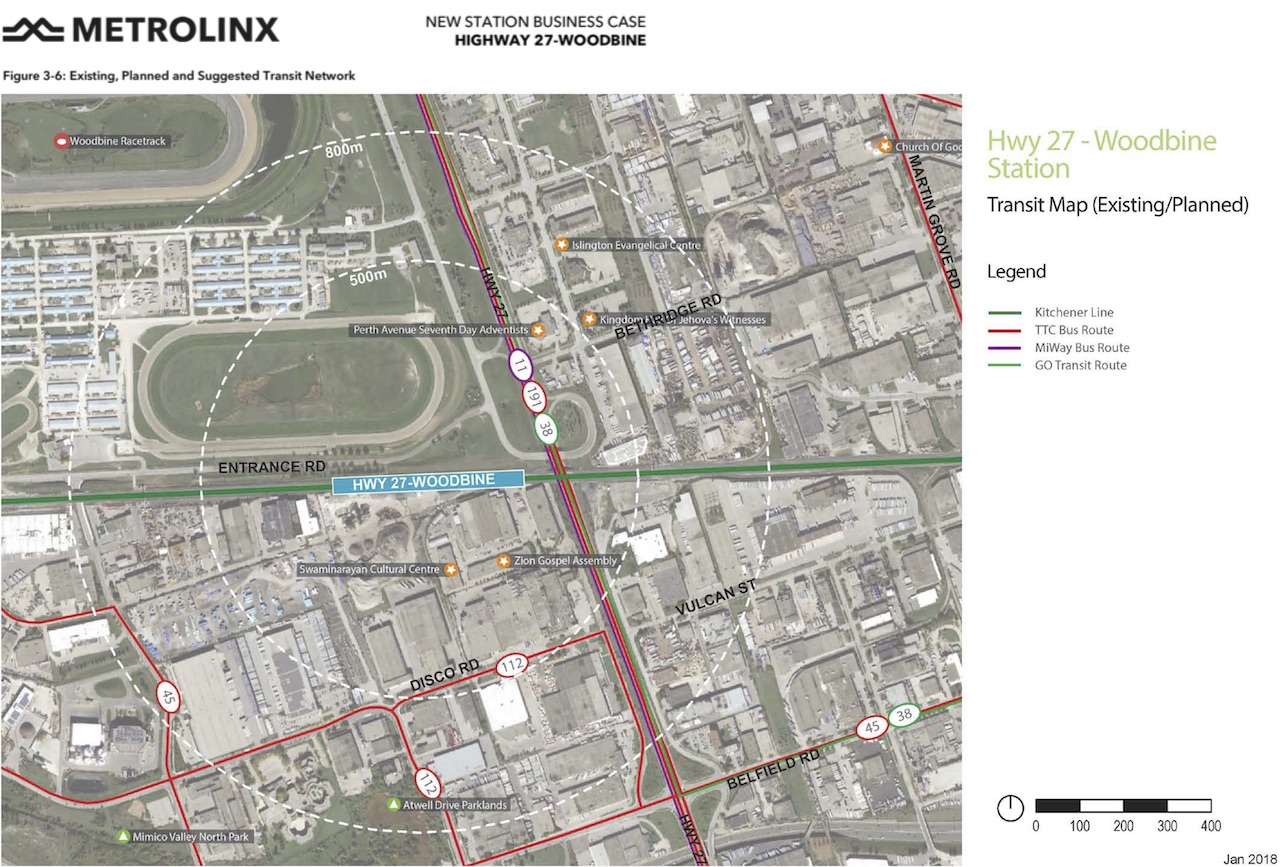
A new station at Woodbine Racetrack is proposed, but work has yet to begin. The station at Etobicoke North will eventually have to be closed and demolished to make way for track expansion required for 15-minute GO service. There’s an opportunity to build a great transit hub at Woodbine, especially with an extension of the Finch West LRT.
Metrolinx map of the potential Highway 27-Woodbine Station
An accessibility failure: Scarborough GO
Scarborough GO Station, from St. Clair Avenue East
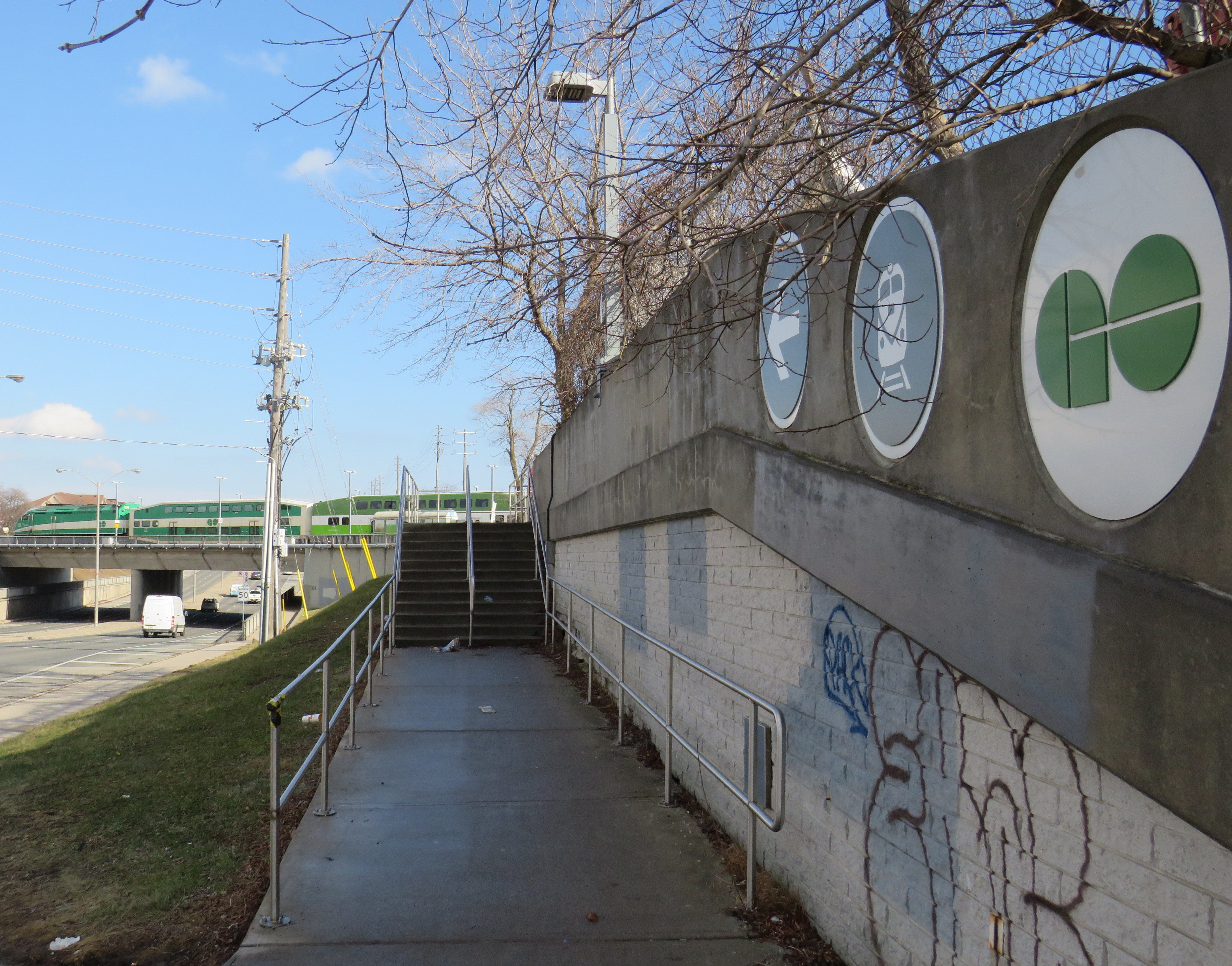
Scarborough GO Station, near St. Clair Avenue East and Kennedy Road, is located where the GO Stouffville Line splits off from the Lakeshore Line; the station was originally known as Scarborough Junction, as it was the point where the Midland Railway of Canada met the Grand Trunk Railway. (This is where Midland Avenue gets its name from.) The station building and parking lot is located on the south side of the tracks, accessible from Midland and Reeve Avenues. A walkway on the north side of the station leads to St. Clair Avenue East, but it involves several staircases and is not fully accessible to the street, where the 9 Bellamy and 102 Markham Road buses stop.
The Scarborough Junction Masterplan development proposal includes a new connection to St. Clair Avenue as part of a transit-oriented mixed-use community. It promises to better integrate GO and TTC services but will likely be several years before construction begins and even longer until a fully accessible connection is possible.
A more typical transfer: Agincourt GO
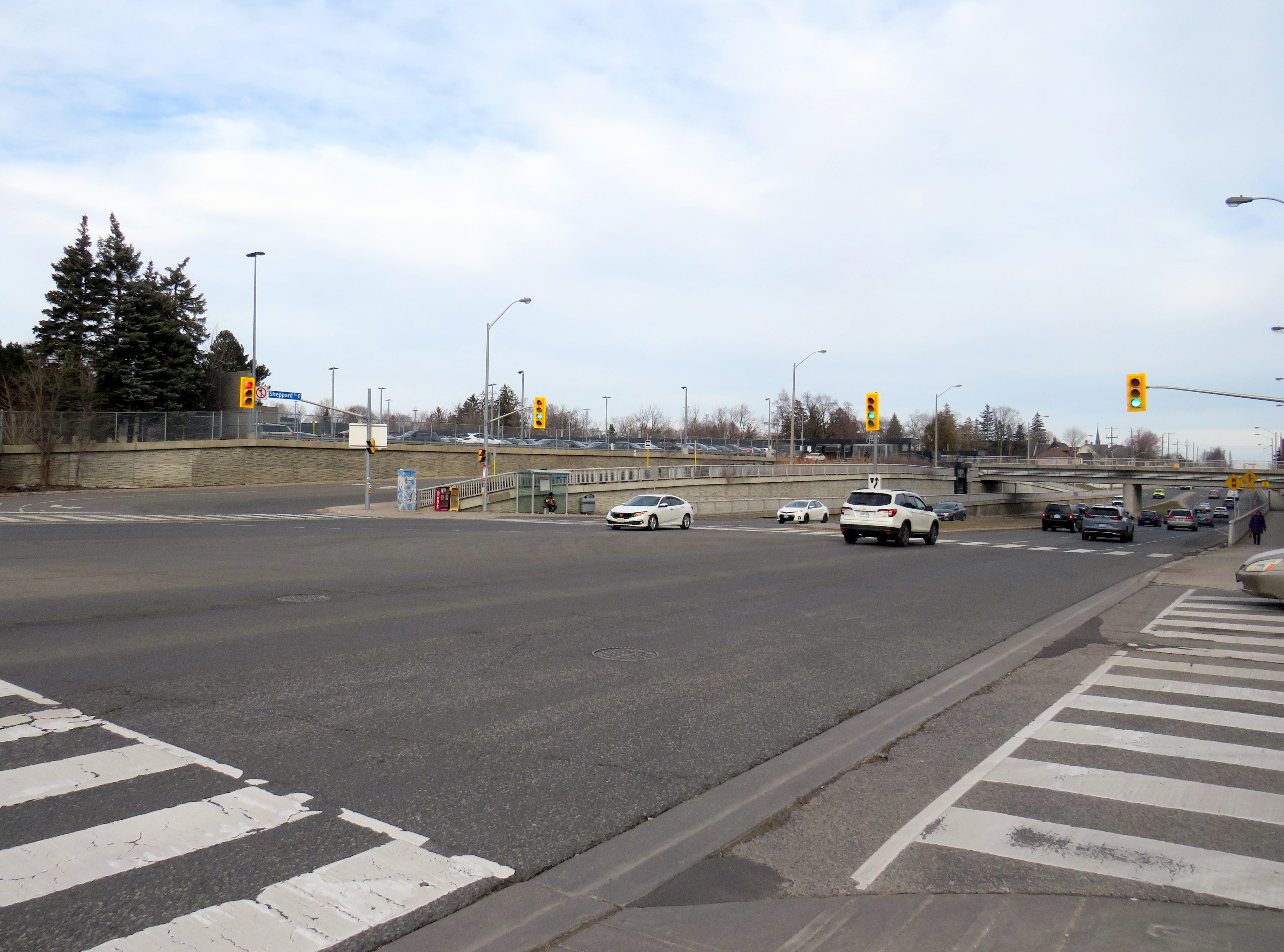
Agincourt GO Station, looking northeast from the south side of Sheppard Avenue East
Agincourt Station, in service since 1871, was taken over by GO Transit in 1982. The station building was always located several hundred metres north of Sheppard Avenue, and even in CN commuter rail days, featured a small parking lot. In 2012, an overpass was built separating Sheppard Avenue from the tracks; this allowed for a future Sheppard East LRT as well as train service expansion (a grassy median marks where the light rail line was planned to go). The TTC bus stops are located where the parking lot driveway exits onto Sheppard at a signalized intersection.
Unfortunately, the station platforms were not moved south on the overpass, reducing the walking distance between the train and bus stops and sidewalks on Sheppard Avenue. Though there’s a proper walkway between the TTC stops and the station itself, the station remains oriented mainly to the surface parking lot. Transfers are definitely possible, but not particularly easy.
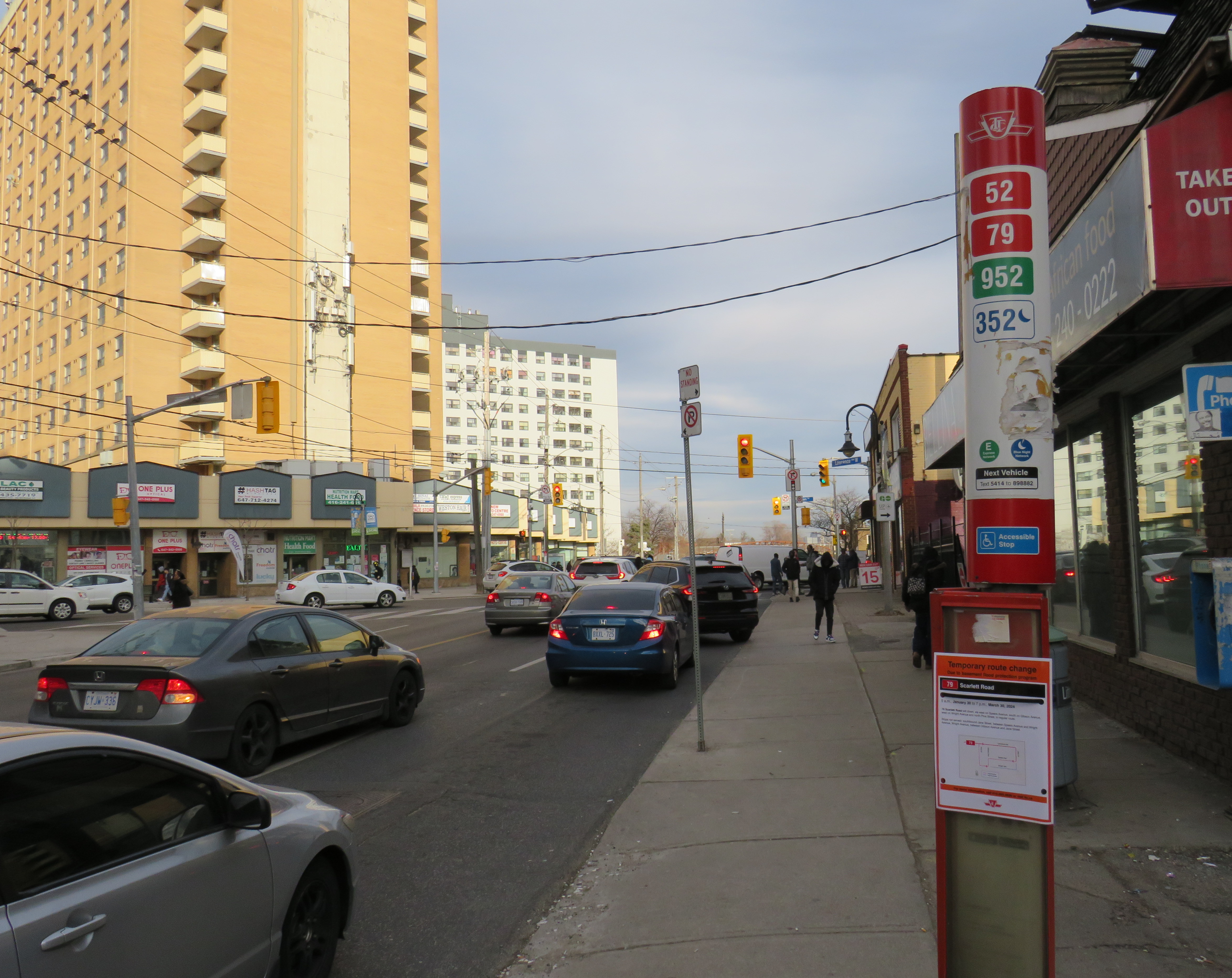
The nearest eastbound TTC bus stop to Weston GO/UPX Station, located a five-minute walk to the east
Similar situations exist at Weston GO/UP Express station, where the TTC stops are several hundred metres away from the GO platforms at Weston Road and Lawrence Avenue, and at Oriole Station, where the walk from the GO platform to Leslie subway station is still unnecessarily lengthy and also requires crossing a busy intersection.
Milliken GO: A promising direction
A Steeles East TTC bus stops at Milliken GO Station
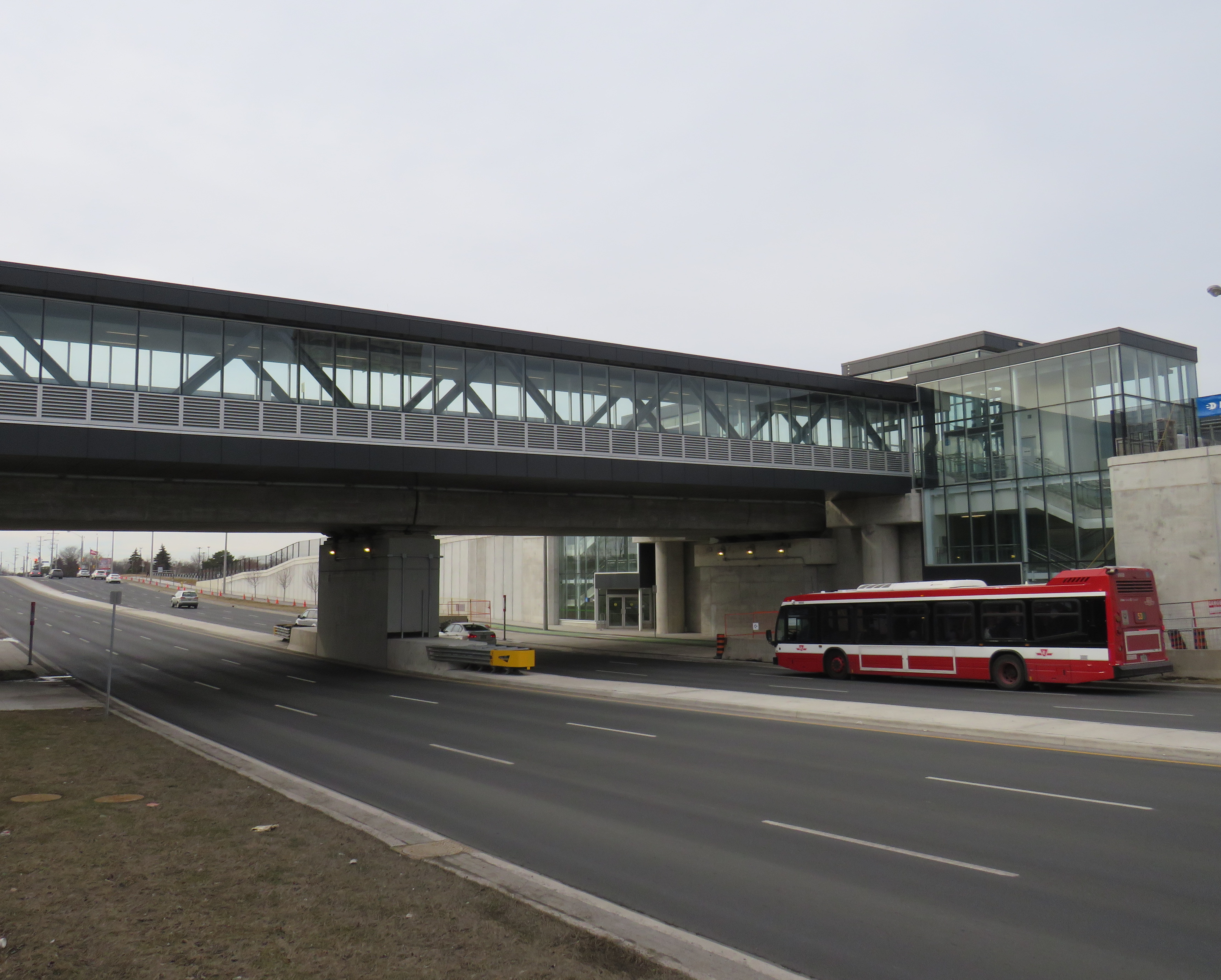
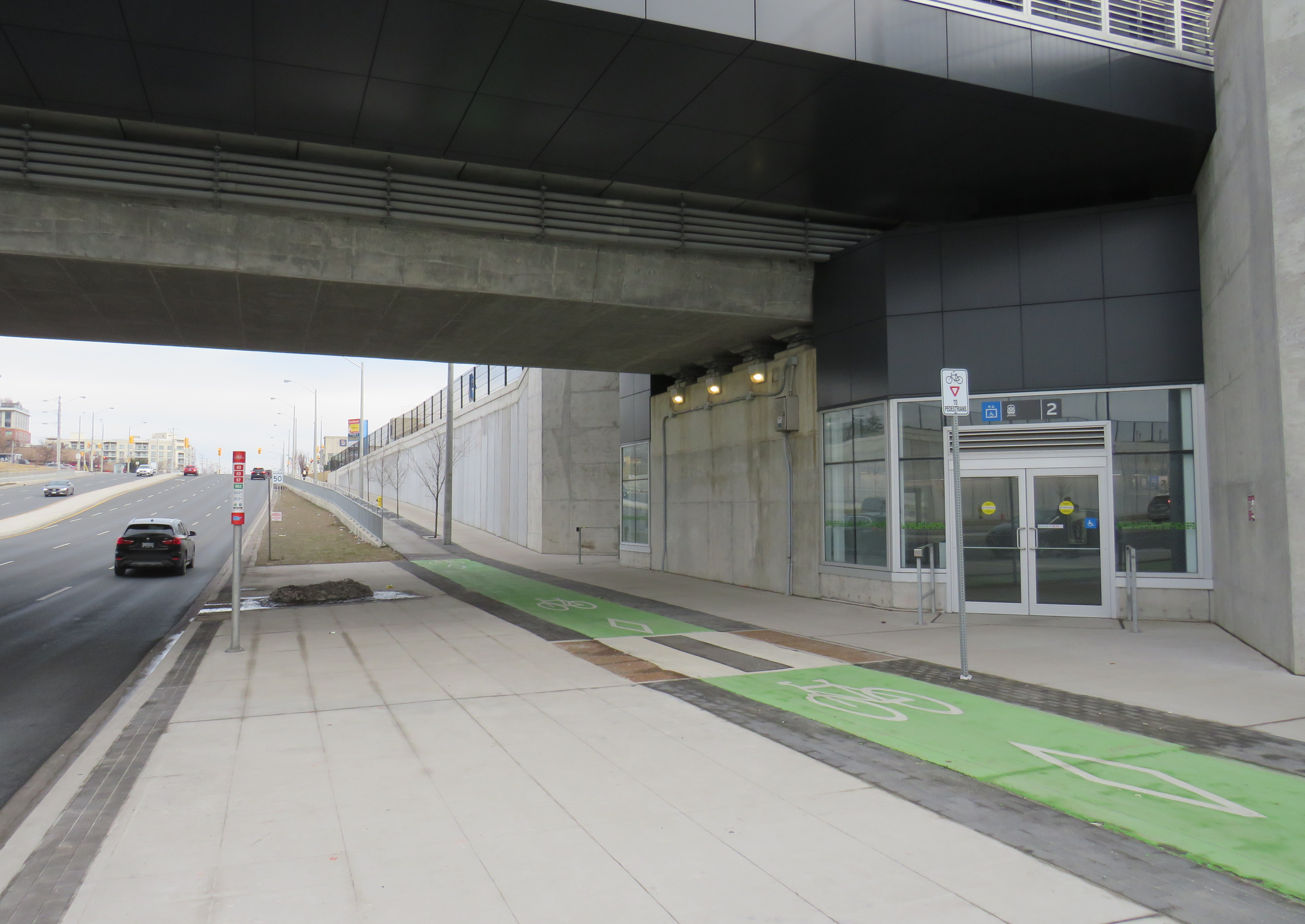
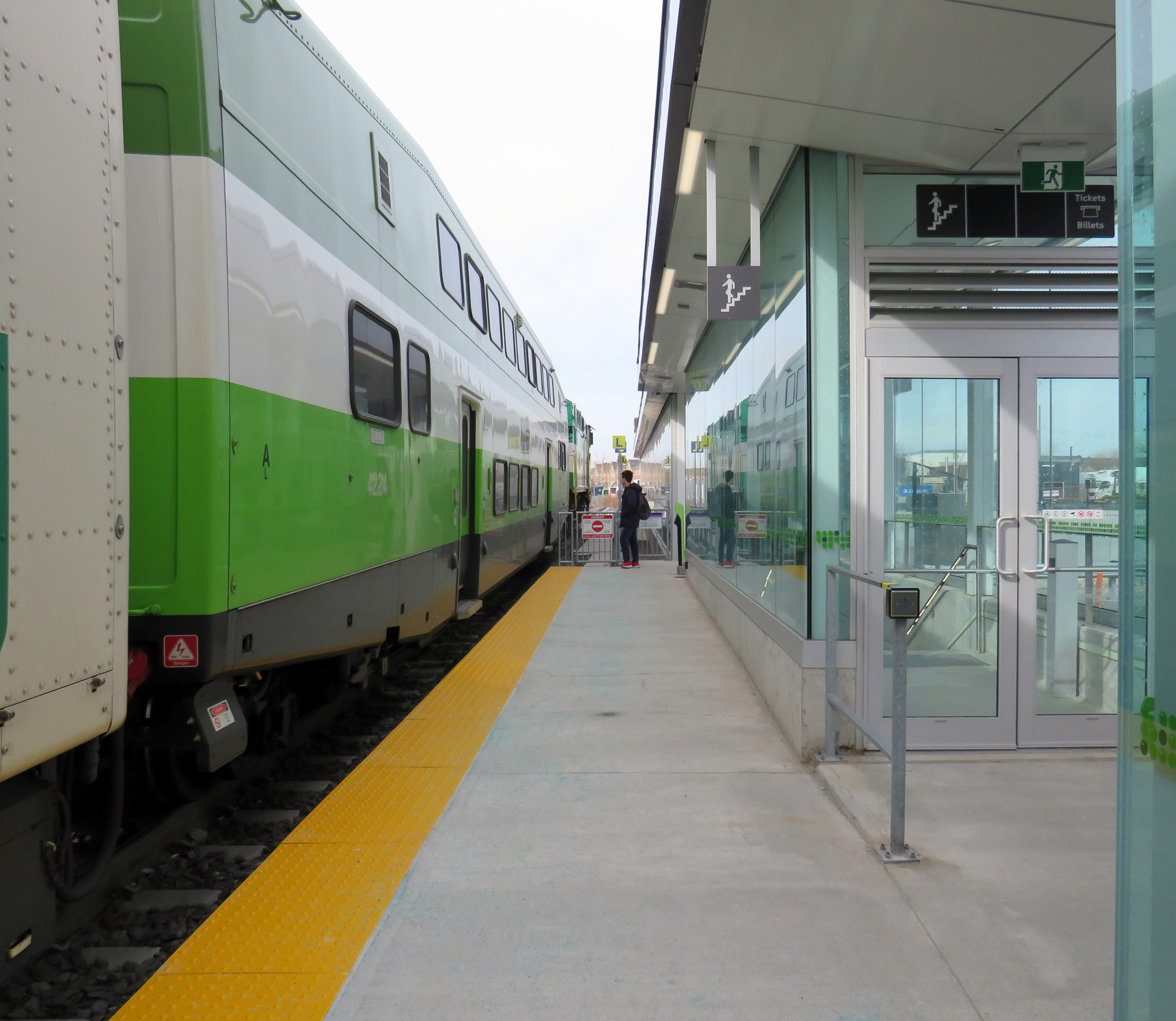
As part of the Stouffville Line corridor upgrades (which includes double-tracking the line between Scarborough Junction and Unionville) Milliken GO Station was recently rebuilt. It now features a new grade separation over Steeles Avenue, along with two new pedestrian overpasses on either side of the tracks. Though the station building is still oriented to the parking lot south of Steeles Avenue, the new layout provides excellent connections to buses on Steeles Avenue, including TTC routes 53/953 Steeles East, 43A Kennedy, and 57 Midland. Entrances on both sides of Steeles Avenue offer stairs and elevators to platform level.
TTC bus stop, separated bike lane, and access to GO trains
The one issue at Milliken Station — as with many GO stations — is that the wayfinding from platform level to TTC buses is completely missing. Ideally, signage should indicate not only the route to TTC buses, but the connecting bus routes as well.
Unfortunately, signage at Milliken Station does not indicate TTC bus connections
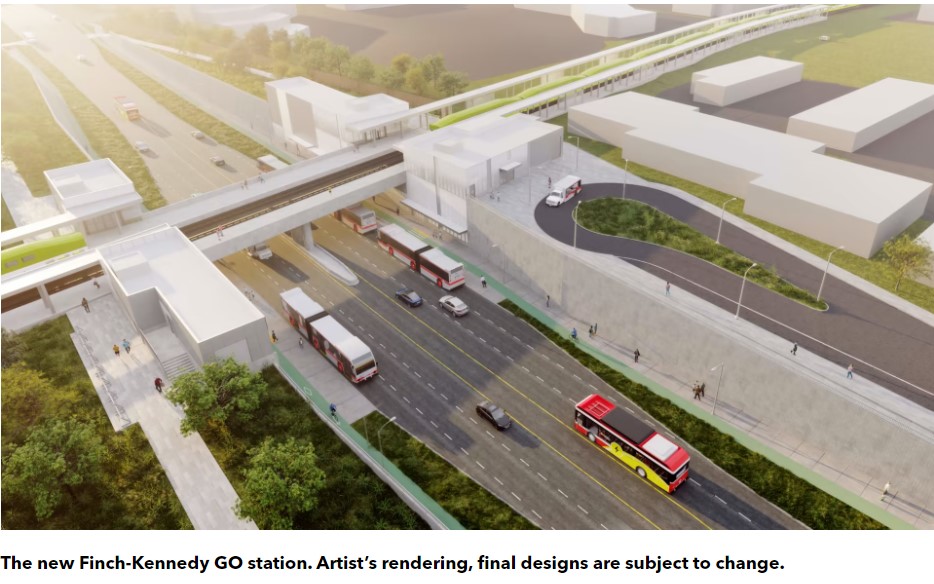
A new GO Station, nearly three kilometres to the south, will feature a similar layout. As platforms will extend over Finch Avenue, transfers between train and bus will be even more convenient at Finch-Kennedy as they are at Milliken. With minimal parking and optimized transit connections, this should be the norm as GO Transit transforms into a frequent, regional rail network. As of February 2024, preliminary work has started on the grade separation.
Rendering of the future Finch-Kennedy GO Station
Concluding thoughts
The new Ontario One Fare Program is a long-overdue step towards integrating the Greater Toronto and Hamilton Area’s disparate transit agencies and addressing unfair tariff boundaries at Steeles Avenue and elsewhere. It also recognizes GO Transit’s future as a regional rapid transit network that not only connects the suburbs to Toronto, but a solution to providing better transit within the city as well.
Most importantly, TTC-GO transfers should be simple, easy, and direct. Happily, there is some momentum to making this happen — Downsview Park Station, opened in December 2017, is a great example of physical integration between GO and TTC — but as shown above, there is much work to be done.
When the Toronto subway system was extended by six stops to York University and Vaughan, it marked the first time the TTC’s rapid transit system extended beyond the city’s boundaries. But it also exposed a major failing of the Golden Horseshoe’s transit structure: the complete lack of fare integration.
In 2017, the provincial government announced a new fare discount between the TTC and GO Transit, which operates the region’s commuter rail and bus network. This $1.50 fare discount, available to Presto card users, was funded by the previous Liberal government’s fledgling cap-and-trade carbon pricing scheme, with the promise of further fare adjustments (such as discounts for transferring between the TTC and other suburban transit agencies, such as York Region Transit and Miway) to come.
With the election of the Progressive Conservatives in 2018, the cap-and-trade scheme was cancelled, and with it, the continued funding for the GO-TTC fare discount. That discount is set to come to an end on March 31, 2020. Neither the cash-strapped TTC or Metrolinx, the provincial agency responsible for GO Transit and transit planning, will step up to make up the difference.
GO Transit buses used to stop right in front of Vari Hall, in the heart of York University’s campus
Though many regular GO rail commuters will feel the impact of the loss of the fare discount, the impact on York University students and staff will be especially felt. That’s because the new subway extension was planned to remove GO Transit buses from the heart of the campus to a purpose-built terminal at a remote new subway station next to Highway 407. I recently wrote about the problematic fare structure on those GO buses serving Highway 407 Station. Now, those commuters going two more stops will pay $6.40 a day in TTC fares on top of those expensive GO fares.
Unless they decide to walk to campus.
On Thursday, March 5, I tried do just that. It was not a pleasant experience.
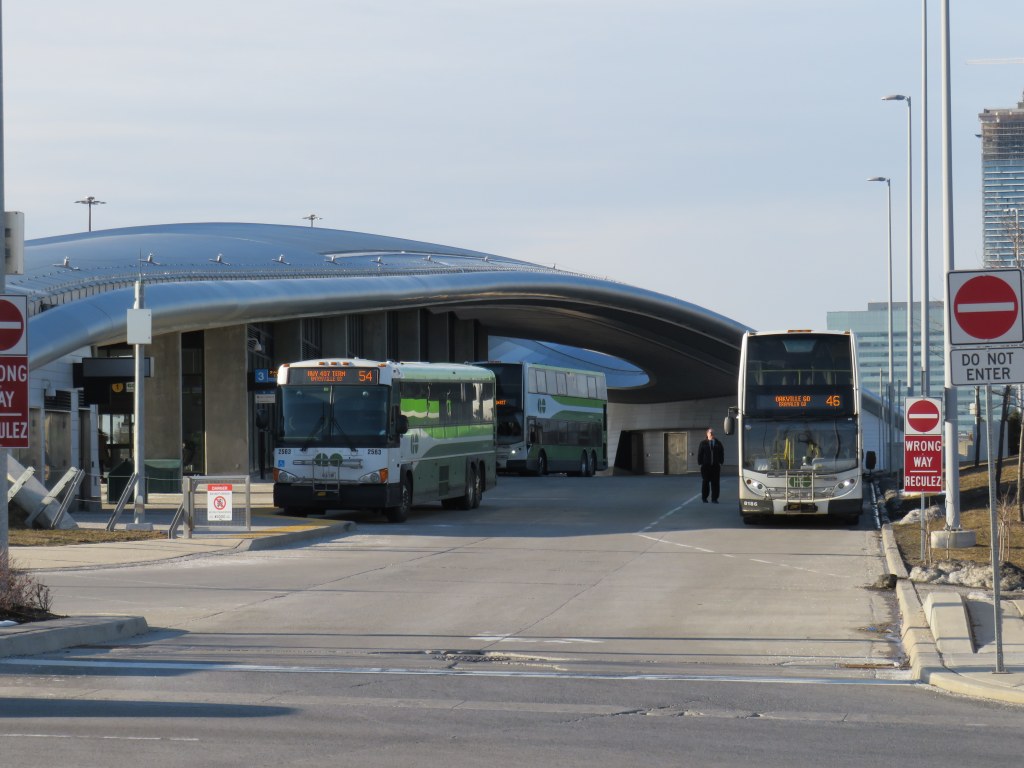
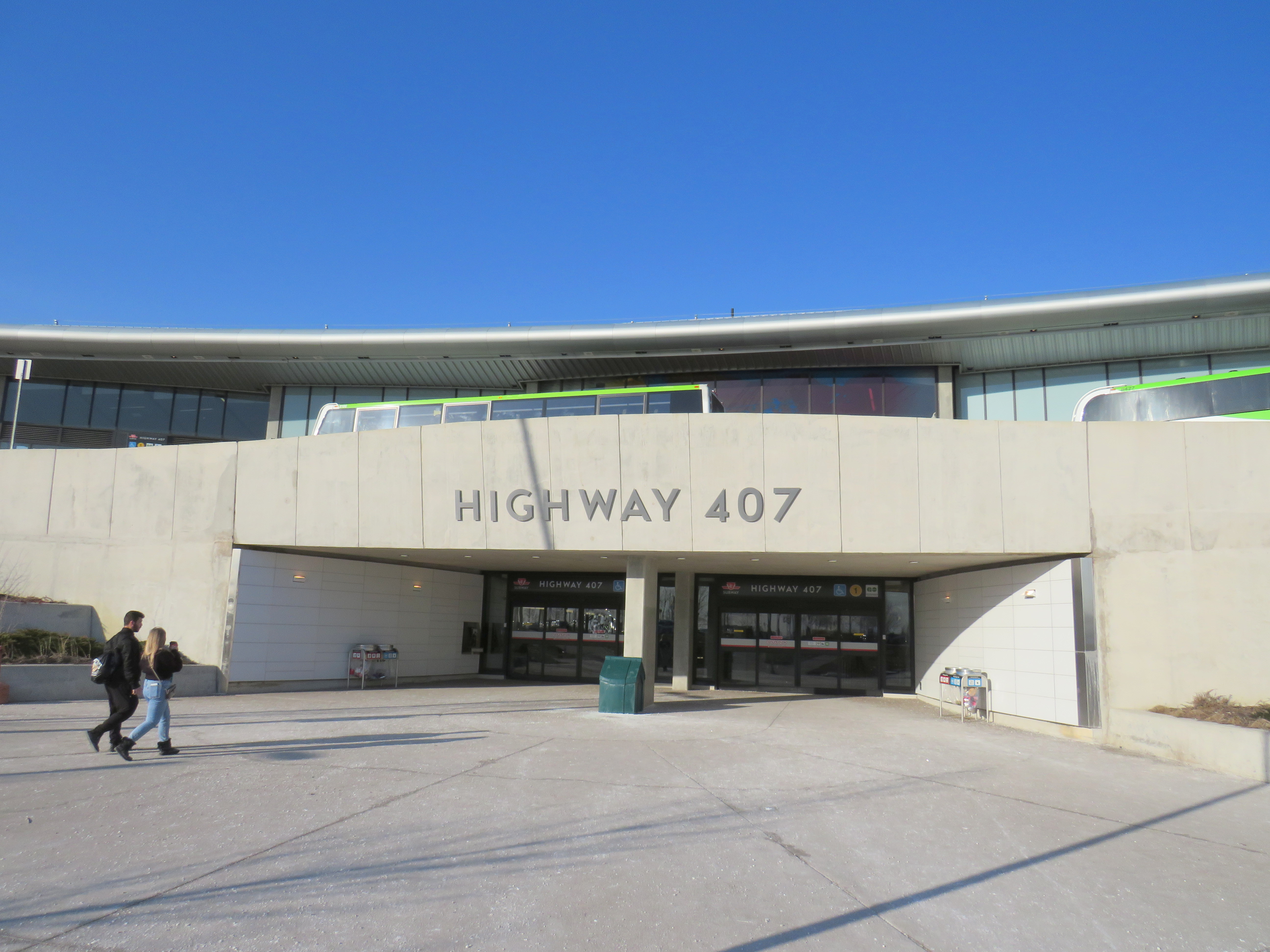
Highway 407 Station features a large bus terminal for GO Transit and YRT buses, a passenger drop-off and pick-up area, and a commuter lot. But it was not built with pedestrians in mind. That’s understandable. The only places within a few minutes’ walk are Beechwood Cemetery across the street, a warehouse, and the employee entrance to a major UPS parcel centre.
The main — and only authorized — entrance is on the opposite side of Jane Street, facing the passenger drop-off/pick-up area and the parking lot. It is quite clear in the design that most passengers would be transferring between bus and subway, perhaps with the idea that the fare boundary issue would be resolved by the time the station was open.
Jane Street, with the entrance to Highway 407 on the right, and Beechwood Cemetery on the left
The vertical circulation prioritizes bus-subway connections. At the bus platform level, I spotted a sign that said “to street, subway” leading to a downwards escalator. But it led me past the mezzanine level straight to the subway fare gates. I had to climb halfway up to get to the entrance doors.
The stained glass at Highway 407 glows in the late afternoon sun. But it doesn’t take away from a poor user experience.
Once outside, I noted that the pedestrian path between the parking lot and the passenger waiting area was completely covered by a giant dirty snow pile. It’s clear that pedestrians are not welcome here.
Snow left on the only legal sidewalk leading out of Highway 407 Station
The circuitous route is designed to keep pedestrians out of the way of the buses entering and exiting the station. But I was left wondering why a shorter, direct, and snow-free route was not designed into the station plan at the beginning. It would have cut a few minutes from my efforts in leaving the station.
Pedestrians are barred from the more direct route into the station, even though the bus terminal is not a TTC fare-paid area.
Eventually, I made it to Jane Street, and began walking south towards Steeles Avenue and campus. The narrow sidewalk hugs Jane Street, and right into a splash zone under the CN Railway underpass.
An unpleasant walk along Jane Street
After twenty-seven minutes, I made it to Pioneer Village Station, which was designed with two separate bus terminals. YRT buses use the smaller bus loop on the north side of Steeles Avenue, outside the fare-paid area. TTC buses use a larger terminal south of Steeles Avenue, on the York University lands. YRT passengers headed to campus must cross Steeles Avenue at grade as the mezzanine level underneath is fully within the TTC fare paid zone. Technically, one could transfer from GO to the YRT 20 Jane bus at Highway 407 Station (with a Presto card, it would cost only $1 each way with the YRT-GO co-fare). But it would still only get you part of the way to campus.
After 35 minutes, I made it from the GO bus platform at Highway 407 Station to the Life Sciences Building at York University, on the northwest corner of the central campus, with another 5-10 minutes to major buildings such as Vari Hall or Scott Library. This was at a relatively quick pace (I’m an able-bodied thirty-something man), in quite pleasant weather. A rainy or bitterly cold day would be quite a different matter. Therefore, most will be forced to pay $3.20 each way (the current TTC Presto fare).
The subway, with the major GO and YRT terminals off campus, was designed for a new fare structure where students and university staff wouldn’t be penalized for having to transfer one or two subway stops to get to the middle of campus. The most we got was a fare discount for GO Transit riders, with nothing for YRT commuters. (Only Brampton Transit continues to directly serve York University.) And now that meagre fare concession is going away, because no one wants to pay for it.
Sadly, this is just further evidence of how we get transit so wrong in the Golden Horseshoe, despite it being the country’s economic heartland.
Transit advocacy group TTC Riders, along with allies at York University, have been calling on Queen’s Park to continue to fund the fare discount. You can find out more here.
I also expect that the opposition New Democrats will submit a motion in the legislature to maintain funding for the discount next week. I’ll update this post as necessary.
Imagine any retail store welcoming its customers the way the Toronto Transit Commission does these days.
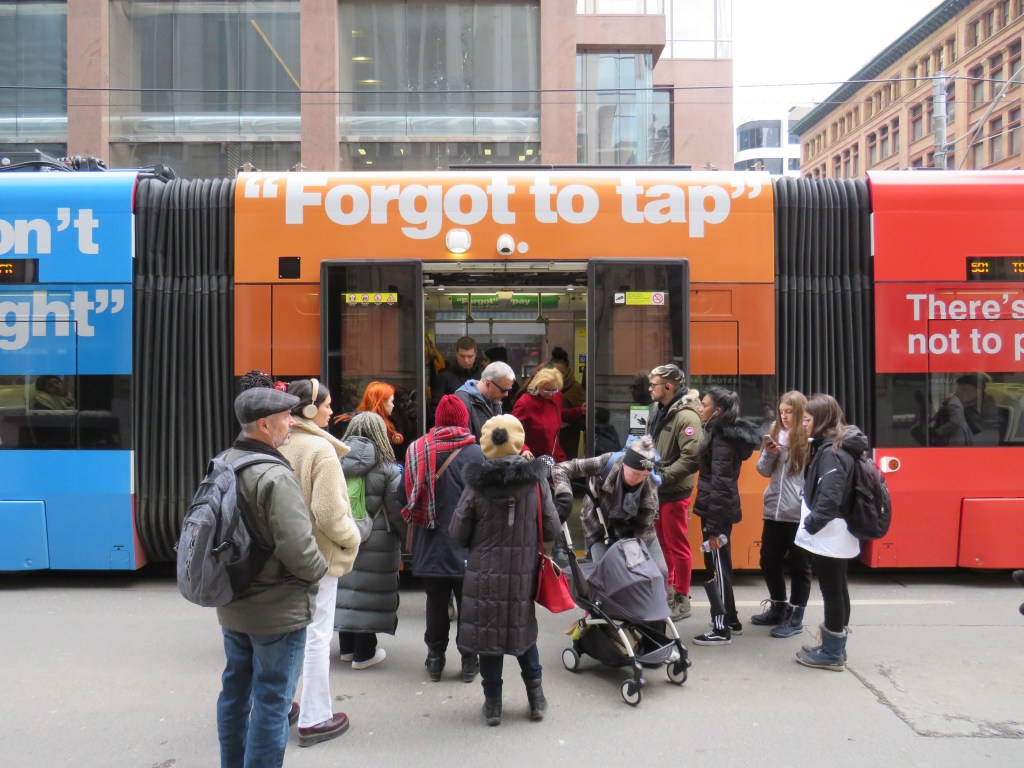
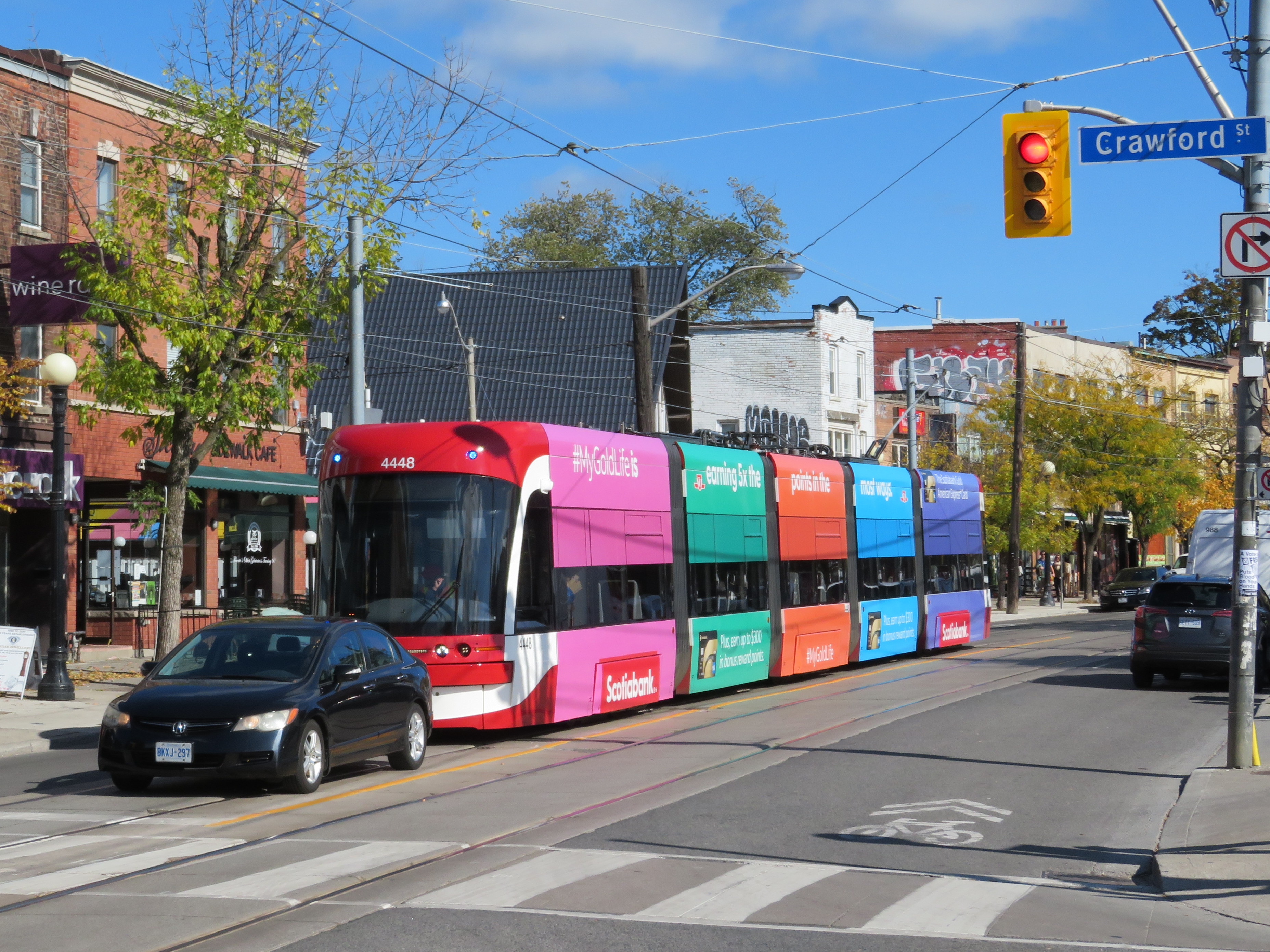
This week, at least two TTC streetcars were wrapped with messages promoting the transit agency’s new aggressive anti-fare evasion campaign. Any passenger caught by fare inspectors or special constables without a valid fare is subject to a fine of up to $425.
As a regular, fare-paying passenger, I am sympathetic to the TTC’s need to balance its books — it relies on transit fares for 68 percent of its $2.14 billion operating budget — but the more aggressive fare enforcement program — including advertisements inside vehicles and stations and hiring 50 more fare inspectors in 2020 — is insulting to its customers.
Typically, businesses and public services strive to welcome their clientele and promote themselves to potential new customers. At one time, the TTC even ran television commercials, with a particular focus on promoting off-peak ridership.
Not anymore.
Customer notices on posters and on the PA system are restricted to subway closure notices, reminders about etiquette, and now warnings of $425 fines for not tapping a Presto card. Riders are no longer thanked for using the TTC. Instead, we’re subjected to poor and inconsistent service, streetcar shortages, regular weekend subway closures, fare hikes, and repeals of recent fare integration measures, along with lectures on fare payment.
Other transit and municipal politics writers, including Steve Munro, Matt Elliott, and Ben Spurr have written about the TTC’s push for stricter fare enforcement as well as the problems passengers have when paying, including malfunctioning Presto readers and fare payment machines, and overcrowded vehicles. Fare payment machines do not accept bank notes, debit, or credit cards. Though the TTC estimates that 5.7 percent of all riders engage in fare evasion, the rate on streetcars, where passengers board from all doors and tap or pay on board, is 15.9 percent.
There has been an inconsistent approach to fare enforcement, with inspectors commonly found at streetcar terminals at subway stations. There are reports and credible accusations of racial profiling by fare enforcement officers.
A friendlier and more wholesome approach would be addressing the technical problems, including the reliability of fare machines, and replacing generic Presto cards being used for child fares that other passengers — such as York University Station — are illegitimately using. There should also be a friendlier education campaign, enforcement discretion, and less aggressive behaviour towards customers, would make far more sense. If the TTC is truly interested in “disrupting” negative behaviour, it should adopt a customer service model, and address the distrust towards its officers from racialized and economically marginalized communities.
Putting aside the bad optics of the crackdown on fare evasion, transit ad wraps are an insult to transit riders. Furthermore, they are a detriment to the brand. Toronto’s streetcars are an icon of this great city; this is cheapened by gigantic ads for Starbucks, Sephora, or Scotiabank.
Inside, the large panoramic windows are obscured by perforated vinyl sheeting that is difficult to see out of. Though the vinyl wraps leave a sliver at seat level, the view is obstructed for anyone standing on a crowded vehicle.
A typical streetcar advertising wrap
The current 12-year, $324-million contract with Pattison Outdoor brings in a total of $27 million a year. The contract includes interior and exterior transit advertising (traditional placards, posters in stations and vehicles, and wraps). In total, advertising in all forms represents 1.1 percent of the entire TTC budget, with wraps representing a small portion of that. These wraps, commissioned by the TTC itself, are part of the contact.
The streetcar wraps that scold, rather than welcome, riders are even more of an insult. What message do they send to visitors to Toronto? And what message do they send to potential riders?
Customer buy-in is about so much more than just paying one’s fare. The TTC should realize that.
As I argue below, this is a major blow to any hopes for an integrated regional transit system throughout the Greater Toronto and Hamilton Area. Subsidized transfers reduce the need to build expensive parking lots and garages, encourage more passengers to ride transit, especially in off-peak periods, and reduce the potential of major GO Transit expansion projects planned or underway.
The provincial Liberal government introduced the discounted double fare in 2017. It reduced the cost of a trip taken on both GO and TTC by $1.50 if the fare was paid on a Presto fare card. For many years, there were discounted transfers between GO and suburban transit agencies, but this was the first time such a discount was offered to TTC passengers.
The Liberals also planned discounts for transferring between suburban bus systems such as York Region Transit and Miway, subsidies that would have been covered by the provincial carbon pricing scheme. This would have reduced the impact of another fare barrier. (A short bus trip across Steeles Avenue costs nearly $7.)
When the Doug Ford-led Progressive Conservative government was elected, the provincial climate change plan was scrapped, along with those planned fare changes. Now, the province will not renew the $18.5 million annual subsidy for linked GO-TTC fares, though it did introduce free fares for children on GO Transit.
This will especially affect commuters to York University, who previously enjoyed a one-seat ride to the heart of the campus on YRT and GO buses. When the subway extension opened, YRT retreated to terminals north of Steeles Avenue, forcing a transfer to the subway or a long walk across six lanes of traffic and campus parking lots. GO Transit, too, moved to a new terminal at Highway 407, two subway stops from campus. While GO commuters at least saved $3.00 a day with the discounted double fare, YRT commuters got nothing. (Of all the suburban agencies, only Brampton Transit continues to serve the campus.)
This is also a blow to what’s left of SmartTrack, Mayor John Tory’s signature transit plan that was once pitched as “London-style surface rail.” At first, SmartTrack was a 53-kilometre heavy-rail line, mostly piggybacking on existing GO Transit corridors, but including a problematic western branch to the Airport Corporate Centre in Mississauga, all on an integrated TTC fare. Eventually SmartTrack just consisted of more frequent, electric GO service, along with additional station stops and fare integration. This was much more realistic, but it distracted from other needs such as the Relief Line and GO’s own RER regional rail plan.
As Jonathan English points out in Urban Toronto, the GO rail network represents “tremendous infrastructure that could greatly improve the lives of hundreds of thousands of Torontonians.” But it lies “letting it lie mostly dormant because we won’t make the comparatively small operating funding investments required to improve the service and make the fares fair.”
The $18.5 million annual cost is a small price to pay for improving transit accessibility and utilization of our existing corridors. Increasing that annual subsidy to reduce the cost of transfers between the TTC , York Region, Brampton, and Mississauga would, too be a worthwhile investment.
Sadly, the current provincial government does not see the value in promoting fairer fare systems, nor regional transit in general. In response to budget cuts, Metrolinx reduced or eliminated service on five GO bus routes last month, and more may be to come. While there may be enthusiasm for building a new “Ontario Line” and a subway extension to Richmond Hill, there’s little regard for the actual transit rider.
Since 1967, GO Transit’s primary focus has been its commuter rail lines radiating from Downtown Toronto, sometimes to the detriment of other transit needs in the Greater Golden Horseshoe, with bus routes complementing and supplementing that rail network. But twenty years ago, the regional transit service launched a new bus route that connected York University with suburban GO stations and bus terminals, filling in a gap and setting a precedent for expansion to other university and college campuses.
Late last year, I analysed the GO Transit rail fare structure that centres on Toronto Union Station, following up on previous work. GO Transit claims to operate on a fare-by-distance structure, this is not quite the case. Generally, the longer one travels, the less the passenger pays per distance traveled.
Though the GO Transit fare structure was recently improved with new lower fares for short trips, there are still significant fare inequities and discrepancies, with Barrie and Richmond Hill Corridor passengers paying the least per kilometre traveled, and Kitchener Corridor passengers paying the most.
The fare discrepancies on the Highway 407 corridor — which is made up of eight bus routes that serve the Highway 407 bus terminal and TTC subway station in Vaughan — are even greater than that on the rail network. A passenger going from Markham GO Station, 27 kilometres from Highway 407 Station, will only pay $3.70 with a Presto card. A passenger from Bramalea GO Station, just 18.7 kilometres from Highway 407 Station, will pay over two dollars more.
Four years ago, I wrote about GO Transit’s problematic fare structure. Though GO Transit claims to charge passengers based upon a fare-by-distance structure, fares for travelling short distances were disproportionately high compared to long-distance rides from outer suburban stations. In 2015, I also found significant fare differences between corridors, with Kitchener Line passengers paying the most per distance traveled.
Since my original post, some changes were made to the GO Transit fare system:
In 2016, a tiered fare increase was applied, with the lowest fares frozen (for example, Union Station to Mimico, Bloor, or Danforth), with fare increases between 40 and 60 cents per ride dependent on distance traveled. Those fare increases applied to Presto fares, though with a discount (11.15% less than the cash fare).
In January 2018, a $1.50 fare discount was introduced for Presto card users transferring between TTC and GO. However, the Ford government announced it would no longer subsidize the TTC-GO fare discount, threatening its continuation.
In April 2019, GO fares for trips less than 10 kilometres were reduced, with the minimum cash fare going from $5.30 to $4.40, with the minimum Presto fares reduced from $4.71 to $3.70. A passenger headed from Union Station to Exhibition Place could choose to take a local TTC streetcar fare ($3.10 with a Presto Card) or the direct GO train ride (just 60 cents more). At the same time, the cash fares for trips longer than 10 kilometres were increased by 4%, while Presto fares were increased by 3%.
The good news is the eventual reduction of short-distance fares have gone a long way towards flattening the fare/distance curve.
There were also some major service changes over the last four years. Two new GO stations were opened: Downsview Park (which offers a direct connection to the new TTC subway extension to York University and Vaughan), and Gormley, a station built next to Highway 404 on the Oak Ridges Moraine. Additional trains were added to Kitchener, new peak-period trains to and from Niagara Falls were introduced, evening trains added on the Kitchener Line, and this month, weekend trains were introduced on the Stouffville Line. But connecting bus routes to Cambridge, Bolton, and between Milton and Oakville were eliminated, with other bus trips cancelled across the system. (more…)
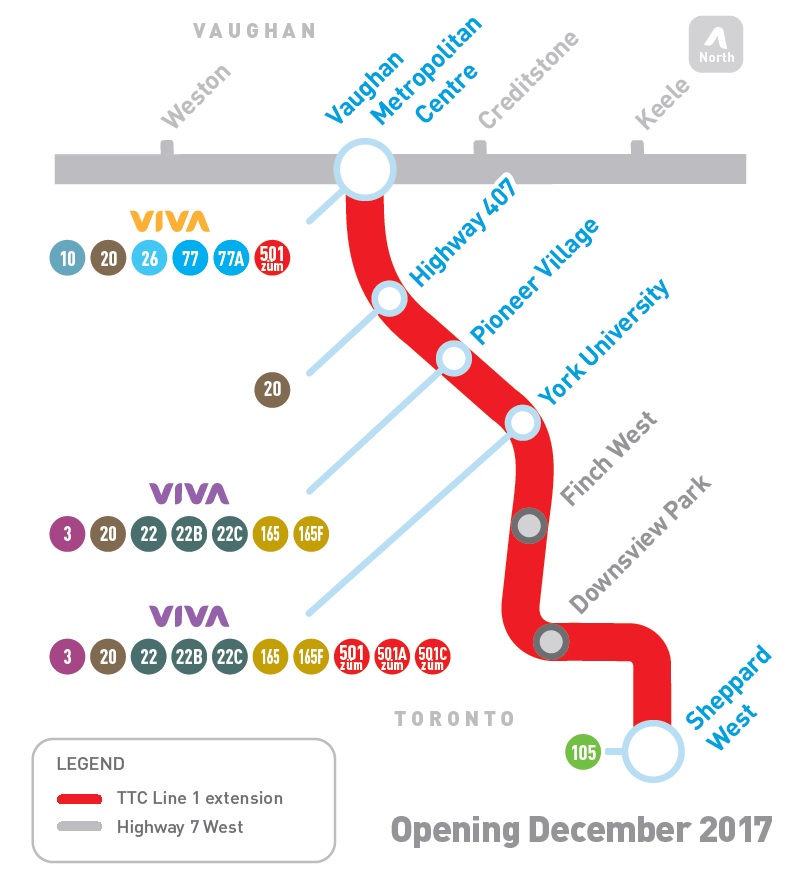
On Sunday, December 17, 2017, the TTC opened the long-awaited $3.2 billion Toronto-York Spadina Subway Extension to York University and the City of Vaughan. The extension of Line 1, which included six new stations, opened over two years behind schedule largely due to construction-related delays. It was the first subway to extend beyond Toronto’s boundaries; York Region is now pushing for another subway extension up Yonge Street to Richmond Hill.
Unfortunately, fare integration between the TTC and suburban transit agencies was never completely worked out, despite many years’ notice that this would be an issue once the subway extension was opened. A new GO Transit terminal was built at Highway 407 Station, meant to handle GO Transit’s many buses currently serving York University. York University and York Region Transit (YRT) signed an agreement that YRT would remove its buses from campus after the subway opened. There was an assumption that transit riders destined for York University would simply transfer to the subway, but measures to prevent those riders from paying a second fare were never worked out.
Many YRT passengers will have to pay the whole $3.00 each way, or be required to make a new transfer and/or walk a farther distance from the north terminal at Pioneer Village Station.
The fact that there’s no fare agreement to allow YRT passengers to ride the subway from Vaughan Centre to York University without paying a full TTC fare is indicative of the failure to fully coordinate regional transportation in the Greater Toronto and Hamilton Area. And York Region’s complete abandonment of what used to be one of its most important hubs is indicative of that region’s lack of commitment to funding transit operations adequately, despite its ambitious capital spending and lobbying for subway extensions.
Ten months ago, I wrote about some of the unanswered questions about the Toronto Transit Commission’s Line 1 subway extension to York University and Vaughan. At the time, I was concerned about fare integration once the subway opened, especially if suburban GO, YRT, or Brampton Transit passengers headed to York University were required to make new transfers to the subway at Vaughan Centre or Highway 407 Stations.
We now know the day the six new subway stations will open: Sunday, December 17, 2017. We also know how the TTC, York Region Transit, and Brampton Transit will serve the new extension and York University. And today, we also have some indication of how GO Transit passengers will be affected by the changes.
How YRT and Brampton Transit will serve the Line 1 subway extension
(from the YRT website)
Transfers from GO Transit or UPX to the TTC will cost $1.50 for passengers using Presto cards, a 50% reduction from the full adult fare of $3.00. Passengers transferring from the TTC to GO or UPX will get a $1.50 fare discount. It is expected that the new co-fare subsidies will cost the provincial government $18 million a year. The fare discount will not apply to passengers using fare media other than Presto cards, including TTC tokens, Metropasses, or paper one-way tickets or day passes.
These are similar to the co-fares offered between GO Transit and transit agencies outside the City of Toronto, including MiWay, York Region Transit, Brampton Transit, and Hamilton Street Railway. However, these co-fares are generally more generous — ranging from $0.60 in Hamilton to $1.00 in York Region.
There was no news on reducing the fare penalty for transferring between the TTC and connecting local bus systems such as York Region Transit and MiWay.
For many commuters, the new TTC co-fare is great news, and it represents a good first step towards proper fare integration. It helps to make GO Transit more useful for trips within the City of Toronto, and it helps suburban commuters who use the TTC for part of their trip, such as University of Toronto students, who are located too far a walk to Union Station.
(John Tory is also claiming a victory, calling it “a step in the right direction” for his SmartTrack proposal. At this point, “SmartTrack” is little more than a GO/TTC fare agreement and a few new proposed GO stations.)
However, this could also affect York University students as well. Previous plans for the Line 1 subway extension saw GO Transit buses serve the Highway 407 station, requiring a transfer to the subway to get to campus. York University has been long eager to remove the buses from the York Commons area, which GO and the TTC use as their campus terminals.
York Region Transit will continue to operate many bus routes into York’s campus, on the Ian Macdonald Boulevard ring road, and Brampton Transit’s Queen Züm bus route will remain on campus. Their university-bound passengers won’t be required to transfer to the subway and pay an additional fare. But it appears, for now, that GO Transit passengers will have to make a connection, costing $1.50 each way. (This will not be the case for in the short term, see update below.) This will also apply to GO train customers on the Barrie Line who currently use York University Station, if that station closes as planned when the subway connection at Downsview Park opens.
This will be a blow for GO Transit customers who commute to and from York University, accustomed to a one-seat ride direct to campus. But it will be an improvement for GO operations on the Highway 407 corridor, with buses no longer stuck in traffic in the Keele Street and Steeles Avenue area. It will also benefit GO Transit passengers who aren’t headed to York University. Providing good public transit is not be about giving everyone a one-seat ride.
Despite these benefits, if GO Transit serves Highway 407 Station as planned, it will impact many passengers with a new transfer and an additional $3.00 cost per day. I’m curious what GO Transit’s messaging and final plans will be, because they have yet to communicate their new schedules and connections when the subway extension opens. Hopefully, we will learn the answers to the rest of those questions soon.
Update: According to the CBC and Metrolinx’s Anne Marie Aikins, there are now no immediate plans to re-route GO Transit buses from York University. at least in the short term. This is a short-term solution, however, because the Highway 407 station was designed with a large terminal for GO Transit buses, and York University has been vocal about wanting the hundreds of GO and TTC buses a day out of the York Commons area.
I don’t see this as a long-term solution, however. Hopefully Metrolinx and the TTC can figure out how to best serve York University passengers, though that should have been figured out a long time ago. After all, the subway was originally supposed to open by the end of 2015.

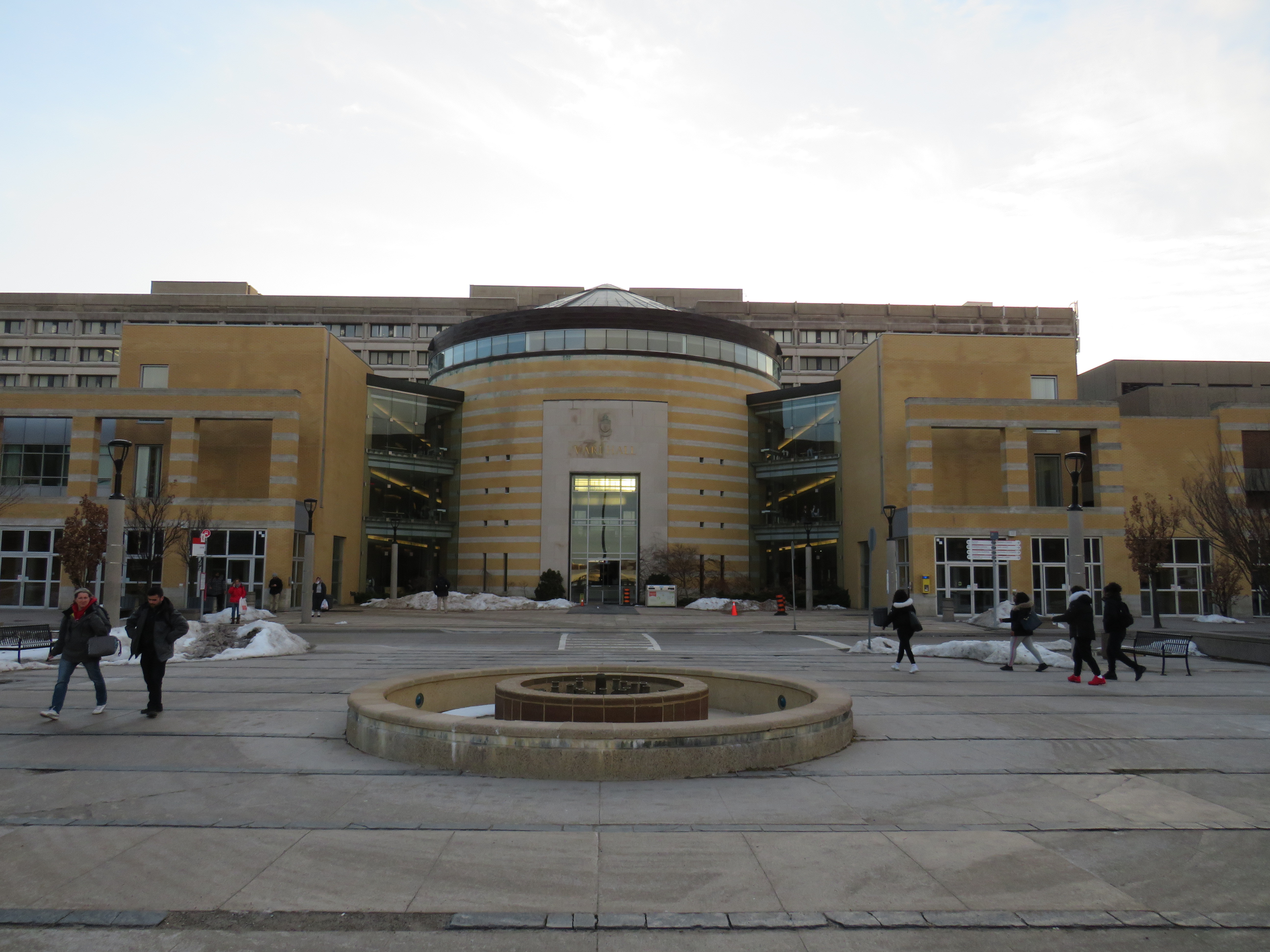 GO Transit buses used to stop right in front of Vari Hall, in the heart of York University’s campus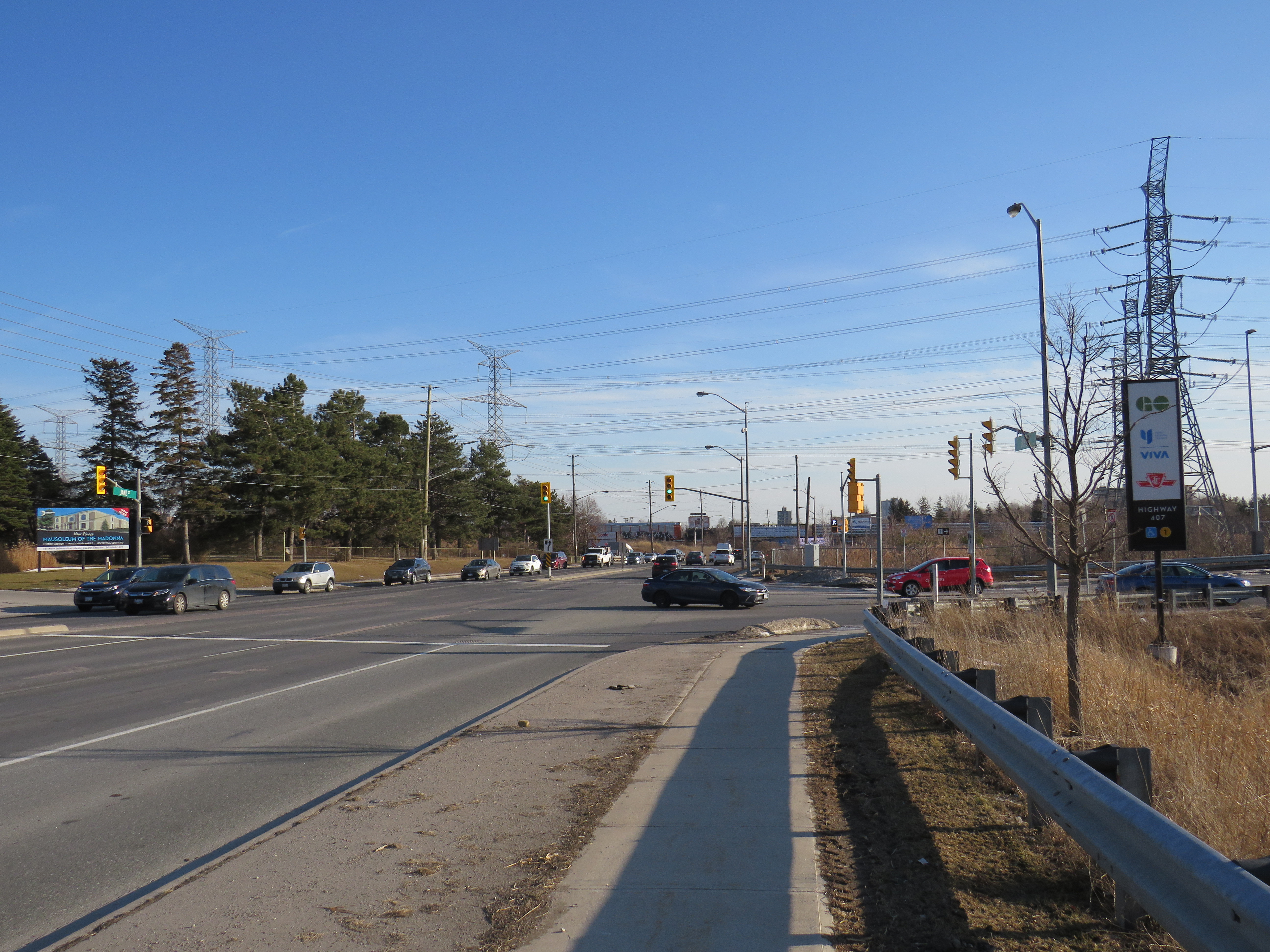
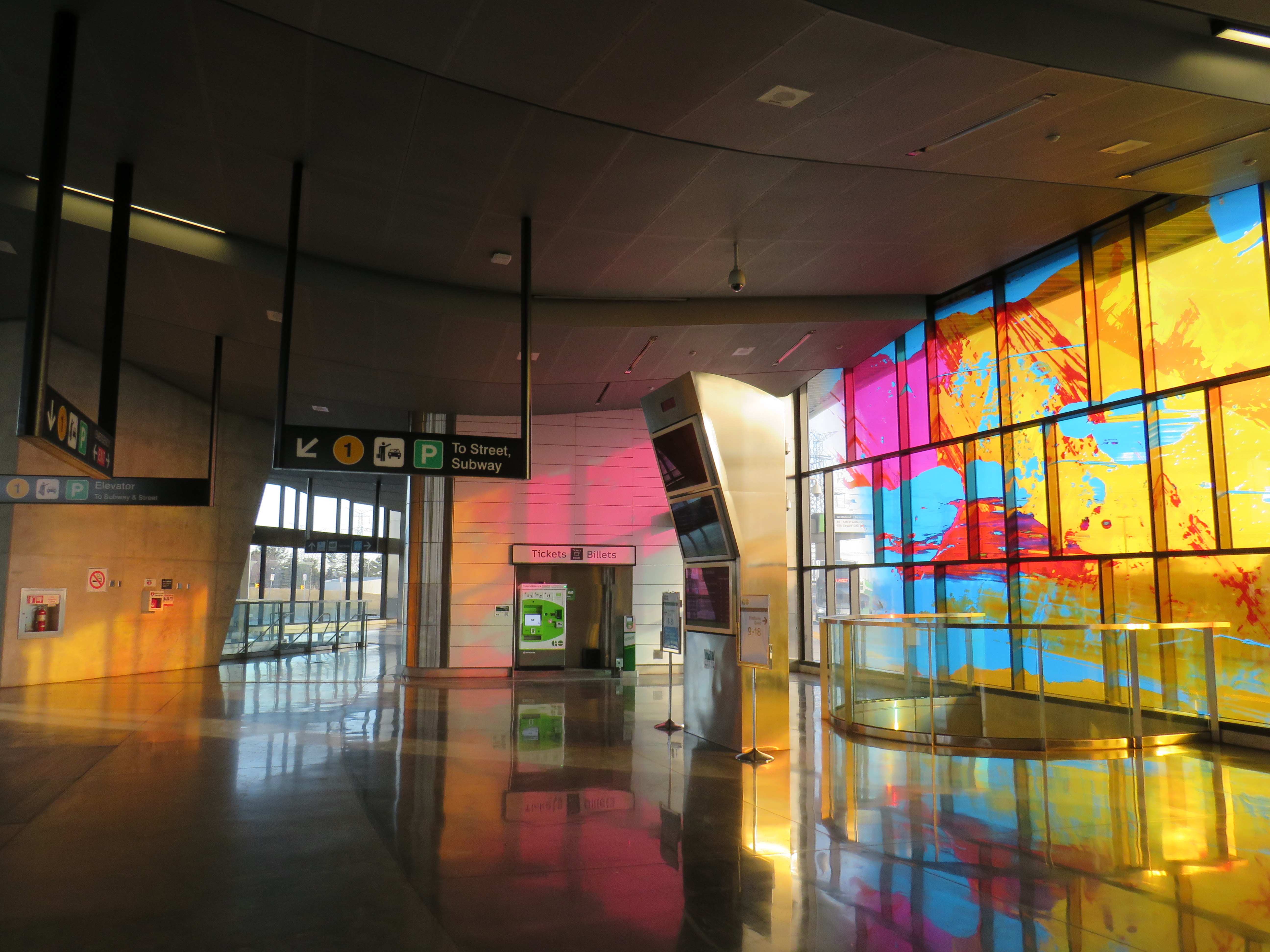 The stained glass at Highway 407 glows in the late afternoon sun. But it doesn’t take away from a poor user experience.


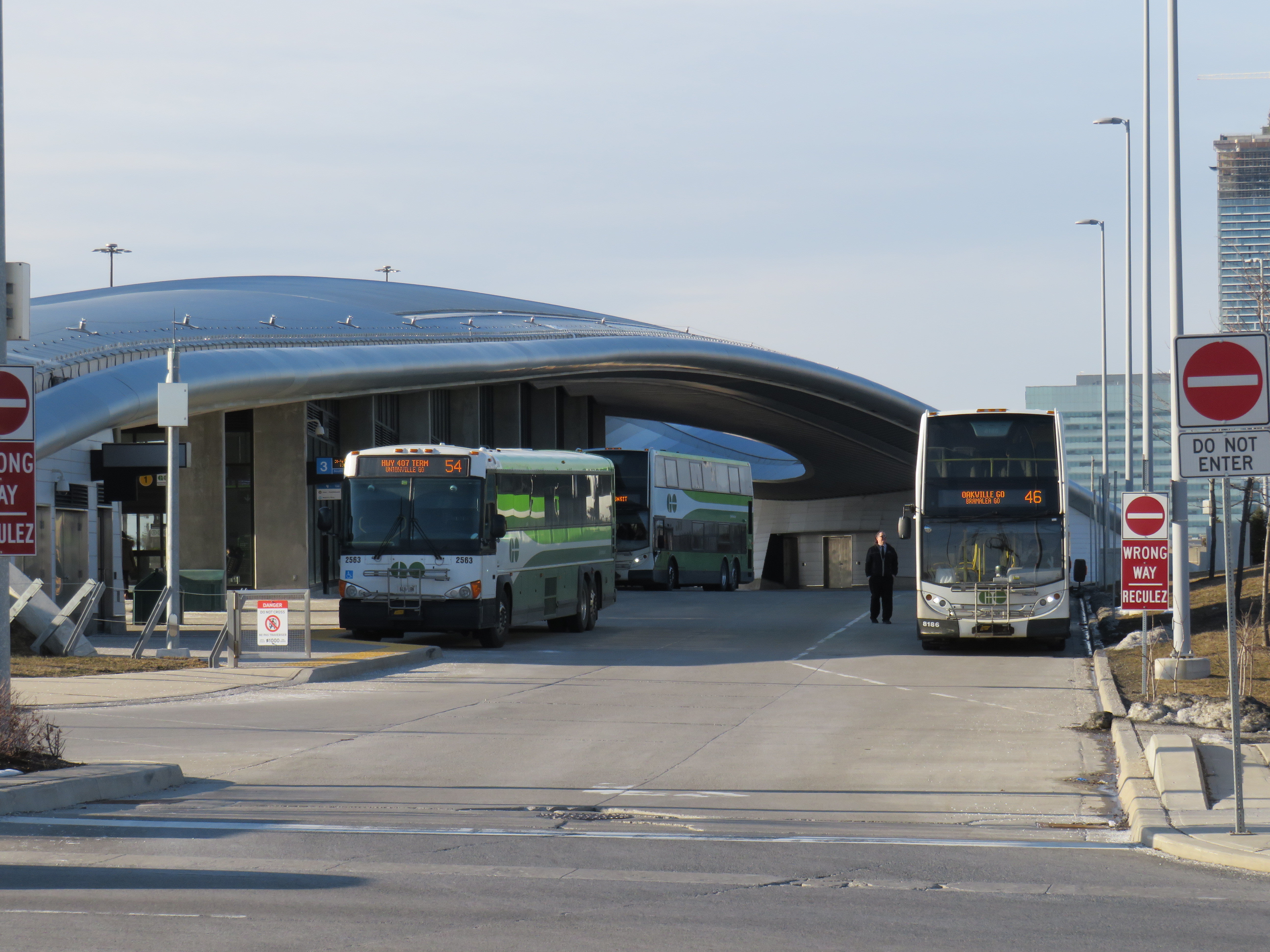
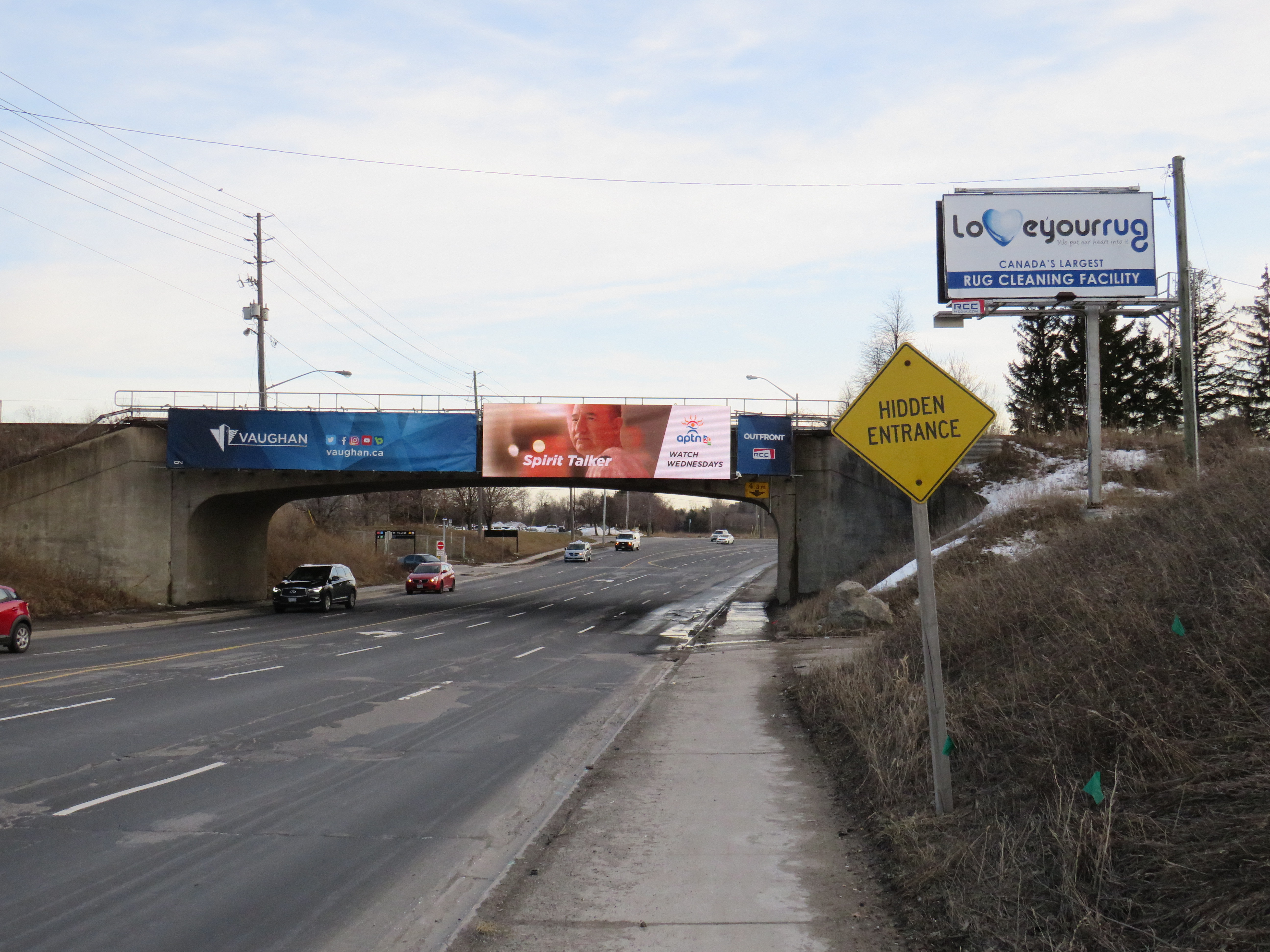
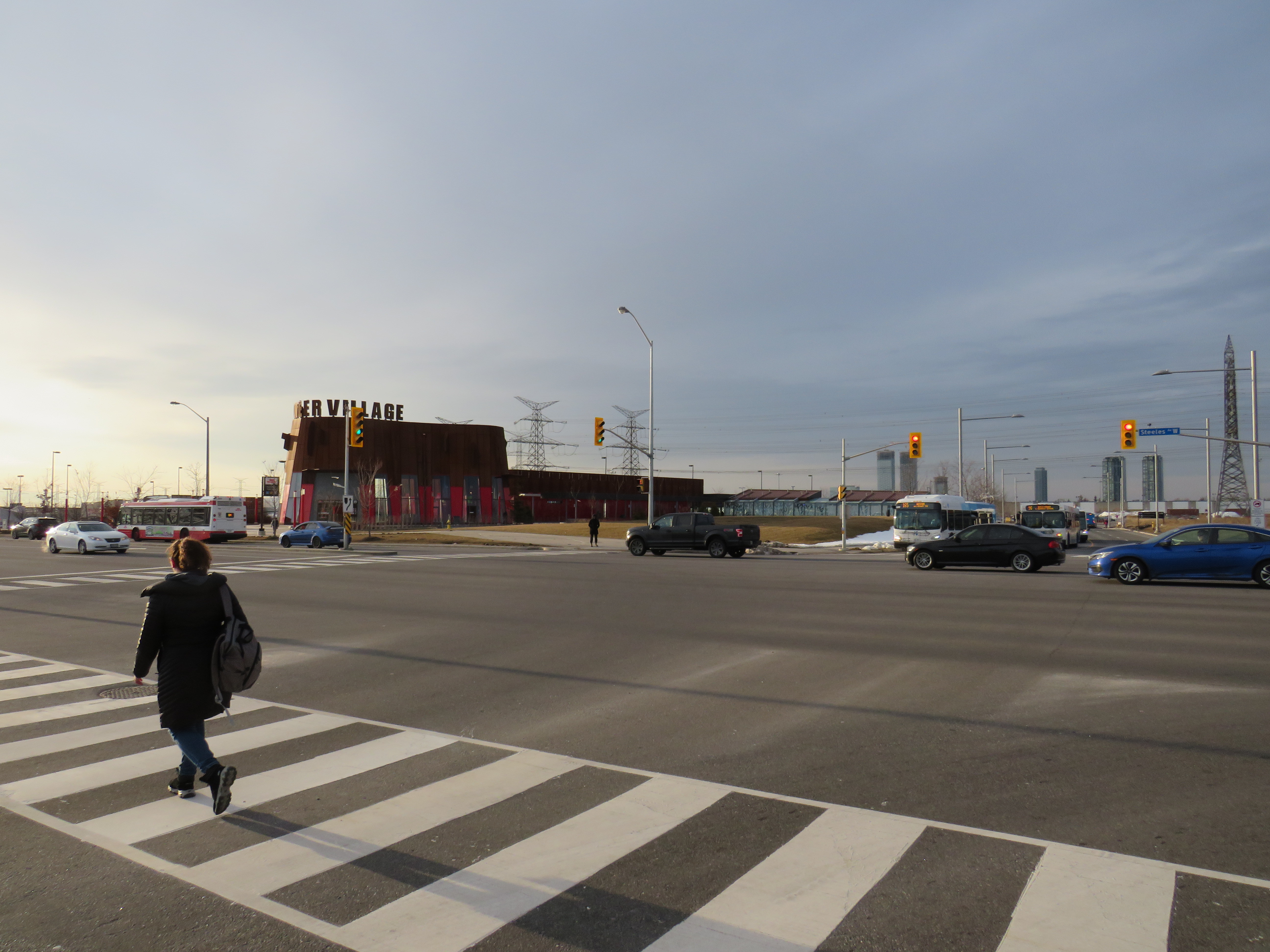



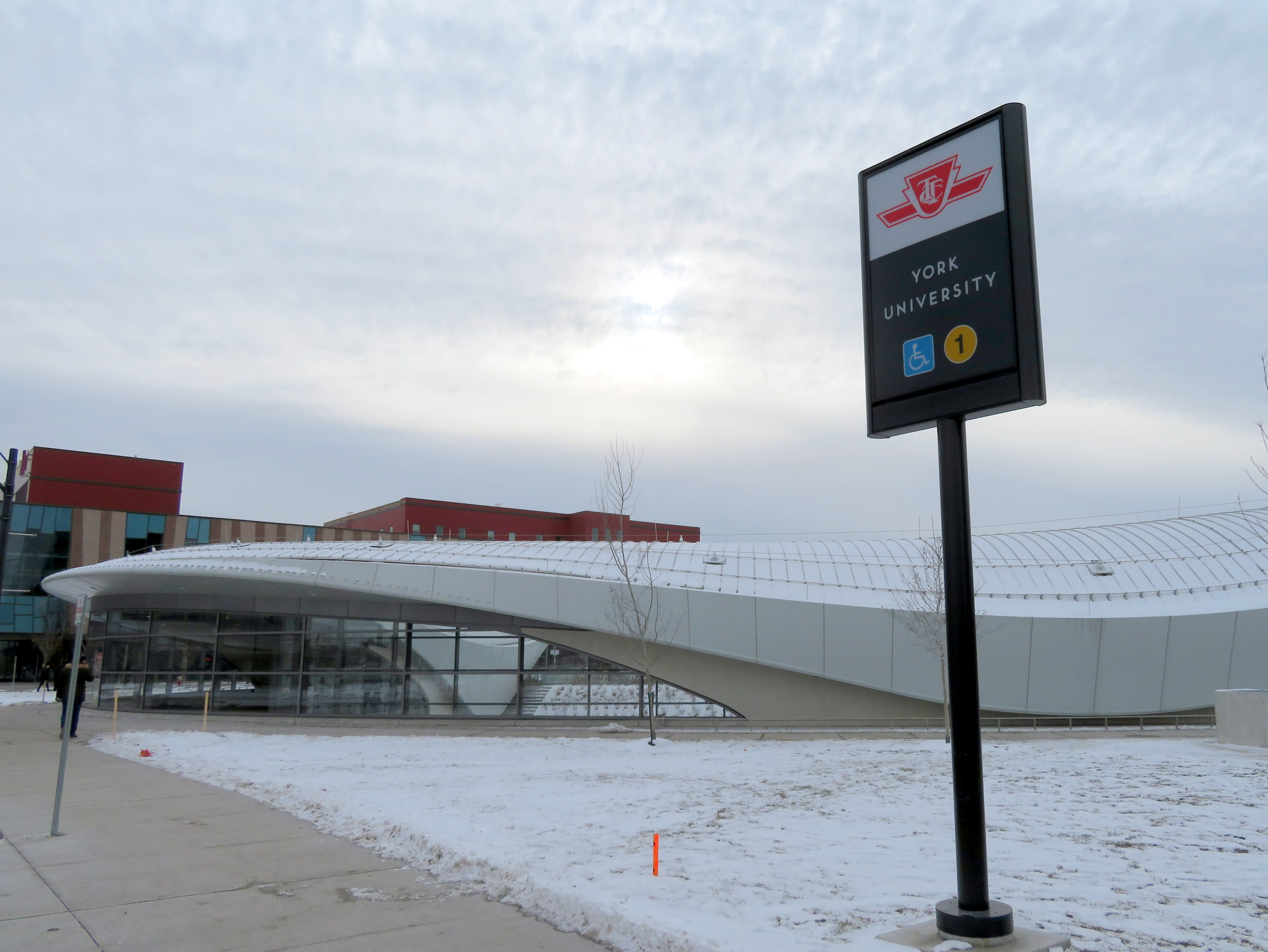
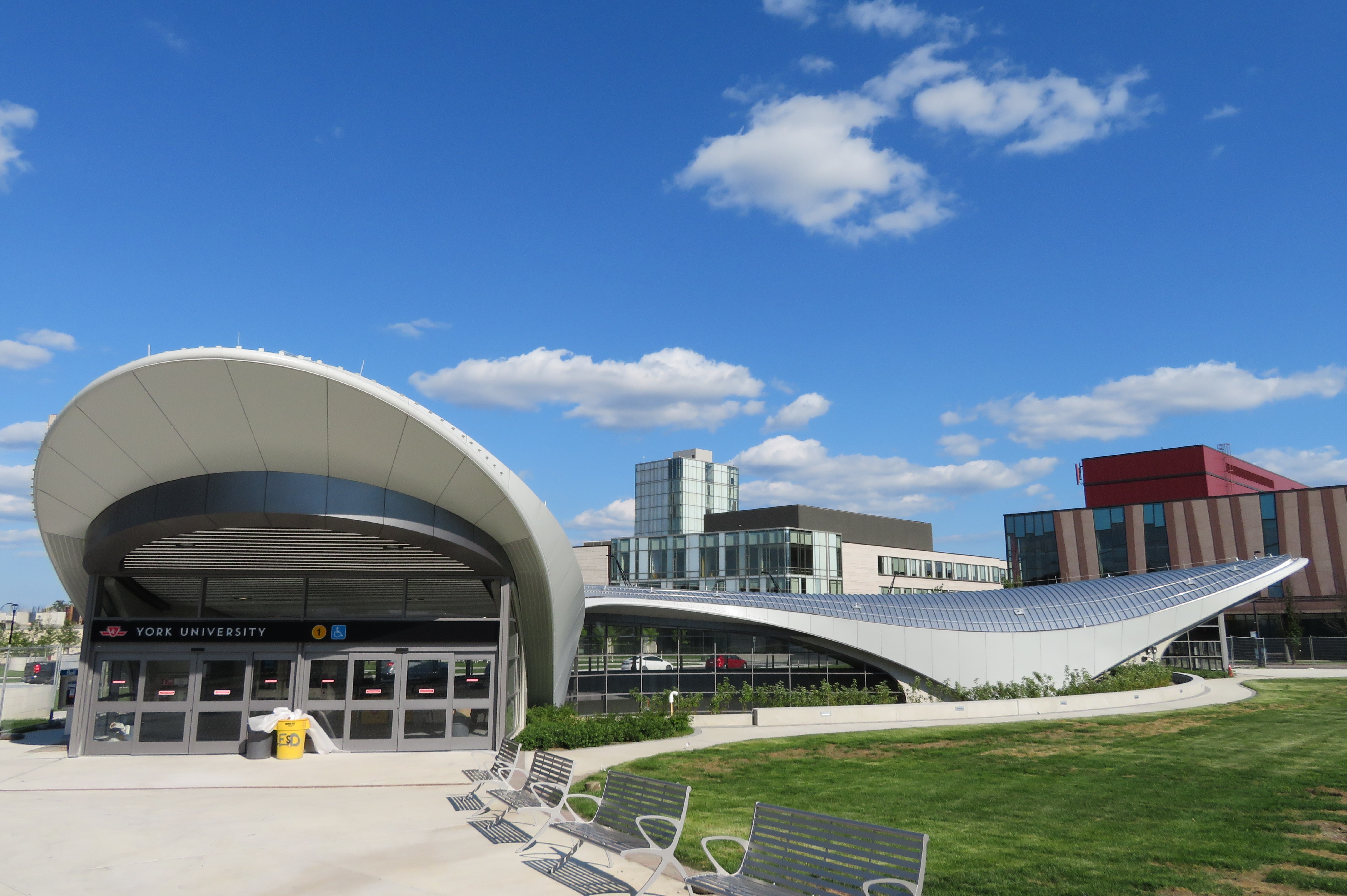 York University Station, August 2017