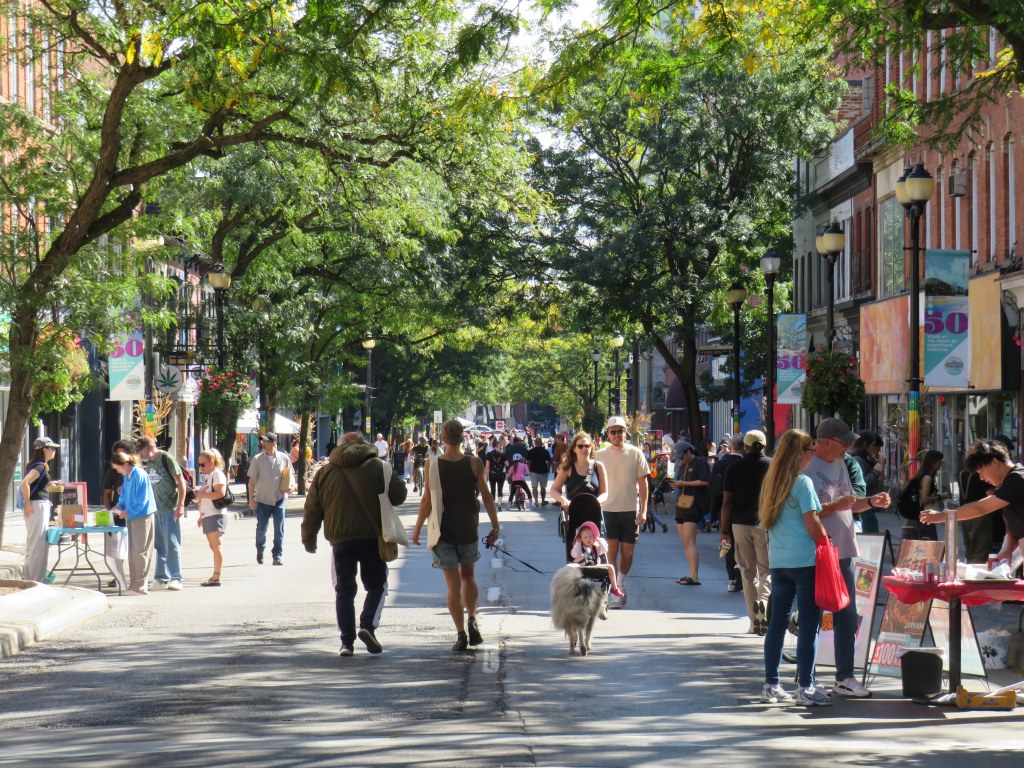
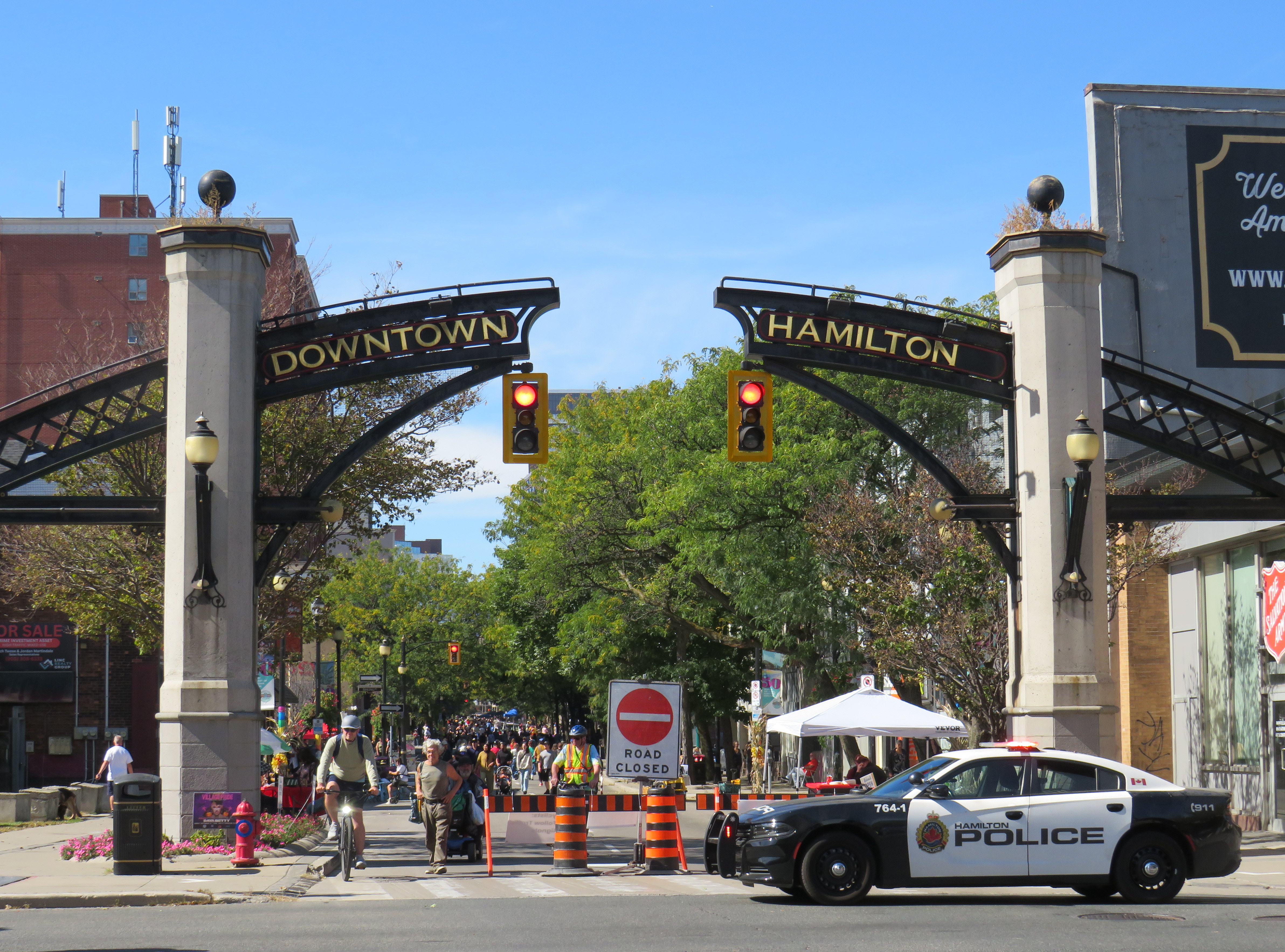
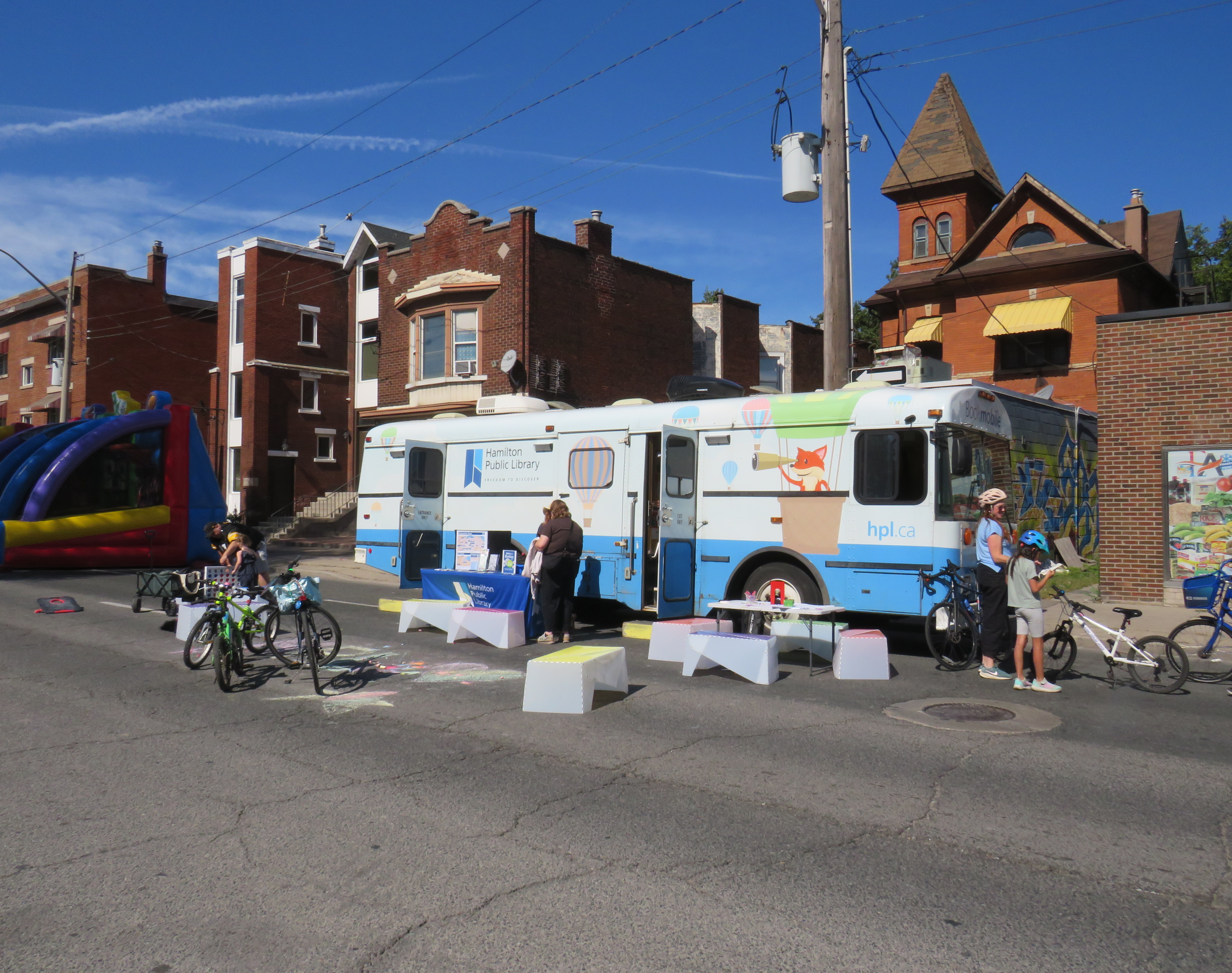
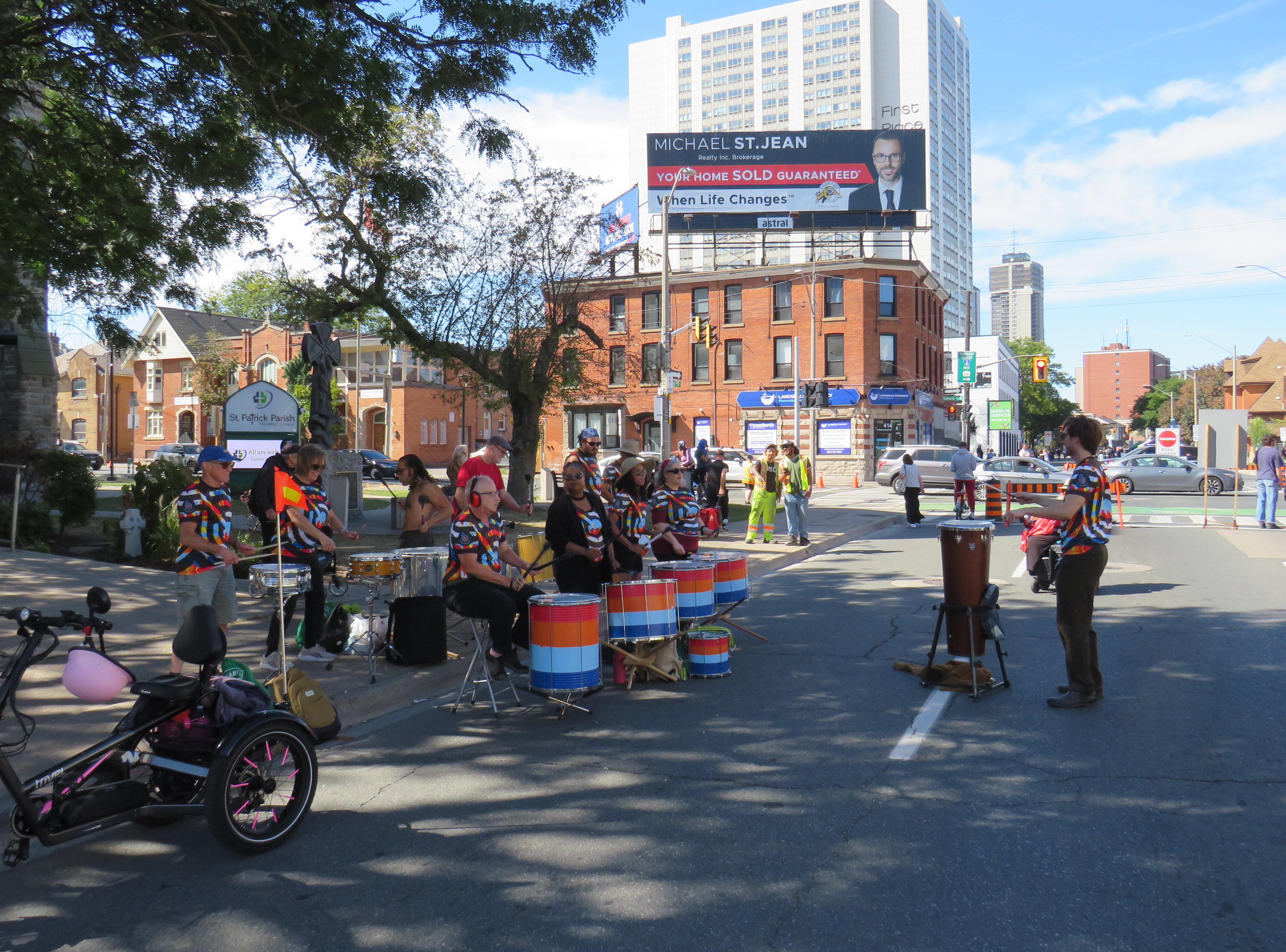
On Sunday, September 27, I took the GO train to Hamilton with my bike to experience Open Streets Hamilton, an annual event that shuts down just over three kilometres of King Street East between John Street and Gage Street from 10AM to 4PM. An official program of the City of Hamilton, pedestrians and cyclists get to enjoy a car-free experience, with five activation hubs, with live music, play spaces, and booths set up by city-affiliated agencies like the Hamilton Street Railway and Hamilton Public Library as well as local non-profit and activist organizations. Businesses along King Street were welcomed to take their business outside with displays and tables for passers-by to browse.
The Hamilton Public Library’s bookmobile near King and ShermanDrum band at King and Victoria
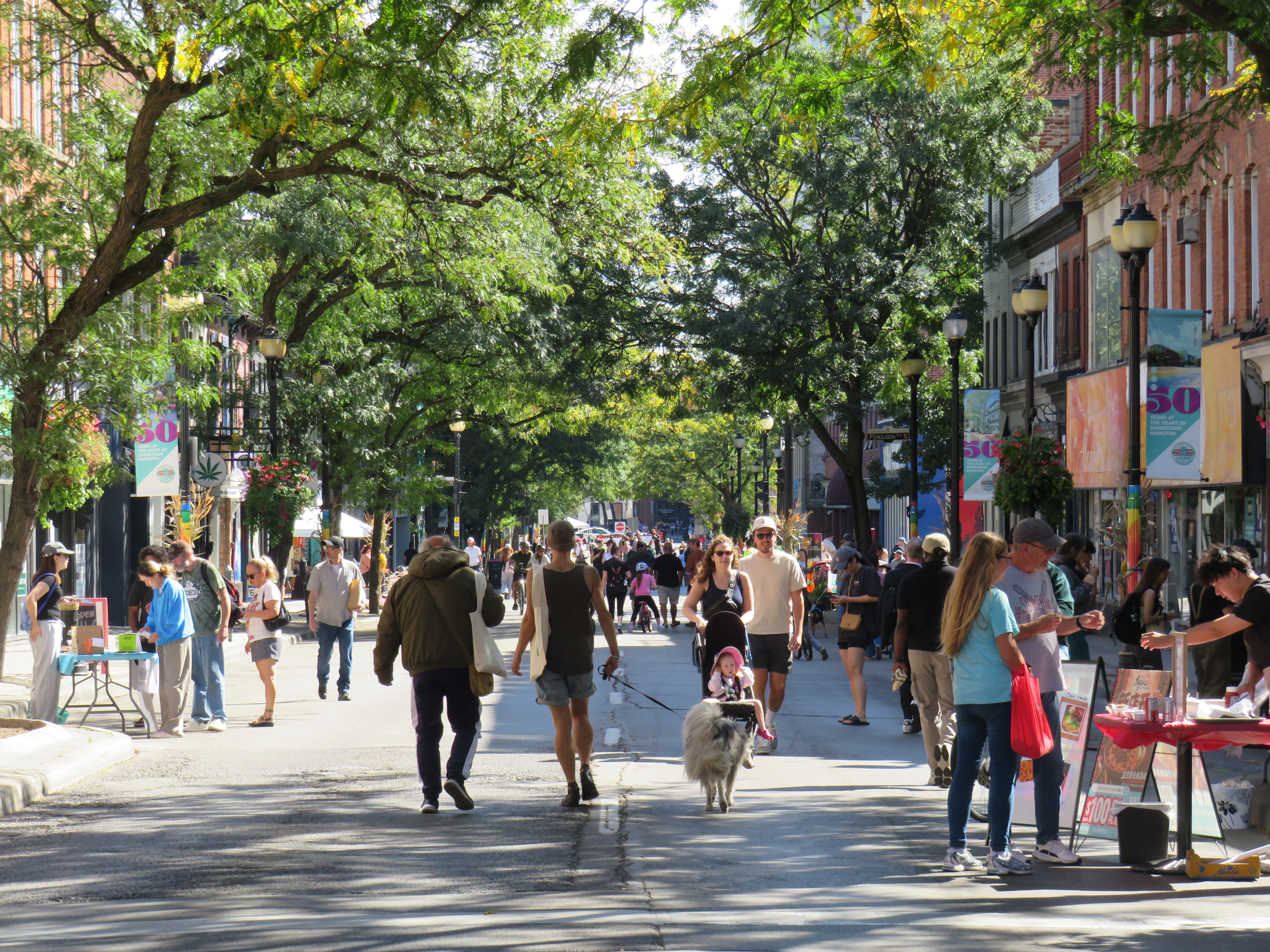
Hamilton’s Open Streets was a delight. A pleasant, sunny day certainly helped, but it was nice to see so many people sharing the space, all at a gentle pace. Cyclists taking advantage of the car-free King Street were respectful of pedestrians having the whole right-of-way and especially careful around the five hubs. Cyclists looking for a faster route could easily go just two blocks north to Cannon Street, which has a continuous two-way cycletrack as far east as Sherman Avenue.
King Street narrows between John and Wellington Streets through the tree-lined International Village BIA
By extending Open Streets into the later afternoon, Hamilton helped to encourage businesses to participate and to get a wide variety of participants through the day. Though Open Streets in Toronto was supported by the Downtown Yonge BIA, there was limited commercial activity along the routes, likely due to the short hours.
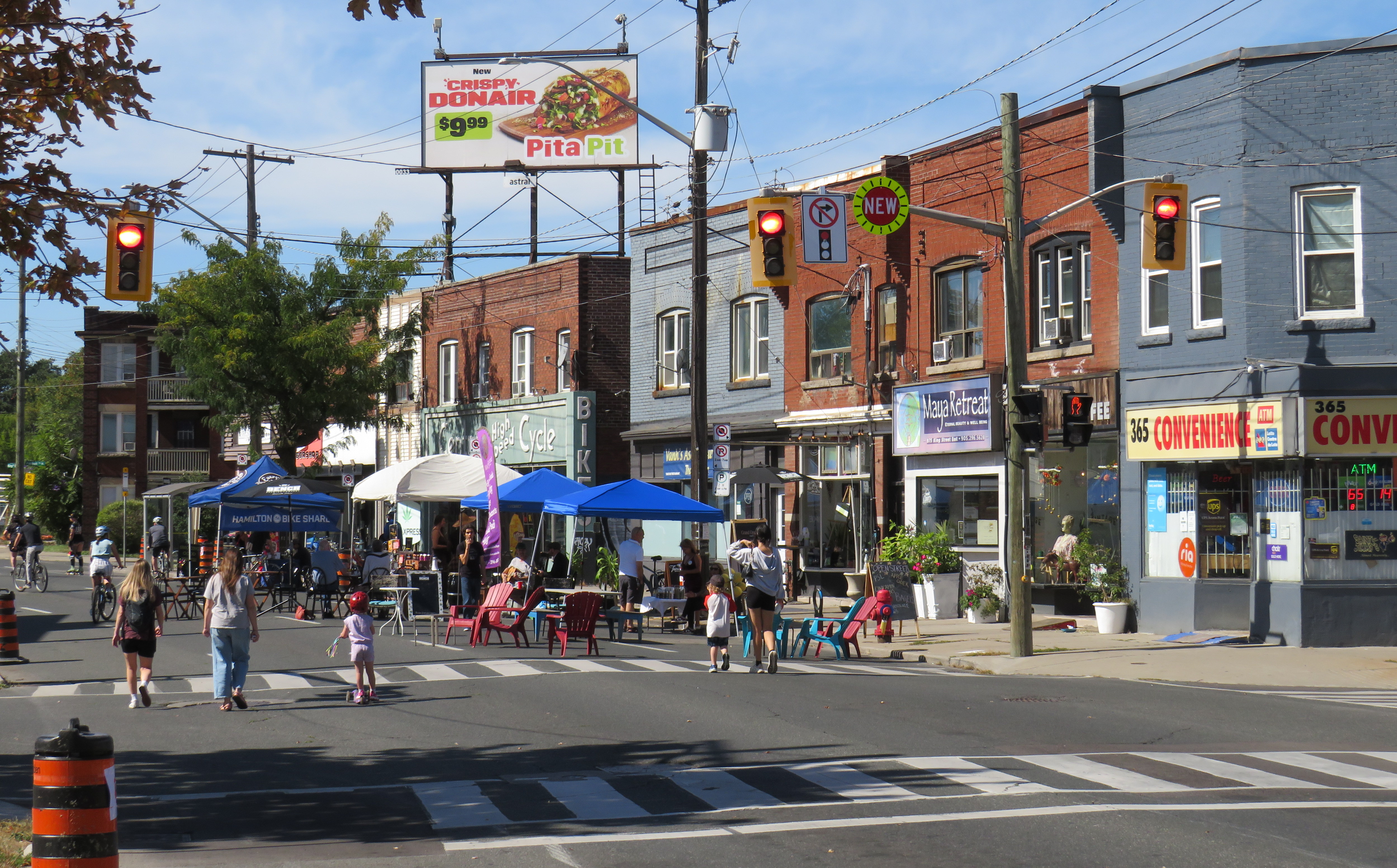
King at Barnesdale, towards the east end of the Open Streets. Note the café on the block put out seating and shade canopies.
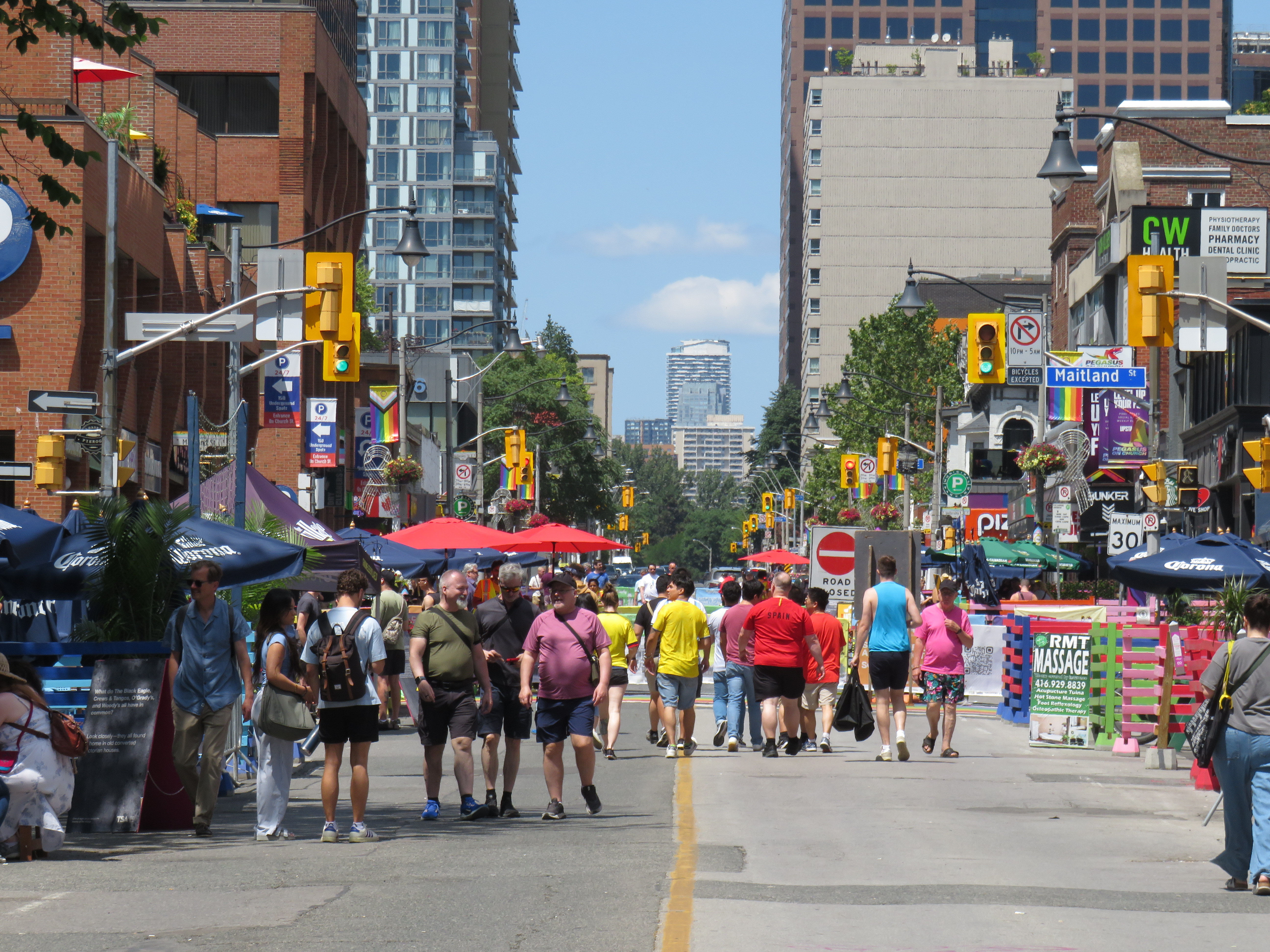
In 2026, Toronto only had two blocks of temporary pedestrian activation — Church Street between Alexander and Wellesley Streets in the Village. Happily, that experiment ran for over six weeks, and restaurants and bars took advantage of the extra space. It worked well, despite nearby road construction and concerns about safety and traffic congestion. But it was just a taste of what Toronto can and should do.
Hamilton shows that open streets are popular and Toronto needs to bring them back. Hopefully the mayor and council elected later this month will have the courage and ambition to get Torontonians outside and on the streets.
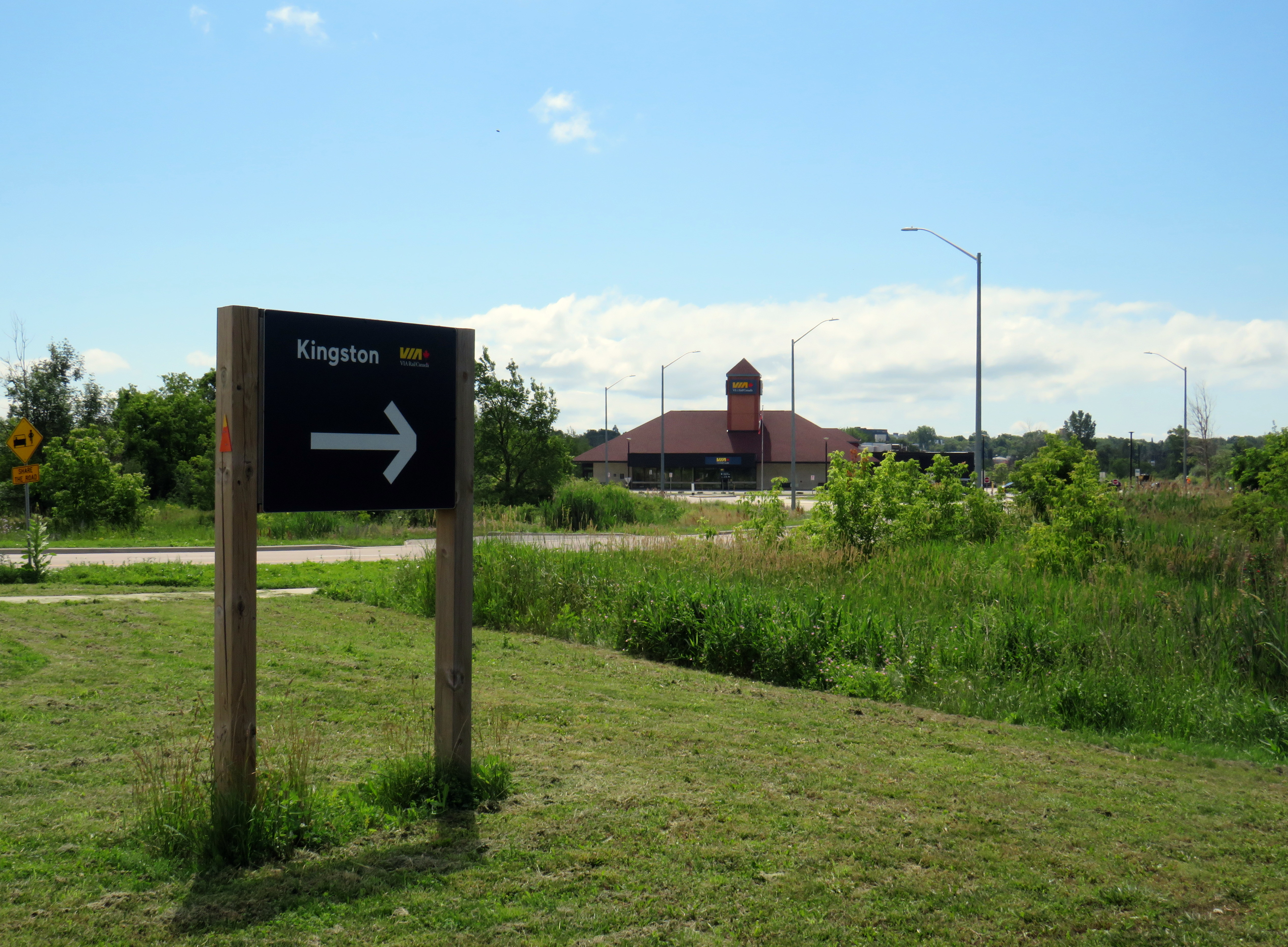
Located in a marshy area, Kingston Station is unnecessarily isolated from the rest of the city
Kingston, Ontario, is the largest city between the Greater Toronto Area, Ottawa, and Montreal. With Queen’s University, Royal Military College, and St. Lawrence College, Kingston is a major trip generator for VIA Rail, and has one of the busiest stations on the Quebec-Windsor corridor. It is also one of the most isolated intercity rail stations in Southern Ontario. Kingston’s geography and earlier decisions made by CN are largely to blame, but the future of VIA’s existing rail services is largely dependant on the fate of Kingston Station.
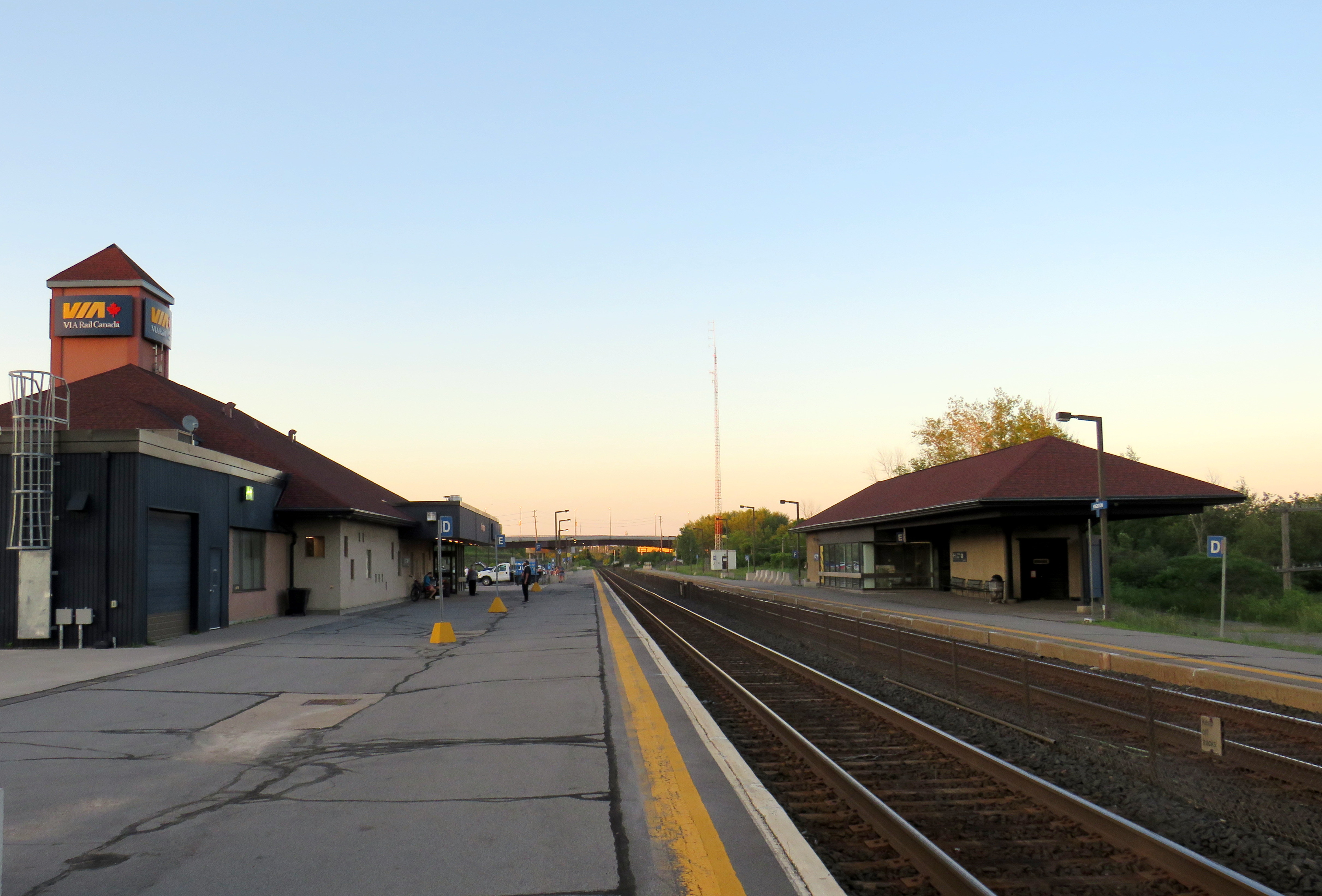
The VIA Rail station, off John Counter Boulevard, was constructed by CN in 1974 to replace a 1850s-era railway station on Montreal Street. The station has a ticket counter, washrooms, a ticket counter, and a small business class lounge, and two platforms. The south platform is connected to the station by way of a tunnel, with elevators, stairs and escalators providing access. Renovations in the early 2000s added a peaked roof and a tower displaying the VIA Rail logo to the minimalist CN station.
But the station is in an isolated location, located in a marshy area; the nearest businesses are a furniture store, a funeral home and a used car dealership. Despite this, Kingston Transit does a satisfactory job connecting the station to the downtown and post-secondary institutions, but the bus stop is unsheltered and a short walk away from the station building.
The two-track arrangement at Kingston Station does not suit CN or VIA particularly well. Both tracks are on the mainline, meaning that they are shared by VIA and freight. Delays to either CN or VIA causes congestion, one of several causes of train delays, contributing to VIA’s poor on-time performance. It also limits VIA’s flexibility in offering early morning or late evening trains that originate or terminate at Kingston or local all-stop service in conjunction with through express services. Newer VIA stations in Belleville and Cobourg have three platforms; the Belleville station tracks allow VIA trains to bypass the CN yard to the north.
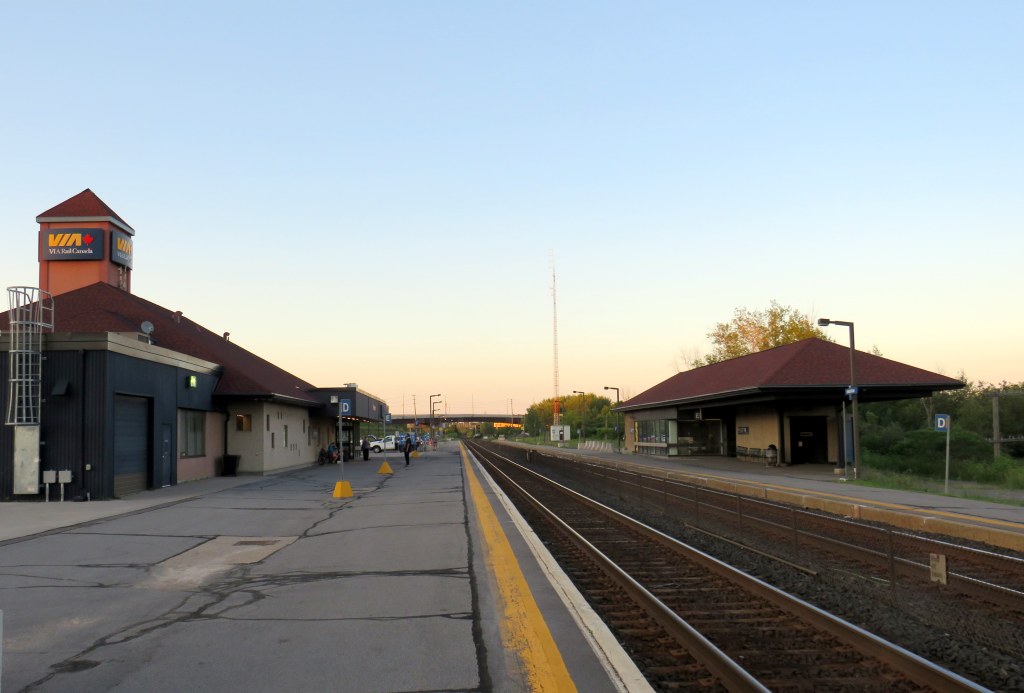
The two-platform Kingston Station
The reasons for the Kingston station’s relative isolation compared to other mid-sized centres like London or Brantford, partly goes back to the 1850s, when the Grand Trunk Railway, which built the Toronto-Montreal mainline, routed its tracks away from Kingston’s urban centre. As the historic downtown sits at the mouth of the wide Cataraqui River, the Grand Trunk sought a narrower crossing further inland. To compensate, it built a spur into Downtown Kingston to serve local passengers and freight service; eventually a streetcar line ran to the main Montreal Street station and the city grew north to meet the railway.
In the 1970s, Canadian National, the successor to the Grand Trunk, was in the midst of modernizing its core infrastructure to focus on long-distance freight and container shipping. It rerouted its mainline north of Kingston on a shallower curve while eliminating several at-grade crossings. As CN continued to operate passenger rail on the corridor, it had to build a new station to replace the old Montreal Street location. The new Kingston Station had plenty of parking along with a passenger pick-up/drop-off loop, easily accessible to Princess Street and the new subdivisions in Kingston Township.
CN had the same principles in mind when it built new stations after the Second World War in Oshawa, Saskatoon, and Ste-Foy, outside of Québec City. Ease of rail operation and access to parking were bigger considerations than having a downtown station accessible by foot or public transit.
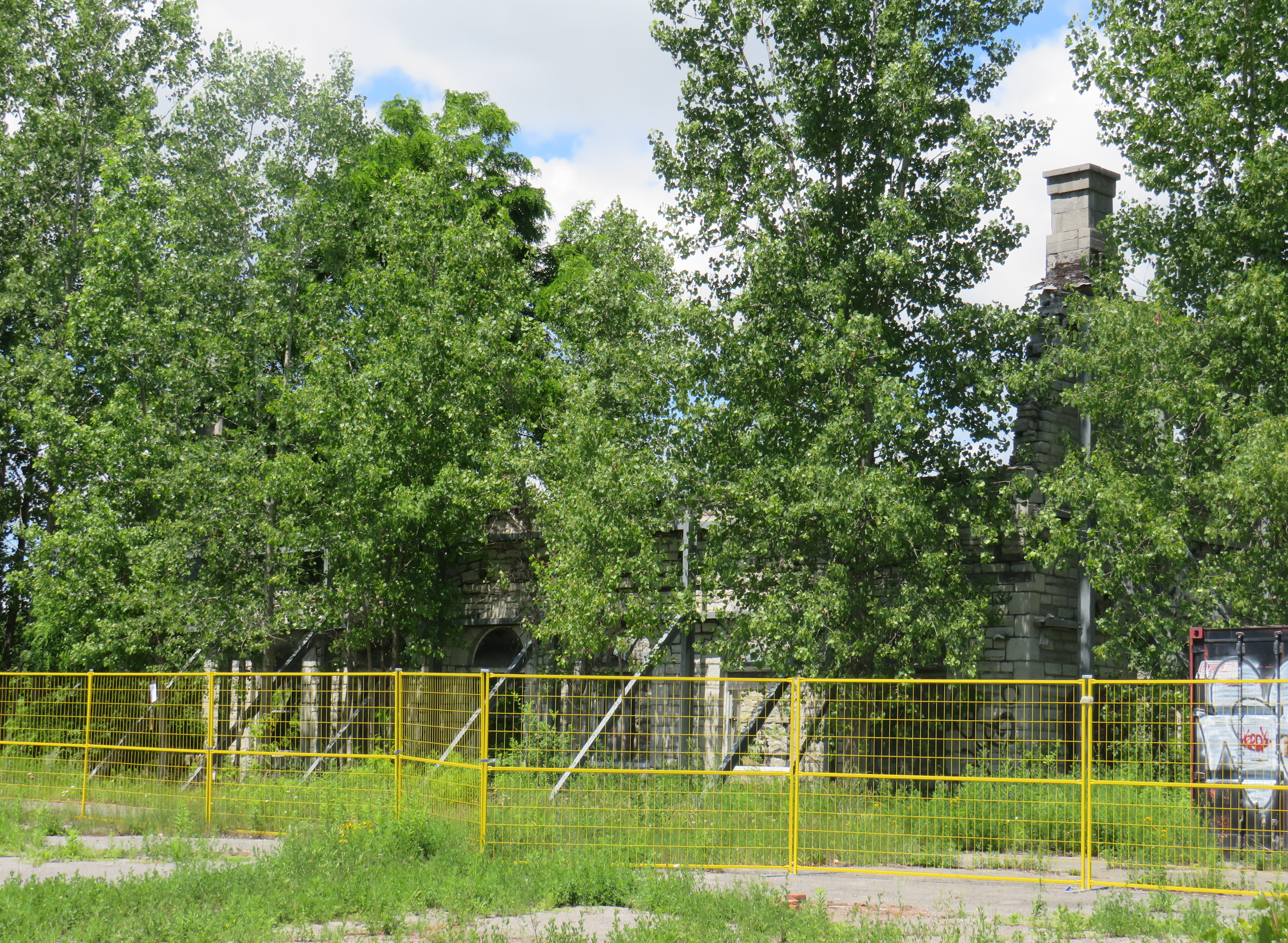
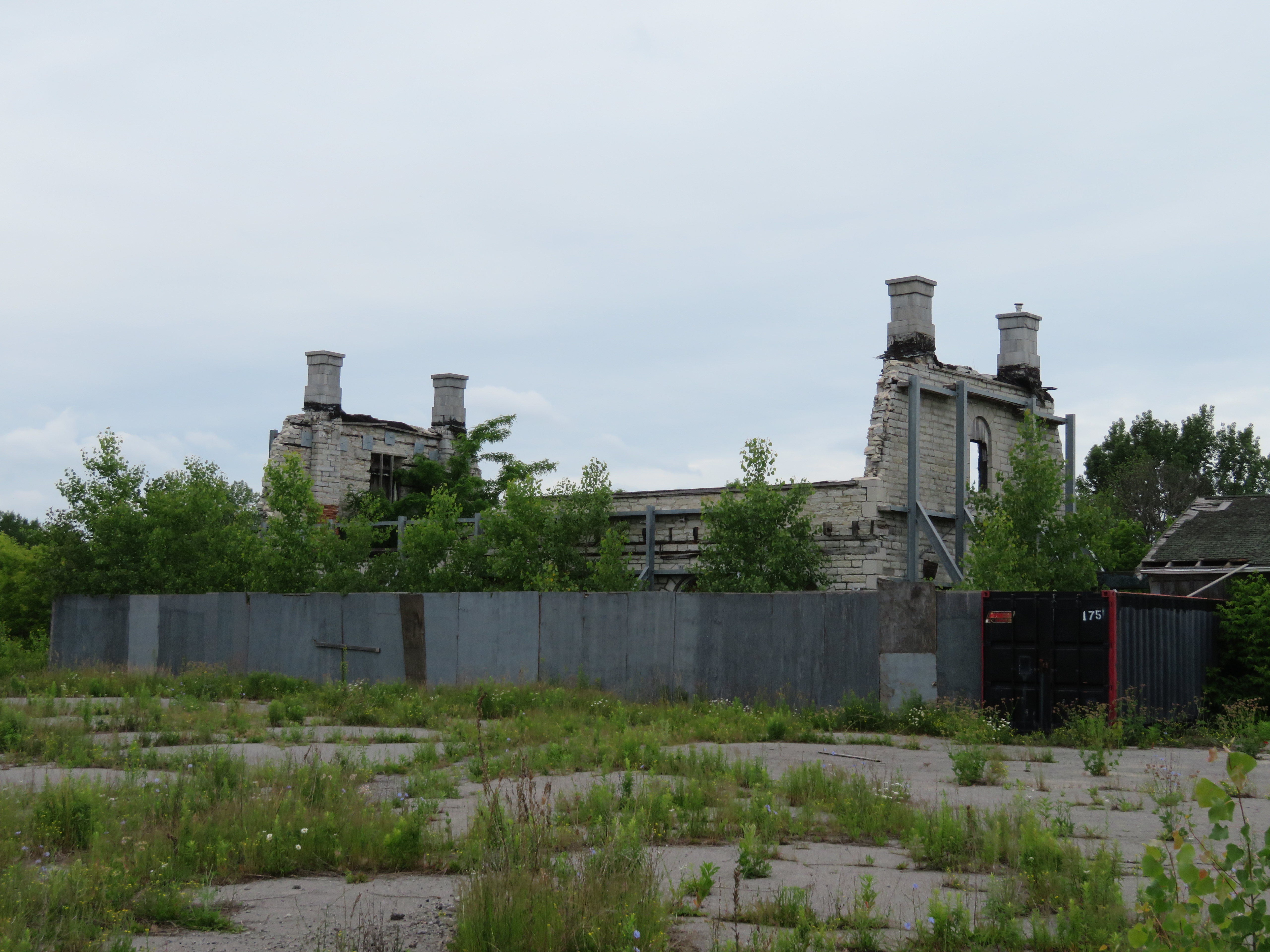
Trees grow around the stone ruins of the 1850s Kingston GTR StationA similar view eight years earlier, in 2018
Today, the original GTR station lies in ruins, fenced off, and partially hidden by trees that have grown around it. The roof is long-gone, as are the additional station buildings such as the express freight and restaurant structures. With the vacant railway lands sitting abandoned for decades, this part of Montreal Street looks rough.
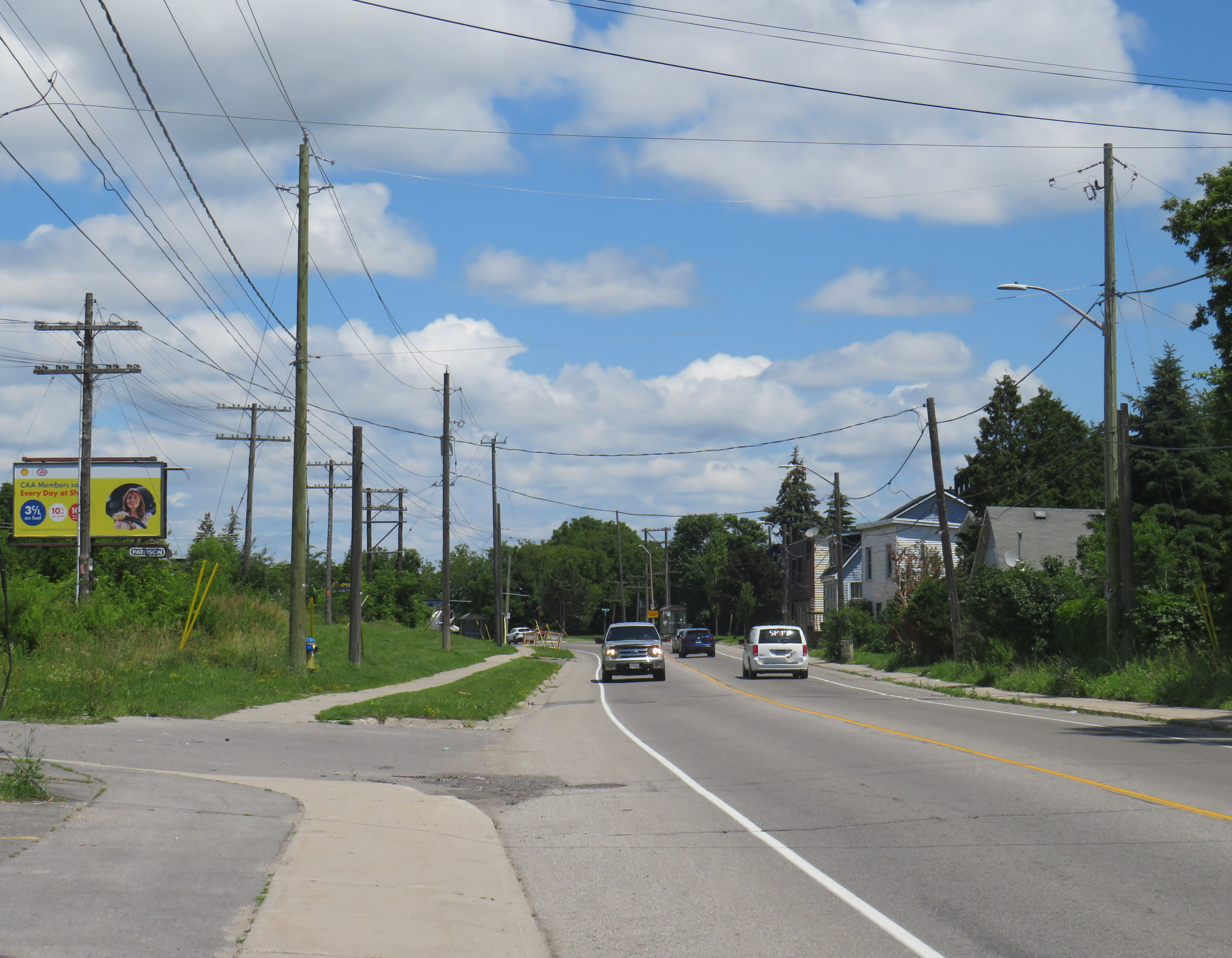
Montreal Street near the old station. The old railway telegraph lines at left betray the old railway route
An opportunity for a new station
Happily, there’s an ideal place for a larger Kingston Station between the old Montreal Street and the newer John Counter Road site that could serve as a proper multimodal hub while being somewhat more convenient to Downtown Kingston and Queen’s University: Division Street. I alluded to this in an earlier post, but after a recent visit, it appears that this is an excellent opportunity.
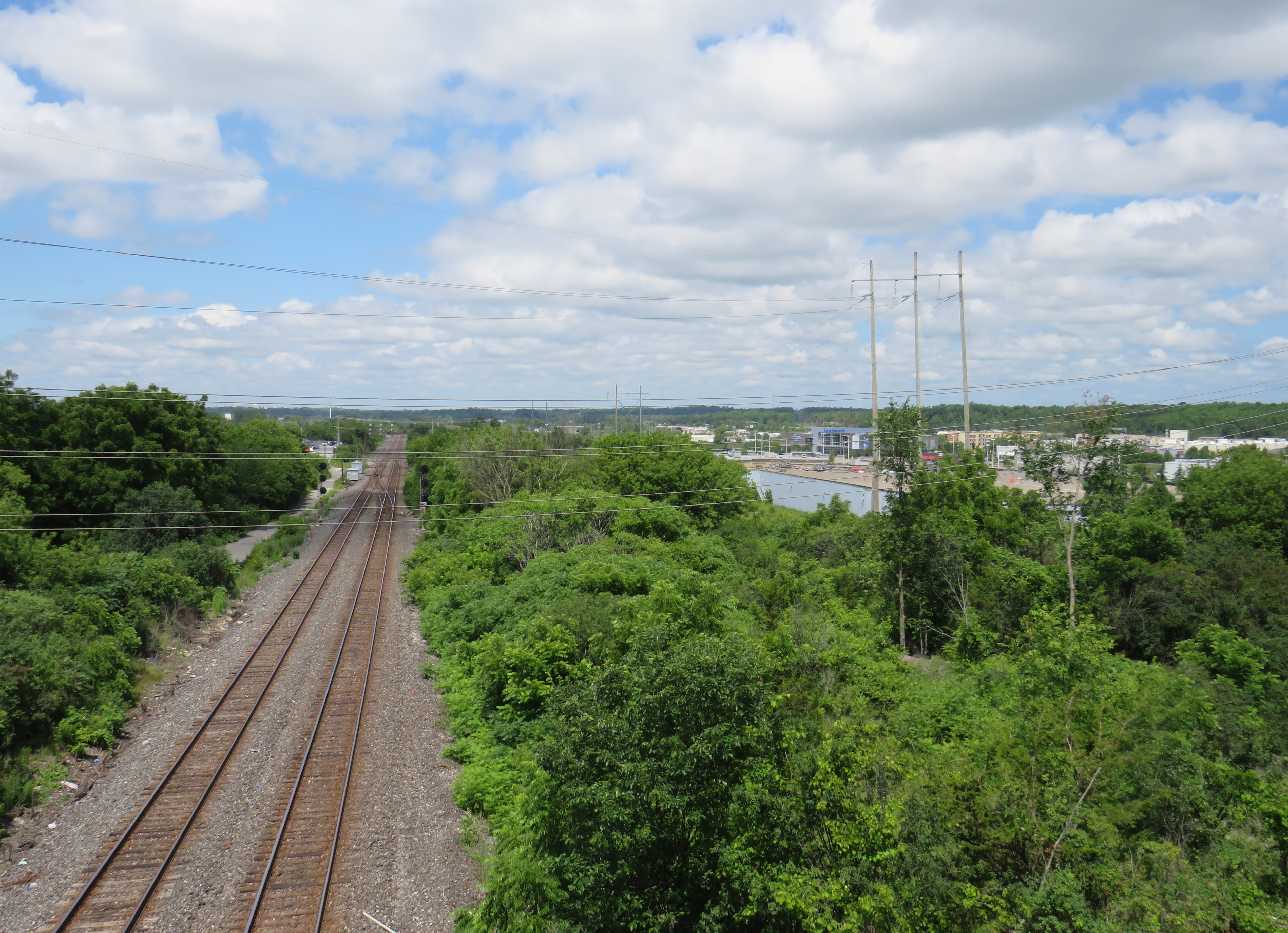
Looking west from Division Street over the CN mainline. The wooded area immediately to the north (right side) offers plenty of room for a new intermodal station.
The CN mainline passes under a long overpass at Division Street that was built in the 1970s not only to cross the CN line but also a Canadian Pacific-owned branch line that once ran between Kingston’s waterfront and Renfrew, near the Ottawa River. The additional room allocated for the now-abandoned CP branch could easily fit two VIA-exclusive tracks, separate from through CN freight trains. This would allow VIA trains to sit overnight, and provide early-morning service to Toronto, Montreal, and Ottawa leaving on schedule. If the Alto HSR takes over the bulk of the through passenger traffic, Kingston will have an excellent regional hub that will serve Eastern Ontario rail passengers far better than the status quo, with more reliable schedules and the opportunity for late night arrivals.
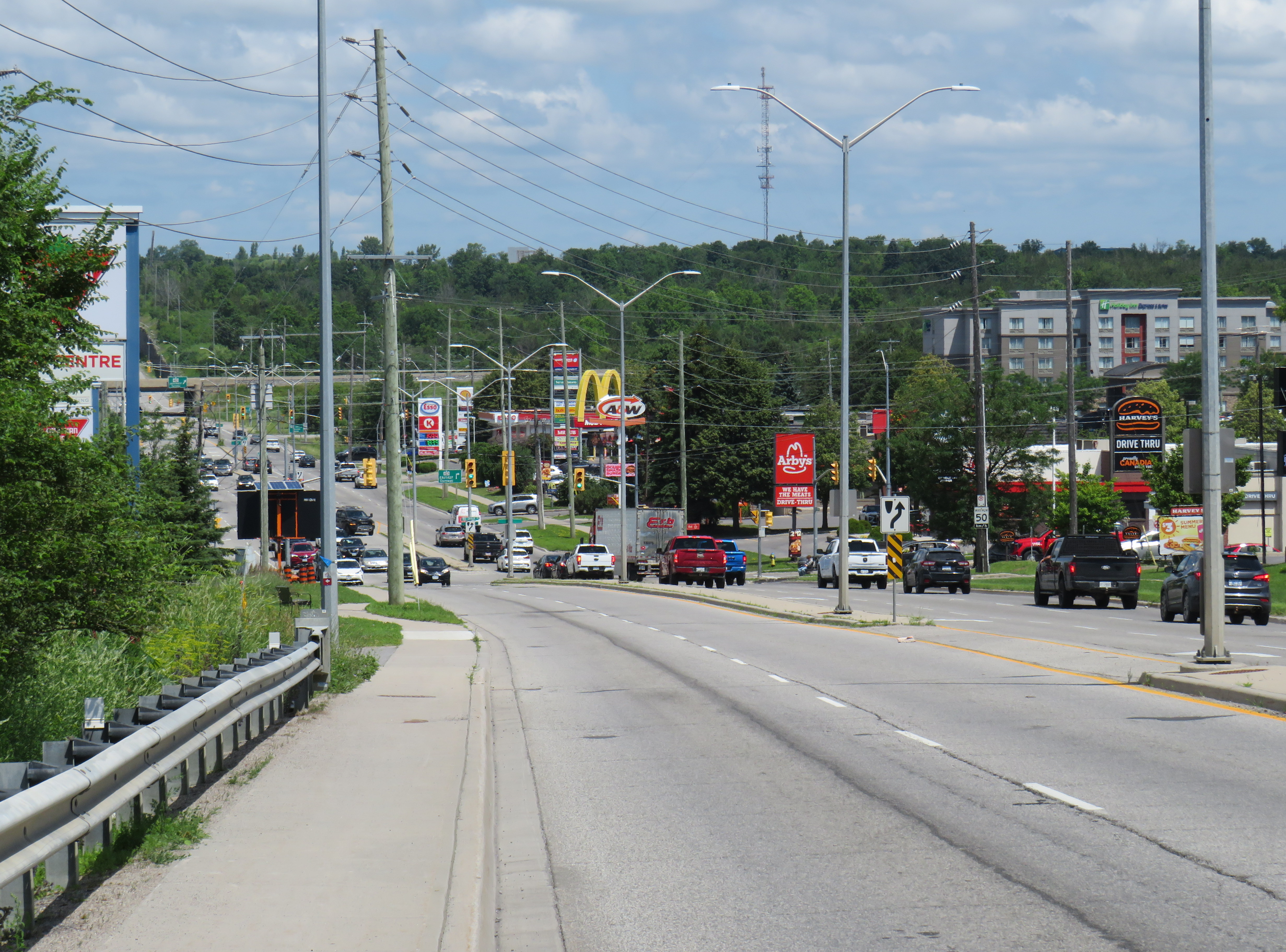
Looking north from the Division Street railway overpass towards Highway 401.
Another advantage of the Division Street site is the proximity to Highway 401. This would allow intercity and regional buses to easily exit and enter the intermodal station. As Division Street continues south towards Downtown Kingston and Queen’s University and is already a major Kingston Transit corridor (with direct and regular service on Routes 1, 2, and 701/702 express, as well as other nearby routes), it’s a logical focal point that can consolidate the various intercity bus stops.
Back in June, Alto announced that federal transport minister Steven MacKinnon directed the consortium to “…develop a plan to assess a southern route option between Peterborough and Ottawa that includes a potential stop in Kingston that would interconnect with VIA Rail services, subject to technical feasibility and project requirements.”
Previous conceptual maps showed the proposed southern alignment located far from Kingston’s urban area, with the closest potential station locations in sparsely-populated South Frontenac Township near the communities of Verona, Sydenham, or Perth Road, at least 20-30 minutes north of Kingston’s urban area by car. If Alto were to serve Kingston properly, it would have to swing much further south, adding to construction costs and through travel times. A spur line into Kingston might make more sense, then, just as the Grand Trunk did 170 years ago.
The time savings to Montreal, Toronto, and Ottawa with a high speed line from Kingston might be better provided with a new conventional railway station and more flexible, reliable service to meet the needs of communities like Kingston, Belleville, and Brockville, rather than forcing Alto farther south. Division Street offers that opportunity.
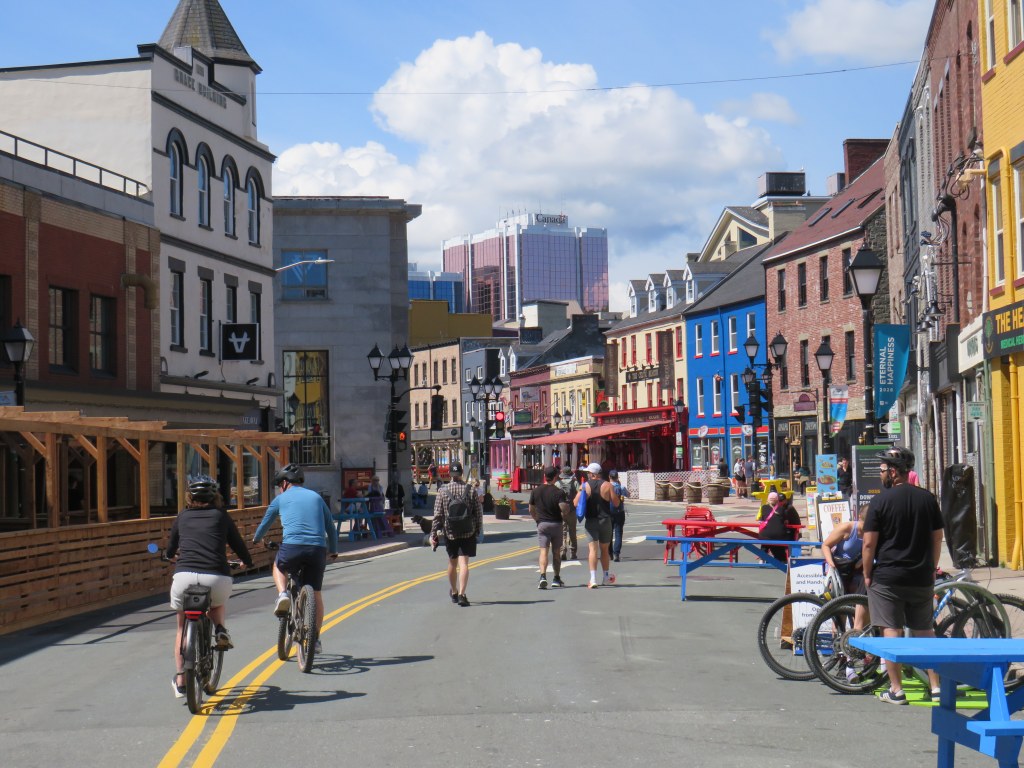
Pedestrians and cyclists enjoying a sunny Sunday morning in St. John’s
In late June of this year, my spouse and I had the chance to visit St. John’s, along with a few other destinations in Eastern Newfoundland and Saint Pierre, France. I highly recommend the visit, though even late June can be a bit cool and wet there.
During our last two days, several blocks — about 700 metres — of Water Street, the main commercial street in St. John’s, was closed to all motor vehicles, and remains so until September 7, Labour Day. This is an annual event, supported by downtown businesses, and is one of the positive legacies of the social distancing era of 2020-2021.
Though fenced-off restaurant patios spill on to Water Street, there are plenty of public spaces to sit, too
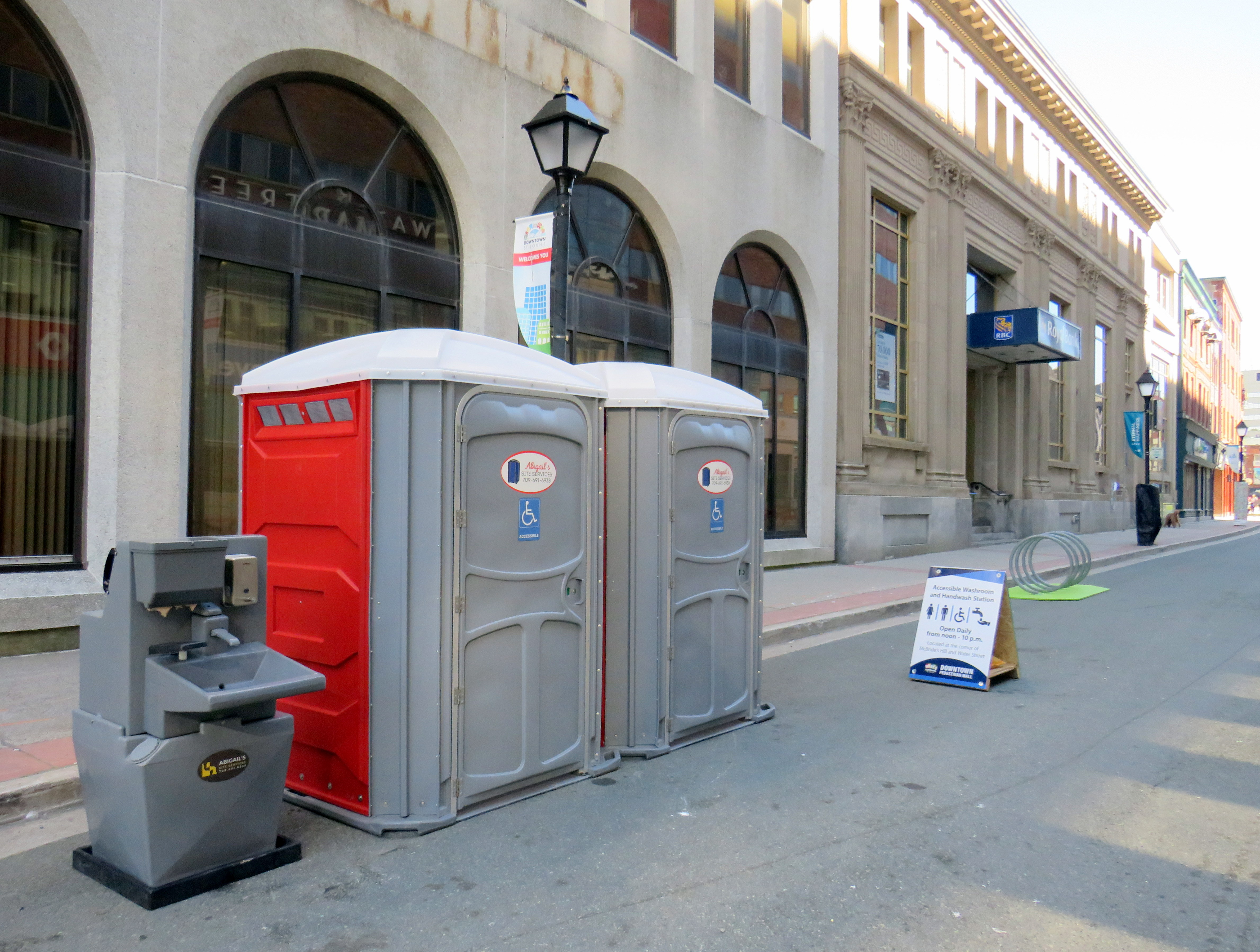
This is much less a street festival (though there are plenty of organized events) and more of an open street initiative. Though restaurants’ patios spill out into the street, there are plenty of public picnic tables set up for anyone to use, both in sunny and shaded areas. There are several portable toilets, complete with adjacent hand-washing sinks, which provide relief without having to pay to use a washroom.
Portable washrooms, hand-washing station, and portable bike parking on Water Street
Pedestrians and pedal cyclists are welcomed, though cyclists are instructed to go at a slow speed, and e-bikes passing through must have their power assist off.
Sign explaining e-bike policy for the Downtown Pedestrian Mall
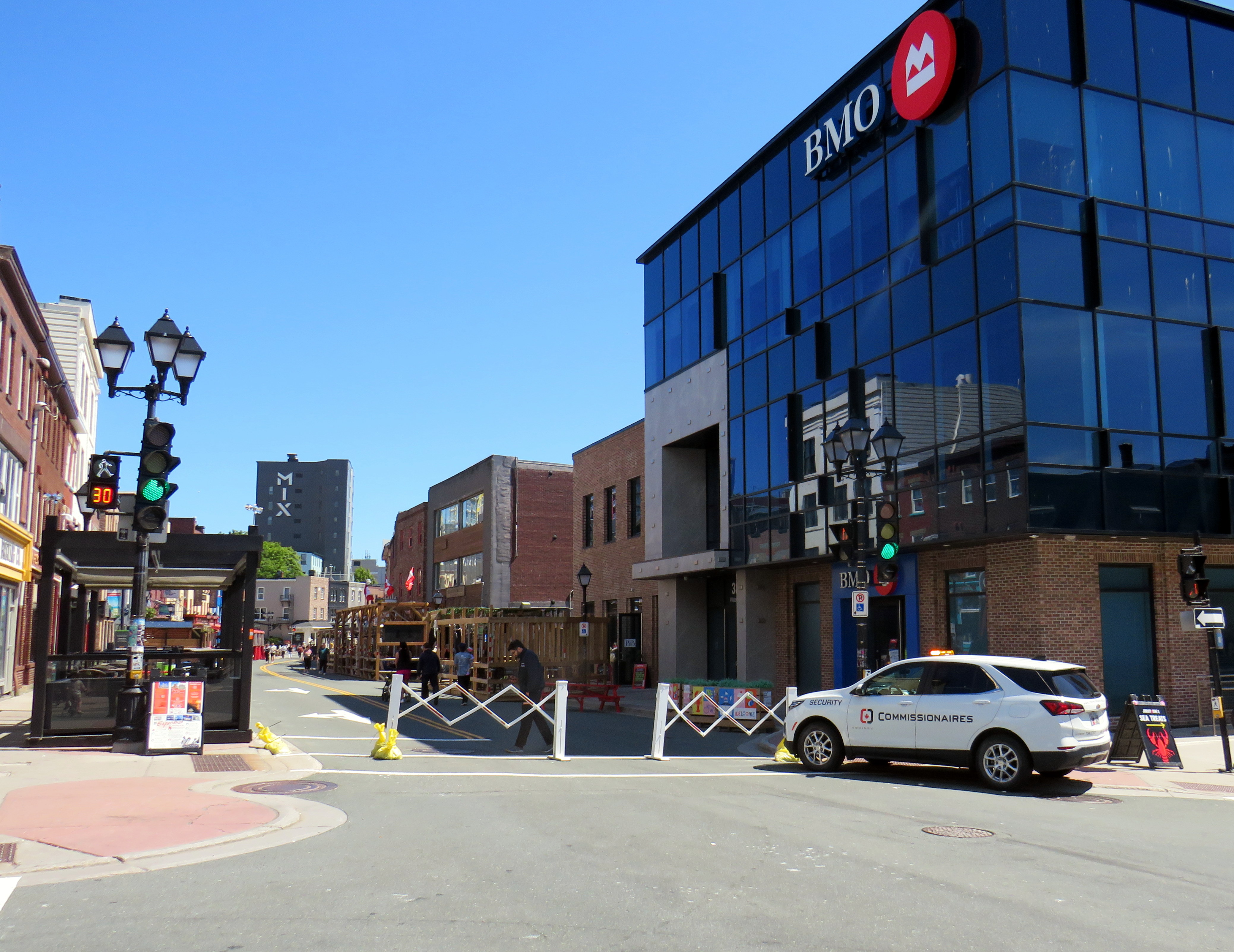
Of course, there are security guards and gates set up to keep motorists out, apart from emergency vehicles and local deliveries. But I did not notice any police cars stationed at any of the intersecting streets, and the few RNC officers I saw were on general foot patrol. Though several Metrobus routes normally serve Water Street, these are diverted one block away to Harbour Drive.
Security minding traffic gates at Water and Adelaide Streets, the southern end of the pedestrian mall
Though St. John’s is a much smaller city than Toronto (its metro area is less than 4% the size of Toronto’s CMA), it is also much more car-dependent, with only a basic bus transit system, and very little cycling infrastructure. Yet, they are able to pull this off for ten weeks a year, on an annual basis. The last Open Streets event in Toronto was in 2022, and those were only held two Sundays of the year. Yes, there are wildly successful street festivals, such as Taste of the Danforth, which just had its record-breaking comeback, but they aren’t the same as they are rammed with crowds, and those only take place over two or three days.
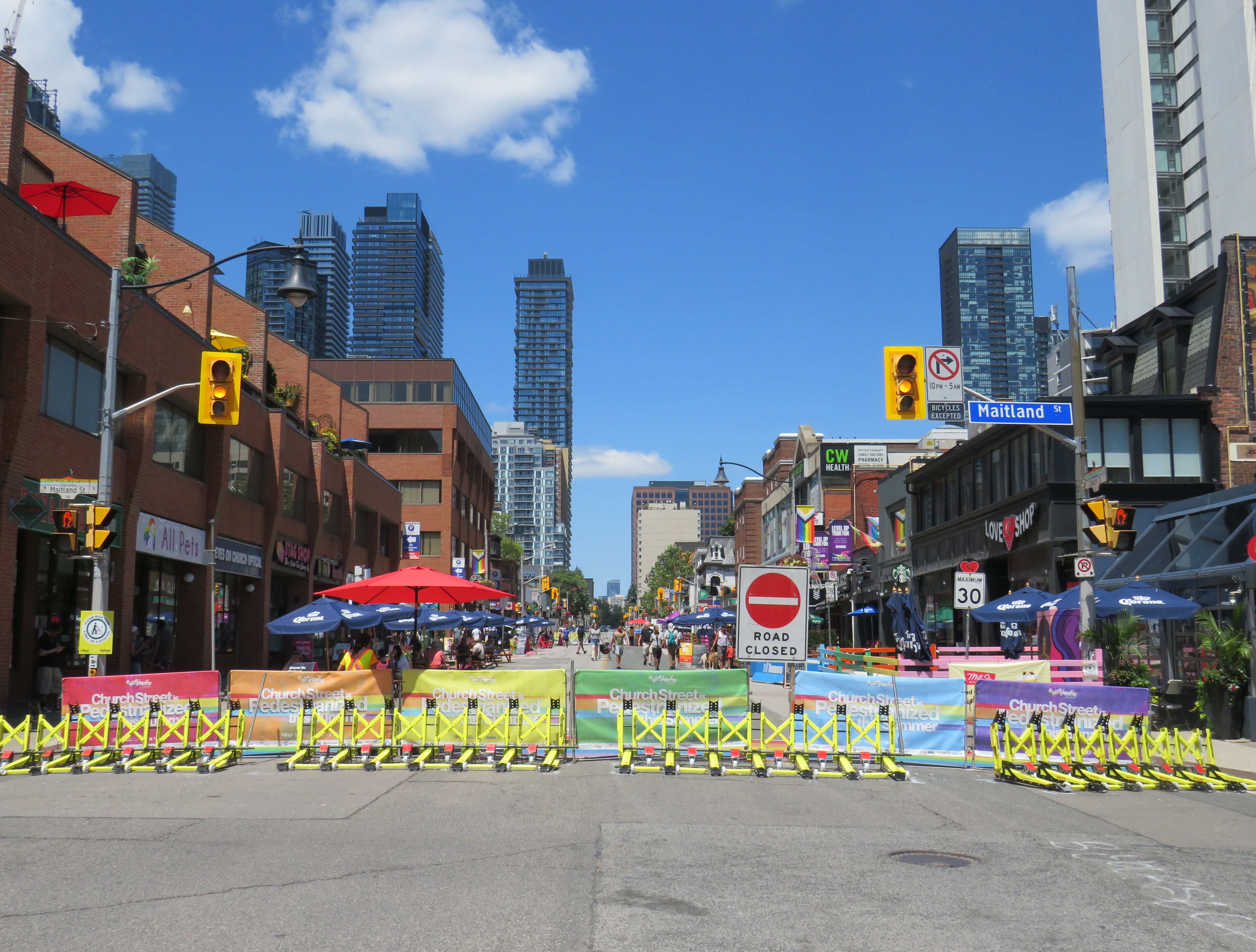
Moveable car traps and metal barricades block Church Street, looking north at Maitland
One key noticeable difference are the harder barriers to prevent motor vehicles from entering. Yellow wheel traps are lined up next to metal barricades, decorated with colourful banners. Though understandable given recent history in Toronto and Vancouver with vehicular attacks on sidewalks and a street festival, they sadly act to fence in what should be an open street and pedestrians must enter on the sidewalks. Unlike St. John’s, cycling is prohibited as well.
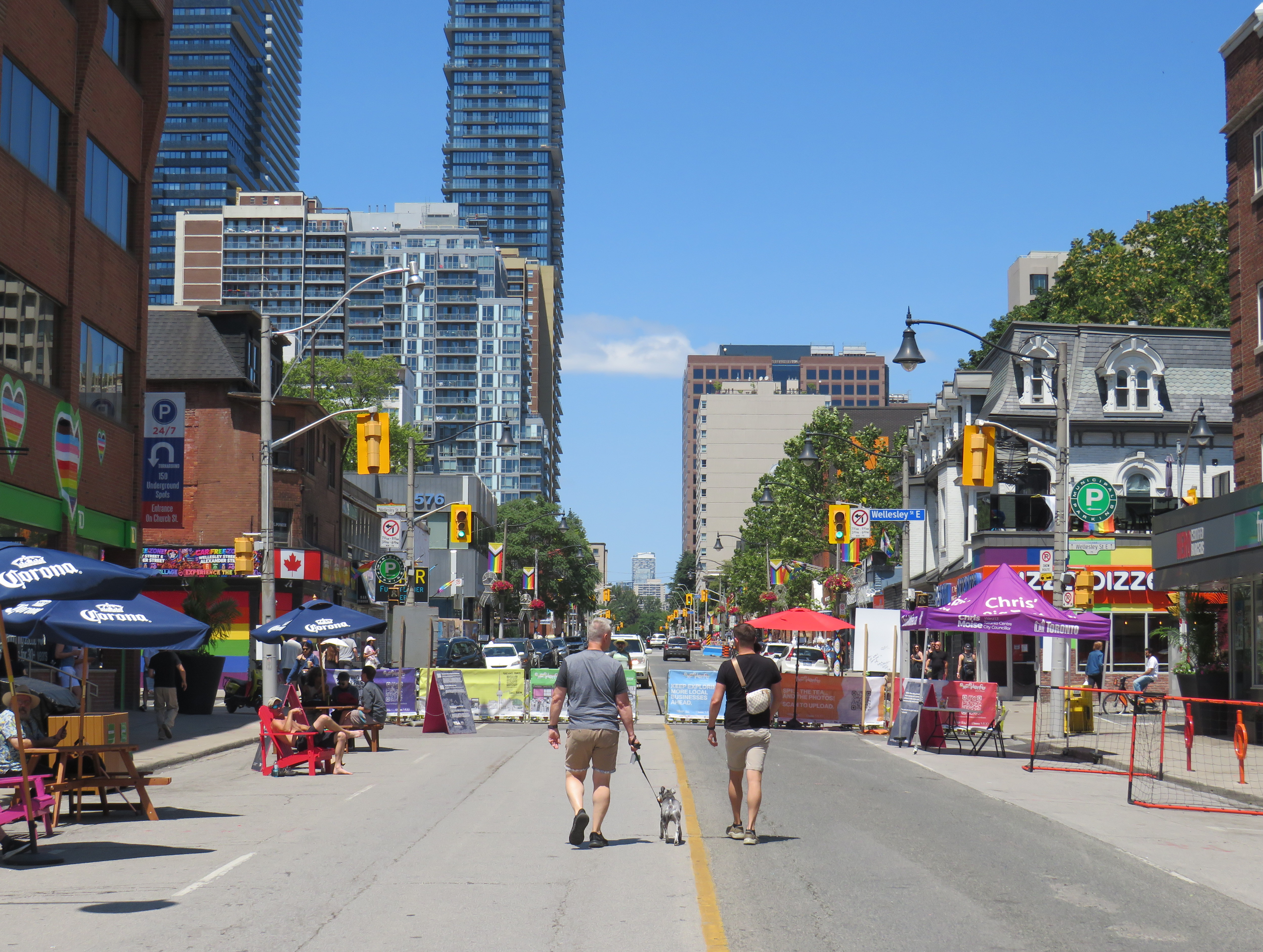
Shaded by branded patio umbrellas, the picnic tables and Muskoka chairs on the left are open to anyone
Still, it’s a great taste of what Toronto should have more of. As on Water Street, there are both private patio spaces on the street as well as public chairs and benches, as well as extra waste bins, though no public toilets. It’s also very well used, especially later in the day. The Church-Wellesley Village is the cultural and commercial centre for Toronto’s 2SLGBTQ+ communities, as well as being in the centre of a very densely-populated area with limited open space.
It is also oddly quiet, despite the vibrancy. That’s because there are no cars, which are a major source of urban noise pollution. The car-free environment also makes sitting on a curbside patio much more enjoyable, without the noise and smells of passing motorists. How can anyone object?
Later in the afternoon, Church Street was busier with pedestrians
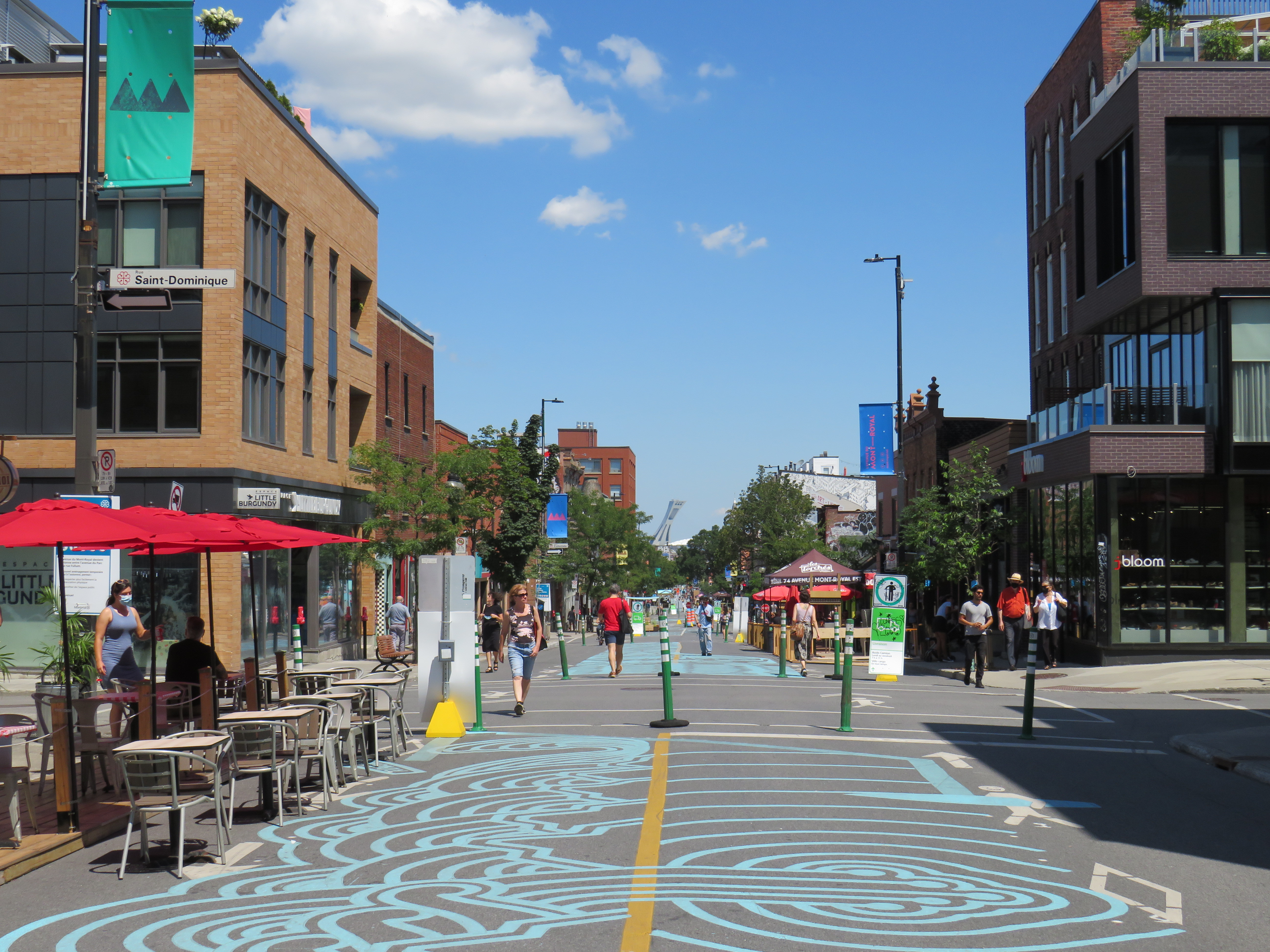
It might be too much to ask for Montreal-style open street corridors, but Toronto should at least aspire to more, long-term open street set-ups like Water Street and Church Street. Kensington Market would be the perfect place to start. Even on our busy east-west streetcar routes on corridors such as Gerrard Street East or Queen Street West, with a bit of imagination and can-do spirit, we can accommodate those as well.
With adding long-term implementations, we will need to rethink the costs of policing and security, which are currently a major barrier to providing these spaces in Toronto. In Montreal, security staffing is minimal on open streets such as Ave. Mont-Royal. The needs of policing and securing a regular pedestrianized area are quite different than ensuring safety at a crowded street festival.
Ave. Mont-Royal, where security measures are minimal on the summer open street
Such crowd-pleasing, neighbourhood-building actions as Open Streets should be on any serious mayor or council candidate’s policy platform in the upcoming municipal election.
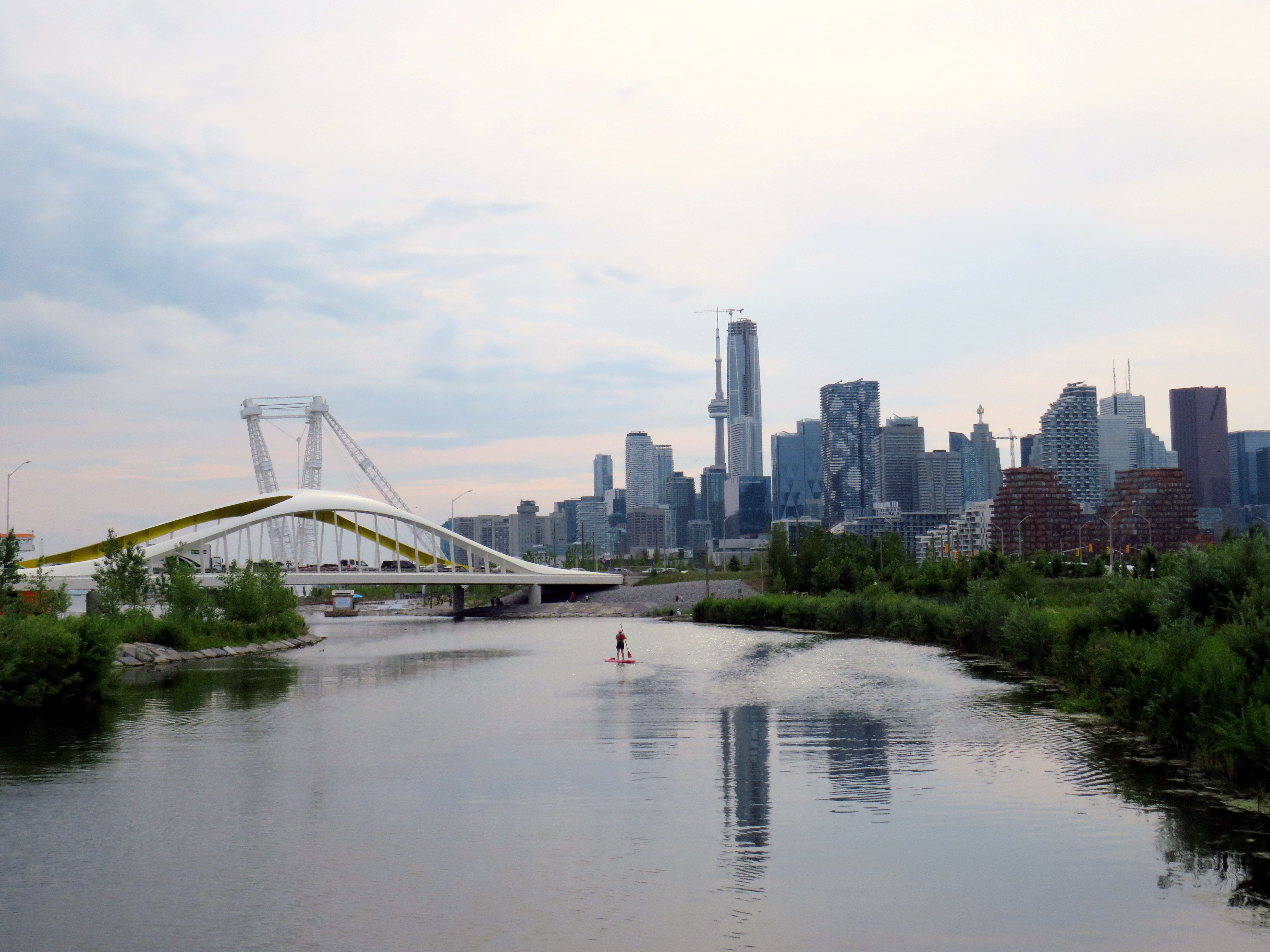
Biidaasaige Park at Ookwemin Minising, Saturday, July 25 2026
During the late evening of Friday, July 24, the federal government announced that it would not proceed with a proposal to expand the Toronto Island Airport (officially Billy Bishop Toronto City Airport) to accommodate additional traffic and commercial jet aircraft. This secretive plan, developed by the Toronto Port Authority and Neuport Aviation, was championed by Doug Ford’s provincial government, which did all it could to push it though. The province moved to expropriate the City of Toronto’s lands on and surrounding the airport and forced it to give up its say in a tripartite agreement that governs the airport operations. It also invoked new powers under Bill 5 to declare it a “special economic zone” to get around environmental regulations and required consultations.
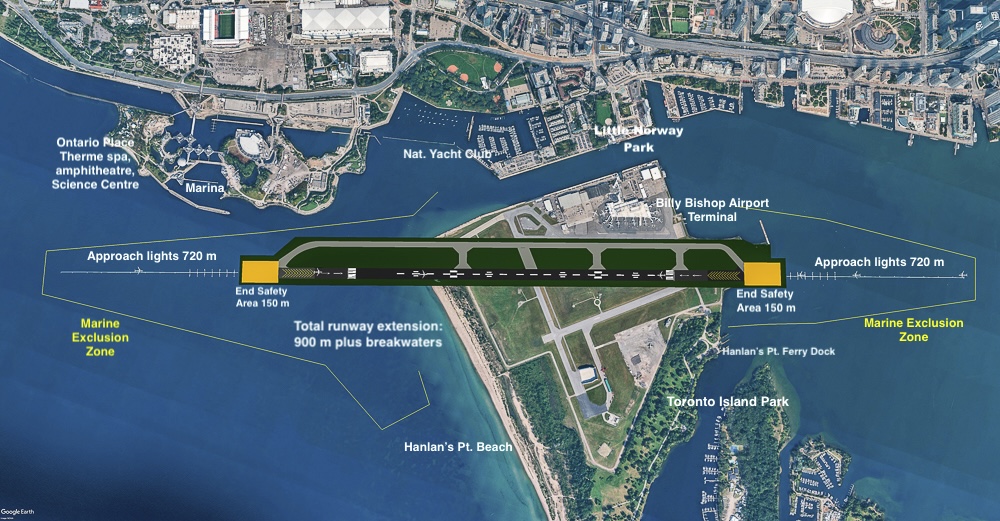
The federal government, headed by Mark Carney, did not object, with the minister of transportation, Steven MacKinnon, expressing that government’s interest in the plan. The province claimed the airport expansion could contribute up to $8.5 billion annually to the economy by 2050, with passenger traffic quintupling from two million to ten million travellers. The east-west runway would have to be extended westward by 900 metres, adjacent to Ontario Place. The expanded marine exclusion zone would disrupt recreational activity in the Toronto Harbour and Lake Ontario and especially impact Hanlan’s Point.
Map by Waterfront For All showing concept of runway expansion required for jet traffic, with runway extending west by 900 metres, along with larger safety zones, marine exclusion zones, and approach lights. (Source of map)
As part of what seemed to be a window-dressing exercise, Transport Canada opened up an online public survey in June to gather feedback, though the survey questions were written with a pro-expansion slant, touting “economic benefits for Canada” in the preamble. This was despite the lack of previous public input or even a detailed business case open to scrutiny and reasoned debate. It seemed as if the fix was in.
But to much surprise and relief, citing the overwhelmingly negative survey responses (of 87,000 responses, 87 percent opposed airport expansion; 80 percent of the total responses were from within the City of Toronto), the federal government kiboshed the expansion plan, allowing only already approved minor extensions for safety improvements. Perhaps the Liberals were worried about upcoming byelections (including one in Beaches-East York) or maybe enough Toronto MPs felt the pressure from their constituents spoke up. But it was the right thing to do, given the expected effects on noise, air, and water pollution, traffic and land constraints at the main airport entrance off Queen’s Quay, and the impact on Waterfront Toronto’s inspiring Ookwemin Minising project on the eastern harbourfront.
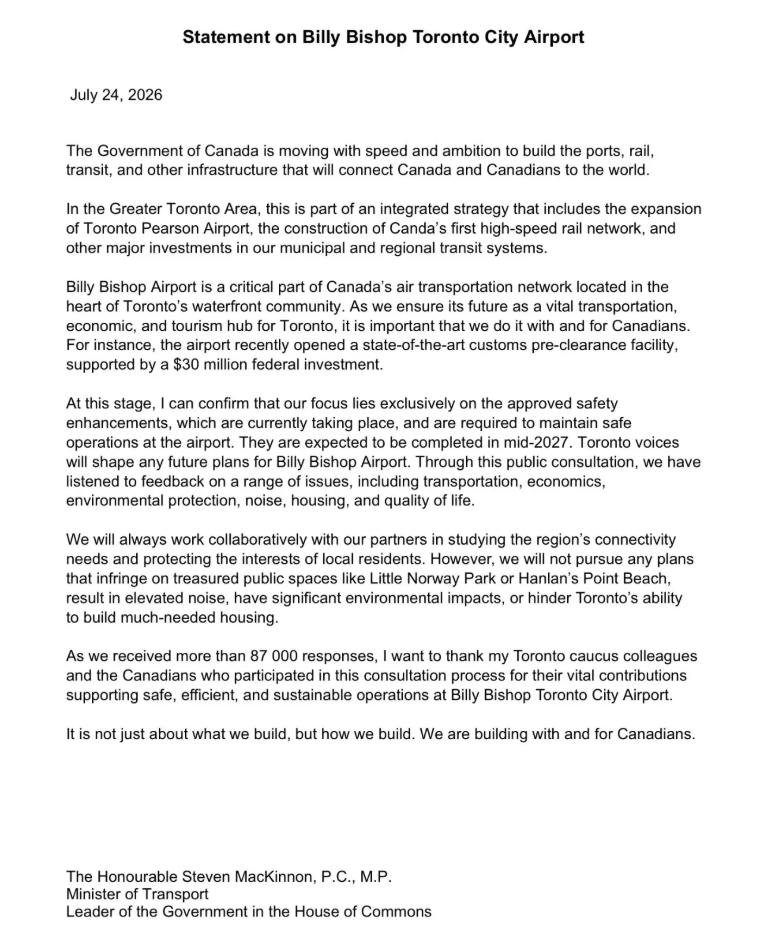
Statement from federal transport minister Steven MacKinnon
Visiting the new western section of Biidassiage Park on Saturday – the morning after the federal announcement, was especially sweet. Waterfront Toronto has shown time and time again that it has the expertise and capacity for building quality public spaces on this city’s waterfront, along with guiding new residential and commercial development to go along with it. Egrets, killdeer, ducks, cormorants, and herons have already made this space home. Public art, play structures, and homages to the industrial past anchored by a huge shipping crane come together in a place that has some of the best views of the downtown skyline. To the northeast, a new highrise community is being planned that will be fully integrated with the completed public spaces; the envisioned community would find itself compromised by the approaches required for larger jet aircraft.
The Q400s taking off overhead were loud enough; even smaller commercial jets will require lower approaches over Toronto Harbour
After spending some time in this amazing space, part of a larger re-naturalization and flood control project at the bottom of the Don River, one could imagine larger jet aircraft landing every few minutes and how much it would effect these lands; the Q400s were loud enough, especially when reverse thrusting upon landing; noise carries a long way upon the flat water in the sheltered harbour. As most downtown residents don’t have access to Muskoka lakefront cottages, these sorts of spaces are critical for a thriving city and healthy living.
Sadly, the backlash from the federal government’s decision not to support the provincial plan came harsh from the province and from politically powerful business groups and at least one Canadian tech billionaire. Ontario Transport Minister Prabmeet Sarkaria claimed the federal government conceded to “fringe groups” in rejecting the Ford government’s jet ambitions. The province, claiming there was a quid pro quo in which it would support the Alto high speed rail project if the province backed the island airport expansion, is now letting its rural Eastern Ontario caucus members openly oppose the rail plan.
The Toronto Region Board of Trade also came out against the federal government’s decision, with chair Giles Gherson calling the airport a “hugely valuable as a business asset” and worried that without the runway expansion, the airport is on “borrowed time.” No facts or figures were cited in his lament to local news media; they were also absent in an op-ed published in March 2026. It is doubtful, that a regional airport with limited destinations makes-or-breaks business decisions whether to locate to Toronto, especially when there is now a frequent airport rail link to Pearson that will eventually be electrified and expanded. Any capacity lost with a potential closure of the island airport can be easily absorbed at Pearson or other facilities, such as Hamilton International or Waterloo Regional airports.
On Elon Musk’s toxic social media site, Shopify co-founder and CEO Tobias Lütke had a bit of a breakdown. He called the overwhelming opposition “retired, unemployed, unemployable and useful idiots [sic].” As a billionaire, Lütke doesn’t have to fly commercial, but can travel by private jet. Perhaps he, and other members of the business elite were upset that their personal jets would continue to have to use Pearson. The same weekend, Lütke backed the idea that voting rights should be tied to income.
Tobias Lütke on X on July 25
One could argue that the airport backers are so upset because they saw this push as the best chance to finally expand the island airport for jet traffic, after two previous fights in 2003 and 2014. There was a pro-business premier with a vindictive streak against the City of Toronto, a banker prime minister whose economic polices have promoted oil and gas and AI development and looking for “nation-building” industrial projects to support, and a well-intentioned but very conciliatory mayor.
That window is now closed. I doubt this ends the decades-long debate on the airport’s future, but it does provide some relief, even some mild satisfaction that the very small percentage of people who are used to getting everything they want from government can still sometimes lose.
Extensions to Montreal’s REM has resulted in some regional route changes in the Montreal area
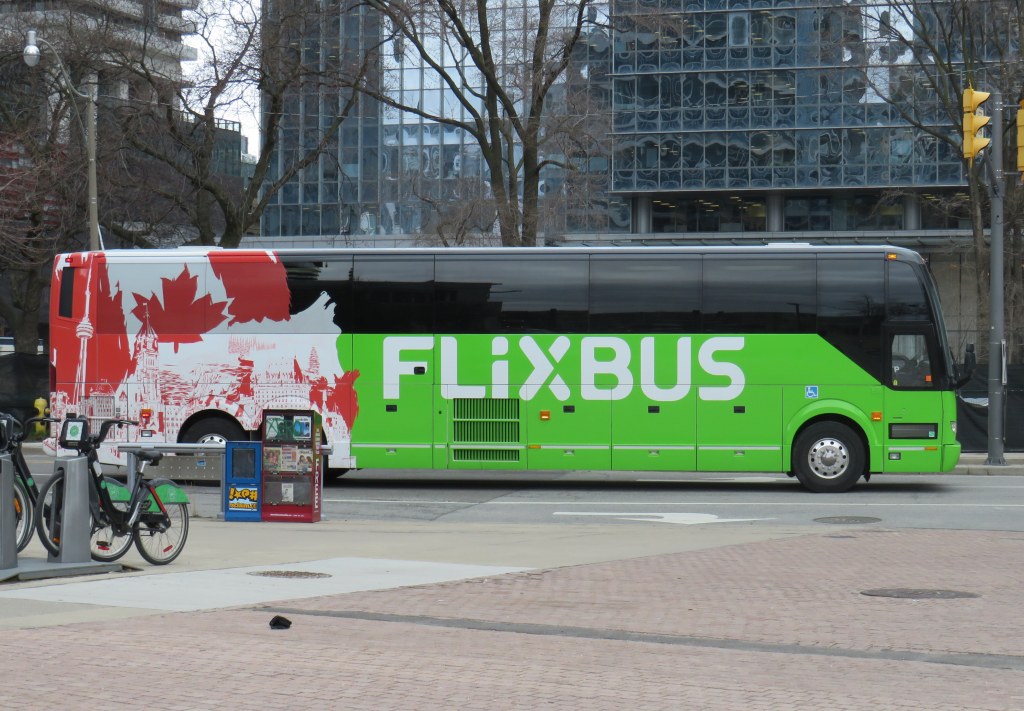
In time for summer, I have updated my Canada Intercity Transportation Map to include new connections and revisions. The only major changes to the intercity coach layer are new routes operated for Flixbus, including new seasonal routes from Toronto to North Bay and Prince Edward County.
In Quebec, the opening of the Deux-Montagnes and Anse-à-l’Orme branches of the REM in Greater Montreal resulted in several long-distance Exo regional bus lines cut back or replaced in favour of local bus routes feeding into the new regional rail service. Therefore, I have decided to remove Exo bus routes from the map where they exist entirely within one or two urban transit zones, being consistent with the municipal transit agencies surrounding Toronto. However, long-distance express routes and routes that serve Montreal’s outer periphery will remain on the map as part of the regional route layers.
In addition, I have also included a few new and previously overlooked services operated by the MRCs (municipalités régionale de comté), including taxibus service areas, which operate similarly to on-demand transit elsewhere in Canada, but have posted stops and semi-fixed schedules; many of these require preregistration before reserving a ride. Where taxibus services operate, I have opted to include those as on-demand, rather than fixed route lines to be consistent across Canada. Only on-demand and taxibus services that are open to the general public are included in the map.
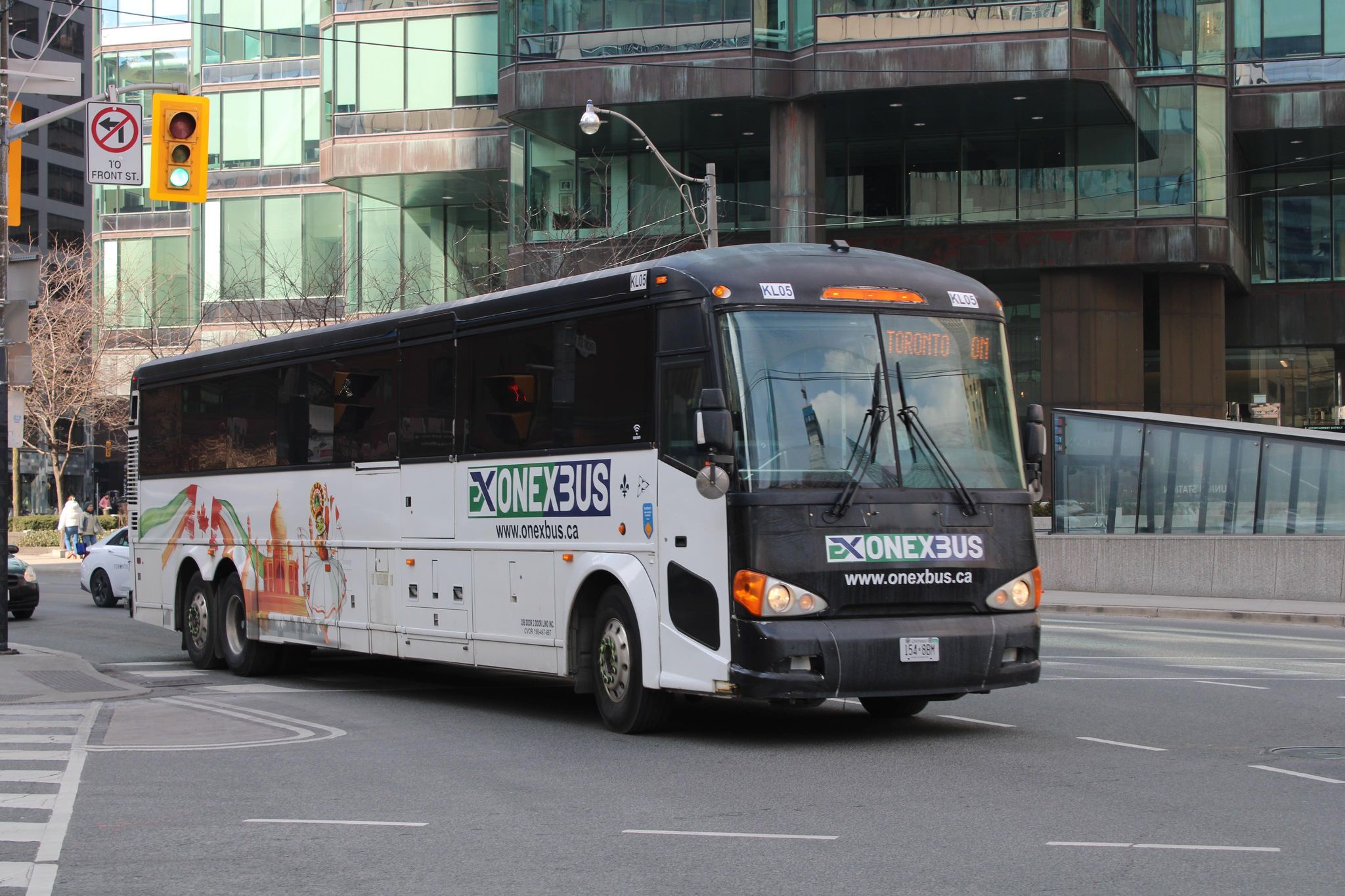
Onex Bus changed its schedules recently, eliminating most departures from Brampton Gateway
Mapping smaller intercity coach operators continues to be challenge, as deregulation in Ontario and Western Canada and online ticketing have made it harder to track changes in schedules and stop locations, though I have noted some changes with Onex Bus’ schedules, which ended most trips to and from Brampton Gateway Terminal at Main and Steeles earlier this year.
Previously, carriers like Greyhound would publish detailed schedules that were valid for at least a few months at a time, including holiday and school break special runs; Ontario Northland and Quebec-based carriers (where provincial regulation remains in force) at least maintain consistent schedules. As it is much harder to track this industry — with no central database — I always appreciate the contributions website visitors provide by email or social media. I thank everyone who has helped so far.
Unfortunately, the costs of maintaining this website and the ArcGIS Online portal to my maps continue to rise. However, I am committed to provide an ad-free, paywall-free resource. If you enjoy my work, please consider buying me a coffee to help with those costs. Thank you!
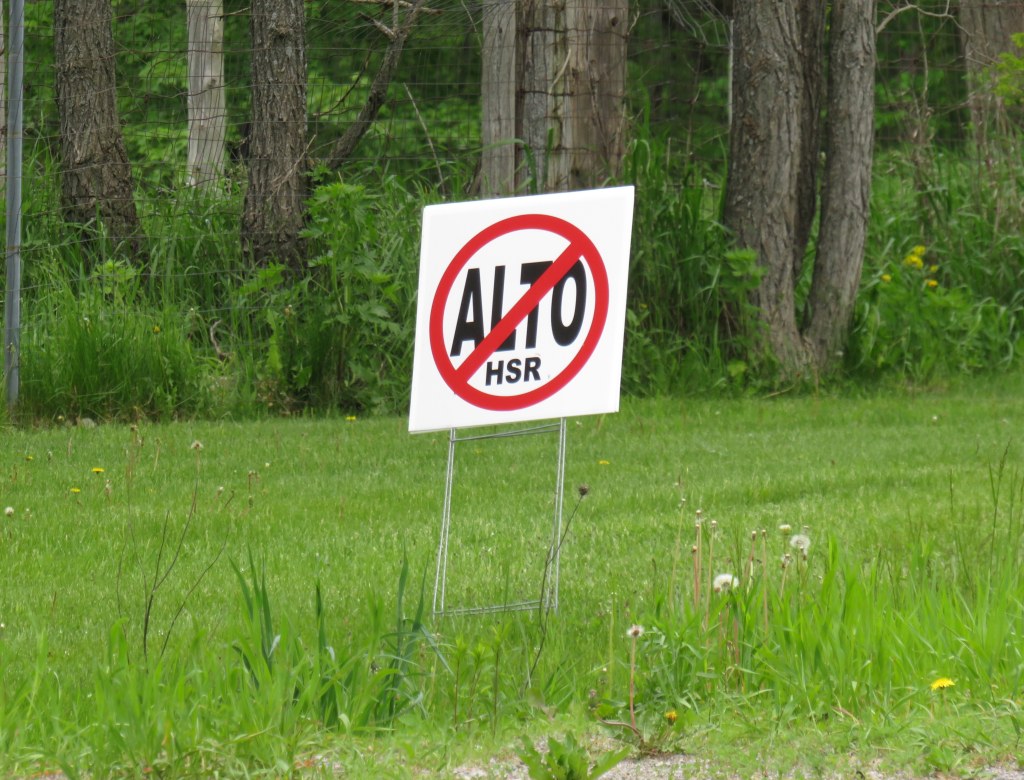
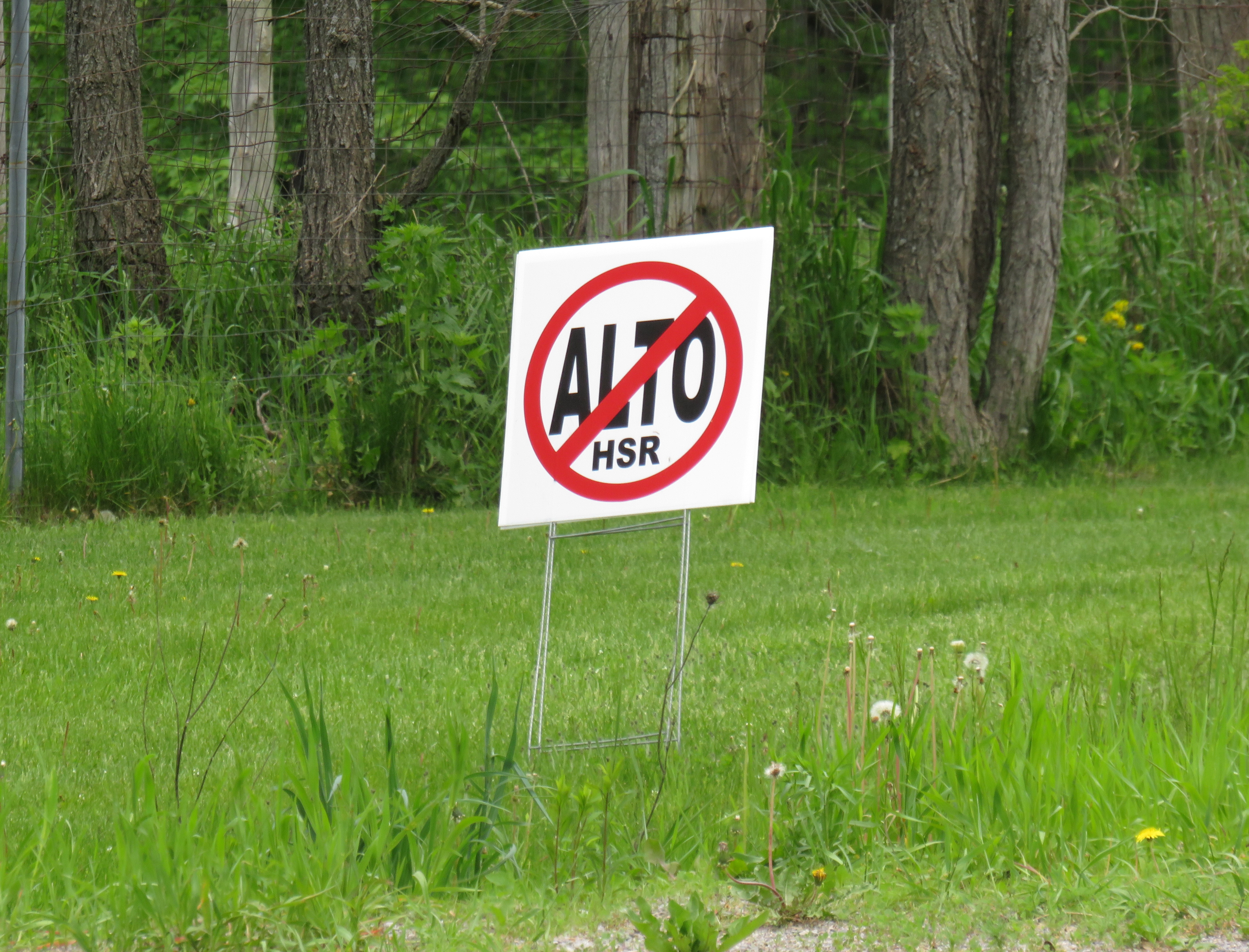
A “No ALTO HSR” sign on a property near Marmora, Ontario
There’s a running joke that Canada leads the world in high speed rail studies, but we never follow through with actually building those high speed lines. Comedian Rick Mercer had at least two sketches on his old weekly CBC television show mocking this state of affairs, as the idea goes back to the 1970s.
“VIA Rail: Yesterday’s speeds, today.”
“Canada’s High Speed Rail Study Industry: The future, never!”
In 2026, however, Canada is finally past the high speed rail study phase and appears to be committed to building the seven-station corridor between Toronto, Ottawa, Montreal, and Quebec City, with a consortium selected that is already planning the detailed route. It’s an exciting time as the first phase, between Ottawa and Montreal, should start construction in three years once the exact corridor is decided upon and land acquisition has begun.
High speed rail, if done right, should benefit Eastern Canada as a whole. Fast and frequent train service will divert a lot of the travel in the busy Toronto-Montreal-Ottawa triangle from the air, reducing emissions and allowing existing airports to handle any increases in long-haul demand. Faster and more reliable passenger train service would also take traffic off the highways and boost commerce within the most populated part of the country. If done right, it will also support plans for better transport infrastructure outside the corridor to Southwestern Ontario and provide Canadian expertise for other projects such as in Alberta, which is contemplating its own passenger rail network between Calgary and Banff and north to Edmonton.
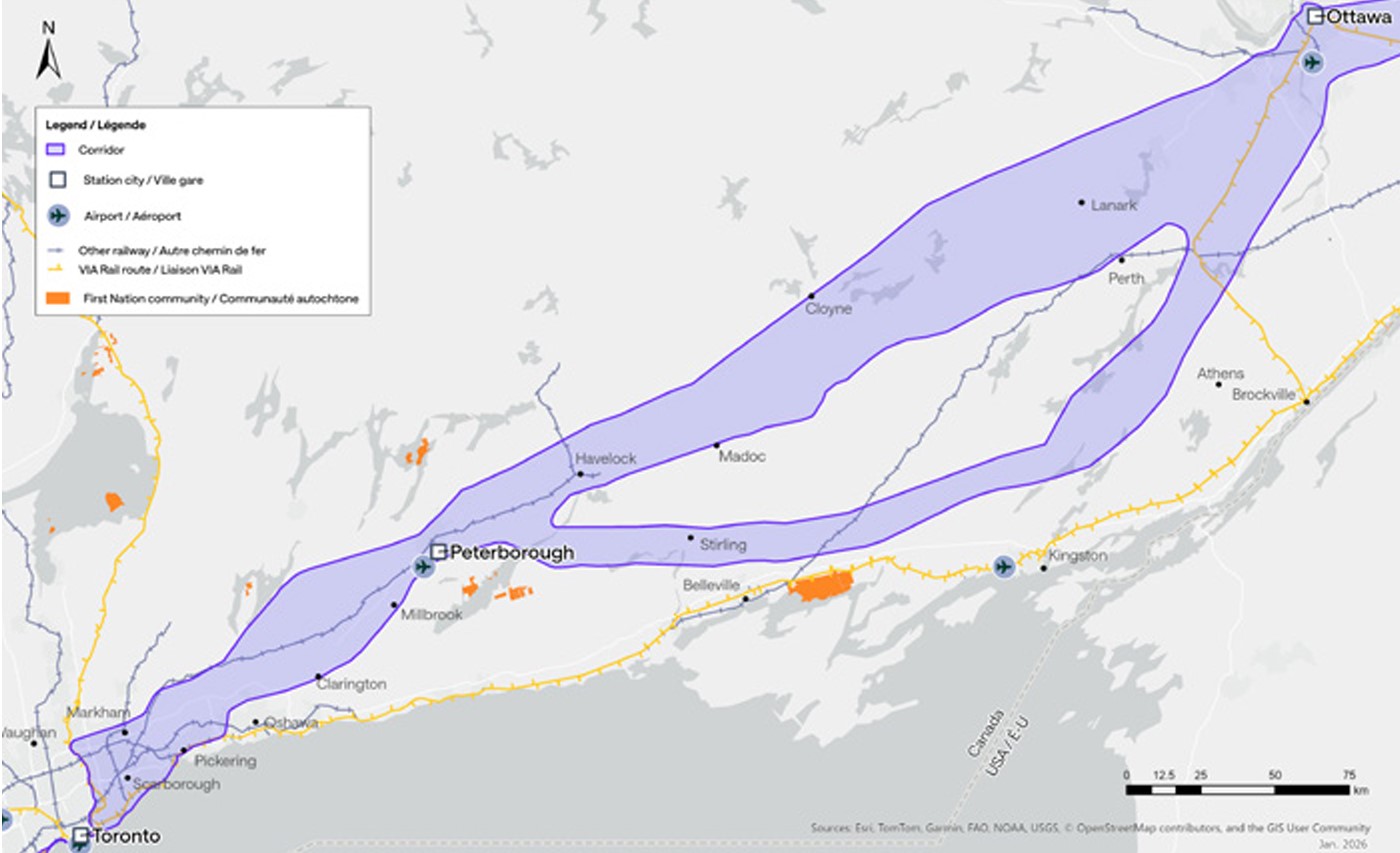
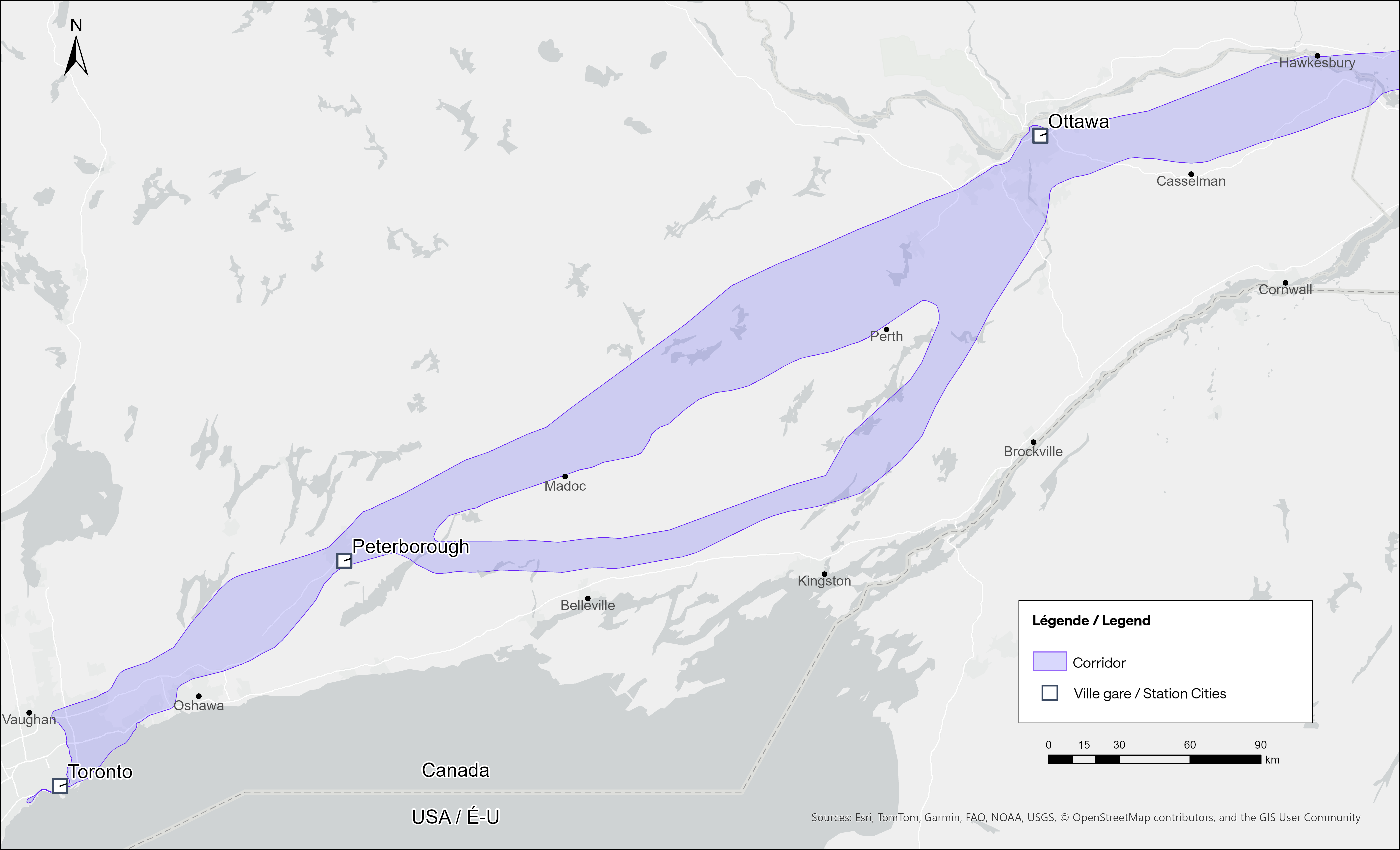
Map of potential routings for the Alto high speed line in Ontario
Not unexpectedly, there is opposition from residents and landowners along the route, especially in Eastern Ontario and the area of Quebec just northwest of Montreal. In Hastings County, north of Trenton and Belleville, there are a few dozen “No Alto HSR” signs on lawns and farms in places like Madoc, Marmora, Stirling, and Tweed. In this part of Ontario, between Peterborough and the Rideau Lakes region southwest of Ottawa, there are two broad potential routes: a southerly corridor runs near Campbellford, Stirling, Tweed, and Westport, including through some productive farmland in Northumberland and Hastings Counties. A second route runs north of Highway 7, just north of Madoc and Perth, along the southern fringes of the Canadian Shield.
Though a high speed railway line would be straight and relatively narrow, it would require the acquisition and severance of hundreds of properties. Along the existing CN and CP railway corridors to the south constructed in the 1850s and 1900s, there are frequent public road and private-access level crossings, something that is not possible with modern high speed trains passing at up to 300 kilometres per hour, so farmers whose land is crossed by the new high speed railway corridor may not be able to access parts of their property easily. Furthermore, there are no stops planned between Peterborough and Ottawa, a distance of over 250 kilometres.
In Prescott & Russell Counties in the Lower Ottawa Valley, even the local governments are opposed to Alto crews doing early survey work to determine an optimum route, with county warden Mario Zanth clear on the matter: “This council does not want them on our territory.” For now, Alto surveying is mostly done by way of drones over land where landowners have not granted access.
Once a more specific route is selected, hopefully some of the opposition will fade. Detailed design work and further consultation should also help mitigate concerns. This is especially important west of Ottawa, where there are the two diverging routes.
Despite the rural opposition, Alto should go ahead. Other major infrastructure projects, especially new highways, can be far more disruptive to local land use. But without local community benefits — at least a new freeway has regular access points — it will be harder to get buy-in.
Therefore, this needs to be a matter of “Alto and” than just “Alto” by itself. This means building and maintaining a supporting network of conventional VIA service, intercity and regional buses, and local transit connections. It might also mean adding a few additional stations along the route, in places such as Perth. Adding additional stops doesn’t have to slow down trains at all; Japan’s Shinkansen has three classes of trains, from the super-express Nozomi to the all-stops Kodama. While most passengers would be through Toronto-Ottawa-Montreal travellers, offering additional stops for select trains can make Alto more accessible to more people, especially if it means providing new options to underserved communities.
An express train passes the local Odawara Shinkansen Station in April 2019
If Alto becomes the backbone of a strong, integrated transportation network in Ontario and Quebec, the benefits will go far beyond those in the six cities directly served the planned high speed line, even to those directly bypassed by Alto trains. This integration is commonplace in Japan and Europe.
In Kingston, for example, a new or upgraded VIA station with additional tracks and platforms would allow for early morning departures and late evening arrivals from Toronto, Ottawa, and Montreal without having to sit on active CN freight tracks overnight; VIA schedules built around serving cities like Belleville, Kingston, and Drummondville would ensure the existing service remains vital as through passengers switch to the faster line. A new Kingston station near Division Street could integrate rail and bus services, with easy access to Highway 401, with local and regional buses to places like Gananoque. Enhanced bus connections to the rest of the Ottawa Valley from the Ottawa Alto/VIA Station could allow travelers from Pembroke, Arnprior, or Hawkesbury to quickly continue their journeys via train. At Trois-Rivières, there should be seamless connections to places like Shawinigan and Victoriaville. The Canada Intercity Transportation Map on this website shows which communities are unserved or underserved by bus and rail: these include many towns in Southern Ontario and Quebec that are within 100 kilometres of the Alto corridor.
Canada is right to invest in high quality and sustainable transportation infrasturure as a nation-building project, to boost the regional and national economy, and promote environmentally friendly travel options. But focusing only on Alto, without a strategy of leveraging the conventional VIA network and intercity bus connections to feed that network, can only limit the success of high speed rail. The communities in between deserve better.
In the fifth year that I have been following and mapping Canada’s intercity transportation links, the network (if you could call it that) remains in flux. Spring 2026 brings several new routes, particularly in Western Canada, that restore some former Greyhound services. Unfortunately, regional and commuter services in Ontario and Alberta are coming to an end. Wednesday, April 30 was the last day for the LTW Route 42 between Leamington and Windsor. In Alberta’s On-It is winding down its commuter buses between Calgary and Cochrane and Okatoks.
However, Flixbus continues to expand, taking over more former Greyhound routes. Unlike Greyhound or most other intercity transport companies, Flixbus is not a bus company per se, as it does not own or operate the services; instead it uses smaller contracted operators while coordinating branding, schedules, and ticketing. But starting in May, it will operate three-four days a week between Calgary, Regina, and Winnipeg, with stops in cities that have long been without service, such as Moose Jaw and Swift Current. Another route will connect Calgary with Drumheller, including a stop at the famous Royal Tyrrell Museum.
Despite the recent loss of TOK’s Southampton route and last year’s cutback of Grey County’s GTR services, there is hope for new connections in Midwestern Ontario. Grey County, together with neighbouring Bruce, Dufferin, and Wellington Counties, is studying a regional system to augment and replace the limited existing services. Hopefully, it will include regular service to fast-growing Saugeen Shores, which recently lost that TOK service. In Centre Wellington, a new local service connecting Elora and Fergus will soon start operations.
One of the major issues continually faces is the lack of intramodality and useful connections. A viable passenger rail system — be it a classic corridor service such as the Quebec-Windsor VIA train or a high-speed line such as the planned ALTO project — is much more useful to many more passengers when there are easy connections at stations. Through-ticketing and schedule coordination should be implemented whenever possible. Furthermore, though the Upper Ottawa Valley (towns and cites such as Renfrew and Pembroke) has a daily Ontario Northland bus, it arrives in Ottawa late in the evening and leaves early in the morning, limiting its usefulness to areas closer to Ottawa that could benefit from a commuter connection or onward trips to Montreal, Toronto, or Kingston. Despite more gaps seemingly filled, other gaps remain.
With planning now well underway for the Alto high speed passenger rail corridor between Quebec City and Toronto, there has been some speculation that Ottawa’s grand old Union Station, in the heart of the capital’s downtown core and a mere stone’s throw from Parliament Hill, could see trains again. Local business leaders and Mayor Mark Sutcliffe are excited by the idea of a downtown station, expecting that a downtown transport hub would help revitalize the local economy. Though it’s a very attractive idea, there are unfortunately just too many reasons why this would not be feasible.
To understand why, it’s worth diving into the history and urban politics of railways in the National Capital Region.
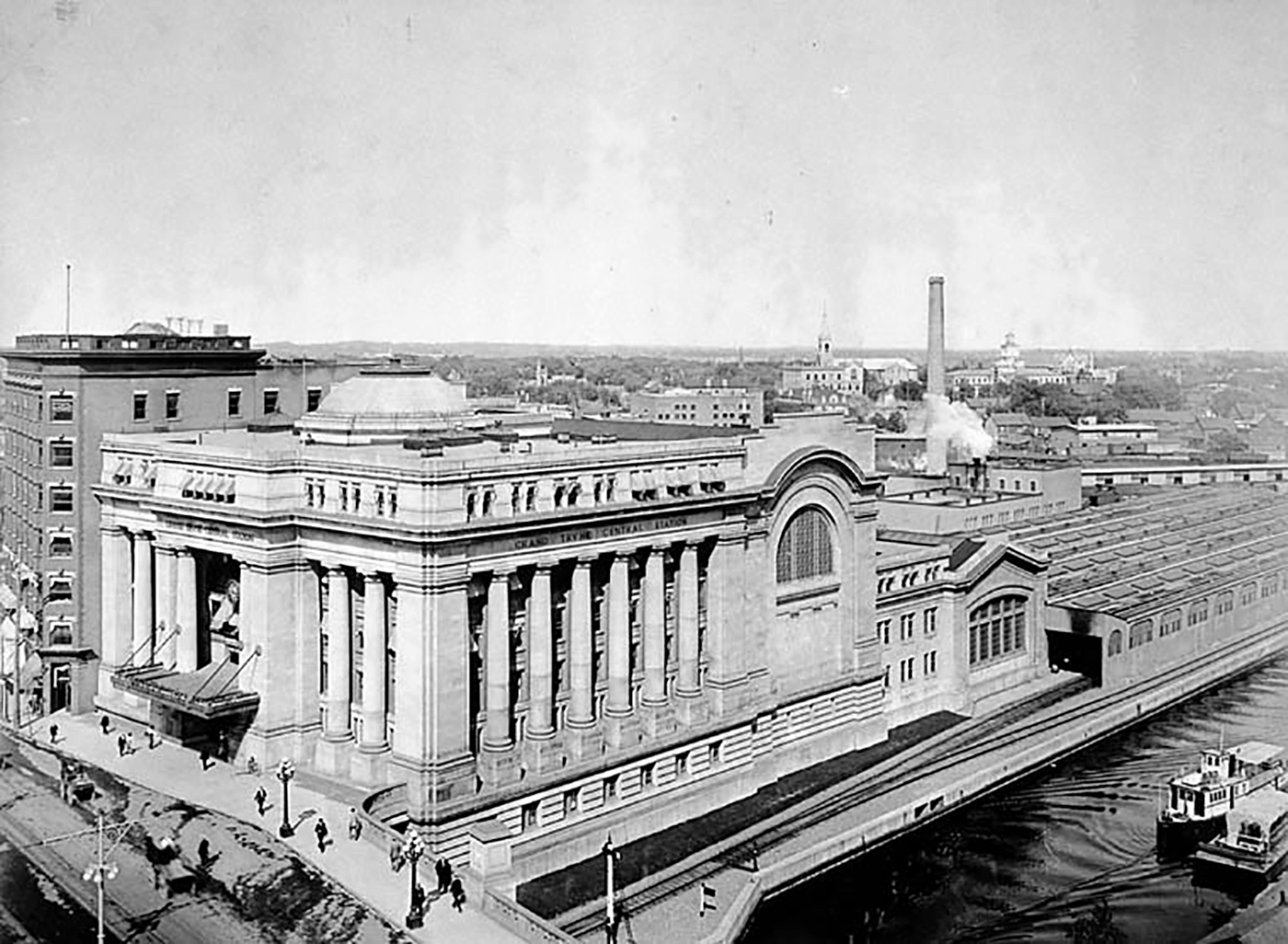
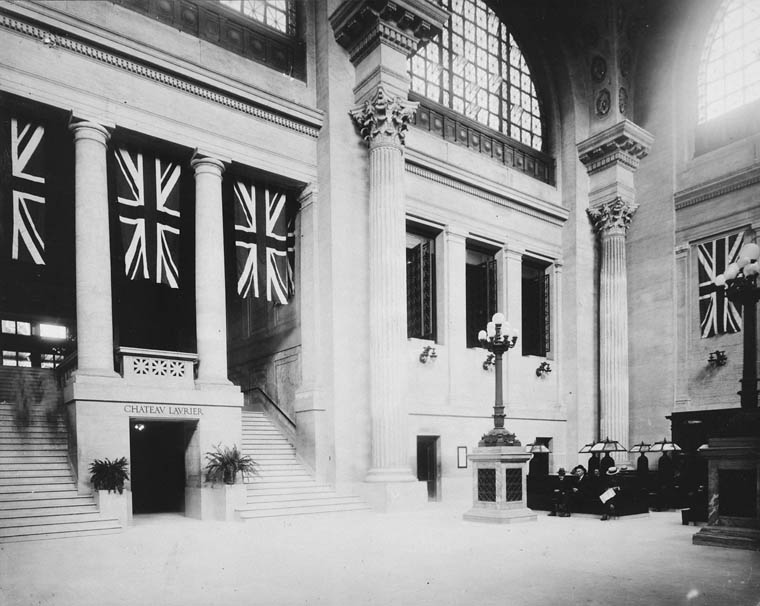
The Grand Trunk Central Station, opened in 1912, provided a grand entrance to Canada’s capital city that was previously served by a few smaller stations just outside the downtown core. The station, designed in the Beaux-Arts style, was built as a stub-end terminal. This meant that trains would arrive and depart from the south and would have to be backed up to change direction. This suited the Grand Trunk Railway just fine, as it lined up perfectly with its route to Montréal via Alexandria (still used by VIA Rail today). The railway also built a hotel across the street — the Chateau Laurier — and connected the station with the hotel with a pedestrian tunnel.
Entrance lobby, soon after opening. Note the tunnel under the staircase to the Chateau Laurier. (Library & Archives Canada)
The 1912 station was intermodal from the very beginning. Right outside the station’s front doors, there were Ottawa Electric Railway streetcar platforms serving several routes on Rideau and Sparks Streets, the two main commercial corridors in Downtown Ottawa. Right below the canal and railway bridge next to the station was the Hull Electric Railway’s loop; its streetcars crossed into Ontario via the Alexandra Bridge.
The Alexandra Bridge carried CPR trains, Hull streetcars, pedestrians, and motor vehicles when it opened in 1901
Soon after opening, the Canadian Pacific Railway joined the Grand Trunk, resulting in the terminal being renamed Union Station; the short-lived Canadian Northern Railway (CNoR) soon followed. As the CPR’s tracks to Hull (via the Alexandra Bridge) ran next to the GTR’s station, it suited the CPR well. Unlike Grand Trunk, both the CPR and CNoR had direct lines to Toronto.
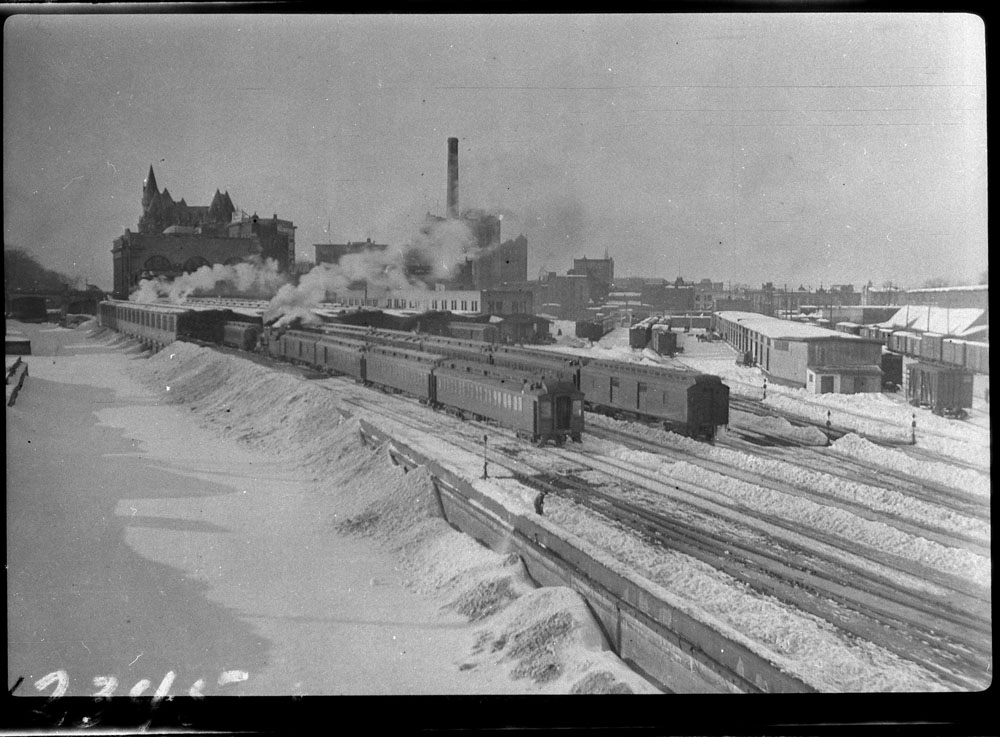
Two platforms on the west side of the station allowed through CPR trains to continue towards the Alexandra Bridge and even return to Ottawa via the Prince of Wales Bridge to the west; this was the route the iconic Canadian train between Montréal and Vancouver took when it was inaugurated in 1955. Most trains — including all GTR and CNoR, however, terminated at the six stub-end tracks. Both GTR and CNoR were absorbed into the new Canadian National Railway (CN) by 1922.
Approach tracks and Bush trainshed, Ottawa Union Station. A wintery scene, with a frozen Rideau Canal on the left. The yards at right are now occupied by the Rideau Centre, Convention Centre, and Department of Defense Headquarters (Library and Archives Canada)
In the 1940s, the federal government led by Liberal prime minister William Lyon Mackenzie King wanted to beautify the nation’s capital region and address traffic congestion. Ottawa — and the federal government — was rapidly growing, while political leaders wanted a cityscape that matched the ambitions of an expanding nation. French urban planner Jacques Gréber was commissioned to plan the region’s future; Gréber’s recommendations, released in 1950, were ambitious and transformative. (You can read the entire report here.)
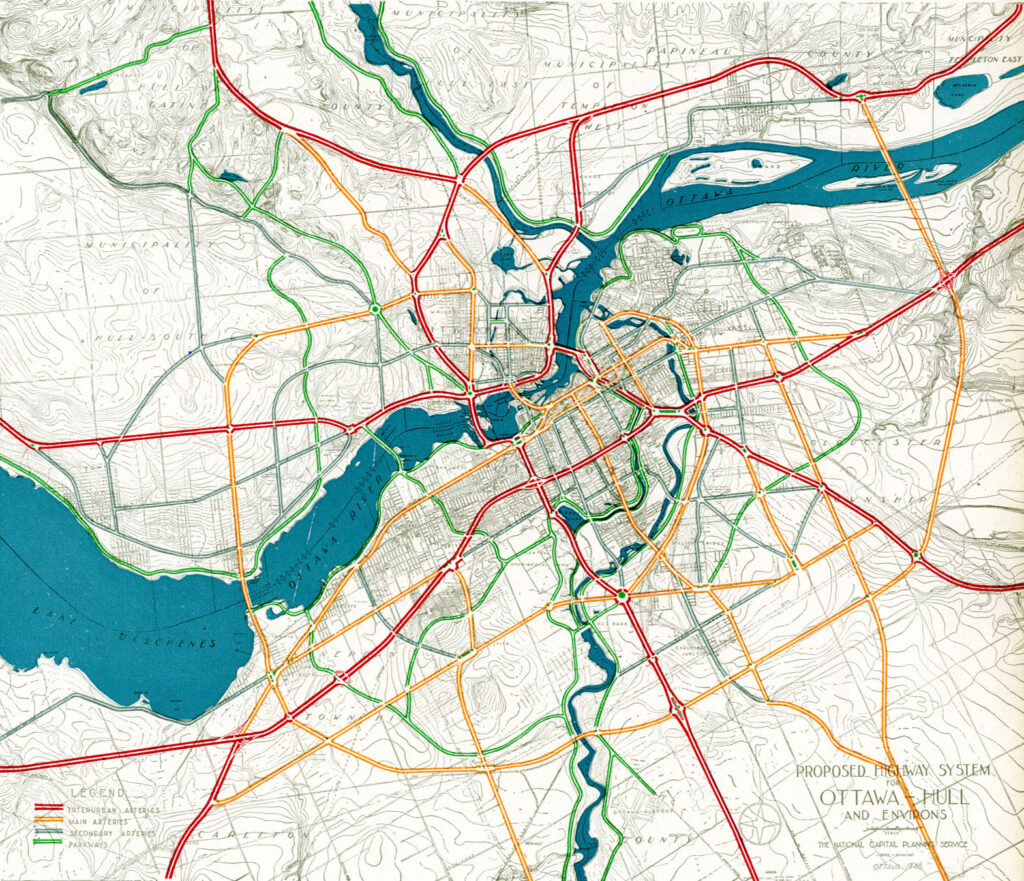
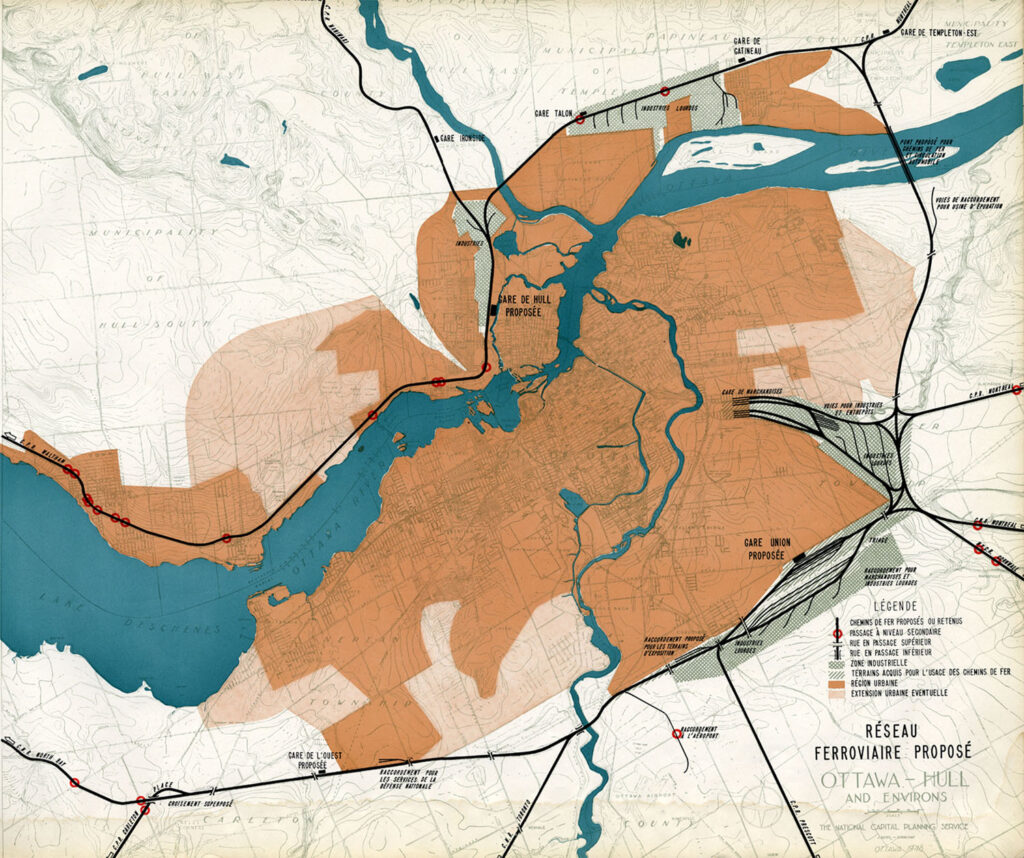
The Gréber Plan — formally titled “Plan for the National Capital” — called for new highways, the abandonment of Ottawa’s streetcars (which were seen as antiquated with unsightly overhead wires), and the removal of all railway infrastructure within the City of Ottawa. The old CN and CPR lines would make way for new roads, including a four-lane arterial along the east side of the Rideau Canal, leading to a new road bridge replacing the Alexandra. A new railway bypass along the periphery of the city would replace all urban trackage, with a proposed new Union Station site in Gloucester Township, south of Walkley Road. Most industrial uses — including the historic paper mills along the Ottawa River — would be moved to the new railway line.
Proposed highway system for Ottawa-Hull and environs, from Gréber’s reportProposed Railway system: Ottawa Hull and environs from Gréber’s report
Though the plan was not fully implemented, it did set the stage for much of the urban planning and infrastructure changes during Ottawa’s next fifty years. The railway bypass was constructed between Bell’s Corners in the west and Ramsayville in the east, with the old Grand Trunk tracks through the city replaced with The Queensway, now part of Highway 417. New parkways lined the rivers and canals. Two new multilane traffic bridges crossed the Ottawa River (though the Alexandra Bridge was maintained for traffic and pedestrians) and Albert and Slater Streets were made one-way, with a new bridge over the Rideau Canal (the Mackenzie King Bridge) linking them to the east. A large Greenbelt encompassed the city region, intended to direct growth while preserving natural areas.
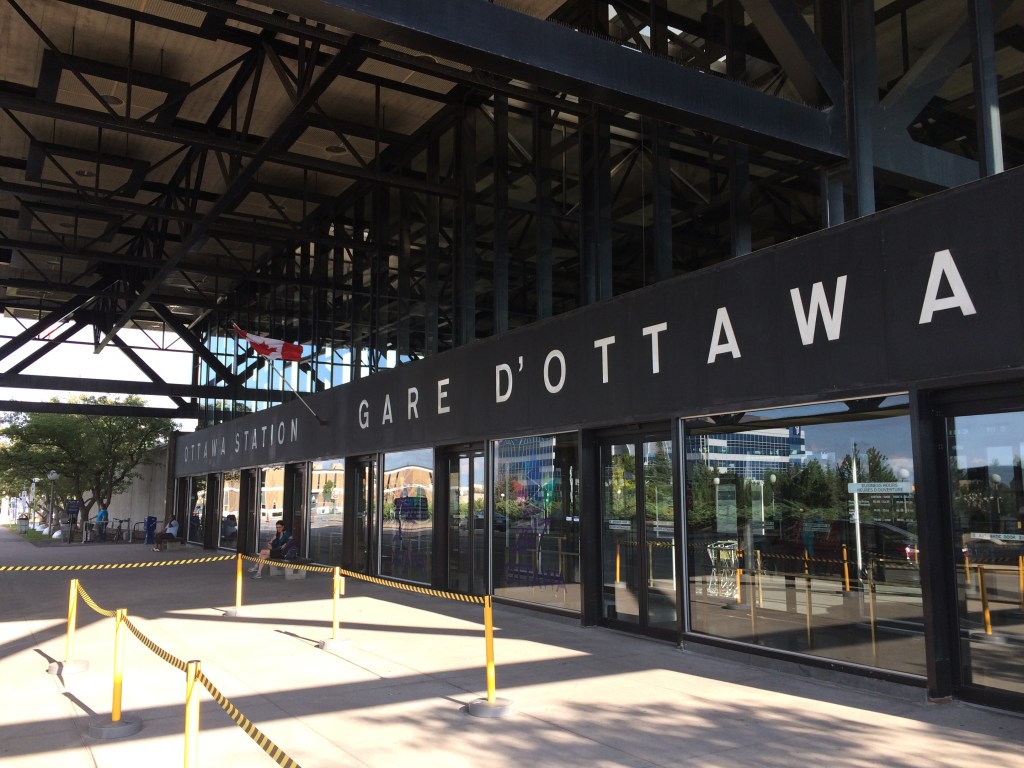
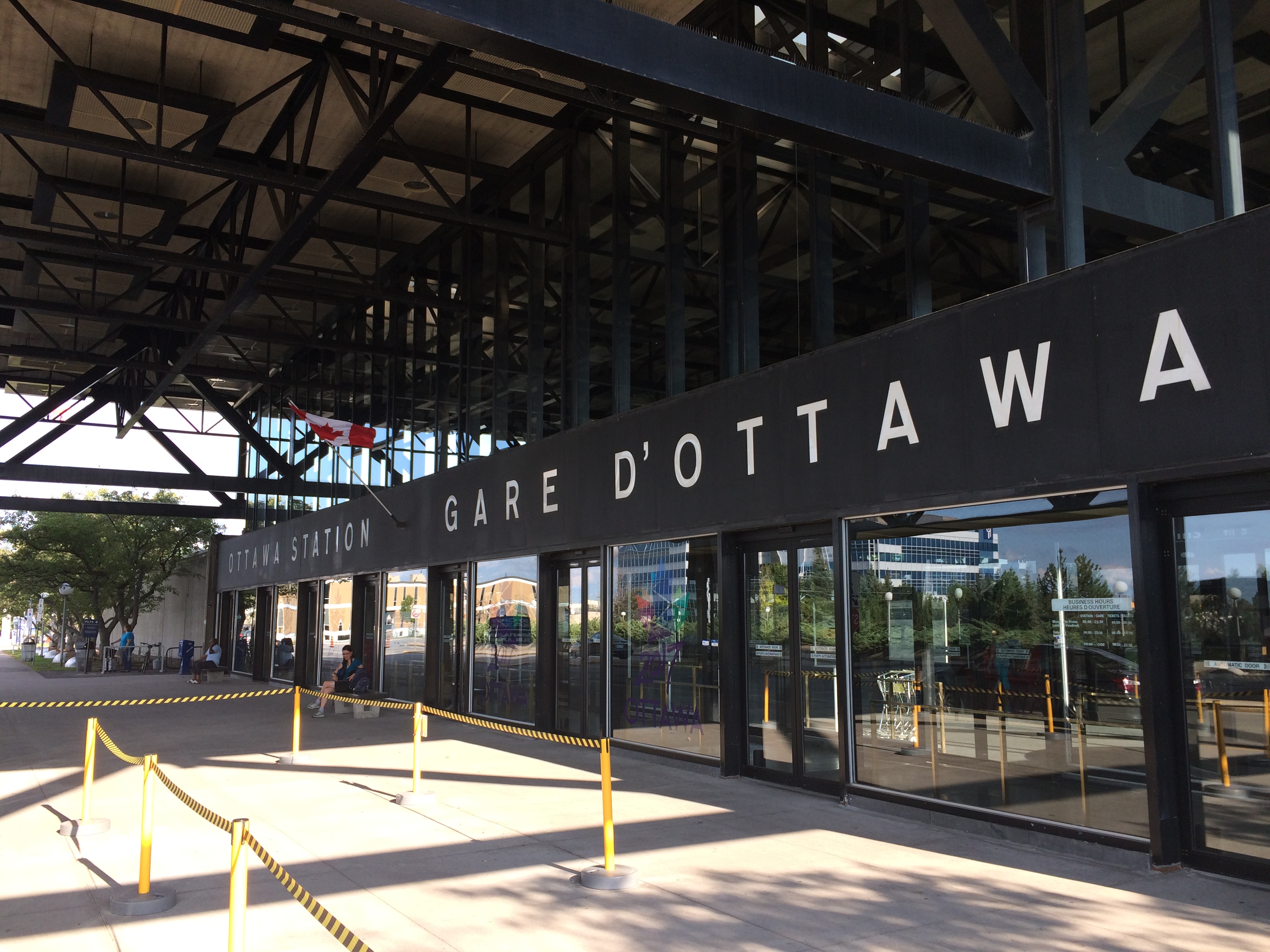
Fortunately, the passenger station was relocated to a point much closer to the city centre than the Gréber Plan envisioned: the old CN and CP tracks along the Rideau River south of the city centre were kept in place but rerouted to serve a new modernist station that opened in July 1966. The new Ottawa Station, designed by John C. Parkin, is one-of-kind. The architecture invokes an airport terminal, with large, sheltered driveways and an airy open lobby/concourse, and was the last grand railway station built in North America. In 1966-1967, there were still two daily transcontinental trains departing from Ottawa Station, along with multiple trains to Toronto and Montreal, including a Toronto-Ottawa night train. Today, there are just eight trains to Toronto and five trains to Montréal.
Ottawa Station, which opened July 31, 1966
Soon after the new station opened, the tracks and ancillary buildings around Union Station were removed, making way for Colonel By Drive, the Rideau Centre shopping mall, a new convention centre, and headquarters for the Department of Defense. The station building itself survived, however, first becoming a temporary museum space during the 1967 Centennial celebrations, then a government conference centre, mostly closed off to the public.
The temporary Senate Chambers in the former train concourse at Ottawa Union Station
Right now, the grand building is the temporary home of Canada’s Senate, and is again accessible to the public, via a free tour. The renovations to the building are very sympathetic to the built heritage. As reconstruction of Centre Block, the regular home of both Houses of Parliament, is still five years away from completion, there’s still lots of time to take the tour.
Awaiting Alto
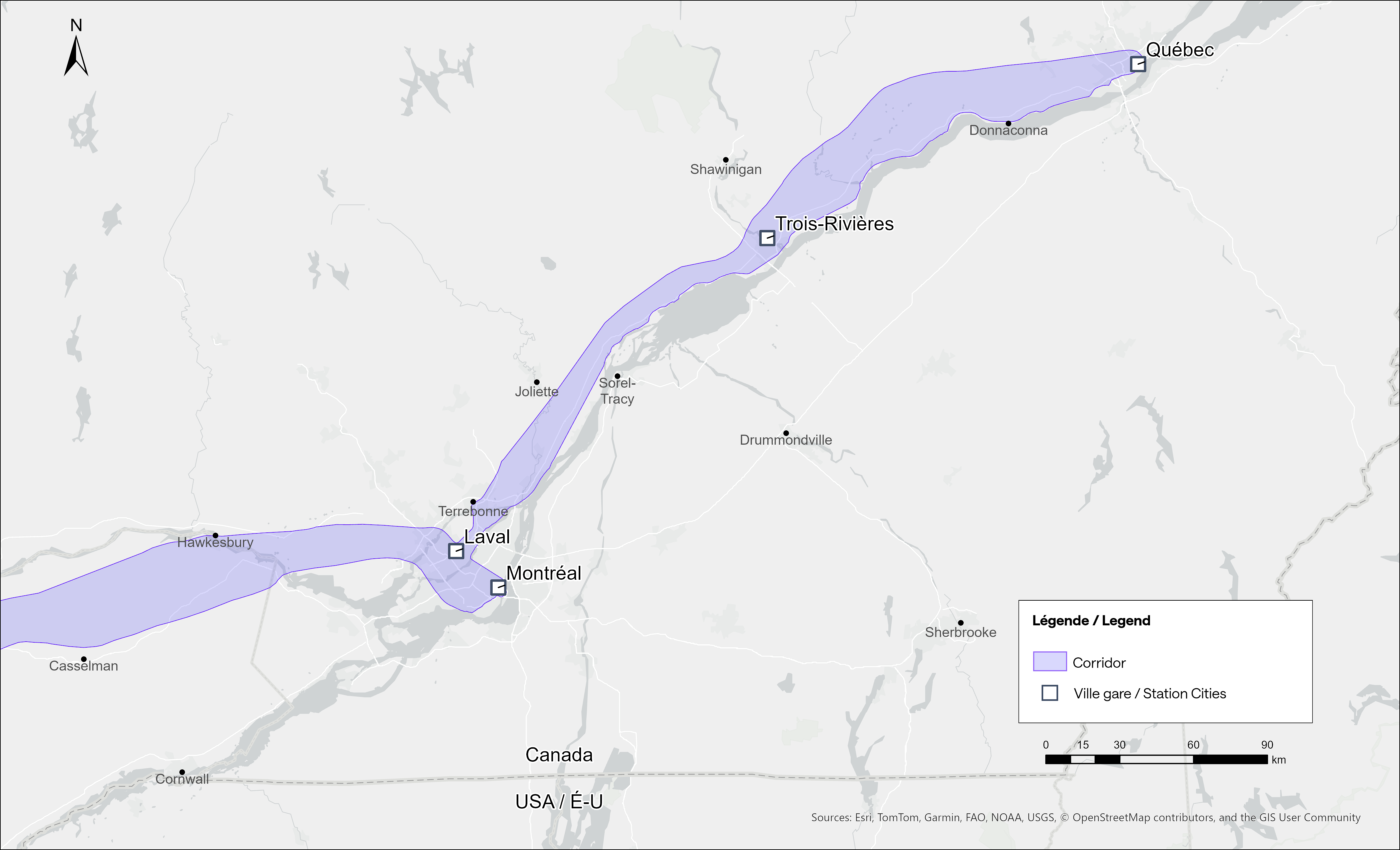
The Alto high speed rail line project, now in the planning stage, will connect Québec, Montréal, Ottawa, and Toronto, with a total of seven stations (the other three are planned in Trois-Rivières, Laval, and Peterborough). The first segment, with the start of construction set for 2029, will link Montréal, Laval, and Ottawa. Consultations on the specific route and station locations are underway, with the broad corridors noted in maps available on the Alto website.
Map of potential routings for the Alto high speed line in OntarioMap of the planned routing for the Alto high speed line in Quebec
The maps clearly show a route between Ottawa and Montréal that will pass through Prescott & Russell Counties, roughly following an abandoned CPR corridor until about Hawkesbury, at which point it would cross into Quebec (following an older abandoned CNoR route) to Laval, then continue south into central Montréal, though not necessarily the existing Central Station (this would likely require a new tunnel under Mount Royal). The Montréal station appears to be a terminal for trains coming from Ottawa and from Trois-Rivières and Québec, much like the existing VIA Central Station.
Alto’s next phase towards Toronto could follow one of two broad routes between Ottawa and Peterborough, either just north of Highway 7, through the Canadian Shield, or a southerly alignment through the Rideau Lakes region and then through South Frontenac and passing near Stirling and Campbellford. All planned routes would require passing through Ottawa entirely on the Ontario side of the Ottawa River, making a through station particularly likely, especially for the critical Toronto-Montréal market.
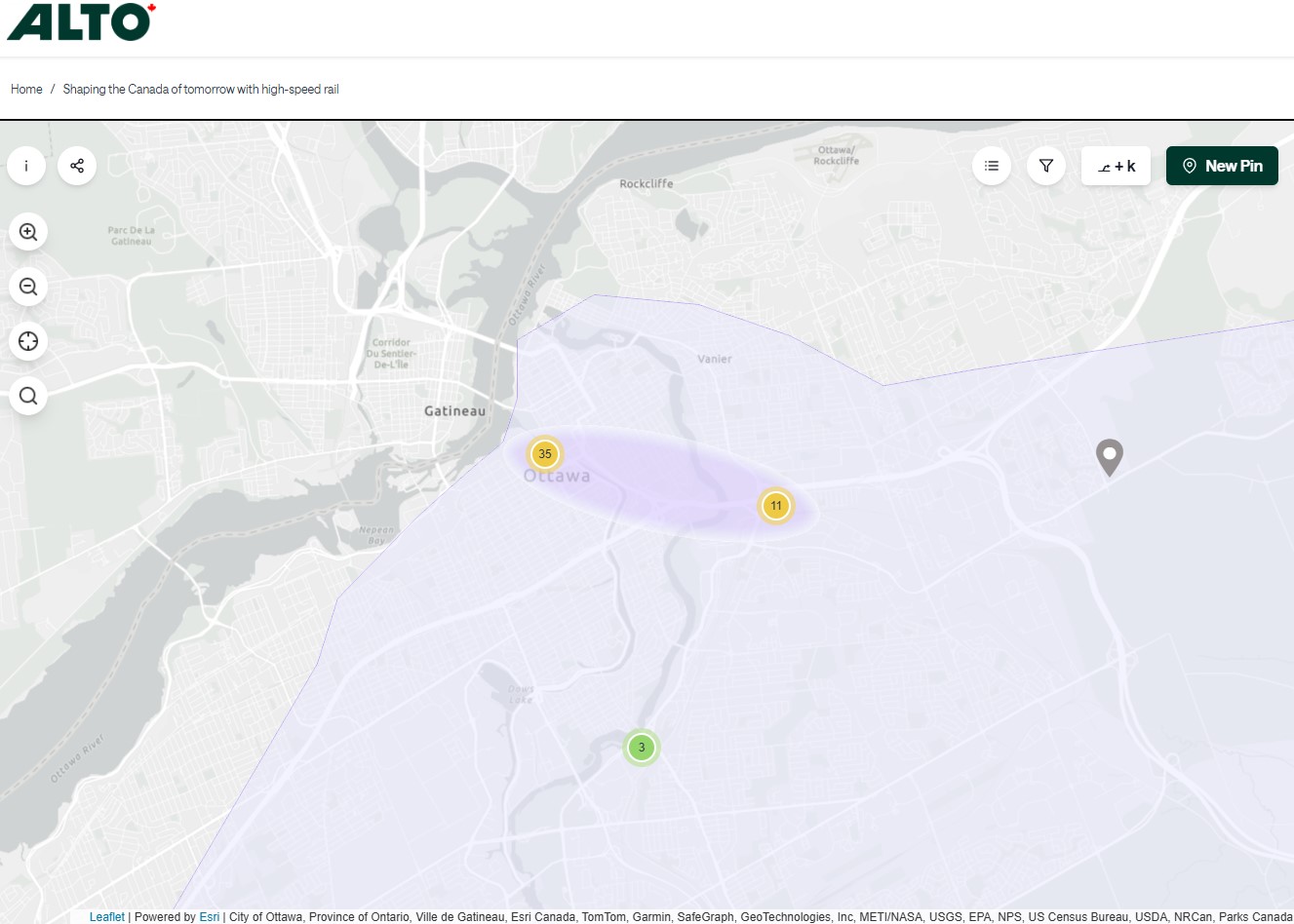
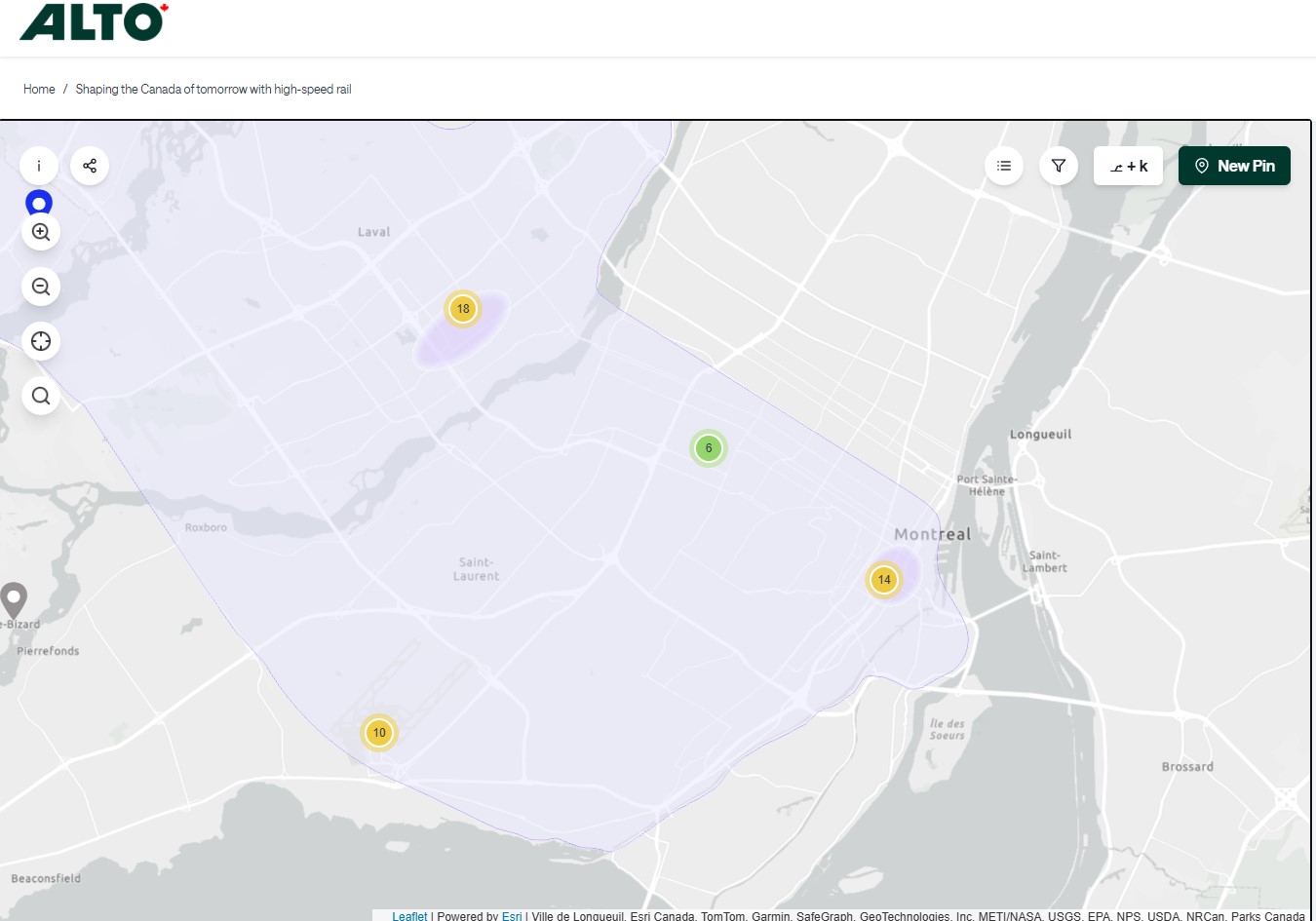
On the detailed consultation map, highlighted areas show where the seven station locations are being considered.
The map for Ottawa shows possible station locations in an area including the current VIA station and the old Union StationThe Montréaland Laval station locations under consideration. The Montréal station area highlighted includes the locations of Central and Lucien L’Allier Stations.The Montréal station for Alto is clearly intended to be a terminal.
The idea of a downtown Ottawa Station for the new high speed rail corridor is certainly enticing. It would breathe new life into a 114-year-old landmark, provide a very convenient spot for Ottawa politicians, public servants, business travelers, tourists, and students attending nearby University of Ottawa. Rideau O-Train Station is less than two blocks away. However, it would require a new tunnel and/or elevated structure to reach the station from the rail corridors to the south. Furthermore, Centre Block would have to reopen on schedule so the Senate can move back before construction can start on refurbishing the station for passenger service.
The 1966 Ottawa VIA Station, on the other hand, has its own advantages. There is plenty of room to build new high speed train platforms, which should provide level boarding for efficient passenger movement. There is also room for parking, passenger pick-up and drop-off, as well as easy access to the highway, unlike Union Station. With the closure of the Ottawa bus station, the VIA Rail Station has become a multimodal hub, with Ontario Northland, Flixbus, and Orleans Express all using the station’s driveway, along with a KLM/Air France shuttle to Dorval Airport. There is also a dedicated O-Train LRT station on-site, though it could be better integrated with the station building.
Perhaps most importantly, the existing VIA station can help ensure the existing Corridor service remains integral, as passengers from Kingston, Belleville, and elsewhere on Lake Ontario and the St. Lawrence River will not be served by Alto; neither would Casselman, Alexandria and Dorval. That the station is a through-line, and not a stub-end terminal, will also ensure that the crucial Toronto-Montréal market will see minimal delays from back-tracking and reversing at a downtown terminal. Though there are instances of high-speed trains reversing directions at major hubs — Trenitalia’s Frecciarossa mainline between Milan and Salerno turns back at Roma Termini and at Napoli Centrale — this is an uncommon arrangement.
All the planned Alto high speed rail stations will have to be easily accessible and close to the downtown cores of the cities it serves. At this point in the planning process, this looks like it will be the case at all three big city stations. But it will need more than walk-up traffic like downtown office workers and tourists; it will be most successful as part of a complete network of local, regional and intercity transport, including the conventional VIA rail system. With specific improvements, including new platforms and better O-Train station integration, the modern yet historic 1966 Ottawa Station is well suited for all of these needs.
Over the last six years, Greyhound Canada disappeared after years of decline, the COVID-19 pandemic hit with travel restricted, the Ontario provincial government set up one-time funding for intercommunity transport links while deregulating the intercity coach industry, and many municipalities dipped their toes into providing rural transit services.
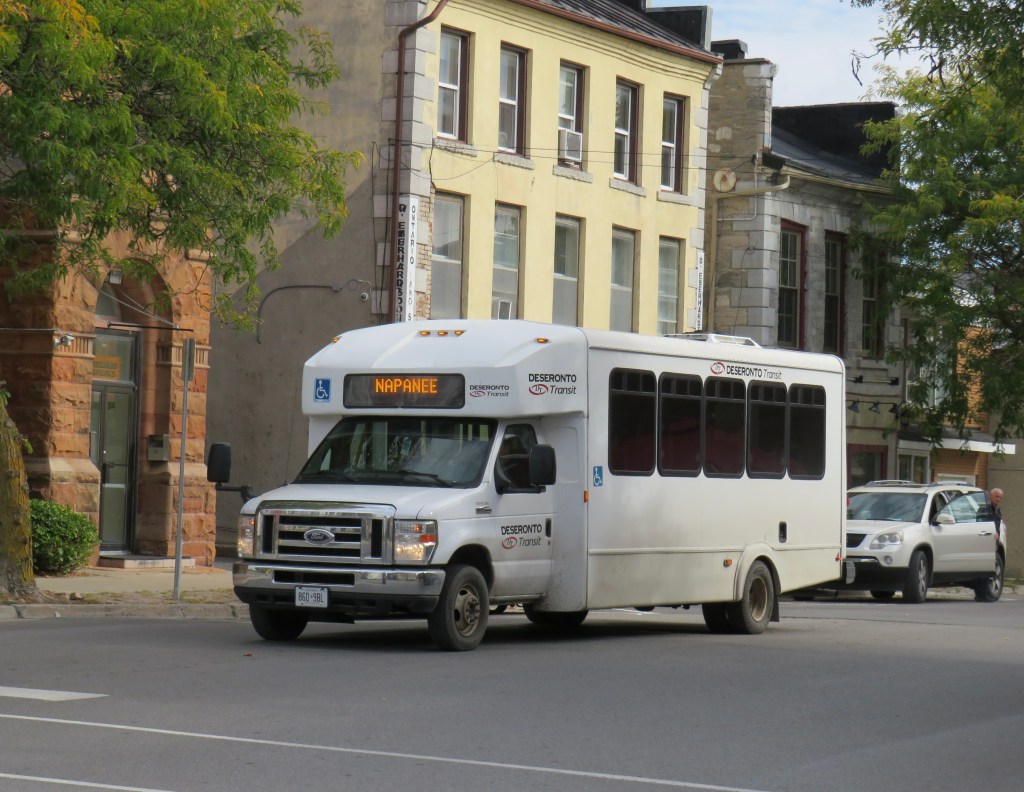
At the end of 2025, there was some good news to note — several rail transit lines opened in Toronto, Montreal, Ottawa, and Edmonton, while a few new rural services opened in Eastern Ontario. Unfortunately, there were also some major losses in Ontario, particularly in Grey County, Oxford County, Napanee-Deseronto, and the impending cancellation of a major route in Essex County. Unlike in Ontario, however, rural transport links remain stable in Quebec and British Columbia.
Stable funding is essential to keep these intercommunity and intercity links alive, particularly where private operators have not filled a need. For example, Flixbus recently cut back their once-a-day route from Toronto to the Lake Huron coast and will not serve rapidly-growing Saugeen Shores during the colder months. That part of Ontario is left only with a three-days-a-week TOK coach despite potential demand. A well-funded regional transport service coordinated by Grey, Bruce, and other adjacent counties could address this, but there needs to be political will to ensure stable and predictable service needed to grow ridership over the long term.
I just completed a round of edits to my intercity map, noting changes to routes, service levels, and in some cases, stop locations. A few new scheduled air shuttles in Atlantic Canada and Manitoba are included; these types of services are only mapped if they also provide non-airport service or at least connect to urban transport.
There are also more grey lines. Starting with edits in mid 2024, I have chosen to grey out abandoned routes, rather than just eliminating them. It is well worth noting where transport links have disappeared, and where replacement service might be worth planning.
Hopefully 2026 will see better service than the end of 2025.
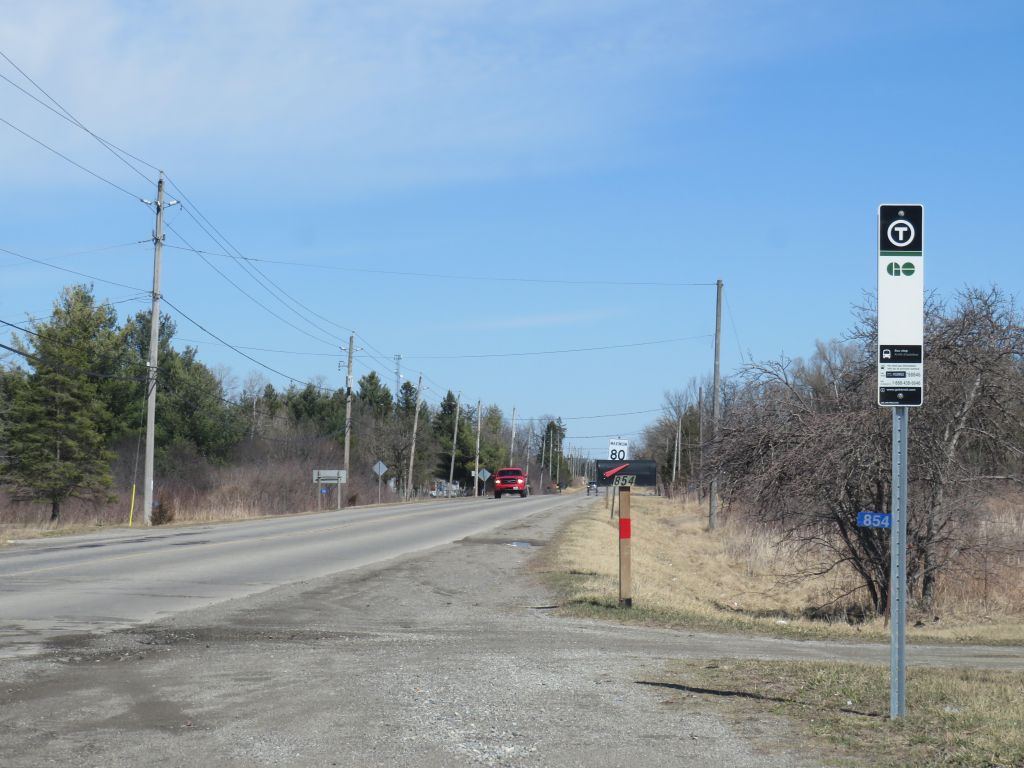
New GO Transit bus stop on Chiefswood Road at Six Nations
As we enter Spring 2025, there are a few significant changes in Ontario’s intercity transportation services. A new daily GO Transit route will now connect Six Nations and the Mississaugas of the Credit First Nation with Brantford, Hamilton, and Greater Toronto. A new seasonal Waterloo-Burlington weekend express could foreshadow more direct service between Kitchener/Waterloo and Hamilton in the future. Flixbus moved its Ottawa terminal stop to the VIA Rail station, joining Ontario Northland and Orleans Express.
However, there are also some cuts, triggered by the end of the Ontario Intercommunity Transportation Grants. Grey County will terminate all GTR services with the exception of Route 1 between Dundalk, Shelburne, and Orangeville. T:GO is ending its intercommunity services outside of Tillsonburg, including routes that connect with Woodstock and London. PC Connect is cutting its rural route that serves places like Mitchell and Milverton (though routes connecting Listowel, Stratford, and St. Marys to Kitchener/Waterloo and London will continue).
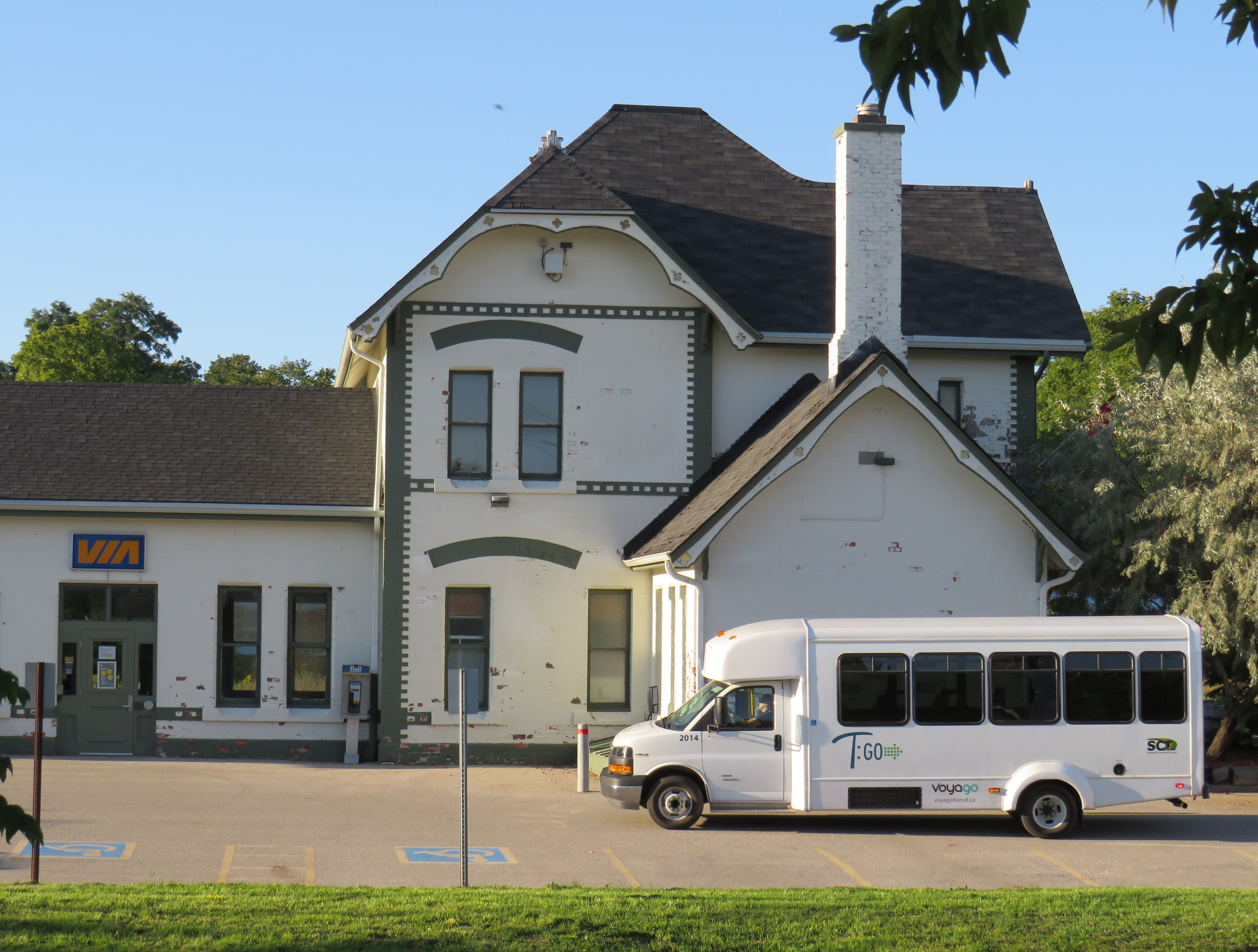
Unfortunately, T:GO will end all intercommunity bus routes outside of Tillsonburg, including the link to Woodstock
Recently, I provided my expertise mapping Canada’s intercity transit links to Transport Canada, which allowed me to enhance and update the interactive map. I am also working with Transport Action Canada to support their efforts advocating improved intercity transport across the country.
As always, please contact me with feedback, corrections, or updates. It is a challenge continually maintaining a Canada-wide map given how frequently things change.