Tag: Bike Trips

  • Biking off to Buffalo

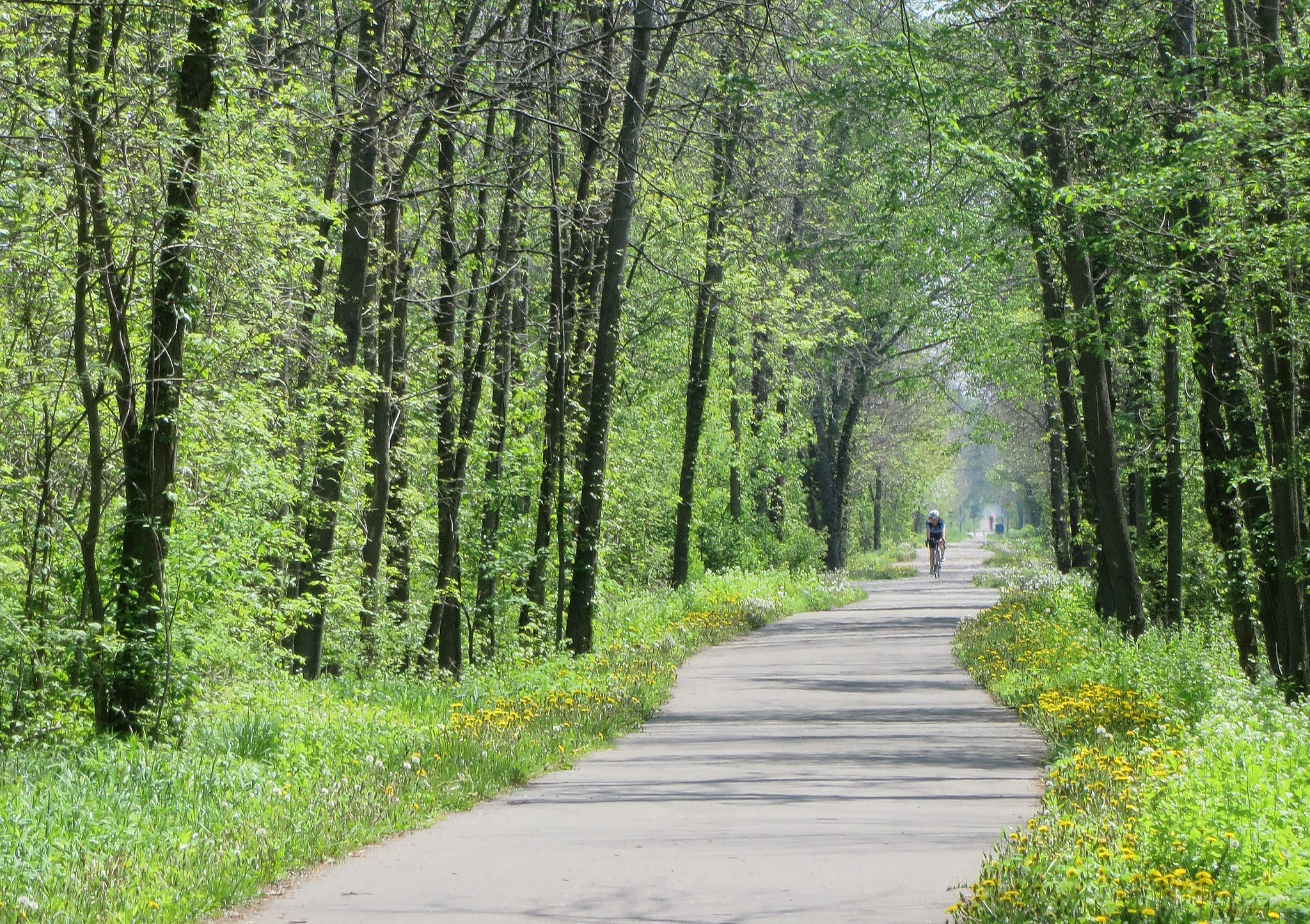
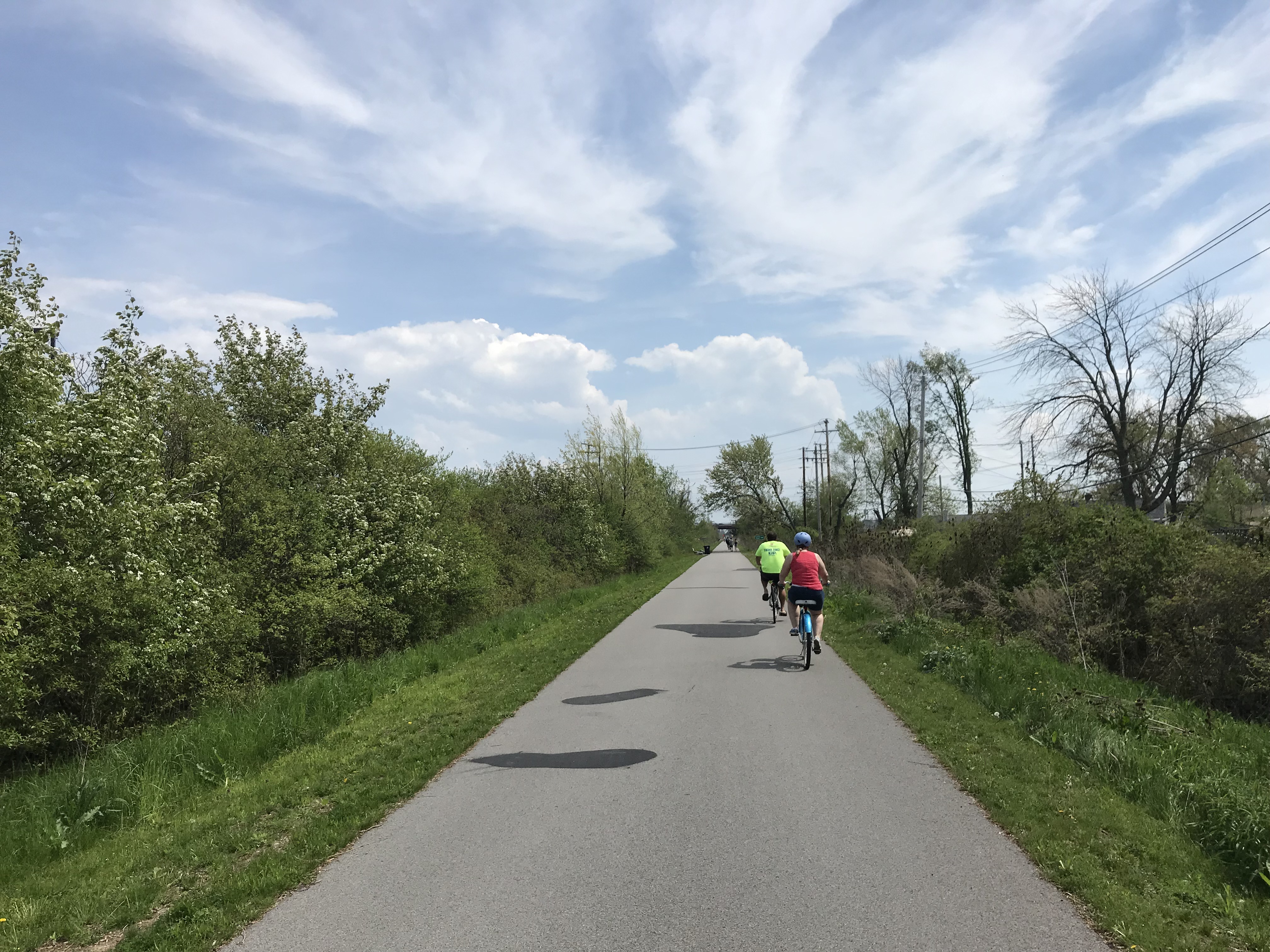
    IMG_6241Tonawanda Rail Trail

    Back on Victoria Day weekend, I biked down to Toronto’s Union Station, loaded by wheels onto a GO train, and headed for Niagara. I have biked through Niagara before, and it is a very pleasant place for cycling, with many paved paths, quiet roads, and paved shoulders and bike lanes along many busier roads. Charming towns such as Niagara-on-the-Lake and Port Colborne offer many places for cyclists to eat, drink, and stay. If you haven’t yet done so, GO Transit’s bike train is worth checking out this year.

    It is also possible to cross the border by bike as well, where there are many great bike routes and parks worth exploring. On my last trip, this is exactly what I did.
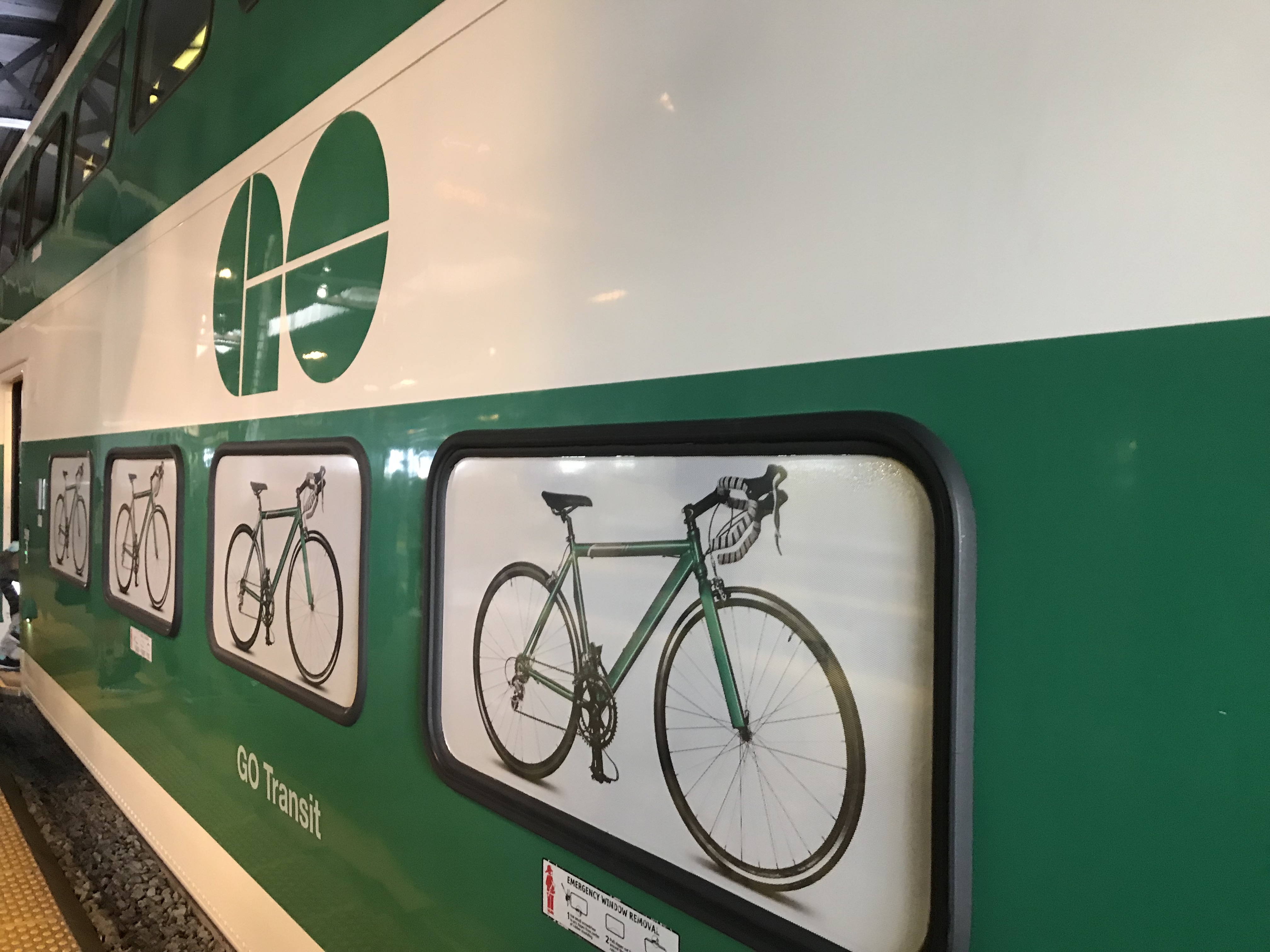
    IMG_6143.jpg
    GO Transit’s bike train at Union Station

    Officially, cyclists may cross at three of the four bridges over the Niagara River. To the north, cyclists may cross at the Queenston-Lewiston Bridge, which connects Ontario Highway 405 with Interstate 190. However, cyclists must cross with traffic (there’s no sidewalk, and pedestrians are prohibited), an unappealing option.

    The Rainbow Bridge allows both pedestrians and cyclists, though cyclists can not use the sidewalk (which offers great view of the nearby falls),but must also ride with traffic. But the Rainbow Bridge prohibits trucks; it is easy to access from city streets in both Niagara Falls, Ontario, and Niagara Falls, New York.

    The Peace Bridge, at the end of the Queen Elizabeth Way in Fort Erie, also permits pedestrians and cyclists, though cyclists must walk their bikes on the sidewalk. A multi-year rehabilitation project closed the sidewalk, but work was recently completed and the sidewalk will open shortly. In the meantime, the Peace Bridge offers a shuttle van (I called on July 1 2019 to confirm its operation, the representative I spoke to advises to call the Peace Bridge office to request a pick up). The Peace Bridge’s website offers detailed instructions on how to access the crossing on both sides.

    The Peace Bridge is free to pedestrians and cyclists in both directions, though cyclists on the Rainbow Bridge are charged $1 (US or Canadian) to travel to Canada.

    I chose to take the Rainbow Bridge both ways. It being a long weekend, I had to wait in traffic both ways, but at least the views are decent, and it’s a flat bridge deck.
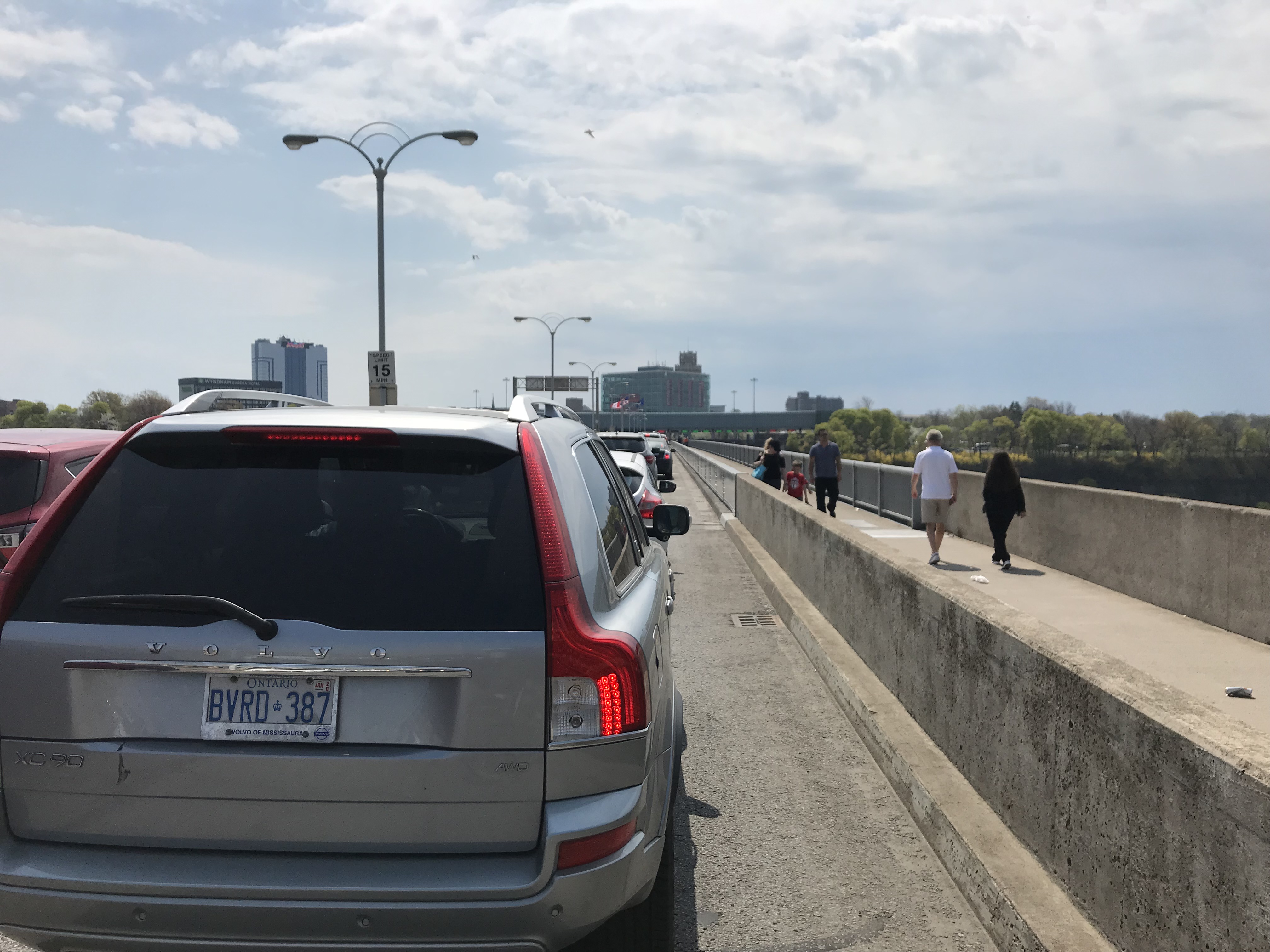
    IMG_6166Crossing the Rainbow Bridge by bike means waiting in traffic…
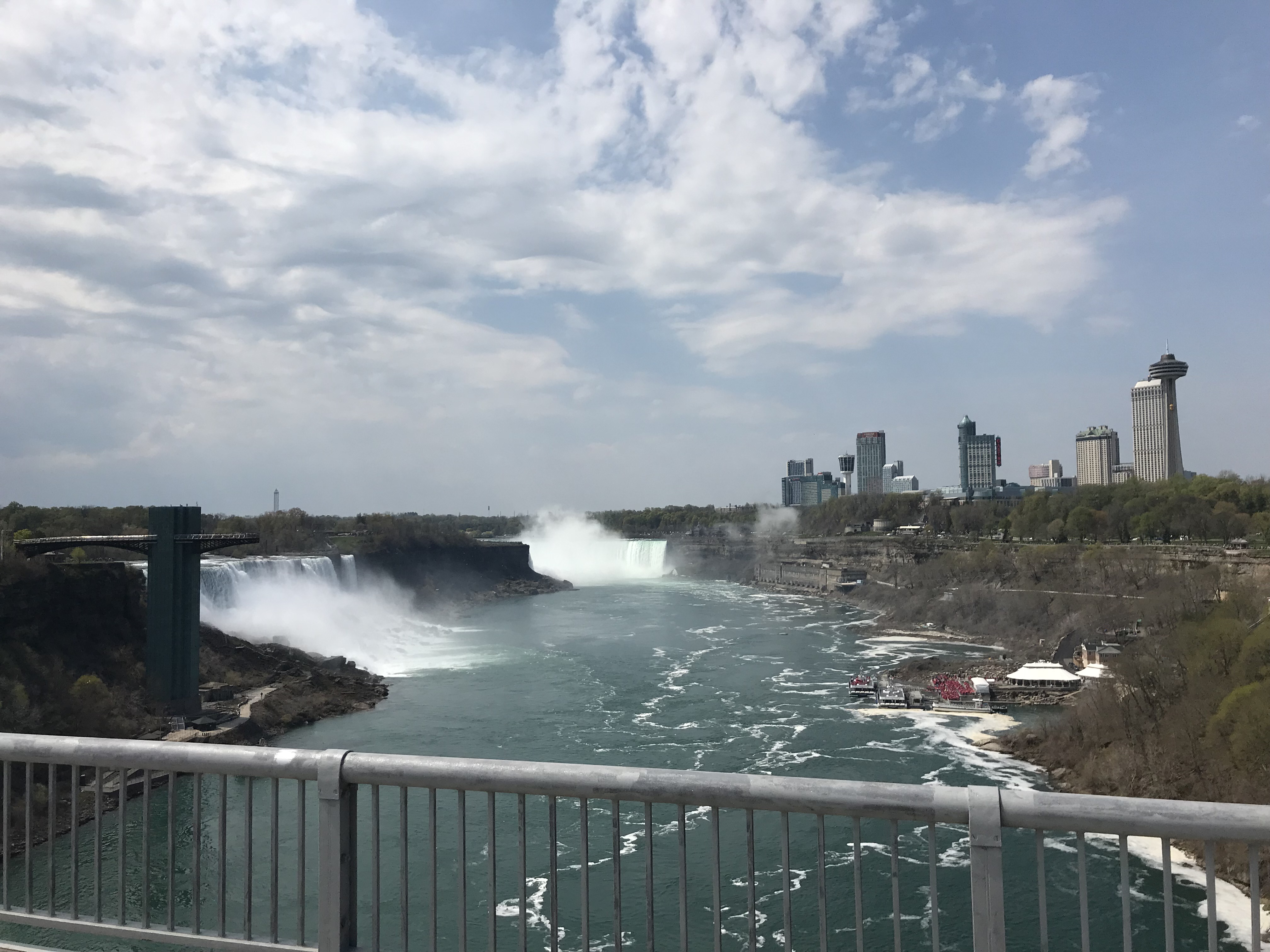
    IMG_6169…though at least the view is nice

    Once across in Niagara Falls, New York, it is easy to access Niagara Falls State Park, which offers great views of the Falls, and is free to enter (though there are charges for parking and for accessing the viewing tower and lower gorge trails). Cyclists are asked to dismount and walk in sections of the park, though it is a reasonable request due to the crowds.

    I then biked along the Niagara Scenic Parkway upriver towards Tonawanda. The parkway was formerly named the Robert Moses State Parkway, but it has since been tamed to improve pedestrian and cycling facilities along the Niagara River, with the road closed completely at the Rainbow Bridge, and narrowed elsewhere. I doubt the Power Broker would have approved.
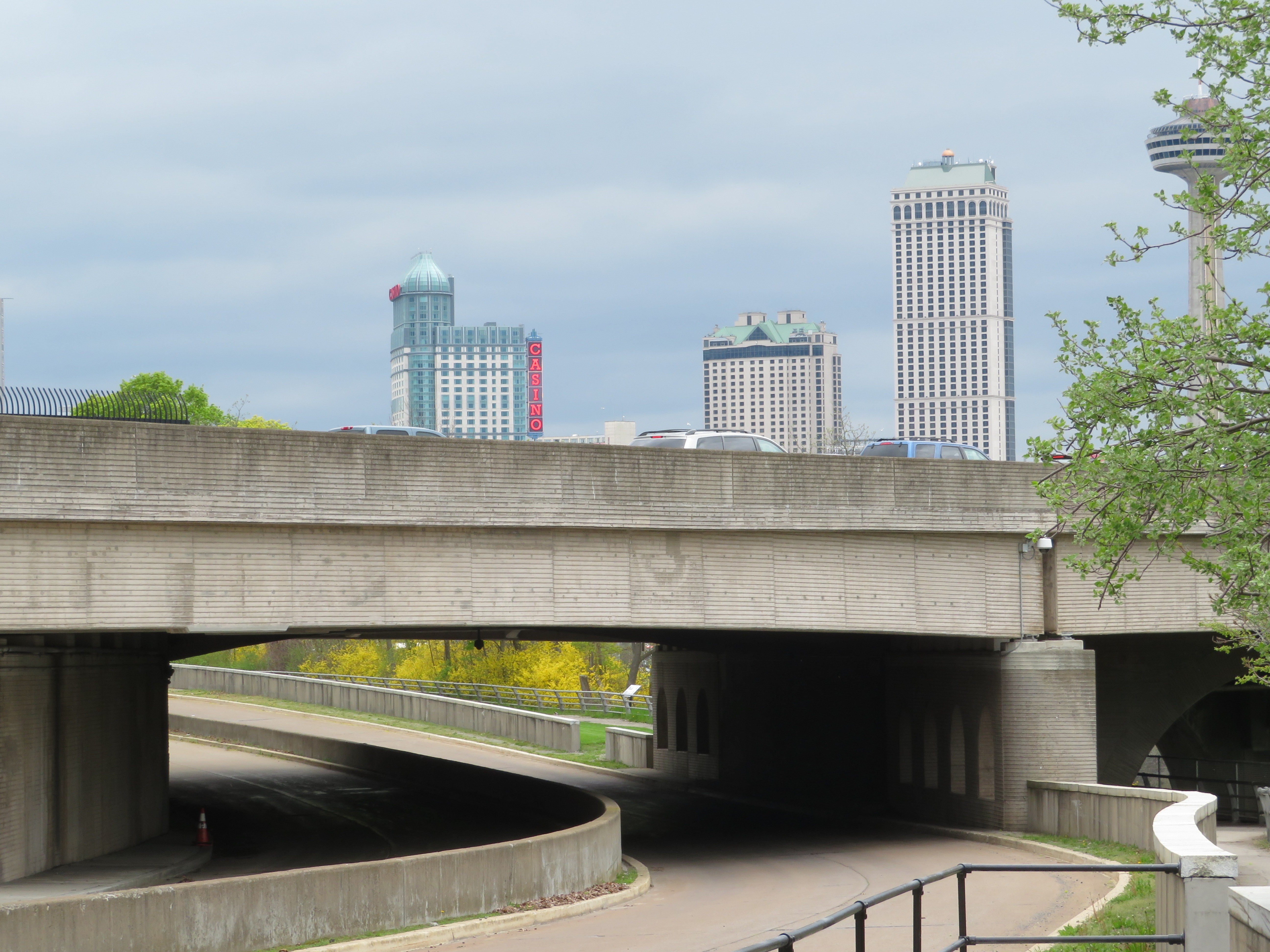
    1-IMG_1624.JPGAbandoned section of the Robert Moses State Parkway under the Rainbow Bridge

    South of Tonawanda, I chose to follow a new rail trail that followed an old interurban line that connected Buffalo with Tonawanda and Niagara Falls. The International Railway Company once operated a large network of street railways in Buffalo and Niagara Falls, as well as rural lines leading as far as Hamburg and Lockport. It also once operated a tourist trolley along both sides of the Niagara River, making it a truly international operation. Interurban service ended in 1937, while the last streetcars ran in 1950.

    IMG_6244
    Tonawanda Rail Trail guide sign

    The Niagara Frontier Transportation Authority, the public successor to the IRC, retained ownership of the Tonawanda corridor, planning a spur line of the new Buffalo Metro LRT. But local opposition and a lack of funds derailed those plans; happily, it is now a wonderful trail with safe, signalized crossings at every major cross street.

    Once in Buffalo, there are many bike lanes, and lower levels of traffic. Not once was I honked at or felt threatened by motorists. The city is mostly flat, and there are many neighbourhoods and landmarks worth checking out, with great restaurants, bars, and breweries. There are many hotels and bed and breakfasts in Downtown Buffalo and in the Allentown area.
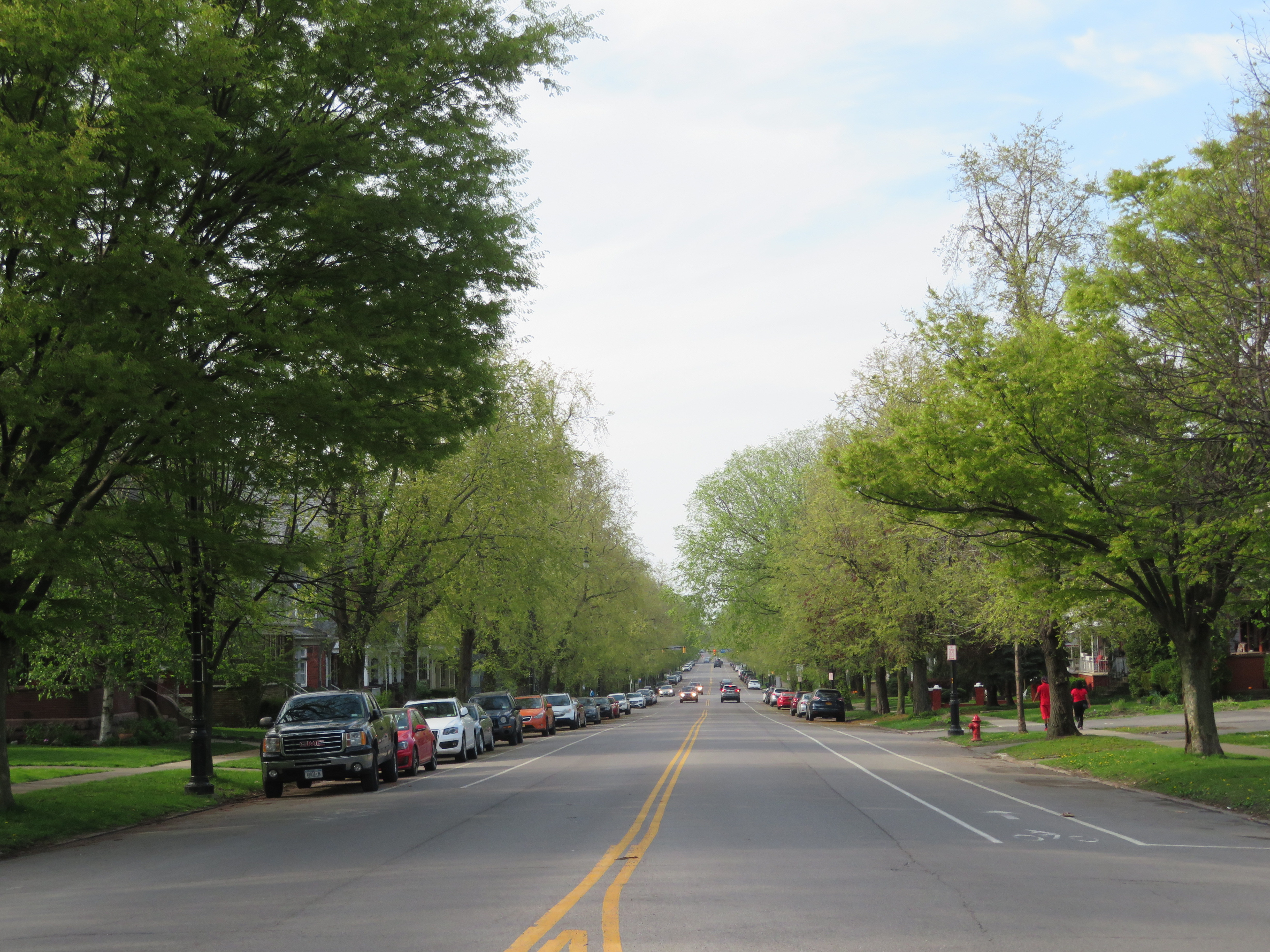
    1-IMG_1528
    Bike Lanes on tree-lined Richmond Avenue
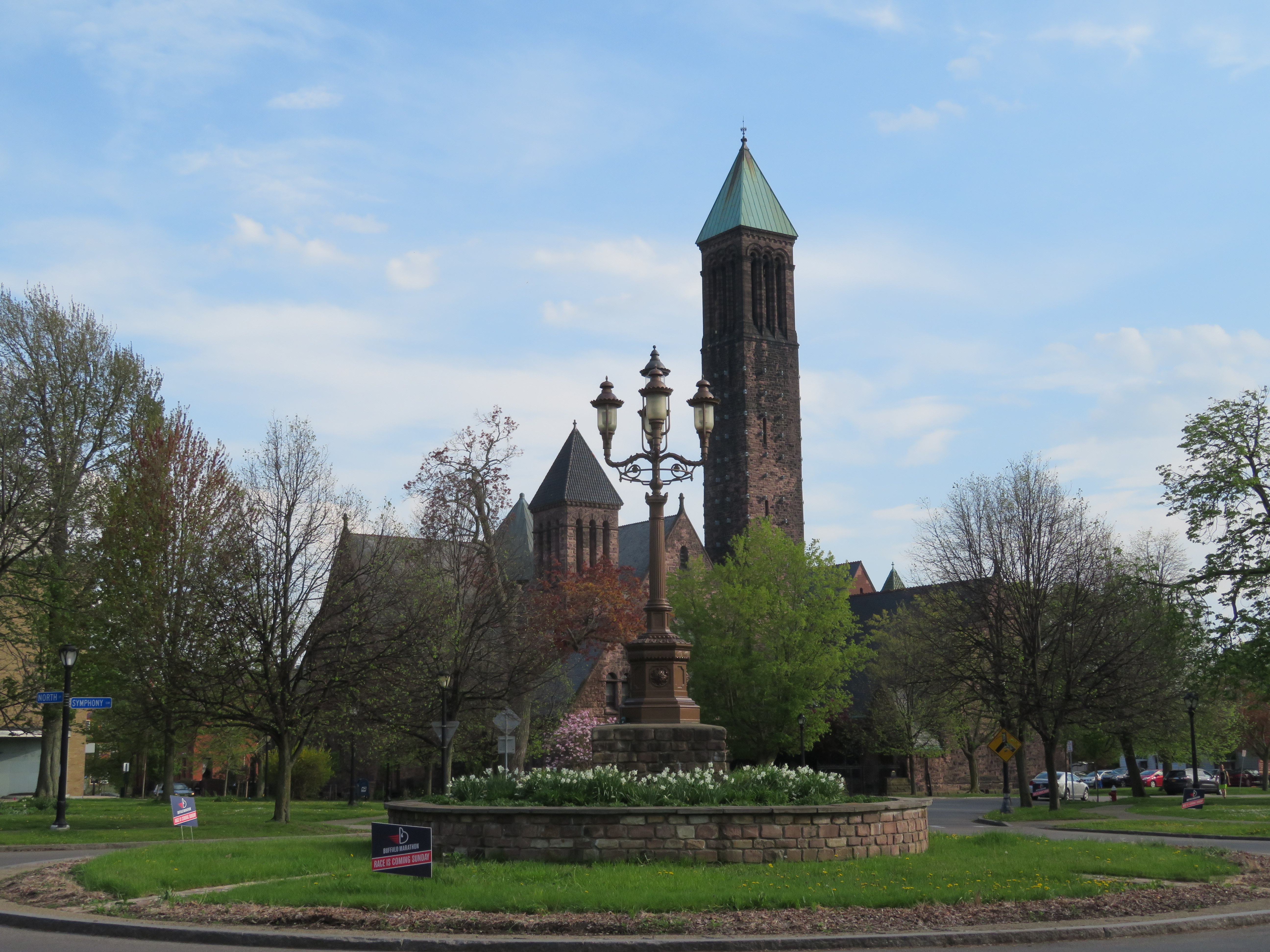
    1-IMG_1525-001
    Symphony Circle, one of many traffic circles as part of Fredrick Law Olmsted’s parkway system developed for Buffalo

    Visiting Buffalo on a Sunday/Monday of a Canadian long weekend also meant being in town on normal working day on Monday, where commercial and institutional buildings are open to the public. The view from the observation deck at Buffalo City Hall is fantastic, while the Council Chamber is an art deco masterpiece.

    1-IMG_1594
    I had lunch in the Ellicott Square Building, which, when completed in 1896, was the largest office building in the world. The building was designed by Charles Atwood of Chicago’s D.H. Burham & Company, and its interior courtyard is spectacular. Several food vendors operate weekdays.
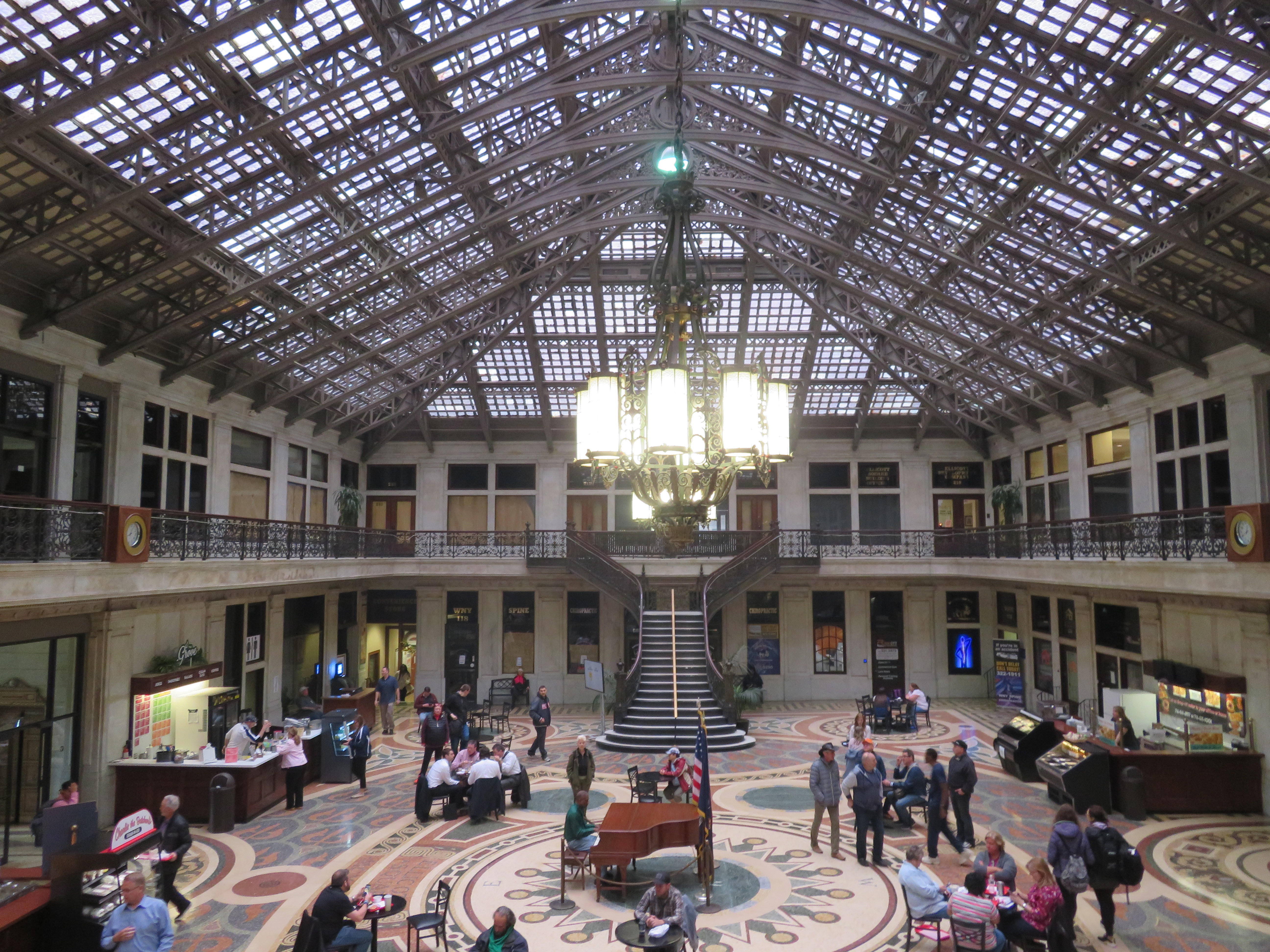
    1-IMG_1570-001Courtyard, Ellicott Square Building

    Buffalo is an attractive cycling destination because a back-up option exists. The NFTA buses are all equipped with bike racks; the Route 40 bus runs direct from Downtown Buffalo to Downtown Niagara Falls, New York. The Monday was cool, wet, and windy, and I was tired (I later found out I was coming down with a bad cold), so I opted to spend the extra time cycling around downtown and the Erie Canal Harbour area and take advantage of the bus service back.

    The GO Niagara bike train operates every weekend until Labour Day, and again during Canadian Thanksgiving Weekend. The Buffalo-Niagara region has a lot to offer cyclists, and it is worth your consideration.
  • Punkeydoodle’s Corners and the world’s highest numbered address

    Punkeydoodles_Corners.JPG

    Last weekend, I went for a ride in Waterloo Region, particularly in Wilmot Township, to the west of Kitchener-Waterloo. Despite some deceptively difficult hills and a strong headwind going back east, it was a very pleasant ride. Outside of Toronto, motorists seem to be quite courteous towards cyclists, with most giving me plenty of room. It helped too that many of Waterloo Region’s rural roads have paved shoulders.

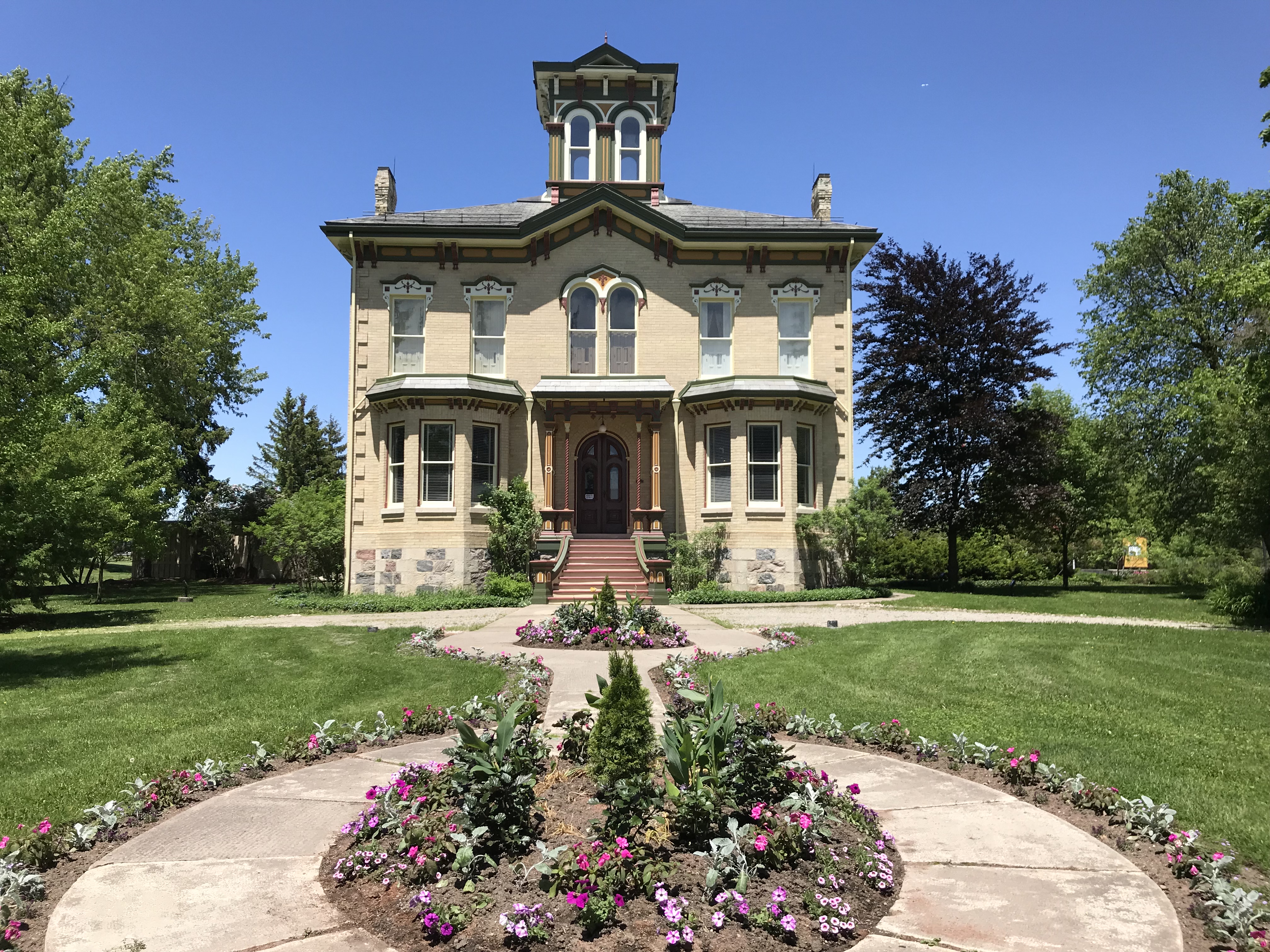
    I made several stops along the way, including Castle Kilbride in Baden, a wonderfully preserved Victorian home. It was built by the Livingston family, who made their fortune in flax and linseed oil. The house, a national historic site, is now a museum operated by Wilmot Township.

    Castle Kilbride.JPGCastle Kilbride

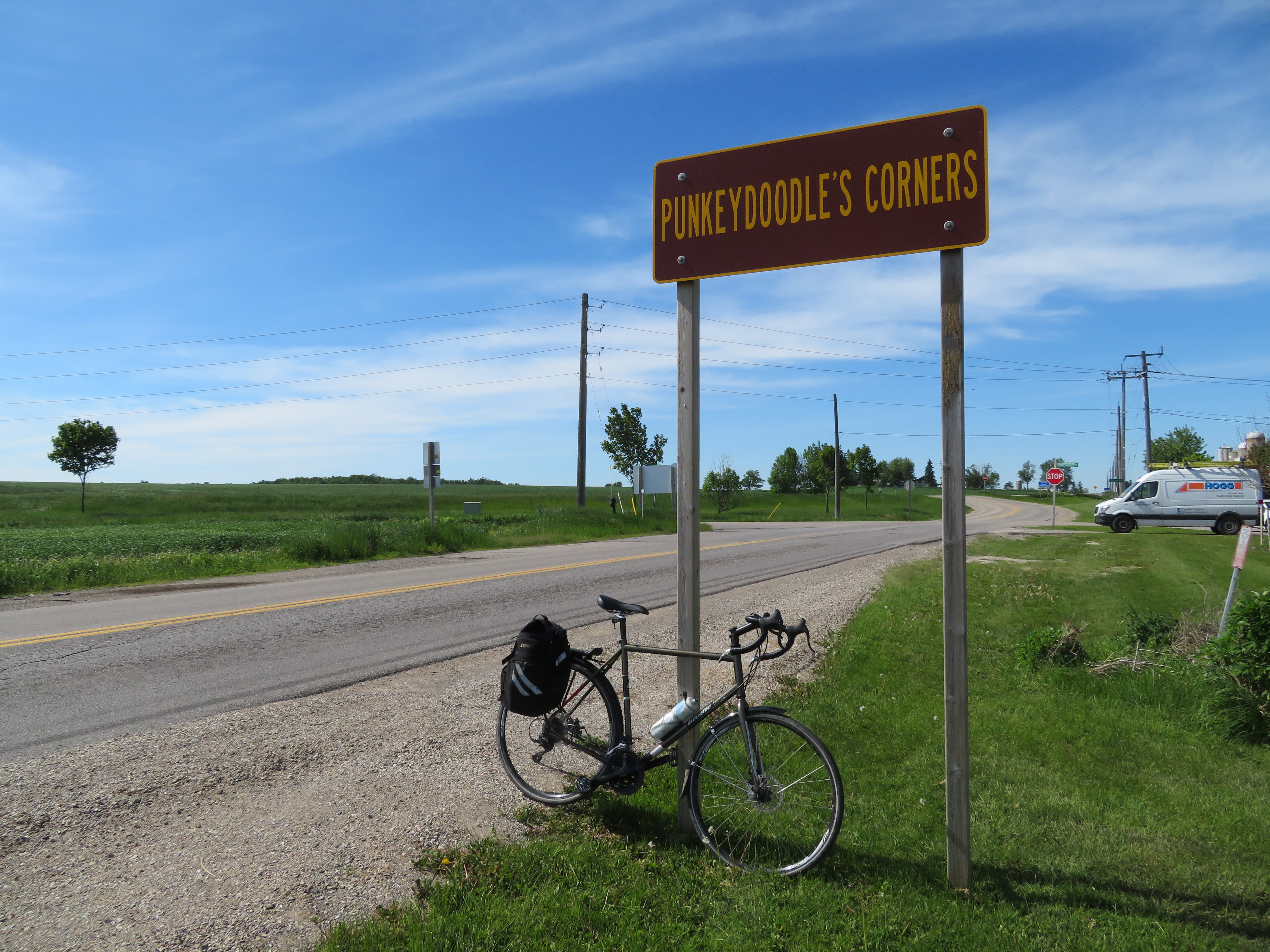
    I biked as far west as the interestingly named hamlet of Punkeydoodle’s Corners, located at the point where Waterloo Region, Perth County, and Oxford County meet.

    Though the origin of the crossroads’ name is not known for sure, the most common theory is that a local innkeeper on the old Huron Road (an early colonization road that connected Guelph with Goderich on Lake Huron) like to sing “Yankee Doodle,” but it sounded more like “Punkey Doodle” to his patrons. The hamlet is now bypassed by Highways 7 and 8, and local business migrated to nearby New Hamburg, located on the railway.

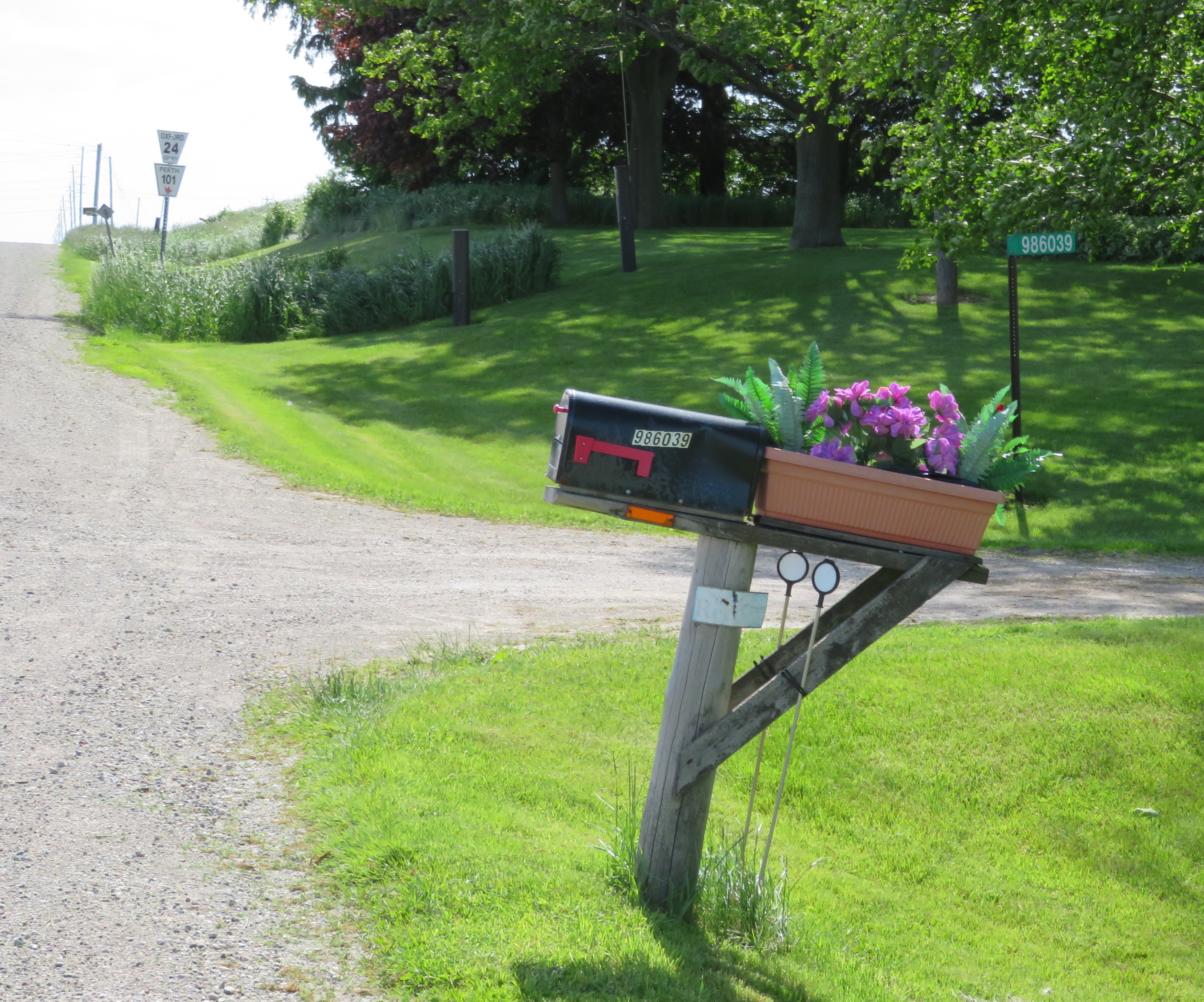
    The Punkeydoodle’s Corners signs are commonly stolen, and one of the signs was obviously missing when I visited. But there’s one more claim to fame: the world’s highest street address number: 986039 Oxford-Perth Road.

    986039.jpg986039 Oxford-Perth Road, a private residence with what is probably the highest numbered address in the world. Road markers for Oxford County Road 24 and Perth County Road 101 are in the background. 
    In many parts of Ontario, rural addresses have a six-digit number, often known as 911 or fire numbers. In Dufferin County, for example, the first two digits refer to the road itself, with each rural road assigned an unique number. Each road is then broken down into sections, represented by the third digit. The last three digits indicate the distance — in decametres — from the beginning of the road section to the property’s entrance, with even numbers on the west or south side of the road.

    Before 911 numbers were introduced, addresses might only consist of a family or business name, rural route number and the name of the village or town with the nearest post office, or by the property’s lot and concession numbers.

    For example, 795112 3rd Line East, Mono, is the address of Mono Cliffs Provincial Park. The number 79, an odd number, has been assigned to the 3rd Line East of Hurontario Street (which runs north-south), while the third digit, 5, represents the section of 3rd Line East north of Mono Centre Road. The entrance to the park is 1.12 kilometres north of Mono Centre Road, on the west side of the road.

    This system allows emergency responders to pinpoint an address quickly and accurately. This is especially important in rural areas, where emergency personnel may be volunteers arriving in their own vehicles. In many parts of southern Ontario, rural roads may simply go by a name, or they may also have a highway or county road number, or still be known by their concession or line numbers. Urban areas, like Orangeville and Shelburne in Dufferin County, have their own numbering systems, separate from the rural 911 addresses.

    Each county may have a slightly different system, but they all have the same purpose. 986039 Oxford-Perth Road just happens to be in the far southeast corner of Perth County, hence its high number. The lowest address numbers in rural Perth County can be found in the northwest corner, near Molesworth.

    It’s worth noting that not all rural areas developed similar numbering systems. In Toronto and York Region, road addresses are based on their origin point. For east-west streets that cross Yonge Street, street numbers start on other side. For example, Yonge Street’s numbering starts at 1 Yonge Street, the Toronto Star Building, and ends at 21137 Yonge Street, where it unceremoniously disappears into the Holland Marsh. 

  • A ride through Midwestern Ontario, Part II

    IMG_6019-001The Cambridge to Paris Rail Trail, part of a network of rail trails that join together in the City of Brantford
    Previously in this blog, I described the first day of a two-day ride through Midwestern Ontario, between Guelph and Kitchener via West Montrose and St. Jacobs. I rode through Ontario’s only authentic covered bridge, along infrastructure created for both cyclists and carriages, and through several picturesque towns and villages.

    Midwestern Ontario is a term that I generally use to describe the part of the province west of the Greater Toronto Area, yet outside the flat, prairie landscapes of Southwestern Ontario (Essex, Lambton, and Kent Counties). The rural landscape is marked by gentle rolling hills, livestock and cash crop farms, as well as cities and towns adjusting to a post-industrial economy. Brantford was once the capital of Canada’s once massive farm implement industry, but now not even the factories remain. Kitchener-Waterloo’s diverse heavy manufacturing concerns have mostly left; but there’s now a strong knowledge economy. Galt (now part of Cambridge) and Paris straddle the Grand River, their grand stone churches and commercial blocks make these some of Ontario’s most picturesque.

    Electric and steam railways — the Grand River Railway, the Lake Erie & Northern, the Toronto, Hamilton & Buffalo, the Grand Trunk, the Canada Southern — tied many of these communities together; now highways do. But many those abandoned railways have found new purpose as hiking and cycling trails; Brantford is at the heart of this new network.

    The second day’s ride, on August 30, took me from Downtown Kitchener, where I stayed overnight, through Cambridge, I then followed the Grand River closely to Brantford. After a stop in Brantford, I took the former TH&B railway corridor into Downtown Hamilton, where I enjoyed dinner and refreshments before loading my bike on a GO Transit bus and rode back home to Toronto. I completed a similar trip in 2012; I wrote about that ride in Spacing.

    Photos and commentary follow.

    (more…)

  • A Simcoe Day ride from Georgetown to Newmarket

    A few weekends ago, on Simcoe Day (Civic Holiday), I cycled a new route, taking 90 kilometre ride between Georgetown and Newmarket. Just over half of the roue took me on the Caledon Trailway, a beautifully-maintained rail trail between Terra Cotta and Tottenham. From Georgetown to Terra Cotta and between Tottenham and Newmarket, I mostly used quiet, country roads. It was a very rewarding trip, one that I will likely redo in the future.

    The Caledon Trailway is one of the most-used rail trails in Ontario, and I encountered many fellow cyclists and pedestrians along the path. For those with cars, there are several convenient parking areas along the route.

    I took the GO Transit bus on Monday, August 3 from Union Station to Georgetown, taking advantage of the bike racks installed on all of that regional transit agency’s buses.  From Newmarket, I took a special summer GO Train that operates between Barrie (Allandale Waterfront Station) and Union Station. Like all non-rush hour GO trains, bicycles are welcomed aboard as well.


    My route between Georgetown and Newmarket

    A few photos and observations follow.

    (more…)

  • Exploring Toronto by bike: A circle tour around the city

    IMG_4182-001A friendly deer passes me as I make my up the Humber River trail

    One of my favourite things to during the summer s taking long weekend bicycle rides. A few of these rides have been multi-day trips, such as the Niagara Region Circle Route tour I took on Victoria Day weekend, or my ride from Hamilton to Port Dover and return last summer, but many have been day trips. Hamilton is one of my favourite destinations; it’s about 85 kilometres from my home to Downtown Hamilton via the Waterfront Trail, Burlington Beach and the Cannon Street cycletrack. I’m not a terribly fit cyclist, and I take many breaks (for a late lunch, to take photos, or for rest) but if I leave home by 11 AM, I’ll be in Hamilton around 6 or 7 PM. For me, it’s all about enjoying the ride; when I ride alone, I find that it’s great alone time.

    But you can stay in the city and enjoy a long, leisurely ride. There are many reasons why you might want to stay in Toronto: there’s no need to carry a repair kit; you’re never too far from a TTC bus route (all buses are equipped with bike racks) if you need to end the ride early for any reason. And it’s a great way to explore the city.

    I recently spent a Sunday afternoon going for a nearly five-hour ride, a circle route from my downtown apartment back downtown, following the Humber River, the new Finch Hydro Corridor path, and the Don River, a 73-kilometre ride in total. I stayed away from Lake Ontario, avoiding the PanAm Games-related detour and general chaos near Exhbition Place.

    I passed by historical landmarks, made multiple crossings of the Humber and Don Rivers, rode through dozens of parks and swallowed at least a few flies. The Humber Trail even makes use of the long-abandoned Toronto Suburban Railway; it makes use of the piers that once supported that electric railway’s trestle over the Humber River.

    The map below illustrates the route that I took, which brought me through five of the six former municipalities that were joined to create the City of Toronto (sorry, Scarborough).

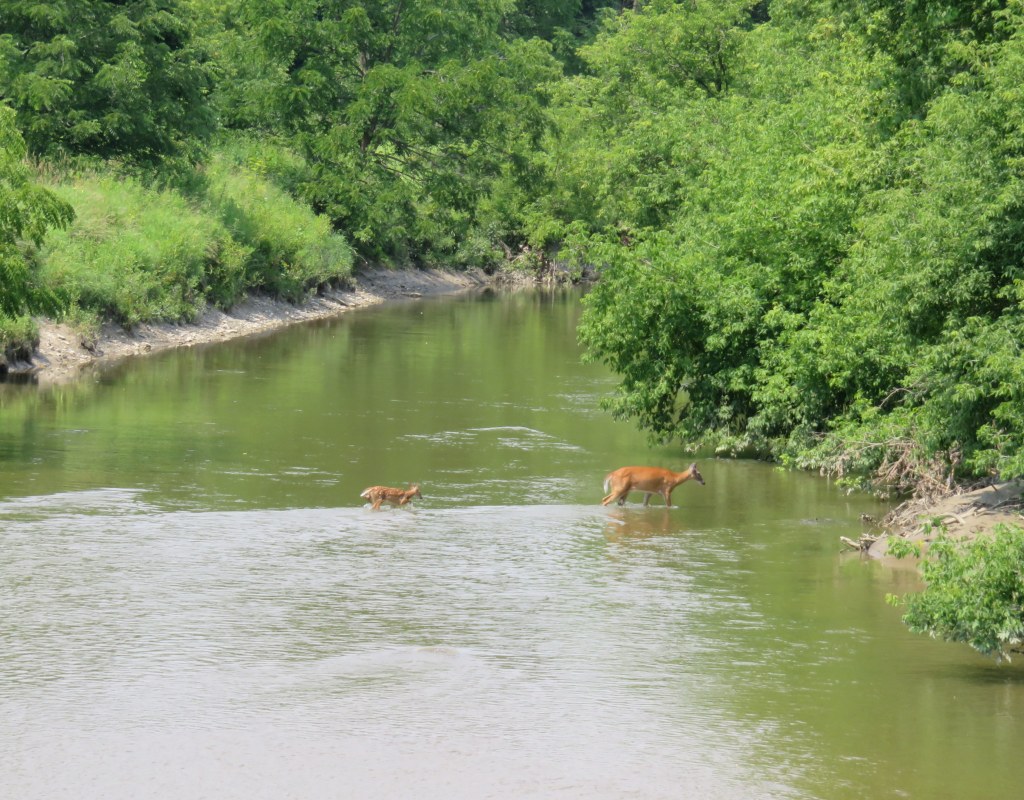
    I often see wildlife when I ride outside Toronto, but I did not expect come so close to it on this trip. But along the Humber River Trail, north of Highway 401 and Albion Road, a youngish deer was wandering down the path, grazing. I stopped my bicycle and just watched, the deer kept coming closer, cautiously walking right past me. Only a few hundred metres north at one of many trail crossings of the river, I spotted a doe and a fawn crossing.

    IMG_4187-002Deer fording the Humber River
    With the completion of the Martin Goodman Trail on Queen’s Quay, it’s almost possible to complete this circle route without riding on city streets. But there are several minor gaps (such as the Lower Humber Trail at Stephen Avenue in Etobicoke) and some very aggravating gaps.

    One of the worst gaps in Toronto’s recreational cycling network is between the Humber River trail and the Finch Hydro trail, where there is simply no safe cycling route to bridge this 3.5 kilometre distance. I survived cycling under Highway 401 on Finch Avenue, but it is not an experience that I advise doing on your own. However, the newly-constructed connection between the Finch corridor and the East Don River trail was seamless and pleasant.  There’s a gap on the East Don trail between Duncan Mill Road and Don Mills, but it is well signed; happily, this will be partially fixed with an extension of the Don Mills trail to York Mills Road.

    The Humber Trail-Finch Hydro Corridor Trail gap in North York

    IMG_6836
    One of the scariest places that I have ever cycled. 

    Happily, these gaps that I mention are on the City of Toronto’s radar. The city is in the process of updating its cycling network plan; city staff, along with consultants IBI group and Vélo Québec, are looking for comments on the new draft cycling project map. There are many other opportunities to improve cycling connections for recreational and utilitarian cycling; I encourage you to have your say.

    Below, a few more photos on my ride around Toronto.

  • Riding the Niagara Circle Route

    17959785808_ed39cf7cad_kThe Friendship Trail, part of the the Greater Niagara Circle Route

    Back on Victoria Day weekend, I took advantage of GO Transit’s summer weekend train service to go for a two-day ride around Niagara Region, on a circle to and from Niagara Falls via the Niagara River, the Welland Canal, and a rail trail connecting Port Colborne and Fort Erie, a circle tour of just under 150 kilometres over those two days.

    For several years now, special GO trains operate on weekends and holidays from Canada Day weekend to Labour Day weekend; and on Victoria Day and Thanksgiving weekends. On the Niagara trains, GO operates two specially-equipped cars with bicycle storage on the lower levels to accommodate cyclists looking to get out to this bicycle-friendly corner of Southern Ontario.

    Day 1 – Niagara Falls to Port Colborne

    I cycled from the GO train at Niagara Falls, down and up the Niagara Escarpment, mostly following the official Greater Niagara Circle Route, stopping at Brock’s Monument, Queenston, Niagara-on-the-Lake for food and libations, then to the Welland Canal and following that to Port Colborne. There are many historic sites and wineries along the way to visit, and you’re likely to spot several lake and ocean-going freighters along the way in the canal. Except for the escarpment, the ride is very flat and forgiving to the less experienced cyclist.

    Port Colborne, about half-way on the two-day ride, is a lovely place to stay overnight; there are several good bed and breakfasts that welcome cyclists, as well as a few good food options downtown. Several people, including the B&B host, recommended an Asian-Mexican fusion restaurant located in an old railway station. That busy little place also had bike racks and a bike repair stand provided by a well-known independent Toronto brewery.

    Port Colborne is now the home of the Jadran, better known as Captain John’s, as it awaits scrapping.


    (more…)