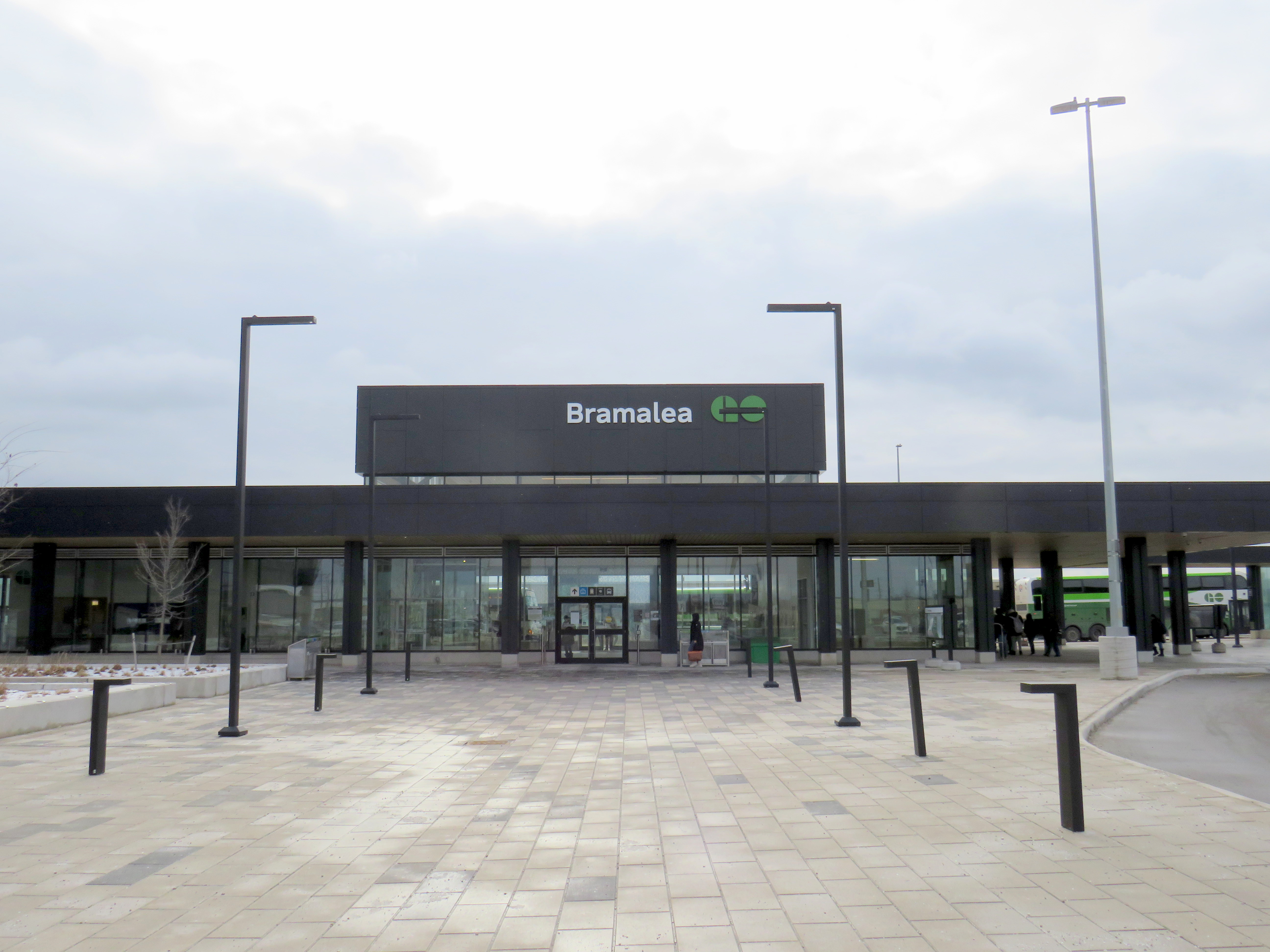
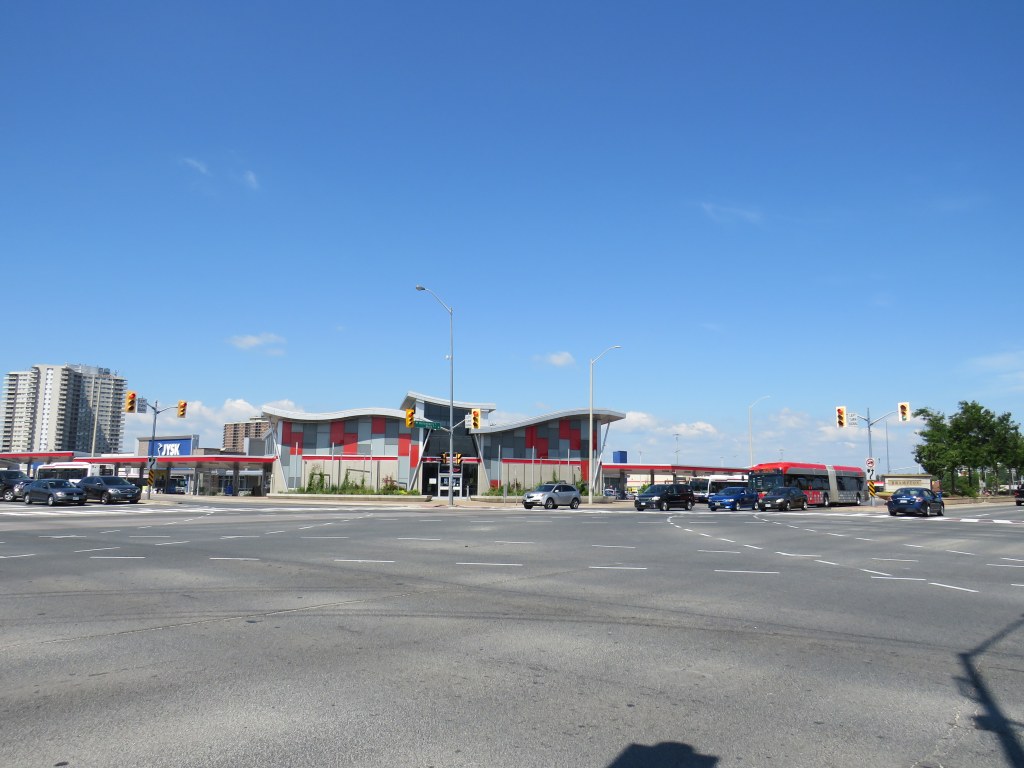
But in January 2023, I returned to Bramalea GO Station and came away feeling satisfied. Metrolinx has finally built a Bramalea GO Station that works. Now it is time to use the rebuilt station to its full potential.
The Metrolinx parking lot at Elizabeth and Railroad Street is nearly complete
Over the last few years, I have followed the purchase and demolition of over a dozen houses in Downtown Brampton, in the block bounded by George, Nelson, Elizabeth, and Railroad Streets. Metrolinx, the provincial transit planning and operating agency, acquired the block for a new surface parking lot for the neighbouring GO Transit station.
At first, the parking lot was intended to replace parking spaces lost due to construction of a new post-secondary education campus — a joint venture between Ryerson University and Sheridan College — on the main GO Station lands. Though the provincial government pulled funding for the campus in the fall of 2018, Metrolinx continued work on the parking lot, completing the demolition, clearing the land, and building the parking area.
Now, it is possible that the parking lot will never open.
At the Brampton City Council meeting on January 26, 2022, councillors considered a request by Rogers for two Minister’s Zoning Orders (MZOs) in order for it to relocate its existing Brampton offices at 8200 Dixie Road in Bramalea to a new build in Downtown Brampton. The particular property Rogers looks to acquire for its new campus is the same one Metrolinx acquired, cleared, and partly constructed its new parking lot.
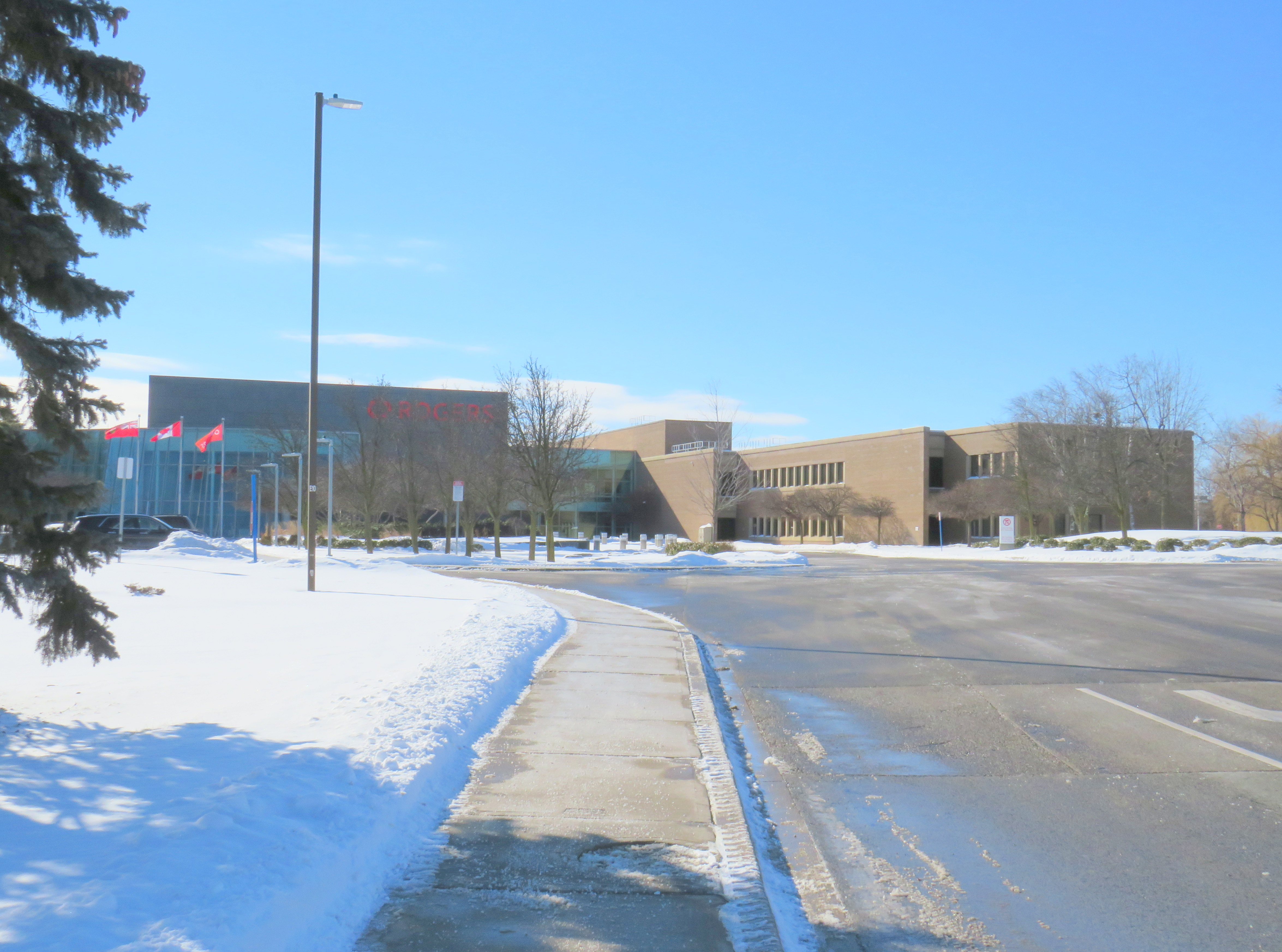
Part of the existing Rogers campus at 8200 Dixie Road
The property at 8200 Dixie Road was built in the 1963 as a Northern Electric (later Northern Telecom) plant, which produced switchboards and other telecommunications equipment. In 1995, the plant closed, and the building was refurbished to become the headquarters for Nortel Networks. In 2005, during Nortel’s infamous fall into bankruptcy, the property was sold to Rogers, which uses it today for its business operations and technical offices, with 3,000 workers stationed there.
Rogers is interested in the downtown site for several reasons. The new campus would be adjacent to several transit links, including the GO Transit Kitchener Line, with links to Downtown Toronto (where Rogers has its head office) and the Kitchener-Waterloo technology hub. In its submission to the city, Rogers also notes the proposed LRT extension into Downtown Brampton (now in the design phase, either as a tunnel or a surface route) and planned bus improvements. Though it is served by Brampton Transit, the 8200 Dixie Road site is almost entirely dependent on its employees driving to work.
The new Rogers downtown site would support Brampton’s goals of becoming a cybersecurity centre of excellence and landing a major postsecondary education campus — Ryerson University continues to be interested in expanding in Brampton and the University of Guelph has expressed interest in relocating its Humber College presence to Brampton to better serve its student base.
There are also several development proposals for Downtown Brampton. The City of Brampton is still planning to build a new Centre for Innovation to support education and business development. The new facility, located adjacent to the downtown transit terminal, will include a new central library. New highrise developments will bring thousands of new residential units to downtown Brampton, walkable to local businesses, the GO station, and Rogers’ planned new campus.
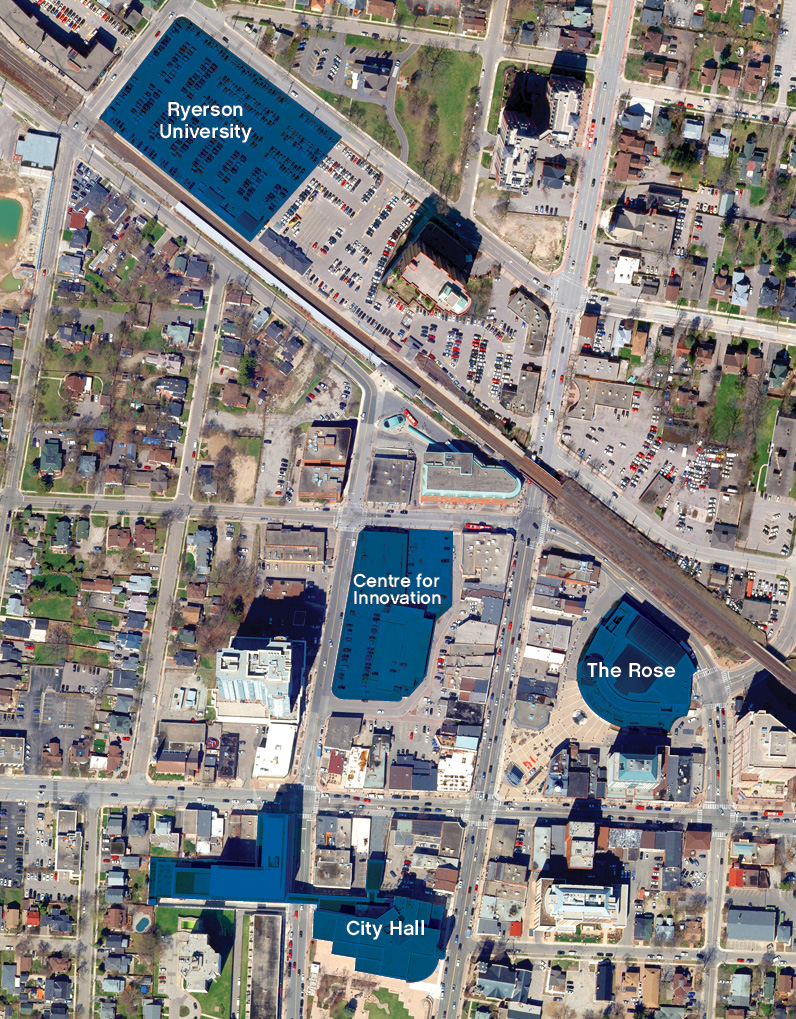
Map of Metrolinx/Rogers lands in Downtown Brampton, with surrounding active development plans
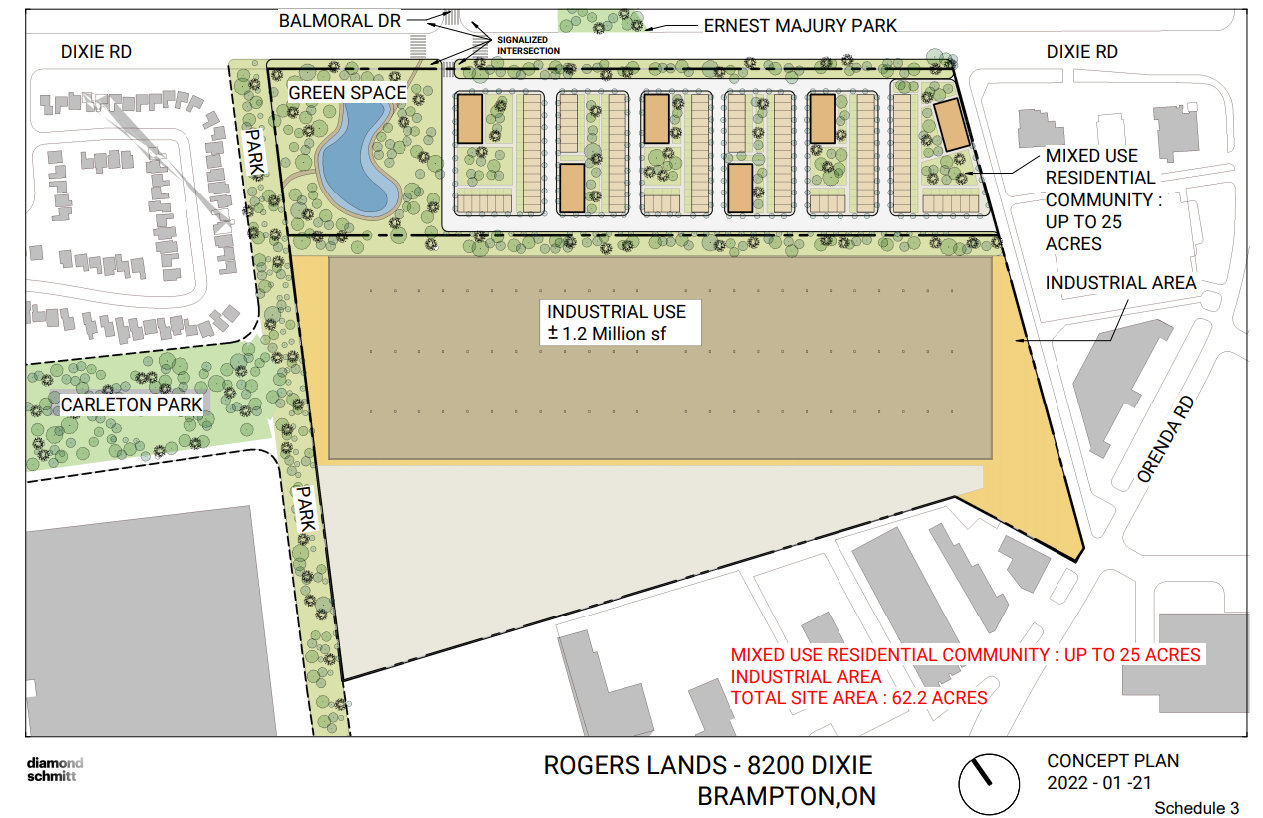
The new office campus — proposed to be 200,000 to 500,000 square feet — would have a smaller footprint than the Dixie Road site. By relocating its offices, Rogers would then be free to sell or redevelop the old Nortel lands for housing and new industrial uses, likely for warehousing and logistics. The development of the old land would certainly finance the new property.
Proposed redevelopment of the Rogers lands at 8200 Dixie Road, with mixed residential development on the east side, towards Balmoral Drive, and new industrial uses on the west side.
Rogers wanted municipal support for the MZOs so it could move quickly towards designing its new office complex. In response to a question from council, Rogers indicated that it had already been talking with Metrolinx about purchasing the land, and that Metrolinx itself was supportive. Mayor Patrick Brown indicated that he has been speaking with Metrolinx CEO Phil Verster, and that Metrolinx would submit its own letter of support.
MZOs have a controversial reputation. In Ontario, the Minister of Municipal Affairs has the authority to issue a zoning order over any property that overrides the normal zoning process. Traditionally, MZOs have been used infrequently, often in an emergency situation (such as after a disaster, such as the collapse of the Algo Centre Mall in Elliot Lake), or to fast track the construction of a major employer or housing development, typically issued at the request of the municipality.
The Doug Ford-led Progressive Conservative government have issued MZOs much more frequently, often for projects with significant opposition. This included the site of a proposed Amazon warehouse on the Pickering/Ajax border, which was strongly opposed by environmentalists and Ajax politicians, yet supported by Pickering officials. Meanwhile, a MZO requested by the City of Toronto, for an affordable housing project in North York, has yet to be issued. (It is worth noting that the project is in a PC-held riding, represented by Associate Minister of Transportation Stan Cho.)
But, in this case, with a unanimous vote of endorsement from Brampton City Council, with support from Metrolinx and local business groups the new Rogers relocation should prove to be less contentious than other recent MZOs.
There are still a few questions that will have to be answered in due time:
Will Metrolinx be able to provide all-day, two-way GO train service to Downtown Brampton by the time Rogers is ready to relocate its Brampton operations? Right now, the Kitchener Line is constrained through Brampton as it uses a busy CN freight corridor. A third track and platform at Downtown Brampton will be needed to support commuters arriving from Toronto in the morning. Though the planned new transit hub at Main and Nelson Streets will support this expansion, work has yet to begin on that project, including a temporary bus facility as the old terminal and office building above is demolished.
Will Brampton agree on the Main Street LRT extension, whether it will be in a tunnel or at-grade in Downtown Brampton? If so, will it be able to secure funding from the province and the federal government? As transit access is key for Rogers’ proposal, and for potential new educational instructions, closure on this long-running matter is important.
How many workers will be on site at Rogers’ new complex? Though 200,000 square feet will be enough space for about 1,000 employees, which is just one-third of its Brampton workforce. Perhaps Rogers is looking towards a hybrid model of work, where employees are on site only part-time.
Finally, it is interesting how Metrolinx, a public agency, was determined to assemble land and build a new parking lot, only to see that land sold to a large private company. However, having major employers located adjacent to regional transit hubs is a good thing, especially as it represents a shift away from GO’s traditional model of transporting commuters to Union Station in the morning and back to the suburbs in the afternoon.
For Downtown Brampton, Rogers’ plans for relocating to the urban core is a badly-needed shot in the arm. Locating a major employer to the core will support existing and new businesses. After many attempts to revitalize downtown, this latest plan might be the catalyst that changes everything.
The current end of track of the once-important Owen Sound Subdivision, on the outskirts of Orangeville. Beyond, a new paved trail occupies the former right-of-way.
On Townline Road on the south end of Orangeville, across the street from the old railway yard and station grounds, two plaques stand, telling the history of the doomed railway next to them.
The first plaque, a faded provincial marker, commemorates the Toronto, Grey and Bruce Railway, which arrived in Orangeville in 1871 and completed to Owen Sound in 1873. The TG&B was combined with the rival Credit Valley Railway by the Canadian Pacific Railway, and Orangeville became the headquarters of a network of branch lines known as the CP Bruce Division. Passenger service to Owen Sound via Brampton and Orangeville continued until 1970.
The second marker, installed by the Town of Orangeville, commemorates the municipal takeover of the remnants of the Bruce Division, after CP abandoned all track west and north of Orangeville in the 1980s and 1990s. The plaque proudly boasts of a “successful passenger tourist operation” and how the new short line “enhanced opportunities for the long-term economic development of the region.”
The municipal plaque is sadly out of date. The Credit Valley Explorer tour train last operated in early 2018, and the Town of Orangeville lost interest in operating the railway, which was costing the municipality $450,000 a year. The last freight train departed Orangeville on Friday, December 17, 2021.
Toronto, Grey and Bruce Railway plaqueOrangeville-Brampton Railway plaque
Together with Dr. Brian Doucet, Canada Research Chair in Urban Change and Social Inclusion at the University of Waterloo, I toured the line in its waning days. At TVO.org, Doucet and I argue that the corridor is worth preserving, even if the Town of Orangeville is no longer interested in paying for the railway. We note how the province is looking to build a new highway through the very same lands that the dying railway cuts across.
Additional photographs and videos of the once-proud Orangeville and Brampton Railway can be found below.
The intersection of Steeles Avenue and Main and Hurontario Streets
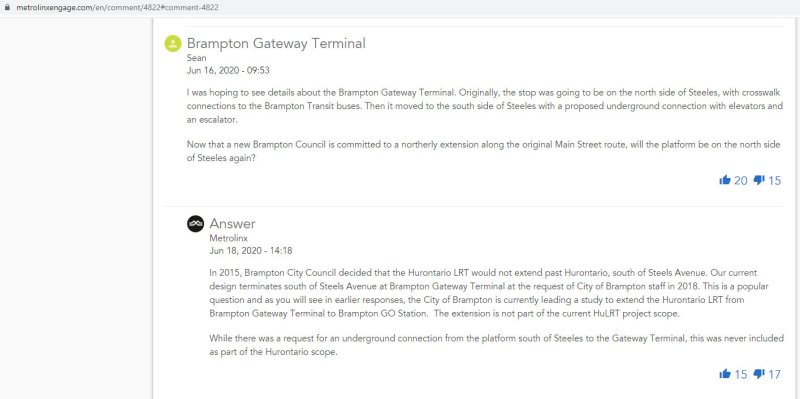
Last year, I wrote about a foreseeable problem coming to the corner of Steeles Avenue and Hurontario and Main Streets in Brampton: the planned Hurontario LRT terminus, to be located on the south side of Steeles Avenue, would require thousands of commuters to transfer to Brampton Transit buses on the north-west corner of the intersection.
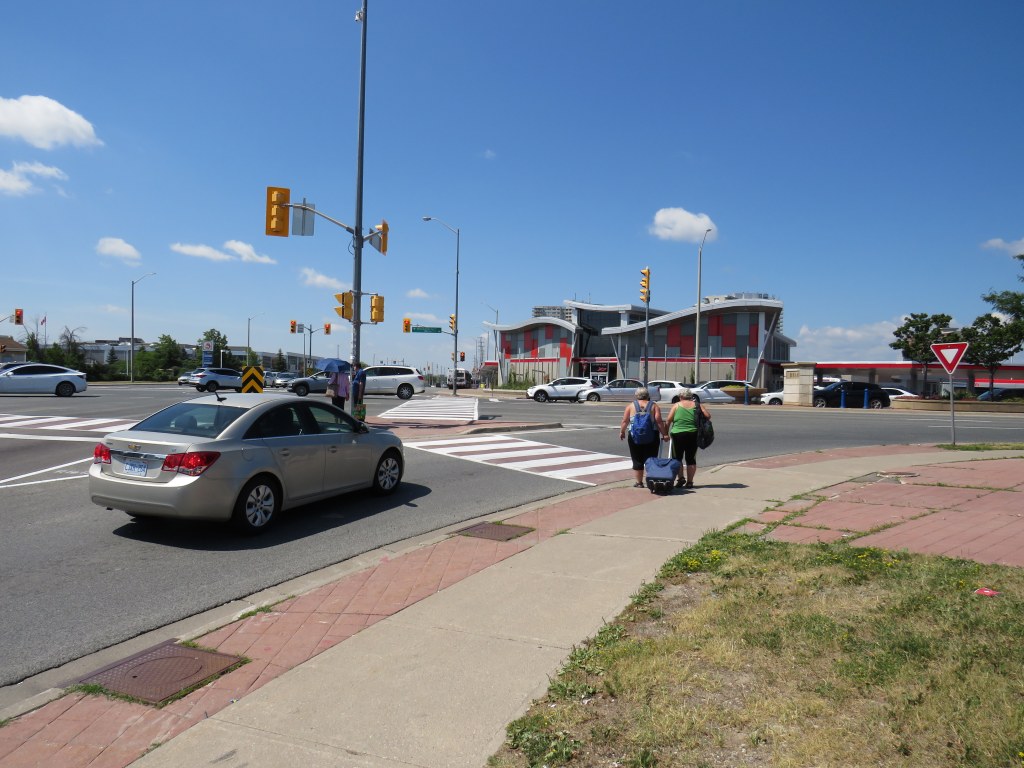
This transfer would require crossing ten or eleven lanes of traffic at one of Peel Region’s busiest intersections, with crowding at the street corners, with passengers awaiting a walk signal two separate times to make the necessary connection.
After twice receiving unsatisfactory answers at a Metrolinx online town hall, and hearing no information about how the crossing at this intersection might be mitigated, on March 9, 2021, I took the step of making an Access to Information Request to Metrolinx under the province’s Freedom of Information and Protection of Privacy Act asking for communications between Metrolinx, the Ministry of Transportation, Mobilinx (the consortium awarded the contract to build and operate the LRT), and the City of Brampton.
I received a package with the requested materials from Metrolinx on July 29, 2021. The request cost me $360.00, plus a $5.00 application fee. Communications from Metrolinx’s privacy officer were professional, friendly, and very helpful.
Through my request that covered the dates December 1, 2018 to March 11, 2021, I obtained several letters from Brampton officials, including City Councillor Gurpreet Singh Dhillon, Director of Transportation Special Projects Chris Duyvestyn, Chief Administrative Officer David Barrick, and Mayor Patrick Brown to Metrolinx and Ministry of Transportation Officials requesting restoration of the north side stop at Steeles Avenue/Brampton Gateway Terminal. I also obtained replies from senior Metrolinx staff, including President and CEO Phil Verster and the Deputy Minister and the Minster of Transportation.
What is the communications reveal is that decisions made during the 2014-2018 term of Brampton Council significantly tied the hands of everyone involved — both at the City of Brampton (which reversed its previous decisions when a new council was elected in October 2018) — and at Metrolinx, which was quickly working towards finalizing the contracts to construct the transit project. Unfortunately, important details, such as the final configuration of the Steeles-Hurontario/Main intersection, remain unknown. Neither Metrolinx nor the Ministry of Transportation, which funds Metrolinx, appear to grasp the problems that will be caused when thousands of commuters have to cross two major streets at an especially busy intersection.
Despite Brampton’s work since December 2018 to move the Brampton Gateway stop back north of Steeles Avenue, including formal requests to Metrolinx and the Ontario Ministry of Transportation (MTO), and despite a similar request from RioCan, owner of the massive Shoppers World Mall property at Main Street and Steeles Avenue, Metrolinx and the province have held firm in their decision.
While Metrolinx and the MTO cite the difficulties of reopening a project which was getting underway, and concerned about setting precedents for other changes to the Hurontario LRT or other transit projects, this would still be a minor change, costing just $15 to $20 million according to a 2020 letter from Metrolinx CEO and President Phil Verster to Brampton Mayor Patrick Brown.
Sadly, transit riders in Brampton – who do not have affluence or political might — have been left in the middle of this political back-and-forth between municipal politicians, the province, and Metrolinx. They will be forced to endure a more difficult transfer between LRT and bus than anything proposed to them in public consultations.
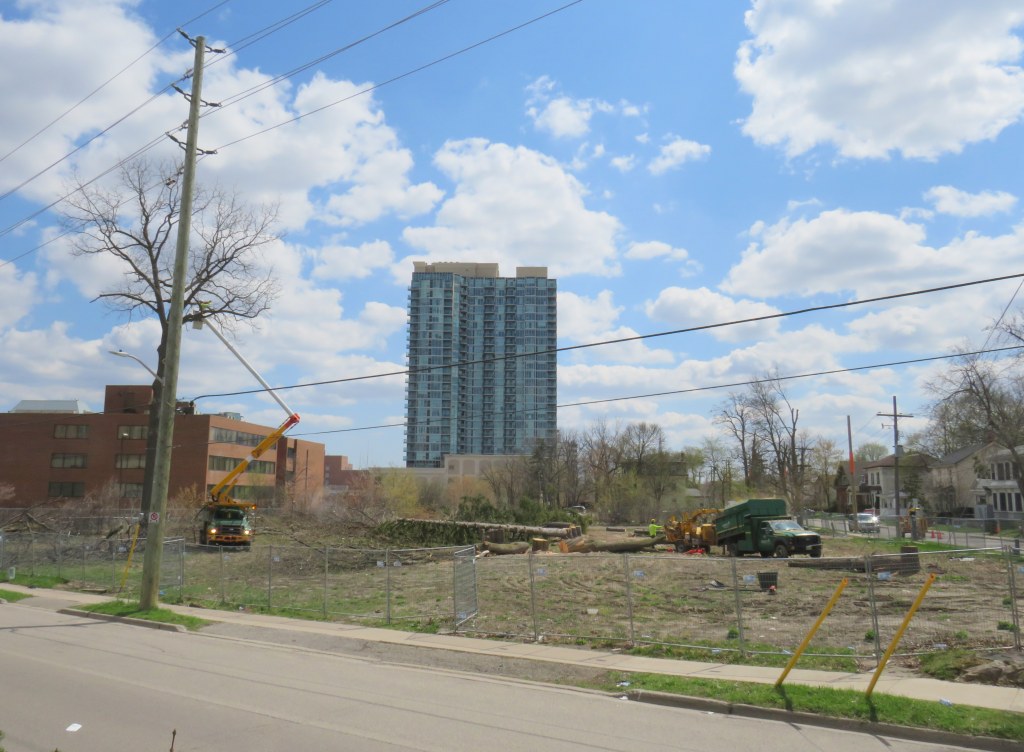
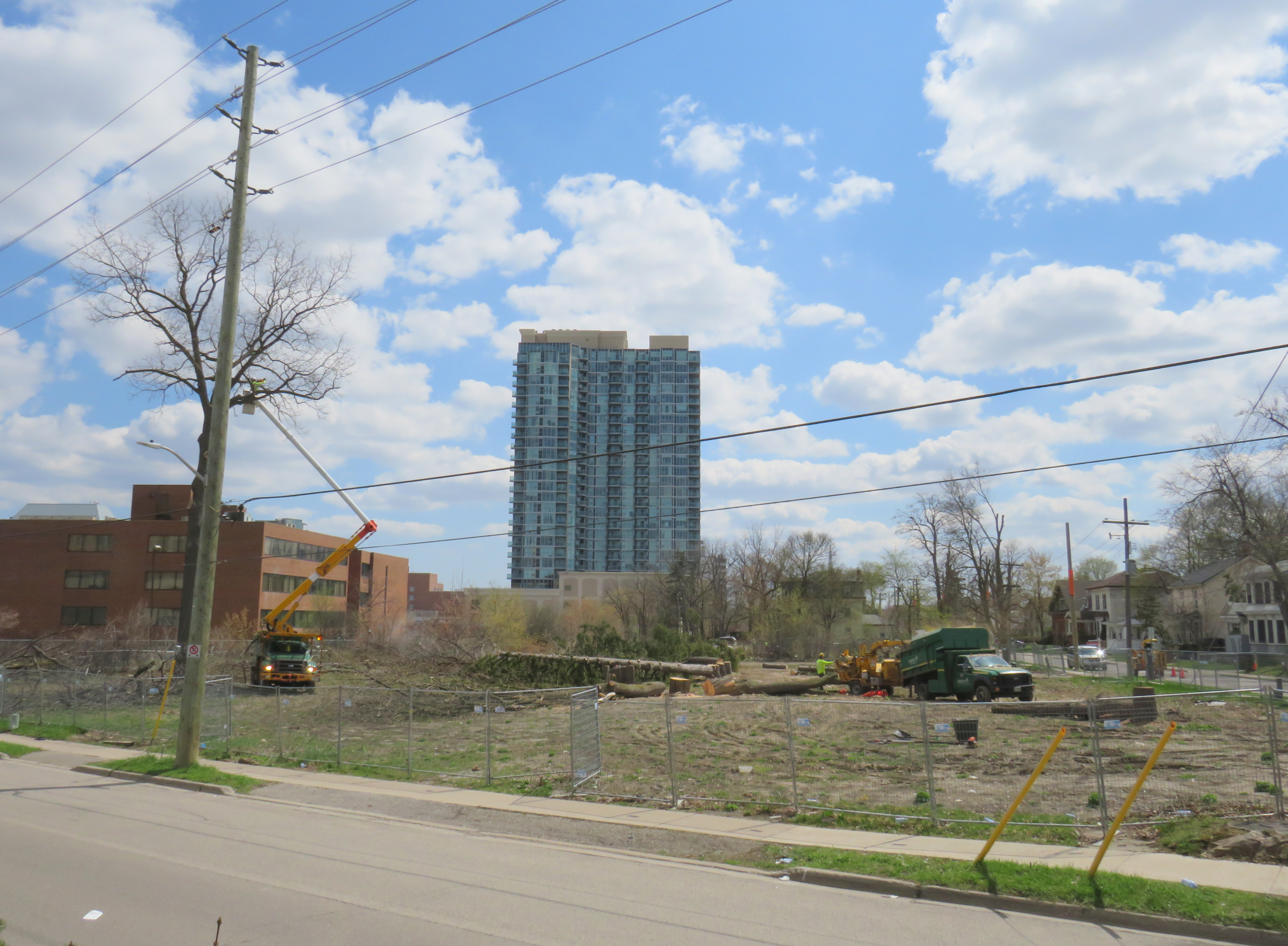
Cutting down trees to make way for a surface parking lot in Downtown Brampton
Earlier this April, contractors hired by Metrolinx cut down trees on its Downtown Brampton property, where twelve houses once stood. The work, originally scheduled for the week of March 22, did not begin until April 12.
The tree removal brings Greater Toronto’s regional transit operating and planning authority one step closer to building a new 200-plus surface parking lot in a city that hopes to renew its downtown core.
Starting in 2016, Metrolinx purchased over a dozen homes along with two four-storey office towers in an area bounded by Railroad, Nelson, and Elizabeth Streets, immediately south of the Brampton GO Station. It vacated and demolished the houses between 2016 and 2019, and left the two office buildings vacant. Metrolinx’s plan was to build a new surface parking lot to expand parking capacity, though in early 2018, the Liberal provincial government announced a new Ryerson University/Sheridan College campus on the existing main parking lot on the north side of the station. Metrolinx’s acquisition of occupied homes — including heritage-listed buildings and a rooming house — made more sense.
After the election of a new Progressive Conservative government led by Doug Ford, funding for the educational campus was pulled, though the City of Brampton and Ryerson University continued to advance plans for the downtown area. The city bought up more of the downtown core, including the southeast corner of George and Nelson Streets, across from the vacated office buildings, as well as the thirty-year old office building at 2 Nelson Street West, below which is the Brampton Transit downtown terminal. These newly acquired lands would be home to a larger bus terminal that would link to an expanded GO station and a proposed extension of the Hurontario LRT, and an Innovation Centre that would serve the education campus and include a new central library.
The old plans for the Ryerson Unversity/Sheridan College building on the GO Transit parking lot, and a Centre for Innovation on the southeast corner of George and Nelson Streets. The Metrolinx lands are in the block between the Centre for Innovation and the GO Station/proposed Ryerson building
Already, there are several high-rise developments in the downtown area under construction or in the planning phase. More development lands will be unlocked with the Riverwalk project, which will improve flood protection along Etobicoke Creek while providing an improved public space.
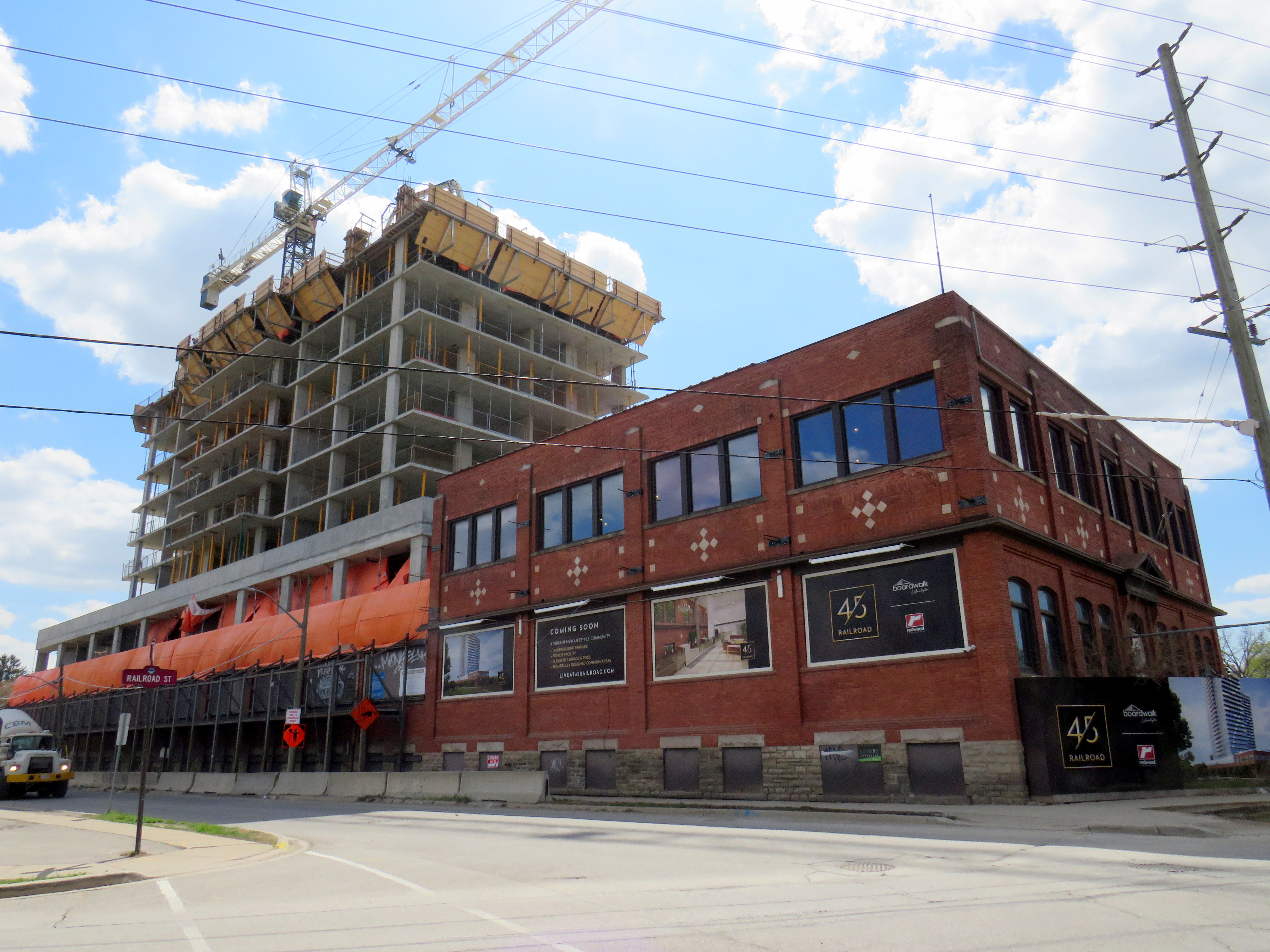
A two-tower rental highrise development is progressing on the old Dominion Skate Factory lands, across the tracks from the GO Station, bringing hundreds of new residents to the downtown core and right to the station.
Given Brampton’s urban aspirations for its downtown core, another surface parking lot — adding 200 spots to the existing 861 spaces — is not the right idea.
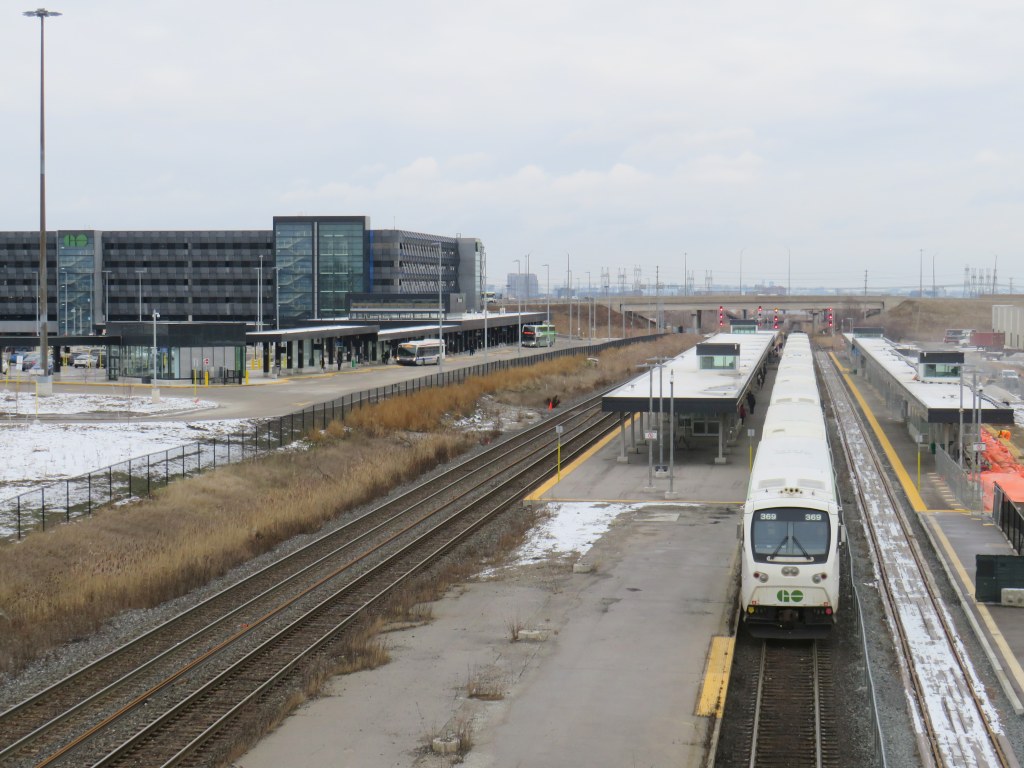
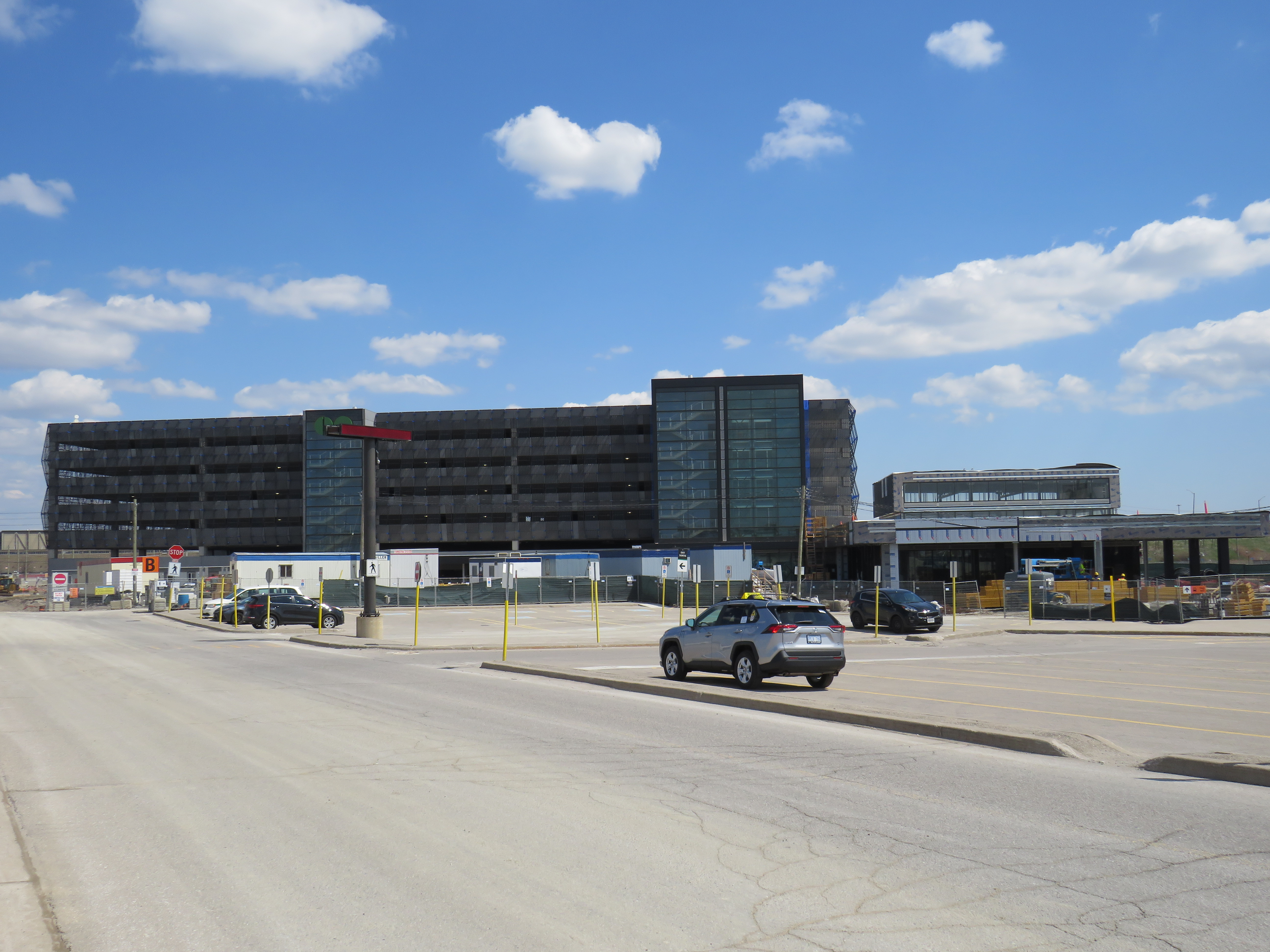
At Bramalea Station, construction has nearly finished on a 1,300 spot parking garage, part of a larger project that also includes a new, larger station building, a larger bus terminal, additional pedestrian tunnels, and improved platforms and security features. Bramalea already has over 2500 parking spaces, but unlike in Downtown Brampton, this is a logical space for parking expansion. The station is surrounded by warehouses and factories, at the intersection of two major truck routes, and close to highways. It is not a place that is easily urbanized. However, improved pedestrian and cycling access is very much warranted.
New garage nearly complete at Bramalea GO Station
With the expansion of parking at Bramalea GO, why is Metrolinx eager to add another parking lot in Downtown Brampton, especially with Ryerson’s downtown plans on hold?
Brampton Gateway Terminal from the southeast corner of Hurontario Street and Steeles Avenue, Brampton
Last month, Metrolinx held a virtual open house to present information on the progress of the Hurontario LRT project, planned work, and details on some of the stops along the line. For now, roadwork is limited to median removal and utility relocation, but by next year, heavy construction will commence along the 18-kilometre long corridor.
If Metrolinx goes ahead with their plans for a minimal station on the south side of the intersection, anyone connecting between modes will be forced to cross two sides of a busy, hazardous intersection at grade, impacting both accessibility and safety. We can thank politicians on the 2014-2018 Brampton City Council for this situation, which provide just one of many examples of how systemic racism manifests in transit decision making.
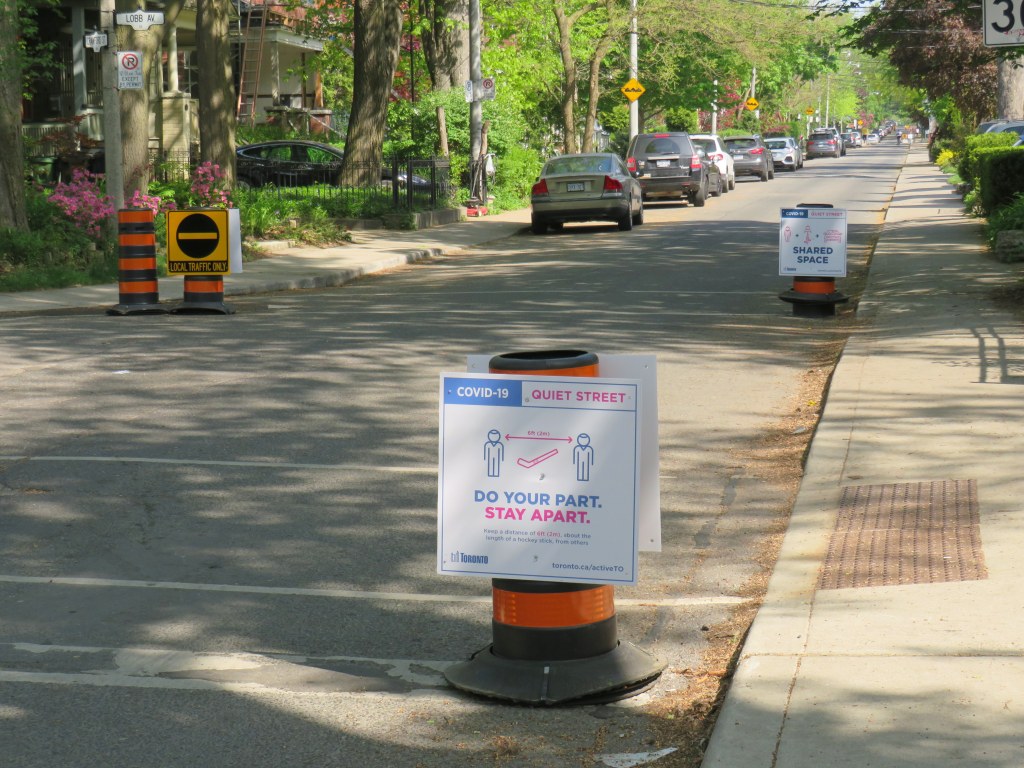
Pylons and Quiet Street signage left in the gutter, Crawford Street, Toronto
Toronto took its time recognizing the need for pedestrian space during the ongoing COVID-19 pandemic. It wasn’t until late April that the mayor and the medical officer of health considered limited curb lane closures to accommodate crowded sidewalks in front of supermarkets, drug stores, and other essential businesses.
But those curb lane closures — called CurbTO — later expanded to ActiveTO, which includes hundreds of kilometres of “Quiet Streets” for pedestrians and cyclusts and regular weekend road closures on Lake Shore Boulevard and Bayview Avenue. By June, CurbTO and ActiveTO were joined by CafeTO — which would expedite restaurant patio licences and even allow temporary patio space in parking lanes — as well as CampTO and SwimTO, programs to safely open up public pools and day camps for the summer.
Most significantly, new cycle tracks and bike were approved by a wide margin at Council in May, including the entire stretch of Bloor-Danforth between Runnymede Road and Dawes Road.
Map of ActiveTO Quiet Streets, weekend closures, and new cycling routes
Through the weekend road closures are closed off with metal barriers and enforced by police, the Quiet Streets are protected only by pylons and temporary signage. On Shaughnessy Boulevard, one of the first Quiet Street implementations, pylons were removed by angry motorists. Elsewhere, residents rearranged pylons to block half the street, doing more to discourage through traffic.
In Kensington Market, pylons were moved by drivers onto the sidewalk, creating additional barriers to pedestrians, especially those with disabilities.
Kensington Market, where many of the share-the-road pylons have been moved to the gutter or onto the sidewalk pic.twitter.com/ylnx0ZrfDa
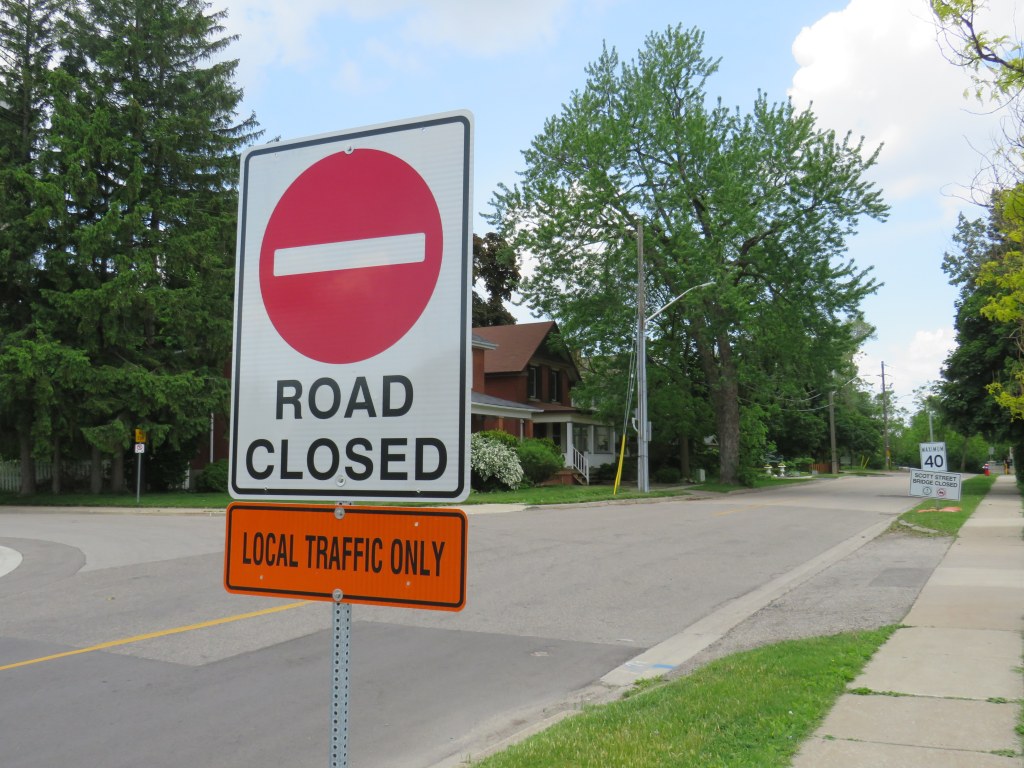
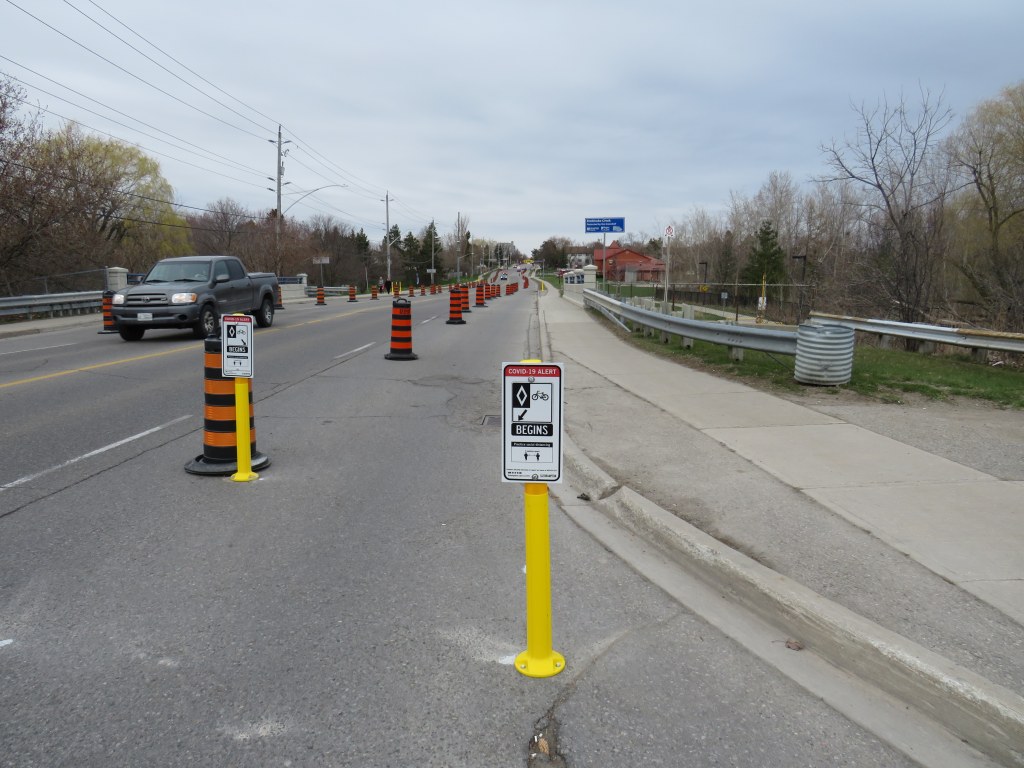
While I was in Brampton recently, I noticed a more effective approach. On Scott Street, just east of the city’s downtown core, a narrow bridge was closed to motor traffic in order to provide a quiet and safe crossing of Etobicoke Creek to connect two sections of the Etobicoke Creek Trail. Instead of moveable pylons, rigid plastic bollards were bolted to the roadway, with a compliant “road closed” sign posted in the middle.
Closely spaced yellow bollards on Scott Street
Signage approaching the closed bridge was also also quite clear.
Road closed sign on Scott Street
I also noted that bolted bollards were also used to mark the interim bike lanes on Vodden Street and Howden Boulevard at every intersection, precluding their use by through traffic. On that early weekday afternoon, only one vehicle was illegally parked in the lane along the entire four-kilometre route. Not one pylon was out of place either.
While Brampton was one of the first cities in Ontario to implement improved active transportation infrastructure during the COVID-19 pandemic, it has done little else since. However, Brampton has an ambitious new active transportation master plan to fix many gaps in its cycling infrastructure and expand its paths system; hopefully it will able to accelerate parts of its plan as Toronto is now doing.
But what Brampton did right was putting in effective barriers and signage to protect its temporary walking and cycling routes. This is something Toronto could learn from.
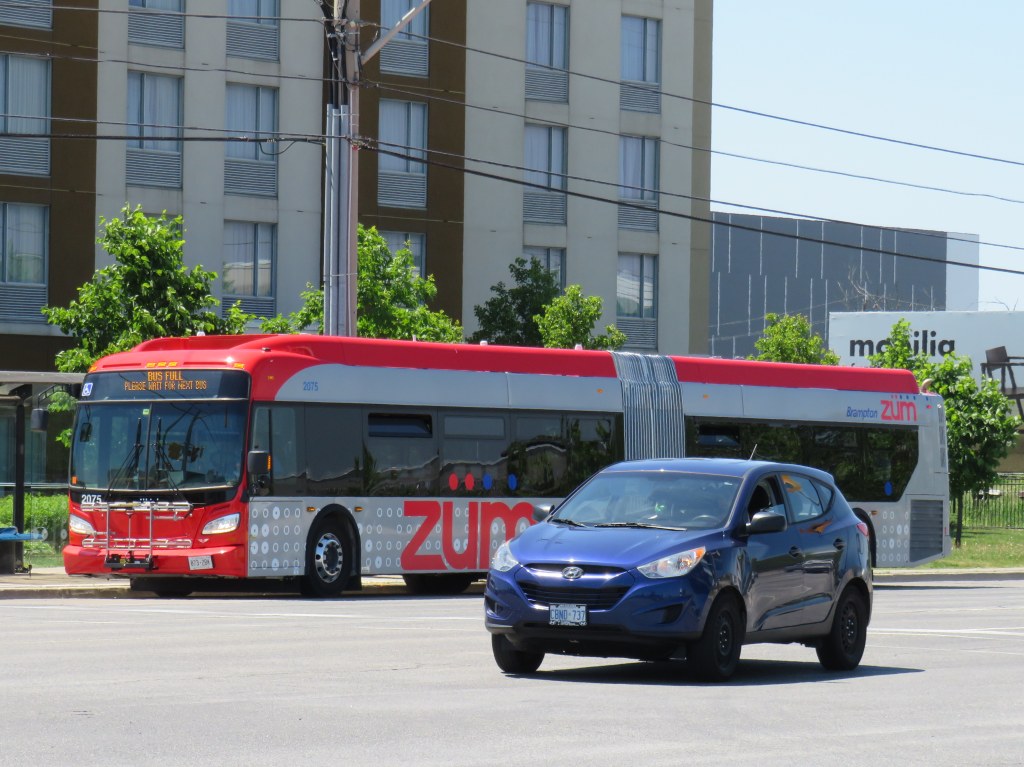
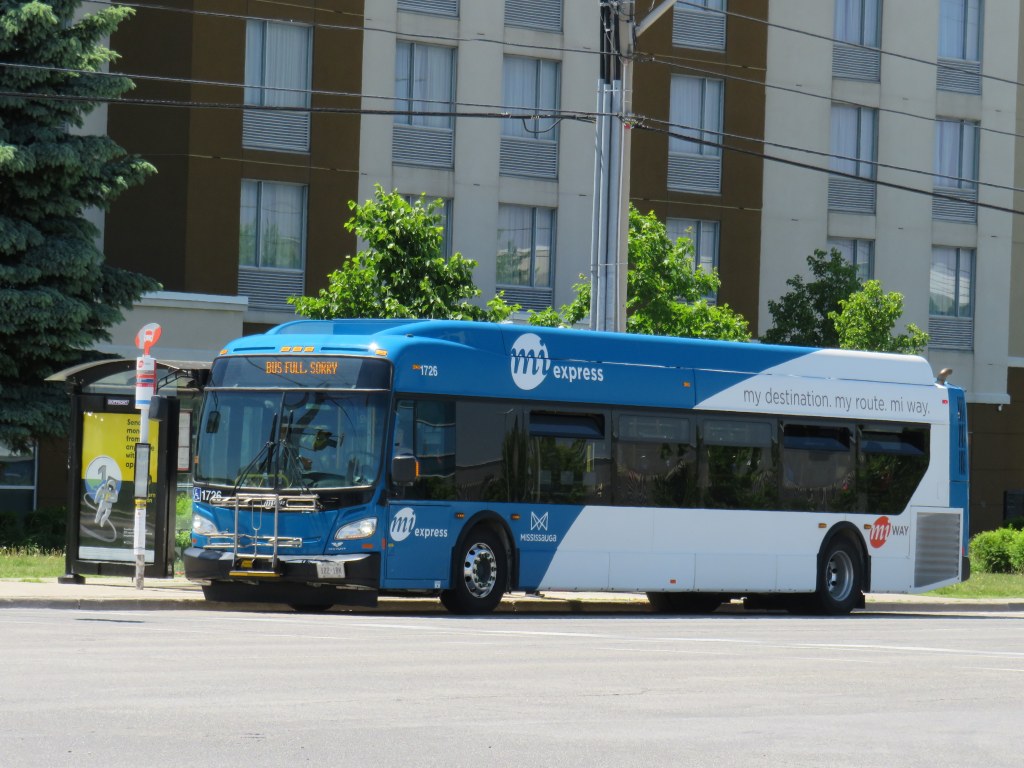
Brampton Transit bus on route 502 Zum with “bus full” displayed
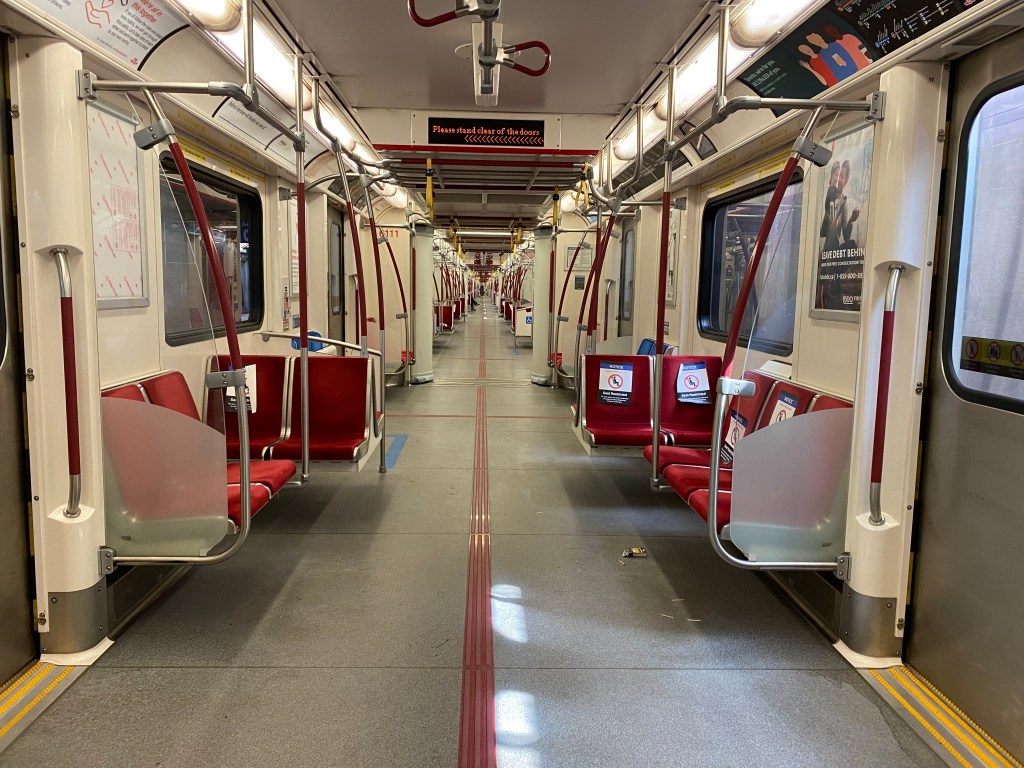
On Thursday, I took the subway for the first time since Ontario declared a state of emergency in March. I entered Queen Station at 9:45 that morning, and rode to Wilson Station. The subway ride north was noticeably quiet, and I had a good choice of seats, even though most were marked as restricted for physical distancing.
Empty subway train northbound on Line 1, June 11, 2020
On my return home, at 4:00 PM, the subway was busier, but still quiet enough to take a seat in the middle of the train, while just about everyone had a non-restricted seat through the downtown core. That never happened prior to March 13.
As I am used to crowded subway trains — even on Sunday mornings — my first subway rides in months proved to be a surreal experience. Though as most passengers were wearing face coverings and keeping distance, it felt safer and more comfortable than many of my recent supermarket trips.
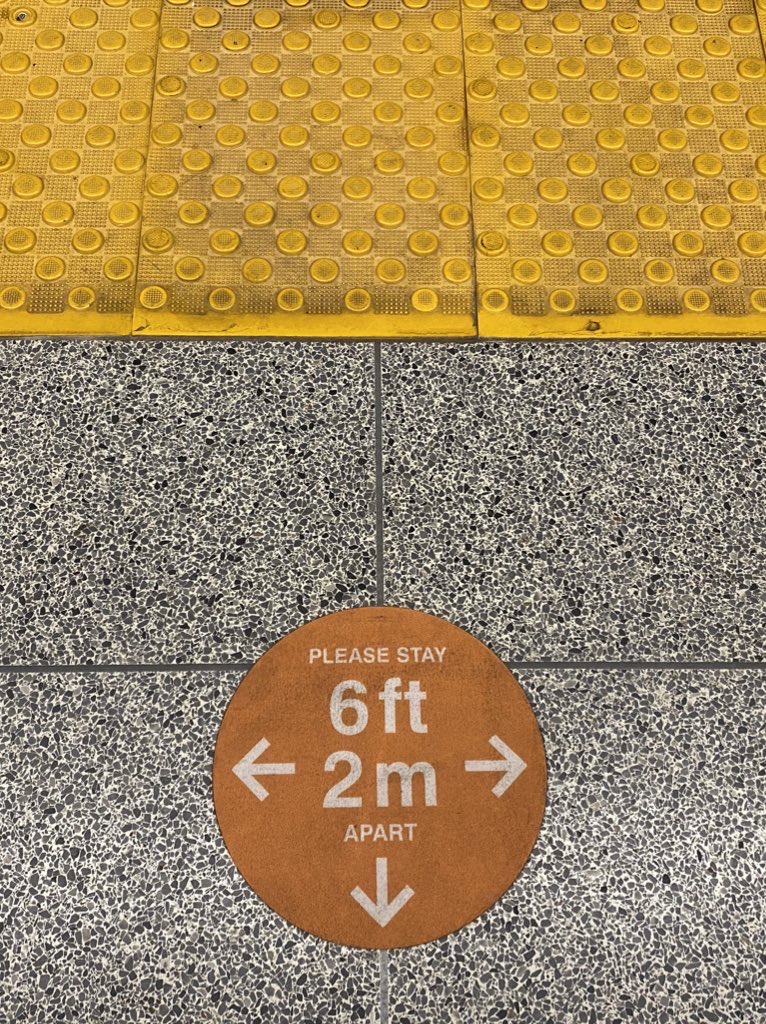
Platform edge marker, Queen Station
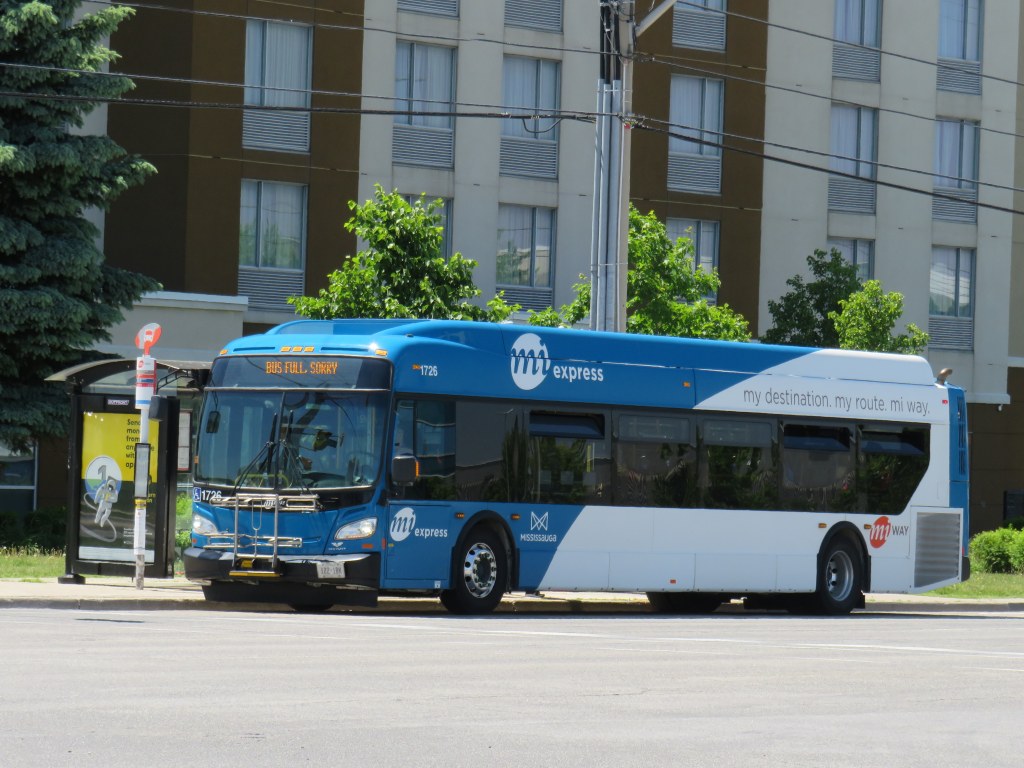
Though subways are mostly empty, and streetcars pass through downtown with only twenty percent of their normal ridership, things are very different on the buses. In Toronto, Brampton and Mississauga, vehicles regularly bypass crowds of waiting passengers while displaying a “sorry bus full” sign.
Miway bus full on Hurontario Street, on the same corridor as the Zum bus pictured above
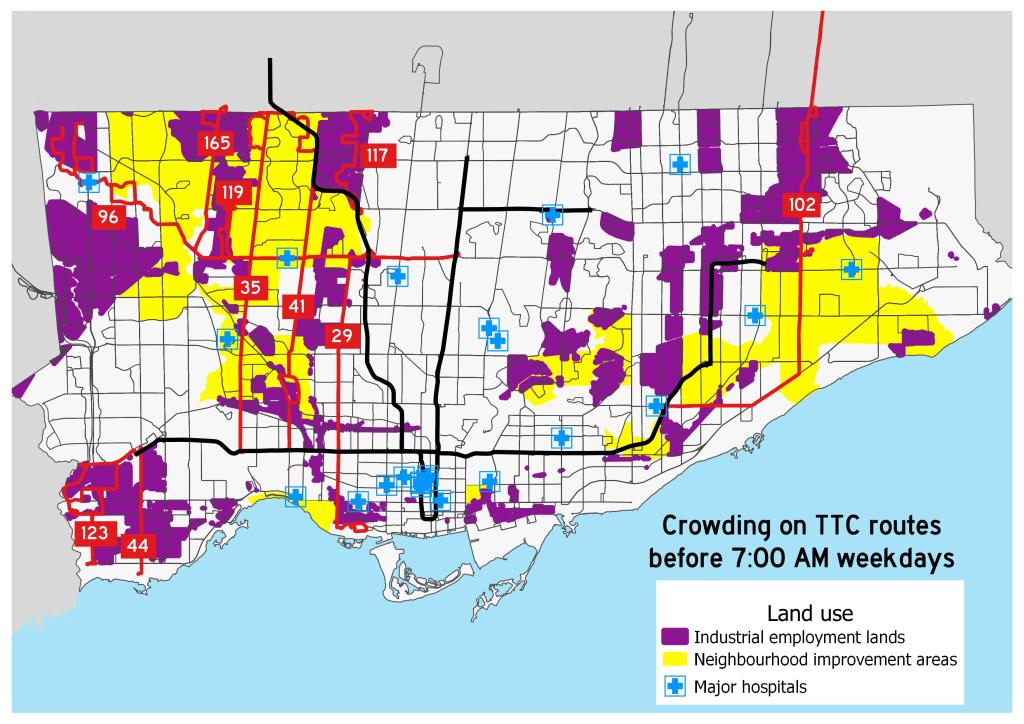
Back in March, I mapped the TTC’s most crowded early morning routes. These ten routes were generally located in Toronto’s suburbs, serving employment lands and neighbourhoods with lower incomes and higher proportions of racialized persons. Brampton and Mississauga, which also have large food production and warehousing industries and significant immigrant and racialized populations, are experiencing similar problems with crowding.
All buses only allow passengers to enter through the rear doors, with many seats marked restricted with paper signs similar to those on the subway. The area behind the driver is closed off as well. While the TTC expect riders to tap their Presto cards at the rear or pay by cash or ticket at a subway station, Brampton, Mississauga, and other systems are permitting free rides for now.
A typical TTC bus contains only 33-36 passenger seats; an articulated (“bendy”) bus has 46. The TTC operators’ union instructed its members to allow only 10 customers aboard a standard bus (though the operator has discretion), and 15 aboard an articulated bus. Transporting that few people on each bus is unsustainable, and with tens of thousands of essential workers relying on the TTC to get to work — many of those jobs difficult and poorly-paying — it’s yet another inequity laid bare by this pandemic.
Crowding on ten TTC bus routes in late March 2020
With loosening restrictions, the demand for transit has already begun to increase. By early July, local transit agencies will require all passengers to wear masks or face coverings. At the same time, passengers will be directed to enter buses through the front doors, while reinstating mandatory fare payment.
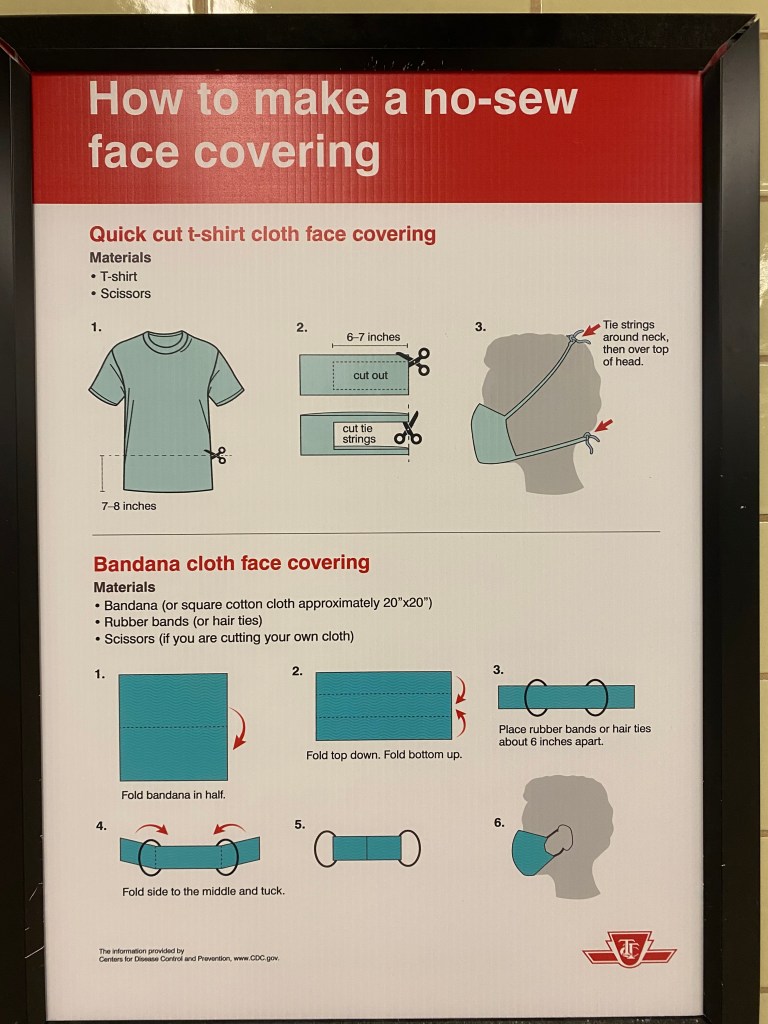
Poster in the TTC subway with instructions on how to make a no-sew fabric face covering.
Front-door boarding and mandatory mask use will help with some of the capacity issues on buses. Offering free masks is a welcome acknowledgement that many who have taken transit may not have money or time to purchase or make their own face coverings. (The TTC has instructions on how to make rudimentary masks posted in subway stations.)
Even then, bus capacity will continue to be limited to ensure physical distancing, and buses will likely still pass by crowds of waiting customers.
While central Toronto benefits from walkable neighbourhoods, existing and new cycling infrastructure, and subways and streetcars with more capacity to spare, suburban residents will still have to rely on buses. Though I see mandatory mask use as a necessary step towards mitigating the risk of viral transmission, I fear it may not be enough for those who work at hospitals and clinics, food plants and warehouses, and grocery stores, restaurants, nursing homes, and daycares.
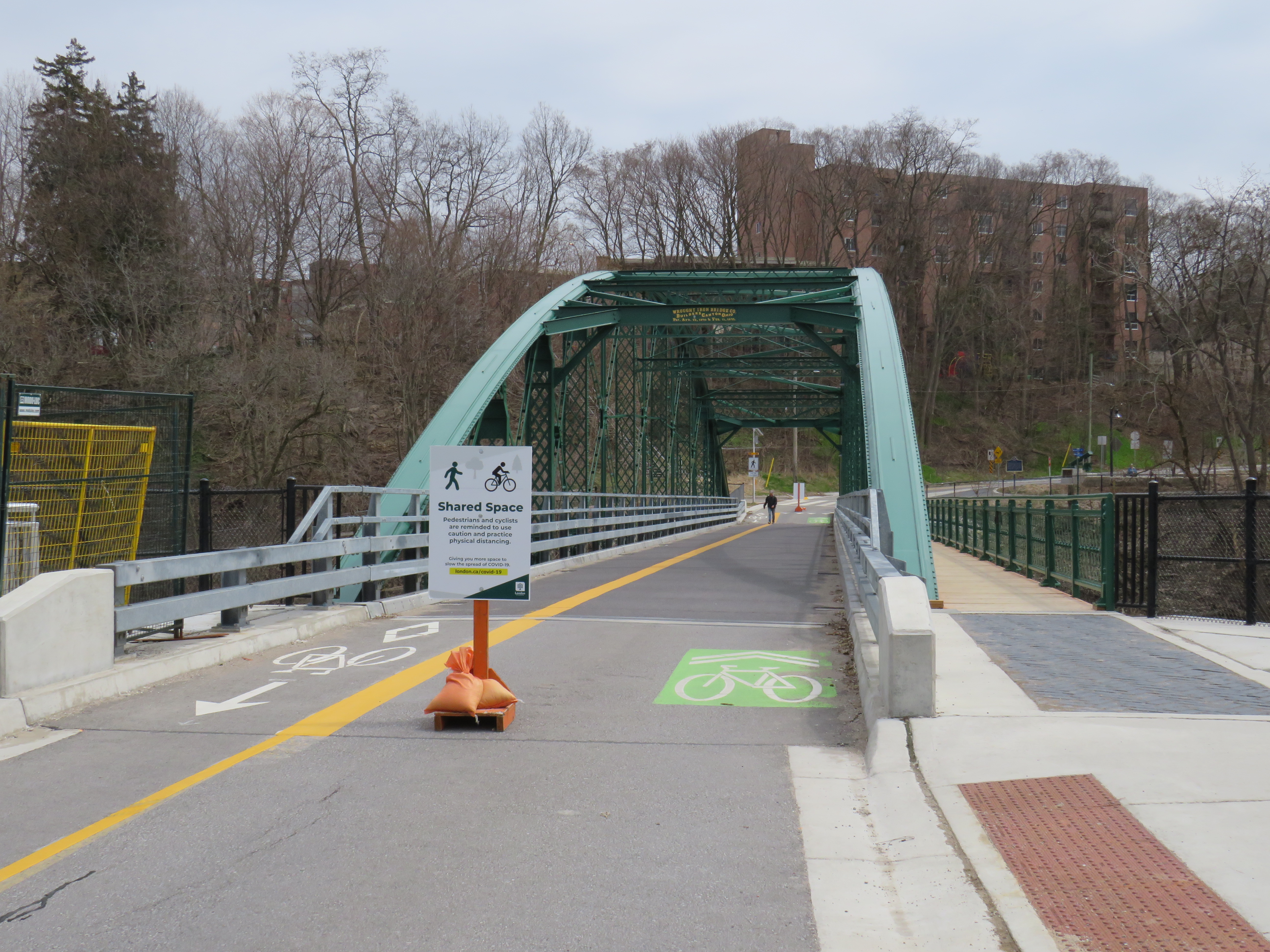
Blackfriars Bridge open to pedestrians and cyclists in London, Ontario
For my latest TVO article, I spoke with Councillor Shawn Menard in Ottawa, Councillor Rowena Santos in Brampton, and Ryerson University epidemiologist Anne Harris about how cities in Ontario are reallocating road space for pedestrians and cyclists during the ongoing COVID-19 pandemic, or why they may be hesitant to do so.
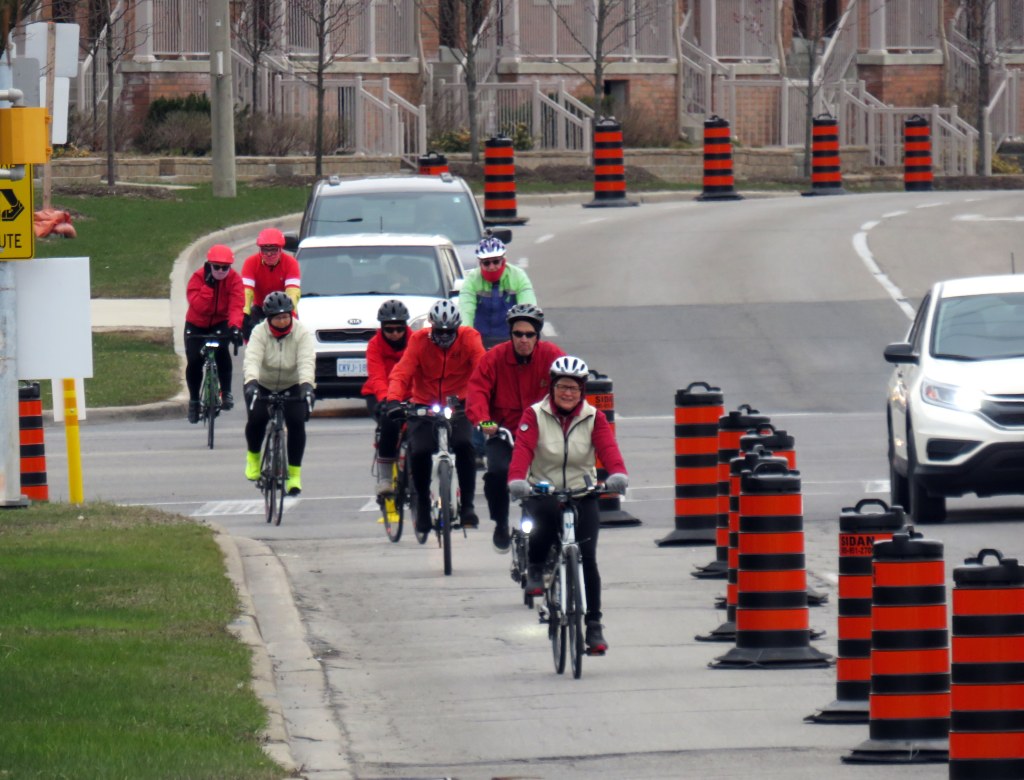
In Brampton, five kilometres of new bike lanes, proposed in that city’s new transportation plan, were quickly approved as part of its response to COVID-19. This benefits both pedestrians and cyclists by reducing conflicts on sidewalks, reducing congestion on city paths, and recognizing that cycling is an increasingly important mode of transportation.
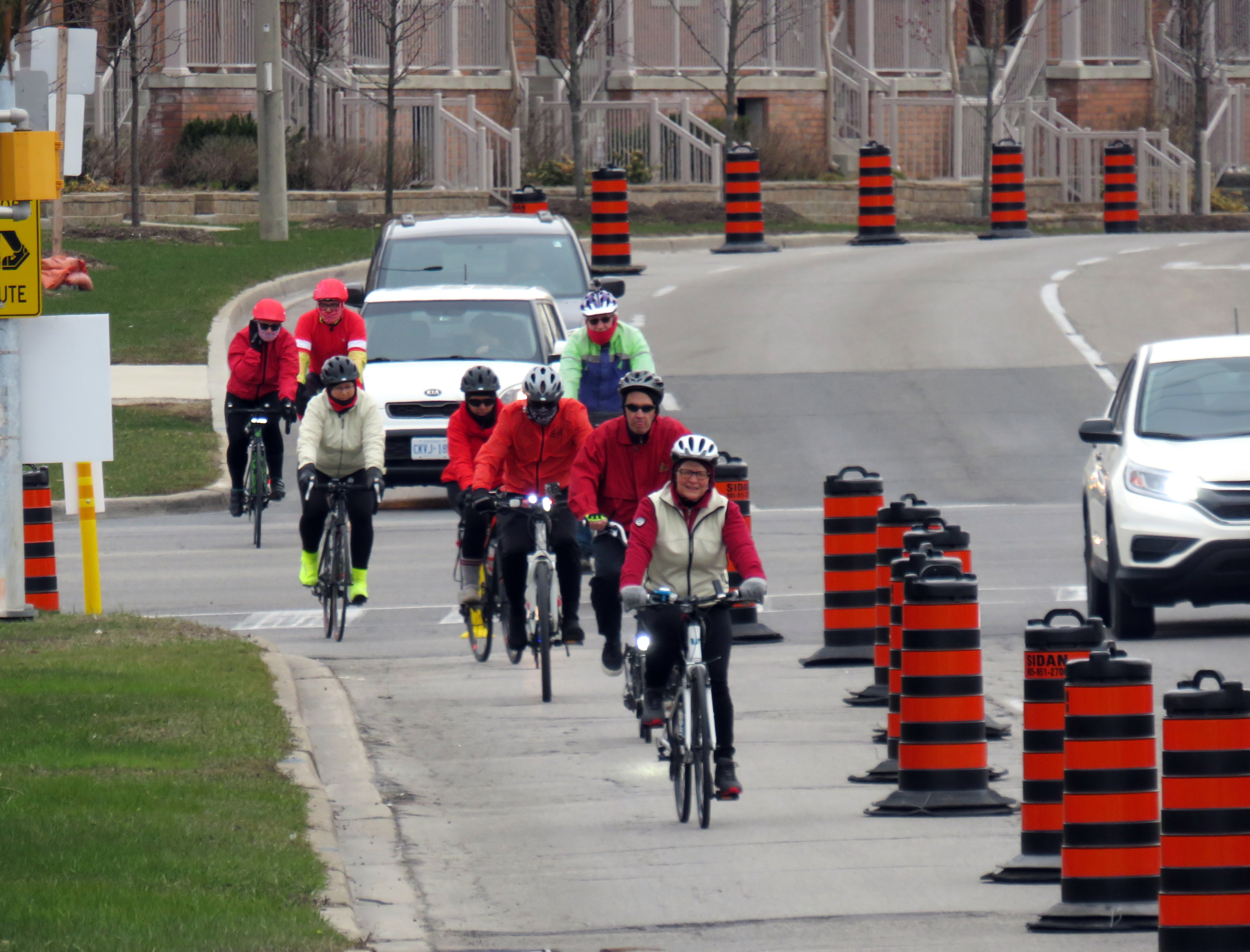
Cyclists on Howden Boulevard, Brampton
In Ottawa, despite resistance from the the mayor and council, Shawn Menard, who represents an urban ward just south of Parliament Hill, was able to temporarily close two lanes of traffic on a narrow bridge on a major retail street, and worked with the National Capital Commission to re-allocate a section of parkway for active transportation.
Meanwhile in Toronto, the mayor and medical officer of health were resistant to increasing calls for sidewalk expansions in congested urban areas, including where queues formed to enter grocery stores, pharmacies, hardware stores, and LCBO outlets.
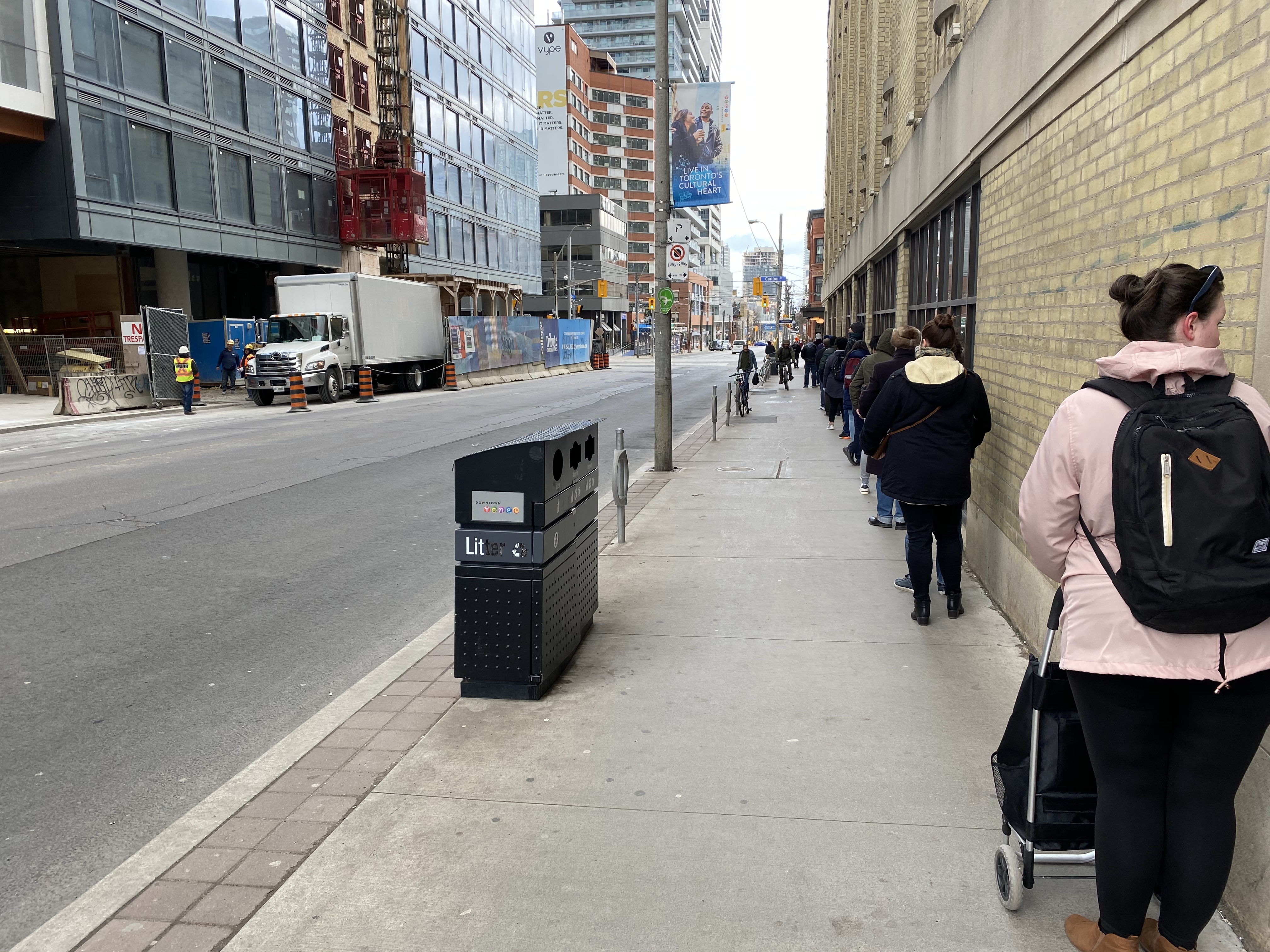
Queue on Church Street at Carlton to enter Loblaws supermarket
With Walk Toronto, I have been involved with pushing the City of Toronto to take action, especially in pinch points where store queues, construction barriers, and other obstructions have made it difficult — if not impossible — to safely practice physical distancing when walking or cycling for essential purposes, or even getting a little bit of fresh air or light exercise in dense urban areas.
The good news is that ten problem areas — including the intersection of Carlton and Church — have finally been identified for curb lane closures, with potentially more on the way. This is a timid first step, made after weeks of advocacy, but it is welcome.
Nobody’s going to be flocking to the streets during a pandemic
In an interview with local news station CP24, Mayor John Tory said that the city was considering implementing one-way directional traffic on city sidewalks as part of a response to COVID-19. This idea was considered as a measure to ensure physical distancing on Toronto’s sidewalks.
The mayor, however, does not support the alternate solution of increasing the amount of road space given to pedestrians and cyclists. With traffic on major routes such as Yonge, Queen, and Bloor reduced, and most businesses closed, it would be easy to provide additional space for pedestrians without causing traffic congestion. According to the mayor, “it could have the unintended effect of attracting more pedestrians to busy areas, something the city is actively trying to discourage right now.”
That’s ridiculous.
With businesses closed, no patios to linger at, and no programming (unlike at any other street closure, whether it be Taste of the Danforth, Open Streets, Pride Week, or Buskerfest), pedestrians will not be attracted to linger and crowd sidewalks in dense urban neighbourhoods. However, they will be able to walk to work, get to essential services, exercise the dog, or get some fresh air, without having to dodge other people or sidewalk barriers, such as construction scaffolding.
Furthermore, enforcing one-way sidewalks — the city’s only other idea — would be extremely difficult to enforce. It would only increase the distance pedestrians would have to walk to get to work or essential services. It would go against centuries of practice, and it would encourage less-safe midblock crossings. It would be especially cumbersome for seniors and pedestrians with disabilities.
While Toronto continues to do nothing to protect vulnerable road users during a pandemic, other cities — including Montreal, New York, Vancouver, Denver, and Oakland— have closed entire roads to better serve pedestrians and cyclists in parks and dense urban areas. Closer to home, Kitchener and Brampton have also taken steps to to assist active transportation during this unprecedented time.
King Street, Downtown Kitchener
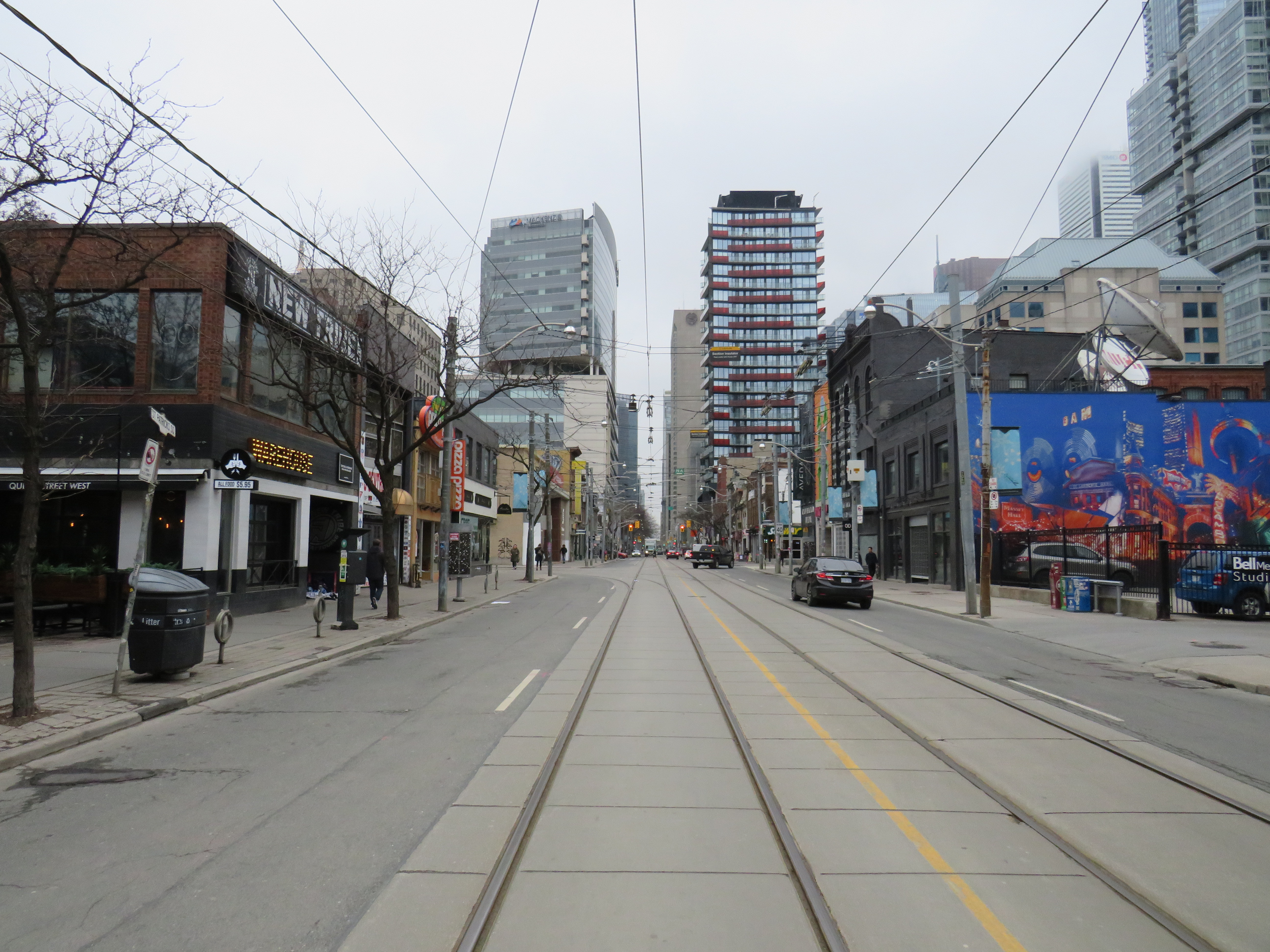
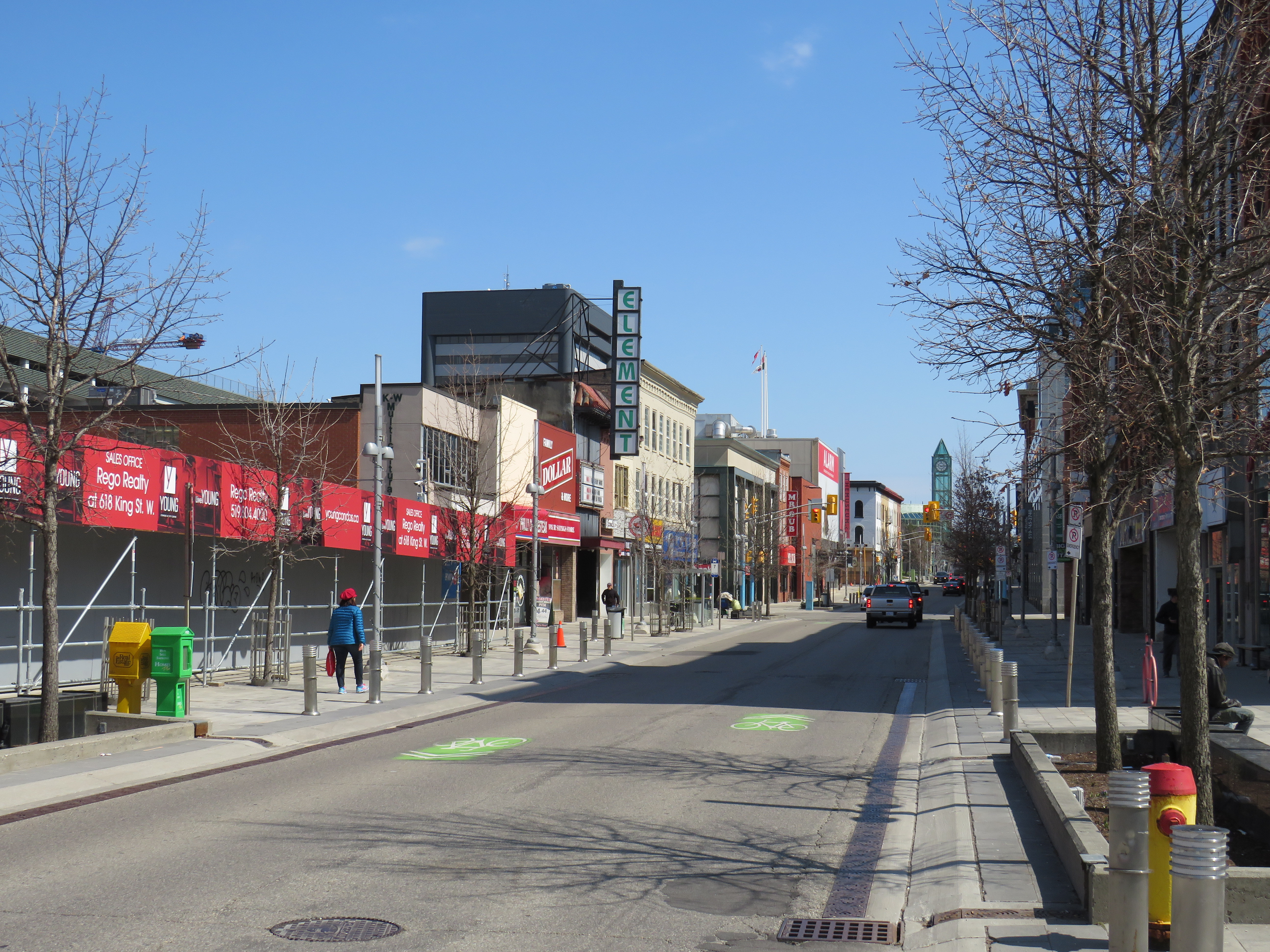
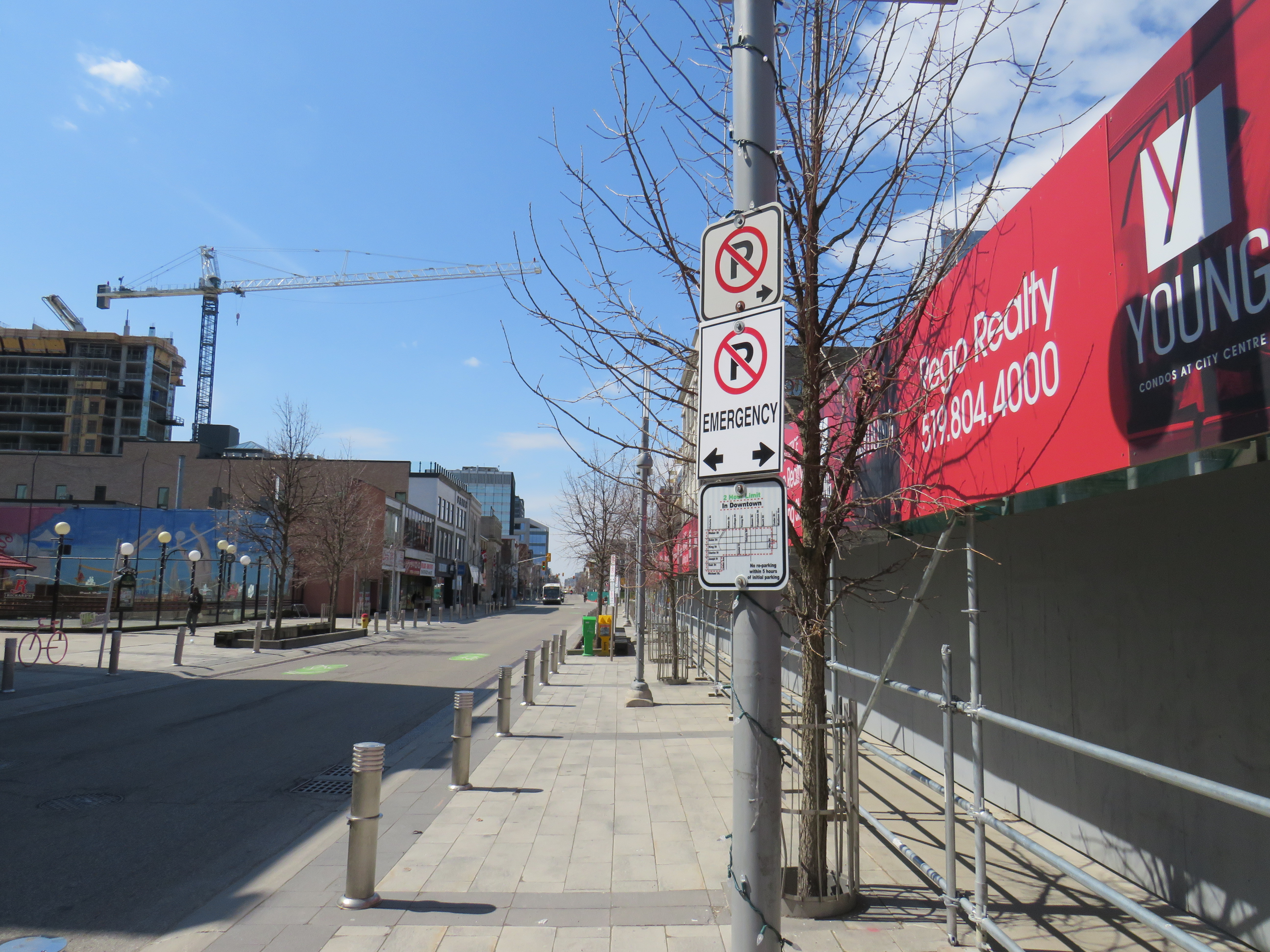
A decade ago, King Street in Downtown Kitchener was reconstructed with new lighting, street furniture, trees, and a rolled curb separating the narrow street with sidewalk and street parking and loading areas, which were separated from the pedestrian area by removable bollards. As a response to COVID-19, most of the parking spots were blocked off, with the bollards moved towards the roadways, quickly and easily expanding the pedestrian zone. With new residential development in Downtown Kitchener, several portions of the regular sidewalk were covered with scaffolding. The widened pedestrian clearway made it easy and safe to get around the barriers, allowing pedestrians to practice physical distancing.
Bollards moved close to the street, and parking banned. It’s much easier to get around the construction scaffolding.
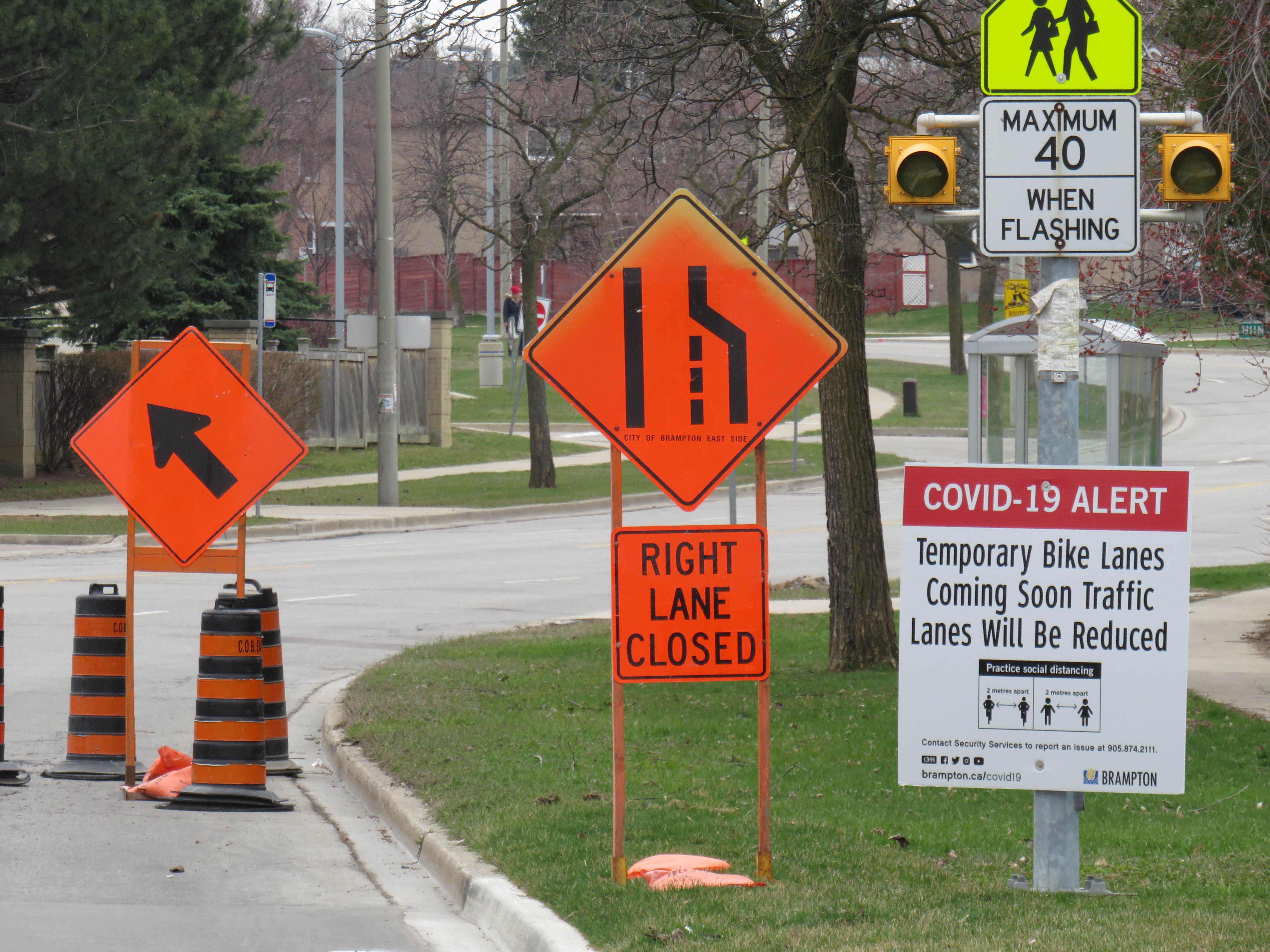
Meanwhile, in Brampton, where sidewalk crowding isn’t usually a problem, the city government went ahead with a plan to close the right lanes of Howden Boulevard and Vodden Street — four-lane collector roads through residential areas — to install temporary bike lanes. This will provide a five-kilometre bikeway across the city between Etobicoke Creek and Chinguacousy Park, crossing Highway 410 at a safe location.
Installing temporary lanes makes it easier in the future to make the lanes permanent — Vodden and Howden could use road diets after all — which could connect three north-south ravine paths and connect Downtown Brampton with Bramalea City Centre. City Council — including Mayor Patrick Brown — is committed to improving the city’s rather poor active transportation infrastructure.
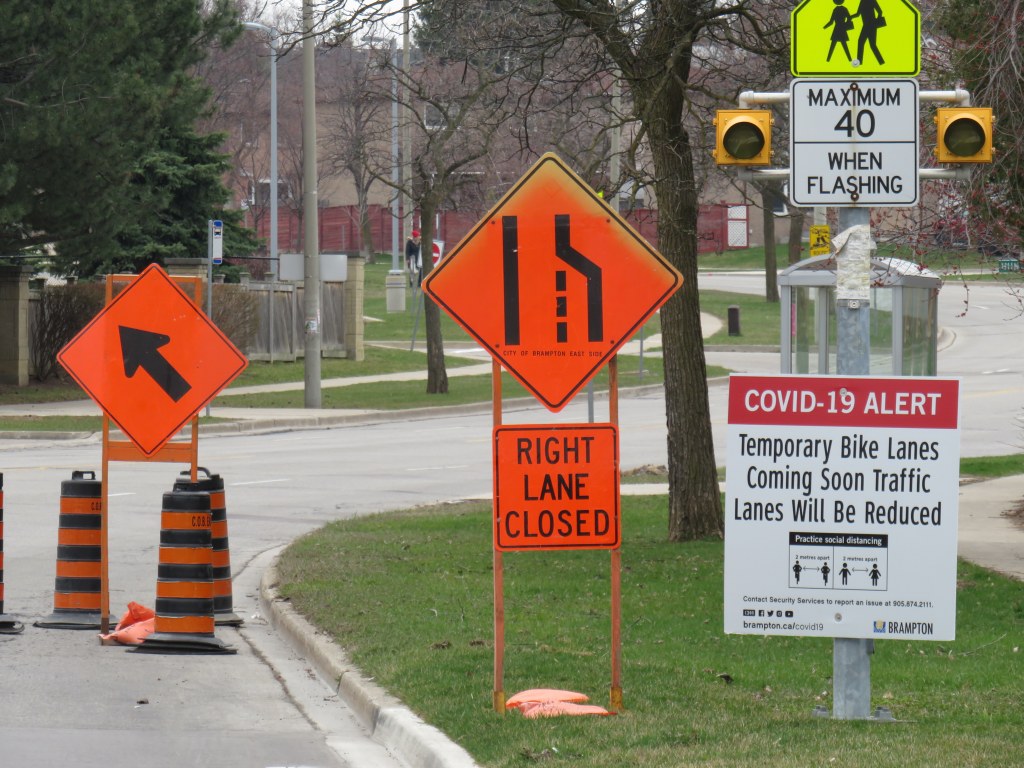
Temporary bike lanes coming to Howden Blvd. in Brampton
While Toronto continues to drag its heels on providing safe spaces for its residents to walk and bike while being physically distant, its peer cities — and even one of its suburbs, are leading. One can only speculate about the reasoning behind Mayor Tory’s reluctance to do more.