This is the first of a series on regional transit in the Greater Toronto and Hamilton Area
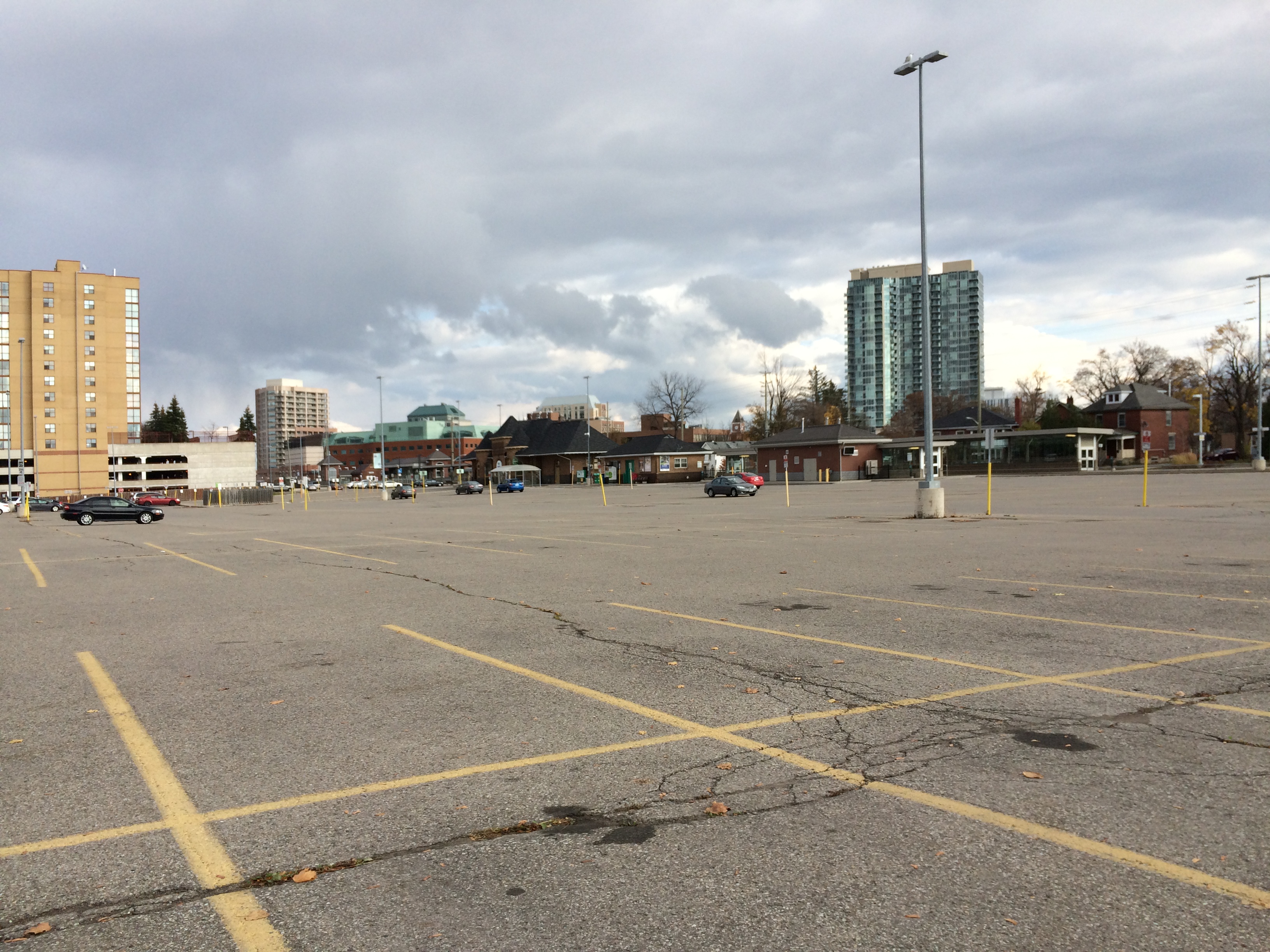
This may or may not come as a surprise to readers of my site, but the largest parking lot provider in Ontario isn’t the Toronto Parking Authority, nor is it a major real estate developer like Oxford (owner of Yorkdale and Square One malls) or Cadillac Fairview (Eaton Centre, Sherway Gardens). That record belongs to a public transit agency.
Metrolinx, the regional transportation authority for the Greater Toronto and Hamilton Area (GTHA), owns or leases 63,302 spots at 53 of its 64 GO Transit rail stations (not counting two stations served by seasonal Niagara trains), and offers another 4,186 spots at various park-and-ride and carpool lots served by GO buses. (Metrolinx is responsible for approximately 1,000 spots, the Ministry of Transportation Ontario and local municipalities are responsible for the remaining 3,000 spots).
Pickering GO Station, adjacent to Highway 401, has the most parking spots in the system, with 3,600 spaces in several lots and in a new parking garage. Clarkson comes in second with over 3,000 spaces. Acton, which sees only two trains a day to Toronto, has only 50 spaces. Eleven GO rail stations do not have any on-site parking: Union Station, Hamilton GO Centre, Hamilton West Harbour, Kipling, Exhibition, Bloor, Danforth, Kennedy, York University, Guelph, and Kitchener. With the exception of York University, all are either in urban downtowns (Toronto, Hamilton, Guelph, Kitchener), or are connections to the TTC.
All GO Transit parking spots are “free,” with the exception of reserved spaces that can be leased for $94/month at most rail stations and the Newmarket bus terminal. Reserved spaces are beneficial for regular passengers to guarantee a preferred spot on weekdays. This is in contrast to the Toronto Transit Commission (TTC), which charges $2 to $7 to park at any of its lots on weekdays, though there are no parking charges on weekends and holidays at most of its lots and garages.
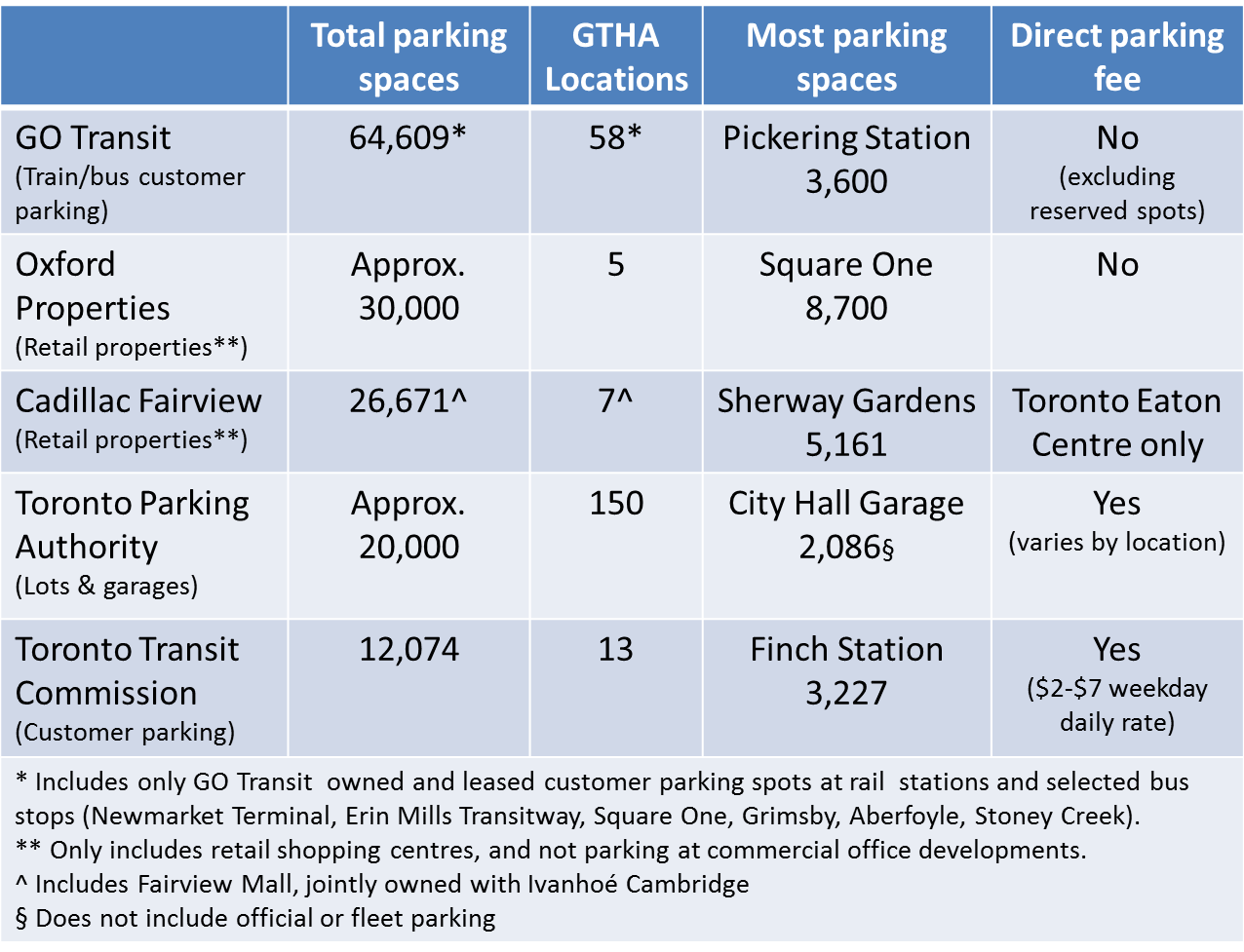
The Toronto Parking Authority, the largest municipal parking operator in North America, operates 20,000 off-street parking spots in lots and garages across the City of Toronto. (The TPA is also responsible for 17,500 metered on-street spots.) Oxford Properties Group owns approximately 30,000 spots at five GTHA malls (Square One is the largest, with 8,700 spots), while Cadillac Fairview owns 26,671 spots at 7 GTHA malls. The TTC has parking facilities at 13 stations; Finch, with 3,227 spots, is the TTC’s largest, though Finch Station’s parking lots are within a hydro field.
The table below illustrates this comparison.
The GTHA’s largest parking operators
I chose to include major shopping centres in this comparison, because as with GO Transit, they provide “free” parking to their customers, both surface lots and multi-level parking garages. The TTC does not charge for parking at most of their lots on weekends and holidays, while the Toronto Parking Authority charges competitive rates while returning a healthy profit to the City of Toronto.
This model of providing ample “free” parking made sense early in GO Transit’s history, when the provincial government created the agency (“GO” is short for Government of Ontario) to shift auto traffic off the Queen Elizabeth Way and other provincial roads as Toronto was growing rapidly, especially as a major financial centre. In 1967, GO operated only on the Lakeshore Line between Pickering and Oakville, with two trains continuing on to Hamilton. Public transit in the suburbs was almost non-existent; land at these new GO stations was cheap and plentiful. (Here is a fascinating history of GO Transit’s early years.)
But that model makes less sense nearly 50 years later, especially as GO moves towards becoming a regional rail operator, with more frequent services operating more like a metro than a commuter railway.

