Tag: GO Transit

  • Down is the new UP: Thoughts on dismal UP Express ridership

    19008325386_9c321ac7ab_k

    At February 10th’s Metrolinx board meeting, there was an update on the Union Pearson (UP) Express ridership. The news isn’t good, as ridership dropped in the last few months, instead of growing according to Metrolinx’s rosy projections.

    UP Express launched on Saturday, June 6, 2015, a month prior to the 2015 PanAm/ParapanAm Games. I was one of thousands to ride the train on that inaugural day; thousands of free tickets were given to the public. Nearly 7,000 rides were taken that Saturday, a number that has yet to be surpassed. Metrolinx estimated that UP Express would start off with an average of 3,000 daily riders, and within a year, there would be 5,000 daily riders. While the base one-way fare for UP Express is $27.50, the fare for Presto cardholders is $19.00.

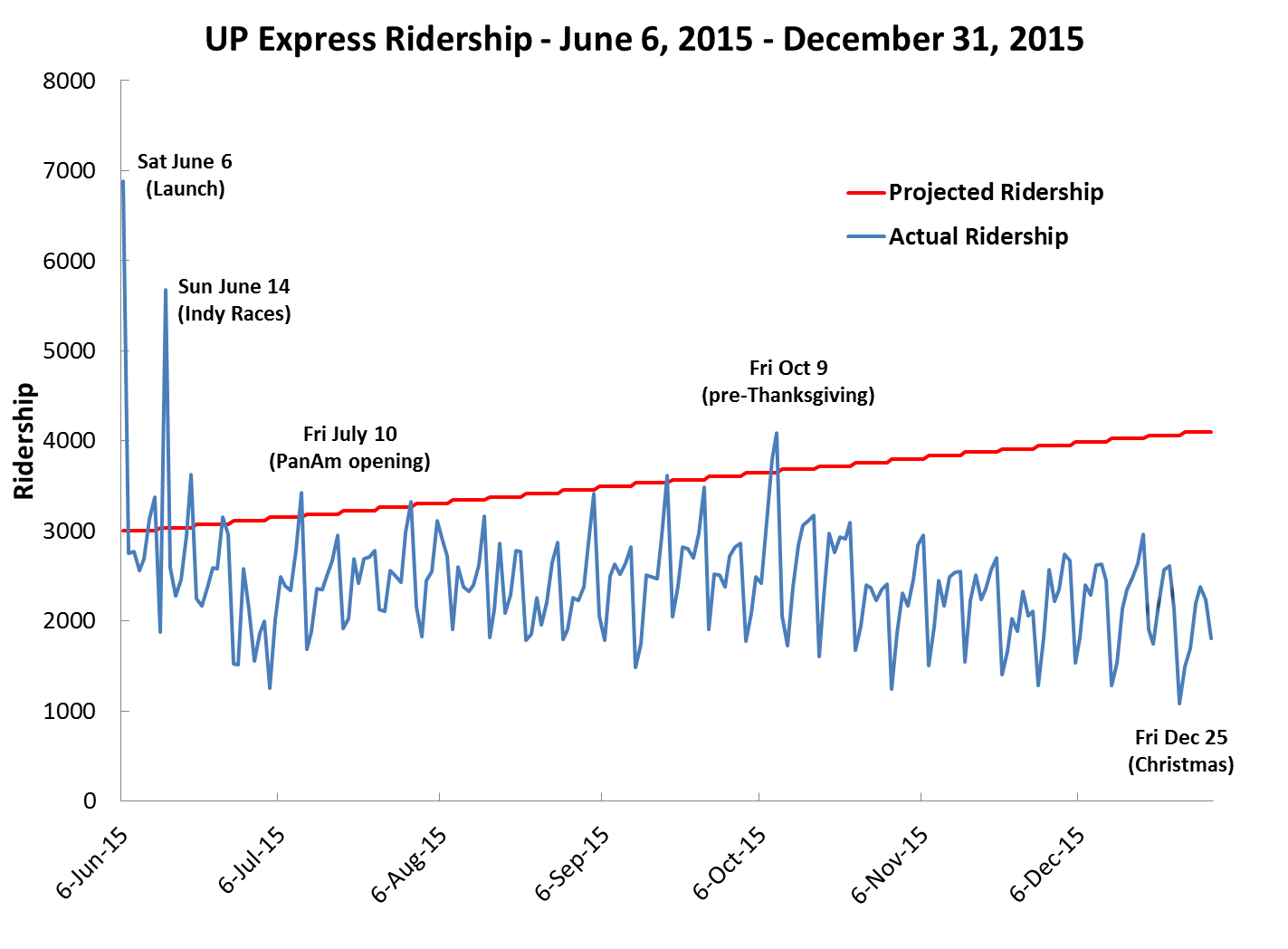
    The line chart below shows the projected ridership (increasing weekly towards 5,000 riders by June 2016) and the actual daily ridership. As one can see, the ridership varies by the day of the week, mirroring trends in air passenger traffic. Fridays are generally the busiest day of the week for UP Express, while Saturdays are the quietest.

    UO

    After the June 6 launch, the busiest day for UP Express were Sunday, June 16, which coincided with the Honda Indy at Exhibition Place, when 5,673 passengers used the train. There were peaks on Friday, June 19 (3,628 customers), Thursday June 25 (3,077 customers), and on Friday, July 10, when 3,424 riders took UP Express, the day of the opening ceremonies for the Toronto 2015 PanAm Games.

    But ridership plateaued after October, which had the highest monthly ridership recorded, at 79,010, which works out to a daily average of 2,548 passengers. The last peak was on Friday, October 19, the day before the Canadian Thanksgiving long weekend. Nearly 5,000 passengers rode UP Express. Ridership dropped in November and December, a busy travelling season. The daily average ridership dropped to 2,169 in December, a new low, and never was above 3,000 after Friday, October 23. Ridership bottomed out on Christmas Day, when a mere 1,086 rode the train.

    MonthlyUPXMetrolinx should be embarrassed by these extremely low ridership figures. UP Express is a semi-autonomous operating division of the provincial transportation agency with its own President, Kathy M. Haley. The agency spent $4.5 million on a contract for branding with Winkreativewhich included special uniforms and even an “in-flight” magazine. The TTC’s 192 Airport Rocket, which has its own dedicated bus fleet, carries 4,700 passengers on an average weekday. The TTC doesn’t have a special operating division or President for that route, even though it carries nearly twice the number of passengers.

    For comparison, in 2014 — the last year for which detailed ridership data is available — only twenty-five regular TTC bus routes had a daily weekday ridership that was lower than the UP Express for the months of November and December. The 48 Rathburn Road bus route, a minor feeder route in Etobicoke, carries approximately the same number of people as the airport rail link.

    GO Transit’s Richmond Hill corridor — the lowest ridership of GO’s seven rail lines, with only 11 trains daily — had a daily ridership of 10,587 according to GO Transit’s Spring 2015 cordon counts, an average of nearly 1,000 riders per train. UP Express, with 156 trains a day averages just over 15 passengers per train.

    The narrative in the local media is that UP Express fares are too high; that ridership will improve if the fares are lowered. Metrolinx CEO Bruce McCuaig claims that “a lack of awareness” is the cause for the low ridership. Given the media hype surrounding the launch, and the improved wayfinding signage at Union Station and Pearson Airport, I don’t think that awareness is the problem.

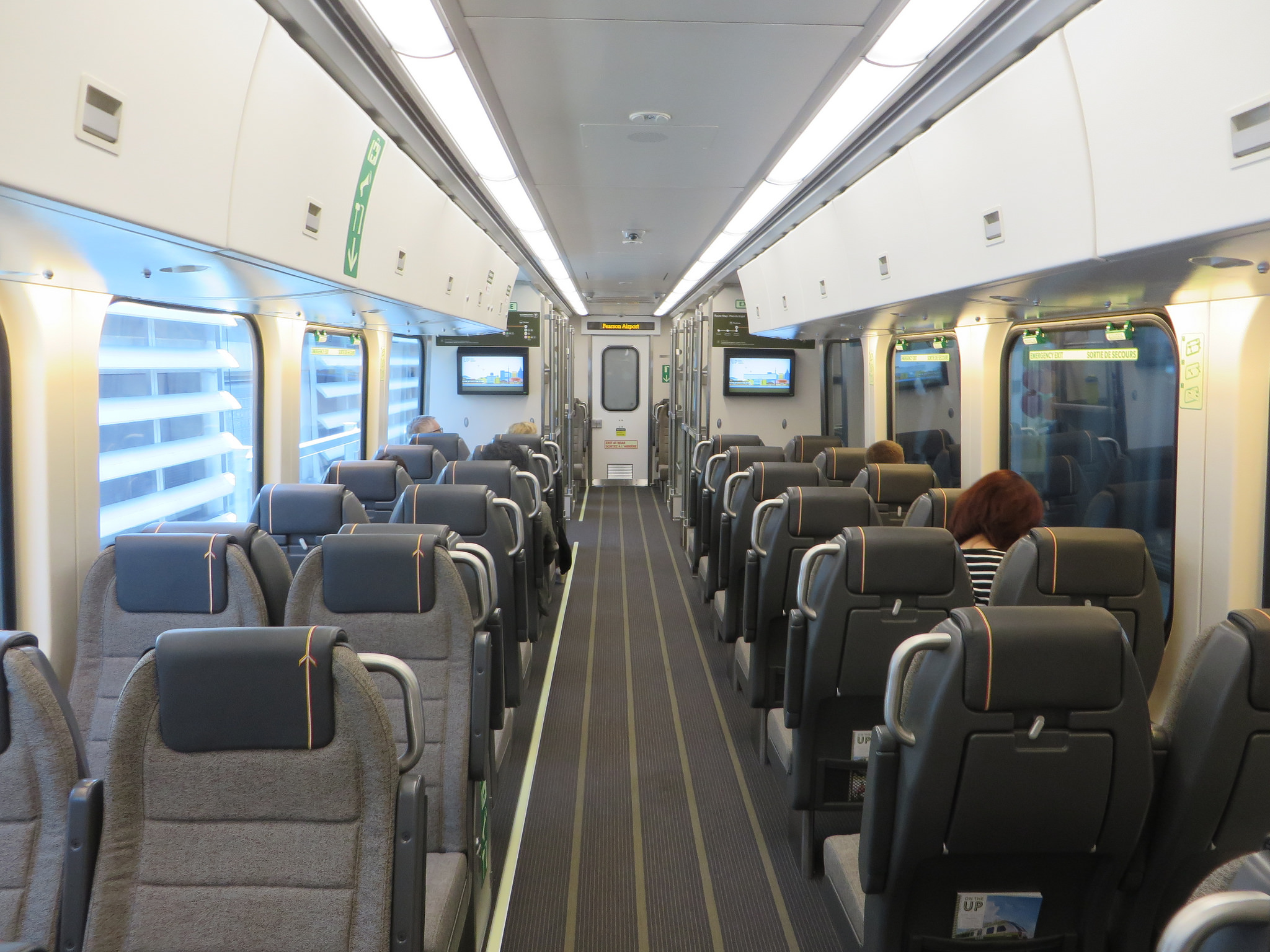
    I also don’t think that lowering UP Express fares, without looking at fare and service integration, is going to be a magic bullet either. Last year, I was pleasantly surprised by the announcement that Presto fares were going to be $19 for Presto cardholders, which was slightly less expensive than I expected. Travelling alone, it’s a bargain compared to riding a taxi or limo, especially if your origin or destination is in Toronto’s financial district. . (Connections at Bloor Station and in Weston are less useful.) I live about 15 minutes away from Union Station by foot, and I’ve taken advantage of UP Express. The cars are comfortable, the wi-fi is a nice perk, and the service is fast, friendly, and reliable.

    Happily, UP Express isn’t a white elephant. Most of the sunk costs — $456-million — are salvageable, and a rail link to Pearson remains an excellent idea.

    I think the answer is making UP Express more of a transit link, useful for residents of North Etobicoke, Weston, Mount Dennis, and West Toronto. The service would be more like Vancouver’s Canada Line; a part of the local transit network, but with a premium on single-ride fares from the airport to recover costs. Metrolinx could start by integrating UP Express with its GO Transit operating division, phasing out the ridiculous branding and separate bureaucracy.

    UP Express could even be part of a re-routed “SmartTrack” corridor, where it would make a few additional stop. But most importantly, it would become part of Toronto’s transit system, rather than a boutique airport shuttle service. The rail infrastructure improvements built for UP Express go a long way towards improving GO train service to Bramalea and points west. Hopefully, we get a revised airport rail link somewhat similar to that of Philadelphia, with fares integrated with the TTC and GO Transit. It’s also worth noting that Pearson Airport offers transit connections to GO Transit buses to Richmond Hill and Hamilton, as well as express and local Mississauga and Brampton Transit routes. There’s a need to recognize Pearson Airport’s role as a regional transit hub, not just a hub for Air Canada and WestJet.

    But the UP Express fiasco raises other questions. How can we expect Metrolinx to come up with a credible fare integration strategy when it can’t even get GO Transit fares right, never mind the UP Express? Yes, there are many fine people working at Metrolinx, but the UP Express hurts the organization’s credibility.

    All that said, I still sometimes feel optimistic about Toronto’s transit progress in recent years. The UP Express, while suffering from poor ridership, is still useful. The Eglinton-Crosstown LRT is underway, and might be extended in both the east and west. The [Downtown] Relief Line subway plan is still a viable project. And despite John Tory’s budget cuts, TTC bus service has been expanded in 2015 and 2016.

    Meanwhile, UP Express will be offering free fares this Family Day weekend. It will be interesting to know whether this promotion will increase ridership on the weekend or not.


    Thanks to Steve Munro for providing me with a copy of Metrolinx’s ridership numbers for UP Express.


  • Milton’s self-inflicted growing pains

    There’s an interesting article in today’s Toronto Star about Milton’s growing pains. The Town of Milton, which has grown tremendously in the last 15 years, complains that the province has neglected to provide the growing municipality with transit and other infrastructure. In 2001, its population was only 31,471. But In 2006, after finally connected to “The Big Pipe” that brought treated lake water to the municipality, the population increased to 53,939, an increase of 71.4%. In 2011, the town’s population went up again to 84,362; by 2016, Milton’s population will be well over 100,000.

    But no one should be surprised by Milton’s growing pains. Milton’s population stagnated for years as its reliance on well water constrained residential and commercial growth. Once all that developer-owned land had access to water and waste water pipes, of course, tract housing, big box stores, and warehouses were going to follow. In recent years, Milton’s housing density has increased in accordance with the province’s Places to Grow Act; with more townhouses and low-rise apartment buildings and houses on smaller lots. But apart from higher densities, land use and planning is still based on automobile ownership and suburban zoning plans.

    Milton is outside the continuous built-up Greater Toronto area. It doesn’t have great transit links, apart from the rush hour GO Trains. Apart from two interchanges off Highway 401, it doesn’t have great highway access. If it’s cheap housing you seek, and nothing else, Milton might be the right place to live. But if you want transit, parks, walkable neighborhoods, access to community services, and short drives, Milton isn’t the right place to buy.

    Many of the concerns are valid. The local hospital hasn’t expanded to accommodate the growing population. Highway 401 hasn’t been expanded through Milton since the 1980s. And while GO Transit has increased the number of trains (from five to nine outbound and inbound trips in the last two decades) and buses, the parking lot has completely filled up.

    But one of the main messages that I read in the article is that there isn’t enough parking. To paraphrase Homer Simpson, parking is the cause of  – and solution to – all of Milton’s problems. Residents and councillors complain about parking at the GO station, such as resident Giles vanderHolt, who says, “there’s a huge need for more GO transit parking and better train service to Milton.”

    GO Transit isn’t going to be adding more train service to Milton any time soon. The Milton Line also serves six stations in Mississauga, and is the busiest route outside the frequent Lakeshore corridor. But the Milton line is almost entirely owned by Canadian Pacific, and it’s a busy freight line. GO simply cannot add any more trains, and if it did, it wouldn’t solve Milton’s parking problem.

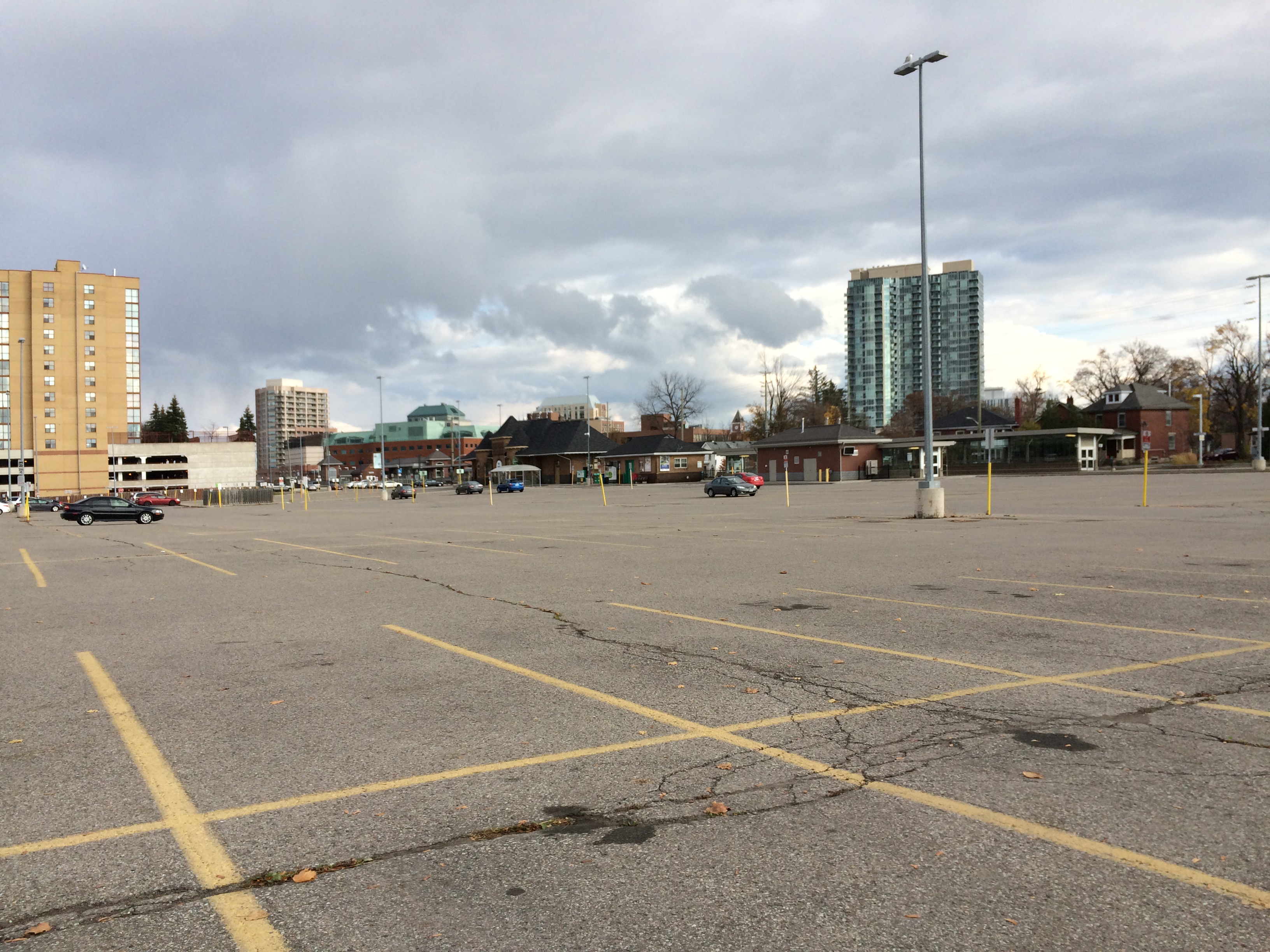
    Surrounding the GO Station, there’s a retail plaza anchored by a Loblaws, and surrounding it, there are several industrial parks and single family houses. There is no transit-oriented development located there, nor is any planned.

    Milton GO Station and surrounding areas

    I have plenty to say about GO Transit’s reliance on free parking, and I wouldn’t be surprised if GO is drawing up plans for a parking garage at Milton. But to be fair, people don’t move to Milton that are planning to give up their cars. Milton Transit isn’t very good, but it does use the GO Station as its primary hub. Meanwhile, GO has been trying a new ride-booking system for commuters to use to get to and from Milton GO Station. That’s an interesting idea that could be expanded to other outer-suburban communities as a short-to-medium term solution. If GO ever implemented parking charges, it could prove to be a good alternative for commuters where transit links are spotty or non-existent. But Milton could do far more to encourage people to walk, bike and take transit to its station, and develop an urban core.

    Milton has been lobbying for years for a university campus, at a site called “Milton Education Village.” But it wants to locate the campus in a greenfield site a 15-minute drive away from the GO Station, distant even from Highway 401. Students from outside Milton will either be dependent on cars to reach the site, or had better hope that transit connections from the west aren’t as bad as they are from the Milton Carpool Lot.

    Oshawa made the mistake of building a major campus as far as possible from its downtown core and transit infrastructure. Why does Milton want to do the same thing?

    On one hand, Milton is right to complain about poor infrastructure. People live there, by choice or by necessity, and they deserve a proper hospital and other provincial services. GO Transit is doing the right thing by trying out a ride-sharing service to and from the GO station. On the other hand, Milton is a “leap-frog” suburb, with poor urban planning and an auto-centric mentality that has helped to create a lot of its mess. Building some transit-oriented development around the GO station, and improving transit links would be a good place to start turning the page.

    0FXZYgd.jpgScreenshot from the classic Simpsons episode “Homer vs. the Eighteenth Amendment”
  • GO Transit plans to raise fares in 2016. How about a better fare system?

    Note: Updated in February 2016 due to a conflicting chart.

    At Thursday’s Metrolinx Board Meeting, the Board of Directors will be voting on a GO Transit fare increase effective February 1, 2016. As has become common, Greg Percy, the President of GO Transit, will be recommending a tiered fare increase, and we should expect that the Metrolinx Board will rubber stamp this proposed fare hike, as it usually does.

    Recently, I wrote about the many problems with GO Transit’s fare structure. It penalizes short trips, it does not allow for any fare integration with the Toronto Transit Commission, and many trip pairs (particularly the Barrie, Richmond Hill, and Stouffville Corridors) are priced lower than they should be compared to other stations. In another post, I suggested that GO Transit should seriously consider charging for parking at its lots, as constructing and maintaining parking lots is a major expense that all GO Transit users are paying for, whether they use them or not.

    I was somewhat surprised to see that the fare increase will not apply to short trips, those currently costing between $5.30 (the lowest fare possible) and $5.69. This would freeze the one-way ticket price for trips such as between Danforth, Union, and Exhibition Stations. With a slight increase in the “loyalty discount” offered tot Presto Card users when they pay a GO fare,  from 10% to 11.15%, this results in a very slight fare decrease for short trips.

    You can read the GO Transit report recommending a fare increase here.

    (more…)

  • The trouble with Trans-Cabs

    In my last post, in which I discussed the gaps in the Golden Horseshoe’s transit network (and offered unsolicited advice to Metrolinx), I used the example of Milton, in which a carpool lot served by several GO Transit bus routes was largely disconnected from the rest of the local transit system, and located several kilometres from the main GO hub at Milton Station.

    When I pointed out that Milton Carpool lot, at the junction of Highways 401 and 25, was only served by Milton Transit’s route 1A/1B, which runs only during rush hours, Twitter user YIGE corrected me:

    https://twitter.com/yige_t/status/669902364111822848

    YIGE is correct. Milton Transit does offer a Trans-cab service in the residential areas north of Main Street in Milton, as well as some of the institutional and industrial zones north of Steeles Avenue. I did not see it in the “System Map and Routes” section of the website; it has its own page elsewhere.

    Trans-Cabs, are contracted taxi services that are intended to serve suburban or rural areas that would be inefficiently served by fixed bus services, but require a connection to the transit network. Several cities and towns in Ontario offer these services.

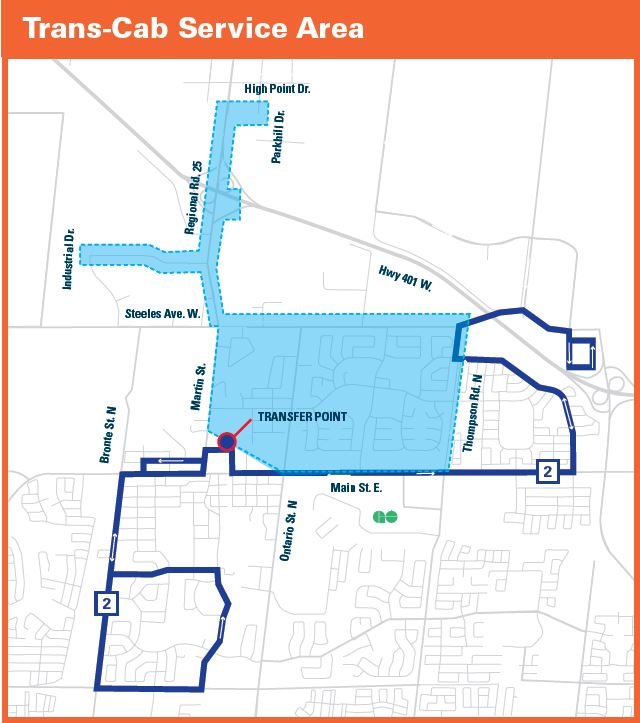
    In Milton, Trans-Cab operates between 8:30 AM to 2:30 PM, and between 5 PM and 6 PM on weekdays, and from 7:10 AM to 7:40 PM on Saturdays,  times when route 1A/1B does not operate. The service requires a 50-cent premium on top of the Milton Transit fare, and the transfer point isn’t at the GO Station, where all eight fixed route buses connect, but at a point in Downtown Milton where only Route 2 connects. Anyone headed elsewhere must then transfer to Route 2 to the GO Station, and transfer yet again. It’s not at all convenient, and the service ends far too early in the evening, especially for commuters and students headed home from Kitchener-Waterloo or Guelph. And unlike connecting between GO and Milton Transits at the station, there’s no co-fare available to any other GO bus service.

    Passengers must also request a ride at least an hour in advance if heading to the transfer point; passengers heading to the Trans-cab service area only have to let the Route 2 operator know they need the service.

    Milton_TransCab
    Map of the Milton Transit Trans-Cab service area, original found here.

    In the Greater Toronto and Hamilton Area, Hamilton Street Railway also provides a Trans-Cab service, serving exurban areas in Stoney Creek (Winona) and Glanbrook. Like Milton, the Trans-Cab service requires a 50 cent premium above the regular fare, and requires a transfer to a regular bus route. In Glanbrook, the service is offered Monday through Saturday from 6 AM to 7 PM, and in rural Stoney Creek from 5AM to 1AM. The HSR system map shows the Trans-Cab service areas. Like Milton, pick-ups have to be arranged at least an hour in advance.

    Peterborough and Greater Sudbury also operate Trans-Cabs; again, in those cities, they serve outlying areas that are difficult to serve with fixed bus routes.

    The Hamilton example illustrates where Trans-Cabs make more sense: in outlying areas where demand is low, the population density sparse, but there’s a need for transit access. In Milton’s case, operating a fixed route serving the urbanized area north of Main Street makes more sense, especially as it links to a major GO Transit connection;. In Milton, a Trans-Cab might be more useful, say, for serving areas outside the Milton urban area, such as Campbellville and Mohawk Racetrack.

    Really, either the Town of Milton/Milton Transit, or GO Transit should work to get the gap between the Highway 401/25 carpool lot and the town transit system fixed properly. An inconvenient Trans-Cab service simply doesn’t cut it.

  • The Golden Horseshoe’s missing links

    14182301824_167b4e754a_k
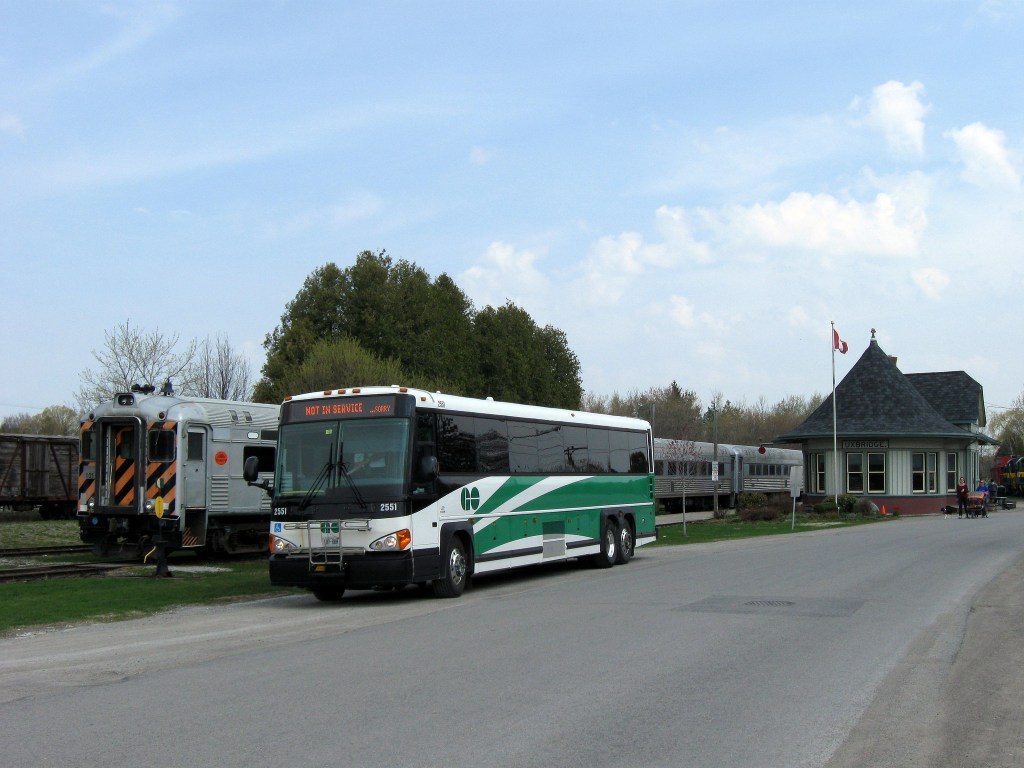
    GO Transit bus at Uxbridge

    Over the last 15 years, GO Transit has done well expanding its bus and rail operations. It opened up new stations, such as Mount Pleasant, Lincolnville, Barrie South, Allandale Waterfront, and West Harbour. It introduced the Highway 407 service, finally making York University accessible to thousands of suburban students. And it extended its reach to Waterloo and Peterborough, not only serving post-secondary institutions and residents in those cities, but also making it easier for cyclists like myself to explore new trails and destinations.

    But as GO Transit expands, there are many gaps, large and small, that should be closed. Coinciding with GO Transit’s expansion, intercity bus operators have been cutting back; dozens of Ontario towns and cities no longer have any coach service, and many more have saw their service cut back. Several municipalities in GO’s service area have resisted operating local transit systems, and GO’s use of park-and-ride lots has made their bus services difficult to reach without a car. In this post, I discuss some of these challenges.


    Related:

    (more…)

  • Not so fair-by-distance: GO Transit’s problematic fare system

    Not so fair-by-distance: GO Transit’s problematic fare system

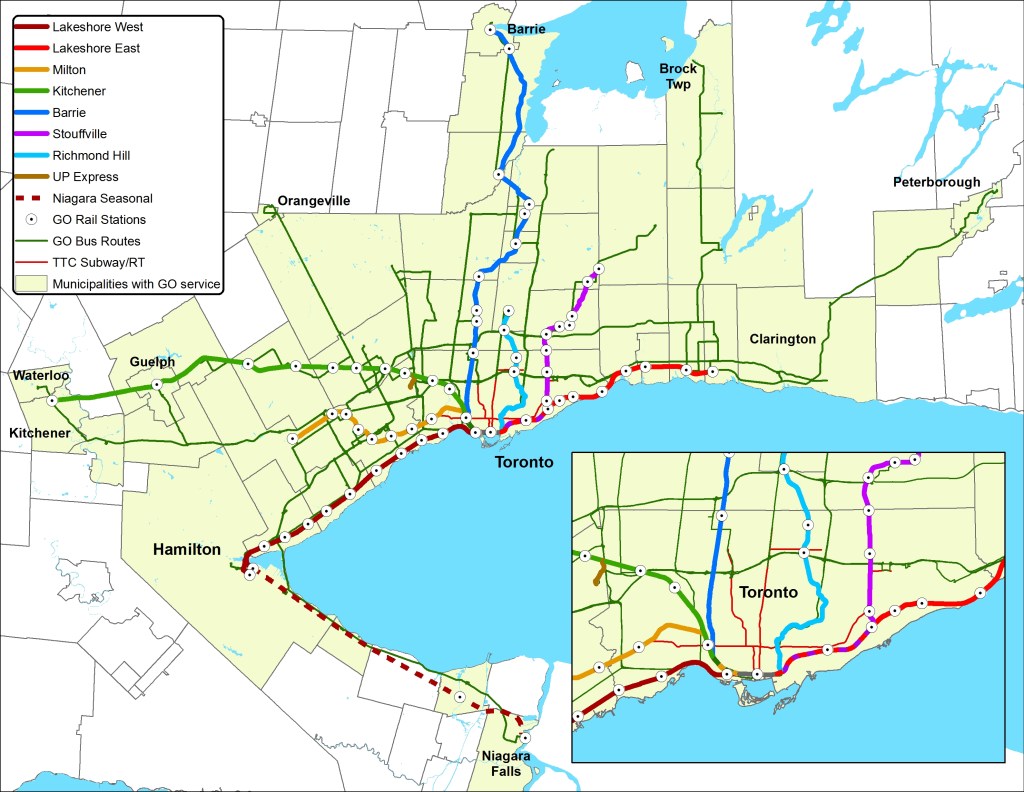
    GO Network 2015GO’s bus and rail system serves 39 municipalities and reaches points over 130 kilometres from Union Station

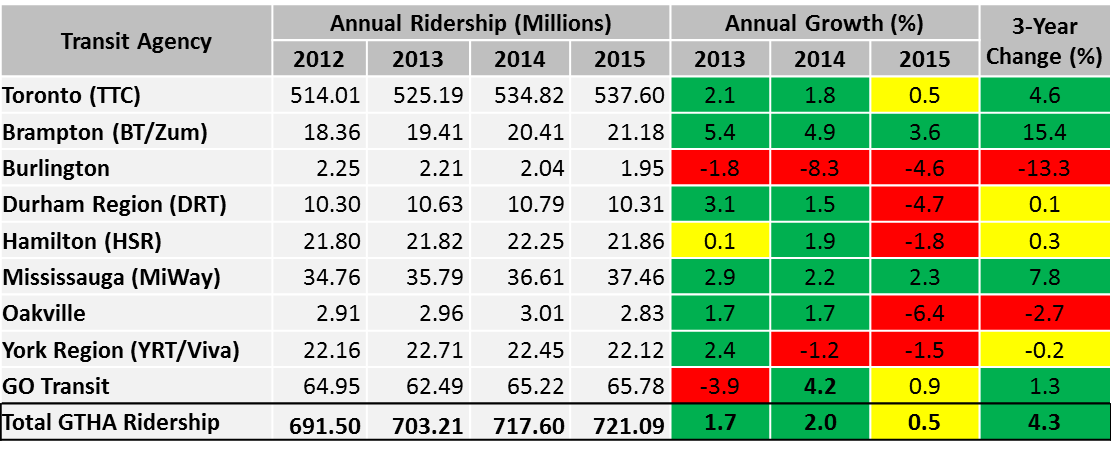
    In 1967, GO Transit started out as a simple commuter service from Oakville to Pickering (with two additional trains to and from Hamilton). In 1970, it started its first bus service, connecting Oshawa and Hamilton to the hourly train service at Pickering and Oakville. Eventually, GO expanded to other corridors, inaugurating the Georgetown service in 1974, and taking over former suburban Grey Coach and TTC routes in the 1970s. By 1981, GO was operating trains on all seven of its current corridors, expanding and extending its bus rail services ever since. As a commuter rail and bus system, GO Transit is a great success story, there were over 68 million boardings in 2014, and service continues to expand. Regular bus service goes all the way to Niagara Falls, Peterborough, and Waterloo, serving post-secondary institutions and long-distance commuters. But there are many ways in which it can improve; its fare structure is just one of them.

    Previously, I explained why GO Transit should consider charging for parking at its commuter lots. GO Transit provides over 60,000 free parking spaces, but the cost of servicing those lots is borne by all passengers, whether or not they drive to the train or not. This isn’t terribly fair to those customers who arrive by foot, by bicycle, or are able to get a ride. In the suburbs outside the City of Toronto, most transit agencies offer a co-fare – a discounted fare for taking local buses to connect to and from GO Transit, but no such fare integration exists with the TTC. But the parking subsidy enjoyed by drivers is only part of the unfair pricing scheme levied by GO Transit.

    GO Transit describes its fare scheme as “fare by distance.” And to a degree, this is accurate. Generally, the farther one travels, the more expensive the fare. So far, so good. But fares for short trips cost far more than longer ones per kilometre traveled, and fare increases for short trips have risen at a greater percentage rate than fare hikes for long trips.

    Steve Munro wrote about the myth of GO’s fare-by-distance scheme last year. As Munro put it, “the fare structure is rigged against short distance trips, and this has been getting progressively worse for a decade.”

    If GO Transit wishes to fully become a regional transit service, it needs to address both its unfair fare scheme and its lack of fare integration with the TTC.

    go_rail_and_bus_network,_2015_by_seanmarshall1_11_18_2015_02_29_09

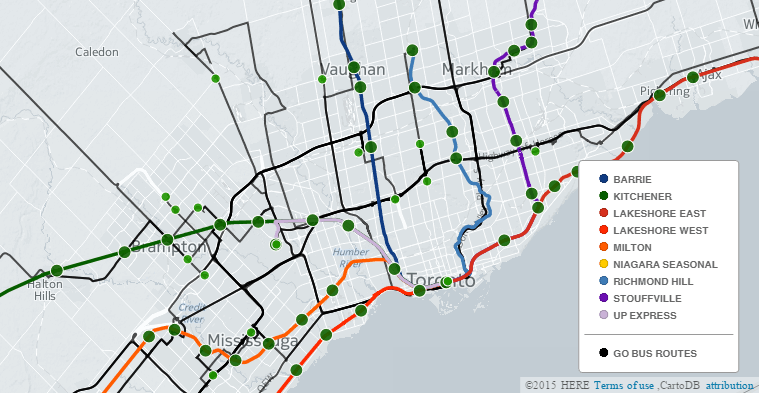
    I created a map of the full GO transit bus and rail system in CartoDB to illustrate GO Transit’s reach; all stations and major bus stops include some fare information (the distance and cash fare to Union Station) and the number of parking spots. 

    (more…)

  • GO Transit and the high cost of “free” parking

    IMG_0878

    This is the first of a series on regional transit in the Greater Toronto and Hamilton Area

    This may or may not come as a surprise to readers of my site, but the largest parking lot provider in Ontario isn’t the Toronto Parking Authority, nor is it a major real estate developer like Oxford (owner of Yorkdale and Square One malls) or Cadillac Fairview (Eaton Centre, Sherway Gardens). That record belongs to a public transit agency.

    Metrolinx, the regional transportation authority for the Greater Toronto and Hamilton Area (GTHA), owns or leases 63,302 spots at 53 of its 64 GO Transit rail stations (not counting two stations served by seasonal Niagara trains), and offers another 4,186 spots at various park-and-ride and carpool lots served by GO buses. (Metrolinx is responsible for approximately 1,000 spots, the Ministry of Transportation Ontario and local municipalities are responsible for the remaining 3,000 spots).

    Pickering GO Station, adjacent to Highway 401, has the most parking spots in the system, with 3,600 spaces in several lots and in a new parking garage. Clarkson comes in second with over 3,000 spaces. Acton, which sees only two trains a day to Toronto, has only 50 spaces. Eleven GO rail stations do not have any on-site parking: Union Station, Hamilton GO Centre, Hamilton West Harbour, Kipling, Exhibition, Bloor, Danforth, Kennedy, York University, Guelph, and Kitchener. With the exception of York University, all are either in urban downtowns (Toronto, Hamilton, Guelph, Kitchener), or are connections to the TTC.

    All GO Transit parking spots are “free,” with the exception of reserved spaces that can be leased for $94/month at most rail stations and the Newmarket bus terminal. Reserved spaces are beneficial for regular passengers to guarantee a preferred spot on weekdays. This is in contrast to the Toronto Transit Commission (TTC), which charges $2 to $7 to park at any of its lots on weekdays, though there are no parking charges on weekends and holidays at most of its lots and garages.

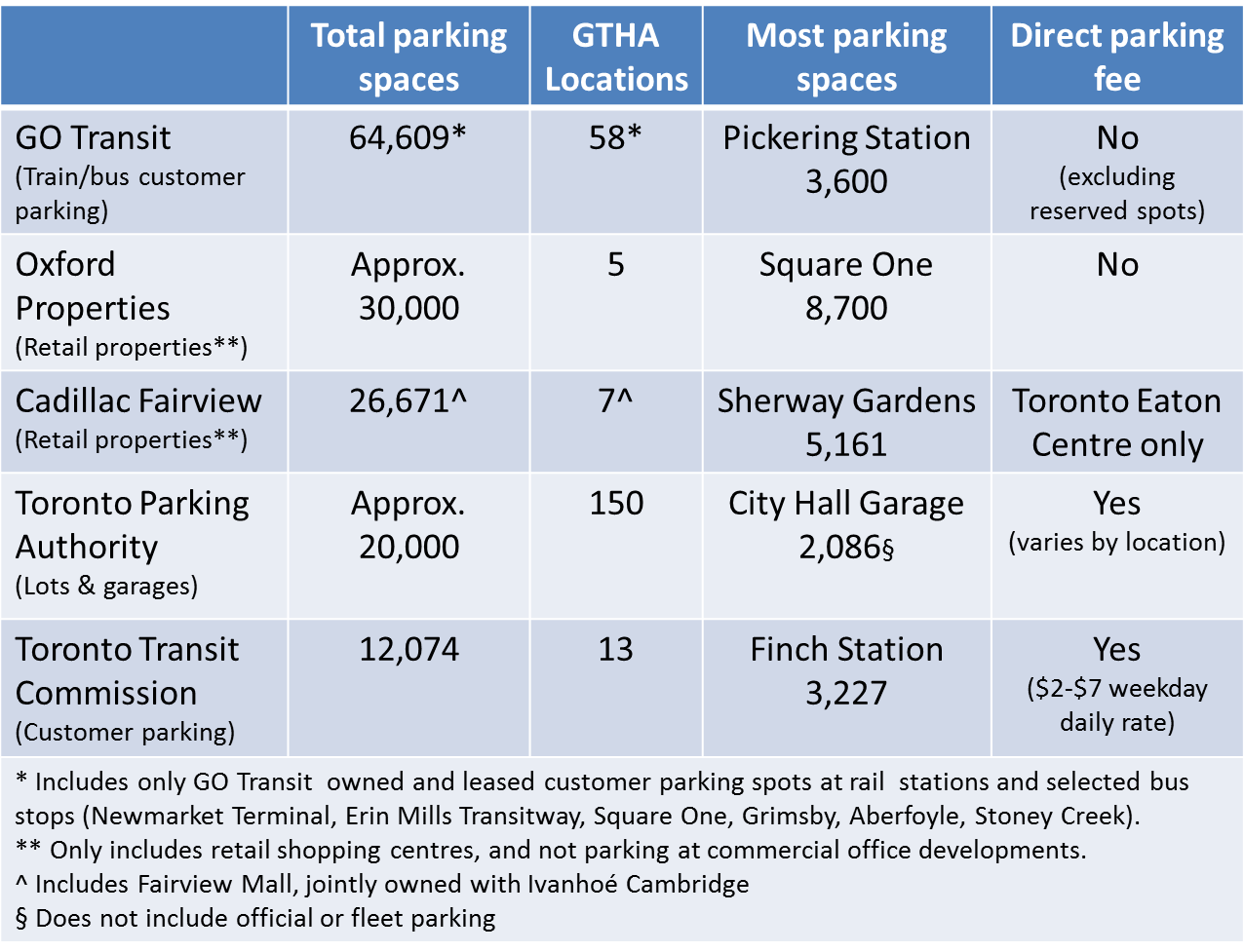
    The Toronto Parking Authority, the largest municipal parking operator in North America, operates 20,000 off-street parking spots in lots and garages across the City of Toronto. (The TPA is also responsible for 17,500 metered on-street spots.) Oxford Properties Group owns approximately 30,000 spots at five GTHA malls (Square One is the largest, with 8,700 spots), while Cadillac Fairview owns 26,671 spots at 7 GTHA malls. The TTC has parking facilities at 13 stations; Finch, with 3,227 spots, is the TTC’s largest, though Finch Station’s parking lots are within a hydro field.

    The table below illustrates this comparison.

    The GTHA’s largest parking operators

    Parking table v2

    I chose to include major shopping centres in this comparison, because as with GO Transit, they provide “free” parking to their customers, both surface lots and multi-level parking garages. The TTC does not charge for parking at most of their lots on weekends and holidays, while the Toronto Parking Authority charges competitive rates while returning a healthy profit to the City of Toronto.

    This model of providing ample “free” parking made sense early in GO Transit’s history, when the provincial government created the agency (“GO” is short for Government of Ontario) to shift auto traffic off the Queen Elizabeth Way and other provincial roads as Toronto was growing rapidly, especially as a major financial centre. In 1967, GO operated only on the Lakeshore Line between Pickering and Oakville, with two trains continuing on to Hamilton. Public transit in the suburbs was almost non-existent; land at these new GO stations was cheap and plentiful. (Here is a fascinating history of GO Transit’s early years.)

    But that model makes less sense nearly 50 years later, especially as GO moves towards becoming a regional rail operator, with more frequent services operating more like a metro than a commuter railway.

    (more…)