This is the first of a series on regional transit in the Greater Toronto and Hamilton Area
This may or may not come as a surprise to readers of my site, but the largest parking lot provider in Ontario isn’t the Toronto Parking Authority, nor is it a major real estate developer like Oxford (owner of Yorkdale and Square One malls) or Cadillac Fairview (Eaton Centre, Sherway Gardens). That record belongs to a public transit agency.
Metrolinx, the regional transportation authority for the Greater Toronto and Hamilton Area (GTHA), owns or leases 63,302 spots at 53 of its 64 GO Transit rail stations (not counting two stations served by seasonal Niagara trains), and offers another 4,186 spots at various park-and-ride and carpool lots served by GO buses. (Metrolinx is responsible for approximately 1,000 spots, the Ministry of Transportation Ontario and local municipalities are responsible for the remaining 3,000 spots).
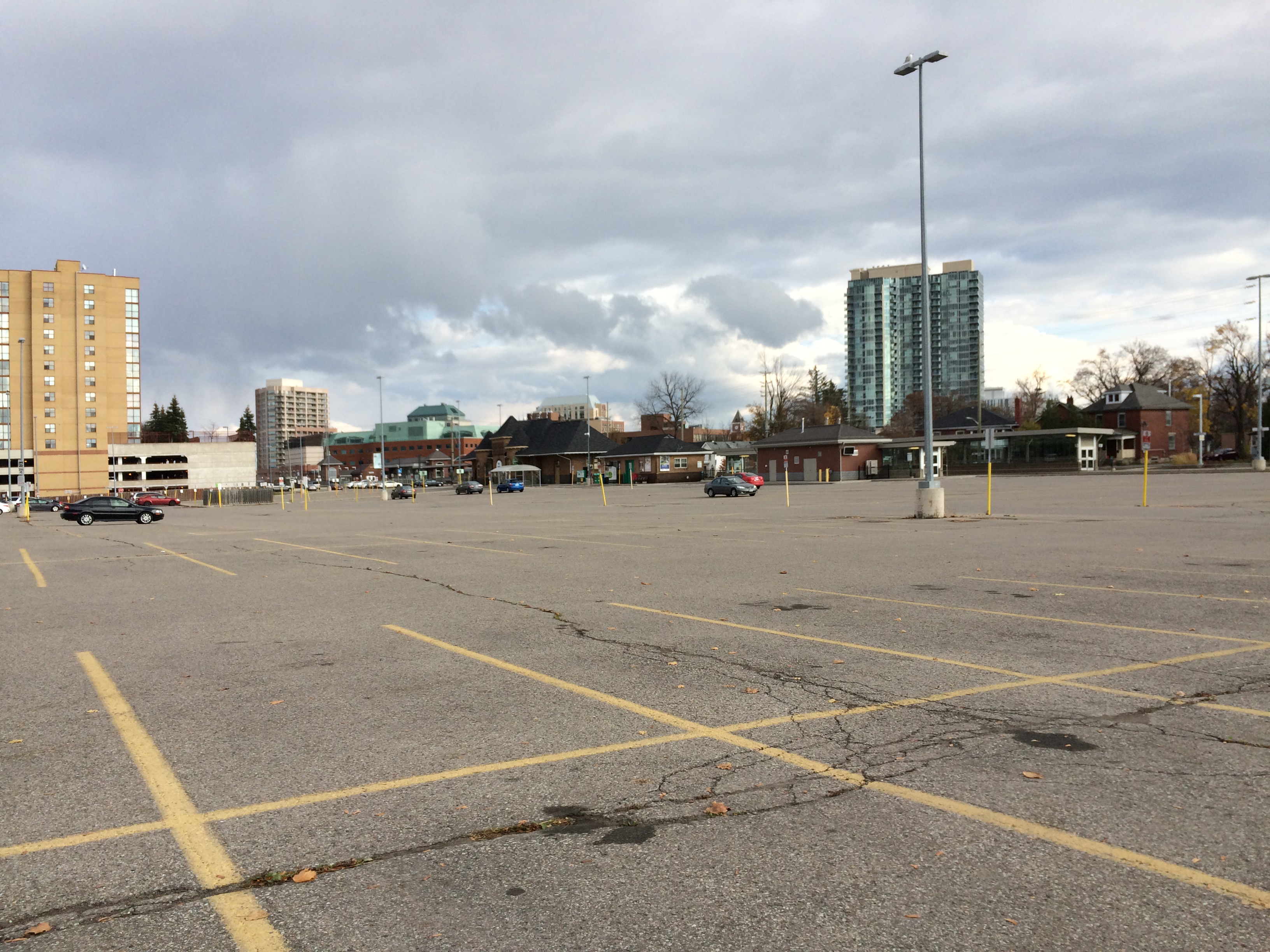
Pickering GO Station, adjacent to Highway 401, has the most parking spots in the system, with 3,600 spaces in several lots and in a new parking garage. Clarkson comes in second with over 3,000 spaces. Acton, which sees only two trains a day to Toronto, has only 50 spaces. Eleven GO rail stations do not have any on-site parking: Union Station, Hamilton GO Centre, Hamilton West Harbour, Kipling, Exhibition, Bloor, Danforth, Kennedy, York University, Guelph, and Kitchener. With the exception of York University, all are either in urban downtowns (Toronto, Hamilton, Guelph, Kitchener), or are connections to the TTC.
All GO Transit parking spots are “free,” with the exception of reserved spaces that can be leased for $94/month at most rail stations and the Newmarket bus terminal. Reserved spaces are beneficial for regular passengers to guarantee a preferred spot on weekdays. This is in contrast to the Toronto Transit Commission (TTC), which charges $2 to $7 to park at any of its lots on weekdays, though there are no parking charges on weekends and holidays at most of its lots and garages.
The Toronto Parking Authority, the largest municipal parking operator in North America, operates 20,000 off-street parking spots in lots and garages across the City of Toronto. (The TPA is also responsible for 17,500 metered on-street spots.) Oxford Properties Group owns approximately 30,000 spots at five GTHA malls (Square One is the largest, with 8,700 spots), while Cadillac Fairview owns 26,671 spots at 7 GTHA malls. The TTC has parking facilities at 13 stations; Finch, with 3,227 spots, is the TTC’s largest, though Finch Station’s parking lots are within a hydro field.
The table below illustrates this comparison.
The GTHA’s largest parking operators
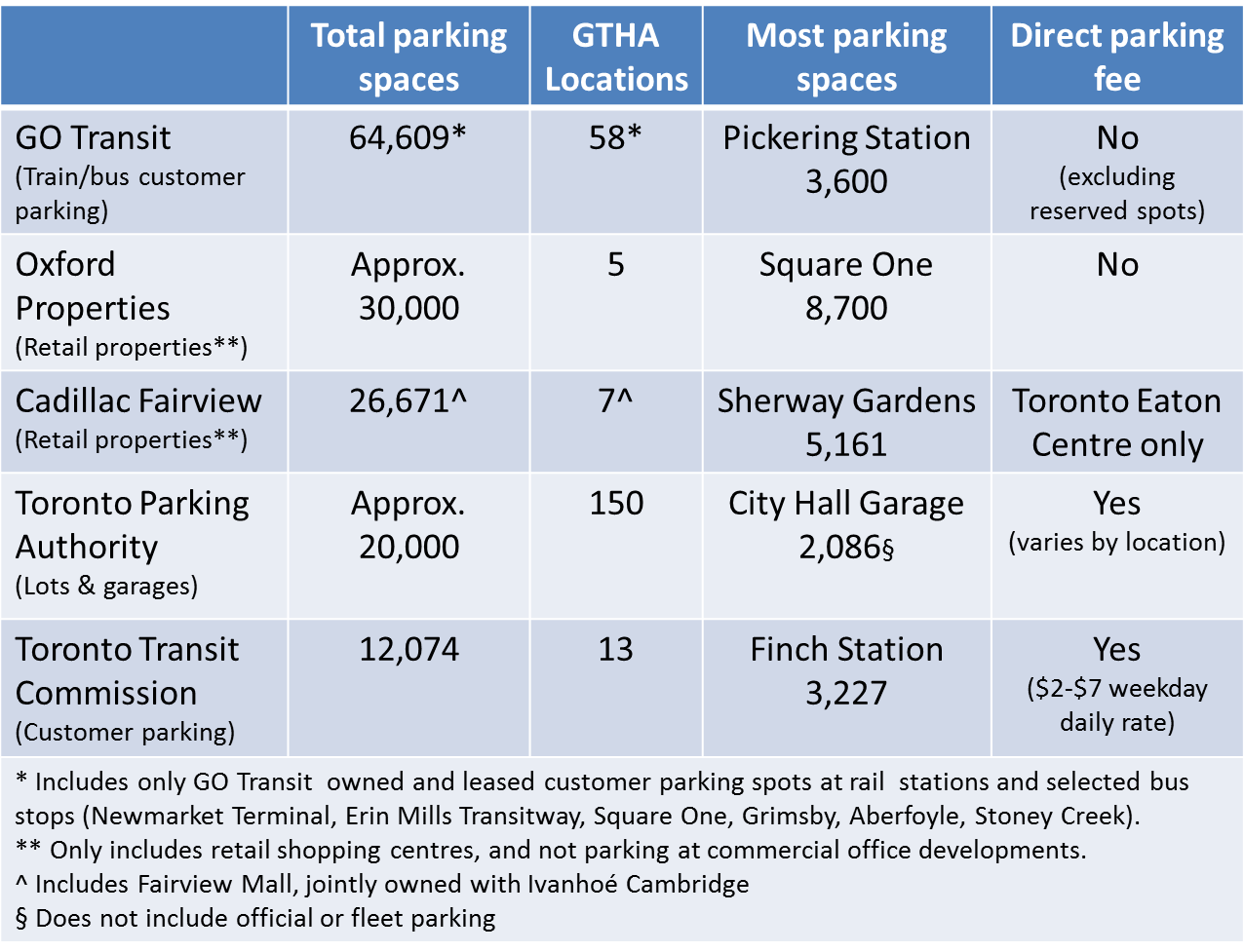
I chose to include major shopping centres in this comparison, because as with GO Transit, they provide “free” parking to their customers, both surface lots and multi-level parking garages. The TTC does not charge for parking at most of their lots on weekends and holidays, while the Toronto Parking Authority charges competitive rates while returning a healthy profit to the City of Toronto.
This model of providing ample “free” parking made sense early in GO Transit’s history, when the provincial government created the agency (“GO” is short for Government of Ontario) to shift auto traffic off the Queen Elizabeth Way and other provincial roads as Toronto was growing rapidly, especially as a major financial centre. In 1967, GO operated only on the Lakeshore Line between Pickering and Oakville, with two trains continuing on to Hamilton. Public transit in the suburbs was almost non-existent; land at these new GO stations was cheap and plentiful. (Here is a fascinating history of GO Transit’s early years.)
But that model makes less sense nearly 50 years later, especially as GO moves towards becoming a regional rail operator, with more frequent services operating more like a metro than a commuter railway.
The high cost of “free” parking
Despite huge seas of “free” parking at GO Transit’s suburban rail stations, and new towering parking garages, that parking isn’t really free. There are both capital costs of acquiring land, constructing lots and parking structures, as well as operating expenses, such as snow removal, security, lighting, and maintenance.
A new 1200-space parking garage, opened at Pickering in 2014, cost $47 million to construct, funded by the provincial and federal governments. Each new parking space in this multi-level parking structure cost over $39,000. Meanwhile, GO remains committed to building 3,500 new parking spaces a year, and Metrolinx/GO Transit, the Ministry of Transportation and municipal and provincial politicians often confuse adding more parking spots to actual transit improvements. Here’s a quote from the Mayor of Vaughan from a March, 2015 MTO press release announcing 60 new parking spots at Maple GO Station:
“These additional parking spots are a welcome addition to the Maple GO station and to the many Vaughan residents who use GO Transit every day. As a growing community, we know the importance of improving access to transit options, and we will continue to work with our provincial partners to ensure our transportation system grows to meet the needs of our city.”
The addition of 60 parking spots hardly improves access to transit, especially for those without access to a car, or for those who prefer not to drive. And a few new parking spaces really shouldn’t be seen as part of a growing transportation system.
The maintenance and servicing of parking costs approximately $100/space for surface parking and $200 for garages, exclusive of realty taxes.¹ Since GO has more than 5,000 spots in parking garages, it’s safe to say that parking maintenance alone costs GO Transit over $7 million annually.
Passengers that arrive at transit stations by foot, by bicycle, or those who get dropped off or carpool cost the transit agency less money, funds that could be used for expanding service. Most suburban transit agencies (such as Durham Region, York Region, Brampton, and Mississauga Transits and Hamilton Street Railway) offer a “co-fare” to passengers heading to or from GO Train Stations, a reduced cash fare of between $0.50 and $0.80, or an equivalent Presto fare deduction when transferring to or from a GO bus or train. This GO Transit-subsidized fare was intended to reduce the demand on parking lots.
Yet the TTC doesn’t have any fare agreement with GO Transit; this lack of fare integration (the GO-TTC Metropass pilot project at Danforth and Exhibition Stations notwithstanding) is an important barrier to transforming GO’s commuter rail services into a bona fide regional rail system. And GO passengers within the City of Toronto pay the highest fares for distance traveled. I’ll speak more about that in a later post.
The trouble with “free” parking though, is that every GO passenger pays for it, whether they drive to the station or not. Those who arrive by foot, by bike, by getting a ride, or within Toronto, by TTC, subsidize those who get there by car. This isn’t fair. And many of those lots, like those in Downtown Brampton (pictured in this post), Port Credit, Richmond Hill, and elsewhere, are in urbanizing neighbourhoods, prime for sustainable transit-oriented development, populated by residents and workers who would be likely transit customers.
Other GO Stations, like Bramalea, Oshawa, Bronte, and elsewhere, are in industrial areas, close to highways but more difficult to urbanize. GO Transit’s seas of parking are more appropriate at these locations. Many passengers will continue to need to drive to GO stations, especially where local transit is poor or non-existent; lots near highways and outside of urban centres will remain important for a regional transit system to meet every need.
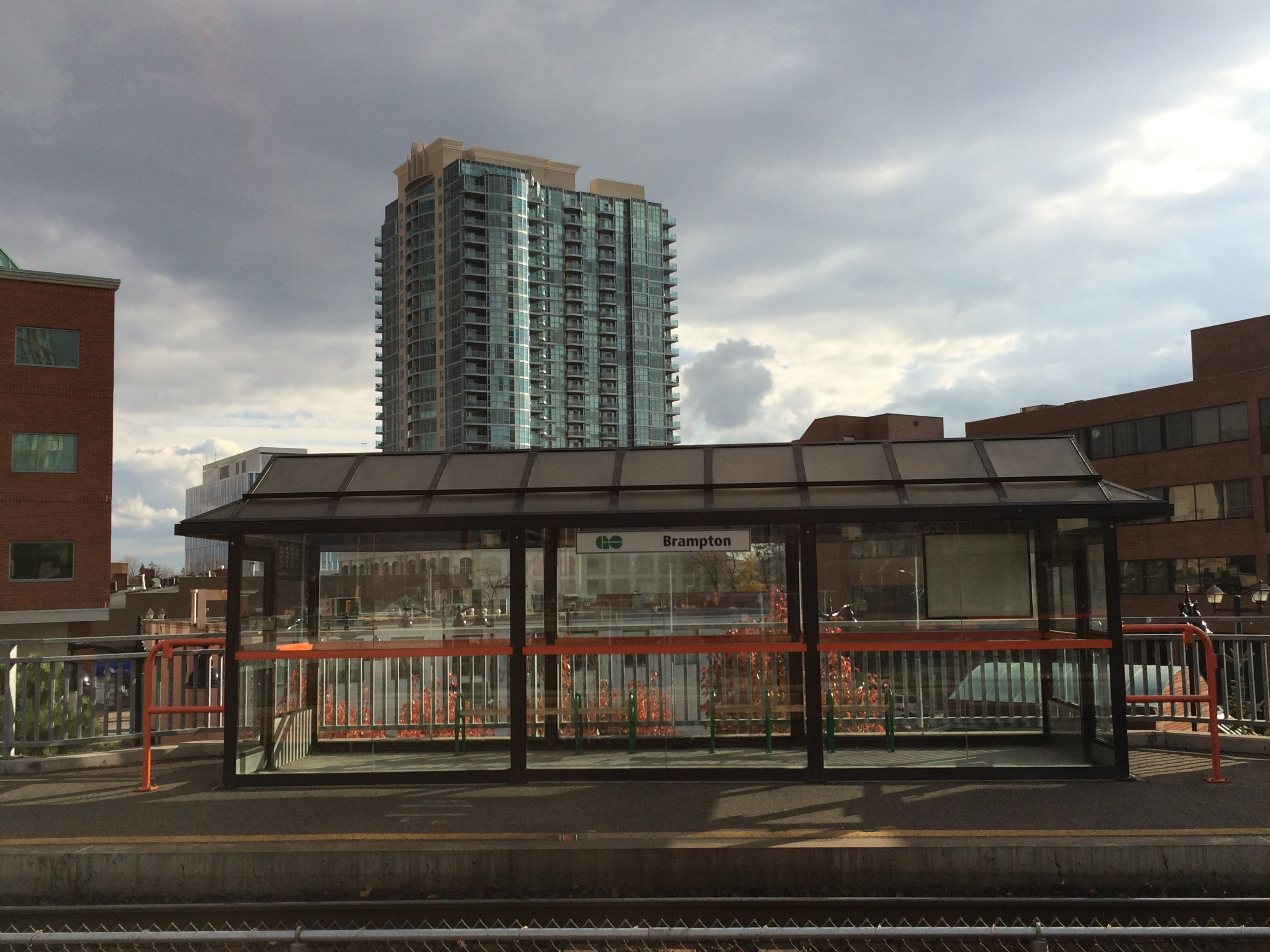 Urban development is necessary around GO Transit’s suburban rail stations.
I’ll discuss the unfairness of GO Transit’s fares further in a later post, but in the meantime, I would like to see a way in which some of GO’s operating costs could be transferred from fares to parking users. With additional parking revenue, general fare increases could be curtailed, or fares even reduced, to reward those who arrive at GO stations by transit, or by foot or bike.
There would certainly be some blowback from regular commuters, but in other large North American metropolitan areas, rail commuters are used to paying for parking. (Here’s the parking page for Metra, Chicago’s commuter rail operator. In New York, parking permits are required at many Long Island Rail Road stations, parking at most Metro-North stations requires payment.) Monthly permits would allow regular commuters to skip paying for parking each morning, while pay-and-display machines and mobile payment options (like that used by the Toronto Parking Authority) would allow irregular drive-up commuters to pay.
Parking garages, while expensive to build, are a more efficient use of space, allowing other parts of the station property to be redeveloped (possibly recouping the construction costs). GO Transit could be building more garages, not to expand parking, but to permit some initial redevelopment opportunities.
To be quite fair, GO Transit has been making some progress. GO has been improving bus facilities at its suburban stations, making them more comfortable for connecting passengers and allowing buses to bypass the rush-hour congestion. The introduction of Presto has allowed fare cardholders to get the local transit co-fare when transferring anywhere to and from GO buses, not just at rail stations. And new bike shelters appeared several years ago at most GO stations, and all GO buses now have bike racks. There are some concessions to non-motorists.
In conclusion, GO Transit, like the TTC, should be a transit agency first. Phasing out free parking, especially in urban areas well served by local transit, could be one of many ways in which GO Transit could truly become a regional transit system.
¹ Many thanks to GO Transit’s Anne Marie Aikins for this figure.


Leave a Reply