Tag: Scarborough

  • Mapping the 2014 Toronto Election: Wards 43 and 44

    Last, but not least, in my series of posts examining the results of the  Toronto municipal election of October 2014, are Wards 43 and 44, Scarborough East.

    I started these series of maps of the 2014 Toronto election as a few tweets. To me, it was a simple, interesting exercise. At first, I only sought to map the most interesting wards, where there were competitive races for city council – wards where the incumbent wasn’t running again, or where great candidates like Alejandra Bravo, Russ Ford, Lekan Olawoye, Dan Fox, and Andray Domise, were taking on established councillors and offering a better alternative to local voters. After requests to have a place to have these maps available somewhere, I resolved to set up a blog and to map every poll. It has taken me a bit longer than I expected, but I hope that these maps become useful between now and the 2018 election.

    While my politics certainly lean left, and my commentary on my blog at times pointed, all the maps I created are available to everyone. Despite my cynicism, I genuinely believe most people run for public office for the right reasons. Putting your name on the ballot takes courage; making a serious run for any elected office, even school trustee, is a long, difficult, exhausting, and expensive undertaking. I respect nearly every candidate who make that effort, regardless of their political leanings.

    And now, with the ward maps done, I’ve thought of more ideas to pursue in the near future. I’m interested in voter turnout; with esteemed Ryerson Professor Myer Siemiatycki, I co-wrote a study commissioned by the Maytree Foundation studying voter turnout in previous municipal elections. With poll-level data, it would be most interesting to look at voter turnout by housing type (such as TCHC vs. private rentals vs. condominium residences, for example) and other local determinants.


    Ward 43

    Ward 43 is represented by Paul Ainslie, a centre-right leaning councillor who I’ve come to respect. Ainslie was picked Chair of the Government Management Committee (and a member of Mayor Rob Ford’s executive committee) after the 2010 election.

    But unlike most Scarborough politicians, Ainslie parted with Ford on many issues. In 2011, Ainslie voted 97% of the time with Ford; but by 2013, he only voted 40.5% of the time with Ford. In 2014, Ainslie’s “Ford Nation” score (as developed by Metro columnist Matt Elliot) was only 20%, a difference of 77%. This was the greatest drop in Elliot’s “Ford Nation Percentage”score. In a CBC article dated October 15, 2013, Ainslie started to “butt heads” with Ford early that year “over budget issues.”

    That October, after the first Ford crack scandal hit but before Rob Ford’s November meltdown that ended up seeing Norm Kelly assume most of Ford’s responsibilities, Ainslie resigned from Ford’s executive. Ainslie supported the Scarborough LRT replacement project (which would include an extension to Progress Road and Sheppard Avenue) instead of the Bloor-Danforth Subway extension. For his actions, Rob Ford then recorded a “robocall” message to Ward 43 residents that read:

    “It was extremely, extremely unfortunate that your councillor, Paul Ainslie, was the only Scarborough councillor who did not listen to his constituents, and voted against the Scarborough subway. In fact, he led the charge against building subways in Scarborough; unfortunately it has led to his resignation from my executive committee. We are moving forward with a team who support the mandate Toronto taxpayers gave me…”

    The calls were made from Ford’s own City Hall telephone number. Eventually, Mayor Ford was forced to apologize on the council floor in 2014, in one of many rulings the City’s integrity commissioner made against the mayor. Despite Ford’s outrageous claims, Ainslie regularly engages with his constituents, including discussing the subway/LRT issue.

    Ainslie’s position on the Scarborough Subway/LRT dovetailed with the transit platform of mayoral candidate David Soknacki, who represented Ward 43 before Paul Ainslie was elected in 2006. Ainslie got his start at city hall as Councillor Soknacki’s executive assistant. (In February 2006, Ainslie was appointed to council to represent neighbouring Ward 41, filling in for former councillor Bas Balkisoon, who was elected as a Liberal MPP in a provincial by-election. Ainslie’s run for Ward 43 councillor later that year was controversial, as appointed councillors are typically expected not to run in the next general election.)

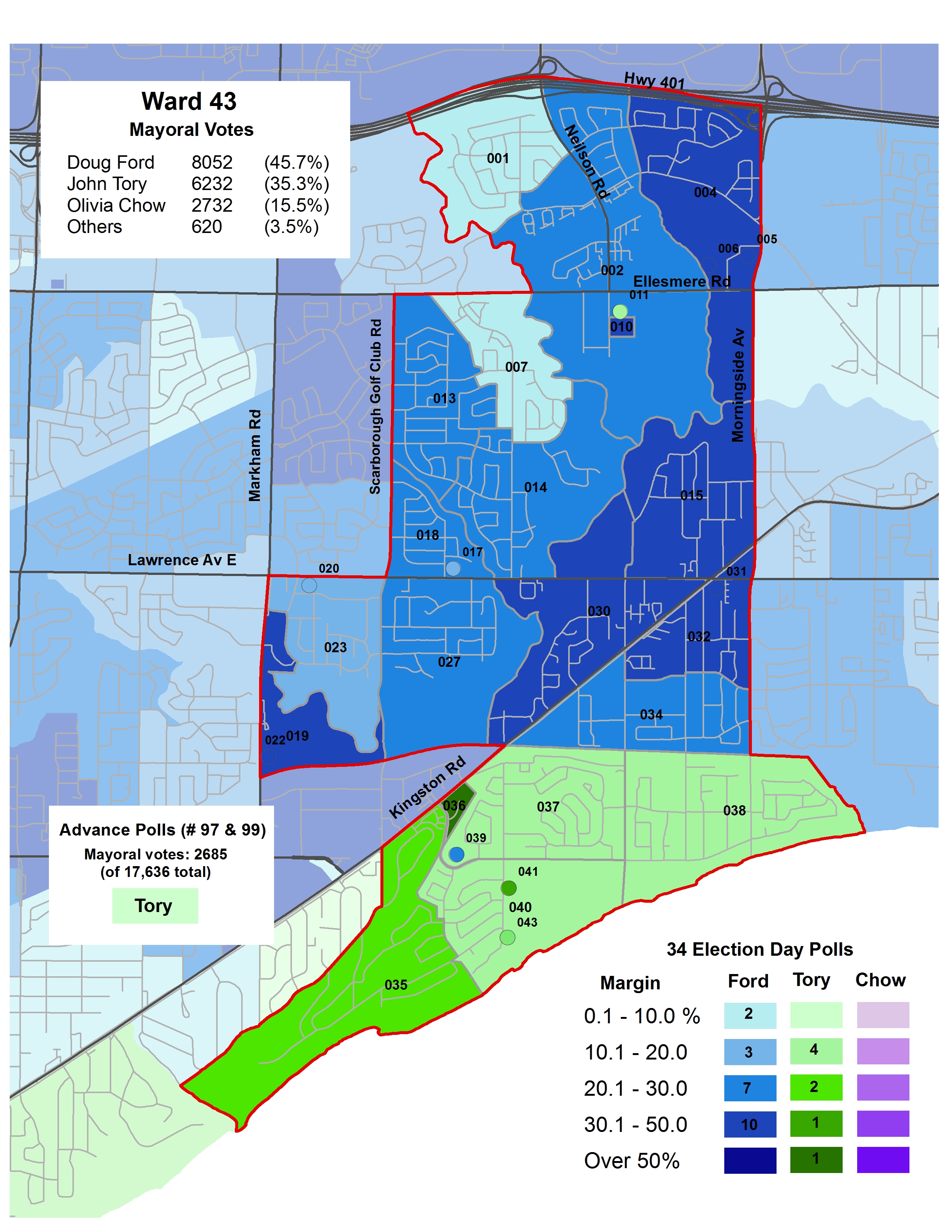
    As in neighbouring Scarborough Ward 36, most polls on the Lake Ontario shoreline in Ward 43 voted for John Tory. Conversely, all but one poll north of the GO Lakeshore East Line, a City of Toronto long term care home near Scarborough Centenary Hospital, voted for Doug Ford. Ford came in first place in Ward 43, netting 45.7% of the vote, while Tory came in second place with 35.3%. Olivia Chow only took 15.5% of the vote.

    Paul Ainslie handily won re-election in 2014 (despite Rob Ford’s robocalls) with 74.3% of the vote. Second place candidate Mark Harris had the vote of only 10.5% of the electorate.

    2014 Election - WARD 43 Mayor
    Poll results of the mayoral race in Ward 43

    Ward 44
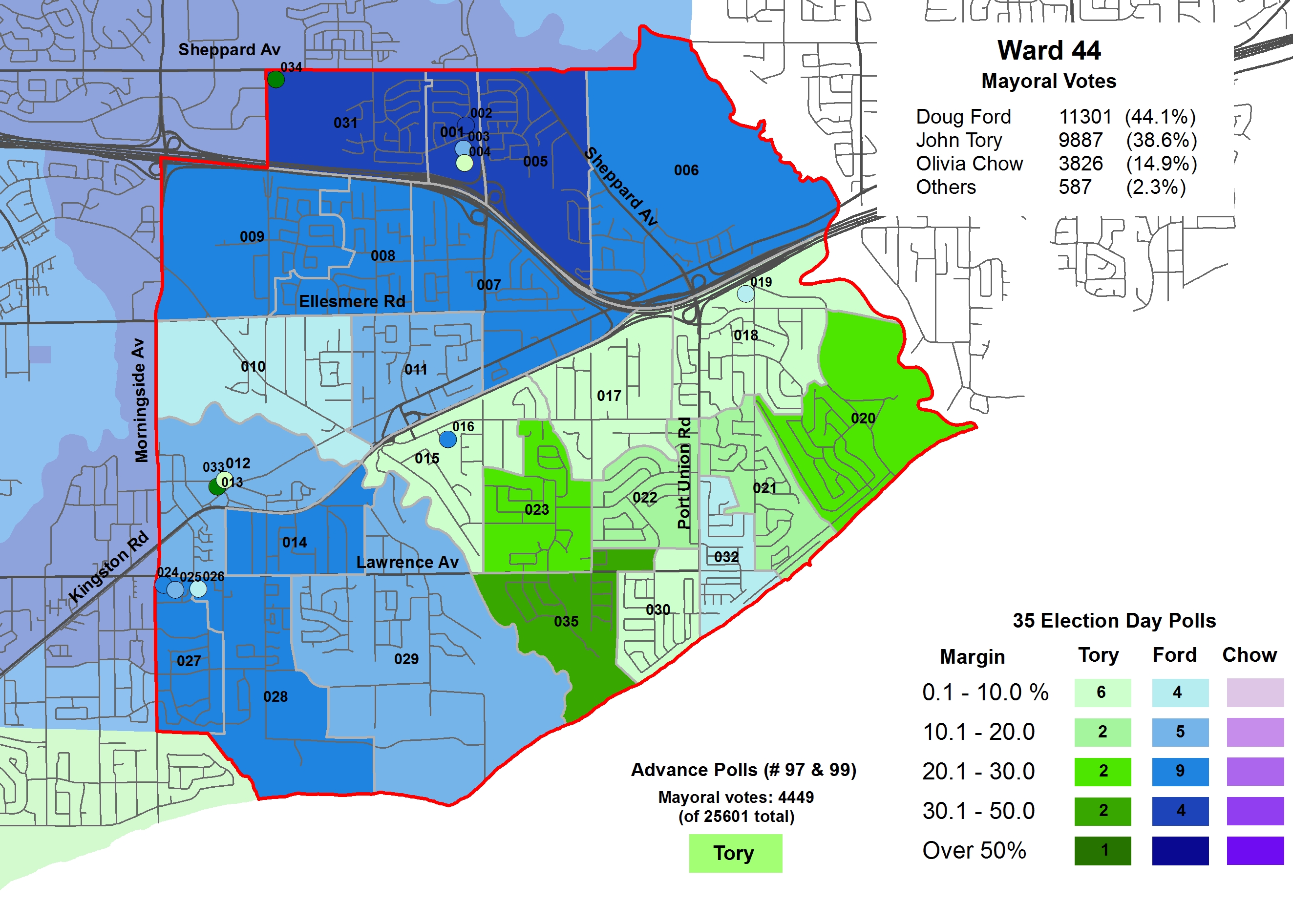
    2014 Election - WARD 44 Mayor

    Poll results of the mayoral race in Ward 44

    East of Highland Creek, the residential areas between Kingston Road/Highway 401 and the lake mostly voted for Tory, continuing Tory’s pattern of coming in first in middle and upper-income polls in Scarborough that straddle Lake Ontario. West of Highland Creek; Polls 027, 028 and 029, while also bordering Lake Ontario, are for all intents and purposes inland; the GO Lakeshore East line (CN Kingston Subdivision) separates residential areas to the north with the parks, factories and municipal facilities (water treatment plants). These polls, which supported Doug Ford by wide margins, are located in the West Hill Neighbourhood Improvement Area (the new nomenclature for what used to be called “priority neighbourhoods); Poll 027 includes the Danzig Street TCHC community where one of Toronto’s worst mass shootings occurred on Monday, July 16, 2012. Most polls north of Kingston Road also voted for Doug Ford.

    Ford came in first place in Ward 44, taking 44.1% of the vote to Tory’s 38.6%. Chow only got 14.9%. As in Ward 43, Tory won the advance poll by a comfortable margin despite coming in second place in both wards.

    Ward 44 also had one of the closest council races as three viable candidates sought to unseat 71-year old Ron Moeser, who left everyone guessing whether he’d run for council again despite a poor attendance record attributed to health concerns. Moeser has long been a dead weight on council, quite possibly its least active member. Moeser was first elected to Scarborough council in 1988, he has been a city councillor since then, except betweeen 2003 and 2006, when Gay Cowbourne defeated him; she did not run again in 2006 and Moeser took back the seat.

    In the 2010 election, Moeser narrowly won in Ward 44, taking 47.4% of the vote to second-place Diana Hall’s 46.1%, a difference of 284 votes.

    In 2014, the Toronto Star endorsed Hall, Cowbourne’s former executive assistant, describing her as a “thoughtful conservative” while NOW Magazine halfheartedly endorsed Amarjeet Shhabra, explaining that the main reason to vote for her was to defeat Moeser. Shhabra, a union organizer, had the Labour Council’s endorsement.

    It’s too bad the Toronto Star and NOW overlooked Moeser’s strongest challenger.

    Moeser unfortunately won in a crowded field of 15 candidates; several of whom had name recognition and organized campaigns. But Moeser won just 25.7% of the vote in the 2014 election, 3769 fewer votes than in 2010. But was Jennifer McKelvie, an environmental scientist and adjunct professor at Ryerson University, who came closest to defeating Moeser, taking 23.4% of the vote, a difference of 572 votes. Hall came in third with 22.2%, and Chhabra came in fourth, netting 11.4% of the vote. McKelvie came in first in 14 election day polls as well as the advance poll, Moeser won in 16 polls, Hall in 5. Most polls that supported Doug Ford the strongest stuck with Moeser for council, while polls where Tory came in mostly voted for Hall or McKelvie, the remainder might have voted for Moeser, but by very small margins.

    Had there been a less crowded field, I suspect that Moeser would not have won in 2014.

    (Interestingly, the advance polls reflected the election day results, there would be two more women on Toronto City Council; Alejandra Bravo also won the advance poll in Ward 17, but couldn’t dislodge Cesar Palacio.)

    McKelvie, who was running for public office for the first time, has some impressive credentials; had she won, she’d be great fresh voice at City Hall. But in several wards, including 3, 5, and 26, the second-place candidate in the 2010 election went on to prevail in 2014. This should be welcome news for Jennifer McKelvie, who I hope will be interesting in running again.
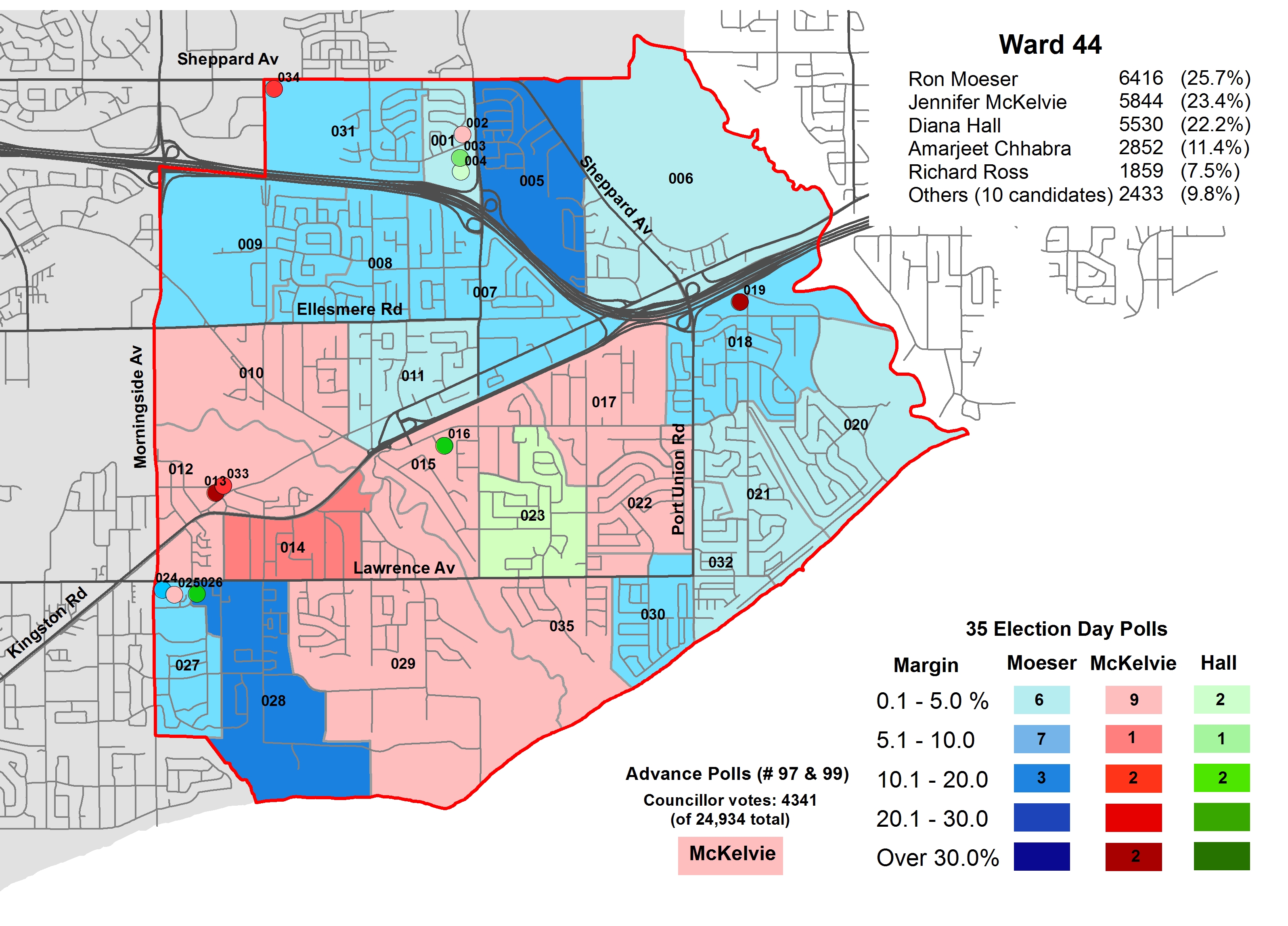
    2014 Election - WARD 44 Cllr

  • Mapping the 2014 Toronto Election: Wards 41 and 42

    I was hoping to have this series of analyses of the 44 wards complete last week, however many things got in the way. But with my life getting back to normal, and with my eagerness to move on to new projects, I bring you the penultimate post in the series the results of the 2014 municipal election.

    In this post, I look at Wards 41 and 42, Scarborough-Rouge River. Ward 41 is represented by Chin Lee, Ward 42 by Raymond Cho. Despite the Fords’ popularity in northeast Scarborough, neither councillor was much of a support of the Ford agenda in 2011-2014. Raymond Cho, despite his Conservative leanings, voted with Ford less than 20% of the time, while Chin Lee voted with Ford 36% of the time, according to Matt Elliot’s Council Scorecard.

    In Ward 41, which is located north of Highway 401, between the GO Stouffville Line (CN Uxbridge Sub) and McCowan/Markham Roads, Doug Ford came in first place in all but one poll, 014, where Olivia Chow won. Poll 014 represents one of several Yee Hong Centres for Geriatric Care.

    In Ward 42, which covers the Malvern and Morningside Heights neighbourhoods, as well as the Toronto Zoo and much of Rouge Park, Doug Ford came in first place in every single poll, doing best in the Malvern neghbourhood, but with less support in the newer subdivisions of Morningside Heights to the north of Finch Avenue.

    John Tory did not win a single poll in either Scarborough-Rouge River ward.

    2014 Election - WARD 41 MayorPoll results of the mayoral race in Ward 41

    2014 Election - WARD 42 Mayor
    Poll results of the mayoral race in Ward 42

    (more…)

  • Mapping the 2014 Toronto Election: Wards 39 and 40

    I almost called this post “Everybody loves @norm” after the popular former Deputy Mayor, Norm Kelly, who represents Ward 40 on  Toronto City Council.

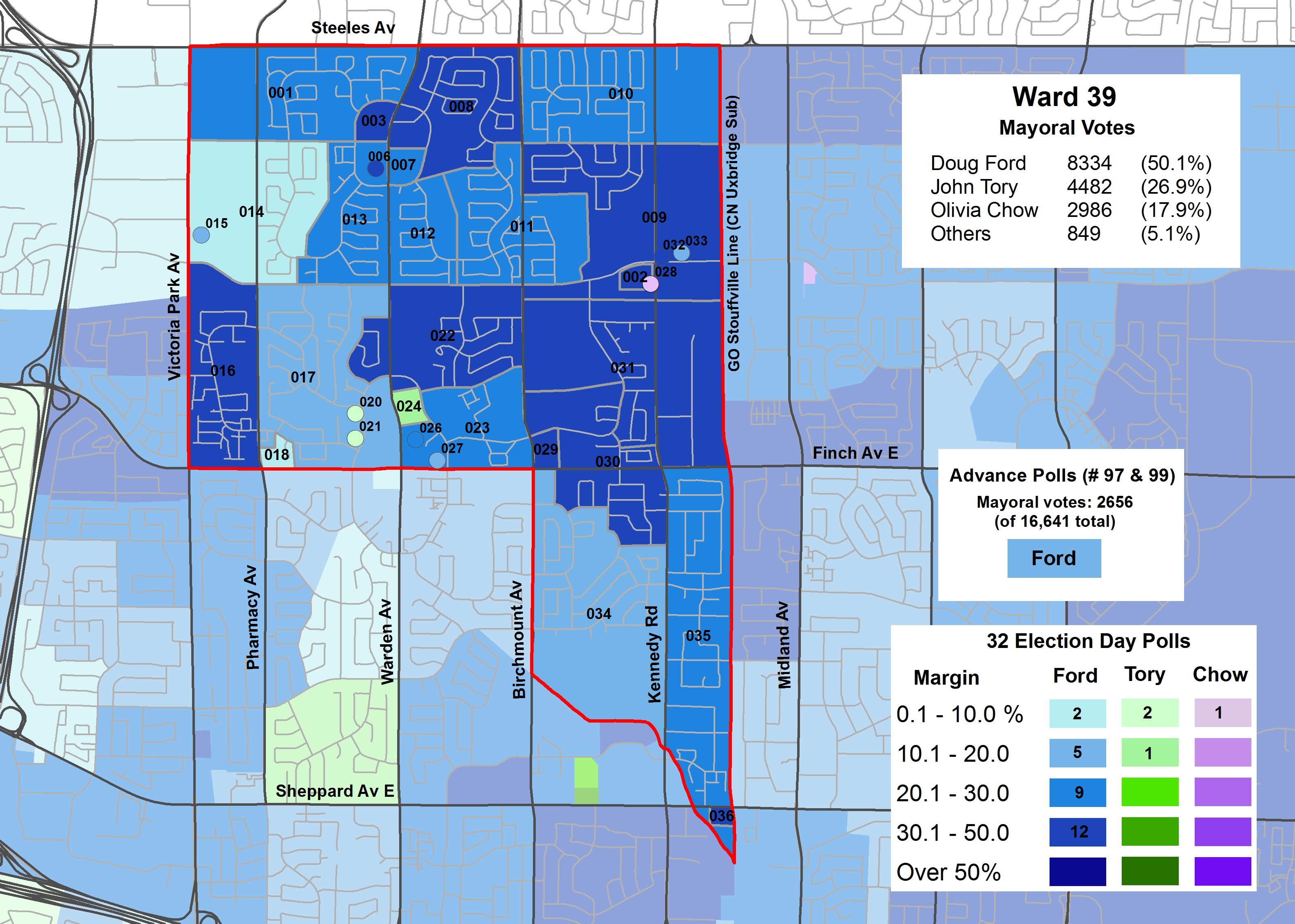
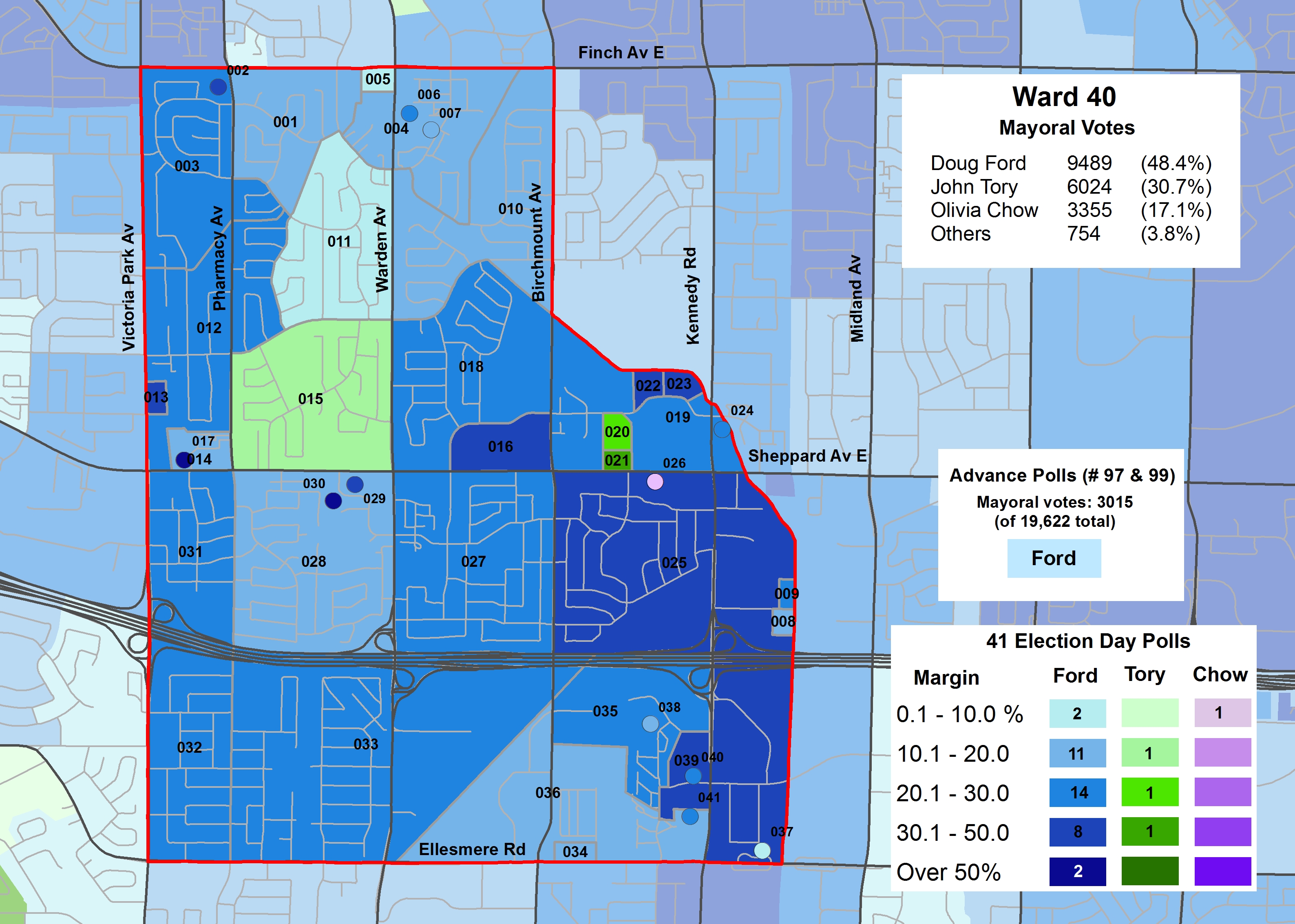
    In this latest installment of my (nearly complete) series of posts on the results of the 2014 municipal election, I come to Wards 39 and 40, Scarborough-Agincourt. The provincial/federal riding of Scarborough-Agincourt is a nice rectangular shape, bounded by Steeles Avenue to the north, Ellesmere Road to the south, Victoria Park to the west, and the GO Transit Stouffville corridor (formerly the CN Uxbridge Subdivision) railway to the east. This rail corridor is proposed as the route of Mayor John Tory’s “SmartTrack” transit plan. However, the boundary between Wards 39 and 40 is a bit jagged, with Finch and Birchmount Avenues and West Highland Creek forming the boundary. This results in an odd panhandle in Ward 39, as it includes only two apartment towers south of Sheppard Avenue.

    Mayoral race

    In the mayoral race, Doug Ford came in first place in both wards, netting 50.1% of the vote in Ward 39 and 48.4% in Ward 40. John Tory came in a distant second place in both wards, with 26.9% of the vote in Ward 39 and 30.7% in Ward 30. Third-place Olivia Chow got between 17 and 18% in both wards.

    2014 Election - WARD 39 MayorPoll results of the mayoral race in Ward 39

    In Ward 39, Doug Ford came in first place in all but 4 polls. John Tory came first in three, all representing condominium towers on Bridletowne Circle (in the Finch/Warden area). Olivia Chow one one poll, 028, a condo tower on Kennedy Road near McNicoll Avenue. Doug Ford came in first place in all seniors’ homes in the ward, including the large Yee Hong Centre. While I am not terribly surprised, it is worth noting how a prominent Chinese-Canadian immigrant could not obtain much support in a ward with a large Chinese-Canadian community.*

    2014 Election - WARD 40 Mayor Poll results of the mayoral race in Ward 40

    Like Ward 39, Doug Ford came in first place in all but four polls in Ward 40, with Tory taking three, and Chow one. Tory did the best in Polls 020 and 021, the Shepherd Village retirement and assisted living community on Sheppard Avenue; he also came first in Poll 015, which doesn’t seem much different than its neighbouring Ford-voting subdivisions. Doug Ford did the best in Polls 014, a rental tower on Chichester Place and 030, an older condominum tower on Palmdale Place.

    Council races

    Ward 39, represented since 2003 by accountant and former Catholic school board trustee Mike Del Grande, was an open race in 2014 with Del Grande’s announcement in February that he was not seeking re-election. On April Fool’s Day, April 1, Liberal MP Jim Karygiannis announced his resignation from federal politics to run for the council seat.

    Karygiannis’s announcement was a bit unusual. while it’s not rare for a sitting federal or provincial politician to run for municipal office, usually it’s to run for mayor (the newly elected mayor of Brampton, Linda Jeffrey, was a Liberal MPP and prominent cabinet minister when she resigned to run there; George Smitherman was another powerful provincial cabinet minister who ran for mayor of Toronto, but lost to Rob Ford in 2010). His claim was it was spend more time with family; speculation was that Liberal leader Justin Trudeau didn’t care for the veteran controversial and socially conservative MPP; the feeling was likely mutual.

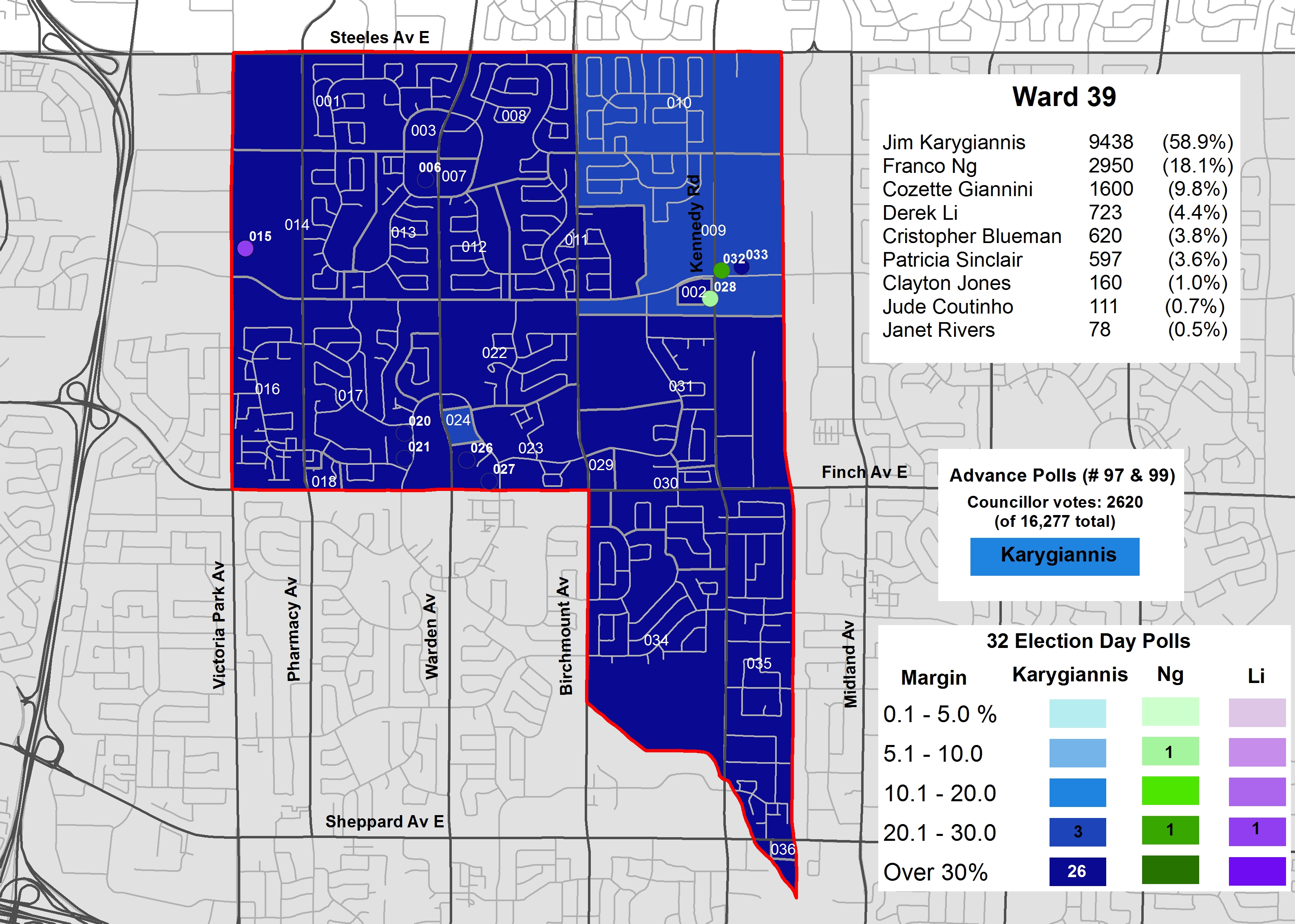
    But with name recognition and a local political machine, Karygiannis pretty much had the advantage of any council incumbent, especially against relative unknowns Franco Ng and Cozette Giannini. While the Toronto Star endorsed Ng, NOW magazine endorsed Giannini, Karygiannis won in a landslide; taking 58.9% of the vote and all but three polls. Second-place Franco Ng netted only 18.1% of the vote (and came first in two polls), Giannini came in third with 9.8%. Fourth-place Derek Li came first in one poll, though this was a long-term medical institution with a small voting population.

    2014 Election - WARD 39 Cllr Poll results of the council race in Ward 39

    There was no contest in Ward 40, represented by councillor Norm Kelly, who won with an astounding 86% of the vote. But I’m certainly not complaining.

    Kelly is a long-term city councillor, but is also a historian, and taught history at Upper Canada College. He was first elected to municipal politics in 1974 as an alderman on Scarborough council. He was a Liberal MP between 1980 and 1984, losing to the Progressive Conservatives in the Mulroney landslide of 1984. After making an unsuccessful run for mayor of Scarborough in 1985, Kelly turned to real estate before returning to Scarborough council in 1994; he has been a Toronto councillor since the 1997 amalgamation.

    Kelly, a centre-right ally of mayors Lastman and Ford (between 2011 and 2014, Kelly voted with the mayor over 80% of the time), was named deputy mayor in August 2013. This was after Rob Ford’s first pick for deputy mayor, Doug Holyday, resigned after a by-election win in Etobicoke-Lakeshore for the Ontario Progressive Conservatives. (The losing Liberal candidate in that by-election, fellow Etobicoke councillor Peter Milczyn, won in the general election in the June 2014 general election). As Rob Ford’s personal scandals involving drug use and lewd behaviour deepened in 2013; council stripped Ford of most of his powers, transferring them to Kelly in November 2013. Kelly quickly re-established order and decorum to City Hall with humour and grace, and for that, politicians and observers of all political stripes were grateful. Even the lefty NOW magazine endorsed Kelly for re-election in 2014.

    Unfortunately, John Tory picked Denzil Minnan-Wong (who, to put it nicely, is not nearly as well-liked as Norm Kelly) as his lead Deputy Mayor. (Vince Crisanti, Glenn De Baeremaeker, and Pam McConnell were chosen as Tory’s secondary deputy mayors.)

    Given Kelly’s sweep of all polls in Ward 40, there was no need to create a map of the council race here.

    Post script: It’s also worth noting that Wards 39 and 40 were represented at the Toronto District School Board by Sam Sotiropoulos, a homophobic and transphobic individual, whose offenses are nicely summed up by Torontoist in its annual Heroes and Villains feature. Sotiropoulos lost to Manna Wong by 2067 votes. Still Sotiropoulos came in second place, and got 9,621 votes. I hope this can be chalked up to the incumbency factor and that many voters simply do not pay attention to school board politics.

    (Hat tip to Paula Cheung reminding me to include this post script, one of the bright spots of the 2014 election.)


    *It should be noted that Olivia Chow immigrated from Hong Kong and speaks Cantonese, many in Ward 39’s Chinese-Canadian community are immigrants from Mainland China and speak Mandarin. And of course, there are many considerations one makes when deciding who to vote for; as I mentioned earlier, I am not surprised to see Chow do so poorly in Agincourt.

  • Mapping the 2014 Toronto Election: Wards 37 and 38

    In this short post, I look at the election results in Ward 37 and Ward 38, Scarborough Centre. Ward 37, west of Brimley Avenue, is represented by Councillor Michael Thompson, while Ward 38, to the east, is represented by Councillor Glenn De Baeremaeker. The results of the mayoral race were nearly the same in Ward 37 and Ward 38. Doug Ford came in first place in both wards with about 51% of the vote, and won all but three polls in Scarborough Centre. John Tory came in a distant second place with less than 30% of the vote (and came in first place in the remaining polls), while Olivia Chow took just over 15% of the vote. Both incumbent councillors were easily re-elected.

    (more…)

  • Mapping the 2014 Toronto Election: Wards 35 and 36

    After many weeks of presenting poll-by-poll maps of the council and mayoral races in the 2014 municipal election, I finally reach the home stretch: the final ten wards located in the former municipality of Scarborough. Of all the six municipalities that were amalgamated into the City of Toronto, Doug Ford did the best here. (Even in the Fords’ home turf of Etobicoke, John Tory came in first place in three of that suburban area’s six wards.)

    In this post, I look at the two wards that make up Scarborough Southwest, Ward 35 and Ward 36.

    Ward 35, the north half of Scarborough Southwest, is a triangular ward bordered by Victoria Park and Eglinton Avenues and Metrolinx’s Lakeshore railway line. Ward 35 is represented by Michelle Berardinetti, who was first elected to city council in 2010, the spouse of Liberal MPP Lorenzo Berardinetti (who represents Scarborough Southwest at the provincial level). Ward 36, south of the railway corridor, straddling Lake Ontario, is represented by Gary Crawford. Unlike Ward 35, ward 36 includes relatively affluent neighbourhoods such as Fallingbrook (which neighbours the prestigious Beaches neighbourhood) and those abutting the Scarborough Bluffs.

    Ward 36 was the only ward in Scarborough where John Tory came in first place; Doug Ford was the first choice in all nine other wards east of Victoria Park Avenue.

    Interestingly, even though the dubious extension of the Bloor-Danforth Subway wouldn’t serve Wards 35 or 36 by any means, both incumbent councillors were strong supporters of the expensive project that replaced plans for the replacement of the existing SRT with an extended light rail corridor.

    (more…)

  • Does Scarborough need a subway extension? (No, it doesn’t.)

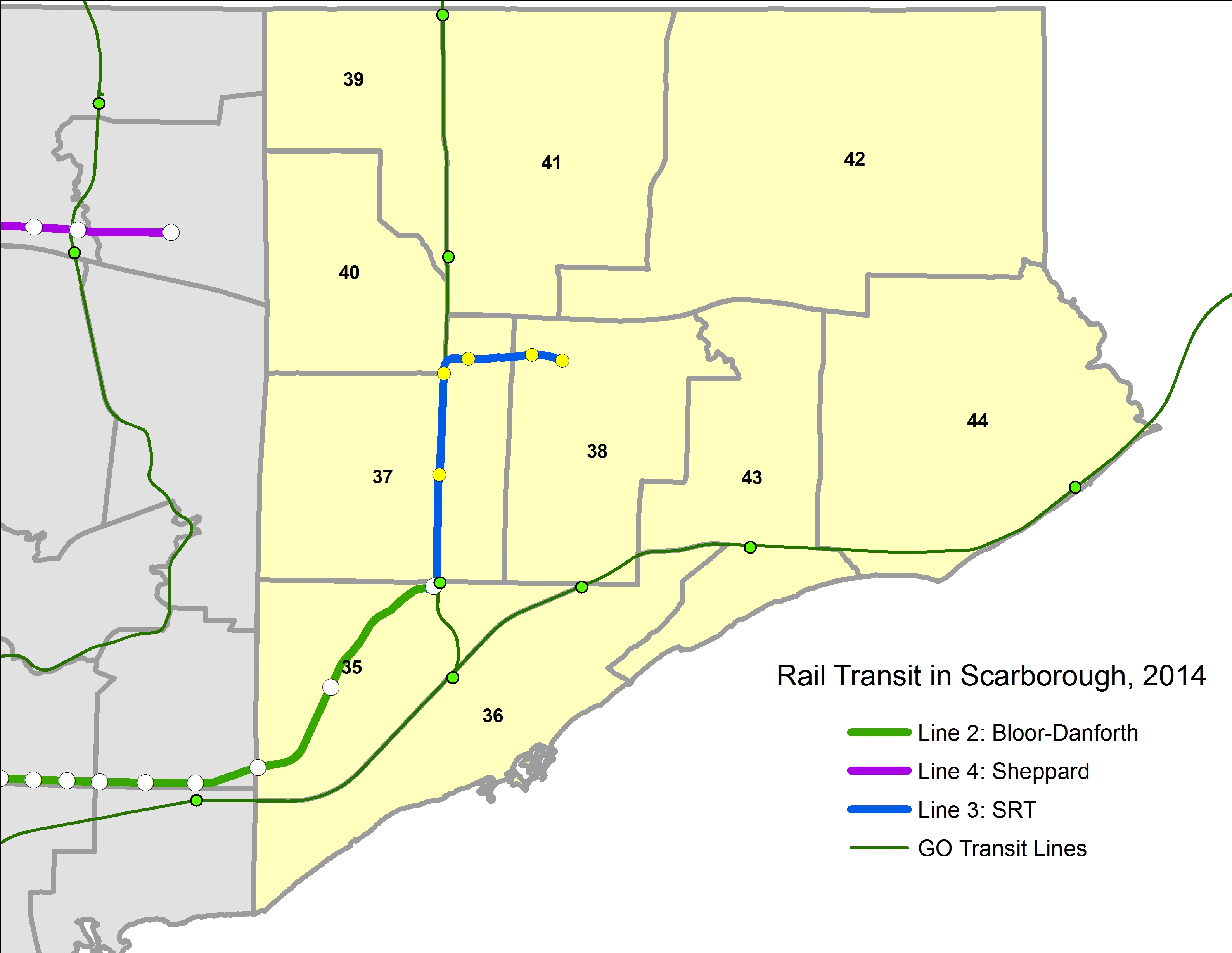
    Scarborough - 2014Rail transit routes in Scarborough, 2014

    The Scarborough Rapid Transit (SRT) line, opened in 1985, is in dire need of replacement. The SRT was planned as a grade-separated LRT route (here what it would have looked like), but the province pushed a new automated light metro ICTS technology. ICTS was developed by the Urban Transportation Development Corporation, then owned by the provincial government (UTDC’s technologies are now owned by Bombardier). ICTS has proven to be successful elsewhere, particularly for Vancouver’s SkyTrain, but not so much in Toronto.

    The city and province originally agreed to replace the ageing SRT with an extended LRT line, which would have been fully grade-separated. It would provide a rapid, high-quality transit route similar to LRT networks in Calgary or San Diego. Repairs to the existing line and new ICTS rail cars would have been expensive and difficult. For example, a tight tunnel between Ellesmere and Midland Stations would require complete reconstruction to fit the larger cars Bombardier still produces for Vancouver.

    In 2010 Rob Ford got elected on a promise of building “subways, subways, subways,” and with the province, had the fully funded, shovel-ready LRT conversion and expansion put on hold. Queen’s Park was wary of Ford’s support in those early years, and the Liberal government afraid of losing seats in Scarborough to the Conservatives. Interestingly, left-leaning councillor Glenn De Baeremaeker was one of the most vocal champions of the subway.

    The alignment for the Bloor-Danforth subway extension from Kennedy Station, which has not yet been decided, would probably be routed via Eglinton Avenue, Danforth Road, and McCowan Road, with stops at McCowan and Lawrence, McCowan and Ellesmere (or closer to the Scarborough Town Centre Mall) alignment to Sheppard Avenue, and McCowan and Sheppard.

    Council had the opportunity in 2013 to reverse its stance, but it unfortunately voted 26-18 to pursue the subway. Paul Ainslie (my favourite councillor in Scarborough), voted for the LRT, the only councillor from that part of Toronto to do so. In return, Mayor Rob Ford robo-called Ward 43 residents, falsely accusing the Ainslie of not consulting with his constituents when he decided to back the LRT. Ford was later forced to apologize by order of the integrity commissioner.

    Ainslie has it right. Support for the subway extension, even in Scarborough, isn’t as strong as many of its politicians’ rhetoric makes it sound. Some polls even suggest that residents in Scarborough support LRT. Mayoral candidates David Soknacki (who dropped out in September) and Olivia Chow supported going back to the LRT plans, but Doug Ford and John Tory backed the subway.

    So here we are. John Tory, elected mayor of Toronto, promised to continue with plans to build the Scarborough subway extension, despite its higher cost and his commitment to SmartTrack. On the campaign trail, Tory has not come out fully supporting LRT construction on Finch West or Sheppard East, two of the three pieces of the Transit City plan that are still funded. (The Eglinton-Crosstown LRT, the only Transit City route so far underway, is being built by the province through Metrolinx.)

    (more…)