Tag: Scarborough

  • The subway is coming. Let’s improve Scarborough Centre

    As the readers of my blog probably know, I am not a fan of the Scarborough Subway extension. Even though the subway will be expensive and less useful than a fully-funded light rail replacement of the ageing Scarborough RT, politicians from all three major parties have backed the subway, promising “respect” and “fairness” for Scarborough.

    Neethan Shan, the New Democratic Party’s candidate in Thursday’s provincial by-election in Scarborough-Rouge River, has been pushing this messaging hard, though all three candidates — including City Councillor Raymond Cho, running for the Progressive Conservatives — are all in favour of the extension. That conveniently ignores the fact that the subway won’t even stop in Scarborough-Rouge River — though the LRT would have.

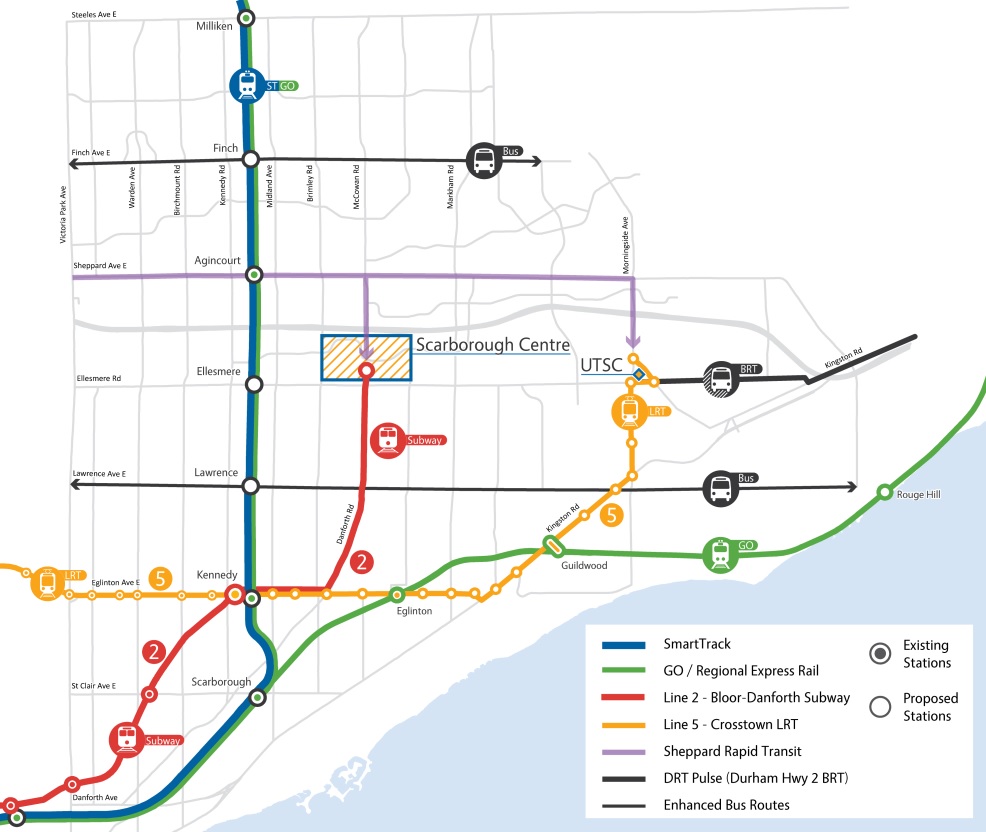
    But it’s now time to move on. Scarborough is going to get a six kilometre long, one-stop subway extension, which was confirmed by a vote at city council in July. The focus should now be on getting the best value out of the $3.2 billion project. That must include improving Scarborough Centre.

    The subway extension is currently in the environmental assessment/detailed design stage. I expect that construction will actually begin probably just before the next provincial election is called in 2018. It won’t open for another four to five years after that, in 2022 or 2023. That is plenty of time to make some necessary changes to the street grid, the built form, and the public realm.

    A few weeks ago (during a rare summer rain storm), I explored Scarborough Centre. With too many surface parking lots and a hostile road network, there’s a lot of work that has to be done to make the improve this suburban hub. Employment and residential growth is currently stagnant; that has to be addressed. All that said, there are also a lot of great community assets already in place, and there are some opportunities to make it better.

    (more…)

  • Suburban cycling infrastructure: the 416 versus the 905

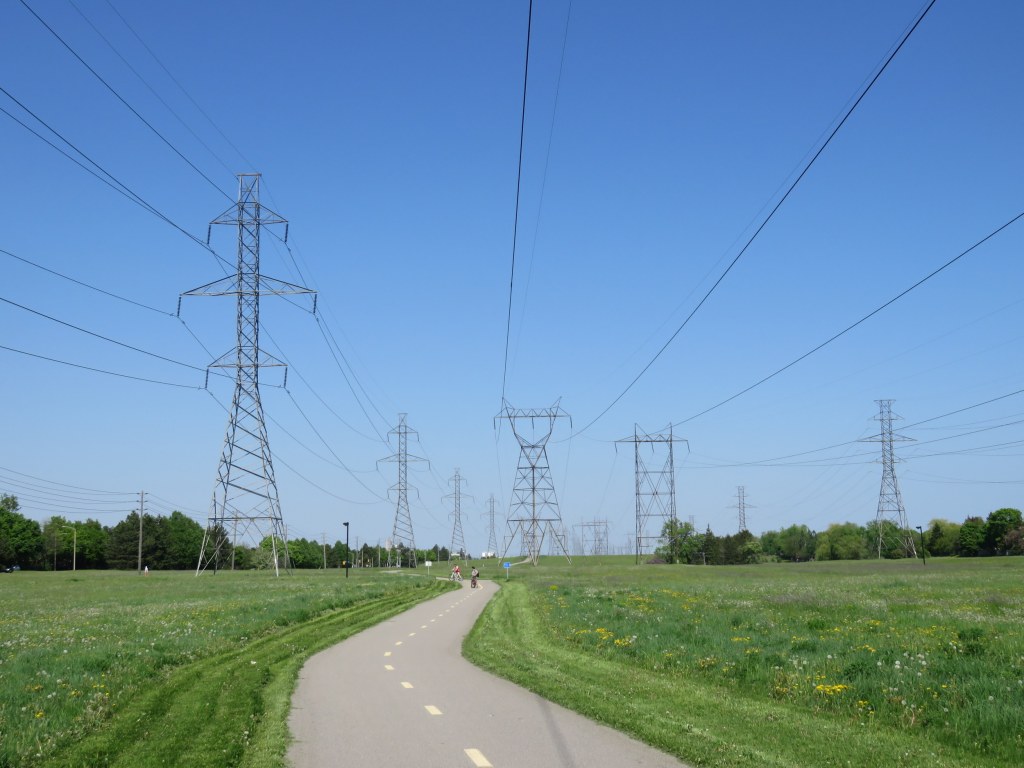
    IMG_2051-001Riding along the McNicoll hydro corridor in northern Scarborough
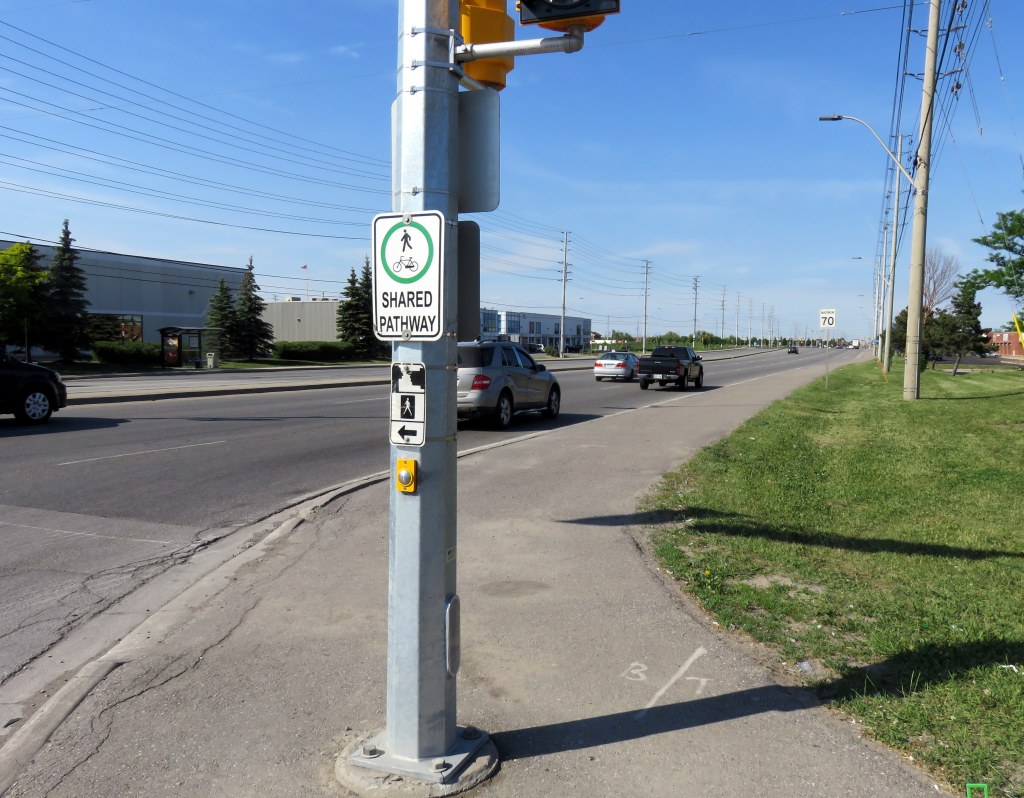
    Earlier this summer, I took two rides from my downtown apartment to suburban locations. On one ride, I biked northeast to Agincourt, on another trip, I biked to Downtown Brampton on a route that took me past the Humber River and Etobicoke Creek. I experienced different standards for on-street and off-road cycling routes. The City of Toronto generally does better, but suburban cycling infrastructure generally depends on off-road trails, rather than on-street bike lanes and cycle tracks.

    In the urban, central part of Toronto, bike lanes and cycle tracks (separated bike lanes located along major streets) are the predominant form of cycling infrastructure. While there are some bike lanes in suburban Toronto and in other municipalities like Mississauga and Brampton, most bike routes, if they exist, are off-road multi-use trails, in ravine or hydro corridors, or alongside major roads, like sidewalks.

    Multi-use paths are pleasant to ride on, but they’re often treated as recreational trails, rather than transportation corridors. Most paths are not cleared of snow in the winter (winter cycling really should be encouraged), and they are often isolated from the adjacent road network and local destinations, and they can meander, rather than follow straight lines. Road crossings can often be awkward.

    Bike lanes, which offer less protection from motorized traffic at least are integrated with the rest of the street grid, and are generally more direct. But on fast-moving suburban arterials, they aren’t ideal without separation. This is where the side-of-road path comes in.

    IMG_2305-001Shared pathway, Derry Road, Mississauga

    (more…)

  • Toronto’s new rapid transit plan

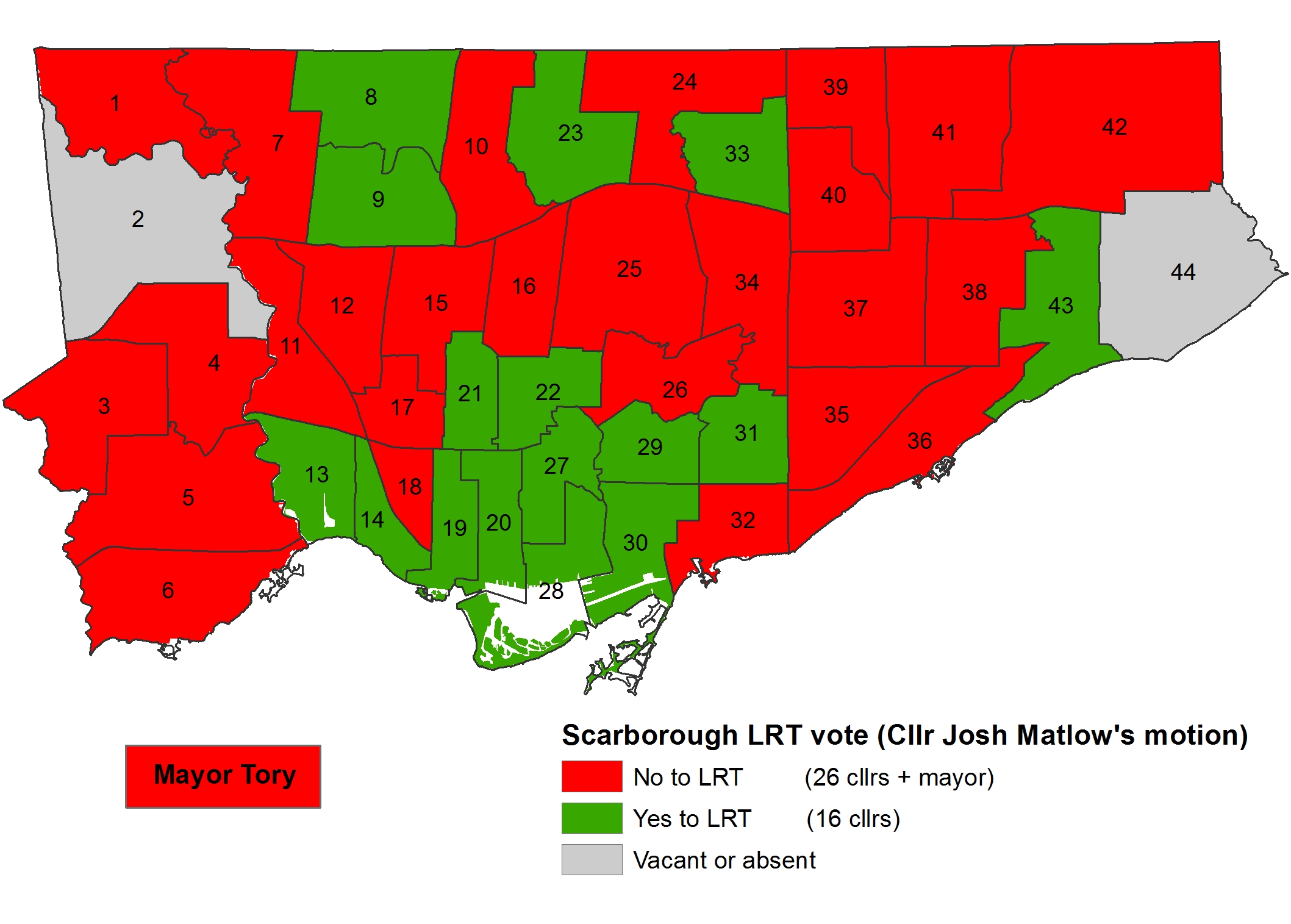
    Yesterday, City Council decided, by a vote of 27-16, to go ahead with the $3.1 billion one-stop extension of the Bloor-Danforth Subway to Scarborough Centre, rejecting Councillor Josh Matlow’s last-ditch attempt to resurrect the LRT replacement and extension of the ageing Scarborough LRT line. Council — Mayor Tory included — also voted to spend resources studying three more suburban subway extensions and a re-alignment of the proposed Relief Line subway backed by the local councillor.

    Unfortunately, the chance of going back to the less-expensive, yet longer seven-stop light rail line is slim-to-nil at this point. In my view, it’s time for transit advocates that backed the LRT to focus their energies elsewhere. Like Metrolinx’s fare integration strategy, and the plans for other LRT lines, such as the eastern and western extensions of the Eglinton-Crosstown.

    TT - Scarborough VoteHow council voted on Councillor Matlow’s motion to resurrect the LRT option for Scarborough
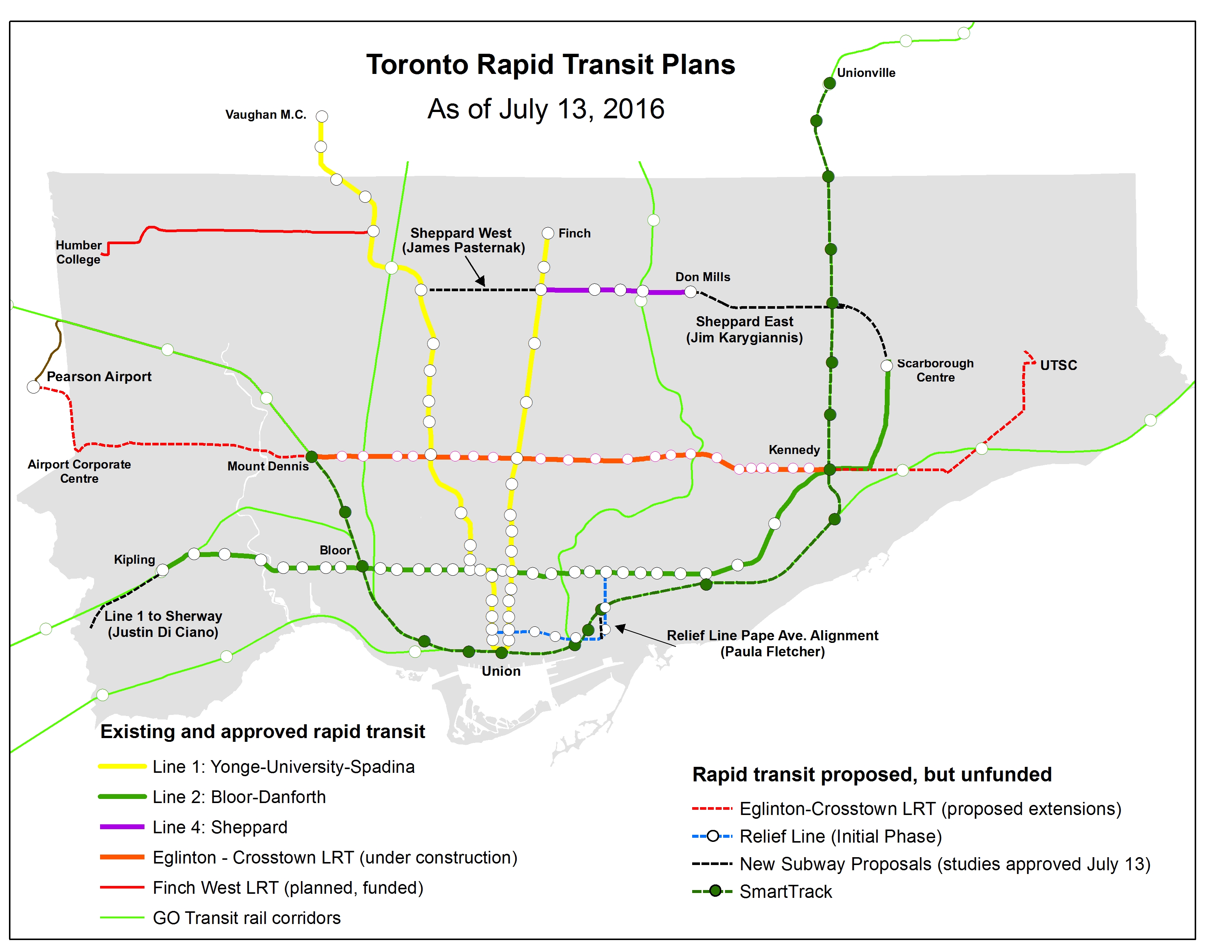
    In order to ensure that he had enough votes, John Tory entertained Ward 39 Councillor Jim Karygiannis’ motion for a study on an extension of the Sheppard Line from Don Mills Station to Scarborough Centre. (There’s a LRT proposed for Sheppard East, but no matter.) Karygiannis’ motion passed, as well as several other councillors’ pet subway projects. Ward 10 Councillor James Pasternak has long pushed for a Sheppard Subway extension west between Sheppard-Yonge and Downsview Stations, and he successfully got that included as well. Finally, Justin Di Ciano (Ward 5) got a study approved for a subway extension in his ward as well, resurrecting a long-dormant proposal for a subway extension from Kipling Station to Sherway Gardens.

    It’s worth noting that all three right-leaning councillors are reliable votes for John Tory.

    Downtown, Paula Fletcher (Ward 30) moved that staff re-examine the Relief Line, moving the recommended alignment from under Pape Avenue to Carlaw Avenue between Gerrard and Queen Streets. This would shift the planned — yet unfunded — subway line two blocks west. The Pape alignment was chosen for ease of construction and operation (the line must curve from north to west just south of Queen Street), and is only two blocks away. That study will cost $520,000 and staff time.

    All these new studies are illustrated below. For clarity’s sake, the Sheppard East LRT, the Scarborough LRT proposal, and the existing Scarborough RT (Line 3) are removed. You can read more about how the votes went down on Steve Munro’s site.

    Transit Plan July 2016The map of planned, approved and existing rapid transit lines, and those extensions and re-alignments approved for study
    The “subways, subways, subways” sentiment is alive and well at City Hall, even if Rob Ford has passed on. And despite the thirst for expensive new subway lines,  Mayor Tory is still backing an austerity agenda at City Hall. Apart from the decorum, not much has changed in the mayor’s office.

  • The difference between the Fords’ Subway Plan and John Tory’s Subway Plan

    201493-rob-ford-subway
    The Rob Ford/Doug Ford Subway Plan, circa 2014

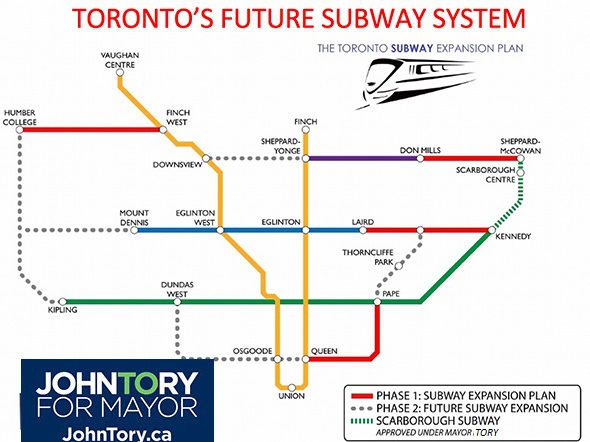
    The above is the subway plan promoted by Rob Ford, and later Doug Ford, in the 2014 municipal election. Thanks to today’s pandering to suburban councillors demanding their own subway lines, below is the John Tory-backed subway plan.

    tory-subway
    The John Tory Subway Plan, circa 2016

  • What do I know? I’m just a downtown elitist

    23211094949_cd3f8fc6a1_k

    I once described Councillor Denzil Minnan-Wong as the city official that “knew the cost of everything and the value of nothing.” In 2014, Minnan-Wong complained about the costs of building new washrooms at the soccer fields at Cherry Beach, holding up a sign that simply said “$600,000.” That photo of Minnan-Wong, scowling for the cameras, trying to generate some outrage in an election year, was meme gold and so was parodied in the #TOpoli Twittersphere.

    At $600,000, yes the washrooms were expensive. But as they were built in an isolated part of the Portlands, they required a new connection to the nearest watermain; a sewage tank had to be constructed as well, being so far from existing lines. The city has a mandate to provide quality parks and recreational facilities. Minnan-Wong, along with the Fords, also complained about the costs of umbrellas at Sugar Beach, a popular new waterfront park.

    In 2016, under Mayor John Tory’s administration, we have a City that doesn’t know the cost of some things (like the Scarborough Subway) nor does it know the value of other, smaller things, like the Toronto sign.

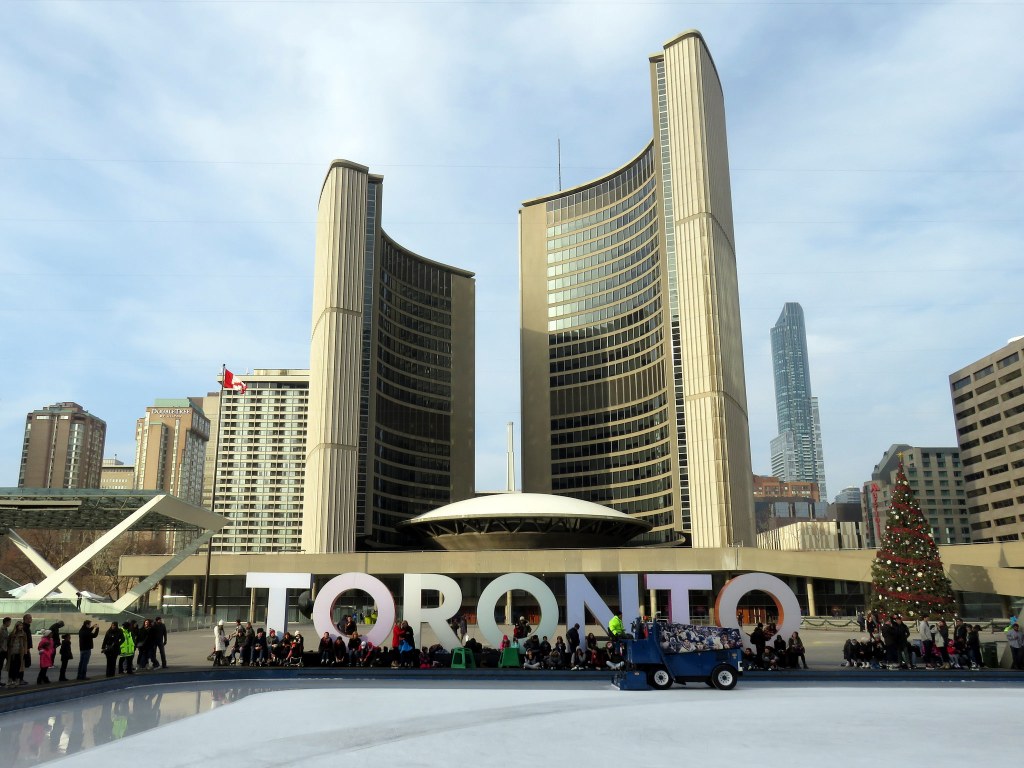
    The Toronto sign, placed on Nathan Phillips Square ahead of last year’s Pan Am Games proved to be incredibly popular with residents and tourists alike. The LED backlighting allows the sign to be coloured at night to mark any holiday or any important current or special event. The $100,000 climbable sign (reminiscent of the successful “I amsterdam” signs) was supposed to be temporary, and will have to be replaced within three years. A staff report estimate the cost of major repairs to the existing sign, and a new mobile sign, would cost $421,700 over two years. This would be money well spent.

    But some councillors, including Etobicoke’s Stephen Holyday and Scarborough’s Raymond Cho, would rather privatize the sign, perhaps selling it off. At least Councillor David Shiner, a fiscal conservative, called it “a potent symbol of Toronto pride and unity” after amalgamation, but even he questioned the need for paying for city staff to maintain the sign. A strong argument could be made that the costs to maintain the sign should come from Tourism Toronto and the local tourism industry, but calls from some quarters to sell it off are ridiculous.

    Last Friday, we learned that the estimated cost of building the one-stop, six kilometre subway extension to Scarborough Centre jumped from $2.0 billion to $2.9 billion. But unlike cycling infrastructure or fully funding an effective Vision Zero program to protect vulnerable road users, the mayor, key council allies, and provincial MPPs remain hell-bent on building it.

    Scarborough Centre MPP Brad Duguid, a powerful cabinet minister in the provincial Liberal government, quoted in the Toronto Sun, said that critics of the subway plan “…have been yapping away on this project from Day 1 and the vast majority of those critics come from fairly elitist downtown views of the city. People in Scarborough and the suburbs of Toronto count as well.” Duguid claimed that “the area surrounding the new [Scarborough Centre] station is growing fast.” Never mind that population and employment densities are not very high along the subway route, even in Scarborough Centre, and no major commercial development has come to central Scarborough since the 1990s.

    On Metro Morning, Duguid, a former city councillor who endorsed John Tory’s mayoral bids in 2003 and 2014, doubled down on his previous rhetoric. He repeated false claims about Scarborough Centre’s growth, claimed Scarborough residents have paid for downtown subway expansions, he even stated that the Scarborough Subway “transcends politics” (which earned a guffaw from host Matt Galloway).

    I live downtown, and I don’t use the subway; like many who live here, I walk to work. Many others cycle, or take overcrowded streetcars on King and Queen Streets. The Yonge Subway is overcrowded from commuters from outside the downtown core. Most downtowners wouldn’t directly benefit from a Relief Line either, but it’s an essential part of the network. The last subway built in Downtown Toronto was in 1966. I’m hardly an “elitist” either; I rent my apartment. I don’t enjoy many luxuries, and I certainly don’t hold a position of power or influence. I simply want the best transit for the best price; the Scarborough LRT, along with GO Transit RER and the Eglinton-Crosstown and Scarborough-Malvern light rail corridors represent the right investment for the eastern half of Toronto.

    We’re content to keep up an underused section of the Gardiner at greater expense than an urban boulevard, at the cost of lost development opportunities on the eastern waterfront. We’re committed to a $2.9 billion, 6 kilometre one-stop extension when a 10 kilometre, 6-stop LRT would cost $1.8 billion, funded entirely by the province. But we’ll complain about umbrellas and washrooms, budget too little for road safety plans, and question the costs of maintaining a popular sign at City Hall. I love this city, but sometimes Toronto still gets me down.

  • A good, a bad, and an ugly week for Toronto transit

    There was some good transit news for Torontonians today, as the provincial government announced $150 million in funding for detailed study and engineering for the planned Relief Line subway. The preferred route and station locations for the first phase of the new subway line was also released this week, with eight stops from Pape to Osgoode Stations.

    Happily, the Relief Line, an idea that’s over one hundred years old, Toronto’s answer to New York’s Second Avenue Subway, is closer to being built than ever before. As Steve Munro reports, the study will focus initially on the portion from Pape to downtown, but will shift to the northern and western extensions.

    But there were also some ugly truths concerning that other subway project, the proposed one-stop extension of Subway Line 2 to Scarborough Centre. Last week, homeowners in the Ellesmere/McCowan neighbourhood received notices of possible expropriation, ahead of a public information session in which the preferred alignment of the one-stop subway was revealed. I can understand the residents’ anger; major projects will always be disruptive to some properties and some families and businesses are sometimes forced to re-locate. There’s an argument to be made that subway backers don’t realize the extent of the disruption that even bored-tunnel subways can cause. Stations have to be dug, utilities have to be moved, buildings demolished, and roads closed.

    But most importantly, the Scarborough subway extension remains a bad policy.

    Fullscreen capture 01062016 72046 PM
    2031 ridership projections for terminal subway stations

    In 2031, the projected ridership between Scarborough Centre and Kennedy Station will be 31,000 a day, or 7,200 in the AM Peak. This is lower than previous estimates; a 2013 study estimated the AM peak ridership for the subway extension to be between 9,500 and 14,000. The reduction by nearly half is because the 2013 plan had three stations — at Lawrence, at Scarborough Centre, and at Sheppard — but the new plan has only one station. Passengers on the 54 Lawrence East bus and on the Sheppard corridor would either be gerrymandered to the SmartTrack line, or forced to transfer to get to the subway at Kennedy or Scarborough Centre. $2 billion will be spent for this one-stop extension, while the Islington to Kipling section of Line 1, opened in 1980, cost a small fraction of that amount, even in 2016 dollars.

    On one hand, 7,200 is a respectable peak hour ridership between the two final stations on a long subway line, and subway trains shouldn’t be full at this part of any route. The ridership between Islington and Kipling stations on the other end of Line 2 will be 1,200 less during the same time. Fed by multiple bus routes, Scarborough Centre will be a busy station, one of the top ten for train boardings, if not the top five, in the TTC system.

    But in order to justify John Tory’s SmartTrack, a useful station at Lawrence and McCowan is being dispensed with. Planners, working under the direction council and the mayor’s office, euphemistically call it an “express subway.”

    Scarborough - 2015Scarborough transit plan, 2015

    Scarborough - 2016Scarborough transit plan, 2016

    Previous proposals, backed by former mayor David Miller and 2014 candidates Olivia Chow and David Soknacki, would have seen a light rail line replace the failing Scarborough RT route; the province even promised to cover the capital costs of the retrofit and extension to Centennial College and Sheppard Avenue. In 2011, in a report published by the Pembina Institute, the AM peak ridership of the LRT line between Kennedy and Sheppard was estimated to be 6,400 in 2031, far below the design capacity of a subway extension. An LRT line, with seven stops and many more surface transit connections, would directly serve many more passengers than a one-stop subway.

    Under the failed mayoralty of Rob Ford, the province agreed to build a subway instead, but the city was required to pay up. A property tax levy of 1.6% is currently collected to help pay the city’s share.

    The LRT ship has probably sailed. But thanks to two weak mayors, myopic councillors eager to show they’re fighting for their little fiefdoms, and an obliging provincial government determined not to lose seats in the next election, we’re stuck. At least we’re making progress on the Relief Line.

    Meanwhile, John Tory continues — inadvertently or not — to sow the seeds of confusion over what SmartTrack is all about. After the Downtown Relief Line funding announcement, the mayor put out this tweet:

    This is incorrect. The work on the GO Stouffville Line (not the “Unionville Line”) is a project undertaken by Metrolinx that will allow for two-way service on the existing GO corridor, work that started in 2015. Apart from the SRRA report written before John Tory ran for mayor in 2014, and some initial studies by the City of Toronto and Metrolinx, no work has been carried out on the still-vague proposal.

    Council’s stubborn support of the Scarborough Subway and Tory’s continued SmartTrack fantasies is are just a few reasons why it’s so easy to be frustrated with municipal politics.

  • The challenge of getting to the bus stop

    IMG_8796-001

    It’s time for a rant on suburban transit, and how unnecessarily difficult it can be to get to the nearest bus stop.

    Transit has a harder time in the suburbs. Population densities are lower than in neighbourhoods developed before the Second World War. Suburbs are not only built for the car, but they’re laid out with crescents, cul-de-sacs and winding street systems meant to discourage through traffic in residential areas. Backyard fences line arterial roads, safe pedestrian crossings might be a ten or fifteen minute walk down the road. These factors can make it difficult for people living in subdivisions and near busy streets to easily access a nearby bus stop.

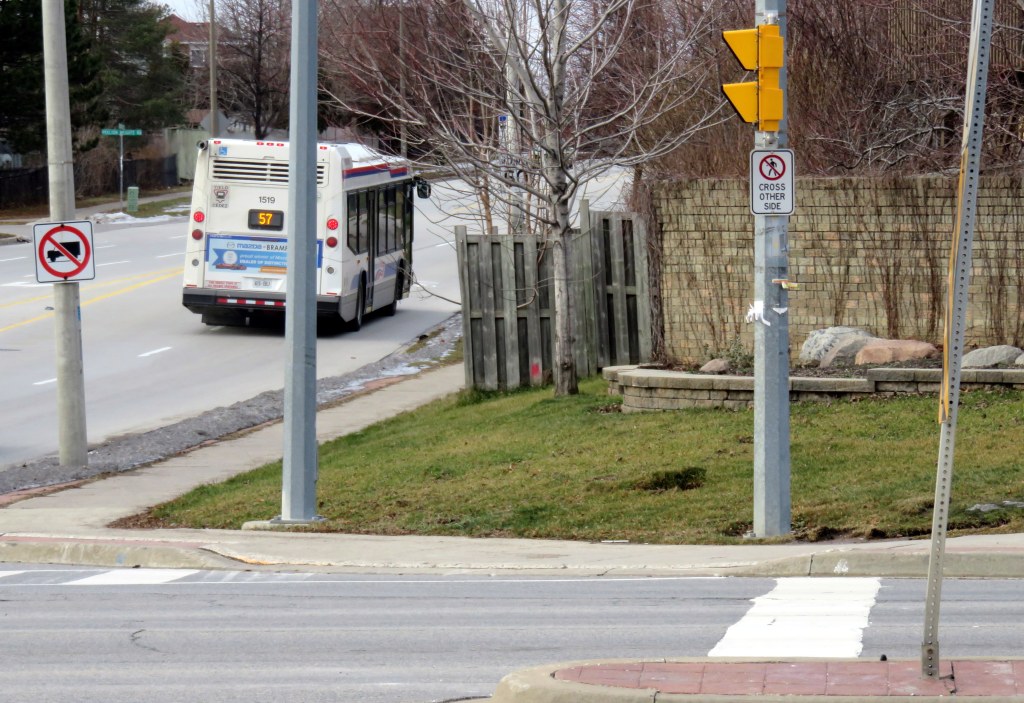
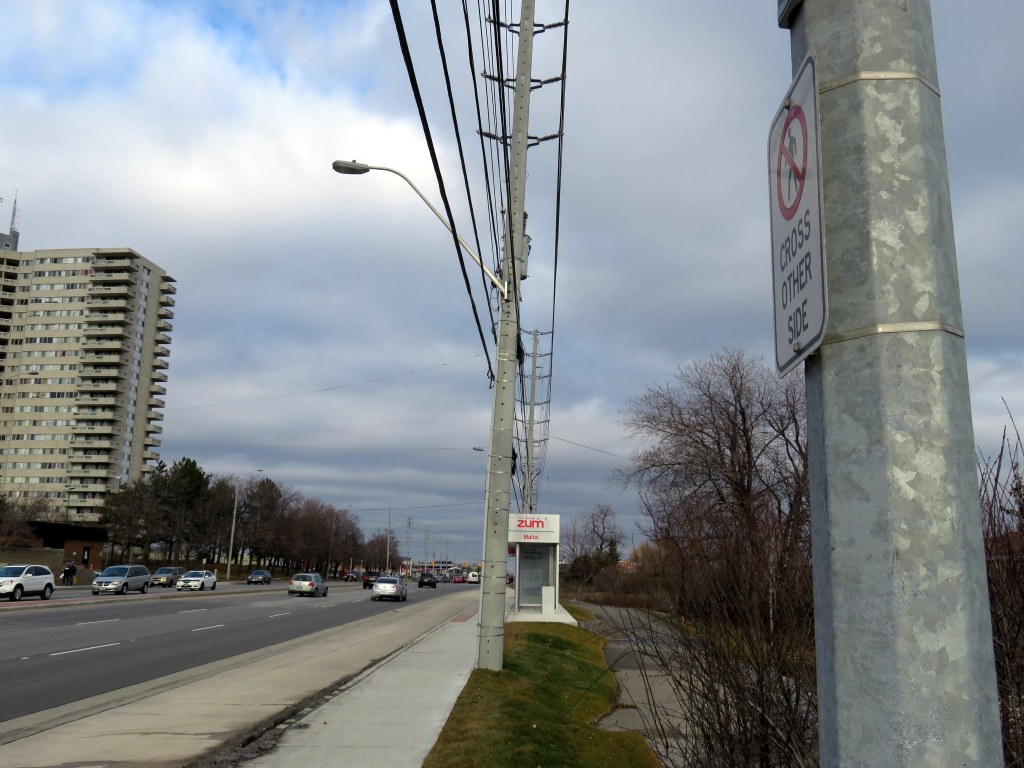
    Last year, Streetsblog USA asked its readers to vote for the sorriest bus stop in America, and some of the submissions are truly awful. But in the Greater Toronto Area, there are many examples of poorly designed or located bus stops. Intersections like the one at Steeles Avenue West and McMurchy/Malta Avenue in Brampton, which, granted isn’t as bad as the StreetsblogUSA submissions, is just one example of how not to get people out of cars and onto public transit. Some thought into placing bus stops and improving access to local transit is necessary.

    I like Brampton Transit and what they’ve been doing over the last decade in my hometown. In 2005, the suburban transit agency began to re-organize its routes into a grid system. There were some hiccups: additional transfers, combined with low frequencies made some trips more difficult, but as ridership improved, so did service levels on key corridors. Schedules were adjusted to improve transfers. Connections to Toronto and Mississauga were improved. My hometown’s bus system was no longer a joke.

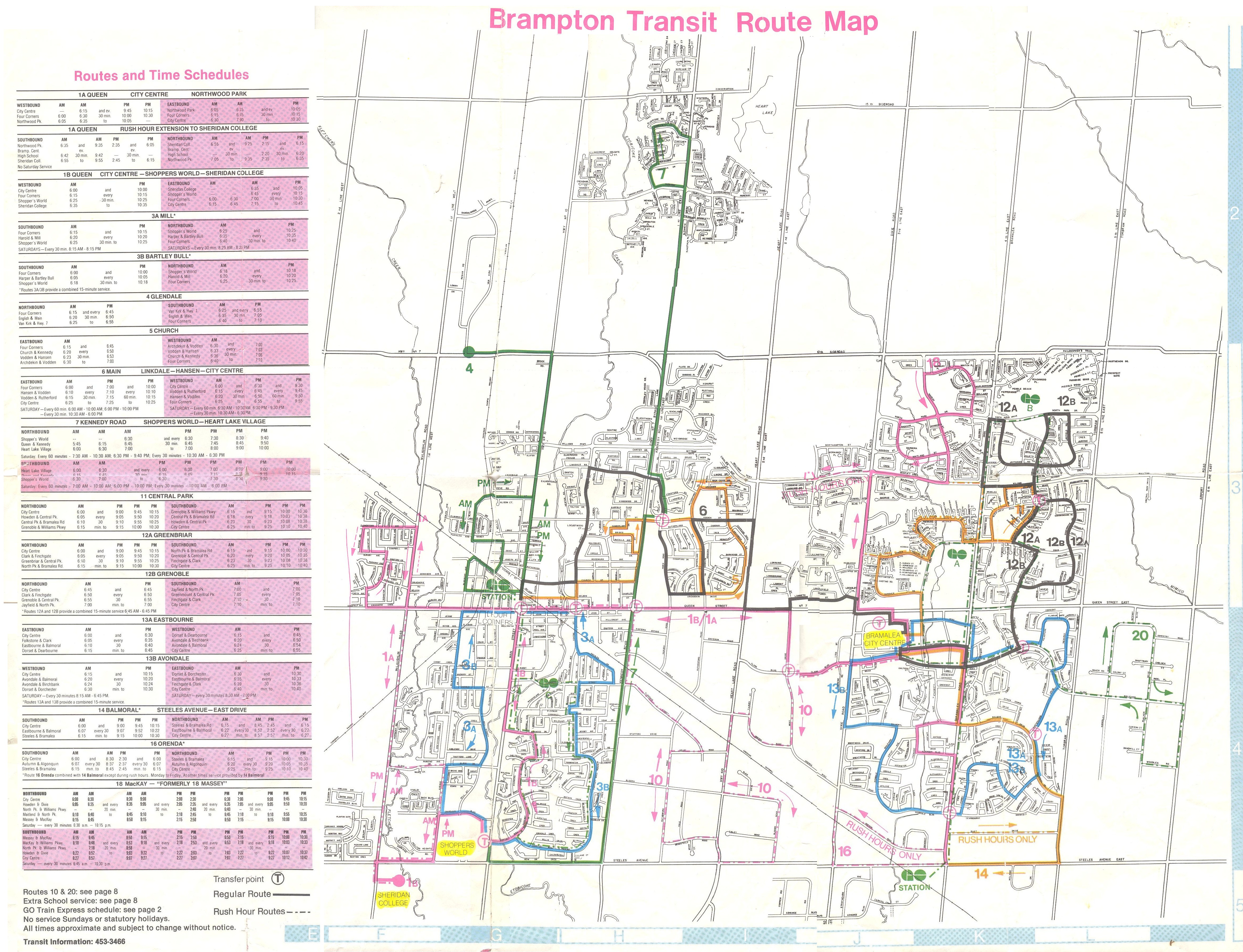
    Brampton Transit - December 1980 front

    Here’s what Brampton Transit looked like in 1980, marked with meandering routes and one-way loops. The 2015-2016 system map is here [PDF]. 

    In September 2010, Brampton Transit introduced its first “Züm” route, 501 Queen, which connects Downtown Brampton with York University. Like the first phase of York Reigon’s Viva and Durham Region’s Pulse, Züm was developed as a specially-branded limited-stop bus service. Züm stops have special shelters, with real-time schedule information, winter heating. And on sections of Queen Street and Steeles Avenue, special “queue jump” lanes allow buses to by-pass cars and trucks waiting at intersections.

    Services such as Zum and Viva, which operate mostly in mixed traffic should not be mistaken for “bus rapid transit” such as Ottawa’s Transitway or Bogota’s TransMillenio; “BRT-lite” or “quality bus” are more appropriate terms for these routes. Route 501 Queen operates every 15 minutes or better, seven days a week, into the late evenings. It’s proof that quality transit can be operated in Toronto’s suburbs, and be a success.

    Since Route 501 was introduced, three more Züm routes were added: 502 Main, which follows Main and Hurontario Streets as far as the Mississauga City Centre Terminal at Square One, 511 Steeles, and 505 Bovaird. Each of these routes complements an existing local bus route, though the level of service on these other routes are not as high as on Queen Street; Züm service ends sooner in the evenings (though local bus service operates until after midnight) and frequencies are lower.

    With the introduction of Züm, and combined with other service increases, Brampton Transit ridership increased by nearly 30 percent in the last five years (2011-2015). This increase is significantly higher than the rate of Brampton’s population growth over the same time period.

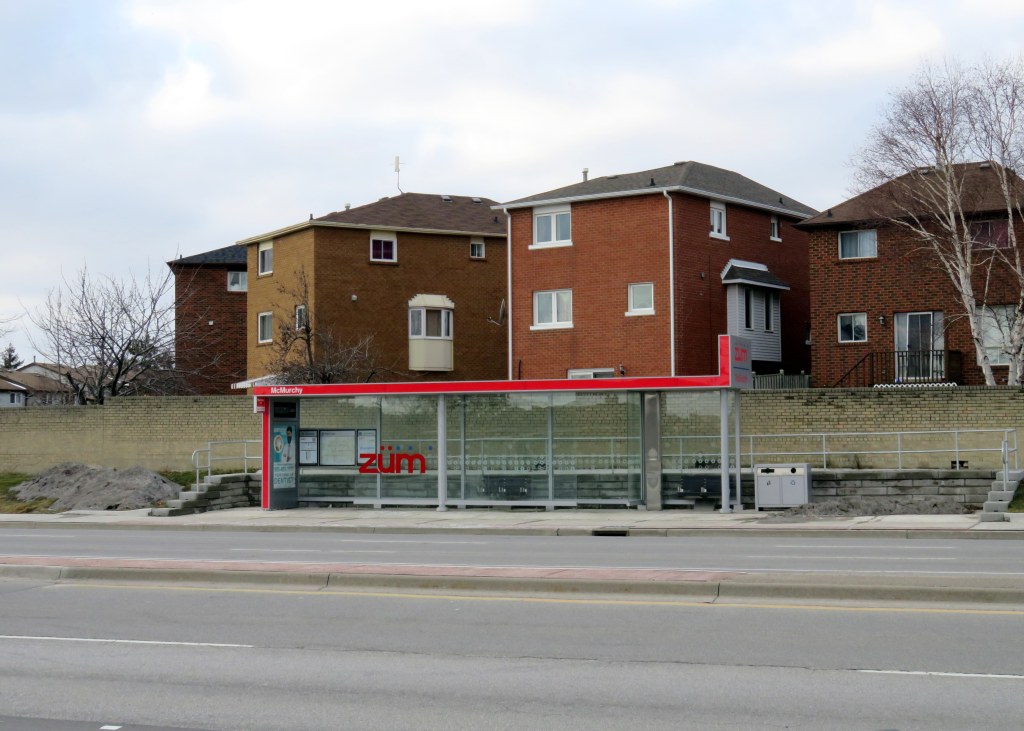
    In September 2015, the 511 Steeles Züm bus was extended west from Shoppers World to Lisgar GO Station in Mississauga; standard Zum shelters were installed along the corridor, including the intersection of McMurchy/Malta Avenues and Steeles. This intersection is only a few hundred metres from where I grew up. The existing bus stops for local bus routes were relocated to the new shelters, like the one seen below.

    IMG_8800-001

    Both bus stops were installed on the east side of the intersection. The trouble is that pedestrian crossings are prohibited on the east side, due to the priority given to motorists at this suburban intersection. Therefore, transit users may have to cross the intersection three times to get to and from their bus; with several rental apartment towers, townhouses, and compact single-family housing, this is not a low-density neighbourhood.

    IMG_8797-001

    From a traffic engineering rationale, this traffic arrangement, which has existed for about a decade, makes sense. The majority of traffic is on busy, six-lane Steeles Avenue. From the north, most traffic on McMurchy Avenue turns east (left) onto Steeles, while Malta Avenue is a short stub, serving a small townhouse development on the south side of Steeles Avenue. Eventually, Malta Avenue will continue south, hooking up with another section of the same street. For now, a dormant farm field separates the two streets and awaits development.

    To facilitate through traffic on Steeles, the cross streets, McMurchy and Malta, are given only green time equivalent to the minimum pedestrian crossing time. And to facilitate the left turns from McMurchy to Steeles, pedestrians are banned from crossing that side of the street. From the viewpoint of a traffic engineer, this makes sense, but it’s a mindset that ignores the needs of pedestrians and transit customers, and with the re-location of the bus stops, this has become more of a problem. This intersection is owned and maintained by the Region of Peel, not the City of Brampton, as Steeles is a regional road.

    There are two options here, and at other places where people must give way to cars:

    1. Allow pedestrians to cross at all four sides of the intersection, ignoring, for a minute, the desire for cars and trucks to move through with minimal disruption; or
    2. Move the bus stops to the west side of the intersection, minimizing the inconvenience for transit riders.

    Brampton Transit has done a fine job growing its ridership over the last decade, making it a bit easier to get around Toronto’s second-largest suburb without a car. But situations like these, where pedestrian access can be improved, are low-hanging fruit that would demonstrate that transit users are valued, even in the car-dependent suburbs. The current arrangement is unacceptable. Brampton and Peel Region should do better.

    There are plenty of cases elsewhere where there are poorly-located transit stops. One example here in Toronto is the eastbound stop for the TTC’s 42A Cummer bus at McNicoll Avenue at Boxdene Avenue in north Scarborough. There’s no sidewalk on the south side of McNicoll, and Boxdene runs north. Anyone attempting to use this stop is at the mercy of traffic on this busy, four lane road.

    Overall, I would like to see more thought put into locating bus stops in general and making sure they’re easily accessible.

  • Yet another transit plan for Scarborough (Updated)

    Updated with a link and discussion of the Scarborough Transit Planning Update, released earlier today.

    It’s been an eventful few days for transit watchers. Late last week, we found out that John Tory’s SmartTrack plan will be clipped to an initial phase between Mount Dennis and Kennedy Station, and the Eglinton-Crosstown extended in the west to the Airport Corporate Centre and probably Pearson Airport itself. The section north from Kennedy Station to Unionville Station in Markham has been deferred to a later Phase II. And the announcement of a preferred alignment to the Gardiner East “Hybrid” was announced on Tuesday.

    Back in December, 2014, I suggested that there was no need for the Scarborough Subway extension, and that a good transit plan had already been developed in the last ten years. A combination of the Scarborough RT replacement and extension to Malvern, the Transit City light rail plan, and GO Transit Regional Express Rail (RER) would have served the eastern part of Toronto quite well.

    But then, in 2010, Toronto elected Rob Ford as mayor, who ran on a transportation platform of “subways, subways, subways” and ending the so-called “war on the car.” The Scarborough RT replacement was dropped in favour of a subway, planning and construction work on the Finch and Sheppard East LRT routes was suspended, and the TTC surface network was cut back. For a while, it looked like maybe the Scarborough LRT line would be resurrected. But then municipal and provincial politicians, looking for votes, pushed the more expensive and shorter subway option. Candidates in a by-election in Scarborough-Guildwood all claimed to be “subway champions,” even the NDP’s Adam Giambrone, the TTC Chair at the time Mayor David Miller put forward the seven-line Transit City LRT plan. The three-stop Scarborough Subway extension would cost over $3.5 billion.

    John Tory, who won the 2014 mayoral election, ran on a platform that included “SmartTrack,” a single-line regional rail concept that he claimed would provide relief to the Yonge Subway, completed by 2021. Tory’s campaign claimed that SmartTrack would carry  200,000 riders a day, and be fully integrated with the TTC, including fares. Tory also promised not to re-open the Scarborough LRT vs. subway debate, committing himself to the three-stop subway. Tory never showed much commitment to the Finch West and Sheppard East LRTs, which were funded by the province, but left dormant.

    The trouble with committing to SmartTrack and the Scarborough Subway was having two new parallel transit lines three kilometres from each other between Eglinton and Sheppard Avenues, as depicted in the map below. The Eglinton-Crosstown LRT, currently under construction, the Bloor-Danforth Subway and the SmartTrack line would intersect at Kennedy Station.

    Scarborough - 2015Active rail transit proposals in Scarborough, as of 2015

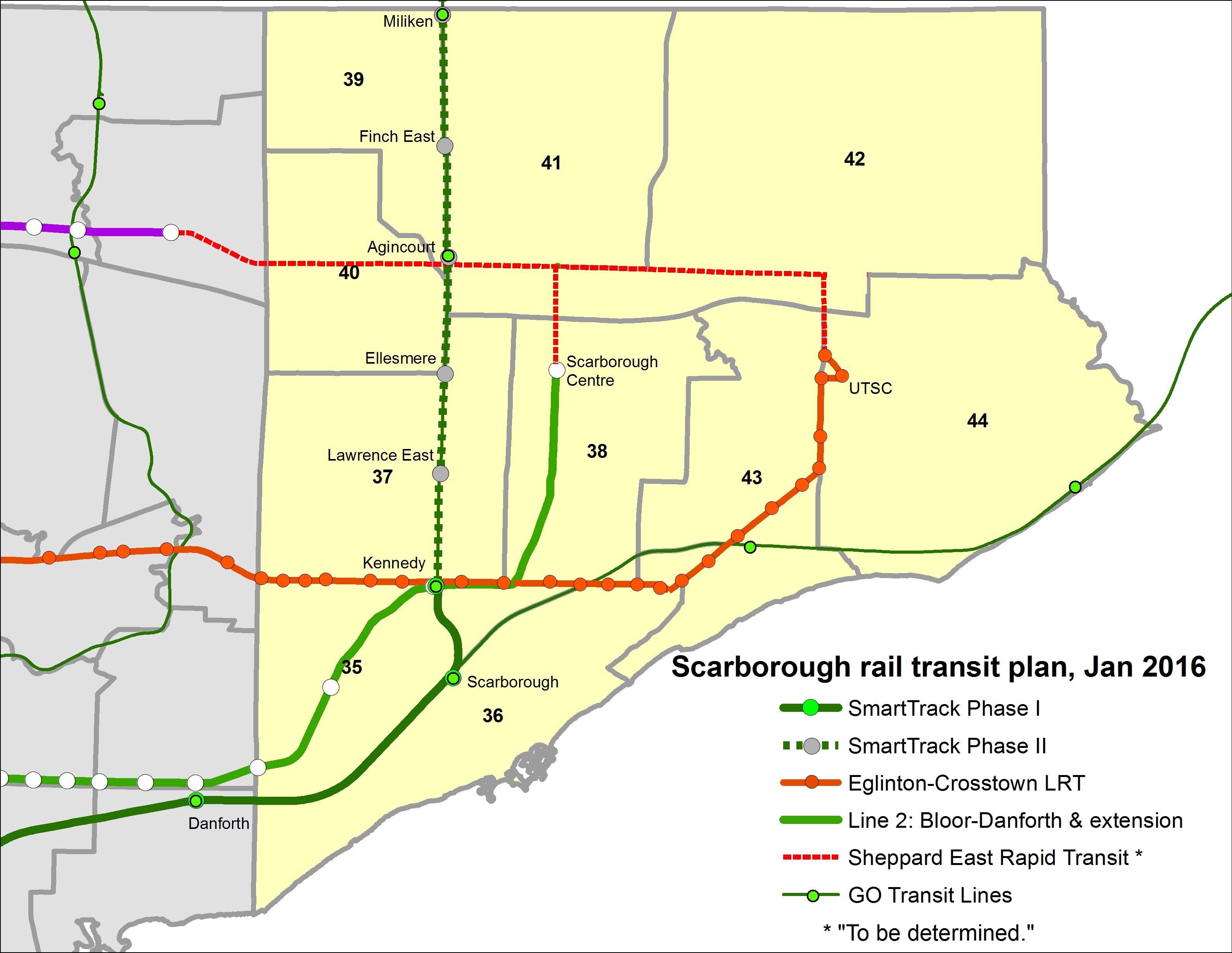
    But on Wednesday, January 20, Oliver Moore and Marcus Gee at the Globe and Mail and Tess Kalinowski at the Toronto Star broke news on a City of Toronto planning report that would re-allocate part of that $3.5 billion from the subway to extending the Eglinton-Crosstown line to the University of Toronto’s Scarborough Campus (UTSC), and reducing the number of stops on the subway from three (excluding Councillor Glenn De Baeremaeker’s proposal for a fourth) to one. The subway, therefore, would run five or six kilometres, non-stop, between Scarborough Centre and Kennedy. The 12-kilometre, 17-stop extension of the Eglinton-Crosstown line resurrects most of the proposed, but unfunded Scarborough-Malvern LRT

    Today, on January 21, the Scarborough Transit Planning Update staff report was released, with more details.

    I created this map below based on a map tweeted by the Star’s Tess Kalinowski on Wednesday afternoon:
    https://twitter.com/TessKalinowski/status/689890493409300484

    Scarborough - 2016The Latest plan for Scarborough, including the one-stop subway extension and the additional 17 stops planned for the Eglinton-Crosstown LRT, as well as SmartTrack Phases I and II, as recommended in a separate study.

    It’s worth noting that the Sheppard East LRT, which won’t start construction until 2021 (essentially leaving it in limbo) is marked on the staff report map as “rapid transit to be determined.” Maybe it will connect to the subway at Scarborough Town Centre. Maybe it will connect to the Eglinton-Crosstown. Maybe it will remain a bus route. In the original Transit City plan, Sheppard East was to be started first; indeed construction did start on the Sheppard Avenue rail underpass at Agincourt GO Station; an empty median is where the LRT tracks are planned to go. The Scarborough-Malvern LRT was supposed to continue north of UTSC to Sheppard Avenue (and potentially further north along Morningside), but this isn’t part of this latest study.

    Transit City planned for a LRT maintenance and storage facility (MSF) on Sheppard East at Conlins Road, near Morningside Avenue. The Conlins MSF would have served three routes: the Sheppard East LRT, the Scarborough RT replacement, and the Scarborough-Malvern LRT. The MSF has been scaled back due to the deferral or cancellation of the other two lines, but will be essential if this latest plan goes through. So the ECLRT is built to UTSC, a rail connection from Sheppard will probably be necessary, and maybe the Sheppard and Crosstown lines were converge here.

    What makes the least sense for me is the long, non-stop section of the subway between Kennedy and Scarborough Centre. There was clearly a problem of having two prioritized high-capacity rail proposals serving similar markets: SmartTrack, and the Scarborough subway extension both championed by the mayor. Cutting out the Sheppard and Lawrence stops delivers passengers to SmartTrack. That is, of course, SmartTrack makes it north of Kennedy Station.

    A separate study by Metrolinx staff, recommending a shorter SmartTrack line between Mount Dennis and Kennedy, along with a western extension of the Eglinton-Crosstown LRT,  was reported in the Globe and Mail last Friday, with the Unionville-Markham section part of a later Phase II. It appears that the City-led Scarborough Transit Planning Study is assuming a full build-out of SmartTrack, at least on the east end.

    I’m happy, though, to see LRT seriously considered as a solution for intermediate transit needs. What I find somewhat ironic, though, is that the Eglinton-Crosstown LRT is becoming what SmartTrack was eighteen months ago: a single line that solves all transit planning problems. Of course, my wish is to go back to building the Scarborough LRT extension, the original Scarborough-Malvern line, and letting Metrolinx and GO Transit do their thing with implementing RER.

    The city planning report notes that “…of the 206,000 transit trips that begin in Scarborough, 99,000 or 48% end in Scarborough. This means that only 14% of all trips that begin and end in Scarborough use transit (99,000 of 692,000).” (Pages 14-15.)

    This is why improving the local transit network – be it streetcars or buses – is so important. We’re often fixated on moving commuters long distances, but we never pay enough attention to short-distance commuters as well. For all the “subways, subways, subways” hot air we’re still hearing from some Scarborough councillors, most of their transit-riding constituents rely on buses. As a friend pointed out, since most of those local trips are by car, we need to ask whether this new plan will make transit more competitive for trips within Scarborough.

    Will we see yet another proposal for Scarborough? I bet we will. Maybe SmartTrack could be routed to a spur to Scarborough Centre (has anyone looked at that?). But at some point, fatigue will set in, and we’ll have to pick something – anything – and build it in order to avoid looking indecisive. But I believe that these planned revisions to SmartTrack, LRT, and the Scarborough subway are steps in the right direction.

  • The Sheppard Scarborough Subway Shitshow

    5279614296_c4bdaac003_b
    Building the Sheppard East LRT in December, 2010

    Nearly five years ago, in October 2010, work began on the Sheppard East light rail transit project, the first of three Transit City lines funded by the provincial government. This initial work was to build a grade separation between Sheppard Avenue East and Canadian National Railway’s Uxbridge Subdivision (better known as the GO Transit Stouffville Line), adjacent to the Agincourt GO Station. Metrolinx was still undertaking detailed design work for the connection to the Sheppard Subway at Don Mills Station, as well as the carhouse at Sheppard and Conlins Road, which would have also served the planned Scarborough RT replacement and extension and potentially the Scarborough-Malvern LRT, one of several Transit City lines that weren’t funded.

    Originally, the 13-kilometre Sheppard East line was to be the first to open, originally by the end of 2013. Finch West between Yonge Street and Humber College was to have opened by the end of 2015. But thanks to austerity measures enacted by the province in Spring 2010, the timelines were pushed back: the Sheppard Line would have opened in 2014; a shortened Finch line (only between the Spadina Subway extension at Keele Street and Humber College) in 2019.

    The completed Sheppard Avenue underpass at Agincourt GO Station, 2013. Note the median for light rail. Image via Google Street View.

    Construction was completed on the Agincourt underpass in May 2013, yet all other enabling work for Sheppard was halted after Mayor Rob Ford’s election. The incoming mayor declared Transit City dead; the province, up for re-election in 2011, was eager to oblige. Ford mused about extending the Sheppard Subway line west to Downsview and east to Scarborough Town Centre, and extend the Bloor-Danforth subway line instead of go with the fully funded, fully approved LRT replacement and extension. Ford was aided and abetted by councillors on both the right and the left, with Councillor Glenn De Baeremaeker the most prominent of Ford’s subway enablers.

    It’s almost a miracle that the Eglinton-Crosstown LRT project survived Ford’s bull-in-a-china-shop act. After some uncertainty, major work on that line continued, with the first boring machines launched in June 2013. That didn’t stop Ford from promising to bury the surface section of the route, at a cost of $1 billion, a plan that City Council defeated in February 2012.

    In March 2012, Council again voted to construct the Sheppard East LRT, in a 24-19 vote against Mayor Ford. Yet work never re-started. In October, 2013, Council voted to proceed with the extension of the Bloor-Danforth subway, even as Ford was losing control of the agenda overall. The provincial Liberal government again went along, hoping to retain power, perhaps even win back a majority government, in the next election. Even Adam Giambrone, an architect of the Transit City LRT plan, backed the expensive subway option as a NDP candidate in a Scarborough provincial by-election.

    That decision pretty much sealed the fate for the Sheppard East LRT. Why go back to building a light rail line on Sheppard if council couldn’t commit to building the Scarborough RT replacement? Why bother building an expensive maintenance facility to serve only one line? Why put any political capital in a project that had only tepid political support? After all, Scarborough was getting the subway extension most of its politicians demanded (even if its residents preferred an LRT), and there would be SmartTrack. Sheppard East was all but dead.

    A few weeks ago, the provincial government re-confirmed that it was funding the construction of the $1.2-billion Finch West LRT between Finch on the Spadina Subway extension, and Humber College, but that work would only start in 2016, and open five years later, in 2021. It also announced 2021 as the start date for construction on the Sheppard East LRT. That puts that project into never-never land. And not a word of protest from City Hall.

    Of course, this latest delay has emboldened subway boosters, hoping the city will push for the subway extension instead. This is despite the fact that the existing five-stop Stubway doesn’t have the ridership to fill four-car subway trains; transit experts are pretty much unanimous in their opinion that the ridership will never materialize to justify a subway extension; even the City of Toronto’s official plans only include subways for the Downtown Relief Line and on Yonge north from Finch Station into York Region. (The one amusing part of Tess Kalinowski’s article is that the pro-subway coalition member she spoke with didn’t want his name published.)

    IMG_2875A private car on the Sheppard Subway, mid-afternoon, May 19, 2015

    Why do we let politicians plan and then then destroy Toronto’s transit plans? Toronto is committed to spending billions on a subway extension we don’t need, while the subway we do need, the Downtown Relief Line, loses momentum as attention is focused elsewhere; on Sheppard and on John Tory’s dubious SmartTrack proposal, a plan that appeared almost out of nowhere in the middle of an election campaign, a half-baked plan that doesn’t provide the subway connectivity nor the redundancy required to function as an adequate relief line. Tory backed the Bloor-Danforth subway extension, even though the cheaper LRT plan was still open.

    Furthermore, Tory committed himself to the Gardiner East “hybrid” solution, which pretty much is a reconstruction of the existing elevated expressway east of Jarvis Street despite it being the more expensive short and long term option for a segment of road that is currently underutilized. It’s a plan that most urban experts and advocates dismiss, even warning that Toronto would be “a laughingstock” if it were implemented. Matt Elliott writes about this absurdity in more detail.

    To me, it appears that Tory surrounded himself with a small group of advisers like campaign chair and lobbyist John Duffy (who will be leading a public relations campaign for SmartTrack) and transportation adviser Eric Miller (who co-authored the pre-SmartTrack reports and whose University of Toronto Transportation Research Institute developed the case for the “hybrid” option backed by “The Gardiner Coalition”). Maybe council will overrule Tory’s preference for the “hybrid.” Maybe not.

    And because of that, John Tory is proving to be on the wrong side again and again on important issues; from carding, a racist police practice he seems to have no problem continuing, despite increasing public opposition; to limiting necessary tax increases; backing the Sheppard Subway; maintaining the East Gardiner Expressway;  his stubborn support for SmartTrack. I’m reminded of his myopic and stubborn support for religious school funding as Ontario Progressive Conservative leader back in 2007; a platform that might have cost him the election. I hope to be proven wrong, but I can’t say I have much faith in John Tory’s leadership.

    Of course, politicians of all stripes can be blamed for the Scarborough Subway Shitshow. But I feel we blew the last, best chance to get things right.

  • Mapping the 2014 Toronto Election: Wards 43 and 44

    Last, but not least, in my series of posts examining the results of the  Toronto municipal election of October 2014, are Wards 43 and 44, Scarborough East.

    I started these series of maps of the 2014 Toronto election as a few tweets. To me, it was a simple, interesting exercise. At first, I only sought to map the most interesting wards, where there were competitive races for city council – wards where the incumbent wasn’t running again, or where great candidates like Alejandra Bravo, Russ Ford, Lekan Olawoye, Dan Fox, and Andray Domise, were taking on established councillors and offering a better alternative to local voters. After requests to have a place to have these maps available somewhere, I resolved to set up a blog and to map every poll. It has taken me a bit longer than I expected, but I hope that these maps become useful between now and the 2018 election.

    While my politics certainly lean left, and my commentary on my blog at times pointed, all the maps I created are available to everyone. Despite my cynicism, I genuinely believe most people run for public office for the right reasons. Putting your name on the ballot takes courage; making a serious run for any elected office, even school trustee, is a long, difficult, exhausting, and expensive undertaking. I respect nearly every candidate who make that effort, regardless of their political leanings.

    And now, with the ward maps done, I’ve thought of more ideas to pursue in the near future. I’m interested in voter turnout; with esteemed Ryerson Professor Myer Siemiatycki, I co-wrote a study commissioned by the Maytree Foundation studying voter turnout in previous municipal elections. With poll-level data, it would be most interesting to look at voter turnout by housing type (such as TCHC vs. private rentals vs. condominium residences, for example) and other local determinants.


    Ward 43

    Ward 43 is represented by Paul Ainslie, a centre-right leaning councillor who I’ve come to respect. Ainslie was picked Chair of the Government Management Committee (and a member of Mayor Rob Ford’s executive committee) after the 2010 election.

    But unlike most Scarborough politicians, Ainslie parted with Ford on many issues. In 2011, Ainslie voted 97% of the time with Ford; but by 2013, he only voted 40.5% of the time with Ford. In 2014, Ainslie’s “Ford Nation” score (as developed by Metro columnist Matt Elliot) was only 20%, a difference of 77%. This was the greatest drop in Elliot’s “Ford Nation Percentage”score. In a CBC article dated October 15, 2013, Ainslie started to “butt heads” with Ford early that year “over budget issues.”

    That October, after the first Ford crack scandal hit but before Rob Ford’s November meltdown that ended up seeing Norm Kelly assume most of Ford’s responsibilities, Ainslie resigned from Ford’s executive. Ainslie supported the Scarborough LRT replacement project (which would include an extension to Progress Road and Sheppard Avenue) instead of the Bloor-Danforth Subway extension. For his actions, Rob Ford then recorded a “robocall” message to Ward 43 residents that read:

    “It was extremely, extremely unfortunate that your councillor, Paul Ainslie, was the only Scarborough councillor who did not listen to his constituents, and voted against the Scarborough subway. In fact, he led the charge against building subways in Scarborough; unfortunately it has led to his resignation from my executive committee. We are moving forward with a team who support the mandate Toronto taxpayers gave me…”

    The calls were made from Ford’s own City Hall telephone number. Eventually, Mayor Ford was forced to apologize on the council floor in 2014, in one of many rulings the City’s integrity commissioner made against the mayor. Despite Ford’s outrageous claims, Ainslie regularly engages with his constituents, including discussing the subway/LRT issue.

    Ainslie’s position on the Scarborough Subway/LRT dovetailed with the transit platform of mayoral candidate David Soknacki, who represented Ward 43 before Paul Ainslie was elected in 2006. Ainslie got his start at city hall as Councillor Soknacki’s executive assistant. (In February 2006, Ainslie was appointed to council to represent neighbouring Ward 41, filling in for former councillor Bas Balkisoon, who was elected as a Liberal MPP in a provincial by-election. Ainslie’s run for Ward 43 councillor later that year was controversial, as appointed councillors are typically expected not to run in the next general election.)

    As in neighbouring Scarborough Ward 36, most polls on the Lake Ontario shoreline in Ward 43 voted for John Tory. Conversely, all but one poll north of the GO Lakeshore East Line, a City of Toronto long term care home near Scarborough Centenary Hospital, voted for Doug Ford. Ford came in first place in Ward 43, netting 45.7% of the vote, while Tory came in second place with 35.3%. Olivia Chow only took 15.5% of the vote.

    Paul Ainslie handily won re-election in 2014 (despite Rob Ford’s robocalls) with 74.3% of the vote. Second place candidate Mark Harris had the vote of only 10.5% of the electorate.

    2014 Election - WARD 43 Mayor
    Poll results of the mayoral race in Ward 43

    Ward 44

    2014 Election - WARD 44 Mayor

    Poll results of the mayoral race in Ward 44

    East of Highland Creek, the residential areas between Kingston Road/Highway 401 and the lake mostly voted for Tory, continuing Tory’s pattern of coming in first in middle and upper-income polls in Scarborough that straddle Lake Ontario. West of Highland Creek; Polls 027, 028 and 029, while also bordering Lake Ontario, are for all intents and purposes inland; the GO Lakeshore East line (CN Kingston Subdivision) separates residential areas to the north with the parks, factories and municipal facilities (water treatment plants). These polls, which supported Doug Ford by wide margins, are located in the West Hill Neighbourhood Improvement Area (the new nomenclature for what used to be called “priority neighbourhoods); Poll 027 includes the Danzig Street TCHC community where one of Toronto’s worst mass shootings occurred on Monday, July 16, 2012. Most polls north of Kingston Road also voted for Doug Ford.

    Ford came in first place in Ward 44, taking 44.1% of the vote to Tory’s 38.6%. Chow only got 14.9%. As in Ward 43, Tory won the advance poll by a comfortable margin despite coming in second place in both wards.

    Ward 44 also had one of the closest council races as three viable candidates sought to unseat 71-year old Ron Moeser, who left everyone guessing whether he’d run for council again despite a poor attendance record attributed to health concerns. Moeser has long been a dead weight on council, quite possibly its least active member. Moeser was first elected to Scarborough council in 1988, he has been a city councillor since then, except betweeen 2003 and 2006, when Gay Cowbourne defeated him; she did not run again in 2006 and Moeser took back the seat.

    In the 2010 election, Moeser narrowly won in Ward 44, taking 47.4% of the vote to second-place Diana Hall’s 46.1%, a difference of 284 votes.

    In 2014, the Toronto Star endorsed Hall, Cowbourne’s former executive assistant, describing her as a “thoughtful conservative” while NOW Magazine halfheartedly endorsed Amarjeet Shhabra, explaining that the main reason to vote for her was to defeat Moeser. Shhabra, a union organizer, had the Labour Council’s endorsement.

    It’s too bad the Toronto Star and NOW overlooked Moeser’s strongest challenger.

    Moeser unfortunately won in a crowded field of 15 candidates; several of whom had name recognition and organized campaigns. But Moeser won just 25.7% of the vote in the 2014 election, 3769 fewer votes than in 2010. But was Jennifer McKelvie, an environmental scientist and adjunct professor at Ryerson University, who came closest to defeating Moeser, taking 23.4% of the vote, a difference of 572 votes. Hall came in third with 22.2%, and Chhabra came in fourth, netting 11.4% of the vote. McKelvie came in first in 14 election day polls as well as the advance poll, Moeser won in 16 polls, Hall in 5. Most polls that supported Doug Ford the strongest stuck with Moeser for council, while polls where Tory came in mostly voted for Hall or McKelvie, the remainder might have voted for Moeser, but by very small margins.

    Had there been a less crowded field, I suspect that Moeser would not have won in 2014.

    (Interestingly, the advance polls reflected the election day results, there would be two more women on Toronto City Council; Alejandra Bravo also won the advance poll in Ward 17, but couldn’t dislodge Cesar Palacio.)

    McKelvie, who was running for public office for the first time, has some impressive credentials; had she won, she’d be great fresh voice at City Hall. But in several wards, including 3, 5, and 26, the second-place candidate in the 2010 election went on to prevail in 2014. This should be welcome news for Jennifer McKelvie, who I hope will be interesting in running again.

    2014 Election - WARD 44 Cllr