Tag: Spacing

  • A new low for the Scarborough Subway champion

    Note: a version of this article has been cross-posted to Spacing Toronto

    For 2016’s annual Torontoist Heroes and Villains feature, I nominated Toronto Councillor Glenn De Baeremaeker (Ward 38, Scarborough Centre) as villain of the year. (“Pedestrian blaming” won that dubious honour.) But I remain proud of my choice. As I wrote back in December:

    De Baeremaeker’s record of environmentalism has been overshadowed by an increasingly antagonistic tone, pitting supposedly downtrodden Scarborough against the rest of the city in his one-track quest to build a one-stop subway extension to his ward. In his myopic support of the subway, De Baeremaeker is opportunistic and vindictive, takes the low road, insults critics who engage in good faith debates, and in the process does a disservice to the community he represents.

    Councillor De Baeremaeker hasn’t changed his tone.

    Yesterday, May 10, the City of Toronto held a public consultation at Scarborough Civic Centre on the next phase of planning for that one-stop, 6.2-kilometre subway extension, which is estimated to cost $3.35 billion, and open no earlier than 2026.

    I wish I was able to attend last night’s meeting, as disgruntled Scarborough residents questioned the merits of that transit plan. And Councillor De Baeremaeker shamelessly blamed “downtown councillors” for the shortcomings of that one-stop subway. For a councillor who is rightly proud of his past environmental advocacy, it was surely a low point.

    Toronto Star reporter Jennifer Pagliaro, an excellent local journalist, covered the meeting. 
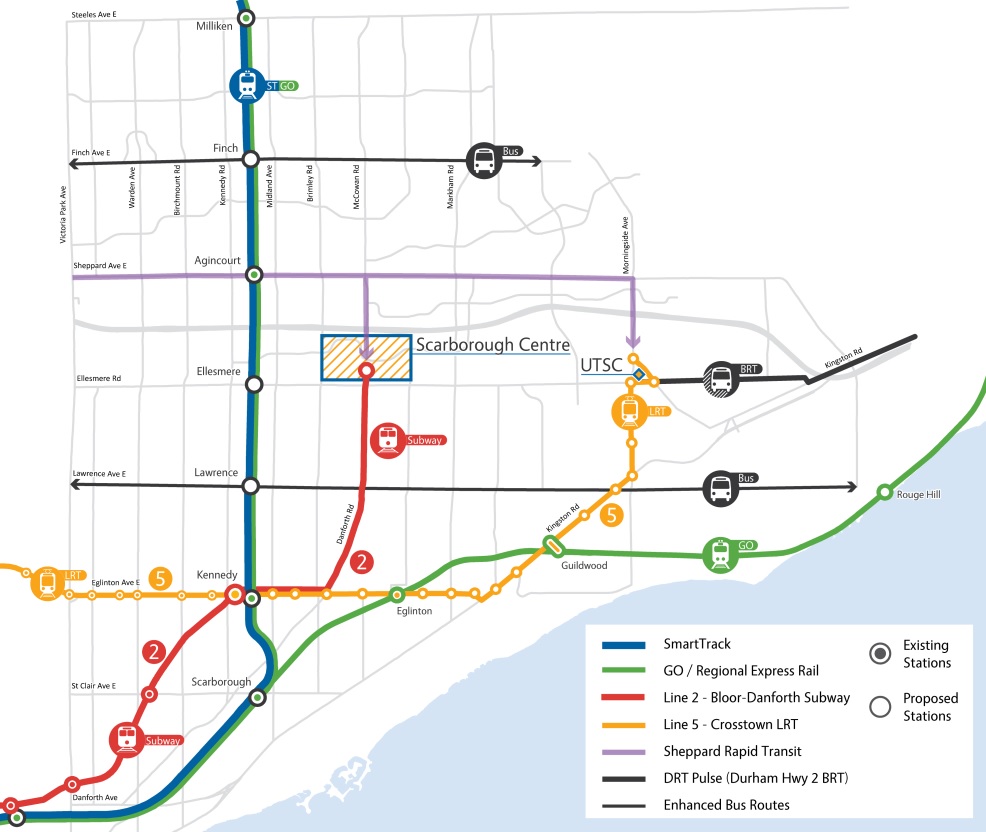
    City Scarborough MapCity of Toronto map from February 2016 illustrating current plans for the Scarborough Subway and connecting transit.

    At the public consultation, TTC and City planning staff answered queries from members of the public, many questioning the utility of the single-stop subway. There are no additional funds to rough in future stations, such as at McCowan Road and Lawrence Avenue, where the line would intersect the busy 54 Lawrence East bus and serve Scarborough General Hospital. As building future stations later would require an extended shut-down of the line, the one-stop subway extension will likely be forever a one-stop subway.

    (The eastern extension of the Eglinton-Crosstown LRT from Kennedy Station to University of Toronto’s Scarborough Campus is also part of the new plan for Scarborough, but the LRT component is unfunded.)

    Shameless as ever, Councillor De Baeremaeker resorted to strawman arguments, talking up a “suburban/urban divide”:

    [De Baeremaeker] blamed “downtown councillors,” who represent the most densely populated wards in the city, for not wanting to fund more frequent transit stops like their residents enjoy.

    Yes, it is true that all councillors representing central Toronto opposed the subway extension, but so did several suburban politicians, most notably Councillor Paul Ainslie (Ward 43 – Scarborough East). Yet not one of those councillors wanted less transit for Scarborough. Instead, they backed a seven-stop LRT replacement for the ageing Scarborough rapid transit line, including an extension to Centennial College and Sheppard Avenue in Malvern. That less-expensive line was fully funded by the provincial government, which would have permitted scarce funds to be spent on other transit projects across Toronto.

    Meanwhile Mayor John Tory was most interested in pushing SmartTrack, a fantasy rail project that got pared down as parts of the line were found to be impossible to build, and costs increased. The eastern end of SmartTrack conflicted with the Scarborough Subway extension. The three-stop subway plan was cut to a single stop at Scarborough Centre, to keep costs down and to not cannibalize SmartTrack.

    Yet Tory and De Baeremaeker are allies on the subway extension; Tory named him one of his Deputy Mayors to champion the line. But Tory’s push for his own project put him at odds with De Baeremaeker’s focus on the subway extension, any subway extension, to his ward.

    It is also worth noting that until 2012, De Baeremaeker supported Transit City, the transit plan championed by David Miller that would have delivered three new light rail lines to Scarborough.

    I am not surprised by De Baeremaeker’s shameless politics. But his performance last night was especially crass and dishonest. Backed into a corner, faced with angry local residents, he lashed out at imaginary villains. But subway backers largely have themselves to blame; despite winning every recent vote on the subway plan, they have only one stop to show for it.
  • Suburban stations for urban needs: accessing GO Transit’s proposed new stations

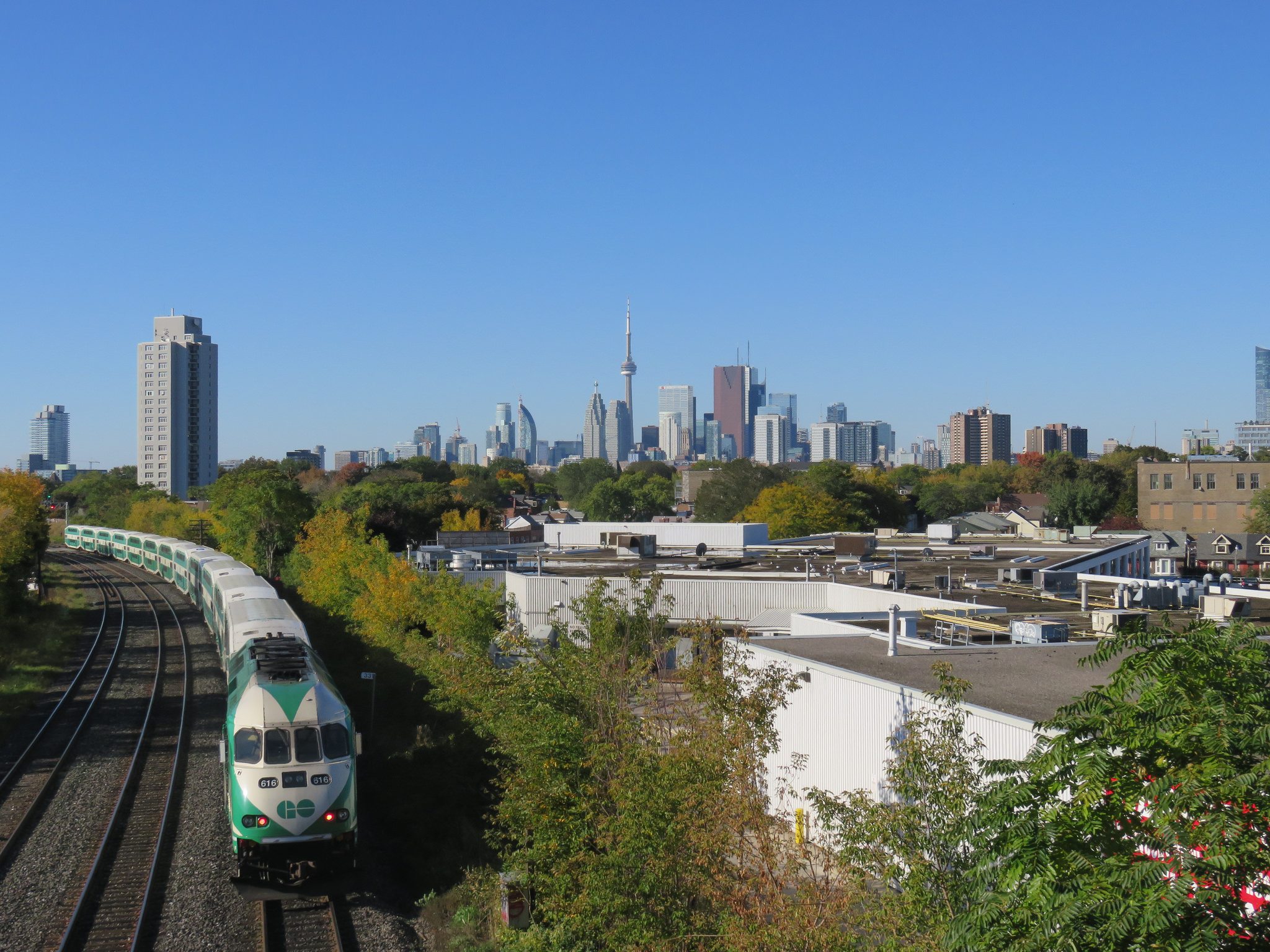
    21505188673_1d34d85175_kGO Transit train from the Pape Avenue footbridge, near the proposed site of Gerrard Station
    At its last board meeting on December 8
    , Metrolinx presented an update on the status of twelve new GO Transit rail stations, all located on existing lines. Eight of these proposed new stations are located in the City of Toronto; and six of those are station locations once promised as part of John Tory’s SmartTrack proposal. Unfortunately, the proposed new station designs (all available in this Metrolinx report) appear to be similar to existing GO stations in the suburbs, with needlessly large bus loops, PPUDOs, and parking lots. Development opportunities are limited.

    Transit connections at some proposed stations, like St. Clair West, are poor or practically non-existent. This is rather unfortunate, as SmartTrack was originally proposed as a frequent, subway-like service between Mississauga and Markham, with full TTC fare integration. Today, it’s merely six additional stations on existing GO Transit rail corridors. Without quick and seamless connections to the subway and surface TTC routes, the ability to provide any transit relief is compromised.

    I have more to say on this at Spacing Toronto.


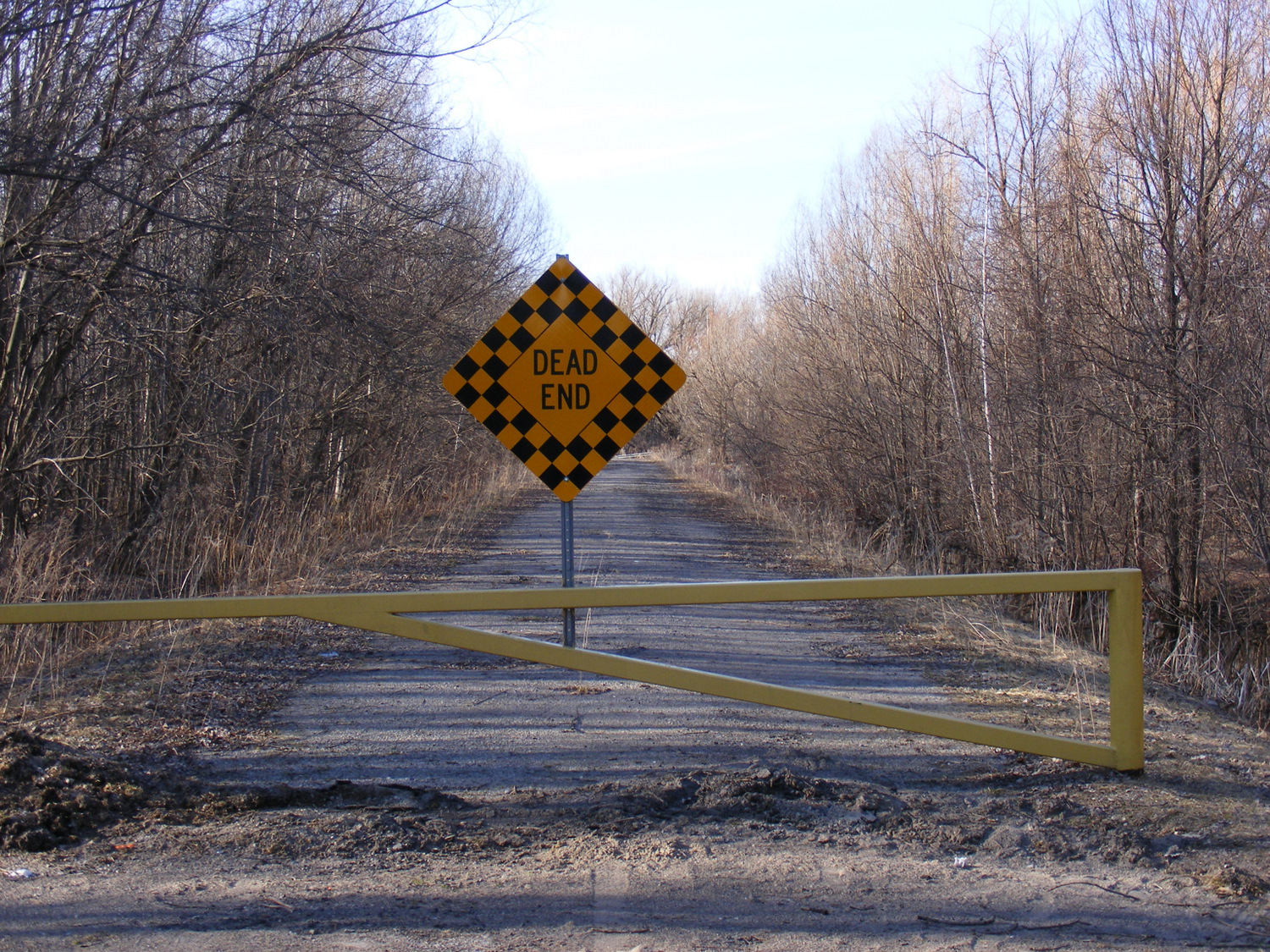
  • From the vaults: the end of Yonge Street

    5608188561_bf233bac9d_o

    Note: This article was previously published in Spacing Toronto on April 13, 2011.

    One of Toronto’s greatest debates concerns Yonge Street’s controversial claim as “the World’s Longest Street.” Indeed, the Guinness Book of World Records published Yonge Street’s status as the true record until 1999; a bronze art installation in front of the Eaton Centre at Yonge and Dundas has a map of Yonge Street extending to Rainy River.

    This claim rests on the rather tenuous claim that that the 1,896 kilometre length of Yonge Street from Queen’s Quay on Toronto’s Harbourfront to Rainy River via Highway 11, at the Minnesota-Ontario border is in fact, the longest continuous “street.”

    While a popular claim, I’ve been a skeptic of this local legend. Highway 11 and Yonge Street have never been one and the the same, especially after the downloading of Highway 11 south of Barrie by the Harris government in the late 1990s.

    In 1920, Yonge Street was added to the Ontario provincial highway systemas Highway 11, which extended from Downtown Toronto as far as the end of Simcoe County, at the Severn River north of Orillia, where an unnumbered highway continued through the unincorporated Districts of Muskoka, Parry Sound and Nipissing to North Bay. In 1937, Highway 11 assumed the Severn River-North Bay portion and the newly-completed North Bay-Hearst section.

    During the Second World War, the section between Nipigon and Hearst was completed; it finally provided a complete provincial highway link between the Manitoba and Quebec borders and formed a crucial part of the Trans-Canada Highway until the more direct Highway 17 link from Sault Ste. Marie to Wawa was completed in the 1960s. Indeed, Highway 11 could still claim as the longest signed route within a sub-national entity but several national routes, such as US Interstates and US highways, are longer. In fact, the last reference to Yonge Street on Highway 11 north of Holland Landing is a short section of former Highway 11 in south Barrie.

    (more…)

  • Brampton’s Etobicoke Creek: floods, concrete, and new public spaces

    20438289892_d6cd9cb6c9_z

    Over at Spacing, I wrote about a recent Jane’s Walk that I led on Downtown Brampton and Etobicoke Creek.

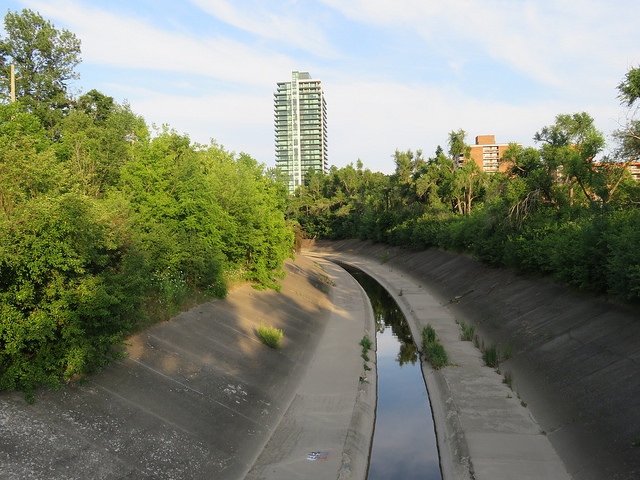
    Until a concrete diversion channel was built in the 1950s, Downtown Brampton would regularly flood as it was built right on top of the creek. The concrete diversion, fenced off and cut off from both the downtown core and the rest of the Etobicoke Creek ravine to the north and south, is an eyesore.

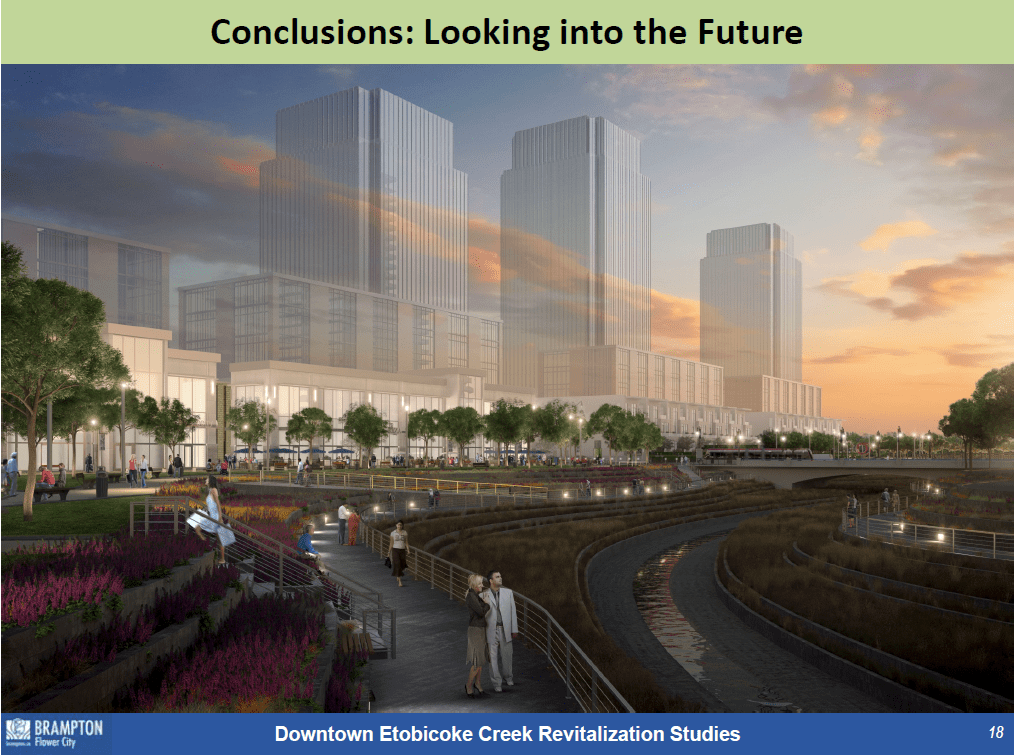
    Happily, the City of Brampton is planning to revitalize the channel, which is nearing the end of its useful life and must be reconstructed. The proposed concept, pictured below, includes new public spaces and urban development.

    Etobicoke Creek
    Conceptual drawing of revitalized Etobicoke Creek 

    Of course, during the walk, there was a discussion of the Hurontario-Main LRT, a subject I’ve written about here several times before. Some local councillors and one local advocacy group, Citizens for a Better Brampton, opposed the Main Street surface alignment, and want to push for an Etobicoke Creek route into Downtown Brampton. It would not only wreck a lovely ravine (where one can spot plenty of wildlife), but it would be located in a floodplain, and near the backyards of less-wealthy residents. There’s now a petition to nix that route. Of course, the cheapest and most logical route is along Main Street itself, but a dysfunctional and misguided Council continues to refuse to accept that fact.

    It was a pleasure leading a Jane’s Walk, and I learned a lot myself from the conversations that we had along the way; a good Jane’s Walk is when local residents participate and share their knowledge. Leading a walk is a lot of fun, and something that’s quite easy to do. And it need not be on the “official” Jane’s Walk weekend (this year, it was May 6-8), but anytime of the year.

    I’ll be leading another walk on Sunday June 12 at 3PM, in Bramalea, meeting at the civic centre across from the mall. Bramalea , billed as “Canada’s first satellite city” when planned and constructed starting in the early 1960s. There’s an interesting diversity of housing types, and an effort to build great greenspaces and linear parks, with a civic centre and shopping mall anchoring the large development.